Article

Application of Blockchain Technologies and Smart Contracts for the Storage and Verification of Academic Transcripts in the Higher Education Systems


by
Olga Ussatova
1,2,
Vladislav Karyukin
1,3,*,
Yenlik Begimbayeva
1,2,
Galimkair Mutanov
1,
Yerlan Kistaubayev
1,3 and
Medet Turdaliyev
1,3
1
Institute of Information and Computational Technologies, Almaty 050010, Kazakhstan
2
Department of Cybersecurity, Energo University, Almaty 050013, Kazakhstan
3
Department of Information Systems, Al-Farabi Kazakh National University, Almaty 050040, Kazakhstan
*
Author to whom correspondence should be addressed.
Information 2026, 17(5), 478; https://doi.org/10.3390/info17050478
Submission received: 4 April 2026 / Revised: 6 May 2026 / Accepted: 7 May 2026 / Published: 13 May 2026
(This article belongs to the Section Information Systems)

Abstract

This article discusses the practical implementation of a prototype academic transcript storage system based on blockchain technology and smart contracts. The digital transformation of higher education requires reliable mechanisms for ensuring the integrity and verifiability of academic documents. It presents the design and experimental validation of a blockchain-based system for storing and verifying academic transcripts within the higher education system of the Republic of Kazakhstan. The proposed solution is based on an Ethereum Virtual Machine-compatible smart contract implemented in Solidity and deployed on a test network. The testnet was used as the experimental environment, and transaction monitoring was performed using the BlockScout v11.0.3 explorer. The architecture of the TranscriptStorage smart contract is presented, including a role-based access model, a data indexing mechanism using keccak-256, and storage of transcripts in a mapping structure (bytes32 => Transcript[ ]). The experimental results confirm the successful recording of the Transcript in the distributed ledger, event recording (Logs), and the correctness of the ABI encoding of input parameters (Raw Input), as well as a change in state (State Changes) reflecting the fee payment. The use of events is shown to enable cost-effective third-party data verification without the need to store the entire text in the contract state. The comparative results showed that the proposed system reduced gas consumption by 804.5% compared to Blockcerts, 48.8% compared to ECertChain, 82.5% compared to ShikkhaChain, and 43.5% compared to zkEVM. These improvements were achieved while maintaining high scalability, robust privacy features, and security, making it a practical solution for Kazakhstan’s educational system.

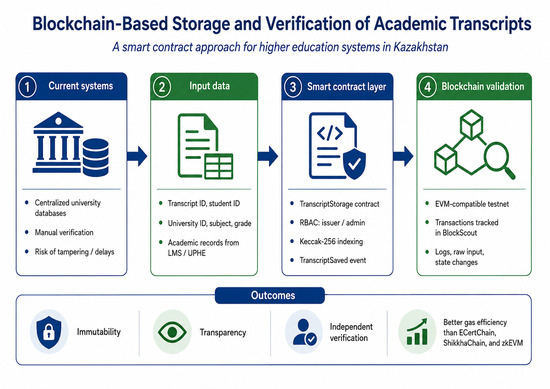
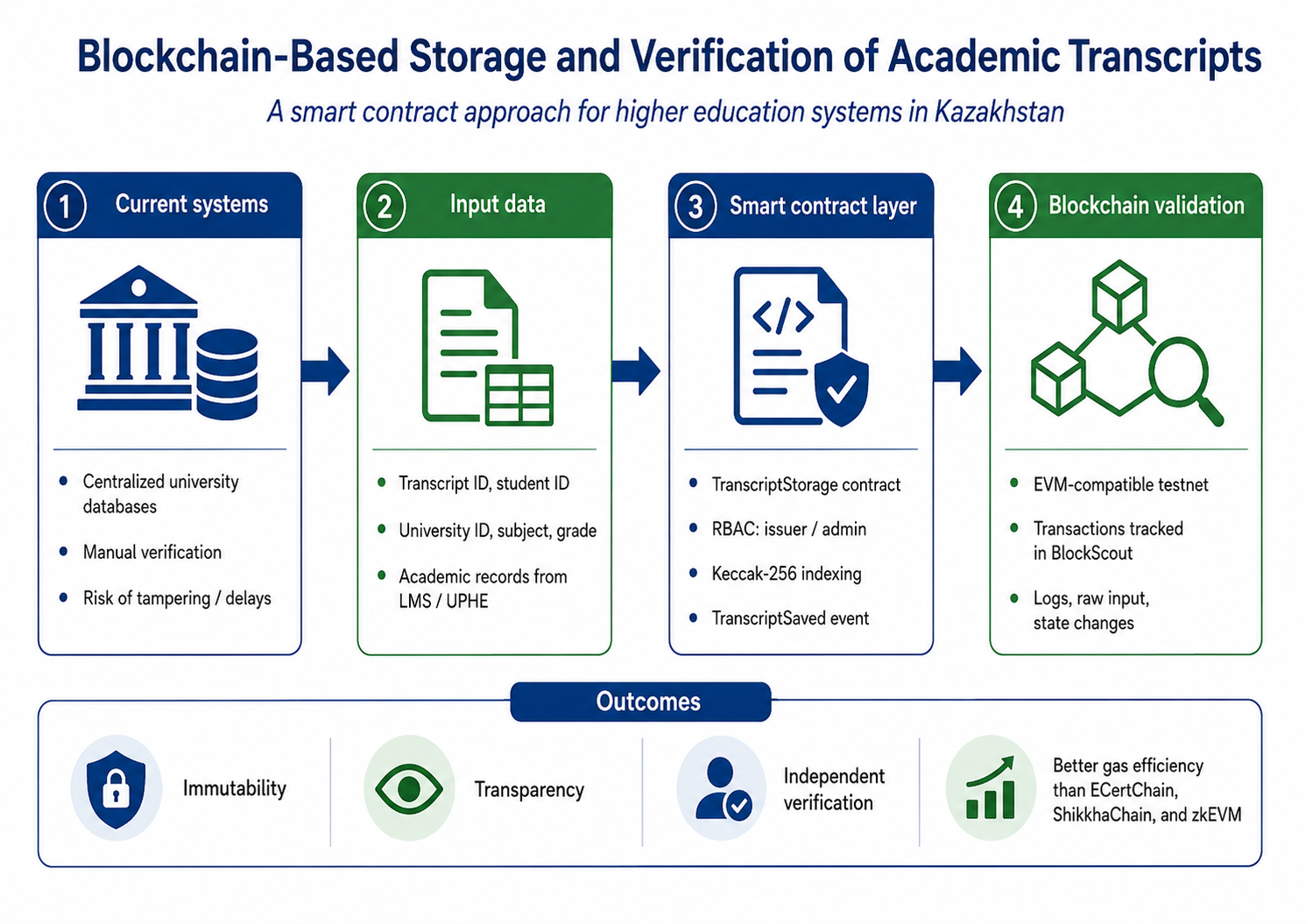
Graphical Abstract

1. Introduction

Automated systems for managing higher and postgraduate education (HPE) [1] have become essential instruments in the digital transformation of modern educational environments. Their importance has grown considerably with the expansion of e-government initiatives, the growing demand for transparency in educational administration, and the widespread adoption of digital services [2] across the public and private sectors. Contemporary universities rely on integrated information systems to manage students’ academic trajectories [3], register courses and learning outcomes, generate academic transcripts, organize schedules, monitor the educational process, and support curriculum implementation. In addition, data generated by HPE systems is frequently used for communication with government authorities, accreditation organizations, and employers, underscoring the need for accurate and reliable educational records. A key function of HPE systems is the issuance of official academic documents, including transcripts, diploma supplements, certificates of study, qualification confirmations, and other records reflecting students’ academic achievements. As higher education becomes increasingly integrated into the global academic space [4], the demand for trustworthy mechanisms for verifying such documents continues to grow. However, existing methods for validating academic credentials often remain fragmented and heavily dependent on centralized procedures within individual universities [5]. In many cases, verification requires formal requests, official correspondence, stamps, and signatures, making the process slow, administratively burdensome, and vulnerable to human error.
Moreover, traditional mechanisms do not provide a strict cryptographic guarantee of document immutability after issuance, and the centralized architectures characteristic of most modern educational information systems [6] have a number of significant limitations. First, centralized databases are susceptible to unauthorized record modification, both from external attacks and internal administrative errors. Second, problems with long-term data storage and reproducibility arise when software platforms are changed, and infrastructure is updated. Third, interuniversity data exchange within a single country, and especially internationally, remains technically challenging, as each organization uses its own data representation standards, and uniform mechanisms for independent verification [7] are often lacking.
Thus, there is a need to develop solutions that ensure trust in academic documents at the university’s internal level and throughout the entire educational process. In this context, a promising direction is the use of distributed ledger technologies (Distributed Ledger Technology), namely the Blockchain and Smart contracts [8]. Blockchain is a mechanism for formalizing rules for recording and verifying data. Blockchain [9] is a distributed database in which records are recorded as a chain of blocks and protected by cryptographic methods. One of its key characteristics is data immutability: once a transaction is included in a block, changing a record becomes virtually impossible without disrupting the network’s consistency. It makes blockchain technology particularly well-suited for applications involving document authentication and establishing trust in digital records. Smart contracts [10] allow the implementation of programmable business logic directly within the blockchain protocol. They automatically execute predefined conditions specified by developers and reduce the need for intermediaries in critical operations. Within the framework of information systems used by organizations of higher and postgraduate education (OHPE), smart contracts [11] can be applied to register academic transcripts, record their issuance, regulate access to data, enable controlled updates, and provide mechanisms for public verification. Such functionality is especially important for academic transcripts, which must remain legally valid, easily verifiable by universities, employers, and government authorities, and securely protected from forgery.
Despite the growing number of works on blockchain-based credential verification systems, significant gaps remain, particularly in integrating blockchain technologies into existing educational infrastructures that rely heavily on centralized control. These solutions often overlook the institutional, regulatory, and operational realities of countries with centralized educational systems, such as Kazakhstan. The current study addresses this gap by proposing a context-aware solution that adapts blockchain principles to the Unified Platform for Higher Education (UPHE) of Kazakhstan, where universities operate under the guidance of a central regulatory body. This research not only explores the integration of Blockchain with existing systems but also demonstrates its practical application for ensuring transparency, immutability, and security in academic records.
The aim of this work is to develop and experimentally test Smart contracts for recording academic transcripts [12] in a distributed ledger, and to demonstrate the technical verification of transactions and events using the BlockScout v11.0.3 explorer. The novelty of the proposed blockchain-based system lies in integrating Blockchain and smart contract technologies into an existing national educational infrastructure that previously operated without decentralized verification mechanisms. While numerous blockchain-based credential verification systems have been proposed globally, the present work introduces a context-aware architectural enhancement to the unified platform for higher education (UPHE), adapting blockchain principles to the specific institutional, regulatory, and operational environment of Kazakhstan. Unlike many similar implementations in Europe and the United States, its fundamental functionality is determined by the presence of a central UPHE system, while most of the other systems propose private student-university communication with the use of Bitcoin-based transactions. Moreover, the functionalities and characteristics of the proposed system are also compared with those of other blockchain systems, including Blockcerts [13], EcertChain [14], ShikkhaChain [15], and zkEVM [16]. This distinguishes the system not merely as another implementation of blockchain credentials, but as a localized and system-level transformation of an existing educational ecosystem.

2. Related Works

Thematic areas of work on the application of Blockchain technology and Smart Contracts in the field of education cover the following areas:
Use of Blockchain for digital diplomas and transcripts;
Access control and privacy models;
Scalability and cost of data storage in Ethereum Virtual Machine (EVM) networks;
Integration of smart contracts with external information systems.
Research examines Blockchain as a tool for ensuring trust in educational documents through its immutability and public verifiability. However, storing the full text of a document in a smart contract is cost-ineffective, so a common practice is to store a document hash or metadata and emit events to confirm the recording.

2.1. Blockchain and Educational Documents

The article [17] proposes a smart contract-based higher education system using zkEVM as a scaling solution. The authors focus on certificate issuing and verification, interoperability, privacy, and GDPR-related concerns. The article combines off-chain data management with on-chain verification via validity proofs to reduce transaction costs and improve scalability. However, the proposed system requires complex infrastructure, including zkEVM components and data availability mechanisms, which may limit practical deployment in conventional university environments.
The article [18] examines the applications of Blockchain technology in education, emphasizing its key properties, including decentralization, traceability, immutability, and trust. The authors discuss the use of Blockchain for managing academic certificates, reducing degree fraud, recording learning activities, supporting formative assessment, and implementing smart contract-based educational interactions. It generally identifies general educational use cases of Blockchain, but it does not address the practical deployment requirements of a national academic record verification platform.
In the article [19], a systematic review of Blockchain in education highlights its potential to improve academic data management, including secure storage and verification of certificates and transcripts. The study identifies key benefits, including greater transparency, enhanced data security, and reduced verification costs. However, it also notes challenges in scalability, smart contract security, and the lack of real-world implementations, emphasizing the need for further empirical research and exploration of Blockchain’s full potential in education.

2.2. Smart Contracts in Educational Systems

In the article [20], the challenges in digital educational records management on privacy and secure sharing are addressed. It proposes using an EduRSS framework that combines a consortium blockchain, off-chain encrypted storage, and smart contracts to ensure the integrity and privacy of records. The framework stores records off-chain with on-chain hashing for security, smart contracts manage storage, access, and record exchange without relying on centralized authorities. A pilot implementation was evaluated for security and efficiency compared to traditional access control systems. However, the system still relies on centralized off-chain storage servers and requires further development for external verification, smart contract management, and integration with decentralized storage.
The study [21] reviews blockchain-based micro-credentialing systems in higher education and identifies requirements, such as secure credential management, privacy-preserving sharing, decentralized student access, and personalized learning recommendations. Their analysis shows that most existing platforms focus on storing and verifying micro-credentials, while a few support intelligent recommendations or decision-making. However, the study is limited to a systematic review and does not provide a deployable architecture for academic transcript verification.
The research [22] analyzes blockchain-based academic certificate systems, including Blockcert, Open Certificates, CERTbchainIoT, BCERT, and Edgecoin. This study highlights Blockchain’s potential to improve certificate security, transparency, immutability, and fraud prevention in higher education. The authors also compare blockchain frameworks such as custom permissioned systems, Ethereum, and Hyperledger Fabric.

2.3. Access Management and Smart Contract Security

The paper [23] proposes a VerX framework for automatically verifying temporal safety properties of Ethereum smart contracts. By combining symbolic execution and delayed predicate abstraction, VerX can check custom functional requirements beyond generic vulnerability detection. Although not designed for education, the study is relevant because blockchain-based academic record systems rely on smart contracts whose correctness and access-control logic must be formally verified before deployment.
The paper [24] presents a blockchain-based educational document management system that combines smart contract-based role access control with machine learning (ML) for malicious user detection. The study demonstrates the potential of integrating Blockchain, access controls, and security analytics to protect educational records. However, its architecture is complex and focuses on general document management rather than lightweight transcript verification integrated into an existing national education system.
The paper [25] explores EduASAC, a blockchain-based education platform for sharing and access control designed to improve the security of educational archive storage. The system integrates a dual-mode access control model (DAC + MAC) and adapts the ACE (OAuth 2.0) framework for blockchain-based authorization [26]. Four smart contracts are introduced to manage node voting, parameter mapping, access control lists, and permission verification [27]. The study is relevant because it provides a fine-grained, blockchain-based access-control framework for educational records [28]. However, the system is more complex than lightweight transcript verification solutions because it relies on homomorphic encryption, multiple smart contracts, government-side authority roles, and detailed permission management mechanisms [29].
To provide a clearer analytical interpretation of the reviewed studies, a comparative summary of the main blockchain-based approaches in education is shown in Table 1. The comparison focuses on the research objective, technological contribution, limitations, and relevance to the proposed system. This analysis shows that although previous studies have demonstrated the potential of Blockchain for educational records, credential verification, privacy protection, and access control, many of them remain conceptual, lack integration with existing national educational platforms, or do not sufficiently address the operational constraints of centralized educational systems.
The comparative analysis shows that existing studies mainly focus on: general blockchain-based educational record verification, privacy-preserving record sharing, and smart contract-based access control. However, many proposed systems remain conceptual or are designed for decentralized institutional environments rather than centralized national education systems. In contrast, the proposed solution is designed as a practical extension of an existing educational platform in Kazakhstan. It combines smart contract record registration, hash indexing, and event verification while avoiding the cost of storing full academic records directly on-chain. Therefore, the proposed system addresses the gap between blockchain-based credential verification and its practical deployment within a regulated national educational infrastructure.

3. Materials and Methods

3.1. Development of the OHPE in the Republic of Kazakhstan and the Use of Blockchain Approaches

In the Republic of Kazakhstan, the digitalization of higher education is developing within the framework of the state’s e-government policy and the modernization of educational services [30]. Universities use learning management systems (LMS), electronic journals, course registration systems, and platforms to generate academic transcripts. Despite the high level of automation, verifying document authenticity in interuniversity and international contexts remains a key challenge.
The use of Blockchain in Kazakhstan’s higher education systems could provide a mechanism for processing critical documents, such as transcripts and diplomas. Blockchain can be used in both public and consortium models, where authorized organizations, such as universities or government agencies, act as validators.
Currently, modern universities in Kazakhstan actively use various LMS systems [31], electronic journals and records, automated course registration systems [32], educational trajectory and academic mobility platforms, as well as digital services [33] for generating academic transcripts.
The most widespread systems are Univer 2.0 (Almaty, Kazakhstan), Platonus (Astana, Kazakhstan), Sirius (Almaty, Kazakhstan), Sportal (Ust-Kamenogorsk, Kazakhstan), Tamos System (Almaty, Kazakhstan), Electronic Rectorate (Petropavlovsk, Kazakhstan), and 1C: University (Moscow, Russia). These platforms are commonly used to manage educational processes, store student-related academic data, and automate institutional workflows.
Univer 2.0 is a university information system used to automate core academic processes, including student registration, curriculum management, course enrollment, grade recording, transcript generation, and academic progress monitoring. This system is especially relevant for managing interactions among students, academic staff, advisors, departments, and registrar’s offices. In the context of the proposed blockchain-based solution, Univer 2.0 can be considered a source system from which verified academic data may be transferred to the blockchain layer for immutable registration and independent verification.
Platonus is one of the widely used educational automation platforms in Kazakhstan and other post-Soviet higher education environments. It supports the management of educational programs, student records, electronic journals, grades, schedules, attendance, individual study plans, and academic reporting. Platonus is not limited to learning management; it also performs many functions of a student information system and an academic administration platform. Therefore, integration with Platonus would allow universities to register selected academic records, such as transcripts or course results, in the Blockchain without altering existing institutional workflows.
Sirius is a Moodle-based digital educational platform designed for undergraduate, graduate, and postgraduate students. It provides access to online courses, allows students to upload assignments, take quizzes, view achievements, and view course materials. Sirius is used to manage academic data, student progress, schedules, and internal university administrative processes. This system centralizes educational information and supports communication between administrative units and academic staff. In the proposed blockchain architecture, Sirius serves as an institutional information source, while the blockchain component provides an additional verification layer for records that require long-term integrity, traceability, and external validation.
Sportal is another educational and administrative platform that supports university-level digital workflows. It includes tools for managing students, academic staff, courses, academic schedules, educational documents, and internal reporting. In the context of higher education digitalization, Sportal helps universities reduce manual paperwork and improve access to academic information. The proposed blockchain-based transcript verification system can complement such platforms by ensuring that important academic records are cryptographically registered and protected against unauthorized modification.
Tamos System is designed to support the management of educational institutions and their academic processes. It is used to organize student data, monitor academic performance, support communication, and manage institutional documentation. In Kazakhstan’s educational environment, such platforms contribute to the transition from paper-based administration to digital record management. However, like other centralized systems, Tamos System still relies on institutional databases; therefore, blockchain integration could strengthen trust by providing immutability, audit trails, and independent verification mechanisms.
Electronic Rectorate is an institutional management and decision-support system aimed at automating administrative processes within a university. It supports monitoring of academic performance, department reports, document flow, staff activities, student data, and management-level analytics. Unlike a classical LMS, Electronic Rectorate is more focused on university governance and administrative oversight. For this reason, it is relevant to the proposed architecture as part of the broader digital university infrastructure, where blockchain can provide reliable evidence of academic record creation, modification, and verification.
1C: University is an enterprise-level information system adapted for higher education institutions. It supports the automation of administrative, educational, financial, personnel, and document-management processes. 1C: University can be used for student record management, educational program administration, orders, reporting, accounting, and integration with other institutional services. Since 1C-based systems are often used as centralized management platforms, the proposed blockchain solution can extend their functionality by providing a trusted external verification layer for academic transcripts and other legally significant educational records.
The flagship educational institution in the Republic of Kazakhstan, Al-Farabi Kazakh National University, utilizes three major information systems:
Univer is an educational information system covering the entire educational process.
Moodle is a distance learning system that provides access to educational resources and interaction between students and teachers.
Massive open online courses (MOOCs) are online educational platforms that expand distance learning opportunities and access to educational materials.
Univer system is an integrated information and educational platform designed to automate key processes in the management of a university’s academic, research, and administrative activities. It covers the entire student engagement cycle, from admissions to graduation.
The Moodle LMS system also demonstrates the active use of digital technologies in distance and blended learning. The Moodle platform provides students with access to a wide range of educational materials, including lectures, seminars, tests, and other assignments. Each subject is presented as a separate course, developed by instructors based on the curriculum. The platform allows for easy organization of both live and asynchronous classes. Results are stored in the system, allowing instructors to analyze student progress and students to track their own.
Open Platform KazNU provides access to a wide range of online courses developed by leading university faculty. The platform is open to students, providing widespread access to educational resources. It offers a variety of courses in the natural sciences, engineering, and humanities in Kazakh, Russian, and English. The courses include video lectures, practical exercises, tests, and other materials. Upon completion, students receive certificates of successful completion and mastery of the materials.
Despite the high level of automation of internal processes, a significant portion of critical documents (transcripts, diplomas, diploma supplements, and others) still depend on centralized repositories and internal university databases. This architecture does not guarantee information confidentiality and poses potential risks, including unauthorized changes to records, data migration errors, difficulties with long-term data storage during software upgrades, and reliance on a specific issuing organization.
In this regard, the implementation of Blockchain technology [34] is a critical element in the security of educational data. The use of Blockchain [35] allows for the creation of a unified mechanism for critical educational data. Its main advantage is that records in a distributed ledger are immutable: once a transaction is included in a block, the data cannot be changed without breaking the network consensus. This makes Blockchain particularly promising for storing proof of academic achievement, as a transcript or diploma can be linked to a unique cryptographic identifier, and its registration is recorded in the Blockchain.
An additional advantage is the ability to automate processes through smart contracts—programmable algorithms executed at the blockchain protocol level. Smart contracts allow for the formalization of transcript recording rules, access rights, and third-party data verification mechanisms. In the context of Kazakhstan, this could provide a unified technical standard for the interuniversity exchange of academic documents and increase trust in digital educational services. Moreover, the blockchain architecture [36] can be implemented in both public and consortium models. A public blockchain ensures maximum transparency and accessibility for verification [37], but requires stricter measures to protect personal data and control information disclosure. A consortium blockchain is preferable for the educational sector, as authorized organizations [38], such as universities, government agencies, national accreditation centers, or specialized educational platforms, can serve as network validators.
Thus, the development of higher professional education in Kazakhstan naturally requires implementing solutions that ensure the long-term integrity, verifiability, and legal validity of academic documents [39]. Blockchain and smart contracts [40] provide the technological foundation for building a scalable transcription system that ensures immutability, cryptographic security, operational transparency, and independent verification without intermediaries. It is also necessary to describe the functional and non-functional aspects and include the following.
Functional Requirements:
Blockchain Integration: The system must integrate with a blockchain-based infrastructure to ensure data immutability and transparent record-keeping.
Smart Contract Implementation: The system should leverage smart contracts to automate processes such as recording academic transcripts, verifying authenticity, and controlling access.
Role-Based Access Control (RBAC): The solution should incorporate RBAC to ensure only authorized entities can write or modify academic records, adding an additional layer of security.
Decentralized Document Verification: The system must allow external parties to verify academic records without directly accessing the institution’s centralized database.
Non-Functional Requirements:
Performance: The system must be scalable to handle thousands of transactions and operate with minimal delays, as demonstrated by its performance in the test network. The blockchain network should maintain stable throughput, processing up to 90 transactions per block and keeping a consistent 15 s block interval.
Scalability: The system must be scalable to support a growing number of students, academic transcript records, universities, authorized users, and external verification requests. As the system is intended for integration into the higher professional education environment of Kazakhstan, it should be capable of handling thousands of blockchain transactions and expanding to multiple educational institutions without significant degradation in throughput or verification efficiency.
Security: Cryptographic security must be implemented to protect sensitive academic data. The solution should support end-to-end encryption and prevent unauthorized access.
Privacy: The system must ensure that personal information (student identifiers) is protected, possibly through anonymization or privacy-enhancing technologies.
Cost Efficiency: The system should minimize gas consumption per transaction to reduce operational costs, as evidenced by the 804.5% improvement over Blockcerts and other comparative systems.
Interoperability: The solution must be able to integrate with existing systems used by educational institutions in Kazakhstan, such as learning management systems (LMS) and student registration platforms.
Transparency and Auditability: The system should support logging all events (e.g., transcript creation and modification) on the Blockchain for full auditability and traceability.
All the mentioned requirements make Blockchain approaches a promising tool for the further development of digital educational services in the Republic of Kazakhstan. After the requirements had been stated, the testing strategies were proposed. The solution was implemented in an environment where it was simulated on real-world conditions without incurring transaction costs on the main Ethereum network. The BlockScout v11.0.3 tool was used as the primary instrument for monitoring transactions, ensuring transparency and reproducibility of results. It allowed tracking transaction executions and validating the accuracy of transaction data and recorded transcripts. The functionality was tested on the core smart contract features, including registration and retrieval of academic transcripts. This ensured that the system accurately recorded, stored, and retrieved data as intended. The RBAC conducted tests to ensure that only authorized entities could interact with the smart contract to add or modify academic records. Then, gas consumption for each transaction was tested to ensure that the system is cost-effective and performs optimally under various conditions. The transaction throughput and block production time were evaluated to confirm that the system can sustain a stable number of transactions per second and maintain consistent block time. Moreover, various scalability and load-testing scenarios were implemented to assess the system’s ability to handle high transaction volumes. The system’s ability to handle both simple and complex operations was also experimented with to confirm that the smart contracts could scale efficiently without compromising performance. The security testing warrants that sensitive academic data is encrypted and stored securely on the Blockchain. This involved testing encryption and access control mechanisms. All events and transactions were logged using the BlockScout explorer, ensuring complete transparency in the system’s operation and enabling third-party verification of academic records without direct access to the institution’s database. The functional tests confirmed that the system correctly performs its core operations of storing and verifying academic transcripts according to the specified requirements. The performance tests demonstrated that the system achieved significant improvements in gas efficiency compared to existing blockchain-based solutions, such as Blockcerts, ECertChain, ShikkhaChain, and zkEVM. The security and privacy tests confirmed that the system implemented robust mechanisms to protect data and ensure transparency through blockchain immutability and event logging. All these methodological parts are demonstrated in the subsequent sections.

3.2. Blockchain Environment and Transaction Monitoring via BlockScout

The Blockchain-based security for educational documents used a testnet of the EVM-compatible Blockchain in Blockscout. Blockscout is a specialized web tool designed for data visualization and analysis. It is an explorer module that allows you to view the blockchain block structure, analyze chain tracking, addresses, interact with smart contracts, and access detailed network status information. One of the main advantages of Blockscout is its ability to be deployed on your own infrastructure. Unlike public explorers like Etherscan, which only work with public networks, Blockscout can be installed for local use, making it particularly valuable for developments that require data control, independence from external services, and the ability to operate on a closed network. This makes Blockscout widely used in the development and implementation of smart contracts in modern systems. To protect electronic educational documents, Blockscout is the primary tool for monitoring network operations and verifying transaction correctness. Through the observer interface, it is possible to monitor and record the transaction, the addresses that initiated it, the values transferred, and the blocks in which it was confirmed. This coverage ensures transparency and reproducibility in the document registration process, a mandatory requirement for system verification.
The experimental workflow begins by deploying the EVM-compatible Blockchain on the testnet, simulating real-world conditions without incurring transaction costs. The smart contract for academic transcript recording integrates with an external IRBAC role management module to enforce access controls. BlockScout is set up as the primary tool for monitoring transactions and verifying blockchain operations. Transaction monitoring is performed using BlockScout, which tracks transaction execution, including the transaction hash, sender and recipient addresses, gas consumption, and transaction status. This monitoring helps confirm the successful inclusion of the transaction in the Blockchain and checks the number of block confirmations, verifying the record’s reliability. The logs generated by BlockScout are then analyzed to ensure the data recorded in the Blockchain is properly consistent. For performance evaluation, gas consumption per transaction is measured to confirm the system’s efficiency and ensure it operates within the available block capacity. Additionally, transaction throughput and block production time are evaluated, with the system showing stable performance. Load testing is performed by simulating a high volume of concurrent transactions to assess the system’s scalability. The system’s ability to maintain performance under heavy load is also evaluated. Lastly, security and privacy tests are conducted to ensure that the academic data is securely encrypted and stored on the Blockchain.
Blockscout transaction activity is shown in Figure 1.
The BlockScout homepage includes a section on analyzing network transaction activity. At the top of the interface is a universal search that allows you to access data by address, transfer hash, block number, or token. This is a quick, primary navigation tool that allows users to navigate to a specific transaction or account and verify that the data has been recorded in the column. It also displays a daily transaction metric, allowing users to visualize current activity, load, and network utilization.
The main block displays completed transactions. Since these transactions are marked as Success, they have been successfully included in the block and confirmed by the network. Each transaction in the list contains key information:
The transaction is the type of operation (regular transaction or interaction with a smart contract).
The transaction hash (e.g., 0xdf6652a…bd2) is a unique identifier that can be used to view detailed information about the transaction.
Execution time shows how much time has passed since the transaction was confirmed.
Sender and recipient addresses are presented in abbreviated form as 0xb9…D150 → 0 × 69…38E2. This information allows you to see the direction of the transfer or call.
Value is the amount passed in a transaction that indicates it was used to call a smart contract function.
Fee is a network commission for executing a transaction (for example, 0.00023 ETH). This is a key value that reflects the cost of performing the operation and gas consumption.
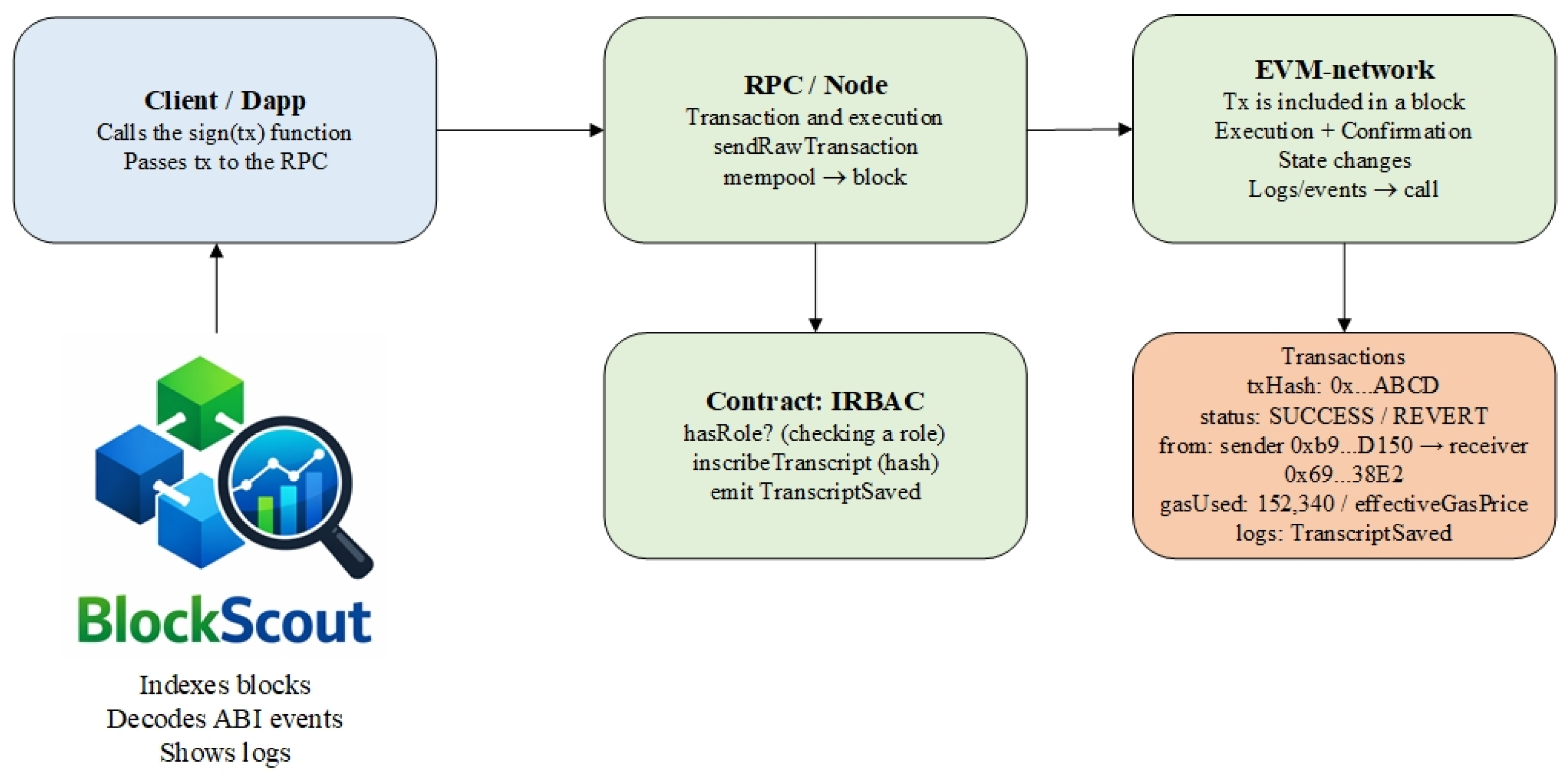
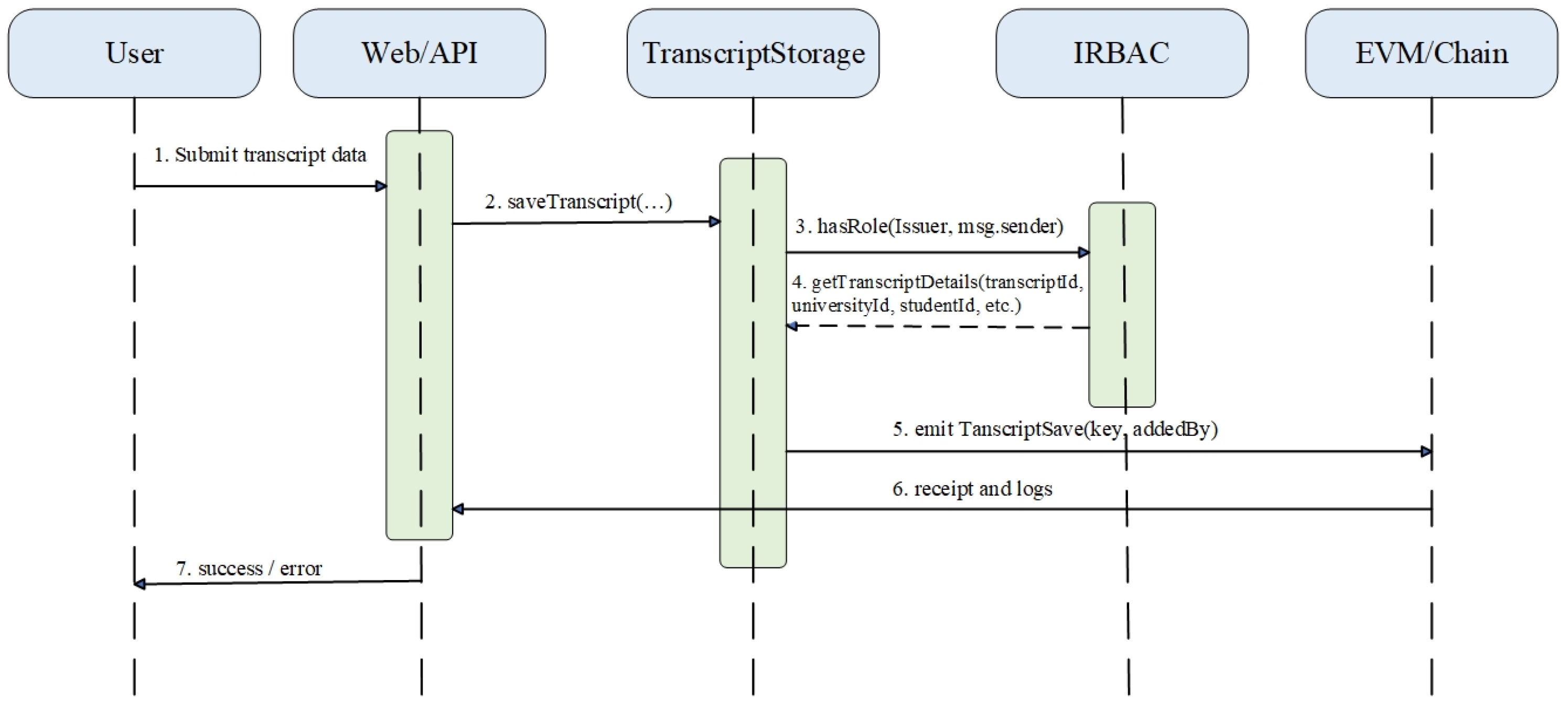
The basic functionality for executing transactions is shown in Figure 2. The sequence of operations is depicted in Figure 3.
The operations are also presented in the algorithm form in Table 2.
In the context of an educational document security system, this transaction functionality is critical, as each document registration (the recording of a certificate, diploma, or grade record hash) is carried out via a transaction. Blockscout verified that the transaction actually took place, was confirmed by the network, and was immutably recorded, allowing it to be verified in the future.

3.3. Detailed View of Transactions

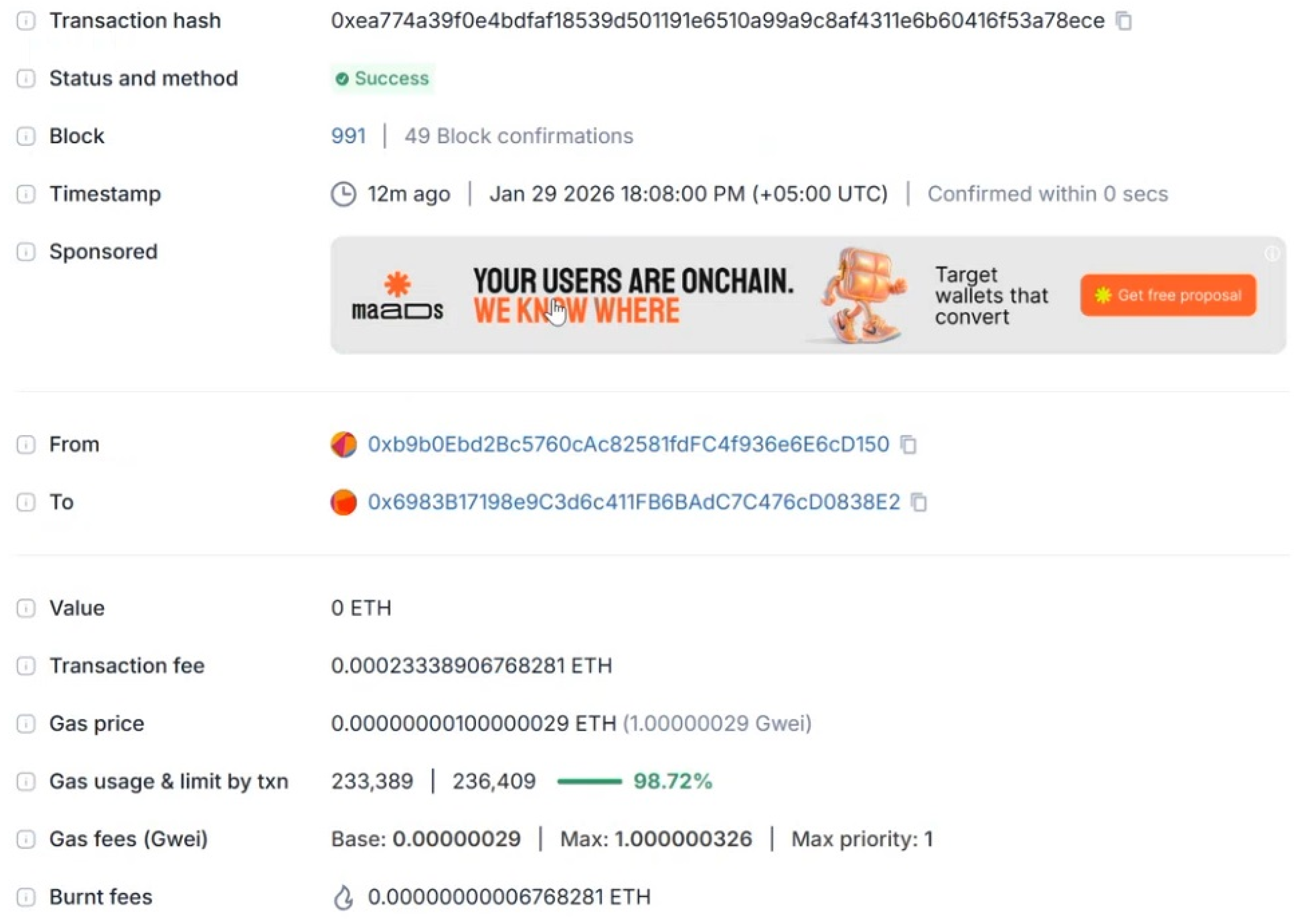
The window containing information about saved smart contract transactions contains a wealth of important information. This information is presented in Figure 4 and described in more detail below.
Blockscout’s Transaction Section is designed for detailed analysis of a single transaction on the blockchain network. It provides complete information on exactly how the operation was executed, who the sender and recipient were, which block the transaction was confirmed in, and the computing resources expended. The Transaction page is displayed at the top of the page. Hash is a unique transaction hash that serves as a digital identifier for a record on the network. This hash is used to search for, confirm, and authenticate a transaction. In the context of educational document security, a transaction hash demonstrates that a specific record was executed and secured in the Blockchain.
In the Status and method field, the Success or Fail results of the transaction are displayed. BlockScout can also display the method if the transaction is a call to a smart contract function. This is especially important for smart contract-based systems, as it allows you to see exactly which function was called and with what parameters. Next, it indicates the block (Block) in which the transaction was included, as well as the number of confirmations (Block Confirmations). This indicates that several more blocks have been created since the block, increasing the reliability of the transaction and reducing the likelihood of its rollback: the more confirmations, the more reliable the record is considered.
The Timestamp field shows the exact time the transaction was executed and confirmed. The transaction shown in Figure 4 was executed on 29 January 2026, in the 5-time zone (Republic of Kazakhstan). This is important for projects related to educational documents, as it allows for recording the moment the record was registered in the Blockchain, i.e., the moment the document was officially entered into the system and received a provable timestamp.
The From and To fields reflect the sender and recipient addresses of the transaction. Depending on the transaction type, the recipient can be either a regular user address or a smart contract address. In document verification systems, transactions are typically sent to a contract address, which stores data, hashes, identifiers, and events. These fields help prove who initiated the transaction and where it was sent.
The Value field shows the amount of cryptocurrency transferred in the transaction. In the screenshot, the value is 0 ETH, meaning no direct transfer of funds occurred. This is typical for transactions that call a smart contract rather than transfer coins. Even with a value of 0, the transaction remains valid because it performs calculations and updates the blockchain state.
The Transaction fee field displays the actual network fee paid to execute the transaction. The fee depends on how much gas was spent and the price of gas. The sender set the price. In an educational document security project, the fee is an important technical parameter, as each document entry requires network resources and has a certain cost.
The Price field displays the cost of one unit of gas, which is typically measured in Gwei (a microunit of ETH). The higher the gas price, the more expensive the transaction, but the faster it is confirmed by the network. On testnets, gas prices may be arbitrary, but in real networks, they reflect the load and competition for including a transaction in a block.
The Gas usage and limit field by txn shows how much gas the transaction actually used and the limit. Figure 4 shows that the transaction used approximately 233,389 units of gas, out of a limit of 236,409, almost all of it. It means the operation was quite resource-intensive and may have involved writing data to the Blockchain or executing smart contract logic.

3.4. Storing Smart Contract Data

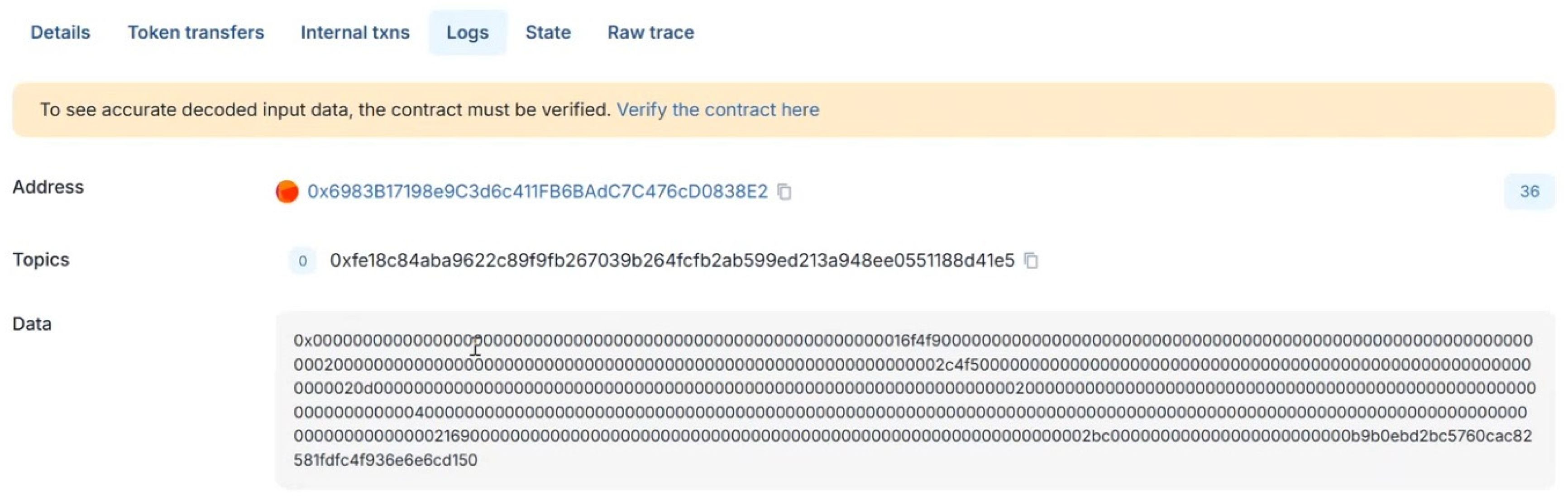
The stored data itself plays a particularly important role in the presented information about smart contract transaction execution. The full hash is stored in the Logs tab, shown in Figure 5.
This representation of the information shows that the data is stored as a hexadecimal string, prefixed with 0x. This format is standard for EVM-compatible blockchains and is used to represent binary data compactly.
In the Address block, the smart contract address that generated the event is specified. This means the transaction triggered a smart contract function, resulting in certain data being recorded in the event log. The Topics field contains a hash of the event signature: 0xfe18c84aba9622c89f9fb267039b264fcfb2ab599ed213a948ee0551188d41e5. In the EVM architecture, this identifier allows external applications and researchers to unambiguously determine which event function was called, even if the contract’s source code is hidden. The Data field contains the main content of the Transcript, encoded in hexadecimal format. When analyzing the data structure, the following aspects can be identified:
Length and structure: Data is split into 32-byte segments, and zero padding indicates the ABI encodings where strings or unique identifiers are stored.
The data block shows the transaction initiator address b9b0ebd2bc5760cac82581fdfc4f936e6e6cd150, confirming the association between the event and the sender.
The intermediate bytes contain encoded information (a document hash or transcript metadata) that is compared to the actual data after decoding.

4. Results of Using Smart Contracts and Comparison with Existing Alternative Systems

4.1. Overview of the Smart Contract Implementation

The smart contract implementation for educational documents is written in Solidity and is designed to record transcripts on the Blockchain. The contract integrates with an external role management module via the IRBAC Improved interface. Critical functions are protected by the onlyRole modifier, which enforces the RBAC model. Specifically, transcript writing is permitted only to subjects with the issuer role, and RBAC configuration modifications are permitted only to subjects with the admin role.

4.2. Transcript Structure and Data Management

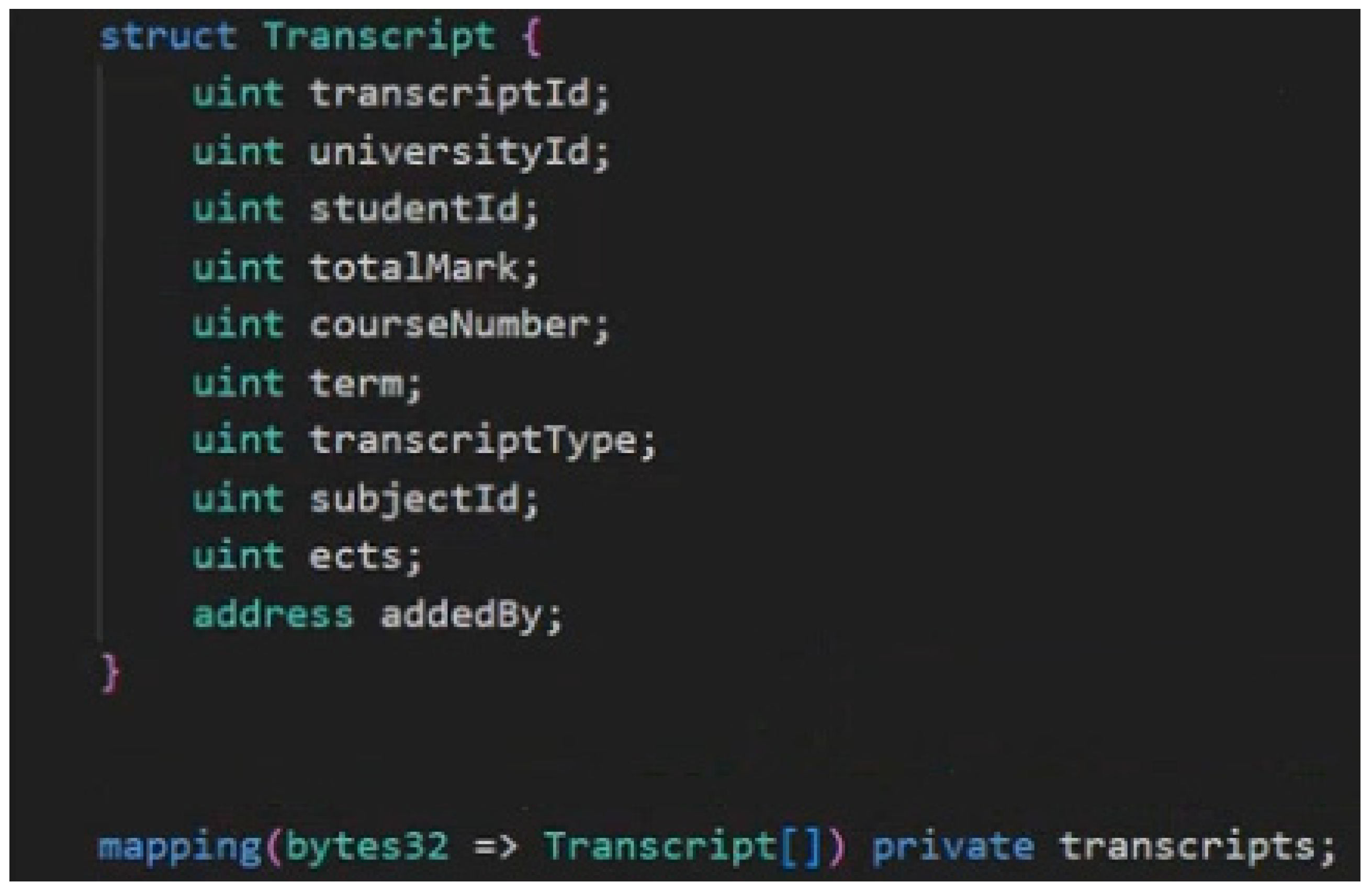
The presentation of the Transcript relies on its structure, which includes the following parameters: transcriptId, universityId, studentId, totalMark, courseNumber, term, transcriptType, subjectId, ects, and addedBy. These parameters are described in Table 3.
The representation of the Transcript with its corresponding Solidity structure is shown in Figure 6.
The presented fragment of a smart contract written in Solidity defines two events that implement the transaction-logging mechanism for the blockchain system used to store academic transcripts.

4.3. Event Logging and Immutability

Events in Ethereum are used to record contract state changes and record transaction logs on the Blockchain. The TranscriptSaved event is emitted when a new academic transcript is saved to the Blockchain. It contains a set of parameters reflecting key attributes of the academic record. The transcriptId parameter represents the unique identifier of the Transcript. The universityId and studentId parameters identify the issuing institution and the student to whom the record belongs, respectively. The totalMark parameter stores the final grade for the course, while courseNumber and term reflect the course of study and academic semester. The transcriptType field distinguishes the record type (Boundary control grades, exam grades, and final grades), subjectId identifies the specific course, and ects indicates the number of ECTS credits. The addedBy parameter records the address of the user who initiated the transcript addition, ensuring transparency and traceability of the data source.
The TranscriptSaved event serves as an immutable audit trail, ensuring that academic records are securely stored and cannot be modified. The smart contract implements role-based access control (RBAC), where the onlyRole modifier ensures that only authorized entities (such as accredited educational institutions) can add transcripts to the Blockchain. This architecture adheres to the separation of concerns principle by separating data storage from authorization logic, enhancing security, and maintaining a system of cryptographic trust. Additionally, the RBACAddressUpdated event records changes to the access control contract’s address, ensuring transparency and preventing unauthorized modifications. A hashed index mechanism is used for efficient record retrieval, enabling scalable transcript storage without altering the contract’s structure. The saveTranscript function follows a sequential process to ensure data integrity and traceability, with built-in checks to prevent the creation of invalid records and guarantee that only authorized users can perform key actions. The detailed description of the TranscriptSaved event, the RBACAddressUpdated event, and the saveTranscript function is thoroughly described in Appendix A.
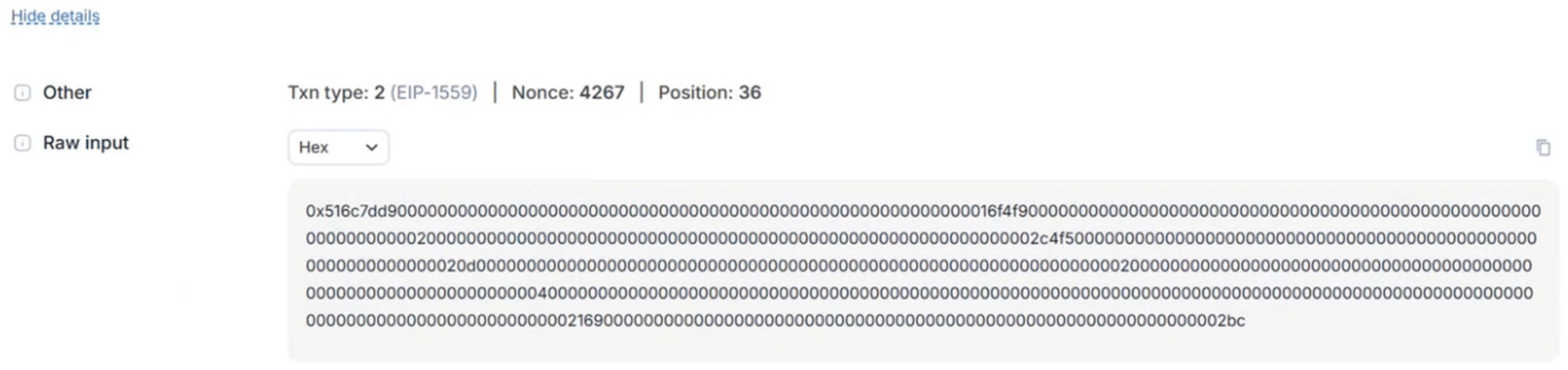
When the user calls the saveTranscript function, its parameters are encoded according to the Ethereum ABI specification and passed to the transaction as a hexadecimal string (Hex). In the transaction details, this is displayed as Raw Input Data, shown in Figure 7.
This block contains encoded values for identifiers, ratings, and other parameters. After the function is executed and the transaction is successfully included in the block, the TranscriptSaved event generates Logs. They are structured data indexed by the Blockchain and available for filtering via events. Unlike a contract state, reading logs does not require gas, making them a convenient tool for analytics and verification. Data is stored both in contract state for business logic and for system access, and in logs for quick external verification. However, this redundancy is intentional and enhances the system’s transparency. Storage provides functionality, while logs provide provability and ease of integration with external services.

4.4. The Comparison of the Proposed System with Other Alternative Systems

The designed education system, which uses Blockchain and smart contract technologies, is considered an advanced UPHE in Kazakhstan, unlike existing systems that do not use Blockchain. For the broader analysis of the proposed system’s performance, it is necessary to compare it with existing alternative foreign systems that actively implement Blockchain and smart contracts. The most popular systems are Blockcerts, ECertChain, ShikkhaChain, and zkEVM.
Blockcerts is a system designed for extending existing educational credentials by adding a blockchain-based verification process for digital certificates. As students’ qualification data are often stored in isolated institutional databases, Blockcerts is described as a way to support decentralized verification of academic achievements while keeping the underlying student data under the institution’s control. The certificate remains part of the institution’s administrative records, but its blockchain-anchored proof enables external parties to verify it without needing a centralized notary or direct issuer mediation. Blockcerts represents the permissionless approach, in contrast to university consortia that use permissioned infrastructures such as Hyperledger Fabric. The important feature here is that verification becomes independent of the issuer’s internal system, improving portability and trust. Blockcerts improves efficiency on public blockchains by batching many certificates into a single blockchain transaction. Blockcerts groups certificates together and anchors them through a Merkle tree of certificate hashes. It reduces network costs substantially while leaving the verification process intact. The blockchain transactions of Blockcerts have the following characteristics. Transactions have a gas limit of 25,000. According to the presented cost model, Blockcerts operates with a gas limit of 25,000 and a transaction fee of 0.0005 ETH. The cost of a transaction in the system is 0.23 USD in 2018 and 0.09 USD in 2019. Blockcerts achieves its main efficiency through batch issuance: 22,000 certificates issued in batches of 200 require only 110 transactions, with an estimated annual total cost of 25 USD, compared to 5011 USD for individual certificate registration. Blockcerts is efficient because its blockchain operations are simple and not computationally intensive, especially when certificates are grouped. Their conclusion is that the blockchain fee itself is not the main barrier to adoption. Instead, the bigger challenges are the development of applications that integrate with university information systems, support issuance and verification workflows, and provide a smooth user experience. In other words, Blockcerts lowers the cost of decentralized notarization, but institutions still need surrounding software and governance to make it practical.
ECertChain is another comprehensive smart-contract-based educational management system for institutional admissions, student registration, certificate issuance, revocation, and verification. Its gas costs are much higher for state-changing operations, especially certificate issuance and contract deployment, but it also provides richer functionality such as registration, revocation, access control, and document ownership management. The system’s most expensive operational transaction is the certificate issue at 441,564 gas. At the same time, read-only actions like certificate verification and certificate export cost 0 gas, which is an advantage for verifiers. The system’s scalability depends strongly on transaction complexity: ECertChain can reach 698 transactions per second for low-gas operations, but only about 55 transactions per second for the heaviest operation, like certificate issuance, while verification and certificate export are read-only functions requiring 0 gas. The platform operates under a block gas limit of 99,000,000. These results indicate that ECertChain provides broader on-chain functionality than lightweight certificate notarization schemes at a higher gas cost per write operation.
ShikkhaChain is a feature-rich blockchain credential management system. Its main strengths are not low gas consumption but its governance-aware architecture, revocation support, and hybrid design with Ethereum and the InterPlanetary File System (IPFS). This richer functionality comes with a relatively high issuance cost of about 1.29 million gas per certificate, making direct deployment to the Ethereum expensive. At the same time, the system has strong integrity and transparency properties, but weaker privacy because certificate metadata can become visible if the CID is known. The system’s performance shows an issuance cost of approximately 1,289,600 gas per certificate, transaction confirmation times of 12–25 s, and IPFS retrieval latency of 1–5 s. The system’s main advantages are tamper-resistance, transparency, decentralized access, and four-level role separation, while its main limitations are high on-chain costs, reliance on IPFS availability, and metadata privacy once the CID is known.
Another important verification system of higher education certificates is zkEVM. It is not a direct Ethereum-only credential application like ECertChain or ShikkhaChain. Instead, it is a Layer-2-style higher-education architecture in which Ethereum serves as a secure settlement and verification layer, while most execution occurs off-chain. The system supports not only certificate issuance and verification, but also admissions, credit transfer, assessments, and payments. It is approximately 400,000 gas per settlement interaction, which is higher than the cost of the simplest anchoring schemes, but the architecture recovers this through better scalability, stronger privacy, and broader system functionality. The strongest features of this design are its modularity, proof-based security, and GDPR-aware hybrid storage model. Its main advantages are proof-based security, reduced Layer-1 load, improved privacy through off-chain data availability, and GDPR-compatible storage design, while its main limitation is the computational overhead and latency of proof generation. The characteristics of the Blockcerts, EcertChain, ShikkhaChain, and zkEVM blockchain systems are shown in Table 4.

4.5. The Statistical Presentation of the Results Comparison

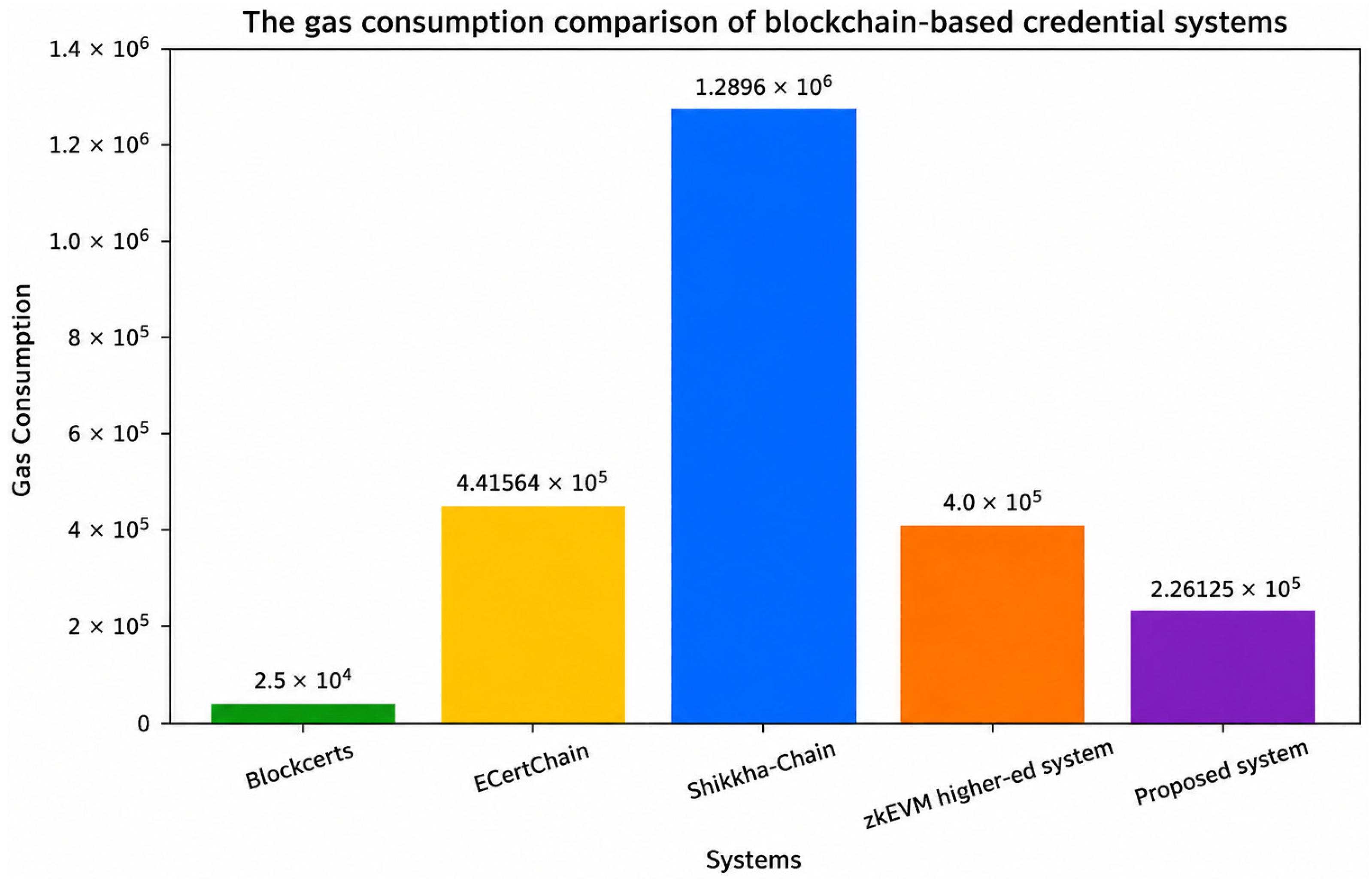
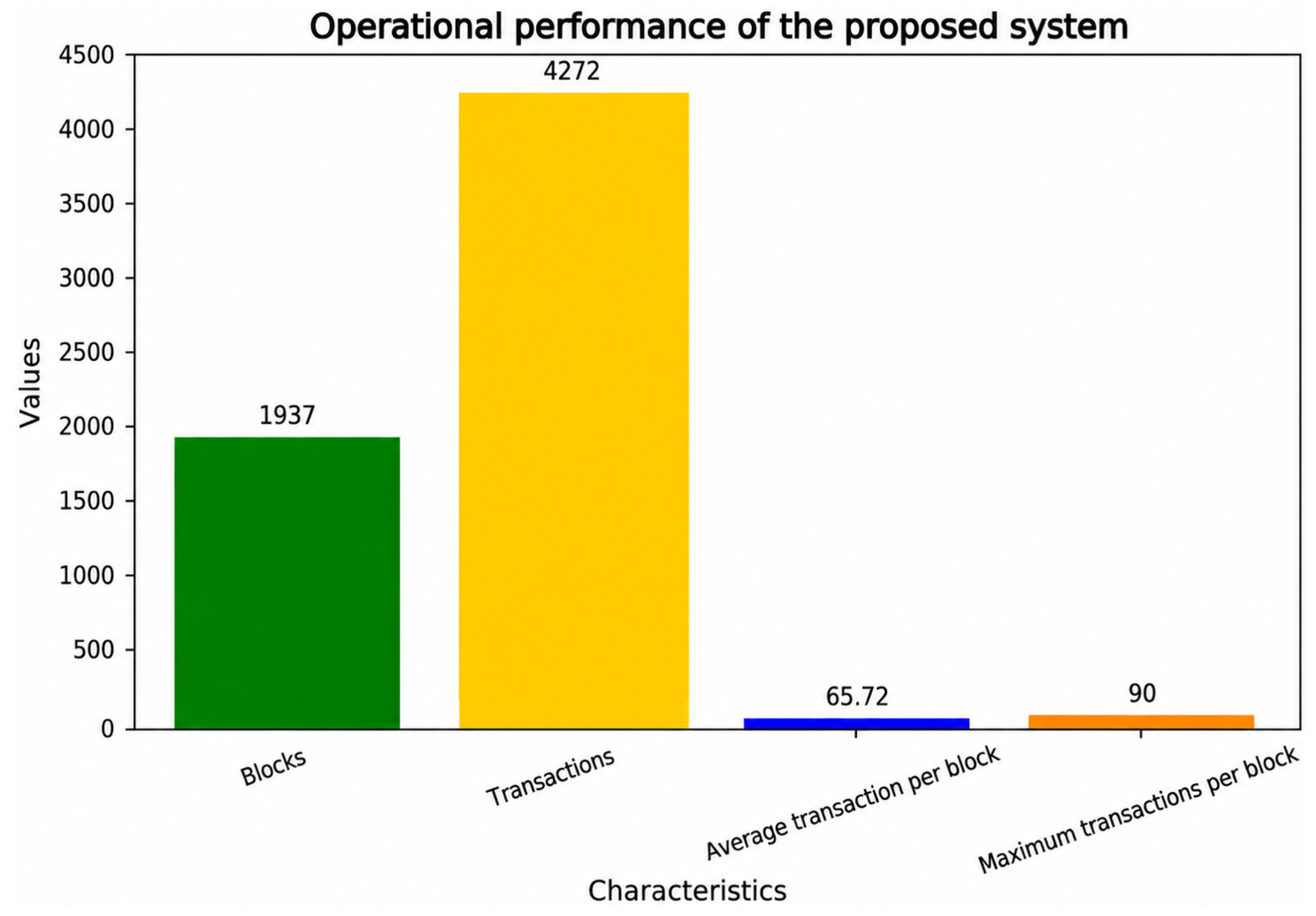
The statistical presentation of gas consumption for each system is shown in Figure 8, and the values of the different operational characteristics of the proposed system are shown in Figure 9.
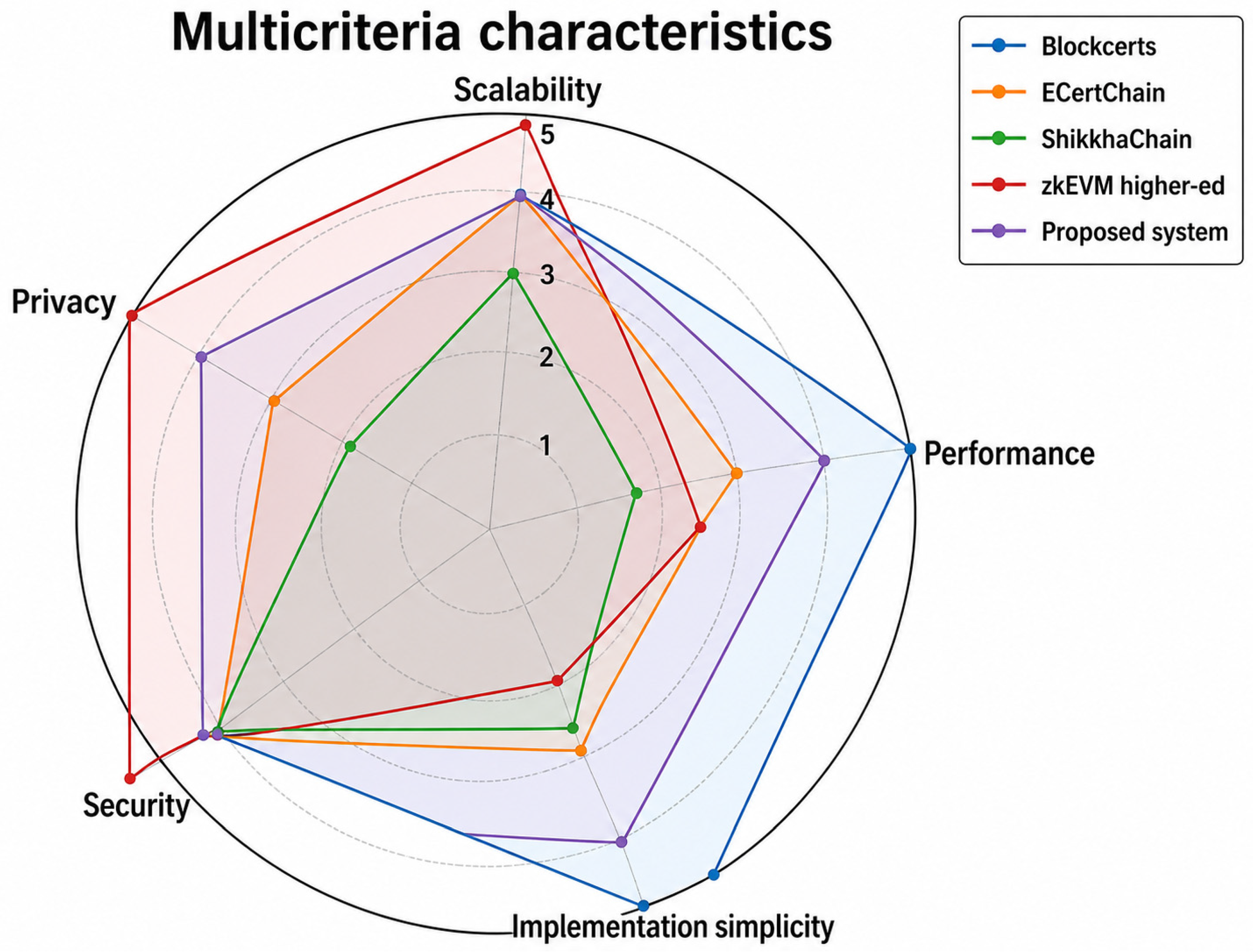
Other multicriteria characteristics for each system are grouped and displayed in a circular diagram in Figure 10.
This Figure shows that Blockcerts remains the most cost-efficient solution for simple anchoring, whereas ShikkhaChain incurs the highest gas costs due to its more complex governance and credential management logic. The proposed system occupies an intermediate position: it requires more gas than minimal certificate-management systems, but less than heavier ones, while also maintaining stronger integration potential for Kazakhstan’s UPHE context.
The comparison between the proposed system’s enhancement and other systems is shown in Table 5, which demonstrates the relationship between gas consumption.
The comparative results showed that the system processed 4272 transactions across 1937 blocks, with a stable average block time of 15-s and an average of 65.72 transactions per block. The average gas consumption per transaction was approximately 226,125 gas. These results indicated a balanced performance profile, where the system supported both lightweight and complex smart-contract operations.

4.6. The Assumptions About the Advantages of the Proposed System

In comparison to Blockcerts, the proposed system exhibited higher gas consumption per transaction but significantly broader functionality. Blockcerts achieved extremely low costs primarily through its minimalist design, which anchored only certificate hashes on-chain, often in batched transactions. While it led to excellent cost efficiency, it limited functionality to basic notarization and verification. In contrast, the proposed system supported richer interactions with smart contracts. Moreover, the proposed system did not rely heavily on batching for efficiency, thereby enabling more flexible, real-time interaction. It represented a trade-off where the proposed system sacrificed minimal cost for increased functionality and adaptability.
Compared to ECertChain, the proposed system demonstrated a more balanced and consistent performance profile. ECertChain reported 441,564 gas units for certificate issuance, which was significantly higher than the proposed system’s gas consumption. ECertChain exhibited wide variations in gas costs across operations, with throughput ranging from 55 to 698 transactions per second, depending on transaction complexity. The proposed system showed more stable gas utilization and block-level efficiency, with consistent transaction density per block and effective use of block gas capacity. It suggests that the proposed system was better optimized for uniform workload distribution, making it more predictable and easier to scale in practice.
ShikkhaChain represented a more complex governance-oriented system, but at the cost of significantly higher gas consumption. The reported 1,289,600 gas per certificate issuance made it the most expensive system among those considered. Additionally, transaction latency of 12–25 s further impacted its performance in real-world scenarios. The proposed system offered a clear advantage in this regard, with average gas consumption substantially lower while still supporting the main smart-contract functionality. Therefore, the proposed system is better suited to cost-sensitive environments, particularly for national-scale deployments that require processing large volumes of credentials.
The zkEVM system achieved strong scalability and privacy by offloading computation off-chain and using Ethereum as a settlement layer, with approximately 400,000 gas per interaction. While this approach reduced Layer-1 load and enhanced privacy, it introduced additional complexity related to validity-proof generation, batching delays, and dependency on off-chain components. The proposed system adopted a more direct, practical on-chain execution model, avoiding the overhead of generating zero-knowledge proofs. Although it might not have the same theoretical scalability as zkEVM architectures, it provided lower system complexity, faster implementation, and easier integration with existing infrastructure.

5. Discussion

5.1. Blockchain for Academic Transcript Management

This study demonstrates the practical feasibility of using Blockchain and smart contracts for academic transcript management in Kazakhstan. The results indicate that Blockchain can indeed serve as an immutable, transparent system for academic records, consistent with earlier studies exploring its use for digital diplomas and credential verification. For example, the Blockcerts system (often cited as a simple blockchain-based credential solution) achieves low-cost verification by batching certificates. However, as our findings suggest, while Blockcerts excels in cost efficiency, it is limited in its functionality, primarily supporting basic certificate notarization and verification.
In contrast, the proposed system not only provides cost-effective verification but also supports richer interactions with smart contracts. This gives it an edge in offering more flexible solutions, such as automated transcript recording and dynamic data growth. This finding builds upon earlier research on the use of hashes and metadata for efficient storage, as seen in the work by [17,18], but extends it by incorporating more advanced data structures, such as hashed indexing, improving the scalability and functionality of the system.

5.2. Comparison with Existing Blockchain Systems

Compared with more comprehensive blockchain systems, such as ECertChain and ShikkhaChain, significant differences in gas consumption and scalability are observed. ECertChain provides more extensive functionality (institution registration, certificate issuance, revocation, and access control) and has much higher gas costs per transaction, especially for state-changing operations. On the other hand, the proposed system demonstrates more stable gas utilization and better overall efficiency, reducing gas consumption while still supporting complex smart-contract logic. ShikkhaChain, which offers robust features such as a governance-aware architecture and revocation support, incurs even higher gas costs, making it less suitable for cost-sensitive environments. Although ShikkhaChain provides strong tamper-resistance and decentralized access, the proposed system maintains lower costs while ensuring the integrity and transparency of academic records. This highlights the trade-off between complexity and cost-efficiency, a challenge that is common in blockchain-based credential systems, as discussed by [19,20].
One of the critical aspects of using Blockchain for academic records is ensuring privacy, particularly when handling student identifiers. While our solution incorporates privacy-protecting mechanisms, including data hashing and role-based access control, it remains essential to address privacy-enhancing technologies, such as zero-knowledge proofs. These technologies help to protect sensitive personal data, which remains a concern in systems like Blockcerts and ShikkhaChain, where metadata might be exposed once the certificate’s content identifier (CID) is known. The inclusion of zero-knowledge proofs in future iterations of the system could significantly enhance student data privacy and align with growing demands for data protection, as prior research has noted.

5.3. Limitations of the Proposed System

Despite the promising results, the proposed system has several limitations that must be considered for real-world deployment.
First, scalability constraints remain an important challenge. However, the system demonstrates stable throughput in the testnet environment, with 65.72 transactions per block at a 15 s interval. Reliance on on-chain execution results in a gas consumption of 226,125 gas per transaction. In large-scale national deployments involving millions of academic records, this may result in increased operational costs and potential network congestion. The proposed architecture does not offload computation, which limits its long-term scalability under heavy workloads.
Second, the system has been validated in a controlled testnet environment that does not fully reflect real-world operational conditions. Practical deployment would require addressing challenges such as validator node management, network governance models, fault tolerance, and infrastructure reliability. These aspects are critical in national-level systems that require continuous availability and trust.
Third, regulatory and legal compliance represents a significant challenge. Educational data is subject to strict data protection laws, and the immutability of Blockchain may conflict with requirements such as data correction or deletion. Adapting the system to comply with national and international regulations requires additional architectural considerations.
Finally, integration complexity with existing educational systems should not be underestimated. Although the proposed architecture is designed to complement existing LMS platforms, real-world adoption requires standardizing data formats, ensuring interoperability between institutions, and aligning with legacy systems.

5.4. Integration with Existing Educational Systems

In the broader context of Kazakhstan’s digital educational infrastructure, the proposed architecture complements existing systems (such as LMS platforms and internal university databases) rather than replacing them. Blockchain functions as a cryptographic verification layer that enhances interuniversity trust, facilitates international recognition of credentials, strengthens anti-corruption safeguards, and improves long-term archival integrity. These implications position blockchain not merely as a storage technology but as a trust infrastructure for digital education governance.
Despite a well-designed smart contract approach based on the Blockchain, its application still has several limitations. The prototype was evaluated in a controlled testnet environment and does not yet address real-world governance, validator coordination, or regulatory compliance. Privacy considerations are critical, particularly when linking student identifiers to blockchain records. Future implementations should consider privacy-enhancing technologies, such as zero-knowledge proofs, to enable verification without exposing personal data. Additionally, formal verification of smart contract logic would strengthen security guarantees and align with best practices in blockchain engineering.
Overall, the proposed system provides a cost-effective alternative to existing blockchain-based educational systems. While Blockcerts excels in low cost, zkEVM-based systems lead in theoretical scalability and privacy, the proposed system achieves a balanced trade-off between performance, functionality, and implementation complexity. This makes it particularly suitable for national-level adoption, where scalability and integration with existing infrastructure are critical.

5.5. Integration to Other Countries and Regions

When implementing the proposed system in other countries, especially in Central Asia, it is necessary to take into account the specific requirements of each country. The Ministry of Education still mostly follows the policies of the Post-Soviet period, where the government fully controlled the educational standards, qualifications, and the issuance of academic records: transcripts and diplomas. Therefore, the proposed blockchain-based system, which integrates with existing educational infrastructure, would align well with such government-controlled systems, offering enhanced transparency, security, and accountability in keeping data and credential verification. The adoption of blockchain-based solutions could modernize the education sector and improve institutional trust in academic records.
In Western countries, universities typically have greater autonomy and freedom to shape their own policies and educational practices. These countries often embrace innovation in educational technology, including Blockchain for credential verification. However, the differences in governance between Central Asia and Western countries suggest distinct challenges and opportunities. European and American universities typically have the freedom to adopt innovative technologies such as Blockchain without significant interference from government bodies. This autonomy could allow universities to implement the system more easily, potentially integrating blockchain-based credentials into their existing systems. As many European and American universities are often globally recognized, implementing a blockchain-based system for academic records could streamline international credential verification. The decentralized nature of the proposed solution could align well with the goals of improving global academic transparency and trust. As many Western universities are part of international consortia that focus on academic exchange and credit transfer, the blockchain-based system could facilitate more efficient and secure transfer of academic records between institutions within these networks.
In addition, during the potential integration of the proposed system in other regions, various maintenance issues should be taken into account: integrating the system with existing infrastructures and keeping it compatible with different national standards, updating smart contracts while maintaining blockchain immutability, addressing performance and gas costs as the system scales across different institutions, and ensuring the system remains compliant with evolving data protection laws.

6. Conclusions

6.1. Key Findings and Results of Research

This paper presented a system for storing and verifying academic transcripts using blockchain technology and Ethereum-compatible smart contracts. The implemented TranscriptStorage smart contract, integrated with an external IRBAC role management module, demonstrated the feasibility of formalizing rules for recording educational data and cryptographic transactions, and of ensuring the immutability of records in a distributed ledger.
The experiments conducted in the test network (testnet) confirmed the correctness of transaction execution, including the successful emission of events (Logs), compliance with ABI encoding of input parameters, and accurate reflection of state changes and network commissions (Gas). The use of the BlockScout explorer enabled a transparent demonstration of transaction confirmation, event decoding, execution parameter analysis, and public verifiability via transaction hashes. These results confirm that the proposed architecture ensures technical transparency, traceability, and reproducibility of the academic document registration process.
The RBAC access control model ensured that transcript-writing operations were performed by authorized subjects (issuers), while changes to system parameters were restricted to administrators (admins). This architecture adhered to the principles of separation of concerns and increased system resilience to unauthorized changes. The use of hash indexing based on the Keccak-256 algorithm ensured deterministic record addressing and scalable transcript storage without altering the contract structure.

6.2. Performance and Efficiency of the Proposed System

From a performance perspective, the proposed system demonstrated a stable, efficient operational profile, processing 4272 transactions across 1937 blocks at a consistent 15 s block interval. The observed average gas consumption of approximately 226,000 gas per transaction indicates a balanced trade-off between cost and functionality. Compared to existing approaches, the proposed system avoids the extremely minimal but functionally limited design of Blockcerts, while also reducing the high gas overhead observed in systems such as ShikkhaChain. In contrast to ECertChain, the system exhibits more stable gas utilization and predictable transaction behavior, and compared to zkEVM-based architectures, it achieves lower implementation complexity while maintaining practical scalability.
The proposed blockchain-based system for academic transcript storage and verification demonstrated significant performance improvements. Compared to existing solutions, it achieved 804.5% better gas efficiency than Blockcerts, 48.8% less gas usage than ECertChain, 82.5% less gas consumption than ShikkhaChain, and 43.5% more efficient than zkEVM. These enhancements are critical for reducing transaction costs and improving scalability, making the system well-suited for deployment in national educational infrastructures.

6.3. Research Directions and Future Work

Overall, the results demonstrate that a blockchain-based approach can ensure cryptographic immutability, traceability, and independent verification of academic data within the Republic of Kazakhstan’s educational environment.
The combination of contract state storage and event-based logging provides an effective balance between business logic functionality and cost-efficient external verification. The system represents a practical enhancement to an existing national educational platform rather than a standalone prototype, thereby increasing its relevance for real-world deployment.
In future works, it is planned to enhance the privacy mechanism to protect student data and address concerns regarding the exposure of personal identifiers in blockchain records. Formal verification of smart contract logic has to improve trust in the system’s operations and align with best practices in blockchain engineering. The main part of building this system lies in its integration with existing OHPE systems, such as Univer, LMS, and state registries, to ensure interoperability and efficiency when adopting the system at scale. Beyond Kazakhstan, this architecture has significant practical applications in other Central Asian countries, where centralized education systems are prevalent. The proposed blockchain solution can be integrated into these systems to enhance transparency, security, and efficiency in managing academic records. Moreover, in Western countries with more autonomous educational systems, the proposed solution could facilitate the decentralized verification of academic credentials, enabling better integration with global education networks and improving credential recognition. The scalability and security of Blockchain make it highly suitable for large-scale implementations, providing cost-effective solutions for both private and public institutions.

Author Contributions

G.M. and O.U. did conceptualization; G.M. and V.K. did methodology; Y.K. and M.T. designed software; Y.B. did validation; G.M., V.K. and O.U. did formal analysis; V.K. and Y.B. did investigation; Y.K. and M.T. worked with resources; M.T. did data curation; V.K., O.U. and Y.B. did original draft preparation; G.M. and Y.K. revised and edited the paper. All authors have read and agreed to the published version of the manuscript.

Funding

This research has been funded by the Science Committee of the Ministry of Science and Higher Education of the Republic of Kazakhstan (Grant No. BR24993014 “The development of an intelligent anti-corruption system for information protection, validation of the results of educational achievements, official documents of students and graduates of universities in the Republic of Kazakhstan”).

Institutional Review Board Statement

Not applicable.

Informed Consent Statement

Not applicable.

Data Availability Statement

The original contributions presented in this study are included in the article. Further inquiries can be directed to the corresponding author.

Conflicts of Interest

The authors declare no conflicts of interest.

Abbreviations

The following abbreviations are used in this manuscript:
HPEHigher and postgraduate education
OHPEOrganizations of higher and postgraduate education
EVMEthereum Virtual Machine
IMCMPsIntelligent micro-credentialing management platforms
AIArtificial Intelligence
RBACRole-based access model

Appendix A

Table A1. The description of events and functions.
Event or FunctionDescription
TranscriptSavedThis event is an immutable audit trail. Since the log data is stored on the Blockchain and cannot be modified, this ensures the record’s provenance and enables the implementation of a digital trust mechanism. This approach is particularly important in academic verification systems, where it is necessary to guarantee the immutability of grades and prevent unauthorized editing. The smart contract implements a modular architecture and does not contain built-in role management logic. Instead, it interacts with the external contract via the IRBAC interface. This approach adheres to the separation of concerns principle, separating the business logic for data storage from the authorization logic. Access to critical functions is restricted using the onlyRole modifier. This modifier checks the role of the caller, msg.sender, via the external IRBAC contract. The function is accessible exclusively to subjects with the issuer role, i.e., accredited educational organizations. In turn, only a user with the admin role can modify the RBAC contract address, preventing unauthorized substitution of the access control module. From a security perspective, this model eliminates the possibility of unauthorized entries. The contract checks the role before executing the main logic, and if there is a discrepancy, execution is aborted via a require statement. Since the check occurs on-chain, it cannot be bypassed without changing the blockchain state. This creates a cryptographically secure system of trust in which only verified universities can add academic data to the ledger.
RBACAddressUpdatedThe RBACAddressUpdated event is designed to record changes to the address of the contract responsible for access control (RBAC or IRBAC). It contains the newAddress parameter, which stores the new address of the access control module. This event is emitted when the authorization contract is updated and reflects the modular nature of the system architecture. The RBACAddressUpdated event plays an important role in ensuring the transparency of role management mechanism updates from a security and system design perspective. Since access to smart contract functions can be regulated by an external IRBAC contract, changes to its address must be explicitly recorded in the Blockchain. This allows auditors and users to track changes to the access policy and prevents covert substitution of the authorization mechanism. A combined data structuring strategy is used for efficient updating and scaling. A hashed indexing mechanism is used to optimize search. The getKey function generates a unique bytes32 key by hashing the (universityId, studentId) pair using the Keccak-256 algorithm. Hashing performs two functions:
  • creates a deterministic and unique record identifier;
  • ensures uniform distribution of keys in the storage.
All transcripts for a given student are stored in a mapping (bytes32 => Transcript []). This means that a dynamic array of all a student’s transcripts can be retrieved using a computed key. This approach ensures system scalability: the number of transcripts can increase without changing the contract structure, and data access remains efficient thanks to the mapping.
saveTranscriptThis function implements a sequential algorithm aimed at ensuring data integrity and traceability. The first step is to validate the input parameters. It verifies that the key identifiers transcriptId, universityId, and studentId are not equal to zero. This prevents the creation of incorrect or fictitious records. The second step involves initializing the memory structure, where a Transcript object is created and automatically populates the sender’s address, msg.sender, in the addedBy field. Since msg.sender is defined by the Ethereum Virtual Machine, spoofing the author of a record is technically impossible. The next step involves writing to the global storage state. The created object is added to the array associated with the corresponding hash key. Once a transaction is included in a block, its data becomes part of the Blockchain’s immutable state. The final step is the emission of the TranscriptSaved event. This creates an entry in the transaction logs, allowing external systems to track the addition of the Transcript without accessing the contract state.

References

  1. Biloshchytskyi, A.; Omirbayev, S.; Mukhatayev, A.; Kuchanskyi, O.; Hlebena, M.; Andrashko, Y.; Mussabayev, N.; Faizullin, A. Structural models of forming an integrated information and educational system “quality management of higher and postgraduate education”. Front. Educ. 2024, 9, 1291831. [Google Scholar] [CrossRef] [Scilit]
  2. Machkour, B.; Abriane, A. The Rise of Artificial Intelligence in Educational Management: A Prospective Analysis on the Role of the Virtual Educational Director. Procedia Comput. Sci. 2025, 257, 1233–1238. [Google Scholar] [CrossRef] [Scilit]
  3. Daim, T.; Gungor, D.O.; Basoglu, N.; Yarga, A.; VanDerSchaaf, H. Exploring student information management system adoption post pandemic: Case of Turkish higher education. Technol. Soc. 2024, 77, 123–135. [Google Scholar] [CrossRef] [Scilit]
  4. An, H.; Chen, J. ElearnChain: A privacy-preserving consortium blockchain system for e-learning educational records. J. Inf. Secur. Appl. 2021, 63, 103013. [Google Scholar] [CrossRef] [Scilit]
  5. Castro, R.Q.; Au-Yong-Oliveira, M. Blockchain and Higher Education Diplomas. Eur. J. Investig. Health Psychol. Educ. 2021, 11, 154–167. [Google Scholar] [CrossRef] [Scilit]
  6. Alammary, A.; Alhazmi, S.; Almasri, M.; Gillani, S. Blockchain-Based Applications in Education: A Systematic Review. Appl. Sci. 2019, 9, 2400. [Google Scholar] [CrossRef] [Scilit]
  7. Cardenas-Quispe, M.A.; Pacheco, A. Blockchain ensuring academic integrity with a degree verification prototype. Sci. Rep. 2025, 15, 9281. [Google Scholar] [CrossRef] [Scilit] [PubMed]
  8. Delgado-von-Eitzen, C.; Anido-Rifón, L.; Fernández-Iglesias, M.J. Blockchain Applications in Education: A Systematic Literature Review. Appl. Sci. 2021, 11, 11811. [Google Scholar] [CrossRef] [Scilit]
  9. Said, S.H.; Dida, M.A.; Kosia, E.M.; Sinde, R.S. A Blockchain-based Conceptual Model to Address Educational Certificate Verification Challenges in Tanzania, Engineering. Technol. Appl. Sci. Res. 2023, 13, 11691–11704. [Google Scholar] [CrossRef] [Scilit]
  10. Zheng, Z.; Xie Sh Dai, H.-N.; Chen, W.; Chen, X.; Weng, J.; Imran, M. An overview on smart contracts: Challenges, advances and platforms. Future Gener. Comput. Syst. 2020, 105, 475–491. [Google Scholar] [CrossRef] [Scilit]
  11. Berrios Moya, J.A.; Ayoade, J.; Uddin, M.A. A Zero-Knowledge Proof-Enabled Blockchain-Based Academic Record Verification System. Sensors 2025, 25, 3450. [Google Scholar] [CrossRef] [Scilit]
  12. Caldarelli, G.; Ellul, J. Trusted Academic Transcripts on the Blockchain: A Systematic Literature Review. Appl. Sci. 2021, 11, 1842. [Google Scholar] [CrossRef] [Scilit]
  13. Castro-Iragorri, C.; Lopez-Gomez, F.; Giraldo, O. Academic Certification Using Blockchain: Permissioned versus Permissionless Solutions. J. Br. Blockchain Assoc. 2020, 3, 1–8. [Google Scholar] [CrossRef] [Scilit] [PubMed]
  14. Singh Yadav, A. ECertChain: A Blockchain-based Educational Certificates and Degree Verification Management System. In Proceedings of the 2025 IEEE 7th International Conference on Computing, Communication and Automation (ICCCA), Greater Noida, India, 28–30 November 2025; IEEE: Piscataway, NJ, USA, 2025; pp. 1–7. [Google Scholar] [CrossRef] [Scilit]
  15. Farabi, A.; Khandaker, I.; Ahsan, J.; Khalil Shanto, I.; Jahan, N.; Jarif Khan, M. ShikkhaChain: A Blockchain-Powered Academic Credential Verification System for Bangladesh. arXiv 2025, arXiv:2508.05334. [Google Scholar] [CrossRef] [Scilit]
  16. El-Hajj, M.; Oude Roelink, B. Evaluating the Efficiency of zk-SNARK, zk-STARK, and Bulletproof in Real-World Scenarios: A Benchmark Study. Information 2024, 15, 463. [Google Scholar] [CrossRef] [Scilit]
  17. Fekete, D.L.; Kiss, A. Toward Building Smart Contract-Based Higher Education Systems Using Zero-Knowledge Ethereum Virtual Machine. Electronics 2023, 12, 664. [Google Scholar] [CrossRef] [Scilit]
  18. Chen, G.; Xu, B.; Lu, M.; Chen, N.-S. Exploring blockchain technology and its potential applications for education. Smart Learn. Environ. 2018, 5, 1. [Google Scholar] [CrossRef] [Scilit]
  19. Bhaskar, P.; Tiwari, C.K.; Joshi, A. Blockchain in education management: Present and future applications. Interact. Technol. Smart Educ. 2020, 18, 1–17. [Google Scholar] [CrossRef] [Scilit]
  20. Li, H.; Han, D. EduRSS: A Blockchain—Based Educational Records Secure Storage and Sharing Scheme. IEEE Access 2019, 7, 179273–179289. [Google Scholar] [CrossRef] [Scilit]
  21. Alsobhi, H.A.; Alakhtar, R.A.; Ubaid, A.; Hussain, O.K.; Hussain, F.K. Blockchain-based micro-credentialing system in higher education institutions: Systematic literature review. Knowl.-Based Syst. 2023, 265, 110238. [Google Scholar] [CrossRef] [Scilit]
  22. Shamsudheen Sh Paul, A.M.; Appukuttan, A.; Karikom, S.T.; Gobinathan, P. Blockchain Technology for Enhanced Security of Academics Certificates in Education. J. Inf. Syst. Eng. Manag. 2025, 10, 227–236. [Google Scholar] [CrossRef] [Scilit]
  23. Permenev, A.; Dimitrov, D.; Tsankov, P.; Drachsler-Cohen, D.; Vechev, M. VerX: Safety Verification of Smart Contracts. In Proceedings of the 2020 IEEE Symposium on Security and Privacy (SP), San Francisco, CA, USA, 18–20 May 2020; IEEE: Piscataway, NJ, USA, 2020; pp. 1661–1677. [Google Scholar] [CrossRef] [Scilit]
  24. Chinnasamy, P.; Subashini, B.; Ayyasamy, R.K.; Kiran, A.; Pandey, B.K.; Pandey, D.; Lelisho, M.E. Blockchain based electronic educational document management with role-based access control using machine learning model. Sci. Rep. 2025, 15, 18828. [Google Scholar] [CrossRef] [Scilit]
  25. Hu, R.; He, C.; Chi, Y.; Duan, X.; Fan, X.; Xu, P.; Gao, W. EduASAC: A Blockchain-Based Education Archive Sharing and Access Control System. Comput. Mater. Contin. 2023, 77, 3387–3422. [Google Scholar] [CrossRef] [Scilit]
  26. Tran, V.D.; Ata, S.; Tran, T.H.; Lam, D.K.; Pham, H.L. Blockchain-Powered Education: A Sustainable Approach for Secured and Connected University Systems. Sustainability 2023, 15, 15545. [Google Scholar] [CrossRef] [Scilit]
  27. Duarte, B.; Ferro, M.; Zarouk, M.Y.; Silva, A.; Martins, M.; Paraguaçu, F. Towards Sustainable Education 4.0: Opportunities and Challenges of Decentralized Learning with Web3 Technologies. Sustainability 2025, 17, 7448. [Google Scholar] [CrossRef] [Scilit]
  28. Silaghi, D.L.; Popescu, D.E. A Systematic Review of Blockchain-Based Initiatives in Comparison to Best Practices Used in Higher Education Institutions. Computers 2025, 14, 141. [Google Scholar] [CrossRef] [Scilit]
  29. Bjelobaba, G.; Savić, A.; Tošić, T.; Stefanović, I.; Kocić, B. Collaborative Learning Supported by Blockchain Technology as a Model for Improving the Educational Process. Sustainability 2023, 15, 4780. [Google Scholar] [CrossRef] [Scilit]
  30. Kistaubayev, Y.; Liébana-Cabanillas, F.; Shaikh, A.A.; Mutanov, G.; Ussatova, O.; Shinbayeva, A. Enhancing Transparency and Trust in Higher Education Institutions via Blockchain: A Conceptual Model Utilizing the Ethereum Consortium Approach. Sustainability 2025, 17, 9350. [Google Scholar] [CrossRef] [Scilit]
  31. Zhumabekova, A.; Matson, E.T.; Karyukin, V.; Zhumabekova, K.; Zhuandykov, B.; Ussatova, O.; Telbayeva, T. Determining Web Application Vulnerabilities Using Machine Learning Methods. In Proceedings of the 2023 19th International Asian School-Seminar on Optimization Problems of Complex Systems (OPCS), Novosibirsk, Moscow, Russian Federation, 14–22 August 2023; IEEE: Piscataway, NJ, USA, 2023; pp. 136–139. [Google Scholar] [CrossRef] [Scilit]
  32. Ussatova, O.; Makilenov, S.; Karyukin, V.; Razaque, A.; Amanzholova, S.; Begimbayeva, Y. The development of an evaluation model for user authentication methods with security, usability, and usage frequency. East.-Eur. J. Enterp. Technol. 2025, 3, 17–29. [Google Scholar] [CrossRef] [Scilit]
  33. Liu, Y.; He, J.; Li, X.; Chen, J.; Liu, X.; Peng, S.; Cao, H.; Wang, Y. An overview of blockchain smart contract execution mechanism. J. Ind. Inf. Integr. 2024, 41, 100674. [Google Scholar] [CrossRef] [Scilit]
  34. El Koshiry, A.; Eliwa, E.; El-Hafeez, T.A.; Shams, M.Y. Unlocking the power of Blockchain in education: An overview of innovations and outcomes. Blockchain Res. Appl. 2023, 4, 100165. [Google Scholar] [CrossRef] [Scilit]
  35. Chugh, R. The sustainability paradox: Rethinking digital technologies in education for a sustainable future. Humanit. Soc. Sci. Commun. 2026, 13, 275. [Google Scholar] [CrossRef] [Scilit]
  36. Damoue, Z.; Ba, M.; Kachallah, A.M.; Espoir Bounguele, S.E.; Ouya, S. Blockchain for Violence-Free Student Elections Implementation and Evaluation at UCAD. In Proceedings of the 2026 6th International Conference on Image Processing and Capsule Networks (ICIPCN), Dhulikhel, Nepal, 27–29 January 2026; IEEE: Piscataway, NJ, USA, 2026; pp. 960–965. [Google Scholar] [CrossRef] [Scilit]
  37. Chen, Z.; Liu, H.; Zhang, L.; Dai, B.; Shi, Y. Research on key technologies for privacy-preserving, regulatorily compliant, and cross-chain interoperability in heterogeneous blockchain systems. Sci. Rep. 2026, 16, 12817. [Google Scholar] [CrossRef] [Scilit] [PubMed]
  38. Alotaibi, M.S. Blockchain Technology and Automated Project Governance: A Systematic Review of Governance Mechanisms, Enabling Conditions, and Future Research Directions. Sustainability 2026, 18, 3589. [Google Scholar] [CrossRef] [Scilit]
  39. Li, X.; Tan, M.; Tian, W. A Secure and Efficient Sharing Framework for Student Electronic Academic Records: Integrating Zero-Knowledge Proof and Proxy Re-Encryption. Future Internet 2026, 18, 47. [Google Scholar] [CrossRef] [Scilit]
  40. Wang, J.; Peng, Y. The application of Blockchain and smart contracts in the trusted evidence storage of carbon trading data of listed companies. Discov. Artif. Intell. 2026, 6, 92. [Google Scholar] [CrossRef] [Scilit]
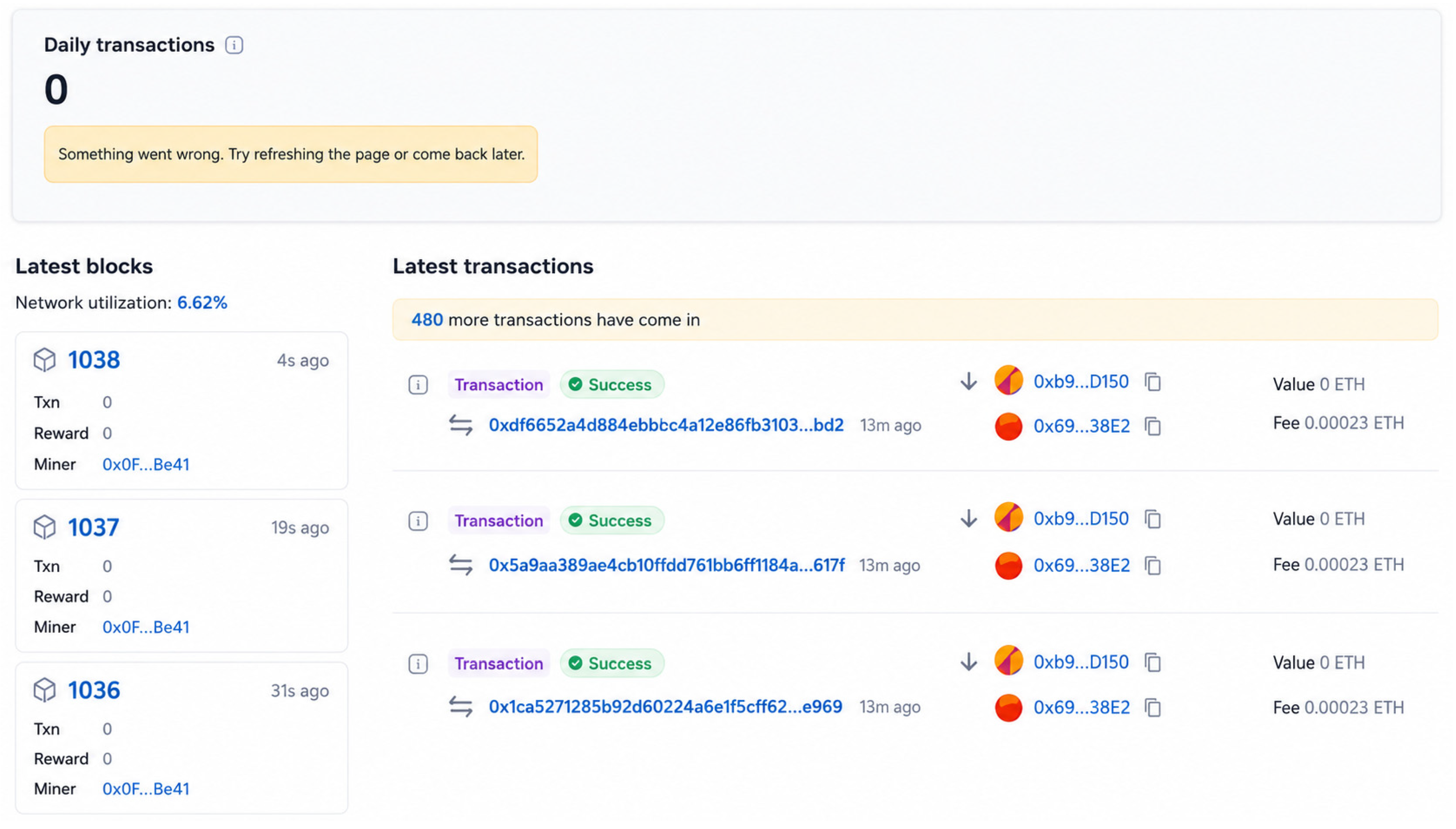
Figure 1. BlockScout’s main transaction activity window.
Information 17 00478 g001
Figure 2. Executing smart contract transactions.
Information 17 00478 g002
Figure 3. Sequence of operations.
Information 17 00478 g003
Figure 4. Detailed information on completed transactions.
Information 17 00478 g004
Figure 5. Encrypted smart contract data.
Information 17 00478 g005
Figure 6. Representation of the transcript structure in Solidity.
Information 17 00478 g006
Figure 7. Details of the completed transaction.
Information 17 00478 g007
Figure 8. Gas consumption comparison of blockchain-based systems.
Information 17 00478 g008
Figure 9. Operational performance metrics of the proposed system in the testnet environment.
Information 17 00478 g009
Figure 10. Comparison of multicriteria characteristics for every system.
Information 17 00478 g010
Table 1. Comparative analysis of blockchain-based educational studies.
NoMain Research FocusBlockchain and Smart Contract ContributionMain LimitationsRelevance to the Proposed System
[17]Blockchain applications in education, including certificates, transcripts, skills evaluation, credit transfer, and lifelong learning.Emphasizes immutability, transparency, and public verifiability of educational records.Scalability, privacy issues, high implementation costs, and uncertainty about what data should be stored on-chain.Supports the need for blockchain-based verification of academic records, but remains broad and conceptual.
[18]Blockchain for degree verification, digital identity, MOOCs, badges, rewards, and teacher evaluation.Proposes Ethereum smart contracts for reward systems, formative assessment, and teacher evaluation.Limited throughput, scalability concerns, and difficulties related to immutability and data correction.Demonstrates smart contract potential in education, but does not focus on integration with a national academic platform.
[19]Systematic review of Blockchain in education.Identifies blockchain benefits for secure storage, certificate verification, transparency, and reduced verification costs.Lack of empirical implementation, smart contract security issues, and scalability challenges.Confirms the general research gap and the need for practical blockchain-based educational systems.
[20]Privacy-preserving educational record sharing.Proposes EduRSS with consortium blockchain, off-chain encrypted storage, on-chain hashes, and smart contracts.Requires additional infrastructure for encrypted off-chain storage and consortium governance.Closely related to privacy-aware academic record management; supports the use of off-chain/on-chain hybrid design.
[21]Blockchain-based micro-credentialing in universities.Reviews Blockchain for credential storage, verification, and trust in micro-credentials.Insufficient scalability, weak integration with learning analytics, and lack of personalized learning support.Relevant for credential verification but focuses mainly on micro-credentials rather than formal academic transcripts.
[22]Academic certificate management and fraud prevention.Reviews systems such as Blockcerts, Open Certificates, CERTbchainIoT, and BCERT.Mostly focuses on certificate verification rather than integration with institutional databases and regulatory systems.Provides a basis for comparing existing credential verification systems with the proposed national-context architecture.
[23]Smart contract security verification.Introduces VerX for automated verification of Ethereum smart contract properties.Not education-specific; focuses on general Ethereum smart contract verification.Relevant to future formal verification of the proposed smart contracts.
[24]Secure educational records management with access control.Combines blockchain storage, role-based access control, smart contracts, and ML-based malicious activity detection.Increased architectural complexity and dependence on additional ML components.Relevant because it combines Blockchain with access management, but differs from our simpler role-based integration model.
[25]Secure access control for educational archives.Proposes EduASAC using consortium blockchain, homomorphic encryption, DAC/MAC access control, and multiple smart contracts.Complex authorization architecture and higher implementation overhead.Relevant to access control and privacy, but less suitable for lightweight integration into an existing centralized education platform.
Table 2. The algorithm presentation of executed operations.
The Algorithm
            BEGIN
                    // Step 1: User submits transcript data
                    FUNCTION SubmitTranscriptData(UserInput)
                            TranscriptData = ValidateInput(UserInput)
                            RETURN TranscriptData
                    END FUNCTION
                    // Step 2: Save the transcript data
                    FUNCTION SaveTranscript(TranscriptData)
                            IF NOT HasRole(‘Issuer’, msg.sender) THEN
                                    THROW “Unauthorized: User is not authorized to issue transcripts.”
                            END IF
                            // Save the Transcript to the Blockchain
                            TransactionHash = SaveToBlockchain(TranscriptData)
                            RETURN TransactionHash
                    END FUNCTION
                    // Step 3: Check if the user has the appropriate role (Issuer)
                    FUNCTION HasRole(Role, User)
                            RETURN IRBAC.HasRole(Role, User)
                    END FUNCTION
                    // Step 4: Retrieve transcript details
                    FUNCTION GetTranscriptDetails(TranscriptID, UniversityID, StudentID)
                            TranscriptDetails = QueryBlockchain(TranscriptID, UniversityID, StudentID)
                            RETURN TranscriptDetails
                    END FUNCTION
                    // Step 5: Emit a successful transaction event
                    FUNCTION EmitTranscriptSave(TranscriptData)
                            // Emit event for logging transcript save
                            Event = EmitEvent(“TranscriptSaved”, TranscriptData.TranscriptID, TranscriptData.AddedBy)
                            RETURN Event
                    END FUNCTION
                    // Step 6: Store data on the Blockchain
                    FUNCTION StoreDataOnBlockchain(TranscriptData)
                            //store hash and metadata on Blockchain
                            StoreHashInBlockchain(TranscriptData.Hash)
                            LogTransactionSuccess(TranscriptData)
                    END FUNCTION
            END
Table 3. The parameters of the Transcript.
ParameterDescription
transcriptIdA unique identifier of the academic transcript record.
universityId 2A unique identifier of the higher education institution that issued the Transcript.
studentId A unique identifier of the student to whom the Transcript belongs.
totalMarkThe final grade or overall evaluation assigned to the student for a particular subject or a course.
courseNumberThe number of the academic year or study level during which the subject was completed.
termThe academic semester or term in which the subject was studied.
transcriptTypeThe category of the transcript entry (e.g., midterm grade, final exam grade, overall course grade).
subjectIdA unique identifier of the academic discipline or course
.ectsThe number of European Credit Transfer and Accumulation System credits assigned to the subject.
addedByThe blockchain address of the authorized entity that added the transcript record.
Table 4. The comparison of the proposed system with other blockchain-based systems.
SystemPerformanceScalabilityPrivacy ImplicationsSecurity Robustness
BlockcertsIt has a gas limit of 25,000 and a 0.0005 ETH transaction fee. For 22,000 certificates per year, batching 200 certificates per transaction requires only 110 transactions, with about 25 USD for batched issuance and 5011 USD for individual issuance.The system’s scalability is high, driven mainly by Merkle-tree batching, which reduces the number of on-chain writes without affecting verification.The privacy implications of the system are moderate as it anchors a hash of certificate data rather than full records, which limits direct exposure. Still, it is built on a public permissionless blockchain, so metadata visibility and public-chain traceability remain concerns.The system’s security is strong with integrity and independent verification. It is highlighted through traceability, multiple copies, and issuer-independent verification. It also allows recipients to hold and share credentials more flexibly.
ECertChainThis system has moderate gas per write operation. The main costs are 441,564 gas for issuing a certificate, 62,411 gas for revocation, 225,589 gas for institution registration, 199,054 gas for edu-user registration, and 0 gas for verification as read-only functions. Contract deployment costs are 1,249,378 gas and 2,971,294 gas.The system reports a 99,000,000-block gas limit and a throughput range from 55 transactions per second for the heaviest transactions to 698 transactions per second for the lightest ones. It also uses IPFS, batch issuance ideas, and a decentralized architecture to support larger document volumes.The system explicitly targets privacy, security, immutability, and transparency, and combines Blockchain with IPFS and cryptographic methods. However, it does not provide a strong privacy-preserving proof mechanism such as zero-knowledge verification.The system has the following characteristics: immutability, cryptographic safeguards, strict access control, tamper resistance, and an on-chain revocation mechanism, making it robust against fraud and unauthorized modification.
ShikkhaChainThis system has the highest gas cost among the others, issuing one certificate at about 1,289,600 gas cost, with a 12–25 s transaction time and 1–5 s IPFS retrieval latency.The system’s scalability is improved by using IPFS on-chain CID and a layered architecture, but it is stated that production use would benefit from Layer-2 or permissioned blockchain deployment due to high on-chain costs and latency.The system’s weak privacy implications stem from a key limitation: certificate metadata may become visible once the CID is known. The privacy concerns suggest that future verification should be based on other approaches.The system implements immutability, content integrity through IPFS CIDs, public verification, and on-chain revocation. It also improves governance with four stakeholder roles: government, regulator, institution, and public.
zkEVM higher-ed systemThe system has gas consumption. It spends 21,000 gas for attestation verification, 350,000 gas for validity-proof verification, 20,000 gas for state-root update, and roughly 400,000 gas per interaction overall.The system has the highest architectural scalability. It moves execution and most data handling off-chain while keeping Ethereum as the settlement layer, reducing transaction costs and improving throughput, batching, and modular scaling.The system keeps the state root and validity proof fully immutable on-chain and notes that using a data availability committee means transaction data is not posted on-chain, thereby improving privacy. The system has a very strong security robustness, which comes from validity proofs, Ethereum-backed settlement, verifier smart contracts, and emergency exit via Merkle proofs. Off-chain data availability can undermine security unless trusted committee members behave honestly.
Proposed systemThe proposed blockchain-based educational system has the following performance characteristics. In gas consumption, the system averages 226,125.29 gas per transaction, with a minimum of 21,000 gas and a maximum of 823,457 gas. The average gas used per block is 14,861,650 gas. These values indicate that the proposed system has a moderate gas consumption. The recorded Blockchain contains 1937 blocks, numbered from 0 to 1935, with a constant block time of 15 s. Across these blocks, the system processed 4272 transactions, averaging 65.72 per block and reaching a maximum of 90. With an average of 65.72 transactions per block, a maximum of 90 transactions per block, and a 15 s average block interval, the network shows relatively stable throughput. The average block gas usage of 14.86 million gas also suggests efficient utilization of block capacity. Compared with simpler certificate notarization schemes, the proposed system appears capable of handling richer smart-contract logic while maintaining practical throughput.The system’s privacy is strong, as it keeps hashes, identifiers, and references on-chain. The system also uses RBAC, implemented as a separate smart contract. This mechanism restricts the registration of academic results and records all registration events, creating a transparent and verifiable transaction log.The blockchain activity suggests good operational stability, since the system shows consistent block production at 15 s intervals and has successfully processed 4272 transactions across 1937 blocks. From a smart-contract perspective, the spread between the minimum gas of 21,000 and the maximum gas of 823,457 indicates support for both simple and more complex operations, which is typical of a functionally rich contract system. The security also supports functionalities such as access control, revocation integrity, cryptographic verification, tamper resistance, and formal verification. Therefore, the security robustness is strong across blockchain immutability, transaction consistency, contract logic, identity management, and access-control architecture.
Table 5. The comparison of the gas consumption of the proposed system to other systems in percentage.
SystemGas Consumption (Per Transaction)Percentage Comparison to Proposed System
Blockcerts25,000804.5% less
ECertChain441,56448.8% more
ShikkhaChain1,289,60082.5% more
zkEVM400,00043.5% more
Proposed System226,125.29Base
Disclaimer/Publisher’s Note: The statements, opinions and data contained in all publications are solely those of the individual author(s) and contributor(s) and not of MDPI and/or the editor(s). MDPI and/or the editor(s) disclaim responsibility for any injury to people or property resulting from any ideas, methods, instructions or products referred to in the content.