An Empirical Study of Knowledge Graph-Enhanced RAG for Information Security Compliance
 , , ,
, , ,  ,
,  and
and 
Abstract
1. Introduction
2. Related Work
3. Methodology
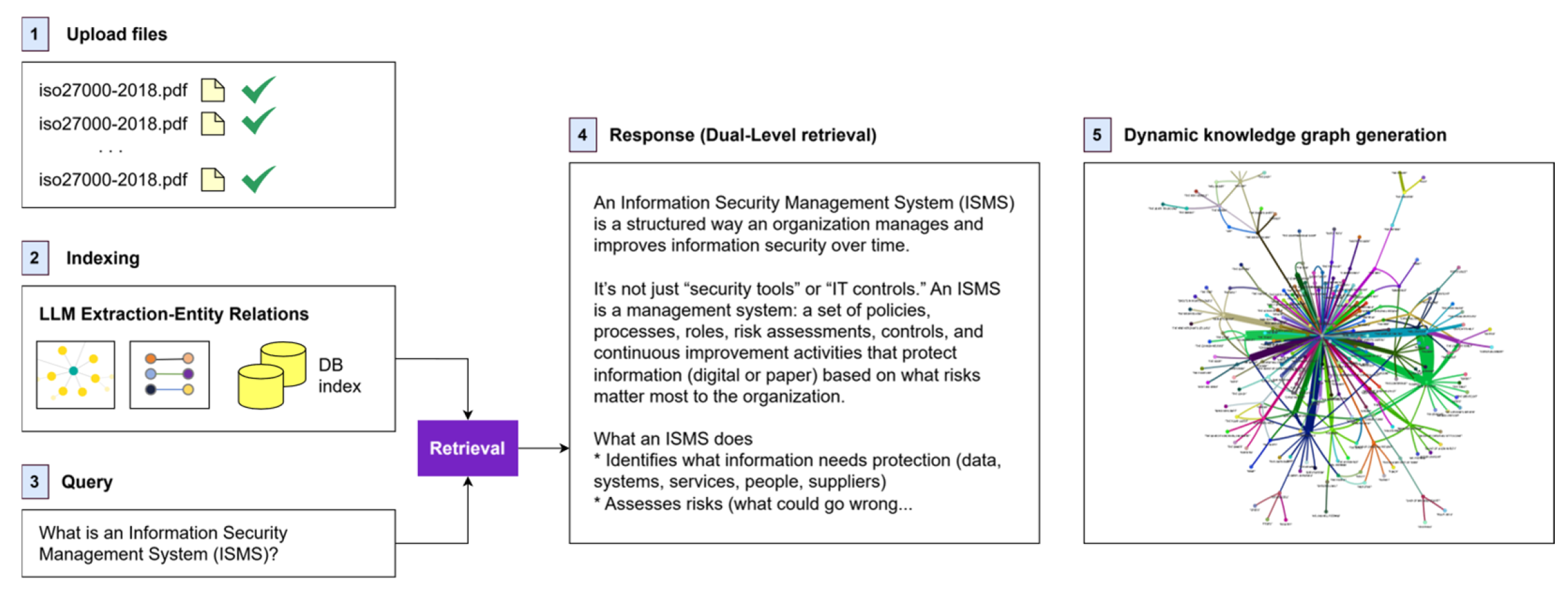
3.1. System Design and System Architecture
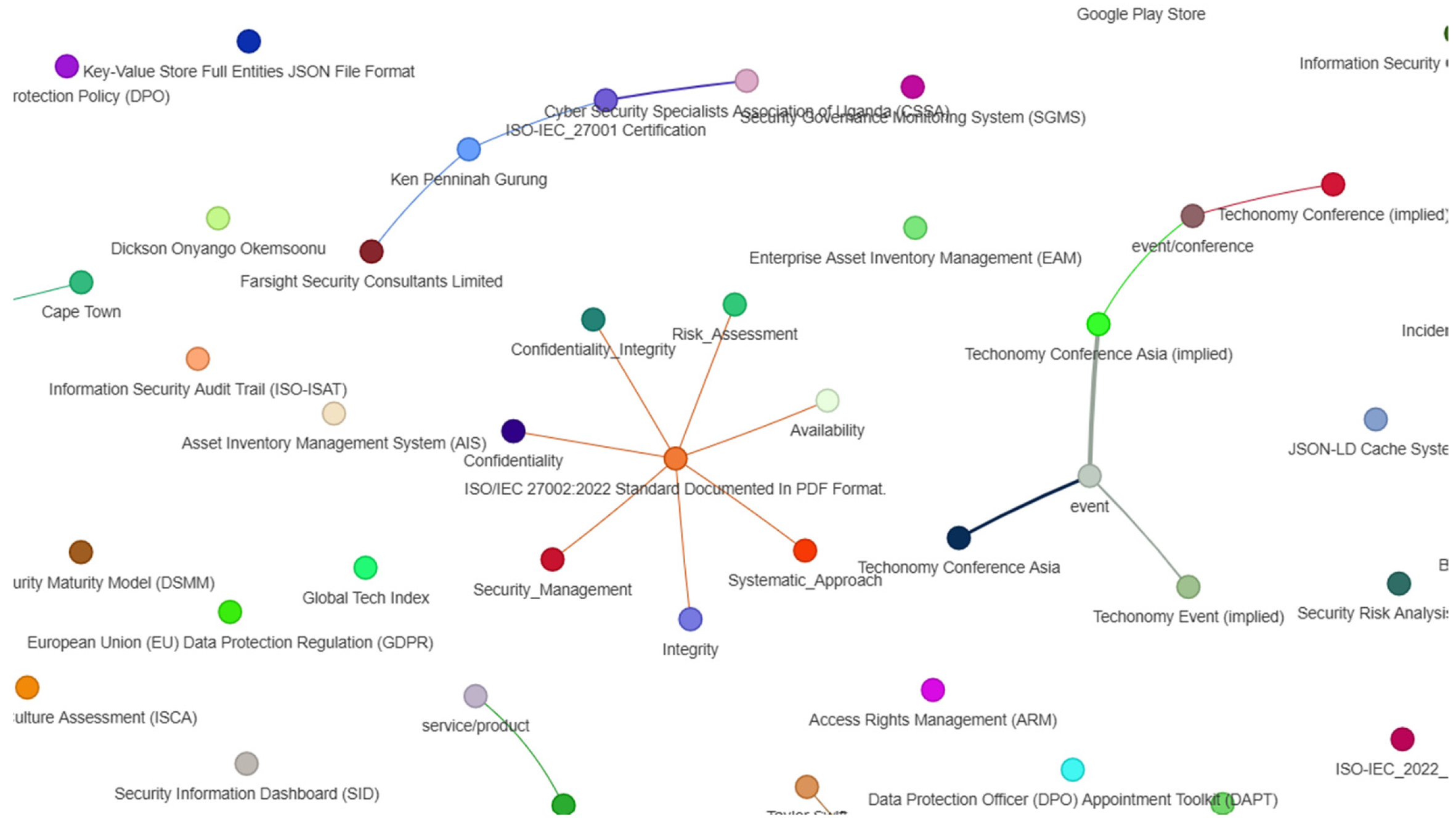
- Document ingestion and graph construction: The source documents are first segmented into clause or paragraph-level chunks. Each chunk is embedded and stored in a vector index for semantic retrieval. In parallel, LightRAG prompts a language model to extract entities and typed relationships from each chunk, which are then assembled into a corpus-level knowledge graph. The extracted relations are stored together with metadata that links them back to the originating chunk(s). Repeated entities and relations extracted from different parts of the corpus are deduplicated, thereby linking conceptually related content across documents. Importantly, graph edges are not created using an embedding-similarity threshold; instead, cosine similarity is used only during retrieval from the vector index to identify candidate chunks, entities, or relations. An example of a knowledge graph constructed in this manner is shown in Figure 1.
- Retrieval by querying the knowledge graph: When a user submits a prompt, LightRAG can operate in several retrieval modes. In naïve mode, retrieval is based only on vector similarity over chunk embeddings. In local mode, retrieval focuses on graph elements closely associated with the entities and relations most directly relevant to the query, aiming to recover precise clause-level evidence. In global mode, retrieval expands over broader graph neighborhoods to collect more conceptually distributed context. In hybrid mode, the system combines both local and global evidence. This retrieval design is particularly relevant for regulatory corpora, where some questions depend on a specific clause, while others require combining information across linked paragraphs, sections, and/or standards.
- Grounded answer generation: The retrieved evidence, together with the user query, is provided to a locally hosted Ollama language model, which generates the final answer. Because answer generation is conditioned on retrieved ISO-related context rather than on the model’s parametric memory alone, the resulting response remains grounded and factual.
- NUM_CTX: The maximum number of tokens available to the reasoning model during answer generation [31];
- EMBEDDING_DIM: The dimensionality of the vector representations produced by the selected embedding model [31];
- MAX_EMBED_TOKENS: The maximum chunk length allowed prior to embedding, which influences retrieval granularity and context segmentation [31].
3.2. ISO Corpus Preparation and Benchmark Dataset
- ISO/IEC 27000:2018 [32]: Overview and vocabulary;
- ISO/IEC 27001:2022 [33]: Requirements for ISMS;
- ISO/IEC 27002:2022 [34]: Code of practice for information security controls;
- ISO/IEC 27003:2017 [35]: Implementation guidance for ISMS;
- ISO/IEC 27004:2016 [36]: Measurement of information security;
- ISO/IEC 27005:2022 [37]: Information security risk management;
- ISO/IEC 27006:2024 [38]: Requirements for bodies auditing and certifying ISMS.
4. Results
4.1. First Phase: Embedding and Model Selection
4.2. Second Phase: Parameter Optimization
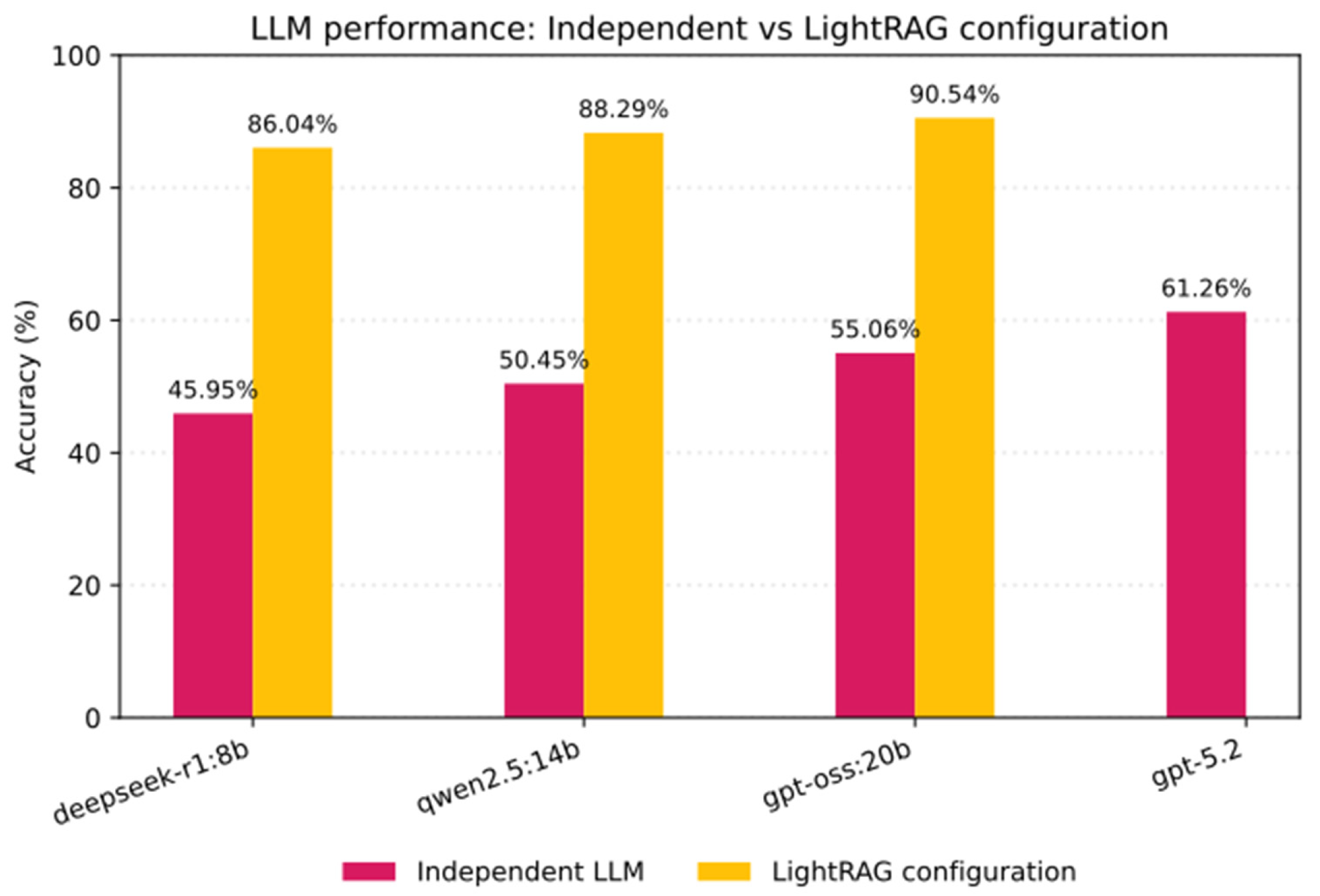
- deepseek-r1:8b
- qwen2.5:14b
- gpt-oss:20b
- gpt-5.2
5. Discussion
6. Conclusions
Author Contributions
Funding
Institutional Review Board Statement
Informed Consent Statement
Data Availability Statement
Conflicts of Interest
References
- Payment Card Industry Data Security Standard (PCI DSS), Version 4.0; PCI Security Standards Council: Wakefield, MA, USA, 2022. Available online: https://www.pcisecuritystandards.org/document_library (accessed on 3 April 2026).
- Cloud Controls Matrix (CCM), Version 4.0; Cloud Security Alliance: Bellevue, WA, USA, 2021. Available online: https://cloudsecurityalliance.org/research/cloud-controls-matrix/ (accessed on 3 April 2026).
- Framework for Improving Critical Infrastructure Cybersecurity (NIST Cybersecurity Framework 2.0); Version 2.0; National Institute of Standards and Technology (NIST): Gaithersburg, MD, USA; U.S. Department of Commerce: Washington, DC, USA, 2024. Available online: https://www.nist.gov/cyberframework (accessed on 3 April 2026).
- Lewis, P.; Perez, E.; Piktus, A.; Petroni, F.; Karpukhin, V.; Goyal, N.; Küttler, H.; Lewis, M.; Yih, W.-t.; Rocktäschel, T.; et al. Retrieval-augmented generation for knowledge-intensive NLP tasks. Adv. Neural Inf. Process. Syst. 2020, 33, 9459–9474. [Google Scholar]
- Asai, A.; Wu, Z.; Wang, Y.; Sil, A.; Hajishirzi, H. Self-RAG: Learning to retrieve, generate, and critique through self-reflection. arXiv 2023, arXiv:2310.11511. [Google Scholar] [CrossRef]
- Ma, X.; Gong, Y.; He, P.; Zhao, H.; Duan, N. Query rewriting in retrieval-augmented large language models. In Proceedings of the 2023 Conference on Empirical Methods in Natural Language Processing; Association for Computing Machinery: New York, NY, USA, 2023; pp. 5303–5315. [Google Scholar]
- Jeong, S.; Baek, J.; Cho, S.; Hwang, S.J.; Park, J.C. Adaptive-RAG: Learning to adapt retrieval-augmented large language models through question complexity. arXiv 2024, arXiv:2403.14403. [Google Scholar]
- Xu, P.; Ping, W.; Wu, X.; McAfee, L.; Zhu, C.; Liu, Z.; Subramanian, S.; Bakhturina, E.; Shoeybi, M.; Catanzaro, B. Retrieval meets long context large language models. arXiv 2023, arXiv:2310.03025. [Google Scholar]
- Gao, Y.; Xiong, Y.; Gao, X.; Jia, K.; Pan, J.; Bi, Y.; Dai, Y.; Sun, J.; Wang, H.; Wang, H. Retrieval-augmented generation for large language models: A survey. arXiv 2023, arXiv:2312.10997. [Google Scholar]
- Fan, W.; Ding, Y.; Ning, L.; Wang, S.; Li, H.; Yin, D.; Chua, T.-S.; Li, Q. A survey on RAG meeting LLMs: Towards retrieval-augmented large language models. In Proceedings of the 30th ACM SIGKDD Conference on Knowledge Discovery and Data Mining; Association for Computing Machinery: New York, NY, USA, 2024; pp. 6491–6501. [Google Scholar]
- Sun, J.; Luo, Z.; Li, Y. A compliance checking framework based on retrieval augmented generation. In Proceedings of the 31st International Conference on Computational Linguistics; Association for Computational Linguistics: Bangkok, Thailand, 2025; pp. 2603–2615. [Google Scholar]
- Malali, N. The Role of Retrieval-Augmented Generation (RAG) in Financial Document Processing: Automating Compliance and Reporting. Int. J. Manag. 2025, 12, 26–46. [Google Scholar] [CrossRef]
- Han, Y.; Ceross, A.; Bergmann, J.H.M. Standard Applicability Judgment and Crossjurisdictional Reasoning: A RAG-based Framework for Medical Device Compliance. arXiv 2025, arXiv:2506.18511. [Google Scholar]
- Mao, Q.; Zhang, Q.; Hao, H.; Han, Z.; Xu, R.; Jiang, W.; Hu, Q.; Chen, Z.; Zhou, T.; Li, B.; et al. Privacy-preserving federated embedding learning for localized retrieval-augmented generation. arXiv 2025, arXiv:2504.19101. [Google Scholar]
- Addison, P.; Nguyen, M.-T.H.; Medan, T.; Shah, J.; Manzari, M.T.; McElrone, B.; Lalwani, L.; More, A.; Sharma, S.; Roth, H.R.; et al. C-FedRAG: A confidential federated retrieval-augmented generation system. arXiv 2024, arXiv:2412.13163. [Google Scholar]
- Nandagopal, S. Securing Retrieval-Augmented Generation Pipelines: A Comprehensive Framework. J. Comput. Sci. Technol. Stud. 2025, 7, 17–29. [Google Scholar] [CrossRef]
- Rorstrom, E. ISO 27001 Foundation—Practice Tests: 150 Questions and Explanations Based on the ISO 27001 Foundation Exam; Kindle Direct Publishing : Seattle, WA, USA, 2023; Available online: https://www.amazon.com/ISO-27001-Foundation-Questions-Explanations-ebook/dp/B0BT21DSVT (accessed on 3 April 2026).
- Ansari, M.S.; Khan, M.S.A.; Revankar, S.; Varma, A.; Mokhade, A.S. Lightweight Clinical Decision Support System using QLoRA-Fine-Tuned LLMs and Retrieval-Augmented Generation. arXiv 2025, arXiv:2505.03406. [Google Scholar]
- Weerasekara, T.B.; Chandeepa, C.; Amarasuriya, O.S.; Hettiarachchi, C. Privacy-Preserving Medical Advising System on Mobile Devices: On-Device PHI Anonymization, Medical Report Retrieval, and Cloud-Based RAG. In Proceedings of the ACM/IEEE International Conference on Connected Health: Applications, Systems and Engineering Technologies; Association for Computing Machinery: New York, NY, USA, 2025; pp. 447–452. [Google Scholar]
- Yu, X.; Lu, Y.; Yu, Z. LocalRQA: From generating data to locally training, testing, and deploying retrieval-augmented QA systems. arXiv 2024, arXiv:2403.00982. [Google Scholar]
- Zeng, S.; Zhang, J.; He, P.; Liu, Y.; Xing, Y.; Xu, H.; Ren, J.; Chang, Y.; Wang, S.; Yin, D.; et al. The good and the bad: Exploring privacy issues in retrieval-augmented generation (RAG). In Findings of the Association for Computational Linguistics: ACL 2024; Association for Computational Linguistics: Bangkok, Thailand, 2024; pp. 4505–4524. [Google Scholar]
- He, L.; Tang, P.; Zhang, Y.; Zhou, P.; Su, S. Mitigating privacy risks in Retrieval-Augmented Generation via locally private entity perturbation. Inf. Process. Manag. 2025, 62, 104150. [Google Scholar] [CrossRef]
- Cheng, Y.; Zhang, L.; Wang, J.; Yuan, M.; Yao, Y. RemoteRAG: A privacy-preserving LLM cloud RAG service. In Findings of the Association for Computational Linguistics: ACL 2025; Association for Computational Linguistics: Bangkok, Thailand, 2025; pp. 3820–3837. [Google Scholar]
- McMahan, B.; Moore, E.; Ramage, D.; Hampson, S.; y Arcas, B.A. Communication-efficient learning of deep networks from decentralized data. In Proceedings of Artificial Intelligence and Statistics (AISTATS); PMLR: Birmingham, UK, 2017; pp. 1273–1282. [Google Scholar]
- Kairouz, P.; McMahan, H.B.; Avent, B.; Bellet, A.; Bennis, M.; Bhagoji, A.N.; Bonawitz, K.; Charles, Z.; Cormode, G.; Cummings, R.; et al. Advances and open problems in federated learning. Found. Trends Mach. Learn. 2021, 14, 1935–8237. [Google Scholar] [CrossRef]
- Wei, K.; Li, J.; Ding, M.; Ma, C.; Yang, H.H.; Farokhi, F.; Jin, S.; Quek, T.Q.S.; Poor, H.V. Federated learning with differential privacy: Algorithms and performance analysis. IEEE Trans. Inf. Forensics Secur. 2020, 15, 3454–3469. [Google Scholar] [CrossRef]
- Pan, S.; Luo, L.; Wang, Y.; Chen, C.; Wang, J.; Wu, X. Unifying large language models and knowledge graphs: A roadmap. IEEE Trans. Knowl. Data Eng. 2024, 36, 3580–3599. [Google Scholar] [CrossRef]
- Sun, J.; Xu, C.; Tang, L.; Wang, S.; Lin, C.; Gong, Y.; Ni, L.M.; Shum, H.-Y.; Guo, J. Think-on-graph: Deep and responsible reasoning of large language model on knowledge graph. arXiv 2023, arXiv:2307.07697. [Google Scholar]
- DEdge, D.; Trinh, H.; Cheng, N.; Bradley, J.; Chao, A.; Mody, A.; Truitt, S.; Metropolitansky, D.; Ness, R.O.; Larson, J. From local to global: A graph RAG approach to query-focused summarization. arXiv 2024, arXiv:2404.16130. [Google Scholar] [CrossRef]
- Guo, Z.; Xia, L.; Yu, Y.; Ao, T.; Huang, C. LightRAG: Simple and fast retrieval-augmented generation. arXiv 2024, arXiv:2410.05779. [Google Scholar]
- HKUDS/LightRAG Contributors. lightrag_ollama_demo.py—Example Script from LightRAG; GitHub Repository, 2025. Available online: https://github.com/HKUDS/LightRAG/blob/main/examples/lightrag_ollama_demo.py (accessed on 3 April 2026).
- ISO/IEC 27000:2018; Information Technology—Security Techniques—Information Security Management Systems—Overview and Vocabulary. ISO/IEC: Geneva, Switzerland, 2018. Available online: https://www.iso.org/standard/73906.html (accessed on 3 April 2026).
- ISO/IEC 27001:2022; Information Security, Cybersecurity and Privacy Protection—Information Security Management Systems—Requirements. ISO/IEC: Geneva, Switzerland, 2022. Available online: https://www.iso.org/standard/82875.html (accessed on 3 April 2026).
- ISO/IEC 27002:2022; Information Security, Cybersecurity and Privacy Protection—Information Security Controls. ISO/IEC: Geneva, Switzerland, 2022. Available online: https://www.iso.org/standard/75652.html (accessed on 3 April 2026).
- ISO/IEC 27003:2017; Information Technology—Security Techniques—Information Security Management Systems—Guidance. ISO/IEC: Geneva, Switzerland, 2017. Available online: https://www.iso.org/standard/63417.html (accessed on 3 April 2026).
- ISO/IEC 27004:2016; Information Technology—Security Techniques—Information Security Management—Monitoring, Measurement, Analysis and Evaluation. ISO/IEC: Geneva, Switzerland, 2016. Available online: https://www.iso.org/standard/64107.html (accessed on 3 April 2026).
- ISO/IEC 27005:2022; Information Security, Cybersecurity and Privacy Protection—Information Security Risk Management. ISO/IEC: Geneva, Switzerland, 2022. Available online: https://www.iso.org/standard/80585.html (accessed on 3 April 2026).
- ISO/IEC 27006-1:2024; Information Security, Cybersecurity and Privacy Protection—Requirements for Bodies Providing Audit and Certification of Information Security Management Systems—Part 1: General. ISO/IEC: Geneva, Switzerland, 2024. Available online: https://www.iso.org/standard/82908.html (accessed on 3 April 2026).
- Rorstrom, E. ISO 27001 Lead Auditor—Study Guide: Achieving Excellence in Information Security: The Ultimate ISO 27001 Lead Auditor Preparation Handbook. 2023. Available online: https://www.amazon.com/ISO-27001-Lead-Auditor-Information/dp/B0BZFC9776 (accessed on 3 April 2026).
- Blokdyk, G. ISO IEC 27000 A Complete Guide—2020 Edition; 5STARCOOKS: Toronto, ON, Canada, 2020; Available online: https://books.google.mk/books?id=OZBF0AEACAAJ (accessed on 3 April 2026).
- Wens, C. ISO 27001 Handbook: Implementing and Auditing an Information Security Management System in Small and Medium-sized Businesses; Independently Published, 2019; Available online: https://www.amazon.com/ISO-27001-Handbook-Implementing-medium-sized/dp/1098547683 (accessed on 3 April 2026).
- Calder, A. ISO27001/ISO27002: A Pocket Guide; IT Governance Publishing: Ely, UK, 2013; Available online: https://books.google.mk/books?id=uFObBAAAQBAJ (accessed on 3 April 2026).
- Calder, A. ISO 27001/ISO 27002—A Guide to Information Security Management Systems; Walter de Gruyter GmbH: Berlin, Germany, 2023; Available online: https://books.google.mk/books?id=qyHkEAAAQBAJ (accessed on 3 April 2026).
- Hintzbergen, J.; Hintzbergen, K. Foundations of Information Security Based on ISO27001 and ISO27002, 3rd ed.; Van Haren Publishing: ’s-Hertogenbosch, The Netherlands, 2015; Available online: https://books.google.mk/books?id=n1gdEQAAQBAJ (accessed on 3 April 2026).
- Calder, A. Information Security Based on ISO 27001/ISO 27002; Van Haren Publishing: ’s-Hertogenbosch, The Netherlands, 2020; Available online: https://books.google.mk/books?id=yhJADwAAQBAJ (accessed on 3 April 2026).
- Calder, A. Implementing Information Security Based on ISO 27001/ISO 27002; Van Haren Publishing: ’s-Hertogenbosch, The Netherlands, 2020; Available online: https://books.google.mk/books?id=0hJADwAAQBAJ (accessed on 3 April 2026).
- Kenyon, B. ISO 27001 Controls: A Guide to Implementing and Auditing, 2nd ed.; IT Governance Publishing Limited: Ely, UK, 2024; Available online: https://books.google.mk/books?id=o4Hw0AEACAAJ (accessed on 3 April 2026).
- Kyriazoglou, J. ISO 27001: 2022 Implementation Handbook: Approaches and Measures to Comply Better with the Requirements of ISO27001 Information Security Controls Standard; Fylatos Publishing: Thessaloníki, Greece, 2024; Available online: https://www.amazon.com/ISO-27001-Implementation-requirements-Information-ebook/dp/B0DB6FD647 (accessed on 3 April 2026).
- CreateSpace Independent Publishing Platform Publisher location; CreateSpace Independent Publishing Platform: North Charleston, SC, USA, 2023; Available online: https://www.amazon.ca/Easy-Guide-Certified-ISO-27000-Specialist/dp/1542979196 (accessed on 3 April 2026).
- Baars, H.; Hintzbergen, J.; Hintzbergen, K. Foundations of Information Security Based on ISO27001 and ISO27002, 4th ed.; Van Haren Publishing: ’s-Hertogenbosch, The Netherlands, 2023; Available online: https://books.google.mk/books?id=xVgdEQAAQBAJ (accessed on 3 April 2026).
- Mirtsch, M.; Kinne, J.; Blind, K. Exploring the adoption of the International Information Security Management System Standard ISO/IEC 27001: A web mining-based analysis. IEEE Trans. Eng. Manag. 2021, 68, 87–100. [Google Scholar] [CrossRef]
- Putra, D.S.K.; Tistiyani, S.; Sunaringtyas, S.U. The Use of ISO/IEC 27001 Family of Standards in Regulatory Requirements in Some Countries. In 2021 2nd International Conference on ICT for Rural Development (IC-ICTRuDev); IEEE: New York, NY, USA, 2021; pp. 1–6. [Google Scholar]
- Nowak, G.J. Information Security Management with accordance to ISO27000 Standards: Characteristics, implementations, benefits in global supply chains. Logistyka 2015, 2, 639–654. [Google Scholar]
- de Freitas Fernandes, A.; de Brito, F.C.S.; Periard, F.F.; Matias, G.A.V.; Gonçalves, M.S.; Baldoino Filho, R.G. The ISO 27000 Family and its Applicability in LGPD Adaptation Projects for Small and Medium-Sized Enterprises. ICSEA 2021, 53. [Google Scholar]
- Izacard, G.; Lewis, P.; Lomeli, M.; Hosseini, L.; Petroni, F.; Schick, T.; Dwivedi-Yu, J.; Joulin, A.; Riedel, S.; Grave, E. Atlas: Few-shot learning with retrieval augmented language models. J. Mach. Learn. Res. 2023, 24, 1–43. [Google Scholar]
- Lee, S.; Shakir, A.; Koenig, D.; Lipp, J. Open source strikes bread-new fluffy embeddings model. mixedbread 2024. [Google Scholar]
- Nussbaum, Z.; Morris, J.X.; Duderstadt, B.; Mulyar, A. Nomic Embed: Training a reproducible long context text embedder. arXiv 2024, arXiv:2402.01613. [Google Scholar] [CrossRef]
- Vera, H.S.; Dua, S.; Zhang, B.; Salz, D.; Mullins, R.; Panyam, S.R.; Smoot, S.; Naim, I.; Zou, J.; Chen, F.; et al. EmbeddingGemma: Powerful and lightweight text representations. arXiv 2025, arXiv:2509.20354. [Google Scholar] [CrossRef]
- Guo, D.; Yang, D.; Zhang, H.; Song, J.; Zhang, R.; Xu, R.; Zhu, Q.; Ma, S.; Wang, P.; Bi, X.; et al. DeepSeek-R1: Incentivizing reasoning capability in LLMs via reinforcement learning. arXiv 2025, arXiv:2501.12948. [Google Scholar]
- Qwen, A.Y.; Yang, B.; Zhang, B.; Hui, B.; Zheng, B.; Yu, B.; Li, C.; Liu, D.; Huang, F.; Wei, H.; et al. Qwen2.5 technical report. arXiv 2024, arXiv:2412.15115. [Google Scholar] [CrossRef]
- Agarwal, S.; Ahmad, L.; Ai, J.; Altman, S.; Applebaum, A.; Arbus, E.; Arora, R.K.; Bai, Y.; Baker, B.; Bao, H.; et al. gpt-oss-120b & gpt-oss-20b model card. arXiv 2025, arXiv:2508.10925. [Google Scholar]



| Question | Answer_gt |
|---|---|
| What is an Information Security Management System (ISMS)? (A) A set of policies and procedures for managing sensitive company information. (B) A software tool for managing security risks (C) A physical security system (D) A consulting service for security compliance | A |
| What are the benefits of implementing ISO 27001? (A) Improving an organization’s overall security posture (B) Enhancing an organization’s reputation and credibility (C) Facilitating compliance with legal and regulatory requirements (D) All of the above | D |
| What is the main difference between ISO 27001 and ISO 27002? (A) ISO 27001 is a standard and ISO 27002 is a code of practice (B) ISO 27001 is for management and ISO 27002 is for technical implementation (C) ISO 27001 is for small businesses and ISO 27002 is for large organizations (D) ISO 27001 is for government agencies and ISO 27002 is for the private sector | A |
| Embedding Model | Language Model | Retrieval modes | |||
|---|---|---|---|---|---|
| Naïve | Local | Hybrid | Global | ||
| nomic-embed-text:137m | deepseek-r1:8b | 78.38% ± 0.45% [77.26, 79.50] | 78.83% ± 0.90% [76.59, 81.07] | 80.18% ± 0.78% [78.24, 82.12] | 79.28% ± 0.90% [77.04, 81.52] |
| llama3.1:8b | 78.38% ± 0.45% [77.26, 79.50] | 78.38% ± 0.45% [77.26, 79.50] | 80.18% ± 0.78% [78.24, 82.12] | 79.28% ± 0.90% [77.04, 81.52] | |
| mistral-nemo:12b | 76.58% ± 0.78% [74.64, 78.52] | 78.38% ± 0.45% [77.26, 79.50] | 80.18% ± 0.78% [78.24, 82.12] | 79.28% ± 0.90% [77.04, 81.52] | |
| qwen2.5:14b | 77.48% ± 0.45% [76.36, 78.60] | 78.38% ± 0.45% [77.26, 79.50] | 80.18% ± 0.78% [78.24, 82.12] | 79.73% ± 1.19% [76.77, 82.69] | |
| gpt-oss:20b | 77.48% ± 0.45% [76.36, 78.60] | 78.38% ± 0.45% [77.26, 79.50] | 80.18% ± 0.78% [78.24, 82.12] | 79.73% ± 1.19% [76.77, 82.69] | |
| embeddinggemma:300m | deepseek-r1:8b | 61.71% ± 0.90% [59.47, 63.95] | 55.41% ± 1.35% [52.06, 58.76] | 53.15% ± 1.80% [48.68, 57.62] | 51.80% ± 2.25% [46.21, 57.39] |
| llama3.1:8b | 68.47% ± 0.90% [66.23, 70.71] | 59.91% ± 1.35% [56.56, 63.26] | 56.76% ± 1.81% [52.26, 61.26] | 71.62% ± 2.25% [66.03, 77.21] | |
| mistral-nemo:12b | 68.92% ± 0.45% [67.80, 70.04] | 64.86% ± 0.90% [62.62, 67.10] | 62.16% ± 1.35% [58.81, 65.51] | 72.07% ± 1.80% [67.60, 76.54] | |
| qwen2.5:14b | 66.22% ± 0.45% [65.10, 67.34] | 74.32% ± 0.90% [72.08, 76.56] | 65.32% ± 0.91% [63.06, 67.58] | 72.07% ± 1.80% [67.60, 76.54] | |
| gpt-oss:20b | 61.26% ± 0.45% [60.14, 62.38] | 61.26% ± 0.90% [59.02, 63.50] | 66.22% ± 0.90% [63.98, 68.46] | 71.62% ± 1.80% [67.15, 76.09] | |
| mxbai-embed-large:335m | deepseek-r1:8b | 79.73% ± 0.45% [78.61, 80.85] | 78.83% ± 2.25% [73.24, 84.42] | 81.53% ± 0.90% [79.29, 83.77] | 81.08% ± 1.35% [77.73, 84.43] |
| llama3.1:8b | 81.08% ± 0.00% [81.08, 81.08] | 78.38% ± 0.45% [77.26, 79.50] | 81.53% ± 0.90% [79.29, 83.77] | 80.63% ± 1.35% [77.28, 83.98] | |
| mistral-nemo:12b | 81.08% ± 0.00% [81.08, 81.08] | 79.27% ± 0.45% [78.15, 80.39] | 82.88% ± 0.90% [80.64, 85.12] | 81.98% ± 1.19% [79.02, 84.94] | |
| qwen2.5:14b | 81.08% ± 0.45% [79.96, 82.20] | 78.83% ± 0.45% [77.71, 79.95] | 83.33% ± 0.90% [81.09, 85.57] | 83.33% ± 1.35% [79.98, 86.68] | |
| gpt-oss:20b | 81.08% ± 0.90% [78.84, 83.32] | 78.83% ± 0.90% [76.59, 81.07] | 83.33% ± 0.45% [82.21, 84.45] | 83.78% ± 0.90% [81.54, 86.02] | |
| Language Model | NUM_CTX | MAX_EMBEDDING_TOKENS | |||
|---|---|---|---|---|---|
| 1024 | 2048 | 4096 | 8192 | ||
| deepseek-r1:8b | 4096 | 83.78% ± 0.90% [81.54, 86.02] | 82.88% ± 0.90% [80.64, 85.12] | 81.98% ± 1.35% [78.63, 85.33] | 80.63% ± 1.80% [76.16, 85.10] |
| 8192 | 86.04% ± 0.45% [84.92, 87.16] | 84.23% ± 0.90% [81.99, 86.47] | 83.78% ± 0.90% [81.54, 86.02] | 81.53% ± 1.35% [78.18, 84.88] | |
| qwen2.5:14b | 4096 | 85.14% ± 0.45% [84.02, 86.26] | 86.94% ± 0.45% [85.82, 88.06] | 85.14% ± 0.90% [82.90, 87.38] | 82.43% ± 1.35% [79.08, 85.78] |
| 8192 | 87.39% ± 0.00% [87.39, 87.39] | 88.29% ± 0.45% [87.17, 89.41] | 86.49% ± 0.45% [85.37, 87.61] | 83.33% ± 0.90% [81.09, 85.57] | |
| gpt-oss:20b | 4096 | 88.29% ± 0.45% [87.17, 89.41] | 82.88% ± 0.90% [80.64, 85.12] | 83.33% ± 0.90% [81.09, 85.57] | 82.43% ± 1.35% [79.08, 85.78] |
| 8192 | 90.54% ± 0.00% [90.54, 90.54] | 88.74% ± 0.45% [87.62, 89.86] | 86.04% ± 0.45% [84.92, 87.16] | 83.33% ± 0.90% [81.09, 85.57] | |
| Question | Question Type | Generated Answer | Ground Truth |
|---|---|---|---|
| What is the purpose of the Statement of Applicability according to ISO 27001? | ISMS implementation/governance | E | A |
| In the event of a security incident at Company X, which of the following actions should be taken first according to ISO 27001 guidelines? | Controls/Annex A | D | B |
| What are the criteria to be used in an internal audit of an organization’s information security management system according to ISO 27001? | Audit/measurement | A | C |
| According to ISO 27001, Annex A, information and assets should be managed by: | Controls/Annex A | B | A |
| What is the purpose of ICT readiness for business continuity? | Controls/Annex A | B | D |
| What is the main focus of ISO/IEC 27004:2016? | Audit/measurement | C | D |
| The five-stage process for risk management, as laid out in ISO 27005, begins with what step? | Risk management | A | C |
| Which document should record the outcomes of risk assessments per ISO/IEC 27005? | Risk management | D | C |
| Error Category | Question Type | Generated Answer |
|---|---|---|
| Retrieval miss | 3 | 4 |
| Multi-hop aggregation error | 1 | 2 |
| Distractor susceptibility | 4 | 3 |
| Graph construction noise | 2 | 1 |
| Total errors (subset) | 10 | 10 |
Disclaimer/Publisher’s Note: The statements, opinions and data contained in all publications are solely those of the individual author(s) and contributor(s) and not of MDPI and/or the editor(s). MDPI and/or the editor(s) disclaim responsibility for any injury to people or property resulting from any ideas, methods, instructions or products referred to in the content. |
© 2026 by the authors. Licensee MDPI, Basel, Switzerland. This article is an open access article distributed under the terms and conditions of the Creative Commons Attribution (CC BY) license.
Share and Cite
Jovanovski, D.; Stojcheva, M.; Dodevska, M.; Lameski, P.; Mishkovski, I.; Gjorgjevikj, D. An Empirical Study of Knowledge Graph-Enhanced RAG for Information Security Compliance. Information 2026, 17, 389. https://doi.org/10.3390/info17040389
Jovanovski D, Stojcheva M, Dodevska M, Lameski P, Mishkovski I, Gjorgjevikj D. An Empirical Study of Knowledge Graph-Enhanced RAG for Information Security Compliance. Information. 2026; 17(4):389. https://doi.org/10.3390/info17040389
Chicago/Turabian StyleJovanovski, Dimitar, Marija Stojcheva, Mila Dodevska, Petre Lameski, Igor Mishkovski, and Dejan Gjorgjevikj. 2026. "An Empirical Study of Knowledge Graph-Enhanced RAG for Information Security Compliance" Information 17, no. 4: 389. https://doi.org/10.3390/info17040389
APA StyleJovanovski, D., Stojcheva, M., Dodevska, M., Lameski, P., Mishkovski, I., & Gjorgjevikj, D. (2026). An Empirical Study of Knowledge Graph-Enhanced RAG for Information Security Compliance. Information, 17(4), 389. https://doi.org/10.3390/info17040389