Article

Generalised Cross-Dialectal Arabic Question Answering Through Adaptive Code-Mixed Data Augmentation


by
Maha Jarallah Althobaiti
Department of Computer Science, College of Computers and Information Technology, Taif University, Taif 21944, Saudi Arabia
Information 2026, 17(2), 139; https://doi.org/10.3390/info17020139
Submission received: 24 December 2025 / Revised: 26 January 2026 / Accepted: 27 January 2026 / Published: 1 February 2026

Abstract

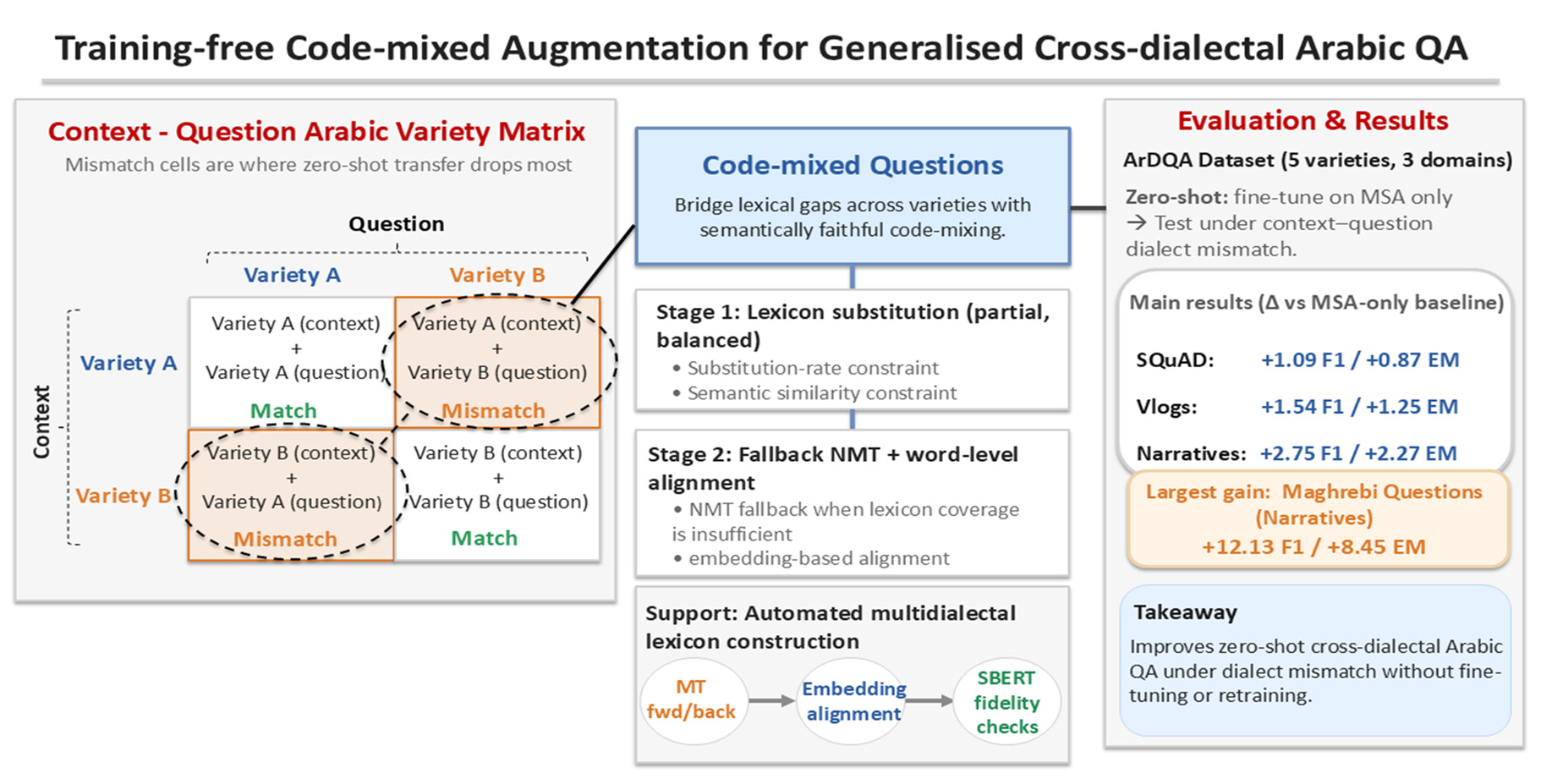
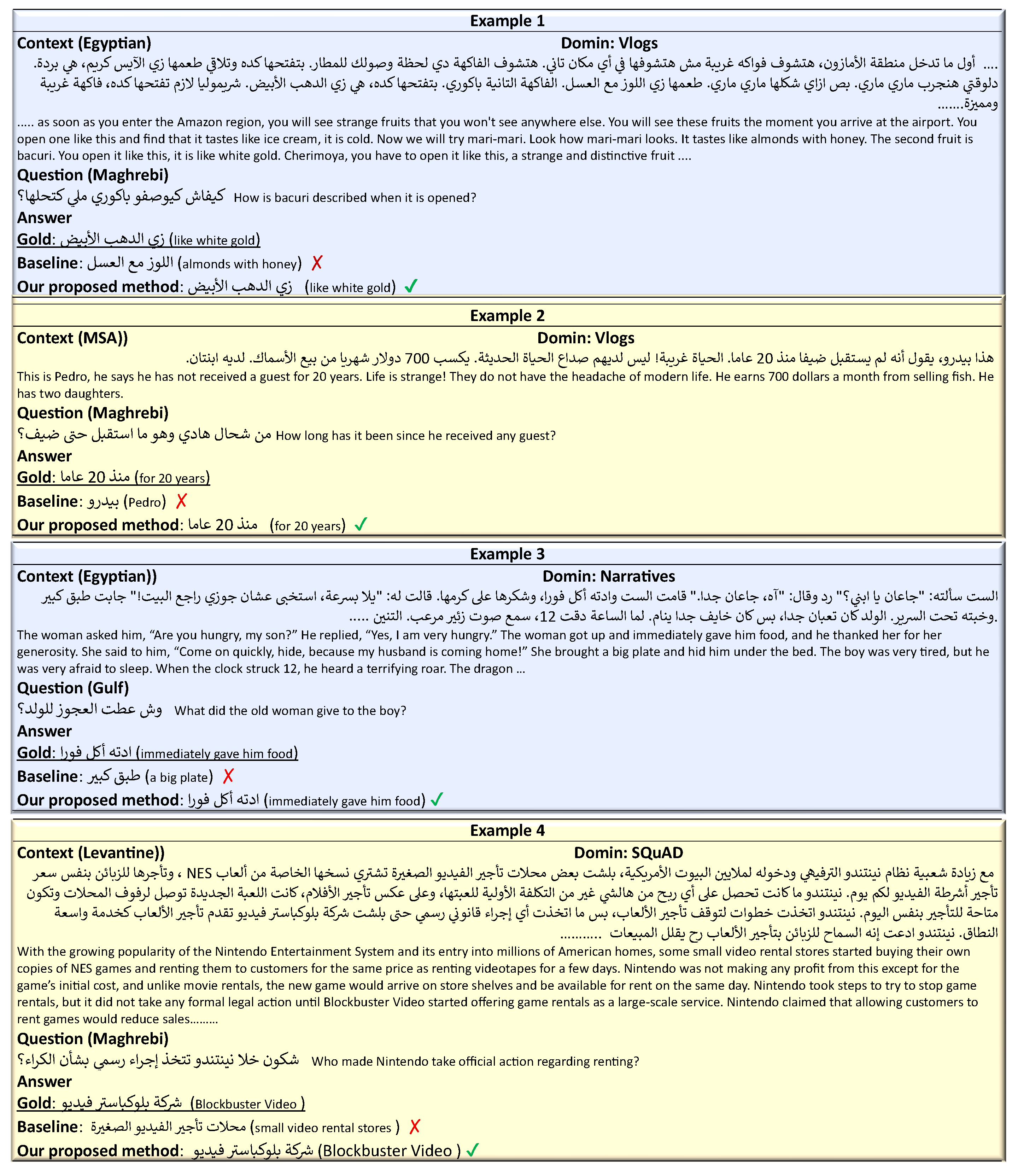
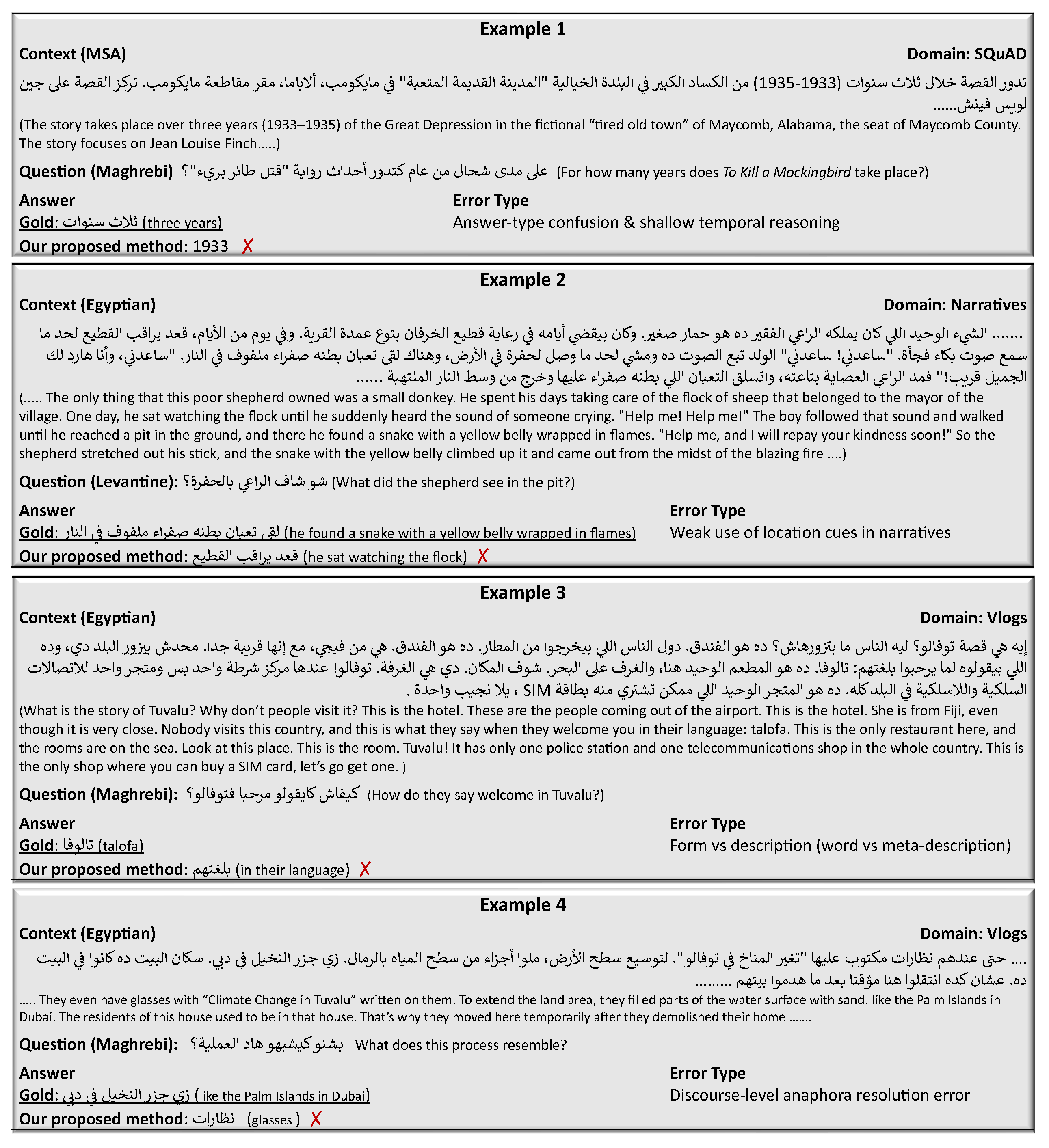
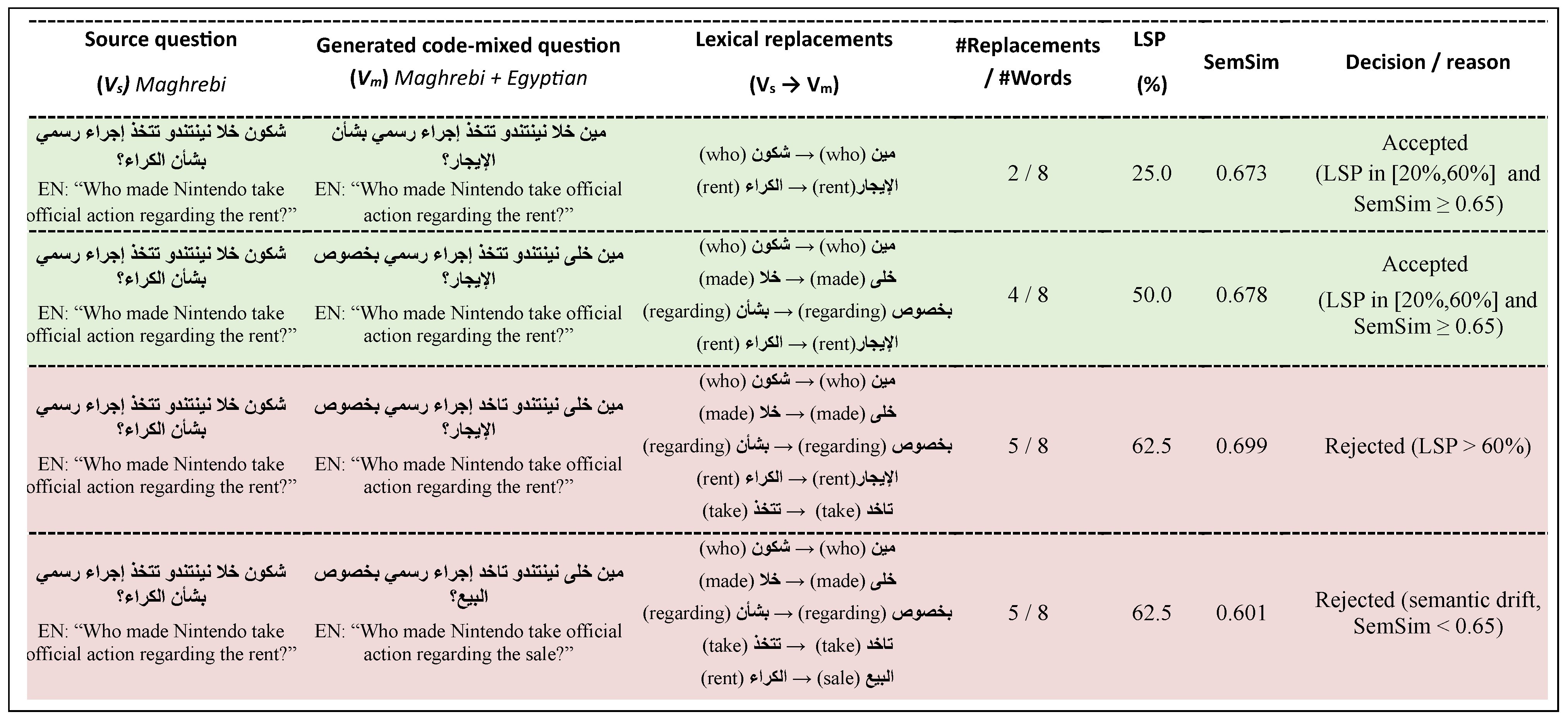
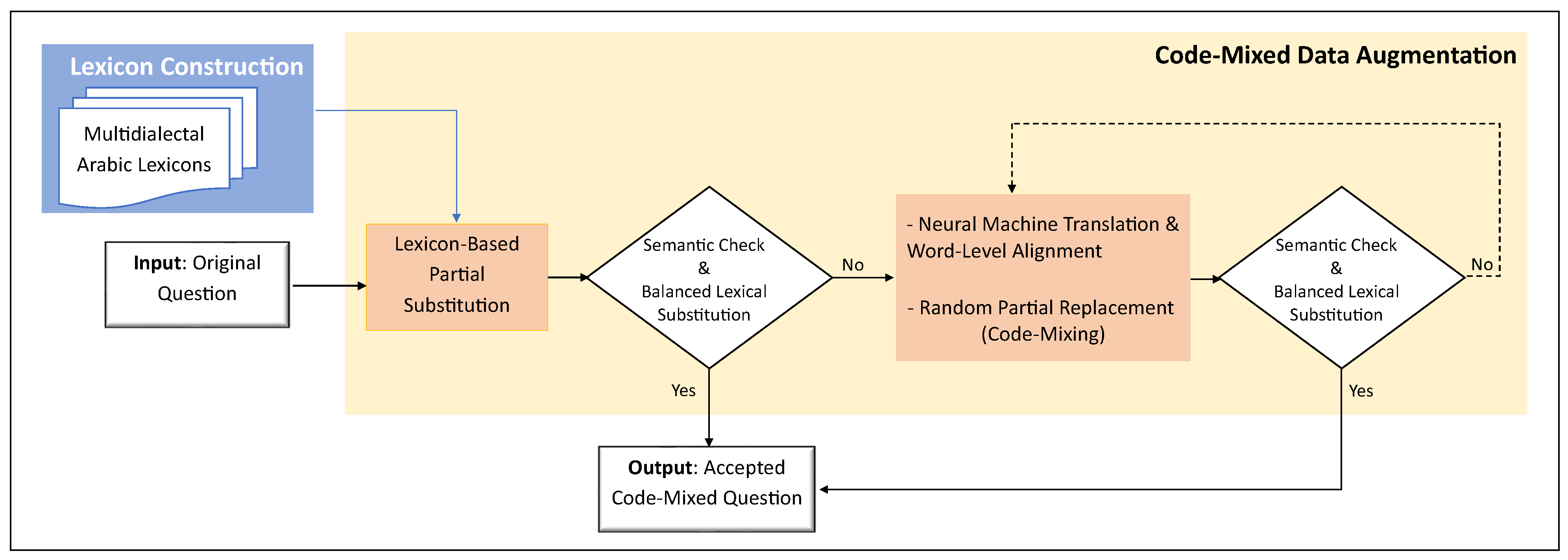
Modern Standard Arabic (MSA) and the many regional dialects differ substantially in vocabulary, morphology, and pragmatic usage. Most available annotated resources are in MSA, and zero-shot transfer from MSA to dialectal tasks suffers a large performance drop. This paper addresses generalised cross-dialectal Arabic question answering (QA), where the context and the question are written in different Arabic varieties. We propose a training-free augmentation framework that generates code-mixed questions to bridge lexical gaps across Arabic varieties. The method produces semantically faithful, balanced code-mixed questions through the following two-stage procedure: lexicon-based partial substitution with semantic similarity and substitution-rate constraints, followed by fallback neural machine translation with word-level alignment when needed. We also introduce automated multidialectal lexicon construction using machine translation, embedding-based alignment, and semantic checks. We carry out our evaluation in a zero-shot setting, where the model is fine-tuned only on MSA and then tested on dialectal inputs using ArDQA, covering five Arabic varieties and three domains (SQuAD, Vlogs, and Narratives). Experiments show consistent improvements under context-question dialect mismatch as follows: +1.09 F1/+0.87 EM on SQuAD, +1.54/+1.25 on Vlogs, and +2.75/+2.27 on Narratives, with the largest gains for Maghrebi questions in Narratives (+12.13 F1/+8.45 EM). These results show that our method improves zero-shot cross-dialectal transfer without fine-tuning or retraining.
Keywords: Arabic question answering; Arabic dialects; cross-dialectal transfer; embedding-based alignment; generalised zero-shot transfer; MSA; neural machine translation; semantic validation; word-level alignment Arabic question answering; Arabic dialects; cross-dialectal transfer; embedding-based alignment; generalised zero-shot transfer; MSA; neural machine translation; semantic validation; word-level alignment
Graphical Abstract