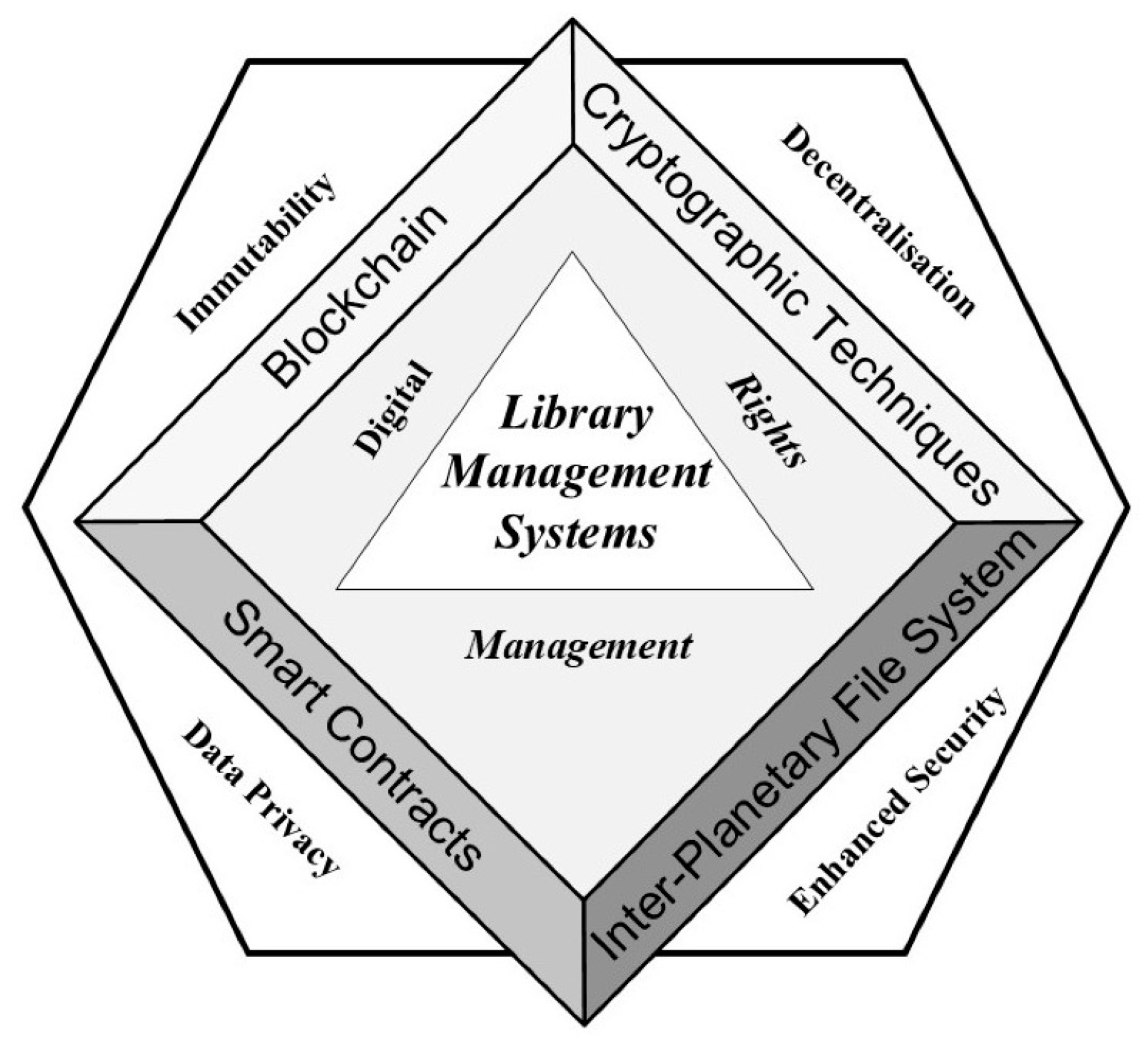
Library Systems and Digital-Rights Management: Towards a Blockchain-Based Solution for Enhanced Privacy and Security



Abstract
1. Introduction
2. Materials and Methods
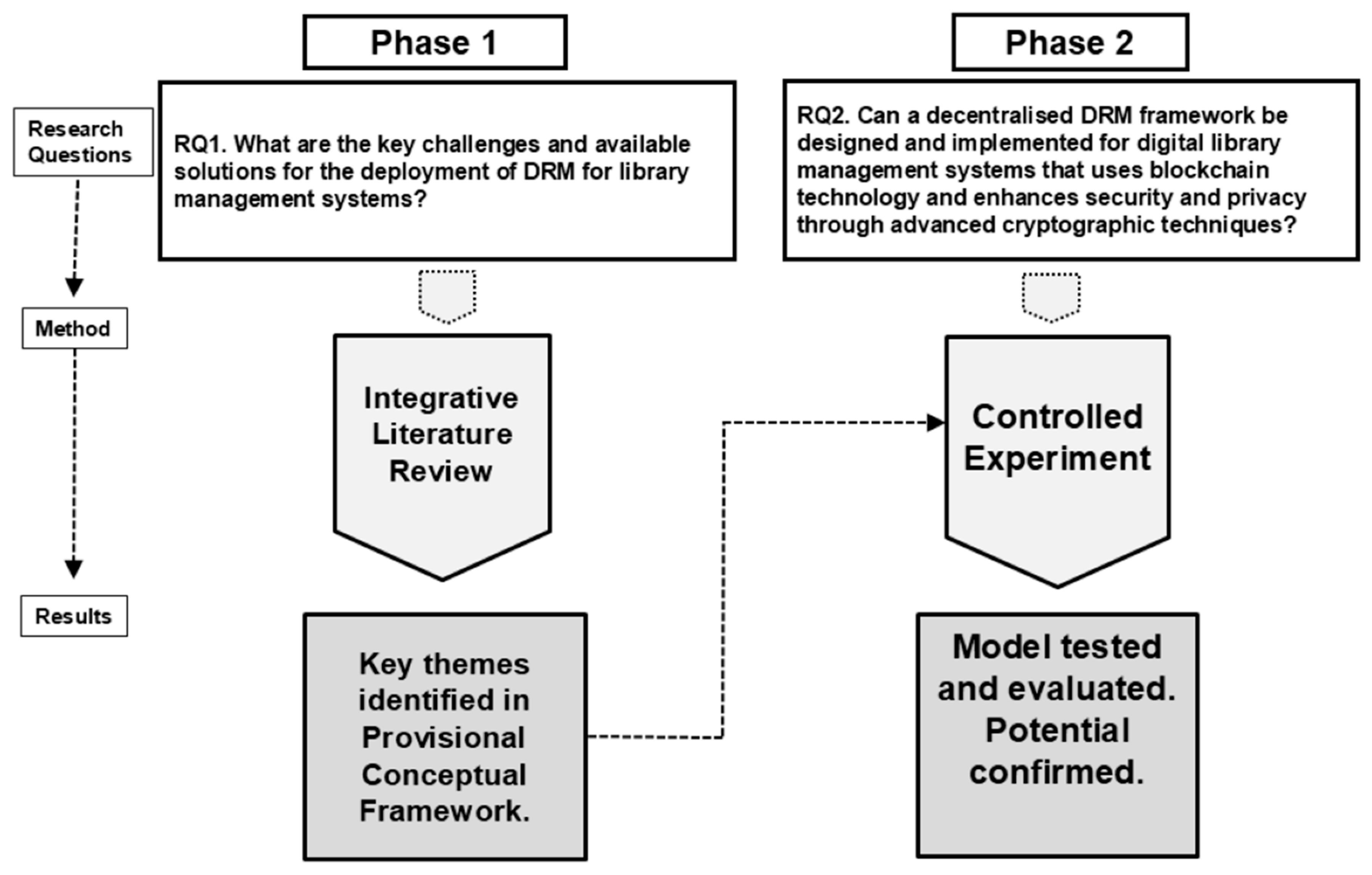
2.1. Integrative Literature Review
2.2. Controlled Experiment
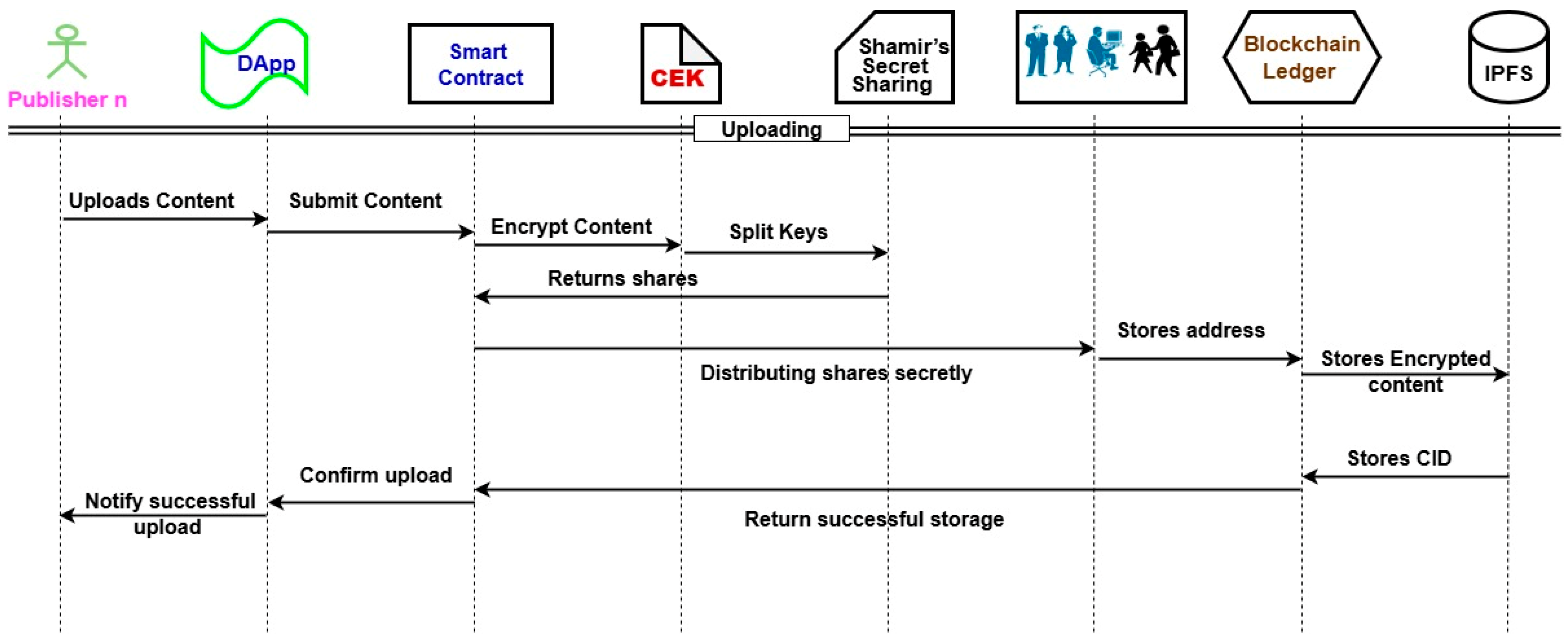
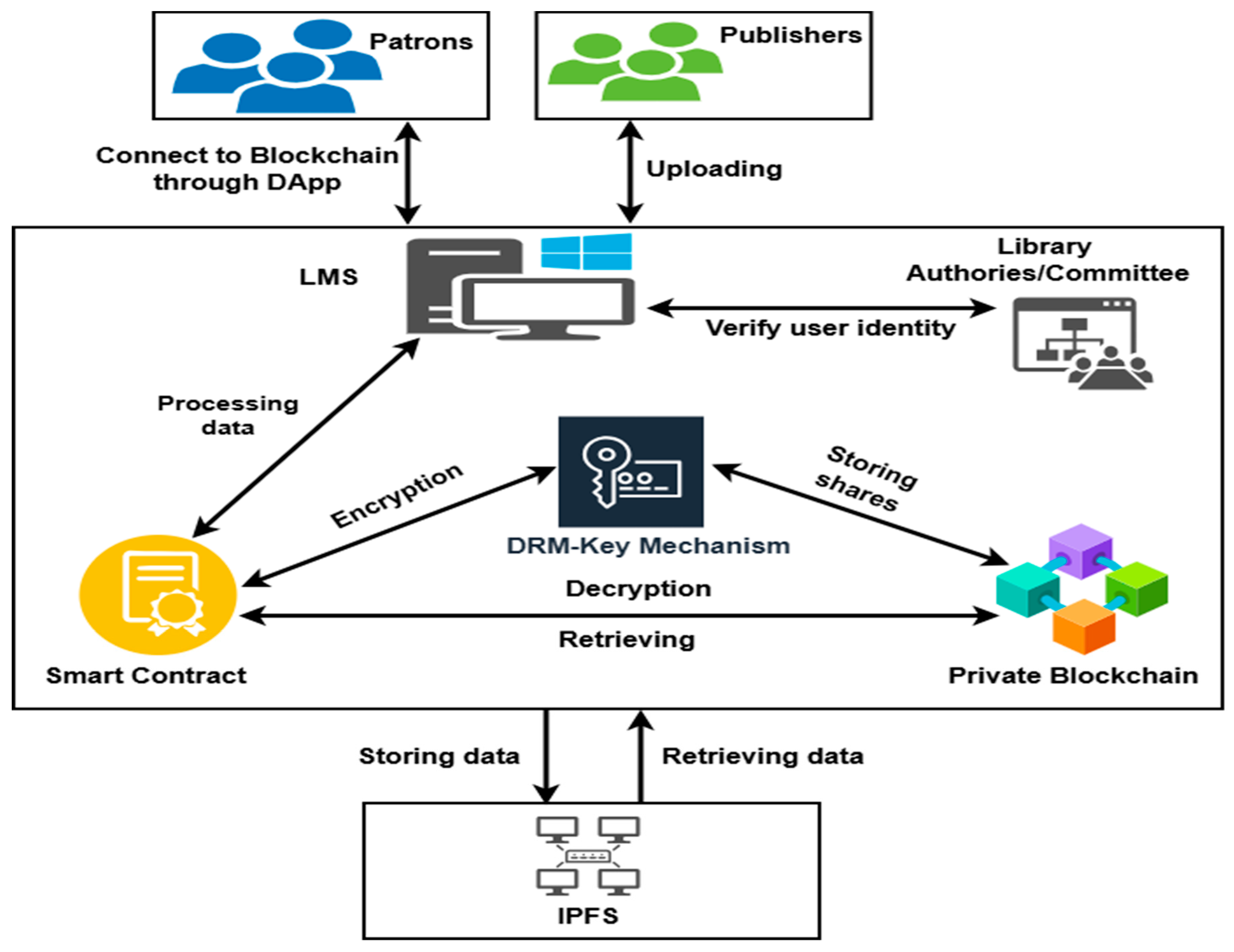
- Library Nodes: The blockchain nodes operated by participating libraries, responsible for validating transactions, and storing asset metadata. Furthermore, this layer serves as the policy enforcement and logging mechanism. Smart contracts are deployed on Ethereum to automate content licensing, manage DRM-keys, verify user-access rights, and ensure immutability of records. By using blockchain, the system eliminates reliance on a central DRM authority, reducing risks of manipulation, downtime, and single-point failures.
- Patrons: This is the term often used for end-users of library systems, these being students, researchers, and faculty members who access digital content via a client application (DApp). Patrons interact with the blockchain through wallets that manage their cryptographic keys.
- Publishers: Authors or publishers are individuals who upload digital assets (e-books, journals) and define initial access policies.
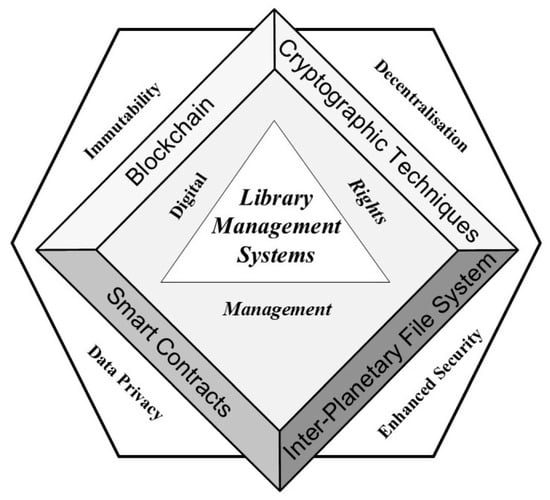
- Off-Chain Storage: Decentralized storage solutions include using IPFS for storing encrypted digital content, with hashes referenced on the blockchain to ensure integrity. Storing digital content directly on the blockchain is costly and inefficient due to block-size limitations. Therefore, the Inter-Planetary File System is employed to store encrypted versions of digital resources. IPFS is a distributed, peer-to-peer storage network that identifies content by a content-addressable hash [22]. This ensures that even if a file is moved or duplicated across the network, it can still be uniquely verified and retrieved.
3. Results
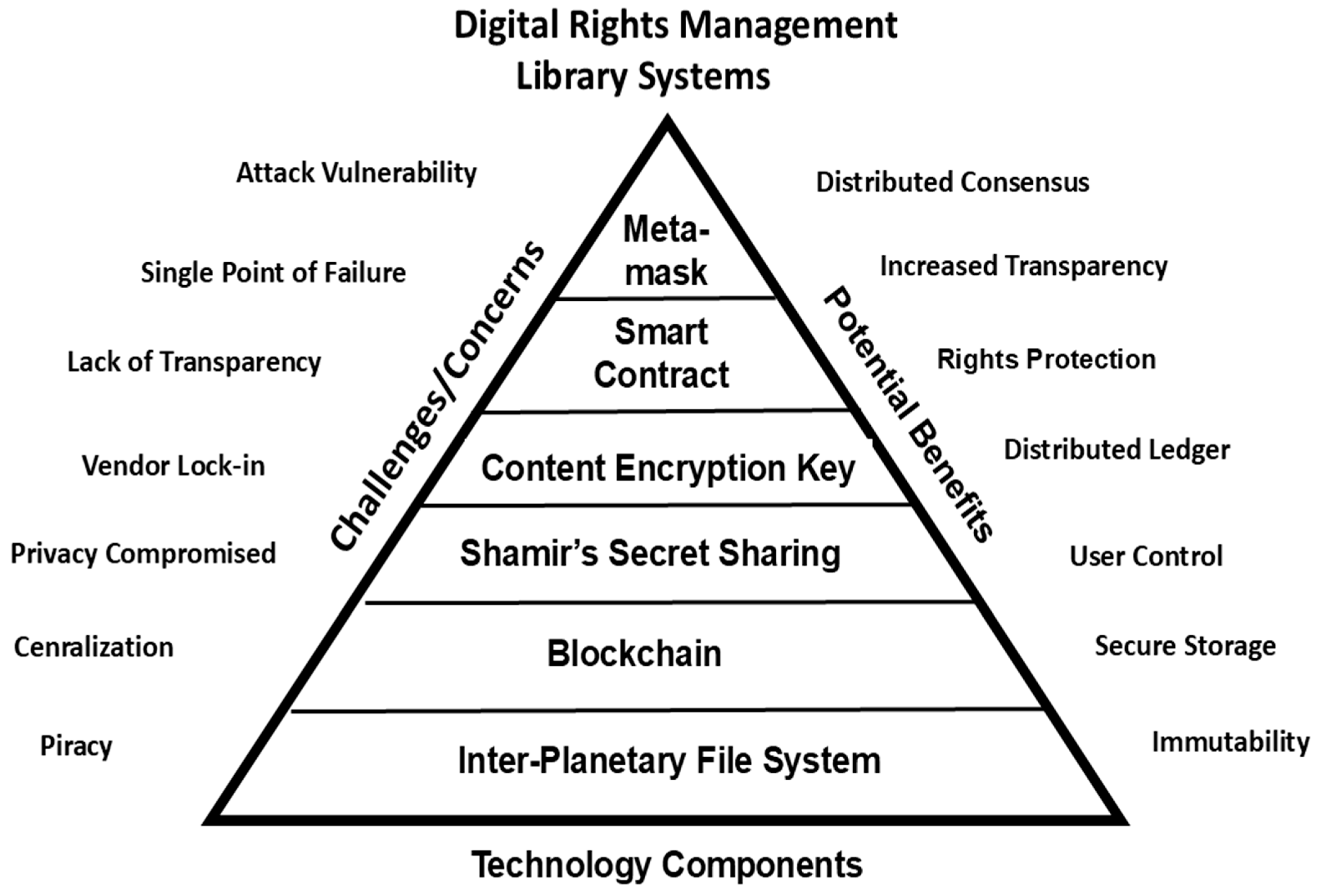
3.1. RQ1: What Are the Key Challenges and Available Solutions for the Deployment of DRM for Library Management Systems?
3.2. RQ2: Can a Decentralized DRM Framework Be Designed and Implemented for Digital Library Management Systems That Uses Blockchain Technology and Enhances Security and Privacy Through Advanced Cryptographic Techniques?
4. System Performance and Evaluation
4.1. Deployment Analysis
4.2. Evaluation Metrics
4.2.1. Performance
4.2.2. Access Latency
4.2.3. Security
4.2.4. Usability and Adoption
4.2.5. Cost-Efficiency
5. Conclusions
Author Contributions
Funding
Institutional Review Board Statement
Informed Consent Statement
Data Availability Statement
Conflicts of Interest
Appendix A. Encryption/Decryption Formulae
- ○
- Formula:
- ○
- C: Ciphertext (encrypted content).
- ○
- E: Encryption function (AES).
- ○
- P: Plaintext (original digital content).
- ○
- K: CEK (the symmetric key).
- ○
- IV: Initialization Vector (a unique, non-secret value to ensure semantic security).
- ○
- Decryption reverses the process: The ciphertext C is collected from IPFS, and the algorithm uses K to recover P. Access control is enforced via blockchain smart contract ensuring that only valid users can obtain K.
- ○
- Formula:
- ○
- D: Decryption function (the inverse of E). The output P matches the original only if the correct K and IV are used; otherwise, it fails.
Appendix B. Shamir’s Secret Sharing Foundations
- (1)
- The polynomial is .
- The coefficients in
- Shares: for to
- Encrypted with public keys and distributed (publisher, admin, faculty, 2 members).
- Commitments stored on-chain for verifiability.
- (2)
- Generate distinct points on the polynomial:
- Generated shares with threshold for . For a 256-bit , use a field with .
- Distribute shares to publisher, Library administrators, Faculty, and to two Members. Each share is encrypted with the node’s public key :
- Store commitments on-chain for verifiability, using a commitment scheme:
- Smart contracts define rules for share submission, ensuring only authorized nodes participate.
Appendix C. Execution Logs


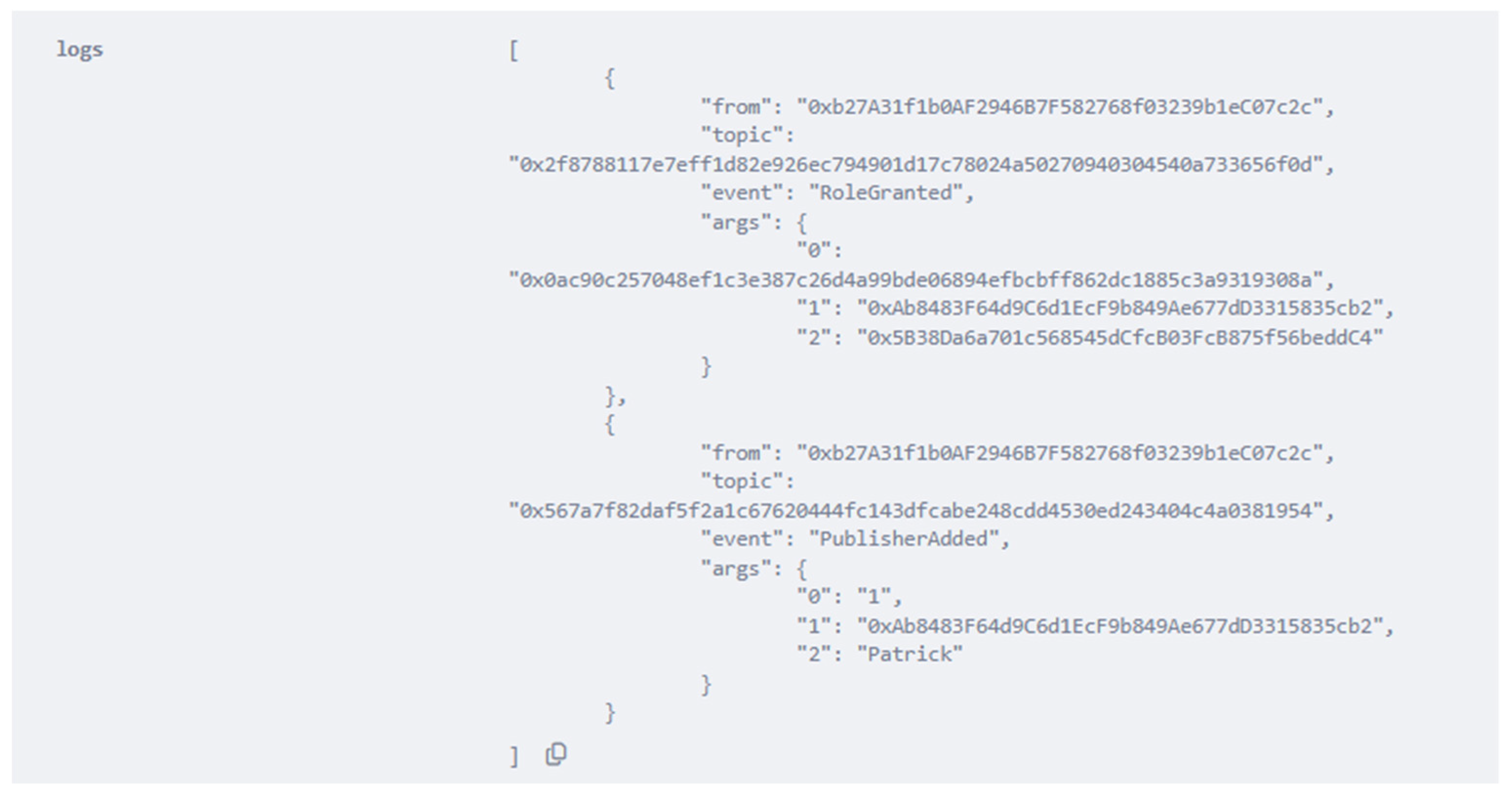
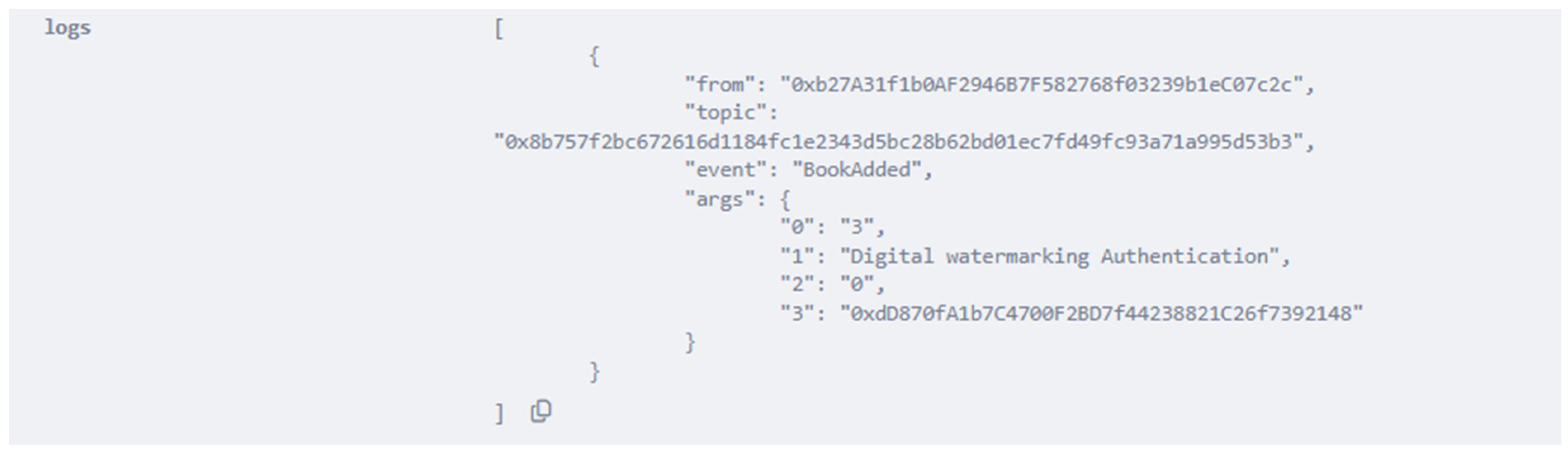
Appendix D. Function Evaluation of the DLMS

| Function Name | Function Hash | Transaction Hash | Block Size (Bytes) | Transaction Index | Transaction Nonce | Epoch |
|---|---|---|---|---|---|---|
| Userinitiatejoining () | 05d7A3y | 0xb01baada161fb426bdb93941a71b6f1ce7bca2665 | 1762839 | 76 | 34 | 83359 |
| Joinnetwork (address) | 07sb13r | 0x4fb784Da684b7f697Ce274E533c342aEae002790 | 1271854 | 46 | 35 | 45736 |
| Verifywallet (address) | 0120d9c | 0x87A3effB84CBE1E4caB6Ab430139eC41d156D55A | 1221445 | 73 | 36 | 44753 |
| DRMTokenresource () | 0x87A3e | 0x60d9B5e1448D931c0116e153CF4d10c2cc3dd7C7 | 1197493 | 20 | 37 | 75757 |
| Getmetadatacontent (uint256) | 0xFb13d | 0xFb13dE1C5aC28fc8335Ec5721b06eB4eA6e3897b | 1202899 | 55 | 38 | 24254 |
| ContentSign (uint256) | 0650d9B | 0x4fb784Da684b7f697Ce274E533c342aEae002790 | 1181460 | 29 | 39 | 64265 |
| MetadataStoredonipfs (uint256) | 09eC41v | 0x87A3effB84CBE1E4caB6Ab430139eC41d156D55A | 1197327 | 82 | 40 | 26625 |
| Verify (uint256) | 06r7A3e | 0x60d9B5e1448D931c0116e153CF4d10c2cc3dd7C7 | 6678436 | 66 | 41 | 54665 |
| Digitalsignature Extraction (bytes) | 0xFb13x | 0xFb13dE1C5aC28fc8335Ec5721b06eB4eA6e3897b | 8896256 | 29 | 42 | 42664 |
| Verifydigitalsignature (uint256, bytes) | 0x60d9B | 0x60d9B5e1448D931c0116e153CF4d10c2cc3dd7C7 | 2177382 | 23 | 44 | 35425 |
| Function Name | TxN Cost (in Gas) | Execution Cost (in Gas) | Amount of Gas Used | TxN Fee (SepoliaEth) |
|---|---|---|---|---|
| Userinitiatejoining () | 1,762,839 | 1,339,757 | 45,994,483 (76.73%) | 0.002653646603 |
| Joinnetwork (address) | 1,271,854 | 763,112 | 24,033,114 (40.06%) | 0.008444237577 |
| Verifywallet (address) | 1,221,445 | 537,435 | 26,843,676 (44.78%) | 0.005572476807 |
| DRMTokenresource () | 1,197,493 | 395,172 | 20,156,791 (33.59%) | 0.005462752934 |
| Getmetadatacontent (uint256) | 1,202,899 | 1,190,870 | 59,959,001 (99.93%) | 0.014024358038 |
| ContentSign (uint256) | 1,181,460 | 1,181,140 | 59,979,270 (99.97%) | 0.002463358038 |
| MetadataStoredonipfs (uint256) | 1,197,327 | 490,904 | 24,828,741 (41.38%) | 0.120023358038 |
| Verify (uint256) | 1,178,436 | 1,037,023 | 53,316,773 (88.95%) | 0.075023358038 |
| Digitalsignature Extraction (bytes) | 1,196,256 | 1,100,555 | 55,557,112 (92.60%) | 0.025023358038 |
| Verifydigitalsignature (uint256, bytes) | 1,177,382 | 1,071,417 | 54,730,860 (91.31%) | 0.002543358038 |
Appendix E. Failure Case Analysis Under Extreme Network Conditions
- High network latency of 500–1000 ms or packet loss of 10–20%. The key reconstruction delays increase by 2 to 3 times resulting in average latency rises to 200–300 ms from 81 ms as the SSS interpolation relies on timely share collection from the nodes. With 15% packet loss,10–15% of transaction fails (timeouts), dropping ARS to 85–90% for the replays and collusion. Blockchain propagation and IPFS pinning suffer from retransmissions.
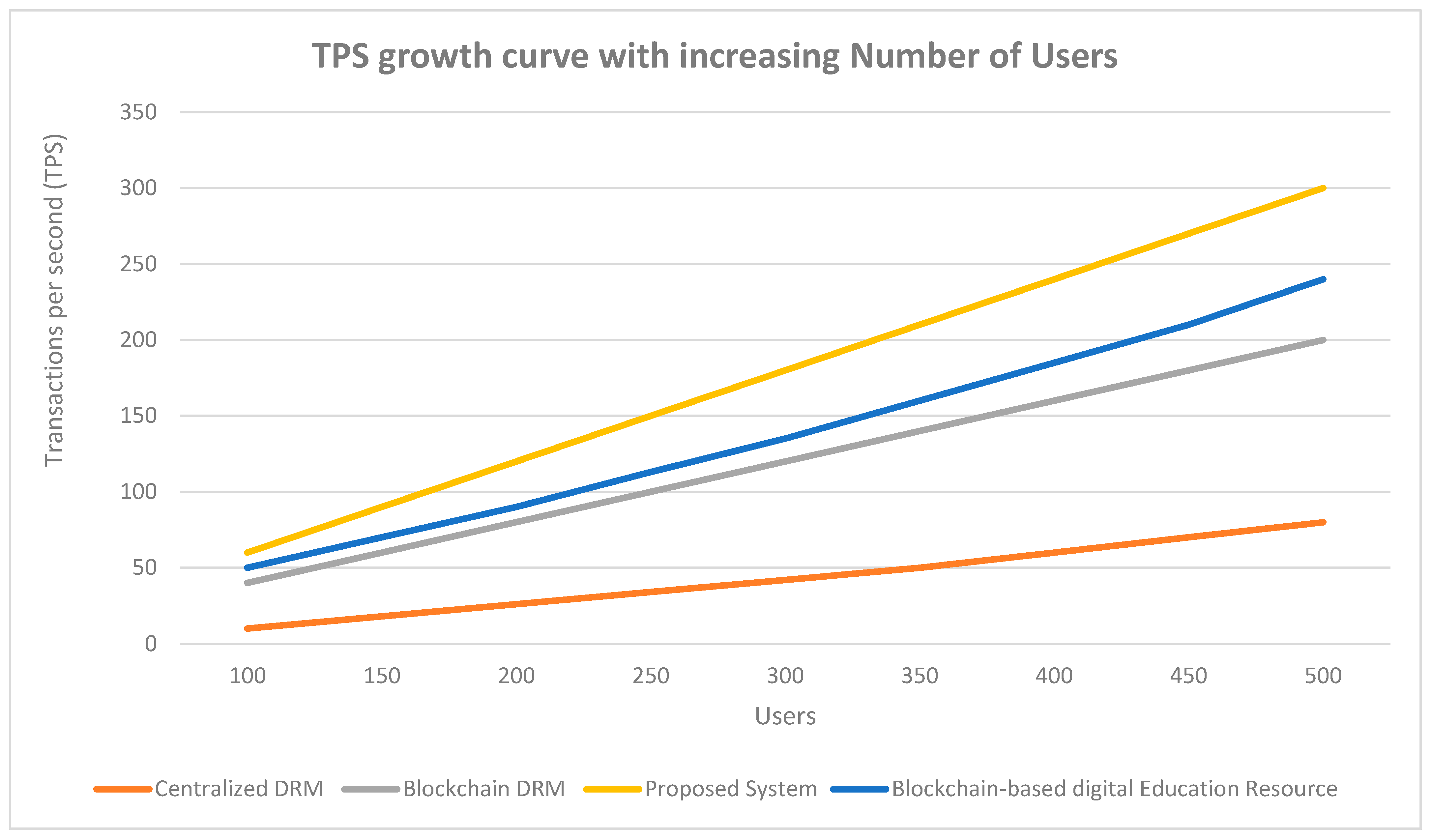
- Low Bandwidth (1–5 Mbps) or High load (1000+ TPS Spikes): Under DDoS-like spikes with simulation as5 times load, the throughput drops to 100 TPS from 300+, with 20–30% failures in content retrieval (IPFS chucks timeout). ARS falls to 80% for key thefts. The bandwidth constraints bottleneck large content like e-books, while overload causes queueing in smart-contact and consensus mechanisms.
References
- Bashir, F.; Warraich, N.F. Future Libraries’ Blockchain Opportunities and Challenges: A Systematic Literature Review and Research Agenda. Digit. Libr. Perspect. 2023, 39, 293–310. [Google Scholar] [CrossRef] [Scilit]
- Safdar, M.; Qutab, S.; Ullah, F.S.; Siddique, N.; Khan, M.A. A Mapping Review of Literature on Blockchain Usage by Libraries: Challenges and Opportunities. J. Librariansh. Inf. Sci. 2023, 55, 848–858. [Google Scholar] [CrossRef] [Scilit]
- Ferro, E.; Saltarella, M.; Rotondi, D.; Giovanelli, M.; Corrias, G.; Moncada, R.; Cavallaro, A.; Favenza, A. Digital Assets Rights Management through Smart Legal Contracts and Smart Contracts. Blockchain Res. Appl. 2023, 4, 100142. [Google Scholar] [CrossRef] [Scilit]
- Neubauer, A. AI and Authorship Redefined: Towards a Global Copyright Framework for Commerce and Human Originality. Doctoral Dissertation, University of Gloucestershire, Cheltenham, UK, 2025. [Google Scholar]
- Ma, Z.; Huang, W.; Gao, H. Secure DRM Scheme Based on Blockchain with High Credibility. Chin. J. Electron. 2018, 27, 1025–1036. [Google Scholar] [CrossRef] [Scilit]
- Wang, Q.; Liu, Y. A Blockchain Empowered Federated Differentiable Search Index Framework for Secure Information Collaboration. Expert Syst. Appl. 2026, 296, 128919. [Google Scholar] [CrossRef] [Scilit]
- Meng, Z.; Zhang, Z.; Wang, W.; Cui, J.; Zhong, H. SmartScope: Smart Contract Vulnerability Detection via Heterogeneous Graph Embedding with Local Semantic Enhancement. Expert Syst. Appl. 2026, 298, 129857. [Google Scholar] [CrossRef] [Scilit]
- Daraghmi, E.Y.; Abu Helou, M.; Daraghmi, Y.A. A Blockchain-Based Editorial Management System. Secur. Commun. Netw. 2021, 2021, 9927640. [Google Scholar] [CrossRef] [Scilit]
- Liu, Y.; Zhou, Z.; Yang, Y.; Ma, Y. Verifying the Smart Contracts of the Port Supply Chain System Based on Probabilistic Model Checking. Systems 2022, 10, 19. [Google Scholar] [CrossRef] [Scilit]
- Hewa, T.; Ylianttila, M.; Liyanage, M. Survey on Blockchain Based Smart Contracts: Applications, Opportunities and Challenges. J. Netw. Comput. Appl. 2021, 177, 102857. [Google Scholar] [CrossRef] [Scilit]
- Coghill, J.G. Blockchain and Its Implications for Libraries. J. Electron. Resour. Med. Libr. 2018, 15, 66–70. [Google Scholar] [CrossRef] [Scilit]
- Khan, A.U.; Zhang, Z.; Taleby Ahvanooey, M.; Rafique, W. Opinion Mining towards Blockchain Technology Adoption for Accessing Digital Library Resources. Aslib J. Inf. Manag. 2022, 74, 135–157. [Google Scholar] [CrossRef] [Scilit]
- Gill, J.; Johnson, P.; Clark, M. Research Methods for Managers, 4th ed.; SAGE: Los Angeles, CA, USA, 2010; ISBN 978-1-84787-094-0. [Google Scholar]
- Bell, E.; Bryman, A.; Harley, B. Business Research Methods, 6th ed.; Oxford University Press: Oxford, UK; New York, NY, USA, 2022; ISBN 978-0-19-886944-3. [Google Scholar]
- Porter, A.L.; Kongthon, A.; Lu, J.-C. Research Profiling: Improving the Literature Review. Scientometrics 2002, 53, 351–370. [Google Scholar] [CrossRef] [Scilit]
- Snyder, H. Literature Review as a Research Methodology: An Overview and Guidelines. J. Bus. Res. 2019, 104, 333–339. [Google Scholar] [CrossRef] [Scilit]
- Levering, B. Concept Analysis as Empirical Method. Int. J. Qual. Methods 2002, 1, 35–48. [Google Scholar] [CrossRef] [Scilit]
- Rocco, T.S.; Plakhotnik, M.S. Literature Reviews, Conceptual Frameworks, and Theoretical Frameworks: Terms, Functions, and Distinctions. Hum. Resour. Dev. Rev. 2009, 8, 120–130. [Google Scholar] [CrossRef] [Scilit]
- Jabareen, Y. Building a Conceptual Framework: Philosophy, Definitions, and Procedure. Int. J. Qual. Methods 2009, 8, 49–62. [Google Scholar] [CrossRef] [Scilit]
- Merriam, S.B.; Simpson, E.L. A Guide to Research for Educators and Trainers of Adults, 2nd ed.; Krieger Publ. Co.: Malabar, FL, USA, 1995; ISBN 978-0-89464-849-6. [Google Scholar]
- Experimental Research: Definition, Types and Examples. Available online: https://www.indeed.com/career-advice/career-development/experimental-research (accessed on 10 December 2025).
- Nododile, T.; Nyirenda, C. A Hybrid Blockchain-IPFS Solution for Secure and Scalable Data Collection and Storage for Smart Water Meters. arXiv 2025, arXiv:2502.03427. [Google Scholar] [CrossRef] [Scilit]
- Johnston, N. The Impact and Management of Mis/Disinformation at University Libraries in Australia. J. Aust. Libr. Inf. Assoc. 2023, 72, 251–269. [Google Scholar] [CrossRef] [Scilit]
- Goru, K.B.; Paramasivan, T.; Rajiakodi, S. A Blockchain Based Scheme for Distributed Storage of Nuclear Power Plant Images. Kerntechnik 2024, 89, 67–76. [Google Scholar] [CrossRef] [Scilit]
- Ju, C.; Shen, Z.; Bao, F.; Wen, Z.; Ran, X.; Yu, C.; Xu, C. Blockchain Traceability System in Complex Application Scenarios: Image-Based Interactive Traceability Structure. Systems 2022, 10, 78. [Google Scholar] [CrossRef] [Scilit]
- Chiu, W.Y.; Meng, W.; Li, W. LibBlock-Towards Decentralized Library System Based on Blockchain and IPFS. In Proceedings of the 2021 18th International Conference on Privacy, Security and Trust, PST, Auckland, New Zealand, 13–15 December 2021; IEEE: Piscataway, NJ, USA, 2021; pp. 1–9. [Google Scholar] [CrossRef] [Scilit]
- Tamilselvan, D.N. Blockchain-based digital rights management for enhanced content security in digital libraries. Int. J. Blockchain Technol. 2024, 2, 1–8. [Google Scholar]
- Mhsnhasan, M.; Selvaraj, V.; Victor, M.; Vijayakumar, M.; Kannan, A.S.; Anand, U. Leveraging AI And Blockchain for Secure Digital Right Management in Libraries. Indian J. Inf. Sources Serv. 2025, 15, 257–265. [Google Scholar] [CrossRef] [Scilit]
- Guo, J.; Li, C.; Zhang, G.; Sun, Y.; Bie, R. Blockchain-Enabled Digital Rights Management for Multimedia Resources of Online Education. Multimed. Tools Appl. 2020, 79, 9735–9755. [Google Scholar] [CrossRef] [Scilit]
- Chen, Y. Design of Blockchain-Based Digital Education Resource Platform. In Proceedings of the 7th International Conference on Knowledge Innovation and Invention, Volume 1; Lecture Notes in Electrical Engineering; Meen, T.-H., Yang, C.-F., Chang, C.-Y., Eds.; Springer Nature: Singapore, 2026; Volume 1481, pp. 127–134. ISBN 978-981-9521-12-8. [Google Scholar]
- Zhao, G.; He, H.; Di, B.; Guo, Q. BC-DERCP: Blockchain-Based Copyright Protection Mechanism for Digital Educational Resources. Educ. Inf. Technol. 2024, 29, 19679–19709. [Google Scholar] [CrossRef] [Scilit]
- Liu, X. Research on University Book Sharing Cloud Platform Based on Blockchain. In Proceedings of the 2021 2nd International Conference on Artificial Intelligence and Information Systems, Chongqing, China, 28–30 May 2021; ACM: Chongqing, China, 2021; pp. 1–5. [Google Scholar]
- Yuan, H.; Qin, X.; Zhou, A.; Tian, Y. A Data Sharing Scheme for IoT Devices Based on Blockchain and Zk-SNARK. Clust. Comput. 2025, 28, 866. [Google Scholar] [CrossRef] [Scilit]
- Jing, N.; Liu, Q.; Sugumaran, V. A Blockchain-Based Code Copyright Management System. Inf. Process. Manag. 2021, 58, 102518. [Google Scholar] [CrossRef] [Scilit]
- Oudah, M.S.; Maolood, A.T. Lightweight Authentication Model for IoT Environments Based on Enhanced Elliptic Curve Digital Signature and Shamir Secret Share. Int. J. Intell. Eng. Syst. 2022, 15, 81–90. [Google Scholar] [CrossRef] [Scilit]
- Commey, D.; Mai, B.; Hounsinou, S.G.; Crosby, G.V. Securing Blockchain-Based IoT Systems: A Review. IEEE Access 2024, 12, 98856–98881. [Google Scholar] [CrossRef] [Scilit]
- Huang, X.; Zhang, W.; Zhang, S. Quantum Multi-Party Private Set Intersection Using Single Photons. Phys. A Stat. Mech. Its Appl. 2024, 649, 129974. [Google Scholar] [CrossRef] [Scilit]
- Farhad, M.A. Consumer Data Protection Laws and Their Impact on Business Models in the Tech Industry. Telecommun. Policy 2024, 48, 102836. [Google Scholar] [CrossRef] [Scilit]
- Blind, K.; Niebel, C.; Rammer, C. The Impact of the EU General Data Protection Regulation on Product Innovation. Ind. Innov. 2024, 31, 311–351. [Google Scholar] [CrossRef] [Scilit]
- Dwork, C.; McSherry, F.; Nissim, K.; Smith, A. Calibrating Noise to Sensitivity in Private Data Analysis. In Proceedings of the Theory of Cryptography; Halevi, S., Rabin, T., Eds.; Springer: Berlin/Heidelberg, Germany, 2006; pp. 265–284. [Google Scholar]
- Dwork, C.; Roth, A. The Algorithmic Foundations of Differential Privacy. Found. Trends® Theor. Comput. Sci. 2014, 9, 211–487. [Google Scholar] [CrossRef] [Scilit]
- Kamath, G. Lecture 5—Approximate Differential Privacy. 2020. Available online: http://www.gautamkamath.com/CS860notes/lec5.pdf (accessed on 24 October 2025).
- Sangeeta, N.; Nam, S.Y. Blockchain and Interplanetary File System (IPFS)-Based Data Storage System for Vehicular Networks with Keyword Search Capability. Electronics 2023, 12, 1545. [Google Scholar] [CrossRef] [Scilit]
- Ye, H.; Park, S. Reliable Vehicle Data Storage Using Blockchain and Ipfs. Electronics 2021, 10, 1130. [Google Scholar] [CrossRef] [Scilit]
- Benet, J. IPFS-Content Addressed, Versioned, P2P File System. In Proceedings of the 2019 IEEE International Conference on Consumer Electronics (ICCE), Las Vegas, NV, USA, 11–13 January 2019; IEEE: Piscataway, NJ, USA, 2014; pp. 1–2. [Google Scholar]
- Kumar, S.; Bharti, A.K.; Amin, R. Decentralized Secure Storage of Medical Records Using Blockchain and IPFS: A Comparative Analysis with Future Directions. Secur. Priv. 2021, 4, e162. [Google Scholar] [CrossRef] [Scilit]
- Pincheira, M.; Donini, E.; Vecchio, M.; Kanhere, S. A Decentralized Architecture for Trusted Dataset Sharing Using Smart Contracts and Distributed Storage. Sensors 2022, 22, 9118. [Google Scholar] [CrossRef] [Scilit] [PubMed]
- Pilares, I.C.A.; Azam, S.; Akbulut, S.; Jonkman, M.; Shanmugam, B. Addressing the Challenges of Electronic Health Records Using Blockchain and IPFS. Sensors 2022, 22, 4032. [Google Scholar] [CrossRef] [Scilit]
- Cramer, R.; Damgård, I.; Dziembowski, S. On the Complexity of Verifiable Secret Sharing and Multiparty Computation. In Proceedings of the Thirty-Second Annual ACM Symposium on Theory of Computing, Portland, OR, USA, 21–23 May 2000; ACM: Portland, OR, USA, 2000; pp. 325–334. [Google Scholar]
- Voudouris, A.; Tressos, A.; Zarras, A.; Xenakis, C. Game on: A Performance Comparison of Interpolation Techniques Applied to Shamir’s Secret Sharing. Comput. J. 2025, 68, 261–272. [Google Scholar] [CrossRef] [Scilit]
- Alharby, M.; Van Moorsel, A. BlockSim: An Extensible Simulation Tool for Blockchain Systems. Front. Blockchain 2020, 3, 28. [Google Scholar] [CrossRef] [Scilit]
- Abu Sirhan, A.; Abdrabbo, K.M.; Ahmed Ali Al Tawalbeh, S.; Hamdi Ahmed, M.; Ali Helalat, M. Digital Rights Management (DRM) in Libraries of Public Universities in Jordan. Libr. Manag. 2019, 40, 496–502. [Google Scholar] [CrossRef] [Scilit]
- Bonneau, J. Why Blockchain Performance Is Hard to Measure. a16z crypto. 2022. Available online: https://a16zcrypto.com/posts/article/why-blockchain-performance-is-hard-to-measure/ (accessed on 15 January 2026).
- Klaytn. A Comparison of Blockchain Network Latencies. Klaytn. 2022. Available online: https://medium.com/klaytn/a-comparison-of-blockchain-network-latencies-7508509b8460 (accessed on 12 October 2025).
- Yasaweerasinghelage, R.; Staples, M.; Weber, I. Predicting Latency of Blockchain-Based Systems Using Architectural Modelling and Simulation. In Proceedings of the 2017 IEEE International Conference on Software Architecture (ICSA), Gothenburg, Sweden, 3–7 April 2017; IEEE: Gothenburg, Sweden, 2017; pp. 253–256. [Google Scholar]
- OpenZeppelin|Security Audits. Available online: https://www.openzeppelin.com/security-audits (accessed on 15 January 2026).
- Public Smart Contract Audits and Security Reviews. Available online: https://diligence.security/audits/ (accessed on 1 January 2026).
- Smart Contract Audit Report for 1inch. Sayfer. Available online: https://sayfer.io/audits/smart-contract-audit-report-for-1inch/ (accessed on 1 January 2026).
- Kamath, G. Lecture 4—Intro to Differential Privacy, Part 2. 2020. Available online: http://www.gautamkamath.com/CS860notes/lec4.pdf (accessed on 1 October 2025).
- Sharma, S.; Batth, R.S. BLOCKLIB: Blockchain Enabled Library Resource Sharing. J. Discret. Math. Sci. Cryptogr. 2022, 25, 839–857. [Google Scholar] [CrossRef] [Scilit]
- Ayoade, G.; Karande, V.; Khan, L.; Hamlen, K. Decentralized IoT Data Management Using BlockChain and Trusted Execution Environment. In Proceedings of the 2018 IEEE International Conference on Information Reuse and Integration (IRI), Salt Lake City, UT, USA, 6–9 July 2018; IEEE: Salt Lake City, UT, USA, 2018; pp. 15–22. [Google Scholar]
- Patel, S.; Persiano, G.; Seo, J.Y.; Yeo, K. Efficient Secret Sharing for Large-Scale Applications. In Proceedings of the CCS ’24: ACM SIGSAC Conference on Computer and Communications Security, Salt Lake City, UT, USA, 14–18 October 2024; Association for Computing Machinery: New York, NY, USA, 2024; pp. 3065–3079. [Google Scholar] [CrossRef] [Scilit]




| Domain | Blockchain Platform | Challenges Identified | Key Finding/Outcomes |
|---|---|---|---|
| Digital-rights management [27] | Hyperledger Fabric (permissioned blockchain). | Traditional DRM systems are vulnerable to piracy and illegal content sharing, making it difficult to fully secure digital assets. Existing systems struggle to balance strong authentication with user privacy, often exposing personal data to risks. Licensing agreements are often cumbersome, slow, and administratively heavy, leading to delays and inefficiencies in content distribution. | Reduced licensing delays and administrative costs. Encourages fair use and sharing while protecting creators’ rights. Builds trust among stakeholders due Higher throughput and lower latency compared to traditional DRM. The system is efficient, secure, and feasible for real-world deployment. |
| Digital-rights management [28]. | Hybrid system. | A single-point of control architecture. Lacks verifiable audit trails. Relies heavily on machine for licensing and content management. | Streamlined rights enforcements, licensing, and access control. Build trust among authors, publishers, and users, ensuring fair use and reducing piracy. Secure and transparent access to digital resources. Reduces disputes over ownership and licensing. |
| Educational Technology—MOOCs, Online Learning [29]. | Hybrid Architecture: Public blockchain (digital certification) + Private blockchains (resource rights management). | Infringement of digital copyrights of multimedia learning resources. Insecurity of digital education certificates (vulnerable to theft, tampering, forgery). Low degree of openness—isolated islands of educational datasets. Declining credibility of Certificate Authority (CA) ecosystem. Lack of unified evaluation standards for e-learning. | Three-network architecture: Learning User Network (LUN), Education Certification Network (ECN), Multimedia Educational Resource Local Networks (MERLNs). Dual blockchain types: MDR Private Blockchains for resource rights, DC Public Blockchain for certificates. Unmediated certificate verification using public key cryptography. Scalable to support diverse educational functions while maintaining security. |
| Digital copyright protection [30]. | Private blockchain network with IPFS. | Ensuring watermarks remain intact under transformations (compression, resizing, cropping, filtering). Current system produce false positives or negatives under certain image manipulations. As more content is registered, blockchain-size grows, raising concerns about transaction speed, cost, and long-term sustainability. | Embedding QR codes via DCT-based watermarking proved resilient against common manipulation (compression, resizing, cropping, and filtering). A trusted environment for digital-content distribution, where ownership and authenticity can be independently verified. The system successfully asserts ownership and prevents piracy. |
| Digital copyright protection in education resources [31]. | Hyperledger Fabric. | Easy duplication and dissemination of resources. Copyright infringement risks. Lack of multidimensional copyright evidence. Weak infringement-tracking mechanisms. | Security improvement by ensuring data integrity, guaranteeing authenticity, and providing immutability. Privacy protection through RSA encryption of identity. Showed high perceived usefulness, ease of use, and willingness to use. The system encourages creativity and resource sharing. |
| Digital copyright protection [32]. | Ethereum blockchain. | Current systems lack mechanisms for effective sharing of physical books across institutions, resulting in low utilization rates. Each university traditionally develops its own independent library management software, leading to duplication of effort, wasted resources, and high cumulative costs. | Efficient resource utilization. Tamper-proof records of borrowing and returning. Cost reduction. |
| Digital-rights management (multimedia content) [33]. | Scalable blockchain with overlay network with pBFT consensus. | Current DRMs are unable to trace who should be responsible for violations. There is a need for a new DRM framework that is reliable, efficient, tamper-resistant, and secure. Core issue is the scalability of blockchain. Digital content that becomes easily available will in time be worthless. No way to track the leakage or copyright for spread of digital material. | Proposed overlay network with cluster heads (CH) to improve throughput. DCT-based watermarking with SPECK lightweight encryption. Achieved improved scalability: blocks propagated in t_hop instead of 8t_hop. Cloud storage for multimedia with blockchain for metadata. |
| Copyrights management [34]. | Private blockchain (JAVA-based) with POW. | Massive open-source projects making copyright registration difficult. Lack of unified copyright-management platform. Decentralized copyright resource and vague copyright ownership. | Achieved accuracy meeting verification requirements. Code fingerprint (256-bit hash) provided best storage efficiency. Better response speed and storage efficiency. Verification model handles code plagiarism effectively. |
| Technology Layer | Technology Description/Function |
|---|---|
| Meta-mask | A digital wallet that manages the interaction between the patron and the library system. The meta-mask provides a wallet-based authentication. Each patron has a unique wallet address that serves as the user’s identity. |
| Smart Contract | Provides a set of automated, transparent, and trustworthy rules that enforce agreements when predetermined conditions are met. |
| Content Encryption Key | An encryption and decryption stage for digital content. Symmetric cryptographic keys, such as AES-128 or AES-256, are used for encrypting and decrypting content. |
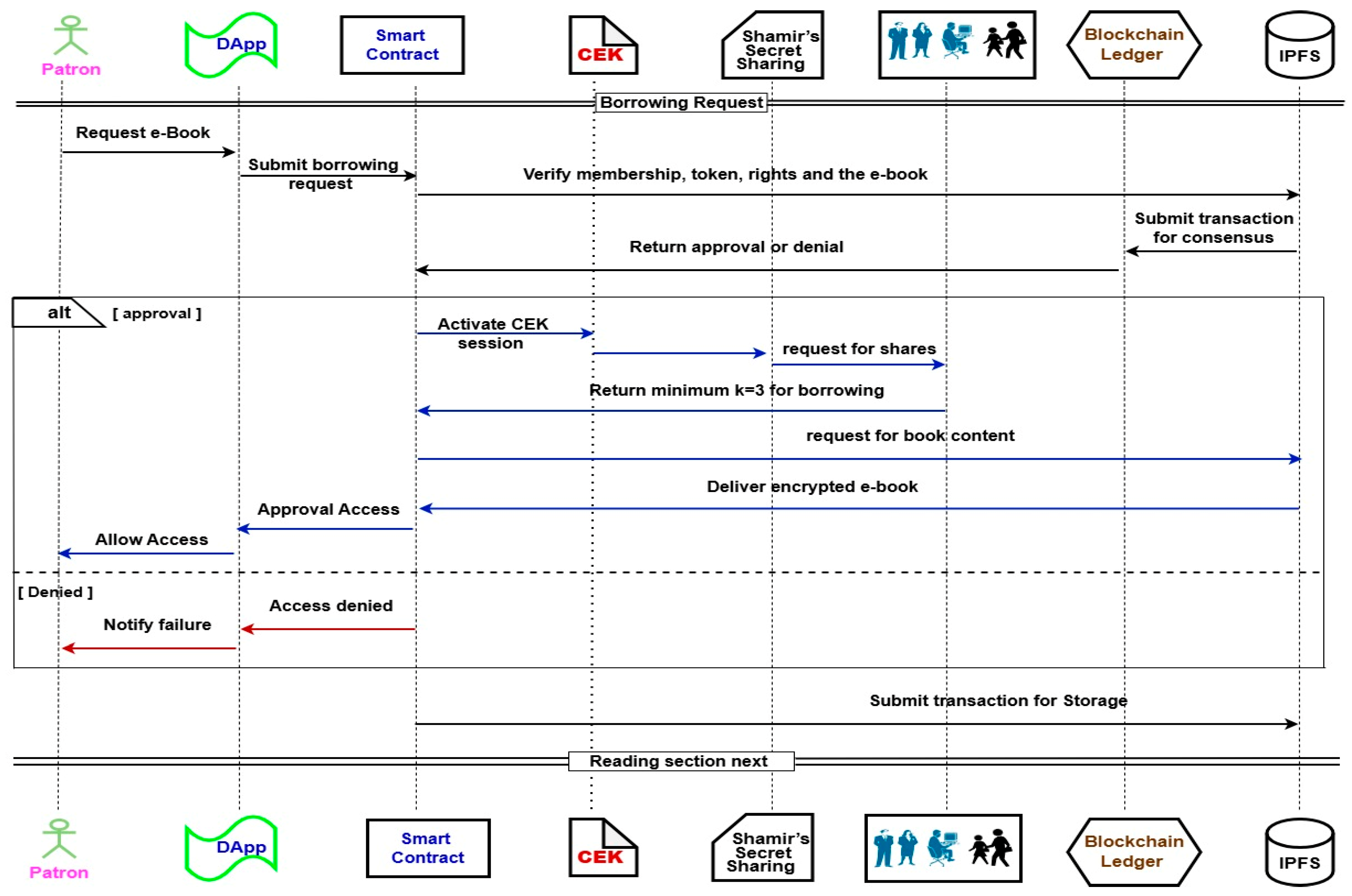
| Shamir’s Secret Sharing | A layer that provides a method to split the Content Encryption Key (secret Keys) into multiple shares securely and distribute the created shares among participants. The reconstruction requires a threshold number of shares, usually a minimum of three, to acquire the original secret key. |
| Blockchain | A distributed digital ledger that records every single transaction in a block. Each new block is cryptographically linked to the previous block, forming a chain of blocks that is secure and immutable. The addition of new records to the blocks is achieved through consensus mechanisms. |
| Inter-Planetary File System | A peer-to-peer network for storing large amounts of metadata and sharing files in a distributed manner. The acquisition of files from the IPFS is based on content addressing. |
| Smart Contract | TxN Hash | Block Size (Bytes) | TxN Index | TxN Nonce | Epoch |
|---|---|---|---|---|---|
| User_Network _Joining | 0x4fb784Da684b7f697Ce274E533c342aEae002790 | 623462 | 34 | 71 | 210198 |
| User_Wallet_Generation | 0x87A3effB84CBE1E4caB6Ab430139eC41d156D55A | 72451 | 56 | 72 | 210204 |
| Content_Tokenization | 0x60d9B5e1448D931c0116e153CF4d10c2cc3dd7C7 | 427304 | 13 | 74 | 210205 |
| Verification _of_ Authenticity | 0xFb13dE1C5aC28fc8335Ec5721b06eB4eA6e3897b | 117658 | 77 | 70 | 210205 |
| Smart Contract | TxN Cost (Gas Amount) | Execution Cost (Gas Amount) | Amount of Gas | TxN Fee (SepoliaEth) |
|---|---|---|---|---|
| DRMChain | 1197493 | 395172 | 20,156,791 (33.59%) | 0.005462752934 |
| User_Network _Joining | 1762839 | 1339757 | 45,994,483 (76.73%) | 0.002653646603 |
| User_Wallet_Generation | 1221445 | 537435 | 26,843,676 (44.78%) | 0.005572476807 |
| Content_Tokenization | 1202899 | 1190870 | 59,959,001 (99.93%) | 0.014024358038 |
| Verification _of_ Authenticity | 1177382 | 1071417 | 54,730,860 (91.31%) | 0.002543358038 |
| System | Average | Standard Deviation | Reduction (%) |
|---|---|---|---|
| Centralized DRM [52] | 100.39 | 20.00 | - |
| Blockchain DRM [27]. | 95.00 | 18.00 | 5.37 |
| BC-DERCP [31] | 86.03 | 16.00 | 18.25 |
| Blockchain-based digital Education Resource [29]. | 90.06 | 17.50 | 17.50 |
| Proposed Mechanism | 81.06 | 15.00 | 19.25 |
| Attack Type | Centralized | Basic Blockchain | Proposed |
|---|---|---|---|
| Key Theft | 85.00 | 90.00 | 97.00 |
| Replay Attacks | 92.00 | 93.00 | 98.50 |
| Node Collusion | 93.00 | 93.00 | 98.50 |
| Denial-of-Service | 0.00 fail (100%) | 64.00 | 100.00 |
| Social engineering attacks | 92.00 | 78.00 | 100.00 |
| Overall | 90.00 | 92.00 | 98.00 |
| System/Source | Avg Gas/Tx | Total Cost (Ether) | Equivalent USD ($) | Vs Centralized Reduction (%) |
|---|---|---|---|---|
| Centralized DRM [52] | N/A | N/A | $50 | - |
| Blockchain DRM [27]. | 120,000 | 12.0 | $24 | 52 |
| BC-DERCP [31] | 110,000 | 12.0 | $21 | 62 |
| Blockchain-based digital Education Resource [29]. | 1400,000 | 16.0 | $31 | 41 |
| Proposed system | 50,000 | 5.0 | $10 | 80 |
Disclaimer/Publisher’s Note: The statements, opinions and data contained in all publications are solely those of the individual author(s) and contributor(s) and not of MDPI and/or the editor(s). MDPI and/or the editor(s) disclaim responsibility for any injury to people or property resulting from any ideas, methods, instructions or products referred to in the content. |
© 2026 by the authors. Licensee MDPI, Basel, Switzerland. This article is an open access article distributed under the terms and conditions of the Creative Commons Attribution (CC BY) license.
Share and Cite
Laboso, P.; Aruldoss, M.; Thiyagarajan, P.; Lakshmi, T.M.; Wynn, M. Library Systems and Digital-Rights Management: Towards a Blockchain-Based Solution for Enhanced Privacy and Security. Information 2026, 17, 137. https://doi.org/10.3390/info17020137
Laboso P, Aruldoss M, Thiyagarajan P, Lakshmi TM, Wynn M. Library Systems and Digital-Rights Management: Towards a Blockchain-Based Solution for Enhanced Privacy and Security. Information. 2026; 17(2):137. https://doi.org/10.3390/info17020137
Chicago/Turabian StyleLaboso, Patrick, Martin Aruldoss, P. Thiyagarajan, T. Miranda Lakshmi, and Martin Wynn. 2026. "Library Systems and Digital-Rights Management: Towards a Blockchain-Based Solution for Enhanced Privacy and Security" Information 17, no. 2: 137. https://doi.org/10.3390/info17020137
APA StyleLaboso, P., Aruldoss, M., Thiyagarajan, P., Lakshmi, T. M., & Wynn, M. (2026). Library Systems and Digital-Rights Management: Towards a Blockchain-Based Solution for Enhanced Privacy and Security. Information, 17(2), 137. https://doi.org/10.3390/info17020137