Review

Review of Advances in Multiple-Resolution Modeling for Distributed Simulation

Industrial Engineering and Management Systems, University of Central Florida, Orlando, FL 32816, USA
*
Author to whom correspondence should be addressed.
Information 2025, 16(8), 635; https://doi.org/10.3390/info16080635
Submission received: 25 March 2025 / Revised: 15 July 2025 / Accepted: 23 July 2025 / Published: 25 July 2025
(This article belongs to the Special Issue Editorial Board Members’ Collection Series: "Information Systems")

Abstract

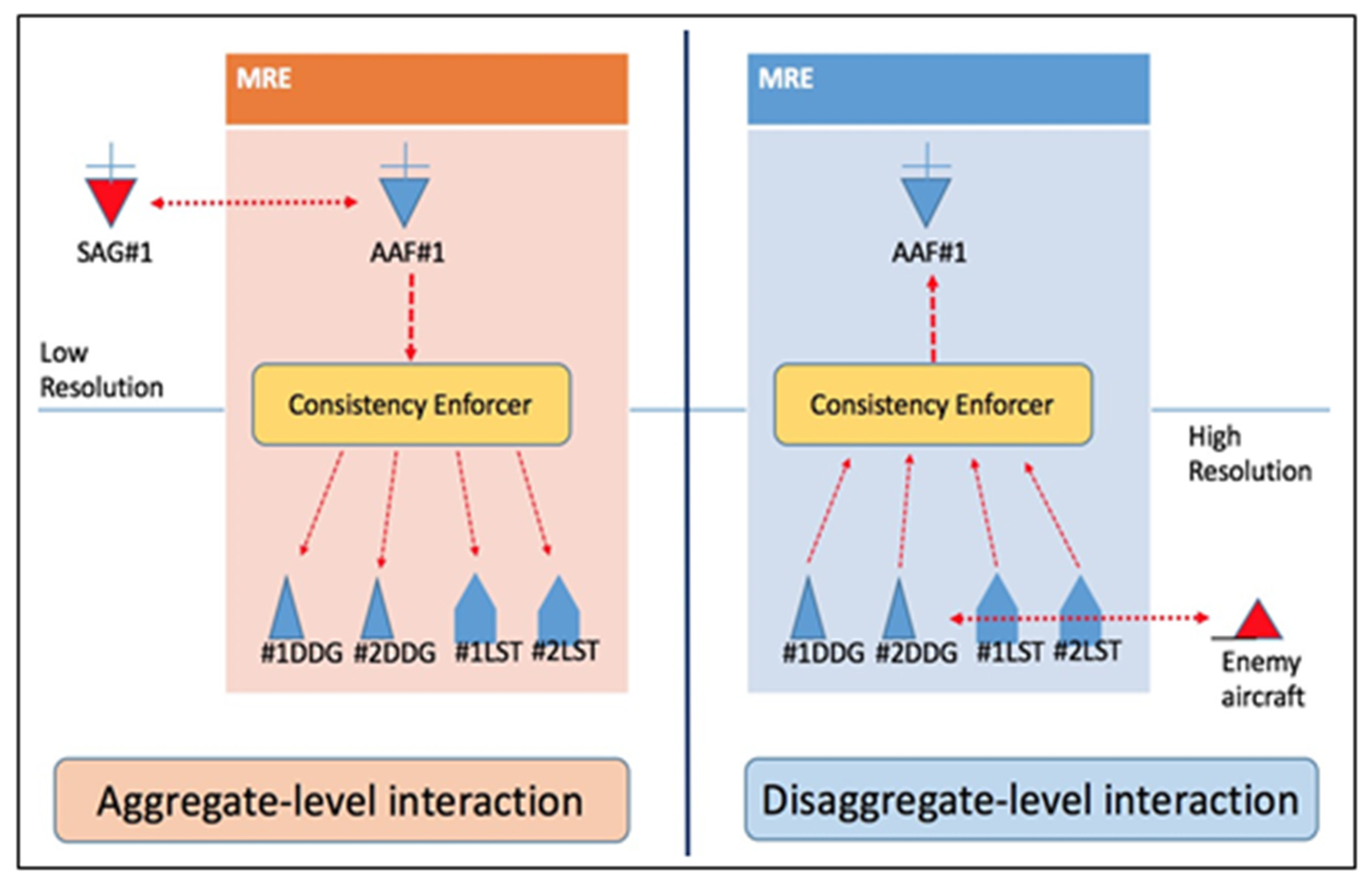
Multiple-resolution modeling (MRM) has emerged as a foundational paradigm in modern simulation, enabling the integration of models with varying levels of granularity to address complex and evolving operational demands. By supporting seamless transitions between high-resolution and low-resolution representations, MRM facilitates scalability and interoperability, particularly within distributed simulation environments such as military command and control systems. This paper provides a structured review and comparative analysis of prominent MRM methodologies, including multi-resolution entities (MRE), agent-based modeling (from a federation viewpoint), hybrid frameworks, and the novel MR mode, synchronizing resolution transitions with time advancement and interaction management. Each approach is evaluated across critical dimensions such as consistency, computational efficiency, flexibility, and integration with legacy systems. Emphasis is placed on the applicability of MRM in distributed military simulations, where it enables dynamic interplay between strategic-level planning and tactical-level execution, supporting real-time decision-making, mission rehearsal, and scenario-based training. The paper also explores emerging trends involving artificial intelligence (AI) and large language models (LLMs) as enablers for adaptive resolution management and automated model interoperability.
Keywords: multiple-resolution modeling; interoperability; high-level architecture; military applications; federated systems multiple-resolution modeling; interoperability; high-level architecture; military applications; federated systems