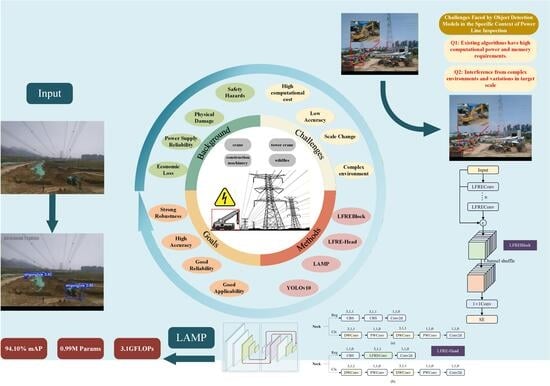
LFRE-YOLO: Lightweight Edge Computing Algorithm for Detecting External-Damage Objects on Transmission Lines


Abstract
1. Introduction
- (1)
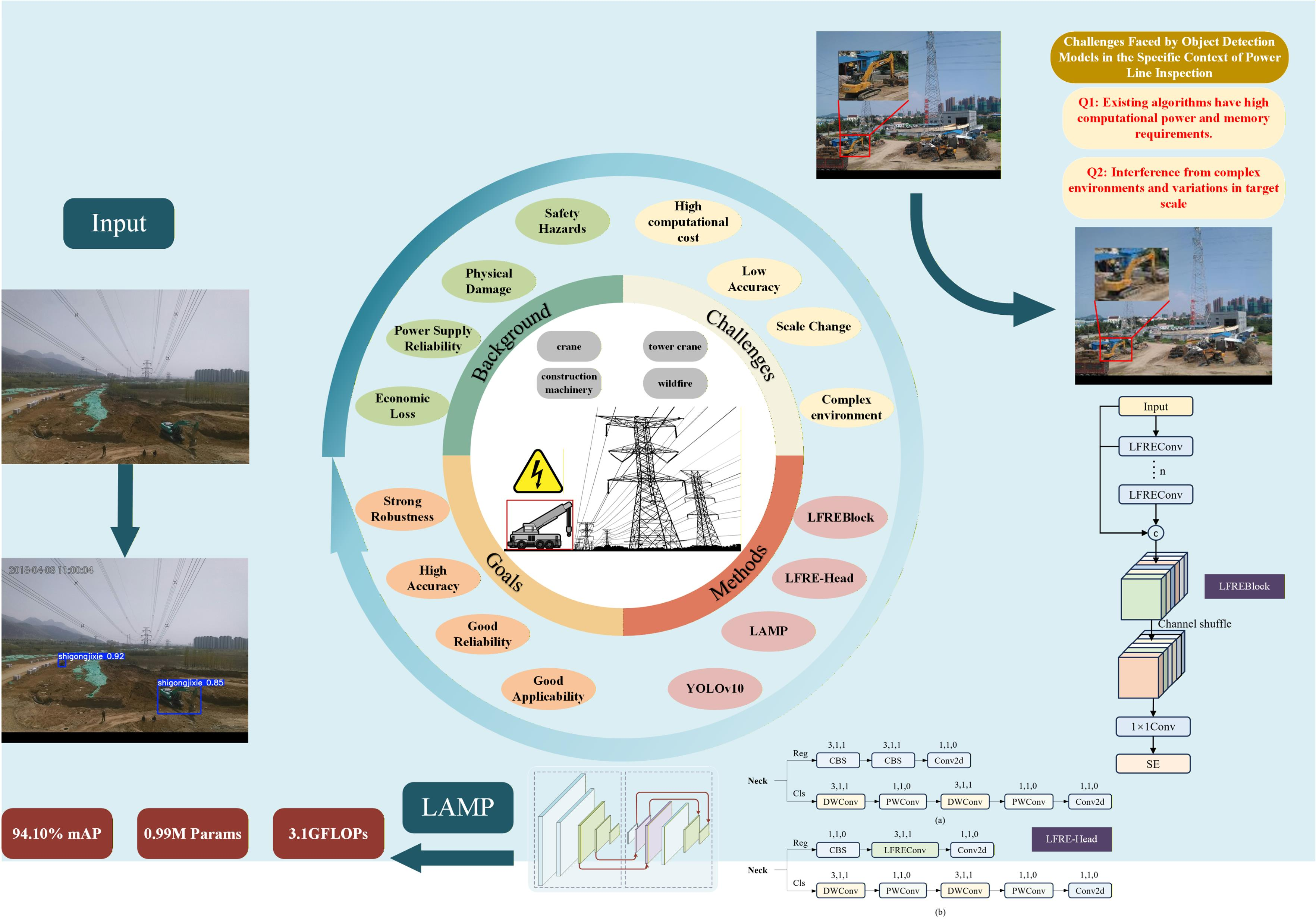
- Lightweight Feature Reuse and Enhancement Convolution (LFREConv): Addressing the insufficient cross-channel information interaction and limited receptive field issues in traditional depthwise separable convolution, we design a cascaded dual depthwise convolution structure with residual connection mechanisms. This significantly expands the effective receptive field with minimal parameter increment while compensating for information loss caused by independent channel processing in depthwise convolution through feature reuse strategies, enhancing feature representation capability while maintaining lightweight advantages.
- (2)
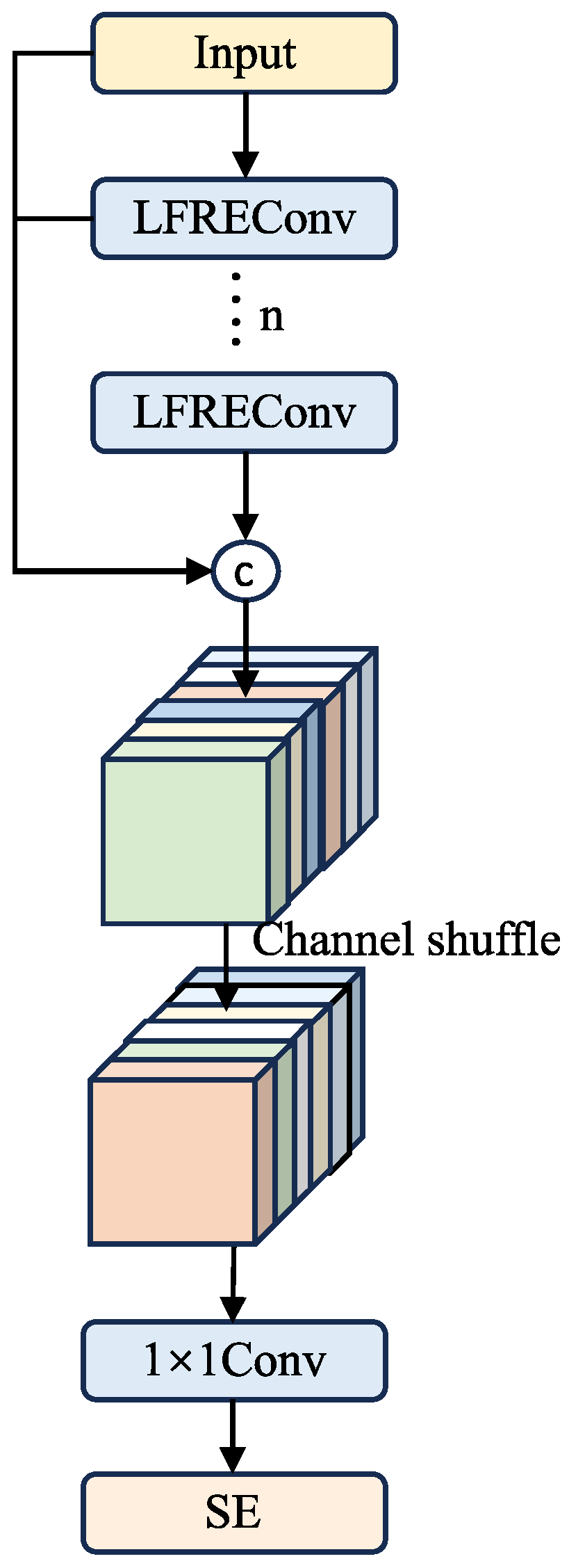
- Efficient Feature Extraction Module (LFREBlock) based on LFREConv: Through cascaded stacking of multi-layer LFRE convolutions, we progressively expand the receptive field and extract high-level semantic information. Combined with feature concatenation, channel shuffle, and SE attention mechanisms, this achieves cross-channel information interaction enhancement and channel-level importance modeling, effectively improving feature extraction capability in complex scenarios.
- (3)
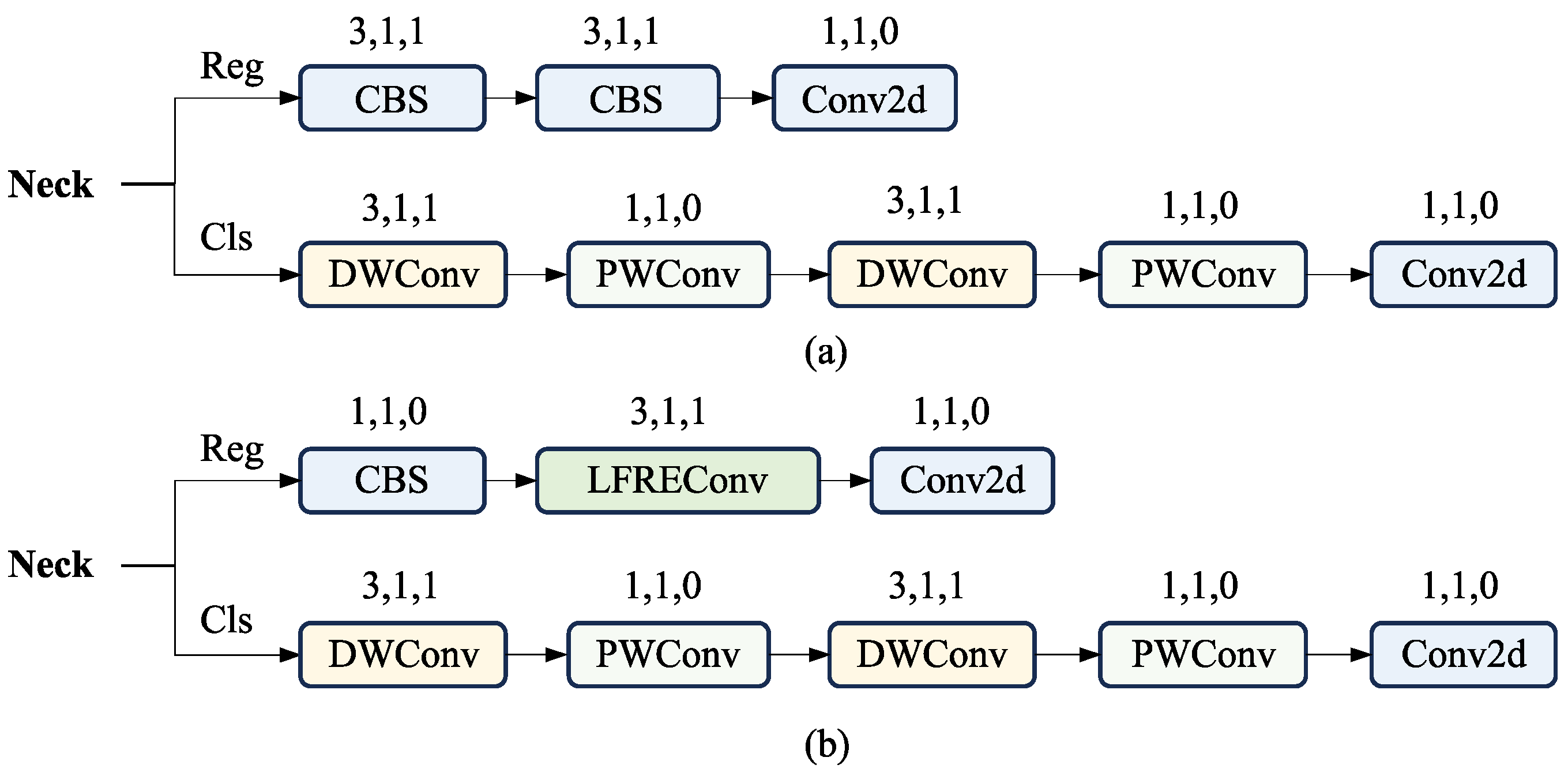
- Lightweight Feature Reuse and Enhancement Detection Head (LFRE-Head): Based on LFREConv, we redesign the regression head to propose LFRE-Head, which retains as much feature layer information as possible before prediction while expanding the effective receptive field on a lightweight basis.
- (4)
- LAMP Application: We apply the layer-adaptive magnitude-based pruning (LAMP) algorithm to compress the trained LFRE-YOLO, maximally reducing model complexity while maintaining detection accuracy.
2. Related Work
2.1. Transmission Line External Damage Target Detection Related Work
2.2. Lightweight Technology Related Work
3. Materials and Methods
3.1. Overall Network Architecture
3.2. Lightweight Feature Reuse and Enhancement Convolution (LFREConv)
3.3. Lightweight Feature Reuse and Enhancement Module (LFREBlock)
3.4. Lightweight Feature Reuse and Enhancement Detection Head (LFRE-Head)
3.5. Model Compression Using the LAMP Pruning Method
4. Results
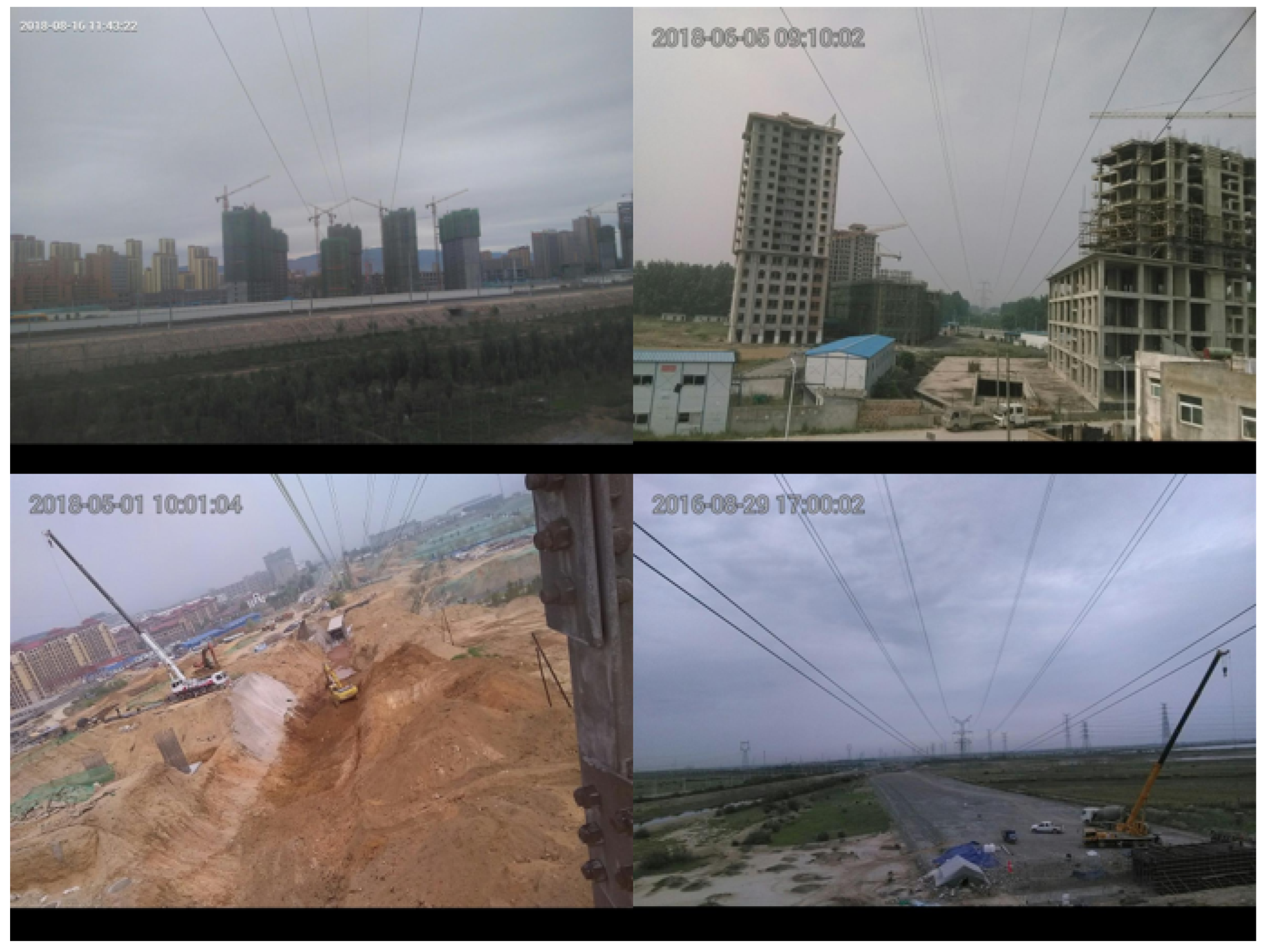
4.1. Dataset Construction
4.2. Experimental Environment and Hyperparameter Settings
4.3. Evaluation Metrics
4.4. Impact of Large Convolution Kernels in Single Layers on Model Performance
4.5. Performance Comparison Under Different Speed
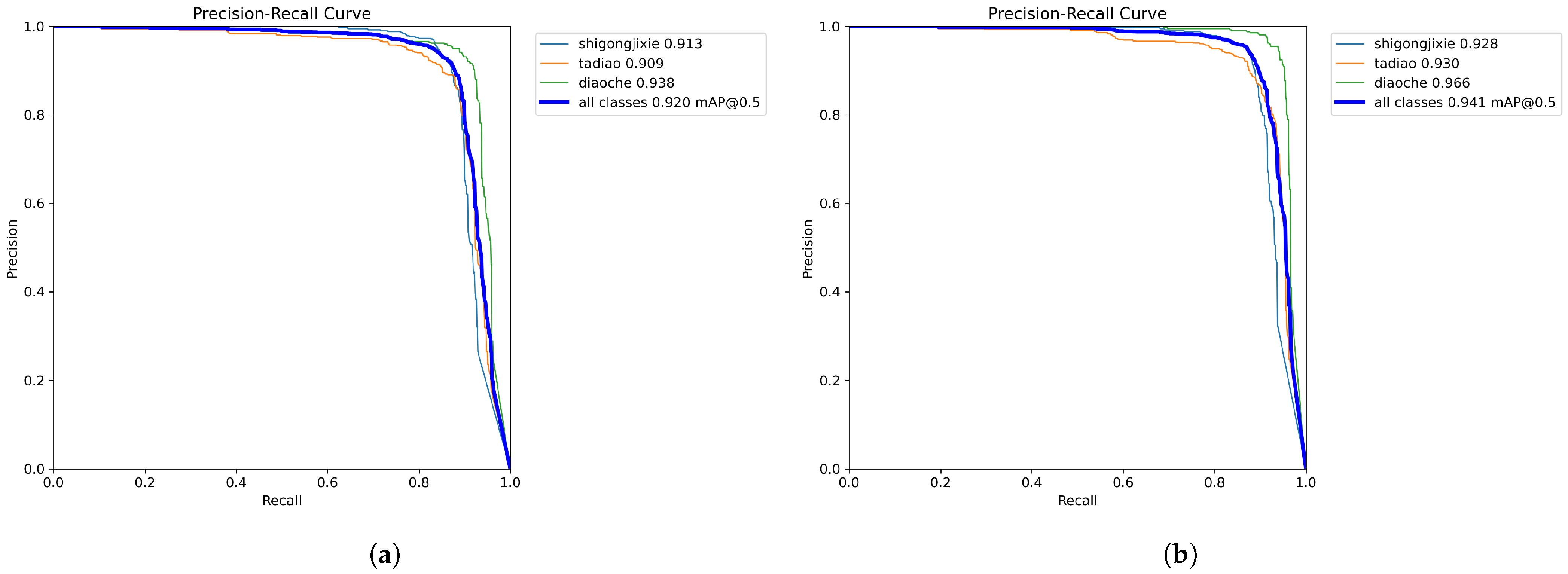
4.6. Ablation Experiments
4.7. Comparison Experiments with Different Models
5. Discussion
Author Contributions
Funding
Institutional Review Board Statement
Informed Consent Statement
Data Availability Statement
Acknowledgments
Conflicts of Interest
References
- Jia, H.; Han, Z.; Xu, X.; Wu, P.; Qin, R.; Jin, Y.; Wang, X.; Huang, W. A Background Reasoning Framework for External Force Damage Detection in Distribution Network. In Proceedings of the Annual Conference of China Electrotechnical Society, Beijing, China, 17–18 September 2022; Springer: Singapore, 2022; pp. 771–778. [Google Scholar]
- Liu, Z.; Wu, G.; He, W.; Fan, F.; Ye, X. Key target and defect detection of high-voltage power transmission lines with deep learning. Int. J. Electr. Power Energy Syst. 2022, 142, 108277. [Google Scholar] [CrossRef]
- Voulodimos, A.; Doulamis, N.; Doulamis, A.; Protopapadakis, E. Deep learning for computer vision: A brief review. Comput. Intell. Neurosci. 2018, 2018, 7068349. [Google Scholar] [CrossRef]
- Xu, S.; Wang, J.; Shou, W.; Ngo, T.; Sadick, A.M.; Wang, X. Computer vision techniques in construction: A critical review. Arch. Comput. Methods Eng. 2021, 28, 3383. [Google Scholar] [CrossRef]
- Ai, D.; Jiang, G.; Lam, S.K.; He, P.; Li, C. Computer vision framework for crack detection of civil infrastructure—A review. Eng. Appl. Artif. Intell. 2023, 117, 105478. [Google Scholar] [CrossRef]
- Girshick, R.; Donahue, J.; Darrell, T.; Malik, J. Rich feature hierarchies for accurate object detection and semantic segmentation. In Proceedings of the IEEE Conference on Computer Vision and Pattern Recognition, Columbus, OH, USA, 23–28 June 2014; pp. 580–587. [Google Scholar]
- Redmon, J.; Farhadi, A. Yolov3: An incremental improvement. arXiv 2018, arXiv:1804.02767. [Google Scholar] [CrossRef]
- Yu, G.; Chang, Q.; Lv, W.; Xu, C.; Cui, C.; Ji, W.; Dang, Q.; Deng, K.; Wang, G.; Du, Y.; et al. PP-PicoDet: A better real-time object detector on mobile devices. arXiv 2021, arXiv:2111.00902. [Google Scholar]
- Howard, A.G.; Zhu, M.; Chen, B.; Kalenichenko, D.; Wang, W.; Weyand, T.; Andreetto, M.; Adam, H. Mobilenets: Efficient convolutional neural networks for mobile vision applications. arXiv 2017, arXiv:1704.04861. [Google Scholar] [CrossRef]
- Xie, S.; Girshick, R.; Dollár, P.; Tu, Z.; He, K. Aggregated residual transformations for deep neural networks. In Proceedings of the IEEE Conference on Computer Vision and Pattern Recognition, Honolulu, HI, USA, 21–26 July 2017; pp. 1492–1500. [Google Scholar]
- Zhang, X.; Zhou, X.; Lin, M.; Sun, J. Shufflenet: An extremely efficient convolutional neural network for mobile devices. In Proceedings of the IEEE Conference on Computer Vision and Pattern Recognition, Salt Lake City, UT, USA, 18–23 June 2018; pp. 6848–6856. [Google Scholar]
- Sandler, M.; Howard, A.; Zhu, M.; Zhmoginov, A.; Chen, L.C. Mobilenetv2: Inverted residuals and linear bottlenecks. In Proceedings of the IEEE Conference on Computer Vision and Pattern Recognition, Salt Lake City, UT, USA, 18–23 June 2018; pp. 4510–4520. [Google Scholar]
- Song, G.; Liu, Y.; Wang, X. Revisiting the sibling head in object detector. In Proceedings of the IEEE/CVF Conference on Computer Vision and Pattern Recognition, Seattle, WA, USA, 13–19 June 2020; pp. 11563–11572. [Google Scholar]
- Jocher, G.; Chaurasia, A.; Qiu, J. YOLOv8. 2023. Available online: https://github.com/ultralytics/ultralytics (accessed on 23 November 2025).
- Wang, A.; Chen, H.; Liu, L.; Chen, K.; Lin, Z.; Han, J. Yolov10: Real-time end-to-end object detection. Adv. Neural Inf. Process. Syst. 2024, 37, 107984–108011. [Google Scholar]
- Xiang, X.; Lv, N.; Guo, X.; Wang, S.; El Saddik, A. Engineering vehicles detection based on modified faster R-CNN for power grid surveillance. Sensors 2018, 18, 2258. [Google Scholar] [CrossRef] [PubMed]
- Qu, L.; Liu, K.; He, Q.; Tang, J.; Liang, D. External damage risk detection of transmission lines using e-ohem enhanced faster r-cnn. In Proceedings of the Chinese Conference on Pattern Recognition and Computer Vision (PRCV), Guangzhou, China, 23–26 November 2018; Springer: Cham, Switzerland, 2018; pp. 260–271. [Google Scholar]
- Liu, P.; Song, C.; Li, J.; Yang, S.X.; Chen, X.; Liu, C.; Fu, Q. Detection of transmission line against external force damage based on improved YOLOv3. Int. J. Robot. Autom 2020, 35, 460–468. [Google Scholar] [CrossRef]
- Li, H.; Jiang, F.; Guo, F.; Meng, W. A real-time detection method of safety hazards in transmission lines based on YOLOv5s. In Proceedings of the International Conference on Artificial Intelligence and Intelligent Information Processing (AIIIP 2022), Qingdao, China, 17–19 June 2022; SPIE: Cergy-Pontoise, France, 2022; Volume 12456, pp. 283–287. [Google Scholar]
- Zou, H.; Ye, Z.; Sun, J.; Chen, J.; Yang, Q.; Chai, Y. Research on detection of transmission line corridor external force object containing random feature targets. Front. Energy Res. 2024, 12, 1295830. [Google Scholar] [CrossRef]
- Li, J.; Zheng, H.; Cui, Z.; Huang, Z.; Liang, Y.; Li, P.; Liu, P. Intelligent detection method with 3D ranging for external force damage monitoring of power transmission lines. Appl. Energy 2024, 374, 123983. [Google Scholar] [CrossRef]
- Zou, H.; Yang, J.; Sun, J.; Yang, C.; Luo, Y.; Chen, J. Detection method of external damage hazards in transmission line corridors based on YOLO-LSDW. Energies 2024, 17, 4483. [Google Scholar] [CrossRef]
- Li, H.; Wu, Z.; Sun, Y.; Wu, X.; Luo, K.; Zhu, Q.; Wang, G. A lightweight RKM-YOLO algorithm for transmission line fault inspection. Energy Rep. 2025, 14, 1509–1522. [Google Scholar] [CrossRef]
- Wang, J.; Wang, Y.; Li, X.; Yuan, B.; Wang, M. SCI-YOLO11: An improved defect detection algorithm for transmission line insulators based on YOLO11. PLoS ONE 2025, 20, e0322561. [Google Scholar] [CrossRef]
- Ji, Y.; Ma, T.; Shen, H.; Feng, H.; Zhang, Z.; Li, D.; He, Y. Transmission Line Defect Detection Algorithm Based on Improved YOLOv12. Electronics 2025, 14, 2432. [Google Scholar] [CrossRef]
- Han, K.; Wang, Y.; Tian, Q.; Guo, J.; Xu, C.; Xu, C. Ghostnet: More features from cheap operations. In Proceedings of the IEEE/CVF Conference on Computer Vision and Pattern Recognition, Seattle, WA, USA, 13–19 June 2020; pp. 1580–1589. [Google Scholar]
- Han, S.; Pool, J.; Tran, J.; Dally, W. Learning both weights and connections for efficient neural network. In Proceedings of the 29th International Conference on Neural Information Processing Systems, Montreal, QC, Canada, 7–12 December 2015. [Google Scholar]
- Li, H.; Kadav, A.; Durdanovic, I.; Samet, H.; Graf, H.P. Pruning filters for efficient convnets. arXiv 2016, arXiv:1608.08710. [Google Scholar]
- He, Y.; Zhang, X.; Sun, J. Channel pruning for accelerating very deep neural networks. In Proceedings of the IEEE International Conference on Computer Vision, Venice, Italy, 22–29 October 2017; pp. 1389–1397. [Google Scholar]
- Luo, J.H.; Wu, J.; Lin, W. Thinet: A filter level pruning method for deep neural network compression. In Proceedings of the IEEE International Conference on Computer Vision, Venice, Italy, 22–29 October 2017; pp. 5058–5066. [Google Scholar]
- Hu, J.; Shen, L.; Sun, G. Squeeze-and-excitation networks. In Proceedings of the IEEE Conference on Computer Vision and Pattern Recognition, Salt Lake City, UT, USA, 18–23 June 2018; pp. 7132–7141. [Google Scholar]
- Lee, J.; Park, S.; Mo, S.; Ahn, S.; Shin, J. Layer-adaptive sparsity for the magnitude-based pruning. arXiv 2020, arXiv:2010.07611. [Google Scholar]
- Shorten, C.; Khoshgoftaar, T.M. A survey on image data augmentation for deep learning. J. Big Data 2019, 6, 60. [Google Scholar] [CrossRef]
- Tan, M.; Le, Q.V. Mixconv: Mixed depthwise convolutional kernels. arXiv 2019, arXiv:1907.09595. [Google Scholar] [CrossRef]
- Cui, C.; Gao, T.; Wei, S.; Du, Y.; Guo, R.; Dong, S.; Lu, B.; Zhou, Y.; Lv, X.; Liu, Q.; et al. PP-LCNet: A lightweight CPU convolutional neural network. arXiv 2021, arXiv:2109.15099. [Google Scholar] [CrossRef]
- Ultralytics. Ultralytics/Yolov5: v7.0—YOLOv5 SOTA Realtime Instance Segmentation. 2022. Available online: https://github.com/ultralytics/yolov5 (accessed on 7 May 2023).
- Li, C.; Li, L.; Jiang, H.; Weng, K.; Geng, Y.; Li, L.; Ke, Z.; Li, Q.; Cheng, M.; Nie, W.; et al. YOLOv6: A single-stage object detection framework for industrial applications. arXiv 2022, arXiv:2209.02976. [Google Scholar] [CrossRef]
- Wang, C.; He, W.; Nie, Y.; Guo, J.; Liu, C.; Han, K.; Wang, Y. Gold-YOLO: Efficient Object Detector via Gather-and-Distribute Mechanism. arXiv 2023. arXiv 2023, arXiv:2309.11331. [Google Scholar]
- Wang, C.Y.; Bochkovskiy, A.; Liao, H.Y.M. YOLOv7: Trainable bag-of-freebies sets new state-of-the-art for real-time object detectors. In Proceedings of the IEEE/CVF Conference on Computer Vision and Pattern Recognition, Vancouver, BC, Canada, 17–24 June 2023; pp. 7464–7475. [Google Scholar]
- Wang, C.Y.; Yeh, I.H.; Mark Liao, H.Y. Yolov9: Learning what you want to learn using programmable gradient information. In Proceedings of the European Conference on Computer Vision, Milan, Italy, 29 September–4 October 2024; Springer: Cham, Switerland, 2024; pp. 1–21. [Google Scholar]
- Khanam, R.; Hussain, M. Yolov11: An overview of the key architectural enhancements. arXiv 2024, arXiv:2410.17725. [Google Scholar] [CrossRef]



| Dataset | Category | Sample Count | Image Count |
|---|---|---|---|
| Dataset A (before augmentation) | Construction machinery | 825 | 1360 |
| Tower crane | 918 | ||
| Crane | 737 | ||
| Dataset B (after augmentation) | Construction machinery | 2475 | 4080 |
| Tower crane | 2754 | ||
| Crane | 2211 |
| Parameter | Value |
|---|---|
| Training epochs | 400 |
| Early stopping trigger epochs | 100 |
| Batch size | 32 |
| Input image size | 640 × 640 |
| Learning rate | 0.01 |
| Optimizer | SGD |
| Network | Large-Kernel | F1 | mAP | mAP | FPS |
|---|---|---|---|---|---|
| Location | 50 (%) | 50–95 (%) | |||
| YOLOv10n + LFREBlock | 0000 | 88.1 | 92.2 | 67.1 | 81.6 |
| YOLOv10n + LFREBlock | 0001 | 88.8 | 92.3 | 67.8 | 81.3 |
| YOLOv10n + LFREBlock | 0011 | 89.4 | 92.6 | 68.0 | 81.0 |
| Speed | F1 | mAP | mAP | Params | GFLOPs | Model Size | FPS |
|---|---|---|---|---|---|---|---|
| 50 (%) | 50–95 (%) | /M | /G | /M | |||
| 1.0 | 89.7 | 93.0 | 68.5 | 1.54 | 4.0 | 3.6 | 81.9 |
| 1.1 | 91.6 | 94.3 | 70.8 | 1.21 | 3.7 | 2.9 | 85.9 |
| 1.2 | 91.1 | 94.2 | 70.5 | 1.07 | 3.4 | 2.6 | 86.5 |
| 1.3 | 91.5 | 94.1 | 70.2 | 0.99 | 3.1 | 2.4 | 86.9 |
| 1.4 | 90.8 | 93.7 | 69.5 | 0.93 | 3.0 | 2.3 | 87.2 |
| 1.5 | 90.5 | 93.4 | 68.8 | 0.87 | 2.8 | 2.1 | 87.6 |
| 1.6 | 90.2 | 93.1 | 67.8 | 0.82 | 2.6 | 2.0 | 87.8 |
| LFREBlock | LFRE-Head | LAMP | F1 | mAP | mAP | Params | GFLOPs | Model Size | FPS |
|---|---|---|---|---|---|---|---|---|---|
| 50 (%) | 50–95 (%) | /M | /G | /M | |||||
| 88.2 | 92.0 | 66.2 | 2.27 | 6.5 | 5.5 | 80.8 | |||
| ✓ | 89.4 | 92.6 | 68.0 | 1.87 | 5.3 | 4.8 | 81.0 | ||
| ✓ | ✓ | 89.7 | 93.0 | 68.5 | 1.54 | 4.0 | 3.6 | 81.9 | |
| ✓ | ✓ | ✓ | 91.5 | 94.1 | 70.2 | 0.99 | 3.1 | 2.4 | 86.9 |
| Models | F1 | mAP | mAP | Params | GFLOPs | Model Size | FPS |
|---|---|---|---|---|---|---|---|
| 50 (%) | 50–95 (%) | /M | /G | /M | |||
| YOLOv5n [36] | 88.5 | 91.0 | 61.5 | 1.76 | 4.1 | 3.9 | 97.7 |
| YOLOv6n [37] | 89.3 | 90.5 | 62.4 | 4.63 | 11.34 | 10.4 | 65.7 |
| Gold-YOLO [38] | 91.2 | 92.3 | 66.8 | 5.60 | 12.05 | 12.5 | 35.5 |
| YOLOv7-tiny [39] | 86.0 | 86.2 | 54.9 | 6.01 | 13.0 | 12.3 | 108.1 |
| YOLOv8n [14] | 90.9 | 92.4 | 70.2 | 3.01 | 8.1 | 6.3 | 69.6 |
| GELAN-t [40] | 84.5 | 86.9 | 56.8 | 1.88 | 7.1 | 4.4 | 32.5 |
| YOLOv10n [15] | 88.2 | 92.0 | 66.2 | 2.27 | 6.5 | 5.8 | 80.8 |
| YOLOv11n [41] | 89.8 | 91.9 | 67.7 | 2.58 | 6.3 | 5.5 | 60.2 |
| Ours | 91.5 | 94.1 | 70.2 | 0.99 | 3.1 | 2.4 | 86.9 |
Disclaimer/Publisher’s Note: The statements, opinions and data contained in all publications are solely those of the individual author(s) and contributor(s) and not of MDPI and/or the editor(s). MDPI and/or the editor(s) disclaim responsibility for any injury to people or property resulting from any ideas, methods, instructions or products referred to in the content. |
© 2025 by the authors. Licensee MDPI, Basel, Switzerland. This article is an open access article distributed under the terms and conditions of the Creative Commons Attribution (CC BY) license (https://creativecommons.org/licenses/by/4.0/).
Share and Cite
Liu, M.; Wu, B.; Chen, M. LFRE-YOLO: Lightweight Edge Computing Algorithm for Detecting External-Damage Objects on Transmission Lines. Information 2025, 16, 1035. https://doi.org/10.3390/info16121035
Liu M, Wu B, Chen M. LFRE-YOLO: Lightweight Edge Computing Algorithm for Detecting External-Damage Objects on Transmission Lines. Information. 2025; 16(12):1035. https://doi.org/10.3390/info16121035
Chicago/Turabian StyleLiu, Min, Benhui Wu, and Ming Chen. 2025. "LFRE-YOLO: Lightweight Edge Computing Algorithm for Detecting External-Damage Objects on Transmission Lines" Information 16, no. 12: 1035. https://doi.org/10.3390/info16121035
APA StyleLiu, M., Wu, B., & Chen, M. (2025). LFRE-YOLO: Lightweight Edge Computing Algorithm for Detecting External-Damage Objects on Transmission Lines. Information, 16(12), 1035. https://doi.org/10.3390/info16121035