
A Capability-Based Framework for Knowledge-Driven AI Innovation and Sustainability



Abstract
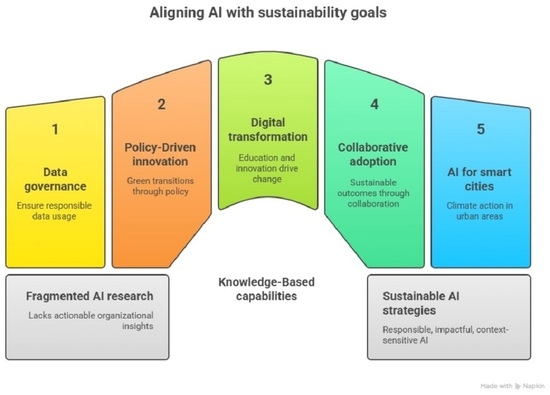
1. Introduction
- To identify and categorize the organizational capabilities that support the alignment of AI innovation with sustainability strategies;
- To articulate the role of knowledge management, leadership, and organizational learning in enabling this alignment;
- To map and synthesize the main research trends and capability domains through bibliometric analysis.
2. Literature Review
3. Methodology
3.1. Data Collection
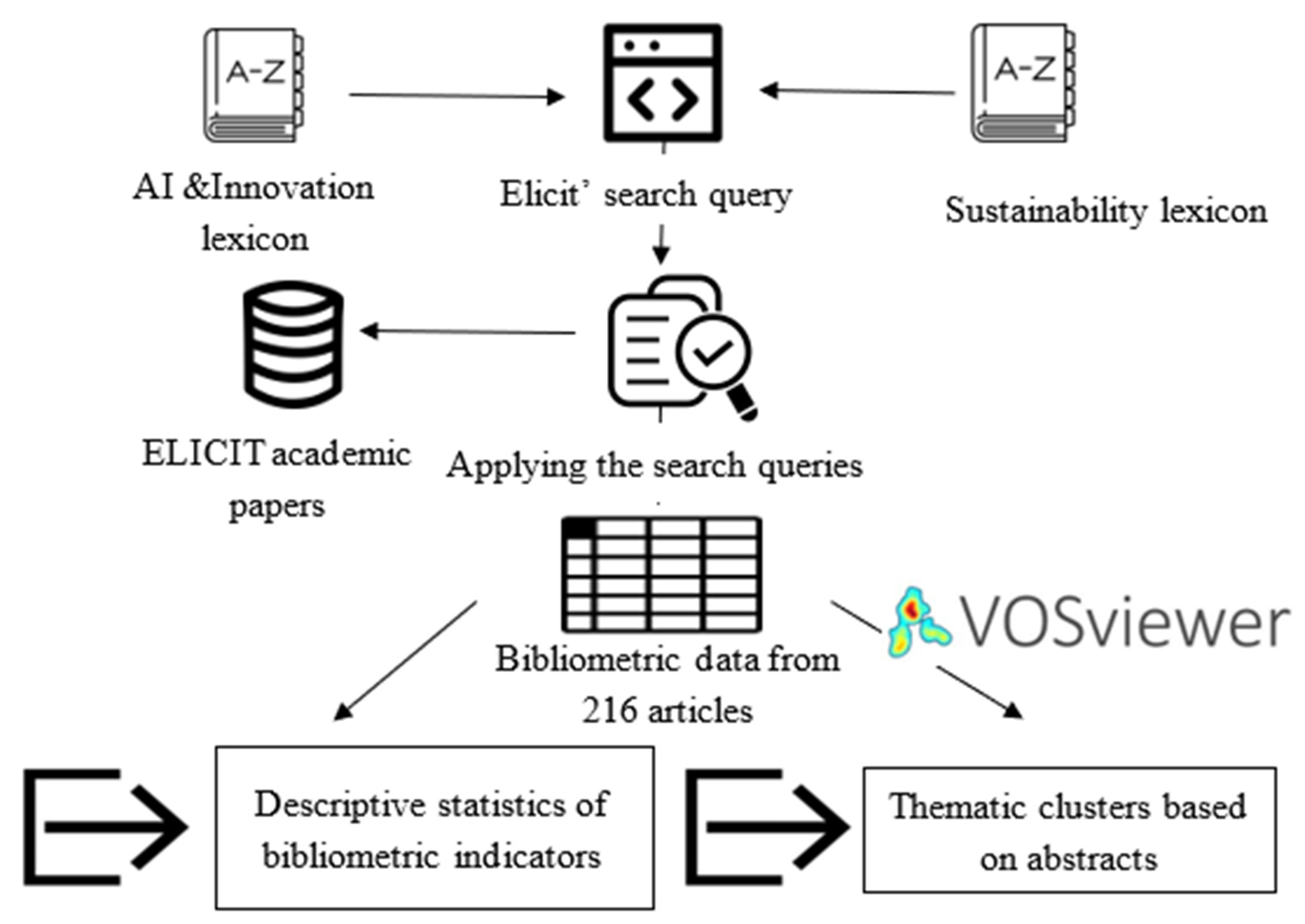
(“artificial intelligence” OR AI OR “AI-driven innovation” OR “responsible AI” OR “green AI” OR “machine learning” OR “deep learning” OR “neural network*” OR “predictive analytics” OR “smart systems” OR “knowledge management” OR “digital transformation” OR “AI capability” OR “big data analytics” OR “generative AI” OR “large language models” OR “LLMs” OR “agentic AI” OR “AI agent*” OR “computer vision” OR “natural language processing”)AND(sustainab* OR “sustainable development” OR “Sustainable Development Goals” OR SDGs OR “green innovation” OR “circular economy” OR “environmental sustainability” OR “environmental governance” OR “net zero” OR “renewable energy”)
3.2. Text Mining and Co-Word Analysis
3.3. Thematic Cluster Identification
4. Results and Critical Analysis
4.1. Insights from Bibliometric Analyses
4.2. Thematic Clusters
4.3. Capability-Based Framework and Strategic Implications
5. Practical and Policy Recommendations
5.1. Practical Recommendations for Organizations and Ecosystems
5.2. Policy Recommendations for Sustainable AI Innovation
6. Summary of Main Findings
7. Limitations and Future Research
8. Conclusions
Author Contributions
Funding
Data Availability Statement
Conflicts of Interest
References
- Shneiderman, B. Human-Centered Artificial Intelligence: Reliable, Safe & Trustworthy. Int. J. Hum.–Comput. Interact. 2020, 36, 495–504. [Google Scholar] [CrossRef] [Scilit]
- Dwivedi, D.N. The Use of Artificial Intelligence in Supply Chain Management and Logistics. In Leveraging AI and Emotional Intelligence in Contemporary Business Organizations; IGI Global Scientific Publishing: Hershey, PA, USA, 2023; pp. 306–313. [Google Scholar] [CrossRef] [Scilit]
- Raimo, N.; De Turi, I.; Albergo, F.; Vitolla, F. The drivers of the digital transformation in the healthcare industry: An empirical analysis in Italian hospitals. Technovation 2023, 121, 102558. [Google Scholar] [CrossRef] [Scilit]
- Grant, R.M. Toward a knowledge-based theory of the firm. Strateg. Manag. J. 1996, 17 (Suppl. 2), 109–122. [Google Scholar] [CrossRef] [Scilit]
- Cohen, W.M.; Levinthal, D.A. Absorptive Capacity: A New Perspective on Learning and Innovation. Adm. Sci. Q. 1990, 35, 128. [Google Scholar] [CrossRef] [Scilit]
- Gold, A.H.; Malhotra, A.; Segars, A.H. Knowledge Management: An Organizational Capabilities Perspective. J. Manag. Inf. Syst. 2001, 18, 185–214. [Google Scholar] [CrossRef] [Scilit]
- Easterby-Smith, M.; Lyles, M.A. The Evolving Field of Organizational Learning and Knowledge Management. In Handbook of Organizational Learning and Knowledge Management; John Wiley & Sons: Hoboken, NJ, USA, 2012; pp. 1–20. [Google Scholar] [CrossRef] [Scilit]
- Zhang, X.; Teng, X.; Le, Y.; Li, Y. Strategic orientations and responsible innovation in SMEs: The moderating effects of environmental turbulence. Bus. Strategy Environ. 2023, 32, 2522–2539. [Google Scholar] [CrossRef] [Scilit]
- Giampaoli, D.; Sgrò, F.; Ciambotti, M.; Wright, P. Unleashing Potential in SMEs: How Intellectual Capital Fuels Employee Flexibility to Reach Strategic Goals. Electron. J. Knowl. Manag. 2025, 23, 67–82. [Google Scholar] [CrossRef] [Scilit]
- He, X.; Burger-Helmchen, T. Evolving Knowledge Management: Artificial Intelligence and the Dynamics of Social Interactions. IEEE Eng. Manag. Rev. 2024, 53, 215–231. [Google Scholar] [CrossRef] [Scilit]
- Jarrahi, M.H.; Askay, D.; Eshraghi, A.; Smith, P. Artificial intelligence and knowledge management: A partnership between human and AI. Bus. Horiz. 2023, 66, 87–99. [Google Scholar] [CrossRef] [Scilit]
- Bag, S.; Choi, T.-M.; Rahman, M.S.; Srivastava, G.; Singh, R.K. Examining collaborative buyer–supplier relationships and social sustainability in the “new normal” era: The moderating effects of justice and big data analytical intelligence. Ann. Oper. Res. 2025, 348, 1235–1280. [Google Scholar] [CrossRef] [Scilit]
- Chatterjee, S.; Chaudhuri, R. Customer Relationship Management in the Digital Era of Artificial Intelligence; Springer International Publishing: Cham, Germany, 2023; pp. 175–190. [Google Scholar] [CrossRef] [Scilit]
- Bosi, M.K.; Lajuni, N.; Wellfren, A.C.; Lim, T.S. Sustainability Reporting through Environmental, Social, and Governance: A Bibliometric Review. Sustainability 2022, 14, 12071. [Google Scholar] [CrossRef] [Scilit]
- Hallinger, P. A Meta-Synthesis of Bibliometric Reviews of Research on Managing for Sustainability, 1982–2019. Sustainability 2021, 13, 3469. [Google Scholar] [CrossRef] [Scilit]
- Teh, D.; Khan, T. Sustainability-Focused Accounting, Management, and Governance Research: A Bibliometric Analysis. Sustainability 2024, 16, 10435. [Google Scholar] [CrossRef] [Scilit]
- Kar, A.K.; Choudhary, S.K.; Singh, V.K. How can artificial intelligence impact sustainability: A systematic literature review. J. Clean. Prod. 2022, 376, 134120. [Google Scholar] [CrossRef] [Scilit]
- Tabbakh, A.; Al Amin, L.; Islam, M.; Mahmud, G.M.I.; Chowdhury, I.K.; Mukta, M.S.H. Towards sustainable AI: A comprehensive framework for Green AI. Discov. Sustain. 2024, 5, 408. [Google Scholar] [CrossRef] [Scilit]
- Zejjari, I.; Benhayoun, I. The use of artificial intelligence to advance sustainable supply chain: Retrospective and future avenues explored through bibliometric analysis. Discov. Sustain. 2024, 5, 174. [Google Scholar] [CrossRef] [Scilit]
- Leal Filho, W.; Mbah, M.F.; Dinis, M.A.P.; Trevisan, L.V.; de Lange, D.; Mishra, A.; Rebelatto, B.; Ben Hassen, T.; Aina, Y.A. The role of artificial intelligence in the implementation of the UN Sustainable Development Goal 11: Fostering sustainable cities and communities. Cities 2024, 150, 105021. [Google Scholar] [CrossRef] [Scilit]
- Valencia-Arias, A.; Jimenez Garcia, J.A.; Alvites Adan, T.E.; Martínez Rojas, E.; Valencia, J.; Agudelo-Ceballos, E.; Uribe Bedoya, H.; Moreno López, G.A. Trends in the sustainable use of artificial intelligence: A bibliometric approach. Discov. Sustain. 2025, 6, 374. [Google Scholar] [CrossRef] [Scilit]
- Yeh, S.-C.; Wu, A.-W.; Yu, H.-C.; Wu, H.C.; Kuo, Y.-P.; Chen, P.-X. Public Perception of Artificial Intelligence and Its Connections to the Sustainable Development Goals. Sustainability 2021, 13, 9165. [Google Scholar] [CrossRef] [Scilit]
- Farmanesh, P.; Solati Dehkordi, N.; Vehbi, A.; Chavali, K. Artificial Intelligence and Green Innovation in Small and Medium-Sized Enterprises and Competitive-Advantage Drive Toward Achieving Sustainable Development Goals. Sustainability 2025, 17, 2162. [Google Scholar] [CrossRef] [Scilit]
- Ali, A.H. Green AI for Sustainability: Leveraging Machine Learning to Drive a Circular Economy. Babylon. J. Artif. Intell. 2023, 2023, 15–16. [Google Scholar] [CrossRef] [Scilit]
- Al-Adwan, M.A.S. Harnessing Artificial Intelligence for Environmental Sustainability: Ethical Considerations and Practical Implications in Achieving SDG 9 And SDG 16. J. Lifestyle SDGs Rev. 2025, 5, e03779. [Google Scholar] [CrossRef] [Scilit]
- Tettey, D.J.; Chrisben, D.; Victoria, M.C.; Chukwubuikem, E.P.; Abdullahi, A. Responsible AI deployment in sustainable project execution: Ensuring transparency, carbon efficiency and regulatory alignment. Int. J. Sci. Res. Arch. 2025, 14, 1686–1705. [Google Scholar] [CrossRef] [Scilit]
- Adewoyin, M.A.; Adediwin, O.; Audu, A.J. Artificial Intelligence and Sustainable Energy Development: A Review of Applications, Challenges, and Future Directions. Int. J. Multidiscip. Res. Growth Eval. 2025, 6, 196–203. [Google Scholar] [CrossRef] [Scilit]
- Iqbal, A.; Zhang, W.; Jahangir, S. Building a Sustainable Future: The Nexus Between Artificial Intelligence, Renewable Energy, Green Human Capital, Geopolitical Risk, and Carbon Emissions Through the Moderating Role of Institutional Quality. Sustainability 2025, 17, 990. [Google Scholar] [CrossRef] [Scilit]
- Maier, F.; Meyer, M.; Steinbereithner, M. Nonprofit organizations becoming business-like: A systematic review. Nonprofit Volunt. Sect. Q. 2016, 45, 64–86. [Google Scholar] [CrossRef] [Scilit]
- Wang, T. Can the application of artificial intelligence technology promote enterprise green technology innovation? In Proceedings of the 7th International Conference on Computer Information Science and Artificial Intelligence, Shaoxing, China, 13–15 September 2024; pp. 195–200. [Google Scholar] [CrossRef] [Scilit]
- Petrescu, M.; Krishen, A.S.; Kachen, S.; Gironda, J.T. AI-based innovation in B2B marketing: An interdisciplinary framework incorporating academic and practitioner perspectives. Ind. Mark. Manag. 2022, 103, 61–72. [Google Scholar] [CrossRef] [Scilit]
- Sriram, N. Harmonizing Innovation and Integrity: Ethical Perspectives on Artificial Intelligence (AI) in Academic Writing. Int. J. Pharm. Health Care Res. 2025, 13, 59–65. [Google Scholar] [CrossRef] [Scilit]
- Tanveer, M.; Hassan, S.; Bhaumik, A. Academic Policy Regarding Sustainability and Artificial Intelligence (AI). Sustainability 2020, 12, 9435. [Google Scholar] [CrossRef] [Scilit]
- Sapkota, R.; Roumeliotis, K.I.; Karkee, M. AI Agents vs. Agentic AI: A Conceptual Taxonomy, Applications and Challenges. arXiv 2025, 126(Part B), 103599. [Google Scholar] [CrossRef] [Scilit]
- Goel, A.; Raut, G.; Sharma, A.; Taneja, U. Artificial Intelligence and Sustainable Business: A Review. S. Asian J. Bus. Manag. Cases 2024, 13, 340–365. [Google Scholar] [CrossRef] [Scilit]
- Sipola, J.; Saunila, M.; Ukko, J. Adopting artificial intelligence in sustainable business. J. Clean. Prod. 2023, 426, 139197. [Google Scholar] [CrossRef] [Scilit]
- Bai, T.R.J.; Shanavas, A. Sustainable finance and use of artificial intelligence in investment decision making. Int. J. Adv. Res. 2024, 12, 1212–1218. [Google Scholar] [CrossRef] [Scilit] [PubMed]
- Widodo, S.; Susan, S. Utilization of Artificial Intelligence for Sustainable Building Architecture. Aksen J. Des. Creat. Ind. 2024, 8. [Google Scholar] [CrossRef] [Scilit]
- Musleh Al-Sartawi, A.M.A.; Hussainey, K.; Razzaque, A. The role of artificial intelligence in sustainable finance. J. Sustain. Financ. Invest. 2022, 2022, 1–6. [Google Scholar] [CrossRef] [Scilit]
- Kaur, S.; Kumar, R.; Singh, K.; Huang, Y. Leveraging Artificial Intelligence for Enhanced Sustainable Energy Management. J. Sustain. Energy 2024, 3, 1–20. [Google Scholar] [CrossRef] [Scilit]
- Walshe, R.; Koene, A.; Baumann, S.; Panella, M.; Maglaras, L.; Medeiros, F. Artificial Intelligence as Enabler for Sustainable Development. In Proceedings of the 2021 IEEE International Conference on Engineering, Technology and Innovation (ICE/ITMC), Cardiff, UK, 21–23 June 2021; pp. 1–7. [Google Scholar] [CrossRef] [Scilit]
- Haleem, A.; Javaid, M.; Khan, I.H.; Mohan, S. Significant Applications of Artificial Intelligence Towards Attaining Sustainability. J. Ind. Integr. Manag. 2023, 8, 489–520. [Google Scholar] [CrossRef] [Scilit]
- Goralski, M.A.; Tan, T.K. Artificial intelligence and sustainable development. Int. J. Manag. Educ. 2020, 18, 100330. [Google Scholar] [CrossRef] [Scilit]
- Dhiman, R.; Miteff, S.; Wang, Y.; Ma, S.-C.; Amirikas, R.; Fabian, B. Artificial Intelligence and Sustainability—A Review. Analytics 2024, 3, 140–164. [Google Scholar] [CrossRef] [Scilit]
- Hintze, A.; Dunn, P.T. Whose interests will AI serve? Autonomous agents in infrastructure use. J. Mega Infrastruct. Sustain. Dev. 2022, 2 (Suppl. 1), 21–36. [Google Scholar] [CrossRef] [Scilit]
- Santos, M.; Carvalho, L.C. AI-driven participatory environmental management: Innovations, applications, and future prospects. J. Environ. Manag. 2025, 373, 123864. [Google Scholar] [CrossRef] [Scilit] [PubMed]
- Shehatta, I.; Al-Rubaish, A.M.; Qureshi, I.U. Coronavirus research performance across journal quartiles. Advantages of Q1 publications. Glob. Knowl. Mem. Commun. 2023, 72, 537–553. [Google Scholar] [CrossRef] [Scilit]
- Calheiros, A.C.; Moro, S.; Rita, P. Sentiment Classification of Consumer-Generated Online Reviews Using Topic Modeling. J. Hosp. Mark. Manag. 2017, 26, 675–693. [Google Scholar] [CrossRef] [Scilit]
- Van Eck, N.J.; Waltman, L. Citation-based clustering of publications using CitNetExplorer and VOSviewer. Scientometrics 2017, 111, 1053–1070. [Google Scholar] [CrossRef] [Scilit]
- Santos, M.R.C.; Laureano, R.M.S. COVID-19-Related Studies of Nonprofit Management: A Critical Review and Research Agenda. Volunt. Int. J. Volunt. Nonprofit Organ. 2022, 33, 936–951. [Google Scholar] [CrossRef] [Scilit]
- Flis, I.; van Eck, N.J. Framing psychology as a discipline (1950–1999): A large-scale term co-occurrence analysis of scientific literature in psychology. Hist. Psychol. 2018, 21, 334–362. [Google Scholar] [CrossRef] [Scilit]
- Verona, G.; Ravasi, D. Unbundling dynamic capabilities: An exploratory study of continuous product innovation. Ind. Corp. Change 2003, 12, 577–606. [Google Scholar] [CrossRef] [Scilit]
- Egger, R.; Yu, J. A topic modeling comparison between lda, nmf, top2vec, and bertopic to demystify twitter posts. Front. Sociol. 2022, 7, 886498. [Google Scholar] [CrossRef] [Scilit]
- Kulkov, I.; Kulkova, J.; Rohrbeck, R.; Menvielle, L.; Kaartemo, V.; Makkonen, H. Artificial intelligence - driven sustainable development: Examining organizational, technical, and processing approaches to achieving global goals. Sustain. Dev. 2024, 32, 2253–2267. [Google Scholar] [CrossRef] [Scilit]
- Fan, Z.; Yan, Z.; Wen, S. Deep Learning and Artificial Intelligence in Sustainability: A Review of SDGs, Renewable Energy, and Environmental Health. Sustainability 2023, 15, 13493. [Google Scholar] [CrossRef] [Scilit]
- Akter, S.; Michael, K.; Uddin, M.R.; McCarthy, G.; Rahman, M. Transforming business using digital innovations: The application of AI, blockchain, cloud and data analytics. Ann. Oper. Res. 2022, 308, 7–39. [Google Scholar] [CrossRef] [Scilit]
- Raman, R.; Gunasekar, S.; Kaliyaperumal, D.; Nedungadi, P. Navigating the Nexus of Artificial Intelligence and Renewable Energy for the Advancement of Sustainable Development Goals. Sustainability 2024, 16, 9144. [Google Scholar] [CrossRef] [Scilit]
- Stahl, B.C. Artificial Intelligence for a Better Future; Springer International Publishing: Berlin/Heidelberg, Germany, 2021. [Google Scholar] [CrossRef] [Scilit]
- Bolón-Canedo, V.; Morán-Fernández, L.; Cancela, B.; Alonso-Betanzos, A. A review of green artificial intelligence: Towards a more sustainable future. Neurocomputing 2024, 599, 128096. [Google Scholar] [CrossRef] [Scilit]
- Lee, B.C.; Brooks, D.; van Benthem, A.; Elgamal, M.; Gupta, U.; Hills, G.; Liu, V.; Phan, L.T.X.; Pierce, B.; Stewart, C.; et al. A view of the sustainable computing landscape. Patterns 2025, 6, 101296. [Google Scholar] [CrossRef] [Scilit] [PubMed]
- Galaz, V.; Centeno, M.A.; Callahan, P.W.; Causevic, A.; Patterson, T.; Brass, I.; Baum, S.; Farber, D.; Fischer, J.; Garcia, D.; et al. Artificial intelligence, systemic risks, and sustainability. Technol. Soc. 2021, 67, 101741. [Google Scholar] [CrossRef] [Scilit]
- Lin, C.-C.; Huang, A.Y.Q.; Lu, O.H.T. Artificial intelligence in intelligent tutoring systems toward sustainable education: A systematic review. Smart Learn. Environ. 2023, 10, 41. [Google Scholar] [CrossRef] [Scilit]
- Mana, A.A.; Allouhi, A.; Hamrani, A.; Rehman, S.; el Jamaoui, I.; Jayachandran, K. Sustainable AI-based production agriculture: Exploring AI applications and implications in agricultural practices. Smart Agric. Technol. 2024, 7, 100416. [Google Scholar] [CrossRef] [Scilit]
- Guandalini, I. Sustainability through digital transformation: A systematic literature review for research guidance. J. Bus. Res. 2022, 148, 456–471. [Google Scholar] [CrossRef] [Scilit]
- Nti, E.K.; Cobbina, S.J.; Attafuah, E.E.; Opoku, E.; Gyan, M.A. Environmental sustainability technologies in biodiversity, energy, transportation and water management using artificial intelligence: A systematic review. Sustain. Futures 2022, 4, 100068. [Google Scholar] [CrossRef] [Scilit]
- Ansell, C.; Gash, A. Collaborative Governance in Theory and Practice. J. Public Adm. Res. Theory 2008, 18, 543–571. [Google Scholar] [CrossRef] [Scilit]
- Vinuesa, R.; Azizpour, H.; Leite, I.; Balaam, M.; Dignum, V.; Domisch, S.; Felländer, A.; Langhans, S.D.; Tegmark, M.; Fuso Nerini, F. The role of artificial intelligence in achieving the Sustainable Development Goals. Nat. Commun. 2020, 11, 233. [Google Scholar] [CrossRef] [Scilit] [PubMed]
- Blasi, S.; Ganzaroli, A.; De Noni, I. Smartening sustainable development in cities: Strengthening the theoretical linkage between smart cities and SDGs. Sustain. Cities Soc. 2022, 80, 103793. [Google Scholar] [CrossRef] [Scilit]
- Bibri, S.E.; Huang, J.; Jagatheesaperumal, S.K.; Krogstie, J. The synergistic interplay of artificial intelligence and digital twin in environmentally planning sustainable smart cities: A comprehensive systematic review. Environ. Sci. Ecotechnol. 2024, 20, 100433. [Google Scholar] [CrossRef] [Scilit] [PubMed]
- Regona, M.; Yigitcanlar, T.; Hon, C.; Teo, M. Artificial intelligence and sustainable development goals: Systematic literature review of the construction industry. Sustain. Cities Soc. 2024, 108, 105499. [Google Scholar] [CrossRef] [Scilit]
- Hassoun, A.; Prieto, M.A.; Carpena, M.; Bouzembrak, Y.; Marvin, H.J.P.; Pallarés, N.; Barba, F.J.; Punia Bangar, S.; Chaudhary, V.; Ibrahim, S.; et al. Exploring the role of green and Industry 4.0 technologies in achieving sustainable development goals in food sectors. Food Res. Int. 2022, 162, 112068. [Google Scholar] [CrossRef] [Scilit]
- Singh, A.; Kanaujia, A.; Singh, V.K.; Vinuesa, R. Artificial intelligence for Sustainable Development Goals: Bibliometric patterns and concept evolution trajectories. Sustain. Dev. 2024, 32, 724–754. [Google Scholar] [CrossRef] [Scilit]
- Kronenberg, J.; Andersson, E.; Elmqvist, T.; Łaszkiewicz, E.; Xue, J.; Khmara, Y. Cities, planetary boundaries, and degrowth. Lancet Planet. Health 2024, 8, e234–e241. [Google Scholar] [CrossRef] [Scilit]
- Nahar, S. Modeling the effects of artificial intelligence (AI)-based innovation on sustainable development goals (SDGs): Applying a system dynamics perspective in a cross-country setting. Technol. Forecast. Soc. Change 2024, 201, 123203. [Google Scholar] [CrossRef] [Scilit]



| Keyword | Example Use in Literature |
|---|---|
| Sustainability | Sustainability is increasingly embedded in AI strategies at the organizational level, requiring capabilities that align AI development with environmental and social priorities. Firms need to integrate sustainability goals into their digital innovation capabilities to remain competitive and compliant [22]. |
| Sustainable development goals (SDGs) | Organizational adoption of AI for SDG alignment depends on strategic leadership and institutional capability to apply AI in sectors like clean energy, education, and smart infrastructure [20]. |
| Green Innovation | Green innovation, enabled by AI, is amplified by organizational capabilities such as technological readiness and absorptive capacity. Firms with strong AI and knowledge-sharing cultures show greater performance in sustainable innovation outcomes [23]. |
| Circular Economy | The transition to circular economy models requires AI-driven data capabilities combined with strategic foresight and organizational learning, allowing firms to optimize reuse, recycling, and material efficiency [24]. |
| Environmental Sustainability | Achieving environmental sustainability through AI involves internal capabilities for cross-functional integration, energy analytics, and dynamic resource allocation—enabled by AI systems trained on sustainable objectives [25]. |
| Environmental Governance | AI supports environmental governance when embedded within organizational routines that emphasize transparency, auditability, and stakeholder accountability. Capabilities in responsible data use, ethical oversight, and real-time monitoring are essential for aligning AI with governance goals [26]. |
| Green AI | Green AI, which prioritizes energy-efficient and environmentally aware AI development, is enabled by organizational capabilities in sustainable computing infrastructure, carbon-conscious design, and internal R&D governance [24]. |
| Responsible AI | The operationalization of responsible AI depends on capabilities for ethical governance, stakeholder engagement, and cross-functional alignment. Organizations must cultivate cultural and procedural mechanisms to ensure that AI innovation contributes to sustainability and social equity [26]. |
| Energy Optimization | AI-driven energy optimization requires firms to develop capabilities in real-time analytics, demand forecasting, and digital infrastructure integration. These are critical for improving energy efficiency in operations and reducing organizational carbon footprints [27]. |
| Net Zero | Achieving net-zero emissions through AI requires strategic capabilities in emissions accounting, cross-sectoral AI integration, and long-term innovation alignment. Firms that invest in these capabilities can leverage AI to support sustainable industrial transitions [28]. |
| Renewable Energy | In the context of renewable energy deployment, AI capabilities such as intelligent forecasting, system learning, and adaptive optimization must be supported by organizational digital maturity and cross-sector collaboration [27]. |
| Keyword | Example Use in Literature |
|---|---|
| Artificial Intelligence (AI) | AI is widely acknowledged as a transformative general-purpose technology with significant implications for addressing complex sustainability challenges across environmental, economic, and social dimensions [35]. |
| AI-Driven Innovation | AI-driven innovation encompasses the application of artificial intelligence to accelerate sustainable product, process, and service development through advanced analytics and automation [36]. |
| Machine Learning | Machine learning models enhance sustainability efforts by enabling real-time predictive capabilities in climate risk assessment, energy efficiency, and environmental monitoring [37]. |
| dhimanDeep learning | Deep learning techniques contribute to sustainable innovation by enabling sophisticated data-driven modeling for complex phenomena such as energy optimization and climate simulations [38]. |
| Neural networks | Artificial neural networks are employed for intelligent pattern recognition and predictive analytics in sustainability applications, including emissions forecasting and smart infrastructure design [38]. |
| Big Data analytics | Big data analytics is a critical enabler of AI-based sustainability by facilitating high-volume data processing, enhancing environmental decision-making, and detecting greenwashing in ESG disclosures [39]. |
| Predictive analytics | Predictive analytics supports sustainable strategies by forecasting energy demand, optimizing supply chains, and improving ecological resource allocation through AI-driven insights [40]. |
| Smart systems | Smart systems, powered by AI and IoT, facilitate adaptive infrastructure for sustainability by dynamically managing resources such as energy, water, and waste in real time [41]. |
| Knowledge management | Integrating AI with organizational knowledge management enhances absorptive capacity and amplifies the firm’s ability to innovate sustainably and respond to environmental complexity [35]. |
| Digital transformation | Digital transformation encompasses the strategic integration of digital technologies, including AI, to drive sustainable value creation and systemic organizational change [42]. |
| AI capability | AI capability refers to a firm’s technological readiness and absorptive competencies to develop, deploy, and scale AI solutions aligned with sustainability objectives [36]. |
| Organizational learning capability | Organizational learning capability serves as a moderator that enables firms to fully leverage AI technologies for enhanced innovation performance in sustainability-oriented contexts [43]. |
| Generative AI (GenAI) | Generative AI offers potential for sustainable innovation through design optimization and simulation, but also poses environmental concerns due to the computational intensity of large-scale models [44]. |
| Large language models (LLM) | LLMs enable scalable natural language processing for sustainability reporting and policy analysis, though concerns persist regarding their energy demands and carbon footprint [44]. |
| Agentic AI & AI agents | Agentic AI refers to autonomous systems capable of goal-directed behavior with minimal human input, increasingly used to enhance sustainability in sectors like energy, logistics, and infrastructure [45]. |
| Computer vision | Computer vision techniques are applied in sustainable domains such as satellite-based environmental surveillance, biodiversity monitoring, and energy-efficient architecture [38]. |
| Natural language processing (NLP) | NLP enables the analysis of sustainability discourse, stakeholder sentiment, and regulatory trends; however, it remains resource-intensive and requires greener AI infrastructure [37]. |
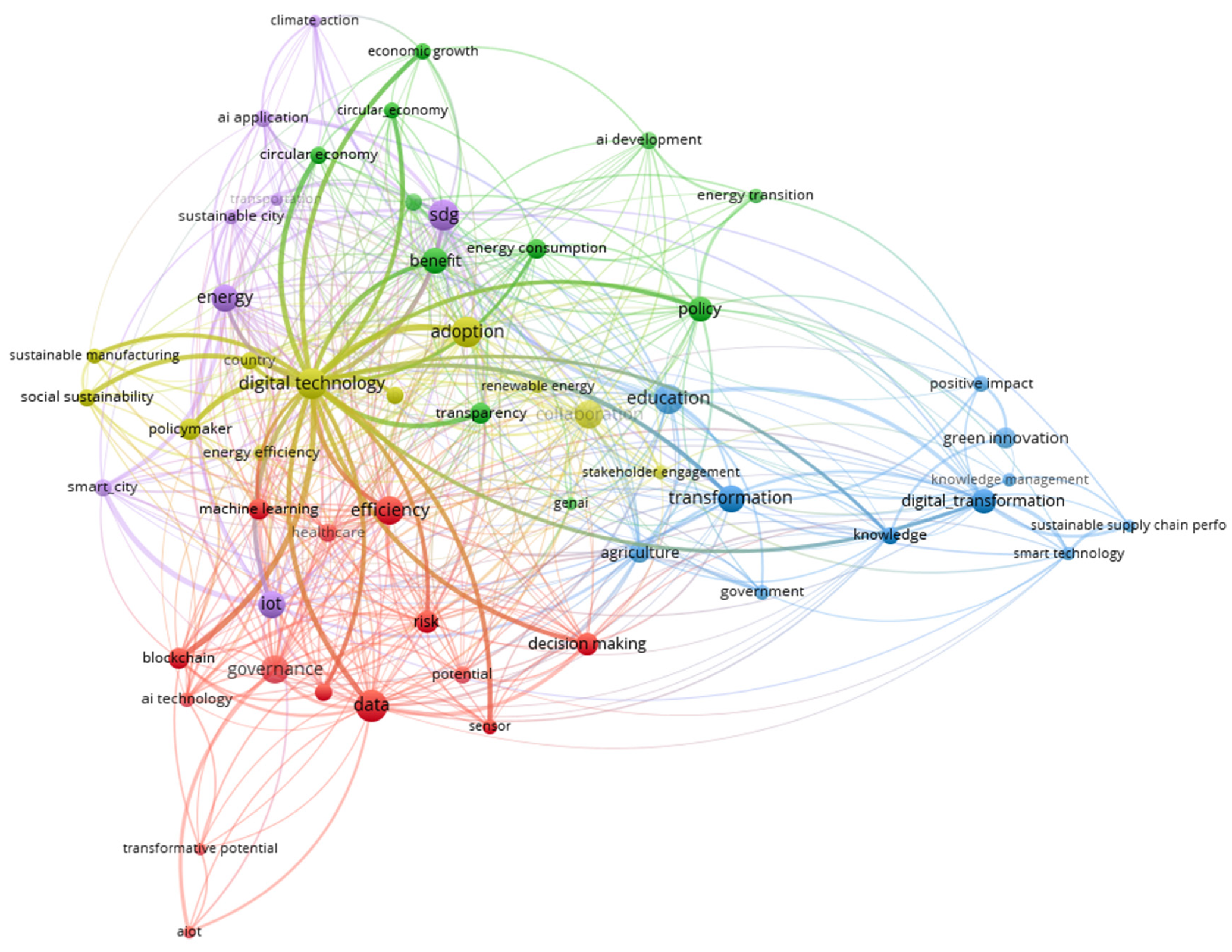
| Cluster | Most Frequent Terms | Number of Occurrences |
|---|---|---|
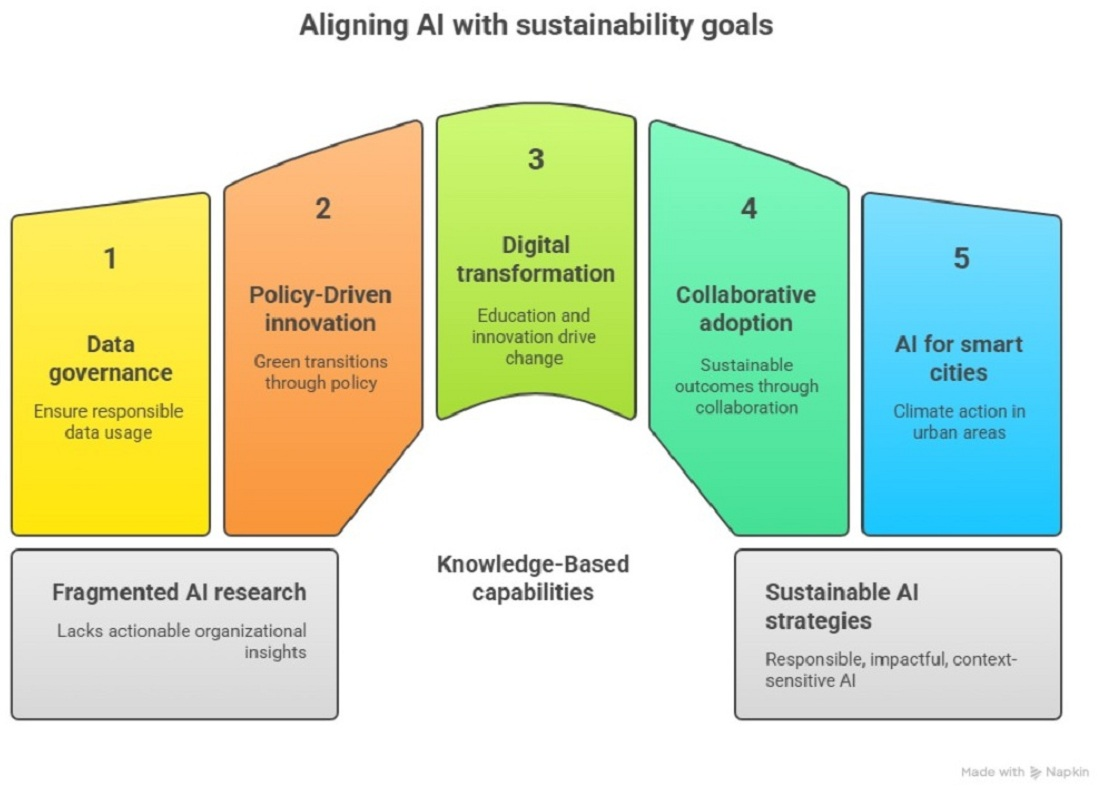
| 1—Data governance and decision intelligence (in red) | data | 37 |
| governance | 33 | |
| efficiency | 27 | |
| decision making | 17 | |
| risk | 16 | |
| healthcare | 15 | |
| blockchain | 15 | |
| machine learning | 14 | |
| potential | 12 | |
| environmental impact | 10 | |
| 2—Policy-driven innovation and green transitions (in green) | benefit | 23 |
| policy | 20 | |
| transparency | 14 | |
| ai development | 13 | |
| energy consumption | 13 | |
| ai model | 12 | |
| energy transition | 9 | |
| circular economy | 9 | |
| 3—Digital transformation through education and innovation (in blue) | education | 37 |
| transformation | 26 | |
| digital transformation | 21 | |
| green innovation | 19 | |
| agriculture | 18 | |
| positive impact | 11 | |
| government | 10 | |
| 4—Collaborative adoption for sustainable outcomes (in yellow) | adoption | 33 |
| digital technology | 33 | |
| collaboration | 32 | |
| policymaker | 15 | |
| energy efficiency | 11 | |
| country | 10 | |
| social sustainability | 10 | |
| 5—AI for smart cities and climate action (in purple) | SDG | 33 |
| IoT | 26 | |
| energy | 25 | |
| smart city | 13 | |
| ai application | 12 | |
| sustainable city | 10 | |
| transportation | 7 | |
| climate action | 7 |
| Capability Domain | Main Thematic Clusters | Key Capabilities | Organizational Level | Illustrative Application |
|---|---|---|---|---|
| Knowledge and learning capabilities | 1 (Data governance), #3 (Education & innovation) | Knowledge integration, Organizational learning, Absorptive capacity, Sustainability literacy | Individual & Organizational | Internal AI training for sustainable agriculture or circular economy |
| Governance and ethical infrastructure | 1 (Data governance), 2 (Policy & Green AI) | Data governance, Risk management, Transparent decision-making, Ethical oversight | Green AI models with carbon accounting and explainable algorithms | |
| Collaborative and institutional capabilities | 2 (Policy & Green AI), #4 (Collaboration) | Multi-stakeholder engagement, Policy co-creation, Public–private partnerships | Ecosystem & Inter-organizational | SDG-aligned AI projects across academia, government, and industry |
| Technological Integration capabilities | 4 (Adoption), 5 (Smart cities) | Smart infrastructure, Digital transformation, AI-enabled energy efficiency, IoT convergence | Operational & Technical | AI-powered smart grid in urban mobility or emission reduction |
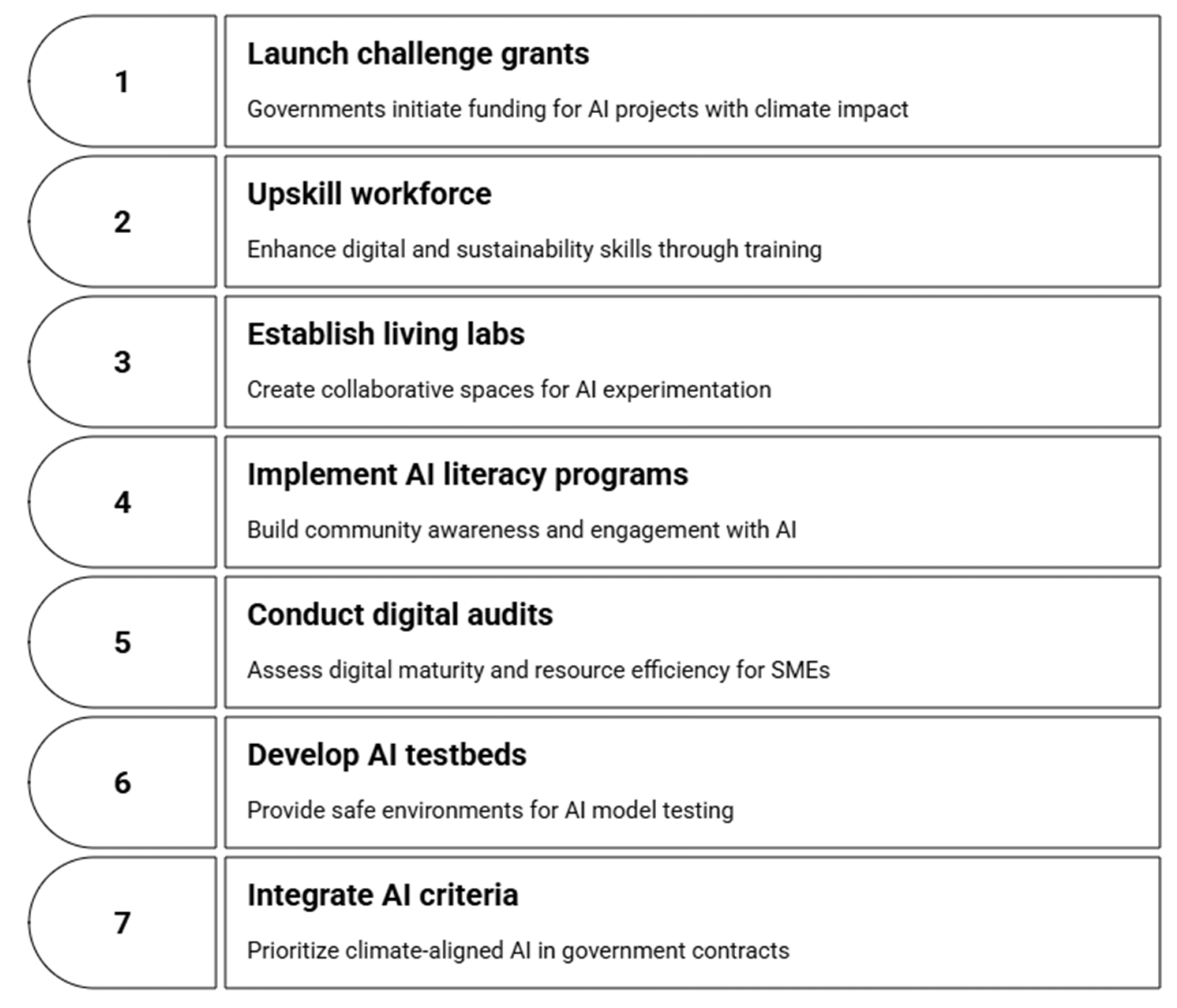
| Thematic Cluster | Policy Recommendation | Recommended Strategic Actions |
|---|---|---|
| 1. Data governance and decision intelligence | Need for ethical data policies, risk management, and AI accountability frameworks. | Develop national data governance guidelines; enforce algorithmic transparency; embed risk metrics in AI evaluation. |
| 2. Policy-driven innovation and green transitions | AI policy must be integrated with sustainability goals and energy efficiency mandates. | Create anticipatory policy sandboxes; align Green AI principles with regulatory instruments; incentivize circular AI. |
| 3. Education and digital transformation | Requires education reform and upskilling to build AI readiness and sustainability literacy. | Launch micro-credential programs in green AI; invest in educator training; embed AI ethics in STEM curricula. |
| 4. Collaborative adoption and multi-stakeholder engagement | Necessitates cross-sectoral governance, co-creation, and participatory policymaking. | Establish regional AI innovation hubs; fund public–private partnership models; promote collaborative policymaking labs. |
| 5. Smart cities and climate action | AI should be embedded into urban planning and climate adaptation policies. | Develop smart infrastructure frameworks; integrate AI into SDG-aligned urban policies; incentivize climate–AI integration. |
Disclaimer/Publisher’s Note: The statements, opinions and data contained in all publications are solely those of the individual author(s) and contributor(s) and not of MDPI and/or the editor(s). MDPI and/or the editor(s) disclaim responsibility for any injury to people or property resulting from any ideas, methods, instructions or products referred to in the content. |
© 2025 by the authors. Licensee MDPI, Basel, Switzerland. This article is an open access article distributed under the terms and conditions of the Creative Commons Attribution (CC BY) license (https://creativecommons.org/licenses/by/4.0/).
Share and Cite
Santos, M.R.C.; Carvalho, L.C.; Francisco, E. A Capability-Based Framework for Knowledge-Driven AI Innovation and Sustainability. Information 2025, 16, 987. https://doi.org/10.3390/info16110987
Santos MRC, Carvalho LC, Francisco E. A Capability-Based Framework for Knowledge-Driven AI Innovation and Sustainability. Information. 2025; 16(11):987. https://doi.org/10.3390/info16110987
Chicago/Turabian StyleSantos, Márcia R. C., Luísa Cagica Carvalho, and Edgar Francisco. 2025. "A Capability-Based Framework for Knowledge-Driven AI Innovation and Sustainability" Information 16, no. 11: 987. https://doi.org/10.3390/info16110987
APA StyleSantos, M. R. C., Carvalho, L. C., & Francisco, E. (2025). A Capability-Based Framework for Knowledge-Driven AI Innovation and Sustainability. Information, 16(11), 987. https://doi.org/10.3390/info16110987