1. Introduction
Social media influencers (SMIs) are individual content creators who build sizeable followings and influence audience attitudes by producing content for specific social media platforms that many people use as brand information, entertainment, and even news online [
1]. Their reach and impact are underwritten by booming adoption of social platforms: TikTok alone reports more than 150 million U.S. users, with daily usage nearing 100 min [
2]. Industry investment has followed suit. The global influencer market is estimated to reach over 30 billion in 2025 [
3].
In digitally networked environments, people lean on cognitive heuristics and quick cues such as popularity, source cues, or surface design, especially when deciding what and whom to trust [
4]. For SMIs, those cues include follower counts, engagement ratios, and visible intimacy with audiences’ signals that may or may not track underlying reliability. This study is motivated by that tension: in a setting where information is abundant and verification is costly, what standards of credibility do influencers themselves apply, and how does their social media capital (e.g., follower size) shape the diversity of sources they consult?
Although SMIs are often perceived as credible by virtue of trust and expertise, such credibility is frequently inferred from readily observable signals, such as follower count, rather than through systematic evaluation of information sources [
4]. Follower size functions as a form of social media capital, signalling reach and influence, yet its relationship with audience engagement is complex. Empirical studies indicate that follower count can exhibit diminishing returns, with mid-tier influencers sometimes generating higher engagement rates than their macro- or mega-tier counterparts [
5,
6]. This raises critical questions about how influencers with different audience sizes approach verification and source selection when creating content for their followers.
Moreover, the ‘mere number effect’ suggests that large follower counts can enhance perceived influence, even when audiences are aware of the presence of fake or inactive followers [
7]. This narrative raises critical questions regarding how influencers, segmented by follower size, source and evaluate information to determine its credibility. Given that credibility is grounded in dimensions such as trustworthiness and expertise [
8], understanding the diversity of sources consulted and the evaluation criteria applied by influencers has implications not only for marketing effectiveness but also for the broader integrity of information circulating in digital public spheres.
Existing literature shows that online credibility is often judged through heuristic cues such as popularity rather than systematic verification [
4]. Influencer research has largely focused on endorsement effects, emphasizing trustworthiness, expertise, and message value [
1,
9], yet evidence suggests that follower size is not a straightforward indicator of influence. Engagement can decline with larger audiences [
5], mid-tier influencers may outperform mega-accounts [
6], and abnormal likes to followers’ ratios can harm perceived credibility [
10]. Even when fake followers are disclosed, large numbers can still enhance perceived influence of the ‘mere number effect [
11]. While social capital frameworks conceptualize influencer–audience ties as relational assets [
12], little is known about how follower size shapes influencers’ own sourcing practices or credibility evaluation criteria. This gap limits understanding of how influencers across tiers construct diverse sources and apply credibility standards, a perspective important for both social capital theory and improving information quality in digital spaces.
This study examines how social media influencers with varying follower sizes from nano (1000–10,0090), micro (10,000–100,000), macro (100,000–1 million), to mega-influencers (above 1 million), use diverse content sources and apply credibility evaluation criteria across platforms such as Instagram, TikTok, and YouTube globally. In the context of a rapidly growing influencer economy with market size grew from USD 16.4 billion in 2022 to USD 24 billion in 2024 and 86% of U.S. marketers report intent to partner with influencers in 2025 based on SproutSocial [
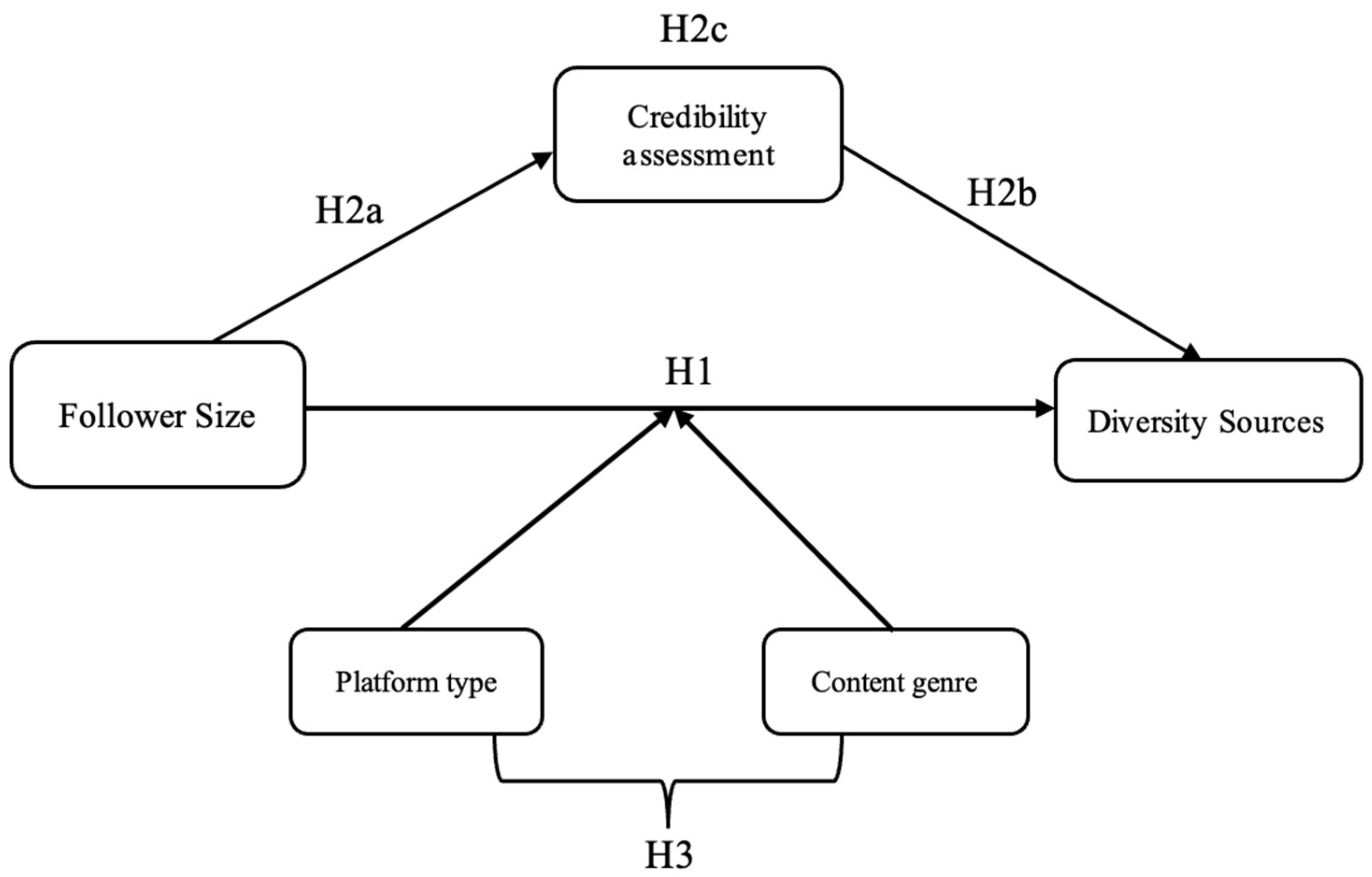
13]; the study employs a cross-sectional survey and statistical mediated moderation analysis to test hypotheses that follower size (social media capital) predicts source diversity, credibility assessment, and that platform type and content genre moderate these relationships, thereby addressing a critical gap in understanding how follower size shapes influencers’ own sourcing and credibility practices, a dimension overlooked by prior studies that focused on audience responses rather than influencer behaviours.
However, while larger audiences may motivate influencers to diversify their sources, such diversification may not directly reflect deeper verification or fact-checking rigor or even show fact-checking rigor. Prior studies show that as influencers professionalize, they often adopt strategies of sourcing that signal credibility to audiences and brands without engaging in meaningful verification processes [
4,
14]. In this case, source diversity can serve as a symbolic cue of transparency and professionalism rather than practice of actual diligence. Accordingly, follower size may heighten the visibility of credibility cues through the display of diverse sources without majorly increasing the underlying rigor of information evaluation. Recognizing this distinction between performative and substantive credibility is very important in understanding how social media capital directly shapes influencer information behaviours.
Furthermore, this study addresses the practical concern for the integrity of information in digital environments, where influencers play a central role in shaping public exposure to news, recommendations, and other content. Understanding how follower size, platform type, and content genre influence sourcing and credibility practices can inform policies promoting transparency, guide organizations toward credible partnerships, and help audiences engage critically with influencer content. These outcomes can advance media literacy, curb misinformation, and reinforce trust in digital communication, contributing to a more informed and resilient public sphere, well beyond the limited scope of endorsing a brand.
Grounded in social capital theory, which views relationships and network resources as assets that shape behaviour, this study conceptualizes follower size as a form of social media capital influencing how influencers source and evaluate information. By examining these dynamics across platform types and content genres, the research not only extends theoretical applications of social capital to the influencer context but also offers actionable insights for improving content credibility and information integrity in digital platforms.
3. Research Methods and Materials
This study employed a quantitative survey design to investigate the relationships among influencer follower size, credibility assessment, platform type, content genre, and the use of diverse sources in influencer content creation. The analysis utilized a large, global dataset collected via an online survey conducted in 2024 with 500 social media influencers. These influencers ranged from nano-influencers (1000–10,000 followers) to mega-influencers (more than 1 million followers), enabling comprehensive coverage of various influencer scales and types.
3.1. Sampling and Participant Recruitment
The anonymous global online survey was conducted, ensuring confidentiality and compliance with ethical research standards. Questions were all close-ended and objectively worded (non-loaded) to facilitate ease of completion. Such design aimed to encourage candid answers from the respondents to avoid social desirability bias. The project received prior approval from the researchers’ university institutional review board before implementation. Participants provided informed consent before completing the questionnaire.
Participants were recruited through an international online panel of a reputable research company, Qualtrics, which offers access to a broad pool of potential respondents. Compensation for participation was provided according to Qualtrics’ standard incentive policies. The survey applied a 50/50 gender quota to achieve gender balance among respondents.
The survey targeted active social media influencers who regularly create public content across major platforms such as Instagram, TikTok, YouTube, and others. Several screener questions were used to ensure the respondent is a qualified influencer eligible for the study, including a minimum follower count of 1000, creating and posting content on a regular basis for audiences other than their friends and family on their main social media platform, with years of experience creating public content, before the respondent can continue the survey. Recruitment employed a quota sampling approach to ensure representation that is diverse across geographic regions and gender. However, we did not set quota by follower size to obtain a representative result of follower size distribution of influencers globally. The survey collected detailed data on demographics (age, gender, education), influencer experience (years of content creation), follower size, content genre, and key variables of interest, such as credibility assessment and use of diverse sources.
To maximize cultural and linguistic inclusivity, the survey instrument was first developed in English and then professionally translated into seven additional languages: Arabic, Chinese, French, German, Portuguese, Russian, and Spanish. These translations were vetted by native communication scholars for accuracy and cultural relevance. Influencers from 44 countries across six continents participated, with 52.4% hailing from Global South countries, classified per UNESCO’s designations.
The geographic quotas allocated for the survey reflected linguistic and economic considerations. English-speaking Global North countries (e.g., United States, United Kingdom, Canada, Australia, Singapore, and Ireland) were assigned a larger sample (100 participants each). English-speaking Global South regions (e.g., India, parts of Africa, Pacific Islands, Southeast Asia) contributed 50 participants. Other language regions (French, Spanish, Portuguese, German, Russian, Arabic, and Chinese) were each assigned 50 participants, ensuring a balanced global distribution.
3.2. Measurements
Follower size was operationalized into four categories: nano-influencers (1000–10,000 followers), micro-influencers (10,000–100,000 followers), meso-influencers (100,000–1 million followers), and mega-influencers (more than 1 million followers). Due to uneven distribution of follower size levels, with much fewer respondents being larger influencers (only 8 mega influencers and 27 macro influencers), these categories were collapsed into two groups: smaller influencers (1000–10,000 followers, n = 340) and larger influencers (10,001–1,000,000 followers, n = 160) for analysis and comparison.
Content genres were classified based on eleven categories commonly identified in influencer marketing [
39]: sports and fitness, gaming, comedy, beauty, fashion/lifestyle, parenting, animal and nature, photography, travel and food, shopping/product reviews, and current affairs/politics/economy. For analytical purposes, these were consolidated into three overarching groups: entertainment only, information only, and mixed content creators.
Source diversity was measured using a multiple-response item that asked participants to identify the types of information sources they regularly use when creating content. The item stated: “What sources do you use to create your content? (Check all that apply)” and presented a checklist of seven options, including: (1) online sources not from mainstream media, (2) personal experience or encounter, (3) mainstream news media, (4) government sources, (5) self-conducted investigations or expert interviews, (6) tips or leads from followers and friends, and (7) an open-ended “other” category. Participants were instructed to select all options that applied. Each selected source was coded as 1, and unselected options as 0. The final source diversity score was calculated by summing the total number of selected options, yielding a continuous measure ranging from 0 to 7, with higher scores indicating greater diversity in content sourcing practices.
Credibility assessment rigor was measured using a single behavioural item that asked respondents to indicate how they verify content before sharing it with their audience. The item stated: “What steps do you take before sharing content with your audience? Select which one best describes your practice.” Respondents selected one of four ordinal response options reflecting increasing effort of the influencer’s credibility-checking behaviour: (1) “Just share the content I found entertaining or useful without checking for accuracy,” (2) “As long as I trust the source/creator of the content, I will share the content,” (3) “I only check for accuracy for news content, all other content I don’t check,” and (4) “Check the source of information from fact-checking sites or look up other authoritative sources and only disseminate information that is verified.”
Each response was coded from 1 to 4 by ranking the effort and rigor, with higher scores indicating greater rigor and effort in systematic credibility assessment. The use of a single-item behavioural measure aligns with methodological literature indicating that single-item scales are acceptable when constructs are unidimensional, clearly defined, and narrow in scope [
40].
To validate this single-item measure, we examined face validity and predictive validity by testing the correlation between the item and our dependent variable (diversity of sources). The items in the assessment rigor scale met these face validity criteria of relevance, ease of response, no ambiguity, non-distressing or sensitive and not judgmental. In addition, it also meets the predictive validity using the item in the result as hypothesized: significant positive correlation between credibility rigor and use of diverse sources (B = 0.3510, SE = 0.0464, t = 7.5581, p < 0.001).
Demographic variables included age measured in standard intervals, gender (male, female, self-described), education level, and years of content creation experience categorized into four intervals: less than one year, 1–3 years, 3–10 years, and more than 10 years.
4. Findings
4.1. Demographic Statistics of the Respondents
The study’s sample comprised 500 respondents with a diverse age distribution. The largest age group was between 25 and 34 years old (33.4%), followed by those aged 35 to 44 years (28.4%). Younger participants aged 18 to 24 years accounted for 19.4%, while those aged 45 to 59 years made up 14.8%. Only 4.0% were aged 60 or older. This age composition suggests that the study primarily reflects the perspectives of young and middle-aged adults, a demographic often most active in digital content creation and social media engagement. See
Table 1 for details of the sample demographics.
By quota design, gender distribution was nearly equal, with male respondents representing 49.6% and female respondents slightly higher at 50.2%. Only one participant (0.2%) preferred to self-describe their gender. In terms of education, most respondents were highly educated, with 42.2% holding a bachelor’s degree and 23.4% possessing a master’s degree or graduate certificate. A smaller proportion had completed some college or an associate degree (18.2%), while 13.6% had a high school education or below. Only 2.4% held a PhD, JD, or equivalent. This indicates a predominantly well-educated sample, which could influence attitudes toward sourcing and credibility assessment in media contexts.
Geographically, the largest representation came from Europe (35.2%) and Asia (29.4%), followed by South America (13.0%) and North America (10.0%). Smaller proportions were from Africa (6.4%) and Oceania (3.0%). The wide geographic spread suggests a globally diverse sample, with a heavy concentration in Europe and Asia.
In terms of content creation experience, 45.2% had been creating public content for 1 to 3 years, 36.0% for more than 3 years but less than 10 years, and 6.6% for 10 years or more. Only 12.2% had less than one year of experience. This shows that most respondents are experienced content creators, with a significant portion having sustained engagement over several years.
For income sources, 31.4% reported that digital content was their main source of income, while the majority (68.6%) did not rely on it as their primary income. Interestingly, most respondents perceived themselves as having at least some influence over their audience, with 69.4% answering “yes, sometimes” and 18.6% stating “yes, always,” while only 12.0% reported not influencing their audience.
When examining the types of content produced, the most common categories were beautiful and attractive things (18.0%), entertainment including memes (15.6%), and recommendations/vlogs (13.8%). Other popular formats included blogs/online commentaries (13.4%) and demonstrations/tutorials (12.6%). Less common were news videos (8.8%), video clips curated from different sources (7.0%), documentaries (3.8%), short fictional films or stories (3.6%), and “other” types of content (3.4%). This distribution reflects a preference for visually engaging and entertainment-oriented formats, though informational and instructional content also plays a substantial role.
Table 1.
Demographic characteristics of the respondents.
| Demographic Statistics | Category | Frequency | Percentage |
|---|
| Respondents Age | Between 18–24 years old | 97 | 19.4 |
| Between 25–34 years old | 167 | 33.4 |
| Between 35–44 years old | 142 | 28.4 |
| Between 45–59 years old | 74 | 14.8 |
| 60 and older | 20 | 4.0 |
| Total | 500 | 100.0 |
| Gender | Male | 248 | 49.6 |
| Female | 251 | 50.2 |
| Prefer to self-describe | 1 | 0.2 |
| Total | 500 | 100.0 |
| Level of Education | High school or below | 68 | 13.6 |
| Some college/associate degree | 91 | 18.2 |
| Bachelor’s degree | 211 | 42.2 |
| Master degree or Graduate Certificate | 117 | 23.4 |
| PhD/JD or equivalent | 12 | 2.4 |
| Total | 499 | 99.8 |
| Continent | Asia | 147 | 29.4 |
| Europe | 176 | 35.2 |
| Oceania | 15 | 3.0 |
| North America | 50 | 10.0 |
| South America | 65 | 13.0 |
| Africa | 32 | 6.4 |
| Total | 500 | 100.0 |
| Do you have a journalistic background | No | 393 | 78.6 |
| Yes | 105 | 21.0 |
| Total | 498 | 99.6 |
| How long have you created public content on social media | Less than one year | 61 | 12.2 |
| 1 to 3 years | 226 | 45.2 |
| More than 3 years but less than 10 years | 180 | 36.0 |
| 10 years or more | 33 | 6.6 |
| Total | 500 | 100.0 |
| Is digital content your main source of income | No | 343 | 68.6 |
| Yes | 157 | 31.4 |
| Total | 500 | 100.0 |
| Influential on audiences | No | 60 | 12.0 |
| Yes, sometimes | 347 | 69.4 |
| Yes, always | 93 | 18.6 |
| Total | 500 | 100.0 |
| Content genre | News videos | 44 | 8.8 |
| Demonstrations/tutorials | 63 | 12.6 |
| Recommendations/Vlogs | 69 | 13.8 |
| Blogs/online commentaries | 67 | 13.4 |
| Video clips curated from different sources | 35 | 7.0 |
| Documentaries | 19 | 3.8 |
| Entertainment including memes | 78 | 15.6 |
| Beautiful and attractive things | 90 | 18.0 |
| Short fictional films or stories | 18 | 3.6 |
| Other (please specify) | 17 | 3.4 |
Source Type
(multiple response) | Online sources | 184 | 36.8 |
| Personal experience | 290 | 58.0 |
| Mainstream news media | 184 | 36.8 |
| Government | 63 | 12.6 |
| Own investigation & interviews | 193 | 38.6 |
| Tips & leads from followers | 147 | 29.4 |
| Other | 3 | 0.6 |
| Follower Size | 1–10 K | 340 | 68.0 |
| 10–100 K | 125 | 25.0 |
| 100 K to 1 million | 27 | 5.4 |
| More than 1 million | 8 | 1.6 |
| Total | 500 | 100.0 |
5. Discussion
Overall, the results showed mixed support for the hypotheses, revealing a consistent relationship between follower size and source diversity, but not between follower size and credibility-assessment rigor.
This study examined how follower size relates to influencers’ use of diverse information sources and how this influences the rigor of their credibility assessment when sharing information. The findings provide insights into how influencers curate and verify content for their audiences. First, the finding that influencers with larger follower counts tend to use a greater variety of sources supports the Social Capital Theory that follower size correlates with access to broader networks and resources. This may be due to partnerships, higher stakes in audience engagement, or a professionalization of content practices. It shows that visibility and credibility online of these influencers are not only tied to popularity metrics but also to how influencers substantiate their messages with different types of information sources, with a mix of personal experience/interviews and official sources.
One main discovery we found is that follower size was not associated with higher rigor of credibility assessment. Instead, influencer uses popularity metrics rather than content validation to determine source credibility when sharing their content with their followers. However, this relationship was nuanced by the finding that credibility was also associated with source diversity. This suggests that influencers try to increase their credibility through displaying the variety of information sources they use rather than the rigorous validation of each individual information source, which is not a process seen by the public.
This finding is consistent with prior literature emphasizing the role of credibility heuristics in shaping information sourcing [
4]. In the context of influencers, those who prioritize accuracy and source validation appear to engage in more varied content curation strategies, possibly to cross-check facts or appeal to a broader audience. This aligns with the argument that credibility-conscious influencers adopt practices like journalistic gatekeeping [
26], thereby increasing their reliability in the eyes of followers and brands. But there are also influencers who use the routine of source variety in lieu of rigorous checking to boost their credibility. Moreover, the result contributes to the influencer credibility literature by empirically linking cognitive evaluation processes (credibility checks) to behavioural sourcing practices, an underexplored but increasingly relevant area in the fight against misinformation. Diverse sources will be beneficial to increase information accuracy when the content creator uses diverse sources as a checking tool, with an increase in rigor in assessing credibility of information before sharing with others. When the diverse sources are just for display and credibility heuristics rather than cross-checking and are not used as evidence of corroboration, then they may not be helpful to increase quality and accuracy of information.
Third, platform type and content genre were not found to moderate the relationship between follower size and the use of diverse sources. Additionally, the results did not find any correlation between diversity of sources and content genre. This suggests that regardless of the type of content influencers produce, be it political commentary, lifestyle vlogs, or entertainment, the breadth of their information sources does not vary significantly. One possible explanation is that influencers across genres have begun adopting similar sourcing practices, potentially shaped by shared norms, algorithmic pressures, or professionalization of content creation across platforms. This convergence may reflect a broader shift in influencer culture where source diversity is not necessarily conditioned by content type but rather by perceived audience expectations and reputational considerations.
The finding corroborates prior research showing that macro-influencers rely more heavily on credible and institutional sources to uphold their legitimacy [
42,
43] and reflects earlier assertions by Kim et al. [
22] that larger influencers adopt more elaborate sourcing strategies as part of strategic brand management. However, it is important to note that using diverse types of sources does not necessarily imply rigorous verification. Macro-influencers may diversify their sources primarily to reduce reputational risk, as diversity is easier to demonstrate in content creation than the less visible process of careful fact-checking. Verification before sharing requires specialized knowledge, time, and caution, which may not be consistently applied despite a broad sourcing profile.
Furthermore, the results suggest that the link between follower size and sourcing diversity is consistent across various content genres and platform types. This finding is different from Kim et al. [
22], who found that genre and platform affordances (e.g., YouTube vs. Instagram) influence influencer strategies. One possible explanation is that influencer professionalism and sourcing practices have converged across platforms, perhaps due to shared norms driven by algorithmic visibility or cross-platform branding. Alternatively, the insignificant effect may indicate that influencer content types have diversified within genres, weakening any consistent moderating influence. These insights caution against overgeneralizing platform-specific strategies in influencer research.
Theoretically, this study contributes to the development of Social Capital Theory in digital environments. Traditionally, social capital refers to the resources individuals gain through social networks, trust, and norms of reciprocity [
15,
16,
17]. In the context of social media, influencers accumulate social capital through their relationships with followers and the trust embedded in their content. However, the result that influencers with larger follower size not assessing with more rigor in information credibility assessment contradicts the prediction from Social Capital Theory, which suggests that individuals rooted in larger social networks (e.g., macro-influencers) are more incentivized to preserve their public image and thus engage in more rigorous information vetting [
41]. The current findings suggest that follower size alone may not determine whether influencers scrutinize content for credibility. This discrepancy may reflect the evolving dynamics of influencer culture, where micro-influencers, due to their close follower relationships, may feel equally compelled to verify information. Alternatively, the visibility of credibility assessment behaviour may be more influenced by platform norms or influencer personality traits than by mere audience size.
The findings show that diverse sourcing serves as a symbolic form of capital for influencers; it communicates credibility, responsibility, and transparency, all of which strengthen the influencer-follower relationship. Follower size alone does not guarantee trust; rather, influencers may feel that audiences evaluate them by their reach (follower size), with sourcing efforts (diverse sources). This reinforces the idea that online influence is shaped by both structural capital (follower networks) and cognitive capital (perceived expertise and trustworthiness). Hence, building on Bourdieu’s concept of symbolic capital, source diversity can be understood as a performative signal of legitimacy. It functions similarly to how journalists cite institutional sources to reinforce authority; yet in influencer culture, it can also mask a lack of actual verification. This suggests a hybrid form of symbolic capital that blends informational cues with aesthetic and strategic branding. Future research could explore how audiences decode such signals, whether they perceive diversity of sources as a proxy for trustworthiness, or whether they differentiate between genuine verification and performative credibility.
This unexpected result in this study invites a reconsideration of how Social Capital Theory (SCT) functions in decentralized, algorithm-driven media environments. While traditional SCT emphasizes that individuals with larger networks are more likely to protect reputational capital by behaving responsibly [
41], the influencer economy rewards visibility and performance, not necessarily epistemic rigor. In digital spaces, attention often functions as capital in itself [
34], and content performance may overshadow the value of source accuracy. Therefore, the non-significant link between follower size and credibility checking may suggest that structural social capital (i.e., large audiences) does not always translate into normative behaviours like fact-checking. This divergence highlights the need to adapt or augment SCT to account for new forms of symbolic and algorithmic capital within influencer ecosystems.
By highlighting the relationship between content practices (like sourcing) and follower trust, the study expands our understanding of how influencers employ their symbolic resources and maintain them in the digital age. It bridges traditional theories of social capital with emerging forms of digital labour and influence.
The findings offer several practical takeaways for influencers, marketers, and platform developers. First, influencers seeking to build or maintain credibility should be intentional about citing a wide range of reliable sources, especially when addressing topics beyond personal experience.
Second, brands and marketers looking to partner with influencers may consider evaluating not only follower metrics but also sourcing practices as indicators of thoughtfulness and professionalism. Collaborating with influencers who consistently use diverse sources may result in higher engagement and trust from audiences.
Lastly, for influencers, platforms, and marketers, these findings offer several tangible takeaways. First, platforms such as Instagram, TikTok, or YouTube could implement source-tagging features enabling creators to link, cite, or annotate their content with source information in a seamless interface. This not only promotes transparency but could enhance platform trustworthiness at scale. Second, influencer marketing agencies may consider including source verification behaviour as part of their vetting criteria when selecting partners for social campaigns, especially in health, news, or educational domains. Some labels of rigorous information checking, such as “fact-checked”, can be added to social media posts. Influencers who post more “fact-checked” posts should be rewarded by marketers. Third, training modules or certifications in digital literacy and source vetting standards (like those similar to media literacy programs for journalists) could be designed to support influencers in improving content accuracy while maintaining engagement.