Article

Totemic Mediation and Visual Prajñā: How Lotus and Dharma Wheel Motifs Generate Embodied Śūnyatā Experience in the Dunhuang Mogao Caves

Department of Art and Physical Education, Xinhua College of Ningxia University, Yinchuan 750021, China
Religions 2026, 17(6), 707; https://doi.org/10.3390/rel17060707 (registering DOI)
Submission received: 23 March 2026 / Revised: 4 June 2026 / Accepted: 5 June 2026 / Published: 12 June 2026
(This article belongs to the Special Issue Buddhist Meditation: Culture, Mindfulness, and Rationality)

Abstract

This article argues that lotus and dharma wheel motifs in the Dunhuang Mogao Caves function not merely as decorative symbols but as active visual apparatuses that generate embodied religious experience through a mechanism we term “totemic mediation.” Drawing on Lévi-Strauss’s structuralist reading of totemism, Descola’s ontological framework, Gell’s theory of art as agency, Meyer’s “sensational form,” and Varela’s neurophenomenology, we define totemic mediation as a triadic mechanism encompassing material–spatial arrangement, ontological transformation of experiential states, and value structure generation. We analyze motifs from Mogao Caves 285, 329, and 361 using a five-step analytic framework: formal–visual description, reconstructed embodied viewing, doctrinal identification, mediation mechanism analysis, and evaluative assessment. The analysis demonstrates that the lotus mediates ontologically along a spatial axis, building a vertical channel between the worldly and the divine through ceiling configurations and upward gazes, while the dharma wheel mediates teleologically across the temporal axis, neutralizing linear temporality through rotational dynamics. Together, these motifs constitute “visual prajñā”—a nonconceptual, embodied cognitive effect that bypasses discursive reasoning to enable direct apprehension of śūnyatā (emptiness). This article offers a replicable analytic framework for examining how religious images operate simultaneously as visual apparatuses and ontological mediators.

1. Introduction

This article argues that lotus and dharma wheel motifs in the Dunhuang Mogao Caves function not merely as decorative symbols but as active visual apparatuses that generate embodied religious experience through a mechanism we term “totemic mediation.” By this we mean a triadic process whereby images (1) arrange material and spatial elements to structure viewing conditions, (2) transform the viewer’s experiential state ontologically, and (3) generate links within Buddhist value structures—bridging the seen and the unseen, the mundane and the sacred. The term “totem” is used here not in its classical ethnographic sense of clan–species affiliation, but as an analytical metaphor drawn from the theoretical apparatus refined by twentieth-century structuralism and the ontological turn: the chain of difference-structure → classification → mediation. We contend that the lotus and dharma wheel in Dunhuang are paradigmatic instances of this mediatory chain, functioning as what we call “visual prajñā”—a nonconceptual, physically cognitive effect that bypasses discursive reasoning to enable direct apprehension of śūnyatā (emptiness).1 The notion of “visual prajñā” proposed here is informed by neurophenomenological approaches to embodied cognition and non-conceptual experience. Lutz and Thompson (2003) suggest that pre-reflective dimensions of experience can be understood through patterns of embodied cognitive engagement, while Varela et al. (1991) emphasize that perceptual qualities such as color emerge through structural coupling between organism and environment. These perspectives provide an interpretive framework for understanding how visual elements, including color vibration and rhythmic line, may shape attention and sensibility. however, this article does not equate artistic experience with neuroscientific conclusions, but uses them only as an interpretive framework.
This intervention matters for two reasons. First, existing scholarship on Dunhuang art has largely confined itself to symbolic readings of Buddhist motifs—lotus as purity, dharma wheel as truth—without theorizing how these images actively produce religious experience through their form, materiality, and spatial placement. The critical question of “how images become sacred mediators” remains underconceptualized: how do visual forms bring about religious experience? What relations among humans and nonhumans do images structure? These issues are particularly pronounced within Buddhist visual culture, wherein the wide range of iconographic and cognitive categories in the tradition (e.g., nimitta and ālambana) remains to be systematically examined through a cross-cultural ontological lens. Second, while the ontological turn in anthropology (Descola 2013; Holbraad and Pedersen 2017) has opened theoretical space for plural modes of existence, it has not been concretely mobilized to analyze visual practice in Buddhist contexts. The present study addresses both gaps.
To address these questions, we develop a five-step analytic framework—formal–visual description, reconstructed embodied viewing, doctrinal identification, mediation mechanism analysis, and evaluative assessment (Table 1)—and apply it to two principal motifs across Mogao Caves 285, 329, and 361. Our analysis demonstrates that the lotus mediates ontologically along the spatial axis, creating a vertical channel between worldly and divine realms through sunken ceiling configurations and upward-arching gazes, while the dharma wheel mediates teleologically along the temporal axis, converting linear time into cyclical awareness through rotational visual dynamics. The neurophenomenological model of “Absolute Unitary Being” (AUB) proposed by d’Aquili and Newberg (1999) provides a theoretical framework for understanding this experiential transformation. We emphasize throughout that this model is deployed as a theoretical hypothesis, not as established neuroscience.
It is important to clarify why we invoke the term “totem” for Buddhist imagery. We do not appeal to the “literal” totemism of nineteenth-century ethnography—the genealogical connection between clans and species—but rather the refined conceptual apparatus clarified through structuralism and the ontological turn. As Lévi-Strauss ([1962] 1963) demonstrated, the foundation of totemism is a cognitive operation that conceptualizes social difference through natural difference.2 Descola (2013) established totemism among four ontological modes, releasing it from specific ethnographic accretions. The indigenous Buddhist term nimitta (sign or mark) refers primarily to cognitive demarcations in meditative praxis—mental images that practitioners cultivate to focus attention. This concept does not capture the mediating agency of images within socio–material–spatial assemblages, as nimitta applies only to internal cognitive events. “Totem” therefore serves as an analytical metaphor, not a literal classificatory category. Its range of applicability is circumscribed to the theoretical precision by which structuralism and the ontological turn concentrate the analytical chain: difference → classification → mediation.

2. Background and Theoretical Orientation

2.1. From Classical Totemism to Ontological Mediation

The concept of totemism has undergone a long theoretical evolution. Classical theorists—McLennan (1869), Frazer (1910), Durkheim ([1912] 1995), and Radcliffe-Brown (1922)—treated totems as markers of clan identity or as symbols reinforcing social integration. McLennan and Frazer situated totemic institutions within a unilinear scale moving from “nature worship” toward “higher religions,” grounded on conjectural reconstructions of animal and plant veneration. Durkheim interpreted the totem as a symbol of “collective life,” signifying the binding force of the social group; Radcliffe-Brown argued that the totemic system maintained social integration through its system of classification. While these accounts clarified the social functions of totemism, they overlooked the emotional register of totems, their capacity for mystical experience, and their potential for symbolic polysemy. Crucially, this classical genealogy had no conception of the mediatory-image apparatus: it did not explain how totemic symbols operate as visual mechanisms or generate religious experiences.
Lévi-Strauss ([1962] 1963) reframed totemism as a “structure of difference”—a cognitive operation that conceptualizes social divisions through natural distinctions, revealing an underlying logic of classification. This structuralist approach successfully stripped totemism of its religious assumptions, but theoretical problems emerged from its dismissal of experience, visual form, and ritual practice. If totemism is a way of thinking rather than an institution, how does it work in relation to visual culture, affective experience, and religious praxis? The reduction of totems to classificatory logic risks glossing over their multilayered mediatory roles encompassing images, rituals, and experience.
The ontological turn offers a pathway forward. Descola (2013) differentiates among four ontological regimes, each interpretable as a generative matrix prescribing how humans relate to nonhuman beings through practice. This provides a framework of considerable flexibility for exploring the variety of thematizations across different cultural contexts that invoke “totemism.” From this perspective, the lotus motif in Dunhuang becomes a mediatory structuring element deeply entangled with image, experience, and religious space. Viveiros de Castro (2014) reconceptualizes perspectivism as an acknowledgment of plural perceptual subjectivities, while Holbraad and Pedersen (2017) propose treating divergent ontological regimes as worlds in their own right. Totemic mediation may thus be understood as constituting a distinct ontological world in which the lotus does not merely symbolize but actively links embodied viewers with pluricentered ontological practices that mediate inner states of consciousness and religious philosophy. These frameworks create theoretical room for understanding how images might structure ontological relations, but they have not been concretely mobilized for visual analysis in specific cultural contexts.

2.2. Visual Mediation Theories: Agency, Sensational Form, and Embodied Vision

Four scholars have advanced our understanding of how images generate experience, each contributing a distinct but incomplete perspective. Gell (1998) theorizes images not as passive symbolic inscriptions but as social agents interleaved within relational networks that actively direct viewing behavior and fashion experience through visual structures and materiality. In the Dunhuang context, the lotus motif exemplifies this agentive mediation by influencing the viewer’s access to Buddhist spatial imagination that facilitates the experience of emptiness. However, Gell’s emphasis falls on social interplay rather than ontological transformation.
Meyer (2012) attends to how religion materializes “felt presence” through durable media and sensational forms, arguing that religion is not simply a body of doctrinal writing but something co-generated through physical material media. She insists that religious experience is never immediate but always “a product of religious framing and mediated forms.” Meyer also directly rejects the traditional method that privileges abstract meaning, emphasizing that religion, through material form, “makes a world.” This perspective is crucial for understanding the lotus as a mediating mechanism. However, Meyer does not focus specifically on how totemic symbolic systems generate the tension between classificatory logic and experiential generation.3
Belting (2011) establishes a triadic relation among image, medium, and body, repositioning the image as “an event of viewing” whose meaning recirculates dynamically within body, space, and medium. He explicitly opposes a “disembodied” view of images, arguing that meaning derives from bodily experience rather than from form itself. Morgan (2012) theorizes seeing as a social and embodied religious act that organizes devotees’ sensory experience, exploring how “seeing was a way of longing to touch and be touched by the sacred.” However, Belting’s phenomenological frame addresses the mode of appearance of images more than their generative ontological power, while Morgan focuses on the sociality of looking rather than on the ontological effects intrinsic to image structures.
In sum, the literature on visual media has considerably enhanced awareness of how images create experience in viewing, but lacks a strong account of why images should carry ontological weight. It is this gap that motivates our concept of “totemic mediation,” which integrates visuality, experience, and ontology within Buddhist iconographic domains.

2.3. The Gap in Dunhuang Studies

The same vacuum is discernible in Dunhuang scholarship. Although extensive work addresses the symbolic meanings of the lotus—purity, transcendence of defilement, nirvāṇa, buddha-nature—studies have often remained confined to symbolic readings without theorizing images as mediatory structures that generate experience and ontological relations (Fan 2010; Fan and Zhao 2009; Duan 1994). Few studies employ specific motifs as entry points for interrogating how cave imagery produces religious presence. Notable exceptions include Wang’s (2004) characterization of grottoes as “mirror halls” and Wang and Yan’s (2023) spatial analysis of Cave 254, but neither develops a systematic framework linking visual form to ontological mediation. Among methodological traditions, Panofsky’s (1939) three-level iconology—pre-iconographical description, iconographical analysis, iconological interpretation—has been influential. But his approach depends on access to a “symbolic cosmos” accessible only to epistemic elites, offering limited explanatory power for non-Western visual traditions. The theory of religious experience—from Otto’s (1917) numinous quality to James’s (1902) varieties and Stace’s (1960) mystical consciousness—illuminates the structured nature of religious experience but fails to show what specific triggering mechanisms images enact. The present study fills this gap.

2.4. Philosophical Foundations: Śūnyatā and the Legitimacy of Image

To understand how Dunhuang art functions as mediation, we must sketch the philosophical framework within which it was created—the Madhyamaka school of Mahāyāna Buddhism. Nāgārjuna4 (c. second century CE) systematically articulated the doctrine of śūnyatā (emptiness), establishing the most rigorous philosophical foundation for Mahāyāna thought. As Garfield (1995) demonstrates, its actual meaning is that no phenomenon can exist alone, unaffected by surrounding conditions, and remain forever the same. All phenomena are devoid of absolute or unchanging svabhāva (inherent self-nature). “Whatever is dependently co-arisen, that is explained to be emptiness” (Garfield 1995). Everything arises through pratītyasamutpāda (dependent origination)—phenomena develop only through co-action within an expansive system of mutual relatedness.5 Emptiness and dependent origination are two expressions of the same thing: whatever arises dependently is empty. Thus, emptiness does not negate existence itself, but denies independent, self-sufficient essential existence (Garfield 1995).
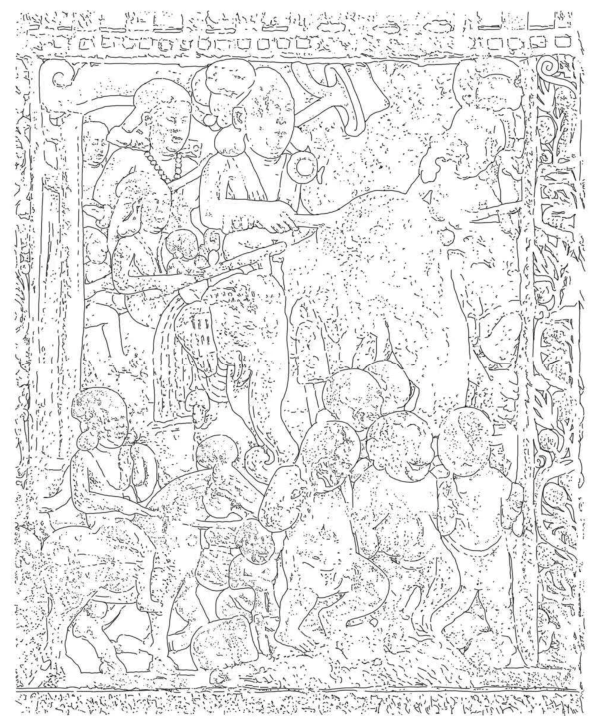
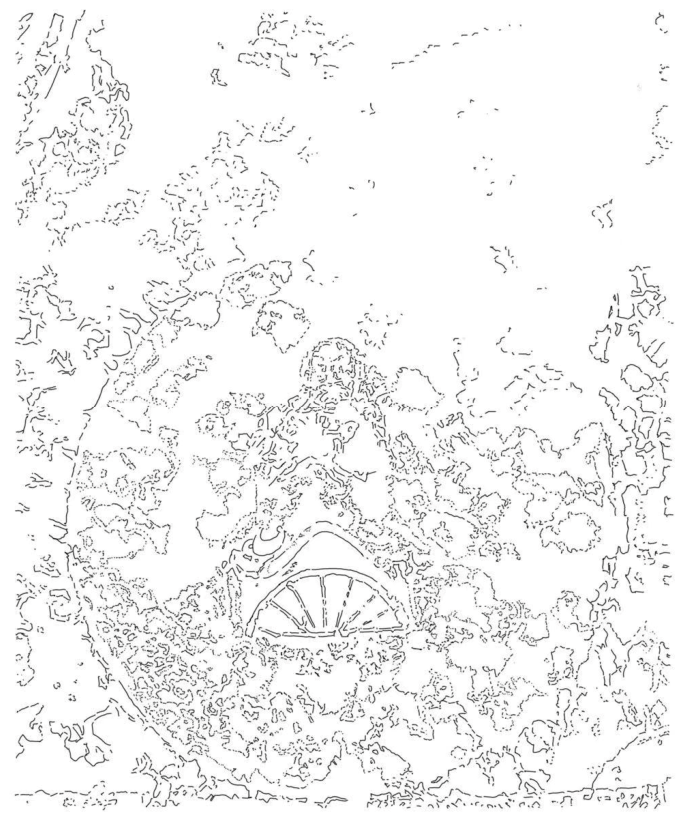
Nāgārjuna’s doctrine of the Two Truths (satya) is crucial for understanding religious art. Conventional truth (saṃvṛti-satya) relates to the practical, linguistic, and visual level of daily experience—including images, paintings, and icons—while ultimate truth (paramārtha-satya) represents the highest reality, in which all phenomena are empty. Crucially, “without reliance on conventional truth, there is no reaching of ultimate meaning” (Nāgārjuna n.d., Mūlamadhyamakakārikā XXIV.10).6 Dunhuang murals can therefore be understood as conventional forms—material pigmentation on stone walls—that simultaneously serve as bridges to ultimate truth, instantiating totemic mediation by pointing beyond themselves toward the emptiness they signify7 (see Figure 1).
The visual challenge is acute: how to portray the dynamic, interdependent arising of phenomena in static images—much less picture the very emptiness they signify. Dunhuang painters employed a strategy of “displaying emptiness through fullness of representations” (śūnyatā through rūpa). They deployed visual motifs like patterned repetitions of the Thousand Buddhas and the cyclical movements of flying apsaras’ scarves to create recursive visual flows dissolving discrete elements into infinite sequences. As Whitfield et al. (2000) observe, “innumerable small images of the Buddha cover the walls and ceilings,” generating “overfullness” and an immersive sense of totality. As the Heart Sūtra states, “form is emptiness; emptiness is form.” (Prajñāpāramitāhṛdaya Sūtra n.d.) The dazzling plenitude of form functions, at the conventional level (saṃvṛti-satya), as a skillful visual means (upāya) that orients the viewer toward emptiness rather than rendering it an object of sight; the saturation of form serves to loosen attachment to discrete, self-subsistent appearances, in the conventional-to-ultimate movement licensed by Mūlamadhyamakakārikā XXIV.10 (Garfield 1995; Williams 2009).8 Conze (1978) argues that prajñā is not intellectual knowing but rather an intuitive, nonconceptual, and direct seeing into the śūnyatā of reality. At Dunhuang, this insight is vectorized visually by totemic apparatuses: through chromatic vibration, rhythmic lineation, and perspectival spatiality, artists conceived apparatuses that “condition” cognition beyond linear logic. Such an experiential effect is what this article refers to as “visual prajñā” (Varela et al. 1991).

3. Methodology

3.1. Operational Definition of Totemic Mediation

“Totemic mediation” designates a category of visual phenomena that must satisfy three necessary and simultaneous conditions. First, it operates through the material arrangement of spatial elements—specific material carriers (pigments, stone, spatial architecture) structure the conditions of viewing (material–spatial condition). Second, it involves the ontological transformation of experiential states—the viewer’s perception shifts from quotidian awareness toward altered cognitive and affective modes (experiential condition). Third, it generates and embeds links within value structures, rendering religious–philosophical values (e.g., emptiness, purity, impermanence) realizable within sensory experience as opposed to serving as mere symbolic references or placeholders (value-generative condition). All three conditions must be simultaneously present; satisfaction of only one or two is insufficient.9
An exclusionary case prevents indiscriminate application. The hundreds of “donor portraits” in Dunhuang murals constitute a typical visual motif materially and spatially embedded in cave contexts, but they primarily document patrons’ identities and meritorious contributions. They do not orchestrate experiential transformation or generate value structures beyond social inscription. They therefore fail the second and third conditions and do not constitute totemic mediation. This exclusionary case demonstrates that the concept possesses analytical precision and is not merely a synonym for “religious image.”

3.2. Distinguishing Totemic Mediation from Adjacent Concepts

Four closely related concepts require differentiation. Gell’s “index” (1998) accentuates images as initiating causal attribution and agency within social networks but emphasizes social interplay over ontological transformation. Meyer’s (2012) “sensational form” attends to how religion materializes “felt presence” through durable media but does not address the tension between totemic classificatory logic and generative experience. Belting’s (2011) “medium” establishes a triadic image–medium–body relation but offers limited insight on how images produce ontological orders of value. Descola’s (2013) “identification mode” provides a macroscopic ontological taxonomy but does not account for how ontology is instantiated by specific images through particular material and spatial mechanisms.10 Totemic mediation integrates elements of all four while requiring all three operational conditions simultaneously, thereby achieving a specificity absent from any single adjacent concept.

3.3. Embodied Viewing as Methodological Premise

This study adopts Morgan’s (2012) embodied vision as a methodological premise, reconceptualizing “viewing” as a set of observable bodily spatial practices rather than passive mental activity. In the Dunhuang caves, viewing encompasses devotees prostrating upon entry, gazing upward toward the lotus on the dome, ambulating along narrative mural paths, and engaging in sustained contemplation under specific lighting conditions. These bodily actions form prerequisites for the lotus motif to function as totemic mediation: the spatial arrangement of the motif determines the viewer’s physical orientation and brings individual perception into the ordained network of contemplative practice.11
Keane’s (2003) theory of “semiotic ideology” helps avoid a critical methodological trap. Modern scholarship often treats material form as a “transparent” vehicle of meaning while ignoring its real efficacy. Keane contends that symbols never exist outside their materiality: “it is semiotic ideology that helps do that”—it is precisely through material substances that symbols take effect. This perspective provides the methodological foundation for treating images as active mediators rather than passive carriers of meaning.12 Drawing on Csorda’s (1990, 1993) theory of embodied existence and Belting’s (2011) triadic arrangement of image–medium–body, the Dunhuang cave complex is reconceived as an integrated mediating apparatus wherein embodied presence activates images through performing their “reader” function. Instead of a mere repository of lotus imagery, the caves form an event space where flesh-and-blood figures and transcendent meanings arise in co-constitutivity.13

3.4. A Five-Step Analytic Template

To ensure analytical comparability, each motif is analyzed through a uniform five-step sequence:
This template translates theoretical commitments into discrete analytical steps applicable to specific images, providing a replicable procedure extensible to other motifs and sites. The following two sections apply this template to the lotus and the dharma wheel. Caves 285, 329, and 361 were selected on four criteria. First, they jointly span the chronological development this article tracks: Cave 285 (Western Wei, 538–539 CE, one of the few precisely dated early caves, with a cosmological dome program), Cave 329 (early Tang, whose caisson achieves the fullest integration of lotus and dharma-wheel motifs), and Cave 361 (mid-Tang, exhibiting the esoteric lotus-ovary and vajra composite). Second, they instantiate the three hierarchical strata of lotus form identified in §4.1 (isolated botanical depiction, caisson composition, and esoterically inflected composite). Third, each places the relevant motif in the central, viewer-orienting caisson position required by our embodied-viewing method. Fourth, all three are art-historically canonical and well documented, permitting reliable reconstruction.

4. Core Totemic Mediator I: The Lotus (Padma)—Ontological Mediation

4.1. Visual–Formal Description: From Botanical Realism to Caisson Dome

The lotus motif pervades the visual field at the Mogao Grottoes: in caisson centers, beneath Buddha seats, among brickwork patterns, and in donors’ hands. Scholars such as Fan Jinshi have documented how lotus iconography evolved from the austere geometric forms of the Northern Wei period to the florid, naturalistic elaborations of the Tang dynasty, numbering over ten distinct types (Fan 2010; Fan and Zhao 2009). Three hierarchical strata can be identified: isolated botanical depictions representing single plants; caisson ceiling compositions forming the overhead visual center of cave architecture; and esoterically inflected composite structures, as in Cave 361, where the lotus ovary is replaced by a viśvavajra (ten-pronged diamond vajra) (Shen 2024). Some motifs approach a distinctive tradition of Chinese botanical painting.
Unlike mere decoration, the lotus is portrayed with “processual” botanical realism along a vertical spatial axis. As Nelumbo nucifera, the lotus rises from mud (paṅka), signifying not static purity but dynamic emergence from confused material sources. The fully opened flower presents a quintessential Mahāyāna totem: it skillfully grows up and out from the polluted substrate, embodying the teaching that defilement and purity are non-dual. Its root–stem–flower morphology, together with closed/open states and the internal structure of its ovary, encodes specific Buddhist doctrines into visual form—the cessation and continuation aspects of the Four Noble Truths (Beer 2003; Williams 2009).14 At the core of these developments lies totemic mediation, whereby the lotus becomes an ontological mediator expressing the quintessence of life itself (Gell 1998).15

4.2. Embodied Viewing Conditions: Upward Gaze, Cervical Extension, and the “Canopy” Experience

Viewing the lotus caisson requires three embodied preconditions: postural—tilting the neck in an upward gaze; spatial—the restricted visual field of the cave interior with its low, enclosed architecture; and temporal—extended contemplation under flickering candlelight that produces visual oscillation. These conditions transform seeing from passive observation into an immersive, embodied endeavor.
Cave 329’s caisson provides a paradigmatic case. One of the artistically most accomplished early Tang cave sanctuaries, its caisson ceiling is a crowning achievement of Dunhuang mural painting. Almost every cave at Dunhuang has a huge open lotus in the center of the caisson—a traditional “heavenly dome” pattern of Chinese architecture filled with lotus totems. In Cave 329, the center of the ceiling presents a graceful, multilayered, large lotus whose carina is built by combining five-colored dharma wheels. Flanking the lotus are four flying apsaras spiraling amid drifting clouds. This arrangement leads the viewer’s eye to the compositional center. In neurophenomenological terms, such directed attention biases the subject’s perception toward psychologically central images, creating temporal flow while settling a distracted mind (Lutz and Thompson 2003).16
Standing at the focal point of the cave chamber—to which they are guided by the cave’s spatial configuration—viewers must tilt their heads upward to take in the panoply of imagery on the caisson. Simply looking upward constitutes a bodily extension: stretching the neck, raising the line of vision above the everyday horizontal axis. This is an embodied orientation distinct from quotidian perception. Wang (2004) notes that the eye level of Buddha figures in Dunhuang is typically set approximately two meters high—slightly above the pilgrim’s natural gaze, compelling an upward look. The visual and bodily aspects of this engagement constitute a form of totemic mediation: the image is not merely seen but physically enacted through bodily practice.

4.3. Doctrinal Signification: Non-Duality, Lotus Emergence, and Tathāgatagarbha

The lotus corresponds to three foundational Buddhist teachings. First, the non-duality of purity and defilement (染净不二): the lotus grows from mud without being stained, embodying—in the tathāgatagarbha-inflected reception that predominates in the Chinese and Dunhuang context (Tathāgatagarbha Sūtra; Śrīmālādevī Sūtra)—the teaching that Buddha-nature exists within all sentient beings regardless of circumstances. The lotus-in-mire simile is, however, also employed in Madhyamaka without any tathāgatagarbha commitment (e.g., the Vimalakīrti-nirdeśa; Thurman 1976), and we therefore do not treat the image as entailing tathāgatagarbha as such. Williams (2009) notes that the tathāgatagarbha teaching holds that “all sentient beings contain a Tathāgata.” The consciousness of inherent purity is “never defiled, and yet its apparent defilement is the cause of bondage” (Williams 2009). Second, lotus emergence: in Pure Land theology, beings are reborn non-sexually, appearing “seated on lotus blossoms, in the presence of Amitābha,” with some lotuses shown as tight buds still concealing the being within (Williams 2009).17 Third, tathāgatagarbha (Buddha-nature): the lotus ovary functions as a symbolic womb (garbha) containing the seed of awakening.18
It is noteworthy that the Prajñāpāramitā tradition represents Wisdom as a goddess—Prajñāpāramitā Devī, “Mother of all Buddhas”—who embodies immense fecundity and inclusiveness (Conze 1978). Shaw (2006) argues that “emptiness is the fertile matrix of reality, and the womb possesses the same wondrous power of manifestation.” At Dunhuang, the lotus serves as a signifier of this generative womb (garbha), complementing feminine wisdom. The lotus is not simply an ornament but the maternal matrix that enfolds awakening. In esoterically inflected caves like Cave 361, the embedding of the soft organic lotus ovary with the solid diamond vajra achieves a unity of wisdom (prajñā/padma, the female principle) and skillful means (upāya/karuṇā/vajra, the male principle), phenomena (dharma) and essence (noumenon) (Beer 2003; Shen 2024).19
The lotuses depicted in the Dunhuang murals are not naturalistic imitations of botanical models but ideal image constructions. They map the ontic reality of the Pure Land’s “subtle, fragrant, and pristine” nature rather than reflecting empirical observation. This is consistent with their function as totemic mediators: they instantiate doctrinal reality rather than representing natural phenomena.

4.4. Mediation Mechanism: From Botanical Metaphor to Ontological Channel

The lotus operates as a mediatory device on three levels. Materially, the caisson separates upper and lower realms, physically maintaining the form of an overhead “canopy” or entrance to the celestial realms descending from above. Practically, the spatial configuration orients the viewer’s body: the upward gaze, cervical extension, and restricted visual field create a “canopy experience” that shifts perception from the horizontal plane of everyday life to the vertical axis connecting earth and heaven. Experientially, the oscillating candlelight activates perceptual states in which the lotus’s layered petals appear to unfold and recede, generating visual indeterminacy that disrupts stable, fixed perception. The viewer’s body is thereby placed within an embodied experiential structure of the non-duality of purity and defilement.
The lotus caisson is the intercessor between heaven and earth, between the everyday and the holy. Through meditative visualization, the viewer may imagine emanating from this lotus (lotus emergence), undergoing an ontological transformation from physical body to “emanation body” (nāmarūpa) consisting of dharmic essence (Williams 2009). The lotus thus creates a vertical ontological channel: the botanical metaphor of growth from mud to blossom becomes an experiential pathway from defilement to purity, from the mundane to the sacred. We stress that “visual prajñā” names a cognitive effect occasioned by visual form, not a claim that prajñā is itself visual or sensory: the image operates as conventional, sensory upāya, while the nonconceptual realization toward which it inclines the viewer transcends both perception and conceptual elaboration. This passage from the sensory to the nonconceptual is precisely the relation of conventional to ultimate truth (Mūlamadhyamakakārikā XXIV.10), and it is warranted by the visualization sūtras, in which disciplined, structured seeing is the prescribed path toward samādhi and toward a seeing that exceeds ordinary perception (Amitāyurdhyāna Sūtra; Inagaki 2003; Conze 1978).

4.5. Evaluation

The lotus satisfies all three conditions for totemic mediation. Material–spatial: mineral pigments on the caisson dome constitute a specific material carrier; the vertical axis and overhead placement create structured spatial arrangement. Experiential: the upward gaze, cervical extension, and sustained contemplation under flickering light shift perception from quotidian to contemplative states, enacting ontological transformation—a perceptual shift for which there is canonical warrant in the kasiṇa practice of the Visuddhimagga, where sustained attention to a visual object (including a light or fire kasiṇa) yields the acquired sign (uggaha-nimitta) and the counterpart sign (paṭibhāga-nimitta) (Buddhaghosa 2010), and in the graduated sun-, water-, and lotus-throne visualizations of the Amitāyurdhyāna Sūtra (Inagaki 2003). Value-generative: the three doctrinal associations of the lotus—non-duality of defilement and purity (Vimalakīrti-nirdeśa; Thurman 1976), lotus-birth emergence (Larger Sukhāvatīvyūha and Amitāyurdhyāna Sūtra; Inagaki 2003), and tathāgatagarbha (Tathāgatagarbha Sūtra; Śrīmālādevī Sūtra)—are embedded, at the conventional level, as sensory supports that incline the viewer toward a realization that itself transcends both sense perception and conceptual thought. The lotus is therefore a full instance of totemic mediation—specifically, ontological mediation along the spatial axis.

5. Core Totemic Mediator II: The Dharma Wheel (Dharmacakra)—Teleological Mediation

5.1. Visual–Formal Description

If the lotus encompasses the form of life, the dharma wheel embodies its function and temporal unfolding. One of the earliest and most celebrated Buddhist visual symbols, the dharma wheel is represented in Dunhuang murals as a concentric radiation pattern: the hub represents quietude and stability; spokes branch outward as dynamic force lines; and the rim closes the circumference, integrating centrifugal energy into unified effect (Beer 2003). Unlike more static symbols such as the cross or stūpa, the dharma wheel visually signifies the concept of rotation. The Buddha’s first teaching at the Deer Park—the “First Turning of the Wheel of Dharma”—set truth in motion, rolling through the world like a wheel: “the unsurpassed Wheel of the Dhamma has been set in motion by the Blessed One, which cannot be stopped by any ascetic or brahmin” (Bodhi 2000).20
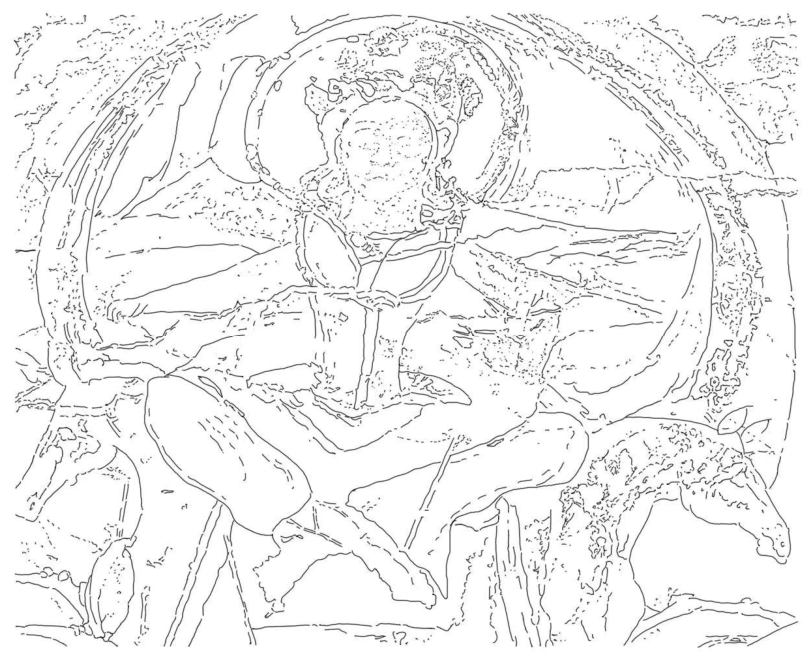
Most familiarly, the eight-spoked wheel (aṣṭāra-cakra) represents the Noble Eightfold Path (āryāṣṭāṅgika-mārga), the content set in motion at the Deer Park (Dhammacakkappavattana Sutta, SN 56.11; Bodhi 2000). The three structural components also carry distinct symbolic weight: the hub denotes ethical discipline (śīla), the spokes wisdom (prajñā) and the disruption of delusion, and the rim meditative concentration (samādhi) providing integrative control. Beer (2003) notes that “a wheel with a thousand spokes, which emanate like the rays of the sun, represents the thousand activities and teachings of the Buddhas.” The dharma wheel also carries pre-Buddhist symbolic weight as an Indian solar symbol of sovereignty, protection, and creation, first appearing on Harappan clay seals circa 2500 BCE. Buddhism adopted it as the emblem of the “wheel-turning” cakravartin (universal monarch), exemplified historically by Emperor Asoka (see Figure 2). In Dunhuang murals, it appears independently in scenes of the Buddha’s preaching mudrā, at caisson centers, on the Buddha’s throne, and in decorative borders—serving simultaneously as identity marker and animated cosmological symbol.

5.2. Embodied Viewing Conditions

The dharma wheel requires a dynamic viewing mode distinct from the lotus’s vertical contemplation. The composition of spokes radiating from center to periphery directs the viewer’s eye in repeated scans from core to edge; when combined with undulating border motifs (honeysuckle, volutes), it creates a perceptual system that entrains the gaze into ongoing rotational motion. In Cave 285, the chariots of solar and lunar deities enter opposite extremes of the dome (Figure 3 and Figure 4), compelling the viewer to turn head or body to follow the indicated motion. Though these chariots are merely representational, they stand for the concept of “wheels” in symbolic form, literally denoting time and an endlessly revolving spatiotemporal cosmos. We stress that these solar and lunar chariots are not instances of the dharmacakra: iconographically they derive from Indo-Iranian solar and lunar deities absorbed into the cosmological program of the dome. We adduce them only as a distinct, complementary instance of rotational and cyclical imagery that reinforces the kinetic visual field of the cave, kept separate from the analysis of the dharma wheel proper in Section 5.3.
This bodily “rotation-following” unsettles the stability of static gaze and reconfigures the viewer’s temporal sense from a “frozen instant” to “persistent flow.” Wang (2004) notes that “pilgrims simply revolve around the Buddhas, and even though the murals of the Thousand Buddhas and the sculptures are still, pilgrims admire the still images in a dynamic way.” Cave viewing is inherently kinetic, not static.

5.3. Doctrinal Signification

The dharma wheel carries three doctrinal layers. First, the First Turning of the Wheel: the Buddha’s initial sermon at the Deer Park, symbolizing that the wheel of truth has begun to turn in the world. Within the standard schema of the Three Turnings of the Wheel of Dharma (Saṃdhinirmocana Sūtra; Powers 1995; Williams 2009), this First Turning (the Four Noble Truths) is the one to which the Dunhuang preaching-scene iconography most directly refers, while the doctrinal content this article engages with corresponds to the later turnings—emptiness (the Second Turning, Prajñāpāramitā) and tathāgatagarbha and Yogācāra (the Third Turning)—so that the single wheel indexes the full doxographical arc. Second, structural symbolism: hub as discipline, spokes as wisdom, rim as concentration—corresponding to the tripartite structure of Buddhist training. Third, impermanence (anicca): the wheel’s ceaseless turning conveys that everything is subject to change and nothing remains permanent (Bodhi 2000).21 The spokes radiating between hub and rim suggest that all phenomena are interdependent manifestations of dharma-nature, instantiating pratītyasamutpāda (dependent origination).

5.4. Mediation Mechanism

The lotus and dharma wheel complement each other mechanistically. Where the lotus functions along the spatial axis as a vertical ontological channel, the dharma wheel works on the temporal axis, converting linear time into cyclical awareness. Its rotational alignment, combined with wave-patterned decorative elements, creates non-fixating visual movement throughout the cave space that denies stasis and prevents fixation of perception at any single point. This instantiates the Diamond Sūtra’s (T235) directive to “generate the mind without abiding anywhere.” Here apratiṣṭhita denotes the mind’s non-abiding in—its non-attachment to and non-fixation upon—any object or conceptual position, not literal fluidity (Vajracchedikā n.d.); the rotational, non-settling visual dynamics serve as an embodied analogue that discourages the gaze and the mind from resting on any single point. Through sustained contemplation of the recurring rotational image, the viewer learns to relinquish hierarchical distinctions between past, present, and future, entering a non-discriminatory consciousness of the “eternal now” (Gell 1998; McMahan 2008; Williams 2009).22
At the level of ornamental motifs, similar mechanisms operate: honeysuckle and arabesque patterns rendered in undulating or spiral forms create visual dynamism throughout the entire cave. These patterns provoke a compulsion to move beyond any single point of stability, enacting the non-abiding (apratiṣṭhita) tendency described by the Diamond Sūtra. The concurrent appearance of both lotus and dharma wheel is deliberate: in Cave 329, the lotus emerges from within the dharma wheel rather than being attached to its exterior—a planned integration of space and time into a holistic system of “visual prajñā.”23

5.5. Evaluation and Comparative Synthesis

The dharma wheel satisfies all three conditions. Material–spatial: mineral pigments on the dome, Buddha’s seat, and borders constitute specific material carriers. Experiential: the radiating structure guides dynamic ocular tracking; border patterns demand rotational bodily engagement, creating an embodied viewing mode outside static gaze. Value-generative: the rotation transposes impermanence from abstract proposition to embodied perception, and the viewer’s apprehension of “non-abidance” opens access to non-dual cognition.
Considering the lotus and dharma wheel together through the five-step template reveals perfect complementarity (Table 2). The lotus governs space, functioning as a conduit linking the human and sacred worlds; looking up at the lotus dome, the viewer experiences openness suggestive of the “Pure Land above.” The dharma wheel governs time: its rhythmic rotation holds attention, severing linear temporality. The lotus exemplifies the intrinsic essence of “becoming” (tathāgatagarbha), while the dharma wheel manifests how truth functions in this becoming (dharma, dependent origination). Their concurrent appearance is a deliberately planned system integrating both space and time into the holistic system of visual prajñā—a subtle resonance that provides the foundation for the neurophenomenological analysis that follows.

6. The Cave as Neurophenomenological Device

If the lotus and dharma wheel are the “software” of visual prajñā, the grotto itself is the “hardware.” By applying neurophenomenological frameworks such as those developed by d’Aquili and Newberg (1999), we can investigate—as theoretical hypotheses—how Dunhuang cave architecture may activate consciousness transformation in conjunction with the totemic mediators analyzed above.

6.1. Grotto as Optical Theater: Wang’s Hypothesis

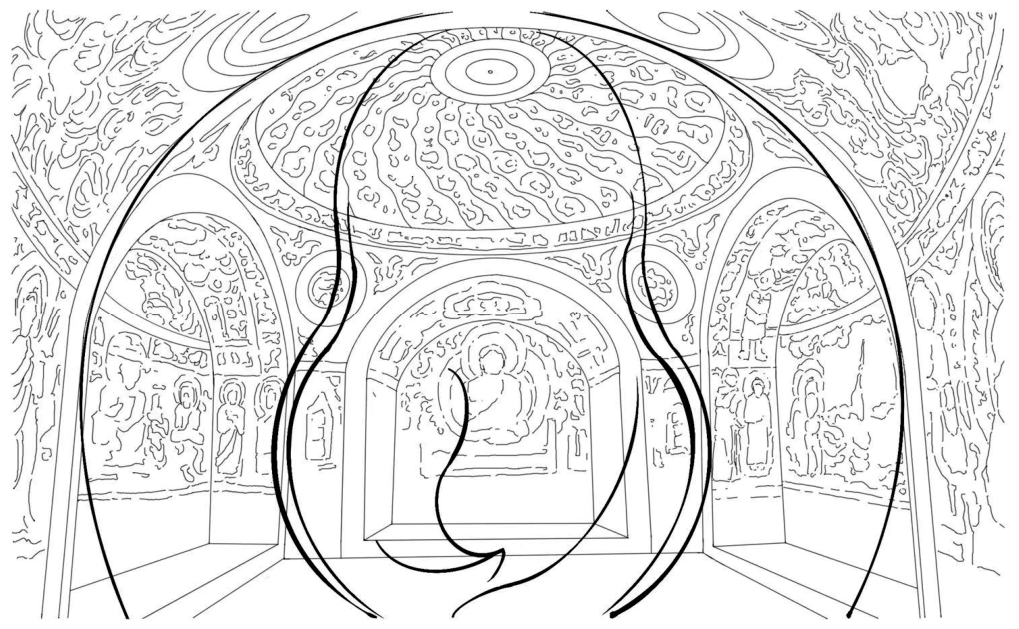
In a groundbreaking study, Wang (2004) characterizes Dunhuang grottoes as “optical theaters” or “halls of mirrors.”24 He argues that these Buddhist murals were not mere decorative wall paintings but “standard tutorials” and meditation aids for practitioners. The imagery worked as carefully crafted guided trails, leading practitioners from ordinary seeing to inner contemplation. As Wang writes, the murals “externalize this mental space in which the practitioner immerses himself,” while “the purpose of such an illusionism is to facilitate the contemplative visualization of the Buddha.” Wang demonstrates that the act of viewing these paintings was itself a form of meditation: crafted with extraordinary perspectival skill, the murals elicit wonder when viewed through enchanting candlelight, as if the cold solid walls melted away, replaced by a boundless Pure Land space. The painted images served as “externalized mirrors” reflecting the practitioner’s internalized mental imagery (see Figure 5).25

6.2. Three Proposed Mechanisms of Consciousness Transformation

Drawing on d’Aquili and Newberg’s (1999) theoretical model of Absolute Unitary Being (AUB)26—a state in which individual self-awareness is entirely subsumed by a universal, indivisible holistic consciousness where subject–object dualism collapses—we propose three mechanisms by which Dunhuang grottoes may induce consciousness transformation. We emphasize that these propositions are developed from research with advanced meditators and ritual participants; their application to the art-viewing experience requires future empirical investigation.
First, the dialectic of sensory deprivation and overload. The dim, enclosed, isolated spatial conditions of the caves approximate sensory deprivation, while the densely arrayed “Thousand Buddhas” on peripheral walls produce a visual experience of excessive repetition and apparent interminability. Wang and Yan (2023) note that Cave 254 contains “more than 1300 images and sculptures of Buddhas on different scales,” providing an objective basis for visual infinite repetition. According to d’Aquili and Newberg’s model, this dialectical tension can create conditions for “deafferentation”—a disruption of input to the brain’s Orientation Association Area (OAA)27, responsible for processing spatial boundaries.
Second, boundary dissolution. When the retina is constantly presented with hundreds of identical Buddha iconographies, figure-ground distinction may gradually diminish. Theoretically, this repeated visual presence may lead to changes in afferent signal processing in the OAA, producing a loosening or temporary dissolution of spatial orientation. The viewer’s subjective experience could transition from “being in a confined room” to drifting within an apparently infinite space suffused with color. This remains a speculative hypothesis requiring future testing through immersive visual environments.28
Third, totemic anchoring. If boundary dissolution occurs, the lotus or vajra at the center of the caisson ceiling may act as a perceptual stabilizing “anchor”—a visual and symbolic focal point for viewers whose spatial orientation has been compromised. This stabilizing function corresponds to the traditional meditative object or support of attention, ālambana (所緣): the use of a single central image—pre-eminently the Buddha on the lotus-throne—as the focus of concentration is prescribed in the throne- and image-contemplations of the Amitāyurdhyāna Sūtra (Inagaki 2003) and parallels the role of the kasiṇa and its nimitta in the Visuddhimagga (Buddhaghosa 2010). Without such a “stable anchor,” consciousness would risk sliding toward mere disorientation rather than structured religious experience. This anchor channels the extraordinary perceptual experience toward Buddhist doctrinal frameworks (śūnyatā) rather than outright sensory chaos (d’Aquili and Newberg 1999).29
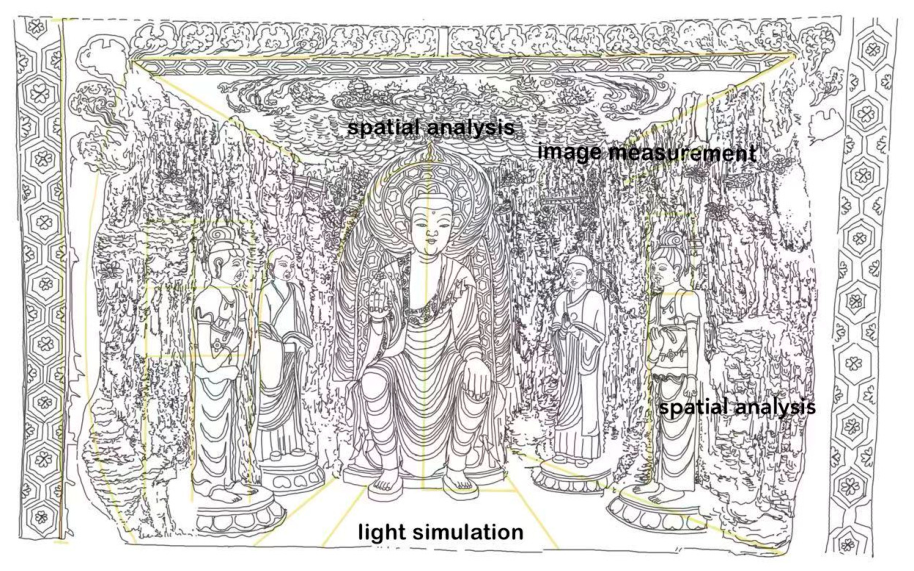
Wang and Yan (2023) observe that in Cave 254, “architecture, murals, and sculptures play important roles in spontaneous pilgrim behavior, leading them to understand the paradise of Buddhas and the way of achieving inner peace.” Much like Nāgārjuna’s claim that śūnyatā only arrives on the ground of dependent origination, the immersive images painstakingly crafted in these caves have borne the phenomenological reality of their cosmological world across centuries. It is in this sense that totemic mediation reaches its apogee as “visual prajñā”: a non-dual cognitive encounter, bypassing written scripture and rational discourse to engage the mind directly—Dunhuang art as a “philosophical machine” (d’Aquili and Newberg 1999; Wang 2004), as illustrated in Figure 6.

7. Conclusions

This study has demonstrated that religious art in the Mogao Grottoes of Dunhuang enacts three interrelated modalities for producing religious presence and experience. First, the embodied orchestration of material and spatial elements invites the viewer into a religious experiential state through embodied acts of seeing. Second, ontological transformation guides perception from mundane sight toward embodied apprehension of śūnyatā—selflessness, impermanence, and non-self. Third, a generative linking of value structures translates the philosophical values of Buddhist thought into the sensory domain.
Specifically, the lotus mediates ontologically along the spatial axis, using the metaphor of plant growth to bridge the dichotomies of defilement and purity, secular and sacred—enacting the tathāgatagarbha doctrine of “Buddha-nature inherent in all beings” (Williams 2009). The dharma wheel mediates teleologically along the temporal axis, converting linear temporality into cyclical awareness through rotational visual dynamics—stabilizing a temporal understanding of flux and cessation. Together, these motifs combine with the spatial enclosures of grotto architecture and the visual redundancy of “Thousand Buddhas” in generating what we have theorized as a neurophenomenological device. By suspending the viewer’s spatial orientation, this device may create conditions for a mystical experience of “Absolute Unitary Being”—though we emphasize this remains a theoretical hypothesis. This constitutes “visual prajñā”: a nonconceptual, embodied cognitive encounter that bypasses discursive reasoning to enable direct apprehension of śūnyatā.
The primary contribution of this study is twofold. First, it offers “totemic mediation” as a replicable analytic framework—with clear necessary conditions (material–spatial arrangement, experiential transformation, value-structure generation) and exclusionary criteria—for examining how religious images operate simultaneously as visual apparatuses and ontological mediators. This concept fills a gap at the intersection of totemism studies, visual anthropology, and Buddhist art scholarship by moving beyond the question of “what does the image represent?” toward “how does the image generate experience and ontological relations?” Second, it introduces “visual prajñā” as a term for the nonconceptual cognitive effect produced by the interaction of specific visual forms, spatial arrangements, and embodied viewing practices within Buddhist cave architecture. For the Buddhist studies and Dunhuang research communities, this provides a fresh interpretive lens for understanding the links between Buddhist meditative practice, visuality, and the systematic construction of relationships between visible and invisible worlds.

8. Limitations and Future Directions

This study has several acknowledged limitations. Our reconstructions of cave viewing experiences depend on textual descriptions and architectural inferences; we did not conduct cognitive experiments or modern eye-tracking studies. The neurophenomenological mechanisms discussed—”deafferentation” and “Absolute Unitary Being”—should be considered theoretical hypotheses rather than conclusive scientific evidence. While Caves 329, 285, and 361 are archetypal, Dunhuang contains nearly 500 caves built at different times in different styles; our conclusions should not be indiscriminately extrapolated to encompass the entirety of Dunhuang art. This is a focused, theory-building case study; corroborating examples from the same periods (e.g., Caves 254 and 257 of the Northern and Western Wei, and Cave 220 of the early Tang) indicate that the motifs are not idiosyncratic to the three focal caves, though a systematic survey across a larger sample of each period remains the first task for future work. The concept of “totemic mediation” remains provisional and requires further comparative analysis to clarify its boundaries relative to “visual piety” and “sensational forms.”30
Future research may pursue three directions: (1) applying “totemic mediation” to comparative analyses of other Buddhist sites (Yungang Grottoes, Longmen Grottoes, Angkor) to assess cross-cultural applicability; (2) integrating eye-tracking methodologies with immersive virtual reality setups to empirically investigate grotto viewing experiences and provide experimental substantiation of theoretical inferences; and (3) conducting interreligious comparative studies of mediatory visual mechanisms in Christianity (iconography) and Islam (calligraphy) to evaluate the generalizing explanatory power of “totemic mediation.” Beyond the lotus and the dharma wheel, several further motifs are promising candidate mediators to test against the three necessary conditions: the stūpa (axial and circumambulated, condensing the Buddha’s presence and parinirvāṇa); the canopy or parasol (chattra) and the wish-fulfilling jewel (cintāmaṇi) as overhead, sheltering foci; the Thousand Buddha field as patterned visual redundancy; and the maṇḍala as a self-contained ontological diagram.

Funding

This research received no external funding.

Institutional Review Board Statement

Not applicable.

Informed Consent Statement

Not applicable.

Data Availability Statement

No new data were created or analyzed in this study. Data sharing is not applicable to this article.

Acknowledgments

The manuscript was independently written by the author. Any AI-assisted tools, where used, were limited to minor language editing and did not contribute to scholarly arguments, source interpretation, or original analysis. During the preparation of this article, I received careful guidance and revision suggestions from my supervisor, Aixin Zhang, a faculty member at Shanghai Theatre Academy. I would like to express my sincere gratitude here.

Conflicts of Interest

The author declares no conflicts of interest.

Notes

1
For the connection with “Gnosticism/Sophia,” see Edward Conze, The Prajñāpāramitā Literature. The sentence “In view of the close analogies which exist between the Prajñāpāramitā and the Mediterranean literature on Sophia, this seems to me significant” (Conze 1978, p. 2) indicates a close analogy between the Prajñāpāramitā and Mediterranean wisdom literature. “Although the term ‘empty’ is not mentioned even once, the doctrine of emptiness is nevertheless established in an ontological, psychological and logical form” (Conze 1978, p. 11).
2
Lévi-Strauss understands it as a mechanism of social classification and points out that “totemism” is an analytical category constructed by anthropology (Lévi-Strauss [1962] 1963, pp. 10, 12).
3
Meyer directly rejects the traditional method that gives priority to abstract meaning, emphasizing that religion, through material form, “makes a world,” which is consistent with the idea of a “visual mediating apparatus”: “Instead of allowing moral dismissals of ‘outward’ forms and materialist worldliness to slip into scholarly analysis, … it is key to approach religion as a mundane, practical and material affair–as present in and making a world” (Meyer 2012, p. 20). Religious experience is not original or immediate but is generated through “mediated forms,” as Meyer argues: “I insist that religious experience does not occur in an immediate and, as it were, raw manner, but is a product of religious framing and mediated forms” (Meyer 2012, p. 12).
4
On the philosophical basis for Dunhuang art as “mediation,” see Nāgārjuna’s Mūlamadhyamakakārikā, which states, “Whatever is dependently arisen is … free from conceptual construction” (Garfield 1995, p. 100), revealing that no dharma may be grasped. Paul Williams argues that the Madhyamaka school aims to show that no existent, no matter how exalted, can withstand ultimate analysis: “The Madhyamika set out to show that absolutely nothing, no matter how exalted, could resist this penetrating analysis” (Williams 2009, p. 15). Prajñā thought establishes the doctrine of emptiness at the level of practice and epistemology, and Edward Conze states, “This Sūtra is one of the most… logical form” (Conze 1978, p. 11). These ideas provide the theoretical background for Dunhuang art as a mediating structure leading toward an understanding of emptiness.
5
Garfield explicitly notes that Nāgārjuna, who lived around the second century CE, is widely regarded as the founder of the Mahāyāna Madhyamaka school, and that “emptiness (śūnyatā)” is the core concept of his philosophical system (Garfield 1995, pp. 1–2). On the Madhyamaka position that “emptiness” is not nihilism, Garfield points out that Nāgārjuna’s notion of “nonexistence” denies that things possess inherent nature (svabhāva), rather than denying their existence at the conventional level. Emptiness and dependent origination are two expressions of the same thing: whatever arises dependently is empty. Thus, emptiness does not negate existence itself, but denies independent, self-sufficient essential existence (Garfield 1995, pp. 304–5).
6
In Chapter XXIV of the Mūlamadhyamakakārikā, “Examination of the Four Noble Truths,” Nāgārjuna explicitly proposes and defines the concept of the “two truths.” “We say that this understanding of yours Of emptiness and the purpose of emptiness… Liberation is not achieved” (Nāgārjuna, Chapter XXIV).
7
Garfield explicitly translates and includes Nāgārjuna’s famous verse, “Without relying on conventional truth, one does not attain the ultimate meaning” (Mūlamadhyamakakārikā, Chapter XXIV, verse 10) (Garfield 1995, p. 298, Part Two, chap. XXIV). Nāgārjuna states that all conditioned dharmas are deceptive, while emptiness itself is fully real (Garfield 1995, p. 35). One must rely on conventional truth in order to reach ultimate truth (Garfield 1995, p. 68). On art objects as mediators of agency, see Gell (1998, p. ix).
8
On the spatial effects of Dunhuang images such as the “Thousand Buddhas” and flying apsaras, see Whitfield: “Whatever the period, innumerable small images of the Buddha cover the walls and ceilings” and “lying apsarasas trailing long scarves on the wall just behind.” At the same time, Whitfield argues that the images are characterized by “overfullness” and an immersive sense of totality: “Their harmony and the close integration between wall paintings and threedimensional stucco images are features that strike the visitor today” (Whitfield et al. 2000, p. 16). Wang and Yan likewise note that, when viewers enter the cave, it is as if they enter “the world of the Buddha.” These studies emphasize the sense of totality and immersion generated by image density and the integration of space (Wang and Yan 2023, p. 3). Emptiness does not negate phenomena, but explains how phenomena exist; this is precisely the theoretical basis for the Heart Sūtra’s claim that “form is not different from emptiness, emptiness is not different from form.” “The meaning of the expression ‘dependent origination’ is the same as ‘emptiness’, and not ‘non-existence’” (Williams 2009, p. 77).
9
Garfield argues that all dharmas are empty in essence: “The Buddha’s teaching of the Dharma Is based on two truths: A truth of worldly convention And an ultimate truth” (Garfield 1995, p. 68). Garfield explicitly states that all dependently arisen dharmas are empty in essence: “Whatever is dependently co-arisen That is explained to be emptiness” (Garfield 1995, p. 69).
10
For Meyer’s notion of “sensory presence,” see her article “Mediation and the Genesis of Presence,” where she explicitly states, “A material approach takes as its starting point the understanding that religion becomes concrete and palpable through people, their practices and use of things, and is part and parcel of power structures.” “Religion is the practice of making the invisible visible, of concretizing the order of the universe… present to the senses and in the circumstances of everyday life” (Meyer 2012, pp. 7–24).
11
Morgan likewise supports this view at the material level: “Seeing is robustly embodied, and so we do well to recapture the aesthetic element of vision…” (Morgan 2012, p. 22); at the practical level: “Seeing was a way of longing to touch and be touched by the sacred” (Morgan 2012, p. 112); and at the existential level: “A self, it follows, is not a timeless essence or disembodied…” (Morgan 2012, p. 22).
12
Modern scholarship often treats material form as a “transparent” vehicle of meaning while ignoring its real efficacy. Webb Keane argues, “Those who would study ‘ideas’ too often treat the associated material forms as transparent, taking their consequentiality to be suspect…” (Keane 2003, pp. 409–10). On the point that “the sign is never detached from materiality,” Webb Keane directly states, “The radical separation of the sign from the material world” (Keane 2003, p. 410). On how the materiality of the sign becomes effective in society, Webb Keane directly states, “It is semiotic ideology that helps do that” (Keane 2003, p. 420). It is precisely “semiotic ideology” that makes signs readable, operable, and effective in society.
13
Belting explicitly opposes a “disembodied” view of images, arguing that images do not exist apart from the body and directly rejecting any understanding of the image as pure form or an abstract object. “Some authors create the impression that images circulate in disembodied form, which is not even true of images in imagination and memory, for they, after all, colonize our bodies.” The image is a product of inner and outer interaction, not an isolated object: “An ‘image’ is more than a product of perception. It is created as the result of personal or collective knowledge and intention. We live with images, we comprehend the world in images” (Belting 2011, p. 9).
14
Robert Beer and Williams both argue that the lotus rises from mud yet remains pure: “The Indian lotus, which grows from the dark watery mire but is unstained by it, is a major Buddhist symbol of purity and renunciation.” “The lotus seats upon which deities sit or stand symbolize their divine origin. They are immaculately conceived, innately perfect, and absolutely pure in their body, speech, and mind” (Beer 2003, p. 7). “This consciousness is intrinsically pure, never defiled, and yet its apparent defilement is the cause of bondage” (Williams 2009, p. 107). The Four Noble Truths are suffering, origination, cessation, and the path.
15
Alfred Gell argues that the image functions as a “mediator” rather than as a symbol or ornament: “The anthropology of art is constructed as a theory of agency, or of the mediation of agency by indexes, understood simply as material entities which motivate inferences, responses or interpretations” (Gell 1998, Foreword, p. ix).
16
In a state of highly focused and well-prepared attention, the subject’s perceptual experience displays continuity and stability, corresponding to the phenomenological basis of “flowing time” and a tranquil state of mind. Lutz and Thompson argue, “Perception was usually experienced with a feeling of ‘continuity’, ‘confirmation’ or ‘satisfaction’” (Lutz and Thompson 2003, p. 44).
17
On “rebirth from a lotus,” Williams argues, “In the Pure Land a being is reborn nonsexually. The blessed appear, seated on lotus blossoms, in the presence of Amitabha.” “One lotus is still closed, however, in a tight bud with the naked child still within” (Williams 2009, p. 241). He further points out that “non-sexually” in Buddhist ontology means a body no longer generated through the physical bodies of parents: “In the Pure Land a being is reborn non-sexually” (Williams 2009, p. 241).
18
On the point that “all sentient beings possess Buddha-nature,” Williams states, “Hence the important statement found in Tathagatagarbha sources sarvasattvAs tathAgatagarbhAS would mean ‘all sentient beings contain a Tathagata’” (Williams 2009, p. 104).
19
Miranda Shaw explicitly defines wisdom as “mother/progenitor”: “Prajnaparamita, Mother of the Buddhas, is the… sole reality. The emanation-bodies of Buddhas and bodhisattvas appear and disappear, whereas the wisdom light of Mother Prajnaparamita is always shining” (Shaw 2006, p. 168). She also points out that the lotus motif is the manifestation and outflow of wisdom: “In this irenic image of Prajñāpāramitā, a scripture appears on the (visual) right lotus, while her lower right hand dispenses the…” (Shaw 2006, p. 5).
20
On the First Turning of the Wheel, Bodhi states, “At Brāṇasī, in the Deer Park at Isipatana, this unsurpassed Wheel of the Dhamma has been set in motion by the Blessed One, which cannot be stopped by any ascetic or brahmin or deva or Māra or Brahmā or by anyone in the world.” This description of the Buddha’s first sermon at Deer Park indicates that “the unsurpassed wheel of true dharma has been set in motion by the Blessed One, and none can stop it.” This precisely confirms that the Buddha’s first sermon is called the “First Turning of the Wheel of Dharma,” symbolizing that the wheel of truth has begun to turn in the world (Bodhi 2000, p. 1846).
21
Bodhi holds that impermanence (anicca) is equivalent to continuous flux, with not a single moment of cessation: “So the mind is impermanent, mental phenomena are impermanent, mind-consciousness is impermanent, mind-contact is impermanent, whatever feeling arises with mind-contact as condition… that too is impermanent” (Bodhi 2000, p. 1235).
22
Gell states, “the anthropology of art is constructed as a theory of agency, or of the mediation of agency by indexes, understood simply as material entities which motivate inferences, responses or interpretations” (Gell 1998, Foreword, p. ix). Williams argues in Mahayana Buddhism: The Doctrinal Foundations that, “If they can maintain mindfulness of the Buddha without interruption from moment to moment, then they will be able to see all the Buddhas of the past, present, and future right in each moment” (Williams 2009, p. 211). McMahan points out that Buddhist modernism, through meditation, transforms temporal experience from linearity to a cyclical experience of the “present moment” (McMahan 2008, pp. 12–15).
23
Cave vision is not static viewing; “rotation” and “movement” are jointly generated by the viewer’s bodily movement and the image. Wang states, “Pilgrims simply revolve around the Buddhas, and even though the murals of the Thousand Buddhas and the sculptures are still, pilgrims admire the still images in a dynamic way” (Wang 2004, p. 13).
24
Wang directly defines the cave as a “mirror hall”: “Indra’s presence here indeed signifies the cave as a mirror hall,” together with: “The facing mirrors bounced their reflections back and forth to extend the optical/virtual domains into infinite horizons where pictorial images loomed” (Wang 2004, p. 503).
25
Wang argues that the murals are templates and auxiliary tools for contemplative practice: “The murals covering the interior walls of Cave 31 at Dunhuang, instead of providing the regimented trappings decorating the ritual practice, in fact picture and externalize this mental space in which the practitioner immerses himself” (Wang 2004, p. 506). Visual illusion is intended to facilitate contemplation: “The purpose of such an illusionism is to facilitate the contemplative visualization of the Buddha” (Wang 2004, p. 497).
26
On “absolute unitary being,” d’Aquili and Newberg argue, “We maintain, however, that the actual experience of AUB in itself is necessarily the same for any individual who experiences it. This is necessary from a neurophysiological as well as a philosophical perspective. It is necessarily experienced as an infinite, unified, and totally undifferentiated state” (d’Aquili and Newberg 1999, p. 117). The consciousness of the individual self is completely replaced by a boundless yet indivisible consciousness of totality; all boundaries between self and non-self disappear.
27
On the effect of deafferentation on the orientation association area (OAA) of the parietal lobe, d’Aquili and Newberg argue, “We propose that the total deafferentation of the left orientation association area results in the obliteration … transcendent wholeness.” “Its total deafferentation can only result in an absolute subjective sensation of pure space… subjectively experienced as absolute unity or wholeness” (d’Aquili and Newberg 1999, p. 112).
28
On the collapse of spatial sense, d’Aquili and Newberg state, “Its total deafferentation can only result in an absolute subjective sensation of pure space” (d’Aquili and Newberg 1999, p. 112).
29
There must be a “stable anchor”; otherwise consciousness will slide toward madness. d’Aquili and Newberg state, “all the way to the state in which there is no perception of spatial or temporal boundaries whatsoever, accompanied by the experience of absolute unity, devoid of content and with even the self-other obliterated.” “We will look at various types of ceremonial ritual and see how they can generate increasing senses of unity and can create what have been referred to as ‘lesser’ mystical states” (d’Aquili and Newberg 1999, p. 98).
30
On the “experience of absolute unity,” d’Aquili and Newberg state, “all the way to the state in which there is no perception of spatial or temporal boundaries whatsoever, accompanied by the experience of absolute unity, devoid of content and with even the self-other obliterated.” “Absolute unitary being” is produced when spatial orientation functions are shut down (d’Aquili and Newberg 1999, p. 98).

References

  1. Beer, Robert. 2003. The Handbook of Tibetan Buddhist Symbols. Chicago and London: Serindia Publications. [Google Scholar]
  2. Belting, Hans. 2011. An Anthropology of Images: Picture, Medium, Body. Translated by Thomas Dunlap. Princeton: Princeton University Press. [Google Scholar]
  3. Bodhi, Bhikkhu, trans. 2000. The Connected Discourses of the Buddha: A Translation of the Saṃyutta Nikāya. Boston: Wisdom Publications. [Google Scholar]
  4. Buddhaghosa. 2010. The Path of Purification (Visuddhimagga), 4th ed. Translated by Bhikkhu Ñāṇamoli. Kandy: Buddhist Publication Society. [Google Scholar]
  5. Conze, Edward. 1978. The Prajñāpāramitā Literature, 2nd ed., revised and enlarged. Tokyo: The Reiyukai. [Google Scholar]
  6. Csordas, Thomas J. 1990. Embodiment as a Paradigm for Anthropology. Ethos 18: 5–47. [Google Scholar] [CrossRef]
  7. Csordas, Thomas J. 1993. Somatic Modes of Attention. Cultural Anthropology 8: 135–156. [Google Scholar] [CrossRef]
  8. d’Aquili, Eugene G., and Andrew B. Newberg. 1999. The Mystical Mind: Probing the Biology of Religious Experience. Minneapolis: Fortress Press. [Google Scholar]
  9. Descola, Philippe. 2013. Beyond Nature and Culture. Translated by Janet Lloyd. Chicago: University of Chicago Press. [Google Scholar]
  10. Duan, Wenjie. 1994. Dunhuang Art: Through the Eyes of Duan Wenjie; New Delhi: IGNCA, New Delhi: Abhinav Publications.
  11. Durkheim, Émile. 1995. The Elementary Forms of Religious Life. Translated by Karen E. Fields. New York: Free Press. First published 1912. [Google Scholar]
  12. Fan, Jinshi. 2010. The Caves of Dunhuang: The Dunhuang Academy. Hong Kong: Scala Arts & Heritage Publishers. [Google Scholar]
  13. Fan, Jinshi, and Shengliang Zhao. 2009. The Art of Mogao Grottoes in Dunhuang. Dumont: Homa & Sekey Books. [Google Scholar]
  14. Frazer, James George. 1910. Totemism and Exogamy. 4 vols. London: Macmillan. [Google Scholar]
  15. Garfield, Jay L. 1995. The Fundamental Wisdom of the Middle Way: Nāgārjuna’s Mūlamadhyamakakārikā. New York: Oxford University Press. [Google Scholar]
  16. Gell, Alfred. 1998. Art and Agency: An Anthropological Theory. Oxford: Oxford University Press. [Google Scholar]
  17. Holbraad, Martin, and Morten Axel Pedersen. 2017. The Ontological Turn: An Anthropological Exposition. Cambridge: Cambridge University Press. [Google Scholar]
  18. Inagaki, Hisao, trans. 2003. The Three Pure Land Sutras. Berkeley: Numata Center for Buddhist Translation and Research. [Google Scholar]
  19. James, William. 1902. The Varieties of Religious Experience. New York: Longmans, Green. [Google Scholar]
  20. Keane, Webb. 2003. Semiotics and the Social Analysis of Material Things. Language & Communication 23: 409–25. [Google Scholar] [CrossRef]
  21. Lévi-Strauss, Claude. 1963. Totemism. Translated by Rodney Needham. Boston: Beacon Press. First published 1962. [Google Scholar]
  22. Lutz, Antoine, and Evan Thompson. 2003. Neurophenomenology: Integrating Subjective Experience and Brain Dynamics in the Neuroscience of Consciousness. Journal of Consciousness Studies 10: 31–52. [Google Scholar]
  23. McLennan, John Ferguson. 1869. The Worship of Animals and Plants. The Fortnightly Review 6: 407–27. [Google Scholar]
  24. McMahan, David L. 2008. The Making of Buddhist Modernism. Oxford: Oxford University Press. [Google Scholar]
  25. Meyer, Birgit. 2012. Mediation and the Genesis of Presence: Towards a Material Approach to Religion. Paper presented at Utrecht University’s Inaugural Lecture, Utrecht, The Netherlands, November 14. [Google Scholar]
  26. Morgan, David. 2012. The Embodied Eye: Religious Visual Culture and the Social Life of Feeling. Berkeley: University of California Press. [Google Scholar]
  27. Nāgārjuna. n.d. Mūlamadhyamakakārikā (中论). In Taishō Tripiṭaka T1564. Tokyo: Daizo Publishing Co., Ltd., vol. 30.
  28. Otto, Rudolf. 1917. Das Heilige. Breslau: Trewendt & Granier, Translated by John W. Harvey. 1923. As the Idea of the Holy. London: H. Milford. [Google Scholar]
  29. Panofsky, Erwin. 1939. Studies in Iconology: Humanistic Themes in the Art of the Renaissance. New York: Oxford University Press. [Google Scholar]
  30. Powers, John, trans. 1995. Wisdom of Buddha: The Saṃdhinirmocana Sūtra. Berkeley: Dharma Publishing. [Google Scholar]
  31. Prajñāpāramitāhṛdaya Sūtra (般若波罗蜜多心经). n.d. In Taishō Tripiṭaka T251. Tokyo: Daizo Publishing Co., Ltd.
  32. Radcliffe-Brown, A. R. 1922. The Andaman Islanders: A Study in Social Anthropology. Cambridge: Cambridge University Press. [Google Scholar]
  33. Shaw, Miranda. 2006. Buddhist Goddesses of India. Princeton: Princeton University Press. [Google Scholar]
  34. Shen, Li. 2024. Maṇḍala or Sign? Re-Examining the Significance of the ‘Viśvavajra’ in the Caisson Ceilings of Dunhuang Mogao Caves. Religions 15: 803. [Google Scholar] [CrossRef]
  35. Stace, W. T. 1960. Mysticism and Philosophy. Philadelphia: J. B. Lippincott. [Google Scholar]
  36. Thurman, Robert A. F. 1976. The Holy Teaching of Vimalakīrti: A Mahāyāna Scripture. University Park: The Pennsylvania State University Press. [Google Scholar]
  37. Vajracchedikā Prajñāpāramitā Sūtra (金刚般若波罗蜜经). n.d. In Taishō Tripiṭaka T235. Tokyo: Daizo Publishing Co., Ltd.
  38. Varela, Francisco J., Evan Thompson, and Eleanor Rosch. 1991. The Embodied Mind: Cognitive Science and Human Experience. Cambridge, MA: MIT Press. [Google Scholar]
  39. Viveiros de Castro, Eduardo. 2014. Cannibal Metaphysics: For a Post-Structural Anthropology. Translated by Peter Skafish. Minneapolis: Univocal. [Google Scholar]
  40. Wang, Eugene Y. 2004. Oneiric Horizons and Dissolving Bodies: Buddhist Cave Shrine as Mirror Hall. Art History 27: 494–521. [Google Scholar] [CrossRef]
  41. Wang, Weiqiao, and Aibin Yan. 2023. Body, Scale, and Space: Study on the Spatial Construction of Mogao Cave 254. Religions 14: 953. [Google Scholar] [CrossRef]
  42. Whitfield, Roderick, Susan Whitfield, and Neville Agnew. 2000. Dunhuang: Caves of the Thousand Buddhas. London: The British Library. [Google Scholar]
  43. Williams, Paul. 2009. Mahayana Buddhism: The Doctrinal Foundations, 2nd ed. London and New York: Routledge. [Google Scholar]
Figure 1. West wall of the main chamber, Cave 323, Mogao Caves. Source: Author’s own creation.
Religions 17 00707 g001
Figure 2. Emperor Ashoka the Great. Source: Author’s own creation.
Religions 17 00707 g002
Figure 3. Solar deity, Kizil Cave 17, Xinjiang. Source: Author’s own compilation.
Religions 17 00707 g003
Figure 4. Lunar deity, north corner of the west wall, Mogao Cave 285. Source: Author’s own compilation.
Religions 17 00707 g004
Figure 5. Psychological theory of “womb regression”: the cave space as maternal enclosure. Source: Author’s own creation.
Religions 17 00707 g005
Figure 6. Sign-intention—Dunhuang as a “philosophical machine”: art as apparatus rather than representation. Source: Author’s own creation.
Religions 17 00707 g006
Table 1. Five-step analytic framework for examining totemic mediation in Buddhist visual culture.
StepDescription
(a) Visual–formal descriptionCategorize the motif’s visual morphology, compositional structure, and formal evolution across historical periods.
(b) Embodied viewing conditionsReconstruct the bodily postures, spatial configurations, and temporal conditions of viewing.
(c) Doctrinal significationIdentify the specific Buddhist doctrines and sūtra passages to which formal attributes correspond.
(d) Mediation mechanismAnalyze how the motif bridges visible and invisible orders through material, practical, and experiential dimensions.
(e) Evaluative assessmentTest whether all three necessary conditions of totemic mediation are simultaneously fulfilled.
Table 2. Multiple mediatory dimensions of the totemic mediators.
DimensionMaterial CarrierDoctrinal MeaningEmbodied Practice
Ontological
(Lotus)
Layered petal structure;
unstained emergence from mire.
Tathāgatagarbha:
non-duality of defilement
and purity; Buddha-nature.
Upward gaze to caisson;
cervical extension;
sense of sublimity.
Teleological
(Dharma Wheel)
Radiating rotational pattern;
hub–spoke–rim.
Dharma/Anicca:
circulation of Dharma;
impermanence.
Dynamic tracking;
rotational gaze;
disrupted visual stasis.
Disclaimer/Publisher’s Note: The statements, opinions and data contained in all publications are solely those of the individual author(s) and contributor(s) and not of MDPI and/or the editor(s). MDPI and/or the editor(s) disclaim responsibility for any injury to people or property resulting from any ideas, methods, instructions or products referred to in the content.