Article

Friar Hernando de Talavera and the Brief and Very Useful Doctrine: Literacy and Evangelisation in Granada, Castile and the Americas


by
Jesús R. Folgado-García
Diego de Pantoja Observatory, Faculty of Humanities and Social Sciences, Comillas Pontifical University, 28049 Madrid, Spain
Religions 2026, 17(6), 705; https://doi.org/10.3390/rel17060705 (registering DOI)
Submission received: 2 March 2026 / Revised: 1 June 2026 / Accepted: 5 June 2026 / Published: 12 June 2026

Abstract

Friar Hernando de Talavera can be considered the main strategist of evangelisation at the end of the 15th century in the recently conquered Kingdom of Granada. To this end, he used the publication Breve y muy provechosa doctrina de lo que debe saber todo cristiano together with eight other very useful treatises [Brief and Very Useful Doctrine of What Every Christian Should Know, with Eight Other Very Useful Treatises], which he accompanied with his Instrucción a los vecinos del Albaicín [Instruction to the Residents of the Albaicín]. Successive editions of the catechism and some books included under the generic title Breve y muy provechosa doctrina [A Brief and Very Useful Doctrine] throughout the 16th century demonstrated its doctrinal soundness and pastoral effectiveness. Furthermore, they were later used not only for catechesis but also for literacy in the Kingdom of Granada and in the early days of the American conquest. The study will systematically present the different editions and their intentions from the Granada incunabulum to the present day. The texts composed by the first archbishop of Granada were the words used to unite several kingdoms and conquered territories in the faith and in the Castilian language. The aim of this study is to provide a systematic overview of the various editions published throughout history and to analyse the influence that some of them exerted on the subsequent development of evangelisation in Granada, Castile, and possibly the Americas.

1. Introduction

Friar Hernando de Talavera (Talavera de la Reina, c. 1430—Granada, 1507), a Hieronymite monk, royal confessor, visitor of the Order of Saint Jerome, Commissioner of the Bull of the Crusade, Bishop of Ávila, governor of the Kingdom of Granada alongside the Count of Tendilla and first archbishop of Granada, to name but a few of his positions, can be considered one of the most important figures in the cultural, religious and political world of the Hispanic world in the mid-15th and early 16th centuries.1
His involvement in various matters of state during the reign of the Catholic Monarchs is undeniable. Many of these influenced the consolidation of their policies (cf. Iannuzzi 2009, pp. 131–297). He stood out primarily as an adviser to the Monarchs. In particular, his relationship with the Catholic Queen, Isabella of Castile, is worth highlighting. Along with Tarsicio de Azcona, we affirm “regarding Talavera that it is certain that the confessor subjected his charge to a laborious process of purification until she reached the high spiritual level at which she lived” (Azcona 1993, p. 42).
Within the cultural sphere of this time, his work in promoting Nebrija’s writings was particularly notable. The author himself noted this in the preface to his work Grammar of the Castilian Language. At that time, as Bishop of Ávila, Talavera was aware of the importance of Castilian for the universal dissemination of knowledge and also for evangelisation. He employed this same approach when he became Archbishop of Granada (1492–1507) and promoted A Brief Guide to the Arabic Language (Alcalá 1505), written by his confessor, friar Pedro de Alcalá. Nebrija would underline the influence on the work and the relationship with the Monarchs:
The third benefit of this work of mine may be that, when I presented a sample of this work to His Royal Majesty in Salamanca, and you asked me what use it might serve, the Most Reverend Bishop of Ávila replied on my behalf; and, speaking on my behalf, he said that once His Highness had brought many barbarian peoples and nations of foreign tongues under his rule, and upon their conquest, they would have to accept the laws that the victor imposes upon the vanquished, and with them our language; then, through my Art, they might come to know it, just as we now learn the art of Latin grammar to learn Latin.
(Nebrija 1492, ff. 3–3v).2
In the opening passages of the treatises contained in the book under consideration, published under the general title Breve y muy provechosa doctrina de lo que deve saber todo christiano con otros ocho tractados muy provechosos [A Brief and Very Useful Doctrine of What Every Christian Should Know, with Eight Other Very Useful Treatises], we find some of the high responsibilities he held.3
The aim of our study is to present what we consider to be the most significant text for the catechisation of the recently conquered Nasrid Kingdom, namely A Brief and Very Useful Doctrine, and the treatises published under this title. As a complementary text, we will also take into account its Instrucción a los vecinos del Albaicín [Instruction to the Residents of the Albaicín].
Some of these writings were repeatedly published throughout the 16th century in the Kingdom of Castile to teach children the basics of reading and Christian doctrine. The teaching of the faith and the alphabet formed the basis of children’s education at the time. It should be noted that this influence reached the first American territories directly via the port of Seville. Fray Hernando de Talavera’s evangelising project for the newly conquered Kingdom of Granada (cf. Folgado García 2011) thus became a paradigm for America as well.
To this end, we will present the editions produced by printers in Seville, Salamanca and Alcalá de Henares. This highlights the usefulness of the first two treatises written by Talavera: Feasts to be observed each month and which ones have a vigil, and when are the four seasons in which fasting is required and Brief and very useful doctrine of what every Christian man and woman should know. We shall therefore encounter two texts that were popular in Spanish culture and catechesis during that century.
In addition, we aim to present a systematic overview of the reprints of the remaining texts that have appeared to date. Of them all, only A pleasant and useful treatise against excessive clothing was reprinted in the 17th century, as we shall see. We have to wait until the early 20th century to find renewed interest in these works from the late 16th century. The fact that many of them have been republished throughout the 21st century highlights the importance Hernando de Talavera has acquired today.
In this study, we do not intend to provide a detailed analysis of the content of the works. We do, however, refer to specific studies on each of them. The aim is to provide a systematic overview of the successive reprints of A Brief and Very Useful Doctrine from the fifteenth century to the present day. To this end, we shall also take into account the manuscripts that preceded the incunabulum edition published in Granada, of which we have records. There is currently a lack of a comprehensive overview of all these works, which hinders a proper understanding of the significance of Friar Hernando’s contribution as both a publisher and a literary figure. We intend this to be our contribution to the academic field.

2. Brief and Very Useful Doctrine of What Every Christian Should Know, with Eight Other Very Useful Treatises

Under the title, it includes nine works commissioned for printing in Granada at the end of the 15th century by Friar Hernando de Talavera. Although all of them are collected under this general title, it is clear that some were written and published before this incunabulum. In turn, they were reissued again from the 16th century onwards, as we have already indicated.
One of the contributions of this study is the systematic presentation of the editions of some of these treatises from their writing and printing in the 16th century to the present day. In this way, we can approach what we consider to be the most paradigmatic work of Friar Hernando de Talavera.

2.1. The Incunabulum Edition

Entitled Brief and Very Useful Doctrine of What Every Christian Should Know, with Eight Other Very Useful Treatises. Composed by the Archbishop of Granada.4 The volume will contain short treatises on essential aspects of Christian life, namely: the observance of feast days, their vigils and fasts;5 essential teachings for Christians;6 guidance on avoiding sin based on the Ten Commandments;7 recommendations for making amends for the harm we have caused;8 guidance on how to prepare oneself spiritually for Holy Communion;9 warnings about the danger of gossip;10 an explanation of the Holy Mass;11 guidance on how to dress and eat in accordance with God’s will;12 and, the use of time as a path to God.13
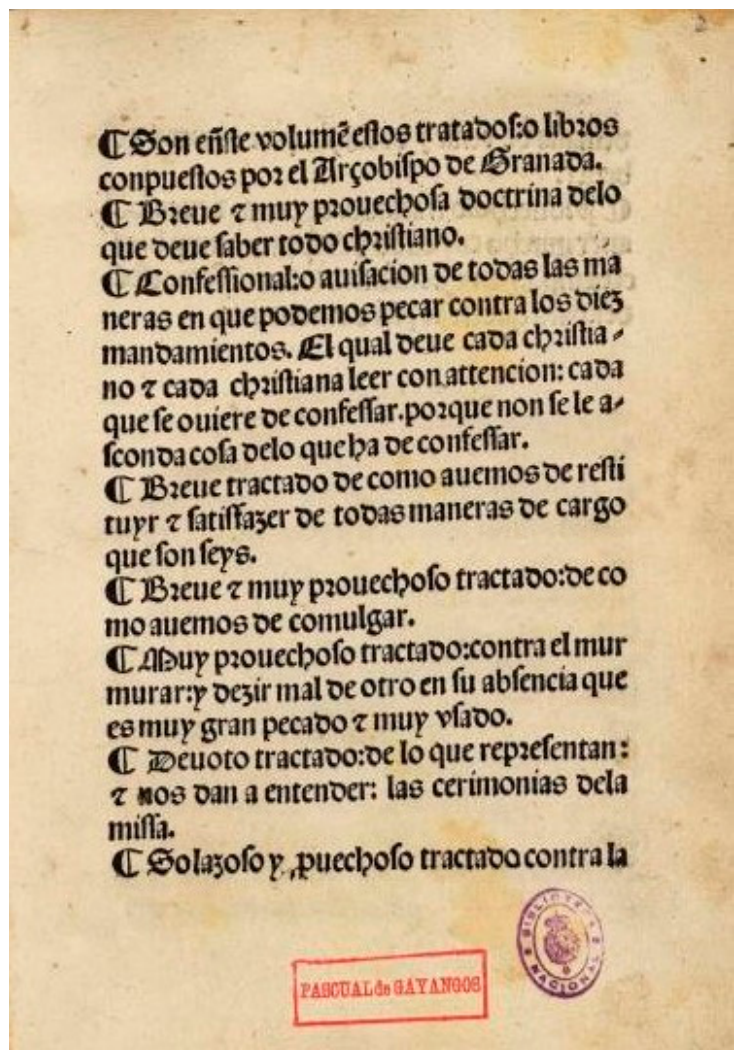
As a general rule, the title of the catechism, Brief and Very Useful Doctrine, was also used to title the entire work containing this series of treatises. However, we should add that the titles listed in the general index of the 1496 text do not correspond to those of each of the treatises (Figure 1).
Copies of this publication can be found in Spanish libraries (cf. García Craviotto 1988, pp. 22–26)—National Library of Spain (Talavera 1496a, 1496b); Library of the Royal Academy of History (Talavera 1496c); Royal Library of the Monastery of El Escorial (Talavera 1496f, 1496g, 1496h); University Library of Barcelona (Talavera 1496d); Library of the Diocesan Seminary of Vitoria (Talavera 1496e), and Chapter Archive of Valladolid Cathedral (there is no specific classification)—as well as those held by the Évora Public Library (Talavera 1496i) and the Library of the Hispanic Society of America in New York (Talavera 1496j). We know that one of the copies held at the Royal Monastery of San Lorenzo del Escorial (Talavera, 1496h) belonged to Queen Isabella the Catholic herself. It came to the Monastery from the Royal Chapel in Granada (cf. Valle Merino 2013, p. 268).

2.2. Authorship and Date of Publication

The authorship of the text is reflected, first of all, in the generic title of the volume, as we have already pointed out. It refers to the appointment of Friar Hernando as Archbishop of Granada. Likewise, the various treatises compiled under the general title of the incunabulum mention the explicit authorship of a Hieronymite monk in their respective headings.14 In addition, the specific titles of the works indicate their relationship with the Catholic Monarchs, their affiliation with the Order of Saint Jerome, their time in the bishopric of Ávila and the Archbishopric of Granada, and their relationship as confessor to the Countess of Benavente. This can be verified in the opening lines of the titles of the books collected under the generic title Brief and Very Useful Doctrine, as we have mentioned previously.15
The reference to Talavera’s appointment as pontiff of Granada indicates that the print was made during his tenure in the new archbishopric (1492–1507), which corresponded to the former Nasrid Kingdom conquered in 1492. Although the edition lacks an imprint, so we cannot know the city or date of printing, according to bibliographic studies it is commonly accepted that the edition was produced in the workshops of Meinardo Ungut and Juan Pegnizer in Granada, around 1496.16 We consider that this issue has been thoroughly addressed by the studies of Professor Resines (Resines 1993, pp. 61–65) and the now classic text by Hazañas on printing in Seville,17 so we accept it as valid.
The text consists of 227 folios in quarto format. The titles and subtitles of the chapters are printed in red ink, while the rest of the text is in black ink.

2.3. Other Editions

It should be noted that some of the writings cited have earlier or later editions than the Granada incunabulum, which is the reference for our study. Of particular note are the 16th-century editions and their use for teaching children and catechism.
We would like to provide a detailed list of the editions of the works that we are aware of to date in this section. In this way, we believe that we will facilitate the study of the seminal work on catechesis, which will give its title to the entire work: Brief Doctrine and the editions related to it.
We must highlight the systematic attempt to publish the Granada incunabulum by the academic Miguel Mir Noguera (Burrieza Sánchez 2012), permanent secretary of the Royal Spanish Academy, in 1911, in the collection Escritores Místicos Españoles [Spanish Mystical Writers] (Mir 1911). Unfortunately, this edition did not include the catechism that gave the entire volume its name.
Let us now move on to a systematic analysis of the writings contained in this Granada copy, commissioned by its archbishop and published from the printing of the incunabulum edition until the 16th century.

2.3.1. Feasts to Be Observed

In addition to the text published in Granada, we know of two other editions of this short work, both linked to the catechism Brief Doctrine contained in the incunabulum. We find it in the Primer and doctrine in Romance by the Archbishop of Granada for teaching children to read. This copy was printed by the publisher Juan de Porras in Salamanca between 1505 and 1508 (Norton 1978, pp. 176–77; Martín Abad 2001, p. 487). We know that one of these printed copies is currently in the National Library of Spain (Talavera 1505–1508).
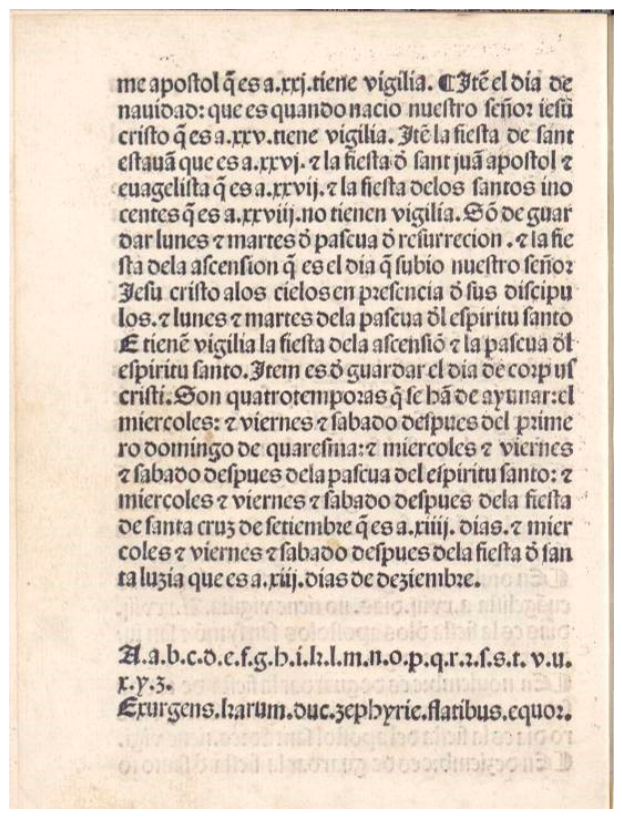
After the printing of the Talavera catechism, we find the inclusion of the Feasts to be observed (Talavera 1505–1508, ff. 7v–8v), followed by the letters of the alphabet to teach children to read, which is a novelty in the printing compared to the incunabulum text from Granada. It should be noted that the catechism will no longer be called Brief Doctrine, but Cartilla (Figure 2).
It is particularly significant that this work by Talavera was republished by the Bishop of Zamora, Francisco Fernández de Córdoba y Mendoza, in 1530 (Álvarez Reyero 1898, pp. 235–36). This highlights the usefulness of the work decades later for the education of Castilian children and the evangelisation of America.
It is very likely that the Bishop of Zamora and Palencia knew and dealt personally with Friar Hernando de Talavera, as he was the son of Diego Fernández de Córdoba, second Count of Cabra, and María Hurtado de Mendoza, daughter of the Dukes of Infantado. Both his father’s and mother’s lineage actively participated in the War of Granada, in which Friar Hernando played a key role (Folgado García 2023, pp. 43–56). Therefore, it would be understandable that the future bishop had seen with his own eyes the utility of the primer for literacy and catechisation in the Kingdom of Granada.
It should be noted that, in this third edition, although it appears in its entirety (You must know which feasts are to be observed each month and which have a vigil and when the four seasons are you must fast), only the fragment relating to the four seasons will be published. As in the first edition (c. 1496) and the second (1505–1508), in this third edition we find it again alongside the book Brief Doctrine, to which the subtitle is added:
In which young people should be taught first and foremost. It was ordered by the most reverend Lord Friar Hernando de Talavera, first archbishop of the Holy Church of Granada, and printed because it was no longer available, by the most illustrious and reverend Lord Don Francisco de Mendoça, bishop of Çamora. Bishop-elect of Palencia, president of the council of the empress and our lady queen for the children of his bishopric.
(Talavera 1530).
The subtitle of the title shows us the reason for its printing and the value attributed to it by its promoter: to teach and catechise the children under his jurisdiction.
The book by Talavera, sponsored by the Bishop of Zamora, lacks an imprint and is a separate booklet, although it is included within the general volume. We find it alongside other books that Bishop Francisco de Mendoza had compiled in 1530 under the general title Instruction for Prelates. Except for Friar Hernando’s book, all of them were published by the various authors under the auspices of the Castilian bishop himself.18
In turn, it is followed by the following prayers: Devotional prayer of Saint Thomas Aquinas recited before receiving communion or celebrating Mass;19 Another devout prayer of his that is recited after receiving communion;20 Followed by a very devout greeting to Our Lady.21 The first two prayers are present in the Granada incunabulum, specifically at the end of the short treatise Brief and very useful treatise on how we should receive communion; the prayer to Our Lady is not included in any of the short treatises in the Granada manuscript.
Although Talavera’s work lacks an imprint, everything seems to indicate that it was sponsored by Bishop Francisco de Córdoba y Mendoza in Alcalá de Henares (Madrid) in 1530. The printer was most likely Miguel de Eguía (González Navarro 1981, pp. 307–19). We deduce this because the books published alongside the Hieronymite monk’s work bear the following imprints: (a) «Printed at the distinguished University of Alcalá de Henares. Last month of October. Year one thousand five hundred and thirty» in the Very useful (and even necessary) instruction for visitors (Díaz de Luco 1530, f. 40); (b) «excusum compluti apud. Michaelem de Eguia. Anno reparatae salutis. M.D.XXX. Mense Novembri», at the end of Archbishop Fonseca’s letter,22 published alongside the volume Instruction for Prelates (AAVV. 1530).
It has recently been republished by the academic Miguel Ángel Ladero Quesada (Ladero Quesada pp. 74–77).

2.3.2. A Brief and Very Useful Doctrine of What Every Christian Man and Woman Should Know

This is a text of great value for evangelisation, undoubtedly written with the aim of catechising the faithful of the new archbishopric of Granada. Its importance is evident, as its specific title encompasses the rest of the treatises already presented. It therefore constitutes the central treatise of the entire work and was published alongside the other treatises grouped under the general title A Brief and Very Useful Doctrine.
A significant point should be noted here. In the Introduction written in 1911 by the scholar Mir Noguera for the edition of the volume examined in this study, he states that he consulted a copy formerly owned by the bibliophile Bartolomé José Gallardo (Mir 1911, p. XI). This detail is particularly noteworthy, since the scholar did not include the catechism among the other treatises. Rather than attributing this omission to oversight, we suggest that the incunabulum on which he worked did not contain it.
This may be inferred from incunabulum number 2119 held by the National Library of Spain and formerly owned by the bibliophile Pascual de Gayangos (Talavera 1496b). Like the copy formerly owned by Gallardo and consulted by Mir, it does not contain the Talavera catechism.
The existence of two copies of the Brief doctrine lacking the catechism suggests that two distinct editions may have circulated: one including the catechism and another without it. Both, however, appear to have been printed in the same workshop, as our examination has revealed no typographical differences between them.
The effectiveness of this text is perhaps best illustrated by Hernando de Talavera’s intention that it should be distributed widely and free of charge, so that the whole population under his pastoral care might possess it. This fact shows that it was a fundamental pillar in the evangelising strategy of the Hieronymite archbishop. This is evident in the words of the episcopal palace and the officials in the service of the archbishop in the instructions he gave for his household:
Make copies of the aforementioned instruction issued by the archbishop and distribute them to each member of the household, and likewise give them to outsiders who request them without charging them anything for them.23
(Talavera 1930, p. 812)
We suggest that this Instruction refers to the edition printed in Salamanca in 1505 by Juan de Porras as an independent volume, together with the Fiestas que son de guardar. Apart from the version printed alongside the other volumes, no evidence of any other standalone edition has survived.
The 1505 edition was printed during the lifetime of Hernando de Talavera himself. A second edition was issued by the same printer in 1508, by which time the author had died. Both editions attest to the effectiveness as a catechetical tool in Granada.
In the post-incunabula from Salamanca of 1505 and 1508, we find the catechism published alongside Feasts to be observed and the alphabet book, as we have already pointed out and recognised in the copy held by the BNE (Talavera 1505–1508). The title of this text is Primer and doctrine in Romance by the Archbishop of Granada for teaching children to read. As we can see, the title differs from the original published in Granada and shows us the link between catechesis and learning to read.
There is also the well-known edition by Bishop Francisco Fernández de Córdoba y Mendoza, as we have already mentioned when discussing the work Feasts to be observed. What we do not know for certain is whether it was printed as a separate book or whether it was published later together with the other booklets.24 We would like to point out that, in the volume preserved by the BNE, Hernando de Talavera’s book (Talavera 1530) appears bound as if it were a separate text from those of the other authors (AAVV 1530; Díaz de Luco 1530). This leads us to speculate that the existing copy may have been compiled after printing. This could also be circumstantial evidence that it may have been distributed separately from the other two booklets, as was probably the case in Granada itself in the 15th century.
Likewise, according to Joaquín Hazañas’ research, we have references to two other editions, although these cannot be verified at present (Hazañas y la Rúa 1945, pp. 94, 187–88). This thesis has been accepted by the scientific community and therefore it enjoys scientific consensus (Norton 1978, pp. 128, 309–10; Martín Abad 2001, pp. 487–88). We are thus faced with two possible new printings:25 in Granada, before 1 February 1508, by the publisher Juan Varela of Salamanca;26 and in Seville, published by Jacobo Cromberger in 1512.27
This second Seville edition by Jacobo Cromberger or Jacobo ‘the German’ has special value, even though it no longer exists today. According to Joaquín Hazaña, we should identify this catechism with the one mentioned in the documentation preserved in the General Archive of the Indies in Seville (doc. 39–21/29). In this way, two thousand reading primers would have been purchased for two maravedis each to be shipped to the New World. These primers would have been acquired by the Casa de Contratación [House of Trade] to be delivered to the Franciscan Alonso de Espinar, who led an expedition of the order to America. If we believe this interpretation, the Talavera’s text would have been used in the early days of evangelisation and conquest in America to teach the first Indian children to read and write in.28
Given the importance of this primer for the history of evangelisation, we would like to reproduce a text on this subject written by one of the most important bibliophiles in the history of Hispanic studies, Joaquín Martín Abad, curator of the National Library of Spain:
Edition documented in Hazañas I, p. 94, which refers to, in Seville, «39–21. Accounts from 1512 in the manual book of charges and discharges of Doctor Sancho de Matienzo, Treasurer of the Casa de Contratación from 1509 to 1512, fol lxxxv»: «and to Jacome Aleman, printer, four thousand maravedis for two thousand reading primers, which were purchased at two maravedis each». It can be assumed that they had been printed in his workshop. The purchase was made, by royal order, by the Casa de Contratación, to deliver the primers to Alonso de Espinar (O.F.M.), who was leading the Franciscan expedition to America.
(Martín Abad 2001, pp. 487–88).
What we do know is that it served as the basis for the catechisation of Castile, as can be inferred from the printing ordered by Bishop Francisco de Mendoza in 1530, as we have already indicated.
The catechism was republished by Professor Resines Llorente in 1993 (Resines 1993, pp. 111–18).

2.3.3. Devout Treatise on What the Ceremonies of the Mass Represent and Teach Us

In relation to this text and its date of composition, we would like to point out the following. Professor Baldomero Jiménez Duque maintained that the text was written at the time when Friar Hernando was prior of Santa María de Prado in Valladolid. Specifically, around the year 1480 (Jiménez Duque 1944, p. 164). However, this author does not provide evidence to support his claim. Nevertheless, there are currently no copies of this pamphlet in existence. Therefore, the Granada printing is the only proof we have of its existence.
We note that the work was reissued in 2017 (Talavera 2017).

2.3.4. A Useful Treatise on How We Must Take Great Care to Spend Our Time Wisely and How We Should Spend It So That No Moment Is Wasted29

The Royal Library of the Monastery of San Lorenzo del Escorial holds a manuscript copy containing both treatises: Advice to the virtuous and very noble lady Donna María Pacheco] (Talavera n.d., ff. 1–27) and A useful treatise demonstrating how many sins are commonly committed in dressing and footwear, and even in eating and drinking (Talavera n.d., ff. 31–95). The manuscript is written on paper in two colours, with the titles and underlining in red and the rest in black. The box measures 201 × 140 mm.
The first draft of the Treatise against excess in dressing, footwear, eating and drinking was written in 1477. The date is indicated in the title of the work itself: in the year of the birth of our Saviour Jesus Christ, one thousand four hundred and seventy-seven.30
Regarding the Avisación, we do not know the date on which María Pacheco, Countess of Benavente, sought the advice of Friar Hernando in order to organise her time, although we do know that, at that time, he was prior of Santa María de Prado and her confessor—approximately between 1470 and 1486 (cf. Martínez Medina 2011, pp. 22–26). The reason for this is that in both works—Tract against excessive clothing and footwear and Advice to the virtuous and very noble lady María Pacheco—only his position as superior of the Hieronymite monastery in Valladolid is mentioned, with no reference to his subsequent appointments, such as that of Bishop of Ávila.
The El Escorial manuscript does not provide any internal information about the date on which it was written, but it must have been between 1477—the date of the composition of the treatise on clothing—and 1486, the date of his appointment as bishop of Ávila, since no reference is made to the author as the Pontiff of Ávila.
If we compare the Advice and the Useful Treatise demonstrating how many sins are commonly committed in dressing and footwear with the texts printed in Granada (A pleasant and useful treatise against excessive clothing), although they have different titles, their content is essentially the same. These are the only two volumes whose existence we can be certain of prior to the 1496 incunabulum from Granada.
The importance of the Treatise against excess in clothing and footwear is demonstrated by the fact that several editions have been printed over the centuries: 17th century (Jiménez Patón 1638), 20th century—Benigno Fernández Álvarez, OSA,31 Narciso Sentenach32 and the aforementioned Miguel Mir—and 21st century (Castro 2001, pp. 11–92).
The Academic Librarian of the Royal Academy of History, Prof. Miguel Ángel Ladero Quesada, reissued the work on the care of time (Ladero Quesada 2020, pp. 77–91).

2.3.5. A Brief and Very Useful Treatise on How We Should Take Communion

We are aware that there is an edition adapted to contemporary Spanish, published in 2019, whose title is ¿Cómo se ha de comulgar? [How should one receive communion?] (Talavera 2019).

2.3.6. Confessional or Warning of All the Ways in Which We Can Sin Against the Ten Commandments

We would just like to point out that, in our opinion, in order to understand Hieronymite’s conception of the sacrament of confession, this work should be compared with the following sections: A Brief Guide to the Arabic Language (Alcalá 1505): A brief guide for clergy who confess new Christians, On the interrogation and doctrine for confessors in each of the languages and Follow the questions in the Ten Commandments (Alcalá 1505, ff. 23–34v). This text was written by Friar Pedro de Alcalá, also a Hieronymite and confessor to Friar Hernando (Folgado García 2015, pp. 49–59). Both texts, that of Friar Hernando and that of Friar Pedro, were written with the same purpose: the catechisation of the Nasrid Kingdom.
Dr. Ladero Quesada reissued (Ladero Quesada 2020, pp. 115–73) and annotated this work (Ladero Quesada 2020, pp. 95–115).

2.3.7. A Most Useful Treatise on the Common and All-Too-Frequent Sin of Slandering, Gossiping About, or Speaking Ill of Someone in Their Absence

Once again, the academic Ladero Quesada will produce an edition (Ladero Quesada 2020, pp. 183–94) and a very brief commentary (Ladero Quesada 2020, pp. 177–82) on the pamphlet.

3. Instruction to the Residents of the Albaicín

If, in order to understand the pamphlet on confession, we referred to the contemporary text by Friar Pedro de Alcalá, to understand the collection of texts grouped under the title Brief and Very Useful Doctrine, we must familiarise ourselves with the Instruction to the Residents of the Albaicín. Composed by Friar Hernando de Talavera himself, at the request of the neighbourhood’s residents, it became a programmatic model of evangelisation not only for Granada, but for all of Castile and the New World.
The request was a consequence of the presence of the Primate of Spain, Archbishop Ximénez de Cisneros, in Granada in 1499. This led to a change in the methods of evangelisation that Friar Hernando had been carrying out since his arrival in that city. In reaction to the new methods, a revolt broke out in the Albaicín in December 1499. The rebellion was pacified thanks to the rapid intervention of the Archbishop of Granada.
Talavera’s disciple, Alonso Fernández de Madrid, in his Life of Friar Hernando de Talavera, first Archbishop of Granada, written shortly before Jerónimo’s death, describes the events:
As the Christians were few and unnoticed, and the Moors were many and determined to die, there was a great danger that they would all be killed and the city and even the kingdom of Granada would be lost. Considering this, the good archbishop, seeing that the matter could not be remedied by force of arms, since there were more than thirty Moors for every Christian, trusting in God’s mercy more than in human strength, when the Moors were at their most courageous and determined, he alone, with a chaplain who always carried the cross before him, and with a few other relatives, without any other weapons, entered among the enemies with that loving countenance and gesture as if he were going to preach to them […]. The Moors saw him, forgot all their rigour and ferocity, laid down their weapons, and with all humility, patience and submission, approached him, offering him peace and kissing the hem of his garment according to their custom, as they did when they were at their most peaceful. He remained there with them for a long time, admonishing them and begging them to surrender and lay down their arms completely, promising them that they would receive no punishment for their past rebellion and that he would obtain forgiveness for them from the Catholic Monarchs.
(Fernández de Madrid 1931, pp. 55–56).
However, as a result of Cisneros’ actions, the Muslim population embraced the Christian faith en masse. In order to persevere in their faith, the residents of the Albaicín themselves asked Archbishop Talavera for instructions on how to adopt Christian practices. This is why this Instruction is commonly dated between 1500 and 1501.33
Its importance lies in the fact that it can be said to summarise the evangelising model of Archbishop Friar Hernando de Talavera. The value of the document is demonstrated by the fact that he had it printed and distributed among his new faithful (Azcona 1993, pp. 688–90). Together with his catechism Brief Doctrine, which he ordered to be disseminated in the same way as the Instruction, it would become the basis of catechesis (Folgado García 2010, pp. 137–54).
The manuscript by Friar Hernando can be found in the General Archive of Simancas (Talavera 1500–1501). It has been edited on several occasions throughout the 20th and 21st centuries by various scholars (Azcona 1964, pp. 761–63; Gallego Burín and Gámir Sandoval 1968, pp. 161–63; Ladero Quesada 1969, p. 293; Garrido Aranda 1979, pp. 307–9; Folgado García 2016, pp. 68–70).

4. Conclusions

We wanted to showcase what appears to be one of the most important texts used for evangelisation in the Kingdom of Granada since its publication in the late 15th century and throughout the 16th century: A Brief and Very Useful Doctrine of What Every Christian Should Know, with Eight Other Very Useful Treatises.
One of the conclusions we can draw from an internal analysis of the work is that it is a heterogeneous text.34 We base this conclusion on the following arguments drawn both from an internal critique of the texts themselves and from the editio princeps, which we believe we have been able to demonstrate: (a) the thematic heterogeneity that exists between the various texts. (b) The fact that most are not dedicated to any particular person. One exception is the text addressed to the Countess of Benavente, the original manuscript of which is held in the Royal Library of the Monastery of San Lorenzo of the Escorial. (c) Of the last two volumes compiled under the same title, there are manuscript texts and, furthermore, they were published independently and prior to the incunabulum.
A testament to the importance of this work by Friar Hernando de Talavera can be found in the catechism contained in this book—A Brief and Very Useful Doctrine of What Every Christian Should Know—together with the booklet Feasts to be observed each month and which ones have vigils, and when are the four seasons of fasting. As we have sought to demonstrate by presenting the various editions followed the first edition in Granada, the successive reprints of both works show how important they were throughout the 16th century.
A relevant detail is the fact that, from the Spanish Cinquecento onwards, the works no longer had a solely catechetical purpose but also served as a pedagogical manual for teaching children to read. This is demonstrated by later editions, in particular the Salamanca edition from the first decade of the century and the Alcalá edition sponsored by Bishop Francisco Fernández de Córdoba y Mendoza in 1530.
It is worth noting the hypothesis that the 1512 Seville edition was used in the early stages of colonisation and evangelisation in the New World. However, we have only the circumstantial evidence outlined above. This is based on Joaquín Hazañas’s interpretation of a text from the General Archive of the Indies, which was subsequently adopted by other leading bibliographers. There is no doubt that the catechism, reprinted and distributed on a massive scale throughout the Kingdom of Granada and across Castile, served the purposes of catechisation and literacy. In this sense, it was a pioneer in the catechisation of Granada and would pave the way for other subsequent catechisms, such as that of Pedro Ramiro de Alba, also a Hieronymite and Archbishop of Granada (cf. Resines 2016).
On the other hand, we must consider other factors. The first is the fact that we have reliable evidence of its use in Castile and Granada during the same period as the edition proposed by Hazañas, in Seville in 1512. The second is that the Talavera catechism is linked to a Franciscan expedition to the Antilles, as at that time we do not yet find catechisms written in the Americas for the purpose of catechisation (cf. Zamora Ramírez 2011). Therefore, although we have no conclusive evidence, it is not unlikely that the Franciscans made use of a text and a method that was working in the Kingdom of Granada in the midst of an initial evangelisation process similar to that which they were to carry out in the Americas. In fact, the missionary methods and catechetical tools of these early decades did not differ greatly from the system proposed by Talavera for Granada, judging by the catechisms used there (cf. Resines 1992a, 1992b).
This fact also highlights the symbiosis that existed at a time when raising cultural standards meant raising moral standards. The inclusion of the alphabet in 16th-century texts alongside the essential rudiments of the Catholic faith shows how intrinsically linked the two dimensions were.
We should also note that Friar Hernando de Talavera’s teaching intentions were similar for all social classes. This is demonstrated by the heterogeneity of the social classes to which the Brief and Very Useful Doctrine was addressed: kings, nobles, commoners… Perhaps this was the greatest asset of Friar Hernando’s missionary method in the Kingdom of Granada and the reason why it spread throughout Castile and the new American territories.
Finally, we have shown how the study of Friar Hernando’s work has experienced a resurgence in the 21st century. To support this assertion, one only needs to look at the reissues of the works we have presented in this article at the time of writing.

Funding

The research is part of the project “Museums, Missions, and Views: Spain-China Interactions, 1815-1949” (MUSEMISION), ref. PID2023-149140NB-I00, funded by MCIU/AEI/10.13039/501100011033/FEDER, EU.

Institutional Review Board Statement

Not applicable.

Informed Consent Statement

Not applicable.

Data Availability Statement

The original contributions presented in this study are included in the article. Further inquiries can be directed to the corresponding author.

Conflicts of Interest

The author declare no conflict of interest.

Notes

1
It is not our intention to provide a biographical sketch of Hernando de Talavera. For this, the reader may consult Iannuzzi (2009); Ladero Quesada (2020).
2
On the relationship between Talavera and Nebrija, see Iannuzzi (2008).
3
«Brief doctrine and teaching […] Ordered by Friar Hernando de Talavera, first archbishop of the Holy Church of Granada»; «Brief form of confession […] Compiled by Licentiate Friar Fernando de Talavera, professed member of the Order of the Glorious Doctor Saint Jerome and confessor to the most high and most Catholic princes, and therefore most powerful and most victorious, Don Fernando and Doña Isabel, King and Queen of Castile and Aragon and Sicily and Granada, etc., and first Archbishop of the Holy Church of Granada»; «A very useful treatise against the common and very continuous sin of detracting or murmuring […] Compiled by the licentiate Friar Hernando de Talavera, first Archbishop of Granada»; «Treatise on the meaning of the ceremonies of the Mass […] Taken from the holy doctors who dealt with this subject, by the licentiate Friar Hernando de Talavera, first archbishop of Granada and confessor to the most high and most Catholic princess, Doña Isabel, first of that name, legitimate successor and heiress and queen and lady of the kingdoms of Spain»; «A useful treatise demonstrating how, in dressing and footwear […] written and compiled by the licentiate Friar Hernando de Talavera, then unworthy prior of the monastery of Sancta María de Prado, located outside the walls of the noble city of Valladolid, and later first archbishop of the Holy Church of Granada, and confessor to the very Catholic Queen of Spain, Doña Isabel, the first of that name»; «Notice to the virtuous and very noble lady Doña María Pacheco, Countess of Benavente (…). Written at her request by Friar Hernando de Talavera, then prior of the monastery of Santa María de Prado and her confessor, and later Bishop of Ávila, and still later, first Archbishop of Granada».
4
For this article, we have used one of the copies held by the National Library of Spain (=BNE) as our reference copy: Inc/2489 (Talavera 1496a). The pagination was added after printing, and we will follow it for the description of the treatises collected under the same title. To make reading easier, we will use the beginning of the title of each treatise in the quotation. It will be cited in the article as: Brief Doctrine.
5
Feasts to be observed each month and which ones have a vigil, and when are the four seasons in which fasting is required (ff. 9–10v).
6
A brief and very useful doctrine of what every Christian man and woman should know (ff. 11–18v).
7
Confessional or warning of all the ways in which we can sin against the Ten Commandments. Every Christian man and woman should read this carefully whenever they have to confess, so that nothing they have to confess is hidden from them (ff. 20–76).
8
A brief treatise on how we must repay and satisfy all six types of debt (ff. 76–83v); A brief and very useful treatise on how we should take communion (ff. 84–106).
9
A brief and very useful treatise on how we should take communion (ff. 84–106).
10
A very useful treatise against gossiping and speaking ill of others in their absence, which is a very great sin and very common (ff. 107–126).
11
Devout treatise on what the ceremonies of the Mass represent and teach us (ff. 128–156).
12
A pleasant and useful treatise against excessive clothing, footwear, eating and drinking (ff. 158–203v).
13
A useful treatise on how we must take great care to spend our time wisely and how we should spend it so that no moment is wasted (ff. 206–227v).
14
However, there is no mention of Talavera in the following books: Feasts to be observed each month and which ones have a vigil, and when are the four seasons in which fasting is required, Brief treatise on how we should make restitution and satisfaction in all six ways of penance, and Brief and very useful treatise on how we should receive communion.
15
See Note 3.
16
Perhaps the best summary of this subject can be found in Haebler’s essential Bibliografía ibérica del siglo XV (Iberian Bibliography of the 15th Century), which has served as a reference to this day and therefore remains valid: «Talavera, Fernando de. Breve y muy provechosa doctrina christiana. –sin indicaciones tipográficas, pero en Granada, por Juan Pegnitzer y Menardo Ungut ca. 1496. –4º –220 hojas no folios. – sign: (4) a8, a-l8, A8B12, a-c8d6, a-f8, aa-cc8. – a línea tirada. – 23–24 líneas en cada plana. –letra gótica de dos tamaños. –impreso de rojo y negro. – capitales de imprenta. fo. 1 prel: Breve e muy provechosa doctrina de lo // que deve saber todo christiano con otros // ocho tractados muy provechosos; compuestos // por el arçobispo de Granada. // (tabla de los tratados.) – fo. A letra encarnada […] [tratado quinto] fo. (a1) en blanco. – fo a ij capital negra, título encarnado: (T)Ractado de lo que significan//las ceremonias de la missa y de // lo que en cada una se deve pen//sar y pedir a nuestro Señor. // Cogido de los santos docto//res que desto trataron: por el licenciado Fray // Hernando de Talavera. Primero arçobispo de // granada. Y confessor de la muy alta e muy ca//thólica princesa Doña Isabel; primera deste // nombre: legítima sucesora y heredera y rey // na y señora de los reynos de España. – sign. B; sulla como dicho es: descienden… –acaba fo. (d6) recto lin. 12: estudio que nos miró en ellos como debía // Deo gratias.- Este tratado no tiene cabeceras» (Haebler 1992, pp. 303–4).
17
To understand the printing process of these books, we reproduce what J. Hazañas wrote in his study on the Seville printing press: “The Archbishop of Granada, Friar Hernando de Talavera, wished to print some books there for the needs of his newly created archdiocese, and without us knowing how or by whose means, circumstances that will one day appear in some Protocol Archive, he made an agreement with the two printing companies working in Seville, the German guild, which at that time had only three members […], who sent their two leaders, Juan Pegnicer de Neuremberga and Meinardo Ungut, to that city, a fact that must have taken place after 4 February and before 9 March 1496, since on the first of those dates Ungut was still in Seville, where, before the notary public Juan Ruiz de Porras, he granted power of attorney to Lanzalao, who, on the second date, before Francisco de Segura, using that power, became a debtor of a Genoese merchant named Tafolla, for 25,844 maravedí coins, the value of fourteen bales of paper. At the beginning of February, Pegnicer and Ungut left Seville for Granada, taking with them paper from their respective workshops, printing presses and cashiers and press officers, as this art was unknown in that city. On 30 April, they finished printing Vita Christi by Friar Francisco Ximénez, corrected and added to by the Archbishop of Granada […]. Many bibliographers suspect, with good reason, that a collection of six pamphlets, all by Friar Hernando de Talavera, printed separately, as indicated by several signatures, which are united by the common cover and table of contents, but which lack typographical indications, is the work of the printers we are discussing and was made in Granada on the occasion of the aforementioned trip. This is to be believed, as Mr Haebler has shown that the characters are the same as those used in the Vita Christi and the book is entitled Breve y muy prouechosa doctrina de lo que deue saber todo christiano con otros tractados muy provechosos: compuestos por el arçobispo de Granada” (Hazañas y la Rúa 1945, p. 30–32).
18
Within the volume, the catechism Brief Doctrine is preceded by three other treatises: Díaz de Luco 1530; AAVV 1530.
19
It has been reissued in Talavera (2019), 15.
20
It has been reissued in Talavera (2019), 16.
21
The prayer has been published by the writer Nuria Sáez Sánchez; it can be found in the appendix, where we find prayers composed or attributed to Friar Hernando in a hagiographic biography (Sáez Sánchez 2019, pp. 94–95).
22
Epistola. Illustisimo ad revendendissimo Domino. Domino Alfonso de Fonseca, Archiepiscopo Toletana. Ac Hispaniarum Primati. Ioannes Bernardus Diaz de Luco, Decretorum Doctor.
23
Tarsicio de Azcona believes that he is referring to Jerome’s catechism Brief Doctrine (Azcona 1958, note 56). Professor Romero is of the same opinion (Romero de Lecea 1973, p. 359).
24
25
The only difference between these two and the BNE copy, according to bibliographers (Norton 1978, n. 826; Martín Abad 2001, n. 1453), is that the title does not refer to Talavera as the author: Cartilla y doctrina en romance para enseñar niños a leer (Primer and doctrine in Romance to teach children to read).
26
Hazañas indicates, using “notes by Manuel Gómez Moreno on documents from the Tithe Archives in Granada”, that on 1 February 1508, the publisher Juan Varela de Salamanca delivered a large number of books to Frir Pedro de Alcalá, among which must have been the Brief Doctrine (Hazañas y la Rúa 1945, pp 187–88; Norton 1978, n. 358; Martín Abad 2001, n. 1451).
27
Hazañas shows that two thousand primers were purchased from “Jacome aleman ynprimidor” (Hazañas y la Rúa 1945, p. 94). Julián Martín states that ‘it can be assumed that they were printed in his workshop,’ in addition to accepting that it is Talavera’s catechism Brief Doctrine (Martín Abad 2001, n. 1453). The link between this primer and the catechism of the Archbishop of Granada follows the thesis put forward by Norton («Presumably an edition of the Cartilla issued in the name of Hernado de Talavera» —Norton 1978, n. 826—). Professor Iannuzzi will also take it on (Iannuzzi 2009, p. 264).
28
The document from the Archivo de Indias leads Joaquín Hazañas to argue that these primers are the Talavera ones printed by “Jacome aleman ynprimidor” according to that account book (Hazañas y la Rúa 1945, p. 94).
29
As these manuscripts are found in the same book and are also the only ones prior to the text that serves as our basis, we have decided to include them under the same heading.
30
A useful treatise demonstrating how many sins are commonly committed in dressing and footwear, and even in eating and drinking, written and compiled by the licentiate Friar Hernando de Talavera (…) in the year of the birth of our Saviour Jesus Christ, one thousand four hundred and seventy-seven, prompted and inspired by the discipline and scourge of the great famine with which Our Lord punished his people that year, especially throughout the Land of Campos.
31
He published chapters IV and V: (Fernández Álvarez 1912a, pp. 167–74; 1912b, pp. 110–18).
32
The fragments not published by Álvarez appear in (Sentenach 1904, pp. 143–62).
33
Professor Nicasio Salvador explores the various possibilities for dating (Salvador Miguel 2016, note 101). For his part, Professor Felipe Pereda posits the possibility that it was written prior to the arrival of the Court in Granada in 1499 (Pereda 2018, p. 133).
34
For a study of the issue: (Romero de Lecea 1973, p. 359; Resines 1993, pp. 61–65).

References

  1. Primary Source

    (AAVV 1530) AAVV. 1530. Instructión muy provechosa (y aun necessaria) para los visitadores. A donde se muestra como se an de regir los que van a visitar en lugar de los Perlados. Item otro tractado de doctrina que conviene para los visitadores y clérigos. Nuevamente impresso por mandato del muy Illustre Señor Don Francisco de Mendoça, Obispo de Zamora. Alcalá: Miguel de Eguía, BNE, R/6559(3).
    (Alcalá 1505) Alcalá, Pedro de. 1505 Arte para Ligeramente Saber la Lengua Aráviga. Granada: Juan Varela de Salamanca, BNE, R/2158.
    (Álvarez Reyero 1898) Álvarez Reyero, Antonio. 1898.Crónicas Episcopales Palentinas. Datos y Apuntes Biográficos, Necrológicos, Bibliográficos e Históricos de los Señores Obispos de Palencia, Desde los Primeros Siglos de la Iglesia Católica Hasta el Día; Materia Precisa para Escribir la Historia de Dicha Ciudad. Palencia: Establecimiento tipográfico de Abundio Z. Menéndez.
    (Díaz de Luco 1530) Díaz de Luco, Juan Bernal. 1530. Instructión de Perlados o Memorial Breve de Algunas Cosas que Deven Hazer para el Descargo de sus Conciencias y Buen Governación de sus Obispados y Diócesis. Ordenado por el Doctor Juan Bernaldiaz de Luco, siendo Provisor del Obispado de Salamanca. Alcalá: Michaelem de Eguia, BNE, R/6559(2).
    (Fernández de Madrid 1931) Fernández de Madrid, Alonso. 1931. Vida de Fray Hernando de Talavera, Primer Arzobispo de Granada. Edited by Félix González Olmedo. Madrid: Razón y fe.
    (Jiménez Patón 1638) Jiménez Patón, Bartolomé. 1638. Reforma de Trages. Doctrina de Fray Hernando de Talavera. Baeza: Biblioteca de la Universidad Complutense de Madrid, FG 3406.
    (Mir 1911) Mir, Miguel, ed. 1911. Escritores Místicos Españoles I. Madrid: Bailly-Bailliére.
    (Nebrija 1492) Nebrija, Helio Antonio de. 1492. Gramática de la Lengua Castellana. Salamanca: Juan de Porras. Library of the Royal College of Spain (Bologna, Italy), Cod. 132.
    (Talavera 1496a) Talavera, Hernando de. 1496a. Breve y Muy Provechosa Doctrina de lo que Deve Saber todo Christiano con otros ocho Tractados muy Provechosos. Compuestos por el arçobispo de Granada. Granada: Meinardo Ungut and Juan Pegnizer, BNE, Inc/2489.
    (Talavera 1496b) Talavera, Hernando de. 1496b. Breve y muy Provechosa Doctrina de lo que deve Saber todo Christiano con Otros Ocho Tractados muy Provechosos. Compuestos por el arçobispo de Granada. Granada: Meinardo Ungut and Juan Pegnizer, BNE, Inc/2119.
    (Talavera 1496c) Talavera, Hernando de. 1496c. Breve y muy Provechosa Doctrina de lo que Deve Saber todo Christiano con Otros Ocho Tractados muy Provechosos. Compuestos por el arçobispo de Granada. Granada: Meinardo Ungut and Juan Pegnizer, Library of the Royal Academy of History, Inc/132.
    (Talavera 1496d) Talavera, Hernando de. 1496d. Breve y muy Provechosa Doctrina de lo que Deve Saber Todo Christiano con Otros Ocho Tractados muy Provechosos. Compuestos por el arçobispo de Granada. Granada: Meinardo Ungut and Juan Pegnizer, University Library of Barcelona, Inc/53.
    (Talavera 1496e) Talavera, Hernando de. 1496e. Breve y muy Provechosa Doctrina de lo que Deve Saber Todo Christiano con Otros Ocho Tractados muy Provechosos. Compuestos por el arçobispo de Granada. Granada: Meinardo Ungut and Juan Pegnizer, Diocesan Seminary of Vitoria, Inc/14.
    (Talavera 1496f) Talavera, Hernando de. 1496f. Breve y muy Provechosa Doctrina de lo que Deve Saber Todo Christiano con Otros Ocho Tractados muy Provechosos. Compuestos por el arçobispo de Granada. Granada: Meinardo Ungut and Juan Pegnizer, RBME, 53-II-4 (1º).
    (Talavera 1496g) Talavera, Hernando de. 1496g. Breve y muy Provechosa Doctrina de lo que Deve Saber Todo Christiano con Otros Ocho Tractados muy Provechosos. Compuestos por el arçobispo de Granada. Granada: Meinardo Ungut and Juan Pegnizer, RBME, 116-V-95.
    (Talavera 1496h) Talavera, Hernando de. 1496h. Breve y muy Provechosa Doctrina de lo que Deve Saber Todo Christiano con Otros Ocho Tractados muy Provechosos. Compuestos por el arçobispo de Granada. Granada: Meinardo Ungut and Juan Pegnizer, RBME, 30-V-29.
    (Talavera 1496i) Talavera, Hernando de. 1496i. Breve y muy Provechosa Doctrina de lo que Deve Saber Todo Christiano con Otros Ocho Tractados muy Provechosos. Compuestos por el arçobispo de Granada. Granada: Meinardo Ungut and Juan Pegnizer,Évora Public Library, Inc/22.
    (Talavera 1496j) Talavera, Hernando de. 1496j. Breve y muy Provechosa Doctrina de lo que Deve Saber Todo Christiano con Otros Ocho Tractados muy Provechosos. Compuestos por el arçobispo de Granada. Granada: Meinardo Ungut and Juan Pegnizer, Library of the Hispanic Society of America in New York, Inc/244.
    (Talavera 1500–1501) Talavera, Hernando de. 1500–1501. Instrucción a los Vecinos del Albaicín. Cámara de Castilla, leg. 8. Valladolid: General Archive of Simancas, pp. 114–15.
    (Talavera 1505–1508) Talavera, Hernando de. 1505–1508. Cartilla y Doctrina en Romance del Arçobispo de Granada para Enseñar Niños a Leer. Salamanca: Juan de Porras, BNE, R. 41125.
    (Talavera 1530) Talavera, Hernando de. 1530. Breve Doctrina y Enseñança que ha de Saber y d[e] Poner en Obra Todo Cristiano y Cristiana. Madrid: BNE, R/6559(1).
    (Talavera 1930) Talavera, Hernando de. 1930. Instrucción que ordenó el Rmo. Señor Don Fray Hernando de Talavera, primero arçobispo de Granada, por do se rigiesen los oficiales, oficios y otras personas de su casa. In Instrucción de Fray Hernando de Talavera para el Régimen Interior de su Palacio. Edited by Domínguez Bordona. Boletín de la Real Academia de la Historia 96: 185-835.
    (Talavera 2017) Talavera, Hernando de. 2017. Tratado de lo que significan las ceremonias de la misa. In «Tratado de lo que Significan las Ceremonias de la Misa». La oración litúrgica en fray Hernando de Talavera. Edited by Jesús R. Folgado García. Barcelona: Centre de Pastoral Litúrgica, pp. 57–96.
    (Talavera 2019) Talavera, Hernando de. 2019. ¿Cómo se ha de Comulgar? Edited by Jesús R. Folgado García. Granada: Nuevo Inicio.
    (Talavera n.d.) Talavera, Hernando de. n.d. Avisación a la Virtuosa y muy Noble Sennora Donna María Pacheco, Condessa de Benavente: De Commo se Deve Cada día Ordenar y Occupar para que Expienda bien su Tiempo: Hecha a su Instançia y Petición por el Licenciado Fray Fernando de Talavera, Indigno prior del Monasterio de Sancta María de Prado y su Confessor y el Tractado Provechoso que Demuestra Commo en el Vestir y Calçar Comúnmente se Cometen Muchos Peccados. y aun También en el Comer y Bever. Hecho y Copilado por el Licenciado fray Fernando de Talavera, Indigno Prior del Monasterio de Sancta María de Prado. [s.l.], BME, b-IV-26.
  2. Secondary Source

  3. Azcona, Tarsicio de. 1958. El tipo ideal de obispo en la Iglesia española antes de la rebelión luterana. Hispania Sacra XI: 19–64. [Google Scholar]
  4. Azcona, Tarsicio de. 1964. Isabel la Católica, Estudio Crítico de su Vida y su Reinado. Madrid: Biblioteca de Autores Cristianos. [Google Scholar]
  5. Azcona, Tarsicio de. 1993. Isabel la Católica. Estudio Crítico de su Vida y su Reinado. Madrid: Biblioteca de Autores Cristianos. [Google Scholar]
  6. Burrieza Sánchez, Javier. 2012. Miguel Mir y Noguera, Historia Hispánica. Available online: https://historia-hispanica.rah.es/biografias/29768-miguel-mir-y-noguera (accessed on 19 February 2026).
  7. Castro, Teresa de. 2001. El tratado sobre el vestir, calzar y comer del arzobispo Hernando de Talavera. Espacio, Tiempo y Forma, Serie III 14: 11–92. [Google Scholar] [CrossRef]
  8. Fernández Álvarez, Benigno. 1912a. Incunables españoles del Biblioteca del Escorial. La Ciudad de Dios 88: 167–74. [Google Scholar]
  9. Fernández Álvarez, Benigno. 1912b. Incunables españoles del Biblioteca del Escorial. La Ciudad de Dios 89: 110–18. [Google Scholar]
  10. Folgado García, Jesús. 2010. Un instrumento usado en la evangelización de la Granada nazarí: La Breve doctrina de Hernando de Talavera. Toletana 24: 137–54. [Google Scholar]
  11. Folgado García, Jesús. 2023. Fray Hernando de Talavera y sus implicaciones en la Guerra de Sucesión, la contienda contra el Reino de Portugal y la Toma de Granada. In Seguridad y Fronteras en Tiempos de los Habsburgo. Liber Amicorum Enrique Martínez Ruíz. Edited by István Szászdi Léon-Borja. Madrid: Centro de Estudios del Camino de Santiago de Sahagún, pp. 43–56. [Google Scholar]
  12. Folgado García, Jesús R. 2011. La iniciación cristiana en la conversión de los moriscos granadinos (1492–1507). Iacobus: Revista de Estudios Jacobeos y Medievales 29–30: 173–90. [Google Scholar]
  13. Folgado García, Jesús R. 2015. Un intento de diálogo en la Granada Nazarí: El Arte para ligeramente saber la lengua aráviga de Pedro de Alcalá. Hispania Sacra 135: 49–59. [Google Scholar] [CrossRef][Green Version]
  14. Folgado García, Jesús R. 2016. Fray Francisco Jiménez de Cisneros y fray Hernando de Talavera, dos religiosos, arzobispos y confesores regios en el Reino de Granada. Toletana 34: 51–77. [Google Scholar]
  15. Gallego Burín, Antonio, and Alfonso Gámir Sandoval. 1968. Los Moriscos del Reino de Granada Según el Sínodo de Guadix de 1554. Granada: Universidad de Granada. [Google Scholar]
  16. García Craviotto, Francisco. 1988. Catálogo General de Incunables en Bibliotecas Españolas I. Madrid: Ministerio de Cultura, Dirección General del Libro y Bibliotecas. [Google Scholar]
  17. Garrido Aranda, Antonio. 1979. Organización de la Iglesia en el Reino de Granada y su Proyección en Indias. Sevilla: Centro Superior de Investigaciones Científicas. [Google Scholar]
  18. González Navarro, Ramón. 1981. El impresor navarro Miguel de Eguía en Alcalá de Henares. Príncipe de Viana 42: 307–19. [Google Scholar]
  19. Haebler, Conrado. 1992. Bibliografía Ibérica del Siglo xv. Enumeración de Todos los Libros Impresos en España y Portugal hasta el Año 1500 I–II. Madrid: Ollero & Ramos. [Google Scholar]
  20. Hazañas y la Rúa, Joaquín. 1945. La imprenta en Sevilla. Noticias Inéditas de sus Impresores Desde la Introducción del arte Tipográfico en Esta Ciudad Hasta el Siglo XIX I. Sevilla: Junta de Patronato del Archivo y Sección de Publicaciones de la Excma. Diputación Provincial de Sevilla. [Google Scholar]
  21. Iannuzzi, Isabella. 2008. Talavera y Nebrija: Lenguaje para convencer, gramática para pensar. Hispania. Revista Española de Historia 228: 37–62. [Google Scholar] [CrossRef]
  22. Iannuzzi, Isabella. 2009. El Poder de la Palabra en el Siglo XV: Fray Hernando de Talavera. Salamanca: Junta de Castilla y León, Consejería de Cultura y Turismo. [Google Scholar]
  23. Jiménez Duque, Baldomero. 1944. El tratado de las ceremonias de la misa. Liturgia I: 163–66. [Google Scholar]
  24. Ladero Quesada, Miguel Ángel. 1969. Los Mudéjares de Castilla en Tiempos de Isabel I. Valladolid: Instituto “Isabel la Católica” de Historia Eclesiástica. [Google Scholar]
  25. Ladero Quesada, Miguel Ángel. 2020. Fray Hernando de Talavera (1430–1507) la fe y las Obras. Madrid: Dykinson. [Google Scholar]
  26. Martín Abad, Julián. 2001. Post-Incunables Ibéricos. Madrid: Ollero & Ramos. [Google Scholar]
  27. Martínez Medina, Francisco Javier. 2011. Fray Hernando de Talavera, primer arzobispo de Granada. Bosquejo biográfico. In Fray Hernando de Talavera. Primer Arzobispo de Granada. Hombre de Iglesia, Estado y Letras. Edited by Francisco Javier Martínez Medina and Martin Biersack. Granada: Universidad de Granada. [Google Scholar]
  28. Norton, Frederick John. 1978. A Descriptive Catalogue of Printing in Spain and Portugal 1501–1520. London: Cambridge University Press. [Google Scholar]
  29. Pereda, Felipe. 2018. Images of Discord: Poetics and Politics of the Sacred Image in Fifteenth-Century Spain. London and Turnhout: Harvey Miller Publishers. [Google Scholar]
  30. Resines, Luis. 1992a. Catecismos Americanos del Siglo XVI. Vol. I. Salamanca: Junta de Castilla y León, Consejería de Cultura y Turismo. [Google Scholar]
  31. Resines, Luis. 1992b. Catecismos Americanos del Siglo XVI. Vol. II. Salamanca: Junta de Castilla y León, Consejería de Cultura y Turismo. [Google Scholar]
  32. Resines, Luis. 1993. La “Breve Doctrina” de Hernando de Talavera. Granada: Arzobispado de Granada. [Google Scholar]
  33. Resines, Luis. 2016. El Catecismo de Pedro Ramiro de Alba. Granada: Universidad de Granada. [Google Scholar]
  34. Romero de Lecea, Carlos. 1973. Hernando de Talavera y el tránsito en España del manuscrito al impreso. In Studia Hieronymiana. Edited by Orden de san Jerónimo. Madrid: Orden de San Jerónimo. [Google Scholar]
  35. Salvador Miguel, Nicasio. 2016. Cisneros en Granada y la quema de libros islámicos. In La Biblia Políglota Complutense en su Contexto. Edited by Alfredo Alvar Ezquerra. Alcalá de Henares: Universidad de Alcalá de Henares, pp. 153–84. [Google Scholar]
  36. Sáez Sánchez, Nuria. 2019. El Santo Alfaquí. Fray Hernando de Talavera. Aranjuez: Xerion. [Google Scholar]
  37. Sentenach, Narciso. 1904. Trajes civiles y militares en los días de los Reyes Católicos. Boletín de la Sociedad Española de Excursiones 12: 143–62. [Google Scholar]
  38. Valle Merino, José Luis del, dir. 2013. Catálogo de Incunables de la Real Biblioteca del Monasterio de San Lorenzo de El Escorial. Madrid: Patrimonio Nacional. [Google Scholar]
  39. Zamora Ramírez, Elena Irene. 2011. Los problemas de traducción del catecismo en América en el siglo XVI. In Lingua, Cultura e Discorso Nella Traduzione dei Francescani. Edited by Antonio Bueno García and Miguel Ángel Vega Cernuda. Perugia: Università per Stranieri di Perugia. [Google Scholar]
Figure 1. Table of contents for the volume Brief and Very Useful Doctrine, containing the treatises written by the Archbishop of Granada, Friar Hernando de Talavera [BNE, Inc/2489, p. 2 (photo by National Library of Spain)].
Religions 17 00705 g001
Figure 2. A page showing the letters of the alphabet so that children can learn them [BNE, R. 41125, p. 8v. (photo by National Library of Spain)].
Religions 17 00705 g002
Disclaimer/Publisher’s Note: The statements, opinions and data contained in all publications are solely those of the individual author(s) and contributor(s) and not of MDPI and/or the editor(s). MDPI and/or the editor(s) disclaim responsibility for any injury to people or property resulting from any ideas, methods, instructions or products referred to in the content.