The Centaur from the Medici to Machiavelli

Abstract
1. Machiavelli’s Centaur Prince Between Classical Sources and the Papal Context
2. The Fortune of the Centaur from Classical Antiquity to the Renaissance
3. The Centaurs of Palazzo Medici and the Pulpits of San Lorenzo: Donatello, Bertoldo, and Cosimo
Fùrano a Cristo i suoi membri confitti/in su la croce santa da’ Giudei/per rabbia e ’nvidia, non già per dilitti:/così intervenne l’anni trentatrei/con Mille quattrocento, che l’invidia/poté in terra quanto in cielo e dei./Reparò Iddio alla mortale insidia,/ma Cosmo fu cacciato dalle mie/case con rabbi<a>, superbia e perfidia./Ma come Gesù Cristo il terzo dìe/in corpo e ’nn alma resurse da mmorte/e glorïoso poi nel ciel salìe,/così, per ordin della eccelsa corte,/il popol mio magnanimo e venu<s>to/Cosimo richiamò dentro alle porte./Con quel trïunfo che l’imperio Agusto/già ebbe in Roma, Cosimo tornòe./Or vedi quanto Iddio repremia il giusto!/E come Iddio sé stesso vendicò<e>/per le man’ d’altri sopra i giudei cani,/che per tutto gli sperse e divoròe,/così di que’ che s’imbrattâr le mani/al mal di Cosmo: fùran ben puniti/e spersi come miseri profane.53
E tanta fama ogni ora in quest’uom sale/che penetra fra’ cieli in ogni stella./Io direi ch’ella avesse fatto male,/s’i’ potesse riprender la Natura,/ad aver fatto Cosimo mortale:/però ch’una sì nobil crëatura,/di tal virtù e grazia e gloria degna,/esser vorrebbe ed immortale e pura.54
Sciocco adunque e misero si ha da tenere colui che essendo da Iddio alle cose alte e degne allettato è provocato per mezzo del senso del vedere. Nondimeno egli volendo più tosto adoperare il tatto si lascia nel lotto sommergere, e similmente mal fa quello, che potendo d’huomo farsi Iddio, contemplando per mezo de l’humana, la bellezza divina; con tutto ciò egli più tosto d’huomo diventa bestia, proponendo la bellezza corporea e vana, a una spirituale e vera.68
4. Botticelli’s Pallas and the Centaur
Iam redit et Virgo, redeunt Saturnia regna;/iam nova progenies caelo demittitur alto./Tu modo nascenti puero, quo ferrea primum/desinet ac toto surget gens aurea mundo,/casta, fave, Lucina: tuus iam regnat Apollo […] te duce. Si qua manent sceleris vestigia nostri,/inrita perpetua solvent formidine terras./Ille deum vitam accipiet divisque videbit/permixtos heroas et ipse videbitur illis/pacatumque reget patriis virtutibus orbem.90
Temer, Giovambatista, tu non puoi/né debbi in alcun modo aver paura/d’altre ferite che de colpi suoi,/perché questa volubil creatura/spesso si suol oppor con maggior forza/dove più forza vede aver Natura;/suo natural potenzia ogni uomo sforza,/e ’l regno suo sempre è violento,/se virtù eccessiva non l’ammorza.98
5. Giuliano De’ Medici as a Centaur in Poliziano’s Stanze per la Giostra
Quale il centaur per la nevosa selva/di Pelio o d’Emo va feroce in caccia,/dalle lor tane predando ogni belva,/or l’orso uccide, or al lion minaccia./Quanto è più ardita fera, più s’inselva,/e ’l sangue a tutte dentro al cor s’agghiaccia;/la selva trema e gli cede ogni pianta,/li arbori abbatte o sveglie, o’ rami schianta.109
Sembra Talia, se in man prende la cetra,/sembra Minerva se in man prende l’asta;/se l’arco ha in mano, al fianco la faretra,/giurar potrai che sia Dïana casta.117
Con voi men vengo, Amor, Minerva e Gloria,/ché ’l vostro foco tutto ’l cor m’avvampa:/da voi spero acquistar l’alta vittoria,/che tutto acceso son di vostra lampa./Datemi aita sì che ogni memoria/segnar si possa di mia eterna stampa,/e facci umil colei ch’or ne disdegna:/ch’i’ porterò di voi nel campo insegna.124
6. The Medicean Centaur Within the Ceremonial Apparatus of Leo X’s Papal Coronation
due versi a lettere d’oro di tal tenore OLIM. HABVIT. CYPRIS. SVA. TEMPORA. TEMPORA. MAVORS/OLIM. HABVIT. SVA. NUNC. TEMPORA. PALLAS. HABET
7. The Medicean Centaur as a Commonplace of Curial Encomiastic Literature
“Medici deique Tonantis.” Iovem dicit, et Apollinem cuius inventum medicina putatur. Vel denique Chironem, qui. “Feci ubi civem summum.” Id civem civitate caelitum, quod ait Plautus, quid enim Caelo sublimius? Ergo sensus hic est, postquam ipsum Chironem in deorum numerum recepit. Videtur itaque de Chirone particulariter intellexisse. Sed melius est, prudentia sua lector intelligat de Iuliano Medice, quem Urbe Roma donatum videtur Poeta voluisse canere. Laurentius Crassus.133
8. Moses as “Centaur” as a Papal Figure in Tommaso Sardi’s Anima Peregrina
Se tu vuoi côr el fior del verde lauro,/seghuirai l’onbra veste el sancto sasso./Rivolto viddi et parvemi un centhauro/ch ’l passo vagheggiava della china/splendente come in ciel cornuto thauro./Così come io credetti onbra divina,/lo scorger non la giunse qual quel fussi/ché luce in maggior luce s’abbacìna.
El nostro auctore in prima faccia non conobbe Moyses essere forma humana ma cosa mostruosa, però dixe et paruemi uno centhauro. Tu hai ad notare che el centhauro è mezo cavallo et mezo huomo, et secondo le favole poetiche mezo huomo et mezo thoro et sono chiamati monocenthauri, de’ quali Ovidio “semibouemque uirum semiuirumque bouem […] Et meritamente el poeta presente finge gli paressi uno centhauro, ché veramente Moyses fu fortissimo et di animo et di corpo et terribile nelle executioni hebbe a ffare per li comandamenti de Dio, et quasi se gli poteva dare questo congnome perché haveva la virtù del cavallo et dello huomo che sì chome nelle battalglie principalmente bisongna gente d’arme et maxime poi uno capitano bene admaestrato con fortissimo cavallo, chosì Moyses, capitano del popolo di Dio contro a pharaone, era fortissimo et celeratissimo chome uno uccello o vento ad la obbedientia di Dio […] perché Moyses fu huomo divino in segno che lui parlò a Dio a faccia a faccia, et come cosa divina volle Dio darli le Leggie che per lui si manifestassino al popolo suo.136
9. The Centaur of Mandragola: Callimaco as a Papal Figure
rimasa come sanza vita, aspetta quale possa essere quello che sani le sue ferite […] priega Iddio che li mandi qualcuno che la redima […] tutta pronta e disposta […] purché ci sia uno che la pigli.183
10. Lorenzo the Magnificent as “Chiron” at the End of the Florentine Histories
Tanto che, a considerare in quello la vita leggieri, voluttuosa e la grave, si vedeva in lui essere due persone diverse, quasi con impossibile coniunzione congiunte.190
Giovanni, suo secondo figliuolo, alla dignità del cardinalato trasse. Il che tanto fu più notabile, quanto, fuora d’ogni passato esemplo, non avendo ancora quattordici anni, fu a tanto grado condotto; il che fu una scala da potere fare salire la sua casa in cielo, come poi, ne’ seguenti tempi, intervenne.191
Nondimeno assai grandi e magnifiche furono l’opere sue, avendo generato la S.V.; la quale opera a tutte quelle de’ suoi maggiori di gran lunga contrappesa e più seculi gli aggiugnerà di fama.193
11. The Machiavellian Centaur in Alciato’s Emblemata
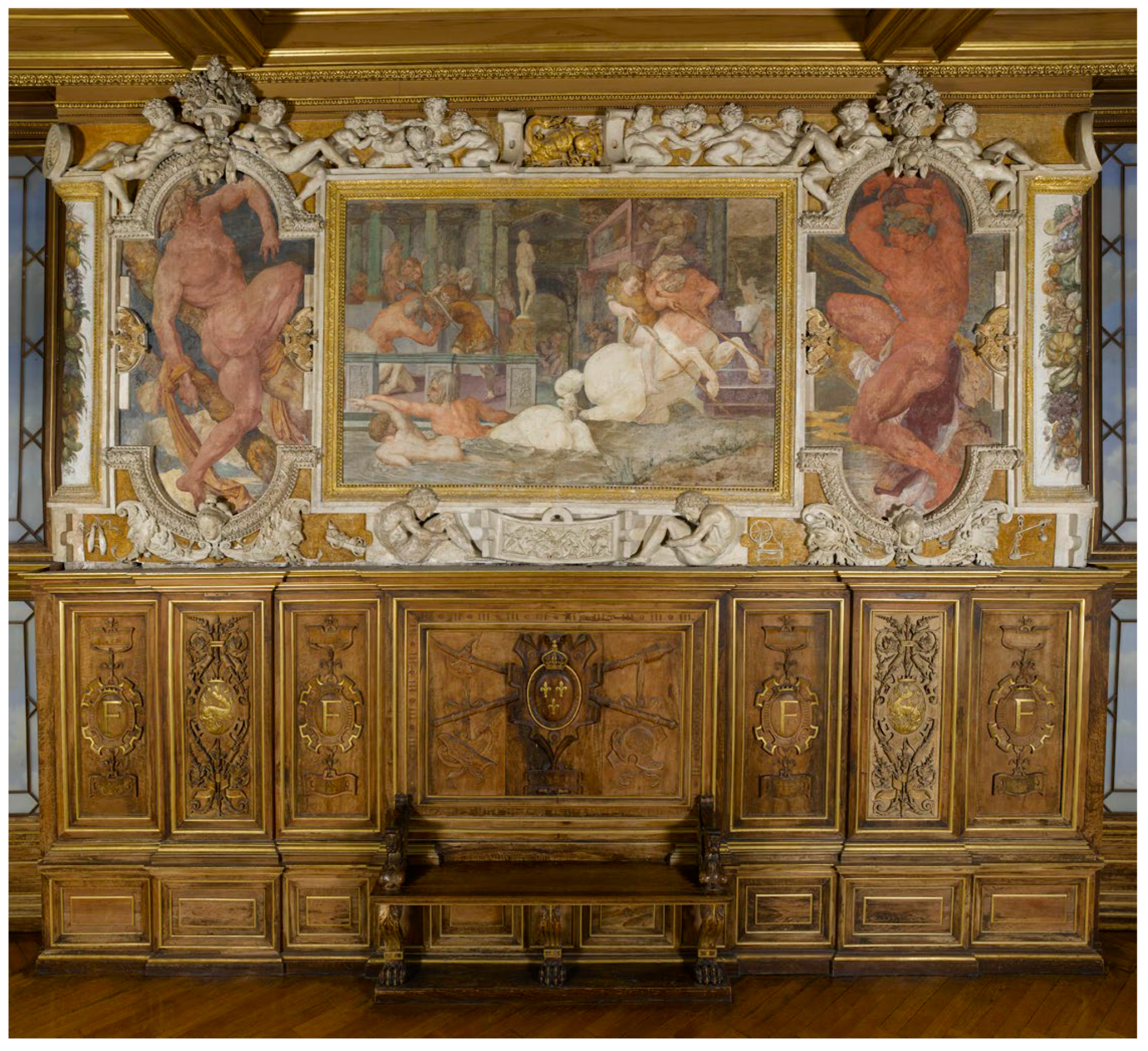
12. Chiron in France: Rosso Fiorentino
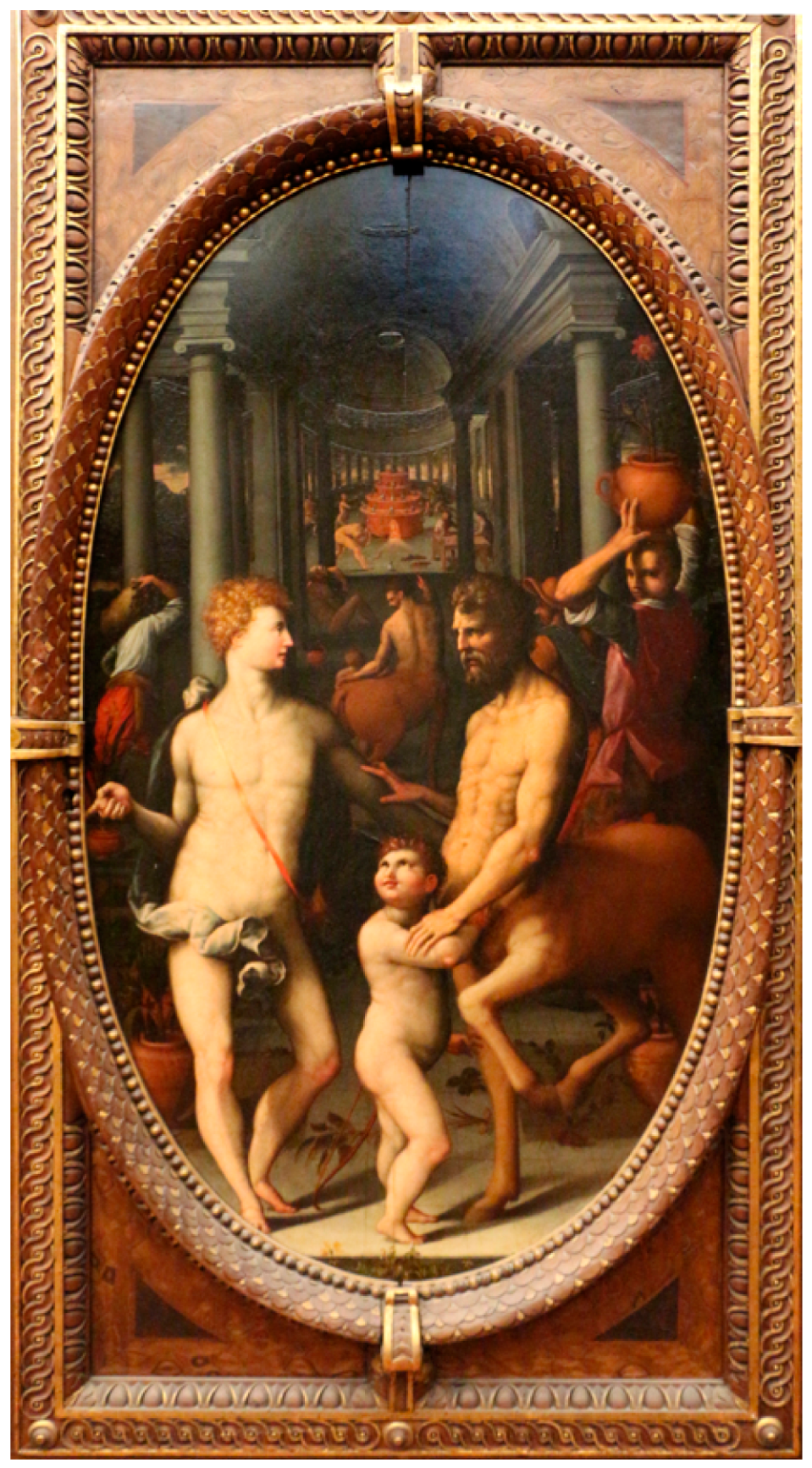
13. Vasari, the Pontifical Foundation of Palazzo Vecchio, and the Machiavellian Chiron
uomini degni e pieni di dottrina, e ammaestramenti buoni; perché avendo a governare i popoli del vostro dominio, vi è necessario sapere infinite cose, ancorché io sappia che ne sapete assai, vivendosi oggi più con simulazione e inganni, che con altri modi; acciò Teti uscita dall’onde faticose, la quale fece insegnare all’astuto Achille il saper vivere, faccia il medesimo Vostra Eccellenza.212
sacrifizj. Questi sono li sacrosanti Eroi fatti dal grande Dio ne’ due Pontefici sommi di questa casa Illustre, i quali hanno fatto nel loro Pontificato sacrifizj all’Altissimo Dio, non solo Padre del tempo, ma delle vite e morti degli uomini, in memoria de’ quali oggi per loro facciamo questi ricordi, sacrificandoli queste tante fatiche di questi uomini virtuosi, i quali in quest’opera illustrano dopo morte la fama loro.213
14. Conclusions
Funding
Institutional Review Board Statement
Informed Consent Statement
Data Availability Statement
Conflicts of Interest
| 1 | “Dovete adunque sapere come e’ sono dua generazioni di combattere: l’uno, con le leggi, l’altro, con la forza. Quel primo è proprio dello uomo; quel secondo, delle bestie. Ma perché el primo molte volte non basta, conviene ricorrere al secondo: pertanto a uno principe è necessario sapere bene usare la bestia e lo uomo. Questa parte è suta insegnata alli principi copertamente da li antichi scrittori, e’ quali scrivono come Achille e molti altri di quelli principi antichi furno dati a nutrire a Chirone centauro, che sotto la sua disciplina li custodissi. Il che non vuole dire altro, avere per precettore uno mezzo bestia e mezzo uomo, se non che bisogna a uno principe sapere usare l’una e l’altra natura: e l’una senza l’altra non è durabile” (Machiavelli 1994), XVIIII, pp. 2–6. |
| 2 | “Sendo dunque necessitato uno principe sapere bene usare la bestia, debbe di quelle pigliare la golpe e il lione; perchè el lione non si difende da’ lacci, la golpe non si difende da’ lupi; bisogna adunque essere golpe a conoscere e’ lacci, e lione a sbigottire e’ lupi: coloro che stanno semplicemente in sul lione, non se ne intendono” (Machiavelli 1994), XVIII, p. 7. As is well known, Machiavelli’s ‘negative’ model is Cicero, De officiis I, 13,41, which describes the injury that is unjustly inflicted upon another. “Cum autem duobus modis, id est aut vi aut fraude, fiat iniuria, fraus quasi vulpeculae, vis leonis videtur; utrumque homine alienissimum, sed fraus odio digna maiore. Totius autem iniustitiae nulla capitalior quam eorum qui tum, cum maxime fallunt, id agunt, ut viri boni esse videantur.” Machiavelli incorporates into the figure of the centaur-prince what Cicero considered alienissimum to the human. See also Plutarch, Life of Sulla. 28,6: “[The Roman consul and general Papirius] Carbo is said to have remarked that in making war upon the fox and the lion in Sulla, he was more annoyed by the fox.” |
| 3 | See (Machiavelli 1994, XVIII, pp. 13–15): “A uno principe adunque non è necessario avere in fatto tutte le soprascritte qualità, ma è bene necessario parere di averle; anzi ardirò di dire questo: che, avendole e osservandole sempre, sono dannose, e, parendo di averle, sono utili: come parere piatoso, fedele, umano, intero, religioso, ed essere: ma stare in modo edificato con lo animo che, bisognando non essere, tu possa e sappia diventare il contrario. E hassi a intendere questo, che uno principe e massime uno principe nuovo non può osservare tutte quelle cose per le quali gli uomini sono chiamati buoni, sendo spesso necessitato, per mantenere lo stato, operare contro alla fede, contro alla carità, contro alla umanità, contro alla religione. E però bisogna che egli abbia uno animo disposto a volgersi secondo che e’ venti della fortuna e le variazioni delle cose gli comandano; e, come di sopra dissi, non partirsi dal bene, potendo, ma sapere entrare nel male, necessitato.” On the centaur as a hypothetical creature capable of combining, according to circumstances, the foresighted intelligence of man—and his ability to use his hands—with the physical strength and swiftness of the horse, see Xenophon’s Cyropaedia IV.3.17–19, translated into Latin by Lorenzo Valla (1438), Poggio Bracciolini (1446), and Francesco Filelfo (1467), a work certainly known to Machiavelli: “Quo fit ut maxime ex omnibus animalibus adamem hippocentauros, si fuerunt, quippe qui tum hominis uterentur ante rem consultandi prudentia et manuum artificio, tum etiam haberent equi et velocitatem et vires. Quare et quod fugeret, capiebant, et quod expectaret, vertebant in fugam. Itaque etiam ipse haec omnia, si fiam eques, me cum sane confero. Potero equidem omnia providere mente humana, manibus vero me armabo, equo autem vehar, adversarium que avertam equi robore, neque sicuti hippocentauri vinciar natura” (Lat. translation by Filelfo). (Raimondi 1998, pp. 137–39), argued for a decisive influence of the above-cited passage on Machiavelli’s centaur; “giovinezza esuberante e avventurosa […] violenza che purifica […] mito di una creazione inattesa […] istinto della velocità e dell’improvvisazione.” In short, the celeritas of vital power constitutes, as Raimondi emphasizes, a defining value of the first form of sovereignty—violent and terrible—embodied by Dumézil in Romulus and exemplified through the figure of the centaur (p. 139). See (Polegato 2015; Biasiori 2017). |
| 4 | See (Ciliberto 2019, pp. 130–61), the IV chapter: “Un gioco serio: uomini, asini, porci.” |
| 5 | “Io non voglio delli esempi freschi tacerne uno. Alessandro sesto non fece mai altro, non pensò mai ad altro che a ingannare uomini, e sempre trovò subietto da poterlo fare: e non fu mai uomo che avessi maggiore efficacia in asseverare, e con maggiori iuramenti affermassi una cosa, che la osservassei meno; nondimeno sempre gli succederno gl’inganni ad votum, perchè conosceva bene questa parte del mondo” (Principe XVIII, 12); “Surse di poi Alessandro VI, il quale di tutti e’ pontefici che sono mai stati, mostrò quanto uno papa e col danaio e con le forze si poteva prevalere; e fece, con lo instrumento del duca Valentino e con la occasione della passata de’ franzesi, tutte quelle cose che io discorro di sopra nell’azioni del duca” (XI, 12). The Prince XVIII.19 introduces a second figure of the centaur, deceitful and violent, “il quale non è bene nominare.” I argue that this is also a papal figure, linked to Leo X, see Lettieri (2025). |
| 6 | See Dante’s Inferno, XII, verses 31–139. See the important studies by (Sasso 1998; Rossini 2007; Eisner 2019). |
| 7 | See Dante’s Inferno, XII, 103–6: “Io vidi gente sotto infino al ciglio;/e ‘l gran centauro disse: “E’ son tiranni ‘che dier nel sangue e ne l’aver di piglio./Quivi si piangono li spietati danni’.” |
| 8 | One should remember an exemplary text that is contemporary with Machiavelli’s treatise: Desiderius Erasmus’ Institutio principis christiani (Froben, Basel 1516). As the ultimate example of the earthly prince, Erasmus consistently models Christ himself, “unicus Princeps ac Dominus omnium” (Erasmus 1974, p. 259, ll. 698–699), “principum omnium monarcha” (p. 158, ll. 680–681). Since Christ is both God and man, he presents himself to earthly rulers as a “regula” (p. 179, l. 417), an “absolutum omnis virtutis ac sapientiae exemplar” (p. 165, l. 942), which is attractive and compelling in its call to imitate, urging them toward perfection and divine union. Erasmus compares him to a “pessimum exemplar” (p. 180, l. 456), as opposed to historical figures of corrupt rulers like Caligula, Nero, Heliogabalus, and also to Achilles (the disciple of Chiron!), Xerxes, Cyrus, Darius, Alexander, and Julius Caesar, all of whom he equates with tyrants dominated by their animalistic instincts, described as “magni ac furiosi latrones” (p. 180, l. 461). Tyrants are portrayed not only through images like “leo, vrsus, lupus […] dracones pardi leones” (p. 157, l. 641) and “crudelis ac rapax leo” (p. 158, l. 686) due to their association with libido, violence, and deceit but also as reflections of the devil, embodying malice and the concept of absolute evil duplicity: “Princeps salutaris, vt erudite dictum est a Plutarcho, viuum quoddam est dei simulacrum, qui simul et optimus est et potentissimus, cui bonitas hoc praestat, vt omnibus prodesse velit; potentia, vt quibus velit, possit quoque. E diuerso malus ac pestilens princeps mali daemonis imaginem repraesentat, cui multum adsit potentiae cum summa malicia coniunctum” (p. 150, ll. 441–445). Moreover, Machiavelli’s restitution of the centaur’s double bestial nature is conditioned by Erasmus’s interpretation of the Ciceronian passage from De officiis cited above, note 2. The most famous exemplum of Machiavellian realism—that of force and cunning, of the fox and the lion—derives from Erasmus, since it belongs to one of the most celebrated Adagia, widely disseminated in Italy, as it appears in the Aldine edition of 1508: “Si leonina pellis non satis est, vulpina addenda” (II, v. 81).” Erasmus explains the saying, which comes from a maxim of Lysander, in precisely the way Machiavelli would understand it five years later: “Quando non puoi ottenere qualcosa con la forza, bisogna usare l’inganno [dolus adhibendus]. Con questo si supera il richiamo, più remoto, al De officiis I, 41, ove la formula è sì presente, ma in forma disgiuntiva, ‘aut vi, aut fraude’ e nettamente riprovata” (Ossola 2015, pp. 16–17). See (Erasmus 1981, no. 2481, p. 337). |
| 9 | “The imitation of the beast takes the place of the imitation of God [… Machiavelli] replaces the imitation of the God-Man Christ by the imitation of the Beast-Man Chiron” (Strauss 1958, p. 78); Strauss views the centaur as an anti-humanistic symbol, interpreting it as a figure of Machiavelli himself. It would be interesting to examine Machiavelli’s most ambitious work in verse, the Capitolo L’Asino, a parodic inversion of Dante’s Commedia: instead of becoming divine, the protagonist—Machiavelli’s own figure—turns into an animal. After having sexual intercourse with his ‘Beatrice,’ who is one of Circe’s maidservants, he comes to recognize a higher wisdom and humanity in the figure of the man turned into a quiet pig, who refuses to return to the human state, condemned as wicked and painful. See (Sasso 1987; Battistini 2017; King 2008). On the Machiavellian centaur as the Renaissance reverse of Pico’s chameleon, see (De Robertis 2015, pp. 127–35). See also (Raimondi 1998), the great chapter “Il politico e il centauro” pp. 125–43, where Machiavelli’s allegorical interpretation of the biblical Moses is brought into relation with that of the centaur: “Al contario dell’ermeneutica umanistica con il suo approccio platonico-cristiano, quella del Machiavelli conosce soltanto una chiave di decifrazione politica, tanto più sorprendente poi quando si applica al testo biblico, per discorrere, a esempio, di Mosè ‘mero esecutore delle cose che gli erano ordinate da Dio’. Basta accostare difatti questo passo del capitolo VI a quello del centauro nel XVIII perché si riveli un’analogia curiosissima tra la coppia del profeta [profeta armato!] e del suo ‘gran precettore’ e quella di Achille e di Chirone, pure lui ‘precettore’, ma “’mezzo bestia e mezzo uomo’, e ciò che fa più impressione naturalmente è l’equipollenza politica fra Dio e il centauro, in un alone di mistero che può avere persino qualcosa di beffardo” (pp. 134–35). As will be seen below, in Chapter VIII, in the work of Tommaso Sardi the figures of the centaur and of Moses will overlap within the papal milieu. |
| 10 | A controversial account—although it predates it by more than two centuries—depicts the pontiff as a monstrous centaur, ambiguously claiming both sacred and temporal power, as reported by (Paravicini Bagliani 2020, pp. 329–30): “Dans un missel de l’abbé de Saint-Jean, à Amiens, illustré par Pierre de Raimbaucourt en 1323, apparaissent un pape-sirène et un pape-centaure. La sirène représente la séduction illégitime […] la figure de l’homme-cheval, en soi négative parce qu’hybride, renvoie polémiquement à l’exercice du pouvoir temporel, surtout de la part d’un pape spécifique: […] Boniface VIII.” |
| 11 | “Credo ancora che sia felice quello che riscontra il modo del procedere suo con la qualità de’ tempi: e similmente sia infelice quello che con il procedere suo si discordano e’ tempi” (Prince XXV, 11). “Concludo adunque che, variando la fortuna e’ tempi e stando li uomini ne’ loro modi ostinati, sono felici mentre concordano insieme e, come e’ discordano, infelici” (Prince XXV, 25); see XXV, 15–17. |
| 12 | “Io iudico bene questo, che sia meglio essere impetuoso che respettivo: perché la fortuna è donna ed è necessario, volendola tenere sotto, batterla e urtala. E si vede che la si lascia vincere da questi, che da quegli che freddamente procedono: e però sempre, come donna, è amica de’ giovani, perché sono meno respettivi, più feroci e con più audacia la comandano” (Prince XXV, 26–27). |
| 13 | Prince XXV, 18–24. |
| 14 | See (Lettieri 2025, pp. 691–704). |
| 15 | Prince XVIII, 19. |
| 16 | See above, note 3. |
| 17 | See above, note 2. |
| 18 | In pagan antiquity, “fabulae fictae sunt […] de centauris, quod equorum hominumque fuerit natura coniuncta” (Augustine of Hippo 1955, p. 604). |
| 19 | “Sagittarium dicunt esse quoddam animal, ex homine & equo mixtum in vultu terribile, & in sagittando praecipuum […] Tales videntur esse multi, qui scil. partim homines, i.e., rationales, partim equi, i.e., bestiales esse noscuntur, qui profecto alios sagittare non cessant, verbisque & iniuriis, detractionibus, & tribulationibus inquietant, & molestant” (Berchorius 1731, p. 641). On the centaur as a diabolical monster who encounters Antony and then flees before the ascetic, see Athanasius’ Vita Antonii (in the anonymous Latin translation), 53.2–3. For a less negative interpretation of the hippocentaurus, who shows Antony the road to the hermit, see Jerome’s Vita Pauli. Cox Miller (1996) interprets Jerome’s homo equo mixtus as the sensual and wild component within the ascetic himself, which he nevertheless succeeds in taming. |
| 20 | On the centaur as a symbol of bestial libido which, once unleashed, turns oppressive, I will only cite two passages from Landino. (Landino 1481, pp. 10–12), comment to Inferno XII, 49–51: “La forza dell’appetito irascibile è torre via tutti gl’obstacoli che non ci lasciono consequire quello che disideriamo. Adunque è folle et stolto tale appetito, el quale tutto il giorno pigne gli animi furiosi, et cupidi della tyrannide, a mille pericoli et morti, e a infinite fatiche;” “Imperoché acquistato quello che prima desiderava, et nel quale credeva riposarsi, gli nasce disiderio d’un maggiore; et mai non arriva a quella quieta viva che si propone, alla quale presto arriverebbe se ponessi freno alla cupidità, et stessi contento al presente stato” (Landino 1481, pp. 44–47). In the insatiable and alienating appetite of the tyrannical centaur one may hear an echo of the condemnation of ambition—and of political life itself—articulated in Lucretius’ De rerum natura. One may also recall Machiavelli’s definition of human desire as a Cain-like “urna sanza fondo” in Dell’Ambizione, vv. 41–42, where the criminal vices of mankind “per mostrar la loro voglia infinita/portano in mano una urna sanza fondo.” |
| 21 | Commenting on the centaurs’ representation in 1400s Florence, Warburg wrote: “The animal strength with which the Centaur grips his victim and the savage desire which event approaching death cannot stifle, are splendidly rendered […] and yet the best thing is absent from this style: beauty. For beautiful these groups are not. If one says of them that they show passionate movement without losing in clarity this is the highest tribute one can pay” (Warburg 2016b, p. 88). |
| 22 | Chiron is described as “the most just of the Centaurs” (δικαιότατος Κενταύρων) (Homer, Iliad XI, p. 831); see Pindar, Pythian 3, strophe 1 and epode 2; Xenophon, Cynegeticus, the extensive opening chapter with its long list of Chiron’s distinguished pupils and the account of their deeds. On Chiron as musician and stern teacher, the educator of Achilles, see Ovid, Ars amatoria I, 19–26. On Chiron as the instructor of Asclepius and on the prophecy of his daughter Ocyrhoe—who foretells that he will renounce his immortality to escape the torment of an incurable wound—see Ovid, Metamorphoses II, 626–679. On the variants of the Chiron myth and his relationship with Apollo’s son in Ovid, see (Merli 2004). On Chiron as the inventor of medicina herbaria et medicamentaria, see Statius, Achilleid I, 115–121, where his peaceful nature and musical mastery are emphasized, and Pliny the Elder, Naturalis historia VII, 196–197; on Chiron as Achilles’ tutor, see XXXVI, 29; and Isidore of Seville, Etymologiae sive Originum libri III, 71, 36, which also recalls his catasterism: “Centaurus Chiron, propter quod nutrierit Aesculapium et Achillem, inter astra dinumeratus est.” It should be remembered that Cristoforo Landino himself translated Pliny’s Historia naturalis into the vernacular Historia naturale di C. Plinio Secondo di latino in volgare tradotta (1476). According to (Levi d’Ancona 2022, p. 43), the botanical profusion that pervades Botticelli’s masterpiece may have been encouraged by the artist’s reading of the Historia naturalis in the edition produced by his friend Landino. Moreover, nineteen of Botticelli’s drawings (out of the ninety-nine originally planned) illustrated Landino’s printed edition of 1481. On Chiron as the teacher of Asclepius, see Lactantius, Divinae institutiones I, 10; on Chiron as the inventor of surgery—hence his name derived from χείρ, “hand”—see Isidore of Seville, Etymologiae IV, 9, 12: “Dictus autem Chiron ἀπὸ τοῦ χειρίζεσθαι, quia chirurgus fuit.” It is worth emphasizing that Angelo Poliziano, in his unpublished commentary on Statius’ Silvae, cites Book I of Apollonius Rhodius’ Argonautica with reference to the centaur Chiron as the educator of Achilles; see (Cattaneo 2025, p. 146). Domizio Calderini published his commentary on the Silvae in 1475. Finally, see (Mengelkoch 2010). |
| 23 | See Lucretius’ De rerum natura II, 700–6; IV, 722–44; V, 878–924. For the influence of Lucretius’ demythologizing philosophy on Florentine Renaissance aesthetics, see the insightful study by (Hedreen 2019). |
| 24 | See Boccaccio’s Genealogia deorum gentilium, VIII, 8 (Boccaccio 1998). Worth noting the first printed edition of Giovanni Boccaccio, Genealogia deorum gentilium by Vindelino da Spira, Venice 1472; this was followed by further printed editions: Bottoni, Reggio 1481; Simon Bevilacqua, Vicenza 1487; Locatelli/Scoto, Venice 1494; Manfredi da Strevo, Venice 1497; Hornken, Paris 1511; Agostino de Zanni, Venice 1511. See (Gambino Longo 2008) on the reception of the Genealogie in sixteenth-century Italy, from Marsilio Ficino to Giorgio Vasari, and, for a broader perspective, (Gendrat-Claudel 2013). |
| 25 | On the celebrated centauromachy, see Ovid, Metamorphoses XII, 210–535: the Centaurs—described as nubigenae feri (v. 210) and saevi (v. 219)—during the wedding feast of Pirithous, friend of Theseus, and the beautiful Hippodamia, when ebrietas geminata libidine regnat (v. 221), unleash a ferocious battle in order to abduct the bride and violate the women of the Lapiths. |
| 26 | See Boccaccio’s Genealogia deorum gentilium, IX, 27: “Ysion thessalus fuit et Lapitharum dominus, regni preter modum avidus, adeo ut per tyrannidem occupare conatus sit […] Rex thronum conscendit suum regiis insignitus notis, tyrannus occupat dominium, armis horridis circumseptus. Rex per quietem et letitiam subditorum, tyrannus per sanguinem et miseriam subiacentium […] tyrannus respective turbulenta nubes est, nulle stabilitati annexa, et que facile resolvatur, seu a furore subiacentium, seu ob desidiam amicorum” (pp. 2–3). |
| 27 | On Juno as spectator of the punishment of Ixion bound to the wheel, see Ovid, Metamorphoses IV, 461–465; on the halting of Ixion’s wheel at the song of Orpheus, see X, 42. On the Centaurs, characterized by “membra inmania” and “geminae vires,” in whom “duplex natura animalia iunxit,” as the offspring of a goddess—namely Juno—and Ixion, qui “tantus erat, Iunonis ut altae/spem caperet,” see XII, 501–506. |
| 28 | On the fabula Ixionis—Ixion as the mythical Centaurs’ progenitor, yet a proud tyrant driven by a desire for rule and power. He rose to power thanks to his hundred-mounted warriors (hence the forced etymology of the Centaurs), only to be overthrown by the wheel of Fortune—see Fulgentius, Mythologiae II, 14, which concludes: “unde eum et ad rotam damnatum dicunt, quod omnis rotae vertigo quae superiora habet modo deiciat. Ergo ostendere hic voluerunt quod omnes qui per arma atque violentiam regnum adfectant subito erectiones, subito elisiones sustineant sicut rota quae stabile non habet aliquando cacumen.” In a contrapasso analogous to that later formulated by Dante Alighieri, elevation is reversed into downfall. This interpretation is taken up in the extensive mythographical and rationalizing treatment of Ixion by Giovanni Boccaccio, Genealogia deorum gentilium IX, 27 (on Ixion as the proud and lustful first tyrant), and IX, 28 (on the violent and libidinous Centaurs as armed men). Coluccio Salutati, in De laboribus Herculis III, 12, depended on Boccaccio and describes Ixion as the first tyrant: “Ixion primus per vim et tirannidem regnum occupare ausus est, ut inter tales non incongrue primus dictus sit.” See also Landino in the manuscript from the Biblioteca Medicea Laurenziana, Pluteo 53.37, f. 301v: “Ixion cum Iunone concumbere credens, cum eius simulacro ex nube facto concubuit. Unde nati sunt Centauri, quorum supernae partes humanae, infernae equinae erant. In quo exprimitur eventus nimiae ambitionis. Nam qui tyrannidi et nimiae imperandi cupiditati incumbunt, putant se Iunone, id est maximis regnis, potiri posse. Et homines deae nuptias petunt, id est eventus sibi supra humanam facultatem proponunt. Unde pro rebus solidis nubem, id est manes assequuntur. Unde non humana quaedam, sed monstruosa et efferata enascuntur, quibus ex alto ad ima praecipitant.” |
| 29 | See Boccaccio’s Genealogia, IX, 27, 4–5: “Fuere quidem Centauri homines armigeri, elati animi, et immoderati ac in omne nephas proni, uti satellites cernimus et stipendiarios et ministros scelerum, ad quorum vires fidemque confestim recurrit tyrannus.” |
| 30 | Chiron teaches Peleus how to seize and restrain the metamorphic Thetis, thereby enabling him to possess her forcefully and conceive Achilles with her; see Apollodorus (Bibliotheca III, 13, 5). Ovid, Metamorphoses XI, 221–265, replaces Chiron with Proteus. Pierre Bersuire (Berchorius), by contrast, presents a Chiron who is not only wise but also lustful, like his father Saturn, exalted as a god, yet debased by his libido: “Rei autem veritas fuit quod Saturnus qui deum se credi volebat in fine dierum suorum factus est luxuriosus et sic fictus est in equum mutatus. Chiron autem valde fuit sapiens, et tamen luxuriosus valde, et propter hoc partim homo et partim equus est fictus” see (Ghisalberti 1933, p. 109). |
| 31 | “Hunc [Achillem] Chiron astrologiam docuit et medicinam, ac etiam lyram tangere” (Giovanni Boccaccio, Genealogia deorum gentilium XII, 52) “Plinius, in libro Historiae naturalis, asserit Chironem, Saturni et Phyllirae filium, primum fuisse herbarum virium atque medicamentorum repertorem” (III, 19). The most detailed account of Chiron appears in Genealogia VIII, 8, where the myth of the immortal centaur is explained in rational terms: Chiron is seen as a wise man able to heal both humans and horses and to overcome deadly poisons, which leads to his later transformation—since he was a man iustissimus—into the constellation Sagittarius. Because he was a “just” man (equus in the moral sense), he was mythically represented as a “horse” (equus in the literal sense). |
| 32 | In Plato, Phaedo 61a, Socrates claims that he has done nothing other but “make music” (μουσικὴν ποιεῖν) if philosophy is the highest form of music, then this is what he has practiced (ὡς φιλοσοφίας μὲν οὔσης μεγίστης μουσικῆς, ἐμοῦ δὲ τοῦτο πράττοντος). |
| 33 | The allegorical interpretation of the centaur proposed by Coluccio Salutati, De laboribus Herculis III, 11, exemplifies of the Platonic–Christian perspective typical of humanism: “Nunc ad allegoriam revertamur. Chyron igitur habet superiorem partem in effigiem hominis, animalis videlicet rationalis, inferiorem autem in equi formam, in quo, sicut diximus, activa vita figuratur. Nam cum ratio, quam communem habemus cum angelis, imperat appetitui, quem communem habemus cum beluis, vita activa plenaque virtutis resultat in homine, que vere humana est. Nam si controversim appetitus subiuget rationem, vita non hominis erit sed penitus bestialis. Si autem imperio rationis ocioso appetitus cooperetur sine resistentia rationi, supra statum hominis hec vita est et que angelica dici debeat, non humana. Nec in equo fuit incongrue appetitus sive sensualitas figurata. Nullum enim animal obedientius est homini quam equus, cuius est, si freno per hominem regitur, solide pergere, si autem sine freno vel absque homine suis motibus relinquatur, sepissime cadere vixque ad destinatum terminum pervenire.” As will be seen, this allegorical interpretation of the centaur closely aligns with the Ficinian reading of the chariot of the soul in Plato’s Phaedrus and the Pichian view of man as a chameleon. For an introduction to the reception of Chiron in Renaissance art and literature, see (Martinez 2019, pp. 180–218), the chapter “Chiron: Magister of Medicine, Sage, and Humanist Educator.” |
| 34 | Anticipating Niccolò Machiavelli, Landino, in his Comento sopra la Comedia (Florence 1481), commenting on Inferno XII, 64–66, 158–159 of the Comedy, presents Chiron as the symbol of “quello animo el quale benché sia efferato nell’ambitione et nella cupidità del signoreggiare, nientedimeno non è sanza alchuna doctrina et ragione, et qualche iustitia et civile chostume.” |
| 35 | See (Apollodorus, II.5.4; Ovid, Fasti V, 379–414); De laboribus Herculis III, 11. |
| 36 | For a sarcastic denigration of Chiron’s renunciation of immortality, because he is tired of the uniformity of an immortal life, see Lucian, Dialogues of the Dead 26. |
| 37 | |
| 38 | See (Pisani 2009, pp. 113–27, esp. 122–23). |
| 39 | See (Erasmus 1979, p. 108): “At quinam potissimum sibi vitae taedio fatum accersiuere? Nonne sapientiae confines? […] Chiron ille, cum immortalem esse liceret, vltro mortem praeoptauit;” in this case, the “sapientia” attributed to Chiron is that of having recognized the profound unhappiness of existence. |
| 40 | See (Erasmus 1987, pp. 162–64), the adagium no. 1721, entitled “Chironium vulnus,” esp.: “Chironium vulnus, immedicabile malum appellabant” (p. 162); yet, considering Chiron’s medical knowledge, Erasmus refers to the “Chironia manus medica” (p. 163). He then reports the statement of Plato Comicus, who attributed to Chiron the same education toward tyranny in Pericles: “Tu quippe Chiron educasse diceris Periclem” (p. 164). In any case, Erasmus interprets the statement symbolically, restoring Damon as Pericles’ “Chiron,” a teacher of music and of “fierce” politics, precisely because crypto-tyrannical: “Per tropum siquidem appellat Damonem Chironem, quod id fuerit Pericli, quod Chiron fuit Achilli, quem docuit quidem fidibus canere, sed ad Centauricam ferociam eduxit” (p. 164). |
| 41 | See (Bruno 1958, pp. 823–25): Christ is polemically depicted as the centaur Chiron, so that Momus rebukes the divinization of Jesus with blasphemous irony. The sharp critic of the gods, referencing the doctrine of the Incarnation, turns it into a sarcastic parody: “Or, che vogliamo fare di quest’uomo insertato a bestia, o di questa bestia inceppata ad uomo, in cui una persona è fatta di due nature, e due sustanze concorrono in una ipostatica unione?” (p. 823). Yet the Christological dogma is preserved (at least provisionally) by Jupiter as an edifying “Semplicità giusta, Favola morale” capable of governing the common people: “Per esser Chirone centauro uomo giustissimo, che un tempo abitò nel monte Pelia, dove insegnò ad Esculapio de medicina, ad Ercole d’astrologia e ad Achille de citara, sanando infermi, mostrando come si montava verso le stelle e come gli nervi sonori s’attaccavano al legno e si maneggiavano, non mi par indegno del cielo. Appresso ne lo giudico degnissimo, perché in questo tempio celeste, appresso questo altare a cui assiste, non è altro sacerdote che lui; il qual vedete con quella offrenda bestia in mano, e con un libatoio fiasco appeso a la cintura. E perché l’altare, il fano, l’oratorio è necessarissimo, e questo sarebbe vano senza l’administrante, però qua viva, qua rimagna e qua persevere eterno, se non dispone altrimente il fato” (p. 825). Thus, underscoring the ironic retraction of the Epistle to the Hebrews, Momus specifies: “lui medesimo, ed uno, può servir per sacrificio e sacrificatore, idest per sacerdote e per bestia” (825). See also (D’Ascia 1998, pp. 255–72). |
| 42 | Statius, Achilleid, defines the wise Chiron as “torvus magister” (I, 39) and, in his company, “Lapitharum proelia ludit/inprobus” (I, 40–41); thus Achilles recalls Chiron: “Ipse sedens vasto facta exspectabat in antro,/si sparsus nigro remearem sanguine; nec me/ante nisi inspectis admisit ad oscula telis” (II, 126–128); and again: “Dicor et in teneris et adhuc reptantibus annis,/Thessalus ut rigido senior me monte recepit,/non ullos ex more cibos hausisse nec almis/uberibus satiasse famem, sed spissa leonum/viscera semianimisque lupae traxisse medullas” (II, 96–100). |
| 43 | The long encomiastic poem on the Medici composed, shortly after Cosimo’s death, by an anonymous writer, is emblematic. See (Newbigin 2011, pp. 22–125). Referring to Florence’s new political greatness, the poet proclaims: “E questa magnitudine ch’i’ parlo/son sute tutte poi ch’al mondo venne/quest’uom che dDio mandò per esaltarlo:/Cosimo è il preclaro vir solenne/che per far la sua patria al ciel volare/ogni dì giunge al suo trïunfo penne” (vv. 988–89). Cosimo’s earthly triumph is thus celebrated almost as though he had ascended to heaven as an alter Christus: “Egli è voler concorde al cor divino/e ne’ beati dello etterno regno/con l’unità del sommo etterno Trino/far Cosmo in terra del trïunfo degno,/d’ogni felicità ch’aver si puote/per gratia Dei o per umano ingegno” (vv. 1012–17); and again: “Né credo che dal ciel già mai concesso/fosse prudenzia e possanza e volere/se non a uno: e Cosimo è quel desso” (vv. 1030–32). Le Onoranze fiorentine goes so far as to articulate a specific analogy between Christ’s death and resurrection and Cosimo’s death and political “resurrection.” I will return to this later with reference to Donatello’s pulpits of the Passion and the Resurrection, installed in San Lorenzo to solemnize the burial of Cosimo the Elder. Finally, Medici lineage itself is construed as a mystical rose, in analogy with the generation of Christ’s mystical body—sprung from the root of Jesse: “O nobile vermena, o gentil nesto,/che dal corpo di Cosimo rampolli/sicomme pulcra rosa dal buon cesto,/li spirti miei non sarien mai satolli/di contar le tue laude, almo preclaro,/che mai dal buono e dal ben non ti crolli” (vv. 1423–28). |
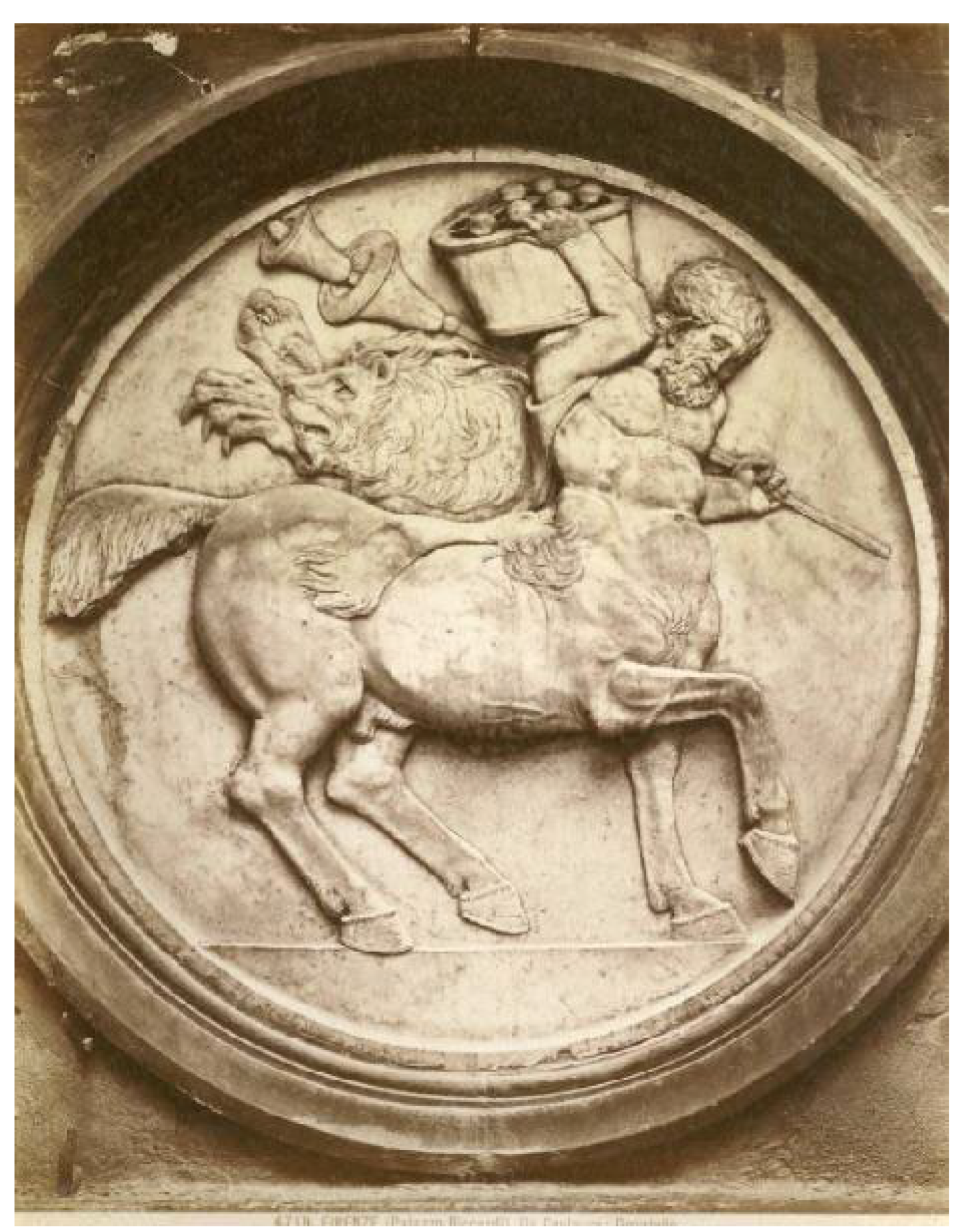
| 44 | Vasari attributes to Donatello the execution of the medallions: “In casa Medici nel primo cortile sono otto tondi di marmo, doue sono ritratti cammei antichi, & rovesci di medaglie, & alcune storie fatte da lui, molto belle; quali sono murati nel fregio, fra le finestre, & l’architraue, sopra gli archi delle logge” (Vasari 1568, p. 331). |
| 45 | On the attribution of the marble tondo to Bertoldo di Giovanni, Donatello’s greatest pupil and one of Michelangelo’s masters, I refer to Francesco Caglioti’s masterly study (Caglioti 2019, pp. 90–93); for Caglioti, the date of composition of the tondi decorating the courtyard of the Palazzo Medici should be placed between 1461 and 1465. |
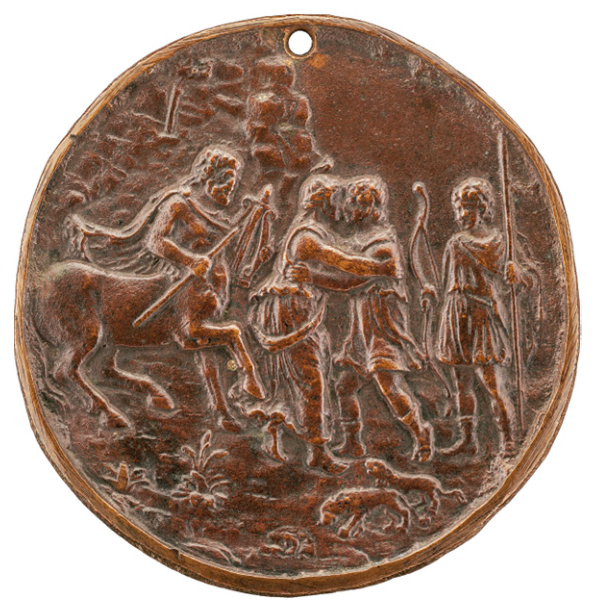
| 46 | See (F. Marcelli 2011, p. 33): “Un’associazione emblematica tra il centauro Chirone e i Medici è visibile nel fregio che decora il cortile delle colonne: il centauro trasporta un cesto colmo delle sei palle araldiche medicee, rielaborando il cammeo in sardonico, già mediceo, nel Museo archeologico nazionale di Napoli […] Non può essere dimostrato con il sostegno di elementi probanti, ma è doveroso evidenziare anche le affinità simboliche che avvicinano Chirone, primo medico e mentore, a Cosimo il Vecchio, capostipite mediceo, maestro del figlio Piero, dei nipoti Giuliano e Lorenzo ed exemplum sempiterno per la stirpe.” |
| 47 | On the marzocco, symbol of Florence, which, tame and submissive to Cosimo, embraces and licks his Medicean singer, see Le Onoranze Fiorentine del 1459 in (Newbigin 2011, pp. 24–25). |
| 48 | On the specific role of the courtyard of the Palazzo Medici, as a space separate yet open, see Dale Kent’s interesting remarks (Kent 2000, p. 230), citing an essay by Francis William Kent: for Dale Kent, Renaissance palaces are places where “’an ebb and flow’ in and out—of neighbors, friends, relatives, and business associates—‘dissolv[ed] the boundaries between public and private space’.” |
| 49 | Consider Benozzo Gozzoli’s extraordinary fresco, La cavalcata dei Magi (1459), in the chapel of the Palazzo Medici, where, alongside portraits of the emperor and the patriarch of Constantinople, as well as of the principal Florentine and Greek intellectuals, the family members are depicted in the guise of the Magi in a procession led by a young Lorenzo the Magnificent. “The anachronisms palpable in the pictures were thoroughly acceptable, for there is a certain stimulus in seeing that Bethlehem was near mediaeval Gothic fortifications, that the train of the Wise Men wore costumes of the fifteenth century, and that actual persons of Florentine fame were given parts as the chief dramatis personae in a scene where sacred and profane, Biblical and Italian, Medici and Magi were joined together” (Hale Shackford 1923, p. 387). I recall the significance of the Compagnia dei Magi, strongly supported by the Medici and connected to the Convent of San Marco; and the abundance of vernacular sacred literature promoted by the Medici, which aimed specifically to portray Florence’s ruling family as messianic. I will just mention Lucrezia Tornabuoni, Piero’s wife, mother of the Magnifico and Giuliano, a refined composer of sacred scripts and religious poetry. See her work, Della stirpe regale è nato il fiore, Florence: Biblioteca Nazionale Centrale di Firenze (BNCF), Magliabechiano VII, p. 338, where the Christological-political projection onto the Medici family, culminating in the papal election of Leo X, is evident. |
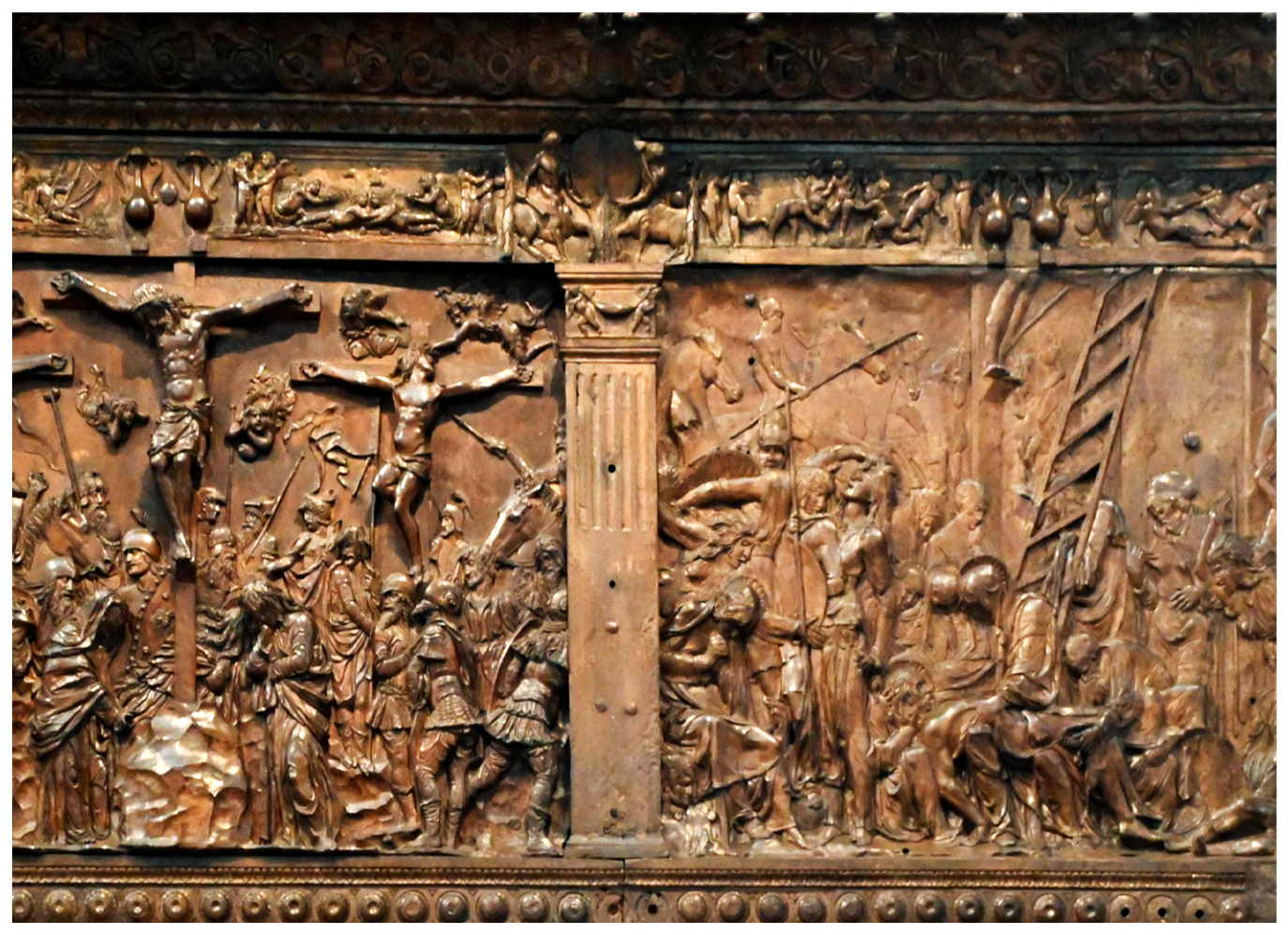
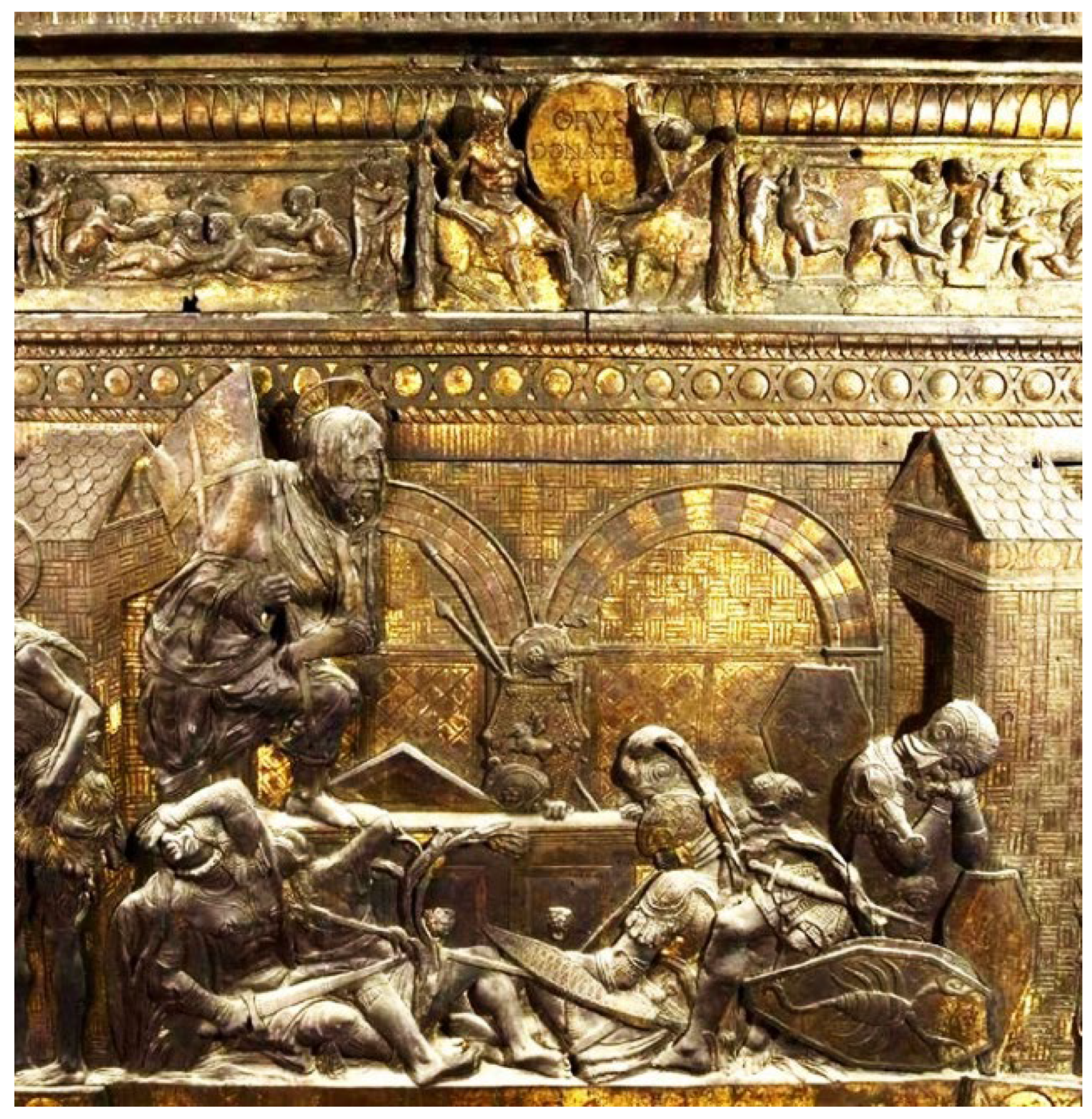
| 50 | Illustrating one of his frescoes, Giorgio Vasari (Vasari 1823, p. 105) indicates Donatello “mostrare […] le cere da far gittare di bronzo i pergami di san Lorenzo, e il modello dell’altar maggiore, con la sepoltura di Cosimo a’ piedi” (pp. 105–6). The pulpits were thus designed as parts of the everlasting celebratory monument to Cosimo, whose tomb was placed into the pier beneath the altar, flanked by Donatello’s two masterpieces. |
| 51 | “The paired centaurs holding a label in the center are by Bertoldo” (Pope-Hennessy 1993, pp. 304–5). |
| 52 | On their original placement, their celebratory scope, and their precise liturgical function, see Francesco Caglioti’s fine essay (Caglioti 2022, pp. 39–90): “La scenografia prevista in San Lorenzo sarebbe stata ancora più ambiziosa [di quella dei cibori pontifici di Roma], non solo per il ricorso al bronzo, ma anche perché i due pergami, pur distando fisicamente dalla tomba cosmiana […], le avrebbero fornito un complemento visivo più diretto ed eloquente, secondo l’agire più scaltro e tipico di Cosimo, volto sempre a ottenere il massimo per sé senza parere” (p. 78). See also (Lavin 1993, p. 12). |
| 53 | (Newbigin 2011, pp. 31–32). |
| 54 | (Newbigin 2011, p. 34). |
| 55 | See (Kent 2000, p. 466). |
| 56 | See above, note 51. |
| 57 | “The placement of the clypeus and centaurs (in the case of both pulpits) is also relevant, as they are situated adjacent to the most crucial scenes of the narrative: Christ’s death and resurrection. Donatello arranges the centaurs almost directly above the figure of Christ rising from the tomb on The Resurrection Pulpit. Regarding The Passion Pulpit, pilasters divide the scenes on the reliefs and the centaurs are situated directly above the central pilaster, which separates the scenes of The Crucifixion from The Deposition of Christ” (Martinez 2019, p. 92). |
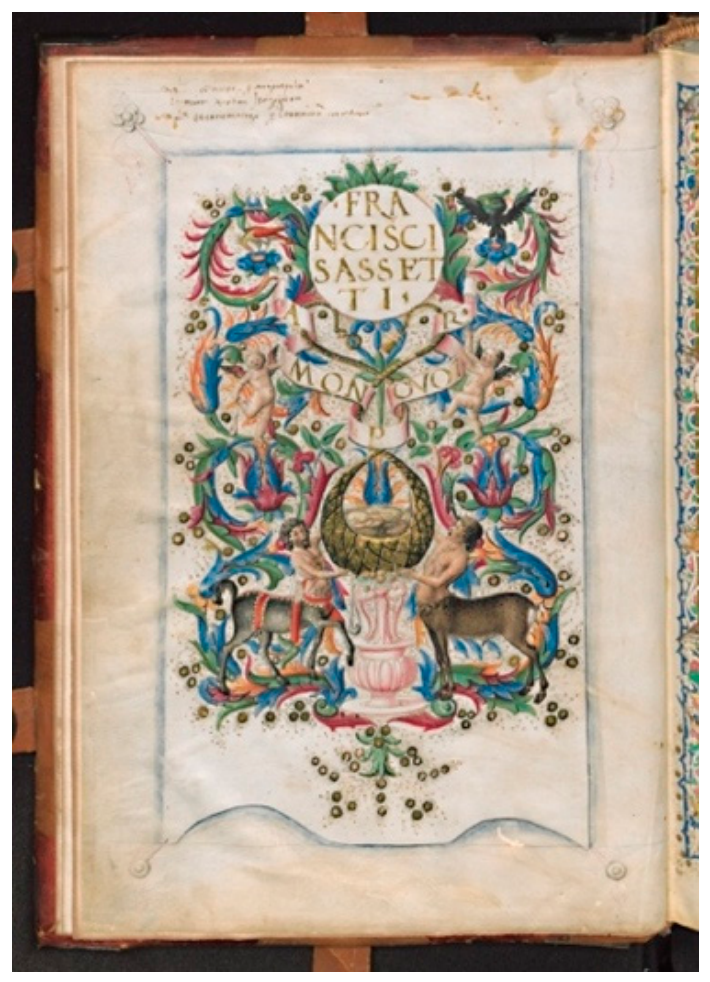
| 58 | Warburg notes a similar observation in the Sassetti Chapel, highlighting the presence of pagan symbols such as centaurs, Roman arches, and columns. This is evident through Ghirlandaio’s Adoration of the Shepherds, displayed on the altar of the family chapel at Santa Trinita, where Sassetti “summons revived antiquity into the presence of the newborn king to bear witness to its own demise. In all good faith, Francesco Sassetti could thus display his Christian piety amid the signs and portents of the Roman world; […] because he believed that he had laid the unquiet spirits of antiquity to rest by building them into the solid conceptual architecture of medieval Christianity” (Warburg 1999a, p. 249). I will return to the Sassetti Chapel and see the scene with the centaur and sling, overlapping with that of David defeating Goliath, as a family emblem: see below, note 74. |
| 59 | This interpretation has been supported with strong arguments by Scott Nethersole (Nethersole 2018, p. 204). In this sense, the empty clipeus of the Pulpit of the Crucifixion was likely intended to hold the depiction of the Medici balls, reinforcing the symbolic connection to the family, similar to the centaur in the columned courtyard of the Palazzo Medici. |
| 60 | (Panofsky 1972, p. 186): “Ficino’s doctrine does not recognize an essential difference between the authority of Christian and non-Christian sources. Since, as has been mentioned, all revelation is as fundamentally one as is the physical universe, “pagan” myth is not so much a typological or allegorical parallel as a direct manifestation of religious truth.” See also (Cassirer 1945, p. 491), even stronger: with Ficino “the principle, Extra ecclesiam nulla salus, is abandoned. But this does not mean a secularization or ‘paganization’ of the Christian religion; it means, on the contrary, a Christianization of paganism. Not a single moment in history, but the historical process in its entirety, is the true revelation of God.” See (Kristeller 1955). I add a brief clarification: the process of secularization is profoundly ambiguous; it preserves by retracting and innovates by conserving. Thus, Christianizing paganism also involves reinterpreting Christianity in pagan—or rather ‘Hellenizing’—terms, making it more universal and rational. On the notion of prisca theologia and the profound influence of Gemistos Plethon see (Vasoli 1999, pp. 23–31); in his Summary of the Doctrines of Zoroaster and Plato (1445 ca.) Plethon includes among the prisci theology not only philosophers, but also mythical figures such as Minos, Tiresias and Chiron! |
| 61 | (Panofsky 1972, pp. 37–38): “The Renaissance man’s sense of “metamorphosis” […] may be described as an experience intellectual and emotional in content but almost religious in character. That the antitheses between “darkness” and “light,” “slumber” and “awakening,” “blindness” and “seeing” which, we remember, served to distinguish the “new age” from the mediaeval past were borrowed from the Bible and the Fathers has already been mentioned and no less obvious are the religious origin and connotations of such words as revivere, reviviscere and, most particularly, renasci. […] When the men of the Renaissance, instead of describing the new flowering of art and letters as a mere renovatio, resorted to the religious similes of rebirth, illumination and awakening, they may be presumed to have acted under a similar impulse: they experienced a sense of regeneration too radical and intense to be expressed in any other language than that of Scripture.” See Edgard Wind (Wind 1958, p. 29): “The notorious ease with which the Renaissance transferred a Christian figure of speech to a pagan subject, or gave pagan features to a Christian theme, has generally been interpreted as a sign of the profound secularization of Renaissance culture,” so that one may conclude that “Christian piety had patently given way to a taste for the pagan. Before accepting so simple a judgement, it is perhaps useful to remember that hybridization works both ways. […] In principle, the artistic habit of exploring and playing with these oscillations was sanctioned by a theory of concordance which discovered a sacred mystery in pagan beauty, conceiving it to be a poetic medium through which the divine splendour had been transmitted: ‘For Dionysius says the divine ray cannot reach unless it is covered with poetic veils’” (The reference is to Giles of Viterbo, In librum primum Sententiarum commentationes ad mentem Platonis, Vatican City, Biblioteca Apostolica Vaticana, Cod. Vat. Lat. 6325, ff. 13ss.). |
| 62 | In examining the nature of human beings, Augustine, in De moribus ecclesiae catholicae et de moribus Manichaeorum I,4,6, turns to the centaur as a symbol of its ambiguity. The centaur appears to be made of both soul and body, making it difficult to determine whether it exists in a paradoxical unity or is divided into its two parts. Additionally, Augustine connects the symbol of the centaur to the Platonic myth of the winged chariot: “Quamquam enim duo sint anima et corpus et neutrum homo vocaretur, si non esset alterum—nam neque corpus homo esset, si anima non esset nec rursus anima homo, si ea corpus non animaretur—fieri tamen potest ut unum horum et habeatur homo et vocetur. Quid ergo hominem dicimus? Animam et corpus tamquam bigas vel centaurum? An corpus tantum, quod sit in usu animae se regentis, tamquam lucernam non ignem simul et testam sed testam solam tamen propter ignem appellamus? An nihil aliud hominem quam animam dicimus, sed propter corpus quod regit, veluti equitem non simul equum et hominem sed hominem solum, ex eo tamen quod regendo equo sit accommodatus, vocamus? Difficile est istam controversiam diiudicare, aut si ratione facile, oratione longum est.” Even before Augustine, Clement of Alexandria proposed the Platonic interpretation of the centaur as a symbol of the human being as a soul pulled downward by its body. See Celemens, Stromata IV, 3,8,4–5 and IV, 3,12,4: “He is like, it appears to me, the Centaur, a Thessalian figment, compounded of a rational and irrational part, of soul and body. Well, the body tills the ground, and hastes to it; but the soul is raised to God: trained in the true philosophy, it speeds to its kindred above, turning away from the lusts of the body, and besides these, from toil and fear, although we have shown that patience and fear belong to the good man. […] As slaves the Scripture views those under sin and sold to sin, the lovers of pleasure and of the body; and beasts rather than men, those who have become like to cattle, horses, neighing after their neighbours’ wives. The licentious is the lustful ass, the covetous is the savage wolf, and the deceiver is a serpent. The severance, therefore, of the soul from the body, made a life-long study, produces in the philosopher gnostic alacrity, so that he is easily able to bear natural death, which is the dissolution of the chains which bind the soul to the body.” In Clement, however, there also recurs an exaltation of Chiron, a just and eminently religious centaur: “Hermippus of Berytus calls Charon the Centaur wise; about whom, he that wrote The Battle of the Titans says, ‘that he first led the race of mortals to righteousness, by teaching them the solemnity of the oath, and propitiatory sacrifices and the figures of Olympus’. By him Achilles, who fought at Troy, was taught. And Hippo, the daughter of the Centaur, who dwelt with Æolus, taught him her father’s science, the knowledge of physics. Euripides also testifies of Hippo as follows: ‘Who first, by oracles, presaged, And by the rising stars, events divine’.” (Clement of Alexandria 1884, p. 400). |
| 63 | “Nel centauro il mito sembra offrire la sintesi iconografica e, quindi, mostrare la ricca ambivalenza simbolica di ciò che Platone, nel Fedro, cercherà di distinguere e stabilizzare nell’allegoria razionale di un mito depotenziato, descrivendo l’anima dell’uomo come un carro alato, guidato da un auriga e trainato da due cavalli, il bianco che muove docile verso il cielo e ciò che sta oltre, ossia l’unità delle idee e dei divini, e il nero, che invece trascina verso la terra e la dispersa molteplicità del sensibile (Fedro 246a-253c)” (Tagliapietra 2020, p. 312). |
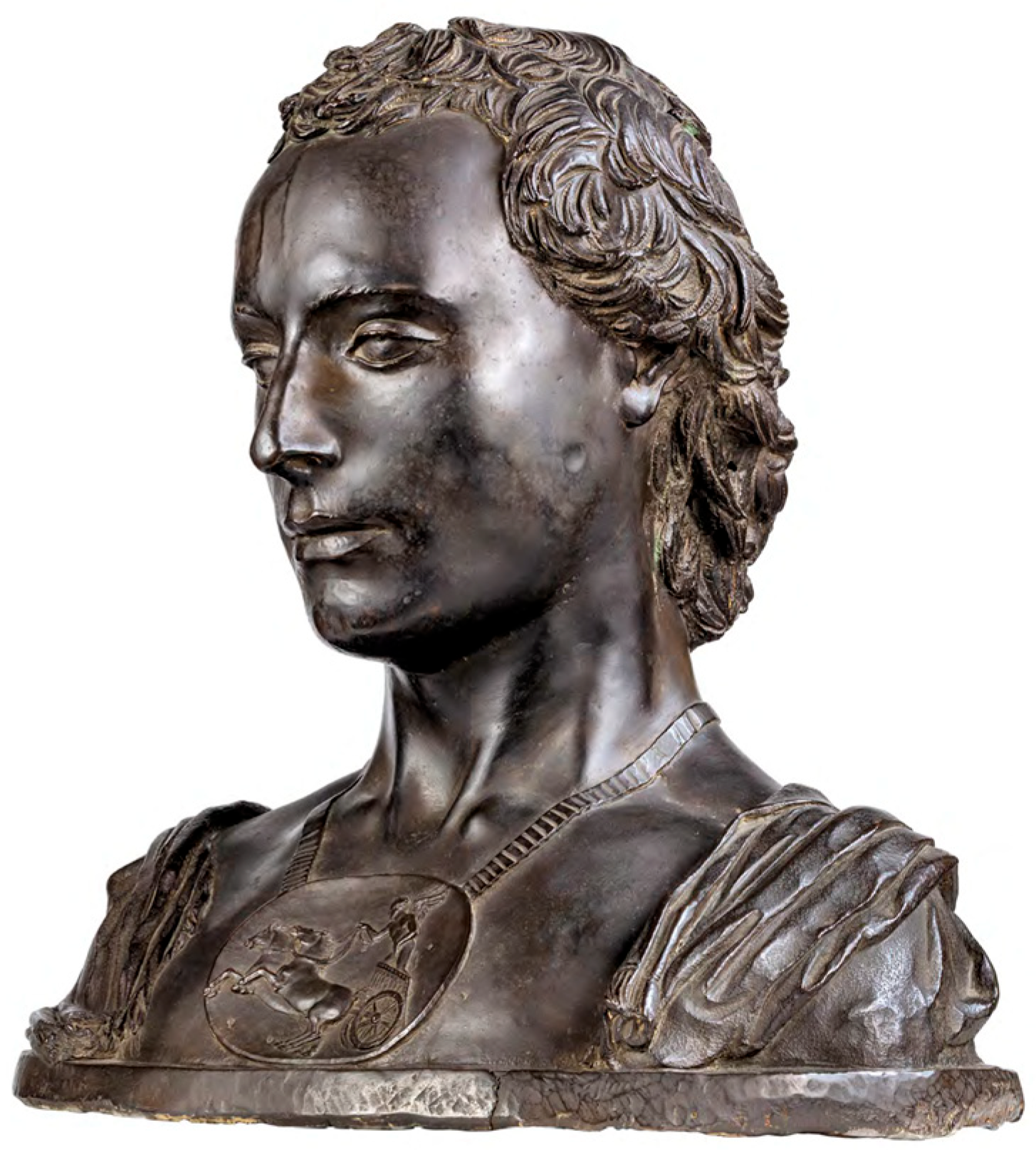
| 64 | Ficino is “la prima grande figura di filosofo cortigiano […] Con Ficino compare il letterato di corte, neppur maestro d’università, ma al servizio di un signore che se ne vale, non solamente per dar lustro alla propria casa, ma anche, senza dubbio, per sottili scopi di propaganda politica […] Alla gioventù fiorentina abituata a sentirsi esortare dalle cattedre e nei discorsi ufficiali alla dignità dell’azione mondana e della vita civile i ficiniani predicarono i rapimenti dell’ascesi contemplativa” (Garin 1951, p. 290). Comparable to the centaur’s metamorphosis, his spiritual journey is similarly complex—“the line of a process that from Lucretian despair, through Platonic hope, led Ficino to Christian certainty” (Garin 1951, p. 292). For the role Augustine plays in the development of his thought, see (Cassirer 1945, pp. 494–501; Vasoli 1999, pp. 91–112). Overall, Ficino’s interpretive approach is open and synergistic, systematically emphasizing the early Augustine and harmonizing him with Origen—highlighted by the clear connection between amor Dei and Platonic eros, as shown in El libro dell’amore, cited below. The Augustine associated with Florentine Neoplatonism is thus “Origenized” see (Wind 1983, pp. 42–62). |
| 65 | Regarding the identification of the author and the young man depicted, I rely on Gianluca Amato’s significant study (Amato 2021, pp. 16–67); for the connection between the bust and the centaur medallion of the Palazzo Medici, see (Amato 2021, pp. 37–40). For both a historical-cultural and iconographic analysis of the importance of the myth of the winged chariot within Medicean circles, see (Amato 2021, pp. 26–37); for its connection with the dynamic figure of the centaur, see (Martinez 2019, pp. 151–79). (Panofsky 1972) had already indicated the bust of a young philosopher—later identified with Giovanni Cavalcanti—as evidence of the diffusion of Ficinian ideals. |
| 66 | See Marsilio Ficino, El libro dell’amore, Oratio VII, chap. 14. The work, published only in the following century under the title Sopra lo amore (Ficino 1544), is the slightly later vernacularization of Ficino’s Commentarium in Convivium Platonis de Amore, composed in 1469, whose autograph is preserved in the Biblioteca Apostolica Vaticana, Vat. Lat. 7705; an idiograph, with autograph interventions, is in the Bodleian Library of Oxford, Canon. Lat. class. 156. |
| 67 | On the figure of a refined intellectual, an intimate and “unicus” friend loved by Ficino, as well as a Florentine political patrician, see (Della Torre 1902, pp. 566–67, 647–54). |
| 68 | Marsilio Ficino, “Lettera a Giovanni Cavalcanti Amico Unico (Mostra qual sia la verità di Iddio lo splendore la bellezza e l’Amore),” (Ficino 1549, 36v). See also Ficino, Sopra lo amore, Oratio VII, chaps. 12–13. |
| 69 | See above, note 33. |
| 70 | In the Heptaplus, Pico identifies in the “spiritus” that “medium vinculum” capable of “copulare” the two “naturae” of the heavenly soul and the earthly body: “Verum inter terrenum corpus et caelestem animi substantiam opus fuit medio vinculo, quod tam distantes naturas invicem copularet; huic muneri delegatum illud tenue et spiritale corpusculum, quod et medici et philosophi spiritum vocant” (Pico della Mirandola 1942a p. 270). Panofsky links the idea of Pico’s spirit as “medium vinculum”—which, by mediating soul and body, connects and binds the former to the latter—to the interpretation of Michelangelo’s Prigioni, especially the Dying Slave in the Louvre, which attempts to free itself from its body. At its feet, a monkey is sketched, symbolizing the animal and lascivious side of desire (Panofsky 1939, pp. 268–72). |
| 71 | “Et homo in honore non commorabitur, adsimilatus est iumentis et exaequatus est […] Homo in honore cum esset non intellexit, conparatus est iumentis insipientibus; et similis factus est illis” (Psalm 48:13 and 21); “Equi amatores et admissarii facti sunt unusquisque ad uxorem proximi sui hinniebat.” In Pico’s commentary on the Genesis account of creation, the sinful fall is equated with becoming like a “beast of burden:“ “Scilicet homo cum in honore esset non intellexit, sed comparatus est iumentis insipientibus et similis factus est illis” (Pico della Mirandola 1942a, p. 284). Mares are even identified as intermediate between the brute animal and the human being, insofar as they signify—in Chiron’s manner—the impulses of the body that can be mastered by reason: “Sunt iumenta, quae, et si carent ratione, disciplinae tamen humanae quoquo modo capaces cum sint, rationis aliquid participare videntur, mediam quasi sortita conditionem inter bruta et homines” (Origen of Alexandria 1896, p. 300). For the depiction of sin as the fall of the soul that becomes bestial, making itself similar to horses/mares, see the passage from Clement of Alexandria’s Stromata, cited above, note 9. See also Origen, Commentary on the Gospel of John I, 22,123; Against Celsus IV, 90. Noteworthy in Origen, Commentary on the Gospel of John X, 32,203–205 is the allegorical interpretation of the “centaur-man,” inspired by Jesus’ entry into Jerusalem, who “just and bringing salvation, and meek, having mounted an ass and a young colt. Whoever, then, receives Him will no longer be afraid […] the horse, the vain thing for safety, that is the mad desire which has accustomed itself to the things of sense and which is injurious to many of those who desire to dwell in Jerusalem and to attend to the sound Word.” |
| 72 | “Quis hunc nostrum chamaeleonta non admiretur? Aut omnino quis aliud quicquam admiretur magis? Quem non immerito Asclepius Atheniensis versipellis huius et se ipsam transformantis naturae argumento per Proteum in mysteriis significari dixit. Hinc illae apud Hebraeos et Pythagoricos metamorphoses celebratae. Nam et Hebraeorum theologia secretior nunc Enoch sanctum in angelum divinitatis, quem vocant nunc in alia alios numina reformant. Et Pythagorici scaelestos homines in bruta deformant et, si Empedocli creditur, etiam in plantas. Quas imitatus Maumeth illud frequens habebat in ore, qui a divina lege recesserit brutum evadere, et merito quidem. Neque enim plantam cortex, sed stupida et nihil sentiens natura; neque iumenta corium, sed bruta anima et sensualis; nec caelum orbiculatum corpus, sed recta ratio; nec sequestratio corporis, sed spiritalis intelligentia angelum facit […] Hinc illud Chaldaeorum homo variae ac multiformis et desultoriae naturae animal. Sed quorsum haec? ut intelligamus, postquam hac nati sumus conditione, ut id simus quod esse volumus, curare hoc potissimum debere nos, ut illud quidem in nos non dicatur, cum in honore essemus non cognovisse similes factos brutis et iumentis insipientibus [see Salmo 48, 21]. Sed illud potius Asaph prophethae: “Dii estis et fili excelsi omnes” [Psalm 81, 6 and Gospel of John. 10, 34] […] Dedignemur terrestria, caelestia contemnamus, et quicquid mundi est denique posthabentes, ultramundanam curiam eminentissimae divinitati proximam advolemus […] Qui Saraph, idest amator est, in Deo est, et Deus in eo, immo et Deus et ipse unum sunt” (Pico della Mirandola [1496] 1942b, pp. 106–12). “Si noster homo ab hostibus inducias tantum quaesierit, multiplicis bruti effrenes excursiones et leonis iurgia, iras animosque contundet. Tum, si rectius consulentes nobis perpetuae pacis securitatem desideraverimus, aderit illa et vota nostra liberaliter implebit, quippe quae caesa utraque bestia, quasi icta porca, inviolabile inter carnem et spiritum foedus sanctissimae pacis sanciet […] pace sanctissima, individua copula, unanimi amicitia, qua omnes animi in una mente, quae est super omnem mentem, non concordent adeo, sed ineffabili quodam modo unum penitus evadant” (Pico della Mirandola [1496] 1942b, pp. 116–18). |
| 73 | See (Martinez 2017, p. 20): “Chiron’s moral behavior, wisdom, and enlightened nature prove that even centaurs have the ability to tame their wild nature, transcend the desires of the flesh, and exhibit more human-like qualities, such as civility, restraint, and compassion;” and (Martinez 2017, 24n17): “Although the Neoplatonist philosopher Marsilio Ficino never mentions the centaur in his writings, Most argues that the ‘centaur embodied Ficino’s concept of the dual, conflicting nature of humanity that could be transcended by divine wisdom’.” See also (Grafton 2010, p. 188). |
| 74 | The reference is to (Warburg 1999a). Emphasizing the symbolic combination of centaur and David, Warburg defines the centaur as “an antique elemental deity […] The centaur—who, like Fortune, is a nature spirit—is used to combine an antique nuance with a suggestion of expressive energy, conveyed by the fact that he wields David’s sling” (p. 244); the centaur, as David’s alter ego, would thus constitute the symbolic polarity identifiable with pagan antiquity and the power of nature, serenely reconciled with biblical revelation, attesting to an “optimistic attempt to absorb and enlist antiquity […] This was the organic polarity that existed within the capacious mind of one cultivated early Renaissance man: a man who, in an age of transformed self-awareness, strove for a positive balance of his own” (p. 249). (See, in this regard, Toussaint 2024, pp. 11–36; Martinez 2019, pp. 137–50). |
| 75 | “Understanding, enlightenment, law in the workings of cultural history, introduced by including irrational instinct within the ambit of historical investigation, was then the goal of my work […] Per mo[n]stra ad astra: the gods have placed the monster on the path to the Idea” (Warburg, letter to Karl Umauf, 13 October 1928, cited in (Forster 1999, p. 25)). It should be noted that Warburg would die just a few days later, on October 26. See, in this regard, (De Laude 2015, pp. 272–76). |
| 76 | See (Boll 1903): In an appendix to the volume, Boll reproduced a Byzantine-era celestial map called the sphaera barbarica, so named because it differed from and was more complex than those based on Hellenistic and Roman sources. It was connected to the work of Teucer of Babylon (1st century BCE), who overlaid Egyptian deities onto the Greco-Babylonian zodiac. Boll’s work played a key role in the groundbreaking lecture that Warburg delivered in Rome in 1912 at the Accademia Nazionale dei Lincei. It is worth noting that the motto per monstra ad sphaeram appeared on Boll’s own bookplate. The first systematic presentation of the sphaera barbarica was given in the 1912 lecture at the Accademia Nazionale dei Lincei by Aby Warburg (Warburg 1922; Italian trans. Warburg 2004, pp. 515–55). |
| 77 | |
| 78 | See (Warburg 2014a, pp. 51–54), esp.: “È la stessa scienza matematica della Grecia, che venne ripristinata nel corso del Rinascimento alle sue forme originarie, a offrire all’uomo europeo l’arma per lottare contro i demoni provenienti dalla Grecia, o meglio dalla Grecia asiatica. L’Atene greca vuol sempre di nuovo essere liberata dall’Alessandria arabizzante. Forse è questo duplice movimento spontaneo all’interno dell’antica eredità greca, in senso più ampio e migliore di quanto si sia finora supposto, il senso interno della cosiddetta epoca del Rinascimento” (p. 54). See also the concluding statement of (Warburg 2004, p. 552): “Il nuovo grande stile che ci ha donato il genio artistico italiano era di fatto radicato nella volontà sociale di liberare l’umanità greca dalla “pratica” medievale e latina di matrice orientale. Con questa volontà diretta a restaurare l’Antico, il “buon europeo” ha iniziato la sua lotta per i Lumi in quell’epoca di migrazioni internazionali di immagini che, in modo un po’ troppo mistico, definiamo come età del Rinascimento.” |
| 79 | Gianni Carchia (Carchia 1984, p. 101) refers to Aby Warburg: symbol and tragedy, which continues: “Letta nel suo nucleo di massima intensità, la storia come memoria scopre in Warburg l’enigma della confusione mimetica originaria.” See Alessandro Del Lago (Del Lago 2016, pp. 89–90): L’arcaico e il suo doppio/The archaic and its double: “Riprendendo la metafora di Freud si potrebbe dire che, all’apice della modernità, l’edificio della psiche collettiva è traballante. Le forze oscure dei sotterranei sono coperte di detriti, e i piani superiori della coscienza minacciati dalle crepe. La coscienza è per Warburg un “sogno.” È piuttosto l’aspirazione alla redenzione della coscienza dalle forze demoniache—che può attuarsi solo nella Memoria—ciò che costituisce la lontana, irraggiungibile stella polare dello storico” (pp. 102–3). |
| 80 | See (Warburg 2014a, pp. 70–73). I will return later to Botticelli’s Pallas and the Centaur; regarding Raphael’s grand fresco in the Vatican Stanze, Warburg writes: “La profonda calma dell’Accademia greca pervade la sala. La dèa Atena si cela nell’ombra della nicchia e tuttavia sporge dallo sfondo. Per monstra ad sphaeram! Dalla terribilità del monstrum [il centauro] alla contemplazione nella sfera ideale della meditazione paganamente dotta. È questo il percorso nella evoluzione culturale del Rinascimento” (p. 73). |
| 81 | The codex also contains Leonardo Bruni’s Isagogicon moralis disciplinae and his translation of the pseudo-Aristotelian Oeconomica. Beneath the medallion with Francesco Sassetti’s name is a cartouche bearing the motto A mon pouvoir. |
| 82 | On Botticelli’s dependence and his symbolic figures on Landino’s Comento sopra la Comedia, see (La Malfa 2000, pp. 225–40; Sbaraglia 2012, pp. 301–9, 297; De Girolami Cheney 2020). On Chiron as a Medicean symbol, see finally (F. Marcelli 2011, p. 33 and 54 nn. 90–94); for Marcelli, Landino himself is portrayed in Signorelli’s portrait, perhaps commissioned by Bartolomeo Scala, humanist favored by the Medici, who became first chancellor of the Florentine republic and then even Gonfaloniere di giustizia; “amicus et familiaris” of Bernardo Machiavelli, having recovered a leading role within the popular republic, he was, after Savonarola’s fall, promoter in 1498 of young Niccolò Machiavelli’s rise to the politically decisive Seconda segreteria. |
| 83 | For a quick survey of Medicean imprese, particularly the diamond one, see (Giovio 1863, pp. 20–24). On palle and Pallade as Medicean symbols, see (Liebenwein 1988, p. 132). |
| 84 | On Pallas as a symbol of Lorenzo the Magnificent’s enlightened and peaceful rule over Florence, see (Steinmann 1901, pp. 74–76); for a recent reinterpretation of the painting as an allegory of the 1480 Peace of Naples between Lorenzo and Ferrante of Naples, capable of remedying Sixtus IV’s violent madness, see (Centanni 2013, p. 142); for a later political contextualization, see (Guidoni 2005, pp. 46–50). On Lorenzo’s bold journey to Naples in 1479, which detached Ferrante from his alliance with Sixtus IV, see Machiavelli, Istorie Fiorentine VIII.17–19. |
| 85 | See (Gombrich 1945, pp. 50–53), devoted to the interpretation of Pallas and the Centaur. To seal his “spiritual” reconstruction of the work, Gombrich cites three verses from Laurence the Magnificent, Altercazione IV, 19: “La figlia qui del gran Tonante sorga,/che sanza madre del suo capo uscio;/questa la mano al basso ingegno porga.” Gombrich’s interpretation evidently depends on (Warburg 2014a, pp. 70–72): Atene “divenne come Pallade—anche l’assonanza del nome con l’impresa dei Medici, la palla, vi ha la sua parte—la dèa di casa della cultura medicea. Così essa appare nell’anno 1475 nel torneo in onore di Simonetta Vespucci come addomesticatrice di Amore, lo addomestica nel senso della Pudicitia di Petrarca e, come Poliziano canta nel suo poema per la giostra, incita alla fine Giuliano a una coraggiosa virilità […] Emerge dal mostruoso complesso agonale dell’antichità, anche se come carattere ideale aspira a un simbolismo spiritualizzato […] Ciò appare con chiarezza nel quadro di Botticelli: Pallade che addomestica il centauro. Forse in relazione a una qualche congiura, lo spirito della cultura medicea vi è espresso nella figura simbolica del complesso agonale tra intelletto e forza primordiale.” See (Wittkower 1939, p. 200): “The picture represents the wisdom in Lorenzo which has overcome the centaur in him. As a secondary allusion Botticelli certainly meant to glorify Lorenzo’s virtuous government of Florence, the town of Minerva.” Finally, see (De Girolami Cheney 1985, pp. 88–89). |
| 86 | “Nello sguardo del centauro non si vede solo la sottomissione, ma soprattutto il dolore, la tristezza mista alla pazienza, un’enigmatica sofferenza muta e silenziosa, che pare condivisa anche dalla vergine guerriera. Anzi, l’intero dipinto del Botticelli ne è pervaso ed è questa sorda inquietudine a provocare” (Tagliapietra 2020, p. 315). |
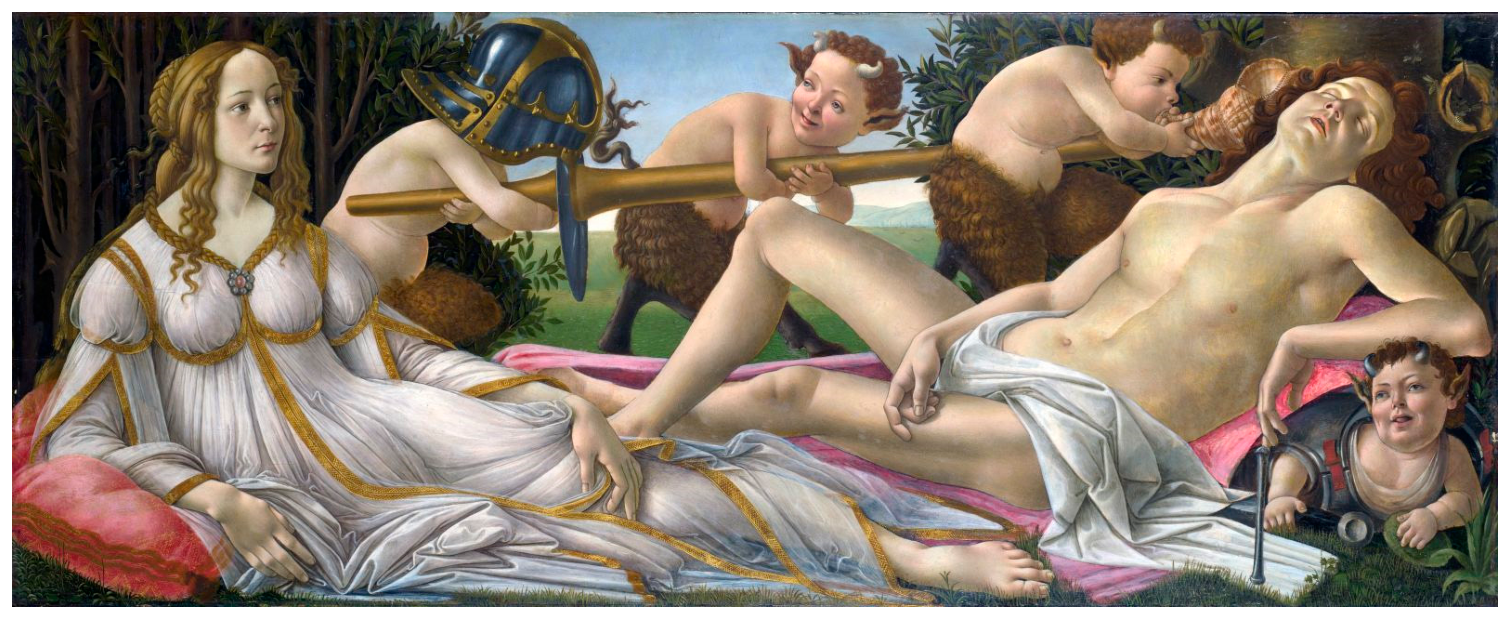
| 87 | Venus is depicted with features of Simonetta Vespucci, as shown by the wasp’s nest behind Mars’s head, symbolically referencing the woman’s surname beloved by Giuliano, as noted by (Gombrich 1945, p. 49). The jousting lance is revealing, alluding to the 1475 Florentine tournament won by Giuliano, who carried a standard bearing Pallas in the likeness of Simonetta: I will return to this in the next section. |
| 88 | Of the greatest relevance, in this regard, is the psalm written in 1478 in reference to the Pazzi conspiracy by Gentile Becchi, In casu 1478 die 26 aprilis in votis Laurentii de Medicis psalmus, Latin text edited in (N. Marcelli 2015, pp. 275–76). It is a cento of biblical Psalms, in which Lorenzo is presented as a new David whom God’s grace protects, saving him from death, and exalts against his enemies: “Perambulabam in innocentia cordis mei,/orabam ad templum sanctum tuum, Domine,/in quo convenirent simul inimici mei,/accipere animam meam consiliati sunt./Ego autem in te speravi, dixi: “Domine, Deus meus es tu,/et eripe me de manibus inimicorum;/qui redimisti servum tuum David/de gladio maligno, eripe me,/donec intrem in sanctuarium tuum/et intelligam in novissimis eorum […] Benedictus Deus qui non amovit orationem meam/et misericordiam suam a me;/qui docet manus meas ad proelium/et posuit ut archum aureum brachia mea./Misit de caelo et liberavit me/et non sunt infirmata vestigia mea. […] Domine, virtus salutis meae,/obumbrasti super caput meum in die belli,/nec conclusisti me in manibus inimici” (vv. 9–18; 22–24; 31–33). Becchi, in this tragic moment, revives the messianic self-identification of the Medici, rulers of free Florence, with David, God’s anointed, victorious over Goliath and his enemies, as shown by Donatello’s David commissioned by Cosimo the Elder and the original inscription on the pedestal of the statue in the courtyard of Palazzo Medici: “Victor es quisquis patriam tuetur;/frangit iniusti deus hostis iras./En puer: “Grandem domui tyrannum:/vincite, cives!” in (N. Marcelli 2015, p. 141). I also recall that Becchi was the author of the virulent Florentina Synodus, directed against Sixtus IV, the instigator of the Pazzi conspiracy, published in (Poliziano and Becchi 2012, pp. 90–168). In the same volume is the annotated chronicle by Poliziano, Coniurationis Commentarium (Poliziano and Becchi 2012, pp. 56–84). |
| 89 | Regarding the Medici’s praise devices—which to me always seem cryptically messianic—the olive branches arranged in a cross that burn without ever being consumed, the olive or laurel trunk that constantly regrows green, and the phoenix in its mythical resurrection from death, along with their variations, see the notable essay by (Bausi 1992, pp. 437–74). For a courtly exaltation of the Medici lineage, capable of conquering time, see the epigram by Gentile Becchi, Ad Petrum Medicem dominum suum in datum manus, in (N. Marcelli 2015, pp. 295–96); in particular the closing vv. 47–50: “Semper erunt Medices, semper adamantius heros,/gesta adamantino tempore semper erunt./Semper erunt Petri gentilia tempora quae sint,/semper erunt domini, servula semper erunt.” |
| 90 | Virgil, Bucolics, Eclogue IV, vv. 6–10 and 13–17. |
| 91 | See (Spike and Cecchi 2017, p. 125). |
| 92 | On Pallas as a favored Medici symbol, see (Agnoletto 2013, pp. 7–21); also relevant is (Agnoletto 2015, pp. 75–95). |
| 93 | “Alessandro […], oltre ad essere considerato, come Marte, il leone e il centauro, crudele e iracondo, era ritenuto, come il centauro, un despota e un mostro; come il leone, un ambizioso e un superbo; come Cimone, quasi insano di mente” (Agnoletto 2015, p. 90). |
| 94 | “Una riflessione, quella anti tirannica, che gioca un ruolo cardine all’interno del discorso complessivo intessuto all’interno della tavola degli Uffizi, dove è manifesta la celebrazione di eroi ed eroine antichi e biblici, che, in linea con le istanze politiche che animavano la vita fiorentina, erano intesi come simboli di giustizia e amore per la patria, nonché della libertà repubblicana, valore che si intestano alcuni membri della famiglia Medici, primo tra tutti Cosimo il Vecchio, che si propone come il salvatore della libertà di Firenze e d’Italia: Davide e Giuditta, conosciuti per essere due famosi tirannicidi biblici; Muzio Scevola, prototipo dell’uomo giusto” (Agnoletto 2015, p. 91). |
| 95 | See (Agnoletto 2014, pp. 94–97; Ead. 2015, pp. 81–82). |
| 96 | Matthew 11:30. See (Giovio 1863, p. 30), who emphasizes: “ancor che paia che ‘l detto giogo fusse prima del gran Cosimo, il quale, quando fu richiamato dall’esilio alla patria, figurò in una medaglia Fiorenza assettata sopra una sedia col giogo cotto i piedi, per dinotare quasi quel detto di Cicerone Roma patrem patriae Ciceronem libera dixit, et per la bellezza fu continuato il portarlo nel pontificato di Leone, et meritò d’essere stampato nelle monete di Fiorenza.” Still in 1530, the day before the fall of the revolt-backed republic of Florence—subjugated after a ten-month siege by imperial and papal troops and the defeat at Gavinana—Paolo Giovio invoked the Medici motto, referring it to Clement VII: “Li arrabiati abasseranno il colo al suave jugo de le clementissime Palle; aliter gustarano qual sia el dolore de’ testiculi” (Paolo Giovio, letter of 9 August 1530 to Marco Contarini, quoted in (O’Bryan 2015, p. 605, n. 62)). The chronic Medici medicina would have been, in this case, exceedingly bitter, and the most clement yoke would have revealed itself fierce and violent. |
| 97 | See (Machiavelli 2012b, pp. 273–75). |
| 98 | (Machiavelli 2012a, pp. 75–90, in particular vv. 7–15 (76–77)). |
| 99 | See (Centanni 2019, pp. 69–112). |
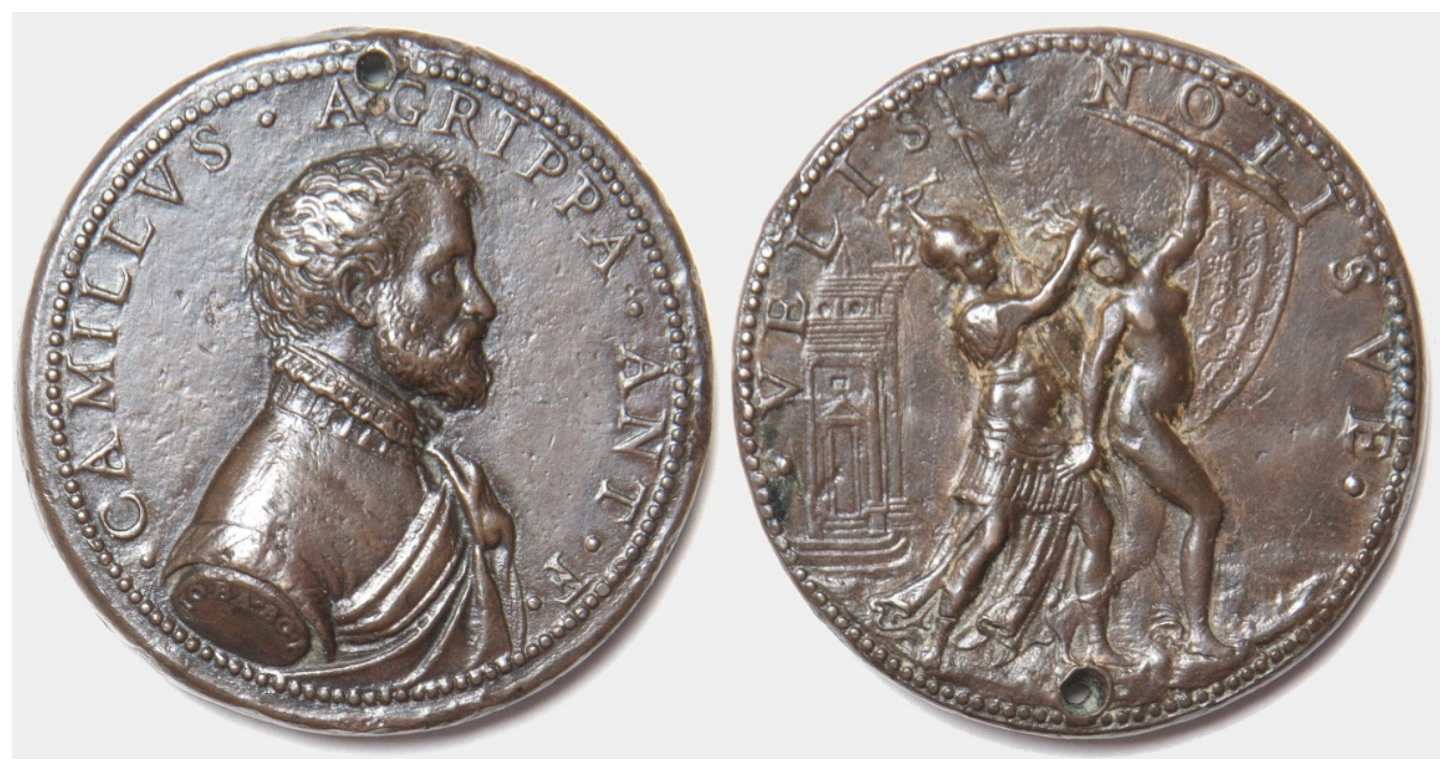
| 100 | See (Warburg 2014b, pp. 13–15): “Afferrare la Fortuna per il ciuffo è l’atto che si oppone nel modo più netto all’atteggiamento passivo nei confronti del fato e precisamente per il Rinascimento (ad esempio Petrarca, de remediis utriusque fortunae e credo anche Boccaccio) fino a Machiavelli questa Occasio è la più decisa concorrente della Fortuna con la ruota e con la vela. Max mi ha scritto che tu hai isolato in Machiavelli proprio la Fortuna con le molte ruote. Ma come supplemento vi spetta senz’altro la sua poesia sulla Occasio […] La medaglia rinascimentale [quella di Camillo Agrippa] che devi ricevere, di cui ti ho già scritto, mostra con un simbolismo assolutamente felice ‘la mentalità’ dell’uomo rinascimentale. Un uomo armato di corazza afferra per il ciuffo la Fortuna con la vela—con l’iscrizione: Velis nolisve. Dunque con lo spiritoso gioco di parole, velis—con le vele, che tu lo voglia o no, e anche le tue vele non ti sono affatto d’aiuto […] Così è, da un lato, il timone, dall’altro il ciuffo della Fortuna il manico da afferrare per colui che lotta con le potenze demoniche della vita. Esse vengono, nell’esser prese, comprese (durch Greifen begriffen). L’essenza del simbolo religioso pagano consiste, da un lato, nella causazione antropomorfa delle cose in genere, al fine di comprendere il divenire, che fluisce in maniera enigmatica, come meta volontariamente perseguita di una personalità sovraumana. E in tal modo, dall’altro lato, il simbolo consente al credente di confrontarsi con questa causa dai sentimenti fondamentalmente umani attraverso la lotta, e non soltanto tramite preghiera e sacrificio […] L’immagine della Fortuna afferrata per il ciuffo] mostra il cosiddetto uomo moderno nella sua condizione di crescente insolenza.” Even more explicit are the contemporaneous remarks in (Warburg 2014c, pp. 19–20), which comment on the same medal: “L’ideale di condottiero della Fortuna-Audax appare qui in un rovesciamento consapevolmente brutale come polo complementare della Fortuna-Fatum, che volge la ruota […] Non si può esprimere in maniera più efficace con parole e immagine il fulmineo rovesciamento dell’agire nella sua forma più primitiva. Quel che fa questo guerriero è brutale, insensata stoltezza. Nel momento in cui l’afferra per il ciuffo, la distrugge come dèa propizia dello spazio dominato. Distrugge il proprio mezzo di trasporto per assicurarsi uno scalpo. Non si può dare geroglifico più evidente e perspicuo per la coazione a regredire allo stadio dell’uomo prensile (Greifmensch), per il tragico destino dell’uomo che viene sempre strappato via dalla condizione della sophrosyne (Besonnenheit) e rigettato in quello della passionale presa di possesso (Besiztsergreifung), che deve sempre di nuovo prendere (greifen) quando invece vorrebbe comprendere (begreifen).” |
| 101 | See (Sofri 2013, in particular the chapter “La fortuna acciuffata” (pp. 96–104)); Sofri underscores how Alfonso’s seizing of Fortune is “una sfida sessuale” (p. 102), a sexual agression that resolves itself into a sexual possession (p. 103). And, commenting on the medal of Camillo Agrippa: “Aggiungerà Warburg, che il gesto dell’uomo che afferra la Fortuna-Occasione dal ciuffo somiglia a quello del boia che afferra il condannato. Ma il’ condannato’ è maschio, La Fortuna è donna e nuda. Il gesto somiglia a quello del maschio che afferra la femmina, per la sua condanna privata” (p. 104). |
| 102 | See (Sofri 2013, the chapter “La fortuna nuda e l’Italia spogliata” (pp. 96–104)); in particular, with great acuity Sofri specifies: “Nel capitolo finale [of The Prince], Machiavelli argomenta l’occasione senza eguali che si dà a un principe nuovo, perché l’abiezione dell’Italia ha toccato il fondo. Una progressione di attributi dolorosi—schiava, serva, dispersa—arriva a una connotazione apertamente sessuale, e ripiglia dall’altro capo l’incitamento a urtare e battere la fortuna: battuta, spogliata, lacera, corsa […] Là capriccio e lussuria, qui onore e offesa. Là una donna da battere, qui una per cui battersi contro l’oltraggio di altri uomini. La Fortuna era nuda, l’Italia è spogliata. Di nuovo un corpo femminile forzato, ma qui non è l’impeto del giovane conquistatore, bensì il furore sacrilego del barbaro […] Il figlio più degno dell’Italia battuta e spogliata dai barbari è quello capace di battere e violare la fortuna. Congiunta nella citazione del giovane feroce e redentore mancato, l’immaginazione sdoppiata della donna non potrebbe essere più evidente. Mi sembra altrettanto evidente la connessione, anzi la complementarità, fra il penultimo e l’ultimo capitolo, la donna-Fortuna e la donna-Italia” (pp. 110–11). |
| 103 | (Warburg 2014a, pp. 97–99). See (Piccolomini 2011, pp. 102–9; see, in particular, p. 107): “Video parva statura virum, nigro vultu, letis oculis, qui manus in capillos fortune conjecerat arreptaque coma: ‘Sta tandem, domina, meque respice—dicebat—. Quo me fugis jam annis duodecim? Capta es, sive velis sive nolis, ut me respicias oportet, satis mihi adversa fuisti. Nunc alium vultum prebebis reor. Aut mihi blanda eris, aut omnes tibi crines evellam. Cur me fugis magnanimum pusillanimesque sectaris?’ Fortune quoque in eum vox erat: ‘Vicisti fateor, nec me amplius experieris adversam’. Tum ego: ‘Quia hic est—inquam—Vegi, qui Fortune vim facit?’ ‘Alfonsus—refert ille—rex Aragonum, qui cum fratribus apud Ponzam captus, Philippoque duci Mediolanensium datus, dimissus denique novis se preliis immiscuit, adversamque dominam insecutus, tantum instando perseverandoque fecit, ut victam pudore Fortunam jam in suum favorem revocaverit”. Warburg, furthermore, connects the image of Fortune violently seized by the hair and in effect raped with Perseus holding the head of the decapitated Medusa by her hair: “Nella presa alla Perseo (Perseusgriff) della testa di Medusa l’energetica impavidità dell’umanità eroica trova la sua più illuminante espressione simbolica” (Warburg 2014a, p. 97). |
| 104 | See (Centanni 2019, pp. 73–75, 82, 85–86). Centanni, however, offers a Warburgian interpretation of the Agrippa medal that I believe is only partial and even misleading, as it focuses solely on the virtuous assertion of Wisdom over Fortune: “Al centro [del pannello di Mnemosyne dedicato alla Fortuna] la figura dell’ ‘uomo che libera se stesso’ virando in modo positivo il ‘simbolo conflittuale’ di Fortuna” (p. 87), “che va piegata e soggiogata per forza di Virtù” (p. 88); “Minerva—Sapienza e Fortezza—ha vinto comunque sul demone capriccioso [della Fortuna]” (p. 96); see the chapter “La lezione di Warburg” (pp. 87–96). One could argue that the obvious erotic element of seizing Fortune by the hair (also seen in the Botticellian images discussed earlier) marks the armored figure as male. Conversely, we might view the violent ‘lord’ of Fortune as the virtuous warrior dressed in the armor of Pallas, as we will see when discussing Giuliano de’ Medici in the next chapter. |
| 105 | “Sembra dunque che la stessa parabola complessiva dell’itinerario di Warburg possa lasciarsi sintetizzare nell’opposizione fra il suo primitivo paganesimo, che lo avrebbe risucchiato nella demonicità naturale, ed un finale esito cristiano, dove la tragica polarità di ogni espressione culturale verrebbe abbandonata in favore del dominio del solo elemento spirituale puro. In realtà, si tratta qui di osservare che ciò che ha attirato alla fine Warburg verso la dimensione della trasfigurazione spirituale è quel medesimo impulso alla libertà che lo aveva da principio spinto alla scoperta, tramite la storia come memoria, dei sedimenti più arcaici dell’immagine […] Di contro a qualunque visione ottimistico-conciliativa Warburg è rimasto fedele fino all’ultimo ad un’interpretazione fortemente drammatica della sfera simbolica” (Carchia 1988, pp. 104–5). |
| 106 | “Ovid’s Fasti were also a principal theme of Poliziano’s public lectures in Florence from 1481 onward. All this taken together supports the notion that Poliziano was Botticelli’s humanist adviser” (Warburg 1999b, p. 122). On Poliziano’s cultural autonomy with respect to Ficinian Platonism, see (Garin 1979). |
| 107 | They were published, shortly before the author’s death, in Cose vulgare del Politiano, de’ Benedetti, Bologna 1494, ff. A 1r–D 6v; here I shall cite them from the recent edition by Francesco Bausi’s (see Poliziano 2016). Bausi maps out the composition of the work over time: “La mia ipotesi è dunque che Poliziano abbia ripreso in mano la vecchia “giostra” dopo la morte di Giuliano, per ricavarne un testo in lode del giovane e sfortunato fratello di Lorenzo […] Le tre fasi redazionali del poemetto sarebbero pertanto databili nell’ordine al 1475, al periodo compreso fra la primavera del 1478 e i primi mesi del 1480 […] e alla primavera del 1494 (anche se questa terza fase vide solo pochi e modesti ritocchi, introdotti per rendere il testo pubblicabile nonostante la sua incompiutezza)” (pp. 157–58); “Avallando nel 1494 L’inclusione del poemetto tra le Cose vulgare, Poliziano fu quindi mosso in prima istanza da esigenze e da finalità di propaganda politica […] e questo spiega perché egli acconsentisse a pubblicare un testo non finito (anche se comunque dotato di un senso compiuto), accordandosi col Sarti affinché questi nella dedica affermasse di stamparlo a insaputa dell’autore e lo presentasse come un’opera giovanile: affermazioni necessarie sia per giustificare la pubblicazione di un’opera “imperfetta”—e dichiarata esplicitamente come tale—, sia per sollevare Poliziano da ogni responsabilità al riguardo” (p. 159). For a contextualization of the work from a historical and literary-historical standpoint, see the notable volume by (Decaria 2023). |
| 108 | (Decaria 2023, p. 210), where it is specified: “Poliziano si ritrovò, evidentemente per cause esterne sopravvenute, a ripensare il suo testo e ad adeguarlo alla tragedia che si era trovato ad attraversare.” |
| 109 | (Poliziano 2016, Book I, stanza 32, vv. 1–8). For an interpretation of the work, important is the introduction by Francesco Bausi in (Poliziano 2016, pp. 7–170; see also Doglio 1983, pp. 197–216; Martelli 1992, pp. 795–800). |
| 110 | The Virgilian echo is evident: “Ceu duo nubigenae cum vertice montis ab alto/descendunt Centauri Homolen Othrymque nivalem/linquentes cursu rapido; dat euntibus ingens/silva locum et magno cedunt virgulta fragore” (Aeneis, VII, 674–677). |
| 111 | (Ullmann 1894, pp. 289–92) took the image of Giuliano as centaur as the interpretive key to Botticelli’s Pallas and the Centaur: “Die Kentauren werden häufig in der Kunst als Sinnbild roher, gewaltthätiger Kraft dargestellt […] Auch Polizian (Giostra I, 32) beschreibt die Wildheit der Kentauren” (p. 291). The interpretation of the Botticellian painting proposed by Ullmann was discussed by (Contarini 1992, pp. 87–93), especially on page 87. I remember that Poliziano was an avid reader of Statius, particularly of the Achilleis. Moreover, it was Poliziano himself who recommended to the sixteen-year-old Michelangelo the subject of the marble high relief of the Battle of the Centaurs (c. 1492): see (Condivi 1553), ff. 6v–7r. For additional evidence of the poet’s interest in the centaur Chiron, tutor of Jason and Achilles, see (Poliziano 1482, in particular Praefatio, ff. a i v–a ii r). |
| 112 | When Giuliano is introduced, he embodies the image of a centaur—naturally wild and free, a Sagittarius hunter, almost one with his horse: “Nel vago tempo di sua verde etate,/spargendo ancor pel volto el primo fiore,/né avendo il bel Iulio ancor provate/le dolce acerbe cure che dà Amore,/viveasi lieto in pace e in libertate./Talor, frenando un gentil corridore/che gloria fu de’ ciciliani armenti/(con esso a correr contendea co’ venti),// or a guisa saltar di leopardo,/or destro fea rotarlo in brieve giro;/or fea ronzar per l’aer un lento dardo,/dando sovente a fere agro martiro” (Poliziano 2016, Book I, stanza 8, vv. 1–8 and stanza 9, vv. 1–4). |
| 113 | An anonymous detailed description of the Botticellian image painted on the standard has come down to us, reported by (Poggi 1902, pp. 71–77), and subsequently by (Agnoletto 2013, p. 8): “Teneva decta Pallas nella mano diricta una lancia da giostra et nella mano mancha lo scudo di Medusa. Era appresso a decta figura un prato adorno di fiori di varii colori che n’usciva uno ceppo d’ulivo con un ramo grande, al quale era legato uno dio d’amore cum le mani dirieto cum corde d’oro. Et a’ piedi aveva archo, turcasso et saecte rocte. Era commesso nel ramo d’ulivo, dove stava legato lo dio d’amore, uno brieve di lectere alla franzese, d’oro, che divevano: La sans par. La sopradecta Pallas guardava fisamente nel sole che era sopra a lei.” For an interpretation of the Stanze as a systematic elaboration of the image on Botticelli’s standard, see (Manzi 2008, pp. 127–36, in particular 133). |
| 114 | (Agnoletto 2013, p. 18). |
| 115 | Also in this decisive passage Giuliano, “equitandi iaculandique gnarus” (Poliziano, Coniurationis Commentarium, in (Poliziano and Becchi 2012, p. 84)), is one with his horse, which is the dynamism of his own desire: “E come tra le fere paventose/al giovan cacciator s’offerse quella,/lieto spronò el destrier per lei seguire,/pensando in breve darle agro martire.//Ma poi che ‘nvan dal braccio el dardo scosse,/del foder trasse fuor la fida spada/e con tanto furor il corsier mosse/che ‘l bosco folto sembrava ampia strada” (Poliziano 2016, Book I, stanza 34, vv. 5–8–stanza 35, vv. 1–4); and again: “E sai quanto nel petto e nelle braccia,/quanto sopra il destriero è poderoso:/pur mo’ lo vidi sì feroce in caccia/che parea il bosco di lui paventoso;/tutta aspreggiata avea la bella faccia,/tutto adirato, tutto era focoso” (Book II, stanza 11, vv. 1–6). Thus, when the doe transforms into a nymph, it is again the horse that represents the fixation of Giuliano’s desire: “La fera sparve via dalle sue ciglia,/ma il giovan della fiera omai non cura;/anzi ristringe al corridor la briglia,/e lo raffrena sovra alla verdura” (Book I, stanza 38, vv. 1–4). |
| 116 | “Dianzi eri d’una fera cacciatore,/più bella fera or t’ha ne’ lacci involto;/dianzi eri tuo, or se’ fatto d’Amore,/sei or legato, e dianzi eri disciolto./Dov’è tuo libertà, dov’è il tuo core?/Amore e una donna te l’ha tolto./Ahi, come poco a sé credere uom degge,/ch’a virtute e fortuna Amor pon legge!” (Poliziano 2016, Book I, stanza 59, vv. 1–8). |
| 117 | (Poliziano 2016), Book I, stanza 46, vv. 1–4. |
| 118 | See Ficino, El libro dell’amore III, 3. |
| 119 | The allegorical interpretation proposed by Bausi presents the Stanze as a metaphor for Giuliano’s growth—from a rough life centered around the hunt to earthly love, then rising through knowledge of Simonetta. She, by introducing him to a courtly and ‘Platonic’ spiritual love, guides him toward love for noble deeds and virtues, overcoming carnal love (Cupid) and ultimately embracing the celestial Venus. This is symbolized by Giuliano’s Botticellian standard, where Pallas gazes steadily at the sun, while Amor or Cupid is now tied to an olive trunk. The final stage reflects a contemplative life, revealed after Simonetta’s death, which encourages one to “disprezzare la fortuna e i beni terreni, diventando come i saggi che non si fanno guidare dal caso, ma lo dominano con la loro virtù. Sullo sfondo (II, 34) si intravede l’imminente morte di Iulio stesso, grazie alla quale egli diventerà eterno per fama […] Il suo è un percorso ascensionale lungo i tre canonici livelli di vita (preceduti dallo stadio iniziale, quello della vita bruta), percorso tracciato da Dio, che attraverso Venere (la Natura) fa sì che Iulio si imbatta nella cerva (la bellezza sensibile), e quest’ultima, come un’esca, lo conduce fuori della materia e gli fa incontrare Simonetta: una forma di bellezza più alta, grazie alla quale egli dimentica la caccia e si innalza a un livello superiore. Simonetta è la “guida” inviata da Dio a Iulio per condurlo alla perfezione: è la sua Beatrice, è la sua Laura, e come quelle è casta e muore giovane, consentendo all’amante di staccarsi dai beni terreni e di giungere alla vita contemplativa […] Iulio passa dal Trionfo dell’Amore a quello della Pudicizia (Simonetta che sconfigge Cupido), della Morte (quella di Simonetta), della Fama (con la vittoria nella giostra) e infine dell’Eternità (con la propria tragica fine: II,34,8)” (Poliziano 2016, pp. 166–67). |
| 120 | Fundamental in this regard is (Settis 1971), which discusses Iulio-Centauro (pp. 175–76) and its being possessed by Minerva-Venere (p. 150) and Pallade-Venere, to whom he sacrifices (p. 177). |
| 121 | See here Dante, Purgatorio, verses 95–96, with reference to the planet Venus: “Citerea,/qui di foco d’amor par sempre ardente.” For the relation among Poliziano, the Botticellian Pallade, and the centaur, the lost Pallade on a bronconi enterprise attested by Vasari, a Medicean enterprise testified to us by Giovio, and a Botticellian drawing conserved at the Biblioteca Ambrosiana in Milan, where a young kneeling figure invokes the protection of a goddess armed/Pallade, see (Warburg 1999b, pp. 109–11). On Botticelli’s Pallade e il centauro, see (Bernacchioni 2023), who prefers to recognize Venus Citeria in the female figure with her head covered in myrtle.: “dèa armata a Sparta e Corinto», che «presso i romani era colei che ottenne la vittoria senza spargimento di sangue.” (p. 24). |
| 122 | Addressing Minerva Pallade: “O sacrosanta dea, figlia di Giove,/per cui il tempio di Ian s’apre e riserra,/la cui potente destra serba e muove/intero arbitrio e di pace e di guerra;/vergine santa, che mirabil prove/mostri del tuo gran nume in cielo e ’n terra,/ch’e valorosi cuori a virtù infiammi,/soccorrimi or, Tritonia, e virtù dammi” (Poliziano 2016, Book II, Stanza 41, ll. 1–8); addressing Gloria: “E tu che drento alla ’nfocata nube/degnasti tua sembianza dimostrarmi,/e ch’ogn’altro pensier dal cor mi rube/(fuor che d’amor, dal qual non posso aitarmi),/e m’infiammasti come a suon di tube/animoso caval s’infiamma all’armi,/fammi in tra gli altri, o Gloria, sì solenne,/ch’i’ batta insino al ciel teco le penne” (Book II, Stanza 43, ll. 1–8 and 45, ll. 5–8); and addressed to Amor: “Ma se mi presti el tuo santo furore,/leverai me sopra la tua natura/e farai come suol marmorea rota,/che lei non taglia e pure il ferro arruota” (Poliziano 2016, Stanza 45, ll. 5–8). |
| 123 | “[…] E già la Gloria/scendea giù folgorando ardente vampo;/con essa Poesia, con essa Istoria/volavon tutte accese del suo lampo./Coste’ parea ch’ad acquistar vittoria/rapissi Iulio orribilmente in campo,/e che l’arme di Palla alla sua donna/spogliassi, e lei lasciassi in bianca gonna.// Po’ Iulio di sue spoglie armava tutto/e tutto fiammeggiar lo facea d’auro;/quando era al fin del guerreggiar condutto,/al capo gl’intrecciava oliva e lauro” (Poliziano 2016, Book II, Stanza 32, ll. 1–8 and 33, ll. 1–4). |
| 124 | (Poliziano 2016, Book II, Stanza 46, ll. 1–8). |
| 125 | “Il cammino di perfezionamento di Giuliano giunge a compimento con la morte, vista come una vera e propria rinascita alla vita eterna e trova perfetta eco anche nel cantare finale del Morgante [di Luigi Pulci], dove Giuliano-Pallante è esaltato post mortem, nel senso proprio di un’assunzione in cielo propiziata dalla funzione esternatrice della poesia […] Io condurrò Pallante a Delfi e Delo,/poi se n’andrà come Quirino in cielo’ [Morgante, XXVIII, 148, ll. 7–8]” (Decaria 2023, p. 212). |
| 126 | See Virgil, Eclogues, Eclogue IV, ll. 5–10: “Magnus ab integro saeclorum nascitur ordo:/iam redit et Virgo, redeunt Saturnia regna;/iam nova progenies caelo demittitur alto./Tu modo nascenti puero, quo ferrea primum/desinet ac toto surget gens aurea mundo,/casta fave Lucina: tuus iam regnat Apollo.” Apollo, moreover, was the father of Asclepius, educated by Chiron to become a divine medicus: as an example of the genuinely systematic exaltation of the Medicean pope through the healing figures of classical mythology, see (Muecke 2014, pp. 315–30). |
| 127 | See the episode of Moses’ bronze serpent in Numbers 21:6–9, echoed, as is well known, in John 3:13–17. The bronze serpent, forged at God’s command, is the miraculous “medical” instrument through which to heal and liberate the people of Israel from the venomous fiery serpents that were destroying them (Numbers 21:6–9; John 3:13–17). |
| 128 | See (Penni 1802, pp. 72–73). |
| 129 | Vasari testifies to the grand Medicean celebration of 6–8 February 1513 in his Vita di Iacopo da Puntormo pittore fiorentino, contained in the second edition of his Vite: “In the midst of the [seventh] chariot rose a great globe in the shape of a world, above which lay prostrate a man like dead, armed with all rusty weapons, who having his back opened and bent, a child all naked and golden emerged from the fissure, representing the age of the resurging gold and the end of that of iron […]” (Vasari 1568, p. 479). Vasari makes an interpretive dating error, postponing the carnival of 1513 to 1514 (Lettieri 2023a, pp. 42–44). |
| 130 | The erotic scene of Mars overturned in Venus’s lap is sung by Poliziano 2016, Book I, Stanza 122, ll. 1–8 and Stanza 123, ll. 1–8. The narrative continues with Simonetta’s vision of Giuliano as Pallade, followed by the same glorious transformation of Giuliano, awakened and “risen,” in Pallade victorious: see Book II, Stanzas 40–46 (Poliziano 2016, pp. 40–46). |
| 131 | See (Pedullà 2017). |
| 132 | See (Benedetti 2016, pp. 63–78), where the satirical comments at Julius Simon Siculo’s debut, in 1513, are contextualized, studied, and cited. These comments were part of the celebratory chronicle of Roman citizenship for Giuliano (and Lorenzo) de’ Medici in September 1513. Edition and translation of the work, as well as of the commentary recorded in MS Vat. Lat. 5356, are in (Siculo 2022). On the Roman triumph of the Medicean lay heir, see (Crucianni 1983, pp. 416–19); it contains the complete report by Francesco Chiericati, Descriptione de la pompa et solennità fatta in Roma. |
| 133 | See the commentary by Benedetti (Benedetti 2016, p. 167). |
| 134 | I refer to the significant doctoral dissertation by Alessandro Ferri (Ferri 2021). The annotated poem by Tommaso Sardi, Anima Peregrina, is found at pp. 1–703. For a brief account of Sardi’s life, see the introduction by Ferri (Ferri 2021, IV–IX; Romagnoli 1885, pp. 289–333; Nardello 2002, pp. 119–76). |
| 135 | In a marginal note on his poem, Sardi mentions Machiavelli, criticizing him for failing to appreciate certain lines by the Dominican. Because of his prominent political position and literary skill, the secretary—the chief assistant to Soderini, to whom a first draft of the poem was dedicated in 1511—was able to preview some of Sardi’s verses. Refer to Ferri (Ferri 2021, LXXXIII and 540), where Sardi’s marginal note on the commentary for lines 1–3 of Book III, chapter 10, is shown: “Contro a Nicolò Machiavelli che negò con tanta arrogantia questa methaphora, cioè le rosse guancie, Dante libro primo, capitulo 24, ternario 44, E ‘l peccator, che ‘ntese, non s’infinse, ma drizò verso me l’animo e ‘l volto, et di trista vergongna si dipinse;” the reference is to Inferno XXIV, lines 130–132. This gloss had not escaped the attention of the earliest scholars studying Sardi’s manuscripts: Eugenio Marino (Marino 2002, pp. 1–92) suggests that the origin of this gloss may be a shared reading of the poem between Sardi and Machiavelli within the library of the Convent. See, in particular, (Marino 2002, pp. 20–21, n. 74). |
| 136 | (Sardi 2021, pp. 775–77). |
| 137 | (Sardi 2021, p. 775). |
| 138 | See above, note 28. |
| 139 | The reference points to Moses as the ultimate example of an “armed prophet,” and thus as a symbol of Italy’s imminent redeemer (Machiavelli, Prince, chapters VI and XXVI). Between the fifteenth and sixteenth centuries, Moses becomes a universally recognized figure representing both sacred and temporal papal power: see Lettieri (Lettieri 2023a, pp. 31–113); and the entire volume (Lettieri 2023b). In short, invoking Moses as a centaur-like armed prophet is to evoke the papal prince as Italy’s redeemer or as the nepotistic supporter of her liberation. |
| 140 | On the centaur as a symbol of the ambiguous pontifical power, see above, note 10. |
| 141 | See (Warburg 2004, esp. pp. 26–27; Warburg 2016a, esp. pp. 140–55). See also Ottavia Niccoli (Niccoli 2007, pp. 163–65; Ead. 2005, pp. 44–45), where the Italian fortune of the polemical topos of the pope as a fox is documented. A passage from a pasquinata referring to the first Medicean pope is cited: “Jam simulabat ovem, factus Leo nomine, vulpes/re fuit et simul ut canis interiit;” this reworks a traditional epigram probably referring to Boniface VIII and quoted by Savonarola himself in a sermon of 6 March 1497: “Intravit ut vulpes, vixit ut leo, mortuus est ut canis.” See also (Niccoli 2005, pp. 118–19), where the denunciation of the fox-like nature of the Roman Curia is amply documented in Lutheran contexts as well. |
| 142 | Note that the Florentine Laurentian manuscript Redi 129, dated to 1519 or March 1520, contains the text with some differences from the centaur edition: it does not have the title La mandragola, but instead has the generic title Comedia. |
| 143 | “Nella tradizione iconografica anteriore al 1518 i centauri pedagoghi o musicanti sono del tutto assenti” (Fido 1974, p. 8). |
| 144 | See (Ridolfi 1968). |
| 145 | See Giorgio Inglese (Inglese 1992, pp. 1011–12): “Nella voluta centrale superiore del fregio, Ridolfi ha riconosciuto, pur nella “rozzezza dell’intaglio”, le “palle” dell’arma medicea. Nel tempo, la stampa non sarà troppo lontana dalla prima rappresentazione. Si esclude dai più che Machiavelli avesse parte nell’edizione: il testo reca non pochi errori, l’intitolazione è banalizzante (non rispetta l’indicazione del Prologo, v. 34, e non trova conferma nella tradizione indiretta, ma autorizzata, che preferisce Nicia). E tuttavia non è facile convincersi che il gusto di uno stampatore pirata, o il caso cieco, abbiano collocato sul frontespizio.” And also “Non può essere accidentale, ma è parodistico, il rovesciamento della Exhortatio alla Casa dei Medici per la liberazione d’Italia («El rimanente dovete fare Voi»), nella raccomandazione di Ligurio a Callimaco (IV, 2,151: «El resto doverrai tu fare da te»), perché si faccia onore nel letto di Lucrezia […] Il travolgimento mandragolesco è stato spinto da Machiavelli al suo limite estremo nel momento in cui ha dato all’azione di Callimaco la medesima struttura, la medesima figura dualistica, che Il Principe aveva attribuito all’azione liberatrice della Casa Medici” (Inglese 1992, pp. 1009 and 1019). |
| 146 | See Pasquale Stoppelli (Stoppelli 2005, pp. 150–54). I therefore dissent from Stoppelli’s assertion (Stoppelli 2014): “La stessa immagine xilografica del centauro musicante è quasi certo che sia materiale di riuso, dunque senza alcuna relazione con il testo della commedia. L’idea che esso rimandi al Chirone del cap. XVIII del Principe è infatti un’ipotesi avanzata da taluni, ma ardua da sostenere, anche perché sarebbe difficile spiegare il motivo per cui l’anonimo tipografo avrebbe preferito alludere all’autore così sottilmente (il Principe circolava ancora manoscritto) invece di riportarne a chiare lettere il nome sul frontespizio.” Unless, of course, the image in the manuscript had itself been suggested by Machiavelli… |
| 147 | See Mandragola IV, II, 6, 32; IV, II, 7, 39; IV, IX, 3, 96; IV, IX, 4, 101; IV, IX, 5, 106; V, II, 1, 17. |
| 148 | See (Aretino 1988, pp. 203–4). |
| 149 | On Leo X as a composer of polyphonic music and on his remarkable musical culture, as well as for the edition of his surviving works, see (Cummings and Gondko 2017, pp. 17–52; See also Pirro 1935, pp. 1–16; and above all Cummings 2012). |
| 150 | See (Comanducci 2016a, pp. 65–66), who recalls the figure of the converted Jew Giovanni Maria Alemanno, the favorite lutenist of Leo X, whom the pope ennobled and to whom he even granted the right to adopt the surname de’ Medici. |
| 151 | This is the opinion of (Fido 1977, esp. chap. VI, pp. 109–22): “Anche senza accogliere come definitiva l’ipotesi del Ridolfi, che Machiavelli pagasse di tasca sua l’edizione di cui si parla […], vien fatto dunque di pensare che la scelta dell’illustrazione liminare non fosse casuale, o meglio non fosse dovuta alla routine dello stampatore, bensì voluta dallo stesso autore” (pp. 117–18); at pages 119–20, Fido directly connects the preceptor “mezzo bestia e mezzo uomo” of Principe XVIII with “il centauro musicante della Mandragola;” “Non sarà ingiustificato vedere anche nelle metamorfosi del centauro da precettore di principi a musicante e amuseur una intenzionale allusione autobiografica, la traccia o spia mitizzata di una frustrata passione politica che sembra cercar sfogo con riluttanza in occupazioni e materie meno degne, ma in realtà riesce a un ludico superamento intellettuale del proprio scacco (“non istima persona,/ancor che facci sergier a colui,/che può portar miglior mantél che lui”), a quel “comico” tra distaccato divertito ed amaro che è la caratteristica peculiare della Mandragola. D’altra parte, l’idea di un legame intenzionale tra il Chirone del Principe e il centauro della commedia concorda, mi pare, con la tendenza della fantasia machiavelliana ‘a rivestire le astrazioni intellettuali di figurazioni sensibili’ acutamente rilevata da Luigi Russo” (p. 121). See (Flaumenhaft 1978, esp. 65–66). |
| 152 | “Nella Mandragola, il famoso centauro compare nientemeno che sul frontespizio della prima edizione; e trattandosi di una delle rare opere pubblicate da Machiavelli in vita possiamo ben credere che la scelta di questa immagine non sia casuale. Com’è stato affermato, il legame tra Principe e Mandragola garantito dalla figura del centauro rafforza l’ipotesi di una lettera allegorica della commedia alla luce del trattato” (Arnaudo 2013, p. 327). |
| 153 | See (Lettieri 2025). |
| 154 | See (Lettieri 2019). |
| 155 | Della Palla, letter to Machiavelli of 26 April 1520 (in Machiavelli 2022, letter no. 277, vol. IV, t. II, 1282–83, §§ 13 and 15), reports that Leo X was kept informed about the project of staging the Machiavellian comedy in Rome: “[Al papa] inoltre ho parlato della vostra commedia, dicendogli come la è in ordine, imparata in tutto da’ sua recitatori [in particular the lead actor Cherea, hired by Leo X in the months of September, October, and November 1520], e che io penso l’abbia assai a dilettare […] A Santa Maria in Porticu [that is, Cardinal Bibbiena, author of the Calandria] feci la imbasciata del suo Calandro e vostro Messer Nicea: risponde cortigianerie, come gli è usato. Ringrazia Salviati della lettera: adirasi che voi usiate seco cerimonie.” Evidently, Cardinal Giovanni Salviati, nephew of Leo X and holder of the cardinalate title of Saints Cosmas and Damian—and therefore responsible for the theatrical programming that the Medici staged on the day dedicated to them—was being thanked by Machiavelli for choosing his comedy, perhaps over a new performance of the Calandria, so that Bibbiena’s “cortigianerie” seem to be a way of putting on a brave face. It should be noted that Cherea staged the Mandragola in Venice in 1522, as attested by (Sanudo 1892, p. 187). |
| 156 | See the eulogy of Niccolò Machiavelli in (Giovio 1577, p. 163): “acta Florentiae, ex ea miri leporis fama Leo Pontifex, instaurato ludo, vt Vrbi ea voluptas communicaretur, cum toto scenae cultu ipsisque histrionibus Romam acciuerit.” Referring to the Mandragola, Giovio still calls it “Nicia,” just as Della Palla does in the letter cited above (note 158), where he calls it “Messer Nicea.” |
| 157 | (Blackburn 1992, pp. 24–28) hypothesizes two separate Roman performances of the Mandragola, the first in spring 1520 and the second on 27 September 1520. The latter is supposedly documented by Marcantonio Michiel in his Diarii romani and by Baldassare Castiglione in a letter to Federico Gonzaga dated 6 October 1520. A “comedia vulgare” was performed in the Vatican, close to the Sistine Chapel, after performances by musicians dressed as physicians. As Castiglione notes, on the very day dedicated to Saints Cosmas and Damian, the usual Medici festivities also celebrated the wedding officiated in the Sistine Chapel by the pope, of Luisa Salviati (sister of Cardinal Salviati) to Sigismondo de Luna, son of the Viceroy of Sicily Giovan Vincenzo. |
| 158 | (Stoppelli 2005, p. 93). And further: “La commedia iniziata come rappresentazione profana si trasforma lentamente, proprio grazie al frate, in rappresentazione sacra, in misterio appunto […] Naturalmente è tutto finto, ma l’utile che il frate ne trarrà saranno monete sonanti e solo questo per lui conta” (p. 105). See, in addition, (Triolo 1994, p. 173): “I submit that the sacro-religious dimension of the work is far more systematic and significant than has been generally granted. Indeed a large part of the play’s power emerges from that dimension.” Yet both (Donadi Perocco 1973, pp. 531–37; Stoppelli 2005, esp. chap. “L’ultima scena,” pp. 91–105), while identifying with great acuity the evocation of sacral elements in the Mandragola, have rendered them literaliter solely as blasphemous allusions or stigmatizations of ecclesiastical corruption. Thus, the presentation of the masculinum at the Temple is interpreted by Donadi Perocco (1973) merely as a “blasfemo Natale profane” (p. 537). |
| 159 | “E se questa materia non è degna,/per esser pur leggieri,/d’unn uom che voglia parer saggio e grave,/scusatelo con questo: che s’ingegna/con questi van pensieri/fare el suo tristo tempo più suave,/perché altrove non have/dove voltare el viso,/ché gli è stato interciso/mostrar con altre imprese altra virtue/non sendo premio alle fatiche sue” (Mandragola, Prologue, vv. 45–55, see (Machiavelli 2017)). |
| 160 | “La favola Mandragola si chiama” (Mandragola, Prologue, v. 34, see (Machiavelli 2017)). While alluding to the misterio of the Song of Songs, where mandrakes were the erotic fruits inviting the lovers to sexual union, the title of the comedy is, in the Medici and Florentine context, of burning political relevance: the compagnacci and enemies of Savonarola commonly and disparagingly called the red crosses—the identifying sign of the piagnoni—poisonous “mandragole.” See (Lettieri 2021, pp. 285–321). |
| 161 | On this point, see (Lettieri 2019). |
| 162 | See (Lettieri 2025, pp. 768–83). |
| 163 | Another pope, Pius II Piccolomini—admittedly before becoming pontiff—had composed a tragic erotic tale centered on an adulterous love affair, whose protagonist was moreover a splendid woman named Lucrezia: this is the epistolary novel dulce amarum by Enea Silvio Piccolomini (1444), printed posthumously (Piccolomini 1468; then Piccolomini 1476). Its success was overwhelming: more than thirty editions appeared between 1483 and 1500, and more than forty between 1500 and 1600. |
| 164 | On the ideological motif of the Medici pope as medicus of Christendom and on its relationship with the “hagiographic” tradition of the family, see the important essay by (O’Bryan 2015, pp. 592–94), where, after recalling the performance of La Mandragola in the Vatican, systematic Medici references to classical myths of healers—such as Apollo, Chiron, and Asclepius, son of the first and pupil of the second—are underscored. |
| 165 | Mandragola, Act V, Scene IV; see (Machiavelli 2017). |
| 166 | Mandragola, Act V, Scene VI, see (Machiavelli 2017); the sexual double entendre is evident. |
| 167 | Perocco and Stoppelli, commenting on the final scenes of the Mandragola, referenced the ritual purification of the mother that occurs before the presentation of Jesus as the firstborn at the Temple, as described in Luke 2:22–24. However, they did not explore the deeper significance of the biblical evocation. In Luke 2:23, there is a citation of Exodus 13:2: “Omne masculinum adaperiens vulvam sanctus Domino vocabitur.” Clearly, when referred to Jesus, the masculinum is the messianic Son. “Il bel fanciul mastio” expected by Nicia turns out to be Callimaco himself, the messianic masculinum (and therefore a papal figure!) who opens Lucrezia’s vulva with his powerful “virga,” as opposed to Nicia’s sterile one, rendering her fertile. |
| 168 | Perocco and Stoppelli, commenting on Nicia’s invitation to Callimaco—“Maestro, toccate la mano qui alla donna mia” (Mandragola, Act V, Scene VI)—referenced the legendary story of the Virgin Mary’s marriage to Joseph, an elderly man chosen because his rod, left in the Temple, unlike those of other suitors, had miraculously blossomed: see the Protoevangelium of James, the Gospel of Pseudo-Matthew, and the Gospel of the Birth of Mary. Even in this case, neither Perocco nor Stoppelli explored the deeper meaning of invoking the apocryphal legend. In (Lettieri 2019, pp. 85–97), it is emphasized how the scene of the marriage of the Virgin was certainly known to Machiavelli, as it was depicted in a fresco by Taddeo Gaddi in Santa Croce in Florence, directly facing the chapel of the Machiavelli family, where, alongside his father, Niccolò too would be buried. In my view, it is exactly the scene of the miraculous blooming of “the old man” Joseph’s rod that highlights the sexual double entendre and simultaneously the sacred-messianic (and thus papal) significance of the comedy’s final line. |
| 169 | Mandragola, Act V, Scene VI; see (Machiavelli 2017). |
| 170 | “[Nicia] Lucrezia, costui [Callimaco] è quello che sarà cagione che noi aremo uno bastone che sostenga la nostra vecchiezza” (Mandragola, Act V, Scene VI; see (Machiavelli 2017)); the sexual double entendre is evident. |
| 171 | “[Nicia] Farò levare e lavare la donna, farolla venire alla chiesa ad entrare in santo” (Mandragola, Act V, Scene II); “menarti in santo” (Act V, Scene V); “entrare in santo” (Act V, Scene VI). |
| 172 | See the interesting essay by (Leta 2021). |
| 173 | See above, note 169. |
| 174 | “Un religioso ‘mal vissuto’ celebra con la postilla burchiellesca del ‘tallo’ messo ‘in sul vecchio’ il florido avvento della giovinezza” (Raimondi 1968, p. 124). |
| 175 | On the political value of the lute—a metaphor for the harmony of the city guaranteed by the philosopher-musician ruler—and on its adoption by the Medici, see (Comanducci 2016b, esp. § 8, pp. 207–11). For a wide-ranging, refined reflection on music as the art of harmonic composition and on David as divine player of the lyre, a figure of Christ and a model for the pope as promoter of Christian concord among princes and faithful in conflict, see Desiderius Erasmus, letter to Pope Adrian VI of 1 August 1522 (in Allen 1524, pp. 100–12); the subject of the letter is the Davidic psalter, as it served as a dedication to the pontiff of the edition of the Commentary on the Psalms by Arnobius the Younger. |
| 176 | See (Lettieri 2023a, pp. 1–9). |
| 177 | See (Lettieri 2025, pp. 751–55). |
| 178 | The reference is to Machiavelli’s famous letter to Francesco Vettori of 31 January 1515: “Chi vedesse le nostre lettere, onorando compare, e vedesse le diversità di quelle, si maraviglierebbe assai, perché gli parrebbe ora che noi fussimo uomini gravi, tutti vòlti a cose grandi, e che ne’ petti nostri non potesse cascare alcuno pensiere che non avesse in sé onestà e grandezza; però dipoi, voltando carta, gli parrebbe quelli noi medesimi essere leggeri, inconstanti, lascivi, vòlti a cose vane. Questo modo di procedere, se a qualcuno pare sie vituperoso, a me pare laudabile, perché noi imitiamo la natura, che è varia; e chi imita quella non può essere ripreso. E benché questa varietà noi la solessimo fare in più lettere, io la voglio fare questa volta in una, come vedrete se leggerete l’altra faccia. Spurgatevi” (Machiavelli 2022, letter no. 264, vol. IV, t. II, 1240, §§ 8–10). |
| 179 | “It is quite striking the extent to which Machiavelli’s treatment of the relation of virtù to fortuna is sexualized. Fortuna invariably is portrayed as a woman, and not in flattering terms […] Virtù, on the other hand, is a male principle, as befits its etymological origin in the Latin vir: male […] The two principles are locked in a fierce and implacable battle of the sexes” (McIntosh 1984, p. 194). Consequently, if the political art is the one capable of coming into riscontro with fortune, attempting to master her virtuously, one may deduce that “sex and politics were the only two things that truly interested Machiavelli; indeed, in his mind the one flows into the other. For him politics was the continuation of sex by other means” (p. 196). “Ciascun uomo è uno stato rispetto a roba e donna, potenza e onore” (Sofri 2013, p. 117). |
| 180 | See (Castiglione 1528, f. vii r): “Non hauete voi letto che delle prime discipline, che insegnò il bon uecchio Chirone nella tenera età ad Achille, il qual egli nutrì dallo latte, & dalla culla, fu la musica? & uolse il sauio Maestro che le mani, che haueano à sparger tanto sangue troiano, fossero spesso occupate nel suono della cythara? Qual soldato adunque farà che si uergogni d’imitar Achille lasciando molti altri famosi capitani, chio potrei addurre? Però non uogliate uoi priuar il nostro Cortegiano della musica: la qual non solamente gli animi humani indolcisse, ma spesso le fiere fa diuentar mansuete: & chi non la gusta, si po tener per certo che habbia gli spiriti discordanti l’un dall’altro.” Castiglione depends on (Pseudo-Plutarch 1507, f. 28r): “Audimus ipsum quoque Herculem usum musica fuisse, et Achillem plurimosque alios quorum eruditor sapientissimus ille Chiron traditur fuisse, Musicae simul et Iustitiae atque Medicinae doctor;” the text, closely connecting the art of musical “moderatio” with the virtue of “modestia,” that is, temperance, presents Chiron’s musical art as ethical, capable of inspiring justice as well as feelings of greatness and courage in the souls of warriors: “Igitur Homerus existimavit decere et consentaneum esse animos herois acui severis atque decoris cantibus, ut revocatis ad memoriam fortibus factis clarioribus hominum instructus atque paratus ad dimicandum cum hostibus foret, quod mox facturum erat” (Pseudo-Plutarch 1507, f. 28r). See (Villa 2009, pp. 59–60). |
| 181 | See (Sofri 2013), who grasps the paradox of The Prince—that of presenting a pontiff as the protagonist of a secular, purely political redemption of Italy: “Dio interviene qua [nel capitolo XXVI], dove suonerebbe sacrilego affidare la donna Italia alla Fortuna. Il paladino del suo riscatto, il suo redentore, sarà bensì lo stupratore baciato dalla fortuna, ma deporrà devotamente la vittoria ai piedi di un altare” (p. 112). For an interpretation of Lucrezia as a figure of Fortune, see (Behuniak-Long 1989), who nonetheless reads the comedy in an exclusively anti-clerical perspective, failing to grasp the decisive pontifical charisma of the lay Medici prince. |
| 182 | See (Raimondi 1968, esp. the chapter “Il Segretario a teatro,” pp. 45–97): the logic of disguise and reversal, which substitutes the vital young man for the dying old one, is traced back to the “linfa nascosta di un mondo carnavalesco, come direbbe il Bachtin, dove la maschera elude l’ordine costituito e celebra la festa del mutamento, dell’anarchia vitale e della giovinezza che si sostituisce alla sterilità in un rito di rinascita, di fecondazione dentro il corpo misterioso della natura” (p. 81). |
| 183 | Prince XXVI, 5–7. |
| 184 | “Per quanto isolato o puntuale, [… il potere] affonda le proprie radici in un mondo istintivo e naturale non diverso, nella sua consistenza, da quello animale. L’immagine del Centauro e la definizione del principe a metà tra la volpe e il leone restituiscono in maniera plastica l’insolubilità di questo viluppo. La bestia non è il grado più basso in cui l’essere umano regredisce quando si allontana dalla propria condizione divina, come nell’antropologia umanistica, né il suo stato provvisorio e primitivo, destinato ad essere definitivamente superato dall’ordine politico, come in quella moderna. Essa è il fondo di energia naturale presente in ogni uomo—ciò da cui egli trae la capacità di difendersi e la spinta a prevalere sugli altri, l’ingegno sottile e il vigore primigenio” (Esposito 2010, pp. 51–52). “Ciò che solo dura, che resiste al finire, o almeno che di tale resistenza custodisce l’estrema speranza, ciò che interrompe, spezza, blocca la continuità di un tempo-che-porta-morte è l’unità del diverso, la scissione del vecchio, inutile soggetto-uomo, e la sua definitiva estraneazione [… donde] la figura del Centauro, dell’uomo-bestia machiavelliano, nella differenza assoluta che lo “forma” e quasi lo esclude da se stesso” (Esposito 1984, p. 35). In this view, the Machiavellian centaur represents the Warburgian Pathosformel, which makes the ancient engram a vital figure that restores the drama of existence as an effort to shape the formless: “E ciò che veramente “fa antico” è l’intensità dell’emozione che quelle figurano incarnano, e l’eccitazione della passione che attraverso la mano dell’artista comunicano. L’ispirazione classica non proviene dunque dalla serenità, ma è ‘figlia della sofferenza, perché è figlia della vita, sa che essa conosce l’ebrezza, la passione, sin la follia’ (così Pasquali)” (Centanni 2002, p. 387). |
| 185 | (Barbuto 2019, p. 164; see also Barbuto 2007, chap. 3, “Il principe centauro,” pp. 69–93). |
| 186 | See (Lettieri 2025; Lettieri 2023b). |
| 187 | “Et avisa alcune parole il Papa rasonò con li cardinali di la presa di Milano […] et che sperava di averlo, dicendo aver auto più alegreza di questo Milan che quando fu fato Papa” (Letere di Roma, di l’orator nostro sier Alvise Gradenigo, 29 November 1521, (in Sanudo 1892, p. 204)). |
| 188 | Huizinga writes (Huizinga 1965, pp. 286–87): “The picture displayed by the Renaissance is one of transformation and hesitation, one of transition and of intermixture of cultural elements. Anyone seeking in it a total unity of spirit capable of being stated in a simple formula will never be able to understand it in all its expressions. Above all, one must be prepared to accept it in its complexity, its heterogeneity, and its contradictions, and to apply a pluralistic approach to the questions it poses. Whoever casts out a single schema as a net to capture this Proteus will only catch himself it the meshes.” |
| 189 | (Huizinga 1965, p. 287). “The serenity of the Renaissance was not realism, for the reality that it refined and elevated to a style was confused. But instead of being elevated into a style, aesthetic realism can be intensified and become hyperrealism.” (Huizinga 1965, p. 307). |
| 190 | “Era nel discorrere le cose eloquente e arguto, nel risolverle savio, nelle esequirle presto e animoso. Né di quello si possono addurre vizi che maculassero tante sue virtù, ancora che fusse nelle cose veneree meravigliosamente involto, e che si delettassi di uomini faceti e mordaci, e di giuochi puerili, più che a tanto uomo non si pareva si convenisse, in modo che molte volte fu visto intra’ suoi figliuoli e figliuole, intra’ loro trastulli mescolarsi. Tanto che, a considerare in quello la vita leggieri, voluttuosa e la grave, si vedeva in lui essere due persone diverse, quasi con impossibile coniunzione congiunte” (Machiavelli, Istorie fiorentine VIII, 36). |
| 191 | Machiavelli, Istorie fiorentine VIII, 36. |
| 192 | Machiavelli, Istorie fiorentine, Dedication. |
| 193 | See (Lettieri 2017, pp. 1034–89). |
| 194 | (Alciato 1531). On the most celebrated work of Alciato (1492–1550), see (Bregman 2007). |
| 195 | (Alciato 1546, p. 28r). |
| 196 | See (Fido 1974, pp. 9–10; Cascione 2007, pp. 99–102), who subordinates Machiavellian elements to a predominant Erasmian perspective. |
| 197 | Prince XVIII, 13 and 15. |
| 198 | (Alciato 1551, p. 160). |
| 199 | (Alciato 1573, 1577, Emblem no. CXLV, pp. 486–88). |
| 200 | See Ovid, Ars amatoria I, vv. 19–26, the reference to the hands of the young Achilles as pupil, chastised by the stern teacher Chiron. |
| 201 | (Alciato 1577, p. 487). |
| 202 | (Valeriano 1556, p. 32v). |
| 203 | (Valeriano 1556, p. 36r). |
| 204 | As a “Machiavellian” example of how the common image of Chiron is used to represent both the political-military and the musical-erotic facets of the aspiring prince—albeit on a much smaller scale—the case of Annibal Caro is notable. Caro, a relative of Giovanni Gaddi, worked on the printed edition of Machiavelli’s works: see (Liguori 2025, pp. 175–93). In her essay, the following are connected: (a) the rhyme Perché Giunone in pioggia si distille, in which the sonnet’s addressee appears to be Diomede Caracciolo, a guest at the court of Charles V, identified with Chiron educating the young Achilles; (b) a letter by Caro datable to 1541, in which an impresa dedicated to Orazio Farnese is described—the latter having been “mandato a crearsi in Francia. Il Centauro è fatto per Chirone maestro d’Achille e rappresenta il re Francesco, sotto la disciplina del quale si mandava. E però gli si fa corona in testa, da una man l’arco, da l’altra la lira, perché di tirar d’arco e di sonar la lira fingono i poeti che Chirone insegnasse ad Achille, che vuol dire l’arte militare e le scienze civili;” (c) a letter dated October 1546, in which the image is dedicated to the young Marquis of Pescara, Francesco Ferdinando II d’Avalos, a new Achilles for whom a fencing master was being sought, but to whom Caro recommends a pleasurable erotic education: “Il centauro, che ricercate per disciplinar ne l’arme il vostro Achille, non si truova ora nel monte Pelio. Si cercherà per la Tessaglia, e vi si invierà di buon trotto […] E però oltre al tenerlo a la scuola di Chirone, mi piacería che lo rinchiudeste ancora nel serraglio de le fanciulle […] Pure si provederà che venga ancora Chirone ad essercitarlo. E voi ricordarete che s’addestri, come fece egli a tirar l’arco ed incordar la lira;” where the erotic double entendre is evident. On the image of the centaur, chosen to represent the mixed nature of man and his love, see (Speroni 1542, pp. 19v-20r): “Hora che è altro la uita dell’uomo che una mistura di ragione, & di sentimento? Adunque noi siamo Centauri, Centauro è l’anima nostra. Il Centauro, è l’amore che ne signoreggia: il quale misto non solamente d’uomo, & di bruto, ma d’infiniti contrarij, che sono uniti in lui solo mischiando insieme dui inamorati, & hermaphroditi facendoli: dà all’uno & all’altro la sua dovuta felicita.” |
| 205 | See (Peluso 1977). |
| 206 | For an interpretation of the painting as an ideological exaltation of Clement VII as the new Moses, battling against Charles V, see (Lettieri 2023b), esp. chap. 12, “Rosso Fiorentino in Rome: Clement VII new Moses and new David,” pp. 85–92. See also (Gaston 1988), who, however, fails to recognize the papal ideological perspective implied by the painting, interprets Moses first as a Savonarolan symbol, and then as a Machiavellian one in an anti-Medici republican perspective. Similarly, I find unconvincing the republican and anti-Medici interpretations of the painting proposed by the noteworthy essay by Simoncelli (Simoncelli 2014, pp. 280–81), where Rosso is drawn into the ideology of the Orti Oricellari conspirators; and, again, the interpretation of Rosso as an anti-Medici artist, opposed to Pontormo, proposed by Firpo (Firpo 2016, pp. 129–31), who passes over the acknowledged period Rosso spent in Rome, which would allegedly have been characterized by undocumentable “disinteresse se non avversione della corte nei suoi confronti” (p. 130). |
| 207 | See (Tolomei 1547, Book V, p. 150v): Antonio Allegretti was a humanist in the circle of Giovanni Gaddi and was involved in the preparation of the Gaddi printed edition of Machiavelli’s principal works. Tolomei, referring to manuscript “copie” of the Discorsi, asks Allegretti for one, informing him that at least three or four are already in circulation: “Hanne vna Francesco Bandini, Baccio Caualcanti n’ha l’altra, M. Emilio Ferretto ha la terza, e qvi in Bologna ho trouato non so che sconciatura, perche Girolamo Mandoli nostro cittadino n’ha XXXVIII discorsi soli” (150v). As evidence of the intimate friendship between Machiavelli and Bandini, see the letter from Bartolomeo Cavalcanti to Niccolò Machiavelli of 11 August 1526 (Machiavelli 2022, letter no. 334, vol. IV, t. III, 1541, §10): “Restami pregarvi che mi raccomandiate strettissimamente al signor luogotenente [Francesco Guicciardini], dipoi salutiate per mia parte Giovanni Bandini.” Moreover, the last document bearing Machiavelli’s signature known to us—a letter sent to Guicciardini containing advice on how to attempt to free Clement VII, besieged in Castel Sant’Angelo after the Sack—was written jointly with Giovanni’s brother, Francesco Bandini: see (Machiavelli 2011, pp. 231–32). On the correspondence among Guicciardini, Machiavelli, and Francesco Bandini in the immediate aftermath of the Sack, see (Simonetta 2019). |
| 208 | The portrait of Machiavelli attributed to Rosso Fiorentino is currently held at the Istituto Nazionale di Studi sul Rinascimento, Fondo Machiavelli-Serristori, Palazzo Strozzi, Florence. |
| 209 | See (von Albertini 1970, pp. 290–96). |
| 210 | See (Vasari 1823, pp. 5–9): Palazzo Vecchio—an aggregate of “mura vecchie sconcertate e scomposte” that gave rise to “un corpo d’una fabbrica disunita e da molte volontà fatto a caso”—was radically restructured by Vasari himself, who was capable of “ridurlo senza rovinare molto e unito e capace alla comodità d’un Principe capo d’una Repubblica, facendo un vecchio diventar giovane e un morto vivo, che sono i miracoli, che fanno conoscere alle genti, che cosa sia dall’impossibile al possibile, e dal falso al vero: perché ogni ingegno mediocre avrebbe saputo di nuovo fare qualcosa, e saria stato bene; ma il racconciar le cose guaste senza rovina, in questo consiste maggiore ingegno” (5); “è ben virtù miracolosa un corpo storpiato, e guasto ridurlo con le membra sane e dritte” (p. 8). Likewise, Cosimo de’ Medici, having “con questa forma vecchia dato origine al suo governo nuovo […], subito che egli fu creato Duca di questa Repubblica conservò le leggi vecchie, e sopra quelle altre ne fondò risguardanti il benessere de’ suoi cittadini” (p. 5). |
| 211 | “Tutti gli Eroi di Casa Medici hanno avuto il principio da papa Leone” (Vasari 1823, p. 185); there follows a list of “the princes” depicted in the busts present in the Sala di Leone X: Clement VII, Duke Giuliano, Duke Lorenzo, Queen Catherine, Cardinal Giovanni, Duke Alessandro, Margaret of Austria, Duke Cosimo I, Eleonora da Toledo. In the Second Day, Fourth Dialogue, the hall of Clement VII is described, adjacent to that of his papal cousin: “Laddove conosciuto io quelle cose, che sono a proposito fare storie in luogo tanto onorato, sono andato scegliendo tutto quello fece Clemente degno di gloria e di memoria, lasciando stare da parte le storie del suo Cardinalato, la creazione e l’incoronazione, sendo stato l’intento mio solo di dipignere quei fatti, che sono stati cagione della grandezza di Casa Medici, e donde nasce la perpetuità dell’eredità, ch’egli provvedde a casa vostra nel principio dello stato di Firenze, che per successione viene ereditaria al possesso di questo Palazzo” (p. 188). |
| 212 | (Vasari 1823, p. 39; See Mattioda 2007). During his Roman sojourn in 1532, in the household of Cardinal Ippolito de’ Medici, Vasari was in close contact with Giovanni Gaddi who, together with his circle of literati (Varchi, Caro, Tolomei), worked on the editions of Machiavelli’s works. Furthermore, Vasari came into close contact with Alciato in Bologna, where he worked between 1539 and 1540. |
| 213 | (Vasari 1823, pp. 37–38). |
| 214 | (Davanzati 1727, p. 171). |
| 215 | In his renowned Studiolo in Palazzo Vecchio—a Wunderkammer adjacent to the Salone dei Cinquecento, designed according to the iconographic plan of Vincenzo Borghini and Giorgio Vasari—Grand Duke Francesco I, an avid collector and alchemist, commissioned a series of paintings, including Apollo Entrusts His Son Asclepius to Chiron (1571–1573) by Domenico Buti. In the background of the painting, centaurs and men are shown distilling medicinal potions. See (Feinberg 2002, p. 61). Vincenzo Borghini was a refined philologist and careful connoisseur of Machiavelli. In 1571, he was also involved in the project—probably supported by Grand Duke Cosimo I—of publishing a “purged” edition of Machiavelli’s works; however, later, Borghini withdrew from the project. |
References
- Agnoletto, Sara. 2013. La Pallade come lancia da giostra: Autorappresentazione simbolica da Giuliano a Lorenzo di Pierfrancesco de’ Medici. La Rivista di Engramma 112: 7–21. [Google Scholar]
- Agnoletto, Sara. 2014. Botticelli orefice del dettaglio. Uno status quaestionis su soggetti del fondale della Calunnia di Apelle (aggiornamento). La Rivista di Engramma 120: 94–97. [Google Scholar]
- Agnoletto, Sara. 2015. Omnia Vincit Amor. Una suggestione ecfrastica delle ‘Nozze di Alessandro e Rossane’: Lettura del riquadro A2 del fondale della Calunnia di Apollo di Botticelli. La Rivista di Engramma 124: 75–95. [Google Scholar]
- Alciato, Andrea. 1531. Emblemata. Augusta: Steyner. [Google Scholar]
- Alciato, Andrea. 1546. Emblemata. Venezia: Paolo Manuzio. [Google Scholar]
- Alciato, Andrea. 1551. Emblemata. Lyon: Rouillé. [Google Scholar]
- Alciato, Andrea. 1573. Emblemata. Antwerp: Plantin. [Google Scholar]
- Alciato, Andrea. 1577. Emblemata. Antwerp: Plantin. [Google Scholar]
- Allen, Percy Stafford, ed. 1524. Opus Epistolarum Desiderii Erasmi Roterodami. Oxford: Oxford University Press, vol. 5, pp. 1522–24. [Google Scholar]
- Amato, Gianluca. 2021. Il ‘Giovane platonico’ di Bertoldo di Giovanni, ovvero il ‘Ritratto di Giovanni Cavalcanti’, ‘amico unico’ di Marsilio Ficino. Prospettiva 183: 16–67. [Google Scholar]
- Aretino, Pietro. 1988. Ragionamento e Dialogo. Milano: Rizzoli. [Google Scholar]
- Arnaudo, Marco. 2013. Il bestiario di Machiavelli, tra emblematica e naturalismo. Italica 80: 313–33. [Google Scholar]
- Augustine of Hippo. 1955. De Civitate dei. Libri XI–XXII. Edited by Bernard Dombart and Alphonse Kalb. CCSL 48. Turnhoult: Brepols. [Google Scholar]
- Barbuto, Gennaro Maria. 2007. Antinomie Della Politica. Saggio su Machiavelli. Napoli: Liguori. [Google Scholar]
- Barbuto, Gennaro Maria. 2019. Vico e Machiavelli. Il “Centauro” e il “tuono”. In All’ombra del Centauro. Tensione Utopica e Verità Effettuale da Machiavelli a Vico. Soveria Mannelli: Rubettino, pp. 159–93. [Google Scholar]
- Battistini, Andrea. 2017. Le ragioni dell’asino (e del maiale). In Humana Feritas. Studi “con” Gian Mario Anselmi. Edited by Loredana Chines, Andrea Severi, Elisabetta Menetti and Carlo Varotti. Bologna: Pàtron, pp. 61–70. [Google Scholar]
- Bausi, Francesco. 1992. Il Broncone e la Fenice (morte e rinascita di Lorenzo de’ Medici). Archivio Storico Italiano 150: 437–54. [Google Scholar]
- Behuniak-Long, Susan. 1989. The Significance of Lucrezia in Machiavelli’s La Mandragola. The Review of Politics 51: 264–80. [Google Scholar] [CrossRef]
- Benedetti, Stefano. 2016. Un repertorio di letterati nella Roma di Leone X: I commentatori dell’Epulum populi Romani. In Cum Fide Amicitia. Per Rosanna Alhaique Pettinelli. Edited by Stefano Benedetti, Francesco Lucioli and Pietro Petteruti Pellegrino. Roma: Bulzoni, pp. 63–78. [Google Scholar]
- Berchorius, Petrus. 1731. Reductorium Morale. In Opera Omnia. Huisch: Köln, p. 2. [Google Scholar]
- Bernacchioni, Anna Maria. 2023. Il raggio divino e la grazia della bellezza: Marsilio Ficino e gli artisti del suo tempo. In Marsilio Ficino. Un Umanista e L’immaginario di Un’epoca. Edited by Daniele Conti. Florence: Figline e Incisa Valdarno, pp. 18–28. Available online: www.fiv-eventi.it (accessed on 12 March 2026).
- Biasiori, Lucio. 2017. Nello Scrittoio di Machiavelli. Il Principe e la Ciropedia di Senofonte. Roma: Carocci. [Google Scholar]
- Blackburn, Bonnie J. 1992. Music and Festivities at the Court of Leo X: A Venetian View. Early Music History 11: 1–37. [Google Scholar] [CrossRef]
- Boccaccio, Giovanni. 1998. Genealogie Deorum Gentilium. In Tutte le opere. Edited by Vittorio Zaccaria. Milano: Arnoldo Mondadori Editore. [Google Scholar]
- Boll, Franz. 1903. Sphaera. Neue Griechische Texte und Untersuchungen zur Geschichte der Sternbilder. Leipzig: Teubner. [Google Scholar]
- Bregman, Alvan. 2007. Emblemata. The Emblem Book of Andrea Alciato. A Leaf Book. Newtown: Bird & Bull Press. [Google Scholar]
- Bruno, Giordano. 1958. Spaccio Della Bestia Trionfante. Edited by Giovanni Aquilecchia. Firenze: Sansoni. [Google Scholar]
- Caglioti, Francesco. 2019. Bertoldo’s Place between Donatello and Michelangelo. In Bertoldo di Giovanni. The Renaissance of Sculpture in Medici Florence. Edited by Aimee Ng, Alexander J. Noelle and Xavier F. Salomon. New York: The Frick Collection, pp. 81–107. [Google Scholar]
- Caglioti, Francesco. 2022. L’ultimo Donatello. I Pulpiti di San Lorenzo: Studi e restauro. In L’ultimo Donatello. I Pulpiti di San Lorenzo: Studi e Restauro. Edited by Maria Donata Mazzoni. Firenze: Edifir, pp. 39–90. [Google Scholar]
- Carchia, Gianni. 1988. Aby Warburg: Simbolo e tragedia. Aut Aut 199–200: 92–108. [Google Scholar]
- Cascione, Giuseppe. 2007. Filosofia e comunicazione politica nell’Europa di Carlo V: Erasmo, Alciato, l’emblematica. In The Italian Emblem. A Collection of Essays. Edited by Donato Mansueto. Glasgow: Glasgow Emblem Studies, pp. 93–114. [Google Scholar]
- Cassirer, Ernst. 1945. Ficino’s place in Intellectual History. Journal of the History of Ideas 6: 483–501. [Google Scholar] [CrossRef]
- Castiglione, Baldassare. 1528. Il Cortegiano. Venezia: Manuzio. [Google Scholar]
- Cattaneo, Gianmario. 2025. Polemiche sui banchi di scuola: Domizio Calderini nei commenti di Angelo Poliziano. In Il Pacioli. La Pedagogia Italiana nel Secolo dell’Umanesimo. Edited by John Butcher. Città di Castello: Edizioni Nuovo Prhomos, pp. 143–58. [Google Scholar]
- Centanni, Monica. 2002. Aby Warburg e il pensiero vivente. In Aby Warburg e il Pensiero Vivente. Edited by Monica Centanni. Dueville: Ronzani, pp. 321–413. [Google Scholar]
- Centanni, Monica. 2013. 26 aprile, giorno di primavera: Nozze fatali nel giardino di Venere. Una rivisitazione della lettura di Aby Warburg dei dipinti mitologici di Botticelli. La Rivista di Engramma 105: 106–47. [Google Scholar]
- Centanni, Monica. 2019. Velis Nolisve. Anfibologia nell’anima e nel corpo di un’impresa. Sulla medaglia di Camillo Agrippa (Roma, ca. 1585). La Rivista di Engramma 162: 69–112. [Google Scholar]
- Ciliberto, Michele. 2019. Niccolò Machiavelli. Ragione e Pazzia. Bari: Laterza. [Google Scholar]
- Clement of Alexandria. 1884. The Miscellanies or: Stromata. Translated by Alexander Roberts, and James Donaldson. Edinburgh: T. and T. Clark. [Google Scholar]
- Comanducci, Rita Maria. 2016a. Il liuto di re Salomone. Il Liuto. Rivista Della Società del Liuto 13: 61–68. [Google Scholar]
- Comanducci, Rita Maria. 2016b. Un ‘geroglifico’ del Quattrocento. Il liuto dalla corda spezzata nella cultura umanistica. Interpres 34: 173–224. [Google Scholar]
- Condivi, Ascanio. 1553. Vita di Michelagnolo Buonarroti. Roma: Blado. [Google Scholar]
- Contarini, Silvia. 1992. “Botticelli ritrovato”: Frammenti di dialogo tra Aby Warburg e André Jolles. Prospettiva 68: 87–93. [Google Scholar]
- Cox Miller, Patricia. 1996. Jerome’s Centaur: A Hyper-Icon of the Desert. Journal of Early Christian Studies 4: 209–33. [Google Scholar] [CrossRef]
- Crucianni, Fabrizio. 1983. Teatro nel Rinascimento. Roma 1450–1550. Roma: Bulzoni. [Google Scholar]
- Cummings, Anthony M. 2012. The Lion’s Ear: Pope Leo X, the Renaissance Papacy, & Music. Ann Arbor: University of Michigan Press. [Google Scholar]
- Cummings, Anthony M., and Michal Gondko. 2017. Et iste erat valde musicus: Pope Leo X, Composer. Recercare 29: 17–52. [Google Scholar]
- D’Ascia, Luca. 1998. Fra piacevolezza letteraria e riforma religiosa: Erasmo e Bruno. Bruniana & Campanelliana 4: 255–72. [Google Scholar]
- Davanzati, Bernardo. 1727. Orazione in Morte del Gran Duca Cosimo I (1574). In Scisma d’Inghilterra Con altre Operette. Padua: Comino, pp. 160–77. [Google Scholar]
- Decaria, Alessio. 2023. Il Lauro Folgorato. La Congiura dei Pazzi, le Stanze per la Giostra, il Morgante. Roma: Edizioni di Storia e Letteratura. [Google Scholar]
- De Girolami Cheney, Liana. 1985. Quattrocento Neoplatonism and Medici Humanism in Botticelli’s Mythological Paintings. Lanham: University Press of America. [Google Scholar]
- De Girolami Cheney, Liana. 2020. Botticelli’s Minerva and the Centaur: Artistic and Metaphysical Conceits. Cultural and Religious Studies 8: 187–216. [Google Scholar] [CrossRef]
- De Laude, Silvia. 2015. ‘Symbol tut wohl!’. Il simbolo fa bene! Genesi del blocco ABC del Bilderatlas Mnemosyne di Aby Warburg. In Atlante A B C. Edited by Daniela Sacco and Silvia De Laude. La Rivista di Engramma 125: 244–93. [Google Scholar]
- Del Lago, Alessandro. 2016. The archaic and its double. Aby Warburg and Anthropology. La Rivista di Engramma 135: 83–108. [Google Scholar]
- Della Torre, Arnaldo. 1902. Storia dell’Accademia Platonica di Firenze. Florence: Carnesecchi. [Google Scholar]
- De Robertis, Tommaso. 2015. Il camaleonte e il centauro. Note sull’antropologia di Giovanni Pico e Niccolò Machiavelli. Schifanoia 46–47: 127–35. [Google Scholar]
- Doglio, Maria Luisa. 1983. Metamorfosi, simbolo e favola. Per una lettura delle “Stanze” del Poliziano. Italianistica 12: 197–216. [Google Scholar]
- Donadi Perocco, Daria. 1973. Il rito finale della Mandragola. Lettere Italiane 25: 531–37. [Google Scholar]
- Eisner, Martin. 2019. Machiavelli in Paradise: How Reading Dante and Ovide Shaped The Prince. Special Topic Cultures of Reading 134: 35–50. [Google Scholar] [CrossRef]
- Erasmus, Desiderius. 1974. Institutio Principis Christiani. Edited by Otto Herding. ASD IV-3. Amsterdam: North-Holland. [Google Scholar]
- Erasmus, Desiderius. 1979. Moriae Encomium id est Stultitiae Laus. Edited by Clarence H. Miller. ASD IV-3. Amsterdam: North-Holland. [Google Scholar]
- Erasmus, Desiderius. 1981. Adagiorum Chilias Tertia. ASD II-5. Edited by Feliz Heinimann and Emanuel Kienzle. Amsterdam: North-Holland. [Google Scholar]
- Erasmus, Desiderius. 1987. Adagiorum Chilias Secunda. Edited by Mikołaj Szymański. Amsterdam: North-Holland. [Google Scholar]
- Esposito, Roberto. 1984. La figura del ‘doppio’ nell’immagine machiavelliana del Centauro. In Ordine e Conflitto. Machiavelli e la Letteratura Politica del Rinascimento Italiano. Napoli: Liguori, pp. 13–39. [Google Scholar]
- Esposito, Roberto. 2010. Pensiero Vivente. Origine e Attualità Della Filosofia Italiana. Torino: Einaudi. [Google Scholar]
- Feinberg, Larry J. 2002. The Studiolo of Francesco I Reconsidered. In The Medici, Michelangelo, and the Art of the Late Renaissance. Edited by Cristina Acidini Luchinat. New Haven: Yale University Press, pp. 47–65. [Google Scholar]
- Ferri, Alessandro. 2021. L’Anima Peregrina di Tommaso Sardi OP. Edizione Critica e Commento. Ph.D. dissertation, Università per Stranieri di Perugia, Perugia, Italy. [Google Scholar]
- Ficino, Marsilio. 1544. Sopra lo Amore. Firenze: Dortelata. [Google Scholar]
- Ficino, Marsilio. 1549. Tomo Primo Delle Divine Lettere del Gran Marsilio Ficino. Venice: Giolito di Ferrarii. [Google Scholar]
- Fido, Franco. 1974. Appunti sulla memoria letteraria di Machiavelli. Modern Language Notes 89: 1–12. [Google Scholar] [CrossRef]
- Fido, Franco. 1977. Le Metamorfosi del Centauro. Studi e Letture da Boccaccio a Pirandello. Roma: Bulzoni. [Google Scholar]
- Firpo, Massimo. 2016. Pontormo, Rosso e i Medici. Le divergenti vie della politica. In Tra Politica e Religione. Nuovi Studi su Immagini e Storia nel ‘500. Pisa: Edizioni della Normale, pp. 123–33. [Google Scholar]
- Flaumenhaft, Mera J. 1978. The Comic Remedy: Machiavelli’s Mandragora. Interpretation: A Journal of Political Philosophy 7: 33–74. [Google Scholar]
- Forster, Kurt W. 1999. Introduction. In Aby Warburg, The Renewal of Pagan Antiquity: Contributions to the Cultural History of the European Renaissance. Los Angeles: Getty Research Institute, pp. 1–75. [Google Scholar][Green Version]
- Gambino Longo, Susanna. 2008. La fortuna delle Genealogie deorum gentilium nel ‘500 italiano: Da Marsilio Ficino a Giorgio Vasari. Cahiers D’études Italiennes 8: 115–30. [Google Scholar] [CrossRef]
- Garin, Eugenio. 1951. Ritratto di Marsilio Ficino. Belfagor 6: 289–301. [Google Scholar]
- Garin, Eugenio. 1979. L’ambiente del Poliziano. In La Cultura Filosofica del Rinascimento Italiano. Ricerche e Documenti. Firenze: Sansoni, pp. 335–58. [Google Scholar]
- Gaston, Vivien. 1988. The Prophet Armed: Machiavelli, Savonarola, and Rosso Fiorentino’s Moses Defending the Daughters of Jethro. Journal of the Warburg and Courtauld Institutes 51: 220–25. [Google Scholar] [CrossRef]
- Gendrat-Claudel, Aurélie. 2013. “Des le commencement ils furent une race noble et forte”. Génealogies et métamorphoses des Centaures dans la littérature italienne. Cahiers d’études Romanes 27: 83–114. [Google Scholar] [CrossRef]
- Ghisalberti, Fausto. 1933. L’Ovidius Moralizatus di Pierre Bersuire. Roma: Cuggiani. [Google Scholar]
- Giovio, Paolo. 1577. Elogia Virorum Literis Illustrium. Basilea: Perna. [Google Scholar]
- Giovio, Paolo. 1863. Ragionamento Sopra i Motti e Disegni D’arme e D’amore che Comunemente Chiamano Imprese. Milano: Daelli. [Google Scholar]
- Gombrich, Ernst Hans. 1945. Botticelli’s Mythologies: A Study in the Neoplatonic Symbolism of His Circle. Journal of the Warburg and Courtauld Institutes 8: 7–60. [Google Scholar] [CrossRef]
- Grafton, Anthony. 2010. Centaur. In The Classical Tradition. Edited by Anthony Grafton, Glenn W. Most and Salvatore Settis. Cambridge and London: The Belknap Press of Harvard University Press, pp. 187–89. [Google Scholar]
- Guidoni, Enrico. 2005. Pallade e il Centauro di Sandro Botticelli ovvero la Pace del 1486. Studi Giorgioneschi 8: 46–50. [Google Scholar]
- Hale Shackford, Martha. 1923. The Magi in Florence: An Aspect of the Renaissance. Studies in Philology 20: 377–87. [Google Scholar]
- Hedreen, Guy. 2019. The Question of Centaurs: Lucretius, Ovid, and Empedokles in Piero di Cosimo. In Piero di Cosimo. Painter of Faith and Fable. Edited by Dennis Geronimus and Michael W. Kwakkelstein. Leiden-Boston: Brill, pp. 189–209. [Google Scholar]
- Huizinga, Johan. 1965. The Problem of the Renaissance. In Men and Ideas. History, the Middle Ages, the Renaissance. New York: Meridian Books. [Google Scholar]
- Inglese, Giorgio. 1992. Mandragola di Niccolò Machiavelli. In Letteratura Italiana. Le opere, Volume I, 1009–1031. Torino: Einaudi. [Google Scholar]
- Kent, Dale. 2000. Cosimo de’ Medici and the Florentine Renaissance. London: Yale University Press. [Google Scholar]
- King, Ed. 2008. Machiavelli’s L’Asino: Troubled Centaur into Conscious Ass. Canadian Journal of Political Science/Revue Canadienne de Science Politique 41: 279–301. [Google Scholar] [CrossRef]
- Kristeller, Paul Oskar. 1955. The Classics and Renaissance Thought. Cambridge: Harvard University Press. [Google Scholar]
- La Malfa, Claudia. 2000. La conoscenza delle cose divine nei commenti di Landino e Botticelli alla Divina Commedia di Dante. In Il Sacro nel Rinascimento. Atti del XII Convegno Internazionale. Edited by Luisa Secchi Tarugi. Chianciano-Pienza: Cesati, pp. 225–40. [Google Scholar]
- Landino, Cristoforo. 1481. Comento Sopra la Comedia. Firenze: Niccolò di Lorenzo della Magna. [Google Scholar]
- Lavin, Irving. 1993. Past-Present: Essays on Historicism in Art from Donatello to Picasso. Berkeley, Los Angeles and Oxford: University of California Press. [Google Scholar]
- Leta, Matteo. 2021. Il matrimonio della ‘vedova’ e la Mandragola. Lettere Italiane 73: 466–89. [Google Scholar]
- Lettieri, Gaetano. 2017. Nove tesi sull’ultimo Machiavelli. Humanitas 72: 1034–89. [Google Scholar]
- Lettieri, Gaetano. 2019. Il Cantico dei cantici chiave della Mandragola. Callimaco figura del papa mediceo, voltando carta tra lettera erotica e allegoria cristologico-politica. In Niccolò Machiavelli. Dai ‘Castellucci’ di San Casciano alla Comunicazione Politica Contemporanea. Edited by Andrea Guidi. Manziana: Vecchiarelli Editore, pp. 43–102. [Google Scholar]
- Lettieri, Gaetano. 2021. Lo «spiraculo» di Machiavelli e «le mandragole» di Savonarola. Due misconosciute metafore cristologico-politiche. Studi e Materiali di Storia delle Religioni 87: 285–321. [Google Scholar]
- Lettieri, Gaetano. 2023a. Mosè figura papale ne Il principe di Machiavelli. In Profezia e politica. Alle origini della Modernità. Edited by Gennaro Maria Barbuto and Fabio Seller. Napoli: FEDOA, pp. 31–113. [Google Scholar]
- Lettieri, Gaetano, ed. 2023b. The Pope, New Moses. From Eugene IV to the Medicean Popes. Madrid: Sindéresis. [Google Scholar]
- Lettieri, Gaetano. 2025. Il principe di Machiavelli enchiridion pontificis. Il centauro papale mediceo e la secolarizzazione del teologico-politico. In I Papati Medicei tra Erasmo e Machiavelli. Edited by Gaetano Lettieri. Roma: Viella, pp. 609–806. [Google Scholar]
- Levi d’Ancona, Mirella. 2022. Botticelli’s Primavera. A Botanical Interpretation. Firenze: Olschki. [Google Scholar]
- Liebenwein, Wolfgang. 1988. Studiolo: Die Entstehung eines Raumtyps und seine Entwicklung bis um 1600. Berlin: Gebr. Mann. [Google Scholar]
- Liguori, Marianna. 2025. Sulla lirica occasionale e politico-encomiastica di Annibal Caro. In Poesia, Storia, Politica nel Rinascimento Italiano, 1494–1559. Edited by Amelia Juri, Elisabetta Olivadese and Nicole Volta. Pisa: ETS, pp. 175–93. [Google Scholar]
- Machiavelli, Niccolò. 1994. De Principatibus. Edited by Giorgio Inglese. Roma: Istituto storico italiano per il Medio Evo. [Google Scholar]
- Machiavelli, Niccolò. 2012a. De Fortuna Capitulum a Giovanbattista Soderini. In Scritti in Poesia e in Prosa. Edited by Antonio Corsaro, Paola Cosentino, Emanuele Cutinelli Rèndina, Filippo Grazzini and Nicoletta Marcelli. Vol. III, t. II of Edizione Nazionale delle Opere. Roma: Salerno, pp. 75–90. [Google Scholar]
- Machiavelli, Niccolò. 2012b. Descriptio Occasionis. Uno che mentre parla con la occasione la perde. A Filippo de’ Nerli. In Scritti in Poesia e in Prosa. Edited by Antonio Corsaro, Paola Cosentino, Emanuele Cutinelli Rèndina, Filippo Grazzini and Nicoletta Marcelli. Vol. III, t. II of Edizione Nazionale Delle Opere. Roma: Salerno, pp. 273–75. [Google Scholar]
- Machiavelli, Niccolò. 2017. Teatro. Andria, Mandragola, Clizia. Edited by Pasquale Stoppelli. Roma: Salerno Editrice. [Google Scholar]
- Machiavelli, Niccolò. 2022. Lettere. In Edizione Nazionale Delle Opere. Edited by Francesco Bausi, Alessio Decaria, Diletta Gamberini, Andrea Guidi, Alessandro Montevecchi, Marcello Simonetta and Carlo Varotti. Roma: Salerno. [Google Scholar]
- Manzi, Attilio. 2008. La mitologizzazione del testo letterario: Le Stanze del Poliziano. Quaderni d’Italia 13: 127–36. [Google Scholar] [CrossRef]
- Marcelli, Fabio. 2011. Il volo di Mercurio. Intorno al Ritratto di uomo anziano di Luca Signorelli. Studi di Storia Dell’arte 22: 21–64. [Google Scholar]
- Marcelli, Nicoletta. 2015. Gentile Becchi. Il Poeta, il Vescovo, L’uomo. Firenze: Le Lettere. [Google Scholar]
- Marino, Eugenio. 2002. G. Savonarola e il poeta Feo Belcari nel poema dantesco Anima Peregrina del domenicano fra Tommaso Sardi (m. 1517). Memorie Domenicane 22: 1–92. [Google Scholar]
- Martelli, Mario. 1992. “Stanze” di Angelo Poliziano. In Letteratura Italiana. Le Opere. I. Edited by Alberto Asor Rosa. Torino: Einaudi, pp. 795–800. [Google Scholar]
- Martinez, Trinity. 2017. A Newly Discovered Textual Source for the Master of the Orpheus Legend’s Chiron Plaquettes. Notes in the History of Art 37: 15–25. [Google Scholar] [CrossRef]
- Martinez, Trinity. 2019. The Evolution of the Centaur in Italian Renaissance Art: Monster, Healer, Mentor, and Constellation. New York: City University of New York Academic Works. [Google Scholar]
- Mattioda, Enrico. 2007. Machiavelli in Vasari. Philologie et Politique 7: 75–90. [Google Scholar] [CrossRef]
- McIntosh, Donald. 1984. The Modernity of Machiavelli. Political Theory 12: 184–203. [Google Scholar] [CrossRef]
- Mengelkoch, Dustin. 2010. The Mutability of Poetics: Poliziano, Statius, and the Silvae. Modern Languages Notes 125: 94–116. [Google Scholar] [CrossRef]
- Merli, Elena. 2004. Esculapio e Chirone in “Fasti e Metamorfosi”: Tradizione mitologica e definizione del genere letterario. Hermes 132: 459–71. [Google Scholar]
- Muecke, Frances. 2014. Verus Medicus: Pierio Valeriano’s Ode on Leo X and the Tiber Island. Roma nel Rinascimento, 315–30. [Google Scholar]
- Nardello, Chiara. 2002. Anima peregrina. Il viaggio dantesco del domenicano Tommaso Sardi. Miscellanea Marciana 17: 119–76. [Google Scholar]
- Nethersole, Scott. 2018. Art and Violence in Early Renaissance Florence. New Haven: Yale University Press. [Google Scholar]
- Newbigin, Nerida, ed. 2011. Le Onoranze Fiorentine del 1459. Letteratura Italiana Antica 12: 117–35. [Google Scholar]
- Niccoli, Ottavia. 2005. Rinascimento Anticlericale. Infamia, Propaganda e satira in Italia tra Quattro e Cinquecento. Roma-Bari: Laterza. [Google Scholar]
- Niccoli, Ottavia. 2007. Profeti e Popolo Nell’italia del Rinascimento. Roma: Laterza. [Google Scholar]
- O’Bryan, Robin. 2015. The Medici Pope, Curative Puns, and a Panacean Dwarf in the Sala di Costantino. Southeastern College Art Conference Review 16: 590–606. [Google Scholar]
- Origen of Alexandria. 1896. Commentary on the Gospel of John. In Ante-Nicene Fathers. Edited and Translated by Allan Menzies. Buffalo: Christian Literature Publishing Co., vol. 9. [Google Scholar]
- Ossola, Carlo. 2015. Erasmo nel Notturno d’Europa. Milano: Vita e Pensiero. [Google Scholar]
- Panofsky, Erwin. 1939. Studies in Iconology: Humanistic Themes in the Art of the Renaissance. Oxford: Oxford University Press. [Google Scholar]
- Panofsky, Erwin. 1972. Renaissance and Renascences in Western Art. New York: Harper & Row. [Google Scholar]
- Paravicini Bagliani, Agostino. 2020. Le monde Symbolique de la Papauté. Corps, Gestes, Images d’Innocent III à Boniface VIII. Firenze: Sismel Edizioni del Galluzzo. [Google Scholar]
- Pedullà, Gabriele. 2017. Aristotle against Machiavelli. The De regnandi peritia of Agostino Nifo and the first reception of the Prince in the Kingdom of Naples. L’Illuminista 17: 279–350. [Google Scholar]
- Peluso, John F. 1977. Rosso Fiorentino’s Moses Defending the Daughters of Jethro and Its Pendant: Their Roman Provenance and Allegorical Symbolism. Mitteilungen des Kunsthistorischen Institutes in Florenz 20: 87–106. [Google Scholar]
- Penni, Giovanni Giacomo. 1802. Cronache delle magnifiche et onorate Pompe fatte in Roma per la Creazione, et Incoronazione di P. Leone X (1513). In Storia de’ Solenni Possessi de’ Sommi Pontefici. Edited by Francesco Cancellieri. Roma: Lazzarini. [Google Scholar]
- Piccolomini, Enea Silvio. 1468. Historia de Duobus Amantibus. Cologne: Zell. [Google Scholar]
- Piccolomini, Enea Silvio. 1476. Historia de Duobus Amantibus. Roma: Schurener de Bopardia. [Google Scholar]
- Piccolomini, Enea Silvio. 2011. Somnium de Fortuna = Lettera a Procopio di Rabstein del 6 giugno 1444. La Rivista di Engramma 92: 102–9. [Google Scholar]
- Pico della Mirandola, Giovanni. 1942a. Heptaplus. De septiformi sex dierum Geneseos enarratione ad Laurentium Medicem. In De hominis Dignitate, Heptaplus, De Ente et Uno e Scritti Vari. Edited by Eugenio Garin. Firenze: Vallecchi, pp. 168–382. [Google Scholar]
- Pico della Mirandola, Giovanni. 1942b. Oratio quaedam elegantissima [de hominis dignitate] (1486). In De hominis Dignitate, Heptaplus, De Ente et Uno e Scritti Vari. Edited by Eugenio Garin. Bologna: Faelli, in Commentationes, Florence: Vallecchi, pp. 102–64. First published 1496. [Google Scholar]
- Pirro, André. 1935. Leo X and Music. The Musical Quarterly 21: 1–16. [Google Scholar] [CrossRef]
- Pisani, Giuliano. 2009. Il programma della Cappella degli Scrovegni. In Giotto e il Trecento. “Il più Sovrano Maestro Mai Stato in Dipintura”. Edited by Alessandro Tomei. Milano: Skira, pp. 113–27. [Google Scholar]
- Poggi, Giovanni. 1902. A proposito della ‘Pallade’ del Botticelli. L’Arte 5: 71–77. [Google Scholar]
- Polegato, Andrea. 2015. Chiron and the Ambiguity of Princely Power: Machiavelli’s Interpretation of a Mythological Character. In Allusions and Reflections. Greek and Roman Mythology in Renaissance Europe. Edited by Elisabeth Wåghäll Nivre. Newcastle upon Tyne: Cambridge Scholars Publishing, pp. 381–92. [Google Scholar]
- Poliziano, Angelo. 1482. Sylva cui Titulus Manto. Firenze: Miscomini. [Google Scholar]
- Poliziano, Angelo. 2016. Stanze per la Giostra. Edited by Francesco Bausi. Messina: Centro Internazionale di Studi Umanistici, Università degli Studi di Messina. [Google Scholar]
- Poliziano, Angelo, and Gentile Becchi. 2012. La Congiura Della Verità. Edited by Marcello Simonetta. Napoli: La scuola di Pitagora. [Google Scholar]
- Pontano, Giovanni. 1505. Urania Sive de Stellis. In Pontani Opera. Venezia: Manuzio. [Google Scholar]
- Pope-Hennessy, John. 1993. Donatello: Sculptor. New York: Abbeville Press. [Google Scholar]
- Pseudo-Plutarch. 1507. De Musica. Edited by Carlo Valgulio. Brescia: Britannico. [Google Scholar]
- Raimondi, Ezio. 1998. Politica e Commedia. Il Centauro Disarmato. Bologna: Il Mulino. [Google Scholar]
- Ridolfi, Roberto. 1968. Composizione, rappresentazione e prime edizioni della Mandragola. La Bibliofilia 64: 285–300. [Google Scholar]
- Romagnoli, Giovanni. 1885. Frate Tommaso Sardi e il suo poema inedito dell’Anima peregrina. Il Propugnatore 17: 289–333. [Google Scholar]
- Rossini, Antonio. 2007. Sui centauri di Dante. Rivista di Cultura Classica e Medievale 49: 145–61. [Google Scholar]
- Sanudo, Martin. 1892. Diarii. T. XXXII, 1 Ottobre 1521–1528 Febbraio 1522. Venezia: Visentini. [Google Scholar]
- Sardi, Tommaso. 2021. L’Anima Peregrina. Edizione Critica e Commento. Edited by Alessandro Ferri. Ph.D. dissertation, Università per Stranieri di Perugia, Perugia, Italy; pp. 1–703. [Google Scholar]
- Sasso, Gennaro. 1987. L’”Asino” di Niccolò Machiavelli: Una satira antidantesca. Considerazioni e appunti. In Annali dell’Istituto Italiano per gli Studi Storici XII 1991: 457–552 (then in Machiavelli e gli Antichi e Altri Saggi). London: R. Ricciardi, vol. IV, pp. 39–128. [Google Scholar]
- Sasso, Gennaro. 1998. Centauri, leoni e volpi. Su alcune “fonti” del diciottesimo del “Principe”. In Gennaro Sasso, Machiavelli e gli Antichi e Altri Saggi. Milano-Napoli: Ricciardi, vol. IV. [Google Scholar]
- Sbaraglia, Daniela Alejandra. 2012. “Sobto divino velame ascose”: Cristoforo Landino e La Pallade e il Centauro di Sandro Botticelli. Schifanoia 42–43: 295–310. [Google Scholar]
- Settis, Salvatore. 1971. Citarea “su una impresa di bronconi”. Journal of the Warburg and Courtauld Institutes 34: 135–77. [Google Scholar] [CrossRef]
- Siculo, Giulio Simone. 2022. Epulum Populi Romani cum Duobus et Septuaginta Commentatoribus. Edited by Stefano Benedetti. Manziana: Vecchiarelli. [Google Scholar]
- Simoncelli, Paolo. 2014. Incontri al Borgo. Divagazioni politiche su Vasari, Rosso, Gherardi. Archivio Storico Italiano 172: 277–310. [Google Scholar]
- Simonetta, Marcello. 2019. Guicciardini e la “rovina d’Italia”. Archivio Storico Italiano 177: 773–820. [Google Scholar]
- Sofri, Adriano. 2013. Machiavelli, Tupac e la Principessa. Palermo: Sellerio. [Google Scholar]
- Speroni, Sperone. 1542. I Dialogi. Venezia: Manuzio. [Google Scholar]
- Spike, John T., and Alessandro Cecchi. 2017. Botticelli and the Search for the Divina: Florentine Painting Between the Medici and the Bonfires of the Vanities. Boston: Muscarelle Museum of Art. [Google Scholar]
- Steinmann, Ernst. 1901. Botticelli. London: Grevel. [Google Scholar]
- Stoppelli, Pasquale. 2005. La Mandragola. Storia e Filologia. Con L’edizione Critica del Testo Secondo il Laurenziano Redi 129. Roma: Bulzoni. [Google Scholar]
- Stoppelli, Pasquale. 2014. Mandragola. In Enciclopedia Machiavelliana. Roma: Istituto della Enciclopedia Italiana. [Google Scholar]
- Strauss, Leo. 1958. Thoughts on Machiavelli. Glencoe: The Free Press. [Google Scholar]
- Tagliapietra, Andrea. 2020. Il mito del centauro e la ferita che cura. Metamorfosi e guarigione. In La Medicina allo Specchio del Sacro. Incontri e Confronti tra Scienza e Religione. Edited by Claudio Moreschini. Brescia: Morcelliana, pp. 307–20. [Google Scholar]
- Tolomei, Claudio. 1547. Lettere. Venezia: Gabriele Giolito de’ Ferrari. [Google Scholar]
- Toussaint, Stéphane. 2024. L’immortalità scolpita. Francesco Sassetti tra Fonzio, Ficino e Warburg. In Sculpter à la Renaissance: Un art pour (é)Mouvoir. Edited by Marc Bormand. Milan and Paris: Officina Libraria/Castello Sforzesco/Musée du Louvre, pp. 11–36. [Google Scholar]
- Triolo, Alfred A. 1994. Machiavelli’s Mandragola and the Sacred. Arte Lombarda 110: 173–79. [Google Scholar]
- Ullmann, Hermann. 1894. Ein wiedergefundener Botticelli. Kunstchronik 19: 289–92. [Google Scholar]
- Valeriano, Pietro. 1556. Hieroglyphica Sive de Sacris Aegyptiorum Liberis Commentarii. Basel: Isengrin. [Google Scholar]
- Vasari, Giorgio. 1568. Le vite de’ più Eccellenti Pittori, Scultori, e Architettori. Firenze: Giunti. [Google Scholar]
- Vasari, Giorgio. 1823. Ragionamenti Sopra le Invenzioni da lui Dipinte in Firenze nel Palazzo Vecchio con Francesco Medici Allora Principe di Firenze. Pisa: Capurro. [Google Scholar]
- Vasoli, Cesare. 1999. Quasi sit deus. In Studi su Marsilio Ficino. Lecce: Conte. [Google Scholar]
- Villa, Marianna. 2009. Musica alla corte di Urbino: Plutarco e Il Cortegiano. Humanistica 4: 53–63. [Google Scholar]
- von Albertini, Rudolf. 1970. Firenze Dalla Repubblica al Principato. Storia e Coscienza Politica. Torino: Einaudi. [Google Scholar]
- Warburg, Aby. 1922. Italienische Kunst und internationale Astrologie im Palazzo Schifanoja zu Ferrara. In Atti del X Congresso Internazionale di Storia Dell’arte (1912). L’Italia e L’arte Straniera. Edited by Adolfo Venturi. Rome: Maglione e Strini, pp. 179–93, Italian trans.: 2004. Arte italiana e astrologia internazionale a Palazzo Schifanoia a Ferrara. In Opere. I—La Rinascita del Paganesimo Antico e Altri Scritti. Turin: Aragno, pp. 515–55. [Google Scholar]
- Warburg, Aby. 1999a. Francesco Sassetti’s Last Injunctions to His Sons. In The Renewal of Pagan Antiquity: Contributions to the Cultural History of the European Renaissance (English trans.). Los Angeles: Getty Research Institute, pp. 223–62, Originally published as 1907. Francesco Sassettis letztwillige Verfügung. In Kunstwissenschaftliche Beiträge August Schmarsow Gewidmet. Leipzig: Hiersemann, 1907, pp. 129–52. [Google Scholar]
- Warburg, Aby. 1999b. Sandro Botticelli’s Birth of Venus and Spring. In The Renewal of Pagan Antiquity: Contributions to the Cultural History of the European Renaissance. Los Angeles: Getty Research Institute, pp. 89–156. [Google Scholar]
- Warburg, Aby. 2004. Reformatorische Weissagung in Wort und Bild. Unpublished. Italian translation: Divinazione in Parola e Immagine All’epoca Della Riforma. In Opere. II—La Rinascita del Paganesimo Antico e Altri Scritti (1917–1929). Torino: Aragno, pp. 5–60. [Google Scholar]
- Warburg, Aby. 2014a. Die Einwirkung der ‘Sphaera barbarica’ auf die kosmischen Orientierungsversuche des Abendlandes (1925). Italian trans.: L’effetto della ‘sphaera barbarica’ sui tentativi di orientamento cosmici dell’Occidente. In Per Monstra ad Sphaeram. Edited by Davide Stimilli and Claudia Wedepohl. Milan: Abscondita, pp. 49–105. [Google Scholar]
- Warburg, Aby. 2014b. Lettera ad Alfred Doren del 31 marzo 1923. In Per Monstra ad Sphaeram. Edited by Davide Stimilli and Claudia Wedepohl. Milan: Abscondita, pp. 13–15. [Google Scholar]
- Warburg, Aby. 2014c. Postscriptum alla Conferenza di Alfred Doren “Fortuna nel Medioevo e nel Rinascimento,” Ottobre 1923. Edited by Davide Stimilli and Claudia Wedepohl. Milan: Abscondita, pp. 19–20. [Google Scholar]
- Warburg, Aby. 2016a. Heidnisch-antike Weissagung in Wort und Bild zu Luthers Zeiten. In Sitzungsberichte der Heidelberger Akademia der Wissenschaften. Heidelberg: Winter, p. 26, Italian translation in (1919) Divinazione Antica-Pagana nei Testi e Nelle Immagini Dell’età di Lutero. Milano: SE, pp. 85–207. [Google Scholar]
- Warburg, Aby. 2016b. Über die Darstellung des Centaurenkampfes. Translated by Alessandro Del Lago. The archaic and its double. Aby Warburg and Anthropology. La Rivista di Engramma 135: 83–108. [Google Scholar]
- Wind, Edgar. 1958. Pagan Mysteries in the Renaissance. New Haven: Yale University Press. [Google Scholar]
- Wind, Edgar. 1983. The Revival of Origen. In The Eloquence of Symbols. Oxford: Clarendon University Press, pp. 42–62. [Google Scholar]
- Wittkower, Rudolf. 1939. Transformations of Minerva in Renaissance Imagery. Journal od Warburg and Courtauld Institutes 2: 194–205. [Google Scholar] [CrossRef]

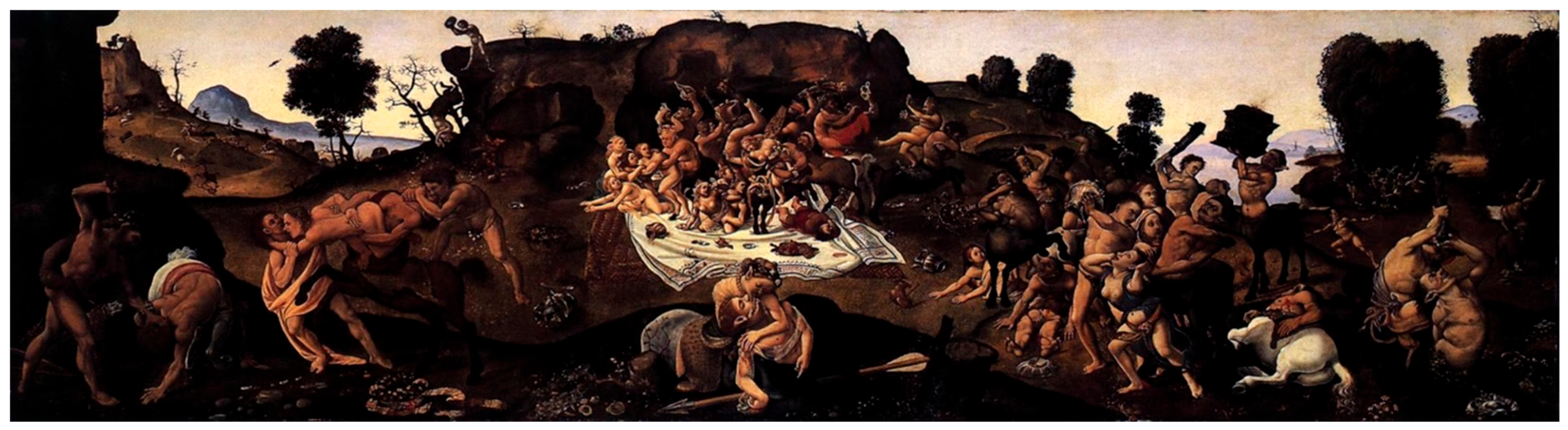


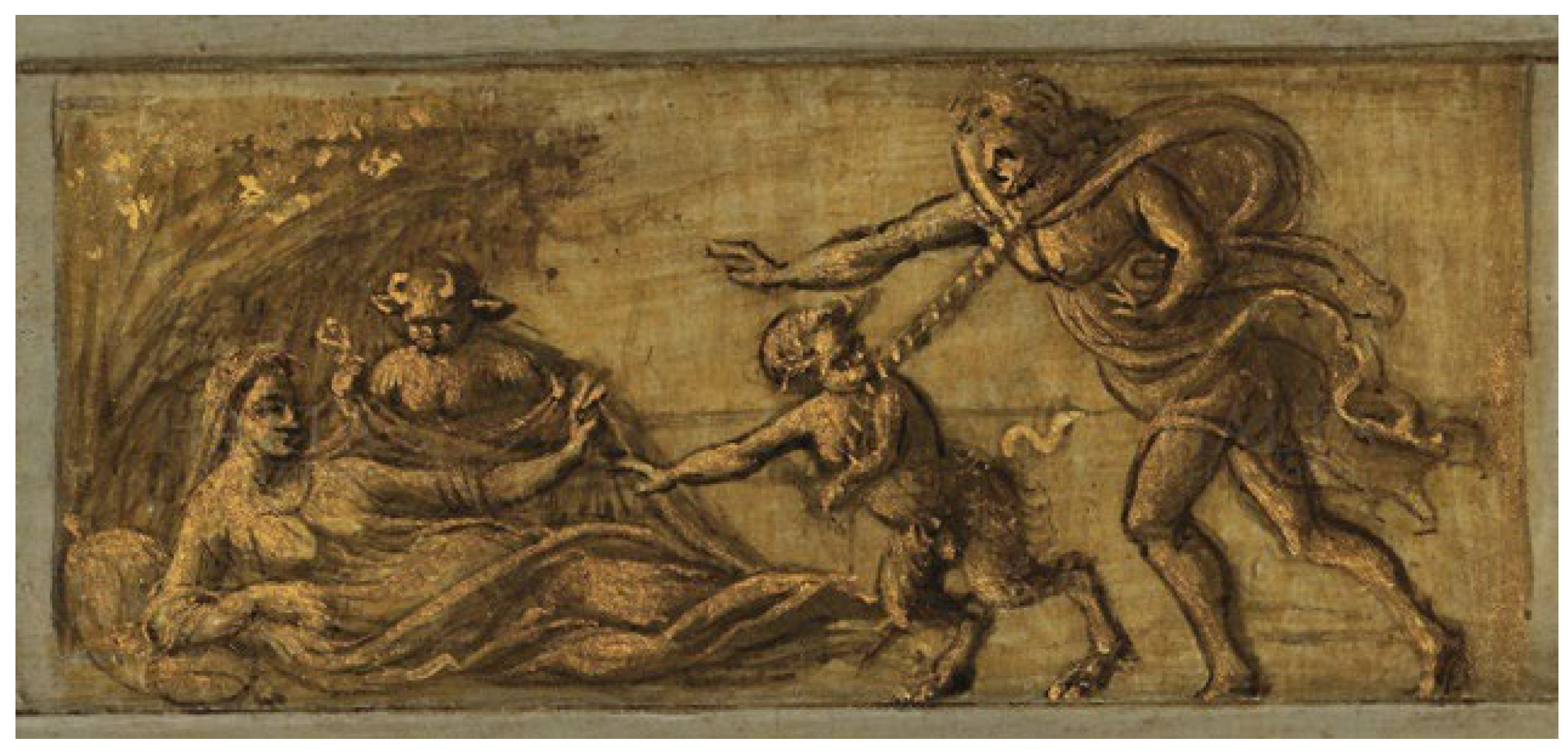
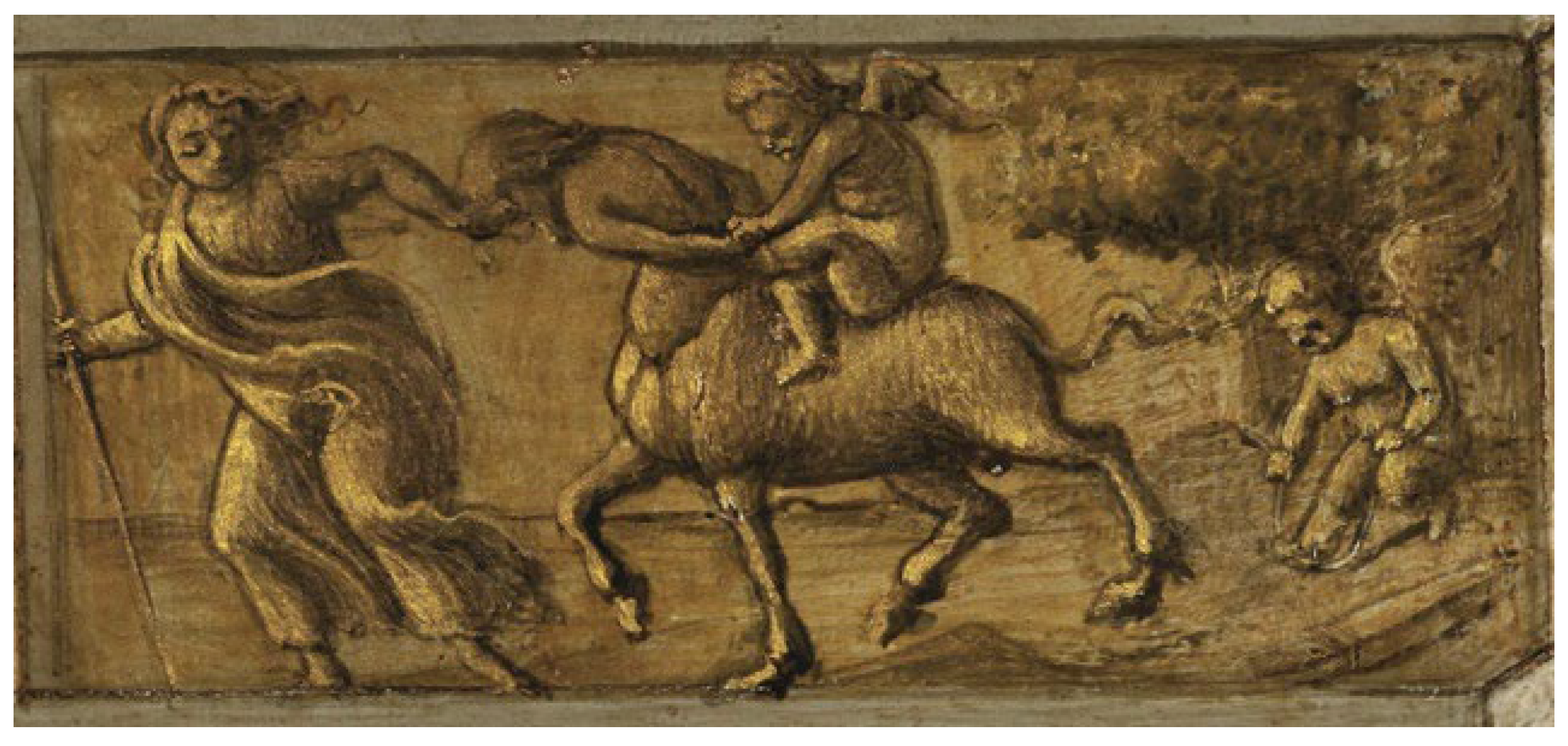


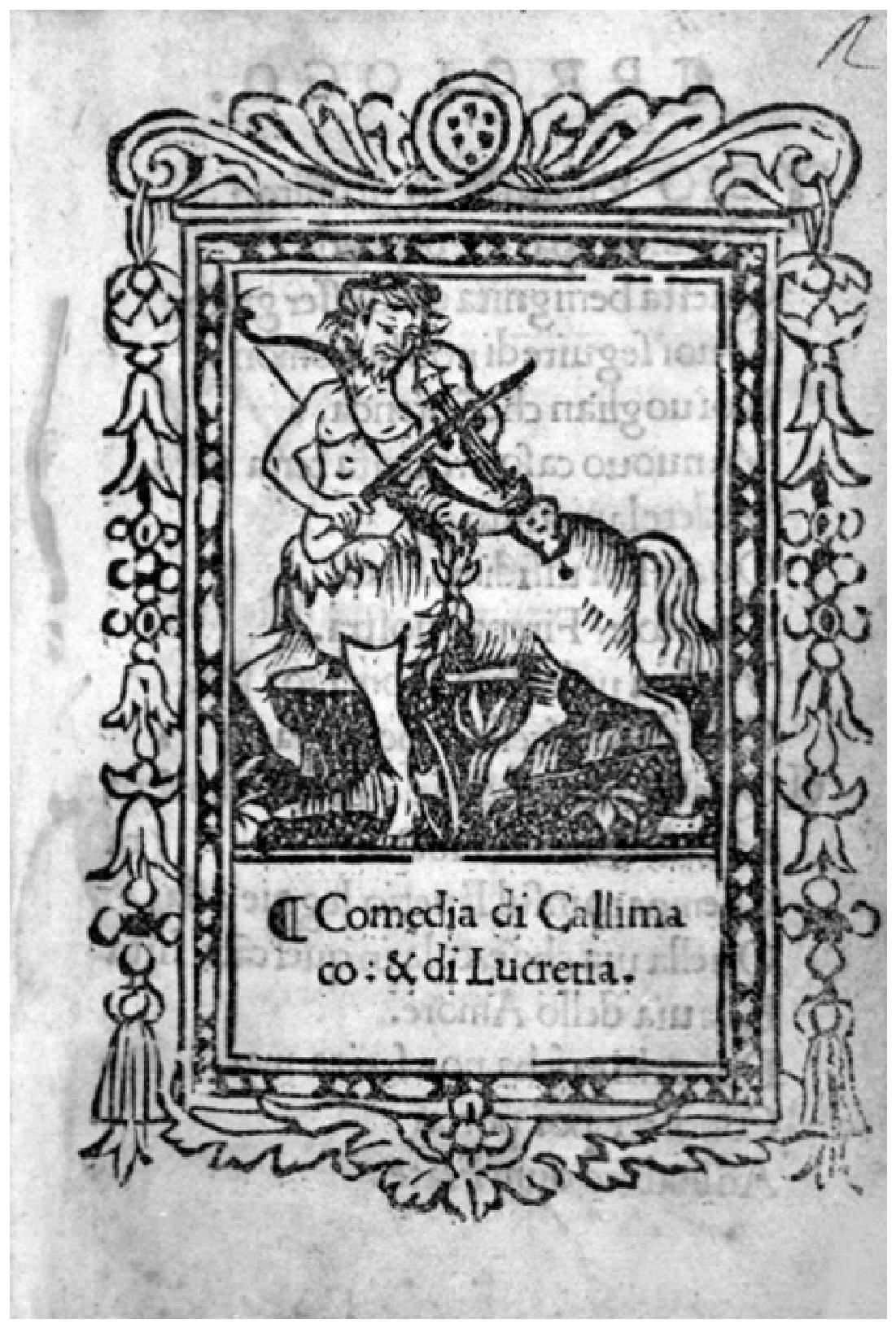


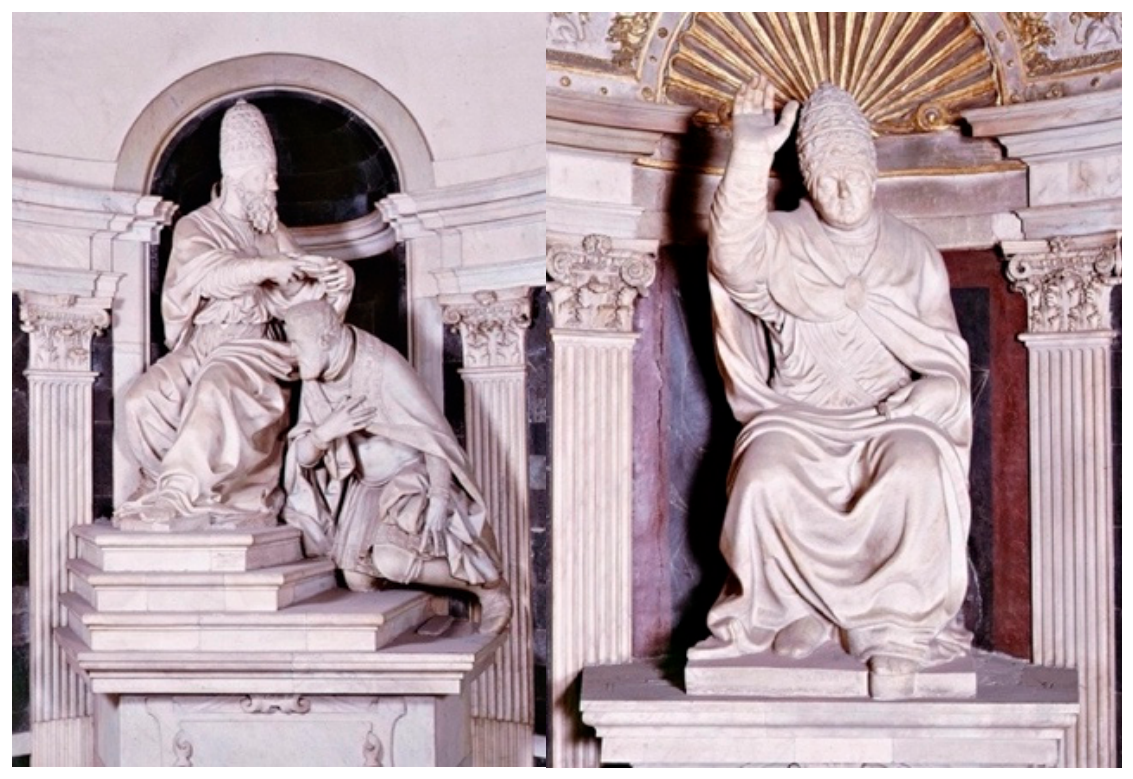

Disclaimer/Publisher’s Note: The statements, opinions and data contained in all publications are solely those of the individual author(s) and contributor(s) and not of MDPI and/or the editor(s). MDPI and/or the editor(s) disclaim responsibility for any injury to people or property resulting from any ideas, methods, instructions or products referred to in the content. |
© 2026 by the author. Licensee MDPI, Basel, Switzerland. This article is an open access article distributed under the terms and conditions of the Creative Commons Attribution (CC BY) license.
Share and Cite
Lettieri, G. The Centaur from the Medici to Machiavelli. Religions 2026, 17, 696. https://doi.org/10.3390/rel17060696
Lettieri G. The Centaur from the Medici to Machiavelli. Religions. 2026; 17(6):696. https://doi.org/10.3390/rel17060696
Chicago/Turabian StyleLettieri, Gaetano. 2026. "The Centaur from the Medici to Machiavelli" Religions 17, no. 6: 696. https://doi.org/10.3390/rel17060696
APA StyleLettieri, G. (2026). The Centaur from the Medici to Machiavelli. Religions, 17(6), 696. https://doi.org/10.3390/rel17060696