Article

Visualizing the Magnificat: Μary and the Attribute of the Book in Early Christian and Medieval Art

by
Elena Papastavrou
Ministry of Culture Greece, 15341 Athens, Greece
Religions 2026, 17(4), 461; https://doi.org/10.3390/rel17040461
Submission received: 31 December 2025 / Revised: 24 February 2026 / Accepted: 25 February 2026 / Published: 8 April 2026

Abstract

This paper examines the iconography of the Mother of God holding a book in Early Christian and Medieval art, focusing on representations in which a book or scroll functions as an attribute of the Virgin Mary. Particular attention is given to scenes depicting Mary in relation to the Christ Child, Christ Pantocrator, and the Magnificat. The study explores the symbolic significance of the book and scroll through the textual tradition of the Church Fathers. Adopting the methodological approach to the iconographical structure developed by André Grabar, the paper centers on three interconnected case studies. First, it offers a close re-examination of a Marian scene on the ivory relief of the Werden casket (9th c.) of which the meaning is hard to understand. Second, it analyzes the depiction of the Mother of God in the vault of the crypt of Epiphanius at San Vincenzo al Volturno (9th c.), with particular emphasis on motifs that associate the image with the theme of Mary’s Triumph. Finally, it considers a fresco of Mary and Christ enthroned from the Egyptian monastery of Deir al-Suryan (10th c.), treating these works as semantically and conceptually related. Through this comparative analysis, the paper advances several interpretations of the Magnificat as articulated in Early Christian visual culture and developed in later periods with the contribution of the Byzantine theology. Given the well-established influence of Early Christian art on both the Carolingian Renaissance in the West and the Byzantine East, the shared iconographical details identified here—both formal and conceptual—are understood as deriving from a common visual tradition rooted in Antiquity.

1. Early Developments of the Book Attribute

In the Bible, particular reference to a book or tablet is made in Isaiah 8:1, where we read: Then the Lord said to me, “Take a large tablet and write upon it common characters”; Isaiah 29:11, 12: “And the vision of all this has become to you like the words of a book that is sealed. When men give it to one who can read, saying ‘read this’, he says ‘I cannot, for it is sealed”; “And when they give the book to one who cannot read, saying, ‘read this’, he says ‘I cannot read”. The exegesis on Isaiah by early Church Fathers, such as, Ireneus Lugdunensis (early 3rd c.), Ephrem the Syrian (4th c.), John Chrysostom (4th c.), Proclus (5th c.), Macarius, and Gregory the Thaumaturgus Neocaesarensis (3rd c.) (PG 10:1173B), Maximus Confessor (7th c.), related the book or the scroll to Christ, the Virgin Mary, and the incarnated Word; to the Truth and Wisdom, to the column and the foundation of the Church. Furthermore, the book is the symbol of the era of Grace. In the context of New Testament scenes with Christ, the Evangelists, the Hierarchs, or the Saints, a book or scroll symbolize the Gospel. The most representative scene in Early Christian iconography is the Traditio Legis. In Marian imagery, a book, tablet or tablets, and a scroll are common metaphors in exegetical texts and in hymnography, as in the Akathist1.
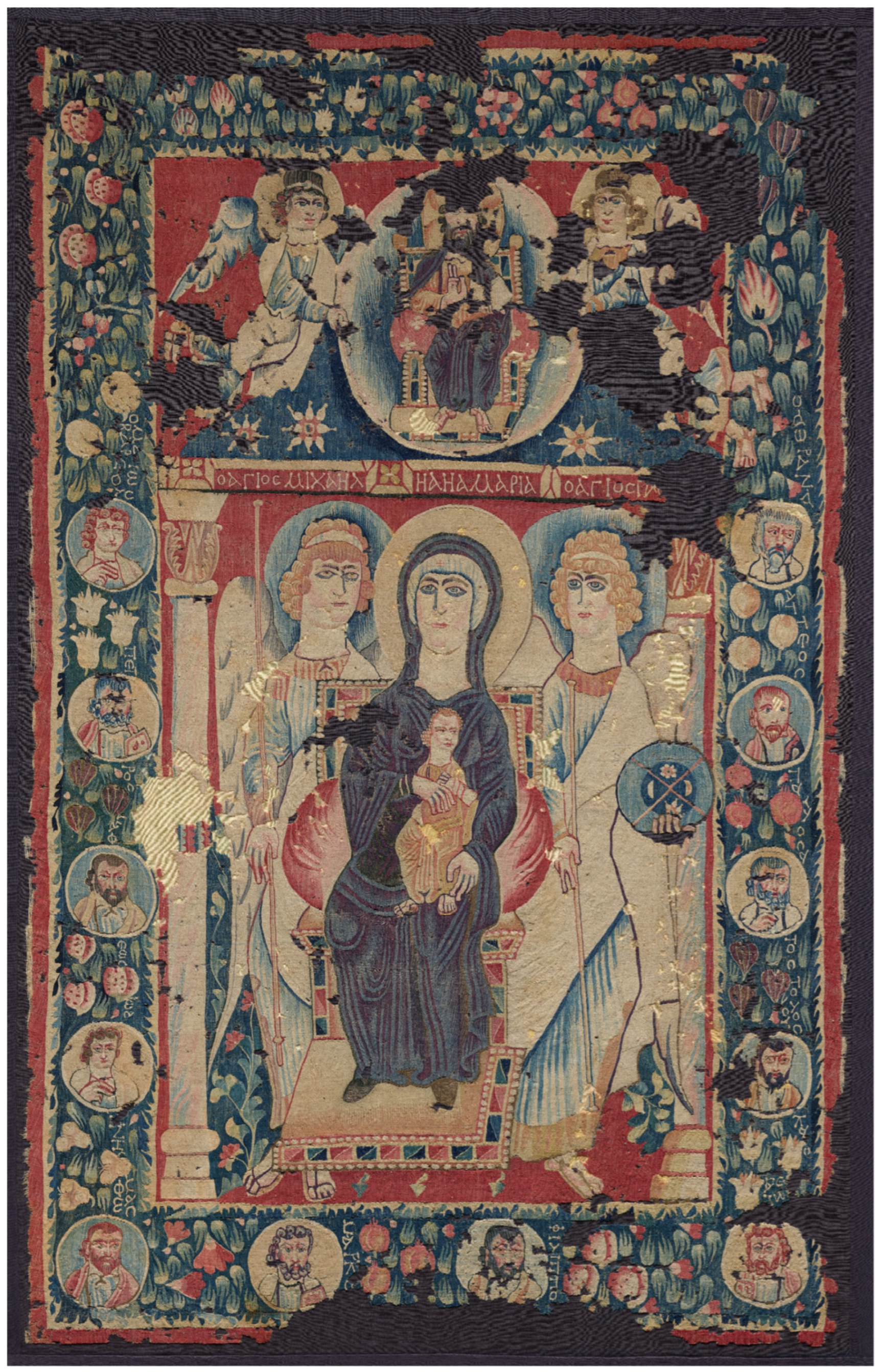
To my knowledge, the first extant artwork of the Mother of God with a book in hand is a tapestry, a hanging of around 500 A.D., in the Cleveland Museum of Art (Figure 1), which is an item of very high-quality art. It is decorated like a veritable icon, in two registers. In the lower one, the Mother of God, seated on jeweled throne with the Christ Child, appears between the archangels Michael and Gabriel. The Christ Child has a rolled scroll in hand, and Mary has a closed codex. The busts of the Apostles frame the lower register. In the upper register, Christ is enthroned in an aureole carried by angels. Obviously, in this work, the idea of the twofold nature of Jesus is developed at two different levels: in the upper part, the eternal reign of the Pantocrator is clearly emphasized; at the lower level, an effort is made to stress the role of both Mary and the Apostles in the work of the Incarnation. In particular, the juxtaposition of the human nature of the Christ Child to the book in Mary’s hand, as sign of the Divine Word or Wisdom2, contributes to accord pictorially to Mary Her quality as Theotokos, as proclaimed during the third ecumenical council at Ephesus (431), a few years before the creation of the current item. In addition, the presence of the Apostles who preached the Gospel in Christ’s Church all over the world transmits the following soteriological message: as the Mother of God gave birth to the Divine Word as a human being, so the Church spreads the word of the Gospel and gives birth to the faithful. In this context, more specifically, the book associates the Mother of God with both notions, first, divine Wisdom, because Mary is the foundation of the Lord, and second, Ecclesia, because the Mother of God is the body of Christ, and Christ is the head of the body of His Church3. We find a similar message in later compositions: in the 12th c. Sinai icon of Mary and Christ, where both hold one and the same scroll (Velmans 2013, Figure 100); in the 13th-century- cod. 269, fol. 4r, in the Public Library in St. Petersburg (Weitzmann 1957, Figure 6; 1976b, Figure 30; Papastavrou 2007, Figure 32), Mary enthroned carries the Christ Child and an unrolled scroll, with an extract of the Magnificat.
The next example is a Sinai icon of the Mother of God with an open scroll, dating to the 6th and 13th c (Weitzmann 1976a, p. 21). In this composition, Mary crosses her arms before her chest in an attitude proper to the personification of Humility,4 holding at the same time an open scroll with her prayer to the Lord for the salvation of humankind. This Marian iconography is usually called the Virgin Paraklesis (Prayer).
Whatever may be the specific sense of the prayer written on Mary’s book or scroll, there is a deeper meaning in the act of praying. The Church Fathers underlined the great importance of prayer as the only agent that unifies human beings with the Almighty5. The prayer leads the believer to vision of God, the άκτιστον φως (the uncreated light). Prayerful hymns of joy and thanks for the salvation of humankind by Christ fill the New Testament6. Again in the New Testament, a command frequently repeated is the perpetual adoration of God by men.7 In addition, prayer reflects the life of the triumphant Church,8 in which the holy souls and the angelic orders exalt the Glory of God perennially (according to the hierarchia ecclesiastica, by Dion. Areopagites). The source of all virtues making the Mother of God a real temple of the Word is her prayer, an act which becomes a paradigm for the other, says Chrysostom (PG 55, col. 469). Mary is particularly praised for having been in continuous spiritual communication with the Lord. Thus, the image of Mary praying reflects also the image of the Church Triumphant.
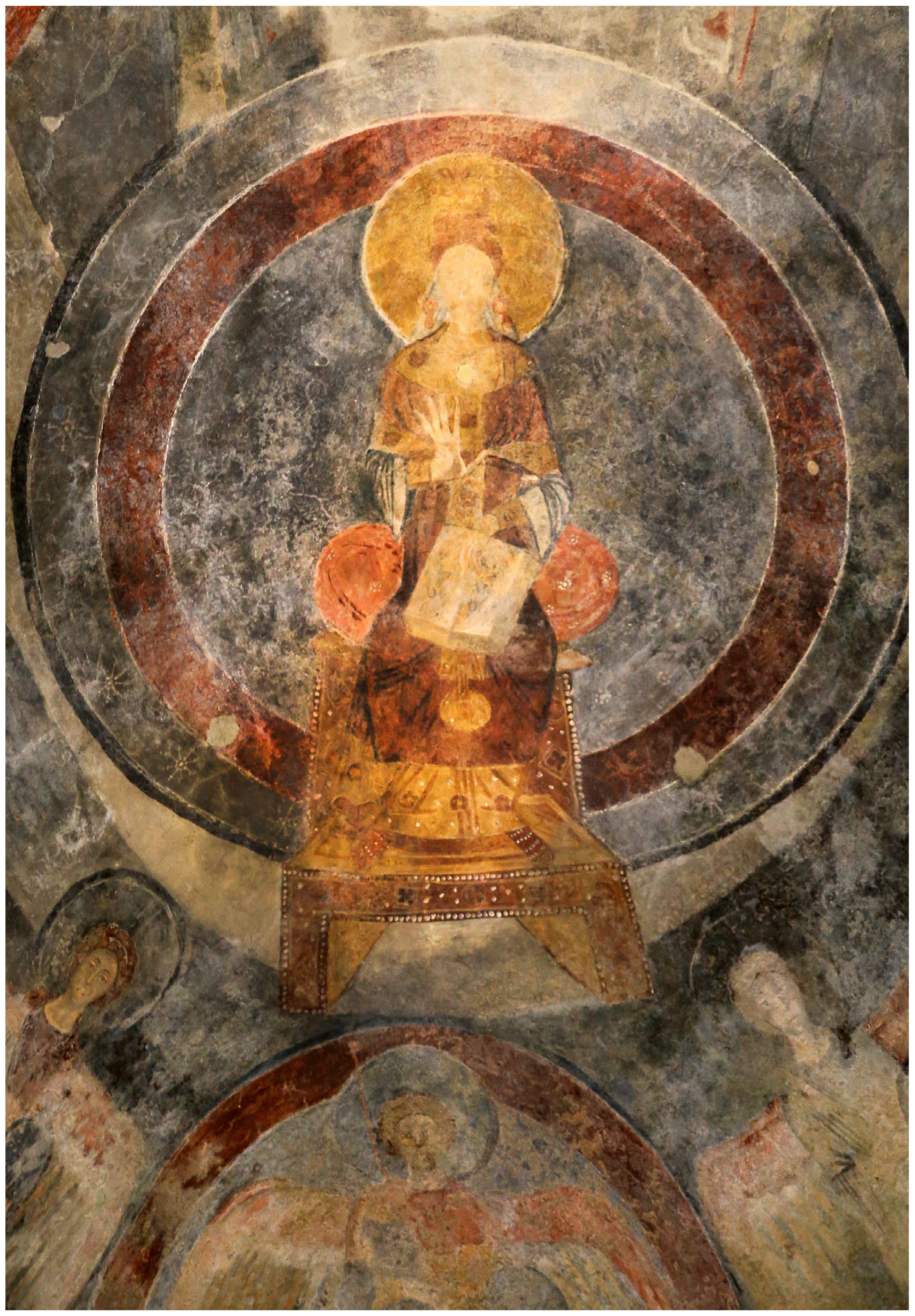
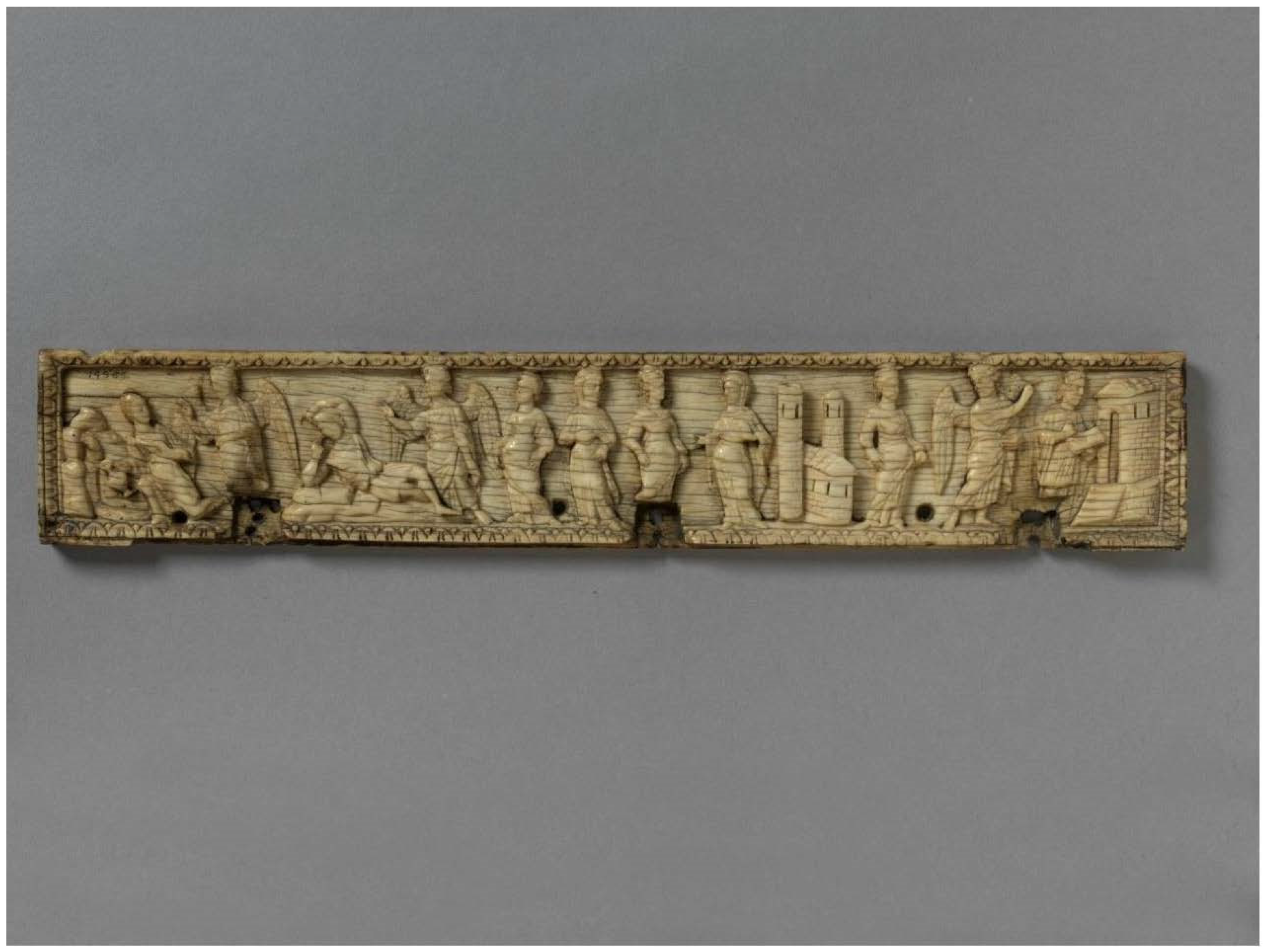
Another instance of Mary holding a book appears in the depiction of the 9th Ode (Luke, I, 38–55). No extant work of this iconography emerges before the 9th c. as seen in the vault of the Epiphanius crypt in the monastery of San Vincenzo at Volturno (first decades of 9th c.): On the side of the Pantocrator, Mary is enthroned as Queen in a typical gesture for the Annunciation carrying on her lap an open book with the Magnificat (Figure 2 and Figure 3). But I shall examine this case a little later. First, I would like to turn our attention to an earlier composition, which to my view may be connected with Mary’s Annunciation and Canticle that seems appropriate to discuss here. Since its iconography is unusual, I would like also to propose an interpretation of it. It is part of the surviving ivory plaques that once covered a shallow box with images of the Infancy cycle, the Werden casket (Beckwith 1958; Volbach 1976, No 118; Williamson 2010, pp. 156–58) now in the Victoria & Albert Museum (Inv. 149–1866). This work is considered by art historians9 most probably to be a Carolingian copy of a fifth-century original. On the first plaque, where the scene under examination is depicted (Figure 4), we see the following compositional sequence: the Annunciation at the spring, the Dream of Joseph (Angel and Mary are included), Mary between two women in a version of the Visitation with an acolyte10, and finally, a three-figure scene between two buildings: Mary in colloquy with the angel, and a man with an open book. No inscriptions appear.
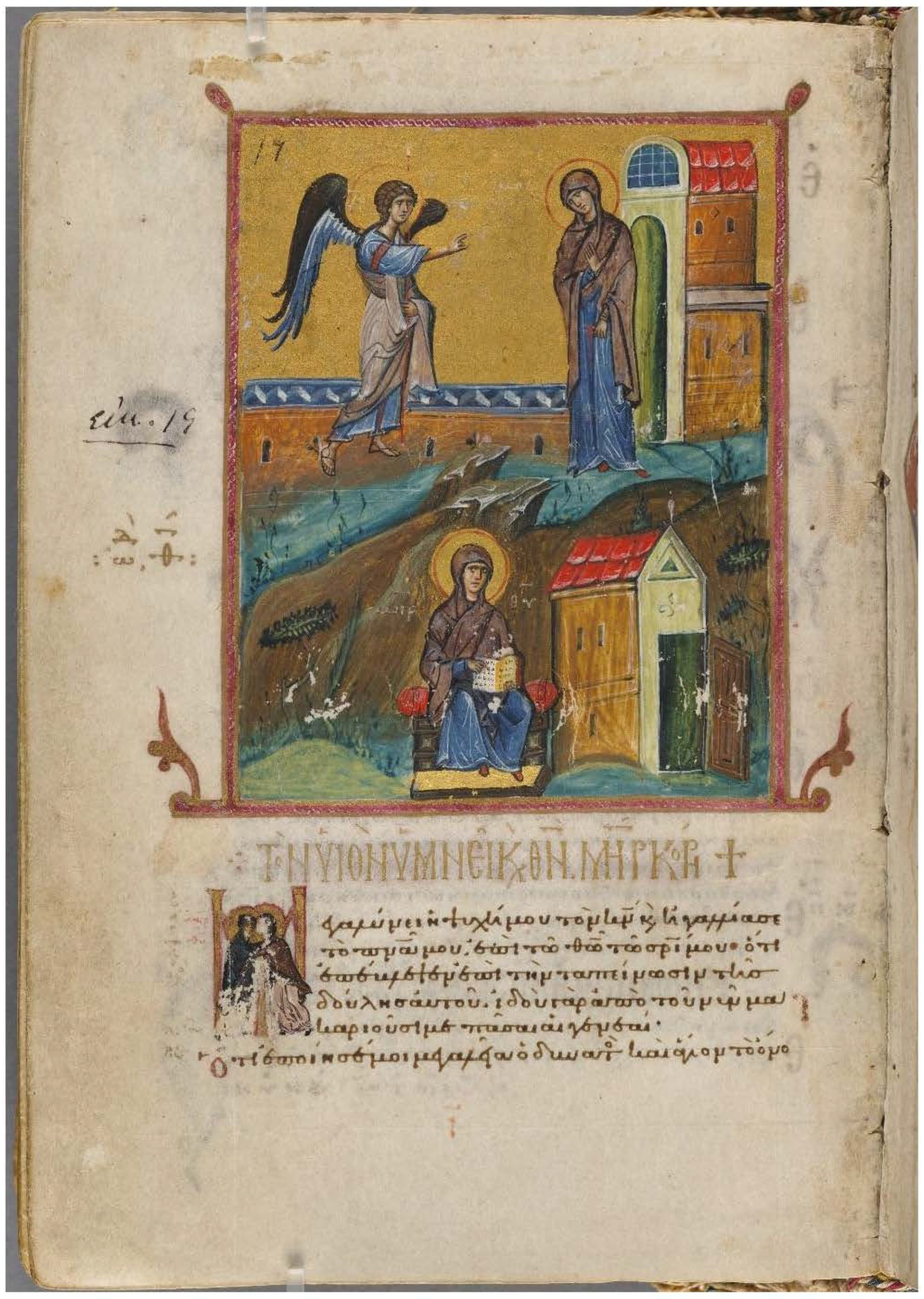
In order to comprehend the final scene,11 let us reconsider first the message of the episodes following the Annunciation: The Dream of Joseph and the Visitation are both revelations about the divine Conception. As a matter of fact, the final scene of the series must be related to the spirit of the two preceding scenes, as is the case in Mary’s Canticle, the 9th Ode.12 More precisely, the Virgin sang the Magnificat, a prayer of glorification with Christological and eschatological meaning, when, after the Annunciation and during the Visitation, she replied to the prophetic salutation of Elizabeth (Lk 1: 42) who through divine inspiration recognized the virginal pregnancy and exclaimed: “Blessed are you among women and blessed is the fruit of your womb”. The iconography of the 9th Ode varies (Weitzmann 1976b; Papastavrou 2007, 186 sq.), but very often we see in it a characteristic attribute of the Virgin, a book or a scroll. According to K. Weitzman (Weitzmann 1976b, p. 79), during the Early Christian period, all three scenes of the evangelic narration (the Annunciation, the Visitation and the Ode) used to be represented in sequence, forming part of a cycle on the Infancy of Christ. This iconographic tradition is actually reflected in the 11th c. illumination of the psalter of DO, Ms 3, fol. 80v13, (Figure 5) where the canticle is articulated in three scenes: on top we see the Annunciation, and, underneath, Mary sitting with an open book, pointing to the written text of the canticle. Under the illumination, the Visitation is nestled in the initial letter of the text of the Magnificat.
Turning back to our example (Figure 4), we observe that the building on the left, shown from the rear, is rendered in a smaller scale than the one on the right, and it has only short openings as windows. Conversely, the building on the right seen from the front is represented on a larger scale, and it has high foundations, with five steps leading to the open door of the entrance. Between these structures, three persons are depicted: the Virgin Mary in colloquy with the angel, who is looking at her, while raising his right arm and pointing with the index finger in the opposite direction; Gabriel is indicating towards a standing man turned in three quarters towards the building; the man is dressed in a short chiton, a dalmatic, and a sort of coat without sleeves fixed in front of the chest and falling on his back; he is clean-shaven, and his hair is somewhat short. Judging from his appearance, he could be a Roman official of high rank, perhaps a consul; holding an open book, he is gazing at the open architectural structure.
In other words, Mary is in colloquy with the angel of the Annunciation (Figure 4), an event that has already happened in the past, because now Gabriel becomes a witness; as it says in the Akathist Hymn, Gabriel, seeing the completion of the Conception in the Virgin’s womb, is pointing to the Son of the Almighty whose incarnation is the cause of Mary’s magnificence and splendor, as stated in her Ode. Most probably, the man is the Bridegroom of the Church holding the Book, the Gospel of the New Testament, which will be spread among the members of His church, symbolized by the open edifice, in contrast to the closed one, the synagogue of the Old Testament.14 To put it another way, in all likelihood, here, we are dealing with another version of Mary’s canticle, because the symbolisms above correspond to the dogmatic message of the Magnificat. The book as a symbol of the Divine Word destined to fecundate Christ’s Church is held by the Lord Himself, whereas the idea of the foundation of the Church is also reflected to the person of the Mother of God thanks to her extraordinary motherhood.
Before turning to the next case study, summarizing what the preceding analysis has shown until now, I propose that the book or scroll in Mary’s hand is primarily a symbol of the Divine Word, bringing Mary into close relationship with the divine Wisdom as well as with the notion of Ecclesia.

2. The Case of San Vincenzo Al Volturno

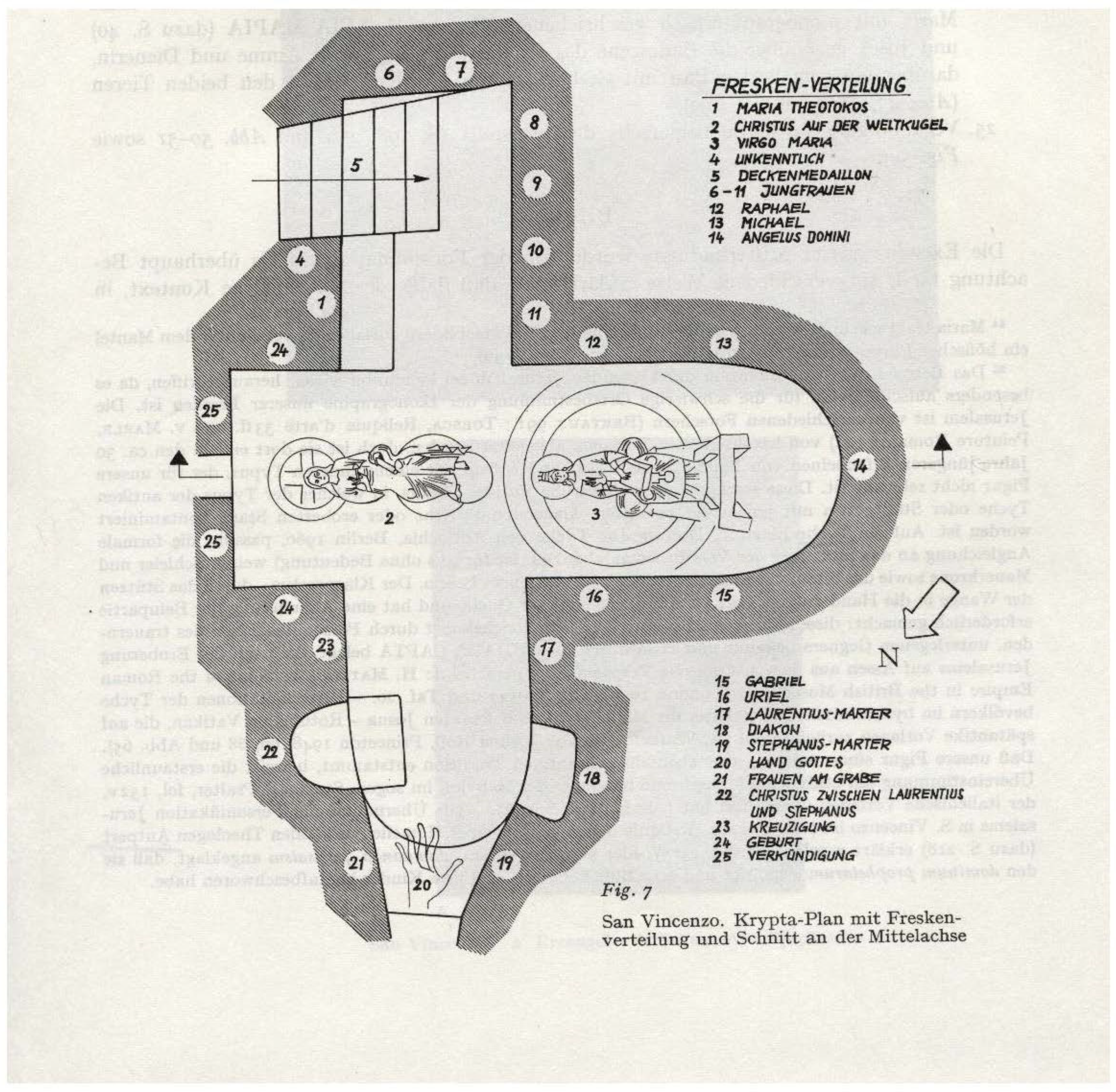
Another example of a fresco depicting the Virgin Mary holding a book appears in a remarkable composition in the vault of the crypt of Epiphanius at the church of San Vincenzo al Volturno, in southern Italy (Figure 2 and Figure 3). The monument is widely recognized, (Toesca 1904; Bertaux 1904; Belting 1968; De’ Maffei 1985; Mitchell 1993; Dell’Acqua 2013, 2019) and the depiction of the Virgin in the vault has been the subject of prior scholarship (Papastavrou 2007, pp. 191, 231–32; Dell’Acqua 2019). Yet, for the purposes of the present study, I will revisit the scene in detail, offering observations on iconographical features that link the image not only to the Annunciation, but also to the Triumph of Mary in Heaven, a theme that would later be elaborated in both Western iconographies and in the eastern periphery of the Byzantine Empire. San Vincenzo lay within the Lombard territory of the Duchy of Benevento (570–1050), and its fresco decoration is generally dated to the first decades of the ninth century. The iconographic program of the monument presents some distinctive features. Hans Belting (Belting 1968, 223 sq.) had observed that it reveals a substrate of Early Christian tradition combined with local theological currents and elements developed in Byzantine art. In the crypt vault, Mary and Christ are aligned on the same axis. While the Pantocrator enthroned on the orb occupies the central part of the vault, Mary appears sitting on a throne in the eastern part of the vault, the apsis, as well, dressed in regal attire with a crown and big earrings; her throne and footstool are adorned with gems. Recent research has demonstrated that the Mother of God originally bore a cabochon gem—made of glass or red granite—at the central place of her collar. Although the gem itself is now lost, the cavity remains. Its symbolism evokes literal metaphors of Mary associated with the Annunciation15. Mary raises her right hand with the palm facing the viewer, a gesture commonly associated with the Annunciation. At the same time, an open book rests on her lap, bearing an extract from the Magnificat: “Ecce enim ex hoc beatam me dicent omnes generationes” (Luke I, 48). Her head is encircled by a halo and her entire figure is contained within a medallion formed by three concentric cycles.
As prior research has shown (Toesca 1904, p. 37; Belting 1968, pp. 216–22, Papastavrou 2007, pp. 231–32; Dell’Acqua 2019), the inspiration for the iconographic program of the crypt was Ambrosius Autpertus, abbot of San Vincenzo (777–78). In his homilies on the Mother of God, Autpertus extols Mary’s humility, praises her miraculous conception of the divine Word16, her purity, and her sovereignty at the time of her Assumption17. He celebrates her as Queen of the angels, reigning with Christ over them18, and as mater et virgo Ecclesia19, that is to say, enthroned in beatitude in the eternal court20. The Virgin Mary’s humility —particularly emphasized in the Annunciation and the Magnificat—is a virtue especially praised by Autpertus in his homily on the Assumption21. All of these values attributed to Mary by Autpertus find expression in the monumental iconography of the crypt of Epiphanius. From a compositional standpoint, the imagery conveys a dual meaning. On the one hand, it represents the Annunciation–Magnificat: the Virgin—having conceived the Word—sings her canticle before her Son. On the other hand, through Mary’s prominent placement within the overall church program—on the same hierarchical level as the Almighty, acting as co-regent—together with the emphasis provided by her radiant triple aureole and the presence of angels in the apse, the composition presents Mary’s triumph as Queen of Heaven because of her Son, in accordance with Luke 1:46–55. Thus, the meaning of the composition unfolds on two levels: first, Mary’s mission in the Incarnation, and second, her triumphal place in heaven through her Assumption, as a consequence of that mission. At San Vincenzo, the Annunciation–Magnificat and Regina coelorum converge into one image.
In her investigation into the textual background of Autpertus’s eight-century homilies—which a few decades later, informed the monumental decoration of the crypt of Epiphanius—Francesca Dell’Acqua (Dell’Acqua 2019) has observed that the theological tradition on the Assumption was not derived primarily from Latin sources, but rather from the writings of the Greek Church Fathers and defenders of Orthodoxy, particularly Andrew of Crete22, Germanus of Constantinople23, and John of Damascus24. For these authors, the Magnificat constituted the most appropriate hymn for glorifying the Mother of God, especially following her passage into eternal life—a view also shared by Autpertus. As early as the 8th century, their homilies may have reached central Italy and the erudite abbot Autpertus, even before the major wave of systematic translations of Greek theological texts into Latin undertaken at the papal court in the second half of the ninth century, aiming at reinforcing Rome’s image as caput Ecclesiae universale.
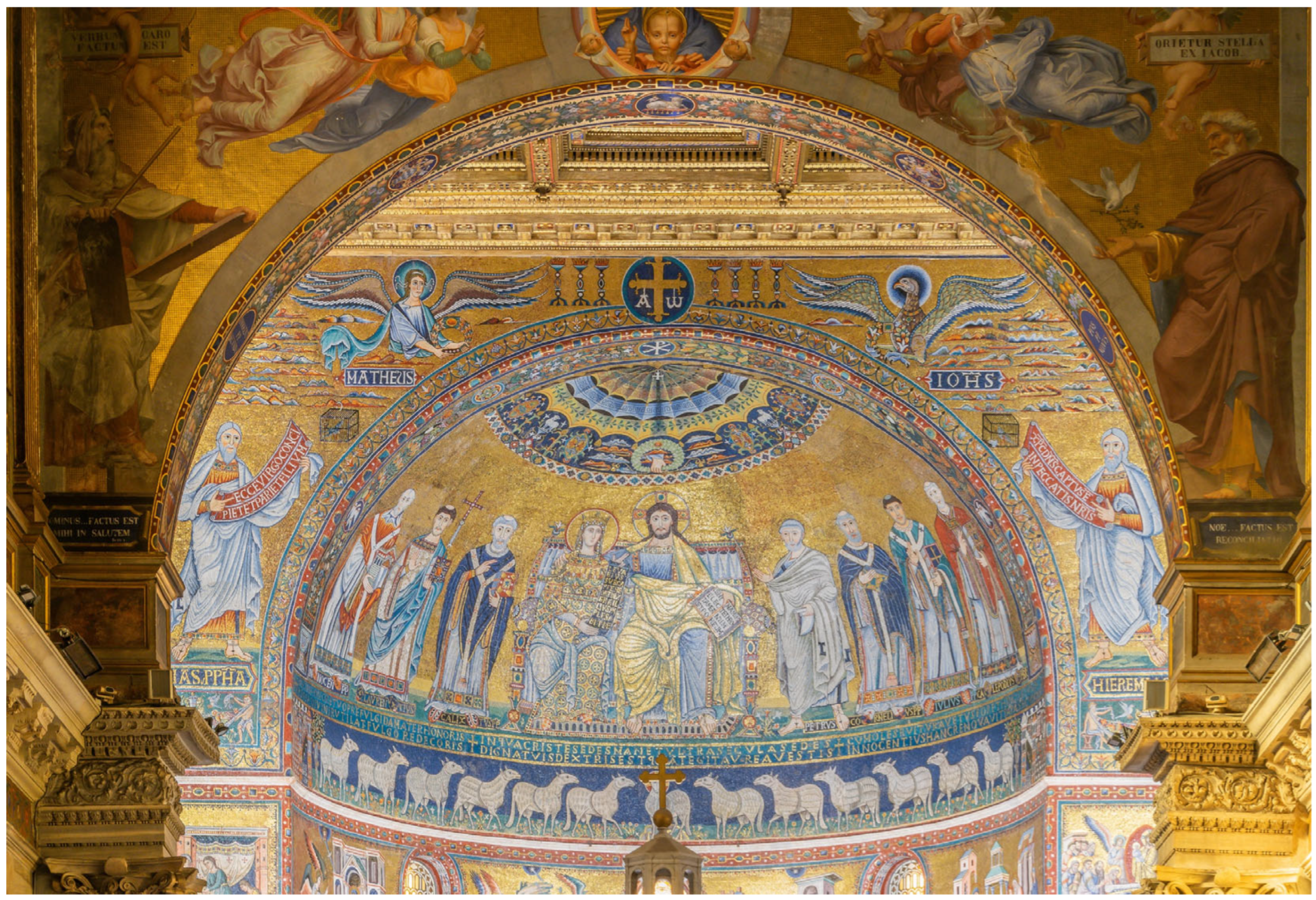
Returning to the mural decoration of San Vincenzo, the allusion to the two pivotal events in Mary’s life is achieved primarily through the iconographic system of the two enthroned co-regents and the book. As I have noted in a previous study, all these iconographic elements reappear in scenes of Mary’s triumphal Assumption after her Dormition, which emerge in the West around the 12th century25. For example, in the apse of Santa Maria in Trastevere, Rome (1140/1143) (Figure 6), the Triumph of the Virgin depicts (Verdier 1980; Thérel 1984; Papastavrou 2007, pp. 218–20) Mother and Son seated on a single throne, with Christ placing his right arm around Mary’s shoulders. Mary holds an open scroll bearing a text from the Song of Solomon, read in the liturgy (Hesbert 1963, p. 125) of both the Annunciation and the Assumption: “Oh that his left hand were under my head and that his right hand embraced me26. Christ, in turn, holds an open book inscribed with “Veni electa mea et ponam in te thronum meum”, paraphrasing Song of Songs 4:8: “Veni de Libano, sponsa mea, veni coronaberis”. A closely related composition appears later, at the end of 13th century, in the apse of Santa Maria Maggiore, painted by Jacopo Torriti27.
The relationship between the Ode imagery and Mary’s Triumph is further corroborated by the recurring attribute of the book or scroll, indicating that representations of Mary’s beatitude and glory as Regina-Ecclesia at her Son’s side are grounded on her mission in the Incarnation. This is evident, for example, in the tympanum of the western portal of the Senlis Cathedral (1170) (Schiller 1980, Figure 627), where the Mother of God holds a book—an attribute associated in the West with the Annunciation and the 9th Ode. Likewise, at Chartres Cathedral (Schiller 1980, Figure 626) (north portal, 1204) and at Strasbourg Cathedral (south portal, 1225–30) (Schiller 1980, Figures 6 and 633), Mary raises both hands in a prayer gesture frequently found in Annunciation scenes. These compositions represent further elaborations of the paired enthroned figures of Christ and Mary, a motif already articulated in the crypt of Epiphanius at San Vincenzo al Volturno.
The formation of the Triumph of the Virgin scene results from the convergence of diverse artistic and spiritual factors that emerged in both East and West, from Late Antiquity through the 12th century28. Among these, in the West, the commentaries on the Song of Songs by Rupert of Deutz (a. 1117–26) (Tuitiensis 1974) and the Sigilium Beatae Mariae by Honorius Augustodunensis (before 1115)29 identified the Virgin Mary with the Sponsa, emphasizing her role as Maria-Ecclesia within this iconographic framework30. A detailed exploration of this theme lies beyond the scope of the present study. Nevertheless, some details within the same scene deserve attention because of their roots in Late Antique art. In particular, the throne of the co-regent figures, the attribute of the book or scroll, and the gestures and postures of the figures—discussed below—appear not only in Western art but also in the eastern periphery of Byzantium.
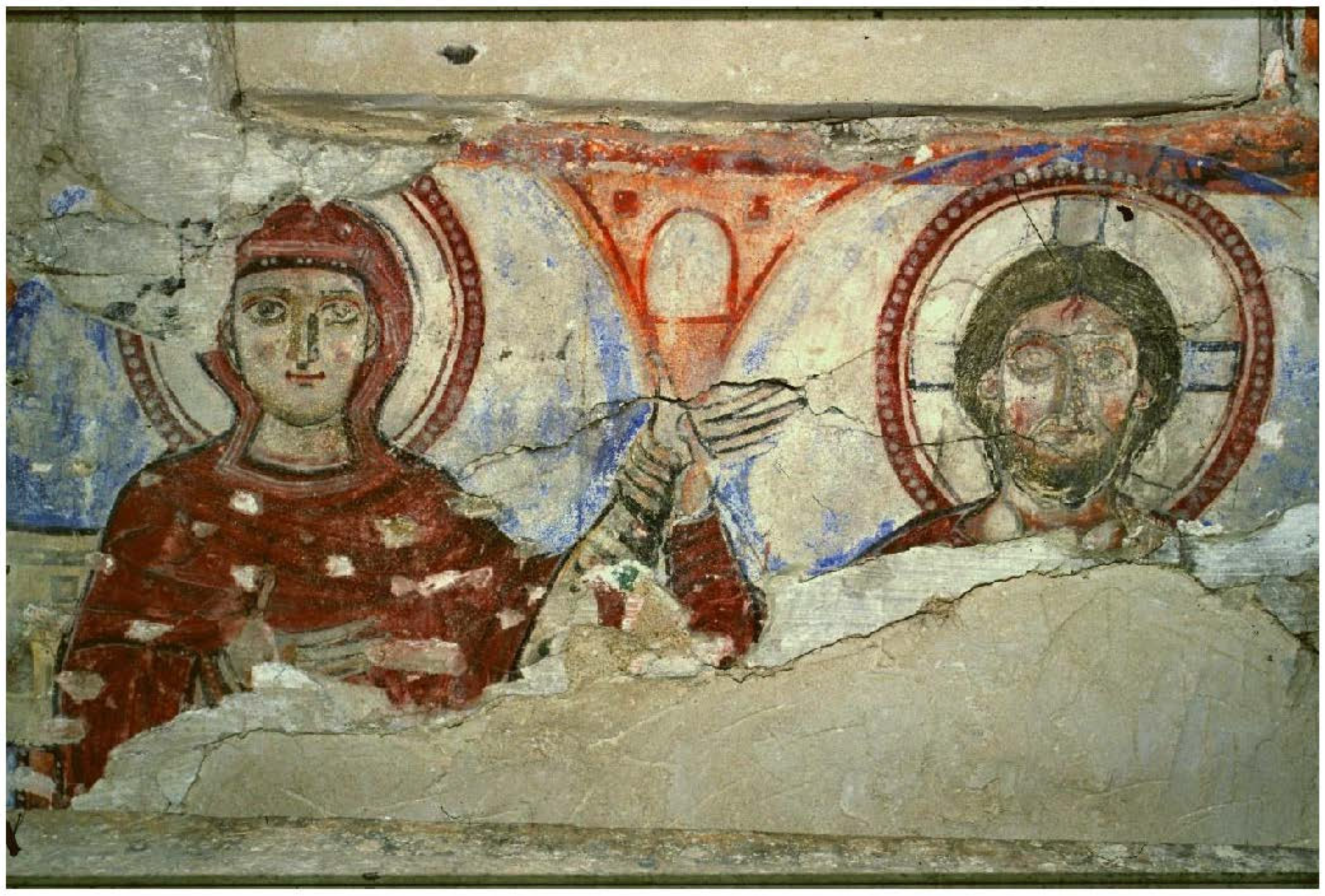
More specifically, a notable example is a mural painting at Deir al-Suryan, (Figure 7) the Orthodox Syrian monastery in Egypt, dating to the 10th century. The monumental paintings of the monastery were brought to scholarly attention through the work of Prof. Karel Innemée (Innemée and Van Rompay 2020). In the area known as khurus, remnants of a sequence depicting the Dormition of the Virgin survive on the far left;31 to the right was a scene now completely lost. The only remaining fragment shows a group of men on the far right gazing upward with amazement (Innemée and Van Rompay 2020). Along the upper edge, a fragmentary Coptic inscription reads: “the body of…”, indicating that the missing scene likely represented the Assumption of the Virgin’s body. At the center of the sequence is a representation of Christ and the Virgin seated frontally side by side, in the manner of enthroned co-emperors, with Christ holding Mary’s left hand by the wrist. The sun and the moon appear beside the heads of the Virgin and Christ respectively. As Prof. Innemée has noted, “the scene is considered a representation of the reunification of the body and soul of the Virgin in heaven and her reception by Christ”32.
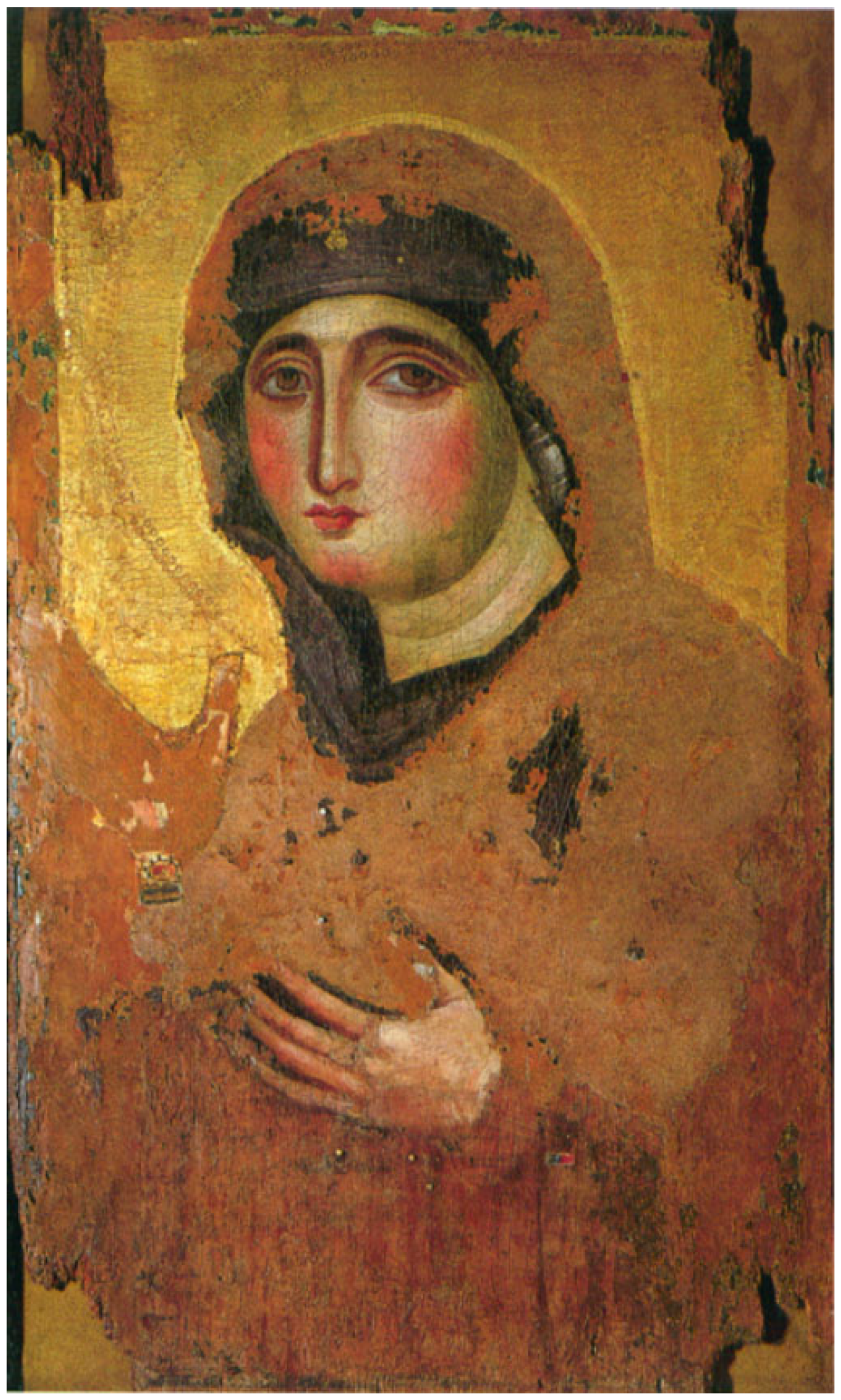
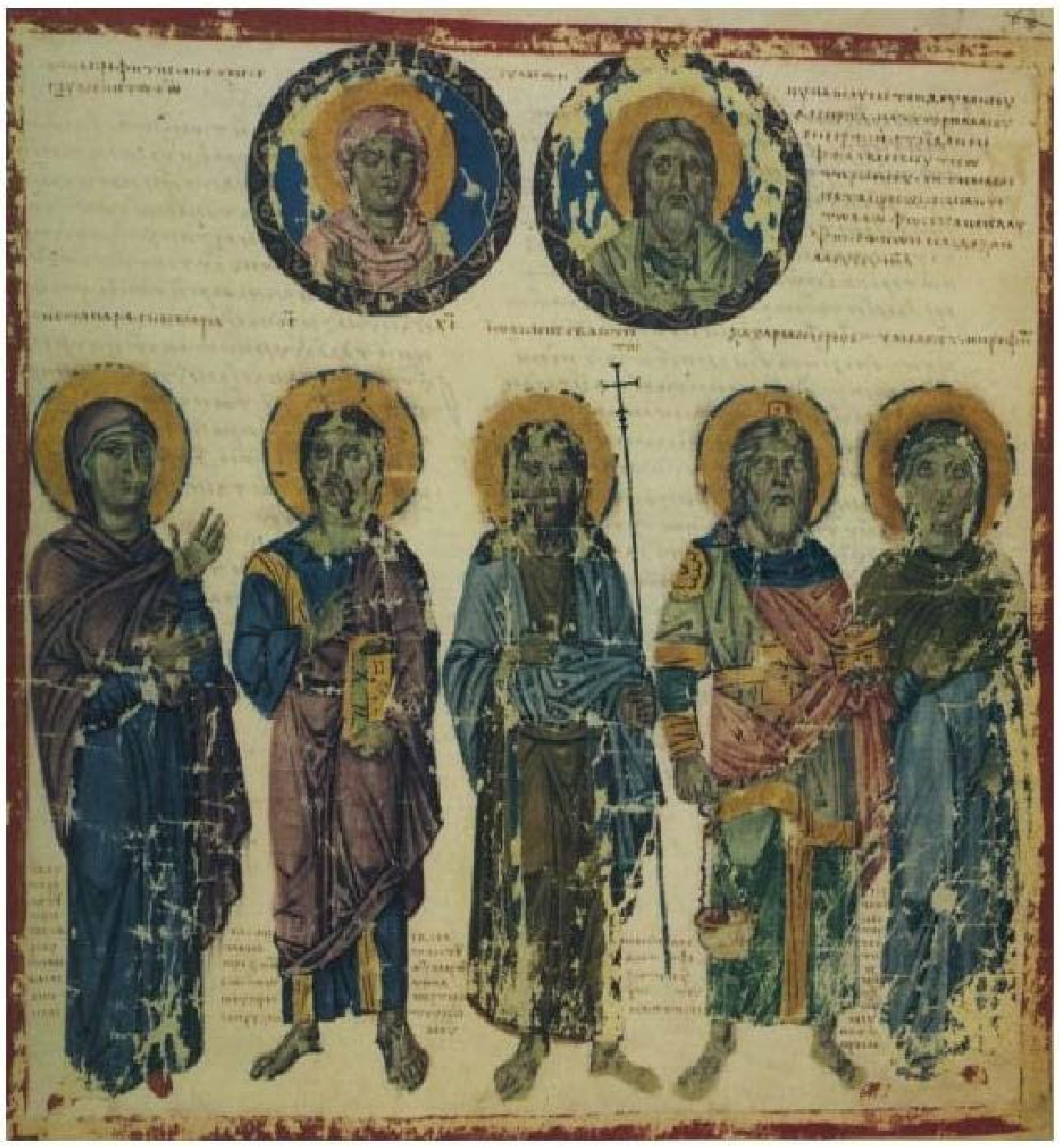
Beyond the ancient motif of co-regents on a throne, the gestures of the figures are especially noteworthy and invite comparison with Western medieval images of Mary’s Triumph. For instance, in the mosaic of Santa Maria in Trastevere (Figure 6), Mother and Son sit frontally on a single throne, while Christ embraces the Virgin with his right arm—a gesture reminiscent of the scene of Aeneas and Dido in the cave (5th c., Biblioteca Vaticana, Vergilius Romanus, fol. 106r) (Weitzmann 1977, pl. 14), where the embracing couple is likewise depicted frontally. Even more significant, however, are Mary’s pose and gesture. As I have shown elsewhere (Papastavrou 2007, 208 sq.), these display iconographic affinities with pre-iconoclastic representations of the Magnificat, such as the Roman icon of the Virgin Monasterium Tempuli (a. 700) (Andaloro and Romano 2002, 31 sq.; Velmans 2013, p. 60, Figure 34) (Figure 8), and the illumination of Cosmas Indicopleustes (Vat. Gr. 699, fol. 76a, 9th c.) (Figure 9), whose prototype dates back to the 6th c.33 In these images, Mary faces the viewer frontally, with both hands directed toward Christ in a gesture of testimony—an attitude echoed in the examples from Deir-al-Suryan and Santa Maria in Trastevere. (Matthiae 1966, 54 sq.) Thus, ancient iconographic elements associated with the Magnificat became connected, in both the East and the West, with representations of Mary’s Assumption in later periods. In other words, the glory foretold by the Mother of God in her canticle was understood to be realized perpetually after her Dormition. As John of Damascus stated, “the glory of Theotokos comes from the fruit of her womb”.34

3. From Word to Glory

The preceding analysis has demonstrated that the book or scroll held by Mary functions as a symbol of the Divine Word, situating her in an intimate relationship with divine Wisdom and with the concept of Ecclesia. When an inscription appears on the book or scroll, it often represents Mary’s prayer to the Lord; regardless of its specific content, however, the act of prayer itself is paramount. Prayer unites Mary with God not only during her earthly life but also in heaven, establishing her as the foremost mediator between her Son and humankind. Her perpetual prayer thus serves both as a model for believers and as an image of the Church triumphant, whose essential vocation is the continual glorification and adoration of the Almighty. Closely linked to this theme is the iconography of the Magnificat, which appears to originate in Early Christian art. In these representations, the Book of the Gospels mediates the relationship between Mary-as-Ecclesia and the Lord, to whom she expresses gratitude by exalting the Incarnation and her role within it. During the same period, the Magnificat is also conveyed through gestures of prayer, with Mary turned to the side and indicating her Son. As this study has shown, both the motif of Mary holding a book or scroll and the gesture of lateral indication were later incorporated into the iconography of the Triumph of the Virgin. The ninth-century imagery of San Vincenzo constitutes the earliest known monumental representation of the Magnificat and forms a pivotal link between Early Christian and Medieval art. It represents a crucial stage in the development of the iconography associated with the Virgin’s triumphal Assumption.
This study has further demonstrated that Early Christian iconographic elements—such as the paired enthronement of Mother and Son (either on separate thrones or sharing a single throne), the attribute of the book or scroll, and specific postures and gestures derived from pre-iconoclastic art—were reinterpreted in later centuries in response to evolving spiritual currents in both the Byzantine East and the Latin West. These transformations ultimately gave rise, in the West, to the iconography of the Virgin’s Assumption known as the Triumph or Crowning of the Virgin. A comparable image also emerged in the Byzantine East, as evidenced by the fresco at Deir al-Suryan in Egypt. Although the East appears to have initiated this parallel development, the contribution of Byzantine Orthodox theology and artistic practice was fundamental. Nevertheless, the specific iconography of Mary’s heavenly glorification did not achieve widespread or sustained prominence in Byzantine art or in the broader Eastern periphery. Within this tradition, the symbolism of the book or scroll—together with gestures recalling the Annunciation—remains central in articulating the inseparable link between the Virgin’s heavenly glory and her participation in the Incarnation. Through this attribute, Mary’s figure is invested with a rich constellation of meanings: humility and beatitude; daughter, mother, spouse, and virgin; servant and queen; intercessor for humankind; embodiment of wisdom and image of the Church.

Funding

This research received no external funding.

Institutional Review Board Statement

Not applicable.

Informed Consent Statement

Not applicable.

Data Availability Statement

No new data were created or analysed in this study. Data sharing is not applicable in this article.

Conflicts of Interest

The authors declare no conflict of interest.

Notes

1
For instance, πλάξ, cf. (Eustratiades 1930, p. 62); Bίβλος, (ibid., p. 12); τόμος (ibid., p. 79).
2
For Clemens Alexandrinus, Stromateis, (PG 9.277A (2nd/3rd c.), wisdom is the eternal knowledge of divine or human things that God taught to us through the prophets and his own Incarnation. During the fifth century, Nilus Ancyranus, Epistularum libri quattuor (PG 79.81) wrote: Ἡ Θεοτόκος τηλικαύτην σοφίαν ἐπεδείξατο, ὥστε ἐκ τῶν ἐρίων τῶν ἐξ αὐτῆς γεννηθέντος ἀρνίου ἐνδῦσαι τοὺς πιστοὺς ἅπαντας (=The Mother of God has proved so much wisdom that she has vested all faithful out of the fleece of the lamb she has born). For Maximus Confessor, Quaestiones ad Thalassium de scriptura (7th c.), PG 90.244, the wisdom is the bond of union with God. In the Akathist, 204 PG 92.1344C the Virgin Mary is saluted as the vase of God’s wisdom: Χαῖρε, σοφίας Θεοῦ δοχεῖον. At last, Johannes Damascenus, De fide orthodoxa libri quattuor (8th c.), PG 94.985B, preaches that God’s wisdom and power, the Son of the Almighty, shaded Mary (=καὶ ἐπεσκίασεν ἐπ’ αὐτὴν ἡ τοῦ Θεοῦ … ἐνυπόστατος σοφία καὶ δύναμις, ὁ υιὸς τοῦ Θεοῦ). Sophronius Hierosolynitanus, Tiodium (7th c.) PG 87.3880A wrote that Mary is the only one who carried the God’s wisdom (μόνη τοῦ Θεοῦ σοφίαν κυήσασα τὴν ἐνυπόστατον… Θεοτόκε), which is taken also by Joseph the Hymnographer (9th c.) PG 87.3840.
3
The notion of ecclesia is identified to the Mother of God: Cyr.hom.diver.4 (p. 104.29; 5[2]358D) ὑμνοῦντας τὴν ἀειπάρθενον Μαρίαν, δηλονότι ἐκκλησίαν. Also, the Church is called Virgin, Eus.h.e.4.22.4 (380A). In addition, a list of various metaphors coincide with those that are attributed to Mary as bride, daughter, virgin, servant, queen, unfruitful, mountain, paradise, multiparous, lily, fountain, Chrysost Eutrop.2.9 (3.393C): “Ὅρα γὰρ τὴν Ἐκκλησίαν, ὅπερ ἔλεγον, ὅτι ποτὲ νύμφη ἐστὶ, ποτὲ θυγάτηρ ἐστὶ, ποτὲ παρθένος ἐστὶ, ποτὲ δούλη ἐστὶ, ποτὲ βασίλισσά ἐστι, ποτὲ στεῖρά ἐστι, ποτὲ ὄρος ἐστὶ, ποτὲ παράδεισός ἐστι, ποτὲ πολυτόκος ἐστὶ, ποτὲ κρίνον ἐστὶ, ποτὲ πηγή ἐστι· πάντα ἐστί. Διὰ τοῦτο ἀκούσας ταῦτα, μὴ νόμιζε σωματικὰ εἶναι … Ὅτι οὐκ ἐν σώματι ταῦτα, ἀλλ’ ἐν ψυχῇ”. Church is the body of Christ; Church appeared in Christ’s flesh: “ἐκκλησία ζῶσα ‘σῶμά ἐστιν Χριστοῦ’. Λέγει γὰρ ἡ γραφή: ἐποίησεν ὁ θεὸς τὸν ἄνθρωπον ἄρσεν καὶ θῆλυ. Τὸ ἄρσεν ἐστὶν ὁ Χριστός, τὸ θῆλυ ἡ ἐκκλησία. … ἦν γὰρ πνευματική, ὡς καὶ ὁ Ἰησοῦς ἡμῶν … ἡ ἐκκλησία δὲ πνευματικὴ οὖσα ἐφανερώθη ἐν τῇ σαρκὶ Χριστοῦ, … ἡ γὰρ σὰρξ αὕτη ἀντίτυπός ἐστιν τοῦ πνεύματος … εἰ δὲ λέγομεν εἶναι τὴν σάρκα τὴν ἐκκλησίαν καὶ τὸ πνεῦμα Χριστόν, ἄρα οὖν ὁ ὑβρίσας τὴν σάρκα ὕβρισεν τὴν ἐκκλησίαν 2Clem.14.2-4.
4
The personification of Humility may be seen on a detail of the enamel crown of Constantinos Monomachos cf. (The Glory of Byzantium 1997, No 145; Byzantium: An Ecumenical Empire 2001, No 14, 81).
5
Cf. exegetic texts of J. Chrysostome PG 58 col. 238; PG 24 col. 57; Hesychios Ierosolym., PG 93 col. 1197C.
6
Ph 2, 6–11; Col 1, 15–20; Ep. 1, 3 sq.; 2, 14–16; I Tim 3, 16; Eb 1,3.
7
(I Ts 5, 16–18; Col 4, 2; Ep 6, 18; Lc 18, 1: “and he told them a parable to the effect that they ought to always to pray and not lose heart”).
8
A telling pictorial example is provided by the Book of Crowning of Charles the Bald, produced in Metz in 869 (Paris, B. N., Ms. lat. 1141, fol. 5v, 5r); cf. (Von Euw 1991, 251 sq., Figures 8 and 9; Papastavrou 2007, Figure 29a,b). On fol. 5v, the glorious Christ appears surrounded by contemplative angelic orders. On fol. 5r, angels, apostles, martyrs, confessors, and lay men and women are arranged on five registers. All are shown in the orans posture, turned towards Christ—a gesture signifying perpetual adoration.
9
As mentioned above.
10
Cf. (Schiller 1981) (3rd. ed.), 1, Figure 75, 8th-century ivory relief from Genoels-Elderen with scenes of the Annunciation and Visitation with two acolytes.
11
It has been proposed that the scene represents the apocryphal event of Mary’s probe of the water, cf. (Schiller 1981, Figure 67).
12
Lk 1, 47–55: Μεγαλύνει ἡ ψυχή μου τὸν Κύριον, καὶ ἠγαλλίασε τὸ πνεῦμά μου ἐπὶ τῷ Θεῷ τῷ σωτῆρί μου, ὅτι ἐπέβλεψεν ἐπὶ τὴν ταπείνωσιν τῆς δούλης Aὐτοῦ· ἰδοὺ γὰρ ἀπὸ τοῦ νῦν μακαριοῦσί με πᾶσαι αἱ γενεαί. Ὅτι ἐποίησέ μοι μεγαλεῖα Ὁ Δυνατός, καὶ Ἅγιον τὸ Ὄνομα Aὐτοῦ, καὶ τὸ ἔλεος Aὐτοῦ εἰς γενεὰς καὶ γενεὰς τοῖς φοβουμένοις Aὐτόν. Ἐποίησε κράτος ἐν βραχίονι Aὐτοῦ, διεσκόρπισεν ὑπερηφάνους διανοίᾳ καρδίας αὐτῶν· καθεῖλε δυνάστας ἀπὸ θρόνων καὶ ὕψωσε ταπεινούς· πεινῶντας ἐνέπλησεν ἀγαθῶν, καὶ πλουτοῦντας ἐξαπέστειλε κενούς. Ἀντελάβετο Ἰσραὴλ παιδὸς Aὐτοῦ, μνησθῆναι ἐλέους, καθὼς ἐλάλησε πρὸς τοὺς πατέρας ἡμῶν, τῷ Ἀβραὰμ καὶ τῷ σπέρματι Aὐτοῦ, εἰς τὸν αἰῶνα.
13
Codex 3, fol. 80v, Dumbarton Oaks, Washington, cf. (Weitzmann 1976b, Figure 28).
14
Actually, in the Early Christian iconography, we know the personifications of the two female figures, the ‘Ecclesia ex gentibus’ and the ‘Ecclesia ex circumcisione’ that appear near edifices, in the apsis of the church of Santa Pudenziana at Rome (380–400) or in the mosaics of Santa Sabina, Rome, cf. (Schiller 1988, Figures 93 and 94). An analogous symbolism of the formation of Christ’s Church by these two limbs is emitted in other circumstances as in the Nativity, where we see the two animals near the Enfant Christ, the ox and the donkey, or two trees with different foliage, cf. (Schiller 1981, Figure 150). Nevertheless, the dualism that Christ’s Apparition brought about in the history has often been represented in different ways. In this framework, the confrontation of the Ecclesia and Synagoga is a very common issue in the art of the Middle Ages (Schiller 1988, Figures 101, 102a, 102b, 103 and 105) as well as the contrast between the arbor bona and arbor mala (Schiller 1988, Figures 153 and 154). I presume that in the case of the Werden casket the two edifices are meant to represent the passage from the Old to the New Testament and to the foundation of the Church whose head is Christ. As is known, in the Annunciation, the edifice is meant to represent the Church; Sapientia thrones in the middle of an edifice, cf. (Schiller 1988, Figures 164 and 168).
15
The symbolism of this element, the red granite, is in relation to the charcoal which points to a prefiguration of the Mother of God for her extraordinary Conception, see: (Dell’Acqua’s text on page 1038).
16
Conceptio S. Anne Marie Virginis, PL 101, col. 1300 sq.
17
In festo Assumptionis b. Mariae PL 39, col. 2129 sq.
18
Ibidem, col. 2130: “quam non dubitat super angelos elevatam cum Cristo regnare debeat … hanc vere fateri reginam coelorum pro eo quod regem peperit angelorum…”.
19
Commentary on the Apocalypse, ed. Maxima Biblioteca Patrum XIII, 532.
20
In festo Assumptionis, PL 39, col. 2134: «Tu in cubiculo regis beatitudinem gemmis ac margaris ornata assistis. Tibi thronus regius ab angelis collocatur in aula aeterni regis”.
21
In festo Assumptionis, PL 39, col. 2133.
22
Homelia in Annuntiationem b. Mariae, PG XCVII, coll. 897A–901A.
23
In Dormitionem, I, PG XCVIII, col 340B.
24
In Dormitionem I, 12, ed. Kotter, pp. 497–98, II, 1–19.
25
For the connection of the Magnificat to the Coronation-Triumph of the Virgin, see: (Papastavrou 2007, pp. 218–20).
26
“Leva eius sub capite meo et dex(t)era illius amplesabit(ur) me”. This is a literal citation of Cant.: 2:6 and 8:3.
27
(Schiller 1980, Figure 647). See also: (Papastavrou 2007, pp. 218–20).
28
On the spiritual trends in the West cf. (Scheffczyk 1959).
29
PL CLXXII, col 495 sq., cf. (Kitzinger 1980, p. 9).
30
On this issue see (Papastavrou 2007, 201 sq., especially, pp. 216–20).
31
One of the earliest known so far, (Innemée and Van Rompay 2020, pp. 252–53).
32
(ibid., p. 32, Figure 29). The author observes that a throne shared by two or more deities or emperors is known from earlier periods, where the sun and moon also flank the throne.
33
(Galavaris 1995, Figure 18). At the side of the Virgin, an inscription reads an extract of the Magnificat Lk 1, 48–49: “For behold, from now on all generations will call me blessed”.
34
John of Damascus, Homélie à la Nativité de la Vierge (Sources chrétiennes), p. 68, col. 9: “δόξα δέ τῆς Θεοτόκου ἔσωθεν ὁ τῆς κοιλίας καρπός”.

References

  1. Andaloro, Maria, and Serena Romano. 2002. Arte e Iconografia a Roma dal Tardoantico alla Fine del Medioevo. Rome: Istituto Poligrafico e Zecca dello Stato. [Google Scholar]
  2. Beckwith, John. 1958. The Werden Casket Reconsidered. Art Bulletin 40: 1–11. [Google Scholar] [CrossRef]
  3. Belting, Hans. 1968. Studien zur Beneventanischen Malerei. Wiesbaden: Reichert. [Google Scholar]
  4. Bertaux, Émile. 1904. L’art dans l’Italie Méridionale: De la fin de l’Empire Romain à la Conquête de Charles d’Anjou. Paris: Picard. [Google Scholar]
  5. Byzantium: An Ecumenical Empire. 2001. Hours of Byzantium. Works and Days in Byzantium. Byzantium. An Ecumenical Empire (exhib. Catalogue). Edited by Maria Evangelatou, Elena Papastavrou and Patricia P. Skotti. Athens: Byzantine and Christian Museum. [Google Scholar]
  6. Dell’Acqua, Francesca. 2013. Ambrogio Autperto e la Cripta di Epifanio nella storia dell’arte medievale. In La Cripta dell’abate Epifanio a San Vincenzo al Volturno: Cento anni di Studi e Ricerche. Edited by Federico Marazzi. Cerro a Volturno: Società Nazionale di Studi Altomedievali, pp. 27–47. [Google Scholar]
  7. Dell’Acqua, Francesca. 2019. Magnificat: L’impatto degli orientali sull’immagine di Maria Assunta al tempo dell’Iconoclasmo. In Le Migrazioni Nell’alto Medioevo. Settimane di Studio della Fondazione Centro Italiano di Studi sull’Alto Medioevo. Split: Centro Italiano di Studi sull’Alto Medioevo. [Google Scholar]
  8. De’ Maffei, Fernanda. 1985. Le arti a San Vincenzo al Volturno. Il ciclo della Cripta di Epifanio. In San Vincenzo al Volturno: Una Grande Abbazia Altomedievale nel Molise. Edited by Fernando Avagliano. Monte Cassino: Edizioni Cassinensi, pp. 269–352. [Google Scholar]
  9. Eustratiades, Spyridon. 1930. Θεοτοκάριον. Paris: Institut Français d’Études Byzantines. [Google Scholar]
  10. Galavaris, George. 1995. Ελληνική Τέχνη: Ζωγραφική Bυζαντινών Χειρογράφων. Athens: Ekdotike Athenon. [Google Scholar]
  11. Hesbert, René-Jean. 1963. Corpus Antiphonalium Officii. Rome: Herder, vol. 1. [Google Scholar]
  12. Innemée, Karel C., and Lucas Van Rompay. 2020. Deir-Al-Surian (Egypt): New Discoveriew of 2001–2002. Hugoye Journal of Syriac Studies 5: 245–63. [Google Scholar]
  13. Kitzinger, Ernst. 1980. A Virgin’s Face: Antiquarianism in 12th-Century Art. Art Bulletin 62: 6–19. [Google Scholar] [CrossRef]
  14. Matthiae, Guglielmo. 1966. Pittura Romana del Medioevo. Rome: Edizioni di Storia e Letteratura. [Google Scholar]
  15. Mitchell, John. 1993. The Crypt Reappraised. In San Vincenzo al Volturno: The 1980–1986 Excavations. Edited by Richard Hodges. London: British School at Rome, pp. 75–114. [Google Scholar]
  16. Papastavrou, Hélène. 2007. Recherche Iconographique dans l’art Byzantine et Occidental du XIe au XVe siècle: L’Annonciation. Venice: Istituto Ellenico di Studi Bizantini e Postbizantini. [Google Scholar]
  17. Scheffczyk, Leo. 1959. Das Mariengeheimnis in Frömmigkeit und Lehre der Karolingerzeit. Leipzig: St. Benno-Verlag. [Google Scholar]
  18. Schiller, Gertrud. 1980. Ikonographie der Christlichen Kunst, Maria. Gütersloh: Gütersloher Verlagshaus, vol. 4.2. [Google Scholar]
  19. Schiller, Gertrud. 1981. Ikonographie der Christlichen Kunst, 3rd ed. Gütersloh: Gütersloher Verlagshaus, vol. 1. [Google Scholar]
  20. Schiller, Gertrud. 1988. Ikonographie der Christlichen Kunst, Die Kirche. Gütersloh: Gütersloher Verlagshaus, vol. 4.1. [Google Scholar]
  21. The Glory of Byzantium. 1997. The Glory of Byzantium. Art and Culture of the Middle Byzantine Era A.D. 843–1261 (exhib. Catalogue) edits. Edited by Helen C. Evans and William D. Wixom. New York: Metropolitan Museum of Art/Yale University Press. [Google Scholar]
  22. Thérel, Marie-Louise. 1984. A L’origine du Décor du Portail Occidental de Notre-Dame de Senlis: Le Triomphe de la Vierge-Eglise. Sources Historiques, Littéraires et Iconographiques. Paris: Klincksieck. [Google Scholar]
  23. Toesca, Pietro. 1904. Reliquie d’arte della Badia di San Vincenzo al Volturno. Bulletino dell’Istituto Storico Italiano 25: 1–84. [Google Scholar]
  24. Tuitiensis, Rupertus. 1974. Commentaria in Canticum Canticorum. Edited by Hrabanus (Rhaban) Haacke. Corpus Christianorum Continuatio Mediaevalis XXVI. Turnhout: Brepols. [Google Scholar]
  25. Velmans, Tania. 2013. L’art de l’icone. Paris: Citadelles et Mazenod. [Google Scholar]
  26. Verdier, Philippe. 1980. Le Couronnement de la Vierge: Les Origines et les Premiers Développements d’un Thème Iconographique. Montréal: Presses de l’Université de Montréal. Paris: Vrin. [Google Scholar]
  27. Volbach, Wolfgang Ferdinand. 1976. Elfenbeinarbeiten der Spätantike und des Frühmittelalters. Mainz am Rhein: Philipp von Zabern. [Google Scholar]
  28. Von Euw, Anton. 1991. Die ottonische Kölner Malerschule: Synthese des künstlerischen Strömungen aus West und Ost. In Kaiserin Theophanu: Begegnung des Ostens und Westens um die Wende des Ersten Jahrhunderts. Edited by Anton Von Euw and Peter Schreiner. Cologne: Böhlau, vol. 1. [Google Scholar]
  29. Weitzmann, Kurt. 1957. Eine Pariser-Psalter Kopie des 13. Jahrhunderts auf dem Sinai. Jahrbuch der Österreichischen Byzantinistik 6: 125–44. [Google Scholar]
  30. Weitzmann, Kurt. 1976a. The Monastery of Saint Catherine at Mount Sinai: The Icons I. From the 6th to the 10th Century. Princeton: Princeton University Press. [Google Scholar]
  31. Weitzmann, Kurt. 1976b. The Ode Pictures of the Aristocratic Psalter Recension. Dumbarton Oaks Papers 30: 65–84. [Google Scholar] [CrossRef]
  32. Weitzmann, Kurt. 1977. Manuscrits Gréco-Romains et Paléochrétiens. New York: Éditions du Chêne. [Google Scholar]
  33. Williamson, Paul. 2010. Medieval Ivory Carvings: Early Christian to Romanesque. London: V&A Publishing. [Google Scholar]
Figure 1. Mother of God with Christ Child and a book, textile, Egypt, 500 A.D., Cleveland Museum of Art. Image in the public domain.
Religions 17 00461 g001
Figure 2. Plan of the crypt of San Vincenzo al Volturno (9th c.), with the depictions of Christ and the Virgin Mary on the central and eastern part of the vault, respectively. Plan after Belting 1968.
Religions 17 00461 g002
Figure 3. Mary singing the Magnificat, fresco, crypt of San Vincenzo al Volturno (9th c.). Source: Wikimedia Commons, username: Sailko (CC-BY-SA-3.0).
Religions 17 00461 g003
Figure 4. Ivory plaque, detail, Werden casket, Victoria & Albert Museum (Inv. 149–1866) © Victoria and Albert Museum, London.
Religions 17 00461 g004
Figure 5. Annunciation, Magnificat, and Visitation, cod. 3, fol. 80v, Dumbarton Oaks, Washington (11th c.) © Dumbarton Oaks Research Library and Collection. Trustees for Harvard University, Washington, DC. (Note: Greek title translation in the image: Magnificat Ode).
Religions 17 00461 g005
Figure 6. The Triumph of the Virgin, Santa Maria in Trastevere, mosaic, (a. 1140). Source: Wikimedia Commons, username: Krzysztof Golik (CC-BY-SA-4.0).
Religions 17 00461 g006
Figure 7. The Virgin Mary and Christ Pantocrator, fresco, Deir-al-Suryan, Egypt (10th c.), photo: Karel Innemée.
Religions 17 00461 g007
Figure 8. The Mother of God in bust, encaustic icon (6th c.), known as “Monasterium Tempuli”, Santa Maria del Rosario, Rome, Source: Wikimedia Commons, username: Asia (CC-BY-SA-4.0).
Religions 17 00461 g008
Figure 9. Christian topography, cod. Vat. gr. 699, fol. 76a (9th c.), photo: Ekdotiki Athinon.
Religions 17 00461 g009
Disclaimer/Publisher’s Note: The statements, opinions and data contained in all publications are solely those of the individual author(s) and contributor(s) and not of MDPI and/or the editor(s). MDPI and/or the editor(s) disclaim responsibility for any injury to people or property resulting from any ideas, methods, instructions or products referred to in the content.