Perspective

A Biblical Analysis of the Implications of Prophetic Communication in Sustainable Church Leadership


1
North Sumatra Theological College, Sekolah Tinggi Teologi Sumatera Utara, Medan 20131, Indonesia
2
Faculty of Hospitality and Tourism, Universitas Pelita Harapan, Karawaci, Tangerang 15811, Indonesia
*
Authors to whom correspondence should be addressed.
Religions 2026, 17(6), 697; https://doi.org/10.3390/rel17060697
Submission received: 13 April 2026 / Revised: 2 June 2026 / Accepted: 4 June 2026 / Published: 10 June 2026

Abstract

This study addresses the conceptual gap between biblical prophetic traditions and contemporary sustainable church leadership models, which often prioritize managerial efficiency over spiritual–moral authority. It constructs a biblically grounded, three-dimensional model of prophetic communication—comprising ethical, transformative, and transcendent dimensions—and analyses its potential role in fostering leadership sustainability. Employing a qualitative methodology integrating biblical exegesis (semantic analysis of Hebrew nebu’ah and Greek propheteia) and theological synthesis of contemporary literature (2019–2025), the research identifies this model as a promising framework for church leadership. Findings suggest that prophetic communication may strengthen spiritual authority, foster systemic accountability, and cultivate truth-centred dialogue essential for navigating moral complexities of the digital age. However, the study acknowledges the hermeneutical challenge of moving from biblical texts to contemporary practice and calls for empirical testing of the model. The study concludes that embedding prophetic communication within leadership praxis warrants consideration as both a strategic and theological imperative for guiding ecclesial communities toward long-term health, resilience, and faithful participation in the Missio Dei.

1. Introduction

The contemporary world is undergoing a significant transformation driven by technological advancements that permeate nearly all aspects of human life and work. Unlike the past, where diligence and hard work were paramount, current changes are highly complex, demanding a focus on creativity, innovation, and adaptation (Schwab 2017, pp. 45–47). One challenge faced by the church today is declining interest in worship, potentially attributable to leadership models that retain outdated cultural practices amidst rapid technological progress. Consequently, the prophetic communication from church leaders lacks impact, particularly among younger congregants. This observation aligns with Bhagwan (2006, p. 78), who argues that a primary challenge for church leaders in prophetic communication within the digital era is the difficulty adapting to evolving social and cultural dynamics, potentially reducing the relevance of their message. Furthermore, a tendency to overlook the needs and interests of the congregation can hinder the effectiveness of prophetic communication, thus failing to achieve its intended purpose.
This study analyses the development of prophetic communication within the context of sustainable leadership. The primary aim of this article is to identify how prophetic communication is applied in sustainable Christian leadership within church and societal environments. The first section will discuss the construction of prophetic communication based on biblical principles. The second section will evaluate the historical and contemporary relationship between prophetic communication and sustainable church leadership. Finally, the third section will examine the application of prophetic communication in the context of the modern church and the role of theological education in supporting this objective.
While existing scholarship addresses prophetic preaching or sustainable management separately, this study makes an original contribution by systematically constructing a tripartite biblical–theological model of prophetic communication—ethical, transformative, and transcendent—and demonstrating its function as an indispensable, non-negotiable pillar for sustainable ecclesial leadership, particularly in responding to the communicative challenges of the post-digital age.

2. Literature Review

2.1. Prophetic Communication in Biblical Tradition

The term ‘prophetic’ originates from the Hebrew word nebu’ah (נבואה), which in the biblical context refers to revelation or messages conveyed by God through prophets, encompassing future prediction, calls for repentance, and morally relevant teachings for his people (Gesenius 1898, s.v. “נְבוּאָה”). In Greek, the term propheteia (προφητεία) is translated as ‘prophecy’ or ‘inspired declaration’, involving direct communication from God to humanity to guide, warn, and strengthen his people (Thayer 1889, s.v. “προφητεία”). Thus, ‘prophetic’ signifies the delivery of divine messages through prophets as God’s intermediaries to guide, warn, rebuke, and strengthen his people according to his will (Nissinen 2017, pp. 34–36).
Based on biblical analysis, prophetic communication is understood as the process of conveying divine knowledge received through revelation, subsequently transmitted to the people in various ways (see Jeremiah 1:9; Amos 3:7). Nissinen (2017, p. 41) affirms that prophetic communication is a form of interaction between God and humanity (Numbers 12:6). Similarly, Hilber (2019, p. 112) views it as the transmission of revealed knowledge, entrusted to the prophet for dissemination to the people (2 Peter 1:21). Oliva (2022, p. 921) adds that the prophet plays a vital role in delivering divine messages that provide personal enlightenment while guiding communal action, thereby implicating the formation of the community’s moral orientation (Jeremiah 23:28–29). From a broader perspective, Willimon (2024, p. 233) emphasises that prophetic communication is not merely prophetic speech but also a means of interaction between the prophet and the congregation within the dimensions of faith, hope, ethics, and morality, aiming to voice God’s will to guide and strengthen the people (1 Corinthians 14:3). This view is further deepened by Le Duc (2024, pp. 105–25), who, within a Catholic framework, interprets prophetic communication as prophetic dialogue—a bridge between faith and socio-technological reality, where the prophet and the church act as communicators of the prophetic voice to guide society in living out Gospel values amidst technological developments and future challenges (Isaiah 58:1).

2.2. Prophetic Integrity and Church Leadership Responsibility

The term ‘church leadership’ from a prophetic perspective is rooted in the Hebrew word nābî (נָבִיא), meaning a prophet—an individual called to deliver God’s word (Exodus 7:1; Jeremiah 1:5). From this root derives the term nebu’ah (נבואה), referring to prophecy or prophetic communication. Several Hebrew lexicon experts explain nābî as ‘prophet, spokesperson for God’, while nebu’ah is defined as ‘prophecy, divine message’ (Brown et al. 1996, s.v. “נָבִיא”; Koehler et al. 2001, s.v. “נָבִיא”; Gesenius 1898, s.v. “נָבִיא”). In a leadership context, Christian leaders undertaking a prophetic role are viewed as nābî, God’s spokespersons tasked with critiquing injustice, calling for repentance, strengthening the faith of the people, and guiding them toward truth. Thus, prophetic Christian leadership from a Hebrew perspective is leadership submitted to a divine calling to voice God’s will, guide the people through his word, and maintain integrity in realising justice and faithfulness to God’s covenant.
Furthermore, the etymology of the Greek word prophētēs (προφήτης) refers to a prophet or divine spokesperson (Matthew 23:37; Acts 13:1). Meanwhile, the term propheteia (προφητεία) denotes prophecy, that is, a message inspired by God to guide the people (1 Corinthians 14:3). Scholars provide varied definitions: Thayer (1889, s.v. “προφήτης”) defines prophētēs as ‘prophet, divine messenger’ and propheteia as ‘inspired speech or prophecy’; Scott (1897, s.v. “προφήτης”) presents the basic meaning of prophētēs as ‘one who speaks representing God’; while Bauer (2010, s.v. “προφήτης”) explains prophētēs in the New Testament context as ‘a spokesperson inspired by God’, and propheteia as ‘speech under divine inspiration’.
Based on studies of church leadership, responsible church leadership in the prophetic role is understood as accountable, ethically grounded leadership oriented toward a transformative mission to convey truth, uphold justice, and manage the spiritual and social well-being of the congregation and society (Micah 6:8; Jeremiah 23:4). This view is reinforced by Kretzschmar (2023, p. a2685), who states that church leadership requires a deep understanding of ethics relevant to contemporary challenges (Proverbs 11:14), and by Niemandt (2019, n.p.), who emphasises its focus on Missio Dei—God’s mission—not merely preserving tradition or institution, but transforming the church and world through the Gospel (Matthew 28:19–20). Similarly, Okobia (2024, pp. 10–24) highlights the role of church leaders as stewards of God’s purposes, encompassing spiritual formation, evangelism, social justice, and community transformation, including the responsibility to mentor new generations of leaders to ensure the continuity of the prophetic witness (2 Timothy 2:2). Furthermore, church leaders are understood as moral agents called to interpret and apply sacred texts and traditions in facing complex modern dilemmas, including in the technological era (2 Timothy 3:16–17). Within this framework, the prophetic task demands leaders build communities actively seeking truth, defending the weak and marginalised, and responding to social brokenness caused by sin (Isaiah 1:17; James 1:27; Pillay 2023, pp. 355–69). However, a lack of accountability often remains a primary factor leading to moral and institutional failure, undermining the prophetic credibility of church leaders and eroding congregational trust (Ezekiel 34:2–4; Obenza 2025, pp. 1–3).

2.3. Prophetic Communication as Distinctive Identity

The origins of prophetic communication are deeply rooted in biblical narrative and theological tradition, forming a solid foundation for its application in contemporary church leadership. Historically, this form of communication is closely associated with biblical figures—both Old Testament prophets and New Testament leaders—who acted as intermediaries between God and his people. In the Hebrew context, the term nābî (נָבִיא) is used for ‘prophet’ as God’s spokesperson (Exodus 7:1; Jeremiah 1:7), while in Greek, the term prophētēs (προφήτης) refers to a ‘bearer of divine message’ (Matthew 23:37; Acts 13:1).
These prophets and apostles delivered God’s messages emphasising repentance (metanoia, μετάνοια, Luke 3:3; Isaiah 1:16–17; Jeremiah 7:5–7), justice (dikaiosynē, δικαιοσύνη, Amos 5:24; Micah 6:8), and life renewal (anakainōsis, ἀνακαίνωσις, Ezekiel 36:26–27; Romans 12:2). In this context, prophetic communication serves as God’s means to rebuke (elenchō, ἐλέγχω), guide, and renew his people, enabling them to live in accordance with his will and divine moral–spiritual calling (Kretzschmar 2023, p. a2685).
Implementing prophetic communication in church leadership is a crucial theological and ethical foundation for reinterpreting the church’s identity and strengthening the relevance of its ministry amidst the dynamic changes in the modern world (Morgan 2007, n.p.). Prophetic communication has a dual role: on one hand, it functions as a theological concept affirming the church’s prophetic role in voicing God’s truth, while on the other, it serves as a practical approach strengthening leadership, participation, and professionalism within religious institutions amid global digital transformation (Schlag et al. 2025, p. 491).

2.4. Sustainable Church Leadership: Contemporary Discourse

Sustainable church leadership is characterised by the ability to build ministerial systems and practices that remain relevant across time, capable of maintaining community resilience, and adaptive to constantly changing cultural, generational, and environmental dynamics. In this context, prophetic communication functions not only as the proclamation of faith truth but also as a means of moral critique against injustice and a tool for social transformation, upholding Kingdom of God values within the church and society. Prophetic leadership reflects the role of conveying divine truth, emulating biblical prophets who courageously rebuked deviant power structures, called for repentance, and invited people to experience spiritual, ethical, and social life renewal (Tveit 2016, pp. 22–31). Another perspective states that sustainable church leadership is a leadership approach integrating spiritual, social, and ecological dimensions harmoniously. Its goal is to ensure the relevance of faith values and church teachings across generations, build inclusive, participatory, and resilient communities, implement environmentally conscious ministerial practices, and encourage innovation and adaptation to changing times (Schlag et al. 2025, p. 491).
Sustainable church leadership is a form of leadership grounded in the spirituality of Christ and oriented toward the sustainability of God’s mission (Missio Dei) amidst world dynamics. This leadership focuses not only on organisational effectiveness but also integrates spiritual formation, social responsibility, and environmental sustainability as key elements of the church’s calling. Sustainable leadership is rooted in a living relationship with Christ as the source of inspiration and ministerial direction. Sustainable leaders act as both administrators and stewards, preserving faith values to remain relevant across generations. They are committed to building communities founded on love, as reflected in Ephesians 4:15–16, that the growth of Christ’s body occurs through cooperation and love uniting the entire congregation. This leadership emphasises the balance between prophetic vision and practical sustainability, ensuring the church remains a model for the world, as taught in Matthew 5:13–16, by presenting Kingdom of God values in various life aspects.

2.5. Research Gap and Contribution

While existing scholarship addresses prophetic preaching (Morgan 2007), sustainable management (Schlag et al. 2025), or digital religion (Campbell and Tsuria 2021) separately, this study makes an original contribution by systematically constructing a tripartite biblical–theological model of prophetic communication—ethical, transformative, and transcendent—and demonstrating its function as an indispensable pillar for sustainable ecclesial leadership, particularly in responding to the communicative challenges of the post-digital age. This model emerges from rigorous lexical-semantic analysis and engages critically with contemporary global scholarship, offering both theoretical and practical resources for church leaders navigating complex socio-technological change.

3. Materials and Methods

This study employs a qualitative biblical–theological methodology designed to ensure academic rigour, transparency, and replicability. The research unfolds through three integrated phases.

3.1. Lexical-Semantic Analysis

Primary Sources: Biblical texts in original languages (Hebrew and Greek) containing prophetic terminology.
Key Terms Analysed:
  • Hebrew: נְבוּאָה (nebu’ah—prophecy), נָבִיא (nābî—prophet), מַשָּׂא (maśśā’—oracle), חָזָה (chazah—to see/vision)
  • Greek: προφητεία (propheteia—prophecy), προφήτης (prophētēs—prophet), παρρησία (parrēsia—boldness/courageous speech), μετάνοια (metanoia—repentance), δικαιοσύνη (dikaiosynē—justice)
  • Lexical Resources: Bauer (2010); Brown et al. (1996); Koehler et al. (2001); Thayer (1889).
Analytical Procedure: For each term, we: (1) trace etymological development; (2) map semantic range across literary contexts (legal, poetic, prophetic, apocalyptic); (3) examine syntagmatic and paradigmatic relationships; and (4) connect findings to theological themes (covenant, justice, eschatology, divine revelation).

3.2. Thematic Synthesis of Contemporary Literature

Database Search: ATLA Religion Database, Scopus, Web of Science, Google Scholar, JSTOR.
Search Parameters: Timeline 2019–2025 (with selective inclusion of seminal earlier works). Search strings included: “prophetic communication” AND “church leadership”; “prophetic leadership” AND “sustainability”; “sustainable leadership” AND “church”; “digital theology” AND “prophetic”; “Missio Dei” AND “leadership”; “prophetic dialogue” AND “contemporary church”.
Inclusion Criteria: Peer-reviewed articles, academic books, and book chapters engaging prophetic or leadership themes with theological/biblical grounding. The search yielded 87 relevant sources after screening (42 peer-reviewed articles, 25 books/chapters, 20 select earlier works). Disciplines represented: biblical studies (n = 31), practical theology (n = 28), leadership studies (n = 18), and digital religion (n = 10).
Analytical Procedure: Open coding → theme identification → constant comparison → synthesis of scholarly discourse, identifying areas of consensus, debate, and gap.

3.3. Contextual Integration and Model Construction

Correlational Analysis: Biblical findings correlated with contemporary themes to identify convergence and divergence.
Model Development: Construction of a tri-dimensional model (ethical, transformative, transcendent) grounded in both biblical exegesis and contemporary scholarship.
Application: Model applied to leadership challenges: digital credibility, institutional constraints, intergenerational sustainability, and socio-technological change.

3.4. Bridging the Hermeneutical Gap: From Biblical Text to Contemporary Practice

A central methodological challenge of this study is the 2000-year gap between the biblical texts examined and contemporary church leadership contexts. Following the methodological framework of practical theology as hermeneutical mediation (Osmer 2008), we do not assume direct, unmediated application of biblical models. Instead, we employ a hermeneutic of trajectory (Browning 1991): we identify enduring theological principles (divine origin, mediatorial role, ethical purpose) from biblical prophetic communication and argue, on theological rather than historical grounds, that these principles remain relevant for contemporary leadership. This move requires justification: we draw on practical theology scholarship (Heitink 1999; Van der Ven 1998) that distinguishes between descriptive (what the text says), normative (what the text commands for faith), and strategic (how to appropriate the text today) levels of interpretation. The model proposed in this study operates primarily at the strategic level, offering a framework for contemporary church leaders to appropriate prophetic principles, not to replicate ancient prophetic office. This distinction is elaborated in Section 5.2 and acknowledged as a limitation in Section 6.

3.5. Validation Strategies

Triangulation: Multiple sources (biblical texts, lexicons, contemporary scholarship, practical theology frameworks) corroborate findings. However, triangulation assumes these sources express complementary rather than contradictory knowledge. We acknowledge that biblical scholarship and practical theology operate with different epistemologies; therefore, triangulation here means convergence of theological themes across different disciplinary perspectives, not empirical verification.
Peer Debriefing: Findings were discussed with two biblical studies scholars and two practical theologians (colleagues at Sumatera Utara Theological Seminary). Their feedback tested interpretations for exegetical accuracy and practical plausibility.
Audit Trail: A detailed analytical record was maintained, including coding sheets, theme definitions, and decision logs.

3.6. Ethical Considerations

This study involves analysis of biblical texts and existing scholarly literature only, with no human or animal participants. It is classified as non-human subjects research and requires no ethical approval. All sources are publicly available and properly attributed.

3.7. Limitations of the Methodological Approach

Three limitations must be noted. First, the hermeneutical gap described in Section 3.4 means that findings are not directly prescriptive for contemporary contexts; they require contextual interpretation and empirical testing. Second, the literature search, while systematic, may have missed relevant sources from non-English publications or from denominations not represented in major databases. Third, the peer debriefing process involved scholars from [specific tradition], which may have introduced denominational bias.

4. Results

4.1. Etymological and Conceptual Foundations

Lexical-semantic analysis reveals that prophetic communication is fundamentally rooted in divine initiative and human mediation. Table 1 summarizes the key terms.
Nissinen (2017, p. 41) affirms prophetic communication as divine–human interaction (Numbers 12:6), distinguished from mere human rhetoric by its responsiveness to divine initiation. Hilber (2019, p. 112) views it as the transmission of revealed knowledge validated by the Holy Spirit’s agency (2 Peter 1:21).
From these foundations, three enduring characteristics emerge: (1) divine origin—the message originates with God, not human invention; (2) mediatorial role—the prophet serves as intermediary; (3) ethical purpose—the message aims to guide God’s people to covenant faithfulness. These characteristics underpin the tri-dimensional model developed throughout this study.

4.2. The Ethical Dimension

The ethical dimension emphasises moral integrity and spiritual responsibility in conveying divine truth with sincerity and love. Willimon (2024, p. 233) argues that prophetic communication is not merely prophetic speech but also a means of interaction between the prophet and the congregation within the dimensions of faith, hope, ethics, and morality, aiming to voice God’s will to guide and strengthen the people. This aligns with Paul’s instruction in 1 Corinthians 14:3 that “the one who prophesies speaks to people for their strengthening, encouraging and comfort.”
Every act of prophetic communication must reflect God’s just and righteous character, positioning the messenger not only as a proclaimer of the word but also as a life example reflecting holiness and honesty. Oliva (2022, p. 921) adds that the prophet plays a vital role in delivering divine messages that provide personal enlightenment while guiding communal action, thereby implicating the formation of the community’s moral orientation. This dimension demands that spiritual leaders speak based on wisdom and sensitivity to God’s will, avoiding falsehood and maintaining pure motivation in ministry. These principles are grounded in Scriptural teachings emphasising truth and love, as reflected in Ephesians 4:15, Proverbs 12:22, Micah 6:8, James 3:17, and 2 Corinthians 4:2, collectively affirming that prophetic communication must always be rooted in honesty, justice, and faithfulness to God.
Kretzschmar (2023, p. a2685) provides a contemporary ethical analysis, demonstrating that prophetic leadership requires a deep understanding of ethics relevant to contemporary challenges. Her work underscores that ethical integrity is not optional but constitutive of authentic prophetic witness. Without this dimension, prophetic communication degenerates into manipulation or self-aggrandisement, losing its divine mandate and moral authority.

4.3. The Transformative Dimension

The transformative dimension emphasises the urgency of personal and social renewal aligned with the divine will, oriented toward justice and communal well-being. Prophetic communication functions as a divine instrument prompting internal and external change through heightened moral awareness, spiritual sensitivity, and concrete action within social contexts.
Niemandt (2019, n.p.) situates this transformative dimension within the framework of Missio Dei—God’s mission—arguing that prophetic leadership focuses not merely on preserving tradition or institution but on transforming the church and world through the Gospel. This missional orientation ensures that prophetic communication aims beyond information transfer to life transformation. As Paul exhorts in Romans 12:2, “Do not conform to the pattern of this world, but be transformed by the renewing of your mind.”
The transformation includes changes in individual behaviour and the renewal of church value systems and culture to reflect God’s love, truth, and justice. Okobia (2024, pp. 10–24) highlights the role of church leaders as stewards of God’s purposes, encompassing spiritual formation, evangelism, social justice, and community transformation. This comprehensive vision of transformation aligns with Ephesians 4:22–24, which calls believers to “put off your old self” and “be made new in the attitude of your minds” and “put on the new self, created to be like God in true righteousness and holiness.”
Pillay (2023, pp. 355–69) further develops this transformative dimension by emphasising that prophetic leaders are called to build communities actively seeking truth, defending the weak and marginalised, and responding to social brokenness caused by sin. This finds biblical warrant in Isaiah 1:17: “Learn to do right; seek justice. Defend the oppressed. Take up the cause of the fatherless; plead the case of the widow.” Thus, prophetic communication becomes a force guiding the people out of worldly conformity and into authentic spiritual renewal, as reflected in Romans 12:2; Ephesians 4:22–24; Colossians 3:10; 2 Corinthians 5:17; Isaiah 1:17; Micah 6:8; Matthew 5:9; and James 2:17.

4.4. The Transcendent Dimension

The transcendent dimension emphasises that the entire process of delivering divine messages is rooted in the profound relationship between humanity and God as the source of wisdom, inspiration, and direction for every prophetic communicative act. This relationship transcends human intellect and rhetoric, grounded in spiritual awareness, enabling one to speak, act, and live in accordance with God’s will.
Bowman (2004, n.p.) and Ehusani (2025, pp. 830–35) both affirm that the success of prophetic ministry stems not from personal ability but from the work of the Holy Spirit, granting power and spiritual authority, validating the prophetic message as revelation from God. This is explicitly stated in 2 Peter 1:21 and Micah 3:8. The transcendent dimension ensures that prophetic communication is not reducible to human skill or technique but remains dependent on divine enablement.
Newberg (2022, pp. 103–18) explores how the Holy Spirit plays a central role in empowering leaders, bestowing gifts, authority, and spiritual sensitivity to deliver God’s message with wisdom and faithfulness. This empowerment is evident in Acts 1:8, John 14:26, and 1 Corinthians 2:10–13. The transcendent dimension thus protects prophetic communication from becoming merely human speculation or cultural accommodation; it maintains its character as divine address.
Willimon (2024, p. 233) further articulates that prophetic communication through the transcendent dimension becomes not only a means of proclamation but also a spiritual expression revitalising the relationship between God and his people, presenting the power of the Holy Spirit as guide, comforter, and source of truth. This is affirmed in Matthew 24:35 (“Heaven and earth will pass away, but my words will never pass away”), Isaiah 61:1, Jeremiah 1:9, John 16:13, and 2 Peter 1:21.

4.5. Summary of the Tri-Dimensional Model

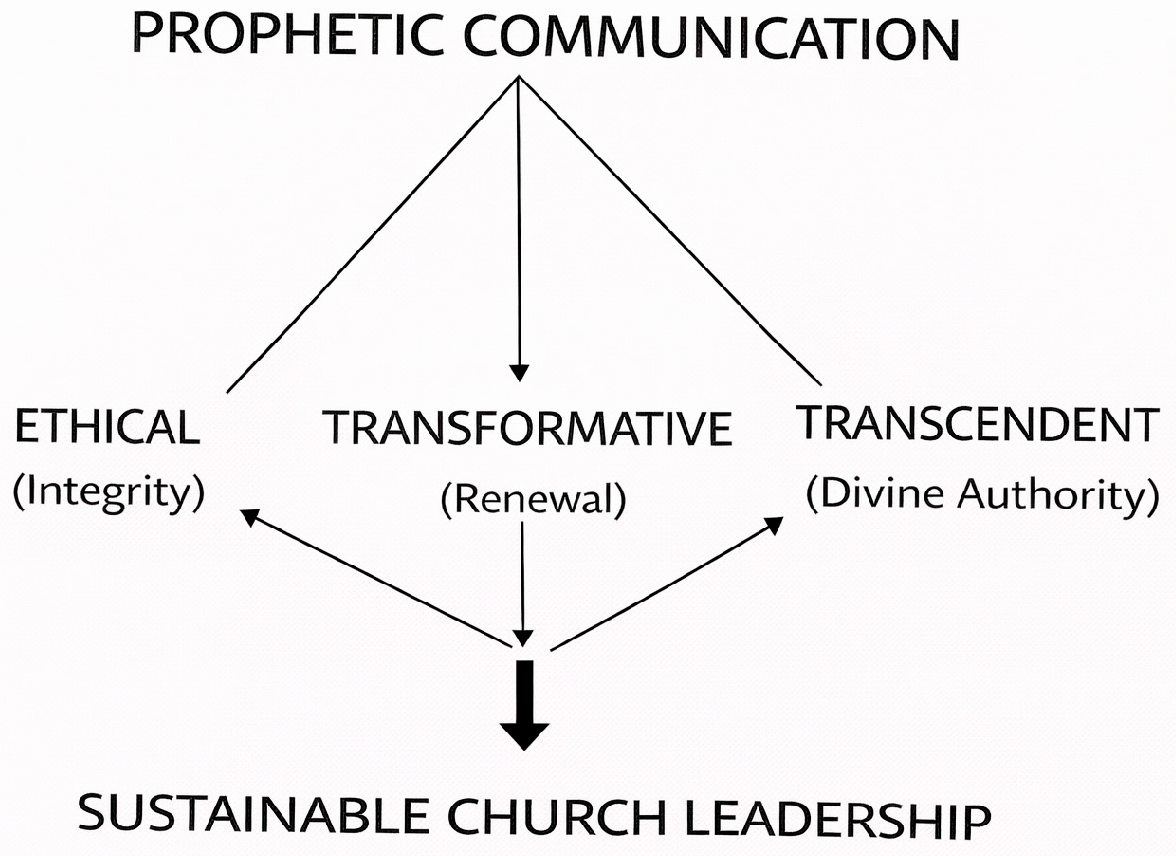
The three dimensions are interconnected and mutually reinforcing (see Figure 1).
Integration of these three dimensions establishes prophetic communication as a distinctive identity marker for authentic church leadership. Morgan (2007, n.p.) argues it is crucial for reinterpreting the church’s identity amidst cultural change. Le Duc (2024, pp. 105–25) introduces “prophetic dialogue” as a bridge between faith and socio-technological reality, expanding prophetic communication beyond proclamation to public engagement. Schlag et al. (2025, p. 491) demonstrate empirically that leaders integrating prophetic principles navigate digital innovation more faithfully than those adopting secular strategies uncritically. The Hebrew nābî and Greek prophētēs affirm the prophetic call to speak on God’s behalf (Exodus 7:1; Jeremiah 1:7; Acts 13:1), strengthening collective identity as the body of Christ (Ephesians 4:15–16; Matthew 5:14–16).

5. Discussion

5.1. Biblical Foundations for Sustainable Leadership

5.1.1. Old Testament Prophetic Leadership

Old Testament prophets functioned as communication intermediaries between God and his people, becoming instruments for conveying divine will amidst complex social and political situations (O’Brien 2022, p. 298). They not only delivered Yahweh’s messages with courage and steadfast faith but also fulfilled ethical and social responsibilities through counsel, rebuke, and interpretation of God’s will for individuals and the Israelite community (Ehusani 2025, pp. 830–35; Frahm-Arp 2021, pp. 312–36) (Micah 6:8; Amos 5:24; Isaiah 1:17).
Frahm-Arp (2021, pp. 312–36) demonstrates that this prophetic role placed them in direct relation with political authority, where prophetic messages often influenced government policies and the nation’s moral and social direction. In this context, the prophets became the living voice of God, calling for justice and repentance and affirming the supremacy of divine truth over human power.
Bowman (2004, n.p.) and Ehusani (2025, pp. 830–35) both affirm that the success of their ministry stemmed not from personal ability but from the work of the Holy Spirit granting power and spiritual authority, validating the prophetic message as revelation from God (2 Peter 1:21; Micah 3:8). Despite human limitations, the prophets demonstrated faithfulness and courage in fulfilling their divine calling.
Beyond being conveyors of the word, they also served as educators training prophetic communicators among the people, instilling understanding of God’s law, tradition, and communication methods grounded in God’s truth (Jeremiah 1:7–10; Isaiah 6:8–9; Deuteronomy 6:6–9; 2 Kings 2:9–15). Through life experiences filled with suffering and testing, as experienced by Jeremiah and Elijah (Jeremiah 20:7–9; 1 Kings 19:9–18), they formed mature spiritual character, filled with empathy, wisdom, and prophetic authority.
Reddy and Nicolaides (2022, pp. 1–15) demonstrate that their life stories became examples for subsequent generations, showing how the prophetic calling does not stop at proclaiming the word but also involves mentoring and regenerating truth proclaimers. Thus, the Old Testament prophets became models of prophetic leadership that not only preserved the continuity of faith but also transmitted spiritual and moral heritage for future generations (Psalm 78:4–7; 2 Timothy 2:2).

5.1.2. New Testament Prophetic Leadership

In the New Testament, prophetic communication displays an integration between the concept of divine inspiration from Hebrew tradition and the Greco-Roman idea of parrhesia—courage to speak honestly and openly. Harvey (2018, pp. 21–34) argues that this fusion produced a form of spiritual communication combining divine authority and moral courage, creating an effective rhetorical style within the cross-cultural and social context of the early church. This synthesis is evident in Paul’s writings, where he positions himself as a prophetic speaker using uncompromising truth while appearing as a moral and theological authority affirming faith integrity amidst pressured Christian communities.
In the context of spiritual gifts, prophecy is understood as a gift of the Holy Spirit given to build up, advise, and strengthen the body of Christ (1 Corinthians 14:3; Ephesians 4:11–13). Hogeterp (2018, pp. 169–96) emphasises that Paul in 1 Corinthians 12–14 presents prophecy not merely as prediction but as proclamation inspired by the Holy Spirit for the edification, encouragement, and strengthening of the congregation. Thus, prophetic communication in the New Testament affirms the dimension of spiritual building and church unity while demanding that spiritual leaders speak with courage sourced from divine authority.
Stenschke (2021, p. a1962) demonstrates that the prophetic message is also rooted in an eschatological vision, affirming hope in the fulfilment of God’s salvation plan. The prophets and apostles spoke with conviction regarding God’s ultimate purpose and the certainty of divine promises, forming the basis for the people’s ethics, faith, and hope. This eschatological orientation invites the Christian community to live in readiness, faithfulness, and hope while actualising Kingdom of God values amidst suffering and changing times.
Prophetic leadership in the New Testament is marked by three main characteristics: courage in declaring truth, steadfastness in confronting power, and the delivery of hope rooted in God’s eschatological promises (Stenschke 2021, p. a1962). Prophetic leaders are called to speak with divine authority, maintain faith integrity and guide people toward hope in the restoration promised by God. Herein, the Holy Spirit plays a central role in empowering leaders, bestowing gifts, authority, and spiritual sensitivity to deliver God’s message with wisdom and faithfulness (Acts 1:8; John 14:26; 1 Corinthians 2:10–13; Newberg 2022, pp. 103–18).
Walkonis (2004, n.p.) concludes that prophetic communication in New Testament church leadership is a spiritual process positioning leaders as divine message bearers who guide and inspire the congregation in faith (James 1:5; Colossians 3:16; 2 Timothy 4:2). True leaders maintain message purity to prevent distortion by personal interests (1 John 4:1; 2 Corinthians 4:2) and build unity through love and humility (Philippians 2:2–4; Romans 12:16–18). When exercised with integrity and sensitivity to the Holy Spirit’s work, prophetic communication strengthens faith, deepens fellowship, and brings forth spiritual and social transformation according to Christ’s will (Romans 12:2; Matthew 5:14–16; Ephesians 4:15–16).

5.2. Integration of the Tri-Dimensional Model in Sustainable Leadership

The tri-dimensional model provides essential foundations for sustainable church leadership. Each dimension contributes distinctively to leadership sustainability.

5.2.1. Ethical Dimension and Accountability

The ethical dimension builds accountability, which Obenza (2025, pp. 1–3) identifies as a critical factor often lacking in church leadership, leading to moral and institutional failure that undermines prophetic credibility and erodes congregational trust. As Ezekiel 34:2–4 condemns shepherds who feed themselves rather than the flock, accountability protects against leadership corruption.
Kretzschmar (2023, p. a2685) demonstrates that ethical prophetic leadership requires deep engagement with contemporary moral challenges, ensuring that leaders remain grounded in biblical truth while addressing complex social realities. This ethical grounding builds trust—the social capital essential for sustainable leadership. Without trust, leaders cannot guide congregations through inevitable challenges and transitions.

5.2.2. Transformative Dimension and Adaptation

The transformative dimension equips leaders to guide congregations through change without losing essential identity. Pillay (2023, pp. 355–69) emphasises that prophetic leaders are called to build communities actively seeking truth, defending the weak and marginalised, and responding to social brokenness caused by sin. This outward orientation prevents the church from becoming ingrown and irrelevant.
Le Duc (2024, pp. 105–25) argues that prophetic dialogue serves as a bridge between faith and socio-technological reality, enabling the church to engage critically and constructively with cultural change. This dialogical capacity is essential for sustainable leadership, as it allows the church to maintain faithful witness while adapting to new contexts.

5.2.3. Transcendent Dimension and Resilience

The transcendent dimension grounds leaders in divine authority and spiritual empowerment, providing resilience for sustained ministry. Newberg (2022, pp. 103–18) explores how the Holy Spirit empowers leaders with gifts, authority, and spiritual sensitivity to deliver God’s message with wisdom and faithfulness. This empowerment sustains leaders through opposition, disappointment, and the inevitable challenges of long-term ministry.
Bowman (2004, n.p.) and Ehusani (2025, pp. 830–35) both affirm that prophetic ministry success stems not from personal ability but from the Holy Spirit’s work. This dependence on transcendence protects leaders from burnout and preserves them for faithful, sustainable service.

5.2.4. Leadership Succession

A critical dimension of sustainability is leadership succession—the faithful transmission of prophetic ministry to future generations. The Old Testament prophets modelled this dimension through mentoring relationships.
Reddy and Nicolaides (2022, pp. 1–15) examine Jeremiah’s ministry as a model of suffering prophetic leadership that transmitted faith across generations. Despite opposition and personal cost, Jeremiah remained faithful, and his example shaped subsequent prophetic identity. Similarly, Elijah’s mentoring of Elisha (2 Kings 2:9–15) demonstrates intentional preparation of successors who would carry forward prophetic ministry.
Okobia (2024, pp. 10–24) emphasises that church leaders have a responsibility to mentor new generations of leaders to ensure the continuity of prophetic witness, drawing on 2 Timothy 2:2: “And the things you have heard me say in the presence of many witnesses entrust to reliable people who will also be qualified to teach others.” This Pauline model of intentional multiplication ensures that prophetic ministry extends beyond any single leader’s lifetime.
The tri-dimensional model informs succession practice:
  • The ethical dimension ensures that successors are selected based on character, not merely charisma or connection (1 Timothy 3:1–7; Titus 1:5–9).
  • The transformative dimension ensures that succession aims at ongoing renewal, not merely institutional continuity.
  • The transcendent dimension ensures that succession depends on the Spirit’s calling and equipping, not merely human planning (Acts 13:2–4).

5.2.5. Empirical and Practical Dimensions

The effectiveness of sustainable church leadership may increase when principles of prophetic communication are applied as the basis in both relational and administrative dimensions of ministry. This claim requires careful qualification. The evidence we can offer is drawn from three types of sources: (1) biblical narratives depicting effective prophetic leadership (e.g., Moses, Jeremiah, Paul); (2) theological reasoning about the necessary conditions for faithful leadership (e.g., Kretzschmar 2023); and (3) contemporary empirical studies (e.g., Schlag et al. 2025; Kesumawati and Gultom 2025). However, no direct empirical evidence from within the present study supports a causal claim. Therefore, we reframe: our analysis suggests that where prophetic principles are embodied in leadership practice, positive outcomes may follow. This is a hypothesis warranting empirical testing, not a demonstrated conclusion.
Kesumawati and Gultom (2025, pp. 156–68), in their cross-denominational research, indicate that values of prophetic communication such as love (1 Corinthians 13:1–3), wisdom (James 3:17), and empathy (Colossians 3:12–14) strengthen the role of pastoral leaders as spiritual guides and ethical models. Leaders exemplifying these principles foster a ministerial environment marked by mutual trust, collaboration, and sustainable spiritual growth, as depicted in Ephesians 4:15–16 regarding the body of Christ growing through love and unity.
Simamora et al. (2025, pp. 131–43) demonstrate that implementing prophetic communication impacts not only interpersonal relationships but also significantly contributes to church organisational governance and culture. When church management practices are systematically executed based on prophetic principles—such as honesty (Proverbs 12:22), justice (Isaiah 1:17), and loving service (John 13:34–35)—the church experiences improvement in organisational clarity, internal communication effectiveness, and trust in leadership. These factors are essential elements in building sustainable church growth while maintaining its spiritual relevance amidst modern social and technological dynamics (Romans 12:2).
Sembiring (2025, pp. 95–105) addresses the practical challenge of developing leadership capacity, arguing that ongoing training in prophetic communication is necessary so the church can strengthen the influence of prophetic values and ensure the relevance of its mission amidst changing times. This includes addressing limitations in leadership resources (Matthew 9:37), difficulties balancing ministerial responsibilities and personal life (Mark 6:31), and communication gaps among congregants (1 Corinthians 1:10).

5.3. Challenges and Opportunities in Implementing Prophetic Communication

5.3.1. Ethical and Socio-Cultural Barriers

Implementing prophetic communication in contemporary society faces challenges related to ethics and socio-cultural aspects, arising from declining moral values, increasing relativism, and ethnocentrism. Pillay (2023, pp. 355–69) observes that norms of truth are often disregarded, while subjective views and cultural superiority hinder the reception of prophetic messages calling for repentance, justice, and love (Micah 6:8; Isaiah 1:17). In this context, divine messages are frequently rejected for conflicting with personal interests or entrenched local values.
Safri (2012, pp. 167–86) argues that a lack of moderation and empathy worsens cross-cultural communication, hindering dialogue that should reflect Christ’s love (Ephesians 4:15; Colossians 3:12–14). Therefore, prophetic communicators are required to demonstrate spiritual sensitivity, wisdom, and integrity, following Jesus’ example of communicating with love and truth (John 13:34–35). Through renewing commitment to ethics and efforts to rebuild trust within the community, prophetic communication can function again as a means of moral and spiritual transformation in modern society (Romans 12:2).
Schlag et al. (2025, p. 491) demonstrate through empirical research with Swiss church actors that religious leaders who maintain ethical integrity while engaging cultural change build greater trust and credibility than those who compromise prophetic distinctiveness for cultural acceptance.

5.3.2. The Digital Era and Media Complexity

The rapid growth of digital technology has ushered humanity into an era of unprecedented media complexity. Alzubi (2023, pp. 1–13) documents that the production, distribution, and consumption of information have undergone fundamental changes in form and dissemination dynamics. The digital world has created communication spaces that are not only fast and open but also laden with bias, polarisation, and value fragmentation.
Blommaert (2020, pp. 390–403) and Shao (2020, pp. 10–15) demonstrate that this change poses new challenges for spiritual leaders and faith messengers in maintaining the purity and integrity of prophetic communication amidst global information flows. This challenge is increasingly evident in what some scholars term the contemporary digital era—a period characterised not only by technical innovation but also by altered social configurations, cultural expressions, and global societal thought patterns. Digital media no longer merely function as a communication tool but have become a discourse space shaping perceptions, opinions, and even public theology.
In this condition, prophetic messengers are required to possess spiritual wisdom and ethical acuity to interpret God’s will relevantly without sacrificing the spiritual depth of the divine message (Colossians 4:6; James 3:17). Prophetic communication must navigate between contextual relevance and theological purity amidst a fast-paced and plural media reality. The main challenge arises when faith values confront digital content that is shallow, sensational, and manipulative.
Campbell and Tsuria (2021, pp. 112–15) argue that the digital era demands the church and spiritual leaders develop “digital religious ethics”—faith-based communication ethics that are not only adaptive to technology but also retain their prophetic character in online contexts. In their view, spiritual communication in digital spaces should be participatory, dialogical, and transformative, reflecting God’s love in an increasingly digitised world. This study affirms their contribution while grounding it in the tri-dimensional model: the transcendent dimension provides the divine authority that prevents digital adaptation from becoming cultural accommodation; the ethical dimension ensures that digital engagement maintains moral integrity; and the transformative dimension ensures that digital communication aims at genuine spiritual renewal rather than mere visibility. As Jeremiah 23:28–29 warns, “Let the prophet who has a dream tell the dream, but let the one who has my word speak it faithfully. Is not my word like fire… like a hammer that breaks the rock in pieces?” Prophetic communication cannot be domesticated by algorithmic logics; it must retain its disruptive, transformative power.

5.3.3. Organisational and Institutional Constraints

Beyond ethical factors and digital/media issues, the institutional and organisational environment plays a crucial role in determining the effectiveness of implementing prophetic communication. Rengkaningtias et al. (2025, pp. 23–34) demonstrate that in religious and educational institutions, implementing prophetic communication often faces complex structural and organisational culture challenges. Educational institutions and religious bodies face challenges such as rigid hierarchies, bureaucratic inertia, limited human and financial resources, and diverse stakeholder expectations, potentially hindering the realisation of open, value-oriented communication patterns.
These constraints often result in information fragmentation, resistance to innovation, and a lack of professional training regarding prophetic communication principles. Consequently, prophetic values like empathy, sincerity, and moral integrity are often marginalised by demands for administrative efficiency, performance targets, and structural compliance.
Wulandari et al. (2025, pp. 80–96) emphasise the importance of prophetic communication as a means of moral correction and character formation in religious leadership contexts. To address this challenge, spiritual leadership in Christian educational institutions is required to balance prophetic values—such as love, sincerity, and justice (Colossians 3:12–14; Ephesians 4:29)—with institutional goals like efficiency, accountability, and spiritual transformation. Applying these values demands strategic management based on faith ethics, where spiritual leaders become examples in integrity and service (1 Timothy 4:12; Titus 2:7).
The tri-dimensional model offers resources for addressing institutional constraints:
  • Ethical dimension calls leaders to model integrity within institutional structures, gradually transforming organisational culture through consistent example.
  • Transformative dimension calls for systemic renewal, not merely individual adaptation, addressing unjust structures and practices that hinder prophetic witness.
  • Transcendent dimension grounds leaders in divine authority, enabling them to resist institutional pressures that would compromise prophetic faithfulness.

5.3.4. Opportunities: Technology and Theological Education

In the digital era, technology and media have become powerful instruments for expanding the reach and impact of prophetic communication. The internet, social media, and various digital platforms allow the church to convey prophetic messages—such as calls for justice, peace, and love—to a broader audience, transcending geographical and cultural boundaries (Matthew 28:19; Acts 1:8). Schlag et al. (2025, p. 491) demonstrate through empirical research that church actors who embrace digital innovation while maintaining theological integrity reach new audiences, particularly younger generations increasingly active in digital spaces.
Through creative content like videos, podcasts, and interactive posts, the church can present prophetic messages relevantly and contextually while maintaining their spiritual essence (1 Corinthians 9:22). However, to ensure this opportunity is utilised optimally, the church needs to develop digital literacy and communication skills among its leaders and members. This includes training in managing digital platforms, creating engaging content, and building online communities that reflect Kingdom of God values (Colossians 4:6).
Campbell and Tsuria (2021, pp. 112–15) provide a framework for this development, emphasising that digital religious ethics must be participatory, dialogical, and transformative. When guided by the tri-dimensional model, digital engagement becomes not merely technological adaptation but faithful prophetic witness in new communicative contexts.
Theological education plays a strategic role in preparing leaders capable of implementing prophetic communication effectively and contextually. Through a relevant and holistic curriculum, theological education can equip prospective leaders with a deep understanding of prophetic communication principles, including their biblical, theological, and ethical foundations (2 Timothy 3:16–17).
Sembiring (2025, pp. 95–105) argues that theological education must provide practical skills in public speaking, digital media management, conflict resolution, and cross-cultural dialogue, enabling leaders to convey prophetic messages with wisdom and empathy (Colossians 4:6). Theological education also serves as a forum for character and spiritual formation, shaping leaders with integrity, courage, and sensitivity to the Holy Spirit’s guidance—essential qualities for prophetic communicators (1 Timothy 4:12).
By integrating theory and practice, theological education can produce leaders who are not only theologically sound but also capable of addressing contemporary challenges with prophetic insight. Kesumawati and Gultom (2025, pp. 156–68) demonstrate that pastors with strong theological education in prophetic principles lead churches that exhibit greater sustainability, adaptability, and missional effectiveness.
Thus, theological education becomes a key pillar in strengthening the church’s prophetic witness in an increasingly complex and changing world, ensuring that each generation produces leaders equipped to communicate prophetically with ethical integrity, transformative power, and transcendent authority.

5.4. Implications for Practice

5.4.1. For Church Leaders

Cultivate Ethical Integrity: Prioritize character formation through spiritual disciplines, accountability relationships, and regular ethical reflection (1 Timothy 4:7–8). Prophetic leadership focuses on transformation, not institutional preservation.
Develop Transformative Vision: Guide congregations to participate in God’s mission (Missio Dei) rather than merely maintain institutional programs. Prophetic leadership focuses on transformation, not institutional preservation.
Nurture Transcendent Dependence: Cultivate practices that deepen awareness of the Holy Spirit’s guidance—prayer, Scripture meditation, and communal discernment (Acts 13:2–4). Prophetic ministry success stems from divine enablement, not human skill.
Embrace Digital Engagement Faithfully: Develop digital literacy while maintaining prophetic distinctiveness. Use digital platforms to extend reach, but evaluate success by spiritual fruit rather than engagement metrics. Digital engagement requires prophetic discernment, not mere adaptation.

5.4.2. For Theological Educators

Integrate Prophetic Formation: Design curricula that balance biblical–theological knowledge with character formation and practical skills. Theological education plays a strategic role in preparing prophetic leaders.
Develop Digital Competency: Train students in digital media production, online community building, and ethical discernment in digital spaces. Digital spaces demand new competencies without compromising prophetic character.
Model Mentoring Relationships: Follow Paul’s example in 2 Timothy 2:2 by intentionally investing in emerging leaders. The tri-dimensional model informs succession through ethical character, transformative vision, and Spirit-led calling.

5.4.3. For Denominational Policymakers

Establish Accountability Structures: Create systems that support ethical integrity—regular reviews, peer accountability, and transparent governance. Lack of accountability undermines prophetic credibility.
Support Succession Planning: Develop intentional processes for identifying, training, and deploying next-generation prophetic leaders. Leadership must be entrusted to reliable people who will teach others.

6. Conclusions

This study has constructed a biblical–theological model of prophetic communication and explored its potential role in fostering sustainable church leadership. Through lexical-semantic analyses of Hebrew (nebu’ah, nābî) and Greek (propheteia, prophētēs) terms and thematic synthesis of contemporary scholarship, the research identifies three interconnected dimensions of prophetic communication: ethical, transformative, and transcendent.
The ethical dimension establishes moral integrity and accountability as foundational for leadership sustainability. Prophetic communicators must embody honesty, justice, and love, reflecting God’s character in both message and life (Ephesians 4:15; Proverbs 12:22). Without this ethical grounding, prophetic witness degenerates into manipulation, losing its divine mandate and moral authority (Kretzschmar 2023, p. a2685).
The transformative dimension ensures that prophetic communication aims at genuine renewal—personal, communal, and structural. Rooted in the Missio Dei, prophetic leadership guides congregations beyond institutional maintenance toward faithful participation in God’s redemptive mission (Niemandt 2019, n.p.; Romans 12:2). This dimension calls leaders to build communities that defend the marginalised and pursue justice (Pillay 2023, pp. 355–69; Isaiah 1:17).
The transcendent dimension grounds prophetic communication in divine authority and spiritual empowerment. Success in prophetic ministry stems not from human ability but from the Holy Spirit’s work, validating messages as divine revelation (Bowman 2004, n.p.; 2 Peter 1:21). This dependence on transcendence protects leaders from burnout and sustains faithful, long-term service (Newberg 2022, pp. 103–18).
The study demonstrates that these dimensions together address contemporary challenges facing church leadership. Ethical and socio-cultural barriers require leaders who embody integrity while engaging cultural change. Digital media complexity demands spiritual wisdom to navigate between relevance and purity. Organisational constraints call for systemic renewal through ethical modelling and transformative vision. Conversely, significant opportunities exist. Digital platforms expand prophetic reach across boundaries, enabling engagement with younger generations through creative content (Schlag et al. 2025, p. 491). Theological education plays a strategic role in preparing leaders with biblical foundations, practical skills, and spiritual formation necessary for faithful prophetic witness (Sembiring 2025, pp. 95–105; 2 Timothy 3:16–17).
Four limitations must be emphasised. First, as noted in Section 3.4, the hermeneutical gap between biblical texts and contemporary practice means that the model cannot be directly prescriptive. Future research should test the model empirically in diverse ecclesial contexts using qualitative methods (interviews, case studies) or quantitative instruments (surveys measuring leadership outcomes). Second, the study’s normative claims—that prophetic communication is “indispensable”—are theological assertions, not empirical conclusions. We have revised these claims accordingly (e.g., “warrants consideration as” rather than “is”). Third, the literature search, while systematic, may have missed relevant sources from non-English publications or denominations not well-represented in major databases. Fourth, the author’s voice, while strengthened, remains partially mediated through extensive quotation; future work by the authors could develop original case studies of prophetic leadership in contemporary congregations.
In conclusion, embedding prophetic communication within leadership praxis warrants consideration as both a strategic and theological imperative for church sustainability. The tri-dimensional model provides church leaders, theological educators, and policymakers with a framework for developing prophetic capacity. Whether this framework proves effective in practice remains an open empirical question.

Author Contributions

Conceptualization, H.H., R.P. and A.P.; methodology, H.H., R.P. and A.P.; formal analysis, H.H., R.P. and A.P.; investigation, H.H., R.P. and A.P.; writing—original draft preparation, H.H., R.P. and A.P.; writing—review and editing, H.H., R.P. and A.P. All authors have read and agreed to the published version of the manuscript.

Funding

This research received no external funding.

Data Availability Statement

All data supporting this study are available in the cited references.

Acknowledgments

The authors thank their institutions for supporting this research.

Conflicts of Interest

The authors declare no conflicts of interest.

References

  1. Alzubi, Ahmad. 2023. The Evolving Relationship between Digital and Conventional Media: A Study of Media Consumption Habits in the Digital Era. The Progress: A Journal of Multidisciplinary Studies 4: 1–13. [Google Scholar] [CrossRef]
  2. Bauer, Walter. 2010. A Greek-English Lexicon of the New Testament and Other Early Christian Literature, 3rd ed. Chicago: University of Chicago Press. [Google Scholar]
  3. Bhagwan, James N. 2006. Towards a Contextual Theology of Prophetic Communication. Ph.D. dissertation, Pacific Theological College, Sava, Fiji. Available online: https://asiapacific.anu.edu.au/pambu/catalogue/index.php/towards-a-contextual-theology-of-prophetic-communication-communicating-the-prophetic-voie-of-the-mainline-churches-and-the-prophetic-role-of-the-news-media-in-contemporary-fiji-island-society;isad?sf_culture=nl (accessed on 3 June 2026).
  4. Blommaert, Jan. 2020. Political Discourse in Post-Digital Societies. Trabalhos Em Linguistica Aplicada 59: 390–403. [Google Scholar] [CrossRef]
  5. Bowman, Craig. 2004. The Spirit of God in the Ministry of the Old Testament Prophets. Leaven 12: 3. Available online: https://digitalcommons.pepperdine.edu/leaven/vol12/iss3/3 (accessed on 25 February 2026).
  6. Brown, Francis, Samuel Rolles Driver, and Charles Augustus Briggs. 1996. The Brown-Driver-Briggs Hebrew and English Lexicon. Peabody: Hendrickson Publishers. [Google Scholar]
  7. Browning, Don S. 1991. A Fundamental Practical Theology. Minneapolis: Fortress Press. [Google Scholar]
  8. Campbell, Heidi A., and Ruth Tsuria. 2021. Digital Religion: Understanding Religious Practice in Digital Media. New York: Routledge. [Google Scholar]
  9. Ehusani, Richard. 2025. Prophetic Self-Negation: Validating the Divine Origin of the Word. Religious Studies 2024: 830–35. [Google Scholar] [CrossRef]
  10. Frahm-Arp, Maria. 2021. Political Activism in Pentecostal Charismatic Evangelical Churches and the 2019 Elections in South Africa. Journal of Religion in Africa 49: 312–36. [Google Scholar] [CrossRef]
  11. Gesenius, Wilhelm. 1898. A Hebrew and English Lexicon of the Old Testament: With an Appendix Containing the Biblical Aramaic. Oxford: Clarendon Press. [Google Scholar]
  12. Harvey, Lexie. 2018. Commitment to the Truth: Parrhesiastic and Prophetic Elements of Paul’s Letter to the Galatians. Res Rhetorica 5: 21–34. [Google Scholar] [CrossRef][Green Version]
  13. Heitink, Gerben. 1999. Practical Theology: History, Theory, Action Domains. Grand Rapids: Eerdmans. [Google Scholar]
  14. Hilber, John W. 2019. Ancient Prophecy: Near Eastern, Biblical, and Greek Perspectives. University Park: Pennsylvania State University Press. [Google Scholar]
  15. Hogeterp, Albert. 2018. Prophecy and the Prophetic as Aspects of Paul’s Theology. Stellenbosch Theological Journal 4: 169–96. [Google Scholar] [CrossRef]
  16. Kesumawati, Kesumawati, and Joni Manumpak Parulian Gultom. 2025. Effective Pastoral Leadership in Church Growth and Renewal. Journal of the American Institute 2: 156–68. Available online: https://www.researchgate.net/publication/389403373_Effective_Pastoral_Leadership_in_Church_Growth_and_Renewal (accessed on 3 June 2026). [CrossRef]
  17. Koehler, Ludwig, Walter Baumgartner, and Johann J. Stamm. 2001. The Hebrew and Aramaic Lexicon of the Old Testament. Leiden: Brill. [Google Scholar]
  18. Kretzschmar, Louise. 2023. A Christian Ethical Analysis of the Importance of Prophetic Leadership for Sustainable Leadership. Verbum et Ecclesia 44: a2685. [Google Scholar] [CrossRef]
  19. Le Duc, Anthony. 2024. Engaging with Stakeholders of the Technological Future Through Prophetic Dialogue: A Catholic Perspective. Jurnal Ledalero 23: 105–25. [Google Scholar] [CrossRef]
  20. Morgan, David. 2007. Priesthood, Prophethood and Spirit-Led Community: A Practical-Prophetic Pentecostal Ecclesiology. Ph.D. dissertation, Durham University, Durham, UK. Available online: https://etheses.durham.ac.uk/id/eprint/2577/ (accessed on 25 February 2026).
  21. Newberg, Eric N. 2022. Paradigms of Global Spirit-Empowered Leadership. Spiritus: ORU Journal of Theology 7: 169–98. [Google Scholar] [CrossRef]
  22. Niemandt, Nelus. 2019. Missional Leadership. Cape Town: AOSIS. [Google Scholar] [CrossRef]
  23. Nissinen, Martti. 2017. Ancient Prophecy: Near Eastern, Biblical, and Greek Perspectives. Oxford: Oxford University Press. [Google Scholar]
  24. Obenza, Brandon Nacua. 2025. Book Review: Altar of Secrets: Sex, Politics, and Money in the Philippine Catholic Church (by Aries C. Rufo). Journal of Contemporary Philosophical and Anthropological Studies 3: 1–3. [Google Scholar] [CrossRef]
  25. O’Brien, Julia M. 2022. Forthtellers Not Foretellers: The Origins of a Liberal Orthodoxy About the Prophets. Religions 13: 298. [Google Scholar] [CrossRef]
  26. Okobia, Faith Nkem. 2024. Paul’s Church Leadership Style a Road Map for Christian Leaders in Nigeria. International Journal of Culture and Religious Studies 5: 61–71. [Google Scholar] [CrossRef]
  27. Oliva, Mirela. 2022. The Experience of Prophecy and the Metaphysics of Providence in Aquinas. Religions 13: 921. [Google Scholar] [CrossRef]
  28. Osmer, Richard R. 2008. Practical Theology: An Introduction. Grand Rapids: Eerdmans. [Google Scholar]
  29. Pillay, Jerry. 2023. The Kingdom of God and the Transformation of the World: The Call and Role of the Ecumenical Movement. International Review of Mission 112: 355–69. [Google Scholar] [CrossRef]
  30. Reddy, Mike Megrove, and Angelo Nicolaides. 2022. Jeremiah the Suffering Prophet—His Communication of Judgment and Promise of Blessings. Pharos Journal of Theology 103: 1–15. [Google Scholar] [CrossRef]
  31. Rengkaningtias, Ayu Usada, Farida Hanum, and Cepi Safruddin Abd Jabar. 2025. Organizational Communication Management in Effective Islamic School. Humanika: Kajian Ilmiah Mata Kuliah Umum 25: 23–34. [Google Scholar] [CrossRef]
  32. Safri, Arif Nuh. 2012. Otentisitas Risalah Kenabian (Pluralisme dan Kemanusiaan) [The Authenticity of the Prophetic Message (Pluralism and Humanity)]. ESENSIA: Jurnal Ilmu-Ilmu Ushuluddin 13: 167–86. Available online: https://ejournal.uin-suka.ac.id/ushuluddin/esensia/article/view/131-10 (accessed on 3 June 2026). [CrossRef]
  33. Schlag, Thomas, Gregor Frey, and Kriti Yadav. 2025. Religious Leadership and Digital Innovation: An Explorative Interview Study with Church Actors in the Swiss Context. Religions 16: 491. [Google Scholar] [CrossRef]
  34. Schwab, Klaus. 2017. The Fourth Industrial Revolution. New York: Currency. [Google Scholar]
  35. Scott, Robert. 1897. A Greek-English Lexicon. New York: Harper & Brothers. [Google Scholar]
  36. Sembiring, Jesica Cindini. 2025. Capacity Building of Facilitators in the Context of Pastoral Ministry at St. Joseph Church Tanjung Balai Karimun. Masyarakat Mandiri: Jurnal Pengabdian Dan Pembangunan Lokal 2: 95–105. [Google Scholar] [CrossRef]
  37. Shao, Yijie. 2020. The Impact of Digital Media on Modern Society and Culture. Communications in Humanities Research 57: 117–22. [Google Scholar] [CrossRef]
  38. Simamora, Parasian, Andreas Eko Nugroho, and Kornelius Rulli Jonathans. 2025. Penerapan Sistem Manajemen Mutu ISO 9001 dan Kontribusinya Bagi Pertumbuhan Gereja Pentakosta di Cililitan [Implementation of the ISO 9001 Quality Management System and Its Contribution to the Growth of the Pentecostal Church in Cililitan]. Jurnal Teologi Dan Pelayanan Kerusso 10: 131–43. [Google Scholar] [CrossRef]
  39. Stenschke, Christoph W. 2021. The Prophet Like Moses (Dt 18:15-22): Some Trajectories in the History of Interpretation. Verbum et Ecclesia 42: a1962. [Google Scholar] [CrossRef]
  40. Thayer, Joseph Henry. 1889. A Greek-English Lexicon of the New Testament. New York: American Book Company. [Google Scholar]
  41. Tveit, Olav Fykse. 2016. Service and Advocacy: Matters of Faith? The Ecumenical Review 68: 14–26. [Google Scholar] [CrossRef]
  42. Van der Ven, Johannes A. 1998. Practical Theology: An Empirical Approach. Kampen: Kok Pharos. [Google Scholar]
  43. Walkonis, Steven R. 2004. The Phenomenon of Power in the Church: An Investigation and Analysis of the Relational Dynamics Experienced in the Context of the Assertion of Authority. Ph.D. dissertation, Andrews University, Berrien Springs, MI, USA. Available online: https://digitalcommons.andrews.edu/dmin/143/ (accessed on 25 February 2026).
  44. Willimon, William H. 2024. Preaching as Protest Against the Apophatic Silencing of God’s People. Religions 15: 233. [Google Scholar] [CrossRef]
  45. Wulandari, May Putri, and Hikmatur Romdoni. 2025. The Prophetic Communication in the Book ‘The Prophet’s Methods of Correcting People’s Mistakes’. Jurnal Peurawi: Media Kajian Komunikasi Islam 8: 80–96. Available online: https://comms.ar-raniry.ac.id/peurawi/article/view/179 (accessed on 25 February 2026).
Figure 1. The Tri-Dimensional Model of Prophetic Communication.
Religions 17 00697 g001
Table 1. Key Prophetic Terminology.
LanguageTermTransliterationMeaningKey References
Hebrewנְבוּאָהnebu’ahProphecy, divine messageGesenius (1898); Brown et al. (1996)
HebrewנָבִיאnābîProphet, God’s spokespersonKoehler et al. (2001)
GreekπροφητείαpropheteiaProphecy, inspired declarationThayer (1889); Bauer (2010)
GreekπροφήτηςprophētēsProphet, divine messengerScott (1897)
Disclaimer/Publisher’s Note: The statements, opinions and data contained in all publications are solely those of the individual author(s) and contributor(s) and not of MDPI and/or the editor(s). MDPI and/or the editor(s) disclaim responsibility for any injury to people or property resulting from any ideas, methods, instructions or products referred to in the content.