Praṇidhi Paintings and Inscriptions of Cave 20 at Bezeklik and the Mūlasarvāstivāda-Vinaya Bhaiṣajyavastu
Abstract
1. Introduction
2. Arrangement of Praṇidhi Paintings According to Le Coq’s Number
3. New Arrangement of Praṇidhi Paintings and Their Relationship to the Bhaiṣajyavastu
4. Conclusions
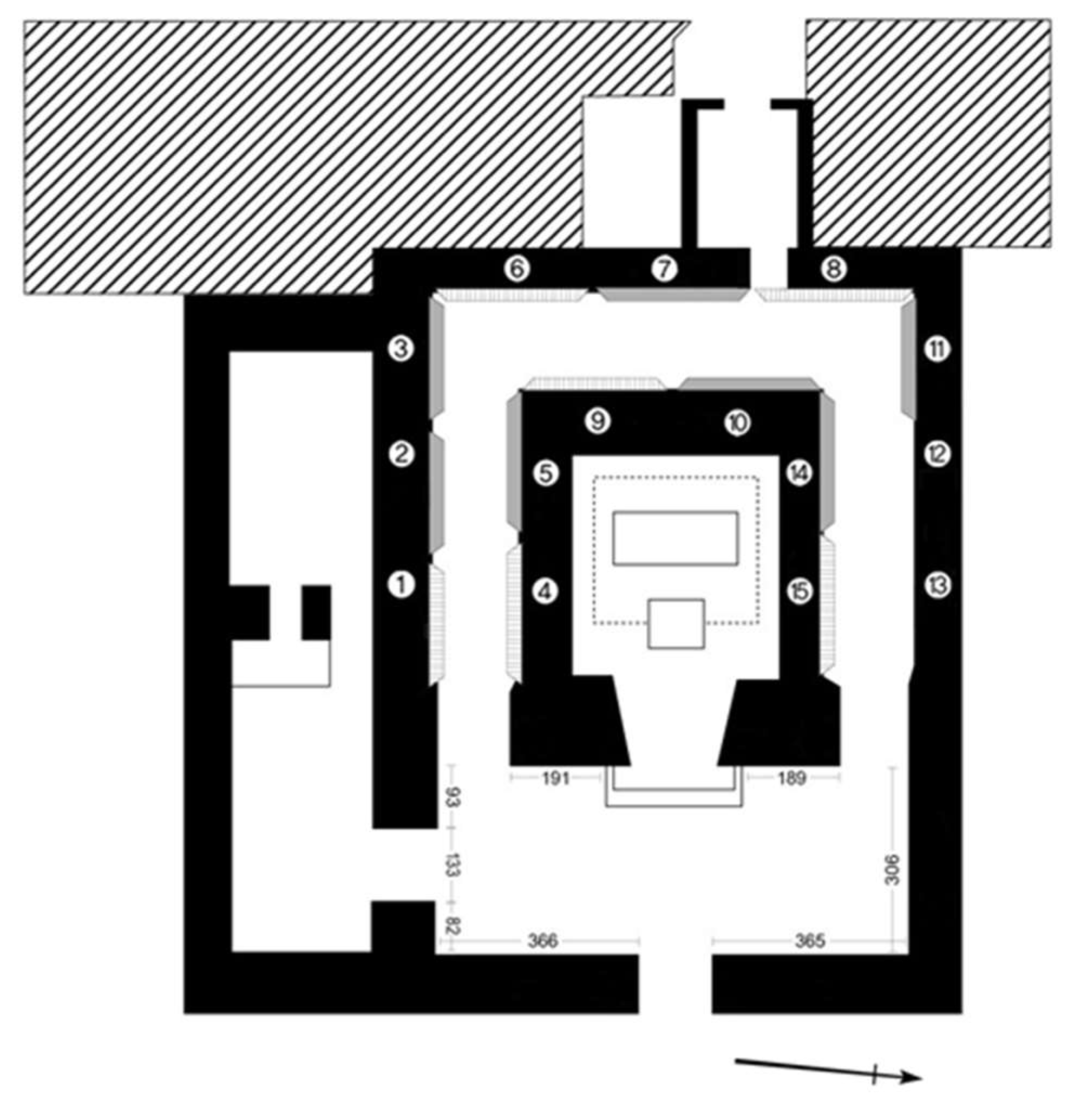
Funding
Institutional Review Board Statement
Informed Consent Statement
Data Availability Statement
Acknowledgments
Conflicts of Interest
Appendix A

| Past Buddhas | Śākyamuni’s Identity of Past Lives | Outline of Actions in Past Lives | Subject nos Praṇidhi Paintings | ||
|---|---|---|---|---|---|
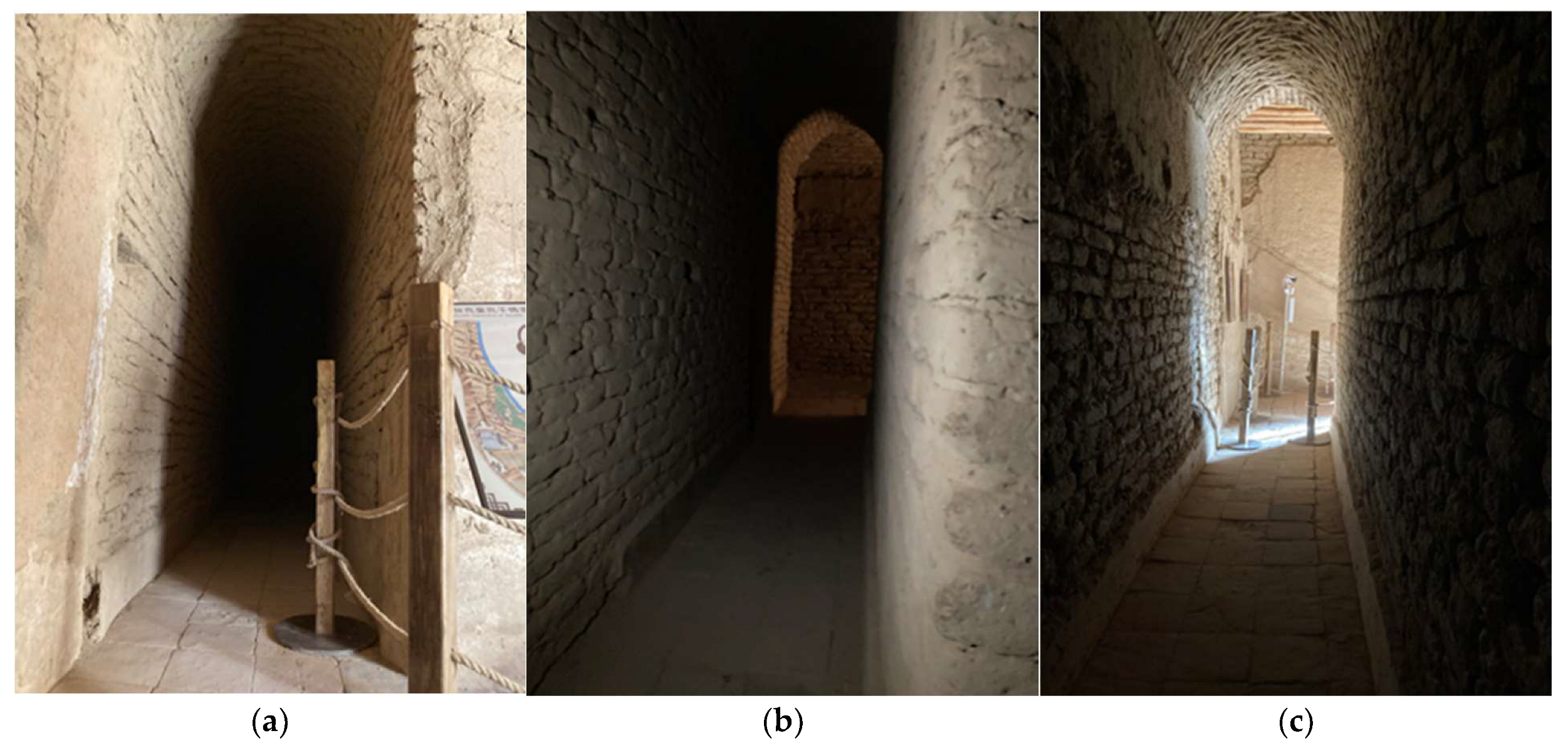
| The first asaṅkhya kalpa | Unspecified | A human king, Prabhāsa | Wished for awakening, made a vow, and gave donations | ||
| 1 | Śākyamuni | Potter | Offered ghee and oil | ||
| 2 | Kauṇḍinya | Daughter of the head of a guild | Donated a lamp | ||
| 3 | Aparājita | Master of the Tripiṭaka | Insulted the community and became a woman. But, upon regaining faith, restored manhood. | ||
| 4 | Ratnaśikhin | Son of a king | Donated lamps | ⑨ | |
| 5 | Kṣemaṃkara | Unspecified | Served Buddha for sixty summers and offered treasures to his stūpa | ||
| 6 | Praṇāda | The head of a guild | Venerated Buddha and built him a stūpa | ||
| 7 | Śrīsaṃbhava | Brahmin | Made the gesture of supplication and venerated the Buddha | ||
| 8 | Hiteṣin | Brahmin | Invited the Buddha to a seat | ||
| 9 | Kauṇḍinya | Ascetic ṛṣi | Saw the Buddha and leapt from the top of a mountain | ||
| 10 | Sudarśana | Ṛṣi | Invited the Buddha for roots and fruits | ||
| 11 | Sunetra | Ṛṣi | Dressed the Buddha with comfortable bark | ⑬ | |
| 12 | Dhṛtarāṣṭra | King | Abandoned my army and attended to the Buddha to seek awakening | ||
| The second asaṅkhya kalpa | 13 | Dīpaṃkara | Young brahmin | Venerated him with seven blue utpalas | ⑦ |
| 14 | Ascetic Practitioner | King | Venerated the Buddha with an upper garment | ||
| 15 | Tamonuda | King | Venerated the Buddha with treasures and music | ② | |
| 16 | Siṃha | King | Venerated the Buddha with an umbrella with a jeweled shaft | ⑤ | |
| 17 | Kṣemaṃkara | King | Invited and venerated the Buddha | ④ | |
| 18 | Narendra | Brahmin | Built a steam bath with the perfume of black agaru | ① | |
| 19 | Thirty brahmin buddhas named Śikhin | King | Served the Buddhas in the city of Rājyavardhana | ||
| 20 | Twenty-five buddhas | Head of a guild | Led a pure life in the city of Grown Rice and venerated the Buddhas | ||
| 21 | Śikhin | Head of a guild | Venerated the Buddha by building a monastery | ③ | |
| 22 | Six victors | Head of a guild | Built a park adorned with elephants, horses, gold, women, and jewels. | ⑥ | |
| 23 | Śikhin | King | Shaved off my hair in front of the Buddha and sought awakening | ||
| 24 | Aniruddha | Brahmin | Sought awakening by venerating fruits | ||
| 25 | Sunetra | Head of a guild | Venerated the Buddha with jewels and a monastery | ⑧ | |
| 26 | Sujāta | Caravan leader | Invited the Buddha for almsfood | ||
| 27 | Sumanas | Caravan leader | Went forth with a thousand attendants | ||
| 28 | Candana | Caravan leader | Offered soft water, oil, and guḍa | ||
| 29 | Brahmadatta | King | Venerated the Buddha with meals and donations | ||
| 30 | Marīcin | Brahmin | Venerated the Buddha with a banner of praise | ||
| 31 | Parārthadarśin | King | Venerated the Buddha with a fan | ||
| 32 | Śākyamuni | Head of a guild | Venerated the Buddha with flower petals | ||
| 33 | Atyuccagāmin | Unspecified | Venerated the Buddha with music and flowers | ||
| 34 | Uttara | King | Offered a chariot | ||
| 35 | Śreṣṭhin | King | Cleaned the streets and built flower pavilions | ||
| 36 | Śamitāri | (King) | Filled the streets with flags and welcomed the Buddha | ||
| 37 | Aṅgaratha | ferryman | Helped the Buddha cross the water’s current | ⑭ | |
| 38 | Mahābhāgīratha | Caravan leader | Formed boats in a line and helped the Buddha cross the great ocean | ||
| 39 | Brahmā | King | Venerated the Buddha with a building | ||
| 40 | Brahmāyus | King | Raised an outer robe and a flag, which caused epidemics to cease | ||
| 41 | Candana | Unspecified | Offered the Buddha a bath, and then the gods brought rain | ||
| 42 | Candra | King | Cultivated love and quelled an epidemic sent by Māra | ||
| 43 | Indradamana | Master of the people | Sought awakening and begged the Buddha for a miracle | ||
| 44 | Ratnaśaila | King | Venerated the Buddha for five years | ||
| 45 | Sarvārthasiddha | Brahmin | Chanted five hundred praises out of faith | ||
| 46 | Indradhvaja | Brahmin | Made the gesture of supplication and said, ‘Please bestow on me what is best.’ | ||
| The third asaṅkhya kalpa | 47 | Kṣemaṃkara | King | Built a stupa and pacified the kingdom. | |
| 48 | Pūrṇamanoratha | King | Venerated the Buddha, out of faith, and I was called a Dharma king | ⑮ | |
| 49 | Sarvābhibhū | Head of a guild | Scattered golden flowers for the Buddha | ||
| 50 | Ratnacūḍa | Head of a guild | Venerated the Buddha with a golden net | ||
| 51 | Padmottara | Head of a guild | Scattered silver flower petals for the Buddha | ||
| 52 | Yaśottara | Brahmin | Venerated the Buddha with a residence | ||
| 53 | Suvādin | King | Protected the Buddha with elephants, horses, chariots, and infantry | ||
| 54 | Vimala | Head of a guild | Built a steam bath and a stūpa, and offered lamps | ||
| 55 | Prabodhana | (King) | Offered music and treasures | ||
| 56 | Jitāri | Head of a guild | Venerated the Buddha by adorning the streets | ||
| 57 | Vāsiṣṭha | Head of a guild | Adorned a park and built a monastery | ⑪ | |
| 58 | Jyotis | (King) | Venerated the Buddha with jewels | ||
| 59 | Ketu | King | Raised a flag and was called a Dharma king | ||
| 60 | Bhāradvāja | King | Offered a water jar and staff, and built a great monastery | ||
| 61 | Arthadarśin | Leader of a guild | Venerated the Buddha with gold, jewels, pearls, and fragrant pieces of wood | ||
| 62 | Sarvārthasiddha | King | Venerated the Buddha with a whole army | ||
| 63 | Parārthadarśin | King | Venerated the Buddha with music and every flower | ||
| 64 | Tiṣya | Head of a guild | Scattered fragrant pieces of wood and perfumes made from roots | ||
| 65 | Tiṣya | Unspecified | Chanted a verse and reduced lives by nine eons | ||
| 66 | Vipaśyin | Grain dealer | Venerated the Buddha with a handful of mudga beans and practiced for awakening | ||
| 67 | Śikhin | Head of a guild | Venerated the Buddha with meals, together with the Buddha’s disciples | ||
| 68 | Viśvabhū | Head of a guild | Venerated with meals | ||
| 69 | Kakutsunda | Head of a guild | Offered all possessions and formed a resolution for the pure life | ||
| 70 | Kanakamuni | Leader of a guild | Built a monastery and went forth into homelessness with faith | ⑫ | |
| 71 | Kāśyapa | Young brahmin Uttara | Formed a resolution to go forth, having heard Nandīpāla’s words | ⑩ | |
| 72 | Maitreya | King | Remembering former favors, he venerated me in return | ||
Appendix B. Layout of the Praṇidhi Paintings


Appendix C. Detail from Taf 17–18 (Subjects 1–2)

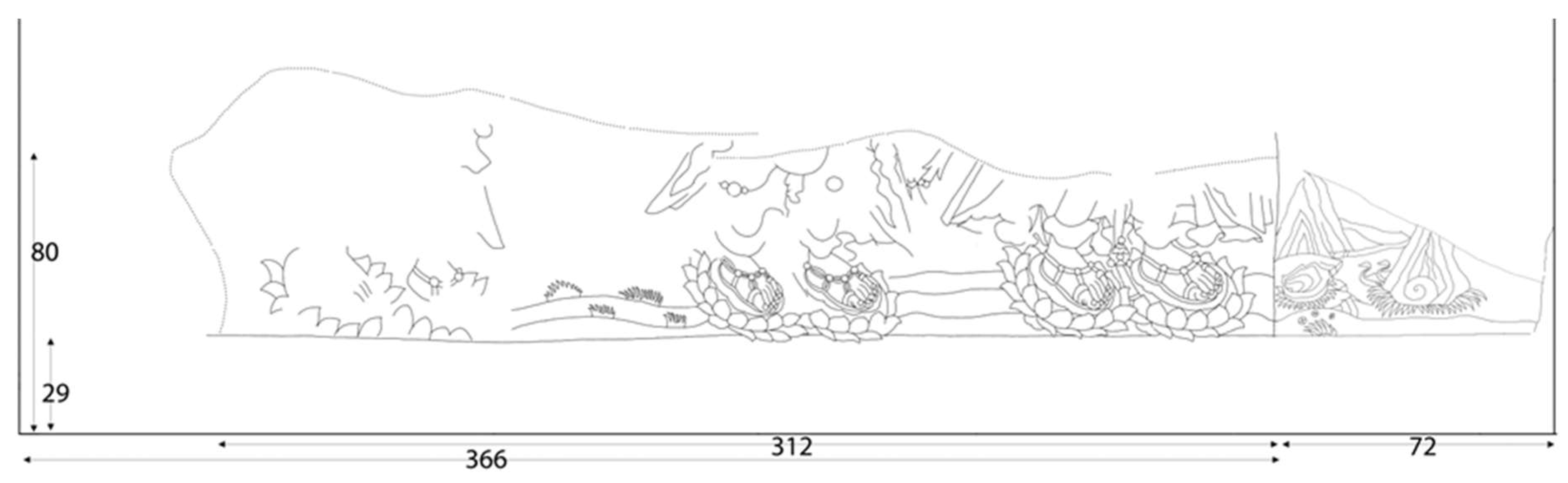
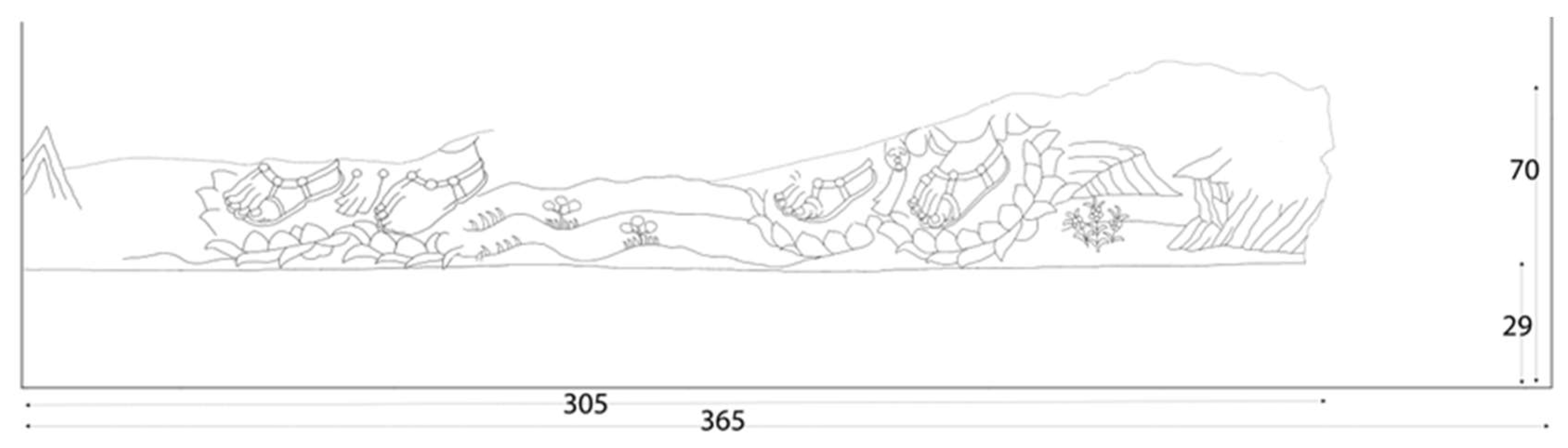
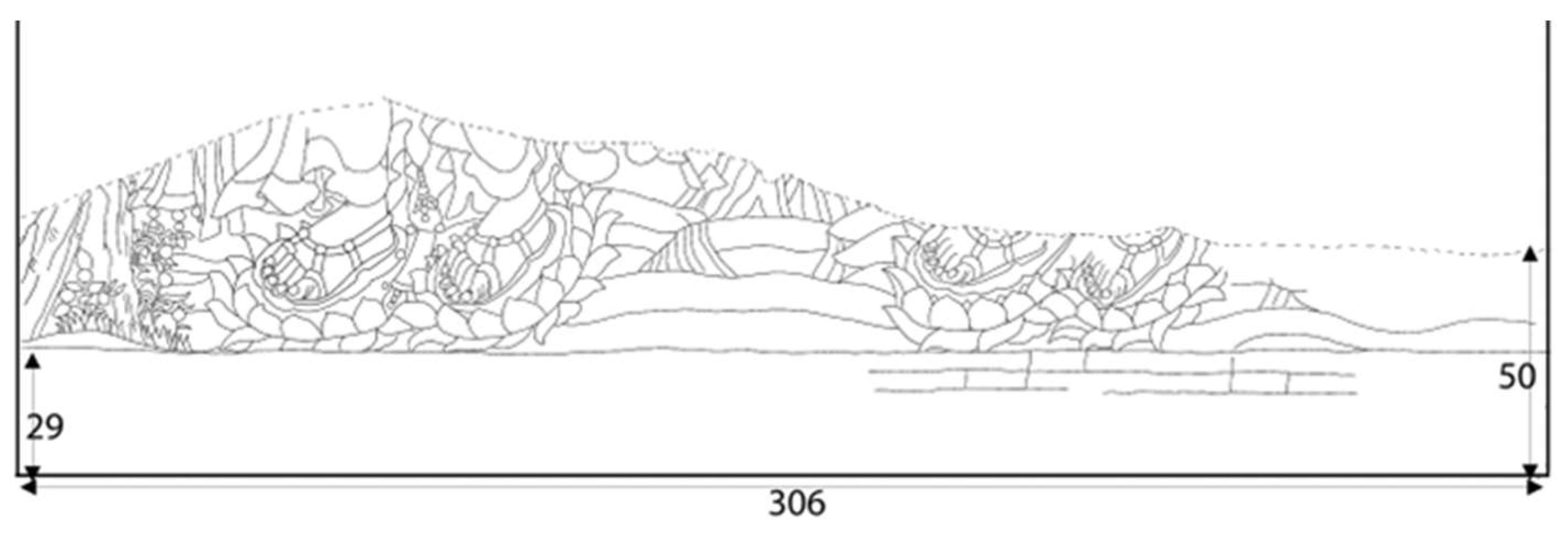
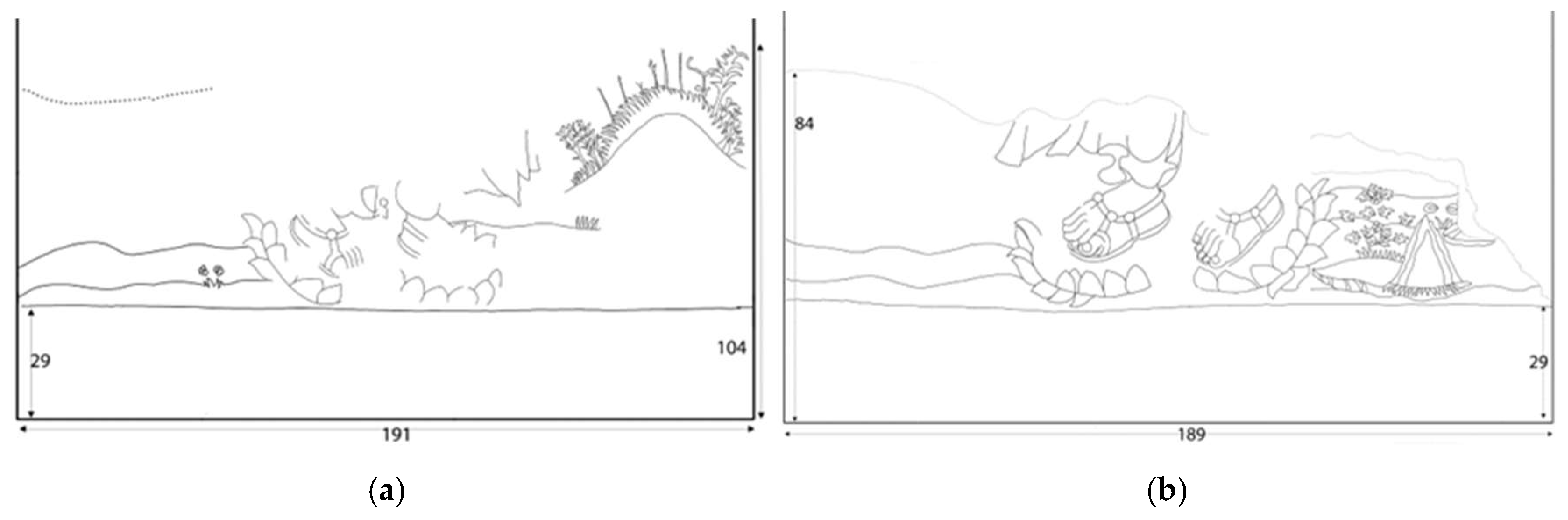
Appendix D. Line Drawing of Mural Remnants Depicting Nine Standing Buddha Figures in the Antechamber


| 1 | This Brāhmī script is referred to as the Slanting Gupta type, which was used in the northern Silk Road route, and is distinguished from the Upright Gupta type found in the manuscripts of Khotan on the southern route (Hoernle 1916, pp. 13–14). The term Slanting Gupta was coined by A.F.R. Hoernle. Recently, the Slanting Gupta type script is also referred to as the North Turkestan Brāhmī, as termed by Waldschmidt (Waldschmidt 1965, p. 34). This description is based on Murakami’s discussion (Murakami 1984, p. 75). |
| 2 | The three asaṅkhya kalpas refer to the time in which Śākyamuni had met numerous Buddhas and endeavored to attain the status of a Bodhisattva. During the first asaṅkhya kalpa, he had encountered 75,000 Buddhas from Śākyamuni to Ratnaśikin; during the second asaṅkhya kalpa, he met 76,000 Buddhas from Ratnaśikin to Dīpaṃkara; and during the third asaṅkhya kalpa, he encountered 77,000 Buddhas from Dīpaṃkara to Vipaśyin. In the subsequent period of 91 kalpa, during which the thirty-two marks of a great man are perfected, he encountered six Buddhas from Vipaśyin to Kāśyapa (阿毘達磨大毘婆沙論T27, no.1545, fasc. 177–178). |
| 3 | The Sarvāstivāda school, one of the largest and most important mainstream schools of Indian Buddhism, a subschool of the Sthavira branch, is first attested in inscriptions dating from the first century C.E. and became prominent throughout northern India and Central Asia, in particular in the northwestern regions of Kashmir and Gandhara and the north central region of Mathura. The school suggests that “everything exists” and it can exert causal efficacy in all three time periods: the past, present, and future (Cox 2004, pp. 750–51). |
| 4 | Note that Hirano later published his book under the name Murakami. |
| 5 | The Buddha-view according to the Vinaya of the Mūlasarvāstivāda acknowledges the existence of multiple Buddhas of the past while limiting the Buddha of the present to Śākyamuni alone, exclusively venerating Śākyamuni as the Buddha of the present age. Furthermore, it explains that Śākyamuni, in his previous lives, made a vow to attain anuttarā-samyak-saṃbodhi (supreme awakening), venerated and made offerings to various past Buddhas, and accumulated merit through virtuous deeds, thereby receiving predictions from those Buddhas so that he attained supreme awakening and became a Buddha. The praṇidhi paintings are understood as a visual expression of this Buddha-view and the praṇidhi concept of the Mūlasarvāstivāda tradition (Murakami 1984, pp. 269–85). |
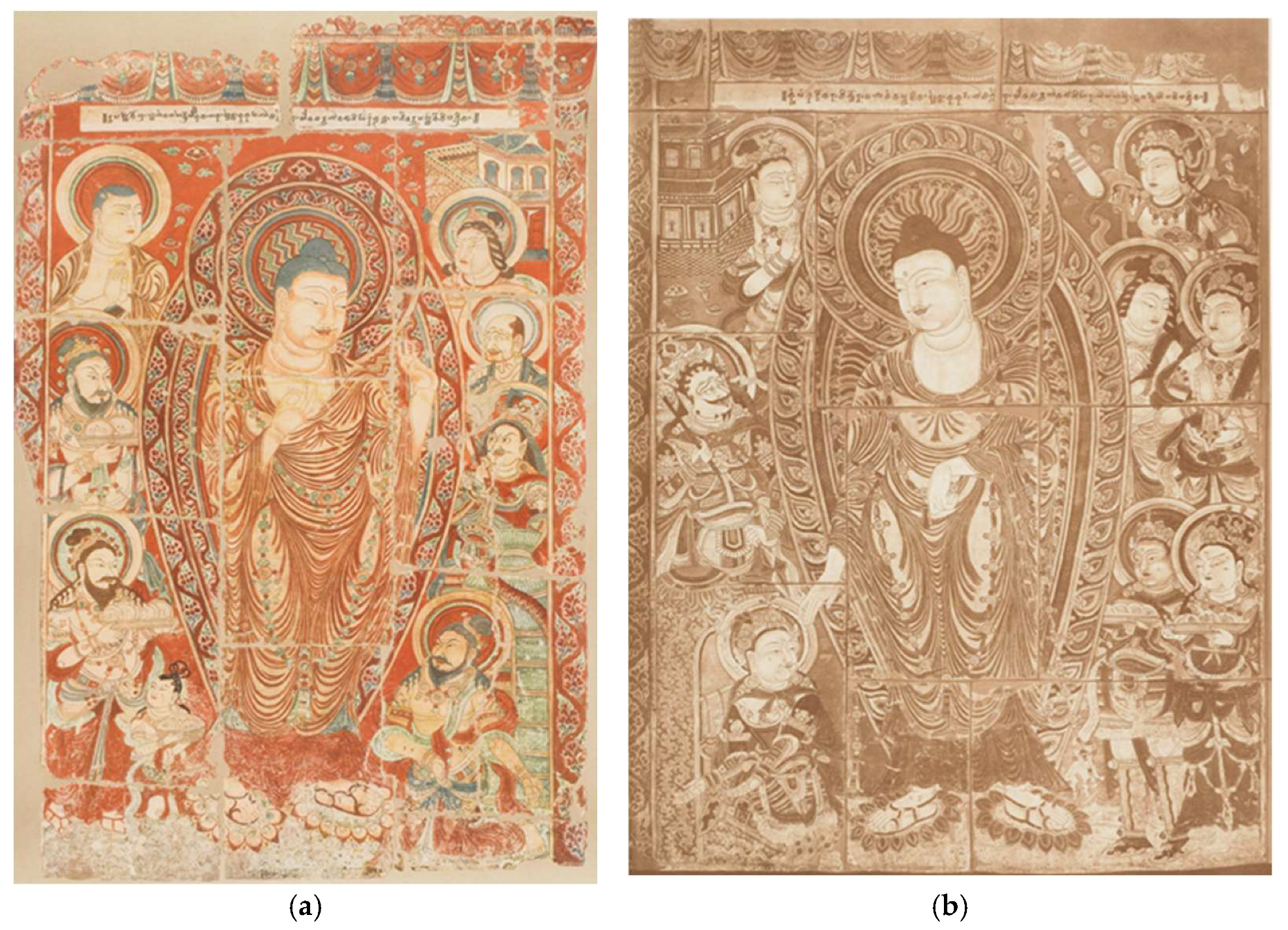
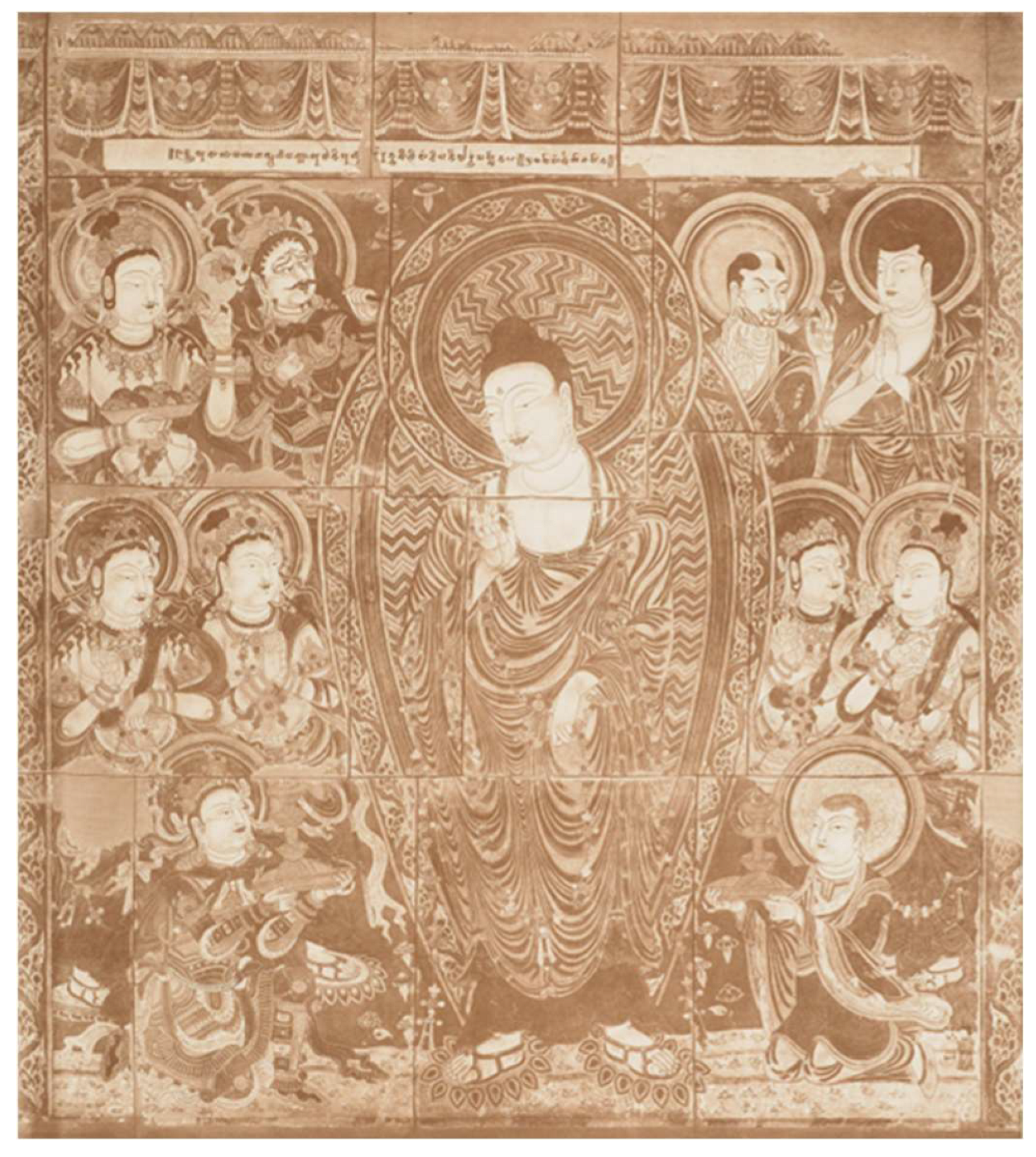
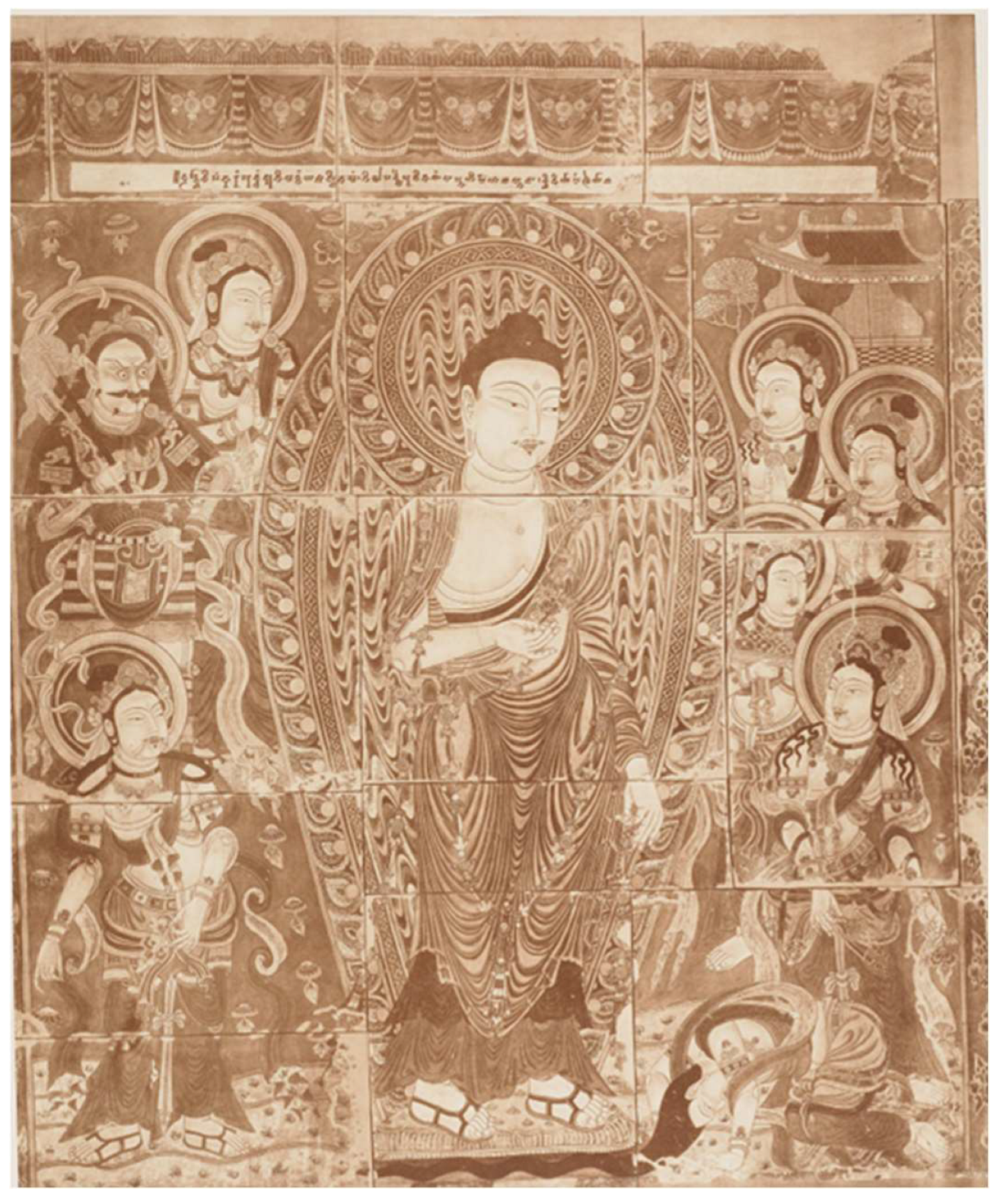
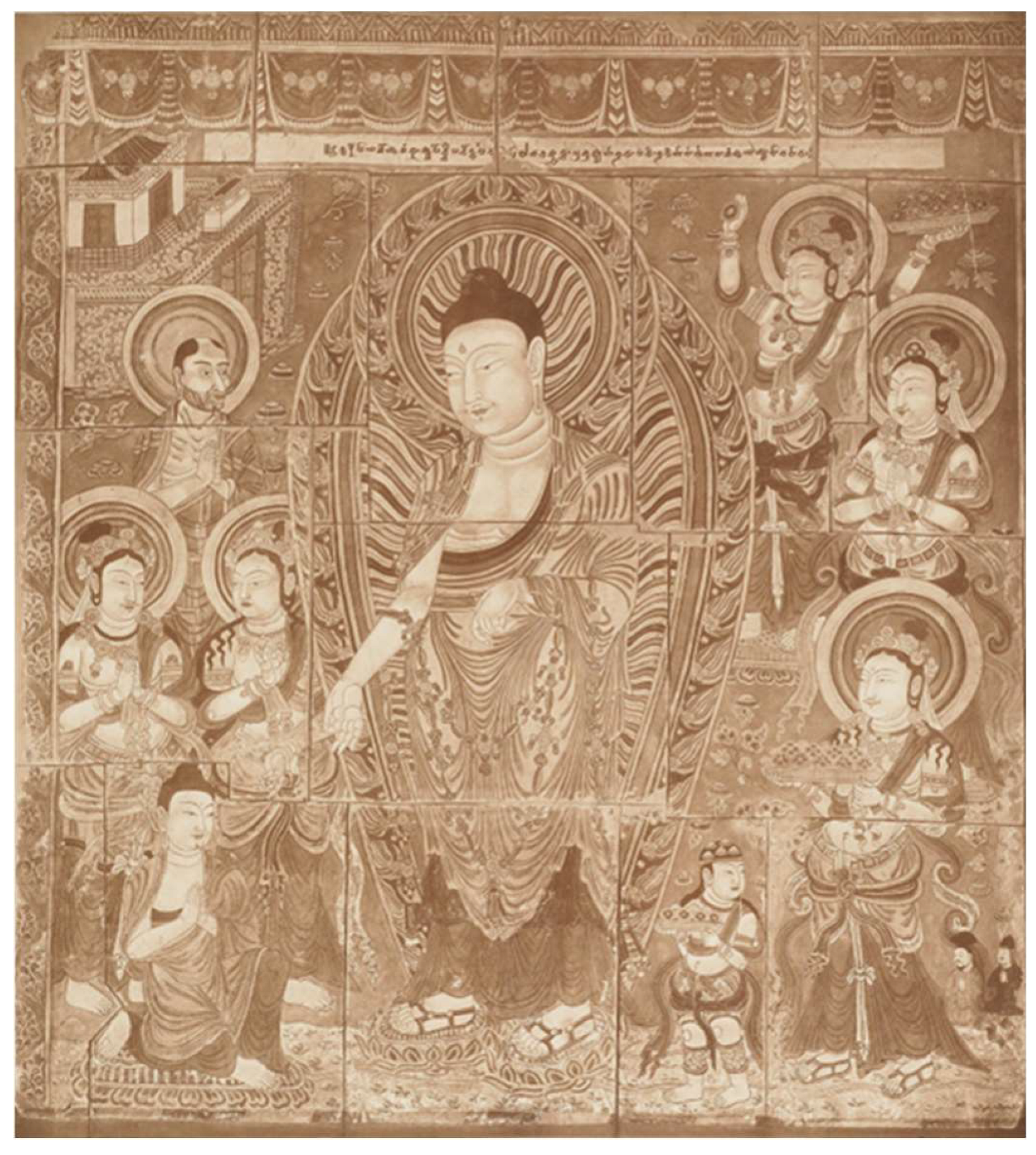
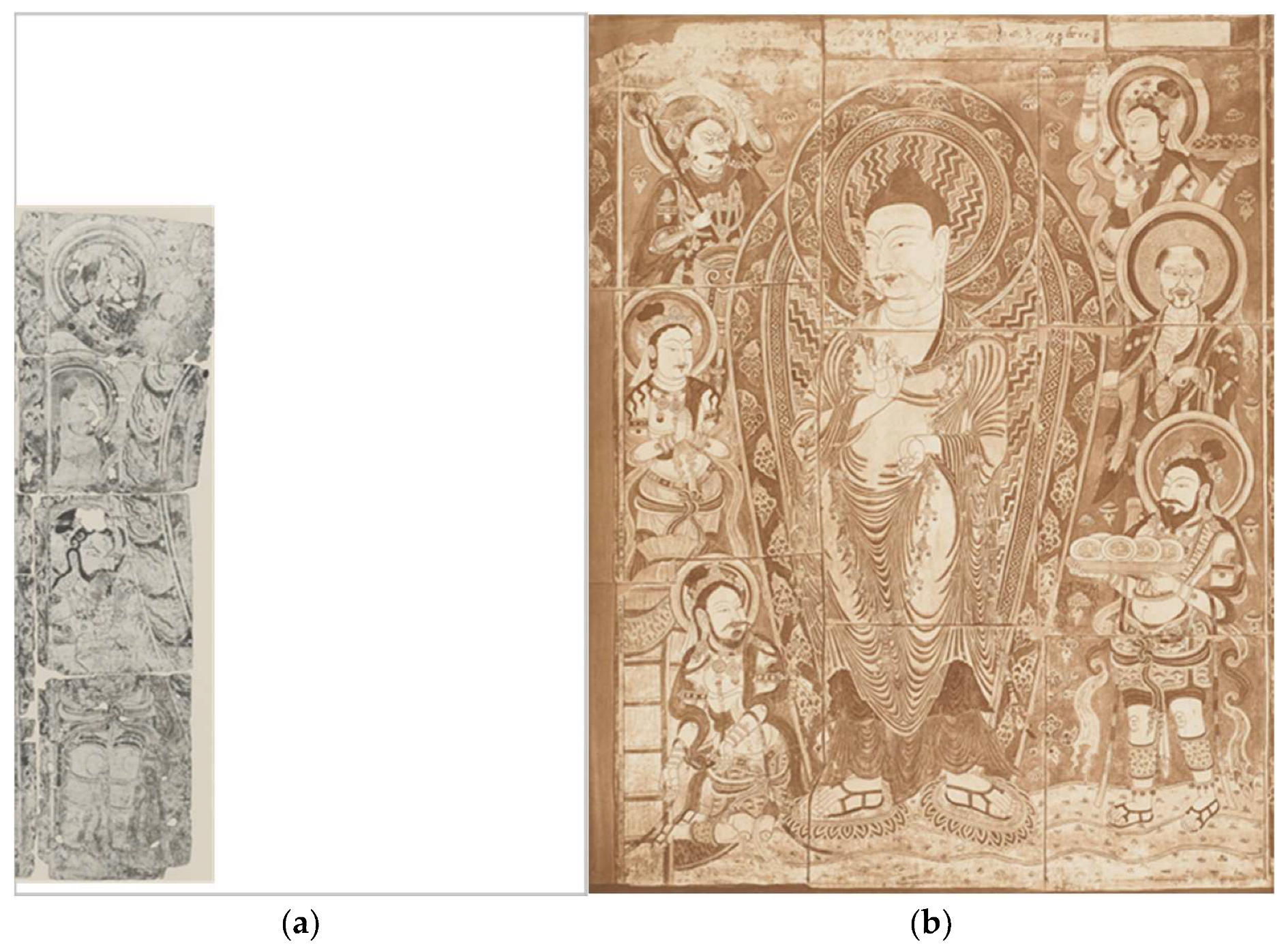
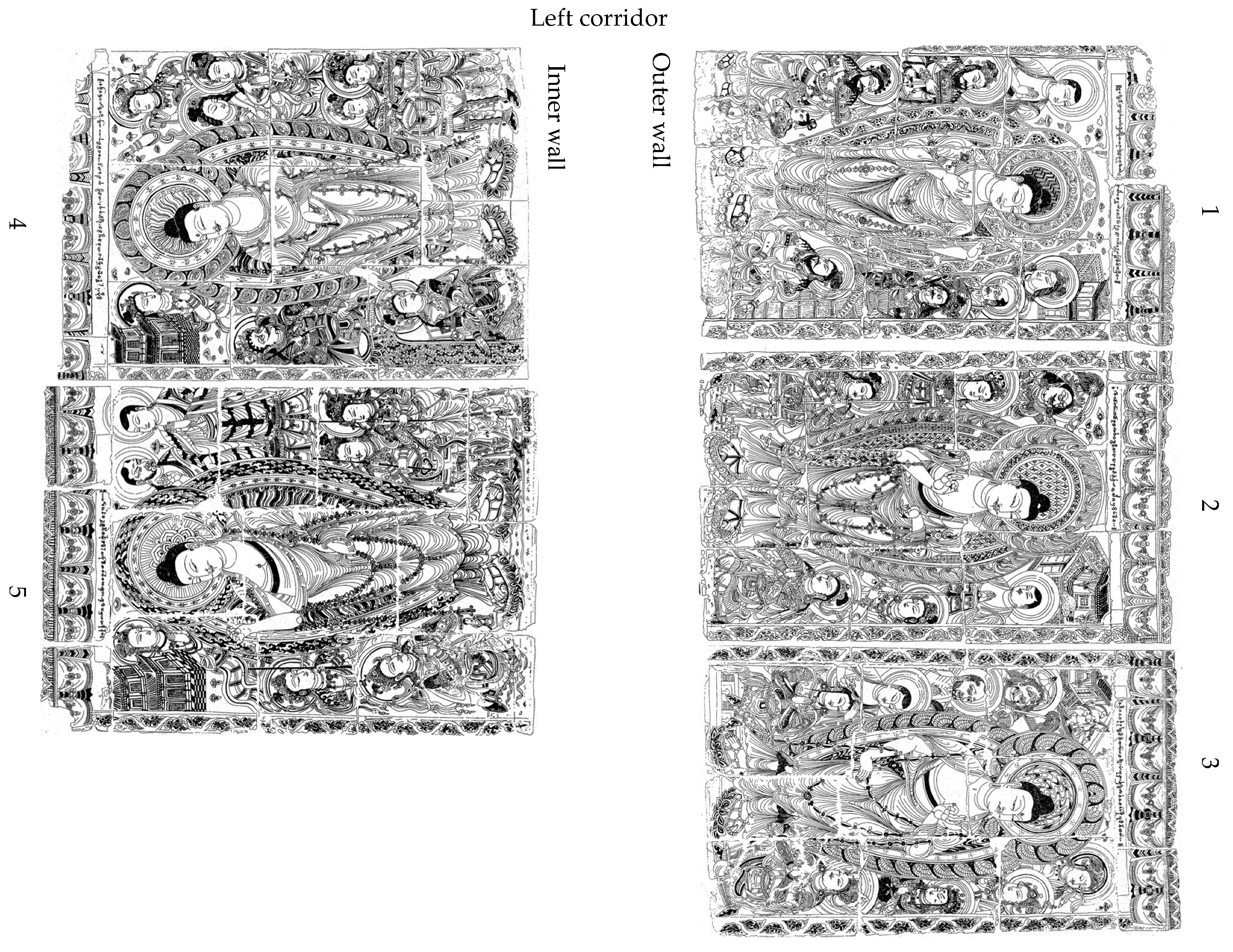
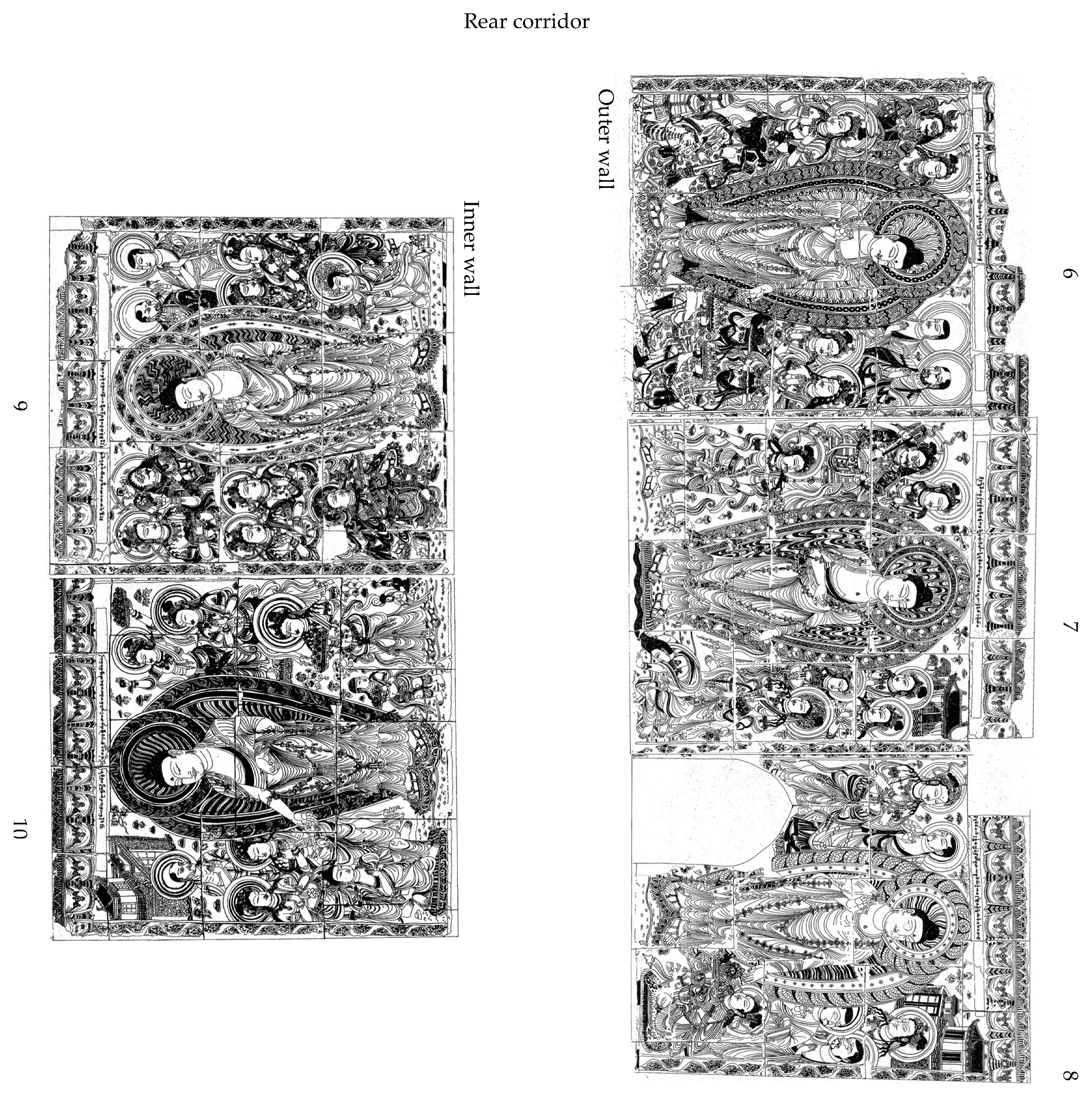
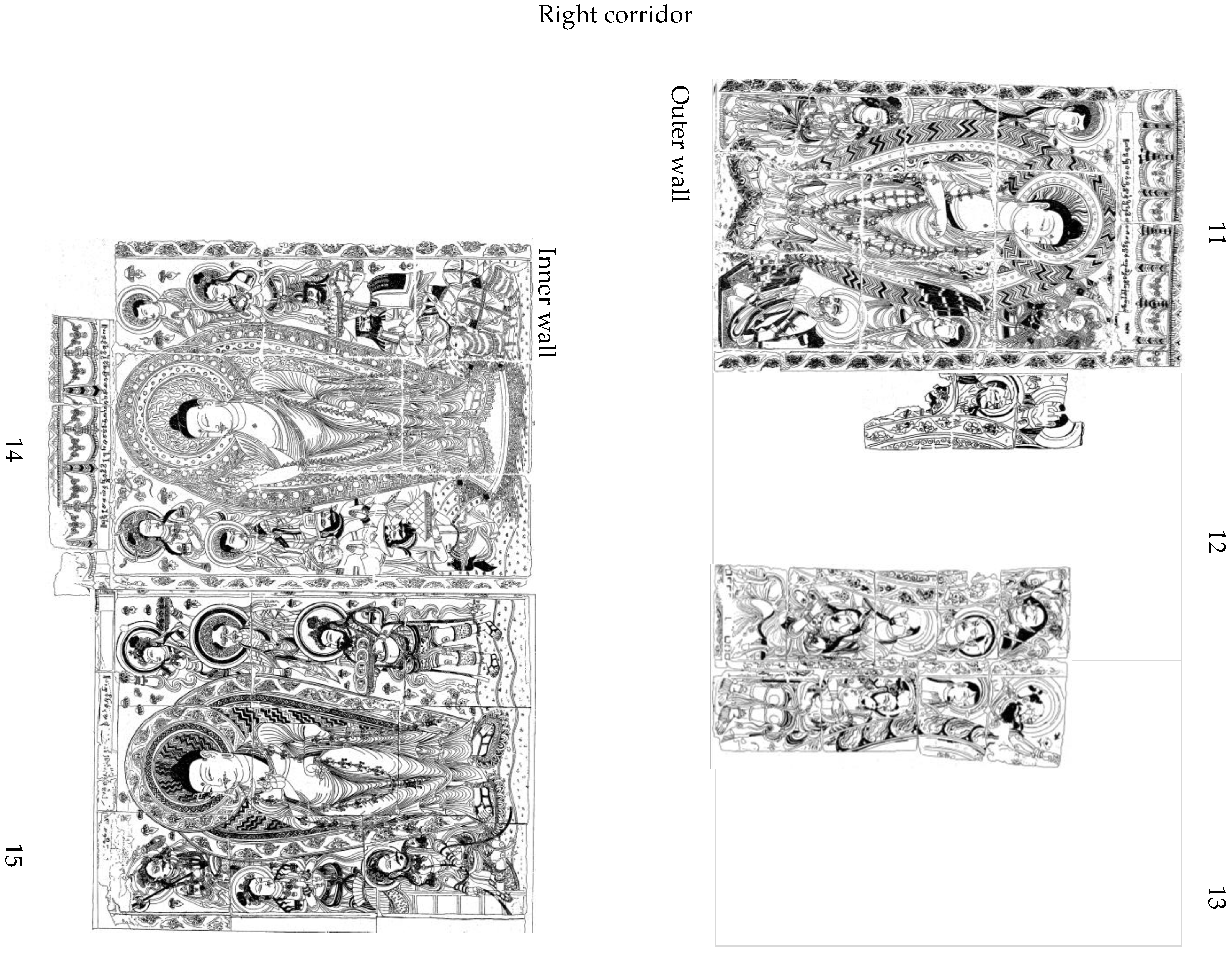
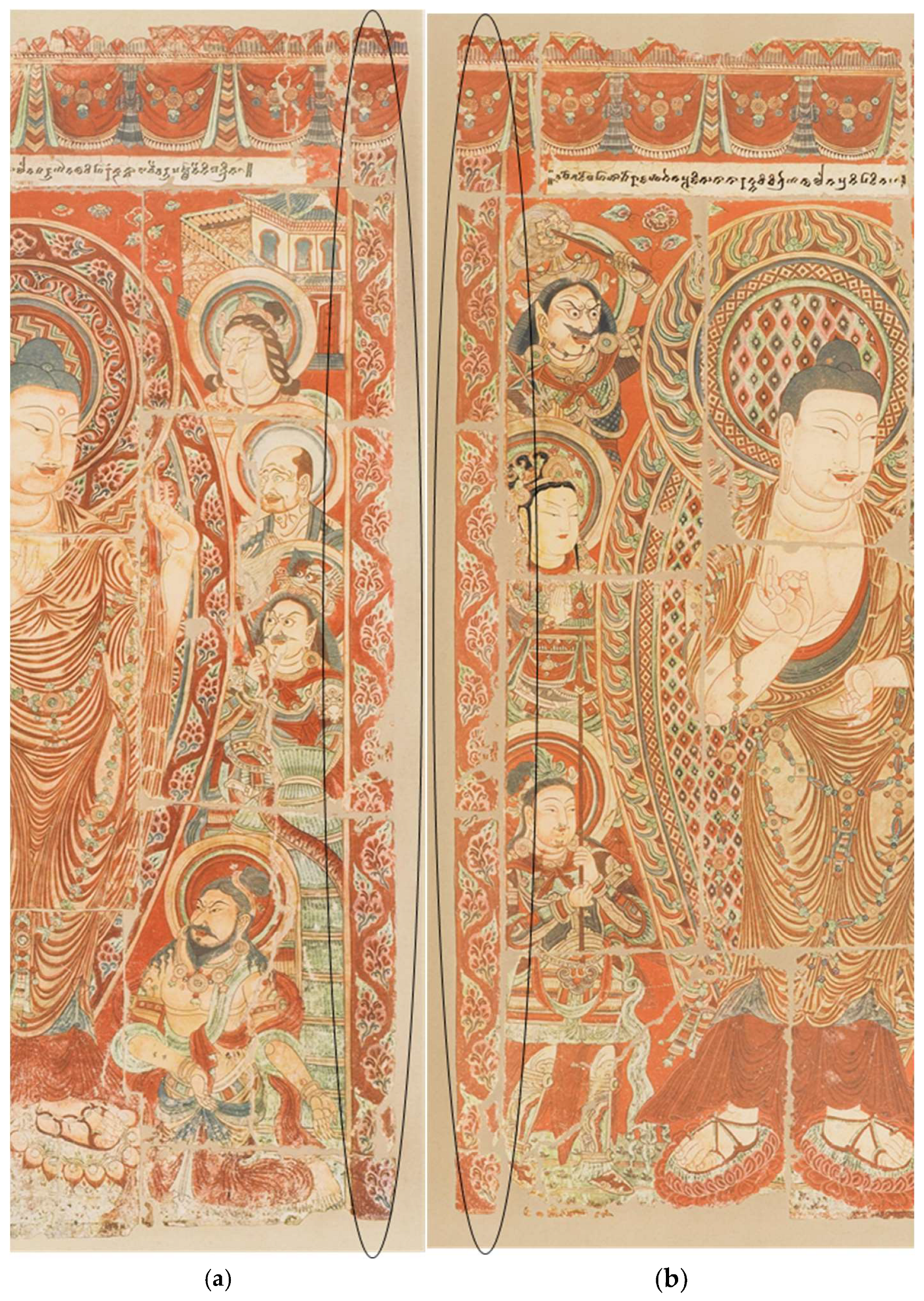
| 6 | Le Coq explains his numbering method for the praṇidhi paintings as follows: “Numbering begins with the foremost scene depicted on the southern wall of the left (southern) corridor as number 1. Murals on the outer wall are counted first, followed by those on the inner wall. In numbering, outer wall murals proceed from left to right from the viewer’s perspective, whereas inner wall murals are numbered from right to left”(Le Coq 1913, p. 15). However, it remains uncertain, in assigning numbers to the murals, whether Le Coq considered a visual sequence given the structure of the cave. Inferring Le Coq’s intention about the numbering system, I suggest that his numbering was not intended to reflect the visual sequence of the praṇidhi paintings but rather was determined in the process of organizing and documenting the materials. If records of Le Coq’s process of removing the praṇidhi paintings from Cave 20 survived, they may provide an answer to this question. Even in the absence of such records, a certain inference can still be drawn from the published plates. As shown in published plates, the drapery depicted above the inscriptions of the praṇidhi paintings was cut so as to extend across the adjacent scenes on the left and right. This can be observed between the scenes of Subjects 1 and 2 in that the scenes of Subjects 1 and 2 seem to be separated by two vertical decorative borders (see Appendix C). However, if one follows the usual composition of such borders, there would have been only one border separating the two subjects. Therefore, it is likely that the original border between the two subjects was attached to Subject 1 and subsequently re-edited and reproduced in the border of Subject 2. It can also be observed that the upper drapery has been cut across both Subjects 1 and 2. This manner of cutting suggests that the paintings were removed from the wall sequentially. Accordingly, Le Coq’s numbering may be related to the process of cutting out the paintings. As mentioned above, unfortunately, Le Coq did not provide any documentary evidence for this assumption. |
| 7 | The cave numbers followed in this paper correspond to the current cave-numbering system used for the Bezeklik caves and are based on zhongguo xinjiang bihua quanji 6. Tuyugou boizikelike. 中国新疆壁画全集. 6. 吐峪沟 柏孜克里克 (Zhao 1995). |
| 8 | Regarding the inscription of Subject 4, Murakami states that the inscription does not have a corresponding passage in the verses of the Bhaiṣajyavastu, and therefore he sought its source from the Zhuanji baiyuanjing 撰集百緣經 (Murakami 1984, pp. 93–96). On this point, however, Kim finds a passage from the second asaṅkhya kalpa of the Bhaiṣajyavastu, “When I was a king, in sixty thousand cities I invited and venerated the sun among humans, Kṣemaṃkara,” arguing that this passage corresponds to the inscription of Subject 4 (Kim 2013, pp. 36–37). Murakami regards the Buddha name corresponding to Kṣemāṅkara as 差摩 and sought its source in works like the Zhuanji baiyuanjing, but Yao presents 安隱日 as the corresponding Chinese Buddha name when translating the relevant passage about Kṣemāṅkara Buddha appearing in the Tibetan Bhaiṣajyavastu (Yao 2013, p. 447). That is, as we consider 安隱日 as the Chinese Buddha name corresponding to Kṣemāṅkara, the inscription of Subject 4 appears in both the Chinese and Tibetan translations of the Bhaiṣajyavastu. Therefore, we can subsequently proceed to explaining the order of the 14 inscriptions, originating from the verses of the Bhaiṣajyavastu. |
| 9 | Grünwedel explains that upon entering the left corridor, Subjects 1, 4 and Subjects 2, 5 form pairs and appear to greet the viewer (Grünwedel 1924, II 80). |
| 10 | The inscriptions of Subjects 3 and 6 appear consecutively in the verses of the second asaṅkhya kalpa, as noted by Huber (Huber 1914, p. 12). |
| 11 | The Sanskrit term ṛṣi is regarded in Hindu literature as a being who has perceived the Vedas. It also played an important role in Buddhism from an early period, and Buddha Gotamais was often referred to as a ṛṣi or a great ṛṣi. In the Jātaka, the term is also used to designate a hermit ascetic. For a more detailed discussion, see (McGovern 2019, pp. 437–42). |
| 12 | I owe these two questions to an anonymous reviewer. |
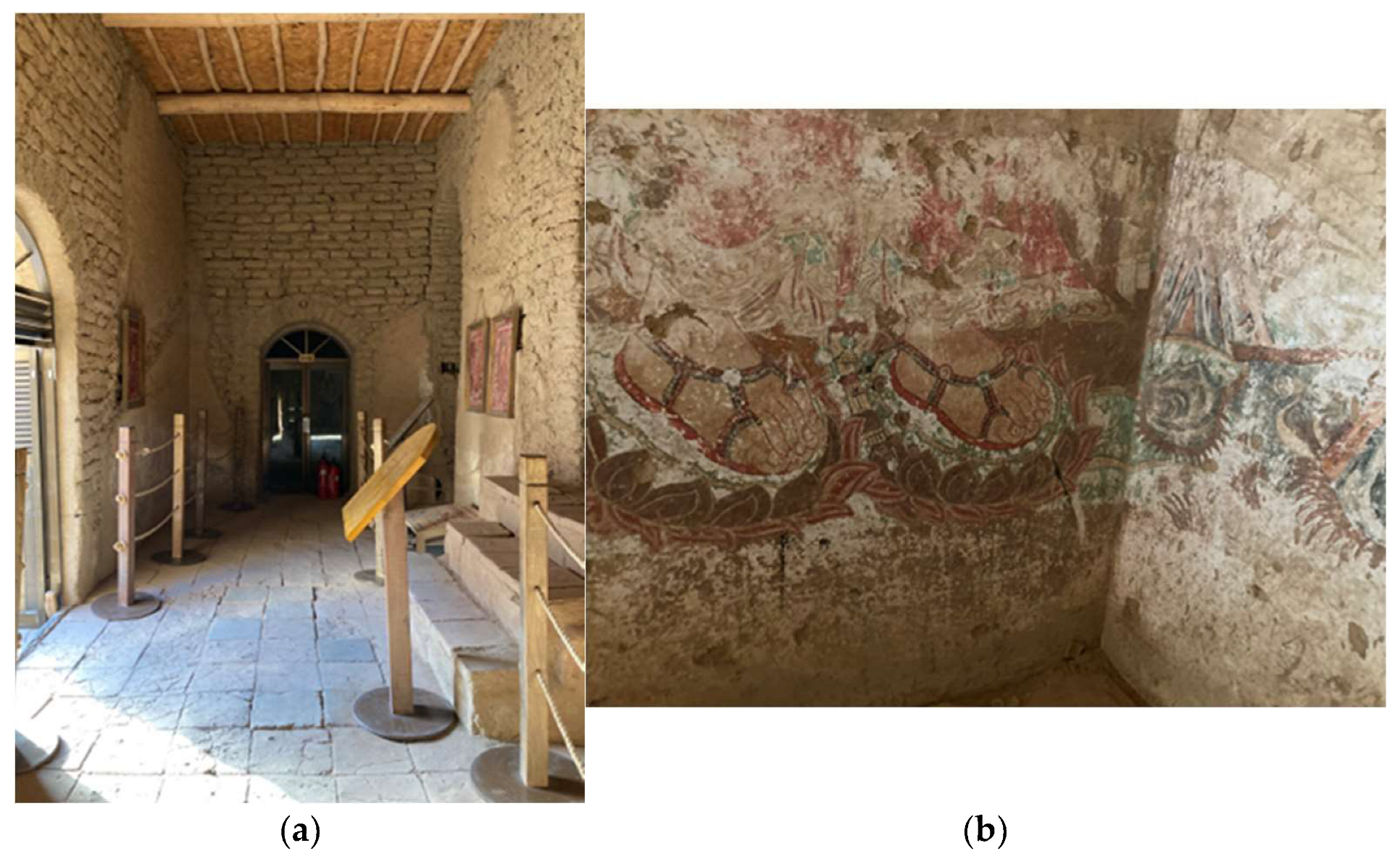
| 13 | Le Coq provides a brief description of the antechamber as follows: “In the antechamber, only bare plaster remains on the rough walls” (Le Coq 1913, p. 14). |
| 14 | Based on the author’s fieldwork, the distribution of the nine Buddhas is as follows: two Buddhas are depicted on the right wall of the antechamber near the entrance, three on the left wall of the antechamber near the entrance, two on the right wall of the antechamber, and one each on the front left and front right walls of the main hall. No Buddhas are depicted on the left wall of the antechamber, as this wall serves as the entrance to Cave 21, an adjacent side chamber. |
| 15 | In 1902, Grünwedel, while examining Cave 15 (Grünwedel No. 4), found that nothing was visible in the rear corridor, so he lit a fire to observe the murals, and he described the sense of vitality that the murals conveyed under the illumination (Grünwedel 1924, II 80). |
| 16 | In discussing these discrepancies, Lüders reached the conclusion that the painters might not have followed the inscriptions when painting the iconography, and even further claimed that there is a possibility that the artists who created the prototype of the praṇidhi iconography could have referred to another text, which is different from the one that inscriptions were chosen from (Lüders 1913, pp. 273–74). |
| 17 | The corresponding Grünwedel’s numbers are Cave 4, 8, 9, 10, 12, 19, 20, 24, 25, 29, 36, 37, 39 (Grünwedel 1912, pp. 223–301). |
References
Primary Sources
Apidamo da piposha lun 阿毘達磨大毘婆沙論, T 27, no. 1545.Genben shuo yiqie youbu pinaiye yaoshi 根本説一切有部毘奈耶藥事, T 24, no.1448.Secondary Sources
- 84000 Translation Project. 2021. The Chapter on Medicines. 84000 Reading Room. Available online: https://reader.84000.co/8494cdad-6af3-4e65-a924-e3b85e64b12d?toh=toh1-6&left=open%3Atoc&right=closed%3Aendnotes&main=open%3Atranslation (accessed on 8 September 2025).
- Andrews, Fred H. 1948. Wall Paintings from Ancient Shrines in Central Asia Recovered by Sir Aurel Stein. London: Oxford University Press, vol. 2. [Google Scholar]
- Cox, Collett. 2004. Sarvastivada and Mulasarvastivada. In Encyclopedia of Buddhism. Farmington Hills: Mscmillan Reference USA, vol. 1. [Google Scholar]
- Grünwedel, Albert. 1906. Bericht über archäologische Arbeiten in Idikutschari und Umgebung im Winter 1902–1903. München: Verlag der K. B. Akademie der Wissenschaften. [Google Scholar]
- Grünwedel, Albert. 1912. Altbuddhistische Kultstätten in Chinesisch–Turkistan. Bericht über Archäologische Arbeiten von 1906 bis 1907 bei Kuča, Qarašahr und in der Oase Turfan. Berlin: Georg Reimer. [Google Scholar]
- Grünwedel, Albert. 1924. Die Teufel des Avesta und ihre Beziehungen zur Ikonographie des Buddhismus Zentral-Asiens. Berlin: Elsner. [Google Scholar]
- Hirano, Shinkan 平野真完. 1961. べゼクリク第九号窟寺銘文による誓願画の考察 [A Study of the Praṇidhi Scenes Based on the Inscriptions of Bezeklik Cave No. 9]. Art Research 美術研究 218: 27–44. [Google Scholar]
- Hoernle, August Friedrich Rudolf. 1916. Manuscript Remains of Buddhist Literature Found in Eastern Turkestan. Oxford: Clarendon Press. [Google Scholar]
- Huber, Edouard. 1914. Les fresques inscrites de Turfan. Bulletin de l’École française d’Extrême-Orient XIV: 9–14. [Google Scholar] [CrossRef]
- Kim, Haewon 김혜원. 2013. Inyeon Seolhwado-eseo Seowondo-ro: Turupan Bezeklik Seokgul-ui ⟨Deungbul Gongyang Seowondo⟩ e Daehan Ilgo 因緣說話圖에서 誓願圖로: 투루판 베제클리크 석굴의 <등불 공양 서원도>에 대한 一考 [From Avadana Painting to Praṇidhi Scene: A Study of “Lamp offering” Praṇidhi Scenes in Bezeklik Caves in Turpan]. Art Historical Materials 미술자료 84: 20–48. [Google Scholar]
- Konczak, Ines. 2012. Origin, Development and Meaning of the Praṇidhi Paintings on the Northern Silk Road. Buddhism and Art in Tufan: From the Perspective of Uyghur Buddhism. Paper presented at the International Symposium Buddhist Culture along the Silk Road: Gandhara, Kucha, and Turfan, Kyoto, Japan, 3–5 November. [Google Scholar]
- Le Coq, Albert von. 1913. Chotscho: Facsimile-Wiedergaben der Wichtigeren Funde der Ersten Königlich Preussischen Expedition nach Turfan in Ost-Turkistan. Berlin: Dietrich Reimer. [Google Scholar]
- Lüders, Heinrich. 1913. Die Praṇidhibilder im neunten Tempel von Bäzäklik. In Sitzungsberichte der K. Preussischen Akademie der Wissenschaften. Reprinted in Plilologica Indica. Göttingen: Vandenhoeck & Ruprecht. [Google Scholar]
- McGovern, Nathan. 2019. Seer (ṛṣi/isi) and Brāhmaṇas in Southeast Asia. In Brill’s Encyclopedia of Buddhism. Leiden: BRILL, vol. 2. [Google Scholar]
- Meng, Fanren 孟凡人. 1981. Xinjiangbozikelike kusi liushi yuwai bihua shulüe 新疆柏孜克里克窟寺流失域外壁画述略 [A Brief Study of Bezeklik Cave Murals from Xinjiang That Have Been Displaced Abroad]. Archaeology and Cultural Relics 考古与文物 4: 43–61. [Google Scholar]
- Meng, Fanren 孟凡人. 1995. Gaochang bihua jiyi 高昌壁画辑佚 [A Collection and Study of the Gaochang Murals]. Wulumuqi Shi: Xinjiang People’s Publishing House 新疆人民出版社. [Google Scholar]
- Meng, Fanren 孟凡人. 2020. Beiting he gaochang yanjiu 北庭和高昌研究 [A Study of Beiting and Gaochang]. Beijing: The Commercial Press商务印书馆. [Google Scholar]
- Murakami, Shinkan 村上真完. 1984. Seiiki no bukkyō: Bezekuriku seigan gakō 西域の仏教-べゼクリク誓願画考 [The Praṇidhi Scenes of the Cave Temples at Bezeklik in Chinese Turkestan]. Tokyo: Third Civilization Publishing 第三文明社. [Google Scholar]
- Waldschmidt, Ernst. 1965. Sanskrithandschriften aus den Turfanfunden. Teil I. Wiesbaden: Franz Steiner Verlag. [Google Scholar]
- Yao, Fumi 八尾史. 2013. Konpon setsuissai ubu ritsu yakuji 根本说一切有部律药事 [Fundamental Vinaya of the Sarvāstivāda on the Bhaiṣajyavastu]. Tokyo: Union Publishing 連合出版. [Google Scholar]
- Zhao, Min 赵敏. 1995. zhongguo xinjiang bihua quanji 6. Tuyugou boizikelike 中国新疆壁画全集. 6. 吐峪沟 柏孜克里克 [Complete Collection of Wall Paintings in Xinjiang, China]. Shenyang: Liaoning Fine Arts Publishing House 辽宁美术出版社, Wulumuqi: Xinjiang Fine Arts and Photography Publishing House 新疆美术摄影出版社, vol. 6. [Google Scholar]
- Zhu, Tianshu 朱天舒. 2012. Reshaping the Jātaka Stories: From Jātakas to Avadānas and Praṇidhānas in Paintings at Kucha and Turfan. Buddhist Studies Review 29: 57–83. [Google Scholar] [CrossRef]


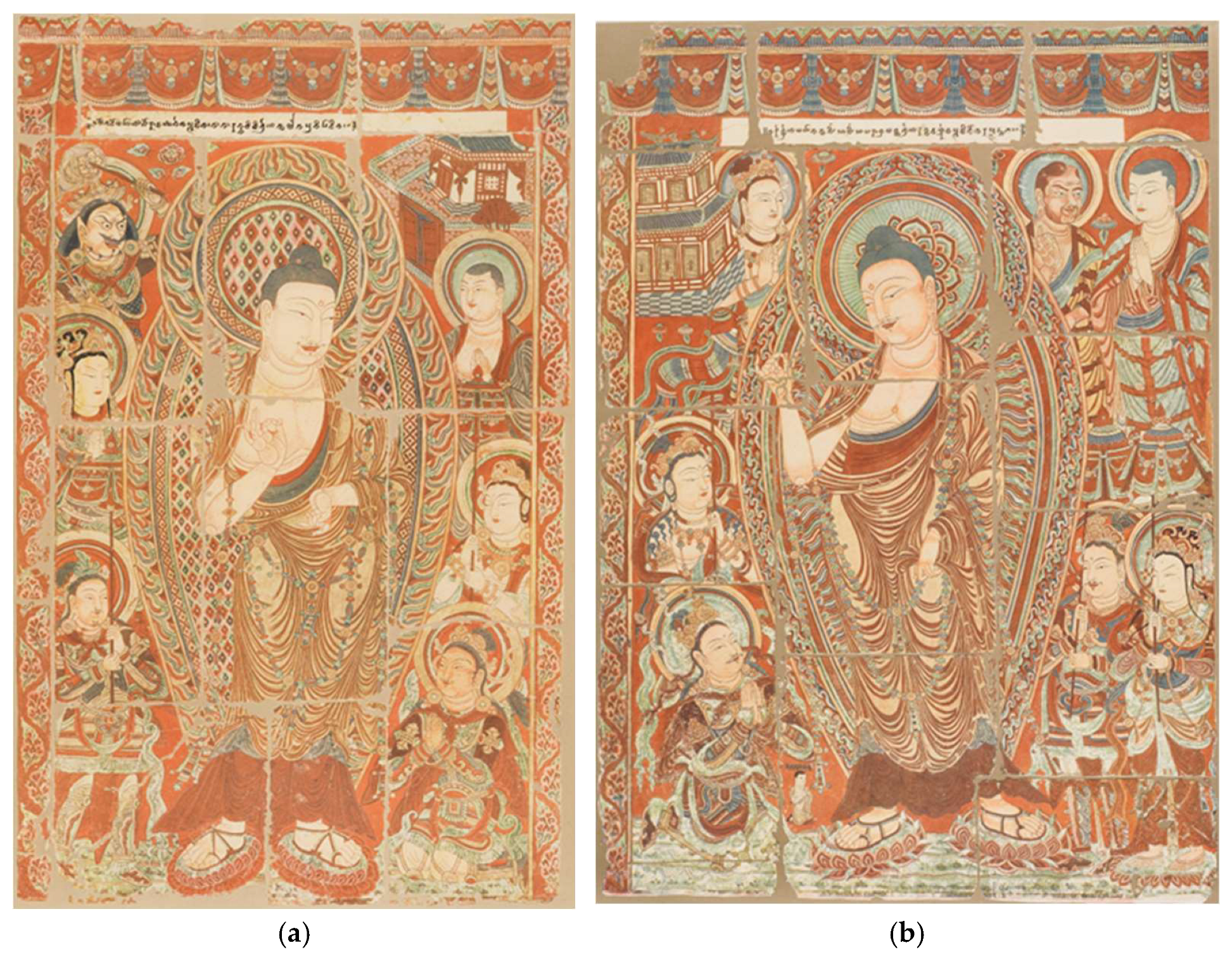
| Subject Nos. in Cave 20 | Iconography | Inscriptions | Verses in the Tibetan Bhaiṣajyavastu |
|---|---|---|---|
| ① | The brahmin offers food (or incense) and invites the Buddha. | The worldly leader, Mahendra, was served by me, a brahmin, with a steam bath, various incense, and black agaru. Thereafter, having built a monastery, I invited the Buddha with all reverence. | I served the leader of the world, Narendra, by building a steam bath, and with the perfume of black agaru, When I was a brahmin. |
| ② | The king offers an umbrella and prays to the Buddha. | Tamonuda, the greatly fortunate one, was venerated by me, a king, and was honored with a variety of jewels and musical tributes. | When I was a king, I offered veneration in the form of various treasures and excellent music to the fortunate one Tamonuda. |
| ③ | The king shaves his head and prays to the Buddha. | In a very pleasant city, Śikhin, the famous enlightened one, was venerated by me, a merchant, with many monasteries. | In the very city Delight, When I was the head of a guild, I venerated by building a monastery the Buddha Śikhin, who was renowned in the world. |
| ④ | The king offers food (or incense) and invites the Buddha. | Kṣemamkara, the Sun of humans, was venerated by me, who was a king, with a steam bath, various incense, and black agaru. Moreover, he was invited with sixty thousand monasteries. | When I was a king, in sixty thousand cities I invited and venerated the sun among humans, Kṣemaṃkara. |
| ⑤ | The king offers an umbrella and prays to the Buddha. | Ananda! Siṃha, possessing the strength of a lion and a hero among humans, was venerated by me, the king of men, with a jewel-handled umbrella. | Ānanda, as the master of the people I venerated Siṃha, who had a lion’ s power, that most excellent of humans, with an umbrella with a jeweled shaft. |
| ⑥ | The merchants offer their goods to the Buddha. | To venerate the six victors with elephants, horses, gold, women, treasures, and pearls, a grove was built by a merchant. | When I was the head of a guild, I built a park adorned with elephants, horses, gold, women, and jewels to venerate six victors. |
| ⑦ | The young brahmin offers lotus flowers and lets his hair down to allow the Buddha to pass. | Having seen the Dīpaṃkara radiant and renowned, the young brahmin venerated him with seven blue lotus flowers. At the end of the second asaṅkhya [kalpa]. | When I was a young brahmin, I saw the Buddha Dīpaṃkara, who was famed for his radiance, and venerated him with seven blue utpalas. |
| ⑧ | The king offers a Cintāmaṇi to the Buddha. | Sunetra, the worldly leader, was at that time venerated by me, a merchant, with Cintāmaṇi jewels and a beautiful monastery. | When I was the head of a guild, I venerated the leader of the world, Sunetra, with precious jewels and a pleasant monastery. |
| ⑨ | The monk and the king offer a lamp to the Buddha. | Formerly, in another life, I was a princess. The oil of a lamp was offered to my brother Ratnaśikin. At the end of the first asaṅkhya [kalpa]. | In another past life when I was a son of a king, I venerated my brother, Ratnaśikhin, with a donation of lamps. |
| ⑩ | The young brahmin prays to the Buddha while receiving the prophecy. | I was Uttara, a young brahmin. Having heard the words of Nandipāla, I resolved to become a monk under the Kāśyapa, the perfectly enlightened one. At the end of all virtuous practices of the third asaṅkhya [kalpa]. | When I was the young brahmin Uttara, having heard Nandīpāla’s words, I formed a resolution to go forth in front of Kāśyapa, the best of humans. |
| ⑪ | The monk offers a robe to the Buddha. | Upon hearing of the arrival of Vāsiṣṭha, I, the merchant, was filled with joy. I decorated the grove and had a monastery built. | When I was the head of a guild, pleased when I heard that Vāsiṣṭha was coming, I adorned a park and built a monastery. |
| ⑫ | The king shaves his head. * | For the sake of Kanakamuni, Shakamuni, who was a merchant, built a grove. A monk……for the sake of great enlightenment……. ** | When I was the leader of a guild, for the completely awakened one Kanakamuni I built a monastery and went forth into homelessness with faith. |
| ⑬ | The brahmin offers leopard-print cloth to the Buddha. * | I, who was indeed a ṛṣi, served Sunetra, the master of the three worlds. The buddha was dressed in a pleasant bark garment by me. | I honored Sunetra, the leader of the world, when I was a ṛṣi. I dressed that most excellent of humans with comfortable bark |
| ⑭ | The merchants pray and make offerings to the Buddha as he crosses the river by boat. | I saw Aṅgirasa arrive at the riverbank, and I, who was the merchant leader, ferried the buddha across the river. | When I was a ferryman, I saw Aṅgaratha arrive at the bank and helped the Muni Cross the water’s current. |
| ⑮ | The brahmin offers food (or incense) to the Buddha and sees him off. | Lawfully, Pūrṇa Manorata, was worshipped with faith by me, who had become king, and I was then honored with the title of Dharma King. | When I was a king, I venerated correctly, out of faith, the Buddha Pūrṇamanoratha, and I was called a Dharma king. |
| Placing of Subject in Cave | Sequence of Subject | Iconography | Inscriptions | Relationships of Iconography and Inscriptions | Order of Inscriptions in the Bhaiṣajyavastu | |||
|---|---|---|---|---|---|---|---|---|
| Former Status of the Donor | Past Buddha | Methods of Offerings | ||||||
| Left corridor | Outer | ① | The brahmin offers food (or incense) and invites the Buddha. | Brahmin | Mahendra | Steam bath, Incense, Monastery | Consistent | 7th—II |
| Inner | ④ | The king offers food (or incense) and invites the Buddha. | King | Kṣemaṃkara | Steam bath, Incense, Monastery | Consistent | 6th—II | |
| Outer | ② | The king offers an umbrella and prays to the Buddha. | King | Tamonuda | Jewels, Music | Consistent (Differences in offering methods | 4th—II | |
| Inner | ⑤ | The king offers an umbrella and prays to the Buddha. | King | Siṃha | Umbrella | Consistent | 5th—II | |
| Outer | ③ | The king shaves his head and prays to the Buddha. | Merchant | Śikhin | Monastery | Inconsistent | 8th—II | |
| Rear corridor | Outer | ⑥ | The merchants offer their goods to the Buddha. | Merchant | Six Victors | Gold, Jewelry, Women and Monastery | Consistent (Differences in past Buddha) | 9th—II |
| Inner | ⑨ | The monk and the king offer a lamp to the Buddha. | Princess | Ratnaśikin | Oil of lamp | Consistent | 1st—I | |
| Outer | ⑦ | The young brahmin offers lotus flowers and lets his hair down to allow the Buddha to pass. | Young Brahmin | Dīpaṃkara | Lotus flowers | Consistent | 3rd—II | |
| Inner | ⑩ | The young brahmin prays to the Buddha while receiving the prophecy. | Young Brahmin, Uttara | kāśyapa | Resolve to leave home | Consistent | 15th—III | |
| Outer | ⑧ | The king offers a Cintāmaṇi to the Buddha. | Merchant | Sunetra | Cintāmaṇi, Monastery | Consistent (Differences in status of the donor) | 10th—II | |
| Right corridor | Outer | ⑪ | The monk offers a robe to the Buddha. | Merchant | Vāsiṣṭha | Grove, Monastery | Inconsistent | 13th—III |
| Inner | ⑭ | The merchants pray and make offerings to the Buddha as he crosses the river by boat. | Leader of merchant | Aṅgirasa | Helping Buddha cross the river | Consistent | 11th—II | |
| Outer | ⑫ | The king shaves his head. * | Merchant | Kanakamuni | Grove, resolve to leave home ** | Consistent (Differences in status of the donor) | 14th—III | |
| Inner | ⑮ | The brahmin offers food (or incense) to the Buddha and sees him off. | King | Manoratha | Faith | Inconsistent | 12th—III | |
| Outer | ⑬ | The brahmin offers leopard-print cloth to the Buddha. * | Ṛṣi | Sunetra | Bark clothes | Consistent | 2nd—I | |
Disclaimer/Publisher’s Note: The statements, opinions and data contained in all publications are solely those of the individual author(s) and contributor(s) and not of MDPI and/or the editor(s). MDPI and/or the editor(s) disclaim responsibility for any injury to people or property resulting from any ideas, methods, instructions or products referred to in the content. |
© 2026 by the author. Licensee MDPI, Basel, Switzerland. This article is an open access article distributed under the terms and conditions of the Creative Commons Attribution (CC BY) license.
Share and Cite
Seung, J. Praṇidhi Paintings and Inscriptions of Cave 20 at Bezeklik and the Mūlasarvāstivāda-Vinaya Bhaiṣajyavastu. Religions 2026, 17, 533. https://doi.org/10.3390/rel17050533
Seung J. Praṇidhi Paintings and Inscriptions of Cave 20 at Bezeklik and the Mūlasarvāstivāda-Vinaya Bhaiṣajyavastu. Religions. 2026; 17(5):533. https://doi.org/10.3390/rel17050533
Chicago/Turabian StyleSeung, Jaehee. 2026. "Praṇidhi Paintings and Inscriptions of Cave 20 at Bezeklik and the Mūlasarvāstivāda-Vinaya Bhaiṣajyavastu" Religions 17, no. 5: 533. https://doi.org/10.3390/rel17050533
APA StyleSeung, J. (2026). Praṇidhi Paintings and Inscriptions of Cave 20 at Bezeklik and the Mūlasarvāstivāda-Vinaya Bhaiṣajyavastu. Religions, 17(5), 533. https://doi.org/10.3390/rel17050533