A Mobile Temple: Forms and Visual Grammar of Portable Buddhist Shrines from the 3rd to the 8th Centuries Unearthed Along the Silk Road

Abstract
1. Portable Buddhist Shrines and Mobile Ritual Sites
2. The Forms of Portable Buddhist Shrines
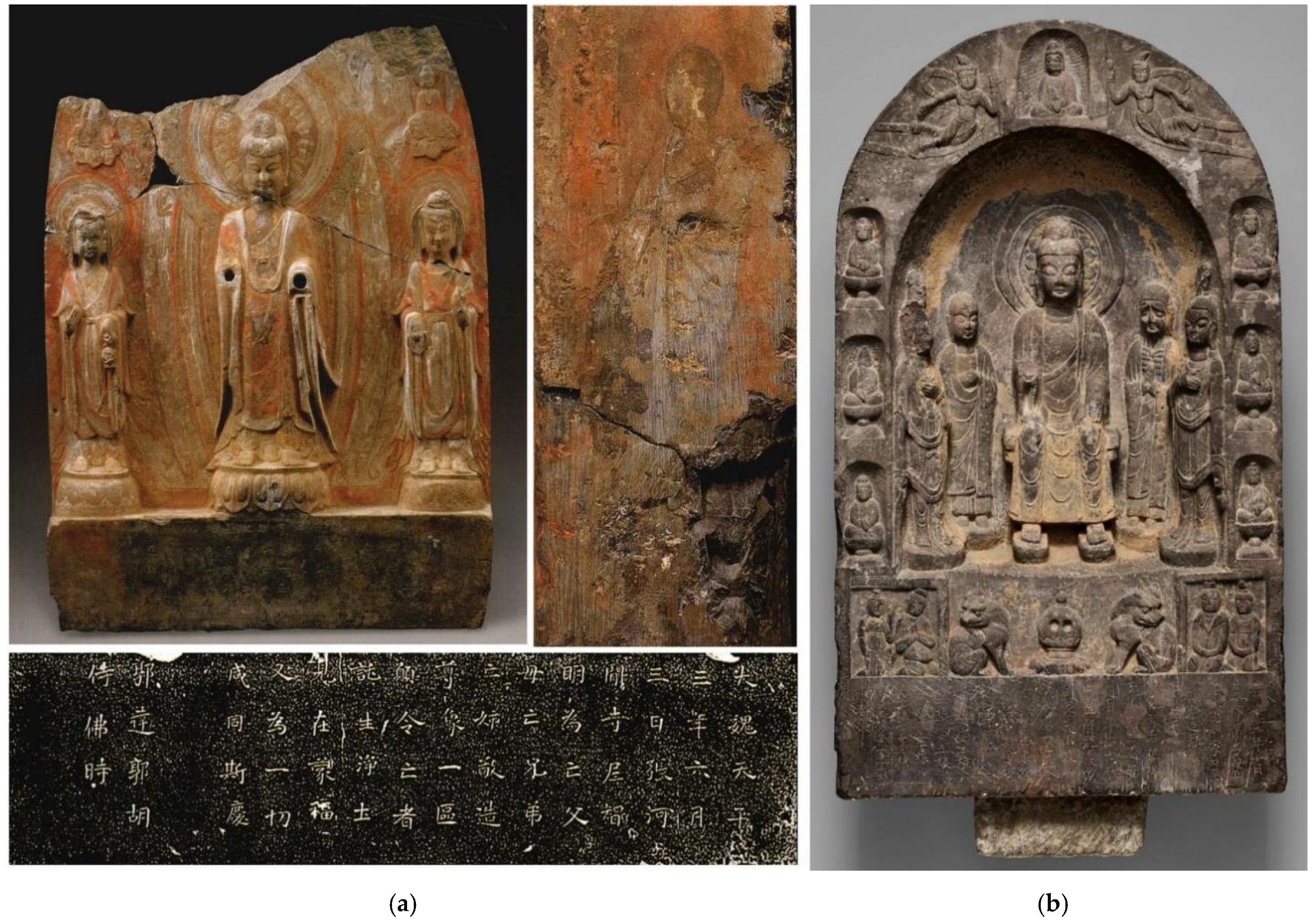
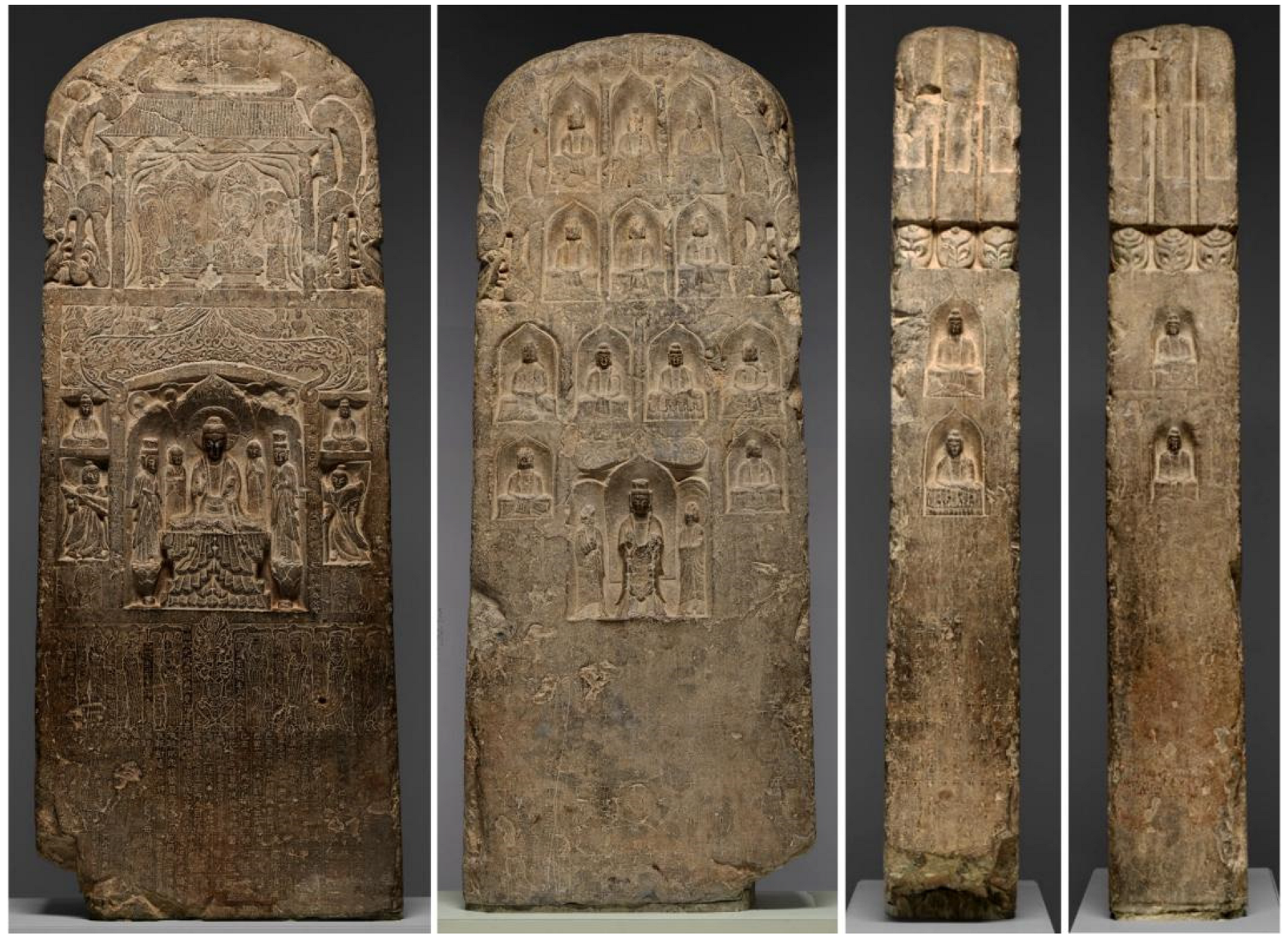
2.1. Pedestal-Style Shrine
2.2. Hanging-Style Shrine
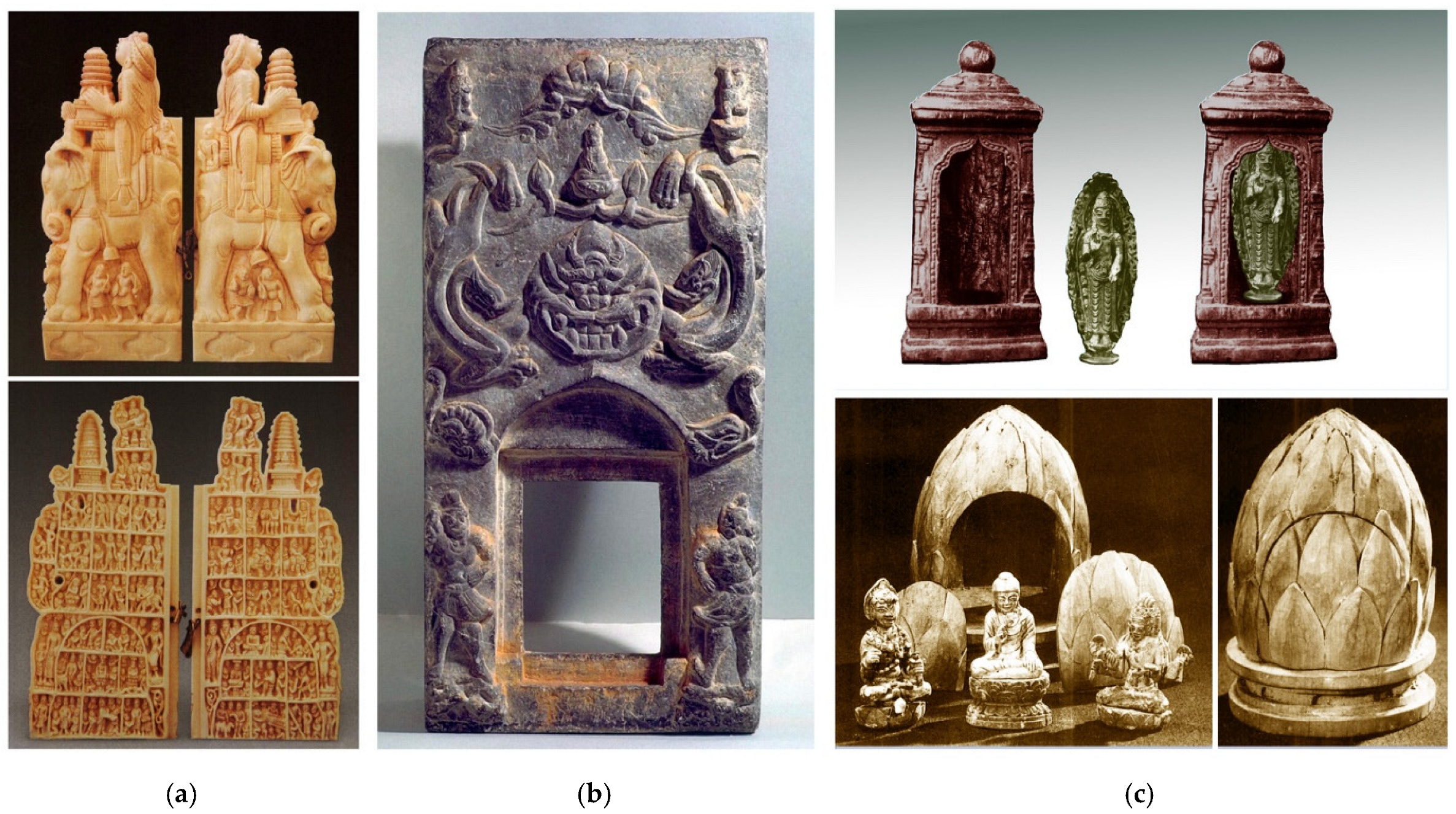
2.3. Open–Close- or Mother–Child-Style Shrine
3. Multi-Modal Visual Grammar Shaped by Local Traditions
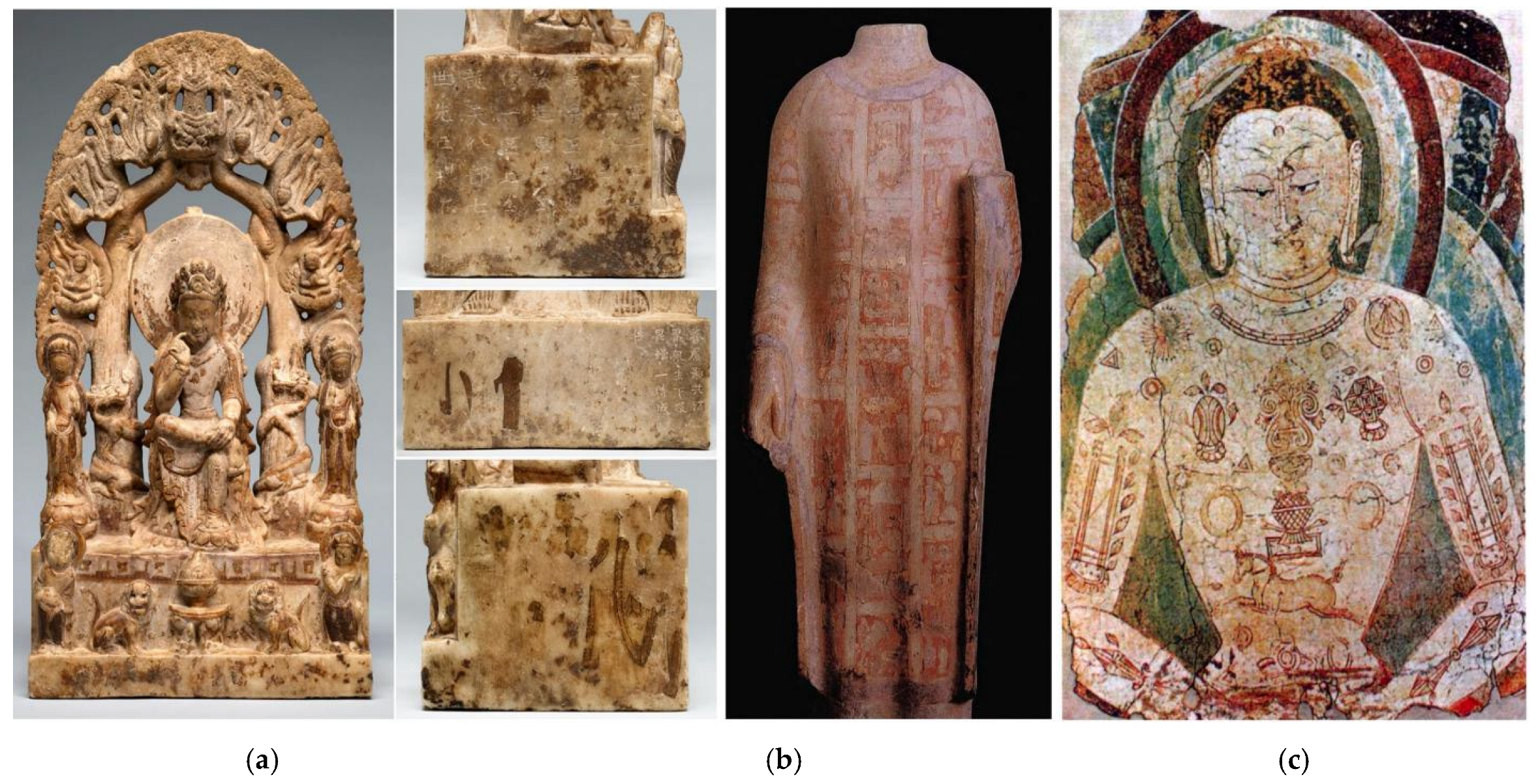
3.1. The Interplay Between Images and Inscriptions: From Static to Dynamic
3.2. Complementarity and Imitation in Visual Form
4. Conclusions
Author Contributions
Funding
Data Availability Statement
Conflicts of Interest
| 1 | |
| 2 | For the form and function of early Chinese Buddhist silk banners, see (Sun 2011, pp. 176–77). |
| 3 | Document OR.ch969-72; see (Sha and Wu 2005, pp. 324–29). |
| 4 | Noas originally referred to the shrines prevalent from the Middle Kingdom to the New Kingdom in ancient Egypt, usually featuring life-sized stone sculptures. Its characteristic is being closed on three sides, leaving only one decorated front area. Hava Katz uses ‘Noas’ to encompass types found in portable clay shrines in the Near East, such as Small Naoi, Large and Crude Naoi, and Large and Delicate Naoi. |
| 5 | |
| 6 | The Xianbei were a nomadic people who emerged in the eastern part of the Mongolian Plateau and the Greater Khingan Mountains region around the 1st century AD. During the 2nd–3rd centuries, they developed multiple tribes, and in the 4th–5th centuries, they successively established northern states such as Western Qin, Northern Wei, and Southern Liang. |
| 7 | |
| 8 | “容相超奇,四八盡俱。菩薩森然而侍立,諸天飛騰而滿跡。觀之者不覺玄光西移,鑒之者曦影以慕” (Yang 2010, p. 3). |
| 9 | |
| 10 | Cases similar to Ch. Liii.001, whether presenting a complete stele form or employing stele-shaped areas, mostly depict a pedestal. This pedestal serves as the central axis at the lower part of the composition, with donors painted on either side. See Stein (1921a, Pl. LXI: Ch. 00617, Pl. LXVI: Ch. lvii. 004, Pl. LXVII: Ch. Lviii. 003, Pl. LXXXIII: Ch. xx. 009, Pl. LXXXIX: Ch. xxi. 005), etc. |
References
- Bai, Jianyao, ed. 2010. Treasures of the Silk Road: Selected Artifacts from Xinjiang Museums (Chinese-English). Urumqi: Xinjiang People’s Publishing House. [Google Scholar]
- Barthes, Roland. 1968. Elements of Semiology. Translated from the French by Annette Lavers and Colin Smith. New York: Hill & Wang, pp. 9, 43. [Google Scholar]
- Behrent, Kurt A. 2007. The Art of Gandhara: In the Metropolitan Museum of Art. New York: The Metropolitan Museum of Art, Pl. 63–65, Figure 34. [Google Scholar]
- Bhandre, Shailendra. 2018. Numismatics of “the Other”: Investigating Coinage and “Greekness” at Taxila. In Buddhism and Gandhara: An Archaeology of Museum Collections. Edited by Himanshu Prabha Ray. New York: Routledge, pp. 70–103. [Google Scholar]
- Brancaccio, Pla. 2018. The Collection of Gandharan Art in the Residence of the Malakand Political Agent, Khyber Pakhtunkhwa Province, Pakistan. In Buddhism and Gandhara: An Archaeology of Museum Collections. Edited by Himanshu Prabha Ray. New York: Routledge, pp. 202–3. [Google Scholar]
- Bureau of Cultural Relics of Xinjiang Uygur Autonomous Region, ed. 2011. Compilation of the Third National Survey of Cultural Relics in Xinjiang Uygur Autonomous Region · Khotan Prefecture Volume. Beijing: Science Press, pp. 15, 119, 134, 151–53. [Google Scholar]
- Cao, Yan, and Zheng Wei. 2022. The Stone Carvings of Si’ercun in Datong and the Nuo Ritual in the Northern Wei Dynasty. Palace Museum Journal 3: 30–37. [Google Scholar]
- Chan, Chun-Wa. 2023. Portable Faith: Toward a Non-Site-Specific History of Buddhist Art in Japan. Ars Orientalis 53: 3–19. [Google Scholar] [CrossRef]
- China Millennium Monument, and Qingzhou Museum, eds. 2002. Buddhist Statues in the Northern Dynasties in Qingzhou. Beijing: Beijing Publishing House. [Google Scholar]
- Coningham, Robin A. E., Kosh P. Acharya, Keir M. Strickland, Christopher E. Davis, Mark J. Manuel, Ian A. Simpson, Krista Gilliland, Jennifer Tremblay, Timothy C. Kinnaird, and David C. W. Sanderson. 2013. The Earliest Buddhist Shrine: Excavating the Birthplace of the Buddha, Lumbini (Nepal). Antiquity 87: 1104–23. [Google Scholar] [CrossRef]
- Dong, Gao, ed. 1983. Complete Collection of All Preserved Prose Literature of the Tang Dynasty. Beijing: China Bookstore, vol. 429, p. 4370. [Google Scholar]
- Du, Zhengyu. 2010. Buddhist Charitable Associations with Government Background in the Western Wei and Northern Zhou Dynasties. Taibei: Huamulan Culture Press, pp. 26–50. [Google Scholar]
- Dunhuang Museum. 2002. Picture Album of Dunhuang Relics. Lanzhou: Gansu People’s Fine Arts Publishing House. [Google Scholar]
- Dunhuang Museum, ed. 2017. Illustrated Catalog of Precious Cultural Relics in Dunhuang Museum. Shenyang: Volumes Publishing Company, pp. 52–53. [Google Scholar]
- Eiichi, Matsumoto. 2019. A Study of Dunhuang Paintings. Translated by Baoyao Lin, Shengliang Zhao, and Mei Li. Hangzhou: Zhejiang University Press. [Google Scholar]
- Feng, Jicai, ed. 2011. Complete Collection of Statues in Datong, China: Museum Collection Volume. Beijing: Zhonghua Book Company. [Google Scholar]
- Geertz, Clifford. 1983. Local Knowledge: Further Essays in Interpretive Anthropology. New York: Basic Books. [Google Scholar]
- Granoff, Phyllis. 1968. A Portable Buddhist Shrine From Central Asia. Archives of Asian Art 22: 80–95. [Google Scholar]
- Grünwedel, Albert. 1906. Bericht Über Archäologische Arbeiten in Idikutschari und Umgebung, im Winter 1902–1903. München: K. B. Akademie der Wissenschaften. [Google Scholar]
- Hameed, Muhammad, and Rabiqa Abid Bukhari. 2021. Iconography of Pensive Boddhisattva and Great Renunciation: Examples from Miniature Portable Shrines from Gandhara. Pakistan Vision 22: 60–77. [Google Scholar]
- Han, Jinke. 2012. The Underground Palace of Famen Temple Pagoda. Beijing: SDX Joint Publishing Company, pp. 95, 111, 168–78. [Google Scholar]
- Hao, Chunwen. 2019. A Study on She Associations in Medieval China. Shanghai: Shanghai Ancient Books Publishing House, pp. 7–55. [Google Scholar]
- Hatcher, Evelyn Payne. 1999. Art as Culture: An Introduction to the Anthropology of Art, 2nd ed. Westport and London: Bergin & Garvey, pp. 135–38. [Google Scholar]
- Hebei Museum, ed. 2014. Famous Kilns and Famous Porcelain. Beijing: Cultural Relics Press. [Google Scholar]
- Huang, Baosheng, trans. 2011. A Sanskrit-Chinese Edition of the Teaching of Vimalakirti. Beijing: China Social Sciences Press, p. 139. [Google Scholar]
- Jao, Tsung-i. 1978. Dunhuang Line Drawings. Monograph Series of the École française d’Extrême-Orient. In Collected Academic Works of Rao Zongyi in the 20th Century, Volume 8: Dunhuang Studies (Part 1). Edited by Rao Zongyi. Beijing: Renmin University of China Press, pp. 424–25. [Google Scholar]
- Jiang, Huaiying, and Xuanchong Qiu, eds. 1998. The Three Pagodas of Chongsheng Temple in Dali. Beijing: Cultural Relics Press, pp. 73–74, 76. [Google Scholar]
- Jiang, Xinjian. 2008. Buddhism and Chinese Funeral Culture. Changsha: Hunan People’s Publishing House. [Google Scholar]
- Jiang, Yingju, and Wenqi Wu, eds. 2000. The Complete Collection of Chinese Stone Reliefs, Volume 1: Stone Reliefs in Shandong. Jinan: Shandong Fine Arts Publishing House, pp. 20–22, Pl. 62–67. [Google Scholar]
- Jin, Weinuo. 2002. Ancient Chinese Buddhist Statues: Styles and Forms. Beijing: Cultural Relics Press. [Google Scholar]
- Katz, Hava. 2016. Portable Shrine Models: Ancient Architectural Clay Models from the Levant. Oxford: British Archaeological Reports Ltd., pp. 1–94. [Google Scholar]
- Khan, Mohammad Wali Ulllah. 2009. Gandhara: The Buddhist Civilization from Pakistan. Translated by Shuilin Lu. Beijing: China Intercontinental Communication. [Google Scholar]
- Knox, Robert. 1992. Amravati: Buddhist Sculpture from the Great Stupa. London: British Museum Press, pp. 32–33. [Google Scholar]
- Kress, Gunther, and Theo van Leeuwen. 2021. Reading Images: The Grammar of Visual Design, 3rd ed. London and New York: Routledge, p. 41. [Google Scholar]
- Le Coq, Albert von. 1913. Chotscho: Facsimile-Wiedergaben der Wichtigeren Funde der Ersten Königlich Preussischen Expedition nach Turfan in Ost-Turkistan. Berlin: Dietrich Reimer. [Google Scholar]
- Lee, Sherman E. 1966. Kleinkunst: Two Early Chinese Wood Sculptures. Archives of Asian Art 20: 66–70. [Google Scholar]
- Li, Jingjie. 2000. A Brief Study on the Iconography of Locana Dharmadhātu. Journal of Palace Museum 3: 53–63. [Google Scholar]
- Liang, Sicheng. 2011. A History of Chinese Architecture. Beijing: SDX Joint Publishing Company, p. 35. [Google Scholar]
- Lin, Zejie, and Yanli Xie. 2025. Touching People with Gods: Droughts and Ritual Prayers in Southeastern China During the Eighth and Ninth Centuries. Religions 16: 332. [Google Scholar] [CrossRef]
- Liu, Fengjun. 2000. Complete Collection of Buddhist Art, Volume 11: The Art of Buddhist Statues in Shandong. Beijing: Cultural Relics Press, pp. 102–3. [Google Scholar]
- Meng, Xianshi. 2009. A Study on Folk Associations in Dunhuang. Beijing: Peking University Press, pp. 113–17. [Google Scholar]
- Monier-Williams, Monier. 1960. A Sanskrit-English Dictionary: Etymologically and Philologically Arranged With Special Reference to Cognate Indo-European Languages. Oxford: Clarendon Press, p. 1260. [Google Scholar]
- Musée des Arts Asiatiques Guimet. 2010. Pakistan, Terre de rencontre (1er-VIe Siècle). Les Arts du Gandhara. Paris: Guimet. [Google Scholar]
- Ning, Ke, and Chunwen Hao, eds. 1997. Edition and Collation of Dunhuang Documents on She Associations. Nanjing: Jiangsu Ancient Books Publishing House, pp. 514–682. [Google Scholar]
- Northern Dynasties Art Research Institute, ed. 2016. Catalogue of the Collection of Northern Dynasties Art Research Institute. Beijing: Cultural Relics Press. [Google Scholar]
- Okada, Ken. 2002. On the Style of Cave Statue 1 at Cishan Temple. In Cishan Temple and Linxi Bridge: Research Report on Buddhist Statue Caves and Shrines. Edited by Department of Archaeology of Northwest University, Japanese Investigation Team to Buddhist Sites in Shaanxi and Linyou County Museum. Beijing: Science Press. [Google Scholar]
- O’Neill, John P., and M. E. D. Laing, eds. 1982. Along the Ancient Silk Routes: Central Asian Art from the West Berlin State Museum. New York: The Metropolitan Museum of Art, pp. 64–65. [Google Scholar]
- Pal, Pratapaditya. 2004. Prologemena to the Study of a Portable Buddhist Shrine. Bulletin of the Asia Institute 18: 1–17. [Google Scholar]
- Piggott, Stuart. 1943. The Earliest Buddhist Shrines. Antiquity 65: 1–10. [Google Scholar] [CrossRef]
- Rhie, Marylin Martin. 2007. Early Buddhist Art of China and Central Asia, Volume 1, Later Han, Three Kingdoms and Western Chin in China and Bactria to Shan-Shan in Central Asia. Leiden: Brill. [Google Scholar]
- Riegl, Alois. 1966. Historische Grammatik der Bildenden Künste, aus dem Nachlaß Herausgegeben von Karl M. Swoboda und Otto Pächt. Graz-Köln: Hermann Böhlaus Nachf. [Google Scholar]
- Rienjang, Wannaporn, and Peter Stewart, eds. 2019. The Geography of Gandharan Art. Oxford: Archaeopress Archaeology. [Google Scholar]
- Sha, Wutian. 2007. A Study of Dunhuang Painting Sketches. Beijing: Central Compilation & Translation Press, p. 5. [Google Scholar]
- Sha, Zhi, and Sifang Wu, eds. 2005. The Korean Documents from Aurel Stein’s Third Central Asian Expedition (Non-Buddhist Texts). Shanghai: Shanghai Lexicographical Publishing House, vol. 2, pp. 324–29. [Google Scholar]
- Shaanxi Yoxian County Yaowangshan Museum, Shaanxi Lintong Municipal Museum, and Beijing Museum of the City Wall of the Liao and Jin Dynasties, eds. 1996. Selected Buddhist and Taoist Statue Steles in the Northern Dynasties. Tianjin: Tianjin Ancient Books Publishing House, p. 124. [Google Scholar]
- Shao, Zhengkun. 2014. Compilation of Statue Inscriptions in the Northern Dynasties with Dates. Changchun: Jilin People’s Publishing House, pp. 196–203. [Google Scholar]
- Shastri, Ajay Mitra. 1995. Inscriptions of the Śarabhapurīyas, Pāṇḍuvaṁśins, and Somavaṁśins. Delhi: Motilal Banarsidass. [Google Scholar]
- Shaw, Julia. 2016. Buddhist and Non-Buddhist Mortuary Traditions in Ancient India: Stupas, Relics, and the Archaeological Landscape, Death Rituals. In Social Order and the Archaeology of Immortality in the Ancient World. Edited by Colin Renfrew, Michael J. Boyd and Iain Morley. New York: Cambridge University Press, pp. 382–400. [Google Scholar]
- Sichuan Provincial Commission for the Preservation of Cultural Relics. 1985. Shu-Kingdom Cliff Tombs at Tujing, Zhongxian, Sichuan. Cultural Relics 7: 72–3. [Google Scholar]
- Soper, Alexander. 1965. A Buddhist Travelling Shrine in an International Style. East and West 15: 211–25. [Google Scholar]
- Stein, Marc Aurel. 1921a. Serindia: Detailed Report of Explorations in Central Asia and Westermost China. Oxford: The Clarendon Press. [Google Scholar]
- Stein, Marc Aurel. 1921b. The Thousand Buddhas: Ancient Buddhist Paintings from the Cave-Temples of Tun-huang on the Western Frontier of China. London: Bernard quaritch, Ltd. [Google Scholar]
- Stein, Marc Aurel. 1928. Innermost Asia: Detailed Report of Explorations in Central Asia, Kan-Su and Eastern Īrān. Oxford: The Calrendon Press. [Google Scholar]
- Sun, Ji. 2011. Illustrated Explanations of the Material Culture of the Han Dynasty, revised ed. Shanghai: Shanghai Ancient Books Publishing House, pp. 176–77. [Google Scholar]
- Sun, Ji. 2016. Chinese Traditional Attire Culture. Shanghai: Shanghai Ancient Books Publishing House, p. 89. [Google Scholar]
- Swāti, Muhammad Farooq. 1997. Special Features of the Buddhist Art in the Swat Valley. Āthāriyyāt 1: 1–60. [Google Scholar]
- The Palace Museum, ed. 2009. The Complete Collection of the Palace Museum: Sculpture & Statue Series 7: Buddhist Statues Unearthed at Xiude Temple Site in Quyang, Hebei (Chinese-English). Beijing: Forbidden City Publishing House, pp. 19–44, 66–81, 92–105, 112–62. [Google Scholar]
- Tripiṭaka Master Buddhabhadra. 1985. The Sutra of the Great and Vast Buddha’s Garland of Flowers in Fifty Scrolls. In Chinese Buddhist Canon. Edited by the Editorial Department of Chinese Buddhist Canon. Beijing: Zhonghua Book Company. [Google Scholar]
- Wang, Yintian, and Chenmin Cao. 2004. Three Stone Carvings in the Northern Wei Dynasty. Cultural Relics 6: 90–92. [Google Scholar]
- Wong, Dorothy C. 2018. Buddhist Pilgrim-Monks as Agents of Cultural and Artistic Transmission: The International Buddhist Art Style in East Asia, ca. 645–770. Singapore: NUS Press. [Google Scholar]
- Wu, Hung. 1986. Buddhist Elements in Early Chinese Art (2nd and 3rd century AD). Artibus Asiae 47: 266. [Google Scholar] [CrossRef]
- Xu, Guangji, ed. 2011. Complete Collection of Unearthed Murals in China, Volume 2: Shanxi. Beijing: Science Press, Pl. 74, 78, 84. [Google Scholar]
- Yan, Kejun, ed. 1958. The Complete Collection of Prose in the Xia, Shang, and Zhou Dynasties, the Qin and Han Dynasties, the Three Kingdoms, and the Six Dynasties: Complete Prose of the Jin Dynasty (with Index). Beijing: Zhonghua Book Company, vol. 158, p. 2376. [Google Scholar]
- Yang, Chaojie. 2010. Complete Collection of Minor Caves around Luoyang: Chinese-English Edition (Volume 1). Beijing: Foreign Languages Press, p. 3. [Google Scholar]
- Zhang, Fuchun. 2014. Collected Works of Zhi Dun with Collations and Annotations, Volume 2. Chengdu: Bashu Publishing House, p. 431. [Google Scholar]
- Zhang, Shumin. 2009. The Art of Buddhist Bronze Statues in Boxing, Shandong. Beijing: Cultural Relics Press, pp. 13–15. [Google Scholar]
- Zhang, Shumin, and Guitian Xiao, eds. 2011. White-Clay Buddhist Statues in Shandong. Beijing: Cultural Relics Press, pp. 4, 6–10. [Google Scholar]
- Zhang, Yuhuan. 2006. History of Chinese Pagodas. Beijing: Science Press, pp. 3–13. [Google Scholar]
- Zwalf, Wladimir. 1996. A Catalogue of the Gandhara Sculpture in the British Museum, Volume II. London: British Museum Press, Pl. 279, 652, 678, 680. [Google Scholar]





Disclaimer/Publisher’s Note: The statements, opinions and data contained in all publications are solely those of the individual author(s) and contributor(s) and not of MDPI and/or the editor(s). MDPI and/or the editor(s) disclaim responsibility for any injury to people or property resulting from any ideas, methods, instructions or products referred to in the content. |
© 2026 by the authors. Licensee MDPI, Basel, Switzerland. This article is an open access article distributed under the terms and conditions of the Creative Commons Attribution (CC BY) license.
Share and Cite
Li, H.; Zhou, H. A Mobile Temple: Forms and Visual Grammar of Portable Buddhist Shrines from the 3rd to the 8th Centuries Unearthed Along the Silk Road. Religions 2026, 17, 360. https://doi.org/10.3390/rel17030360
Li H, Zhou H. A Mobile Temple: Forms and Visual Grammar of Portable Buddhist Shrines from the 3rd to the 8th Centuries Unearthed Along the Silk Road. Religions. 2026; 17(3):360. https://doi.org/10.3390/rel17030360
Chicago/Turabian StyleLi, Haoran, and Hengbang Zhou. 2026. "A Mobile Temple: Forms and Visual Grammar of Portable Buddhist Shrines from the 3rd to the 8th Centuries Unearthed Along the Silk Road" Religions 17, no. 3: 360. https://doi.org/10.3390/rel17030360
APA StyleLi, H., & Zhou, H. (2026). A Mobile Temple: Forms and Visual Grammar of Portable Buddhist Shrines from the 3rd to the 8th Centuries Unearthed Along the Silk Road. Religions, 17(3), 360. https://doi.org/10.3390/rel17030360