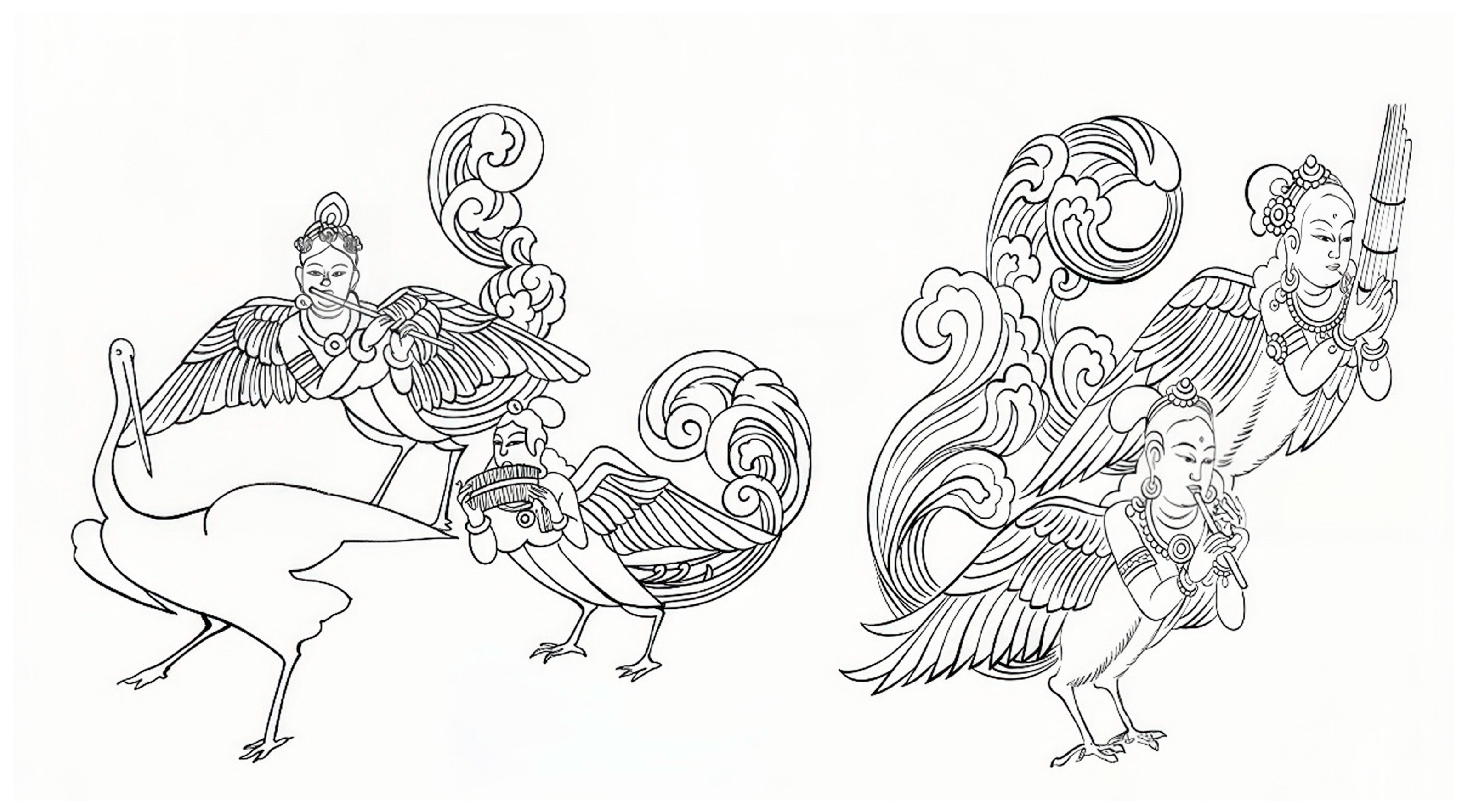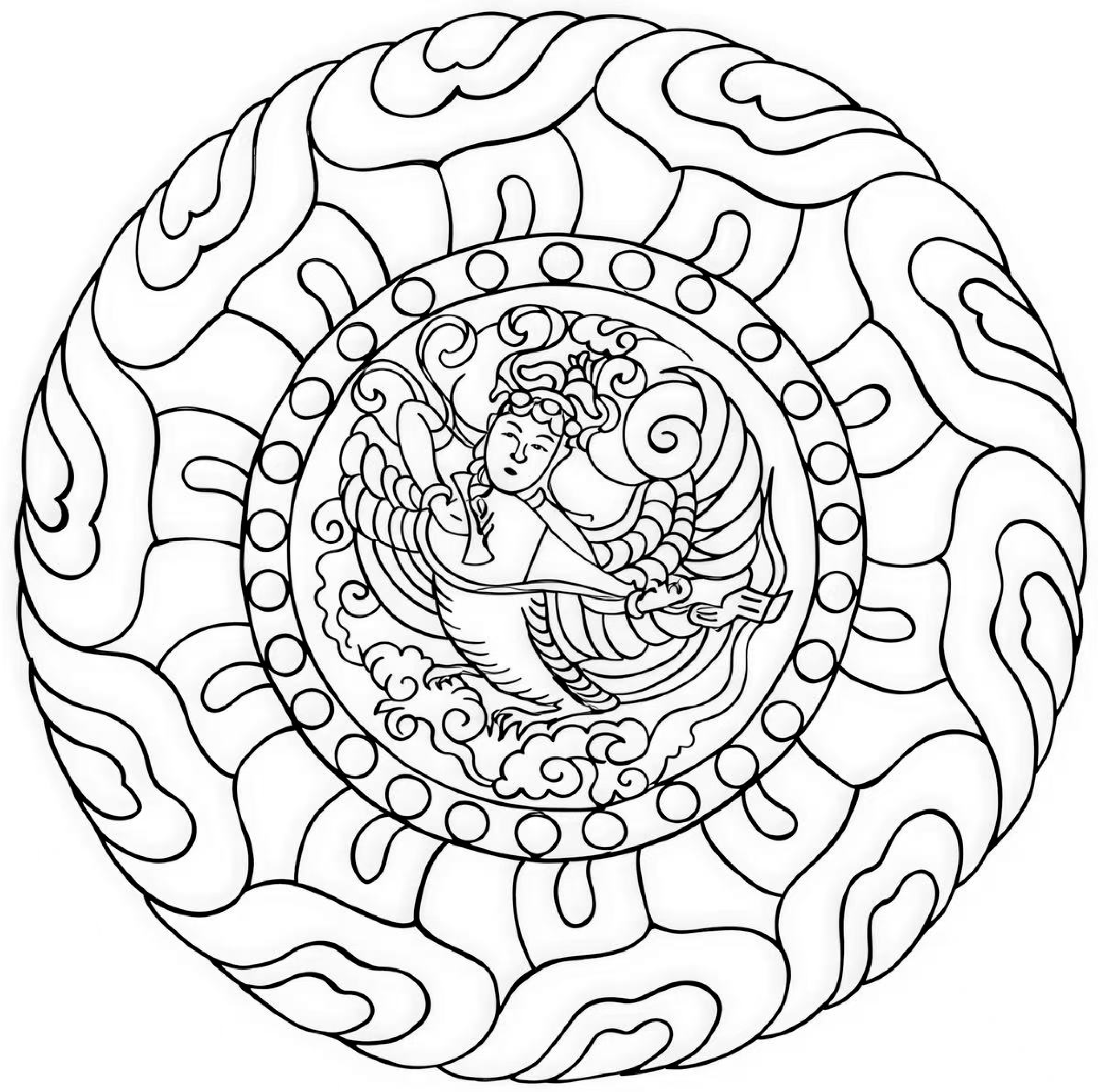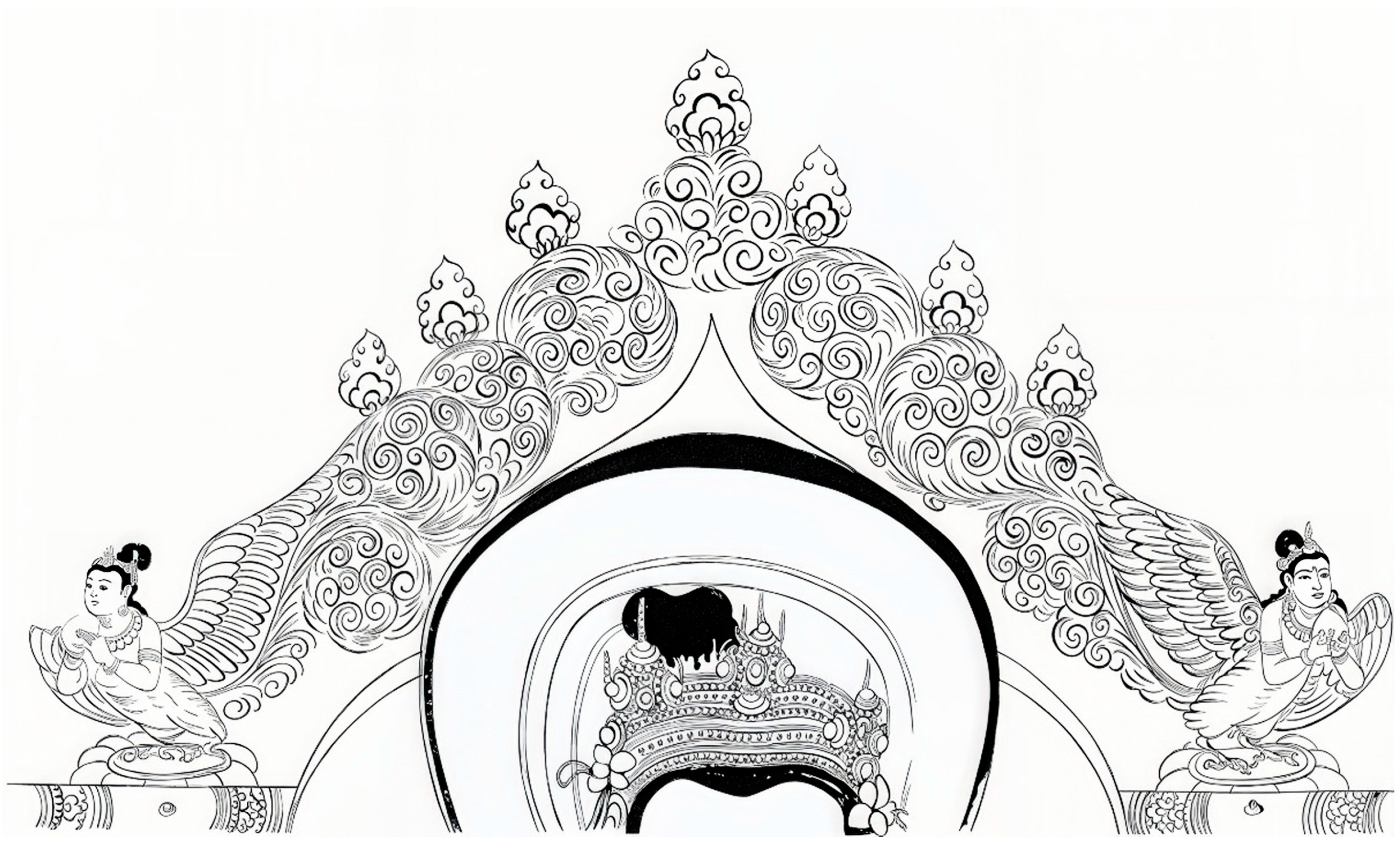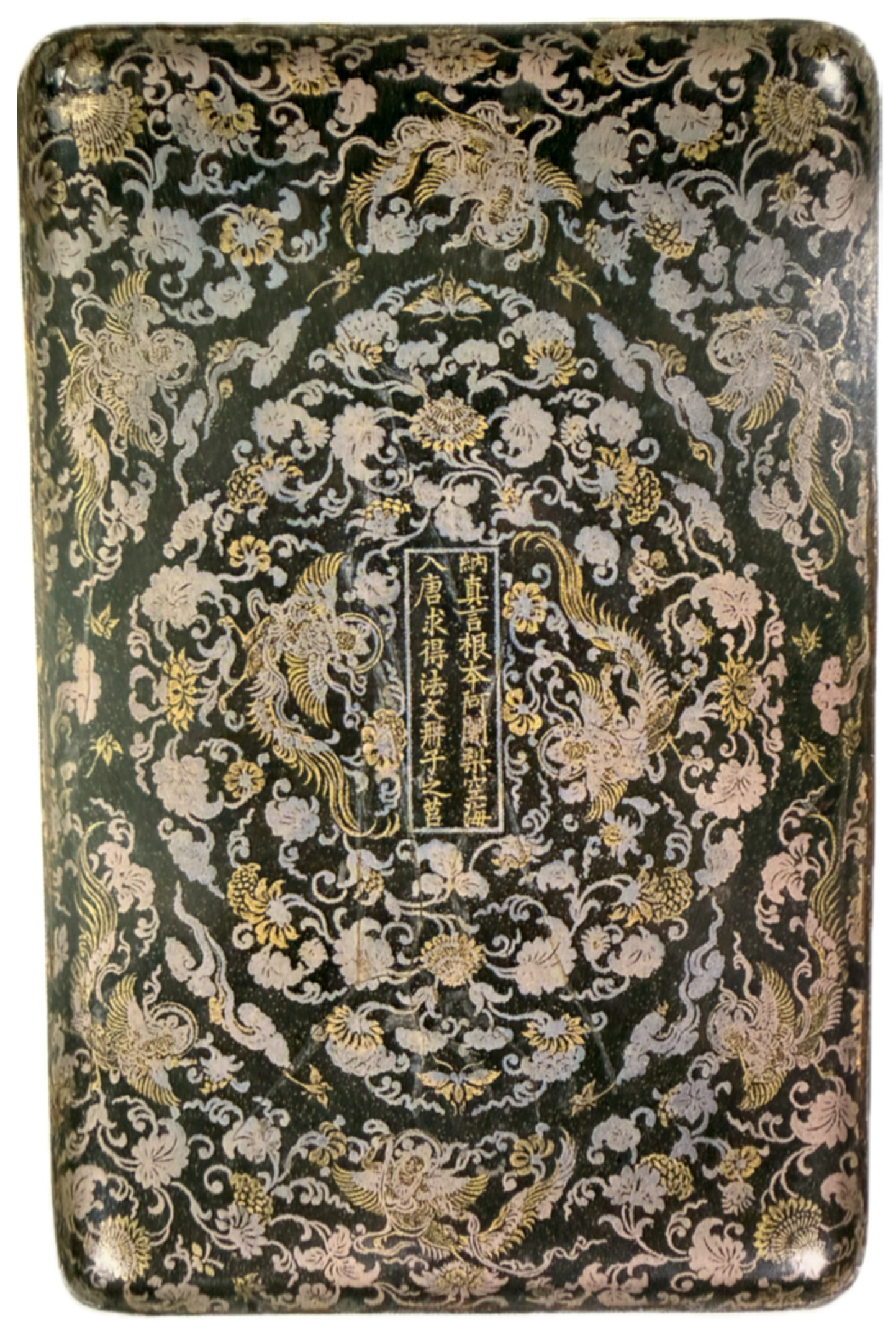
From Sacred Voice to Wearable Form: Material Translation and the Kalavinka as Jewelry in the Song–Liao World
Abstract
1. Introduction: From Iconographic Origin to Material Translation
1.1. Research Gap
1.2. Research Question
1.3. Argument and Contribution
- Fusion and de-gendering from its kinnara/kinnarī prototype, through which paired figures were consolidated into a single, transferable form;
- Stylization and elongation of the tail, allowing it to function as an autonomous ornamental structure;
- Postural reorientation toward decorative function, enabling the figure to operate within the material language and bodily frameworks of jewelry.
1.4. Materials and Methods
1.5. Structure of the Article
2. Iconographical Evolution of Kalavinka as Motif
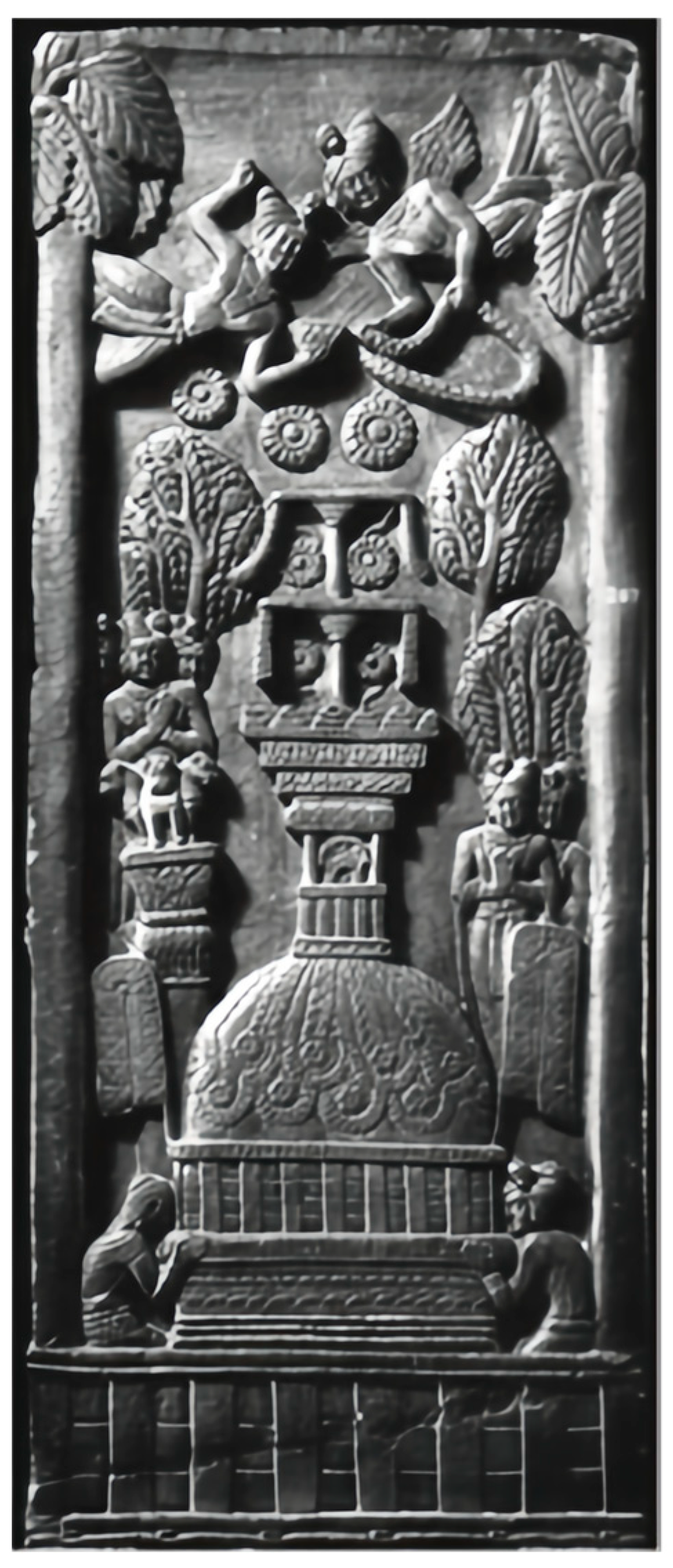
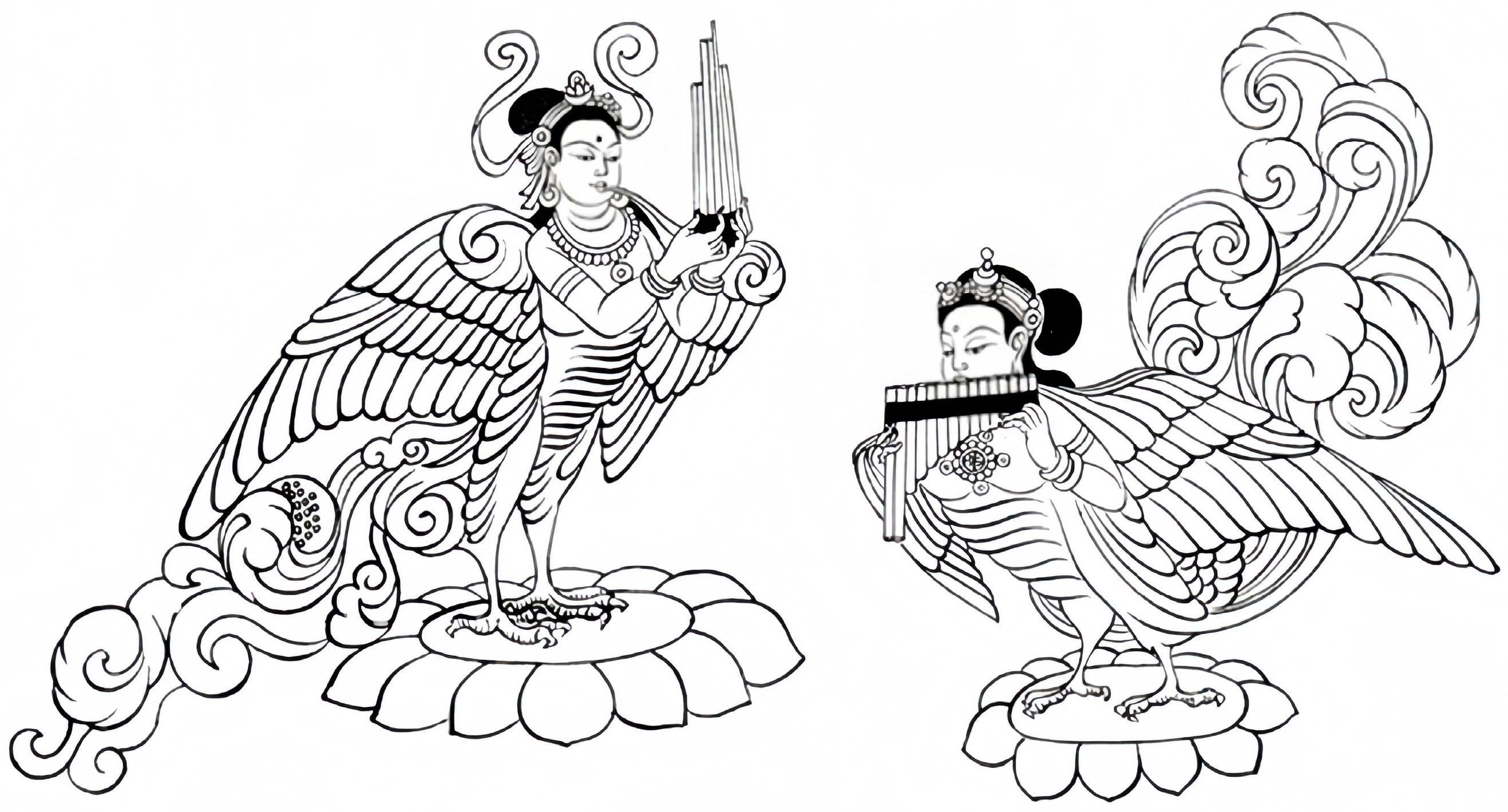
2.1. Kinnara/Kinnari Prototype
2.2. Evolution of Kalavinkas in Dunhuang
2.2.1. Transregional Transmission and Cultural Reception of Kalavinka
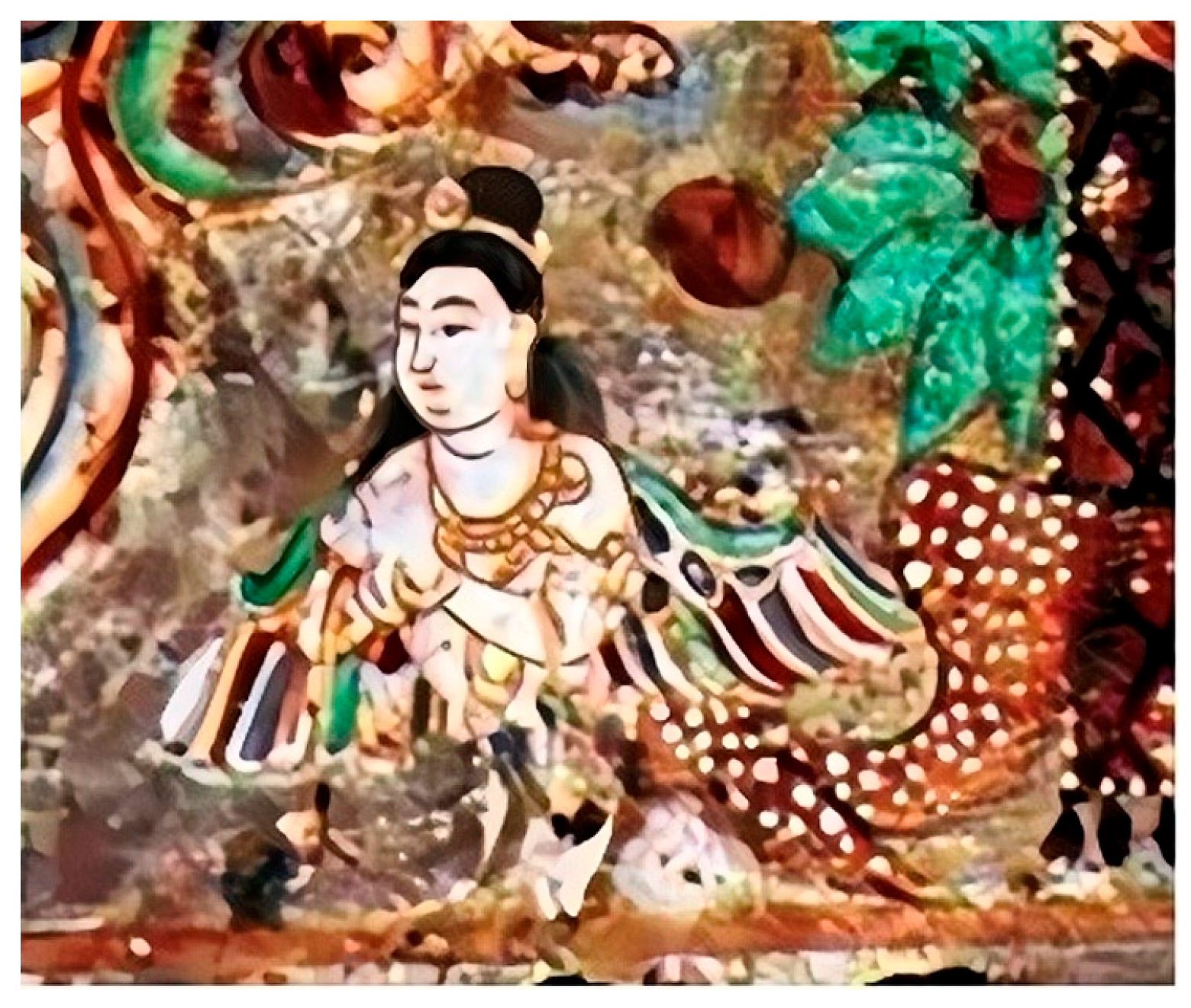
2.2.2. Evolution of Kalavinkas in Dunhuang Murals
3. Translating the Sacred into Ornament: Painted Kalavinka Jewelry on the Silk Road
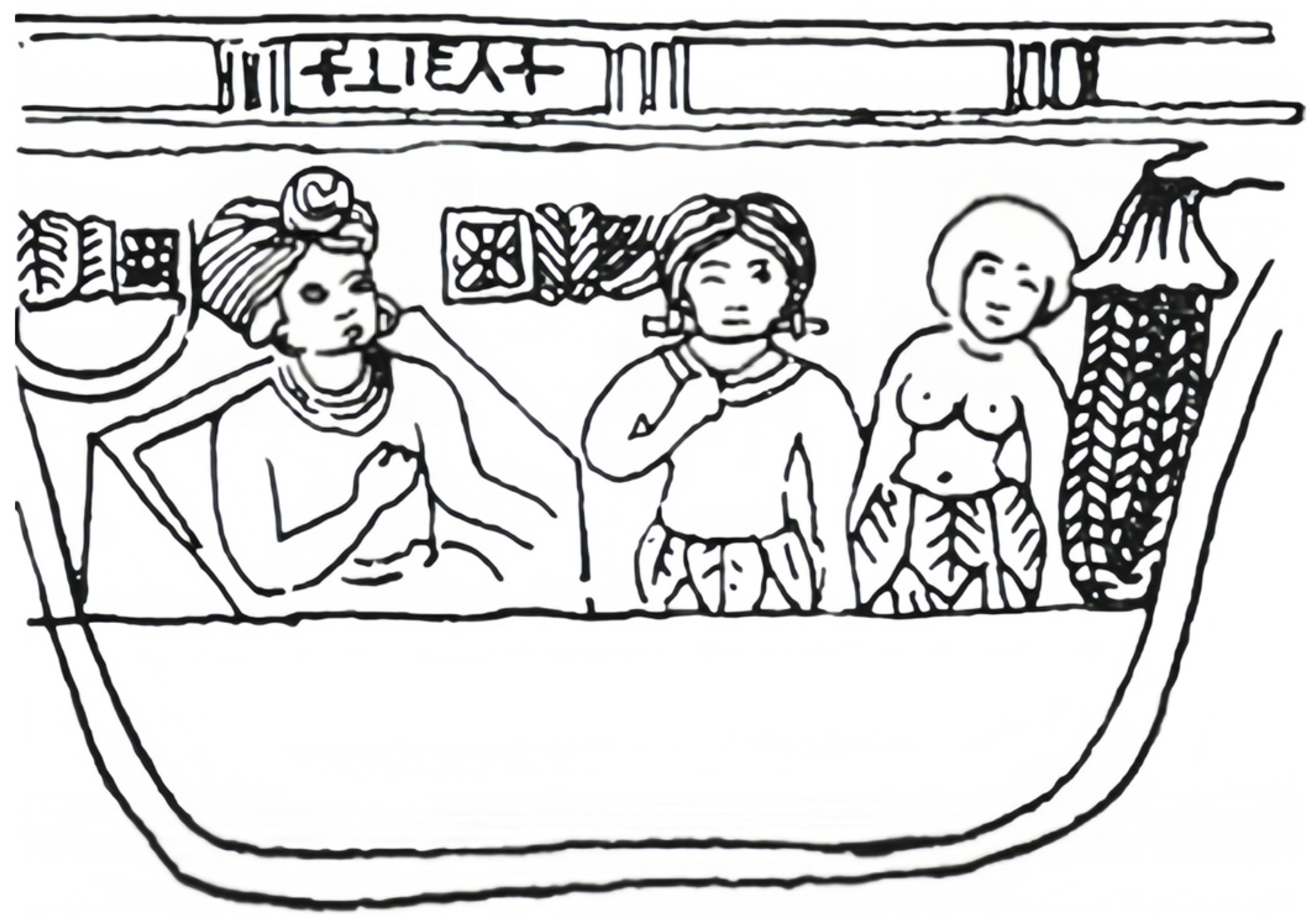
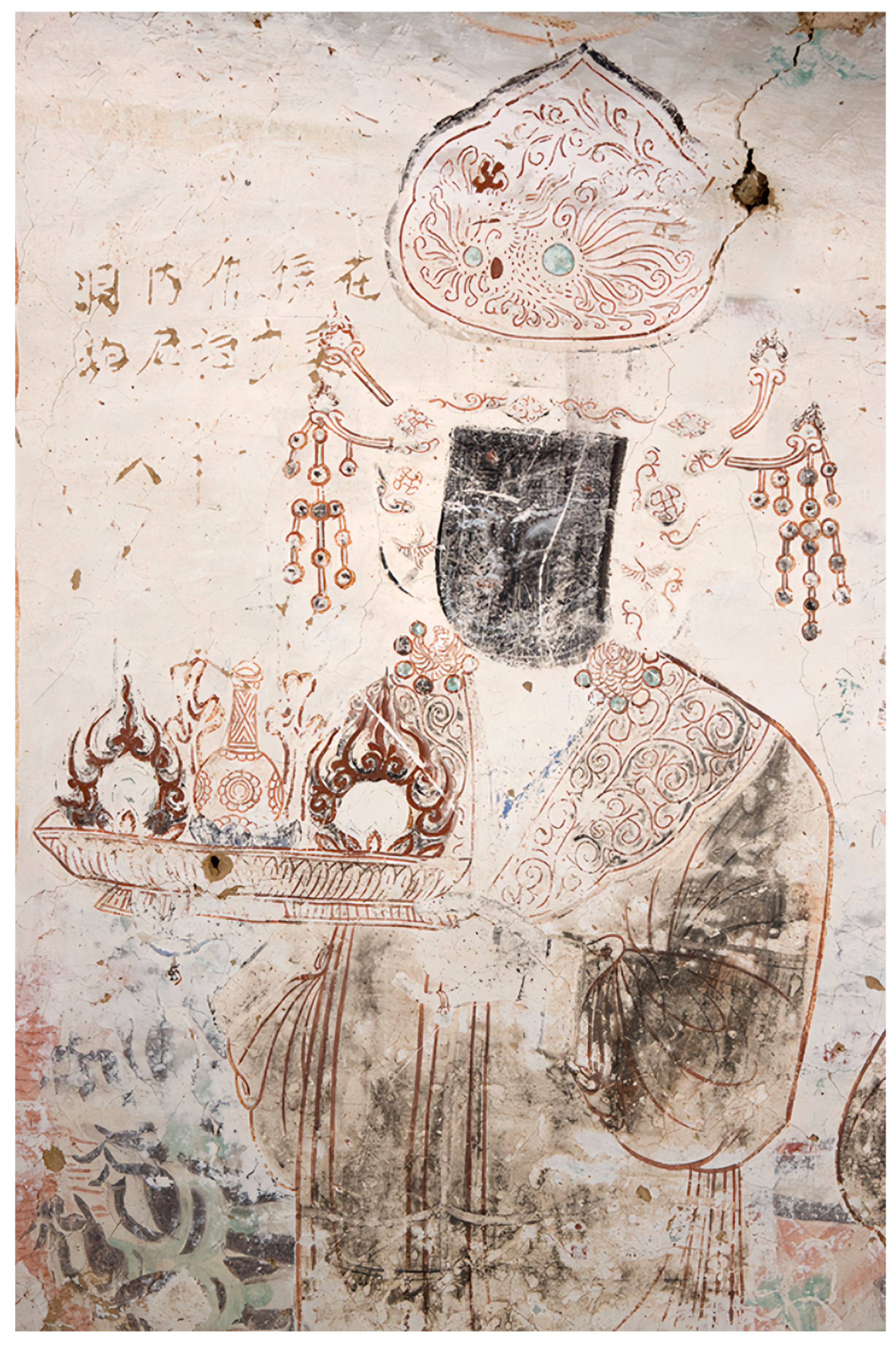
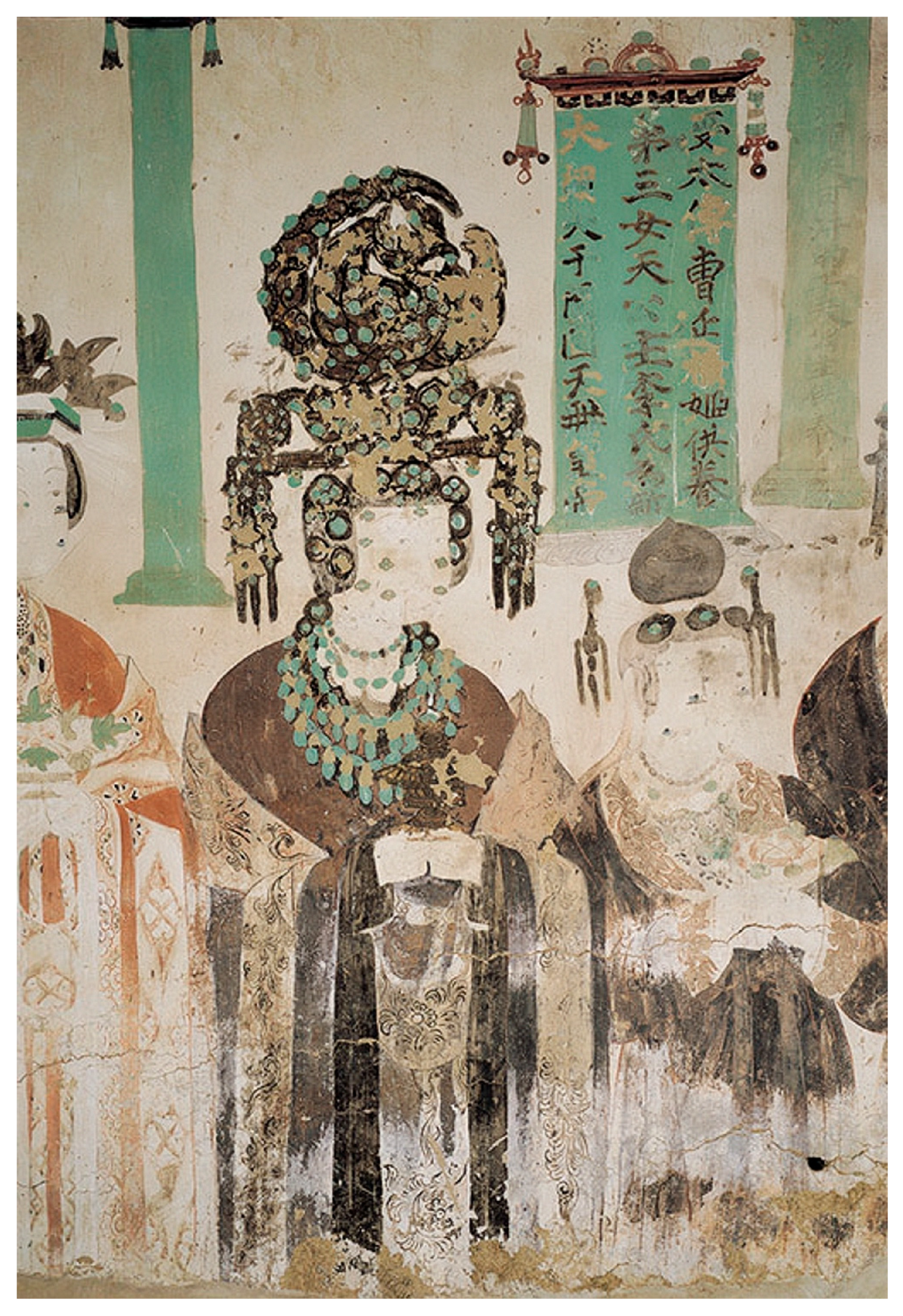
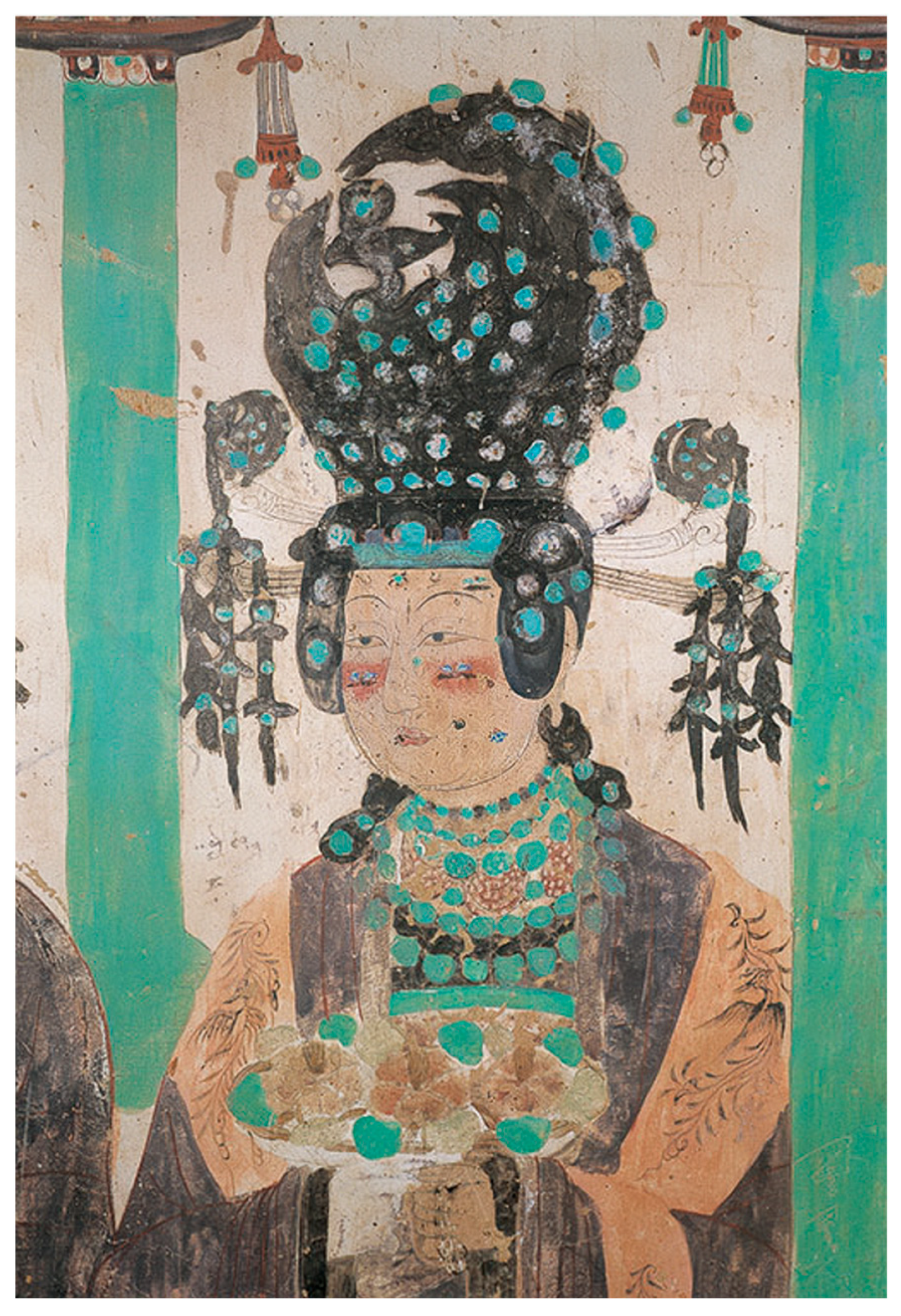
3.1. Western Thousand Buddha Cave 16: Uyghur Female Donor’s Kalavinka Earring
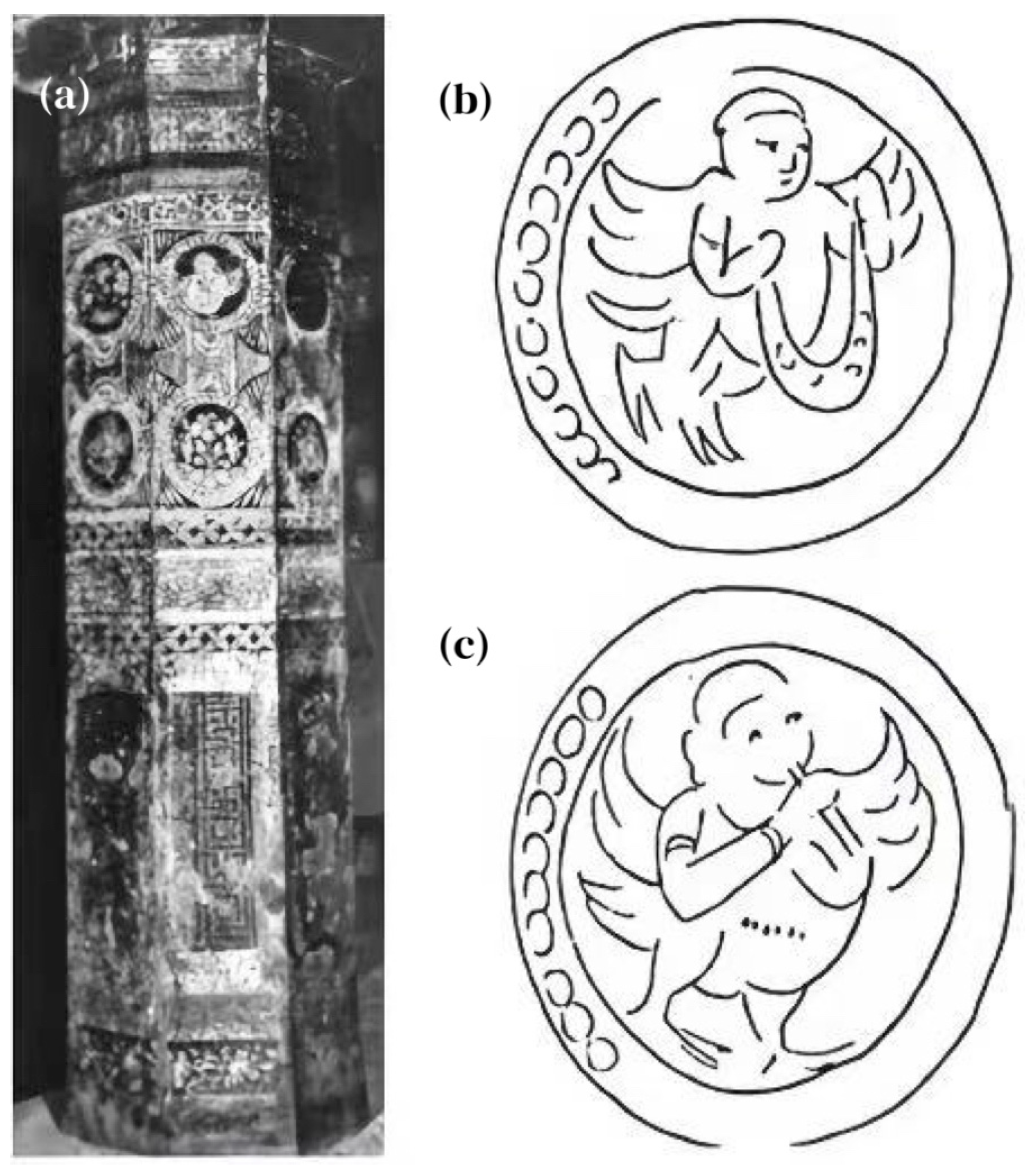
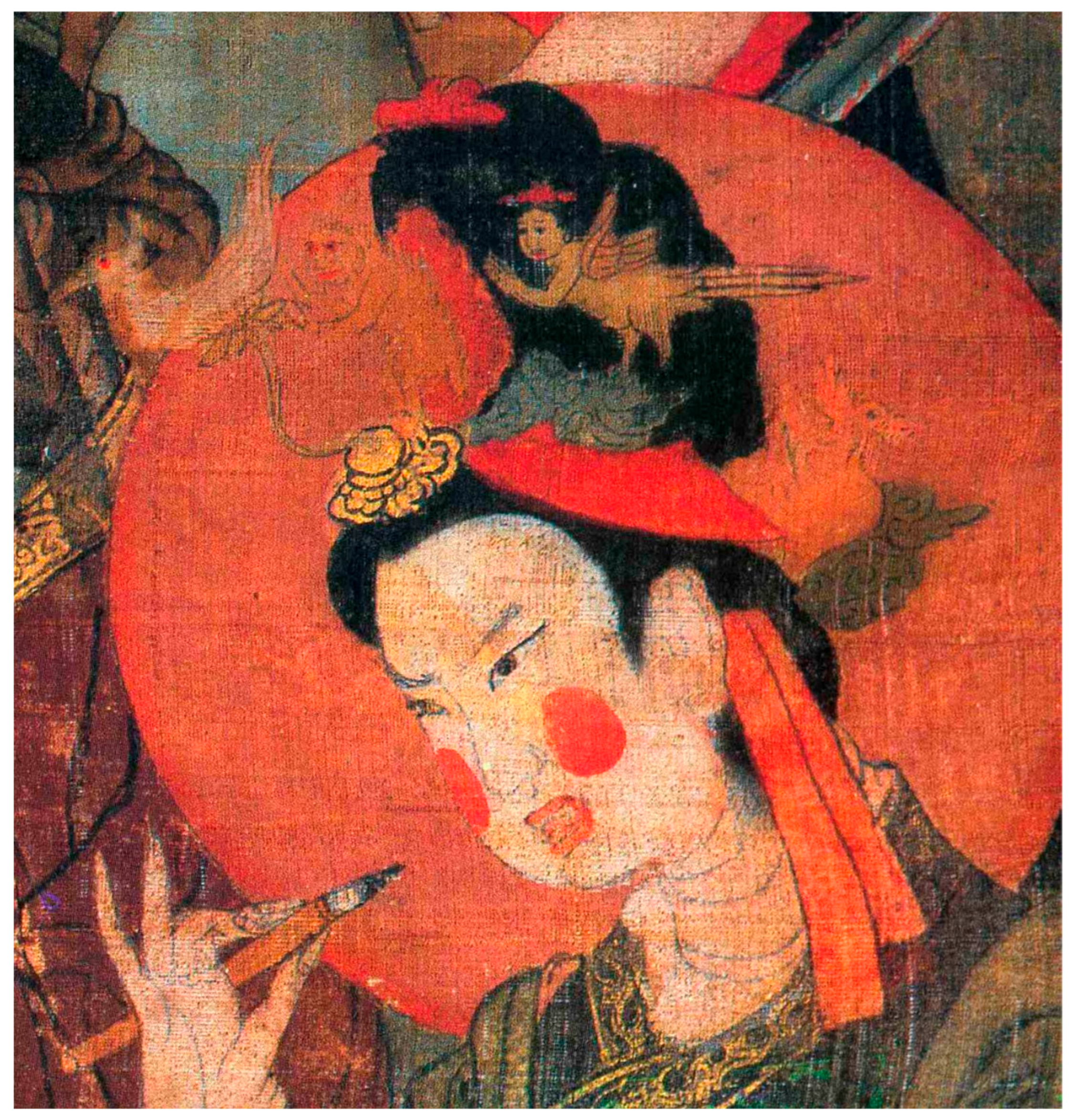
3.2. Kinnara/Kalavinka Motifs as Head Ornaments of Deity at Khara Khoto
4. Sacred Bird as Ornament: The Kalavinka as Golden Jewelry Along the Silk Road
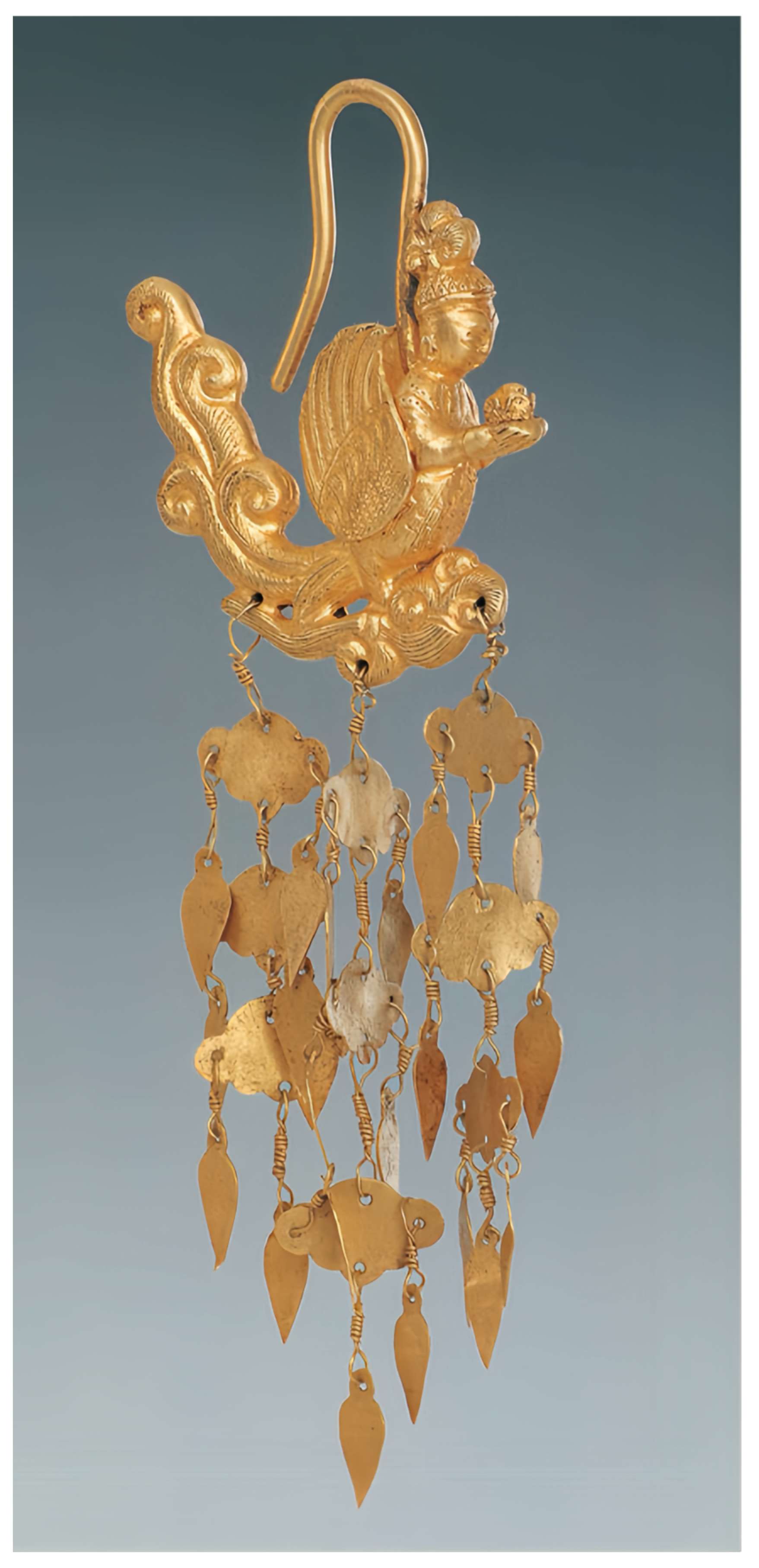
4.1. Liao-Period Gold Kalavinka Earring
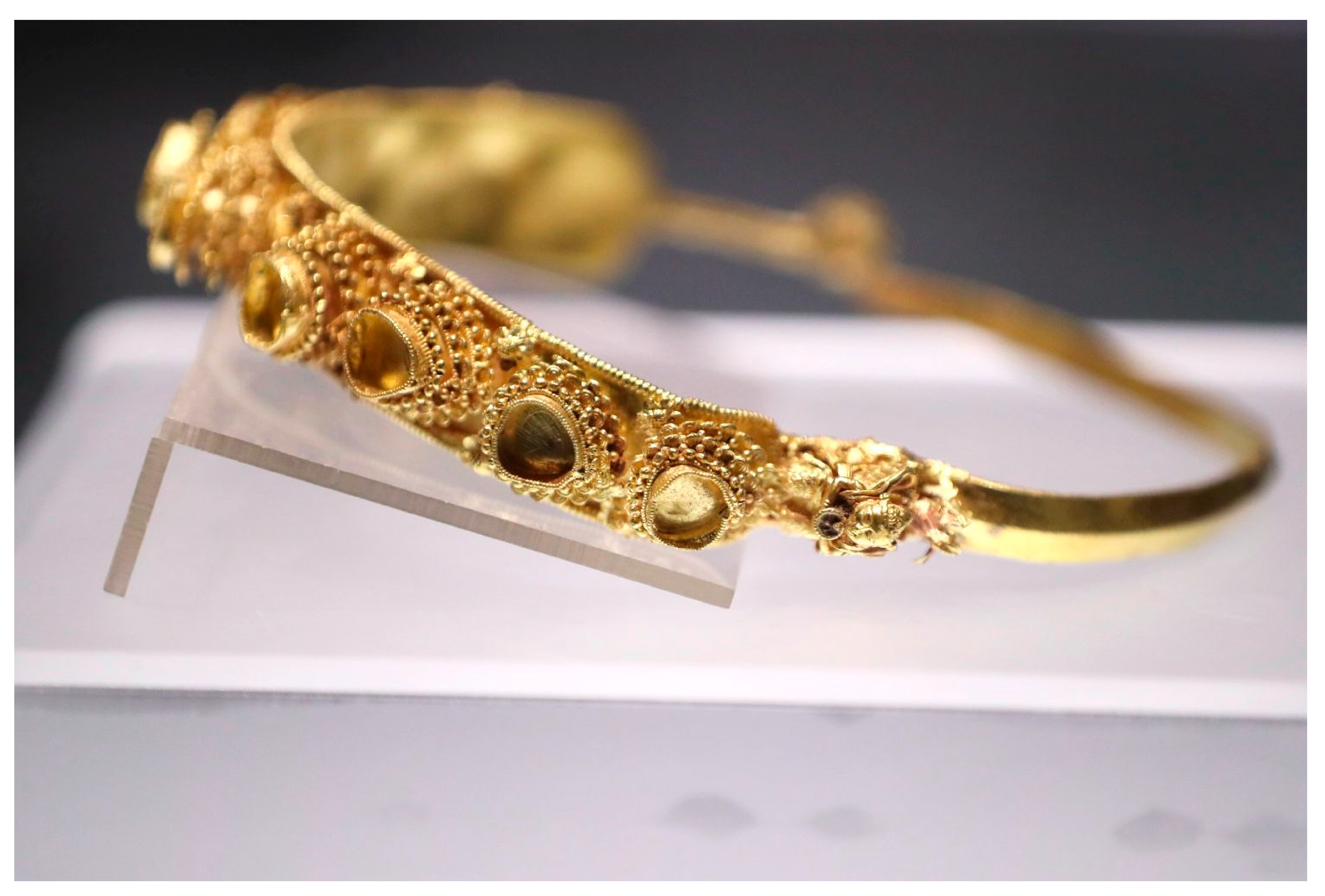
4.2. Western Xia-Period Gold Linked-Pearl Patterned Headdress
5. Conclusions
Funding
Institutional Review Board Statement
Informed Consent Statement
Data Availability Statement
Acknowledgments
Conflicts of Interest
| 1 | Mythological bird with two human heads, symbolizing “sharing the same life.” |
| 2 | Kinnara (male) and kinnarī (female) are paired semi-divine celestial musicians in South Asian religious traditions who later appear among the “Eight Classes of Devas and Nāgas” in Buddhist cosmology, where they are associated with music, devotion, and auspicious attendance. |
| 3 | Khara Khoto (“Black Water City”) was a major Tangut city of the Western Xia (1038–1227) located along the Silk Road in present-day Inner Mongolia. Abandoned after its destruction in the fourteenth century and rediscovered by Russian expeditions in the early twentieth century, the site yielded a large corpus of Buddhist paintings, manuscripts, and ritual objects that illuminate the transregional circulation of religious imagery across Inner Asia. |
| 4 | (Zheng 2002, chap. 2). Zheng uses the quote from Serindia: detailed report of explorations in Central Asia and westernmost to conclude Stein believes all winged figures from Buddhist art come from Hellenistic heritage. |
| 5 | Jātakas are narrative accounts of the Buddha Sakyamuni’s previous lives, widely transmitted in Buddhist textual and visual traditions, in which he appears in human or animal form to exemplify moral virtues and karmic causality. |
| 6 | The Amitābha Sūtra is a foundational Pure Land Buddhist scripture that describes the Western Paradise (Sukhāvatī) presided over by the future Buddha Amitābha. |
| 7 | The Visualization Sūtra is a key Pure Land Buddhist text that outlines meditative visualizations of Amitābha Buddha and his Western Paradise, providing a scriptural basis for the rich pictorial traditions depicting celestial musicians, jeweled landscapes, and devotional scenes. |
| 8 | Dicrurus paradiseus formosus is a subspecies of the Greater Racket-tailed Drongo, a bird species originating from Java. |
| 9 | Makie Lacquer Fascicle Box with Hōsōge Floral and Kalavinka Motifs (Thirty-Fascicle Set). |
| 10 | Kūkai (774–835), a Japanese Buddhist monk and founder of the Shingon school. He traveled to Tang China to study esoteric Buddhism and played a central role in transmitting tantric doctrines, rituals, and visual culture to Japan. |
| 11 | “Box Containing the Booklets of Esoteric Dharma Texts Obtained in Tang China by Kūkai, the Founding Ācārya of Shingon.” |
References
Primary Sources
Liu, Xu, Zhang Zhaoyuan, Jia Wei, Zhao Xi, and Sang Weihan. 1975. Jiu Tang Shu (Old Book of Tang, 舊唐書). Beijing: Zhonghua Shuju.Ouyang, Xiu, and Song Qi. 1975. Xin Tang Shu (New Book of Tang, 新唐書). Beijing: Zhonghua Shuju.Stein, Aurel. 1921. Serindia: Detailed Report of Explorations in Central Asia and Westernmost China. Oxford: Clarendon Press.Wang, Pu. 1955. Tang Huiyao (Institutional History of the Tang, 唐會要). Beijing: Zhonghua Shuju.Wang, Qinruo, Yang Yi, and Sun Fu, eds. 1960. Cefu Yuangui (Prime Tortoise of the Record Bureau, 冊府元龜). Beijing: Zhonghua Shuju.Secondary Sources
- Bagley, Robert. 2006. Ornament, representation, and imaginary animals in Bronze Age China. In Gombrich Among the Egyptians and Other Essays in the History of Art. Seattle: Marquand Books, pp. 168–71. [Google Scholar]
- Barua, Benimadhab, and Kumar Gangananda Sinha. 1926. Barhut Inscriptions. Calcutta: University of Calcutta, pp. 86–87. [Google Scholar]
- Chen, Xuejing. 2002. 迦陵频伽起源考. Dunhuang Research 3: 1–8. [Google Scholar] [CrossRef]
- Cunningham, Alexander. 1879. The Stûpa of Bharhut: A Buddhist Monument Ornamented with Numerous Sculptures Illustrative of Buddhist Legend and History in the Third Century B.C. London: W. H. Allen and Co. [Google Scholar]
- Duan, Wenjie, ed. 1985. Complete Collection of Chinese Art: Painting. In Dunhuang Murals, Part II. Shanghai: Shanghai People’s Fine Arts Publishing House, vol. 15. [Google Scholar]
- Duan, Wenjie. 1987. Feitian, kinnara, and kinnarī: Further discussion on Dunhuang feitian. Dunhuang Research 1: 1–3. [Google Scholar]
- Dunhuang Cultural Relics Research Institute, ed. 1987. Chinese Grottoes: Dunhuang Mogao Caves. Beijing: Cultural Relics Publishing House, vol. 3. [Google Scholar]
- Fang, Fang. 2023. Distinguishing the imagery of “Qianqiu” and Kalaviṅka: A study based on a human-faced, bird-bodied silver ornament unearthed from the “Tianzi Tomb”. Art in China (Zhongguo Meishu) 2: 72–76. [Google Scholar]
- Ge, Qifeng. 2018. 千年妙音:文物中的迦陵频伽. Cultural Relics of Central China (Zhongyuan Wenwu) 6: 103–9. [Google Scholar]
- Guan, Youhui, ed. 2001. Dunhuang Mogao Cave 14 Vajra-Holding Avalokiteśvara headwear line drawing. In Complete Collection of Dunhuang Murals. Tianjin: Hebei People’s Fine Arts Press, vol. 8, p. 188. [Google Scholar]
- He, Xiaoyan, and Jin Ning. 2024. A study on the Kalaviṅka unearthed from the Western Xia tombs. Xixia Studies (Tangut Research) 2: 308. [Google Scholar]
- Ji, Xianlin, ed. 2002. Research on Music and Dance in Dunhuang Murals. Lanzhou: Gansu Education Press. [Google Scholar]
- Ju, He. 2021. A Review and Prospect of Buddhist Studies in Liao Dynasty. Journal of Chifeng University (Social Science) 42: 23–27. [Google Scholar] [CrossRef]
- Katsuki, Gen’ichirō. 2006. Jinmen o Motsu tori: Karyōbinga no Sekai (人面をもつ鳥 迦陵頻伽の世界). (Nihon no bijutsu, no. 481). Tokyo: Shibundō. [Google Scholar]
- Koizuka, Takashi, and Akira Miyaji, eds. 2000. Sekai Bijutsu Daizenshū. Tōyō-hen, vol. 13: India (1). Tokyo: Shōgakukan. [Google Scholar]
- Kradin, Nikolay N., and Alexander L. Ivliev. 2014. Istoriia Kidan’skoi Imperii Liao (907–1125) [History of the Khitan Empire Liao (907–1125)]. Moscow: Vostochnaya Literatura, pp. 208–11. [Google Scholar]
- Kramrisch, Stella. 1928. The Vishnudharmottara (Part III): A Treatise on Indian Painting and Image-Making. Calcutta: Calcutta University Press. [Google Scholar]
- Li, Fang. 2018. The research on related issues of the Xixia gold headdress with Kalaviṅka and lotus lianzhu decorative patterns. Tangut Research (Xixia Studies) 1: 79–80. [Google Scholar]
- Liang, Zhenzhong, and Yanzhou Xia. 2023. From India to Dunhuang: A study on the iconographic evolution of gandharvas and kinnaras. Journal of Northern Music 1: 29–30. [Google Scholar]
- Mair, Victor H., ed. 2012. Buddhism across Boundaries: The Interplay of Indian, Chinese, and Central Asian Source Materials. In Sino-Platonic Papers 222. Philadelphia: University of Pennsylvania. [Google Scholar]
- Mou, Zhongjian, and Jian Zhang. 2015. Handbook of the History of Religions in China, Volume II: From the Liao Dynasty to the Republican Era. Leiden: Brill. [Google Scholar] [CrossRef]
- Nevsky, Nikolai Aleksandrovich. 1960. Tangutskaya filologiya: Issledovaniya i slovar [Tangut Philology: Investigations and Dictionary]. 2 vols. Moscow: Izdatel’stvo Akademii Nauk SSSR. [Google Scholar]
- Ouyang, Lin, Weixiang Shi, and Dunyu Shi, comps. 1995. Collection of Dunhuang Decorative Patterns. Shanghai: Shanghai Bookstore Publishing House. [Google Scholar]
- Panchamukhi, Raghavendra Swamirayacharya. 1951. Gandharvas and Kinnaras in Indian Iconography. Dharwar: Kannada Research Institute. [Google Scholar]
- Piotrovsky, Mikhail. 1993. Lost Empire of the Silk Road: Buddhist Art from Khara Khoto (10th–13th Century). St. Petersburg: State Hermitage Museum, pp. 228–30. [Google Scholar]
- Riboud, Pénélope. 2007. Bird-priests in Central Asian tombs of sixth-century China and their significance in the funerary realm. Bulletin of the Asia Institute 21: 1–23. [Google Scholar]
- Rouse, William Henry Denham, trans. 1901. The Jātaka, or Stories of the Buddha’s Former Births. Cambridge: Cambridge University Press, vol. 4. [Google Scholar]
- Russell-Smith, Lilla. 2005. Uygur Patronage in Dunhuang: Regional Art Centres on the Northern Silk Road in the Tenth and Eleventh Centuries. Leiden: Brill. [Google Scholar] [CrossRef]
- Schafer, Edward H. 1963. The Golden Peaches of Samarkand: A Study of T’ang Exotics. Berkeley: University of California Press, pp. 103–4. [Google Scholar]
- Sun, Wujun. 2021. A study of pre–eighth-century ancient Indian human–horse composite images: Kinnarī and kinnara. Research of Chinese Fine Arts 39: 76–85. [Google Scholar]
- Sun, Wujun, and Jia Zhang. 2018. The origin and evolution of kalaviṅka imagery in Dunhuang murals. Journal of the National Museum of China 4: 50–65. [Google Scholar]
- Terentyev, Andrey. 2004. Opredelitel’ Buddiiskikh Izobrazhenii [OПPEДEЛИTEЛЬ БУДДИЙCKИX ИЗOБPAЖEHИЙ; Buddhist Iconography Identification Guide]. Saint Petersburg: Nartang, p. 42. [Google Scholar]
- Yang, Rui. 2011. Research on Ethnic Relations in Northwestern China and the History of Overland Silk Road Trade from the Ninth to Thirteenth Centuries: Project Summary. Beijing: National Office for Philosophy and Social Sciences. [Google Scholar]
- Yang, Yan. 2024. The function and symbolic meaning of kalaviṅka roof-tile ornaments: Also on the iconographic source of xingshi. Wenwu Tiandi (Cultural Relics World) 7: 85–87. [Google Scholar]
- Yazdani, Ghulam. 1955. Ajanta: The Colour and Monochrome Reproductions of the Ajanta Frescoes Based on Photography. Part 4. Oxford: Oxford University Press. [Google Scholar]
- Zhang, Guoying Stacy. 2016. From kinnara to kalavinka: On the autonomy of image in Buddhist transmission from India to China. Paper presented at Images and Codes: 2015–2016 Graduate Student Symposium in East Asian Art at Princeton University, Princeton, NJ, USA, February 27. [Google Scholar]
- Zhang, Yuanlin. 2018. An echo from the ancient past: Depictions of the Lotus Sutra in Dunhuang murals and their message for the contemporary world. Journal of Oriental Studies 28. [Google Scholar]
- Zheng, Ruzhong. 2002. Musical Performers in Dunhuang Murals. In Research on Music and Dance in Dunhuang Murals. Edited by Xianlin Ji. Lanzhou: Gansu Education Press, p. 45. [Google Scholar]
- Zhu, Tianshu. 1998. Liao Dai Jin Yin Qi (Liao Dynasty Gold and Silver Artifacts). Beijing: Cultural Relics Press, pp. 41–74. [Google Scholar]
- Zürcher, Erik. 2012. Buddhism across boundaries: The foreign input. In Buddhism across Boundaries: The Interplay of Indian, Chinese, and Central Asian Source Materials. Edited by John R. McRae and Jan Nattier. Sino-Platonic Papers 222. Philadelphia: University of Pennsylvania, pp. 1–25. [Google Scholar]





| Subject Type | Cave Number |
|---|---|
| Visualization Sutra Illustration | 159, 112, 7, 126, 199, 201, 258 |
| Medicine Buddha Sutra Illustration | 7, 159, 200, 238, 237, 360, 369 |
| Amitabha Sutra Illustration | 369, 386 |
| Sutra of Repaying Kindness Illustration | 54,200 |
| Golden Light Sutra Illustration | 158 |
| Preaching Scene | 166 |
| Assembly of the Buddhas of the Ten Directions | 258 |
| Diamond Sutra Illustration | 69 |
| Subject Type | Cave Number |
|---|---|
| Visualization Sutra Illustration | 12, 141, 144, 232 |
| Medicine Buddha Sutra Illustration | 177 |
| Amitabha Sutra Illustration | 156, 107, 192, 196 |
| Sutra of Repaying Kindness Illustration | 141 |
| Niche and Caisson Decoration | 14, 85, 9 |
Disclaimer/Publisher’s Note: The statements, opinions and data contained in all publications are solely those of the individual author(s) and contributor(s) and not of MDPI and/or the editor(s). MDPI and/or the editor(s) disclaim responsibility for any injury to people or property resulting from any ideas, methods, instructions or products referred to in the content. |
© 2026 by the author. Licensee MDPI, Basel, Switzerland. This article is an open access article distributed under the terms and conditions of the Creative Commons Attribution (CC BY) license.
Share and Cite
Xia, Y. From Sacred Voice to Wearable Form: Material Translation and the Kalavinka as Jewelry in the Song–Liao World. Religions 2026, 17, 572. https://doi.org/10.3390/rel17050572
Xia Y. From Sacred Voice to Wearable Form: Material Translation and the Kalavinka as Jewelry in the Song–Liao World. Religions. 2026; 17(5):572. https://doi.org/10.3390/rel17050572
Chicago/Turabian StyleXia, Yunxin. 2026. "From Sacred Voice to Wearable Form: Material Translation and the Kalavinka as Jewelry in the Song–Liao World" Religions 17, no. 5: 572. https://doi.org/10.3390/rel17050572
APA StyleXia, Y. (2026). From Sacred Voice to Wearable Form: Material Translation and the Kalavinka as Jewelry in the Song–Liao World. Religions, 17(5), 572. https://doi.org/10.3390/rel17050572