Article

The Socio-Religious Forgiveness and Reconciliation in Desmond Mpilo Tutu, as a Possible Inspiration for the Post-Genocide Rwanda

by
Celestin Ntaganira
Department of Education in Arts and Social Sciences, Catholic University of Rwanda, Kigali P.O. Box 442, Rwanda
Religions 2026, 17(4), 474; https://doi.org/10.3390/rel17040474
Submission received: 13 February 2026 / Revised: 30 March 2026 / Accepted: 3 April 2026 / Published: 9 April 2026
(This article belongs to the Special Issue Social Justice in Theological Education: Challenges and Opportunities)

Abstract

Rwanda has experienced the tragedy of conflict and hatred based on what was politically created as ethnicity. That bad condition grew in history with the post-colonial leaders and produced the genocide of the Tutsi population in the country in 1994. Currently, there is no open violence in Rwanda, but there are some significant elements of socio-religious crisis that are consequences of the recent past, genocide, and war. Therefore, in this article, the effort is made to examine what has been done in Society and the Catholic Church, to which 44% of Rwandans religiously belong, and what the weak points are in the Church and the State’s reconciliation efforts, that could be improved by inspiration through the concept of reconciliation of Desmond Mpilo Tutu. To carry on this research, this study adopts a comparative and hermeneutic method where the various sources on the Rwandan journey in forgiveness and reconciliation are analysed, and then, the forgiveness and reconciliation work of Desmond Mpilo Tutu. The meeting of two contexts shows that both victims and perpetrators need the restoration of their humanity and dignity, but also that there is “no future without forgiveness”.

1. Introduction

Rwanda has experienced the tragedy of conflicts and hatred between its inhabitants based on ethnicity, with some other causes like political causes or the struggle for power, inequality in sharing national property, and unresolved past grievances. That bad condition grew in history and led the country to genocide against the Tutsi in 1994 and other kinds of wars. After such a tragedy, it is in the Rwandans’ power to choose healing. There is a need to build bridges, not walls. In the context of historical conflicts, such as the genocide in Rwanda and other kinds of war, socio-religious forgiveness and reconciliation are crucial for fostering a peaceful and harmonious future. That will involve shifting from a past divisive formation to a unity-oriented formation of citizens. Facing the truth of Rwandan history is the key. Taking a risk to walk a mile in the shoes of those with whom there was a conflict, listening to their hopes and fears. There are four main motivations: First, forgiveness and reconciliation are essential in Christian tradition and every post-conflict case, and now with a particular focus on Rwanda. Second, one of the missions Franciscans have embarked on is Justice, Peace, and Integrity of Creation (JPIC), and this research participates in this mission of the Franciscan order to which the one writing this work belongs. Third, a personal experience in Rwanda is reason to long for its reconciliation. Fourth, Desmond Mpilo Tutu died on 26 December 2021. Since forgiveness and reconciliation are important topics in his life and works, it is good to honour him by highlighting his contribution to African Theology and social spirituality.
In the case of Rwanda, Mamdani in his work entitled When Victims Become Killers: Colonialism, Nativism, and the Genocide in Rwanda, shows well that “every round of perpetrators has justified the use of violence as the only effective guarantee against being victimised yet again. For the unreconciled victim of yesterday’s violence, the struggle continues” (Mamdani 2001, pp. 267–68). Such a perspective creates an atmosphere of tension that leads to sin. War and genocide are evil-oriented structures. Catherine Claire Larson, in her book entitled As We Forgive: Stories of Reconciliation from Rwanda, writes that “while this process is far from complete, every instance is so beautiful, so extraordinary, so beyond ordinary human capability, that it demands our attention and exploration” (Larson 2009, p. 19).
There was neither a study regarding forgiveness and reconciliation by Desmond Tutu that was applied to Rwanda’s situation, nor a restoration of a Rwandan socio-religious relationship that offers an exhaustive and lasting solution. A socio-spiritual observation detects a problem. It is here that this work takes an interest in contributing to socio-religious spirituality in Rwanda.
In the aftermath of the war and genocide against the Tutsi, civil reconciliation starts with the security and peaceful coexistence of victims and perpetrators. The government created the Commission of National Unity and Reconciliation (NURC) to promote unity and reconciliation within the Rwandan Society (Republic of Rwanda, Report of the National Summit on Unity and Reconciliation, p. 25). The civic education emphasised the Banyarwanda (Rwandans) identity that goes beyond ethnic divisions (Clark 2010, p. 137). There rose the initiative of ndi umunyarwanda (I am Rwandan) as a campaign that promotes national reconciliation. Since the regular civil courts were not able to handle the many cases of the genocide, gacaca courts were introduced as a form of traditional reconciliatory justice that drew inspiration from Rwanda’s traditional culture. It is based on resolving disputes in a public forum with the entire community. Rwanda emphasised unity, truth and justice as a means of achieving reconciliation. The Church has given Rwandans hope that God’s will is still to heal them. The Church has worked towards a reconciled future. Initiatives have been inaugurated for peace, justice, forgiveness and reconciliation, for example, the Christian gacaca (gacaca nkirisitu) in the parishes. However, the challenge remains that there are some people still resisting the reconciliation process. For instance, several génocidaires are still convinced that killing Tutsi was right, and they regret not having managed to kill all of them. They still look for ways to complete their task (Kinzer 2008, pp. 325–26). When survivors realise that behaviour also blocks in a way their progress in that journey of reconciliation.
This academic endeavour establishes a comparative study of Rwanda and South Africa’s journey to reconciliation and adopts Tutu’s socio-spiritual contributions to help Rwanda improve its reconciliation process. The reconciliation processes in Rwanda and South Africa provided both similar and contrasting approaches to healing and rebuilding fractured societies after periods of violence and oppression. Similarly, one of their characteristics was that they were truth-seeking reconciliation commissions. In 1999, Rwanda established the National Unity and Reconciliation Commission (NURC), which was, in a way, equivalent to Tutu’s South African Truth and Reconciliation Commission (TRC). In Rwandan and South African reconciliation commissions, there is a sense of lamenting from both victims and perpetrators on the point of their benefit. In South Africa, former perpetrators who qualified were granted amnesty immediately. In Rwanda, it was not called amnesty, but there were several instances of legal pardoning and releasing from prison those who confessed to their crimes in the genocide. TRC was criticised for being seen as an ANC(a party that took power after apartheid) propaganda machine, its limited methodology, the incredibility of victims’ statements, the lack of impartiality, insufficient interrogation, inadequate validation of amnesty statements, deficient support for victims, being too much influenced by religion, forgiving the unforgivable and the National Party’s refusal to apologise. Such language was also found in Rwanda from the opposition against the RPF when it comes to the NURC and Gacaca courts. TRC in South Africa and the gacaca courts in Rwanda advanced the instruments linked to indigenous legacy and tradition. No wonder they were a success to a certain level. Because of that effort, Rwanda has seen tremendous progress towards healing and development.
They also differed in a way that Rwanda focused more on justice and accountability through the Gacaca courts, which raised questions of fairness and impartiality. While in South Africa, with Desmond Tutu, the justice system did not focus more on punishing but on restoring the human dignity of both perpetrator and victim. TRC emphasised truth-telling and amnesty, while NURC stressed truth-telling and justice. Regarding the role of Christianity in the process of reconciliation, Rwanda and South Africa differ in the degree to which Christianity contributed to certain issues. The Church’s support for the victims during the catastrophe was minimal in Rwanda and strong in South Africa. The Church struggled to establish its credibility in Rwanda due to its weakness. Genocide survivors knew the role of certain Christian leaders who either actively took part in the genocide or did not dare to stop it.
Since the Church is God’s creation, she follows His instructions. For the Church to succeed in her mission to consolidate forgiveness and reconciliation, she has to keep a prophetic distance from the State authorities. Let no one equate prophetic distance with absence or indifference. The Church also considers a prophetic presence in the State. To promote unity, the Church has to start from within because the Church of Christ cannot preach unity when it is divided itself. Tutu suggests that since all human beings have their human frailties, forgiveness and reconciliation serve as the way forward. For him and his community-based theology, people can only be healed together (Tutu and Tutu 2015, p. 209). The main objective is to study the spirituality of forgiveness and reconciliation by considering two African processes of forgiveness and reconciliation: South Africa in relation to Desmond Mpilo Tutu and the context of Rwanda. Therefore, providing some areas where Rwanda needs to learn from the reconciliation process chaired by Desmond Mpilo Tutu for the betterment of its socio-religious relationship. To achieve the above objective, this argument will first consider contextualization to investigate the historical context lived by Rwandans and that which is lived by Desmond Mpilo Tutu in South Africa. Second, decontextualization to dialogue with the two social contexts to understand their goals and the necessity of a socio-spiritual theology that has forgiveness and reconciliation as a unifying factor. Third, the recontextualization allows for a critical confrontation (comparative study) between these two social contexts, synthesising the central points of their processes of reconciliation by pointing out the convergences and divergences, then their contributions to the socio-spiritual life in Rwanda. This discussion is in three parts: the first part investigates the tentative post-genocide Rwanda for a reconciliation process. The second part discusses an overview of the forgiveness and reconciliation in Desmond Mpilo Tutu. The third part is a synthesis. It applies Tutu’s socio-religious concepts to improve Rwanda’s reconciliation process.

2. The Tentative of Post-Genocide Rwanda for a Reconciliation Process

Soon after the genocide against the Tutsi and the civil war, Rwandan reality was a failure in every domain of national life. Terror was all over as a way of life in the country, and most of the citizens dared not even dream of peace, safety, and fulfilment of their projects. On the other hand, every person, family and society live in the hope of moving towards a better life. The intention is to deliberate on what Rwanda did in terms of reconciliation to gather the possible scattered pieces and restart a new way of life. The question is, how was it done, and at which level was it of help? Civil reconciliation is one of the areas in need of healing.

2.1. Civil Reconciliation Process in Rwanda

In July 1994, when the genocide against the Tutsi was stopped by the RPF (Rwanda Patriotic Front), there was nothing to rely on. An extreme shock had left Rwanda paralysed. There was a situation where absolutely nothing was functional. The tragedy in Rwanda was real. The writer Stephen Kinzer did not hesitate to call Rwanda a “failed state” (Kinzer 2008, p. 1). There was no way Rwandans could pretend that all was okay. For “the past is not dead. In fact, it is not even past” (Faulkner 1919, p. 85). The failures of the country and the limitations of international support shed light on the need for self-reliance and introspection. Rwanda needed to rise above the challenges and reclaim its rightful place in the world. As held by Douglas Abrams, due to the will to live, Rwanda had to adapt to hardship just to avoid perishing (Goodall and Abrams 2021, p. 121). The rebuilding of Rwanda was the only option, and it had to start from somewhere.

2.1.1. Post-Genocide Reconstruction and Learning to Face the Future

After genocide and war, Rwanda started with “processes by which a nation would best be able to complete a shift from an oppressive to an open order” (Rushdy 2018, p. 237). The new government in power referred to some documents like the constitution of 10 June 1991, the RPF declaration of 17 July 1994 and the Arusha Peace Accord together with all its protocols, to formulate its program. The government of national unity took eight points for its plan: to reinforce a climate of peace and security; organise the central, prefectural, communal, sector and cell administration; restore and strengthen national unity; repatriate and settle refugees; improve the people’s living conditions and resolve those social problems which were a result of genocide, massacres and war; re-launch the national economy; redefine the country’s foreign policy and strengthen democracy in Rwanda (Burgoyne and Maguire 2004, p. 6).
Rebuilding the social, political, and economic structure of a war-torn state or society, on the other hand, is always a complicated task that necessitates comprehensive national and international solutions. The state in this case also needs external collaborators to support its quick rehabilitation and reconstruction (Ball 1996, p. 48). In 1995, an organization Ibuka (remember), was created, representing genocide survivor associations in Rwanda. It stands to advocate for four core objectives, which are justice, remembrance, helping genocide survivors, and peacebuilding. Moreover, an annual genocide memorial (icyunamo) was introduced to help remember and give respect to the lost lives during the genocide against the Tutsi. “Those who cannot remember the past are condemned to repeat it” (Santayana 1905, p. 218). For that reason, several memorial sites were constructed throughout the country.
A terrible reality, however, existed in opposition to these efforts. The ex-FAR (Rwanda armed forces) and Interahamwe (a militia that was involved in genocide) who stayed in Congo refugee camps, would be welcomed secretly as liberators in the families inside Rwanda. This gave the génocidaires in Congo camps a reason to believe they may be able to seize Kigali and complete their massacre. On different occasions, they even invaded Rwanda and assassinated Tutsi in their beds, killing mayors and other local officials. They took control of schools in certain towns, made students divide into groups based on their ethnicity, and then massacred the Tutsi. Of course, some students were murdered by militants when they refused to separate themselves. There is an example of Nyange secondary school on 18th March 1997 declaring with one voice that they were all Rwandans (Katongole 2005, p. 112).
Unfortunately, from then up to now, when one hears about the continuing conflicts between Rwanda and Congo, this is one of the major causes that génocidaires use Congo to destabilise Rwanda. And Congo has always shown less interest in solving this problem once and for all. On the other side in Rwanda, “there were cries of what should we do about the victims, people affected by the genocide directly? There were also cries of what do we do with these killers?” (Kinzer 2008, p. 187). Some of the RPF Inkotanyi soldiers were furious young men with murderous wrath because their families had been recently murdered. Some of them ended up exacting vengeance on persons who were thought to have massacred their families.
Measures were put in place by the authority to punish and prevent revenge. Imagine, some of them were so aggrieved and angry that they would kill people and then kill themselves. They knew that if they committed vengeance and the government got hold of them, they would face severe consequences. In the words of Major General Paul Kagame, by then Minister of Defence, “if we had been weak, we could easily have had another genocide. The anger was out there with some of these young people who had lost their parents, their relatives, and with arms, and having fought and defeated these genocidal forces, feeling there has to be justice” (Kinzer 2008, p. 190).

2.1.2. The Creation of NURC (National Unity and Reconciliation Commission)

The government has implemented various policies and methods to encourage unity and social cohesion and ensure that Rwandans are treated with equality and equity regardless of their differences. Rwanda has understood that peace, security, unity, and reconciliation are all vital pillars of its development. The National Unity and Reconciliation Commission (NURC) was established by Law N° 03/99 of 12/03/1999. The overall aim of the Commission is to promote unity and reconciliation within the Rwandan Society (Republic of Rwanda National Unity and Reconciliation Commission 2002, Report of the National Summit on Unity and Reconciliation, pp. 24–25).
The two main NURC initiatives are Conflict Management and Peacebuilding and Civic Education. Rwanda is emphasising unity in addition to truth and justice as a means of achieving reconciliation. In turn, this unity is being sought through the uncovering of Banyarwanda (Rwandans) identity that goes beyond ethnic divisions (Clark 2010, p. 137). The government initiative of ndi umunyarwanda (I am Rwandan) is a campaign that promotes national reconciliation. It helps to look at any Rwandan in the mirror of being a Rwandan instead of seeing him or her belonging to this or that ethnic group. For Pope Francis, “forgiveness enables us to pursue justice without falling into a spiral of revenge” (Francis 2020, N° 252).
The state needed to create the structures for transitional justice, and for individual acts of personal forgiveness to become more than isolated occurrences. The power and meaning of these acts (for the wrong-doer, the victim and the community) must be captured by a common narrative. The state, therefore, has an extremely practical role to play in facilitating and broadcasting acts of personal forgiveness (Inazu 2009, p. 20).
More than in schools, the ingando (educative camps) were introduced; re-educating certain demographic groups through solidarity camps is another method of promoting national harmony and reconciliation. The illustration of inclusive and participatory administration is the National Dialogue Council (Umushyikirano). It started in 2003 as an avenue for Rwandans from diverse social groups to debate national unity, reconciliation, and other social and development concerns impacting the country in the direction of a unified and prosperous Rwanda. Its main objective is to strengthen the unity and reconciliation process based on four pillars: History, testimonies, forgiveness and healing through dialogue.

2.1.3. Gacaca Courts

Gacaca courts were established in Rwanda as a means to address the backlog of more than 100,000 genocide suspects and the operational problems faced by the then-operating justice system. Gacaca is a form of traditional reconciliatory justice that draws inspiration from Rwandan traditional culture. It is based on the concept of resolving disputes in a public forum with the involvement of the entire community. Initially, every community member had the right to be heard, and to settle family or village disagreements such as those over land, marital, property rights, theft, inheritance and other disputes in the community.
The gacaca jurisdiction (court or tribunal) was formed under an Organic Law passed on 26 January 2001, following the 1994 genocide. Dowden says that “the foundation of these trials was the promotion of justice, peace, reconciliation and healing between the victim and the perpetrator in the presence of everyone” (Dowden 2009, pp. 253–54). Gacaca was deemed necessary to resolve the long-standing issue of overcrowded jails and long delays in the prosecution of those accused. Genocide and other crimes against humanity were committed between 1 October 1990 and 31 December 1994. Similar conflict resolution processes existed in other African nations, notably in South Africa, but they went by various names (Ntampaka 2002, pp. 419–55).
It proved that the population is not so ignorant that it cannot be trained. The gacaca system was explained to the population, and those in charge were trained and assisted by lawyers. At first, the risk that the truth would not be established and that impartiality would be impossible was real, but at last, the other participants were bringing in contradictory evidence. And that counterbalanced those tendencies. The Gacaca could both investigate and punish, but in a restorative manner. Gacaca put an end to the culture of impunity by holding accountable those who actively participated in the massacres.
Nonetheless, gacaca has its challenges. It was really risky and less promising to see how the ordinary people who are not trained or accustomed to legal procedures deal with such serious offences. It appears that the training session’s time limit was insufficient for the judges to develop the abilities necessary to successfully oversee the gacaca procedure. Family and friendship ties would compromise the fairness of the trials. In such situations of survivors not yet reconciled with themselves and with those who previously wanted to kill them, there is a danger that, from their anger, they could also falsely accuse someone. On the other hand, the perpetrators who voluntarily lied before the gacaca court due to the incapacity of providing evidence from the survivor also provoked deeper wounds for the survivor. Therefore, slowing down the reconciliation process.

2.1.4. The Image of Forgiveness and Reconciliation in Rwanda

While forgiveness is sometimes portrayed as a change that takes place in the person who has been wronged, reconciliation is intrinsically reciprocal, requiring both parties to change. Ultimately, constructive forgiveness plays a role in the healing of all individuals involved in terms of survivors, perpetrators, and non-violent members of the perpetrator group (Bies and Tripp 1998, pp. 49–67). As much as there are limitations to the methods and initiatives taken by Rwanda to work toward forgiveness and reconciliation, it is not all bad. There are also positive fruits. At least at this level, reconciliation can be taken as mutual acceptance by members of formerly incompatible groups. They have made a choice not only to move forward but also to move on together as neighbours and friends. Though to a limited degree, reconciliation in Rwanda has incorporated a changed mental direction toward the other. Thus, reconciliation in Rwanda, being slow but progressive, is reasonable (Staub and Laurie 2003, pp. 432–50). However, some individuals have been opposing this process.
Some Obstacles to the Reconciliation Process
Some individuals resist reconciliation, hindering progress towards healing and unity. Genocide ideology is one of the causes for resistance, as some perpetrators refuse to accept responsibility for their crimes or provide information about victims’ bodies. In fact, for some, given the opportunity, they can commit the same atrocity again (Kinzer 2008, pp. 325–26).
The lack of trust between survivors and perpetrators also poses a challenge. Genocide denial, including minimising statistics and questioning the credibility of truth-telling, also remains an obstacle (Stanton 2005). Socioeconomic inequality further complicates reconciliation, impeding unity and mutual respect as well as evoking old feelings of discrimination. If, as Peter Uvin argues, poverty and inequality fed into the dynamics of genocide (Uvin 1998, p. 11), it follows that national unity and reconciliation have, as an essential element, the notion of economic development. Since education plays a big role in the economic development, a reconciliation journey requires also an education system that is fair, efficient and capable of combating inequality; something that Rwanda had not enjoyed before. Though a lot has been done to reduce poverty in Rwanda, in rural areas, poverty is still around 48.7% compared to 22.1% in urban areas (Bikorimana et al. 2022, p. 45). Such a gap makes it difficult for citizens to move together towards unity and reconciliation. Then, critics argue that certain government measures may not promote reconciliation, citing one public execution of top killers in the genocide that took place and justice systems prioritising national image over individual welfare (Thomson 2013, p. 161).
A Jesuit writer, Jean Baptiste Ganza, evaluates how different trends of Rwandans perceive the genocide annual memorial, saying that some members of the Hutu community feel that there is a need for a space for those Hutu who suffered the effects of genocide. Since the train of reconciliation in Rwanda can never take off without the Hutu, Ganza quotes Desmond Tutu that denial of someone’s suffering can subvert his personhood (D. M. Tutu 1999, p. 30). It can produce in him or her some words and actions of desperation, as at times all of these are seen in Rwanda, especially in the period of commemoration of the genocide against Tutsi (Ganza 2013, p. 56). Then, the Ecclesial reconciliation cannot be undermined.

2.2. The Rwandan Ecclesial Reconciliation Process

After the genocide and war in Rwanda, the Catholic Church faced criticism for its perceived silence and involvement of its members in the killings. The Church has taken steps to promote reconciliation and peacebuilding. Initiatives such as parish reconciliation groups, prison ministries, and justice and peace commissions have been implemented. While the Church maintains that it cannot be collectively blamed, Pope Francis acknowledged the Church’s failures during the genocide. He asked for forgiveness during a visit with Rwandan President Paul Kagame on 20th March 2017 (Kagame 2017, Press Communiqué).
Sibomana holds that “there is no doubt that the Roman Catholic Church did not live up to its moral responsibility in the years which preceded the genocide. It’s a reality which no one can deny” (Sibomana 1999, p. 121). This was both in acts and omissions. Perraudin and Bigirumwami talked about the need for social cohesion but provided wildly divergent analyses of Rwanda’s social reality. In the ways they chose to explain the issue differently, unity was lost (Theunis 1995, p. 292). At some point, there was not only a failure to publicly rebuke Church leaders involved in the killings but also assisting them to escape the court of law. Despite accusations and challenges, the Church’s role in reconstructing the country remains essential, and theologians and believers alike must respond constructively by providing pastoral care, preaching, and teaching on relevant topics. She has to denounce any structure of sin.

2.2.1. Genocide and War Interpreted as Structures of Sin

The appropriate time to talk or keep silent before a structure of sin in Rwanda has been a rough road for the Catholic Church in Rwanda. Catholics members make around 44% of the Rwandan population (Maurice 2015, p. 124). According to Carney, the widespread inability of Church leaders to keep a prophetic distance from state authorities has been one of the worst sins of the Church leaders. Every significant Rwandan political figure had a perceived ecclesiastical partner between 1930 and 1994; these include Mutara Rudahigwa and Mgr Léon Classe; Gregoire Kayibanda and Mgr André Perraudin; and then, Juvenal Habyarimana and Mgr Vincent Nsengiyumva. The Church needs to understand that her main role is not to control the state or utilise state power to further her own institutional interests. Instead, she collaborates with the state to be able to express her prophetic character. This does not imply that the Church isolates herself in a ghetto. She speaks up on the pressing social concerns of the day, such as racism, genocide, war, abortion, labour relations, immigration, the environment and governmental corruption, all for the sake of advocating for the common good (Carney 2014, p. 203).
Does it make sense to accuse the Church of Genocide? On one hand, it can be true if it is about the fact that some of those who killed were members of the Church. But the Church as an institution did not send them to kill, nor did they kill in the name of the Church. Yet, the Church of Rwanda has always had some men and women of faith who have denounced the evil. At times, they felt abandoned and powerless before the gravity of the matter, but “faith is taking the first step even when you don’t see the whole staircase” (King 1962). The problem is, when a country is heading to destruction, and God intervenes to reason with them, leaders take God to be foolish. For example, Sr. Felicite Niyitegeka (a member of the Auxiliaries of the Apostolate), a Hutu who was killed on 21 April 1994 during the genocide, refused to betray the Tutsi she was hiding. She is now among the national heroes (Randall 2015, p. 198). There are also the living ones throughout the country who suffered in different ways on account of protecting those who were being hunted to be killed or refusing to participate in killing. Every Rwandan has several names in mind of such special and important citizens, and they deserve proper recognition.
The episcopal conference denounces any structure of sin saying that “if we do not clearly denounce lies, corruption, theft, oppression, arbitrary imprisonment, and assassinations with their authors, whether this be an individual, a group or the power, we cannot avoid a sense of culpability, which may appear to be complicity” (CECR 1991, p. 181).

2.2.2. A Church Ready to Learn

Dealing with the reconciliation process, Carney recognises still current existential questions if one is interested in doing Christian Theology and Spirituality in Rwanda: How can Churches support Rwanda’s social reconciliation efforts without becoming politicised and while maintaining their autonomy? How can Christian entities work with the government to advance Rwandan society while simultaneously avoiding the danger of “reconciliation” and “unity” rhetoric silencing their prophetic voices toward the government? How can Christians foster interpersonal forgiveness and reconciliation without contributing to the societal pressure that limits personal freedom? How can Christian Churches help individuals achieve the level of economic independence and allow them to freely participate in reconciliation? How can Christians carry out an internal purification of memory that is sincere (Carney 2023)? For most of the Rwandans, a complete reconciliation has not yet happened. And to such understanding, Father André Sibomana holds that “converting hearts is a long task and it is impossible to measure the results” (Sibomana 1999, p. 131).
The Jesuit writer Uwineza says that the Church in Rwanda found herself in a state where she had been “not only a wounding institution, but also a self-wounding institution” (Uwineza 2022, p. 182). How could she contribute to healing, reconciliation, and sustainable peace in Rwanda? But also trying to reconcile the Church’s sinfulness and her holiness. For she needs to ponder on serious questions, as borrowed from Rutagambwa: how does recognising the Church’s sinfulness remain consistent with her holiness? Do the sinful acts of some members of the hierarchy imply the Church’s loss of holiness? How then does the spirituality of apology, rather than contradict the Church’s holiness, reinforce and contribute to it (Rutagambwa 2023)? Francis Sullivan confirms that the mystery of the Church consists of being only one Church, which is both a “mystical body” and sinful people constantly in need of purification (Sullivan 1988, p. 67).
In reality, looking at the Catholic Church’s investment in lifting the society in terms of its social, moral, cultural, economic, political, educational, and media dimensions, the Church proves itself to comprehend the positive or negative elements present in inter-ethnic relations in Rwanda. Therefore, she can also suggest actively a better way to go (Bizumuremyi 1994, p. 25). According to O’Neill, considering God’s grace helps to even embark on the road of dealing with barbarities normally termed as beyond repair (O’Neill 2021, pp. 19–47).
According to Antoine Cardinal Kambanda, Christian Gacaca (Gacaca nkirisitu) was proposed to the Church of Rwanda during the synod that prepared for the 2000-year jubilee of evangelisation in Rwanda. The call was responded to by all dioceses (Kambanda 2023, p. 57). It is no longer hard for Rwanda to understand that “injustice anywhere is a threat to justice everywhere” (Sundquist 2009, p. 102).
Whereas in some other cases of atrocities, some individuals lost faith, most Rwandans’ faith in God increased and even helped them to go through all the horrors and traumas they endured. This is a new testimony that flows from Rwanda to the world. Reconciliation is a tough journey, but Rwandans concur with Martin Luther King Junior, who says: “If you can’t fly, run; if you can’t run, walk; if you can’t walk, crawl; but by all means keep moving” (King 1960, pp. 6–17). Therefore, Theology is to face the real problems of the daily life of the people of God in Rwanda as Desmond Tutu did in South Africa.

3. Forgiveness and Reconciliation in Desmond Mpilo Tutu

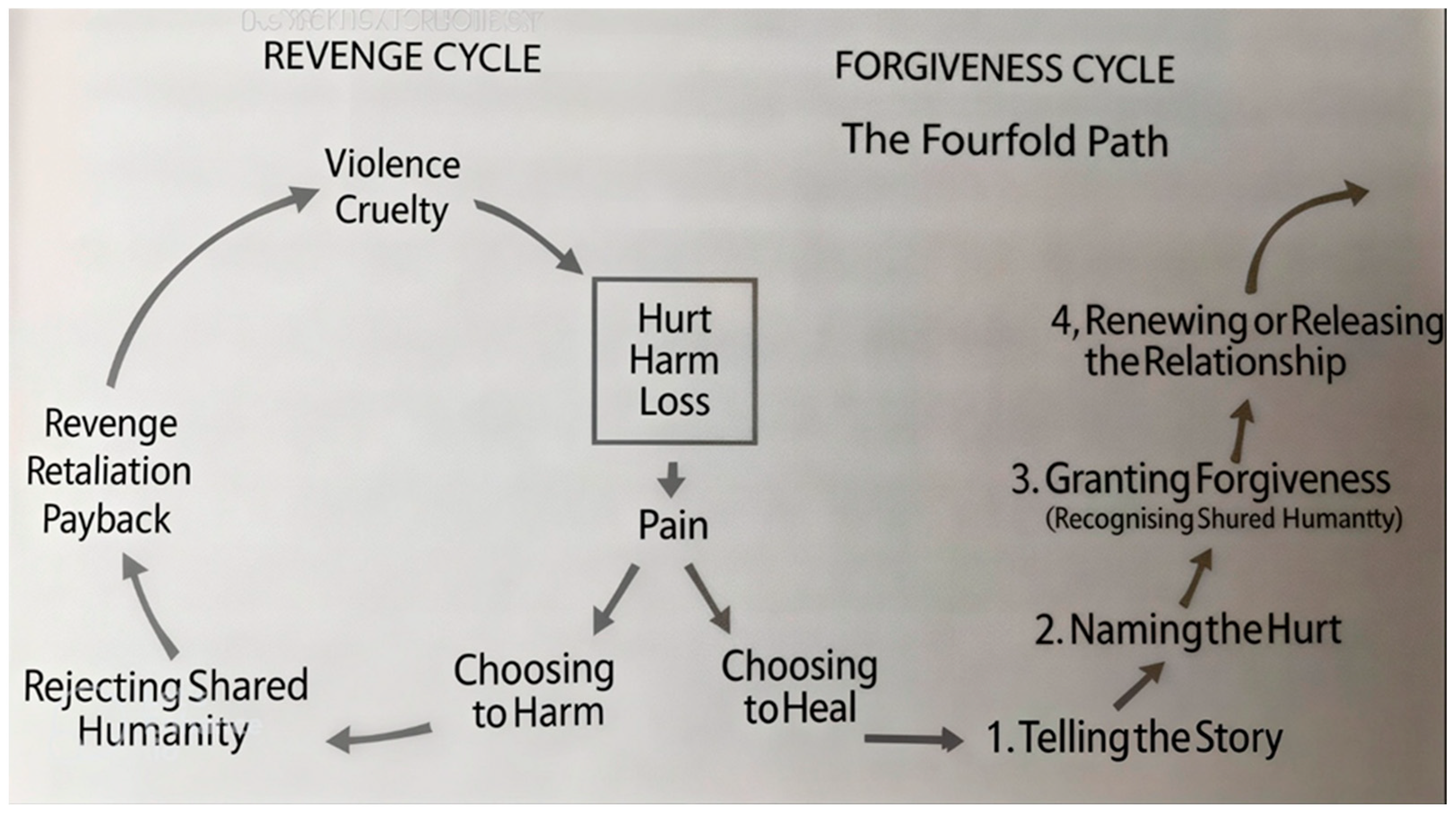
The Anglican Archbishop Desmond Tutu led for a long period the non-violent manifestations against the oppressive government of apartheid in South Africa. Apartheid was a system of institutionalised racial segregation that existed in South Africa, where the white minority was oppressing the non-white majority, especially the black people. When the new government was established, Tutu remained a religious leader who could recognise goodness wherever it came from and condemn evil regardless of its origin. After the tragedy of gross human rights violations, one has to choose between two options: either the revenge cycle or the forgiveness cycle. Vengeance leads to perpetual cruelty while forgiveness leads to relationship renewal and healing. Desmond Tutu respected every human being as the Imago Dei (D. Tutu 2015, p. 20) and cherished Ubuntu (humanness) (Tutu and Tutu 2010, p. 108) in African theology. However, time has to permit all conditions necessary for success.

3.1. When Time Permits

Tutu writes: “Everywhere else elections are secular political events. Ours was more than this, much, much more. It was a veritable spiritual experience, a mountain-top experience” (D. M. Tutu 1999, p. 219). The elections were held on 27 April 1994, and Nelson Mandela won and became the new president at seventy-six years old. The elections were declared to be free and fair. Nelson Mandela was to be inaugurated as president on 10 May 1994 (Holmes 2020, p. 45). When the apartheid government was removed, as a Church leader, Tutu made efforts to avoid partisanship, even if he had been working hand in hand with all other freedom fighters who took over the power. Tutu understood leadership as a responsibility rather than a privilege, and he confronted governmental structures and policies for the better. He used to say: “This is the difference between the critic and the prophet. The critic condemns from the outside, and the prophet confesses from within. The critic accuses, the prophet weeps” (D. M. Tutu 1987, p. 164). The transition from an oppressive government to a democracy was difficult and needed a reconciliation process.

The Truth and Reconciliation Commission in South Africa (TRC)

When the apartheid regime was deposed, there were societal and individual wounds to heal. The Truth and Reconciliation Commission (TRC) was established in South Africa as a means to address the wounds and divisions caused by decades of apartheid and violence. Archbishop Desmond Tutu was appointed as the chairperson of that commission. The TRC aimed to promote national unity and reconciliation by uncovering the truth about human rights abuses and providing a platform for victims and perpetrators to confront the past. When it was founded, two opposing viewpoints predominated in the public discourse that shaped the nation’s transition to democracy and racial equality: while those connected to the deposed regime demanded a general amnesty, many of its victims and the liberation movements anticipated harsh punishment for the horrible human rights violations. It was agreed to settle on the possibility of amnesty, but only in exchange for the truth.
A truth-intended commission gives the voiceless a space while giving offenders a chance to atone for their wrongdoing; creating an official public record of past crimes, at the same time creating a shared history and promoting reconciliation by raising socio-political consciousness among those who benefit from oppressive systems. Only a TRC can provide the forum for a non-adversarial meeting between victims and perpetrators, giving both parties a chance to make amends (D. M. Tutu 1999, p. 4). Both the victim and the offender must work together to reclaim their humanity. “We can’t violate another’s dignity without violating our own” (Tutu and Tutu 2010, p. 215). Tutu, quoting Bishop Malusi Mpumlwana after his torture, writes that “these are God’s children and they are losing their humanity. We have to help them recover it” (Tutu and Tutu 2010, p. 34).
TRC processes were guided by two perspectives of Judeo-Christian legacy and the idea of Ubuntu, which is an African sense of interconnectedness. In the context of African traditional religion, forgiveness and reconciliation are intertwined. In transitional justice, personal forgiveness comes with a communal character. It is neither private nor individual. The interconnectedness serves as a reminder of the inseparable relatedness of suffered tragedies. Tutu, with his purple clerical garbs, Christian traditions, and continual reference to Christian practices, seemed in no way hesitant to bring his Christian influence into the formalities of the hearings. In his own words, he declares that very few people objected to the heavy spiritual and indeed Christian emphasis of the commission. “When I was challenged on it by journalists, I told them I was a religious leader and had been chosen as who I was. I could not pretend I was someone else” (D. M. Tutu 1999, p. 72).
There is a possibility of offering forgiveness from the victim and pardon from the state without visible signs of remorse, confession of guilt, and acts of reparation. However, there can be no reconciliation without forgiveness from victims and remorse from perpetrators. This is the restoration of a broken relationship with God and a broken relationship between individuals and groups in society. Tutu held that through the commission, God was making known His divine plan to unite and reconcile a divided and shattered humanity. The alienation from God must be addressed to handle social issues. After all, God takes the initiative to provide a durable solution (Jones 1995, pp. 183–86).

3.2. Desmond Tutu’s Theological Perspective on Forgiveness and Reconciliation

Tutu’s theology against the apartheid system and his vision for a new South Africa are based on his concept of man created in the image of God (imago Dei), and the African theological understanding of Ubuntu, where man is always in relation with others. Forgiveness and reconciliation as terms serve as a guide in the search for the kingdom of God. For that reason, reconciliation in South Africa is not a destination. Rather, it aims at building a new community, a new people, and a new nation for the Kingdom of God.
The theology of forgiveness, according to Tutu, is first and foremost for those who need to forgive. Forgiveness is a gift people give to themselves. Those who need forgiveness must also forgive the harm that was done to them when they fell from grace. Forgiveness is simply about understanding that everyone is both inherently good and inherently fragile. For him, no one is born a criminal or cruel. He says: “I do believe there are monstrous and evil acts, but I do not believe those who commit such acts are monsters or evil” (Tutu and Tutu 2010, p. 55). When a person is demoted to the status of a monster, he is denied the ability to be accountable and change regarding his acts and behaviour. The issue is that the conditions people put on the gift of forgiveness make them slaves to the one who wronged them. They forget that these are chains for which only the offender holds the key. Forgiveness is the only way out of the prison that injury creates. No person will always stand in the camp of the perpetrator. No person will always be the one who is the victim. In some situations, a person has been harmed, and in others, he has harmed others. Not all harms are equivalent, but this is not the issue. No big offence is unworthy of forgiveness. Nevertheless, this does not imply that forgiving someone is a luxury. To forgive does not mean to ignore what has happened. Healing does not draw a veil over the hurt.
Honest accountability is necessary for healing and reconciliation. For Tutu, the following is needed for healing: “…truth may exacerbate the hurt; it might make things worse. But if we want real forgiveness and real healing, we must face the real injury” (Tutu and Tutu 2010, p. 24). Justice is a perspective to be taken into consideration. With the initiation of the process of reconciliation, the possibility of doing justice is opened. Even though reconciliation with God is an indispensable foundation in the process, “there must be a corresponding personal dimension, otherwise, the profound teaching remains in abstracto and detached from human experience” (Martin 1997, p. 98).
Tutu offers his understanding of how people get drawn into a cycle of revenge and rupture, and how they can better choose a cycle of forgiveness and healing, referred to as the Forgiveness Cycle. The following is his visual portrayal of the process (Tutu and Tutu 2010, p. 49; Figure 1):
There is no way to live with others without at some point being hurt. As fragile and vulnerable beings, individuals experience some hurt, harm, or loss. The wound can be physical, spiritual, emotional, or psychosocial. For Donna Hicks, “people can experience an injury to their dignity, an emotional wound that harms their sense of worth and value as a human being” (Hicks 2011, p. 30). And such hurt is what puts people in the above cycle.
The response to hurt is universal: each person experiences sadness, pain, anger, and shame. It is at this juncture that the moment of choice comes; what happens is that people step unexpectedly into the revenge cycle. To escape from revenge, they need to recognise their common humanity. When they cannot perceive the other as a wounded person who has hurt them out of his own ignorance and brokenness, it makes it hard for them also to acknowledge their own woundedness. Retaliation, in turn, leads to more hurt, more harm, and more loss, which keeps the revenge cycle going on without end. Here, it can now be realised how much some families, tribes, ethnic groups, and nations have been imprisoned in the revenge cycle for countless years. Even if the urge to seek revenge may be natural, one does not have to succumb to its seductive invitation.
Desmond Tutu provided four steps in the forgiveness cycle: “Tell your story for as long as you need to. Name your hurts until they no longer pierce your heart. Grant forgiveness when you are ready to let go of a past that cannot be changed. Reconcile or release the relationship as you choose” (Tutu and Tutu 2010, p. 38).
Accepting one’s responsibility and role in any conflict is a crucial aspect of rebuilding relationships. The acknowledgement of Rwandans’ part in a conflict makes it easier to mend boundaries. When a person causes harm to another, they both lose a portion of their humanity and divinity. The perpetrator needs to be courageous enough to stand in front of the one he has hurt and open his heart to make space for his pain. Since one contributes to creating that pain, he also has a part in healing it.
There is also a part of forgiving oneself, especially when you are both the victim and the perpetrator in the same story. Without self-forgiveness, one may easily be paralysed by guilt, shame, regret, or remorse. And he discovered that with such a human frailty, there can be no future without forgiveness (D. Tutu 2011, p. 35). Tutu’s promotion of forgiveness and reconciliation depended on how he esteemed man as the image of God.

3.3. Imago Dei as a Locus of Tutu’s Theology

Tutu’s theological conception of the image of God draws upon several significant theological sources. It is grounded in a profound faith where he believes that God is the creator and sustains the human community. The Imago Dei idea is one of the most important weapons that provides sufficient ground for the claims of apartheid to be evaluated and refuted based on biblical evidence (Egan 2022, p. 184). Tutu writes that “to treat a child of God as if he or she were less than this is not just wrong… it is veritably blasphemous…Each of us is a “God carrier”, as St. Paul put it. Human beings must not just be respected, but they must be held in awe and reverence” (Tutu and Abrams 2005, p. 63). Such is not found in a political manifesto; it is from the Bible.
No one is bad, and people should be defined by the totality of their worst actions. For instance, a particular person is not a killer; he is an individual whose actions killed another person. “Our nature is goodness. Yes, we do much that is bad, but our essential nature is good” (Tutu and Tutu 2010, p. 6). Unfortunately, at times, some people have often been defined by what they have done. They are created by God, who is goodness itself, and they are made for goodness. “This is not only a faith claim. It is a scientific fact. Science testifies that goodness is a survival strategy” (Tutu and Tutu 2010, p. 14).

3.4. Tutu’s Theological Concept of Ubuntu

Tutu’s Ubuntu theology provides an African Christian spirituality as an alternative to the typical Western spirituality obsessed with the self (Battle 1997, p. 99). “Each proper theology must take the scandal of its own particularity seriously. Therein lies its strengths and its limitations. It speaks out of and to a specific context” (D. Tutu 2011, p. 118). Africa needs African theologians who take into account the history, culture and ideologies of the oppressed masses of the continent. Koka says that “until the lions have their own historians, tales of hunting will always glorify the hunter” (Koka 2001, p. viii).
For Tutu, the definition of Ubuntu has two parts. The first is that the person is friendly, hospitable, generous, gentle, caring and compassionate. That is the person’s worth. The second part of the concept is about openness towards others, where a person shares his or her worth and humanity.
Ubuntu is about the essence of being human. It is part of the gift that Africans give to the world. Ubuntu embraces a willingness to go the extra mile for the sake of others. It involves the individual as much as being in a community and belonging within that social, religious, moral and political context. Human beings are deeply connected, whether they recognise it or not (Miller 2011, pp. 138–40). Thus, Ubuntu provides a logical basis for reconciliation in the aftermath of violent conflict (Tutu and Tutu 2010, p. 15, 47).
From his understanding of man as the image of God and his ubuntu theology, Tutu embraces a reconciliation system of several key points: truth-seeking, restoration of human dignity through justice, promotion of forgiveness, inclusive dialogue, leadership with honesty accompanied by integrity, non-violence and peace, recognition of the role of faith and spirituality, and reconciliation as a process.

4. Desmond Tutu’s Socio-Religious Contribution to the Rwandan Forgiveness and Reconciliation Process

4.1. Creating Space for Reconciliation and Adaptation of Narratives

When considering past hostilities, such as the Rwandan genocide, socio-religious forgiveness and reconciliation are crucial for fostering a peaceful and harmonious future. Forgiveness and reconciliation can restore trust, social cohesion, and a sense of justice within communities affected by violence and conflict. Embracing forgiveness and reconciliation can prevent future disputes. Such an endeavour is a spiritual urgency and a practical necessity for building a more inclusive and prosperous Rwanda. To restore a long historical mess like the one in Rwanda, it requires starting with the purification of memory.

4.1.1. Reconciliation Commissions and Purification of Memory

While both Rwanda and South African reconciliation approaches had their strengths and limitations, they reflected the specific historical, cultural, and political contexts of each nation. Rwanda has a long history of manipulation by different regimes. Taking on a reconciliation endeavour, therefore, requires memory purification. This takes place in several steps of the Rwandan reconciliation process. It is about remembering transgressions as forgiven, frailties as acknowledged, and mistakes as comprehended. In the process, reality is given a new meaning through understanding, forgiveness, and acceptance, while yet being able to change, reinterpret, heal, and rehabilitate it (Mong 2015, p. 78). Rwanda needs to re-examine the authenticity of the practices and beliefs instituted by colonialists and missionaries. They can be retained if they follow the Gospel or ubuntu (humanness). But if they do not favour staying together for Rwandans, they can be reformed.
Unity-Based Narratives
In the book Rainbow People of God by Desmond Tutu, the main concern is an inclusive, non-racial South African community. God intended for the entire creation to be united from the beginning. God originally intended for humans to take care of the rest of his creation. This is the greatest honour granted to every human being, regardless of gender, race, nationality, or colour. Human beings possess this aspect of harmony, unity, fellowship and friendliness because they are God’s creation (D. Tutu 1994, p. 60). Tutu does admit, though, that the entering of sin into God’s creation caused things to go wrong. The original unity was broken. There is discord where togetherness is expected. The consequence of sin is separation and alienation. And that calls for a restoration of unity.
Africa had a momentous year in 1994. South Africa smoothly shifted to democracy. That was a long period of human rights violations of apartheid. On the sadder side, though, Rwanda was the scene of a horrific genocide. Both nations started national reconciliation initiatives that attracted international notice. The Truth and Reconciliation Commission (TRC) was established in South Africa, while the National Unity and Reconciliation Commission (NURC) and Gacaca Community Courts were established in Rwanda. These Commissions were semi-judiciary bodies that investigated, revealed and responded to a pattern of past human wrongdoings in both countries (Pathak 2017, p. 193). These commissions carried with them a communitarian and official climate.
As Desmond Tutu calls for the restoration of victims’ and perpetrators’ dignity, citizens expect a truth-intended commission that will provide a voice to the voiceless and an opportunity for wrongdoers to make amends. Then, forgiveness can follow confession, and healing can happen. That proceeding can contribute to national unity. TRC and NURC stressed how victims must be told the truth about previous brutality for reconciliation to occur (Hay 1998, p. 133). There was also the exhuming of the remains of those killed in both countries to honour them with a humane burial (Truth and Reconciliation Commission of South Africa Report 1998). For Walter Wink, “truth is medicine. Without it, a society remains infected with past evils that will inevitably break out in the future” (Wink 1998, p. 53). According to Desmond Tutu, ubuntu theology carries various human virtues, including unity. Rwanda is not starting from zero. In history, some Rwandans have died refusing to group themselves on the grounds of ethnicity. The examples of Nyange Students and Sister Félicité Niyitegeka are well recorded (Katongole 2005, p. 112).
In Rwanda, policies and initiatives were put in place for a functional legal system that upholds the rule of law. That helped to resolve the grievances at a certain level. Along with post-war reconstruction, peacebuilding was made a key component of diplomatic efforts to avoid violence (Leader 2020, p. 329). The National Unity Sensitisation Programme has begun bearing fruit. For instance, secondary schools and universities have established unity and reconciliation clubs. People have been volunteering to oversee efforts of unity and reconciliation. Such volunteers are currently in every province. Political party leaders pledged to support efforts towards unity and healing in a manifesto they published. Former infiltrators have started setting up peace-building clubs after going through solidarity camps, where they humbly admit their past transgressions and promise to promote harmony and reconciliation. The country has known many divisions in history, and it is in its citizens’ power to choose healing. There is a need to build bridges, not walls (Republic of Rwanda National Unity and Reconciliation Commission 2002, Report of the National Summit on Unity and Reconciliation, pp. 25–26). The success will depend on how the past divisive formation is corrected. Both NURC and TRC promoted national and individual harmony in a sense.
Tutu has been against the large amount of money spent by countries on arms while many of the citizens languish in poverty. Poverty and ignorance are negative forces against unity and reconciliation. In Rwanda, favours based on the social hierarchy are to be abolished. And from the aspect of favouritism, both parties (Hutu and Tutsi) have offended and have been victims in different ways. However, it is important to distinguish the depth of the offences committed. For example, war crimes are different in intensity from those of genocidal cleansing. If this is not acknowledged, the people who are now perceived as the offenders will start to regard themselves as the victims. There is a need for an offending party to express remorse as a moral and spiritual virtue that helps victims feel better through both literal and symbolic meanings (Bassett and Pearson 2011, p. 51).
Those who stand in opposition to the Rwandan government have criticised NURC and Gacaca courts. Susan Thomson puts it across that the policy of national unity and reconciliation was silent on other forms of violence perpetrated against ordinary Rwandans of all ethnicities throughout the 1990s by competing parties seeking to seize or maintain state power (Thomson 2013, p. 106). However, the government has responded that on the side of the RPA, the offending soldiers were arrested, tried, and punished. Evidence suggests that many were taken to military tribunals (Kinzer 2008, p. 190). Some of the RPA soldiers were tried with the death penalty before it was abolished in Rwanda because of revenge (Documentary 2024). Such an answer may be true, but the way it is given, if it is not born from a dialogue of equals, may not facilitate a deeper reconciliation. It reveals a contrast from the South African process that confronted even the former wife of Nelson Mandela to answer for her violent acts. The fact that reconciliation is a long-term process with many more dimensions than truth finding means that no truth commissions can do more than take the initial steps (Gready 2011, p. 111).
There is a contrast between the post-genocide in Rwanda and the post-apartheid in South Africa. Among the white inhabitants with respect to apartheid, there were few culprits but many beneficiaries. When it comes to genocide in Rwanda, among the Hutu, there were fewer beneficiaries and many perpetrators (Mamdani 2001, p. 266). There cannot be a durable reconciliation in the absence of social justice when there are numerous beneficiaries, as in South Africa. Therefore, reconciliation must be more social to be sustainable. The issue of justice is of crucial importance in determining the future of a society. In situations where there are few beneficiaries, like in Rwanda, more political reconciliation is essential to healing (Mamdani 2001, p. 273). That is why Rwanda started by discouraging politically constructed identities as part of the purification of memory.
Accommodative Identity
Tutu’s theology opposing the apartheid regime and his vision for an inclusive South African community are key to anyone willing to do theology in Rwanda. For him, a relationship is supposed to consider three aspects: ecclesiology, which stands for God’s earthly kingdom, interdependence (referred to as the African Spirit of Ubuntu), and the man as Imago Dei. Tutu aspired to a universal vision of inclusive humanity that goes above the divisions of race, class, ethnicity, tribe, nationality, religion, and other forms of sectarianism.
Tutu shows that despite systematic barriers preventing white South Africans from acknowledging their shared humanity with black South Africans, there are more things in common between them than differences. In Rwanda, the commission created programmes that could resolve at least to a certain degree, the problem of politically constructed identities. Rwanda invested in civic education, conflict and violence prevention, dialogue and encouraging public action (Haskell 2011, pp. 94–95). The motto of ndi Umunyarwanda (I am Rwandan) serves to transcend the legacy of ethnic hate and violence since the Rwandans feel that ethnic discord was the cause of the genocide. According to Des Forges, “Rwandans take history seriously. Hutu who killed Tutsi did so for many reasons, but beneath the individual motivations lay a common fear rooted in firmly held but mistaken ideas of the Rwandan past” (Des Forges 1999, p. 25). There is a need to understand how the colonial era constructed Rwandan conflicting identities and how Rwanda has to deconstruct them due to their discriminatory character. Then again, to construct a uniting common Rwandan identity. In some cases, including Rwanda, public leaders may seek to intensify ethnic polarisation as a means of unifying potential supporters. These ethnic entrepreneurs seek to raise the salience of one central social identity at the expense of other identities that have tended to create social bonds (Longman 2011 p. 313).
However, some Rwandans and researchers have taken this campaign negatively. For example, Thomson says that “the RPF invokes its vision of “Rwandan-ness,” that is, the promise of a unified national identity, as a strategic tool with which to silence its critics and opponents” (Thomson 2013, p. 114). It is as if Rwanda is trying to change the identity of Rwandans. The claim is not appropriate based on this research, and there is no reason to fight a positive change. Because even the Christian life and conversion are about transformation and changing of former identity to a new one in Christ. Therefore, passing from native human frailty to new life in the risen Christ (1 Corinthians 15:21–23).
This work suggests to the government leaders, authors and different organisations to avoid language-denoting groups like Twa, Hutu or Tutsi in a situation that can provoke conflict. After the genocide against the Tutsi, Rwanda is trying to rebuild its institutions based on competence, not ethnic groups. But you hear or read statements like a predominant Tutsi government. Rwandans seem to care about the Rwandan government, not the Hutu or Tutsi government. Such an attitude distorts the process of reconciliation. For Tutu, to work for reconciliation is to realise God’s dream for humanity. To imitate the communion that exists among the three persons of the Trinity. Rwanda needs to rediscover that all human beings are connected through interdependence as members of a single family. He quoted Martin Luther King Junior saying that if people do not learn to live as brothers, they will die together as fools (D. Tutu 2011, p. 51).
Tutu was aware of the cruel acts that rule the world and people’s lives. But by being made good and bearing the imprint of God, the heart hungers for goodness and the will of God. Human beings can act righteously and work alongside God. Their diversity should not prevent them from working together for peace and prosperity (Brittain and Maphumulo 2022, pp. 305–6). The creative activity of God is completed in the world through variety. Social change happens when people realise how important it is to stand in solidarity with those who are different from them. Therefore, it is through diversity and otherness that they learn more about both who God is and who they are as individuals (Tutu and Abrams 2005, p. 13–18). If Rwanda understands it this way, NURC can make a big contribution as a bridge between the brutal past and an inclusive and uniting future.
Desmond Tutu demonstrates how the world’s hostility to good challenges the fraternal aspect in South Africa and abroad. Some people have embraced extremism that they render the world wicked (D. M. Tutu 1999, p. 266). Even if the genocide against the Tutsi was stopped by the RPF in 1994, some extremists went into exile in different countries near and far. Some of them have never converted, and they exhibit that, given another opportunity, they can still commit the same genocidal crimes. As this academic work is going on, the war in Congo Kinshasa is going on, and a negative mobilisation is going on against particular social groups. And it is connected to this problem. In the spirit of Desmond Tutu, whatever the issue may be, war can never bring a sustainable solution. The root causes of the poor relationship between DRC and Rwanda-speaking people are partly due to the legacy of the 1885 Berlin Conference, which was recognised by the OAU (Organisation of African Unity) under the principle of inviolability of colonial borders. Colonial borders put some Kinyarwanda-speaking people with their land in Congo. Congolese, at times, fail to recognise them as Congolese and call them Rwandans. In several incidents, the Congo government has tried to uproot them from their ancestral land. They have ended up in refugee camps in the region and beyond for decades (Karenzi 2025, pp. 306–24).
When genocidaires ran away from Rwanda to Congo, they continued to train as an army and killed Tutsi belonging to the Kinyarwanda-speaking community in Congo. In the case of the relations between the DRC and Rwanda, it is critical to find a lasting solution to the security crisis in Rwanda and Eastern DRC, without uprooting the FDLR (Forces démocratiques de libération du Rwanda) militias. They left Rwanda after killing people; they should be sent back to Rwanda to account for their crimes through justice. Unfortunately, the Congolese government has been supporting them. It uses them for its own interest (United Nations, Economic Commission for Africa 2015, p. 14). Some of those incidents leave memories behind, but Rwandans can render their memories redemptive to avoid becoming prisoners of the past.
Keeping the Past Alive Without Becoming Its Prisoner
Desmond Tutu recommends keeping memories that would not alienate some but would have the capacity to contribute to the process of healing and reconciliation (D. M. Tutu 1999, p. 60). At times, people feel like flipping the page and declaring that these things happened a long time ago and that they should focus on the future. For Tutu, that cannot work! Without remembering the past, they cannot be sure of where to go. Without an honest, clear memory, they cannot advance. In the same line with Tutu, Shawn Copeland holds that “Theology must protect the memory of the genocide: vigilantly guard the memory of the dead, keep alive the memory of their suffering and anguish for the future…” (Copeland 2023, p. 121). For humanity’s conscience to rise against all desires for dominance and destruction, there is a need to continue kindling the flame of collective conscience. It testifies to the horror of what happened and preserves the memory of the victims for future generations (Francis 2020, N° 249). This research holds that those who were fierce enemies need to cultivate a constructive and penitential memory. Then, they can accept the past so as not to cloud the future with regrets and problems (Francis 2020, N° 226).
In South Africa and Rwanda, some of those who participated in human rights violations did not appreciate the erection of memorial sites. This applies to Rwanda’s annual commemoration of the genocide against the Tutsi. The reason appears to be that it comes with the request for justice and accountability. Some perpetrators are not ready to face justice. Paul Ricoeur prefers to approach the issue with an appeased memory. That is the memory that no longer speaks with the anger of the evil that has been done (Ricoeur 2005, p. 17). However, one has to be careful that the appeased memory is not understood as if the harm is not taken seriously. As Hannah Arendt says, there is no way one can describe the concentration camps sine ira (without outrage), but for the sake of a common future (victims and perpetrators), that indignation has to be managed well, otherwise it can cause more harm. Remembering genocide is never a mere factual re-presentation of the pastness of the past (Arendt 1994, p. 404).
Tutu has held that victims have every right to feel anger at first as a natural and legitimate human reaction regarding the atrocities they endured. But people who harbour resentment against the offender ultimately become targets of their own revenge. Their life is made less meaningful by the past, which has tormented and enslaved them (D. M. Tutu 1999, p. 156). This work calls on Rwandans to think about the tremendous impact that can be achieved by simply assisting each community in facing its painful past. This requires that all those Rwandans who suffered victimhood of any kind embrace the character of the wounded healer (Isaiah 53:3–5) as opposed to the wounded wounder. As the New Testament demonstrates, the wounded healer is Jesus Christ (2 Cor. 5: 21 and Gal. 3:13). For Tutu, appealing for reconciliation after conflict and violence involves an inclusive dialogue.

4.1.2. All-Embracing Dialogue in Reconciliation Process

Desmond Tutu cherished dialogue when fighting against apartheid and in the process of reconciliation. Rwanda needs the conviction that a dialogue is a better way to go. Taking a risk to walk a mile in the shoes of those with whom one does not agree, listening to their hopes and fears. It is an act of kindness. For Pope Francis, “…Kindness facilitates the quest for consensus; it opens new paths where hostility and conflict would burn all bridges” (Francis 2020, N° 224).
Desmond Tutu maintains that an honest dialogue removes obstacles to forgiveness and reconciliation. In Rwanda, due to the long, divisive history, there are still problems such as genocide ideology and ethnic stereotypes. This can be reduced by continual encounters among citizens to talk over their differences and contribute to the future. Some steps have been made, like the inclusive and participatory administration known as the National Dialogue Council (Umushyikirano). It consolidates unity and reconciliation through history, testimonies, forgiveness and healing through dialogue. The Church can take a facilitating position in this process.

4.2. The Church in the Process of Reconciliation

As the Church offers her contribution to the Rwandan process of forgiveness and reconciliation, she needs to re-examine her theology of redemptive suffering. Rwandans have experienced suffering, and one of the responsibilities of the Church is to explain that suffering is real in human and Christian life. Desmond Tutu put the Church on guard regarding its role in the suffering of the people of God. Far too often, religion has perversely done the opposite of what it should represent, namely, promote sisterhood and brotherhood, which in turn should create tolerance, respect, compassion, peace, reconciliation, care, and sharing. In history, religion has fostered injustice, oppression, intolerance, and alienation while also fuelling violence (D. Tutu 2011, p. 51). However, one can do something to alleviate the inevitable suffering of human beings. And hope consoles even when life is hard.

4.2.1. The Theology of Suffering and Binding in Faithful Love

For Tutu, if Christians are the servants of God the Father of Jesus Christ, then they cannot be surprised that servanthood goes with a certain level of suffering (D. M. Tutu 1984, p. 68). At times, terrible things happen, and one tends to question whether God is still in control. People start to question His intervention in human life. Does He, at times, feel happy seeing His creatures suffer? Why should one pray if prayers are not answered? Is it that God is not answering prayers, or He is not doing what the one in prayer wants? A person may find himself in a situation of accusing God and even needing to forgive Him (Terkeurst 2020, p. 122). Catholic theology makes it a point that suffering is an inevitable human reality. Evil deeds committed by people against one another constitute moral evil, but there is also natural evil due to calamities like floods.
Suffering in the theology of Desmond Tutu goes in line with the Catholic position that to partake in the cross of Christ is to share in God’s plan for the world’s salvation. This is not to suggest that one should look for ways of suffering. Though suffering is part of an encounter with Christ and an experience of God, woe to a person who causes grief to the destitute (Vellguth 2014, pp. 27–42). The religion should motivate its members to take measures to improve the lives of people who are hungry, naked, ill, and imprisoned. The evangelist Matthew writes: “When I was hungry, you fed me. When I was naked, you clothed me. When I was thirsty, you gave me something to drink. When I was in prison, you visited me… Inasmuch as you have done it to the least of these, my sisters and my brothers, you have done it to me” (Mt 25:35–36,40). Rwandan Christians can get concerned with living in a way that liberates, heals, restores, and celebrates the dignity of the other.
All persons deserve love, but loving an oppressor does not imply that one should accept or tolerate his mistreatment of anyone. Conversely, genuine love for an oppressor is finding methods to stop his tyranny. It entails robbing him of a power that he is unable to use positively and that degrades both his and others’ humanity. Victims of injustice must fight tenaciously for their rights and the rights of their families to uphold the dignity that is a loving gift from God (Francis 2020, N° 241). Christ did not choose the path of his suffering and death. He accepted to make a sacrifice for obedience to the Father.
Believing That God Is Good When Life Is Not
For Desmond Tutu, Christian hope can be a witness of the Church amid troubles. Nowadays, some individuals feel that they are no longer sure of anything. It denotes this world and this chaotic life. The world is turning upside down. Even in the Church, the teachings of sobriety, openness, listening and dialogue are opposed by those with wealth, power, closed-mindedness and worldliness. Rwandans passed through such social and religious crises in terms of war and genocide. But is this how life is destined to be? No, Christian faith and spirituality always offer a second chance for change. Desmond Tutu would say that hope is essential for change to occur (D. Tutu 1982, p. 36). Desmond Tutu’s concept of hope flows from the firm fact that, through the power and grace of God, changes in society and life are possible and worth sacrificing for. Meaning that hope reminds people of the responsibility to do better.
For Desmond Tutu, speaking about hope for a new political dispensation or social change does not mean that people are placing trust in these changes. Rather, they trust in God because they have come to know of God’s plan to unite and reconcile a divided and shattered humanity. Rwandans believe in the transformation of their society. And it points to the fact that if they are aspiring for hope, the first step is to look for it in the right place and in the right way. Therefore, they need to be rooted in God Himself. For Thomas Merton, people do not hope for what they have. Hence, to live in hope is to live in poverty, having nothing. And yet, if they abandon themselves to the economy of Divine providence, they have everything they hope for (Merton 2003, p. 15). This is a hope based on God’s promises and derived from Christ’s deeds (Benedict XVI 2007, N° 3, 27, 28).
According to Tutu, God cherishes liberty, equity, equality, and community. God provided man with a sense of belonging to a particular nation, and no human being is supposed to be forced into exile. “We can’t create a world without pain or loss or conflict or hurt feelings, but we can create a world of forgiveness…that allows us to heal from those losses and pain and repair our relationships” (Tutu and Tutu 2015, p. 222). God works to mend broken relationships as well as to lessen human suffering. Jesus refers to it when he exhorts those who are pharisaic in their call for external religious observances to discover what the text “I desire mercy and not sacrifice” means (Matthew 12:7).
The idea of a compassionate and just God standing with the oppressed can accompany the country in shaping the resilience and determination of Rwandans as they strive to overcome the legacies of the aftermath of historical traumas such as the 1994 genocide. This notion is concrete in Rwanda by the fact that when the Tutsi as a social group were targeted to be exterminated, God kept his promise of being the preserver of his people. No matter how the Tutsi died, there is also the privilege to talk about survivors of the genocide. Suffering and hope are intertwined in the theology of Desmond Tutu. Rwandans can move to another level of a deep and reconciled relationship.

4.2.2. Self-Transcendence in Healing Rwanda’s Wounds

A person who sails on a reconciliation journey avoids self-centeredness. Rwasna will have to work towards shared responsibility. The idea of an ecumenical spirit has to be lived if the Church in Rwanda wants to bear fruit. The Church of Christ cannot preach unity when she is divided.
Some of the problems of socio-religious relationships in Rwanda have their causes in the self-centeredness of some individuals and groups. Those involved in self-centeredness lack the value and consideration of others, as suggested in the spirituality of ubuntu. Ubuntu Theology brings out the idea of a relationship to the “other” with respect and love. That type of Theology would help Rwandans to understand what is still missing in the process of reconciliation. It would help them to realise that Rwanda is living in an “armed peace”, with ethnic groups pacified but still fractured to a certain extent and haunted by the consequences of genocide. With this understanding, Desmond Tutu has insisted on the community as a treasure for Christian and African traditions. It is the time to embrace the point that “being Christian is not the result of an ethical choice or a lofty idea, but the encounter with an event, a person, which gives life a new horizon and a decisive direction” (Benedict XVI 2005, N° 1).
The Rwandan Church also needs to include forgiveness and reconciliation in her preaching. It is necessary to pay more attention to the information that helps to reconcile than to the information that slows it down. For example, not to dwell only on the wrong committed but also to value the good done. In the family, parents and elders may guide the young ones to introduce themselves as Rwandans rather than their small social groups. In this way, the family will have accomplished its mission within the Church. It is time to realise that the program of “I am Rwandan” is not destroyed only by genocidal ideology, but also all bad elements like bad governance, exaggeration of self-interest, laziness, drunkenness, drugs, poverty, forming any grouping based on segregation, lack of accountability, impunity, corruption and the like. Rwanda has to identify the elements mentioned above among the enemies of unity and reconciliation. As Rwandans combat such various vices, based on the Theology of Desmond Mpilo Tutu, Rwanda needs to embrace the idea that no future without forgiveness (D. Tutu 2011, p. 35).1
Christ came to reconcile people to the Father. And that shows how much forgiveness and reconciliation are ingrained in the word and mission of God. In Rwanda, the idea of NURC and Gacaca was the pursuit of truth, justice, forgiveness and reconciliation. This NURC has done a lot to prepare for a deeper healing. This article does not propose to replace Rwanda’s ways of forgiveness and reconciliation with those suggested by Tutu. But most of the elements found in Desmond Tutu’s journey in South Africa can help Rwanda improve and take more steps forward. Rwandans need to listen to Jesus asking a question to them: “Do you want to be well (Jn 5:6)”? Though it is Jesus who heals, people also participate in their healing. They have an opportunity, but they also carry a responsibility. When one sees Man as imago Dei, it becomes easier to live with him or her. If people can assume a willingness to regard themselves and each other as eternal spiritual beings and not just as bodies, it starts to be easier to see the value of forgiveness (Tutu and Tutu 2015, p. 49). Working for peace, forgiveness and reconciliation saves from falling into revenge, and it requires opting for Tutu’s forgiveness cycle. But what could be a criticism of Desmond Tutu?

4.3. A Critic of Tutu

There can be an imbalance when one focuses on reconciliation without repentance. The TRC made the Kairos document’s emphasis on repentance seem light in favour of a view of forgiveness as unconditional and a source of individual healing. As it stands today, one of the ways of resisting reconciliation in Rwanda has been the perpetrators who are not repentant. Though it was often said that Tutu and his TRC commissioners advised applicants for amnesty to say the truth, they were not required to apologise or show remorse as part of the amnesty process. And Tutu, since he published his book No Future Without Forgiveness, based on the Rwandan experience, one could say that there was also a need for another corresponding volume like No Future Without Repentance or No Reconciliation without Repentance. The forgiveness ideal presented to victims in South Africa is both unconditional and a national imperative. As it stands in no future without forgiveness, the entire burden of the future is put on the shoulders of the victims.
It is essential to acknowledge the pain and suffering endured by victims and not rush the process of forgiveness, as it somehow happened during the TRC, because that may destabilise their healing journey. However, these critics do not refute the significant contributions Desmond Tutu has made to the field of forgiveness and reconciliation.

5. Conclusions

This work started reporting that socio-religious forgiveness and reconciliation are essential to promote a peaceful and credible future. This is noticed especially in the context of historical conflicts, such as the war and genocide in Rwanda. Christian theology does well when addressing real-world problems of human suffering and community. This discourse has made a compelling case that a potential spiritual approach for Rwanda can be found in Desmond Tutu’s theology of forgiveness and reconciliation. It can contribute to resolving long-standing conflicts and grievances across Rwandan social groups (Hutu and Tutsi). Tutu’s emphasis on restorative justice, moral accountability, and communal healing provides an important interpretive lens for understanding reconciliation processes within post-conflict societies, highlighting the transformative role of spirituality in promoting healing, social restoration, and sustainable peace.
Since the tragedy of war and genocide in Rwanda came as a result of the long history of spreading hatred among the social groups, there is a need to create space for reconciliation and conversion of narratives. Anyone can write Rwandan history, but the main requirement should be to focus on uniting Rwandans, not to divide them. Rwanda had to critique colonial narratives to decolonise its history. Rwandans had to reclaim virtues that previously held them together. As a result, South Africa and Rwanda cannot afford to abandon the efforts made by the two engaging commissions (NURC and TRC). Ubuntu theology and Gacaca traditional courts are good for implementing any community-based initiatives. Keeping memories of the tragedy facilitates the healing process, but one has to be careful not to become a prisoner of the past. The country has undergone a remarkable transformation, emerging as a beacon of hope and resilience. The government has implemented policies focused on unity and reconciliation, economic growth, poverty reduction, and social development, leading to improvements in healthcare, education, and infrastructure. The Church’s character as custodian of forgiveness and reconciliation has contributed to the process. She has shown Rwandans that forgiveness is one way of evangelising the oppressor. Repentance is required before reconciliation, and cheap reconciliation needs to be avoided. However, the reconciliation process in Rwanda still presents several challenges.
Genocide ideology being one of the causes for resistance, perpetrators need to be helped to understand that accepting accountability for their crimes benefits both victims and offenders. Both parties need to remember that there is no future without forgiveness (D. Tutu 2011, p. 35). As it has been put forth, government and private institutions need to intensify the uncovering of the truth, the upholding of human dignity via justice, willingness to forgive, embracive dialogue, leadership that combines integrity and honesty, non-violence and peace, and prominence of spirituality and faith. There is a need to be aware that reconciliation is a continuous endeavour. Rwandans from all social groups are requested to take heed to the ubuntu theology of Desmond Tutu, which holds that man is the image of God. It makes the person be respected in all ways possible. If clear laws against genocide and discrimination are established, it will facilitate the forgiveness and reconciliation process. The culture of impunity will be eliminated. If initiatives about unity and constant dialogue are made a culture, it will eradicate segregating language among Rwandans.
To heal Rwandan woundedness requires self-transcending to overcome self-centeredness. It may at times include undergoing some suffering. But as already discussed, God is always on the side of the needy. Christ is the main instrument through which God reconciles the world. Humans are God’s ostensible instruments of change in the world because they were made in his likeness. Therefore, God has decided to continue His work of reconciliation in Christ through the human race.

Funding

This research received no external funding.

Institutional Review Board Statement

Not applicable.

Informed Consent Statement

Not applicable.

Data Availability Statement

No new data were created or analysed in this study. Data sharing is not applicable to this article.

Conflicts of Interest

The author declares no conflict of interest.

Abbreviations

The following abbreviations are used in this manuscript:
CECRConférence des Evêques Catholiques du Rwanda
FARles Forces Armées Rwandaise
FDLRForces démocratiques de libération du Rwanda
FFFonti Francescane
JPICJustice, Peace and Integrity of Creation
NURCNational Unity and Reconciliation Commission
OAUOrganisation of African Unity
OFMOrder of Friars Minor
RPARwanda Patriotic Army
RPFRwanda Patriotic Front
TRCTruth and Reconciliation Commission

Note

1
Based on the Theology of Desmond Mpilo Tutu, Rwanda needs to embrace the idea that No future without forgiveness (D. Tutu 2011, p. 35), and it can also be added that there is also no reconciliation without repentance.

References

  1. Arendt, Hannah. 1994. A Reply to Eric Voegelin. In Essays in Understanding: 1930–1954. New York: Harcourt Brace. [Google Scholar]
  2. Ball, Nicole. 1996. The Challenge of Rebuilding War-Torn Societies. Washington, DC: Overseas Development Council. [Google Scholar]
  3. Bassett, Rodney L., and Elizabeth Pearson. 2011. Feeling Bad: The Different Colours of Remorse. Journal of Psychology and Christianity 30: 51–69. [Google Scholar]
  4. Battle, Michael. 1997. Reconciliation: The Ubuntu Theology of Desmond Tutu. Cleveland: The Pilgrim Press. [Google Scholar]
  5. Benedict XVI. 2005. Encyclical Letter. In Deus Caritas Est. Roma: Libreria Editrice Vaticana. [Google Scholar]
  6. Benedict XVI. 2007. Encyclical Letter. In Spe Salvi. Roma: Libreria Editrice Vaticana. [Google Scholar]
  7. Bies, Robert, and Thomas Tripp. 1998. Revenge in organizations: The good, the bad, and the ugly. In Dysfunctional Behavior in Organizations: Violent and Deviant Behavior. Edited by Anne O’Leary-Kelly, Ricky Griffin and Judith Collins. Amsterdam: Elsevier, vol. 23, pp. 49–67. [Google Scholar]
  8. Bikorimana, Gerard, Dieudonne Uwizeye, and Celestin Ndikumana. 2022. Empirical Analysis of Poverty Eradication and its Determinants in Rwanda: Lessons from China. African Journal of Social Issues 5: 44–64. [Google Scholar] [CrossRef]
  9. Bizumuremyi, C. 1994. L’église et les Relations Interethniques au Rwanda de 1900 à 1960. Paris: Institut des Etudes Economiques et Sociales de l’Institut Catholique de Paris. [Google Scholar]
  10. Brittain, C. Christopher, and Nkanyiso Maphumulo. 2022. Desmond Tutu and the Promise and Perils of the Prophetic Role of the Church. The Anglican Theological Review 104: 304–20. [Google Scholar] [CrossRef]
  11. Burgoyne, Bob, and Matthew Maguire. 2004. Rwanda’s Demobilization: Creating the Environment for Investment. Shanghai: The International Bank for Reconstruction and Development. [Google Scholar]
  12. Carney, James Jay. 2014. Rwanda Before the Genocide: Catholic Politics and Ethnic Discourse in the Late Colonial Era. Oxford: Oxford University Press. [Google Scholar]
  13. Carney, James Jay. 2023. Healing a wounded Society: Challenges, Reconciliation, and Hope in Rwanda. Paper presented at Online Conference Organised by The Catholic University of America with Hekima University College, Nairobi, Kenya, April 14–15. [Google Scholar]
  14. CECR. 1991. Message des Évêques Catholiques du Rwanda aux prêtres, religieux et religieuses, 21 Novembre 1991: Au service de l’Eglise dans une société de multipartisme. In CECR, Recueil des Lettres et Messages. Hanoi: CECR. [Google Scholar]
  15. Clark, Janine Natalya. 2010. National unity and reconciliation in Rwanda: A flawed approach? Journal of Contemporary African Studies 28: 137–54. [Google Scholar] [CrossRef]
  16. Copeland, M. Shawn. 2023. Responsibilities of Theology in Post-Genocide Rwanda. In Reinventing Theology in Post-Genocide Rwanda: Challenges and Hopes. Edited by Marcel Uwineza, Elisée Rutagambwa and Michel Segatagara Kamanzi. Washington, DC: Georgetown University Press. [Google Scholar]
  17. Des Forges, A. Liebhafsky. 1999. Leave None to Tell the Story: Genocide in Rwanda. New York: Human Rights Watch. [Google Scholar]
  18. Documentary. 2024. Umunsi Zikatirwa Urwo Gupfa Kubera Kwihorera. Available online: https://www.youtube.com/watch?v=9yWVHjNUEtc (accessed on 4 February 2026).
  19. Dowden, Richard. 2009. Africa: Altered States, Ordinary Miracles. London: Portobello Books. [Google Scholar]
  20. Egan, Antony. 2022. Desmond Tutu (1931–2021): Spiritualità, Rivoluzione e Riconciliazione. La Civiltà Cattolica II 2022 4124: 177–89. [Google Scholar]
  21. Faulkner, William. 1919. Requiem for a Nun. London: Chatto & Windus. [Google Scholar]
  22. Francis. 2020. Encyclical Letter. In Fratelli Tutti. Roma: Libreria Editrice Vaticana. [Google Scholar]
  23. Ganza, Jean Baptiste. 2013. The Principle of Integral Reconciliation: Beyond Political Arrangements in Rwanda. Saarbruecken: Lambert Academic Publishing. [Google Scholar]
  24. Goodall, Jane, and Douglas Abrams. 2021. The Book of Hope. New York: Macmillan Publishers. [Google Scholar]
  25. Gready, Paul. 2011. The Era of Transitional Justice: The Aftermath of the Truth and Reconciliation Commission in South Africa and Beyond. New York: Routledge. [Google Scholar]
  26. Haskell, Leslie. 2011. Justice Compromised: Legacy of Rwanda’s Community-based Gacaca Courts. Holocaust and Genocide Studies Publications 1: 1–153. [Google Scholar]
  27. Hay, Mark. 1998. Ukubuyisana: Reconciliation in South Africa. Pietermaritzburg: Cluster Publications. [Google Scholar]
  28. Hicks, Donna. 2011. Dignity: The Essential Role it Plays in Resolving Conflict. Pennsylvania: Yale University Press. [Google Scholar]
  29. Holmes, Carolyn. 2020. The Black and White Rainbow: Reconciliation, Opposition, and Nation-Building in Democratic South Africa. Ann Arbor: University of Michigan Press. [Google Scholar]
  30. Inazu, D. John. 2009. No Future Without (Personal) Forgiveness: Re-Examining the Role of Forgiveness in Transitional Justice, 10 HUM. RTS. REV. 309. Available online: http://scholarship.law.duke.edu/cgi/viewcontent.cgi?article=2740&context=faculty_scholarship (accessed on 30 January 2026).
  31. Jones, L. Gregory. 1995. Embodying Forgiveness: A Theological Analysis. Michigan: Eerdmans. [Google Scholar]
  32. Kagame, Paul. 2017. Press Communiqué: Audience with the President of the Republic of Rwanda 20.03.2017. Available online: https://press.vatican.va/content/salastampa/en/bollettino/pubblico/2017/03/20/170320c.html (accessed on 5 February 2026).
  33. Kambanda, Antoine Cardinal. 2023. The Role of the Church in the Process of Reconciliation in Rwanda. In Reinventing Theology in Post-Genocide Rwanda: Challenges and Hopes. Edited by Marcel Uwineza, Elisée Rutagambwa and Michel Segatagara Kamanzi. Washington, DC: Georgetown University Press. [Google Scholar]
  34. Karenzi, Ben. 2025. Analyzing the negative effects of the demarcation of Rwanda’s frontiers by colonial powers on Kinyarwanda-speaking Congolese in Eastern Democratic Republic of Congo. African Journal of Social Issues 8: 306–24. [Google Scholar] [CrossRef]
  35. Katongole, Emmanuel. 2005. A Future for Africa: Critical Essays in Christian Social Imagination. Chicago: University of Chicago Press. [Google Scholar]
  36. King, Martin Luther, Jr. 1960. Speech at Spelman College on 10 April 1960 Keep Moving from this Mountain. Spelman Messenger. Available online: https://kinginstitute.stanford.edu/king-papers/documents/keep-moving-mountain-address-spelman-college-10-april-1960 (accessed on 2 February 2026).
  37. King, Martin Luther, Jr. 1962. A Speech in New York City. September 12. Available online: https://www.youtube.com/watch?v=k7t35qDYHgc (accessed on 27 January 2026).
  38. Kinzer, Stephen. 2008. A Thousand Hills: Rwanda’s Rebirth and the Man Who Dreamed it. Hoboken: John Wiley & Sons. [Google Scholar]
  39. Koka, Kgalushi. 2001. Ubuntu/Botho, Recipe for a New World Order. Johannesburg: Kara Heritage Institute. [Google Scholar]
  40. Larson, Catherine Claire. 2009. As We Forgive: Stories of Reconciliation from Rwanda. Grand Rapids: Zondervan. [Google Scholar]
  41. Leader, Joyce Ellen. 2020. From Hope to Horror: Diplomacy and the Making of the Rwanda Genocide. Nebraska: The University of Nebraska Press. [Google Scholar]
  42. Longman, Timothy. 2011. Christianity and Genocide in Rwanda. London: Cambridge University Press. [Google Scholar]
  43. Mamdani, Mahmood. 2001. When Victims Become Killers: Colonialism, Nativism, and the Genocide in Rwanda. Princeton: Princeton University Press. [Google Scholar]
  44. Martin, P. Ralph. 1997. Reconciliation: A Study of Paul’s Theology. Oregon: Wipf and Stock. [Google Scholar]
  45. Maurice, John. 2015. Faith-based organisations bolster health care in Rwanda. World Report 386: 123–24. [Google Scholar] [CrossRef] [PubMed]
  46. Merton, Thomas. 2003. No Man Is an Island. New York: Barnes and Noble Books. [Google Scholar]
  47. Miller, Greg. 2011. Why Loneliness Is Hazardous to Your Health. Science 331: 138–40. [Google Scholar] [CrossRef] [PubMed]
  48. Mong, Ambrose. 2015. Are Non-Christians Saved?: Joseph Ratzinger’s Thoughts on Religious Pluralism. London: Oneworld Publications. [Google Scholar]
  49. Ntampaka, Charles. 2002. Le retour à la tradition dans le jugement du génocide Rwandais: Le gacaca, justice participative. Bulletin Des Séances 48: 419–55. [Google Scholar]
  50. O’Neill, William. 2021. Reimagining Human Rights: Religion and the Common Good. Washington, DC: Georgetown University Press. [Google Scholar]
  51. Pathak, Bishnu. 2017. A Comparative Study of World’s Truth Commissions: From Madness to Hope. World Journal of Social Science Research 4: 193–30. [Google Scholar] [CrossRef]
  52. Randall, E. Amy. 2015. Genocide and Gender in the Twentieth Century: A Comparative Survey. London: Bloomsbury Academic. [Google Scholar]
  53. Republic of Rwanda National Unity and Reconciliation Commission. 2002. Report of the National Summit on Unity and Reconciliation; Kigali: Republic of Rwanda National Unity and Reconciliation Commission.
  54. Ricoeur, Paul. 2005. Memory, History, Forgiveness: A Dialogue between Paul Ricoeur and Sorin Antohi. Janus Head 8: 14–25. [Google Scholar] [CrossRef]
  55. Rushdy, Ashraf. 2018. After Injury: A Historical Anatomy of Forgiveness, Resentment, and Apology. New York: Oxford University Press. [Google Scholar]
  56. Rutagambwa, Elisee. 2023. Healing a wounded Society: Challenges, Reconciliation, and Hope in Rwanda. Paper presented at Online Conference Organised by The Catholic University of America with Hekima University College, Nairobi, Kenya, April 14–15. [Google Scholar]
  57. Santayana, George. 1905. Reason in Common Sense. New York: Scribner’s. [Google Scholar]
  58. Sibomana, Andre. 1999. Hope for Rwanda: Conversations with Laure Guilbert and Hervé Deguine. London: Pluto Press. [Google Scholar]
  59. Stanton, H. Gregory. 2005. Twelve Ways to Deny Genocide. Available online: https://www.genocidewatch.com/twelve-ways-to-deny-genocide (accessed on 15 January 2026).
  60. Staub, Ervin-Pearlman, and Anne Laurie. 2003. Healing, Reconciliation, and Forgiving after Genocide and Other Collective Violence. In The Psychology of Good and Evil: Why Children, Adults, and Groups Help and Harm Others. Cambridge: Cambridge University Press, pp. 432–450. [Google Scholar] [CrossRef]
  61. Sullivan, Francis A. 1988. The Church We Believe in: One, Holy, Catholic and Apostolic. Mahwah: Paulist Press. [Google Scholar]
  62. Sundquist, J. Eric. 2009. King’s Dream. London: Yale University Press. [Google Scholar]
  63. Terkeurst, Lysa. 2020. Forgiving What You Can’t Forget: Discover How to Move on, Make Peace with Painful Memories, and Create a Life that’s Beautiful Again. Nashville: Nelson Books. [Google Scholar]
  64. Theunis, Guy. 1995. Le rôle de l’Église catholique dans les événements récents. In Les Crises Politiques au Burundi et au Rwanda (1993–1994): Analyses, Faits, et Documents. Edited by André Guichaoua. Paris: Université de Lille. [Google Scholar]
  65. Thomson, Susan. 2013. Whispering Truth to Power: Everyday Resistance to Reconciliation in Postgenocide Rwanda. Wisconsin: University of Wisconsin Press. [Google Scholar]
  66. Truth and Reconciliation Commission of South Africa Report. 1998, vol. 1, Chap 5. Art. 14. p. 107. Available online: https://www.justice.gov.za/trc/report/finalreport/volume%201.pdf (accessed on 15 January 2026).
  67. Tutu, Desmond. 1982. Crying in the Wilderness: The Struggle for Justice in South Africa. Grand Rapids: W. B. Eerdmans Publishing Company. [Google Scholar]
  68. Tutu, Desmond. 1994. The Rainbow People of God: A Spiritual Journey from Apartheid to Freedom. Cape Town: Double Storey Books. [Google Scholar]
  69. Tutu, Desmond. 2011. God Is Not a Christian: And Other Provocations. Edited by Biographer John Allen. New York: HarperOne. [Google Scholar]
  70. Tutu, Desmond. 2015. In God’s Hands: Archbishop of Canterbury’s Lent Book 2015. London: Bloomsbury. [Google Scholar]
  71. Tutu, Desmond, and Douglas Abrams. 2005. God Has a Dream: A Vision of Hope for Our Time. Johannesburg: Rider. [Google Scholar]
  72. Tutu, Desmond, and Mpho Tutu. 2010. Made for Goodness: And Why This Makes All the Difference. Edited by Douglas Abrams. Johannesburg: Rider. [Google Scholar]
  73. Tutu, Desmond, and Mpho Tutu. 2015. The Book of Forgiving. Edited by Douglas Abrams. London: Harper Collins Publishers. [Google Scholar]
  74. Tutu, Desmond Mpilo. 1984. Hope and Suffering: Sermons and Speeches. Grand Rapids: William B. Eerdmans. [Google Scholar]
  75. Tutu, Desmond Mpilo. 1987. Hammering Swords into ploughshares: Essays in Honour of Archbishop Mpilo Desmond Tutu. Edited by Buti-Mosala Tlhagale and Itumeleng Jerry. Trenton: African World Press. [Google Scholar]
  76. Tutu, Desmond Mpilo. 1999. No Future Without Forgiveness: A Personal Overview of South Africa’s Truth and Reconciliation Commission. London: Rider. [Google Scholar]
  77. United Nations, Economic Commission for Africa. 2015. Conflicts in the Democratic Republic of Congo: Causes, Impact and Implications for the Great Lakes Region. Available online: https://archive.uneca.org/sites/default/files/PublicationFiles/conflits_in_drc_eng_25sept_rev1.pdf (accessed on 10 January 2026).
  78. Uvin, Peter. 1998. Aiding Violence: The Development Enterprise in Rwanda. West Hartford: Kumarian Press. [Google Scholar]
  79. Uwineza, Marcel. 2022. Risen from the Ashes: Theology as Autobiography in Post-Genocide Rwanda. Nairobi: Paulines Publications Africa. [Google Scholar]
  80. Vellguth, Klaus. 2014. Tracing the Footsteps of Jesus: The Origins of Religiously Motivated Charity and an Experience of Encountering Christ. In Theology and Diakonia Faith in Action. Quezon: Claretian Publications. [Google Scholar]
  81. Wink, Walter. 1998. When the Powers Fall: Reconciliation in the Healing of Nations. Minneapolis: Fortress Press. [Google Scholar]
Figure 1. (Tutu and Tutu 2010, p. 49).
Religions 17 00474 g001
Disclaimer/Publisher’s Note: The statements, opinions and data contained in all publications are solely those of the individual author(s) and contributor(s) and not of MDPI and/or the editor(s). MDPI and/or the editor(s) disclaim responsibility for any injury to people or property resulting from any ideas, methods, instructions or products referred to in the content.