1. Introduction
Bioethics has become one of the most relevant interdisciplinary fields for addressing the ethical implications arising from biomedical progress, biotechnological development, and contemporary clinical practice. Since its institutionalization during the second half of the twentieth century, bioethics has sought to provide conceptual frameworks that guide decision-making in contexts where scientific knowledge, moral values, and social considerations converge (
Beauchamp and Childress 2019;
Jonsen 1998;
Varkey 2020). In general terms, bioethics can be understood as the systematic study of moral problems related to the life sciences and healthcare, integrating perspectives from philosophy, medicine, law, and the social sciences (
Reich 1995;
Tomašević 2013).
Within the context of Christian thought, bioethics has also been the subject of specific reflection within contemporary moral theology. Various authors have emphasized that issues related to the beginning and end of life, biotechnology, and biomedical research raise ethical challenges that require articulation between the Christian moral tradition and contemporary scientific developments (
John Paul II 1995;
Sgreccia 2012;
Keenan 2010). In this context, bioethics has been progressively integrated into theological and pastoral training programs, particularly in seminaries and priestly formation houses.
One of the most influential approaches in the development of contemporary bioethics is the so-called the principlism approach proposed by Beauchamp and Childress, which identifies four fundamental principles to guide ethical deliberation in medicine and biomedical research: respect for autonomy, beneficence, nonmaleficence, and justice (
Beauchamp and Childress 2019). This model has been widely used both in the teaching of bioethics and in the analysis of clinical and research dilemmas (
Gillon 1994;
Varkey 2020). Despite the criticisms it has received for its relatively abstract nature, the principlism approach continues to be one of the most influential theoretical frameworks in bioethics education at the international level (
Jonsen 1998;
Sugarman and Sulmasy 2010).
In addition to normative approaches developed within the biomedical field, various philosophical currents have contributed to enriching contemporary bioethical debate. Among them, personalist bioethics stands out, having exerted significant influence in academic contexts linked to the Christian philosophical and theological tradition. This approach developed, among others, by Elio Sgreccia proposes an anthropological perspective centered on the intrinsic dignity of the human person and on moral responsibility with respect to life, integrating philosophical reflection with ethical deliberation in the medical and biotechnological fields (
Sgreccia 2012;
Sgreccia and Di Pietro 2012). From this perspective, bioethics is not limited to the application of abstract principles but is grounded in an integral conception of the human person and of human dignity (
Sgreccia 2012).
In recent decades, the teaching of bioethics has gained increasing importance in educational programs across multiple disciplines. Initially incorporated into medical curricula in North America during the 1970s, bioethics education has progressively expanded to other academic fields, including nursing, psychology, law, philosophy, and theology (
Eckles et al. 2005;
Varkey 2020). In particular, the teaching of ethics in religious contexts has received growing attention in recent decades, highlighting the importance of integrating moral reasoning with pastoral formation and theological reflection in the preparation of religious leaders (
Keenan 2010;
Curran 2008).
Bioethics education not only seeks to transmit theoretical knowledge but also to foster moral reasoning skills, ethical deliberation, and responsible decision-making (
Goldie 2000;
Self et al. 1992). In this regard, several authors have emphasized the importance of empirically assessing the level of ethical knowledge and competence among students in different educational contexts in order to improve training programs and develop more effective pedagogical tools (
Eckles et al. 2005;
Sugarman and Sulmasy 2010).
Despite the growing interest in bioethics education, most empirical research in this field has focused on medical, nursing, or other health profession students (
Self et al. 1992;
Eckles et al. 2005). In comparison, studies on bioethics literacy in religious or theological educational contexts remain relatively scarce. Ethical formation in seminaries has been analyzed mainly from philosophical, theological, and pastoral perspectives, but a limited number of empirical studies have evaluated the bioethical knowledge of students in these formative contexts (
Heft 2011;
Keenan 2010).
To date, empirical studies specifically assessing bioethics knowledge or literacy among seminary students remain scarce, particularly in Latin America. While several studies have examined ethics education in medical and health sciences students (
Self et al. 1992;
Eckles et al. 2005), only a limited number of works have explored ethical formation in religious or theological contexts, and these have largely focused on normative, philosophical, or pastoral dimensions rather than on measurable knowledge outcomes (
Heft 2011;
Keenan 2010). To our knowledge, no prior study has systematically evaluated bioethics knowledge among Catholic seminarians in Colombia using a structured assessment instrument. This gap justifies the exploratory nature of the present study.
In the Latin American context, and particularly in countries such as Colombia, ecclesiastical seminaries play a central role in the philosophical, theological, and pastoral formation of future priests. Latin American bioethics has developed its own reflection in recent decades, marked by concerns related to social justice, health inequalities, and the specific sociocultural contexts of the region. Various authors have emphasized that the teaching of bioethics in Latin America must consider not only international normative frameworks but also the social and cultural realities that influence healthcare practice and moral decision-making in the region (
Garrafa and Porto 2003;
Garrafa 2005;
Kottow 2003).
In Latin America, priestly formation is usually carried out in institutions that combine philosophical, theological, and pastoral studies, following the guidelines established by the Holy See for the formation of future presbyters (
Second Vatican Council 1965;
Congregation for the Clergy 2016). In these institutions, bioethics is typically incorporated within courses related to fundamental moral theology or moral theology, although the pedagogical approaches used for its teaching may vary considerably among seminaries and training programs. This diversity raises questions about the level of bioethical knowledge acquired by students and about the effectiveness of the different educational models used in teaching the discipline (
Garrafa and Porto 2003).
A relevant methodological aspect in this type of study is the possible effect of the response bias related to administration context when questionnaires are administered in supervised academic contexts. Various authors have pointed out that the presence of teachers or indirect guidance during the administration of evaluation instruments may influence participants’ responses, generating potential biases in the measurement of actual knowledge (
Podsakoff et al. 2003;
Bowling 2005). For this reason, comparing different modes of questionnaire administration (for example, free responses versus responses administered or mediated by teachers) may provide relevant information about the validity of the instruments used to assess bioethical knowledge.
In this context, evaluating the level of bioethics literacy among seminary students may provide valuable information both for the development of assessment instruments and for the improvement of bioethics training programs within ecclesiastical institutions. Likewise, the psychometric analysis of questionnaires designed to measure bioethical knowledge allows the identification of strengths and limitations of evaluation tools used in specific educational contexts.
Furthermore, despite the development of bioethics in Latin America and its progressive incorporation into training programs in seminaries and theological centers, empirical studies that systematically evaluate the bioethical knowledge of students in these educational contexts remain scarce. For this reason, the present study aims to assess the level of bioethical knowledge among seminary students through the administration of a structured questionnaire, as well as to explore the psychometric properties of the instrument used and examine possible differences associated with different modes of questionnaire administration. This issue is particularly relevant in pastoral contexts, where future priests frequently participate in processes of moral accompaniment related to complex medical decisions and ethical discernment in situations of vulnerability.
In this study, the term “bioethics literacy” is used in a restricted and operational sense, referring specifically to the level of factual and conceptual knowledge in bioethics as assessed through a structured questionnaire. It does not encompass broader dimensions often associated with literacy, such as ethical reasoning, deliberative capacity, or practical judgment. Therefore, the findings should be interpreted as reflecting bioethics knowledge rather than the full scope of bioethics literacy.
2. Materials and Methods
2.1. Study Design
An observational cross-sectional study was conducted with the aim of evaluating the level of bioethics literacy among seminary students and preliminarily examining the psychometric properties of a questionnaire designed to measure knowledge in bioethics. The study followed a quantitative approach based on the administration of a structured knowledge instrument.
2.2. Participants and Study Context
The study population consisted of students from 36 ecclesiastical jurisdictions corresponding to diocesan ecclesiastical seminaries in Colombia who were pursuing studies in philosophical or theological formation. Among them was the major seminary of Cali, where the questionnaire was administered in person, while in the remaining seminaries the application was carried out through unsupervised modalities or through teachers responsible for the bioethics course.
Questionnaires that had been completed in full were included in the analysis, while incomplete instruments or those showing inconsistent response patterns were excluded. In addition to the questionnaire responses, basic sociodemographic variables were collected from participants, including age (grouped into intervals), academic level, and level of studies within the seminary’s formation program.
Participants were recruited through collaboration with seminary authorities and course instructors, who facilitated access to students enrolled in bioethics-related courses. The sampling strategy can therefore be considered a form of convenience sampling within the accessible population.
2.3. Instrument
The instrument used was a bioethics knowledge questionnaire composed of 32 multiple-choice items with a single correct answer. Each item has a single correct answer and addresses different conceptual contents related to bioethics. The items were developed to cover different thematic dimensions commonly present in academic bioethics programs taught in seminaries and theological training institutions.
The questionnaire includes content related to philosophical foundations of ethics, anthropology and personalist bioethics, bioethical principles, clinical bioethics, and issues related to bioethics and biotechnology. The total score is obtained by summing the correct responses, with a possible range from 0 to 32 points, where higher values indicate a higher level of bioethics knowledge. For statistical analysis, responses were recoded dichotomously as correct (1) or incorrect (0). The full questionnaire is available in the
Supplementary Materials (Supplementary File S1: Spanish version;
Supplementary File S2: English version).
2.4. Content Validation of the Instrument
The content of the questionnaire was developed based on the main topics addressed in bioethics training programs in ecclesiastical academic contexts and specialized literature on personalist bioethics and clinical bioethics. The items were reviewed by teachers with experience in teaching bioethics in seminaries in order to ensure the conceptual relevance of the questions and their suitability for the students’ level of formation. This process allowed the wording of the items to be adjusted and ensured coverage of the main bioethical contents considered relevant in the formation of seminarians.
The development of the questionnaire followed an iterative process that included initial item drafting based on core bioethics curricula, expert review by instructors with teaching experience in seminary contexts, and subsequent refinement of wording to ensure clarity and conceptual adequacy. Although no formal pilot testing was conducted, items were reviewed to ensure alignment with the expected level of knowledge in this population.
2.5. Data Collection Procedure
Data collection was carried out during the academic period corresponding to the teaching of the bioethics course. Depending on the logistical possibilities of each seminary, the questionnaire was administered using one of the three application modalities described above. In total, the study collected responses from students belonging to 36 different seminaries or ecclesiastical jurisdictions, which made it possible to obtain a geographically diverse sample of priestly formation in Colombia.
In the face-to-face modality, participants completed the questionnaire during supervised academic sessions. In the non-face-to-face modalities, the questionnaire was distributed for individual completion. In all cases, participants were previously informed about the objectives of the study and the voluntary nature of their participation.
2.6. Statistical Analysis
The statistical analysis included descriptive procedures and exploratory psychometric analyses.
First, descriptive statistics of the questionnaire scores were calculated, including mean, standard deviation, median, interquartile range, and minimum and maximum values. The distribution of the scores was examined through graphical representations.
The psychometric analysis of the items included the estimation of item difficulty, defined as the proportion of correct responses, and item discrimination, estimated through the corrected item–total correlation. The internal consistency of the instrument was evaluated using Cronbach’s alpha coefficient.
In order to explore the possible latent structure of the questionnaire, an exploratory factor analysis (EFA) was conducted on the correlation matrix among items. The adequacy of the data for this analysis was evaluated using the Kaiser–Meyer–Olkin (KMO) index and Bartlett’s test of sphericity. To facilitate the interpretation of the factors, a Varimax rotation was applied. Given the exploratory nature of the study and the characteristics of the instrument, the results of the factor analysis were interpreted with caution and primarily for descriptive purposes.
In order to examine participants’ performance in different conceptual areas of bioethics, the questionnaire items were subsequently grouped into five thematic domains corresponding to the main contents assessed by the instrument.
Finally, overall questionnaire scores were compared among the different application modalities using analysis of variance (ANOVA). The values of the F statistic, the level of statistical significance (p), and the effect size (η2) were reported. The results were presented through tables and graphical representations.
2.7. Ethical Considerations
The study protocol was approved by the Ibero-American Committee on Ethics and Bioethics (17 June 2022). All participants signed an informed consent form authorizing the anonymized use of their data for research purposes. Data management was carried out in accordance with the principles of the Declaration of Helsinki and the applicable regulations on the protection of personal data.
3. Results
A total of 216 complete questionnaires were analyzed from students belonging to 36 seminaries or ecclesiastical jurisdictions in Colombia, obtained through three modes of administration of the instrument: face-to-face administration at the seminary in Cali, unsupervised administration without teacher mediation, and administration conducted by teachers responsible for the course. The sociodemographic characteristics are summarized in
Table 1.
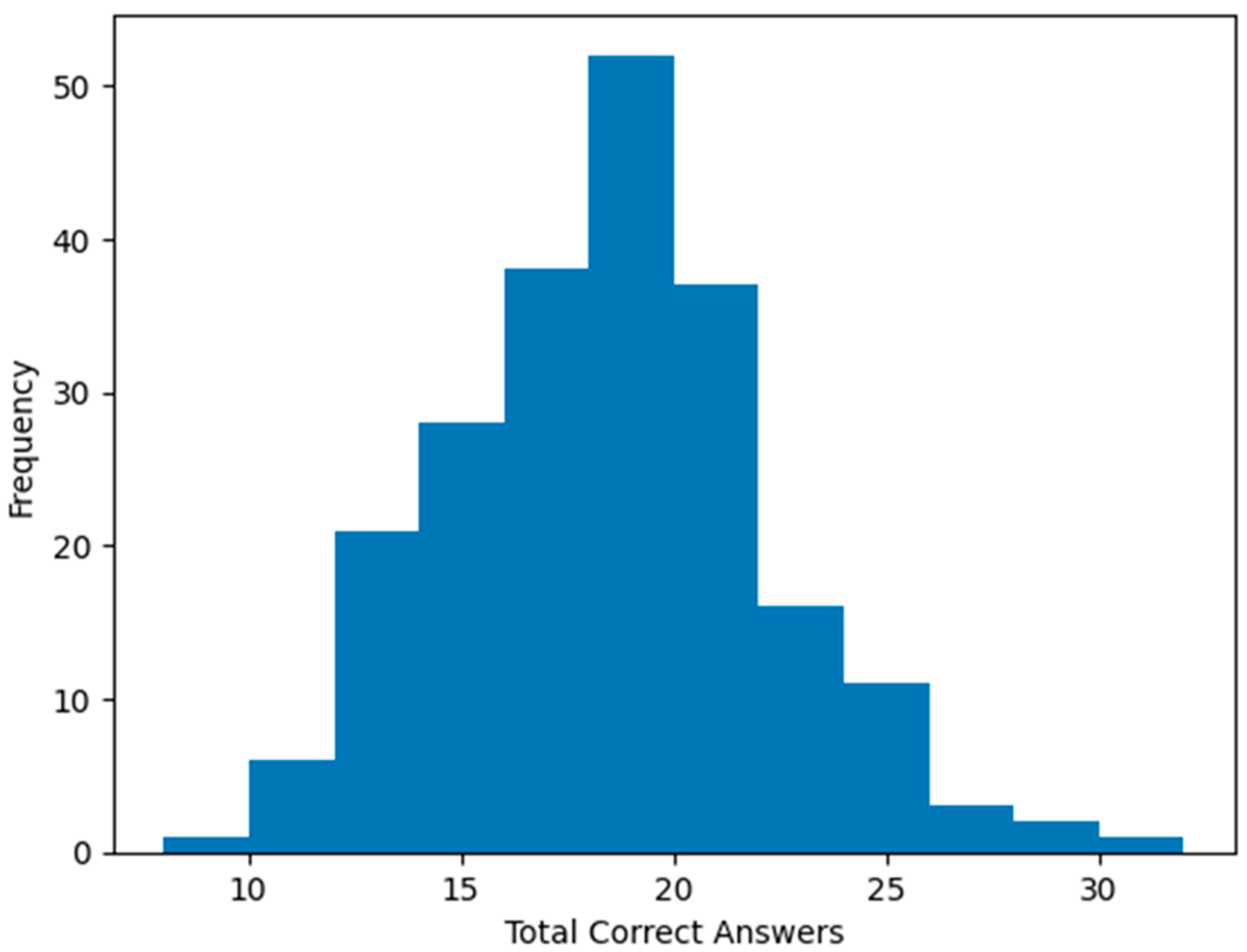
The overall performance on the questionnaire showed a moderate level of bioethics literacy. The distribution of the scores is presented in
Figure 1, where a concentration in intermediate-to-high values can be observed, without marked accumulation at the extremes. For descriptive purposes, performance can be classified into three levels: low (≤15 correct responses), intermediate (16–21), and high (≥22). Under this classification, 25.0% of participants were in the low level, 50.9% in the intermediate level, and 24.1% in the high level (
Table 2).
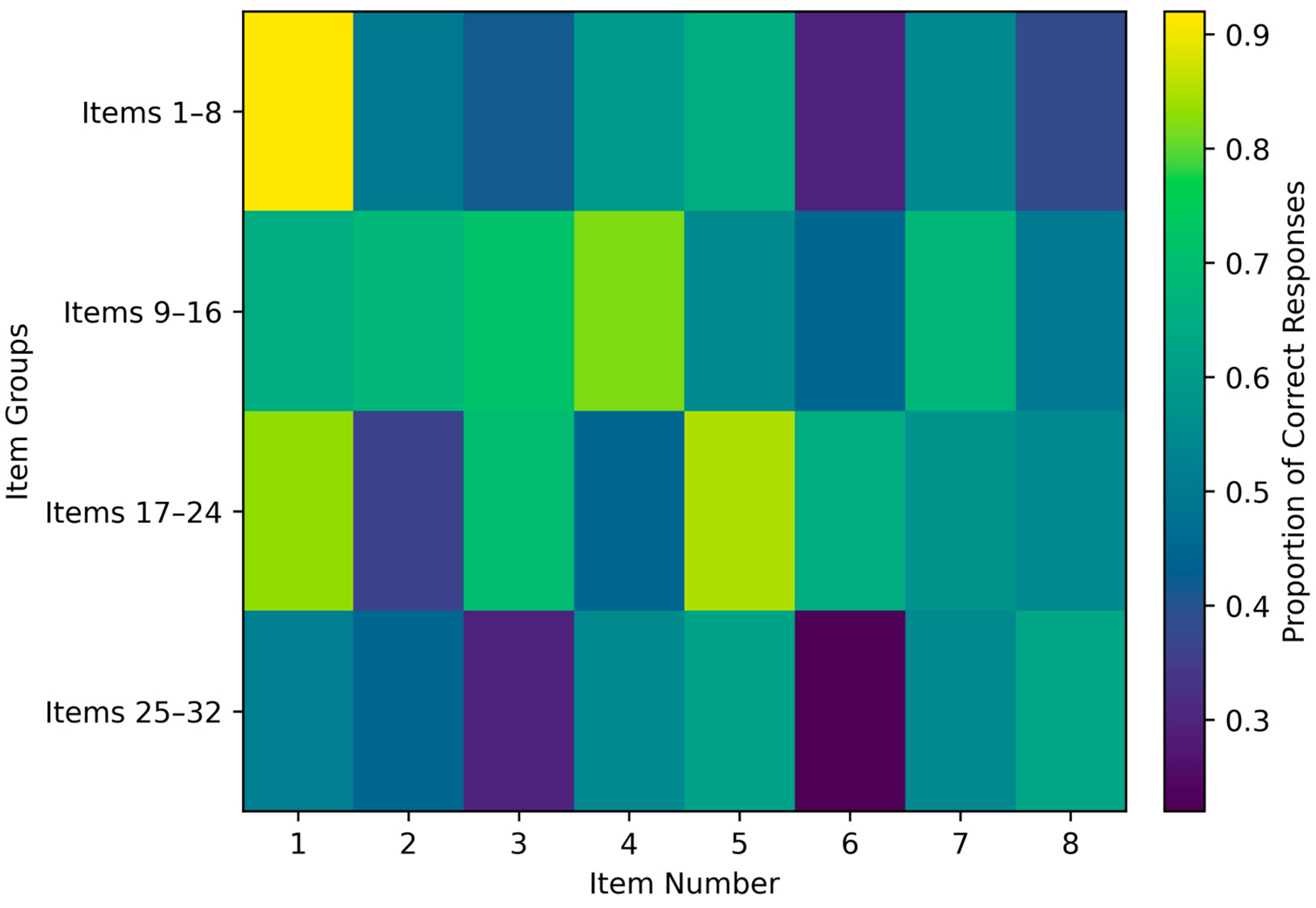
The psychometric analysis at the item level showed considerable heterogeneity in both difficulty and discrimination. The proportion of correct responses ranged from 0.14 to 0.93, with several items of moderate difficulty but also with some very easy questions and others clearly demanding. In terms of discrimination, the corrected item–total correlations were variable; several items were within an acceptable range, but others showed very low or even negative correlations, suggesting that not all items contribute in the same way to the overall performance of the questionnaire. This pattern can be observed in
Table 3 and in the heatmap in
Figure 2. In particular, items related to philosophical foundations and some aspects of personalist bioethics tended to concentrate higher levels of difficulty, whereas some items involving more direct conceptual recognition showed higher proportions of correct responses.
The internal consistency of the instrument was moderate, with Cronbach’s alpha = 0.61. This result suggests acceptable reliability for an initial exploratory analysis, although it is lower than the levels typically recommended for established scales. The “alpha if item deleted” analysis showed small increases when removing some items with poorer performance, particularly those with negative discrimination, although none of these changes substantially modified the overall interpretation of the instrument. Consequently, the observed pattern suggests that the instrument functions better as an exploratory measure of knowledge than as a fully stabilized scale.
The latent structure of the questionnaire was explored through factor analysis on the correlation matrix among items. The adequacy of the matrix for this analysis was limited, as indicated by the KMO index = 0.46, although Bartlett’s test of sphericity was significant (χ
2(496) = 1826.86,
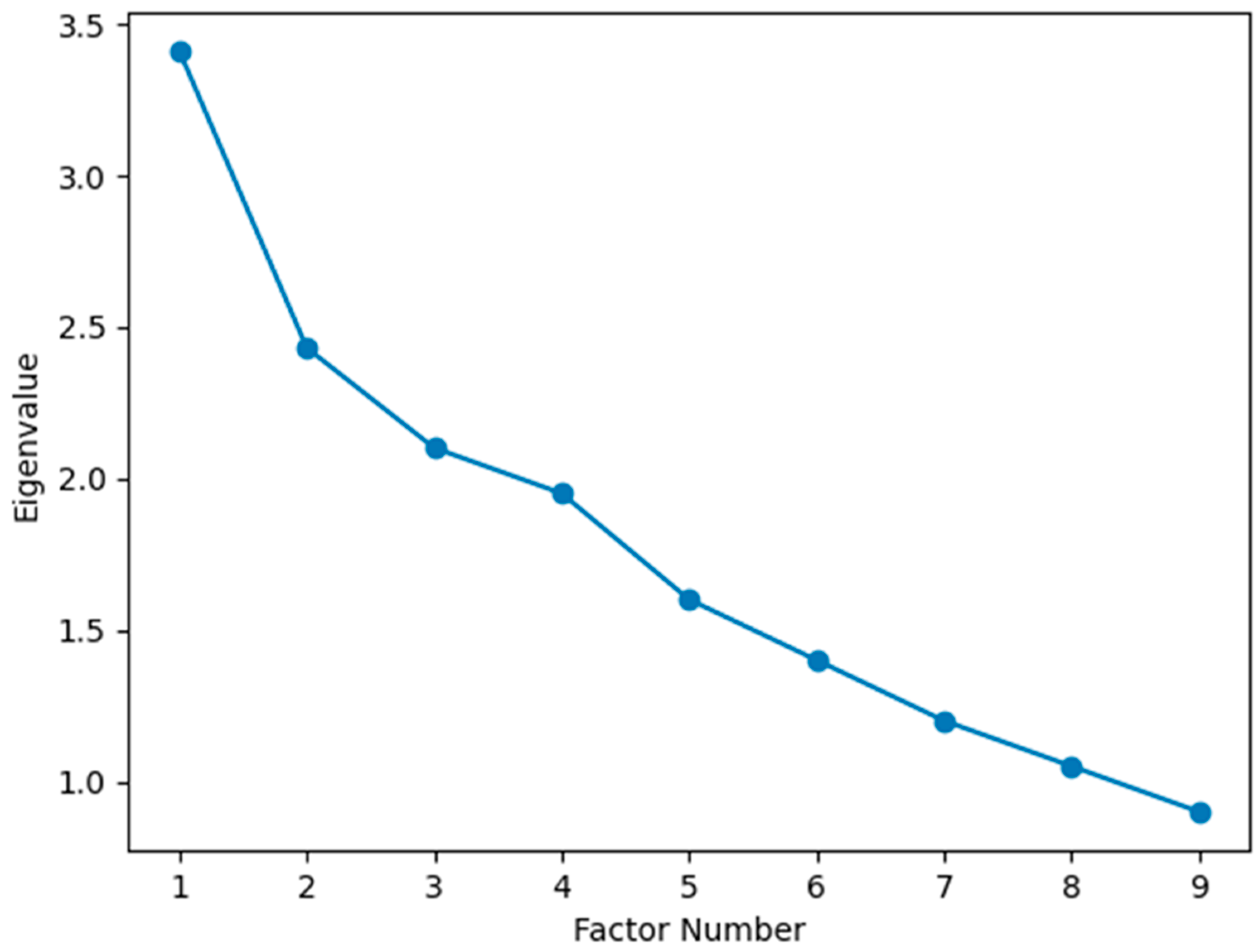
p < 0.001). Although the KMO index was lower than the value usually recommended for confirmatory factor analysis, the factor analysis was conducted strictly for exploratory purposes, with the aim of examining possible conceptual groupings among the questionnaire items. A Varimax rotation was applied to facilitate the interpretation of the factors. The scree plot in
Figure 3 showed a gradual decline with an early inflection and without a particularly clear separation between components. Nevertheless, to facilitate conceptual interpretation, a four-factor solution was examined, whose eigenvalues and explained variance are presented in
Table 4.
The rotated solution showed conceptually plausible groupings, although with modest loadings and some dispersion of the items, which reinforces the idea of a still preliminary factorial structure.
Table 5 presents the most salient rotated factor loadings (|loading| ≥ 0.30). In general terms, several items related to autonomy, vulnerability, and informed consent tended to cluster together, while other items of a philosophical, doctrinal, or magisterial nature showed less clear assignment. Therefore, these results support referring to a preliminary structure rather than a definitive validation of the construct.
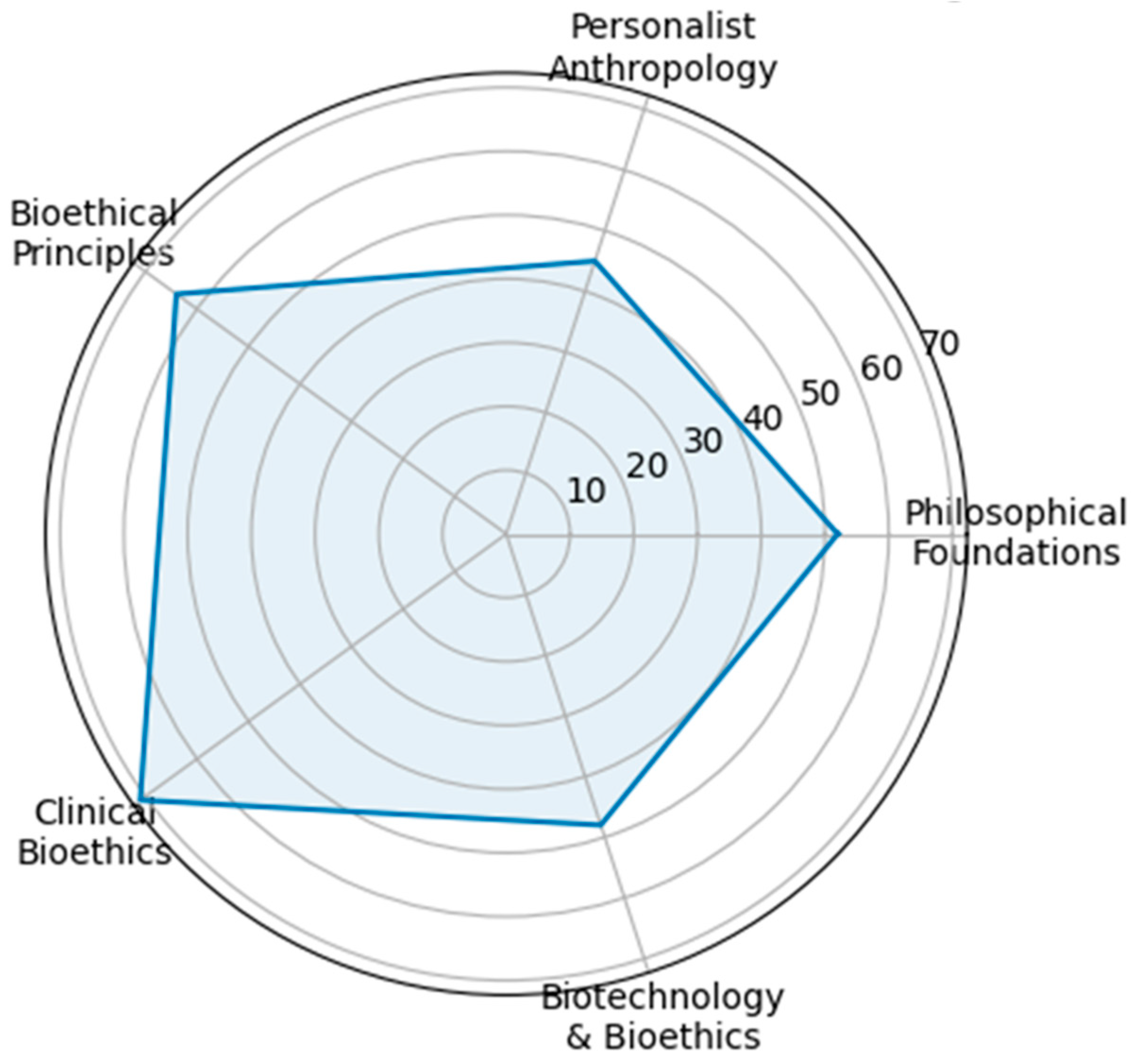
To examine the knowledge areas in a more substantive way, the items were grouped into five thematic domains: philosophical foundations, anthropology/personalism, bioethical principles, clinical bioethics, and bioethics and biotechnology. As shown in
Figure 4, performance was higher in clinical bioethics and bioethical principles, whereas results were comparatively lower in anthropology/personalism and bioethics and biotechnology. Philosophical foundations occupied an intermediate position but showed greater individual dispersion. This pattern suggests that participants respond better to applied bioethical content and clinical terminology than to philosophical or doctrinal content of greater conceptual density.
Finally, it was examined whether the mode of questionnaire administration could influence the scores obtained. The mean scores were similar across the three modes of administration (
Table 6). The analysis of variance did not show statistically significant differences among groups (F(2.213) = 0.04,
p = 0.962, η
2 = 0.0004). The observed effect size was practically null, suggesting that the mode of questionnaire administration did not significantly influence the performance obtained.
In general terms, the results suggest that the instrument can be used as an exploratory tool to describe patterns of bioethical knowledge in seminary populations, although the psychometric evidence obtained indicates that additional processes of item revision and refinement would be necessary before considering it a fully validated scale.
4. Discussion
The results of this study show that the overall level of bioethics literacy among the seminarians evaluated was moderate, with a distribution concentrated in intermediate scores and with a non-negligible proportion of students located at low levels of performance. This finding is relevant for two reasons. First, it suggests that the presence of bioethical content in priestly formation programs does not by itself guarantee a solid and homogeneous appropriation of fundamental concepts. Second, it may suggest that the teaching of bioethics in seminaries could be achieving a general familiarity with the discipline, but not necessarily a sufficient consolidation of its theoretical foundations and its frameworks of moral deliberation. This interpretation is consistent with the literature on ethics education, which has repeatedly shown that curricular exposure to ethics or bioethics content does not always automatically translate into high levels of moral reasoning or robust conceptual mastery, especially when teaching focuses more on the transmission of content than on critical deliberation and interdisciplinary integration (
Goldie 2000;
Eckles et al. 2005;
Varkey 2020).
One of the most significant findings of the study is the asymmetry between domains. The better performance in content related to clinical bioethics and bioethical principles, compared with the lower performance in the areas of philosophical foundations, personalist bioethics, and, to a lesser extent, bioethics and biotechnology, suggests that students appear to handle applied, recognizable, and terminologically stabilized content more easily than content requiring a more refined articulation between moral philosophy, theological anthropology, and bioethical reasoning. This pattern is not surprising. In the literature on bioethics education, it has been observed that students tend to respond better to relatively standardized practical dilemmas or categories (autonomy, informed consent, justice, euthanasia, end of life) than to content of greater conceptual or historical density, such as underlying philosophical traditions or the anthropological foundations of the ethical frameworks used (
Goldie 2000;
Eckles et al. 2005;
Gillon 1994). In other words, the data point to teaching that may be more effective in identifying concrete bioethical problems than in developing a deep understanding of the philosophical and theological assumptions that should sustain them.
This difference between applied content and foundational content is particularly important in the case of seminaries. Unlike bioethics programs directed at medical students, where the priority is often clinical decision-making, in priestly formation bioethics should not be limited to the practical resolution of dilemmas but should be inserted within a broader horizon of formation of moral judgment, pastoral discernment, and an integral understanding of the human person. Both
Optatam totius and
Pastores dabo vobis insist that priestly formation requires an organic articulation between the intellectual, spiritual, human, and pastoral dimensions and not a simple accumulation of specialized content (
Second Vatican Council 1965;
John Paul II 1995). From this perspective, the fact that seminarians obtain better results in applied components than in philosophical and personalist foundations could be interpreted as an indication of formative fragmentation: students recognize operative bioethical categories, but do not always demonstrate an equivalent mastery of the anthropological and moral frameworks that should give them coherence.
The low performance observed in several items related to personalist bioethics deserves specific consideration. Given that the questionnaire included content related to Sgreccia, the dignity of the person, the personalist tradition, and some magisterial documents, better performance might be expected in a population immersed in theological and moral formation. However, the results suggest that familiarity with personalist bioethics is partial and uneven. This observation may be interpreted in two non-exclusive ways. The first is that personalist bioethics, although nominally present in teaching, may not be addressed with sufficient systematic depth. The second is that there is a distance between doctrinal or magisterial language and the effective appropriation of its categories by students. This is not a minor issue, because personalist bioethics has been precisely one of the most influential frameworks in Catholic academic contexts, emphasizing the centrality of the person, corporeality, vulnerability, and the inviolability of human life (
Sgreccia 2012). If these contents do not appear firmly established in the knowledge of seminarians, this suggests the need to review not only what is taught, but also how it is taught.
The results must also be interpreted in light of the Latin American and Colombian context. Latin American bioethics has insisted that ethical deliberation cannot be abstracted from the structural conditions of inequality, exclusion, and vulnerability present in the region (
Garrafa and Porto 2003;
Kottow 2003). In this sense, bioethics formation in Latin American seminaries should ideally integrate not only the classical normative tradition (principlism approach, international documents, Catholic moral teaching), but also sensitivity to the social determinants of health, structural injustice, and the situations of human fragility that characterize many pastoral contexts. The fact that students perform better in conventional clinical content than in content linked to broader contexts of vulnerability, anthropology, or moral foundations may indicate that bioethics teaching is still closer to a model of principles and dilemmas than to a contextual, social, and pastorally embodied bioethics. From a Latin American perspective, this is a particularly important issue because the region’s bioethics has repeatedly emphasized that moral reflection should not be reduced to individual conflicts but should also include the social and political conditions that produce harm and exclusion (
Garrafa and Porto 2003).
Another relevant finding of the study is the absence of significant differences according to the mode of questionnaire administration. This result is particularly interesting because one of the initial concerns of the study was the possible “directionality” of responses when the instrument was administered in contexts more mediated by teachers. The methodological literature has pointed out that the mode of questionnaire administration may affect data quality, social desirability, and the way participants interpret and respond to items (
Bowling 2005;
Podsakoff et al. 2003). However, in this study the mean scores were practically equivalent across modalities, with an effect size that was practically null. This suggests that, at least in this sample and for this instrument, the mode of administration did not substantially alter the level of knowledge observed. This finding has two implications. On the one hand, it reinforces the idea that the differences detected in performance respond more to real patterns of knowledge than to administration artifacts. On the other hand, it requires qualifying the initial suspicion that teacher mediation might have significantly biased responses. Nevertheless, this absence of differences does not completely eliminate the possibility of more subtle contextual effects (for example, in the interpretation of certain specific items), so continuing to control for this aspect in future studies remains methodologically advisable. This result is methodologically relevant because it suggests that the instrument presents reasonable stability across different conditions of administration. In educational studies, the presence of teachers or institutional mediation during the administration of questionnaires may generate social desirability biases or strategic responses from participants. The fact that no differences between modalities were observed in this study suggests that the questionnaire may capture patterns of knowledge that are relatively robust across variations in the context of administration.
From a psychometric point of view, the results invite a cautious interpretation. The analysis of difficulty and discrimination showed that several items perform reasonably well, but also that some items present low or even negative discrimination. This suggests that not all items contribute coherently to the measurement of the intended construct. The overall internal consistency, expressed as a Cronbach’s alpha of 0.61, must be interpreted with caution. Although this value may be considered acceptable in initial exploratory studies or in heterogeneous knowledge instruments, it is clearly below the thresholds usually considered desirable for an established scale (
Taber 2018). In this case, moreover, the result must be interpreted by taking into account that the questionnaire brings together conceptually diverse content (moral philosophy, bioethical principles, clinical bioethics, personalism, normative documents), so high internal homogeneity cannot necessarily be expected. In other words, the moderate alpha does not invalidate the instrument, but it does indicate that the questionnaire functions better as an exploratory tool for profiling knowledge than as a fully stabilized unidimensional scale.
The factorial structure identified points in the same direction. Although Bartlett’s test was significant, the low KMO value indicates limited adequacy of the matrix for a robust factor analysis, and the variance explained by the four-factor solution was modest. This requires interpreting the factorial structure as tentative and preliminary rather than as a definitive validation of the construct. From a methodological perspective, this result should not be seen as a failure but rather as a useful signal regarding the current state of the instrument. The literature on exploratory factor analysis has emphasized that these procedures must be applied and interpreted with particular caution when items are few, dichotomous, or conceptually heterogeneous and that the use of correlations more appropriate for ordinal or dichotomous variables can substantially change the results (
Costello and Osborne 2005;
Flora and Curran 2004). In this sense, the data from the present study suggest that a future refinement of the questionnaire should especially review items with low discrimination, explore the structure with tetrachoric matrices, and verify whether the instrument functions better as a set of thematic subscales rather than as a single global measure.
Beyond quantitative performance, the findings have considerable formative and pastoral relevance. If seminarians show moderate knowledge in bioethics, with strengths in applied content but weaknesses in philosophical and personalist foundations, then the issue is not simply to increase the amount of content taught, but to review the pedagogical architecture of instruction. Bioethics formation in seminaries should probably be oriented less toward the mere transmission of definitions and more toward integration between philosophy, moral theology, concrete cases, and pastoral discernment. This would imply a pedagogy combining conceptual study, reading of magisterial documents, case analysis, reasoned deliberation, and connection with real situations of human and spiritual accompaniment. Within the framework of priestly formation, bioethics should not appear as a marginal or excessively technical module, but rather as a privileged space where doctrine, moral reasoning, social reality, and pastoral practice intersect (
John Paul II 1995;
Congregation for the Clergy 2016).
In this sense, the results of the study may be read as a call to strengthen seminary bioethics that is simultaneously intellectually rigorous, pastorally situated, and socially sensitive. Intellectually rigorous, because the deficits detected in foundations and personalism reveal the need for greater theoretical consistency. Pastorally situated, because future priests will encounter persons and families facing complex decisions regarding illness, suffering, and the beginning and end of life. And socially sensitive, because in the Latin American context these decisions are crossed by inequalities, vulnerability, and unequal access to health resources and integral well-being. In sum, the study may be interpreted as suggesting that the teaching of bioethics in Colombian seminaries should not be conceived merely as the transmission of knowledge, but as part of an authentic formation of moral conscience.
The study also presents limitations that must be acknowledged. First, the instrument still shows a preliminary psychometric structure, so conclusions about “bioethics literacy” must be interpreted with caution. Second, although the comparison between modes of administration showed no differences, the cross-sectional design does not allow the evaluation of longitudinal changes or the causal attribution of results to specific teaching strategies. Third, the sample belongs to a specific and predominantly theological formation context, which limits the generalization of the findings to other seminaries, countries, or ecclesial institutions with different curricular structures. Furthermore, the use of a multiple-choice questionnaire limits the assessment to declarative knowledge and does not capture other dimensions of bioethics competence, such as ethical reasoning or decision-making. However, these limitations do not diminish the value of the study; rather, they appropriately delimit its scope and reinforce its contribution as a first empirical step in a field that remains scarcely explored.
Overall, the findings support the conclusion that the teaching of bioethics in Colombian seminaries has generated an appreciable base of knowledge, but one that remains uneven. Better performance in applied content is not accompanied by an equally solid understanding of philosophical foundations, personalism, or the broader doctrinal framework. At the same time, the stability of the results across modes of administration reinforces the credibility of the overall pattern observed. From an academic and pastoral point of view, this suggests that the challenge does not consist only in “teaching more bioethics,” but in teaching it in a more integrated, contextualized, and coherent manner with the formative purpose of the seminary.




 ,
,