O chestnut-tree, great-rooted blossomer,
Are you the leaf, the blossom or the bole?
O body swayed to music, O brightening glance,
How can we know the dancer from the dance?
—W. B. Yeats, “Among School Children”
1. Introduction
When it comes to the question of the nature and reality of God/the divine (i.e., theology) in Christian thought, we can distinguish two major paradigms that have been in contention at least since the rise of modernity. On the one hand are the various traditional theological conceptions that have emphasized God’s immutable, eternal nature. In this view, God is understood as fixed and transcendent, outside the temporal flux of the world, fundamentally unchanged by historical events (cf. Psalm 102:27; Malachi 3:6; Hebrews 13:8; James 1:17).
1 On the other hand are the conceptions born out of modern critical study of religious traditions, which claim to be able to trace the immanent, historically contingent transformations that the idea of God has undergone over time (for popular treatments, see
Armstrong 2004;
Aslan 2017;
Römer 2015;
Wright 2009).
As this description suggests, however, the question of God’s historicity has long been intrinsically bound up with questions of ontology; either God
is and
always has been or we are talking only about “the idea of God”—one that, precisely because it lacks objective reality, can be subject to arbitrary metamorphosis in the minds of humans over time. In this way, the question of divine mutability has tended to break along two major conceptual vectors. Either God is (a) objectively real, transcendent, and immutable, or (b) subjectively constructed, immanent, and mutable. The first position I will refer to as
traditional-orthodox and the second (
post)
modern-critical, since the former perspective was culturally dominant in some form as classical Christian orthodoxy up to the Western Enlightenment, when the dawn of historical consciousness raised the specter of cultural relativism that has only been amplified in the social constructionist and genealogical discourses of 20th century postmodernism.
2Here I would like to articulate an alternative position that synthesizes insights from across these paradigmatic perspectives and hence constitutive of a
metamodern theological move. Metamodernism is an emerging paradigm that endeavors to move through and beyond postmodernism by productively engaging, synthesizing, or integrating its insights with those of previous paradigms (
Clasquin-Johnson 2017;
Dempsey 2023;
Van den Akker et al. 2017;
Vermeulen and van den Akker 2010). According to this proposed view, God can be understood as immanent and mutable—but also real:
immanent in that God is not radically distinct from the natural world;
mutable in precisely the sorts of ways that (post)modern-critical analysis has demonstrated the historically contingent manifestations of the divine across time; yet
real in the sense that these manifestations have not been purely subjective psychological projections but actual, collectively produced emergent phenomena with objective causal power. Such a theological paradigm stands to gain the empirical insight of modern naturalistic science and historical criticism, as well as the sociological insight of postmodern constructionist thought, yet without adopting the atheistic ontological stance endemic to these discourses. It does this by understanding God’s historical evolution as a natural, complex process with a real, emergent referent dependent upon but irreducible to the subjective beliefs of people.
This metamodern perspective represents a coherent theological vision based on multiple dimensions that I will collectively refer to as a developmental, emergent, and participatory theology of harmonization—or the DEPTH model for short. To unpack this model, I will describe each of these dimensions in some detail, establishing their connections to one another as I go. With all of the dimensions explained, I conclude with a summary of the overall theological gestalt they entail and attend to some remaining desiderata while suggesting areas of application and exegesis.
2. Emergent
To begin, let us start slightly out of order with the concept of
emergence, the E in the DEPTH model, since it is arguably the linchpin of the whole paradigm that renders the others fully intelligible. Emergence is an idea of central importance in the field of complex systems science. Melanie Mitchell defines a complex system as one “in which large networks of components with no central control and simple rules of operation give rise to complex collective behavior, sophisticated information processing, and adaptation via learning or evolution” (
Mitchell 2009, p. 13). Such complex systems are said to exhibit
emergent properties: phenomena in which lower-order parts come together to generate a higher-order whole with characteristics that are qualitatively more than the sum of those parts.
Consider, for instance, an ant colony. It exhibits behavioral complexity that only emerges at the collective group level. Study the behavior of an individual ant, however, and this complexity disappears. In fact, ants in small numbers will actually act maladaptively when left to their own devices (e.g., descending into a “death spiral”). It is the colony as a whole, then, and not its myriad constitutive parts, that is the “self-organizing” adaptive totality—a genuine
superorganism with emergent functional capabilities not reducible to the parts by themselves. Once grasped, the importance of emergent properties can be seen in all manner of phenomena that exhibit distinctly new kinds of organized behavior at scale.
3One key indicator that a phenomenon is emergent is that it requires an explanatory framework (e.g., equations, laws, models) different from those normally used to interpret its constituent parts (
Chalmers 2008). In the classic formulation, “more is different” (
Anderson 1972); you cannot deduce higher-level phenomena (e.g., hydrodynamics, superconductivity) from the lower-order phenomena out of which they emerge. There is no way to explain the behavior of all the atoms that constitute
me simultaneously moving downstairs to get a mug of tea by using models from particle physics. Such crude reductionism, you could say, misses what’s
really going on. As a complex system with emergent properties, even the simplest biological cell requires explanatory models over and above those of physics.
Indeed, precisely to account for the unique behavior of cells and other living things—behavior with real causal power—is why biology exists as a scientific field distinct from physics in the first place. As qualitatively different phenomena emerge, new levels of analysis are required to model and explain their behavior
on their own terms.
Hoel (
2023, p. 162) notes that “we can view the tree of science as a ladder, where some fields are ‘higher up’ than others” because emergent phenomena occur at a macroscale that is more causally significant than the microscale phenomena on which they are based. This is the insight behind his
theory of causal emergence. “Causal emergence,” he says, “occurs when the macroscales have more causal influence than their underlying microscales over the exact same events” (
Hoel 2023, p. 177). When I go to get a mug of tea, my psychology is exerting more causal power than my atomic makeup, which is why theories from social science are more explanatory in this context than those from physics.
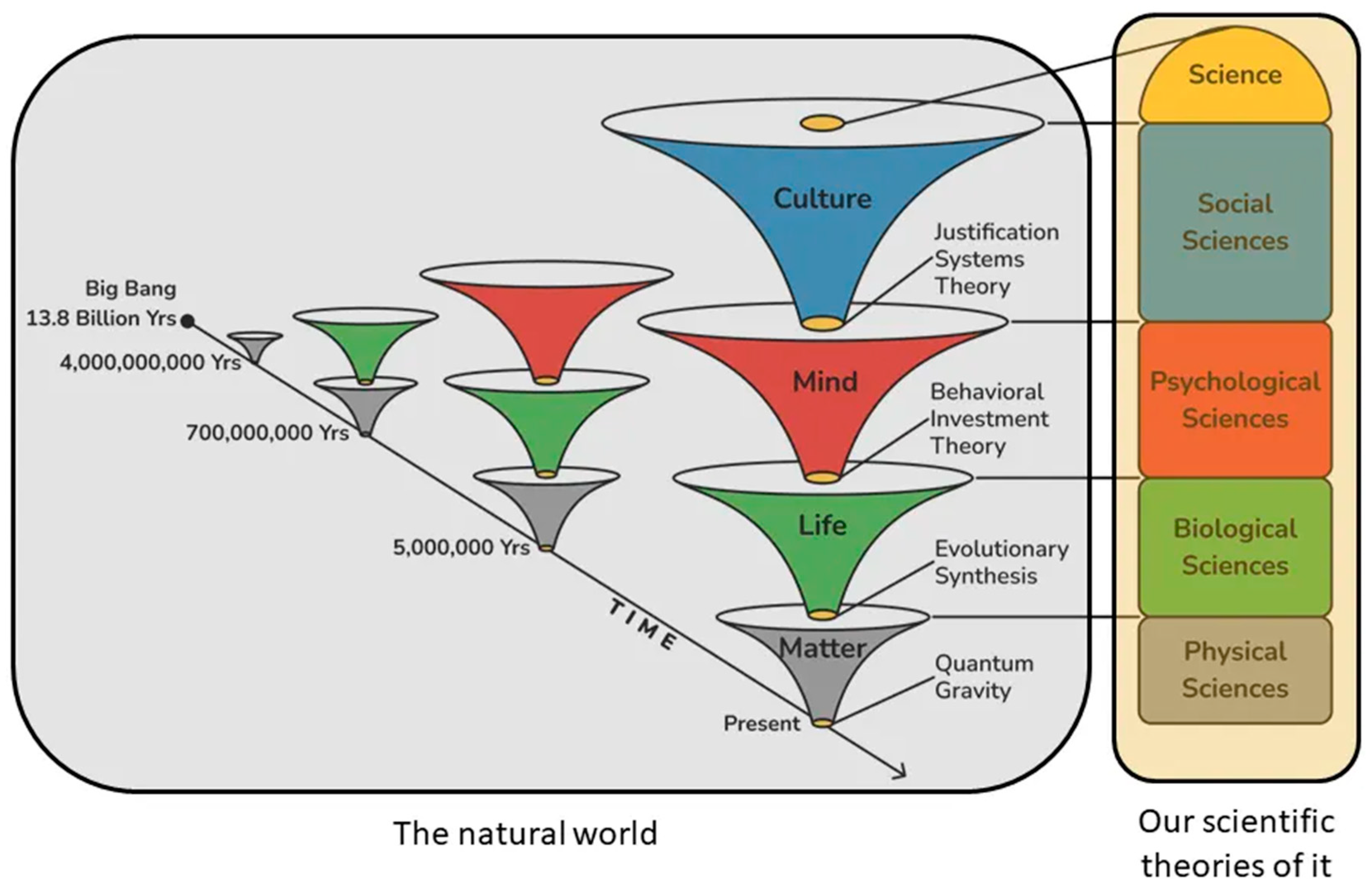
The insight that different scientific fields of knowledge correspond to increasingly complex emergent levels of behavior lies at the heart of the Unified Theory of Knowledge (UTOK) framework, which maps the “tree of science” as a “tree of knowledge” spanning four complexity planes: Matter (physical sciences), Life (biological sciences), Mind (psychological sciences), and Culture (social sciences) (
Figure 1).
What is important to appreciate here is that these planes represent genuinely novel
ontic dimensions of reality distinguished by higher levels of causal emergence. In this sense, there is a direct connection between
ontology and
causal power. For example, the claim by eliminative materialists that Mind can be discounted as merely an “epiphenomenon” of Matter is based on assessments of Mind’s supposed lack of causal power.
5 It is these sorts of ideas that are radically undermined by theories of emergence, which recognize that phenomena at higher levels of complexity are real, irreducible existents requiring analysis on their own terms. As Gregg Henriques, the developer of the UTOK model, puts it:
The emergence of information theory, information science, chaos and complexity sciences, and philosophical analyses of living and mental creatures … all show why a strong physical reductionism or eliminative materialism is a fallacious frame for scientific knowledge. The [Tree of Knowledge] show[s] how the natural world is singular and monistic in the sense that the foundational ground of existence is an Energy Information Field, out of which the dimensions of behavioral complexification called Matter, Life, Mind, and Culture emerge. Novel properties emerge via things such as the linking of parts together to make new wholes (e.g., electrons merge with protons to make hydrogen), and via aggregate groups across scales (e.g., the way groups of water molecules give rise to fluidity and rivers and lakes). In addition, there have been four great dimensional emergences of Matter, Life, Mind, and Culture. The latter three all give rise to complex adaptive dynamic systems, whose patterns of behavior are not just matter and energy on a field of space and time but include dynamically self-organizing complex adaptive systems that engage in information processing and communication behaviors that require different metaphysical concepts above and beyond efficient causation.
Such ideas offer a revolutionary new way to think about reality, up to and including ultimate reality—i.e., theology. In particular, the concept of emergence suggests a bold new frame for thinking about God, one that allows us to see God as “higher up” not in terms of supernatural transcendence but emergent causality. Indeed, the idea of emergence and a stratified ontology give us a way to situate transcendence within the immanent, natural world. Such a world is dynamic and evolving, with evolutionary complexification itself being the means by which new emergent levels appear.
But if God is genuinely emergent in some form, then the divine can be immanent and mutable while also being ontologically real and irreducible. An emergentist theology sees a God who is a whole greater than the sum of its parts, with real causal power operating at a macroscale over and above everything that is sub-divinity.
3. Participatory
Such an emergentist theology immediately raises the question, though: If God is a whole more than the sum of its parts, what are the constitutive parts from which God emerges? If the theological plane is a level of emergent complexity with causal power, what is the microscale undergoing self-organization? If God is the murmuration, who are the starlings?
The (post)modern-critical view, we noted, principally engages God as an idea in the minds of human beings. As early modern thinkers came to emphasize the subject/object split, a sharp dichotomy opened between reality and appearance. Science, it was held, could address the reality of the objective world, in large part by bracketing out subjective distortions. In subjectivity, by contrast, “mere appearance” could blend easily with fantasy and delusion, leaving the mind a dubious place for any number of arbitrary beliefs. As historical-critical studies revealed how conceptions of God changed over time—from polytheistic tribal war deity to henotheistic lawgiver to monotheistic Creator and beyond—it made sense to assess these as transformations of shared subjective constructs molded by historical contingency without any objective referent. (Eventually, with the postmodern turn, even scientific objectivity would be counted among such constructs—just another idea in the human mind forever incapable of connecting to the real.)
The metamodern theology espoused here would embrace the insight that God is indeed an evolving concept in the human mind while rejecting the reductionism of this claim, which negates God’s reality and thus ends in atheism. Rather, as we have claimed, God is emergent, and here we can clarify from what God emerges: human minds. According to the DEPTH approach, it is believers, together, in co-participation, who summon forth the divine. “For where two or three gather in my name, there am I with them” (Matthew 18:20). Or, more conservatively, we might say that collective faithful devotion offers the conditions for Spirit to manifest—perhaps akin to the way the neurons in my brain offer the conditions for me to think certain thoughts regardless of whether I do indeed think them or not. The point is that God emerges from the psychologically mediated activity of human beings.
To be clear, such a claim is not simply the reiteration of the (post)modern-critical notion that God is just an idea in people’s heads. That claim is akin to saying that I am just the atoms that constitute me. Every “just” signals a reductionism. In point of fact, I am the atoms that constitute me, but I am also more than that, emergent from that. In a similar way, one can say that God is an idea in human minds, but not just that. Rather, human minds present the microscale substrate, the medium, the inter-psychic parts from which God actually emerges. As we have seen, such emergent processes are real phenomena with causal power over and above that from which they emerge. Where (post)modern-critical theology would reduce God to a psychological construct, this metamodern theology would posit God as actually emergent from people’s shared psychological behavior. God (at least when active/activated, let us say) is not merely an epiphenomenon of human minds but rather a higher-order reality that can supervene upon such minds.
As an example of what this looks like, let us consider how congregants participate in a charismatic church service. With shared attention and intention, communally holding and evoking shared ideas and orientations, evocative music is played, hands are waved, powerful words spoken. As the service progresses, the mood shifts; the presence of the Spirit is felt. Emotions swell, and divine power is palpable. An hour in, the room half-lit, the pastor prays over a worshipper who, at the name of Jesus, immediately falls to the floor, emptied of strength, “slain in the Spirit.”
What has happened?
Reductionist explanations struggle to account for such experiences. Concepts like suggestion, projection, mass hysteria and the like lean on subjectivist rationalizations that do not do justice to the objective character of these events. Told in their own words, the worshipper says they felt overwhelmed by a more powerful entity; they did not fall, they were overcome. Traditional interpretations that claim an inbreaking of God from without, then, will tend to land as more immediately credible than any supposedly rational interpretation that would force one to deny the core characteristics of their own experience.
Viewing the event through an emergent, participatory lens offers something beyond this classic dichotomy. The power felt was not supernatural in the traditional sense but naturally generated by the congregants themselves through their embodied, psychological participation in the ritual.
This idea by itself is nothing new; it was articulated already by Durkheim and has long been appreciated by sociologists of religion. What is novel here is the recognition that the congregants are
actually giving rise to some
real phenomenon over and above just their social activity. For Durkheim, “religious force is the feeling the collectivity inspires in its members, but projected outside and objectified by the minds that feel it” (
Durkheim 2001, p. 174), leaving the interpretation reductionist at core. As he says, “god is merely the symbolic expression of society” (
Durkheim 2001, p. 171)—and every “merely” is a reductionism. Here, though, there is no
merely. Divinity is really present, exerting causal power—not just
from within (i.e., subjectively) but
from above, as a supervenience upon a group of minds. God is not reducible to sociology; theology is emergent from society.
6Such emergence requires participation. The coincidence of parts is not enough; they must be activated in a certain way. The murmuration does not emerge from starlings but from their flight. Thoughts emerge not from synapses but through their firing. Emergence is always process. It is not the dancers, it is the dance. God, then, is a certain kind of process. And to say as much is in no way to diminish, reduce, or even depersonalize God, since it should immediately be clear that so is everything—including every person.
But if many phenomena are emergent, participatory processes, it is incumbent on us to identify what specific sort God is, which leads us to a consideration of just what is meant here by theology—the T in the DEPTH model.
4. Theology
In its most basic sense, of course, theology is the study of (-ology) God (theos)—but what is “God”? Given that this metamodern theology emphasizes the mutability of God as psychologically engaged and participatorily enacted, the question cannot be answered simply by pointing to any particular instantiation across time. That is, God cannot simply be equated with the tribal war deity or the henotheistic lawgiver or the monotheistic Creator, etc. However, the recognition that some identifiable phenomenon is mutable and finds expression in these diverse forms presupposes a form of continuity, otherwise we would not recognize dynamic transformation, only static differences. Whatever we mean by God, then, must entail some sort of identity general enough to include all of these forms as dynamic manifestations of a single underlying phenomenon.
Here metamodern theology can be aided by metamodern philosophy, specifically that of Jason Ānanda Josephson Storm, whose concept of “process social kinds” offers a helpful framework for thinking the concept of God and the discipline of theology in non-essentialist but post-deconstructive terms. For Storm, social kinds are “(1) socially constructed, (2) dynamic clusters of powers, (3) which are demarcated by the causal processes that anchor the relevant clusters” (
Storm 2022, p. 111). A full analysis along these lines would exceed the scope of this article, but we can make some high-level observations that address the need to identify anchoring processes for theology’s persistent cluster of causal powers.
I have written elsewhere about the way human religiosity functions as an extension of deeper evolutionary dynamics reaching all the way down to thermodynamic necessity (
Dempsey 2024). To persist, all entities must resist entropy by leveraging the energy of their environments to maintain their informational complexity. Information pertinent to this end is intrinsically
meaningful to such entities (
Kolchinsky and Wolpert 2018;
Rovelli 2018).
As new levels of complexity have emerged across cosmic evolution (from Matter to Life to Mind to Culture), meaning of this kind has complexified in tandem. On the complex plane of Culture, humans process meaningful information through symbolic language in social contexts. Though this high degree of complexity makes human experiences of meaning profoundly more rich and layered than, say, a bacterium’s at the earliest level of Life, the same basic functional requirements are at play in both. There is thus continuity in process yet discontinuity in form. Indeed, even within the Culture plane alone there is diversity in the ways this finds expression, though the deep function it serves allows us to pinpoint the anchoring processes responsible for theology’s cluster of powers as an instance of “ergonic convergence” (
Storm 2022, pp. 123–26).
In contexts of human social construction, the most important meanings for a society are represented in terms of “the sacred.” As I put it elsewhere:
I will use the word “sacred,” then, to refer to those collective representations of a culture that are superlatively meaningful to it (in the technical sense of meaning as mutual information with causal power bearing on viability). The sacred constitutes the veritable foundation upon which psycho-cultural flourishing depends. It hallows that which sustains and upholds a given society, enshrining the established gains of cognition and conception that make any continued gains possible. It is the proper respect owed to the adaptive path taken, its active shoring up, and the intimation of where it will lead based on where it has been. It is, in short, what is deemed most important to the continued viability of a successful human system–environment relationship.
This is why sacred phenomena can be as diverse as a totem’s pole, an ancient city’s god, a modern city’s site of democratic governance, etc. What is sacred varies; why it is sacred is the same across contexts thanks to consistent anchoring processes.
In a Christian theological context, this is why “God” has taken such diverse shapes according to the contingent material conditions in which he has been emergently and participatorily enacted. God can be understood as the ultimate shaping force in the negentropic effort to maintain and enhance a society, whatever its size or stage of complexity. As conditions and needs have shifted for different social-organizational historical structures, so God has shifted in turn. What has remained constant is the functional requirement to counter entropy at every stage of emergent complexity and seek the maximization of contextual viability.
As this requirement extends across all ontological strata, though, we can appreciate that the impetus of the divine can be tracked back into pre-Cultural levels. What will become God in human culture has its prefigurations in animal psychology, biology, and even physics in every adaptive mechanism that enhances an entity’s viability. So, in yet another way, God is not “merely” a social construction (though God may manifest in socially constructed form at the level of Culture), but indeed a cosmic, universal impetus towards order and complexity as opposed to disorder and chaos. God is nascent already in the dissipative structuring of a whirlpool, in the implicit knowledge of cellular chemotaxis, and in the embodied love a primate mother has for her offspring.
This negentropic quality is essential, I believe, to the identity of God as an emergent potency, and serves as the key quality for distinguishing the divine from other such forces. For, indeed, nothing in the mechanics of collectively actualized ideational forms necessitate, in themselves, the production of a benevolent, Godlike entity per se. In fact, the same process would seem to permit of a diversity of supra-psychological potencies, including even entropic ones. Weak versions of this idea can be found in aspects of memetic theory (
Blackmore 1999;
Dawkins 1976); stronger versions in contemporary appropriations of the esoteric concept of “egregore” as a class of collectively produced, trans-psychic entities (
Stavish 2018). If classic theological language like “demonic” and “Devil” has a place in metamodern theology, it could be in naming genuinely emergent phenomena of a
socially entropic sort as a kind of inverse to the negentropic God described by the DEPTH model. Whatever we make of that prospect, the point to stress is that a negentropic, viability-enhancing emergence extending the complexification trend for humanity would be what characterizes divinity per se, and in a way where many of the classical theological attributes of God are represented (e.g., benevolence, intelligence, love, power).
Understanding God as
the drive towards existence seeking flourishing allows us to see the divine in every part of the cosmos. Indeed, appreciating that existence by itself entails meaning of this kind, we may even gain a new appreciation for Tillich’s notion of God as “the Ground of Being” and “ultimate concern” (
Tillich 1951). But if what we mean by “God” is God as understood by people in a person-like way, we must conclude that that only emerges with human beings.
In fact, here the apprehension of God as person-like, if not anthropomorphic, is entirely well-founded. Consider that higher emergent levels do not necessarily lose the core aspects of their constituent parts; a multicellular organism gains emergent capacities by virtue of its more complex configuration but still contains cells functioning as cells. Moreover, functions present at one scale can find their equivalent at a higher one—e.g., cells individually metabolize while multicellular organisms leverage cellular structures for metabolic processes. By comparison, if God is emergent out of the minds of human beings, then God is inherently psychological in nature—indeed, super-psychological in fact. God would not be so much a mind as Mind in some collective sense—a concept long at home in theological discussions. Moreover, if subjective consciousness is itself an emergent property of so many unconscious neurons, the idea of God possessing a personal subjectivity with his own will gains a new basis.
Returning to the idea of God in more universal terms as maximal viability-enhancing negentropy, however, it remains to say more about how this works exactly. For this, we must consider the importance of harmonization, the H in the DEPTH model.
5. Harmonization
In all of the ideas expressed so far, I have been profoundly influenced by metamodern thinker and frequent collaborator Layman Pascal, but nowhere more so than in the idea I refer to here as “harmonization.” According to Pascal’s surplus cohesion model, human spirituality and religion can be understood as processes whereby multiple subsystems are successfully integrated into a more coherent, harmonized whole—for individuals in the case of spirituality and for collectives in the case of religion. It is when such subsystems are brought into mutual resonance or harmony that they produce what Pascal calls “surplus cohesion,” a higher-order fullness whose excess generates emergent potentials. As he puts it:
Spiritual experience is the production of a numinous experiential excess (“surplus coherence”). It is produced by the balanced blending or harmonization of two or more different subsystems of our subjectivity or intelligence. … Success is herein considered to be the achievement of “gestalt” effects—results that are greater-than-the-sum-of-the-parts. Analogous, perhaps, to the emergence of overtone resonances between specific acoustic vibrations. An extra quality is added into the mix. It exceeds the components and responsively reflects back upon… as if from an additional or greater realm.
In individual spiritual practice, such integration might harmonize biological subsystems like the thinking “head” and affective “heart” (i.e., linguistic and neurological information processing centers, respectively); in collective manifestations of religiosity, different groups of people or social functions (e.g., scientists, artists, theologians). In either case, when successful harmonization occurs, such integrations produce an over-abundant intensity that gestures to new expansive horizons of capability and possibility—that is, one could say, enlightenment or rebirth for individuals and the Enlightenment or Renaissance for collectives. This is a particular type of emergence. It is less like the emergence of fluid dynamics from H2O molecules and more like the emergence of a multi-cellular organism with all its complex functionalities (e.g., metabolic, cardiovascular) out of less complex single-celled organisms. Not just new properties but new capacities come online.
In a very literal way, I believe, this can be understood as the synergistic harnessing and deployment of new energies. Insights from applications of non-equilibrium thermodynamics in complexity science, for example, suggest that emergently complex configurations are able to harness increasing amounts of free energy in order to dissipate other energy gradients more efficiently. Adrian Bejan’s work formulating the “constructal law,” for instance, articulates this as evolutionary directionality towards optimizing energy flows. As he puts it:
In the big picture—all the rivers, all the trees, all the animals on Earth—the driving force behind the evolution of everything that flows is the generation of shape and structure to move more easily. This is why we can say that this unintentional tendency has a purpose.
Over cosmic evolution, this tendency has driven the emergence of new levels of complexity characterized by increasing energy throughput (or free energy rate density) (
Chaisson 2001). Bobby Azarian describes how these dynamics give rise to dissipative systems—self-organizing structures like whirlpools and hurricanes that emerge to dissipate free energy—which in turn led to Life:
Since nature loathes gradients, the effort put forth into reducing them is proportional to the magnitude of the gradient. When gradients become large enough and sufficient free energy becomes available, a cycling structure will spontaneously emerge to enable the gradient to dissipate more efficiently. Because the universe “wants” to produce entropy at the fastest possible rate, it will actually create organized systems that help it achieve its thermodynamic goal more efficiently. To the conscious observer, these emergent structures seem to materialize out of thin air, built by the “invisible hand” of nature. … Driven by persistent energy flow, the complexity of a dissipative chemical network steadily increases, new features are forged, and finally, self-organization spawns a cell
In this way, we can appreciate the emergence of higher levels of complexity as attractors to which systems are pushed in their bid to minimize free energy, all while using available free energy to organize and maintain more complex forms. Reality is continually seeking to manifest higher forms for energy to do more powerful sorts of work. These can be unlocked through the coherent synchronization of parts in service to a “higher power.”
In the history of religion, major harmonizations of this sort seem to occur when a coordinated integration of phenomena across multiple spheres realizes synergistic resonance in a manner that mutually increases overall complexity and free energy rate density. Such spheres might include mode of production, governance structure, cultural worldview, individual cognition, and so on. For instance, the shift from foraging to farming brought net increases in per capita energy use (from c. 4000 kcal/cap/day in forager societies to a ceiling of c. 30,000 in agrarian ones), accompanied by a transformation of values/worldview and a new hierarchical mode of social organization (
Morris 2015), raising demands on cognitive complexity for the new elites (from hierarchical complexity levels c. 900 to c. 1050;
Dempsey and Kurze, forthcoming), etc., Together, such social shifts saw an uptick of free energy rate density from c. 40,000 to c. 100,000 erg/s/g (
Chaisson 2014) and a sort of phase transition to a qualitatively new mode of living and cultural meaning-making. In this transformation, the sacred itself evolved, from diffuse animistic expressions (e.g.,
mana) to anthropomorphic polytheistic pantheons. Religion, as a dissipative system, unlocked new energy potentials to configure society in more complex ways, and the new harmonization of peasants, palace, temple, traders, etc. occasioned new capabilities.
7As this example should make clear, however, the resultant form God takes in these emergent transformations is not without problems and deep internal tensions. Divine expressions of early agrarian societies, for instance, tended to reflect the entrenched hierarchies and imperialist impulses of Bronze and Iron Age empires. Indeed, as we have noted, the ability to emergently realize a divine potency by a collective does not demand that that potency be of a sort inherently commendable by contemporary standards. It need only assist that society in enhancing its own viability according to its immediate contextual needs, manifesting in the “zone of proximal development” for that society as an attractor of increasing complexity.
Indeed, such considerations bring us full circle to the developmental nature of this emergent participatory theology of harmonization—the D in the DEPTH model.
6. Developmental
What should by now be clear after outlining the various dimensions of the DEPTH approach—but which would have proven a difficult jumping-off point—is that the various dynamics I have been describing all have an inherent directionality to them. Emergence is a product of complexity, which is an accretive process following the arrow of time. One needs Matter before one can get Life, Life before one can get Mind, Mind before one can get Culture. The sequence is non-arbitrary in the sense that each layer provides the necessary prerequisite for the next.
Likewise, complex systems, we saw, “give rise to … adaptation via learning,” meaning they can grow increasingly adequate in their meaningful information processing in a progressive way. Indeed, one can read the successive ontic planes on the Tree of Knowledge as gains in capacities for entities to model and understand reality and thereby increase their causal power. Azarian writes, “All evolutionary processes are learning processes” (
Azarian 2022, p. 34), and as he and others have noted, the entire history of cosmic evolution itself can be read as one long learning process unfolding across increasingly complex planes of emergence (
Campbell 2021;
Cziko 1995;
Dempsey 2024).
The DEPTH concept of the divine hinges on the ability to recognize contextually negentropic benefits relative to existing conditions. Moving closer to God, so to speak, entails expansion, wellbeing, and new powers; moving the other way: negation, regression, suffering, and entropy. Earlier forms in this process appear to later ones as less adequate—a topic we will return to momentarily—and yet the later forms could not have arisen without the gains of the earlier.
What all of this reveals is that an emergent and participatory theology of harmonization is developmental in nature. That is, it implies a spectrum along which the successive enactments of God unfold, and this spectrum has some sort of normative aspect according to which increasing adequacy can be assessed. In terms of mutability, then, God does not just change, God develops.
Versions of this insight appeared early in modern theological thought as it began to diverge from traditional-orthodox conceptions of divine transcendent immutability. Hegel and the German Idealists, for their part, intimated the unfolding of Spirit through human history in a way that resisted the reduction of God to a subjective construct in the mind by absolutizing the Mind in idealist terms and characterizing the entire drama as phenomenology. In this way, the ontological reality of an evolving God could be retained even as it was rendered mutable. Whatever issues one might have with idealist framings, more problematic by far was the way Hegel’s philosophy of history played into supremacist, imperialist, and racist tropes, with the development of Spirit culminating in the specific culture of the German people, now divinely mandated to subjugate the less “civilized.”
8 These kinds of prejudices would persist into modern sociology and anthropology even after the triumph of theological reductionism to the subjective, with the culmination of evolutionary Progress identified variously in atheistic objective science or else an amenable kind of liberal Christianity that might deign to lift “savages” and “primitives” out of their pagan ignorance.
Postmodern critiques of such supremacism offered a welcome correction to this sort of crude cultural developmentalism. Unfortunately, the radical cultural relativism ushered in as the alternative has revealed itself as an overcorrection with its own problems. Emphasizing the insight of historical consciousness, postmodern thought relativized all philosophies of history. Since all knowledge is culturally and historically contingent, it was argued, there is simply no universal vantage outside culture from which to assess cultural development.
Ironically, such anti-developmental perspectives lead to their own, but very different, philosophy of history—one in which brute power becomes the only arbitrator. Yuval Harari’s Sapiens, for instance, offers an exemplary postmodern contrast to old modernist visions of Progress like Hegel’s. “There is no proof that history is working for the benefit of humans,” Harari declares,
because we lack an objective scale on which to measure such benefit. Different cultures define the good differently, and we have no objective yardstick by which to judge between them. The victors, of course, always believe that their definition is correct. But why should we believe the victors? … No matter what you call it–game theory, postmodernism or memetics–the dynamics of history are not directed towards enhancing human well-being.
In this paradigm, there is no way to speak of anything like collective development towards the good; notions of God and even science are just socially constructed “imagined orders” imprisoning us in different ways. “There is no way out of the imagined order,” says Harari. “When we break down our prison walls and run towards freedom, we are in fact running into the more spacious exercise yard of a bigger prison” (
Harari 2015, p. 118).
Foucault, who saw prisons everywhere in cultural activity, proposed a postmodern historiography defined by methods of subversive genealogy, wherein any seeming reason or lawlike purpose in history must be exposed as some form of arbitrary aggression or stupid contingency. Such history, he wrote, “differs from the history of historians in being without constants. … The traditional devices for constructing a comprehensive view of history and for retracing the past as a patient and continuous development must be systematically dismantled” (
Foucault 2004, p. 79). All is accident without pattern or law—except, perhaps, opportunistic power and enduring oppression:
Humanity does not gradually progress from combat to combat until it arrives at universal reciprocity, where the rule of law finally replaces warfare; humanity installs each of its violences in a system of rules and thus proceeds from domination to domination. … The successes of history belong to those who are capable of seizing these rules … The forces operating in history do not obey destiny or regulative mechanisms, but the luck of the battle. They do not manifest the successive forms of a primordial intention and their attention is not that of a conclusion, for they always appear through the singular randomness of events. … [T]he world of effective history knows only one kingdom, without providence or final cause, where there is only “the iron hand of necessity shaking the dice-box of chance.”
Rejecting both modernist cultural triumphalism and postmodern cynicism and value nihilism, various forms of metamodern thought have sought to reclaim developmental or progressive frameworks of various kinds, though in a manner that integrates postmodern critiques of developmentalist tendencies towards supremacism, totalitarianism, and teleological fatalism (
Dempsey 2023;
Freinacht 2017). New insights from complexity science and disciplines across the Tree of Knowledge—from non-equilibrium thermodynamics to evolutionary biology, cognitive neuroscience, developmental psychology, and beyond—all reveal patterns, constants, and repeating regularities suggestive of a universe prone to developmental complexification across scales, and offer new ways of conceiving at least a rudimentary objective “yardstick” for human and more-than-human good, one that can be traced all the way down to thermodynamic forms of meaning and value. So framed, development becomes a matter of the degree to which an entity can leverage increasing information processing capacity for maximally negentropic ends (
Azarian 2022;
Dempsey 2024;
Piaget 1971), expanding its “cognitive light cone” to encompass greater horizons of care (
Doctor et al. 2022;
Heylighen et al. 2024;
Levin 2019).
When viewed in the light of such complexification dynamics, it is hard not to read the cultural history of God from a tribal genocidal war deity to an entire people’s divine lawgiver to a truly universal Source or Ground of Being—even as Love itself (1 John 4:8)—in developmental terms. Nor, to make very clear, is such a reading a recapitulation of the traditional (antisemitically tinged) contrast between Jewish and Christian God concepts, since Judaism developed its own version of this theological evolution through the Pharisaic and rabbinic traditions. Indeed, theological traditions the world over seem prone to make such moves when complexifying historical contingencies prompt theological development along more expansive, procedurally rational, and universalist lines—a “vindicatory” genealogy, says Habermas, quite different from the postmodern one (
Habermas 2023).
In this framing, historical/material conditions will of course place constraints on what form of God is beneficial or even possible in a given context. When needs are primarily survival-focused, with food, resources, and energy scarce, it should not surprise us to see a God of power, plunder, and spoil gain efficacy as an emergent potential for a collective. By contrast, in well-resourced, safe, and supportive contexts (e.g., “postmaterialist” societies;
Inglehart 2018), conditions are ripe for God to emerge as universally benign, loving, and rational. Again, such claims by themselves are nothing new; the difference here is in appreciating these various forms of God not merely as subjective conceptual constructs but as actualized emergent realities with causal power. It was not just
ideas about Yahweh that changed; it was
Yahweh who changed—grew, matured, developed. And this
by means of human beings.
With this, our appreciation for the participatory element gains an additional dimension. It is not just that human activity is the medium from which God emerges; it is the means by which God
develops. Transformation of the collective consciousness of human beings changes the conditions for God’s real emergence. Human development, you could say, is the precondition for theological development (
Wilber 2006).
This places a new sense of agency and urgency on humanity compared to traditional-orthodox models of divine immutability. A radically transcendent, fixed, and immutable God is impassive and complete, with no genuine need or desire for engagement with the world or humanity besides an ultimate condescension of self-demeaning grace. An emergent, participatorily enacted God is an open and relational God, intimately bound up with humanity (
Oord 2021). The forward advance of God literally depends upon us.
The self-conscious effort to actively co-construct future phases of God’s development is a global, multi-generational project I refer to as “building the Cathedral” (
Dempsey 2021). If God emerges out of the minds of humanity, the stuff of God’s future expression may already lie latent in today’s untapped unconscious archetypal symbolism and imagery. Here the DEPTH model intersects with depth psychology and the personal mythopoetic endeavor to render into conscious form the mythic
prima materia of the unconscious (
Edinger 1984). By this means, we participate in the life of God as creative divine functionaries, fashioning new channels and vehicles for divine expression in service to the life of God (
Dempsey 2022).
A passage from William James’s Varieties of Religious Experience that I am fond of quoting in this context (mytho)poetically expresses the creative potential of the individual to serve God’s developmental advance along new paths. James recounts how, after being put under ether for a surgery, a woman recalled the following dream/mystical experience while unconscious:
A great Being or Power was traveling through the sky, his foot was on a kind of lightning as a wheel is on a rail, it was his pathway. The lightning was made entirely of the spirits of innumerable people close to one another, and I was one of them. He moved in a straight line, and each part of the streak or flash came into its short conscious existence only that he might travel. I seemed to be directly under the foot of God, and I thought he was grinding his own life up out of my pain. Then I saw that what he had been trying with all his might to do was to change his course, to bend the line of lightning to which he was tied, in the direction in which he wanted to go. … He bended me, turning his corner by means of my hurt … [O]n waking, my first feeling was, and it came with tears, ‘Domine non sum digna’ [Lord, I am not worthy], for I had been lifted into a position for which I was too small. I realized that in that half hour under ether I had served God more distinctly and purely than I had ever done in my life before, or than I am capable of desiring to do. I was the means of his achieving and revealing something, I know not what or to whom, and that, to the exact extent of my capacity for suffering. While regaining consciousness, I wondered why, since I had gone so deep, I had seen nothing of what the saints call the love of God, nothing but his relentlessness. And then I heard an answer, which I could only just catch, saying, ‘Knowledge and Love are One, and the measure is suffering.’
The account offers a powerful image of a God subconsciously working towards his own new forms of Self-expression by means of individual human growth. Such growth is always painful, born of confrontation with existing limits that must be transcended, yet it brings new forms of knowledge—which are themselves expressions of love. In this way, the DEPTH model offers new interpretations of what might be meant not only by concepts like “revelation” but the prophetic call itself as a commitment to suffer in service of summoning forth from the collective a new and better way to engage the divine.
7. Future Directions, Present Clarifications, and the Full Depth of God1,2,3,4,5
Having worked through each of the DEPTH model’s five dimensions individually, we can now step back and entertain in one wide view the prospect of such a metamodern theology, along with some additional implications, connections, and desiderata.
The advance in our historical understanding of religious traditions occasioned by modern methods brought profound new insights while also raising serious theological questions. Whereas traditional-orthodox theism claimed God was eternal and unchanging, “the same yesterday, today, and forever” (Hebrews 13:8), historical-critical evidence showed a God undergoing radical transformation over time. Today, monumental works can trace in detail the various syncretisms that occurred between Yahweh and other ancient Canaanite deities like El and Baal (
Lewis 2020); the development of Jewish monotheism out of polytheism (
Smith 2001); the origins and development of Satan (
Forsyth 1989), and other such transformations. Postmodern genealogies likewise excavate the history of such hallowed ideas but with the added deconstructive effort to unmask them as oppressive power plays (
Pagels 1996). Integrating these insights into theology has posed a major challenge, whereas simply embracing them as evidence of the shifting fabrications of human thought offers an easy way to interpret their contingency and contradictions.
This dilemma gets a radical new reframing with the possibility that psycho-social behavior could be the medium through which real, higher-order phenomena emerge with true causal power. Taking ideas from the sociology of religion a step further, we can see collective religious participation as the generative dynamics for the emergence of God in a manner akin to the way the networked firing of synapses in the nervous system are the generative dynamics for the emergence of conscious sensation. Through the coherent harmonization of a group of people, new energy can be harnessed and deployed to instantiate real phenomena at a higher order of being—a true “higher power” that serves to consolidate and invigorate that group to progress further along its path-dependent vector of multi-dimensional complexification. In this way, the transformations of the divine are not (necessarily) random or stratagems for oppression, but potential vehicles for psycho-social development towards more expansive, universal, and liberating structures.
With the DEPTH model, a number of new directions open up for future theological reflection. A new reading of sacred history along these lines seems demanded, for one. Covenantal and dispensationalist theologies in particular could be radically reimagined in this manner as relating to distinct stages of God’s evolution. A DEPTH source criticism would breathe new theological significance into questions of compositional strata. Questions of theodicy likewise acquire a new frame if God’s moral development parallels that of humanity rather than preceding it as timelessly complete, while the problem of God’s omnipotence in this context is mitigated by the realization that the manifest God is only as powerful as the collective human substrate from which he draws. Additionally, one might ask: What does a DEPTH approach to Christology look like? And how might we conceive of eschatology and matters of afterlife in emergentist, participatory terms (a topic that has already been explored by
Freke (
2017) in interesting ways)? These and many other theological topics could be fruitfully engaged using this model, while the finer details of the model itself stand in need of a more comprehensive, systematic theological treatment.
Finally, with the basic framework articulated, some important further points deserve brief clarification. For one thing, it should be stressed that this approach supplements rather than replaces theories of projection, suggestion, etc. Allowing for the possibility of a genuinely emergent deity of various sorts does not mean that we should interpret all claims of such phenomena as actual realizations of this sort of potential. To be sure, there are many beliefs that people can hold (inter-)subjectively that do not find emergent actualization and where subjectivist reductionism is the best explanation.
Next, it is important to appreciate the breadth of meanings associated with theological language and to avoid conflating different ideas together. The term “God” covers a sizable semantic range, and a coherent metamodern theology should be able to address them comprehensively. Even in this paper we have noted different meanings of God, including (1) the universal negentropic principle, (2) that principle as it finds expression in symbolically mediated human culture, and (3) the various developmental manifestations this takes as different culturally manifested God-forms.
Along the way we have also gestured to other notions, such as God as “Ground of Being” which could also be fitted into the above—specifically with reference to the above-mentioned “foundational ground of existence [that] is an Energy Information Field, out of which the dimensions of behavioral complexification called Matter, Life, Mind, and Culture emerge.” Because “the natural world is singular and monistic” at root, all emergent phenomena are ultimately One, and direct phenomenal apprehensions of this seem a likely source of unitive and mystical experience in religious traditions. Such experiences are likely an entirely different phenomenon from the emergent, participatory enactment of divine potencies by collectives (though the way such experiences are retroactively interpreted will likely draw on collective representations of the divine). Apophatic mysticism, while perhaps gesturing to a metaphysical space outside any naturalistic science, can also be read as an appreciation for the nondual nature of all forms.
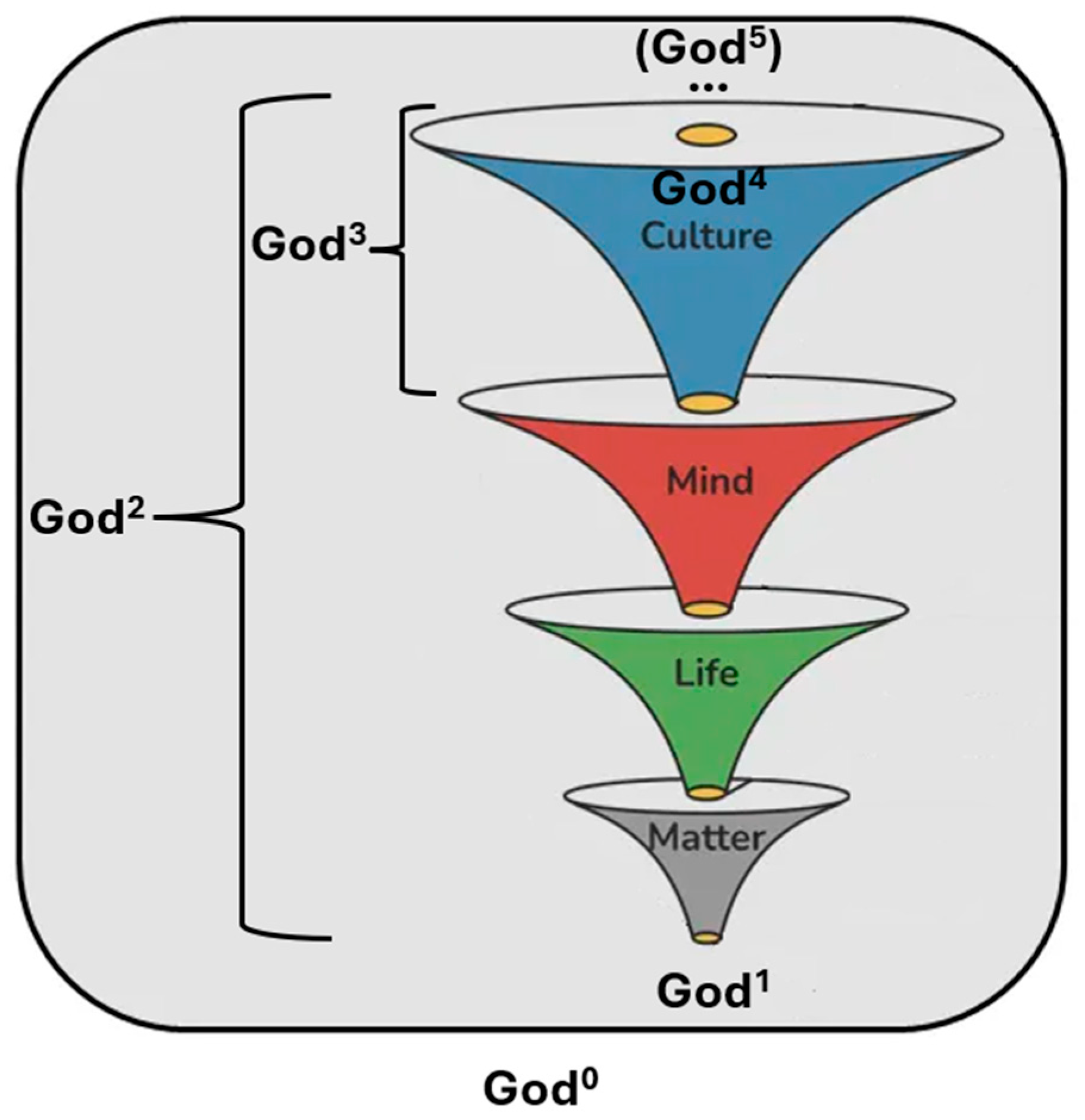
In sum, the language of God can be pointing to different modes of divine expression along the axis of cosmic complexification. We can differentiate these for greater conceptual clarity and refer to: God
0 as the God that is beyond/prior to Being; God
1 as Ground of all Being/Being itself; God
2 as the negentropic principle cohering and orienting all beings across scales; God
3 as that principle finding expression as a personally inflected form in human Culture specifically; God
4 as the current, most developed form of God available to Culture; and God
5 as the hypothetical ultimate culmination point of God as fully realized in the future, to which all forms are progressively tending in an asymptotic fashion as an infinitely deepening singularity (
Figure 2).
The aspect of divinity principally theorized above, then, as psychologically mediated, emergently activated potential should be understood as primarily concerning just one part of this spectrum (God
3–4 specifically),
9 though the DEPTH model as a meta-theology allows us to consider divinity across the entire continuum. Indeed, God is a deep reality with levels the human mind cannot fathom. “O the depth of the riches and wisdom and knowledge of God!” (Romans 11:33).
This approach would thus seem capable of accommodating a range of theological insights within a coherent framework. Indeed, as paradigmatically metamodern (sometimes also referred to as “integrative,” “integrated,” or “integral”), it explicitly aspires to synthesize truths from traditional, modern, and postmodern theological traditions. At the same time, it extends a theological line of thought that already has deep roots in, for example, the process theology of Alfred North Whitehead, John Cobb, David Ray Griffin, and Matt Segall; the cosmogenesis theology of Pierre Teilhard de Chardin, Ilia Delio, Thomas Berry, Mary Evelyn Tucker, and Brian Swimme; the Jungian theology of Erich Neumann, Edward Edinger, and Jordan Peterson; the integral (and integral-informed) theology of Ken Wilber, Paul Smith, Fr. Richard Rohr, and Brian McLaren; the open and relational theology of Thomas Jay Oord, Tripp Fuller, Andrew Davis, and Chad Bahl; and the emergentist theologies of Stuart Kauffman and Nancy Ellen Abrams (to name a few).
What the DEPTH model uniquely adds to such lines of theological thought is a robust bridge that can link classical theological concepts with those from contemporary complex systems science. Divinity is neither supernaturally hypostatized nor erased by natural science, neither radically subjectivized nor diffused into philosophical abstraction. Approaching God with DEPTH honors the reality of the divine in all its historical forms and phases.
What it cannot accommodate, and seeks actively to transcend, is a conception of God that lacks dynamism and the capacity for ongoing evolution. Whereas the necessity to place God in history once appeared to undermine God’s reality, a metamodern theology would see it just the other way: a God completely beyond space and time is nothing and never could be. It is precisely because of the evolutionary dynamics driving cosmic complexification that God as we know him can be real at all. And it is those same dynamics that allow us to revere the sacred Mystery before us, with us, and to come.