A Parallel STPA–FTA Risk Assessment Framework for Maritime Autonomous Surface Ships: Development and Case Study Application †


Abstract
1. Introduction
2. Materials and Methods
2.1. Research Methodology Overview
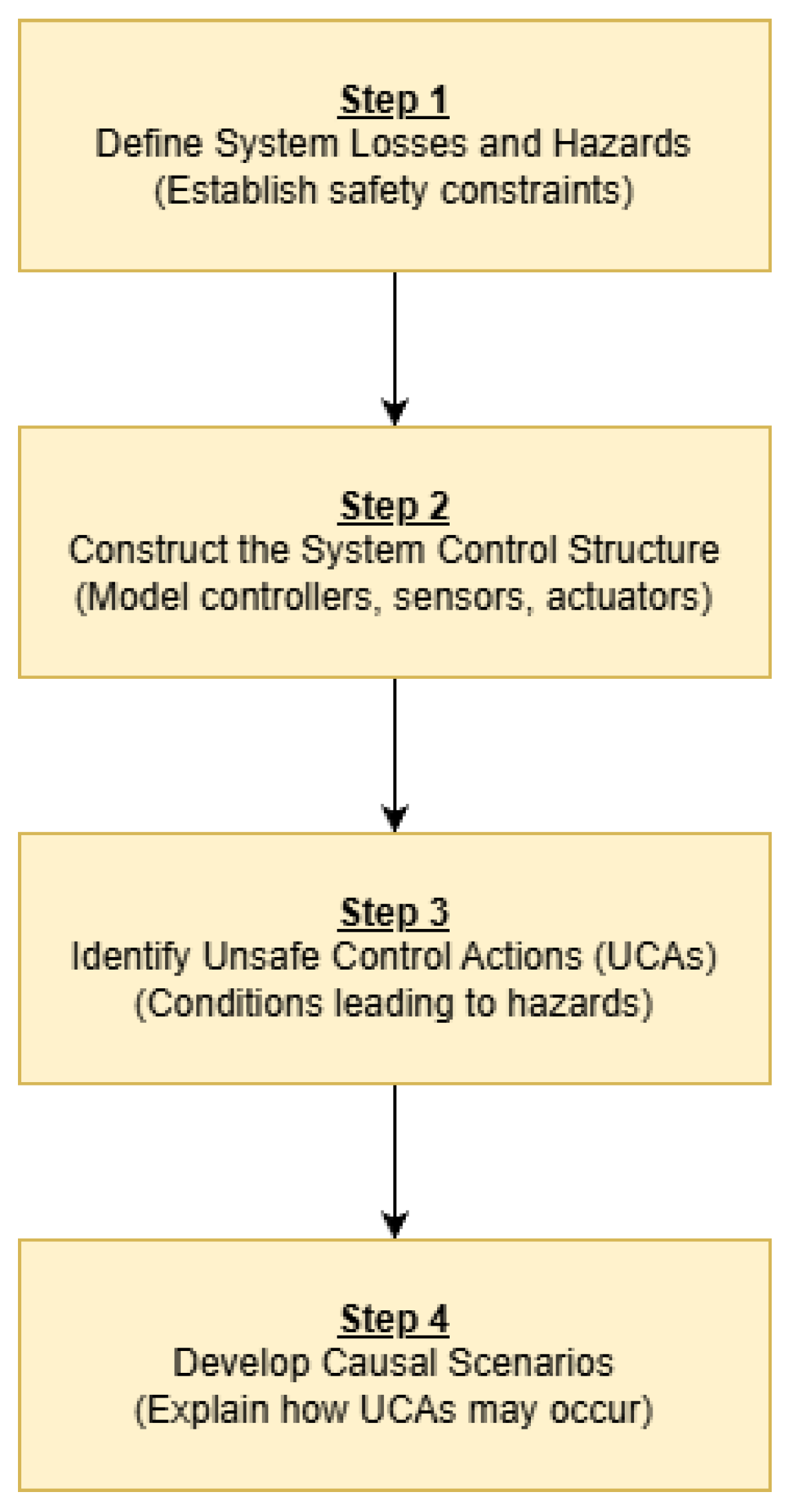
2.2. System-Theoretic Process Analysis (STPA)
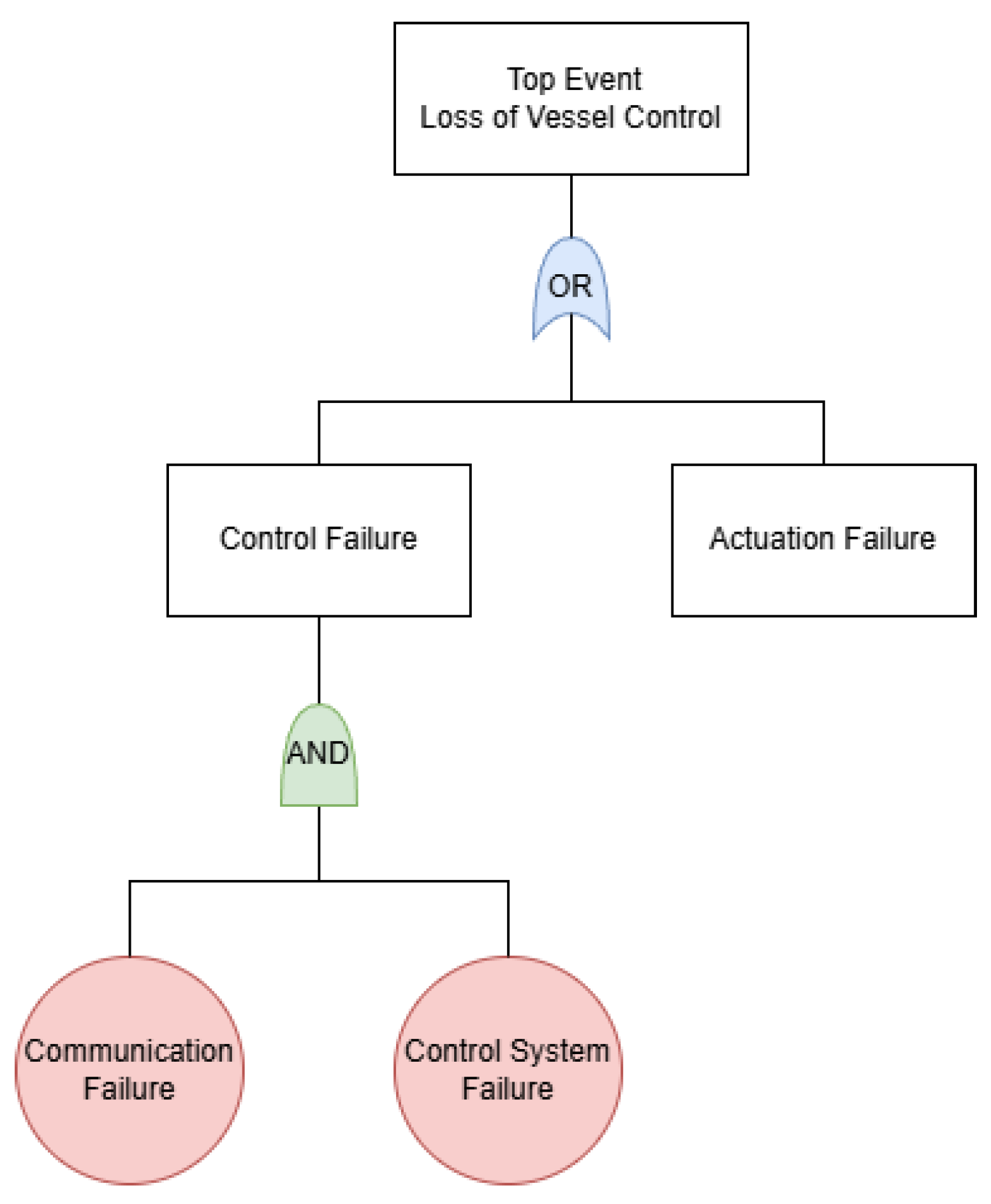
2.3. Fault Tree Analysis (FTA)
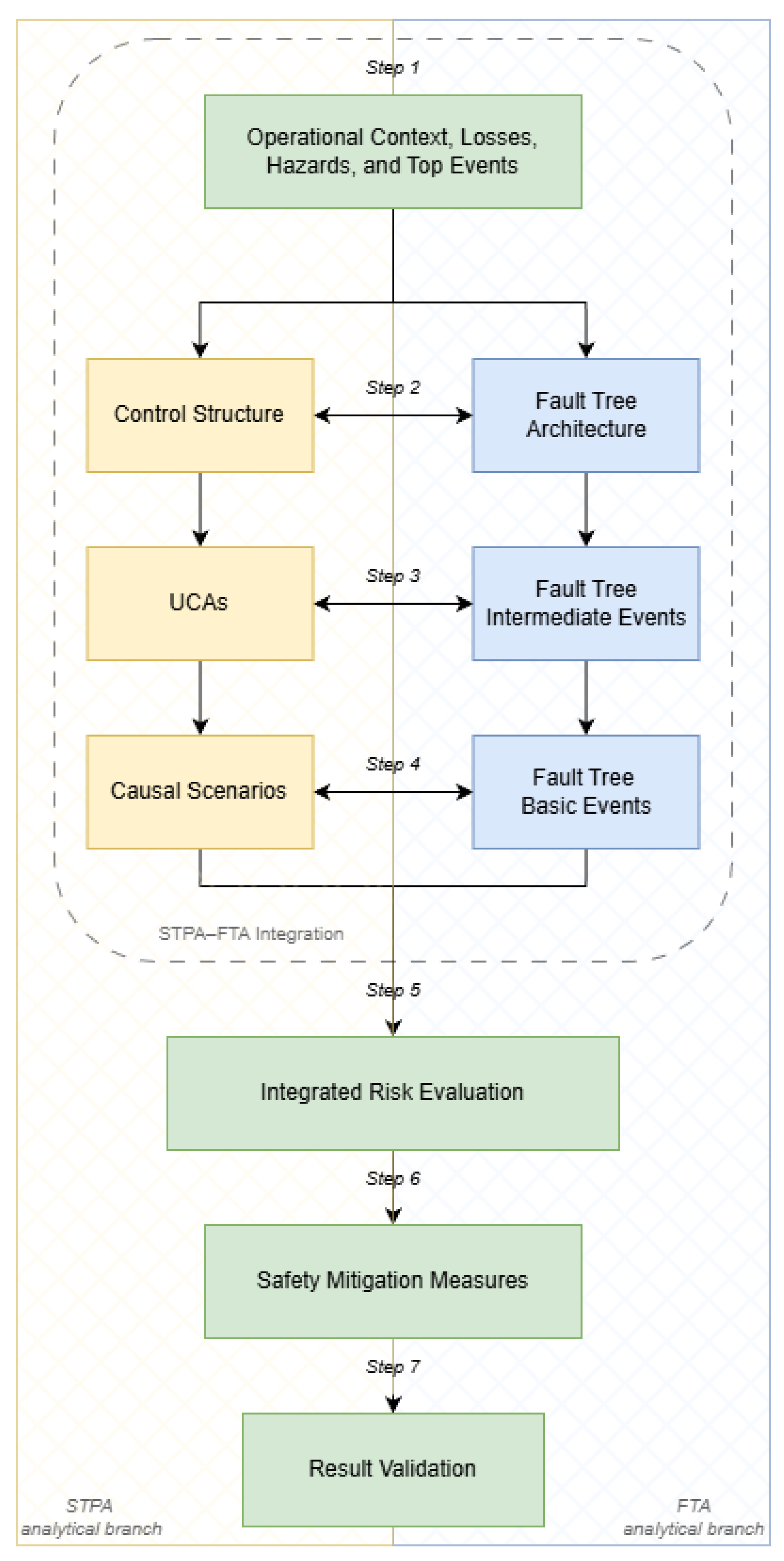
2.4. Parallel STPA–FTA Integration Framework
2.5. Analytical Workflow of the Framework
- Step 1—Definition of Operational Context, Losses, Hazards, Failure Domains, and Top Events
- Step 2—Development of Control Structure and Fault Tree Architecture
- Step 3—Identification of Unsafe Control Actions and Intermediate Fault Tree Events
- Step 4—Development of Causal Scenarios and Basic Fault Tree Events
- Step 5—Evaluation of Risk Significance through Integrated STPA–FTA Analysis
- Step 6—Development and Prioritization of Safety Mitigation Strategies
- Step 7—Result Validation
3. Results
3.1. Case Study Description and Operational Context (Step 1—Part A)
3.2. System Definition: Losses, Hazards, Failure Domains and Top Event (Step 1—Part B)
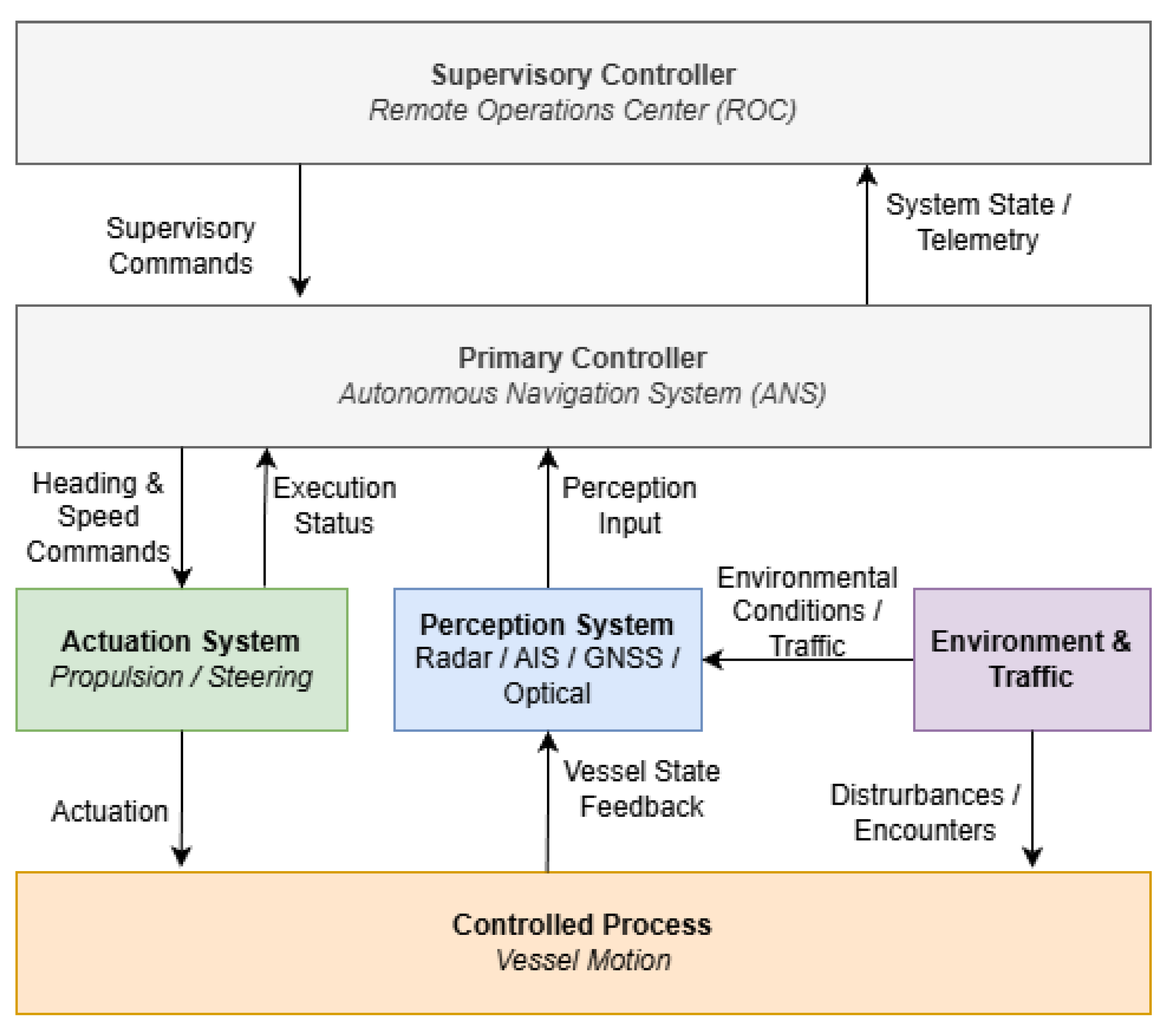
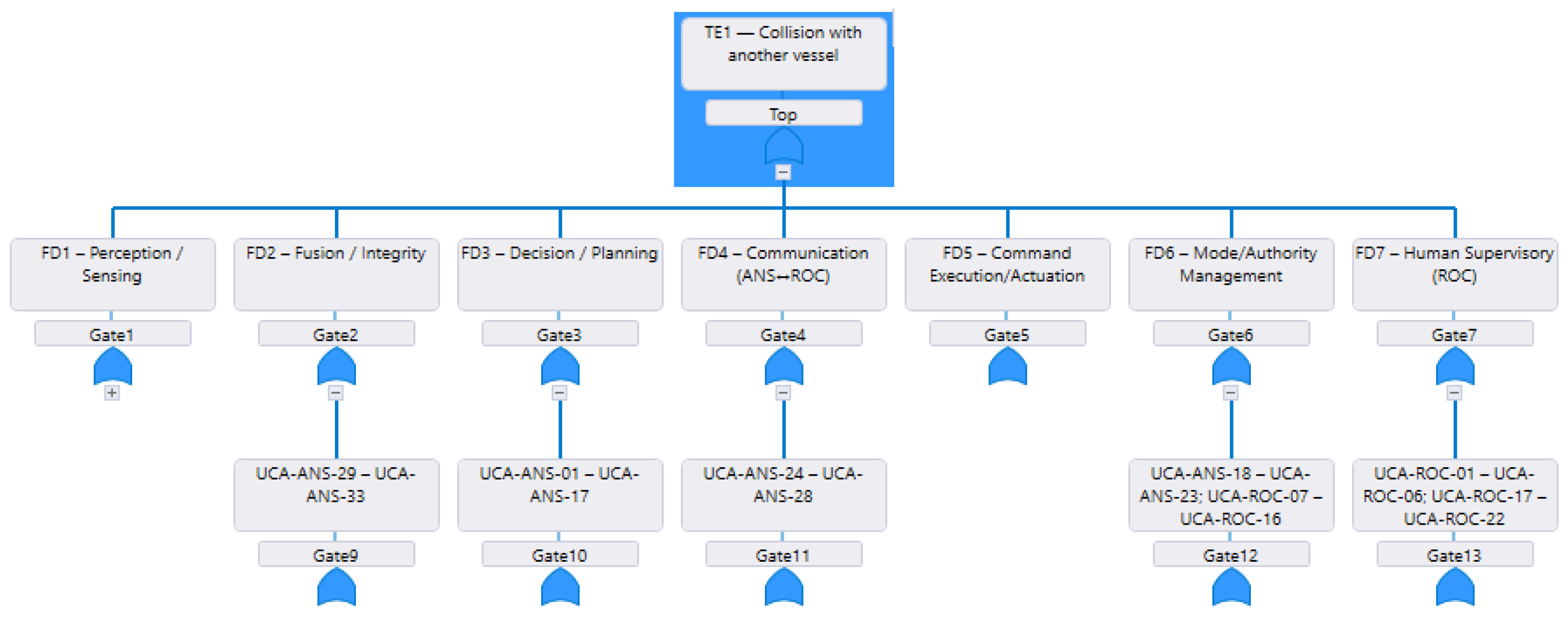
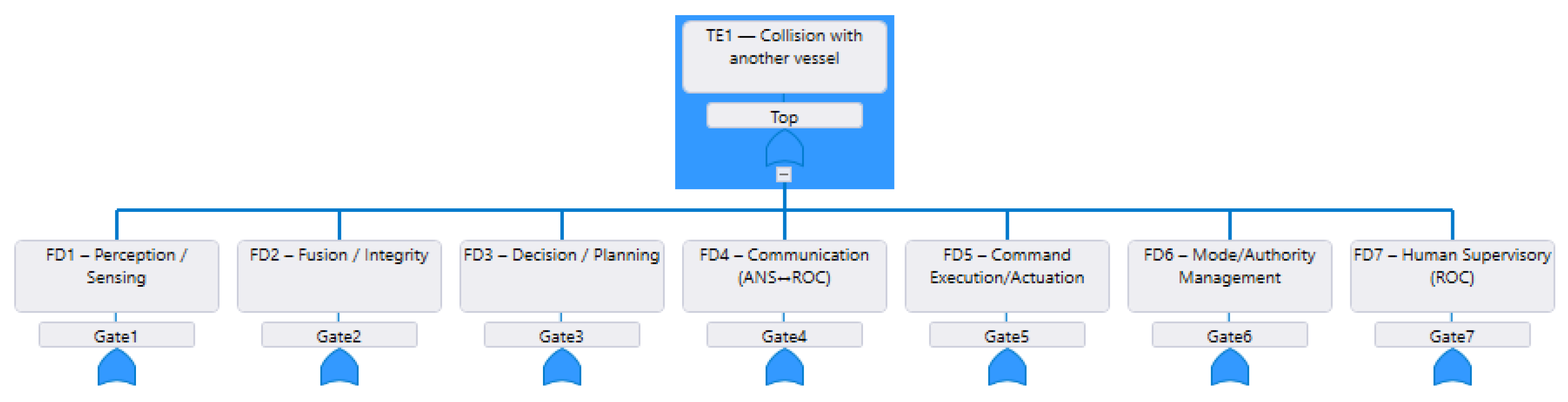
3.3. System Control Structure and Fault Tree Architecture (Step 2)
3.4. Unsafe Control Actions and Intermediate Fault Tree Events (Step 3)
- a required control action is not provided when needed
- an incorrect or unsafe control action is provided
- a control action is provided too early, too late, or in an incorrect order
- a control action is applied for too long or stopped too soon
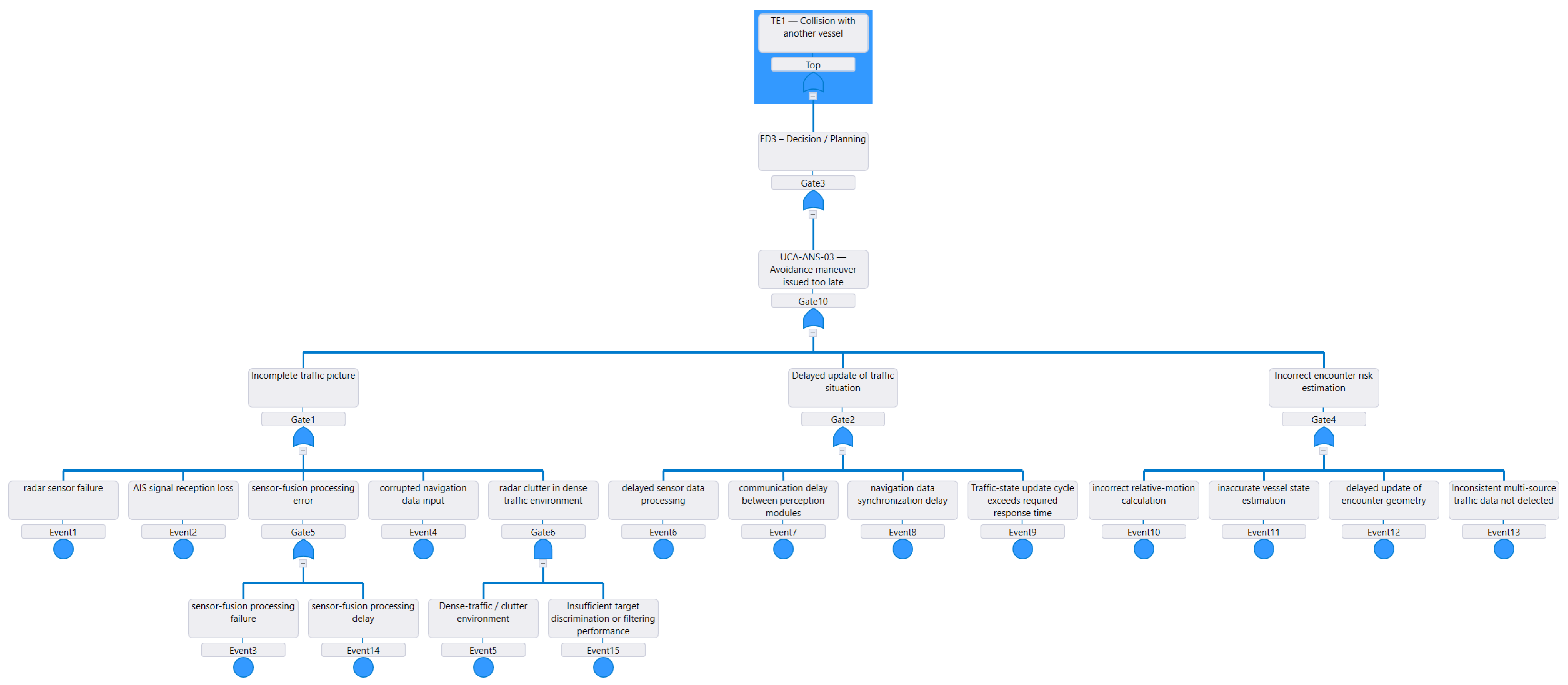
3.5. Causal Scenario Development and Fault Tree Refinement (Step 4)
- CS-1—Incomplete traffic picture leading to delayed avoidance maneuver.
- CS-2—Communication latency preventing timely supervisory intervention.
- CS-3—Authority handover conflict between ANS and ROC.
- CS-4—Actuation deviation not detected by the controller.
- CS-5—Incorrect collision-risk assessment by the ANS.
3.6. Risk Significance Evaluation Through Integrated STPA-FTA Analysis (Step 5)
- DP1—Perception and situational-awareness degradation pathway (CS-1)
- DP2—Communication disturbance pathway (CS-2)
- DP3—Authority allocation and mode-coordination pathway (CS-3)
- DP4—Actuation and maneuver-execution deviation pathway (CS-4)
- DP5—Decision-algorithm collision-risk assessment pathway (CS-5)
3.7. Safety Mitigation Strategies (Step 6)
- Perception and situational-awareness robustness (DP1)—improving reliability of traffic detection and sensor-fusion processes
- Communication resilience between the vessel and the Remote Operations Centre (DP2)—ensuring timely supervisory awareness and intervention capability
- Authority-management coordination between the Autonomous Navigation System (ANS) and the Remote Operations Centre (DP3)—preventing conflicting control actions during authority transitions
- Execution monitoring and maneuver verification (DP4)—ensuring that commanded maneuvers are correctly executed and deviations are detected
- Collision-risk assessment robustness within the decision-making algorithms (DP5)—improving the reliability of encounter evaluation and maneuver planning
3.8. Result Validation (Step 7)
- First, the analysis was reviewed for internal structural consistency across the seven-step workflow. In particular, it was confirmed that the operational context and system boundary defined in Step 1 remained stable throughout the analysis; that the Hierarchical Control Structure developed in Step 2 remained consistent with the Unsafe Control Actions identified in Step 3; that the causal scenarios developed in Step 4 plausibly explained the selected UCAs; and that the representative fault-tree branches refined in Steps 4 and 5 remained traceable to the corresponding failure domains, unsafe functional conditions, and dominant accident pathways.
- Second, the results were examined for causal plausibility within the operational context of the case study. This review considered whether the dominant accident pathways identified in Step 5 were credible for a DoA3 short-sea vessel operating under high-density traffic conditions with ROC supervision. In this respect, the resulting pathways, i.e., perception degradation, communication disturbance, authority-coordination conflict, actuation deviation, and decision-algorithm error, were found to be consistent with the control architecture, mission assumptions, and degraded/fallback conditions represented in the case study.
- Third, the analysis was reviewed for traceability completeness. Particular attention was given to the preservation of the analytical chain linking losses, hazards, unsafe control actions, causal scenarios, fault-tree branches, minimal cut sets, dominant accident pathways, and mitigation strategies. This traceability is a core requirement of the proposed framework and constitutes one of the principal validation criteria for the integrated STPA–FTA application.
4. Discussion
5. Conclusions
Author Contributions
Funding
Data Availability Statement
Acknowledgments
Conflicts of Interest
Abbreviations
| ANS | Autonomous Navigation System |
| BN | Bayesian Network |
| CCF | Common-Cause Failure |
| CMF | Common-Mode Failure |
| ConOps | Concept of Operation |
| CS | Causal Scenario |
| DoA | Degree of Autonomy |
| DP | Dominant Accident Pathway |
| EMSA | European Maritime Safety Agency |
| FD | Failure Domain |
| FMEA | Failure Modes and Effects Analysis |
| FTA | Fault Tree Analysis |
| HAZID | Hazard Identification |
| HAZOP | Hazard and Operability Study |
| IMO | International Maritime Organization |
| MASS | Maritime Autonomous Surface Ships |
| MCS | Minimal Cut Sets |
| MoO | Mode of Operation |
| ODD | Operational Design Domain |
| OE | Operational Envelope |
| RBAT | Risk-Based Assessment Tool |
| ROC | Remote Operations Centre |
| STAMP | Systems-Theoretic Accident Model and Processes |
| STPA | System-Theoretic Process Analysis |
| UCA | Unsafe Control Action |
Appendix A. Supporting Analytical Tables

| Hazard ID | Hazard Description |
|---|---|
| H1 | Inadequate situational awareness for the current encounter context, including missing or incorrect targets, degraded tracking or classification, or an incomplete traffic picture. |
| H2 | Unsafe or non-compliant maneuver command issued, such as a trajectory, speed, or heading command that increases collision or grounding risk or conflicts with COLREG intent. |
| H3 | Required risk-reducing maneuver not issued or executed in time during a developing encounter situation. |
| H4 | Operation outside the validated Operational Envelope (OE) or Operational Design Domain (ODD), including cases where sensing or communication degradation persists without detection or without activation of defined degraded-state behavior. |
| H5 | Remote supervisory or override function unavailable or delayed beyond safe limits during operational phases where supervisory intervention is required (Degree of Autonomy 3 specific). |
| H6 | Command execution deviates materially from intended behavior without timely detection, resulting in actuation or maneuver execution mismatch that is not detected or compensated. |
| H7 | Hazardous interaction between shipboard autonomy and Remote Operations Centre control, including mode confusion, conflicting commands, or unclear authority handover (Degree of Autonomy 3 specific). |
| H8 | Integrity of critical navigation inputs (sensor or communication data) compromised without timely detection, leading to incorrect situational awareness or decision-making. |
| Failure Domain | Description |
|---|---|
| FD1—Perception/Sensing | Failures affecting sensor availability or detection capability, including sensor outage, interference, misdetection, or misclassification of surrounding traffic. |
| FD2—Fusion/Integrity | Failures related to track fusion and integrity monitoring, including inconsistent or stale traffic information, integrity monitoring failure, or unverified or maliciously altered input data. |
| FD3—Decision/Planning | Failures affecting encounter assessment, COLREG reasoning, or maneuver planning logic resulting in unsafe trajectory generation. |
| FD4—Communication (ANS↔ROC) | Failures in the communication link between the Autonomous Navigation System and the Remote Operations Centre, including loss, latency, corruption, or bandwidth degradation affecting supervision or override capability, including cybersecurity-induced corruption or unauthorized command injection. |
| FD5—Command Execution/Actuation | Failures affecting maneuver execution, including steering or thrust commands not executed correctly or vessel response deviating from commanded behavior. |
| FD6—Mode/Authority Management | Failures in control authority allocation, including mode confusion, conflicting control commands, or improper handover between autonomous and supervisory control. |
| FD7—Human Supervisory (ROC) | Failures associated with remote human supervision, including delayed intervention, incorrect interpretation of system state, or incorrect override decisions. |
| UCA ID | Control Action | Unsafe Control Condition | STPA Category | Linked Hazard(s) |
|---|---|---|---|---|
| UCA-ANS-01 | Issue heading/course change command | No course-change command is issued when an avoidance turn is required in a developing encounter. | Not provided when required | H3, H2 |
| UCA-ANS-02 | Issue heading/course change command | A course-change command is issued although no collision-avoidance maneuver is required. | Provided when not required | H2 |
| UCA-ANS-03 | Issue heading/course change command | A course-change command is issued too late to achieve the required safe separation distance. | Provided too late | H3 |
| UCA-ANS-04 | Issue heading/course change command | A course-change command is issued prematurely before a stable encounter assessment is available. | Provided too early | H2 |
| UCA-ANS-05 | Issue heading/course change command | A course-change command is issued in an incorrect sequence relative to other maneuver commands (e.g., relative to speed update). | Wrong order | H2 |
| UCA-ANS-06 | Issue heading/course change command | A course-change command is maintained too long or terminated too early, resulting in an unsafe maneuver execution. | Applied too long/stopped too soon | H2 |
| UCA-ANS-07 | Issue speed/thrust command | No speed adjustment is issued when speed reduction is required to safely manage an encounter. | Not provided when required | H3 |
| UCA-ANS-08 | Issue speed/thrust command | A speed adjustment command is issued although no change in speed is required. | Provided when not required | H2 |
| UCA-ANS-09 | Issue speed/thrust command | A speed adjustment command is issued too late to influence vessel maneuverability. | Provided too late | H3 |
| UCA-ANS-10 | Issue speed/thrust command | A speed adjustment command is issued prematurely, reducing maneuverability under normal navigation conditions. | Provided too early | H2 |
| UCA-ANS-11 | Issue speed/thrust command | A speed command is maintained too long or terminated prematurely, resulting in an unsafe speed profile. | Applied too long/stopped too soon | H2 |
| UCA-ANS-12 | Issue trajectory/maneuver plan update (collision avoidance) | No trajectory update is issued when a maneuver re-planning is required to maintain safe navigation. | Not provided when required | H3, H2 |
| UCA-ANS-13 | Issue trajectory/maneuver plan update (collision avoidance) | A trajectory update is issued although no maneuver adjustment is required. | Provided when not required | H2 |
| UCA-ANS-14 | Issue trajectory/maneuver plan update (collision avoidance) | A trajectory update is issued too late to safely resolve the encounter. | Provided too late | H3 |
| UCA-ANS-15 | Issue trajectory/maneuver plan update (collision avoidance) | A trajectory update is issued prematurely based on incomplete situational awareness. | Provided too early | H1, H2 |
| UCA-ANS-16 | Issue trajectory/maneuver plan update (collision avoidance) | A trajectory update is issued while the vessel is under ROC authority or during an ongoing authority handover. | Wrong order | H7 |
| UCA-ANS-17 | Issue trajectory/maneuver plan update (collision avoidance) | The trajectory plan remains active too long or is terminated prematurely despite changes in traffic conditions. | Applied too long/stopped too soon | H2 |
| UCA-ANS-18 | Initiate mode transition | Mode transition is not initiated when degradation or ODD exceedance requires fallback behavior. | Not provided when required | H4, H7 |
| UCA-ANS-19 | Initiate mode transition | Mode transition is initiated when not required, creating unnecessary operational disruption and authority confusion. | Provided when not required | H7 |
| UCA-ANS-20 | Initiate mode transition | Mode transition is initiated too late after degradation is detected, leaving unsafe operation ongoing. | Provided too late | H4 |
| UCA-ANS-21 | Initiate mode transition | Mode transition is initiated too early (false-positive degradation), causing inappropriate fallback behavior in critical phases. | Provided too early | H4, H7 |
| UCA-ANS-22 | Initiate mode transition | Mode transition is commanded during an authority handover before the ROC is confirmed ready to assume control. | Wrong order | H7, H5 |
| UCA-ANS-23 | Initiate mode transition | Fallback/degraded mode is maintained too long/exited too soon, resulting in unsafe capability mismatch in changing conditions. | Applied too long/stopped too soon | H4 |
| UCA-ANS-24 | Request ROC intervention/escalation | Escalation to the ROC is not requested when supervisory intervention is required. | Not provided when required | H5, H7 |
| UCA-ANS-25 | Request ROC intervention/escalation | Escalation is requested when not required, overloading ROC and increasing delay for truly critical events. | Provided when not required | H5 |
| UCA-ANS-26 | Request ROC intervention/escalation | Escalation request is sent too late for effective supervisory intervention. | Provided too late | H5, H3 |
| UCA-ANS-27 | Request ROC intervention/escalation | Escalation request is sent too early, before sufficient system assessment is available, leading to ineffective or conflicting interventions. | Provided too early | H7 |
| UCA-ANS-28 | Request ROC intervention/escalation | Escalation request persists too long or is cancelled prematurely while the unsafe condition remains active. | Applied too long/stopped too soon | H7, H5 |
| UCA-ANS-29 | Input Integrity Validation | Integrity validation of critical navigation inputs is not performed before those inputs are used for encounter assessment. | Not provided when required | H8, H1 |
| UCA-ANS-30 | Input Integrity Validation | Integrity is flagged compromised when not compromised, causing inappropriate degraded behavior | Provided when not required | H4 |
| UCA-ANS-31 | Input Integrity Validation | Integrity compromise is detected or flagged too late to prevent unsafe decision-making | Provided too late | H8, H1, H3 |
| UCA-ANS-32 | Input Integrity Validation | Integrity compromise flag is cleared prematurely, resulting in unsafe trust in navigation inputs that may still be unreliable. | Stopped too soon | H8, H1 |
| UCA-ANS-33 | Input Integrity Validation | Integrity compromise flag remains active longer than required, resulting in unnecessary degraded operation or restriction. | Applied too long | H4 |
| UCA-ROC-01 | Override maneuver (heading/speed/trajectory) | ROC override maneuver is not issued when intervention is required due to unsafe ANS behavior or degraded system capability. | Not provided when required | H5, H2 |
| UCA-ROC-02 | Override maneuver (heading/speed/trajectory) | ROC override maneuver is issued when not required, disrupting a safe ANS maneuver and potentially creating new conflicts. | Provided when not required | H7, H2 |
| UCA-ROC-03 | Override maneuver (heading/speed/trajectory) | ROC override maneuver is issued too late to alter outcome in a developing encounter. | Provided too late | H5, H3 |
| UCA-ROC-04 | Override maneuver (heading/speed/trajectory) | ROC override maneuver is issued before adequate situational assessment is available. | Provided too early | H1, H2 |
| UCA-ROC-05 | Override maneuver (heading/speed/trajectory) | ROC override is issued in the wrong order relative to authority confirmation (commands sent while ANS still in control/unclear authority). | Wrong order | H7 |
| UCA-ROC-06 | Override maneuver (heading/speed/trajectory) | Override command is maintained too long/stopped too soon, producing oscillation or incomplete risk reduction. | Applied too long/stopped too soon | H7, H2 |
| UCA-ROC-07 | Approve/force mode transition | ROC does not approve/force required mode transition under verified degradation/ODD exceedance. | Not provided when required | H4, H5 |
| UCA-ROC-08 | Approve/force mode transition | ROC forces mode transition when not required, creating unnecessary fallback and authority confusion. | Provided when not required | H7, H4 |
| UCA-ROC-09 | Approve/force mode transition | ROC approval/forcing is issued too late, leaving unsafe operation in normal mode. | Provided too late | H4, H5 |
| UCA-ROC-10 | Approve/force mode transition | ROC approval/forcing is issued in the wrong order relative to handover (e.g., approves fallback after authority already assumed/released without sync). | Wrong order | H7 |
| UCA-ROC-11 | Execute authority handover (assume/release control) | ROC does not assume control when required (e.g., ANS requests escalation and degradation prevents safe autonomy). | Not provided when required | H5, H7 |
| UCA-ROC-12 | Execute authority handover (assume/release control) | ROC assumes/releases authority when not required, creating mode confusion and conflicting commands. | Provided when not required | H7 |
| UCA-ROC-13 | Execute authority handover (assume/release control) | Authority handover occurs too late to provide effective control. | Provided too late | H5, H3 |
| UCA-ROC-14 | Execute authority handover (assume/release control) | Authority handover occurs too early (before communication stability and situational awareness are sufficient), increasing unsafe intervention risk. | Provided too early | H1, H7 |
| UCA-ROC-15 | Execute authority handover (assume/release control) | Authority handover is executed in the wrong order relative to mode confirmation (handover without confirmed state alignment). | Wrong order | H7 |
| UCA-ROC-16 | Execute authority handover (assume/release control) | Authority is held too long/released too soon, causing unstable responsibility allocation during multi-phase operations. | Applied too long/stopped too soon | H7 |
| UCA-ROC-17 | Impose supervisory operational constraints (e.g., speed limit, conservative policy) | ROC does not impose supervisory constraints when required (e.g., reduced visibility/high traffic/degraded sensors). | Not provided when required | H5, H4 |
| UCA-ROC-18 | Impose supervisory operational constraints (e.g., speed limit, conservative policy) | ROC imposes constraints when not required, causing unsafe maneuver limitations (e.g., inability to comply with COLREG due to too strict speed limit). | Provided when not required | H2, H7 |
| UCA-ROC-19 | Impose supervisory operational constraints (e.g., speed limit, conservative policy) | Constraints are imposed too late to influence decision/execution. | Provided too late | H5, H3 |
| UCA-ROC-20 | Impose supervisory operational constraints (e.g., speed limit, conservative policy) | Constraints are imposed too early (before situation assessment), causing suboptimal/unsafe behavior in dynamic encounters. | Provided too early | H1, H2 |
| UCA-ROC-21 | Impose supervisory operational constraints (e.g., speed limit, conservative policy) | Constraints are imposed in the wrong order relative to authority/mode change (constraint conflicts with current control policy state). | Wrong order | H7 |
| UCA-ROC-22 | Impose supervisory operational constraints (e.g., speed limit, conservative policy) | Constraints are maintained too long/removed too soon, creating policy oscillation or unsafe relaxation of operational constraints. | Applied too long/stopped too soon | H4, H7 |
| Failure Domain | Associated Control Actions | UCAs Localized in Domain | Basis for Assignment |
|---|---|---|---|
| FD1—Perception/Sensing | —(input generation/sensing functions) | — | No UCAs are localized in this domain at Step 3 because sensing functions do not issue control actions; failures in sensing/perception are represented as component-level/basic events during later FTA refinement (Step-5) and as causal factors in Step-4 scenarios. |
| FD2—Fusion/Integrity | Input Integrity Validation | UCA-ANS-29–UCA-ANS-33 | Integrity monitoring and validation of critical navigation inputs (originating from FD1 and communication sources) prior to encounter assessment and decision-making. |
| FD3—Decision/Planning | Issue heading/course change command Issue speed/thrust command Issue trajectory/maneuver plan update | UCA-ANS-01–UCA-ANS-17 | Unsafe maneuver planning, timing, and trajectory generation within ANS decision logic. |
| FD4—Communication (ANS–ROC) | Request ROC intervention/escalation | UCA-ANS-24–UCA-ANS-28 | Unsafe supervisory interaction mediated through the ANS-ROC communication interface (escalation timing/necessity/duration). |
| FD5—Command Execution/Actuation | —(execution/actuation response) | — | No UCAs are localized in this domain at Step-3 because actuation does not originate control actions; execution deviations are represented through component-level/basic events and detection/compensation failures during later FTA refinement (Step-5). |
| FD6—Mode/Authority Management | Initiate mode transition Approve/force mode transition Execute authority handover | UCA-ANS-18–UCA-ANS-23; UCA-ROC-07–UCA-ROC-16 | Mode transitions and authority allocation/transfer between ANS and ROC. |
| FD7—Human Supervisory (ROC) | Override maneuver Impose supervisory operational constraints | UCA-ROC-01–UCA-ROC-06; UCA-ROC-17–UCA-ROC-22 | ROC supervisory intervention (override) and policy/constraint imposition affecting ANS behavior. |
| Minimal Cut Set | Order | Basic Event(s) | Interpretation |
|---|---|---|---|
| MCS-1 | 1 | Radar sensor failure | Loss of primary traffic detection capability |
| MCS-2 | 1 | AIS signal reception loss | Loss of AIS-based vessel identification and traffic awareness |
| MCS-3 | 1 | Sensor-fusion processing failure or delay | Failure or excessive latency in fusion processing preventing timely construction of the traffic picture |
| MCS-4 | 1 | Corrupted navigation data input | Invalid navigation inputs propagating to perception and decision modules |
| MCS-5 | 1 | Sensor data processing or synchronization delay | Timing misalignment between sensing modules affecting traffic state estimation |
| MCS-6 | 1 | Incorrect motion or vessel state estimation | Errors in relative-motion or vessel state calculation affecting encounter assessment |
| MCS-7 | 1 | Inconsistent multi-source traffic data not detected | Integrity monitoring failure allowing conflicting sensor inputs |
| MCS-8 | 2 | Dense traffic environment + insufficient target discrimination capability | Environmental complexity combined with insufficient filtering performance |
References
- Utne, I.B.; Rokseth, B.; Sørensen, A.J.; Vinnem, J.E. Towards Supervisory Risk Control of Autonomous Ships. Reliab. Eng. Syst. Saf. 2020, 196, 106757. [Google Scholar] [CrossRef]
- Wróbel, K.; Montewka, J.; Kujala, P. Towards the Development of a System-Theoretic Model for Safety Assessment of Autonomous Merchant Vessels. Reliab. Eng. Syst. Saf. 2018, 178, 209–224. [Google Scholar] [CrossRef]
- Burmeister, H.-C.; Bruhn, W.; Rødseth, Ø.J.; Porathe, T. Autonomous Unmanned Merchant Vessel and Its Contribution towards the E-Navigation Implementation: The MUNIN Perspective. Int. J. E-Navig. Marit. Econ. 2014, 1, 1–13. [Google Scholar] [CrossRef]
- Ferreira, F.; Alves, J.; Leporati, C.; Bertolini, A.; Bargelli, E. Current Regulatory Issues in the Usage of Autonomous Surface Vehicles. In Proceedings of the 2018 OCEANS—MTS/IEEE Kobe Techno-Oceans (OTO), Kobe, Japan, 28–31 May 2018; IEEE: Piscataway, NJ, USA, 2018; pp. 1–9. [Google Scholar]
- Banda, O.A.V.; Kannos, S.; Goerlandt, F.; van Gelder, P.H. A Systemic Hazard Analysis and Management Process for the Concept Design Phase of an Autonomous Vessel. Reliab. Eng. Syst. Saf. 2019, 191, 106584. [Google Scholar] [CrossRef]
- Hatledal, L.I.; Skulstad, R.; Li, G.; Styve, A.; Zhang, H. Co-Simulation as a Fundamental Technology for Twin Ships. MIC 2020, 41, 297–311. [Google Scholar] [CrossRef]
- International Maritime Organization (IMO). IMO MSC.1/Circ.1638—Outcome of the Regulatory Scoping Exercise for the Use of Maritime Autonomous Surface Ships (MASS); IMO: London, UK, 2021. [Google Scholar]
- International Maritime Organization (IMO). IMO MSC.108/4—Development of a Goal-Based Instrument for Maritime Autonomous Surface Ships (MASS); IMO: London, UK, 2024. [Google Scholar]
- International Maritime Organization (IMO). IMO MSC.109/5—Development of a Goal-Based Instrument For Maritime Autonomous Surface Ships (MASS); IMO: London, UK, 2024. [Google Scholar]
- American Bureau of Shipping (ABS). ABS Requirements for Autonomous and Remote Control Functions; ABS: Houston, TX, USA, 2024. [Google Scholar]
- DNV. Autonomous and Remotely Operated Ships; DNV-CG-0264; DNV: Høvik, Norway, 2024. [Google Scholar]
- Bureau Veritas BV. Guidelines for Autonomous Shipping; Guidance Note NI 641 DT R01 E; Bureau Veritas: Paris, France, 2019. [Google Scholar]
- European Maritime Safety Agency EMSA. RBAT Part 3 Final Report; EMSA: Lisbon, Portugal, 2024.
- European Maritime Safety Agency EMSA. RBAT Method Description (Rev.4.2); EMSA: Lisbon, Portugal, 2025.
- American Bureau of Shipping ABS. Guidance Notes on Risk Assessment Applications for the Marine and Offshore Industries; ABS: Houston, TX, USA, 2020. [Google Scholar]
- Chaal, M.; Ren, X.; BahooToroody, A.; Basnet, S.; Bolbot, V.; Banda, O.A.V.; Gelder, P.V. Research on Risk, Safety, and Reliability of Autonomous Ships: A Bibliometric Review. Saf. Sci. 2023, 167, 106256. [Google Scholar] [CrossRef]
- Tao, J.; Liu, Z.; Wang, X.; Cao, Y.; Zhang, M.; Loughney, S.; Wang, J.; Yang, Z. Hazard Identification and Risk Analysis of Maritime Autonomous Surface Ships: A Systematic Review and Future Directions. Ocean Eng. 2024, 307, 118174. [Google Scholar] [CrossRef]
- Li, Z.; Zhang, D.; Han, B.; Wan, C. Risk and Reliability Analysis for Maritime Autonomous Surface Ship: A Bibliometric Review of Literature from 2015 to 2022. Accid. Anal. Prev. 2023, 187, 107090. [Google Scholar] [CrossRef]
- Zhou, X.-Y.; Liu, Z.-J.; Wang, F.-W.; Wu, Z.-L.; Cui, R.-D. Towards Applicability Evaluation of Hazard Analysis Methods for Autonomous Ships. Ocean Eng. 2020, 214, 107773. [Google Scholar] [CrossRef]
- Voutzoulidis, K.G.; Tigkas, I.G. Addressing Risk in Autonomous Shipping: A Combined Parallel STPA and FTA Framework. In Innovations in Sustainable Maritime Technology—IMAM 2025; Spyrou, K.J., Themelis, N., Eds.; Springer Nature Switzerland: Cham, Switzerland, 2025; pp. 235–248. ISBN 978-3-032-02101-4. [Google Scholar]
- Park, H.; Kim, J. STPA Analysis for Safe Operation of Maritime Autonomous Surface Ship under Degradation State. Front. Mar. Sci. 2025, 12, 1601515. [Google Scholar] [CrossRef]
- Gomola, A.; Bouwer Utne, I. A Novel STPA Approach to Software Safety and Security in Autonomous Maritime Systems. Heliyon 2024, 10, e31483. [Google Scholar] [CrossRef]
- Gu, Q.; Deng, B.; He, Y.; Zhang, Y.; Cheng, L.; Wang, Y. MarineSeg: A CNN–Transformer Hybrid Architecture with Feature Voting Decoder for Robust Semantic Segmentation in USV-Captured Images. Neurocomputing 2026, 671, 132597. [Google Scholar] [CrossRef]
- Yamada, T.; Sato, M.; Kuranobu, R.; Watanabe, R.; Itoh, H.; Shiokari, M.; Yuzui, T. Evaluation of Effectiveness of the STAMP/STPA in Risk Analysis of Autonomous Ship Systems. J. Phys. Conf. Ser. 2022, 2311, 012021. [Google Scholar] [CrossRef]
- Chaal, M.; Valdez Banda, O.A.; Glomsrud, J.A.; Basnet, S.; Hirdaris, S.; Kujala, P. A Framework to Model the STPA Hierarchical Control Structure of an Autonomous Ship. Saf. Sci. 2020, 132, 104939. [Google Scholar] [CrossRef]
- Leveson, N.; Thomas, J. STPA Handbook; Massachusetts Institute of Technology (MIT): Cambridge, MA, USA, 2018. [Google Scholar]
- Basnet, S.; BahooToroody, A.; Chaal, M.; Lahtinen, J.; Bolbot, V.; Valdez Banda, O.A. Risk Analysis Methodology Using STPA-Based Bayesian Network- Applied to Remote Pilotage Operation. Ocean Eng. 2023, 270, 113569. [Google Scholar] [CrossRef]
- Yang, X.; Zhu, Y.; Zhou, T.; Xu, S.; Zhang, W.; Zhou, X.; Meng, X. Integrating Software FMEA and STPA to Develop a Bayesian Network-Based Software Risk Model for Autonomous Ships. JMSE 2023, 12, 4. [Google Scholar] [CrossRef]
- Nakashima, T.; Kureta, R.; Khastgir, S. Addressing Systemic Risks in Autonomous Maritime Navigation: A Structured STPA and ODD-Based Methodology. Reliab. Eng. Syst. Saf. 2025, 261, 111041. [Google Scholar] [CrossRef]
- Basnet, S.; BahooToroody, A.; Montewka, J.; Chaal, M.; Valdez Banda, O.A. Selecting Cost-Effective Risk Control Option for Advanced Maritime Operations; Integration of STPA-BN-Influence Diagram. Ocean Eng. 2023, 280, 114631. [Google Scholar] [CrossRef]
- Harkleroad, E.P.; Vela, A.E.; Kuchar, J.K. Review of Systems-Theoretic Process Analysis (STPA) Method and Results to Support NextGen Concept Assessment and Validation; MIT Lincoln Laboratory: Lexington, MA, USA, 2013. [Google Scholar]
- Noh, H.; Kang, K.; Park, J.-Y. Risk Analysis of Autonomous Underwater Vehicle Operation in a Polar Environment Based on Fuzzy Fault Tree Analysis. J. Mar. Sci. Eng. 2023, 11, 1976. [Google Scholar] [CrossRef]
- Sahin, B.; Yazidi, A.; Roman, D.; Soylu, A. Ontology-Based Fault Tree Analysis Algorithms in a Fuzzy Environment for Autonomous Ships. IEEE Access 2021, 9, 40915–40932. [Google Scholar] [CrossRef]
- Li, P.; Wang, Y.; Yang, Z. Risk Assessment of Maritime Autonomous Surface Ships Collisions Using an FTA-FBN Model. Ocean Eng. 2024, 309, 118444. [Google Scholar] [CrossRef]
- Rehail, Y.; Tchouar, N.; Zennir, Y.; Carniel, A. STPA-FTA Hybrid Hazard Analysis Framework Applied to a High Integrity Pressure Protection System. Life Cycle Reliab. Saf. Eng. 2026. [Google Scholar] [CrossRef]
- Zhou, Z.; Mao, H.; Yang, B.; Sun, S. A Novel Method for Risk Identification and Quantitative Assessment in Shale Gas Development Phase Based on STPA-FTA-DEMATEL. Unconv. Resour. 2026, 10, 100301. [Google Scholar] [CrossRef]
- Ventikos, N.P.; Chmurski, A.; Louzis, K. A Systems-Based Application for Autonomous Vessels Safety: Hazard Identification as a Function of Increasing Autonomy Levels. Saf. Sci. 2020, 131, 104919. [Google Scholar] [CrossRef]
- ReVolt—Next Generation Short Sea Shipping. Available online: https://www.dnv.com/news/revolt-next-generation-short-sea-shipping-7279/ (accessed on 26 January 2025).
- European Environment Agency; European Maritime Safety Agency. European Maritime Transport Environmental Report 2025; Publications Office: Luxembourg, 2025. [Google Scholar]
- Eurostat. Maritime Transport Statistics—Short Sea Shipping of Goods; Eurostat: Luxembourg, 2026. [Google Scholar]
- Ahmed, Y.A.; Theotokatos, G.; Maslov, I.; Wennersberg, L.A.L.; Nesheim, D.A. Regulatory and Legal Frameworks Recommendations for Short Sea Shipping Maritime Autonomous Surface Ships. Mar. Policy 2024, 166, 106226. [Google Scholar] [CrossRef]
- Leveson, N.G. Engineering a Safer World: Systems Thinking Applied to Safety; The MIT Press: Cambridge, MA, USA, 2012; ISBN 978-0-262-29824-7. [Google Scholar]
- National Aeronautics and Space Administration (NASA). Fault Tree Analysis: A Bibliography; NASA Special Publication: Washington, DC, USA, 2000. [Google Scholar]
- Vesely, W.E.; Goldberg, F.F.; Roberts, N.H.; Haasl, D.F. NUREG-0492, “Fault Tree Handbook”; U.S. Nuclear Regulatory Commission: Washington, DC, USA, 1981.
- International Electrotechnical Commission. IEC 61025:2006—Fault Tree Analysis (FTA); IEC: Geneva, Switzerland, 2006. [Google Scholar]
- Byun, S.; Papaelias, M.; Márquez, F.P.G.; Lee, D. Fault-Tree-Analysis-Based Health Monitoring for Autonomous Underwater Vehicle. J. Mar. Sci. Eng. 2022, 10, 1855. [Google Scholar] [CrossRef]
- Lee, P.; Bolbot, V.; Theotokatos, G.; Boulougouris, E.; Vassalos, D. Fault Tree Analysis of the Autonomous Navigation for Maritime Autonomous Surface Ships. In Proceedings of the 1st International Conference on the Stability and Safety of Ships and Ocean Vehicles, Online, 6–11 June 2021. [Google Scholar]
- Mahboob, Q.; Straub, D. Comparison of Fault Tree and Bayesian Networks for Modeling Safety Critical Components in Railway Systems. In Safety, Reliability and Risk Analysis: Beyond the Horizon; CRC Press: Boca Raton, FL, USA, 2011; ISBN 978-0-415-68379-1. [Google Scholar]
- European Commission EU. Transport in Figures 2020; Publications Office of the European Union: Luxembourg, 2020. [Google Scholar]
- Port of Rotterdam Authority. Highlights Annual Report; Port of Rotterdam Authority: Rotterdam, The Netherlands, 2024. [Google Scholar]
- Bolbot, V.; Theotokatos, G.; Nesheim, D.A.; Lien Wennersberg, L.A. A Holistic Framework for Autonomous Shipping Safety Security and Cybersecurity Assurance; AUTOSHIP EU Funded Project Deliverable D2.6; 2021; Available online: https://www.researchgate.net/publication/361738310_ (accessed on 16 April 2026).
- Sumon, M.M.A.; Kim, H.; Rokseth, B. Hazard Analysis of Autonomous Vessel Operation during the Interaction and Execution between Remote Operation Centre Controller and Onboard Controllers. J. Shipp. Trade 2025, 10, 25. [Google Scholar] [CrossRef]
- Hoem, Å.S.; Rødseth, Ø.J.; Johnsen, S.O. Adopting the CRIOP Framework as an Interdisciplinary Risk Analysis Method in the Design of Remote Control Centre for Maritime Autonomous Systems. In Advances in Safety Management and Human Performance; Lecture Notes in Networks and Systems; Arezes, P.M., Boring, R.L., Eds.; Springer International Publishing: Cham, Switzerland, 2021; Volume 262, pp. 219–227. ISBN 978-3-030-80287-5. [Google Scholar]
- Blindheim, S.; Johansen, T.A.; Utne, I.B. Risk-Based Supervisory Control for Autonomous Ship Navigation. J. Mar. Sci. Technol. 2023, 28, 624–648. [Google Scholar] [CrossRef]
- Bolbot, V.; Theotokatos, G.; Wennersberg, L.A. A Method to Identify and Rank Objects and Hazardous Interactions Affecting Autonomous Ships Navigation. J. Navig. 2022, 75, 572–593. [Google Scholar] [CrossRef]
- International Maritime Organization. Resolution MSC.255(84)—Adoption of the Code of the International Standards and Recommended Practices for a Safety Investigation into a Marine Casualty or Marine Incident (Casualty Investigation Code); IMO: London, UK, 2008. [Google Scholar]
- Tam, C.; Bucknall, R. Collision Risk Assessment for Ships. J. Mar. Sci. Technol. 2010, 15, 257–270. [Google Scholar] [CrossRef]
- Lee, P.; Theotokatos, G.; Boulougouris, E.; Bolbot, V. Risk-Informed Collision Avoidance System Design for Maritime Autonomous Surface Ships. Ocean Eng. 2023, 279, 113750. [Google Scholar] [CrossRef]
- Sadeghi, R.; Goerlandt, F. Validation of System Safety Hazard Analysis in Safety-Critical Industries: An Interview Study with Industry Practitioners. Saf. Sci. 2023, 161, 106084. [Google Scholar] [CrossRef]
- Zhou, X.-Y.; Jin, S.; Mei, Y.; Sun, X.; Yang, X.; Nie, S.; Zhang, W. Towards Hazard Analysis Result Verification for Autonomous Ships: A Formal Verification Method Based on Timed Automata. J. Mar. Sci. Eng. 2025, 13, 1058. [Google Scholar] [CrossRef]
- Ralyté, J.; Koutsopoulos, G.; Stirna, J. Verification, Validation, and Evaluation of Modeling Methods: Experiences and Recommendations. In Software and Systems Modeling; Springer: Berlin, Germany, 2025. [Google Scholar] [CrossRef]
- Yuzui, T.; Kaneko, F. Toward a Hybrid Approach for the Risk Analysis of Maritime Autonomous Surface Ships: A Systematic Review. J. Mar. Sci. Technol. 2025, 30, 153–176. [Google Scholar] [CrossRef]
- Na, S.; Lee, D.; Baek, J.; Kim, S.; Choung, C. Qualitative Risk Assessment Methodology for Maritime Autonomous Surface Ships: Cognitive Model-Based Functional Analysis and Hazard Identification. J. Mar. Sci. Eng. 2025, 13, 970. [Google Scholar] [CrossRef]
- Shiokari, M.; Itoh, H.; Yuzui, T.; Ishimura, E.; Miyake, R.; Kudo, J.; Kawashima, S. Structure Model-Based Hazard Identification Method for Autonomous Ships. Reliab. Eng. Syst. Saf. 2024, 247, 110046. [Google Scholar] [CrossRef]
- Johansen, T.; Utne, I.B. Human-Autonomy Collaboration in Supervisory Risk Control of Autonomous Ships. J. Mar. Eng. Technol. 2024, 23, 135–153. [Google Scholar] [CrossRef]
- Corsi, P.; Jakovlev, S.; Figari, M.; Djackov, V. Analysis and Definition of Certification Requirements for Maritime Autonomous Surface Ship Operation. J. Mar. Sci. Eng. 2025, 13, 751. [Google Scholar] [CrossRef]




| Aspect | STPA–BN Approaches | Sequential/Loosely Coupled STPA–FTA | Proposed Parallel STPA–FTA Framework |
|---|---|---|---|
| Integration logic | Transformation of STPA results into probabilistic dependency structures, introducing additional modelling complexity | Methods applied in stages and linked, with potential loss of contextual information | Concurrent development within shared system architecture |
| Structural traceability | May be reduced due to transformation into probabilistic dependencies; Reliance on expert judgement | Limited due to separation of analytical stages | Preserved through explicit linkage between control actions and fault-tree elements |
| System representation consistency | Dependent on abstraction into probabilistic models | May lead to inconsistencies between STPA and FTA models | Maintained through shared system architecture |
| Feedback and control representation | Implicit within probabilistic dependencies | Limited representation due to staged modelling | Explicitly represented through integrated control and failure modelling |
| Interpretability | May be reduced due to probabilistic abstraction of system behavior | Dependent on consistency between separate models | Enhanced through direct mapping between system behavior and failure logic |
| Category | Description |
|---|---|
| Loss L1 | Loss of life or serious injury to crew, passengers, or third parties |
| Loss L2 | Total loss of the vessel or loss of seaworthiness resulting from navigational accident |
| Loss L3 | Severe environmental damage or pollution |
| Loss L4 | Major damage to own vessel or third-party assets |
| Hazard H1 | Inadequate situational awareness for encounter context |
| Hazard H2 | Unsafe or non-compliant maneuver command issued |
| Hazard H3 | Required collision-avoidance maneuver not issued in time |
| Hazard H5 | Remote supervisory/override function is unavailable or delayed |
| Top Event | Collision with another vessel |
| Failure Domain FD3 | Decision/planning failure affecting encounter assessment or maneuver selection |
| Failure Domain FD7 | Human supervisory (ROC) failure affecting timely intervention, interpretation, or override decisions |
| UCA ID | Control Action | Unsafe Control Condition | STPA Category | Linked Hazard(s) |
|---|---|---|---|---|
| UCA-ANS-03 | Issue heading/course change command | A course-change command is issued too late to achieve the required safe separation distance. | Provided too late | H3 |
| UCA-ANS-15 | Issue trajectory/maneuver plan update | A trajectory update is issued prematurely based on incomplete situational awareness. | Provided too early | H1, H2 |
| UCA-ROC-01 | Override maneuver (heading/speed/trajectory) | ROC override maneuver is not issued when intervention is required due to unsafe ANS behavior or degraded system capability. | Not provided when required | H5, H2 |
| Dominant Pathway | Representative Mitigation Strategy |
|---|---|
| DP1—Perception degradation | Sensor redundancy, improved sensor-fusion integrity monitoring, and cross-validation of traffic information from multiple sensing sources. |
| DP2—Communication disturbance | Communication redundancy, degraded-mode procedures, and buffered telemetry transmission to ensure continuity of supervisory awareness. |
| DP3—Authority coordination conflict | Explicit authority-management protocols, synchronized mode-transition logic, and confirmation mechanisms for control transfer between ANS and ROC. |
| DP4—Maneuver execution deviation | Closed-loop maneuver monitoring, execution feedback verification, and adaptive control adjustments to compensate for actuation disturbances. |
| DP5—Decision algorithm misclassification | Improved encounter prediction models, validation of collision-risk thresholds, and integration of supervisory monitoring for anomalous decision behavior. |
| Traceability Element | Location |
|---|---|
| Losses (L) | Table 2 |
| ↓ | |
| Hazards (H) | Table 2; Appendix A |
| ↓ | |
| Unsafe Control Actions (UCAs) | Table 3; Appendix A |
| ↓ | |
| Causal Scenarios (CS) | Section 3.5 |
| ↓ | |
| Fault Trees/Failure Events/Representative Minimal Cut Sets (MCS) | Figure 5, Figure 6 and Figure 7; Appendix A |
| ↓ | |
| Dominant Accident Pathways (DP) | Table 4 |
| ↓ | |
| Mitigation Strategies | Table 4 |
Disclaimer/Publisher’s Note: The statements, opinions and data contained in all publications are solely those of the individual author(s) and contributor(s) and not of MDPI and/or the editor(s). MDPI and/or the editor(s) disclaim responsibility for any injury to people or property resulting from any ideas, methods, instructions or products referred to in the content. |
© 2026 by the authors. Licensee MDPI, Basel, Switzerland. This article is an open access article distributed under the terms and conditions of the Creative Commons Attribution (CC BY) license.
Share and Cite
Voutzoulidis, K.; Tigkas, I. A Parallel STPA–FTA Risk Assessment Framework for Maritime Autonomous Surface Ships: Development and Case Study Application. J. Mar. Sci. Eng. 2026, 14, 748. https://doi.org/10.3390/jmse14080748
Voutzoulidis K, Tigkas I. A Parallel STPA–FTA Risk Assessment Framework for Maritime Autonomous Surface Ships: Development and Case Study Application. Journal of Marine Science and Engineering. 2026; 14(8):748. https://doi.org/10.3390/jmse14080748
Chicago/Turabian StyleVoutzoulidis, Konstantinos, and Ioannis Tigkas. 2026. "A Parallel STPA–FTA Risk Assessment Framework for Maritime Autonomous Surface Ships: Development and Case Study Application" Journal of Marine Science and Engineering 14, no. 8: 748. https://doi.org/10.3390/jmse14080748
APA StyleVoutzoulidis, K., & Tigkas, I. (2026). A Parallel STPA–FTA Risk Assessment Framework for Maritime Autonomous Surface Ships: Development and Case Study Application. Journal of Marine Science and Engineering, 14(8), 748. https://doi.org/10.3390/jmse14080748