Dual-View Entropy-Driven AIS–Sonar Fusion for Surface and Underwater Target Discrimination

Abstract
1. Introduction
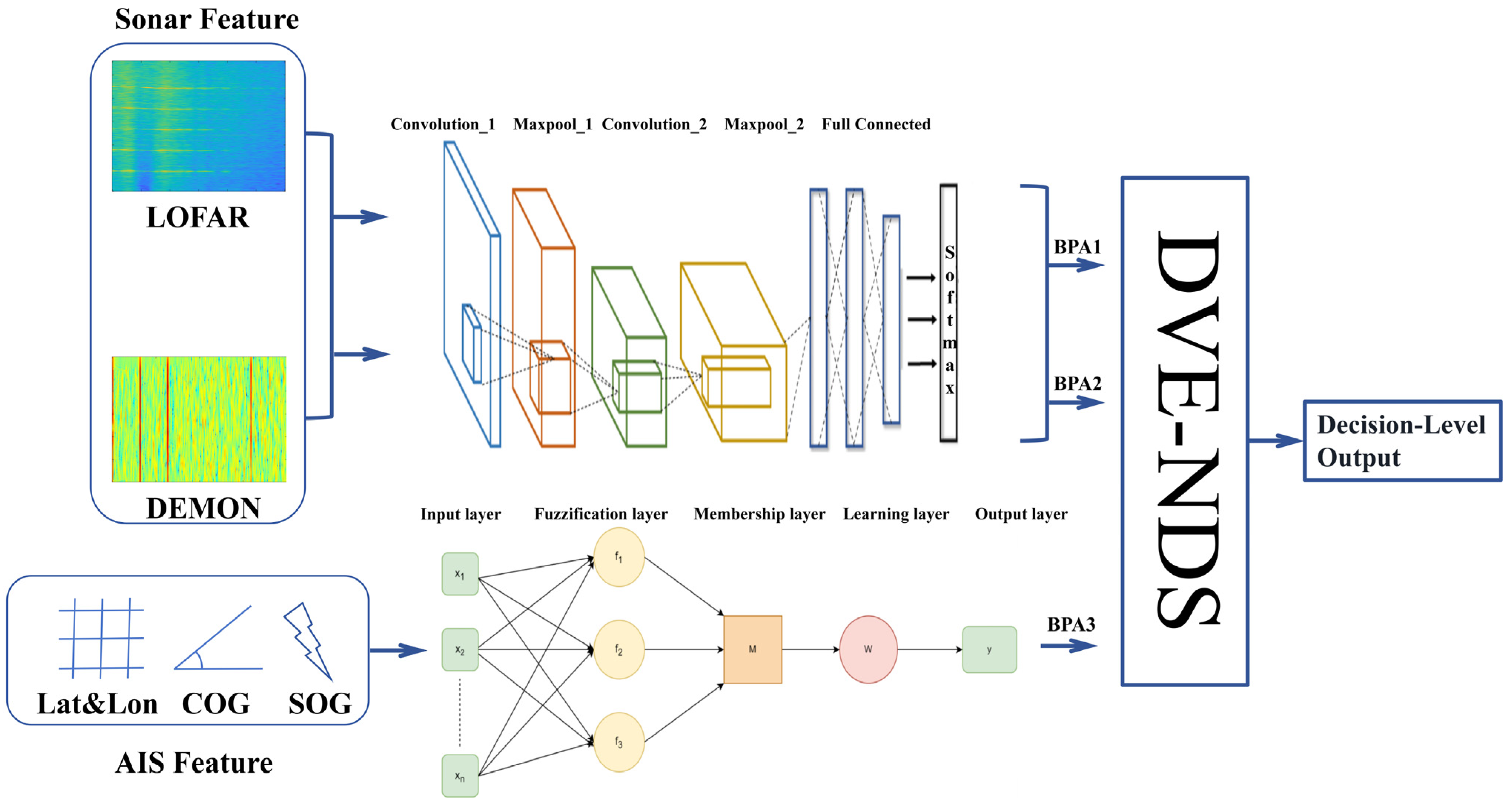
- Construction of a heterogeneous decision-level recognition framework: We construct a heterogeneous recognition framework that maps AIS spatiotemporal association into evidential support and uncertainty for surface/underwater discrimination. Specifically, a fuzzy logic strategy is utilized to transform discrete AIS kinematic information into probabilistic evidence. By applying Negation Basic Probability Assignment (Negation BPA) theory, AIS spatiotemporal mismatches are converted into negation support for non-cooperative underwater targets. This mechanism aligns kinematic priors with acoustic representations (LOFAR and DEMON spectra) at the semantic level.
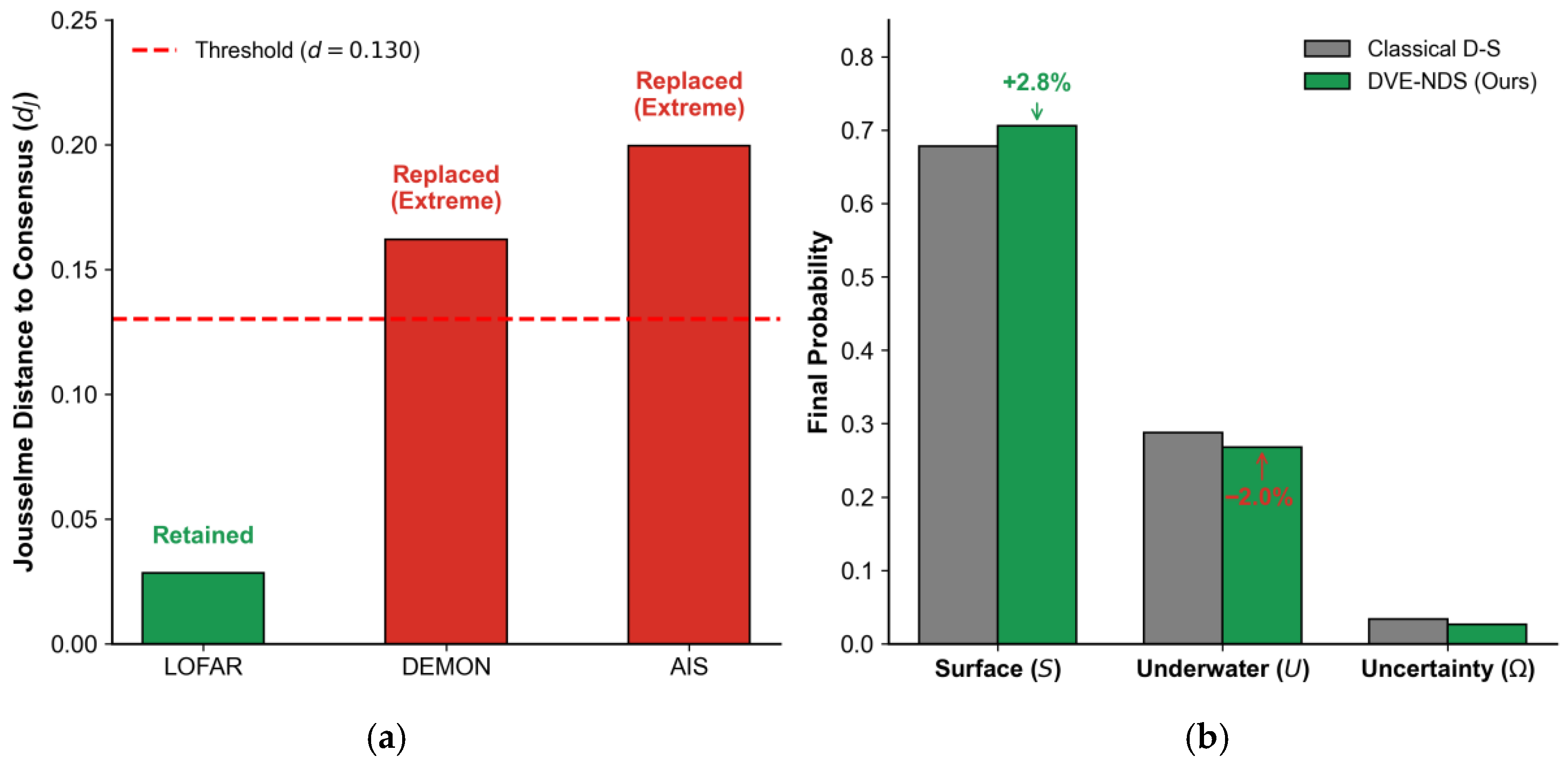
- Proposal of a Dual-View Entropy-Driven Negation D-S fusion algorithm: We propose a DVE-NDS fusion algorithm that jointly considers evidence quality and inter-source consensus to address conflicts between acoustic features and AIS priors. The algorithm establishes a hybrid weighting and dynamic correction mechanism. Modified Deng entropy and negation belief entropy are introduced to quantify the self-information quality of the evidence from both positive and negative perspectives. Simultaneously, the Jousselme distance is utilized to evaluate group consensus, and an adaptive correction strategy is applied to identify and replace abnormal evidence that deviates from group semantics.
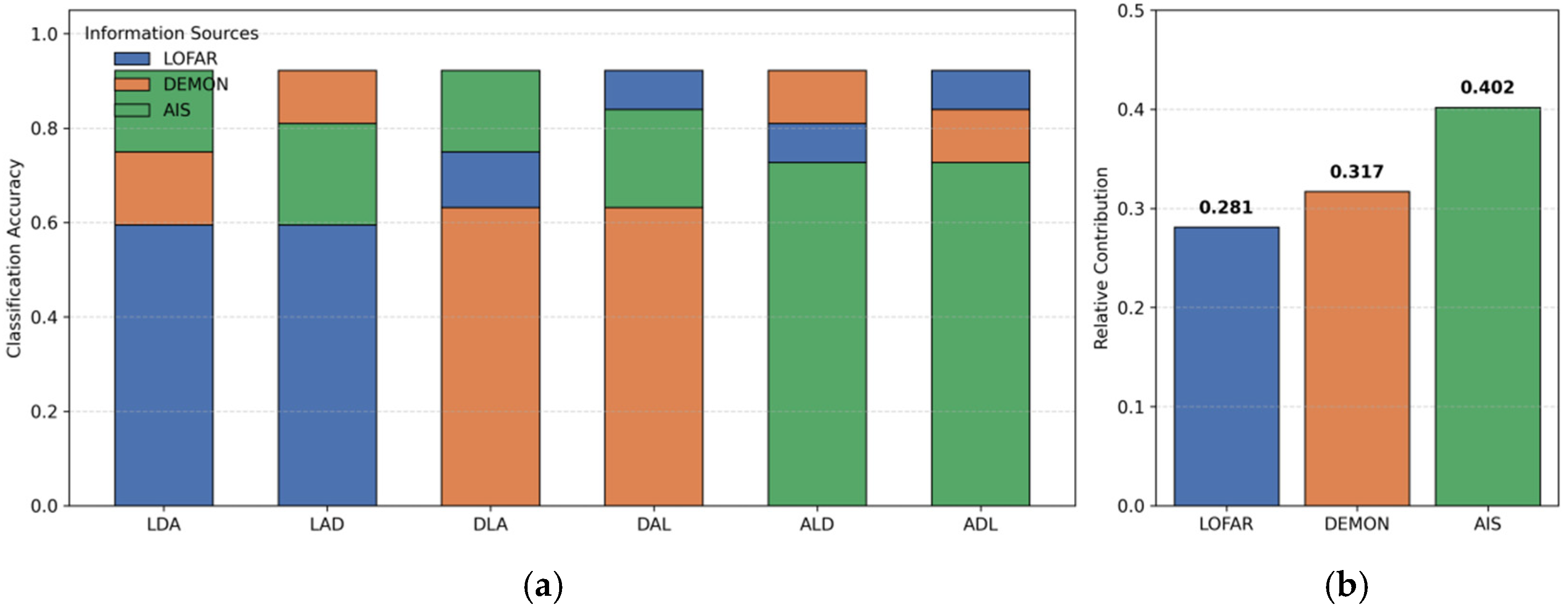
- Application of an interpretable evaluation paradigm based on Shapley values: We use game-theoretic Shapley-value analysis to quantitatively deconstruct the relative marginal contributions of LOFAR, DEMON, and AIS within the fusion process. The analysis provides a quantitative assessment of the system’s robustness mechanism, demonstrating that AIS information contributes to the upper bound of classification performance (with a contribution rate of 40.2%), while acoustic modalities establish the safety baseline of the system (with a contribution rate of 59.8%). This validates the structural rationale of kinematics-assisted acoustic decision-making.
2. Methods
2.1. Feature Extraction
2.1.1. LOFAR
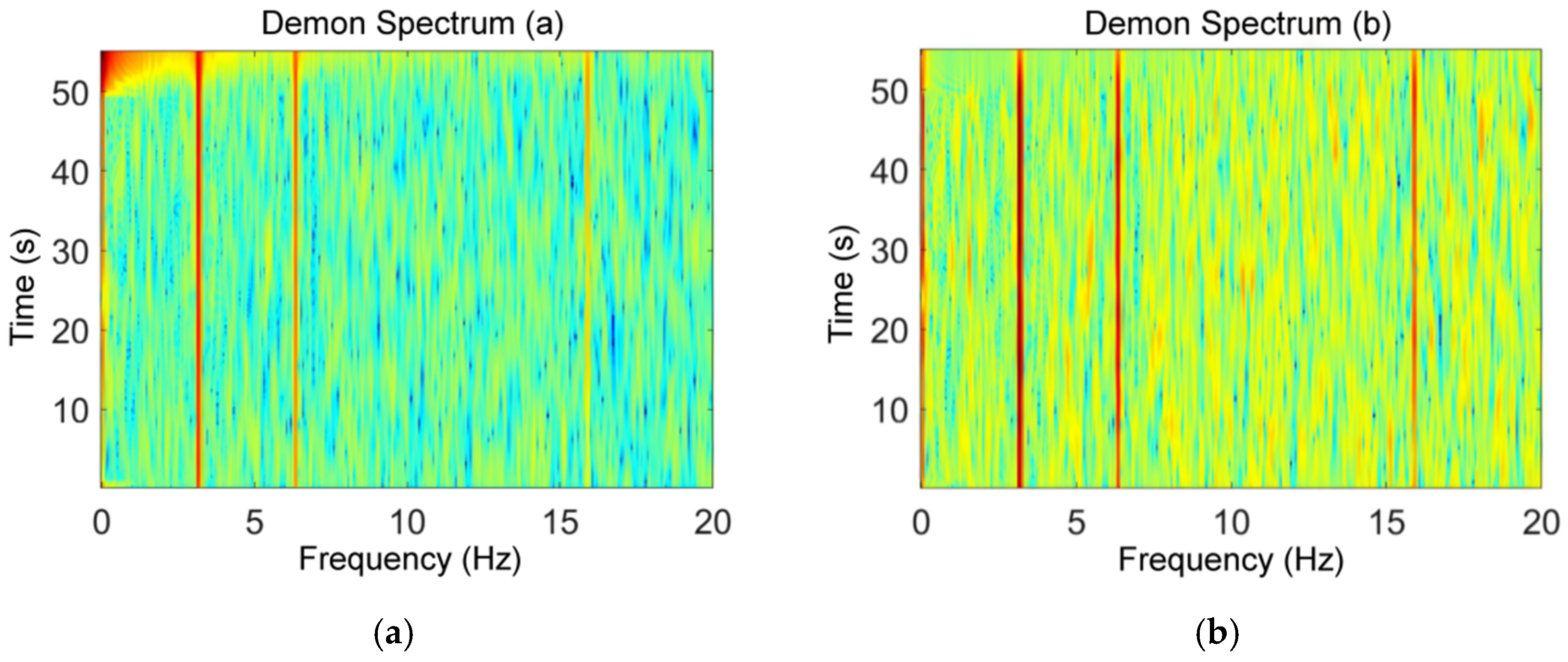
2.1.2. DEMON
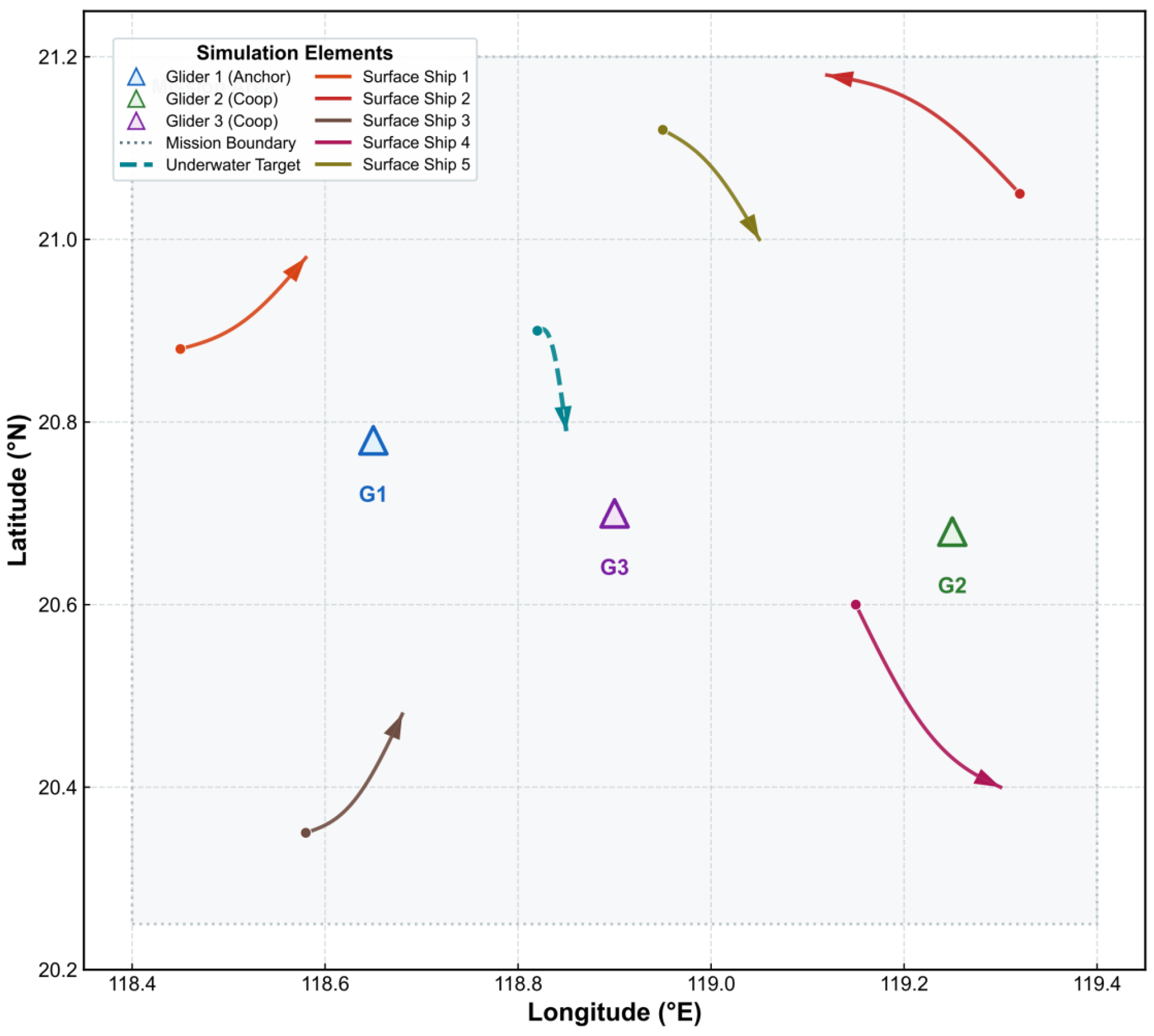
2.1.3. Spatiotemporal Benchmark Construction and Sequence Feature Extraction of Multi-Source Heterogeneous Data
Spatial Domain Unification Based on Geodetic Calculation
Temporal Alignment and Preprocessing
Time Series Tensor Construction with Sliding Window
2.2. Models
2.2.1. Convolutional Neural Network
2.2.2. Fuzzy Association Degree Construction and Correlation Resolution
Construction of Fuzzy Association Degree
- Gaussian Membership Function for Target Features
- Bearing Affinity Membership
- Distance Affinity Membership
- Kinematic Reliability Membership
Heterogeneous Evidence Reconstruction Strategy Based on Negation Basic Probability Assignment
- (1)
- Forward Confirmation Mode
- (2)
- Reverse Inference Mode
DVE-NDS: A Dual-Perspective Entropy-Driven Negation D-S Fusion Algorithm
- Fusion Problem Definition
- Evidence Self-Information Quality Assessment
- (1)
- Original Perspective
- (2)
- Negation Perspective
- (3)
- Comprehensive Uncertainty Measure
- Group Consensus Evaluation Based on Jousselme Distance
- Coupled Weight Generation and Dynamic Evidence Correction
2.2.3. Interpretability Assessment Based on Game Theory Shapley Values
3. Experimental Setup
3.1. Original AIS Dataset
3.2. Vessel Noise Dataset
3.3. Training Set
3.4. Cross-Validation and Hyperparameter Optimization
4. Results and Discussion
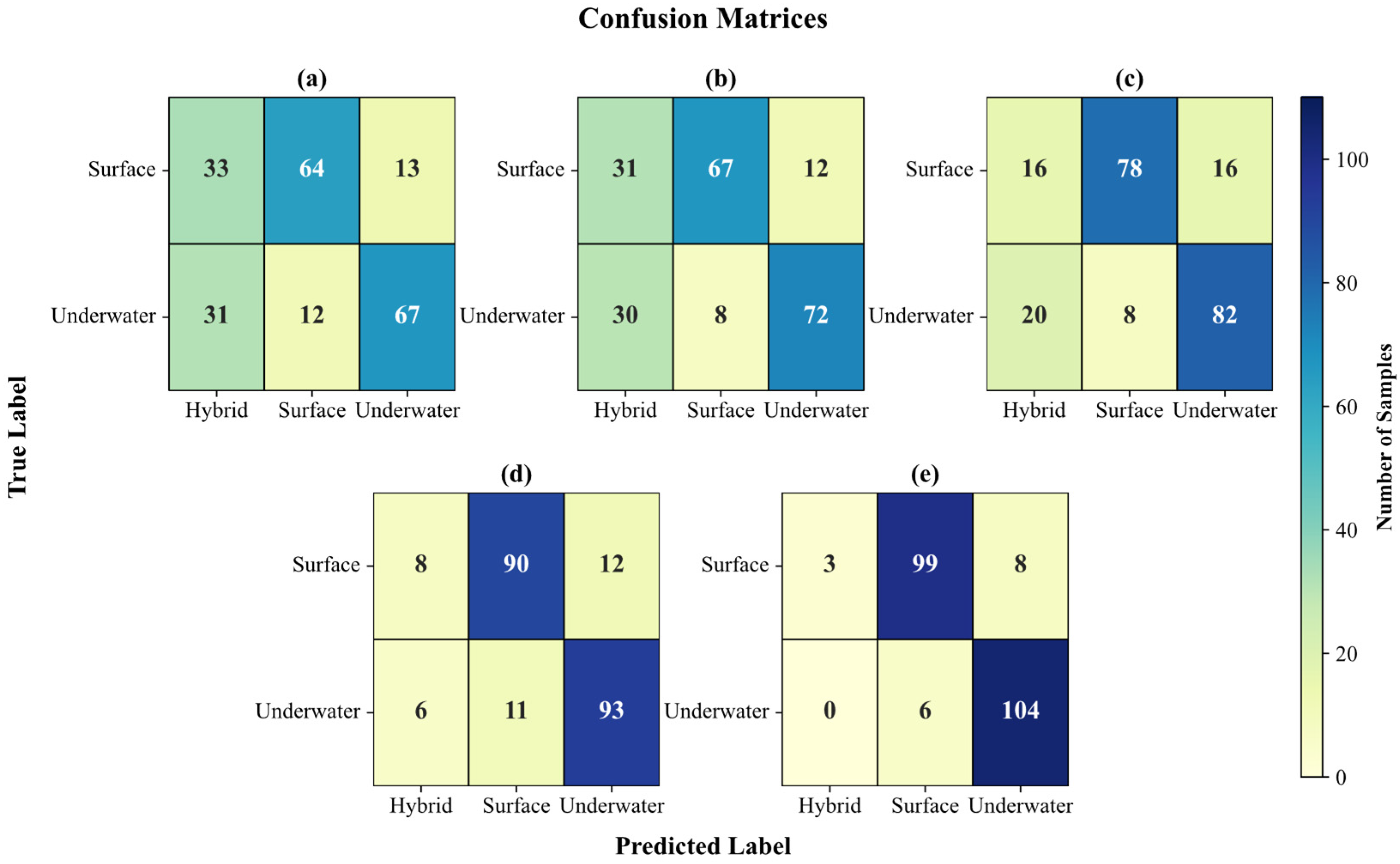
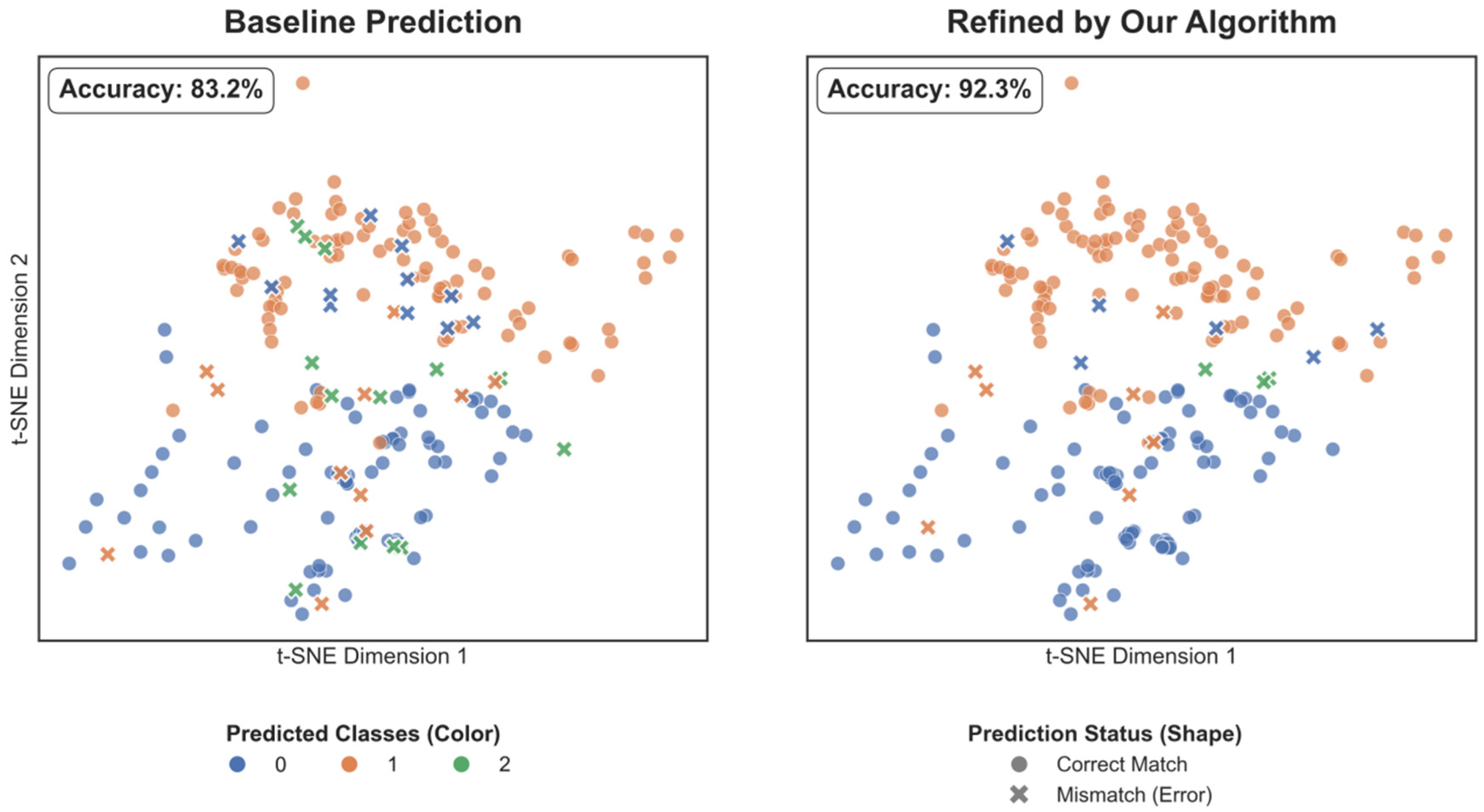
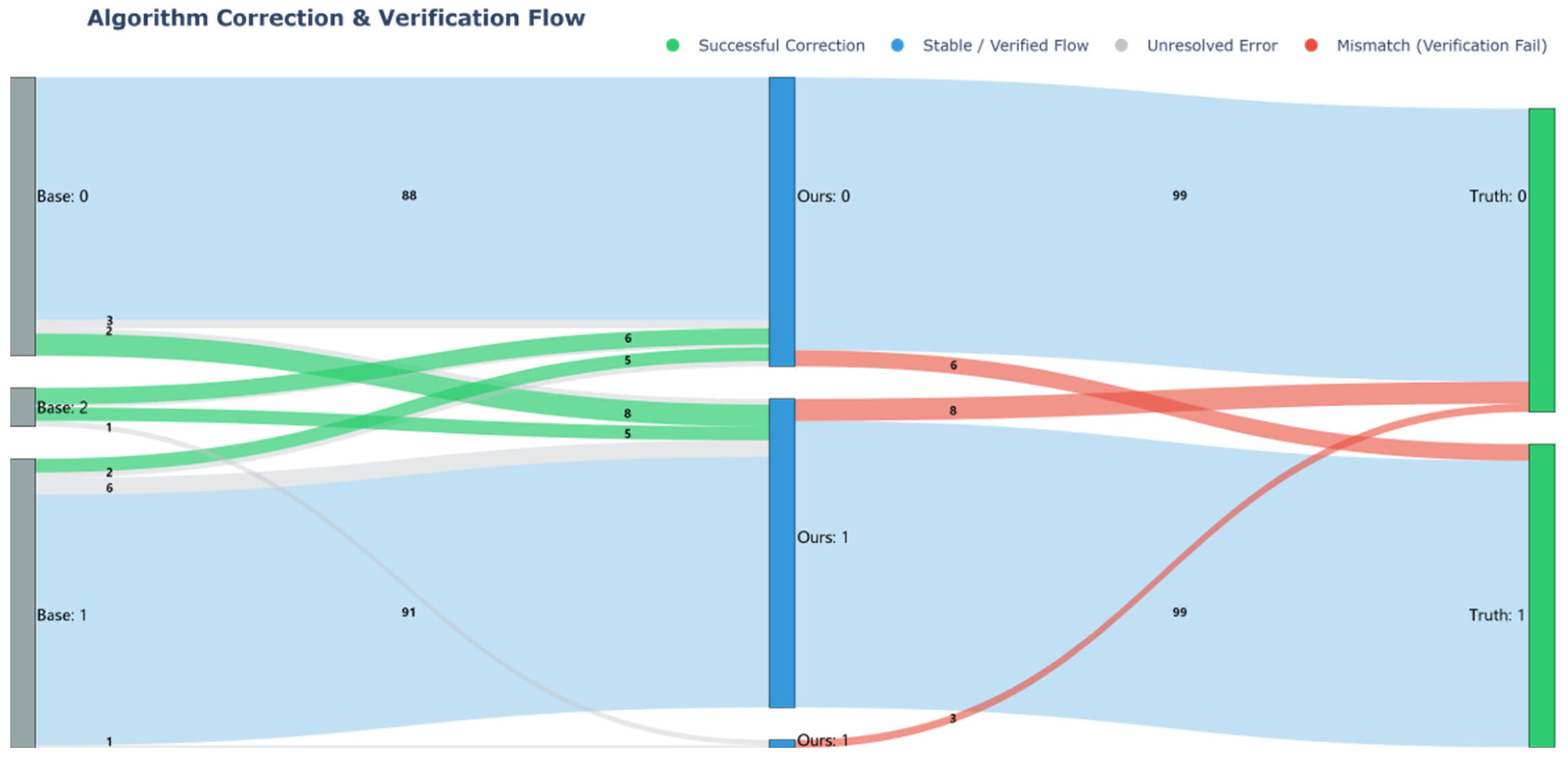
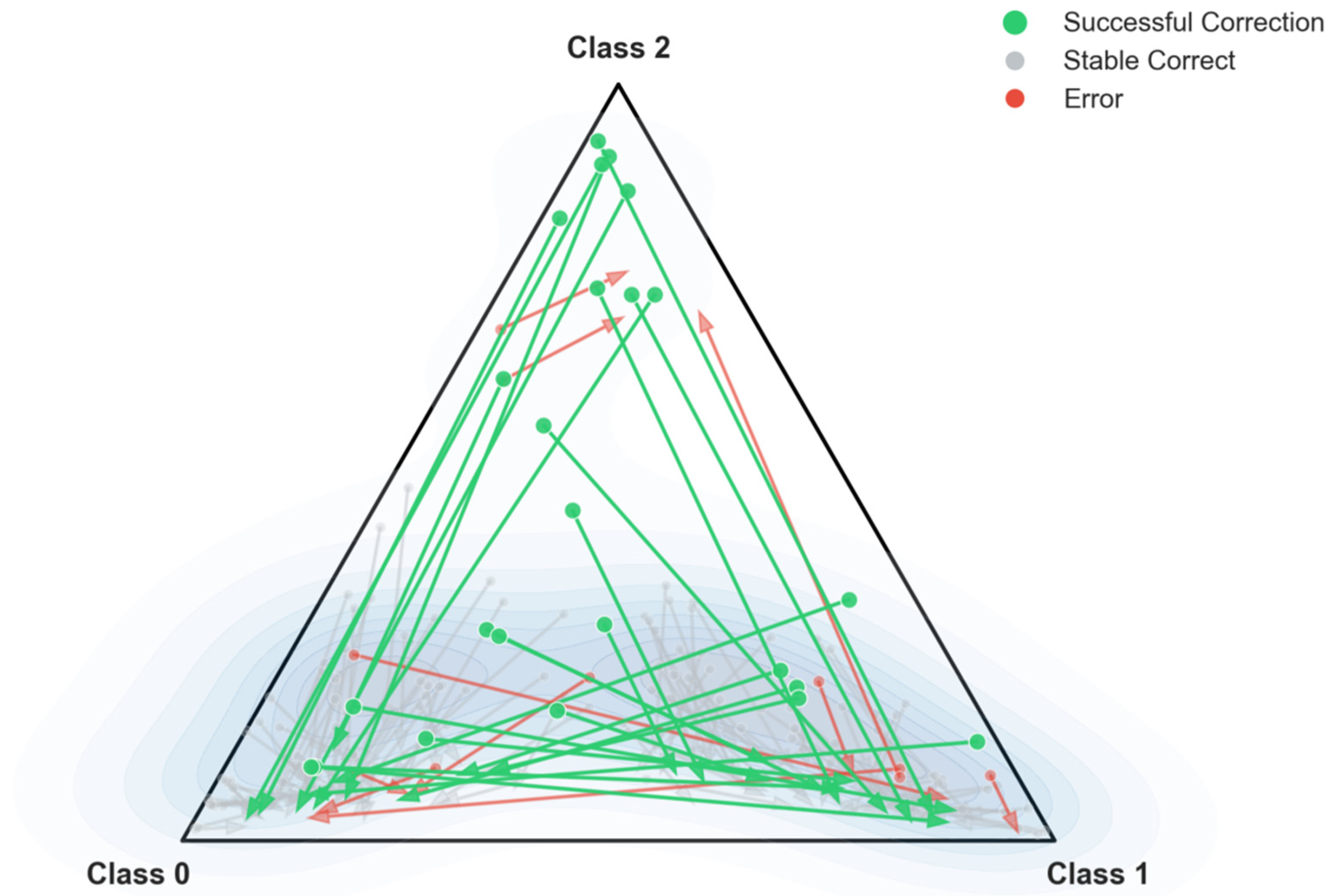
4.1. Performance Benchmarking and Error Correction Traceability
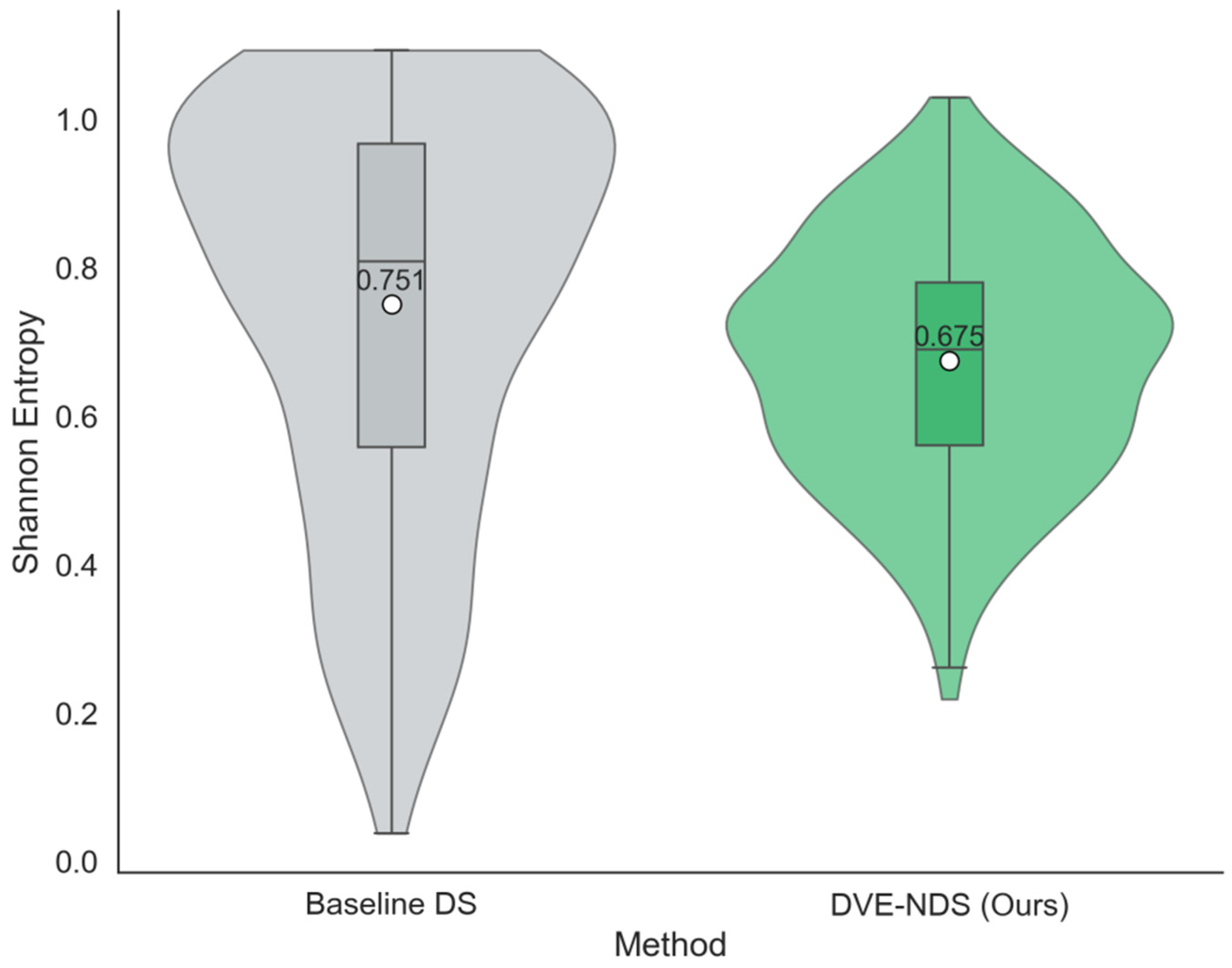
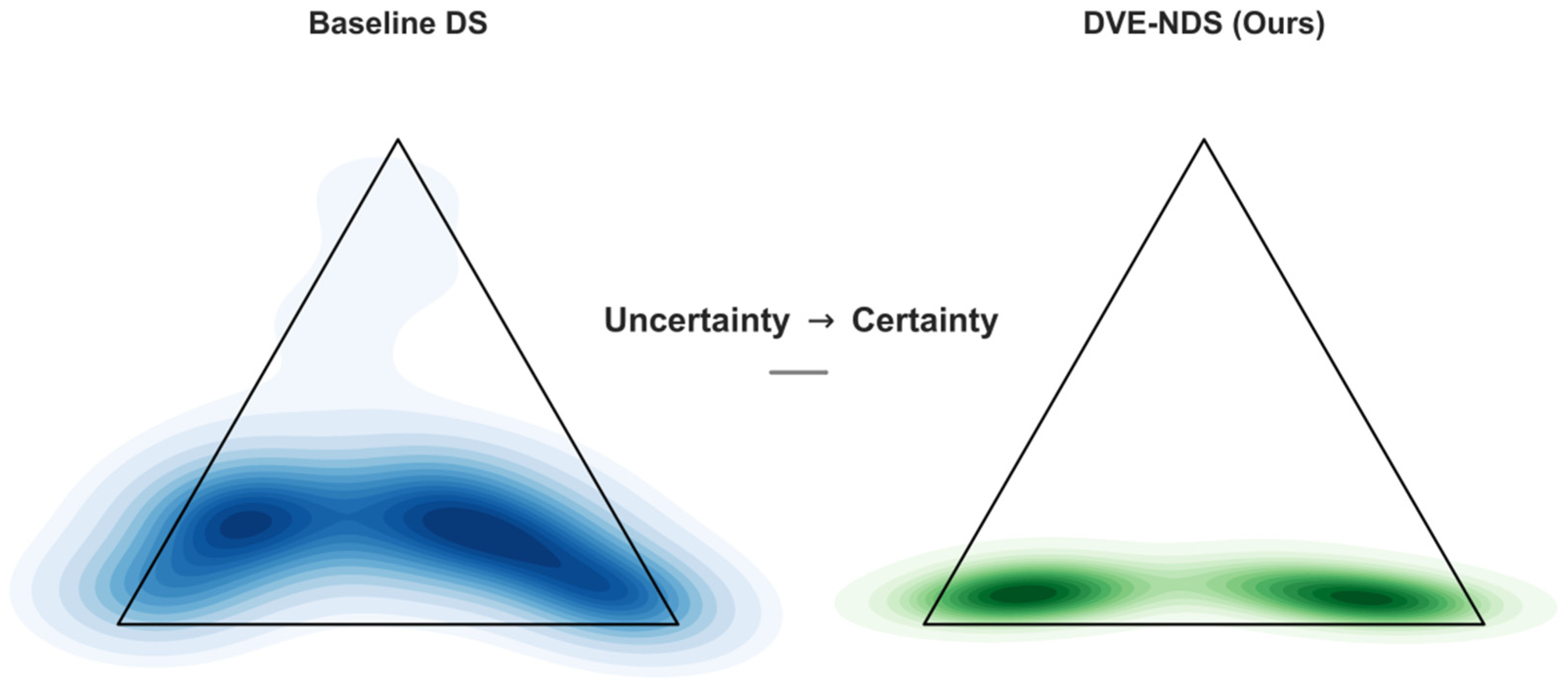
4.2. Analysis of Prediction Uncertainty and Decision Mechanism
4.3. Analysis of Heterogeneous Source Contribution and Robustness
4.4. Robustness Analysis Under Simulated Degradations
4.5. Computational Complexity and Real-Time Feasibility
4.6. Case Study: Quantitative Resolution of the “Dark Ship” Conflict and Dynamic Correction Mechanism
4.6.1. Evidence Distribution and Dynamic Weighting Mechanism
4.6.2. Multidimensional Evidence Health Assessment
4.6.3. Extreme Suppression and Final Decision Enhancement
5. Conclusions
Author Contributions
Funding
Data Availability Statement
Conflicts of Interest
Abbreviations
| DVE-NDS | Dual-View Entropy-Driven Negation Dempster–Shafer |
| BPA | Basic Probability Assignment |
| DTW | Dynamic Time Warping |
| AIS | Automatic Identification System |
| LOFAR | Low Frequency Analysis and Recording |
| DEMON | Detection of Envelope Modulation on Noise |
| CNNs | Convolutional Neural Networks |
| AWGN | Additive White Gaussian Noise |
References
- Urick, R.; Kuperman, W.A. Ambient Noise in the Sea. J. Acoust. Soc. Am. 1989, 86, 1626. [Google Scholar] [CrossRef]
- Vangi, M.; Topini, E.; Liverani, G.; Topini, A.; Ridolfi, A.; Allotta, B. Design, Development, and Testing of an Innovative Autonomous Underwater Reconfigurable Vehicle for Versatile Applications. IEEE J. Ocean. Eng. 2025, 50, 509–526. [Google Scholar] [CrossRef]
- Vallicrosa, G.; Fumas, M.J.; Huber, F.; Ridao, P. Sparus II AUV as a Sensor Suite for Underwater Archaeology: Falconera Cave Experiments. In Proceedings of the 2020 IEEE/OES Autonomous Underwater Vehicles Symposium, AUV 2020, St Johns, NL, Canada, 30 September–2 October 2020. [Google Scholar]
- Ainslie, M.A. Sonar signal processing. In Principles of Sonar Performance Modelling; Ainslie, M., Ed.; Springer: Berlin/Heidelberg, Germany, 2010; pp. 251–310. [Google Scholar]
- He, T.; Feng, S.; Yang, J.; Yu, K.; Zhou, J.; Chen, D. Underwater Acoustic Signal LOFAR Spectrogram Denoising Based on Enhanced Simulation. Appl. Sci. 2024, 14, 10931. [Google Scholar] [CrossRef]
- Wang, J.; Song, C.; Qi, Z. A radon transform-based method for line spectrum enhancement of vector hydrophone LOFAR spectrograms under low SNR conditions. Sci. Rep. 2025, 15, 10679. [Google Scholar] [CrossRef]
- Li, Z.; Cheng, Y.; Qiu, J. Adaptive Line Enhancer for Passive Sonars Based on Frequency-Domain Sparsity, Shannon Entropy Criterion and Mixed-Weighted Error. Arab. J. Sci. Eng. 2024, 50, 5899–5920. [Google Scholar] [CrossRef]
- Deepa, B.; Anoop, M.; Vijayan Pillai, S.; Sooraj, K.A. Performance Evaluation of the DEMON Processor for Sonar. In Proceedings of the 2022 IEEE Region 10 Symposium (TENSYMP), Mumbai, India, 1–3 July 2022; IEEE: New York, NY, USA, 2022; pp. 1–6. [Google Scholar]
- Chen, L.; Luo, X.; Zhou, H. A ship-radiated noise classification method based on domain knowledge embedding and attention mechanism. Eng. Appl. Artif. Intell. 2024, 127, 107320. [Google Scholar] [CrossRef]
- Jamal, S.; Lakziz, J.; Benremdane, Y.; Ouaskit, S. Passive Sonar Detection and Classification Based on Demon-Lofar Analysis and Neural Network Algorithms. Int. J. Artif. Intell. Appl. 2024, 15, 87–98. [Google Scholar] [CrossRef]
- Li, L.; Song, S.; Feng, X. Combined LOFAR and DEMON Spectrums for Simultaneous Underwater Acoustic Object Counting and F0 Estimation. J. Mar. Sci. Eng. 2022, 10, 1565. [Google Scholar] [CrossRef]
- Filho, E.P.S.; Santos, A.D.; Filho, E.F.S.; Fernandes, A.C.L.; de Seixas, J.M.; Moura, N.N.d. Hilbert–Huang Transform with Intelligent Noise Reduction for Passive SONAR Signal Processing. IEEE J. Ocean. Eng. 2025, 50, 1387–1402. [Google Scholar] [CrossRef]
- Jiang, J.; Wu, Z.; Lu, J.; Huang, M.; Xiao, Z. Interpretable features for underwater acoustic target recognition. Measurement 2021, 173, 108586. [Google Scholar] [CrossRef]
- Luo, X.; Chen, L.; Zhou, H.; Cao, H. A Survey of Underwater Acoustic Target Recognition Methods Based on Machine Learning. J. Mar. Sci. Eng. 2023, 11, 384. [Google Scholar] [CrossRef]
- Yang, Y.; Yao, Q.; Wang, Y. Underwater Acoustic Target Recognition Method Based on Feature Fusion and Residual CNN. IEEE Sens. J. 2024, 24, 37342–37357. [Google Scholar] [CrossRef]
- Liu, F.; Shen, T.; Luo, Z.; Zhao, D.; Guo, S. Underwater target recognition using convolutional recurrent neural networks with 3-D Mel-spectrogram and data augmentation. Appl. Acoust. 2021, 178, 107989. [Google Scholar] [CrossRef]
- Feng, H.; Chen, X.; Wang, R.; Wang, H.; Yao, H.; Wu, F. Underwater acoustic target recognition method based on WA-DS decision fusion. Appl. Acoust. 2024, 217, 109851. [Google Scholar] [CrossRef]
- Feng, S.; Ma, S.; Zhu, X.; Yan, M. Artificial Intelligence-Based Underwater Acoustic Target Recognition: A Survey. Remote Sens. 2024, 16, 3333. [Google Scholar] [CrossRef]
- Song, Y.; Mohsin, M.F.M. Comparative Analysis of Deep Learning Techniques for Passive Underwater Acoustic Target Recognition: Overview, Challenges, and Future Directions. Int. J. Adv. Comput. Sci. Appl. 2025, 16, 132–145. [Google Scholar] [CrossRef]
- Zhao, W.; Cheng, X.; Wang, D.; Xiong, X.; Zhang, X. Enhancing underwater target detection: Fusion of spatio-temporal incompletely-aligned AIS and sonar information via DTW and multi-head attention mechanism. IET Radar Sonar Navig. 2024, 18, 2521–2540. [Google Scholar] [CrossRef]
- Zhang, Y.; Wang, C.; Zhang, Q.; Da, L.; Jiang, Z. Bearing-only motion analysis of target based on low-quality bearing-time recordings map. IET Radar Sonar Navig. 2023, 18, 765–781. [Google Scholar] [CrossRef]
- Walker, J.L.; Zeng, Z.; ZoBell, V.M.; Frasier, K.E. Underwater sound speed profile estimation from vessel traffic recordings and multi-view neural networks. J. Acoust. Soc. Am. 2024, 155, 3015–3026. [Google Scholar] [CrossRef]
- Yeong, D.J.; Velasco-Hernandez, G.; Barry, J.; Walsh, J. Sensor and Sensor Fusion Technology in Autonomous Vehicles: A Review. Sensors 2021, 21, 2140. [Google Scholar] [CrossRef]
- Chen, J.; Han, B.; Ma, X.; Zhang, J. Underwater Target Recognition Based on Multi-Decision LOFAR Spectrum Enhancement: A Deep-Learning Approach. Future Internet 2021, 13, 265. [Google Scholar] [CrossRef]
- Zhu, J.; Peng, C.; Zhang, B.; Jia, W.; Xu, G.; Wu, Y.; Hu, Z.; Zhu, M. An Improved Background Normalization Algorithm for Noise Resilience in Low Frequency. J. Mar. Sci. Eng. 2021, 9, 803. [Google Scholar] [CrossRef]
- Vincenty, T. Direct and Inverse Solutions of Geodesics on the Ellipsoid with Application of Nested Equations. Surv. Rev. 2013, 23, 88–93. [Google Scholar] [CrossRef]
- Liang, M.; Su, J.; Liu, R.W.; Lam, J.S.L. AISClean: AIS data-driven vessel trajectory reconstruction under uncertain conditions. Ocean Eng. 2024, 306, 117987. [Google Scholar] [CrossRef]
- Liu, S.; Fu, X.; Xu, H.; Zhang, J.; Zhang, A.; Zhou, Q.; Zhang, H. A Fine-Grained Ship-Radiated Noise Recognition System Using Deep Hybrid Neural Networks with Multi-Scale Features. Remote Sens. 2023, 15, 2068. [Google Scholar] [CrossRef]
- Yan, C.; Yan, S.; Yao, T.; Yu, Y.; Pan, G.; Liu, L.; Wang, M.; Bai, J. A Lightweight Network Based on Multi-Scale Asymmetric Convolutional Neural Networks with Attention Mechanism for Ship-Radiated Noise Classification. J. Mar. Sci. Eng. 2024, 12, 130. [Google Scholar] [CrossRef]
- Singh, R.N.P.; Bailey, W.H. Fuzzy logic applications to multisensor-multitarget correlation. IEEE Trans. Aerosp. Electron. Syst. 1997, 33, 752–769. [Google Scholar] [CrossRef]
- Shi, C.; Tao, J.; Zhang, L. The fuzzy association method for target-tracking association of sonar. Tech. Acoust. 2020, 39, 141–145. [Google Scholar] [CrossRef]
- Liu, W.; Liu, Y.; Gunawan, B.A.; Bucknall, R. Practical Moving Target Detection in Maritime Environments Using Fuzzy Multi-sensor Data Fusion. Int. J. Fuzzy Syst. 2020, 23, 1860–1878. [Google Scholar] [CrossRef]
- Sun, F.; Qiu, J.; Song, Y. Research on Track Correlation Algorithm of AIS and Passive Sonar Based on Fuzzy Mathematics. Digit. Ocean. Underw. Warf. 2022, 5, 225–229. [Google Scholar]
- Zhang, Y.; Qin, C. A Gaussian-Shaped Fuzzy Inference System for Multi-Source Fuzzy Data. Systems 2022, 10, 258. [Google Scholar] [CrossRef]
- Yin, L.; Deng, X.; Deng, Y. The Negation of a Basic Probability Assignment. IEEE Trans. Fuzzy Syst. 2019, 27, 135–143. [Google Scholar] [CrossRef]
- Yager, R.R. On the Maximum Entropy Negation of a Probability Distribution. IEEE Trans. Fuzzy Syst. 2015, 23, 1899–1902. [Google Scholar] [CrossRef]
- Deng, Y. Deng entropy. Chaos Solitons Fractals 2016, 91, 549–553. [Google Scholar] [CrossRef]
- Tang, Y.; Chen, Y.; Zhou, D. Measuring Uncertainty in the Negation Evidence for Multi-Source Information Fusion. Entropy 2022, 24, 1596. [Google Scholar] [CrossRef] [PubMed]



| Class | Abbreviation | Description |
|---|---|---|
| Latitude | Lat | Longitude of a ship |
| Longitude | Lon | Latitude of a ship |
| Course over ground | COG | Actual direction of progress of a vessel |
| Speed over ground | SOG | Speed of a vessel relative to the Earth’s surface |
| Layer Type | Output Shape | Parameters |
|---|---|---|
| Conv1 (3 × 3, 32) | (873, 654, 32) | 896 |
| MaxPool1 (2 × 2) | (436, 327, 32) | 0 |
| Conv2 (3 × 3, 64) | (434, 325, 64) | 18,496 |
| MaxPool2 (2 × 2) | (217, 162, 64) | 0 |
| Conv3 (3 × 3, 128) | (215, 160, 128) | 73,856 |
| MaxPool3 (2 × 2) | (107, 80, 128) | 0 |
| Flatten | (1,095,680) | 0 |
| Fully Connected | (128) | 140,247,168 |
| Softmax | (3) | 384 |
| Dataset Category | Training Set | Validation Set | Test Set | Total |
|---|---|---|---|---|
| Hybrid Targets | 220 | 80 | 0 | 300 |
| Surface Targets | 220 | 80 | 110 | 410 |
| Underwater Targets | 220 | 80 | 110 | 410 |
| Total | 660 | 240 | 220 | 1120 |
| Class | Accuracy | Precision | Recall | F1 |
|---|---|---|---|---|
| LOFAR | 59.55% | 83.98% | 59.55% | 69.69% |
| DEMON | 63.18% | 87.52% | 63.18% | 73.39% |
| AIS | 72.73% | 87.19% | 72.73% | 79.30% |
| D-S | 83.18% | 88.84% | 83.18% | 85.92% |
| DVE-NDS | 92.27% | 93.57% | 92.27% | 92.92% |
| Stage | Baseline D-S System | Proposed DVE-NDS System |
|---|---|---|
| CNN Feature Extraction | 2.060 s | 2.060 s |
| AIS Fuzzy Association | 0.010 s | 0.010 s |
| Decision-Level Fusion | 0.017 s | 0.050 s |
| Total Inference Time | 2.087 s | 2.120 s |
Disclaimer/Publisher’s Note: The statements, opinions and data contained in all publications are solely those of the individual author(s) and contributor(s) and not of MDPI and/or the editor(s). MDPI and/or the editor(s) disclaim responsibility for any injury to people or property resulting from any ideas, methods, instructions or products referred to in the content. |
© 2026 by the authors. Licensee MDPI, Basel, Switzerland. This article is an open access article distributed under the terms and conditions of the Creative Commons Attribution (CC BY) license.
Share and Cite
Zhang, X.; Che, J.; Xiong, X.; Zhang, Y.; He, X.; Deng, M.; Wang, D. Dual-View Entropy-Driven AIS–Sonar Fusion for Surface and Underwater Target Discrimination. J. Mar. Sci. Eng. 2026, 14, 675. https://doi.org/10.3390/jmse14070675
Zhang X, Che J, Xiong X, Zhang Y, He X, Deng M, Wang D. Dual-View Entropy-Driven AIS–Sonar Fusion for Surface and Underwater Target Discrimination. Journal of Marine Science and Engineering. 2026; 14(7):675. https://doi.org/10.3390/jmse14070675
Chicago/Turabian StyleZhang, Xiaoshuang, Jiayi Che, Xiaodan Xiong, Yucheng Zhang, Xinbo He, Mengsha Deng, and Dezhi Wang. 2026. "Dual-View Entropy-Driven AIS–Sonar Fusion for Surface and Underwater Target Discrimination" Journal of Marine Science and Engineering 14, no. 7: 675. https://doi.org/10.3390/jmse14070675
APA StyleZhang, X., Che, J., Xiong, X., Zhang, Y., He, X., Deng, M., & Wang, D. (2026). Dual-View Entropy-Driven AIS–Sonar Fusion for Surface and Underwater Target Discrimination. Journal of Marine Science and Engineering, 14(7), 675. https://doi.org/10.3390/jmse14070675