1. Introduction
With the continuous advancement of port and navigation channel construction, coastal land reclamation, and artificial island projects, large-scale dredging and backfilling operations have been intensively conducted worldwide for a prolonged period. Trailing suction hopper dredgers (TSHDs) are widely employed owing to their high operational efficiency and flexible construction organization; however, the sediment plumes generated during side-casting or sailing side-casting backfilling have become one of the key factors affecting backfilling quality control and environmental compliance [
1]. In tidally dominated, semi-enclosed, or funnel-shaped bays, the dispersion pathways, deposition patterns, and recovery duration of sediment plumes are directly associated with the coverage width and thickness uniformity of layered backfilling, as well as the duration of suspended solids exceedance.
Layered sailing side-casting backfilling differs fundamentally from fixed-point or static discharge; it is essentially a moving-source process characterized by continuous release along a prescribed sailing track [
2]. During this process, the sediment source term migrates with the vessel, and the plume produces a time-varying and spatially non-uniform far-field response under the combined effects of tidal advection, turbulent diffusion, and particle settling. The sailing speed determines the spatial sweeping rhythm and duration of the moving source, whereas the discharged sediment concentration modulates the solid flux and effective settling velocity, thereby shaping the thickness and areal coverage of the deposited layer. Quantitatively characterizing these coupled processes under tidal forcing remains important for coordinating backfilling quality and environmental constraints.
Substantial progress has been made in understanding dredging-induced sediment plumes and in developing assessment methodologies, covering near-field mixing, source term characterization, far-field dispersion, and monitoring-based validation. de Wit et al. [
3] performed three-dimensional CFD simulations of TSHD plume mixing and compared the results with field observations, providing important references for turbulent mixing and initial dilution. de Wit et al. [
4] further investigated the effects of dredging speed, propeller action, overflow location, and pulsing on the suspended-sediment source term, showing that near-field discharge processes directly affect the source flux delivered to the ambient flow. Decrop et al. [
5] numerically simulated near-field dredging plumes and evaluated the efficiency of an environmental valve, further demonstrating that the initial plume development is highly sensitive to the discharge configuration. Becker et al. [
6] proposed a source term estimation framework for far-field dredge plume modeling and emphasized that reliable source characterization is essential for credible far-field prediction. Decrop et al. [
7] developed a parameter model for dredge plume sediment source terms, providing a practical approach for translating near-field discharge behavior into engineering-scale far-field inputs. Lisi et al. [
8] established a general mathematical modeling framework for the physical effects induced by sediment-handling operations in marine and coastal areas, highlighting the importance of linking source characterization with transport impact assessment. Regarding far-field modeling, Di Risio et al. [
9] developed an analytical model for the preliminary assessment of dredging-induced sediment plumes under spatially non-homogeneous and time-varying resuspension sources, providing useful support for describing unsteady far-field plume evolution. Fernandes et al. [
10] investigated dispersion plumes at open-ocean disposal sites of dredged sediment, extending the understanding of far-field plume behavior under offshore disposal conditions. Zhang and Adams [
11] demonstrated that near-field plume characteristics can be coupled with larger-scale circulation models, providing methodological support for transferring unresolved discharge behavior into far-field simulations. Suh [
12] developed a hybrid near-field/far-field discharge model for coastal areas, further confirming the feasibility of using equivalent source representations to bridge local discharge physics and regional-scale transport prediction. Premathilake and Khangaonkar [
13] developed a three-dimensional plume dilution and transport model for dynamic tidal environments, showing that plume-scale release behavior can be effectively integrated with large-scale hydrodynamic modeling.
From the perspective of engineering applicability, model validation and the credibility of input parameters are critical to whether far-field assessments can be reliably implemented. Jiang [
14] summarized key parameters and validation pathways for three-dimensional plume models, and Stewart and Leaman [
15] further discussed input verification issues in plume modeling. Stemm [
16], focusing on complex engineering scenarios, pointed out that predictability is often constrained by a combination of site conditions, boundary forcing, and input uncertainties. Correspondingly, in situ observations and remote sensing provide essential data support for model calibration, threshold verification, and uncertainty constraints. Cussioli et al. [
17] conducted field observations of dredging plumes in harbors and provided direct evidence of dispersion and settling characteristics. With respect to key settling mechanisms, Jeong et al. [
18] observed flocculation and enhanced settling velocities in situ at coastal sand-mining sites, suggesting that effective settling velocity may vary substantially over short timescales and thereby alter plume recovery duration. Guard et al. [
19] combined ADCP profiles with water sampling to monitor engineering plumes and, through posterior flux calculations, inferred and corrected source release rates, providing an operational workflow for source term verification and model calibration under observational constraints.
Although previous studies have established useful approaches for near-field mixing, far-field plume prediction, and monitoring-based validation, the layered sailing side-casting backfilling scenario in tidally controlled waters remains insufficiently resolved in three aspects. First, this operation is inherently a moving-release process, but the source term in engineering-scale far-field models is still often simplified as a static or quasi-steady input, making it difficult to represent the spatiotemporal migration of release intensity in a mass-consistent manner. Second, existing studies have more often emphasized plume extent or SSC levels, whereas deposition-layer indicators directly relevant to layered-backfilling quality, such as deposited thickness, lateral coverage, and along-track continuity, have received less systematic attention. Third, although construction parameters are known to affect plume behavior, their relative influences on dispersion, deposition, and recovery duration under tidal forcing have not been compared within a unified modeling framework.
To address these issues, this study develops a two-dimensional hydrodynamic–sediment coupled model for TSHD layered sailing side-casting backfilling in tidal waters, in which a mass-conserving moving-source term is introduced to represent the side-casting track and time-varying source input. On this basis, the effects of sailing speed and sediment concentration on far-field plume extent, deposition-layer characteristics, and SSC recovery duration are systematically compared. In addition, a dimensional analysis is conducted to interpret the relative roles of source duration, advection, and settling timescales in shaping the observed scenario differences. The resulting framework is intended to provide engineering support for parameter selection, environmental constraint assessment, and construction planning in layered backfilling projects under similar tidal conditions.
2. Mathematical Model
This study adopts the MIKE21 depth-averaged hydrodynamic–sediment framework for numerical simulation. Equations (1)–(8) describe the governing equations and associated closure relations for flow motion, horizontal mixing and diffusion, suspended-sediment transport, and bed evolution. The side-casting discharge is represented in this framework through an engineering source term, whose formulation is described in the following section.
2.1. Standard Governing Equations in the MIKE21 Framework
- (1)
Hydrodynamic governing equations
The continuity equation is as follows:
where
and
denote the depth-averaged velocity components;
is the total water depth; and
is the volumetric source/sink term.
Momentum equations are as follows:
where
is the water surface elevation;
is the gravitational acceleration;
is the Coriolis parameter;
is the water density;
is the horizontal eddy viscosity;
and
are the wind stress and bottom friction, respectively; and
and
represent the equivalent body force terms accounting for wave radiation stresses, atmospheric pressure gradients, numerical dissipation, and other effects.
The closure relationship for water depth and bottom friction is given by
where
is the bed elevation;
denotes the depth-averaged velocity vector; and
is the drag coefficient, converted from the Manning/Chézy parameters.
At the open offshore boundaries, tidal water-level time series or harmonic constituents are prescribed; at land boundaries, a zero normal flux condition is applied. The wetting–drying process is handled using a water depth threshold criterion to identify whether a cell participates in the computation, thereby maintaining mass conservation and ensuring numerical stability during exposure/inundation of the intertidal zone.
- (2)
Closure for horizontal eddy viscosity and diffusion
The Smagorinsky subgrid-scale model is adopted to parameterize the horizontal eddy viscosity as
where
and
;
is the background eddy viscosity;
is the Smagorinsky constant; and
is the grid scale.
The horizontal turbulent diffusion coefficient for suspended sediment is closed consistently with the eddy viscosity formulation:
where
is the turbulent Schmidt number;
is the horizontal diffusion tensor, which reduces to a scalar coefficient under the isotropic assumption.
- (3)
Suspended-sediment transport and bed evolution equations
A standard two-dimensional depth-averaged suspended-sediment transport equation in the MIKE21 sediment transport framework, including bed exchange terms and an engineering source term, is written as
where
is the depth-averaged suspended-sediment concentration (SSC);
denotes the user-defined engineering source term introduced in this study to represent the moving side-casting discharge; and
and
are the bed erosion and deposition fluxes, respectively, expressed as mass fluxes.
Bed-level evolution is described using the Exner-type mass conservation equation:
where
is the bed porosity and
is the sediment particle density. The erosion and deposition fluxes are parameterized using parameters such as the critical shear stress and the settling velocity, and are coupled with the near-bed shear stress
.
2.2. Mass-Conserving Representation of the Moving-Source Term
As MIKE21 is a two-dimensional depth-averaged model, it primarily resolves regional-scale hydrodynamics and suspended-sediment transport processes, but it does not explicitly resolve the discharge-induced jet momentum, intense near-field shear mixing, initial vertical spreading, or other three-dimensional processes in the immediate vicinity of the outlet. Previous studies have shown that these near-field processes mainly control the suspended-sediment source flux delivered to the ambient flow, the initial dilution, and the initial plume footprint, which subsequently determine the effective input for far-field transport prediction [
3,
4,
5,
6,
7,
8]. More generally, near-field/far-field coupling studies have demonstrated that unresolved local discharge behavior can be transferred into regional transport models through equivalent source representations [
9,
10,
11]. Following this engineering-oriented modeling rationale, the sailing side-casting discharge is represented here by a mass-conserving two-dimensional moving-source term,
, in the depth-averaged concentration equation. This treatment is intended as an equivalent far-field representation of the unresolved near-field discharge and is used to describe the spatiotemporal evolution of source input at the engineering scale.
For a single side-casting sailing leg with length
and a vessel sailing speed
, the source duration is given by
Within the time interval
, the center position of the source,
, is updated according to the vessel motion and distributed to neighboring computational cells using a spatial weighting function. The source is imposed on the model in the form of a solid mass flux, and its instantaneous release intensity is expressed as
where
is the discharge flow rate of the sediment–water mixture and
is the volumetric solid concentration of the discharged mixture.
To ensure mass conservation, the total solid mass input during a single sailing side-casting operation satisfies
For sailing side-casting operations, the release location migrates continuously with the vessel along the prescribed sailing track. A moving-source representation is therefore required to describe the spatiotemporal migration of the far-field input in a mass-consistent manner. Since MIKE21 does not explicitly resolve the near-field spreading dominated by discharge momentum, the unresolved initial horizontal footprint is represented by an equivalent spatial kernel, through which the instantaneous solid mass flux is allocated to the source neighborhood on the computational grid.
A local coordinate system is established with the source center
as the origin, where the
axis is aligned with the sailing track and the
axis is normal to it. An anisotropic elliptical Gaussian kernel is adopted for the source term:
where
and
denote the distances from the geometric center of cell
to the source center in the
coordinate system. Only cells satisfying
are included in the source allocation. This condition corresponds to a
elliptical support of the anisotropic Gaussian kernel in the local
coordinate system. For a normalized two-dimensional Gaussian distribution, this region contains approximately
of the total kernel mass, so the neglected tail remains small. The truncation is introduced to localize the equivalent near-field release footprint, avoid unrealistically long-range allocation of source mass, and maintain computational efficiency. The raw kernel values are normalized to obtain the cell weights
, satisfying
.
The kernel scales
and
characterize the initial horizontal spread of the equivalent side-casting release in the along-track and cross-track directions, respectively. Their values are constrained by two considerations. First, they are linked to the geometric extent of the bottom-door group, so that the anisotropy of the kernel reflects the elongated source footprint along the sailing direction. Second, they are checked against the local grid spacing to ensure that the source neighborhood is resolved by multiple cells and that the normalized source allocation remains numerically stable. In this sense,
and
should be regarded as engineering closure scales for the initial far-field input generated by the unresolved near-field discharge, rather than as direct measurements of the detailed near-field jet width. They are set as
where
and
are the total length and total width of the centroid line or centroid span of the bottom-door group, respectively.
The solid mass flux
defined in Equation (10) is distributed to the concentration source term of cell
using the normalized weight
as
where
and
are the water depth and the cell area of cell
, respectively. Accordingly,
, ensuring that the source input satisfies strict mass conservation at any instant and is consistent with the total mass of a single sailing side-casting operation given in Equation (11).
The source center is updated according to the sailing speed. At each model time step , is advanced along the sailing track based on the vessel velocity, and a continuous position is obtained via linear interpolation between polyline nodes of the track. For the scenarios used in comparative analyses, and are prescribed as constants within a single side-casting time window. If time series from onboard monitoring are available, they are imposed according to the sampling interval and resampled to the model time step. When necessary, a moving-average filter is applied to and to remove high-frequency noise.
It should be noted that the present formulation is intended for engineering-scale far-field assessment. It does not explicitly reproduce the three-dimensional jet breakup, density stratification, propeller-induced entrainment, or other detailed near-field mechanisms in the immediate vicinity of the outlet.
2.3. Parameter Settings and Calibration Strategy
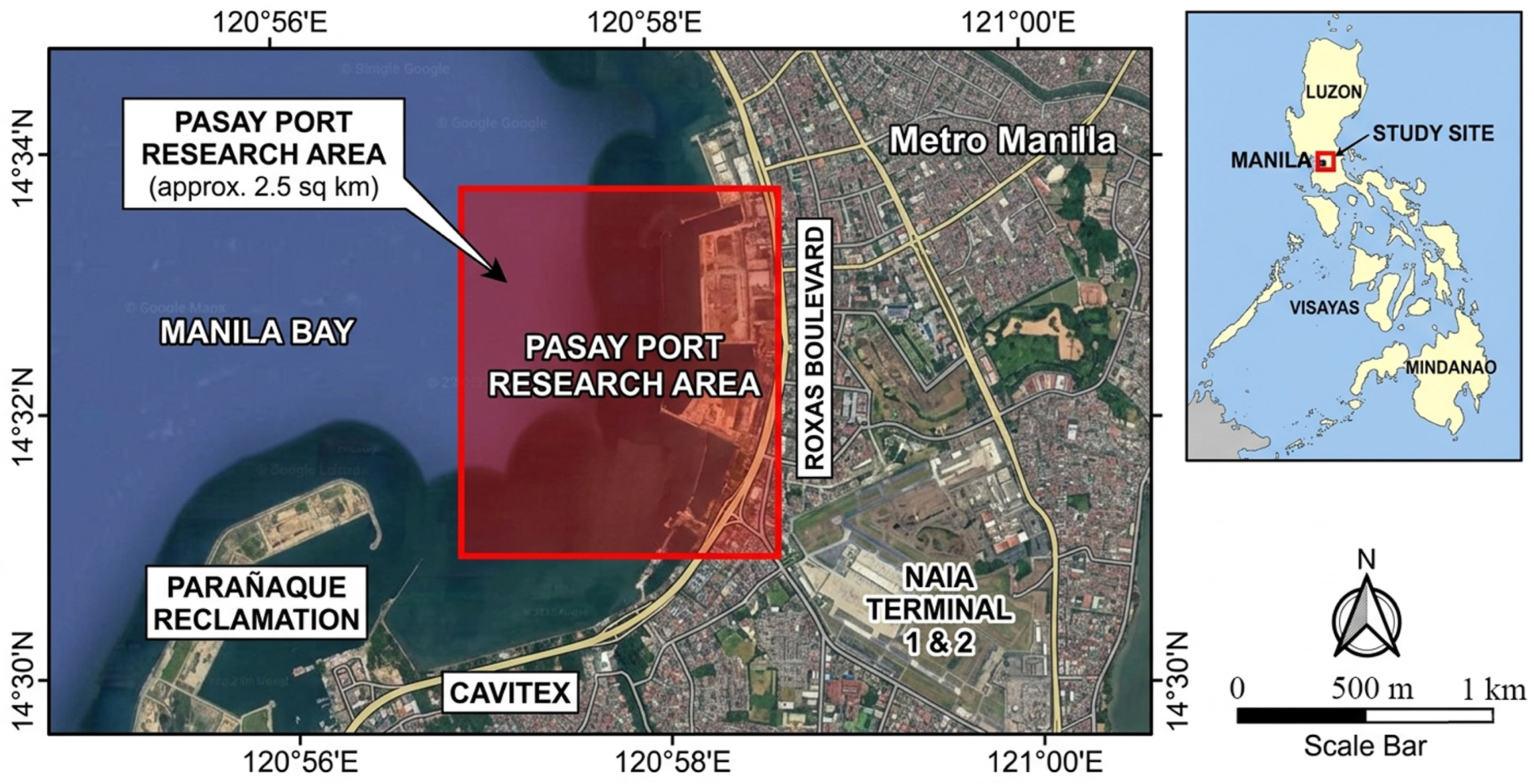
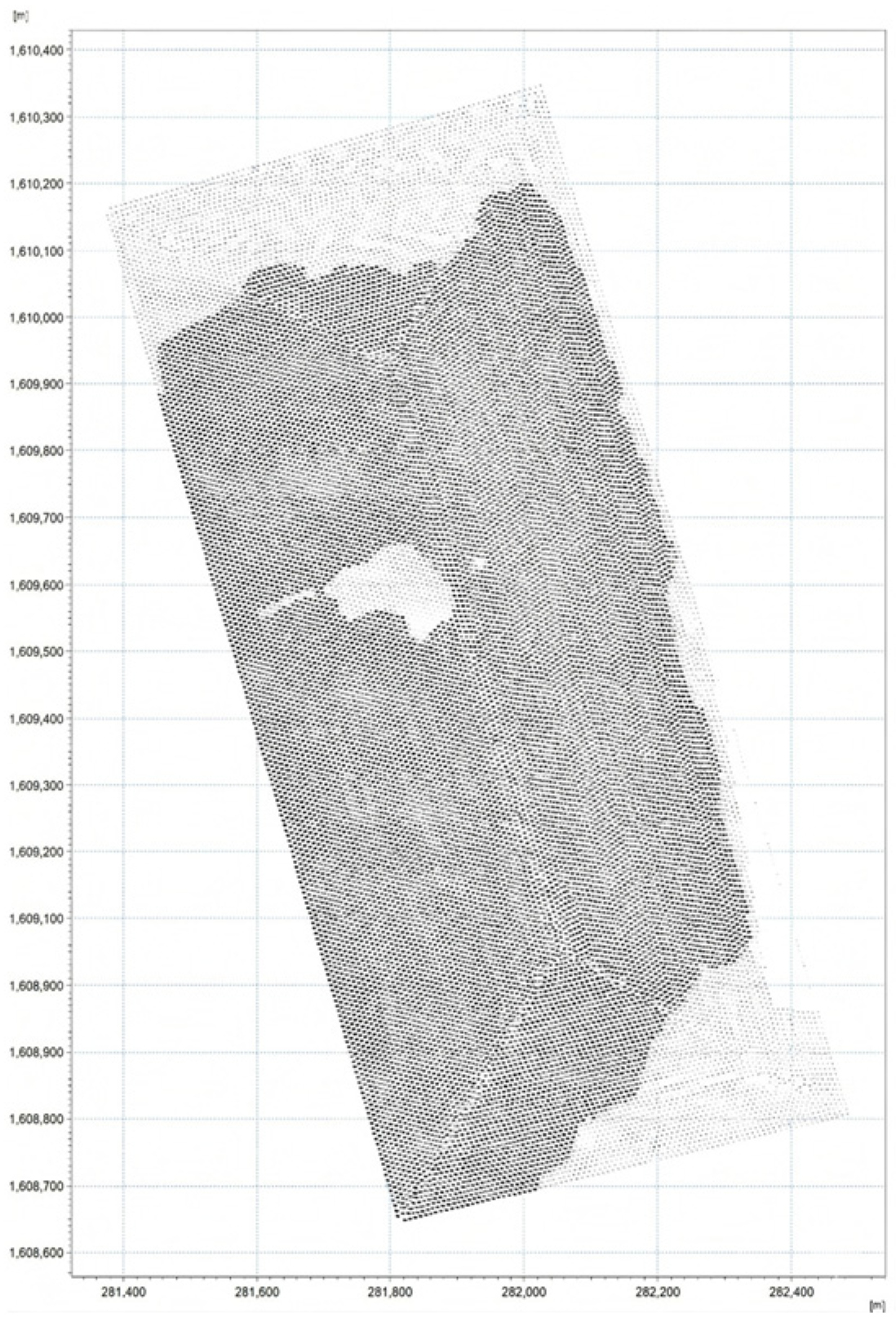
The study area is a funnel-shaped, semi-enclosed bay characterized by strong shoreline curvature and substantial modification due to land reclamation. The model bathymetry is based on the NAMRIA 2023 digital bathymetric dataset, and its vertical accuracy is checked against historical single-beam sounding points (±0.2 m). The computational mesh is locally refined along high-curvature shoreline segments and engineered coastlines, as shown in
Figure 1. A zero normal flux condition is imposed at land boundaries, and a wetting–drying threshold is enabled to handle intertidal exposure/inundation.
In terms of topography, the water depth transitions from approximately 5 m in nearshore areas to about 25 m toward the bay mouth. In the shallow bay-head region, a thick soft-mud layer (>15 m) is developed, while locally dredged depressions reach a maximum depth of 32.1 m.
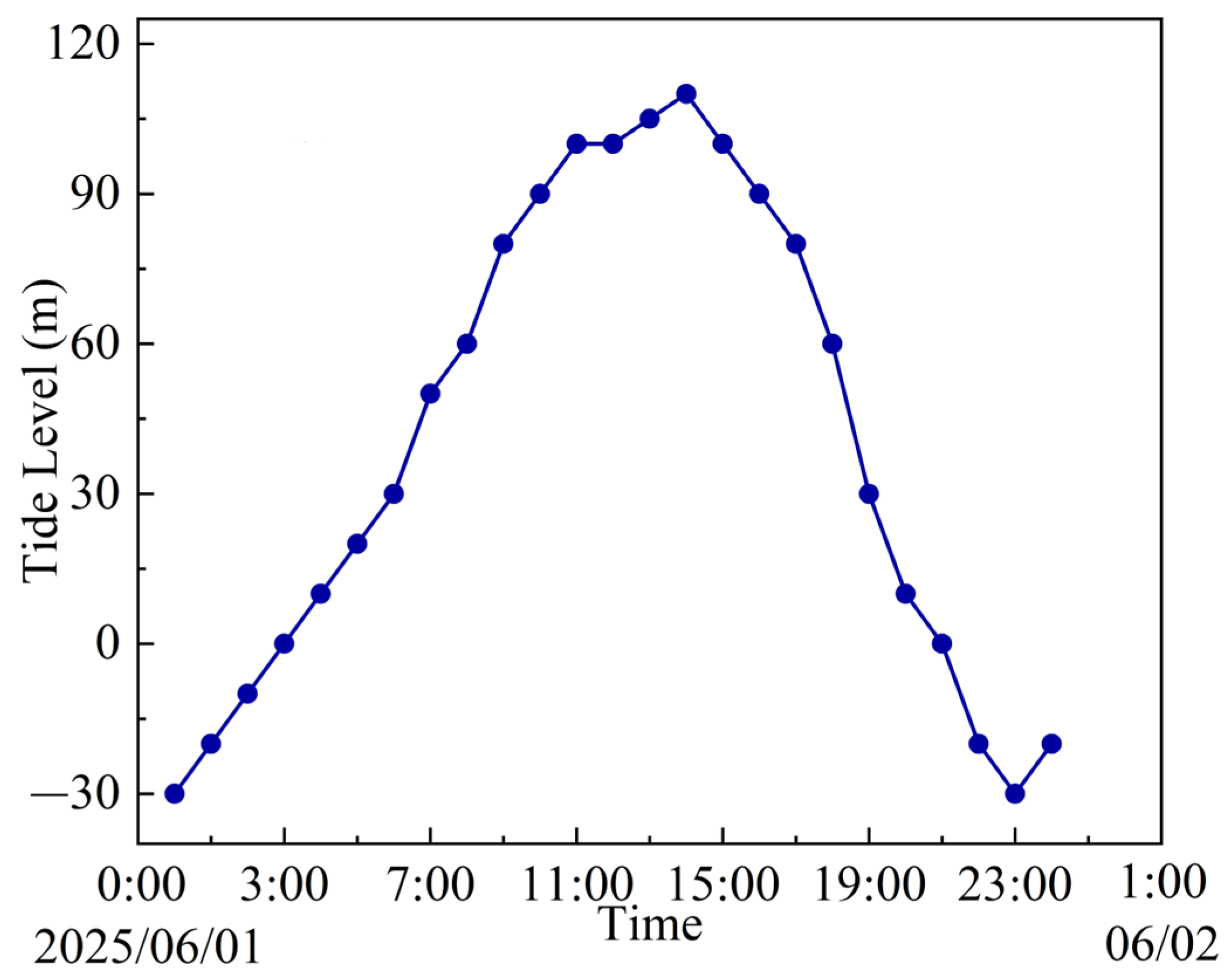
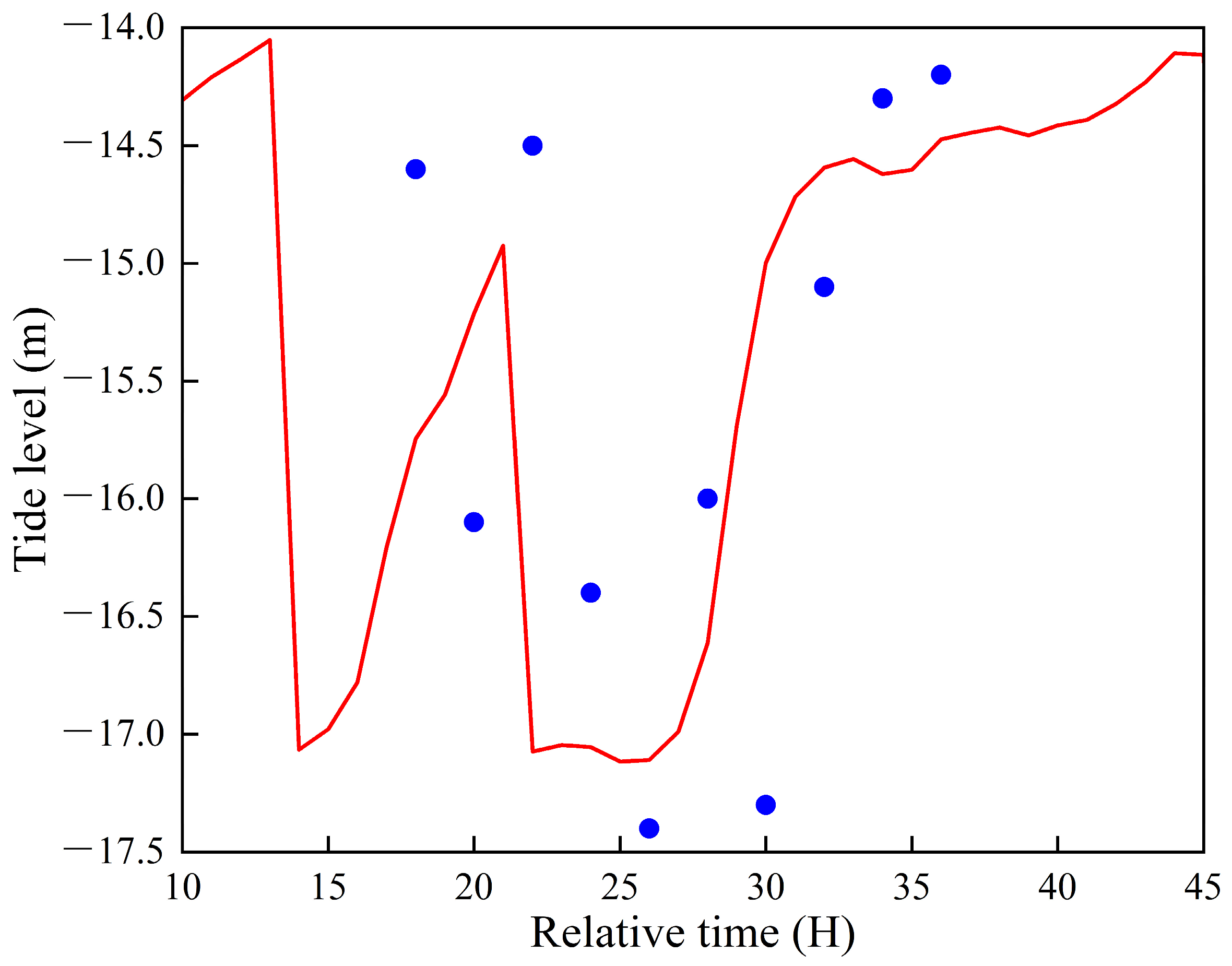
Regarding tides, the bay mouth is dominated by regular semidiurnal tides, gradually transitioning to irregular semidiurnal tides toward the bay head. The tidal range increases from approximately 1.8 m to 2.7 m, and geometric convergence causes the Pasay reach to lag the bay mouth by about 42 min. At the offshore open boundary, harmonic forcing is prescribed using eight principal tidal constituents superimposed to drive the model. In addition, spring- and neap-tide scenarios are configured to examine the sensitivity of dispersion scales to tidal range. The boundary tidal data are derived from an integrated dataset that merges records from the 2020–2023 PNCM tide gauge station and the NAMRIA historical tide observation database; based on these data, tidal forcing points are generated for the numerical simulations, as shown in
Figure 2.
2.4. Numerical Implementation and Computational Settings
Model parameters are classified mechanistically into three categories. The first category includes grain size–settling velocity parameters. The second category comprises planform transport and mixing parameters, in which the characteristic scales of the source spatial weighting function are used to represent the initial horizontal footprint of the unresolved near-field spreading on the computational grid. The third category consists of bed exchange parameters, which constrain the flux closures between suspended sediment and the bed.
Initial values and admissible ranges of these parameters are obtained from localized inversions based on the shoreline geometry, isobath patterns, and tidal data of the study area, and are further constrained to convergence using limited in situ measurements and empirical knowledge. The initial settling velocity is taken from empirical ranges reported for comparable TSHD projects, with the still-water settling velocity computed using the Van Rijn formulation adopted as the baseline value. For fine sediments, flocculation effects are incorporated by applying a correction factor
(≥1) to the baseline value, such that the effective settling velocity
is given by
where
is the still-water settling velocity computed from the Van Rijn relationship using the equivalent floc diameter
. Here,
represents a characteristic floc size for fine sediments and is selected as a representative value within the range 0.03–0.12 mm.
is a correction factor accounting for flocculation-induced enhancement of settling velocity. It is calibrated by fitting observed SSC time series and plume width, and is obtained through a parameter search within 1.1–1.6.
A two-step procedure is used to determine the horizontal diffusion coefficient . First, an initial admissible range is specified based on the magnitude of horizontal eddy viscosity from the hydrodynamic module and the grid resolution, ensuring that the mixing intensity is consistent with the flow-field scales. Second, field SSC time series and the envelope area above a prescribed threshold are used to constrain the diffusion intensity, and the final parameter value is obtained via error minimization.
The Krone deposition probability formulation and two erosion rate expressions are employed and coupled with Exner-type bed evolution. The deposition probability
together with the near-bed concentration
determines the deposition flux. The erosion rate is expressed in two forms depending on the bed consolidation state:
The side-casting source is imposed either as a volumetric source or as a boundary source. The source strength and source concentration are derived from operational monitoring and vessel operating conditions, and are phase-synchronized with the offshore tidal open-boundary forcing to ensure consistent driving conditions.
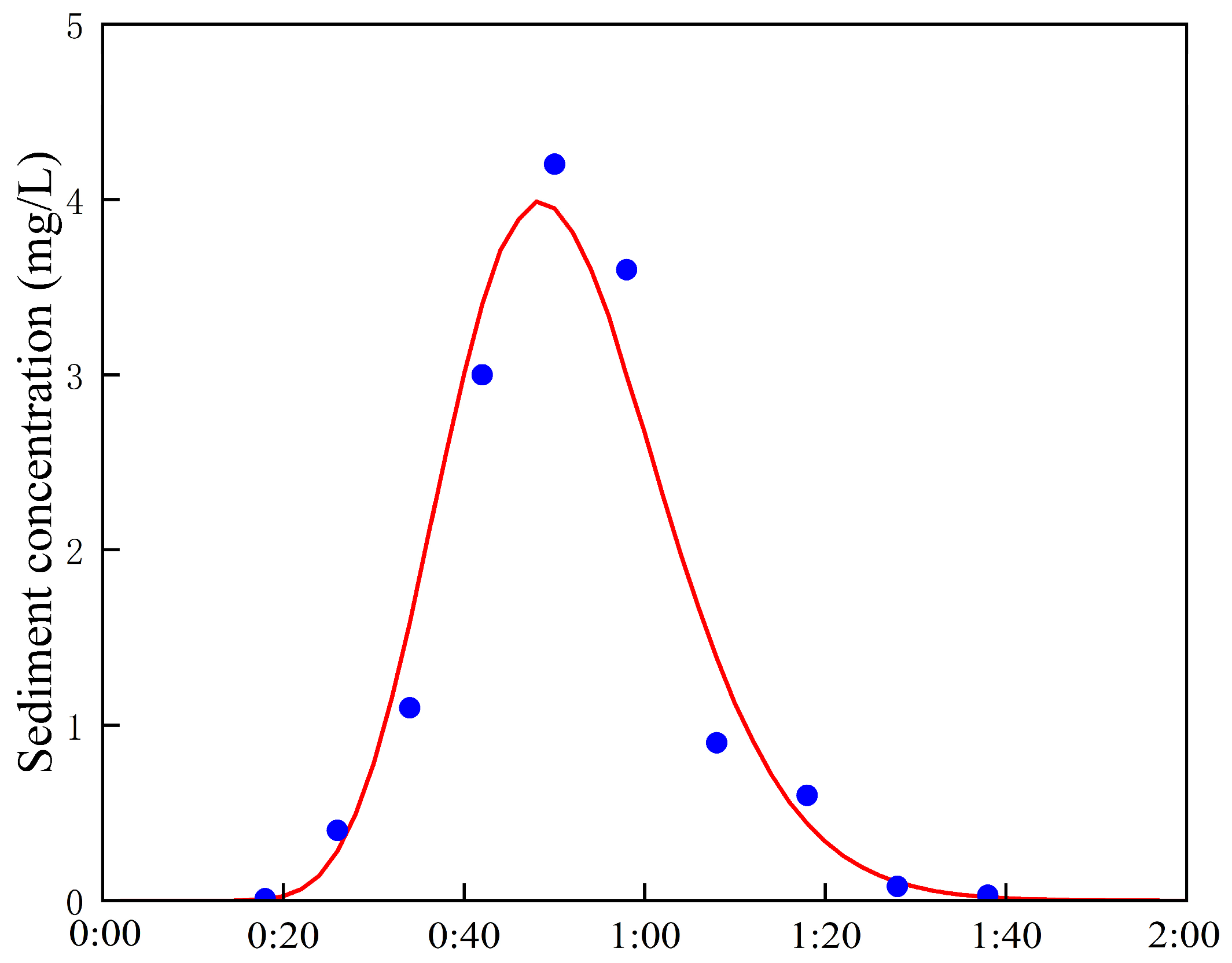
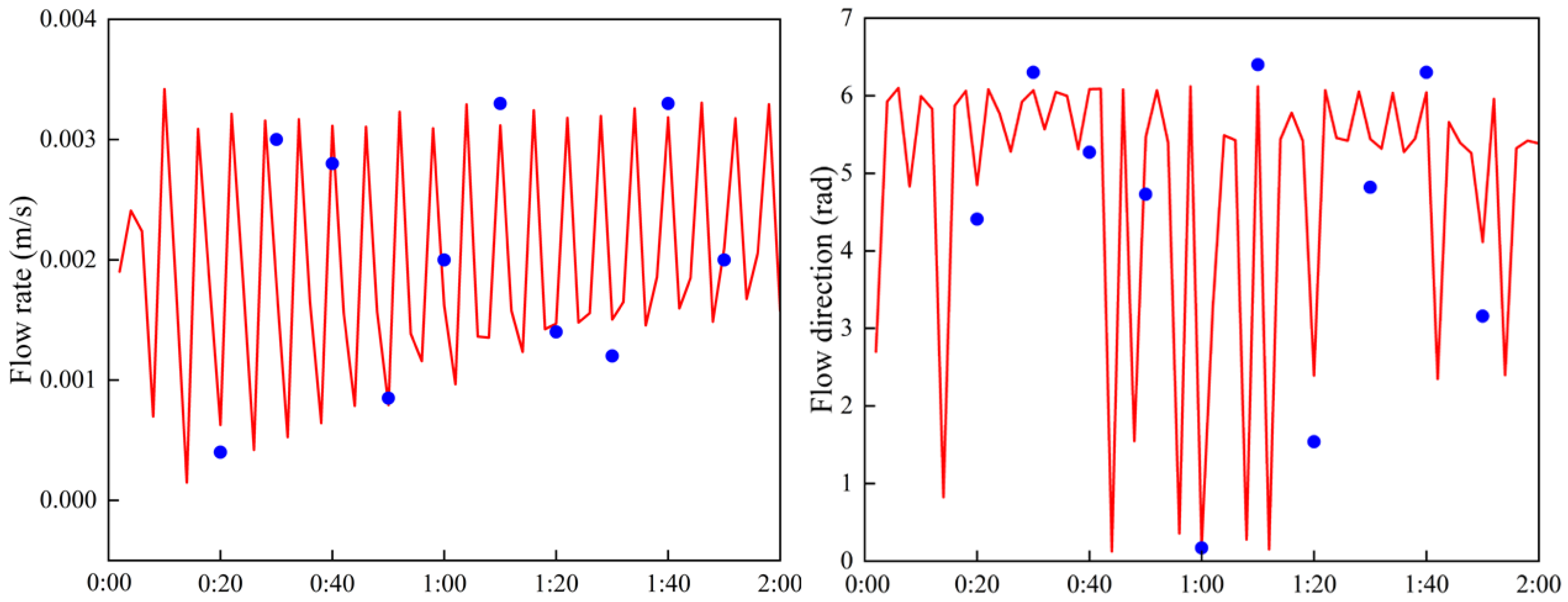
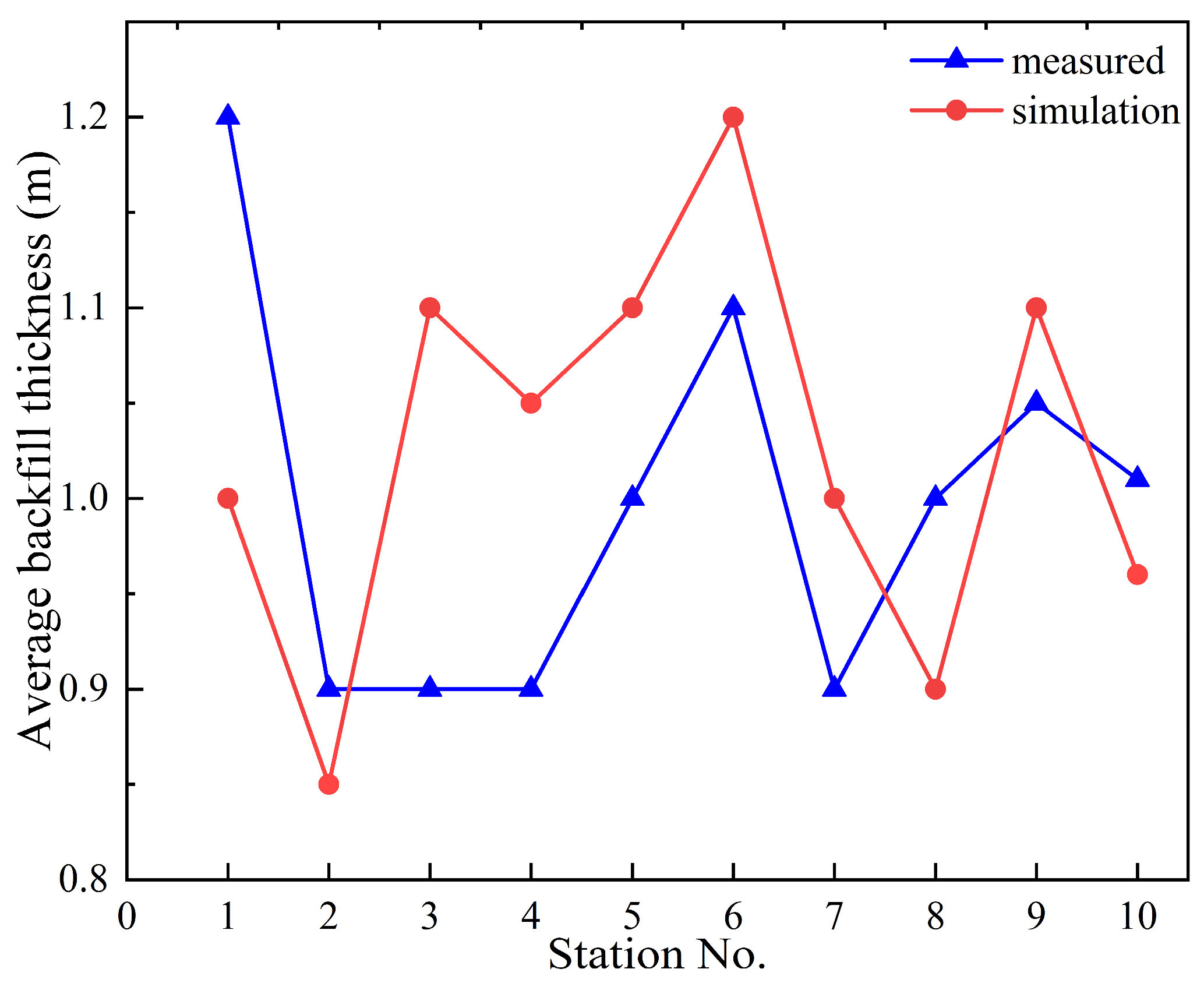
Observation-based constraints include water level, depth-averaged velocity inferred from ADCP profiles, SSC time series, and the threshold envelope area. Hydrodynamic calibration is performed first, such that the root-mean-square errors of water level and velocity satisfy the relevant criteria; sediment parameter searching is then conducted. The objective function is defined as a weighted, multi-metric form:
where
denotes the weighted sum of area deviations for three selected concentration isolines. Under the TSHD operational scenario, the model can reproduce the observed magnitudes of water level, current velocity, and SSC, and is therefore suitable as a calibration benchmark.
To improve the transparency of the calibration procedure, the final adopted values of the key sediment transport parameters are summarized in
Table 1.
It should be noted that the calibrated parameter set in this study is intended as a site-specific engineering representation for the Pasay Port application. Because the influences of settling velocity, diffusion intensity, and source-scale parameters are strongly dependent on local hydrodynamic conditions, sediment properties, and operational settings, the calibrated values reported here should be interpreted as locally representative rather than universally transferable. A comprehensive sensitivity or uncertainty analysis across broader marine environments is beyond the scope of the present work and deserves dedicated future investigation.
4. Analysis and Discussion
Within a typical operational window of the Pasay Port backfilling project, a large TSHD is taken as the working platform. The project requires a total backfilling thickness of 2 m implemented in two layers. Accordingly, the volume of a single sailing side-casting operation is set to approximately 1.6 × 10⁴ m3 with a sailing leg of 500 m, corresponding to a total discharged sediment mass of about 4.2 × 10⁷ kg. The scenario matrix consists of 33 parameter combinations formed by three sailing speeds (0.2/0.3/0.4 kn) and eleven sediment concentration levels (5–90%). To ensure engineering relevance for layered construction, only scenarios yielding a single-layer backfilling thickness within 0.5–1.0 m were retained for comparative analysis. As a result, 20 scenarios were retained, and 13 were excluded; among the excluded cases, eight produced insufficient single-layer thickness (<0.5 m), whereas five led to excessive deposition thickness (>1.0 m). The excluded scenarios occur near both ends of the parameter space, indicating that the screening acts as an engineering feasibility constraint rather than a biasing selection step.
4.1. Spatiotemporal Evolution Characteristics of Far-Field Plume Dispersion
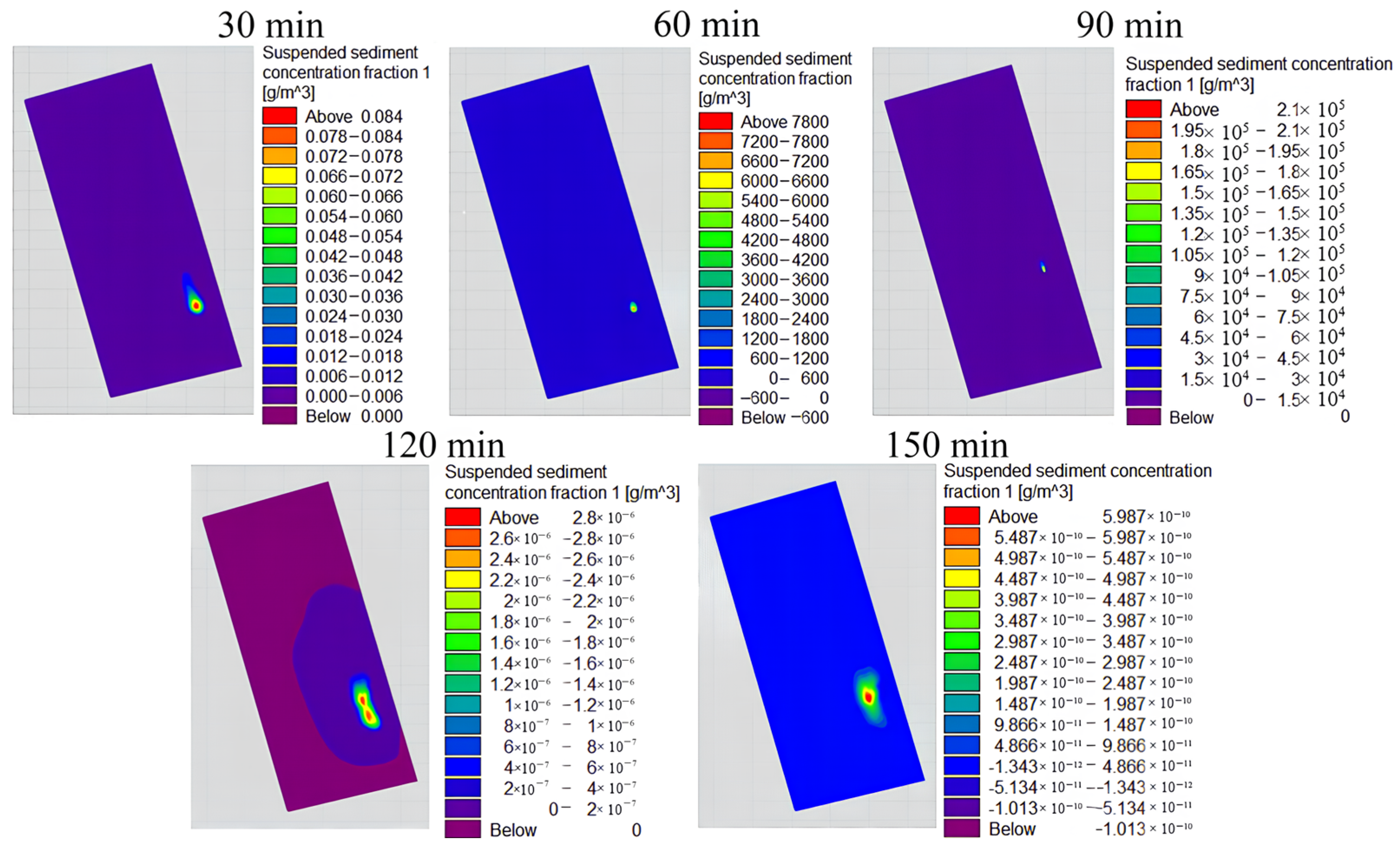
To characterize the far-field evolution of sediment plumes induced by sailing side-casting backfilling under tidal forcing, a baseline scenario is selected with a sailing speed of 0.3 kn, a sediment concentration of 70%, and a sailing leg length of 500 m, which is used as the reference for subsequent comparative analyses. Under this scenario, the side-casting operation can be regarded as a moving-source term continuously released along the sailing track. The plume evolution is jointly governed by source sweeping, tidal advection, turbulent diffusion, and settling, and the resulting far-field dispersion exhibits stable stage-dependent characteristics, as illustrated in
Figure 9.
The temporal variations in the threshold exceedance area and centroid displacement are shown in
Figure 9. Under this baseline scenario, the side-casting operation acts as a continuously moving source along the sailing track, and the far-field plume evolution is jointly controlled by source sweeping, tidal advection, turbulent diffusion, and settling. To reduce reliance on visual interpretation alone, the temporal evolution is quantified using two indicators: the threshold exceedance area of the plume footprint and the centroid displacement of the exceedance region relative to the initial release position. The former characterizes the planar impact extent, whereas the latter reflects the net downstream migration of the plume under tidal advection.
In the early stage of side-casting, the source is still being accumulated along the sailing path, so the exceedance area remains limited, and the centroid displacement grows slowly. The plume is therefore concentrated near the source region, and no clear trailing structure has yet formed. During the intermediate stage, both indicators increase rapidly: the threshold exceedance area expands markedly under the combined effects of continuous release, tidal transport, and horizontal diffusion, while the centroid displacement increases as the plume is advected along the dominant transport direction. This period corresponds to the fastest plume growth stage.
From the late operational stage to shortly before or after source termination, the exceedance area reaches its maximum or remains near its peak, indicating the most unfavorable impact footprint. At this stage, newly released sediment is superimposed onto the pre-existing trailing plume, so the outer boundary may still expand even when the high-concentration core begins to weaken. After source termination, the system enters a passive transport and decay stage. The exceedance area gradually contracts under settling and dilution, and the centroid displacement tends to level off as the plume approaches the background state. Therefore, the temporal plume stages can be identified more objectively as a source accumulation stage, a rapid expansion stage, and a post-termination decay stage according to the joint evolution of the exceedance area and centroid displacement.
4.2. Control Effects of Sailing Speed on Far-Field Dispersion Scale and Impact Footprint
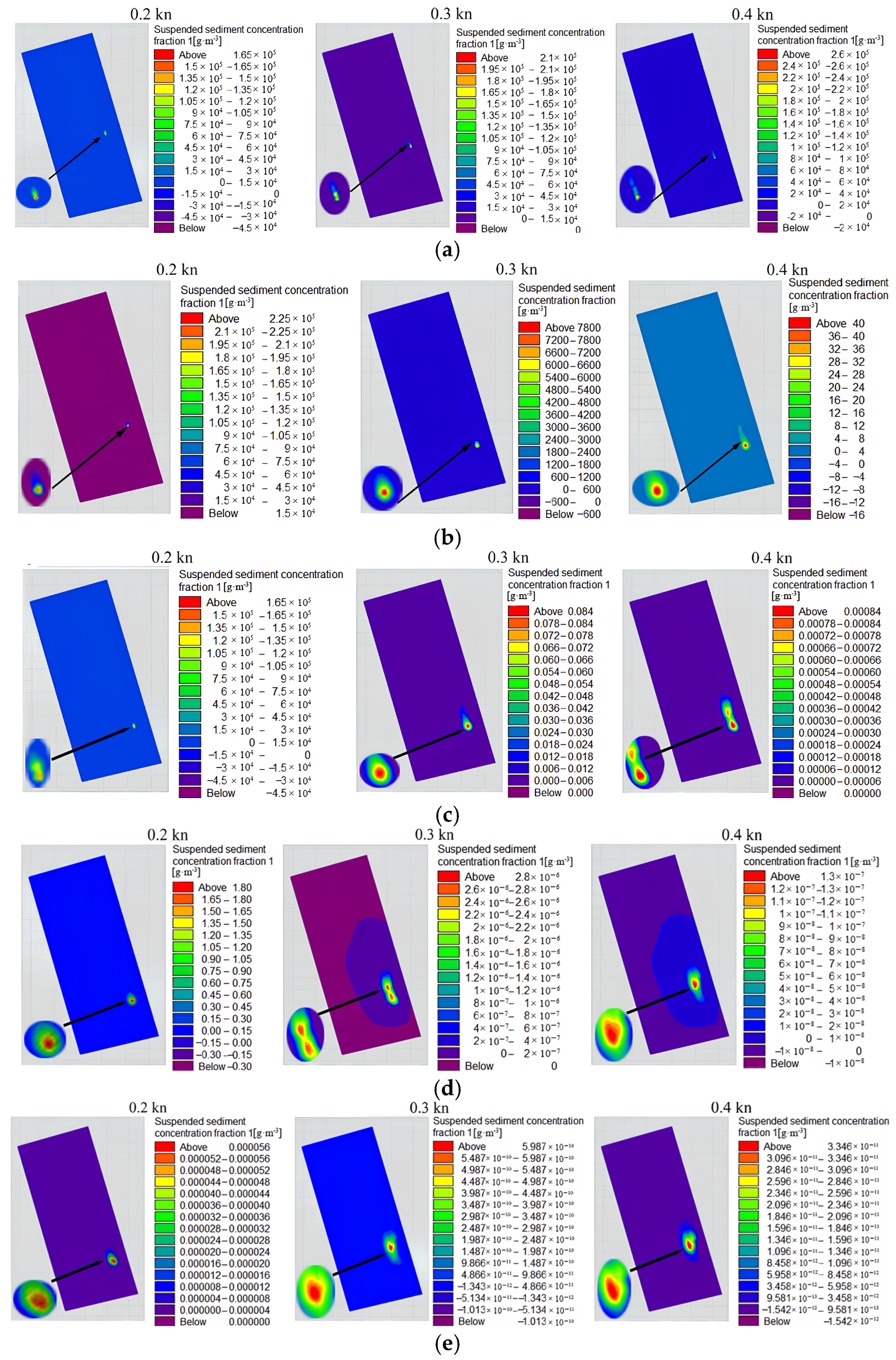
In layered sailing side-casting backfilling, sailing speed determines the sweeping efficiency of the moving source and the operation duration, and is therefore a key operational parameter governing far-field dispersion. To quantify its effects, a comparative analysis is conducted for three sailing speeds (0.2/0.3/0.4 kn) under a fixed sediment concentration of 70% and a constant sailing leg length of 500 m, as shown in
Figure 10.
Under all three sailing speeds, the plume evolves through source accumulation, outward expansion, and post-termination decay, but the temporal pace and spatial footprint differ substantially. At 0.2 kn, the source remains active for about 81.0 min over the 500 m sailing leg, so the plume stays concentrated near the release corridor for a longer period, and the downstream trailing structure develops relatively slowly. At 0.3 kn, the source duration decreases to 54.0 min, and the plume forms a clearer and more continuous elongated band during the middle stage. At 0.4 kn, the source duration is further reduced to 40.5 min, while the swept distance per unit time is the largest; consequently, the trailing plume is established earlier, and the affected footprint expands more rapidly during the first hour. In this sense, increasing sailing speed compresses the release period while enhancing the along-track stretching rate of the far-field plume, thereby changing both the footprint geometry and the timing of its development.
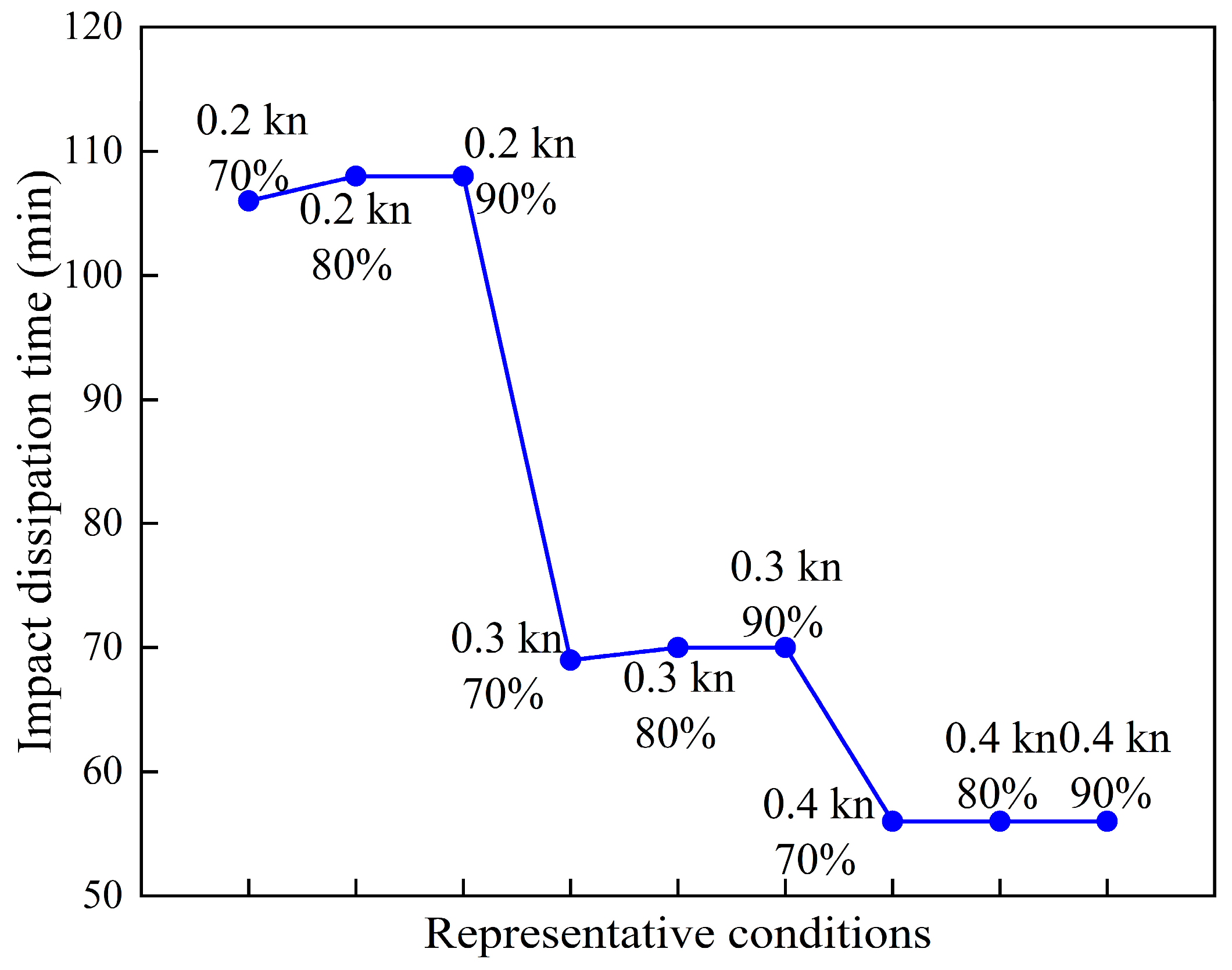
The shift in operation duration directly changes the timing and persistence of the most unfavorable footprint. For the representative high-concentration cases analyzed in this study, the impact dissipation time is about 105.9–107.9 min at 0.2 kn, 68.9–69.9 min at 0.3 kn, and 55.9 min at 0.4 kn. Thus, when the sailing speed increases from 0.2 kn to 0.4 kn, the total impact duration is shortened by approximately 50 min, whereas the corresponding variation caused by concentration changes within a given speed group is much smaller. The low-speed case, therefore, exhibits a later and longer-lasting peak footprint because sediment input is sustained over a longer interval, while the high-speed case reaches the unfavorable stage earlier and enters the decay regime sooner after source termination. These numerical comparisons indicate that sailing speed is the dominant control on the temporal persistence and occurrence window of the far-field impact footprint under the present scenario settings.
The effect of sailing speed can be attributed to a dual modulation of the spatiotemporal characteristics of the moving source. A higher speed increases the swept distance per unit time, promoting rapid formation and elongation of the trailing plume, while simultaneously shortening the side-casting duration and enabling an earlier transition from a release-dominated regime to a regime controlled by background transport and decay. Therefore, sailing speed is not merely an operational setting; it is an important variable that can shift the relative importance of the mechanisms governing far-field dispersion, providing a physical basis for subsequent analyses of concentration effects and speed–concentration coupling.
4.3. Modulation of Deposited Layer Thickness and Coverage According to Sediment Concentration
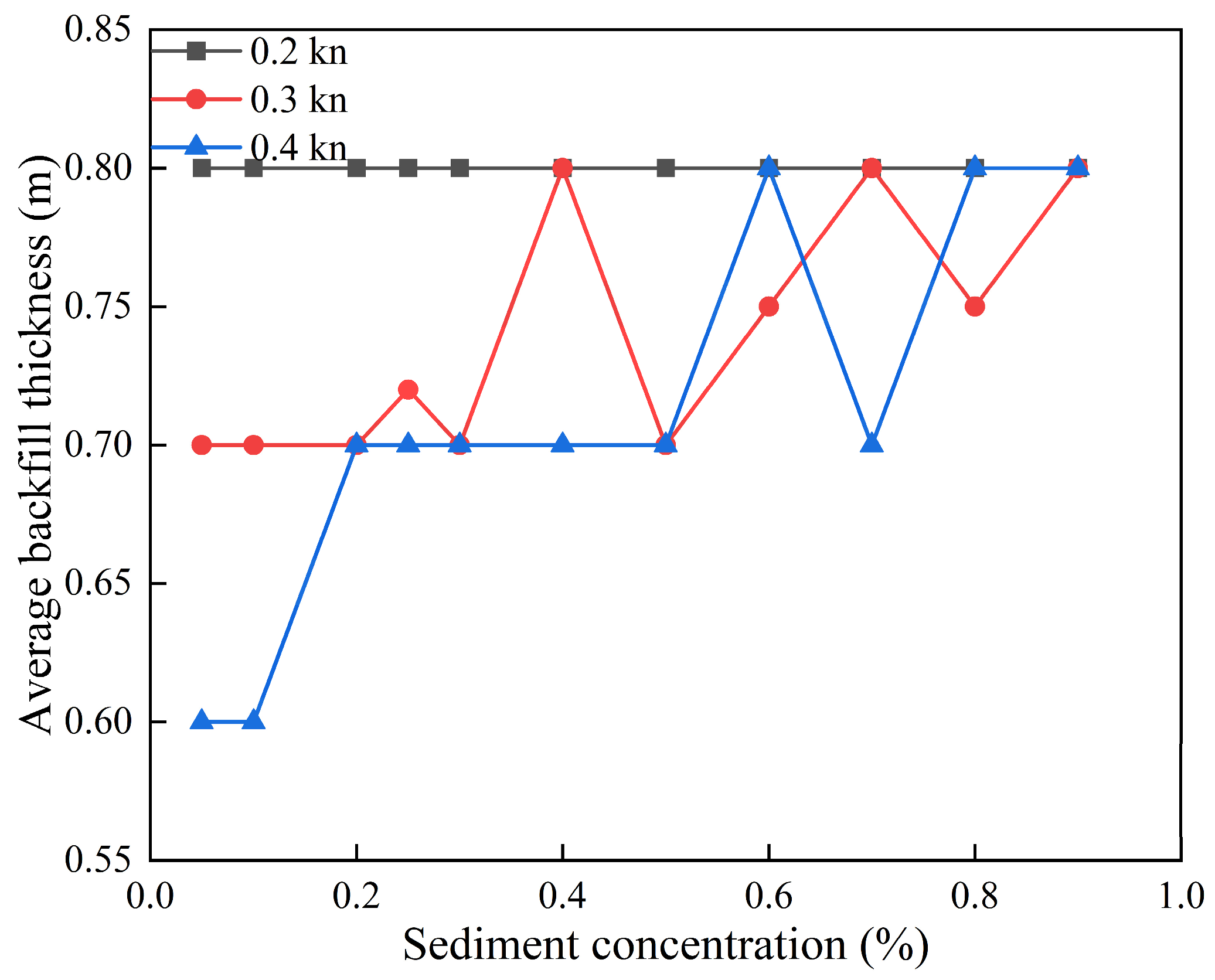
In layered sailing side-casting backfilling, sailing speed primarily controls the far-field dispersion scale, whereas sediment concentration more directly governs the deposited layer characteristics by regulating the solid flux. Accordingly, the deposition responses under different combinations of sailing speed and sediment concentration are compared using three unified indicators: mean deposited thickness, coverage width, and core trailing-band length. These three metrics characterize, respectively, the overall deposition magnitude, the lateral spreading extent, and the along-track continuity of the deposited layer. The following analysis, therefore, focuses on how these three indicators vary with sediment concentration under different sailing speeds.
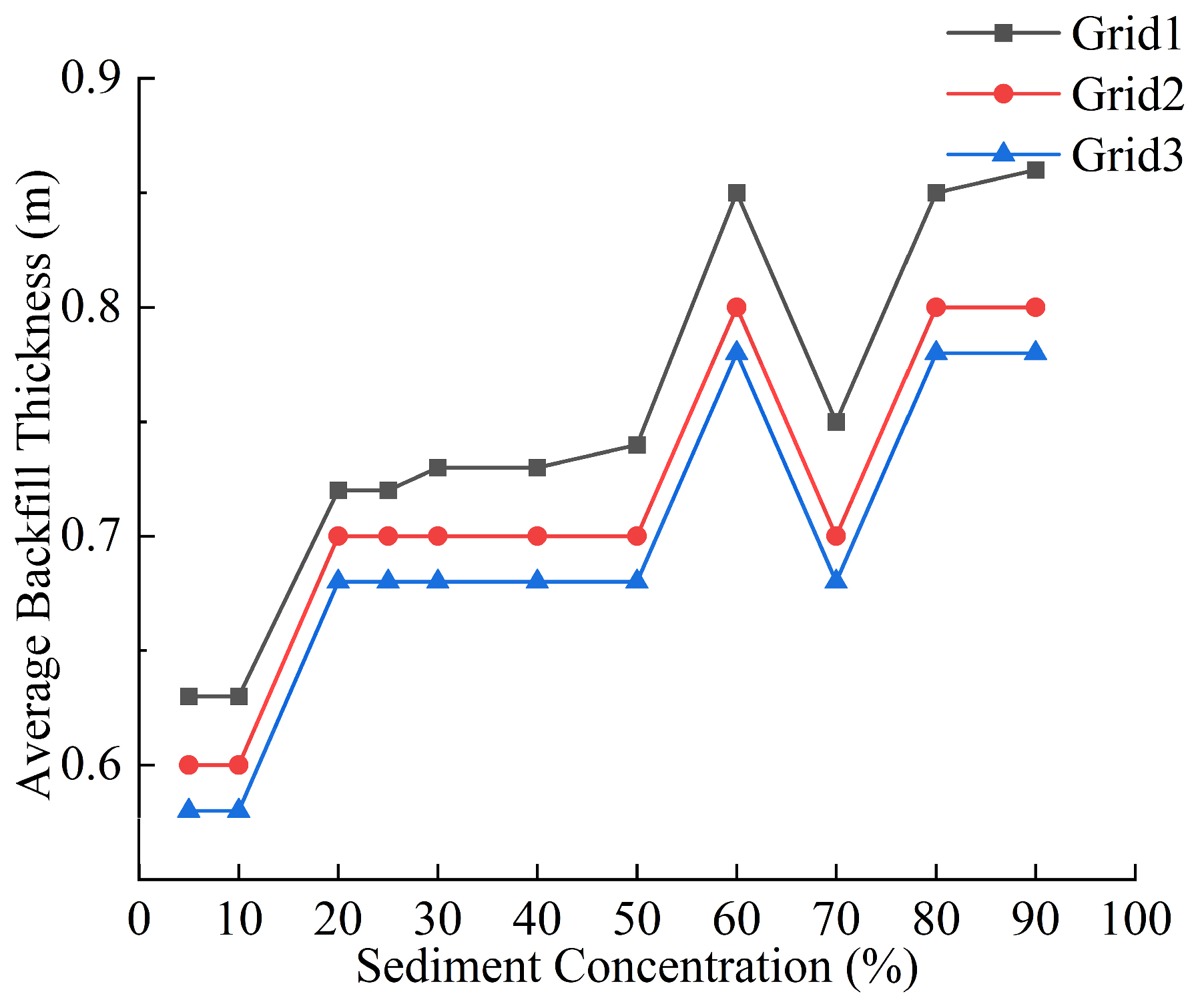
As shown in
Figure 11, for all sailing speeds, the mean deposited thickness generally increases with increasing concentration, while the coverage width exhibits a consistent decreasing trend. At low concentrations, the solid flux is small, and deposition is more readily influenced by background hydrodynamics and lateral diffusion, resulting in a thin yet wide deposit. As concentration increases, settling becomes more efficient, and a larger fraction of particles is deposited near the sailing track, leading to a rapid increase in thickness and a suppression of lateral spreading. In the high-concentration range, the incremental increase in mean deposited thickness becomes smaller, indicating an apparent leveling-off within the tested concentration range that may be associated with bed constraints, resuspension, and mixing limitations. This feature is consistent across different sailing speeds, suggesting that it is primarily governed by sediment concentration.
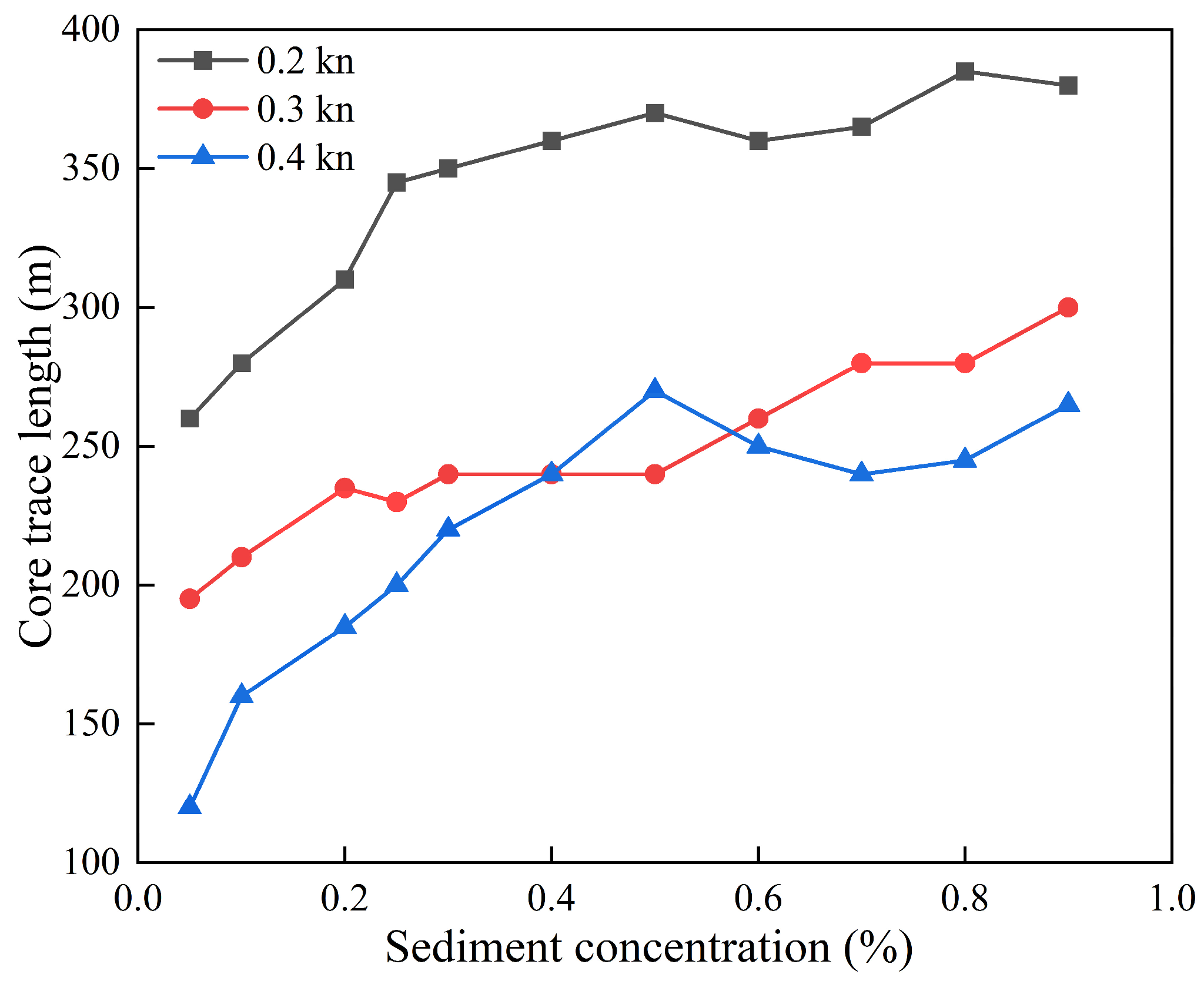
As shown in
Figure 12, core trailing-band length increases with increasing concentration for all sailing speeds, indicating that higher concentrations enhance along-track continuity. However, the sensitivity varies with sailing speed. At low speeds, the response is stronger, and concentration plays a more pronounced role in regulating continuity. At higher speeds, the incremental change becomes smaller, suggesting that rapid source migration weakens the control of a single concentration level on continuity, and the deposition pattern becomes more constrained by the speed-dominated mechanisms.
Sediment concentration modifies the particle settling probability and near-bed accumulation efficiency by regulating the solid flux. At low concentrations, collective (hindered/aggregate) effects are weak, and settling is more easily diminished by turbulence and lateral diffusion. As concentration increases, the settling probability rises, promoting the formation of thicker and more continuous deposits. With further increases, growth in these indicators gradually levels off due to limitations imposed by bed conditions and resuspension. Overall, sediment concentration more directly affects deposition-related characteristics, while sailing speed modulates its effects through the sweeping characteristics of the moving source.
4.4. Control Mechanisms of Parameter Combinations on the Recovery Duration of Environmental Impacts
In engineering practice and environmental management, an operable integrated indicator is required to quantify far-field dispersion impacts. Among various metrics, the time required for suspended-sediment concentration (SSC) to recover below a specified control level is a useful criterion because it jointly reflects the effects of dispersion scale, source duration, and background hydrodynamics, and directly influences construction-window scheduling and environmental risk assessment. In the present study, the dissipation of construction-induced disturbance is therefore quantified as the time required for SSC to return below a prescribed reference level. It should be emphasized that the value of 200 mg/L is adopted here as an engineering reference threshold for inter-scenario comparison, rather than as a universal environmental limit applicable to all sites. Its practical relevance may vary with local regulatory requirements, ecological sensitivity, and background turbidity conditions. Accordingly, to improve local interpretability, an incremental criterion relative to the pre-operation background SSC is also introduced in parallel.
In practical backfilling projects, the water content of fill material is typically no higher than 30% [
20]. Therefore, sediment concentrations of 70%, 80%, and 90% are selected as representative levels to cover common high-solids backfilling conditions. For consistency of scenario comparison, the absolute reference threshold is set to
mg/L based on previous engineering practice [
21]. Meanwhile, to account for local background conditions and to avoid overreliance on a single absolute threshold, a background-relative form is introduced as
where
is the background suspended-sediment concentration measured prior to the start of side-casting, and
denotes the allowable above-background increment. In the validation window of the present study,
is approximately 0.1 mg/L before the operation, indicating a very low ambient background level in the monitored area. Under this framework, the 200 mg/L threshold serves as a unified engineering reference for comparing scenario-dependent recovery duration, while the incremental criterion provides a site-dependent interpretation linked to local background conditions and possible regulatory requirements.
Taking the pre-operation observation window used for model validation as an example, the background SSC in the monitored area was approximately mg/L. Under the absolute threshold criterion, the recovery condition is . Under the background-relative criterion, the recovery condition is , where denotes the allowable above-background increment. The former is used here as a unified engineering reference for inter-scenario comparison, whereas the latter is introduced to account for local background conditions and possible regulatory requirements.
As shown in
Figure 13, the recovery duration varies markedly among scenarios, spanning on the order of tens of minutes, indicating that construction parameters can materially affect the persistence of environmental impacts. Within the tested scenarios, the recovery duration is more sensitive to sailing speed than to sediment concentration. Although low sailing speeds tend to produce a smaller instantaneous dispersion scale, the longer source duration maintains elevated SSC for a longer period, resulting in slower recovery. At higher sailing speeds, the source terminates earlier, the system enters the passive decay stage sooner, and the recovery process is correspondingly accelerated. Sediment concentration mainly provides a secondary modulation within each sailing speed group: increasing concentration generally prolongs the recovery duration, but the magnitude of this effect is smaller than the differences associated with changes in sailing speed.
A two-factor variance decomposition further suggests that the variation associated with sailing speed is larger than that associated with sediment concentration, while the interaction term remains comparatively limited under the present parameter settings. This pattern indicates that the recovery duration is closely related to the source duration and release rhythm. Sailing speed controls the side-casting duration and therefore affects the fraction of time during which the system remains under active source input. Similar distinctions between an operationally forced release stage and a post-release passive plume stage have been widely recognized in dredging plume studies and far-field plume assessments, in which the persistence of elevated suspended sediment is governed jointly by source duration, background advection, turbulent diffusion, and settling removal. Realistic source term estimation is therefore critical because it determines not only the initial plume intensity but also the timing and magnitude of the transition from source-controlled evolution to background-controlled decay [
22].
From a process perspective, the recovery of the far-field SSC footprint can be interpreted as the combined result of two successive stages. During the active release stage, the moving source continuously injects suspended sediment into the ambient flow, and the exceedance footprint is maintained by the combined effects of source replenishment and tidal advection. After source termination, the system enters a passive decay stage, in which the residual plume progressively weakens under the joint action of background transport, horizontal diffusion, and gravitational settling. Reviews of dredging-induced plumes and hybrid near-field/far-field plume models show that this post-release evolution is commonly controlled by ambient hydrodynamics together with sediment-settling behavior, whereas the total persistence of above-threshold concentration is strongly influenced by the release duration and the termination timing of the source [
23]. Therefore, under the present moving-release configuration, sailing speed affects recovery primarily by controlling the side-casting duration and the transition time from active release to passive decay, while sediment concentration mainly modulates the initial plume intensity and settling supply but has a weaker effect on the overall recovery duration within the tested range.
This interpretation is also consistent with the present results. For a fixed sailing leg, increasing sailing speed shortens the source duration and advances the onset of passive decay, thereby reducing the total exceedance duration. By contrast, within the tested 70–90% concentration range, the characteristic post-termination decay time varies within a narrower band, indicating that concentration mainly modifies the release strength but does not overturn the dominant control exerted by source duration. From an engineering perspective, this suggests that, when backfilling thickness and coverage requirements are satisfied, a moderate increase in sailing speed may help shorten the SSC exceedance duration. Sediment concentration should therefore be selected in conjunction with deposition-related requirements and allowable recovery time constraints.
4.5. Dynamical Characteristics and Dimensional Analysis of Far-Field Sediment Dispersion
Once the sediment plume enters the far field, the intense initial mixing in the vicinity of the outlet can be equivalently represented, at the regional scale, as a time-varying moving-source term along the sailing track. For physical interpretation of the far-field behavior, the dominant balance of the depth-averaged suspended-sediment process may be expressed in a reduced form as
where
represents the net removal intensity of settling acting on the depth-averaged concentration.
To enable consistent comparisons among different sailing speeds, a dimensionless time is introduced. When , the source continuously supplies sediment; the trailing plume is stretched and superimposed along the dominant transport direction under the background flow, and the affected area expands. When , the source terminates, and the system transitions to passive transport and decay: the high-concentration core drops rapidly, while the outer edge may continue to expand slowly for a short period; overall, concentration gradients keep weakening, and the plume converges toward the threshold. Because a moving source produces spatiotemporal superposition between newly released segments and the pre-existing trail, the stage around often exhibits coexistence of a still-expanding trail and a decaying core, causing the most unfavorable impact to occur frequently around the end of operation.
To generalize the above dynamical interpretation into criteria applicable across scenarios and to provide a unified framework for parameter extrapolation, dimensional analysis is adopted to summarize the main mechanisms influencing the far-field process. Horizontal transport can be characterized by the Péclet number, . A larger indicates advection-dominated transport and promotes along-flow elongation of the trailing plume, whereas a smaller implies stronger diffusion and facilitates lateral spreading of the impact footprint. The settling removal intensity for the depth-averaged concentration can be characterized by , where a larger value implies stronger settling over a given transport scale and faster concentration decay. The sweeping effect of the moving source can be represented by the ratio between the release duration and the characteristic transport timescale; together with sailing speed, it determines the phase window in which the most unfavorable moment occurs.
Based on the nine representative parameter combinations shown in
Figure 13, a preliminary engineering approximation can be extracted to relate the threshold dissipation time to the side-casting duration within the present parameter range. For a sailing leg length of 500 m, sailing speeds of 0.2, 0.3, and 0.4 kn correspond to source durations of 81.0, 54.0, and 40.5 min, respectively, whereas the corresponding impact dissipation times are approximately 105.9–107.9 min, 68.9–69.9 min, and 55.9 min. The resulting ratio
clusters within 1.28–1.38 for these representative cases. This indicates that, under the present high-solids scenario settings, the threshold dissipation time remains approximately proportional to the source duration to first order and may be written as
, where
should be interpreted as an empirical proportionality factor rather than a universal constant. Rewriting this expression as
gives a characteristic post-termination decay time
of about 15–27 min. Within the tested 70–90% concentration range, its variation remains limited, suggesting that the total impact duration is affected more strongly by changes in release duration induced by sailing speed than by concentration alone. Because this approximation is derived from only a small number of representative scenarios, it should be regarded only as a preliminary engineering guideline within the tested parameter space, and broader scenario coverage would be required before attempting more general predictive use.
5. Conclusions
This study investigates layered sailing side-casting backfilling with a trailing suction hopper dredger (TSHD) and addresses the need to predict and regulate far-field plume dispersion and deposition under tidal forcing. Based on MIKE21 within a two-dimensional depth-averaged framework, a tide-resolving assessment system is established. A moving-source term is introduced to describe the side-casting track and flux time series, and a parameter matrix is constructed for comparative analyses. Field hydrodynamic and SSC data acquired using RTK-GNSS are used to calibrate and validate water level, tidal currents, and suspended-sediment processes. The Pasay Port project in Manila Bay is employed as a case study to evaluate the dispersion footprint, deposition patterns, and recovery duration. The main findings are as follows:
- (1)
Under the baseline condition with a 500 m sailing leg and a sailing speed of 0.3 kn, the active source duration is about 54.0 min. The far-field plume evolution can be divided into three successive stages, namely, source accumulation (0–30 min), rapid expansion (30–60 min), and post-termination decay (>60 min). The most unfavorable footprint generally occurs near the end of source release, and the plume gradually weakens thereafter, approaching the background state at approximately 120–150 min.
- (2)
Under a fixed sailing speed, sediment concentration primarily governs the deposited layer characteristics, represented by mean deposited thickness, coverage width, and core trailing-band length. Across the tested concentration range of 5–90%, mean deposited thickness and core trailing-band length generally increase with sediment concentration, whereas coverage width decreases. This indicates that increasing concentration shifts the deposition pattern from a thin and laterally dispersed layer toward a thicker, narrower, and more continuous deposited layer along the sailing track. In the high-concentration range of 70–90%, however, the variation rates of these three indicators become weaker, indicating a reduced incremental response in the 70–90% concentration range.
- (3)
Sailing speed is the primary control on the temporal persistence of the far-field impact footprint. For a 500 m sailing leg, increasing the sailing speed from 0.2 kn to 0.3 kn and 0.4 kn shortens the source duration from 81.0 min to 54.0 min and 40.5 min, respectively, while the corresponding impact dissipation time decreases from approximately 105.9–107.9 min to 68.9–69.9 min and further to 55.9 min. By comparison, within each speed group, increasing the sediment concentration from 70% to 90% prolongs the recovery duration by no more than about 2.0 min. These results indicate that sailing speed exerts a much stronger control than sediment concentration on footprint persistence and recovery time. Within the tested parameter range, the recovery duration can be interpreted by a first-order engineering approximation related to the source duration, but this relation should be regarded only as a preliminary engineering guideline rather than a universal predictive scaling law.
To avoid overstating the generality of the present conclusions, several limitations of this study should be acknowledged. First, the analysis is based on a single engineering case in the Pasay Port area, and the calibrated parameter set should therefore be interpreted as site-specific rather than universally transferable. Second, the side-casting discharge is represented by an equivalent moving-source term within a two-dimensional depth-averaged framework, which is suitable for far-field engineering assessment but does not explicitly resolve near-field jet breakup, vertical stratification, or propeller-induced entrainment. Third, the scenario matrix is restricted to the tested ranges of sailing speed and sediment concentration, so the derived response patterns and the preliminary scaling for recovery duration should not be extrapolated beyond the present parameter space without additional verification. Fourth, the validation data are limited by the spatial and temporal coverage of field observations, especially for SSC, which may still introduce uncertainty into the calibrated sediment transport parameters. Fifth, the threshold-based recovery analysis in this study is intended as an engineering comparison framework, and its practical interpretation may vary with local regulatory criteria, background turbidity, and ecological sensitivity. Similar issues concerning process simplification, model applicability, and uncertainty in dredge plume assessment have also been discussed in previous studies and reviews [
24].
Future work should therefore focus on extending the framework in several directions. Multi-site validation under different hydrodynamic and sedimentary environments is needed to assess parameter transferability and improve the general applicability of the method. Coupling with higher-resolution near-field models or more advanced plume formulations would help better constrain the source representation and the transition from active release to passive decay [
25]. Broader scenario sampling, including wider operational ranges and additional environmental forcings, is also required to test the robustness of the preliminary recovery duration scaling identified in this study. In addition, more comprehensive field monitoring and data assimilation may improve the calibration of SSC-related processes and reduce residual uncertainty in plume prediction [
26]. Overall, the present study should be regarded as a physically constrained and observation-calibrated engineering reference for layered side-casting backfilling under tidal forcing, rather than as a universal predictive framework.