1. Introduction
Tides dominate sea levels and currents in most coastal regions. They are commonly obtained using conventional harmonic analysis (CHA), which fits a set of sinusoidal components to the data via least squares [
1]. However, this method cannot be readily applied online or during model runtime, as it requires the complete time series a priori. The alternative method for tidal removal is based on weighted averaging filters [
2,
3,
4]. This method can achieve a greater degree of tidal suppression and is independent of geographic location. It is useful for studying long-period sea level fluctuations. However, because this method operates as a low-pass filter, it also eliminates non-tidal oscillations with periods close to tidal periods. Furthermore, it is not suitable for online applications because it requires both past and future data to perform the filtering.
The demand for online de-tiding applications has therefore driven the development of several online tidal filters. To remove modelled tides prior to the data assimilation of sea level anomalies, Smith et al. [
5] adapted the CHA to an online harmonic analysis (OHA) using a sliding-window approach. To assimilate deep-water tides or tidal transports, Kodaira et al. [
6] and Wang et al. [
7] adapted the recursive climatological filter (RCF) of Thompson et al. [
8], originally developed for spectral nudging of temperature and salinity, to tidal frequencies. This approach has subsequently been used for the parameterization of the tidal component of ice-ocean stress [
9]. More recently, Xu and Zaron [
10] developed an online “streaming” band-pass filter (SBP), based on the motion of a damped harmonic oscillator, and applied it to the parameterization of internal wave drag in ocean models. Although these approaches were developed for similar purposes, their relative similarities, differences, and practical implications have not been clearly established.
So far, applications of the online filters introduced above have mostly focused on regions away from the coast, where tidal signals are easier to isolate. In coastal regions, however, accurate de-tiding is more challenging due to shallow water effects, nonlinear interactions, and the presence of non-tidal signals near the tidal frequency bands [
11,
12]. De-tiding is therefore typically performed using CHA applied to year-long time series, a process that can be resource-intensive when applied routinely across large numbers of locations or over a two-dimensional field.
In operational practice at Environmental and Climate Change Canada (ECCC), the de-tiding procedure for total sea level (TSL) is repeated every 12 h for each forecast, using accumulated year-long data for Canadian coastal regions. Non-tidal residuals (NTRs, TSL minus tides) are used to reconstruct TSL over locations where accurate harmonic predictions are available based on long observation records. Two-dimensional maps of NTRs are used by forecasters to inform flooding warnings, for example, by assessing the propagation of remote surges in the form of coastal trapped waves. In addition, developers need to generate informative two-dimensional TSL products referenced to the highest or lowest astronomical tide (HAT or LAT). Deriving HAT and LAT requires de-tiding at least 19 years of hindcast TSLs to account for nodal modulation, and this process must be repeated whenever model updates affect the simulated tides. Collectively, these de-tiding requirements place substantial demands on computational resources.
This raises the question of whether the online tidal filters described earlier could help address this computational burden. A key challenge is that tidal dynamics are much more complex near the coast due to nonlinear processes, implying that more constituents are required to construct the filter and potentially increasing the computational cost during model runtime. Another challenge is ensuring sufficient accuracy so that the impact of the filter on derived NTRs is minimal.
Based on these considerations, we aim to address two key questions: (1) What are the similarities and differences among the three online tidal filters, RCF, OHA, and SBP? (2) Can online tidal filters be used to efficiently and accurately de-tide modelled coastal sea levels during model runtime, thereby replacing the resource-intensive post-processing procedure based on the CHA?
The structure of this paper is as follows.
Section 2 describes the equations of the three online tidal filters. Their evaluation and comparison are presented in
Section 3.
Section 4 explores the applicability of the filter for online de-tiding of coastal sea levels. A summary and conclusions are given in
Section 5.
2. Filter Description
For the three filters, we denote the original and filtered sea level time series at the current
-th model time step by
and
, respectively. To facilitate comparison, we focus on one single target frequency,
, and omit the mean component. The rotation matrix with the rotation angle
, used by both RCF and OHF, is denoted by
,
2.1. Recursive Climatological Filter (RCF)
The RCF is formulated directly in the following discretized form,
where
,
, and
is an auxiliary state vector. Assuming
, the frequency response of the filter can be described by the transfer function
The coefficient
controls the nudging strength towards the input signal
. It sets both the effective memory of the filter and its spectral bandwidth; a smaller
yields a narrower bandwidth and a longer spin-up time. Its e-folding time is approximately
Although Thompson et al. [
8] do not provide an explicit derivation of the RCF equations, the method can be interpreted as an exponential moving average of embedded harmonics. The rotation matrix
is the key that advances the previous internal oscillator states to the current time step. Physically, K, when
is neglected or set to 1, is equivalent to a vector of harmonic basis functions evaluated at the current time step
, with the factor of 2 accounting for the splitting of energy between positive and negative frequency components. The vector
can be interpreted as a vector of instantaneous harmonic coefficients, from which the amplitudes and phases of tidal constituents can be recovered. The vector
in Equation (3) is used to extract the cosine component for constructing the filtered signals at the current time step.
2.2. Online Harmonic Analysis (OHA)
The OHA approach is derived by introducing a sliding-window weight, specified as a decreasing exponential function, to the cost function of CHA. The derived filter equations in real space, also in discretized form, are given by
Here,
denotes the vector of harmonic basis functions of size
, where
is the number of frequencies, and
is the matrix of the outer product of harmonic basis functions with size
. Both
and
are evaluated at the current time step
, and therefore their elements are equal to 0 for terms that involve a sine component; otherwise, the element is equal to 1.
denotes summing over only the cosine components of the vector
. The coefficient
is the weight that determines the width of the sliding window; it is equivalent to
in the RCF approach. It follows that the e-folding time of this filter is
The OHA and RCF equations are very similar, with both Equations (2) and (6) updating the state recursively with a rotation matrix to advance the previous state to the current time step. Over time, the OHA’s unique matrix
stabilizes to a constant matrix
with off-diagonal elements close to zero and diagonal elements approximately equal to 0.5, which is equivalent to the factor 2 in
of the RCF. As a result, we derived the transfer function for the OHA equations:
2.3. Streaming Band-Pass Filter (SBP)
The SBP filter is derived in continuous time form, consisting of two coupled ordinary differential equations,
where
is a dummy variable,
is the damping coefficient. The second-order version of Equations (11) and (12) is
which is the classical damped harmonic oscillator forced by the external term
. Assuming
, the transfer function of the filter is derived as
The decay of initial conditions can be examined from the homogeneous version of Equation (13), which has a solution of the form
This implies an e-folding time of
The filter bandwidth is controlled with
and the target frequency
. For implementation, the filter equations need to be discretized as follows:
3. Filter Comparison
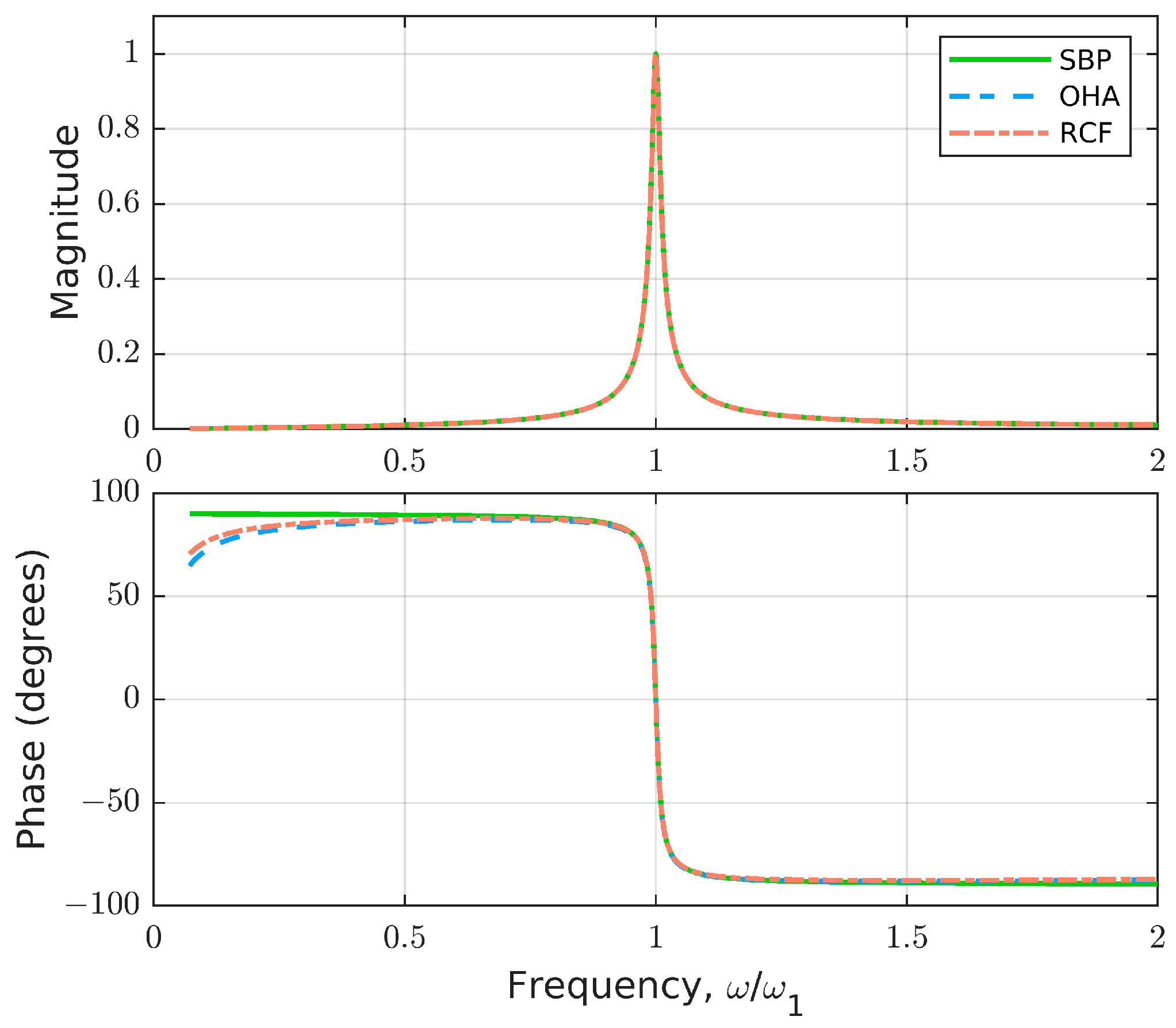
We first examine the frequency responses of the three filters. To allow a direct comparison, their e-folding times are all set to 10 days by adjusting the coefficients
,
, and
in Equations (5), (9) and (16), respectively.
Figure 1 presents a comparison of their transfer functions, following Equations (4), (10) and (14). Interestingly, despite being derived from different mathematical approaches, all filters display the same passband magnitude with a zero phase lag at the target frequency.
In the time domain, however, SBP differs from the others in that it has discretization errors (Equations (17) and (18)); Xu and Zaron [
10] show a nearly linear increase in filtering errors with
. In contrast, RCF and OHA are inherently discretized, with accuracy independent of
, which is incorporated into the rotation matrix
. To illustrate this effect, we evaluate performance using
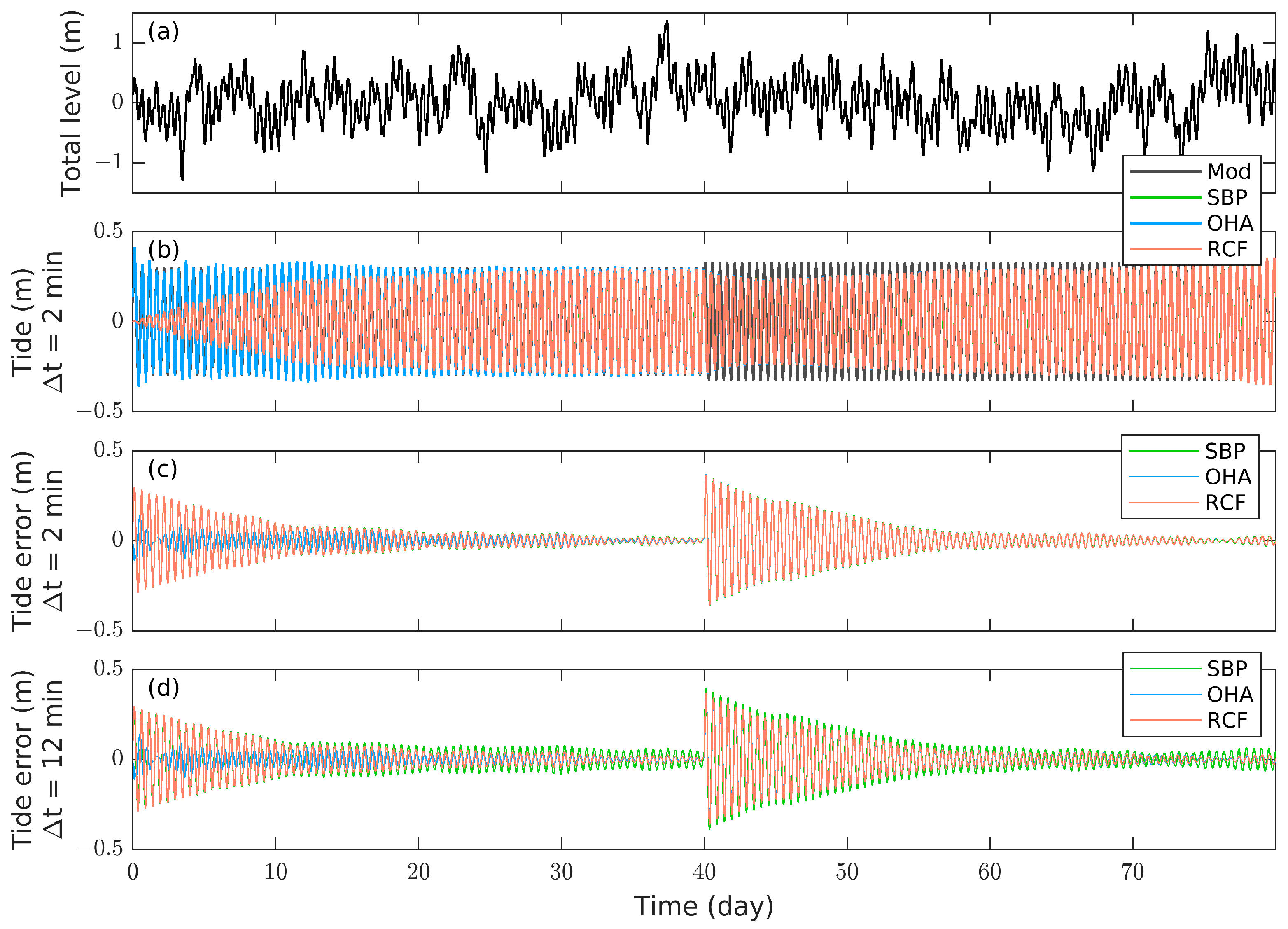
= 2 and 12 min for a modelled TSL time series constructed using M2 tide and surges (
Figure 2a). The surge component is simulated using a first-order autoregressive model. To examine the filter response to tidal variability, an abrupt change in tidal amplitude and phase is imposed at mid-record (black line in
Figure 2b). The e-folding time is set to 10 days for all filters.
Figure 2c shows the time series of errors in the filtered tides using
= 2 min. Results for all three filters are virtually identical after about day 30 (i.e., three e-folding times), once they have stabilized from the initial condition. The only difference prior to day 30 between OHA and the other two filters reflects the fact that OHA’s matrix
has not yet stabilized. Since both
and
are initialized to zero and must build up over time, their combination
(effectively normalizing
by
; Equation (8)), leads to overfitting in OHA during the early spin-up period (blue line in
Figure 2b). The corresponding results for
= 12 min are shown in
Figure 2d. As expected, SBP errors increase substantially, whereas those of RCF and OHA remain unchanged.
An overall summary of the main features of the three filters is given in
Table 1. Performance of all three filters is essentially equivalent when computational cost is not considered, including in the case of multiple frequencies. The operating costs of both RCF and SBP are low, with SBP being extremely low, about 10 times faster than RCF; However, SBP inherently introduces discretization errors, which can increase linearly up to 20% when
is increased to 25 min [
10]. Therefore, SBP may be suitable for applications where such errors are acceptable and a small
is required. The cost of OHA in its current form is much higher because of the additional matrix operation involving
. One possible solution is to optimize it by pre-initializing
to its stabilized state, thereby eliminating the need for Equation (8) and essentially reducing the overall cost to that of RCF. Note also that both RCF and OHA can extract time-varying harmonic constants, allowing additional applications, whereas SBP cannot.
Because RCF is free of discretization errors compared to SBP and has a lower cost than OHA, we use it to examine its suitability for online de-tiding of global coastal sea levels.
4. Online De-Tiding of Coastal Sea Level
4.1. Data and Evaluation
As our initial goal is to implement the online de-tiding of coastal sea level in ECCC’s Global Deterministic Storm Surge Prediction System (GDSPS) [
9], we use a model-based TSL hindcast produced with this system. The hindcast covers the period 2014 to 2018. We consider a sample of 305 output points that match globally distributed tide gauge locations. Following [
13], the hindcast is generated by the GDSPS, forced with surface winds and pressure from the ERA5 reanalysis [
14]. Modelled tides are constrained through the nudging of deep-water tidal transport toward data-assimilative products, TPXO8 and FES14 [
15,
16]. Modelled temperature and salinity are constrained through nudging toward the GLORYS12 reanalysis [
17]. Sea ice effects on tides are included following the approach described in [
9].
The TSL records are analyzed annually with CHA using the t_tide package [
1], and tides are reconstructed using all analyzed constituents except long-period tides (SA, SSA, MSF, MF, MSM, and MM) because (a) the meteorological contribution generally dominates at these frequencies [
18], and (b) the GDSPS does not include these astronomical tidal forcings. The filter has been run from the beginning of 2014, with data from 2018 reserved to evaluate its performance. Filter skill is quantified using the root-mean-square difference (RMSD) of tides relative to CHA, along with the mean absolute percentage difference (MAPD) for the three largest NTR maxima in 2018. We note, however, that results from CHA do not necessarily represent the “true” tidal signal, particularly in regions influenced by sea ice or by seasonal tidal variability that is not purely sinusoidal.
4.2. Filter Design
The design of the RCF requires specifying target tidal frequencies and
values. In principle, all constituents fitted by t_tide could be used to design the filter. We find, however, that this does not necessarily yield the optimal performance, because the filter must operate continuously and its bandwidth, determined by
, cannot be made infinitely narrow to minimize contamination from non-tidal processes. For this reason, we exclude insignificant or noise-level constituents. Based on sensitivity tests that minimize the average RMSD across all sites using a reference
value, we select constituents with a signal-to-noise ratio (SNR) exceeding six at two or more of the 305 locations. Requiring at least two sites helps avoid overfitting to a single isolated location with distinct tidal characteristics. We note that the criterion can be relaxed in regional or local applications (
Appendix A). This procedure results in a total of 51 constituents.
The primary factor in selecting the value is the long-term nodal modulation of tides, which requires the filter to adapt accordingly. Otherwise, a uniformly narrow bandwidth could be applied for all constituents, assuming tides are nearly deterministic. To address this, we assign wider bandwidths to constituents subject to significant nodal effects and narrower bandwidths to others.
Based on sensitivity tests aimed at minimizing the average RMSD across all sites, we set
values corresponding to an e-folding time of 90 days for K1, O1, and K2, 120 days for M2, 2N2, N2, and L2, and 200 days for the remaining constituents. Note that nodal effects differ among constituents and are more effective for K1, O1, and K2 [
19]. We refer to this configuration as t_filt
var. We find that the
values determined from this global application remain appropriate for regional or local applications (
Appendix A). We also note that the resulting data window width does not strictly comply with the Rayleigh criterion. This is not a major concern because the objective of this application is not to resolve individual constituents; rather, it is to obtain the instantaneous combined contribution of the tidal bands (i.e., the total tidal signal) over the same period as the analyzed data. Including additional constituents beyond the Rayleigh criterion provides the filter with the flexibility to better track the total tidal signal.
To illustrate the nodal impact and the effectiveness of t_filt
var, we compare it with two configurations that use uniform
values corresponding to an e-folding time of 145 days and 200 days (denoted as t_filt
145d and t_filt
200d, respectively). Among uniform bandwidth filters, t_filt
145d yields the lowest average RMSD. The three filter configurations are summarized in
Table 2.
4.3. De-Tiding Performance
We first examine filter skills using uniform bandwidths across constituents.
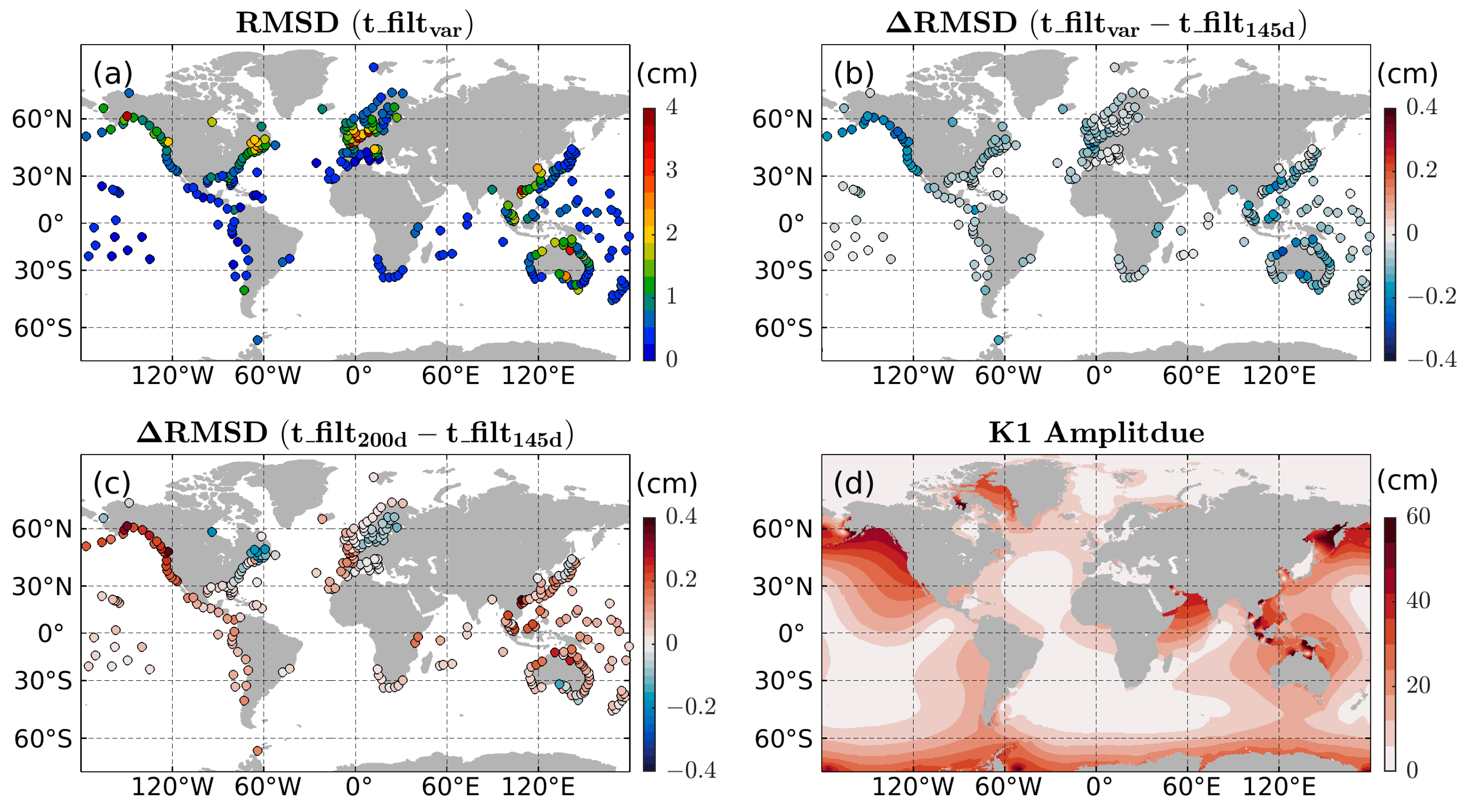
Figure 3c shows that narrowing the bandwidth from t_filt
145d to t_filt
200d results in either increased or decreased skill, depending on the region. Relatively large increases in RMSD are observed at stations in the Pacific and Indian Oceans, closely mirroring the global pattern of diurnal tides (e.g., K1 in
Figure 3d), which are subject to strong nodal modulations [
19,
20]. This indicates that t_filt
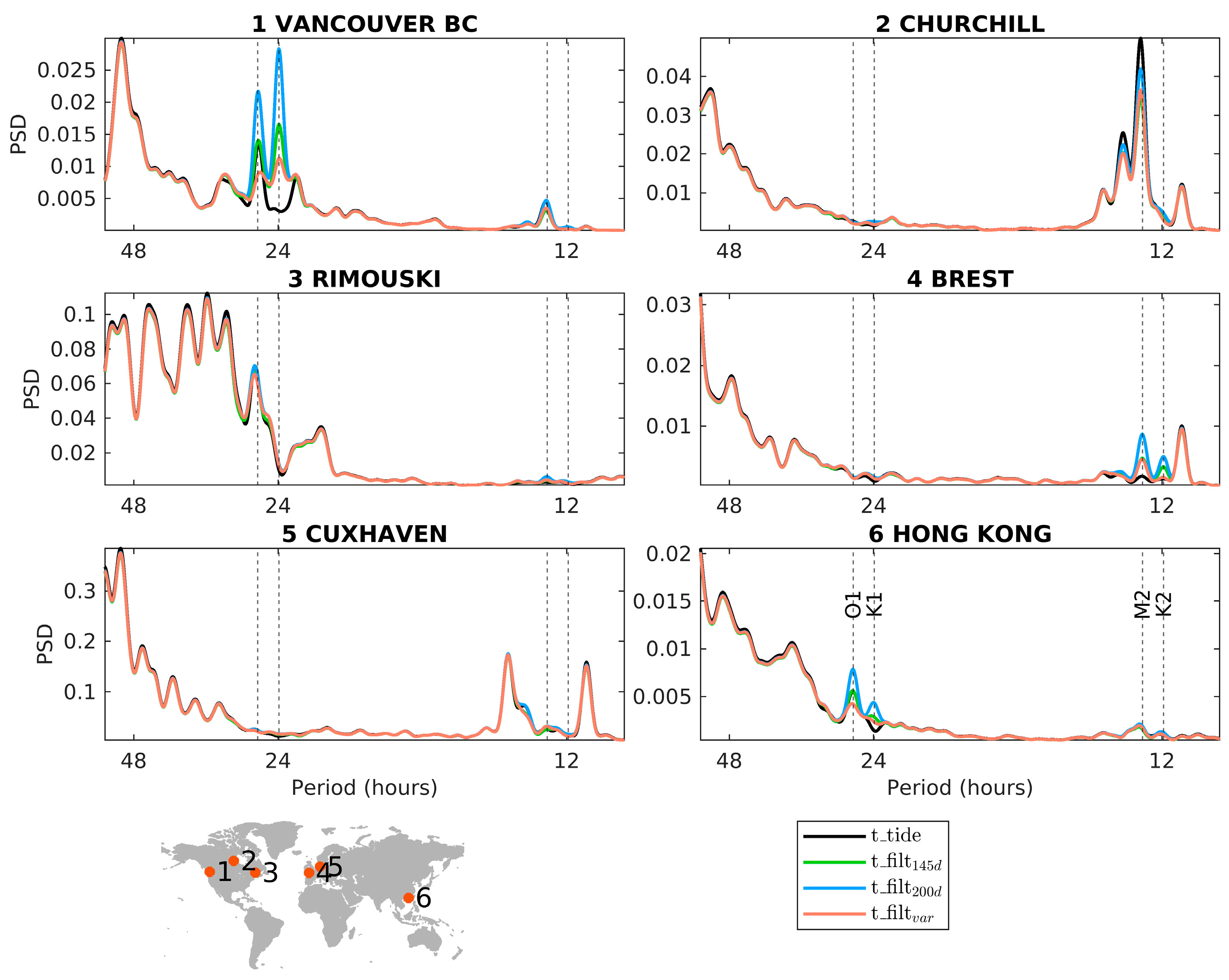
200d does not allow sufficient time to adjust to these long-term nodal variations. Indeed, this is confirmed by the NTR spectra at individual locations in
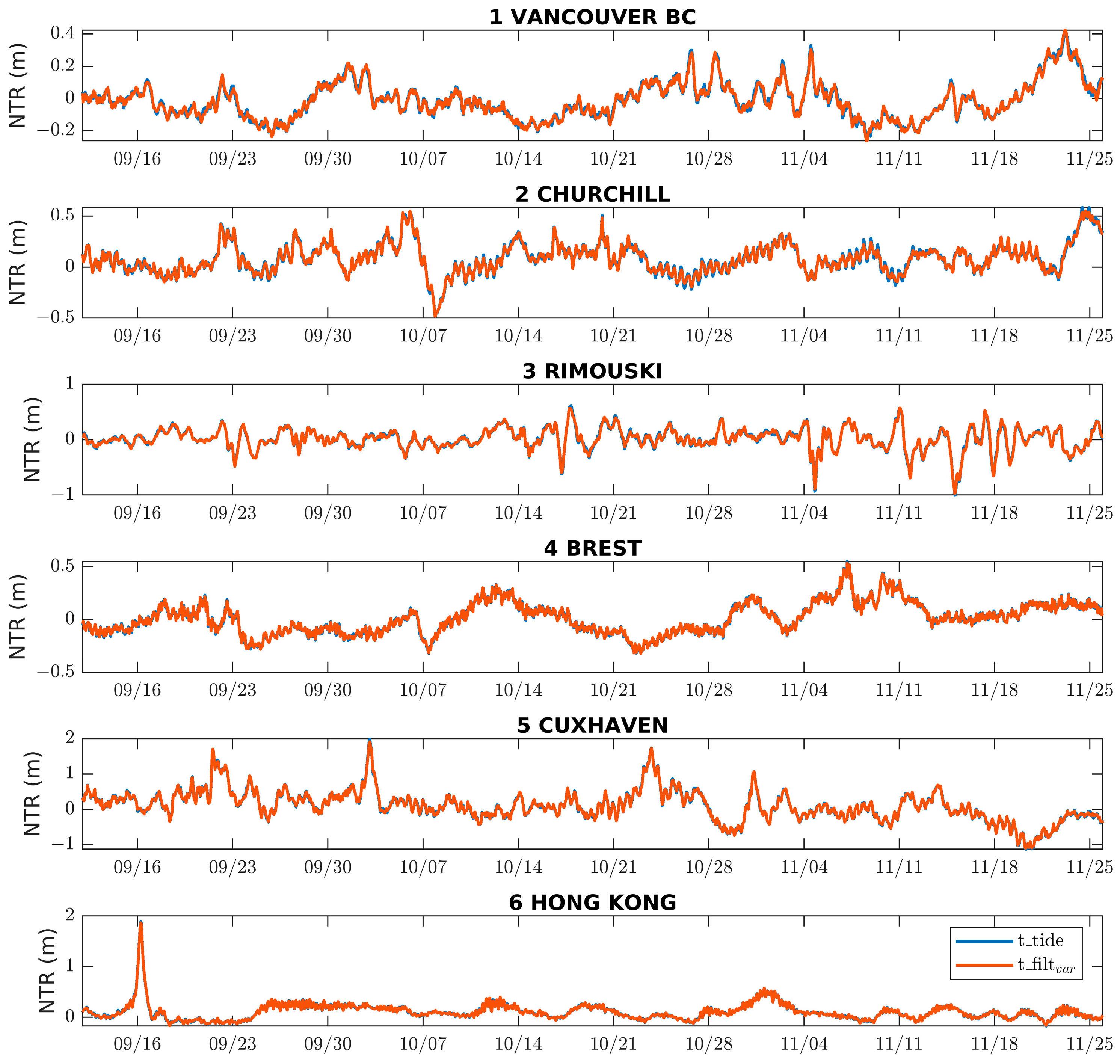
Figure 4; at Vancouver and Hong Kong, residual energy remains in the K1 and O1 bands for t_filt
200d. The decreased filter skill along the west coast of Europe is also explained by residual energy remaining in the M2 and K2 bands (e.g., Brest in
Figure 4).
Using t_filt
200d does lead to slightly decreased RMSD at stations along the east coast of Canada, as well as in the Baltic Sea and the Mediterranean Sea (
Figure 3c). Most of these stations feature large surge signals near the diurnal bands (e.g., Rimouski in
Figure 4), so a narrower bandwidth allows slightly better separation of tides from NTRs in the absence of strong nodal modulation. One exception is station Churchill, where ice-induced seasonal modulation of tides is present [
9] and the decreased RMSD does not necessarily indicate improved filter skill. Although both t_tide and t_filt include two sidebands, H1 and H2, around M2 to account for its seasonality [
21], some energy remains in the M2 band as the ice-induced seasonality is not purely sinusoidal. As a result, the wider bandwidth in t_filt
145d removes slightly more of this energy than both t_filt
200d and t_tide.
The above analysis has motivated the design of t_filt
var, with bandwidths tailored to each constituent based on nodal effects.
Figure 4 shows that t_filt
var minimizes the residual tidal energies due to nodal effects, particularly at K1, O1, K2, and M2 bands, reducing them to levels close to those obtained with t_tide. Although visually small differences remain (e.g., Vancouver), they correspond to negligible differences in the time domain, as shown in
Figure 5.
Figure 3a shows the spatial distribution of RMSD for t_filt
var. Compared to t_filt
145d, the best performing uniform bandwidth filter, t_filt
var reduces the RMSD at all stations (
Figure 3b), reducing the average RMSD from 0.942 cm to 0.859 cm, a reduction of about 9%. Most stations have RMSD well below 1.0 cm. Larger values (1.5–4.0 cm) occur at locations with generally shallower water depths (<20 m) and higher NTR energy near tidal frequency bands (see
Figure 4 and
Figure S1). Nonetheless, these differences represent only a negligible fraction (below 3%) of the local tidal standard deviation.
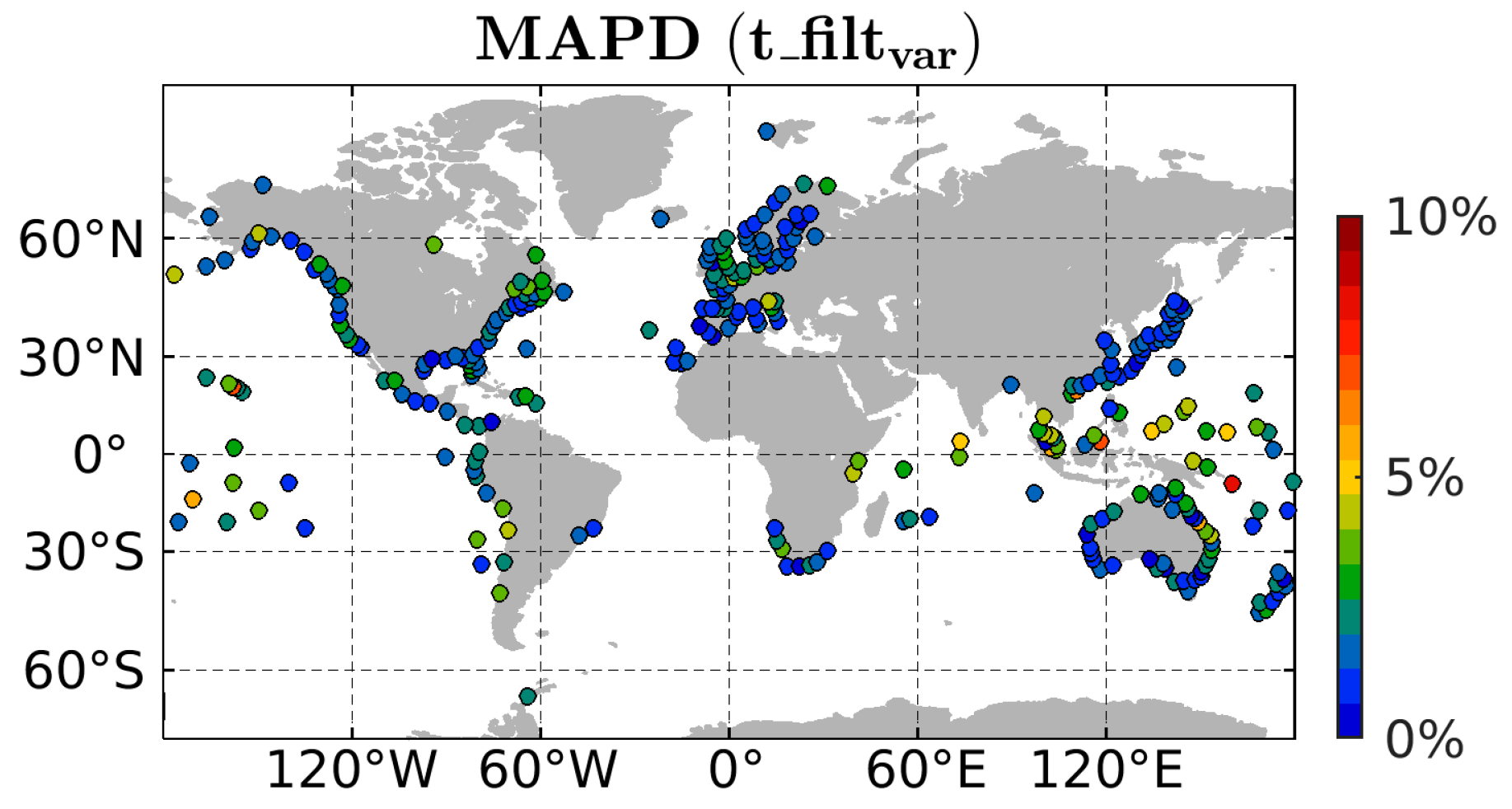
To assess the performance of separating extreme NTRs compared to t_tide,
Figure 6 shows the MAPD for the three largest NTR maxima in 2018. For most stations, the MAPD is below 4%, with a mean of 2.0 ± 1.2% across all stations, except at some isolated tropical locations where sea levels are dominated by small, slow baroclinic-driven variations.
Figure 5 further shows that the filtered NTR time series closely match those from t_tide at selected stations, including extreme storm surges produced by extratropical or tropical cyclones. Residual M2 tidal energy at Churchill, attributable to sea ice effects, is also visible in the time series from both t_tide and t_filt
var.
4.4. Numerical Performance
We next implemented the RCF approach with the t_filt
var configuration in ECCC’s global storm surge prediction system [
9] to examine its numerical performance. Initially, the filter was applied at each internal model time step of 4 min, resulting in a roughly 10% increase in model runtime, which is acceptable but not ideal. Since RCF is free of discretization error, the filter can instead be applied at an hourly interval, matching the output frequency, without loss of skill. This reduces the additional model runtime to about 2%.
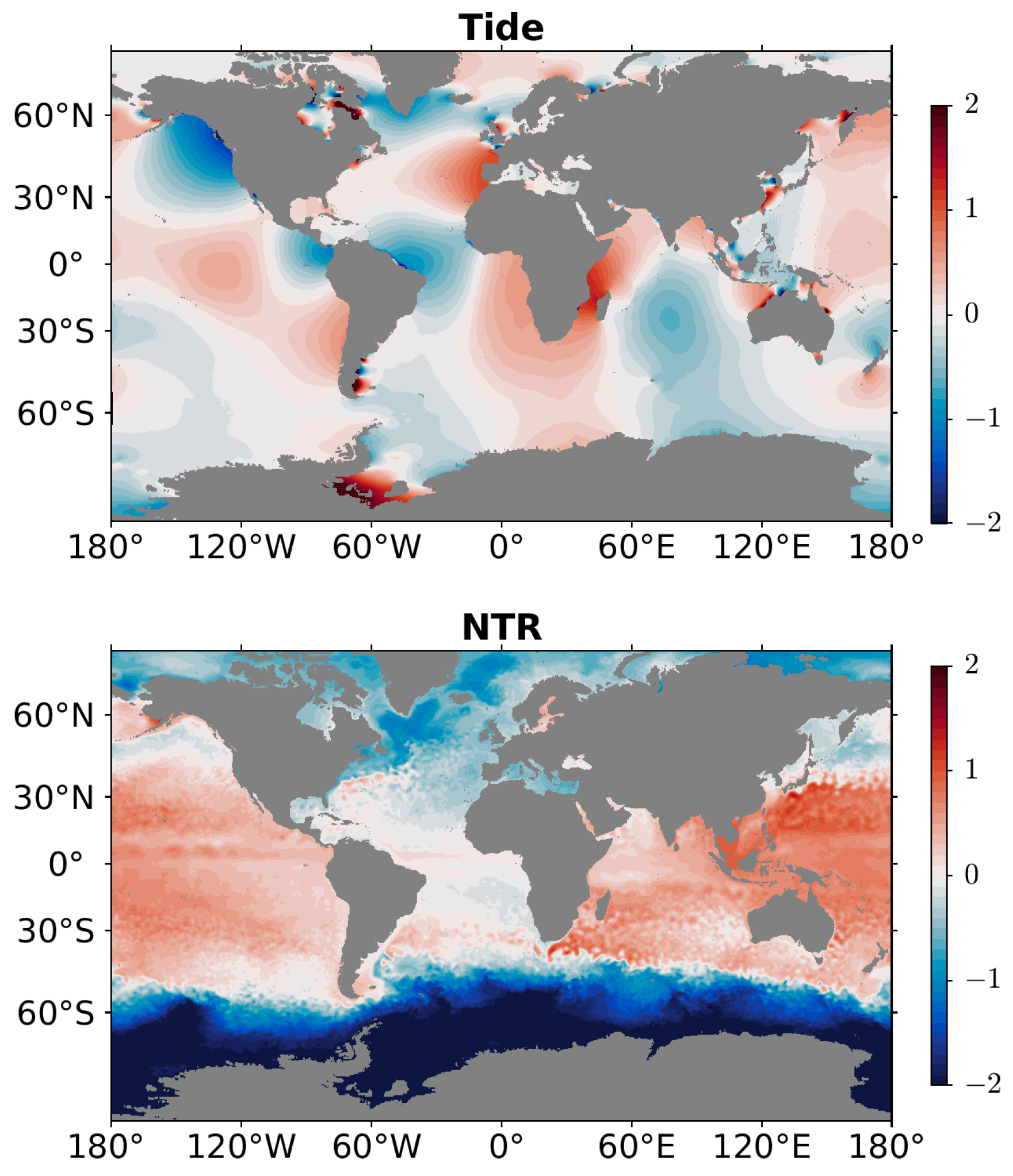
Figure 7 illustrates an instantaneous output of well-separated tide and NTR fields. Producing such output in post-processing would be impractical, as it would require a year-long harmonic analysis applied to a horizontal grid of 4322 × 3606 points, an approach that is even less feasible for historical multi-decadal predictions or for decadal to centennial projections.
5. Summary and Conclusions
Considering emerging online tidal filters for ocean modelling applications, we evaluated and compared three approaches: a recursive climatological filter (RCF), representing an exponential average of embedded harmonics; an online harmonic analysis (OHA) adapted from conventional harmonic analysis (CHA); a streaming band-pass (SBP) filter derived from a damped harmonic oscillator. We further examined the applicability of online filters in de-tiding global coastal sea levels, with the initial goal of reducing resources associated with post-processing, including storage, I/O, computation and time.
Assessments show that the OHA equations closely resemble those of RCF once the filter has stabilized. Despite their different mathematical formulations, all three approaches show identical frequency responses, with passbands of equal magnitude centered on the target frequencies and zero phase shift. Consequently, their time-domain performance is virtually identical after the initial spin-up period, provided the time step is sufficiently small. In practice, however, differences arise in computational cost and discretization error: OHA is more expensive due to additional matrix operations, while SBP has discretization errors that grow with the time step. In addition, both RCF and OHA can output the time-varying harmonic constants, enabling additional applications.
As it is low-cost and free from discretization error, we implemented the RCF approach to evaluate its performance in online de-tiding of modelled coastal sea levels at 305 sites that match global tide gauge locations. The filter skill was evaluated using CHA as a reference. Consequently, the evaluation primarily reflects consistency with CHA rather than absolute physical accuracy.
As the filter passband narrows, its skill initially improves and then degrades, reflecting insufficient time for the filter to adjust to long-term nodal modulations in modelled tides. This effect is more pronounced for diurnal tides K1 and O1, consistent with previous studies. Its impact on semidiurnal tides, such as M2 and K2, is also significant along the west coast of Europe. To account for nodal modulations, we adopted varying passbands among constituents, resulting in an about 9% improvement in filter skill compared to a uniform passband. Overall, the filter demonstrates adequate skill globally relative to CHA, with a maximum RMSD for tides below 4 cm (about 3% of the tidal standard deviation) and a MAPD of 2.0 ± 1.2% across all sites for extreme NTRs. Both CHA and RCF, however, show limitations over locations where the seasonal variation in tides, for example, due to sea ice, is not purely sinusoidal.
We further examined the numerical performance of the RCF approach in practical implementation within ECCC’s global storm surge prediction system. Applying the filter hourly, matching the typical model output frequency rather than every model time step, reduces the additional computational cost from about 10% to 2%, making it feasible for daily operational use. Although the filter’s e-folding time (spin-up) is substantially longer, up to 200 days (see
Table 2), due to higher accuracy requirements compared to other deep-water applications [
7,
10], this spin-up is required only once and therefore represents a negligible fraction of the overall computational cost.
Supplementary Materials
The following supporting information can be downloaded at:
https://www.mdpi.com/article/10.3390/jmse14070666/s1, Figure S1: (a) RMSD of filtered tides obtained using
; (b) standard deviation of high-pass filtered non-tidal residual using a cut-off period of 36 h; and (c) water depth at 305 tide gauge locations.
Author Contributions
Conceptualization, P.W. and N.B.; software, P.W.; formal analysis, P.W. and N.B.; investigation, P.W. and N.B.; data curation, P.W.; writing—original draft preparation, P.W.; writing—review and editing, P.W. and N.B.; visualization, P.W. All authors have read and agreed to the published version of the manuscript.
Funding
This research received no external funding.
Data Availability Statement
Acknowledgments
We thank our long-time friend, colleague, and mentor, Keith R. Thompson, for his inspiration, support, and guidance. His early development of the recursive climatological filter has had a lasting impact on ocean modelling and inspired the present work and its new applications. We also thank Frédéric Dupont for his comments on an early draft of this paper.
Conflicts of Interest
The authors declare no conflicts of interest.
Appendix A
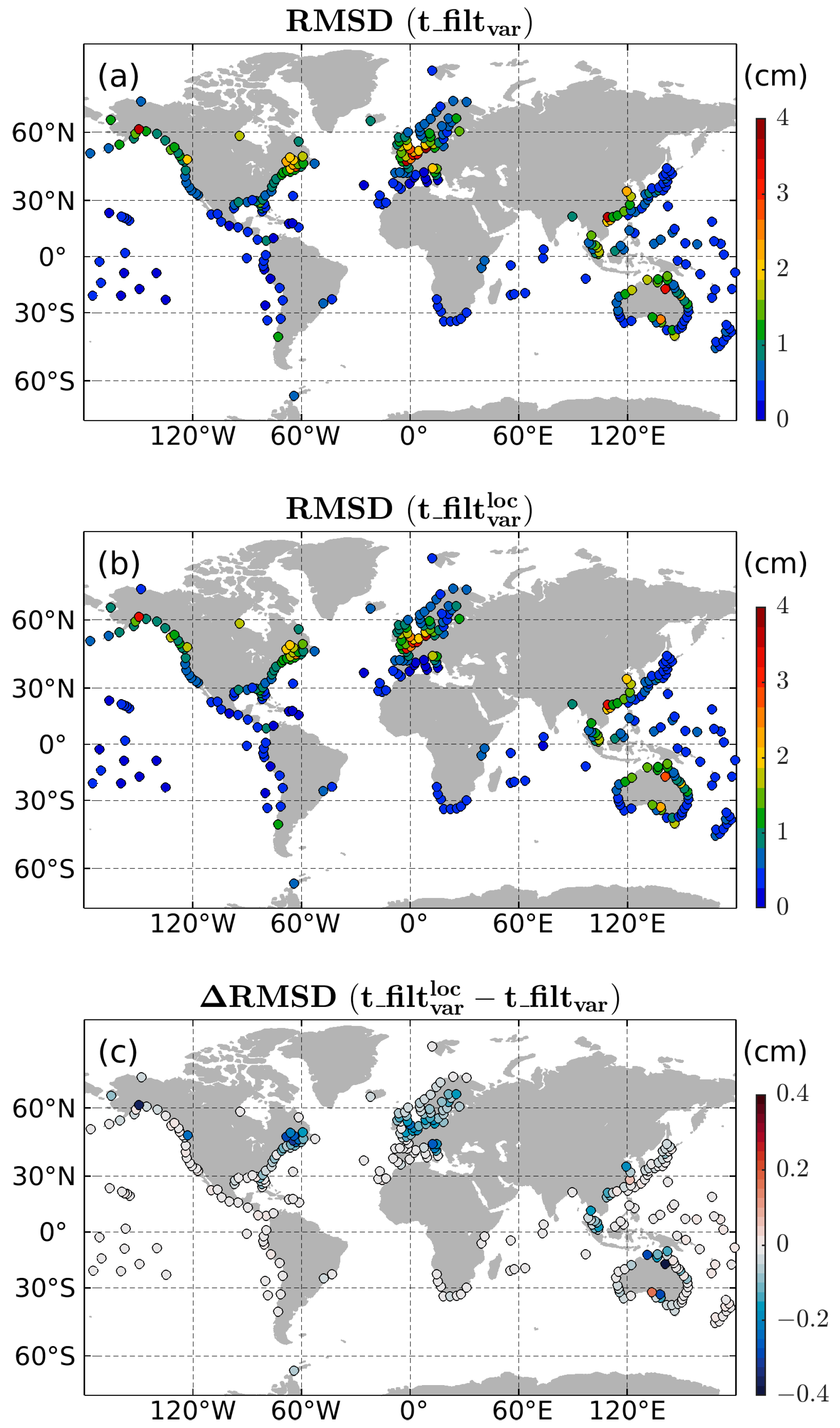
The filter design in the main text, including the specification of tidal frequencies and κ values, is intended for global applications. For regional or local applications, the design can be further optimized. In particular, tidal frequencies can be specified based on local tidal characteristics; that is, they do not need to satisfy constraints derived from a global set of locations. As a result, the SNR threshold used in the global application (SNR > 6) can be relaxed. Sensitivity tests show that selecting location-specific constituents with SNR > 0.6 yields the best consistency with CHA at sites sensitive to the specification of tidal frequencies, with reductions in RMSD by up to 10%. These include parts of the east coast of Canada, northern Europe, and isolated inlets or straits where tidal dynamics are complex (
Figure A1).
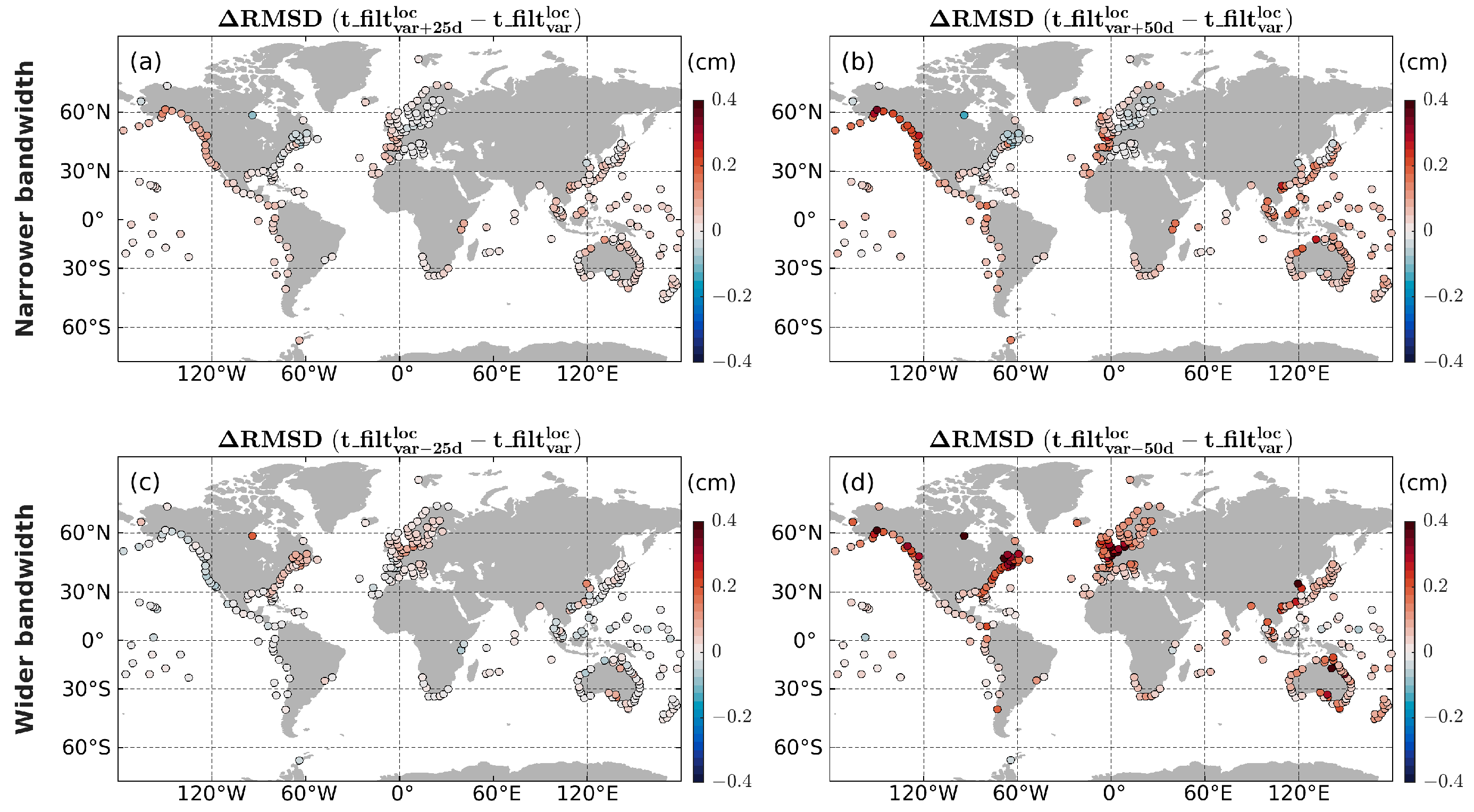
Using location-specific constituents, we further examined the suitability of the chosen κ values in the global application and found that they remain appropriate across different regions. Further narrowing or widening the filter bandwidth results in only minimal improvements of the RMSD at locations showing a positive response (cool colors in
Figure A2).
Figure A1.
RMSD of filtered tides obtained using (a) and (b) at 305 tide gauge locations. (c) Difference in RMSD between and . differs from by using location-specific constituents with SNR > 0.6.
Figure A1.
RMSD of filtered tides obtained using (a) and (b) at 305 tide gauge locations. (c) Difference in RMSD between and . differs from by using location-specific constituents with SNR > 0.6.
Figure A2.
RMSD changes resulting from (a,b) narrowing or (c,d) widening filter bandwidth for regional or local applications with location-specific constituents ( ). () denotes filters with bandwidths uniformly narrowed (widened) by increasing (decreasing) the e-folding time by 25 d. The same applies to and .
Figure A2.
RMSD changes resulting from (a,b) narrowing or (c,d) widening filter bandwidth for regional or local applications with location-specific constituents ( ). () denotes filters with bandwidths uniformly narrowed (widened) by increasing (decreasing) the e-folding time by 25 d. The same applies to and .
References
- Pawlowicz, R.; Beardsley, B.; Lentz, S. Classical Tidal Harmonic Analysis Including Error Estimates in MATLAB Using T_TIDE. Comput. Geosci. 2002, 28, 929–937. [Google Scholar] [CrossRef] [Scilit]
- Groves, W.G. Numerical Filters for Discrimination against Tidal Periodicities. Eos Trans. Am. Geophys. Union 1955, 36, 1073–1084. [Google Scholar] [CrossRef] [Scilit]
- Godin, G. The Analysis of Tides; University of Toronto Press: Toronto, ON, Canada, 1972. [Google Scholar]
- Thompson, R.O.R.Y. Low-Pass Filters to Suppress Inertial and Tidal Frequencies. J. Phys. Oceanogr. 1983, 13, 1077–1083. [Google Scholar] [CrossRef] [Scilit]
- Smith, G.C.; Liu, Y.; Benkiran, M.; Chikhar, K.; Surcel Colan, D.; Gauthier, A.-A.; Testut, C.-E.; Dupont, F.; Lei, J.; Roy, F.; et al. The Regional Ice Ocean Prediction System v2: A Pan-Canadian Ocean Analysis System Using an Online Tidal Harmonic Analysis. Geosci. Model Dev. 2021, 14, 1445–1467. [Google Scholar] [CrossRef] [Scilit]
- Kodaira, T.; Bernier, N.; Thompson, K.R. Application of the Spectral Nudging on Global Tides Towards a Global Total Water Level Prediction System. In ASME 2019: Proceedings of the 38th International Conference on Ocean, Offshore and Arctic Engineering, Glasgow, Scotland, UK, 9–14 June 2019; American Society of Mechanical Engineers: New York, NY, USA, 2019; Volume 9, p. V009T13A011. [Google Scholar]
- Wang, P.; Bernier, N.B.; Thompson, K.R.; Kodaira, T. Evaluation of a Global Total Water Level Model in the Presence of Radiational S 2 Tide. Ocean Model. 2021, 168, 101893. [Google Scholar] [CrossRef] [Scilit]
- Thompson, K.R.; Wright, D.G.; Lu, Y.; Demirov, E. A Simple Method for Reducing Seasonal Bias and Drift in Eddy Resolving Ocean Models. Ocean Model. 2006, 13, 109–125. [Google Scholar] [CrossRef] [Scilit]
- Wang, P.; Bernier, N.B. Adding Sea Ice Effects to a Global Operational Model (NEMO v3.6) for Forecasting Total Water Level: Approach and Impact. Geosci. Model Dev. 2023, 16, 3335–3354. [Google Scholar] [CrossRef] [Scilit]
- Xu, C.; Zaron, E.D. Detecting Instantaneous Tidal Signals in Ocean Models Utilizing Streaming Band-Pass Filters. J. Adv. Model. Earth Syst. 2024, 16, e2024MS004319. [Google Scholar] [CrossRef] [Scilit]
- Horsburgh, K.J.; Wilson, C. Tide-surge Interaction and Its Role in the Distribution of Surge Residuals in the North Sea. J. Geophys. Res. 2007, 112, C08003. [Google Scholar] [CrossRef] [Scilit]
- Inoue, R.; Garrett, C. Fourier Representation of Quadratic Friction. J. Phys. Oceanogr. 2007, 37, 593–610. [Google Scholar] [CrossRef] [Scilit]
- Wang, P.; Bernier, N.B. Advancing Global Hindcast of Extreme Sea Levels: Insights from a 65-Year Study. Weather Clim. Extrem. 2025, 50, 100805. [Google Scholar] [CrossRef] [Scilit]
- Bell, B.; Hersbach, H.; Simmons, A.; Berrisford, P.; Dahlgren, P.; Horányi, A.; Muñoz-Sabater, J.; Nicolas, J.; Radu, R.; Schepers, D.; et al. The ERA5 Global Reanalysis: Preliminary Extension to 1950. Q. J. R. Meteorol. Soc. 2021, 147, 4186–4227. [Google Scholar] [CrossRef] [Scilit]
- Egbert, G.D.; Erofeeva, S.Y. Efficient Inverse Modeling of Barotropic Ocean Tides. J. Atmos. Oceanic Technol. 2002, 19, 183–204. [Google Scholar] [CrossRef] [Scilit]
- Lyard, F.H.; Allain, D.J.; Cancet, M.; Carrère, L.; Picot, N. FES2014 Global Ocean Tide Atlas: Design and Performance. Ocean Sci. 2021, 17, 615–649. [Google Scholar] [CrossRef] [Scilit]
- Jean-Michel, L.; Eric, G.; Romain, B.-B.; Gilles, G.; Angélique, M.; Marie, D.; Clément, B.; Mathieu, H.; Olivier, L.G.; Charly, R.; et al. The Copernicus Global 1/12° Oceanic and Sea Ice GLORYS12 Reanalysis. Front. Earth Sci. 2021, 9, 698876. [Google Scholar] [CrossRef] [Scilit]
- Crawford, W.R. Analysis of Fortnightly and Monthly Tides. Int. Hydrogr. Rev. 1982, 59, 131–141. [Google Scholar]
- Godin, G. The Use of Nodal Corrections in the Calculation of Harmonic Constants. Int. Hydrogr. Rev. 1986, 63, 143–162. [Google Scholar]
- Haigh, I.D.; Eliot, M.; Pattiaratchi, C. Global Influences of the 18.61 Year Nodal Cycle and 8.85 Year Cycle of Lunar Perigee on High Tidal Levels. J. Geophys. Res. 2011, 116, C06025. [Google Scholar] [CrossRef] [Scilit]
- Ray, R. Technical Note: On Seasonal Variability of the M2 Tide. Ocean Sci. 2022, 18, 1073–1079. [Google Scholar] [CrossRef] [Scilit]
| Disclaimer/Publisher’s Note: The statements, opinions and data contained in all publications are solely those of the individual author(s) and contributor(s) and not of MDPI and/or the editor(s). MDPI and/or the editor(s) disclaim responsibility for any injury to people or property resulting from any ideas, methods, instructions or products referred to in the content. |