1. Introduction
As an important direction of renewable energy generation, floating offshore wind turbine (FOWT) has attracted widespread attention because it can obtain more stable and powerful wind energy resources in deep-sea areas [
1,
2]. This is because the offshore wind resources located far from shore are not only more abundant but also exhibit better stability compared to onshore wind. However, in the harsh marine environment, the FOWT platform is prone to severe multi-degree-of-freedom (M-DOF) coupled vibration response under multiple excitations such as wind, waves, and currents. Such vibrations not only reduce the power generation efficiency, but also lead to structural fatigue damage in critical components such as the drivetrain and tower structure [
3,
4,
5], seriously threatening the safety and reliability of long-term system operation.
To address the vibration control of FOWT, various control methods have been developed to reduce excessive vibrations. Among these approaches, tuned mass damper (TMD), known as a passive control device, has been widely adopted in the field of FOWT vibration suppression due to its simple structure, low cost, convenient maintenance, and no external energy requirements.
Early studies mainly focused on the inhibitory effect of single-degree-of-freedom (S-DOF) TMD on specific motion modes of FOWT. In this research line, Murtagh et al. [
6] applied TMD technology to the vibration control of FOWT towers by installing an S-DOF TMD at the tower top, which effectively reduces the fore–aft vibration response and lays a foundation for subsequent investigations. Building on this method, Si et al. [
7] explored alternative installation strategies by arranging TMD inside the floating platform, where they optimized relevant parameters and evaluated its suppression effect on the FOWT motion. Li et al. [
8] installed TMDs in both the nacelle and tower positions for vibration suppression, which can effectively dissipate the tower’s vibration energy and improve system stability.
Meanwhile, parallel research on the fixed-bottom offshore wind turbines also provides valuable insights for FOWT applications. Colwell et al. [
9] introduced a tuned liquid column damper into a fixed-bottom wind turbine, while Zhang [
10], Chen [
11], and Li [
12] applied spherical or ball vibration absorbers to fixed-bottom offshore wind turbines, effectively suppressing structural responses under wind, wave, and seismic load excitation. Although these studies demonstrated the effectiveness of S-DOF TMD in reducing specific vibration modes, it was found that FOWT often exhibits complex M-DOF coupled vibration characteristics in actual operations, as the pitch and roll motions of semi-submersible platforms under wave excitation frequently occur simultaneously and couple with each other through hydrodynamic interactions, which in turn makes it difficult to adopt an S-DOF TMD to effectively control multiple motion modes at the same time.
To address the limitation of S-DOF TMD in controlling multi-dimensional vibrations, bidirectional and three-dimensional vibration control solutions were studied. Tong et al. [
13] proposed a bidirectional tuned liquid column damper applied to the motion response suppression of barge-type FOWT, which can effectively reduce both roll and pitch motion. Meanwhile, considering the practical scenario where wind and wave directions are often misaligned in actual offshore conditions, Stewart [
14] studied the TMD suppression effect of a monopile FOWT under wind–wave misalignment conditions, which can reduce the fore–aft and side–side fatigue loads of the tower by approximately 5% and 40%, respectively.
To achieve more effective bidirectional vibration control with a single integrated device, Sun et al. [
15] proposed a three-dimensional pendulum tuned mass damper, which enables the mass to swing freely in three-dimensional space. This design can achieve faster response speed and better bidirectional vibration damping effect compared to dual linear TMDs under non-aligned excitations such as wind-waves and near-field earthquakes. However, one well-known drawbacks of this design is that its nonlinear dynamic characteristics make parameter optimization more complicated and require more sophisticated optimization algorithms.
Parameter optimization in complex energy systems has been studied using advanced hybrid and data-driven methods [
16]. Achieving optimal TMD performance depends on proper tuning of its parameters, as the TMD is limited by its narrow control frequency band, making it critical to achieve the optimal tuning frequency in practice [
17]. As discussed in [
18], when the tuning frequency is inconsistent with the natural frequency of the structure, the vibration suppression effect is significantly reduced. Therefore, parameter optimization is necessary to achieve satisfactory suppression response.
To achieve this purpose, Stewart and Lackner [
19] established a 3-DOF simplified model for different types of FOWTs and optimized TMD parameters using surface plot method and genetic algorithms. Similarly, Ding et al. [
20] proposed a coupled dynamic model for a barge-type FOWT and employed the multi-island genetic algorithm to optimize the TMD parameters to achieve roll motion stability and tower-top displacement reduction. Although these methods provided satisfactory results for simple TMD configurations, more advanced optimization algorithms are needed for complex M-DOF TMD systems.
For this purpose, Chen et al. [
21] used an improved artificial fish swarm algorithm to optimize the TMD parameters, achieving a 68.3% reduction in fore–aft displacement of the tower top under shutdown conditions. By extending this idea to more complex FOWT configurations, Jin et al. [
22] established a multi-body dynamics model and constructed an equivalent 6-DOF simplified model for a spar-type FOWT, where the improved artificial fish swarm algorithm is used to optimize the TMD parameters. He et al. [
23] further improved the optimization ability of the artificial fish swarm algorithms, which can significantly reduce the structural vibration displacement.
It was noted when a TMD with M-DOF motion is used to suppress multiple modes of the main structure, the dimension and complexity of the optimization problem increase significantly. In this respect, the Particle Swarm Optimization (PSO) algorithm is favored because of its global search ability, insensitivity to initial values, and no need for gradient information [
24]. Leveraging these advantages, Chen et al. [
25] established a finite element model and proposed a multi-objective optimization method for TMD design based on a satisfaction function and PSO. Dong et al. [
26] proposed a C-shaped particle-damping TMD for the space constraint problem at the top of FOWT tower, established a theoretical model of equivalent two particles, and used PSO to determine the optimal parameters. In this sense, the PSO algorithm presents a great potential for optimizing M-DOF TMD systems with complex parameter spaces and multiple objectives.
Based on the above discussions, a single TMD design scheme with X–Y plane M-DOF motion is proposed for the OC4-DeepCwind 5 MW semi-submersible FOWT, aiming to provide a cost-effective technical approach for multi-dimensional vibration control under space constraint conditions. Unlike existing results that only consider single-directional vibration suppression or require multiple separate TMD units, the established M-DOF TMD system can suppress both pitch and roll motions simultaneously using a single integrated device. A multi-objective optimization problem is formulated to unify the frequency tuning accuracy, damping ratio constraints, and mass ratio limits, ensuring both optimal performance and engineering feasibility.
Furthermore, an improved PSO algorithm with time-varying acceleration coefficients is employed to solve the constrained optimization problem, which dynamically adjusts exploration and exploitation capabilities to overcome the limitations of the standard PSO in handling the strongly coupled five-dimensional parameter space. To verify the effectiveness of the proposed M-DOF TMD system, comprehensive simulations are conducted using the widely adopted OpenFAST platform [
27,
28] under various sea state conditions.
The paper is organized as follows:
Section 2 establishes the theoretical model of the OC4-DeepCwind semi-submersible FOWT coupled with the M-DOF TMD system.
Section 3 presents the multi-objective parameter optimization method using an improved particle swarm optimization algorithm with time-varying acceleration coefficients (TVAC-PSO).
Section 4 determines the optimal TMD parameters using the proposed TVAC-PSO algorithm and conducts comparative simulations based on the OpenFAST platform under various sea state conditions to evaluate the vibration suppression performance. Conclusions are summarized in
Section 5.
2. Modeling of the FOWT-TMD System
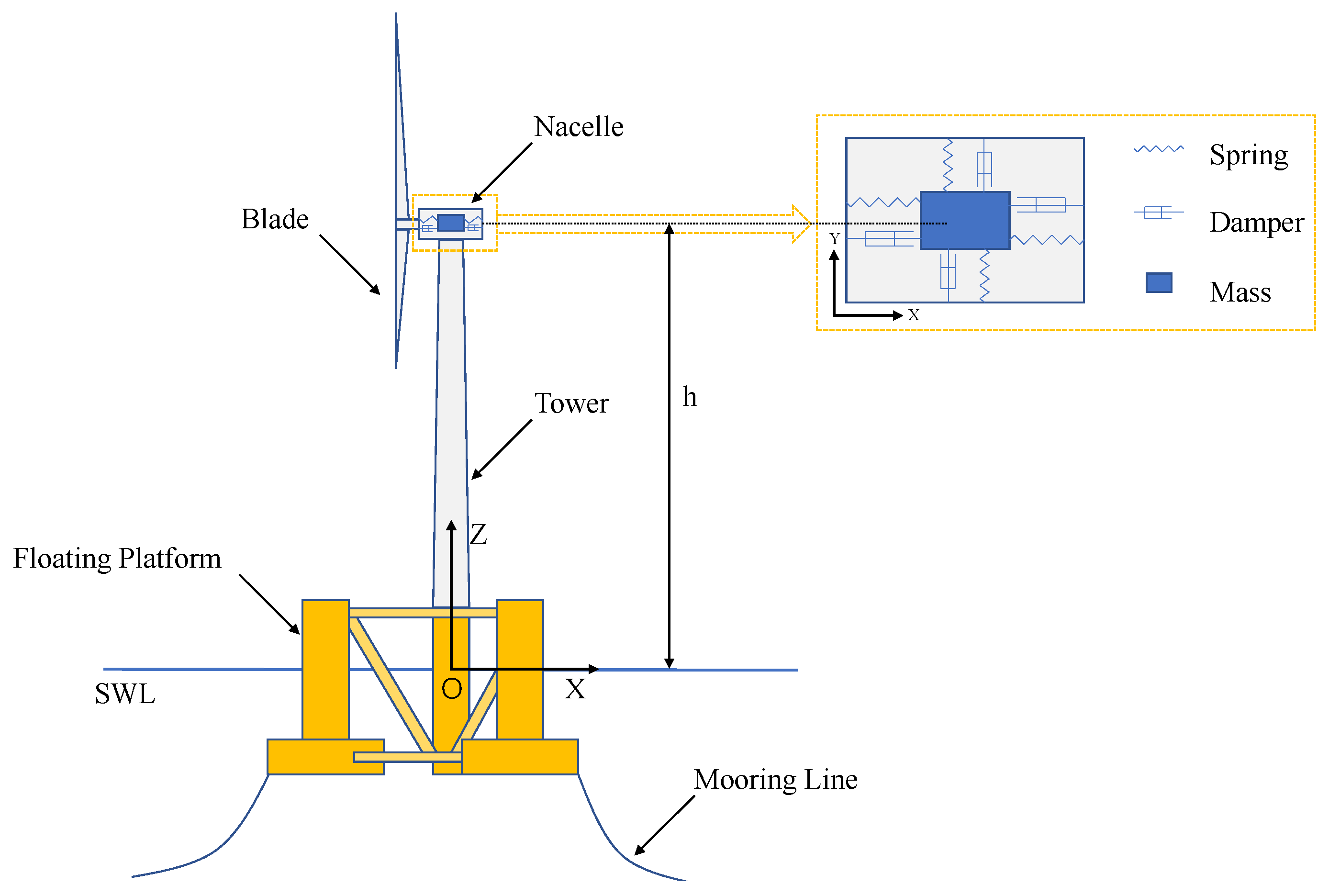
As shown in
Figure 1, the FOWT model employed in this study integrates the NREL 5 MW wind turbine, the DeepCwind semi-submersible platform and the mooring lines. The system reference point is defined at the intersection of the central column axis and the still water level (SWL). Moreover, detailed parameters for FOWT, where CoM denotes the Centre of Mass, as [
29] are summarized in
Table 1.
For the ease of subsequent TMD design, the mathematical model of the FOWT-TMD system can be first established within the Lagrangian framework. An inertial coordinate system
is defined at the SWL to describe the system motion. The
x axis aligns with the prevailing wind direction, and the
z axis points vertically upward. Following the conventional notation for marine structures, the six degrees of freedom are numbered as follows: surge (1), sway (2), heave (3), roll (4), pitch (5), and yaw (6). For the OC4-DeepCwind semi-submersible platform, roll and pitch are the most significant motion responses under wave excitation, as they directly affect structural integrity and power generation performance [
29]. This focus on roll and pitch as the primary control targets is consistent with established practice in FOWT vibration control studies [
7,
19]. Since this study focuses on the coupled roll and pitch motions, the generalized coordinate vector is defined as:
where
and
denote the platform roll and pitch angles, respectively, while
and
represent the TMD displacements in the roll and pitch directions relative to the nacelle. Consequently, for the FOWT-TMD system, the general form of the Lagrangian equation is expressed as:
where
L denotes the Lagrangian function,
is the kinetic and potential energy of the system,
are the generalized coordinate and velocity vectors, and
denotes the total generalized force vector.
Furthermore, the total kinetic and potential energies of the FOWT system coupled with the TMD are given by:
where
are the mass moments of inertia,
are the hydrostatic restoring stiffness coefficients for roll and pitch motions,
represent the kinetic and potential energies of the TMD.
The TMD is installed within the nacelle to suppress the roll and pitch motions of the FOWT induced by wind and wave excitation. It moves bidirectionally relative to the nacelle, dissipating energy through a spring-damper system. Accordingly, the motion of the TMD is expressed as:
where
h is the vertical installation height of the TMD,
and
are the relative displacements of the TMD in the
x and
y directions within the nacelle, respectively. Therefore, the kinetic and potential energies of the TMD are expressed as:
where
is the TMD mass,
and
are the spring stiffness coefficients in the
x and
y directions, respectively.
Now, the total generalized force vector
in Equation (
2) is expressed as:
where
,
, and
represent the generalized force vectors induced by aerodynamic, hydrodynamic, and mooring loads, respectively.
First, regarding the aerodynamic component in Equation (
8), the aerodynamic loads are generated by the wind–rotor interaction and act on the rotating blades. Since the TMD is installed inside the nacelle and moves together with it, the aerodynamic forces influence the TMD indirectly through the nacelle motion induced by rotor thrust. Therefore, in the generalized force formulation, the aerodynamic loads appear only in the platform motion equations and do not contribute directly to the TMD’s generalized coordinates. Given that the wind direction aligns with the
x axis, the resulting thrust generates a dominant overturning moment about the
y axis. Consequently, the generalized aerodynamic force vector
can be written as:
where
represents the aerodynamic pitching moment, which is determined via the relation
. Here,
denotes the total rotor thrust and
denotes the hub height, defined as the vertical distance from SWL to the rotor hub center. To quantify the total thrust
, the blade element momentum (BEM) theory is adopted [
30]. By integrating the thrust contributions along the blade span from the hub to the rotor radius
R,
is obtained as:
Similarly, the total aerodynamic torque can be expressed as
. The differential thrust
and torque
acting on a blade element of thickness
at radial position
r can be computed as:
where
is the air density,
B is the number of blades,
is the wind velocity,
c is the chord length,
is the rotor angular velocity, and
is the flow angle. Based on the BEM theory, the axial and tangential induction factors,
a and
, represent the reduction in the axial wind velocity and the increase in the tangential velocity due to the rotor interference, respectively. The normal and tangential force coefficients,
and
, are obtained by projecting the lift and drag coefficients
and
onto the normal and tangential directions:
These induction factors are solved iteratively using:
where
is the local solidity and
F denotes the Prandtl’s tip loss correction factor.
The second component in Equation (
8), the hydrodynamic load, follows a similar treatment to the aerodynamic load. Since the TMD is installed in the nacelle located far above the waterline, these loads act on the platform hull and do not directly contribute to the TMD generalized forces. Thus, the generalized hydrodynamic force vector is defined as:
where
and
denote the hydrodynamic moments about the roll and pitch axes, respectively. These moments are obtained by integrating the distributed hydrodynamic forces exerted on the submerged members along the wetted surface:
where
S denotes the wetted surface of all submerged members, and
and
represent the moment arms relative to the
y axis and
x axis, respectively. For the cylindrical members of the platform, the distributed force per unit length
is calculated using the Morison equation [
31]:
where
is the water density,
D is the diameter,
and
are the inertia and drag coefficients,
and
are the normal fluid and structural accelerations, and
is the relative normal velocity.
Finally, the mooring system provides restoring moments to the platform. Similar to the aerodynamic and hydrodynamic loads, the mooring forces act on the platform and do not directly contribute to the TMD. The generalized mooring force vector is thus written as:
where
and
represent the restoring moments derived from the total mooring force vector
. By simplifying the mooring system as a linear spring-stiffness model for small platform motions [
28],
is decomposed into:
where
is the initial pretension vector, and
is the stiffness matrix associated with roll and pitch motions.
With the kinetic energy
T, potential energy
V, and generalized forces
, the equation of motion can be derived by substituting these expressions into the Lagrangian equation Equation (
2) as:
By separating the stiffness terms contained in
and the potential energy
V and moving them to the left-hand side, Equation (
20) can be rearranged into the standard matrix form:
where
,
, and
represent the global mass, damping, and stiffness matrices of the coupled system, respectively. To explicitly show the coupling mechanism between the platform and the TMD, the mass matrix is expressed as:
where
,
,
, and
are the frequency-dependent hydrodynamic added mass coefficients obtained from potential flow analysis [
29]. The off-diagonal terms
and
represent the hydrodynamic coupling between roll and pitch motions, i.e., when the platform undergoes pitch motion, it generates radiated waves that exert moments in the roll direction, and vice versa. These hydrodynamic coefficients satisfy
. The term
in the diagonal positions accounts for the TMD mass contribution to the platform’s moment of inertia, and the off-diagonal term
represents the inertial coupling between platform rotations and TMD translations.
The damping matrix is defined as follows:
where
and
denote the frequency-dependent hydrodynamic radiation damping coefficients for roll and pitch motions, respectively. The off-diagonal terms
and
capture the energy dissipation due to roll-pitch hydrodynamic interaction, with
. The TMD damping coefficients
and
appear in the diagonal terms as
and
, while the off-diagonal coupling terms are
and
.
Finally, the stiffness matrix is given by:
where the stiffness matrix includes contributions from both the hydrostatic restoring stiffness and the mooring stiffness. In the matrix,
and
represent the TMD spring stiffness coefficients in the
x and
y directions, respectively, and
h is the vertical installation height of the TMD. These parameters contribute to the diagonal terms through
and
, and to the off-diagonal coupling terms through
and
.
In addition,
is the external excitation vector comprising the aerodynamic and hydrodynamic loads:
With the coupled FOWT-TMD dynamic model established, the next step is to determine the optimal TMD parameters that can effectively suppress the platform’s roll and pitch motions under various sea state conditions. This optimization problem is addressed in the following section using the TVAC-PSO algorithm.
3. TMD Parameter Optimization Using TVAC-PSO
The equations derived in
Section 2 present the dynamic model of the coupled FOWT-TMD system. However, the specific parameters of the TMD (i.e.,
, where
) should be determined. As shown in the system matrices Equations (
22)–(
24), these parameters directly influence the dynamic characteristics of the coupled system through mass, damping, and stiffness coupling terms. Arbitrary selection of these parameters may lead to detuning or even amplification of vibrations. Therefore, determining the optimal parameter set is critical to achieve effective vibration suppression.
The structural parameters and hydrodynamic coefficients of the FOWT platform are treated as known from the OC4 project specifications [
29]. However, the system matrices
,
, and
incorporate the TMD design parameters as decision variables.
The optimization objective is to determine the optimal TMD parameters that minimize the platform’s pitch and roll responses while satisfying engineering constraints [
32]. This multi-objective formulation is consistent with established approaches for optimizing complex energy infrastructure systems under competing requirements [
33]. A comprehensive objective function
J is established as the sum of three terms:
where
focuses on the frequency tuning accuracy,
ensures appropriate damping ratios, and
constrains the TMD mass ratio. The first term,
, is defined as:
where
represents the natural frequency of the TMD. Through free decay simulations in OpenFAST, the dominant frequency peak in the FOWT’s pitch and roll response spectrum is identified at 0.038 Hz, which is adopted as the target control frequency
Hz for TMD tuning. Since the OC4-DeepCwind platform is geometrically symmetric [
29], the natural frequencies in roll and pitch are nearly identical, allowing the use of a single target frequency. According to the free-decay and spectral analysis results, the roll and pitch modes corresponding to this dominant low-frequency resonant peak were selected as the tuning targets for the proposed 2-DOF TMD, because they represent the most critical platform rotational responses under combined wind–wave excitation. In contrast, higher-order structural modes are located at substantially higher frequencies and are not the primary contributors to the platform motion targeted by the present passive control design. Therefore, the proposed 2-DOF TMD is specifically tuned to mitigate the dominant roll and pitch resonances.
The second term,
, constrains the damping ratio. The damping ratio affects both the effective bandwidth and the peak suppression efficiency. Extremely low damping causes excessive TMD stroke, while excessive damping reduces tuning efficiency. Based on the Den Hartog’s theory [
34], the optimal damping ratio typically lies within the range
. The damping term
is defined as the sum of penalties for both directions:
where the penalty function
imposes a high cost on infeasible values:
and the damping ratio
is calculated as
[
35]. A large penalty value is assigned when
falls outside the feasible range, forcing the optimization algorithm to search within the valid region.
The third term,
, restricts the mass ratio. Excessive top mass negatively impacts the platform’s stability and structural payload capacity. The mass ratio is limited to a practical range using the following penalty:
where
is the mass ratio. The threshold of
is selected indicating diminishing returns for mass ratios beyond 6% [
8], while the weighting factor of 100 is applied to significantly amplify any violation. This ensures that the penalty term becomes dominant if the mass limit is exceeded, forcing the optimization algorithm to converge within the feasible region. The penalty weights were selected to balance two requirements: preserving frequency-matching performance as the primary optimization target and providing sufficient constraint enforcement for damping-ratio and mass-ratio feasibility. In preliminary optimization tests, lower penalty weights led to a noticeably wider spread of the optimized TMD parameters across repeated runs, indicating weaker constraint guidance. By contrast, the adopted penalty values produced solutions that remained concentrated within a physically reasonable parameter range while still allowing effective exploration of the search space.
By minimizing the total objective function Equation (
26), the TMD parameter optimization problem unifies the frequency tuning, damping rationality, and mass constraints. The complete optimization formulation is expressed as:
The decision variables are constrained within these physically feasible ranges. The mass limits ensure the TMD mass remains between 1% and 10% of the total platform mass. The ranges for damping and stiffness are selected to cover a broad search space, ensuring that the optimal parameters for frequency tuning and energy dissipation lie strictly within the defined region.
To solve the constrained optimization problem formulated above, the PSO algorithm is employed. PSO is a population-based optimization algorithm that does not require gradient information [
24], making it suitable for handling the nonlinear objective function and multiple constraints. However, the standard PSO employs fixed control parameters throughout the optimization process. The velocity of each particle is updated according to:
where
and
are the velocity and position of particle
i at iteration
t,
is the personal best position,
is the global best position,
and
are random numbers uniformly distributed in
,
w is the inertia weight,
is the cognitive acceleration coefficient representing each particle’s tendency to return to its personal best position, and
is the social acceleration coefficient representing the attraction toward the global best position. This fixed-parameter strategy presents limitations for the TMD parameter optimization problem.
The TMD optimization involves a five-dimensional search space with strong parameter coupling. The frequency is jointly determined by mass and stiffness (), while the damping ratio depends on all three parameters (). With fixed parameters, the standard PSO struggles to balance exploration and exploitation. In early iterations, the algorithm may converge prematurely to local optima, missing better solutions in distant regions. In later iterations, excessive exploration causes oscillations around the optimum, preventing precise convergence.
To address these limitations, this study adopts the TVAC-PSO algorithm. Unlike the standard PSO with fixed parameters, the TVAC-PSO dynamically adjusts both the inertia weight and acceleration coefficients throughout the optimization process, providing distinct advantages for the TMD parameter optimization problem. Specifically, the TVAC-PSO enables adaptive balancing between global exploration and local exploitation, which is particularly crucial for the coupled multi-dimensional TMD parameter space. In early iterations, enhanced exploration capability allows the algorithm to effectively sample different mass-stiffness combinations across the wide feasible ranges, preventing premature convergence to local optima. In later iterations, strengthened exploitation capability enables precise tuning of damping coefficients to achieve exact frequency matching and optimal damping ratio constraints. This adaptive mechanism makes the TVAC-PSO well suited for the multi-objective, multi-constraint TMD optimization problem where parameters exhibit nonlinear coupling.
The key control parameters in TVAC-PSO are the inertia weight
w and acceleration coefficients
and
in the velocity update equation Equation (
32). The inertia weight
w governs the influence of a particle’s previous velocity on its current movement. A larger
w encourages global exploration by allowing particles to maintain momentum and traverse large regions of the search space, while a smaller
w promotes local exploitation by reducing particle velocity and enabling fine-tuning around promising regions [
36].
For the TMD optimization problem, global exploration is critical in early iterations to identify feasible mass ranges and their corresponding stiffness values across the broad search space. As the optimization progresses, local exploitation becomes more important to precisely tune the damping coefficients and achieve exact frequency matching with the target value of 0.038 Hz. A linearly decreasing inertia weight strategy is adopted:
where
t is the current iteration number,
is the maximum number of iterations, and
and
are the maximum and minimum inertia weights, respectively. These values are selected based on extensive empirical studies demonstrating optimal balance between exploration and exploitation [
37].
The acceleration coefficients and govern the relative influence of cognitive learning and social learning on the particle movement. In the standard PSO, these coefficients remain constant, providing equal weight to personal and global best positions throughout the optimization. For the TMD parameter optimization problem, a more effective approach is to vary and dynamically over time, with decreasing and increasing as the optimization progresses. The cognitive acceleration coefficient represents each particle’s tendency to return to its personal best position, encouraging independent exploration of the search space. The social acceleration coefficient represents the attraction toward the global best position, promoting convergence toward the swarm’s collective optimum.
Following the approach proposed by Ratnaweera et al. [
38], time-varying acceleration coefficients are implemented using linear functions:
where
,
,
, and
are the initial and final values of the acceleration coefficients.
This time-varying strategy implements a deliberate shift from exploration to exploitation. In early iterations, a large
combined with a small
encourages particles to explore diverse regions independently, reducing the risk of premature convergence to local optima. As iterations progress,
decreases while
increases, gradually shifting the swarm’s focus toward the global best solution and accelerating convergence. The constraint
is maintained to ensure the convergence stability [
39].
For the TMD optimization problem, this strategy offers distinct advantages. During the exploration phase, particles can effectively sample different mass stiffness combinations across the wide parameter ranges. Each particle explores its local neighborhood independently, increasing the likelihood of discovering multiple feasible solutions. During the exploitation phase, particles converge rapidly toward the global optimum, precisely adjusting damping coefficients to achieve optimal frequency tuning and damping ratio constraints.
The complete procedure of the TVAC-PSO algorithm for TMD parameter optimization is summarized in Algorithm 1. This algorithm forms the basis for the numerical simulations and validation presented in the following section.
| Algorithm 1 TVAC-PSO for TMD Parameter Optimization |
1: Input: Swarm size , maximum iterations , parameter bounds
2: Output: Optimal TMD parameters |
|
3: |
4: Initialize particle positions randomly within bounds
5: Initialize particle velocities randomly
6: Set , , ,
7: Set ,
8: Initialize personal best for each particle
9: Evaluate for all particles and set global best |
|
10: |
11: for to do
12: Update inertia weight:
13: Update time-varying acceleration coefficients:
14:
15: |
| 16: |
17: for each particle to N do
18: Extract TMD parameters: from
19: Calculate natural frequencies: for
20: Calculate damping ratios: for
21: Calculate mass ratio:
22: Evaluate objective function using Equation (26)
23: if then
24: Update personal best:
25: end if
26: end for |
| 27: |
|
28: Update global best: |
|
29: |
30: for each particle to N do
31: Generate random vectors
32: Update velocity using Equation (32):
33: Update position:
34: Apply boundary constraints:
35:
36: end for
37: end for |
|
38: |
|
39: return Optimal TMD parameters |
4. Numerical Simulation and Validation
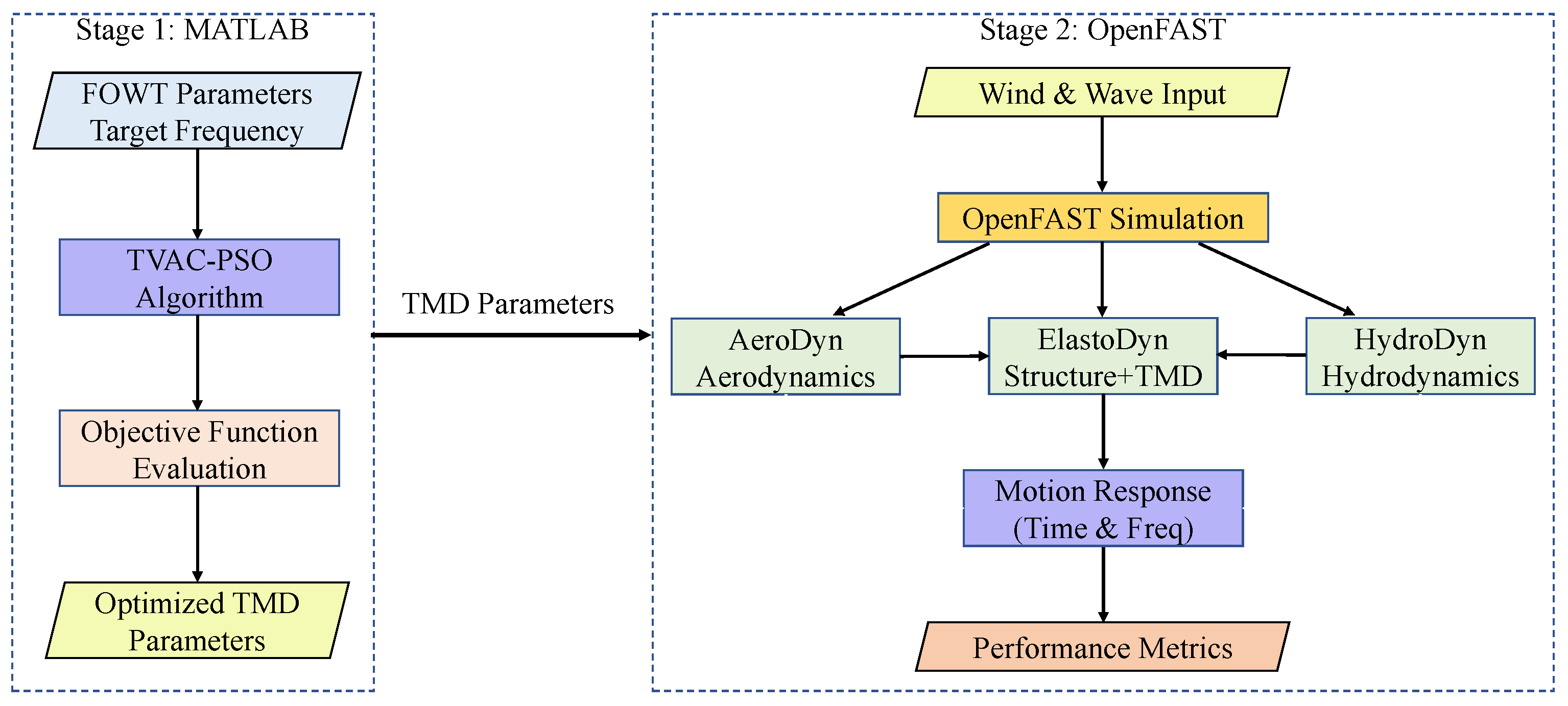
In this section, the effectiveness of the proposed TVAC-PSO algorithm in optimizing TMD parameters for vibration suppression of the FOWT is demonstrated through numerical simulations. The overall simulation framework is illustrated in
Figure 2.
As shown in
Figure 2, the simulation process consists of two main stages: Stage 1 performs parameter optimization using TVAC-PSO in MATLAB, where the objective function is evaluated based on the frequency tuning criteria, damping ratio constraints, and mass ratio limits. Stage 2 validates the performance using OpenFAST simulations with the optimized TMD parameters under various environmental conditions. Using the TVAC-PSO algorithm described in
Section 3, the optimization problem is solved with a swarm size of
particles and a maximum of
iterations. To assess the robustness and consistency of the optimization results, 20 independent runs are conducted with different random seeds.
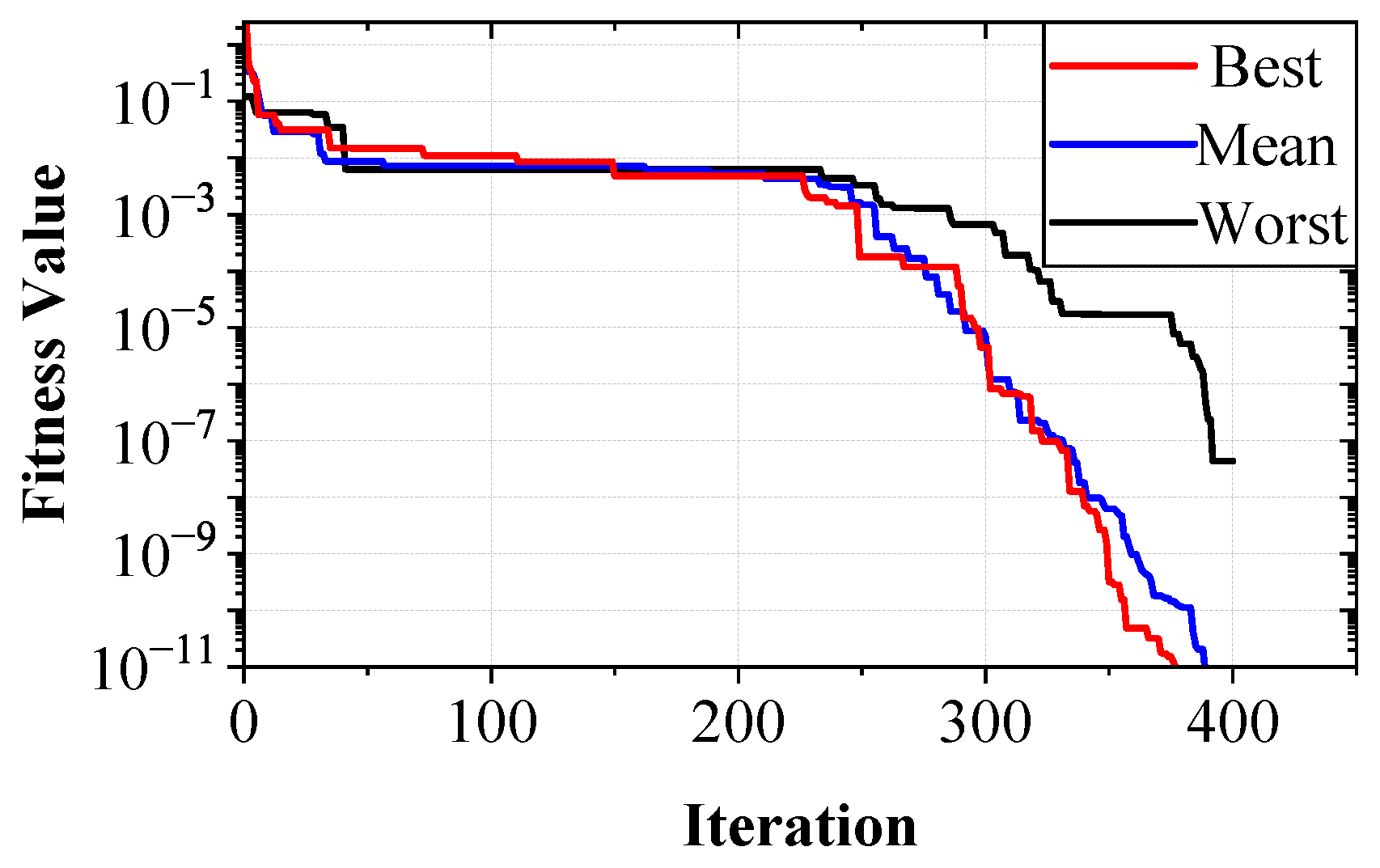
Figure 3 presents the convergence behavior of the TVAC-PSO algorithm over 20 independent runs, where the Best, Mean, and Worst curves represent the runs achieving the lowest, closest-to-average, and highest final objective function values, respectively. During the initial stage of iterations, the objective function value decreases rapidly, demonstrating the algorithm’s strong global exploration capability in quickly identifying the promising parameter region. As the optimization progresses, the convergence rate gradually slows as the algorithm transitions from exploration to exploitation. The solution stabilizes after approximately 250 iterations, at which stage the objective function approaches its minimum value. Across these 20 independent runs, the final objective function values ranged from
(Best) to
(Worst), with a mean of
and a standard deviation of
. In 19 out of 20 runs, the final objective value converged to below
, demonstrating the high consistency and robustness of the proposed TVAC-PSO algorithm. The optimization is terminated using the maximum iteration number
as the stopping criterion. In all runs, the objective function had already stabilized well before this limit was reached, confirming that the selected stopping criterion is sufficient for the present problem. Additional preliminary tests with lower penalty weights showed a much wider spread in the optimized TMD parameters across repeated runs, although feasible solutions could still be obtained. This observation supports the adopted penalty settings, which provide stronger constraint guidance and lead to more stable parameter ranges in the optimization results.
As summarized in
Table 2, the standard PSO with fixed parameters was also tested under the same population size, parameter bounds, maximum iteration number, and 20 independent runs for comparison. The results show that the proposed TVAC-PSO provides much better robustness and consistency. Specifically, although the best final objective value of the standard PSO reached
, its worst result deteriorated to
, with a mean of
and a standard deviation of
. In contrast, the proposed TVAC-PSO achieved a much lower worst value of
, together with a mean of
and a standard deviation of
. Moreover, the convergence success rate of TVAC-PSO reached 95% (19/20), whereas the standard PSO achieved only 65% (13/20). These results quantitatively demonstrate that the time-varying acceleration strategy effectively improves convergence robustness and reduces premature stagnation in the strongly coupled TMD optimization problem.
The optimized TMD parameters obtained from TVAC-PSO are presented in
Table 3. The optimal TMD mass of 648,565 kg corresponds to a mass ratio of 4.54%, well within the prescribed limit of 6%. This value represents a practical compromise between vibration suppression effectiveness and structural feasibility. The stiffness parameters are nearly identical for roll and pitch directions, reflecting the platform’s geometric symmetry. The damping parameters exhibit slight asymmetry, resulting from adaptive adjustment to the specific dynamic characteristics of each motion mode. Based on the optimized mass and stiffness parameters, the TMD natural frequencies are calculated as
rad/s and
rad/s, corresponding to 0.038 Hz, which precisely matches the target frequency identified from spectral analysis. The damping ratios are
and
, both within the optimal range of 0.03–0.30 recommended by classical TMD theory [
40]. These values ensure effective energy dissipation without excessive damper stroke.
The optimized parameters result in a near-zero objective function value, calculated from Equation (
26), indicating satisfactory performance in meeting all design criteria: frequency tuning accuracy, damping ratio constraints, and mass ratio limits. The optimized parameters demonstrate good engineering feasibility and can be implemented through standard spring-damper systems. The stiffness values correspond to helical spring designs, while the damping coefficients can be realized using hydraulic or magnetorheological dampers.
To verify the vibration reduction performance of these optimized parameters, a high-fidelity aero-hydro-servo-elastic simulation model of the FOWT was established using OpenFAST. The HydroDyn module is employed to calculate wave loads based on the potential flow theory and the Morison equation, while the AeroDyn module computes aerodynamic loads using BEM theory. The MoorDyn module is used to model the mooring system, fully coupling the TMD system with the FOWT dynamics. The OpenFAST model was established based on the OC4-DeepCwind 5 MW semi-submersible reference configuration, with the geometric, mass, and mooring properties taken from the corresponding OC4 specifications [
29]. Free-decay tests in roll and pitch were also carried out to validate the low-frequency dynamics of the model. The proposed 2-DOF roll-pitch model reproduced the free-decay responses well, with coefficients of determination of 0.9611 and 0.9657 for roll and pitch, respectively. In addition, the dominant PSD peaks of both roll and pitch responses were captured at 0.037842 Hz, which is in close agreement with the OpenFAST results. The simulations in this study were performed with a time step of 0.0125 s. Three representative load cases are designed to systematically verify the vibration reduction effectiveness of the optimized TMD, covering conditions from normal operation to extreme sea states. The specific environmental parameters of each load case are detailed in
Table 4. The wind speeds and wave parameters are selected based on IEC 61400-3 standards [
41] to represent typical offshore wind farm operating conditions. For clarity, LC1–LC3 denote Load Cases 1–3, respectively. Additional oblique wave directions or a broader set of irregular sea states are not explicitly considered in the current analysis. LC1 represents low wind speed conditions, where the motion is primarily wave-dominated, serving as a key test for the TMD suppression effect under wave-induced excitation. LC2 represents the standard operating sea state and is the most common condition during the turbine’s operating life. LC3 represents harsh environmental conditions with extreme 50-year return period sea states, evaluating the TMD’s survivability and suppression effectiveness under high wind and wave loads. In addition, a basic time-step sensitivity check is carried out for the representative LC2 case with the optimized TMD by reducing the simulation time step from 0.0125 s to 0.00625 s. The resulting variations in the key response metrics, including the standard deviation and maximum values of roll and pitch motions, are all below 0.2%, confirming that the adopted time step is adequate for the present comparative analysis.
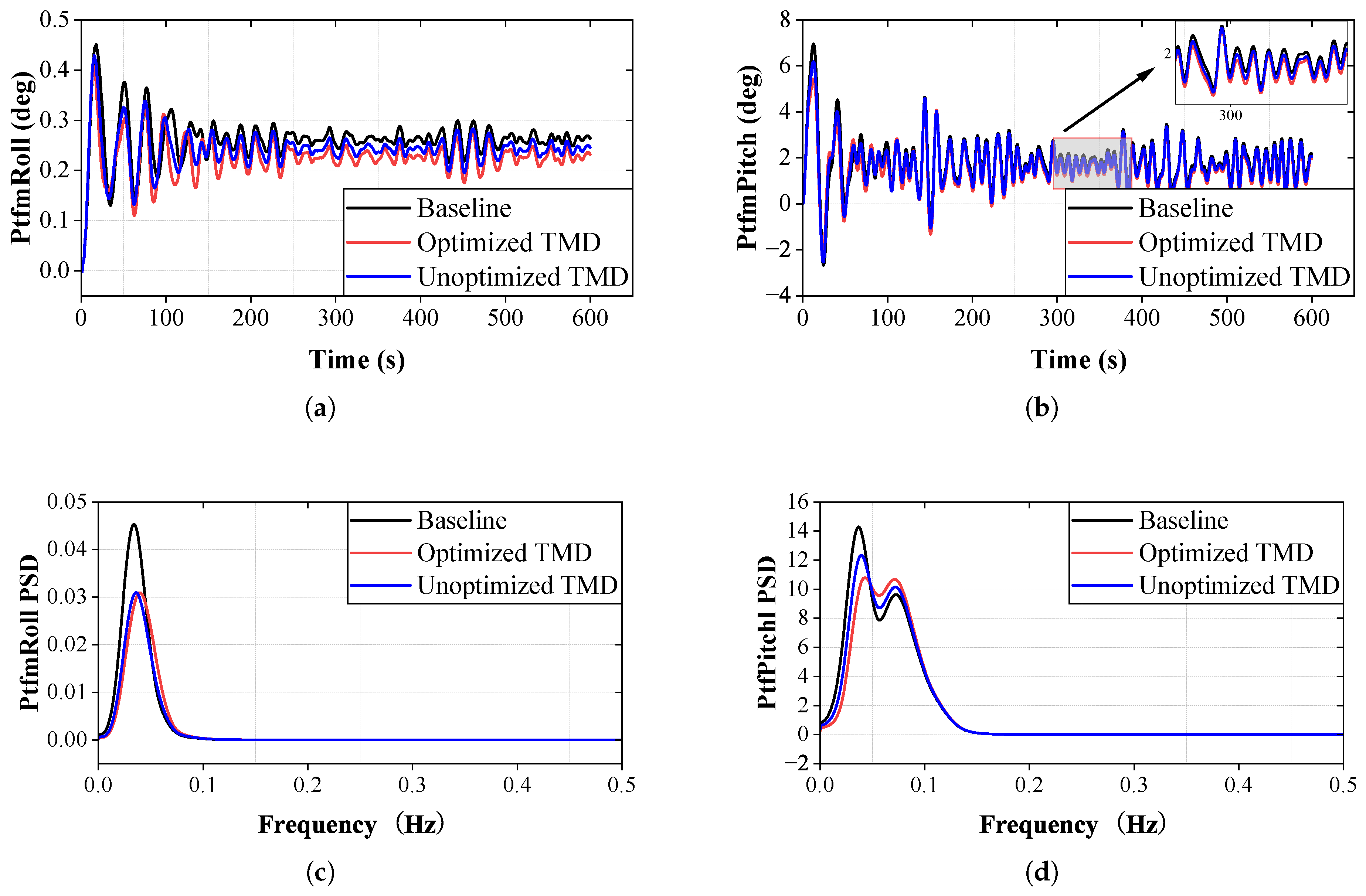
The time-domain and frequency-domain responses of the FOWT under the three load cases are analyzed. Three simulation configurations are compared: (1) Baseline: the FOWT without TMD; (2) Unoptimized TMD: the TMD with empirically selected parameters; (3) Optimized TMD: the TMD with parameters obtained from TVAC-PSO optimization as shown in
Table 3. The quantitative performance metrics, including standard deviation (Std), maximum values (Max), and power spectral density (PSD) peak reductions, are calculated from the OpenFAST simulation results and summarized in
Table 5. In addition, since LC2 represents the standard operating sea state, the generator-power-related metrics of the baseline and optimized cases are compared in
Table 6 to examine whether the proposed TMD affects power generation performance.
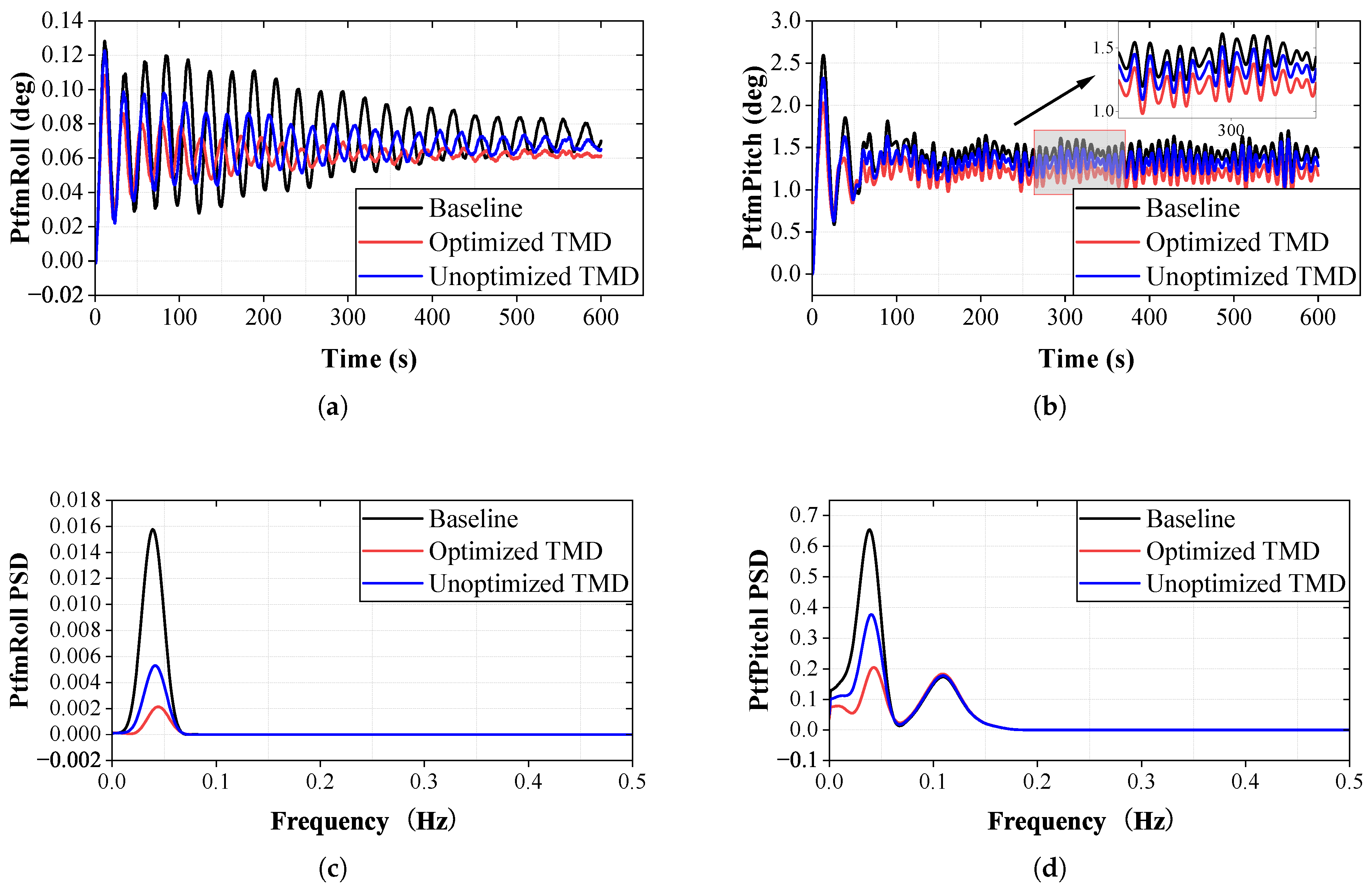
Figure 4 presents the FOWT motion responses under LC1. The results demonstrate that the Optimized TMD exhibits superior vibration suppression compared to the Unoptimized case. As shown in
Table 5, the Optimized TMD reduces the Std of roll and pitch motions by 54.5% and 24.7%, respectively. In contrast, the Unoptimized TMD only achieves reductions of 36.0% and 13.3%. The frequency-domain analysis further confirms this advantage. The Optimized TMD suppresses the resonant peak energy by 88.1% in roll and 70.7% in pitch, significantly outperforming the Unoptimized TMD.
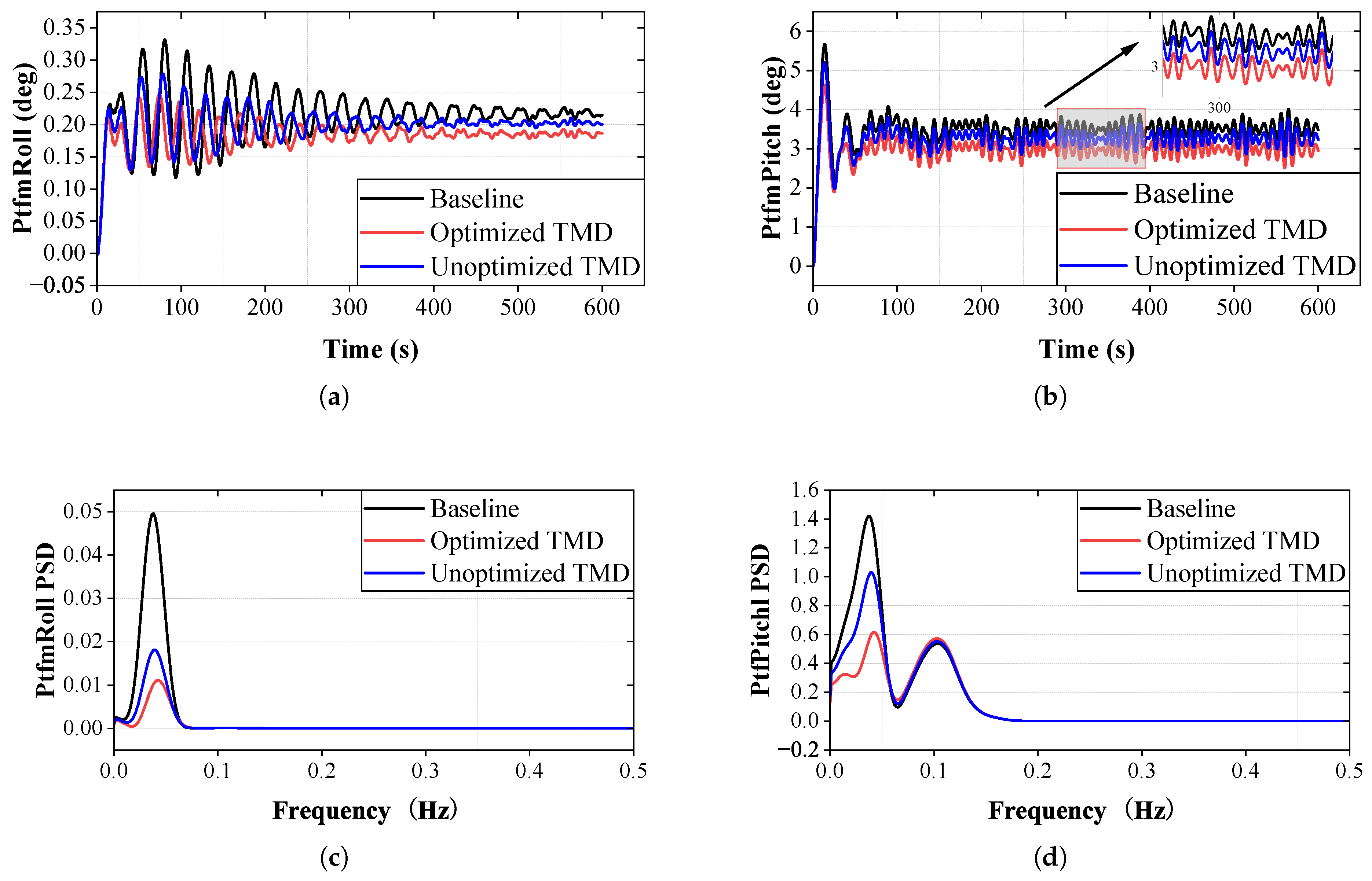
Under LC2, as shown in
Figure 5, the Optimized TMD maintains robust performance. The time-domain results in
Table 5 show that the roll and pitch Std are reduced by 40.4% and 18.8%, respectively. The Unoptimized TMD is less effective, with reductions of 29.4% and 8.6%. Notably, the Optimized TMD significantly suppresses the pitch resonant peak in the frequency domain by 60.0%, whereas the Unoptimized case only achieves 28.3%. This demonstrates that the TVAC-PSO algorithm successfully identifies the optimal damping and stiffness to mitigate the pitch resonance induced by the combined wind and wave loads. An additional detuning check was carried out under the representative LC2 condition by perturbing the optimized TMD natural frequency by
while keeping the mass and damping parameters unchanged. The results show that the nominal optimized design provides the best overall suppression performance among the three cases. The pitch response is only weakly affected by such tuning deviations, with changes of less than 0.1% in both the standard deviation and maximum value. By contrast, the roll response is more sensitive: relative to the nominal optimized design, the
detuned case increased the roll standard deviation by approximately 20.6%, while the
detuned case increased it by approximately 30.1%. It should be noted that, under LC2, the roll response is comparatively small and mainly arises through pitch-roll coupling rather than direct dominant roll-direction excitation. As a result, even a modest absolute variation may appear as a relatively large percentage change in the roll statistics. These results indicate that the proposed design retains reasonable robustness to moderate tuning deviations while also confirming the importance of accurate tuning for achieving the best roll-suppression performance. In addition, the generator-power-related comparison in
Table 6 shows that the optimized TMD does not introduce any adverse effect on power generation under the representative operating condition LC2. Instead, the mean generator power increases slightly from 4617.5 kW to 4637.7 kW, while the coefficient of variation decreases marginally from 0.04369 to 0.04362. Although these changes are small, they indicate that the proposed M-DOF TMD can effectively suppress platform vibrations without compromising the power-generation performance of the system.
For LC3, as shown in
Figure 6, the wave excitation energy is dominant. Although the reduction in Std is modest due to the strong wave-frequency forced motions, the suppression of extreme values is significant. According to
Table 5, the Optimized TMD reduces the maximum pitch angle by 21.8%, which is crucial for structural survivability. The Unoptimized TMD only reduces the Max pitch by 11.1%. The PSD analysis also shows that the Optimized TMD suppresses the pitch resonant peak by 32.0%, nearly double the effectiveness of the Unoptimized case. This result highlights that the Optimized TMD provides better safety margins for the FOWT under harsh environmental conditions. Because the proposed TMD is tuned to the dominant roll and pitch modes, its influence on higher-frequency structural modes is expected to be limited. Likewise, surge and sway motions are not included as direct tuning targets in the present design, and no notable direct suppression effect on these responses is claimed in this study. These results indicate that the optimized TMD parameters remain effective under the considered load cases with varying wind and wave conditions, suggesting a certain degree of robustness to changes in the FOWT operating point, including mean wind speed, rotor speed, and blade pitch. In addition, supplementary simulations around the baseline LC2 condition showed that the optimized TMD parameters remain effective under moderate mean-wind-speed variations from 10 m/s to 12 m/s without re-tuning, indicating a certain degree of robustness to operating-point changes. However, since a passive TMD is inherently frequency-sensitive, re-tuning may still be required if the FOWT operates in substantially different dynamic regimes.
5. Conclusions
In this study, a novel vibration suppression strategy for the OC4-DeepCwind 5 MW FOWT is proposed by using a multi-degree-of-freedom TMD system, where the TVAC-PSO algorithm is adopted to determine the optimal TMD parameters to achieve suppression of roll and pitch motion. A coupled FOWT-TMD dynamic model is first established using the Euler-Lagrange formulation. A 2-DOF TMD is designed in which the stiffness and damping in roll and pitch directions are independently tuned. The optimal TMD parameters, including mass ratio, stiffness, and damping coefficients, are then determined using the TVAC-PSO algorithm. The effectiveness of the optimized parameters is verified through OpenFAST simulations. The performance of the TMD is systematically evaluated under three typical load cases, and the results show that the optimized TMD maintains effective damping performance across all operating conditions considered in this study, indicating a certain degree of robustness to variations in mean wind speed, rotor speed, and blade pitch. However, since passive TMDs remain frequency-sensitive devices, re-tuning may be required when the FOWT operates in substantially different dynamic regimes. Moreover, the present validation is limited to representative IEC-based load cases within the standard OC4/OpenFAST framework. Additional oblique wave directions and a broader range of irregular sea states are not explicitly considered and should be investigated in future work for a more comprehensive robustness assessment. In addition, although reduced platform motions may indirectly contribute to more stable power-related responses, performance metrics associated with power production, such as generator speed variability or energy yield stability, are not included in the present optimization and should be examined in future studies. Similarly, fatigue-related quantities such as tower base bending moments and drivetrain torque fluctuations are not explicitly evaluated in the present work, and a comprehensive fatigue-life assessment incorporating the TMD effects should be carried out in future research. Reliability-oriented and service-life-oriented optimization formulations, as well as robustness evaluation under stochastic wind, wave, and structural uncertainties, also remain important directions for further investigation. In addition, broader comparisons with other control strategies and detailed mechanical implementation of the proposed TMD system should be addressed in future work. Notably, the TMD demonstrates significant suppression capability even under extreme environmental conditions. Compared to traditional single-degree-of-freedom or multiple independent TMD configurations, the proposed 2-DOF TMD design offers reduced installation space requirements, lower maintenance costs, and improved reliability through a simplified mechanical design, owing to the integrated realization of bidirectional tuning with a single mass block, which avoids the duplication of independent mass assemblies, support structures, and installation interfaces typically required in dual S-DOF TMD layouts, while maintaining a comparable percent-level total mass ratio.