1. Introduction
High-precision positioning is essential for autonomous underwater vehicles (AUVs). The growing use of AUVs in scientific research and military operations has accelerated the demand for highly accurate and stable navigation technologies [
1,
2,
3]. Because each type of navigation sensor has distinct advantages and limitations, multi-sensor integration has become a major research focus in AUV navigation [
4,
5].
The Inertial Navigation System (INS), a self-contained system capable of providing continuous navigation information, serves as the foundation of most integrated navigation architectures, with the Inertial Measurement Unit (IMU) as its core component [
6]. Originally developed for military purposes, the INS was first applied by Germany in the V2 rocket in 1942. In 1958, the U.S. submarine Nautilus successfully completed an Arctic under-ice voyage using the INS—the first underwater application of the technology [
7]. Over subsequent decades, INS technology for underwater vehicles advanced considerably [
8,
9], expanding its application from military to scientific and commercial domains [
5,
10,
11]. However, because the INS operates on the dead-reckoning principle, its errors accumulate over time, necessitating periodic correction from external sensors.
Acoustic positioning systems—including Long Baseline (LBL), Short Baseline (SBL), and Ultra-Short Baseline (USBL) configurations—provide high-precision absolute positioning for AUVs [
12,
13]. When integrated with the INS, these systems effectively bound inertial error accumulation and have been widely adopted in engineering applications [
14,
15]. However, they also impose significant operational constraints: LBL requires extensive deployment time to install and geolocate seafloor transponders [
16], while SBL and USBL depend on surface support vessels throughout the mission [
14,
17]. These requirements not only reduce AUV operational flexibility but also substantially increase mission cost. Consequently, achieving reliable high-precision navigation beyond acoustic coverage has become essential for improving AUV autonomy and reducing operational burden.
Pressure sensors (PSs) provide high-accuracy depth measurements with fast sampling rates. Their compact size, low cost, simple installation, and passive operation make them indispensable components of modern AUV navigation systems. Nevertheless, because PSs supply only one-dimensional depth information, they cannot effectively constrain the multi-dimensional error growth of the INS.
The Doppler Velocity Log (DVL) offers three-dimensional velocity measurements that can directly suppress INS velocity and position divergence [
18,
19]. Owing to its independence from external infrastructure and straightforward deployment, the DVL has become a standard sensor in AUV navigation systems [
19]. Its applicability, however, depends critically on successful acoustic bottom-tracking. Once the AUV exceeds the instrument’s maximum altitude, DVL measurements are lost, restricting operational validity to near-seafloor regions [
20]. In addition, seafloor characteristics such as soft sediments or dense vegetation may degrade measurement quality or cause complete tracking failure [
21,
22]. However, in environments where DVL bottom-tracking fails or is unavailable, researchers have turned to alternative methods that do not rely on continuous external velocity measurements. Among these, geophysical field navigation—which utilizes ambient fields such as gravity, geomagnetism, or bathymetry—offers a promising approach for long-endurance, infrastructure-free navigation.
Geophysical field navigation—implemented using gravity, geomagnetic, or bathymetric terrain information—estimates position by matching measurements to pre-established georeferenced databases [
23,
24]. These techniques provide strong anti-interference and anti-detection capability, making them attractive for long-term autonomous missions. However, their practical deployment is hindered by the need for high-resolution global databases, the cost of building and maintaining such datasets, and the sensitivity of matching algorithms to local environmental conditions. Limitations in real-time performance, robustness, and database availability have thus constrained their widespread use. While geophysical navigation provides independence from deployed infrastructure, its effectiveness is inherently tied to the availability and quality of pre-existing georeferenced maps. In uncharted or poorly mapped regions, its utility diminishes. This limitation motivates the exploration of model-aided (MA) navigation, a fundamentally different paradigm that leverages the vehicle’s own dynamic model rather than matching external environmental cues, thereby circumventing the dependency on prior maps.
MA navigation enhances INS performance by integrating vehicle dynamic models into the estimation process. In aviation, MA approaches have been used to assist inertial systems through aircraft dynamic modeling, confirming the feasibility of the vehicle-based MA INS [
25]. Extending this concept to underwater applications, researchers have used hydrodynamic models to convert propeller rotational speed (PRS) into AUV velocity. This approach provides an effective positioning solution when DVL measurements are unavailable or degraded [
26,
27]. To further improve accuracy, several studies estimated ocean currents from empirical tidal and current tables to partially mitigate current-induced errors in MA navigation [
28,
29]. Subsequent work introduced explicit current estimation within the navigation filter to compensate for dynamic ocean environments [
30]. Other researchers have enhanced algorithm robustness by incorporating Acoustic Doppler Current Profiler data [
31]. Some studies have developed cost-effective model-aided (MA) frameworks designed for low-cost MEMS-based INS units [
32]. In addition, Gao et al. achieved DVL-comparable performance using fuzzy logic mapping between motor currents or propeller speeds and cruising velocity [
33].
Most existing research has emphasized ocean current estimation, given its importance for high-precision navigation in long-duration, unaided missions. However, current fields vary significantly with depth and cannot be reliably inferred without dedicated sensors [
33]. Introducing current parameters without sufficient observational constraints increases the number of unknowns and reduces system observability, potentially causing instability in the estimation process. Although transient accuracy may improve, these methods often degrade overall navigation robustness during extended operations or large-scale deployments.
To address this specific challenge of sustaining accurate AUV navigation over long durations without continuous external velocity aiding, this paper proposes a novel attitude-compensated and acoustics-calibrated model-aided navigation framework. The framework’s innovation stems from its unique integration of two key concepts: first, it replaces the DVL by deriving a model-based velocity, which is obtained by using the attitude-compensating vertical velocity to correct the forward speed estimated from the propulsion model; second, it transforms sporadic absolute position fixes (e.g., from LBL) from mere position updates into a means for online calibration of the propulsion model’s intrinsic bias. This dual approach of sensor substitution and opportunistic model refinement is designed to maintain bounded navigation error in environments where traditional aiding sensors like DVLs are unavailable or fail.
2. Materials and Methods
2.1. Theoretical Background and Sensor Principles
2.1.1. Inertial Navigation System Fundamentals
INS observations are obtained from the inertial sensors within an IMU, which consists of gyroscopes and accelerometers providing triaxial angular rate and acceleration measurements, respectively. The IMU is rigidly mounted inside the AUV with its orthogonal axes aligned to the vehicle’s body frame. Operating at a fixed frequency, the INS propagates the previous navigation state—attitude, velocity, and position (AVP)—to estimate the current state through a process known as mechanization.
During mechanization, initial alignment errors, together with gyroscope drift and accelerometer bias, gradually accumulate, leading to increasing navigation errors over time. To mitigate this drift, external sensor measurements are incorporated using a Kalman filter, which updates the INS solution by comparing measured and predicted values. The Kalman filter then estimates and compensates for the INS state errors, thereby refining the overall navigation solution.
INS state errors primarily encompass attitude errors (
), velocity errors (
), position errors (
), gyroscope biases (
), and accelerometer biases (
). When modeled as state parameters in Kalman filtering, the system model is represented by the following:
where
represents the state vector of the INS;
represents the predicted value of the state variable;
represents the state transition matrix of the INS;
represents the process noise allocation matrix of the INS;
represents the process noise of the INS.
2.1.2. Depth Sensing with Pressure Sensors
PSs measure pressure at the AUV’s location and convert it into depth measurements
. The predicted depth value
can be calculated via Equation (2):
where
represents the local height anomaly and
represents the ellipsoid height calculated by the INS.
The measurement model of the PS is represented by the following equation:
where
,
;
;
represents the random error of the output value of the PS.
2.1.3. Long Baseline Positioning System
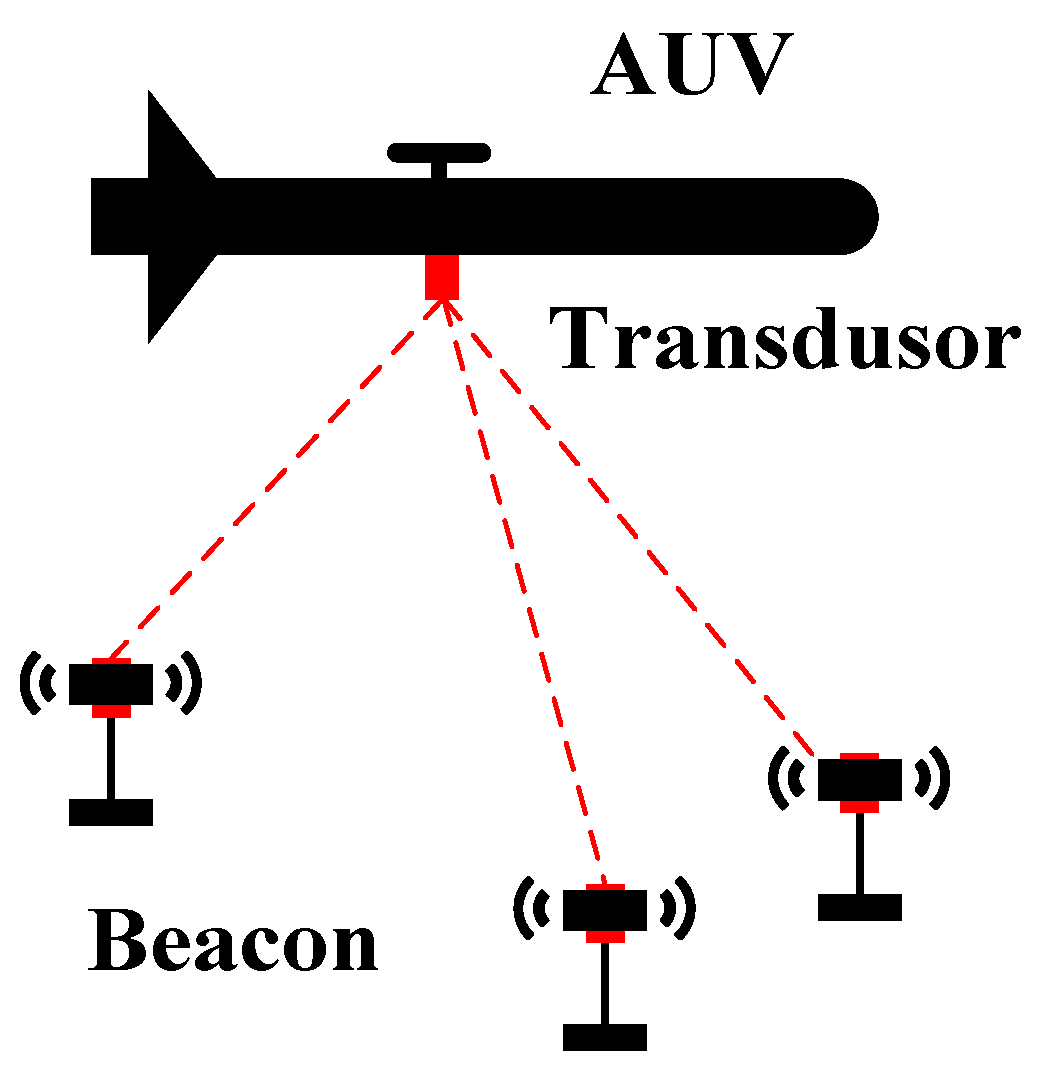
LBL determine the AUV’s position by analyzing ranging measurements between the underwater navigation beacons at known locations and the transducer on the AUV, with the operational principle illustrated schematically in
Figure 1.
The measurement model of the LBL is represented by the following equation:
where
;
and
represent the position estimation value and the position output by LBL, respectively;
;
represents the identity matrix; and
represents the random error of LBL output position.
Because of the suboptimal observation geometry in LBL, their vertical positioning accuracy is relatively low. To address this limitation, LBL and PS measurements are typically fused within the same Kalman filter to enhance overall three-dimensional positioning accuracy. Under this configuration, the LBL measurement model can be expressed as follows:
2.2. Attitude-Compensated and Acoustics-Calibrated Model-Aided Navigation
2.2.1. Derivation of the Model-Based Velocity
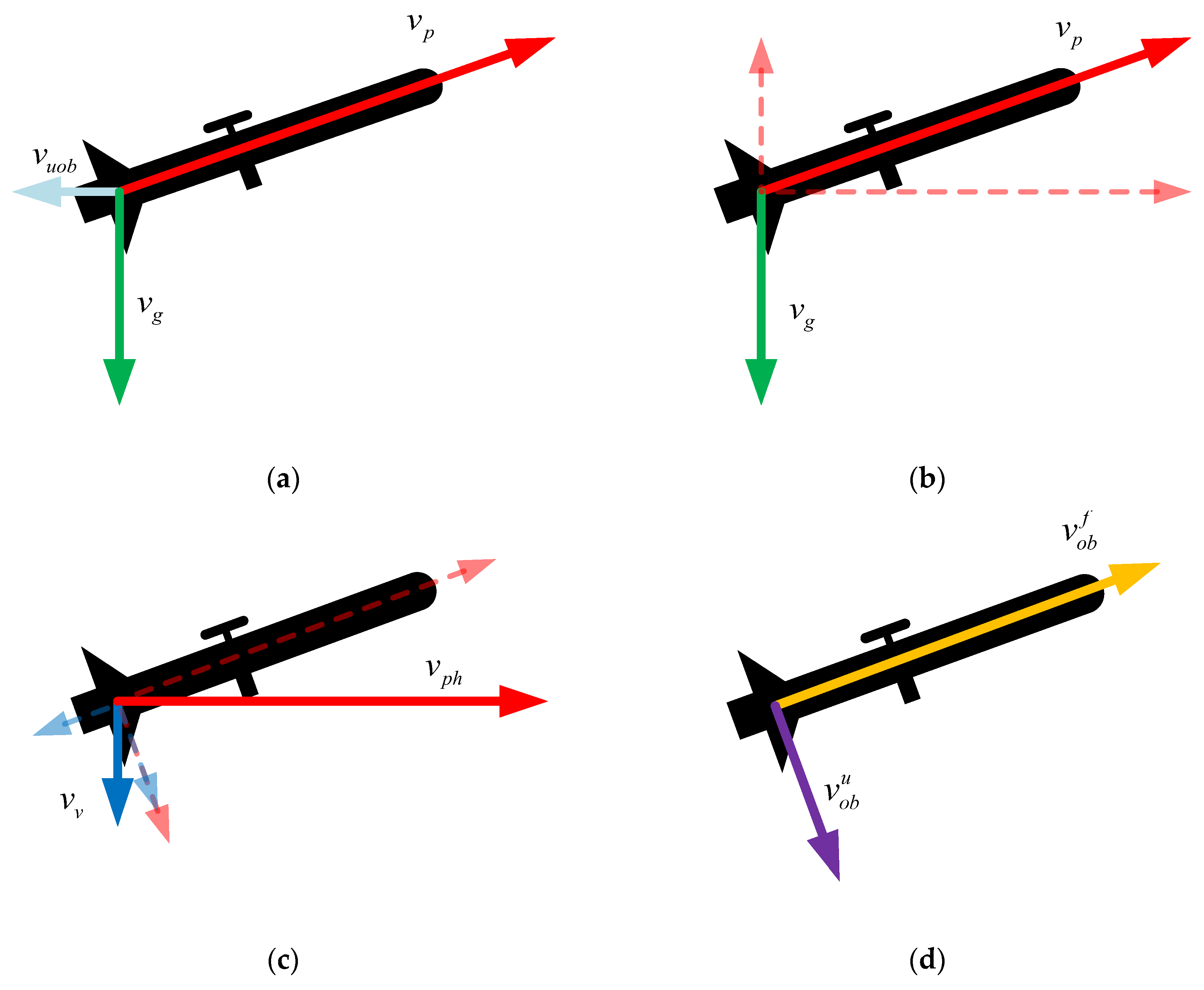
The AUV’s velocity comprises three primary components: the forward velocity
generated by the propeller (termed Propulsion-Induced Velocity, PIV), the vertical velocity
resulting from gravity/buoyancy effects (as depicted in
Figure 2), and an unpredictable velocity caused by ocean currents (referred to as unobservable velocity
). The PIV aligns with the forward axis of the body frame, while the vertical velocity acts along the zenith direction of the navigation frame. This work defines their vector sum as the observable velocity
. The AUV’s total velocity
is expressed through Equation (6):
To execute submerged maneuvers or accelerated ascents, AUVs typically maintain pitched attitudes (head-up or head-down). Under such conditions, PIV
decomposes into a horizontal component
and vertical component
. The resultant vertical velocity
combines the buoyancy-induced vertical velocity
with the propulsion vertical component
, thereby expressing the AUV’s total velocity as follows:
The value
of the vertical velocity
can be derived from high-frequency depth data (provided by PSs) via differentiation. The vertical component
of the PIV is formulated in Equation (8):
where
denotes the pitch angle (positive when bow-up). The body-frame coordinates
of the AUV’s observable velocity are computed as follows:
where
,
, and
represent the right, forward, and upward coordinates of the AUV’s observable velocity in the body frame, respectively.
Given
and
, the body-frame coordinates of the AUV’s observable velocity are expressed by Equation (12):
During stable AUV navigation, the PRS
is assumed to have a linear relationship with the value
of PIV [
34], expressed by Equation (13):
where
represents the PRS-PIV mapping coefficient (hereafter referred to as the mapping coefficient), which is a constant typically obtained through tank testing;
represents the value of the mapping coefficient derived from tank testing; and the inherent deviation
is defined as the mapping coefficient bias, expressed as follows:
The value of PIV calculated based on
is
:
In this paper, the body-frame coordinates
of the AUV’s observable velocity, calculated from
, are modeled as the model-based velocity and formulated via Equation (16):
where
and
denote the velocity of the AUV in the body frame (b-frame) and navigation frame (n-frame), respectively, and
represents the coordinate transformation matrix from the n-frame to the b-frame. The model-based velocity value
is computed as specified in Equation (17):
where
represents the rotational speed value output by the propeller.
2.2.2. Integrated Measurement Model
From Equation (16), the model-based velocity estimate
derived via the INS can be computed using Equation (18):
where
represents the coordinate transformation matrix calculated via the INS and
denotes the INS-derived velocity of the AUV in the navigation frame. Given that the magnitude of the unobservable velocity
is negligible and computationally intractable, this study simplifies Equation (18) to Equation (19):
Differentiating Equation (19) yields the following:
where
is termed the mapping coefficient bias error. The model-based velocity estimate
derived via the INS is expressed as follows:
where
denotes the error component in model-based velocity estimation attributable to the INS state and
, and
represents the error arising from the unobservable velocity.
The model-based velocity value
is expressed as follows:
where
represents stochastic errors attributable to rotational speed inaccuracies and similar factors.
Equation (21) minus Equation (22) yields the following:
Substituting Equation (20) into Equation (23) yields the following:
This article considers as a random error term.
When operating within the effective range of LBL, this study concurrently feeds model-based velocity, LBL, and PS measurements into a Kalman filter. The measurement model is expressed as follows:
where
represents the state vector of the model-based velocity;
represents the measurement vector of the Kalman filter;
;
represents the random error term; and
.
Without LBL, the mapping coefficient bias error
is neglected, under which the measurement model is expressed as follows:
2.2.3. System Model
When LBL is operational, the mapping coefficient bias error
is estimated. The system model is expressed as follows:
where
represents the predicted value of the propeller state vector;
denotes the state transition matrix governing propeller dynamics;
signifies the process noise distribution matrix that maps noise sources to state dimensions; and
corresponds to the process noise covariance matrix. Since the mapping coefficient bias
is modeled as a constant value,
,
,
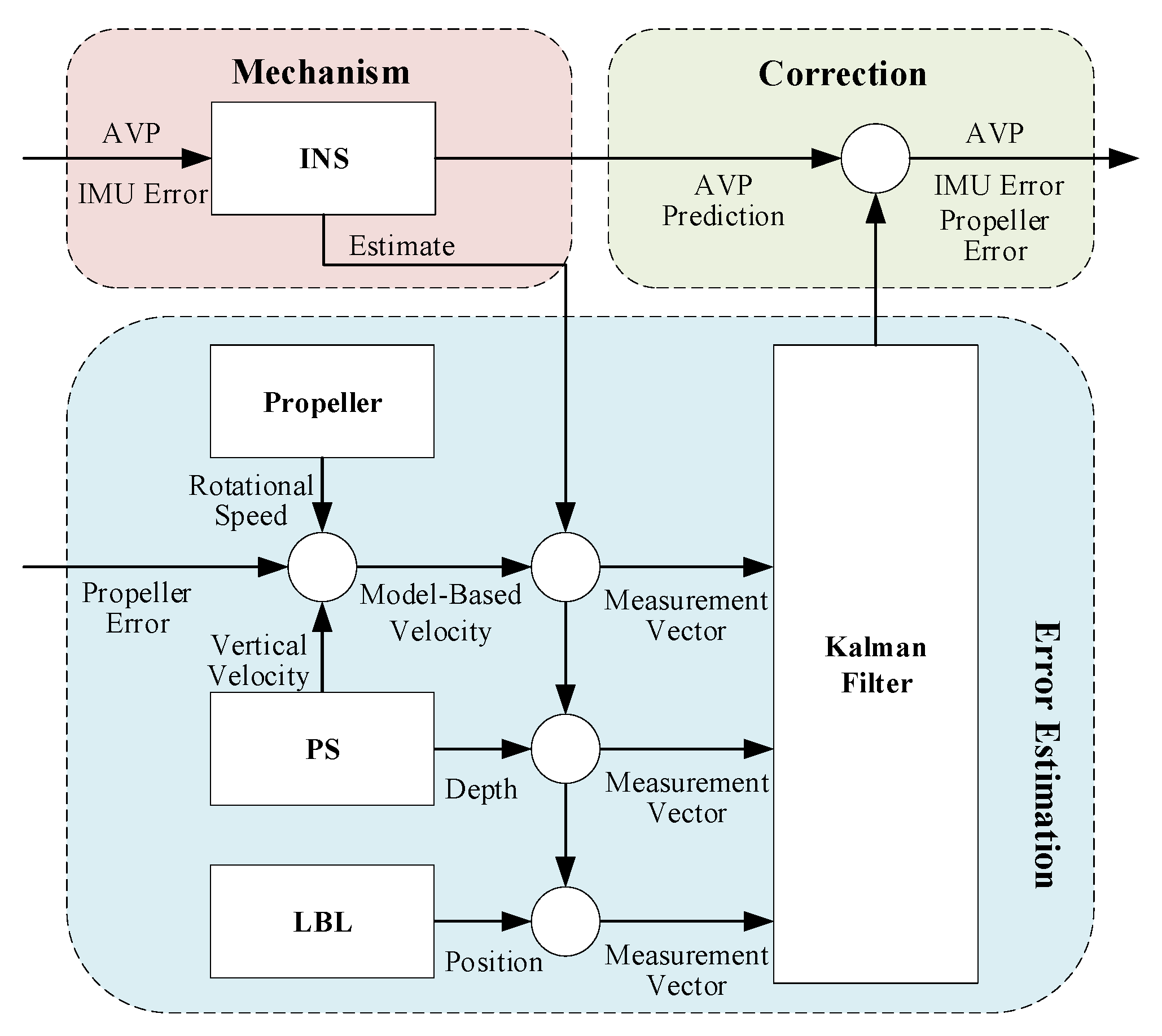
. Here, the flowchart of the framework proposed in this paper is depicted in
Figure 3.
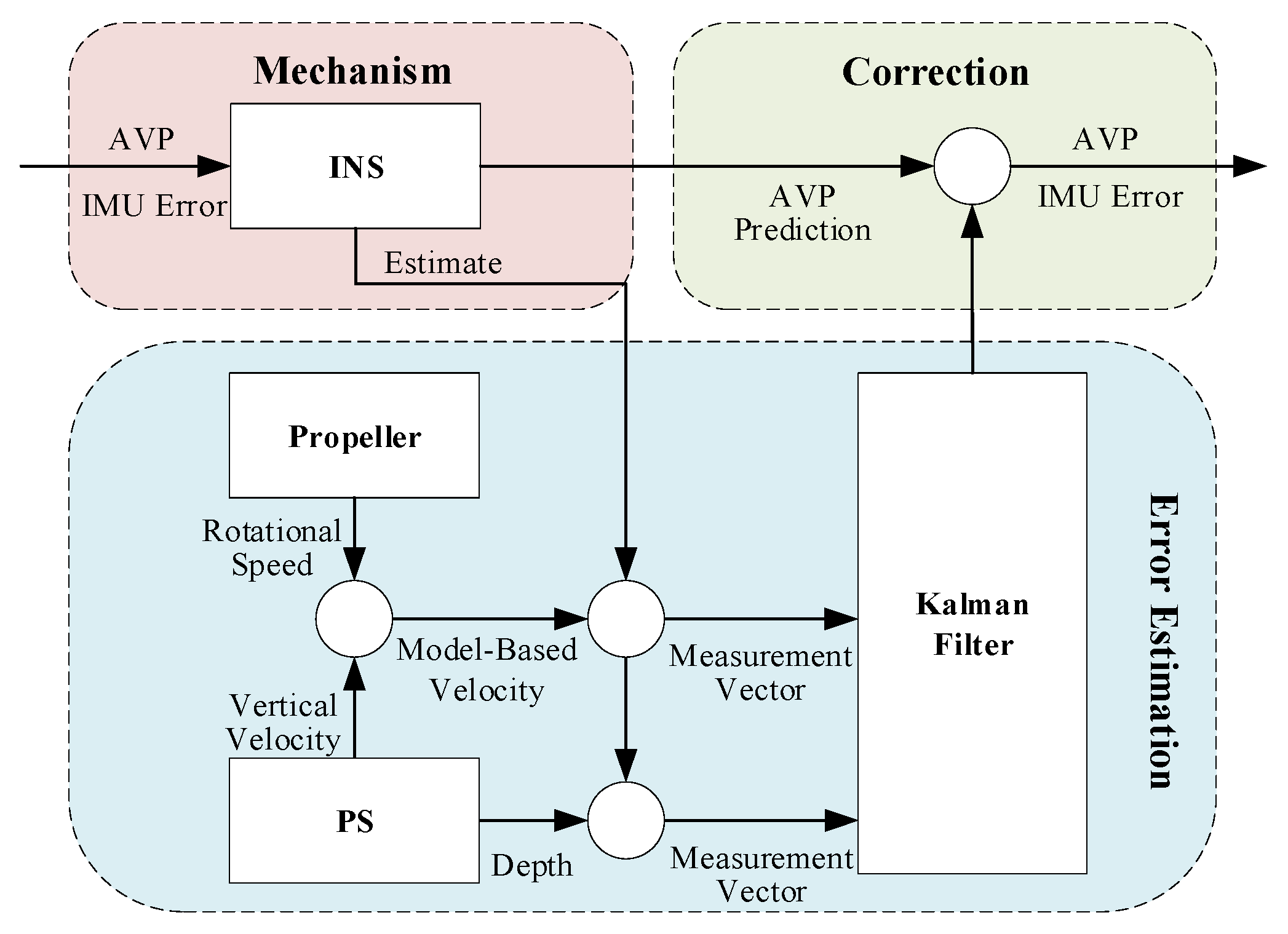
When the LBL is unavailable, Equation (1) is employed as the system model. Here, the flowchart of the framework proposed in this paper is depicted in
Figure 4.
2.2.4. Kalman Filter
The current epoch’s position and velocity of the underwater vehicle can be estimated by feeding the observation model into a Kalman filter. The main steps of the Kalman filter are as follows.
- (1)
State Prediction (Predict the current epoch’s state based on the previous epoch):
where
and
represent the state vector and its covariance matrix from the previous epoch, respectively;
and
represent the predicted state vector and its covariance matrix for the current epoch, respectively;
is the state transition matrix for the current epoch; and
is the process noise covariance matrix.
- (2)
State Update (Update the current epoch’s state using the measurements):
where
and
represent the updated state vector and its covariance matrix for the current epoch, respectively;
and
represent the innovation (measurement residual) and its covariance matrix, respectively; and
is the Kalman gain matrix, calculated as follows:
The process noise covariance matrix was tuned based on the calibrated noise characteristics of the IMU (e.g., angular random walk, bias instability) and the assumption of slow variation for the model bias state . The measurement noise covariance matrix for the LBL updates was set according to its nominal positioning accuracy (~3 m), while that for the model-based velocity observation was set based on its expected uncertainty. The initial state covariance matrix was configured according to the coarse alignment accuracy of the INS and prior knowledge of the sensor biases.
2.3. Experimental Platform and Sea Trial Configuration
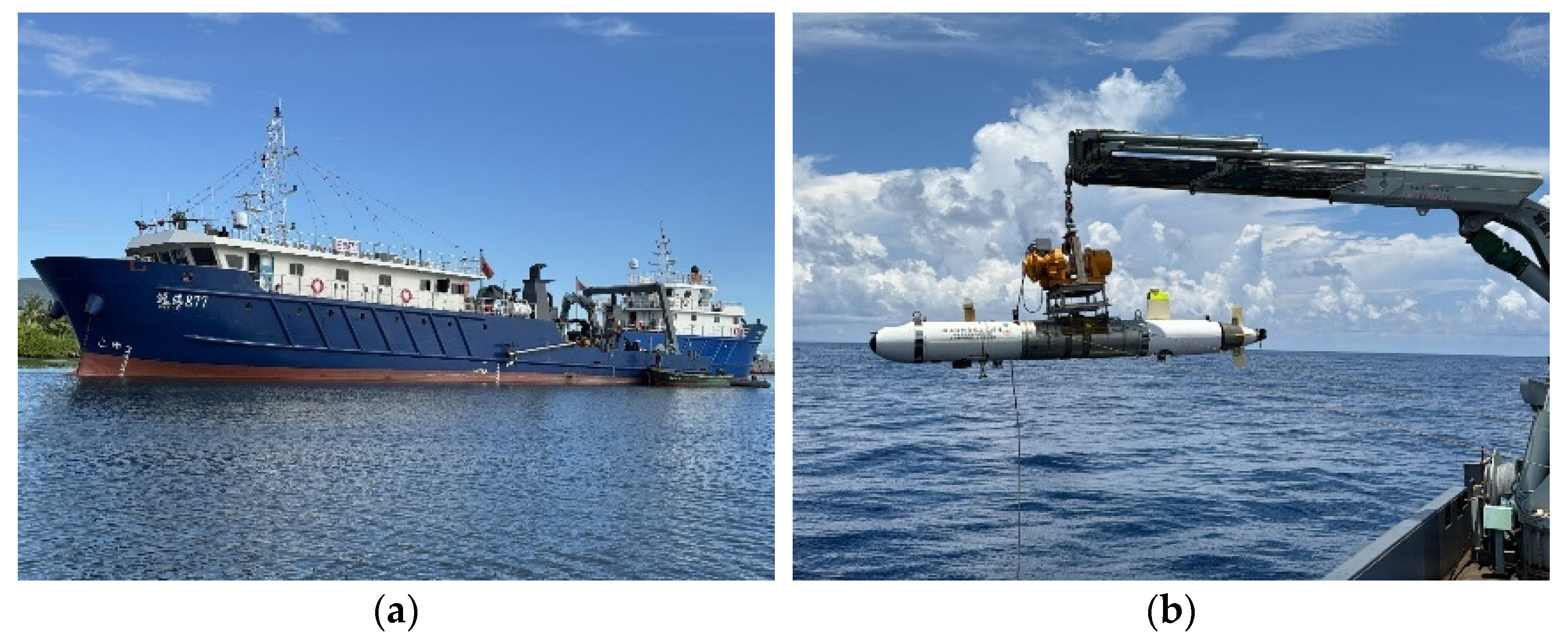
The sea trial was conducted using the Yuanhai 877 surface support vessel (
Figure 5a), with the AUV hull custom-manufactured by Deepinfar (Tianjin, China) (
Figure 5b). The AUV was equipped with the following sensors and navigation subsystems: IMU, LBL, PSs, propeller, USBL, and GNSS.
The INS employed a fiber-optic MFG-IIIU-T398F unit developed by CSSC Marine Technology (Pudong, Shanghai, China), featuring a gyroscope bias instability of 0.01°/h and an accelerometer bias instability of 1 mg. The LBL system, developed by Harbin Engineering University, utilized three seafloor transponders with dual-frequency operation: a passive mode (2–4 kHz) offering 1 ms timing accuracy and an active mode (8–16 kHz) achieving 0.1 ms timing accuracy, both sampled at 20 s intervals. Depth was measured using the Impact Subsea ISD4000 sensor (Aberdeen, UK), providing ±0.01% FS accuracy at a 10 Hz sampling rate, while propulsion was driven by a Kollmorgen KBM(S)-60 propeller (Radford, VA, USA). The reference trajectory of the AUV was obtained from IXSEA GAPS USBL (Brest, France) and GNSS positioning data, with attitude reference derived from GNSS/IMU fusion.
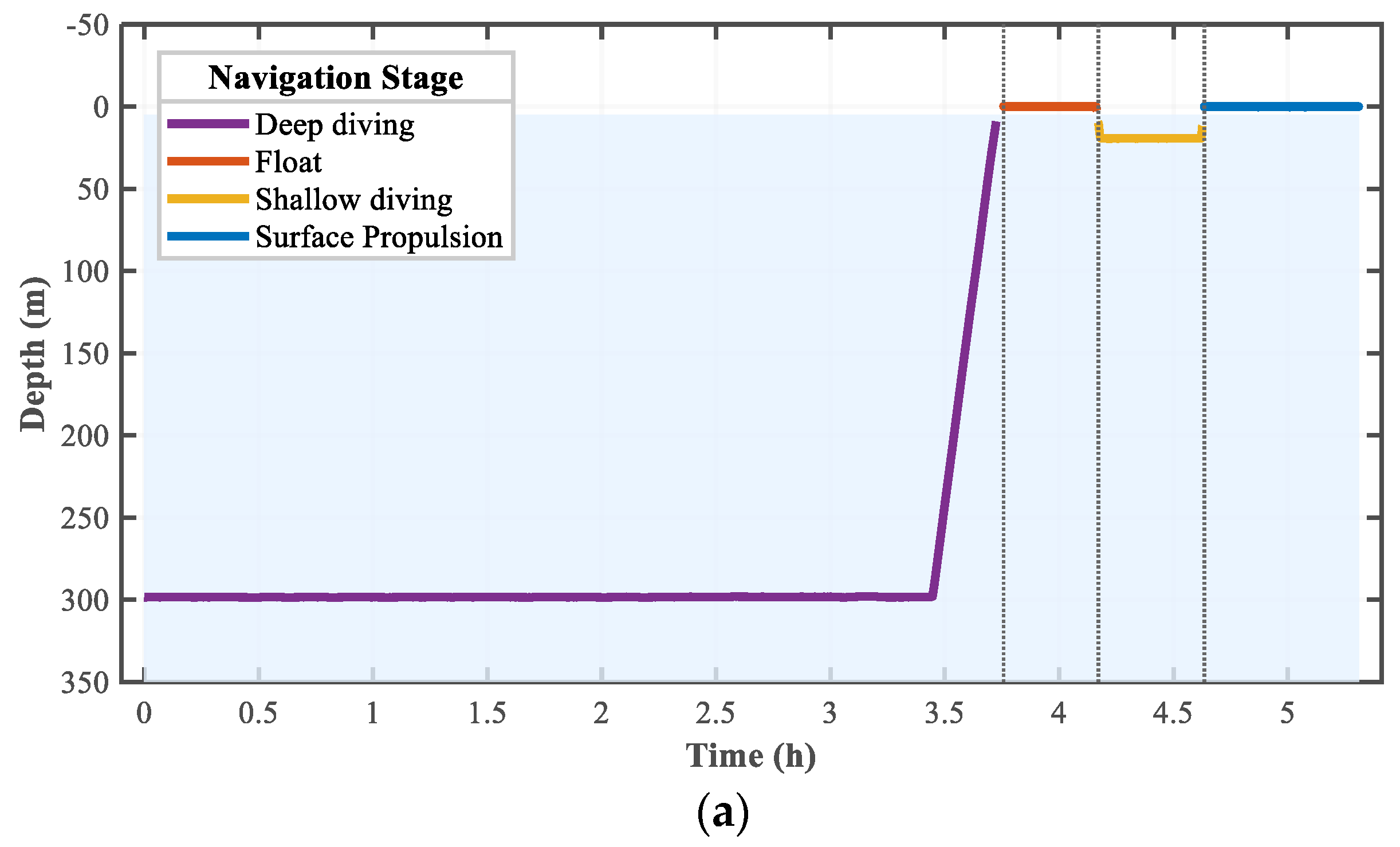
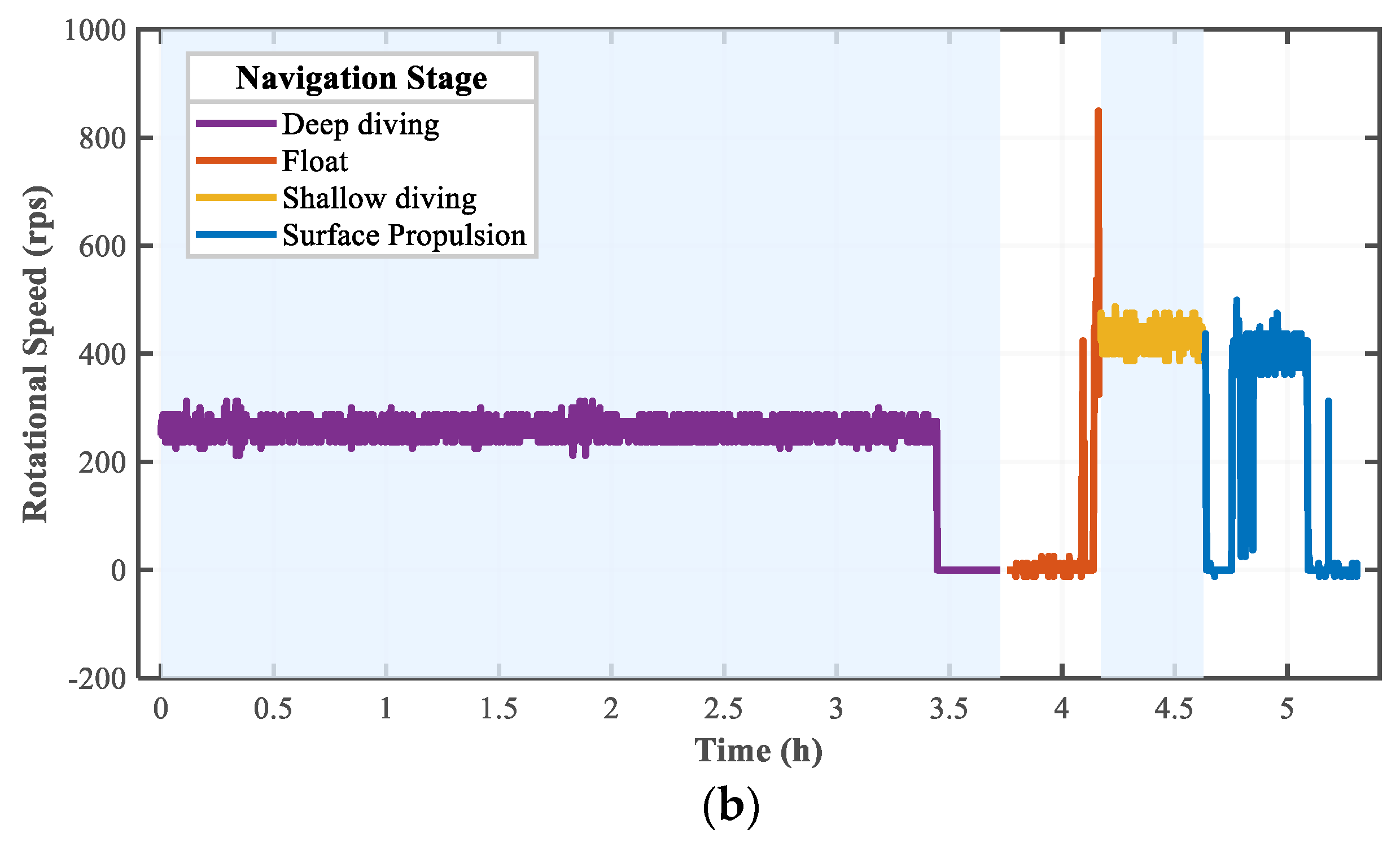
To ensure adequate navigation duration and diverse motion patterns, the AUV performed continuous operations lasting 5.4 h, with the trajectory divided into four distinct phases based on depth and maneuvering behavior:
- (1)
Deep-Diving Phase: The AUV maintained an approximate depth of 300 m, traveling eastward from the western side of the LBL array at a speed of 1.3 m/s for 3.5 h, followed by a 20 min ascent, covering a total distance of about 15 km.
- (2)
Floating Phase: The AUV drifted passively on the surface for 20 min, reorienting its heading from east to south.
- (3)
Shallow-Diving Phase: The vehicle descended to a depth of 20 m and traveled southward at 2.1 m/s for 30 min before ascending, covering approximately 3.5 km.
- (4)
Surface-Propulsion Phase: The AUV initially drifted passively for 7 min, then propelled southeastward at 2 m/s for 20 min, and finally drifted for 14 min, with a total travel distance of around 2 km.
Variations in AUV depth and propeller rotational speed during the experiment are presented in
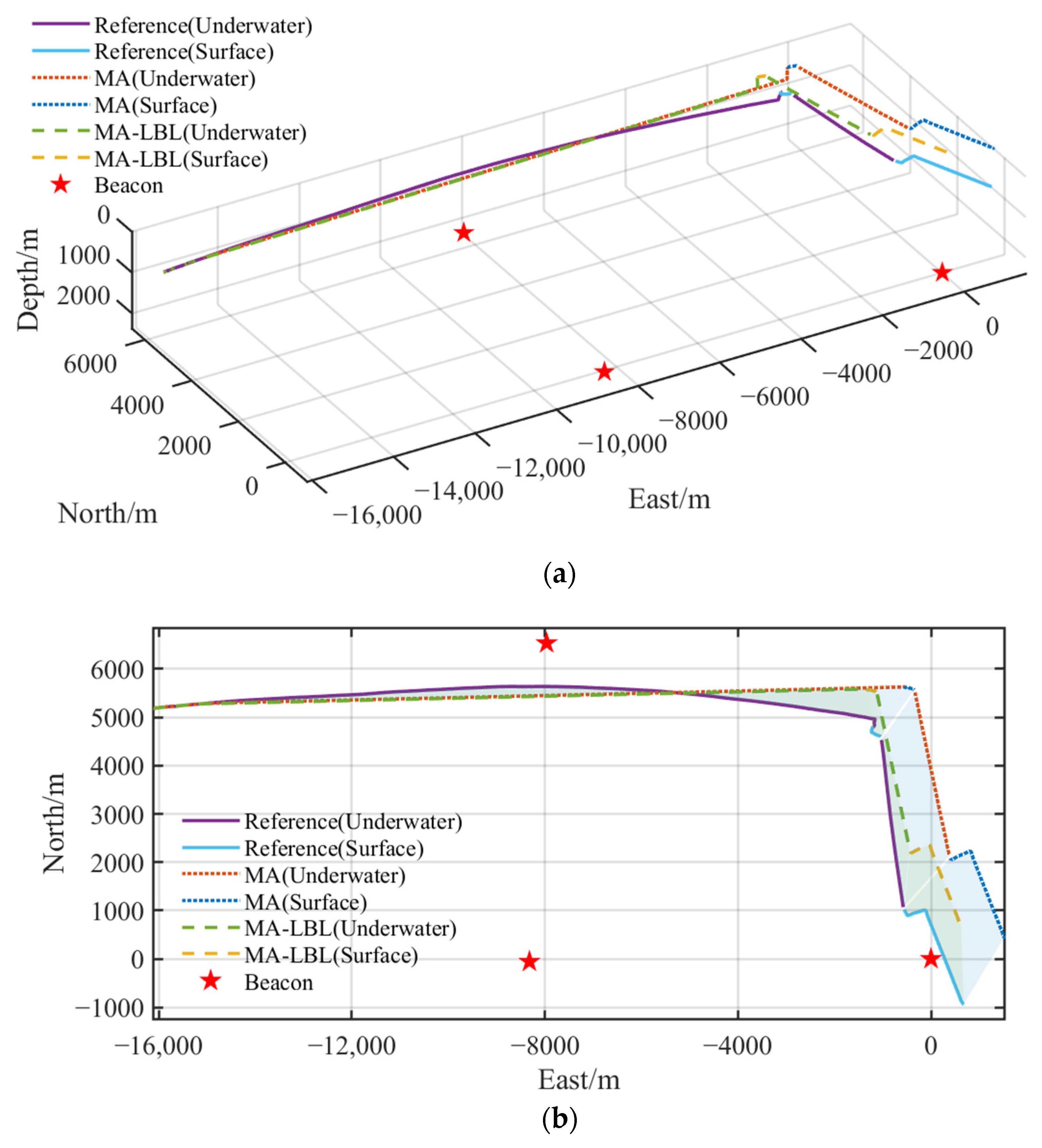
Figure 6, while the overall navigation trajectory is shown in
Figure 7. The LBL system was operational only during the first 14 min of the mission and remained deactivated thereafter.
2.4. Data Processing and Comparative Methods
To ensure data quality and consistency for navigation and analysis, sensor data underwent preprocessing. All sensor data streams (IMU, PSs, LBL, and propeller RPM) were synchronized to a common GPS time base via interpolation to the IMU’s sampling epoch using hardware timestamps. The raw depth measurements from the PSs, particularly during shallow-diving and surface phases, contain high-frequency noise from surface waves. To reliably extract the low-frequency heave motion signal for vertical velocity calculation, the raw depth data was pre-processed with a low-pass filter to suppress wave-induced noise, a step critical for maintaining the accuracy of the attitude compensation mechanism.
To evaluate the proposed framework, three navigation strategies were implemented and compared.
The Unconstrained INS (UINS) method served as a pure inertial navigation baseline, where the INS propagated its navigation state using only IMU measurements, without any aiding from external velocity or position sensors. Its performance demonstrates the inherent, unbounded error growth of the unaided inertial system.
The Model-Aided INS (MA) method integrated the proposed attitude-compensated model-based velocity (derived from PS depth and propeller RPM) as an aiding measurement to the INS via the Kalman filter. However, it did not estimate or correct the mapping coefficient bias error .
The complete proposed framework, termed Model-Aided INS with LBL Calibration (MA-LBL), operated in two distinct modes. During the initial 14-min window when LBL positioning was available, it operated in a calibration mode, jointly estimating the INS states and the mapping coefficient bias error . After this calibration window, it switched to an aided navigation mode, continuing as the standard MA method but utilizing the value estimated and fixed during the calibration phase.
All three methods incorporated depth updates from the PSs. The ground truth trajectory for accuracy evaluation was generated by post-processing data from the high-precision IXSEA GAPS USBL system (aided by surface GNSS) and the onboard GNSS receiver.
3. Results
The UINS rapidly diverged during deep diving after LBL data loss, exhibiting positional errors exceeding hundreds of kilometers in other phases (
Table 1). The primary contributor to this divergence was the accelerometer’s precision limitations. These results demonstrate that the UINS is unsuitable for practical field deployments.
As illustrated in
Figure 7 and
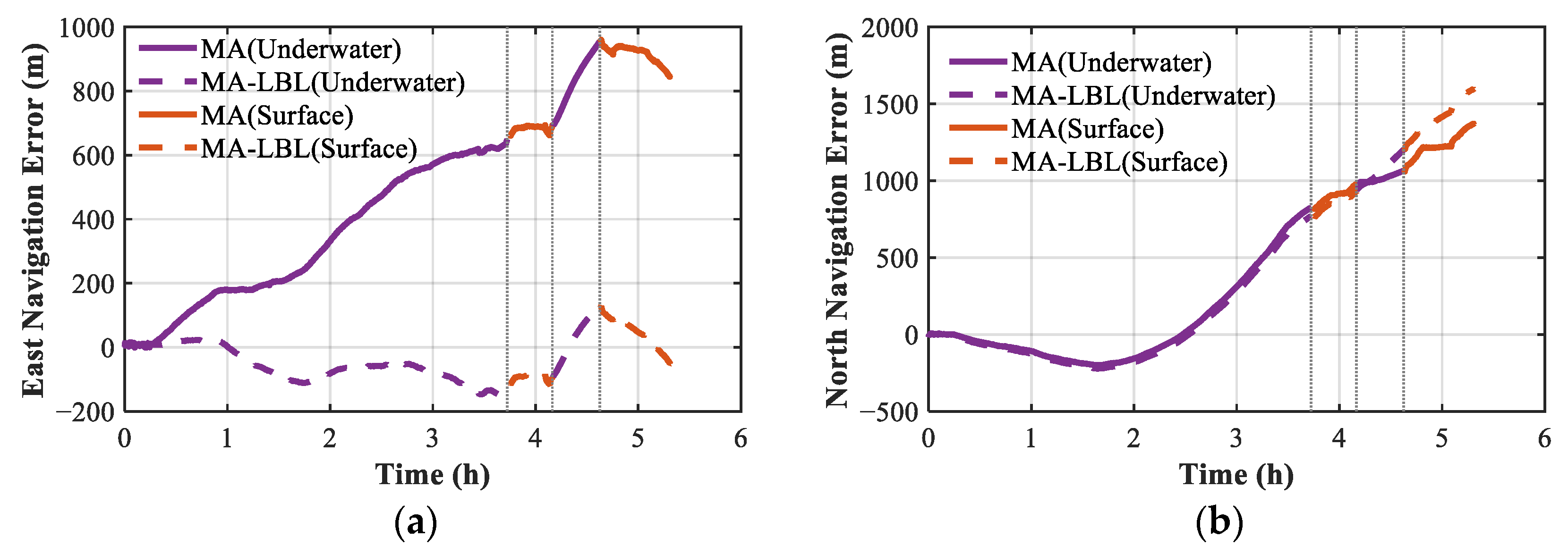
Figure 8, notable systematic deviations are observed between the reference trajectory and those reconstructed using the MA and MA-LBL methods, primarily caused by AUV drift induced by ocean currents. According to
Table 1, the east-directional positioning accuracy of MA-LBL gradually surpasses that of MA during the deep-diving phase, with the advantage becoming more pronounced over time. In contrast, during the remaining three phases, the eastward accuracy difference between the two methods remains relatively constant, ranging from 600 to 900 m. This trend arises because, in the deep-diving phase, the AUV’s motion was predominantly eastward, allowing MA-LBL’s enhanced precision to accumulate directly in the same direction. Conversely, in the other phases, the AUV followed a mostly southeasterly heading, which slowed the rate at which MA-LBL’s eastward accuracy advantage developed.
During the initial 8 km of the deep-diving phase, the AUV maintained a northeasterly heading, during which both MA and MA-LBL exhibited southward deviations that gradually intensified. After approximately 8 km of travel, the AUV changed its course to a southeasterly heading, leading the southward deviations to progressively diminish. By the latter stage of the deep dive, these deviations reversed direction, becoming northward offsets that continued to increase. This reversal occurs because the velocity vector orientation changed as the AUV’s heading shifted. The change in direction also altered the velocity bias, causing the accumulated errors to transition from southward to northward. This process effectively compensated for the earlier deviations through directional bias reorientation.
During the float phase, the AUV first drifted passively southward for approximately 15 min, followed by active southeasterly motion for about 5 min. Throughout this period, the error evolution of both MA and MA-LBL displayed nearly identical trends, confirming that the prevailing current direction was primarily southward. This conclusion is further supported by the additional intentional drifting segment conducted later in the surface-propulsion phase.
In the shallow-diving and surface-propulsion phases, northward deviations progressively increased for both methods, with MA-LBL exhibiting a slightly faster accumulation rate. This divergence arises from a southward ocean current, which induced higher actual southward velocity in the AUV than either method estimated. Because MA-LBL produced the lowest estimated southward velocity, its uncorrected current bias resulted in a more rapid increase in northward positional error.
Overall, both MA and MA-LBL effectively limited positional divergence, maintaining total position errors below 1600 m in all directions after 5.4 h of operation. Although ocean currents and trajectory factors placed MA-LBL at a disadvantage in north–south positioning, its superior east–west precision compensated for this limitation. Consequently, MA-LBL achieved lower overall horizontal position errors than MA across all mission phases, yielding an average reduction of 28.1% in horizontal positioning error.
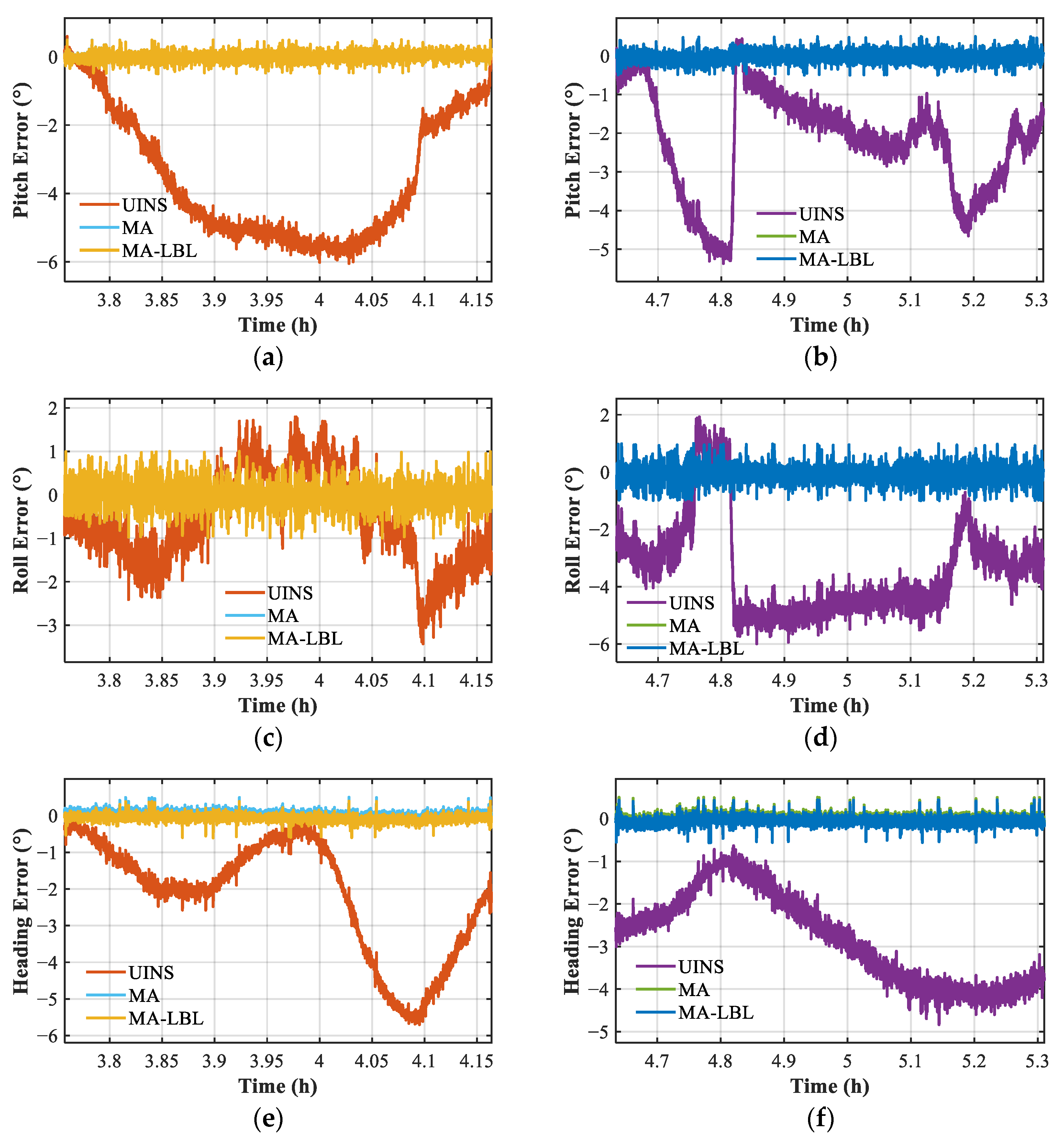
As shown in
Figure 9 and
Table 2, both MA and MA-LBL maintained attitude errors below 1°. In contrast, the UINS method showed much larger orientation deviations across all three axes, with maximum pitch errors exceeding 6°. This performance disparity arises from the propagation of large position and velocity uncertainties into the attitude estimation process during UINS mechanization, leading to significantly degraded orientation accuracy.
5. Conclusions
This study proposed and validated the attitude-compensated and acoustics-calibrated model-aided navigation framework, a novel solution designed to sustain reliable navigation for AUVs in the absence of continuous DVL aiding. The core contribution is a practical methodology that achieves bounded long-term positioning error by uniquely fusing two key mechanisms: (1) attitude compensation performed using vertical velocity derived from a pressure sensor, yielding a DVL-free velocity estimate, and (2) opportunistic online calibration of the propulsion model’s bias utilizing intermittent LBL acoustic positioning.
Experimental validation through a 5.4 h deep-sea trial in the South China Sea demonstrated the framework’s efficacy. After a brief 14 min initial LBL calibration, the framework maintained a final position error of 509 m, significantly outperforming both pure inertial navigation and the uncalibrated model-aided approach. This result confirms the framework’s capability to constrain error drift and ensure long-term navigational stability solely with periodic absolute position updates.
Furthermore, the developed measurement and system models establish a generalized mathematical framework. Its sensor-agnostic design allows for straightforward extension to other aiding sources, such as USBL systems or DVLs when available, to perform similar bias calibration and enhance robustness. The demonstrated performance supports critical applications, including reliable long-distance path planning and the initialization of single-beacon navigation systems in DVL-denied environments.
In summary, the framework provides a validated and effective strategy to extend AUV operational endurance in scenarios where traditional velocity sensors are unavailable or unreliable. Future work will focus on enhancing the framework’s robustness by developing more adaptive, environment-aware propulsion models and explicitly estimating depth-varying currents. Further optimization of the calibration strategy for ultra-long-duration missions will also be pursued.




 ,
,