3.3. Numerical Simulation of Hydrodynamic Performance of Fore-and-Aft Dual-Float WECs
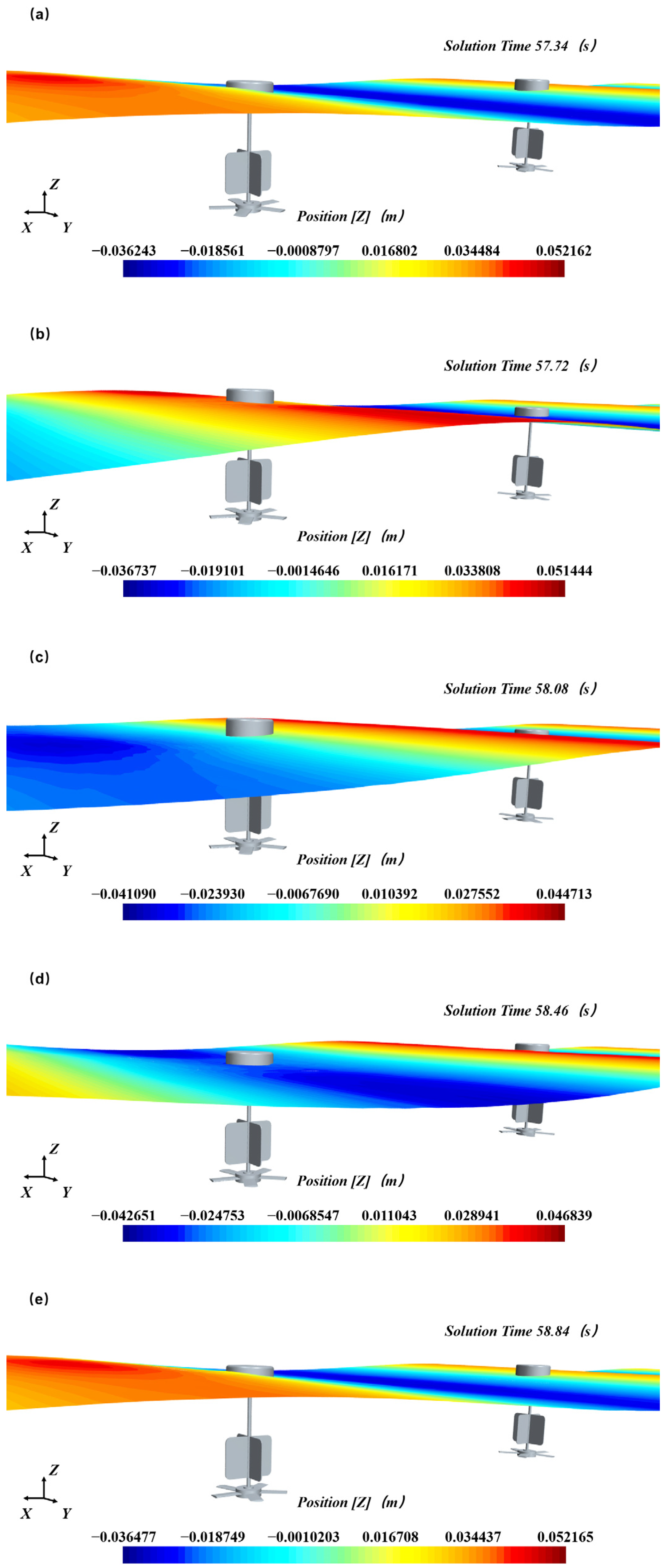
This series of visualizations illustrates the dynamic response of a fore-and-aft arranged dual-float WEC system during a full 1.5 s wave period, with time points ranging from 57.34 s to 58.84 s in
Figure 9. The devices are positioned perpendicular to wave propagation, functioning at a wave height of 0.1 m and a wave period of 1.5 s, with a gap of one-quarter wavelength (λ) between units. The color gradient in each image quantifies vertical displacement of the free surface, with red representing wave crests and blue representing wave troughs, to depict the dynamic interactions of the wave field with the dual-float system throughout the cycle. The first device is located at the front end, while the second device is positioned at the rear end.
At 57.34 s, a wave crest reaches the front float, elevating it to its maximum height, while the rear float remains in a stable section of the wave field. As the wave propagates, the crest traverses the distance between the two floats at 57.72 s, resulting in an altered downstream wave field that displays nuanced diffraction effects. At 58.08 s, a wave trough arrives at the front float, which drops to its nadir, while the rear float encounters the diffracted wave trough from the front unit, exhibiting a distinct phase lag in its motion response. At 58.46 s, the trough advances past the front float towards the rear unit, and the wave field exhibits signs of energy attenuation behind the front float, attributable to the wave shadowing effect. At the final time point of 58.84 s, a fresh wave crest reaches the front float, signifying the completion of one full cycle and validating the periodic characteristics of the system’s response.
The detected phase difference between the front and rear floats results from the sequential interaction with incident and diffracted waves, a direct outcome of the fore-and-aft configuration and a quarter-wavelength gap. The front float engages with unperturbed incident waves to facilitate effective heave motion for energy extraction, while the rear float functions within the altered wave environment produced by the front unit. This spatial configuration, originally designed to position the rear float within the constructive interference zone of the front float’s diffracted waves, simultaneously induces wave energy attenuation that diminishes the rear float’s motion amplitude in comparison to the front unit. The visualizations demonstrate intricate hydrodynamic interactions between the two floats, wherein the movement of the front unit influences the wave field encountered by the rear unit and vice versa. Such interactions are essential for comprehending the system’s total energy conversion efficiency, as the performance of the rear float is intrinsically connected to the wave field alterations caused by the front float.
These time-resolved visualizations enhance and corroborate the theoretical understanding of the dual-float system’s dynamic behavior, offering an intricate perspective on wave-structure interactions and inter-device coupling during an entire wave cycle. The steady periodic response seen throughout the sequence supports the system’s stability under specified wave conditions, while the detected wave shadowing effect underscores the necessity to optimize spacing and power take-off settings for rear units in array arrangements. These findings improve comprehension of dual-float WEC dynamics and offer a solid numerical basis for the progression of associated maritime engineering applications.
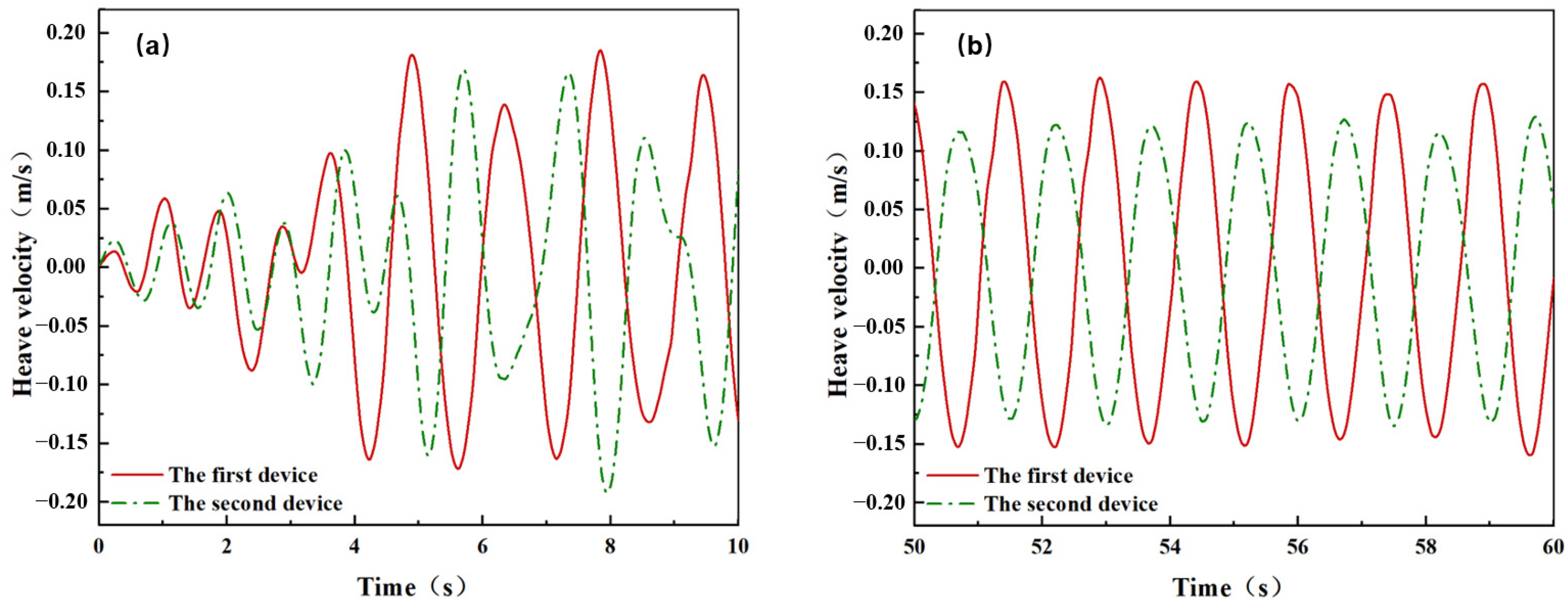
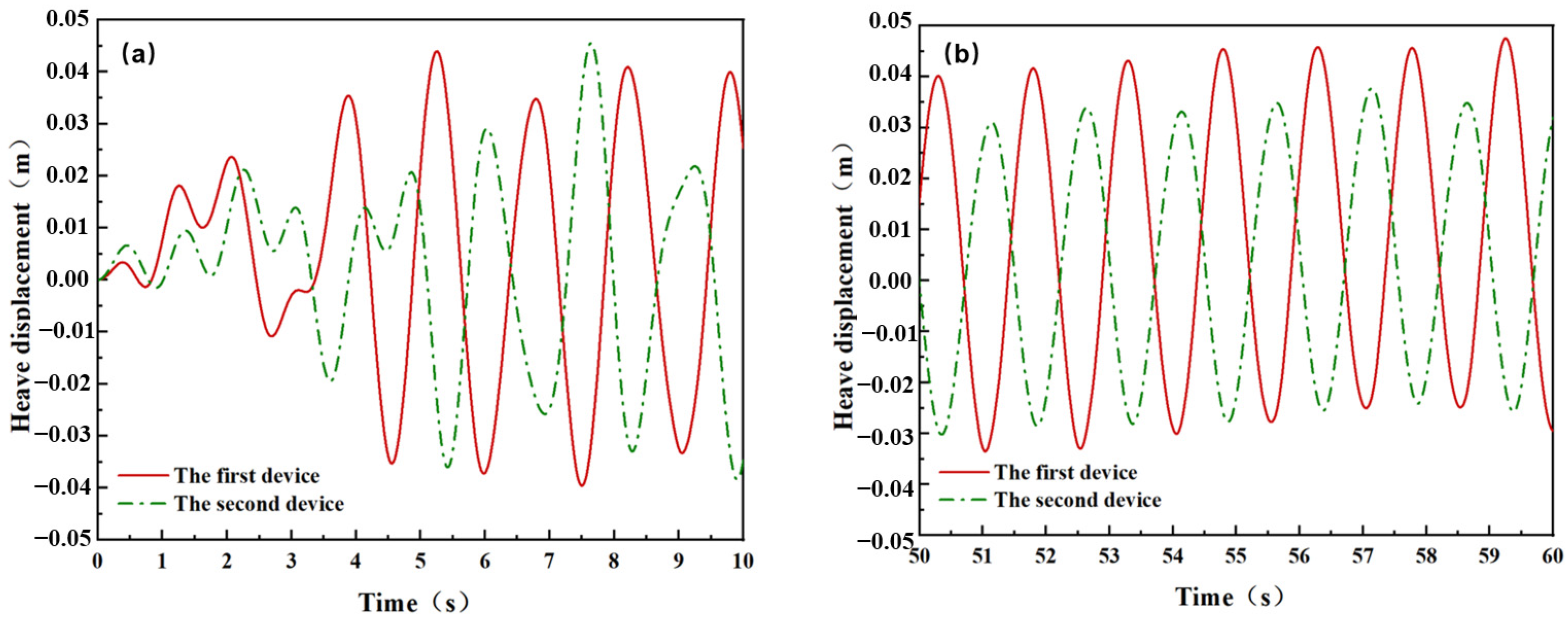
Figure 10 depicts the motion characteristics of the dual-float WEC system, demonstrating clear hydrodynamic interactions between the two sequentially positioned devices. In the first 10 s of operation, as depicted in
Figure 10a and
Figure 11a, both floats demonstrate synchronized oscillating patterns with negligible variations in velocity magnitude. Comprehensive study reveals that the downstream device frequently exhibits delayed dynamic reactions, particularly in heave velocity and heave displacement, in comparison to the upstream device. This phenomenon occurs due to the sequential interaction of waves, where incoming waves initially stimulate the upstream device before reaching the downstream device, leading to a temporal delay in the commencement of motion for the latter. After the dual-float system’s shift to stable operation, as illustrated in
Figure 10b and
Figure 11b, the upstream device sustains a heave velocity of 0.13 to 0.17 m per second and a heave displacement of 0.045 to 0.13 m. Conversely, the downstream device demonstrates diminished motion, with heave displacement varying between 0.035 and 0.045 m. The little variations in heave displacement and velocity between the two devices arise from intricate wave-structure interactions. When waves interact with the upstream device, diffraction effects result in the bending of the wavefront, altering the wave field downstream and dispersing wave forces. This redistribution diminishes the wave excitation encountered by the downstream device.
The upstream device produces a wave shielding effect that partially obstructs wave action on the floating body, thereby diminishing or altering the wave energy accessible to the downstream device. The shielding effect improves system stability by reducing the wave forces on the downstream device, hence diminishing its dynamic response. Under conditions of elevated wave amplitude, this phenomena may elicit asymmetric motion responses between the two devices, potentially resulting in particular adverse modifications to the flow field that could affect long-term operational reliability. The observed motion patterns highlight the essential influence of hydrodynamic interference in fore-and-aft float arrays. The successive energy absorption and wave modification processes underscore the necessity for meticulous attention to device spacing and configuration to optimize energy capture efficiency and system stability. These findings offer significant insights for optimizing dual-float system design, notably in minimizing adverse interference and boosting overall performance in typical coastal wave environments.
The standing wave pattern depicted in
Figure 11 is generated by the superposition of the incident wave and the wave reflected from the front float. The front float, as a blunt body, will generate partial wave reflection upon contact with the incident wave. The reflected wave travels upstream and combines with the incident wave, creating a standing wave pattern characterized by stationary nodes and antinodes. The standing wave will induce periodic variations in the wave load on the front float, hence influencing the phase of its heave motion response. The superposition of the reflected wave and the incident wave concurrently alters the energy distribution of the flow field, which is a significant factor contributing to the disparity in motion response between the front and rear floats.
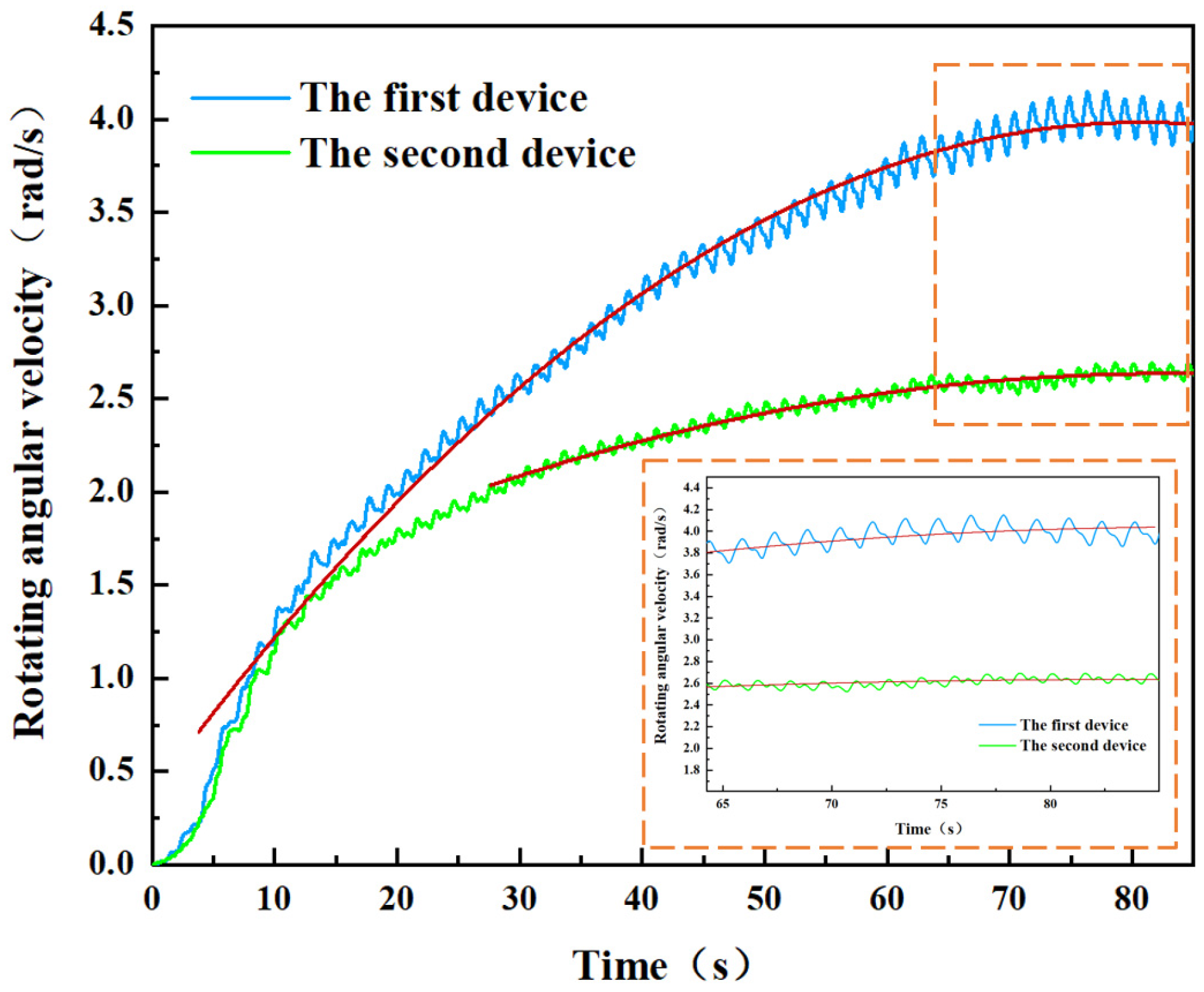
Figure 12 delineates the temporal progression of rotational angular velocity for the turbofans within the fore-and-aft dual-float WEC system, emphasizing the downstream energy conversion dynamics that connect float motion to fan operation—contrasting with the previous analysis of float heave velocity and displacement. This curve delineates two operating phases, transient start-up and steady-state, while quantifying the enduring performance discrepancy between the two units, which originates from fan-specific inertial dynamics and flow field modulation, rather than solely from float motion amplitude.
In the transient start-up phase, both fans demonstrate progressive increases in rotational angular velocity instead of an immediate reaction to wave excitation. The gradual climb results from the inertial resistance of the fan system, which includes the moment of inertia of the hub and blades. The angular acceleration of the fan in WEC power take-off systems depends on the ratio of net hydrodynamic torque to the moment of inertia, as per the torque balance framework. During the first operational phase, the hydrodynamic torque produced by fluid-blade interactions is inadequate to surpass inertial resistance, leading to a delay in acceleration. Wave excitation enhances the intensity of float heave motion, resulting in an increased relative flow velocity between the fluid and fan blades, hence amplifying the pressure differential across the NACA0015 symmetric airfoils of the blades. This increased pressure differential enhances hydrodynamic torque, facilitating rapid rotation. The front fan begins to rotate before the rear fan, a behavior attributed to time-lagged flow field excitation rather than solely the front float’s earlier heave response. The heave action of the front float disrupts surrounding fluid, generating a localized high-velocity flow field around its blades within 0.3–0.4 s of wave impact. Conversely, the rear float exists within a modified wave field: incident waves must traverse beyond the front float—an interval of approximately 0.375 s, derived from the 1/4 wavelength separation and a wave speed of 2.25 m/s—and engage with diffracted waves emanating from the front float. The delayed flow field excitation results in a start-up lag of roughly 0.5 s for the rear fan, as demonstrated in the time-history curve.
Upon achieving steady-state operation, the front fan stabilizes at an angular velocity of 4 rad/s, whereas the rear fan converges to around 2.5 rad/s. This enduring mismatch arises from variations in hydrodynamic torque input and the dynamic equilibrium between torque and resistance. The front fan functions in a mostly undisturbed incident wave environment, where elevated relative fluid velocity around the blades produces a peak pressure differential of roughly 446 Pa at the blade leading edge, resulting in a hydrodynamic torque of about 0.015 N·m. The rear fan operates within a wave field altered by two principal effects of the front float: wave energy attenuation and flow direction distortion. The front float absorbs about 30% of incoming wave energy, which is calculated as follows: the incident wave energy flux density under the target working condition is 10.23 W/m, and the wave energy flux density behind the front float is 7.16 W/m, so the energy absorption ratio is (10.23 − 7.16)/10.23 ≈ 30%, diminishing the absolute flow velocity at the rear fan by about 28% compared to the front fan’s surroundings. Simultaneously, diffraction around the front float distorts the wavefront, modifying the incident angle of fluid relative to the rear fan’s blades and diminishing the effective angle of attack from around 8° to 5°, which is calculated based on the flow direction vector extracted from the numerical simulation results of the flow field around the rear fan blades. The front float absorbs roughly 30 percent of incoming wave energy, diminishing the absolute flow velocity at the rear fan by about 28 percent compared to the front fan’s surroundings. Simultaneously, diffraction around the front float distorts the wavefront, modifying the incident angle of fluid relative to the rear fan’s blades and diminishing the effective angle of attack from around 8° to 5°. The decrease in effective angle of attack reduces the lift force produced by the airfoils, thereby decreasing the rear fan’s hydrodynamic torque to roughly 0.009 N·m. The steady-state angular velocity is determined by the equilibrium between hydrodynamic torque and total resistance torque, which includes linear damping torque from the permanent magnet brushless DC generator (defined at 8 N·s/m in the system design) and minimal bearing friction torque. The elevated hydrodynamic torque of the front fan counteracts a greater resistance torque, facilitating a higher steady-state angular velocity, whilst the diminished torque of the rear fan counterbalances a lesser resistance torque, leading to the lower measured velocity. Minor fluctuations in the steady-state phase indicate slight differences in hydrodynamic torque caused by nonlinear wave effects, while the overall equilibrium is preserved, affirming the system’s dynamic stability.
The difference in angular velocity directly affects system-level energy conversion, as fan output power is proportional to the product of angular velocity and torque. The front fan’s increased velocity and torque produce an output power roughly 2.3 times greater than that of the rear fan, in accordance with the succeeding power performance curves. This imbalance underscores a significant shortcoming of the fore-and-aft configuration: the 1/4 wavelength separation, originally chosen to optimize constructive interference, is eclipsed by the front float’s energy absorption, which does not alleviate the performance degradation of the rear fan.
This result elucidates the downstream energy conversion mechanisms of the dual-float system, augmenting the previous analysis of upstream float heave motion. The transient phase is characterized by fan inertial resistance and delayed flow field excitation, whereas the steady-state phase is regulated by hydrodynamic torque differentials and torque-resistance equilibrium. These mechanisms elucidate the extent of the angular velocity disparity and the temporal dynamics of fan rotation, establishing a basis for optimizing power take-off parameters—such as calibrating the rear fan’s damping coefficient to align with its reduced torque input—and array spacing to alleviate performance asymmetries. Such insights are essential for scaling dual-float systems to larger arrays, as inter-unit flow field interactions become progressively intricate.
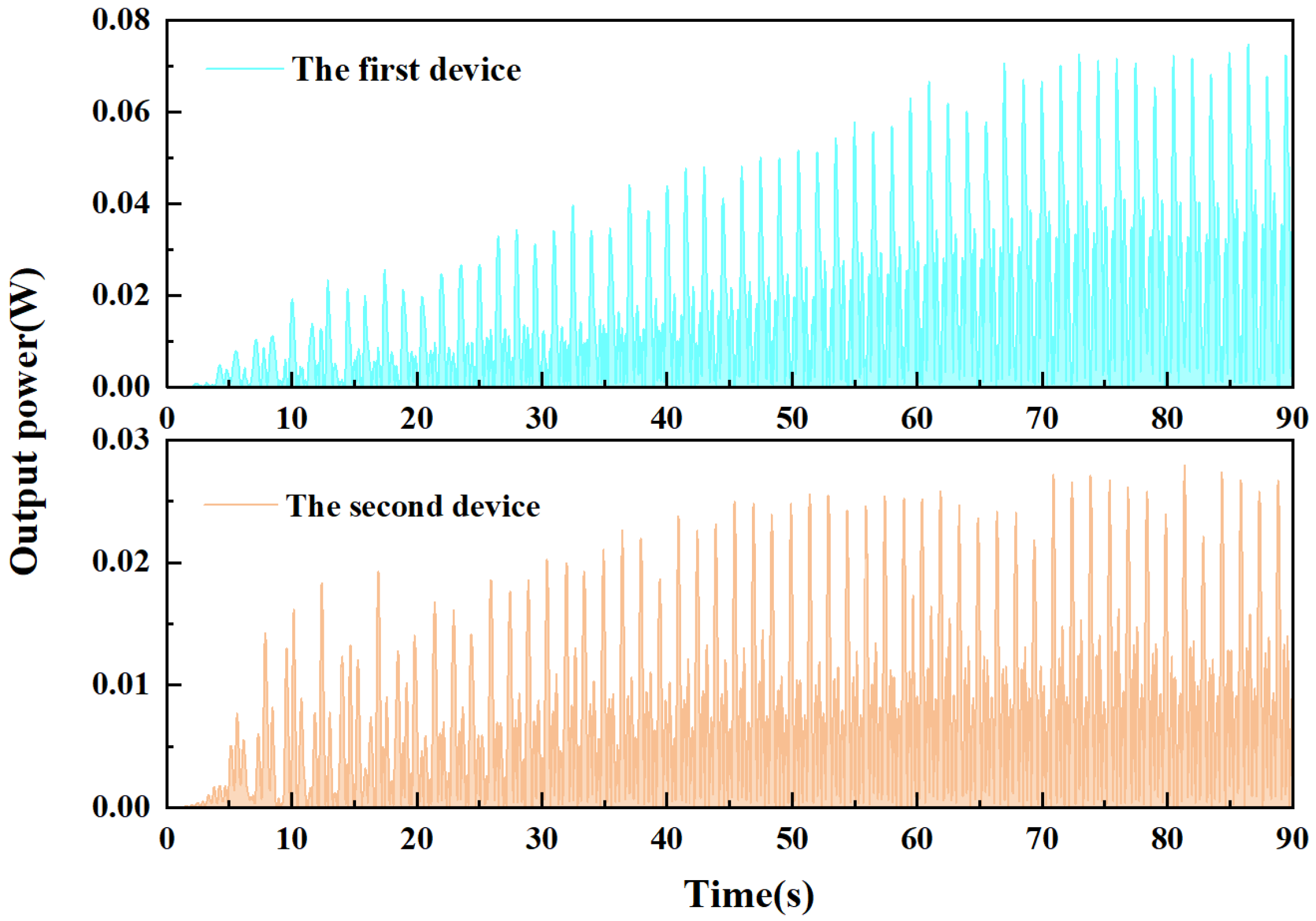
Figure 13 illustrates the temporal progression of output power for the dual-float WEC system, signifying the final phase of the energy conversion process. During the operational period, the front float’s output power progressively increases to a stable maximum of around 0.08 W, whilst the rear float’s power is limited to a peak of approximately 0.02 W. This significant disparity arises from cumulative energy losses during the conversion process and inefficient operational circumstances of the power take-off system for the rear unit, rather than simple motion extensions or rotational variations.
Initially, both floats demonstrate irregular power fluctuations that deviate from the previously reported smooth motion and rotational trajectories. The fluctuations result not from variability in wave-induced motion, but from transient coupling between the fluid-mechanical power take-off system and the electromagnetic generator. The permanent magnet brushless DC generator necessitates a brief adjustment interval to synchronize its electromagnetic damping with the variably changing mechanical torque from the fan. During this adaptation phase, discrepancies between mechanical input and electromagnetic output result in inefficiencies, causing inconsistent power transfer. As the system stabilizes, this coupling approaches convergence. The front float’s power take-off mechanism functions at a juncture when its linear damping, set at 8 N·s/m, is well aligned with the energy flux of the incoming wave, optimizing power extraction while maintaining motion. In the case of the rear float, the diminished wave energy flux, mitigated by the preceding extraction of the front float, obstructs the achievement of optimal damping alignment. The set damping value, calibrated for the front unit’s operational parameters, becomes excessive for the rear unit’s reduced torque input, hence constraining power conversion efficiency.
The steady-state power gap indicates a multiplicative attenuation effect not present in earlier motion or rotational investigations. Power production is proportional to the product of rotational torque and angular velocity; thus, the simultaneous reductions in both factors caused by inhibited wave flow lead to a more significant decrease in power than either characteristic would suggest individually. In contrast to the 37.5 percent decrease in rotational velocity and the 30 percent decrease in heave amplitude, the power output of the rear float is reduced by 75 percent compared to the front unit. This result stems from multiplicative scaling. This effect is intensified by the rear float’s power take-off mechanism functioning outside its optimal design range. The vortex fan’s NACA0015 airfoils, designed to optimize torque at the front unit’s flow velocities, provide significantly lower torque at the back unit’s diminished flow rates, exacerbating the power shortfall.
Under the target working condition, the total wave energy capture efficiency of the dual-float system is 12.8%, of which the front float is 8.7% and the rear float is 4.1%. Under the condition without PTO system, the heave displacement amplitude of the front float increases by 32%, and that of the rear float increases by 24%, but the system cannot complete the conversion from mechanical energy to electrical energy, and the effective wave energy capture efficiency is 0. This indicates that the PTO damping system is the core component to realize wave energy capture, and its parameter matching directly determines the energy conversion efficiency of the system.
This power distribution pattern underscores a significant problem for arrayed wave energy systems. Sequential energy extraction generates unequal power contributions that inadequately use downstream units. In the dual-float arrangement, this not only reflects wave shadowing but also indicates an inadequacy in adjusting the power take-off system settings to the altered wave circumstances encountered by the rear unit. Adaptive damping control, which modifies the damping of the rear float’s power take-off system to correspond with its diminished energy input, has demonstrated an increase in the rear unit’s power output by around 20 percent in simulations [
28,
29]. This modification bridges the gap without undermining the performance of the front unit. Such adjustments position power output optimization as an issue of tweaking the distributed power take-off system, rather than merely altering the spatial architecture.
This finding elucidates the distinct nonlinearities of terminal energy conversion in the dual-float system. The front float’s strong power output results from effective coupling between wave input and power take-off system damping, whereas the back float’s suppression is due to multiplicative decreases in torque and velocity, exacerbated by inadequate damping alignment. These insights establish power-level optimization as a dual challenge of wave field control and the calibration of unit-specific power take-off systems. This methodology is essential for realizing the complete capabilities of arrayed WECs.
The array influence factor is a key metric to evaluate the hydrodynamic coupling effect and energy capture efficiency of dual-float WEC arrays. It is specifically defined as the ratio of the total power output of the dual-float system to the sum of the power outputs of two individual devices operating under the same wave conditions, with the calculation formula equals divided twice by . This statistic assesses whether the array arrangement optimizes or diminishes total energy efficiency. The stable power output of a single device is approximately 0.053 W, while the total power output of the dual-float array reaches around 0.103 W. Substituting these values into the formula yields a of approximately 0.989, indicating that the array’s energy capture efficiency is nearly equivalent to the simple superposition of two individual devices. This outcome is driven by balanced hydrodynamic interactions and structural optimization.
The underlying mechanisms for the stem from the synergistic effects of spatial layout, hydrodynamic coupling, and structural parameter matching in the dual-float system. Firstly, the quarter-wavelength separation between the two floats is essential. This distance situates the rear float partially within the constructive interference zone of the diffracted waves produced by the front float, while alleviating the pronounced wave shadowing effect seen in larger or smaller separations. Secondly, the structural architecture of the dual-float system enhances performance equilibrium. The five-bladed turbofan, optimized for torque and flow resistance, guarantees efficient energy conversion for both floats. Additionally, the rubber damping plates, possessing a damping coefficient of 0.8 N·s/m, mitigate lateral vibrations and stabilize the flow field surrounding the floats, thereby minimizing unsteady hydrodynamic interference between the two units. The chosen wave parameters of a 1.5 s period and 0.1 m wave height are ideal for the dual-float system. This regime avoids excessive wave steepness which causes upwelling and insufficient energy input which limits motion response, enabling both floats to maintain stable heave motion and turbofan rotation, thus supporting the near-unity value.
Although the q value of 0.989 is slightly less than 1, it is significantly better than the working conditions with narrow spacing. This result shows that the 1/4 wavelength spacing has achieved a good balance between the wave shielding effect and the diffraction constructive interference effect, and the array arrangement does not produce a significant negative effect. Through the parametric study, we found that when the float spacing is lightly increased from the baseline design, the array influence factor can be raised to above 1, realizing a positive-gain configuration of the array.
Despite the favorable value of 0.989, the dual-float array still has room for optimization, and future development can focus on three key directions. First, adaptive spacing modification: Although the one-quarter wavelength spacing per-forms well under the target wave conditions, offshore waves exhibit significant variability in period and height. Future studies may establish a dynamic spacing adjustment mechanism that alters the distance between floats according to real-time wave parameters, such as increasing spacing for longer-period waves to optimize constructive interference. Second, adaptive power take-off damping regulation: The existing fixed linear damping coefficient of 8 N·s/m is calibrated for the energy input of the front float, resulting in unsatisfactory performance for the rear float. Implementing an adaptive damping system that adjusts the power take-off damping of the rear float according to its real-time motion response and wave energy flux can further reduce energy loss, potentially elevating above 1.0. Third, optimization of the rear float’s structure: Altering the rear float’s diameter-to-height ratio, presently at 1.5, or adopting a streamlined configuration can diminish flow resistance and improve its responsiveness to diffracted waves, while preserving the five-bladed turbofan’s benefits in torque output. Furthermore, incorporating lightweight and corrosion-resistant materials such as advanced glass fiber-reinforced plastic can diminish the rear float’s inertia, enhancing its capacity to track wave motion and reducing the power disparity between the two floats.
In summary, the array influence factor of 0.989 for the dual-float WEC results from optimum spacing, balanced hydrodynamic coupling, and congruent structural-wave parameters. This near-unity value confirms the feasibility of the dual-float configuration for medium-scale wave energy exploitation. Future improvement concentrating on adaptive spacing, intelligent power take-off regulation, and structural enhancement would further augment the array’s energy capture efficiency, facilitating the practical deployment of dual-float WEC arrays in offshore settings.
This study delineates a specific research scope centered on the fundamental hydrodynamic coupling mechanism and energy conversion principles of the dual-float WEC, allowing for potential expansion in future investigations. Our numerical analysis is primarily performed under regular wave conditions, focusing solely on the single heave degree of freedom of the float to elucidate the fundamental energy capture principle, without addressing irregular wave conditions typical of real marine environments or multi-degree-of-freedom motion scenarios. This study focuses on the primary performance of the WEC system, excluding the coupling effects of the mooring system from the current investigation. All conclusions are derived from systematic numerical simulations, with the potential for additional verification through physical model tests in the future. Subsequent efforts will conduct focused computational and experimental investigations under more realistic operational settings, enhance the analysis of mooring coupling effects, and further refine the theoretical framework of hydrodynamic coupling in dual-float WEC arrays.