Phototrophic Carbon Capture in Marine Algae: Comparative Efficiencies, Sequestration Dynamics, and Climate Implications


Abstract
1. Introduction
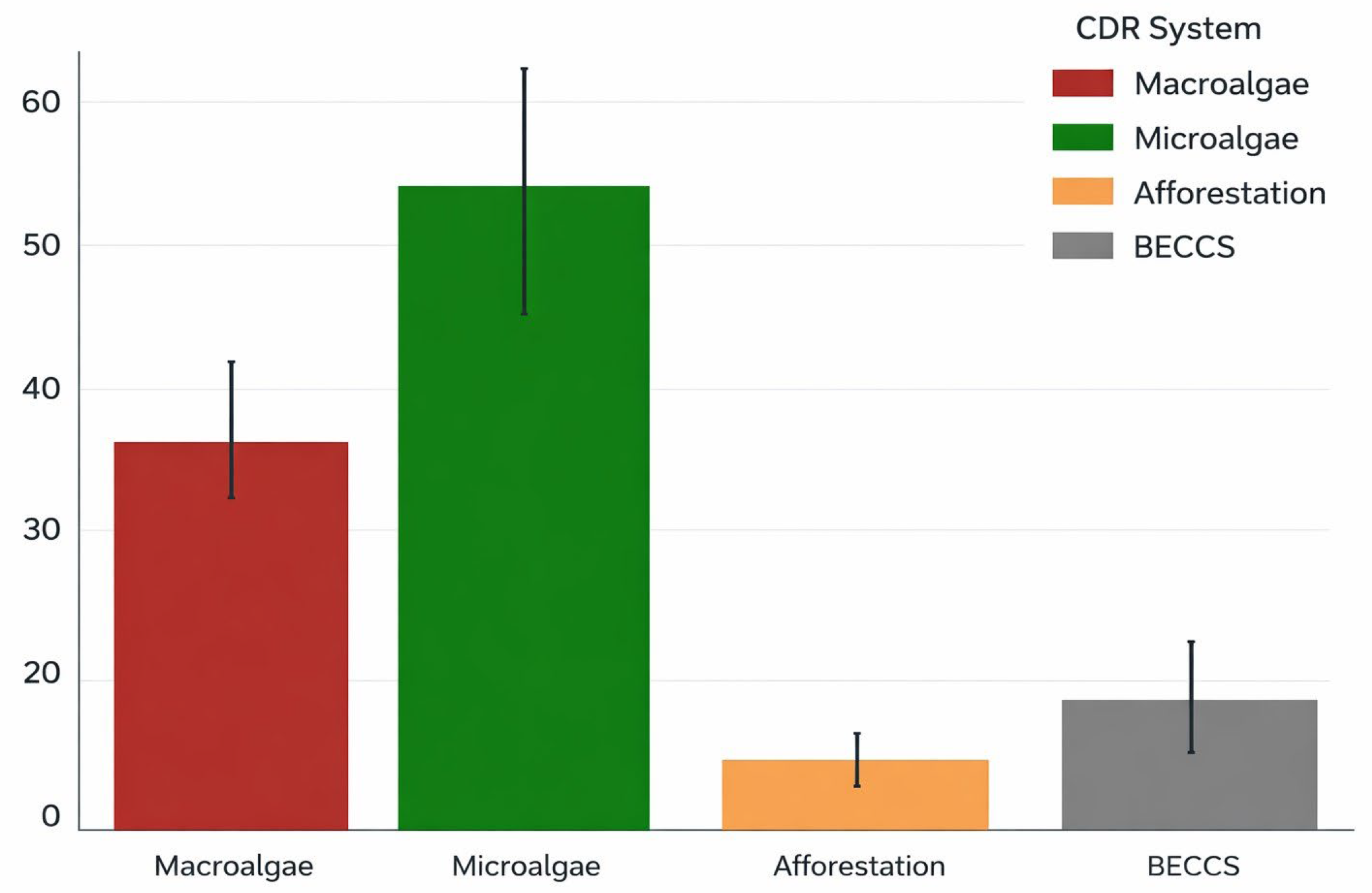
2. Comparative Efficiencies of Algal Systems
3. Durable Sequestration and RMRV Challenges
4. Satellite Remote Sensing of Seaweeds
Multispectral Satellites
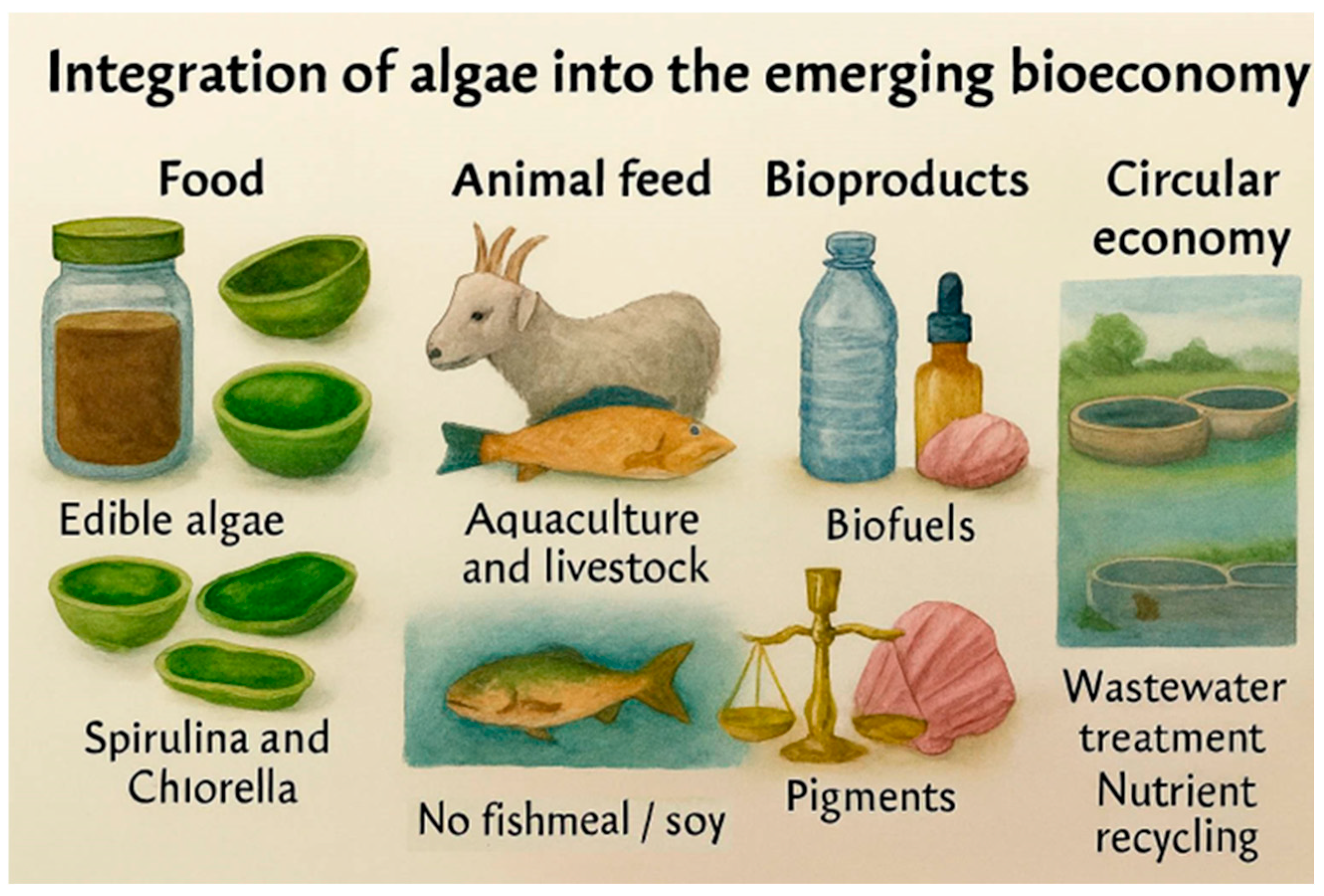
5. Algae in Bioeconomy and Food Security
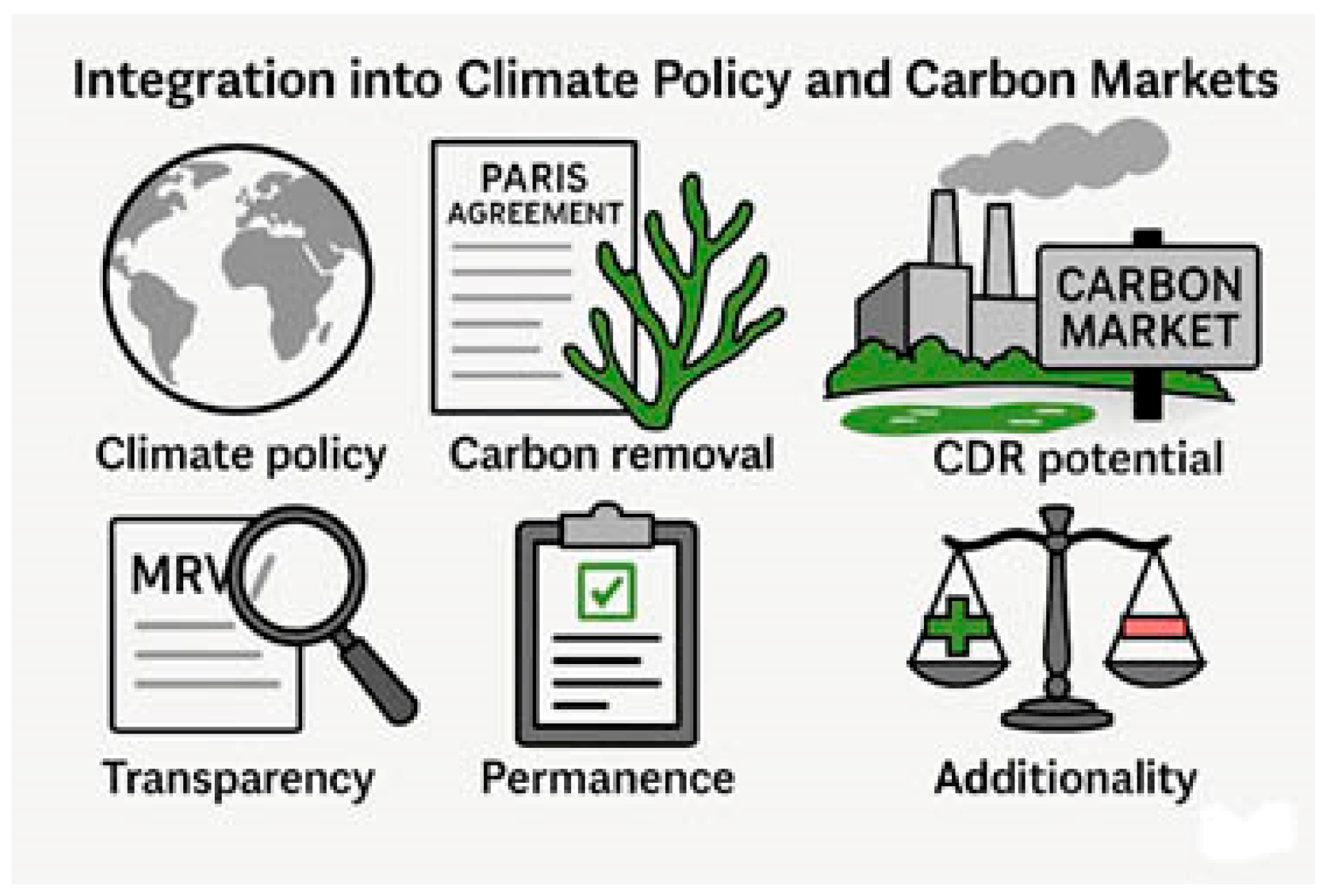
6. Integration into Climate Policy and Carbon Markets
7. Societal Acceptance and Ethical Considerations
8. Future Research Directions and Innovation Pathways
9. Conclusions and Outlook
Funding
Data Availability Statement
Conflicts of Interest
Abbreviations
| BECCS | Bioenergy with Carbon Capture and Storage |
| CDR | Carbon Dioxide Removal |
| CO2 | Carbon Dioxide |
| IMTA | Integrated Multitrophic Aquaculture |
| MSI | Multispectral Imager |
| NDCs | Nationally Determined Contributions |
| OLI | Operational Land Imager |
| PBR | Photobioreactor |
| RMRV | Remote Monitoring Reporting Verification |
References
- Wang, W.-L.; Fu, W.; Le Moigne, F.A.C.; Letscher, R.T.; Liu, Y.; Tang, J.-M.; Primeau, F.W. Biological carbon pump estimate based on multidecadal hydrographic data. Nature 2023, 624, 579–585. [Google Scholar] [CrossRef] [PubMed]
- Li, G.; Yao, J. A Review of Algae-Based Carbon Capture, Utilization, and Storage (Algae-Based CCUS). Gases 2024, 4, 468–503. [Google Scholar] [CrossRef]
- NOAA Global Ocean Monitoring and Observing. Latest Ocean Carbon Data Atlas shows a significant decline in ocean CO2 measurements. Available online: https://globalocean.noaa.gov/latest-ocean-carbon-data-atlas-shows-a-significant-decline-in-ocean-co2-measurements/ (accessed on 27 January 2026).
- Shahid, A.; Malik, S.; Zhu, H.; Xu, J.; Nawaz, M.Z.; Nawaz, S.; Asraful Alam, M.; Mehmood, M.A. Cultivating microalgae in wastewater for biomass production, pollutant removal, and atmospheric carbon mitigation; a review. Sci. Total Environ. 2020, 704, 135303. [Google Scholar] [CrossRef]
- Hoque, M.M.; Iannelli, V.; Padula, F.; Radice, R.P.; Saha, B.K.; Martelli, G.; Scopa, A.; Drosos, M. Microalgae: Green Engines for Achieving Carbon Sequestration, Circular Economy, and Environmental Sustainability—A Review Based on Last Ten Years of Research. Bioengineering 2025, 12, 909. [Google Scholar] [CrossRef] [PubMed]
- Park, J.; Kumar, G.; Bakonyi, P.; Peter, J.; Nemestóthy, N.; Koter, S.; Kujawski, W.; Bélafi-Bakó, K.; Pientka, Z.; Muñoz, R.; et al. Comparative Evaluation of CO2 Fixation of Microalgae Strains at Various CO2 Aeration Conditions. Waste Biomass Valorization 2021, 12, 2999–3007. [Google Scholar] [CrossRef]
- GreenWater Scientific. The David versus Goliath of Carbon Capture. 2026. Available online: https://greenwaterscientific.com/blogs/news/the-david-versus-goliath-of-carbon-capture (accessed on 27 January 2026).
- Kumar, N.; Shivandappa, S.; Reddy, R.J.; Ranjan, A.R.; Goudar, P.C. Algae bioreactor for CO2 capture: An integrated approach for carbon sequestration. Int. J. Innov. Res. Technol. 2021, 8, 134–140. [Google Scholar]
- Dębowski, M.; Krzemieniewski, M.; Zieliński, M.; Kazimierowicz, J. Immobilized Microalgae-Based Photobioreactor for CO2 Capture (IMC-CO2PBR): Efficiency Estimation, Technological Parameters, and Prototype Concept. Atmosphere 2021, 12, 1031. [Google Scholar] [CrossRef]
- Chikamoto, M.O.; DiNezio, P.; Lovenduski, N. Long-Term Slowdown of Ocean Carbon Uptake by Alkalinity Dynamics. Geophys. Res. Lett. 2023, 50, e2022GL101954. [Google Scholar] [CrossRef]
- Rinanti, A. Biotechnology Carbon Capture and Storage by Microalgae to Enhance CO2 Removal Efficiency in Closed-System Photobioreactor. In Algae—Organisms for Imminent Biotechnology; Thajuddin, N., Dhanasekaran, D., Eds.; IntechOpen: London, UK, 2016. [Google Scholar] [CrossRef]
- Rose, D.J.; Hemery, L.G. Methods for Measuring Carbon Dioxide Uptake and Permanence: Review and Implications for Macroalgae Aquaculture. J. Mar. Sci. Eng. 2023, 11, 175. [Google Scholar] [CrossRef]
- Wu, J.; Yao, W.; Keller, D.P.; Oschlies, A. Nearshore Macroalgae Cultivation for Carbon Sequestration by Biomass Harvesting: Evaluating Potential and Impacts with an Earth System Model. Geophys. Res. Lett. 2025, 52, e2025GL116774. [Google Scholar] [CrossRef]
- Chen, S.; Strong-Wright, J.; Taylor, J.R. Modeling carbon dioxide removal via sinking of particulate organic carbon from macroalgae cultivation. Front. Mar. Sci. 2024, 11, 2024. [Google Scholar] [CrossRef]
- Rose & Hemery. Macroalgae Aquaculture as A Potential Carbon Dioxide Removal Strategy. Responsible Seafood Advocate (2023). Available online: https://www.globalseafood.org/advocate/macroalgae-aquaculture-as-a-potential-carbon-dioxide-removal-strategy/ (accessed on 27 January 2026).
- Nellemann, C.; Corcoran, E.; Duarte, C.M.; Valdés, L.; De Young, C.; Fonseca, L.; Grimsditch, G. (Eds.) Blue Carbon—The Role of Healthy Oceans in Binding Carbon; UNEP/GRID-Arendal: Arendal, Norway, 2009; ISBN 978-82-7701-060-1. Available online: www.grida.no (accessed on 3 March 2026).
- Krause-Jensen, D.; Duarte, C.M. Substantial role of macroalgae in marine carbon sequestration. Nat. Geosci. 2016, 9, 737–742. [Google Scholar] [CrossRef]
- Minhas, A.K.; Gaur, S.; Sunny, S.; Paladugu, C.; Ravishankar, G.A.; Pereira, L.; Ambati, R.R. Microalgae-Based Wastewater Treatment Processes for the Bioremediation and Valorization of Biomass: A Review. Phycology 2026, 6, 18. [Google Scholar] [CrossRef]
- Kim, K.Y. Harnessing seaweed farming for climate mitigation in South Korea: Evaluating carbon dioxide removal potential and future research directions. Algae 2024, 39, 329–347. [Google Scholar] [CrossRef]
- Duong, C.; Bower, C.; Hume, K.; Rock, L.; Tessarolo, S. Quest carbon capture and storage offset project: Findings and learnings from 1st reporting period. Int. J. Greenh. Gas Control 2019, 89, 65–75. [Google Scholar] [CrossRef]
- Wang, W.-L.; Fernández-Méndez, M.; Elmer, F.; Gao, G.; Zhao, Y.; Han, Y.; Li, J.; Chai, F.; Dai, M. Ocean afforestation is a potentially effective way to remove carbon dioxide. Nat. Commun. 2023, 14, 4339. [Google Scholar] [CrossRef] [PubMed]
- IPCC. Refinement to the 2006 IPCC Guidelines for National Greenhouse Gas Inventories. IPCC. 2019. Available online: https://www.ipcc.ch/report/2019-refinement-to-the-2006-ipcc-guidelines-for-national-greenhouse-gas-inventories/ (accessed on 27 January 2025).
- Janatian, N.; Raudsepp, U.; Broomandi, P.; Fickas, K.; Olli, K.; Heimovaara, T.; Mannik, A.; Uiboupin, R.; Pahlevan, N. A review on remote-sensing-based harmful cyanobacterial bloom monitoring services. Remote Sens. Appl. Soc. Environ. 2025, 37, 101488. [Google Scholar] [CrossRef]
- FAO. The global status of seaweed production, trade and utilization. In FAO Fisheries and Aquaculture Technical Paper; FAO: Rome, Italy, 2021; p. 658. [Google Scholar]
- Mouritsen, O.G.; Rhatigan, P.; Pérez-Lloréns, J.L. World cuisine of seaweeds: Science meets gastronomy. Int. J. Gastron. Food Sci. 2018, 14, 55–65. [Google Scholar] [CrossRef]
- Wells, M.L.; Potin, P.; Craigie, J.S.; Raven, J.A.; Merchant, S.S.; Helliwell, K.E.; Smith, A.G.; Camire, M.E.; Brawley, S.H. Algae as nutritional and functional food sources: Revisiting our understanding. J. Appl. Phycol. 2017, 29, 949–982. [Google Scholar] [CrossRef]
- Bleakley, S.; Hayes, M. Algal Proteins: Extraction, Application, and Challenges Concerning Production. Foods 2017, 6, 33. [Google Scholar] [CrossRef] [PubMed]
- Malcata, F.X. Nutritional Value and Uses of Microalgae in Aquaculture. In Aquaculture; Muchlisin, Z.A., Ed.; IntechOpen: London, UK, 2012. [Google Scholar] [CrossRef]
- Corrigan, S.; Brown, A.R.; Ashton, I.G.C.; Smale, D.A.; Tyler, C.R. Quantifying habitat provisioning at macroalgal cultivation sites. Rev. Aquac. 2022, 14, 1671–1694. [Google Scholar] [CrossRef]
- Roque, B.M.; Salwen, J.K.; Kinley, R.; Kebreab, E. Inclusion of Asparagopsis armata in lactating dairy cows’ diet reduces enteric methane emission by over 50 percent. J. Clean. Prod. 2019, 234, 132–138. [Google Scholar] [CrossRef]
- Bixler, H.J.; Porse, H. A decade of change in the seaweed hydrocolloids industry. J. Appl. Phycol. 2011, 23, 321–335. [Google Scholar] [CrossRef]
- Chisti, Y. Biodiesel from microalgae. Biotechnol. Adv. 2007, 25, 294–306. [Google Scholar] [CrossRef] [PubMed]
- Christenson, L.; Sims, R. Production and harvesting of microalgae for wastewater treatment, biofuels, and bioproducts. Biotechnol. Adv. 2011, 29, 686–702. [Google Scholar] [CrossRef]
- Duarte, C.M.; Wu, J.; Xiao, X.; Bruhn, A.; Krause-Jensen, D. Can Seaweed Farming Play a Role in Climate Change Mitigation and Adaptation? Front. Mar. Sci. 2017, 4, 2017. [Google Scholar] [CrossRef]
- Fuss, S.; Lamb, W.F.; Callaghan, M.W.; Hilaire, J.; Creutzig, F.; Amann, T.; Beringer, T.; de Oliveira Garcia, W.; Hartmann, J.; Khanna, T. Negative emissions—Part 2: Costs, potentials and side effects. Environ. Res. Lett. 2018, 13, 063002. [Google Scholar] [CrossRef]
- IPCC. Special Report on Carbon Dioxide Removal and Storage. IPCC. 2027. Available online: https://www.ipcc.ch/report/2027-ipcc-methodology-report-on-carbon-dioxide-removal-technologies-carbon-capture-utilization-and-storage-for-national-greenhouse-gas-inventories-additional-guidance/ (accessed on 27 January 2026).
- Borchers, M.; Förster, J.; Thrän, D.; Beck, S.; Thoni, T.; Korte, K.; Gawel, E.; Markus, T.; Schaller, R.; Rhoden, I.; et al. A Comprehensive Assessment of Carbon Dioxide Removal Options for Germany. Earth’s Future 2024, 12, e2023EF003986. [Google Scholar] [CrossRef]
- Howard, J.; Sutton-Grier, A.; Herr, D.; Kleypas, J.; Landis, E.; Mcleod, E.; Pidgeon, E.; Simpson, S. Clarifying the role of coastal and marine systems in climate mitigation. Front. Ecol. Environ. 2017, 15, 42–50. [Google Scholar] [CrossRef]
- Ocean Conservancy. Oceans and Carbon Dioxide Removal: Opportunities, Risks, and Governance Considerations; Ocean Conservancy: Washington, DC, USA, 2025; Available online: https://oceanconservancy.org/wp-content/uploads/2025/09/Oceans-CDR-22-12-B_03_locked.pdf (accessed on 27 January 2026).
- Das, B.D.; Bhattarai, A. The versatility of algae in addressing the global sustainability challenges. Front. Bioeng. Biotechnol. 2025, 13, 2025. [Google Scholar] [CrossRef]
- Khan, N.; Sudhakar, K.; Mamat, R. Macroalgae farming for sustainable future: Navigating opportunities and driving innovation. Heliyon 2024, 10, e28208. [Google Scholar] [CrossRef] [PubMed]
- Fennel, K. The Verification Challenge of Marine Carbon Dioxide Removal. Annu. Rev. Mar. Sci. 2026, 18, 141–164. [Google Scholar] [CrossRef] [PubMed]
- Bach, H.; Hansen, T. IMO off course for decarbonisation of shipping? Three challenges for stricter policy. Mar. Policy 2023, 147, 105379. [Google Scholar] [CrossRef]
- Sovacool, B.K. Expanding carbon removal to the Global South: Thematic concerns on systems, justice, and climate governance. Energy Clim. Change 2023, 4, 100103. [Google Scholar] [CrossRef]
- Schoenefeld, J.J.; Hildén, M.; Jordan, A.J. The challenges of monitoring national climate policy: Learning lessons from the EU. Clim. Policy 2018, 18, 118–128. [Google Scholar] [CrossRef]
- Gaspar, R.; Pereira, L.; Sousa-Pinto, I. The seaweed resources of Portugal. Bot. Mar. 2019, 62, 499–525. [Google Scholar] [CrossRef]
- Marcos, C.; Díaz, D.; Fietz, K.; Forcada, A.; Ford, A.; García-Charton, J.A.; Goñi, R.; Lenfant, P.; Mallol, S.; Mouillot, D.; et al. Reviewing the Ecosystem Services, Societal Goods, and Benefits of Marine Protected Areas. Front. Mar. Sci. 2021, 8, 2021. [Google Scholar] [CrossRef]
- Oschlies, A.; Bach, L.T.; Fennel, K.; Gattuso, J.-P.; Mengis, N. Perspectives and challenges of marine carbon dioxide removal. Front. Clim. 2025, 6, 2024. [Google Scholar] [CrossRef]
- Wisser, D.; Özkan, Ş.; Lanzoni, L.; Tempio, G.; Tubiello, F.; Uwizeye, A.; Lizarralde Piquet, C.; Cinardi, G.; Reppin, S.; Dondini, M.; et al. Pathways to Lower Emissions: A Global Assessment of the Greenhouse Gas Emissions and Mitigation Options from Livestock Agrifood Systems; FAO: Rome, Italy, 2023. [Google Scholar] [CrossRef]
- Radakovits, R.; Jinkerson Robert, E.; Darzins, A.; Posewitz Matthew, C. Genetic Engineering of Algae for Enhanced Biofuel Production. Eukaryot. Cell 2010, 9, 486–501. [Google Scholar] [CrossRef]
- Yadav, J.; Marwah, H.; Kumar, C. Synthetic biology and metabolic engineering paving the way for sustainable next-gen biofuels: A comprehensive review. Energy Adv. 2025, 4, 1209–1228. [Google Scholar] [CrossRef]
- Chandrani, S.; Drishanu, D.; Vaishnavi, G.; Gunaseelan, S.; Ashokkumar, B.; Bharathi, K.S.U.; Chew, K.W.; Varalakshmi, P. Role of macroalgal blue carbon ecosystems in climate change mitigation. Sci. Total Environ. 2025, 958, 177751. [Google Scholar] [CrossRef]
- Penloglou, G.; Pavlou, A.; Kiparissides, C. Recent Advancements in Photo-Bioreactors for Microalgae Cultivation: A Brief Overview. Processes 2024, 12, 1104. [Google Scholar] [CrossRef]
- Civzele, A.; Mezule, L. Microalgae Harvesting after Tertiary Wastewater Treatment with White-Rot Fungi. J. Fungi 2022, 8, 1232. [Google Scholar] [CrossRef]
- Mertens, J.; Breyer, C.; Belmans, R.; Gendron, C.; Geoffron, P.; Fischer, C.; Du Fornel, E.; Lester, R.; Nicholas, K.A.; de Miranda, P.E.V.; et al. Evaluating carbon removal: Integrating technical potential with environmental, social, governance criteria, and sequestration permanence. iScience 2024, 27, 111418. [Google Scholar] [CrossRef]
- Lehmann, J.; Gaunt, J.; Rondon, M. Bio-char Sequestration in Terrestrial Ecosystems—A Review. Mitig. Adapt. Strateg. Glob. Change 2006, 11, 403–427. [Google Scholar] [CrossRef]
- Kaynak, E.; Piri, I.S.; Das, O. Revisiting the Basics of Life Cycle Assessment and Lifecycle Thinking. Sustainability 2025, 17, 7444. [Google Scholar] [CrossRef]
- Röschel, L. Towards system-aware governance of marine carbon dioxide removal: A review of interdependent challenges. Environmental Research Letters 2025, 20, 103004. [Google Scholar] [CrossRef]
- Motlaghzadeh, K.; Craik, N.; Moreno-Cruz, J.; Schweizer, V.; Fuhrman, J.; Hipel, K.W. Applying equity principles leads to higher carbon removal obligations in Canada. Commun. Earth Environ. 2025, 6, 88. [Google Scholar] [CrossRef]
- Cantasano, N. The Role of Seaweeds in Carbon Sequestration. Adv. Oceanogr. Mar. Biol. 2024, 4, 1–14. [Google Scholar] [CrossRef]
- Pickerell, T.; Ashford, O.S. Ocean-Based Solutions Can Help Close the Climate Emissions Gap. Sustainability 2025, 17, 7951. [Google Scholar] [CrossRef]
- Cheng, H.; Liu, Y.; Deng, Z.; Yang, C.; Xie, X.; Baloch, H.; Xu, W.; Zhang, H.; Gao, J.; Qin, Z.; et al. The potential microalgae-based strategy for attaining carbon neutrality and mitigating climate change: A critical review. Front. Mar. Sci. 2025, 12, 2025. [Google Scholar] [CrossRef]
- Branco-Vieira, M.; Lopes, M.P.C.; Caetano, N. Algae-based bioenergy production aligns with the Paris agreement goals as a carbon mitigation technology. Energy Rep. 2022, 8, 482–488. [Google Scholar] [CrossRef]
- Lawless, S.; Ogier, E.M.; Streit, R.; Gurney, G.G.; Cohen, P.J.; Gruby, R.; Pradhan, S.; Morrison, T.H. Promoting socially responsible governance of new marine climate intervention. Cell Rep. Sustain. 2025, 2, 100366. [Google Scholar] [CrossRef]
- Nwoba, E.G.; Parlevliet, D.A.; Laird, D.W.; Alameh, K.; Moheimani, N.R. Light management technologies for increasing algal photobioreactor efficiency. Algal Res. 2019, 39, 101433. [Google Scholar] [CrossRef]
- Chhandama, M.V.L.; Rai, P.K.; Lalawmpuii. Coupling bioremediation and biorefinery prospects of microalgae for circular economy. Bioresour. Technol. Rep. 2023, 22, 101479. [Google Scholar] [CrossRef]
- Benjamins, S.; Williamson, B.; Billing, S.-L.; Yuan, Z.; Collu, M.; Fox, C.; Hobbs, L.; Masden, E.A.; Cottier-Cook, E.J.; Wilson, B. Potential environmental impacts of floating solar photovoltaic systems. Renew. Sustain. Energy Rev. 2024, 199, 114463. [Google Scholar] [CrossRef]
- Chiaramonti, D.; Lehmann, J.; Berruti, F.; Giudicianni, P.; Sanei, H.; Masek, O. Biochar is a long-lived form of carbon removal, making evidence-based CDR projects possible. Biochar 2024, 6, 81. [Google Scholar] [CrossRef]
- O’Shea, T.; Golden, J.; Olander, L. Sustainability and Earth Resources: Life Cycle Assessment Modeling. Bus. Strategy Environ. 2013, 22, 429–441. [Google Scholar] [CrossRef]
- Yao, Y.; Zhang, B. Life Cycle Assessment in the Monitoring, Reporting, and Verification of Land-Based Carbon Dioxide Removal: Gaps and Opportunities. Environ. Sci. Technol. 2025, 59, 11950–11963. [Google Scholar] [CrossRef]
- Pace, L.A.; Saritas, O.; Deidun, A. Exploring future research and innovation directions for a sustainable blue economy. Mar. Policy 2023, 148, 105433. [Google Scholar] [CrossRef]
- Rissman, J.; Bataille, C.; Masanet, E.; Aden, N.; Morrow, W.R.; Zhou, N.; Elliott, N.; Dell, R.; Heeren, N.; Huckestein, B.; et al. Technologies and policies to decarbonize global industry: Review and assessment of mitigation drivers through 2070. Appl. Energy 2020, 266, 114848. [Google Scholar] [CrossRef]



| Algal Group/Representative Taxa | Key Biological Features Relevant to Carbon Capture | Sequestration Pathways | Current Deployment Status | Example Projects/Applications | References |
|---|---|---|---|---|---|
| Microalgae (General) | High photosynthetic efficiency; rapid biomass turnover; adaptable to engineered systems | Biomass harvest for BECCS, biochar, bioproducts; potential sinking; dissolved inorganic carbon uptake | Pilot to early commercial, especially in land-based photobioreactors | Industrial CO2-capture photobioreactors; wastewater-coupled cultivation | [4] |
| Diatoms (Bacillariophyta) | Silica frustules enhance sinking; major contributors to oceanic primary production | Ballasted particulate organic carbon (POC) export; natural carbon-pump enhancement | Research only; no engineered deployment | Ocean-fertilization experiments; natural pump monitoring | [5] |
| Coccolithophores (e.g., Emiliania huxleyi) | Calcification affects alkalinity; mixed CO2 uptake effects | Carbonate export; alkalinity modification | Research only | Mesocosm studies on alkalinity enhancement | [6] |
| Cyanophyceae (e.g., Prochlorococcus, Synechococcus) | Extremely abundant; efficient light harvesting; nitrogen fixation in some taxa | DOC production; microbial-loop carbon retention | Fundamental research; no deployment | Open-ocean productivity studies; genetic engineering research | [7,8] |
| Green Microalgae (Chlorophyta) | High lipid content; robust in engineered systems | Biomass harvest for BECCS, biofuels | Pilot to commercial (land-based) | Raceway ponds; integrated biorefineries | [8] |
| Brown Macroalgae (e.g., Macrocystis, Laminaria) | High biomass yield; fast growth; strong carbon-storage potential | Sinking of detritus; deep-sea export; long-lived biomass | Pilot to early field trials; growing interest in open-ocean CDR | Offshore kelp farms; kelp-sinking trials; kelp forest carbon-accounting studies | [9] |
| Red Macroalgae (e.g., Gracilaria, Kappaphycus) | High carbohydrate content; widely cultivated | Biomass harvest; limited natural sinking | Commercial aquaculture, but not CDR-oriented | Biopolymer production; food and hydrocolloid industries | [10,11] |
| Green Macroalgae (e.g., Ulva) | Extremely fast growth; thrives in eutrophic waters | Biomass harvest; coastal carbon removal | Commercial biomass production; emerging CDR interest | Coastal bioremediation; valorization of Ulva blooms | [12] |
| Sargassum spp. | Free-floating mats; episodic large-scale biomass accumulation | Natural export to deep sea (variable); biomass harvest | Exploratory research; early-stage valorization | Sargassum-to-biochar initiatives; coastal mitigation projects | [13] |
| Monitoring Technique | Carbon Accounting Component Addressed | Strengths | Key Uncertainties/Limitations |
|---|---|---|---|
| Isotopic tracers (e.g., δ13C, radiocarbon) | Quantifying carbon uptake, distinguishing anthropogenic vs. natural carbon | High specificity; useful for source attribution | Limited spatial coverage; difficult to apply at large scales; tracer dilution during export |
| Satellite remote sensing (multispectral, hyperspectral) | Biomass distribution, surface extent, seasonal dynamics | Large-scale, repeatable, cost-effective | Poor penetration in turbid waters; cannot quantify subsurface biomass; uncertain conversion from optical signal to carbon |
| In situ biogeochemical sensors (O2, pH, DIC/TA) | Net community production, carbon fluxes, remineralization | High temporal resolution; direct measurement of water-column changes | Attribution to algal biomass vs. other processes; limited spatial coverage |
| Acoustic and optical profiling (LIDAR, sonar, fluorometry) | Vertical export flux, sinking rates, particle concentration | Useful for tracking export pathways | Cannot directly determine carbon content; deep-ocean fate remains poorly constrained |
| Harvest-based biomass measurements | Carbon removed through biomass extraction | High accuracy at farm scale | Does not capture unharvested export; post-harvest remineralization uncertain |
| Earth system models coupled with empirical data | Long-term sequestration potential, deep-ocean fate | Integrates multiple data streams; scenario testing | Large uncertainties in remineralization rates, burial efficiency, and ocean circulation impacts |
| Application Area | Example Products | Primary Co-Benefits | Circular-Economy Linkages |
|---|---|---|---|
| Human food | Edible macroalgae (Saccharina, Porphyra), microalgae (Spirulina, Chlorella) | Nutrient-dense proteins, vitamins, minerals; diversification of food systems | Low land and freshwater use; integration with wastewater nutrient recovery |
| Animal feed | Aquafeed additives, livestock supplements | Reduced reliance on fishmeal and soy; improved feed efficiency; methane-reducing compounds in ruminants | Valorization of algal by-products; reduced pressure on terrestrial crops |
| Bioplastics & biopolymers | Alginate, carrageenan, agar, biodegradable packaging | Substitution of fossil-based plastics; reduced waste | Use of residual biomass; closed-loop material cycles |
| Biofuels | Biodiesel, bioethanol, biogas, jet fuel precursors | Renewable energy; reduced lifecycle emissions | Coupling with CO2 capture and wastewater treatment to lower inputs |
| Pharmaceuticals & nutraceuticals | Pigments, antioxidants, bioactive compounds | High-value products; health benefits | Extraction cascades enabling full biomass utilization |
| Environmental services | Wastewater treatment, nutrient removal, bioremediation | Improved water quality; reduced eutrophication | Recovery of nitrogen and phosphorus for reuse in cultivation |
| Agriculture & soil amendments | Biofertilizers, biostimulants | Enhanced soil health; reduced synthetic fertilizer use | Recycling of nutrients from algal residues back into agriculture |
Disclaimer/Publisher’s Note: The statements, opinions and data contained in all publications are solely those of the individual author(s) and contributor(s) and not of MDPI and/or the editor(s). MDPI and/or the editor(s) disclaim responsibility for any injury to people or property resulting from any ideas, methods, instructions or products referred to in the content. |
© 2026 by the author. Licensee MDPI, Basel, Switzerland. This article is an open access article distributed under the terms and conditions of the Creative Commons Attribution (CC BY) license.
Share and Cite
Pereira, L. Phototrophic Carbon Capture in Marine Algae: Comparative Efficiencies, Sequestration Dynamics, and Climate Implications. J. Mar. Sci. Eng. 2026, 14, 518. https://doi.org/10.3390/jmse14050518
Pereira L. Phototrophic Carbon Capture in Marine Algae: Comparative Efficiencies, Sequestration Dynamics, and Climate Implications. Journal of Marine Science and Engineering. 2026; 14(5):518. https://doi.org/10.3390/jmse14050518
Chicago/Turabian StylePereira, Leonel. 2026. "Phototrophic Carbon Capture in Marine Algae: Comparative Efficiencies, Sequestration Dynamics, and Climate Implications" Journal of Marine Science and Engineering 14, no. 5: 518. https://doi.org/10.3390/jmse14050518
APA StylePereira, L. (2026). Phototrophic Carbon Capture in Marine Algae: Comparative Efficiencies, Sequestration Dynamics, and Climate Implications. Journal of Marine Science and Engineering, 14(5), 518. https://doi.org/10.3390/jmse14050518