Article

Influence of Hydrodynamic Regime on Living Coccolithophores in the Cretan Sea and South Cretan Area (Eastern Mediterranean)

by
Margarita D. Dimiza
1,
Panagiota Syriopoulou
1,
Elisavet Skampa
1,
Constantine Parinos
2,
Dimitris Velaoras
2,
Pascal Conan
3,
Mireille Pujo-Pay
3,
Angela Maria Oviedo
4,
Xavier Durrieu de Madron
5,
Alexandra Gogou
2 and
Maria V. Triantaphyllou
1,*
1
Faculty of Geology and Geoenvironment, National and Kapodistrian University of Athens, Panepistimioupolis, 15784 Athens, Greece
2
Institute of Oceanography, Hellenic Centre for Marine Research, P.O. Box 712, 19013 Anavyssos, Greece
3
Laboratoire d’Océanographie Microbienne (LOMIC UMR 7621 CNRS-SU), Observatoire Océanologique de Banyuls, Sorbonne Université, 113 Avenue Pierre Fabre, 66650 Banyuls-sur-Mer, France
4
Independent Researcher, 06230 Beaulieu-sur-Mer, France
5
Centre de Formation et de Recherche sur les Environnements Méditerranéens (CEFREM), UMR 5110, University of Perpignan Via Domitia, 52 Avenue Paul Alduy, 66100 Perpignan, France
*
Author to whom correspondence should be addressed.
J. Mar. Sci. Eng. 2026, 14(5), 517; https://doi.org/10.3390/jmse14050517
Submission received: 19 December 2025 / Revised: 5 March 2026 / Accepted: 5 March 2026 / Published: 9 March 2026
(This article belongs to the Section Geological Oceanography)

Abstract

Coccolithophores are important components of marine phytoplankton and are found to be useful indicators of the environmental conditions of the upper water column. In this study, we investigate coccolithophore abundance and composition in the Cretan Sea and South Cretan area (Eastern Mediterranean), and their relation to prevailing hydrodynamic conditions during late February/early March 2019. Results showed that total coccolithophore abundance ranged from 26.3 × 10² to 258.8 × 10² coccospheres L−1, averaging at 135.8 × 10² coccospheres L−1. Among the 45 identified species, the opportunistic Emiliania huxleyi was the most dominant, representing 89% of the coccolithophore assemblage. In the Cretan Sea, this species showed relatively homogeneous abundances throughout the upper 100 m depth of the water column; however, towards the Rhodes Cyclone, where a weak stratification had started, and the mixed layer was relatively shallow, higher abundances were found at depths shallower than 50 m. Syracosphaera molischii co-occurred with Emiliania huxleyi, whereas Rhabdosphaera clavigera, Syracosphaera pulchra, and Syracosphaera mediterranea were also present but in lower abundances, reflecting the influence of warm, salty Levantine Surface Water. Based on the morphological analysis, Emiliania huxleyi was mostly represented by heavily calcified forms consistent with winter-spring patterns in the Aegean Sea. The observation of signs of dissolution with high relative abundances of etched/corroded coccospheres indicates the sensitivity of Emiliania huxleyi to the prevailing circulation pattern during the 2019 mixing event within the Rhodes gyre.

1. Introduction

Marine phytoplankton includes different groups of unicellular autotrophic organisms, which are responsible for about half of the global primary production [1] and play a crucial role in the functioning and regulation of oceanic food webs, the carbon biological pump, and global biogeochemical cycles (e.g., [2]). Among the major groups of marine phytoplankton, coccolithophores are of significant ecological importance in the global oceans. Coccolithophores are small photoautotrophic eukaryotes that typically fall within the nanoplankton size range (2–20 μm) and form an external skeleton (coccosphere) consisting of multiple calcium carbonate plates called coccoliths. They exhibit a haplodiplontic life cycle in which they can produce two structurally different types of coccoliths: heterococcoliths formed by a radial array of complex crystal units during the diploid stage (heterococcolithophore phase, HET), and holococcoliths formed of numerous minute euhedral crystallites during the haploid stage (holococcolithophore phase, HOL) [3]. Coccolithophores are considered the most productive calcifying organisms, accounting for about 50% of global marine calcium carbonate production and contributing significantly to the marine carbon cycle by producing both organic and inorganic carbon (e.g., [4,5,6]).
Coccolithophores are distributed widely and are diverse in the global ocean [7]. They are known to thrive in warm, stratified, and oligotrophic areas [8], while in nutrient-rich and highly turbulent environments, they are less diverse, represented by only a few opportunistic species such as Emiliania huxleyi and Gephyrocapsa oceanica [9,10,11,12]. A variety of environmental factors, such as water temperature and salinity, light availability, nutrient concentrations, and carbonate chemistry, influence the distribution of species and assemblages (e.g., [13,14,15]). Climatic factors also significantly influence coccolithophores through their impact on ocean hydrology and stratification (e.g., [16,17,18,19]). In general, seasonal, temporal, and spatial variations in the structure and abundance of coccolithophore assemblages are largely determined by climatic and oceanographic dynamics.
The Eastern Mediterranean Sea is characterized as a low-nutrient, low-chlorophyll (LNLC), and low primary production system (e.g., [20,21,22]). The biogeochemical cycles in the basin are mainly dominated by small phytoplankton cells, which have lower nutrient requirements than larger phytoplankton cells (e.g., [23,24,25,26]). Coccolithophores represent an important part of the phytoplankton communities [13,15,23], with greater abundances found in the Ionian and Levantine Seas [26]. Emiliania huxleyi is the dominant species in the coccolithophore assemblages of the Eastern Mediterranean, and numerous representatives of Umbellosphaera spp., Syracosphaera spp., Rhabdosphaeraceae and holococcolithophores are also present, particularly in the upper and mid-photic zone during the warm season (e.g., [27,28,29,30,31,32,33,34,35,36]). Typically, a seasonal increase in coccolithophore abundance is observed in late winter/early spring [31,32,35].
This paper investigates the living coccolithophore distribution by analyzing water samples collected from the Cretan Sea and the South Cretan area in late February/early March 2019. This region, in the central part of the Eastern Mediterranean, is known for its dynamic activity with diverse hydrodynamic structures and varied circulation patterns, influenced by the interaction of different water masses [37]. These oceanographic features have a significant impact on nutrient dynamics and, consequently, regional phytoplankton and productivity [21,26,38]. In particular, the Rhodes gyre is identified as an “intermittently blooming” region within the Eastern Mediterranean. This area is subject to strong physical forcing, resulting in a dynamic interplay between typical oligotrophic conditions and episodes of intense biomass accumulation [39]. Therefore, we hypothesized that the intensity of vertical mixing driven by the cyclonic activity of the Rhodes gyre, and the resulting nutrient availability, might influence the coccolithophore community structure and support higher abundances. The increased turbulence during mixing events would lead to a more homogenous vertical distribution of species. Previous studies have shown the prevalence of coccolithophores in the region and highlighted their importance in the marine ecosystem [15,40,41,42]. Following previous late winter–early spring studies in the area (e.g., [14,36]), the present study investigates coccolithophore abundance, diversity, and composition during the 2019 late winter period, and evaluates the impact of prevailing hydrodynamic conditions on coccolithophore assemblages and Emiliania huxleyi morphology during a high-intensity Rhodos gyre interval.

2. Study Area

2.1. Oceanographic Setting

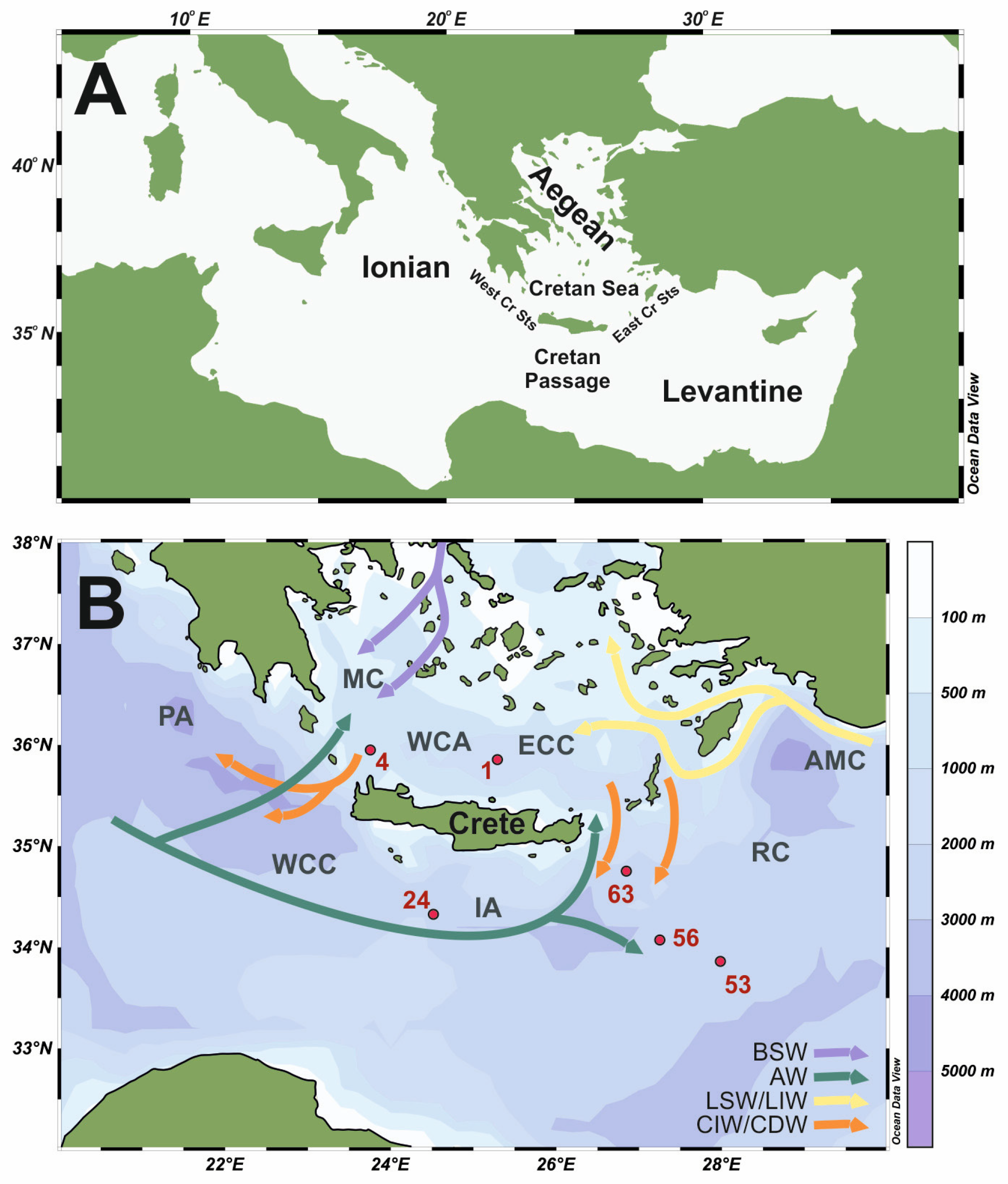
The Cretan Sea comprises a major part of the South Aegean Sea and extends between the Cyclades plateau and the island of Crete (Figure 1A). It is the largest and deepest basin in the Aegean Sea, with an average depth of ∼1000 m and a maximum depth of 2500 m. The Cretan Sea is connected to the Ionian Sea and the Levantine Basin through the Western and Eastern Cretan Straits, respectively. The Western Cretan Straits consist of the Elafonisos, Kithira, and Antikithira Straits, and the Eastern Cretan Straits comprise the Straits of Kassos, Karpathos, and Rhodos Straits. Additionally, in the South Cretan area, the Cretan Passage, a submarine ridge, extends from Crete to the Libyan coast. This area, with a width of about 300 km and an average depth of more than 2000 m, separates the Levantine basin from the Ionian Sea.
The study area exhibits a complex hydrology and water mass structure (Figure 1B). The surface/subsurface layers of the water column are dominated by the modified Atlantic Water (AW) and the warm and high salinity Levantine Surface Water (LSW) (e.g., [37,43]). The intermediate layers (~100–500 m depth) are characterized by the Levantine Intermediate Water (LIW) and the locally produced Cretan Intermediate Water (CIW) (e.g., [37,43,44,46,47,48,49]. Surface circulation is further influenced by a series of recurrent or permanent mesoscale eddies, gyres, and jets (see [37,43,50]). Prominent features in the area include the West Cretan Anticyclone (WCA) and the East Cretan Cyclone (ECC), as well as the Ierapetra Gyre (IG) in the Cretan Passage southeast of Crete. Additionally, the RC is a permanent feature and represents an area of significantly increased primary production, particularly compared to the adjacent ultra-oligotrophic regions [38,51]. The cyclonic Rhodes gyre causes continuous upwelling of nutrient-rich deeper water at its center, a process that is further enhanced by winter deep convection under cold and windy conditions. This mechanism drives the vertical transport of nutrients into the euphotic layer, resulting in significant phytoplankton growth during late winter and early spring [52,53,54].

2.2. Oceanographic Conditions in Late February/Early March 2019

This study is based on data collected from six stations located in the Cretan Sea and South Cretan area (Figure 1B; Table 1) during the oceanographic cruise PERLE–2 (Pelagic Ecosystem Response in the Levant Experiment) on board the R/V French “Pourquoi Pas?” from 27 February 2019 to 16 March 2019.
The water temperature (T) and salinity (S) ranged from 15.0 °C to 17.5 °C and 38.9 to 39.4, respectively, as per Metzl et al. [55], with a weak vertical gradient at the upper 100 m of the water column. The hydrology in the area (Table 2) was characterized by a well-mixed water column with a mixed layer depth exceeding 100 m; however, towards the RC, the mixed layer depth was low, less than 50 m [56]. The depths of the phosphacline and nitracline varied, with the phosphacline generally deeper than the nitracline. The concentration of the dissolved inorganic phosphorus inside the mixed layer did not exceed 30 nM, and the nitrate + nitrite concentration reached up to 1.13 μM, with higher values observed in the Cretan Sea [56]. Regarding the carbonate system, a seasonally low seawater pH of 7.98 on average in the top 50 m in late winter 2019 was observed, corresponding to relatively high dissolved inorganic carbon (DIC) values and low total alkalinity (TA) values [57]. In general, in the upper 100 m of the water column, TA ranged from 2573 µmol kg−1 to 2799 µmol kg−1, and DIC ranged from 2276 µmol kg−1 to 2394 µmol kg−1 (see Metzl et al. [55]).
In the study by Van Wambeke et al. [58], various physical and biogeochemical parameters were measured within the mixed layer, including nutrients, total chlorophyll-a concentrations (Tchla), and mixed layer depth (Table 2). Moreover, the cruise stations were clustered in five groups (B–F) based on different hydrological structures (cyclones or anticyclones), biogeochemical, and biological variability within the mixed layer. Following this classification, Stations 1 and 4 (Group F) were situated in the Cretan Sea and characterized by deep mixed layers (Table 2), while Station 24 (Group C) was located south of Crete around the Ierapetra anticyclone, where a progressive shallowing of the mixed layer and a lower concentration of DIP were recorded during the cruise. Stations 63, 56 and 53 were in extensions of the RC (Groups D and E). Station 56 was sampled twice during the cruise, on 10 March (ST56A, Group E) and 14 March (ST56B, Group D). The second sampling was performed after a low-intensity, short-term wind mixing event within the Rhodes gyre that occurred on 13 March [44,58], which influenced the water column by deepening the mixed layer, decreasing sea surface temperature (about 0.4 °C), and injecting nutrients, resulting in variations in phytoplankton and microbial communities [58].

3. Materials and Methods

3.1. Coccolithophore Sampling and Analysis

Plankton samples were collected at different depths in the euphotic zone (20, 50, and 100 m) from seven hydrocasts using Niskin bottles (General Oceanics, Miami, FL, USA) mounted on a rosette sampler equipped with a CTD (Conductivity, Temperature, and Depth sensors). Coccolithophore samples (1.5 L in volume) were filtered through a cellulose nitrate membrane (Whatman, Cytiva, Marlborough, MA, USA; diameter 47 mm and pore size 0.45 μm), under low pressure (<200 mm Hg; Bollmann et al., [59]), onboard immediately after sampling, dried, and stored in plastic Petri dishes.
In the laboratory, a small piece of each filter, approximately 8 × 8 mm2, was cut out, attached to a copper electron microscope stub using a double-sided adhesive tape, and coated with Au using a sputter coater. The samples were examined under a Jeol JSM 6360 SEM (Jeol Ltd., Tokyo, Japan) at the National and Kapodistrian University of Athens, Department of Geology and Geoenvironment, at a magnification of 2000× or 5000× as needed.
All coccospheres were counted and identified at the species level where possible, or in major taxonomic groups according to the taxonomic references of Young et al. [3], Cros and Fortuño [60], Malinverno et al. [61], and the electronic guide to the biodiversity and taxonomy of coccolithophores, Nannotax 3 [62].
Coccosphere abundance was calculated using the following equation:
A = N × S/V
where A = coccosphere abundance in coccospheres L−1, N = number of coccospheres on the scanned filter area, S = scaling factor (area of the whole filter/scanned filter area), and V = volume of the seawater filtered (L).
Following the methodology of Taylor [63], the standard error of the counts was derived from the ratio of the square root of observed cells to the equivalent investigated volume. The 95% confidence limits were then calculated by multiplying the standard error by 1.96, providing an estimate of abundance variability.
To estimate diversity, the Shannon–Wiener index (H′) was calculated for each sample:
H′ = −Σpi ln(pi)
where H′ = Shannon–Wiener index, and pi = relative abundance of each species in the sample.
The dominance index (Y) was used to determine the dominant species and was calculated using the following equation:
Y = ni/N × fi
where Y = dominance index, N = total cell abundance of all species counted, ni = cell abundance of species i, and fi = frequency of occurrence of species i.

3.2. Morphological Analysis Emiliania huxleyi

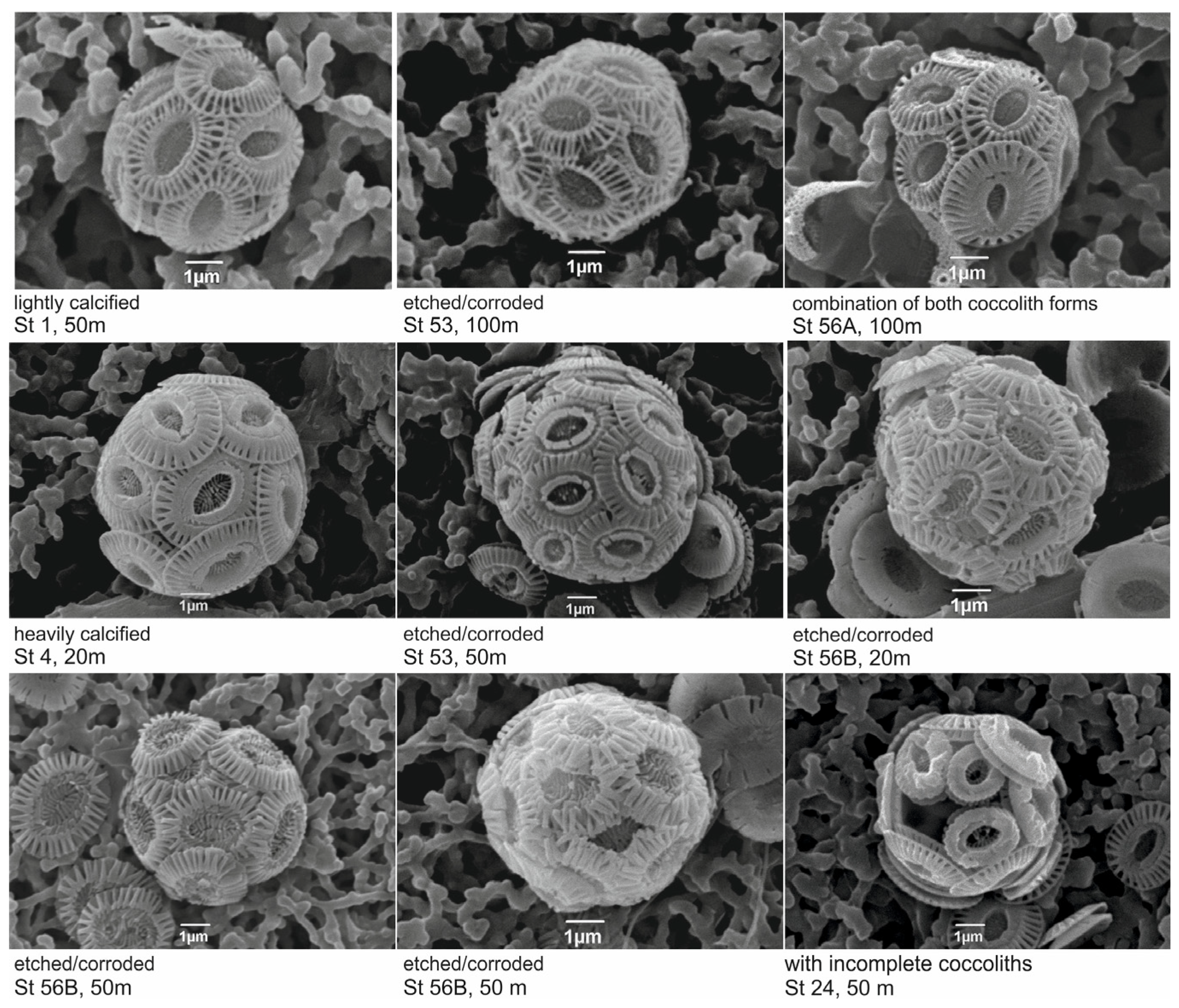
A total of 435 SEM images of coccospheres (about twenty per sample) were used for qualitative and morphometric analysis of Emiliania huxleyi type A. Based on the morphology and degree of calcification of the attached coccoliths, Emiliania huxleyi coccospheres were classified into two submorphotypes, following descriptions from previous studies in the region (e.g., [14,36]): lightly calcified form, characterized by delicate, well-separated distal shield elements, with relatively narrow central tube, and a broad central area covered by lath-like elements; and heavily calcified form, which exhibits a thicker central tube cycle with a robust, intensely calcified appearance, where the tube elements are occasionally fused to the inner ends of the distal shield elements (Figure 2). Several specimens from both submorphotypes showed etched/corroded coccoliths (sensu Young [64]), which were characterized by varying degrees of etching of the central tube cycle and collapse of distal shield elements (Figure 2). A few specimens with incomplete coccoliths were also observed (Figure 2).
For morphometric analysis, coccolith length (CL), coccolith width, and tube width measurements of the attached coccoliths were obtained from the SEM images using the ImageJ software (version 1.54). The measurements were performed on the lightly calcified, heavily calcified, and, when feasible, etched/corroded specimens. Relative Tube Width (RTW; Young et al. [65]) was used as an indicator of the degree of E. huxleyi calcification and was calculated as RTW = 2 × tube width/coccolith width.

3.3. Statistical Analysis

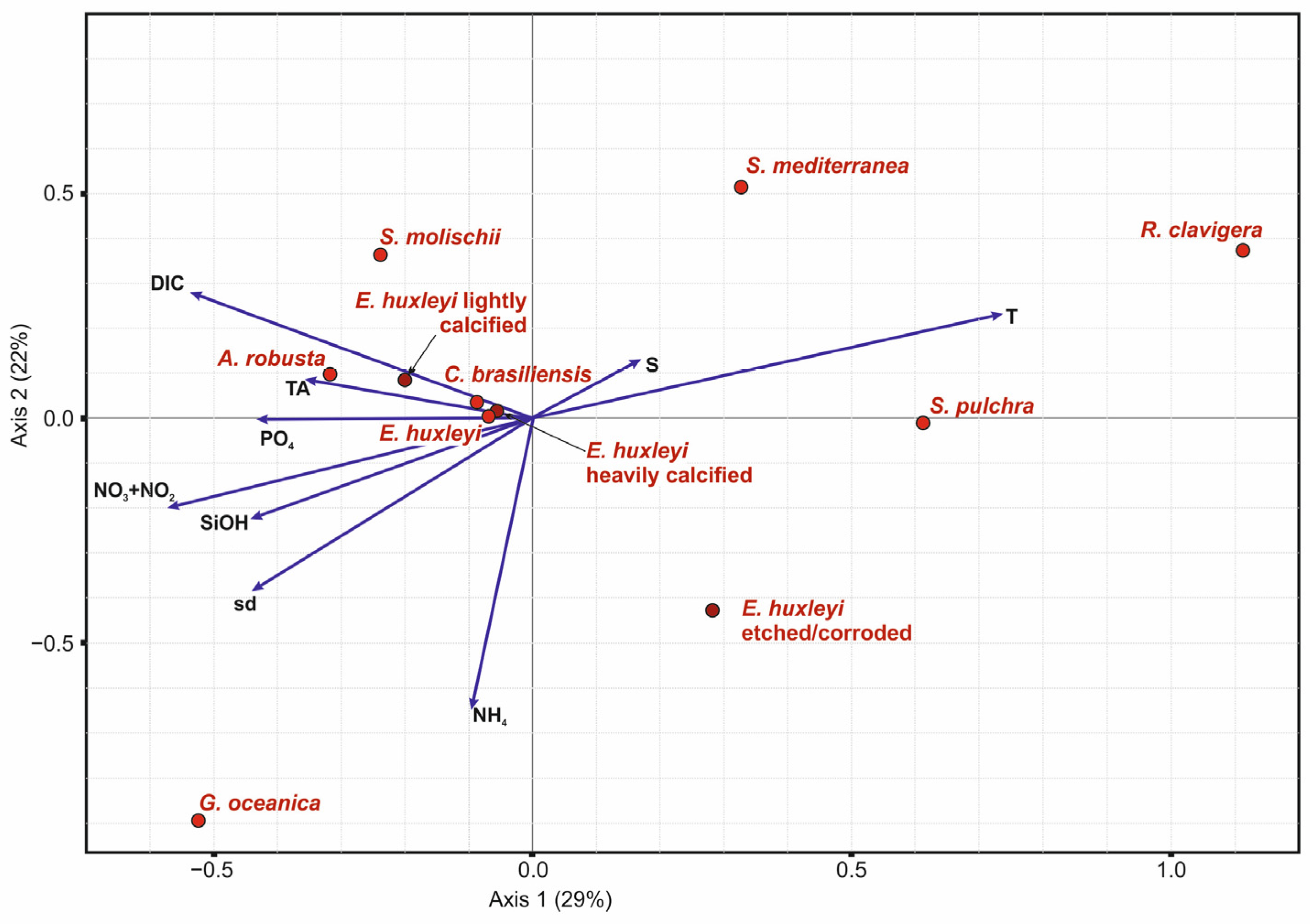
Canonical Correspondence Analysis (CCA) was applied to examine the influence of environmental variables (T, S, TA, DIC, nutrients [silicate SiOH), nitrate + nitrite (NO3 + NO2), phosphate (PO4), ammonium (NH4)], and sampling depth) on coccolithophore variability. The CCA was performed on the main coccolithophore species, with a relative abundance higher than 2% in at least one sample and Y > 0.001, and the submorphotypes of Emiliania huxleyi. Physicochemical and carbonate system data were obtained from the SNAPO-CO2 dataset of Metzl et al. [55], while nutrient data were derived from Van Wambeke et al. [56,58]. Before analysis, the coccolithophore data sets were logarithmically log(1 + x) transformed to reduce the effects of differences in magnitude between variables, and environmental variables were z-score normalized. The significance of the CCA axes was tested by permutation (number of permutations = 999, p-value < 0.05). In addition, the statistical significance of the relationships between coccolithophores and environmental variables was determined by the simple nonparametric Spearman’s rho correlation.
In addition, the non-parametric Mann–Whitney U tests were performed to evaluate the differences in CL and RTW between lightly and heavily calcified, as well as normal and etched/corroded Emiliania huxleyi coccoliths. Differences were considered significant at p < 0.05.
The statistical analyses were carried out using the PAST (PAleontological STatistics) software version 4.03 [66] and the SPSS program version 29.0 for Windows (SPSS Inc., Chicago, IL, USA).

4. Results

4.1. Coccolithophore Composition and Abundance

A total of 45 coccolithophore taxa were recognized, of which 42 were identified at the species level, and three were identified at the genus level. Only three holococcolithophore forms were found, along with one heterococcolithophore–holococcolithophore combination (two coccospheres of Helicosphaera pavimentum HET-HOL; St. 56B, 20 m depth) (Figure 3).
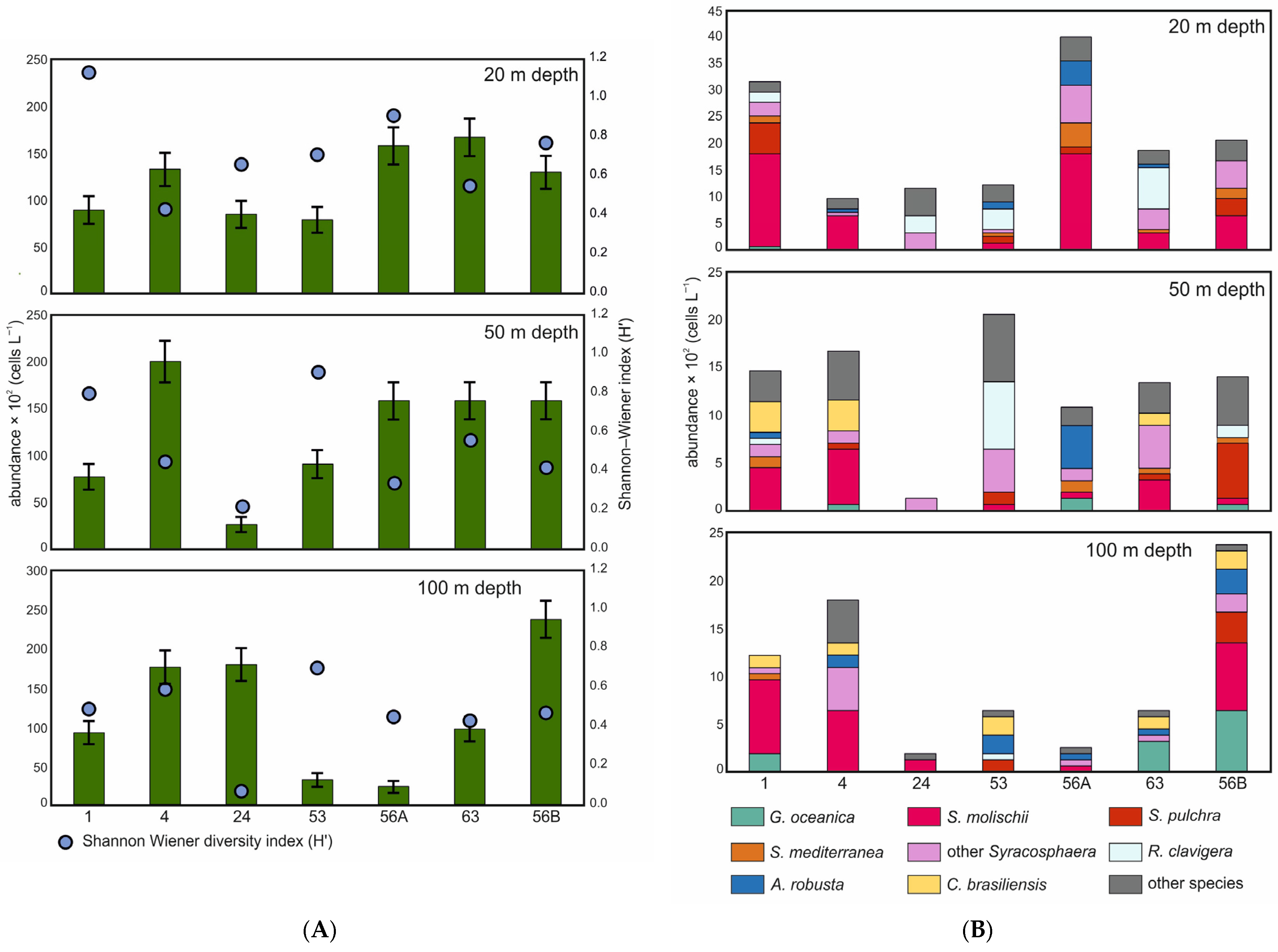
The total coccolithophore abundance ranged from 26.3 × 10² coccospheres L−1 (St 56A, 100 m depth) to 258.8 × 10² coccospheres L−1 (St 56B, 100 m depth), with an average of 135.8 × 10² coccospheres L−1. The diversity of the coccolithophore assemblage was relatively low, with an average H′ of 0.58. The lowest values were observed in the deeper waters, with a minimum of H′ = 0.07 (St 24, 100 m depth) south of Crete. In contrast, the assemblage in the upper water layer was more diverse, reaching a maximum of H′ = 1.13 (St 1, 20 m depth) in the central part of the Cretan Sea (Figure 4A).
According to the dominance index (Y ≥ 0.02), Emiliania huxleyi type A and Syracosphaera molischii were the dominant species. Additionally, six other species, namely Calciosolenia brasiliensis, Syracosphaera pulchra, Algirosphaera robusta, Syracosphaera mediterranea, Rhabdosphaera clavigera, and Gephyrocapsa oceanica, were identified with relatively high occurrence (Y > 0.001) and relative abundance (>2%) (Table 3).
Emiliania huxleyi made up 73% to 98% (average = 89%) of the total assemblage. It was the dominant species at all stations and depths, with the highest absolute abundance of 235.1 × 10² cells L−1 (St. 56B, 100 m depth) at the station influenced by the RC (Figure 4A). Syracosphaera molischii accounted for up to 14% (average = 3.2%) of the total assemblage and was most abundant in the upper 20 m of the water column, reaching a maximum abundance of 18.0 × 10² cells L−1 (St. 56A, 20 m depth) (Figure 4B). Similarly, Syracosphaera pulchra (max = 5.8 × 10² cells L−1; St. 1, 20 m depth), Rhabdosphaera clavigera (max = 7.7 × 10² cells L−1; St. 63, 20 m depth), and Syracosphaera mediterranea (max = 4.5 × 10² cells L−1; St. 56A, 20 m depth) were found in higher abundances in the upper 20 m of the water column (Figure 4B). On the other hand, higher values of Algirosphaera robusta (max = 4.5 × 10² cells L−1; St. 56A, 20 m and 50 m depth) and Calciosolenia brasiliensis (max = 3.2 × 10² cells L−1; St. 4, 20 m depth; St. 1 and 4, 50 m depth) were observed up to 50 m depth, while Gephyrocapsa oceanica (max = 6.4 × 10² cells L−1; St. 56B, 100 m depth) reached its highest value in the deeper waters.

4.2. Emiliania huxleyi Morphological Results

Emiliania huxleyi type A was the only morphotype of the species found in the samples examined.
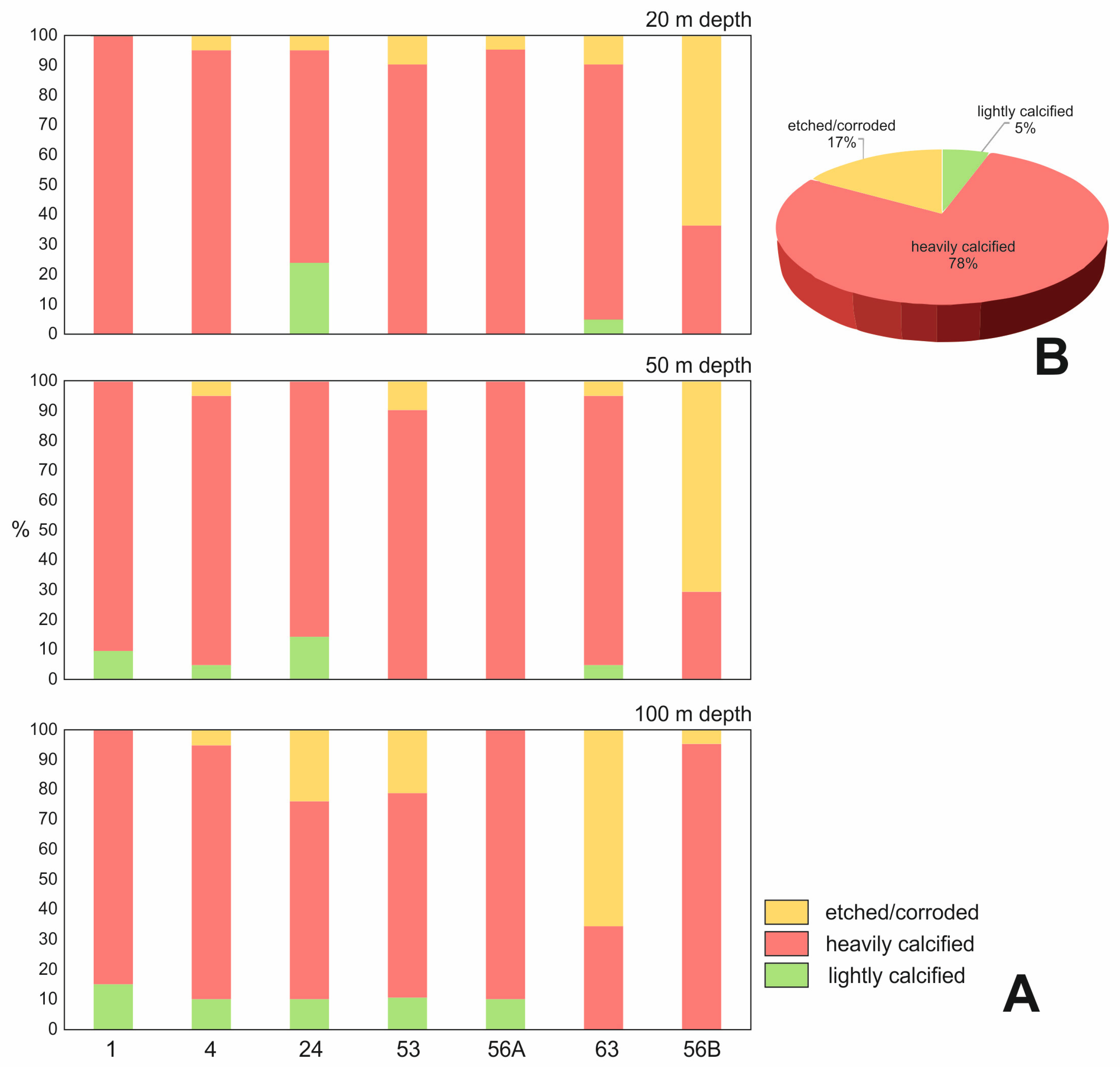
Heavily calcified coccospheres were the dominant Emiliania huxleyi form in all water layers (Figure 5A). In most stations, a relative increase in lightly calcified coccospheres was observed at 100 m depth. Etched/corroded coccospheres were found in all investigated stations, excluding St. 1 in the Cretan Sea, and sometimes made up more than 50% of the Emiliania huxleyi populations towards the RC (St. 56B, 20 m and 50 m depth; St. 63, 100 m depth) (Figure 5A). Notably, two specimens with incomplete coccoliths were found at St. 24 (50 m depth) south of Crete. Overall, heavily calcified coccospheres accounted for 78% of the population, and those lightly calcified represented 5% (Figure 5B). Coccospheres with etched/corroded coccoliths were observed in 17% of the total Emiliania huxleyi population.
The results of the analyzed morphometric parameters (RTW and CL) in the different Emiliania huxleyi forms are summarized in Table 4. Due to their limited number (<10), etched/corroded coccoliths of the lightly calcified submorphotype were not included in the statistical analysis. Overall, the RTW showed significantly higher values in heavily calcified (averaging 0.27) compared to those of lightly calcified coccoliths (averaging 0.16) (U = 692, p < 0.001). On the other hand, no statistically significant difference (U = 381, p > 0.05) was found for the CL between the two forms. Also, the Mann–Whitney test revealed significant differences between normal and etched/corroded coccoliths for both RTW (U = 2452, p < 0.001) and CL (U = 4230, p = 0.027).

4.3. Relationship Between Coccolithophores and Environmental Variables (CCA and Spearman Correlation)

The influence of environmental parameters on the coccolithophore distribution in the Cretan Sea and Cretan Passage was assessed using CCA and Spearman correlation. According to the CCA results (Figure 6), the first two canonical axes explained 56.00% of the total variance in coccolithophore distribution. Axis 1, which accounted for 29% of the variance, showed a negative relationship with DIC (−0.633) and nutrients, SiOH (−0.448), NO3 + NO2 (−0.435), PO4 (−0.397), and a positive relationship with water temperature (0.605). Axis 2 explained a further 22% of the variance and was positively correlated with water salinity (0.535).
Most coccolithophore species showed a negative correlation with Axis 1 and were positioned in the general direction of the DIC and SiOH, NO3 + NO2, and PO4 vectors (Figure 6). Syracosphaera pulchra and Rhabdosphaera clavigera displayed a greater inclination towards the temperature and salinity vectors, indicating a close relationship with this parameter, while Gephyrocapsa oceanica and Algirosphaera robusta were found near the NH4 and nutrient vectors, respectively. Regarding the submorphotypes of Emiliania huxleyi, it is worth noting the position of the etched/corroded forms on Axis 1, which are located near the NH4 vector side and show an anti-correlation with the DIC and TA.
Consistent with the CCA results, Spearman’s rho correlation analysis revealed significant relationships between coccolithophores and environmental parameters (Table 5). Particularly, Syracosphaera pulchra, Syracosphaera mediterranea, and Rhabdosphaera clavigera showed a significant positive correlation with temperature, while Emiliania huxleyi had a negative correlation. Syracosphaera pulchra and Rhabdosphaera clavigera also displayed significant negative correlations with DIC and TA, respectively. A negative significant correlation with nutrients was observed for Rhabdosphaera clavigera and Syracosphaera mediterranea, while Algirosphaera robusta exhibited a positive correlation.

5. Discussion

Plankton sampling in the Cretan Sea and South Cretan area in late February/early March of 2019 coincided with the end of winter circulation and the beginning of seasonal stratification [57]. During the cruise, active mesoscale activity was observed, characterized by the presence of the RC and several mesoscale features interconnected by intense geostrophic jets [44]. Warm and salty LSW from the AMC following the northeastern periphery of the RC flowed towards the Cretan Passage. This geostrophic jet meandered, creating small-scale eddies, and partly entered the Cretan Sea through the Eastern Straits [44]. These oceanographic conditions affect the abundance, composition, and calcification of living coccolithophores by controlling and influencing important physical processes such as mixed layer depth, nutrient availability, as well as the profiles of physical–chemical parameters.
In particular, the deep mixed layer (extending below 100 m) and relatively higher nutrient concentrations at Stations 1 and 4 in the Cretan Sea (Table 2) supported a relatively high abundance of Emiliania huxleyi and a diverse assemblage (Figure 4). In contrast, the shallower mixed layer (MLD = 57 m) and lower nutrient concentrations at St. 24 in the South Cretan margin restricted coccolithophore development, resulting in the lowest species diversity, particularly in the deeper water layers. Finally, the warmer and saltier waters influenced by RC dynamics were characterized by high marine productivity, with Tchla concentrations exceeding 0.4 µg L−1. In this area, Emiliania huxleyi exhibited high abundances, and several other species, such as Rhabdosphaera clavigera, Syracosphaera mediterranea, Algirosphaera robusta, and Gephyrocapsa oceanica, reached their maximum abundance. Interestingly, these high coccolithophore abundances coincided with high relative percentages of etched/corroded coccospheres, particularly of Emiliania huxleyi.

5.1. Coccolithophore Distribution and Ecology

Coccolithophore abundance was relatively low, with a maximum of 2.6 × 10⁴ coccospheres L−1. This value, however, is comparable to those reported by Penales et al. [36] for the study area (March 2019: max 2.8 × 10⁴ coccospheres L−1) and falls within the range observed in previous studies of the Eastern Mediterranean, which reported maximum winter and early spring values between 2.0 × 10⁴ and 2.3 × 10⁵ coccospheres L−1 [28,30,32,35,62]. Although 45 species were found in this study, species diversity was relatively low, with the Shannon–Wiener index of up to H′ = 1.13, reflecting the dominance of the opportunistic, r-selected species Emiliania huxleyi. These features are typical of coccolithophore assemblages in the Eastern Mediterranean during the cold mixing period, when nutrient concentrations are elevated (e.g., [14,28,30,32,35,36,67]).
Emiliania huxleyi was abundant and dominant throughout the study area, contributing, on average, 89% of the coccolithophore assemblage. In the stations of the Cretan Sea (Stations 1 and 4) and at the station influenced by the RC after the mixing event (St. 56B), its abundances remained relatively homogeneous throughout the water column, while in the stations situated in extensions of the RC before the mixing event (Stations 63, 56A and 53), they were more concentrated in the upper 50 m depth. Mixing/stratification conditions in the water column probably influence this distribution pattern; it seems to be that while vertical mixing and the associated higher nutrient concentrations in the mixed layer (NOx = 1.10 µM and DIP = 23.3 nM; Table 2) prevailed in the Cretan Sea, weak stratification had started towards the RC [56,57,58], restricting coccolithophore abundance to a relatively shallow mixed layer. However, the mixing event within the Rhodes gyre on 13 March caused the redistribution of the coccolithophore abundance, with Emiliania huxleyi shifting deeper, extending down to 100 m depth at St. 56B (Figure 4A). This temporal change was also evident in the vertical distribution of Syracosphaera molischii (Figure 4B).
Syracosphaera molischii, the second most dominant species during the sampling time, is known to have similar ecological requirements to Emiliania huxleyi [68], and these species often co-occur in nutrient-enriched winter waters of the Mediterranean Sea [32,36,67,69]. The higher abundances of Syracosphaera molischii and the little variation in depth in the Cretan Sea are likely linked to the higher nutrient content in the mixed layer.
Despite the dominance of Emiliania huxleyi, the presence of the less opportunistic species Rhabdosphaera clavigera, Syracosphaera pulchra, and Syracosphaera mediterranea is interesting. These species are typically found in upper photic zone assemblages of the Mediterranean and are characteristic of environments with warm, oligotrophic, and stratified waters (e.g., [30,32,67,70,71,72]). In the Cretan Sea and the South Cretan area, they are usually abundant in the summer but can also sporadically increase during colder periods, as observed in sediment trap data [40,41]. In late winter of 2019, they were found in relatively low abundances and were more prevalent in the upper layer of the water column (20–50 m depth; Figure 4B), where higher values of species diversity were also observed. Correlation analysis and CCA results showed that their abundance was influenced by temperature and salinity, suggesting a connection to warmer and saltier surface waters of Levantine origin (LSW). A similar assemblage of these species has been observed along the west coast of the Iberian Peninsula and has been used as a good tracer for warmer and saltier subtropical waters over the Portuguese shelf during the upwelling-downwelling transition [73,74].
Algirosphaera robusta, Calciosolenia brasiliensis and Gephyrocapsa oceanica showed variable abundances during the cruise. In contrast to the upper photic zone assemblage, these species appeared without a specific water depth distributional pattern. Algirosphaera robusta has been documented to be seasonally important in the area, mainly during the periods of low temperature and high productivity [36,75]. Its statistically significant correlation with nutrients in this study and the observed co-occurrence in the CCA with Emiliania huxleyi and Syracosphaera molischii highlight the species’ ability to utilize the transient nutrient supply from the deeper layers to the euphotic zone during winter mixing events by the cyclonic activity of the Rhodes gyre [58]. Along with this species, Calciosolenia brasiliensis is commonly found in autumn–winter coccolithophore assemblages in the Eastern Mediterranean (e.g., [30,36]). Gephyrocapsa oceanica, which is a tracer for Atlantic lower salinity surface waters [28], occurs predominantly in the Western Mediterranean. It is typically rare in pelagic environments of the Eastern Mediterranean (e.g., [15,28,30,33,70,72]), although in the Aegean Sea, this species is more abundant in semi-enclosed bays, where it demonstrates opportunistic behavior in response to eutrophic conditions [12,32]. In late winter of 2019, this species showed maximum abundance at 100 m depth of the water column (Figure 4B), after the mixing event (St. 56B).
As expected, coccolithophore assemblages consisted largely of heterococcolithophore forms, while holococcolithophores constituted a minor component. Since the HET and HOL life cycle phases are ecologically distinct and inhabit distinct niches [76,77], HET cells, in the seasonal distribution patterns, thrive in cold high-nutrient conditions dominated during winter, and HOL cells reach the maximum abundance in warm low-nutrient conditions during summer [15,31,35,78,79]. However, there are some exceptions to this seasonal pattern. In the case of Helicosphaera pavimentum, HOL cells occur predominantly during winter, suggesting that they are better adapted to cold, high-nutrient, mixing waters compared to HET cells, which are more common in stratified seasons [80]. In this study, Helicosphaera pavimentum HOL, while not abundant, was the most frequent holococcolithophore. HET cells were not observed, but two combination HET-HOL coccospheres were detected in the upper water layer following the mixing event at St. 56B. Helicosphaera pavimentum HET-HOL cells have also been found in early spring in the NE Aegean Sea [81] and the central Adriatic Sea [82]. The persistent occurrence of these combination coccospheres in late winter/early spring could suggest that life-phase transitions are triggered by environmental changes during the seasonal transition.

5.2. Emiliania huxleyi Morphologies

Emiliania huxleyi type A is the dominant morphotype today in the Mediterranean region, where it displays a range of morphological variations based on the degree of coccolith calcification. The distribution of these more or less calcified forms varies between different water masses and shows distinct biogeographic and seasonal patterns [14,18,33,36,83]. Emiliania huxleyi type A population observed in this study mostly consisted of heavily calcified forms, in agreement with previous research in the area [36] and the seasonal succession pattern described by Triantaphyllou et al. [14] in the Aegean Sea, where the heavily calcified coccospheres are prevalent during the winter–spring period. Moreover, these results are consistent with the previous findings in the Mediterranean Sea, where the heavily calcified forms are more common in the southeastern regions [84].
Lightly calcified coccospheres were also present during the studied period, but in low relative abundances (<10%). This is in agreement with the general pattern in the Aegean Sea reported by Triantaphyllou et al. [14], who noted that these forms represent a minor component of the Emiliania huxleyi population during the winter–spring period. This form dominates during the summer period, a time of high temperature–low productivity conditions and lower bicarbonate content. In the North Aegean, Karatsolis et al. [33] and Skampa et al. [83] documented an increase in lightly calcified Emiliania huxleyi coccospheres even during the winter–spring period, which was associated with the enhanced surficial inflow of less saline BSW. In this study, the co-occurrence of lightly and heavily calcified coccospheres was observed (Figure 2); free coccoliths were readily adsorbed by cells to form xenospheres that showed a combination of both coccolith forms [85]. Morphological comparison between the two forms confirmed a decreased degree of calcification of the lightly calcified coccoliths as determined by RTW, but their coccolith length remained unaffected, suggesting that the degree of calcification is independent of coccolith size [65]. Besides the fact that the higher frequency of lightly calcified coccospheres was observed in the deeper waters, they practically did not show a clear correlation with any of the studied environmental parameters.
A high frequency of etched/corroded coccospheres (~20%) was observed in the population of Emiliania huxleyi. Similar corroded morphologies have been previously reported as evidence of early dissolution [64]. The dissolution process resulted in a variation in effects on coccoliths [64,86,87,88], ranging from weak etching, characterized by thinning and the disconnection of distal shield and central tube elements, to severe damage, marked by the complete collapse of the distal shield elements on the proximal shield due to extensive etching of tube elements. In our study, these types of morphologies were found in both lightly and heavily calcified coccospheres. Notably, the dissolution seen in the morphology of heavily calcified coccoliths is consistent with biometric parameters of coccolith RTW and length, which showed statistically significantly lower values in etched/corroded compared to normal forms.
Recently, Penales et al. [36] observed a relatively high proportion of etched/corroded specimens of Emiliania huxleyi and other taxa in the photic zone in the South Aegean Sea during sampling conducted in March 2017 and 2019. These signs of dissolution were attributed to the in situ dissolution of CaCO3. The phenomenon was more pronounced in March 2017, resulting from intense cold conditions and wind-induced mixing, which may have enhanced the absorption of atmospheric CO2 in surface waters, thereby increasing the water column acidity via dense water formation. Our findings confirm the presence of dissolution-affected assemblages in the south of Crete (St. 24) and in the extensions of the RC (Stations 53 and 63). These assemblages were found primarily in deeper samples at the 100 m depth level, with etched/corroded coccospheres co-occurring with normal specimens. A plausible explanation could be that the coccolithophore assemblage, initially thriving at a relatively shallow mixed layer, became the subject of dissolution mostly in the deeper parts of the water column, driven by the combination of their sinking rate and acidification effects due to early spring convective mixing and subsequent natural increases in CO2 seawater concentrations [36,57].
However, the most pronounced occurrence of etched/corroded coccospheres was observed at Station 56B sampled on 14 March, where approximately ~60–70% of Emiliania huxleyi specimens exhibited a high degree of dissolution, while other species were well-preserved. This selective dissolution suggests that etched/corroded coccospheres are likely of natural origin rather than a resulting from a filtration artifact. If dissolution had occurred during or after sampling on the filter, it would probably have affected other fragile species as well. In contrast to the other sites, dissolution at Station 56B was restricted to the mixed layer (upper 50 m depth) and did not extend into the deeper waters (100 m depth). These findings appear to be linked to the environmental biogeochemical conditions during the recent mixing event within the Rhodes gyre on 13 March, which caused a dynamic redistribution of nutrients and microorganisms.
A significant drawdown in atmospheric pressure (from 1020 to 1000 mbar) and high wind speeds reaching 30 knots triggered the brief mixing event on March 13th, which resulted in a ~0.4 °C decrease in sea surface temperature and a deepening of the mixed layer from 21 to 50 m in the stations in extensions of the RC. The mixing induced a consistent injection of nutrients into the upper layers, with NOx concentrations increasing significantly from 0.29 μM to 0.70 μM (Table 2) [44,58]. This is also documented by BGC-Argo observations from the Rhodes gyre, which provide high-resolution evidence of how NO3/MLD dynamics drive phytoplankton response and physical–biogeochemical interactions in the region [42]. As a result, the mixed layer deepening led to a more homogeneous vertical distribution of the coccolithophore assemblages, including Emiliania huxleyi (Figure 4). Despite the potential dilution effect of the deeper mixed layer, coccolithophore abundances remained high, indicating a rapid response to the newly available nutrients. Vertical transport of coccolithophores resulted in higher abundances at 100 m, where the absence of mixed-layer turbulence and more stable conditions prevailed.
Van Wambeke et al. [51] documented a significant increase in heterotrophic prokaryotes in the mixing layer following the event of March 13th. Although direct microscale pH measurements are not available, the high relative abundance of etched/corroded coccospheres in the Emiliania huxleyi population within the mixed layer could be linked to elevated bacterial activity and enzymatic processes. We hypothesize that accelerated organic matter consumption might have potentially created an acidic microenvironment, which could be conducive to carbonate dissolution and degradation on calcareous structures [89]. Interestingly, a follow-up sampling from the same area after 10 days [36] verified the increased presence of etched/corroded Emiliania huxleyi coccospheres (10%) in the deeper photic zone (70–90 m), implying in this case their vertical transport through the water column, while in contrast the normally calcified assemblages thrived in surface layers, as the result of the circulation conditions established after the cease of winter 2019 RC intensification [44].

6. Conclusions

The study of living coccolithophores in the Cretan Sea and South Cretan area in late February/early March 2019 provides evidence of their response to the seasonal changes associated with the winter–spring transition. Our data highlight the influence of dynamic oceanographic conditions during this period on species abundance, composition, and Emiliania huxleyi morphology.
The main findings can be summarized as follows:
  • Coccolithophore abundance ranged from 26.3 × 10² to 258.8 × 10² coccospheres L−1, averaging at 135.8 × 10² coccospheres L−1. The relatively low species diversity (Shannon–Wiener index up to H′ = 1.13) confirmed the dominance of the opportunistic Emiliania huxleyi.
  • Mixing/stratification conditions influenced the distribution patterns of Emiliania huxleyi. Particularly, in the Cretan Sea, where vertical mixing prevailed, its abundances were relatively homogeneous throughout the upper 100 m depth of the water column, while towards the Rhodes gyre, where a weak stratification had started with a shallow mixed layer, Emiliania huxleyi was more concentrated at depths shallower than 50 m.
  • Rhabdosphaera clavigera, Syracosphaera pulchra, and Syracosphaera mediterranea were also present but in lower abundances. Both Canonical Correspondence and Spearman correlation analyses showed that their abundance was influenced, indicating a connection to warm, salty Levantine Surface Water (LSW) even during the colder season.
  • Among holococcolithophores, Helicosphaera pavimentum HOL was the most frequent. The presence of HET-HOL combination coccospheres suggests that life-phase transitions for Helicosphaera pavimentum may be triggered by environmental shifts during the seasonal change from winter to spring.
  • Emiliania huxleyi was mostly represented by heavily calcified forms. The occurrence of dissolution, indicated by a high frequency of etched/corroded coccospheres (> 20%) in the Emiliania huxleyi population, reflects the species response to regional carbonate chemistry and the prevailing circulation patterns.

Supplementary Materials

The following supporting information can be downloaded at: https://www.mdpi.com/article/10.3390/jmse14050517/s1, Table S1: Absolute abundances of coccolithophore species.

Author Contributions

Conceptualization, M.D.D., P.S. and M.V.T.; methodology, M.D.D., P.S., E.S., A.M.O. and M.V.T.; investigation, M.D.D., P.S., E.S., C.P., D.V., A.G. and M.V.T.; data curation, D.V., M.V.T., C.P. and A.G.; writing—original draft preparation M.D.D., P.S., A.G. and M.V.T.; writing—review and editing, M.D.D., P.S., E.S., C.P., A.G., D.V., A.M.O., M.P.-P., X.D.d.M. and M.V.T.; visualization, M.D.D., E.S. and P.S.; project administration, P.C., M.P.-P., X.D.d.M., M.V.T. and A.G. All authors have read and agreed to the published version of the manuscript.

Funding

We gratefully acknowledge the PERLE project for the collected samples and ancillary data used in this study. PERLE project was funded in the framework of the French MISTRALS-MERMEX (CNRS/INSU) project: CONAN Pascal, DURRIEU DE MADRON Xavier (2019) PERLE2 cruise, RV Pourquoi pas? https://doi.org/10.17600/18000865. This research was funded by the Greek National Project “Support for upgrading the operation of the National Network for Climate Change-CLIMPACT” (Grant Agreement: 2023NA11900001, MIS 5201588), funded by national Greek funds under the Ministry of Development & Investment; Project homepage: https://climpact.gr.

Institutional Review Board Statement

Not applicable.

Informed Consent Statement

Not applicable.

Data Availability Statement

Data are contained within the article and Supplementary Materials. The data presented in this study are available on request from the corresponding author.

Conflicts of Interest

The authors declare no conflicts of interest.

Abbreviations

The following abbreviations are used in this manuscript:
BSWBlack Sea Water
AWAtlantic Water
LSWLevantine Surface Water
LIWLevantine Intermediate Water
CIWCretan Intermediate Water
CDWCretan Deep Water
MCMyrtoan Cyclone
WCAWest Cretan Anticyclone
ECCEast Cretan Cyclone
AMCAsia Minor Current
PAPelops Anticyclone
WCCWest Cretan Cyclone
IAIerapetra Anticyclone
RCRhodes Cyclone
DICDissolved Inorganic Carbon
TATotal Alkalinity
PERLEPelagic Ecosystem Response in the Levant Experiment
TTemperature
SSalinity
CLCoccolith Length
RTWRelative Tube Width
CCACanonical Correspondence Analysis

References

  1. Behrenfeld, M.J.; Randerson, J.T.; McClain, C.R.; Feldman, G.C.; Los, S.O.; Tucker, C.J.; Falkowski, P.G.; Field, C.B.; Frouin, R.; Esaias, W.E.; et al. Biospheric Primary Production During an ENSO Transition. Science 2001, 291, 2594–2597. [Google Scholar] [CrossRef]
  2. Falkowski, P.G.; Barber, R.T.; Smetacek, V. Biogeochemical Controls and Feedbacks on Ocean Primary Production. Science 1998, 281, 200–206. [Google Scholar] [CrossRef]
  3. Young, J.; Geisen, M.; Cros, L.; Kleijne, A.; Sprengel, C.; Probert, I.; Østergaard, J. A Guide to Extant Coccolithophore Taxonomy. J. Nannoplankton Res. 2003, 1, 125. [Google Scholar] [CrossRef]
  4. Rost, B.; Riebesell, U. Coccolithophores and the Biological Pump: Responses to Environmental Changes. In Coccolithophores: From Molecular Processes to Global Impact; Thierstein, H.R., Young, J.R., Eds.; Springer: Berlin/Heidelberg, Germany, 2004; pp. 99–125. [Google Scholar]
  5. O’Brien, C.J.; Peloquin, J.A.; Vogt, M.; Heinle, M.; Gruber, N.; Ajani, P.; Andruleit, H.; Arístegui, J.; Beaufort, L.; Estrada, M.; et al. Global Marine Plankton Functional Type Biomass Distributions: Coccolithophores. Earth Syst. Sci. Data 2013, 5, 259–276. [Google Scholar] [CrossRef]
  6. Gregg, W.W.; Rousseaux, C.S. Global Ocean Primary Production Trends in the Modern Ocean Color Satellite Record (1998–2015). Environ. Res. Lett. 2019, 14, 124011. [Google Scholar] [CrossRef]
  7. Jordan, R.W.; Chamberlain, A.H.L. Biodiversity among Haptophyte Algae. Biodivers. Conserv. 1997, 6, 131–152. [Google Scholar] [CrossRef]
  8. Winter, A.; Siesser, W.G. (Eds.) Coccolithophores. In Journal of the Marine Biological Association of the United Kingdom; Cambridge University Press: Cambridge, UK, 1994. [Google Scholar] [CrossRef]
  9. Giraudeau, J.; Bailey, G.W. Spatial Dynamics of Coccolithophore Communities during an Upwelling Event in the Southern Benguela System. Cont. Shelf Res. 1995, 15, 1825–1852. [Google Scholar] [CrossRef]
  10. Guerreiro, C.; Oliveira, A.; de Stigter, H.; Cachão, M.; Sá, C.; Borges, C.; Cros, L.; Santos, A.; Fortuño, J.-M.; Rodrigues, A. Late Winter Coccolithophore Bloom off Central Portugal in Response to River Discharge and Upwelling. Cont. Shelf Res. 2013, 59, 65–83. [Google Scholar] [CrossRef]
  11. Bonomo, S.; Cascella, A.; Alberico, I.; Ferraro, L.; Giordano, L.; Lirer, F.; Vallefuoco, M.; Marsella, E. Coccolithophores from near the Volturno Estuary (Central Tyrrhenian Sea). Mar. Micropaleontol. 2014, 111, 26–37. [Google Scholar] [CrossRef]
  12. Dimiza, M.D.; Koukousioura, O.; Michailidis, I.; Dimou, V.-G.; Navrozidou, V.; Aligizaki, K.; Seferlis, M. Seasonal Living Coccolithophore Distribution in the Enclosed Coastal Environments of the Thessaloniki Bay (Thermaikos Gulf, NW Aegean Sea). Rev. Micropaléontol. 2020, 69, 100449. [Google Scholar] [CrossRef]
  13. Ignatiades, L.; Gotsis-Skretas, O.; Pagou, K.; Krasakopoulou, E. Diversification of Phytoplankton Community Structure and Related Parameters along a Large-Scale Longitudinal East–West Transect of the Mediterranean Sea. J. Plankton Res. 2009, 31, 411–428. [Google Scholar] [CrossRef]
  14. Triantaphyllou, M.; Dimiza, M.; Krasakopoulou, E.; Malinverno, E.; Lianou, V.; Souvermezoglou, E. Seasonal Variation in Emiliania huxleyi Coccolith Morphology and Calcification in the Aegean Sea (Eastern Mediterranean). Geobios 2010, 43, 99–110. [Google Scholar] [CrossRef]
  15. Oviedo, A.; Ziveri, P.; Álvarez, M.; Tanhua, T. Is Coccolithophore Distribution in the Mediterranean Sea Related to Seawater Carbonate Chemistry? Ocean Sci. 2015, 11, 13–32. [Google Scholar] [CrossRef]
  16. Grelaud, M.; Schimmelmann, A.; Beaufort, L. Coccolithophore Response to Climate and Surface Hydrography in Santa Barbara Basin, California, AD 1917–2004. Biogeosciences 2009, 6, 2025–2039. [Google Scholar] [CrossRef]
  17. Meyer, J.; Riebesell, U. Reviews and Syntheses: Responses of Coccolithophores to Ocean Acidification: A Meta-Analysis. Biogeosciences 2015, 12, 1671–1682. [Google Scholar] [CrossRef]
  18. D’Amario, B.; Pérez, C.; Grelaud, M.; Pitta, P.; Krasakopoulou, E.; Ziveri, P. Coccolithophore Community Response to Ocean Acidification and Warming in the Eastern Mediterranean Sea: Results from a Mesocosm Experiment. Sci. Rep. 2020, 10, 12637. [Google Scholar] [CrossRef] [PubMed]
  19. Guerreiro, C.V.; Ferreira, A.; Cros, L.; Stuut, J.-B.; Baker, A.; Tracana, A.; Pinto, C.; Veloso, V.; Rees, A.P.; Cachão, M.A.P.; et al. Response of Coccolithophore Communities to Oceanographic and Atmospheric Processes across the North- and Equatorial Atlantic. Front. Mar. Sci. 2023, 10, 1119488. [Google Scholar] [CrossRef]
  20. Krom, M.D.; Emeis, K.-C.; Van Cappellen, P. Why Is the Eastern Mediterranean Phosphorus Limited? Prog. Oceanogr. 2010, 85, 236–244. [Google Scholar] [CrossRef]
  21. Siokou-Frangou, I.; Christaki, U.; Mazzocchi, M.G.; Montresor, M.; D’Alcalá, M.R.; Vaqué, D.; Zingone, A. Plankton in the Open Mediterranean Sea: A Review. Biogeosciences 2010, 7, 1543–1586. [Google Scholar] [CrossRef]
  22. Raveh, O.; David, N.; Rilov, G.; Rahav, E. The Temporal Dynamics of Coastal Phytoplankton and Bacterioplankton in the Eastern Mediterranean Sea. PLoS ONE 2015, 10, e0140690. [Google Scholar] [CrossRef]
  23. Ignatiades, L.; Psarra, S.; Zervakis, V.; Pagou, K.; Souvermezoglou, E.; Assimakopoulou, G.; Gotsis-Skretas, O. Phytoplankton Size-Based Dynamics in the Aegean Sea (Eastern Mediterranean). J. Mar. Syst. 2002, 36, 11–28. [Google Scholar] [CrossRef]
  24. Psarra, S.; Zohary, T.; Krom, M.D.; Mantoura, R.F.C.; Polychronaki, T.; Stambler, N.; Tanaka, T.; Tselepides, A.; Thingstad, T.F. Phytoplankton Response to a Lagrangian Phosphate Addition in the Levantine Sea (Eastern Mediterranean). Deep Sea Res. Part II Top. Stud. Oceanogr. 2005, 52, 2944–2960. [Google Scholar] [CrossRef]
  25. Tanaka, T.; Zohary, T.; Krom, M.D.; Law, C.S.; Pitta, P.; Psarra, S.; Rassoulzadegan, F.; Thingstad, T.F.; Tselepides, A.; Woodward, E.M.S.; et al. Microbial Community Structure and Function in the Levantine Basin of the Eastern Mediterranean. Deep Sea Res. Part Oceanogr. Res. Pap. 2007, 54, 1721–1743. [Google Scholar] [CrossRef]
  26. Varkitzi, I.; Psarra, S.; Assimakopoulou, G.; Pavlidou, A.; Krasakopoulou, E.; Velaoras, D.; Papathanassiou, E.; Pagou, K. Phytoplankton Dynamics and Bloom Formation in the Oligotrophic Eastern Mediterranean: Field Studies in the Aegean, Levantine and Ionian Seas. Deep Sea Res. Part II Top. Stud. Oceanogr. 2020, 171, 104662. [Google Scholar] [CrossRef]
  27. Kleijne, A. Holococcolithophorids from the Indian Ocean, Red Sea, Mediterranean Sea and North Atlantic Ocean. Mar. Micropaleontol. 1991, 17, 1–76. [Google Scholar] [CrossRef]
  28. Knappertsbusch, M. Geographic Distribution of Living and Holocene Coccolithophores in the Mediterranean Sea. Mar. Micropaleontol. 1993, 21, 219–247. [Google Scholar] [CrossRef]
  29. Triantaphyllou, M.V.; Dermitzakis, M.D.; Dimiza, M.D. Holo- and Heterococcolithophorids (Calcareous Nannoplankton) in the Gulf of Korthi (Andros Island, Aegean Sea, Greece) during Late Summer 2001. Rev. Paleobiol. 2002, 21, 353–369. [Google Scholar]
  30. Malinverno, E.; Ziveri, P.; Corselli, C. Coccolithophorid Distribution in the Ionian Sea and Its Relationship to Eastern Mediterranean Circulation during Late Fall to Early Winter 1997. J. Geophys. Res. Oceans 2003, 108, 8115. [Google Scholar] [CrossRef]
  31. Dimiza, M.D.; Triantaphyllou, M.V.; Dermitzakis, M.D. Seasonality and Ecology of Living Coccolithophores in Eastern Mediterranean Coastal Environments (Andros Island, Middle Aegean Sea). Micropaleontology 2008, 54, 159–175. [Google Scholar] [CrossRef]
  32. Dimiza, M.D.; Triantaphyllou, M.V.; Malinverno, E.; Psarra, S.; Karatsolis, B.-T.; Mara, P.; Lagaria, A.; Gogou, A. The Composition and Distribution of Living Coccolithophores in the Aegean Sea (NE Mediterranean). Micropaleontology 2015, 61, 521–540. [Google Scholar] [CrossRef]
  33. Karatsolis, B.-T.; Triantaphyllou, M.V.; Dimiza, M.D.; Malinverno, E.; Lagaria, A.; Mara, P.; Archontikis, O.; Psarra, S. Coccolithophore Assemblage Response to Black Sea Water Inflow into the North Aegean Sea (NE Mediterranean). Cont. Shelf Res. 2017, 149, 138–150. [Google Scholar] [CrossRef]
  34. Skejić, S.; Arapov, J.; Kovačević, V.; Bužančić, M.; Bensi, M.; Giani, M.; Bakrač, A.; Mihanović, H.; Gladan, Ž.N.; Urbini, L.; et al. Coccolithophore Diversity in Open Waters of the Middle Adriatic Sea in Pre- and Post-Winter Periods. Mar. Micropaleontol. 2018, 143, 30–45. [Google Scholar] [CrossRef]
  35. Keuter, S.; Silverman, J.; Krom, M.D.; Sisma-Ventura, G.; Yu, J.; Tsemel, A.; Ben-Ezra, T.; Sher, D.; Reich, T.; Koplovitz, G.; et al. Seasonal Patterns of Coccolithophores in the Ultra-Oligotrophic South-East Levantine Basin, Eastern Mediterranean Sea. Mar. Micropaleontol. 2022, 175, 102153. [Google Scholar] [CrossRef]
  36. Penales, P.J.F.; Skampa, E.; Dimiza, M.D.; Parinos, C.; Velaoras, D.; Pavlidou, A.; Malinverno, E.; Gogou, A.; Triantaphyllou, M.V. Coccolithophore Assemblage Dynamics and Emiliania huxleyi Morphological Patterns During Three Sampling Campaigns Between 2017 and 2019 in the South Aegean Sea (Greece, NE Mediterranean). Geosciences 2025, 15, 268. [Google Scholar] [CrossRef]
  37. Theocharis, A.; Balopoulos, E.; Kioroglou, S.; Kontoyiannis, H.; Iona, A. A Synthesis of the Circulation and Hydrography of the South Aegean Sea and the Straits of the Cretan Arc (March 1994–January 1995). Prog. Oceanogr. 1999, 44, 469–509. [Google Scholar] [CrossRef]
  38. Vidussi, F.; Claustre, H.; Manca, B.B.; Luchetta, A.; Marty, J. Phytoplankton Pigment Distribution in Relation to Upper Thermocline Circulation in the Eastern Mediterranean Sea during Winter. J. Geophys. Res. Oceans 2001, 106, 19939–19956. [Google Scholar] [CrossRef]
  39. Psarra, S.; Livanou, E.; Varkitzi, I.; Lagaria, A.; Assimakopoulou, G.; Pagou, K.; Ignatiades, L. Phytoplankton Dynamics in the Aegean Sea. In The Aegean Sea Environment: The Biodiversity of the Natural System; Anagnostou, C.L., Kostianoy, A.G., Mariolakos, I.D., Panayotidis, P., Soilemezidou, M., Tsaltas, G., Eds.; Springer Nature: Cham, Switzerland, 2024; pp. 89–114. ISBN 978-3-031-59415-1. [Google Scholar]
  40. Malinverno, E.; Triantaphyllou, M.V.; Stavrakakis, S.; Ziveri, P.; Lykousis, V. Seasonal and Spatial Variability of Coccolithophore Export Production at the South-Western Margin of Crete (Eastern Mediterranean). Mar. Micropaleontol. 2009, 71, 131–147. [Google Scholar] [CrossRef]
  41. Skampa, E.; Triantaphyllou, M.V.; Dimiza, M.D.; Gogou, A.; Malinverno, E.; Stavrakakis, S.; Parinos, C.; Panagiotopoulos, I.P.; Tselenti, D.; Archontikis, O.; et al. Coccolithophore Export in Three Deep-Sea Sites of the Aegean and Ionian Seas (Eastern Mediterranean): Biogeographical Patterns and Biogenic Carbonate Fluxes. Deep Sea Res. Part II Top. Stud. Oceanogr. 2020, 171, 104690. [Google Scholar] [CrossRef]
  42. D’Ortenzio, F.; Taillandier, V.; Claustre, H.; Coppola, L.; Conan, P.; Dumas, F.; du Madron, X.D.; Fourrier, M.; Gogou, A.; Karageorgis, A.; et al. BGC-Argo Floats Observe Nitrate Injection and Spring Phytoplankton Increase in the Surface Layer of Levantine Sea (Eastern Mediterranean). Geophys. Res. Lett. 2021, 48, e2020GL091649. [Google Scholar] [CrossRef]
  43. Velaoras, D.; Krokos, G.; Nittis, K.; Theocharis, A. Dense Intermediate Water Outflow from the Cretan Sea: A Salinity Driven, Recurrent Phenomenon, Connected to Thermohaline Circulation Changes. J. Geophys. Res. Oceans 2014, 119, 4797–4820. [Google Scholar] [CrossRef]
  44. Taillandier, V.; D’Ortenzio, F.; Prieur, L.; Conan, P.; Coppola, L.; Cornec, M.; Dumas, F.; De Madron, X.D.; Fach, B.; Fourrier, M.; et al. Sources of the Levantine Intermediate Water in Winter 2019. J. Geophys. Res. Oceans 2022, 127, e2021JC017506. [Google Scholar] [CrossRef]
  45. Schlitzer, R. Interactive Analysis and Visualization of Geoscience Data with Ocean Data View. Comput. Geosci. 2002, 28, 1211–1218. [Google Scholar] [CrossRef]
  46. Álvarez, M.; Sanleón-Bartolomé, H.; Tanhua, T.; Mintrop, L.; Luchetta, A.; Cantoni, C.; Schroeder, K.; Civitarese, G. The CO2 System in the Mediterranean Sea: A Basin Wide Perspective. Ocean Sci. 2014, 10, 69–92. [Google Scholar] [CrossRef]
  47. Theocharis, A.; Georgopoulos, D.; Lascaratos, A.; Nittis, K. Water Masses and Circulation in the Central Region of the Eastern Mediterranean: Eastern Ionian, South Aegean and Northwest Levantine, 1986–1987. Deep Sea Res. Part II Top. Stud. Oceanogr. 1993, 40, 1121–1142. [Google Scholar] [CrossRef]
  48. Velaoras, D.; Papadopoulos, V.P.; Kontoyiannis, H.; Cardin, V.; Civitarese, G. Water Masses and Hydrography during April and June 2016 in the Cretan Sea and Cretan Passage (Eastern Mediterranean Sea). Deep Sea Res. Part II Top. Stud. Oceanogr. 2019, 164, 25–40. [Google Scholar] [CrossRef]
  49. Zodiatis, G. Circulation of the Cretan Sea-Water Masses (Eastern Mediterranean-Sea). Oceanol. Acta 1993, 16, 107–114. [Google Scholar]
  50. Tsimplis, M.N.; Velegrakis, A.F.; Drakopoulos, P.; Theocharis, A.; Collins, M.B. Cretan Deep Water Outflow into the Eastern Mediterranean. Prog. Oceanogr. 1999, 44, 531–551. [Google Scholar] [CrossRef]
  51. Napolitano, E.; Oguz, T.; Malanotte-Rizzoli, P.; Yilmaz, A.; Sansone, E. Simulations of Biological Production in the Rhodes and Ionian Basins of the Eastern Mediterranean. J. Mar. Syst. 2000, 24, 277–298. [Google Scholar] [CrossRef]
  52. Siokou, I.; Simantiris, N.; Christou, E.D.; Theocharis, A. Episodic Deep Vertical Mixing in the Rhodes Gyre (Mediterranean Sea) Triggers an Exceptional Mesozooplankton Outburst. Prog. Oceanogr. 2025, 235, 103496. [Google Scholar] [CrossRef]
  53. Salihoǧlu, İ.; Saydam, C.; Baştürk, Ö.; Yilmaz, K.; Göçmen, D.; Hatipoǧlu, E.; Yilmaz, A. Transport and Distribution of Nutrients and Chlorophyll-a by Mesoscale Eddies in the Northeastern Mediterranean. Mar. Chem. 1990, 29, 375–390. [Google Scholar] [CrossRef]
  54. Souvermezoglou, E.; Krasakopoulou, E. The Effect of Physical Processes on the Distribution of Nutrients and Oxygen in the NW Levantine Sea. In The Eastern Mediterranean as a Laboratory Basin for the Assessment of Contrasting Ecosystems; Malanotte-Rizzoli, P., Eremeev, V.N., Eds.; Springer: Dordrecht, The Netherlands, 1999; pp. 225–240. ISBN 978-94-011-4796-5. [Google Scholar]
  55. Metzl, N.; Fin, J.; Lo Monaco, C.; Mignon, C.; Alliouane, S.; Antoine, D.; Bourdin, G.; Boutin, J.; Bozec, Y.; Conan, P.; et al. A Synthesis of Ocean Total Alkalinity and Dissolved Inorganic Carbon Measurements from 1993 to 2022: The SNAPO-CO2-v1 Dataset 2023. Earth Syst. Sci. Data 2023, 15, 4283–4298. [Google Scholar] [CrossRef]
  56. Van Wambeke, F.; Conan, P.; Pujo-Pay, M.; Taillandier, V.; Crispi, O.; Pavlidou, A.; Nunige, S.; Didry, M.; Salmeron, C.; Pulido-Villena, E. Phosphomonoesterase and Phosphodiesterase Activities in the Eastern Mediterranean in Two Contrasting Seasonal Situations. Biogeosciences 2024, 21, 2621–2640. [Google Scholar] [CrossRef]
  57. Wimart-Rousseau, C.; Wagener, T.; Álvarez, M.; Moutin, T.; Fourrier, M.; Coppola, L.; Niclas-Chirurgien, L.; Raimbault, P.; D’Ortenzio, F.; De Madron, X.D.; et al. Seasonal and Interannual Variability of the CO2 System in the Eastern Mediterranean Sea: A Case Study in the North Western Levantine Basin. Front. Mar. Sci. 2021, 8, 649246. [Google Scholar] [CrossRef]
  58. Van Wambeke, F.; Taillandier, V.; de Madron, X.D.; Conan, P.; Pujo-Pay, M.; Psarra, S.; Rabouille, S.; Baumas, C.; Pulido-Villena, E. Mesoscale Variability of Phosphorus Stocks, Hydrological and Biological Processes in the Mixed Layer in the Eastern Mediterranean Sea in Autumn and during an Unusually Dense Winter Phytoplankton Bloom. Deep. Sea Res. Part I Oceanogr. Res. Pap. 2024, 209, 104348. [Google Scholar] [CrossRef]
  59. Bollmann, J.; Cortés, M.Y.; Haidar, A.T.; Brabec, B.; Close, A.; Hofmann, R.; Palma, S.; Tupas, L.; Thierstein, H.R. Techniques for Quantitative Analyses of Calcareous Marine Phytoplankton. Mar. Micropaleontol. 2002, 44, 163–185. [Google Scholar] [CrossRef]
  60. Cros, L.; Fortuño, J.M. Atlas of Northwestern Mediterranean Coccolithophores. Sci. Mar. 2002, 66, 1–182. [Google Scholar] [CrossRef]
  61. Malinverno, E.; Dimiza, M.D.; Triantaphyllou, M.V.; Dermitzakis, M.D.; Corselli, C. Coccolithophores of the Eastern Mediterranean Sea: A Look into the Marine Microworld; ION Publications: Athens, Greece, 2008. [Google Scholar]
  62. Young, J.R.; Bown, P.R.; Lees, J.A. Nannotax3 Website. International Nannoplankton Association. Available online: https://www.mikrotax.org/Nannotax3/pages/ntax-citation.html (accessed on 15 July 2025).
  63. Taylor, J.R. An Introduction to Error Analysis: The Study of Uncertainties in Physical Measurements; University Science Books: Sausalito, CA, USA, 1982; ISBN 978-1-940380-08-7. [Google Scholar]
  64. Young, J.R. Variation in Emiliania huxleyi Coccolith Morphology in Samples from the Norwegian EHUX Experiment, 1992. Sarsia 1994, 79, 417–425. [Google Scholar] [CrossRef]
  65. Young, J.R.; Poulton, A.J.; Tyrrell, T. Morphology of Emiliania huxleyi Coccoliths on the Northwestern European Shelf—Is There an Influence of Carbonate Chemistry? Biogeosciences 2014, 11, 4771–4782. [Google Scholar] [CrossRef]
  66. Hammer, Ø.; Harper, D.A.T.; Ryan, P.D. PAST: Paleontological Statistics Software Package for Education and Data Analysis. Palaeontol. Electron. 2001, 4, 9. [Google Scholar]
  67. Dimiza, M.D.; Triantaphyllou, M.V.; Krasakopoulou, E. Coccolithophores (Calcareous Nannoplankton) Distribution in the Surface Waters of the Western Cretan Straits (South Aegean Sea): Productivity and Relation with the Circulation Pattern. Hell. J. Geosci. 2010, 45, 55–64. [Google Scholar]
  68. Haidar, A.T.; Thierstein, H.R. Coccolithophore Dynamics off Bermuda (N. Atlantic). Deep Sea Res. Part II Top. Stud. Oceanogr. 2001, 48, 1925–1956. [Google Scholar] [CrossRef]
  69. Cros, L. Planktonic Coccolithophores of the NW Mediterranean. Ph.D. Thesis, University of Barcelona, Barcelona, Spain, 2001. [Google Scholar]
  70. Balestra, B.; Morena, M.; Monechi, S.; Marano, C.; Locaiono, F. Coccolithophore Communities in the Gulf of Manfredonia (Southern Adriatic Sea): Data from Water and Surface Sediments. Micropaleontology 2008, 54, 377–396. [Google Scholar] [CrossRef]
  71. Cerino, F.; Malinverno, E.; Fornasaro, D.; Kralj, M.; Cabrini, M. Coccolithophore Diversity and Dynamics at a Coastal Site in the Gulf of Trieste (Northern Adriatic Sea). Estuar. Coast. Shelf Sci. 2017, 196, 331–345. [Google Scholar] [CrossRef]
  72. Bonomo, S.; Schroeder, K.; Cascella, A.; Alberico, I.; Lirer, F. Living Coccolithophore Communities in the Central Mediterranean Sea (Summer 2016): Relations between Ecology and Oceanography. Mar. Micropaleontol. 2021, 165, 101995. [Google Scholar] [CrossRef]
  73. Silva, A.; Palma, S.; Moita, M.T. Coccolithophores in the Upwelling Waters of Portugal: Four Years of Weekly Distribution in Lisbon Bay. Cont. Shelf Res. 2008, 28, 2601–2613. [Google Scholar] [CrossRef]
  74. Moita, M.T.; Silva, A.; Palma, S.; Vilarinho, M.G. The Coccolithophore Summer–Autumn Assemblage in the Upwelling Waters of Portugal: Patterns of Mesoscale Distribution (1985–2005). Estuar. Coast. Shelf Sci. 2010, 87, 411–419. [Google Scholar] [CrossRef]
  75. Triantaphyllou, M.V.; Ziveri, P.; Tselepides, A. Coccolithophore Export Production and Response to Seasonal Surface Water Variability in the Oligotrophic Cretan Sea (NE Mediterranean). Micropaleontology 2004, 50, 127–144. [Google Scholar] [CrossRef]
  76. Cros, L.; Estrada, M. Holo-Heterococcolithophore Life Cycles: An Ecological Strategy? In Proceedings of the Symposium on Integrating New Advances in Mediterranean Oceanography and Marine Biology, Barcelona, Spain, 26–29 November 2013. [Google Scholar]
  77. de Vries, J.; Monteiro, F.; Wheeler, G.; Poulton, A.; Godrijan, J.; Cerino, F.; Malinverno, E.; Langer, G.; Brownlee, C. Haplo-Diplontic Life Cycle Expands Coccolithophore Niche. Biogeosciences 2021, 18, 1161–1184. [Google Scholar] [CrossRef]
  78. Šupraha, L.; Ljubešić, Z.; Mihanović, H.; Henderiks, J. Coccolithophore Life-Cycle Dynamics in a Coastal Mediterranean Ecosystem: Seasonality and Species-Specific Patterns. J. Plankton Res. 2016, 38, 1178–1193. [Google Scholar] [CrossRef]
  79. Godrijan, J.; Young, J.R.; Pfannkuchen, D.M.; Precali, R.; Pfannkuchen, M. Coastal Zones as Important Habitats of Coccolithophores: A Study of Species Diversity, Succession, and Life-Cycle Phases. Limnol. Oceanogr. 2018, 63, 1692–1710. [Google Scholar] [CrossRef]
  80. Keuter, S.; Koplovitz, G.; Torfstein, A.; Frada, M.J. Two-Year Seasonality (2017, 2018), Export and Long-Term Changes in Coccolithophore Communities in the Subtropical Ecosystem of the Gulf of Aqaba, Red Sea. Deep Sea Res. Part I Oceanogr. Res. Pap. 2023, 191, 103919. [Google Scholar] [CrossRef]
  81. Triantaphyllou, M.V.; Karatsolis, B.-T.; Dimiza, M.D.; Malinverno, E.; Cerino, F.; Psarra, S.; Jordan, R.W.; Young, J.R. Coccolithophore Combination Coccospheres from the NE Mediterranean Sea: New Evidence and Taxonomic Revisions. Micropaleontology 2015, 61, 457–472. [Google Scholar] [CrossRef]
  82. Young, J.R.; Arapov, J.; Skejic, S.; Bakrac, A.; Buzancic, M.; Triantaphyllou, M. Verification of the Life-Cycle of Helicosphaera pavimentum, and Discussion of the Identity of Syracolithus dalmaticus. J. Nannoplankton Res. 2020, 30, 41–47. [Google Scholar] [CrossRef]
  83. Skampa, E.; Triantaphyllou, M.V.; Dimiza, M.D.; Gogou, A.; Malinverno, E.; Stavrakakis, S.; Panagiotopoulos, I.P.; Parinos, C.; Baumann, K.-H. Coupling Plankton-Sediment Trap-Surface Sediment Coccolithophore Regime in the North Aegean Sea (NE Mediterranean). Mar. Micropaleontol. 2019, 152, 101729. [Google Scholar] [CrossRef]
  84. D’Amario, B.; Ziveri, P.; Grelaud, M.; Oviedo, A. Emiliania huxleyi Coccolith Calcite Mass Modulation by Morphological Changes and Ecology in the Mediterranean Sea. PLoS ONE 2018, 13, e0201161. [Google Scholar] [CrossRef]
  85. Johns, C.T.; Bondoc-Naumovitz, K.G.; Matthews, A.; Matson, P.G.; Iglesias-Rodriguez, M.D.; Taylor, A.R.; Fuchs, H.L.; Bidle, K.D. Adsorptive Exchange of Coccolith Biominerals Facilitates Viral Infection. Sci. Adv. 2023, 9, eadc8728. [Google Scholar] [CrossRef]
  86. Baumann, K.-H.; Andruleit, H.; Schröder-Ritzrau, A.; Samtleben, C. Spatial and Temporal Dynamics of Coccolithophore Communities during Low Production Phases in the Norwegian-Greenland Sea. In Contributions to the Micropaleontology and Paleoceanography of the Northern North Atlantic (Collected Results from the GEOMAR Bungalow Working Group); Hass, H.C., Kaminski, M.A., Eds.; Grzybowski Foundation: Krakow, Poland, 1997; pp. 227–243. [Google Scholar]
  87. Burns, D.A. Phenotypes and Dissolution Morphotypes of the Genus Gephyrocapsa Kamptner and Emiliania huxleyi (Lohmann). N. Z. J. Geol. Geophys. 1977, 20, 143–155. [Google Scholar] [CrossRef]
  88. Henderiks, J.; Winter, A.; Elbrächter, M.; Feistel, R.; Der Plas, A.; Nausch, G.; Barlow, R. Environmental Controls on Emiliania huxleyi Morphotypes in the Benguela Coastal Upwelling System (SE Atlantic). Mar. Ecol. Prog. Ser. 2012, 448, 51–66. [Google Scholar] [CrossRef]
  89. Leung, J.Y.S.; Zhang, S.; Connell, S.D. Is Ocean Acidification Really a Threat to Marine Calcifiers? A Systematic Review and Meta-Analysis of 980+ Studies Spanning Two Decades. Small 2022, 18, 2107407. [Google Scholar] [CrossRef]
Figure 1. (A) Map of the Eastern Mediterranean; (B) location of the study area with sampling stations and the main circulation pattern (based on data from Velaoras et al. [43] and Taillandieret et al. [44]). BSW = Black Sea Water; AW = Atlantic Water; LSW/LIW = Levantine Surface Water/Levantine Intermediate Water; CIW/CDW = Cretan Intermediate Water/Cretan Deep Water; MC = Myrtoan Cyclone; WCA = West Cretan Anticyclone; ECC = East Cretan Cyclone; AMC = Asia Minor Current; PA = Pelops Anticyclone; WCC = West Cretan Cyclone; IA = Ierapetra Anticyclone; RC = Rhodes Cyclone. (Ocean data view, ODV software (version 4.7.8), [45]).
Jmse 14 00517 g001
Figure 2. SEM micrographs of the different Emiliania huxleyi submorphotypes.
Jmse 14 00517 g002
Figure 3. SEM micrographs of selected coccolithophore specimens identified in the studied samples.
Jmse 14 00517 g003
Figure 4. (A) Absolute abundances of Emiliania huxleyi (green bars) and Shannon–Wiener diversity index (blue circles) for the investigated stations. Error bars represent the 95% confidence intervals. (B) Absolute abundances of the main coccolithophore species (excluding Emiliania huxleyi) for the investigated stations.
Jmse 14 00517 g004
Figure 5. (A) Relative abundances of the heavily calcified, lightly calcified and etched/corroded Emiliania huxleyi coccospheres for the investigated stations; (B) their relative abundance calculated from all studied samples.
Jmse 14 00517 g005
Figure 6. Canonical correspondence analysis (CCA) biplot of the main coccolithophore species and Emiliania huxleyi submorphotypes (red points) and environmental parameters (blue vectors). T = temperature; S = salinity; TA = total alkalinity; DIC = dissolved inorganic carbon; sd = sampling depth.
Jmse 14 00517 g006
Table 1. Geographical coordinates, date, and sampling depths of the investigated stations.
StationLatitude (°N)Longitude (°E)DateSampling
Depth (m)
135.85525.29627 February 201920, 50, 100
435.95023.75828 February 201920, 50, 100
2434.32724.5204 March 201920, 50, 100
5333.86127.9889 March 201920, 50, 100
56A34.07227.25810 March 201920, 50, 100
6334.75226.85411 March 201920, 50, 100
56B33.96527.32114 March 201920, 50, 100
Table 2. Median values of selected physical and biogeochemical parameters within the mixed layer among the different groups of cruise stations according to Van Wambeke [58].
Groups of Cruise Stations
ParameterCDEF
Mixed layer depth (m)575022145
Temperature (°C)15.616.116.415.7
Salinity39.0439.2139.2239.19
Tchla (µg L−1)0.260.450.420.23
NOx (µM)0.770.7000.291.10
DIP (nM)9.99.79.123.3
Table 3. Dominance index (Y), maximum absolute (×102 cell L−1), and maximum relative (%) abundances of the main coccolithophore species.
YMax (×102 Cells L−1)Max (%)
Emiliania huxleyi88.9199.798.9
Syracosphaera molischii3.218.014.3
Calciosolenia brasiliensis0.83.25.0
Syracosphaera pulchra0.95.84.8
Algirosphaera robusta0.74.55.0
Rhabdosphaera clavigera0.94.52.3
Syracosphaera mediterranea0.53.96.4
Gephyrocapsa oceanica0.56.43.1
Table 4. Statistics of morphometric parameters in the different Emiliania huxleyi submorphotypes. N = number of specimens measured; RTW mean = average relative tube width; RTW SD = standard deviation of RTW; RTW SEM = standard error of the mean RTW; CL mean = average coccolith length; CL SD = standard deviation of CL; CL SEM = standard error of the mean CL.
NRTW MeanRTW SDRTW SEMCL Mean (μm)CL SD (μm)CL SEM (μm)
Normal lightly calcified220.1650.0480.0103.4230.4730.101
Normal heavily calcified3460.2750.0700.0033.5500.4130.022
Etched/corroded *320.2090.0530.0093.3680.3790.067
* represents the etched/corroded specimens classified from the heavily calcified form.
Table 5. Matrix of Spearman’s rho correlation coefficients for main coccolithophore species, submorphotypes of Emiliania huxleyi and environmental parameters.
TSTADICNH4NO3 + NO2PO4SiOHsd
Algirosphaera robusta−0.11−0.110.370.33−0.480.360.490.390.20
Calciosolenia brasiliensis0.170.380.250.190.390.32−0.010.090.08
Emiliania huxleyi−0.48−0.210.01−0.010.420.240.050.190.39
Gephyrocapsa oceanica0.030.350.04−0.210.060.260.160.070.32
Rhabdosphaera clavigera0.44−0.01−0.45−0.37−0.33−0.48−0.07−0.47−0.39
Syracosphaera mediterranea0.570.33−0.19−0.02−0.06−0.44−0.24−0.25−0.48
Syracosphaera molischii0.240.480.190.24−0.010.11−0.110.17−0.22
Syracosphaera pulchra0.660.37−0.13−0.57−0.27−0.41−0.01−0.43−0.24
E. huxleyi lightly calcified−0.31−0.270.050.320.180.09−0.400.000.35
E. huxleyi heavily calcified0.310.27−0.05−0.32−0.18−0.090.400.00−0.35
E. huxleyi etched/corroded0.400.19−0.13−0.420.37−0.300.02−0.330.02
Values in bold: correlation is significant at the 0.05 level (2-tailed); values in bolded italics: correlation is significant at the 0.01 level (2-tailed).
Disclaimer/Publisher’s Note: The statements, opinions and data contained in all publications are solely those of the individual author(s) and contributor(s) and not of MDPI and/or the editor(s). MDPI and/or the editor(s) disclaim responsibility for any injury to people or property resulting from any ideas, methods, instructions or products referred to in the content.