Article

Climate-Driven Habitat Shifts in Brown Algal Forests: Insights from the Adriatic Sea
1
Faculty of Natural Sciences and Mathematics, University of Maribor, Koroška cesta 160, 2000 Maribor, Slovenia
2
Agricultural Institute of Slovenia, Hacquetova ulica 17, 1000 Ljubljana, Slovenia
3
Faculty of Arts, University of Maribor, Koroška cesta 160, 2000 Maribor, Slovenia
4
Marine Biology Station Piran, National Institute of Biology, Fornače 41, 6330 Piran, Slovenia
*
Author to whom correspondence should be addressed.
J. Mar. Sci. Eng. 2026, 14(2), 196; https://doi.org/10.3390/jmse14020196 (registering DOI)
Submission received: 18 December 2025 / Revised: 12 January 2026 / Accepted: 13 January 2026 / Published: 17 January 2026

Abstract

Brown algal forests (Cystoseira sensu lato) are key habitat-forming components of temperate rocky coasts but have experienced widespread decline across the Mediterranean Sea. This study investigates the current distribution and potential future shifts in brown algal forests across the Adriatic Sea under ongoing climate change. We combined non-destructive field-based mapping along the Slovenian coastline with remote-sensing products and spatial environmental predictors to model basin-wide habitat suitability. A multiscale geographically weighted regression (MGWR) framework was applied to account for spatial non-stationarity and to explicitly capture the fact that environmental drivers of habitat suitability operate at different spatial scales—an assumption that global models such as GAM or standard GWR cannot adequately address. Habitat suitability maps were generated for present-day conditions and projected under mid- and late-century climate scenarios. The results reveal pronounced latitudinal gradients, identify areas of ongoing canopy decline in the northern Adriatic, and highlight parts of the southern Adriatic as potential climate refugia. Overall, the study demonstrates a likely north–south contraction of suitable habitat for brown algal forests and underscores the value of multiscale spatial modelling for informing marine spatial planning, conservation prioritization, and climate-adaptive restoration under European policy frameworks.

1. Introduction

Brown algal forests formed by species of Cystoseira sensu lato (including three genera—Cystoseira, Gongolaria, and Ericaria) are key structural components of rocky-shore ecosystems throughout the Mediterranean Sea [1,2]. Acting as autogenic ecosystem engineers, these canopy-forming fucoids create complex three-dimensional habitats that support rich assemblages of algae, invertebrates, and fish [3,4,5,6]. In the upper-infralittoral zone, Cystoseira s.l. forests function as a nursery for juvenile fishes and other motile fauna [7,8,9,10,11]. Their dense canopies provide various ecosystem services: enhancing primary production, nutrient cycling, coastal carbon sequestration, mitigating climate change, stabilizing sediments, and protecting shorelines from hydrodynamic stress [12,13,14,15]. These algal species produce valuable compounds with antimicrobial and antioxidant properties, along with various secondary metabolites such as phenolic compounds that help them adapt to complex environmental pressures. These substances are gaining growing biotechnological interest due to their potential applications across numerous industrial sectors [16,17,18]. The ecological importance of brown algal forests has led to their recognition as habitats of Community Interest under the EU Habitats Directive (92/43/EEC) and as quality elements in the evaluation of the Ecological status according to the Water Framework Directive (WFD, 2000/60/EC) [19,20,21,22,23]. With the exception of Cystoseira compressa (Esper) Gerloff & Nizamuddin, all other Cystoseira s.l. species are listed under Annex II of the Barcelona Convention Protocol concerning Specially Protected Areas and Biological Diversity [24] as endangered or threatened species, and in Appendix I of the Bern Convention [25] as strictly protected plant species. Nevertheless, despite these protection, Mediterranean fucoid forests are undergoing a worrying regression in both extent and diversity [2,14,26]. Multiple anthropogenic pressures, such as habitat loss and coastal modification, pollution and eutrophication, increased sedimentation, and overgrazing have been repeatedly implicated in the widespread canopy loss of Cystoseira s.l. species in nearly all Mediterranean sub-basins [27,28,29,30,31,32,33,34], including the Adriatic Sea [22,35,36,37]. This decline mirrors a global trend affecting marine vegetated ecosystems and undermines multiple ecosystem services they provide to coastal societies [38,39]. In many locations, fucoid canopies have been replaced by opportunistic turf-forming algae that stabilize alternative, degraded community states [35,40,41,42]. This shift is reinforced by overgrazing from sea urchins [43] and herbivorous fishes [44,45,46] and by increased sediment resuspension in shallow bays [35,47].
Climate-related stressors are exacerbating these local pressures. Recent studies have increasingly documented shifts in the distribution and abundance of macroalgal forests in response to rising ocean temperatures and extreme thermal events such as marine heatwaves [48,49,50]. These thermal anomalies can disrupt the phenology and physiology of canopy-forming macroalgae, impairing their performance, increasing their susceptibility to additional stressors, and ultimately resulting in population declines or even local extinctions [51,52,53]. Furthermore, such anomalies can alter the composition of associated communities and modify species interactions [54,55], with cascading effects on ecosystem functioning and the delivery of ecosystem services [56,57]. Consequently, the degradation of brown algal forests diminishes the ocean’s capacity to sequester carbon dioxide, thereby undermining its role in climate change mitigation [58]. Urgent and targeted conservation and restoration actions are essential to safeguard these foundational species and habitats [26,59,60].
Precise and comprehensive mapping of brown algal forests is a critical component of monitoring initiatives and is indispensable for evaluating their status and long-term trends in their distribution. Within the European Union, such habitat mapping directly supports the evaluation of biodiversity under the Marine Strategy Framework Directive (MSFD), contributing in particular to Descriptor 1 (Biological Diversity) through the assessment of criteria D1C4 (habitat distribution and extent) and D1C6 (habitat condition), and to Descriptor 6 (seafloor integrity) by informing criteria D6C2 (condition of benthic habitats). These data form a critical evidence base for the development of effective programmes of measures to achieve Good Environmental Status (GES) and are also fundamental for informing and upscaling restoration actions in line with the objectives of the Nature Restoration Regulation (NRR). In this context, substantial advances have been achieved in the development of restoration techniques for Cystoseira s.l. species over the past fifteen years. Coordinated research efforts have resulted in a range of protocols encompassing both in situ and ex situ approaches [59,60,61,62,63,64,65]. Although these interventions are still largely implemented at small to medium spatial scales, they currently represent the most promising evidence-based option for counteracting the decline of Cystoseira s.l. forests in the Mediterranean Sea [66].
Although habitat extent is a primary indicator for all these efforts, large-scale, systematic mapping of brown algal forests remains largely unavailable, particularly in the Adriatic Sea, despite the growing number of local studies [36,37,60,64,67]. Traditional field surveys based on SCUBA visual transects or quadrat sampling provide valuable ecological detail but are geographically limited and resource-intensive [22,35]. These limitations hinder the development of accurate baseline maps and the capacity to detect regional distribution trends. Consequently, new approaches integrating field observations with geospatial technologies are increasingly used to improve monitoring coverage and efficiency [2,26,68].
Advances in remote-sensing technology have also significantly enhanced the capacity to map and monitor marine vegetated habitats at large spatial scales [13,69]. Moreover, remote-sensing approaches [69] facilitate the integration of environmental predictors such as light, temperature, and wave exposure [70] into machine-learning frameworks that can predict habitat suitability and potential shifts under changing environmental conditions.
This study aimed to (a) delineate the current distribution of brown algal forests in the Adriatic Sea, (b) identify the main environmental drivers of their regression, and (c) project potential future habitat change scenarios, with spatial information on the potential extent and condition of upper-infralittoral communities across the Adriatic Sea, highlighting areas of predicted canopy decline potentially linked to anthropogenic pressures, areas of predicted habitat suitability increase, and temporarily stable areas.
To achieve these objectives, we integrated data from a non-destructive visual survey of benthic infralittoral vegetation along the Slovenian coastline (northern Adriatic), with a recently published habitat suitability map for Mediterranean Cystoseira s.l. species [2]. We tested several spatial modelling approaches and fitted models with remote-sensing-based environmental predictors to primarily explain the current spatial pattern of Cystoseira s.l. habitat suitability and then, based on that, evaluate its potential development under environmental/climate change scenarios.

2. Materials and Methods

2.1. Study Area

The Adriatic Sea is a semi-enclosed basin between the Italian and Balkan peninsulas, connected to the Ionian Sea through the Strait of Otranto [71]. Its hydrography is strongly seasonal and spatially differentiated into northern, central, and southern sub-basins, with circulation dominated by a cyclonic system consisting of a southward-flowing western Adriatic current and a northward-flowing eastern Adriatic current [72,73]. Bathymetry ranges from the shallow northern shelf to the deep South Adriatic Pit (>1300 m), with sills that partially restrict deep-water exchange [66]. Basin circulation and ventilation are strongly influenced by surrounding mountain ranges that steer regional airflow [71] (Figure 1).
The Gulf of Trieste stretches from Cape Savudrija in Croatia to the town of Grado in Italy, forming the northernmost part of both the Adriatic and the wider Mediterranean Sea [74]. It spans three countries and includes the entire coastline of Slovenia [75]. Its circulation is largely wind-driven, particularly by the bora, which induces offshore transport and a characteristic double-gyre system [66,71,72]. The combination of shallow depth, restricted circulation, and dominant northeasterly winds results in relatively sheltered hydrodynamic conditions compared to the adjacent open Adriatic [66,70,71,76,77].
According to da Costa et al. (2024) [78], sea surface temperature in the Adriatic Sea shows a consistent warming trend (0.04 °C yr−1 historically, 0.022 °C yr−1 in projections). Marine heatwaves are projected to become longer and more frequent, increasing from ~29 days and 1.2 events yr−1 historically to ~36 days and 1.7 events yr−1 in projections. Despite a continued mean sea-level rise (~3–5 mm yr−1), projections indicate a slight slowdown due to compensating thermosteric, halosteric, and hydrological effects [78].

2.2. Spatial Data Sets

2.2.1. Cartography of Benthic Vegetation Along the Slovenian Coastline

In 2020, a comprehensive survey of the entire Slovenian coastline was conducted using a field method based on visual observation of sea-bottom segments covered with vegetation within the infralittoral belt. The CARLIT method [43,79] was adapted for the specific conditions of the Slovenian coastal area. Unlike the original methodology, which includes the mediolittoral belt, this adaptation was necessary because most macroalgal and seagrass species in the northern Adriatic do not occur in such shallow waters [21,22].
The survey was conducted from a small boat cruising along the coastline, maintaining proximity to the shoreline. In the absence of mediolittoral communities, upper-infralittoral communities were identified using a large Aquascope Underwater Viewer (Figure 1B). Observations were directly annotated onto field maps (aerial and orthophotographs) prepared at an appropriate scale, allowing for the distinction of shorter sector lengths and suitable to be used in the field. This approach facilitated the division of the shoreline into several sectors, each characterized by a specific vegetal community category (either a single community or a combination of communities), resulting in sectors of variable length. The mapped distribution of community categories was subsequently vectorized and digitized using QGIS software (version 3.40) [80].

2.2.2. Brown Algal Forest Suitability Data for the Adriatic Sea

To predict potential shifts in brown algal forest (Cystoseira s.l.) distribution in the Adriatic Sea by mid- and end of the 21st century, the Fabbrizzi et al. (2020) [2] habitat suitability model (HSM) output (the first continuous habitat suitability map) was utilized. They managed to develop a Cystoseira s.l. species (n = 20) distribution database for the entire Mediterranean Sea based on published and grey literature analysis. Accordingly, they successfully fitted a Random Forest (RF)-based model by considering 55 geospatial predictor variables that, directly or indirectly, explained the existing spatial pattern of Cystoseira s.l. canopies along the Mediterranean Sea.

2.2.3. Environmental Variable Datasets for the Adriatic Sea

In the next data acquiring step, potential predictor variables for brown algal forest distribution in the Adriatic Sea were downloaded from several open-source data platforms providing environmental variables. The Bio-ORACLE v3.0 database [81] was used to gather environmental data for current conditions (2010–2020) and future time windows (2040–2050, 2090–2100) for two potential Shared Socioeconomic Pathway (SSP) scenarios of future climate change (SSP2-4.5, SSP5-8.5). The regional relative sea-level projection data set [82,83,84] associated with the Intergovernmental Panel on Climate Change Sixth Assessment Report was downloaded from the Zenodo web platform (URL: https://zenodo.org/records/6382554 [accessed on 08 August 2025]). The used ar6-regional-confidence sea-level change data set considers the following contributors/components: Antarctic Ice Sheet, Greenland Ice Sheet, glaciers, land water storage, ocean dynamics (includes ocean thermal expansion) and vertical land motion (non-climatic processes). We considered the 0.5 quantile for sea-level change levels (unit = mm) and medium- and low-confidence intervals for the SSP2-4.5 and SSP5-8.5 emission scenarios for the future time windows 2040–2050 and 2090–2100. In order to unify the sea-level change data with environmental variables acquired from the Bio-ORACLE database for the current status time window (2010–2020), we set the 2020 sea-level change prediction (0.5 quantile, medium- or low-confidence level) for each of the emission scenarios (SSP2-4.5, SSP5-8.5) as the baseline. However, to consider potential anthropogenic influences from the shoreline on brown algal forest distribution in the Adriatic Sea, the CORINE landcover database (2018) [85] was used. This product offers a pan-European land cover and land use inventory with 44 thematic classes. It is freely available on the Copernicus web platform (DOI (raster 100 m): https://doi.org/10.2909/960998c1-1870-4e82-8051-6485205ebbac).

2.3. The Dependent Variable

As mentioned above, we utilized the Fabbrizzi et al. (2020) [2] product (the cys suitability raster; pixle size = 0.004166 DD) to produce the dependent variable. Before doing that, we compared their product with our field-based mapping data along the Slovenian coastline, which ranged among those areas where RF Cystoseira s.l. median suitability values shifted beyond the optimal cutoff value of 0.61, to evaluate its use and applicative value from the local and regional level perspectives. Thus, our predictions of potential shifts in Cystoseira s.l. suitability scores for areas above the optimal cutoff value (the eastern coast of the Adriatic Sea) could potentially reach higher reliability. However, to avoid any misleading conclusions regarding the ecological value of our predictions in the study area (such as probability of presence or percentage of canopy cover), we operated only with the mean suitability scores. Owing to environmental data spatial resolution limits, models to evaluate potential development of brown algal forest (Cystoseira s.l.) distribution under environmental change scenarios were created for the entire Adriatic Sea area (the regional perspective). Thus, we generated repeating shapes (hexagons; area = 8660 ha) with the Create Grid tool in the QGIS environment [80] along the Adriatic coast and calculated the mean brown algal forest suitability score per each hexagon unit with the Zonal statistics algorithm. We applied this procedure for the following reasons: (1) to adopt to the weakest spatial resolution of used predictor variables (the sea-level change predictions; pixel size = 0.25 DD), (2) to create a suitable matrix for implementing several spatial modelling approaches (GLM [Generalized Linear Models], GAMM [Generalized Additive Mixed Models], and MGWR [Multi-scaled Geographically Weighted Regression]), and finally (3) to secure the best possible visualization of the produced results/predictions (potential brown algal forest) suitability shifts by the mid- and end of the 21st century.

2.4. The Predictors

Three spatial databases [81,82,83,84,85] provided altogether 53 predictor variables for our target area (the Adriatic Sea). However, all these predictors were initially treated with the Zonal statistics algorithm in the QGIS environment [80] to produce mean values per each hexagon unit. This procedure simultaneously minimized the scale mismatch between used data sources for predictor variables. Afterwards, all predictor mean values were standardized and analyzed for intercorrelation/multicollinearity by applying Spearman’s correlation coefficient (ρ) (some did not meet the normal distribution requirements) and the Variance Inflation Factor (VIF) in the R statistical environment [86] by applying the Rcmdr [87] and rvif [88] packages. To filter out correlated variables the following criteria were applied: (1) ρ > 0.6 or ρ < −0.6 and (2) VIF < 5. Thus, 13 predictor variables, listed in Table 1, were selected to calibrate geospatial models to evaluate and predict potential spatial shifts in brown algal forest suitability in the Adriatic Sea.
However, some predictor variables in our modelling procedure were considered as temporary stable (ua_dis, coast_dis, river_dist, bat) and others as dynamic (t_max, swv, swd, s, mld, at_max, pH_min, p and slr_2020_45_med_c, slr_2020_85_med_c). The latter practically enabled (our) predictive brown algal forest suitability modelling. Moreover, the impact of lower spatial resolution data (sea-level change data) on our predictive modelling should not be neglected.

2.5. Spatial Modelling and Prediction

After preparing and standardizing the dependent and predictor variables for each hexagon unit in the study area, the following spatial modelling algorithms were fitted: (1) the Generalized Linear Model (GLM), (2) the Generalized Additive Mixed Model (GAMM), and (3) the Multiscale Geographically Weighted Regression (MGWR) model. Models 1 and 2 were prepared in R statistical environment [86] by applying the Rcmdr package [87], whereas model 3 was designed with the self-standing version of the MGWR software (version 2.2.1), provided by Florida State University [91,92]. In the next step, model performance indicators (the Akaike Information Criterion [AIC], the Bayesian Information Criterion [BIC], and the adjusted determination coefficient [adjR2]) were used to select the best-performing algorithm. In addition to that, standardized residuals of all four models were tested for spatial autocorrelation with Moran’s spatial autocorrelation index (Moran’s I) by applying the Hotspot Analysis Plugin [93] in the QGIS environment. Thus, areas along the Adriatic coast, where the selected predictor variables were lacking informative power, were identified. To visualize, additionally measure, and evaluate model performance, scatterplots with the corresponding R2 values and predicted real/current status standardized brown algal forest suitability scores for each model were designed.
After selecting the best-performing model (algorithm), future predictions were calculated for two-time windows (2040–2050 and 2090–2100), two emission scenarios (SSP2-4.5 and SSP5-8.5), and two sea-level rise confidence levels (medium and low) by leaning on the MGWR predictor variable coefficients (β values). Finally, the predicted brown algal forest suitability scores were de-standardized and rescaled to values between 0 and 1. Each of the predicted time window, emission scenario, and confidence level map representing potential brown algal forest suitability in the Adriatic Sea were then subtracted with the real/current status suitability score to highlight areas where most change in brown algal forest(Cystoseira s.l.) suitability score can be expected.

3. Results

3.1. Brown Algal Forest Distribution Along the Slovenian Coastline—Data Validation for Modelling

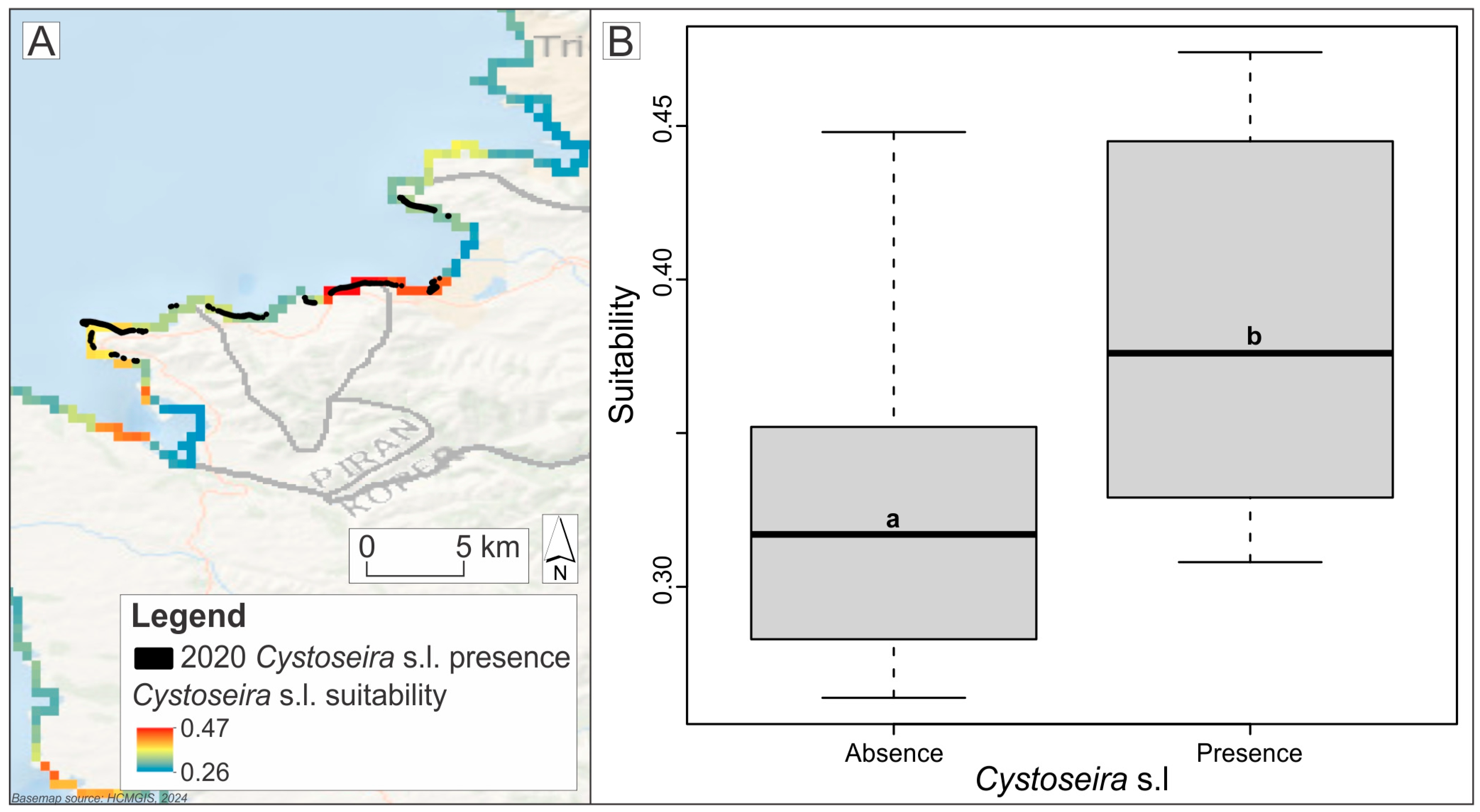
The 2020 mapping of benthic vegetation along the Slovenian coastline showed that the upper-infralittoral belt is overgrown with approximately 265.1 ha of benthic vegetation, of which seagrass meadows covered 204.9 ha. This survey also revealed clear spatial patterns in the distribution of brown algal forests. These assemblages covered nearly 26 ha (Figure 2A). Stands dominated by Cystoseira compressa were the most extensive and widespread, occupying approximately 17.4 ha. Areas where Gongolaria barbata (Stackhouse) Kuntze formed the dominant canopy covered about 8.1 ha. In contrast, forests dominated by Ericaria crinita (Duby) Molinari & Guiry were limited to 0.2 ha, and those characterized by Cystoseira corniculata (Turner) Zanardini to only 0.1 ha. Other macroalgal species commonly associated with these assemblages included Halopithys incurva (Hudson) Batters, Padina pavonica (Linnaeus) Thivy 1960, Halopteris scoparia (Linnaeus) Sauvageau, Dictyota dichotoma (Hudson) J.V.Lamouroux, and Corallina spp.
By comparing the used brown algal forest suitability scores with real presence/absence data along the Slovenian coastline (Figure 2A), spatial differences at this local level were clearly evident, considering that this product was developed for the Mediterranean scale and reached, in this part, suitability score values beyond the optimal cutoff of 0.61. Thus, the suitability scores were significantly lower (p < α; α = 0.05) in areas where Cystoseira s.l. communities were not developed (Figure 2B). Based on this validation, we proceeded to use the first Mediterranean Cystoseira s.l. continuous habitat suitability map to model potential change in brown algal forest suitability in the Adriatic Sea under several environmental/climate change scenarios.

3.2. Brown Algal Forest Suitability in the Adriatic Sea

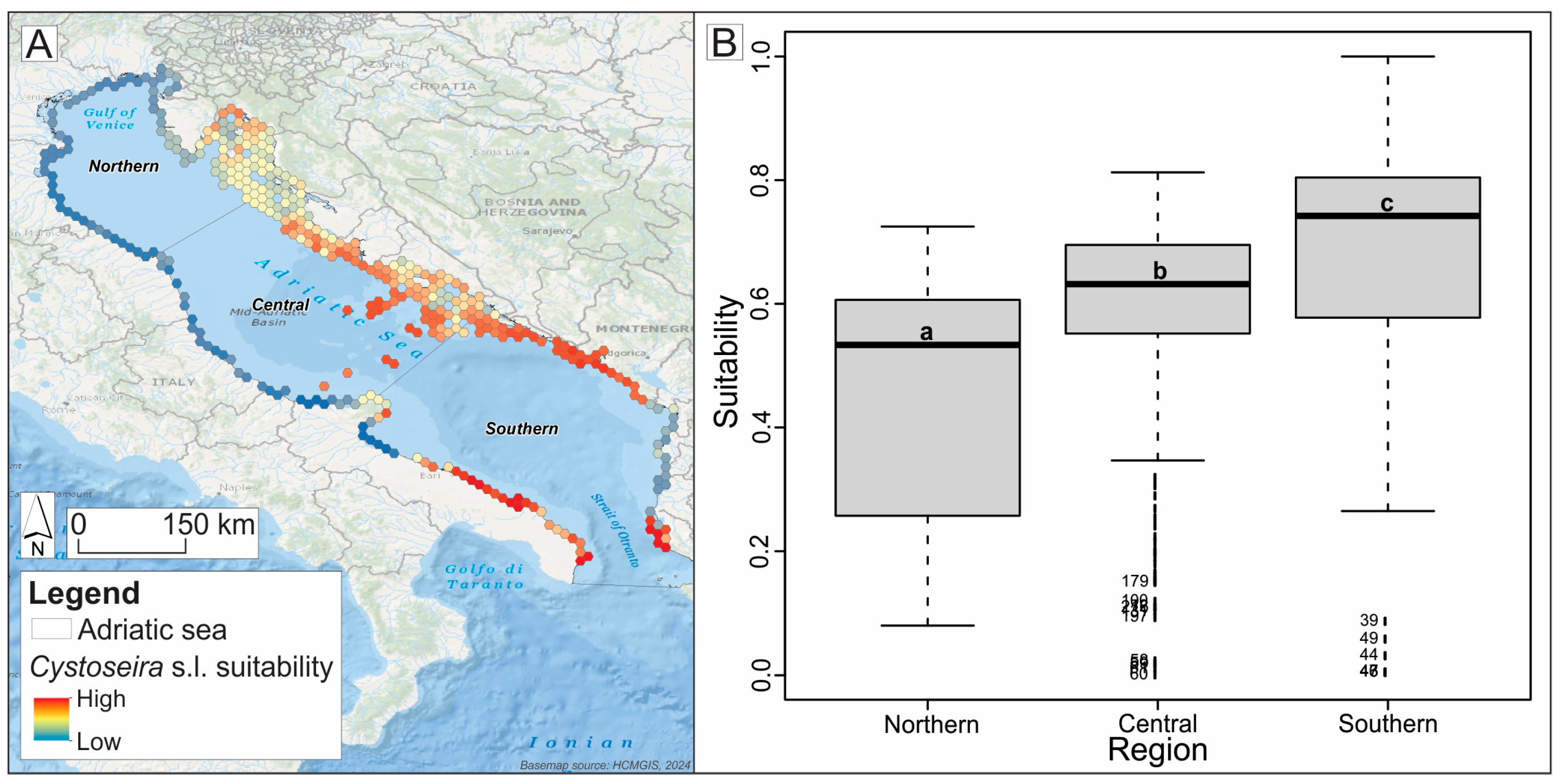
The spatial pattern of brown algal forest habitat suitability in the Adriatic Sea follows a latitudinal gradient (Figure 3A). The colder and shallower northern part reached significantly lower average suitability scores compared to the deeper and warmer central and southern parts. The Kruskal–Wallis post hoc test indicated that all three geographic units (northern, central, and southern parts) differ in brown algal forest habitat suitability (Figure 3B).
However, in the northern and central parts of the Adriatic Sea, high brown algal forest habitat suitability is predominately found in the eastern coastline, whereas in the southern part, both coastlines offer habitable conditions. The highest suitability scores were estimated along the south-eastern Italian coastline, along the southern coast of Albania, along the coastline of Montenegro, and along the southern coastline of the archipelago of Croatia. In the northern part of the Adriatic Sea, high habitat suitability for brown algal forests were estimated south of the Istrian peninsula in the Kvarner Gulf archipelago. Low suitability scores were estimated along the eastern Italian coastline (beginning in the region of Gargano) towards the Gulf of Trieste.

3.3. Predictor Correlation Matrix

Prior to modelling procedure, all acquired predictor variables (n = 53) were tested for potential intercorrelation to avoid informative power overlap. In Table 2, Spearman’s correlation coefficients for those predictor variables are listed (n = 13) that passed the filtering procedure (ρ > 0.6 or ρ < −0.6 and VIF < 5).
We made only one exception because the considered sea-level baseline variables (slr_2020_45_med_c and slr_2020_85_med_c) did reach a higher ρ score than the set threshold with the t_max predictor variable. However, both those predictors were/are temporally dynamic, and their spatial pattern might be similar from our spatial analysis perspective, but their informative power in predicting potential brown algal forest suitability shifts is most definitely unique and differs locally.

3.4. Model Comparison

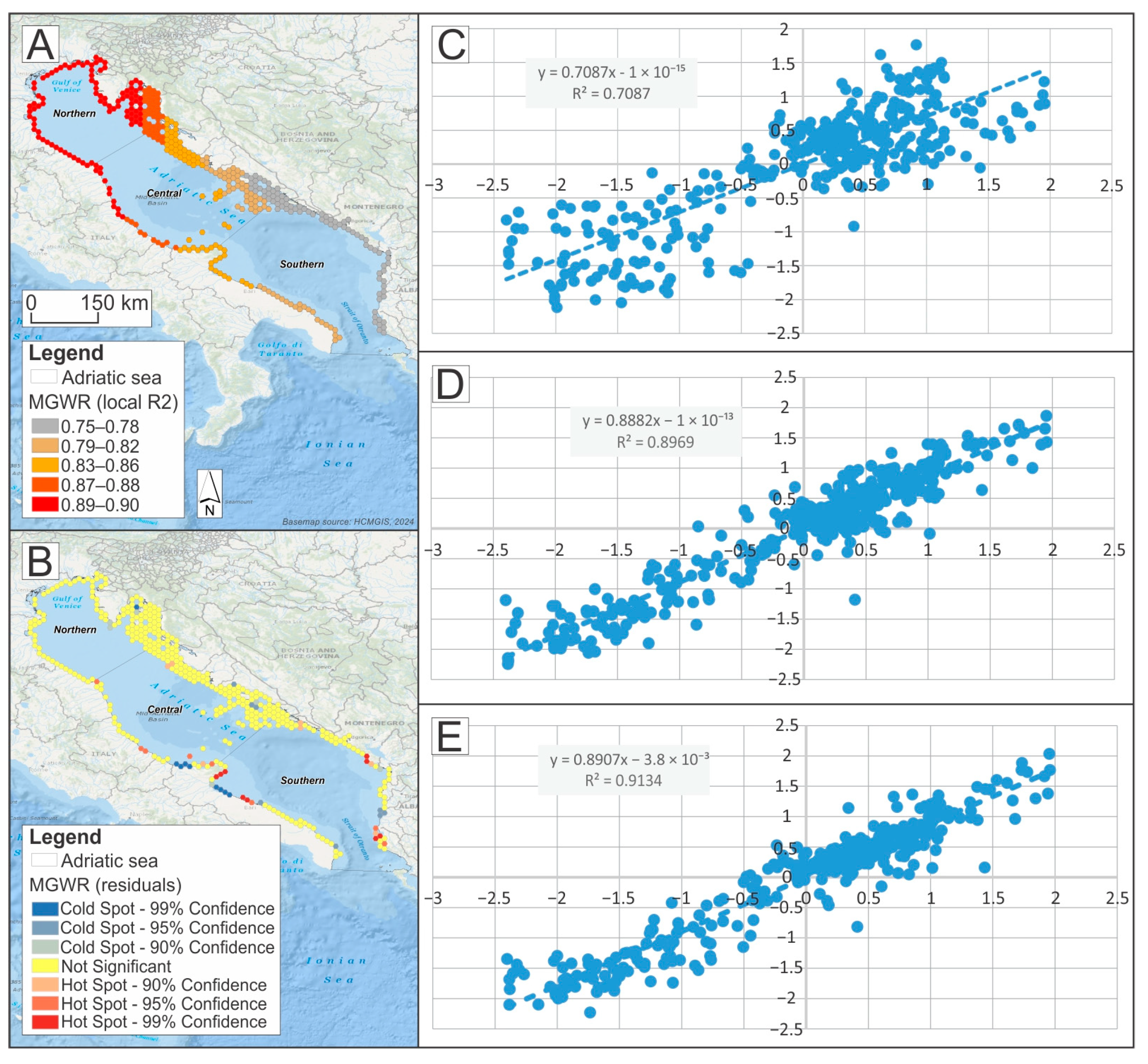
Three models were developed to evaluate potential spatial shifts in brown algal forest suitability in the Adriatic Sea. All were fitted with same predictor variables (Table 1) known for their direct, or in-direct, influence on brown algal forest spatial distribution in general. The GLM approach yielded the highest AICc (624.3) and BIC (682.9) values. Nine (9) predictors had statistically significant (p < α; α = 0.05) influence on the dependent variable (standardized mean Cystoseira s.l. canopies suitability) (Table 3). However, the simultaneously significant standardized residuals spatial autocorrelation test (Moran’s I = 0.031; p < α; α = 0.05) indicated clusters in several locations along the Adriatic Sea coastline in this case, which led us to the conclusion that the used predictor variables were lacking informative power in this modelling procedure. Thus, a GAMM was fitted in the next step to improve predictive power. Here, three predictor variables (ua_dis, p, and pH_min) had a significant linear relation with the dependent variable, whereas the remaining 10 predictors (coast_dis, river_dis, bat, mld, s, swd, swv, at_max, t_max, slr_med_con) indicated a significant non-linear behaviour (Table 4). The GAMM reached an adjR2 value of 0.88 and had a remarkably lower AICc (326.7) and BIC (556.5) values compared to the GLM approach. The GAMM algorithm produced less spatial clusters of (low and high) standardized residuals as well, thus additionally indicating modelling improvement. However, in the desire to prepare the best possible algorithm for evaluating potential brown algal forest spatial distribution development in the Adriatic Sea, a third modelling approach (MGWR), which relaxes the assumption that all the processes being modelled operate at the same spatial scale, was calibrated (Table 5). The fitted MGWR model thus reached the highest adjR2 value (0.90) and the lowest AICc (251.2) and BIC (453.6) values (Table 5).
Moreover, to visualize model performances, Figure 4C–E was created. By analyzing the relation between observed and predicted (standardized) values of the dependent variable, the relative model fit can be further assessed. Again, the MGWR modelling approach reached the highest determination coefficient, explaining 91% of variation (compared to GLMs 71% or GAMMs 89%). Despite high modelling performance values, the MGWR approach did not fully capture the current brown algal forests’ suitability spatial pattern in the entire study area. Some clustered over- and under-predictions were nevertheless present in the southern part of the Adriatic Sea, especially along the Italian eastern coastline, in the northern part of the Puglia region, and along the coast of Albania (Figure 4B). This directly indicates missing predictors or possibly local biotic factors.
The fact that our MGWR model predictions of current (average) brown algal forest suitability scores were the strongest in the northern part of the Adriatic Sea can be observed by mapping local R2 values (Figure 4A). The observed variation in R2 values, ranging between 0.75 and 0.90, provided an additional rationale for selecting the MGWR algorithm as the sole approach to predict potential shifts in brown algal forest suitability under several climate/environmental change scenarios.

3.5. Potential Brown Algal Forest Spatial Distribution Shifts

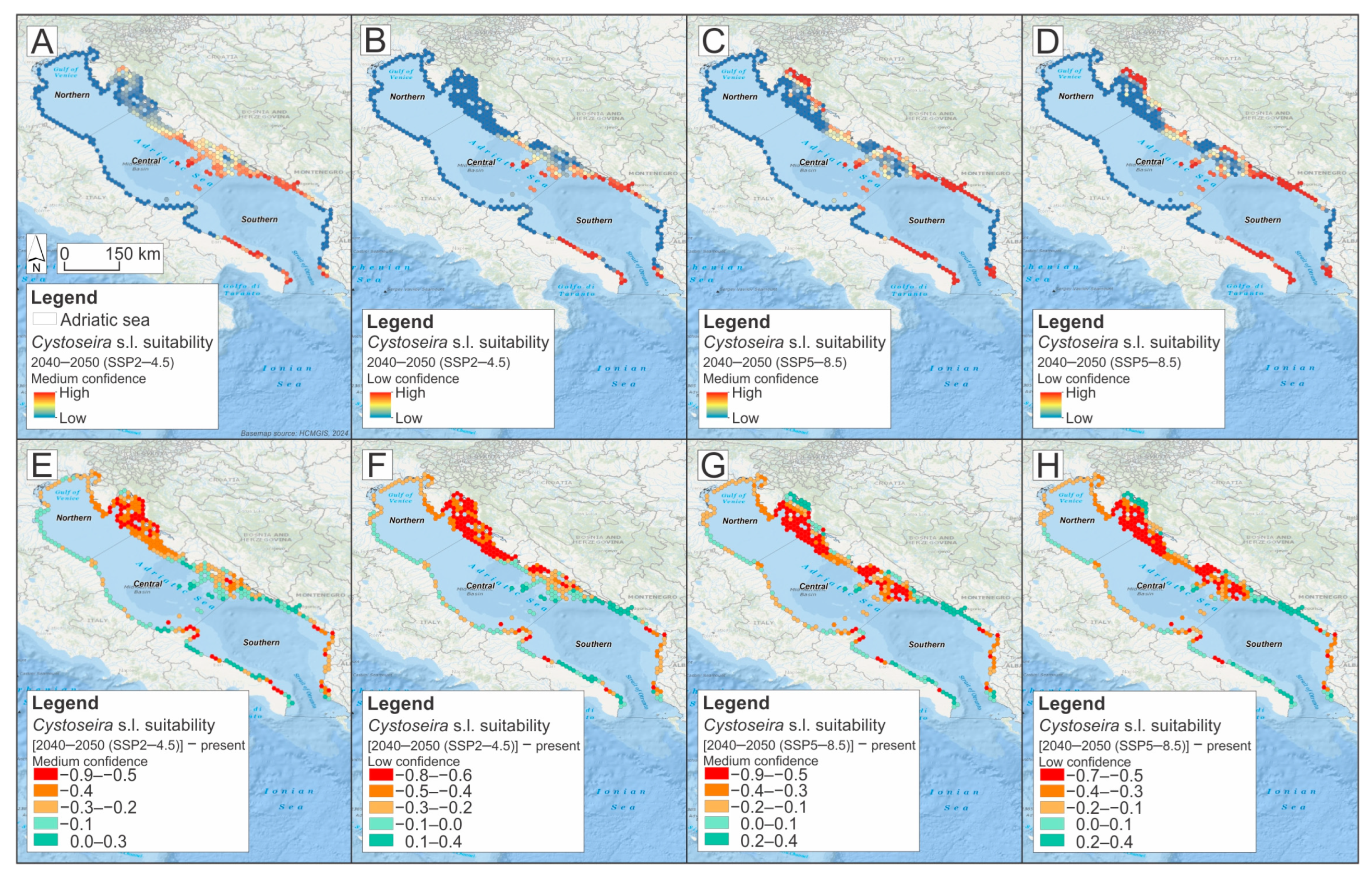
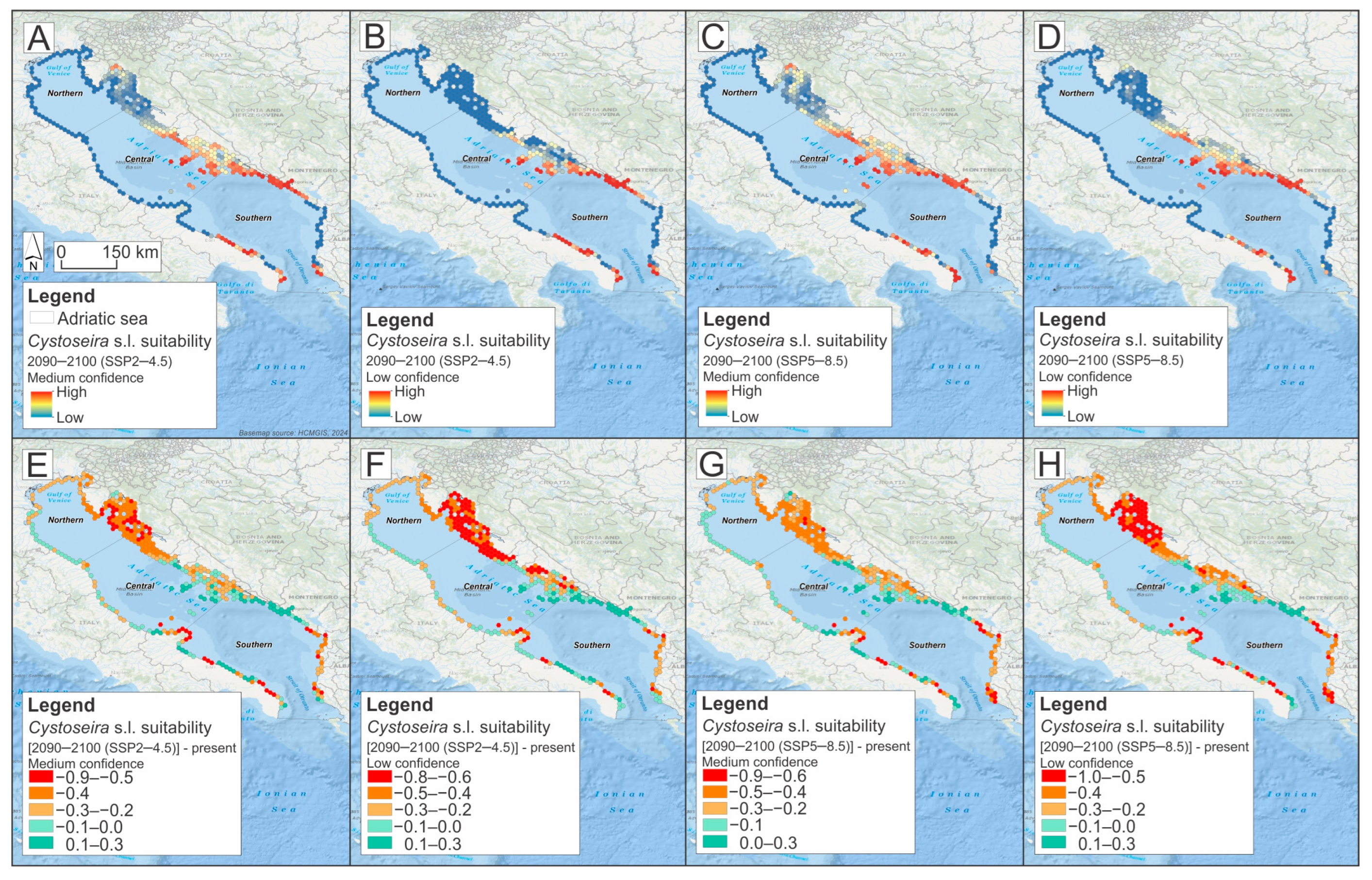
The MGWR algorithm fitted with spatio-temporary static and dynamic predictor variables produced average brown algal forest suitability scores for each hexagon unit along the Adriatic Sea coastline for the 2040–2050 and 2090–2100 time windows, the SSP2-4.5 and SSP5-8.5 emission scenarios, and the medium- and low-confidence relative sea-level rise scenarios (Figure 5A–H and Figure 6A–H).
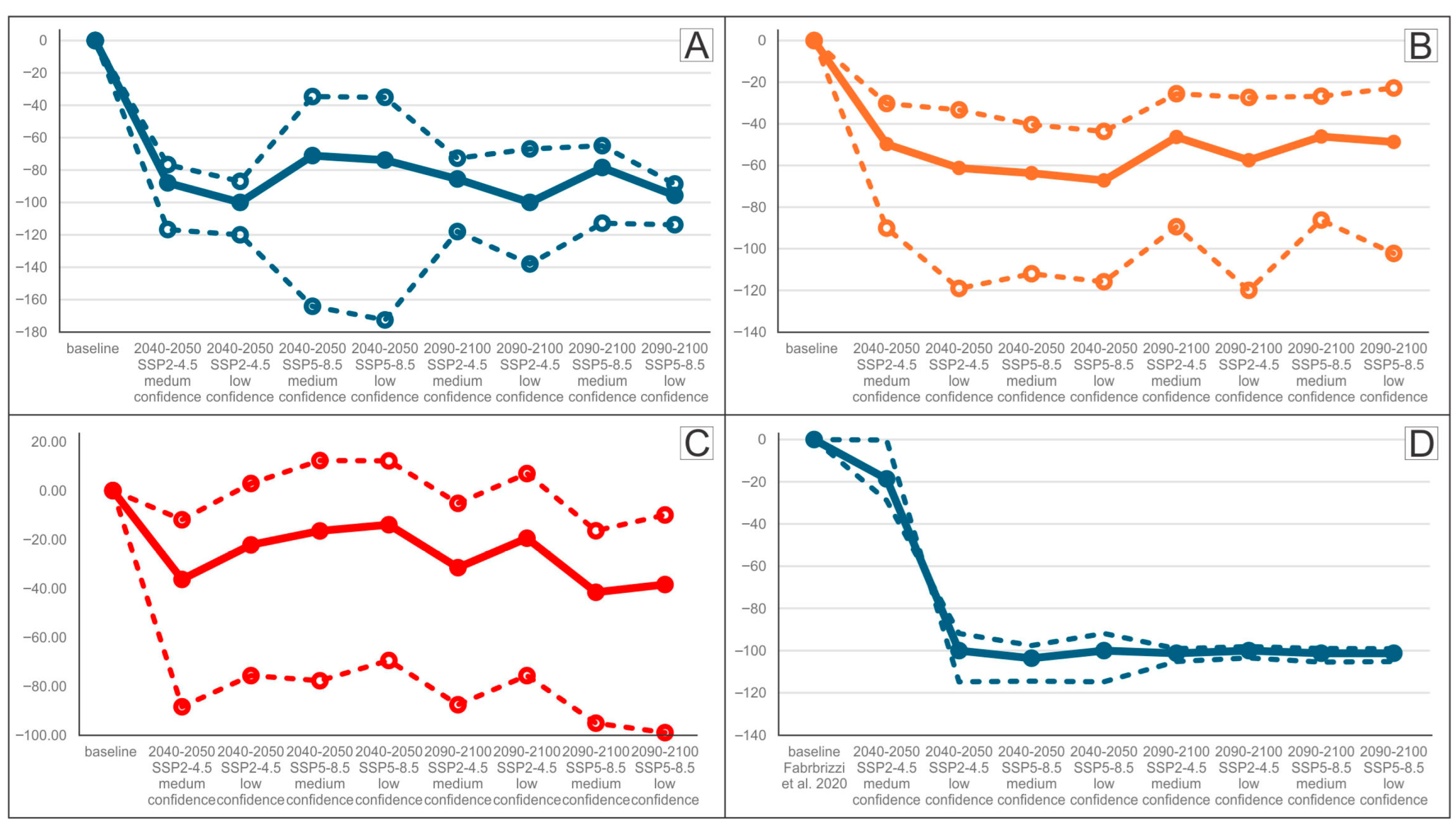
The SSP2-4.5 emission and low-confidence sea-level rise scenarios indicated a potential decrease (for −77 to −117% [−88% in average], Figure 7A) in brown algal forest average habitat suitability, especially in the northern part of the Adriatic Sea, already by 2040–2050. Moderate and high average suitability scores could then be expected in the central and southern part of the study area. However, in this scenario, there are some locations where average suitability scores for brown algal forest habitats are predicted to potentially improve (the most remote islands of Dalmatia, parts of the Montenegro coastline, and along the coastline of Apulia [Italy]). An even more intense negative spatial pattern habitat suitability shift in the northern part of the Adriatic Sea is predicted by considering the low-confidence sea-level rise scenario (from −87 to −120% [−100% in average]). The latter estimates there is a potential complete disappearance of suitable conditions for brown algal forests by 2040–2050.
According to the prediction, considering the pessimistic SSP5-8.5 emission scenario and the medium- and low-confidence sea-level rise scenarios for the time window 2040–2050, the most stable area for brown algal forests in the Adriatic Sea could be the southern part. Yet, in both predictions, conditions could potentially improve in the Kvarner Gulf (Croatia), in areas along the southern Croatian coastline, continuing to Bosnia and Montenegro, as well as along the Apulian coastline in Italy. However, from the whole central part perspective, overall suitability conditions for brown algal forests are expected to decrease (from −74 to −173% [−72% on average]) (Figure 7B).
By the end of the century (2090–2100), high average suitability for brown algal forests could potentially be expected only in the southern part of the Adriatic Sea, although still lower than our baseline year 2020 (ranging from −6 to −89%, with an average decline of −32%; Figure 7C), under both emission (SSP2-4.5 and SSP5-8.5) and sea-level rise confidence scenarios (medium and low). There, in some areas, suitable conditions for brown algal forests may even improve (green hexagons). Conversely, all predictions indicate that the northern (from −73 to −121%, averaging −90%) and most of the central (from −20 to −100%, averaging −50%) basins of the Adriatic Sea could almost completely lose their potential to host brown algal forests by the end of the century.
Regarding the Slovenian coastline, the average habitat suitability for brown algal forest is expected to decrease intensively already by 2040–2050 (Figure 7D) under three of the four considered emission and sea-level rise confidence scenarios. Only the combination of the SSP2-4.5 emission and medium sea-level rise confidence scenarios suggests a potential more gradual decrease, ranging from −20 to −29% (−19% on average) compared to the baseline reported by the Fabbrizzi et al. (2020) [2] baseline, of average brown algal forest habitat suitability. Unfortunately, all considered predictions are indicating a tipping point in habitat suitability by mid-century, beyond which recovery is unlikely.

4. Discussion

The results of this study highlight a clear biogeographical gradient and alarming future trajectory for Adriatic brown algal forests. Present-day habitat suitability follows a latitudinal pattern, with the shallow and semi-enclosed northern Adriatic having significantly lower suitability for canopy-forming algae than the deeper central and southern regions. In our 2020 field survey of the Slovenian coast—at the Adriatic’s northernmost tip—we found smaller brown algal forests (~26 ha total) dominated by the less sensitive and more widespread Cystoseira compressa (17.4 ha) and Gongolaria barbata (8.1 ha), with negligible cover of more sensitive species like Ericaria crinita (~0.2 ha). This underscores that northern sites already represent a “collapse zone” for several canopy-forming species, likely the outcome of cumulative local stressors documented over the past decades [22,35,37,67,94]. These findings align with Mediterranean-wide observations that healthy Cystoseira s.l. forests persist primarily in less impacted locations, often in areas of high water quality and widespread suitable substrata [2,26].
Critically, our projections indicate that regional differences will become more pronounced in the coming decades. Under mid-21st century conditions, even a moderate climate scenario (SSP2-4.5 with low-end sea-level rise) predicts steep declines in brown algal habitat suitability, especially in the northern Adriatic, with average suitability values decreasing by approximately 88% relative to present-day conditions. This magnitude of change reflects a marked reduction in the environmental suitability required to sustain canopy-forming Cystoseira forests, rather than a direct estimate of areal forest loss. In practical terms, such low suitability scores indicate that large portions of the northern Adriatic would fall below thresholds compatible with the persistence or recovery of brown algal forests, even if local remnants currently remain. By the end of the century, both intermediate- and high-emission scenarios suggest that most of the northern Adriatic and substantial parts of the central basin may lose the capacity to support Cystoseira forests altogether, implying a high risk of functional habitat collapse. Additionally, three out of four tested scenario combinations indicate that the Slovenian coastal sea—which still hosted healthy brown algal forests in 2020—will reach a tipping point of irretrievable habitat loss by mid-century. Only under the most optimistic combination of moderate emissions and lower sea-level rise might the decline in Slovenian marine waters be somewhat gradual (≈20% reduction by 2050), but even that scenario points toward continual degradation thereafter. The highest present-day suitability in our models occurs along the southern and eastern Adriatic coasts—e.g., the south-eastern Italian (Apulian) shores, Montenegro, southern Albania, and the offshore Croatian archipelagos—which coincide with known hotspots of extant macroalgal forest diversity and cover [43]. However, by the end of the 21st century, our projections converge on a further contraction of suitable brown algal forest habitats: high habitat suitability is expected to persist only in the far south, and even there at levels 30–90% lower than present. But even a 30–50% reduction in suitability could translate into more patchy forests and local extirpations of the more thermally sensitive species. A contraction to only southern sites would shrink the biogeographic range of Adriatic Cystoseira s.l. forests, potentially eliminating unique genotypes adapted to the northern conditions [95]. The extinction of these edge populations would reduce the overall genetic diversity and adaptive capacity of the species complex, as well as break the connectivity between Mediterranean populations [53]. Our model outcomes paint a sobering picture of latitudinal retraction—essentially a climate-driven range collapse from north to south—consistent with global observations of warming-induced shifts in marine foundation species [54,55]. Ecologically, the implications of these distribution shifts are profound. Cystoseira s.l. algal forests are biodiversity hotspots, and the local declines we observe in the northern Adriatic already correspond with impoverished associated communities [5,10,11]. This pattern mirrors broader Mediterranean trends: widespread Cystoseira s.l. declines over past decades have left fragmented, isolated populations and, in some areas, complete local extinctions [31,34,96].
From a methodological standpoint, the use of a Multiscale Geographically Weighted Regression (MGWR) model was pivotal in capturing the spatially heterogeneous drivers underlying these patterns. By allowing coefficients to vary geographically, the MGWR approach accommodated the notion that environmental processes influencing Cystoseira s.l. distribution operate at different spatial scales across the Adriatic. This yielded a markedly improved fit (adjR2 ≈ 0.90) compared to a traditional GLM (adjR2 ≈ 0.71) or even a GAMM with mixed linear and non-linear terms (adjR2 ≈ 0.88). In practical terms, MGWR not only increased overall predictive accuracy but also unveiled local patterns that the global models obscured. For instance, our MGWR’s local R2 mapping showed that the model explained the spatial pattern of Cystoseira s.l. habitat suitability best in the northern Adriatic (up to ~90% of variability) and slightly less so in parts of the south. This likely reflects the strong, spatially consistent relationship between certain predictors (e.g., coastal urbanization or water clarity) and algal forest presence in the north, versus more complex or unmeasured influences in the south (where pockets of over- or under-prediction persisted). The presence of clustered residuals along the southern Italian and Albanian coasts in our MGWR outputs is telling—it suggests that additional factors (perhaps localized herbivory pressure, unaccounted water quality issues, or biotic interactions) influence suitability there, highlighting directions for future data collection. Nonetheless, the MGWR’s superior performance—lowest AICc and BIC, highest explained variance—demonstrates the value of moving beyond classical global models in spatial ecology. Traditional GLMs in our case suffered from significant spatial autocorrelation in residuals, indicating that important spatially variable drivers were missing. The GAMM improved on this by incorporating non-linear responses (for 10 out of 13 predictors) and random effects, reducing but not eliminating spatial clustering of errors (under- or over-predictions). MGWR, by comparison, effectively “built in” a spatially explicit structure, capturing fine-scale variations—for example, it could adjust the influence of maximum sea temperature or pH in one subregion independently of another. For ecologically complex coastlines like the Adriatic, this flexibility is indispensable. It recognizes that, say, distance to river mouths (a proxy for nutrient and sediment input) may strongly limit Cystoseira s.l. in one locality but be less relevant elsewhere, or that tolerance to thermal maxima may differ between northern and southern populations. By calibrating such nuances, MGWR provided more credible forecasts of habitat suitability under future scenarios. This methodological advance is significant for marine habitat modelling broadly: as calls grow for more spatially explicit predictions of climate change impacts on biodiversity, tools like MGWR offer a means to integrate multiscale processes and improve predictive power [39]. We note, however, that even MGWR is only as good as the input data—the remaining unexplained variability pinpoints the need to incorporate biotic factors (e.g., grazers or competitors) and higher-resolution oceanographic data in future models. Our approach thus illustrates both the promise and the challenges of cutting-edge spatial modelling in marine ecology, advocating for its broader application while underscoring that careful validation (e.g., with local surveys like our 2020 Slovenian dataset) is essential to ensure realism in model outputs.
The implications of our results resonate with urgent policy and conservation challenges in the Adriatic and the wider Mediterranean. Under the EU MSFD, Member States have to achieve Good Environmental Status of their marine waters, which implicitly includes the “health” of coastal habitats such as macroalgal forests. Our projected losses of brown algal forests in the northern Adriatic therefore raise alarm bells for MSFD assessments: if these key habitats disappear, the associated community degradation will likely compromise the status evaluation according to multiple MSFD descriptors (D1 biodiversity, D4 food webs, D6 seafloor integrity). To counter these trends, both immediate protection and adaptive restoration efforts are needed [97]. Reducing local stressors (such as coastal pollution and construction activities, high sedimentation rates, and overgrazing) can strengthen the resilience of remaining brown algal forests [44,47]. Continuous monitoring programmes and an improved management framework are essential to adjust strategies as conditions evolve [98]. Developing a coordinated observing system for marine macroalgae [38], combining field surveys and remote sensing [69], is also crucial to track the changes that our model predicts and to detect early warning signs of local declines or recoveries. The relevance of these findings is further reinforced by the EU Nature Restoration Law (EU Regulation 2024/1991) [99], which sets legally binding targets to restore at least 20% of degraded ecosystems by 2030 and all ecosystems in need of restoration by 2050. Within this framework, our spatially explicit model outputs offer a practical decision-support tool for restoration planning by identifying areas where environmental conditions are projected to remain suitable for brown algal forests under future climate scenarios. For example, parts of the southern Adriatic that consistently retain higher habitat suitability in our projections may represent priority areas for conservation and restoration planning, as they are expected to maintain suitable environmental conditions over the coming decades. Conversely, northern Adriatic areas projected to fall below suitability thresholds may require more intensive management interventions or may not represent sustainable restoration targets under high-emission scenarios [14]. Our results therefore indicate that the restoration of Cystoseira s.l. forests in climate-sensitive northern regions must be coupled with both local pressure mitigation and realistic climate projections; otherwise, restoration gains are likely to be short-lived and vulnerable to rapid reversal [46,62,92].
In conclusion, our integrated approach, combining high-resolution local surveys with advanced spatial modelling, reveals the gravity of the predicted distribution of brown algal forests under climate change. Without intervention, we are likely to witness a significant contraction of these algal forests toward the few remaining favourable pockets, with a concomitant loss of biodiversity and ecosystem function in vast areas that historically housed these habitats. Methodologically, we demonstrate that tools like MGWR can greatly enhance our understanding of spatial ecological processes and thus inform more nuanced management decisions—a step change over conventional modelling techniques in predicting fine-scale habitat shifts. From a policy perspective, meeting international conservation and restoration commitments will require urgent, innovative efforts to bolster these underwater forests now, in the narrow window, before climate impacts become irreversible. Integrating model-based foresight into these efforts and with strong conservation and restoration activities could tip the balance in favour of these crucial ecosystems. Trying to protect and preserve brown algal forests in the Adriatic Sea in the face of climate change will test our ability to integrate science, conservation policy, and field actions. However, local conservation actions can only delay declines, whereas global climate mitigation is essential to ensure long-term persistence.

Author Contributions

Conceptualization D.I., M.O.-B., L.L., and D.D.; methodology, D.I., M.O.-B., L.L., and D.D.; validation, D.I., L.L., D.T., B.M., V.P., A.F., A.L., M.O.-B., and D.D.; formal analysis, M.O.-B., D.D., and D.I.; investigation, M.O.-B., B.M., and L.L.; resources, D.I., L.L., M.Š., and M.O.-B.; data curation, D.I., D.D., and M.O.-B.; writing—original draft preparation, M.O.-B., D.I., D.D., and L.L.; writing—review and editing, D.D., D.I., L.L., D.T., B.M., V.P., M.Š., A.F., A.L., and M.O.-B.; visualization, D.D., D.I., and M.O.-B. All authors have read and agreed to the published version of the manuscript.

Funding

This research was funded by the Slovenian Research and Innovation Agency, grant numbers P1-0237 (Coastal Sea Research) and P6-0372 (Slovene identity and cultural awareness in linguistic and ethnic contact areas in past and present), research projects J1-1702 (Factors affecting Adriatic brown algal forests and solutions for habitat restoration) and J6-60107 (Scientific Discovery and Scientific Justification: A Coherentist Perspective), and the project “Development of Research Infrastructure for the International Competitiveness of the Slovenian RRI Space—RI-SI-LifeWatch”, co-financed by the Republic of Slovenia, Ministry of Education, Science and Sport and the European Union from the European Regional Development Fund.

Data Availability Statement

The raw data supporting the conclusions of this article will be made available by the authors on request.

Acknowledgments

Special thanks are due to Tihomir Makovec, Leon Lojze Zamuda, and Simone Spinelli for their invaluable collaboration during brown algal forest monitoring and cartography in the Slovenian coastal sea.

Conflicts of Interest

The authors declare no conflicts of interest. The funders had no role in the design of the study; in the collection, analyses, or interpretation of data; in the writing of the manuscript; or in the decision to publish the results.

References

  1. Bringloe, T.T.; Starko, S.; Wade, R.M.; Vieira, C.; Kawai, H.; De Clerck, O.; Cock, J.M.; Coelho, S.M.; Destombe, C.; Valero, M.; et al. Phylogeny and Evolution of the Brown Algae. Crit. Rev. Plant Sci. 2020, 39, 281–321. [Google Scholar] [CrossRef]
  2. Fabbrizzi, E.; Scardi, M.; Ballesteros, E.; Benedetti-Cecchi, L.; Cebrian, E.; Ceccherelli, G.; De Leo, F.; Deidun, A.; Guarnieri, G.; Falace, A.; et al. Modeling Macroalgal Forest Distribution at Mediterranean Scale: Present Status, Drivers of Changes and Insights for Conservation and Management. Front. Mar. Sci. 2020, 7, 20. [Google Scholar] [CrossRef]
  3. Bonaca, M.O.; Lipej, L. Factors Affecting Habitat Occupancy of Fish Assemblage in the Gulf of Trieste (Northern Adriatic Sea). Mar. Ecol. 2005, 26, 42–53. [Google Scholar] [CrossRef]
  4. Mačić, V.; Svirčev, Z. Macroepiphytes on Cystoseira Species (Phaeophyceae) on the Coast of Montenegro. Fresenius Environ. Bull. 2014, 23, 29–34. [Google Scholar]
  5. Pitacco, V.; Orlando-Bonaca, M.; Mavrič, B.; Popović, A.; Lipej, L. Mollusc Fauna Associated with the Cystoseira Algal Associations in the Gulf of Trieste (Northern Adriatic Sea). Medit. Mar. Sci. 2014, 15, 225–238. [Google Scholar] [CrossRef]
  6. Piazzi, L.; Bonaviri, C.; Castelli, A.; Ceccherelli, G.; Costa, G.; Curini-Galletti, M.; Langeneck, J.; Manconi, R.; Montefalcone, M.; Pipitone, C.; et al. Biodiversity in Canopy-Forming Algae: Structure and Spatial Variability of the Mediterranean Cystoseira Assemblages. Estuar. Coast. Shelf Sci. 2018, 207, 132–141. [Google Scholar] [CrossRef]
  7. Cheminée, A.; Sala, E.; Pastor, J.; Bodilis, P.; Thiriet, P.; Mangialajo, L.; Cottalorda, J.-M.; Francour, P. Nursery Value of Cystoseira Forests for Mediterranean Rocky Reef Fishes. J. Exp. Mar. Biol. Ecol. 2013, 442, 70–79. [Google Scholar] [CrossRef]
  8. Bianchelli, S.; Danovaro, R. Impairment of Microbial and Meiofaunal Ecosystem Functions Linked to Algal Forest Loss. Sci. Rep. 2020, 10, 19970. [Google Scholar] [CrossRef] [PubMed]
  9. Mancuso, F.P.; Milazzo, M.; Chemello, R. Decreasing in Patch-Size of Cystoseira Forests Reduces the Diversity of Their Associated Molluscan Assemblage in Mediterranean Rocky Reefs. Estuar. Coast. Shelf Sci. 2021, 250, 107163. [Google Scholar] [CrossRef]
  10. Orlando-Bonaca, M.; Trkov, D.; Klun, K.; Pitacco, V. Diversity of Molluscan Assemblage in Relation to Biotic and Abiotic Variables in Brown Algal Forests. Plants 2022, 11, 2131. [Google Scholar] [CrossRef]
  11. Lipej, L.; Ivajnšič, D.; Pitacco, V.; Trkov, D.; Mavrič, B.; Orlando-Bonaca, M. Coastal Fish Fauna in the Cystoseira s.l. Algal Belts: Experiences from the Northern Adriatic Sea. J. Mar. Sci. Eng. 2023, 11, 888. [Google Scholar] [CrossRef]
  12. Peleg, O.; Guy-Haim, T.; Yeruham, E.; Silverman, J.; Rilov, G. Tropicalization May Invert Trophic State and Carbon Budget of Shallow Temperate Rocky Reefs. J. Ecol. 2020, 108, 844–854. [Google Scholar] [CrossRef]
  13. Lewis, P.H.; Roberts, B.P.; Moore, P.J.; Pike, S.; Scarth, A.; Medcalf, K.; Cameron, I. Combining Unmanned Aerial Vehicles and Satellite Imagery to Quantify Areal Extent of Intertidal Brown Canopy-forming Macroalgae. Remote Sens. Ecol. Conserv. 2023, 9, 540–552. [Google Scholar] [CrossRef]
  14. Fabbrizzi, E.; Giakoumi, S.; De Leo, F.; Tamburello, L.; Chiarore, A.; Colletti, A.; Coppola, M.; Munari, M.; Musco, L.; Rindi, F. The Challenge of Setting Restoration Targets for Macroalgal Forests under Climate Changes. J. Environ. Manag. 2023, 326, 116834. [Google Scholar] [CrossRef]
  15. Mancuso, F.P.; Sarà, G.; Mannino, A.M. Diversity and Distribution of Intertidal Cystoseira Sensu Lato Species Across Protection Zones in a Mediterranean Marine Protected Area. Plants 2024, 13, 3562. [Google Scholar] [CrossRef]
  16. Bruno de Sousa, C.; Gangadhar, K.N.; Macridachis, J.; Pavão, M.; Morais, T.R.; Campino, L.; Varela, J.; Lago, J.H.G. Cystoseira Algae (Fucaceae): Update on Their Chemical Entities and Biological Activities. Tetrahedron Asymmetry 2017, 28, 1486–1505. [Google Scholar] [CrossRef]
  17. De La Fuente, G.; Fontana, M.; Asnaghi, V.; Chiantore, M.; Mirata, S.; Salis, A.; Damonte, G.; Scarfì, S. The Remarkable Antioxidant and Anti-Inflammatory Potential of the Extracts of the Brown Alga Cystoseira Amentacea Var. Stricta. Mar. Drugs 2020, 19, 2. [Google Scholar] [CrossRef]
  18. Mannino, A.M.; Micheli, C. Ecological Function of Phenolic Compounds from Mediterranean Fucoid Algae and Seagrasses: An Overview on the Genus Cystoseira Sensu Lato and Posidonia Oceanica (L.) Delile. J. Mar. Sci. Eng. 2020, 8, 19. [Google Scholar] [CrossRef]
  19. Orfanidis, S.; Panayotidis, P.; Stamatis, N. Ecological Evaluation of Transitional and Coastal Waters: A Marine Benthic Macrophytes-Based Model. Mediterr. Mar. Sci. 2001, 2, 45–66. [Google Scholar] [CrossRef]
  20. Orfanidis, S.; Panayotidis, P.; Ugland, K. Ecological Evaluation Index Continuous Formula (EEI-c) Application: A Step Forward for Functional Groups, the Formula and Reference Condition Values. Mediterr. Mar. Sci. 2011, 12, 199–232. [Google Scholar] [CrossRef]
  21. Orlando-Bonaca, M.; Lipej, L.; Orfanidis, S. Benthic Macrophytes as a Tool for Delineating, Monitoring and Assessing Ecological Status: The Case of Slovenian Coastal Waters. Mar. Pollut. Bull. 2008, 56, 666–676. [Google Scholar] [CrossRef]
  22. Orlando-Bonaca, M.; Pitacco, V.; Lipej, L. Loss of Canopy-Forming Algal Richness and Coverage in the Northern Adriatic Sea. Ecol. Indic. 2021, 125, 107501. [Google Scholar] [CrossRef]
  23. Iveša, L.; Djakovac, T.; Devescovi, M. Long-Term Fluctuations in Cystoseira Populations along the West Istrian Coast (Croatia) Related to Eutrophication Patterns in the Northern Adriatic Sea. Mar. Pollut. Bull. 2016, 106, 162–173. [Google Scholar] [CrossRef]
  24. United Nations Environment Programme (UNEP). Convention for the Protection of the Marine Environment and the Coastal Region of the Mediterranean and Its Protocols 2019; United Nations Environment Programme (UNEP): Nairobi, Kenya, 2019. [Google Scholar]
  25. Council of Europe. Convention on the Conservation of European Wildlife and Natural Habitats (Bern Convention); Council of Europe: Bern, Switzerland, 1979; Entered into Force 1 June 1982. Available online: https://www.coe.int/en/web/bern-convention (accessed on 10 January 2026).
  26. Verdura, J.; Rehues, L.; Mangialajo, L.; Fraschetti, S.; Belattmania, Z.; Bianchelli, S.; Blanfuné, A.; Sabour, B.; Chiarore, A.; Danovaro, R.; et al. Distribution, Health and Threats to Mediterranean Macroalgal Forests: Defining the Baselines for Their Conservation and Restoration. Front. Mar. Sci. 2023, 10, 1258842. [Google Scholar] [CrossRef]
  27. Airoldi, L.; Beck, M.W. Loss, Status and Trends for Coastal Marine Habitats of Europe. Oceanogr. Mar. Biol. 2007, 45, 345–405. [Google Scholar]
  28. Mangialajo, L.; Chiantore, M.; Cattaneo-Vietti, R. Loss of Fucoid Algae along a Gradient of Urbanisation, and Structure of Benthic Assemblages. Mar. Ecol. Prog. Ser. 2008, 358, 63–74. [Google Scholar] [CrossRef]
  29. Airoldi, L.; Bulleri, F. Anthropogenic Disturbance Can Determine the Magnitude of Opportunistic Species Responses on Marine Urban Infrastructures. PLoS ONE 2011, 6, e22985. [Google Scholar] [CrossRef]
  30. Airoldi, L.; Ballesteros, E.; Buonuomo, R.; Van Belzen, J.; Bouma, T.J.; Cebrian, E.; De Clerk, O.; Engelen, A.H.; Ferrario, F.; Fraschetti, S. Marine Forests at Risk: Solutions to Halt the Loss and Promote the Recovery of Mediterranean Canopy-Forming Seaweeds. In Proceedings of the 5th Mediterranean Symposium on Marine Vegetation, Slovenia, Portorož, 27–28 October 2014; pp. 28–33. [Google Scholar]
  31. Thibaut, T.; Blanfuné, A.; Boudouresque, C.-F.; Verlaque, M. Decline and Local Extinction of Fucales in the French Riviera: The Harbinger of Future Extinctions? Mediterr. Mar. Sci. 2015, 16, 206–224. [Google Scholar] [CrossRef]
  32. Rindi, L.; Dal Bello, M.; Benedetti-Cecchi, L. Experimental Evidence of Spatial Signatures of Approaching Regime Shifts in Macroalgal Canopies. Ecology 2018, 99, 1709–1715. [Google Scholar] [CrossRef] [PubMed]
  33. Orfanidis, S.; Rindi, F.; Cebrian, E.; Fraschetti, S.; Nasto, I.; Taskin, E.; Bianchelli, S.; Papathanasiou, V.; Kosmidou, M.; Caragnano, A.; et al. Effects of Natural and Anthropogenic Stressors on Fucalean Brown Seaweeds Across Different Spatial Scales in the Mediterranean Sea. Front. Mar. Sci. 2021, 8, 658417. [Google Scholar] [CrossRef]
  34. Blanfuné, A.; Boudouresque, C.-F.; Verlaque, M.; Thibaut, T. Severe Decline of Gongolaria Barbata (Fucales) along Most of the French Mediterranean Coast. Sci. Rep. 2025, 15, 5701. [Google Scholar] [CrossRef]
  35. Orlando-Bonaca, M.; Rotter, A. Any Signs of Replacement of Canopy-Forming Algae by Turf-Forming Algae in the Northern Adriatic Sea? Ecol. Indic. 2018, 87, 272–284. [Google Scholar] [CrossRef]
  36. Iveša, L. Effects of Increased Seawater Temperature and Benthic Mucilage Formation on Shallow Cystoseira Forests of the West Istrian Coast (Northern Adriatic Sea). Eur. J. Phycol. 2019, 54, 1–27. [Google Scholar] [CrossRef]
  37. Falace, A.; Alongi, G.; Orlando-Bonaca, M.; Bevilacqua, S. Species Loss and Decline in Taxonomic Diversity of Macroalgae in the Gulf of Trieste (Northern Adriatic Sea) over the Last Six Decades. Mar. Environ. Res. 2024, 202, 106828. [Google Scholar] [CrossRef] [PubMed]
  38. Duffy, J.E.; Benedetti-Cecchi, L.; Trinanes, J.; Muller-Karger, F.E.; Ambo-Rappe, R.; Boström, C.; Buschmann, A.H.; Byrnes, J.; Coles, R.G.; Creed, J.; et al. Toward a Coordinated Global Observing System for Seagrasses and Marine Macroalgae. Front. Mar. Sci. 2019, 6, 317. [Google Scholar] [CrossRef]
  39. Hassoun, A.E.R.; Mojtahid, M.; Merheb, M.; Lionello, P.; Gattuso, J.-P.; Cramer, W. Climate Change Risks on Key Open Marine and Coastal Mediterranean Ecosystems. Sci. Rep. 2025, 15, 24907. [Google Scholar] [CrossRef]
  40. Airoldi, L.; Balata, D.; Beck, M.W. The Gray Zone: Relationships between Habitat Loss and Marine Diversity and Their Applications in Conservation. J. Exp. Mar. Biol. Ecol. 2008, 366, 8–15. [Google Scholar] [CrossRef]
  41. Perkol-Finkel, S.; Airoldi, L. Loss and Recovery Potential of Marine Habitats: An Experimental Study of Factors Maintaining Resilience in Subtidal Algal Forests at the Adriatic Sea. PLoS ONE 2010, 5, e10791. [Google Scholar] [CrossRef] [PubMed]
  42. Connell, S.D.; Foster, M.S.; Airoldi, L. What Are Algal Turfs? Towards a Better Description of Turfs. Mar. Ecol. Prog. Ser. 2014, 495, 299–307. [Google Scholar] [CrossRef]
  43. Nikolić, V.; Žuljević, A.; Mangialajo, L.; Antolić, B.; Kušpilić, G.; Ballesteros, E. Cartography of Littoral Rocky-Shore Communities (CARLIT) as a Tool for Ecological Quality Assessment of Coastal Waters in the Eastern Adriatic Sea. Ecol. Indic. 2013, 34, 87–93. [Google Scholar] [CrossRef]
  44. Gianni, F.; Bartolini, F.; Pey, A.; Laurent, M.; Martins, G.M.; Airoldi, L.; Mangialajo, L. Threats to Large Brown Algal Forests in Temperate Seas: The Overlooked Role of Native Herbivorous Fish. Sci. Rep. 2017, 7, 6012. [Google Scholar] [CrossRef]
  45. Orlando-Bonaca, M.; Pitacco, V.; Slavinec, P.; Šiško, M.; Makovec, T.; Falace, A. First Restoration Experiment for Gongolaria Barbata in Slovenian Coastal Waters. What Can Go Wrong? Plants 2021, 10, 239. [Google Scholar] [CrossRef] [PubMed]
  46. Savonitto, G.; De La Fuente, G.; Tordoni, E.; Ciriaco, S.; Srijemsi, M.; Bacaro, G.; Chiantore, M.; Falace, A. Addressing Reproductive Stochasticity and Grazing Impacts in the Restoration of a Canopy-forming Brown Alga by Implementing Mitigation Solutions. Aquat. Conserv. 2021, 31, 1611–1623. [Google Scholar] [CrossRef]
  47. Airoldi, L. The Effects of Sedimentation on Rocky Coast Assemblages. In Oceanography and Marine Biology; CRC Press: Boca Raton, FL, USA, 2003; pp. 169–171. [Google Scholar]
  48. Savonitto, G.; Alongi, G.; Falace, A. Reproductive Phenology, Zygote Embryology and Germling Development of the Threatened Carpodesmia Barbatula (=Cystoseira Barbatula) (Fucales, Phaeophyta) towards Its Possible Restoration. Webbia 2019, 74, 317–323. [Google Scholar] [CrossRef]
  49. Bevilacqua, S.; Savonitto, G.; Lipizer, M.; Mancuso, P.; Ciriaco, S.; Srijemsi, M.; Falace, A. Climatic Anomalies May Create a Long-lasting Ecological Phase Shift by Altering the Reproduction of a Foundation Species. Ecology 2019, 100, e02838. [Google Scholar] [CrossRef]
  50. Verdura, J.; Santamaría, J.; Ballesteros, E.; Smale, D.A.; Cefalì, M.E.; Golo, R.; De Caralt, S.; Vergés, A.; Cebrian, E. Local-scale Climatic Refugia Offer Sanctuary for a Habitat-forming Species during a Marine Heatwave. J. Ecol. 2021, 109, 1758–1773. [Google Scholar] [CrossRef]
  51. Gouvêa, L.P.; Schubert, N.; Martins, C.D.L.; Sissini, M.; Ramlov, F.; Rodrigues, E.R.D.O.; Bastos, E.O.; Freire, V.C.; Maraschin, M.; Carlos Simonassi, J.; et al. Interactive Effects of Marine Heatwaves and Eutrophication on the Ecophysiology of a Widespread and Ecologically Important Macroalga. Limnol. Oceanogr. 2017, 62, 2056–2075. [Google Scholar] [CrossRef]
  52. De Bettignies, T.; Wernberg, T.; Gurgel, C.F.D. Exploring the Influence of Temperature on Aspects of the Reproductive Phenology of Temperate Seaweeds. Front. Mar. Sci. 2018, 5, 218. [Google Scholar] [CrossRef]
  53. Buonomo, R.; Chefaoui, R.M.; Lacida, R.B.; Engelen, A.H.; Serrão, E.A.; Airoldi, L. Predicted Extinction of Unique Genetic Diversity in Marine Forests of Cystoseira spp. Mar. Environ. Res. 2018, 138, 119–128. [Google Scholar] [CrossRef]
  54. Vergés, A.; Doropoulos, C.; Malcolm, H.A.; Skye, M.; Garcia-Pizá, M.; Marzinelli, E.M.; Campbell, A.H.; Ballesteros, E.; Hoey, A.S.; Vila-Concejo, A.; et al. Long-Term Empirical Evidence of Ocean Warming Leading to Tropicalization of Fish Communities, Increased Herbivory, and Loss of Kelp. Proc. Natl. Acad. Sci. USA 2016, 113, 13791–13796. [Google Scholar] [CrossRef]
  55. Wernberg, T.; Bennett, S.; Babcock, R.C.; De Bettignies, T.; Cure, K.; Depczynski, M.; Dufois, F.; Fromont, J.; Fulton, C.J.; Hovey, R.K.; et al. Climate-Driven Regime Shift of a Temperate Marine Ecosystem. Science 2016, 353, 169–172. [Google Scholar] [CrossRef]
  56. Vergés, A.; Steinberg, P.D.; Hay, M.E.; Poore, A.G.B.; Campbell, A.H.; Ballesteros, E.; Heck, K.L.; Booth, D.J.; Coleman, M.A.; Feary, D.A.; et al. The Tropicalization of Temperate Marine Ecosystems: Climate-Mediated Changes in Herbivory and Community Phase Shifts. Proc. R. Soc. B 2014, 281, 20140846. [Google Scholar] [CrossRef]
  57. Straub, S.C.; Wernberg, T.; Thomsen, M.S.; Moore, P.J.; Burrows, M.T.; Harvey, B.P.; Smale, D.A. Resistance, Extinction, and Everything in Between—The Diverse Responses of Seaweeds to Marine Heatwaves. Front. Mar. Sci. 2019, 6, 763. [Google Scholar] [CrossRef]
  58. Smale, D.A.; Burrows, M.T.; Moore, P.; O’Connor, N.; Hawkins, S.J. Threats and Knowledge Gaps for Ecosystem Services Provided by Kelp Forests: A Northeast Atlantic Perspective. Ecol. Evol. 2013, 3, 4016–4038. [Google Scholar] [CrossRef] [PubMed]
  59. Falace, A.; Kaleb, S.; De La Fuente, G.; Asnaghi, V.; Chiantore, M. Ex Situ Cultivation Protocol for Cystoseira Amentacea Var. Stricta (Fucales, Phaeophyceae) from a Restoration Perspective. PLoS ONE 2018, 13, e0193011. [Google Scholar] [CrossRef] [PubMed]
  60. Lokovšek, A.; Orlando-Bonaca, M.; Gljušćić, E.; Bilajac, A.; Iveša, L.; Di Cave, A.; Savio, S.; Ortenzi, F.; Trkov, D.; Congestri, R.; et al. Enhancing Ex Situ Cultivation of Mediterranean Fucales: Species-Specific Responses of Gongolaria Barbata and Ericaria Crinita Seedlings to Algal Extracts. Mar. Environ. Res. 2025, 211, 107411. [Google Scholar] [CrossRef] [PubMed]
  61. Verdura, J.; Sales, M.; Ballesteros, E.; Cefalì, M.E.; Cebrian, E. Restoration of a Canopy-Forming Alga Based on Recruitment Enhancement: Methods and Long-Term Success Assessment. Front. Plant Sci. 2018, 9, 1832. [Google Scholar] [CrossRef]
  62. De La Fuente, G.; Chiantore, M.; Asnaghi, V.; Kaleb, S.; Falace, A. First Ex Situ Outplanting of the Habitat-Forming Seaweed Cystoseira Amentacea Var. Stricta from a Restoration Perspective. PeerJ 2019, 7, e7290. [Google Scholar] [CrossRef]
  63. Medrano, A.; Hereu, B.; Cleminson, M.; Pagès-Escolà, M.; Rovira, G.; Solà, J.; Linares, C. From Marine Deserts to Algal Beds: Treptacantha Elegans Revegetation to Reverse Stable Degraded Ecosystems inside and Outside a No-Take Marine Reserve. Restor. Ecol. 2020, 28, 632–644. [Google Scholar] [CrossRef]
  64. Orlando-Bonaca, M.; Savonitto, G.; Asnaghi, V.; Trkov, D.; Pitacco, V.; Šiško, M.; Makovec, T.; Slavinec, P.; Lokovšek, A.; Ciriaco, S.; et al. Where and How—New Insight for Brown Algal Forest Restoration in the Adriatic. Front. Mar. Sci. 2022, 9, 988584. [Google Scholar] [CrossRef]
  65. Lokovšek, A.; Pitacco, V.; Trkov, D.; Zamuda, L.L.; Falace, A.; Orlando-Bonaca, M. Keep It Simple: Improving the Ex Situ Culture of Cystoseira s.l. to Restore Macroalgal Forests. Plants 2023, 12, 2615. [Google Scholar] [CrossRef]
  66. Smith, C.J.; Verdura, J.; Papadopoulou, N.; Fraschetti, S.; Cebrian, E.; Fabbrizzi, E.; Monserrat, M.; Drake, M.; Bianchelli, S.; Danovaro, R.; et al. A Decision-Support Framework for the Restoration of Cystoseira Sensu Lato Forests. Front. Mar. Sci. 2023, 10, 1159262. [Google Scholar] [CrossRef]
  67. Iveša, L.; Bilajac, A.; Gljušćić, E.; Najdek, M. Gongolaria Barbata Forest in the Shallow Lagoon on the Southern Istrian Coast (Northern Adriatic Sea). Bot. Mar. 2022, 65, 255–268. [Google Scholar] [CrossRef]
  68. Bordoni, F. Integrating Benthic Habitat Mapping for Macroalgal Forest Monitoring in the Mediterranean. Ocean. Coast. Manag. 2025, 290, 106785. [Google Scholar]
  69. Poursanidis, D.; Katsanevakis, S. Mapping Subtidal Marine Forests in the Mediterranean Sea Using Copernicus Contributing Mission. Remote Sens. 2025, 17, 2398. [Google Scholar] [CrossRef]
  70. Fragkopoulou, E.; Serrão, E.A.; De Clerck, O.; Costello, M.J.; Araújo, M.B.; Duarte, C.M.; Krause-Jensen, D.; Assis, J. Global Biodiversity Patterns of Marine Forests of Brown Macroalgae. Glob. Ecol. Biogeogr. 2022, 31, 636–648. [Google Scholar] [CrossRef]
  71. Boicourt, W.C.; Ličer, M.; Li, M.; Vodopivec, M.; Malačič, V. Sea State: Recent Progress in the Context of Climate Change. In Coastal Ecosystems in Transition: A Comparative Analysis of the Northern Adriatic and Chesapeake Bay; Geophysical Monograph Series; Malone, T.C., Malej, A., Faganeli, J., Eds.; Wiley: Hoboken, NJ, USA, 2021; pp. 21–48. ISBN 978-1-119-54358-9. [Google Scholar]
  72. Artegiani, A.; Paschini, E.; Russo, A.; Bregant, D.; Raicich, F.; Pinardi, N. The Adriatic Sea General Circulation. Part I: Air–Sea Interactions and Water Mass Structure. J. Phys. Oceanogr. 1997, 27, 1492–1514. [Google Scholar] [CrossRef]
  73. Orlic, M.; Gacic, M.; Laviolette, P.E. The Currents and Circulation of the Adriatic Sea. Oceanol. Acta 1992, 15, 109–124. [Google Scholar]
  74. Conversi, A.; Peluso, T.; Fonda-Umani, S. Gulf of Trieste: A Changing Ecosystem. J. Geophys. Res. 2009, 114, 2008JC004763. [Google Scholar] [CrossRef]
  75. Malačič, V.; Petelin, B. Climatic Circulation in the Gulf of Trieste (Northern Adriatic). J. Geophys. Res. 2009, 114, 2008JC004904. [Google Scholar] [CrossRef]
  76. Malej, A.; Malacic, V. Factors Affecting Bottom Layer Oxygen Depletion in the Gulf of Trieste (Adriatic Sea). Ann. An. Istrske Mediter. Stud. (Hist. Nat.) 1995, 6, 33–42. [Google Scholar]
  77. Ličer, M.; Smerkol, P.; Fettich, A.; Ravdas, M.; Papapostolou, A.; Mantziafou, A.; Strajnar, B.; Cedilnik, J.; Jeromel, M.; Jerman, J.; et al. Modeling the Ocean and Atmosphere during an Extreme Bora Event in Northern Adriatic Using One-Way and Two-Way Atmosphere–Ocean Coupling. Ocean Sci. 2016, 12, 71–86. [Google Scholar] [CrossRef]
  78. Da Costa, V.S.; Alessandri, J.; Verri, G.; Mentaschi, L.; Guerra, R.; Pinardi, N. Marine Climate Indicators in the Adriatic Sea. Front. Clim. 2024, 6, 1449633. [Google Scholar] [CrossRef]
  79. Ballesteros, E.; Torras, X.; Pinedo, S.; García, M.; Mangialajo, L.; De Torres, M. A New Methodology Based on Littoral Community Cartography Dominated by Macroalgae for the Implementation of the European Water Framework Directive. Mar. Pollut. Bull. 2007, 55, 172–180. [Google Scholar] [CrossRef]
  80. QGIS Development Team. QGIS Geographic Information System. 2024. Available online: https://www.qgis.org/ (accessed on 10 August 2025).
  81. Assis, J.; Fernández Bejarano, S.J.; Salazar, V.W.; Schepers, L.; Gouvêa, L.; Fragkopoulou, E.; Leclercq, F.; Vanhoorne, B.; Tyberghein, L.; Serrão, E.A.; et al. Bio-ORACLE v3.0. Pushing Marine Data Layers to the CMIP6 Earth System Models of Climate Change Research. Glob. Ecol. Biogeogr. 2024, 33, e13813. [Google Scholar] [CrossRef]
  82. Garner, G.G.; Hermans, T.; Kopp, R.E.; Slangen, A.B.A.; Edwards, T.L.; Levermann, A.; Nowicki, S.; Palmer, M.D.; Smith, C.; Fox-Kemper, B.; et al. IPCC AR6 Sea Level Projections 2021. Available online: https://zenodo.org/records/5914710 (accessed on 10 August 2025).
  83. Fox-Kemper, B.; Hewitt, C.; Xiao, G.; Aðalgeirsdóttir, S.S.; Drijfhout, T.L.; Edwards, N.R.; Golledge, M.; Hemer, R.E.; Kopp, G.; Krinner, A.; et al. Ocean, Cryosphere and Sea Level Change; Climate Change 2021: The Physical Science Basis. Contribution of Working Group I to the Sixth Assessment Report of the Intergovernmental Panel on Climate Change, 1st ed.; Cambridge University Press: Cambridge, UK; New York, NY, USA, 2023; ISBN 978-1-009-15789-6. [Google Scholar]
  84. Kopp, R.E.; Garner, G.G.; Hermans, T.H.J.; Jha, S.; Kumar, P.; Reedy, A.; Slangen, A.B.A.; Turilli, M.; Edwards, T.L.; Gregory, J.M.; et al. The Framework for Assessing Changes To Sea-Level (FACTS) v1.0: A Platform for Characterizing Parametric and Structural Uncertainty in Future Global, Relative, and Extreme Sea-Level Change. Geosci. Model. Dev. 2023, 16, 7461–7489. [Google Scholar] [CrossRef]
  85. Land Copernicus CORINE Land Cover. Available online: https://land.copernicus.eu/en/products/corine-land-cover (accessed on 15 April 2025).
  86. R Development Core Team R: A Language and Environment for Statistical Computing 2025. Available online: https://www.r-project.org (accessed on 10 July 2025).
  87. Fox, J.; Marquez, M.M.; Bouchet-Vala, M. Rcmdr: R Commander. R Package Version 2.9-5 2024. Available online: https://cran.r-project.org/web/packages/Rcmdr/Rcmdr.pdf (accessed on 10 July 2025).
  88. Salmerón-Gómez, R.; García-García, C.B.; García-Pérez, J. A Redefined Variance Inflation Factor: Overcoming the Limitations of the Variance Inflation Factor. Comput. Econ. 2025, 65, 337–363. [Google Scholar] [CrossRef]
  89. Bio-ORACLE consortium BioORACLE. Available online: https://www.bio-oracle.org/ (accessed on 15 April 2025).
  90. NASA. IPCC Sea Level Projection Tool. Available online: https://sealevel.nasa.gov/ipcc-ar6-sea-level-projection-tool (accessed on 3 March 2025).
  91. Oshan, T.; Li, Z.; Kang, W.; Wolf, L.; Fotheringham, A. Mgwr: A Python Implementation of Multiscale Geographically Weighted Regression for Investigating Process Spatial Heterogeneity and Scale. ISPRS Int. J. Geo-Inf. 2019, 8, 269. [Google Scholar] [CrossRef]
  92. Fotheringham, A.S.; Oshan, T.M.; Li, Z. Multiscale Geographically Weighted Regression: Theory and Practice; CRC Press: Boca Raton, FL, USA, 2023; ISBN 1-003-43546-7. [Google Scholar]
  93. Oxoli, D.; Prestifilippo, G.; Bertocchi, D. Enabling Spatial Autocorrelation Mapping in QGIS: The Hotspot Analysis Plugin. Geoing. Ambient. E Mineraria (GEAM) 2017, 151, 45–50. [Google Scholar]
  94. Falace, A.; Alongi, G.; Cormaci, M.; Furnari, G.; Curiel, D.; Cecere, E.; Petrocelli, A. Changes in the Benthic Algae along the Adriatic Sea in the Last Three Decades. Chem. Ecol. 2010, 26, 77–90. [Google Scholar] [CrossRef]
  95. Falace, A.; Manfrin, C.; Furnari, G.; D’Ambros Burchio, S.; Pallavicini, A.; Descourvieres, E.; Kaleb, S.; Lokovšek, A.; Grech, D.; Alongi, G. Contribution to the Knowledge of Gongolaria Barbata (Sargassaceae, Fucales) from the Mediterranean: Insights into Infraspecific Diversity. Phytotaxa 2024, 635, 191–205. [Google Scholar] [CrossRef]
  96. Cebrian, E.; Tamburello, L.; Verdura, J.; Guarnieri, G.; Medrano, A.; Linares, C.; Hereu, B.; Garrabou, J.; Cerrano, C.; Galobart, C.; et al. A Roadmap for the Restoration of Mediterranean Macroalgal Forests. Front. Mar. Sci. 2021, 8, 709219. [Google Scholar] [CrossRef]
  97. Lokovšek, A.; Pitacco, V.; Falace, A.; Trkov, D.; Orlando-Bonaca, M. Too Hot to Handle: Effects of Water Temperature on the Early Life Stages of Gongolaria Barbata (Fucales). J. Mar. Sci. Eng. 2024, 12, 514. [Google Scholar] [CrossRef]
  98. Aurelle, D.; Thomas, S.; Albert, C.; Bally, M.; Bondeau, A.; Boudouresque, C.; Cahill, A.E.; Carlotti, F.; Chenuil, A.; Cramer, W.; et al. Biodiversity, Climate Change, and Adaptation in the Mediterranean. Ecosphere 2022, 13, e3915. [Google Scholar] [CrossRef]
  99. European Parliament EU Regulation 2024/1991 of the European Parliament and of the Council of 24 June 2024 on Nature Restoration and Amending Regulation (EU) 2022/869 2024. Available online: https://eur-lex.europa.eu/eli/reg/2024/1991/oj/eng (accessed on 10 July 2025).
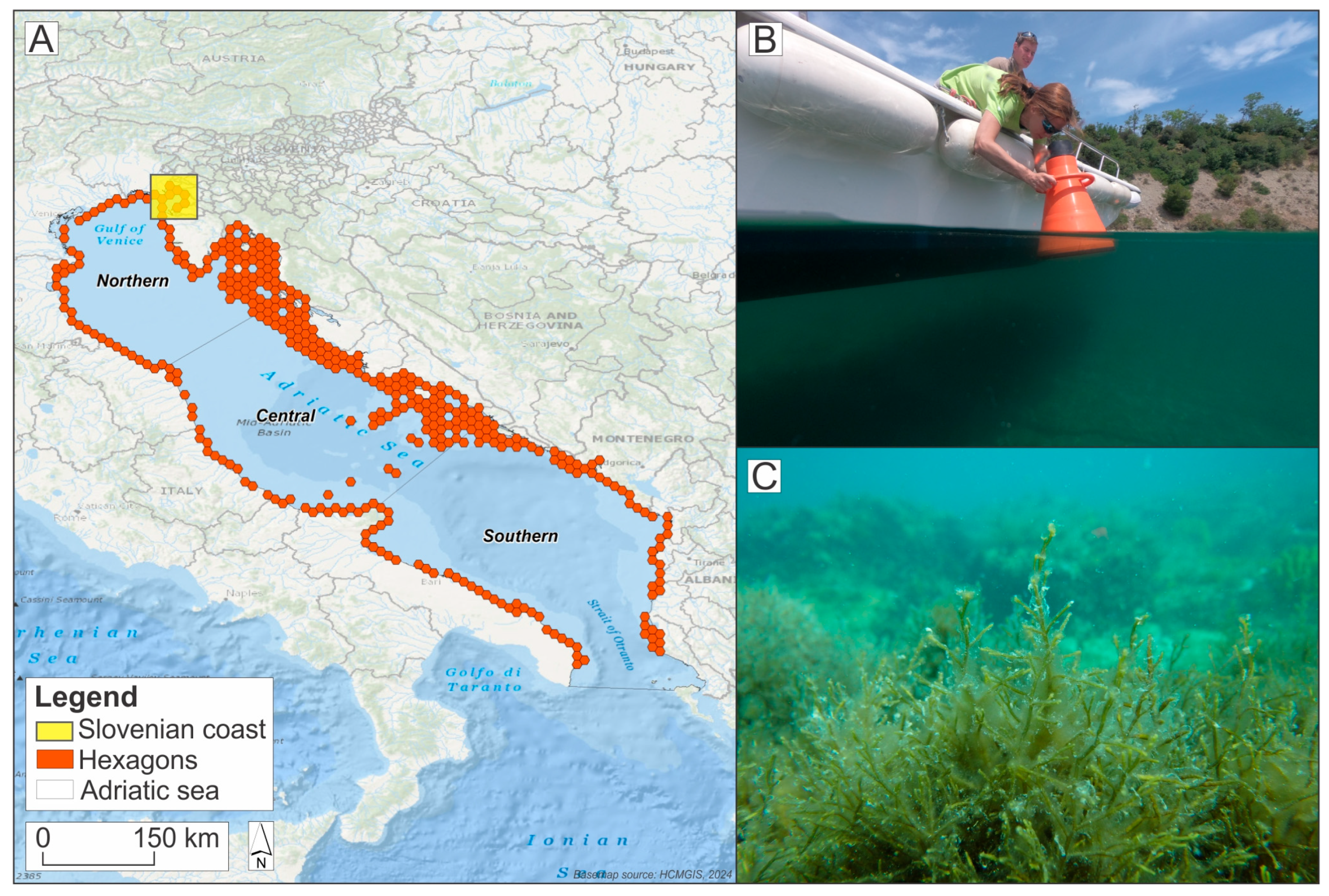
Figure 1. The geographic position of both study areas. The Slovenian coastline and the Adriatic Sea coastline with sub-basins and the corresponding spatial unit, adapted to the lowest-resolution predictor variable in our analysis (hexagons; area = 8660 ha) (A), the mapping procedure along the Slovenian coastline (B), and Cystoseira s.l. stands (C).
Jmse 14 00196 g001
Figure 2. Cystoseira s.l. species suitability scores (red = high, blue = low) along the Slovenian coastline, overlaid with our field mapping results (A), and significant differences (p < α; α = 0.05) in habitat suitability scores between Cystoseira s.l. presence and absence localities (B).
Jmse 14 00196 g002
Figure 3. The spatial pattern of the dependent variable (average Cystoseira s.l. species suitability) (A), with significant regional differences (p < α; α = 0.05) (B).
Jmse 14 00196 g003
Figure 4. MGWR local R2 values (A), cold (blue; under-predictions) and hot (red; over-predictions) spots (B), and model validation scatter plots ((C) = GLM, (D) = GAMM, (E) = MGWR).
Jmse 14 00196 g004
Figure 5. Predicted average Cystoseira s.l. habitat suitability for the 2040–2050 time window (AD) and the corresponding difference maps (EH).
Jmse 14 00196 g005
Figure 6. Predicted average Cystoseira s.l. habitat suitability for the 2090–2100 time window (AD) and the corresponding difference maps (EH).
Jmse 14 00196 g006
Figure 7. Average growth rates (bold lines) with standard deviations (dotted lines) (in %) for Cystoseira s.l. habitat suitability in the northern (A), central (B), and southern (C) parts of the Adriatic Sea and along the Slovenian coastline (D) according to all considered time windows, SSP, and sea-level rise confidence scenarios.
Jmse 14 00196 g007
Table 1. Summary of the selected predictor variables for the potential brown algal forest (Cystoseira s.l. canopies) suitability shifts modelling in the Adriatic Sea.
NVariable NameSpatial ResolutionSourceAbbreviated Name
1Euclidean distance from urban land0.05 DDDerived from Copernicus CLC2018 [85]; processed in QGIS [80]ua_dis
2Euclidean distance from coastcoast_dis
3Euclidean distance from riverriver_dis
4Maximum ocean/sea temperature [°C]BIOORACLE, 2025 [89]t_max
5Sea water velocity [m·s−1]swv
6Sea water direction [degree]swd
7Silicate [mmol·m−3]s
8Mixed layer depth [m]mld
9Bathymetry [m]bat
10Maximum air temperature [°C]at_max
11Minimum pHph_min
12Phosphate [mmol·m−3]p
13aMedium confidence sea level, SSP2-4.5, 20200.25 DDNASA, 2025 [90]slr_2020_45_med_c
13bMedium confidence sea level, SSP5-8.5, 2020slr_2020_85_med_c
Table 2. Spearman’s correlation coefficient values for selected predictor variables.
Variableslr_2020_45_med_cslr_2020_85_med_ccoast_disat_maxbatmldpph_minsswdswvt_maxriver_disua_dis
slr_2020_45_med_c1.000.960.160.600.10−0.14−0.35−0.36−0.550.090.250.820.00−0.04
slr_2020_85_med_c0.961.000.200.530.04−0.05−0.41−0.53−0.600.210.180.78−0.01−0.07
coast_dis0.160.201.000.21−0.410.15−0.06−0.15−0.190.170.060.100.040.15
at_max0.600.530.211.00−0.110.07−0.28−0.07−0.44−0.150.180.590.150.13
bat0.100.04−0.41−0.111.00−0.590.150.350.32−0.250.180.16−0.22−0.26
mld−0.14−0.050.150.07−0.591.00−0.36−0.55−0.430.25−0.41−0.180.270.27
p−0.35−0.41−0.06−0.280.15−0.361.000.530.51−0.020.20−0.41−0.19−0.08
ph_min−0.36−0.53−0.15−0.070.35−0.550.531.000.60−0.470.38−0.210.08−0.01
s−0.55−0.60−0.19−0.440.32−0.430.510.601.00−0.420.32−0.440.16−0.10
swd0.090.210.17−0.15−0.250.25−0.02−0.47−0.421.00−0.21−0.07−0.160.11
swv0.250.180.060.180.18−0.410.200.380.32−0.211.000.180.35−0.15
t_max0.820.780.100.590.16−0.18−0.41−0.21−0.44−0.070.181.00−0.030.01
river_dis0.00−0.010.040.15−0.220.27−0.190.080.16−0.160.35−0.031.000.07
ua_dis−0.04−0.070.150.13−0.260.27−0.08−0.01−0.100.11−0.150.010.071.00
Table 3. Summary of the GLM.
GLM CoefficientsEstimateStd. Errort ValuePr(>|t|)
(Intercept)0.0000.0290.0001.000
Z.slr_2020_45_med_c0.0390.0710.5455.864 × 10−1
Z.ua_dis0.0280.0330.8364.037 × 10−1
Z.coast_dis−0.0700.034−2.0564.052 × 10−2*
Z.river_dis0.1260.0373.4296.760 × 10−4***
Z.p0.3700.0764.8781.620 × 10−6***
Z.ph_min−0.4780.082−5.8141.360 × 10−8***
Z.at_max0.0050.0440.1229.028 × 10−1
Z.bat−0.0480.045−1.0762.825 × 10−1
Z.mld0.4330.0587.4278.230 × 10−13***
Z.s−0.2190.051−4.2692.520 × 10−5***
Z.swd0.1350.0373.6772.730 × 10−4***
Z.swv0.1150.0392.9293.622 × 10−3**
Z.t_max−0.4190.055−7.6292.170 × 10−13***
Null deviance370.000on 370 degrees of freedom
Residual deviance107.780on 357 degrees of freedom
AIC624.240
Significance levels: * p < 0.05; ** p < 0.01; *** p < 0.001.
Table 4. Summary of the GAMM.
Parametric CoefficientsEstimateStd. Errort ValuePr(>|t|)
(Intercept)0.0000.0180.0001.000
Z.ua_dis0.0580.0262.2062.811 × 10−2*
Z.p0.2460.0633.8981.190 × 10−4***
Z.ph_min−0.3880.071−5.4928.250 × 10−8***
Approximate significance of smoothed termsedfRef.dfFp-value
s(Z.slr_2020_45_med_c)5.696.933.322.143 × 10−3**
s(Z.coast_dis)8.138.778.382.000 × 10−16***
s(Z.river_dis)7.868.658.242.000 × 10−16***
s(Z.at_max)6.757.883.644.840 × 10−4***
s(Z.bat)1.752.176.649.990 × 10−4***
s(Z.mld)6.897.9910.132.000 × 10−16***
s(Z.s)8.088.7415.192.000 × 10−16***
s(Z.swd)6.557.644.505.870 × 10−5***
s(Z.swv)1.001.0037.852.000 × 10−16***
s(Z.t_max)1.001.0035.572.000 × 10−16***
adjR20.878
Deviance explained89.70%
GCV0.14431
Scale est.0.12187
n371
Significance levels: * p < 0.05; ** p < 0.01; *** p < 0.001.
Table 5. Summary of the MGWR model.
Diagnostic Information MGWR Model
Residual sum of squares32.349
Effective number of parameters (trace(S))50.704
Degree of freedom (n-trace(S))320.296
Sigma estimate0.318
Log-likelihood−73.878
Degree of Dependency (DoD)0.770
AIC251.164
AICc268.286
BIC453.647
R20.913
adjR20.899
MGWR bandwidths
VariableBandwidthENP_jAdj t-val (95%)DoD_j
ua_dis60.00012.4462.8950.574
coast_dis370.0001.1412.0230.978
river_dis370.0001.1802.0370.972
t_max370.0001.0802.0000.987
swv355.0001.2902.0740.957
swd367.0001.2942.0750.956
s169.0002.1642.2810.870
mld57.00010.5792.8420.601
bat370.0001.3392.0900.951
at_max48.00012.1472.8870.578
ph_min370.0001.0882.0020.986
p367.0001.0531.9890.991
slr_2020_45_med_c120.0003.9032.5010.770
Monte Carlo Test for Spatial Variability
Variablep-value
ua_dis0.000***
coast_dis0.985
river_dis0.932
t_max0.923
swv0.655
swd0.523
s0.000***
mld0.000***
bat0.604
at_max0.000***
ph_min0.103
p0.003**
slr_2020_45_med_c0.000***
Significance levels: ** p < 0.01; *** p < 0.001.
Disclaimer/Publisher’s Note: The statements, opinions and data contained in all publications are solely those of the individual author(s) and contributor(s) and not of MDPI and/or the editor(s). MDPI and/or the editor(s) disclaim responsibility for any injury to people or property resulting from any ideas, methods, instructions or products referred to in the content.