Atmospheric Deposition of Multi-Class Substances into the Ocean: Synthesis of Fluxes, Seasonal Spatial Patterns and Ecological Risks


Abstract
1. Introduction
2. Materials and Methods
2.1. Literature Compilation
2.2. Data Standardization and Flux-to-Concentration Conversion Methods
2.3. Seasonal Analysis
2.4. Risk Assessment
3. Results
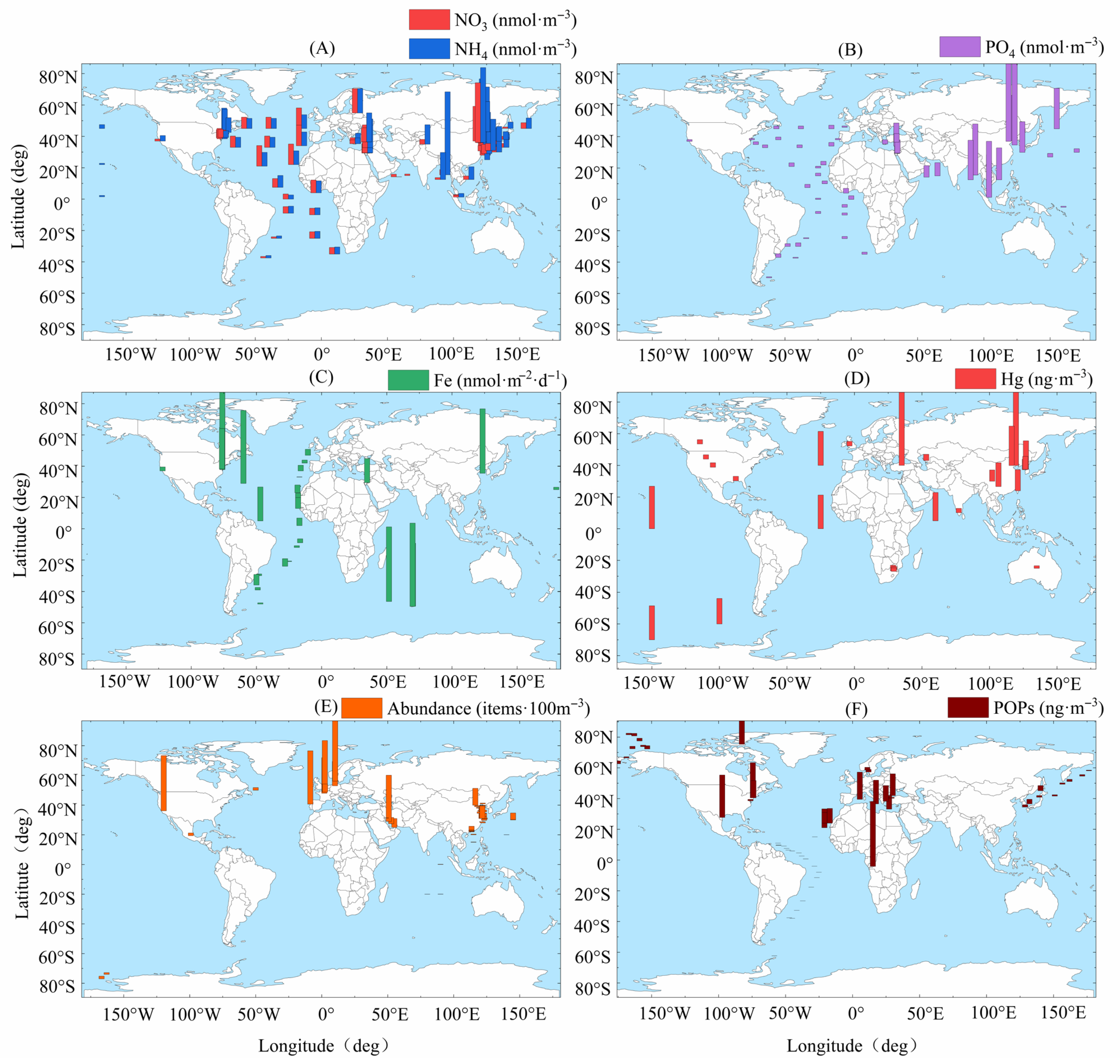
3.1. Overview of Atmospheric Substance Categories and Monitoring Status
3.2. Deposition Flux of Substances
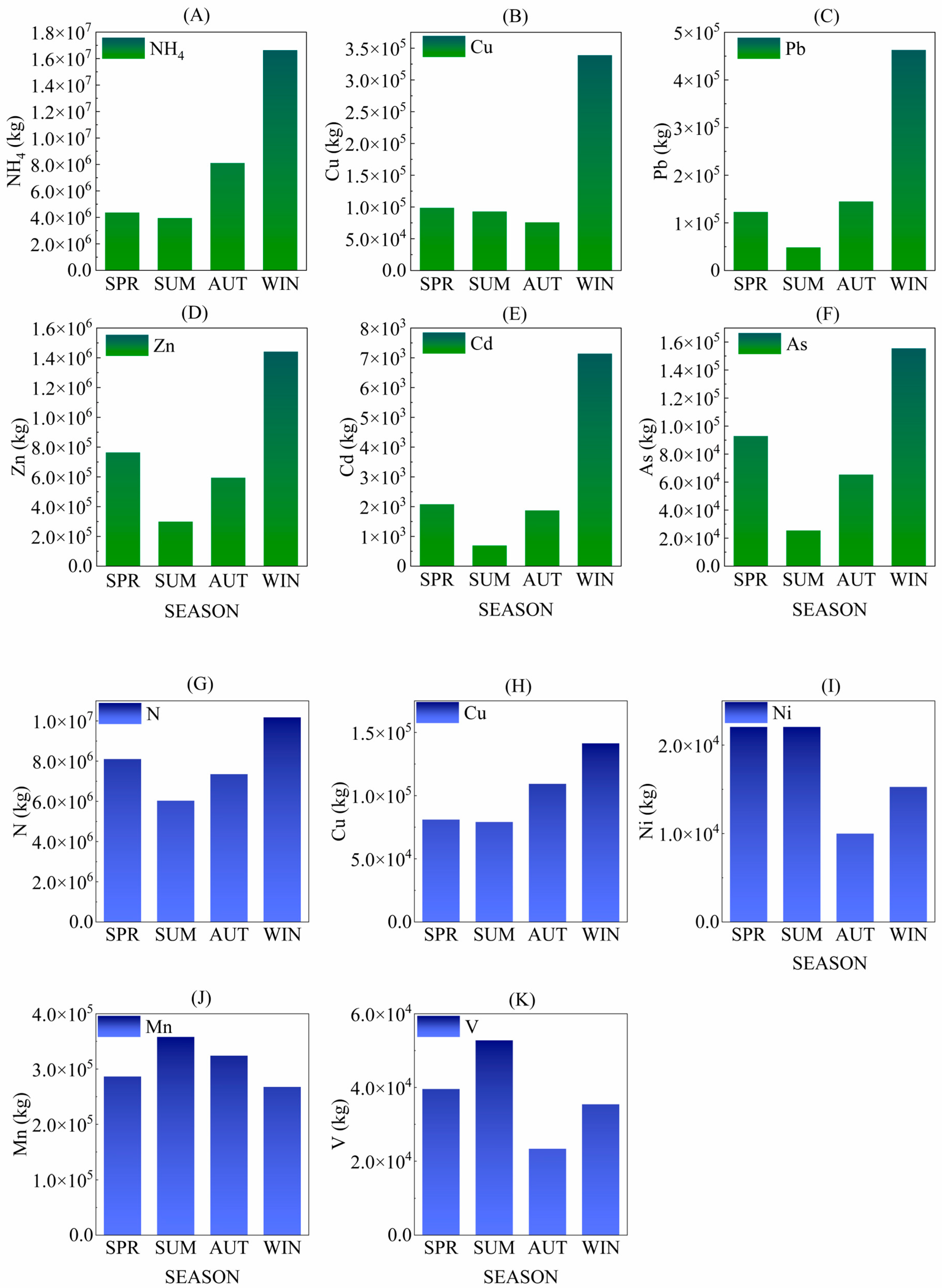
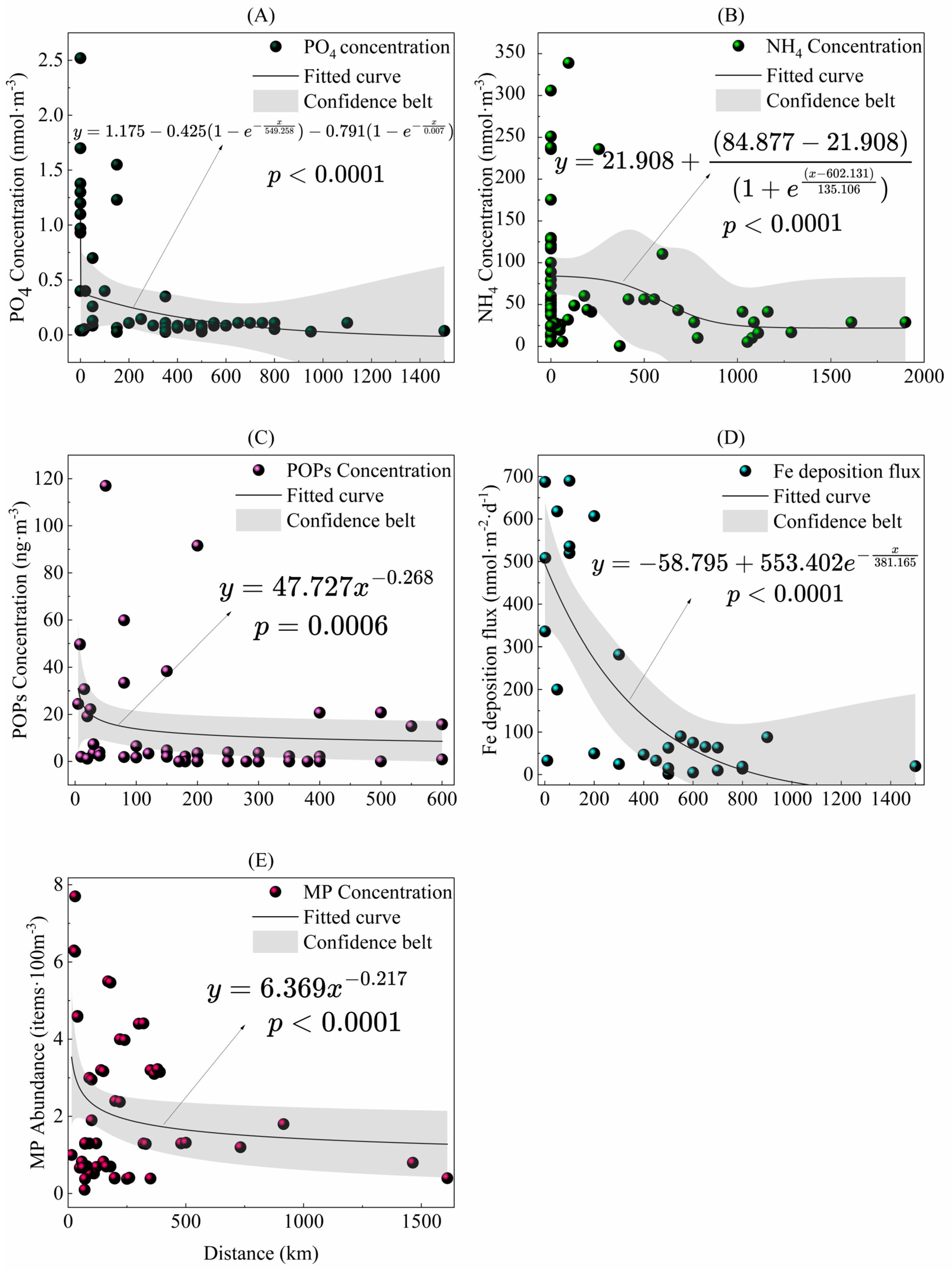
3.3. Seasonal and Spatial Variation in Atmospheric Deposition Substances
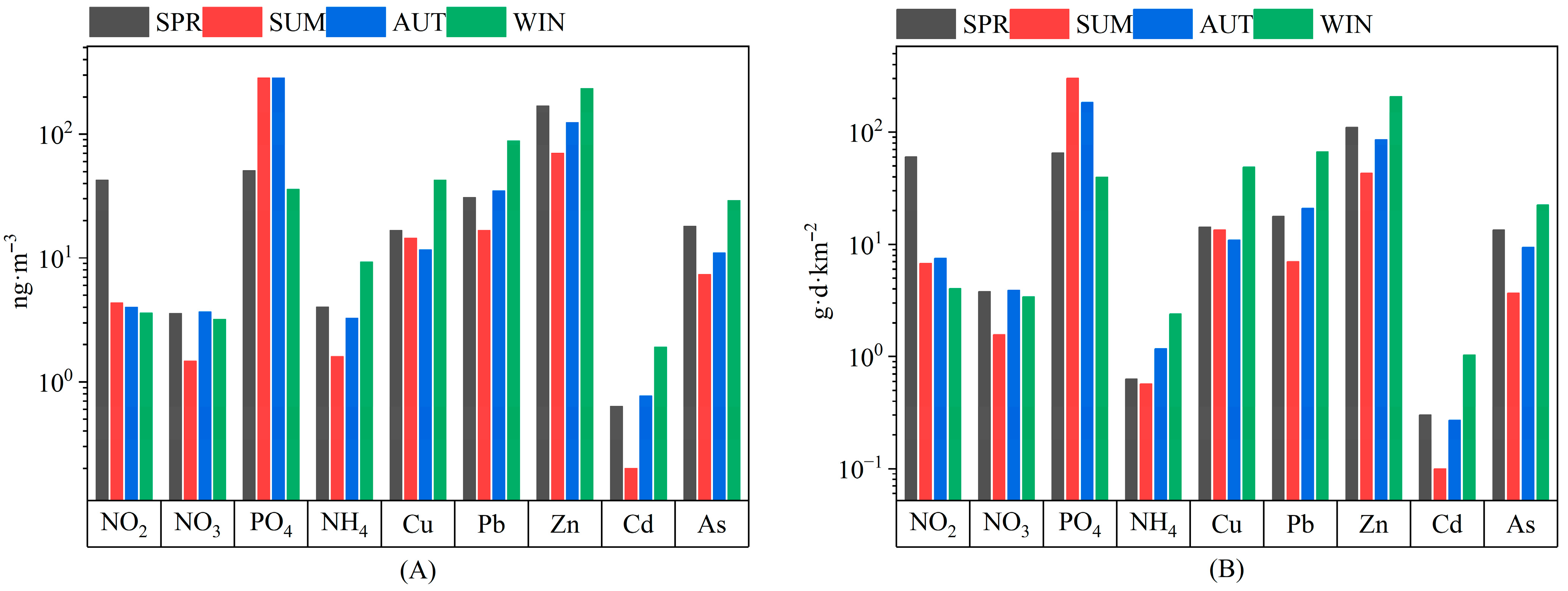
3.3.1. Seasonal Variation
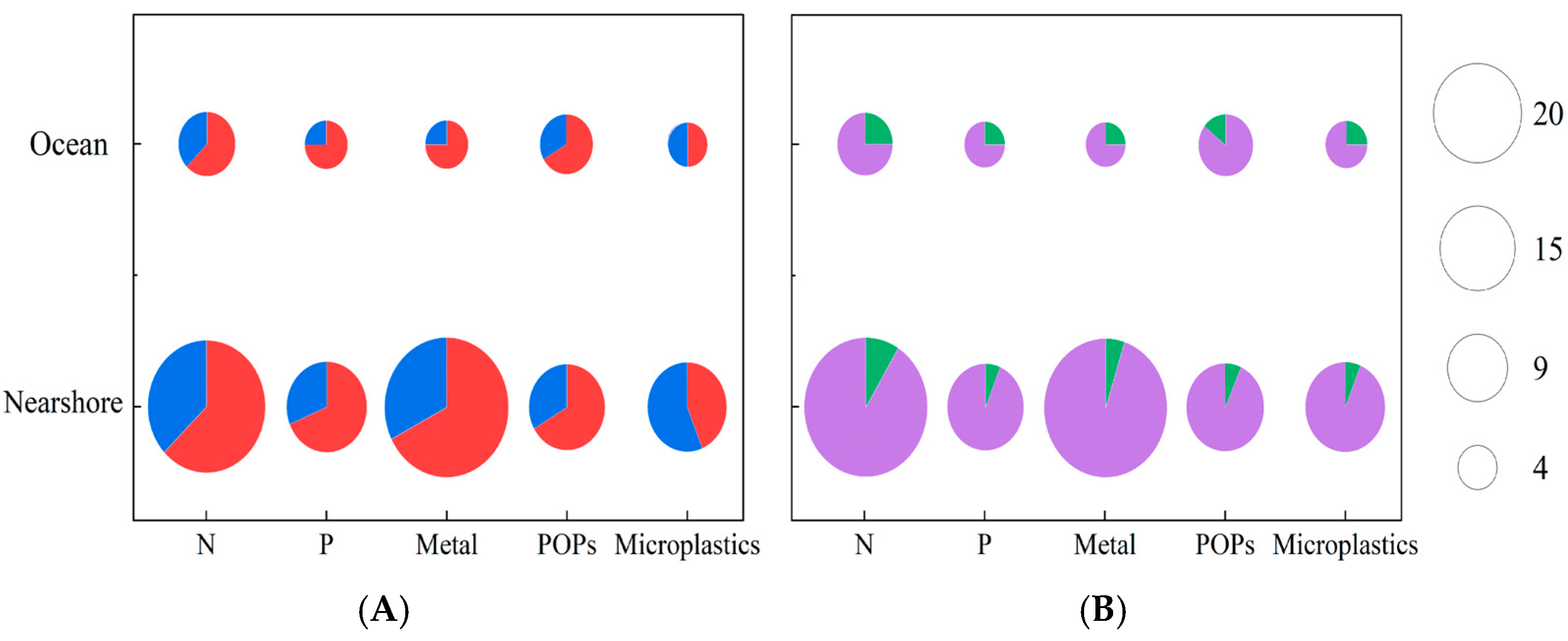
3.3.2. Spatial Patterns of Substance Concentrations Along the Shore-to-Offshore Gradient
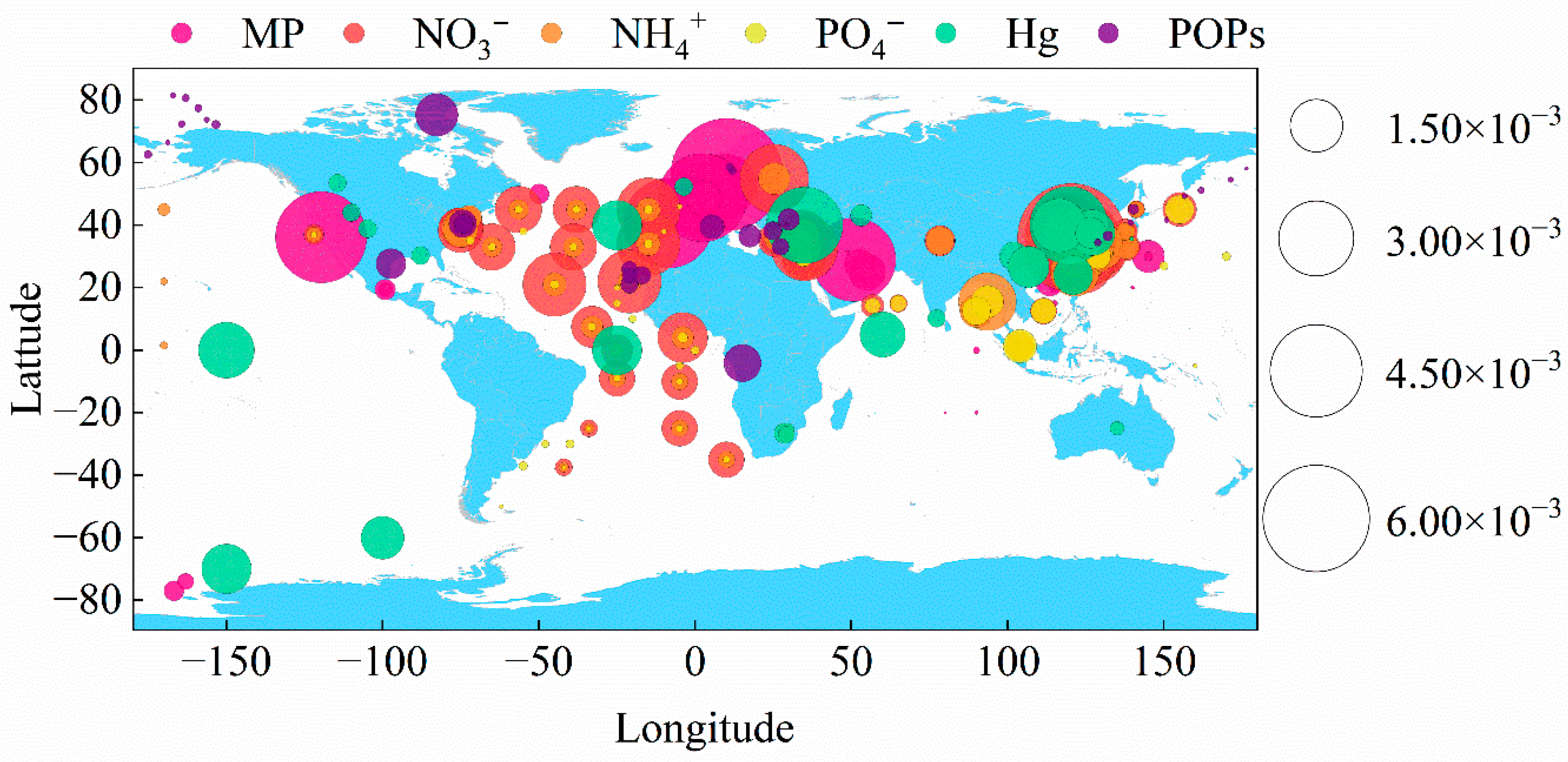
3.4. Ecological Implications
4. Discussion
4.1. Atmospheric Deposition Relative to Other Substance Input Pathways
4.2. Transport Distances of Atmospheric Deposition Across Substance Categories
4.3. Ecological Consequences in the Ocean
4.4. Advantages, Limitations and Knowledge Gaps
5. Conclusions
Supplementary Materials
Author Contributions
Funding
Data Availability Statement
Conflicts of Interest
Abbreviations
| POPs | Persistent Organic Pollutants. |
| RQ | Risk Quotient. |
| MRQ | Mixed Risk Quotient. |
| DIN | Dissolved Inorganic Nitrogen. |
| WOS | Web of Science. |
| PEC | Predicted Environmental Concentration. |
| MEC | Measured Environmental Concentration. |
| PNEC | Predicted No-Effect Concentration. |
| AF | Assessment factor. |
| PCBs | Polychlorinated Biphenyls. |
| OCPs | Organochlorine Pesticides. |
| PAHs | Polycyclic Aromatic Hydrocarbons. |
| EC50 | Half Maximal Effective Concentration. |
| LC50 | Median Lethal Concentration. |
| NOEC | No Observed Effect Concentration. |
References
- Morley, S.A.; Abele, D.; Barnes, D.K.A.; Cárdenas, C.A.; Cotté, C.; Gutt, J.; Henley, S.F.; Höfer, J.; Hughes, K.A.; Martin, S.M.; et al. Global Drivers on Southern Ocean Ecosystems: Changing Physical Environments and Anthropogenic Pressures in an Earth System. Front. Mar. Sci. 2020, 7, 547188. [Google Scholar] [CrossRef]
- Dachs, J.; Méjanelle, L. Organic Pollutants in Coastal Waters, Sediments, and Biota: A Relevant Driver for Ecosystems During the Anthropocene? Estuaries Coasts 2010, 33, 1–14. [Google Scholar] [CrossRef]
- Krishnamurthy, A.; Moore, J.K.; Mahowald, N.; Luo, C.; Zender, C.S. Impacts of atmospheric nutrient inputs on marine biogeochemistry. J. Geophys. Res.-Biogeosci. 2010, 115, G01006. [Google Scholar] [CrossRef]
- Zitoun, R.; Marcinek, S.; Hatje, V.; Sander, S.G.; Völker, C.; Sarin, M.; Omanović, D. Climate change driven effects on transport, fate and biogeochemistry of trace element contaminants in coastal marine ecosystems. Commun. Earth Environ. 2024, 5, 560. [Google Scholar] [CrossRef]
- Allen, D.; Allen, S.; Abbasi, S.; Baker, A.; Bergmann, M.; Brahney, J.; Butler, T.; Duce, R.A.; Eckhardt, S.; Evangeliou, N.; et al. Microplastics and nanoplastics in the marine-atmosphere environment. Nat. Rev. Earth Environ. 2022, 3, 393–405. [Google Scholar] [CrossRef]
- Zhang, Q.; Li, Y.; Wang, M.; Wang, K.; Meng, F.; Liu, L.; Zhao, Y.; Ma, L.; Zhu, Q.; Xu, W.; et al. Atmospheric nitrogen deposition: A review of quantification methods and its spatial pattern derived from the global monitoring networks. Ecotoxicol. Environ. Saf. 2021, 216, 112180. [Google Scholar] [CrossRef]
- Wright, L.P.; Zhang, L.M.; Cheng, I.; Aherne, J.; Wentworth, G.R. Impacts and Effects Indicators of Atmospheric Deposition of Major Pollutants to Various Ecosystems—A Review. Aerosol Air Qual. Res. 2018, 18, 1953–1992. [Google Scholar] [CrossRef]
- Tan, S.; Cheung, S.; Ho, T.-Y.; Liu, H. Metatranscriptomics of the bacterial community in response to atmospheric deposition in the Western North Pacific Ocean. Mar. Genom. 2019, 45, 57–63. [Google Scholar] [CrossRef]
- Ventura, A.; Simoes, E.F.C.; Almeida, A.S.; Martins, R.; Duarte, A.C.; Loureiro, S.; Duarte, R. Deposition of Aerosols onto Upper Ocean and Their Impacts on Marine Biota. Atmosphere 2021, 12, 684. [Google Scholar] [CrossRef]
- Hamilton, D.S.; Perron, M.M.G.; Bond, T.C.; Bowie, A.R.; Buchholz, R.R.; Guieu, C.; Ito, A.; Maenhaut, W.; Myriokefalitakis, S.; Olgun, N.; et al. Earth, Wind, Fire, and Pollution: Aerosol Nutrient Sources and Impacts on Ocean Biogeochemistry. Annu. Rev. Mar. Sci. 2022, 14, 303–330. [Google Scholar] [CrossRef]
- Hossain, M.; Engelhardt, I. Global plastic footprint: Unveiling property trends, environmental fate, and emerging threats of microplastic and nanoplastics pollution across ecosystems. Energy Ecol. Environ. 2025, 10, 637–674. [Google Scholar] [CrossRef]
- Yao, Y.; Yu, G.; Han, L.; Chen, Z.; Wang, T.; Yan, Z.; Wang, J.; Sun, M. Atmospheric Nitrogen Deposition Controls Interannual Variability of Net Primary Production in the Bohai Sea. J. Geophys. Res.-Ocean. 2024, 129, e2024JC021562. [Google Scholar] [CrossRef]
- Zan, J.; Maher, B.A.; Fang, X.; Stevens, T.; Ning, W.; Wu, F.; Yang, Y.; Kang, J.; Hu, Z. Global dust impacts on biogeochemical cycles and climate. Nat. Rev. Earth Environ. 2025, 6, 789–807. [Google Scholar] [CrossRef]
- Eagles-Smith, C.A.; Ackerman, J.T. Mercury bioaccumulation in estuarine wetland fishes: Evaluating habitats and risk to coastal wildlife. Environ. Pollut. 2014, 193, 147–155. [Google Scholar] [CrossRef] [PubMed]
- Zhang, X.M.; Meyer, T.; Muir, D.C.G.; Teixeira, C.; Wang, X.W.; Wania, F. Atmospheric deposition of current use pesticides in the Arctic: Snow core records from the Devon Island Ice Cap, Nunavut, Canada. Environ. Sci.-Process. Impacts 2013, 15, 2304–2311. [Google Scholar] [CrossRef] [PubMed]
- Abbasi, S.; Jaafarzadeh, N.; Zahedi, A.; Ravanbakhsh, M.; Abbaszadeh, S.; Turner, A. Microplastics in the atmosphere of Ahvaz City, Iran. J. Environ. Sci. 2023, 126, 95–102. [Google Scholar] [CrossRef]
- Abbasi, S.; Keshavarzi, B.; Moore, F.; Turner, A.; Kelly, F.J.; Dominguez, A.O.; Jaafarzadeh, N. Distribution and potential health impacts of microplastics and microrubbers in air and street dusts from Asaluyeh County, Iran. Environ. Pollut. 2019, 244, 153–164. [Google Scholar] [CrossRef]
- Akhbarizadeh, R.; Dobaradaran, S.; Torkmahalleh, M.A.; Saeedi, R.; Aibaghi, R.; Ghasemi, F.F. Suspended fine particulate matter (PM2.5), microplastics (MPs), and polycyclic aromatic hydrocarbons (PAHs) in air: Their possible relationships and health implications. Environ. Res. 2021, 192, 110339. [Google Scholar] [CrossRef]
- Alshemmari, H. Past, present and future trends of selected pesticidal and industrial POPs in Kuwait. Environ. Geochem. Health 2022, 44, 3191–3214. [Google Scholar] [CrossRef]
- Baker, A.R.; Kelly, S.D.; Biswas, K.F.; Witt, M.; Jickells, T.D. Atmospheric deposition of nutrients to the Atlantic Ocean. Geophys. Res. Lett. 2003, 30, 2296. [Google Scholar] [CrossRef]
- Baker, A.R.; Lesworth, T.; Adams, C.; Jickells, T.D.; Ganzeveld, L. Estimation of atmospheric nutrient inputs to the Atlantic Ocean from 50° N to 50° S based on large-scale field sampling: Fixed nitrogen and dry deposition of phosphorus. Glob. Biogeochem. Cycles 2010, 24, Gb3006. [Google Scholar] [CrossRef]
- Baker, A.R.; Weston, K.; Kelly, S.D.; Voss, M.; Streu, P.; Cape, J.N. Dry and wet deposition of nutrients from the tropical Atlantic atmosphere: Links to primary productivity and nitrogen fixation. Deep-Sea Res. Part I-Oceanogr. Res. Pap. 2007, 54, 1704–1720. [Google Scholar] [CrossRef]
- Bardouki, H.; Liakakou, H.; Economou, C.; Sciare, J.; Smolı, J.; Ždı, V.; Eleftheriadis, K.; Lazaridis, M.; Dye, C.; Mihalopoulos, N. Chemical composition of size-resolved atmospheric aerosols in the eastern Mediterranean during summer and winter. Atmos. Environ. 2003, 37, 195–208. [Google Scholar] [CrossRef]
- Belelie, M.D.; Ayob, N.; Burger, R.P.; Venter, A.D.; Piketh, S.J. Atmospheric mercury dispersion over the South African Highveld. South Afr. J. Sci. 2025, 121, 17029. [Google Scholar] [CrossRef] [PubMed]
- Belelie, M.D.; Piketh, S.J.; Burger, R.P.; Venter, A.D.; Naidoo, M. Characterisation of ambient Total Gaseous Mercury concentrations over the South African Highveld. Atmos. Pollut. Res. 2019, 10, 12–23. [Google Scholar] [CrossRef]
- Binici, B.; Yenisoy-Karakas, S.; Bilsel, M.; Durmaz-Hilmioglu, N. Sources of polycyclic hydrocarbons and pesticides in soluble fraction of deposition samples in Kocaeli, Turkey. Environ. Sci. Pollut. Res. 2014, 21, 2907–2917. [Google Scholar] [CrossRef]
- Brorstrom-Lunden, E. Atmospheric deposition of persistent organic compounds to the sea surface. J. Sea Res. 1996, 35, 81–90. [Google Scholar] [CrossRef]
- Burns, D.A.; Bhatt, G.; Linker, L.C.; Bash, J.O.; Capel, P.D.; Shenk, G.W. Atmospheric nitrogen deposition in the Chesapeake Bay watershed: A history of change. Atmos. Environ. 2021, 251, 118277. [Google Scholar] [CrossRef]
- Can-Guven, E. Microplastics as emerging atmospheric pollutants: A review and bibliometric analysis. Air Qual. Atmos. Health 2021, 14, 203–215. [Google Scholar] [CrossRef]
- Carbo, P.; Krom, M.D.; Homoky, W.B.; Benning, L.G.; Herut, B. Impact of atmospheric deposition on N and P geochemistry in the southeastern Levantine basin. Deep-Sea Res. Part II-Top. Stud. Oceanogr. 2005, 52, 3041–3053. [Google Scholar] [CrossRef]
- Castro-Jimenez, J.; Berrojalbiz, N.; Wollgast, J.; Dachs, J. Polycyclic aromatic hydrocarbons (PAHs) in the Mediterranean Sea: Atmospheric occurrence, deposition and decoupling with settling fluxes in the water column. Environ. Pollut. 2012, 166, 40–47. [Google Scholar] [CrossRef] [PubMed]
- Chen, H.-Y.; Hung, C.-C.; Fang, T.-H.; Gong, G.-C. Dry deposition and particle-size distribution of phosphorus in the marine atmosphere over the northeastern coast of Taiwan. Cont. Shelf Res. 2008, 28, 756–766. [Google Scholar] [CrossRef]
- Chen, H.Y.; Chen, L.D. Importance of anthropogenic inputs and continental-derived dust for the distribution and flux of water-soluble nitrogen and phosphorus species in aerosol within the atmosphere over the East China Sea. J. Geophys. Res.-Atmos. 2008, 113, D11303. [Google Scholar] [CrossRef]
- Chen, Y.; Mills, S.; Street, J.; Golan, D.; Post, A.; Jacobson, M.; Paytan, A. Estimates of atmospheric dry deposition and associated input of nutrients to Gulf of Aqaba seawater. J. Geophys. Res.-Atmos. 2007, 112, D04309. [Google Scholar] [CrossRef]
- Chen, Y.; Siefert, R.L. Seasonal and spatial distributions and dry deposition fluxes of atmospheric total and labile iron over the tropical and subtropical North Atlantic Ocean. J. Geophys. Res.-Atmos. 2004, 109, D09305. [Google Scholar] [CrossRef]
- Cindoruk, S.S.; Tasdemir, Y. The investigation of atmospheric deposition distribution of organochlorine pesticides (OCPs) in Turkey. Atmos. Environ. 2014, 87, 207–217. [Google Scholar] [CrossRef]
- Del Vento, S.; Dachs, J. Atmospheric occurrence and deposition of polycyclic aromatic hydrocarbons in the northeast tropical and subtropical Atlantic Ocean. Environ. Sci. Technol. 2007, 41, 5608–5613. [Google Scholar] [CrossRef]
- Ding, J.; Sun, C.; He, C.; Zheng, L.; Dai, D.; Li, F. Atmospheric microplastics in the Northwestern Pacific Ocean: Distribution, source, and deposition. Sci. Total Environ. 2022, 829, 154337. [Google Scholar] [CrossRef]
- Ding, Y.; Zou, X.; Wang, C.; Feng, Z.; Wang, Y.; Fan, Q.; Chen, H. The abundance and characteristics of atmospheric microplastic deposition in the northwestern South China Sea in the fall. Atmos. Environ. 2021, 253, 118389. [Google Scholar] [CrossRef]
- Dris, R.; Gasperi, J.; Mirande, C.; Mandin, C.; Guerrouache, M.; Langlois, V.; Tassin, B. A first overview of textile fibers, including microplastics, in indoor and outdoor environments. Environ. Pollut. 2017, 221, 453–458. [Google Scholar] [CrossRef]
- Duce, R.; Liss, P.; Merrill, J.; Atlas, E.; Buat-Menard, P.; Hicks, B.; Miller, J.; Prospero, J.; Arimoto, R.; Church, T.; et al. The atmospheric input of trace species to the world ocean. Glob. Biogeochem. Cycles 1991, 5, 193–259. [Google Scholar] [CrossRef]
- Engle, M.A.; Tate, M.T.; Krabbenhoft, D.P.; Kolker, A.; Olson, M.L.; Edgerton, E.S.; DeWild, J.F.; McPherson, A.K. Characterization and cycling of atmospheric mercury along the central US Gulf Coast. Appl. Geochem. 2008, 23, 419–437. [Google Scholar] [CrossRef]
- Fang, G.-C.; Wu, Y.-S.; Chang, T.-H. Comparison of atmospheric mercury (Hg) among Korea, Japan, China and Taiwan during 2000–2008. J. Hazard. Mater. 2009, 162, 607–615. [Google Scholar] [CrossRef] [PubMed]
- Feng, X.B.; Shang, L.H.; Wang, S.F.; Tang, S.L.; Zheng, W. Temporal variation of total gaseous mercury in the air of Guiyang, China. J. Geophys. Res.-Atmos. 2004, 109, D03303. [Google Scholar] [CrossRef]
- Feng, X.B.; Tang, S.L.; Shang, L.H.; Yan, H.Y.; Sommar, J.; Lindqvist, O. Total gaseous mercury in the atmosphere of Guiyang, PR China. Sci. Total Environ. 2003, 304, 61–72. [Google Scholar] [CrossRef]
- Ferm, M. Atmospheric ammonia and ammonium transport in Europe and critical loads: A review. Nutr. Cycl. Agroecosyst. 1998, 51, 5–17. [Google Scholar] [CrossRef]
- Fisher, J.A.; Nelson, P.F. Atmospheric mercury in Australia: Recent findings and future research needs. Elem.-Sci. Anthr. 2020, 8, 70. [Google Scholar] [CrossRef]
- Fu, X.; Feng, X.; Zhu, W.; Wang, S.; Lu, J. Total gaseous mercury concentrations in ambient air in the eastern slope of Mt. Gongga, South-Eastern fringe of the Tibetan plateau, China. Atmos. Environ. 2008, 42, 970–979. [Google Scholar] [CrossRef]
- Gao, Y.A. Atmospheric nitrogen deposition to Barnegat Bay. Atmos. Environ. 2002, 36, 5783–5794. [Google Scholar] [CrossRef]
- Gaston, E.; Woo, M.; Steele, C.; Sukumaran, S.; Anderson, S. Microplastics Differ Between Indoor and Outdoor Air Masses: Insights from Multiple Microscopy Methodologies. Appl. Spectrosc. 2020, 74, 1079–1098. [Google Scholar] [CrossRef]
- Gigliotti, C.L.; Dachs, J.; Nelson, E.D.; Brunciak, P.A.; Eisenreich, S.J. Polycyclic aromatic hydrocarbons in the New Jersey coastal atmosphere. Environ. Sci. Technol. 2000, 34, 3547–3554. [Google Scholar] [CrossRef]
- Golomb, D.; Ryan, D.; Eby, N.; Underhill, J.; Zemba, S. Atmospheric deposition of toxics onto Massachusetts Bay. 1. Metals. Atmos. Environ. 1997, 31, 1349–1359. [Google Scholar] [CrossRef]
- Gratz, L.E.; Eckley, C.S.; Schwantes, S.J.; Mattson, E. Ambient Mercury Observations near a Coal-Fired Power Plant in a Western US Urban Area. Atmosphere 2019, 10, 176. [Google Scholar] [CrossRef] [PubMed]
- He, J.; Balasubramanian, R.; Burger, D.F.; Hicks, K.; Kuylenstierna, J.C.I.; Palani, S. Dry and wet atmospheric deposition of nitrogen and phosphorus in Singapore. Atmos. Environ. 2011, 45, 2760–2768. [Google Scholar] [CrossRef]
- Heimburger, A.; Losno, R.; Triquet, S.; Nguyen, E.B. Atmospheric deposition fluxes of 26 elements over the Southern Indian Ocean: Time series on Kerguelen and Crozet Islands. Glob. Biogeochem. Cycles 2013, 27, 440–449. [Google Scholar] [CrossRef]
- Herut, B.; Collier, R.; Krom, M.D. The role of dust in supplying nitrogen and phosphorus to the Southeast Mediterranean. Limnol. Oceanogr. 2002, 47, 870–878. [Google Scholar] [CrossRef]
- Hsu, S.-C.; Wong, G.T.F.; Gong, G.-C.; Shiah, F.-K.; Huang, Y.-T.; Kao, S.-J.; Tsai, F.; Lung, S.-C.C.; Lin, F.-J.; Lin, I.I.; et al. Sources, solubility, and dry deposition of aerosol trace elements over the East China Sea. Mar. Chem. 2010, 120, 116–127. [Google Scholar] [CrossRef]
- Huang, D.-Y.; Peng, P.A.; Xu, Y.-G.; Sun, C.-X.; Deng, H.-M.; Deng, Y.-Y. Distribution, regional sources and deposition fluxes of organochlorine pesticides in precipitation in Guangzhou, South China. Atmos. Res. 2010, 97, 115–123. [Google Scholar] [CrossRef]
- Im, U.; Christodoulaki, S.; Violaki, K.; Zarmpas, P.; Kocak, M.; Daskalakis, N.; Mihalopoulos, N.; Kanakidou, M. Atmospheric deposition of nitrogen and sulfur over southern Europe with focus on the Mediterranean and the Black Sea. Atmos. Environ. 2013, 81, 660–670. [Google Scholar] [CrossRef]
- Jickells, T.D.; Baker, A.R.; Chance, R. Atmospheric transport of trace elements and nutrients to the oceans. Philos. Trans. R. Soc. A-Math. Phys. Eng. Sci. 2016, 374, 20150286. [Google Scholar] [CrossRef]
- Karthik, R.; Paneerselvam, A.; Ganguly, D.; Hariharan, G.; Srinivasalu, S.; Purvaja, R.; Ramesh, R. Temporal variability of atmospheric Total Gaseous Mercury and its correlation with meteorological parameters at a high-altitude station of the South India. Atmos. Pollut. Res. 2017, 8, 164–173. [Google Scholar] [CrossRef]
- Kawakami, N.; Osada, K.; Nishita, C.; Yabuki, M.; Kobayashi, H.; Hara, K.; Shiobara, M. Factors controlling sea salt modification and dry deposition of nonsea-salt components to the ocean. J. Geophys. Res.-Atmos. 2008, 113, D14216. [Google Scholar] [CrossRef]
- Kentisbeer, J.; Leaver, D.; Cape, J.N. An analysis of total gaseous mercury (TGM) concentrations across the UK from a rural sampling network. J. Environ. Monit. 2011, 13, 1653–1661. [Google Scholar] [CrossRef] [PubMed]
- Kim, K.-H.; Kim, M.-Y.; Kim, J.; Lee, G. The concentrations and fluxes of total gaseous mercury in a western coastal area of Korea during late March 2001. Atmos. Environ. 2002, 36, 3413–3427. [Google Scholar] [CrossRef]
- Kim, K.H.; Kim, M.Y. The effects of anthropogenic sources on temporal distribution characteristics of total gaseous mercury in Korea. Atmos. Environ. 2000, 34, 3337–3347. [Google Scholar] [CrossRef]
- Koçak, M.; Kubilay, N.; Mihalopoulos, N. Ionic composition of lower tropospheric aerosols at a Northeastern Mediterranean site: Implications regarding sources and long-range transport. Atmos. Environ. 2004, 38, 2067–2077. [Google Scholar] [CrossRef]
- Kouvarakis, G.; Mihalopoulos, N.; Tselepides, A.; Stavrakaki, S. On the importance of atmospheric inputs of inorganic nitrogen species on the productivity of the eastern Mediterranean Sea. Glob. Biogeochem. Cycles 2001, 15, 805–817. [Google Scholar] [CrossRef]
- Kuang, Z.H.; McConnell, L.L.; Torrents, A.; Meritt, D.; Tobash, S. Atmospheric deposition of pesticides to an agricultural watershed of the Chesapeake Bay. J. Environ. Qual. 2003, 32, 1611–1622. [Google Scholar] [CrossRef]
- Kuo, T.-H.; Chang, C.-F.; Urba, A.; Kvietkus, K. Atmospheric gaseous mercury in northern Taiwan. Sci. Total Environ. 2006, 368, 10–18. [Google Scholar] [CrossRef]
- Lao, Q.; Jiao, L.; Chen, L.; Sun, X.; Chen, F.; Liu, G.; Zhang, C. The effect of typhoons on POPs in atmospheric particulates over the coastal islands of Fujian, southeast China. Hum. Ecol. Risk Assess. 2020, 26, 890–905. [Google Scholar] [CrossRef]
- Lefer, B.L.; Talbot, R.W. Summertime measurements of aerosol nitrate and ammonium at a northeastern US site. J. Geophys. Res.-Atmos. 2001, 106, 20365–20378. [Google Scholar] [CrossRef]
- Li, Y.; Shao, L.; Wang, W.; Zhang, M.; Feng, X.; Li, W.; Zhang, D. Airborne fiber particles: Types, size and concentration observed in Beijing. Sci. Total Environ. 2020, 705, 135967. [Google Scholar] [CrossRef] [PubMed]
- Liu, K.; Wang, X.; Fang, T.; Xu, P.; Zhu, L.; Li, D. Source and potential risk assessment of suspended atmospheric microplastics in Shanghai. Sci. Total Environ. 2019, 675, 462–471. [Google Scholar] [CrossRef] [PubMed]
- Liu, K.; Wang, X.; Song, Z.; Wei, N.; Ye, H.; Cong, X.; Zhao, L.; Li, Y.; Qu, L.; Zhu, L.; et al. Global inventory of atmospheric fibrous microplastics input into the ocean: An implication from the indoor origin. J. Hazard. Mater. 2020, 400, 123223. [Google Scholar] [CrossRef] [PubMed]
- Liu, K.; Wu, T.; Wang, X.; Song, Z.; Zong, C.; Wei, N.; Li, D. Consistent Transport of Terrestrial Microplastics to the Ocean through Atmosphere. Environ. Sci. Technol. 2019, 53, 10612–10619. [Google Scholar] [CrossRef]
- Liu, M.; Zheng, H.; Li, H.; Chen, F.; Lou, L.; Wang, W.; Zhang, H.; Chen, C.; Ye, J.; Yan, M.; et al. Field evidence and modeling validation of biogeochemical controls on the deposition of persistent organic pollutants in the deep ocean. J. Hazard. Mater. 2024, 480, 136395. [Google Scholar] [CrossRef]
- Liu, S.L.; Nadim, F.; Perkins, C.; Carley, R.J.; Hoag, G.E.; Lin, Y.H.; Chen, L.T. Atmospheric mercury monitoring survey in Beijing, China. Chemosphere 2002, 48, 97–107. [Google Scholar] [CrossRef]
- Lohmann, R.; Breivik, K.; Dachs, J.; Muir, D. Global fate of POPs: Current and future research directions. Environ. Pollut. 2007, 150, 150–165. [Google Scholar] [CrossRef]
- Lohmann, R.; Markham, E.; Klanova, J.; Kukucka, P.; Pribylova, P.; Gong, X.; Pockalny, R.; Yanishevsky, T.; Wagner, C.C.; Sunderland, E.M. Trends of Diverse POPs in Air and Water Across the Western Atlantic Ocean: Strong Gradients in the Ocean but Not in the Air. Environ. Sci. Technol. 2021, 55, 9498–9507. [Google Scholar] [CrossRef]
- Long, X.; Fu, T.-M.; Yang, X.; Tang, Y.; Zheng, Y.; Zhu, L.; Shen, H.; Ye, J.; Wang, C.; Wang, T.; et al. Efficient Atmospheric Transport of Microplastics over Asia and Adjacent Oceans. Environ. Sci. Technol. 2022, 56, 6243–6252. [Google Scholar] [CrossRef]
- Luarte, T.; Gomez-Aburto, V.A.; Poblete-Castro, I.; Castro-Nallar, E.; Huneeus, N.; Molina-Montenegro, M.; Egas, C.; Azcune, G.; Perez-Parada, A.; Lohmann, R.; et al. Levels of persistent organic pollutants (POPs) in the Antarctic atmosphere over time (1980 to 2021) and estimation of their atmospheric half-lives. Atmos. Chem. Phys. 2023, 23, 8103–8118. [Google Scholar] [CrossRef]
- Luarte, T.; Hirmas-Olivares, A.; Hofer, J.; Giesecke, R.; Mestre, M.; Guajardo-Leiva, S.; Castro-Nallar, E.; Perez-Paradal, A.; Chiang, G.; Lohmann, R.; et al. Occurrence and diffusive air-seawater exchanges of organochlorine pesticides (OCPs) and polychlorinated biphenyls (PCBs) in Fildes Bay, King George Island, Antarctica. Sci. Total Environ. 2024, 908, 168323. [Google Scholar] [CrossRef] [PubMed]
- Ma, Y.; Luo, Y.; Zhu, J.; Zhang, J.; Gao, G.; Mi, W.; Xie, Z.; Lohmann, R. Seasonal variation and deposition of atmospheric organophosphate esters in the coastal region of Shanghai, China. Environ. Pollut. 2022, 300, 118930. [Google Scholar] [CrossRef] [PubMed]
- Ma, Y.; Xie, Z.; Yang, H.; Möller, A.; Halsall, C.; Cai, M.; Sturm, R.; Ebinghaus, R. Deposition of polycyclic aromatic hydrocarbons in the North Pacific and the Arctic. J. Geophys. Res. Atmos. 2013, 11, 5822–5829. [Google Scholar] [CrossRef]
- Mace, K.A.; Kubilay, N.; Duce, R.A. Organic nitrogen in rain and aerosol in the eastern Mediterranean atmosphere: An association with atmospheric dust. J. Geophys. Res.-Atmos. 2003, 108, 4320. [Google Scholar] [CrossRef]
- Mackey, K.R.M.; van Dijken, G.L.; Mazloom, S.; Erhardt, A.M.; Ryan, J.; Arrigo, K.R.; Paytan, A. Influence of atmospheric nutrients on primary productivity in a coastal upwelling region. Glob. Biogeochem. Cycles 2010, 24, Gb4027. [Google Scholar] [CrossRef]
- Mahowald, N.; Jickells, T.D.; Baker, A.R.; Artaxo, P.; Benitez-Nelson, C.R.; Bergametti, G.; Bond, T.C.; Chen, Y.; Cohen, D.D.; Herut, B.; et al. Global distribution of atmospheric phosphorus sources, concentrations and deposition rates, and anthropogenic impacts. Glob. Biogeochem. Cycles 2008, 22, Gb4026. [Google Scholar] [CrossRef]
- Markaki, Z.; Oikonomou, K.; Kocak, M.; Kouvarakis, G.; Chaniotaki, A.; Kubilay, N.; Mihalopoulos, N. Atmospheric deposition of inorganic phosphorus in the Levantine Basin, eastern Mediterranean: Spatial and temporal variability and its role in seawater productivity. Limnol. Oceanogr. 2003, 48, 1557–1568. [Google Scholar] [CrossRef]
- Marusczak, N.; Castelle, S.; de Voguee, B.; Knoery, J.; Cossa, D. Seasonal Variations of Total Gaseous Mercury at a French Coastal Mediterranean Site. Aerosol Air Qual. Res. 2016, 16, 46–60. [Google Scholar] [CrossRef]
- Matsumoto, K.; Minami, H.; Uyama, Y.; Uematsu, M. Size partitioning of particulate inorganic nitrogen species between the fine and coarse mode ranges and its implication to their deposition on the surface ocean. Atmos. Environ. 2009, 43, 4259–4265. [Google Scholar] [CrossRef]
- Mazur, M.; Mintz, R.; Lapalme, M.; Wiens, B. Ambient air total gaseous mercury concentrations in the vicinity of coal-fired power plants in Alberta, Canada. Sci. Total Environ. 2009, 408, 373–381. [Google Scholar] [CrossRef] [PubMed]
- Mihalopoulos, N.; Stephanou, E.; Kanakidou, M.; Pilitsidis, S.; Bousquet, P. Tropospheric aerosol ionic composition in the Eastern Mediterranean region. Tellus Ser. B-Chem. Phys. Meteorol. 1997, 49, 314–326. [Google Scholar] [CrossRef]
- Morales, L.; Dachs, J.; Gonzalez-Gaya, B.; Hernan, G.; Abalos, M.; Abad, E. Background Concentrations of Polychlorinated Dibenzo-p-Dioxins, Dibenzofurans, and Biphenyls in the Global Oceanic Atmosphere. Environ. Sci. Technol. 2014, 48, 10198–10207. [Google Scholar] [CrossRef] [PubMed]
- Nakamura, T.; Matsumoto, K.; Uematsu, M. Chemical characteristics of aerosols transported from Asia to the East China Sea: An evaluation of anthropogenic combined nitrogen deposition in autumn. Atmos. Environ. 2005, 39, 1749–1758. [Google Scholar] [CrossRef]
- Nguyen, H.T.; Kim, K.-H.; Kim, M.-Y.; Hong, S.; Youn, Y.-H.; Shon, Z.-H.; Lee, J.S. Monitoring of atmospheric mercury at a global atmospheric watch (GAW) site on An-Myun Island, Korea. Water Air Soil Pollut. 2007, 185, 149–164. [Google Scholar] [CrossRef]
- O’Driscoll, K. Air-Sea Exchange of Legacy POPs in the North Sea Based on Results of Fate and Transport, and Shelf-Sea Hydrodynamic Ocean Models. Atmosphere 2014, 5, 156–177. [Google Scholar] [CrossRef]
- Obrist, D.; Hallar, A.G.; McCubbin, I.; Stephens, B.B.; Rahn, T. Atmospheric mercury concentrations at Storm Peak Laboratory in the Rocky Mountains: Evidence for long-range transport from Asia, boundary layer contributions, and plant mercury uptake. Atmos. Environ. 2008, 42, 7579–7589. [Google Scholar] [CrossRef]
- Palm, A.; Cousins, I.; Gustafsson, Ö.; Axelman, J.; Grunder, K.; Broman, D.; Brorström-Lundén, E. Evaluation of sequentially-coupled POP fluxes estimated from simultaneous measurements in multiple compartments of an air-water-sediment system. Environ. Pollut. 2004, 128, 85–97. [Google Scholar] [CrossRef]
- Park, J.S.; Wade, T.L.; Sweet, S.T. Atmospheric deposition of PAHs, PCBs, and organochlorine pesticides to Corpus Christi Bay, Texas. Atmos. Environ. 2002, 36, 1707–1720. [Google Scholar] [CrossRef]
- Prata, J.C.; Castro, J.L.; da Costa, J.P.; Duarte, A.C.; Rocha-Santos, T.; Cerqueira, M. The importance of contamination control in airborne fibers and microplastic sampling: Experiences from indoor and outdoor air sampling in Aveiro, Portugal. Mar. Pollut. Bull. 2020, 159, 111522, Correction in Mar. Pollut. Bull. 2021, 166, 111888. https://doi.org/10.1016/j.marpolbul.2020.111888.. [Google Scholar] [CrossRef]
- Qi, J.; Yu, Y.; Yao, X.; Gang, Y.; Gao, H. Dry deposition fluxes of inorganic nitrogen and phosphorus in atmospheric aerosols over the Marginal Seas and Northwest Pacific. Atmos. Res. 2020, 245, 105076. [Google Scholar] [CrossRef]
- Quinn, P.K.; Bates, T.S.; Johnson, J.E.; Covert, D.S.; Charlson, R.J. Interactions between the sulfur and reduced nitrogen cycles over the central Pacific-Ocean. J. Geophys. Res.-Atmos. 1990, 95, 16405–16416. [Google Scholar] [CrossRef]
- Robarge, W.P.; Walker, J.T.; McCulloch, R.B.; Murray, G. Atmospheric concentrations of ammonia and ammonium at an agricultural site in the southeast United States. Atmos. Environ. 2002, 36, 1661–1674. [Google Scholar] [CrossRef]
- Russell, K.M.; Keene, W.C.; Maben, J.R.; Galloway, J.N.; Moody, J.L. Phase partitioning and dry deposition of atmospheric nitrogen at the mid-Atlantic US coast. J. Geophys. Res.-Atmos. 2003, 108, 4656. [Google Scholar] [CrossRef]
- Sakata, M.; Marumoto, K. Formation of atmospheric particulate mercury in the Tokyo metropolitan area. Atmos. Environ. 2002, 36, 239–246. [Google Scholar] [CrossRef]
- Sauret, N.; Wortham, H.; Strekowski, R.; Herckes, P.; Nieto, L.I. Comparison of annual dry and wet deposition fluxes of selected pesticides in Strasbourg, France. Environ. Pollut. 2009, 157, 303–312. [Google Scholar] [CrossRef]
- Scudlark, J.R.; Conko, K.M.; Church, T.M. Atmospheric wet deposition of trace-elements to Chesapeake Bay—CBAD study year-1 results. Atmos. Environ. 1994, 28, 1487–1498. [Google Scholar] [CrossRef]
- Shi, J.-H.; Zhang, J.; Gao, H.-W.; Tan, S.-C.; Yao, X.-H.; Ren, J.-L. Concentration, solubility and deposition flux of atmospheric particulate nutrients over the Yellow Sea. Deep-Sea Res. Part II-Top. Stud. Oceanogr. 2013, 97, 43–50. [Google Scholar] [CrossRef]
- Shruti, V.C.; Kutralam-Muniasamy, G.; Perez-Guevara, F.; Roy, P.D.; Martinez, I.E. Occurrence and characteristics of atmospheric microplastics in Mexico City. Sci. Total Environ. 2022, 847, 157601. [Google Scholar] [CrossRef]
- Sorooshian, A.; Corral, A.F.; Braun, R.A.; Cairns, B.; Crosbie, E.; Ferrare, R.; Hair, J.; Kleb, M.M.; Mardi, A.H.; Maring, H.; et al. Atmospheric Research Over the Western North Atlantic Ocean Region and North American East Coast: A Review of Past Work and Challenges Ahead. J. Geophys. Res.-Atmos. 2020, 125, e2019JD031626. [Google Scholar] [CrossRef]
- Srinivas, B.; Sarin, M.M. Atmospheric deposition of N, P and Fe to the Northern Indian Ocean: Implications to C- and N-fixation. Sci. Total Environ. 2013, 456, 104–114. [Google Scholar] [CrossRef] [PubMed]
- Srinivas, B.; Sarin, M.M. Atmospheric deposition of phosphorus to the Northern Indian Ocean. Curr. Sci. 2015, 108, 1300–1305. [Google Scholar]
- Tan, H.; He, J.L.; Liang, L.; Lazoff, S.; Sommer, J.; Xiao, Z.F.; Lindqvist, O. Atmospheric mercury deposition in Guizhou, China. Sci. Total Environ. 2000, 259, 223–230. [Google Scholar] [CrossRef] [PubMed]
- Uematsu, M.; Hattori, H.; Nakamura, T.; Narita, Y.; Jung, J.Y.; Matsumoto, K.; Nakaguchi, Y.; Kumar, M.D. Atmospheric transport and deposition of anthropogenic substances from the Asia to the East China Sea. Mar. Chem. 2010, 120, 108–115. [Google Scholar] [CrossRef]
- Van Drooge, B.L.; Grimalt, J.O.; Torres-García, C.J.; Cuevas, E. Deposition of semi-volatile organochlorine compounds in the free troposphere of the eastern north Atlantic ocean. Mar. Pollut. Bull. 2001, 42, 628–634. [Google Scholar] [CrossRef]
- Varenik, A.V.; Konovalov, S.K. Variations in Concentrations and Ratio of Soluble Forms of Nutrients in Atmospheric Depositions and Effects for Marine Coastal Areas of Crimea, Black Sea. Appl. Sci. 2021, 11, 11509. [Google Scholar] [CrossRef]
- Villafane, A.B.; Ronda, A.C.; Pirani, L.S.R.; Picone, A.L.; Lucchi, L.D.; Romano, R.M.; Pereyra, M.T.; Arias, A.H. Microplastics and anthropogenic debris in rainwater from Bahia Blanca, Argentina. Heliyon 2023, 9, e17028. [Google Scholar] [CrossRef]
- Wang, C.; Wang, Z.; Zhang, X. Characteristics of the air-sea exchange of gaseous mercury and deposition flux of atmospheric mercury at an island near the boundary of the Bohai Sea and Yellow Sea. Atmos. Environ. 2020, 232, 117547. [Google Scholar] [CrossRef]
- Wang, C.L.; Zou, X.Q.; Zhao, Y.F.; Li, Y.L.; Song, Q.C.; Wang, T.; Yu, W.W. Distribution pattern and mass budget of sedimentary polycyclic aromatic hydrocarbons in shelf areas of the Eastern China Marginal Seas. J. Geophys. Res.-Oceans 2017, 122, 4990–5004. [Google Scholar] [CrossRef]
- Wang, S.F.; Feng, X.B.; Qiu, G.L.; Wei, Z.Q.; Xiao, T.F. Mercury emission to atmosphere from Lanmuchang Hg-Tl mining area, Southwestern Guizhou, China. Atmos. Environ. 2005, 39, 7459–7473. [Google Scholar] [CrossRef]
- Wang, X.; Li, C.; Liu, K.; Zhu, L.; Song, Z.; Li, D. Atmospheric microplastic over the South China Sea and East Indian Ocean: Abundance, distribution and source. J. Hazard. Mater. 2020, 389, 121846. [Google Scholar] [CrossRef]
- Wang, X.; Liu, K.; Zhu, L.; Li, C.; Song, Z.; Li, D. Efficient transport of atmospheric microplastics onto the continent via the East Asian summer monsoon. J. Hazard. Mater. 2021, 414, 125477. [Google Scholar] [CrossRef] [PubMed]
- Wong, H.L.; Giesy, J.P.; Lam, P.K.S. Atmospheric deposition and fluxes of organochlorine pesticides and coplanar polychlorinated biphenyls in aquatic environments of Hong Kong, China. Environ. Sci. Technol. 2004, 38, 6513–6521. [Google Scholar] [CrossRef] [PubMed]
- Wu, J.; Zhang, Y.; Song, L.; Yang, M.; Liu, X.; Yu, J.; Liang, G.; Zhang, Y. Occurrence and dry deposition of organophosphate esters in atmospheric particles above the Bohai Sea and northern Yellow Sea, China. Atmos. Environ. 2022, 269, 118831. [Google Scholar] [CrossRef]
- Yuan, Z.; Li, H.-X.; Lin, L.; Pan, Y.-F.; Liu, S.; Hou, R.; Xu, X.-R. Occurrence and human exposure risks of atmospheric microplastics: A review. Gondwana Res. 2022, 108, 200–212. [Google Scholar] [CrossRef]
- Zhang, J.; Zhang, G.S.; Bi, Y.F.; Liu, S.M. Nitrogen species in rainwater and aerosols of the Yellow and East China seas: Effects of the East Asian monsoon and anthropogenic emissions and relevance for the NW Pacific Ocean. Glob. Biogeochem. Cycles 2011, 25, Gb3020. [Google Scholar] [CrossRef]
- Zhang, Y.; Kang, S.; Allen, S.; Allen, D.; Gao, T.; Sillanpaa, M. Atmospheric microplastics: A review on current status and perspectives. Earth-Sci. Rev. 2020, 203, 103118. [Google Scholar] [CrossRef]
- Zhu, L.; Chen, Y.; Guo, L.; Wang, F. Estimate of dry deposition fluxes of nutrients over the East China Sea: The implication of aerosol ammonium to non-sea-salt sulfate ratio to nutrient deposition of coastal oceans. Atmos. Environ. 2013, 69, 131–138. [Google Scholar] [CrossRef]
- Lestari, P.; Oskouie, A.K.; Noll, K.E. Size distribution and dry deposition of particulate mass, sulfate and nitrate in an urban area. Atmos. Environ. 2003, 37, 2507–2516. [Google Scholar] [CrossRef]
- Paíga, P.; Correia-Sá, L.; Correia, M.; Figueiredo, S.; Vieira, J.; Jorge, S.; Silva, J.G.; Delerue-Matos, C. Temporal Analysis of Pharmaceuticals as Emerging Contaminants in Surface Water and Wastewater Samples: A Case Study. J. Xenobiotics 2024, 14, 873–892. [Google Scholar] [CrossRef]
- Zheng, Z.-Y.; Ni, H.-G. Predicted no-effect concentration for eight PAHs and their ecological risks in seven major river systems of China. Sci. Total Environ. 2024, 906, 167590. [Google Scholar] [CrossRef] [PubMed]
- Du, M.; Wei, D.; Tan, Z.; Lin, A.; Du, Y. Predicted no-effect concentrations for mercury species and ecological risk assessment for mercury pollution in aquatic environment. J. Environ. Sci. 2015, 28, 74–80. [Google Scholar] [CrossRef] [PubMed]
- Jung, J.-W.; Park, J.-W.; Eo, S.; Choi, J.; Song, Y.K.; Cho, Y.; Hong, S.H.; Shim, W.J. Ecological risk assessment of microplastics in coastal, shelf, and deep sea waters with a consideration of environmentally relevant size and shape. Environ. Pollut. 2021, 270, 116217. [Google Scholar] [CrossRef] [PubMed]
- Hela, D.G.; Lambropoulou, D.A.; Konstantinou, I.K.; Albanis, T.A. Environmental monitoring and ecological risk assessment for pesticide contamination and effects in Lake Pamvotis, northwestern Greece. Environ. Toxicol. Chem. 2005, 24, 1548–1556. [Google Scholar] [CrossRef] [PubMed]
- Adu, J.T.; Kumarasamy, M.V. Assessing Non-Point Source Pollution Models: A Review. Pol. J. Environ. Stud. 2018, 27, 1913–1922. [Google Scholar] [CrossRef] [PubMed]
- Liu, L.; Xu, W.; Wen, Z.; Liu, P.; Xu, H.; Liu, S.; Lu, X.K.; Zhong, B.Q.; Guo, Y.X.; Lu, X.; et al. Modeling global oceanic nitrogen deposition from food systems and its mitigation potential by reducing overuse of fertilizers. Proc. Natl. Acad. Sci. USA 2023, 120, e2221459120. [Google Scholar] [CrossRef]
- Deng, O.P.; Huang, S.; Wang, C.; Wei, Y.C.; Xia, Y.Q.; Liu, Z.H.; Zhang, X.M.; Xiao, W.; He, T.T.; Wu, X.B.; et al. Atmospheric Nitrogen Pollution Control Benefits the Coastal Environment. Environ. Sci. Technol. 2023, 58, 449–458. [Google Scholar] [CrossRef]
- Evangeliou, N.; Tichy, O.; Eckhardt, S.; Zwaaftink, C.G.; Brahney, J. Sources and fate of atmospheric microplastics revealed from inverse and dispersion modelling: From global emissions to deposition. J. Hazard. Mater. 2022, 432, 128585. [Google Scholar] [CrossRef]
- Ji, X.W.; Abakumov, E.; Xie, X.C. Atmosphere-ocean exchange of heavy metals and polycyclic aromatic hydrocarbons in the Russian Arctic Ocean. Atmos. Chem. Phys. 2019, 19, 13789–13807. [Google Scholar] [CrossRef]
- da Costa Filho, B.M.; Duarte, A.C.; Rocha-Santos, T.A.P. Environmental monitoring approaches for the detection of organic contaminants in marine environments: A critical review. Trends Environ. Anal. Chem. 2022, 33, e00154. [Google Scholar] [CrossRef]
- Aves, A.R.; Revell, L.E.; Gaw, S.; Ruffell, H.; Schuddeboom, A.; Wotherspoon, N.E.; LaRue, M.; McDonald, A.J. First evidence of microplastics in Antarctic snow. Cryosphere 2022, 16, 2127–2145. [Google Scholar] [CrossRef]
- Jung, J.; Han, B.; Rodriguez, B.; Miyazaki, Y.; Chung, H.Y.; Kim, K.; Choi, J.O.; Park, K.; Kim, I.N.; Kim, S.; et al. Atmospheric Dry Deposition of Water-Soluble Nitrogen to the Subarctic Western North Pacific Ocean during Summer. Atmosphere 2019, 10, 351. [Google Scholar] [CrossRef]
- Seok, M.-W.; Kim, D.; Park, G.-H.; Lee, K.; Kim, T.-H.; Jung, J.; Kim, K.; Park, K.-T.; Kim, Y.-H.; Mo, A.; et al. Atmospheric deposition of inorganic nutrients to the Western North Pacific Ocean. Sci. Total Environ. 2021, 793, 148401. [Google Scholar] [CrossRef] [PubMed]
- Fowler, D.; Pyle, J.A.; Raven, J.A.; Sutton, M.A. The global nitrogen cycle in the twenty-first century: Introduction. Philos. Trans. R. Soc. B-Biol. Sci. 2013, 368, 20130165. [Google Scholar] [CrossRef] [PubMed]
- Violaki, K.; Tsiodra, I.; Nenes, A.; Tsagkaraki, M.; Kouvarakis, G.; Zarmpas, P.; Florou, K.; Panagiotopoulos, C.; Ingall, E.; Weber, R.; et al. Water soluble reactive phosphate (SRP) in atmospheric particles over East Mediterranean: The importance of dust and biomass burning events. Sci. Total Environ. 2022, 830, 154263. [Google Scholar] [CrossRef] [PubMed]
- Jiang, F.; Gao, C.; Chan, A.W.H.; Topping, D.O.; Zhang, H.; Li, W.; Coe, H.; Liu, X.; Ching, J.; Zheng, Z. A Review of Atmospheric Micro/Nanoplastics: Insights into Source and Fate for Modelling Studies. Curr. Pollut. Rep. 2025, 11, 53. [Google Scholar] [CrossRef]
- Woodall, L.C.; Sanchez-Vidal, A.; Canals, M.; Paterson, G.L.J.; Coppock, R.; Sleight, V.; Calafat, A.; Rogers, A.D.; Narayanaswamy, B.E.; Thompson, R.C. The deep sea is a major sink for microplastic debris. R. Soc. Open Sci. 2014, 1, 140317. [Google Scholar] [CrossRef]
- De Rosa, E.; Montuori, P.; Triassi, M.; Masucci, A.; Nardone, A. Occurrence and Distribution of Persistent Organic Pollutants (POPs) from Sele River, Southern Italy: Analysis of Polychlorinated Biphenyls and Organochlorine Pesticides in a Water-Sediment System. Toxics 2022, 10, 662. [Google Scholar] [CrossRef]
- Zuo, Z.-C.; Liu, S.-S.; He, Z.; Yang, G.-P. Occurrence, spatial and temporal distribution, sources and ecological risk assessment of halogenated polycyclic aromatic hydrocarbons (HPAHs) in sediments of the East China Sea. Environ. Pollut. 2025, 384, 127021. [Google Scholar] [CrossRef]
- Grannas, A.M.; Bogdal, C.; Hageman, K.J.; Halsall, C.; Harner, T.; Hung, H.; Kallenborn, R.; Klán, P.; Klánová, J.; Macdonald, R.W.; et al. The role of the global cryosphere in the fate of organic contaminants. Atmos. Chem. Phys. 2013, 13, 3271–3305. [Google Scholar] [CrossRef]
- Ding, X.; Guo, X.; Gao, H.; Gao, J.; Shi, J.; Yu, X.; Wu, Z. Seasonal variations of nutrient concentrations and their ratios in the central Bohai Sea. Sci. Total Environ. 2021, 799, 149416. [Google Scholar] [CrossRef] [PubMed]
- Wei, Y.; Song, L.; Ma, Y.; Mu, J.; Yi, W.; Sun, J.; Qu, K.; Cui, Z. Implications of ocean warming and acidification on heavy metals in surface seawater of the Bohai Sea. J. Hazard. Mater. 2024, 477, 135305. [Google Scholar] [CrossRef] [PubMed]
- Spilling, K.; Vanharanta, M.; Santoro, M.; Villena-Alemany, C.; Labrenz, M.; Grossart, H.P.; Piwosz, K. Picophytoplankton act as the primary consumers of excess phosphorus after the spring bloom in the eutrophic Baltic Sea. Limnol. Oceanogr. 2025, 70, S55–S68. [Google Scholar] [CrossRef]
- Wang, J.; Yu, Z.; Wei, Q.; Yao, Q. Long-Term Nutrient Variations in the Bohai Sea Over the Past 40 Years. J. Geophys. Res.-Ocean. 2019, 124, 703–722. [Google Scholar] [CrossRef]
- Sonke, J.E.; Angot, H.; Zhang, Y.X.; Poulain, A.; Björn, E.; Schartup, A. Global change effects on biogeochemical mercury cycling. Ambio 2023, 52, 853–876. [Google Scholar] [CrossRef] [PubMed]
- Wu, Y.-S.; Osman, A.I.; Hosny, M.; Elgarahy, A.M.; Eltaweil, A.S.; Rooney, D.W.; Chen, Z.; Rahim, N.S.; Sekar, M.; Gopinath, S.C.B.; et al. The Toxicity of Mercury and Its Chemical Compounds: Molecular Mechanisms and Environmental and Human Health Implications: A Comprehensive Review. Acs Omega 2024, 9, 5100–5126. [Google Scholar] [CrossRef]
- Della Torre, C.; Bergami, E.; Salvati, A.; Faleri, C.; Cirino, P.; Dawson, K.A.; Corsi, I. Accumulation and Embryotoxicity of Polystyrene Nanoparticles at Early Stage of Development of Sea Urchin Embryos Paracentrotus lividus. Environ. Sci. Technol. 2014, 48, 12302–12311. [Google Scholar] [CrossRef] [PubMed]
- Cole, M.; Lindeque, P.; Halsband, C.; Galloway, T.S. Microplastics as contaminants in the marine environment: A review. Mar. Pollut. Bull. 2011, 62, 2588–2597. [Google Scholar] [CrossRef]
- Amelia, T.S.M.; Khalik, W.; Ong, M.C.; Shao, Y.T.; Pan, H.J.; Bhubalan, K. Marine microplastics as vectors of major ocean pollutants and its hazards to the marine ecosystem and humans. Prog. Earth Planet. Sci. 2021, 8, 12. [Google Scholar] [CrossRef]
- Wright, S.L.; Kelly, F.J. Plastic and Human Health: A Micro Issue? Environ. Sci. Technol. 2017, 51, 6634–6647. [Google Scholar] [CrossRef]
- Li, J.; Zhang, G.; Li, X.D.; Qi, S.H.; Liu, G.Q.; Peng, X.Z. Source seasonality of polycyclic aromatic hydrocarbons (PAHs) in a subtropical city, Guangzhou, South China. Sci. Total Environ. 2006, 355, 145–155. [Google Scholar] [CrossRef]
- Kourtchev, I.; McGillen, M.R.; Wenger, J.; Donahue, N.M. Rethinking environmental boundaries for contaminants of emerging concern. Atmos. Environ. 2025, 361, 121492. [Google Scholar] [CrossRef]



Disclaimer/Publisher’s Note: The statements, opinions and data contained in all publications are solely those of the individual author(s) and contributor(s) and not of MDPI and/or the editor(s). MDPI and/or the editor(s) disclaim responsibility for any injury to people or property resulting from any ideas, methods, instructions or products referred to in the content. |
© 2026 by the authors. Licensee MDPI, Basel, Switzerland. This article is an open access article distributed under the terms and conditions of the Creative Commons Attribution (CC BY) license.
Share and Cite
Lin, Q.; Yi, X.; Wang, J.; Zhang, Y.; Zhan, J. Atmospheric Deposition of Multi-Class Substances into the Ocean: Synthesis of Fluxes, Seasonal Spatial Patterns and Ecological Risks. J. Mar. Sci. Eng. 2026, 14, 483. https://doi.org/10.3390/jmse14050483
Lin Q, Yi X, Wang J, Zhang Y, Zhan J. Atmospheric Deposition of Multi-Class Substances into the Ocean: Synthesis of Fluxes, Seasonal Spatial Patterns and Ecological Risks. Journal of Marine Science and Engineering. 2026; 14(5):483. https://doi.org/10.3390/jmse14050483
Chicago/Turabian StyleLin, Qinghao, Xianliang Yi, Junyi Wang, Yiwen Zhang, and Jingjing Zhan. 2026. "Atmospheric Deposition of Multi-Class Substances into the Ocean: Synthesis of Fluxes, Seasonal Spatial Patterns and Ecological Risks" Journal of Marine Science and Engineering 14, no. 5: 483. https://doi.org/10.3390/jmse14050483
APA StyleLin, Q., Yi, X., Wang, J., Zhang, Y., & Zhan, J. (2026). Atmospheric Deposition of Multi-Class Substances into the Ocean: Synthesis of Fluxes, Seasonal Spatial Patterns and Ecological Risks. Journal of Marine Science and Engineering, 14(5), 483. https://doi.org/10.3390/jmse14050483