Satellite-Based Machine Learning for Temporal Assessment of Water Quality Parameter Prediction in a Coastal Shallow Lake




Abstract
1. Introduction
- Quantify how model performance changes under independent temporal projection,
- Identify parameter- and sensor-specific strengths and limitations in out-of-time prediction, and
- Derive interpretable band-based retrieval formulations only for parameter–sensor combinations demonstrating sufficient temporal robustness.
2. Materials and Methods
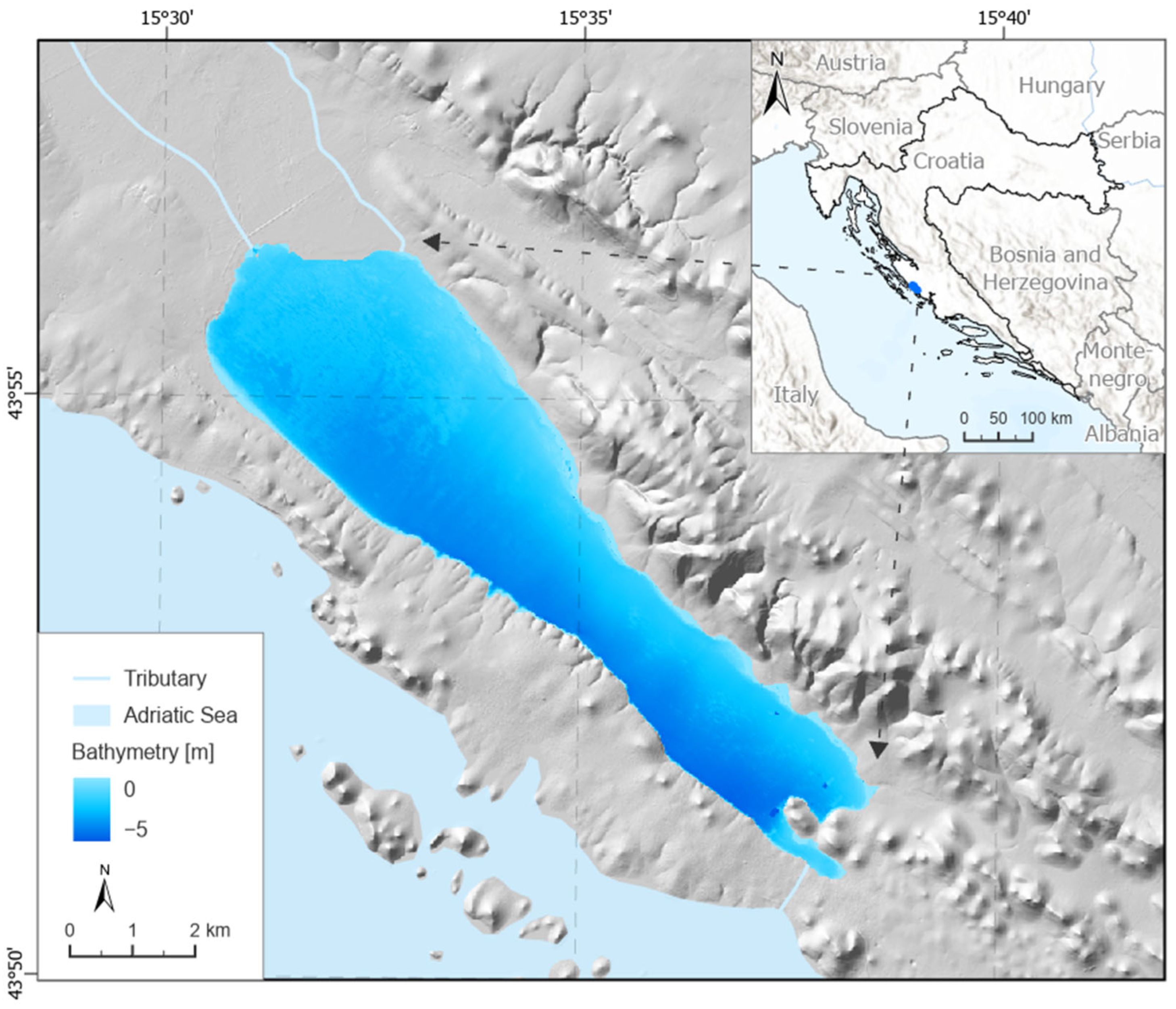
2.1. Study Area
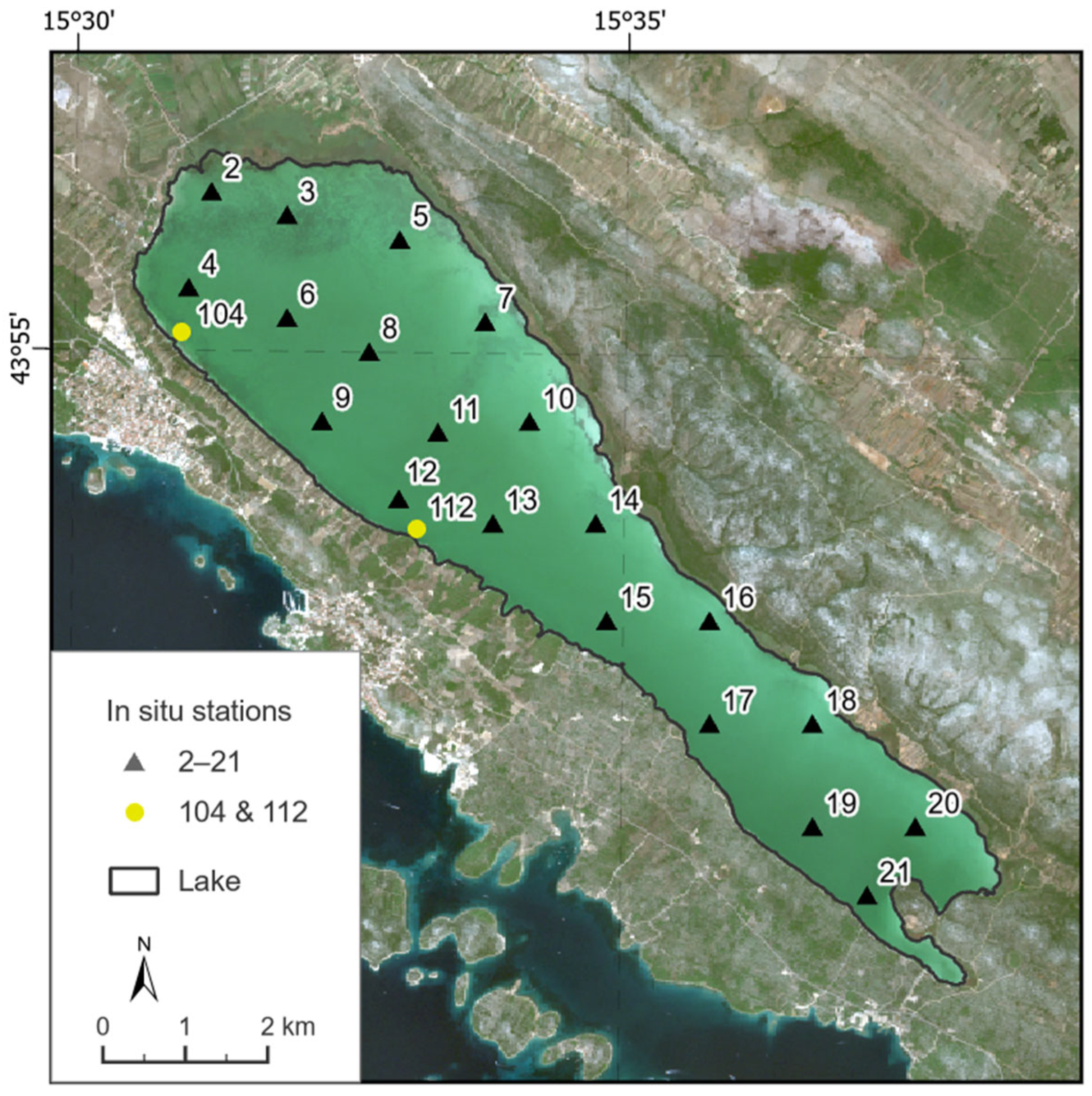
2.2. In Situ Data Collection and Harmonization
2.3. Satellite Data Acquisition and Preprocessing
2.4. Statistical and Correlation Analysis
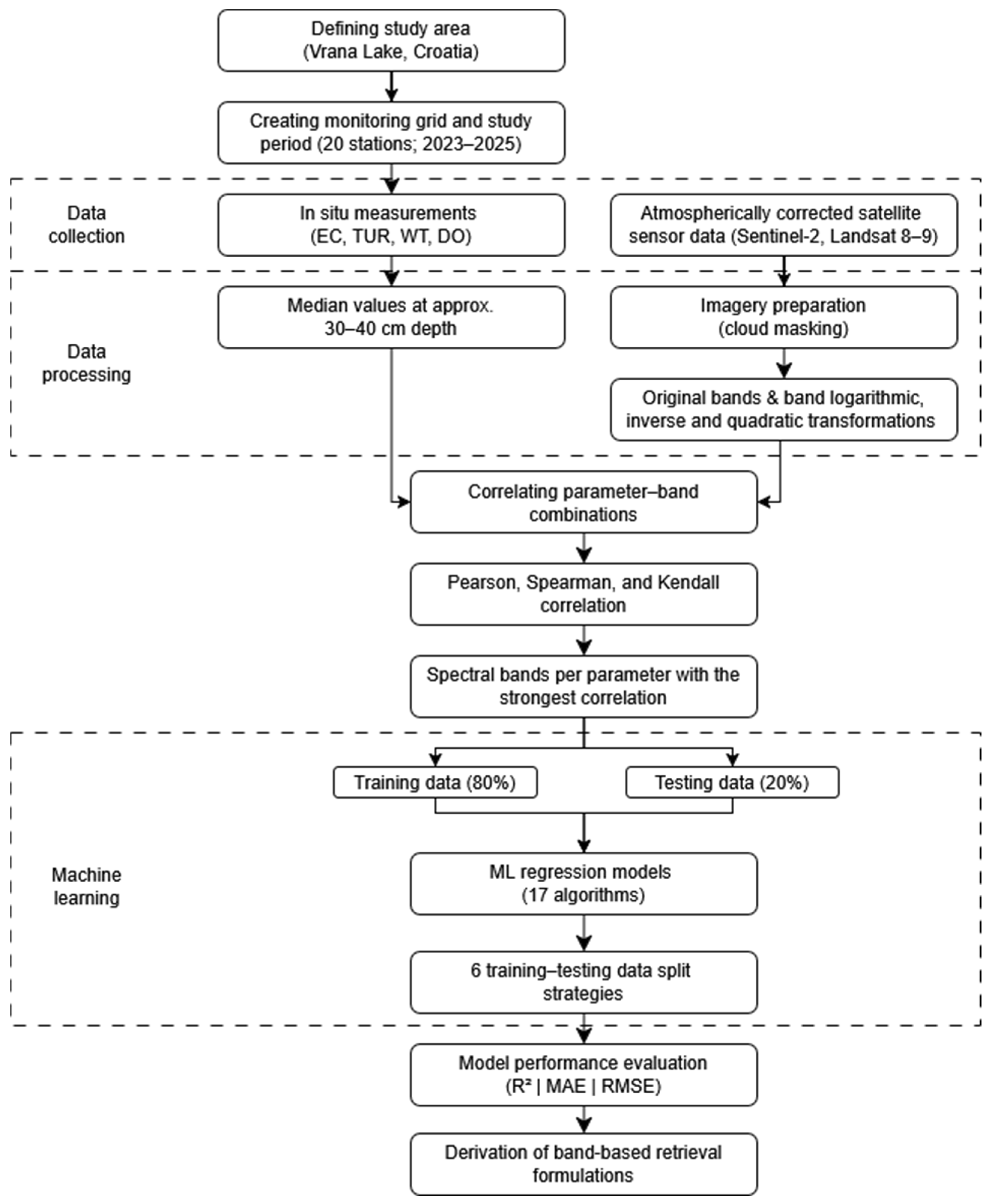
2.5. Machine Learning Modelling and Validation Strategy
2.6. Derivation of Band-Based Retrieval Formulations
3. Results
3.1. Temporal Patterns and Value Ranges of in Situ Water Quality Measurements
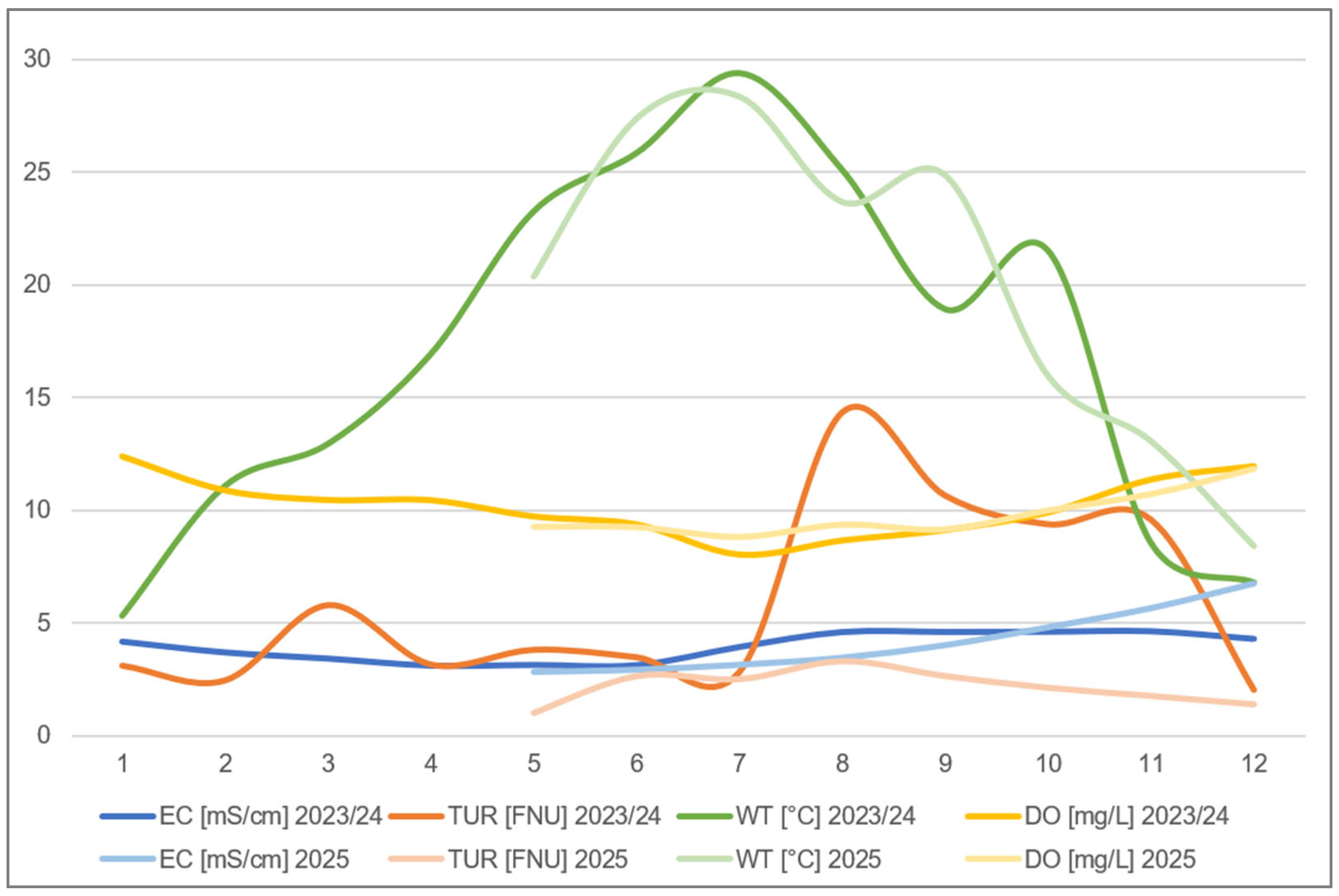
3.1.1. Temporal Variability of in Situ Water Quality Parameters
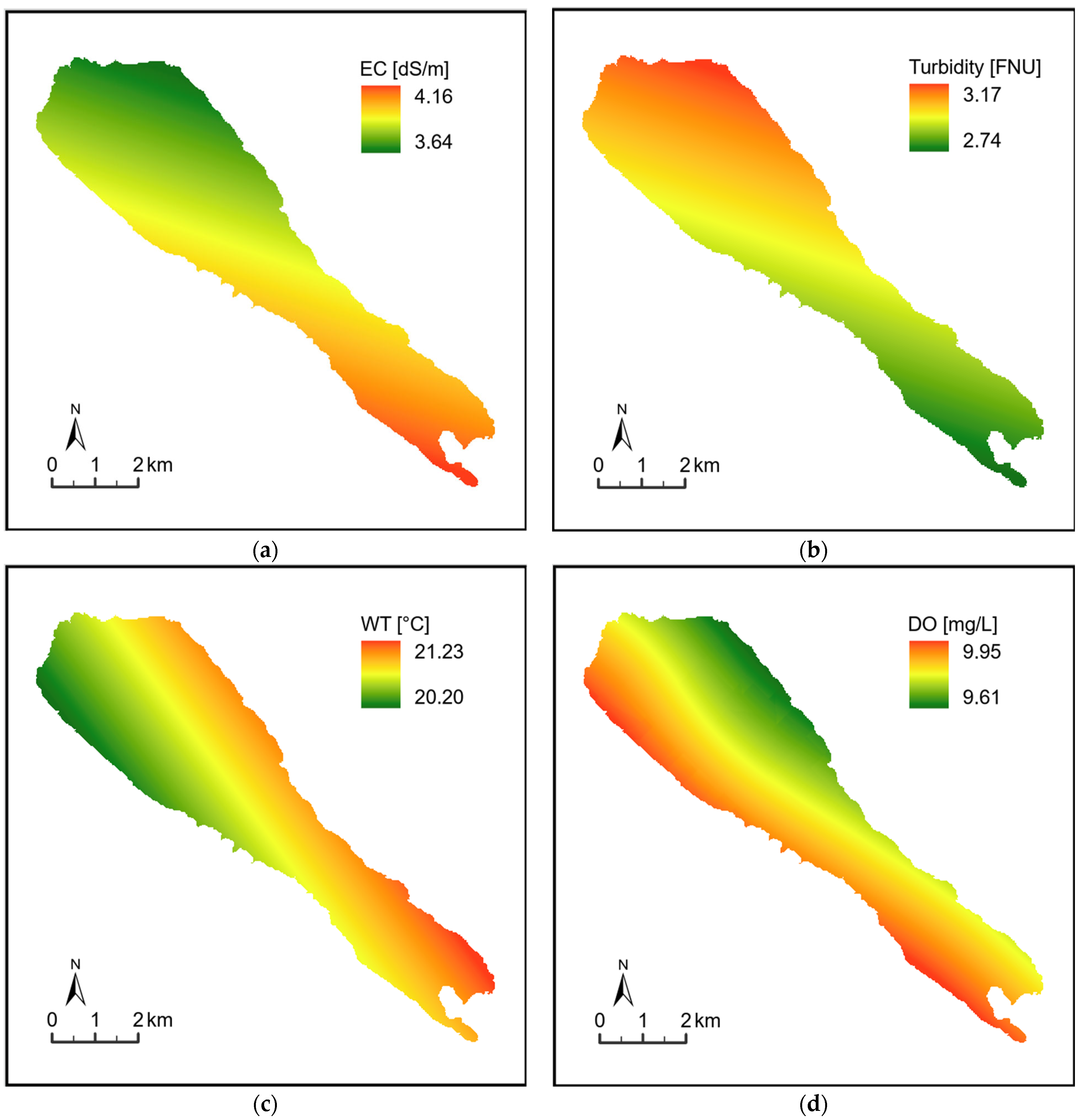
3.1.2. Spatial Variability of In Situ Water Quality Parameters
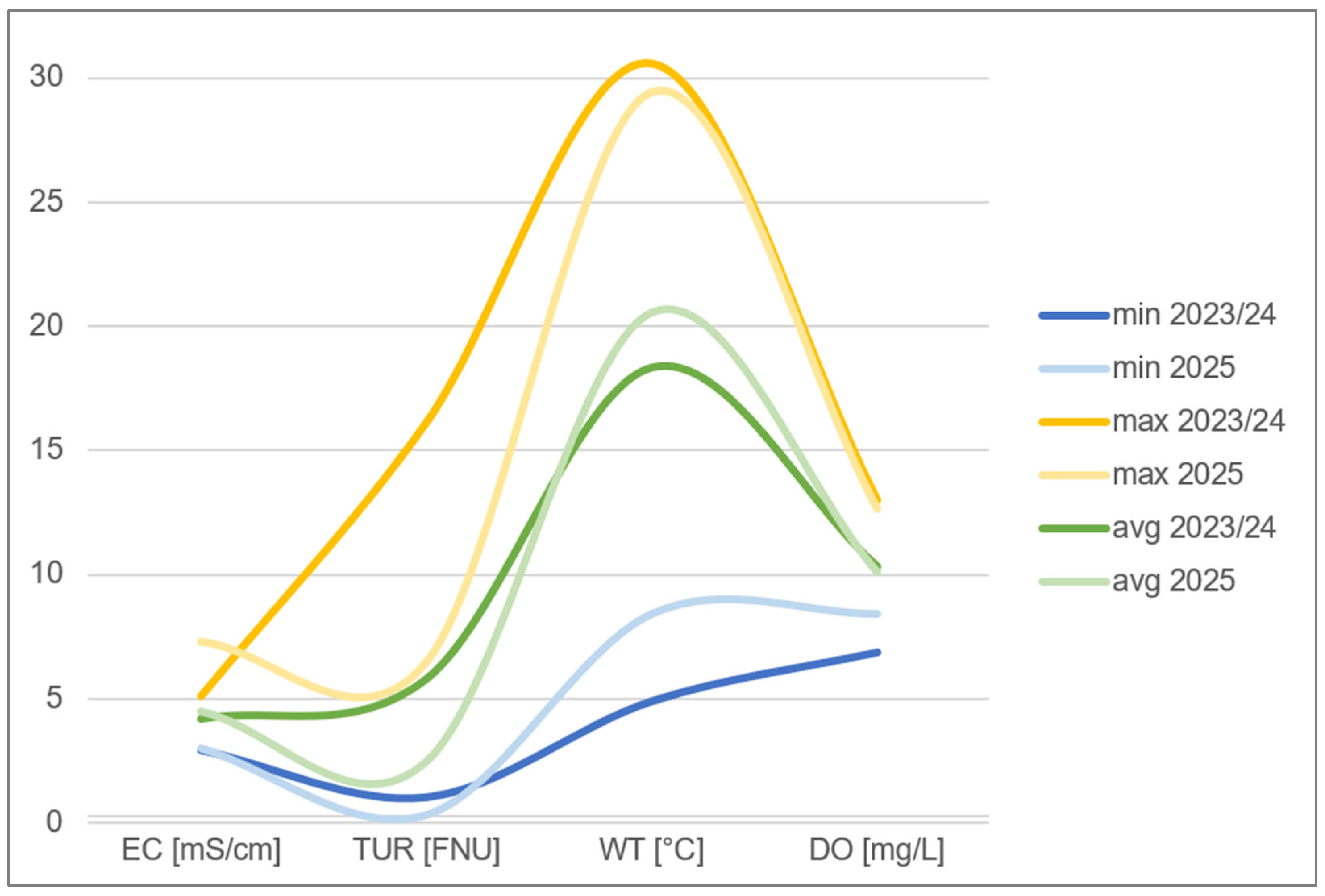
3.1.3. Comparison of Minimum, Average, and Maximum Values
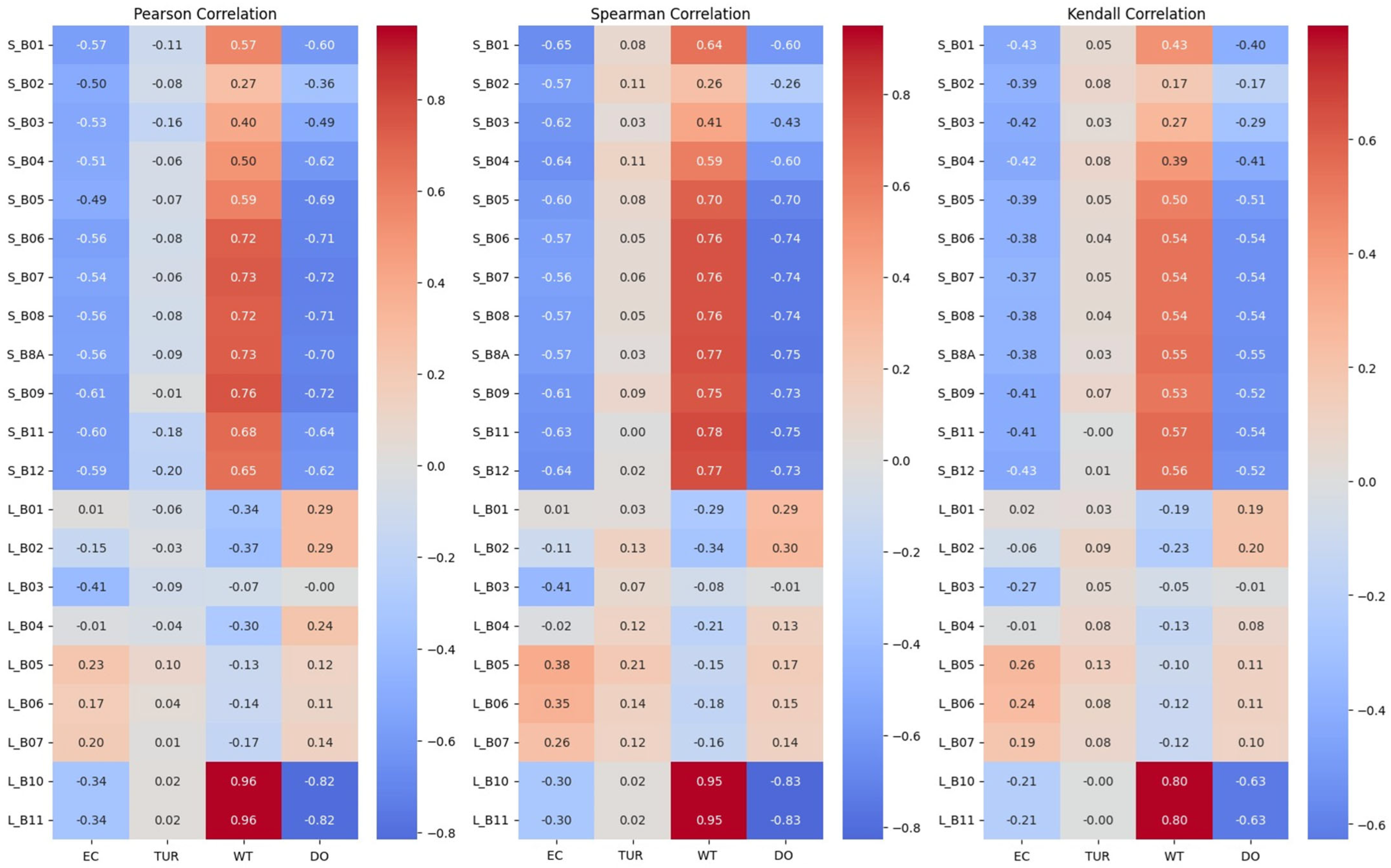
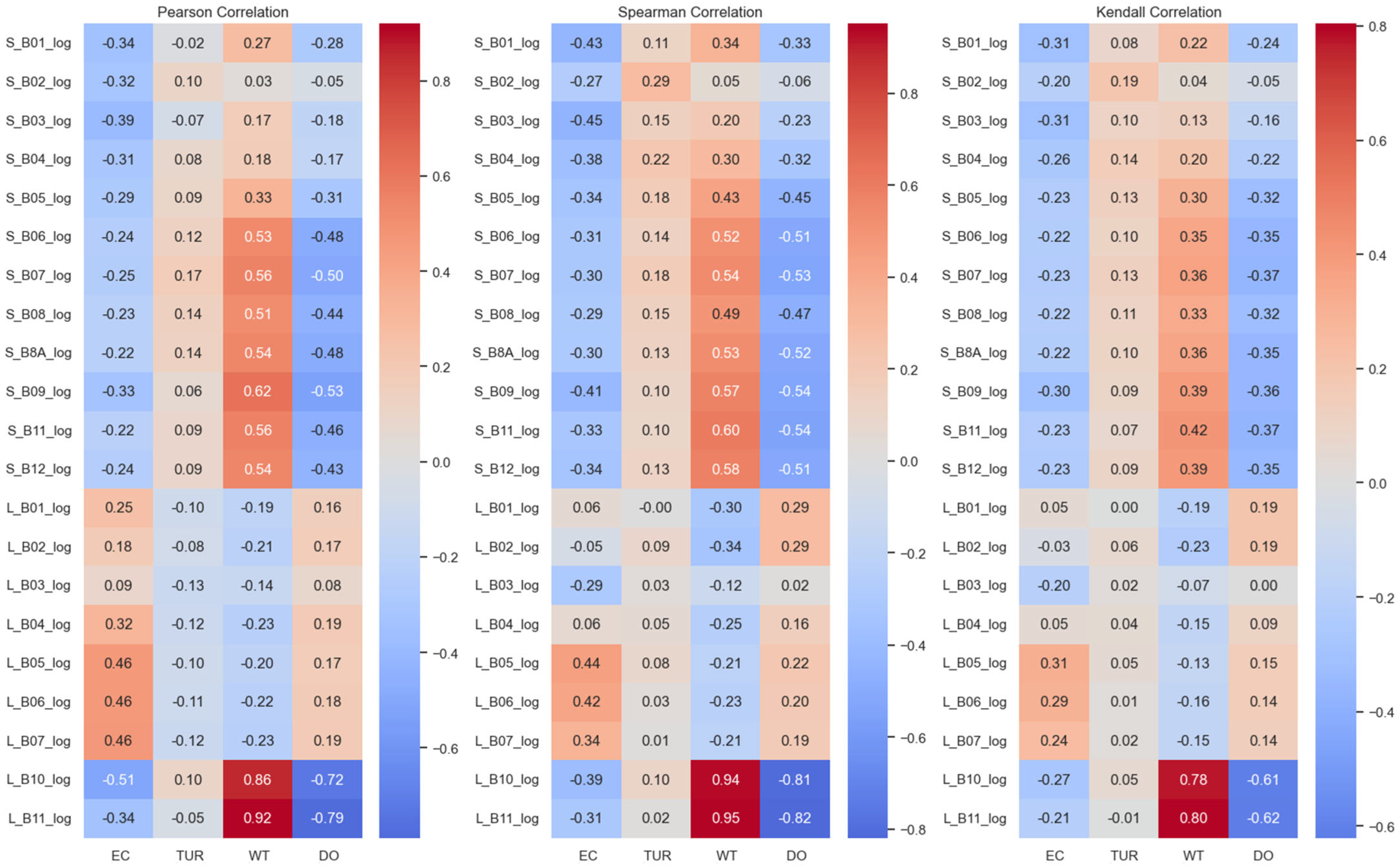
3.2. Correlation Analysis Between Spectral Bands and In Situ Parameters
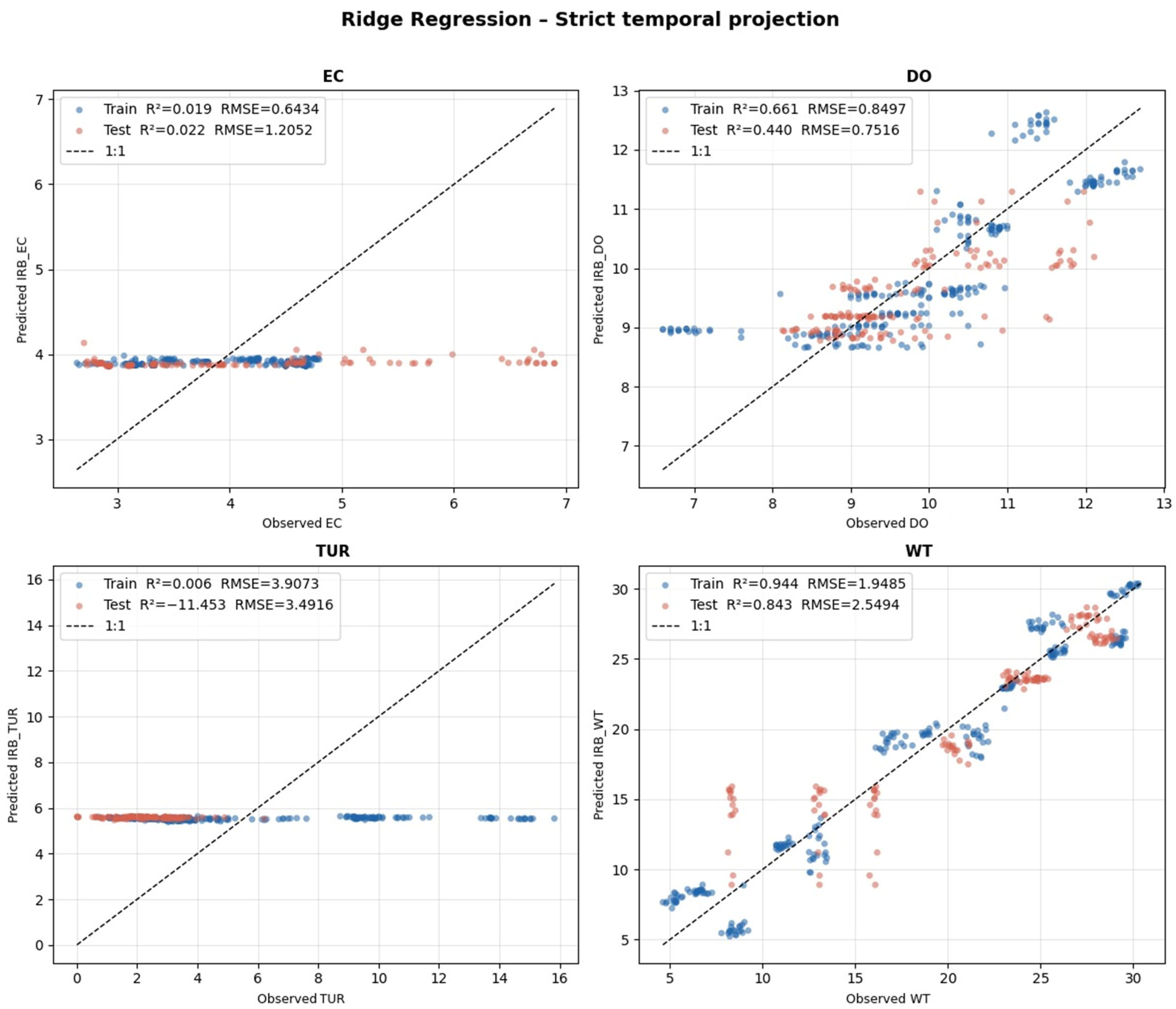
3.3. Machine Learning Model Performance Across Split Strategies
3.4. Band-Based Retrieval Formulations
3.4.1. WT
3.4.2. EC
0.168 × L_B07_log − 0.672 × L_B10_log,
3.4.3. DO
3.4.4. TUR
4. Discussion
4.1. Temporal Variability as a Driver of Model Transferability
4.2. Sensor–Parameter Suitability and Spectral Observability
4.3. Feature Transformations Matter for EC and DO
4.4. Model Complexity Versus Temporal Robustness
4.5. Implications for Operational Monitoring of Shallow Coastal Lakes
- WT retrieval is operationally reliable in this setting due to direct thermal observability and strong temporal transferability.
- DO retrieval can be feasible but requires regime-aware modelling, where feature transformation (log) and regularization help stabilize relationships under temporal shifts.
- EC and TUR retrieval remain high-risk for temporal generalization in shallow, event-driven systems; operational use should explicitly account for episodic variability and mismatch effects.
5. Conclusions
Supplementary Materials
Author Contributions
Funding
Data Availability Statement
Acknowledgments
Conflicts of Interest
Abbreviations
| ANN | Artificial Neural Network |
| DO | Dissolved Oxygen |
| EC | Electrical Conductivity |
| CDOM | Coloured Dissolved Organic Matter |
| GIS | Geographic Information System |
| KNN | k-Nearest Neighbours |
| L_Bxx | Landsat 8–9 Spectral Band (e.g., L_B10 = Landsat Band 10) |
| MAE | Mean Absolute Error |
| ML | Machine Learning |
| MLP | Multilayer Perceptron |
| R2 | Coefficient of Determination |
| RMSE | Root Mean Squared Error |
| S_Bxx | Sentinel-2 Spectral Band (e.g., S_B02 = Sentinel-2 Band 2) |
| SHAP | SHapley Additive exPlanations |
| SVR | Support Vector Regression |
| SWIR | Short-Wave Infrared |
| TSS | Total Suspended Solids |
| TUR | Turbidity |
| WT | Water Temperature |
References
- Deng, Y.; Zhang, Y.; Pan, D.; Yang, S.X.; Gharabaghi, B. Review of Recent Advances in Remote Sensing and Machine Learning Methods for Lake Water Quality Management. Remote Sens. 2024, 16, 4196. [Google Scholar] [CrossRef]
- Sun, Y.; Wang, D.; Li, L.; Ning, R.; Yu, S.; Gao, N. Application of Remote Sensing Technology in Water Quality Monitoring: From Traditional Approaches to Artificial Intelligence. Water Res. 2024, 267, 122546. [Google Scholar] [CrossRef]
- Kong, Y.; Jimenez, K.; Lee, C.M.; Winter, S.; Summers-Evans, J.; Cao, A.; Menczer, M.; Han, R.; Mills, C.; McCarthy, S.; et al. Monitoring Coastal Water Turbidity Using Sentinel2—A Case Study in Los Angeles. Remote Sens. 2025, 17, 201. [Google Scholar] [CrossRef]
- Assaf, M.N.; Abdelal, Q.; Hussein, N.M.; Halaweh, G.; Alzubaidi, A.J. Water Quality Monitoring and Management: Integration of Machine Learning Algorithms and Sentinel-2 Images for the Estimation of Chlorophyll-a. Model. Earth Syst. Environ. 2025, 11, 348. [Google Scholar] [CrossRef]
- Wu, Z.; Pang, J.; Li, J.; Wang, Y.; Ruan, J.; Zhang, X.; Yang, L.; Pang, Y.; Gao, Y. A Review of Remote Sensing-Based Water Quality Monitoring in Turbid Coastal Waters. Intell. Mar. Technol. Syst. 2025, 3, 24. [Google Scholar] [CrossRef]
- Jaywant, S.A.; Arif, K.M. Remote Sensing Techniques for Water Quality Monitoring: A Review. Sensors 2024, 24, 8041. [Google Scholar] [CrossRef] [PubMed]
- Chen, H.; Gao, X.; Yuan, R. Advances in Remote Sensing and Sensor Technologies for Water-Quality Monitoring: A Review. Water 2025, 17, 3000. [Google Scholar] [CrossRef]
- Nikoo, M.R.; Zamani, M.G.; Zadeh, M.M.; Al-Rawas, G.; Al-Wardy, M.; Gandomi, A.H. Mapping Reservoir Water Quality from Sentinel-2 Satellite Data Based on a New Approach of Weighted Averaging: Application of Bayesian Maximum Entropy. Sci. Rep. 2024, 14, 16438. [Google Scholar] [CrossRef]
- Arantes, A.E.; De Castro, B.R.F.; Martins, A.B.; Capelo-Neto, J.; Gonçalves Barros, M.U. Satellite-Based Water Quality Assessment of Castanhão Reservoir Using Machine Learning and Genetic Algorithms. Next Res. 2025, 2, 100340. [Google Scholar] [CrossRef]
- Batina, A.; Šiljeg, A.; Krtalić, A.; Šerić, L. SIGMaL: An Integrated Framework for Water Quality Monitoring in a Coastal Shallow Lake. Remote Sens. 2026, 18, 312. [Google Scholar] [CrossRef]
- Shamloo, A.; Sima, S. Investigating the Potential of Remote Sensing-Based Machine-Learning Algorithms to Model Secchi-Disk Depth, Total Phosphorus, and Chlorophyll-a in Lake Urmia. J. Great Lakes Res. 2024, 50, 102370. [Google Scholar] [CrossRef]
- Batina, A.; Šiljeg, A. Enhancing Water Quality Monitoring in a Coastal Shallow Lake Using GIS and Multi-Criteria Decision Analysis. Environ. Sustain. Indic. 2025, 28, 100881. [Google Scholar] [CrossRef]
- Šerić, L.; Pinjušić, T.; Topić, K.; Blažević, T. Lost Person Search Area Prediction Based on Regression and Transfer Learning Models. ISPRS Int. J. Geo-Inf. 2021, 10, 80. [Google Scholar] [CrossRef]
- Batina, A.; Cukrov, N.; Ćuže Denona, M. Spatiotemporal Water Quality Analysis of Vrana Lake, Croatia. Open Geosci. 2025, 17, 20250817. [Google Scholar] [CrossRef]
- Pan, Y.; Bélanger, S.; Huot, Y. Evaluation of Atmospheric Correction Algorithms over Lakes for High-Resolution Multispectral Imagery: Implications of Adjacency Effect. Remote Sens. 2022, 14, 2979. [Google Scholar] [CrossRef]
- Zhu, W.; Xia, W. Effects of Atmospheric Correction on Remote Sensing Statistical Inference in an Aquatic Environment. Remote Sens. 2023, 15, 1907. [Google Scholar] [CrossRef]
- Andrzej Urbanski, J.; Wochna, A.; Bubak, I.; Grzybowski, W.; Lukawska-Matuszewska, K.; Łącka, M.; Śliwińska, S.; Wojtasiewicz, B.; Zajączkowski, M. Application of Landsat 8 Imagery to Regional-Scale Assessment of Lake Water Quality. Int. J. Appl. Earth Obs. Geoinf. 2016, 51, 28–36. [Google Scholar] [CrossRef]
- Kuhn, C.; De Matos Valerio, A.; Ward, N.; Loken, L.; Sawakuchi, H.O.; Kampel, M.; Richey, J.; Stadler, P.; Crawford, J.; Striegl, R.; et al. Performance of Landsat-8 and Sentinel-2 Surface Reflectance Products for River Remote Sensing Retrievals of Chlorophyll-a and Turbidity. Remote Sens. Environ. 2019, 224, 104–118. [Google Scholar] [CrossRef]
- Kayastha, P.; Dzialowski, A.R.; Stoodley, S.H.; Wagner, K.L.; Mansaray, A.S. Effect of Time Window on Satellite and Ground-Based Data for Estimating Chlorophyll-a in Reservoirs. Remote Sens. 2022, 14, 846. [Google Scholar] [CrossRef]
- Filippelli, S.K.; Schleeweis, K.; Nelson, M.D.; Fekety, P.A.; Vogeler, J.C. Testing Temporal Transferability of Remote Sensing Models for Large Area Monitoring. Sci. Remote Sens. 2024, 9, 100119. [Google Scholar] [CrossRef]
- Caballero, I.; Roca, M.; Santos-Echeandía, J.; Bernárdez, P.; Navarro, G. Use of the Sentinel-2 and Landsat-8 Satellites for Water Quality Monitoring: An Early Warning Tool in the Mar Menor Coastal Lagoon. Remote Sens. 2022, 14, 2744. [Google Scholar] [CrossRef]
- Talavera, L.; Domínguez-Gómez, J.A.; Navarro, N.; Rodríguez-Santalla, I. Analysing Spatiotemporal Variability of Chlorophyll-a Concentration and Water Surface Temperature in Coastal Lagoons of the Ebro Delta (NW Mediterranean Sea, Spain). J. Mar. Sci. Eng. 2024, 12, 941. [Google Scholar] [CrossRef]
- Yan, X.; Zhang, T.; Du, W.; Meng, Q.; Xu, X.; Zhao, X. A Comprehensive Review of Machine Learning for Water Quality Prediction over the Past Five Years. J. Mar. Sci. Eng. 2024, 12, 159. [Google Scholar] [CrossRef]
- Ansari, M.; Knudby, A.; Homayouni, S. River Salinity Mapping through Machine Learning and Statistical Modeling Using Landsat 8 OLI Imagery. Adv. Space Res. 2025, 75, 6981–7002. [Google Scholar] [CrossRef]
- Dogliotti, A.I.; Ruddick, K.G.; Nechad, B.; Doxaran, D.; Knaeps, E. A Single Algorithm to Retrieve Turbidity from Remotely-Sensed Data in All Coastal and Estuarine Waters. Remote Sens. Environ. 2015, 156, 157–168. [Google Scholar] [CrossRef]
- Kutser, T. Quantitative Detection of Chlorophyll in Cyanobacterial Blooms by Satellite Remote Sensing. Limnol. Oceanogr. 2004, 49, 2179–2189. [Google Scholar] [CrossRef]
- Molner, J.V.; Soria, J.M.; Pérez-González, R.; Sòria-Perpinyà, X. Measurement of Turbidity and Total Suspended Matter in the Albufera of Valencia Lagoon (Spain) Using Sentinel-2 Images. J. Mar. Sci. Eng. 2023, 11, 1894. [Google Scholar] [CrossRef]
- Villota-González, F.H.; Sulbarán-Rangel, B.; Zurita-Martínez, F.; Gurubel-Tun, K.J.; Zúñiga-Grajeda, V. Assessment of Machine Learning Models for Remote Sensing of Water Quality in Lakes Cajititlán and Zapotlán, Jalisco—Mexico. Remote Sens. 2023, 15, 5505. [Google Scholar] [CrossRef]



| Measurement Date | Satellite Overpass Date | Difference Days |
|---|---|---|
| 17 July 2023 | 11 July 2023 | −6 |
| 18 August 2023 | 20 August 2023 | 2 |
| 27 September 2023 | 29 September 2023 | 2 |
| 13 October 2023 | 9 October 2023 | −4 |
| 4 December 2023 | 18 December 2023 | 14 |
| 19 December 2023 | 18 December 2023 | −1 |
| 11 January 2024 | 12 January 2024 | 1 |
| 19 February 2024 | 21 February 2024 | 2 |
| 14 March 2024 | 17 March 2024 | 3 |
| 29 April 2024 | 21 April 2024 | −8 |
| 24 May 2024 | 11 May 2024 | −13 |
| 17 June 2024 | 15 June 2024 | −2 |
| 19 July 2024 | 10 July 2024 | −9 |
| 28 May 2025 | 7 June 2025 | 10 |
| 26 June 2025 | 25 June 2025 | −1 |
| 24 July 2025 | 15 July 2025 | −9 |
| 27 August 2025 | 19 August 2025 | −8 |
| 16 September 2025 | 18 September 2025 | 2 |
| 28 October 2025 | 4 November 2025 | 7 |
| 12 November 2025 | 4 November 2025 | −8 |
| 12 December 2025 | 12 December 2025 | 0 |
| Min | −13 | |
| Max | 14 | |
| Median | −1 |
| Split Name | Training Set | Testing Set | Purpose |
|---|---|---|---|
| Random split (baseline) | Randomly sampled observations from all periods | Remaining random observations | Baseline performance under stationary data distribution |
| Strict temporal projection | 2023–2024 | 2025 | Operational scenario with fully independent future data |
| Partial forward projection | 2023–2024 + first 3 months of 2025 | Last 5 months of 2025 | Evaluate limited forward transfer |
| Late-season calibration | 2023–2024 + last 3 months of 2025 | First 5 months of 2025 | Assess sensitivity to late-season training data |
| Backward projection | All available data excluding first 4 months of 2023–2024 | First 4 months of 2023–2024 | Test model robustness when projecting backward in time |
| Extended calibration | All available data excluding last 4 months of 2023–2024 | Last 4 months of 2023–2024 | Assess late-season variability within reference period |
| Parameter | Satellite Mission | Selected Bands | Dominant Spectral Region |
|---|---|---|---|
| WT | Landsat 8–9 | L_B10, L_B11 | Thermal infrared |
| TUR | Sentinel-2 | S_B02, S_B04, S_B07, S_B12 | Visible, red-edge, SWIR |
| EC | Landsat 8–9 | L_B04_log, L_B05_log, L_B06_log, L_B07_log, L_B10_log | Red, near-infrared, SWIR, thermal |
| DO | Landsat 8–9 | L_B10_log, L_B11_log | Thermal infrared |
Disclaimer/Publisher’s Note: The statements, opinions and data contained in all publications are solely those of the individual author(s) and contributor(s) and not of MDPI and/or the editor(s). MDPI and/or the editor(s) disclaim responsibility for any injury to people or property resulting from any ideas, methods, instructions or products referred to in the content. |
© 2026 by the authors. Licensee MDPI, Basel, Switzerland. This article is an open access article distributed under the terms and conditions of the Creative Commons Attribution (CC BY) license.
Share and Cite
Batina, A.; Šerić, L.; Krtalić, A.; Šiljeg, A. Satellite-Based Machine Learning for Temporal Assessment of Water Quality Parameter Prediction in a Coastal Shallow Lake. J. Mar. Sci. Eng. 2026, 14, 566. https://doi.org/10.3390/jmse14060566
Batina A, Šerić L, Krtalić A, Šiljeg A. Satellite-Based Machine Learning for Temporal Assessment of Water Quality Parameter Prediction in a Coastal Shallow Lake. Journal of Marine Science and Engineering. 2026; 14(6):566. https://doi.org/10.3390/jmse14060566
Chicago/Turabian StyleBatina, Anja, Ljiljana Šerić, Andrija Krtalić, and Ante Šiljeg. 2026. "Satellite-Based Machine Learning for Temporal Assessment of Water Quality Parameter Prediction in a Coastal Shallow Lake" Journal of Marine Science and Engineering 14, no. 6: 566. https://doi.org/10.3390/jmse14060566
APA StyleBatina, A., Šerić, L., Krtalić, A., & Šiljeg, A. (2026). Satellite-Based Machine Learning for Temporal Assessment of Water Quality Parameter Prediction in a Coastal Shallow Lake. Journal of Marine Science and Engineering, 14(6), 566. https://doi.org/10.3390/jmse14060566