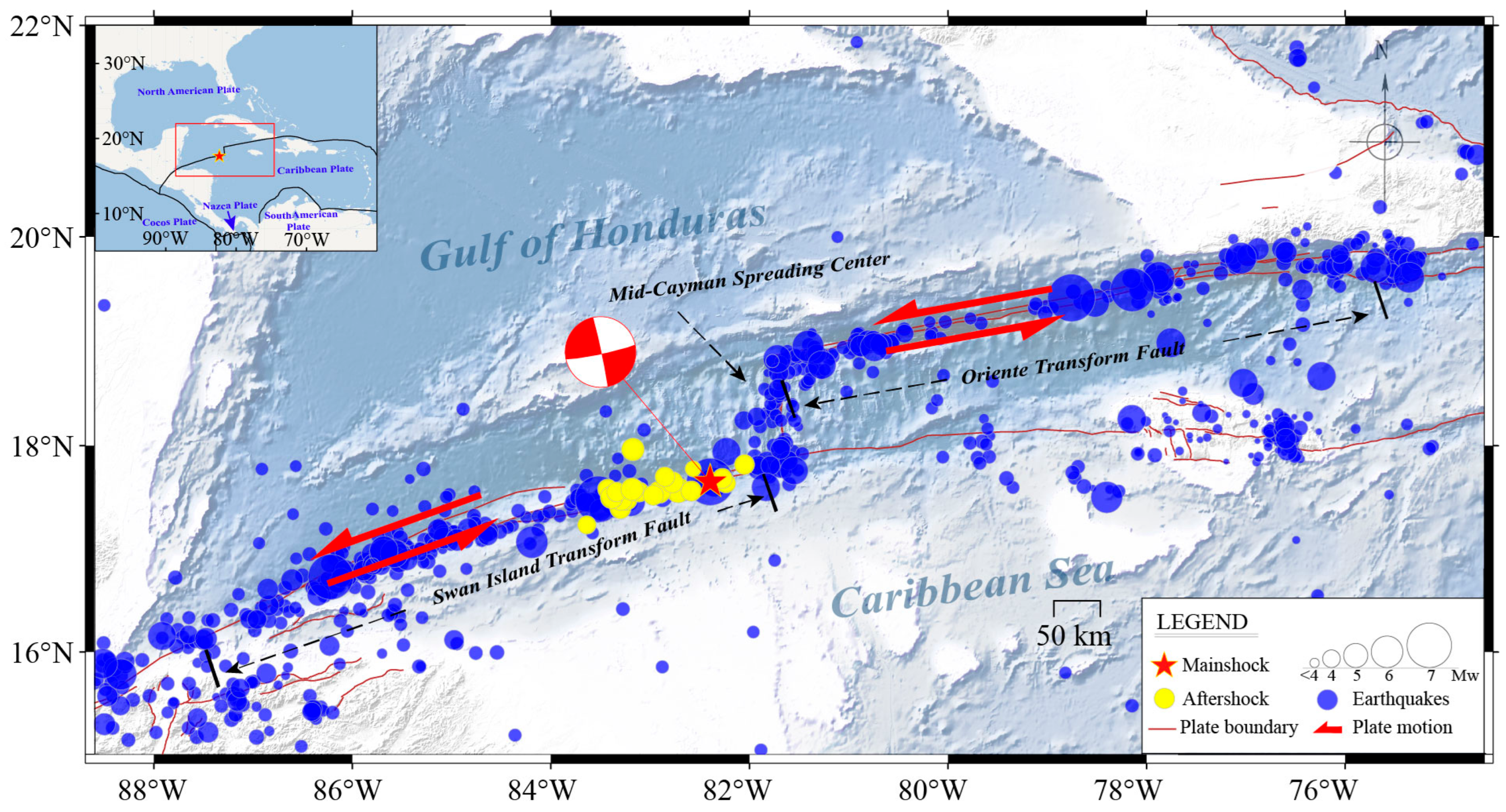
Rupture Velocity Acceleration and Slip Partitioning Along an Oceanic Transform Fault: The 2025 Mw 7.6 Cayman Trough Earthquake

 , ,
, ,
Abstract
1. Introduction
2. Back-Projection Analysis
2.1. Data and Processing
2.2. Back-Projection Method
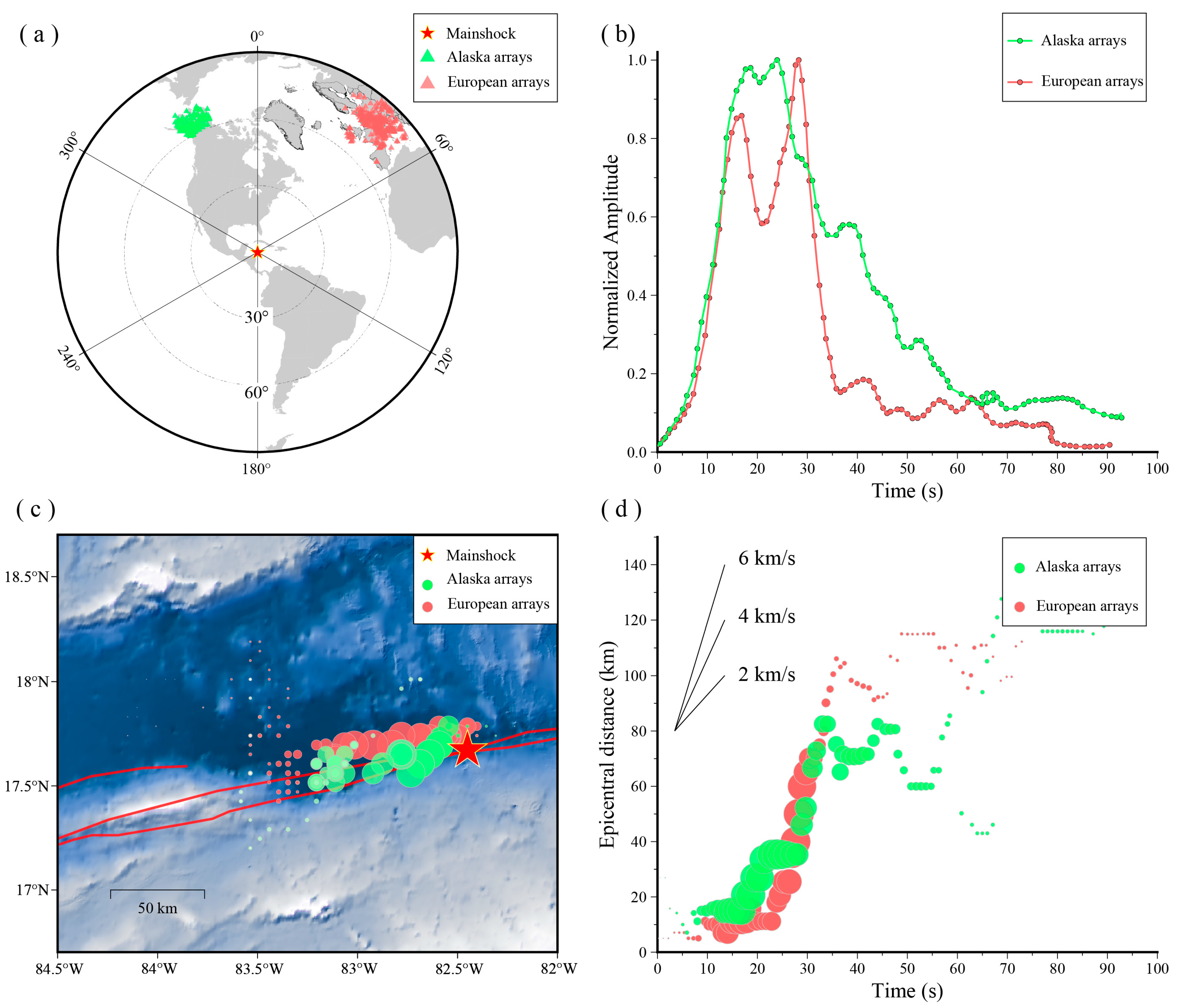
2.3. Back-Projection Results
- The initial ~20 s corresponds to a sub-shear phase, with an average rupture speed of ~1 km/s.
- In the subsequent stage, the rupture accelerates significantly, reaching supershear speeds of ~5–6 km/s.
3. Finite-Fault Inversion
3.1. Data and Method
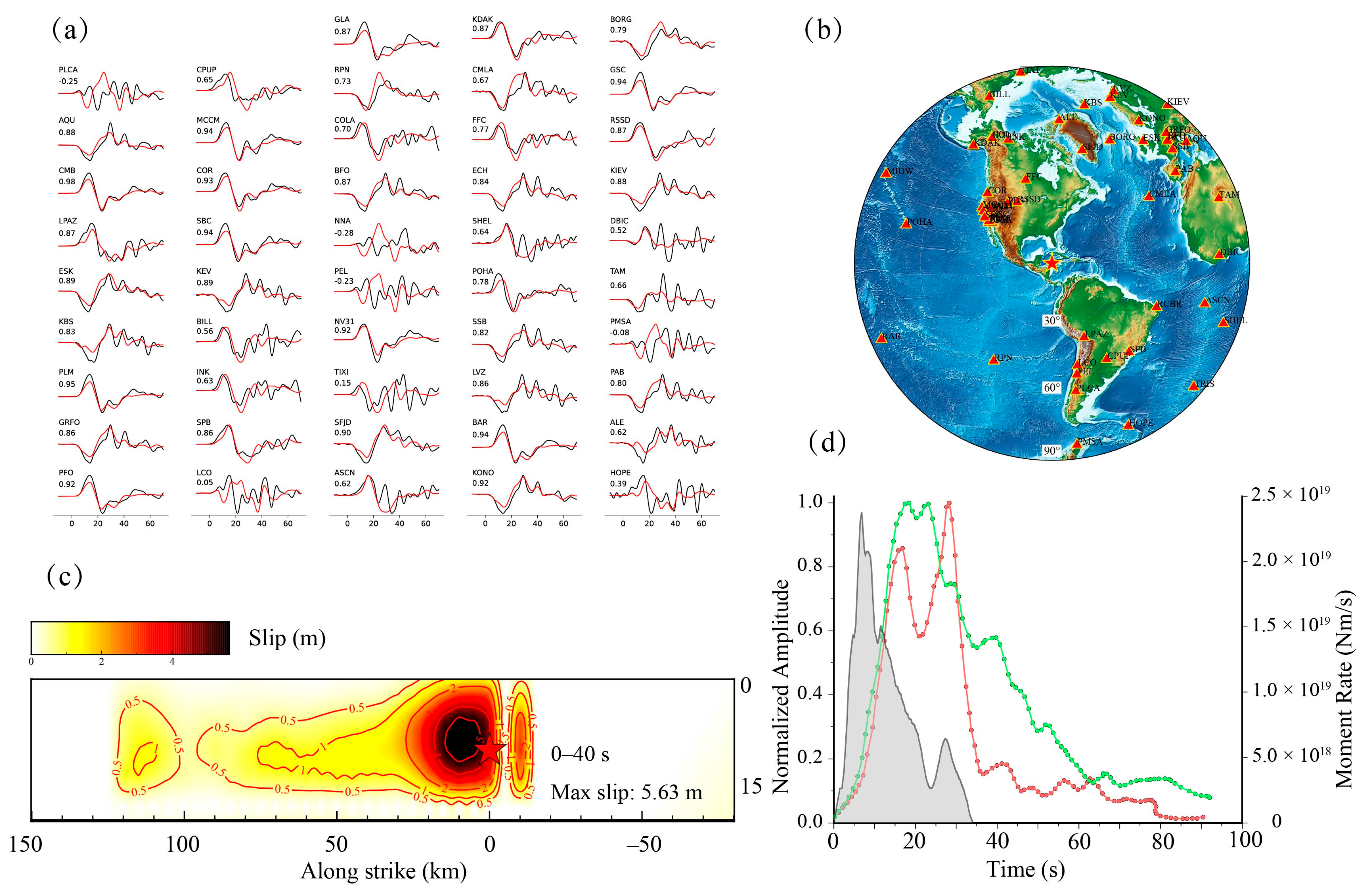
3.2. Inversion Results
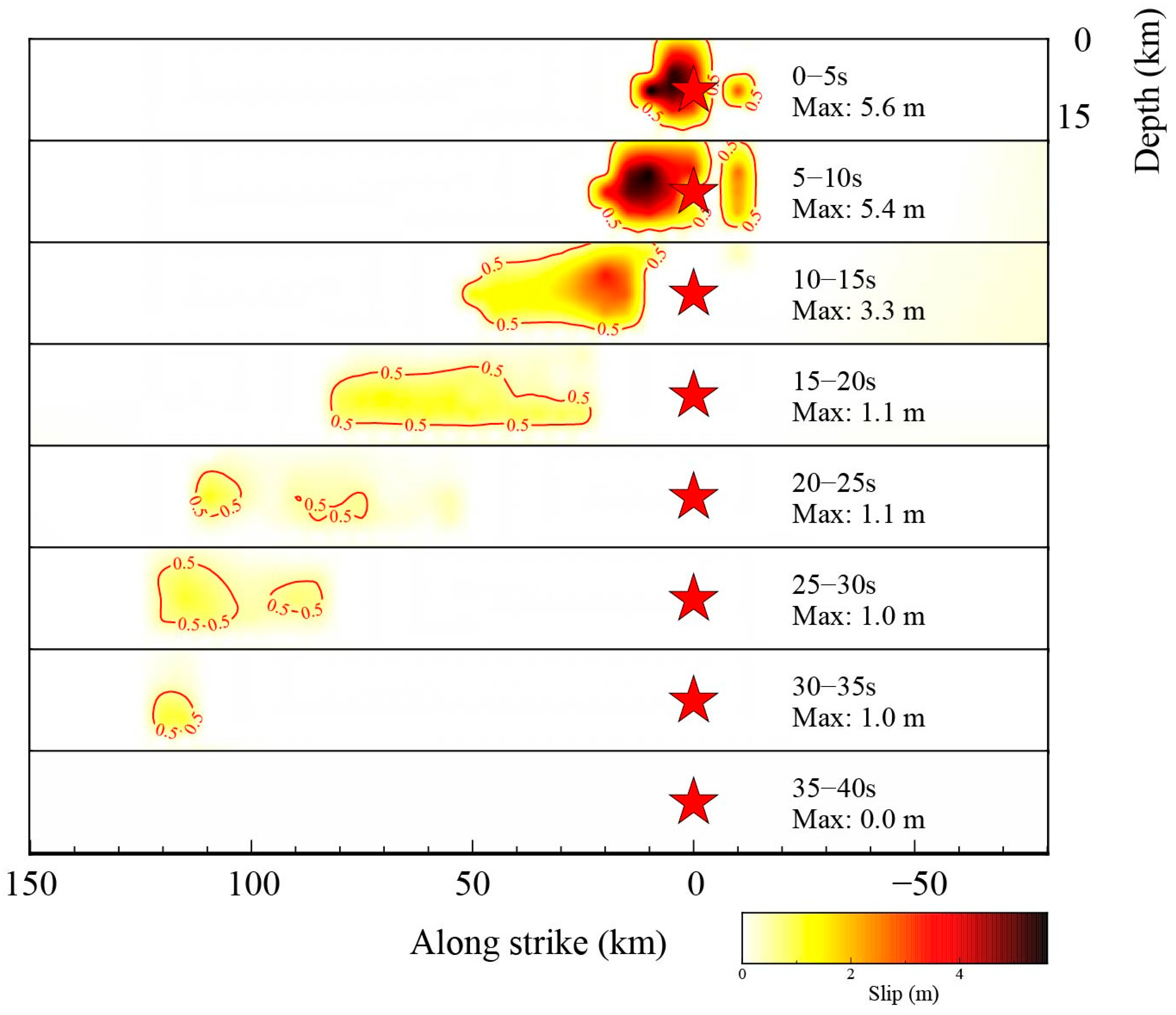
3.3. Spatiotemporal Rupture Evolution
4. Discussion
5. Conclusions
Author Contributions
Funding
Data Availability Statement
Acknowledgments
Conflicts of Interest
References
- Calais, É.; Symithe, S.; de Lépinay, B.M.; Prépetit, C. Plate boundary segmentation in the northeastern Caribbean from geodetic measurements and Neogene geological observations. Comptes Rendus-Géosci. 2016, 348, 42–51. [Google Scholar] [CrossRef]
- Peirce, C.; Grevemeyer, I.; Hayman, N.W.; Van Avendonk, H.J.A. Active ocean–continent transform margins: Seismic investigation of the Cayman Trough-Swan Island ridge-transform intersection. Geophys. J. Int. 2022, 229, 1604–1627. [Google Scholar] [CrossRef]
- Plafker, G. Tectonic aspects of the Guatemala earthquake of 4 February 1976. Science 1976, 193, 1201–1208. [Google Scholar] [CrossRef]
- Calais, E.; Delouis, B.; Ampuero, J.-P.; Bao, H.; Courboulex, F.; Deschamps, A.; De Lépinay, B.; Monfret, T.; Meng, L.; Xu, L.; et al. The 28 January 2020, Mw7. 7, Cayman Trough/Oriente Fault, Supershear Earthquake Rupture. Seismica 2025, 4, 1815. [Google Scholar] [CrossRef]
- Rosencrantz, E.; Mann, P. SeaMARC II mapping of transform faults in the Cayman Trough, Caribbean Sea. Geology 1991, 19, 690–693. [Google Scholar] [CrossRef]
- Leroy, S.; Mauffret, A.; Patriat, P.; Mercier de Lépinay, B. An alternative interpretation of the Cayman trough evolution from a reidentification of magnetic anomalies. Geophys. J. Int. 2000, 141, 539–557. [Google Scholar] [CrossRef]
- Connelly, D.P.; Copley, J.T.; Murton, B.J.; Stansfield, K.; Tyler, P.A.; German, C.R.; Van Dover, C.L.; Amon, D.; Furlong, M.; Grindlay, N.; et al. Hydrothermal vent fields and chemosynthetic biota on the world’s deepest seafloor spreading centre. Nat. Commun. 2012, 3, 620. [Google Scholar] [CrossRef]
- Hayman, N.W.; Grindlay, N.R.; Perfit, M.R.; Mann, P.; Leroy, S.; de Lépinay, B.M. Oceanic core complex development at the ultraslow spreading Mid-Cayman Spreading Center. Geochem. Geophys. Geosyst. 2011, 12, AG02. [Google Scholar] [CrossRef]
- Mann, P.; Calais, E.; Ruegg, J.; DeMets, C.; Jansma, P.E.; Mattioli, G.S. Oblique collision in the northeastern Caribbean from GPS measurements and geological observations. Tectonics 2002, 21, 1057. [Google Scholar] [CrossRef]
- Mann, P. Global catalogue, classification and tectonic origins of restraining- and releasing bends on active and ancient strike-slip fault systems. Geol. Soc. Lond. Spec. Publ. 2007, 290, 13–142. [Google Scholar] [CrossRef]
- Sibson, R.H. Earthquakes and rock deformation in crustal fault zones. Annu. Rev. Earth Planet. Sci. 1986, 14, 149. [Google Scholar] [CrossRef]
- Chen, W.; Wu, J.; Rao, G.; Li, X.; Chen, L.; Peng, Y.; Zhang, Z.; Yi, M.; Sun, Y. Rapid Post-Earthquake Impact and Recovery Assessment: The 2025 M w 7.7 Myanmar Earthquake. J. Earth Sci. 2025, 36, 2380–2386. [Google Scholar] [CrossRef]
- Bai, C.; Xu, W.; Zhao, L.; Sun, K.; Xie, L. 3D coseismic deformation and fault slip model of the 2023 Kahramanmaraş earthquake sequence constrained by GPS, ALOS-2 and Sentinel-1 data. J. Earth Sci. 2025, 36, 812–822. [Google Scholar] [CrossRef]
- Zhang, P.-Z. A review on active tectonics and deep crustal processes of the Western Sichuan region, eastern margin of the Tibetan Plateau. Tectonophysics 2013, 584, 7–22. [Google Scholar] [CrossRef]
- Wang, D.; Mori, J. Rupture process of the 2011 off the Pacific coast of Tohoku Earthquake (M w 9.0) as imaged with back-projection of teleseismic P-waves. Earth Planets Space 2011, 63, 17. [Google Scholar] [CrossRef]
- Wang, D.; Kawakatsu, H.; Mori, J.; Ali, B.; Ren, Z.; Shen, X. Backprojection analyses from four regional arrays for rupture over a curved dipping fault: The Mw 7.7 24 September 2013 Pakistan earthquake. J. Geophys. Res. Solid Earth 2016, 121, 1948–1961. [Google Scholar] [CrossRef]
- Krüger, F.; Ohrnberger, M. Tracking the rupture of the M w = 9.3 Sumatra earthquake over 1150 km at teleseismic distance. Nature 2005, 435, 937–939. [Google Scholar] [CrossRef]
- Ishii, M.; Shearer, P.M.; Houston, H.; Vidale, J.E. Extent, duration and speed of the 2004 Sumatra–Andaman earthquake imaged by the Hi-Net array. Nature 2005, 435, 933–936. [Google Scholar] [CrossRef]
- Yao, H.; Shearer, P.M.; Gerstoft, P. Subevent location and rupture imaging using iterative backprojection for the 2011 Tohoku M w 9.0 earthquake. Geophys. J. Int. 2012, 190, 1152–1168. [Google Scholar] [CrossRef]
- Vera, F.; Tilmann, F.; Saul, J. A decade of short-period earthquake rupture histories from multi-array back-projection. J. Geophys. Res. Solid Earth 2024, 129, e2023JB027260. [Google Scholar] [CrossRef]
- Kennett, B.L.N.; Engdahl, E.R. Traveltimes for global earthquake location and phase identification. Geophys. J. Int. 1991, 105, 429–465. [Google Scholar] [CrossRef]
- Laske, G.; Masters, G.; Ma, Z.; Pasyanos, M. Update on CRUST1.0—A 1-degree global model of Earth’s crust. Geophys. Res. Abstr. 2013, 15, 2658. [Google Scholar]
- Andrews, D. Rupture propagation with finite stress in antiplane strain. J. Geophys. Res. 1976, 81, 3575–3582. [Google Scholar] [CrossRef]
- Bizzarri, A.; Spudich, P. Effects of supershear rupture speed on the high-frequency content of S waves investigated using spontaneous dynamic rupture models and isochrone theory. J. Geophys. Res. Solid Earth 2008, 113, B05304. [Google Scholar] [CrossRef]
- Melgar, D.; Fan, W.; Riquelme, S.; Geng, J.; Liang, C.; Fuentes, M.; Vargas, G.; Allen, R.M.; Shearer, P.M.; Fielding, E.J. Slip segmentation and slow rupture to the trench during the 2015, Mw8. 3 Illapel, Chile earthquake. Geophys. Res. Lett. 2016, 43, 961–966. [Google Scholar] [CrossRef]
- Razafindrakoto, H.N.; Mai, P.M.; Genton, M.G.; Zhang, L.; Thingbaijam, K.K.S. Quantifying variability in earthquake rupture models using multidimensional scaling: Application to the 2011 Tohoku earthquake. Geophys. J. Int. 2015, 202, 17–40. [Google Scholar] [CrossRef][Green Version]
- Kikuchi, M.; Kanamori, H. Inversion of complex body waves-II. Phys. Earth Planet. Inter. 1986, 43, 205–222. [Google Scholar] [CrossRef]
- Tocheport, A.; Rivera, L.; Chevrot, S. A systematic study of source time functions and moment tensors of intermediate and deep earthquakes. J. Geophys. Res. Solid Earth 2007, 112, B07311. [Google Scholar] [CrossRef]
- Chounet, A.; Vallée, M.; Causse, M.; Courboulex, F. Global catalog of earthquake rupture velocities shows anticorrelation between stress drop and rupture velocity. Tectonophysics 2018, 733, 148–158. [Google Scholar] [CrossRef]
- Weng, H.; Ampuero, J.-P. Integrated rupture mechanics for slow slip events and earthquakes. Nat. Commun. 2022, 13, 7327. [Google Scholar] [CrossRef]
- Chen, G.; Li, J.; Chen, J.; Du, R.; Liu, Y.; Qi, Y.; Li, C.F.; Huang, X. High-Precision Sub-Seafloor Velocity Building Based on Joint Tomography and Deep Learning on OBS Data in the South China Sea. J. Earth Sci. 2025, 36, 830–834. [Google Scholar] [CrossRef]
- Beeler, N.M.; Tullis, T.E. Self-healing slip pulses in dynamic rupture models due to velocity-dependent strength. Bull. Seismol. Soc. Am. 1996, 86, 1130–1148. [Google Scholar] [CrossRef]
- Lu, X.; Lapusta, N.; Rosakis, A.J. Pulse-like and crack-like ruptures in experiments mimicking crustal earthquakes. Proc. Natl. Acad. Sci. USA 2007, 104, 18931–18936. [Google Scholar] [CrossRef] [PubMed]
- Ampuero, J.P.; Rubin, A.M. Earthquake nucleation on rate and state faults–Aging and slip laws. J. Geophys. Res. Solid Earth 2008, 113, B01302. [Google Scholar] [CrossRef]



Disclaimer/Publisher’s Note: The statements, opinions and data contained in all publications are solely those of the individual author(s) and contributor(s) and not of MDPI and/or the editor(s). MDPI and/or the editor(s) disclaim responsibility for any injury to people or property resulting from any ideas, methods, instructions or products referred to in the content. |
© 2026 by the authors. Licensee MDPI, Basel, Switzerland. This article is an open access article distributed under the terms and conditions of the Creative Commons Attribution (CC BY) license.
Share and Cite
Zhang, H.; Wang, D.; Peng, Y.; Wang, Z.; Zhang, Z.; Tan, S.; Gong, K.; Yang, Y. Rupture Velocity Acceleration and Slip Partitioning Along an Oceanic Transform Fault: The 2025 Mw 7.6 Cayman Trough Earthquake. J. Mar. Sci. Eng. 2026, 14, 479. https://doi.org/10.3390/jmse14050479
Zhang H, Wang D, Peng Y, Wang Z, Zhang Z, Tan S, Gong K, Yang Y. Rupture Velocity Acceleration and Slip Partitioning Along an Oceanic Transform Fault: The 2025 Mw 7.6 Cayman Trough Earthquake. Journal of Marine Science and Engineering. 2026; 14(5):479. https://doi.org/10.3390/jmse14050479
Chicago/Turabian StyleZhang, Hong, Dun Wang, Yuyang Peng, Zhifeng Wang, Zhenhang Zhang, Songlin Tan, Keyue Gong, and Yongpeng Yang. 2026. "Rupture Velocity Acceleration and Slip Partitioning Along an Oceanic Transform Fault: The 2025 Mw 7.6 Cayman Trough Earthquake" Journal of Marine Science and Engineering 14, no. 5: 479. https://doi.org/10.3390/jmse14050479
APA StyleZhang, H., Wang, D., Peng, Y., Wang, Z., Zhang, Z., Tan, S., Gong, K., & Yang, Y. (2026). Rupture Velocity Acceleration and Slip Partitioning Along an Oceanic Transform Fault: The 2025 Mw 7.6 Cayman Trough Earthquake. Journal of Marine Science and Engineering, 14(5), 479. https://doi.org/10.3390/jmse14050479