Article

Incorporating Radioactive Decay Chains Within Lagrangian Marine Radionuclide Transport Models for Assessing the Consequences of Nuclear Accidents

1
Departamento de Matemática Aplicada I, ETSIA, Universidad de Sevilla, 41013 Sevilla, Spain
2
Departamento de Física Aplicada I, ETSIA, Universidad de Sevilla, 41013 Sevilla, Spain
*
Author to whom correspondence should be addressed.
J. Mar. Sci. Eng. 2026, 14(4), 328; https://doi.org/10.3390/jmse14040328
Submission received: 13 January 2026 / Revised: 5 February 2026 / Accepted: 6 February 2026 / Published: 8 February 2026

Abstract

Lagrangian particle-tracking models are increasingly used to simulate radionuclide transport in marine environments, especially for assessing the consequences of accidental releases. However, existing models generally neglect radioactive decay chains, limiting their ability to reproduce the complete behavior of radionuclides and their progeny. To the authors’ knowledge, this work presents the first implementation of radioactive decay chains within a fully three-dimensional Lagrangian marine radionuclide transport model, explicitly coupling stochastic particle tracking with decay kinetics and dynamic sediment–water interactions, enabling a realistic simulation of parent–daughter transformations in the ocean. The approach is tested for the chain in the Western Mediterranean Sea, following a hypothetical nuclear accident. Results confirm that the stochastic treatment accurately reproduces analytical decay solutions and can be seamlessly incorporated into operational-scale transport simulations. The framework can be extended to other radionuclide series and marine domains, providing a versatile and computationally efficient tool for emergency response, environmental impact assessment, and safety analysis in nuclear engineering applications.

1. Introduction

Lagrangian modeling approaches are increasingly employed to simulate the dispersion and transport of radionuclides within marine environments [1,2,3,4,5,6,7], particularly in emergency scenarios. These models offer certain advantages over traditional Eulerian frameworks, such as higher computational efficiency and an enhanced ability to represent the steep concentration gradients that typically develop following large-scale radioactive discharges into the ocean, avoiding numerical diffusion. These issues are discussed in detail in the review in [8].
Only one marine radionuclide transport model including radioactive chains can be found in the literature, to the authors’ knowledge, which is a compartment (or box) model [9], the so-called poseidon–r. While these models are well suited for large-scale or long-term assessments, they do not explicitly resolve three-dimensional advection and diffusion processes at the particle level. To the authors’ knowledge, the explicit inclusion of radioactive decay chains within a fully three-dimensional Lagrangian ocean transport model has not been previously reported. The present work addresses this gap by integrating stochastic decay-chain dynamics into an operational Lagrangian framework.
Incorporating radioactive decay chains into marine dispersion models is essential for achieving the realistic assessments of radiological impacts following accidental releases. The daughter products of many parent radionuclides often exhibit distinct physical–chemical behaviors and half-lives, which can significantly alter the temporal and spatial evolution of total radioactivity in the marine environment. Neglecting these decay chains may lead to underestimation or misrepresentation of the long-term distribution of radioactivity, particularly for actinides and other nuclides with complex decay series. Therefore, the explicit treatment of parent–daughter relationships is a relevant component in emergency response modeling, ensuring more accurate predictions of contaminant transport, exposure pathways, and ecological or human dose assessments.
The objective of this paper is to describe a methodology to include radionuclide chains into a Lagrangian model, which has not been previously reported. For this purpose, the model described in [6] for the Western Mediterranean is expanded to include this new feature, and some application examples are presented. The model, described briefly later, also incorporates a dynamic model to describe radionuclide exchanges between water and sediments.
241Pu is selected for the study because it is the most abundant Pu isotope released in the environment, and thus it is the main contributor to the total Pu activity [10]. It is hazardous to human health and, in addition, its daughters, 241Am and 237Np, become the major components of doses [10]. In addition, their environmental behaviors are markedly different: plutonium and americium are known to be strongly particle-reactive elements in seawater, exhibiting high sediment–water distribution coefficients [11] and a marked tendency to accumulate in marine sediments. Numerous field studies have documented their contrasting partitioning between dissolved and particulate phases in coastal and open-sea environments, including the Mediterranean Sea, highlighting their relevance for sediment–water exchange modeling [12]. In contrast, neptunium exhibits a much lower affinity for particles and sediments than plutonium and americium as reflected by its significantly smaller sediment–water distribution coefficient. This results in a higher mobility in marine environments and transport pathways that differ markedly from those of the more particle-reactive actinides Pu and Am. The selected decay chain therefore spans a wide range of half-lives and sediment reactivities, making it a representative and demanding test case for assessing the ability of a Lagrangian framework to consistently simulate radioactive decay, transport processes, and dynamic water–sediment interactions. While the present study focuses on methodological development and validation against analytical decay solutions, further validation using observational data and independent datasets is required and will be addressed in future work.
The principal sources of environmental 241Pu are nuclear weapons testing, nuclear fuel reprocessing facilities [10], and nuclear power plant accidents. For example, it has been estimated that approximately 6.0 × 10 15 Bq were released during the Chernobyl accident [13], while about 1.2 × 10 12 Bq were emitted as a result of the Fukushima accident [14]. Satellite accidents have also contributed significantly [10], as well as accidents involving nuclear weapons: in 1966 a B-52 bomber crashed near Palomares (Spain, southwest Mediterranean) and two thermonuclear weapons were destroyed contaminating the soil with Pu and Am, which were washed to the sea by heavy rains in the region [15]. Another example is the 1968 Thule (Greenland) accident in which four nuclear weapons were destroyed [16]. The released Pu in these cases was of the order of 1 TBq [10,15,16].
The model and the methodology developed to include radioactive chains in the Lagrangian framework are described in Section 2. Examples of the results are presented in Section 3.

2. Lagrangian Model Description: Incorporating Decay Chains

In the Lagrangian approach, a radionuclide release is represented by a collection of particles, usually around 10 6 , each corresponding to a specific number of becquerels. The trajectories of these particles are computed to determine their final spatial distribution, from which concentration maps of radionuclides are reconstructed. The model accounts for advection by currents, three-dimensional turbulent diffusion, radioactive decay, and radionuclide exchanges between the water column and sediments. These exchanges are modeled dynamically, assuming a reversible process characterized by adsorption and desorption rate constants. Radioactive decay and sediment–water interactions are handled through a stochastic (Monte Carlo) scheme. The model operates in spherical coordinates, and a detailed description of the equations and implementation can be found in [6].
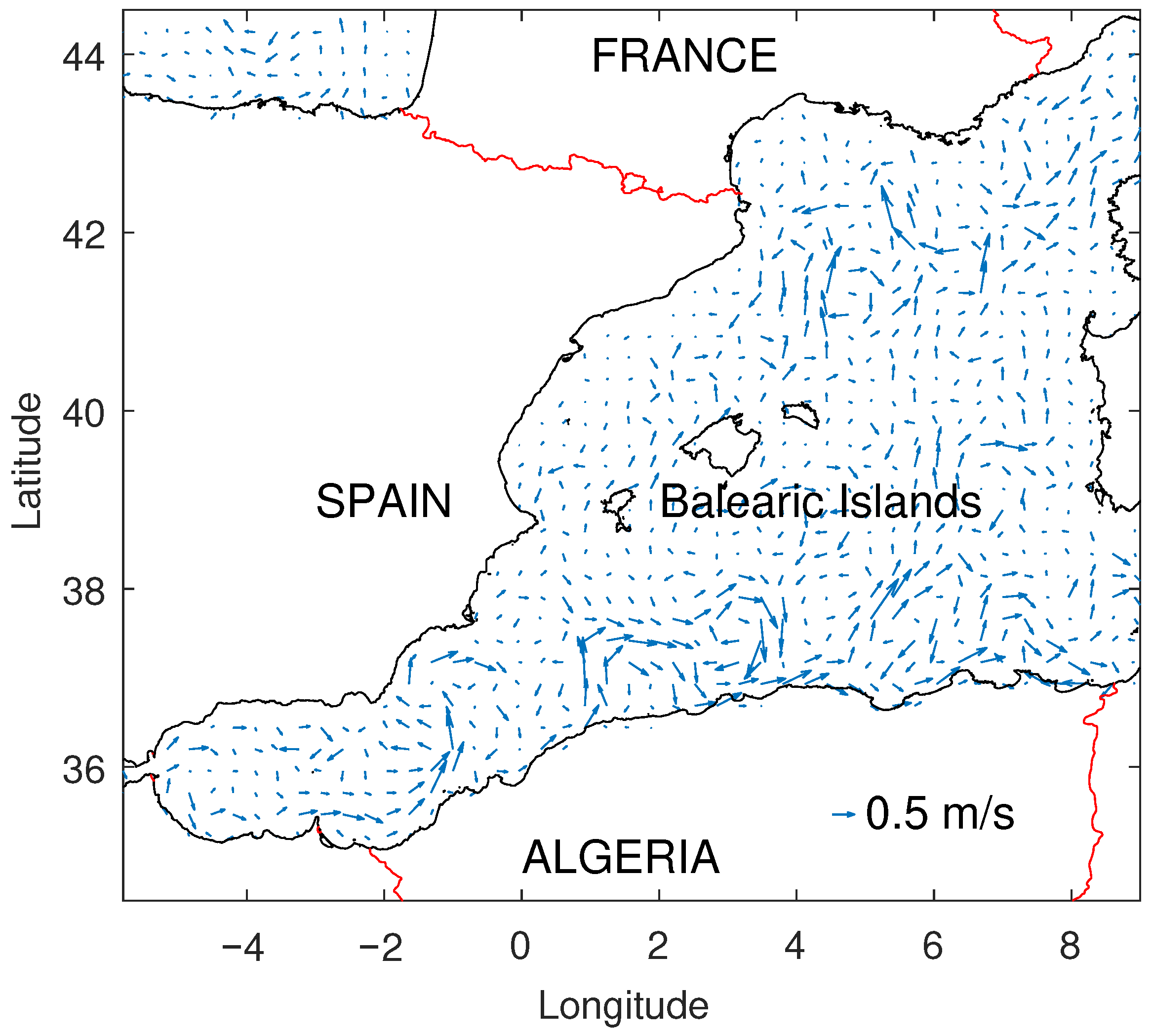
The model of the Western Mediterranean used to test the methodology covers the area between 5.80 ° and 9.00 ° longitude, and from 34.50 ° to 44.50 ° latitude (Figure 1). Hydrodynamic data within this region were obtained from the HYCOM (HYbrid Coordinate Ocean Model) global ocean model [17]. This system is driven by atmospheric parameters such as wind fields, short- and long-wave radiation, freshwater inputs from major rivers, precipitation, air temperature, specific humidity, dew point, and atmospheric pressure. Therefore, the currents data from HYCOM implicitly include all physical processes in the region—density-driven circulation due to temperature and salinity differences, as well as heat exchanges with the atmosphere and wind stress—as all of them continuously change in time and space. Data were obtained for model realization GLBa0.08, experiment 91.2, from which zonal and meridional velocities were extracted. Numerous examples of HYCOM applications are available on its official website, and several specific studies focused on the Mediterranean Sea are also documented in the literature [18,19]. The model is composed of 32 vertical layers, with a horizontal resolution of 0.08 ° in longitude. The resolution in latitude, however, is non-uniform; for this reason, the simulations were conducted using spherical coordinates. Although tidal forcing is not represented in HYCOM, this simplification is acceptable because the tidal effects in the Mediterranean Sea are weak [20] and can be disregarded. An example of surface circulation for January 31st provided by HYCOM is presented in Figure 1. Daily currents are used in the transport simulations.
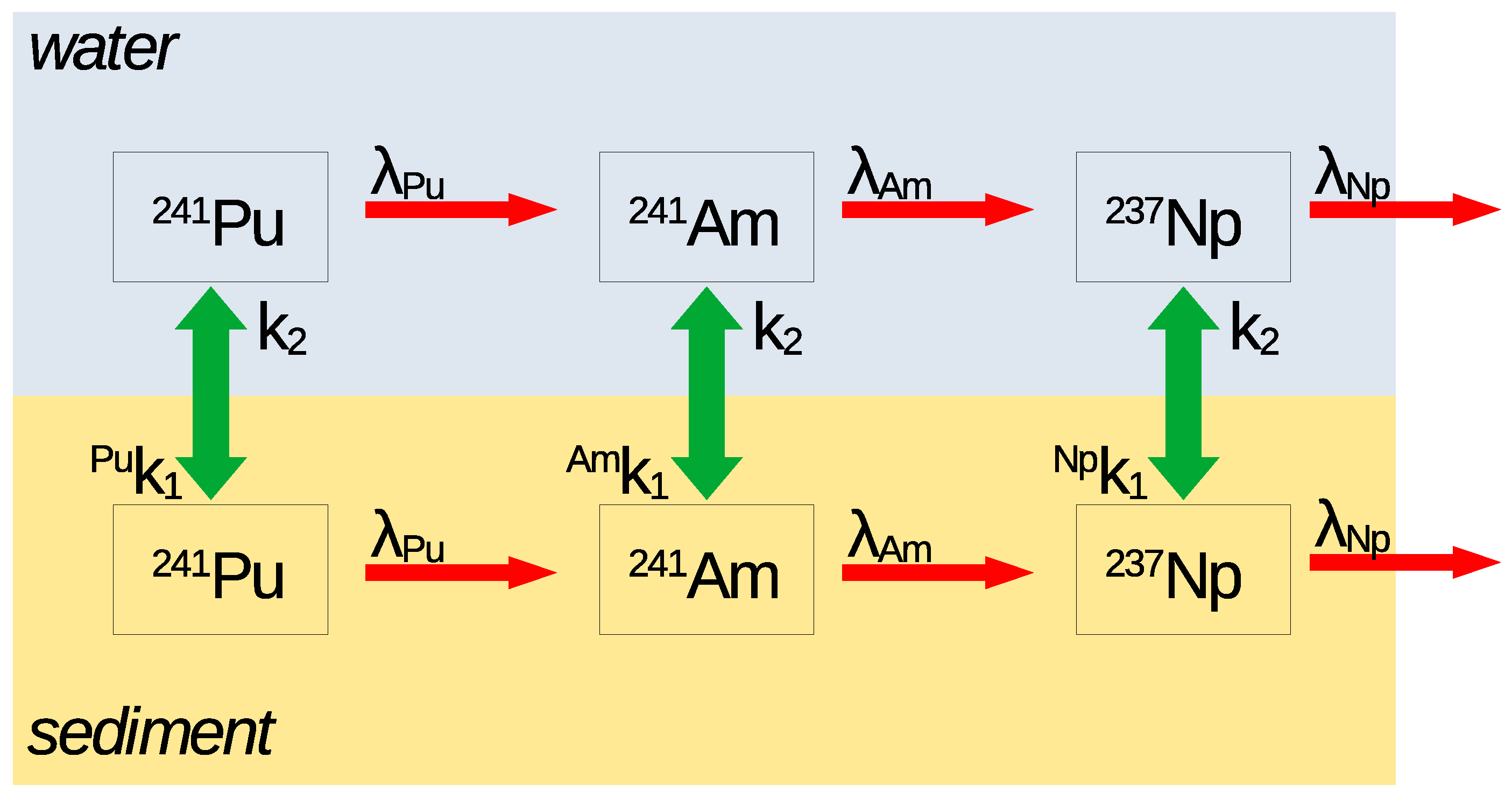
The model, in this formulation, has already been applied to simulate the consequences of hypothetical nuclear accidents in the Mediterranean [6,21,22]. Now, it has been reformulated following the scheme in Figure 2, involving 241Pu and its daughters as mentioned in Section 1. In this case, three radionuclides in the chain have been considered, but the method can be generalized to any number.
As previously mentioned, in the Lagrangian approach, each particle represents a number of Bq (the unit of activity). In the present model, it represents a number of atoms since activity is A = λ N , where λ (s−1) is the radioactive decay constant and N the number of atoms, and consequently the same number of atoms of different isotopes corresponds to different activity values. For each process in Figure 2, a probability is defined as ([4,6] and references here contained):
p α = 1 e α Δ t ,
where p α is the probability that the process occurs in time interval Δ t (s). Parameter α represents any of the processes in Figure 2: a radioactive decay (the corresponding λ ) or a phase transition, characterized by k 1 (s−1) if the atom is dissolved or k 2 (s−1) if it is in the sediment. A random number, uniformly distributed between 0 and 1, R A N , is generated using a standard fortran library and the process α occurs if R A N p α .
For the purpose of code programming, a label is assigned to each of the six possible states in Figure 2. The label of each particle is checked each time step to identify the processes which can occur (for instance a dissolved 241Am particle can be converted to a sediment 241Am particle or a dissolved 237Np particle). If any of these processes occur, checked as explained above, the label of the particle is appropriately changed according to the final particle state. If a 237Np particle (either in water or sediment) decays, it is removed from the computation. Similarly, if a particle leaves the model domain, it is removed from the computation.
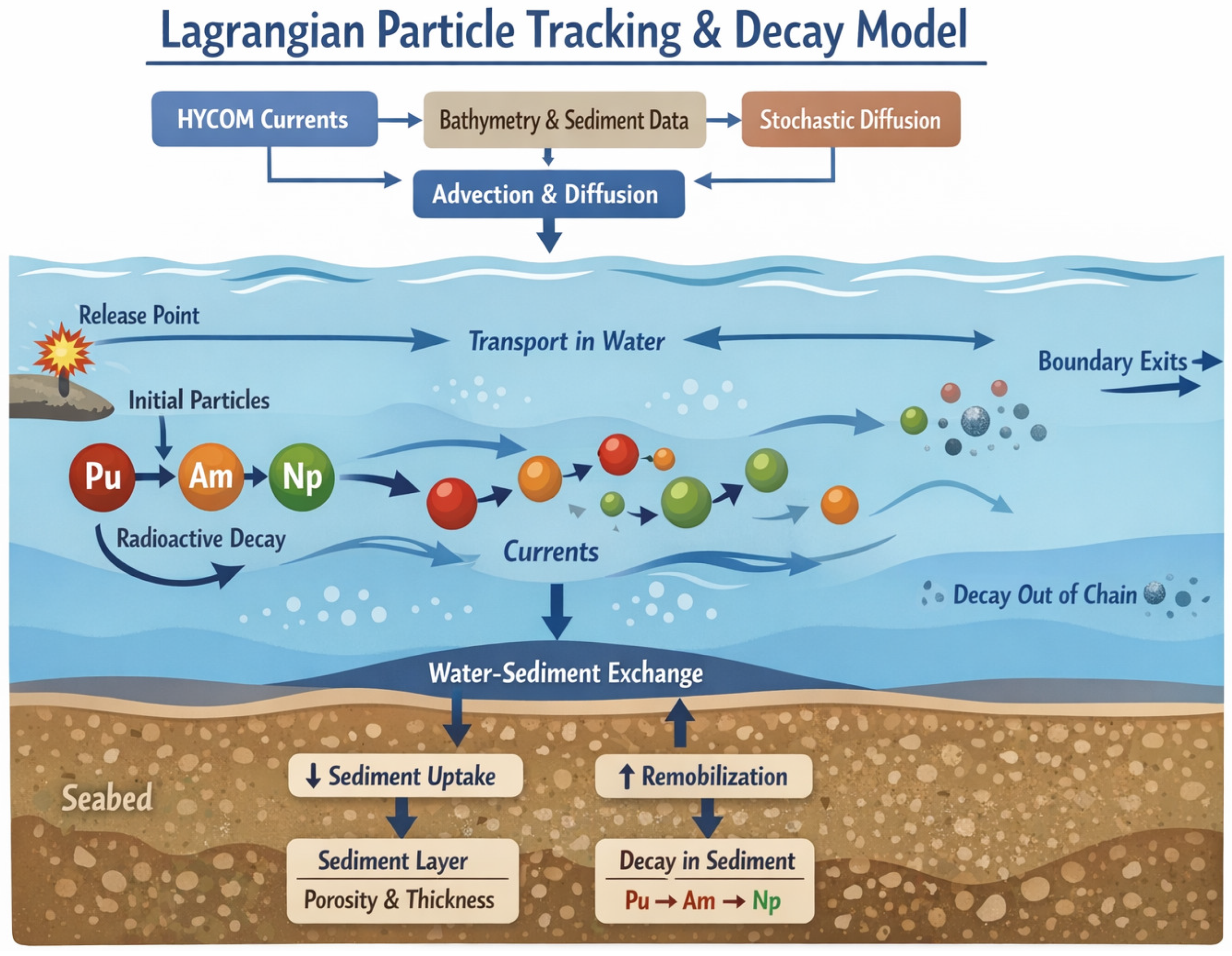
At any desired time during the simulation, the number of particles of each radionuclide per control volume can be converted to activity, multiplying by the corresponding λ , and then to activity concentration (in Bq/m3 in water or Bq/kg in sediment) as described in detail in [4], for instance. A more detailed workflow of the model is provided as Supplementary Materials File S1 and it is graphically depicted in Figure 3.
The model details were already discussed in [6]: The time step was fixed as Δ t = 1200 s to ensure that the spatial displacement given by a particle during a time step due to advection and diffusion is not larger than the size of grid cells. The number of particles used in the simulations was 2 × 10 6 , and linear interpolation was used to obtain water currents at each required time and position. Actually, the present Lagrangian model formulation has been widely tested in model intercomparison programs organized by the International Atomic Energy Agency [23,24] with successful results. In these exercises, the model results were compared with real measurements in water and sediments after Chernobyl and Fukushima accidents.

3. Results

As explained in the previous works [4,6,8], and the references included here, the same value of k 2 can be used for different elements, being the geochemical behavior essentially controlled by k 1 , which is linked with k 2 through the element equilibrium distribution coefficient k d (m3/kg). The desorption rate value used in all previous works is k 2 = 1.16 × 10 5 s−1, which was obtained from laboratory experiments [25]. k d values have been compiled by the International Atomic Energy Agency [11], which are presented in Table 1. These parameters are used in the present application.
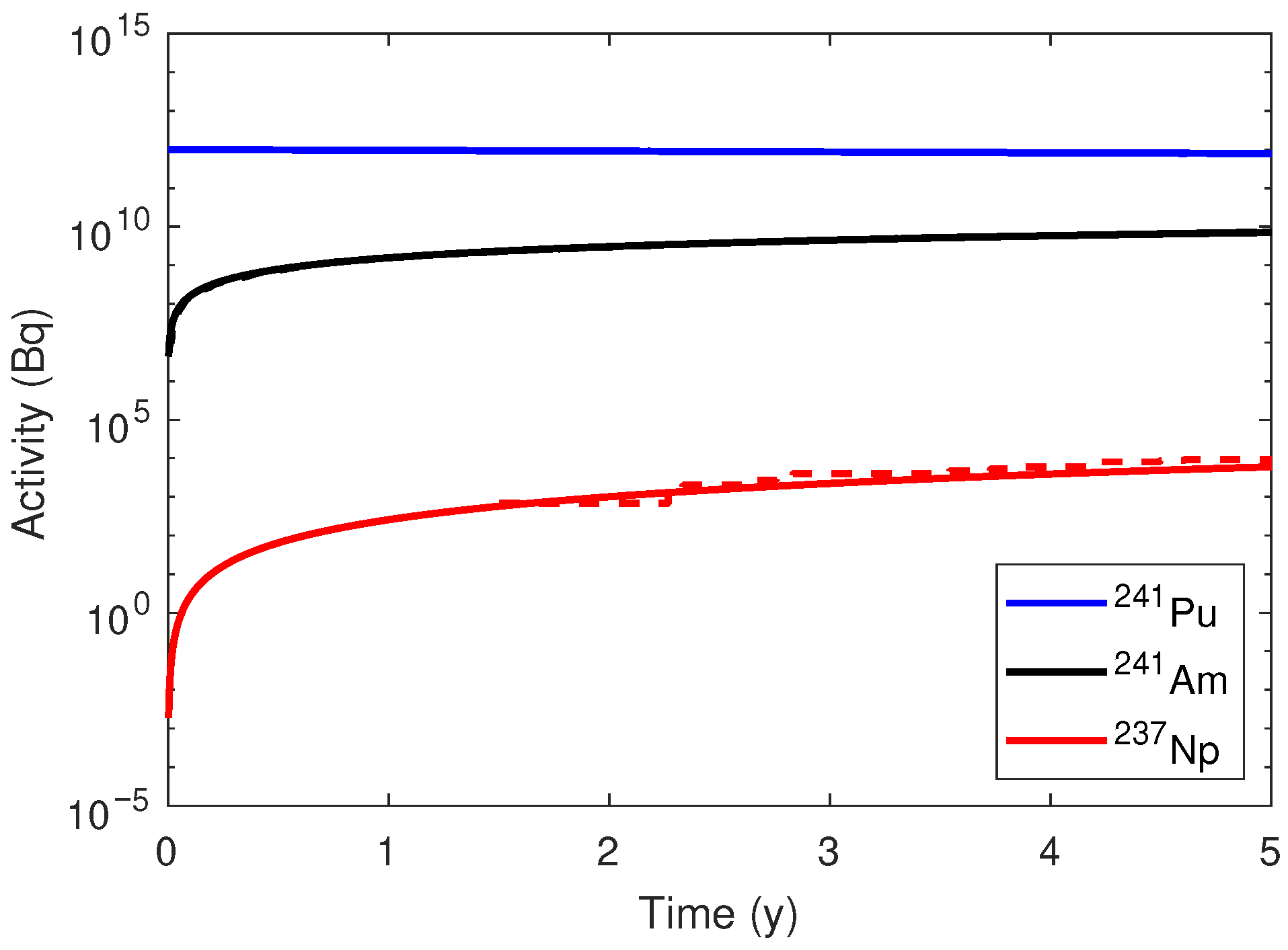
Initially, the formulation is tested in a zero-dimensional model in which we have a starting 241Pu activity of 10 12 Bq in a closed container (we neglect water–sediment interactions since we are testing the Lagrangian approach for decay chains; for water–sediment interactions have already been widely validated in mentioned references). Time evolution of the calculated activities of the three isotopes is presented in Figure 4, together with the exact solution of the radioactive decay equations. It can be seen that the stochastic method mimics the exact solution rather well.
The methodology is incorporated in the full radionuclide transport model of the Western Mediterranean [6], and a hypothetical accident in a ship is simulated, as per previous studies involving hypothetical nuclear accidents in vessels [26,27,28]. An instantaneous discharge of 1 TBq of 241Pu is assumed to occur in the sea surface, which is the order of magnitude of releases in some previous accidents as commented in Section 1. The accident occurs at coordinates 1.5 ° E, 37.8 ° N, where the water depth is 3000 m, on March 21st. This is just an example, as per [6], where the same accidents occurring on different dates and locations, are simulated to investigate seasonal effects in transport pathways. This is discussed in detail in [6] but it is not the purpose of the present paper. A one-year-long simulation was carried out. In addition, it must be noted that in a real accident, many different radionuclides are released simultaneously. However, our purpose is simply testing the proposed methodology, not simulating a real accident, although a simultaneous release of all radionuclides can be easily simulated.
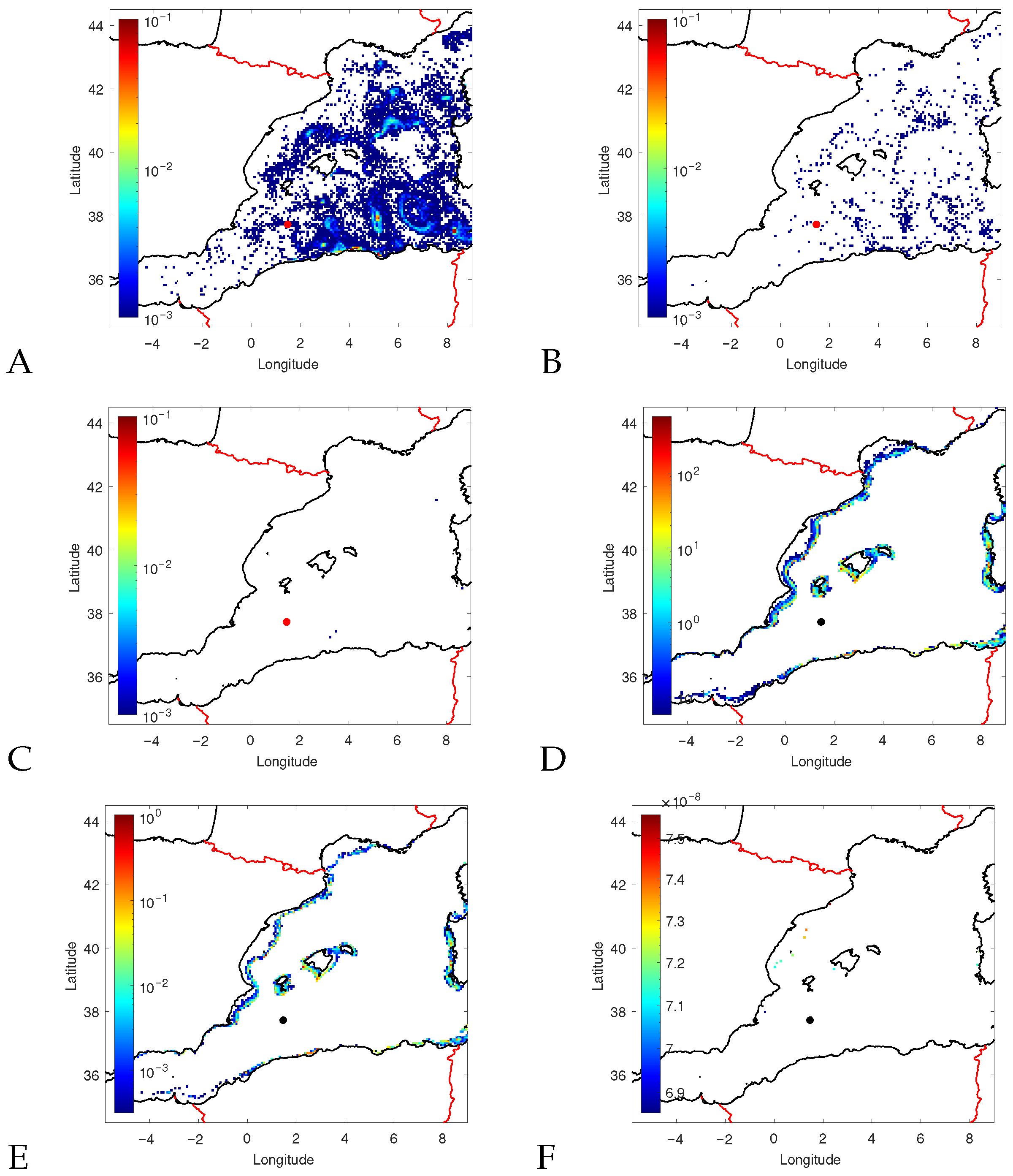
The calculated concentrations of the three radionuclides in surface water and sediment after one year are presented in Figure 5. The surface water is considered to be 50 m thick as in [6]. The mixed layer thickness in this region presents some seasonal variability, typically ranging from about 10 to 100 m [29]. A mean representative value of 50 m is used as discussed in [6]. After one year, 241Pu is distributed over almost all of the model domain, as well as the 241Am produced by its parent decay. Little 237Np is still present in the water surface. In the case of sediments, there is a significant adsorption of 241Pu and 241Am along the coastlines due to their high reactivities (see k d values in Table 1): when radionuclides reach shallow waters, they are quickly fixed to the seabed. Some 237Np is also present in some shallow areas. Due to its low affinity to be fixed to sediments (Table 1), this presence can be most likely attributed to the decay of 241Am already present in the sediment.
If exactly the same release occurs close to the seabed, actually at 2995 m water depth (5 m over the seabed), calculated concentrations in bed sediments after one year are presented in Figure 6. Due to the high reactivity of Pu and Am, these radionuclides are quickly fixed to the bottom, remaining in the release area and not reaching the surface layer. 237Np is very mobile in the marine environment, and thus once it is produced by 241Am decay, it is redissolved and can travel to larger distances from the release point, some small fraction of it being readsorbed by sediments (the extremely low concentrations can be seen in the color scale). In spite of its mobility, 237Np does not reach the surface layer since the release point is very deep.
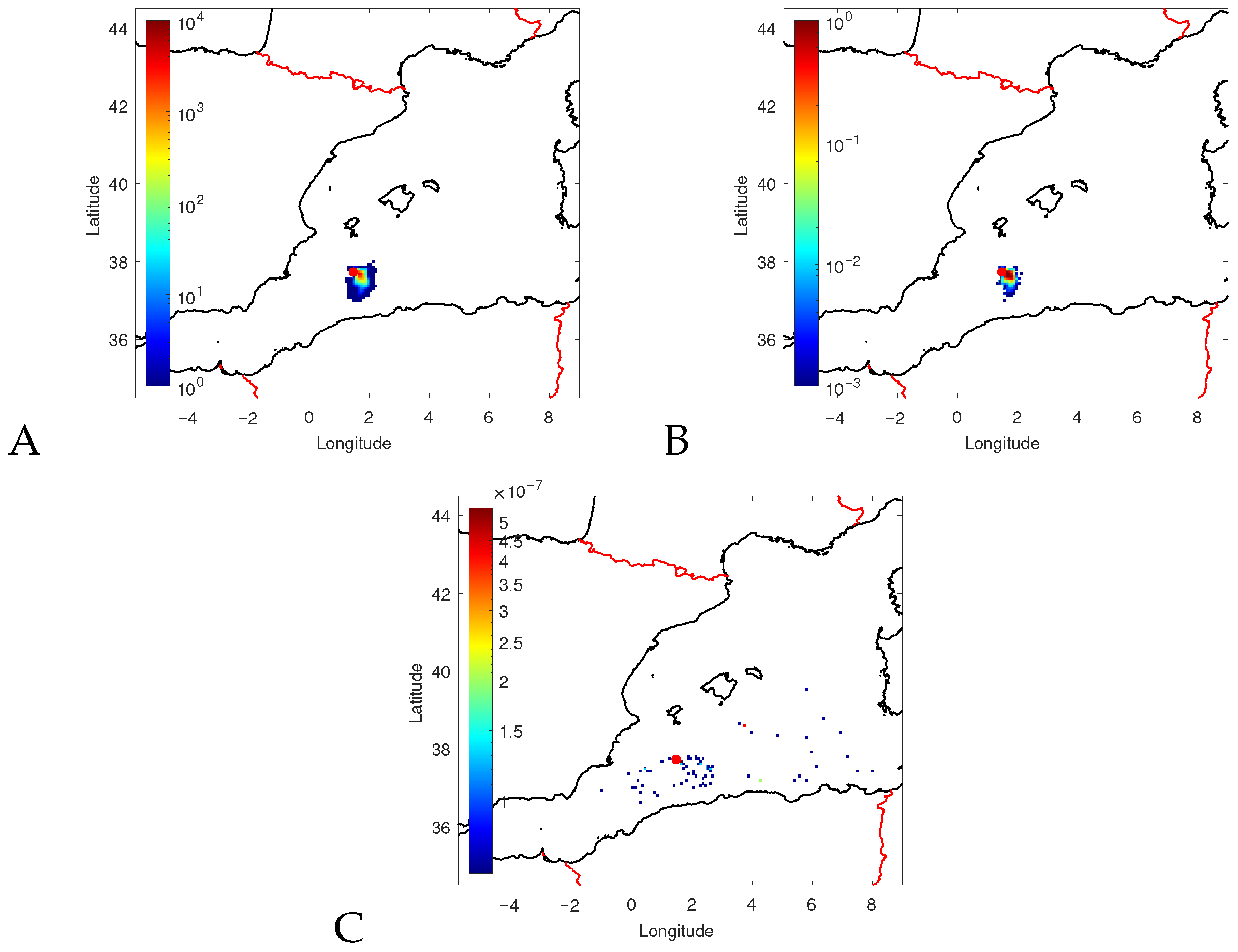
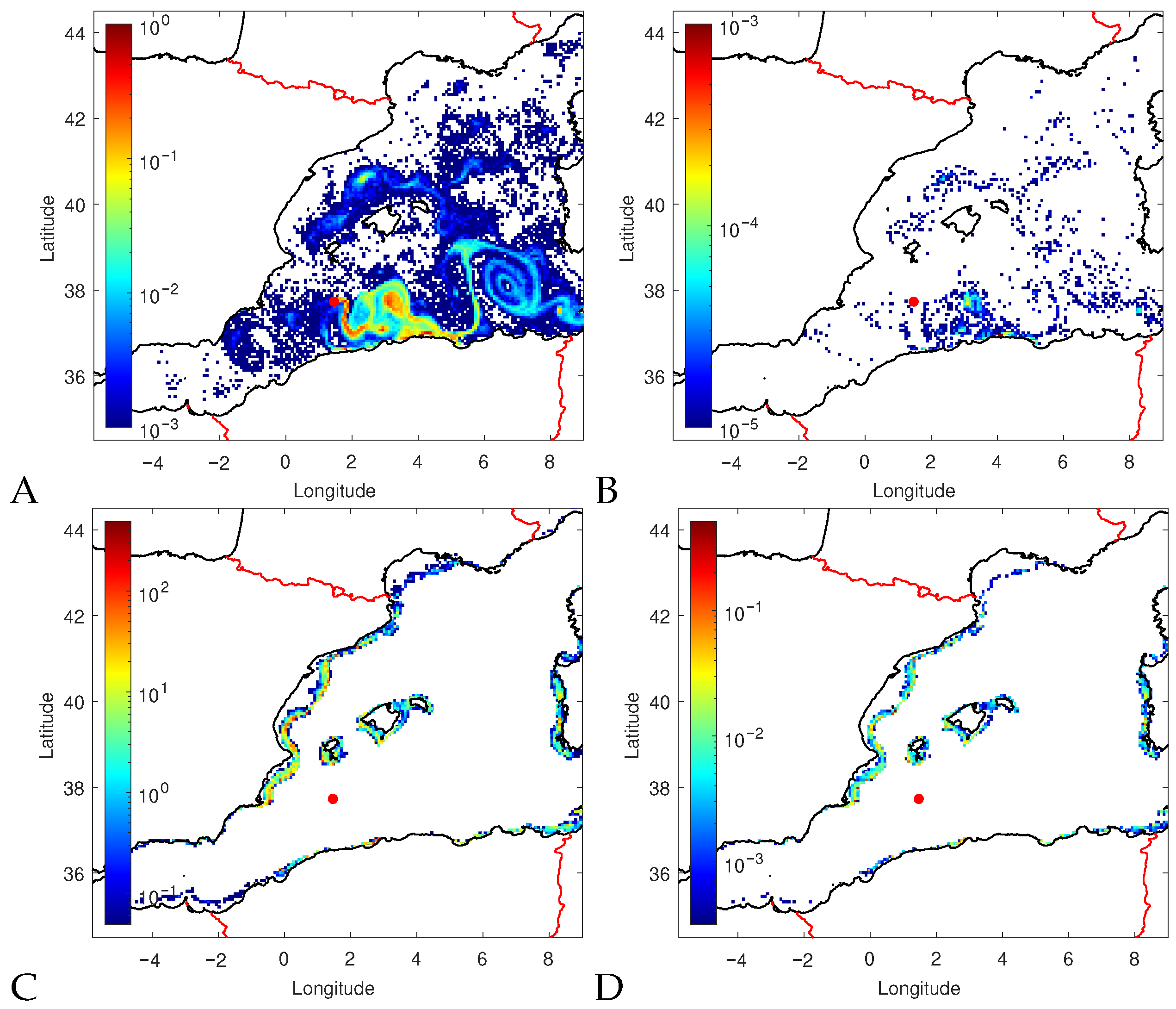
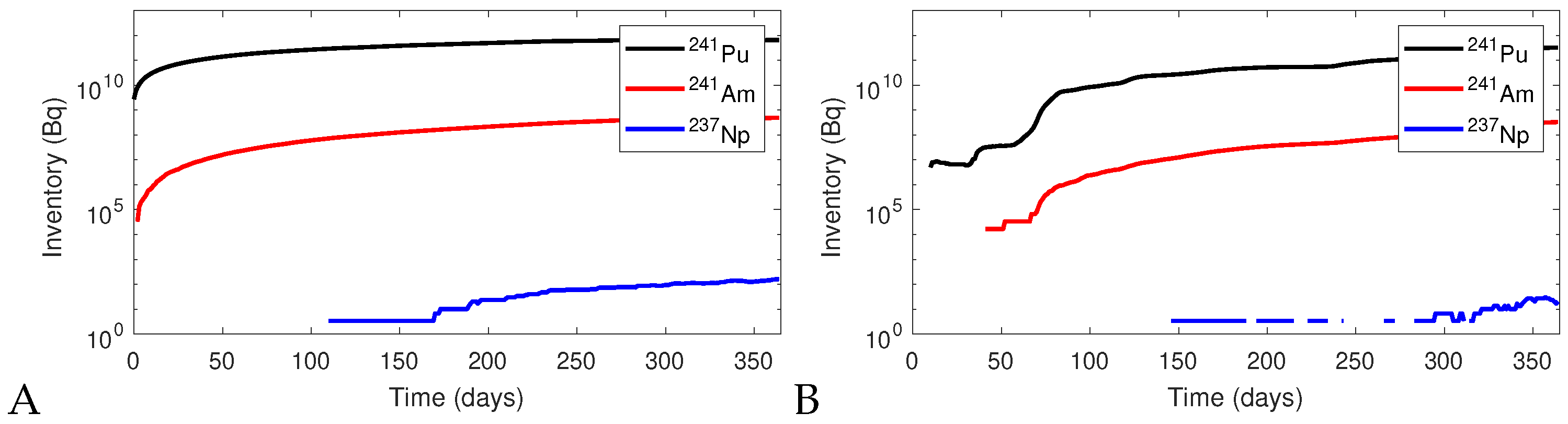
As our last example, the experiment in Figure 5 is repeated but supposing that the same release (1 TBq of 241Pu) occurs across one year at a constant rate. The resulting concentrations after one year are presented in Figure 7. The plume of 241Pu extends from the release point as expected in a continuous release, but 241Am is more apparent at some distance from the source. Due to the slow release rate, extremely little 237Np is produced (the results for this radionuclide are not shown because they are not relevant). In the case of sediment, similar comments as before can be made: there is adsorption along the coastlines since when radionuclides reach shallow waters they are quickly fixed to the seabed. Actually, the temporal evolution of the total inventories of the three radionuclides in water and sediments for this experiment are shown in Figure 8. 237Np starts to grow after some 100 days (Figure 8A), but the amount present is orders of magnitude lower than that of 241Am and, of course, 241Pu. This last radionuclide begins to be fixed to sediments after 10 days (Figure 8B), when the first-released radionuclides reach the shallow areas south of the release point. After some 50 days there is a marked increase in the 241Pu and 241Am sediment inventories, when a larger fraction of released particles spread over the shallow coastal areas. After one year, 97.5% of the activity in the model domain is 241Pu, 0.082% is 241Am and only 1.8 × 10 8 % is 237Np. The remaining fraction to complete 100% of the released activity has left the model domain through open boundaries. If the release is instantaneous, the 241Pu inventory decreases to 95.1% and 241Am increases to 0.16%. The 237Np inventory is still negligible.
As a final remark, it should be noted that the equilibrium distribution coefficients used in this study correspond to IAEA-recommended reference values [11], which are commonly adopted in large-scale and emergency-response marine radionuclide transport models. While k d values may vary by orders of magnitude depending on local sediment composition, redox conditions, and biogeochemical processes, the purpose of the present simulations is not to provide site-specific predictions but to demonstrate the feasibility and numerical stability of the proposed decay-chain implementation within a Lagrangian framework. The sensitivity tests of model response to kinetic coefficients (hence k d s) have been performed and analyzed in detail in previous works [30,31], and thus they are not repeated here.

4. Discussion

This work represents the first implementation, to the authors’ knowledge, of radioactive decay chains within a fully three-dimensional Lagrangian marine radionuclide transport model. Previous approaches have either neglected parent–daughter coupling or relied on compartmental, box-type models. By explicitly coupling decay kinetics with stochastic particle tracking and sediment–water interactions, the present study introduces a comprehensive framework capable of simulating the full evolution of radioactive series in the ocean, under a Lagrangian approach.
The proposed methodology can be readily extended to other radionuclide chains (also involving more than three radionuclides) and geographical domains, providing a versatile tool for retrospective assessments, emergency management, and prospective safety analyses of nuclear facilities. By integrating chain decay dynamics within a physically consistent transport model, this work establishes a foundation for next-generation marine radioecological modeling in the Lagrangian context.
The results presented here should therefore be interpreted within the context of a methodological study. The decay-chain algorithm is independent of the specific choice of k d values and can be readily applied using alternative parameterizations appropriate for particular environments. In practical applications, k d values should be selected or calibrated based on local sediment characteristics and available observational data (if available; if not, the IAEA recommended values have to be used). A comprehensive quantitative sensitivity analysis of k d variability is beyond the scope of the present work and has been carried out in the past as commented before.
A limitation of the methodology, albeit one inherent to Lagrangian models, is the fact that the number of particles in a simulation must increase as the number of radionuclides in the decay chain increases, in order that the uncertainty (due to the stochastic component of the Lagrangian model) remains under a given threshold. The relation between stochastic uncertainty and the number of particles in a Lagrangian simulation was addressed in a recent paper [32]: the relative error σ r due to the stochastic component of the model in the calculated activity concentration in a grid cell ( i , j ) is
σ r = N ( i , j ) N ( i , j ) ,
where N ( i , j ) is the number of particles (in water or in sediment) in the cell. From this equation, it is deduced that if we need to reduce stochastic uncertainty in a given location by a factor 2, for instance, the number of particles in the simulation should be increased by a figure of 4 (full details can be seen in [32]).
On the other hand, the advantage of this technique over an Eulerian model lies in the fact that three advection/diffusion differential equations (in the present example with three radionuclides) must be solved over the whole computational domain, with the involved computational cost, in the Eulerian framework.
Future work will focus on validating the model against observational data and exploring its application to additional decay chains and environmental conditions.

5. Conclusions

  • A new methodology has been developed to incorporate radioactive decay chains into a fully three-dimensional Lagrangian marine radionuclide transport model, allowing parent–daughter transformations to be simulated consistently together with advection, diffusion, and water–sediment interactions.
  • The stochastic implementation of radioactive decay chains has been validated against analytical solutions, demonstrating that the method accurately reproduces the expected temporal evolution of activities in closed systems.
  • The methodology has been applied to the 241Pu→241Am→237Np chain in the Western Mediterranean Sea, illustrating its capability to simulate realistic transport and partitioning patterns under different release scenarios.
  • Further validation against observational data or independent datasets is still required and will be addressed in future work, together with applications to additional radionuclide chains and operational-scale emergency scenarios.

Supplementary Materials

The following supporting information can be downloaded at: https://www.mdpi.com/article/10.3390/jmse14040328/s1, File S1: Workflow of the model computational scheme.

Author Contributions

Methodology, R.P.; Software, C.C.; Validation, C.C.; Formal analysis, C.C.; Investigation, R.P.; Writing—original draft, R.P.; Writing—review & editing, C.C. All authors have read and agreed to the published version of the manuscript.

Funding

This research received no external funding.

Data Availability Statement

The data presented in this study are available on request from the corresponding author.

Acknowledgments

The authors are indebted to Simon Dedman, of Florida International University, for reviewing the English of this manuscript.

Conflicts of Interest

The authors declare no conflicts of interest.

References

  1. Schonfeld, W. Numerical simulation of the dispersion of artificial radionuclides in the English Channel and the North Sea. J. Mar. Syst. 1995, 6, 529–544. [Google Scholar] [CrossRef]
  2. Maderich, V.; Bezhenar, R.; Kovalets, I.; Khalchenkov, O.; Brovchenko, I. Long–Term Contamination of the Arabian Gulf as a Result of Hypothetical Nuclear Power Plant Accidents. J. Mar. Sci. Eng. 2023, 11, 331. [Google Scholar] [CrossRef]
  3. Min, B.I.; Periáñez, R.; Kim, I.G.; Suh, K.S. Marine dispersion assessment of 137Cs released from the Fukushima nuclear accident. Mar. Pollut. Bull. 2013, 72, 22–33. [Google Scholar] [CrossRef]
  4. Periáñez, R. APERTRACK: A particle-tracking model to simulate radionuclide transport in the Arabian/Persian Gulf. Prog. Nucl. Energ. 2021, 142, 103998. [Google Scholar] [CrossRef]
  5. Kawamura, H.; Kobayashi, T.; Furuno, A.; In, T.; Ishikawa, Y.; Nakayama, T.; Shima, S.; Awaji, T. Preliminary numerical experiments on oceanic dispersion of 131I and 137Cs discharged into the ocean because of the Fukushima Daiichi nuclear power plant disaster. J. Nucl. Sci. Technol. 2011, 48, 1349–1356. [Google Scholar] [CrossRef]
  6. Periáñez, R.; Cortés, C. A Numerical model to simulate the transport of radionuclides in the Western Mediterranean after a nuclear accident. J. Mar. Sci. Eng. 2023, 11, 169. [Google Scholar] [CrossRef]
  7. Brovchenko, I.; Kim, K.O.; Maderich, V.; Jung, K.T.; Bezhenar, R.; Ryu, J.H.; Min, J.E. Sediment and radioactivity transport in the Bohai, Yellow, and east China seas: A modeling study. J. Mar. Sci. Eng. 2022, 10, 596. [Google Scholar] [CrossRef]
  8. Periáñez, R.; Bezhenar, R.; Brovchenko, I.; Duffa, C.; Iosjpe, M.; Jung, K.T.; Kobayashi, T.; Liptak, L.; Little, A.; Maderich, V.; et al. Marine radionuclide transport modelling: Recent developments, problems and challenges. Environ. Modell. Softw. 2019, 122, 104523. [Google Scholar] [CrossRef]
  9. Maderich, V.; Bezhenar, R.; Tateda, Y.; Aoyama, M.; Tsumune, D.; Jung, K.T.; de With, G. The POSEIDON–R compartment model for the prediction of transport and fate of radionuclides in the marine environment. MethodsX 2018, 5, 1251–1266. [Google Scholar] [CrossRef]
  10. Thakur, P.; Ward, A.L. 241Pu in the environment: Insight into the understudied isotope of plutonium. J. Radioanal. Nucl. Chem. 2018, 317, 757–778. [Google Scholar] [CrossRef]
  11. IAEA. Sediment Distribution Coefficients and Concentration Factors for Biota in the Marine Environment; Technical Reports Series, No. 422; IAEA: Vienna, Austria, 2004. [Google Scholar]
  12. Molero, J.; Sánchez–Cabeza, J.A.; Merino, J.; Vives–Batlle, J.; Mitchell, P.I.; Vidal–Quadras, A. Particulate distribution of plutonium and americium in surface waters from the Spanish Mediterranean coast. J. Environ. Radioact. 1995, 28, 271–283. [Google Scholar] [CrossRef]
  13. UNSCEAR—United Nations Scientific Committee on the Effects of Atomic Radiation. Sources and Effects of Ionizing Radiation, Report to the General Assembly, with Scientific Annexes; United Nations: New York, NY, USA, 2000; Volume 1. [Google Scholar]
  14. Zheng, J.; Tagami, K.; Watanabe, Y.; Uchida, S.; Aono, T.; Ishii, N.; Yoshida, S.; Kubota, Y.; Fuma, S.; Ihara, S. Isotopic evidence of plutonium release into the environment from the Fukushima DNPP accident. Nat. Sci. Rep. 2012, 2, 304. [Google Scholar] [CrossRef]
  15. Gascó, C.; Antón, M.P.; Espinosa, A.; Aragón, A.; Alvarez, A.; Navarro, N.; García–Tenorio, R. Procedures to define Pu isotopic ratios characterizing a contaminated area in Palomares (Spain). J. Radioanal. Nucl. Chem. 1997, 222, 81–86. [Google Scholar] [CrossRef]
  16. Eriksson, M.; Lindahl, P.; Roos, P.; Dahlgaard, H.; Holm, E. U, Pu, and Am nuclear signatures of the Thule hydrogen bomb debris. Environ. Sci. Technol. 2008, 42, 4717–4722. [Google Scholar] [CrossRef] [PubMed]
  17. Bleck, R. An oceanic general circulation model framed in hybrid isopycnic–Cartesian coordinates. Ocean Model. 2001, 4, 55–88. [Google Scholar] [CrossRef]
  18. Xu, X.; Chassignet, E.P.; Price, J.F.; Özgökmen, T.M.; Peters, H. A regional modeling study of the entraining Mediterranean outflow. J. Geophys. Res. 2007, 112, C12005. [Google Scholar] [CrossRef]
  19. Kara, A.B.; Wallcraft, A.J.; Martin, P.J.; Pauley, R.L. Optimizing surface winds using QuikSCAT measurements in the Mediterranean Sea during 2000–2006. J. Mar. Syst. 2009, 78, S119–S131. [Google Scholar] [CrossRef]
  20. Pugh, D.T. Tides, Surges and Mean Sea Level; Wiley: Chichester, UK, 1987; p. 472. [Google Scholar]
  21. Periáñez, R.; Cortés, C. A Study on the Transport of 137Cs and 90Sr in Marine Biota in a Hypothetical Scenario of a Nuclear Accident in the Western Mediterranean Sea. J. Mar. Sci. Eng. 2023, 11, 1707. [Google Scholar] [CrossRef]
  22. Cortés, C.; Periáñez, R.; Block, B.A.; Castleton, M.R.; Cermeño, P.; Dedman, S. Numerical modelling of radionuclide uptake by bluefin tuna along its migration routes in the Mediterranean Sea after a nuclear accident. Mar. Environ. Res. 2024, 202, 106757. [Google Scholar] [CrossRef]
  23. IAEA. Modelling Of Marine Dispersion And Transfer Of Radionuclides Accidentally Released From Land Based Facilities; IAEA-TECDOC-1876; IAEA: Vienna, Austria, 2019. [Google Scholar]
  24. IAEA. Enhancement of Modelling Approaches for the Assessment of Radionuclide Transfer in the Marine Environment; IAEA-TECDOC-2060; IAEA: Vienna, Austria, 2024. [Google Scholar]
  25. Nyffeler, U.P.; Li, Y.H.; Santschi, P.H. A kinetic approach to describe trace element distribution between particles and solution in natural aquatic systems. Geochim. Cosmochim. Acta 1984, 48, 1513–1522. [Google Scholar] [CrossRef]
  26. Karcher, M.; Hosseini, A.; Schnur, R.; Kauker, F.; Brown, J.E.; Dowdall, M.; Strand, P. Modelling dispersal of radioactive contaminants in Arctic waters as a result of potential recovery operations on the dumped submarine K–27. Mar. Pollut. Bull. 2017, 116, 385–394. [Google Scholar] [CrossRef]
  27. Kobayashi, T.; Togawa, O.; Odano, N.; Ishida, T. Estimates of collective doses from a hypothetical accident of a nuclear submarine. J. Nucl. Sci. Technol. 2001, 38, 658–663. [Google Scholar] [CrossRef]
  28. Kobayashi, T.; Chino, M.; Togawa, O. Numerical simulations of short–term migration processes of dissolved cesium–137 due to a hypothetical accident of a nuclear submarine in the Japan sea. J. Nucl. Sci. Technol. 2006, 43, 569–575. [Google Scholar] [CrossRef]
  29. D’Ortenzio, F.; Iudicone, D.; de Boyer, M.C.; Testor, P.; Antoine, D.; Marullo, S.; Santoleri, R.; Madec, G. Seasonal variability of the mixed layer depth in the Mediterranean Sea as derived from in situ profiles. Geophys. Res. Lett. 2005, 32, L12605. [Google Scholar] [CrossRef]
  30. Periáñez, R. On the sensitivity of a marine dispersion model to parameters describing the transfers of radionuclides between the liquid and solid phases. J. Environ. Radioact. 2004, 73, 101–115. [Google Scholar] [CrossRef] [PubMed]
  31. Bezhenar, R.; Jung, K.T.; Maderich, V.; de With, G.; Willemsen, S.; Qiao, F. Transfer of radiocaesium from contaminated bottom sediments to marine organisms through benthic food chain in post-Fukushima and post-Chernobyl periods. Biogeosciences 2016, 13, 3021–3034. [Google Scholar] [CrossRef]
  32. Periáñez, R. A simple method for the evaluation of the uncertainty in the predictions of a Lagrangian marine radionuclide transport model. Nucl. Eng. Tech. 2026, 58, 103917. [Google Scholar] [CrossRef]
Figure 1. Model domain. Surface water circulation calculated by HYCOM model for January 31st is also shown as an example. Only one in 16 vectors is drawn for better clarity.
Jmse 14 00328 g001
Figure 2. Model scheme showing the radioactive chain and water–sediment interactions. Red arrows represent radioactive decay (governed by the corresponding λ ) and green arrows denote exchanges of radionuclides between water and sediments. k 1 and k 2 are adsorption and desorption kinetic rates, respectively (see main text for details).
Jmse 14 00328 g002
Figure 3. Scheme showing the processes included in the model.
Jmse 14 00328 g003
Figure 4. Comparison of the exact solution of the decay equations (solid lines) with the stochastic method (dashed lines).
Jmse 14 00328 g004
Figure 5. (AC) Calculated concentrations of 241Pu, 241Am and 237Np, respectively, in water (Bq/m3). (DF) The same but in sediments (Bq/kg). The release occurs at the sea surface. The dot indicates the release point.
Jmse 14 00328 g005
Figure 6. (AC) Calculated concentrations of 241Pu, 241Am and 237Np, respectively, in sediments (Bq/kg) if the release occurs 5 m above the seabed. The dot indicates the release point.
Jmse 14 00328 g006
Figure 7. (A,B) Calculated concentrations of 241Pu and 241Am, respectively, in water (Bq/m3). (C,D) the same but in sediments (Bq/kg). The release occurs at the sea surface and is continuous, at constant rate, during one year. The dot indicates the release point.
Jmse 14 00328 g007
Figure 8. Time evolution of the calculated inventories of the three radionuclides in water (A) and sediments (B).
Jmse 14 00328 g008
Table 1. Equilibrium distribution coefficient [11] and radioactive decay constants of the considered radionuclides.
241Pu241Am237Np
λ (s−1) 1.59 × 10 9 5.09 × 10 11 1.03 × 10 14
k d (m3/kg)10020001
Disclaimer/Publisher’s Note: The statements, opinions and data contained in all publications are solely those of the individual author(s) and contributor(s) and not of MDPI and/or the editor(s). MDPI and/or the editor(s) disclaim responsibility for any injury to people or property resulting from any ideas, methods, instructions or products referred to in the content.