Article

New Insights into the Molecular Phylogeny of Graneledone (Cephalopoda, Megaleledonidae) and Description of a New Species from the Southeastern Pacific Ocean †

by
María Cecilia Pardo-Gandarillas
1,* and
Christian M. Ibáñez
2,*
1
Departamento de Ecología y Biodiversidad, Facultad de Ciencias de la Vida, Universidad Andres Bello, Santiago 8370035, Chile
2
One Health Institute, Facultad de Ciencias de la Vida, Universidad Andres Bello, Santiago 8370035, Chile
*
Authors to whom correspondence should be addressed.
urn:lsid:zoobank.org:pub:D70C3896-4EEA-4B91-AA2D-7AB4DCE9C500.
J. Mar. Sci. Eng. 2026, 14(3), 311; https://doi.org/10.3390/jmse14030311
Submission received: 31 December 2025 / Revised: 27 January 2026 / Accepted: 4 February 2026 / Published: 5 February 2026
(This article belongs to the Special Issue Biogeography, Biodiversity and Systematics of Marine Cephalopods)

Abstract

Deep-sea octopuses of the genus Graneledone currently include ten recognized species, yet their phylogenetic relationships remain insufficiently resolved. Here, we provide molecular phylogenetic analyses for eight species based on three mitochondrial markers (16S, COIII, COI) and formally describe a new species from the southeastern Pacific. Four specimens previously reported lacked evidence necessary for taxonomic validation; in this study, we examine eight additional individuals collected between 436 and 1482 m depth, generating new mitochondrial sequences and proposing an updated phylogenetic hypothesis for the genus. Species delimitation analyses strongly support the recognition of a new species. The newly described octopus is medium-sized, lacks an ink sac, and bears a single series of suckers on arms of similar length. Key diagnostic traits include 43–45 suckers on the hectocotylized (right third) arm, six to seven gill lamellae per demibranch, a VV-shaped funnel organ, and five to seven transverse folds on the ligula. Among all examined characters, the number of opposite suckers provides the most robust morphological distinction from congeners distributed across the Pacific, Atlantic, and Antarctic oceans. Our results highlight the value of integrative taxonomy in resolving species boundaries within Graneledone and reveal previously undocumented diversity in the deep Southeastern Pacific. Continued sampling and molecular analyses will be essential for identifying additional cryptic lineages and refining evolutionary hypotheses for this poorly explored deep-sea octopod lineage.

1. Introduction

Benthic octopuses of the genus Graneledone Joubin, 1898, comprise ten recognized species distributed across all oceans. These include G. antarctica Voss, 1976 and G. macrotyla Voss, 1976 from the Southern Ocean; G. verrucosa (Verrill, 1881) from the North Atlantic; G. gonzalezi Guerra, González & Cherel, 2000 from the Kerguelen Islands; G. yamana Guerrero-Kommritz, 2000 from the Southwest Atlantic; G. pacifica Voss & Pearcy, 1990 and G. boreopacifica Nesis, 1982 from the North Pacific; and G. taniwha O’Shea, 1999, G. kubodera O’Shea, 1999, and G. challengeri (Berry, 1916) from the South Pacific. Species of Graneledone inhabit deep-sea environments ranging from 90 to 3000 m depth, including hydrothermal vents and cold seeps [1,2,3].
Species of the deep-sea genus Graneledone exhibit distinctive morphological traits, including a body covered with warts, uniserial suckers, and the absence of an ink sac [1,4,5]. However, these diagnostic characters have proven insufficient for reliably distinguishing among species within the genus [6]. In this context, molecular species delimitation analyses have emerged as a valuable tool for resolving taxonomic boundaries and uncovering cryptic diversity [7].
Molecular phylogenetic analyses of deep-sea benthic octopuses, including three to six Graneledone species [3,7,8], support the monophyly of the genus and validate several species-level distinctions. More recent analyses suggest the existence of two major clades within Graneledone: one comprising species from Antarctica and New Zealand (G. antarctica, G. taniwha, G. kubodera, and G. challengeri), and another including species from the North Pacific and North Atlantic (G. pacifica and G. verrucosa) [7]. Strugnell et al. [9] proposed that all extant Graneledone species originated in the Southern Ocean and subsequently dispersed into other oceanic regions during the Middle Miocene (~15 Mya), highlighting the Southern Ocean as a center of origin and diversification for deep-sea octopuses.
Octopuses of the genus Graneledone are rare and have been documented in only a few localities worldwide [2]. Most species were originally described from a limited number of specimens [10,11] and exhibit restricted geographic distributions, often separated by thousands of kilometers. In the southeastern Pacific, several Graneledone specimens have been collected, including one near a bathyal methane seep site off Concepción and others as bycatch from crustacean and toothfish deep-water fisheries off south-central Chile [3,12]. Molecular analyses of these specimens revealed genetic divergences of 0.8% from G. pacifica, 1.2% from G. verrucosa, and 2.3% from G. antarctica based on 16S and COI sequences [3]. Phylogenetic analyses also supported reciprocal monophyly between G. pacifica and the Chilean Graneledone specimens, which were proposed as a candidate species based on genetic distances and tree topology [3].
In the present study, we integrate previously published data with newly collected specimens and mitochondrial sequences to propose a revised phylogenetic hypothesis for the genus and formally describe a new species of Graneledone from the South Pacific Ocean.

2. Materials and Methods

2.1. Sampling

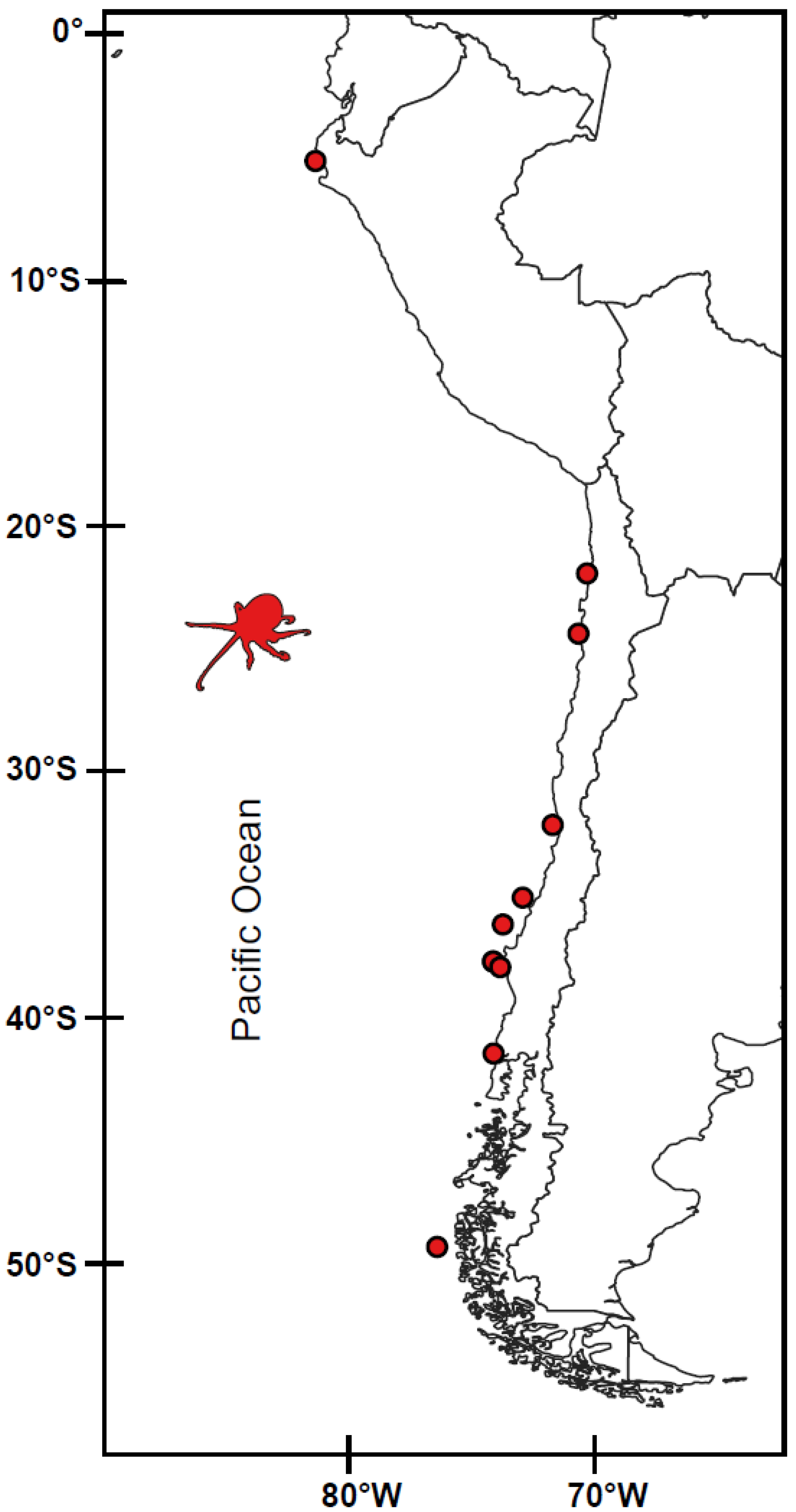
This study is based on 12 Graneledone specimens collected along the Chilean continental shelf between 21° S and 41° S (Figure 1). Additionally, one specimen of G. challengeri from New Zealand, as well as two G. antarctica from the Ross Sea, were obtained from the NIWA invertebrate collection for comparative sequencing. Tissue samples were preserved in 96% ethanol for molecular analyses, while whole specimens were fixed in 10% seawater formalin for subsequent anatomical and morphological examination. Voucher and type specimens are deposited in the Museo Nacional de Historia Natural, Chile (MNHNCL), and the Museo Zoológico de la Universidad de Concepción (MZUC-UCCC).

Comparative Material Examined

  • Graneledone antarctica G. L. Voss, 1976, adult male 55 mm ML (Antarctica, 74°31′54″ S, 027°13′24″ W, 2103 m) ZMH 12658, collected during RV Polarstern cruise Antarktis XV/3 at station 134 in 1998.
  • Graneledone antarctica G. L. Voss, 1976, adult female 60 mm ML (Antarctica, 69°25′00″ S, 005°20′00″ W, 1800 m) ZMH 72401, collected during RV Polarstern cruise Antarktis XXIII/2 at station 57 in 2005.
  • Graneledone challengeri (S. S. Berry, 1916): NIWA 84064, ML 125 mm, 45°09.10′ S, 166°92.53′ E, 1450 m, 29 May 2004.
  • Graneledone challengeri (S. S. Berry, 1916): NIWA 84068, ML 40 mm, 34°88.11′ S, 179°07.50′ E, 1518 m, 21 May 2001.
  • Graneledone kubodera O’Shea, 1999: Holotype NIWA 109068, ML 79 mm, 48°25.25′ S, 179°27.03′ E, 541–548 m, 20 November 1989.
  • Graneledone pacifica Voss & Pearcy, 1990: SBMNH 63333, ML 135 mm, 32°15′ N, 119°01′ W, 1050 m, 5 October 1978.
  • Graneledone pacifica Voss & Pearcy, 1990: SBMNH 42223, ML 102 mm, 41°41.1′ N, 125°1.9′ W, 650 m, 28 May 1969.
  • Graneledone taniwha O’Shea, 1999: Holotype NIWA 662, ML 121 mm, 44°41.90′ S, 177°23.71′ W, 1135–1157 m, 17 October 1995.
  • Graneledone verrucosa (A. E. Verrill, 1881), two females of 46 and 17 mm ML, (NE Atlantic, 49°46′00″ N, 012°31′00″ W, 2000 m) ZMH 12657, collected during RV Walther Herwig cruise #47 at station 630 in 1981.
  • Graneledone verrucosa (A. E. Verrill, 1881), adult female 98 mm ML (N Atlantic, 1200 m), ZMH 12663, collected during RV Walther Herwig cruise #46 at station 591 in 1981.
  • Graneledone yamana Guerrero-Kommritz, 2000, adult male 50 mm ML (SE to Falkland Islands, 54°18′00″ S, 56°10′00″ W, 560 m) ZMH 12669, collected during RV Walther Herwig cruise #31 at station 584 in 1978.
  • Graneledone yamana, adult male 58 mm ML (near to Falkland Islands, 50°18′00″ S, 56°49′00″ W, 515 m) ZMH 2789, collected during RV Walther Herwig cruise #45 at station 325 in 1966.

2.2. Phylogenetic Analysis

Total genomic DNA was extracted from five specimens of three species (Table 1) using the saline extraction protocol described by Aljanabi and Martinez [13]. PCR reactions were performed for each sample, which included 0.06 U/µL Taq polymerase, 1X buffer (50 mM KCl, 10 mM Tris-HCl, pH 8.0), 0.8 mM dNTPs, 2 mM MgCl2, 2–3 ng/µL of the extracted DNA, and 0.2 M of each primer targeting Cytochrome Oxidase I (COI: 5′-TAAACTTCAGGGTGACCAAAAAATCA-3′ and 5′-GGTCAACAAATCATAAAGATATTGG-3′), Cytochrome Oxidase III (COIII: 5′-CAATGATGACGAGATATTATYCG-3′ and 5′-TCAACAAAGTGTCAGTATCA-3′), and 16S rRNA (16S: 5′-CGCCTGTTTATCAAAAACAT-3′ and 5′-CCGGTCTGAACTCAGATCACGT-3′) [14]. Thermal cycling conditions included an initial denaturation at 94 °C for 3 min, followed by 35 cycles of 94 °C for 40 s, 50 °C for 40 s (COI and COIII), or 52 °C for 40 s (16S), and 72 °C for 60 s, with a final extension at 72 °C for 7 min. PCR products were purified and sequenced by Macrogen Inc, Seoul, South Korea. Sequences were aligned using MUSCLE, implemented in MEGA v11 [15].
Phylogenetic relationships were inferred from a partitioned dataset comprising three mitochondrial markers (16S, COI, COIII), with each gene assigned its own evolutionary model as determined by the Akaike Information Criterion (AIC) implemented in JModelTest [16]: 16S (HKY + G), COI (T92 + G), and COIII (HKY + G). Bayesian inference was performed using MrBayes v3.2 [17], employing four default heated chains run for five million generations, with sampling every 1000 generations. Convergence was assessed by inspecting likelihood traces in Tracer v1.5 [18]. The first 500 trees from each run were discarded as burn-in, and a majority-rule consensus tree was generated from the remaining trees. In addition, phylogenetic relationships among Graneledone species were reconstructed using a maximum likelihood (ML) approach implemented in IQ-TREE [19]. Tree searches employed the hill-climbing NNI strategy [20]. Model selection was carried out with ModelFinder [21], applying a partition scheme based on codon positions for the protein-coding genes COI and COIII. Node support was assessed through 1000 ultrafast bootstrap replicates [22].
Outgroup taxa included Pareledone charcoti (Joubin, 1905), P. turqueti (Joubin, 1905), Megaleledone setebos (Robson, 1932), Thaumeledone peninsulae Allcock et al. 2004, T. rotunda (Hoyle, 1885), T. zeiss O’Shea, 1999, and T. gunteri Robson, 1930. The phylogenetic tree was rooted using Adelieledone polymorpha (Robson, 1930) and A. piatkowski Allcock et al. 2003. Final tree visualization and editing were conducted using FigTree v1.3.1 [23]. Sequences generated in this study are available in GenBank (Table 1).
Table 1. Octopod species included in the phylogenetic analyses.
SpeciesCOICOIII16S rRNA
Graneledone sellanesi MNHNCLJN800404PX896319JN800402
Graneledone sellanesi MZUCJN800403PX896320JN800401
Graneledone antarcticaAF377973EU071461EU071436
Graneledone antarctica GANZ01PX869849PX896316PX870023
Graneledone antarctica GANZ02PX869850PX896317PX870024
Graneledone challengeri-MT225048MT216957
Graneledone challengeri GCNZPX869851PX896318PX870025
Graneledone challengeri GCNZ13MT216548MT225047MT216956
Graneledone taniwha 1MT216552MT225055MT216964
Graneledone taniwha 2MT216553MT225056MT216965
Graneledone taniwha 3MT216554MT225057MT216966
Graneledone kubodera 1MT216556MT225050MT216959
Graneledone kubodera 2MT216549MT225051MT216960
Graneledone kubodera NZP1MT216550MT225052MT216961
Graneledone kubodera NZP2MT216551MT225059MT216962
Graneledone kubodera GTNZ27MT225054MT225060MT225053
Graneledone verrucosa 1 AF000042EU071462AY545111
Graneledone verrucosa 2 EU071449NC_069993NC_069993
Graneledone pacifica 1EU071448EU071460EU071435
Graneledone pacifica 2MN413646-MN413669
Graneledone yamana O36O36 * -
Graneledone yamana O37O37 *O37 *-
Prealtus paralbidaHM104261HM104252HM104247
Thaumeledone rotundaEU071445EU071456EU071432
Thaumeledone gunteriAY557521EU071457AF299266
Thaumeledone peninsulaeEU071446EU071458EU071433
Thaumeledone zeissMT216581MT225087MT217000
Adelieledone polymorphaEF102173EF102153EF102194
Adelieledone PiatkowskiEU071444EU071455EU071431
Pareledone charcotiEF102175EF102155EF102196
Pareledone turquetiEF102192EF102171EF102213
Megaleledone setebosEF102174EF102154EF102195
* Data from Oellermann et al. [24].

2.3. Species Delimitation Analysis

Species delimitation was assessed using two complementary approaches. First, the Bayesian Poisson Tree Processes (bPTP) method [25] was applied to the consensus tree generated by MrBayes, as implemented on the bPTP web server (https://species.h-its.org/, accessed on 20 January 2026). This method models speciation events based on branch lengths in a phylogenetic tree, providing probabilistic support for species boundaries. The bPTP analysis was run for 1,000,000 steps in the MCMC algorithm with 1000 iterations of thinning. Second, we applied the Assemble Species by Automatic Partitioning (ASAP) method [26] in the Spart explorer (https://spartexplorer.mnhn.fr/, accessed on 20 January 2026) for COI and COIII sequences using Jukes–Cantor distances. ASAP uses a hierarchical clustering algorithm based on pairwise genetic distances. ASAP proposes species partitions ranked by a scoring system that does not rely on prior assumptions about intraspecific diversity.

3. Results

3.1. Systematics

  • Family Megaleledonidae d’Orbigny, 1840
  • Genus Graneledone Joubin, 1918
  • Type species: Graneledone verrucosa (Verril, 1881)
  • Synonymy: Eledone verrucosa Verrill, 1881, Moschites verrucosa Berry, 1917.
  • Graneledone sellanesi sp. nov. Pardo-Gandarillas and Ibáñez, 2026.

3.1.1. Holotype

Adult male 110 mm ML, collected north of Mocha Island, 37°46.17′ S, 74°07.29′ W, southeastern Pacific at a depth of 1482 m, MNHNCL 300096, collected by J. Sellanes, October 2007.

3.1.2. Paratypes

Adult male 160 mm ML, collected near of Constitución coast, 35°10′ S, 72°55′ W, 436 m, MNHNCL 300095, collected by C.M. Ibáñez, October 2000.
Adult female 165 mm ML, collected at Northwest of Concepción, 36°15.71′ S, 73°43.48′ W, 600 m, MZUC-UCCC 32743, collected by M. Pedraza, March 2007.
Adult male 80 mm ML, collected off Puerto Montt, 41°41′45″ S, 72°51′47″ W, MNHNCL 300039.
Adult female 97 mm ML, collected near Los Molles, 32°13′00″ S, 71°42′00″ W, 830 m, MNHNCL 300064, collected by I. Kong and P. Zabala, 4 September 1980.
Adult male 45 mm ML, collected off Antofagasta, 24°26′00″ S, 70°39′00″ W, 800 m, MNHNCL 300081, collected by I. Kong, 1 January 1981.
Adult male 111 mm ML, collected at Southern Chile, 38°00′ S,73°50′ W, 1000 m, MNHNCL 300060, collected by Rojas M., 12 April 1997.
Two adult males 35 and 40 mm ML and two adult females 49 and 66 mm ML, collected off Tocopilla coast, 21°59′ S, 70°18′ W, 900 m, MNHNCL 300063, collected by I. Kong, 23 February 1981.
Adult male 49 mm ML, collected off Lebu coast, 37°46′10.2″ S 74°07′17.4″ W, 900 m, MNHNCL 300055, collected by M. Rojas, 12 April 1997.

3.1.3. Diagnosis

Medium-sized octopus (TL = 520 to 810 mm) lacking an ink sac. Eyes large (20% of ML) and projecting. Two supraocular cirri above each eye. Suckers are small and uniserial (6–8 mm). Funnel organ VV-shaped, free zone of the funnel corresponding to 53–62% of funnel length. The first pair of arms is always the longest (75–78% of TL) with arm formula 1.2.3.4. The web is very deep, with unequal sectors; sectors A and B are always the largest, and sector E is the smallest. The third right arm of males is hectocotylized with 43 and 45 suckers and shorter than the opposite arm. The opposite arm has 98 to 107 suckers. Mean opposite sucker number 12.1. Calamus of medium size (50% of the ligula) with a deep median incision; ligula with five to seven creases. Six to seven lamellae per demibranch. Radula bearing seven teeth: three central, two lateral, and two marginal plates in each transversal line. The body surface is covered by complex papillose warts with many tiny spine-like structures, extending dorsally from the mantle to the arm tips. Thirty to thirty-five warts at the dorsal mantle midline from anterior to posterior, and 15 to 20 between the eyes. These warts are composed of one to five individual processes.

3.1.4. Description

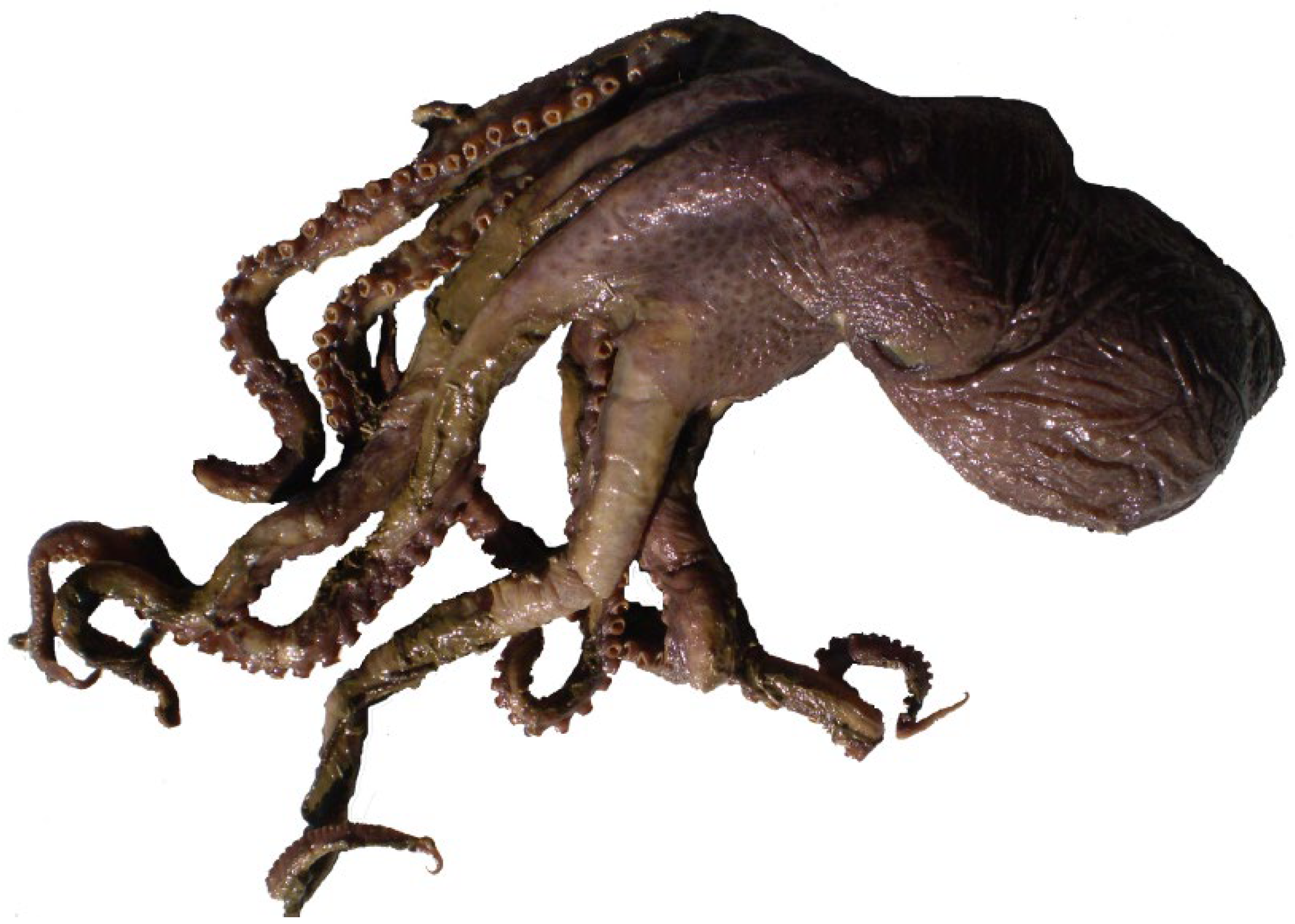
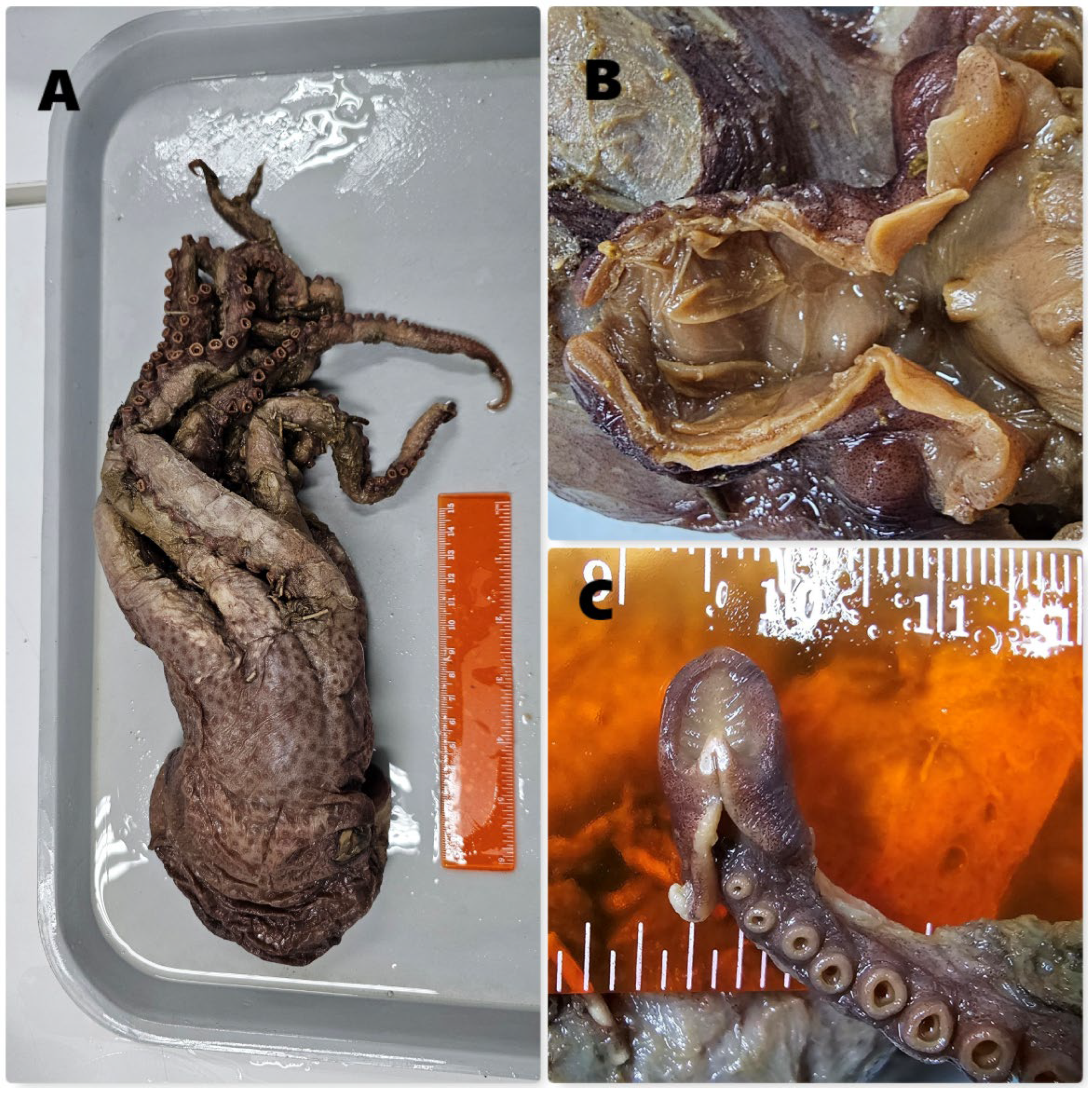
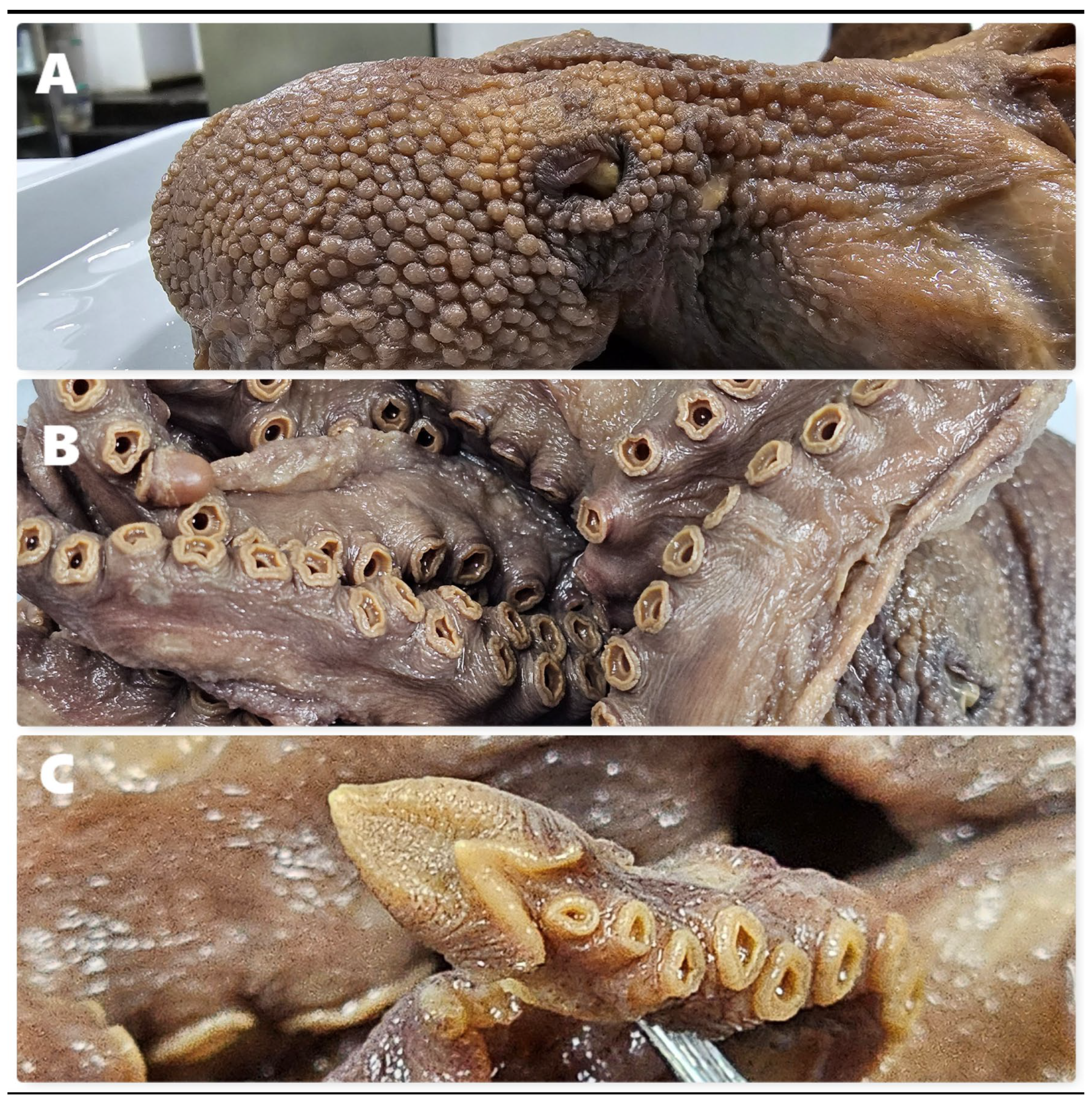
Adult specimens analyzed (eight specimens, Table 2) show a medium size range, measuring 170–810 mm in total length. The mantle is sacciform in shape and reaches a maximum of 165 mm ML (Figure 2). The dorsal body surface, from the mantle region to the distal ends of the arms, is densely ornamented with elaborate papillose warts, each bearing numerous small cone-shaped tubercules ranging from 1 to 5 mm (Figure 2, Figure 3A and Figure 4A). Along the dorsal mantle midline, 28–35 such warts are present, while 15–23 additional ones occur between the eyes. These structures occur in clusters composed of one to four processes on both the mantle and the web. Over each eye, two well-defined supraocular cirri are present (Figure 4A). The pallial aperture is moderately broad relative to the width of the mantle, occupying 41–80% of ML. Head width is nearly equivalent to mantle width (65–100% MW). The eyes are relatively large (15–30% of ML) and positioned more laterally than frontally, almost level with the dorsal body surface. The funnel is of moderate length (28–45% of ML), and its free portion is short, comprising 42–65% of the total funnel length. The funnel organ forms a characteristic “VV” shape (Figure 3B).
The arms are long and relatively uniform in size, typically reaching no more than 78% of the total length. The first arm pair is invariably the longest, while the fourth pair is the shortest, yielding the typical arm formula order 1.2.3.4. The web is shallow, with sectors E and D forming the shortest portions. Web configuration varies and may follow patterns such as ABCDE, ACDBE, or BCDAE (Table 2).
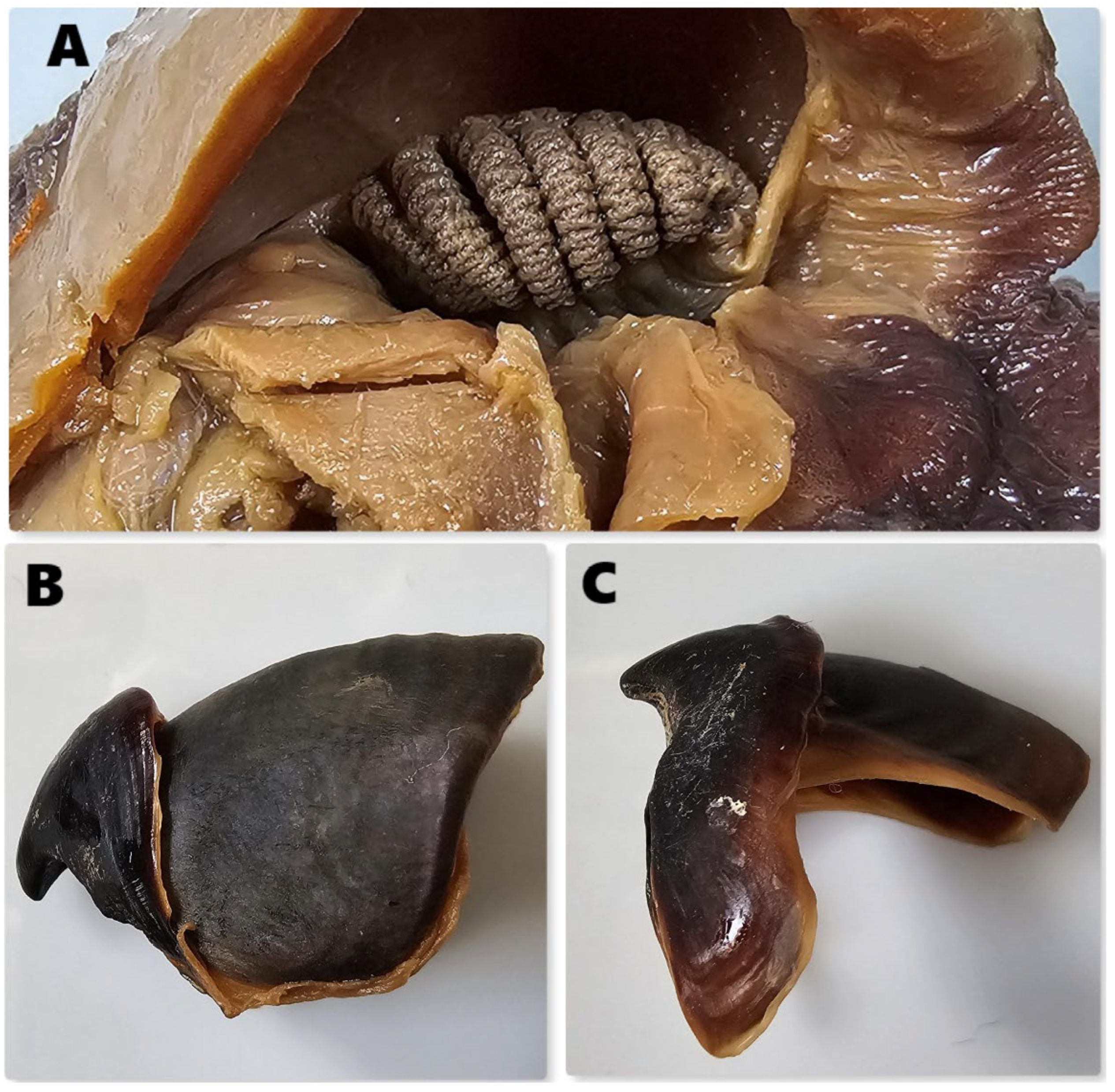
The arms bear a single row of suckers (Figure 2 and Figure 3A). These suckers are small, tubular, sessile, and lack a distinct acetabulum aperture, measuring 4.2 to 8.5% of ML (Figure 4B). The third right arm is hectocotylized (44 to 55% of TL) and is noticeably shorter than the corresponding opposite arm (57–64% of TL) (Table 2). The hectocotylized arm carries 43–45 suckers, whereas its counterpart bears 98–107 (Table 2). The spermatophoric canal is smooth, unpigmented, and runs along the ventral surface of the hectocotylized arm, terminating at the calamus. The copulatory structure includes a small ligula (3.2–4.1% of the hectocotylized arm length) marked by 5–7 transverse folds (Figure 3C and Figure 4C). The calamus, 8–9 mm in length, is unpigmented and relatively elongated, reaching approximately half the length of the ligula (48–69% of LL). The gills are small and consist of six to seven lamellae per demibranch (Figure 5A). Upper beak with strong, deep jaw angle (Figure 5B); lower beak with distinct groove along lower edge of insertion plate (Figure 5C).
One female examined (MNHNCL 300064) from central Chile (~32° S) contained 292 large eggs (25–32 mm) in her ovary.
For a full description and morphological comparison, including pictures and drawings of the anatomy of the holotype and paratype specimens, see Ibáñez et al. [3].

3.1.5. Etymology

Named after Javier Sellanes (Chile), who collected the holotype specimen and has contributed greatly to knowledge on the biodiversity of mollusks from Chile, including the descriptions of more than 25 new species.

3.1.6. Remarks

Graneledone sp. nov. is distinguished from congeners by higher counts of cartilaginous clusters along the mantle and head, exceeding those of G. gonzalezi, G. macrotyla, G. yamana, G. pacifica, G. verrucosa, and G. taniwha, but fewer than in G. antarctica and G. challengeri (see Table 3 in Ibáñez et al. [3]). Wart processes within each cluster are more numerous (1–22) and larger (1–5 mm in diameter) than in G. antarctica (1–11; 0.3–0.9 mm), G. gonzalezi (1–12; 3.3 mm), G. pacifica (3–12; 1–3 mm), G. verrucosa (1–12; 1–3 mm), and G. challengeri (1–10; 1–2.7 mm), but fewer than in G. taniwha (1–37; 0.5–8 mm). The hectocotylized sucker count is similar to G. challengeri, G. verrucosa, and G. taniwha, but higher than in other species (see Table 3 in Ibáñez et al. [3]). Graneledone sellanesi sp. nov. further differs by a lower OSN maximum (12.1) compared to its sister species G. pacifica (14.7), but higher than G. verrucosa (8.5) (see Voight & Kurth [6]).

3.2. Molecular Phylogenetic Analysis

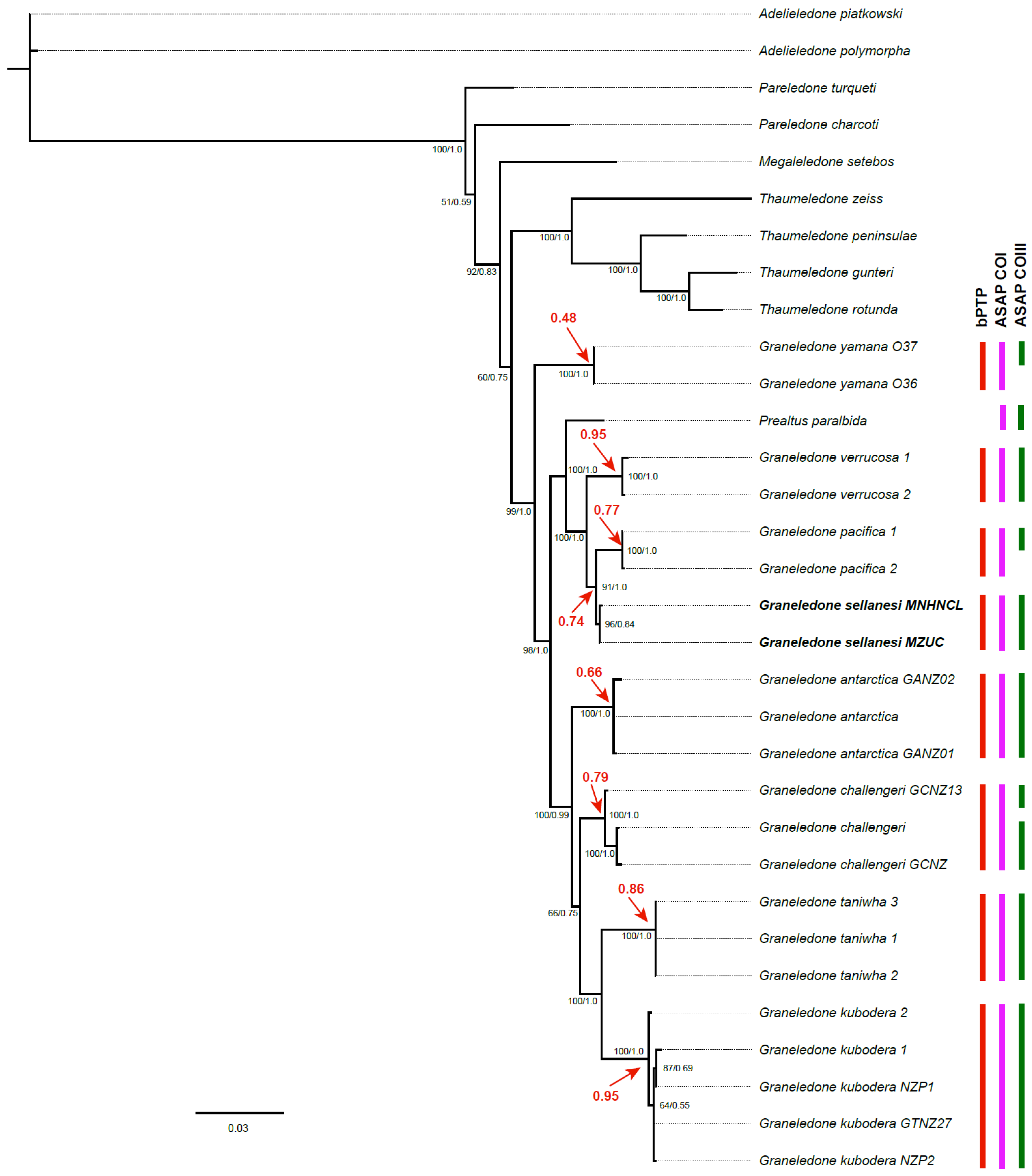
Phylogenetic analysis results in a consensus tree with most of the clades with high bootstrap supports and posterior probabilities (BS > 95; PP > 0.95), but some ones have low values (BS = 51 to 75; PP = 0.58 to 0.73) inside Graneledone clade (Figure 6). The first clade is composed of G. yamana, distant from the other clades of the genus (Figure 6). The second clade includes Graneledone sp. nov., G. verrucosa, G. pacifica, and Prealtus paralbida (Figure 6). The third clade is composed of G. antarctica, G. challengeri, G. taniwha, and G. kubodera (Figure 6).

3.3. Species Delimitation Results

The ASAP analysis, using COI, found nine species (asap-score = 1.0, threshold distance = 0.001278) (Figure 6) with a low barcode gap (p-distance = 0.02). Similarly, ASAP analysis with COIII found 10 species (asap-score = 2.0, threshold distance = 0.001073) (Figure 6) with a low barcode gap (p-distance = 0.025). Species delimitation using bPTP, defining clusters of our dataset, identifying eight entities of Graneledone + Prealtus octopuses with posterior probabilities of conspecific ranging from 0.48 to 0.95 (Figure 6).

4. Discussion

Morphological and phylogenetic analyses of Chilean Graneledone specimens, together with comparative material from the Pacific, Atlantic, and Antarctic oceans, support the recognition of the Chilean lineage as a distinct species. This result highlights how poorly explored the cephalopod fauna of the southeastern Pacific remains, emphasizing the need for continued integrative studies. Species delimitation approaches provide strong support for Graneledone sellanesi sp. nov., which forms a well-supported clade separate from its closest northern relatives, G. pacifica and G. verrucosa. Furthermore, the same integrative framework proved valuable in clarifying the taxonomic status of the two New Zealand Graneledone subspecies, which were elevated to full species rank [7].
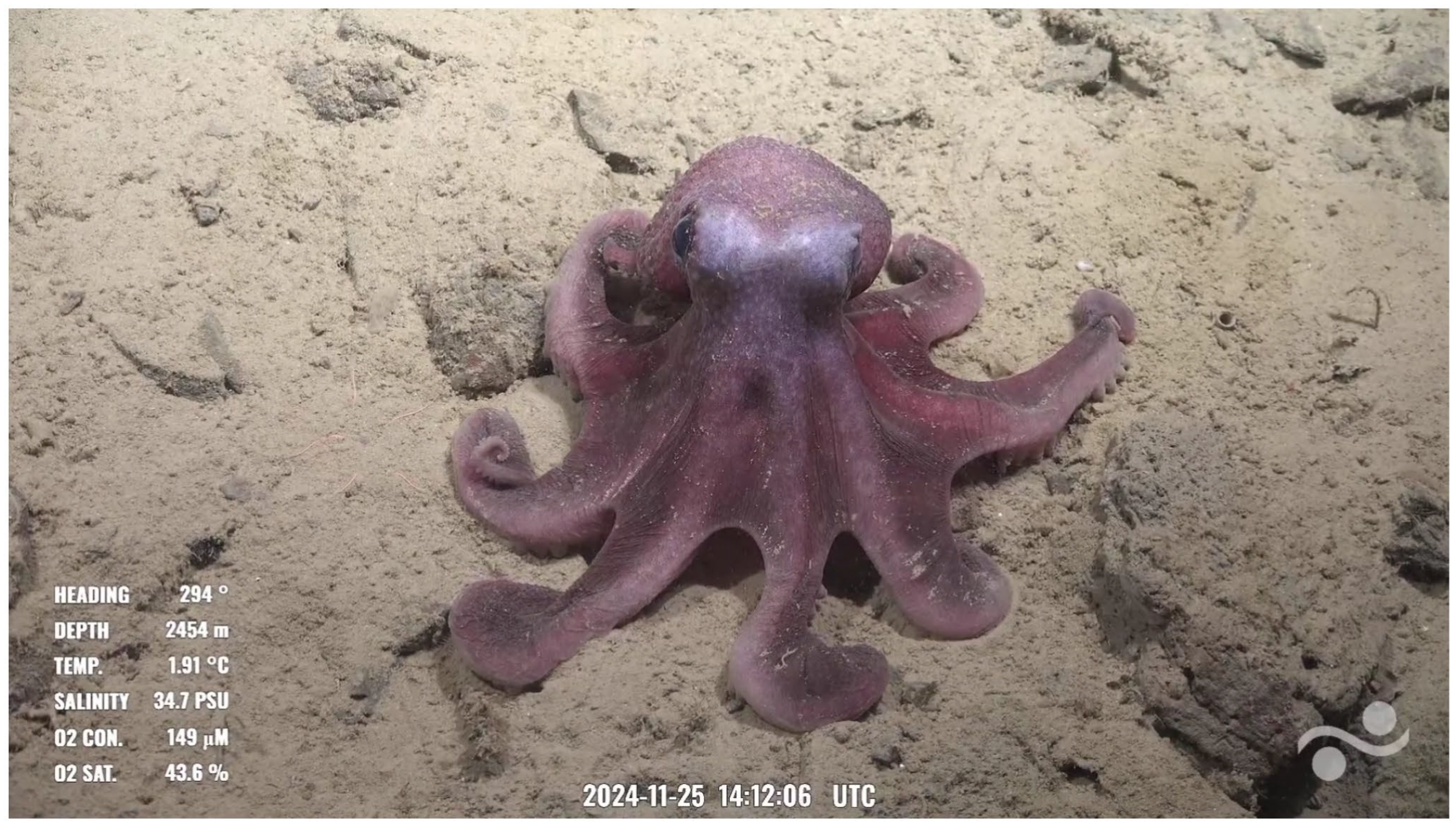
The confirmed distribution of Graneledone sellanesi sp. nov. ranges from 21° S to 41° S along the Chilean continental margin. However, additional records of Graneledone from Peru [28,29], the presence of Graneledone beaks in the stomachs of Dissostichus eleginoides [30], and recent remotely operated vehicle (ROV) imagery from Southern Chile (Figure 7) suggest a much broader latitudinal range, potentially spanning from 5° S to 49° S. Its bathymetric distribution is estimated at 400–2454 m, based on all available specimen records and indirect evidence, indicating that the species occupies a wide depth range typical of deep-sea benthic octopods.
High levels of morphometric and meristic variation among Graneledone species have long complicated their taxonomic identification. Traits such as gill lamella counts, sucker numbers on the hectocotylized arm, and wart patterns frequently overlap between species, limiting their diagnostic utility [3,4]. Further adding to this complexity, G. pacifica shows depth-related clinal variation in sucker number across the North Pacific [31], which can obscure species-level boundaries. In response to these challenges, the opposite sucker number (OSN) has been proposed as a more consistent and reliable character than wart counts for distinguishing species within the genus [6,32]. Graneledone sellanesi sp. nov. displays a lower maximum OSN value (12.1) than its sister species G. pacifica (14.7), but remains higher than G. verrucosa (8.5), according to the dataset presented by Voight & Kurth [6]. This metric therefore represents a stable morphological criterion for differentiating G. sellanesi sp. nov. from its closest relatives as recovered in the molecular phylogeny.
The difficulty in separating species within Graneledone likely reflects the relatively recent origin of the lineage, estimated at approximately 3–7 million years [9,33]. However, this divergence window should be reassessed using a more comprehensive species sampling, as current estimates rely on incomplete taxonomic representation. With the formal description of Graneledone sellanesi sp. nov., the genus now comprises 11 recognized species worldwide, underscoring the need for updated molecular clock analyses to refine the evolutionary history of this deep-sea octopod group.
In the phylogenetic reconstruction (Figure 6), Prealtus paralbida consistently nests within the Graneledone clade. As reported by previous studies, P. paralbida appears as the sister taxon to G. verrucosa and G. pacifica [7,34]. This phylogenetic placement contrasts with its current generic assignment and likely reflects the circumstances of its original description: Allcock et al. [35] compared the species with members of Thaumeledone but did not evaluate its affinity relative to Graneledone. To resolve this taxonomic discrepancy, a re-examination of the type material and a revised generic diagnosis are required to determine whether P. paralbida should be transferred to Graneledone, as strongly suggested by molecular data. Based on its phylogenetic position and morphological similarities, we propose that Prealtus be regarded as a junior synonym of Graneledone. The specimens described by Allcock et al. [35] possess numerous small, simple dorsal papillae and exhibit morphometric and meristic values consistent with those of Graneledone species. Reassigning P. paralbida to Graneledone would bring the taxonomy into closer alignment with evolutionary relationships and enhance systematic coherence within the group.

Author Contributions

Both authors, M.C.P.-G. and C.M.I., contributed equally to analyzing the data and writing the manuscript. All authors have read and agreed to the published version of the manuscript.

Funding

This research was funded by Instituto Antártico Chileno (INACH) funding number RG 50-18 awarded to M.C.P.-G.

Institutional Review Board Statement

Not applicable.

Data Availability Statement

The sequences obtained in this study are in GenBank (Table 1).

Acknowledgments

We thank Janet Voight for their valuable comments on the early version of this manuscript. We thank Andrea Martínez, Bernhard Hausdorf, Daniel Geiger, and Sadie Mills for help in examining specimens from the MNHNCL (Chile), ZMH (Germany), SBMNH (US), and NIWA (New Zealand).

Conflicts of Interest

The authors declare no conflicts of interest.

References

  1. Guerrero-Kommritz, J. A new species of Graneledone from the southwest Atlantic. J. Molluscan Stud. 2000, 66, 543–549. [Google Scholar] [CrossRef]
  2. Voight, J.R. The distribution of octopuses of Graneledone (Cephalopoda: Octopodidae) in reference to deep-sea features. Malacologia 2000, 42, 63–74. [Google Scholar]
  3. Ibáñez, C.M.; Pardo-Gandarillas, M.C.; Poulin, E.; Sellanes, J. Morphological and molecular description of a new record of Graneledone (Cephalopoda, Octopodidae) in the southeastern Pacific Ocean. Rev. Biol. Mar. Oceanogr. 2012, 47, 439–450. [Google Scholar] [CrossRef]
  4. O’Shea, S. The Marine Fauna of New Zealand: Octopoda (Mollusca: Cephalopoda). In NIWA Biodiversity Memoir; National Institute of Water and Atmospheric Research: Wellington, New Zealand, 1999. [Google Scholar]
  5. Allcock, A.L.; Collins, M.A.; Vecchione, M. A redescription of Graneledone verrucosa (Verrill, 1881) (Octopoda: Octopodidae). J. Molluscan Stud. 2003, 69, 135–143. [Google Scholar] [CrossRef]
  6. Voight, J.R.; Kurth, J.A. Towards species identification of the bathyal octopod Graneledone (Mollusca: Cephalopoda). Mar. Biol. Res. 2017, 13, 862–869. [Google Scholar] [CrossRef]
  7. Ibáñez, C.M.; Fenwick, M.; Ritchie, P.A.; Carrasco, S.A.; Pardo-Gandarillas, M.C. Systematics and phylogenetic relationships of New Zealand benthic octopuses (Cephalopoda: Octopodoidea). Front. Mar. Sci. 2020, 7, 182. [Google Scholar] [CrossRef]
  8. Strugnell, J.M.; Allcock, A.L.; Collins, M.A. Molecular evolutionary relationships of the octopodid genus Thaumeledone (Cephalopoda: Octopodidae) from the Southern Ocean. Antarct. Sci. 2008, 20, 245–251. [Google Scholar] [CrossRef]
  9. Strugnell, J.M.; Rogers, A.D.; Prodöhl, P.A.; Collins, M.A.; Allcock, A.L. The thermohaline expressway: The Southern Ocean as a centre of origin for deep-sea octopuses. Cladistics 2008, 24, 853–860. [Google Scholar] [CrossRef]
  10. Voss, G.L. Two new species of octopods of the genus Graneledone (Mollusca: Cephalopoda) from the Southern Ocean. Proc. Biol. Soc. Wash. 1976, 88, 447–458. [Google Scholar]
  11. Nesis, K.N. Abridged Key to the Cephalopods Molluscs of the World’s Oceans; Light and Food Industry Publishing House: Moscow, Russia, 1982; 385p. [Google Scholar]
  12. Ibáñez, C.M.; Pardo-Gandarillas, M.C.; Párraga, D.; Ziruelello, M.; Sellanes, J. Cefalópodos recolectados en el talud continental de Chile central. Amici Molluscarum 2011, 19, 37–40. [Google Scholar]
  13. Aljanabi, S.M.; Martinez, I. Universal and rapid salt-extraction of high quality genomic DNA for PCR-based techniques. Nucleic Acids Res. 1997, 25, 4692–4693. [Google Scholar] [CrossRef]
  14. Allcock, A.L.; Strugnell, J.M.; Johnson, M.P. How useful are the recommended counts and indices in the systematics of the Octopodidae (Mollusca: Cephalopoda). Biol. J. Linn. Soc. 2008, 95, 205–218. [Google Scholar] [CrossRef]
  15. Tamura, K.; Stecher, G.; Kumar, S. MEGA11: Molecular evolutionary genetics analysis version 11. Mol. Biol. Evol. 2021, 38, 3022–3027. [Google Scholar] [CrossRef]
  16. Posada, D. jModelTest: Phylogenetic model averaging. Mol. Biol. Evol. 2008, 25, 1253–1256. [Google Scholar] [CrossRef]
  17. Ronquist, F.; Teslenko, M.; van der Mark, P.; Ayres, D.; Darling, A.; Höhna, S.; Larget, B.; Liu, L.; Suchard, M.A.; Huelsenbeck, J.P. MrBayes 3.2: Efficient Bayesian phylogenetic inference and model choice across a large model space. Syst. Biol. 2012, 61, 539–542. [Google Scholar] [CrossRef]
  18. Rambaut, A.; Drummond, A.J. Tracer v1.5. Available online: https://tree.bio.ed.ac.uk/software/tracer (accessed on 13 June 2025).
  19. Trifinopoulos, J.; Nguyen, L.T.; von Haeseler, A.; Minh, B.Q. W-IQ-TREE: A fast-online phylogenetic tool for maximum likelihood analysis. Nucleic Acids Res. 2016, 44, W232–W235. [Google Scholar] [CrossRef] [PubMed]
  20. Nguyen, L.T.; Schmidt, H.A.; von Haeseler, A.; Minh, B.Q. IQ-TREE: A fast and effective stochastic algorithm for estimating maximum-likelihood phylogenies. Mol. Biol. Evol. 2015, 32, 268–274. [Google Scholar] [CrossRef] [PubMed]
  21. Kalyaanamoorthy, S.; Minh, B.Q.; Wong, T.K.F.; von Haeseler, A.; Jermiin, L.S. ModelFinder: Fast model selection for accurate phylogenetic estimates. Nat. Methods 2017, 14, 587–589. [Google Scholar] [CrossRef] [PubMed]
  22. Minh, B.Q.; Nguyen, M.A.; von Haeseler, A. Ultrafast approximation for phylogenetic bootstrap. Mol. Biol. Evol. 2013, 30, 1188–1195. [Google Scholar] [CrossRef]
  23. Rambaut, A. FigTree, v1.3.1; Tree Figure Drawing Tool; Institute of Evolutionary Biology, University of Edinburgh: Edinburgh, UK, 2009; Available online: http://tree.bio.ed.ac.uk/software/figtree/ (accessed on 2 January 2025).
  24. Oellermann, M.; Strugnell, J.M.; Lieb, B.; Mark, F.C. Positive selection in octopus haemocyanin indicates functional links to temperature adaptation. BMC Evol. Biol. 2015, 15, 133. [Google Scholar]
  25. Zhang, J.; Kapli, P.; Pavlidis, P.; Stamatakis, A. A general species delimitation method with applications to phylogenetic placements. Bioinformatics 2013, 29, 2869–2876. [Google Scholar] [CrossRef] [PubMed]
  26. Puillandre, N.; Brouillet, S.; Achaz, G. ASAP: Assemble species by automatic partitioning. Mol. Ecol. Resour. 2021, 21, 609–620. [Google Scholar] [CrossRef]
  27. Roper, C.F.E.; Voss, G.L. Guidelines for taxonomic descriptions of cephalopod species. Mem. Natl. Mus. Vic. 1983, 44, 49–63. [Google Scholar] [CrossRef]
  28. Hochberg, F.G. Class Cephalopoda. In Taxonomic Atlas of the Benthic Fauna of the Santa Maria Basin and Western Santa Barbara Channel; The Mollusca. Part 1, The Aplacophora, Polyplacophora, Scaphopoda, Bivalvia and Cephalopoda; Valentich-Scott, P., Blake, J.A., Eds.; Santa Barbara Museum of Natural History: Santa Barbara, CA, USA, 1998; Volume 8, pp. 175–236. [Google Scholar]
  29. Cardoso, F.; Hochberg, F.G. Some deep-sea octopods found off Peru. In Proceedings of the 2012 Abstracts of the Cephalopod International Advisory Council Symposium, Florianopolis, Brazil, 29 October–2 November 2012; p. 208. [Google Scholar]
  30. Murillo, C.; Oyarzún, C.; Fernández, I. Variación latitudinal y estacional en la dieta de Dissostichus eleginoides Smitt, 1898 (Perciformes: Nototheniidae) en ambientes profundos de la costa centro-sur de Chile. Gayana 2008, 72, 94–101. [Google Scholar] [CrossRef]
  31. Voight, J.R.; Kurth, J.A.; Strauss, R.E.; Strugnell, J.M.; Allcock, L.A. A depth cline in deep-sea octopods (Cephalopoda: Graneledone) in the northeast Pacific Ocean. Bull. Mar. Sci. 2020, 96, 323–340. [Google Scholar] [CrossRef]
  32. Voight, J.R.; Sirenko, B. Separating species of North Pacific bathyal octopods of Graneledone Joubin, 1918. Mar. Biodivers. 2021, 51, 76. [Google Scholar] [CrossRef]
  33. Pardo-Gandarillas, M.C.; Carrasco, S.A.; Varela, A.I.; Ibáñez, C.M. Systematic and biogeography of two sympatric octopuses from the remote Juan Fernández Archipelago, South Pacific Ocean. Rev. Fish Biol. Fish. 2024, 34, 1685–1706. [Google Scholar] [CrossRef]
  34. Strugnell, J.M.; Norman, M.D.; Vecchione, M.; Guzik, M.; Allcock, A.L. The ink sac clouds octopod evolutionary history. Hydrobiologia 2014, 725, 215–235. [Google Scholar] [CrossRef]
  35. Allcock, A.L.; Collins, M.A.; Piatkowski, U.; Vecchione, M. Thaumeledone and other deep-water octopodids from the Southern Ocean. Deep Sea Res. Part II Top. Stud. Oceanogr. 2004, 51, 1883–1901. [Google Scholar] [CrossRef]
Figure 1. Map showing geographical records (red dots) of Graneledone sellanesi sp. nov. along the southeastern Pacific.
Jmse 14 00311 g001
Figure 2. Holotype of Graneledone sellanesi sp. nov. (MNHNCL 300096).
Jmse 14 00311 g002
Figure 3. Holotype of Graneledone sellanesi sp. nov (MNHNCL 300096). (A) Complete specimen, (B) funnel organ, (C) hectocotylus.
Jmse 14 00311 g003
Figure 4. Paratype of Graneledone sellanesi sp. nov. (MNHNCL 300039). (A) Head and eye, (B) arms and suckers, (C) hectocotylus.
Jmse 14 00311 g004
Figure 5. Gills and beaks pictures from a paratype of Graneledone sellanesi sp. nov. (MNHNCL 300095). (A) Right gill lamellae, (B) upper beak, (C) lower beak.
Jmse 14 00311 g005
Figure 6. Maximum likelihood phylogram of Graneledone species (16S + COI + COIII). Colored bars are the species detected by bPTP and ASAP analyses, and their respective probability values are bold and associated with red arrows. Node values are bootstrap support from maximum likelihood and posterior probabilities from Bayesian inference.
Jmse 14 00311 g006
Figure 7. Graneledone individual recorded in Southern Chile (49°23′17.7″ S, 76°24′03.2″ W) by the SuBastian ROV of the Schmidt Ocean Institute. Image captured from a YouTube video.
Jmse 14 00311 g007
Table 2. Morphometric measurements in millimeters (mm) and counts of Graneledone sellanesi sp. nov. specimens. Abbreviations of morphological measurements and counts are following Roper and Voss [27]: TL: total length; ML: mantle length; MW: mantle width; ED: eye diameter; HdL: head length; HdW: head width; AL: arm length 1 to 4R/L; WD: web depth A to E; ASC: arm sucker count 1 to 4R/L; AS: arm sucker diameter; GiLC: gill lamella count; FuL: funnel length; FFL: free funnel length; CaL: calamus length; LL: ligula length; PAL: pallial aperture length; AW: arm base width; GiL: gill length. * missing or damaged organ.
MNHNCLMZUC-UCCCMNHNCLMNHNCLMNHNCLMNHNCLMNHNCLMNHNCL
30009632743300095300039300064300081300060300055
SexMaleFemaleMaleMaleFemaleMaleMaleMale
TL810760520330490170510250
AL1l630570395248360100330115 *
AL1r565564380245380115381134
AL2l590570375220 *33098210 *131
AL2r560570300 *24034699380155
AL3l46546633517838095360175
AL3r39049527817031575281130
AL4l25546331017031087320155
AL4r439442300160280 *82322100 *
AW2328202023.482414
HdW88101906065.12368149
HdL4551432536.75144826
MW93130907599359648
DML16016511080974511149
VML95100935082366843
PAL6686685071247139
ED3232221214112315
SD876573.764.2
LL16 96 4.5138.9
CaL8 8.54 2.295.1
FuL4747403544203722
FFL2927211529133317
GiLC76777777
GiLL 2625.52518
WDA9010578607523.650 *23
WDBl1007870488730.545 *33
WDCl901006538100405833
WDDl8580505588355028
WDBr11478555684284729
WDCr9570504068 *3538 *32
WDDr8557555960 *365025
WDE854830657028*24
ASC1R1008710273855542 *58
ASC1L61999575995929 *37 *
ASC2R1049745 *78845060 *63
ASC2L7910410874885725 *65
ASC3R4395454383424044
ASC3L9810510770875626 *73
ASC4R88100906944 *5129 *34 *
ASC4L82959363825127 *61
Disclaimer/Publisher’s Note: The statements, opinions and data contained in all publications are solely those of the individual author(s) and contributor(s) and not of MDPI and/or the editor(s). MDPI and/or the editor(s) disclaim responsibility for any injury to people or property resulting from any ideas, methods, instructions or products referred to in the content.