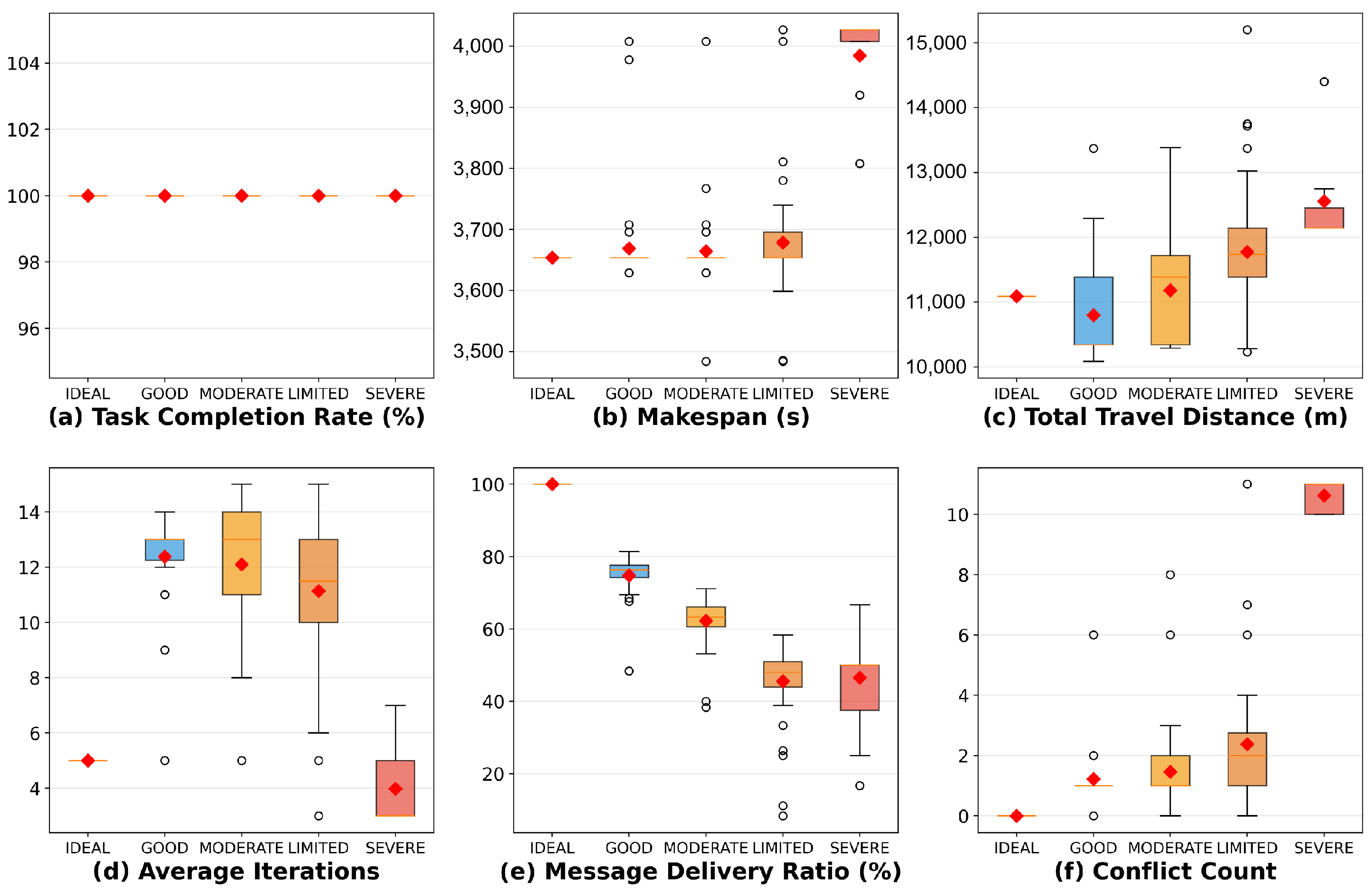
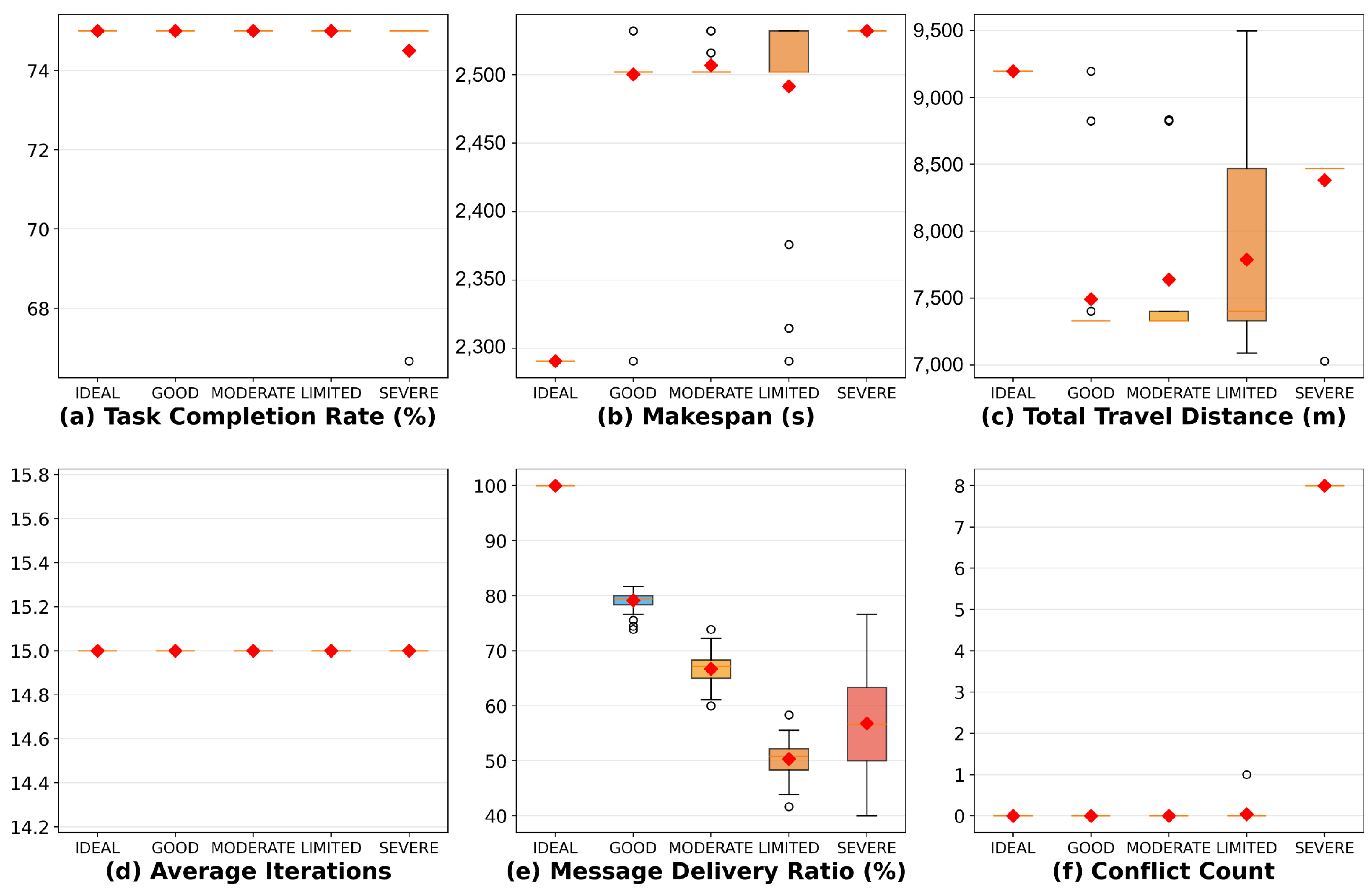
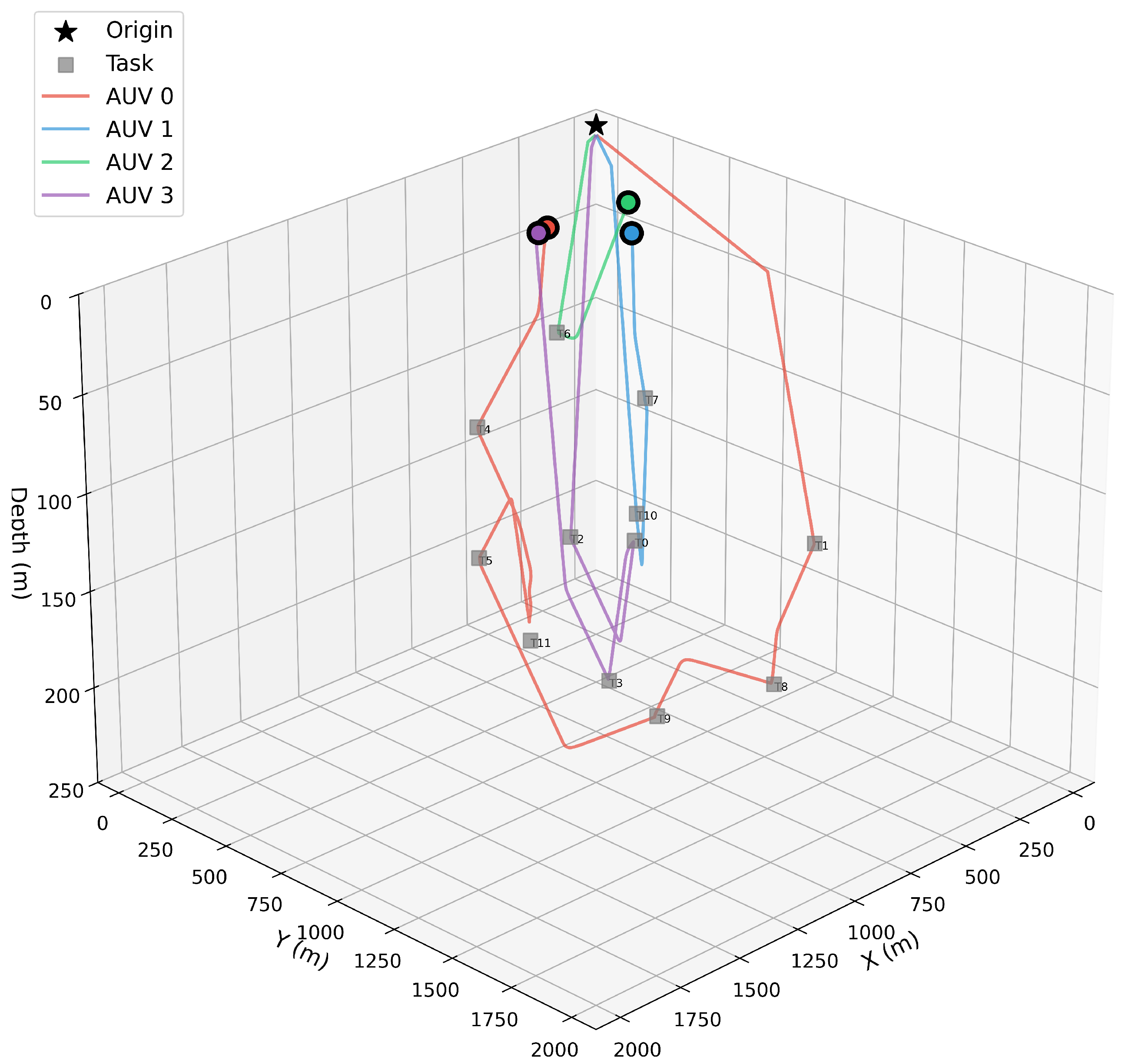
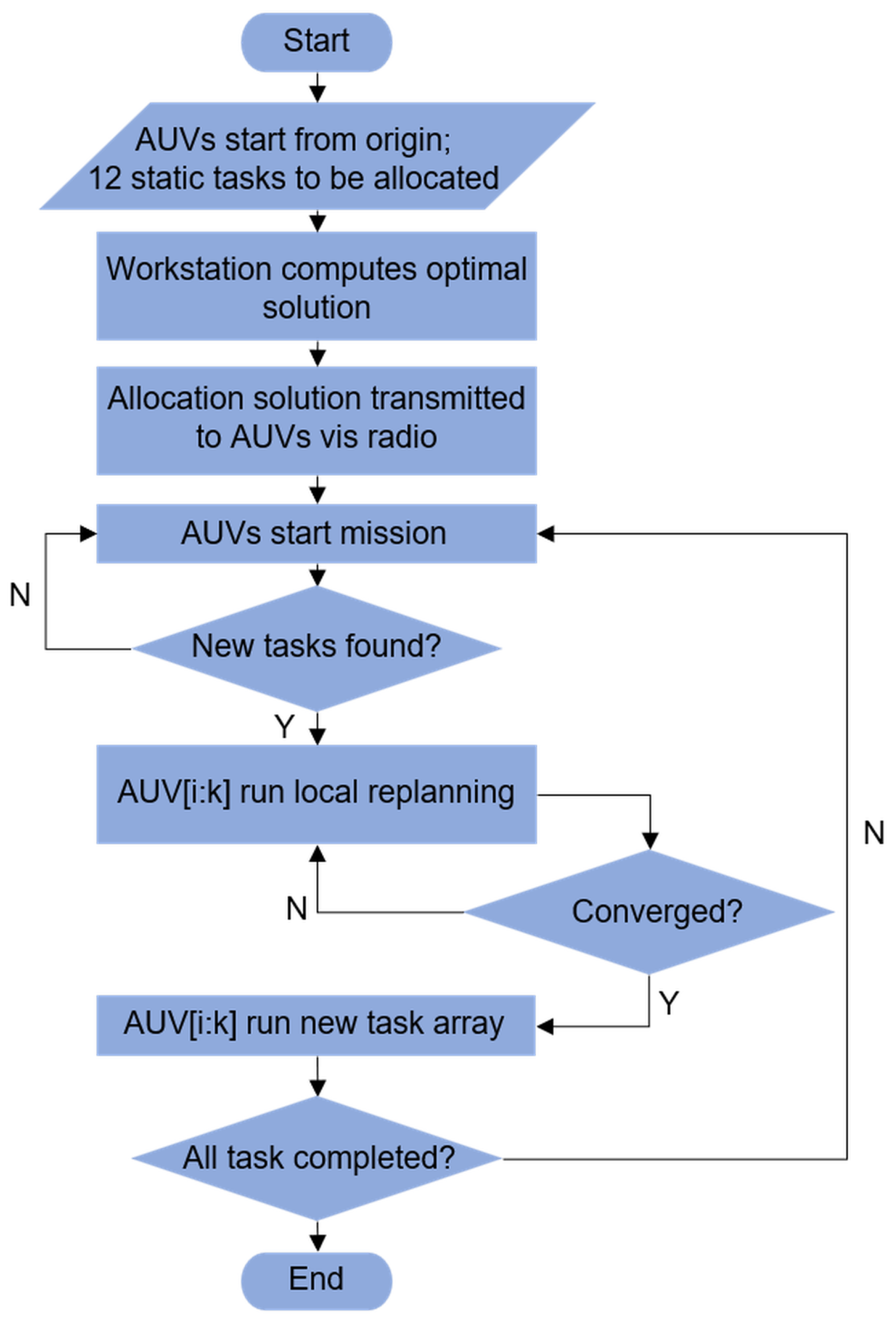
2.1. Simulation Environment Description
- (1).
Software architecture and implementation.
We implemented a dedicated multi-AUV task-allocation simulator to evaluate CBBA under weak underwater acoustic communication. The project is organized into five core modules: models (AUV kinematics, task model, and communication model), algorithms (Baseline CBBA, Improved CBBA, CA-CBBA, and false-convergence diagnostics), simulation (scenario configuration and the main simulator loop), visualization, and analysis. This modular structure allows us to swap communication-loss models and algorithm variants while keeping scenario generation and metric logging consistent.
- (2).
AUV kinematics and constraints.
Each AUV state includes horizontal position , depth z, heading, pitch, and forward speed. Unless otherwise stated, we use a simplified 3D Dubins-like kinematic model with a minimum turning-radius constraint and bounded speed/depth limits for mission-level travel-time estimation. The default parameters include the following: cruise speed m/s, max speed m/s, max turn rate rad/s, minimum turning radius 5 m, maximum depth 200 m, and max vertical speed m/s. We also keep a placeholder interface for replacing this model with a higher-fidelity 6-DOF dynamics module in future work (currently falling back to the Dubins model).
- (3).
Task model and dynamic task insertion.
Tasks are represented as 3D points with unique IDs, reward/priority attributes, optional deadlines, and a discrete status machine (unassigned/assigned/in-progress/completed). Task instances can be generated using uniform, clustered, or grid patterns to control spatial structure. Dynamic tasks are supported by the simulator; when a new task appears, nearby AUVs discover it and initiate a local bidding/consensus update so that the new task can be inserted into an existing route.
- (4).
Underwater acoustic communication model.
We parameterize underwater communication by range, packet loss, and propagation delay. Five representative regimes are predefined for controlled connectivity degradation: IDEAL, GOOD, MODERATE, LIMITED, and SEVERE. The communication configuration also exposes sound speed (1500 m/s), bandwidth (max messages per step), and a propagation-delay scaling factor. In addition to the baseline linear distance-dependent loss, we support two non-linear loss models—exponential and logistic—to test sensitivity to non-linear channel behaviors.
- (5).
Scenario scaling and simulation loop.
We provide several predefined scenario scales (e.g., 3/4/6/8 AUVs paired with 6/10/15/20 tasks) to support scalability experiments. The simulator runs in discrete time with s, a maximum simulated horizon of 3600 s, a CBBA iteration cap per allocation round, and a maximum bundle size per AUV.
- (6).
Local negotiation and conflict-handling mechanisms.
To address last-mile conflicts in severely degraded regimes, the simulator includes a proximity-triggered local conflict resolution procedure: when multiple AUVs believe they own the same task, negotiation is triggered near the task location, and the closest AUV executes while others yield. This mechanism is enabled/disabled via the simulation configuration to support ablation studies.
- (7).
Metrics and experiment scripts.
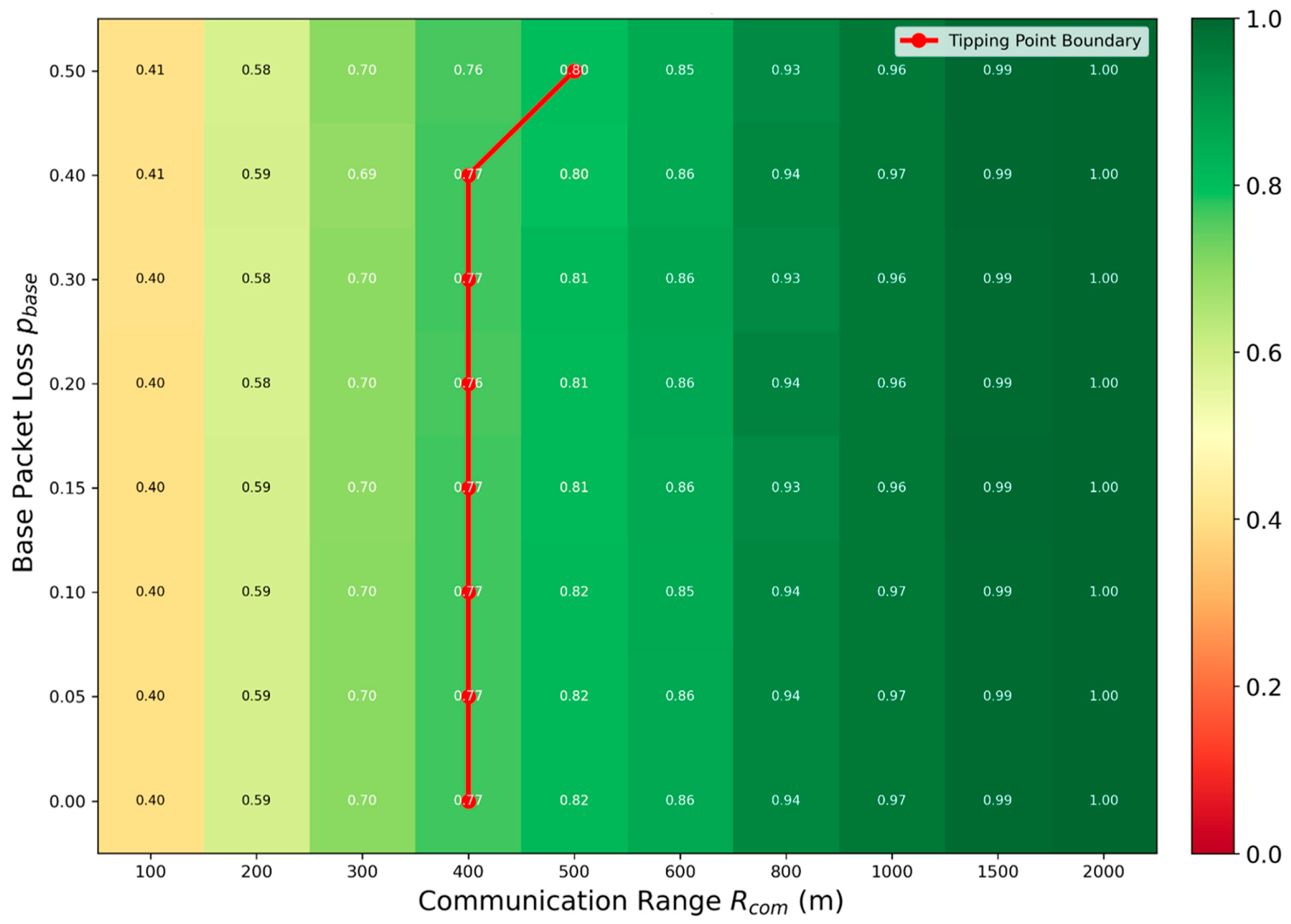
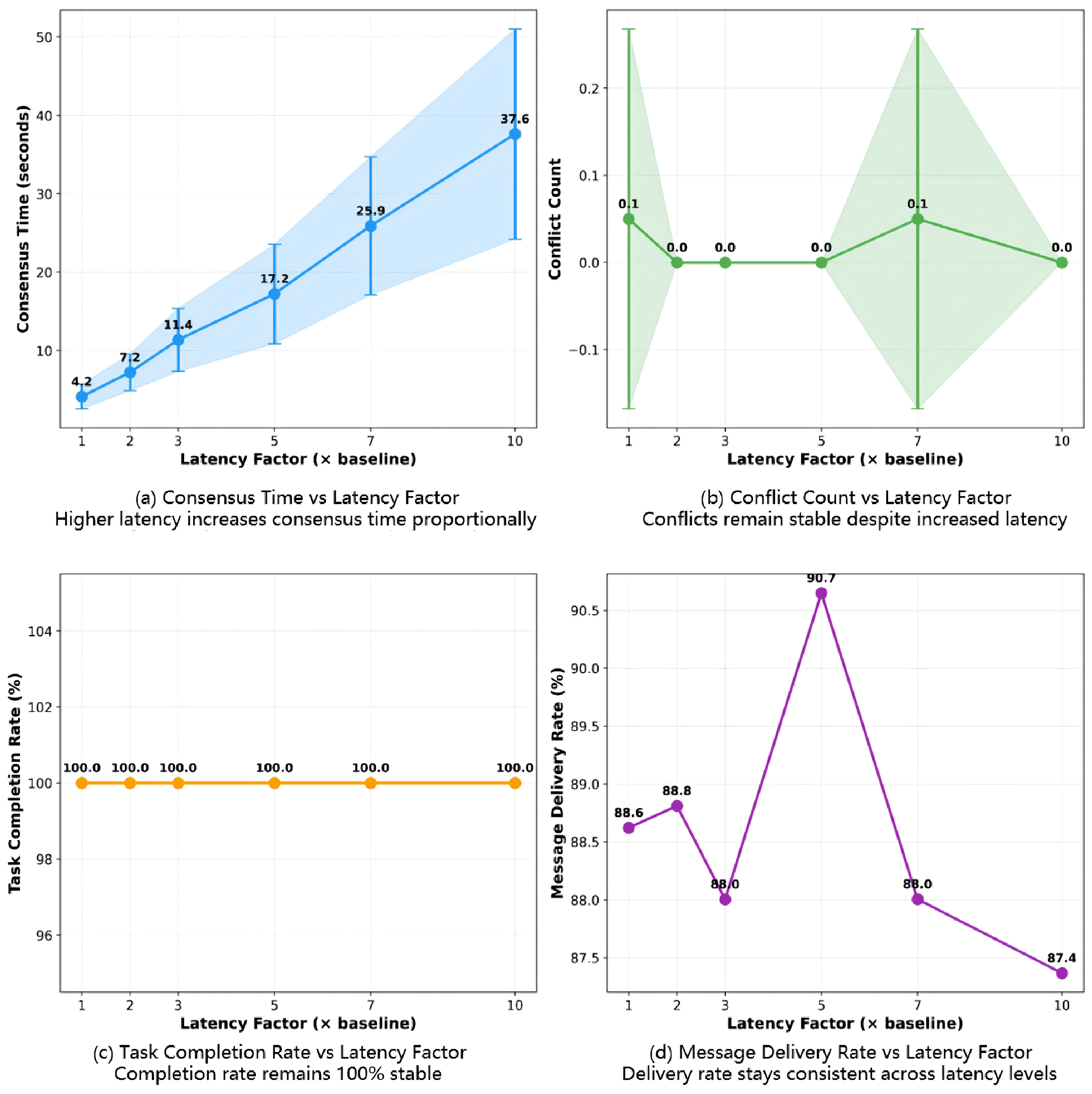
We log metrics covering task allocation quality, convergence behavior, communication effectiveness, and path efficiency, including task completion, convergence status/iterations, message delivery rate, delay/connectivity diagnostics, makespan, total distance, and conflict count. We provide dedicated experiment scripts for regime sweeps, task scalability, latency sensitivity, LCC tipping point identification, false-convergence detection, and non-linear loss-model sensitivity.
- (8).
Computational requirements and runtime reporting.
To improve reproducibility, we report both the hardware/software environment and the wall-clock runtime of the simulator in
Table 1. All experiments are deterministic given a fixed random seed and configuration; we report the number of Monte Carlo runs per configuration and summarize runtime as (i) mean wall-clock time per simulation episode, (ii) mean wall-clock time per configuration (aggregated over runs), and (iii) total runtime for a full sweep experiment. For transparency, we also report the average number of CBBA iterations per dynamic reallocation event and the average number of messages transmitted per episode.
2.2. Scenario Description
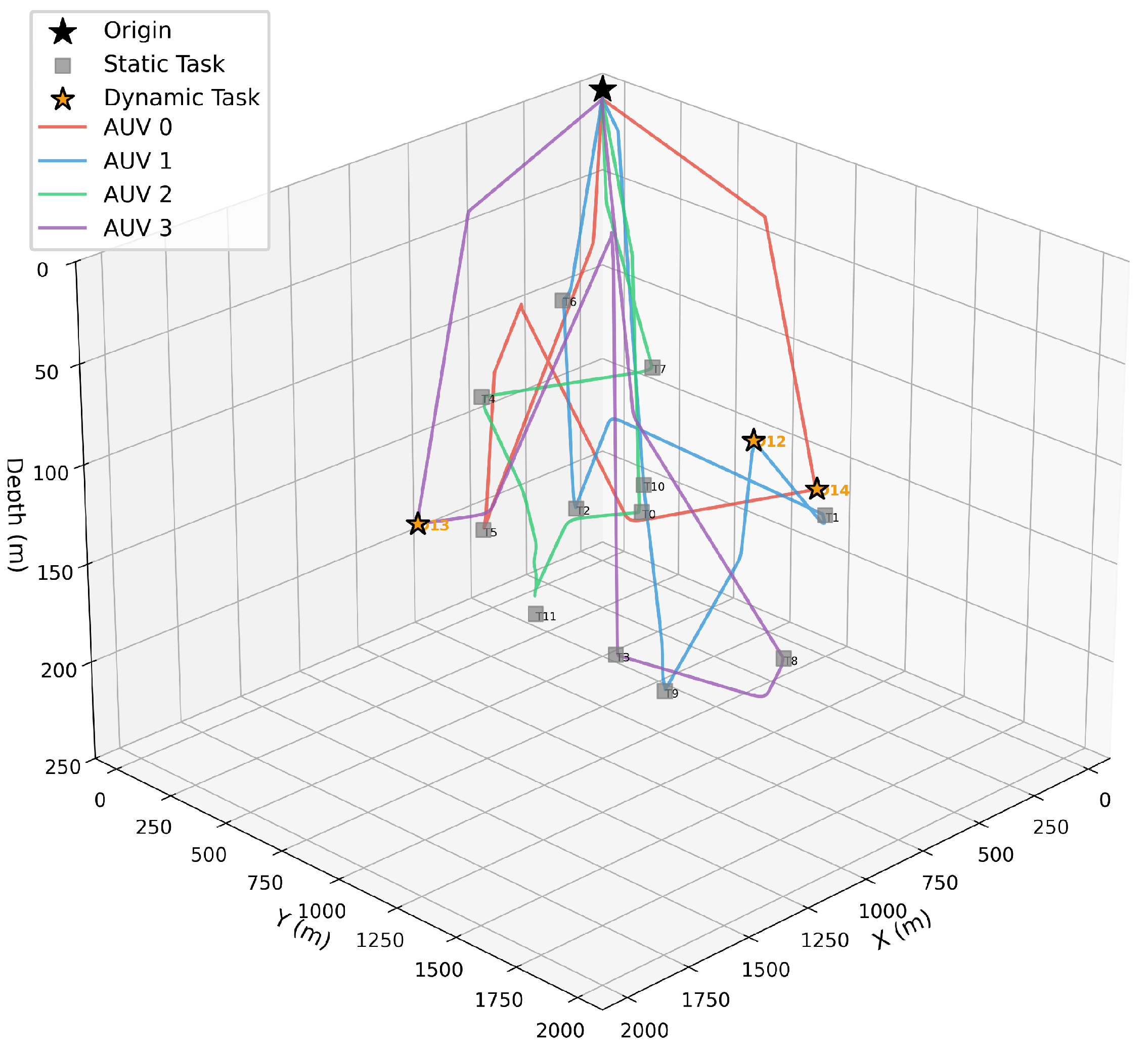
We consider a mission scenario involving a team of AUVs deployed in a 3D underwater environment to perform a set of tasks. The environment is defined as a bounded 3D space .
We let the set of AUVs be . Every AUV is supposed to be equipped with both sensors and communication modules such that they perform navigation, target detection, and information exchange of time-varying reliability. The AUVs are assumed to start from known initial positions at time .
The set of tasks is denoted as . Each task represents a point of interest (POI) located at coordinate with an associated reward . Tasks may be static (known a priori) or dynamic (appearing stochastically during the mission). For dynamic tasks, location and reward become known to the fleet only after the task appearance time . Successful completion of a task requires an AUV to first travel to the location of the task and perform on-site operations for a duration of .
The goal of the fleet is to allocate all tasks optimally among the AUVs for maximum mission efficiency. More precisely, we are interested in minimizing the makespan—the moment when the last AUV completes the tasks allocated to it and goes back to depot—guaranteeing equitably distributed workload and prompt completion of a mission.
2.3. AUV Kinematic Model
To balance geometric realism and computational efficiency at the mission-planning level, we adopt a Dubins-like kinematic model in the horizontal plane coupled with a decoupled depth-rate model (a common “2.5D” approximation). This choice explicitly captures the dominant non-holonomic maneuvering constraint in the horizontal plane (bounded turning radius), while enabling fast cost evaluation for repeated task allocation and replanning.
- (1).
State and dynamics.
The state of the
k-th AUV at time
t is defined as
where
is the inertial position,
is the yaw (heading) angle, and
is the surge speed. The simplified kinematics are
where
is the yaw rate,
is the longitudinal acceleration, and
is the vertical (heave) speed.
- (2).
Physical bounds and implied maneuvering limits.
We impose bounded actuation and speed limits:
The planar component of Equation (
2) is non-holonomic: the AUV advances along its heading and cannot instantaneously translate laterally. Together with bounded yaw rate, the instantaneous turning radius satisfies
- (3).
Remark on modeling scope and extensibility.
Equation (
2) decouples the depth change from planar heading dynamics. This “2.5D” abstraction is adopted because this work focuses on task allocation under communication constraints, where repeated cost queries dominate runtime. The overall framework preserves a clear interface for replacing Equation (
2) with higher-fidelity 6-DOF AUV dynamics (or a Dubins-airplane-like 3D kinematic model) in future work.
- (4).
Task service time.
Each task requires a fixed service time s, accounting for sensing/inspection actions at the task site. This service time also absorbs short local maneuvers such as heading reorientation near the task.
Inter-Task Travel-Time Cost
For mission-level optimization, we define an inter-task travel-time cost combining (i) a Dubins-like planar path length under and (ii) a bounded-rate depth-change time. Consider moving from task node i to task node j with positions and .
- (1).
Planar travel distance (free arrival heading with local reorientation).
Most tasks in our scenario are position defined and do not impose a strict arrival bearing. Hence, we do not enforce an arrival heading at node
j when computing the inter-task planar distance. Let
denote the current heading at node
i. We define the planar Dubins-like distance with
free arrival heading as
This mission-level abstraction is consistent with allowing the AUV, upon reaching the task vicinity, to perform short local maneuvers (e.g., loitering/hovering and heading adjustment) before executing the task. In our model, the time overhead of such local reorientation is explicitly absorbed into the fixed task service time
s. Therefore, omitting an explicit arrival heading state in Equation (
5) does not compromise the consistency of the mission-level scheduling cost.
- (2).
Transit-and-service decomposition.
For a route segment
, we use the transit time
defined in Equations (
9) and (
10). The total time contribution of visiting task
j after task
i is then modeled as
where
includes both the on-site operation and any short local reorientation maneuver at the task.
- (3).
Planar and depth travel time.
Given
, the planar travel time is approximated using a nominal cruise speed
:
The minimum time required to change depth under the bounded vertical rate is
- (4).
Combined inter-task travel-time cost.
Assuming planar motion and depth change can be executed concurrently (consistent with the decoupled 2.5D abstraction), we define
If a particular mission profile requires sequential execution (e.g., depth adjustment must be completed before horizontal maneuvering in a constrained layer), we alternatively use
The above travel-time model supports fast and consistent mission-level evaluation for task allocation and routing, while preserving the key feasibility characteristics imposed by the planar minimum turning radius and bounded vertical rate.
2.4. Underwater Acoustic Communication Model
The nature of underwater acoustic communication, with its propagation speed, path loss, and bandwidth, places severe constraints on the coordination among multi-agents. A realistic communication model is implemented to evaluate the robustness of the proposed allocation algorithm, considering four major factors: communication range, propagation delay, packet loss, and bandwidth limitations.
2.4.1. Communication Factors
- (1).
Communication Range and Topology
The network connectivity is modeled as a time-varying graph
. An edge
exists in
if the Euclidean distance
between AUV
k and AUV
l is within the maximum communication range
:
This geometric constraint determines the instantaneous neighbor set
for each agent.
Given the time-varying communication graph
, the instantaneous neighbor set of AUV
k at time
t is defined as
which is equivalently expressed, using (
11), as
- (2).
Propagation Delay
Acoustic waves have a propagation speed in water of approximately
m/s, five orders of magnitude slower compared to electromagnetic waves. We explicitly model the non-negligible propagation delay
for any message transmitted from agent
k to
l:
Consequently, the information received by agent
l at time
t reflects the state of agent
k at time
, introducing state asynchrony into the consensus process.
- (3).
Probabilistic Packet Loss
Attenuation and multipath fading imply that signal reliability decays with distance. We adopt a distance-dependent probabilistic loss model to emulate the key effect of underwater acoustic links: as the inter-vehicle separation increases, message delivery becomes less reliable and eventually drops to zero beyond the communication range .
Default (linear) model. In the main experiments, successful packet delivery
is defined as
where
represents a baseline loss rate (e.g., due to background noise, collisions, or interference), and the term
captures the monotonic degradation of link quality with distance. We use this linear form as a controlled and interpretable abstraction: it introduces only two high-level parameters (
and
), supports systematic regime design, and allows us to isolate communication-induced consensus effects without overfitting to a specific modem/channel model.
Non-linear variants (robustness check). Since real underwater links may exhibit non-linear and threshold-like behaviors (e.g., rapid reliability drop near a critical distance or bursty loss), we additionally evaluate two alternative distance-to-success mappings in a sensitivity study: an exponential decay model
and a logistic (threshold-like) model
where
controls the exponential decay rate, and
controls the steepness and midpoint of the logistic transition. These variants are not intended as a definitive physical-layer model; rather, they serve to verify that the main conclusions (tipping behavior driven by fragmentation and the benefits/limits of hybrid local resolution) are not artifacts of the linear assumption. The corresponding results are reported in Section Sensitivity to Non-Linear Channel Loss Models.
- (4).
Bandwidth Constraints
Recognizing the low data rate of acoustic modems, we apply a bandwidth constraint to the number of messages an agent can broadcast in every simulation cycle. Let
be the queue of outgoing messages for agent
k. We limit the number of transmitted messages by
:
Excess messages are either queued for the next cycle or dropped based on priority.
2.4.2. Communication Scenarios
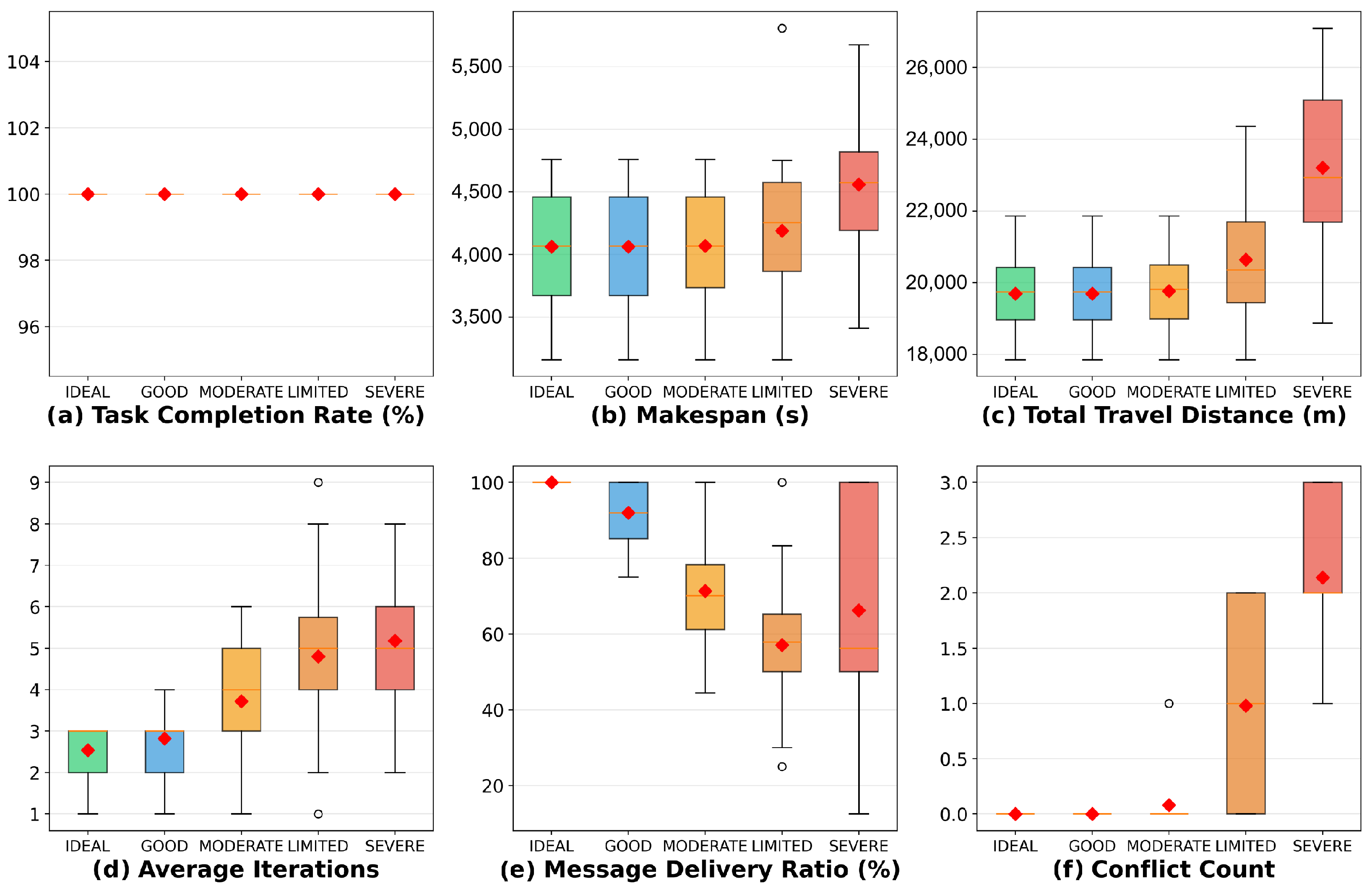
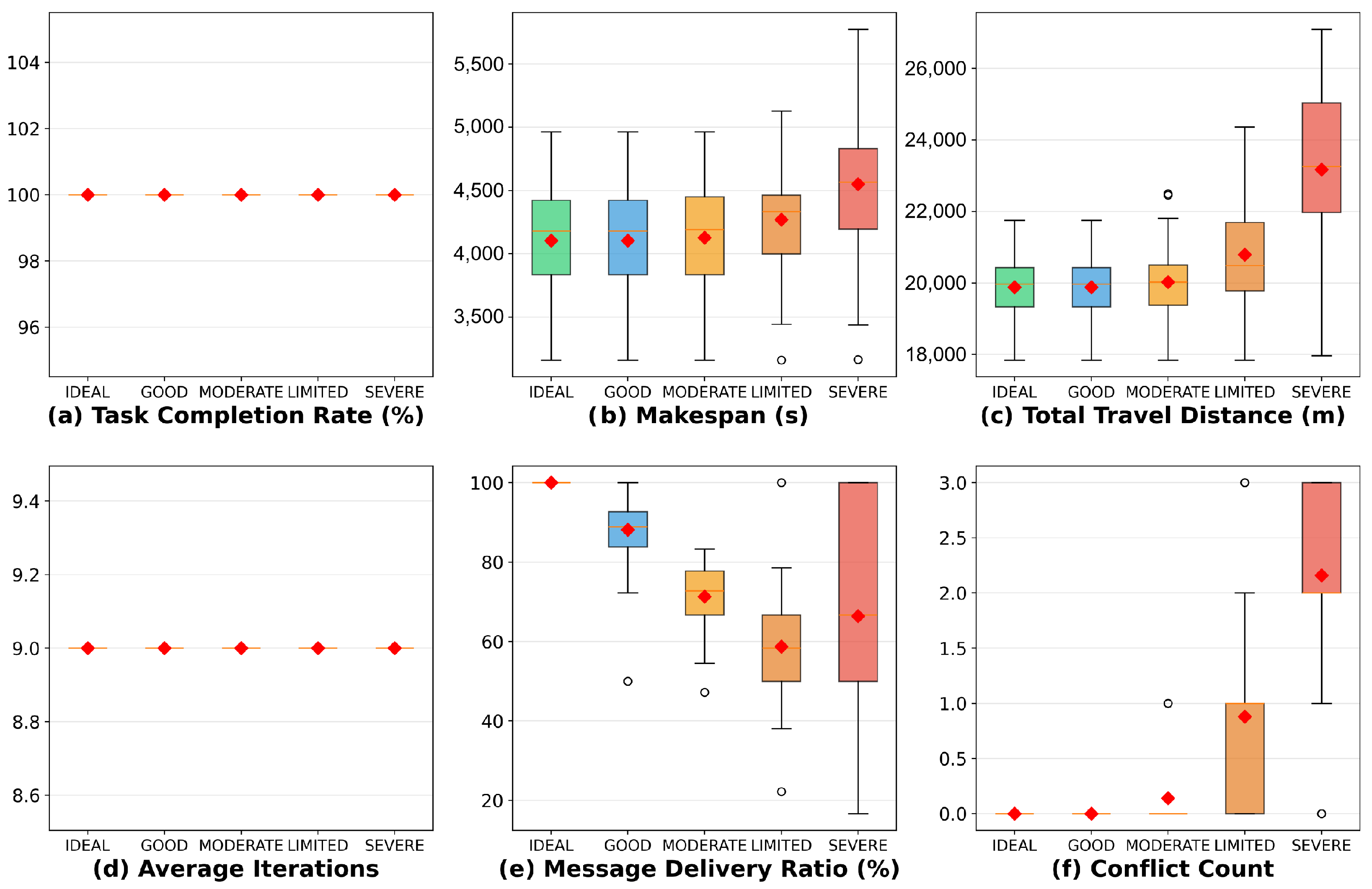
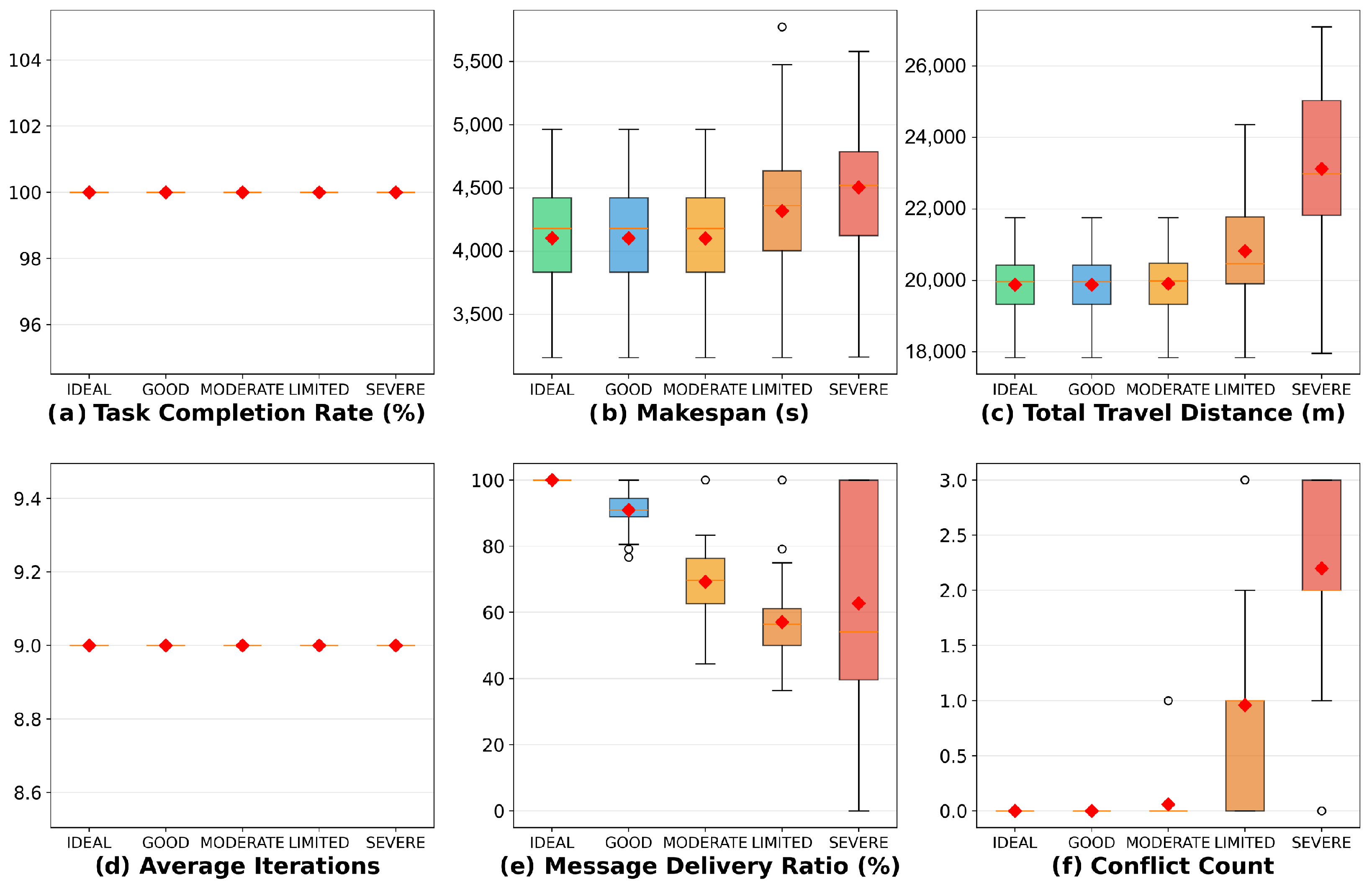
We define five different communication scenarios in a systematic analysis of algorithmic resilience, ranging from ideal conditions to severe degradation. Specific parameters are given along with their physical interpretations in
Table 2.
The IDEAL scenario assumes perfect communication to establish an upper bound on performance. In contrast, the GOOD and MODERATE scenarios represent standard operational conditions; LIMITED and SEVERE simulate highly constrained environments in which coordination is frequently disrupted.
The communication regimes in
Table 2 are designed as a controlled and reproducible degradation ladder rather than a site-specific channel fit. Underwater acoustic links exhibit strong environment dependence (bathymetry, multipath, shipping noise, interference, and modem configuration), so our goal is to span representative operational envelopes and progressively stress information propagation and network connectivity.
The baseline loss term
compactly captures non-distance effects such as ambient noise, collisions, fading bursts, and receiver demodulation failures. Combined with the distance-dependent success probability, these parameters yield a monotonic reduction of effective information propagation across regimes. This is consistent with common underwater acoustic network simulation practice, where the emphasis is placed on controlled connectivity degradation to study algorithmic robustness rather than on calibrating to a single measured channel [
14,
15].
The values
m are chosen to cover mid-range kilometer-scale links and short-range sub-kilometer interactions that are commonly reported for commercial acoustic modems under different carrier bands and conditions. For example, typical ranges on the order of ∼1–6 km are reported depending on frequency (e.g., LF/MF vs. higher bands), while effective range can shrink substantially in cluttered or high-interference environments [
16,
17]. Accordingly, we set GOOD (2000 m) and MODERATE (1000 m) to represent reliable and typical ranges, LIMITED (500 m) to emulate frequent short-range contacts, and SEVERE (200 m) to intentionally induce intermittent connectivity and network partitioning—a known dominant failure mode for distributed consensus in underwater acoustic networks [
14,
18].
2.4.3. Simulation Mechanism
The update loop uses a discrete-event approach to simulate the communication process:
- 1.
Topology Update: At each time step t, pairwise distances are computed to update the neighbor sets .
- 2.
Stochastic Transmission: When agent k attempts to send a message to l, a random variable is drawn. The transmission is successful only if .
- 3.
Delay Modeling: If successful, the message is not delivered immediately. Instead, it is placed in a global event queue with a scheduled delivery time .
- 4.
Message Processing: Agent l retrieves and processes messages from the queue only when the simulation clock reaches . This mechanism faithfully reproduces the effects of stale information and temporal inconsistencies inherent in underwater networks.
2.5. Problem Formulation
We formulate the task allocation problem as a Min-Max Multi-Traveling Salesperson Problem (Min-Max mTSP). More formally, let be a graph, where is the set of nodes (AUVs start nodes and task nodes), respectively.
Let the binary decision variable be 1 if AUV k travels from node i to node j, and 0 otherwise. The objective is to minimize the makespan M, defined as the maximum path duration among all AUVs.
Subject to:
- (i).
Makespan Constraint: The completion time for each AUV
k, denoted as
, must not exceed the makespan
M:
- (ii).
Task Assignment: Each task
must be visited exactly once by exactly one AUV:
- (iii).
Flow Conservation: AUVs must leave their starting nodes and maintain path continuity:
- (iv).
Fairness Constraint (Optional): To ensure resource utilization, we impose that each AUV performs at least one task:
- (v).
Subtour Elimination: To ensure valid executable paths without disconnected loops (subtours) for the agents, we employ the Miller-Tucker-Zemlin (MTZ) formulation [
19]. We introduce auxiliary continuous variables
representing the visit order of task
i by AUV
k. The constraints are defined as:
where
L is the maximum allowable path length (or total number of tasks). This ensures that if AUV
k travels from task
i to task
j (i.e.,
), then the visit order must satisfy
, preventing cycles within the task graph.
The solution to this global optimization problem in Equations (
19)–(
24) is NP-hard. To address this, we propose an improved CBBA framework that augments the standard bundle-building and consensus phases with (i) solver-assisted initialization and (ii) a local conflict-resolution/repair mechanism to enhance reliability under degraded communication. We benchmark the resulting distributed solutions against a centralized SCIP solver, which provides the global optimum (or the best feasible solution within the time budget).
2.8. Local-Communication-Based Conflict Resolution Under Severe Conditions
A critical contribution of this work is a robust “last-mile” conflict resolution mechanism designed specifically for Severe communication environments. In such scenarios, the global network often fragments into disconnected components, preventing the standard CBBA consensus from converging on a conflict-free assignment. To prevent multiple AUVs from wasting energy attempting the same task due to outdated global information, we introduce a decentralized, geometry-triggered resolution protocol.
2.8.1. Local Neighborhood Modeling
Under severe attenuation, an agent
i can only exchange information with a subset of physically proximate agents. We define the instantaneous local neighbor set
as
where
is the effective short-range communication radius. In our “Severe” scenario, this range is restricted (e.g., 200 m), often resulting in
or even isolation until agents converge on a target.
2.8.2. Negotiation Zone and Competitor Discovery
To minimize bandwidth usage, agents do not broadcast verification messages continuously. Instead, negotiation is triggered locally when an agent enters the Negotiation Zone of its targeted task j. This zone is defined by a radius around the task location .
Upon entering this zone (), agent i initiates the following discovery process:
Broadcast Claim: Agent i broadcasts a claim message to all local neighbors .
Identify Competitors: Agent i listens for corresponding claims. A neighbor k is deemed a Competitor if the following hold:
- -
Agent k is also targeting task j ().
- -
Agent k is physically within the local communication range ().
- -
Agent k is also within the negotiation zone ().
2.8.3. Conflict Resolution Logic
Once the set of local competitors is identified, the agent executes a deterministic decision rule to resolve the conflict without requiring a central coordinator. The rule prioritizes the agent best positioned to complete the task immediately.
Decision Rule: Agent
i retains the task if and only if
This implies that the agent closest to the target wins. In the rare case of equidistant agents, the lower ID serves as the immutable tie-breaker.
Yielding Action: If agent i determines it is not the winner, the following occurs:
It immediately yields the task, marking it as locally blocked.
It triggers a SkipTask action, advancing its internal task pointer to the next assignment in its bundle (or returning to base if is empty).
Global consistency is not enforced; agent i simply modifies its local execution path to avoid collision/redundancy.
2.8.4. Hybrid Architecture Integration
This mechanism functions as a safety net beneath the standard CBBA layer. The system operates as a hybrid state machine:
Global Layer (CBBA): Under normal conditions, CBBA provides the optimal task schedule.
Local Layer (Safety): When global consensus fails (due to packet loss/partitioning), the local resolution protocol activates ad hoc to resolve conflicts physically at the target site.
The pseudo-code for this innovative process is presented in Algorithm 1. The main loop of the improved CBBA is shown in Algorithm 2. Within this loop, iterative bundle construction with kinematic-aware scoring is performed, neighbor messages are exchanged for consensus, post-consensus bundle repair is applied, and termination is determined by convergence detection or a maximum-iteration limit.
| Algorithm 1 Local conflict resolution (executed at each time step). |
Require: Current agent i, Target Task j, Neighbors 1: 2: if then ▹ Broadcast claim to local neighbors 3: Broadcast Claim to 4: 5: for all do 6: if Receive Claim then 7: 8: end if 9: end for 10: 11: for all do 12: if or (and) then 13: 14: break 15: end if 16: end for 17: if then ▹ Yield task to competitor 18: Yield Task: Log “Yielding task j to agent k” 19: 20: Update Target to 21: end if 22: end if
|
| Algorithm 2 Improved CBBA. |
Require: AUV set , task set , communication network , max bundle size , max iterations Ensure: Final assignment (each is an ordered task path) 1: Initialize each agent i: bundle , path ; winning bids , winners for all j. 2: , converged←False 3: while converged= False do 4: 5: Update positions by current AUV states; reset bandwidth counters. ▹ Phase 1: Bundle Building (local greedy + local search) 6: bundle_changed ← False 7: for all do 8: if BundleBuild(i) adds any task then 9: bundle_changed ← True 10: end if 11: end for ▹ Phase 2: Consensus (neighbor broadcast + CBBA update rules) 12: data_changed ← False 13: for all do 14: MakeMessage(i) ▹ 15: for all do 16: 17: end for 18: end for 19: for all do 20: for all do 21: if ProcessMessage() updates any or then 22: data_changed ← True 23: end if 24: end for 25: end for ▹ Post-consensus rebuild (inconsistency or remaining capacity) 26: for all do 27: if ¬CheckConsistency(i) or then 28: if BundleBuild(i) adds any task then 29: bundle_changed ← True 30: end if 31: end if 32: end for 33: ▹ assigned tasks 34: all_assigned 35: if (bundle_changed = False) and (data_changed = False) and all_assigned then 36: converged ← True 37: end if 38: if then 39: converged ← True 40: end if 41: end while 42: return
|
2.8.5. False Convergence: Definition and Detection
Under SEVERE communication conditions, CBBA may exhibit an apparent local “convergence”: each agent’s local winner vector stops changing, yet a globally consistent assignment is not reached because the communication graph is partitioned and conflicting beliefs cannot be reconciled. To make this phenomenon explicit and measurable, we define and detect false convergence as follows.
Let
denote agent
i’s winner vector at CBBA round
t (for all tasks). We define local stagnation to occur at time
t if the winner vectors remain unchanged for
H consecutive rounds:
In simulation, a global observer computes a global conflict indicator
that detects inconsistent task ownership beliefs across agents, e.g., when two or more agents claim different winners for the same task:
We also monitor network fragmentation using the LCC ratio
(Equation (
35)).
False convergence is declared at time
t if (i) local stagnation holds (Equation (
30)) and (ii) the system remains globally inconsistent, i.e.,
where we use
and set
unless otherwise stated. This definition captures the practical failure mode in SEVERE conditions: the algorithm appears stable locally, but conflicts persist due to missing global information propagation.
2.9. Performance Metrics and Experimental Setup
To comprehensively evaluate the efficacy of the proposed task allocation framework under varying communication constraints, we define a set of quantitative metrics and a rigorous experimental protocol.
2.9.1. Performance Metrics
- (1).
Task Allocation Quality
The primary objective is efficient mission completion. We measure the following:
Task Completion Rate (
): The percentage of tasks successfully executed by the fleet relative to the total available tasks.
Makespan (): The mission duration, defined as the time when the last AUV completes its final task and returns to base. This reflects the parallelism and load balancing quality.
Total Travel Distance (): The aggregate distance traveled by all AUVs, serving as a proxy for total energy consumption.
- (2).
Algorithm Convergence
We assess the stability of the distributed consensus process via the following:
Convergence Rate: The percentage of simulation runs where the CBBA algorithm successfully reaches a consensus state (no conflicting bids) before the decision deadline.
Average Iterations: The mean number of communication rounds required to achieve consensus, indicating computational and communication overhead.
- (3).
Communication Efficiency
Given the focus on underwater networks, we track the following:
2.9.2. Experimental Setup
We conduct a series of simulation experiments using the developed Python-based simulation environment.
- 1.
Simulation Parameters
The default scenario involves a fleet of
AUVs and
tasks (static and dynamic) distributed within a 3D bounding box of
m. AUVs operate with a cruise speed of
m/s and adhere to the Dubins kinematic constraints described in
Section 2.3. To assess scalability with respect to team size and task load, we conduct a CBBA scaling study under two representative communication regimes:
IDEAL and
SEVERE. We vary the number of AUVs as
and the number of tasks as
.
We select a default setting of 4 AUVs and 10–20 tasks to balance three practical requirements: (i) represent a realistic small-team multi-AUV deployment, (ii) ensure that weak-communication effects (intermittent connectivity, delayed information propagation, and network fragmentation) are observable, and (iii) enable statistically meaningful Monte Carlo evaluation across multiple communication regimes with manageable computational cost.
A team size of four is a commonly used small-team scale in cooperative AUV operations and is sufficient to exhibit non-trivial distributed-consensus phenomena such as task conflicts, consensus instability, and fragmentation-driven inconsistency, without being dominated by scalability effects. Moreover, this scale makes our connectivity-based diagnostics directly interpretable: for example, an LCC ratio threshold of corresponds to the condition that at least 3 out of 4 AUVs remain in the same connected component, which is central to our tipping-point and false-convergence analyses.
We choose 10–20 tasks to create a workload that is non-trivial yet feasible for a 4-AUV team, ensuring multiple tasks per vehicle and thus meaningful bundling/reordering and dynamic reassignment behavior. This range avoids degenerate cases where the team is under-loaded (too few tasks leading to trivial allocations) or over-saturated (too many tasks where failures are dominated by infeasibility rather than communication). It also matches our dynamic-task setting (e.g., 12 static tasks plus 3 dynamic insertions), where the reallocation mechanism, convergence behavior, and conflict persistence can be clearly observed under degraded communication.
To avoid over-specializing conclusions to a single configuration, we additionally include a scaling study that varies both the number of AUVs and tasks (e.g., paired with ) and reports runtime and key performance trends under multiple communication regimes, strengthening the generality of our findings beyond the default 4-AUV setup.
- 2.
Monte Carlo Methodology
To account for the stochastic nature of packet loss, task generation, and initial configurations, we employ Monte Carlo methods.
Trials: For each communication condition (Ideal, Good, Moderate, Limited, and Severe), we conduct independent simulation runs.
Randomization: Each run uses a distinct random seed to vary task locations, dynamic appearance times, and packet drop events, ensuring statistical significance.
- 3.
Comparative Studies
We design two specific comparative studies to validate the contributions:
Baseline Comparison (CBBA vs. Optimal): We compare the solution quality (makespan and total distance) of our distributed CBBA implementation against a global optimal benchmark obtained via a SCIP integer programming solver (under Ideal conditions).
State-of-the-Art Comparison (Proposed vs. SOTA CBBA Variants): we compare our method with a representative CBBA-family baselines implemented in the same simulation environment within scenario 2. In CA-CBBA, the bidding score is modified by incorporating a communication-reliability term, such that assignments that are difficult to coordinate under intermittent connectivity are penalized. This baseline represents the communication-aware CBBA family.
Ablation Study (Local Resolution): specifically in the Severe scenario, we compare two diverse configurations:
- -
Standard CBBA: Agents rely solely on global consensus, which frequently fails in severe conditions.
- -
CBBA + Local Resolution: The proposed hybrid approach (
Section 2.8) is enabled, allowing local negotiation at target sites.
The difference in Conflict Count and Task Completion Rate between these two sets quantifies the value of the proposed local resolution mechanism.