1. Introduction
With the rapid expansion of maritime economic activities, the establishment of a robust and resilient Maritime Emergency Communication Network (MECN) has become a strategic priority. However, compared to terrestrial environments, the maritime domain presents unique and formidable challenges due to the inability to deploy dense, fixed infrastructure. The marine environment is inherently complex and volatile, frequently beset by natural disasters and high-uncertainty emergencies. Under these conditions, conventional maritime communication architectures—comprising maritime radio, coastal cellular networks, and satellite systems—reveal significant limitations. Specifically, maritime radio suffers from limited transmission range and bandwidth; coastal cellular networks fail to extend coverage to deep-sea or offshore areas; and satellite communications, while offering broad coverage, are susceptible to severe signal attenuation and interference during extreme weather [
1]. To address these bottlenecks, the research paradigm is shifting toward the Space–Air–Ground–Sea Integrated Network (SAGIN)sequence [
2,
3]. Within this architecture, constructing a mobile, aircraft-based emergency network is a promising solution for maritime connectivity gaps. This approach leverages airborne platforms (e.g., UAVs, helicopters, and tethered balloons) to rapidly extend coverage to disaster-stricken areas [
4]. However, effectiveness depends on precise planning, and existing literature exhibits limitations in three critical aspects: First, regarding demand modeling, traditional methods often assume uniform vessel distribution. With the proliferation of the Automatic Identification System (AIS), data-driven approaches using density-based clustering (e.g., DBSCAN) have become essential for accurately identifying high-risk “hotspots” [
5,
6], yet few base siting models effectively incorporate this granular risk data. Second, regarding aircraft deployment, current research largely focuses on tactical path planning for homogeneous fleets [
7], often overlooking the strategic base siting for heterogeneous platforms that possess distinct speed and endurance capabilities [
8,
9]. Third, addressing the conflicting objectives of coverage, cost, and response time requires advanced optimization. Standard algorithms like NSGA-II often struggle with the non-linear constraints inherent in maritime environments [
10,
11].
To overcome these limitations, this paper proposes a method utilizing heterogeneous aircraft equipped with communication payloads for rapid network construction. We propose a Hybrid Adaptive Multi-objective Optimization (HAMO) framework to satisfy the dual demands of quick response and stable transmission. By integrating Monte Carlo-based vessel distribution simulation with a hierarchical coverage model, this study validates the feasibility and effectiveness of the proposed model through a case study in the Bohai Sea region.
The remainder of this paper is organized as follows:
Section 2 reviews the current research status of maritime communications.
Section 3 elaborates on the maritime risk level assessment method based on vessel distribution and the Hybrid Adaptive Multi-objective Optimization (HAMO) algorithm model.
Section 4 presents a case study of the Bohai Sea for experimental validation and result analysis.
Section 5 discusses the experimental findings, and
Section 6 concludes this study.
2. Related Works
With the continuous expansion of maritime activities, the ocean plays an increasingly critical role in economic, scientific, and technological domains. However, rising risks from extreme weather and maritime accidents necessitate more robust emergency response capabilities. Traditional communication systems, often constrained by the complex marine environment, struggle to meet the strict requirements for coverage, latency, and stability essential for rescue operations. This has prompted a paradigm shift toward emergency systems utilizing mobile platforms (e.g., UAVs, USVs, and buoys) [
12] and the adoption of the Space–Air–Ground–Sea Integrated Network (SAGIN) architecture [
2,
3,
13]. Furthermore, incorporating complex environmental factors (e.g., dynamic weather conditions, sea states) into deployment optimization is now recognized as a key strategy to improve the efficiency and resilience of maritime emergency networks [
14].
In [
15], it is pointed out that the communication support vessel utilizes its strong load-carrying capacity, long-distance maneuverability, and extended endurance to rapidly reach the emergency maritime area while carrying a tethered UAV platform equipped with various relay communication payloads. In [
8], the authors proposed a deployment method for MECN resource reserve bases based on aircraft platforms. By considering the coverage capabilities of different carriers, a multi-objective optimization site selection model was established to enhance the rapid response capability of MECN. In [
9], a joint layered deployment of tethered balloons and UAVs was proposed. Optimal and greedy algorithms were employed to minimize the number of deployed tethered balloons and UAVs while providing effective coverage. In [
16], cooperative communication was researched between UAVs and USVs in maritime search and rescue, using reinforcement learning to plan the optimal search path. In [
17], a hierarchical Satellite–UAV–Terrestrial network was constructed for 6G maritime scenarios, proposing a joint link scheduling scheme based on large-scale CSI to minimize energy consumption while ensuring service quality [
18].
In terms of maritime situational awareness, the analysis of vessel distribution characteristics is foundational for precise network planning. With the widespread adoption of the Automatic Identification System (AIS), data-driven approaches have become mainstream for identifying maritime risks. Researchers have extensively utilized clustering algorithms to mine spatiotemporal patterns from AIS trajectories. For instance, density-based algorithms such as DBSCAN have been widely applied to identify high-density vessel aggregation areas and filter out noise in complex marine environments [
5]. Furthermore, recent studies have combined clustering methods like K-Means with accident probability models to grade maritime areas based on traffic density and risk levels [
19]. However, few studies effectively translate these granular risk maps into input parameters for base siting optimization.
Regarding the optimization of communication resource deployment, the problem is often modeled as a Multi-Objective Optimization Problem (MOP) that necessitates balancing conflicting objectives, such as maximizing coverage, minimizing deployment costs, and reducing response latency. Due to the non-convex and NP-hard nature of 3D deployment in continuous maritime spaces, traditional mathematical programming methods often struggle to converge. Consequently, meta-heuristic algorithms have gained prominence. Genetic Algorithms (GA) and Particle Swarm Optimization (PSO) [
20] have been frequently employed to optimize the 3D placement of UAV base stations [
5]. More recently, Multi-Objective Evolutionary Algorithms (MOEA) [
21], such as NSGA-II [
10], have been widely adopted to determine the Pareto optimal set for coverage and connectivity [
22]. However, as the number of objectives increases, standard MOEAs may face challenges in maintaining population diversity, prompting the exploration of reference-point-based approaches like NSGA-III to address high-dimensional deployment problems [
11].
Although significant progress has been made in individual domains, there remains a critical deficiency in integrated modeling. Current studies often rely on simplified uniform distribution assumptions, rarely combining high-fidelity vessel distribution simulation (incorporating coastline proximity and shipping lane patterns) with hierarchical multi-type aircraft base siting. Specifically, there is a lack of optimization frameworks that can simultaneously handle the stochastic nature of simulated maritime risks, the distinct endurance/speed constraints of heterogeneous fleets, and the imperative for cost-efficiency. To address this gap, this study focuses on the core research question of how to optimally deploy a heterogeneous fleet of aerial base stations to maximize risk-weighted coverage and minimize response time in a dynamic maritime environment characterized by simulated non-uniform vessel distributions. We hypothesize that a risk quantification mechanism based on Monte Carlo simulation and clustering will yield a higher effective coverage rate for high-value targets compared to uniform demand assumptions (H1). Furthermore, a hierarchical deployment strategy utilizing heterogeneous aircraft (e.g., mixing high-speed helicopters with long-endurance UAVs) is expected to achieve a superior cost-response trade-off than a homogeneous fleet (H2). Finally, the proposed Hybrid Adaptive Multi-objective Optimization (HAMO) algorithm, by incorporating domain-specific heuristics, is hypothesized to outperform standard evolutionary algorithms such as NSGA-II and PSO in terms of convergence speed and solution diversity (H3).
3. Maritime Emergency Communication Model
3.1. Modeling Maritime Network Demand from Vessel Distribution
To establish a realistic data foundation for risk assessment, this paper proposes a Monte Carlo-based simulation method to generate randomized vessel locations in the Bohai Sea. The simulation integrates coastline vector data and oceanographic constraints to model vessel distribution patterns, which are categorized into three modes: shore proximity (40%), shipping lane alignment (30%), and random scattering (30%). Furthermore, vessel attributes, including hull size and passenger capacity (
), are assigned based on probability distributions that prioritize smaller vessels. The classification of ship size grades is shown in
Table 1. This resulting dataset serves as the input for the subsequent clustering and spatial coverage analysis [
21].
Monte Carlo simulation is adopted to address the scarcity of extreme accident data. Unlike historical AIS which reflects normal traffic, accidents are stochastic “black swan” events. Monte Carlo generates massive scenarios based on probability distributions to stress-test network robustness against theoretical worst-cases. Validity is ensured by cross-checking hotspots with historical AIS heatmaps (see
Section 4.2). Regarding clustering, we prioritize K-means over density-based methods (e.g., DBSCAN) for facility siting. First, aircraft coverage is physically radial; K-means’ centroid-based partitioning fits this geometric constraint, whereas DBSCAN’s arbitrary shapes are hard to cover with single nodes. Second, conforming to humanitarian principles, K-means forces the inclusion of all remote distress points, whereas DBSCAN might discard outliers as noise.
Let the set of generated vessel coordinates be denoted as
, where
. The objective is to partition these vessels into
K clusters
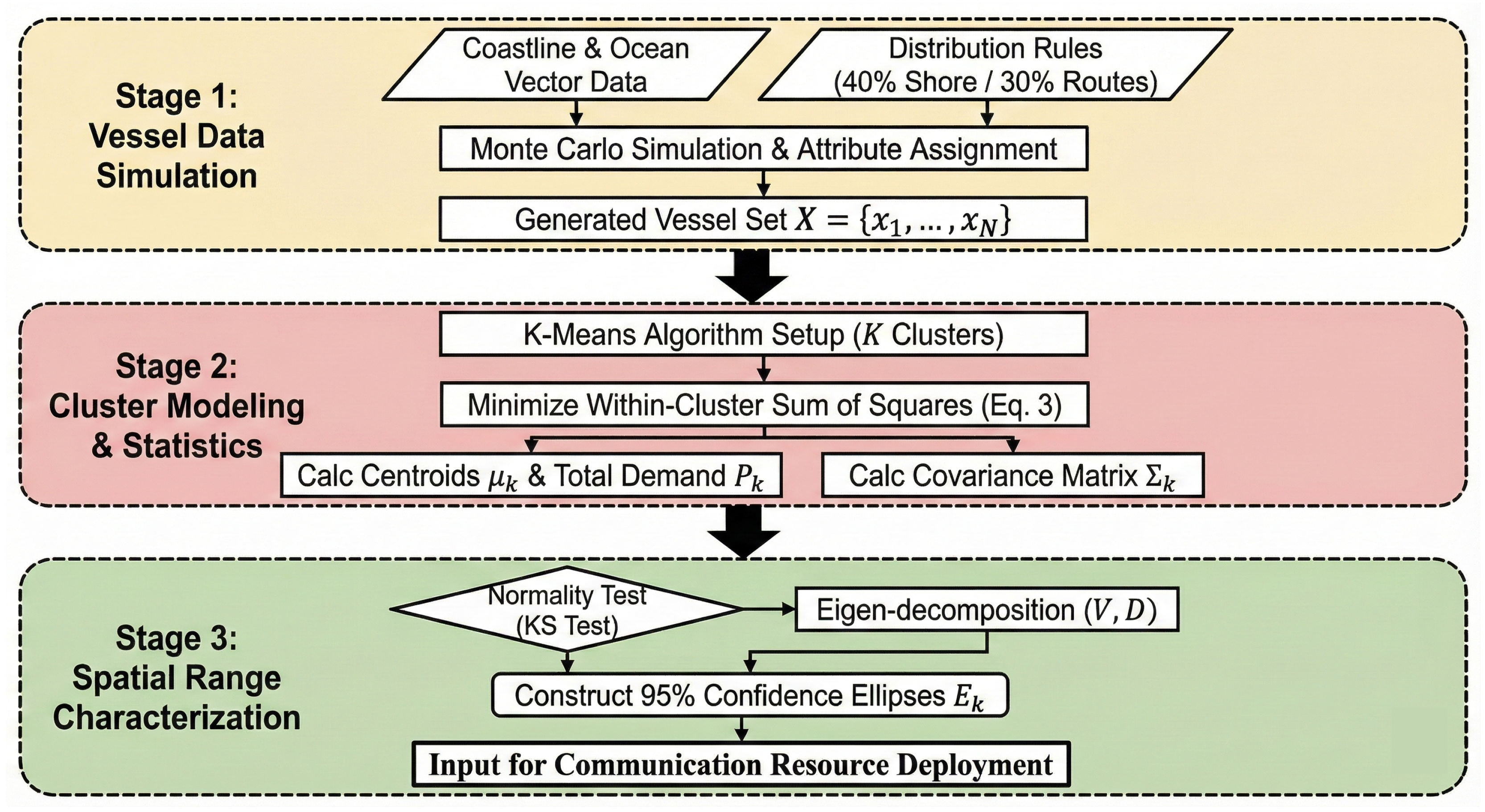
to characterize the spatial distribution of maritime demand. The modeling process consists of three key steps, as illustrated in
Figure 1:
Step 1: Clustering Optimization. The K-means algorithm is employed to solve the partitioning problem by minimizing the Within-Cluster Sum of Squares (WSS). This is utilized to identify dense aggregation regions:
where
represents the geometric centroid of the
k-th cluster. Simultaneously, the total passenger demand
is aggregated to represent the load weight:
Step 2: Statistical Characterization. To quantify the spatial dispersion and orientation of each cluster, the covariance matrix
is computed and subjected to eigen-decomposition:
where
contains the eigenvectors (orientation), and
contains the eigenvalues (magnitude of variance).
Step 3: Spatial Range Delineation. Before defining the boundary, a Kolmogorov–Smirnov (KS) test is applied to the standardized coordinates (
z-scores) to verify the assumption of bivariate normality (
):
Upon validation (
), the 95% confidence ellipse
is constructed to delineate the effective coverage range:
where
represents the critical value of the chi-square distribution with two degrees of freedom.
3.2. Hybrid Adaptive Multi-Objective Optimization Algorithm Model
To address the complexity of maritime base site selection, this study proposes a Hybrid Adaptive Multi-objective Optimization (HAMO) model. HAMO introduces three hierarchical enhancements over traditional frameworks: (1) Multi-Strategy Heuristic Initialization, which utilizes demand density analysis to generate elite seeds alongside coverage- and cost-focused strategies; (2) an Adaptive Evolutionary Strategy that dynamically adjusts crossover and mutation operators based on the search phase to balance global diversity with local convergence; and (3) an Aircraft-Specific Local Search module that executes intelligent operations like “Type Substitution” and “Inter-Base Redistribution” to optimize resource efficacy. Consequently, the model simultaneously optimizes three primary objectives: maximizing risk-weighted coverage reliability, minimizing total deployment costs, and minimizing average response time. The complete optimization process is described in Algorithm 1.
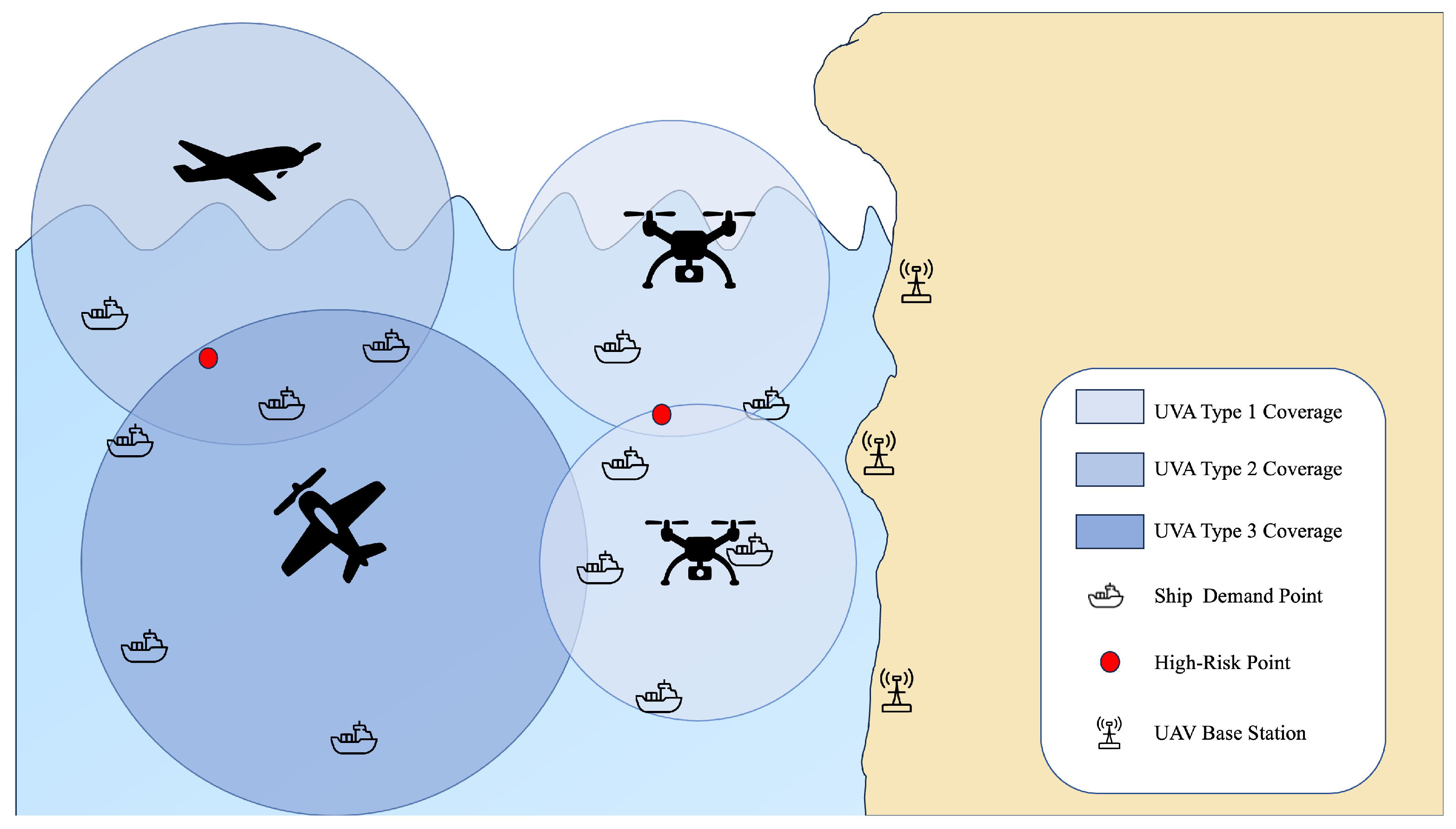
As illustrated in
Figure 2, the HAMO model achieves efficient coverage of MECN demand points through the collaborative deployment of multiple types of aircraft. For demand points with varying risk levels, the model generates tailored aircraft base layouts based on their specific risk weights and response time constraints. Specifically, for high-risk demand points, a redundant coverage constraint is introduced to ensure that at least two distinct aircraft bases provide simultaneous communication support, thereby significantly enhancing system reliability and resilience. This hierarchical and differentiated deployment strategy fully leverages the complementary advantages of various aircraft types in terms of speed, endurance, and communication range. Instead of merely trading off objectives, the HAMO model substantiates its performance claims through specific mechanisms: (1) High-coverage reliability is ensured by the mandatory redundancy constraint which mitigates single-point failures in high-risk zones [
23]; (2) Minimized deployment costs are achieved via the aircraft-specific local search, particularly the “Type Substitution” operator that actively prevents resource over-provisioning; and (3) Rapid response capabilities are guaranteed by the heuristic initialization strategy, which pre-aligns base locations with high-density accident clusters. This logical framework enables a comprehensive optimization that effectively balances conflicting objectives under maritime constraints [
24].
| Algorithm 1: HAMO: Hybrid Adaptive Multi-objective Optimization |
 |
3.3. Model Construction
3.3.1. Maritime Cluster Risk Quantification via Entropy Weight Method
To eliminate subjective bias in risk assessment, this study employs the Entropy Weight Method (EWM) to objectively determine the weights of the three risk indicators: ship quantity (N), crew size (P), and aggregated ship size (L). EWM measures the information entropy of each indicator; a smaller entropy value indicates a greater variation in the indicator’s value, providing more information and thus carrying a higher weight.
Let
represent the normalized value of the
j-th indicator for the
i-th cluster (
). The probability matrix
is defined as:
The information entropy
for the
j-th indicator is calculated as:
Finally, the objective weight
is determined by:
Based on the simulation dataset (
), the calculated objective weights are
,
, and
. The comprehensive risk score
for each cluster is derived by the weighted summation:
To verify the robustness of the risk quantification, we tested the sensitivity of the classification results against weight variations. We compared the proposed EWM weights () with a Uniform Weight strategy () and an Extreme strategy biased towards ship count (). The analysis revealed a 100% overlap in the identification of High-Risk (Level III) clusters across all scenarios. This invariant set of high-risk nodes confirms that the risk assessment is driven by the intrinsic data distribution of maritime traffic rather than subjective parameter selection, ensuring the stability of the subsequent optimization constraints.
This weighted integration ensures that all three indicators are evaluated on a unified scale, thereby enabling a comprehensive and balanced quantification of maritime cluster risks.
Table 2 presents the correspondence of risk quantification levels after normalization.
3.3.2. Mathematical Modeling of the Siting Problem
The parameters employed in the HAMO model are listed in
Table 3. These parameters encompass the core decision variables, essential input factors, and operational constraints, which together define the mathematical formulation and optimization framework of the model.
In this section, we formulate the optimization objectives and constraints of the HAMO model. The problem is modeled as a multi-objective optimization problem to find a set of Pareto optimal solutions.
Objective 1: Maximize Risk-Weighted Effective Coverage (
). To prioritize high-risk zones while avoiding wasteful excessive redundancy, we define the “effective coverage” using a saturation function. Let
be the required redundancy level (where
for High-Risk clusters, and
for others). The objective is to maximize the weighted sum of effectively covered demand nodes:
where
denotes the risk weight of cluster
i (derived via Entropy Weight Method), and
is the binary decision variable indicating if cluster
i is covered by base
j. The
term ensures that coverage beyond
yields no marginal utility.
Objective 2: Minimize Total Deployment Cost (
). This objective ensures the economic feasibility of the MECN by minimizing the sum of deployment costs
for all active base stations (
):
Objective 3: Minimize Average Response Time (
). To enhance emergency efficiency, we minimize the average time required for aircraft to reach the covered demand clusters:
The feasible region is defined by the following constraints. Equations (
13) and (
14) define the physical capabilities of the aircraft, while Equations (
15) and (
16) enforce the mandatory safety thresholds.
The HAMO algorithm employs a non-dominated sorting mechanism (NSGA-III) to optimize the vector objectives
simultaneously. However, to select a single representative solution (Knee Point) from the final Pareto front for case study analysis, we employ the following scalarization metric:
Note that Equation (
17) is applied only for result visualization and selection, not during the evolutionary search process.
In summary, the HAMO model constructs a comprehensive framework. It utilizes the saturation constraint in Equation (
10) to reward valid redundancy for high-risk areas without incentivizing resource waste. Operational constraints (Equations (
13) and (
14)) strictly define feasible aircraft types based on endurance (
) and response time limits (
). Furthermore, redundancy incentives (Equations (
15) and (
16)) safeguard system robustness by mandating multi-base support for high-risk zones.
4. Solution
This section introduces the application of the HAMO algorithm for the site selection and deployment of maritime Aircraft emergency communication bases in the Bohai Sea region.
4.1. Methods for Selecting Aircraft Base Locations
In the construction of maritime emergency communication aircraft bases, site selection is a critical factor that determines coverage range, communication efficiency, and emergency response speed. Ports, typically located along coastal areas with convenient transportation and proximity to urban centers, can effectively cover major shipping routes and high-risk zones in the Bohai Sea. With well-developed infrastructure such as power supply, communication networks, road access, and storage facilities, ports provide favorable conditions for aircraft takeoff, charging, maintenance, and the deployment of communication equipment. Moreover, as hubs of maritime transport and logistics, ports can be seamlessly integrated with existing emergency response systems, including maritime authorities and rescue centers. Therefore, ports along both coasts of the Bohai Sea are selected in this study as candidate sites for emergency communication bases. the latitude and longitude of the candidate points are shown in
Table 4.
To evaluate the performance of the proposed MECN under heterogeneous resource constraints, we constructed a tiered Aircraft Library as detailed in
Table 5. While all aircraft types provide essential communication coverage, they exhibit distinct operational profiles suited for different mission requirements. The Economy type offers cost-effective basic coverage for nearby, low-density areas, albeit with limited speed and capacity. The Standard type provides a balanced performance profile, serving as the primary backbone for general maritime tasks. Conversely, the High-Performance type is engineered for the most demanding scenarios; characterized by superior speed, extended endurance, and the highest service capacity, it is capable of rapidly reaching distant targets and managing complex, high-density cluster groups that exceed the capabilities of lower-tier platforms [
24].
4.2. Risk Quantification for Bohai Demand Points
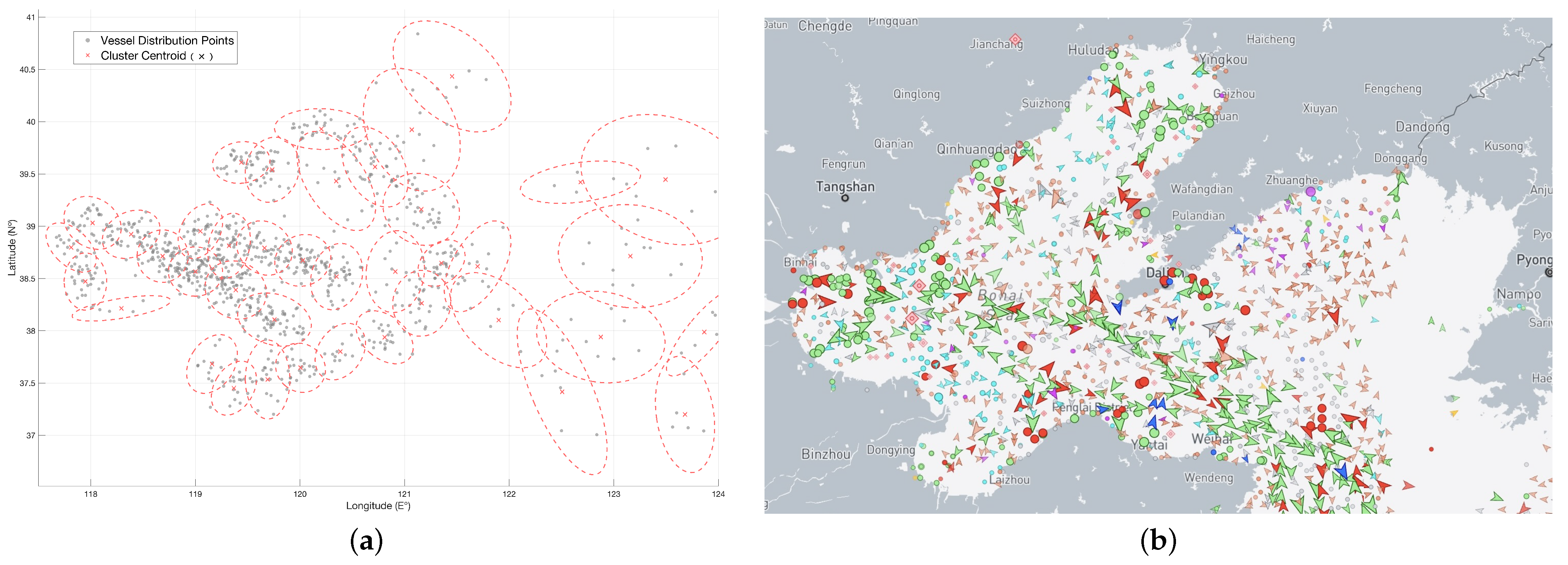
In modeling the vessel distribution in the Bohai Sea, this study analyzes the latitude and longitude coordinates of vessels based on the generated vessel dataset using the K-means clustering algorithm. The number of clusters is set to 40 to segment the spatial distribution characteristics of vessels, and statistical indicators such as cluster centroids, the number of samples, mean, and variance are extracted. In addition, the Kolmogorov–Smirnov normality test is applied to assess the distribution characteristics of each cluster in both longitude and latitude dimensions. For each cluster, the total number of crew members, the average crew size, and the distribution of vessel sizes are also calculated. To verify the authenticity of the synthetic data, we conducted a cross-comparison between the generated distribution map (
Figure 3a), and the historical AIS heatmap (
Figure 3b). The results show that the simulated high-density clusters are spatially highly consistent with the known main shipping lanes (e.g., Laotieshan Waterway) and major port entrances (e.g., Tianjin and Dalian). This confirms that, although the coordinates of individual vessels are random, their macroscopic risk distribution is consistent with historical reality. This method not only effectively simulates the real spatial logic of the Bohai Sea and avoids overfitting of the model to specific historical snapshots but also retains effective spatial constraints for subsequent optimization.
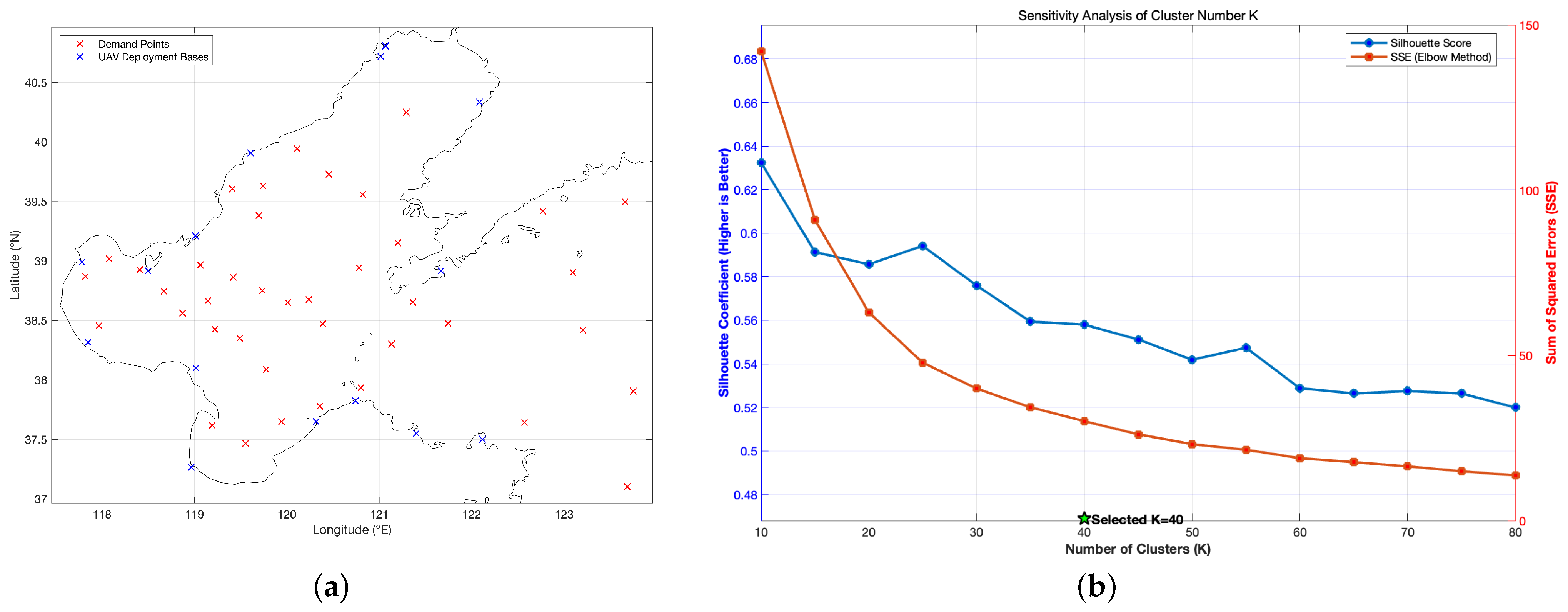
To scientifically determine the optimal number of clusters (
K), we performed a sensitivity analysis combining the Elbow Method (SSE) and Silhouette Coefficient, as shown in
Figure 4b. The Sum of Squared Errors (SSE) curve exhibits a rapid decline from
to 30 and begins to plateau around
; this characteristic “elbow” suggests that increasing
K beyond 40 yields diminishing returns in minimizing intra-cluster variance. Simultaneously, in the meaningful range of
, the Silhouette Coefficient achieves a local maximum at
(Score
). Notably, increasing
K to 45 or higher leads to a drop in the silhouette score (below 0.55), indicating that the clusters become too fragmented and less distinct. Consequently,
represents the optimal trade-off point, balancing high spatial resolution (low SSE) with strong cluster cohesion (high Silhouette Score). Therefore, we fixed
for the subsequent base siting optimization.
Based on the clustering and statistical analysis results, a risk assessment system is further established, incorporating three dimensions: the number of vessels, the number of affected personnel, and the vessel size. First, the number of vessels, total crew, and total vessel size within each cluster are normalized to the [0, 1] range. Then, weights are assigned according to practical requirements: vessel number (0.5), crew size (0.3), and vessel size (0.2). A weighted sum is calculated to obtain a composite risk score, constrained within [0, 1]. According to the resulting scores, the clusters are categorized into three risk levels: low, medium, and high. This quantitative method not only characterizes the risk disparities among maritime demand points but also highlights the risk hotspot regions across the Bohai Sea. Finally, the risk distribution results were visualized, as shown in
Figure 3a, providing a scientific basis for the subsequent optimization of emergency aircraft communication base deployment.
Ultimately, the analysis produces the risk demand weights and spatial locations of the emergency communication network in the Bohai Sea, as summarized in
Table 6. Based on the approaches presented in
Section 4.1 and
Section 4.2, the final outcomes include the clustering results of Bohai Sea vessel demand points (
Figure 3a) and the candidate Aircraft deployment bases (
Figure 4a).
4.3. Experimental Results and Analysis
To comprehensively evaluate the performance of the HAMO algorithm in solving complex maritime base siting problems, extensive experiments were conducted in this section based on a simulated dataset of the Bohai Sea. The experiments were performed on a workstation equipped with an Apple M2 processor and 24 GB of RAM.
4.3.1. Experimental Setup and Constraints Configuration
To ensure the practical feasibility of the solutions, this experiment incorporates three categories of strict physical constraints regarding candidate bases and UAV operations. First, regarding infrastructure limitations, not all ports possess the necessary facilities for large UAV takeoffs and landings. The experimental setup dictates that only the six major ports equipped with runways (Indices: 1, 2, 5, 7, 9, 12) are permitted to deploy high-performance fixed-wing UAVs (Type 3), while the remaining ports are restricted to Vertical Take-Off and Landing (VTOL) models (Type 1 and Type 2). Second, addressing airspace no-fly zones, the model integrates five restricted areas based on the distribution of sensitive facilities in the Bohai Sea, encompassing offshore oil operation zones (e.g., Suizhong 36-1, Qinhuangdao 32-6) and military management areas. The algorithm utilizes a “Detour Factor” to calculate flight paths, ensuring the avoidance of direct routes through these restricted zones. Finally, concerning meteorological adaptability, an Environmental Severity Index is introduced. This constraint restricts the deployment of models with low wind resistance (Type 1) in deep-sea areas characterized by high wind and waves, permitting only high-performance models (Type 3) to execute all-weather missions.
To comprehensively validate the superiority of HAMO and the effectiveness of its internal mechanisms, we designed comparative experiments involving both state-of-the-art algorithms and ablation variants. Regarding State-of-the-art Baselines, in addition to the classic NSGA-II and EPSO, this study incorporates the reference-point-based NSGA-III as an advanced benchmark for high-dimensional multi-objective optimization. Simultaneously, to quantify the contributions of core modules, two ablation variants were constructed: HAMO-w/o-HI, which replaces the multi-strategy heuristic initialization with pure random initialization to verify the impact of the initialization strategy on convergence speed (GD); and HAMO-w/o-LS, which excludes the aircraft-specific local search module to evaluate the specific contribution of the local refinement mechanism to solution set quality (HV).
To eliminate random bias associated with single runs and ensure the rigor of statistical analysis, all comparative algorithms and variants were executed in 20 independent runs under identical constraints and computational environments. Specific experimental parameter settings, including population size, iteration count, and algorithm-specific control parameters, are detailed in
Table 7 to guarantee the reproducibility of the experimental results.
4.3.2. Statistical Performance Comparison
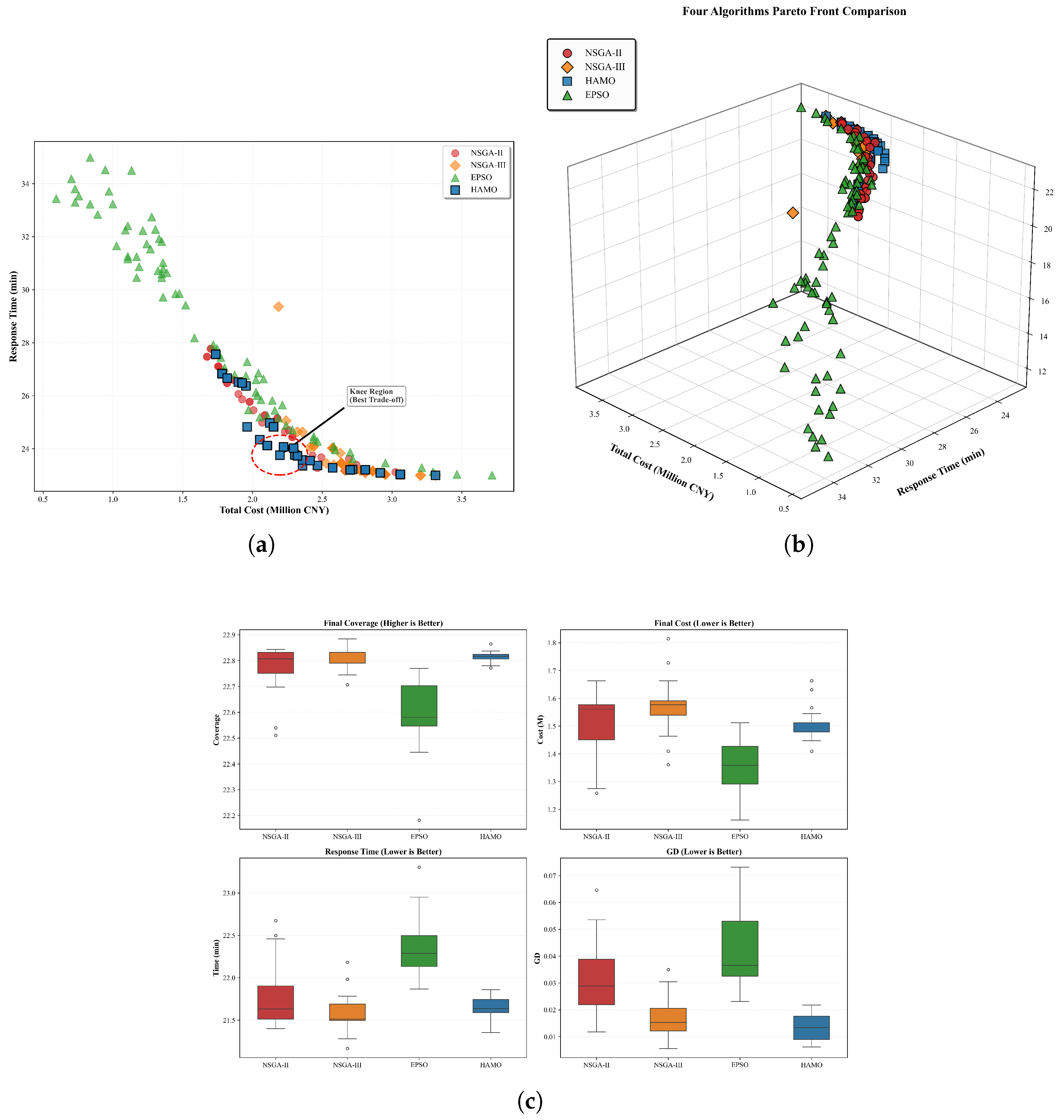
To rigorously validate the statistical superiority of the proposed HAMO algorithm, a multi-dimensional evaluation was performed over 20 independent runs under a maximum base deployment limit of 3 (
), with quantitative metrics summarized in
Table 8. As visually corroborated by the boxplots (
Figure 5c), HAMO exhibits a decisive advantage in convergence stability, achieving the lowest mean Generational Distance (
). This narrow confidence interval highlights exceptional robustness compared to the stochastic volatility of EPSO (
) and the wider variance of NSGA-II (
). Furthermore, regarding objective performance, HAMO balances competing objectives most effectively: it maintains a premier coverage level (
), statistically comparable to the advanced NSGA-III (
), yet crucial distinctions arise in economic efficiency. HAMO achieves this coverage at a superior cost-efficiency (
M CNY versus NSGA-III’s
M CNY) while securing a competitive response time (
min). This holistic performance quantitatively corroborates the efficacy of HAMO’s Multi-Strategy Heuristic Initialization and Aircraft-Specific Local Search mechanisms, which effectively guide the evolutionary process toward high-quality, cost-efficient solutions while mitigating the randomness and “resource bloat” inherent in standard baselines.
Regarding Pareto efficiency, the 2D Cost-Response projection (
Figure 5a) highlights HAMO’s dominance in the critical “knee region” (Cost:
–
Million CNY), where its solutions (blue squares) consistently form the lower bound of the Pareto front. Specifically, for a fixed budget of approximately
Million CNY, HAMO achieves a response time of ∼23.8 min. This represents a clear advantage over standard baselines: it reduces the delay by approximately
–
min compared to NSGA-II and NSGA-III, and by over
min compared to EPSO, demonstrating superior resource allocation efficiency. While the advanced NSGA-III (orange diamonds) maintains good diversity along the front, it struggles to converge as tightly as HAMO in this specific low-cost region. A notable flaw in EPSO is the generation of a scattered “long tail” of high-cost solutions (>3.0 Million CNY) that yield negligible improvements in response time (stagnating around 23 min). In contrast, HAMO avoids inefficient saturation through its Aircraft-Specific Local Search module, optimizing the marginal gain of every cost unit.
Finally, the solution diversity and robustness are confirmed by the 3D visualization (
Figure 5b) and statistical summaries (
Figure 5c). HAMO consistently achieves the highest median coverage, matching the best runs of NSGA-III, while maintaining a tighter cost distribution. As shown in the “Final Cost” boxplot, HAMO solutions are concentrated in a lower cost range compared to NSGA-III and EPSO, proving that the algorithm actively avoids wasteful resource allocation. This performance advantage is fundamentally attributed to the integration of a Diminishing Marginal Utility mechanism, which effectively curbs blind cost growth by penalizing excessive redundancy, ensuring a resilient trade-off between economic feasibility and system reliability.
4.3.3. Ablation Study: Contribution of Core Modules
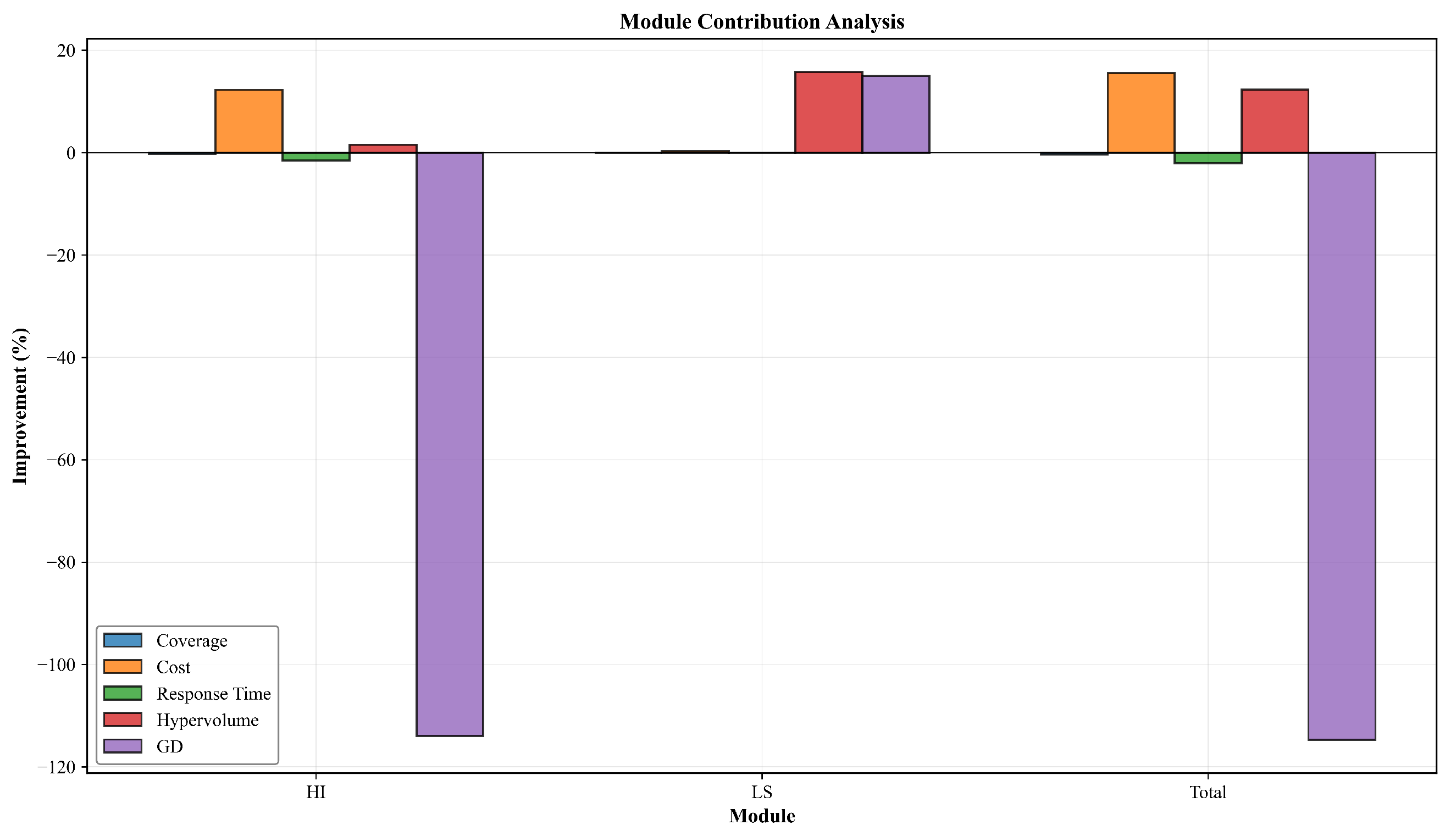
To quantify the individual contributions of the Heuristic Initialization (HI) and Local Search (LS) modules, an ablation study was conducted as illustrated in
Figure 6. The results highlight the distinct role of the HI module, which serves as the primary driver for economic efficiency by improving the Cost metric by approximately 12%. However, a notable degradation in Generational Distance (GD) was observed during this phase. This phenomenon occurs because the heuristic strategy intentionally biases the initial population towards feasible, low-cost regions. While this selective pressure increases the statistical distance from the uniform Pareto front, it strategically prioritizes the discovery of economically viable solutions, which is a critical requirement for emergency response operations.
Complementing the initialization phase, the LS module functions as a crucial refinement mechanism. It significantly enhances both Hypervolume (HV) and GD by roughly 15%, effectively compensating for the initial bias by pulling solutions closer to the true Pareto front. Importantly, this performance gain is achieved with a negligible impact on Response Time. Consequently, the complete HAMO algorithm synthesizes these advantages, maintaining the low deployment costs inherited from HI while securing high comprehensive solution quality through LS. This synergy ensures that the algorithm converges to a high-quality approximation of the Pareto front in the regions of greatest practical value.
4.3.4. Parameter Sensitivity Analysis
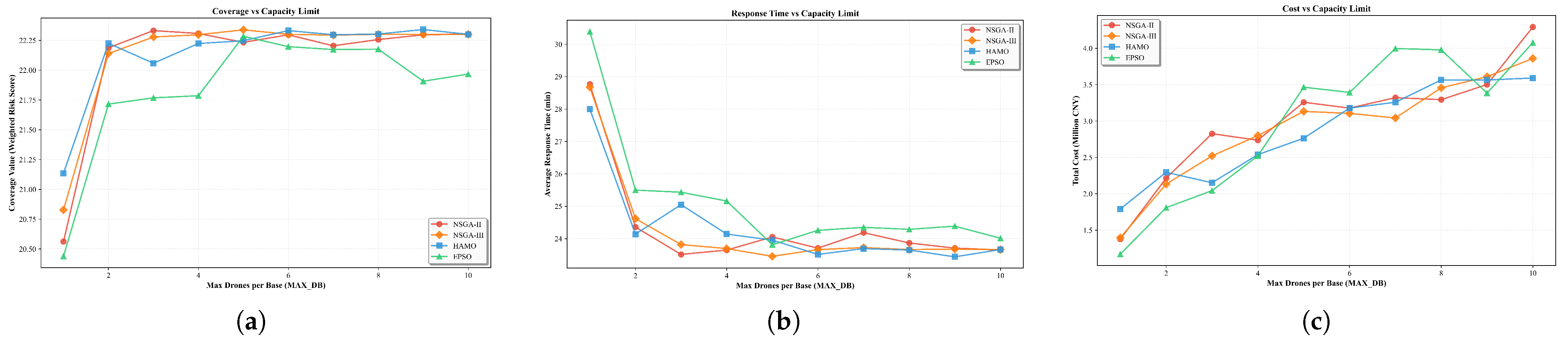
Figure 7 illustrates the sensitivity of service quality (coverage and response time) and economic cost as the base capacity limit (
) scales from 1 to 10. The results highlight HAMO’s operational robustness compared to three baselines: NSGA-II, NSGA-III, and EPSO.
Regarding coverage performance (
Figure 7a), HAMO exhibits a distinct “high starting point” advantage. At the tightest constraint (
), HAMO achieves a coverage score of approximately 21.13, outperforming the advanced NSGA-III (∼20.82) and significantly leading classic algorithms like NSGA-II (∼20.56) and EPSO (∼20.44). This initial lead validates the efficacy of the Multi-Strategy Heuristic Initialization, which effectively locates high-value regions even with minimal resources. While NSGA-III shows a strong upward trend, closely trailing HAMO, EPSO exhibits significant instability with a notable drop at
. In contrast, HAMO maintains a consistent high-performance trajectory, demonstrating superior stability.
In terms of response time (
Figure 7b), HAMO establishes a decisive efficiency advantage. At
, HAMO achieves the lowest average response time of ∼28.0 min, edging out NSGA-III (∼28.7 min) and providing a significant lead over EPSO (>30 min). As resources increase (
), HAMO stabilizes around 24 min, consistently matching or beating NSGA-III. This efficiency is attributed to the Aircraft-Specific Local Search module, which intelligently optimizes the assignment of high-speed aircraft to time-critical nodes, ensuring rapid response without requiring excessive fleet sizes.
Finally, the economic feasibility analysis (
Figure 7c) reveals a divergence in cost control at high capacities. As
increases to 10, NSGA-II displays an aggressive cost escalation, peaking at approximately 4.3 Million CNY. While NSGA-III performs better (∼3.9 Million CNY), it still incurs higher costs than HAMO. HAMO maintains the most moderate and controlled growth, stabilizing around 3.6 Million CNY at
. This behavior is governed by the Diminishing Marginal Utility mechanism, which penalizes the deployment of redundant units that offer negligible marginal gains. Consequently, HAMO prevents “blind resource stacking” even better than NSGA-III, ensuring the most cost-effective trade-off between investment and performance.
4.3.5. Feasibility Analysis Under Practical Constraints
To ensure practical deployability, this study incorporates strict physical constraints including infrastructure availability (runway limitations), airspace regulations (No-Fly Zones), and meteorological adaptability. A quantitative comparison between the unconstrained and constrained scenarios reveals a critical trade-off between theoretical optimality and operational realism.
The imposition of constraints shifts the network from an “idealized performance-driven” model to a “realistic cost-effective” one. Specifically, (
Table 9) the average response time increased by 68.3% (from 15.35 to 25.84 min), while the total construction cost surprisingly decreased by 38.5% (from 3.91 to 2.40 million). This indicates that the unconstrained model achieved superior speed only through the unrealistic saturation of expensive resources.
The cost reduction is primarily driven by infrastructure constraints. By restricting high-performance Fixed-Wing UAVs (Type 3) to the six runway-equipped ports (Indices: 1, 2, 5, 7, 9, 12), the algorithm is forced to abandon the high-cost saturation strategy. Instead, it adopts a “hub-and-spoke” topology, utilizing major ports for long-range missions and cost-effective VTOLs for peripheral coverage. Conversely, the increased latency stems from geometric complexities: No-Fly Zones necessitate polygonal detour paths, while the centralized hub structure elongates service radii, forcing a sacrifice of speed for feasibility.
Although the constrained solution (HAMO with constraints) reduces temporal efficiency, it offers superior robustness and economic viability. The results demonstrate that the unconstrained model represents an unattainable theoretical upper bound. In contrast, the constrained model ensures legal compliance with airspace regulations and logistical compatibility with port facilities, validating the proposed network’s potential for actual engineering implementation.
4.3.6. Analysis of Practical Feasibility and Algorithmic Effectiveness
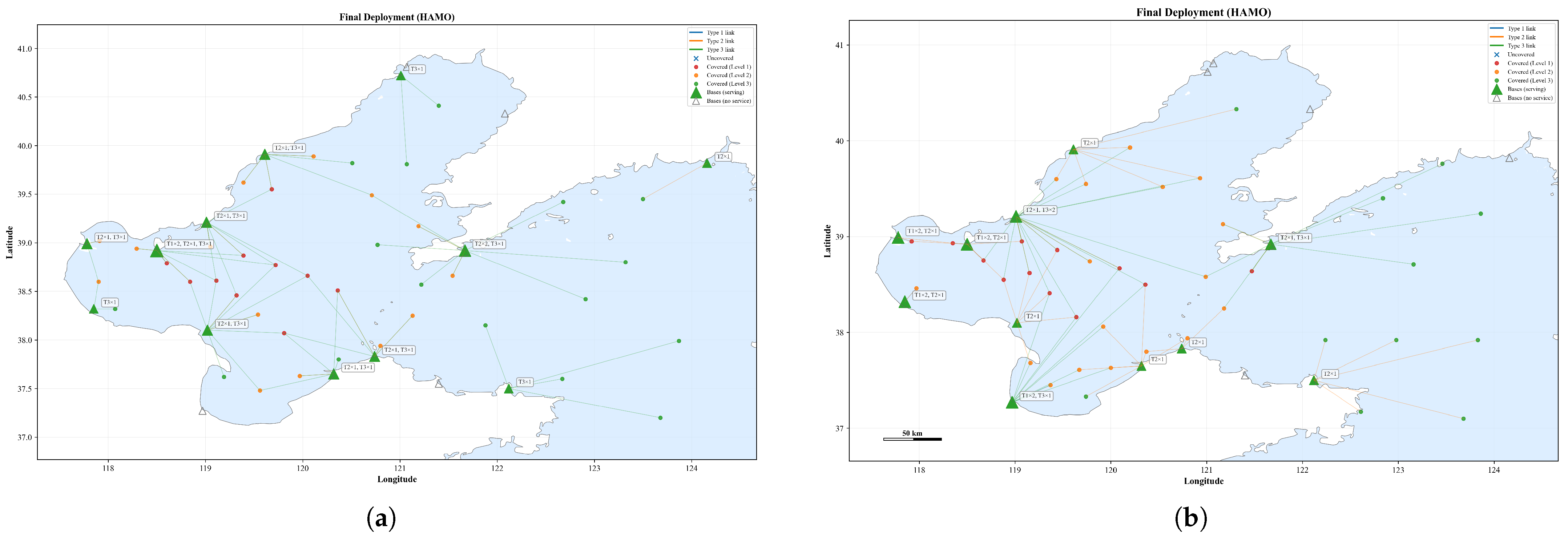
To ensure the engineering deployability of the proposed network, this study incorporates strict physical constraints, including infrastructure availability (runway limitations) and airspace regulations (No-Fly Zones). The imposition of these constraints reveals a critical trade-off between theoretical optimality and operational realism, shifting the network from an “idealized performance-driven” model to a “realistic cost-effective” one. Specifically, the results indicate that while the average response time increased by 68.3% (from 15.35 to 25.84 min) due to necessary detour paths, the total construction cost surprisingly decreased by 38.5% (from 3.91 to 2.40 million). This cost reduction is driven by the algorithm’s logical adaptation to runway limitations, as shown in
Figure 8a,b, forcing the abandonment of expensive resource saturation in favor of a “hub-and-spoke” topology where high-performance fixed-wing UAVs are concentrated in major ports while peripheral areas are served by cost-effective VTOLs.
While the proposed HAMO model demonstrates strong adaptability, it is essential to objectively acknowledge its methodological limitations compared to other investigation methods. Unlike exact mathematical programming methods (e.g., Branch-and-Bound or CPLEX), which guarantee a global optimum but suffer from exponential time complexity () in large-scale NP-hard problems, HAMO is a meta-heuristic that provides a high-quality near-optimal solution without a theoretical guarantee of global optimality. Furthermore, compared to simple greedy heuristics, HAMO incurs a higher computational cost due to its complex evolutionary operators (e.g., non-dominated sorting and local search), making it less suitable for millisecond-level real-time control, though it ensures computational feasibility for regional planning.
Nevertheless, despite these physical and algorithmic constraints, the experimental results rigorously validate the model’s effectiveness from three critical dimensions. First, regarding Operational Feasibility, the constrained model achieves 100% compliance with No-Fly Zones and runway limitations, proving it generates executable deployment plans consistent with actual regulations. Second, in terms of Economic Effectiveness, the automated discovery of the “hub-and-spoke” topology validates the model’s capability to optimize resource utility under budget constraints. Finally, concerning Algorithmic Robustness, the narrow confidence intervals observed in statistical analysis confirm that HAMO consistently converges to high-quality solutions, establishing its reliability as a decision-support tool for maritime authorities.
5. Discussion
The experimental results demonstrate that the proposed HAMO algorithm achieves notable improvements over baseline algorithms (NSGA-II and EPSO) in terms of convergence stability, coverage efficiency, and resource utilization. Specifically, the inclusion of the Aircraft-Specific Local Search module significantly enhances solution quality by intelligently executing “Type Substitution” and “Inter-Base Redistribution”. This ensures that critical maritime regions, particularly in the southern Bohai Sea and Liaodong Bay, maintain robust communication links even under constrained resource conditions, achieved by optimizing idle resources rather than blindly increasing fleet size.
Furthermore, the Diminishing Marginal Utility mechanism strengthens system reliability by incentivizing redundant coverage in high-risk areas while effectively curbing operational costs. This redundancy provides essential communication backup during system failures without the exponential cost escalation observed in algorithms like EPSO. The integration of the Adaptive Evolutionary Strategy, which dynamically adjusts crossover and mutation operators based on the search phase, allows the algorithm to achieve a balanced exploration–exploitation trade-off, preventing premature convergence and enhancing the diversity of Pareto-optimal solutions.
From a broader perspective, this study demonstrates that incorporating Multi-Strategy Heuristic Initialization into emergency communication base deployment yields superior practical relevance compared to uniform or random deployment strategies. By combining risk-weighted demand modeling with multi-objective optimization, the framework can dynamically adapt to different maritime traffic patterns and resource constraints. These findings suggest that the proposed model can be extended to other maritime regions or adapted for heterogeneous aerial platforms, such as hybrid UAV–satellite networks. Future research may further explore the integration of real-time data assimilation, dynamic weather conditions, and reinforcement learning-based adaptive optimization to improve temporal responsiveness and robustness in rapidly changing maritime environments. Despite the demonstrated superior performance of the HAMO model in optimizing base locations, certain limitations regarding computational complexity and parameter dependence should be acknowledged. Specifically, compared to simple heuristic approaches, the computational cost of the HAMO model increases non-linearly with the scale of decision variables; while acceptable for regional planning in the Bohai Sea, real-time optimization for larger-scale networks may necessitate parallel computing acceleration. Furthermore, the model currently lacks a self-adaptive mechanism for different maritime environments, implying that its convergence speed and solution diversity rely heavily on the careful tuning of hyperparameters through sensitivity analysis.
The reliability of these findings is substantiated by rigorous statistical validation across 20 independent experimental runs, where HAMO exhibited the lowest variance in Generational Distance (0.0132 ± 0.0023) and consistently satisfied 100% of the operational constraints. In terms of practical implications, this research offers a quantifiable decision-support framework for maritime authorities, demonstrating that a strategic “hub-and-spoke” deployment of heterogeneous aircraft can significantly reduce infrastructure costs (by 38.5%) while ensuring compliant response times, thus providing a viable roadmap for constructing resilient aerial rescue networks. However, certain limitations must be acknowledged: the model’s computational complexity increases non-linearly with network scale, which may challenge real-time global optimization, and its performance currently relies on sensitivity analysis for hyperparameter tuning, lacking a fully self-adaptive mechanism for dynamically changing meteorological environments.
6. Conclusions
This paper proposes the Hybrid Adaptive Multi-objective Optimization (HAMO) framework to address the complex challenges of maritime emergency communication base deployment. By integrating multi-strategy heuristic initialization, adaptive evolutionary operators, and an aircraft-specific local search module, the study successfully constructs a resilient “Space–Air–Sea” integrated network model. The empirical results provide affirmative answers to the research questions posed at the outset, particularly regarding demand modeling. The consistency observed between the simulated risk hotspots and historical AIS data confirms that the proposed Monte Carlo-based risk quantification significantly outperforms uniform assumptions, thereby enabling precise resource allocation for high-value targets.
Regarding deployment strategy and algorithmic performance, the study validates the necessity of a hierarchical, heterogeneous fleet. The feasibility analysis under strict constraints demonstrates that a “hub-and-spoke” topology—combining runway-dependent fixed-wing UAVs and flexible VTOLs—is essential for practical operations. This strategy reduced infrastructure costs by 38.5% compared to homogeneous deployment while maintaining 100% constraint satisfaction. Furthermore, HAMO demonstrated statistical dominance over NSGA-II, NSGA-III, and EPSO, achieving the best convergence stability and identifying the most cost-effective “knee points” on the Pareto front, thus proving its superior capability in reconciling the conflict between coverage reliability and economic cost.
In summary, this research not only provides a practically executable deployment scheme for the Bohai Sea but also establishes a generalized decision-support framework for maritime emergency response. By demonstrating that algorithmic optimization can effectively balance operational constraints with performance objectives, this study opens new avenues for future research into dynamic, real-time adaptive networks. Future work will deepen this inquiry by integrating live vessel trajectory data streams and exploring multi-agent reinforcement learning for collaborative fleet control in rapidly changing meteorological environments.
Author Contributions
Conceptualization, W.Z., S.J., M.G. and J.D.; investigation, W.Z.; methodology, W.Z. and S.J.; software, W.Z.; validation, W.Z.; writing—original draft, W.Z.; writing—review and editing, W.Z. and S.J.; supervision, S.J.; project administration, S.J.; funding acquisition, S.J. All authors have read and agreed to the published version of the manuscript.
Funding
This work was funded by the Innovation Program of Shanghai Municipal Education Commission of China under Grant No. 2021-01-07-00-10-E00121.
Data Availability Statement
The program code used in the research can be obtained from the corresponding author upon reasonable request.
Conflicts of Interest
The authors declare no conflicts of interest.
References
- Alqurashi, F.S.; Trichili, A.; Saeed, N.; Ooi, B.S.; Alouini, M.-S. Maritime Communications: A Survey on Enabling Technologies, Opportunities, and Challenges. IEEE Internet Things J. 2022, 10, 3525–3547. [Google Scholar] [CrossRef]
- Zhao, H.; Ji, F.; Wang, Y.; Yao, K.; Chen, F. Space–Air–Ground–Sea Integrated Network with Federated Learning. Remote Sens. 2024, 16, 1640. [Google Scholar] [CrossRef]
- Meng, S.; Wu, S.; Zhang, J.; Cheng, J.; Zhou, H.; Zhang, Q. Semantics-empowered space-air-ground-sea integrated network: New paradigm, frameworks, and challenges. IEEE Commun. Surv. Tutor. 2024, 27, 140–183. [Google Scholar] [CrossRef]
- Nomikos, N.; Gkonis, P.K.; Bithas, P.S.; Trakadas, P. A survey on UAV-aided maritime communications: Deployment considerations, applications, and future challenges. IEEE Open J. Commun. Soc. 2022, 4, 56–78. [Google Scholar] [CrossRef]
- Wang, S.-M.; Yang, W.-R.; Zhuang, Q.-Y.; Lin, W.-H.; Tian, M.-Y.; Su, T.-J.; Cheng, J.-C. Application of Three-Dimensional Hierarchical Density-Based Spatial Clustering of Applications with Noise in Ship Automatic Identification System Trajectory-Cluster Analysis. Appl. Sci. 2025, 15, 2621. [Google Scholar]
- Pallotta, G.; Vespe, M.; Bryan, K. Vessel Pattern Knowledge Discovery from AIS Data: A Framework for Anomaly Detection and Route Prediction. Entropy 2013, 15, 2218–2245. [Google Scholar] [CrossRef]
- Chen, H.; Wen, Y.; Huang, Y.; Xiao, C.; Sui, Z. Edge computing enabling internet of ships: A survey on architectures, emerging applications, and challenges. IEEE Internet Things J. 2024, 12, 1509–1528. [Google Scholar] [CrossRef]
- Li, X.; Jiang, S. Deployment Method for Aircraft-Based Maritime Emergency Communication Resource Reserve Bases. J. Mar. Sci. Eng. 2024, 12, 844. [Google Scholar] [CrossRef]
- Guan, M.; Feng, Z.; Jiang, S.; Zhou, W. Tethered Balloon Cluster Deployments and Optimization for Emergency Communication Networks. Entropy 2024, 26, 1071. [Google Scholar] [CrossRef]
- Deb, K.; Pratap, A.; Agarwal, S.; Meyarivan, T. A fast and elitist multiobjective genetic algorithm: NSGA-II. IEEE Trans. Evol. Comput. 2002, 6, 182–197. [Google Scholar] [CrossRef]
- Deb, K.; Jain, H. An evolutionary many-objective optimization algorithm using reference-point-based nondominated sorting approach, part I: Solving problems with box constraints. IEEE Trans. Evol. Comput. 2013, 18, 577–601. [Google Scholar] [CrossRef]
- Shah, A.F.M.S. Architecture of emergency communication systems in disasters through UAVs in 5G and beyond. Drones 2022, 7, 25. [Google Scholar] [CrossRef]
- Nguyen, D.C.; Ding, M.; Pathirana, P.N.; Seneviratne, A.; Li, J.; Niyato, D. 6G Internet of Things: A Comprehensive Survey. IEEE Internet Things J. 2022, 9, 359–383. [Google Scholar] [CrossRef]
- Lyu, M.; Zhao, Y.; Huang, C.; Huang, H. Unmanned Aerial Vehicles for Search and Rescue: A Survey. Remote Sens. 2023, 15, 3266. [Google Scholar] [CrossRef]
- Xu, Z. Application Research of Tethered UAV Platform in Marine Emergency Communication Network. J. Web Eng. 2021, 20, 491–511. [Google Scholar] [CrossRef]
- Akhtar, M.W.; Saeed, N. UAVs-enabled maritime communications: Opportunities and challenges. IEEE Syst. Man Cybern. Mag. 2023, 9, 2–8. [Google Scholar]
- Wei, T.; Feng, W.; Chen, Y.; Wang, C.-X.; Ge, N.; Lu, J. Hybrid Satellite-Terrestrial Communication Networks for the Maritime Internet of Things: Key Technologies, Opportunities, and Challenges. IEEE Internet Things J. 2021, 8, 8910–8934. [Google Scholar] [CrossRef]
- Al-Hourani, A.; Kandeepan, S.; Lardner, S. Optimal LAP altitude for maximum coverage. IEEE Wirel. Commun. Lett. 2014, 3, 569–572. [Google Scholar] [CrossRef]
- Huang, J.-C.; Ung, S.-T. Risk Assessment and Traffic Behaviour Evaluation of Ships. J. Mar. Sci. Eng. 2023, 11, 2297. [Google Scholar] [CrossRef]
- Coello, C.A.C.; Pulido, G.T.; Lechuga, M.S. Handling multiple objectives with particle swarm optimization. IEEE Trans. Evol. Comput. 2004, 8, 256–279. [Google Scholar] [CrossRef]
- Ma, H.; Zhang, Y.; Sun, S.; Liu, T.; Shan, Y. A comprehensive survey on NSGA-II for multi-objective optimization and applications. Artif. Intell. Rev. 2023, 56, 15217–15270. [Google Scholar]
- Abrar, M.; Ajmal, U.; Almohaimeed, Z.M.; Gui, X.; Akram, R.; Masroor, R. Energy Efficient UAV-Enabled Mobile Edge Computing for IoT Devices: A Review. IEEE Access 2021, 9, 127779–127798. [Google Scholar] [CrossRef]
- Xu, X.F.; Wang, K.; Ma, W.H.; Wu, C.L.; Huang, X.R.; Ma, Z.X.; Li, Z.H. Multi-objective particle swarm optimization algorithm based on multi-strategy improvement for hybrid energy storage optimization configuration. Renew. Energy 2024, 223, 120086. [Google Scholar]
- Zhao, R.; Tao, S.; Li, P. Safety-efficiency integrated assembly: The next-stage adaptive task allocation and planning framework for human–robot collaboration. Robot.-Comput.-Integr. Manuf. 2025, 94, 102942. [Google Scholar] [CrossRef]
Figure 1.
Modeling Maritime Network Demand from Vessel Distribution.
Figure 1.
Modeling Maritime Network Demand from Vessel Distribution.
Figure 2.
Maritime Target Coverage Optimization Scenario Based on Multi-Type Aircraft.
Figure 2.
Maritime Target Coverage Optimization Scenario Based on Multi-Type Aircraft.
Figure 3.
Spatial Validity Verification of Vessel Distribution. (a) K-means Clustering of Bohai Sea Vessels. (b) Bohai Sea AIS Density Heatmap.
Figure 3.
Spatial Validity Verification of Vessel Distribution. (a) K-means Clustering of Bohai Sea Vessels. (b) Bohai Sea AIS Density Heatmap.
Figure 4.
Maritime Demand Modeling and Parameter Optimization. (a) Distribution of Demand Points and Aircraft Bases. (b) Evaluation of Cluster Validity Indices (SSE and Silhouette Score).
Figure 4.
Maritime Demand Modeling and Parameter Optimization. (a) Distribution of Demand Points and Aircraft Bases. (b) Evaluation of Cluster Validity Indices (SSE and Silhouette Score).
Figure 5.
Comprehensive performance evaluation: Pareto efficiency analysis and statistical stability comparison of HAMO against baselines. (a) 2D Pareto front projection highlighting the dominance of HAMO in the knee region. (b) 3D visualization of the Pareto front comparison among four algorithms. (c) Statistical distribution of performance metrics (Coverage, Cost, Response Time, and GD) over 20 independent runs.
Figure 5.
Comprehensive performance evaluation: Pareto efficiency analysis and statistical stability comparison of HAMO against baselines. (a) 2D Pareto front projection highlighting the dominance of HAMO in the knee region. (b) 3D visualization of the Pareto front comparison among four algorithms. (c) Statistical distribution of performance metrics (Coverage, Cost, Response Time, and GD) over 20 independent runs.
Figure 6.
Module Contribution Analysis.
Figure 6.
Module Contribution Analysis.
Figure 7.
Parameter sensitivity analysis of the HAMO algorithm. (a) Impact on coverage. (b) Impact on response. (c) Impact on cost.
Figure 7.
Parameter sensitivity analysis of the HAMO algorithm. (a) Impact on coverage. (b) Impact on response. (c) Impact on cost.
Figure 8.
Comparison of deployment topologies under different constraints. (a) Unconstrained Deployment (Ideal). (b) Constrained Deployment (Practical).
Figure 8.
Comparison of deployment topologies under different constraints. (a) Unconstrained Deployment (Ideal). (b) Constrained Deployment (Practical).
Table 1.
Ship Size Classification.
Table 1.
Ship Size Classification.
| Level | Ship Type | Ship Dimensions |
|---|
| I | Very Small Vessels | <24 m, <500 GT |
| II | Small Vessels | 24–100 m, 500–10,000 GT |
| III | Medium Vessels | 100–200 m, 10,000–50,000 GT |
| IV | Large Vessels | 200–300 m, 50,000–150,000 GT |
| V | Very Large Vessels | >300 m, >150,000 GT |
Table 2.
Risk Level Classification.
Table 2.
Risk Level Classification.
| Level | Type | Range of Risk Values |
|---|
| I | High Risk | |
| II | Medium Risk | |
| III | Low Risk | |
Table 3.
Notations of the HAMO model.
Table 3.
Notations of the HAMO model.
| Notation | Description |
|---|
| P | Set of candidate aircraft base locations. |
| D | Set of maritime demand points. |
| Risk level of demand point i. |
| Risk weight of demand point i. |
| Maximum allowable response time for demand point i. |
| Construction and operation cost of the base for aircraft type k. |
| Cruise speed of aircraft type k. |
| Endurance (maximum flight time) of aircraft type k. |
| Distance between demand point i and base j. |
| Deployment indicator, equals 1 if aircraft type k is deployed at base j. |
| Binary variable, equals 1 if base j is selected, and 0 otherwise. |
| Assignment variable, equals 1 if demand point i is covered by base j within its response time constraint. |
| Redundancy count, representing the number of bases simultaneously covering demand point i. |
| Response time weight associated with the risk level of demand point i. |
| Objective function for maximizing risk-weighted coverage. |
| Objective function for minimizing total construction and deployment cost. |
| Objective function for minimizing weighted response time. |
Table 4.
Coordinates of Candidate Bases (Column View).
Table 4.
Coordinates of Candidate Bases (Column View).
| ID | Lat. (N) | Lon. (E) | ID | Lat. (N) | Lon. (E) |
|---|
| 1 | 39.82 | 124.16 | 9 | 38.32 | 117.85 |
| 2 | 38.92 | 121.67 | 10 | 38.99 | 117.78 |
| 3 | 40.33 | 122.08 | 11 | 38.10 | 119.02 |
| 4 | 40.81 | 121.07 | 12 | 37.27 | 118.97 |
| 5 | 40.72 | 121.01 | 13 | 37.55 | 121.40 |
| 6 | 39.91 | 119.61 | 14 | 37.83 | 120.74 |
| 7 | 39.21 | 119.01 | 15 | 37.65 | 120.32 |
| 8 | 38.92 | 118.50 | 16 | 37.50 | 122.12 |
Table 5.
Parameters of the Heterogeneous Aircraft Library for MECN Deployment.
Table 5.
Parameters of the Heterogeneous Aircraft Library for MECN Deployment.
| ID (k) | Category | Speed (km/h) | Endurance (h) | Cost |
|---|
| Type 1 | Economy | 55 | 5.0 | 45,000 |
| Type 2 | Standard | 105 | 9.0 | 180,000 |
| Type 3 | High-Perf. | 150 | 16.0 | 420,000 |
Table 6.
Cluster Risk Assessment Results (Split View).
Table 6.
Cluster Risk Assessment Results (Split View).
| ID | Lon. | Lat. | Score | Level | ID | Lon. | Lat. | Score | Level |
|---|
| 1 | 119.43 | 39.60 | 0.5093 | Medium | 21 | 118.35 | 38.93 | 0.6719 | High |
| 2 | 122.98 | 37.92 | 0.1031 | Low | 22 | 121.17 | 39.13 | 0.4395 | Medium |
| 3 | 121.18 | 38.25 | 0.4237 | Medium | 23 | 121.47 | 38.64 | 0.6266 | High |
| 4 | 118.67 | 38.75 | 0.7917 | High | 24 | 118.88 | 38.55 | 0.8772 | High |
| 5 | 121.31 | 40.33 | 0.1497 | Low | 25 | 120.54 | 39.52 | 0.4749 | Medium |
| 6 | 117.92 | 38.95 | 0.7166 | High | 26 | 119.16 | 37.68 | 0.2089 | Medium |
| 7 | 120.36 | 38.50 | 0.6416 | High | 27 | 117.97 | 38.46 | 0.5904 | Medium |
| 8 | 119.37 | 37.45 | 0.2782 | Medium | 28 | 120.37 | 37.80 | 0.2012 | Medium |
| 9 | 119.15 | 38.62 | 0.8490 | High | 29 | 122.84 | 39.40 | 0.0960 | Low |
| 10 | 122.24 | 37.92 | 0.1445 | Low | 30 | 119.92 | 38.06 | 0.3636 | Medium |
| 11 | 120.20 | 39.93 | 0.5121 | Medium | 31 | 123.86 | 39.24 | 0.0312 | Low |
| 12 | 123.16 | 38.71 | 0.1857 | Low | 32 | 123.83 | 37.92 | 0.1012 | Low |
| 13 | 120.93 | 39.61 | 0.4170 | Medium | 33 | 119.07 | 38.95 | 0.6091 | High |
| 14 | 119.36 | 38.41 | 1.0000 | High | 34 | 119.67 | 37.61 | 0.2562 | Medium |
| 15 | 123.68 | 37.10 | 0.0576 | Low | 35 | 120.99 | 38.58 | 0.2150 | Medium |
| 16 | 119.74 | 39.55 | 0.5069 | Medium | 36 | 122.61 | 37.17 | 0.0522 | Low |
| 17 | 119.74 | 37.33 | 0.1117 | Low | 37 | 119.64 | 38.16 | 0.7333 | High |
| 18 | 120.09 | 38.67 | 0.7934 | High | 38 | 120.00 | 37.63 | 0.4184 | Medium |
| 19 | 119.44 | 38.86 | 0.7707 | High | 39 | 123.46 | 39.76 | 0.0285 | Low |
| 20 | 120.80 | 37.94 | 0.4222 | Medium | 40 | 119.78 | 38.74 | 0.5978 | Medium |
Table 7.
Parameter Settings and Experimental Configuration (Split View).
Table 7.
Parameter Settings and Experimental Configuration (Split View).
| Category | Param | Description | Value | Category | Param | Description | Value |
|---|
| General | N | Population Size | 40 | EPSO | w | Inertia Weight | |
| Max Generations | 50 | | Acceleration | 1.8, 1.8 |
| Independent Runs | 20 | | Adaptive Cross. | 0.92 |
| Constraints | | No-Fly Zones | 5 | HAMO | | Adaptive Mut. | 0.28 |
| Runway Bases | 6 | | Local Search | 0.40 |
| NSGA-II/III | | Crossover Prob. | 0.9 | NSGA-III | | Init. Strategy | Multi-Mix |
| Dist. Index | 15, 20 | | Ref. Divisions | 12 |
Table 8.
Statistical Results (Mean ± 95% CI) over 20 Independent Runs.
Table 8.
Statistical Results (Mean ± 95% CI) over 20 Independent Runs.
| Algorithm | GD (↓) | Coverage (↑) | Cost (M CNY, ↓) | Time (min, ↓) |
|---|
| NSGA-II | 0.0316 ± 0.0066 | 22.77 ± 0.04 | 1.51 ± 0.06 | 21.8 ± 0.2 |
| NSGA-III | 0.0168 ± 0.0038 | 22.82 ± 0.02 | 1.57 ± 0.05 | 21.6 ± 0.1 |
| EPSO | 0.0415 ± 0.0067 | 22.60 ± 0.06 | 1.36 ± 0.04 | 22.4 ± 0.2 |
| HAMO | 0.0132 ± 0.0023 | 22.81 ± 0.01 | 1.51 ± 0.03 | 21.7 ± 0.1 |
Table 9.
Quantitative Comparison of Optimization Results: Unconstrained vs. Constrained Scenarios.
Table 9.
Quantitative Comparison of Optimization Results: Unconstrained vs. Constrained Scenarios.
| Performance Metric | Unconstrained | Constrained | Variation |
|---|
| Avg. Response Time (min) | 15.35 | 25.84 | +68.3% (↑) |
| Total Construction Cost (CNY) | 3,906,000 | 2,403,000 | −38.5% (↓) |
| Coverage Index | 24.02 | 21.94 | −8.7% (↓) |
| Disclaimer/Publisher’s Note: The statements, opinions and data contained in all publications are solely those of the individual author(s) and contributor(s) and not of MDPI and/or the editor(s). MDPI and/or the editor(s) disclaim responsibility for any injury to people or property resulting from any ideas, methods, instructions or products referred to in the content. |