Article

Local Erosion–Deposition Changes and Their Relationships with the Hydro-Sedimentary Environment in the Nearshore Radial Sand-Ridge Area off Dongtai, Northern Jiangsu

by
Ning Zhuang
1,2,
Liwen Yan
1,2,3,*,
Yanxia Liu
1,
Xiaohui Wang
4,
Jingyuan Cao
1,2 and
Jiyang Jiang
3
1
CAS Key Laboratory of Marine Geology and Environment, Institute of Oceanology, Chinese Academy of Sciences, Qingdao 266400, China
2
University of Chinese Academy of Sciences, Beijing 101408, China
3
College of Geodesy and Geomatics, Shandong University of Science and Technology, Qingdao 266590, China
4
China Energy Engineering Group Jiangsu Electric Power Design Institute Co., Ltd., Nanjing 211102, China
*
Author to whom correspondence should be addressed.
J. Mar. Sci. Eng. 2026, 14(2), 205; https://doi.org/10.3390/jmse14020205
Submission received: 4 November 2025 / Revised: 19 December 2025 / Accepted: 24 December 2025 / Published: 20 January 2026
(This article belongs to the Section Coastal Engineering)

Abstract

The radial sand-ridge field off the Jiangsu coast is a distinctive landform in a strongly tide-dominated environment, where sediment supply and geomorphic patterns have been profoundly altered by Yellow River course changes, reduced Yangtze-derived sediment, and large-scale reclamation. Focusing on a typical nearshore sector off Dongtai, this study integrates multi-source data from 1979 to 2025, including historical nautical charts, high-precision engineering bathymetry, full-tide hydro-sediment observations, and surficial sediment samples, to quantify seabed erosion–deposition over 46 years and clarify linkages among tidal currents, suspended-sediment transport, and surface grain-size patterns. Surficial sediments from Maozhusha to Jiangjiasha channel systematically fine from north to south: sand-ridge crests are dominated by sandy silt, whereas tidal channels and transition zones are characterized by silty sand and clayey silt. From 1979 to 2025, Zhugensha and its outer flank underwent multi-meter accretion and a marked accretion belt formed between Gaoni and Tiaozini, while the Jiangjiasha channel and adjacent deep troughs experienced persistent scour (local mean rates up to ~0.25 m/a), forming a striped “ridge accretion–trough erosion” pattern. Residual and potential maximum currents in the main channels enhance scour and offshore export of fines, whereas relatively strong depth-averaged flow and near-bed shear on inner sand-ridge flanks favor frequent mobilization and short-range trapping of coarser particles. Suspended-sediment concentration and median grain size are generally positively correlated, with suspension coarsening in high-energy channels but dominated by fine grains on nearshore flats and in deep troughs. These findings refine understanding of muddy-coast geomorphology under strong tides and may inform offshore wind-farm foundation design, navigation-channel maintenance, and coastal-zone management.

1. Introduction

Tide-dominated coasts and their associated nearshore tidal-flat systems are widely distributed worldwide and constitute a key interface linking terrigenous sediment input with shelf sedimentary sinks, exerting an important influence on shoreline evolution, navigation channel stability, and offshore engineering safety [1,2,3]. Among them, tidal sand-ridge and sand-bank systems (including linear and radial sand ridges) are typical geomorphic units that form through self-organization under strong tidal currents, and have been widely documented in shelf seas such as the North Sea, the English Channel, the Bay of Bengal, and off the Korean Peninsula [4,5,6]. Previous studies have shown that the formation and evolution of tidal sand ridges reflect complex coupling among tidal-current nonlinearity, residual transport, and feedback between bed morphology and flow; their planform patterns and vertical evolution characteristics not only record long-term changes in regional hydrodynamics and sediment supply, but also affect local erosion/deposition patterns and seabed stability [7,8,9]. Additionally, global-scale studies on shoreline change and sediment transport indicate that, under the combined effects of climate warming and relative sea-level rise, intensive human engineering interventions, and sharply reduced fluvial sediment delivery, many tide-dominated coasts are shifting from a state of “sediment surplus” to “sediment deficit”, expressed through shoreline retreat, tidal-flat contraction, and reshaping of shoal/sand-ridge morphology [10,11,12].
Against this background, the long-term morphodynamic evolution of tidal sand ridges and their adjacent tidal-flat-channel systems has become a frontier topic in international coastal science. On the one hand, studies from the perspectives of physical processes, morphological stability analysis, and three-dimensional numerical modeling have explored the formation thresholds and migration trends of tidal sand ridges, as well as their control on tidal-channel pathways [13]. On the other hand, long-term analyses based on multi-period nautical charts, hydrographic surveys, and remote-sensing data have revealed pronounced morphological adjustments of tidal flats and sand banks in regions such as the North Sea and the North Atlantic coasts under the influence of engineering works, sediment management, and changes in sea-state conditions [11,14,15]. The nearshore radial sand-ridge system off the northern Jiangsu coast in the southern Yellow Sea is one of the largest and morphologically most complete tidal sand-ridge fields in the world. It is controlled by a radial tidal-current system generated by the interference of tidal waves and is developed under conditions of strong tides, weak waves, and multiple sediment sources [16,17,18]. Within this system, the nearshore radial sand-ridge area off Dongtai, northern Jiangsu, is regarded as a typical sector that has long been subjected to the combined influence of residual sediment supply following the Yellow River diversions and changes in sediment discharge from the Yangtze River, superimposed on intensive human activities such as shoreline reclamation, port and deep-water channel construction, and offshore wind-farm development [19,20,21]. Previous studies have yielded substantial insights into the formation of the radial tidal-current field, the overall morphological evolution of the sand-ridge system, and the medium- to long-term changes in shorelines and tidal flats [22,23], and have revealed trends in regional sediment budget adjustment and stability changes in parts of the sand-ridge–channel system [24,25]. However, these studies have predominantly focused on regional-scale or macroscopic patterns. Systematic investigations integrating multi-source datasets remain scarce for the spatial heterogeneity of local erosion–deposition changes on different geomorphic units within the typical nearshore radial sand-ridge area off Dongtai, and for their quantitative response relationships with key elements of the hydro-sedimentary environment such as tidal-current structure, suspended-sediment transport, and sediment properties.
This study focuses on the typical nearshore radial sand-ridge area off Dongtai, northern Jiangsu, and integrates multi-source data from 1979 to 2025, including historical bathymetric charts, measured water depths and surficial sediment data, and high-resolution hydro-sediment observations covering multiple tidal conditions. At the scale of a characteristic tidal-flat–sand-ridge–trough system, we identify and quantitatively characterize the 46-year evolution of local erosion–deposition and its spatial differentiation pattern; using multi-tidal-cycle current and suspended-sediment data, we analyze the correspondence and characteristic combinations between local erosion–deposition and tidal-current structure (including residual-current patterns) and suspended-sediment dynamics; and we assess the indicative significance of grain-size assemblages and grain-size statistics for differentiating local erosion–deposition across geomorphic units and depositional environments. These analyses deepen understanding of the formation and long-term evolution of radial sand-ridge fields and provide a scientific basis for regional marine engineering safety assessment, coastal-zone development, and environmental management.

2. Materials and Methods

2.1. Overview of the Study Area

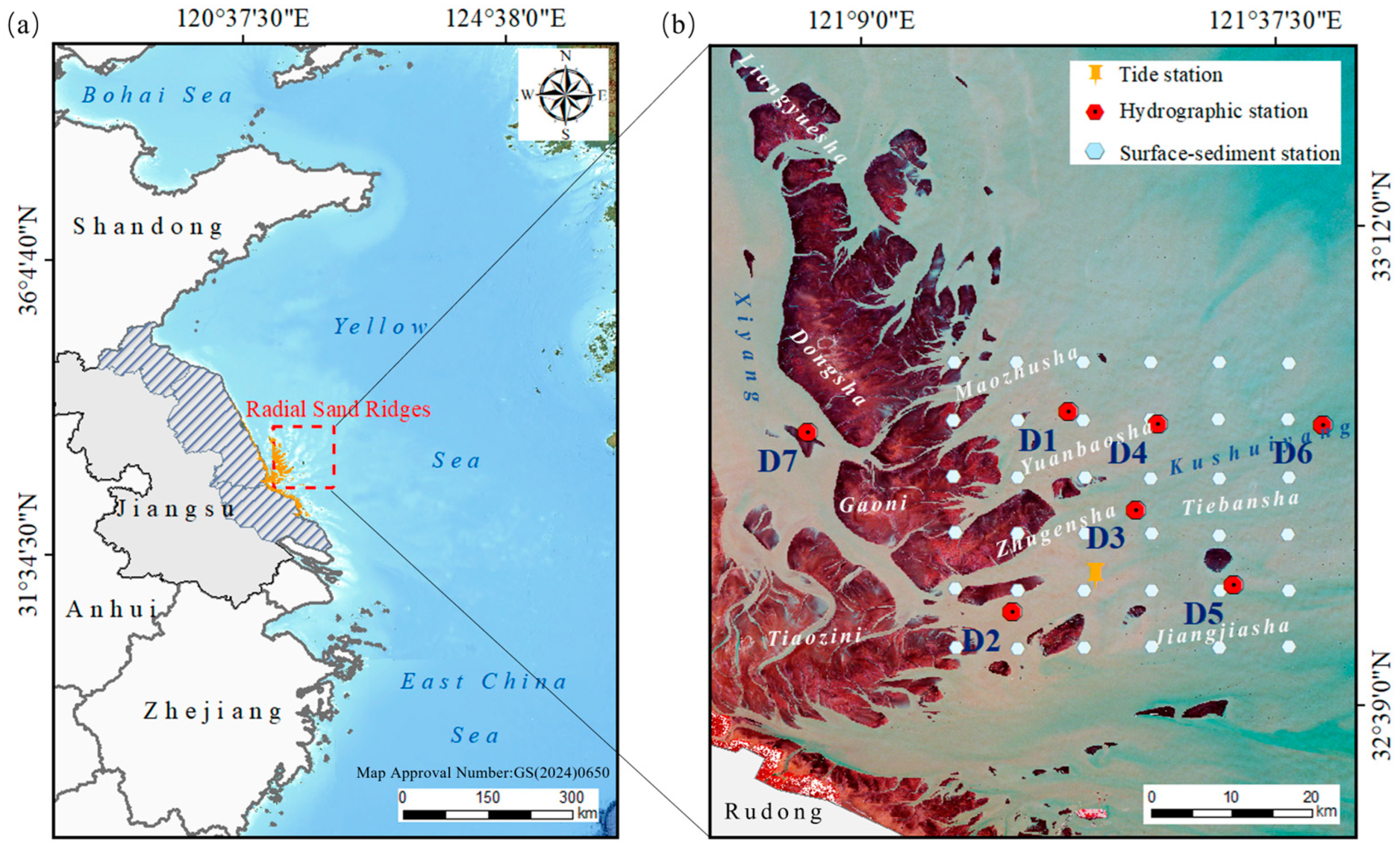
This study area is located in the nearshore waters of Dongtai, Jiangsu Province, and is part of the southwestern edge of the South Yellow Sea. It is one of the typical areas where radial sand-ridge systems develop in northern Jiangsu (Figure 1). The water depth in this sea area is generally between 5 and 15 m. The seabed morphology is mainly composed of sand-ridge and trough systems formed by tidal currents. The tidal type is an irregular semi-diurnal tide with a large tidal range, with an average tidal range of more than 2.5 m and a maximum tidal range exceeding 4 m. The sand ridges in the study area extend radially, presenting a typical radial morphology with high ridges and deep troughs, and the main troughs open to the outer sea. Surficial sediments are dominated by silty sand and sandy silt, with local muddy and coarser components, showing pronounced spatial grain-size variability [17]. The hydrodynamic structure in this area is complex, with obvious tidal-current asymmetry and prominent residual tidal currents in the intertidal zone. It is a typical sea area for studying. tidally driven sand transport and the associated sedimentary responses of the seabed.

2.2. Research Data and Methods

To systematically characterize the hydro-sedimentary environment and local erosion–deposition response in the nearshore radial sand-ridge area off Dongtai, northern Jiangsu, this study integrates multiple data sources, including a 1979 historical nautical chart, high-precision engineering bathymetric data from 2025, and multi-tidal-cycle hydro-sediment observations and surficial sediment samples collected in spring 2025. These datasets are used jointly to analyze seabed erosion–deposition evolution, tidal-current structure, and suspended-sediment transport processes. The primary field surveys and laboratory measurements were acquired under the feasibility-stage offshore site-investigation program for the SPIC Dongtai H7 Offshore Wind Farm Project. The 2025 engineering bathymetric survey was provided by the Surveying Company of Jiangsu Electric Power Design Institute Co., Ltd. (Nanjing, China); the in situ hydro-sediment observations were conducted by the Pearl River Hydrology and Water Resources Survey Center; and the associated sediment laboratory analyses were completed by qualified testing laboratories as part of the program’s quality-controlled technical deliverables. In this study, these deliverables were independently processed and reanalyzed through a unified workflow (datum harmonization and consistency checks, ADCP processing and metric extraction, DEM construction and differencing, and subsequent statistical/spatial analyses).
The hydro-sediment observations in spring 2025 covered three representative tidal conditions (neap tide, mean tide, and spring tide). Seven fixed stations (D1–D7) were deployed along the sand-ridge crest (Figure 1), on the flood and ebb flanks, and in adjacent troughs, effectively covering the main geomorphic units, including the inner shallow sand ridge of Xiyang, the transition zone between Zhugensha and Yuanbaosha, the Jiangjiasha channel, and the deep trough of Kushuiyang to the east. At each station, an acoustic Doppler current profiler (ADCP) was deployed to obtain vertical profiles of tidal-current velocity (speed and direction) under a full-tide continuous observation scheme. Instrument deployment, underwater positioning, and vertical bin configuration followed the requirements of the current “Technical Specifications for Hydrographic Survey of Water Transport Engineering” (JTS 131) for tidal-current profiling; the center of the first near-bed bin was kept at a safe height above the seabed to avoid the bottom blank zone. During the observation period, three-dimensional current velocity, compass heading, and water depth were recorded synchronously at all stations.
Water-level information from the project tide-gauge/platform records was used for background tidal characterization and vertical datum referencing within the quality-controlled deliverables. For the analyses in this study, tidal phasing and vertical normalization of ADCP profiles relied on the station-local instantaneous water depth H derived from each ADCP pressure record, rather than transferring the tide-gauge water-level curve to individual stations; therefore, station-to-gauge distance does not affect the phase classification and no additional phase-lag correction was required for profile layer extraction. Based on the ADCP vertical binning, a six-point method was used to extract representative tidal-current velocity (speed and direction) at six standard levels (surface, 0.2H, 0.4H, 0.6H, 0.8H, and near-bed), where H denotes the instantaneous water depth at the time of observation. An hourly time series of current velocity was compiled for each ADCP depth bin (layer) by resampling the measured velocities at 1 h intervals. Layer-resolved and depth-averaged tidal-current velocity time series were then derived for subsequent residual-current estimation and extreme-velocity analysis. Residual-current vectors were quantified as the Eulerian time mean of the observed horizontal velocity vectors over the full observation period, representing the net transport component. Station-specific harmonic analysis was applied where needed to separate major tidal constituents and to support the extreme-velocity reconstruction.
The possible maximum tidal-current velocity was calculated using the harmonic reconstruction method widely applied in tidal-current analysis and engineering assessment in China. First, harmonic analysis was performed on the measured horizontal currents at each station to obtain the amplitudes and phases of the main tidal constituents (M2, S2, K1, O1, etc.). On this basis, the possible maximum composite current velocity was reconstructed using the standard formula:
V m a x = 1.295 W M 2 + 1.245 W S 2 + W K 1 + W O 1 + W M 4 + W M S 4 ,
where W M 2 , W S 2 , W K 1 , W O 1 , W M 4 , W M S 4 are the maximum current vectors of each constituent. The weighting factors (1.295 for M 2 and 1.245 for S 2 ) follow the standard engineering practice used in regional offshore site investigations. The resulting (Vmax) represents the maximum tidal-current strength that may occur under given astronomical tidal conditions and is used to quantitatively compare the incipient motion and sediment-transport capacity at different stations under extreme tidal conditions. Near-bed current velocity was obtained by taking a weighted average of the lowest one or several valid bins in the ADCP vertical profile, in order to avoid treating interpolated values within the bottom blank zone as actual measurements.
Suspended-sediment sampling was carried out synchronously with the ADCP measurements. At each station and each standard relative level, water samples were collected at 1 h intervals using a water sampler to obtain full tidal-cycle time series, and suspended-sediment concentration (SSC) was determined by membrane filtration followed by oven-drying and weighing. The horizontal tidal-current vector fields plotted below were constructed from observations rather than numerical model output: depth-averaged tidal-current velocities at the seven fixed stations (D1–D7) for representative tidal phases were interpolated using inverse distance weighting (IDW; power parameter = 2) onto a regular latitude–longitude grid (15 × 15 nodes) covering the station envelope with a small buffer; the plotted arrows correspond to the interpolated grid-node vectors and were sub-sampled for display to avoid excessive visual density, while the observational constraint remains the seven station measurements. In addition, suspended-sediment grain-size composition was examined for specific tidal phases under three representative tidal conditions: layered water samples were collected during flood acceleration, flood slack, ebb acceleration, and ebb slack on representative neap-, mean-, and spring-tide days, composited by volume-weighted mixing, pre-treated using standard procedures (removal of organic matter and carbonates, followed by ultrasonic dispersion), and measured with a laser particle-size analyzer to obtain grain-size component distributions.
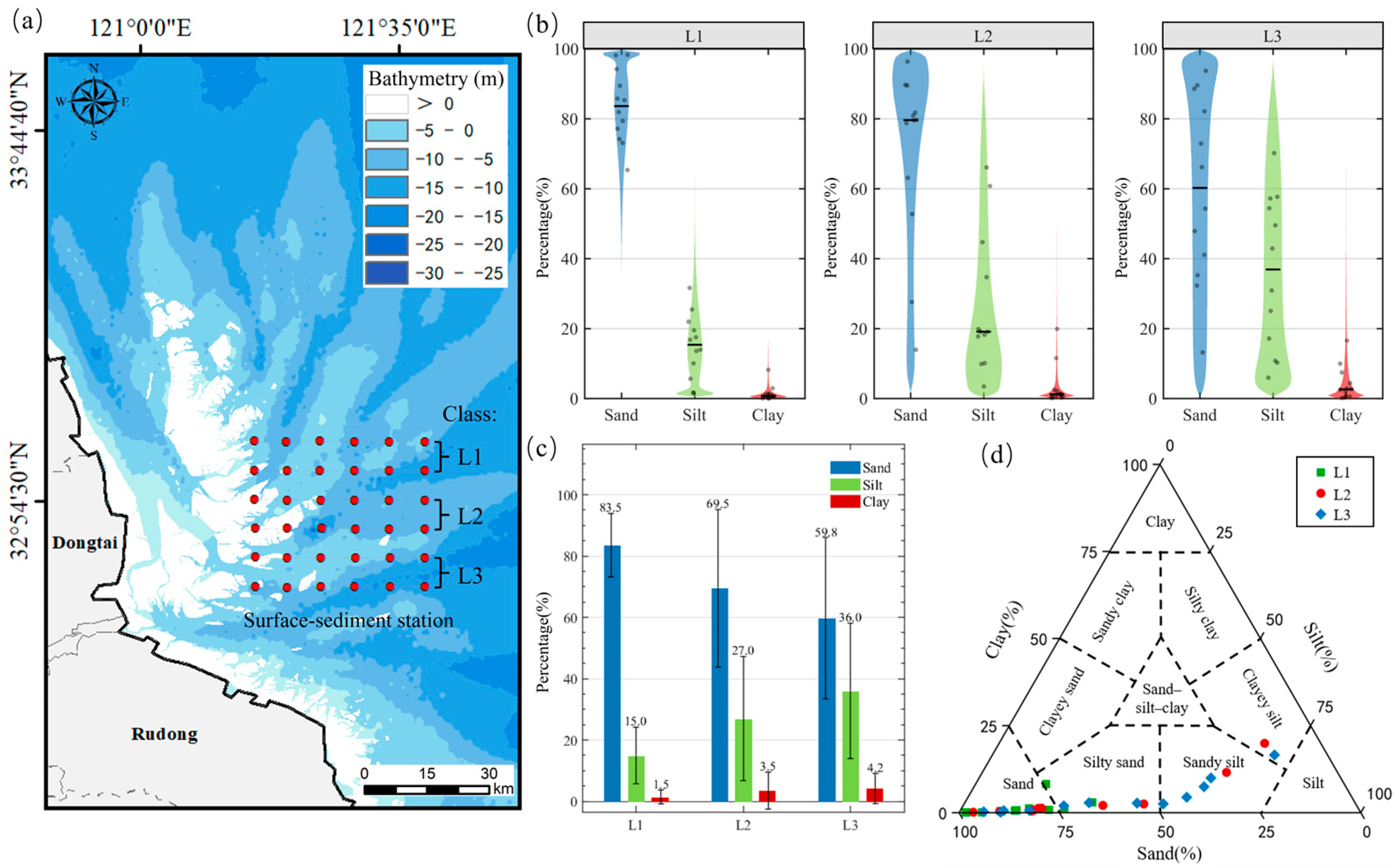
Surficial sediment samples (0–5 cm) were collected by the survey institution along typical sand-ridge–trough cross-sections, yielding 36 samples. The sampling layout covered different energy environments, including Maozhusha, Zhugensha, Jiangjiasha channel, and the deep trough of Huangshayang. Prior to laboratory analysis, samples were air-dried, gently disaggregated, and sieved to remove shell fragments and plant debris, and were then pre-treated following standard procedures (removal of organic matter and carbonates, dispersion). Grain-size frequency distributions were measured with a laser particle-size analyzer. Grain-size statistics were calculated using the Folk–Ward method [26], and sediment types were classified according to the Shepard ternary classification scheme [27]. The corresponding classification and statistical calculations were performed using GRADISTAT (version 8.0) software [28].
Seabed morphological evolution was analyzed using a 1:150,000 nautical chart (Dafeng Port–Yangkou Port sheet) from 1979 and the 2025 engineering bathymetry. Water depths in 1979 were obtained by digitizing contour lines from the chart and converting them, according to the map scale, into discrete depth points; the 2025 bathymetric data were provided as engineering drawings and digital products. After coordinate transformation and geometric correction, the two datasets were unified to the same map projection and vertical datum. Ordinary kriging was applied separately to each period to construct DEMs with a grid resolution of 50 m × 50 m, which respects the spatial representativeness of the historical chart and avoids introducing pseudo-precision into the engineering bathymetry. On the unified grid, the depth difference field is computed as
Δ h ( x , y ) = h 2025 ( x , y ) h 1979 ( x , y ) ,
where ( Δ h > 0 ) denotes deposition and ( Δ h < 0 ) denotes erosion. The total erosion and total deposition volumes are obtained by integrating Δ h over the erosional and depositional cells, respectively, using the grid-cell area. The mean annual bed-level change rate for each grid cell is defined as
r ( x , y ) = Δ h ( x , y ) 46   ( m / a ) ,
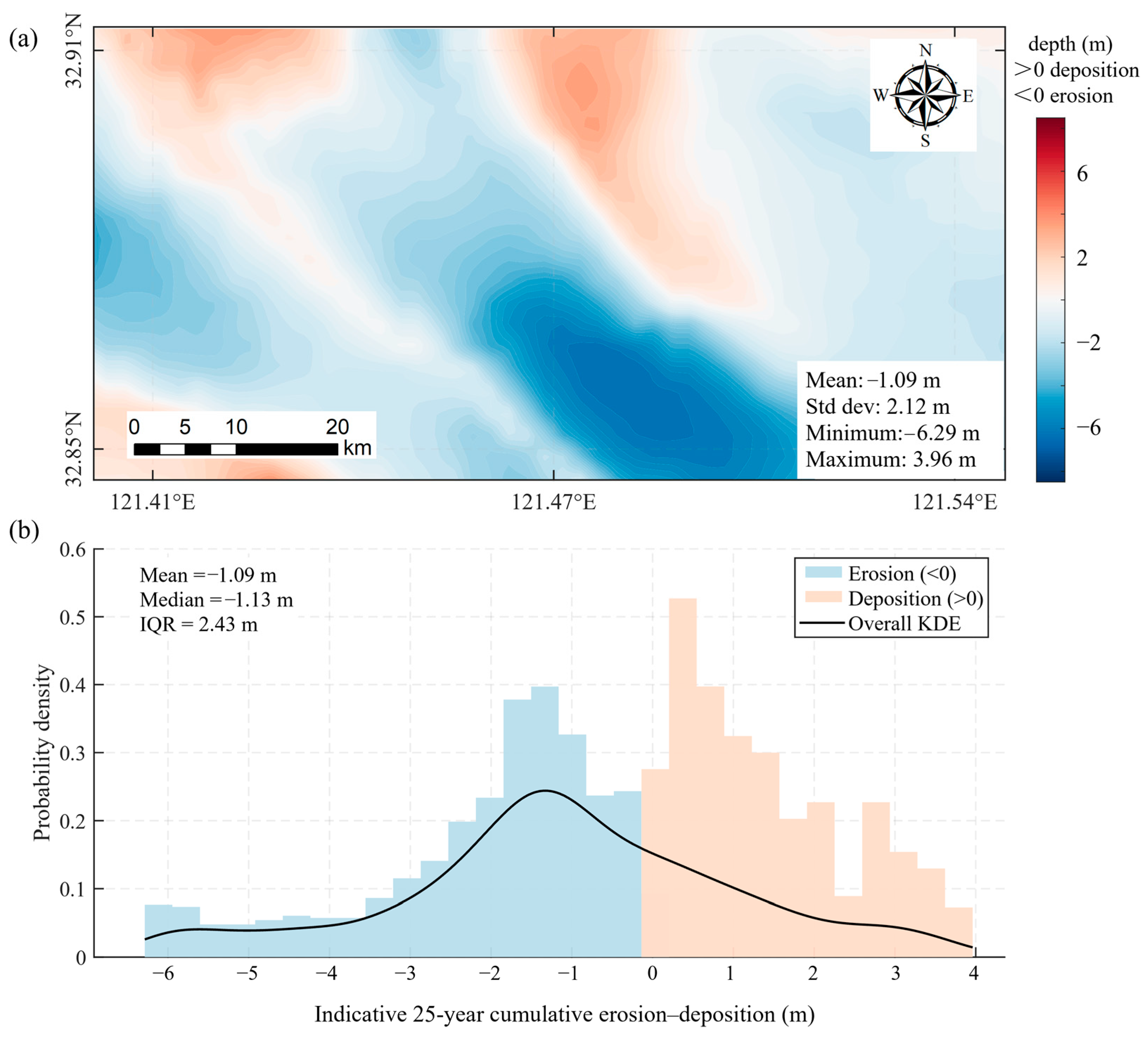
where the time interval between 1979 and 2025 is taken as 46a. Under a trend-stationary approximation (i.e., linear scaling of the observed 1979–2025 mean rate without invoking a predictive numerical model), an indicative 25 a thickness is given by
Δ h 25 ( x , y ) = r ( x , y ) × 25 = Δ h ( x , y ) × 25 46 ,
This metric is used to illustrate the possible magnitude and spatial variability of change rather than to provide a dynamical forecast. Regarding uncertainty, a significance threshold of 1.0 m was applied such that cells with |Δh| < 1.0 m were treated as “no significant change” and excluded from erosion/deposition volume statistics. The 25-year estimate is an engineering reference extrapolation derived from the two available bathymetric epochs (1979 and 2025). Given that only two epochs are available, this approach assumes that the net long-term tendency is broadly representative (a stationarity assumption) and is therefore presented as an indicative, order-of-magnitude scenario rather than a prediction.
Statistical analyses and visualization of suspended-sediment, grain-size, and hydrodynamic parameters were carried out using Origin (2023), ArcGIS (version 10.6), and related software. Violin plots based on kernel density estimation were used to illustrate the distributional characteristics of suspended-sediment grain-size components across different environmental zones. Shepard ternary diagrams were constructed from sand–silt–clay fractions output by GRADISTAT (version 8.0) using the ternary-plot module in Origin to characterize surficial sediment-type composition. Spatially continuous fields of suspended-sediment concentration, median grain size, and surficial grain-size parameters were obtained by ordinary kriging interpolation. Correlation direction and strength were quantified using Pearson’s correlation coefficient (r), and statistical significance was assessed at α = 0.05.

3. Results and Analysis

3.1. Particle Size Distribution Characteristics of Surface Sediments in Typical Sections of the Sand-Ridge Area

Profiles L1–L3 collectively capture the alongshore and cross-shore variability of surficial sediment characteristics within the nearshore radial sand-ridge system (Figure 2). Profile L1 spans the northern sector from the Maozhusha ridge to the Caomishuyang shallow, profile L2 extends from the western flank of Gaoni eastwards to Zhugensha, and profile L3 covers the southernmost sector from the Jiangjiasha ridge belt to the Huangshayang tidal channel.
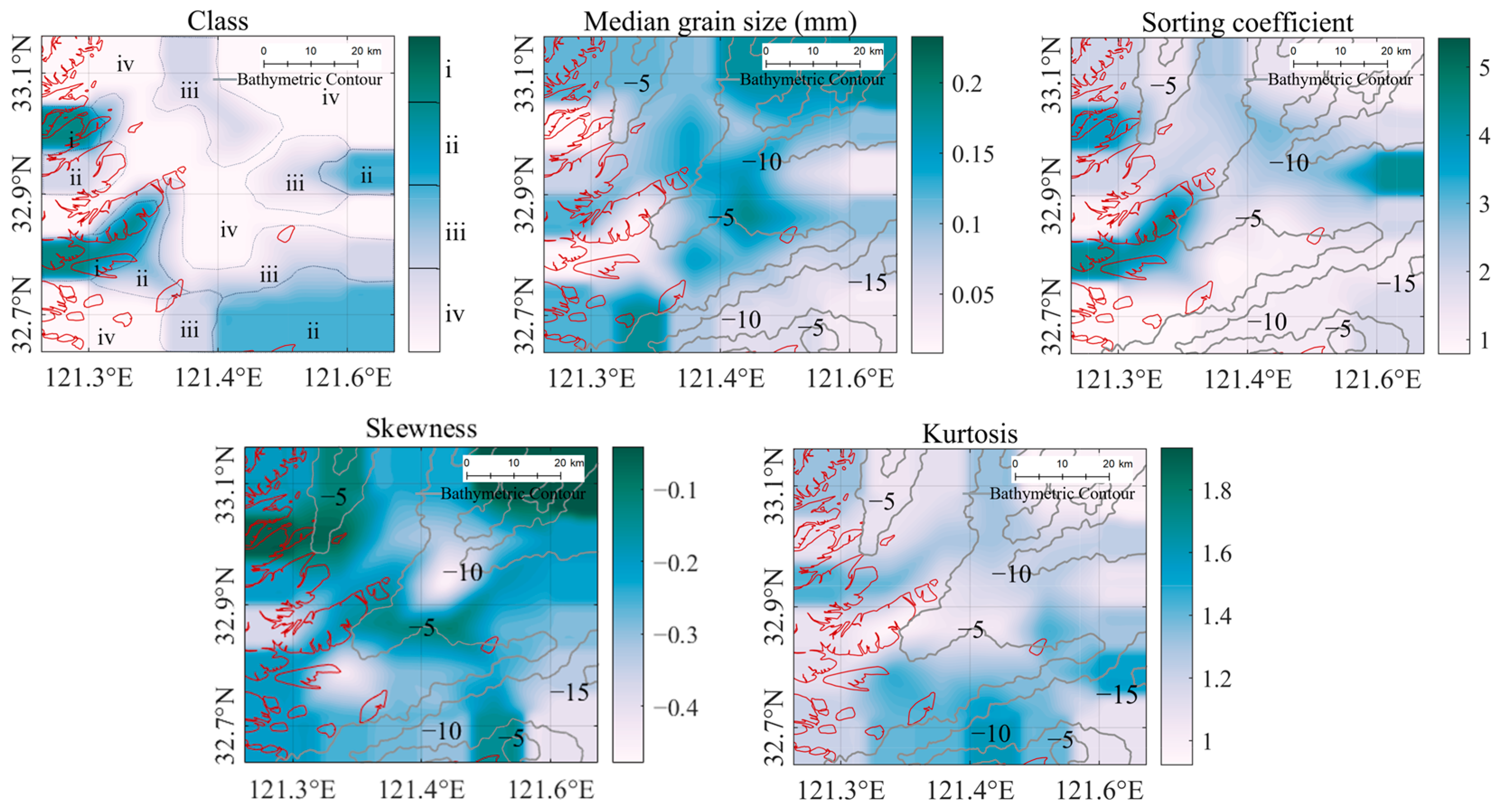
Along the north–south sequence from L1 to L3, sediment composition exhibits a clear progressive fining trend. Sand content decreases southward from 83.5% along L1 to 69.5% along L2 and 59.8% along L3, while silt content increases from 15% to 27% and 36%, and clay content from 1.5% to 3.5% and 4.2%. Correspondingly, Maozhusha is dominated by sandy silt, Zhugensha by clayey silt, and the Jiangjiasha channel by sandy silt to silty sand. This systematic compositional shift reflects decreasing hydrodynamic energy from sand-ridge crests toward tidal channels and inter-ridge environments. Superimposed on this alongshore trend, pronounced cross-shore (radial) gradients are evident within individual profiles (Figure 3). On the outer flank of Maozhusha, sediments become progressively coarser seaward, with median grain size increasing from ~0.12 mm to ~0.17 mm, accompanied by higher sand content and reduced silt and clay fractions. Along profile L2, marked west–east differentiation occurs across Zhugensha, where sediments fine eastward from 0.08 mm to 0.03 mm and kurtosis decreases from 1.43 to 1.08; grain-size changes are even more pronounced on the eastern Tiebansha. In the southern shallow-water sector, sediments along the outer extension of the Jiangjiasha channel also coarsen seaward, with median grain size increasing from 0.02 mm to 0.08 mm and sorting improving from 4.25 to 2.62. In contrast, the deep-water Huangshayang tidal channel exhibits a clear fining trend toward offshore, with median grain size decreasing from 0.13 mm to 0.04 mm, sorting coefficient increasing from 1.79 to 3.96, and sand content decreasing in favor of silt and clay fractions.
Ridge crests and flanks of Maozhusha are characterized by median grain sizes of 0.10–0.14 mm, decreasing to 0.07–0.12 mm toward Zhugensha, while the Jiangjiasha channel and inter-ridge areas are dominated by finer sediments of 0.04–0.09 mm, forming a banded north–south gradient from L1 to L3. Sorting coefficients are relatively low in ridge-flank and channel-margin settings (around 1.2) but increase to 2.1–3.5 in transitional and trough areas, reaching up to ~4.5 over the main body of Zhugensha. Skewness is generally negative and gradually approaches zero southward, indicating increasingly symmetrical grain-size distributions. Kurtosis values indicate weakly leptokurtic to mesokurtic distributions across the study area: sediments from the Jiangjiasha sector to the Huangshayang tidal channel are predominantly weakly leptokurtic (approximately 1.4–1.7), whereas those over the main sand-ridge bodies and adjacent troughs are mainly mesokurtic (approximately 1.0–1.4), suggesting relatively moderate to flattened distribution shapes.

3.2. Analysis of Long-Term Erosion–Deposition Evolution in the Region

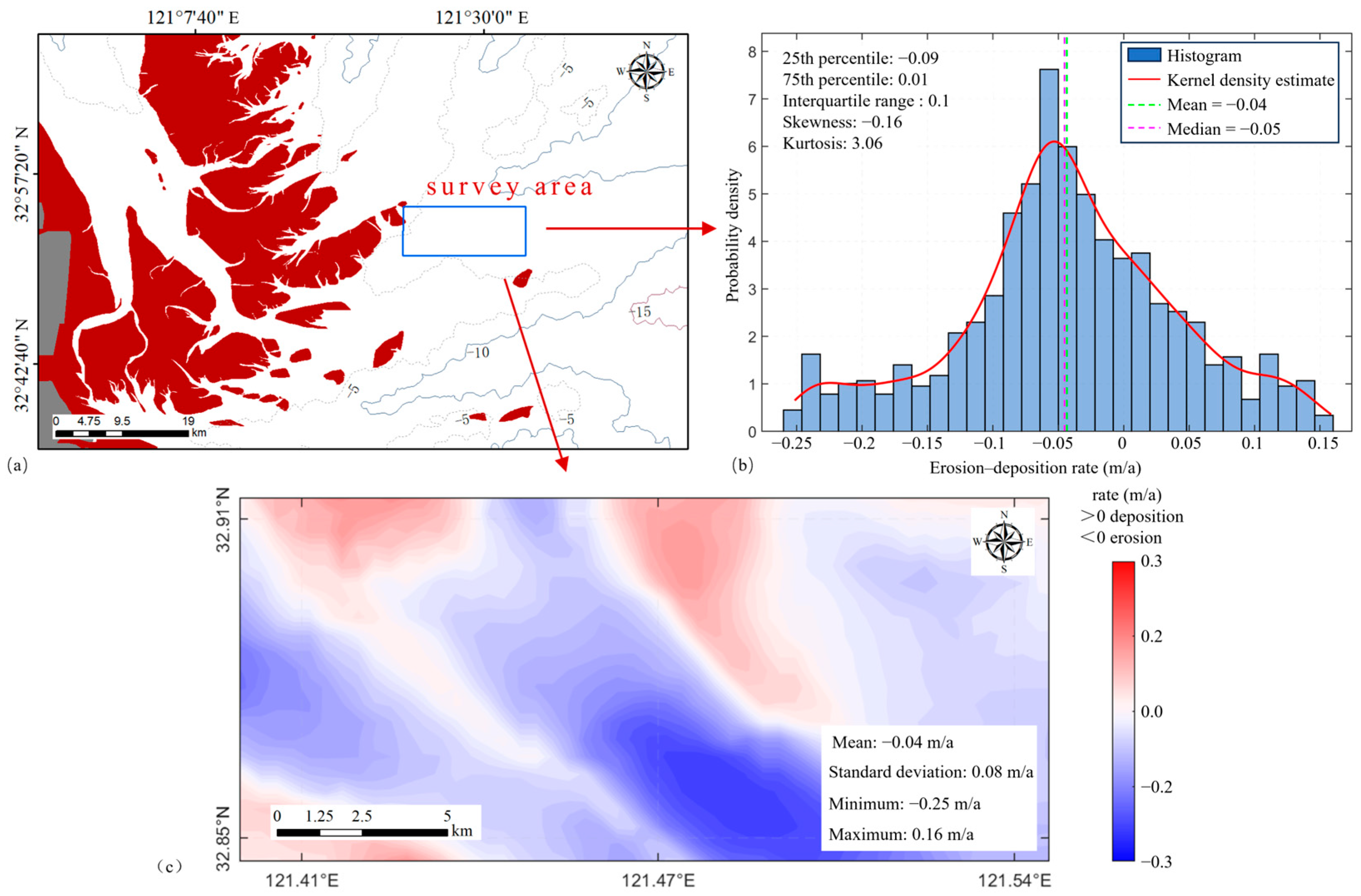
According to the latest measured topographic data in 2025, the water depth in the survey area ranges from 1.5 to 17 m. The shallowest shoal is Tiebansha (1.5–3 m), bordered by Zhugensha to the west and Yuanbaosha to the north; the Kushuiyang channel occupies the central part of the survey area (Figure 4). Zhugensha shows an overall trend of deposition, with a cumulative deposition thickness of 0 to 6 m. The ridge axis is deflected to a long NW–SE shape. Its north and southeast sides have intensified erosion, and a V-shaped deep-water area has developed along the outer edge of the ridge in Maozhusha, with an erosion depth exceeding 6 m and an average annual erosion rate of approximately −0.13 m/a. Jiangjiasha shows obvious north–south differences: the northern part has an erosion depth of 2 to 4 m and gradually evolves into an east–west waterway; in the south, there are two erosion areas with depths exceeding 9 m, while the rest of the area is mainly deposition. Deposition centers of 0–9 m occur in the northern part of the deep-water area and along the southern side of the Jiangjiasha deep channel.
Overall, the average erosion and deposition rate over the past 46 years is approximately −0.04 m/a, with local variations ranging from −0.25 to 0.16 m per year. The erosion and deposition zones are mostly distributed in an interlaced pattern: a continuous erosion zone from northeast to southwest runs through the main channel, and the Jiangjiasha tidal channel in the south has a strong local erosion, with an average annual erosion rate of −0.25 m per year; narrow deposition zones are generally developed on both sides of the channel, with deposition rates mostly ranging from 0.02 to 0.1 m per year.

3.3. Full-Tide Hydrodynamic Characteristics at Typical Stations

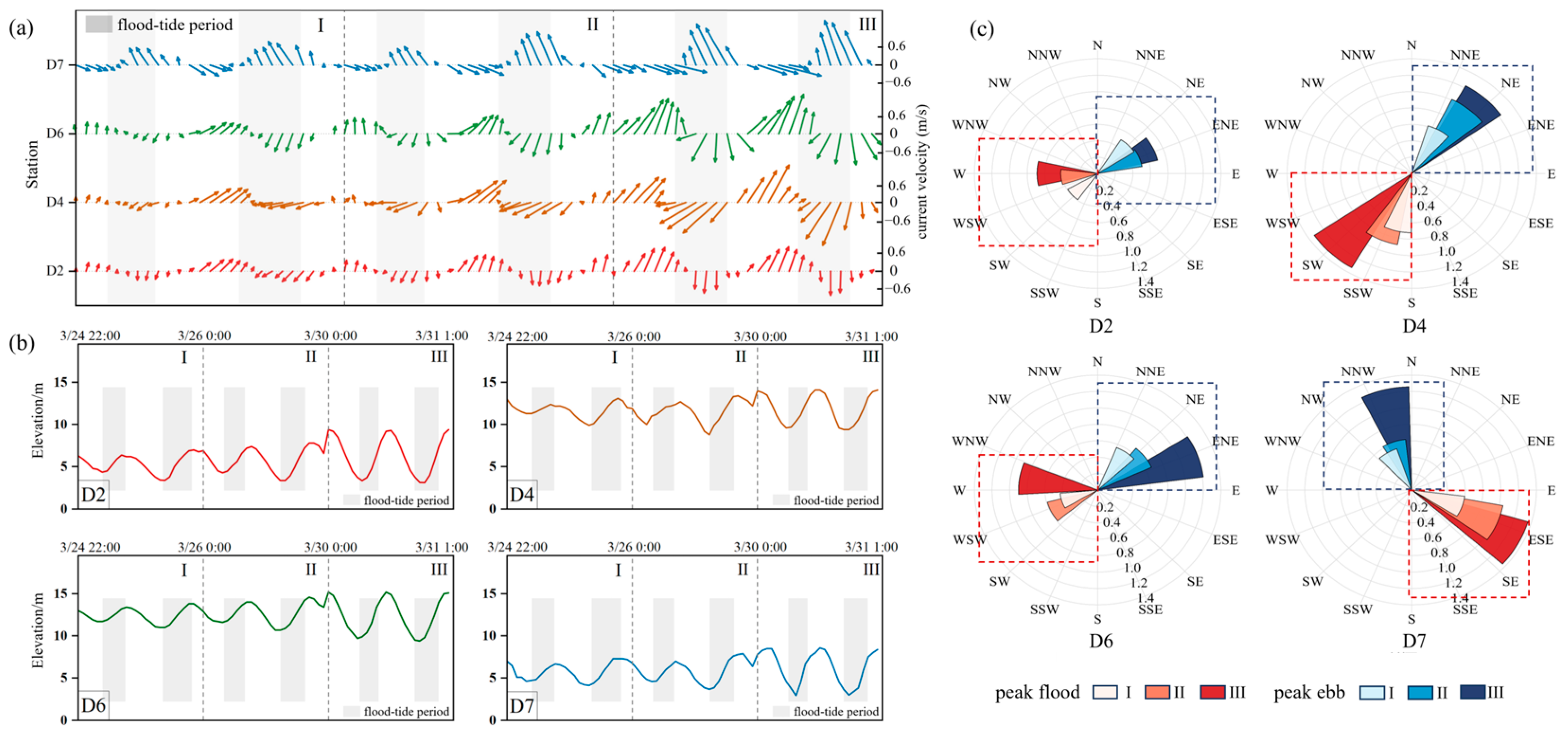
As shown in Figure 5, the tidal-current dynamics in the study area are mainly controlled by the semi-diurnal tide. The tidal-current velocity time series all exhibit regular reciprocating characteristics and gradually increase from neap tides to spring tides. The tidal-current velocity in the inner area of the shallow water sand ridges near the shore is generally weak, with the depth-averaged value mostly ranging from 0.3 to 0.6 m/s. Moving outward into the intertidal zone between Zhugensha and Yuanbaosha, the water depth increases to 9 to 13 m. During spring tides, the tidal-current velocity can reach 0.9 m/s, and the difference between the peak and trough of the flood and ebb tides significantly expands. The dynamic conditions are intense, and the erosion–deposition process is active. In the transition zone of Jiangjiasha channel in the south, the water depth further increases to about 10 m. Although the overall tidal-current velocity is lower than that in the central trough area, it still exceeds 0.6 m/s during spring tides, showing the transitional characteristics of enhanced exchange with the open sea.
The main axis of the nearshore shoal area is NNE–SSE, with nearly symmetrical flood and ebb tides, and is significantly constrained by the coastline and sand ridges. In the middle intertidal area of Zhugensha and Yuanbaosha, the main axis is ENE–WSW, with the highest flow concentration and the most prominent reciprocating characteristics during spring tides. In the southern transition zone, the main axis of the tidal current is also ENE–WSW, with a relatively stable direction, but there is a certain degree of dispersion during neap and mean tides. In the deep tidal channel of Kushuiyang in the far eastern part of the study area, at Station D6, the water depth is about 11–15 m, the peak current velocity exceeds 1.0 m/s, and the flow direction is nearly E–W, with the narrowest reciprocating angle. The deep channel has a significant constraining effect on the tidal current. Overall, tidal currents in the study area are modulated temporally by the semi-diurnal tide and the neap–spring cycle and constrained spatially by the sand-ridge–channel geomorphic configuration (e.g., channel confinement, depth-related frictional contrasts, and bathymetric steering), forming a hydrodynamic structure in which current energy increases and flow directions become progressively more convergent from shallow flats toward deep troughs.

3.4. Suspended-Sediment Concentration and Grain-Size Variation at Representative Tidal Moments

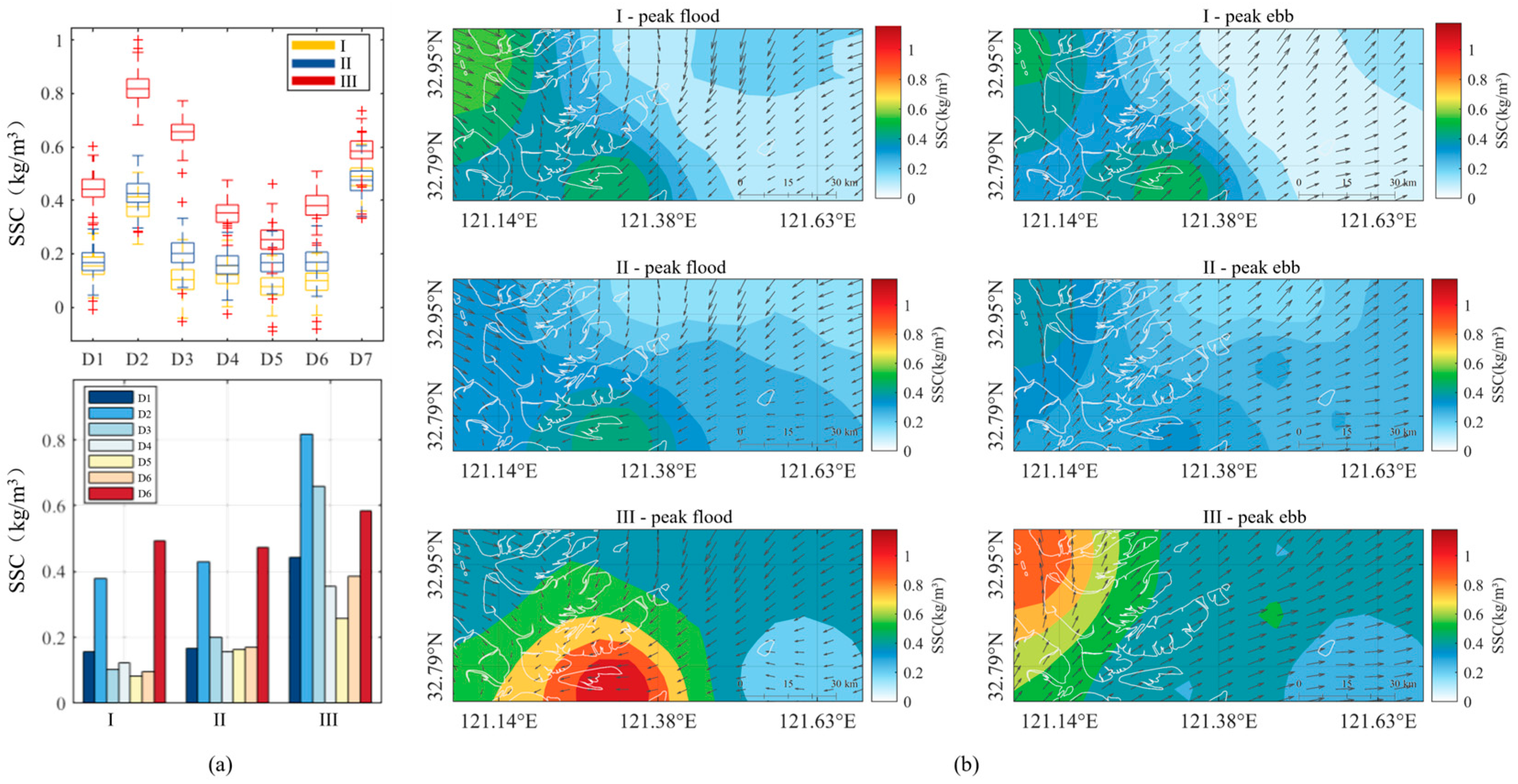
From the perspective of tidal-cycle changes, the suspended-sediment concentration in the study area generally shows a stepwise increase neap to mean and then to spring tides, with the average vertical concentration throughout the tidal cycle being approximately 0.38, 0.52, and 0.82 kg/m3, respectively. Spatially (Figure 6), the concentration is the highest in the transition zone between Dongsha and Gaoni, reaching 0.61 kg/m3 during neap tides and 1.22 kg/m3 at peak flood during the spring tide, which is the highest sediment accumulation area in the entire region. In the intertidal sand ridges and channels area between Zhugensha and Yuanbaosha, the concentration is only 0.1–0.16 kg/m3 during neap tides, increases to 0.16–0.2 kg/m3 during mean tides, and further rises to 0.36–0.66 kg/m3 during spring tides. In contrast, the concentration in the Jiangjiasha tidal channel in the south and the deep water trough in the east of Kushuiyang is generally less than 0.1 kg/m3 during neap tides. Considering the typical moments, the concentration in the shallow-water area near the inner side of Xiyang suddenly increases to 1.24 kg/m3 during the flood tide of spring tides and rapidly drops to 0.37 kg/m3 during the ebb tide. The Jiangjiasha tidal channel in the south also shows similar characteristics, and the suspended-sediment concentration remains at a relatively high level. In the Zhugensha sea area, the concentration during the flood and ebb tides of spring tides is similar, and the concentration in the open sea gradually decreases. Overall, the flood tide process plays a dominant role in the resuspension of sediments.
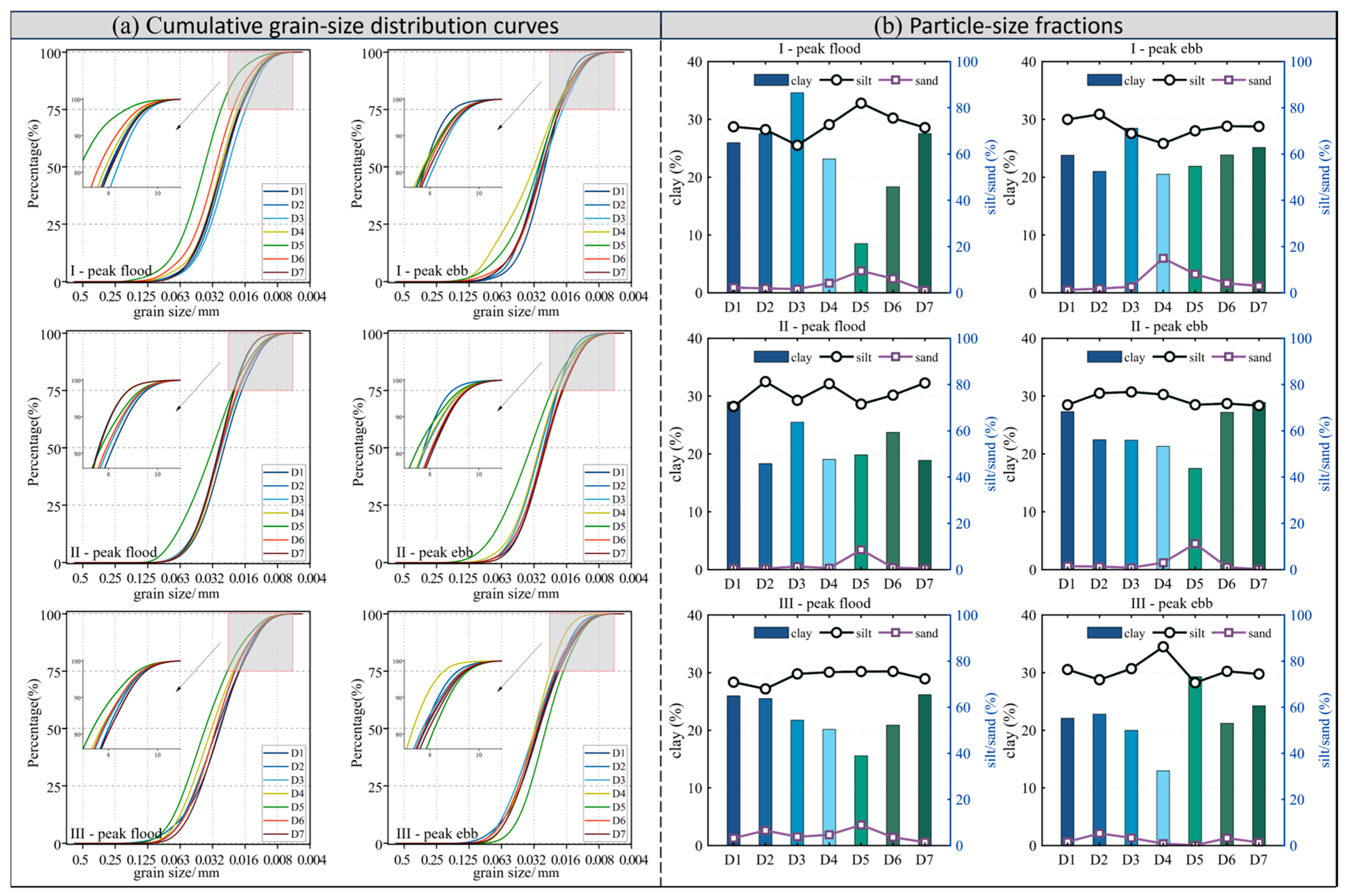
From the grain-size cumulative curves, component bar charts, and median grain-size distribution maps (Figure 7), it can be seen that the suspended sediment in the study area generally shows a typical S-shaped distribution, with the particle size mainly concentrated in the range of 0.006–0.013 mm. From the perspective of the tidal cycle, during the neap and medium tides, silt (70–80%) and clay (20–30%) are dominant, and the median particle size mostly remains at 0.007–0.009 mm, with fine particles being the main component of the suspended sediment. However, during the spring tide, the sand component significantly increases, and the median particle size generally rises to 0.010–0.012 mm, with some local areas even coarsening to 0.016–0.017 mm.
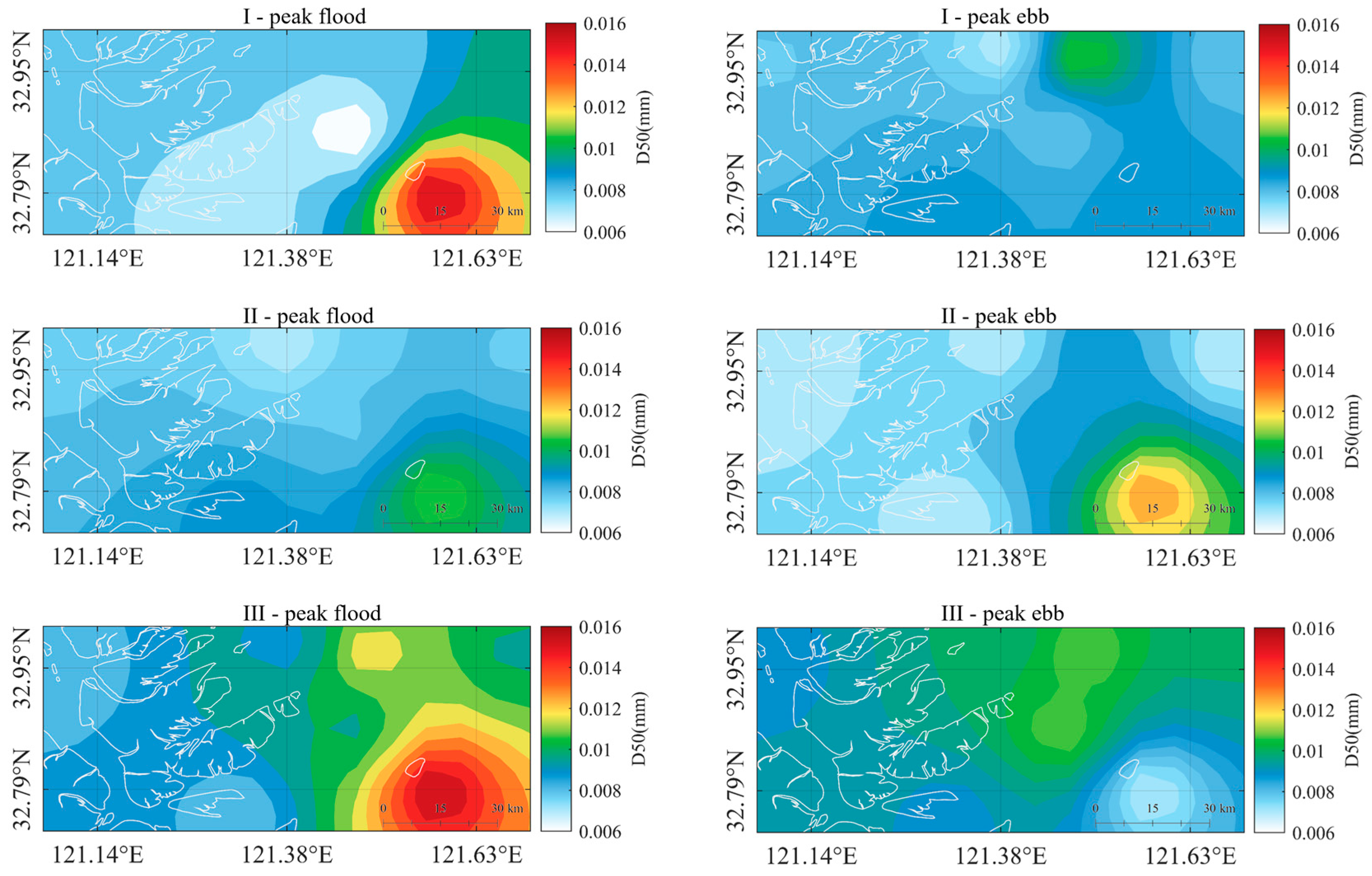
The intertidal zone between Zhugensha and Yuanbaosha is mainly composed of silt and clay during neap and spring tides, but the sand proportion increases to 3–5% during spring tides, showing a significant coarsening. Jiangjiasha tidal channel is the most distinctive, with a median grain size of 0.011–0.013 mm during spring tides and even reaching 0.016 mm during the ebb of spring tides, making it the area with the highest proportion of coarse particles in the entire region (Figure 8). At the junction of Dongsha and Gaoni, the sand content rises to 6.55% during the flood of spring tides, and the curve rises sharply in the fine silt fraction, corresponding to the median grain size increasing from 0.008 mm to 0.011 mm. In contrast, the nearshore shoals of Xiyang and the deep trough of Kushuiyang have long remained stable in the fine silt fraction, with a sand proportion of less than 3–6%, and the median grain size has remained at 0.007–0.009 mm during the observation period, dominated by fine suspended particles. Overall, suspended material is dominated by silt and clay during neap and mean tides, whereas a systematic coarsening (increased sand fraction and larger median grain size) occurs during spring tides. During the survey period, coarsening is most pronounced in tidal-channel and intertidal exchange settings, while nearshore shoals and deep troughs remain dominated by fine suspended particles.

4. Discussion

4.1. Indicative 25-Year Erosion–Deposition Scenario for the Survey Area

The hydro-sedimentary environment of the radial sand-ridge area is highly dynamic, and erosion–deposition processes are active over multi-decadal timescales. Based on the long-term bathymetric difference between 1979 and 2025 (Figure 9) and following the procedure described in Section 2.2, the cumulative change over a 25-year timescale is presented here as an indicative scenario for reference. The resulting cumulative erosion–deposition magnitude ranges from approximately −6.29 m to 3.96 m. Spatially, the southwestern sector along the outer flank of Zhugensha corresponds to persistent aggradation, with a maximum accretion thickness of about 3 m and a corresponding mean accretion rate of approximately 0.12 m/a; in the southeastern part, accretion associated with the Tiebansha-influenced sector can reach about 3.96 m. In contrast, erosion is mainly concentrated within the southern troughs, where the maximum scour depth is about 6.29 m and the mean erosion rate is approximately 0.25 m/a, highlighting a pronounced contrast in erosion–deposition response between channel zones and sand-ridge zones.
At the regional scale, previous studies have discussed multiple processes relevant to the long-term evolution of the Jiangsu radial sand-ridge system and the associated ridge–channel morphology, providing context for interpreting the spatial pattern in the multi-decadal difference field [29]. The southern wing of the radial sand shoals has been described as relatively weakly affected by direct influences of Yellow River mouth migration and the evolution of the abandoned Yellow River delta, and the tidal-channel–sand-ridge system there has largely adjusted to the local hydro-sedimentary setting. By contrast, the northern wing has been reported to exhibit more pronounced channel development and extension tendencies under regional-scale hydrodynamic and coastal-evolution influences [30]. The convergent shoreline sector at the center of the radial sand shoals shows progradational evolution, whereas erosion–deposition at the confluence zone of distal tidal-channel ends remains intense and spatially heterogeneous in space [31].
Moreover, planform swinging and ridge–trough migration are reflected in adjustments of local bathymetry and flow configuration, providing favorable conditions for repeated ridge–channel sediment exchange over longer timescales [32]. Since 1979, Zhugensha has gradually rotated from an approximately E–W orientation to an approximately NE–SW orientation, consistent with the broader planform trend of the radial sand-ridge group. As a result, two major trough channels have been recognized within the project area: the “1979 channel between Zhugensha and Tiebansha” and the “new channel formed after sand-ridge rotation around 2010”. These channels intersect the survey area and are associated with larger seabed-elevation changes, implying elevated sensitivity of local erosion–deposition patterns [33].

4.2. Analysis of Residual Currents and Possible Maximum Tidal-Current Velocity

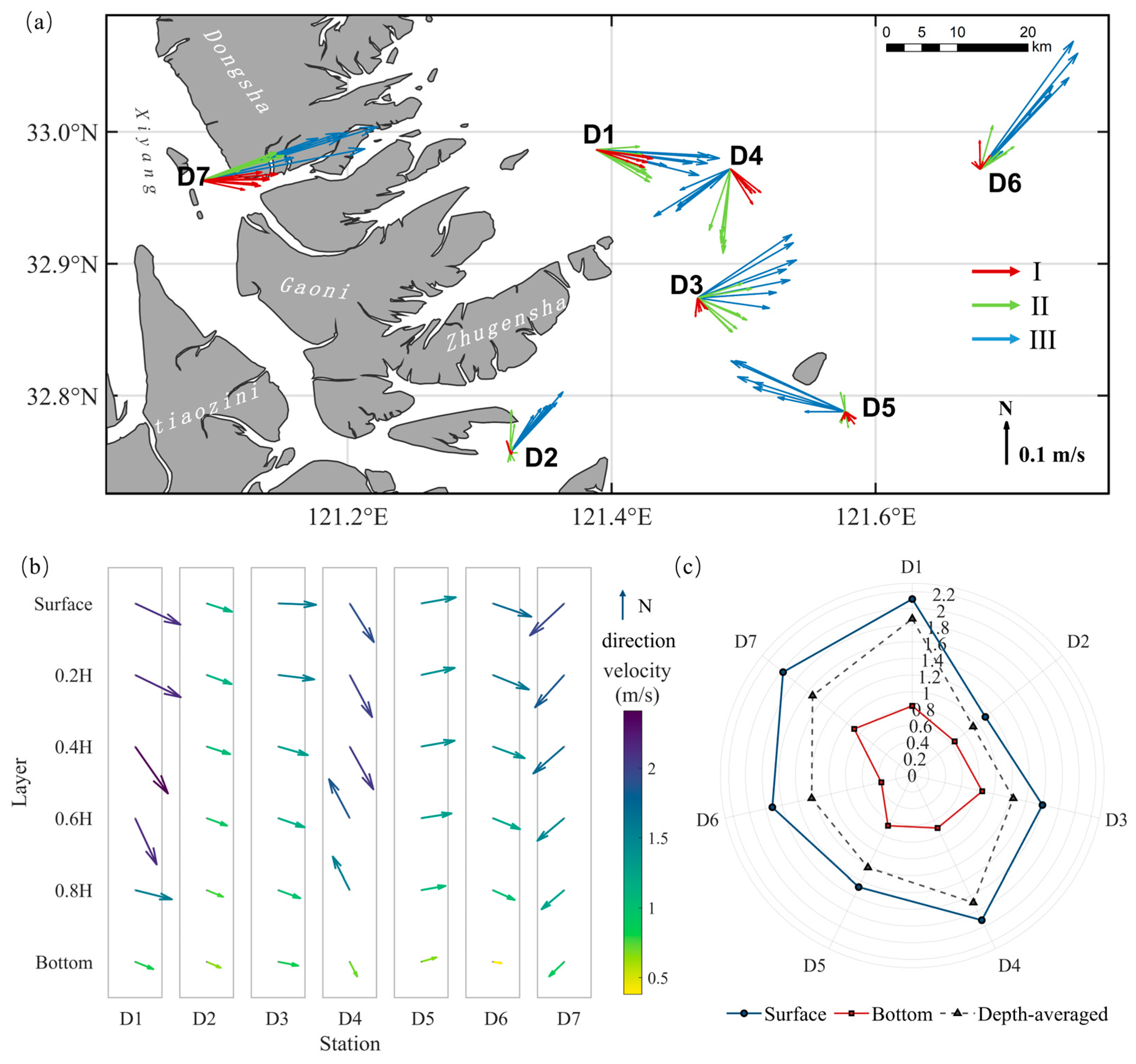
The tidal-current–sand-ridge system in the study area exhibits pronounced hydrodynamic zonation (Figure 10). In the main tidal channel between Maozhusha and Zhugensha, the depth-averaged tidal currents are aligned with the trough and reverse predominantly along a NE–SW axis, while the residual current during spring tides reaches ~0.23 m/s and is oriented along the channel. During the spring-tide surveys, near-bed velocities were generally sufficiently energetic to favor bed disturbance, local scour, and frequent sediment resuspension within the channel. Surface velocities can reach about 2.4 m/s, clearly exceeding bottom velocities of less than 1.0 m/s, indicating evident vertical shear. This structure suggests that near-bed tidal currents, and the associated bed shear inferred qualitatively, are most relevant for initiating sediment motion, whereas mid–upper water-column currents mainly govern the advection and redistribution of suspended material. Across the channel–ridge boundary, the pronounced lateral gradient in near-bed tidal-current velocity suggests enhanced bed disturbance and erosion potential within the trough, with comparatively higher deposition potential near the foot of the ridge slope, forming a local “channel erosion–ridge accretion” pattern between troughs and sand ridges [34]. This hydrodynamic setting is consistent with the erosion of the main tidal channel and the relative accretion of adjacent sand ridges identified in Section 3.2.
In the offshore Kushuiyang deep tidal channel, the residual current velocity can reach up to 0.35 m/s, with a stable direction towards ENE–ESE, and the possible maximum current velocity is about 1.26 m/s. Relative to the main tidal channel, the peak velocity is slightly lower, whereas the residual component is more persistently oriented, favoring sustained net transport along the deep trough. Under this regime, fine particles are less likely to remain within the trough for long, and suspended material is more readily conveyed seaward along the residual pathway. In combination with the local grain-size characteristics and the net erosion signal derived from long-term seabed evolution, the Kushuiyang deep trough is characterized as a net-erosional, export-dominated channel reach, marked by net seabed lowering and preferential removal of fine sediments.
In contrast, residual currents are weakest in the southern Tiaozini–Jiangjiasha channel, being only about 0.15 m/s during spring tides and less than 0.02 m/s during neap and mean tides, while the possible maximum current velocities remain relatively large (about 1.5–2.0 m/s). On the inner flank of the nearshore shallow sand ridge of Xiyang, located landward of the boundary between Dongsha and Gaoni, relatively high depth-averaged velocities coincide with large possible maximum velocities. During spring tides, the depth-averaged residual velocity can reach 0.35 m/s with a stable ENE–ESE direction, and remains around 0.16–0.17 m/s during neap and mean tides; the possible maximum velocity is about 2.0 m/s, and near-bed shear is pronounced. Here, energetic near-bed flow promotes frequent entrainment and transport along the ridge foot, while the residual and mid–upper layer currents contribute to cross-unit transport pathways of suspended material between the inner and outer flanks of the sand ridge. This area is characterized by relatively high SSC, coarser suspended grain size, and a comparatively stable flow direction, representing an environment of active resuspension with directed sediment transport. This is spatially consistent with the zoning results indicating relative accretion and lower local erosion–deposition risk on the northern wing and central tidal flats [35,36].

4.3. Zonal Differences in Water–Sediment Transport and Their Depositional Environmental Implications

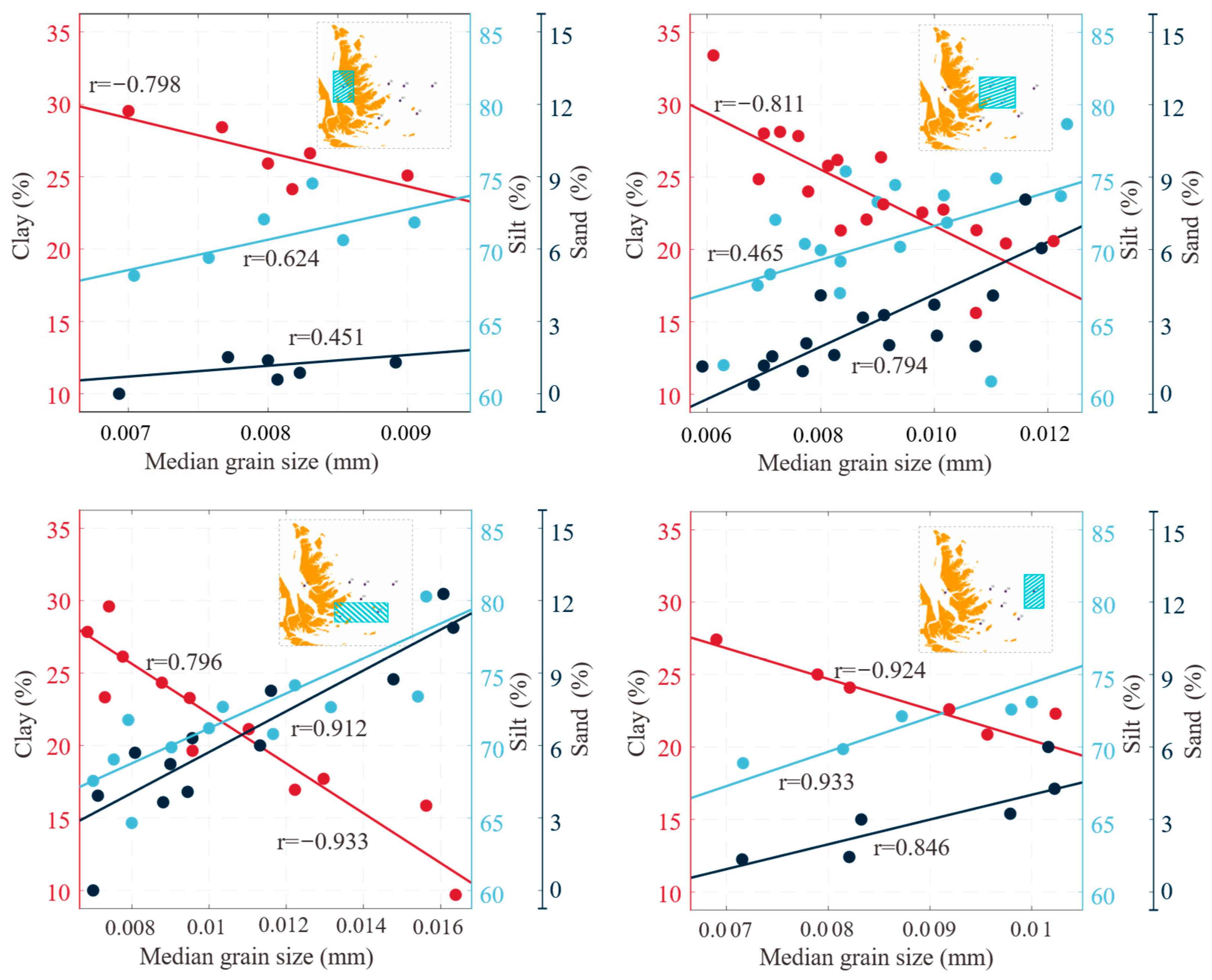
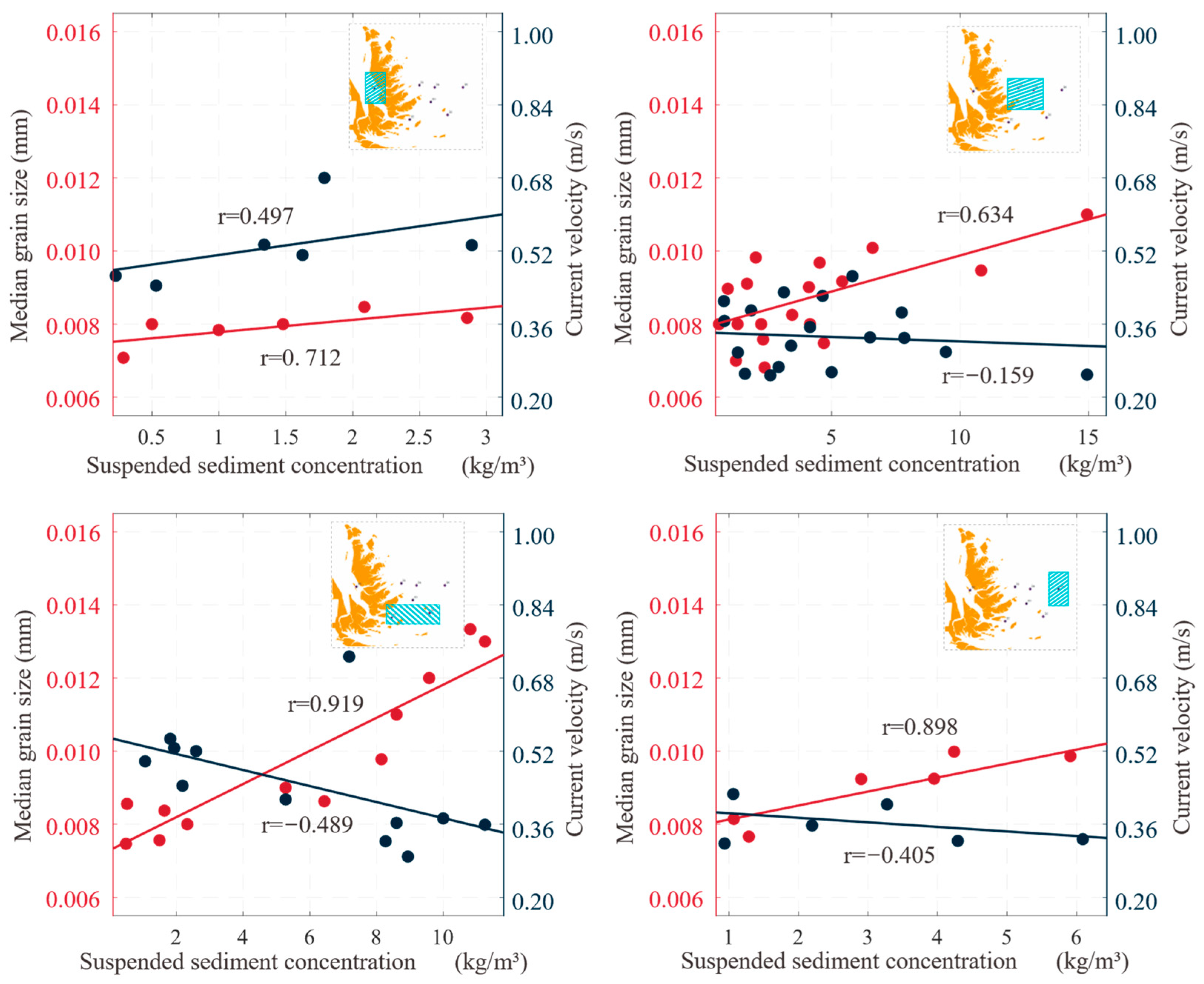
The radial sand-ridge field is embedded in a macrotidal regime, in which tidal-current-driven near-bed shear stress and lateral exchange across ridge–channel boundaries are closely associated with spatial erosion–deposition patterns. Marked contrasts in hydro-sedimentary behavior among geomorphic units reflect the combined influences of tidal currents, wave forcing, sediment supply, and topographic configuration. To avoid mixing observations from distinct hydro-geomorphic contexts, the seven stations are interpreted within four representative local environment types along a nearshore–offshore and ridge–channel gradient: the nearshore shallow flats on the inner flank of the Xiyang ridge; the central ridge–channel exchange zone (tidal channel–Zhugensha–Yuanbaosha–Kushuiyang interaction area); the southern outer transitional channel zone at the sand-ridge/open-sea boundary; and the offshore Kushuiyang deep channel together with the eastern outer deep trough (Figure 11 and Figure 12).
A consistent regional trend is observed from nearshore to offshore: the dominant signal shifts from locally resuspension-dominated behavior in shallow flats to transport-and-exchange-dominated behavior in the central ridge–channel system, and finally to offshore winnowing and net export in the deep-trough pathway. In the nearshore shallow-flat belt, median grain size is negatively correlated with clay content (r = −0.798) and positively correlated with silt and sand contents (silt: r = 0.624; sand: r = 0.451), indicating preferential removal of clay and relative enrichment of coarser fractions under wave–tide disturbance [37]. SSC increases concurrently with both median grain size (r = 0.712) and tidal-current velocity (r = 0.497), implying that SSC variability is mainly governed by local resuspension under stronger near-bed shear. This belt therefore represents a typical “resuspension–accumulation” environment.
In the central ridge–channel–Kushuiyang exchange zone, the coupled pattern of “coarsening sand/silt increase–clay decrease” persists (clay: r = −0.811; silt: r = 0.465; sand: r = 0.794). However, SSC shows only a moderate association with median grain size (r = 0.634) and is nearly decoupled from instantaneous tidal-current velocity (r = −0.159). This indicates that SSC variability here is increasingly controlled by ridge–channel geometry, the radial tidal-current structure, and reciprocal exchange pathways, such that SSC at a given station integrates both local entrainment and advective contributions (upstream delivery and lateral exchange) [38]. This behavior is consistent with frequent switching between erosion and deposition and pronounced spatial differentiation over multi-year to decadal timescales, supporting interpretation of this unit as a “strong-exchange, highly active” environment.
Farther seaward, in the southern outer transitional channel zone, the SSC–median grain-size relationship strengthens markedly (r = 0.919). Median grain size is strongly negatively correlated with clay content (r = −0.933) and positively correlated with silt and sand contents (silt: r = 0.796; sand: r = 0.912), indicating that increasing SSC is associated with a coarser suspended mixture and preferential winnowing/export of fine fractions along the offshore-directed pathway [39]. At the station scale, SSC and tidal-current velocity show a moderate negative correlation (r = −0.489), consistent with enhanced channelized flushing: stronger currents shorten local residence time and suppress the persistence of high-SSC peaks even as regional export efficiency increases. This zone therefore functions as a “transitional net-export channel”, consistent with its tendency toward relative erosion or a slightly negative erosion–deposition balance over longer timescales.
In the offshore Kushuiyang deep channel and the eastern outer deep trough, sediments are dominated by fine sand and silt. Median grain size remains negatively correlated with clay content (r = −0.924) and positively correlated with silt and sand contents (silt: r = 0.933; sand: r = 0.846), consistent with persistent offshore-directed winnowing. SSC remains strongly positively correlated with median grain size (r = 0.898), whereas the SSC–velocity relationship is weak to moderate and negative (r = −0.405). This suggests that SSC variability primarily reflects strengthened bed winnowing and slight coarsening of the suspended load rather than a linear response to instantaneous velocity changes. Combined with the offshore-directed residual-current pattern, the deep-channel system is interpreted as a preferential pathway for net seaward sediment export on a qualitative basis, consistent with the multi-decadal (1979–2025) net-erosion pattern indicated by the erosion–deposition analysis.
Overall, beyond regular tidal-current and wave forcing, ridge–trough morphological adjustment and episodic extreme events can further modulate these transport regimes. Planform swinging and ridge–trough migration are commonly associated with adjustments in local depth and flow structure, which are conducive to repeated ridge–channel sediment exchange over longer timescales [40], whereas storm surges can trigger short-lived SSC pulses and rapid redistribution [41]. Moreover, recent engineering activities (e.g., channel regulation, reclamation, offshore wind development) may locally alter morphology and flow fields [42]. Accordingly, the relationships reported here are used as diagnostic hydro-sedimentary indicators for differentiating local erosion–deposition settings, while future work integrating longer time series and process-based modeling can further quantify thresholds and attribution.

5. Conclusions

Based on historical bathymetric charts and full-tide hydrodynamic–sediment observations collected during a representative short-term survey, this study clarifies how sand-ridge–trough morphology structures hydrodynamic zonation and thereby organizes erosion–deposition behavior in the nearshore radial sand-ridge area off Dongtai, northern Jiangsu. The main conclusions are as follows:
(1)
Surficial sediment textures display systematic along-channel fining and clear contrasts among ridges, channels, and troughs, indicating persistent differentiation of hydrodynamic energy and sediment-transport pathways across geomorphic units.
(2)
Multi-decadal bathymetric differences reveal a characteristic banded evolution in which ridge bodies tend to aggrade while adjacent troughs and channelized zones preferentially deepen. This ridge–trough coupling highlights sustained sediment redistribution within the system, rather than spatially uniform seabed change.
(3)
The short-term observations demonstrate consistent process contrasts among hydrodynamic settings: energetic channels and strong exchange zones promote sediment mobilization and advective export, whereas ridge flanks and nearshore shoals favor frequent resuspension with comparatively short-range retention; deeper trough environments preferentially accumulate finer suspended material conveyed along channelized pathways. These process contrasts provide a mechanistic interpretation consistent with the long-term ridge–trough erosion–deposition configuration derived from bathymetric differencing.
(4)
The hydrodynamic–sedimentary zoning identified here offers a conceptual framework that may inform applied coastal activities by highlighting where scour-dominated conditions are more likely (channel and trough sectors) versus where reworking and accumulation are more prominent (nearshore shoals and ridge toes). Building on this foundation, future work can integrate longer-term observations, event-focused measurements, and process-based modeling to further quantify hydrodynamic thresholds, sediment mobility, and stability envelopes needed for wind-farm foundation assessment, navigation-channel management, and broader coastal-zone planning.

Author Contributions

Conceptualization, N.Z. and L.Y.; methodology, L.Y. and Y.L.; software, X.W. and J.C.; validation, N.Z., J.C. and J.J.; formal analysis, Y.L.; investigation, X.W.; resources, J.J.; data curation, J.C.; writing—original draft preparation, N.Z.; writing—review and editing, L.Y. and Y.L.; visualization, X.W.; supervision, J.J.; project administration, N.Z.; funding acquisition, L.Y. All authors have read and agreed to the published version of the manuscript.

Funding

This research was funded by Shandong Provincial Key Research and Development Program (Public Welfare Science and Technology Research Category), grant number 2019GSF111017.

Data Availability Statement

The data that support the findings of this study are available on request from the corresponding author upon reasonable request.

Conflicts of Interest

Author Xiaohui Wang was employed by the company China Energy Engineering Group Jiangsu Electric Power Design Institute Co., Ltd. The remaining authors declare that the research was conducted in the absence of any commercial or financial relationships that could be construed as a potential conflict of interest.

References

  1. Xing, F.; Wang, Y.P.; Ni, W.; Gao, S.; Jia, J.; Gao, J. Modeling multi-decadal morphological evolution of the radial-shaped sand ridges in the Southern Yellow Sea, China. Catena 2024, 238, 107884. [Google Scholar] [CrossRef]
  2. Hu, Z.; Wang, Z.B.; Zitman, T.J.; Stive, M.J.F.; Bouma, T.J. Predicting long-term and short-term tidal flat morphodynamics using a dynamic equilibrium theory. J. Geophys. Res. Earth Surf. 2015, 120, 1803–1823. [Google Scholar] [CrossRef]
  3. Longhitano, S.G.; Mellere, D.; Steel, R.J.; Ainsworth, R.B. Tidal depositional systems in the rock record: A review and new insights. Sediment. Geol. 2012, 279, 2–22. [Google Scholar] [CrossRef]
  4. Petti, M.; Pasquali, D.; Postacchini, M.; Zitti, G. Tidal flats morphodynamics: A new conceptual model to support sustainable management. Water 2019, 11, 1176. [Google Scholar] [CrossRef]
  5. Yang, G.; Li, C.; Zhong, Y.; Pan, X.; Zhao, C.; Dong, C. Impact of tropical cyclones on the hydrodynamics and sediment dynamics of the radial sand ridge system in the southern Yellow Sea. Ocean Model. 2024, 188, 102328. [Google Scholar] [CrossRef]
  6. Mao, C.; Rao, W.; Li, T.; Jin, K.; Wang, S. Lead isotope compositions and modern sediment sources in the radial sand ridges from the Jiangsu coast, East China. Appl. Geochem. 2024, 160, 105858. [Google Scholar] [CrossRef]
  7. Safak, I.; Warner, J.C.; List, J.H.; Kumar, N. Persistent shoreline shape induced from offshore geologic framework: Effects of shoreface-connected ridges. J. Geophys. Res. Oceans 2017, 122, 8721–8738. [Google Scholar] [CrossRef]
  8. Li, Y.; Yao, H.; Chen, Z.; Luo, W.; Zhang, S. Morphology and evolution of submarine sand ridges and sand waves off the southwestern coast of Hainan Island, China. Front. Mar. Sci. 2025, 12, 1561392. [Google Scholar] [CrossRef]
  9. Chen, Y.; Wei, Y.; Peng, L. Ecological technology model and path of seaport reclamation construction. Ocean Coast. Manag. 2018, 165, 244–257. [Google Scholar] [CrossRef]
  10. Murray, N.J.; Phinn, S.R.; DeWitt, M.; Ferrari, R.; Johnston, R.; Lyons, M.B.; Clinton, N.; Thau, D.; Fuller, R.A. The global distribution and trajectory of tidal flats. Nature 2019, 565, 222–225. [Google Scholar] [CrossRef]
  11. Cheng, S.; Zeng, X.; Wang, Z.; Zeng, C.; Cao, L. Spatiotemporal variations of tidal flat landscape patterns and driving forces in the Yangtze River Delta, China. Front. Mar. Sci. 2023, 9, 1086775. [Google Scholar] [CrossRef]
  12. Mahavadi, T.F.; Seiffert, R.; Kelln, J.; Fröhle, P. Effects of sea level rise and tidal flat growth on tidal dynamics and geometry of the Elbe estuary. Ocean Sci. 2024, 20, 369–388. [Google Scholar] [CrossRef]
  13. van Maren, D.S.; Guo, L.; Wang, Z.B.; Winterwerp, J.C. Land reclamation impacts on tidal landscape evolution. Rev. Geophys. 2025, 62, e2024RG000860. [Google Scholar] [CrossRef]
  14. Horrillo-Caraballo, J.M.; Reeve, D.E. Morphodynamic behaviour of a nearshore sandbank system: The Great Yarmouth Sandbanks, U.K. Mar. Geol. 2008, 254, 91–106. [Google Scholar] [CrossRef]
  15. Tao, J.; Wang, Z.B.; Zhou, Z.; Xu, F.; Zhang, C.; Stive, M.J.F. A morphodynamic modeling study on the formation of the large-scale radial sand ridges in the Southern Yellow Sea. J. Geophys. Res. Earth Surf. 2019, 124, 1742–1767. [Google Scholar] [CrossRef]
  16. Xu, F.; Tao, J.; Zhou, Z.; Coco, G.; Zhang, C. Mechanisms underlying the regional morphological differences between the northern and southern radial sand ridges along the Jiangsu Coast, China. Mar. Geol. 2016, 371, 1–17. [Google Scholar] [CrossRef]
  17. He, L.; Ye, S.; Xue, C.; Zhao, G.; Yang, S.; Amorosi, A. Sedimentology and evolution of the Holocene radial tidal sand ridge in the south Yellow Sea, China. Front. Earth Sci. 2023, 10, 1107495. [Google Scholar] [CrossRef]
  18. Li, C.X.; Zhang, J.Q.; Fan, D.D.; Deng, B. Holocene regression and the tidal radial sand ridge system formation in the Jiangsu coastal zone, east China. Mar. Geol. 2001, 173, 97–120. [Google Scholar] [CrossRef]
  19. Li, T.; Rao, W.; Wang, S.; Mao, C. Identifying the clay-size sediment provenance of the radial sand ridges in the southwestern Yellow Sea using geochemical and Sr–Nd isotopic tracers. Mar. Geol. 2023, 455, 106957. [Google Scholar] [CrossRef]
  20. Cao, J.; Zhao, Y.; Xu, M.; Liu, Q.; Shi, W. Quantitative geochemistry as a provenance indicator for surface sediments in the north Jiangsu radial sand ridges (NJRSR) in the South Yellow Sea, East China. Cont. Shelf Res. 2021, 228, 104545. [Google Scholar] [CrossRef]
  21. Zhao, Y.; Liu, Q.; Huang, R.; Pan, H.; Xu, M. Recent evolution of coastal tidal flats and the impacts of intensified human activities in the modern radial sand ridges, East China. Int. J. Environ. Res. Public Health 2020, 17, 3191. [Google Scholar] [CrossRef] [PubMed]
  22. Kang, Y.; He, J.; Wang, B.; Lei, J.; Wang, Z.; Ding, X. Geomorphic evolution of radial sand ridges in the South Yellow Sea observed from satellites. Remote Sens. 2022, 14, 287. [Google Scholar] [CrossRef]
  23. Kang, Y.; Lei, J.; Wang, M.; Li, G.; Ding, X. Topographic evolution of tidal flats based on remote sensing: An example in Jiangsu coast, Southern Yellow Sea. Front. Mar. Sci. 2023, 10, 1163302. [Google Scholar] [CrossRef]
  24. Zhang, S.; Xu, Q.; Zheng, Q.; Li, X. Mechanisms of SAR imaging of shallow water topography of the Subei Bank. Remote Sens. 2017, 9, 1203. [Google Scholar] [CrossRef]
  25. Chen, Y.; Li, G.; Cui, L.; Li, L.; He, L.; Ma, P. The effects of tidal flat reclamation on the stability of the coastal area in the Jiangsu Province, China, from the perspective of landscape structure. Land 2022, 11, 421. [Google Scholar] [CrossRef]
  26. Folk, R.L.; Ward, W.C. Brazos River bar (Texas); a study in the significance of grain size parameters. J. Sediment. Res. 1957, 27, 3–26. [Google Scholar] [CrossRef]
  27. Shepard, F.P. Nomenclature based on sand-silt-clay ratios. SEPM J. Sediment. Res. 1954, 24, 151–158. [Google Scholar] [CrossRef]
  28. Blott, S.J.; Pye, K. GRADISTAT: A grain size distribution and statistics package for the analysis of unconsolidated sediments. Earth Surf. Process. Landf. 2001, 26, 1237–1248. [Google Scholar] [CrossRef]
  29. Cao, K.; Li, F.; Gao, N.; Zhang, Z.; Wen, X. Study on temporal and spatial variation of tidal flat ridge lines in the radial sand ridges area of the South Yellow Sea since 1979. Sci. Geogr. Sin. 2017, 37, 1593–1599. [Google Scholar] [CrossRef]
  30. Su, M.; Yao, P.; Wang, Z.B.; Zhang, C.K.; Stive, M.J.F. Exploratory morphodynamic modeling of the evolution of the Jiangsu coast, China, since 1855: Contributions of old Yellow River-derived sediment. Mar. Geol. 2017, 390, 306–320. [Google Scholar] [CrossRef]
  31. Chen, K.; Zheng, J.; Zhang, C.; Wang, N.; Zhou, C. The evolution characteristics of main waterways and their control mechanism in the radial sand ridges of the southern Yellow Sea. Acta Oceanol. Sin. 2017, 36, 91–98. [Google Scholar] [CrossRef]
  32. Liu, B.; Wu, H.; Zhang, Z.; Wei, G.; Wang, Y.; Zheng, J.; Ji, X.; Jiang, S. Recent evolution of the intertidal sand ridge lines of the Dongsha Shoal in the modern radial sand ridges, East China. Int. J. Environ. Res. Public Health 2021, 18, 1573. [Google Scholar] [CrossRef] [PubMed]
  33. Zhu, Q.; Xing, F.; Wang, Y.P.; Syvitski, J.; Overeem, I.; Guo, J.; Li, Y.; Tang, J.; Yu, Q.; Gao, J.; et al. Hidden delta degradation due to fluvial sediment decline and intensified marine storms. Sci. Adv. 2024, 10, eadk1698. [Google Scholar] [CrossRef] [PubMed]
  34. Dai, Z.J.; Liu, J.T.; Lei, Y.P.; Zhang, X.L. Patterns of sediment transport pathways on a headland bay beach—Nanwan Beach, South China: A case study. J. Coast. Res. 2010, 26, 1096–1103. [Google Scholar] [CrossRef]
  35. Kong, D.; Miao, C.; Borthwick, A.G.; Duan, Q.; Liu, H.; Sun, Q.; Ye, A.; Di, Z.; Gong, W. Evolution of the Yellow River Delta and its relationship with runoff and sediment load from 1983 to 2011. J. Hydrol. 2015, 520, 157–167. [Google Scholar] [CrossRef]
  36. Cheng, G.; Wang, Y.P.; Voulgaris, G.; Du, J.; Sheng, J.; Xiong, J.; Xing, F. Sediment exchange between channel and sand ridges in the southern Yellow Sea: The importance of tidal asymmetries. Cont. Shelf Res. 2020, 205, 104169. [Google Scholar] [CrossRef]
  37. de Swart, H.E.; Yuan, B. Dynamics of offshore tidal sand ridges, a review. Environ. Fluid Mech. 2019, 19, 1047–1071. [Google Scholar] [CrossRef]
  38. Nnafie, A.; Wolf, T.B.J.; de Swart, H.E. Tidal sand ridges on the shelf: A numerical study of their natural morphodynamic evolution and response to interventions. Cont. Shelf Res. 2020, 205, 104195. [Google Scholar] [CrossRef]
  39. Zhu, Z.; Wang, Y.; Hu, Z.; Bian, S.; Zhang, Y.; Xiong, C. Mechanism of phase lag between current speed and suspended sediment: Combined effect of erosion, deposition, and advection. J. Ocean Univ. China 2019, 18, 43–56. [Google Scholar] [CrossRef]
  40. Huang, H.; Du, T.; Gao, A. Modern changes of tidal troughs among the radial sand ridges in northern Jiangsu coastal zone. Chin. J. Oceanol. Limnol. 2009, 27, 658–666. [Google Scholar] [CrossRef]
  41. Li, B.; Jia, Y.; Liu, J.P.; Liu, X.; Wang, Z. Effect of Wave, Current, and Lutocline on Sediment Resuspension in Yellow River Delta-Front. Water 2020, 12, 845. [Google Scholar] [CrossRef]
  42. Scarpa, G.M.; Davison, S.; Manfè, G.; Lorenzetti, G.; Zaggia, L.; Braga, F. Suspended sediment dynamics at the inlets of Venice Lagoon: Unraveling the effects of storm surges and mobile barrier operations. J. Hydrol. 2025, 651, 132588. [Google Scholar] [CrossRef]
Figure 1. (a) Yellow Sea and sand-ridge area. (b) Distribution map of investigation sites (background: Sentinel-2 images taken on 28 January 2023 (R:8, G:3, B:2)).
Jmse 14 00205 g001
Figure 2. (a) Distribution of stations in the study area and the three profiles. (b) Content of particle size components in each profile. (c) Average particle size composition and standard deviation of each profile group. (d) Shepard’s triangular classification results.
Jmse 14 00205 g002
Figure 3. Spatial distribution characteristics of surface sediment particle size parameters (types: i clayey silty sand, ii sandy silty sand, iii silty sand, iv sand).
Jmse 14 00205 g003
Figure 4. (a) Survey area of measured topography in 2025. (b) Histogram of average annual erosion–deposition rate. (c) Spatial distribution map of average annual erosion–deposition rate in the survey area from 1979 to 2025.
Jmse 14 00205 g004
Figure 5. (a) Depth-averaged tidal-current velocity time series at typical stations. (b) Full-tide water-level variation at typical stations. (c) Rose diagrams of tidal-current speed and direction under different tidal conditions (unit: m/s; I—neap, II—mean, III—spring).
Jmse 14 00205 g005
Figure 6. (a) Suspended mass content at each station during different tidal periods. (b) Concentration of suspended sediments (SSC) and tidal-current field distribution at typical moments of each tidal period (I—neap tide, II—mean tide, III—spring tide).
Jmse 14 00205 g006
Figure 7. (a) Cumulative grain-size distribution curves of suspended sediment at stations D1–D7 during peak flood and peak ebb (I—neap tide, II—mean tide, III—spring tide). (b) Corresponding particle-size fractions (clay, silt, and sand).
Jmse 14 00205 g007
Figure 8. Spatial distribution of suspended-sediment median grain size at peak flood and peak ebb (I—neap tide, II—mean tide, III—spring tide).
Jmse 14 00205 g008
Figure 9. (a) Indicative 25-year cumulative erosion–deposition scenario (m) derived from the two-epoch bathymetric difference. (b) Statistical distribution of the indicative 25-year cumulative change, shown as a histogram with an overall kernel density estimation (KDE) curve (i.e., a smoothed probability density function). The interquartile range (IQR) is reported to describe the spread of the central 50% of values.
Jmse 14 00205 g009
Figure 10. (a) Residual-current vectors at each station over a full tidal cycle. (b) Layer-by-layer vectors of maximum possible current velocity at each station. (c) Radar chart of surface, bottom, and depth-averaged maximum possible current speed at each station (m/s).
Jmse 14 00205 g010
Figure 11. Relationships between suspended-sediment median grain size and grain-size composition in different regions.
Jmse 14 00205 g011
Figure 12. Relationships between suspended-sediment concentration, median grain size, and current velocity in different regions.
Jmse 14 00205 g012
Disclaimer/Publisher’s Note: The statements, opinions and data contained in all publications are solely those of the individual author(s) and contributor(s) and not of MDPI and/or the editor(s). MDPI and/or the editor(s) disclaim responsibility for any injury to people or property resulting from any ideas, methods, instructions or products referred to in the content.