Article

Size-Specific Phytoplankton Pigment Characteristics in Jaran and Hansan Bays Based on HPLC Analysis

1
Department of Oceanography, Pusan National University, Busan 46241, Republic of Korea
2
Marine Research Institute, Pusan National University, Busan 46241, Republic of Korea
3
South Sea Fisheries Research Institute, National Institute of Fisheries Science, Yeosu 59780, Republic of Korea
4
Ecological Risk Research Department, Korea Institute of Ocean Science and Technology, Geoje 53201, Republic of Korea
5
Marine Biodiversity Division, National Marine Biodiversity Institute of Korea, Seocheon 33662, Republic of Korea
6
Marine Natural Disaster Research Department, Korea Institute of Ocean Science and Technology, Busan 49111, Republic of Korea
7
Marine Environmental Impact Assessment Center, National Institute of Fisheries Science, Busan 46083, Republic of Korea
*
Author to whom correspondence should be addressed.
These authors contributed equally to this work.
J. Mar. Sci. Eng. 2026, 14(2), 206; https://doi.org/10.3390/jmse14020206
Submission received: 23 December 2025 / Revised: 14 January 2026 / Accepted: 16 January 2026 / Published: 20 January 2026
(This article belongs to the Special Issue Marine Microalgae: Taxonomy, Diversity and Biogeography)

Abstract

This study investigated the spatial and seasonal dynamics of phytoplankton communities in Jaran Bay, inner Hansan Bay, and outer Hansan Bay, with particular emphasis on size structure and pigment-based indicators of productivity and physiological status. Water sampling was conducted during May, August, and October in 2020, 2022, and 2023 and phytoplankton communities were analyzed using size-fractionated chlorophyll a measurements and high-performance liquid chromatography (HPLC) pigment analysis. Chlorophyll a concentrations exhibited pronounced seasonality, with consistently elevated values in August across all bays. Diatoms were predominant throughout the study period; however, their relative contribution declined in outer Hansan Bay during summer, coinciding with increased contributions from cryptophytes and cyanobacteria. Size-fractionated analyses revealed that large-sized phytoplankton (>20 µm) predominantly consisted of diatoms, whereas small-sized phytoplankton (<20 µm) were composed of diatoms and cryptophytes. Comparisons between fluorometric and pigment-based approaches indicated that pigment-based diagnostics overestimated microphytoplankton contributions, attributable to the presence of small-sized diatoms. Pigment indices further revealed that large-sized phytoplankton were characterized by higher photosynthetic carotenoid concentrations and lower photoprotective carotenoid ratios, indicative of enhanced photosynthetic activity and productivity. Overall, these findings highlight the critical role of phytoplankton size structure in regulating productivity and physiological responses in aquaculture-dominated coastal bays.

1. Introduction

Phytoplankton, as the primary producers in marine ecosystems, form the base of the marine food web and play a fundamental role in energy transfer to higher trophic levels [1,2,3]. Phytoplankton community composition is sensitive to various biotic and abiotic factors such as temperature, light intensity, salinity, nutrient availability and grazing pressure [4,5].
Traditionally, phytoplankton community composition has been investigated using optical microscopy, which is effective for identifying larger species but is time-consuming and limited in enumerating nano and picophytoplankton [6,7]. Alternatively, chemotaxonomic approaches based on high-performance liquid chromatography (HPLC) and diagnostic pigments provide a rapid and reliable approach to quantify phytoplankton composition and biomass [8,9]. In addition, pigment-based indices and ratios derived from chlorophyll a and accessory pigments offer valuable insights into the productivity and physiological states of functional phytoplankton groups under varying environmental conditions [10,11,12].
Typically, large-sized phytoplankton tend to be dominant in nutrient-rich bays, whereas small-sized phytoplankton, including nano and picophytoplankton, prevail under oligotrophic or stratified conditions [13,14,15]. Size-specific differentiation is therefore ecologically significant, as it reflects the regional nutrient dynamics and influences trophic transfer efficiency and marine food web structure [16,17]. Consequently, understanding the phytoplankton community composition and size structure is essential for assessing ecosystem status and sustainability in aquaculture-dominated coastal environments [12,18,19]. Jaran Bay and Hansan Bay, located along the southern coast of Korea, support extensive aquaculture activities, including the cultivation of oysters, bivalves, molluscs, sea squirts, and fish. Aquaculture in these bays is dominated by filter-feeding bivalves and mollusks [20,21,22,23,24], which rely primarily on phytoplankton as a food source and exhibit size-selective grazing behavior [25,26,27]. Jaran Bay and Hansan Bay differ markedly in their hydrographic and geomorphological characteristics, which strongly influence phytoplankton dynamics [24,28,29]. Jaran Bay is a semi-enclosed embayment with shallow depths and restricted water exchange [30], making it highly susceptible to terrestrial nutrient inputs and eutrophication. Inner Hansan Bay exhibits similar semi-enclosed conditions but experiences stronger anthropogenic pressure due to intensive aquaculture activities and coastal development, resulting in elevated nutrient availability and frequent phytoplankton blooms [31,32]. In contrast, outer Hansan Bay is deeper and more openly connected to offshore waters, with enhanced water exchange and stronger hydrodynamic forcing [29]. Although several studies have applied HPLC to examine phytoplankton communities in these bays [22,23], integrated investigations linking size-fractionated pigment composition, productivity-related pigment indices, and environmental gradients across multiple coastal subregions remain limited.
Moreover, commonly applied pigment-based approaches such as diagnostic pigment analysis (DPA) generally assume diatoms to be exclusively microphytoplankton (>20 μm) [4,10,11,18]. Recent evidence suggests, however, that small-sized diatoms (<20 μm) can contribute substantially to phytoplankton communities, potentially leading to biases in size-class estimates derived from pigment-based methods [15]. Despite its implications for interpreting phytoplankton size structure and productivity, this issue has not yet been systematically evaluated in Korean coastal bays.
In this study, we combine size-fractionated chlorophyll-a measurements with HPLC-based pigment analysis to investigate spatial and seasonal variability in phytoplankton community structure in Jaran Bay, inner Hansan Bay, and outer Hansan Bay, three representative aquaculture-dominated coastal systems along the southern Korean coast. By explicitly comparing fluorometric and pigment-based size estimates and applying pigment indices related to photosynthetic activity and photoprotection, this study provides new insights into (i) the role of phytoplankton size structure in regulating productivity, (ii) the limitations of conventional pigment-based size classifications under coastal conditions, and (iii) the environmental drivers shaping phytoplankton physiological responses in shallow, human-impacted bays.

2. Materials and Methods

2.1. Study Area and Water Sampling

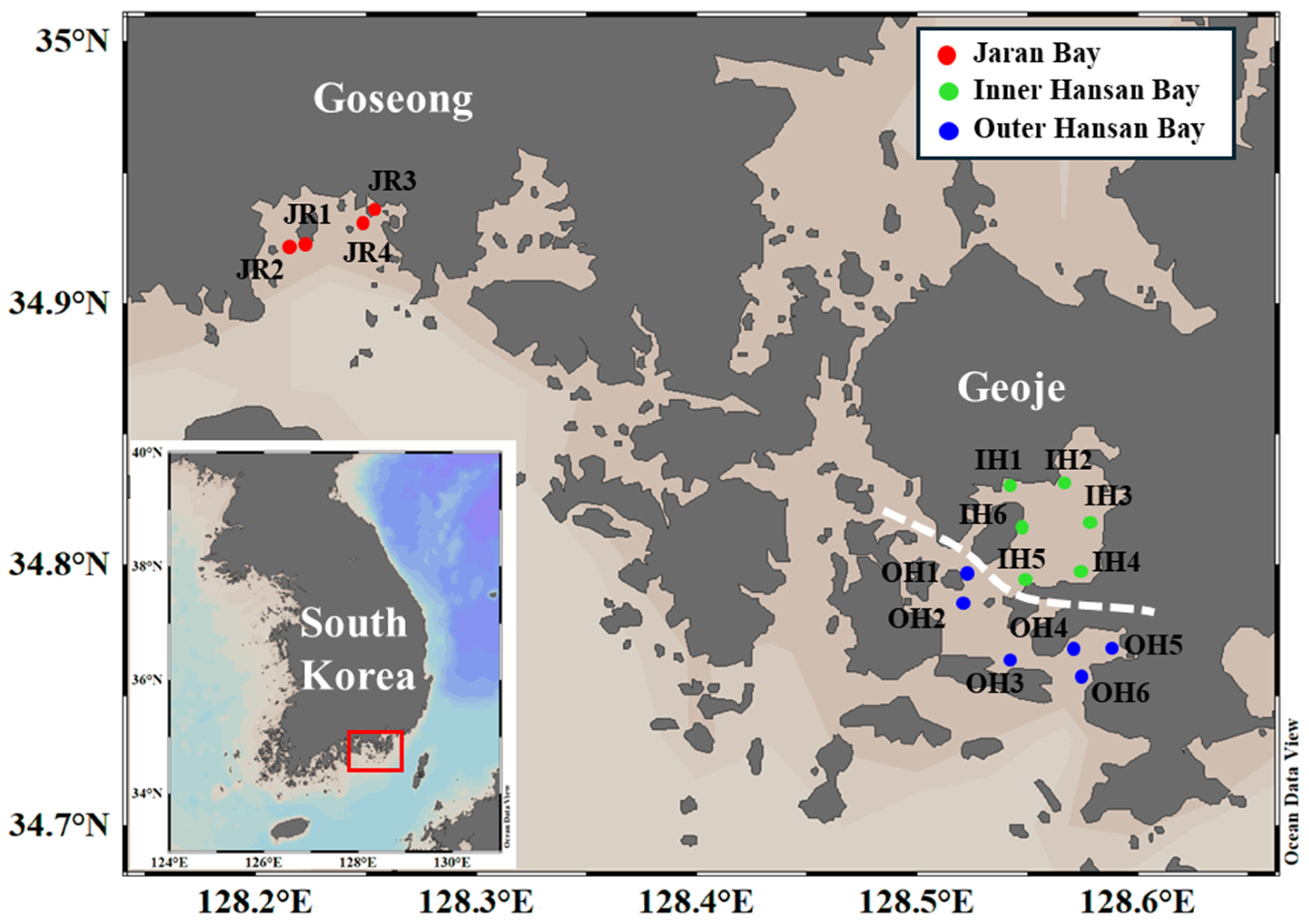
To assess seasonal and regional variations in phytoplankton communities, field sampling was conducted in Jaran Bay (Goseong) during May, August, and October of 2020; inner Hansan Bay (Geoje) during the same seasons in 2022; and in outer Hansan Bay (Geoje) in 2023 (Figure 1). Sampling was carried out at 4 stations in Jaran Bay, 6 stations in inner Hansan Bay, and 6 stations in outer Hansan Bay (Supplementary Table S1). Hansan Bay is subdivided into an inner bay that is largely enclosed by surrounding land and an outer bay with greater water exchange with the open sea. At each station, seawater samples for phytoplankton pigment analysis were collected as single, non-replicated discrete samples using a 10 L Niskin bottle at the 100% and 1% photosynthetically active radiation (PAR) depths, as determined from Secchi disk measurements. Temperature and salinity were measured in situ using a portable multiparameter instrument (YSI Pro30, YSI Corp., Yellow Springs, OH, USA). The exact sampling depths (m) corresponding to these light levels at each station are provided in Supplementary Table S1.

2.2. Size-Fractionated Chlorophyll a (Chl-a) Concentration

To determine size-fractionated Chl-a concentrations, 500 mL of seawater was sequentially filtered through 20 μm and 2 μm membrane filters, followed by a 47 mm glass fiber filter (GF/F; Whatman, Maidstone, UK). All filters were stored at −80 °C to minimize photodegradation until analysis. Chl-a was extracted in the dark at 4 °C for 21–24 h using 90% acetone, following the procedure described by Parsons et al. [33]. The extracts were subsequently filtered through a 0.2 μm polyethylene syringe filter, and Chl-a concentrations were quantified using a fluorometer (10-AU, Turner Design, San Jose, CA, USA). The proportional contribution of each size fraction was calculated relative to the total Chl-a concentration.
Size-fractionated phytoplankton were operationally defined based on filtration during sample processing. Large-sized phytoplankton were defined as particles retained on 20 μm pore-size filters (>20 μm), while small-sized phytoplankton were defined as particles passing through the 20 μm filter and retained on GF/F filters (<20 μm). This size classification reflects the effective particle size retained during filtration, rather than the morphological size of individual cells.

2.3. Phytoplankton Pigment Analysis

For the analysis of total photosynthetic pigments, 1 L of water was filtered through a 47 mm GF/F filter. For size-fractionated pigment analysis, 1.5–2 L of seawater was sequentially filtered through a 47 mm membrane filter with a pore size of 20 μm, followed by a GF/F filter. All filters were immediately wrapped in aluminum foil and stored at −80 °C until analysis to minimize pigment degradation prior to analysis.
Pigments were extracted with 5 mL of 100% acetone, and canthaxanthin (100 µL) was added as an internal standard to account for potential losses during extraction and cell disruption. Cell disruption was achieved by sonication for 1 min, followed by pigment extraction for 24 h in the dark at 4 °C. The extracts were filtered through a 0.2 μm polytetrafluoroethylene (PTFE) syringe filter and centrifuged at 3500 rpm for 10 min to remove particulate impurities. For HPLC analysis, 1 mL of the supernatant was mixed with 300 μL of distilled water, and pigment separation was performed using an Agilent Infinity 1260 HPLC system (Santa Clara, CA, USA) with a Zabrax Eclipse XDB C8 column (250 × 4.6 mm, 5 µm), following the modified method of Zapata et al. [34]. Individual pigments were identified by comparing retention times with those of commercially available pure standards of chlorophyll a (Chl-a), chlorophyll b (Chl-b), β-carotene (β-Car), fucoxanthin (Fuco), prasinoxanthin (Pras), 19′-hexanoyloxyfucoxanthin (Hex), diadinoxanthin (Diad), 19′-butanoyloxyfucoxanthin (But), peridinin (Peri), alloxanthin (Allo), neoxanthin (Neo), violaxanthin (Viol), lutein (Lut) and zeaxanthin (Zea) (DHI, Institute for Water and Environment, Denmark). Calibration curves derived from these standards were used to quantify pigment concentrations.
The concentration of each pigment was calculated using the equation described by Lee et al. [35]:
Concentration   =   Area   ×   Rf   ( Ve / Vs )   [ ng   L 1 ]
  • Area = the peak area of the pigment in the sample,
  • Rf = the standard response factor derived from the standard pigment injection,
  • Ve = the adjusted volume of the IS,
  • Vs = the volume of the filtered water sample.
Phytoplankton community composition was estimated using the CHEMTAX program [8,36], which allocates Chl-a to different phytoplankton groups (Diatoms, Cyanobacteria, Chlorophytes, Pelagophytes, Prasinophytes, Dinoflagellates, Cryptophytes, and Prymnesiophytes) based on group-specific pigment ratios. Initial pigment-to-Chl-a ratios were selected from regional and literature-based values relevant to temperate coastal waters and iteratively optimized by CHEMTAX to minimize residual error [35]. The resulting group contributions represent pigment-based estimates expressed as chlorophyll-a equivalents rather than direct biomass measurements.

2.4. Pigment Indices

Chl-a and various accessory pigments specific to distinct phytoplankton groups were analyzed to characterize community composition [36,37,38,39]. To estimate the relative contributions of three pigment-based phytoplankton size classes (fmicro, fnano and fpico), DPA was applied using seven diagnostic pigments: Fuco, Peri, Hex, But, Allo, Chl-b, Zea (Table 1) [4,10,11,18]. Size class contributions were calculated using weighting factors derived for the East China Sea, as reported by Sun et al. [40]. Pigment indices were further calculated to evaluate the relative contributions of chlorophyll and carotenoids to the total pigment pool [11,41,42]. Carotenoid pigments were classified into photosynthetic carotenoids (PSC) and photoprotective carotenoids (PPC), and the PPC:PSC ratio and the photoprotection index (PI) were calculated as defined in Table 1.

2.5. Statistical Analysis

To assess the statistical significance of regional and seasonal variations in phytoplankton communities, Pearson’s correlation analysis, Mann–Whitney U test, and Kruskal–Wallis test were performed using the “stats” package in R (version 4.3.2). The Mann–Whitney U test and Kruskal–Wallis test (with an alpha level of <0.05) were utilized to identify statistically significant differences among seasons, regions, size-fractionated data. To examine the nonlinear relationship between phytoplankton community contributions and temperature, generalized additive models (GAMs) were applied using the equation Y = α + s(X), where Y represents the contribution to Chl-a, and X represents temperature. To prevent overfitting, the maximum basis dimension (k) was set to 5. GAM analyses were performed using the “mgcv” package in R.

3. Results

3.1. Seasonal and Regional Variability of Chl-a Concentration

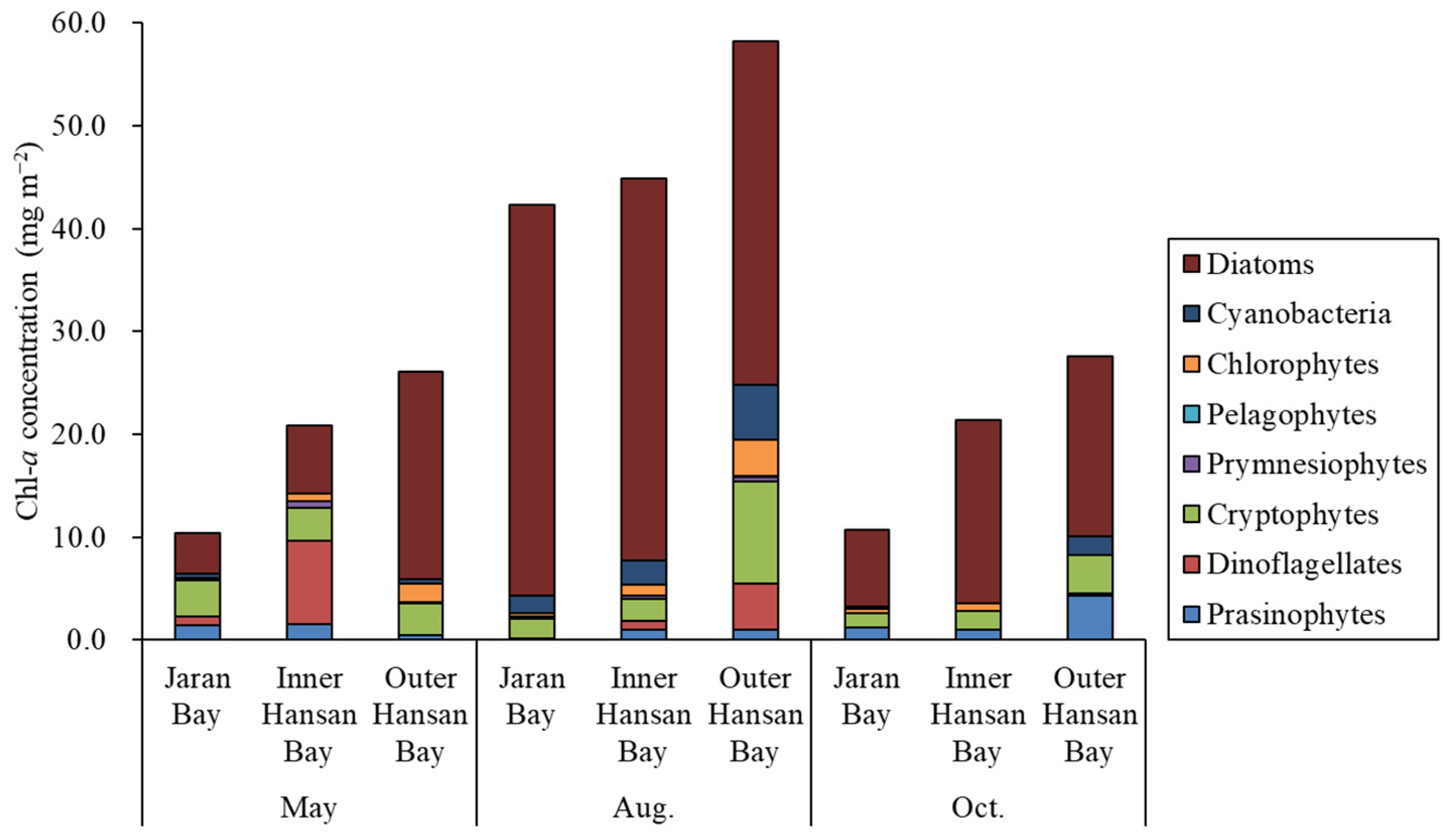
Phytoplankton community structure was inferred from pigment-derived group contributions estimated using the CHEMTAX algorithm. The group contributions shown in Figure 2, Figure 3 and Figure 4 represent Chl-a–based estimates (chlorophyll equivalents) rather than direct biomass measurements and therefore reflect relative changes in phytoplankton community structure. For each station, Chl-a concentrations measured at the surface and at the 1% light depth were integrated to represent the euphotic-zone inventory. Depth-integrated chlorophyll-a is used as a proxy for relative phytoplankton biomass under the shallow euphotic depths (<10 m) and the well-mixed hydrographic conditions observed during the study period, as evidenced by the vertical temperature and salinity profiles (Supplementary Figure S2). During the study period, the depth-integrated Chl-a concentrations in August compared to May and October (Kruskal–Wallis test, p < 0.01; Figure 2). This summer maximum was consistently observed in Jaran Bay, inner Hansan Bay, and outer Hansan Bay, indicating enhanced phytoplankton biomass during the warm season. Regionally, outer Hansan Bay consistently exhibited the highest integrated Chl-a concentrations throughout all seasons (Figure 2)

3.2. Phytoplankton Community Structure

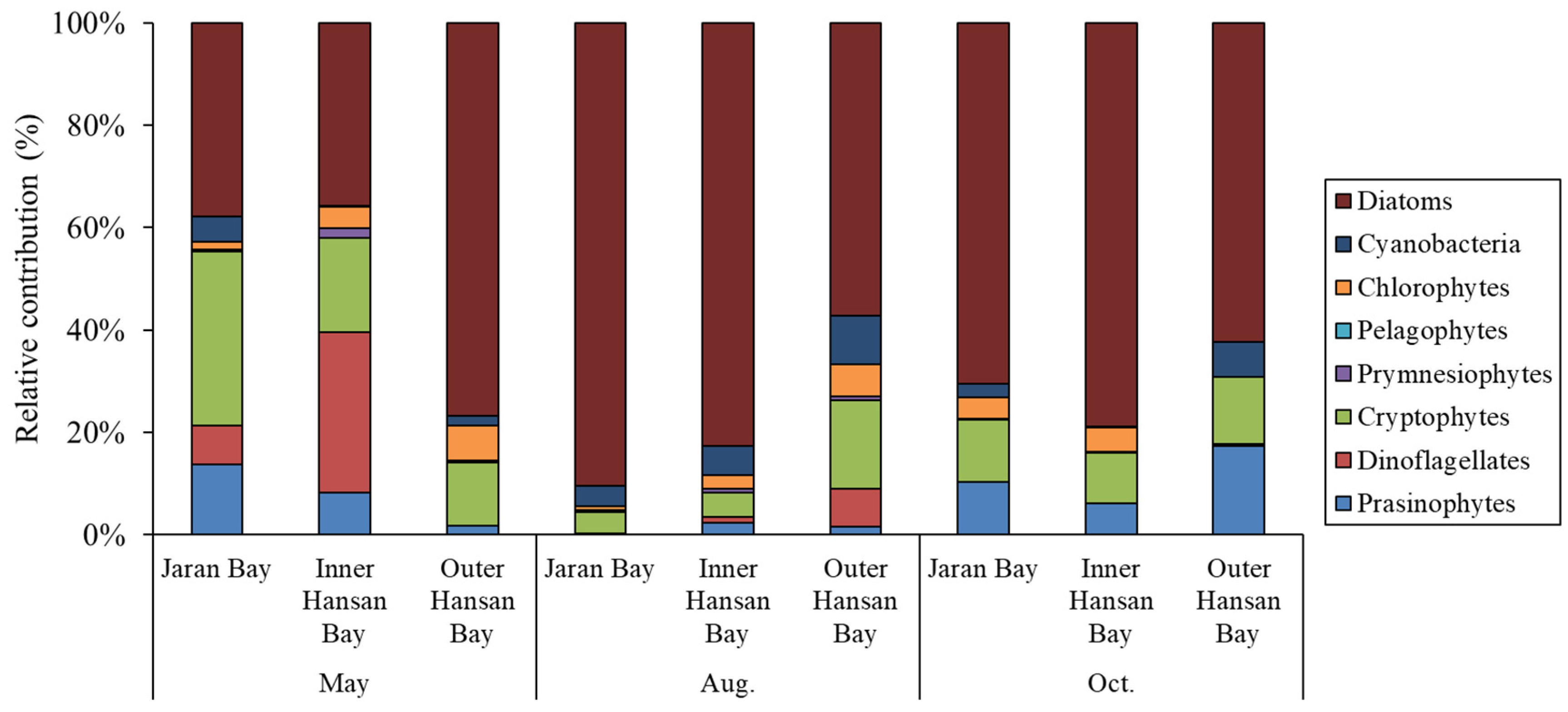
Across the study area, the major phytoplankton communities were dominated by diatoms, followed in decreasing order by cryptophytes, prasinophytes, dinoflagellates, cyanobacteria, chlorophytes, prymnesiophytes, and pelagophytes (Figure 3 and Figure 4). While diatoms consistently represented the major taxonomic group, their relative contribution exhibited clear seasonal and regional variability.
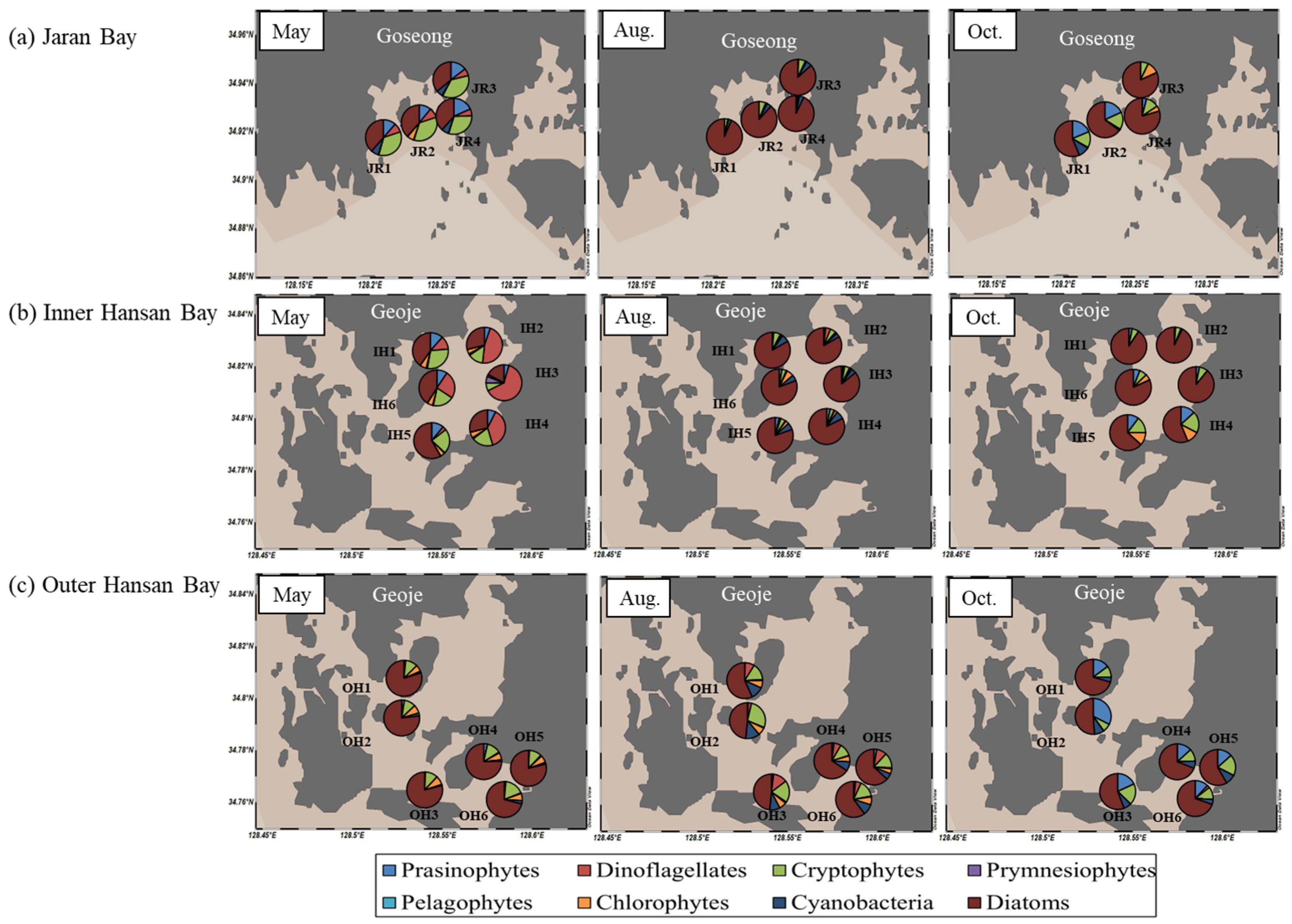
In Jaran Bay, phytoplankton communities showed pronounced seasonal shifts (Figure 3). In May, the community was relatively diverse, with diatoms co-dominating alongside cryptophytes and prasinophytes. By August, diatoms became overwhelmingly dominant, accounting for 90.4 ± 3.4%, while cryptophytes and cyanobacteria contributed only minor fractions. In October, diatoms dominance weakened slightly, accompanied by increased contributions from cryptophytes and prasinophytes. Although there was no noticeable spatial distribution of the phytoplankton community in May and August, a higher contribution of prasinophytes was observed in the western stations (JR1 and JR2) in October (Figure 4a).
In the inner Hansan Bay, diatoms and dinoflagellates were equally abundant in May, followed by cryptophytes and prasinophytes (Figure 3). A clear east–west contrast was evident, with dinoflagellates dominating eastern stations and diatoms prevailing in western stations (Figure 4b). During August, diatoms became strongly dominant across the bay, with some modest increase in cyanobacteria and cryptophytes. In October, diatoms remained dominant group, but cryptophytes and prasinophytes increased in relative abundance, particularly in the southern stations (Figure 4b).
In outer Hansan Bay, diatoms dominated the phytoplankton community throughout the study period, although their relative contribution varied seasonally (Figure 4c). In August, the contribution of diatoms decreased markedly, coinciding with increases in cryptophytes, cyanobacteria, and emergence of dinoflagellates. By October, diatoms remained the most dominant group, while prasinophytes increased significantly compared to earlier seasons.

3.3. Size-Fractionated Chl-a Concentration and Phytoplankton Community Structure

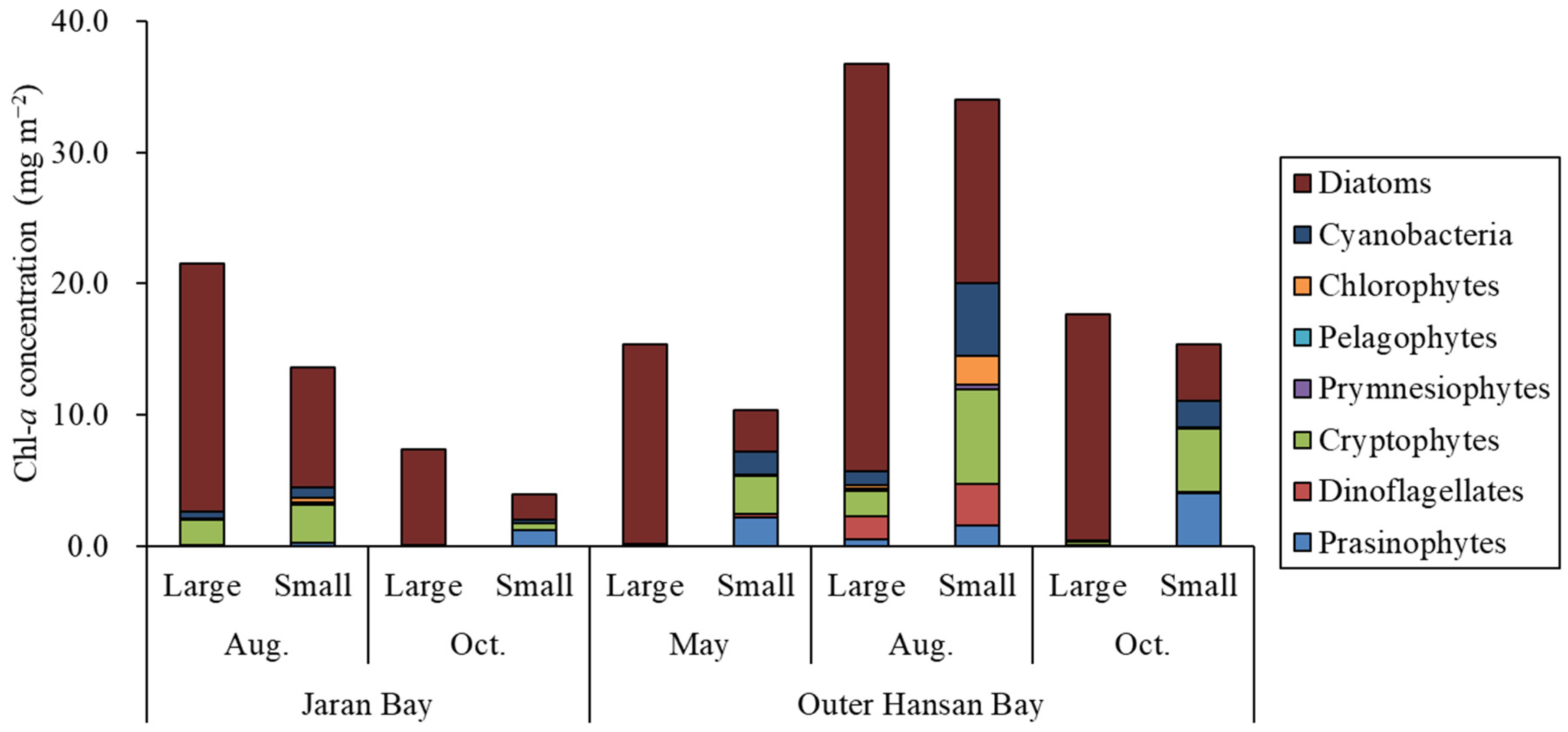
Size-fractionated Chl-a concentrations and associated phytoplankton community compositions are shown in Figure 5, based on Chl-a–derived group contributions estimated using CHEMTAX. These values represent Chl-a–based estimates of group contributions within the large (>20 µm) and small (<20 µm) size fractions.
In both Jaran Bay and outer Hansan Bay, depth-integrated Chl-a concentration were consistently higher in the large-sized phytoplankton fraction than in the small-sized fraction (Figure 5), indicating a dominant contribution of large phytoplankton to total chlorophyll pools in both regions.
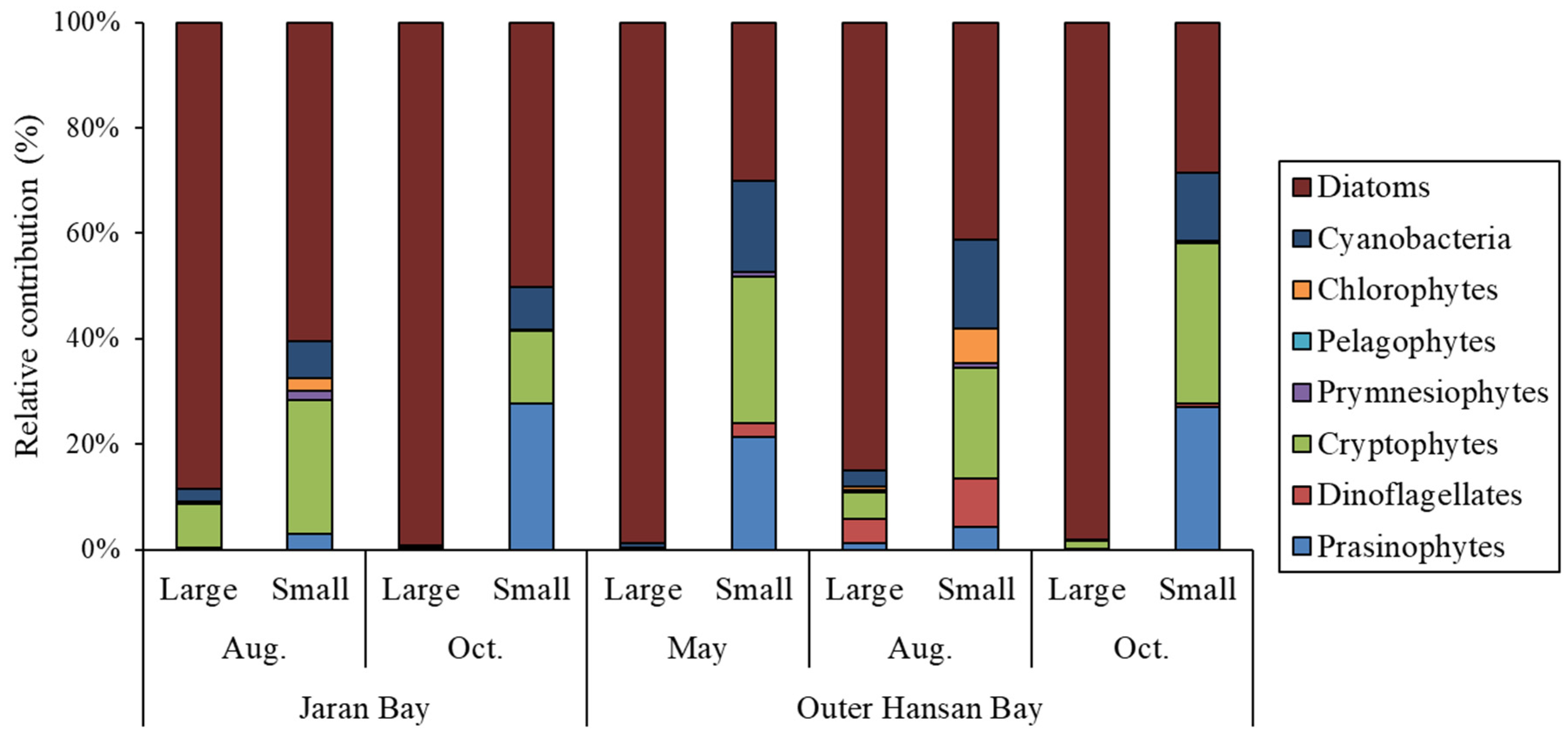
The large-sized phytoplankton community in Jaran Bay and outer Hansan Bay was predominantly composed of diatoms, which accounted for more than 80% of the large-size fraction throughout the study period. Cryptophytes represented the primary secondary group, particularly during summer, while other phytoplankton groups contributed only minor proportions. In contrast, the small-sized phytoplankton community exhibited greater taxonomic diversity. Although diatoms remained the dominant group, their relative contribution varied seasonally, with cryptophytes, prasinophytes, and cyanobacteria forming substantial proportions of the small-size fraction, especially during summer.
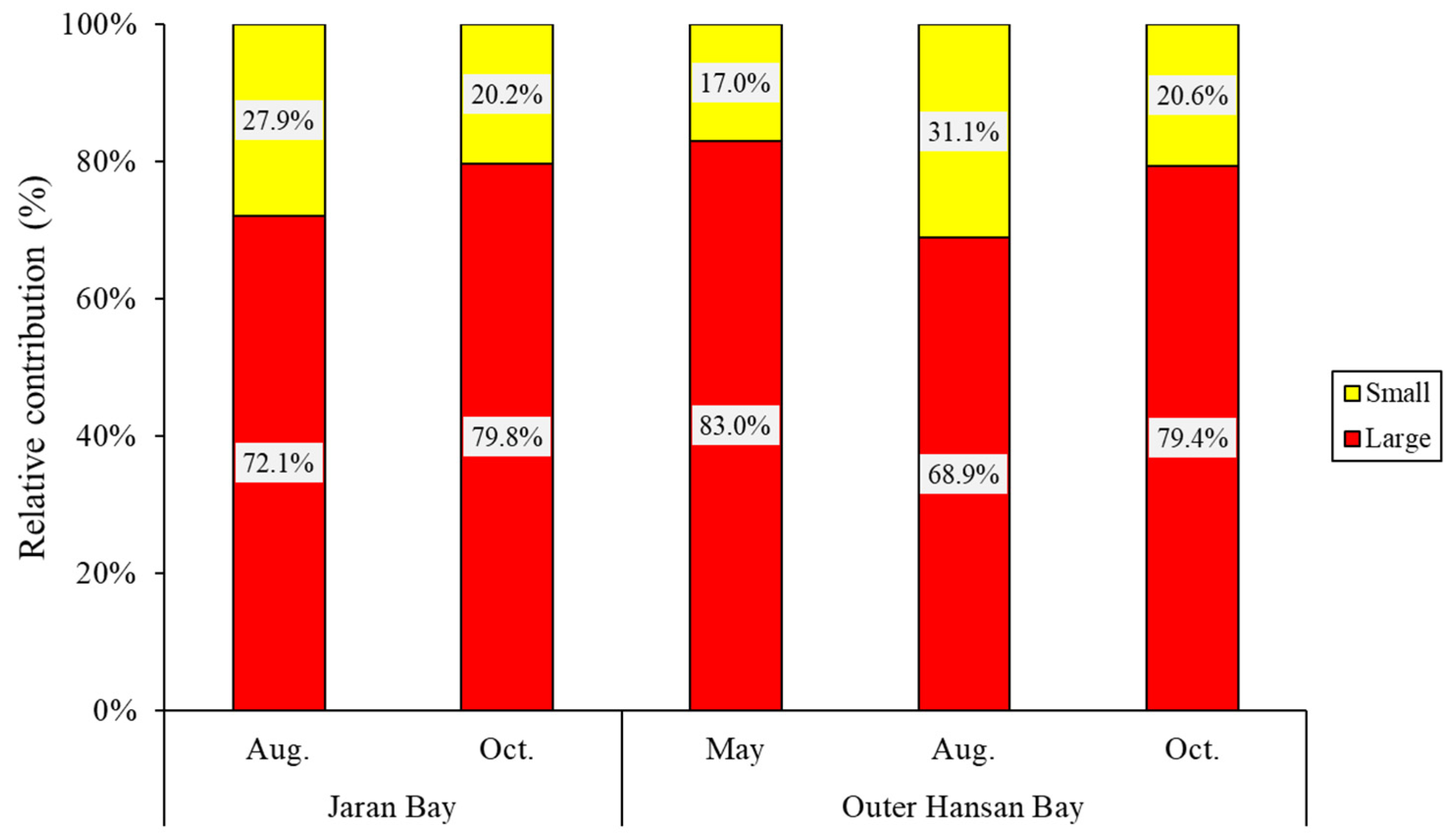
The contribution of diatoms was significantly higher in large-sized fraction than in the small-sized fraction (Mann–Whitney U test, p < 0.01). While diatom dominance in the large-sized fraction did not vary significant among seasons, their contribution to the small-sized fraction increased significantly in August compared to other seasons (Kruskal–Wallis test, p < 0.05) (Figure 6).

3.4. Seasonal Variation in the Size Structure of Diatoms

In both Jaran Bay and outer Hansan Bay, the concentrations of large- and small-sized diatoms showed clear seasonal variability, significantly higher values observed in August compared to other months (Mann–Whitney U test, p < 0.05; Figure 5).
The relative contributions of small-sized diatoms to total diatom concentrations varied seasonally in both bays. In both regions, the proportion of small-sized diatoms was highest in August, followed by a decline in October (Figure 6). Across the study period, the average contribution of small-sized diatoms in Jaran Bay and outer Hansan Bay was 23.8 ± 8.7%, with no significant spatial differences between the two bays (Figure 7).
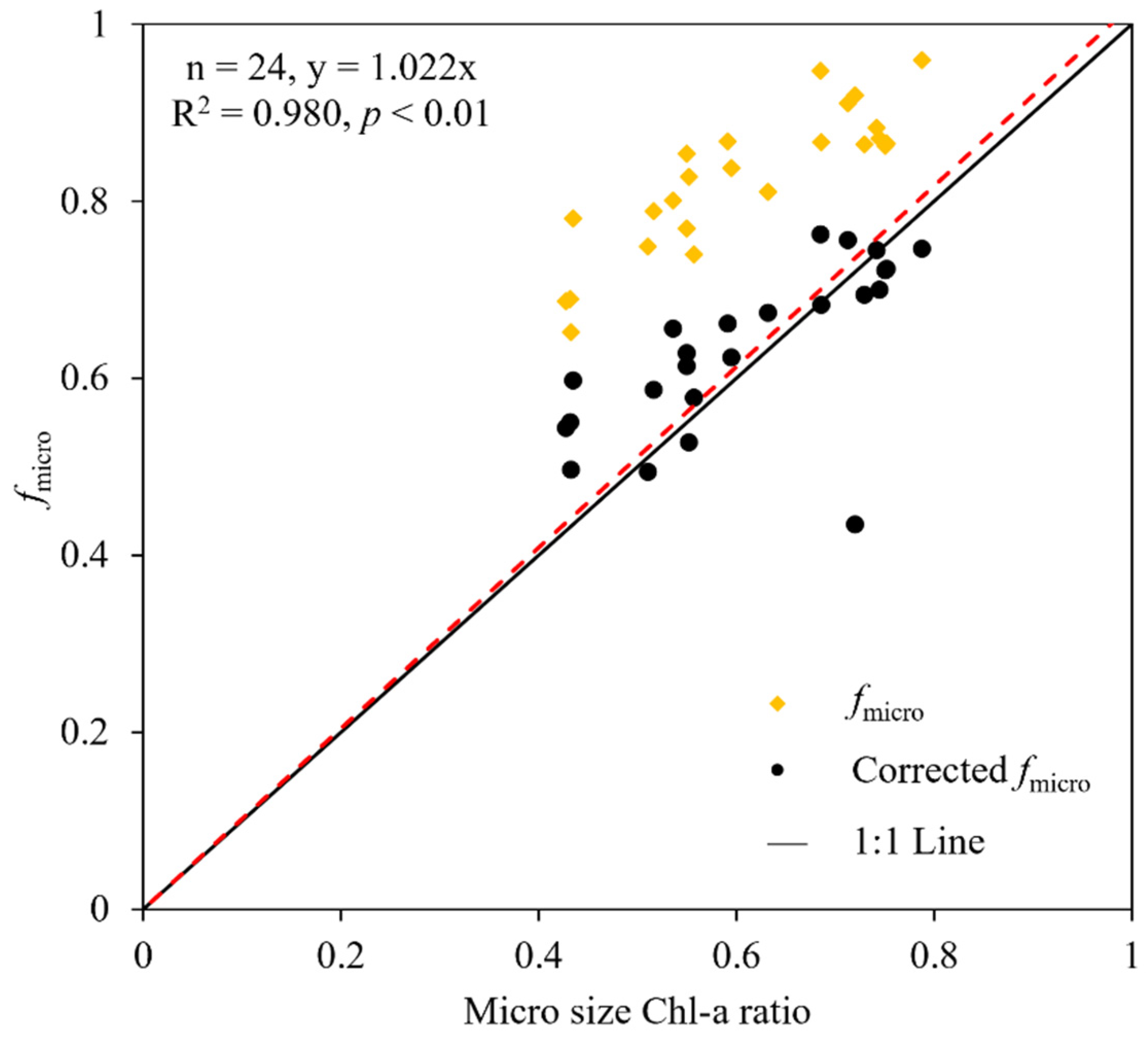
To evaluate the effect of small-sized diatoms on DPA-based size estimates, the contribution of fucoxanthin associated with small-sized diatoms (<20 µm) was estimated using the average proportion of small-sized diatoms derived from size-fractionated Chl-a measurements. This estimated fraction was then subtracted from the total fucoxanthin pool prior to calculating fmicro, such that only the fucoxanthin attributed to large-sized diatoms (>20 µm) was retained in the fmicro calculation as below.
Fucomicro = Fucototal × (1 − Psmall diatoms)
where Psmall diatoms represents the average fractional contribution of small-sized diatoms estimated from size-fractionated Chl-a measurements.
This adjustment resulted in a significantly improved agreement between fluorometric and pigment-based estimates of the microphytoplankton fraction, as reflected by the regression line closely following the 1:1 line (p < 0.01, R2 = 0.980; Figure 8).

3.5. Total Phytoplankton Pigment Indices

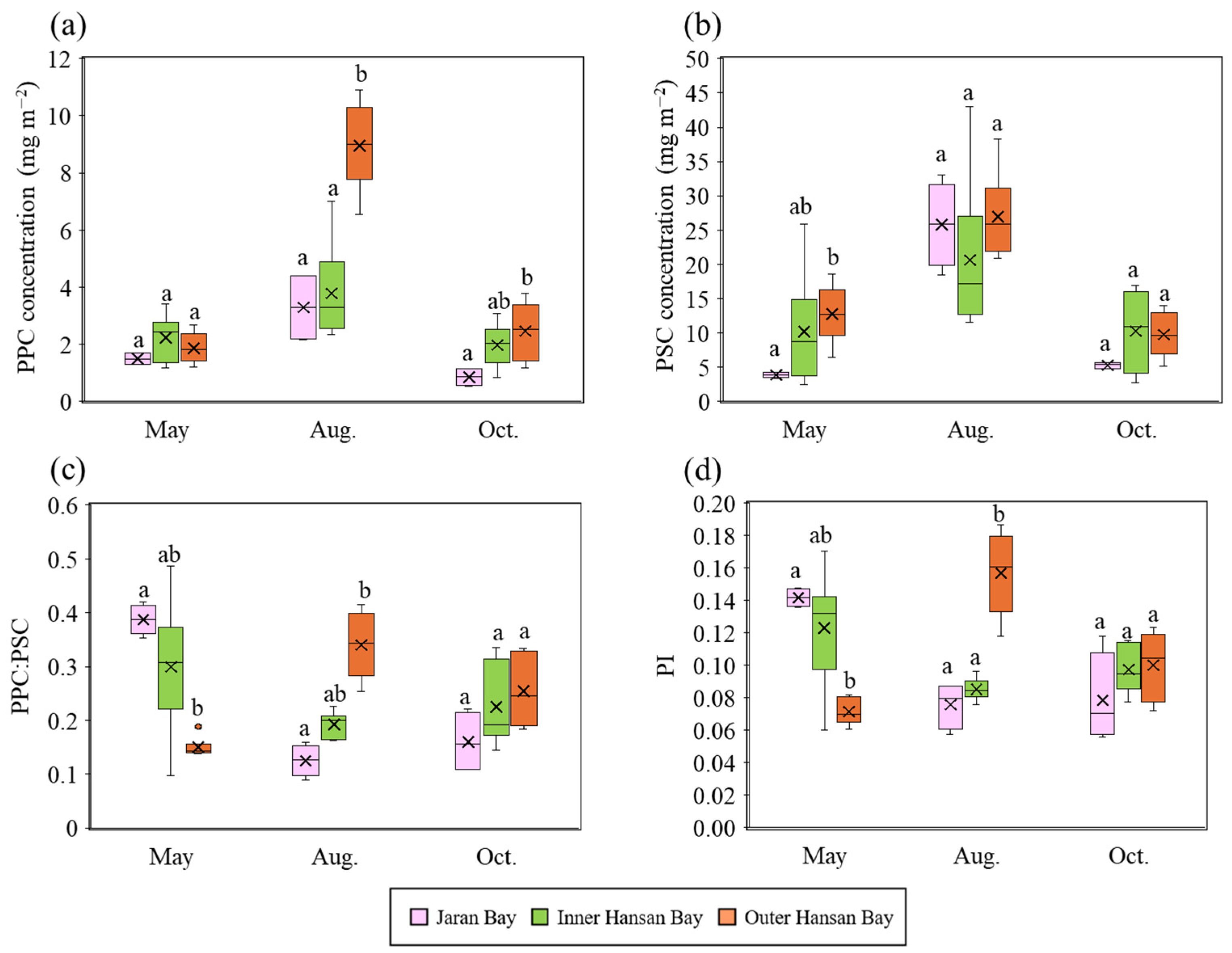
Across all study areas, PPC exhibited strong seasonal variability, peaking in August and declining toward October (Figure 9a). PPC values were consistently highest in outer Hansan Bay, where August concentrations were approximately twice those observed in Jaran Bay and inner Hansan Bay. While no significant regional differences were detected in May, PPC differed significantly among bays in August and October (Kruskal–Wallis test, p < 0.05).
PSC also showed their highest values in August across all regions and significantly higher than in other seasons (Mann–Whitney U test, p < 0.01) (Figure 9b). Regional differences in PSC were evident in May, particularly between Jaran Bay and outer Hansan Bay (Mann–Whitney U test, p < 0.05), whereas no significant spatial differences in PSC values were observed during August and October (Kruskal–Wallis test, p > 0.05).
The PPC:PSC ratio, an indicator of stratification and trophic status, remained consistently below 1 throughout the study period, reflecting the dominance of PSC over PPC (Figure 9c). Seasonal trends in PPC:PSC ratios differed among bays, with pronounced increases in August in outer Hansan Bay, while Jaran Bay and inner Hansan Bay showed their lowest ratios during summer.
PI also showed clear seasonal and regional variability (Figure 9d). PI values decreased from May to August in Jaran Bay and inner Hansan Bay, whereas outer Hansan Bay exhibited a pronounced increase in August followed by a decline in October. Overall, PI showed a strong positive correlation with the PPC:PSC ratio (Spearman correlation, p < 0.01; ρ = 0.892).

3.6. Size-Fractionated Phytoplankton Pigment Indices

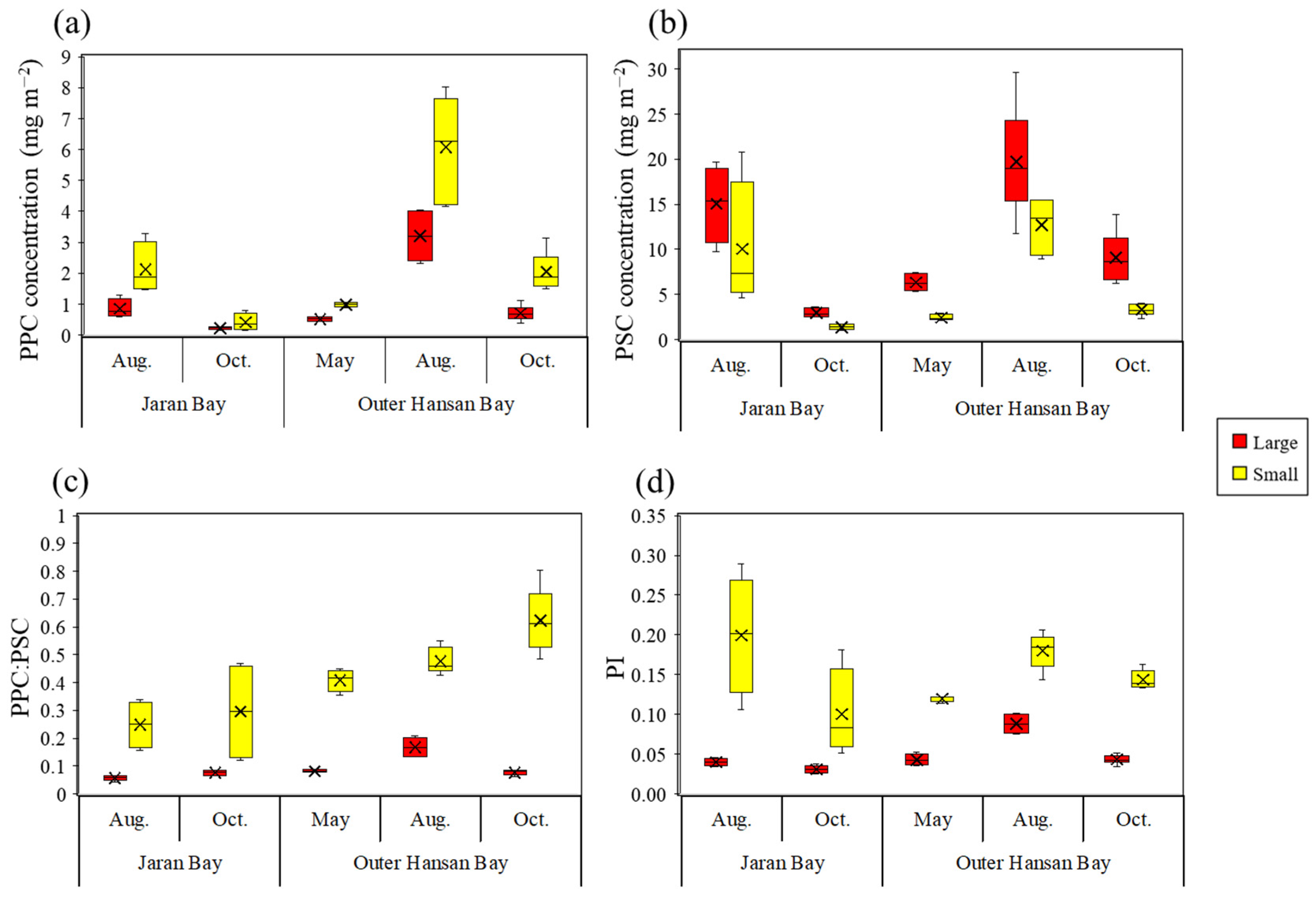
Across both Jaran Bay and outer Hansan Bay, the depth-integrated PPC concentrations were consistently higher in small-sized phytoplankton compared to large-sized phytoplankton (Figure 10a). This size-dependent contrast was most pronounced in August, when small-sized fraction had a significantly higher PPC relative to large-sized fractions (Mann–Whitney U test, p < 0.05). PPC concentrations in both size classes declined toward October, with reduced differences between size fractions in Jaran Bay, whereas small-sized phytoplankton in outer Hansan Bay maintained significantly higher PPC throughout the study period. In contrast, the depth-integrated PSC concentrations were significantly higher in large-sized phytoplankton (Mann–Whitney U test, p < 0.01), particularly during summer (Figure 10b). PSC peaked in August for both size classes in both bays and declined toward October (Kruskal–Wallis test, p < 0.01). Seasonal variability in PSC was more pronounced than spatial variability, especially during peak summer conditions.
The PPC:PSC ratio for both large- and small-sized phytoplankton remained consistently below, indicating the dominance of photosynthetic carotenoids across all seasons (Figure 10c). However, small-sized fractions exhibited significantly higher PPC:PSC ratios than large-sized phytoplankton throughout the study (Mann–Whitney U test, p < 0.01), with the highest values observed in outer Hansan Bay during August and October. Similarly, the PI was consistently higher in small-sized phytoplankton than in large-sized phytoplankton throughout the study periods (Mann–Whitney U test, p < 0.01) (Figure 10d). PI values peaked in August, particularly in outer Hansan Bay, and decreased toward October, highlighting clear size-dependent differences in photophysiological responses to seasonal environmental conditions.

4. Discussion

4.1. Spatio-Seasonal Phytoplankton Dynamics

Pigment analysis demonstrated pronounced seasonality in Chl-a concentrations, with a maximum consistently observed in August across all study areas. The high summer Chl-a concentrations are characteristics of shallow estuaries and coastal bays adjacent to land, where monsoonal rainfall and terrestrial inputs are known to increase nutrient availability [43,44,45].
Among the studied bays, Chl-a concentrations were highest in outer Hansan Bay, followed by inner Hansan Bay and Jaran Bay. The Chl-a concentrations in May and October are consistent with previously reported ranges for Jaran Bay (5.2–36.7 mg m−2) [24] and Hansan Bay (11.99–30.37 mg m−2) [23]. Phytoplankton communities in these coastal systems are generally dominated by diatoms and dinoflagellates [46,47]. In the present study, diatoms consistently dominated throughout the sampling period, while cryptophytes occasionally emerged as subdominant contributors. The distinct phytoplankton structure observed in inner Hansan Bay during May is likely attributable to a spatial heterogeneity in hydrographic conditions and localized anthropogenic influences. Inner Hansan Bay is characterized by restricted water exchange, shallow depths, and intensive aquaculture activity, which can potentially lead to uneven nutrient distributions and variable residence times across stations. Previous studies in this region have shown that such conditions promote localized blooms and allow different phytoplankton groups (e.g., diatoms versus dinoflagellates or cryptophytes) to dominate depending on small-scale differences in nutrient availability, stratification, and grazing pressure [24,29].
In August, diatoms contributed more than 80% of the phytoplankton community in both Jaran Bay and inner Hansan Bay, representing their seasonal maximum. This pattern is consistent with summer diatom dominance reported in other southern Korean coastal systems, such as Gamak Bay (76%) and Jinhae Bay (78.6%) [48,49]. In contrast, diatom contributions in outer Hansan Bay declined to their lowest levels in August (57.1%), despite comparable absolute diatom concentrations across bays. Notably, August water temperatures (26.2–27.9 °C) in the euphotic zone of outer Hansan Bay were significantly higher than those in Jaran Bay and inner Hansan Bay (Kruskal–Wallis test, p < 0.01; Figure S1). These elevated temperatures likely exceeded the upper thermal tolerance of diatoms, which are known to experience reduced growth and competitive ability above ~25 °C [50], thereby allowing cryptophytes and cyanobacteria to increase in relative abundance.
Cryptophytes, identified as a recurrent subdominant group in this study, are known for their ubiquitous distribution and ability to thrive in broad range of nutrient conditions [51,52]. The sporadic increases in cryptophyte contributions observed in Jaran Bay during May and in outer Hansan Bay during August suggest a strong capacity to exploit variable environmental conditions [53]. Previous studies in Hansan Bay have indicated N:P ratio generally lower than the Redfield ratio (16), except during spring [23]. Such low N:P conditions may constrain cryptophyte growth, as these taxa are particularly sensitive to nitrogen availability, particularly ammonia, potentially rendering them less competitive than diatoms in low N:P environmental conditions [54,55,56].

4.2. Size-Fractionated Chl-a and Diatom Size Distributions Within Phytoplankton Communities

Across all studied bays, Chl-a concentrations were consistently higher in large-sized phytoplankton compared to small-sized phytoplankton. Community contributions derived using the CHEMTAX program indicated that diatoms accounted for over 85% of the large-sized phytoplankton communities in both Jaran Bay and outer Hansan Bay. Although various communities were observed within the small-sized phytoplankton fraction, diatoms were consistently identified as either the dominant or subdominant group.
The average contribution of small-sized diatoms in Jaran Bay and outer Hansan Bay (23.8 ± 8.7%) was notably lower than that reported for the Yellow Sea, where small-sized diatoms comprised 62.3 ± 12.9% of the total diatom community in 2019 [15]. This contrast underscores pronounced regional differences in diatom size structure, which can substantially influence photosynthetic efficiency and carbon fixation capacity [57,58]. Accordingly, understanding the size structure of phytoplankton and its variability in response to environmental changes is ecologically important. In the present study, size-fractionated pigment analysis confirmed the presence of diatoms within the small-sized phytoplankton fraction. This finding contrasts with earlier studies that largely classified diatoms exclusively as microphytoplankton (>20 µm) based on DPA [18,42,59]. These results suggest that diatoms can span a broader range of size classes and may exhibit size plasticity under varying environmental conditions.
Across all seasons and regions, microphytoplankton consistently dominated both fluorometric and DPA-based approaches. However, direct comparison of these two methods revealed that DPA tended to overestimate microphytoplankton contributions while underestimating nano and picophytoplankton fractions. This discrepancy, also reported for the Yellow Sea [15], likely arises from the conventional DPA calculation, which does not account for the contribution of small-sized diatoms and their marker pigment, fucoxanthin. Incorporating the contribution of small-sized diatoms into the fucoxanthin weighting could improve the accuracy of fmicro estimates and yield results more consistent with independent size-fractionated observations.
This apparent discrepancy can be further explained by the morphological characteristics of dominant diatom taxa in the study area. Although species-level identification was not conducted in the present study, previous investigations in Jaran Bay, Hansan Bay, and adjacent southern Korean coastal waters have consistently reported Chaetoceros spp. as the dominant diatom group, often accounting for more than ~40% of the total phytoplankton community and reaching 60–80% during highly productive periods [47,60,61]. Species of the genus Chaetoceros are characterized by filamentous or chain-forming colonies connected by siliceous setae. While individual cells typically range from approximately 5 to 20 µm in size, the overall dimensions of colonies frequently exceed 20 µm [62,63]. Consequently, depending on colony integrity during sampling and filtration, the same species may be distributed across both large (>20 µm) and small (<20 µm) size fractions. This morphological plasticity provides a plausible explanation for the substantial contribution of diatoms observed within the small-sized phytoplankton fraction in the present study and helps explain the tendency for DPA based on fucoxanthin to overestimate microphytoplankton contributions.
The systematic overestimation of microphytoplankton by DPA observed in this study highlights a limitation of the conventional size-class schemes that assign fucoxanthin exclusively to the microphytoplankton pool. Our findings demonstrate that a substantial proportion of fucoxanthin in coastal environments can originate from small-sized diatoms (<20 µm), leading to the overestimated microphytoplankton contribution and corresponding underestimation of nano and picophytoplankton fractions. To improve DPA-based size-class estimates, a modified approach could be adopted in which fucoxanthin is partitioned between micro and nano and picophytoplankton fractions using empirically derived weighting factors based on independent size-fractionated Chl-a measurements. Conceptually, this approach would allow the contribution of fucoxanthin from small-sized diatoms to be reassigned to the nano and picophytoplankton pool, thereby reducing bias in fmicro estimates. Future studies integrating HPLC-based pigment analysis with direct observational techniques, such as imaging flow cytometry or microscopy-based size measurements, will be essential to further validate and refine pigment-based size classification schemes in aquaculture-dominated coastal systems. Recent studies have increasingly emphasized the ecological significance of small-sized diatoms, indicating that diatoms can occupy both micro and nanophytoplankton size categories [64,65,66,67]. Furthermore, diatom size distributions have been shown to respond to temperature, with a gradual shift toward smaller cell sizes under warming conditions [68,69]. Consistent with these findings, this study identified a positive correlation between the proportion of small-sized diatoms and temperatures (Pearson’s correlation, r = 0.442, p < 0.01). Such temperature-driven shifts could promote transitions toward nano and picophytoplankton dominance as warming continues [70].
In Hansan Bay and Jaran Bay, filter-feeding organisms such as oysters (Crassostrea gigas) and sea squirts (Halocynthia roretzi) selectively graze phytoplankton based on cell size. Oysters primarily consume micro-sized diatoms, whereas sea squirts preferentially exploit nano and picophytoplankton [71,72]. Consequently, shifts in phytoplankton size structure, such as an increase in the relative contribution of small-sized diatoms under elevated temperatures, could significantly influence aquaculture systems. Oysters, which efficiently retain and assimilate larger diatom cells and chains, may experience reduced feeding efficiency and growth as phytoplankton communities shift toward smaller diatom forms. In contrast, sea squirts, which are capable of exploiting nano and picophytoplankton, may be less negatively affected or potentially favored under such conditions. As a result, warming-driven changes in phytoplankton size structure could alter food availability and trophic efficiency in aquaculture-dominated bays, with implications for species-specific growth performance and ecosystem carrying capacity. Given the ongoing rise in sea surface temperatures along the Korean coast [73,74], adaptive adjustments in aquaculture practices and fisheries management strategies may be required to sustain productivity in Hansan Bay and Jaran Bay.

4.3. PPC and PSC as Indicators of Phytoplankton Productivity and Environmental Conditions

PPC and PSC are widely used indicators of shifts in the functional composition and physiological status of phytoplankton communities under varying environmental conditions [11,12]. Higher PPC proportions are typically associated with high light condition and environmentally stressful conditions, reflecting the phytoplankton’s need for photoprotection against oxidative stress [39,75,76,77]. In contrast, lower PPC proportions and PI values generally indicate more efficient photosynthesis and enhanced primary productivity. Accordingly, these pigment-based indices provide valuable insights into phytoplankton physiological responses to changes in habitat conditions, including variations in light availability and seasonal environmental forcing.
In this study, diatoms dominated phytoplankton communities throughout all seasons, contributing to consistently elevated fucoxanthin concentrations and resulting in PSC levels exceeding PPC, particularly during August. Significant differences in PPC:PSC ratios and PI values between August and other seasons in Jaran Bay and inner Hansan Bay are consistent with seasonal environmental changes associated with the summer monsoon during which enhanced terrestrial inputs are known to influence coastal conditions and phytoplankton physiological response [11,78]. In Outer Hansan Bay, elevated water temperatures during August likely promoted the accumulation of PPC, particularly diadinoxanthin, as a photoprotective response to increased light exposure and oxidative stress [75,79].
Across all studied bays, the averaged PPC:PSC ratio was 0.23 ± 0.10, consistently below 1, comparable to the values reported for the East Sea of Korea and indicative of high productivity [42]. The generally low PI values observed in Jaran Bay (0.05–0.14), Inner Hansan Bay (0.06–0.17), Outer Hansan Bay (0.06–0.18) were narrower and lower compared to those reported for other regions, such as Palk Bay (0.37–0.71) and the Argentinian Sea (1.00–3.12) [12,80]. These patterns likely reflect the shallow coastal environments and the dominance of large phytoplankton taxa, particularly diatoms, which are typically associated with high photosynthetic activity and productivity conditions (Figure 10) [42]. The prevalence of large-sized diatoms, known for their efficient light utilization and carbon fixation capacity, likely contributes to the relatively low PI values observed in this study.
Size-fractionated pigment analysis further revealed that large-sized phytoplankton consistently exhibited higher PSC concentrations, with diatoms representing the dominant group. This dominance resulted in elevated fucoxanthin levels and correspondingly lower PPC:PSC ratios and PI values, indicative of high photosynthetic activity and productivity. In contrast, small-sized phytoplankton exhibited relatively higher PPC proportions and PI values, typically associated with lower productivity [79,80,81,82]. These results suggest that environmental conditions favoring small-sized phytoplankton dominance may be associated with reduce overall productivity.
Overall, PPC- and PSC-based indices proved useful for assessing phytoplankton physiological status and productivity across size classes and regions. The observed differences in pigment composition between large- and small-sized phytoplankton provide critical insights into functional strategies and adaptive responses to variable light conditions in coastal ecosystems.
It should be noted that the present study was conducted in different years for each bay (Jaran Bay in 2020, inner Hansan Bay in 2022, and outer Hansan Bay in 2023), which may introduce interannual variability into spatial comparisons among study sites. Interannual fluctuations in physical forcing, nutrient supply, and hydrographic conditions are known to influence phytoplankton biomass, community composition, and size structure in coastal systems. Consequently, some of the observed differences among bays may reflect year-specific environmental conditions in addition to spatial heterogeneity.
Future studies incorporating simultaneous, multi-bay sampling within the same year will be essential to more clearly disentangle spatial effects from interannual variability and to further refine interpretations of phytoplankton physiological dynamics in southern Korean coastal waters.

5. Summary and Conclusions

This study demonstrates that phytoplankton community structure and productivity in Jaran Bay and Hansan Bay are strongly regulated by seasonal environmental variability, particularly temperature, and light conditions. Diatoms dominated the phytoplankton community across all seasons and bays, contributing substantially to Chl-a biomass, photosynthetic carotenoids, and overall primary productivity. Pronounced spatial differences emerged during summer, especially in outer Hansan Bay, where elevated temperatures exceeded the optimal thermal range for diatoms and coincided with increased contributions from cryptophytes and cyanobacteria.
Size-fractionated analyses revealed that large-sized phytoplankton, primarily diatoms, were the principal contributors to biomass and photosynthetic activity, while small-sized phytoplankton exhibited higher photoprotective pigment proportions. The substantial presence of small-sized diatoms highlights the plasticity of diatom size structure and underscores a key limitation of conventional pigment-based size classification approaches that assume diatoms are exclusively microphytoplankton. Accordingly, this study emphasizes the need to account for size variability within taxonomic groups when interpreting pigment-based size distributions.
Pigment-based indices (PSC, PPC, PPC:PSC ratio, and PI) proved useful for diagnosing seasonal and size-dependent variations in phytoplankton physiological status and productivity. Low PPC:PSC ratios and PI values reflected the dominance of large, highly productive diatoms in these shallow coastal systems, while higher values in small-sized phytoplankton indicated greater investment in photoprotection under variable light and temperature conditions. However, alternative explanations should also be considered. In coastal environments, the small-sized fraction may include not only living phytoplankton cells but also detrital material and non-living pigmented particles in addition to living phytoplankton, potentially increasing the relative contribution of photoprotective pigments. This methodological constraint may partially contribute to the higher PPC:PSC ratios observed in the <20 µm fraction. Therefore, PPC:PSC and PI are interpreted here as relative indicators of physiological state and community-level pigment composition, rather than as direct or absolute measures of productivity or light stress. Independent validation using physiological measurements (e.g., fluorescence-based photophysiology or growth rates) would be required to fully quantify these relationships and is beyond the scope of the present study.

Supplementary Materials

The following supporting information can be downloaded at: https://www.mdpi.com/article/10.3390/jmse14020206/s1, Table S1: Summary of sampling stations in Jaran Bay, inner Hansan Bay, and outer Hansan Bay, including geographical coordinates (latitude and longitude) and the exact depths (m) at which seawater samples were collected at the 100% and 1% photosynthetically active radiation (PAR) levels.; Figure S1: Vertical distribution profile of temperature in Jaran Bay, inner Hansan Bay, and outer Hansan Bay. (a) May, (b) August, (c) October.; Figure S2: Vertical distribution profile of salinity in Jaran Bay, inner Hansan Bay, and outer Hansan Bay. (a) May, (b) August, (c) October.

Author Contributions

Conceptualization, Y.H.K. and S.H.L.; methodology, Y.H.K. and S.H.L.; validation, S.H.L.; formal analysis, Y.H.K., S.M.L., J.H.K., Y.K., S.P., J.K., H.-K.J., M.J.K., Y.J.L., D.L. and J.H.L.; investigation, Y.H.K., S.M.L., J.H.K., Y.K., S.P., J.K., H.-K.J., M.J.K., H.C., Y.J.L., D.L. and J.H.L.; data curation, Y.H.K., S.M.L., J.H.K., Y.K., S.P., J.K., H.-K.J., M.J.K., H.C., Y.J.L., D.L. and J.H.L.; writing—original draft preparation, Y.H.K. and S.H.L.; writing—review and editing, Y.H.K. and S.H.L.; visualization, Y.H.K.; supervision, S.H.L.; funding acquisition, S.H.L. All authors have read and agreed to the published version of the manuscript.

Funding

This work was supported by a grant from the National Institute of Fisheries Science (NIFS; R2026049) and by the Korea Institute of Marine Science & Technology Promotion (KIMST; RS-2025-02217872; RS-2023-00256330), funded by the Ministry of Oceans and Fisheries.

Data Availability Statement

Data are contained within the article and Supplementary Materials.

Acknowledgments

We would like to thank the researchers in the NIFS for their assistance with sample analysis.

Conflicts of Interest

The authors declare that they have no competing interests.

References

  1. Fenchel, T. Marine plankton food chains. Annu. Rev. Ecol. Syst. 1988, 19, 19–38. [Google Scholar] [CrossRef]
  2. Legendre, L.; Rassoulzadegan, F. Food-web mediated export of biogenic carbon in oceans: Hydrodynamic control. Mar. Ecol. Prog. Ser. 1996, 145, 179–193. [Google Scholar] [CrossRef]
  3. Berglund, J.; Müren, U.; Båmstedt, U.; Andersson, A. Efficiency of a phytoplankton-based and a bacterial-based food web in a pelagic marine system. Limnol. Oceanogr. 2007, 52, 121–131. [Google Scholar] [CrossRef]
  4. Claustre, H. The trophic status of various oceanic provinces as revealed by phytoplankton pigment signatures. Limnol. Oceanogr. 1994, 39, 1206–1210. [Google Scholar] [CrossRef]
  5. Finkel, Z.V.; Beardall, J.; Flynn, K.J.; Quigg, A.; Rees, T.A.V.; Raven, J.A. Phytoplankton in a changing world: Cell size and elemental stoichiometry. J. Plankton Res. 2010, 32, 119–137. [Google Scholar] [CrossRef]
  6. Tester, P.A.; Geesey, M.E.; Guo, C.; Paerl, H.W.; Millie, D.F. Evaluating phytoplankton dynamics in the Newport River estuary (North Carolina, USA) by HPLC-derived pigment profiles. Mar. Ecol. Prog. Ser. 1995, 124, 237–245. [Google Scholar] [CrossRef]
  7. Agirbas, E.; Feyzioglu, A.M.; Kopuz, U.; Llewellyn, C.A. Phytoplankton community composition in the south-eastern Black Sea determined with pigments measured by HPLC-CHEMTAX analyses and microscopy cell counts. J. Mar. Biol. Assoc. UK 2015, 95, 35–52. [Google Scholar] [CrossRef]
  8. Wright, S.W.; Jeffrey, S.W.; Mantoura, R.F.C.; Llewellyn, C.A.; Bjørnland, T.; Repeta, D.; Welschmeyer, N. Improved HPLC method for the analysis of chlorophylls and carotenoids from marine phytoplankton. Mar. Ecol. Prog. Ser. 1991, 77, 183–196. [Google Scholar] [CrossRef]
  9. Wright, S.W.; Jeffrey, S.W. Pigment markers for phytoplankton production. In Marine Organic Matter: Biomarkers, Isotopes and DNA; Springer: Berlin, Germany, 2006; pp. 71–104. [Google Scholar] [CrossRef]
  10. Vidussi, F.; Claustre, H.; Manca, B.B.; Luchetta, A.; Marty, J.C. Phytoplankton pigment distribution in relation to upper thermocline circulation in the eastern Mediterranean Sea during winter. J. Geophys. Res. Ocean. 2001, 106, 19939–19956. [Google Scholar] [CrossRef]
  11. Barlow, R.; Stuart, V.; Lutz, V.; Sessions, H.; Sathyendranath, S.; Platt, T.; Kyewalyanga, M.; Clementson, L.; Fukasawa, M.; Watanabe, S.; et al. Seasonal pigment patterns of surface phytoplankton in the subtropical southern hemisphere. Deep Sea Res. Part I 2007, 54, 1687–1703. [Google Scholar] [CrossRef]
  12. Moreno, D.V.; Marrero, J.P.; Morales, J.; García, C.L.; Úbeda, M.V.; Rueda, M.J.; Llinás, O. Phytoplankton functional community structure in Argentinian continental shelf determined by HPLC pigment signatures. Estuar. Coast. Shelf Sci. 2012, 100, 72–81. [Google Scholar] [CrossRef]
  13. Acevedo-Trejos, E.; Brandt, G.; Bruggeman, J.; Merico, A. Mechanisms shaping size structure and functional diversity of phytoplankton communities in the ocean. Sci. Rep. 2015, 5, 8918. [Google Scholar] [CrossRef]
  14. Marañón, E. Cell size as a key determinant of phytoplankton metabolism and community structure. Annu. Rev. Mar. Sci. 2015, 7, 241–264. [Google Scholar] [CrossRef]
  15. Kim, Y.; Youn, S.; Oh, H.; Joo, H.; Jang, H.; Kang, J.; Lee, D.; Jo, N.; Kim, K.; Park, S.; et al. Seasonal compositions of size-fractionated surface phytoplankton communities in the Yellow Sea. J. Mar. Sci. Eng. 2022, 10, 1087. [Google Scholar] [CrossRef]
  16. Wilkerson, F.P.; Dugdale, R.C.; Kudela, R.M.; Chavez, F.P. Biomass and productivity in Monterey Bay, California: Contribution of the large phytoplankton. Deep Sea Res. Part II 2000, 47, 1003–1022. [Google Scholar] [CrossRef]
  17. Brewin, R.J.; Sathyendranath, S.; Lange, P.K.; Tilstone, G. Comparison of two methods to derive the size-structure of natural populations of phytoplankton. Deep Sea Res. Part I 2014, 85, 72–79. [Google Scholar] [CrossRef]
  18. Uitz, J.; Claustre, H.; Morel, A.; Hooker, S.B. Vertical distribution of phytoplankton communities in open ocean: An assessment based on surface chlorophyll. J. Geophys. Res. Ocean. 2006, 111, C08005. [Google Scholar] [CrossRef]
  19. Wetz, M.S.; Yoskowitz, D.W. An ‘extreme’ future for estuaries? Effects of extreme climatic events on estuarine water quality and ecology. Mar. Pollut. Bull. 2013, 69, 7–18. [Google Scholar] [CrossRef] [PubMed]
  20. Cho, C.H.; Park, K. Eutrophication of bottom mud in shellfish farms, the Goseong-Jaran Bay. Korean J. Fish. Aquat. Sci. 1983, 16, 260–264. [Google Scholar]
  21. Choi, W.J.; Chun, Y.Y.; Park, J.H.; Park, Y.C. The influence of environmental characteristics on the fatness of Pacific oyster, Crassostrea gigas, in Hansan–Koje Bay. J. Korean Fish. Soc. 1997, 30, 794–803. [Google Scholar]
  22. Lee, J.H.; Kim, H.C.; Lee, T.; Lee, W.C.; Kang, J.J.; Jo, N.; Lee, S.H. Monthly variations in the intracellular nutrient pools of phytoplankton in Jaran Bay, Korea. J. Coast. Res. 2018, 85, 331–335. [Google Scholar] [CrossRef]
  23. Kang, J.J.; Lee, J.H.; Kim, H.C.; Lee, W.C.; Lee, D.; Jo, N.; Min, J.; Lee, S.H. Monthly variations of phytoplankton community in Geoje–Hansan Bay of the southern part of Korea based on HPLC pigment analysis. J. Coast. Res. 2018, 85, 356–360. [Google Scholar] [CrossRef]
  24. Lee, J.H.; Lee, W.; Kim, H.C.; Jo, N.; Kim, K.; Lee, D.; Kang, J.J.; Sim, B.; Kwon, J.; Lee, S.H. Temporal and spatial variations of the biochemical composition of phytoplankton and potential food material (FM) in Jaran Bay, South Korea. Water 2020, 12, 3093. [Google Scholar] [CrossRef]
  25. Riegman, R.; Kuipers, B.R.; Noordeloos, A.A.; Witte, H.J. Size-differential control of phytoplankton and the structure of plankton communities. Neth. J. Sea Res. 1993, 31, 255–265. [Google Scholar] [CrossRef]
  26. Jiang, T.; Chen, F.; Yu, Z.; Lu, L.; Wang, Z. Size-dependent depletion and community disturbance of phytoplankton under intensive oyster mariculture based on HPLC pigment analysis in Daya Bay, South China Sea. Environ. Pollut. 2016, 219, 804–814. [Google Scholar] [CrossRef] [PubMed]
  27. Kwak, J.H.; Han, E.; Lee, S.H.; Park, H.J.; Kim, K.R.; Kang, C.K. A consistent structure of phytoplankton communities across the warm–cold regions of the water mass on a meridional transect in the East/Japan Sea. Deep Sea Res. Part II 2017, 143, 36–44. [Google Scholar] [CrossRef]
  28. Kim, H.C.; Lee, J.H.; Lee, W.C.; Hong, S.; Kang, J.J.; Lee, D.; Jo, N.; Bhavya, P.S. Decoupling of Macromolecular compositions of particulate organic matters between the water columns and the sediment in Geoje-Hansan Bay, South Korea. Ocean Sci. J. 2018, 53, 735–743. [Google Scholar] [CrossRef]
  29. Kim, D.; Lee, Y.J.; Kang, H.Y.; Kwon, K.Y.; Lee, W.C.; Kwak, J.H. Seasonal variations in primary productivity and biomass of phytoplankton in Geoje-Hansan Bay on the southern coast of Korea. Ocean Sci. J. 2019, 54, 213–227. [Google Scholar] [CrossRef]
  30. Kim, J.H.; Hong, S.; Lee, W.C.; Kim, H.C.; Eom, K.H.; Jung, W.S.; Kim, D.M. Estimation of the effect of flushing time on oyster aquaculture potential in Jaran Bay. Ocean Sci. J. 2019, 54, 559–571. [Google Scholar] [CrossRef]
  31. Park, Y.C.; Kim, P.H.; Jung, Y.J.; Lee, K.J.; Kim, M.S.; Go, K.R.; Park, S.G.; Kwon, S.J.; Yang, J.H.; Mok, J.S. Seasonal variation of physicochemical factor and fecal pollution in the Hansan-Geojeman area, Korea. Fish. Aquat. Sci. 2016, 19, 17. [Google Scholar] [CrossRef]
  32. Baek, J.; Go, S.; Nam, J.; Choi, K.S.; Jung, S. Evaluation of ecosystem services provided by pacific oyster, Crassostrea gigas, farms in hansan bay, korea. Ocean Sci. J. 2024, 59, 7. [Google Scholar] [CrossRef]
  33. Parsons, T.R.; Maita, Y.; Lalli, C.M. A Manual of Chemical & Biological Methods for Seawater Analysis; Pergamon Press: Oxford, UK, 1984. [Google Scholar]
  34. Zapata, M.; Rodríguez, F.; Garrido, J.L. Separation of chlorophylls and carotenoids from marine phytoplankton: A new HPLC method using a reversed phase C8 column and pyridine-containing mobile phases. Mar. Ecol. Prog. Ser. 2000, 195, 29–45. [Google Scholar] [CrossRef]
  35. Lee, Y.W.; Park, M.O.; Kim, Y.S.; Kim, S.S.; Kang, C.K. Application of photosynthetic pigment analysis using a HPLC and CHEMTAX program to studies of phytoplankton community composition. Sea 2011, 16, 117–124. [Google Scholar] [CrossRef]
  36. Mackey, M.D.; Mackey, D.J.; Higgins, H.W.; Wright, S.W. CHEMTAX—A program for estimating class abundances from chemical markers: Application to HPLC measurements of phytoplankton. Mar. Ecol. Prog. Ser. 1996, 144, 265–283. [Google Scholar] [CrossRef]
  37. Gieskes, W.W.C.; Kraay, G.W.; Nontji, A.; Setiapermana, D.; Sutomo. Monsoonal alternation of a mixed and a layered structure in the phytoplankton of the euphotic zone of the Banda Sea (Indonesia): A mathematical analysis of algal pigment fingerprints. Neth. J. Sea Res. 1988, 22, 123–137. [Google Scholar] [CrossRef]
  38. Jeffrey, S.W.; Wright, S.W.; Zapata, M. Recent advances in HPLC pigment analysis of phytoplankton. Mar. Freshw. Res. 1999, 50, 879–896. [Google Scholar] [CrossRef]
  39. Ras, J.; Claustre, H.; Uitz, J. Spatial variability of phytoplankton pigment distributions in the Subtropical South Pacific Ocean: Comparison between in situ and predicted data. Biogeosciences 2008, 5, 353–369. [Google Scholar] [CrossRef]
  40. Sun, D.; Huan, Y.; Wang, S.; Qiu, Z.; Ling, Z.; Mao, Z.; He, Y. Remote sensing of spatial and temporal patterns of phytoplankton assemblages in the Bohai Sea, Yellow Sea, and East China Sea. Water Res. 2019, 157, 119–133. [Google Scholar] [CrossRef]
  41. Paul, M.; Velappan, M.N.; Nanappan, U.; Gopinath, V.; Thekkendavida Velloth, R.; Rajendran, A.; Nair, M.; Peariya, A. Characterization of phytoplankton size-structure based productivity, pigment complexes (HPLC/CHEMTAX) and species composition in the Cochin estuary: Special emphasis on diatoms. Oceanologia 2021, 63, 463–481. [Google Scholar] [CrossRef]
  42. Lee, M.; Kim, Y.B.; Park, C.H.; Baek, S.H. Characterization of seasonal phytoplankton pigments and functional types around offshore island in the East/Japan Sea, based on HPLC pigment analysis. Sustainability 2022, 14, 5306. [Google Scholar] [CrossRef]
  43. Park, K.W.; Suh, Y.S.; Lim, W. Seasonal changes in phytoplankton composition in Jinhae Bay, 2011. J. Korean Soc. Mar. Environ. Saf. 2012, 18, 520–529. [Google Scholar] [CrossRef]
  44. Chung, M.H.; Youn, S.H. Temporal and spatial variability of phytoplankton communities in the Nakdong River estuary and coastal area, 2011–2012. Sea 2013, 18, 214–226. [Google Scholar] [CrossRef]
  45. Yang, W.; Noh, J.H.; Lee, H.; Lee, Y.; Choi, D.H. Weekly variation of prokaryotic growth and diversity in the inner bay of Yeong-do, Busan. Ocean Polar Res. 2021, 43, 31–43. [Google Scholar] [CrossRef]
  46. Cloern, J.E.; Dufford, R. Phytoplankton community ecology: Principles applied in San Francisco Bay. Mar. Ecol. Prog. Ser. 2005, 285, 11–28. [Google Scholar] [CrossRef]
  47. Yoo, M.H.; Park, K.W.; Oh, H.J.; Koo, J.H.; Kwon, J.N.; Youn, S.H. The seasonal and regional distribution of phytoplankton communities in the fisheries resources protection area of Korea in 2016. J. Korean Soc. Mar. Environ. Saf. 2018, 24, 288–293. [Google Scholar] [CrossRef]
  48. Oh, H.T.; Kim, D.J.; Lee, W.C.; Jung, R.H.; Hong, S.J.; Kang, Y.S.; Lee, Y.-W.; Tilburg, C. Composition of phytoplankton in Gamak Bay by CHEMTAX analyses. J. Environ. Sci. Int. 2008, 17, 1155–1167. [Google Scholar] [CrossRef]
  49. Na, S.; Lee, J.; Kim, J.B.; Koo, J.H.; Lee, G.; Hwang, H. Effects of physicochemical and environmental factors on spatial and temporal variations in phytoplankton pigment and its community composition in Jinhae Bay. J. Korean Soc. Mar. Environ. Saf. 2021, 27, 340–354. [Google Scholar] [CrossRef]
  50. Kang, Y.; Kang, H.Y.; Kim, D.; Lee, Y.J.; Kim, T.I.; Kang, C.K. Temperature-dependent bifurcated seasonal shift of phytoplankton community composition in the coastal water off southwestern Korea. Ocean Sci. J. 2019, 54, 467–486. [Google Scholar] [CrossRef]
  51. Klaveness, D. Biology and ecology of the Cryptophyceae: Status and challenges. Biol. Oceanogr. 1989, 6, 257–270. [Google Scholar] [CrossRef]
  52. Barone, R.; Naselli-Flores, L. Distribution and seasonal dynamics of cryptomonads in Sicilian water bodies. Hydrobiologia 2003, 502, 325–329. [Google Scholar] [CrossRef]
  53. Baek, S.H.; Shin, K.S.; Hyun, B.G.; Jang, P.G.; Kim, H.S.; Hwang, O.M. Distribution characteristics and community structure of phytoplankton in the different water masses during early summer of southern sea of Korea. Ocean Polar Res. 2010, 32, 1–13. [Google Scholar] [CrossRef]
  54. Egge, J.K. Are diatoms poor competitors at low phosphate concentrations? J. Mar. Syst. 1998, 16, 191–198. [Google Scholar] [CrossRef]
  55. Sun, Y.; Youn, S.; Kim, Y.; Kang, J.J.; Lee, D.; Kim, K.; Jang, H.K.; Jo, N.; Yun, M.S.; Song, S.; et al. Interannual variation in phytoplankton community driven by environmental factors in the northern East China Sea. Front. Mar. Sci. 2022, 9, 769497. [Google Scholar] [CrossRef]
  56. Yoon, J.N.; Lee, M.; Jin, H.; Lim, Y.K.; Ro, H.; Park, Y.G.; Baek, S.H. Summer distributional characteristics of surface phytoplankton related with multiple environmental variables in the Korean coastal waters. J. Mar. Sci. Eng. 2022, 10, 850. [Google Scholar] [CrossRef]
  57. Kang, J.J.; Jang, H.K.; Lim, J.; Lee, D.; Lee, J.H.; Bae, H.; Lee, C.H.; Kang, C.; Lee, S.H. Characteristics of different size phytoplankton for primary production and biochemical compositions in the Western East/Japan Sea. Front. Microbiol. 2020, 11, 560102. [Google Scholar] [CrossRef]
  58. Lee, S.H.; Yun, M.S.; Jang, H.K.; Kang, J.J.; Kim, K.; Lee, D.; Jo, N.; Park, S.H.; Lee, J.H.; Ahn, S.H.; et al. Size-differential photosynthetic traits of phytoplankton in the Chukchi Sea. Cont. Shelf Res. 2023, 255, 104933. [Google Scholar] [CrossRef]
  59. Hirata, T.; Hardman-Mountford, N.J.; Brewin, R.J.; Aiken, J.; Barlow, R.; Suzuki, K.; Isada, T.; Howell, E.; Hashioka, T.; Noguchi-Aita, M.; et al. Synoptic relationships between surface chlorophyll-a and diagnostic pigments specific to phytoplankton functional types. Biogeosciences 2011, 8, 311–327. [Google Scholar] [CrossRef]
  60. Lim, W.A.; Lee, Y.S.; Lee, S.G. Characteristics of environmental factors related to outbreak and decline of Cochlodinium polykrikoides bloom in the southeast coastal waters of Korea, 2007. J. Korean Soc. Oceanogr. 2008, 7, 68–77. [Google Scholar]
  61. Kwon, H.-K.; Kim, H.-J.; Yang, H.-S.; Oh, S.-J. Non-outbreak cause of Cochlodinium bloom in the western coast of Jaran Bay in summer, 2013: On the basis of nutrient data. J. Korean Soc. Mar. Environ. Saf. 2014, 20, 372–381. [Google Scholar] [CrossRef]
  62. Lee, S.D.; Lee, J.H. Morphology and taxonomy of the planktonic diatom Chaetoceros species (Bacillariophyceae) with special intercalary setae in Korean coastal waters. Algae 2011, 26, 153–165. [Google Scholar] [CrossRef]
  63. Kutako, M.; Hiransuchalert, R.; Watchasit, S.; Kaewduang, M.; Hanchana, O.; Setthamongkol, P.; Chindudsadeegul, P.; Gunbua, V.; Jaritkhuan, S. Morphological and molecular comparison as a useful tool for identification of the three centric marine diatoms (Bacillariophyceae: Chaetoceros). Arch. Microbiol. 2023, 205, 173. [Google Scholar] [CrossRef]
  64. Leblanc, K.; Queguiner, B.; Diaz, F.; Cornet, V.; Michel-Rodriguez, M.; Durrieu de Madron, X.; Conan, P. Nanoplanktonic diatoms are globally overlooked but play a role in spring blooms and carbon export. Nat. Commun. 2018, 9, 953. [Google Scholar] [CrossRef]
  65. Gao, Y.H.; Chen, C.P.; Li, Y. Marine nanoplanktonic diatoms from coastal waters of Hong Kong. In Perspective on Marine Environment Change in Hong Kong and Southern China, 1977–2001; Morton, B., Ed.; Hong Kong University Press: Hong Kong, China, 2003; pp. 93–107. [Google Scholar]
  66. Armbrust, E.V. The life of diatoms in the world’s oceans. Nature 2009, 459, 185–192. [Google Scholar] [CrossRef]
  67. Chase, A.P.; Kramer, S.J.; Haëntjens, N.; Boss, E.S.; Karp-Boss, L.; Edmondson, M.; Graff, J.R. Evaluation of diagnostic pigments to estimate phytoplankton size classes. Limnol. Oceanogr. Methods 2020, 18, 570–584. [Google Scholar] [CrossRef] [PubMed]
  68. Montagnes, D.J.; Franklin, M. Effect of temperature on diatom volume, growth rate, and carbon and nitrogen content: Re-considering some paradigms. Limnol. Oceanogr. 2001, 46, 2008–2018. [Google Scholar] [CrossRef]
  69. Svensson, F.; Norberg, J.; Snoeijs, P. Diatom cell size, coloniality and motility: Trade-offs between temperature, salinity and nutrient supply with climate change. PLoS ONE 2014, 9, e109993. [Google Scholar] [CrossRef]
  70. Trombetta, T.; Vidussi, F.; Mas, S.; Parin, D.; Simier, M.; Mostajir, B. Water temperature drives phytoplankton blooms in coastal waters. PLoS ONE 2019, 14, e0214933. [Google Scholar] [CrossRef] [PubMed]
  71. Vaquer, C.D.A.; Lam-Höai, T.; Rougier, C.; Mazouni, N.; Lautier, J.; Collos, Y.; Le Gall, S. Feeding rate of the oyster Crassostrea gigas in a natural planktonic community of the Mediterranean Thau Lagoon. Mar. Ecol. Prog. Ser. 2000, 205, 171–184. [Google Scholar] [CrossRef]
  72. Kang, C.K.; Choy, E.J.; Hur, Y.B.; Myeong, J.I. Isotopic evidence of particle size-dependent food partitioning in cocultured sea squirt Halocynthia roretzi and Pacific oyster Crassostrea gigas. Aquat. Biol. 2009, 6, 289–302. [Google Scholar] [CrossRef]
  73. Lee, E.Y.; Park, K.A. Validation of satellite sea surface temperatures and long-term trends in Korean coastal regions over past decades (1982–2018). Remote Sens. 2020, 12, 3742. [Google Scholar] [CrossRef]
  74. Park, K.W.; Chung, M.H.; Yoo, M.H.; Kim, K.Y.; Park, T.G.; Youn, S.H. Impact of phytoplankton community structure changes in the South Sea of Korea on marine ecosystems due to climate change. Water 2023, 15, 4043. [Google Scholar] [CrossRef]
  75. Eisner, L.B.; Cowles, T.J. Spatial variations in phytoplankton pigment ratios, optical properties, and environmental gradients in Oregon coast surface waters. J. Geophys. Res. Oceans 2005, 110, C10009. [Google Scholar] [CrossRef]
  76. Vijayan, A.K.; Yoshikawa, T.; Watanabe, S.; Sasaki, H.; Matsumoto, K.; Saito, S.; Takeda, S.; Furuya, K. Influence of non-photosynthetic pigments on light absorption and quantum yield of photosynthesis in the western equatorial Pacific and the subarctic North Pacific. J. Oceanogr. 2009, 65, 245–258. [Google Scholar] [CrossRef]
  77. Schlüter, L.; Møhlenberg, F.; Havskum, H.; Larsen, S. The use of phytoplankton pigments for identifying and quantifying phytoplankton groups in coastal areas: Testing the influence of light and nutrients on pigment/chlorophyll a ratios. Mar. Ecol. Prog. Ser. 2000, 192, 49–63. [Google Scholar] [CrossRef]
  78. Kim, Y.; Lee, J.H.; Kang, J.J.; Lee, J.H.; Lee, H.W.; Kang, C.K.; Lee, S.H. River discharge effects on the contribution of small-sized phytoplankton to the total biochemical composition of particulate organic matter in Gwangyang Bay, Korea. Estuar. Coast. Shelf Sci. 2019, 226, 106293. [Google Scholar] [CrossRef]
  79. Barlow, R.G.; Aiken, J.; Holligan, P.M.; Cummings, D.G.; Maritorena, S.; Hooker, S. Phytoplankton pigment and absorption characteristics along meridional transects in the Atlantic Ocean. Deep Sea Res. Part I 2002, 49, 637–660. [Google Scholar] [CrossRef]
  80. Madhu, N.V.; Ullas, N.; Ashwini, R.; Meenu, P.; Rehitha, T.V.; Lallu, K.R. Characterization of phytoplankton pigments and functional community structure in the Gulf of Mannar and the Palk Bay using HPLC–CHEMTAX analysis. Cont. Shelf Res. 2014, 80, 79–90. [Google Scholar] [CrossRef]
  81. Organelli, E.; Nuccio, C.; Melillo, C.; Massi, L. Relationships between phytoplankton light absorption, pigment composition and size structure in offshore areas of the Mediterranean Sea. Adv. Oceanogr. Limnol. 2011, 2, 107–123. [Google Scholar] [CrossRef]
  82. Mendes, C.R.B.; Kerr, R.; Tavano, V.M.; Cavalheiro, F.A.; Garcia, C.A.E.; Dessai, D.R.G.; Anilkumar, N. Cross-front phytoplankton pigments and chemotaxonomic groups in the Indian sector of the Southern Ocean. Deep Sea Res. Part II 2015, 118, 221–232. [Google Scholar] [CrossRef]
Figure 1. Location of sampling stations in Jaran Bay, inner Hansan Bay, and outer Hansan Bay, south coast of South Korea.
Jmse 14 00206 g001
Figure 2. Seasonal variations in depth-integrated phytoplankton community concentrations expressed as chlorophyll-a equivalents, derived from pigment analysis, in Jaran Bay, inner Hansan Bay, and outer Hansan Bay.
Jmse 14 00206 g002
Figure 3. Seasonal variations in the relative contributions of phytoplankton groups to the total community, derived from pigment analysis, in Jaran Bay, inner Hansan Bay, and outer Hansan Bay.
Jmse 14 00206 g003
Figure 4. Spatial-seasonal integrated phytoplankton community compositions in Jaran Bay (a), inner Hansan Bay (b), and outer Hansan Bay (c).
Jmse 14 00206 g004
Figure 5. Seasonal variations in depth-integrated, size-fractionated phytoplankton community concentrations, expressed as chlorophyll-a equivalents and derived from pigment analysis, in Jaran Bay and outer Hansan Bay.
Jmse 14 00206 g005
Figure 6. Seasonal variations in the relative contributions of size-fractionated phytoplankton groups to the total phytoplankton community, derived from pigment analysis, in Jaran Bay and outer Hansan Bay.
Jmse 14 00206 g006
Figure 7. Seasonal variation in the relative proportions of large- and small-sized diatoms in Jaran Bay and outer Hansan Bay.
Jmse 14 00206 g007
Figure 8. Comparison of microphytoplankton proportions determined by fluorometric and HPLC pigment analysis. The yellow diamonds represent the original estimates from both methods, whereas black circles indicate values corrected by excluding the contribution of small-sized diatoms. The red dashed line denotes the regression trend of the corrected estimates, and the solid black line indicates the 1:1 reference line.
Jmse 14 00206 g008
Figure 9. Seasonal variations in PPC (a), PSC (b) concentrations, and pigment indices; PPC:PSC ratio (c), PI (d) in Jaran Bay, inner Hansan Bay, and outer Hansan Bay. Different letters indicate significant differences among sites within each season based on Kruskal–Wallis test (p < 0.05). Dots represent outliers, and the symbol “×” indicates the mean value.
Jmse 14 00206 g009
Figure 10. Seasonal variations in size-fractionated PPC (a), PSC (b) concentrations, and pigment indices; PPC:PSC ratio (c), PI (d) for large- (>20 µm) and small-sized phytoplankton (≤20 µm) in Jaran Bay, inner Hansan Bay, and outer Hansan Bay. The symbol “×” indicates the mean value.
Jmse 14 00206 g010
Table 1. Formula, and selected taxonomic designations for chlorophylls, carotenoids, pigment combinations, and indices.
Pigment Index Estimation Formula
TChl aTotal chlorophyll aChl-a + DVChl-a +Chlide a
∑DPWWeighted sum of diagnostic pigments2.05 (Fuco) + 1.01 (Peri) + 1.31 (Hex) + 4.27 (But) + 3.28 (Allo) + 0.94 (Chl-b) + 0.75 (Zea)
fmicro (>20 µm)Microphytoplankton ratio factor(2.05 (Fuco) + 1.01 (Peri))/∑DPW
fnano (2–20 µm)Nanophytoplankton ratio factor(1.31 (Hex) + 4.27 (But) + 3.08 (Allo))/∑DPW
fpico (0.2–2 µm)Picophytoplankton ratio factor(0.94 (TChl b) + 0.75 (Zea))/∑DPW
PPCPhotoprotective carotenoidsAllo + Diad + Vio + Zea + β-Car
PSCPhotosynthetic carotenoidsBut + Fuco + Hex + Peri
PIPhotoprotection indexPPC/TChl a
Disclaimer/Publisher’s Note: The statements, opinions and data contained in all publications are solely those of the individual author(s) and contributor(s) and not of MDPI and/or the editor(s). MDPI and/or the editor(s) disclaim responsibility for any injury to people or property resulting from any ideas, methods, instructions or products referred to in the content.