Article

An Integrated MMEM-FTA Approach for Causal Analysis of Ship Collisions: A Case Study of Taizhou Coastal Waters


1
Maritime College, Beibu Gulf University, Qinzhou 535011, China
2
Guangxi Laboratory of Modern Canal, Nanning 530029, China
3
School of Naval Architecture and Maritime, Zhejiang Ocean University, Zhoushan 316022, China
4
China Waterborne Transport Research Institute, Beijing 100088, China
*
Author to whom correspondence should be addressed.
J. Mar. Sci. Eng. 2026, 14(13), 1146; https://doi.org/10.3390/jmse14131146
Submission received: 6 April 2026 / Revised: 10 June 2026 / Accepted: 15 June 2026 / Published: 23 June 2026
(This article belongs to the Special Issue Maritime Security and Risk Assessments—2nd Edition)

Abstract

It is of great significance for accident prevention to explore the causes and evolution laws of ship collisions at sea. The paper aims to constructs a systematic MMEM-FTA integrated analysis framework and applies the framework to analyze the causes of ship collisions in Taizhou coastal waters. Ship collision cases in Taizhou coastal waters from 2017 to 2025 are collected, and a statistical analysis is conducted on the characteristics of collision accidents. Under the MMEM frame, 16 accident influencing factors are identified from four aspects: personnel negligence, ship failure, management failure and environmental degradation. Based on FTA, a fault tree diagram of ship collision accidents in Taizhou coastal waters is constructed. Results of both quantitative and quantitative analysis show that the structural importance of ship failure, management failure and complex environment is the largest and an event with higher probabilistic and critical importance is “Unseaworthiness.” These mentioned events are main reasons for ship collision accidents. Suggestions on risk control options (RCOs) for accident prevention are put forward under the MMEM frame. The proposed MMEM-FTA integrated analysis framework is feasible for accident causation analysis. This research can provide theoretical and practical supports for identifying causes of ship collisions, for elucidating the evolution mechanism of accidents and for taking targeted measures to prevent accidental risks.

1. Introduction

Approximately 80% of international trade is facilitated by maritime transport, primarily due to its cost-effectiveness and ability to provide efficient transportation that generates economies of scale. In this context, due to the extensive use and importance of maritime transport in global trade, maritime accidents, environmental damage, and loss of life and property are undesirable phenomena for maritime transport and its associated commercial activities. Despite the concerted efforts of industry stakeholders, particularly the International Maritime Organization (IMO), who implement stringent measures to prevent maritime accidents, it remains a significant challenge that such incidents persist [1]. Maritime accidents are unforeseen events that often lead to loss of life and economic damage. As a result, the enhancement of maritime safety has long been a paramount concern for regulatory bodies across the globe [2]. To avoid maritime accidents, carrying out hazard identification, risk assessment, accident cause analysis, and research safety measures are essential for improving maritime safety.
According to the statistics of 760 accidents that occurred in China’s coastal waters in the past 10 years, the Maritime Safety Administration of the Ministry of Transport found 304 collision accidents, accounting for 40% [3]. Hence, it is imperative to conduct research on the causation of collision accidents. As a country with the longest coastline in the world, China has a wide range of ports. Zhejiang, as an important area of China’s shipping industry, has rich marine resources and a developed economy. Zhejiang ports have unique geographical positions and advantages in China’s port system. Among them, Taizhou has one-third of the mainland coastline of Zhejiang Province and one-fifth of the islands. It is the only city in the province, and indeed in the entire country, that simultaneously embraces three bays (Taizhou Bay, Sanmen Bay and Yueqing Bay). As a main passage of China’s north–south shipping route, ship traffic flow in Taizhou coastal waters is high, and there are many navigational route intersections, and the navigation order affects navigation safety. What is worse, Taizhou coastal waters are susceptible to fog in spring and summer, extreme weather such as typhoons, storm surges and thunderstorms in summer and autumn, and strong winds in winter. In addition, Taizhou coastal waters are characterized by strong tides and strong currents, with large tidal ranges and rapid currents, which bring obvious risks to navigational safety. Analyzing causes of maritime accidents in Taizhou coastal waters will provide valuable references for taking targeted measures to prevent accidental risks and ensure navigational safety.
In light of the aforementioned background and requirements, this study is conducted. It is important to clarify that the primary contribution of this work lies in its “application-oriented” framework, designed to address practical implementation challenges, rather than in the derivation of new theoretical constructs. This paper proposes an integrated analytical framework based on existing theories and methods and applies it to analyze the causes of ship collisions in Taizhou coastal waters.
The primary research components comprise the following four aspects.
(1) Statistical analysis of ship collision accidents in Taizhou coastal waters
This study conducts a comprehensive statistical analysis of waterborne traffic accidents occurring in the coastal waters of Taizhou from 2017 to 2025. The research begins with the systematic collection and collation of historical accident data. It initially outlines the annual trends in the total number of maritime traffic accidents and categorizes the specific types of accidents that have occurred. The analysis places particular emphasis on ship collision incidents. A detailed statistical breakdown is performed to examine the distribution of these collisions in terms of temporal patterns (specific times and seasons), geographical hotspots (high-risk locations and waterways), vessel types involved (e.g., commercial ships, fishing vessels), and the severity of the accidents, including the accident grade and the resulting economic and human losses. This foundational analysis establishes the empirical context for the subsequent theoretical modeling.
(2) Identification of causal factors based on the MMEM analytical framework
To move beyond simple statistics and understand the root causes, this research employs a rigorous qualitative methodology. Through a comprehensive and meticulous analysis of individual accident case reports, the study applies the Man–Machine–Environment–Management (4M) analytical framework. This systematic approach allows for the deconstruction of complex accident scenarios into four fundamental dimensions:
  • Human error: Investigating factors such as crew negligence, operational mistakes, and fatigue.
  • Ship failure: Examining mechanical breakdowns, equipment malfunctions, and vessel condition.
  • Environmental defects: Assessing the impact of adverse weather, sea conditions, and visibility.
  • Management failure: Reviewing systemic issues such as regulatory gaps, inadequate supervision, and training deficiencies. By utilizing this framework, the study identifies and categorizes the specific influencing factors contributing to ship collision accidents in the region.
(3) Construction and analysis of a fault tree model for ship collision accidents
Building upon the identified causal factors, this study adopts the FTA method to construct a sophisticated analytical model specific to ship collisions in the coastal waters of Taizhou. In this model, the four categories of factors identified under the MMEM frame are logically integrated as nodes within the fault tree. This creates a structured, top-down diagram that visually and mathematically represents the causal relationships leading to a collision. The research then performs both qualitative and quantitative analyses on this model. By calculating critical parameters such as minimal cut sets and probability importance, the study precisely identifies the “key causal factors” that most significantly constrain the safety of waterborne traffic in the Taizhou coastal area.
(4) Formulation of accident prevention strategies
The final component of this research synthesizes the findings from the previous stages to propose actionable safety improvement measures. Based on the identified accident factors and the results of the qualitative and quantitative analysis of accident causation, a series of targeted preventive suggestions are put forward. These recommendations are systematically organized under the MMEM frame, ensuring a holistic approach to risk mitigation. The suggestions aim to address specific vulnerabilities in human behavior, ship maintenance, environmental monitoring, and management systems to enhance the overall safety level of maritime transportation in the study area.
The innovative contributions of this study are reflected in the following two points.
(1) Development of the MMEM-FTA integrated analyzing framework
This study proposes a systematic MMEM-FTA integrated analysis method designed to overcome the limitations of single-theory approaches in maritime accident causal analysis. It establishes a rigorous workflow that translates the macroscopic causal factors identified by MMEM into the microscopic logical gates of FTA. By utilizing MMEM to categorize risk factors across four dimensions (ship, personnel, management, and environment) and subsequently applying FTA to perform structural importance and probability analysis, the proposed method achieves a deep coupling that allows for both comprehensive hazard identification and precise quantitative assessment of maritime accidents.
(2) Localized application of the MMEM-FTA method: enriching accident causation research and revealing mechanisms of local ship collisions
This study reveals the specific causative mechanisms and risk evolution patterns of ship collisions in Taizhou coastal waters. By applying the proposed framework to this specific region, the study systematically identifies 16 critical risk factors across four dimensions. It quantitatively determines that “Unseaworthiness” is the most critical basic event and clarifies that the coupling of human negligence and environmental complexity is the dominant pathway for accident evolution in this area.
The subsequent sections of this paper are organized as follows: Section 2 is a literature review that surveys various methods available for identifying influencing factors and analyzing the causes of maritime traffic accidents, with a particular focus on reviewing the Man–Machine–Environment–Management (MMEM) theory and fault tree analysis (FTA). Section 3 outlines the research methodology. It begins by introducing the theoretical foundations of the study: the Man–Machine–Environment–Management (MMEM) theory and fault tree analysis (FTA). Subsequently, an integrated workflow is proposed, which combines these methods specifically for the causation analysis of maritime traffic accidents. Section 4 describes the research materials used in this study, specifically the statistical analysis of ship collision accidents in the coastal waters of Taizhou. Section 5 details the application of the integrated workflow to the causation analysis of ship collision accidents in Taizhou coastal waters. This section covers the identification of influencing factors, the construction of the fault tree model, and the subsequent qualitative and quantitative analysis of collision causes based on the model. Section 6 focuses on proposing accident risk control measures. It synthesizes the findings from the previous stages to propose actionable risk control options (RCOs). Based on the identified accident factors and the results of the qualitative and quantitative analysis of accident causation, a series of targeted preventive suggestions are put forward. Section 7 concludes the thesis. It summarizes the main research findings and implications and points out the limitations of the study as well as directions for future research.

2. Literature Review

In the field of safety science, system safety analysis involves considering the entire production process or operational chain as a unified system, performing a thorough examination of its various components, identifying its weakest links, recognizing the hazardous nature of different scenarios, and determining the causal relationships that can lead to catastrophic events. It is helpful to anticipate and assess the system’s safety, thereby paving the way for effective strategies, techniques, and measures to neutralize potential risk factors. Many scholars use a variety of methods to carry out qualitative or quantitative safety analysis of water transportation systems, such as risk identification, risk assessment, accident cause analysis, etc. [4], in order to provide support for the safety of water transportation systems.
Domestic and foreign scholars have adopted diversified risk analysis methods and have formed rich research results in the identification, assessment, and control of ship shipping safety risks. Chen B Q [5] elaborated the main content of SC and analyzed the application of SC in ship transportation. According to transportation status of harbor dangerous goods, Sun Y et al. [6] analyzed the risk factors and introduced safety evaluation practice based on preliminary hazard analysis (PHA) and SC to put forward safety recommendations. Goksu S et al. [7] adopted failure mode and effect analysis (FMEA) to evaluate the potential risks that may occur during ship operation, and the practical application of this method was proved by taking ship berthing and unberthing operations as examples. Liu P D et al. [8] improved the FMEA method from multiple perspectives and proved the effectiveness and superiority of the improved FMEA method by identifying and analyzing the risk of offshore oil spills. Purba J H et al. [9] developed an event tree analysis method based on fuzzy probability to conduct safety assessment of core damage frequency in nuclear power plants. Ma L H et al. [10] proposed a solution based on a decision-making trial and evaluation laboratory (DEMATEL), interpretive structure modelling (ISM) and fuzzy Bayesian network (FBN) method and presented a more detail quantitative assessment of risk factors. Kim D J et al. [11] used a 5 × 5 probabilistic risk matrix to predict the long-term risk of maritime accidents and adopted a Markov chain model to estimate the probability. Lan H et al. [12] employed the Éclat algorithm to extract association rules from a total loss accident dataset associated with accident types and accident severity and identified major factors affecting total loss accidents. Yu et al. [13] propose a comprehensive method to quantify the impact of COVID-19 on global LNG shipping efficiency based on the spatiotemporal characteristics. Kim T et al. [14] expanded the current research on maritime autonomous surface ships by using the Delphi method and analytic hierarchy process (AHP) and explored the impact of disruptive changes in the implementation of autonomous technologies and the leadership capabilities that should be expected of personnel in the future configuration of ship operations. Ahn S I et al. [15] adopted the cognitive reliability and error analysis method (CREAM) to evaluate and quantify personnel reliability in emergency responses in case of a fire in the engine room of a ship. Hanafiah R M et al. [16] adopted the AHP and TOPSIS to evaluate twelve criteria and six alternatives and proposed a new framework for sustaining the safety of sea transport services. Sezer S I et al. [17] adopted CREAM to predict personnel reliability during the operation of a tanker cargo oil pump and calculated the probability of human error under the fuzzy set. Fan C L et al. [18] established a 4P4F causative analysis framework to identify navigational risk factors of maritime autonomous surface ships to assist in the design and planning of maritime transportation systems. Xue J et al. [19] presented a comprehensive framework for analyzing characteristics and causes of ship accidents. Gan L X et al. [20] built a knowledge graph of ship collision accidents that included 910 entity nodes and 1920 relational edges and found that management factors were important factors leading to ship collision accidents. Ma L H et al. [21] established the framework of the human factors analysis and classification system (HFACS), identified and constructed human factors at different levels, conducted a more detailed quantitative assessment of human factors, and achieved prediction of human factors in marine accidents. Maternová A et al. [22] discussed problems of identification and evaluation factors affecting the occurrence of marine accidents and adopted HFACS method to investigate and classify human factors in marine transportation. Bayazit O et al. [23] used HFACS for the passenger vessel accidents (PVA) method to classify 112 collision accident reports and identified risk factors affecting collision during port maneuvers. Afenyo M et al. [24] used a Bayesian model (BN) to analyze causes of Arctic shipping accidents, providing information for the formulation of measures to avoid and control Arctic shipping accidents. Zhang J F et al. [25] integrated a collision risk evolution mechanism into a BN for identifying scenario elements and calculating collision risk. Fu S S et al. [26] adopted an object-oriented Bayesian network model to identify risk factors and conduct quantitative risk assessment for multiple navigation accidents in ice-covered waters of the Arctic. Lan H et al. [27] proposed a data-driven approach integrating association rule mining (ARM), complex networks (CNs), and random forests (RFs) to explore correlations between risk factors and identify key risk factors that predicted severity of ship collisions. Li H H et al. [28] developed a new data-driven collision risk analysis model from a global perspective and investigated the roots of collision accident factors to provide valuable insights. Wang Y F et al. [29] adopted BP neural network to conduct causal analysis and predicted collision risk by integrating collision probabilities with consequences. Zheng X Z et al. [30] constructed an accident-induced complex network model from the MMEM perspective. Xu Y et al. [31] carried out qualitative and quantitative analysis of maritime accidents in the Zhoushan Island area from four aspects: crew quality, ship condition, navigation environment and management factors. Liu Z T et al. [32] combined data samples to analyze causes of ship capsizing accidents in strong winds and waves from four aspects: man, machine, environment and management. Gürgen S et al. [33] investigated root causes of accidents resulting from loss of a ship steering ability using fuzzy fault tree analysis (FFTA). Kuzu A C et al. [34] adopted FFTA to perform systematic risk analysis on the case of ship mooring operation, provided an insight into the process of accident development related to risks in ship mooring operation and proposed some risk control options. Ugurlu H et al. [35] examined 39 primary causes for collisions with FTA and presented importance and probability values for each primary cause. Sokukcu M et al. [36] carried out a risk assessment for collision accidents during underway ship to ship berthing maneuvers through integrating FTA into a BN and identified the greatest influencing root nodes on STS collision accidents. Tunçel A L et al. [37] conducted a detailed risk analysis under FTA for F&E accidents in bulk carrier ships and provided valuable insights to reduce risk and improve operational safety. Taking Ulsan Port as a case, Kweon et al. [38] adopt logical analysis of data to explore vessel demurrage rules, verify prediction accuracy and identify key influencing factors, which provides an effective new method and practical references for ports to reduce demurrage rate and improve operational efficiency.
According to the literature review, researchers primarily utilize five categories of methods in the field of maritime safety analysis: qualitative analysis, quantitative assessment, human factor analysis, systemic frameworks and data-driven and intelligent algorithms. To help clearly grasp the characteristics of these approaches, we categorize them and provide a concise critique of their respective strengths and weaknesses. The specific breakdown is as follows:
(1) Qualitative and semi-quantitative analysis methods
These theories/methods are summarized and listed in Table 1.
(2) Quantitative and probabilistic risk assessment methods
These theories/methods are summarized and listed in Table 2.
(3) Human factors and organizational management analysis
These theories/methods are summarized and listed in Table 3.
(4) Systemic and decision analysis frameworks
These theories/methods are summarized and listed in Table 4.
(5) Data-driven and intelligent algorithms
These theories/methods are summarized and listed in Table 5.
The literature review reveals that current research trends are evolving from single qualitative analysis (e.g., SC, PHA) towards a combination of qualitative and quantitative approaches (e.g., FTA, FMEA), and further advancing into data-driven and systemic integration (e.g., BN, MMEM combination).
  • Limitations of a single method: No single method is a panacea. Each approach has its specific scope of application and inherent limitations. For instance, the weakness of the safety checklist (SC) is lack of in-depth analytical capability. SC relies primarily on preset inspection items and fails to deeply analyze the root causes of accidents. It is more suitable for routine inspections and compliance verification, offering limited capability for risk identification in complex systems. The weakness of the Delphi method is the strong subjectivity in process. Although multi-round consultations can mitigate individual bias, the selection of experts, the design of questions, and the interpretation of results all carry a strong degree of subjectivity. Furthermore, consensus among experts does not necessarily equate to correctness. The weakness of the Markov chain model is the insufficient adaptability to reality. This model assumes the system possesses the “memoryless property,” meaning future states depend solely on the current state. This assumption often does not hold in complex maritime traffic systems. Since vessel navigation is influenced by various dynamic factors, simple state transition assumptions may fail to accurately reflect actual conditions. While fault tree analysis (FTA) excels in dissecting complex logical relationships and identifying root causes through a structured deductive approach, it struggles to capture the dynamic evolution of accidents and time-dependent system behaviors. Conversely, although neural networks demonstrate superior performance in non-linear prediction and pattern recognition from massive datasets, they function as opaque “black box” models, critically lacking the interpretability required to explain the underlying causal mechanisms, etc.
  • Combination is the trend: As mentioned in the literature, combining 4M theory with FTA, or FTA with BN, allows these methods to complement each other. This ensures both the systematic nature of the analytical framework and the accuracy of quantitative analysis. This hybrid approach is likely a valuable direction for subsequent research.
Due to unique applicability and advantages, the corresponding methods are selected to realize the research content and purpose of scholars. Among them, the MMEM frame is a risk identification method that identifies influencing factors from four aspects: personnel, machine, environment and management. Using the MMEM frame, safety risks can be comprehensively understood and causes of accidents can be analyzed. The FTA method is a logical deductive analysis tool that analyzes the phenomena, causes and results of accidents with a directed logical tree that describes the occurrence of accidents, so as to find out measures to prevent accidents. Therefore, the research carried out in this paper is based on the MMEM frame and FTA method.

3. Methodology

This section begins by outlining the fundamental methods (MMEM and FTA) employed in this research and their objectives. It then presents an integrated workflow designed for causal analysis of ship collisions.

3.1. Man–Machine–Environment–Management (MMEM)

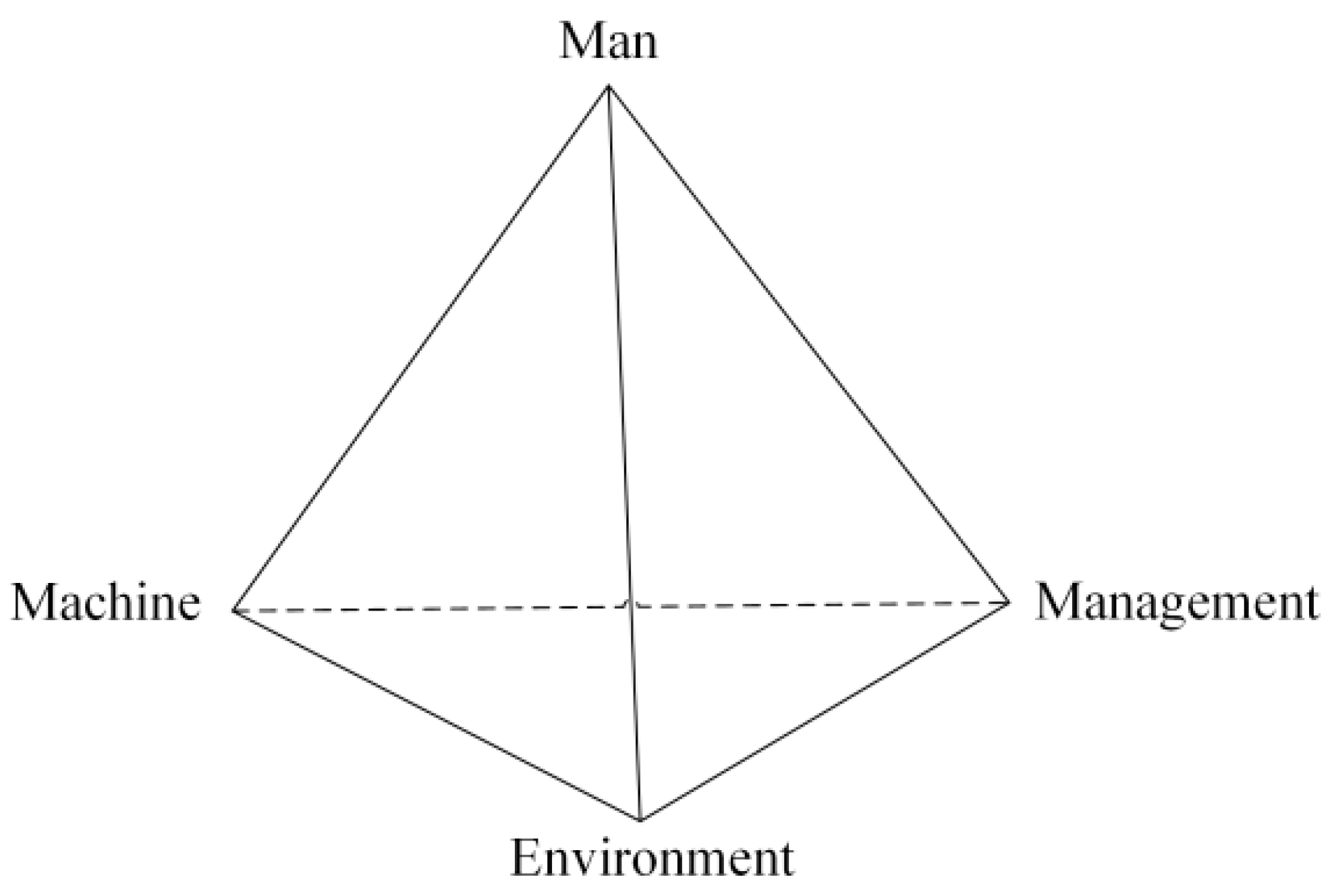
The theory of the MMEM frame is based on Man–Machine–Environment system engineering. Man, machine and environment are the three elements that affect the state of the system, and controlling the three elements can make the system reach the best state. In order to realize “control,” in 1998, Chen W J [39] put forward the “Man–Machine–Environment–Management” (MMEM) frame, revealing the safety guarantee mechanism of “management” on the coordination of the Man–Machine–Environment relationship in safety management and accident prevention and control systems, as shown in Figure 1.
Figure 1 illustrates the four compositions of maritime safety systems, man, machine (ship), environment, and management. The maritime safety system depends on the combined support of these four dimensions.
The core function of the MMEM framework is to provide a structured and systematic classification model for the safety analysis of maritime systems. It categorizes the numerous factors contributing to accidents into four dimensions: man, machine (ship), environment, and management. Acting like a comprehensive “checklist,” it guarantees comprehensive coverage of all potential areas during both risk identification and the formulation of risk control measures, thereby avoiding a limited perspective.
The primary advantages of the MMEM framework lie in its comprehensiveness and systematicity. It effectively overcomes the drawback of traditional analysis methods—often described as “seeing the trees but not the forest”—by preventing analysts from focusing excessively on direct causes, such as unsafe human behavior, while neglecting deeper indirect factors like equipment defects, adverse environmental conditions, or management loopholes. Through this structured classification, MMEM lays a solid foundation for subsequent in-depth analyses (such as integration with FTA), ensuring both the breadth and completeness of accident cause analysis.
When conducting accidental causation analysis, it serves as a guideline to identify accident influencing factors from these four perspectives: man, machine, environment, and management. This paper employs the MMEM framework to comprehensively identify the influencing factors of ship collision accidents from four aspects: man, machine (ship), environment, and management.

3.2. Fault Tree Analysis (FTA)

Fault tree analysis (FTA) is a top-down deductive failure analysis method, which was first proposed by H. A. Watson and D. F. Haasl of Bell Laboratories in the 1960s [40]. In 1974, the U.S. Atomic Energy Regulatory Commission (AERC) published the Wash-1400 Report on Safety of Commercial Atomic Reactors by FTA method, and it promoted research and application of fault tree analysis.
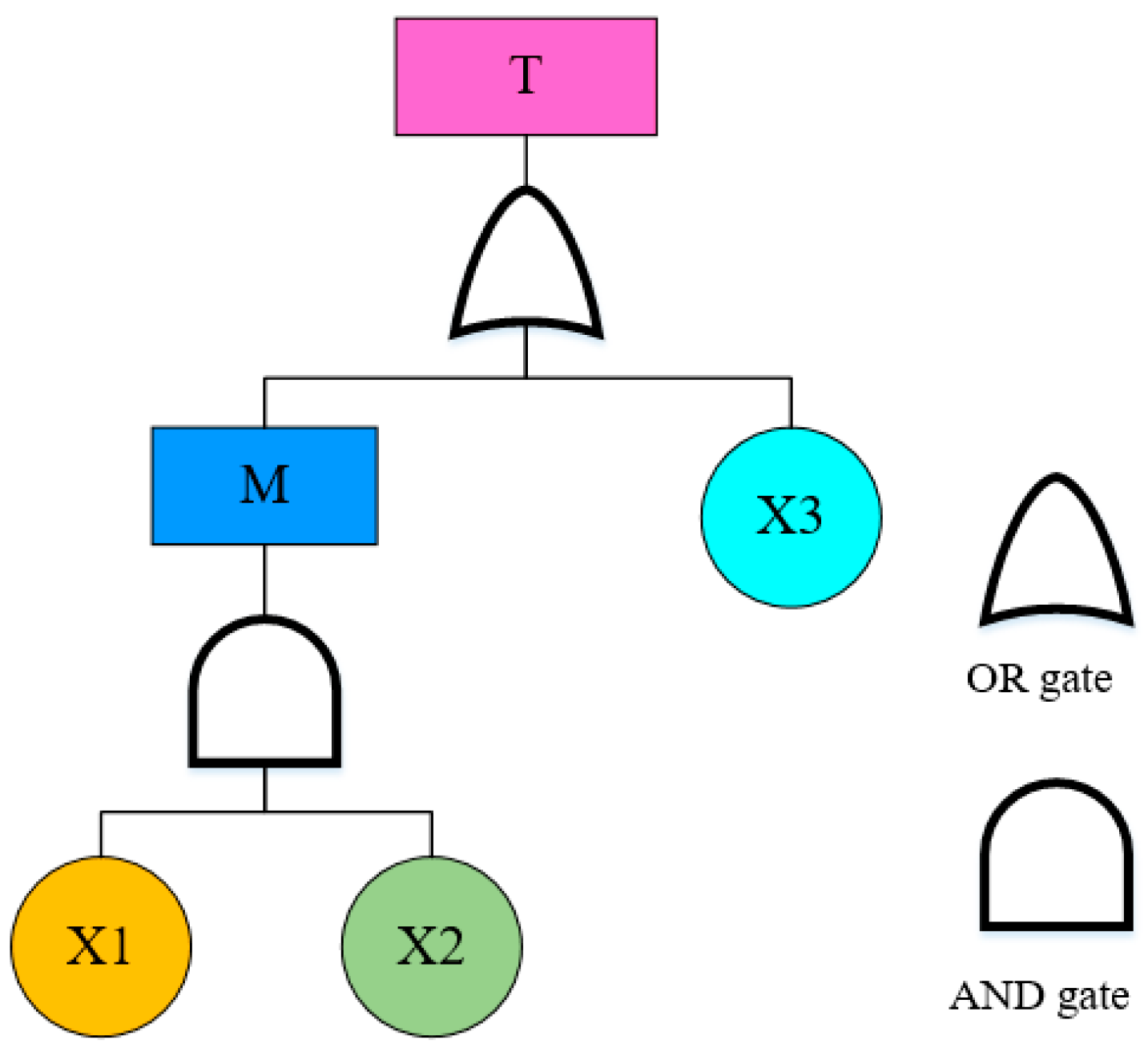
A fault tree is a logical diagrammatic representation that illustrates cause-and-effect relationships within a system. It employs symbols such as prescribed events and logic gates to depict the relationships between diverse events, thereby elucidating their causal linkages, as shown in Figure 2.
Among them, “T” denotes the top event which is the direct target event of fault tree analysis; “M” denotes the intermediate event which is the intermediate result event located between the top event and the basic event; “X” denotes the basic event, which is the event that does not need to be further developed or finally analyzed.
The primary objective of the FTA method is to construct a model that thoroughly elucidates the various causes of a top event, thereby facilitating the identification of preventive measures to reduce its probability of occurrence. The FTA method offers the following key advantages:
  • It enables a comprehensive analysis of the causes behind each system failure state.
  • It fosters a deep understanding of the intrinsic connections between failure causes associated with a specific failure state.
  • It demonstrates the degree and mode of influence that failure causes exert on the failure state, aiding in the development of effective countermeasures.
  • It provides reliable data for failure prevention through qualitative and quantitative analysis once the fault tree is constructed.
Constructing a fault tree model is essential for ship collision accident analysis, as it systematically reveals the deep-seated causal chains and critical risk combinations through logical deduction, thereby providing a scientific basis for formulating precise preventive measures. This paper employs FTA to systematically analyze the causal chains of ship collision accidents, thereby revealing the specific pathways and logical relationships through which various factors lead to the ultimate accident.

3.3. Integrated Workflow

3.3.1. Chart of the Integrated Workflow

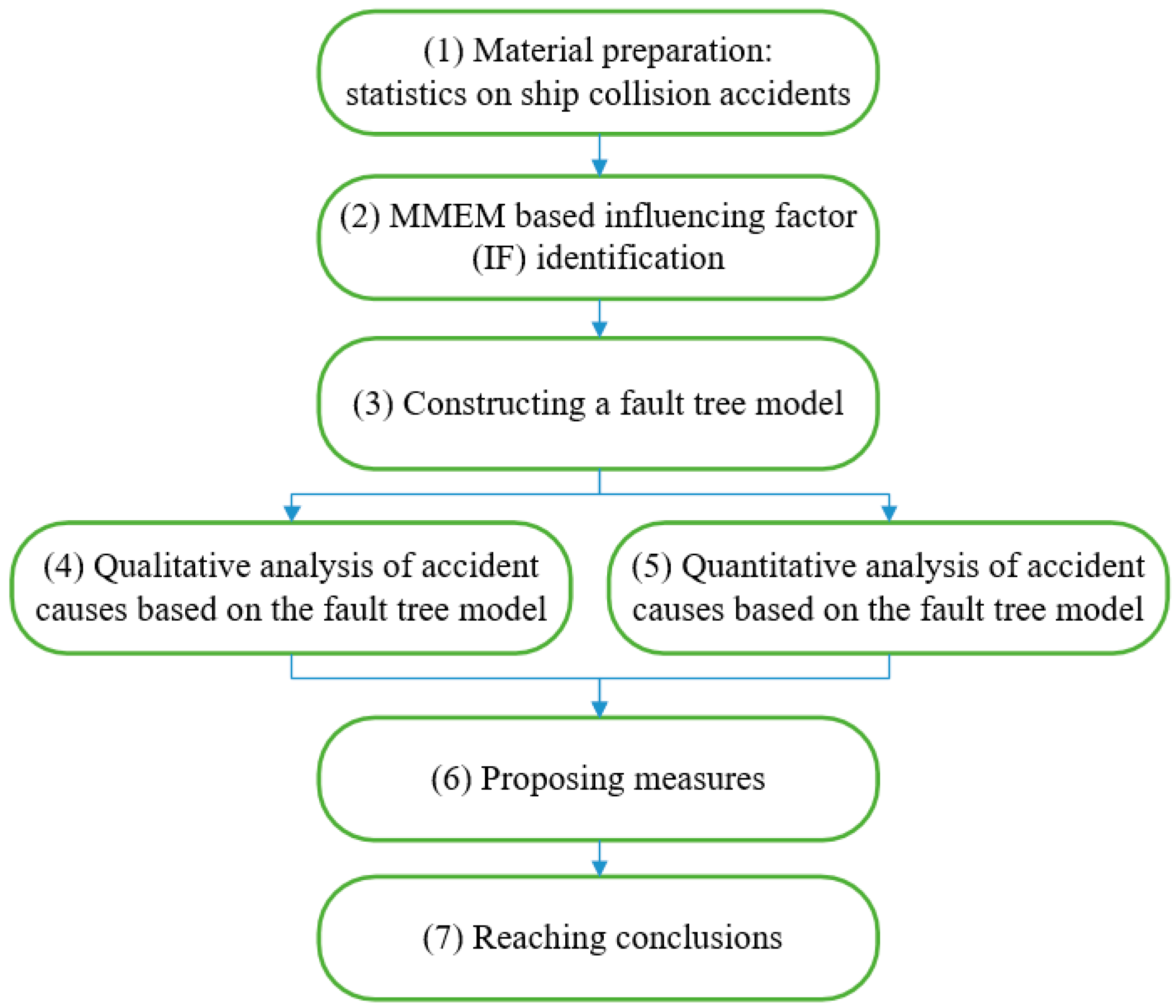
Based on the existing system safety analysis methods, this study proposes an MMEM-FTA integrated analytical framework and applies it to analyze the causes of ship collisions in Taizhou coastal waters. The developed integrated workflow of the paper includes 7 main steps, as shown in Figure 3.
It should be noted that Steps 3 to 6 serve not only as the application process of the proposed MMEM-FTA integrated analysis method but also as its validation procedure. The validation is achieved through a practical application case: applying the MMEM-FTA method to the causal analysis of ship collision accidents in Taizhou coastal waters, thereby verifying the applicability of the proposed method.

3.3.2. Step 1: Material Preparation

The first step is to prepare the materials, which involves collecting accident cases and conducting a preliminary statistical analysis. The analyzing reports of ship accidents happened in Taizhou coastal waters from 2017 to 2025 are collected. A statistical analysis is conducted on the collision accidents.

3.3.3. Step 2: MMEM-Based Influencing Factors Identification

The primary focus of this step is to identify the factors contributing to accidents, which involves systematically analyzing accident investigation reports to pinpoint the basic events that led to them. Based on the MMEM frame, 16 influencing factors leading to ship collision accidents in Taizhou coastal waters are identified, and the accidents related to each risk factor are counted. This step lays a preliminary foundation for subsequently constructing the topological structure of the fault tree and performing quantitative calculations.

3.3.4. Step 3: Constructing Fault Tree

The task of this step is to construct a fault tree for ship collision accidents in the coastal waters of Taizhou, that is, to determine the topological structure of the fault tree.
In the construction of the fault tree, the identified basic events are assumed to be statistically independent. This assumption is justified based on three primary considerations. First, and crucially, this treatment is consistent with the methodological guidelines recommended by the International Maritime Organization (IMO) for maritime accident analysis using FTA, which often accept the independence of specific factors to standardize the assessment process. Second, this approach aligns with established practices in relevant literature, where similar independence assumptions are frequently adopted for accident influencing factors to facilitate risk modeling. First, it serves to simplify the model complexity, thereby ensuring the computational feasibility and clarity of the quantitative analysis.
With the independence assumption established, “Ship collision” is defined as the top event; “Ship failure,” “Personnel negligence,” “Management failure,” “Environment degradation” are taken as intermediate events; 16 risk factors are taken as basic events, and all events are connected by logical symbols. Thus, the fault tree (topological structure) for ship collision accidents can be constructed.

3.3.5. Step 4: Qualitative Analysis of Accident Causes Based on the Fault Tree Model

The main task of this step is to perform Boolean algebra calculations, obtain the minimum cut set and minimum path set, and conduct a structural importance analysis.
Qualitative analysis is one of the components of fault tree analysis. It primarily involves two main tasks and objectives. One is using Boolean algebra to find the minimum cut set and the minimum path set of the fault tree. Another is finding out the basic events of structural importance. These two are used to evaluate the degree of influence of the basic events and help determine the effective measures to prevent the occurrence of faults. The relevant concepts and specific approaches used in this step are as follows.
(1) Boolean algebra, minimum cut set and minimum path set
In FTA, a minimum cut set (MCS) refers to a collection of basic events. The occurrence of all these basic events is sufficient to cause the top event to occur. Furthermore, this set possesses the property of minimality: if any single basic event is removed from the set, the remaining events will no longer be sufficient to cause the top event (i.e., even if the remaining events occur, the top event may not happen). The minimum cut set is the set of essential events that are minimally necessary to cause the top event to occur and represents the effective way to cause the top event to occur. There are two key points for understanding an MCS. (a) Function: A minimum cut set represents a “minimum sufficient combination of conditions” that leads to the top event. If the corresponding basic events in this set all occur (trigger), the top event will happen; conversely, if any event in the set does not occur, that specific combination is insufficient to cause the accident. (b) Minimality: This emphasizes that the set is irreducible, containing no redundant events. For example, if {A, B} is a minimum cut set, then neither {A} nor {B} alone is sufficient to cause the top event.
In FTA, a minimum path set (MPS) refers to a collection of basic events. The non-occurrence of all these basic events is sufficient to guarantee that the top event does not occur. Furthermore, this set possesses the property of minimality: if any single basic event is removed from the set, the remaining events will no longer be sufficient to prevent the top event. There are two key points for understanding an MPS. (a) Function: A minimum path set represents a “minimum necessary combination of conditions” required to prevent the top event. As long as the corresponding basic events in this set do not occur (i.e., they function correctly or remain inactive), the path leading to the accident is blocked. (b) Minimality: This emphasizes that the set is irreducible; there are no redundant basic events. For example, if {A, B} is a minimum path set, then neither {A} nor {B} alone can guarantee the prevention of the top event.
MCSs and MPSs exhibit duality. An MCS is the smallest set of basic events whose occurrence causes the top event, whereas an MPS is the smallest set of basic events whose non-occurrence prevents the top event. They are dual concepts (convertible via De Morgan’s laws) and analyze system safety from the perspectives of “causation” and “prevention,” respectively.
(2) Structural importance analysis
Structural importance analysis evaluates the impact of each basic event’s occurrence on the top event, based solely on the fault tree structure. In this paper, the minimum path set method is utilized to determine the ranking of structural importance.

3.3.6. Step 5: Quantitative Analysis of Accident Causes Based on the Fault Tree Model

The main task of this step is to conduct probability importance analysis and criticality importance analysis.
Quantitative analysis is another of the components of fault tree analysis. It originally comprises three main aspects: probability forecasting (estimation) of the top event, probability importance analysis, and criticality importance analysis.
However, the primary objective of constructing the fault tree model in this study is to reveal the underlying logical structure and key causal paths of accidents rather than to conduct precise risk probability predictions. Due to the scarcity of underlying data, it is difficult to obtain the absolute failure probabilities of basic events, making it impossible to accurately calculate the occurrence probability of the top event based on this model. In light of this, the quantitative calculation of the top event probability is omitted, and the focus of this section is placed on the importance analysis.
By introducing the probability importance and critical importance metrics, this paper aims to quantitatively analyze the sensitivity of the top event to relative changes in the probabilities of basic events. This approach can effectively overcome the limitations caused by the lack of precise prior data, accurately identify the key causes that have the most significant impact on system safety, and thus provide a scientific basis for formulating prevention measures with clear priorities.
Constrained by the lack of macro-level operational data, this study employs the “normalized weight of events” (see Equation (1)) as a heuristic substitute for prior probabilities in calculating probability importance. Consequently, the resulting probability importance coefficients are intended solely to represent the relative ranking of influence among basic events within the current accident sample and do not denote true physical probability rates. Therefore, it is evident that the methodology adopted in this paper is essentially a semi-quantitative analysis.
(1) Basic event probabilities: Using normalized weights as substitutes
Due to the lack of absolute probabilities for basic events, this paper directly uses occurrence frequencies as a substitute: a proxy for probability.
Within the theoretical framework of probability and statistics, the practice of estimating probability via frequency rests on a solid foundation, with the Law of Large Numbers serving as its core justification. This law mathematically demonstrates that as the number of trials approaches infinity, the frequency of an event converges in probability to its theoretical probability, exhibiting stable long-term regularity. Consequently, in scenarios involving a large number of repeatable trials—such as product quality sampling or clinical drug trials—frequency serves as the most intuitive and reliable approximation of probability. This approach is not only feasible but also acts as a scientific bridge connecting abstract theory with empirical data. It is noted that the validity of this method is heavily contingent upon the premise of a “large sample.”
However, in the study of rare events, sample sizes are often constrained by limited observation windows due to their inherently low annual occurrence rates. Under these circumstances, estimating probability via frequency is not merely a methodological choice but a practical necessity. Since the theoretical probabilities of unique or rare accidents are typically unknown and cannot be derived a priori, the relative frequency observed from available datasets serves as the most direct and objective proxy. This empirical approach enables researchers to quantify risk based on actual occurrences, grounding theoretical models in observable reality.
Although the Law of Large Numbers dictates that frequency converges to probability only in an asymptotic sense, the calculated frequency remains the “best unbiased estimate” available within the context of limited data years. By treating observed frequencies as approximations of underlying probabilities, analysts can still derive meaningful insights, assess safety performance, and inform decision making. While the precision of this estimate is intrinsically linked to sample size, the method provides a necessary starting point for risk assessment, allowing for the application of statistical inference even in data-scarce scenarios. Consequently, despite the limitations of small samples, frequency estimation remains an indispensable and logically consistent tool for understanding “low-probability, high-consequence” events.
Therefore, grounded in mathematical theory and taking into account the practical constraints of small samples, we employ frequency as a substitute for probability to facilitate quantitative calculation. In other words, in this study, the occurrence frequency of an event is utilized as a proxy for its probability in the fault tree model. It is important to clarify that these frequency values should not be interpreted as absolute statistical probabilities; rather, they serve as relative risk indicators to evaluate and prioritize the significance of various events. It should be noted, however, that the frequency of an event is defined here as the ratio of its number of occurrences to the total number of occurrences of all events (rather than the total number of accidents, since a single accident may involve multiple causes). Thus, this approach is reflected in Equation (1).
q ( X i ) = w ( X i ) i = 1 n w ( X i )
where the probability of a basic event is named q ( X i ) , the number of occurrences of this basic event is named w ( X i ) , n denotes the total number of events ( n = 16 ). Therefore, it is evident that this paper essentially uses normalized weights as a substitute for basic event probabilities.
Theoretically, the probability of the top event can be calculated according to the logical relationship between events in Figure 2 and the probability of basic events q ( X i ) . Note that, as mentioned before, the quantitative calculation (estimation) of the top event probability is omitted in this paper due to the lack of prior probabilities for the independent occurrence of basic events. At the connection of the “or gate,” Equation (2) is used to calculate the probability of the intermediate event A resulting from the “or gate.” At the connection of the “and gate,” Equation (3) is used to calculate the probability of the intermediate event B resulting from the “and gate” [38].
Q A = 1 i = 1 n A ( 1 q ( X i ) )
Q B = i = 1 n B q ( Y i )
where the probability of the intermediate event A resulting from an “or gate” is named Q A , X i denotes the i th event connected to the “or gate,” q ( X i ) denotes the probability of this event, n A denotes the total number of events connected to the “or gate,” the probability of the intermediate event B resulting from an “and gate” is named Q B , Y i denotes the i th event connected to the “and gate,” q ( Y i ) denotes the probability of this event, n B denotes the total number of events connected to the “and gate.”
(2) Probability importance measure
Probability importance refers to the importance degree of basic events measured from the perspective of probability. Equation (4) is used to calculate the probability importance of basic events.
P ( X i ) = Q q ( X i )
where the probability importance of each basic event is named P ( X i ) , the probability of the top event is named Q .
(3) Criticality importance measure
The criticality importance is defined as the ratio of the rate of change in the top event’s probability to that of the underlying basic events. Equation (5) is utilized to calculate the criticality importance of these events.
C ( X i ) = ln Q ln q ( X i )
where the critical importance of each basic event is named C ( X i ) .

3.3.7. Step 6: Proposing Measures

In this step, we develop targeted risk control options (RCOs) from the four dimensions of man, machine (ship), environment, and management, according to the MMEM-based influencing factor (IF) identification, and causal analysis by using the fault tree model. This process aims to translate the research findings into actionable safety strategies that effectively mitigate identified risks.

3.3.8. Step 7: Reaching Conclusion

The final phase of the research process involves synthesizing the analytical findings into a coherent set of conclusions, primarily highlighting the study’s contributions, practical implications, limitations, and future research directions.

4. Materials: Accidents

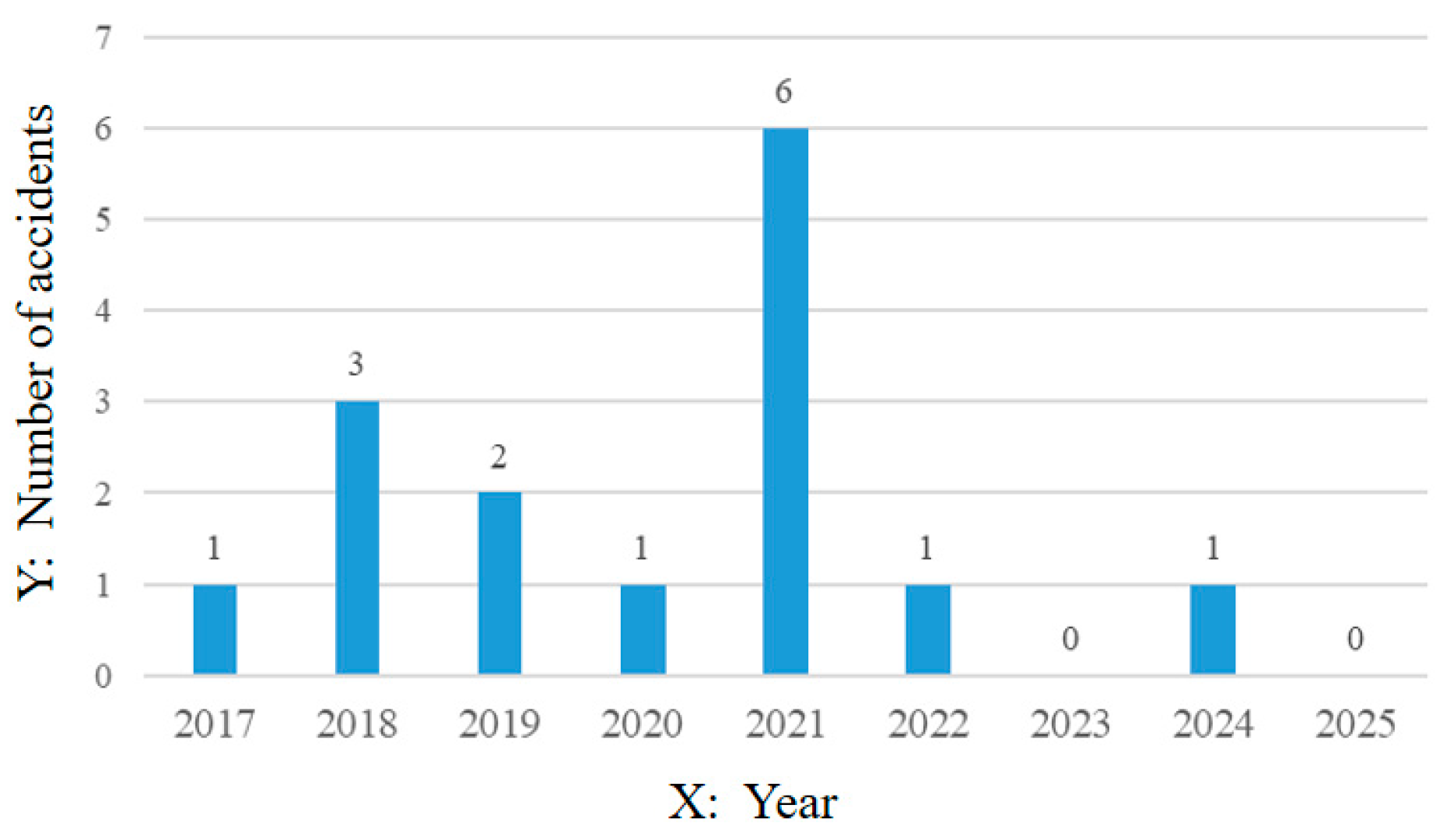
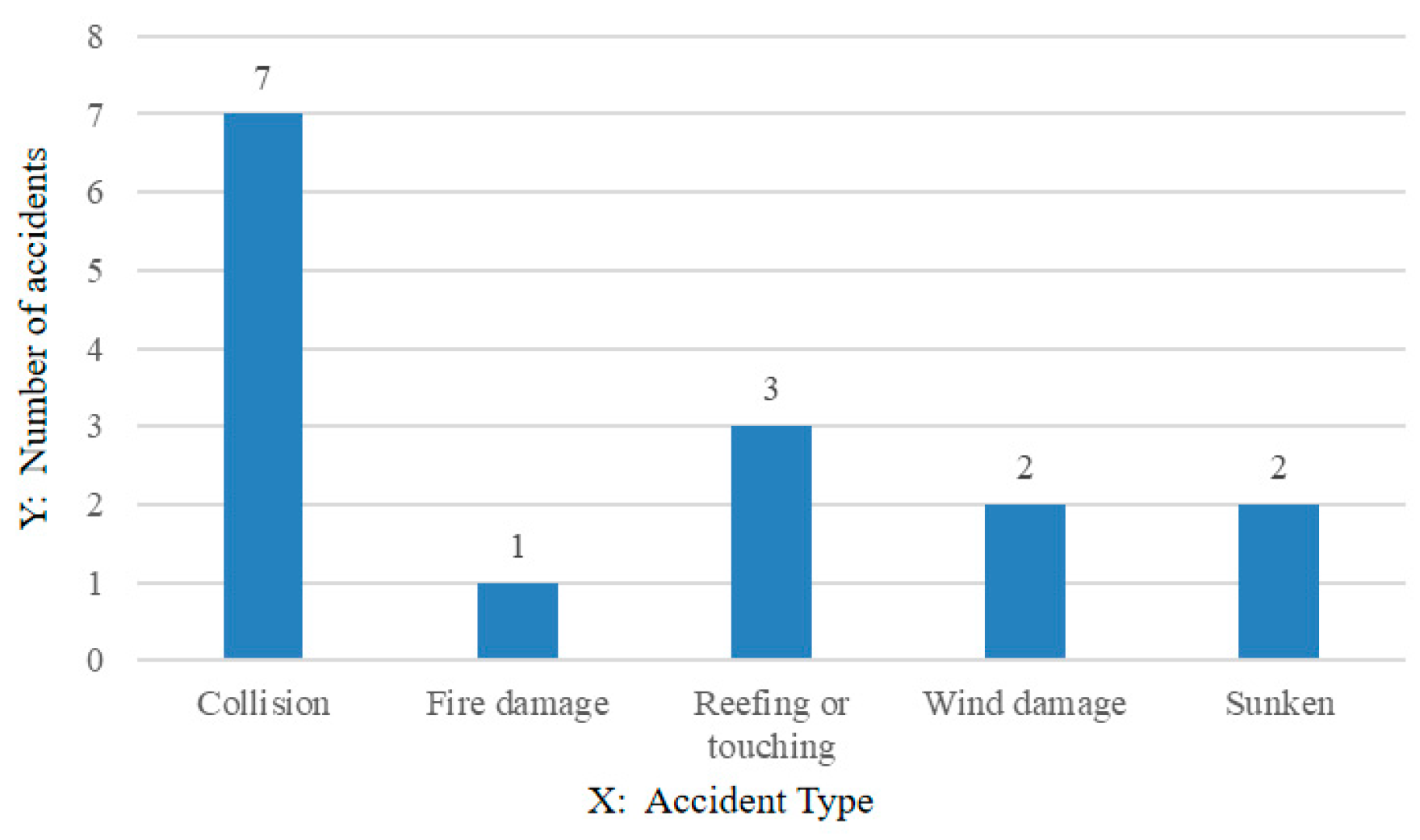
This section corresponds to Step 1. Accident cases are collected from the official website of the Zhejiang Maritime Safety Administration (Zhejiang MSA). A total of 15 accidents between 2017 and 2025 are collected, as shown in Figure 4 and Figure 5. Ship accident types are counted, which shows that ship collision accidents in Taizhou occurred most, with seven (nearly 50%). Overall, the potential reasons for the significantly high number of accidents in 2021 are mainly due to changes in navigation volume, weather conditions, and the recovery of shipping activities after the epidemic. It can be seen that ship collision accidents have a higher proportion and the highest number. Compared with other accidents, collision accidents occur more frequently, mainly due to traffic flow conflicts, complex encounter situations, and limited collision avoidance control space.
Based on ship collision reports, collision time, collision location, types of ships on both sides of the collision, collision losses and collision grades, statistics are shown in Table 6.
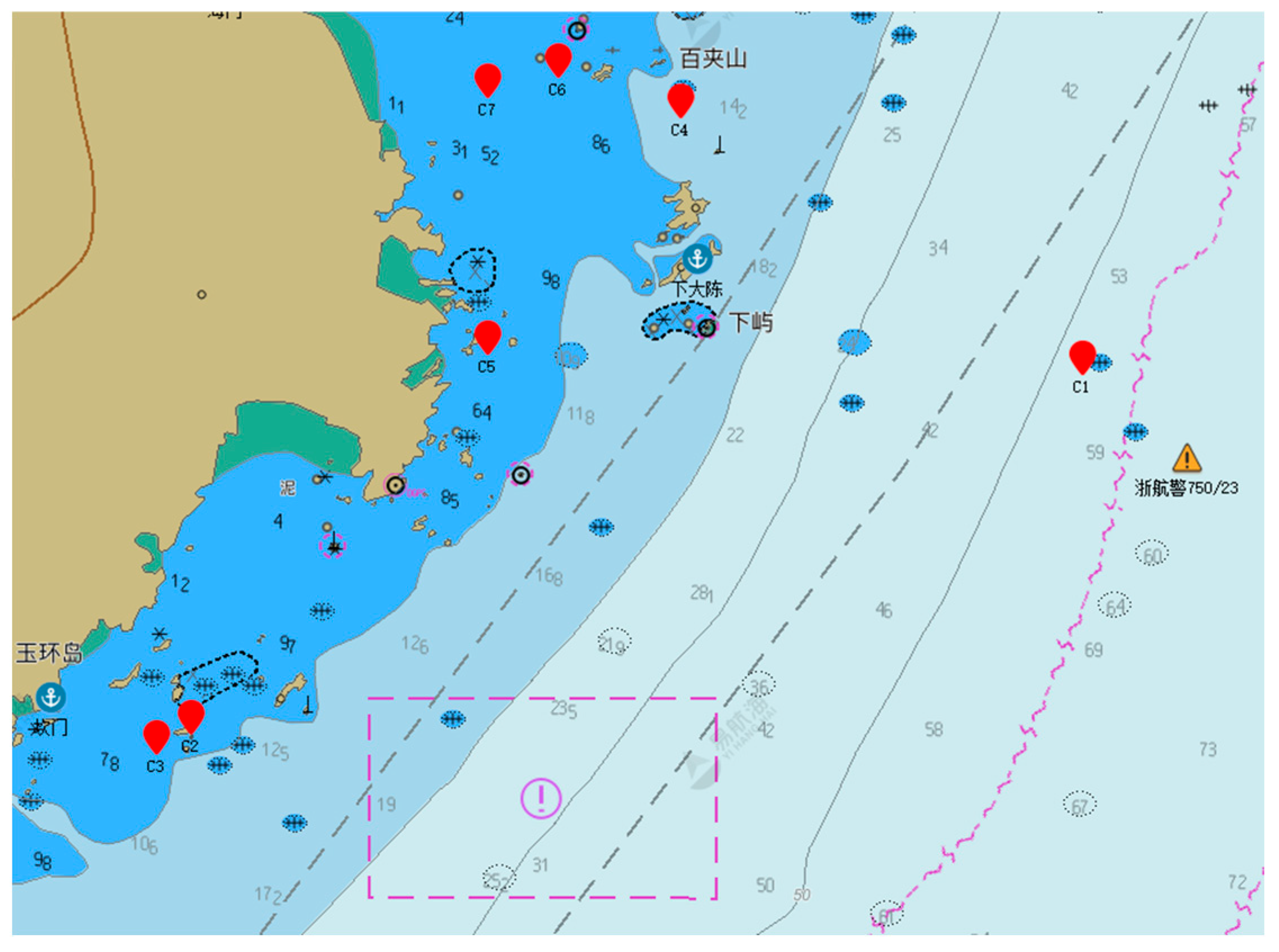
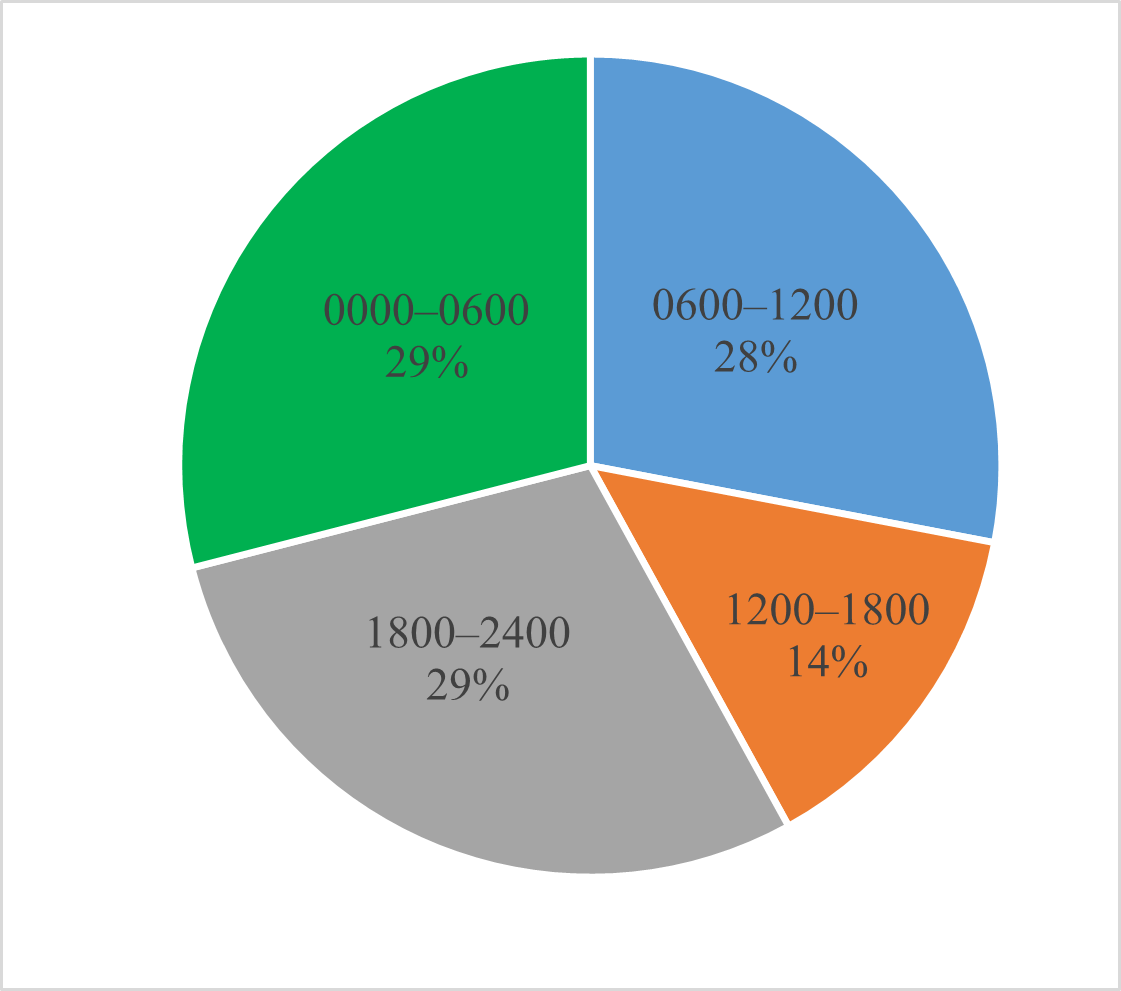
As shown in Figure 6, ship collision accidents mostly occurred in areas with dense vessels or at route crossings. As shown in Figure 7, ship collisions in Taizhou coastal waters occurred mostly during the period from 1800 to 0600 and 0000–0600, with both accounting for 29%. The main reason for the higher proportion of accidents occurring at night is the impact of human factors such as crew fatigue, lookout negligence, and reduced visibility.
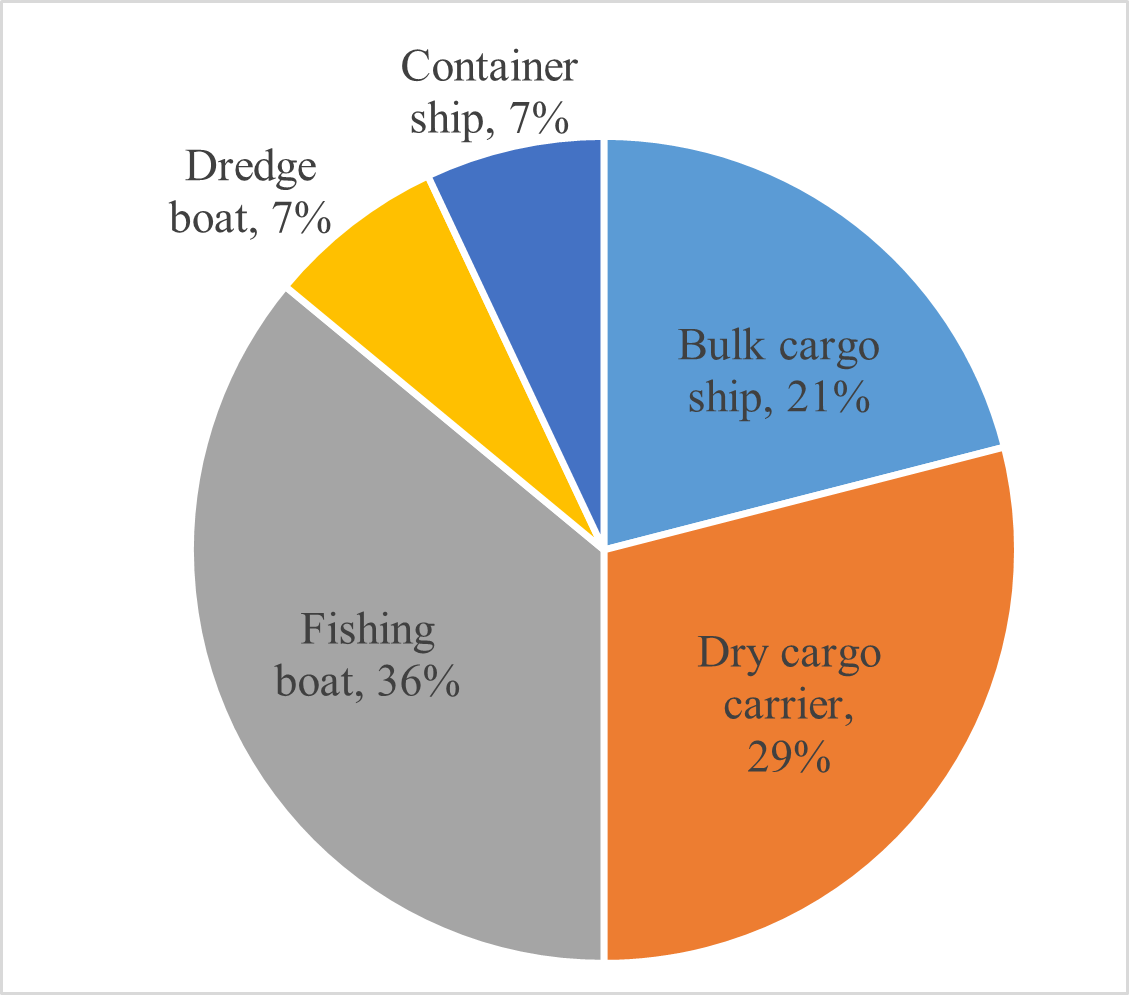
As shown in Figure 8, the vessels involved were mostly fishing boats, dry cargo ships and container ships. The collision probability of fishing boats is higher. The reason for the high proportion of fishing boat accidents is mainly due to the large number of fishing boats in the water area, poor maneuverability of fishing boats and crew safety awareness, and the fact that fishing boats usually do not follow the prescribed route during navigation.
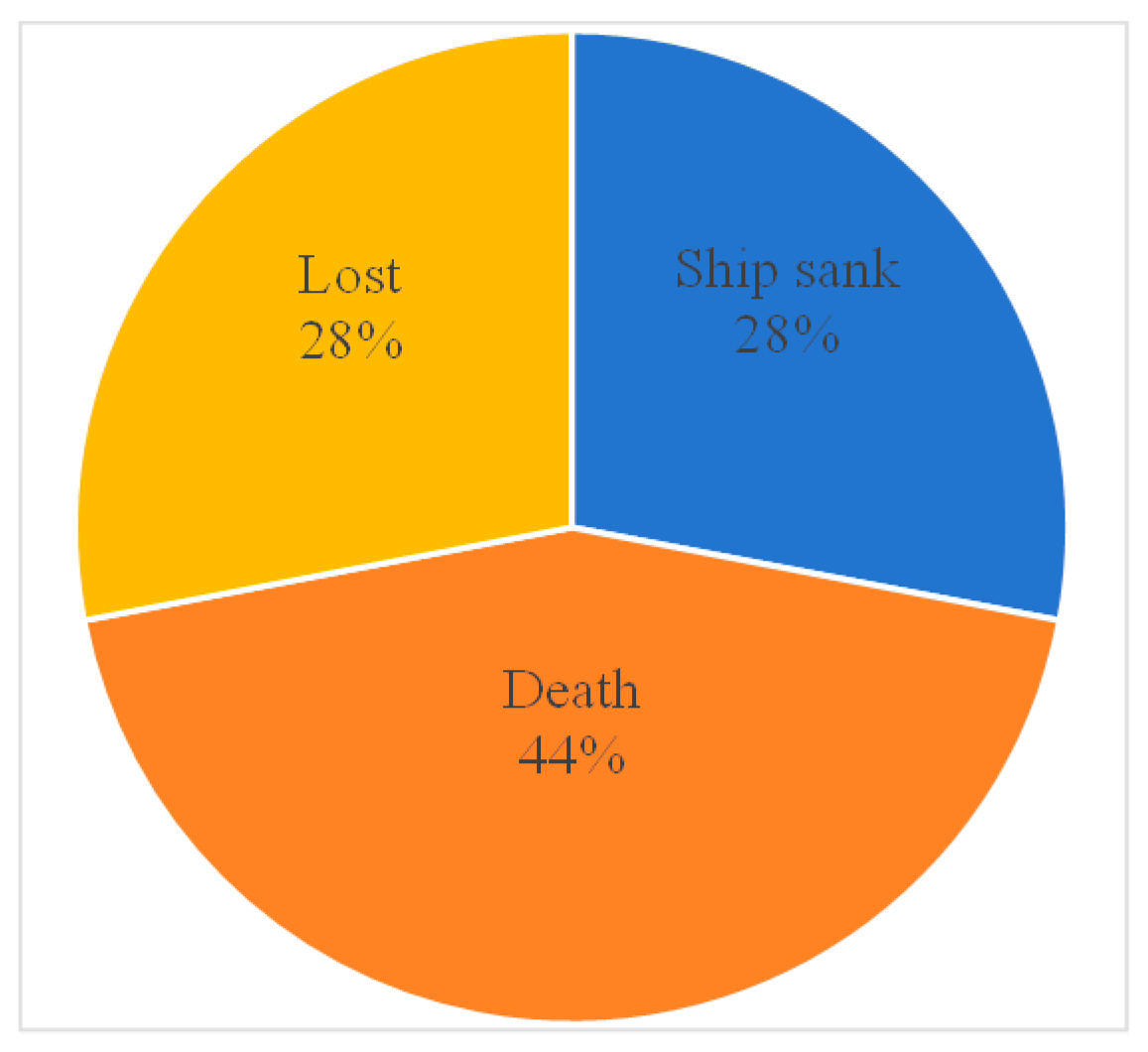
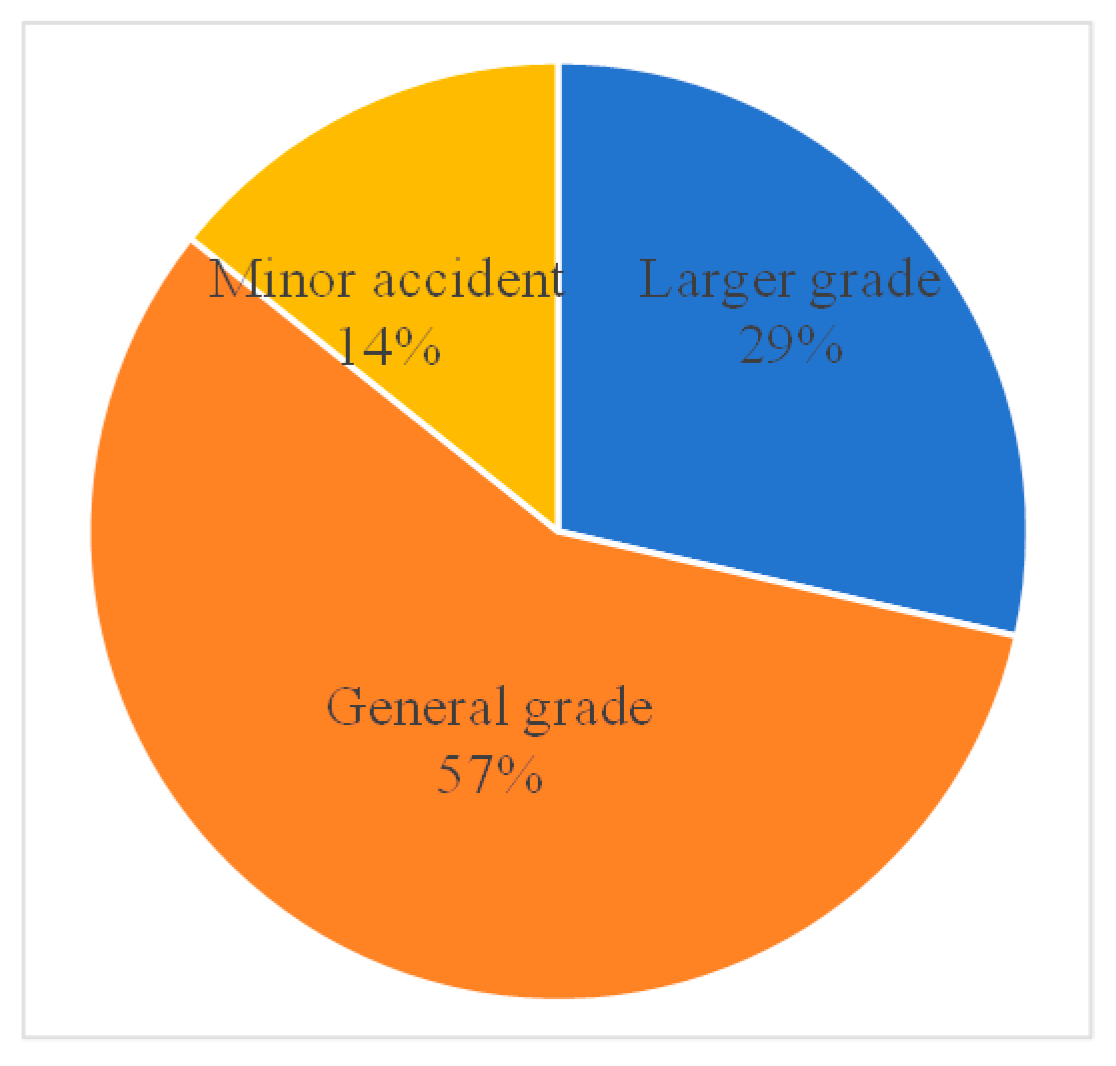
As shown in Figure 9, all accidents in Taizhou coastal waters had sunken ships and casualties of different degrees. This is because, once a ship collision occurs, it is easy to cause damage to the hull, water ingress, and sinking, which can directly threaten the lives of personnel in a short period of time, especially at night or in adverse sea conditions, making escape extremely difficult. As shown in Figure 10, the grade (severity) of ship collision accidents in Taizhou coastal waters was distributed from larger to minor, and most of them were general. Overall, in this water area, the high proportion of fishing boats involved in accidents and the high incidence at night, combined with the limitations of water rescue conditions, have led to a significantly higher risk of casualties. The collision risk control and emergency response capabilities for small and medium-sized vessels in this water area need to be improved during nighttime.
Figure 9. Loss of ship collision.
Jmse 14 01146 g009
Figure 10. Grade of ship collision.
Jmse 14 01146 g010

5. Results and Discusson

5.1. Influencing Factors Identification

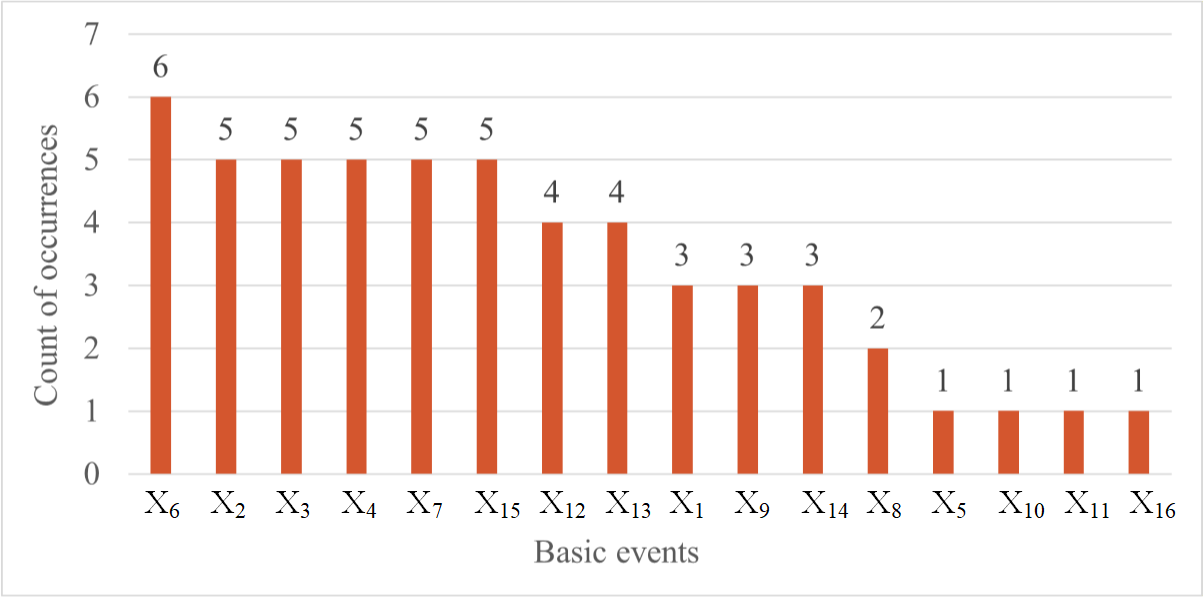
This section corresponds to Step 2. In order to analyze the overall causes of ship collision accidents in Taizhou coastal waters, this paper adopts the MMEM frame to identify influencing factors from four aspects: ship failure, personnel negligence, management failure and environment degradation, as shown in Table 7, and counts the occurrences of basic events, as shown in Figure 11.
(1) Ship failure (M1). Including: Poor vessel performance; Unseaworthiness.
(2) Personnel negligence (M2). Firstly, personnel negligence mainly manifests in negligence of safety responsibility (M5) and lack of expertise (M6). Going on causal analysis, in the aspect of negligence of safety responsibility, it manifests in incompetency of crew (M7) and neglect of observation (M8). The aspect of lack of expertise manifests in improper avoidance measures (M9) and poor seamanship performance (M10). Finally, nine risk factors are attained by deeply analyzing four failure states.
Incompetency of crew (M7). Including: Crew shortages; Failure of crew to obtain appropriate certificates.
Neglect of observation (M8). Including: Absence of duty officer; Failure to use effective means of proper lookout.
Improper avoidance measures (M9). Including: Failure to judge collision risk; Failure to comply with the duty to yield.
Poor seamanship performance (M10). Including: Failure to use safe speed; Failure to signal as required; Improper choice of anchorage location.
(3) Management failure (M3). Including: Lack of safety management responsibility of shipping company; Lack of responsibility for on-board safety management.
(4) Environment degradation (M4). Including: Dense route crossings; High vessel interchange traffic; Poor visibility between fogs. The first two factors can be attributed to the complexity of navigation in the waters (M11).
Figure 11 visualizes the frequency distribution of various events. The data reveals that event X6 has the highest frequency, occurring six times. Five events (X3, X7, X15, X4, and X2) follow with an identical frequency of five occurrences each. Events X12 and X13 appear four times, while X1, X9, and X14 occur three times, and X8 appears twice. The lowest frequency is observed for events X5, X10, X11, and X16, each occurring only once. The height of the bars highlights the variations in frequency, allowing for an immediate visual comparison of the relative prevalence of each event.

5.2. Fault Tree Model of Collision Accidents

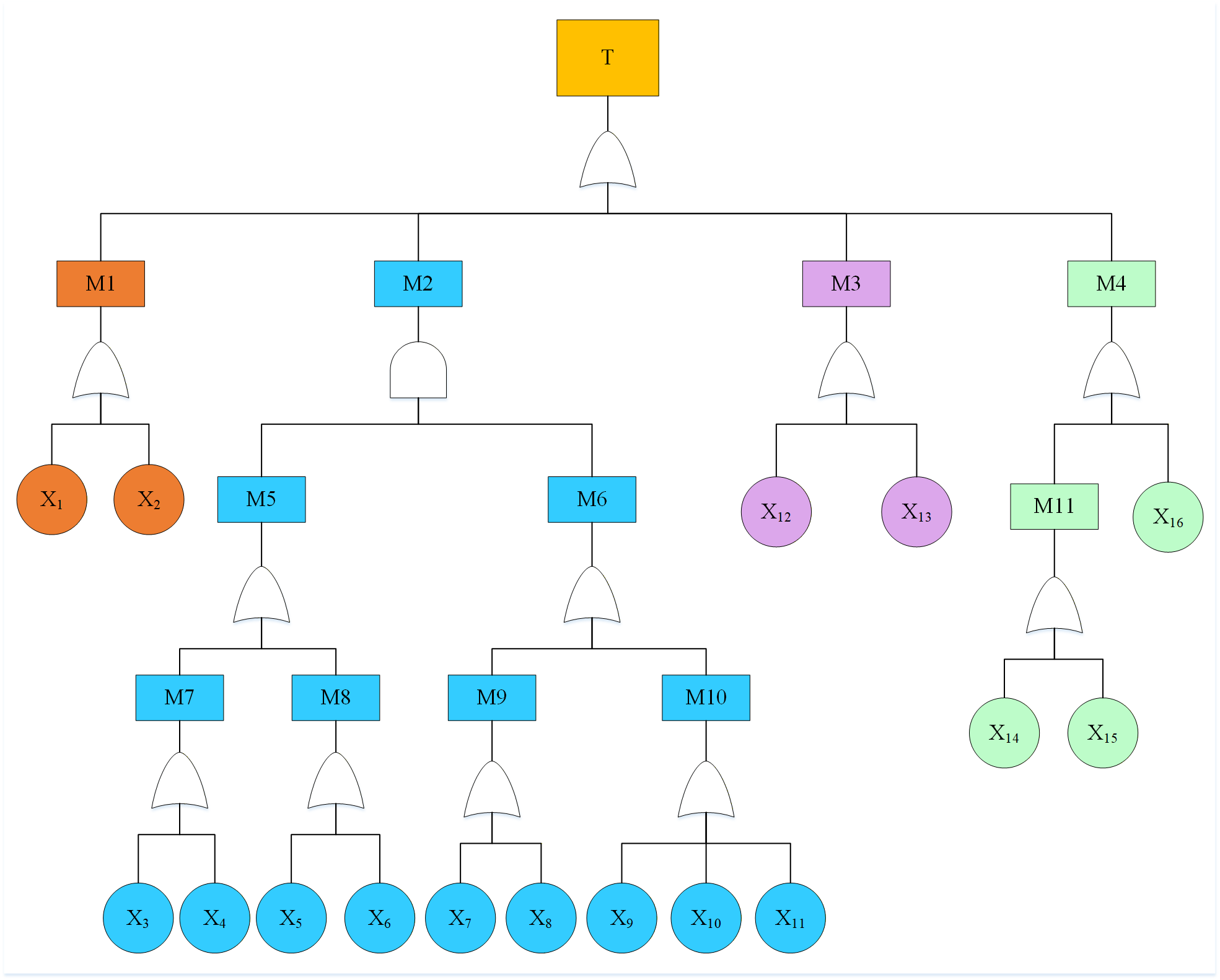
This section corresponds to Step 3. Using the approach described in Step 3 (including the assumption of event independence), the resulting fault tree is illustrated in Figure 12.
The diagram Figure 12 breaks down the top event (T) into four main branches (the intermediate events M1, M2, M3, M4). By tracing the paths from the bottom (16 basic events) up to the top through the logic gates, analysts can determine the specific combinations of failures that lead to the accident. For example, the leftmost branch shows that either basic failure X1 or X2 is sufficient to cause intermediate failure M1.

5.3. Qualitative Analysis of Accident Causes

This section corresponds to Step 4. The qualitative analysis of accident causes mainly comprises the following two aspects.
(1) Boolean algebra, minimum cut set and minimum path set
Based on the constructed fault tree model (topological structure; Figure 12) of ship collisions in Taizhou coastal waters, using the approaches described in Step 4, the Boolean algebraic equations of the accident tree are obtained, as shown in Equations (6) and (7).
T = M 1 + M 2 + M 3 + M 4 = ( X 1 + X 2 ) + ( M 5 M 6 ) + ( X 12 + X 13 ) + ( M 11 + X 16 ) = ( X 1 + X 2 ) + ( M 7 + M 8 ) ( M 9 + M 10 ) + ( X 12 + X 13 ) + ( X 14 + X 15 + X 16 ) = ( X 1 + X 2 ) + ( X 3 + X 4 + X 5 + X 6 ) ( X 7 + X 8 + X 9 + X 10 + X 11 )    + ( X 12 + X 13 ) + ( X 14 + X 15 + X 16 )
T = M 1 M 2 M 3 M 4 = ( X 1 X 2 ) ( M 5 + M 6 ) ( X 12 X 13 ) ( M 11 X 16 ) = ( X 1 X 2 ) [ ( M 7 M 8 ) + ( M 9 M 10 ) ] ( X 12 X 13 ) ( X 14 X 15 X 16 ) = ( X 1 X 2 ) [ ( X 3 X 4 X 5 X 6 ) + ( X 7 X 8 X 9 X 10 X 11 ) ] ( X 12 X 13 )    ( X 14 X 15 X 16 )
From Equation (6), 27 minimum cut sets can be obtained and listed in Table 8. From Equation (7), two minimum path sets can be obtained: {X1, X2, X3, X4, X5, X6, X12, X13, X14, X15, X16} and {X1, X2, X7, X8, X9, X10, X11, X12, X13, X14, X15, X16}.
In general, the qualitative analysis yielded 27 minimal cut sets and two minimal path sets, revealing critical insights into the risk landscape of ship collision accidents in Taizhou coastal waters.
The large number of minimal cut sets (27 in total) indicates a high degree of complexity and inherent risk within the navigation system. In FTA, each minimal cut set represents a unique scenario or “failure pathway” that can directly trigger the top event (a collision). The existence of 27 such pathways suggests that the system is susceptible to a wide variety of failure combinations, highlighting the significant potential risk inherent in the current navigational environment. This multitude of dangerous situations underscores the necessity of rigorous risk control measures.
Conversely, the identification of only two minimal path sets highlights the limited avenues available for ensuring system safety. A minimal path set represents a set of components or conditions that must all succeed (or be present) to prevent the top event. The relatively small number of path sets implies that ensuring the success of these two specific combinations of basic events is crucial for maintaining safety. Specifically, the two path sets, {X1, X2, X3, X4, X5, X6, X12, X13, X14, X15, X16} and {X1, X2, X7, X8, X9, X10, X11, X12, X13, X14, X15, X16}, can be interpreted as the core “defense lines” against collisions.
A comparative analysis of these two path sets reveals that the basic events X1, X2, X12, X13, X14, X15, and X16 are common to both. This overlap suggests that these specific factors are fundamental to system safety; their proper functioning is indispensable regardless of the specific operational scenario. From a risk management perspective, this indicates that prioritizing the reliability of these shared basic events offers the most efficient way to enhance overall system resilience, as improving these elements strengthens both potential safety pathways simultaneously.
(2) Structural importance analysis
Using the approaches described in Step 4, the resulting structural importance order of the basic events is presented in Equation (8).
I ( X 16 ) = I ( X 15 ) = I ( X 14 ) = I ( X 13 ) = I ( X 12 ) = I ( X 2 ) = I ( X 1 ) > I ( X 6 ) = I ( X 5 ) = I ( X 4 ) = I ( X 3 ) > I ( X 11 ) = I ( X 10 ) = I ( X 9 ) = I ( X 8 ) = I ( X 7 )
The quantitative analysis results from Equation (8) reveal the criticality ranking of basic events, identifying X16, X15, X14, X13, X12, X2 and X1 as having the highest structural importance. These core drivers, which correspond to factors related to “ship failure,” “management failure,” and “environmental degradation,” constitute the primary contributors to ship collision accidents in Taizhou coastal waters. This finding holds profound theoretical and practical implications; it not only validates the effectiveness of the MMEM method in identifying top-level risk factors but also precisely pinpoints the focal areas for accident prevention.
From a categorical perspective, the concentration of these high-importance basic events within “ship failure,” “management failure,” and “environmental degradation” distinctly characterizes the specific evolutionary patterns of accidents in this maritime area. It is worth noting that these factors with high structural importance often occupy “deep” or “foundational” positions in the accident causation chain. For instance, “management failure” factors (such as X12, X16) are typically the root causes of human error and inadequate equipment maintenance, while “environmental degradation” (such as X2) acts as an external stressor that significantly reduces the system’s safety margin. This indicates that, within the accident formation mechanism of these waters, foundational organizational management defects and uncontrollable environmental pressures jointly constitute the “soil” and “catalyst” for accident occurrence.
This result has clear implications for safety management strategies: relying solely on terminal measures such as “human procedural compliance” or “equipment maintenance” is insufficient to fundamentally curb accidents. Instead, prevention and control efforts must be shifted upstream, focusing on systematic interventions targeting the “management failure” and “environmental monitoring” links with high structural importance. This further confirms the necessity of adopting the combined MMEM and FTA approach in this study, which, through the perspective of domino chain effects, successfully captures these underlying root causes of the accidents.

5.4. Quantitative Analysis of Accident Causes

This section corresponds to Step 5. The quantitative analysis of accident causes mainly comprises the following three aspects.
(1) Basic event probabilities: Using normalized weights as substitutes
Given the scenario described in Step 5 and using Equation (4), the occurrence probabilities of basic events when normalized weights are fundamentally used as substitutes are shown in Table 9.
The data presented in Table 9 highlights a critical vulnerability in the navigational safety of Taizhou coastal waters: the failure to maintain effective and regular lookout. The fact that basic event X6 has the highest frequency reflects a persistent operational lapse where mariners fail to utilize available means—such as visual observation, radar, and the automatic identification system (AIS). This lack of vigilance acts as a primary contributor to ship collision accidents in the region.
(2) Probability importance measure
Equation (4) described in Step 5 is used to calculate the probability importance of basic events and the results are shown in Table 10.
As shown in Table 10, basic event X2 has the highest probability importance, followed by X15. This indicates that “Unseaworthiness” is the most critical factor leading to ship collision accidents in Taizhou coastal waters. Additionally, high vessel interchange traffic is also a significant contributor to such accidents.
While structural importance analysis emphasizes the foundational role of management factors, the ranking of probability importance in Table 10 reveals the “pain points” of accident prevention and control under current operating conditions. Based on these results, the following risk management insights can be derived:
  • Environmental and traffic factors are the primary drivers. The top two ranked basic events, X2 (Unseaworthiness) and X15 (High vessel interchange traffic), possess the highest probability importance values (0.6402). This indicates that external environmental stressors and traffic density are the most sensitive factors triggering system failure.
  • Management responsibility acts as the root cause of human error. Following closely behind the primary environmental and traffic factors are X12 (Lack of safety management responsibility of shipping company) and X13 (Lack of responsibility for on-board safety management), which exhibit a high probability importance value of 0.6271. This statistical prominence highlights that managerial negligence constitutes the second most significant source of risk within the system. More importantly, it suggests that management failure acts as the latent root cause of human error; when safety responsibilities are ill-defined or neglected at the organizational level, the likelihood of operational personnel committing errors increases significantly. Therefore, strengthening the accountability system is not merely an administrative requirement but a critical technical measure to cut off the transmission path of accident risks.
  • Vessel performance and route conditions represent the tertiary risk tier. Ranked 5th and 6th, X1 (Poor vessel performance) and X14 (Dense route crossings) also hold substantial weight (0.6151). This suggests that, while less critical than management failures, the inherent physical condition of the vessel and specific route characteristics (such as frequent crossing situations) constitute the next level of risk priority.
  • Specific operational errors exhibit lower probability importance. In contrast to the systemic factors mentioned above, specific operational failures (such as X6, Failure to keep a proper lookout, and X7, Failure to judge collision risk) and certain violations (e.g., X9, Failure to use safe speed) have lower rankings in terms of probability importance (ranging between 0.10 and 0.15).
Summary: Risk mitigation strategies should prioritize environmental adaptability (enhancing vessel resilience against X2) and traffic management (optimizing routing for X15). Simultaneously, strict enforcement of safety management systems by shipping companies (targeting X12, X13) is essential. Although operational errors exhibit lower probability importance, continuous crew training remains imperative to minimize their likelihood of occurrence.
(3) Criticality importance measure
Equation (5) described in Step 5 is used to calculate the criticality importance of basic events, and the results are presented in Table 11.
Criticality importance is one of the most decision-relevant metrics in FTA, as it reflects the “marginal benefit” of reducing the probability of a basic event. As shown in Table 11, the analysis reveals that environmental and managerial factors dominate the risk landscape. Specifically, X2 and X15 rank first with a value of 0.1420, followed closely by X12 and X13. Based on these results, the following insights can be derived.
  • Environmental and traffic factors are dominant: The top two ranked basic events, X2 (Unseaworthiness) and X15 (High vessel interchange traffic), share the highest critical importance value (0.1420). This indicates that environmental stressors and traffic density are the most sensitive factors triggering system failure. Combined with X16 (Poor visibility between fogs), it is evident that external environmental pressure acts as the primary driver of risk in this system.
  • Management responsibility is pivotal: X12 (Lack of safety management responsibility of shipping company) and X13 (Lack of responsibility for on-board safety management) rank 3rd and 4th with a value of 0.1107. This highlights that managerial negligence is the second most significant source of risk, acting as the root cause of human error.
  • Vessel condition and navigational complexity rank next in significance: X1 (Poor vessel performance) and X14 (Dense route crossings) also hold substantial weight. This suggests that, while the inherent physical condition of the vessel and complex navigational environments are slightly less critical than environmental and management factors, they remain key elements in the overall risk profile.
Summary: Effective risk mitigation requires a dual approach targeting both human reliability and physical constraints. To address the critical human-centric factors (X2, X15, X12, X13), priority must be given to enhancing crew competency through rigorous certification standards and adequate staffing, alongside reinforced training to prevent operational lapses such as failure to keep a proper lookout. Simultaneously, risks associated with vessel performance and route density (X1, X14) should be managed through strict preventive maintenance regimes to ensure hull and machinery integrity, combined with the strategic use of navigational aids and route planning to safely negotiate complex, high-traffic waters.

6. Measures

This section corresponds to Step 6. Based on the analysis of ship collision accidents in Taizhou coastal waters using the MMEM-FTA integrated workflow, accident prevention measures—also referred to as risk control options (RCOs)—are proposed across four dimensions: man, machine (ship), environment, and management.
(1) Man-related RCOs
Addressing the dual challenges of negligence in safety responsibility and inadequate professional skills is critical. By employing both quantitative and qualitative analyses, we aim to ensure that no fundamental instances of human error are overlooked. To mitigate these risks, the following recommendations are proposed.
  • Prioritize safety education: Enhanced focus should be placed on the continuous safety education of the crew.
  • Strengthen safety awareness: Efforts must be made to cultivate a strong sense of safety awareness and responsibility among all personnel.
  • Enhance vigilance: Lookout duties should be strictly enforced to maintain situational awareness.
  • Ensure operational compliance: When navigating Taizhou coastal waters, crews must utilize ship equipment effectively and strictly observe standard operating procedures.
  • Optimize watchkeeping schedules: Duty arrangements should be optimized to ensure crew members receive adequate rest and prevent fatigue.
  • Focus on competency and recruitment: Greater emphasis should be placed on technical proficiency, and the hiring process for crew members must be rigorous.
  • Familiarize with local waters: Captains and crews navigating Taizhou coastal waters for the first time must thoroughly familiarize themselves with the unique characteristics specific to the local area, such as meteorological, hydrographic, and navigational safety regulations, and consult relevant chart data in advance.
(2) Machine (ship)-related RCOs
Qualitative and quantitative analyses have identified two primary issues: “Poor vessel performance” and “Unseaworthiness.” The structural significance of these two fundamental events is considerable, as their probability importance and criticality constitute a significant proportion of the overall risk. To mitigate these risks, the following recommendations are proposed.
  • Conduct pre-voyage inspections: Before sailing, a thorough self-check of the ship’s technical and loading conditions must be performed to ensure the vessel is in sound working order and cargo stowage complies with safety standards.
  • Enhance equipment maintenance: The maintenance of shipboard equipment and machinery should be strengthened. This includes appropriately shortening maintenance intervals to ensure a high rate of equipment reliability and operational integrity.
(3) Environment-related RCOs
Qualitative and quantitative analyses indicate that the complex navigation environment in Taizhou coastal waters significantly contributes to ship collision accidents. To mitigate these risks, the following recommendations are proposed.
  • Enhance information collection: Efforts should be intensified to gather comprehensive risk information regarding the local waters.
  • Update weather data: Timely updates on meteorological conditions and sea states must be ensured.
  • Restrict navigation in adverse weather: Ship movements should be strictly limited or suspended during severe weather conditions.
  • Disseminate port information: Port entry and exit details should be promptly released to shipping companies and vessels.
  • Strengthen vigilance against environmental hazards: Lookout duties should be reinforced to proactively identify environmental risks, and timely avoidance measures must be taken.
  • Optimize route planning: It is essential to reasonably plan coastal shipping routes in Taizhou coastal waters and implement waterway separation schemes. Furthermore, measures should be taken to restrict fishing boats from arbitrarily crossing shipping lanes, and navigational warnings should be issued for accident-prone areas.
(4) Management-related RCOs
Qualitative and quantitative analyses reveal that “Lack of safety management responsibility in shipping companies” and “Deficiencies in on-board safety management” hold the highest structural importance. Given their high probability and criticality, these two factors are significant precursors to ship collisions. To address these issues, the following recommendations are proposed.
  • Strengthen corporate oversight: Management protocols within shipping companies must be reinforced to ensure strict adherence to safety regulations and the full implementation of corporate safety responsibilities.
  • Implement dynamic monitoring: Real-time dynamic monitoring systems should be deployed to track vessel movements and maintain up-to-date status awareness.
  • Enhance patrols and obstacle removal: Regular patrols in Taizhou coastal waters should be conducted to identify and remove navigational obstacles promptly.
  • Ensure vessel seaworthiness: Ships must undergo rigorous inspections and maintenance to guarantee their seaworthiness and technical reliability at all times.
  • Verify crew competency: Comprehensive safety checks and competency assessments should be conducted regularly to ensure the qualification, suitability and operational proficiency of the on-board crew.

7. Conclusions

This section corresponds to Step 7. Above all, it should be explicitly noted that the nature of this research is application-oriented. The primary objective is not to create new theoretical paradigms but to comprehensively utilize existing methods to construct an integrated analytical approach for maritime accident causation analysis. Based on the existing system safety analysis methods, this paper constructs a systematic MMEM-FTA integrated analysis framework and applies it to analyze the causes of ship collisions in Taizhou coastal waters. The conclusions are summarized in the following four aspects.

7.1. Contributions

This paper contributes to the field of maritime safety by proposing a novel integrated accident causation analysis method—combining the MMEM and FTA—and demonstrating its applicability through a case study of Taizhou waters. This approach not only enhances the identification of risk factors but also provides actionable insights for local safety management. The main contributions of this study can be categorized into three aspects.
(1) Methodological contribution
The core contribution of this study lies in constructing a scientific and systematic accident analysis framework. Its key value is the ability to accurately reconstruct the entire process of accident evolution and deeply identify the root causes of accidents.
This study proposes an integrated accident causation analysis framework by synthesizing the MMEM and FTA theories. Unlike approaches relying on a single theoretical perspective, this integrated framework provides a more comprehensive lens for maritime safety analysis. Specifically, under the MMEM framework, 16 risk factors for ship collision accidents in Taizhou coastal waters are identified across four dimensions: ship failure, personnel negligence, management failure, and environmental degradation. Subsequently, the FTA method is applied to perform both qualitative and quantitative analyses, demonstrating the methodological advantage of combining complementary theories to evaluate complex maritime risks.
(2) Content contribution
When applying this framework to analyze ship collision accidents in Taizhou coastal waters, the study systematically reveals the critical causative factors and their coupling mechanisms.
  • Qualitative findings: Under the MMEM framework, 16 risk factors are identified across four dimensions: ship failure, personnel negligence, management failure, and environmental degradation. The analysis indicates that ship failure, management failure, and complex environments hold the highest structural importance.
  • Quantitative findings: The FTA results demonstrate that the basic event “Unseaworthiness” possesses the highest probability and critical importance. These findings enrich the empirical evidence regarding accident evolution patterns and highlight that the coupling of human error (e.g., negligence) and environmental conditions is a dominant pathway for accidents in this region.
(3) Case study contribution
This research conducts an in-depth empirical analysis of Taizhou waters, filling a gap in regional safety studies for this complex estuary environment. Beyond theoretical insights, the study translates the identified risks into actionable strategies for local safety management. It suggests that regulatory bodies should prioritize the prevention of risks stemming from personnel negligence (poor professional skills) and ship unseaworthiness (poor mechanical performance), while also strengthening corporate safety management responsibilities. This localized accident causation model serves as a vital reference for understanding and mitigating risks in similar coastal waters.

7.2. Implications

The findings of this study offer significant theoretical and practical implications for enhancing maritime safety and refining accident prevention strategies. The implications of this study are summarized in three aspects.
(1) Methodological implications
This study demonstrates the value of an integrated analytical approach in maritime safety research. By synthesizing multiple existing theories into a unified framework, it offers a more systematic and holistic method for accident causation analysis compared to single-theory approaches. This methodological integration not only enhances the comprehensiveness of risk factor identification but also provides a replicable analytical template for researchers studying complex socio-technical systems. It suggests that future methodological advancements in safety science may benefit more from the synergistic combination of established models than from the isolated development of new ones.
(2) Theoretical implications
The findings enrich the theoretical understanding of accident mechanisms in specific maritime environments. By applying the integrated framework to the Taizhou waters, this study validates the applicability of general accident causation theories in local contexts while highlighting the necessity of contextual adaptation. It reveals how generic causal factors interact with region-specific conditions (e.g., local traffic density, hydro-meteorological patterns), thereby bridging the gap between abstract theoretical models and concrete empirical realities. This contributes to the refinement of accident causation theory by emphasizing the importance of “localization” in safety research.
(3) Practical implications
From a practical standpoint, this research provides actionable insights for maritime safety management in the Taizhou waters and similar regions.
  • Targeted Regulation: The identification of specific accident causation patterns allows maritime authorities to move beyond generic safety measures and formulate targeted regulations addressing the most critical local risk factors.
  • Resource Allocation: The analysis helps in prioritizing safety resources (e.g., patrol vessels, VTS monitoring) towards the high-risk scenarios and key causal nodes identified in the study.
  • Reference for Similar Waters: The localized accident model serves as a benchmark for other coastal areas with similar navigational characteristics, offering a reference for proactive risk management and accident prevention strategies globally.

7.3. Limitations

While this study offers valuable insights into accident causation in Taizhou waters, several limitations should be acknowledged to provide a balanced perspective on the findings.
First, the scope of the analysis is constrained by the availability of historical data. The limited sample size of accident reports may affect the statistical representativeness of the results, potentially overlooking rare but high-consequence accident scenarios. Consequently, the generalizability of the findings to a broader temporal context should be approached with caution.
Second, in quantifying the risk factors, this study utilized event frequency as a proxy for probability. While this is a common practice in retrospective analyses, it assumes that historical operational conditions remain constant. This substitution may introduce inaccuracies, as frequency does not always perfectly equate to the true probability of occurrence in dynamic maritime environments. Therefore, it is necessary to explicitly state in the manuscript that the quantitative results should be interpreted as semi-quantitative risk indicators rather than precise probabilistic estimates.
Third, the construction of the integrated accident causation model involves a degree of subjectivity. The identification and classification of accident influencing factors, as well as the logical structuring of the accident tree, rely heavily on expert judgment and the interpretation of textual reports. Although rigorous protocols were followed to ensure consistency, the potential for cognitive bias in categorizing complex causal factors cannot be entirely eliminated.
Fourth, it should be noted that, while this study assumes independence among factors for modeling purposes, actual dependencies among human, technical, environmental, and management factors may exist. These dependencies could lead to complex coupling effects that warrant further attention, as acknowledging such interactions is crucial for understanding how they might significantly alter risk propagation paths.
Finally, this study focuses on the application of the proposed integrated method within a specific case context. We did not conduct a comparative analysis with results derived from other established accident analysis methods (e.g., pure STAMP or HFACS or BN approaches). Future research could benefit from a comparative study to further validate the relative advantages and robustness of this integrated framework.

7.4. Future Directions

Building upon the findings and acknowledging the limitations of the current study, several avenues for future research are proposed to further advance maritime safety analysis.
First, to address the constraint of data availability, future studies should aim to expand the dataset by incorporating accident records over a longer time span or aggregating data from multiple maritime jurisdictions. A larger and more diverse sample size would not only enhance the statistical power of the analysis but also improve the generalizability of the identified accident patterns to other water areas with similar navigational characteristics.
Second, to mitigate the inaccuracies associated with using frequency as a proxy for probability, future research could integrate quantitative risk assessment (QRA) techniques or Bayesian networks. These probabilistic models can better account for the dynamic nature of maritime environments and update risk probabilities as new data becomes available, thereby providing a more precise estimation of accident likelihood.
Third, to reduce the subjectivity inherent in factor identification and model construction, future work should focus on validating the integrated framework through Delphi methods or inter-rater reliability tests involving a larger panel of domain experts. Additionally, exploring the use of natural language processing (NLP) tools to assist in the automated extraction and classification of causal factors from accident reports could minimize human bias and increase the efficiency of the analysis.
Finally, comparative studies are essential to establish the robustness of the proposed method. Future research should apply this integrated approach alongside other established models (such as STAMP or HFACS or BN) to the same set of accident cases. Comparing the results will help clarify the specific advantages of the integrated framework in uncovering complex causal chains and provide empirical evidence for its broader application in the maritime industry.

Author Contributions

Conceptualization, Y.T. and Q.H.; methodology, Y.T. and Q.H.; software, Y.T. and Q.H.; investigation, Y.T. and Q.H.; data curation, Y.T. and Q.H.; visualization, Y.T. and Q.H.; formal analysis, Y.T. and Q.H.; writing—original draft preparation, Y.T. and Q.H.; writing—review and editing, Y.T. and K.Z.; validation, K.Z. and W.T.; supervision, K.Z. and W.T.; funding acquisition, Y.T. and W.T. All authors have read and agreed to the published version of the manuscript.

Funding

Fund of Guangxi Science and Technology Program (GuikeLT2504240033); Guangxi Natural Science Foundation (2025GXNSFHA069259; 2026GXNSFHA00640291); Guangxi Science and Technology Major Program (Open Bidding for Selecting the Best Candidates: GuikeJB2502850005); Guangxi Maritime Economy Talent Development Support Special Program (2025XHRC06).

Data Availability Statement

The original contributions presented in this study are included in the article. Further inquiries can be directed to the corresponding author.

Conflicts of Interest

The authors declare no conflicts of interest.

References

  1. Zhang, K.; Huang, L.; He, Y.; Wang, B.; Chen, J.; Tian, Y.; Zhao, X. A real-time multi-ship collision avoidance decision-making system for autonomous ships considering ship motion uncertainty. Ocean Eng. 2023, 278, 114205. [Google Scholar] [CrossRef] [Scilit]
  2. Chen, X.; Wu, P.; Wu, Y.; Aboud, L.; Postolache, O.; Wang, Z. Ship trajectory prediction via a transformer-based model by considering spatial-temporal dependency. Intell. Robot. 2025, 5, 562–578. [Google Scholar] [CrossRef] [Scilit]
  3. Chen, X.; Yang, R.; Wu, Y.; Zhang, H.; Ranjitkar, P.; Postolache, O.; Zheng, Y.; Wang, Z. Towards intelligent shipping: Image-enhanced ship detection and situation analysis in low-light scenes. Intell. Robot. 2025, 5, 662–678. [Google Scholar] [CrossRef]
  4. Ren, Y.Q.; Yao, J.; Zhang, F.C.; Wang, Y. Application of safety check list method in the fishing vessel’s life-saving equipment evaluation. Fish. Mod. 2015, 42, 72–75. [Google Scholar]
  5. Chen, B.Q. Application of safety checklist in ship transportation. Pearl River Water Transp. 2014, 12, 68–69. [Google Scholar]
  6. Sun, Y.; Wang, X. The Safety Evaluation Application of the Harbor Dangerous Goods Operation. Ind. Saf. Environ. Prot. 2010, 36, 55–56. [Google Scholar]
  7. Goksu, S.; Arslan, O. A quantitative dynamic risk assessment for ship operation using the fuzzy FMEA: The case of ship berthing/unberthing operation. Ocean Eng. 2023, 287, 115548. [Google Scholar] [CrossRef] [Scilit]
  8. Liu, P.D.; Wu, Y.F.; Li, Y.; Wu, X. An improved FMEA method based on the expert trust network for maritime transportation risk management. Expert Syst. Appl. 2024, 238, 121705. [Google Scholar] [CrossRef] [Scilit]
  9. Purba, J.H.; Tjahyani, D.S.; Widodo, S.; Ekariansyah, A.S. Fuzzy probability based event tree analysis for calculating core damage frequency in nuclear power plant probabilistic safety assessment. Prog. Nucl. Energy 2020, 125, 103376. [Google Scholar] [CrossRef] [Scilit]
  10. Ma, L.H.; Ma, X.X.; Lan, H.; Liu, Y.; Deng, W. A methodology to assess the interrelationships between contributory factors to maritime transport accidents of dangerous goods in China. Ocean Eng. 2022, 266, 112769. [Google Scholar] [CrossRef] [Scilit]
  11. Kim, D.J.; Sur, J.M.; Cho, H.U. A long term expected risk estimation of maritime accidents through Markov chain approach and probabilistic risk matrix. Asian J. Shipp. Logist. 2023, 39, 1–12. [Google Scholar] [CrossRef] [Scilit]
  12. Lan, H.; Ma, X.X.; Ma, L.H.; Qiao, W. Pattern investigation of total loss maritime accidents based on association rule mining. Reliab. Eng. Syst. Saf. 2023, 229, 108893. [Google Scholar] [CrossRef] [Scilit]
  13. Yu, H.; Chen, F. Quantitative analysis of the efficiency dynamics of global liquefied natural gas shipping under COVID-19. Digit. Transp. Saf. 2024, 3, 19−35. [Google Scholar] [CrossRef] [Scilit]
  14. Kim, T.; Mallam, S. A Delphi-AHP study on STCW leadership competence in the age of autonomous maritime operations. J. Marit. Aff. 2020, 19, 163–181. [Google Scholar] [CrossRef] [Scilit]
  15. Ahn, S.I.; Kurt, R.E. Application of a CREAM based framework to assess human reliability in emergency response to engine room fires on ships. Ocean Eng. 2020, 216, 108028. [Google Scholar] [CrossRef] [Scilit]
  16. Hanafiah, R.M.; Zainon, N.S.; Karim, N.H.; Rahman, N.S.F.A.; Behforouzi, M.; Soltani, H.R. A new evaluation approach to control maritime transportation accidents: A study case at the Straits of Malacca. Case Stud. Transp. Policy 2022, 10, 751–763. [Google Scholar] [CrossRef] [Scilit]
  17. Sezer, S.I.; Elidolu, G.; Aydin, M.; Ahn, S.I.; Akyuz, E.; Kurt, R.E. Analyzing human reliability for the operation of cargo oil pump using fuzzy CREAM extended Bayesian Network (BN). Ocean Eng. 2024, 299, 117345. [Google Scholar] [CrossRef] [Scilit]
  18. Fan, C.; Wróbel, K.; Montewka, J.; Gil, M.; Wan, C.; Zhang, D. A framework to identify factors influencing navigational risk for Maritime Autonomous Surface Ships. Ocean Eng. 2020, 202, 107188. [Google Scholar] [CrossRef] [Scilit]
  19. Xue, J.; Papadimitriou, E.; Reniers, G.; Wu, C.; Jiang, D.; van Gelder, P. A comprehensive statistical investigation framework for characteristics and causes analysis of ship accidents: A case study in the fluctuating backwater area of Three Gorges Reservoir region. Ocean Eng. 2021, 229, 108981. [Google Scholar] [CrossRef] [Scilit]
  20. Gan, L.X.; Ye, B.Y.; Huang, Z.Q.; Xu, Y.; Chen, Q.; Shu, Y. Knowledge graph construction based on ship collision accident reports to improve maritime traffic safety. Ocean Coast. Manag. 2023, 240, 106660. [Google Scholar] [CrossRef] [Scilit]
  21. Ma, L.H.; Ma, X.X.; Lan, H.; Liu, Y.; Deng, W. A data-driven method for modeling human factors in maritime accidents by integrating DEMATEL and FCM based on HFACS: A case of ship collisions. Ocean Eng. 2022, 266, 112699. [Google Scholar] [CrossRef] [Scilit]
  22. Maternová, A.; Materna, M. Research of maritime accidents based on HFACS framework. Transp. Res. Procedia 2023, 74, 1224–1231. [Google Scholar] [CrossRef] [Scilit]
  23. Bayazit, O.; Kaptan, M. Dynamic risk analysis of collision in port areas using DBN based on HFACS-PV. Ocean Eng. 2024, 2998, 117183. [Google Scholar] [CrossRef] [Scilit]
  24. Afenyo, M.; Khan, F.; Veitch, B.; Yang, M. Arctic shipping accident scenario analysis using Bayesian Network approach. Ocean Eng. 2017, 133, 224–230. [Google Scholar] [CrossRef] [Scilit]
  25. Zhang, J.F.; Jin, M.; Wan, C.P.; Dong, Z.; Wu, X. A Bayesian network-based model for risk modeling and scenario deduction of collision accidents of inland intelligent ships. Reliab. Eng. Syst. Saf. 2024, 243, 10981. [Google Scholar] [CrossRef] [Scilit]
  26. Fu, S.S.; Zhang, Y.; Zhang, M.Y.; Han, B.; Wu, Z. An object-oriented Bayesian network model for the quantitative risk assessment of navigational accidents in ice-covered Arctic waters. Reliab. Eng. Syst. Saf. 2023, 238, 109459. [Google Scholar] [CrossRef] [Scilit]
  27. Lan, H.; Wang, S.T.; Zhang, W.F. Predicting types of human-related maritime accidents with explanations using selective ensemble learning and SHAP method. Heliyon 2024, 10, e30046. [Google Scholar] [CrossRef] [Scilit]
  28. Li, H.H.; Çelik, C.; Bashir, M.; Zou, L.; Yang, Z. Incorporation of a global perspective into data-driven analysis of maritime collision accident risk. Reliab. Eng. Syst. Saf. 2024, 249, 110187. [Google Scholar] [CrossRef] [Scilit]
  29. Wang, Y.F.; Wang, L.T.; Jiang, J.C.; Wang, J.; Yang, Z.L. Modelling ship collision risk based on the statistical analysis of historical data: A case study in Hong Kong waters. Ocean Eng. 2020, 197, 106869. [Google Scholar] [CrossRef] [Scilit]
  30. Zheng, X.Z.; Ke, S.G.; Chen, X.; Shao, B.; Wang, S.; Zhao, J. Cause analysis of inland river ship collision accident based on complex network. J. Saf. Sci. Technol. 2023, 19, 211–217. [Google Scholar]
  31. Xu, Y.; Pang, S.J. Analysis and countermeasures of ship accidents in Zhoushan islands and reef. J. Shandong Jiaotong Univ. 2023, 31, 156–161+172. [Google Scholar]
  32. Liu, Z.T.; Du, B.S.; Jia, S.L. Cause analysis of ship capsizing accident in heavy wind and waves based on Bayesian networks. J. Shanghai Marit. Univ. 2022, 43, 56–61. [Google Scholar]
  33. Gürgen, S.; Yazır, D.; Konur, O. Fuzzy fault tree analysis for loss of ship steering ability. Ocean Eng. 2023, 279, 114419. [Google Scholar] [CrossRef] [Scilit]
  34. Kuzu, A.C.; Akyuz, E.; Arslan, O. Application of Fuzzy Fault Tree Analysis (FFTA) to maritime industry: A risk analysing of ship mooring operation. Ocean Eng. 2019, 179, 128–134. [Google Scholar] [CrossRef] [Scilit]
  35. Ugurlu, H.; Cicek, I. Analysis and assessment of ship collision accidents using Fault Tree and Multiple Correspondence Analysis. Ocean Eng. 2022, 245, 110514. [Google Scholar] [CrossRef] [Scilit]
  36. Sokukcu, M.; Sakar, C. Risk analysis of collision accidents during underway STS berthing maneuver through integrating fault tree analysis (FTA) into Bayesian network (BN). Appl. Ocean Res. 2022, 126, 103290. [Google Scholar] [CrossRef] [Scilit]
  37. Tunçel, A.L.; Beşikçi, E.B.; Akyuz, E.; Arslan, O. Safety analysis of fire and explosion (F&E) accidents risk in bulk carrier ships under fuzzy fault tree approach. Saf. Sci. 2023, 158, 105972. [Google Scholar]
  38. Kweon, S.J.; Hwang, S.W.; Jo, L.M.J. Demurrage pattern analysis using logical analysis of data: A case study of the Ulsan Port Authority. Expert Syst. Appl. 2022, 206, 117745. [Google Scholar] [CrossRef] [Scilit]
  39. Chen, W.J. Discussion on new safety science theory of maritime pre-control. China Saf. Sci. J. 1998, 6, 8–12. [Google Scholar]
  40. Wei, X.P.; Bian, S.T. Theory and Application of Fault Tree Analysis. Electron. Prod. Reliab. Environ. Test. 2004, 3, 43–45. [Google Scholar]
Figure 1. MMEM Schematic.
Jmse 14 01146 g001
Figure 2. Fault tree: the logic diagram.
Jmse 14 01146 g002
Figure 3. The developed MMEM-FTA integrated workflow.
Jmse 14 01146 g003
Figure 4. Count of accidents across year.
Jmse 14 01146 g004
Figure 5. Count of accidents across type.
Jmse 14 01146 g005
Figure 6. Locations of ship collisions in Taizhou coastal waters from 2017 to 2025.
Jmse 14 01146 g006
Figure 7. Time of ship collision.
Jmse 14 01146 g007
Figure 8. Type of ship involved.
Jmse 14 01146 g008
Figure 11. Count of occurrences of basic events.
Jmse 14 01146 g011
Figure 12. The fault tree of ship collisions in Taizhou coastal waters.
Jmse 14 01146 g012
Table 1. Qualitative and semi-quantitative analysis methods.
Theory/MethodAdvantages (Pros)Disadvantages (Cons)
Safety Checklist (SC) Intuitive and Simple: Easy to operate and capable of quickly identifying explicit safety hazards (e.g., missing life-saving equipment).Experience-dependent: Lacks systematic analysis and is easily limited by the subjective experience of inspectors, making it difficult to uncover deep-seated root causes.
Preliminary Hazard Analysis (PHA)Forward-looking: Can identify major risk factors early in the project lifecycle at a low cost.Roughness: Results are largely qualitative, making precise quantitative calculations difficult.
Failure Mode and Effects Analysis (FMEA)Systematic and Comprehensive: Identifies potential failure modes of individual components and their impact on the system.Ignores Interdependencies: Traditional FMEA often assumes independent failures, struggling to reflect complex accident scenarios involving multi-factor coupling.
Delphi MethodExpert Consensus: Effectively integrates dispersed expert opinions through multi-round anonymous consultations.Time-consuming: The process is cumbersome, and results heavily depend on the authority and representativeness of the experts.
Table 2. Quantitative and probabilistic risk assessment methods.
Theory/MethodAdvantages (Pros)Disadvantages (Cons)
Fuzzy Probability/Fuzzy Set TheoryHandling Uncertainty: Effectively addresses issues of fuzziness and incompleteness in maritime accident data (e.g., fuzzy FTA, fuzzy FMEA).Computational Complexity: Involves complex mathematical operations, requiring high capability in data processing and modeling.
Event Tree Analysis (ETA)Logical Clarity: Deduces accident development paths forward from an initiating event with strong logic.Data Dependency: Requires precise probability data for each link; accurate quantitative calculation is difficult without it.
5 × 5 Probability Risk MatrixStrong Visualization: Intuitively maps risks into a matrix, facilitating decision-makers’ understanding of risk levels.Subjectivity: The classification of risk levels and the assignment of probability/consequence values often carry strong subjective coloring.
Markov Chain ModelDynamic Prediction: Suitable for analyzing long-term risks with state transition characteristics (e.g., long-term accident probability).Strict Assumptions: Typically assumes the “memoryless property,” which may deviate from reality in the complex and changing maritime environment.
Table 3. Human factors and organizational management analysis.
Theory/MethodAdvantages (Pros)Disadvantages (Cons)
Cognitive Reliability and Error Analysis Method (CREAM)Focus on Cognition: Specifically designed for quantitative assessment of personnel reliability in scenarios like emergency response.Narrow Scope: Primarily targets specific scenarios (e.g., engine room fires, pump operations), showing relatively weak generalizability.
Human Factors Analysis and Classification System (HFACS)Clear Hierarchy: Constructs a complete analytical framework ranging from unsafe acts to organizational management deficiencies.Qualitative Dominance: While it identifies factors, it has limitations in performing precise quantitative risk predictions.
Table 4. Systemic and decision analysis frameworks.
Theory/MethodAdvantages (Pros)Disadvantages (Cons)
Man–Machine–Environment–Management (4M/MMEM)Comprehensive and Systemic: Covers the four basic elements of accident occurrence, aligning with the complexity of maritime accidents.Framework Nature: Serves more as a dimensional framework and usually requires combination with specific techniques like FTA or BN for implementation.
DEMATEL and ISMStrong Structure: Identifies causal relationships and hierarchical structures among risk factors (e.g., DEMATEL for weights, ISM for hierarchy).Static Analysis: Typically processes static data, struggling to reflect the dynamic evolution of accident occurrences.
AHP and TOPSISMulti-Criteria Decision Making: Suitable for ranking and evaluating (pros and cons) among multiple alternatives (e.g., safety service framework evaluation).Subjective Weights: The judgment matrices in AHP rely on the subjective judgment of decision-makers.
Table 5. Data-driven and intelligent algorithms.
Theory/MethodAdvantages (Pros)Disadvantages (Cons)
Bayesian Networks (BNs)High Adaptability: Integrates prior knowledge with real-time data to handle uncertainty, suitable for causal inference.Construction Difficulty: Network structure learning and parameter learning are computationally intensive and demand high data quality.
Neural Networks (BP)Non-linear Fitting: Possesses powerful non-linear mapping capabilities, suitable for complex causal prediction problems.Black Box Model: Internal logic is difficult to interpret, and it is prone to local optima or overfitting.
Association Rule Mining (ARM)Discovering Implicit Rules: Mines inconspicuous associated factors from massive historical data (e.g., total loss accident data).Big Data Dependency: Requires massive historical data support; performance is poor when data is sparse.
Table 6. Overview of collision accidents in Taizhou coastal waters from 2017 to 2025.
NumberLocationTimeType of ShipLossGrade
C1Jiaojiang Chengjiao Island southwest waters3 July 2021, 20:18Bulk cargo ship–Dry cargo carrierOne ship sankGeneral grade
C2Haimen Harbor dangerous goods anchorage12 March 2021, 23:06Domestic fishing vessel–Dry cargo carrierOne ship sank and seven people diedLarger grade
C3The waters near Jigu Mountain21 January 2021, 9:58Dry cargo carrier–Gillnet fishing boatOne ship sank and one person lostGeneral grade
C4Jiaojiang—Jiangshan Island east waters27 July 2020, 0:03Dry cargo carrier–Bulk cargo shipOne ship sankMinor accident
C5Yuhuan City, Jishan Island southeast waters12 September 2018, 17:47Bulk cargo ship–Nameless fishing boatOne ship sank and two people diedGeneral grade
C6Yuhuan City, Dalu Island southeast waters11 March 2018, 6:05Dredge boat–Fishing boat without certificatesOne ship sank and two people diedGeneral grade
C7Wenling off the sea12 October 2017, 0:05Container vessel–Single boat trawlerOne ship sank and six people lostLarger grade
Table 7. Identification of accident influencing factors.
SymbolInfluencing Factor
(Basic Event)
SymbolInfluencing Factor
(Basic Event)
X1Poor vessel performanceX9Failure to use safe speed
X2UnseaworthinessX10Failure to signal as required
X3Crew shortagesX11Improper choice of anchorage location
X4Failure of crew to obtain appropriate certificatesX12Lack of safety management responsibility of shipping company
X5Absence of duty officerX13Lack of responsibility for on-board safety management
X6Failure to effectively use means of proper lookoutX14Dense route crossings
X7Failure to judge collision riskX15High vessel interchange traffic
X8Failure to comply with the duty to yieldX16Poor visibility between fogs
Table 8. The 27 minimum cut sets.
No.Minimum Cut SetsNo.Minimum Cut SetsNo.Minimum Cut SetsNo.Minimum Cut SetsNo.Minimum Cut Sets
1{X1}8{X3, X7}13{X4, X7}18{X5, X7}23{X6, X7}
2{X2}9{X3, X8}14{X4, X8}19{X5, X8}24{X6, X8}
3{X12}10{X3, X9}15{X4, X9}20{X5, X9}25{X6, X9}
4{X13}11{X3, X10}16{X4, X10}21{X5, X10}26{X6, X10}
5{X14}12{X3, X11}17{X4, X11}22{X5, X11}27{X6, X11}
6{X15}        
7{X16}        
Table 9. Occurrence probabilities of basic events (normalized weights as substitutes).
SymbolX1X2X3X4X5X6X7X8
Number of occurrences35551652
Probability0.0560.0930.0930.0930.0190.1110.0930.037
SymbolX9X10X11X12X13X14X15X16
Number of occurrences31144351
Probability0.0560.0190.0190.0740.0740.0560.0930.019
Table 10. Probability importance of basic events.
Arrange in OrderBasic EventProbability ImportanceArrange in OrderBasic EventProbability Importance
1X20.64022X150.6402
3X120.62714X130.6271
5X10.61516X140.6151
7X160.59198X70.1524
9X90.146410X80.1438
11X100.140912X110.1409
13X60.102814X30.1007
15X40.100716X50.0931
Table 11. Criticality importance of basic events.
Arrange in OrderBasic EventCritical ImportanceArrange in OrderBasic EventCritical Importance
1X20.14202X150.1420
3X120.11074X130.1107
5X10.08226X140.0822
7X70.03388X60.0272
9X160.026810X30.0223
11X40.022312X90.0196
13X80.012714X100.0064
15X110.006416X50.0042
Disclaimer/Publisher’s Note: The statements, opinions and data contained in all publications are solely those of the individual author(s) and contributor(s) and not of MDPI and/or the editor(s). MDPI and/or the editor(s) disclaim responsibility for any injury to people or property resulting from any ideas, methods, instructions or products referred to in the content.