Brief Report

Identifying Seasonal Spatial Distribution Patterns of Scarcely Recorded Shrimp Species Solenocera alticarinata Kubo, 1949 in the East China Sea: Fisheries Conservation and Management Strategy


1
Key Laboratory of East China Sea Fishery Resources Exploitation, Ministry of Agriculture and Rural Affairs, Shanghai 200090, China
2
East China Sea Fisheries Research Institute, Chinese Academy of Fishery Sciences, Shanghai 200090, China
3
Hebei Provincial Technology Innovation Center for Coastal Ecology Rahabilitation, Tangshan 063610, China
4
Shanghai Society of Oceanology and Limnology, East China Sea Ecology Center, Ministry of Natural Resources, Shanghai 200062, China
*
Authors to whom correspondence should be addressed.
These authors contributed equally to this work.
J. Mar. Sci. Eng. 2026, 14(12), 1134; https://doi.org/10.3390/jmse14121134 (registering DOI)
Submission received: 25 May 2026 / Revised: 17 June 2026 / Accepted: 18 June 2026 / Published: 20 June 2026
(This article belongs to the Special Issue Marine Ecological Ranch, Fishery Remote Sensing, and Smart Fishery)

Abstract

Comprehensive biological and ecological data are essential for the appropriate stock management of Solenocera alticarinata Kubo, 1949. The lack of ecological knowledge on S. alticarinata, a species of potential economic value in the East China Sea, limits the development and implementation of appropriate fishery management measures such as minimum landing size and seasonal closure. Accordingly, we employed research vessels to characterize the seasonal spatial distribution patterns of S. alticarinata within the study area (26.5–35° N, 120–127° E) in 2018–2019. Our findings indicate that S. alticarinata can survive at a depth of 50–120 m and sea bottom salinity of 33–35. The highest biomass-based CPUE and greatest abundance of S. alticarinata were found during the summer and autumn, respectively. The seasonal ranking of the total catch per unit effort in number was as follows: autumn (1438.7 ind·h−1) > summer and winter (1012.1–1078.2 ind·h−1) > spring (287 ind·h−1). In terms of mean average individual size, the order was summer > spring > autumn and winter. Overall, our findings provide a basis for developing management policies, and offer insights for designing fishery management and conservation strategies.

1. Introduction

In 2021, shrimp accounted for 17% of the total value of global aquatic product trade, with a total trade volume of around 2.8 million tonnes, ranking first among all traded fishery products in both volume and value [1]. Shrimps are the foremost profitable fishery trade in several developing countries [2]. The genus Solenocera Lucas, 1849 comprises 43 species, and includes marine shrimps found in tropical and subtropical seas worldwide, with about ten species having major commercial importance and occurring in offshore waters [3]. Solenocera shrimps are found on muddy or sandy substrates at depths ranging from 50 to over 400 m, primarily along the continental shelf or upper continental slope [4].
Unfortunately, in recent years, the resources of Solenocera have gradually declined, likely owing to overfishing and climate change in China [5]. These species play important ecological roles within the food webs of the marine ecosystem [6]. In some areas, Solenocera constitutes an important by-catch of the demersal fishery [7]. The target tropical benthic species Solenocera alticarinata Kubo, 1949 (Decapoda; Solenoceridae; Solenocera) is mainly distributed in Japan, Southeast Asia, India, and China (including the East China Sea and South China Sea) with a depth range of 50–100 m [8]. The maximum carapace lengths of the male and female S. alticarinata are 102 mm and 129 mm, with weights of 16 g and 38 g, respectively [8].
Adequate fishery management depends on the correct estimation of population abundance, distribution patterns, and potential migration route [9]. Although Ye et al. (2006) studied S. alticarinata in Fujian waters [8], research on this species in Jiangsu and Zhejiang is still limited, hindering the formulation of targeted management plans for its sustainable exploitation and conservation in the East China Sea.
This study aims to fill the research gap in the comprehensive sea-wide seasonal distribution of S. alticarinata, while also supplementing its abundance, biomass, mean individual size and spatial distribution, as only partial regional biological information is currently available. We also discuss the potential environmental factors affecting the distribution patterns and abundance of S. alticarinata. Gaining full insights into the biology and ecology of S. alticarinata and pinpointing its key spawning and nursery habitats is vital for designing environment-specific adaptive management strategies, and underpins the conservation, sustainable exploitation and development of this resource.

2. Materials and Methods

From 2018 to 2019, standardized scientific bottom trawl surveys were carried out in the southern Yellow Sea and East China Sea over four seasons: autumn (2–11 November 2018), winter (4–27 January 2019), spring (22 April–10 May 2019), and summer (13 August–27 September 2019). The survey utilized a standardized bottom trawl with a 20 mm knot-to-knot cod-end mesh size, a 72.24 m headline, a net height of 10–15 m, and an 82.44 m groundline. Due to the size selectivity of the 20 mm mesh, small juveniles escape through meshes and are inadequately sampled. Our sampling station layout and the use of fishing gears have all been approved by national competent authorities. Field sampling was conducted aboard the fishery research vessels Zhongkeyu 211 and Zhongkeyu 212, covering the region 26.50–35.00° N, 120.00–127.00° E (Figure 1). Zhongkeyu 211 and Zhongkeyu 212 are research vessels constructed to identical standards. Divided by the Yangtze River, the two ships conducted surveys simultaneously in the same season: one sailed along a zigzag route mainly in the southern Yellow Sea, while the other carried out surveys in the East China Sea following the same zigzag pattern. Sampling stations were arranged in a grid with 30 arcminute intervals in both latitude and longitude. At each station, bottom trawling was performed for 1 h at a constant speed of 3 knots, yielding a total of 519 valid hauls: 127 (17 containing the species) in autumn, 111 (21) in winter, 141 (10) in spring, and 140 (17) in summer.
All collected specimens were immediately transported to the laboratory following trawling for species identification and documentation of occurrence at each sampling station. At each station, firstly, we separated specimens of major commercial fish species from the catch samples. The remaining samples were thoroughly homogenized using a cleaver and other tools, and then divided into four equal portions with the same cutting tools. One of these four portions constituted the randomly selected subsample after complete homogenization. Given the large quantity of shrimp specimens collected at each sampling station, this sampling method guaranteed the proportional representation of shrimp individuals across all size classes within the quarter subsample. For this quarter subsample, we first sorted the shrimp by species. Afterwards, we measured the body length and body weight of the largest and smallest individuals of each target species, followed by counting the total number of shrimp individuals and calculating the total biomass with a precision of 0.10 g.
Two CPUE indices were calculated for the target species: biomass-based CPUE (CPUEw, g·h−1) and numerical CPUE (CPUEn, ind·h−1), both standardized to a one-hour tow duration. The following equations were used to calculate the catch per unit effort (CPUE):
C P U E n =   N i / t i
C P U E w = W i / t i
where N i is the catch in number (ind) at i station; W i is the catch in weight (g) at i station; and t i is the trawling time (h) at i station.
The average individual weight (AIW) at each station was then estimated as the ratio of CPUEw to CPUEn. Mean CPUE in abundance and biomass was calculated as the total CPUE in abundance and biomass divided by the total number of stations where the species occurred in the corresponding season. We performed the Kruskal–Wallis with Dunn–Bonferroni post hoc test to identify whether CPUEw and CPUEn differ significantly among spring, summer, autumn, and winter. Statistical analyses were performed in RStudio (version 4.5.2).
At each sampling station, water depth, temperature, and salinity were measured using a conductivity–temperature–depth (CTD) profiler (SBE 19, Sea-Bird Scientific, Bellevue, WA, USA). CTD measurements were conducted and completed prior to trawling after the vessel arrived at each designated sampling station. Sea surface salinity (SSS) and sea surface temperature (SST) were recorded at 3 m below the sea surface. We sampled at 3 m below the surface to reduce interferences from surface wind and waves, obtain stable hydrographic data and follow routine fishery survey standards. Bottom salinity (SBS) and bottom temperature (SBT) were measured at 2 m above the seafloor for stations shallower than 50 m, and at 2–4 m above the seafloor for stations deeper than 50 m. Different heights above the seafloor were used to reduce sediment interference across varying water depths.

3. Results

3.1. Seasonal Variation in Environmental Factors at Shrimp Sampling Stations

The depth and SBS value ranges were 55–120 m and 33–35 across all seasons, respectively (Table 1). SSS showed the seasonal ranking of spring (32–35) → summer (28–35) → autumn (33–35) and winter (34–35) (Table 1). SST showed the seasonal order of spring (17–25 °C) → summer (26–29 °C) → autumn (21–25 °C) → winter (15–19 °C) (Table 1). The lower limit SBT values were 15–17 °C, indicating the seasonal order as winter and spring (15–20 °C) → summer (17–28 °C) and autumn (17–22 °C) (Table 1).
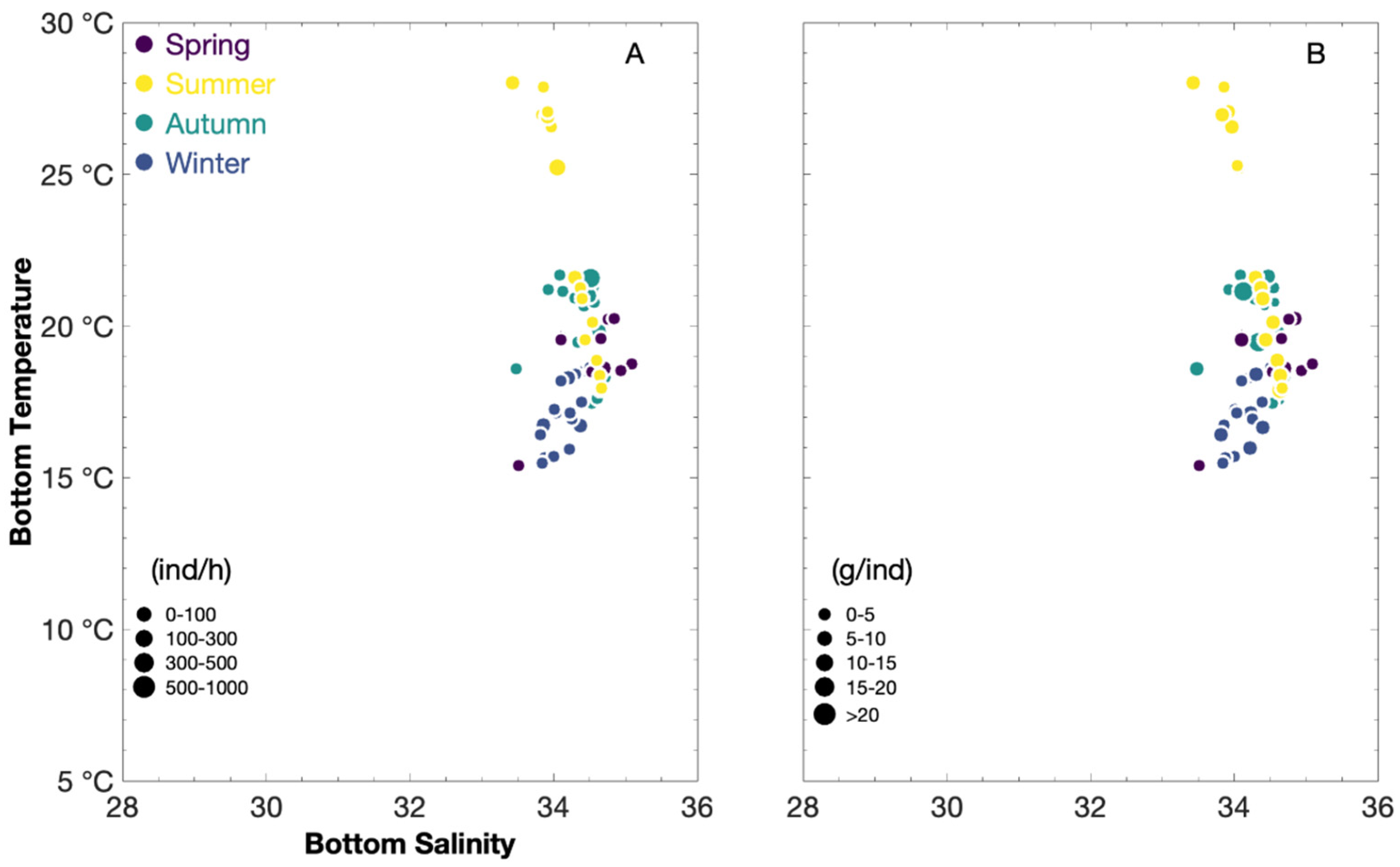
Most abundances were found on SBT 18–19 °C (abundance percentage of 92.68%) in spring, 25–28 °C in summer (72.37%), 20–22 °C in autumn (94.45%), and 16–19 °C in winter (88.1%), with SBS 34–35 across all seasons (Figure 2). When AIW > 10 g·ind−1, larger individuals were found at SBT 18–21 °C in spring, 17–27 °C in summer, 17–22 °C in autumn, and 16–19 °C in winter, with SBS 33–35 across all seasons (Figure 2). When AIW < 3 g·ind−1, smaller individuals were found at SBT 18–22 °C and SBS 34–35 in autumn (Figure 2).

3.2. Seasonal Variation in CPUEw, CPUEn, and AIW

The seasonal rankings of the total CPUEw was summer (12,626.2 g·h−1) > winter (7542.4 g·h−1) > autumn (4778.1 g·h−1) > spring (2646.2 g·h−1), and of the total CPUEn was autumn (1438.7 ind·h−1) > summer and winter (1012.1–1078.2 ind·h−1) > spring (287 ind·h−1). The seasonal order of the mean CPUEw was summer > autumn > spring and winter, whereas for the upper limit CPUEw was summer > autumn and winter > spring (Table 2). The seasonal order of the mean and upper limit CPUEn values was winter > summer > autumn > spring (Table 2). The seasonal order of the mean AIW was summer > spring > autumn and winter; the upper and lower limit AIW values were spring and summer > autumn and winter; and winter > spring, summer, autumn, respectively (Table 2).
Statistical analysis revealed significant seasonal differences in both CPUEw and CPUEn (CPUEw: Kruskal–Wallis test, χ2 = 7.85, df = 3, p < 0.05; CPUEn: Kruskal–Wallis test, χ2 = 8.03, df = 3, p < 0.05). Using Dunn’s test with Bonferroni correction for post hoc pairwise comparisons, the results indicated that no statistically significant differences were found between most seasonal combinations. Significant differences were only detected between spring and winter for both indices (CPUEw: p < 0.05; CPUEn: p = 0.0151), and all other pairwise seasonal comparisons yielded p values greater than 0.05.

3.3. Seasonal Spatial Distribution Pattern of S. alticarinata

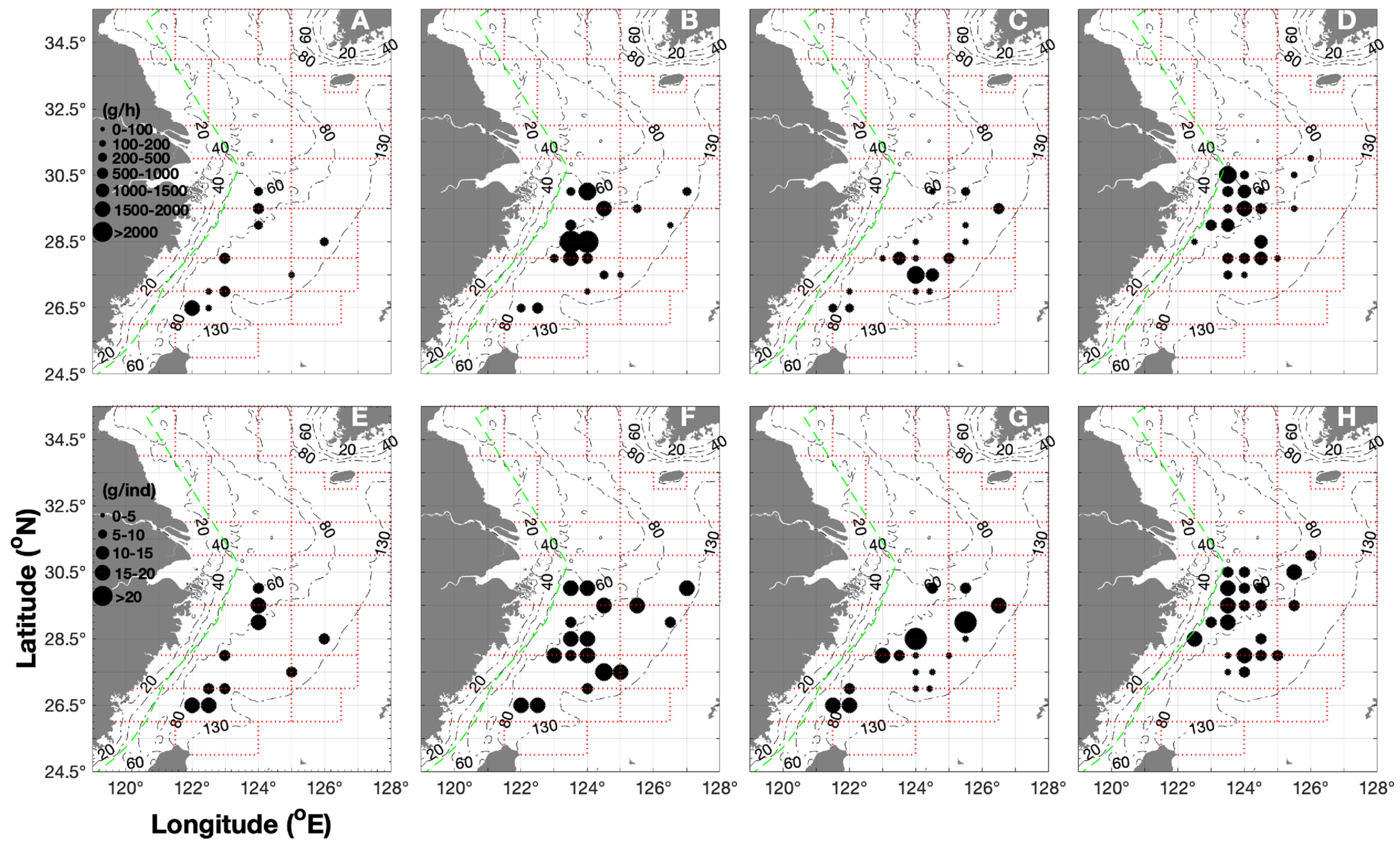
The spatial distribution of S. alticarinata exhibited different seasonal variations. In spring, the population was primarily found at Mindong and Wentai (abundance percentage of 90%: the same applies hereinafter) (SBT 18–20 °C; SBS 34–35; depth 80–110 m), followed by Zhoushan and Yushan (10%) (15–20 °C; 33–35; 60–110 m) (Table 3 and Figure 3). During summer, the highest concentration shifted to Yushan and Yuwai (60%) (25–28 °C; 33–35; 70–120 m), followed by Zhoushan and Zhouwai (20%) (18–27 °C; 34–35; 60–100 m), Wentai (15%) (17–27 °C; 34–35; 70–100 m), and Mindong (5%) (18–21 °C; 34–35; 100–110 m) (Table 3 and Figure 3). By autumn, they returned to Wentai and Mindong (70%) (17–22 °C; 34–35; 80–120 m), followed by Yushan (20%) (19–22 °C; 34–35; 80–100 m), and Zhouwai (10%) (18–22 °C; 33–34; 60–100 m) (Table 3 and Figure 3). In winter, the highest abundance was recorded in Zhoushan (60%) (15–17 °C; 33–35; 60–80 m), followed by Yushan and Wentai (39%) (15–20 °C; 34–35; 60–110 m), and Zhouwai (1%) (16–18 °C; 33–35; 60–90 m) (Table 3 and Figure 3). The seasonal rankings in AIW across the fishing ground were as follows: in spring, Mindong and Zhoushan–Yushan > Wentai; in summer, Zhoushan and Zhouwai ≈ Yushan and Yuwai ≈ Wentai and Mindong; in autumn, Yushan > Zhouwai > Wentai; and in winter, Zhoushan, Zhouwai, and Yushan > Wentai (Table 3).

4. Discussion

In the present study, we found the largest biomass-based CPUE of S. alticarinata in summer (August) and the greatest abundance in autumn (November), indicating the possible breeding and spawning periods in August to November in the East China Sea, respectively. In the Mindongbei offshore water at Fujian, China, Ye et al. (2006) found the seasonal order of spring (May: 34.7 kg·km−2) > summer (August: 13.8 kg·km−2) > autumn (November: 4.55 kg·km−2) > winter (February: 2.89 kg·km−2) for S. alticarinata, with the highest and lowest mean AIW in August and February, respectively [8]. Ye et al. (2006) also argued that the peak spawning period of S. alticarinata was in August to November at Fujian, China [8]. In this study, the larger adult parent cohort of S. alticarinata was found in spring–summer, while the newborn and larger recruitment cohort was found in autumn–winter, respectively. To support our arguments, we present discontinuous length frequency groups (Figure S1) and gonad maturity stage data (Figures S2 and S3) across different months and fishing grounds for the period 2019–2025, which are attached in the Supplementary Materials. Moreover, the higher standard deviation of mean CPUE by weight in summer was mainly attributed to the obvious differentiation in individual body size of the target species across sampling sites. Meanwhile, the species had a wider range of activities and unstable aggregation in summer, leading to large variations in catch weight among stations. In autumn, the species shows distinct differences in aggregation density: dense populations occur in some waters, while sparse distributions are observed in others. This phenomenon, combined with seasonal migration activities, causes greater fluctuation in catch quantity, hence a higher standard deviation of mean CPUE by number.
Second, regarding the observed distribution pattern, we found that most adults and larger recruitments still remained at offshore water areas with high water temperature (SBT < 20 °C) and salinity (>34) in spring, such as Mindong and Wentai, while a small portion of the adult cohorts migrated to the inshore water areas, such as Zhoushan and Yushan, with lower water temperature and salinity. During summer, the parent cohorts released the newborn recruitment in a larger inner area of Yushan, under SBT < 28 °C and >18 °C with a possible favorable SBT of 25 °C. In autumn, the newborn recruitment performed a short-distance feeding migration from Zhoushan–Zhouwai–Yushan–Yuwai to high salinity offshore areas such as Wentai and Mindong as SBT dropped to <18 °C. Conversely, a small portion of the population cohort remained at Zhoushan–Yushan with an SBT of 18–22 °C. During the winter, larger recruitments were found in the study area for further nursery and feeding, with SBT > 15 °C. The evidence from length frequency groups and gonadal maturity data supporting the above inferences can be found in Figures S1–S4.
Third, in this study, the depth range of S. alticarinata indicated a preference of 50–120 m across the season. Other species such as Solenocera membranacea were found at depths of 55–289 m [10]. The SBT where the adults of S. membranacea were present was 13–14 °C [4], whereas the S. alticarinata adults in the East China Sea were found at SBT > 17–18 °C. Regarding salinity, Solenocera crassicornis was found in the salinity value range of 30–42, and the abundance showed an inverse relationship with rainfall and the resulting salinity decrease in the inshore waters [11]. The juveniles and adults of S. alticarinata in this study were found in high salinity areas with SBS 33–35 in the East China Sea.
Finally, the design and implementation of management measurements used in marine shrimp fisheries included temporal and spatial fishing restrictions (such as protected breeding areas and seasonal closures). In the Mindongbei fishing ground of Fujian, China, seasonal closures should be established for S. alticarinata from May–August in the offshore area with depths of 80–100 m to protect immature juveniles and the parent cohort [8]. We recommend focusing protection on broodstock larger than 85 mm in body length (see Figure S4) in the Yushan fishing ground that are approaching sexual maturity, during the period from August to November in the East China Sea. The findings presented in this study can help provide an essential framework for designing policies tailored to the management of S. alticarinata in the East China Sea.

5. Conclusions

In summary, the following main points were found:
(1)
In the East China Sea, S. alticarinata was mainly found within the following environmental ranges: 50–120 m depth, 33–35 SBS, and 16–28 °C SBT across all seasons.
(2)
The majority of S. alticarinata in the East China Sea were not found in waters with a temperature below 15 °C in this study.
(3)
No individuals of the target shrimp species were captured or recorded in the sea areas north of the Zhoushan fishing ground.

Supplementary Materials

The following supporting information can be downloaded at: https://www.mdpi.com/article/10.3390/jmse14121134/s1, Figure S1: Length frequency group histograms of Solenocera alticarinata (the size range is 20–140 mm, with a class interval of 20 mm) by fishing grounds, and sampling months and years. N indicates the total sampling number. Mean body length is indicated in the position of the vertical red dashed line and the corresponding red text. We collected the samples in Zhoushan (September, 2022; N = 21; Mean body length = 93.3 mm), Zhouwai (August, 2020; N = 30; Mean body length = 94.7 mm), Yushan (November, 2018; N = 30; Mean body length = 89.2 mm) (May, 2020; N = 24; Mean body length = 89.9 mm) (August, 2020; N = 30; Mean body length = 97.7 mm) (November, 2021; N = 30; Mean body length = 66.2 mm) (April, 2023; N = 30; Mean body length = 73.5 mm) (January, 2024; N = 47; Mean body length = 75.1 mm), Yuwai (August, 2020; N = 30; Mean body length = 89.9 mm) (November, 2021; N = 30; Mean body length = 68.5 mm), Wentai (May, 2019; N = 16; Mean body length = 75.6 mm) (August, 2020; N = 30; Mean body length = 89.1 mm) (May, 2021; N = 60; Mean body length = 90.6 mm) (November, 2021; N = 60; Mean body length = 75.7 mm) (September, 2022; N = 26; Mean body length = 84.3 mm) (September, 2023; N = 26; Mean body length = 94 mm) (April, 2025; N = 30; Mean body length = 81.7 mm) (September, 2025; N = 30; Mean body length = 94.1 mm), Mindong (May, 2019; N = 30; Mean body length = 87.3 mm); Figure S2. Mean gonadal maturity stage (arabic numbers in y-axis are used to denote different maturity stages) and standard deviation by sampling months and fishing grounds, including Yushan (November, 2018; May, 2020; August, 2020; January, 2024), Wentai (August, 2020; November, 2021; September, 2022), Mindong (May, 2019), and Yuwai (August, 2020). All specimens in the figure are female. Gonadal maturity was classified into six stages: Stage I, immature (juvenile); Stage II, early developing; Stage III, mid-developing (nearly mature); Stage IV, mature (ready to spawn); Stage V, spawning (ongoing or imminent spawning); Stage VI, post-spawning. Figure S3. The number percentage of sampling individuals at each gonadal maturity stages by fishing grounds and sampling months, including Yushan (November, 2018; n = 14) (May, 2020; n = 14) (August, 2020; n = 28) (January, 2024; n = 29), Yuwai (August, 2020; n = 16), Wentai (August, 2020; n = 10) (November, 2021; n = 23) (September, 2022; n = 4), and Mindong (May, 2019; n = 18). Gonadal maturity stages are defined in Figure S2. Figure S4. Body length range (unit: mm) by gonadal maturity stages. Gonadal maturity stages are defined in Figure S2. Stage I of gonadal maturity has a body length range of 63–110 mm. Stage II of gonadal maturity has a body length range of 52–113 mm. Stage III of gonadal maturity has a body length range of 51–125 mm. Stage IV of gonadal maturity has a body length range of 87–110 mm. Stage V of gonadal maturity has a body length of 98 mm. Stage VI of gonadal maturity has a body length of 97–112 mm.

Author Contributions

Conceptualization, M.X. and H.L. (Huiyu Li); methodology, J.L. and H.L. (Hongmei Li); software, H.L. and H.L. (Hongmei Li); validation, M.X., J.L., and H.L. (Huiyu Li); formal analysis, Y.L. and H.L. (Hongmei Li); investigation, Y.L.; resources, Y.L.; data curation, M.X.; writing—original draft preparation, M.X. and H.L. (Hongmei Li); writing—review and editing, M.X. and H.L. (Hongmei Li); visualization, J.L. and H.L. (Huiyu Li); supervision, J.L. and H.L. (Huiyu Li); project administration, J.L. and H.L. (Huiyu Li); funding acquisition, Y.L. All authors have read and agreed to the published version of the manuscript.

Funding

This research was supported by the National Key R&D Program of China (Grant/Award Numbers: 2024YFD2400404).

Data Availability Statement

The original contributions presented in this study are included in the article. Further inquiries can be directed to the corresponding author(s).

Acknowledgments

The authors wish to thank the crews of the fishing boats for their help with field sampling; members of the Key Laboratory of East China Sea and the Oceanic Fishery Resources Exploitation, Ministry of Agriculture and Rural Affairs; and Wenquan Sheng for constructive discussions and encouragement. We sincerely thank the anonymous reviewers for their rigorous evaluation and constructive comments, which have greatly improved this work.

Conflicts of Interest

The authors declare no conflicts of interest.

References

  1. Sharma, R.; Barange, M.; Agostini, V.; Barros, P.; Gutiérrez, N.L.; Vasconcellos, M.; Fernández Reguera, D.; Tiffay, C.; Levontin, P. Review of the State of World Marine Fishery Resources—2025; FAO Fisheries and Aquaculture Technical Paper No. 721; FAO: Rome, Italy, 2025. [Google Scholar]
  2. Rivera-Ferre, M.G. Can Export-Oriented Aquaculture in Developing Countries Be Sustainable and Promote Sustainable Development? The Shrimp Case. J. Agric. Environ. Ethics 2009, 22, 301–321. [Google Scholar] [CrossRef]
  3. Purushothaman, P.; Chakraborty, R.D.; Maheswarudu, G.; Kuberan, G. New Records of Solenocera barunajaya Crosnier, 1994. Zootaxa 2017, 4341, 296–300. [Google Scholar] [CrossRef] [PubMed]
  4. Heegaard, P. On Behaviour, Sex-Ratio and Growth of Solenocera membranacea (Risso) (Decapoda, Penaeidae). Crustaceana 1967, 12, 227–237. [Google Scholar] [CrossRef]
  5. Cheng, J.H.; Dai, G.J.; Ling, J.Z.; Liu, M. Discussion on management countermeasure of economic shrimps in East China Sea. China Fish. 2003, 1, 74–75. (In Chinese) [Google Scholar]
  6. Gómez, M.A.; Gasca, A.G. Dispersal Patterns of Shrimp Larvae and Postlarvae of the Genus Solenocera. Rev. Biol. Mar. Oceanogr. 2007, 42, 157–165. [Google Scholar] [CrossRef]
  7. Demestre, M.; Abelló, P. Growth and Distribution of Solenocera membranacea (Risso, 1816) (Decapoda, Dendrobranchiata) in the Northwestern Mediterranean Sea. Sci. Mar. 1993, 57, 161–166. [Google Scholar]
  8. Ye, S.Z.; Ye, Q.T.; Zhang, Z.L. The quantitative distribution and biological characteristics of Solenocera alticarinata in the Northeast Fujian outer-sea. South China Fish. Sci. 2006, 2, 33–37. (In Chinese) [Google Scholar]
  9. Methot, R.D., Jr.; Wetzel, C.R. Stock Synthesis: A Biological and Statistical Framework for Fish Stock Assessment and Fishery Management. Fish. Res. 2013, 142, 86–99. [Google Scholar] [CrossRef]
  10. Despalatović, M.; Grubelić, I.; Šimunović, A. Distribution and Abundance of the Atlantic Mud Shrimp, Solenocera membranacea (Risso, 1816) (Decapoda, Solenoceridae) in the Northern and Central Adriatic Sea. Crustaceana 2006, 79, 1025–1032. [Google Scholar] [CrossRef]
  11. Damle, R.S.; Deshmukh, V.D. Salinity Tolerance and Fishery of Mud Shrimp Solenocera crassicornis (H. Milne Edwards) in the Coastal Waters of Mumbai. J. Mar. Biol. Assoc. India 2011, 53, 230–236. [Google Scholar]
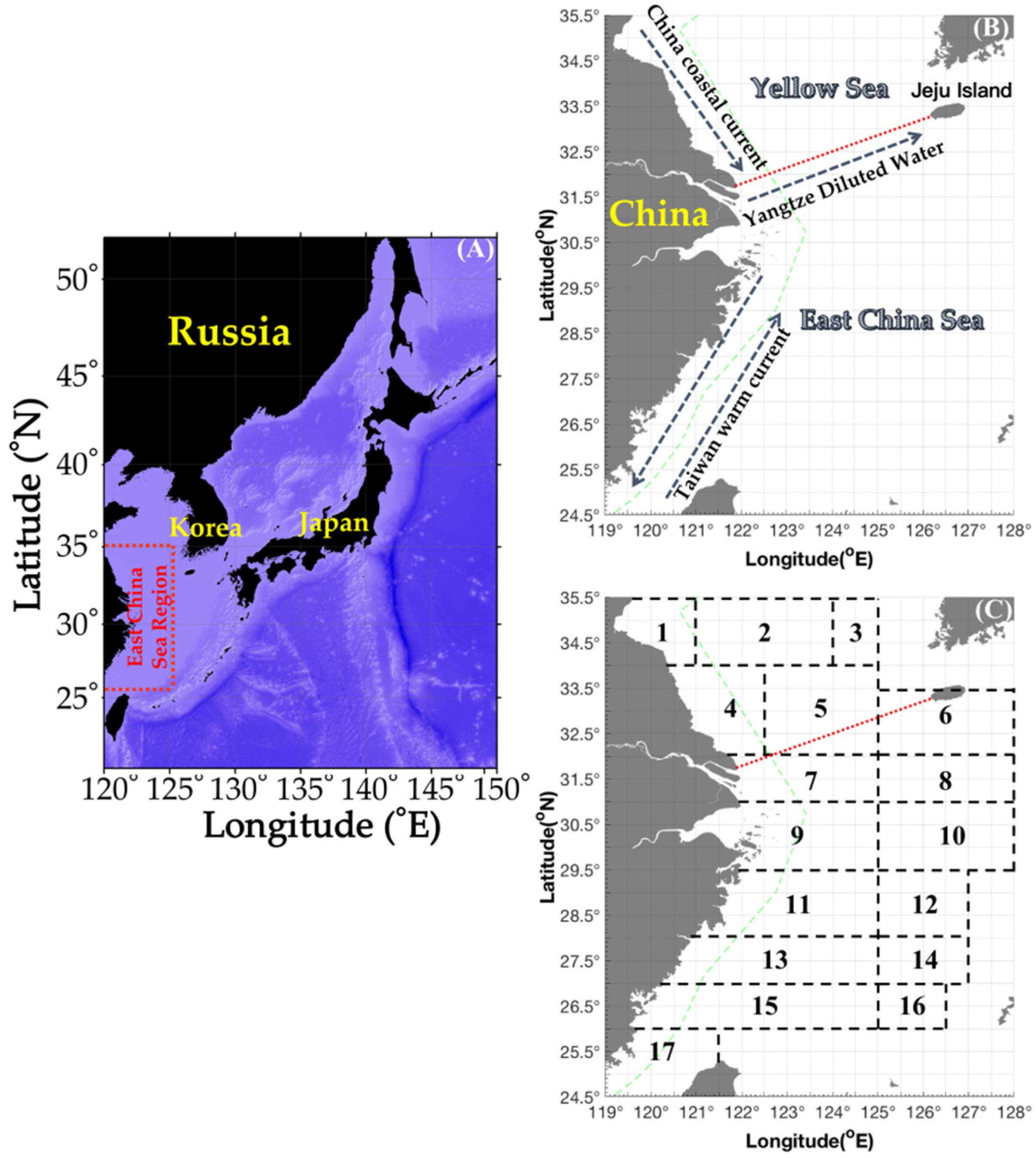
Figure 1. Schematic of the study area and surveyed fishing grounds. (A) Geographical scope of the study region (26.50° N–35.00° N, 120.00° E–127.00° E) (red dashed box). (B) Southern Yellow Sea and East China Sea, with their boundary marked by a red dashed line. (C) Positions of 17 surveyed fishing grounds: (1) Haizhou Bay, (2) Lianqingshi, (3) Liandong, (4) Lvsi, (5) Dasha, (6) Shawai, (7) Yangtze River Estuary, (8) Jiangwai, (9) Zhoushan, (10) Zhouwai, (11) Yushan, (12) Yuwai, (13) Wentai, (14) Wenwai, (15) Mindong, (16) Minwai, and (17) Minzhong. These fishing ground names and their boundaries have been traditionally established by Chinese fishermen over history. In 1987, the Ministry of Agriculture of China issued official administrative documents that formally defined the names and scopes of offshore fishing grounds in China. The green dashed line indicates the motor trawling prohibition boundary.
Jmse 14 01134 g001
Figure 2. Relationships between sea bottom salinity, sea bottom temperature (°C), and two biological metrics of Solenocera alticarinata Kubo, 1949: numerical catch per unit effort (CPUEn), binned into intervals of (A) 0–100, 100–300, 300–500, and 500–1000 ind·h−1; and average individual weight (AIW), grouped into categories of (B) 0–5, 5–10, 10–15, 15–20, and > 20 g·ind−1. Seasonal data points are denoted by colored circles: deep violet (spring), bright yellow (summer), teal (autumn), and slate blue (winter).
Jmse 14 01134 g002
Figure 3. Seasonal distribution patterns of weight-based catch per unit effort (CPUEw; g·h−1) and average individual weight (AIW; g·ind−1) of Solenocera alticarinata. Both metrics are presented in black: CPUEw is classified into intervals of (AD) 0–100, 100–200, 200–500, 500–1000, 1000–1500, 1500–2000, and >2000 g·h−1 in spring (A), summer (B), autumn (C), and winter (D); AIW is grouped into categories of (EH) 0–5, 5–10, 10–15, 15–20, and >20 g·ind−1 in spring (E), summer (F), autumn (G), and winter (H). Red dashed lines denote the demarcation lines separating distinct fishing grounds; readers may refer to the legend of Figure 1 for corresponding fishing ground names. The green dashed line indicates the motor trawling prohibition boundary.
Jmse 14 01134 g003
Table 1. Seasonal ranges of environmental factors across all seasons.
SeasonSea Surface Temperature (°C)Sea Surface SalinitySea Bottom Temperature (°C)Sea Bottom SalinityDepth (m)
spring17–2532–3515–2033–3556–107
summer26–2928–3517–2833–3561–120
autumn21–2533–3517–2233–3560–115
winter15–1934–3515–2033–3555–107
Table 2. Seasonal mean ± stdev and range of CPUEw (unit: g·h−1), CPUEn (unit: ind·h−1) and AIW (unit: g·ind−1) of Solenocera alticarinata Kubo, 1949 across all seasons in 2018–2019.
TypeSpringSummerAutumnWinter
Value range of CPUEw7.7–11647–419019.4–18768–1942.4
Mean CPUEw at collection stations264.6 ± 348.1742.7 ± 1117.3359.2 ± 470.6281.1 ± 462.4
Value range of CPUEn1–1121–3362–2361.5–848
Mean CPUEn at collection stations28.7 ± 36.863.4 ± 93.448.2 ± 206.584.6 ± 60.1
Value range of AIW6.4–13.17–15.51.7–14.52–23.1
Mean AIW9.7 ± 2.211.2 ± 2.18.5 ± 6.88.2 ± 3.2
Table 3. The value and percentage of CPUEw and CPUEn in terms of mean and total values, and the mean value of AIW across all seasons, fishing grounds, and environmental factors (sea surface temperature [SST], sea surface salinity [SSS], sea bottom temperature [SBT], sea bottom salinity [SBS], depth).
Fishing GroundMean ValueTotal ValueEnvironmental Factors
CPUEwCPUEnAIWCPUEwCPUEnSSTSSSSBTSBSDepth
Spring
Zhoushan–Yushan140.714.5%13.313.1%10.8562.821.3%5318.5%17–2032–3415–2033–3556–107
Wentai209.621.5%28.828.3%8838.331.7%11540.1%21–2433–3518–2034–3581–107
Mindong622.664%59.558.6%111245.147.1%11941.5%24–2534–3518–2034–3598–102
Summer
Zhoushan–Zhouwai671.922.9%52.521%11.93359.326.6%262.324.3%27–2928–3318–2734–3561–97
Yushan–Yuwai171658.6%148.759.4%10.1686454.4%594.755.2%28–2933–3425–2833–3570–120
Wentai391.113.4%36.814.7%11.91955.415.5%184.217.1%26–2733–3417–2734–3575–101
Mindong149.25.1%12.34.9%10.1447.63.5%373.4%26–2733–3418–2134–3597–112
Autumn
Zhouwai206.325.8%21.810%861913%65.54.6%21–2333–3418–2233–3460–102
Yushan16821%32.114.7%10.41175.924.6%224.515.6%22–2433–3519–2234–3576–100
Wentai–Mindong426.253.2%164.175.3%62983.362.4%1148.779.8%23–2533–3517–2234–3576–115
Winter
Zhoushan555.946.1%70.344%9.4444759%562.555.6%15–1733–3515–1733–3555–78
Zhouwai383.2%5.13.2%9.3113.91.5%15.21.5%16–1733–3516–1833–3566–88
Yushan343.228.5%35.622.3%9.91372.918.2%142.314.1%16–1734–3515–1734–3564–92
Wentai268.122.2%48.730.5%61608.721.3%292.128.9%18–1934–3518–2034–3588–107
Disclaimer/Publisher’s Note: The statements, opinions and data contained in all publications are solely those of the individual author(s) and contributor(s) and not of MDPI and/or the editor(s). MDPI and/or the editor(s) disclaim responsibility for any injury to people or property resulting from any ideas, methods, instructions or products referred to in the content.