Review

Global Trends and Hotspots Evolution in Ship Exhaust Emissions Research

1
College of Biological and Environmental Sciences, Zhejiang Wanli University, Ningbo 315100, China
2
Center for Excellence in Regional Atmospheric Environment, Fujian Key Laboratory of Atmospheric Ozone Pollution Prevention, Key Laboratory of Urban Environment and Health, Institute of Urban Environment, Chinese Academy of Sciences, Xiamen 361021, China
3
Zhejiang Key Laboratory of Pollution Control for Port-Petrochemical Industry, Ningbo Key Laboratory of Urban Environmental Pollution and Control, CAS Haixi Industrial Technology Innovation Center in Beilun, Ningbo 315830, China
4
Ningbo Xinrui Zhice Technology Co., Ltd., Ningbo 315800, China
5
Yunnan Guoke Green Environmental Protection Co., Ltd., Kunming 650206, China
*
Authors to whom correspondence should be addressed.
J. Mar. Sci. Eng. 2026, 14(12), 1079; https://doi.org/10.3390/jmse14121079 (registering DOI)
Submission received: 29 April 2026 / Revised: 4 June 2026 / Accepted: 8 June 2026 / Published: 10 June 2026
(This article belongs to the Section Marine Environmental Science)

Abstract

Ship exhaust emissions have become an increasingly prominent global atmospheric environmental issue, triggering a series of ecological disturbances and adverse public health consequences. However, comprehensive analyses of the research progress and evolution trends in this field remain scarce. This study systematically retrieved 1346 scholarly publications in the ship exhaust emissions field for the period 2011–2025 from the Web of Science Core Collection and carried out a bibliometric analysis encompassing publication outputs, contributing countries/regions, and keyword characteristics. The findings reveal a sustained and robust growth trajectory in global research output, with annual publications increasing nearly fivefold over the 15-year study period. Notably, academic interest in this field has increased significantly since 2020 due to the implementation of the global sulfur cap regulation. Core thematic clusters (mean silhouette S = 0.7205) in this field include source apportionment, numerical modeling analysis, atmospheric criteria pollutants, and technological emission reduction strategies. The geographical distribution of research output shows a significant positive correlation with the importance of regional maritime economies. China, the United States, and Germany are the leading contributors in terms of publication outputs, while frequent research collaborations have been observed among European countries. Since 2021, the emergence of Automatic Identification System data as a keyword with high burst strength (intensity = 3.60) marks a paradigm shift toward a “big data-enabled refined management” framework. Concurrently, the sustained burst activity of keywords including nitrogen oxides, volatile organic compounds, and traffic-related emissions from 2023 to 2025 indicates rapidly growing scholarly attention to secondary aerosol precursors from shipping, and the critical need for coordinated multi-pollutant control strategies. Future research directions for ship exhaust emissions are expected to transition from fundamental characterization research to big data-driven monitoring and estimation methods, as well as advanced emission reduction technologies. The bibliometric insights derived from this study provide a valuable reference framework for subsequent in-depth studies on ship exhaust emissions.

1. Introduction

Against the backdrop of advancing globalization and the sustained expansion of international trade volumes, maritime shipping has become the dominant mode of transport for global commerce [1,2], accounting for approximately 80% of global merchandise trade [3]. While functioning as a lifeline of the global economy, the environmental ramifications of the shipping sector have grown increasingly conspicuous. As a key byproduct of international maritime operations, ship exhaust emissions have emerged as a major global environmental and climate challenge. Their primary constituents including but not limited to sulfur oxides (SOX), nitrogen oxides NOX), particulate matter (PM), and carbon dioxide (CO2) directly compromise air quality and public health in coastal and port areas, and constitute a significant source of global atmospheric pollution [4,5,6]. Furthermore, NOX and SO2 can be readily converted into nitric acid and sulfuric acid via dissolution in atmospheric moisture [7,8], and subsequently integrate into Earth’s biogeochemical cycles through precipitation. These sequential processes exert multifaceted adverse effects on human health, vegetation, soil systems, and overall ecosystem integrity, all of which demand rigorous scientific scrutiny [9].
The Third International Maritime Organization (IMO) Greenhouse Gas Study demonstrated that, under diverse scenarios encompassing transport demand, economic conditions, and energy consumption patterns, unregulated shipping emission factors were projected to increase by 50–250% by 2050, based on the emission projection data from 2013 to 2016 [10]. To curb carbon emissions within the maritime sector, the IMO formulated and adopted its initial greenhouse gas (GHG) reduction strategy in 2018, committing to reduce total annual GHG emissions by at least 50% by 2050 relative to the 2008 baseline [11]. In 2020, the IMO implemented the global sulfur cap regulation, which restricts the sulfur content of marine fuels to below 0.50% so as to alleviate detrimental environmental and public health impacts, thereby accelerating the green transition of the shipping industry [12]. Against this regulatory backdrop, research in related fields has expanded significantly over the past few decades, establishing a comprehensive interdisciplinary knowledge framework covering emission control technologies (e.g., scrubbers and selective catalytic reduction) [13,14], alternative fuels (e.g., liquefied natural gas, methanol, ammonia, and hydrogen) [15,16,17], emission monitoring and modeling [18,19,20], environmental and health impact assessments [21,22], as well as international emission mitigation policy frameworks [23].
Faced with the rapidly expanding and intricate body of scholarly literature in this domain, a critical challenge facing both the academic community and policymakers is systematically delineating the field’s developmental trajectory, identifying core research themes and evolutionary pathways, uncovering academic collaboration networks [24], and forecasting future research trends. Bibliometrics, a quantitative analytical approach based on mathematical statistics, addresses this challenge by mining and visualizing the extrinsic characteristics of large-scale academic literature, including publication outputs, authors, affiliations, countries, journals, keywords, and citation networks. This methodology offers an objective and macro-level perspective for interpreting the developmental dynamics, knowledge architecture, and research hotspots within a specific discipline or field [25,26,27]. Applying bibliometric methods to conduct a panoramic review and in-depth analysis of ship exhaust emissions research not only enables early-career researchers to rapidly comprehend the field’s intellectual landscape and core knowledge base but also provides scholars with valuable guidance regarding disciplinary evolution and cutting-edge research directions. Furthermore, it offers data-driven decision support for research funding agencies and policymakers to optimize resource allocation and strategic planning.
Over the past decade, researchers across the globe have conducted extensive investigations into issues pertaining to ship exhaust emissions, achieving remarkable advancements and providing insightful reference foundations for the advancement of this field. Nevertheless, a comprehensive systematic analysis and synthesis of this extensive body of literature remain lacking. In the present study, the CiteSpace software package was employed to analyze literature data obtained from the Web of Science Core Collection. The compiled dataset includes article titles, author keywords, contributing authors, and international collaboration metadata for peer-reviewed publications focused on ship exhaust emissions from 2011 to 2025. This study aims to systematically delineate the research progress and evolutionary trajectory of ship exhaust emissions research, laying a theoretical foundation for the development of emission evaluation and control methodologies. Additionally, it identifies core research priorities and proposes prospective future directions for this field.

2. Materials and Methods

2.1. Data Sources and Acquisition

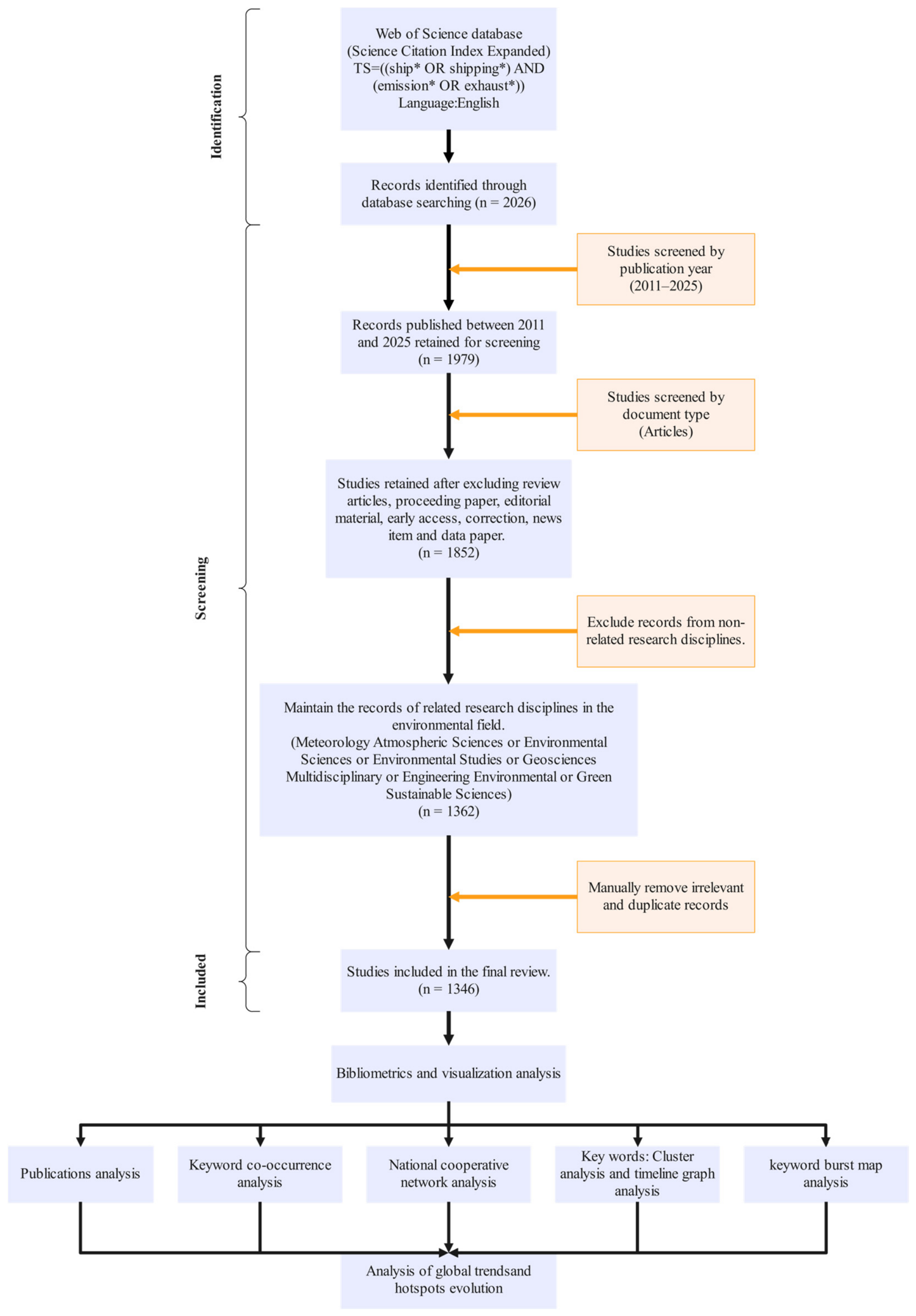
The data employed in this study were retrieved from the Web of Science (WOS) database. As a globally recognized, authoritative, and comprehensive academic information platform, WOS is widely utilized across a broad range of disciplines, including the natural sciences, engineering, social sciences, arts, and humanities. A bibliometric approach was adopted in this study to conduct a systematic analysis of literature related to ship exhaust emissions. The core search terms comprised the following keyword combination: (ship* OR shipping*) AND (emission* OR exhaust*). The search scope was restricted to the period from 2011 to 2025, and only documents categorized as research articles were included. A manual screening process was subsequently carried out by examining article titles and abstracts to exclude clearly irrelevant publications. In total, 1346 valid documents were obtained as the analytical dataset and exported in RefWorks format. This review was conducted and reported in accordance with the Preferred Reporting Items for Systematic Reviews and Meta-Analyses PRISMA 2020 statement. The PRISMA flow diagram illustrating the study selection process is presented in Figure 1.

2.2. Scientometric Analysis

In this study, CiteSpace (version 6.4.R1 Advanced) was employed to conduct visual scientometric analyses of the retrieved literature pertaining to ship exhaust emissions research. Publication outputs, contributing countries, keywords, and other relevant bibliometric indicators for the period 2011–2025 were analyzed to characterize the research background, current status, thematic hotspots, and developmental trends within this domain. CiteSpace was utilized to construct and analyze both the international research collaboration network and the keyword co-occurrence network for this field. For the visualization of the international collaboration network, the node type was set to “Country”, with a minimum publication threshold of 10. The node size corresponds to the total publication output of a given country or region, while the thickness of connecting links indicates the total link strength of international research collaborations. In the keyword co-occurrence network visualization, the node type was defined as “Keyword”, with a frequency threshold of 20. Here, node size represents the occurrence frequency of individual keywords, and interconnecting links denote co-occurrence relationships between keywords. Keyword clustering and timeline analyses were conducted to systematically and objectively identify the research hotspots and evolutionary trends across distinct periods within the field. Finally, the statistical data extracted from the literature sample were imported into Origin software (version 2021) to generate the corresponding visual graphics.

3. Results and Discussion

3.1. Publications Analysis

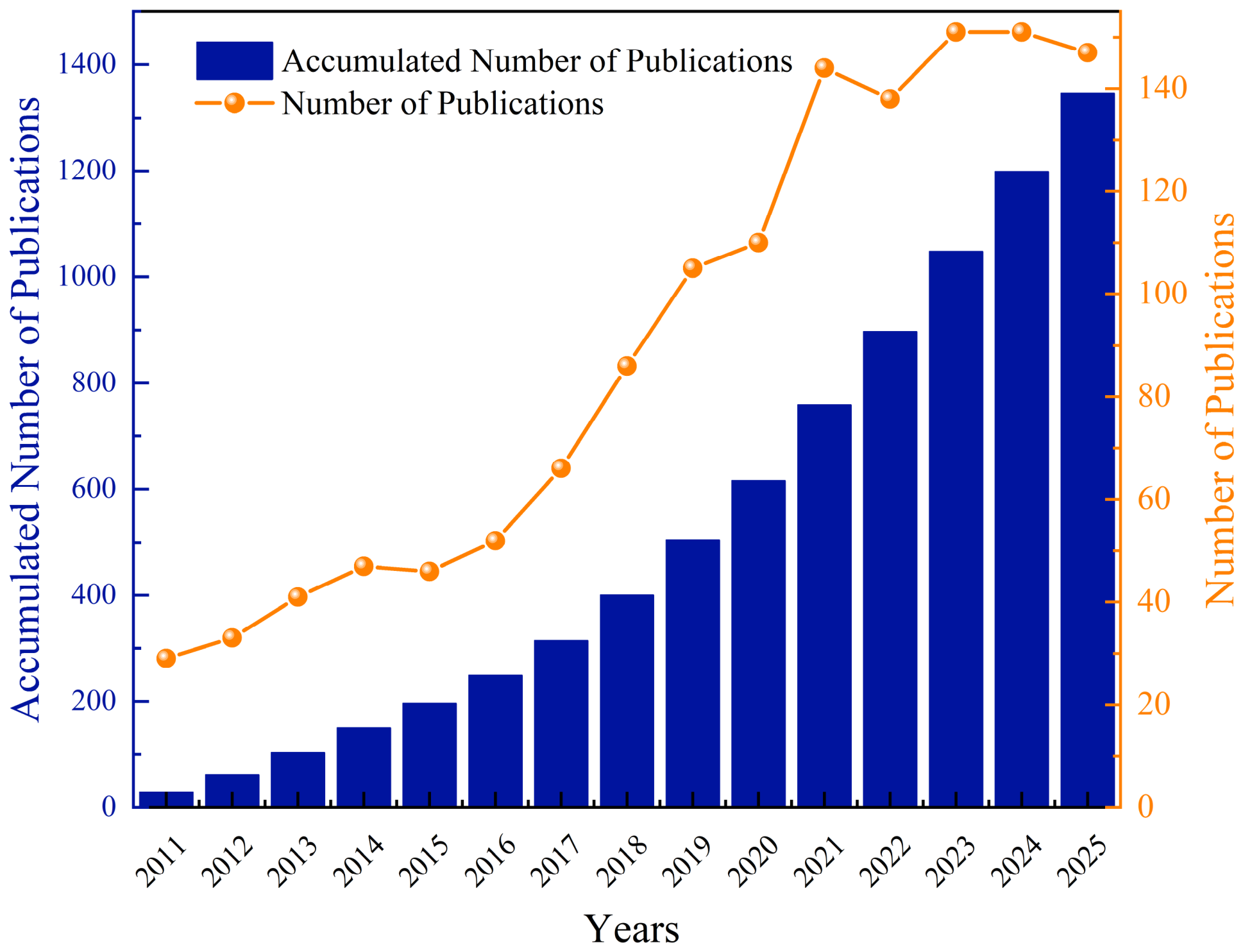
Against the backdrop of the sustained and rapid development of the global shipping industry, atmospheric environmental deterioration driven by ship exhaust emissions has become increasingly prominent [12,28,29]. Understanding the impacts of ship exhaust emissions has become increasingly critical, as these pollutants accumulate and migrate in the atmosphere via diverse transport pathways. Publication output refers to the total number of articles published within a specific research domain over a defined time interval, and fluctuations in annual publication volumes can effectively reflect the developmental dynamics and current status of the field. A bibliometric analysis of the 1346 publications addressing ship exhaust emissions over the 2011–2025 period reveals an overall upward trend in the number of relevant publications (Figure 2). From 2011 to 2015, annual publication output remained relatively low and stable, ranging from 30 to 50 articles per year. This pattern indicates that research on ship exhaust emissions was still in the preliminary exploratory stage, characterized by a slow growth rate in scholarly outputs. Between 2016 and 2020, the annual number of publications exhibited a moderately accelerated growth trend, signifying that research in this field entered a phase of rapid development and attracted increasing attention from the global academic community. Notably, a pronounced surge in publication numbers was observed after 2020, with the cumulative total reaching 1346 articles by 2025. This trend reflects a substantial increase in research attention devoted to ship exhaust emissions in recent years. Based on publication statistics extracted from the WOS database, international research output over the most recent three years is as follows: 151 articles in 2023, 151 articles in 2024, and 147 articles in 2025, indicating that annual publication volumes have gradually stabilized. The publication output in 2025 is approximately fivefold that of 2011 (29 articles), demonstrating sustained global scholarly interest in this research field.
This trend indicates that research in this field has garnered growing global attention, particularly in countries with advanced shipping industries and well-developed maritime economies. In terms of scholarly publication output, China ranks first worldwide in the field of ship exhaust emissions research. This finding is primarily attributable to the fact that seven of the world’s top ten largest ports are located in China, and the construction of its waterway transport infrastructure has accelerated continuously in recent years [30]. However, the expansion of port infrastructure and growth in vessel numbers inevitably lead to an increase in emissions, while intensive vessel traffic in port areas aggravates air pollution in both local and surrounding regions [9]. This issue particularly occurred in economically developed, port-intensive regions including the Yangtze River Delta, Pearl River Delta, and Bohai Bay Rim, making these areas the core focal points of domestic ship emissions research. From a regional research perspective, existing domestic studies in China are predominantly concentrated on waterways characterized by intensive shipping activity and notable air quality impacts on adjacent densely populated areas. For instance, Zhang et al. [30] focusing on the Nanjing section of the Yangtze River, demonstrated the substantial contribution of inland vessel emissions to urban air quality along the riverbanks. Their findings indicated that in areas adjacent to the waterway, NOX emitted from inland ships accounts for at least 40% of local atmospheric pollution. Similarly, Fu et al. [31] systematically analyzed the combined pollution effects of ship emissions on PM2.5 and O3 in the Yangtze River Delta, and confirmed that ship emissions induce a significant elevation in PM2.5 concentrations across coastal and offshore areas. The Bohai Bay Rim has been investigated by Wan et al. [32], whose findings confirmed the notable accumulation of ship emissions in this region. They identified that high-emission zones are primarily clustered around major ports including Tianjin and Dalian, as well as core maritime traffic arteries such as the Laotieshan Waterway. In contrast, focusing on the unique island geographical setting of Hainan, Xie et al. [33] elucidated the impacts of offshore vessel emissions on island air quality, and highlighted the critical role of meteorological conditions including monsoons and sea–land breezes in the long-range transport of ship-sourced pollutants.
It is evident that the impact of ship exhaust emissions on coastal air quality has become a common issue in port-dense regions worldwide. For instance, Viana et al. [34] employed dispersion models and health impact assessment tools to quantify the reductions in PM10 and SO2 concentrations resulting from designating the Sea of Marmara as a sulfur oxide emission control area (ECA). This study underscores the effectiveness of ECA policies in regions with high-density shipping and population. Yoo et al. [35] utilized the WRF and CMAQ models combined with the recirculation index and the integrated process rate analysis to systematically assess the synergistic effects of sea–land breeze recirculation and ship emissions on PM2.5 pollution in Busan South Korea. In the Gothenburg region of Sweden, Tang et al. [36] coupled dispersion models with health impact assessment tools to quantify the contributions of local and regional shipping to air quality and public health. Sha et al. [37] conducted empirical quantitative research of ship emissions, and linked datasets from 189 international ports with vessel arrival and departure records to develop customized emission inventories.

3.2. Analysis of Research Hotspots and Trends

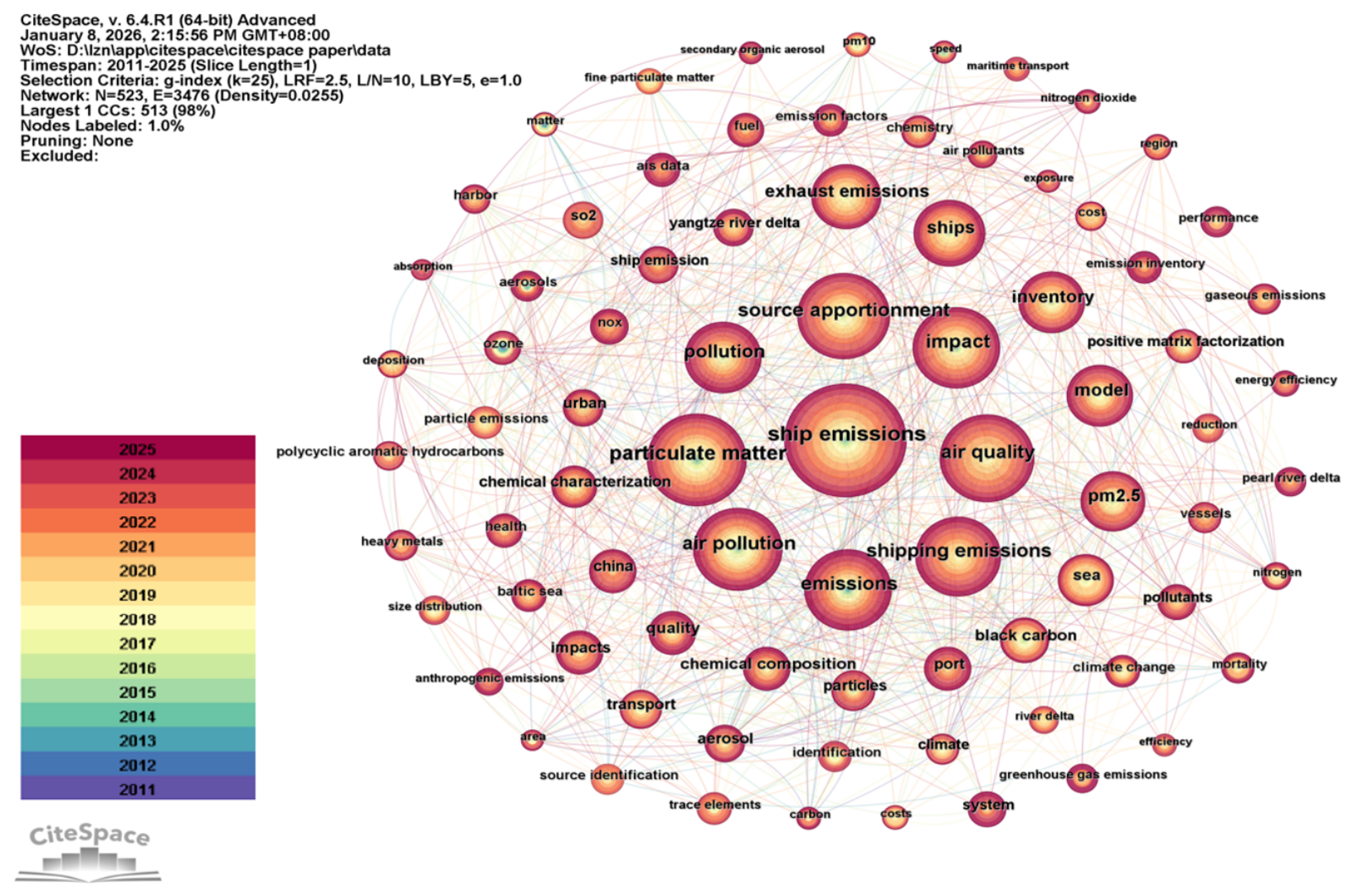
The core connotation and thematic focus of a scholarly article can be effectively reflected via its keywords. Identifying core keywords within a specific research field enables readers to gain an insight into the field’s developmental patterns, characteristics, and trends, especially its core research content, directions, and hotspots. By utilizing the keyword analysis module of CiteSpace, 522 keywords were extracted from relevant scholarly publications in this target field. With the minimum keyword co-occurrence frequency threshold set to 20, a total of 80 eligible keywords were ultimately identified. Based on the corresponding statistical outcomes, a keyword co-occurrence network diagram is further constructed and visualized in Figure 3.
The most frequently occurring keyword across the analyzed corpus is “ship emissions” with 367 occurrences, followed by “particulate matter” with 252 occurrences. Additional high-frequency keywords within the dataset include “air quality” with 244 occurrences, “source apportionment” with 225 occurrences, “air pollution” with 209 occurrences, “impact” with 205 occurrences, and “emissions” with 196 occurrences. Building on the aforementioned high-frequency keywords, the research landscape of ship emissions can be systematically divided into five core thematic clusters: (1) pollutant species and emission characteristics of ship emissions; (2) emission sources and inventory compilation of ship emissions; (3) atmospheric environmental impacts of ship emissions; (4) research methodologies and technical approaches for ship emission studies; and (5) geographical and regional research on ship emissions. Furthermore, strong semantic linkages exist among these keywords, with their high co-occurrence frequencies confirming robust interrelationships between the identified themes. Notably, research focusing on the pollutant species and emission characteristics of ship emissions accounts for a significant proportion of the analyzed literature, marking it as a prevailing research hotspot and core thematic focus within the field to date.

3.3. Intensity Analysis of Major Countries/Regions

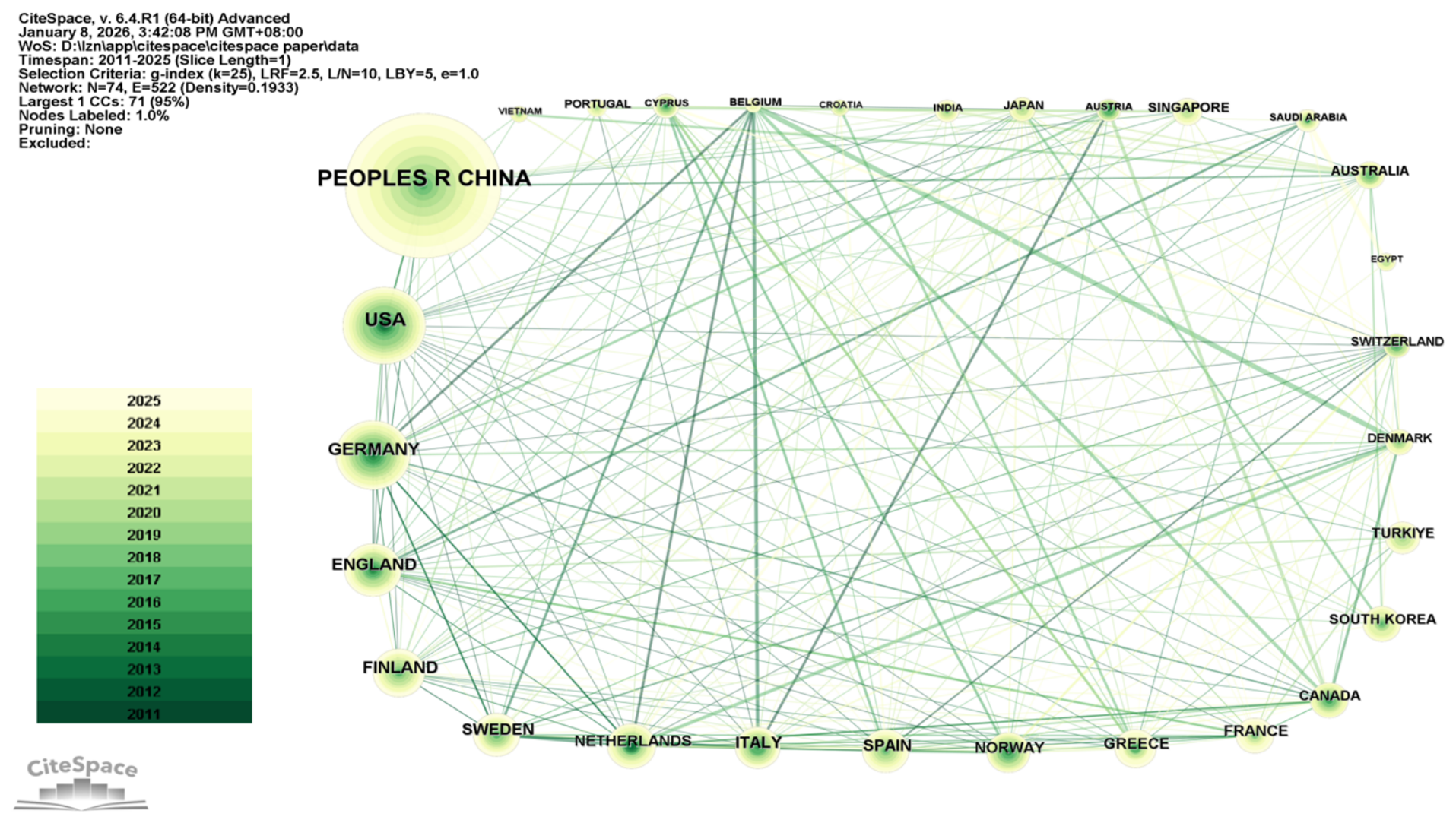
The research intensity of a country within a given academic field can be objectively reflected, to a certain extent, by its scholarly publication output. We conducted an international collaboration network analysis of the collected literature using CiteSpace, and identified that relevant publications originated from 72 countries and regions. A minimum threshold of 10 publications per country/region was applied, yielding 29 eligible countries and regions for subsequent analysis in Figure 4.
From the co-occurrence knowledge visualization map of major contributing countries in the ship emissions research field, it is evident that China maintains close scientific collaborative ties with countries including USA, Germany, and Australia. In terms of the number of publications, China made the greatest contribution to the field with 571 relevant publications. The top-publishing countries of China, USA, and Germany have vast maritime territories or important ports, qualifying them as major global shipping nations. This result is consistent with the conclusion drawn by Zhao et al. [38] from their study on the profound impacts of ship exhaust emissions on the global environment, climate change, and public health, indicating that ship exhaust emissions contribute significantly to the global atmospheric pollution load, particularly in coastal and port areas. Furthermore, the collaboration network generated via CiteSpace reveals that European countries including Germany, Belgium, Denmark, Sweden, Italy, and the Netherlands, engage in frequent and wide-ranging scientific collaborations. Such collaborative initiatives have expanded academic exchanges and project partnerships in related research areas, collectively promoting the rapid advancement of pollution control and monitoring technologies for ship emissions.
Our analysis of the international scientific collaboration network reveals that the countries with the highest scholarly contributions to this field maintain extensive collaborative linkages with other countries and regions. However, a subset of countries still demonstrates very limited research collaboration with other major contributing countries and research institutions in this field. These disparities in collaborative engagement may be primarily attributed to cross-national differences in economic development levels, maritime industry scale, and territorial sea area across different countries and regions. These underlying heterogeneities may in turn lead to significant variations in ship exhaust emission levels across different study areas. A comparative analysis of national case studies on ship exhaust emissions reveals a clear convergence in core research methodologies worldwide. The vast majority of scholarly research on ship exhaust emissions focuses on two core areas: numerical model estimation and emission monitoring. The utilization of (Automatic Identification System) AIS data to construct emission inventories with high spatiotemporal resolution, and the combination of air quality models for process analysis and impact assessment, has gradually become the main method in this research field.
In China, the strategic pursuit of carbon neutrality and sustainable development has accelerated the green transformation of the shipping industry, including the establishment of a ship energy consumption reporting system to support emission monitoring and analysis [39]. Building upon this reporting system, Li et al. [40] proposed an emission inventory construction approach based on the ship energy consumption reporting system, which offers potential advantages in generating results with higher precision and improved spatiotemporal resolution. Regarding model estimation and emission monitoring, He et al. [41] proposed a stratified sampling regional shipping emission model based on individual vessel emissions. By utilizing complete vessel information to perform ship-level emission calculations, this model effectively reduces estimation uncertainties introduced by the absence of individual vessel parameters. Ding et al. [42] adopted an Extreme Gradient Boosting model combined with vessel activity data derived from AIS signals to quantify the contribution of ship exhaust to black carbon pollution during fishing periods in the East China Sea. Gan et al. [43], taking the western port area of Shenzhen as a case study, estimated ship exhaust emissions in 2018 by fitting vessel AIS data with ship characteristic parameters. Wang et al. [44] used AIS data to monitor and match excessive exhaust emissions from navigating vessels in Nanjing. They applied a ship emission calculation model to derive real-time SO2 source intensities for individual ships, and developed an improved Gaussian dispersion model incorporating vessel movement characteristics to compute time-series SO2 diffusion concentrations at monitoring points. He et al. [45] developed a high spatiotemporal resolution ultraviolet remote sensing imaging system for NO2 monitoring in ship exhaust, and analyzed the ultraviolet absorption characteristics of NO2 in the 440 nm band. Zhang et al. [46] constructed a high-resolution ship emission inventory within 12 nautical miles of Hainan Island for 2019–2022 based on the SEIM and VoySEIM models. Dai et al. [47] utilized real-time AIS data from 2023 to construct an hourly, kilometer-scale high-resolution emission inventory for Shanghai Port, and precisely characterized the emission patterns of different vessel types, particularly container ships and bulk carriers, across various time periods and operational areas. Dong et al. [22] using the WRF-CMAQ model, focused on changes in health risks associated with PM2.5 and its trace metal components in Shanghai before and after the implementation of the low-sulfur fuel policy, thereby quantitatively evaluating the policy’s emission reduction effectiveness. Additionally, Xie et al. [48] targeting the Northern Jiangsu section of the Beijing–Hangzhou Grand Canal, incorporated shallow-water effect corrections into the STEAM model, significantly improving the accuracy of inland vessel emission estimations.
Consistent with the core research focus observed in China, scholarly research in other countries also predominantly centers on the two core themes of numerical model estimation and emission monitoring. For instance, Bojić et al. [49] developed the PrE-PARE model, which enables the prediction, systematic analysis, and quantitative assessment of ship-sourced air pollution in port areas. Da Silva et al. [50] established a standardized methodological framework for ship emission estimation using AIS data. Orlandi et al. [51] proposed an innovative integrated framework coupling a marine meteorological forecast module and a ship performance model, which adopts multi-layer modeling to evaluate the environmental impacts of ship emissions. In conclusion, these studies reflect a clear growing trend in the field: the continuous refinement of modeling methods tailored to specific regional and navigational contexts.

3.4. Keyword Cluster Analysis

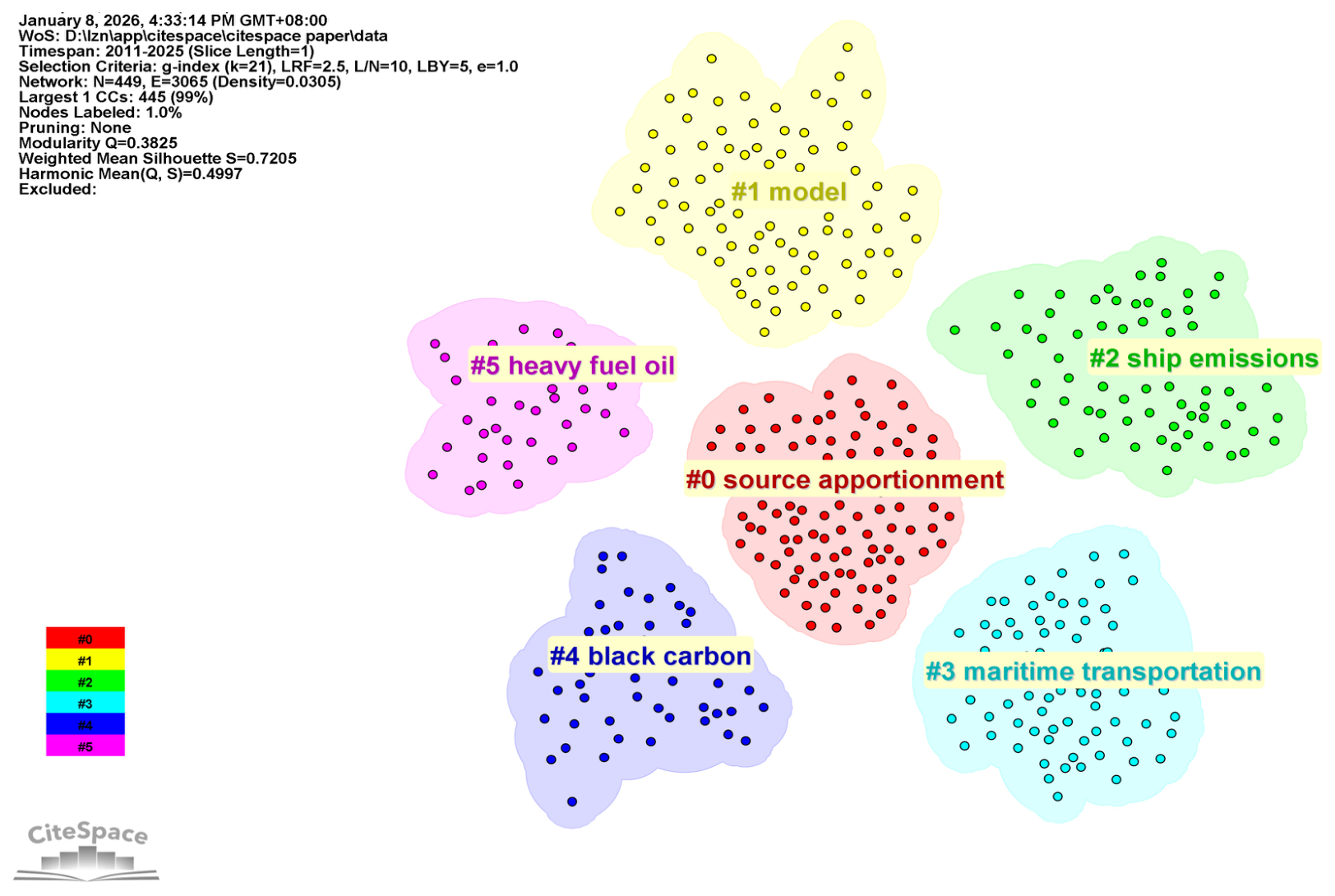
The keyword clustering analysis is a well-established bibliometric method used to delineate core research hotspots within a defined academic field. For this analysis, cluster size refers to the number of keywords included in each cluster, while the silhouette value quantifies the degree of differentiation between independent clusters. We generated a keyword clustering map using the Log-Likelihood Ratio (LLR) algorithm integrated into CiteSpace software. In the resulting map, a higher number of nodes within a cluster corresponds to a broader research scope and greater scholarly attention devoted to the corresponding thematic focus. The keyword clustering map derived from CiteSpace divided the extracted keywords into seven distinct thematic clusters, which collectively capture the core research hotspots in the field of ship emissions in Figure 5.
In bibliometric research, a modularity (Q) value above 0.3 is widely accepted to indicate a statistically significant clustering structure. For the average silhouette value (S), a score above 0.5 indicates that the clustering result is reasonable, while a score exceeding 0.7 confirms that the clustering is robust and statistically convincing. In this study, the obtained Q value was 0.3825 and the average S value was 0.7205, verifying that our clustering results have a significant structural division and high statistical reliability. In Figure 5, Cluster 0 is predominantly focused on source apportionment, with core keywords including “particulate matter” and “chemical composition”. This cluster primarily elucidates the source profiling information of pollutants derived from ship emissions. Cluster 1 is mainly centered on numerical simulation models, with core keywords including “air quality”, “impact”, “pollution”, and “aerosol”. This cluster covers research on modeling frameworks for the monitoring and assessment of ship-derived atmospheric pollution. Cluster 2 is predominantly focused on the core characteristics of ship emissions, with core keywords including “ship emissions”, “exhaust emissions”, and “air pollution”. This cluster investigates the intrinsic correlation between ship exhaust emissions and ambient atmospheric pollution. Cluster 3 is primarily focused on maritime transportation, with core keywords including “ship” and “port”. This cluster explores the impacts of shipping and port operation activities on ship exhaust emissions. Cluster 4 is centered on black carbon, with core keywords including “black carbon”, “size distribution”, and “impact”. This cluster characterizes the distribution properties and associated environmental impacts of black carbon, a key pollutant emitted from ship exhausts. Cluster 5 is mainly focused on heavy fuel oil, with core keywords including “fuel”, “combustion”, “diesel”, and “oil”. This cluster provides insights into the environmental issues associated with heavy fuel oil combustion and application in marine vessels.
It is noteworthy that specific “emission reduction technologies” (e.g., scrubbers, selective catalytic reduction) do not appear as independent high-frequency keywords in the co-occurrence network. Instead, they are predominantly embedded within clusters such as “source apportionment” and “numerical modeling”, where the underlying literature frequently addresses technical mitigation measures. Similarly, alternative marine fuels including methanol, ammonia, and hydrogen have not yet formed a distinct keyword cluster, likely because they are often labeled under broader terms like “fuel” or “alternative fuel”. Nevertheless, a manual inspection of recent publications (2022–2025) reveals a rapidly growing body of work devoted to life-cycle assessment and combustion characteristics of these emerging fuels, indicating an active and lexically diffused research front [52,53,54]. Future bibliometric updates would benefit from a more finely resolved keyword set that explicitly captures individual technologies and alternative fuel types.

3.5. Keyword Trend Analysis

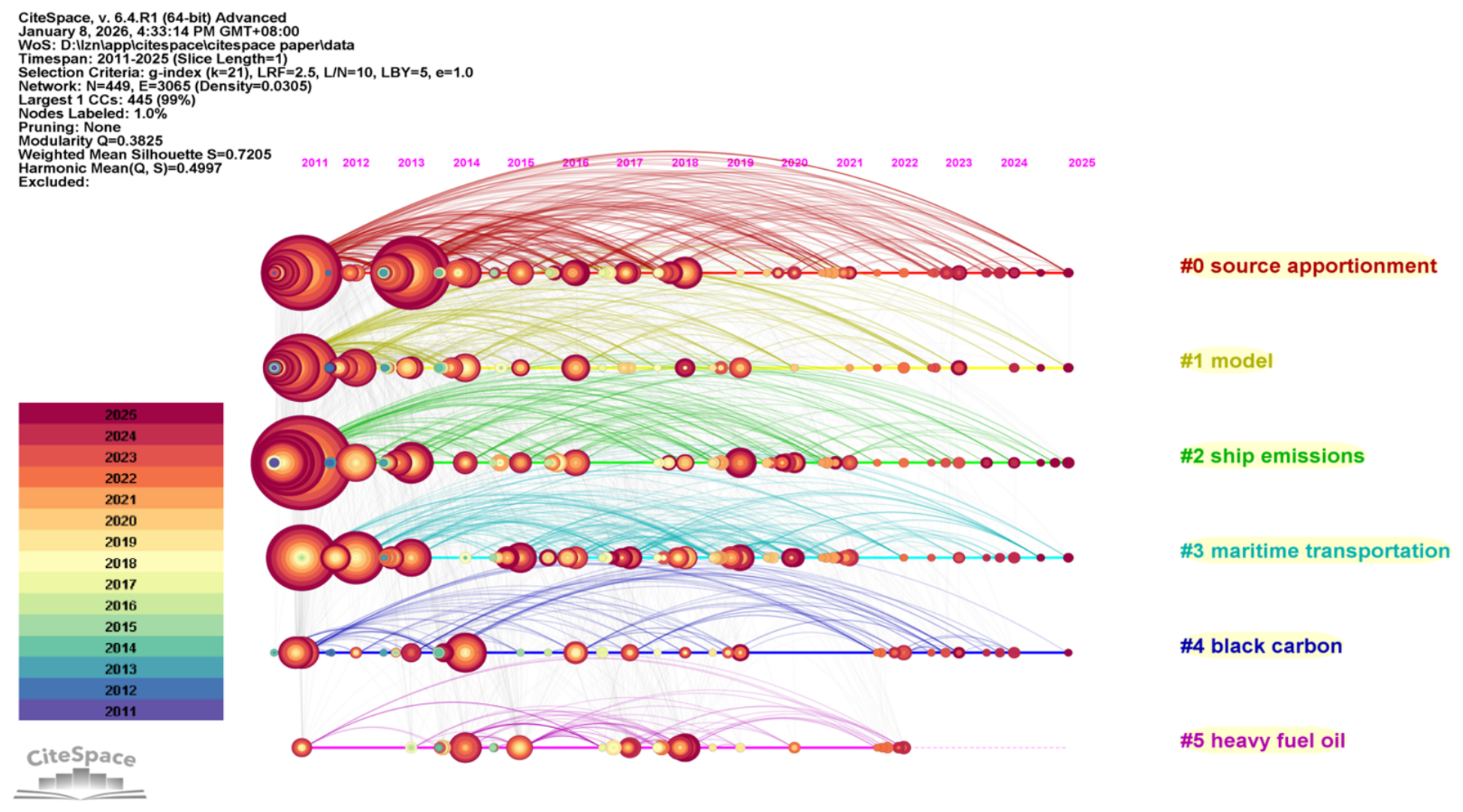
To explore the temporal evolution of research trends in the ship emissions field, we generated a keyword timeline map in this study. In the generated map, the color-coded labels on the right correspond to the distinct thematic keyword clusters identified previously, while the gradient color of the node centers along the horizontal timeline indicates the year of first occurrence for each keyword. Nodes are aligned with the chronological timeline on the horizontal axis, with their size proportional to the occurrence frequency and co-occurrence strength of the corresponding keyword. The timeline network comprises 449 nodes in total, with the largest connected subgraph containing 445 nodes, accounting for 99% of all nodes. The network includes 3065 edges representing co-citation relationships, with an overall network density of 0.0305, indicating a sparse yet highly interconnected network structure. The 99% node connectivity further confirms that the core research themes in this field are highly concentrated and intrinsically interlinked in Figure 6.
The keyword timeline map clearly delineates three distinct sequential phases in the evolution of ship emissions research. During the 2011–2015 period, the keyword clusters exhibited a relatively dense distribution with high node intensity, laying the foundation for two core research directions: “source apportionment” and “numerical modeling”. For the 2016–2021 period, a distinct gap is observed in the central segment of the timeline, which may be attributed to a temporary lull in research activity in the field or a sampling gap within the analyzed literature dataset. From 2022 to 2025, the number of nodes rises markedly once again, accompanied by the emergence of high-profile emerging keywords including “ship emissions”, “maritime transportation”, “black carbon”, and “heavy fuel oil”. This trend signals a notable shift in research focus over the most recent three years, with growing scholarly attention directed toward ship-sourced black carbon emissions, regulatory frameworks for heavy fuel oil, and policy development for maritime emission reduction. Overall, the timeline analysis demonstrates that the ship emissions research field established its core methodological and thematic framework during 2011–2015, underwent a brief period of slowed development from 2016 to 2020, and has regained robust research momentum since 2022. This recent upsurge in research activity is largely driven by the implementation of landmark international maritime environmental policies, most notably the IMO 2020 Global Sulfur Cap and the European Union’s “Fit for 55” legislative package. While the observed temporal alignment strongly suggests a policy–research nexus, it should be acknowledged that keyword co-occurrence and burst analyses do not establish causal relationships. The associations depicted here reflect thematic proximity rather than statistically tested correlations. Nonetheless, the chronological coincidence underscores the importance of regulatory milestones in shaping academic agendas. Contemporary research hotspots in the field are concentrated in three core frontier directions: (1) the refinement and validation of ship emission inventories; (2) quantitative assessment of the contribution of ship-sourced black carbon to Arctic warming; and (3) research and development of low-carbon alternative fuels to replace heavy fuel oil in marine vessels.

3.6. Emerging Research Areas

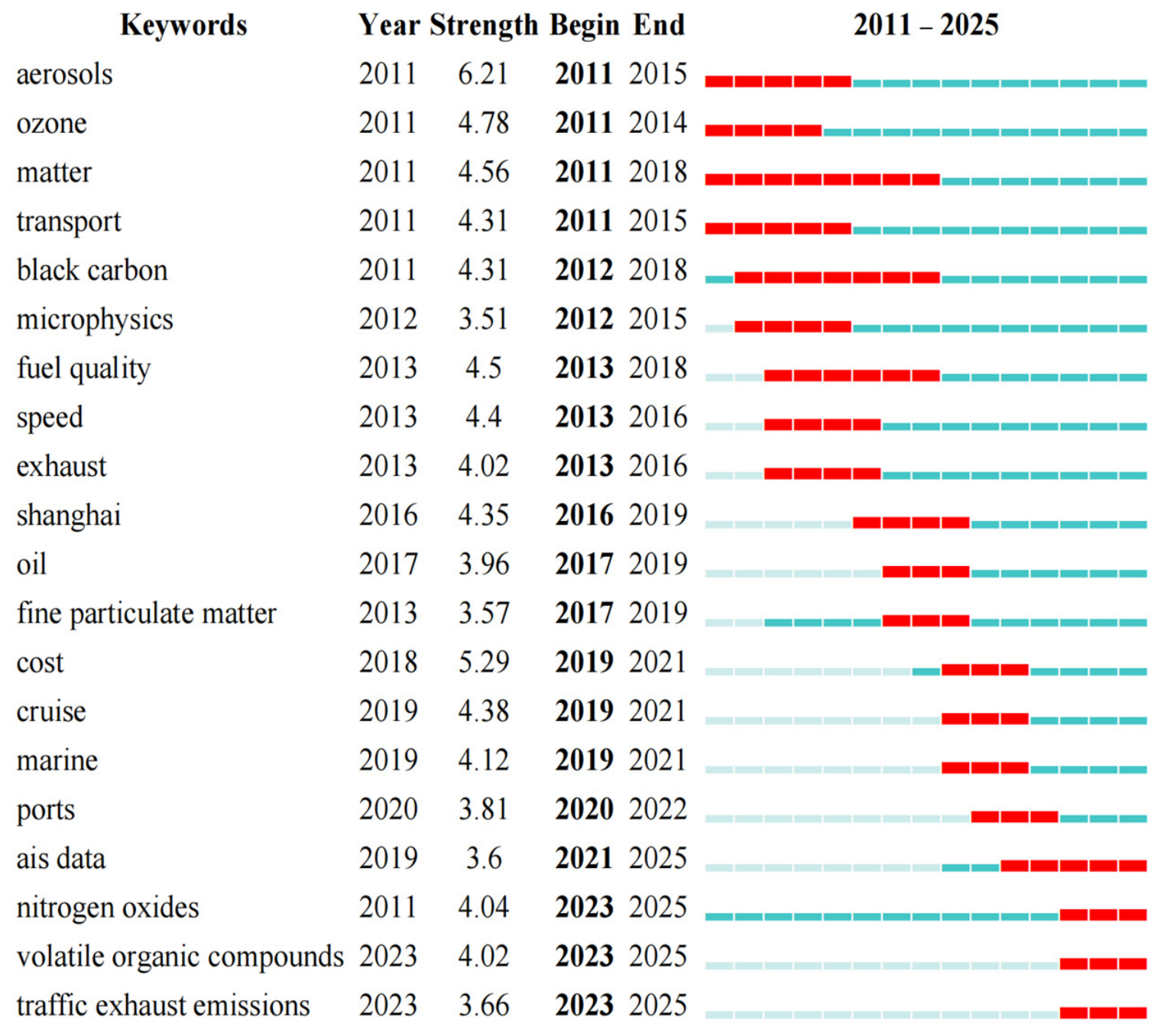
Keyword burst detection is a core bibliometric approach to characterize the emergence, temporal evolution, and directional shifts in frontier research hotspots in a defined academic field. We generated a keyword burst map via CiteSpace, which is ranked by keyword burst strength and visually presents the burst events of target keywords and their corresponding onset years. In the burst map, red segments indicate the time windows in which the corresponding keywords were identified as research frontiers, accompanied by a sharp increase in the number of related publications. The burst strength value quantifies the intensity of a keyword’s burst event, with a higher value indicating a more pronounced and influential burst trend. Figure 7 presents the top 20 keywords with the strongest burst strength over the study period from 2011 to 2025. Collectively, the evolution of frontier research hotspots in this field can be clearly delineated into three sequential developmental phases.
During the 2011–2014 period, foundational scientific concepts including aerosols, ozone, and black carbon exhibited concentrated burst events, with a peak burst intensity of 6.21. This early research phase established the core quantitative analytical framework for characterizing ship emission characteristics and their associated climate and environmental effects. From 2013 to 2018, the research focus shifted toward technical drivers of shipping emission reduction, including fuel quality, sailing speed optimization, and exhaust gas treatment. Meanwhile, city-scale case studies represented by Shanghai first emerged as a prominent research theme, signaling a clear shift in research perspective from global-scale average estimation to field observation and refined quantification in port cities.
Since 2019, keywords including cruise ships, marine environment, port emissions, and AIS data have successively entered the high-citation frontier range, marking the transition of ship emissions research into a “big data-driven refined management” stage. Notably, the burst intensity of AIS data reached 3.60 in 2021, confirming that ship trajectory big data has become a core technical support for the refinement and updating of ship emission inventories. Starting in 2023, keywords including nitrogen oxides, volatile organic compounds, and traffic exhaust emissions have simultaneously exhibited a new round of sustained burst events, with burst intensities all exceeding 3.6, which remain ongoing through 2025. This trend reflects a rapidly growing scholarly focus on secondary aerosol precursors from shipping emissions, as well as the coordinated control of multi-source traffic-related atmospheric pollutants.

3.7. Methodological Limitations and Uncertainties

The bibliometric approach employed in this study, while powerful for mapping research landscapes, is subject to several inherent uncertainties that should be carefully weighed when interpreting the results. A primary source of uncertainty stems from the exclusive reliance on the WOS Core Collection. Although this ensures the inclusion of high-quality, peer-reviewed literature, it simultaneously introduces a selection bias: important contributions indexed in other databases (e.g., Scopus, Google Scholar) and gray literature such as technical reports or conference proceedings are excluded. This may lead to the oversight of regionally significant work, particularly from developing countries where local journals are not necessarily WOS-indexed. The issue is compounded by a language and regional publication bias, as WOS is known to favor English-language journals. Consequently, our dataset likely underestimates research published in Chinese, Korean, Russian, and other languages, despite the considerable shipping activity in those regions. And moving from data coverage to the analytical methodology, the detection of keyword bursts and the formation of thematic clusters are inherently sensitive to the chosen algorithm parameters. For instance, varying the minimum burst duration or the scaling factor can alter the set of identified frontier topics, especially for short-lived, recent bursts. Similarly, the LLR clustering algorithm tends to extract terms that maximally discriminate clusters, which may not always align with the most socially or policy-relevant concepts. Temporal factors also play a role, as citation lag effects disproportionately affect recent publications. Articles from 2024 to 2025 have insufficient time to accumulate citations, so their influence on the intellectual structure of the field is inevitably underrepresented. This limitation is particularly relevant for fast-moving topics such as alternative fuels or new monitoring technologies. Furthermore, the visual representation and network metrics are influenced by the choice of similarity measures and network pruning algorithms within CiteSpace. Although we followed widely accepted default settings, different parameter choices could yield slightly different network configurations. Another important limitation lies in the nature of the keywords themselves. The keywords analyzed are those provided by authors and databases. They may not capture all dimensions of a paper’s content. Papers focusing on specific emission reduction technologies or alternative fuels might use highly specialized terms that do not reach the frequency threshold for detection in a broad-scope analysis. These uncertainties are considered as inherent features of bibliometric mapping exercise and do not negate the value of the patterns observed. But they do call for cautious interpretation and triangulation with expert-based reviews and full-text analyses.

4. Conclusions

This study conducted a systematic bibliometric analysis of 1346 scholarly publications in the ship exhaust emissions field, retrieved from the Web of Science Core Collection for the period 2011–2025, using CiteSpace and its integrated auxiliary analytical tools. The core objective was to systematically delineate the structure, evolutionary trajectories, and frontier directions of this research domain by dissecting the latent knowledge base through visual knowledge mapping. The results show that the global research output has grown continuously with annual publications increasing nearly fivefold over the 15-year study period. This trend reflects the growing global concern regarding the environmental and climatic impacts of shipping activities and the maritime industry’s proactive response to increasingly stringent international environmental regulations. This work thus provides a panoramic characterization of the structural evolution and dynamic research frontiers in the field of ship exhaust emissions. Moreover, through the systematic review of existing literature performed in this study, it is evident that scholarly research in this field exhibits a high degree of consistency across target study regions, core methodological frameworks, and key research conclusions. Notably, a systematic assessment of methodological limitations reveals that the exclusive use of WOS and the inherent sensitivities of bibliometric algorithms may lead to an underrepresentation of non-English literature and very recent cutting-edge developments, including studies on novel emission reduction technologies and low-carbon alternative fuels. Additionally, inevitable publication and indexing lags may underrepresent very recent advances. These limitations are worthy of attention.
Our analysis reveals the structural and dynamic features of ship exhaust emissions research. Core thematic clusters include source apportionment, numerical modeling, criteria pollutants, and emission reduction technologies. Although specific technologies and alternative fuels are not always captured as high-frequency keywords, the thematic clusters encompass a wealth of research on control devices and emerging fuels as identified in the recent burst analysis and manual verification. Keyword clustering exhibits strong internal coherence alongside thematic diversity (mean silhouette S = 0.7205), spanning fundamental pollutant characterization and applied work on control technologies, monitoring methods, and alternative fuels. Geographically, research output correlates positively with maritime economic prominence; China, the United States, and Germany lead global contributions. China accounted for over 42% of all the publications, which reflects its concentration of major ports and domestic pressures for green shipping transition. International collaboration is extensive, notably within European countries, accelerating knowledge transfer and methodological innovation. Temporally, research foci have progressed from foundational emission characterization toward sophisticated data-driven modeling and monitoring. Since 2021, the emergence of AIS data as a high-burst keyword (intensity = 3.60) signals a paradigm shift toward “big data-enabled refined management,” enabling precise estimation and prediction of vessel-attributable air pollution. Concurrently, sustained bursts of nitrogen oxides, volatile organic compounds, and traffic-related emissions through 2023–2025 reflect intensifying attention to secondary aerosol precursors and the imperative for coordinated multi-pollutant control.
Notably, our analysis identifies intersecting core research frontiers that are poised to shape the future trajectory of the field. The refinement of high-resolution ship emission inventories, through the integrated application of AIS data, satellite remote sensing observations, and machine learning algorithms, will remain a sustained methodological priority. On the other hand, the development and full life-cycle assessment of alternative marine fuels, including methanol, ammonia, and hydrogen, are accelerating as critical technical pathways toward achieving the IMO 2050 decarbonization targets. Although health-related terms were not included in the keywords or keyword clusters in this study, future research should also place great emphasis on the health effects of ship-emitted pollutants at the population level, particularly through long-term personal exposure monitoring in port cities and epidemiological studies. In conclusion, this bibliometric mapping analysis provides researchers, policymakers, and funding agencies with a systematic and holistic reference for understanding the intellectual structure and evolutionary pathways of global ship exhaust emissions research. As the global shipping industry navigates the complex transition toward environmental sustainability, such comprehensive analytical frameworks will prove indispensable for coordinating international research efforts, and accelerating the translation of scientific insights into effective, evidence-based emission reduction strategies.

Author Contributions

Writing—original draft preparation, investigation, methodology, Z.L.; data curation, L.T., A.S. and C.L.; writing—review and editing, resources, funding acquisition, C.H. and H.X. All authors have read and agreed to the published version of the manuscript.

Funding

This research was funded by the Zhejiang Natural Science Foundation (ZCLMS25B0702), and Ningbo Natural Science Foundation (No. 2023J303).

Data Availability Statement

No new data were created or analyzed in this study.

Acknowledgments

We would like to thank the editor and reviewers for their advice on this work.

Conflicts of Interest

Anwei Shi was employed by Ningbo Xinrui Zhice Technology Co., Ltd. Chunli Liu was employed by Yunnan Guoke Green Environmental Protection Co., Ltd. The remaining authors declare that the research was conducted in the absence of any commercial or financial relationships that could be construed as a potential conflict of interest.

References

  1. Xiao, G.; Wang, Y.; Wu, R.; Li, J.; Cai, Z. Sustainable Maritime Transport: A Review of Intelligent Shipping Technology and Green Port Construction Applications. J. Mar. Sci. Eng. 2024, 12, 1728. [Google Scholar] [CrossRef]
  2. Xiao, G.; Pan, L.; Lai, F. Application, opportunities, and challenges of digital technologies in the decarbonizing shipping industry: A bibliometric analysis. Front. Mar. Sci. 2025, 12, 1523267. [Google Scholar] [CrossRef]
  3. Wang, Q.W.; Zhang, H.; Hu, C.H. China’s competition regulation in the maritime industry: Regulatory concerns, problems and potential implications. Ocean Coast. Manag. 2024, 251, 107082. [Google Scholar] [CrossRef]
  4. Roy, A.; Chakraborty, M. A review of ship emissions impacts on environmental, health, societal impacts and IMO’s mitigation policies. Reg. Stud. Mar. Sci. 2025, 81, 103964. [Google Scholar] [CrossRef]
  5. Cullinane, K.; Tseng, P.H.; Wilmsmeier, G. Estimation of container ship emissions at berth in Taiwan. Int. J. Sustain Transp. 2016, 10, 466–474. [Google Scholar] [CrossRef]
  6. Sofiev, M.; Winebrake, J.J.; Johansson, L.; Carr, E.W.; Prank, M.; Soares, J.; Vira, J.; Kouznetsov, R.; Jalkanen, J.P.; Corbett, J.J. Cleaner fuels for ships provide public health benefits with climate tradeoffs. Nat. Commun. 2018, 9, 406. [Google Scholar] [CrossRef]
  7. Cao, Y.-Z.; Wang, S.; Zhang, G.; Luo, J.; Lu, S. Chemical characteristics of wet precipitation at an urban site of Guangzhou, South China. Atmos. Res. 2009, 94, 462–469. [Google Scholar] [CrossRef]
  8. Roy, A.; Chatterjee, A.; Tiwari, S.; Sarkar, C.; Das, S.K.; Ghosh, S.K.; Raha, S. Precipitation chemistry over urban, rural and high altitude Himalayan stations in eastern India. Atmos. Res. 2016, 181, 44–53. [Google Scholar] [CrossRef]
  9. Zhang, C.; Yi, X.; Gao, X.; Wang, M.; Shao, C.; Lv, Z.; Chen, J.; Liu, Z.; Shen, C. Physiological and biochemical responses of tea seedlings (Camellia sinensis) to simulated acid rain conditions. Ecotoxicol. Environ. Saf. 2020, 192, 110315. [Google Scholar] [CrossRef]
  10. Smith, T.W.P.; Jalkanen, J.P.; Anderson, B.A.; Corbett, J.J.; Faber, J.; Hanayama, S.; O’Keeffe, E.; Parker, S.; Johansson, L.; Aldous, L.; et al. Third IMO GHG Study 2014; Report No. MEPC 67/6/INF.3; International Maritime Organization: London, UK, 2015. [Google Scholar]
  11. IMO. GHG Emissions. Available online: https://www.imo.org/en/OurWork/Environment/PollutionPrevention/AirPollution/Pages/GHG-Emissions.aspx (accessed on 1 October 2019).
  12. Faber, J.; Hanayama, S.; Zhang, S.; Pereda, P.; Comer, B.; Hauerhof, E.; van der Loeff, W.S.; Smith, T.; Zhang, Y.; Kosaka, H.; et al. Reduction of GHG Emissions from Ships—Fourth IMO GHG Study 2020—Final Report; Report No. IMO doc MEPC 75/7/15; International Maritime Organization: London, UK, 2020. [Google Scholar]
  13. Zhou, J.; Zhou, S.; Zhu, Y. Experiment and Prediction Studies of Marine Exhaust Gas SO2 and Particle Removal Based on NaOH Solution with a U-Type Scrubber. Ind. Eng. Chem. Res. 2017, 56, 12376–12384. [Google Scholar] [CrossRef]
  14. Gondikas, A.; Mattsson, K.; Hassellov, M. A new form of hazardous microparticulate contamination to the marine environment from ships using heavy fuel oil with exhaust gas scrubbers—Characterization and implications for fate, transport and ecotoxicity. Sci. Total Environ. 2025, 959, 178263. [Google Scholar] [CrossRef]
  15. Bayramoğlu, K. The effects of alternative fuels, cruising duration and variable generators combination on exhaust emissions, energy efficiency existing ship index (EEXI) and carbon intensity rating (CII). Ocean Eng. 2024, 302, 117723. [Google Scholar] [CrossRef]
  16. Skoko, I.; Stanivuk, T.; Franic, B.; Bozic, D. Comparative Analysis of CO2 Emissions, Fuel Consumption, and Fuel Costs of Diesel and Hybrid Dredger Ship Engines. J. Mar. Sci. Eng. 2024, 12, 999. [Google Scholar] [CrossRef]
  17. Wu, P.-C.; Lin, C.-Y. Feasibility and Cost-Benefit Analysis of Methanol as a Sustainable Alternative Fuel for Ships. J. Mar. Sci. Eng. 2025, 13, 973. [Google Scholar] [CrossRef]
  18. Zhang, Z.; Zheng, W.; Cao, K.; Li, Y.; Xie, M. An improved method for optimizing detection bands of marine exhaust SO2 concentration in ultraviolet dual-band measurements based on signal-to-noise ratio. Atmos. Pollut. Res. 2022, 13, 101479. [Google Scholar] [CrossRef]
  19. Huang, L.; Wen, Y.; Geng, X.; Zhou, C.; Xiao, C. Integrating multi-source maritime information to estimate ship exhaust emissions under wind, wave and current conditions. Transp. Res. Part D Transp. Environ. 2018, 59, 148–159. [Google Scholar] [CrossRef]
  20. Zhang, Z.; Zheng, W.; Li, Y.; Cao, K.; Xie, M.; Wu, P. Monitoring Sulfur Content in Marine Fuel Oil Using Ultraviolet Imaging Technology. Atmosphere 2021, 12, 1182. [Google Scholar] [CrossRef]
  21. Liu, H.; Fu, M.; Jin, X.; Shang, Y.; Shindell, D.; Faluvegi, G.; Shindell, C.; He, K. Health and climate impacts of ocean-going vessels in East Asia. Nat. Clim. Change 2016, 6, 1037–1041. [Google Scholar] [CrossRef]
  22. Dong, X.; Zhang, Y.; Yu, G.; Xiong, Y.; Han, Z.; Huo, J.; Huang, C.; Kan, H.; Zheng, M.; Ning, Z.; et al. Environmental and health impacts of reduced PM2.5 and trace metals from ship emissions under low-sulfur fuel oil policy in Shanghai, China. Environ. Pollut. 2025, 377, 126409. [Google Scholar] [CrossRef]
  23. Baumann, J. From global to human factors: Shipping emissions policy process in the IMO. Mar. Policy 2024, 167, 106291. [Google Scholar] [CrossRef]
  24. Van Eck, N.J.; Waltman, L. Software survey: VOSviewer, a computer program for bibliometric mapping. Scientometrics 2010, 84, 523–538. [Google Scholar] [CrossRef]
  25. Qin, F.; Li, J.; Zhang, C.; Zeng, G.; Huang, D.; Tan, X.; Qin, D.; Tan, H. Biochar in the 21st century: A data-driven visualization of collaboration, frontier identification, and future trend. Sci. Total Environ. 2022, 818, 151774. [Google Scholar] [CrossRef] [PubMed]
  26. Yang, M.R.; Dai, X.R.; Huang, Z.W.; Huang, C.Y.; Xiao, H. Research progress of the POP fugacity model: A bibliometrics-based analysis. Environ. Sci. Pollut. Res. Int. 2022, 29, 86899–86912. [Google Scholar] [CrossRef] [PubMed]
  27. Li, Y.; Sha, Z.; Tang, A.; Goulding, K.; Liu, X. The application of machine learning to air pollution research: A bibliometric analysis. Ecotoxicol. Environ. Saf. 2023, 257, 114911. [Google Scholar] [CrossRef]
  28. Kalli, J.; Jalkanen, J.-P.; Johansson, L.; Repka, S. Atmospheric emissions of European SECA shipping: Long-term projections. WMU J. Marit. Aff. 2013, 12, 129–145. [Google Scholar] [CrossRef]
  29. Serra, P.; Fancello, G. Towards the IMO’s GHG Goals: A Critical Overview of the Perspectives and Challenges of the Main Options for Decarbonizing International Shipping. Sustainability 2020, 12, 3220. [Google Scholar] [CrossRef]
  30. Zhang, X.; van der A, R.; Ding, J.; Zhang, X.; Yin, Y. Significant contribution of inland ships to the total NOX emissions along the Yangtze River. Atmos. Chem. Phys. 2023, 23, 5587–5604. [Google Scholar] [CrossRef]
  31. Fu, X.; Wang, X.; Chen, D.; Lang, J.; Zhou, Y.; Guo, X. Process analysis of the impacts of ship emissions on PM2.5 and O3 in the Yangtze River Delta, China. J. Environ. Sci. 2026, 161, 372–383. [Google Scholar] [CrossRef]
  32. Wan, Z.; Cai, Z.; Zhao, R.; Zhang, Q.; Chen, J.; Wang, Z. Quantifying the air quality impact of ship emissions in China’s Bohai Bay. Mar. Pollut. Bull. 2023, 193, 115169. [Google Scholar] [CrossRef]
  33. Xie, R.; Xing, Q.; Gao, J.; Wang, X.; Xu, W.; Lv, Z.; Yi, W.; Zhao, J.; Luo, Z.; Wu, X.; et al. Investigation on the effect of ship emissions on the air quality: A case study in Hainan Island, China. J. Environ. Sci. 2025, 156, 114–125. [Google Scholar] [CrossRef]
  34. Viana, M.; Fann, N.; Tobias, A.; Querol, X.; Rojas-Rueda, D.; Plaza, A.; Aynos, G.; Conde, J.A.; Fernandez, L.; Fernandez, C. Environmental and health benefits from designating the Marmara Sea and the Turkish Straits as an emission control area (ECA). Environ. Sci. Technol. 2015, 49, 3304–3313. [Google Scholar] [CrossRef]
  35. Yoo, J.W.; Park, S.Y.; Kim, J.; Chae, D.; Moon, J.; Kim, C.H.; Park, J.; Kim, T.H.; Lee, S.H. Understanding the mechanisms of coastal PM2.5 formation driven by land-sea breeze recirculation and ship emissions. Environ. Pollut. 2026, 390, 127483. [Google Scholar] [CrossRef]
  36. Tang, L.; Ramacher, M.O.P.; Moldanová, J.; Matthias, V.; Karl, M.; Johansson, L.; Jalkanen, J.-P.; Yaramenka, K.; Aulinger, A.; Gustafsson, M. The impact of ship emissions on air quality and human health in the Gothenburg area—Part 1: 2012 emissions. Atmos. Chem. Phys. 2020, 20, 7509–7530. [Google Scholar] [CrossRef]
  37. Sha, M.; Zhai, J.; Wan, Z.; Wu, Z.; Jin, Y.; Zhu, E. Insights into the Global Characteristics of Shipping Exhaust Emissions at Berth. J. Mar. Sci. Eng. 2024, 12, 1527. [Google Scholar] [CrossRef]
  38. Zhao, J.; Wei, Q.; Wang, S.; Ren, X. Progress of ship exhaust gas control technology. Sci. Total Environ. 2021, 799, 149437. [Google Scholar] [CrossRef]
  39. Yan, X.; Wang, J.; Wu, F.; Bai, J.; Zhang, X.; Li, G.; Fei, H. Spatial and Temporal Variation Characteristics of Air Pollutants in Coastal Areas of China: From Satellite Perspective. Remote Sens. 2025, 17, 1861. [Google Scholar] [CrossRef]
  40. Li, Y.; Zhang, Y.; Cheng, J.; Zheng, C.; Li, M.; Xu, H.; Wang, R.; Chen, D.; Wang, X.; Fu, X.; et al. Comparative Analysis, Use Recommendations, and Application Cases of Methods for Develop Ship Emission Inventories. Atmosphere 2022, 13, 1224. [Google Scholar] [CrossRef]
  41. He, S.; Wu, X.; Wang, J.; Lu, Y. Shipping emission inventory preparation with AIS data: A stratified random sampling method. Transp. Res. Part D Transp. Environ. 2025, 138, 104520. [Google Scholar] [CrossRef]
  42. Ding, S.; Liu, D.; Wu, Y.; Cao, S.; Zhao, S.; Xu, B. Quantifying the contribution of ship emissions to black carbon pollution along the coast of the East China sea using machine learning approach. Ocean Coast. Manag. 2025, 269, 107784. [Google Scholar] [CrossRef]
  43. Gan, L.; Che, W.; Zhou, M.; Zhou, C.; Zheng, Y.; Zhang, L.; Rangel-Buitrago, N.; Song, L. Ship exhaust emission estimation and analysis using Automatic Identification System data: The west area of Shenzhen port, China, as a case study. Ocean Coast. Manag. 2022, 226, 106245. [Google Scholar] [CrossRef]
  44. Wang, C.; Wu, H.; Ye, Z. Excessive Ship Exhaust Emissions Monitoring and Matching Using a Hybrid Method. J. Mar. Sci. Eng. 2025, 13, 2252. [Google Scholar] [CrossRef]
  45. He, W.; Yuan, H.; Zhang, H.; Zhang, Y.; Zhou, W.; Wu, K. Ship exhaust NO2 ultraviolet remote sensing imaging monitoring system. Opt. Laser Technol. 2025, 192, 114030. [Google Scholar] [CrossRef]
  46. Zhang, W.; Yi, W.; He, T.; Peng, X.; Xing, Q.; Wu, X.; Yang, Z.; Xie, R.; Xian, A.; Liu, H.; et al. Ship emissions and reduction potential under domestic policies and international cooperation: A case study in Hainan, China. J. Environ. Sci. 2025, 156, 253–266. [Google Scholar] [CrossRef]
  47. Dai, Y.; Shi, X.; Deng, Q.; Du, W.; Bai, Y.; Ren, H.; Cheng, J. Synergistic effects of CO2 and air pollutants from ship emissions in Shanghai, China: Spatial-temporal characteristics, prediction assessment, policy implications. J. Environ. Manag. 2025, 376, 124417. [Google Scholar] [CrossRef]
  48. Xie, W.; Xu, S.; Cheng, C.; Zhang, N.; Wang, Z.; Hao, J. Shallow water effect-informed estimation of inland ship emissions: A case study of the North Jiangsu Canal. Ocean Eng. 2025, 341, 122438. [Google Scholar] [CrossRef]
  49. Bojić, F.; Gudelj, A.; Bošnjak, R. A Comprehensive Model for Quantifying, Predicting, and Evaluating Ship Emissions in Port Areas Using Novel Metrics and Machine Learning Methods. J. Mar. Sci. Eng. 2025, 13, 1162. [Google Scholar] [CrossRef]
  50. Ribeiro da Silva, J.N.; Santos, T.A.; Teixeira, A.P. Methodology for Predicting Maritime Traffic Ship Emissions Using Automatic Identification System Data. J. Mar. Sci. Eng. 2024, 12, 320. [Google Scholar] [CrossRef]
  51. Orlandi, A.; Calastrini, F.; Kalikatzarakis, M.; Guarnieri, F.; Busillo, C.; Coraddu, A. Air quality forecasting of along-route ship emissions in realistic meteo-marine scenarios. Ocean Eng. 2024, 291, 116464. [Google Scholar] [CrossRef]
  52. Li, Q.; Lam, J.S.L. Biofuel consumption and emission prediction for harbour craft using Machine learning methods. Transp. Res. Part D Transp. Environ. 2025, 149, 105005. [Google Scholar] [CrossRef]
  53. Kumar, R.; Salo, K.; Yao, F.; Maxime, S.; Laura, R.V.; Booge, D.; Marandino, C.A.; Al-Hajjaji, S.; Matz-Luck, N.; Rutgersson, A. Charting the course to cleaner shipping routes: Emission inventory for Baltic Sea shipping and green fuel potential. Carbon Manag. 2025, 16, 2523919. [Google Scholar] [CrossRef]
  54. Ellersdorfer, P.; Ali Khan, M.H.; Lejeune, M.; Kerwick, A.; Nolan, T.; Martinez, J.G.; Darling, A.; MacGill, I.; Daiyan, R. Navigating green Seas: An open-source tool for costing the development of green shipping corridors. Fuel 2026, 410, 137870. [Google Scholar] [CrossRef]
Figure 1. The process of screening and analysis of the research.
Jmse 14 01079 g001
Figure 2. Annual number of publications in this study from 2011 to 2025.
Jmse 14 01079 g002
Figure 3. Co-occurrence network of core keywords in this study from 2011 to 2025.
Jmse 14 01079 g003
Figure 4. Visualization of national cooperation in this study from 2011 to 2025.
Jmse 14 01079 g004
Figure 5. Keyword clusters in this study from 2011 to 2025.
Jmse 14 01079 g005
Figure 6. Timeline spectrum of keywords in this study from 2011 to 2025.
Jmse 14 01079 g006
Figure 7. Top 20 keywords with the strongest citation bursts in this study.
Jmse 14 01079 g007
Disclaimer/Publisher’s Note: The statements, opinions and data contained in all publications are solely those of the individual author(s) and contributor(s) and not of MDPI and/or the editor(s). MDPI and/or the editor(s) disclaim responsibility for any injury to people or property resulting from any ideas, methods, instructions or products referred to in the content.