Article

Effect of Scour on Hydrodynamic Pressure of Offshore Monopile and Site Response Under Seismic Loads


1
Key Laboratory of Urban Security and Disaster Engineering of Ministry of Education, Beijing University of Technology, Beijing 100124, China
2
State Key Laboratory of Bridge Engineering Safety and Resilience, Beijing University of Technology, Beijing 100124, China
3
China Huaneng Group Clean Energy Technology Research Institute Co., Ltd., Beijing 102209, China
*
Author to whom correspondence should be addressed.
J. Mar. Sci. Eng. 2026, 14(12), 1068; https://doi.org/10.3390/jmse14121068
Submission received: 6 May 2026 / Revised: 1 June 2026 / Accepted: 3 June 2026 / Published: 7 June 2026
(This article belongs to the Special Issue Wave–Structure–Seabed Interaction)

Abstract

In complex marine environments, monopile foundations are subjected not only to waves and currents but also to seismic loads. The long-term combined action of waves and currents induces scour around the monopile, leading to soil loss, seabed morphology changes, and an enlarged water–structure interface. When seismic load is present, scour amplifies the hydrodynamic pressure on offshore monopiles and modifies the site response, significantly influencing the seismic performance of the monopiles and their superstructures. To address the issue, this study develops three-dimensional numerical models based on the computational fluid dynamics (CFD) method and ABAQUS (2020) to systematically investigate the effects of scour on hydrodynamic pressure of offshore monopile and site dynamic response under seismic loads. First, a numerical model including scour effects is established in ANSYS Fluent (2022), and parametric analyses are performed to evaluate the impact of local scour hole geometry on hydrodynamic pressure; subsequently, comparisons are made with global scour conditions, and an added mass coefficient accounting for the distribution of scour effects along the pile is proposed. Finally, on the ABAQUS platform, a numerical model is developed to analyze the dynamic response of the free-field soil and the coupled water–soil free-field under scour conditions.

1. Introduction

With the advancement of global technology and economic development, excessive consumption of fossil fuels and ecological degradation have been recognized as increasingly critical challenges. Wind energy has been regarded as a renewable and clean alternative that has attracted widespread international attention. In comparison with onshore wind turbines, offshore wind turbines (OWTs) have developed rapidly over the past two decades, owing to the abundance and stability of offshore wind resources, as well as the limited environmental impact on local communities [1,2]. Monopile foundations have been considered an economically viable solution for OWTs, particularly in shallow-water regions with depths of approximately 10–25 m [3]. In addition to long-term environmental loads such as wind and waves, monopile-supported OWTs in seismically active regions may also be subjected to seismic loads [4,5,6]. In the marine environment, wave and current actions can induce scour around the monopile foundation [7,8], thereby altering the topographic morphology around the structure and increasing the water–structure contact area. Therefore, it is necessary to investigate the effects of scour on hydrodynamic pressure and seismic site response for the seismic design of monopile-supported OWTs.
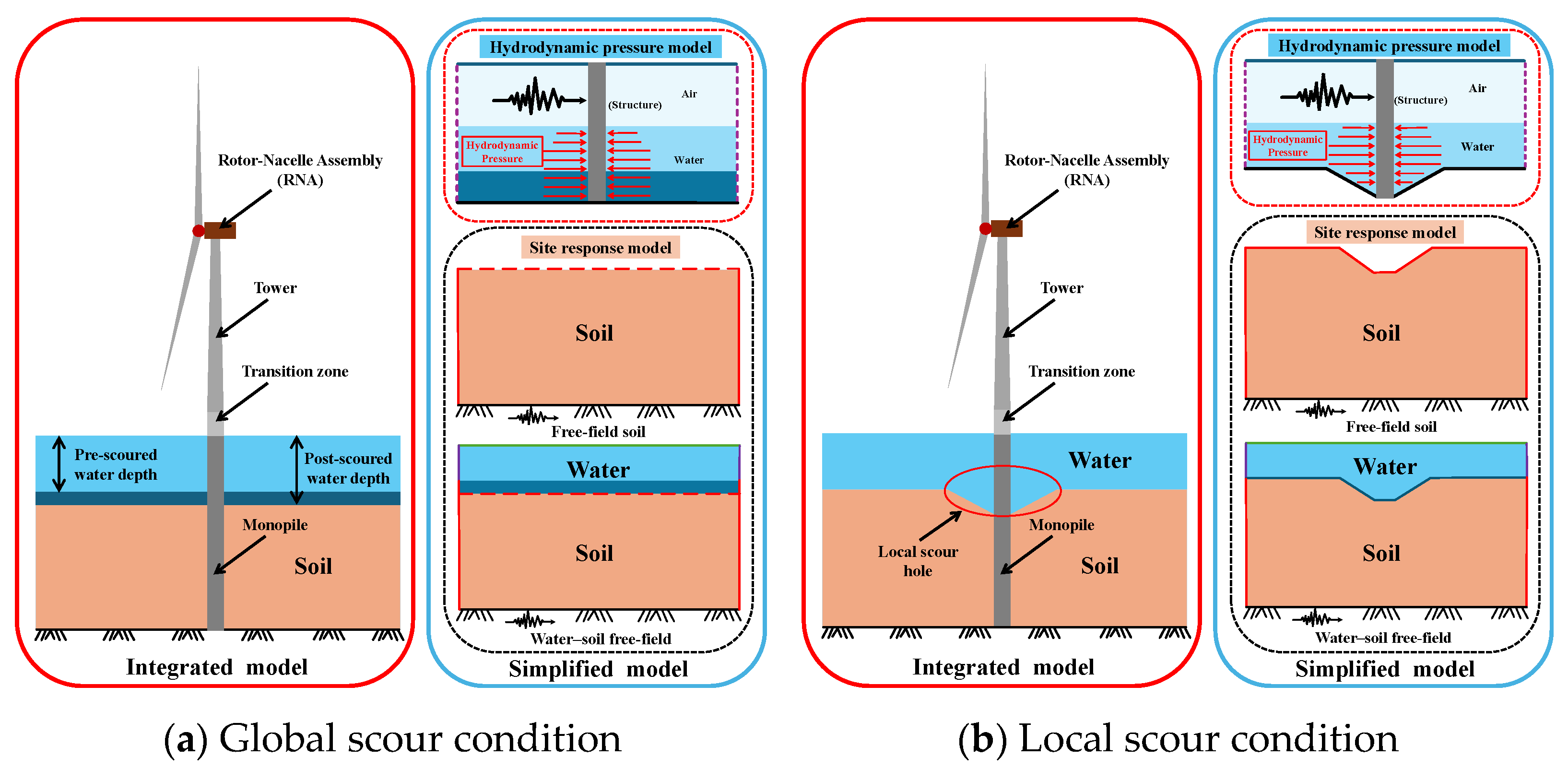
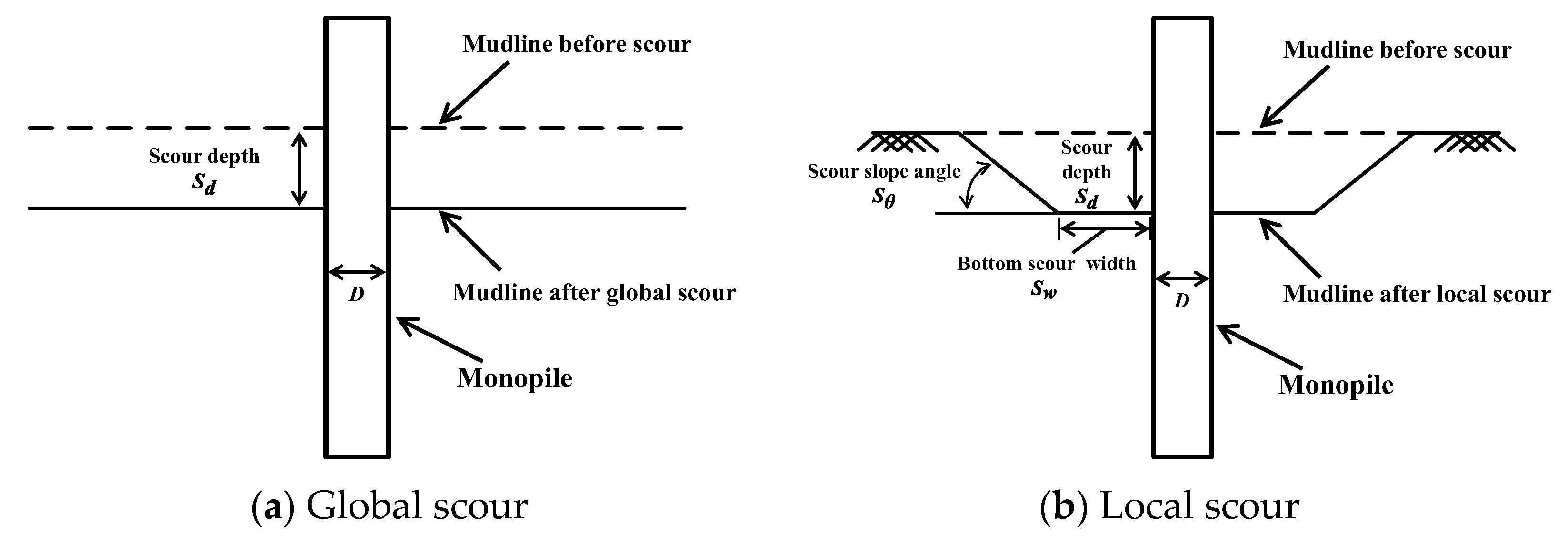
The installation of cylindrical structures in marine environments alters the surrounding hydrodynamic conditions, thereby enhancing sediment transport under the combined action of waves and currents. As a result, erosion of seabed soil is triggered, and scour around the monopile foundation is generated [9]. According to the extent and characteristics of seabed erosion, scour can generally be classified into two types: global scour, which refers to widespread seabed erosion over a relatively large area, and local scour, which is characterized by the formation of scour holes around the foundation [10]. In recent years, extensive research has been conducted to investigate the causes and influencing factors of scour through laboratory experiments and numerical simulations. Sumer et al. [11] examined the scour problem of cylindrical pile foundations under wave action alone. Based on comprehensive experimental and numerical results, it has been demonstrated that under the action of individual waves, the scour depth increases with increasing KC number, wave height, and wave period. Link and Zhao [12,13] performed experimental studies on the influence of different flow velocities and base aspect ratios on local scour depth under steady current conditions. Sumer and Qi [7,8] reported that the combined action of waves and currents exerts a greater influence on scour around pile foundations than either waves or currents acting alone. Due to the continuous evolution and complexity of scour morphology, accurately characterizing seabed topography under scour conditions remains challenging. Local scour holes are often conceptualized as inverted truncated cones, characterized by several geometric parameters, including scour depth (Sd), bottom scour width (Sw), and scour slope angle (Sθ). This representation has been widely adopted in previous studies [14,15]. Global scour is typically represented as a uniform lowering of the seabed to the maximum scour depth (Sd). The simplified forms of global and local scour are illustrated in Figure 1. Whitehouse et al. [16] recommended that the scour depth be taken as 1.38D, while offshore design codes specify a design scour depth of 1.3D [17]. Zhu et al. [18] reported from experimental studies on local scour around anchored foundations that the upstream Sθ ranges from 40° to 55°, while the downstream angle ranges from 30° to 70°. Roulund et al. [19] further summarized, based on a series of experiments, that the scour slope angle is closely related to the natural angle of repose of the soil. In marine engineering practice, it has been recommended that Sw = 0 and Sθ = 30°.
Scour reduces the embedded depth of the monopile foundation, thereby weakening its horizontal bearing capacity and consequently altering the overall dynamic characteristics of the monopile-supported OWTs. Specifically, the natural frequency of the structure continuously decreases with increasing scour depth [20,21,22,23]. Furthermore, the second-order mode shape of the OWTs is more sensitive to scour [22]. Moreover, the morphology of the scour hole has a significant influence on the horizontal bearing capacity of monopile foundations [14,24]. The effects of different geometric parameters on the bearing capacity vary, among which the influence of scour depth is the most significant. Therefore, the influence of local scour should be accurately considered in the engineering design of monopile-supported OWTs.
Monopile foundations play a critical role in supporting offshore structures and are vulnerable to severe damage in high seismic regions [5]. Under seismic loads, vibrations of monopile foundations induce surrounding water motion, thereby generating additional hydrodynamic forces. To account for this, Yang et al. [25] extended the Morison equation to consider pressures from both internal and external water on thin-walled deep-water piers, while Wang et al. [26] derived an analytical solution for hydrodynamic pressure on hollow elliptical cylinders using radiation theory. Numerical approaches, including CFD simulations [27], potential-based fluid elements (PBFEs) [28], and semi-analytical methods [29,30], have been widely employed to investigate hydrodynamic pressure induced by seismic loads. In engineering practice, hydrodynamic pressure is often represented by added mass, which quantifies the effective water mass participating in vibration. Zhang et al. [31] calculated added mass for cylinders of arbitrary cross-sections, while Du et al. [32] demonstrated that hydrodynamic pressure can be represented by added mass under low-frequency conditions and should include additional damping at higher frequencies. Other simplified formulations for added mass have been proposed [33]. Hydrodynamic forces not only amplify structural responses under seismic loads but also increase the fundamental vibration period [34]. Several studies have investigated the influence of local scour on the hydrodynamic pressure acting on submarine pipelines [35,36,37]. However, existing studies on the effect of scour on the dynamic response of monopile-supported OWTs have generally applied hydrodynamic pressure in the same manner as that under the unscoured condition [21,22,38], neglecting the influence of scour-induced seabed topography changes on hydrodynamic pressure. In fact, hydrodynamic loading may increase due to the enlarged water–structure contact area by scour [39]. In addition to hydrodynamic pressure, seismic site response also plays an important role in the dynamic analysis of offshore structures. Seismic site response is strongly affected by impedance contrasts between shallow soil and bedrock, leading to filtering and amplification of ground motion. Factors such as topography and soil stratigraphy alter seismic wave propagation through scattering and diffraction [40,41,42], and further alter the seismic response of the structure [43]. Zhao et al. [44,45] demonstrated that water depth further modifies site response, generally lowering natural frequencies and reducing vertical seismic effects. Some studies have applied the ground surface motions under seismic loads directly to the OWTs as uniform seismic loads [46,47], a practice that overlooks the amplification effect of the site on ground motions. To address this limitation, subsequent studies investigating the effect of scour on the dynamic response of OWTs have employed free-field soil analysis to obtain ground motions at different depths and applied them to the structure [21,22]. However, this approach simplifies the local scour site to a global scour site, thereby neglecting the influences of local scour and water–soil interaction on the site response. In summary, the effect of scour-induced seabed topography changes on hydrodynamic pressure and seismic site response has not yet been systematically investigated.
This study investigates the effect of scour on hydrodynamic pressure of offshore monopile and site response under seismic loads. The research findings can provide a reference for fully considering scour effect in the dynamic response analysis of monopile-supported OWTs under scour conditions. The structure of this study is organized as follows. In Section 2, simplified calculation models for hydrodynamic pressure and site response are established using ANSYS Fluent (2022) and ABAQUS (2020) respectively, which are validated against corresponding numerical analysis models. In Section 3, the effects of local scour hole morphology on the hydrodynamic pressure of monopile foundations are examined, with comparisons made to global scour conditions. Based on these analyses, a distributed added mass coefficient for monopiles under local scour conditions is proposed. Section 4 focuses on the influence of scour and water–soil interaction on the natural frequency of the site. Subsequently, the effects of local and global scour on the dynamic responses of both free-field soil and water–soil free-field under horizontal and vertical seismic loads are investigated. Finally, conclusions are drawn in Section 5.

2. Establishment of the Numerical Model

2.1. Assumption and Simplification

This study takes the monopile-supported OWT as the research object. Based on the assumption of rigid bedrock at the base, simplified numerical models are established to assess the effects of scour on hydrodynamic pressure of offshore monopile and seismic site response. In the hydrodynamic pressure model considering scour, the seabed and monopile structure can be considered rigid by neglecting their vibrational deformation under seismic loads to simplify calculation [27,32,35,48]. Consequently, the hydrodynamic pressure model is simplified to include only the rigid cylindrical structure and the fluid domain. Since considering soil–structure interaction would significantly increase the computational cost, and this study primarily focuses on the effects of scour on the responses of the free-field soil and the water–soil free-field, the presence of the monopile structure is neglected in the site response model for simplicity. Only the soil domain and water domain affected by scouring are retained. The integrated and simplified models under global scour and local scour conditions are presented in Figure 2.

2.2. Simulation Model for Hydrodynamic Pressure

The CFD method is capable of simulating fluid motion processes with high accuracy, and can simulate the motion of structure under the action of fluid through dynamic mesh technology, making it suitable for studying fluid–structure interaction in ocean engineering.

2.2.1. Governing Equations

In this section, the fluid is assumed to be an incompressible and viscous fluid, and the continuity equation and Navier–Stokes equation are used as the control equations. The formula is (1) the continuity equation and (2) the Navier–Stokes equation [49].
u i = 0
u i t + u j u i x j = 1 ρ p x i + ( ν + ν t ) Δ u i + f i
where i = 1,2,3. xi is the coordinate, ui is the velocity of the fluid in the i-direction, fi is the volumetric force acting in i-direction. p is the pressure. ρ is the fluid density. t is the time. v and vt are the viscosities of the molecular kinematic and eddy kinematic, respectively.

2.2.2. Turbulence Model

The turbulence viscosity vt is an unknown quantity induced by the turbulent eddy viscosity assumption. Selecting a suitable turbulence model to close the RANS equations can significantly affect the accuracy of numerical results [27]. The SST k-ω model excels in accurately predicting flow separation under adverse pressure gradients [50,51], while also offering robust near-wall treatment and broad applicability. The governing transport equations for the k-ω SST model are expressed as follows:
k t + u j k x j x j ( ν + σ k ν t ) k x j = P k β * ω k
ω t + u j ω x j x j ( ν + σ ω ν t ) ω x j = γ ν t G β ω 2 + 2 1 F 1 σ ω 2 ω k x j ω x j
P k = min G , 10 β * ω k
G = ν t u i x j u i x j + u j x i
ν t = a 1 k max a 1 ω , S F 2
where k is the turbulent kinetic energy. Pk is the production term of k. ω is the specific dissipation rate. S is the mean rate of strain of the flow. β* and a1 are constants, which are taken as 0.09 and 0.31 in the present study, respectively [50]. F1 and F2 are blending functions. F1 is designed to be one in the near-wall region (activating k-ω) and zero away from the wall (activating k-ε); F2 is one for boundary-layer flows and zero for free shear layers. ϕ1 represents any constant in the k-ω model (σk1, σw1, β1 and γ1), ϕ2 represents any constant in the transformed k-ε model (σk2, σw2, β2 and γ2), and ϕ denotes the corresponding constant in the new model. The relationship between them is given as follows:
ϕ = F1ϕ1 + (1 − F1)ϕ2
The values of σk, σw, β and γ are blended using Equation (8) in which ϕ1 and ϕ2 are given in Table 1.

2.2.3. Numerical Model Setup

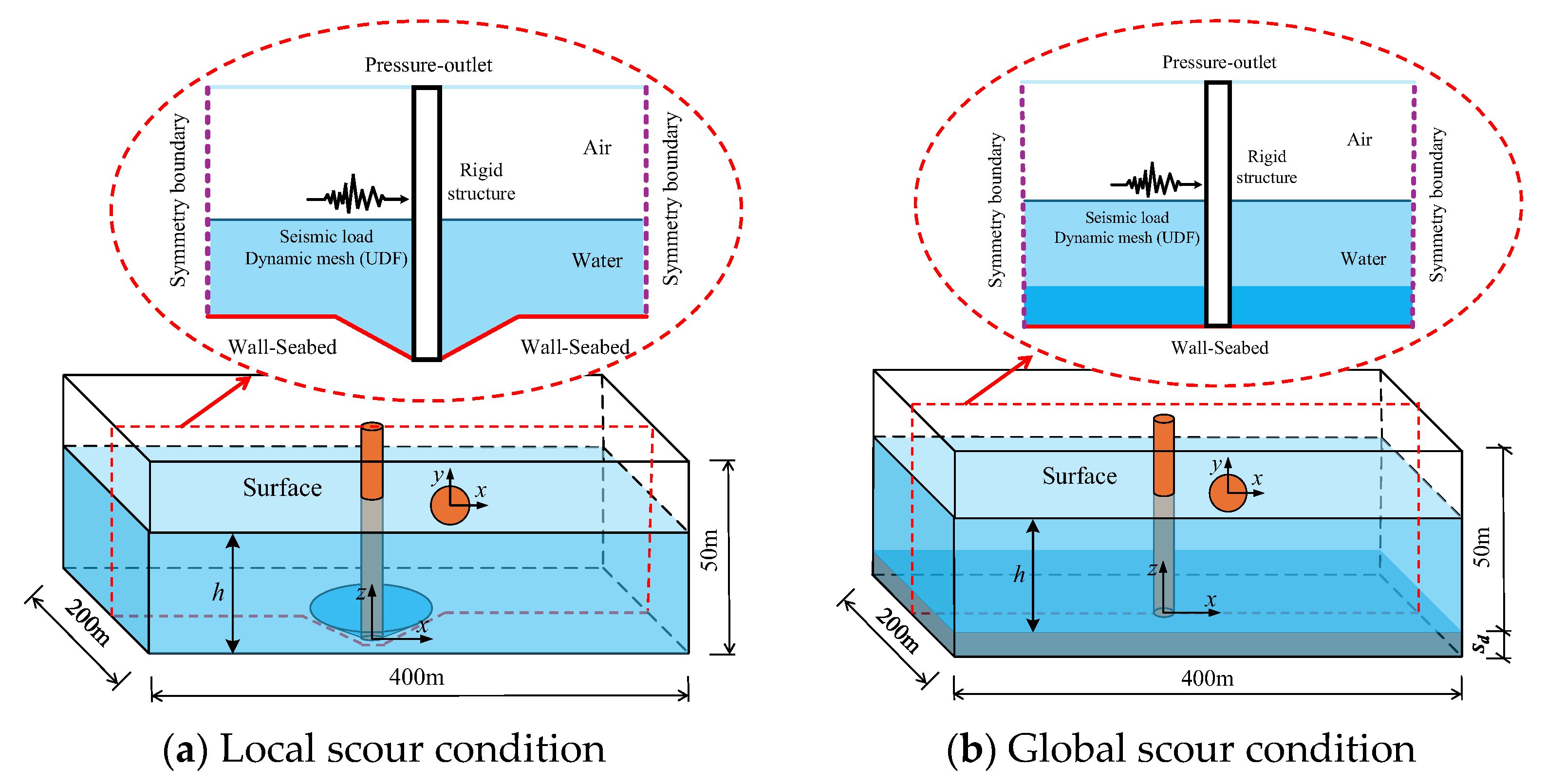
The finite volume method is adopted to numerically solve the governing differential equations. The three-dimensional numerical models under scour conditions are shown in Figure 3, the length and width of the model are fixed as 400 m and 200 m, respectively, while the initial height is 50 m, with the initial water depth h specified as 20 m. Among them, for local scour conditions, corresponding water regions are added at the bottom of the model according to different geometries of local scour holes; for global scour conditions, the submerged depth of the structure is adjusted accordingly based on the scour depth. The volume of fluid method (VOF) is used to follow the boundary between the air and liquid phase [52], and the VOF model is employed to track the air–liquid interface, thereby capturing the dynamic behavior of the sea surface during structural movement. The region defined by the patch method is designated as the phase-water, and the surface tension coefficient between the air and water phases is set to 0.072 N/m. The boundaries surrounding the flume are defined with symmetric boundary conditions to simulate unbounded water domain. At the top open boundary, the air volume fraction is set to 1 and the relative pressure is 0. At the bottom, the seabed is represented by a no-slip wall boundary. At the structure boundary, the User-Defined Function (UDF) is compiled for the velocity component of the ground motion along the x-axis.

2.3. Simulation Model for Site Response

2.3.1. Finite Element Model Setup

The elastic-perfectly plastic Mohr–Coulomb (MC) model failure criterion is used for the simulation of soil behavior. In geotechnical engineering, the MC model is one of the most widely used constitutive models. The MC model has been utilized to evaluate the performance of monopile foundations in sand [53,54], which shows that the MC model failure criterion can accurately simulate the plastic deformation and response of sand under loads.
In dynamic analysis, soil typically exhibits nonlinear behavior and significant energy dissipation. Therefore, it is necessary to consider the existence of damping and incorporate Rayleigh damping in numerical calculation [55]. The required Rayleigh damping parameters are determined according to the following formula:
α * = 4 π f 1 f 2 ξ f 1 + f 2
β * = ξ π ( f 1 + f 2 )
where α* is the Rayleigh damping parameter related to mass, β* is the Rayleigh damping parameter related to stiffness. f1 is the first natural frequency, f2 is the second natural frequency, ξ is the damping ratio. The damping ratio of soil is taken as 5% in this study [43,56].
The acoustic-structure coupling method is a numerical technique used to simulate fluid–structure interactions. In this approach, the fluid is modeled as an acoustic medium, where pressure is only related to volumetric strain. Under the assumption that the fluid is inviscid and incompressible, the governing equation for fluid motion is expressed as follows:
1 K f p ¨ + x 1 ρ f p x = 0
where p is the pressure, x represents the spatial coordinates of fluid particles, ρf is the density of fluid, and kf is the volumetric modulus of fluid.
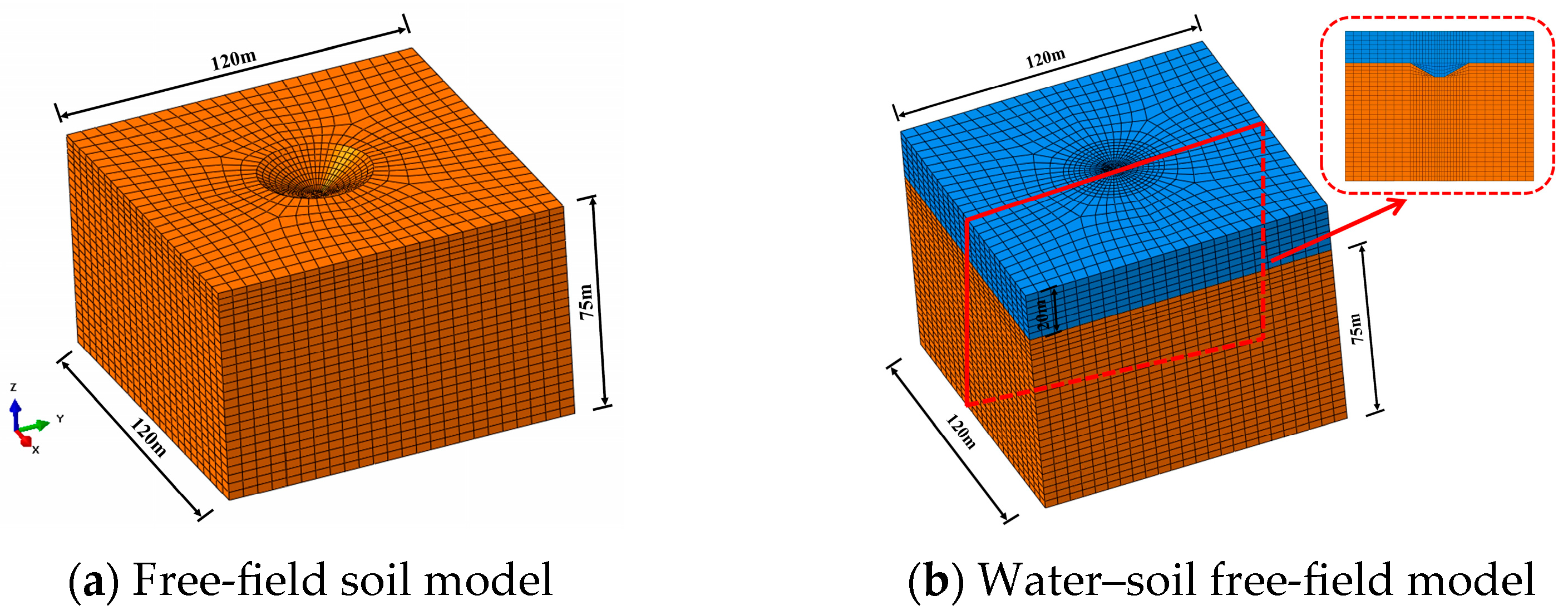
The soil adopted in this study is stiff sand, and the soil parameters are referenced from the research of Jung et al. [54]. The volumetric modulus of water can be obtained from the research of Wu et al. [57]. The relevant material properties of soil and water are listed in Table 2. The soil and water domains are discretized using an eight-node stress brick element (C3D8R) and an eight-node acoustic brick element (AC3D8), respectively. To ensure the reliability of the numerical results and minimize boundary effects, the soil domain is modeled as a single site measuring 120 m × 120 m × 75 m, with an initial water depth of 20 m. The numerical models for both the free-field soil and the water–soil free-field under local scour conditions are shown in Figure 4. Global scour is simulated by simultaneously adjusting the water depth and soil layer thickness, maintaining their combined total at 95 m.

2.3.2. Boundary Conditions

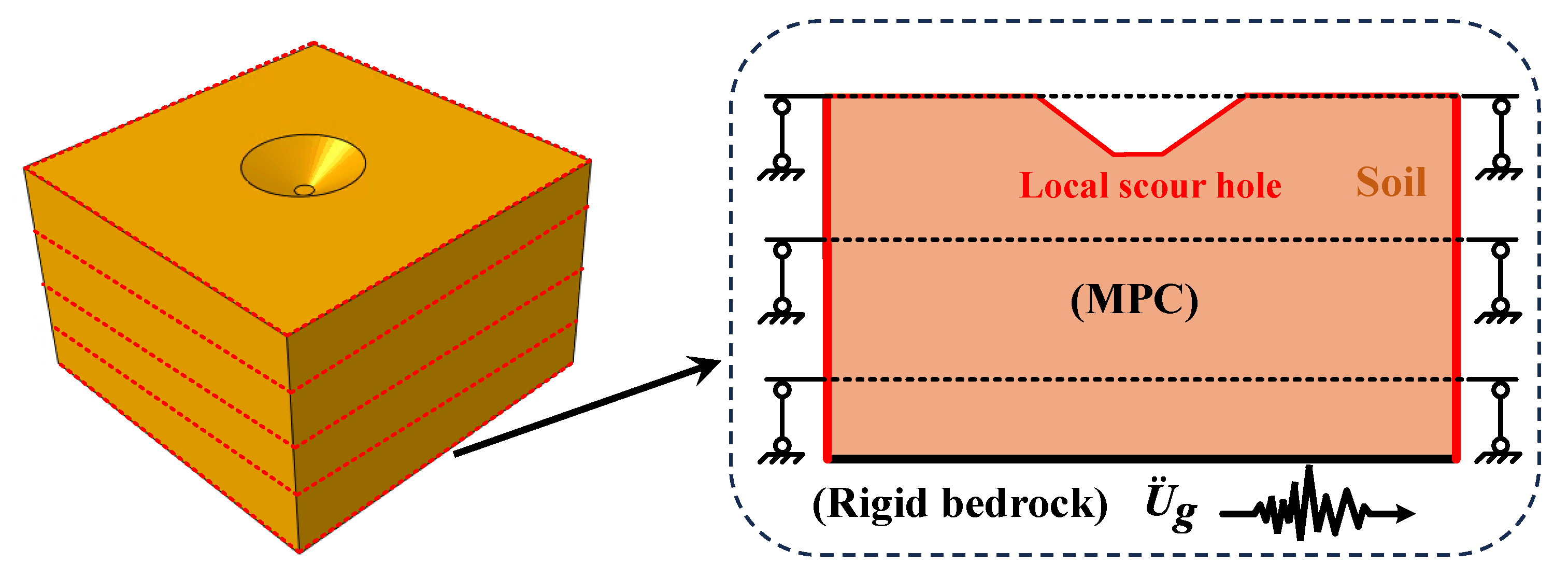
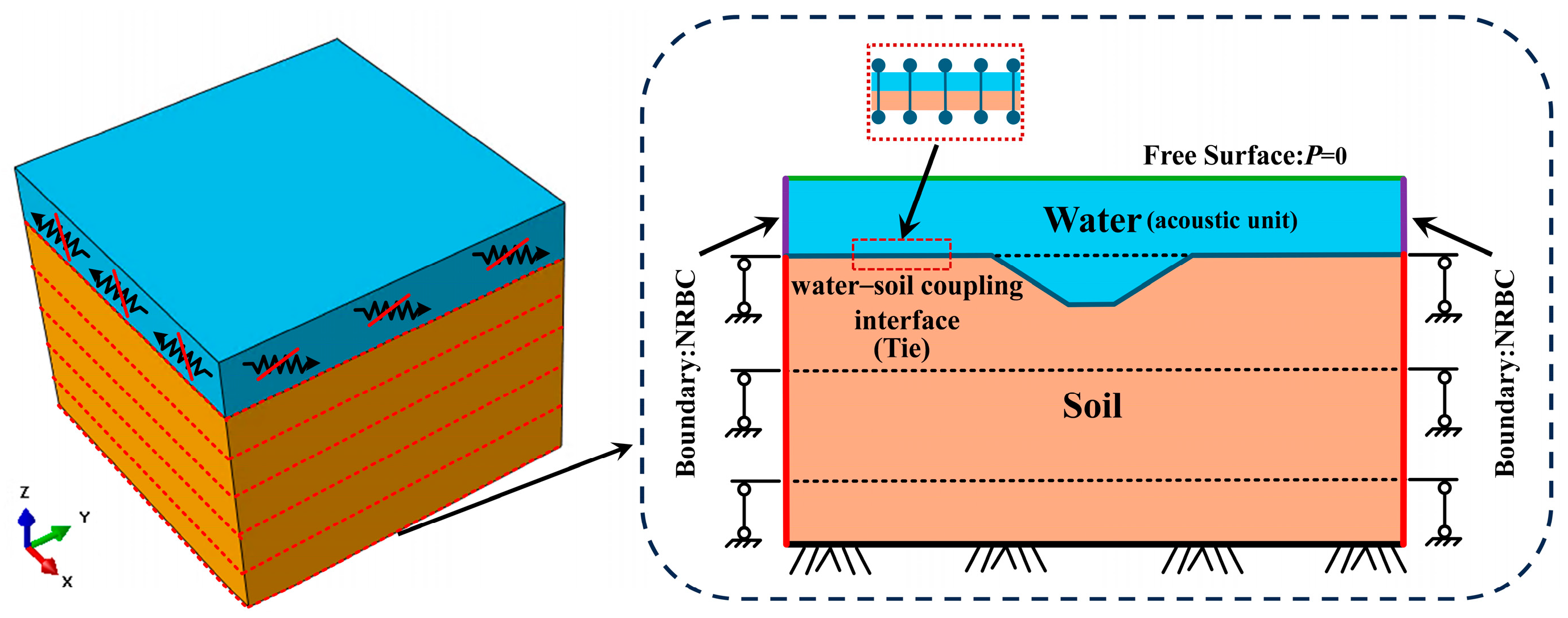
The present model applies consistent excitation at the base to simulate the motion of rigid bedrock. The boundaries of the model significantly influence the site response. To simulate the infinite boundary conditions of the soil layer, the rotational degrees of freedom at the lateral boundaries are constrained [58] and the horizontal degrees of freedom for nodes at the same elevation on the lateral boundary are fully constrained using Multi-Point Constraints (MPC), which is used to define kinematic relationships between the control and slave nodes in ABAQUS, as illustrated in Figure 5.
According to acoustic theory, sound propagates through all elastic media by transferring vibrational energy. In fluids, this vibration manifests as alternating compression and expansion, resulting in the transmission of sound as compressive waves. Due to the slow propagation and significant attenuation of sound in water, it is necessary to model an unbounded fluid domain. In this study, the non-reflective absorbing boundary condition is applied at the lateral boundaries to absorb scattered waves, thereby simulating acoustic wave propagation in an infinite aquatic medium. The radiation conditions [57] at the truncated boundary of the infinite water domain can be expressed as
p n = 1 c p ˙
where p is the pressure. n is the normal direction at the boundary of infinite fluid. c is the speed of sound in fluid.
The water surface was defined as free surface (p = 0). Non-reflective boundary conditions (NRBC) were applied to the lateral boundaries to simulate the truncated boundary of the infinite water domain. The “Tie” constraint was implemented at the water–soil coupling interface to simulate water–soil interaction, as shown in Figure 6.

2.3.3. Soil Consolidation and Local Scour Process

The present model accounts for soil consolidation and the simulation of soil unloading within the local scour hole, with the main process being divided into two stages:
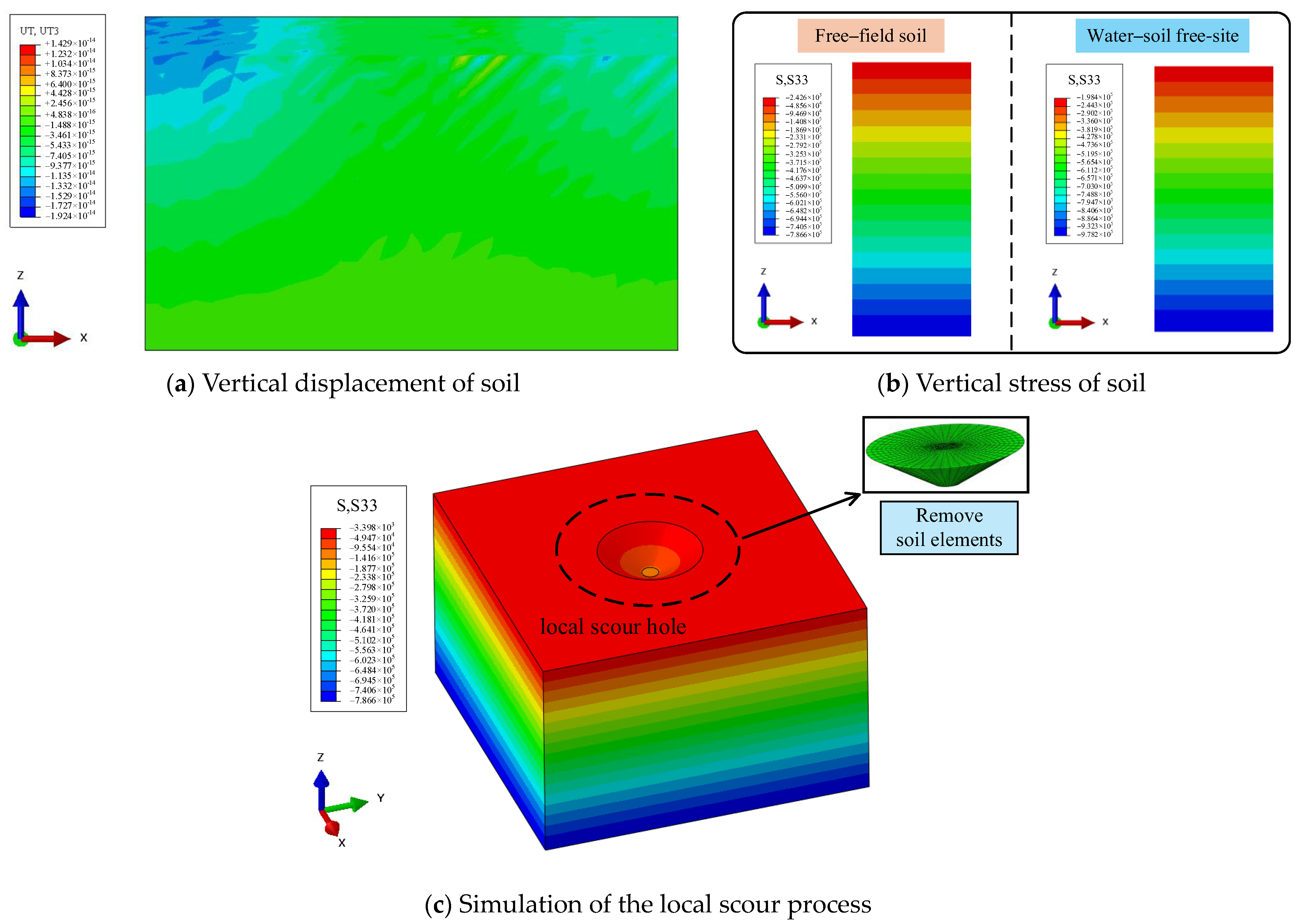
Firstly, a gravity consolidation analysis is performed on the free-field site to establish the initial geostatic stress, and the static water pressure is applied on the seabed surface soil nodes to simulate the gravity consolidation of water–soil free-field. The vertical displacement of the soil after the completion of geostatic stress equilibrium is shown in Figure 7a, and the effective stress distribution following consolidation in the free-field soil and the water–soil free-field is presented in Figure 7b. The soil is considered fully consolidated at the end of the initial geostatic stress equilibrium phase, when the magnitude of vertical displacement is less than 10−5 m.
After establishing the non-zero geostatic stress site condition, the dynamic analysis phase is initiated. Horizontal and vertical seismic loads are applied at the base of the model to investigate the dynamic site response under different scour conditions. Meanwhile, the soil elements in the local scour zone are removed by the “model change” feature in ABAQUS to simulate the local scour process, as shown in Figure 7c.

2.4. Validation of Numerical Model

2.4.1. Hydrodynamic Pressure Numerical Model

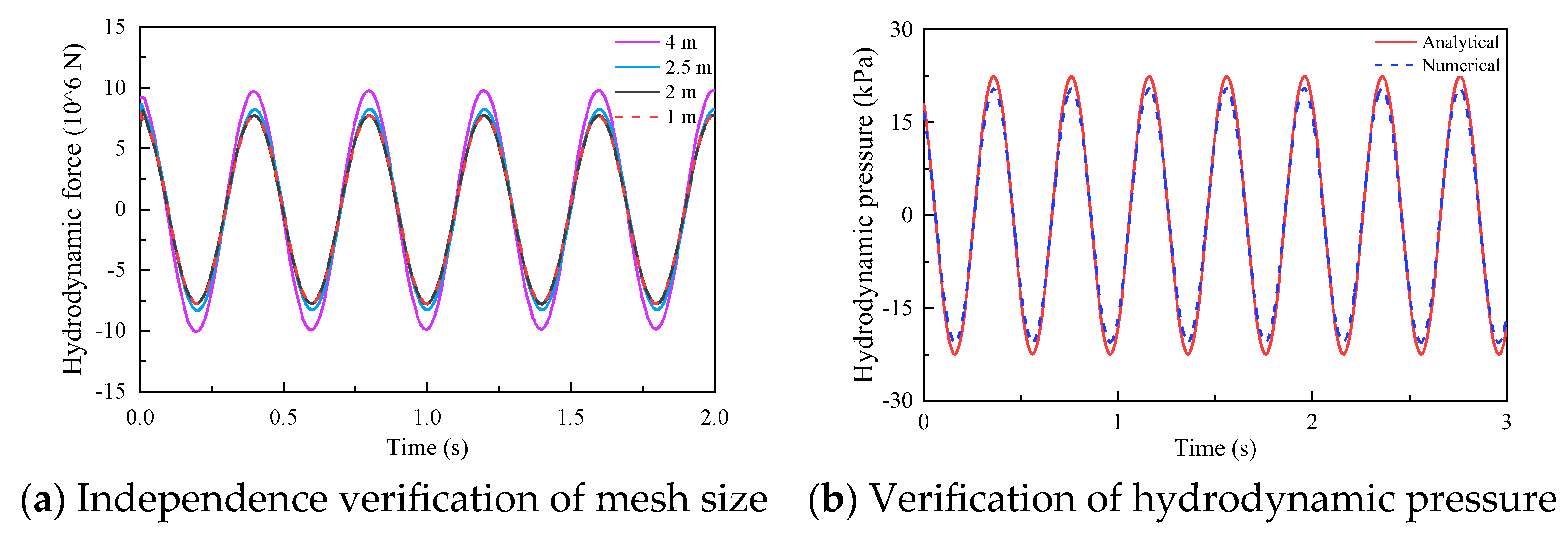
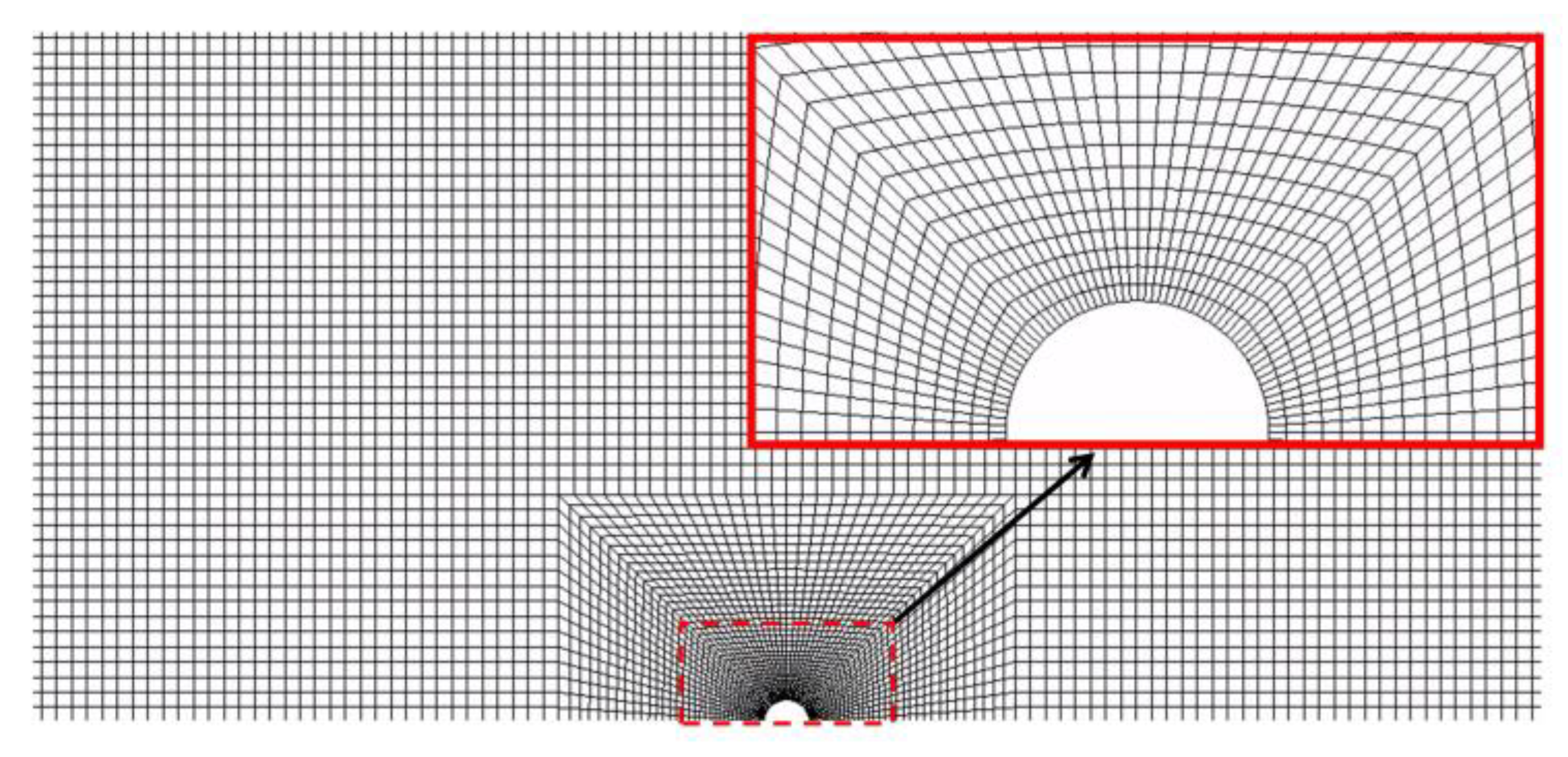
In this section, the established numerical model for hydrodynamic pressure is validated. The water depth (H) is set to 20 m in the numerical model and the cosine load with an amplitude of 1 and a frequency of 2.5 Hz is applied to the structure by UDF. A convergence test is conducted to determine the appropriate mesh size for the computational domain, with a finer mesh applied in the regions surrounding the cylinder. The diameter of the refinement area is about 10D. An overview of the mesh can be seen in Figure 8. To verify the mesh independence of the final calculation results, mesh sizes of 4 m, 2.5 m, 2 m, and 1 m were tested, with a time step of 0.01 s. The results of the mesh independence test are presented in Figure 9a. The comparison shows that the numerical model has converged when the minimum mesh size is 2 m. Considering both accuracy and computational efficiency, a mesh size of 2 m is selected for the subsequent numerical models. Next, the time series of the hydrodynamic pressure acting horizontally at the bottom of the structure is extracted and compared with the analytical solution for the hydrodynamic pressure of incompressible fluids, as proposed by Han [59]. The comparison result is shown in Figure 9b. It can be observed that the numerical result matches well with the analytical result, which indicates the numerical method is suitable for subsequent analysis of hydrodynamic pressure under scour conditions.

2.4.2. Site Response Numerical Model

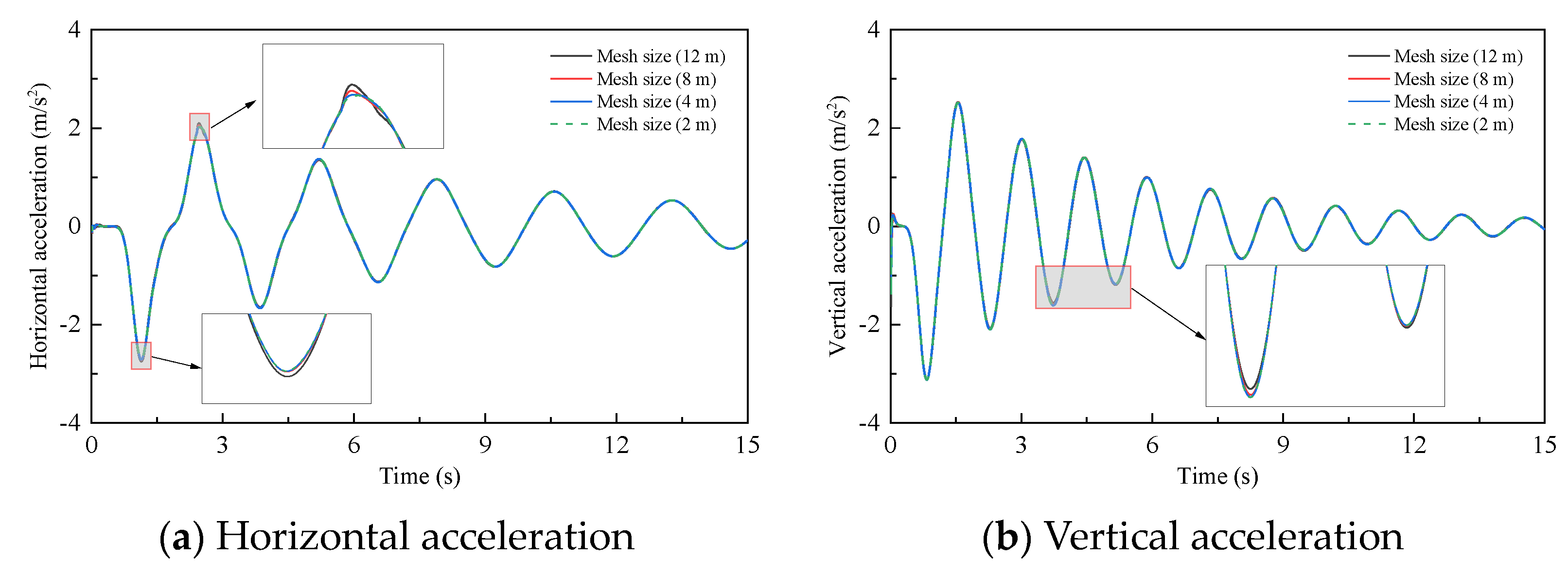
In the site response analysis considering the effect of local scour, local mesh refinement is required in the scour region to ensure the accuracy of the numerical results. A transitional mesh discretization is adopted for both the soil and water domains from the model boundary to the local scour hole region. Mesh sensitivity analysis is performed using models with maximum element sizes of 12 m, 8 m, 4 m, and 2 m. Pulse loads are applied at the bottom of the model, and the horizontal and vertical accelerations of the soil at the bottom of the local scour hole were extracted. The comparison results are shown in Figure 10. It can be observed that the site response model exhibits low sensitivity to mesh size, and a maximum element size of 4 m satisfies the computational accuracy requirements. Accordingly, the mesh size in the soil boundary is set to 4 m, and the minimum element size in the local scour hole region is set to 0.2 m. Under the adopted mesh discretization scheme, the soil domain consists of 36,660 elements and 39,717 nodes, whereas the water domain contains 11,028 elements and 13,208 nodes.
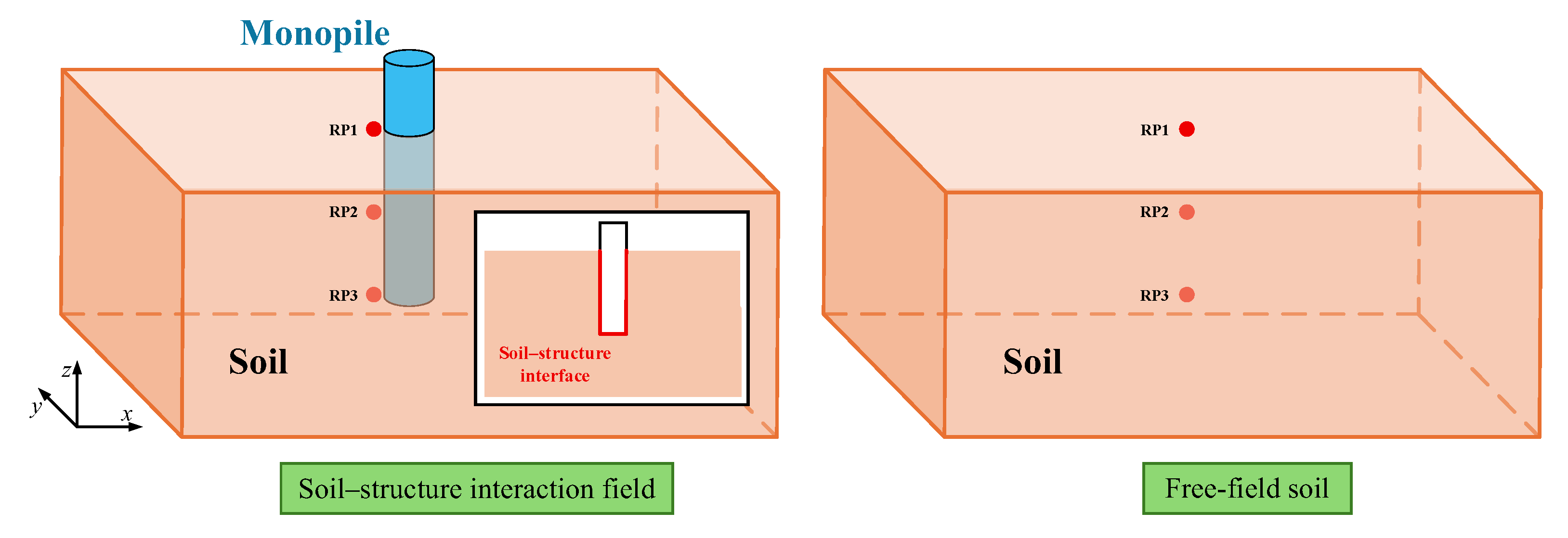
Based on the mesh size selection described above, the simplified assumption of neglecting soil–structure interaction described in Section 2.1 is validated. The schematic diagrams of the soil–structure interaction field and the free-field soil model are shown in Figure 11. The geometric dimensions and material parameters of the monopile are listed in Table 3. The soil–structure interface behavior is characterized through normal and tangential contact interactions. The inner and outer surfaces of the monopile are defined as the master contact surfaces, while the soil surface is assigned as the slave contact surface. For the normal behavior, separation between the soil and the monopile is allowed. In the tangential direction, the interface behavior is simulated using the Coulomb friction model, with the interfacial friction coefficient taken as k = tan(φ/2) = 0.315 (where φ denotes the soil internal friction angle). The adopted contact settings can reasonably simulate the soil–structure interaction behavior [14,56], and the size of the soil domain can effectively avoid the interference of boundary effects [60].
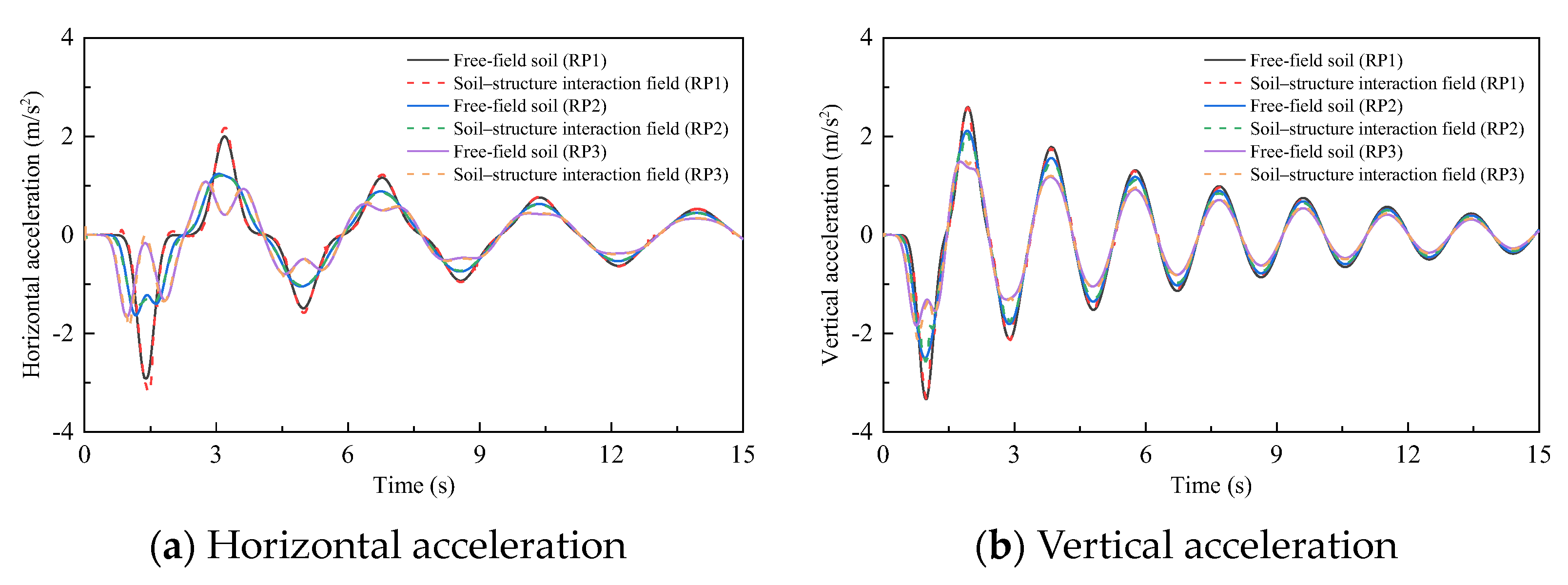
Three reference points (RP1, RP2, RP3) at different elevations are selected in both the free-field soil and the soil–structure interaction field. Pulse loads in the x and z directions are applied at the bottom of the two models, and the horizontal and vertical acceleration responses of each reference point are extracted. The comparison results of acceleration are presented in Figure 12. It can be observed that the monopile structure exerts slight influences on the dynamic response of surrounding soil in the present site response model. Since this study focuses on the effect of scour-induced seabed topography changes and water–soil interaction on site response, the influence induced by the monopile structure can be neglected in the subsequent analyses to simplify the computational process and analysis procedure.
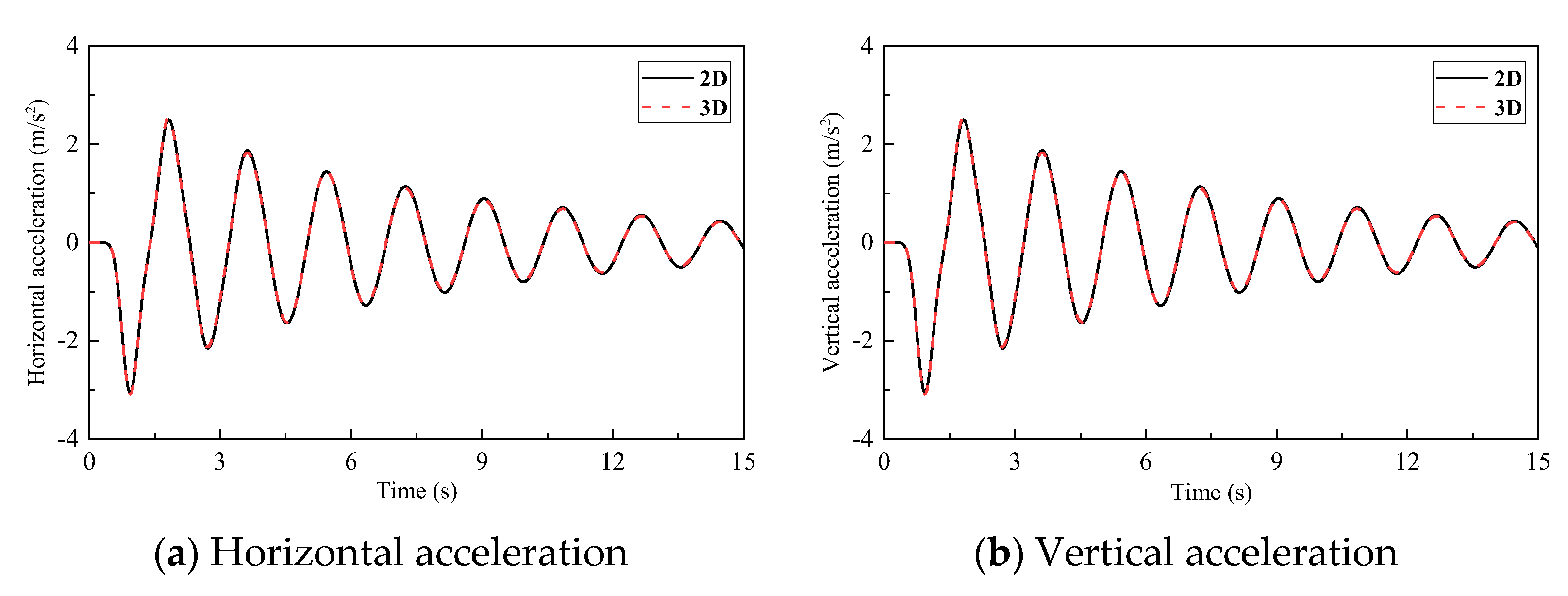
Finally, to validate the accuracy of the three-dimensional site response model and boundary conditions, a two-dimensional model is established for comparative analysis. In this model, the soil domain is discretized using four-node plane strain elements (CPE4R), and the water domain is discretized with four-node acoustic elements (AC2D4). Horizontal and vertical impulse loads are applied separately at the base of the model, and the displacement and acceleration responses at the top of the soil layer are compared. Figure 13 shows the comparison of the numerical results between the two-dimensional and three-dimensional numerical models. It can be seen that the results of the two models are identical, demonstrating the accuracy of the current numerical model and the boundary condition settings.

3. Numerical Simulation of Hydrodynamic Pressure Under Scour Conditions

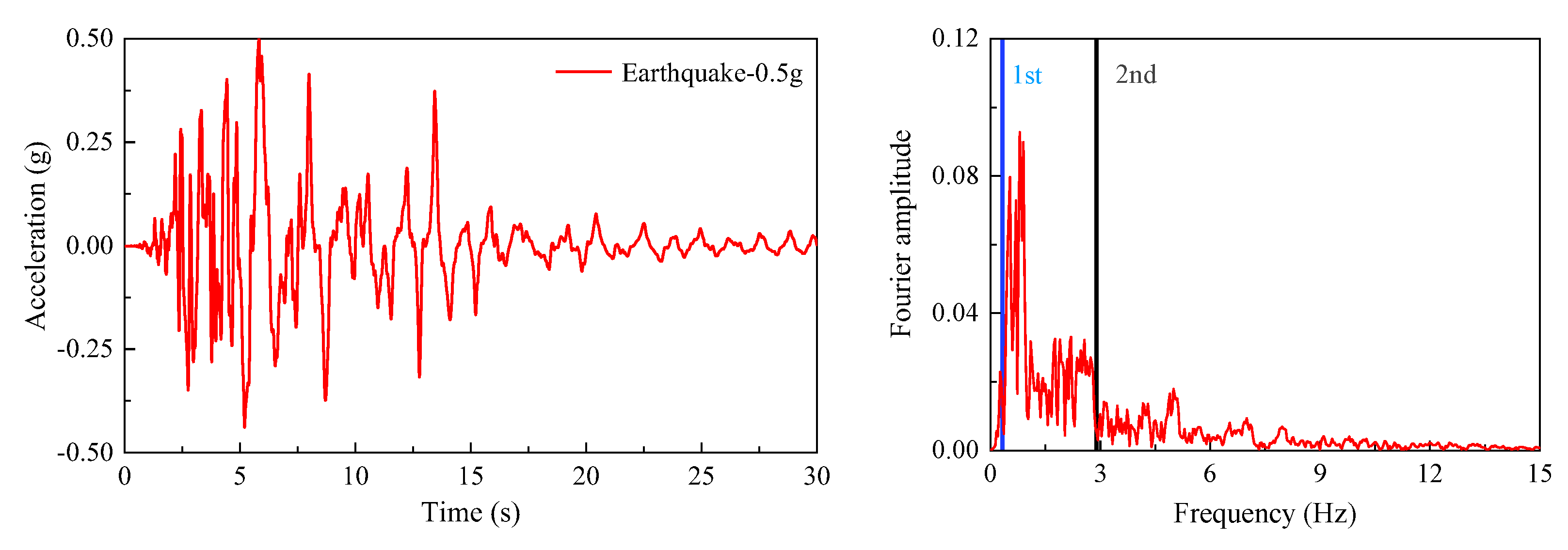
The effects of different scour types (global scour and local scour) on the distribution and magnitude of hydrodynamic pressure on monopile foundations are examined using response analysis under horizontal seismic load. The first and second natural frequencies of the 5 MW OWTs are 0.324 Hz and 2.9 Hz respectively [61]. The selected seismic load, shown in Figure 14, exhibits pronounced spectral components near the first and second natural frequencies of the 5 MW OWTs. This frequency alignment induces structural resonance, substantially amplifying the dynamic responses of both the turbine tower and its supporting structure, thereby posing a significant risk to the overall seismic safety of the system.

3.1. Global Scour Conditions

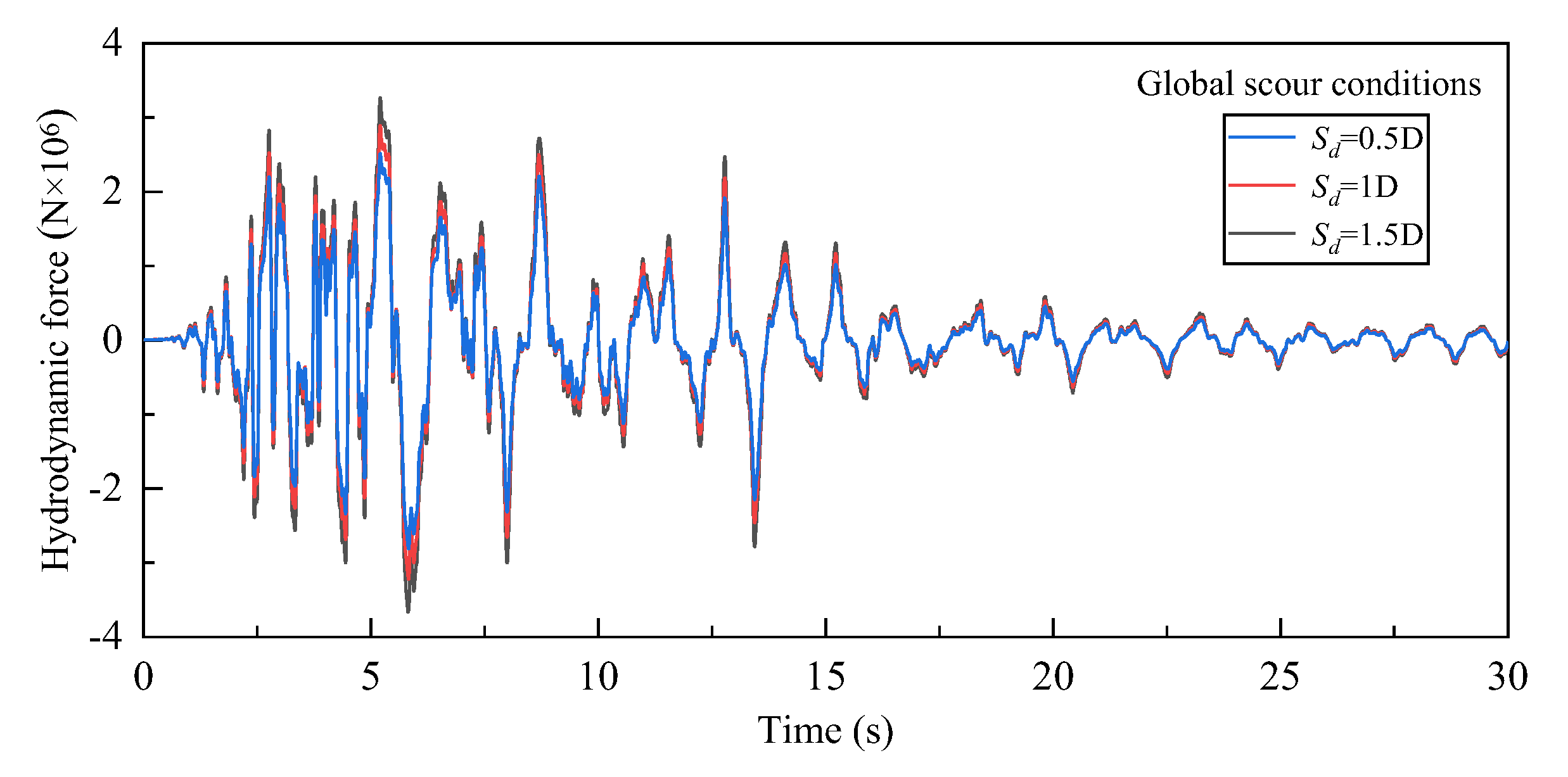
The hydrodynamic force is obtained by integrating the hydrodynamic pressure over the surface of the monopile structure, which represents the total force exerted by the water on the structure during seismic action. Under global scour conditions, the hydrodynamic forces acting on the structural wall at various scour depths are as presented in Figure 15. The fluctuations in these forces closely follow the characteristics of the input seismic load. With increasing scour depth, the contact area between the structure and the surrounding water progressively enlarges, thereby inducing a significant amplification of the hydrodynamic forces acting on the structure. This observation highlights the critical role of scour depth in modifying the structural load response under seismic load, which has important implications for the design and safety assessment of monopile-supported offshore wind turbines.
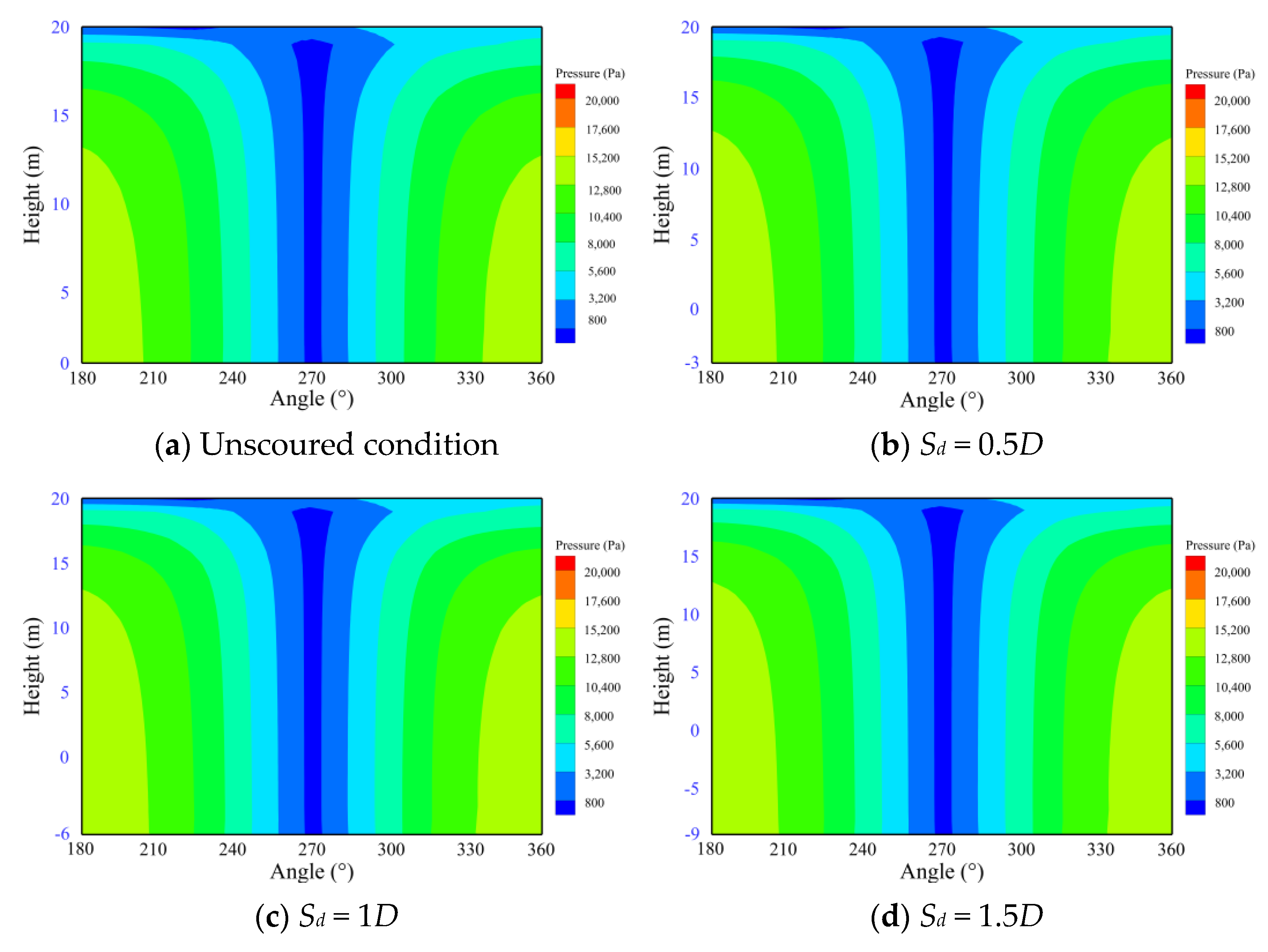
The spatial distribution of hydrodynamic pressure on the structural surface under varying scour depths is illustrated in Figure 16. Owing to the symmetric distribution of hydrodynamic pressure along the direction of motion, only the pressure contour over half of the cylindrical surface is presented. The vertical axis, denoted as “Height”, represents the distance from the original seabed plane, whereas the horizontal axis employs an angular coordinate system (ranging from 180° at the windward to 360° at the leeward) to indicate the circumferential position. Compared with the unscoured condition, global scour does not modify the overall spatial distribution pattern of hydrodynamic pressure. As the water depth increases, the circumferential variation of hydrodynamic pressure gradually diminishes along the depth, exhibiting a symmetric pressure distribution on both sides of the structure.

3.2. Local Scour Conditions

3.2.1. The Effect of Scour Slope Angle

The effect of local scour hole morphology on hydrodynamic pressure is quantitatively assessed by varying the geometric parameters of the local scour hole. This section focuses on the influence of scour slope angle on hydrodynamic pressure under different scour depth conditions, using a numerical model in which the bottom scour width is not considered.
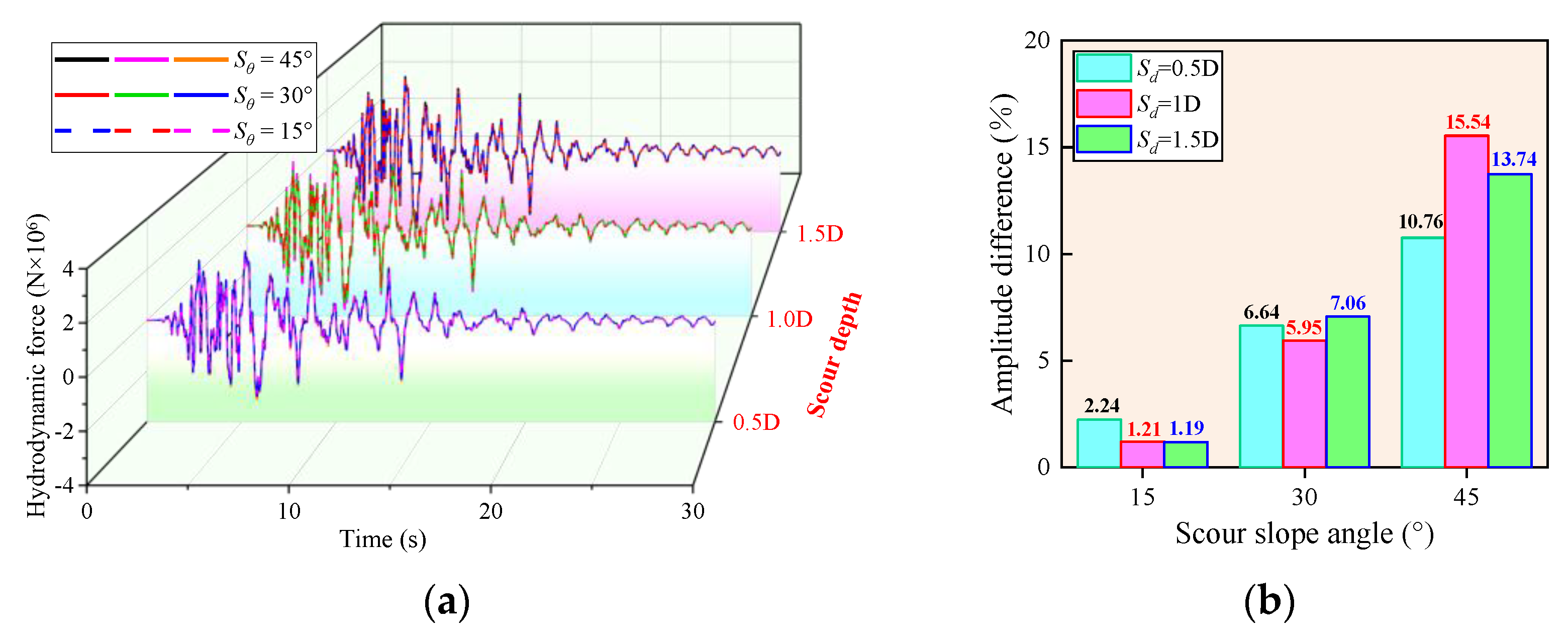
The variations in hydrodynamic force at different scour slope angles and scour depths are presented in Figure 17. The time history curves of hydrodynamic force for different slope angles at the same scour depth are shown in Figure 17a. The hydrodynamic force exhibits a consistent variation pattern across different scour depths, and it increases markedly with increasing slope angle. Figure 17b illustrates the differences in hydrodynamic force amplitude between local and global scouring at identical scour depths. Variations in the scour slope angle significantly affect the hydrodynamic force amplitude, with the most pronounced difference observed under the condition (Sd = 1D, Sθ = 45°), where the amplitude increases by 15.54%.
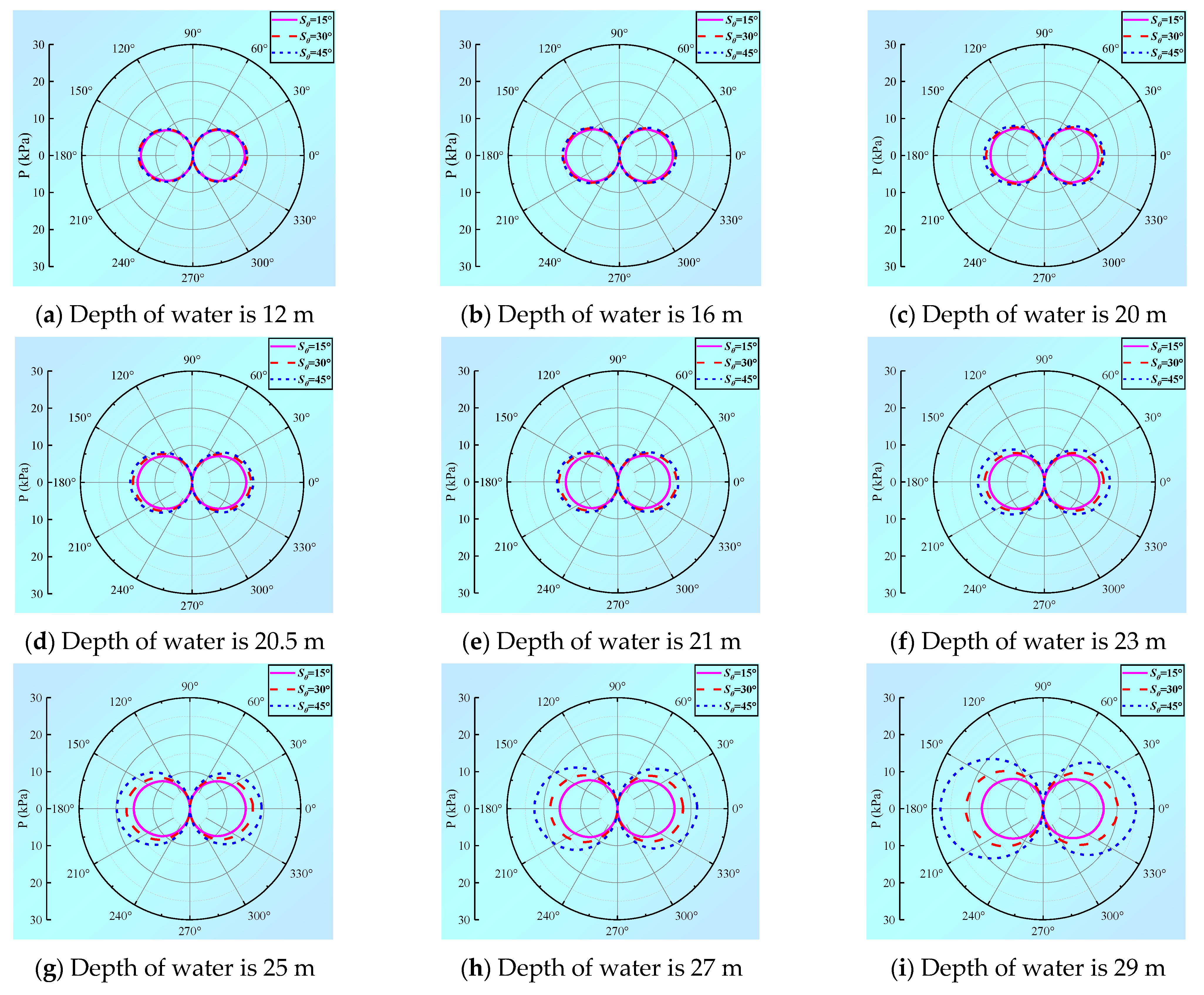
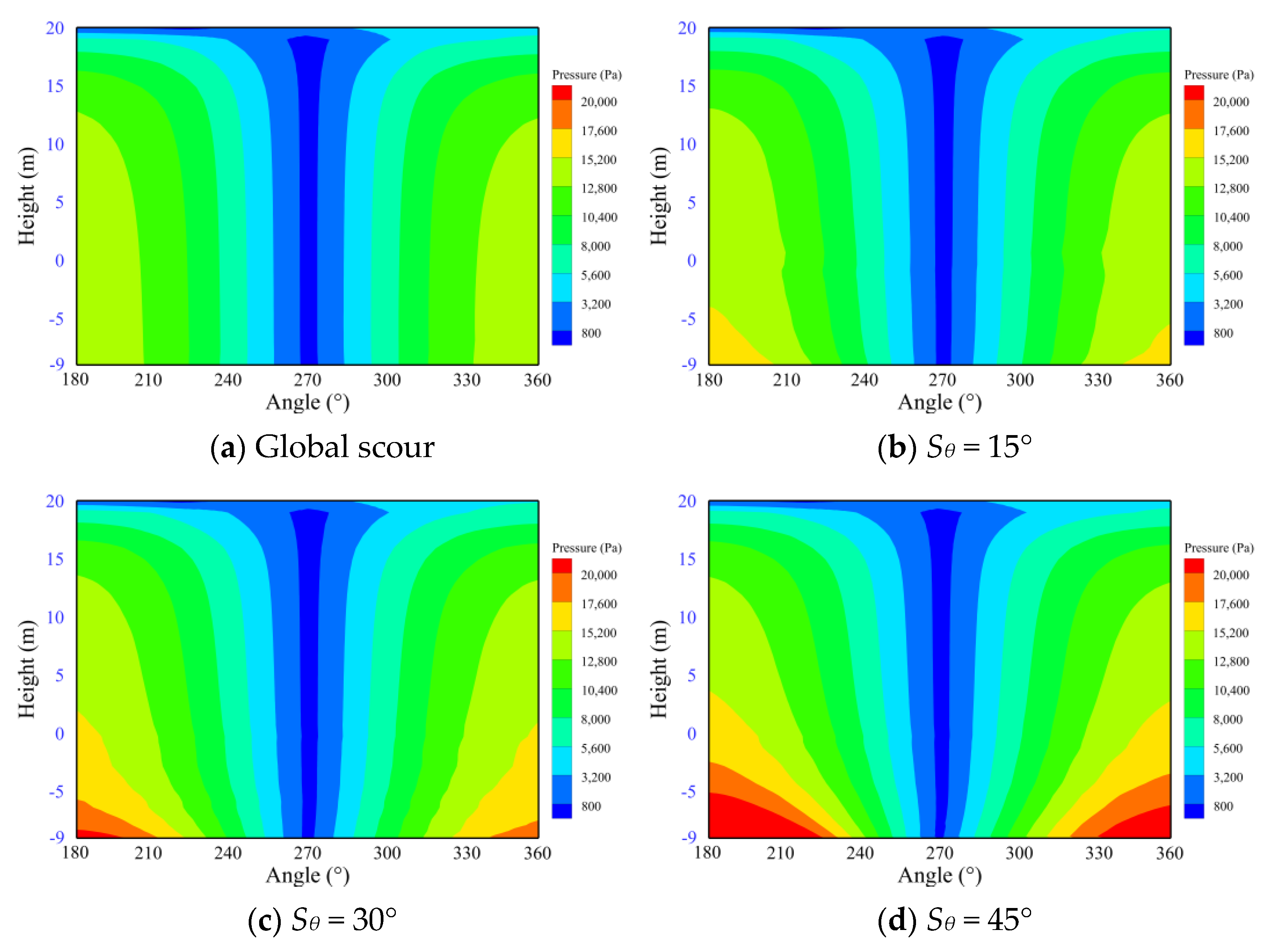
The effect of the scour slope angle on the circumferential peak hydrodynamic pressure distribution of the structure at different water depths at a scour depth of 1.5D is shown in Figure 18. The results indicate that variations in the scour slope angle substantially affect both the magnitude and spatial distribution of hydrodynamic pressure on cylindrical surfaces. With increasing water depth, the circumferential variation of hydrodynamic pressure around the structure under different scour slope angles gradually becomes more pronounced, with these differences primarily confined to the local scour hole region. At the base of the local scour hole, the disparity in hydrodynamic pressure between the upstream and downstream sides of the structure increases significantly with steeper slope angles, and the maximum hydrodynamic pressure consistently occurs on the upstream side. Figure 19 comparatively illustrates the spatial distribution patterns of hydrodynamic pressure on the structural surface under global scour conditions and local scour conditions at an identical scour depth (Sd = 1.5D). Significant differences in hydrodynamic pressure distribution are observed between local and global scour conditions, especially at the structure base. Within the local scour hole region, flow obstruction by the pit sidewalls leads to the formation of a high-pressure zone, and the extent of the zone continues to expand as the scour slope angle increases.

3.2.2. The Effect of Bottom Scour Width

This section investigates the influence of bottom scour width on hydrodynamic pressure under various scour depth conditions by fixing the scour slope angle (Sθ = 30°).
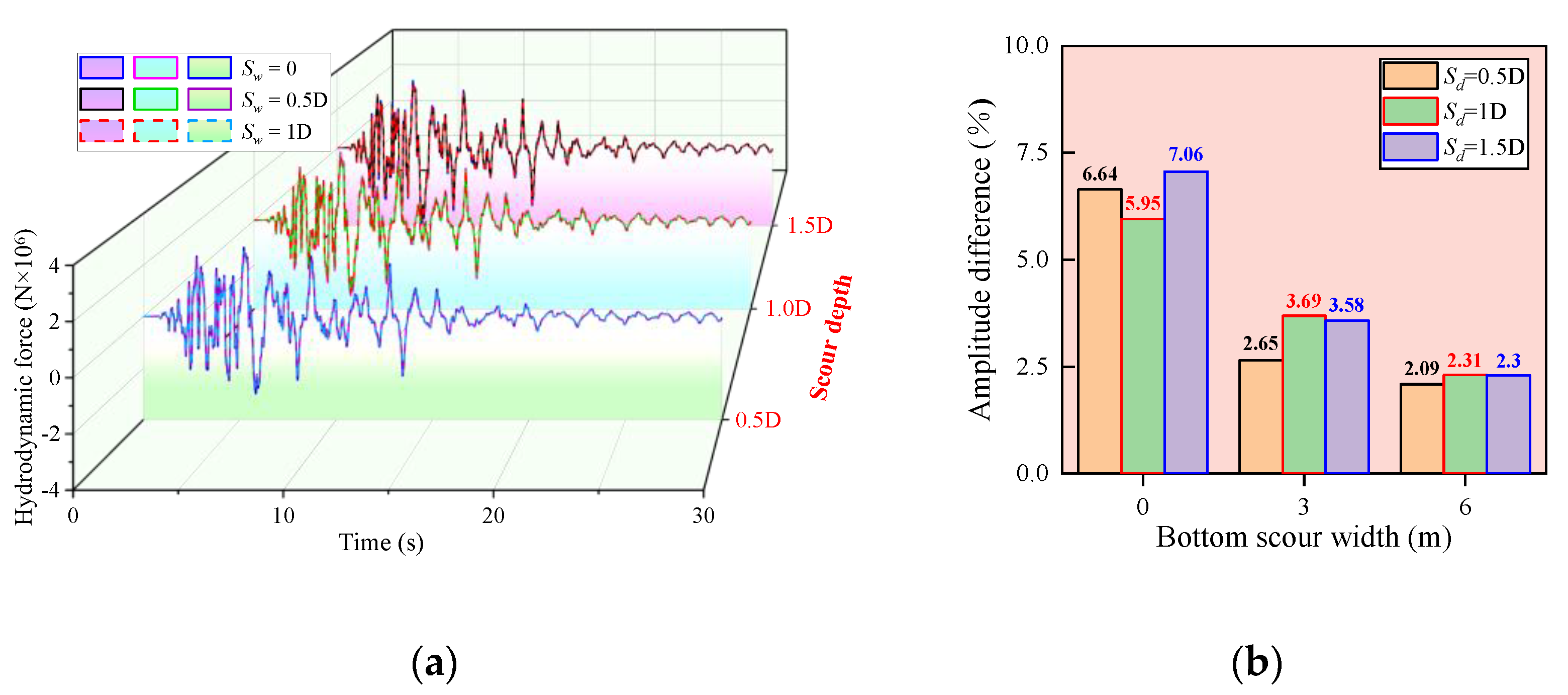
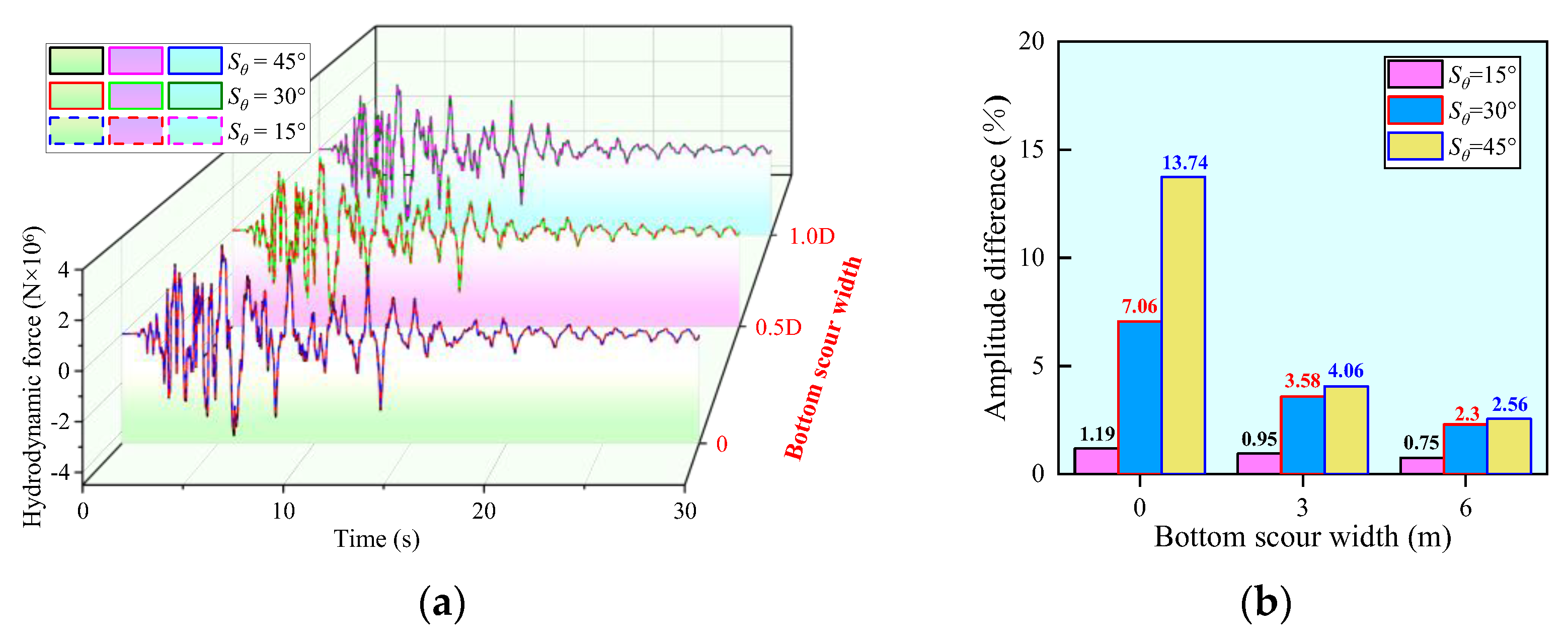
The differences in hydrodynamic force for a varying bottom scour width are shown in Figure 20. The time history curve of hydrodynamic force for different bottom scour widths at the same scour depth is shown in Figure 20a; the presence of bottom scour width reduces the hydrodynamic force under different scour depth conditions. Figure 20b shows the differences in hydrodynamic force amplitude between local scour and global scour at the same scour depth; the bottom scour width suppresses the development of hydrodynamic force, the difference in hydrodynamic forces between local and global scour diminishes with increasing bottom scour width, and the variations in scour depth do not alter the influence of bottom scour width on hydrodynamic pressure.
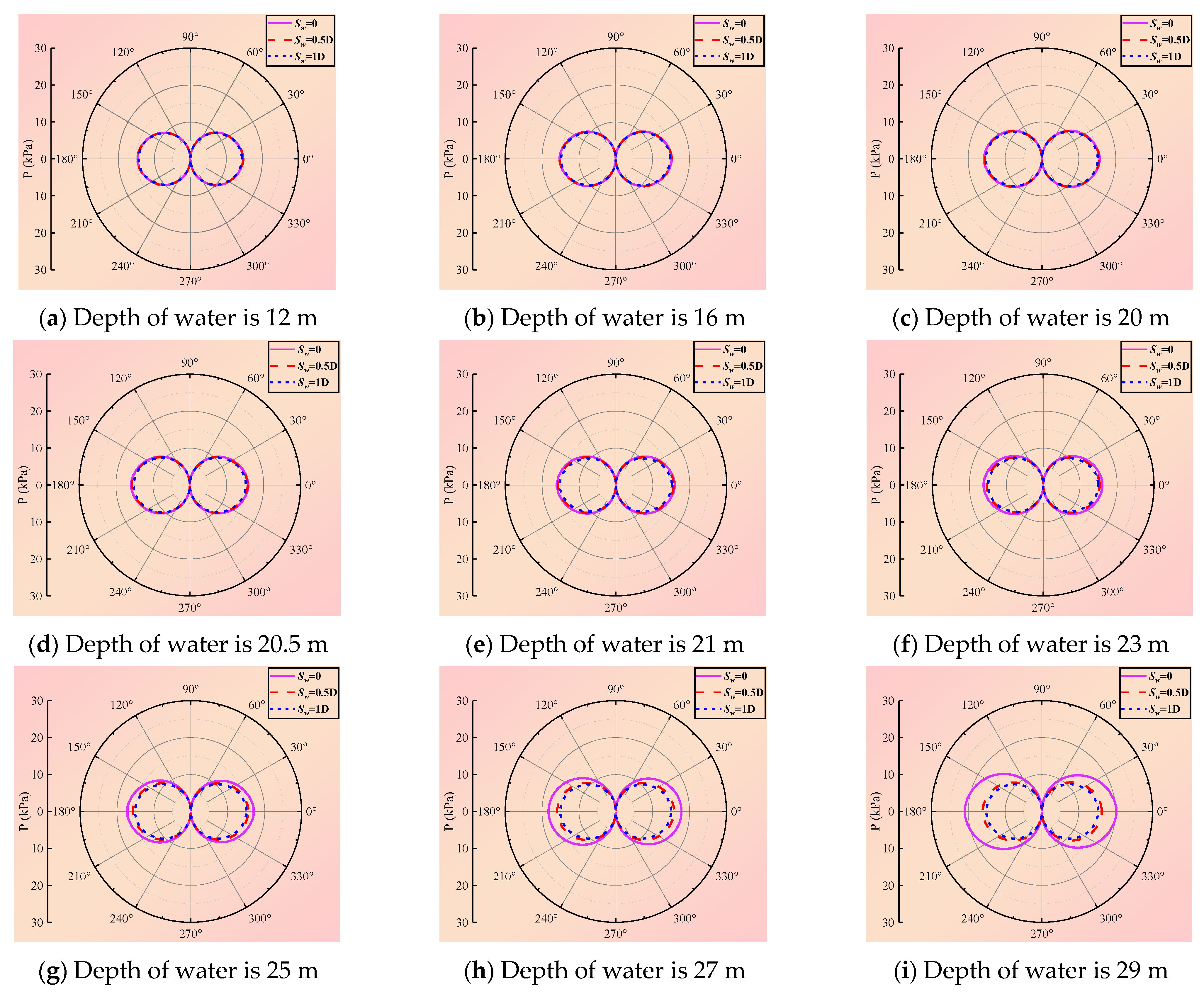
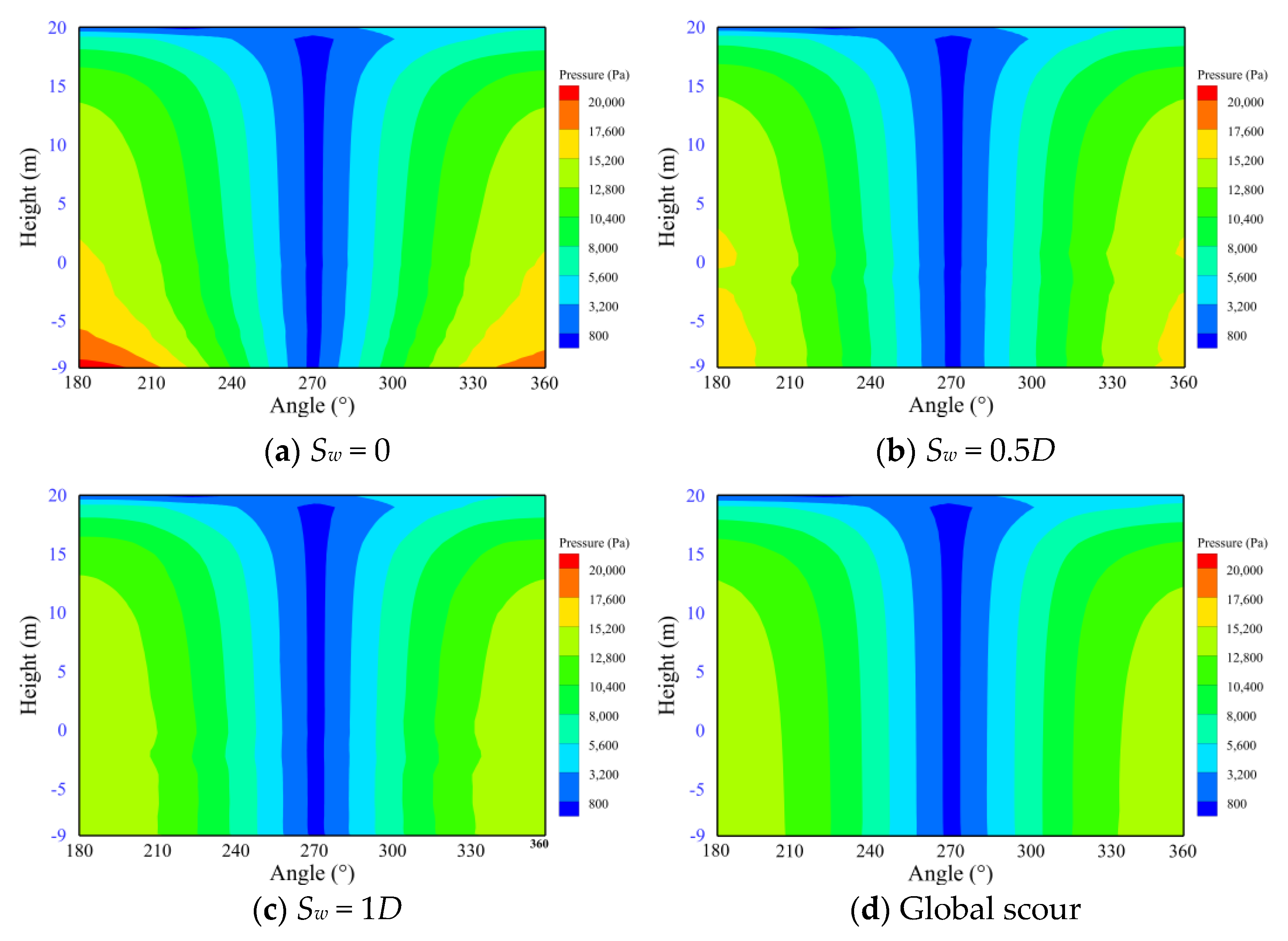
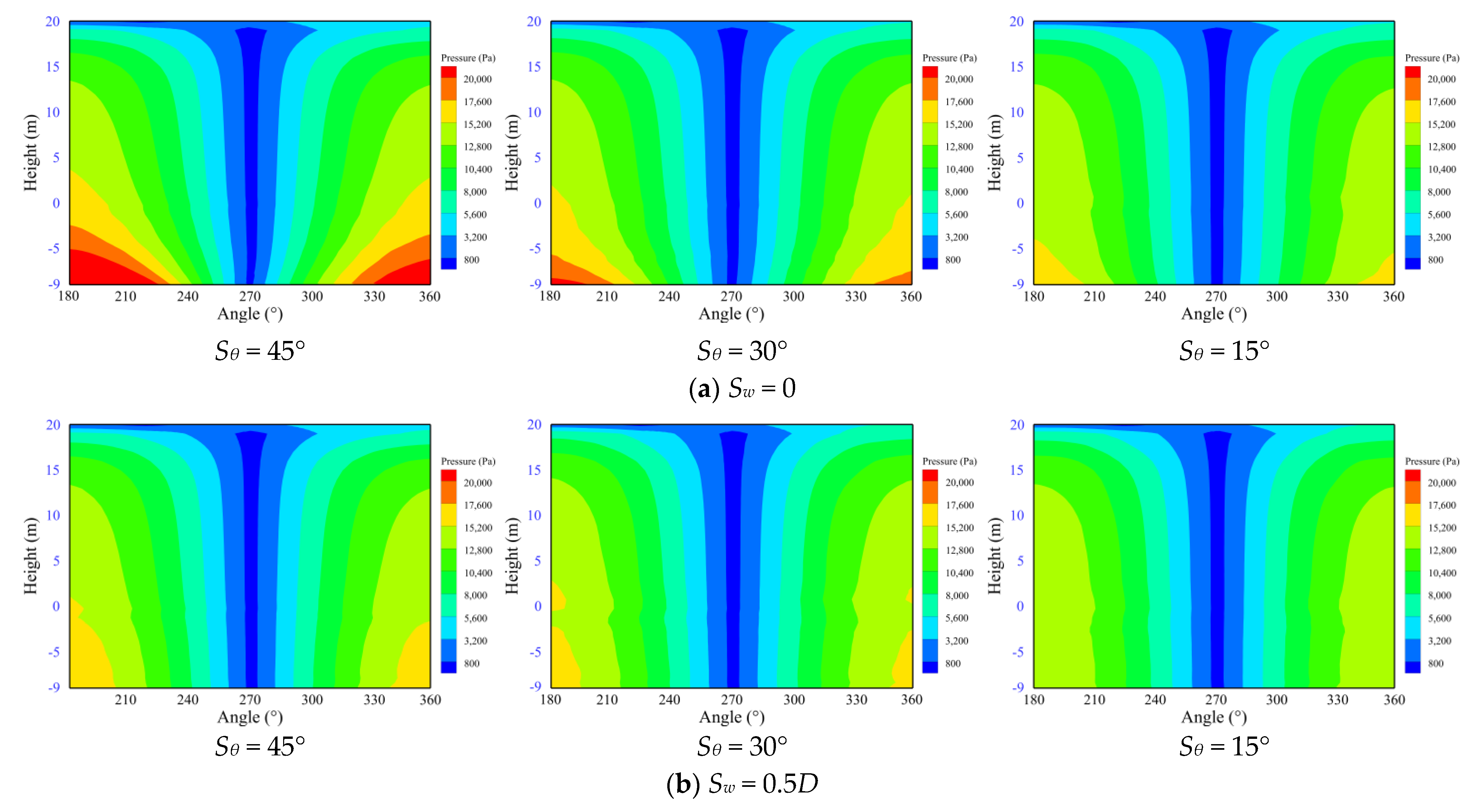
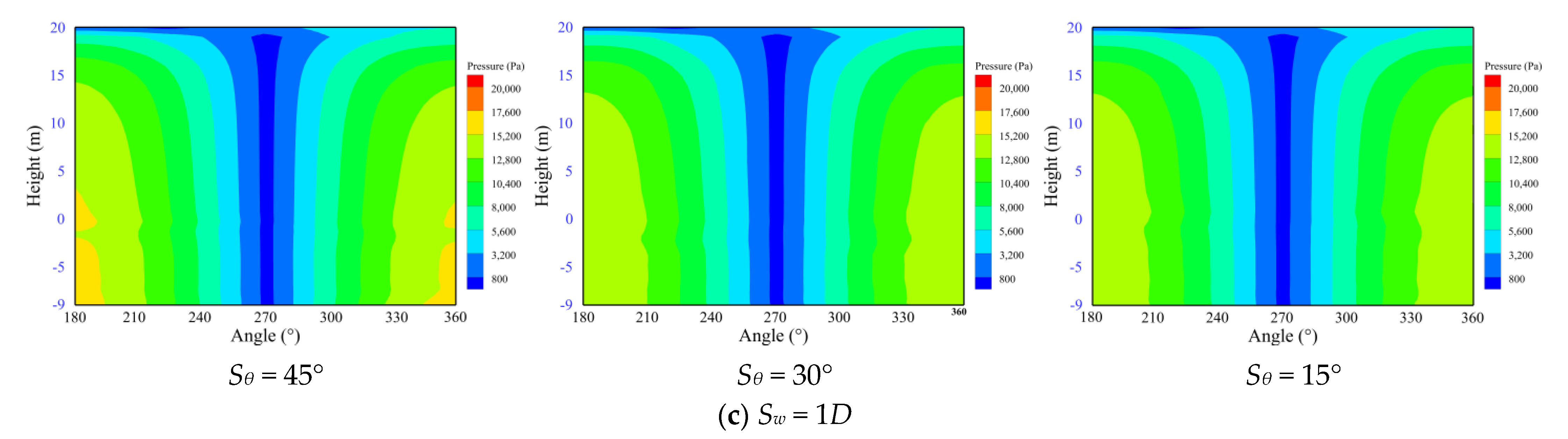
The effect of bottom scour width on the circumferential peak hydrodynamic pressure distribution of the structure at different water depths under the condition of a scour depth of 1.5D is shown in Figure 21. The presence of bottom scour width reduces the hydrodynamic pressure on the cylindrical surface within the local scour hole region, leading to a pressure distribution that is more symmetric on both sides of the structure. However, the effect of increasing bottom scour width on the overall hydrodynamic pressure is relatively limited. Figure 22 comparatively illustrates the spatial distribution patterns of hydrodynamic pressure on the structural surface under global scour conditions and local scour conditions at an identical scour depth (Sd = 1.5D). The bottom scour width provides space for fluid movement within the local scour hole, reducing the constraining effect of the local scour hole wall on flow motion and thereby effectively suppressing the formation of a high-pressure zone at the bottom of the local scour hole. As the bottom scour width increases, the influence of the local scour hole on the hydrodynamic pressure distribution around the cylindrical structure gradually diminishes.

3.2.3. Combined Effects of Scour Slope Angle and Bottom Scour Width

As shown in Figure 17b and Figure 20b, under local scour conditions, the variation of scour depth has a minor effect on the influence pattern of hydrodynamic pressure caused by the individual variation of scour slope angle and bottom scour width. Therefore, this section systematically investigates the combined effects of scour slope angle and bottom scour width on hydrodynamic pressure at a scour depth of 1.5D by establishing numerical models of local scour hole with varying morphologies.
The variations in hydrodynamic force at different scour slope angles under varying bottom scour widths are presented in Figure 23. The time history curves of hydrodynamic force for different scour slope angles at the same bottom scour width are shown in Figure 23a. When a bottom scour width is present, the differences in hydrodynamic force induced by changes in scour slope angle are markedly reduced, indicating that the bottom scour width mitigates the influence of scour slope angle on the hydrodynamic force. Figure 23b shows the differences in hydrodynamic force amplitude between local scour conditions and global scour conditions at a Sd = 1.5D, the amplitude of hydrodynamic force increases with scour slope angle under different scour width conditions, but the amplitude difference between local and global scour gradually decreases as the bottom scour width increases.
Figure 24 comparatively illustrates the spatial distribution patterns of hydrodynamic pressure on the structural surface under local scour conditions (Sd = 1.5D) considering the combined effects of scour slope angle and bottom scour width. It can be observed that the presence of the bottom scour width mitigates the influence of the scour slope angle on hydrodynamic pressure, with the bottom scour width acting as a key controlling parameter under local scour conditions; moreover, with increasing bottom scour width and decreasing scour slope angle, the differences in hydrodynamic pressure between local and global scour gradually diminish, resulting in a spatial distribution of hydrodynamic pressure on the structural surface under local scour conditions that increasingly resembles that of global scour.

3.3. The Added Mass Coefficient Under Scour Conditions

The dominant frequencies of seismic loads are typically distributed within 5 Hz which is significantly lower than the fundamental frequency of water, the added damping effect can be neglected and the hydrodynamic pressure is simulated using the added mass model under horizontal seismic loads, which accounts for hydrodynamic pressure by equivalently applying additional mass to the structure and representing its effect through inertial forces.
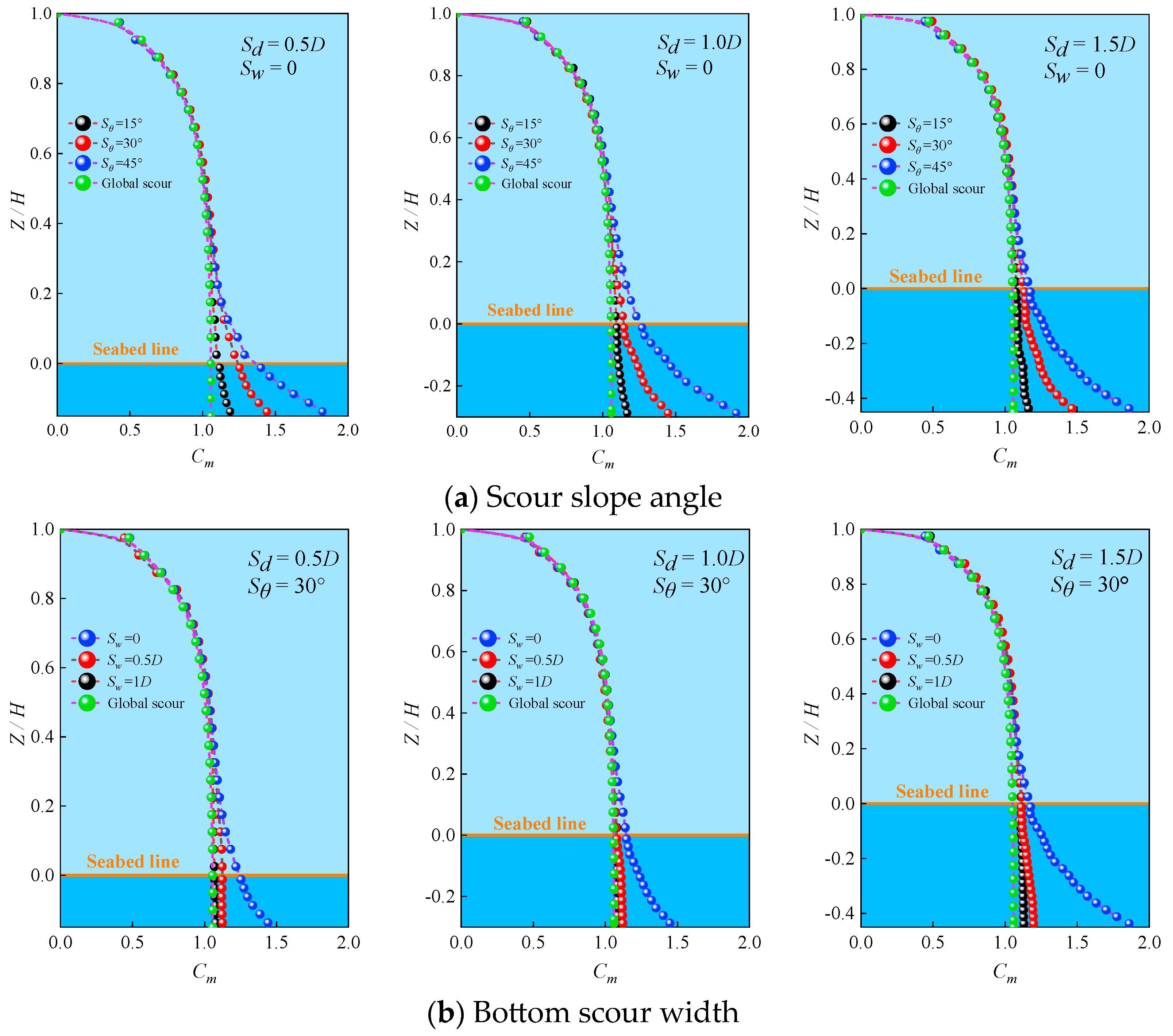
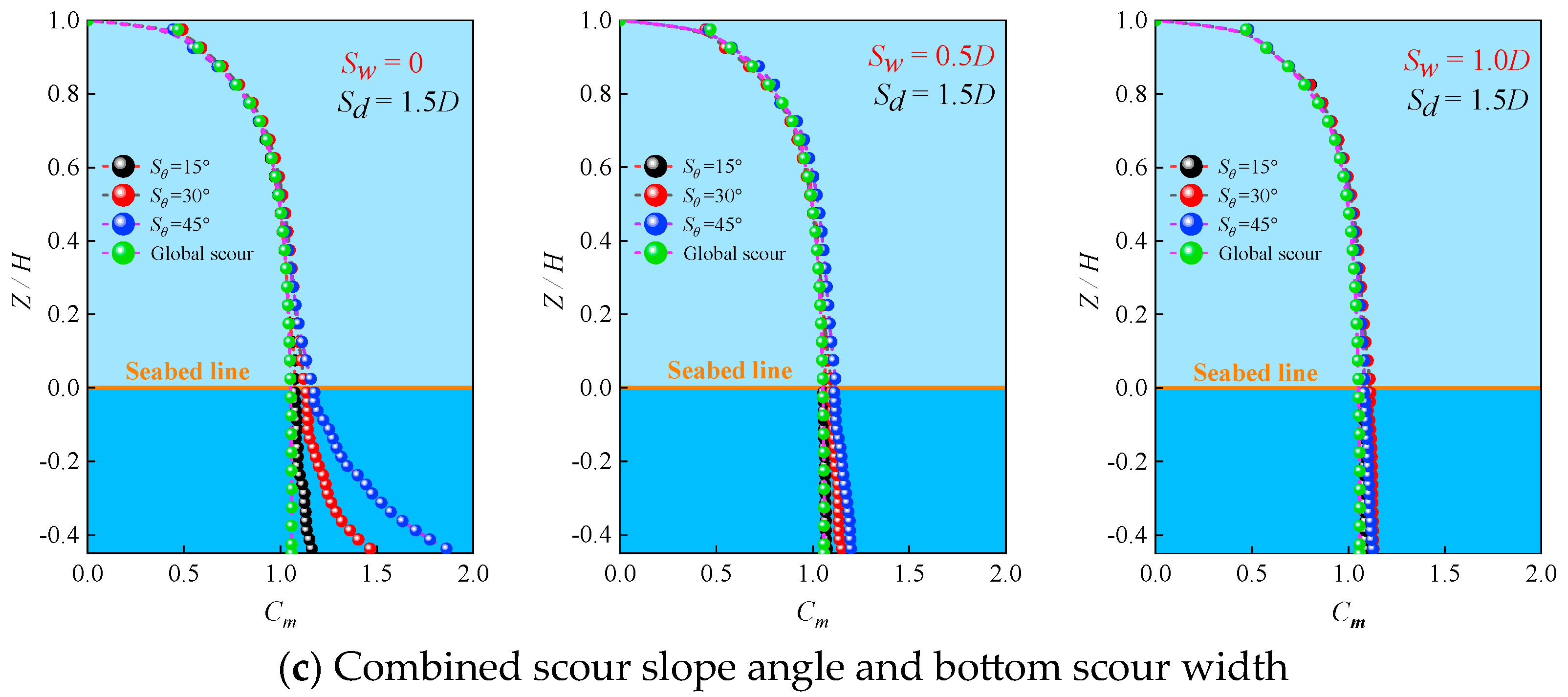
The influence of the local scour hole morphology on the added mass coefficient in local scour conditions is shown in Figure 25. Figure 25a shows the influence of scour slope angle on the added mass coefficient under different scour depths. Within the local scour hole region, the added mass coefficient increases nonlinearly with increasing slope angle. The differences in the added mass coefficient between local and global scour conditions are primarily concentrated within the region extending from a relative height coefficient of 0.3 to the base of the structure, and these differences are negligible when the scour slope angle is small. Figure 25b illustrates the effect of bottom scour width on the added mass coefficient under different scour depths. The results indicate that the presence of a bottom scour width significantly mitigates the impact of the local scour hole on the added mass coefficient, with the differences between local and global scour gradually diminishing as the bottom scour width increases. Figure 25c depicts the combined influence of scour slope angle and bottom scour width on the added mass coefficient. With increasing bottom scour width and decreasing scour slope angle, the added mass coefficient progressively converges toward the distribution pattern observed under global scour conditions.

4. Numerical Simulation of Site Response Under Scour Conditions

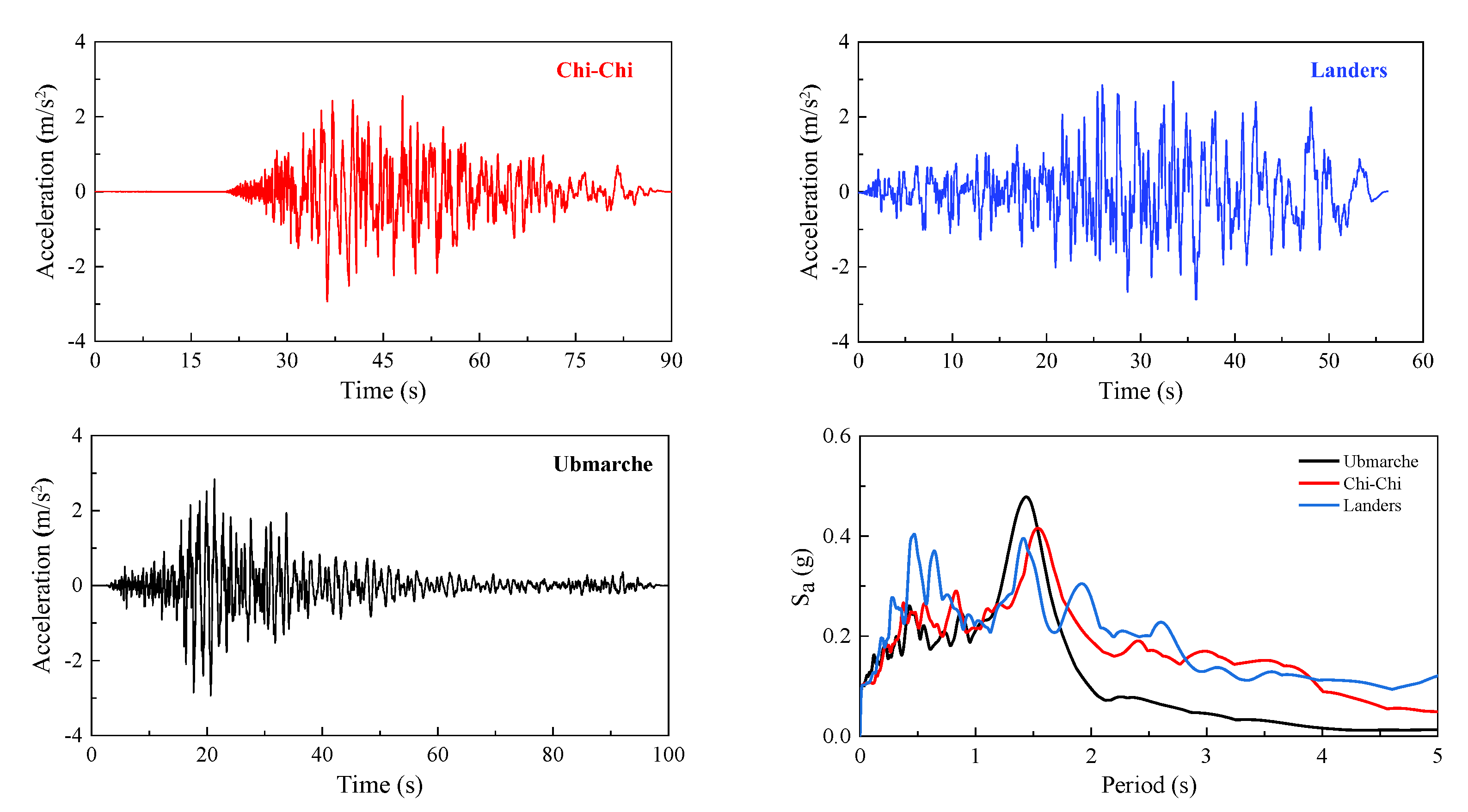
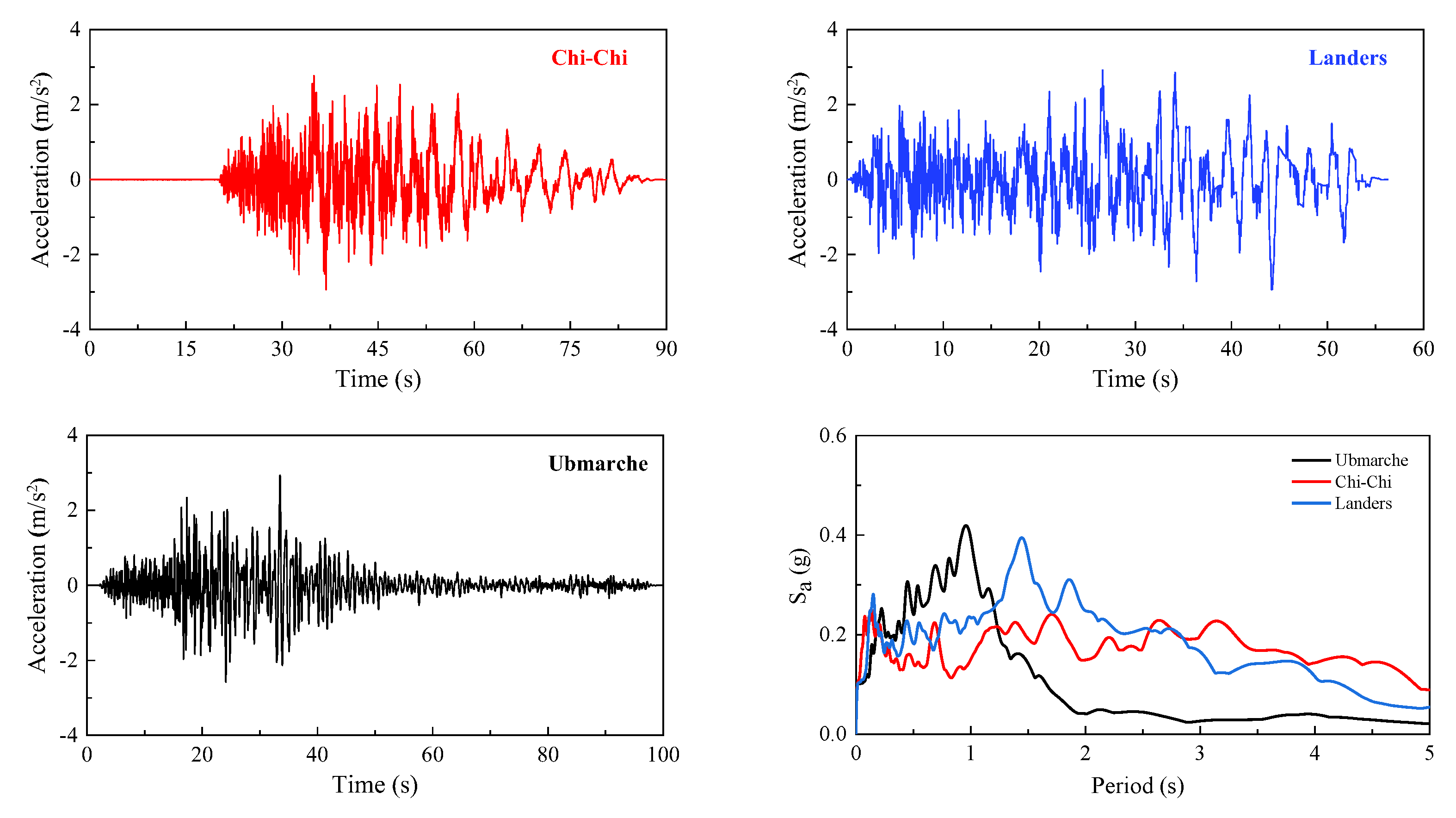
The effect of scour on site response is investigated in this section. Three seismic records, from the Chi-Chi, Landers, and Ubmarche seismic loads, are selected to serve as input loads from the Pacific Earthquake Engineering Research Center (PEER) database. Detailed information regarding these three earthquake records is summarized in Table 4. The time history curves and the corresponding acceleration response spectra for both the horizontal and vertical components of these ground motions are presented in Figure 26 and Figure 27, respectively.
In this study, all original records are scaled uniformly to 0.3 g in both horizontal and vertical directions, and the acceleration response spectra are calculated based on the seismic records being scaled to a peak ground acceleration (PGA) of 0.1 g.

4.1. Natural Frequency Analysis Under Scour Conditions

The natural frequency of a site governs its dynamic response under seismic loads. Therefore, examining the variations in site natural frequencies under different scour conditions is of critical importance. Table 5 presents the first three horizontal natural frequencies and the first vertical natural frequency of the seabed. The results indicate that the local scour hole exerts only a limited effect on the seabed’s natural frequencies. In contrast, under global scour conditions, the reduction in soil layer thickness substantially increases seabed stiffness, leading to higher horizontal and vertical frequencies. Additionally, the presence of water significantly reduces the vertical natural frequency while having minimal impact on the horizontal frequencies.

4.2. Free-Field Response of Soil Under Scour Conditions

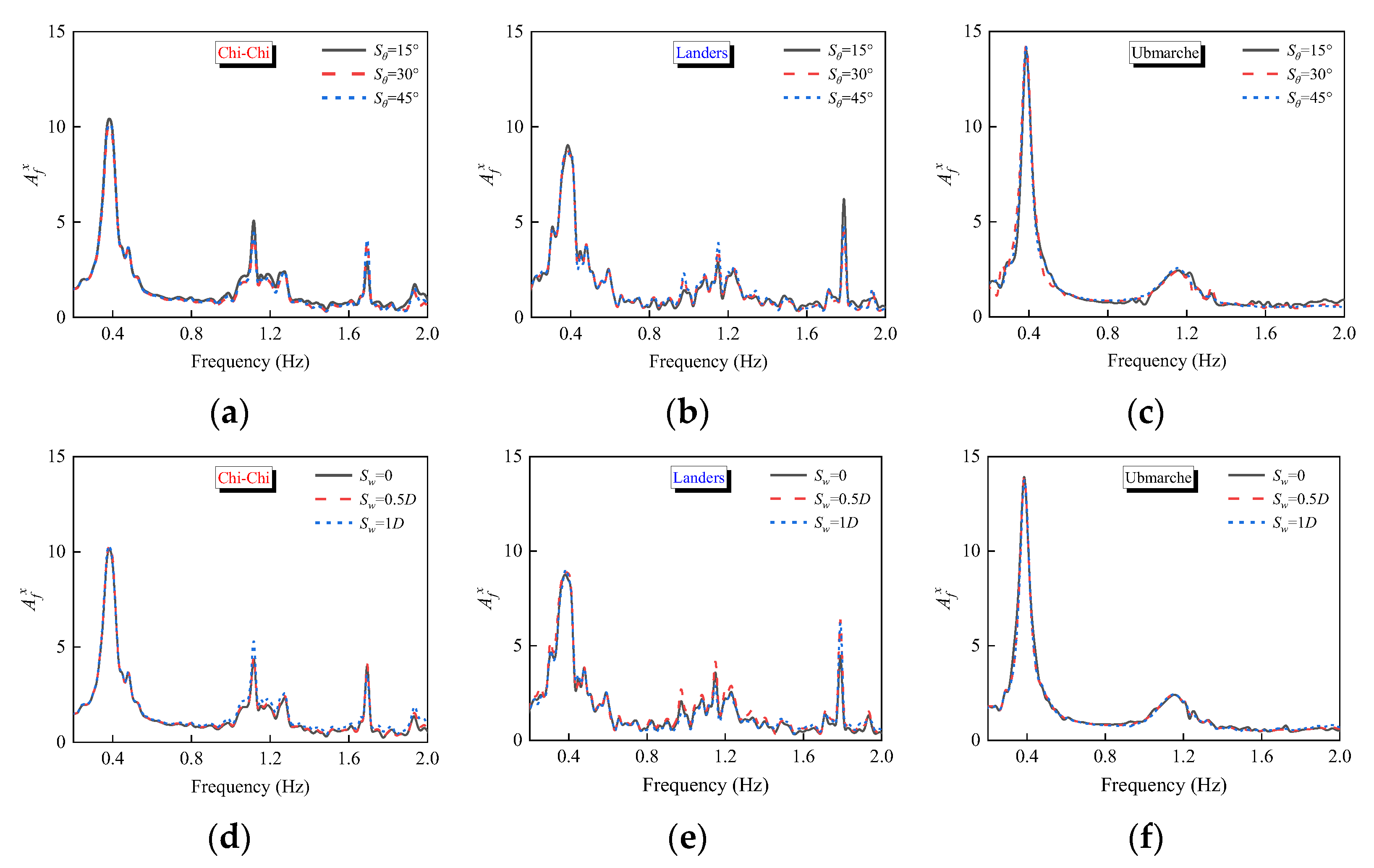
The influence of scour slope angle and bottom scour width on the amplitude of the horizontal acceleration transfer function from bedrock to the scoured surface under different seismic loads is illustrated in Figure 28. Under local scour conditions, the transfer function amplitude of the free-field soil exhibits little variation, indicating that changes in local scour hole morphology have a limited effect on the horizontal dynamic response of the free-field soil.
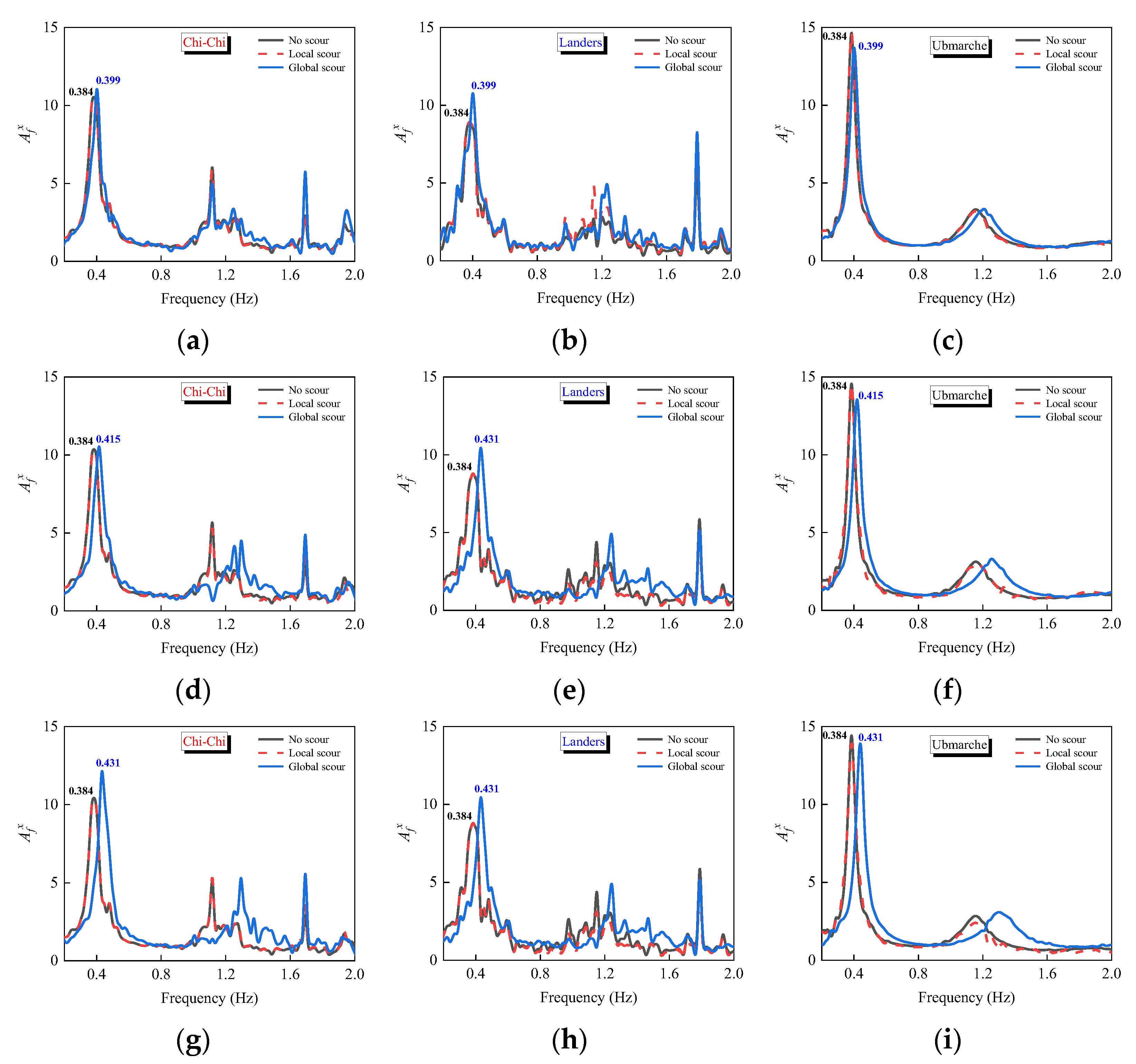
The amplitude of the horizontal acceleration transfer function at identical elevations under scoured and unscoured conditions, for varying scour depths, is compared in Figure 29. The results indicate that, across the entire frequency spectrum, the transfer function amplitude of the locally scoured site closely matches that of the unscoured site, suggesting that the presence of a local scour hole does not significantly alter the horizontal seismic response of the site. In contrast, global scour modifies the horizontal natural frequency of the seabed, resulting in notable differences in the transfer function amplitude between globally scoured and unscoured sites. As scour depth increases, the predominant period of the globally scoured site gradually decreases, enhancing the site’s amplification of higher-frequency seismic components. Under varying scour depths, a significant difference in horizontal response is observed between locally and globally scoured sites, whereas the difference between locally scoured and unscoured sites remains relatively small.
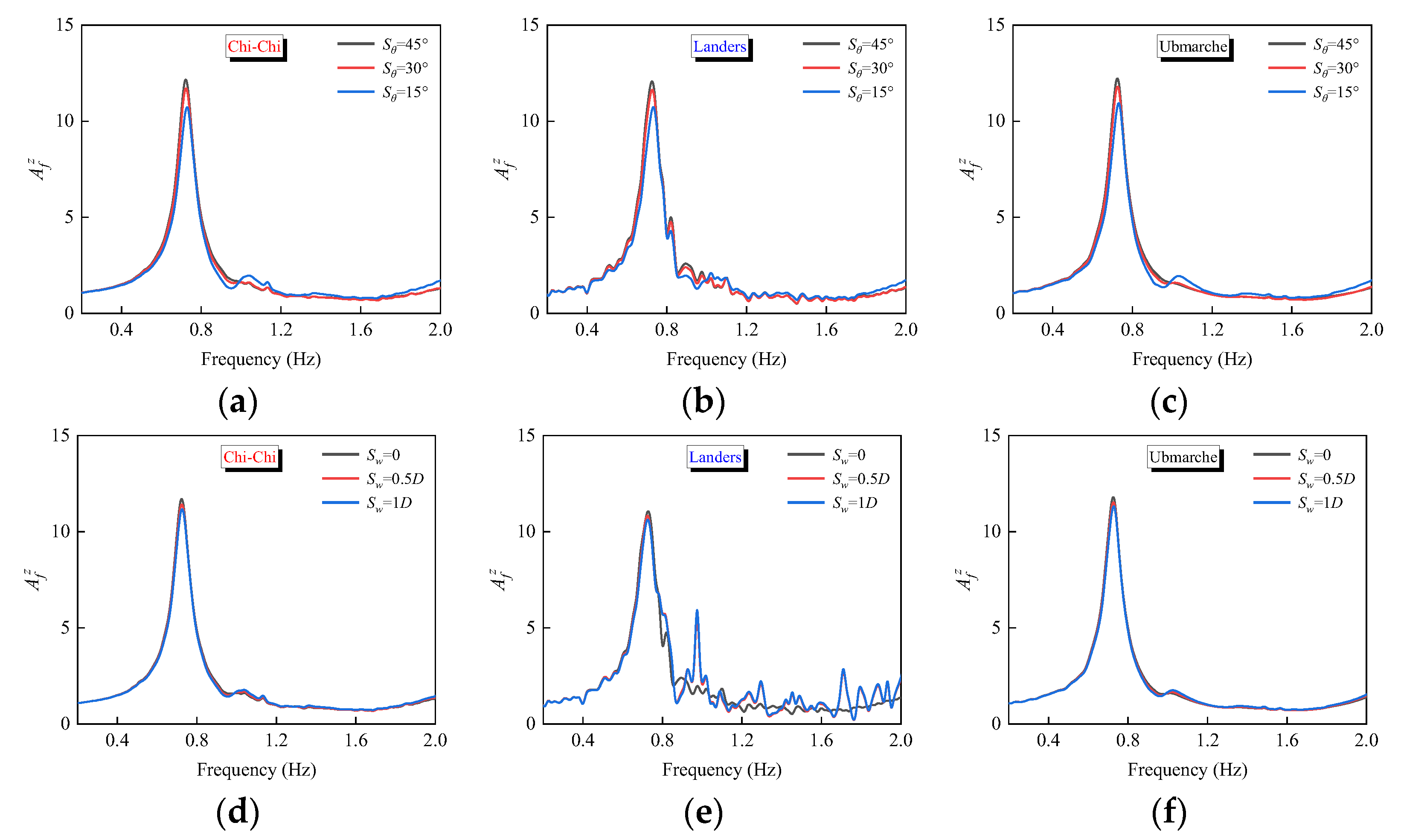
The influence of scour slope angle and bottom scour width on the amplitude of the vertical acceleration transfer function from bedrock to the scoured surface under different seismic loads is illustrated in Figure 30. As shown in the figure, bottom scour width exerts a relatively limited effect on the vertical site response, whereas a decrease in slope angle leads to a reduction in vertical response. This difference may be attributed to variations in seismic wave scattering caused by slopes with different inclination angles. Overall, variations in the morphology of the local scour hole do not alter the vertical predominant frequency of the site.
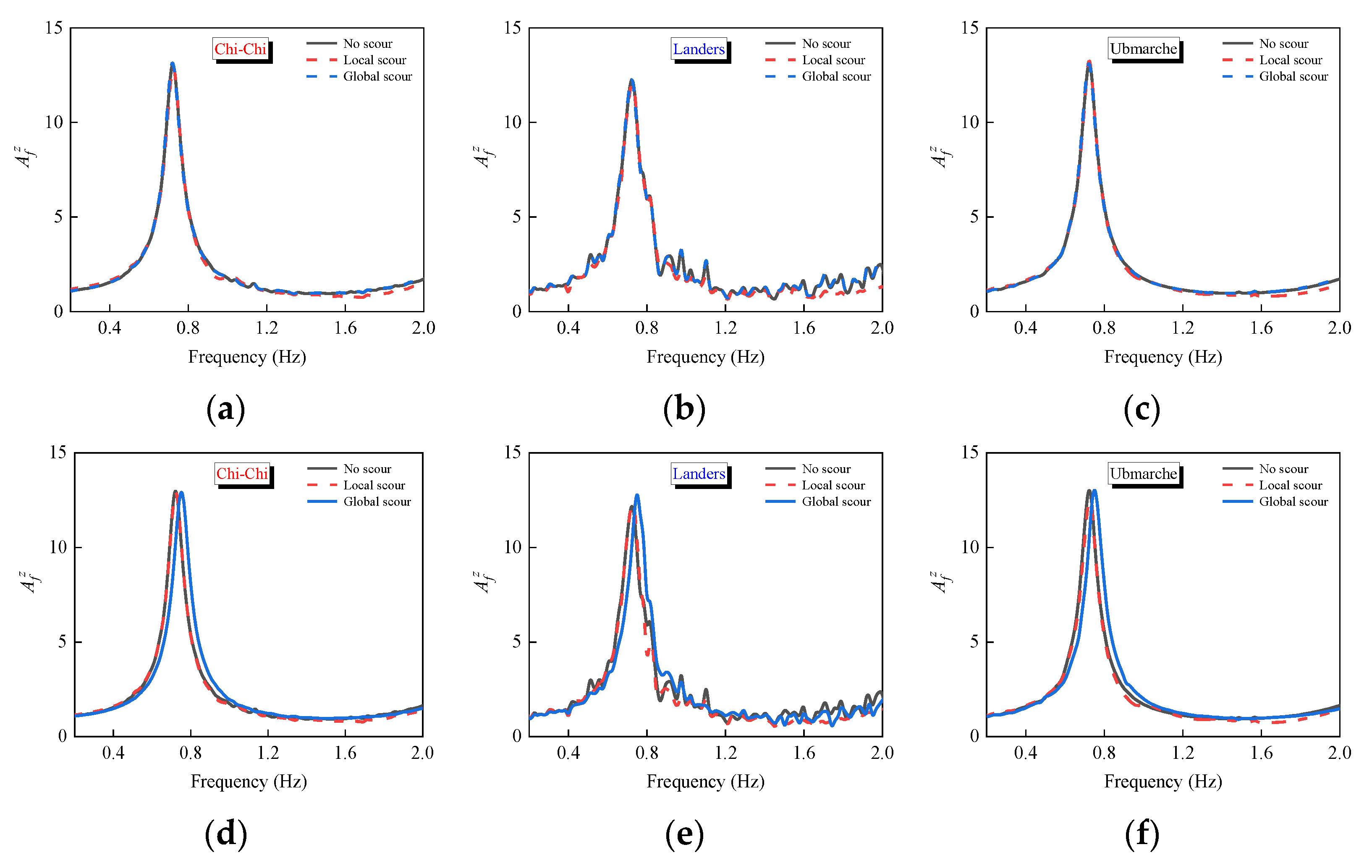
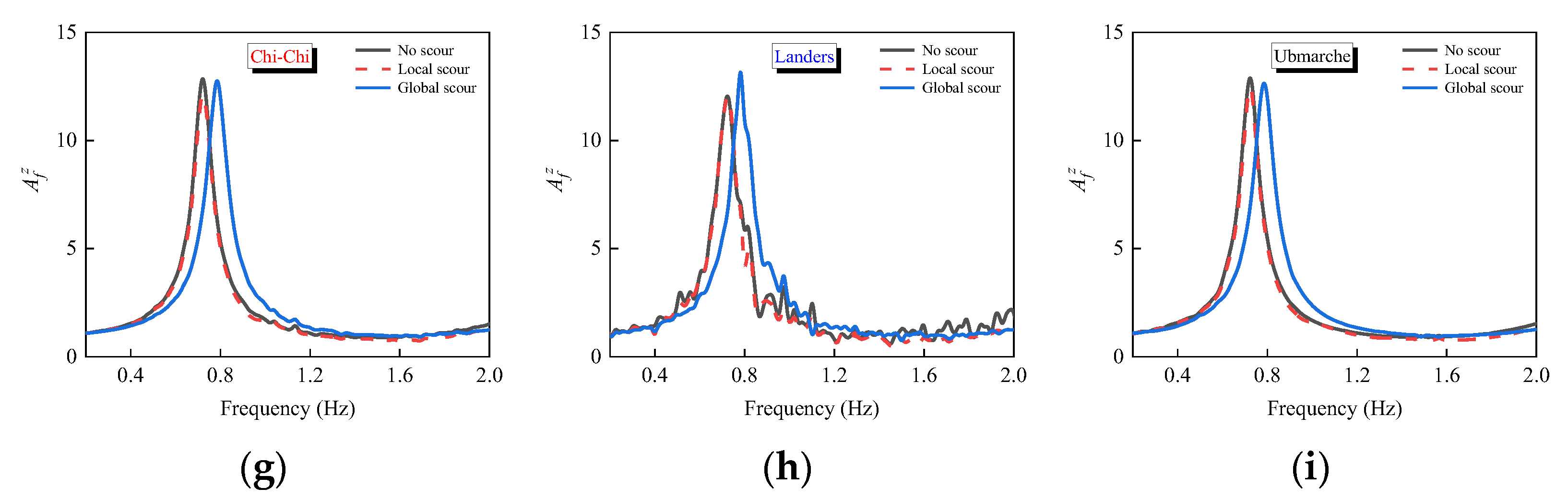
The amplitude of the vertical acceleration transfer function at identical elevations, comparing scour conditions with varying scour depths to the unscoured condition, is presented in Figure 31. Across the frequency spectrum, the transfer function amplitudes of the locally scoured site closely match those of the unscoured site, indicating that the presence of a local scour hole does not affect the site’s response under vertical seismic loads. In contrast, global scour alters the vertical natural frequency of the seabed, causing the primary amplification band of the site to shift toward higher frequencies as scour depth increases. At a shallow scour depth (Sd = 0.5D), the vertical response of globally and locally scoured sites is essentially consistent at identical elevation, and the difference in response between locally and globally scoured sites gradually enlarges with continued increase in scour depth.

4.3. Coupled Free-Field Response of Water–Soil Under Scour Conditions

The influence of water–soil interaction on the amplitude of the horizontal acceleration transfer function from bedrock to the scoured surface under different seismic loads is presented in Figure 32. As illustrated, the transfer function amplitude of the water–soil free-field closely matches that of the free-field soil across the frequency spectrum under scour conditions, indicating that water exerts only a limited effect on the site’s horizontal response. Figure 33 depicts the influence of water–soil interaction on the amplitude of the vertical acceleration transfer function under different seismic loads. It can be observed that water–soil interaction reduces the site’s vertical seismic response. Moreover, the presence of water significantly amplifies the high-frequency components of the vertical ground motion due to seismic wave refraction within the water.
The presence of water alters the dynamic wave propagation environment of the site and thus inhibits the energy transmission and amplification of vertical seismic waves, which necessitates close attention to the influence of water–soil interaction on the vertical seismic response of the site. Figure 34 compares the vertical acceleration responses at the elevation of the local scour hole bottom between locally scoured and unscoured sites under different seismic loads, with the water–soil interaction effect considered. It can be seen that only minor differences exist in the vertical responses between locally scoured and unscoured sites, indicating that the water within the local scour hole exerts a limited influence on the vertical seismic response of the site under local scour conditions. Figure 35 presents the differences in vertical acceleration responses at the same elevation between globally scoured and locally scoured sites under different seismic loads, with the water–soil interaction effect also incorporated. The results indicate that under the global scour condition, the water depth increases with the action of global scour, which further attenuates the vertical seismic response of the site; this trend is consistently verified in the site responses under the Chi-Chi and Landers seismic loads. In addition, global scour alters the natural frequency of the site, leading to a significant amplification of the site’s vertical response under certain seismic loads. This characteristic is particularly evident in the Ubmarche seismic load, where it can be observed that the amplification effect of the vertical response induced by variations in the site’s natural frequency exceeds the attenuation effect caused by the increased water depth.

5. Conclusions

The effects of scour on hydrodynamic pressure and site response under seismic loads are investigated in this study. Both local and global scour conditions are considered. Based on the numerical analyses, the following conclusions are drawn.
  • Under scour conditions, the contact area between the structure and the surrounding water is significantly increased, leading to additional hydrodynamic pressures during horizontal seismic loads. Neglecting these scour-induced hydrodynamic loads may result in reduced safety margins and increased engineering risks.
  • The morphology of the local scour hole significantly affects the hydrodynamic pressure distribution. Within the scour region, upstream and downstream pressures are asymmetrically distributed, with their difference increasing with the scour slope angle. A larger bottom scour width reduces the effect of local scour, and as the width increases and the slope angle decreases, the hydrodynamic pressure gradually approaches that observed under global scour conditions.
  • The added mass model can effectively simulate hydrodynamic pressure. Furthermore, the distribution characteristics of the added mass coefficients along the monopile under different scour morphologies and scour types are presented in this study, which can provide a reference for the simplified calculation and engineering analysis of hydrodynamic pressure acting on monopile-supported OWTs under scour conditions.
  • The existence of a local scour hole does not alter the predominant period of the site. In contrast, under global scour conditions, the site predominant period decreases with increasing scour depth, while the amplification effect on high-frequency seismic components becomes more pronounced. The presence of water significantly affects the vertical response of the scoured site; however, the influence of the water within the local scour hole on the vertical site response can be neglected. On the other hand, the presence of water has little effect on the horizontal seismic response of the scoured site. Therefore, the effect of water–soil interaction can be neglected in the analysis of horizontal site seismic response.
  • The seismic response differs between locally and globally scoured sites, making it inappropriate to directly use the response results of a globally scoured site as the loading input for structures under local scour conditions. The local scour morphology has a minor influence on the site response, and the response of the locally scoured site at the same elevation is generally consistent with that of the unscoured site. Consequently, the acceleration at corresponding elevations of the two-dimensional unscoured site can be adopted as the non-uniform seismic loading input for the simplified model of monopile-supported OWTs.

6. Research Limitations and Prospects

This study investigates the effect of regular local scour hole morphology on the hydrodynamic pressure of offshore monopile structures under the assumptions of rigid seabed and structural conditions. However, the complex and asymmetric local scour hole geometries may further influence hydrodynamic pressure characteristics and therefore require additional investigation. In addition, the seismic response of marine soils considering scour effect is also examined in this study. Nevertheless, the two-phase characteristics of marine soils, as well as soil stiffness degradation and cyclic deformation accumulation under cyclic and seismic loads, are not considered. Future studies should incorporate appropriate constitutive models to evaluate the effects of pore pressure evolution and stiffness degradation on the seismic response of scoured sites. To more accurately assess the effect of scour on hydrodynamic pressure of offshore monopile and site response under seismic loads, a fully coupled fluid–structure–seabed interaction model will be developed in future work.

Author Contributions

Conceptualization, P.W.; methodology, P.W.; software, J.P.; validation, J.P.; formal analysis, J.P.; investigation, X.Q.; resources, P.W.; data curation, J.P.; writing—original draft preparation, P.W.; writing—review and editing, B.Y.; visualization, J.P.; supervision, X.Q.; project administration, B.Y.; funding acquisition, P.W. and B.Y. All authors have read and agreed to the published version of the manuscript.

Funding

This research described in this manuscript is jointly funded by the Project of National Natural Science Foundation of China (Grant No. 52494963 (B.Y.)) and the Beijing Natural Science Foundation (Grant No. JQ24050 (P.W.)). This support is gratefully acknowledged. The opinions and conclusions presented are those of the authors and do not necessarily reflect those of sponsors.

Data Availability Statement

Data are contained within the article.

Conflicts of Interest

Author Xu Qiu was employed by the company China Huaneng Group Clean Energy Technology Research Institute Co., Ltd. The remaining authors declare that the research was conducted in the absence of any commercial or financial relationships that could be construed as a potential conflict of interest.

Abbreviations

SymbolDescriptionUnit
DMonopile diameterm
SdScour depthm
SwBottom scour widthm
SθScour slope angle°
ρWater densitykg/m3
m =   ρ π D 2 4 Added mass per unit height of the cylinderkg/m
mAdded mass under scour conditionskg
ZRelative elevation above the initial seabed linem
HInitial water depthm
Cm = m m Added mass coefficient under scour conditions
AfAmplitude of the acceleration transfer function

References

  1. Wang, X.F.; Zeng, X.W.; Li, J.L.; Xu, Y.; Wang, H.J. A review on recent advancements of substructures for offshore wind turbines. Energy Convers. Manag. 2018, 158, 103–119. [Google Scholar] [CrossRef]
  2. Pérez-Collazo, C.; Greaves, D.; Iglesias, G. A review of combined wave and offshore wind energy. Renew. Sustain. Energy Rev. 2015, 42, 141–153. [Google Scholar] [CrossRef]
  3. Kuo, Y.; Achmus, M.; Abdel-Rahman, K. Minimum embedded length of cyclic horizontally loaded monopiles. J. Geotech. Geoenviron. Eng. 2012, 138, 357–363. [Google Scholar] [CrossRef]
  4. Prowell, I.; Uang, C.; Elgamal, A.; Luco, J.; Guo, L. Shake table testing of a utility-scale wind turbine. J. Eng. Mech. 2012, 138, 900–909. [Google Scholar] [CrossRef]
  5. Zheng, X.Y.; Li, H.; Rong, W.; Li, W. Joint earthquake and wave action on the monopile wind turbine foundation: An experimental study. Mar. Struct. 2015, 44, 125–141. [Google Scholar] [CrossRef]
  6. Kim, D.H.; Lee, S.G.; Lee, I.K. Seismic fragility analysis of 5 MW offshore wind turbine. Renew. Energy 2014, 65, 250–256. [Google Scholar] [CrossRef]
  7. Sumer, B.M.; Fredsøe, J.R. Scour around pile in combined waves and current. J. Hydraul. Eng. 2001, 127, 403–411. [Google Scholar] [CrossRef]
  8. Qi, W.G.; Gao, F.P. Equilibrium scour depth at offshore monopile foundation in combined waves and current. Sci. China Technol. Sci. 2014, 57, 178–187. [Google Scholar] [CrossRef]
  9. Sumer, B.M.; Whitehouse, R.J.S.; Torum, A. Scour around coastal structures: A summary of recent research. Coast. Eng. 2001, 44, 153–190. [Google Scholar] [CrossRef]
  10. Standards, B. Petroleum and Natural Gas Industries—Specific Requirements for Offshore Structures—Part 1: Metocean Design and Operating Considerations; International Organization for Standardization: Geneva, Switzerland, 2005. [Google Scholar]
  11. Sumer, B.M.; Christiansen, N.; Fredsøe, J. The horseshoe vortex and vortex shedding around a vertical wall-mounted cylinder exposed to waves. J. Fluid Mech. 1997, 332, 41–70. [Google Scholar] [CrossRef]
  12. Link, O.; Henríquez, S.; Ettmer, B. Physical scale modelling of scour around bridge piers. J. Hydraul. Res. 2019, 57, 227–237. [Google Scholar] [CrossRef]
  13. Zhao, M.; Cheng, L.; Zang, Z. Experimental and numerical investigation of local scour around a submerged vertical circular cylinder in steady currents. Coast. Eng. 2010, 57, 709–721. [Google Scholar] [CrossRef]
  14. Jin, Z.; Jin, Y.F.; Yin, Z.Y.; Chen, X.S. Evolution of bearing capacity and macroelement modelling for suction caisson foundations in sand considering local scour. Comput. Geotech. 2025, 179, 106985. [Google Scholar] [CrossRef]
  15. Guo, X.; Liu, J.; Yi, P.; Feng, X.; Han, C. Effects of local scour on failure envelopes of offshore monopiles and caissons. Appl. Ocean Res. 2022, 118, 103007. [Google Scholar] [CrossRef]
  16. Whitehouse, R.J.S.; Harris, J.M.; Sutherland, J.; Rees, J. The nature of scour development and scour protection at offshore windfarm foundations. Mar. Pollut. Bull. 2011, 62, 73–88. [Google Scholar] [CrossRef]
  17. DNVGL-ST-0126; Support Structure for Wind Turbines. DNV-GL (Det Norske Veritas): Oslo, Norway, 2016.
  18. Zhu, C.; Wu, W.; Liu, X.; Liu, H.; Hu, R.; Yu, P. Experimental study of structure dimensions effects on local scour of submerged compound suction anchor foundation. Ocean Eng. 2024, 294, 116742. [Google Scholar] [CrossRef]
  19. Roulund, A.; Sumer, B.M.; Fredsøe, J.R.; Michelsen, J. Numerical and experimental investigation of flow and scour around a circular pile. J. Fluid Mech. 2005, 534, 351–401. [Google Scholar] [CrossRef]
  20. Kim, D.; You, Y.; Sun, M. Analysis of mitigation of natural frequency reduction due to scour through inner water level control of offshore wind turbines. Ocean Eng. 2025, 337, 121907. [Google Scholar] [CrossRef]
  21. Liang, F.; Yuan, Z.; Liang, X.; Zhang, H. Seismic response of monopile-supported offshore wind turbines under combined wind, wave and hydrodynamic loads at scoured sites. Comput. Geotech. 2022, 144, 104640. [Google Scholar] [CrossRef]
  22. Jiang, W.; Lin, C.; Sun, M. Seismic responses of monopile-supported offshore wind turbines in soft clays under scoured conditions. Soil Dyn. Earthq. Eng. 2021, 142, 106549. [Google Scholar] [CrossRef]
  23. Jawalageri, S.; Prendergast, L.; Jalilvand, S.; Malekjafarian, A. Effect of scour erosion on mode shapes of a 5 MW monopile-supported offshore wind turbine. Ocean Eng. 2022, 266, 113131. [Google Scholar] [CrossRef]
  24. Peng, Y.; Ouyang, H.; Qin, W.; Gong, W.; Dai, G. Lateral and vertical bearing characteristics of monopile and pile groups under scour condition: Model test and calculation method. Ocean Eng. 2025, 331, 121232. [Google Scholar] [CrossRef]
  25. Yang, W.; Li, Q. The expanded Morison equation considering inner and outer water hydrodynamic pressure of hollow piers. Ocean Eng. 2013, 69, 79–87. [Google Scholar] [CrossRef]
  26. Wang, P.; Zhao, M.; Du, X. Analytical solution and simplified formula for earthquake induced hydrodynamic pressure on elliptical hollow cylinders in water. Ocean Eng. 2018, 148, 149–160. [Google Scholar] [CrossRef]
  27. Wang, P.; Yu, W.; Zhao, M.; Du, X. Effects of wind-wave-current-earthquake interaction on the wave height and hydrodynamic pressure based on CFD method. Ocean Eng. 2024, 305, 17. [Google Scholar] [CrossRef]
  28. Bouaanani, B.; Lu, F.Y. Assessment of potential-based fluid finite elements for seismic analysis of dam-reservoir systems. Comput. Struct. 2009, 87, 206–224. [Google Scholar] [CrossRef]
  29. Wang, P.; Zhao, M.; Li, H.; Du, X. An accurate and efficient time-domain model for simulating water-cylinder dynamic interaction during earthquakes. Eng. Struct. 2018, 166, 263–273. [Google Scholar] [CrossRef]
  30. Sun, K.; Nogami, T. Earthquake induced hydrodynamic pressure on axisymmetric offshore structures. Earthq. Eng. Struct. Dyn. 1991, 20, 429–440. [Google Scholar] [CrossRef]
  31. Zhang, J.; Wei, K.; Qin, S. An efficient numerical model for hydrodynamic added mass of immersed column with arbitrary cross-section. Ocean Eng. 2019, 187, 106192. [Google Scholar] [CrossRef]
  32. Du, X.; Wang, P.; Zhao, M. Simplified formula of hydrodynamic pressure on circular bridge piers in the time domain. Ocean Eng. 2014, 85, 44–53. [Google Scholar] [CrossRef]
  33. Wang, P.; Zhao, M.; Du, X.; Liu, J.; Chen, J. Simplified evaluation of earthquake-induced hydrodynamic pressure on circular tapered cylinders surrounded by water. Ocean Eng. 2018, 164, 105–113. [Google Scholar] [CrossRef]
  34. Liaw, C.Y.; Chopra, A.K. Dynamics of towers surrounded by water. Earthq. Eng. Struct. Dyn. 1974, 3, 33–49. [Google Scholar] [CrossRef]
  35. Wang, Y.; Yu, S.; Wang, S.; Zhan, B.; Jin, Y.; Tang, G. Numerical study on the hydrodynamic force on submarine pipeline considering the influence of local scour under unidirectional flow. Water 2025, 17, 2737. [Google Scholar] [CrossRef]
  36. Jensen, B.L.; Sumer, B.M.; Jensen, H.R.; Fredsøe, J. Flow around and forces on a pipeline near a scoured bed in steady current. J. Offshore Mech. Arct. Eng. 1990, 112, 206–213. [Google Scholar] [CrossRef]
  37. Chen, L.; Wang, Y.; Sun, S.; Wang, S. The effect of boundary shear flow on hydrodynamic forces of a pipeline over a fully scoured seabed. Ocean Eng. 2020, 206, 107326. [Google Scholar] [CrossRef]
  38. Cheng, X.; Liu, J.; Wang, G.; Lang, R.; Lu, D.; Du, X. Seismic response of offshore wind turbine supported by tetrapod piled jacket foundations in clays considering scour. Soil Dyn. Earthq. Eng. 2026, 203, 110004. [Google Scholar] [CrossRef]
  39. Qu, L.; An, H.; Draper, S.; Watson, P.; Zhao, M.; Harris, J.; Whitehouse, R.; Zhang, D. A review of scour impacting monopiles for offshore wind. Ocean Eng. 2024, 301, 117385. [Google Scholar] [CrossRef]
  40. Elgamal, A.W.; Zeghal, M.; Parra, E.; Gunturi, R.; Stepp, J.C. Identification and modeling of earthquake ground response—I. Site amplification. Soil Dyn. Earthq. Eng. 1996, 15, 499–522. [Google Scholar] [CrossRef]
  41. Rayhani, M.H.T.; El Naggar, M.H. Seismic response of sands in centrifuge tests. Can. Geotech. J. 2008, 45, 470–483. [Google Scholar] [CrossRef]
  42. Hough, S.E.; Altidor, J.R.; Anglade, D.; Given, D.; Yong, A. Localized damage caused by topographic amplification during the 2010 M7.0 Haiti earthquake. Nat. Geosci. 2010, 3, 778–782. [Google Scholar] [CrossRef]
  43. Wang, P.G.; Chu, Y.; Li, H.J.; Zhao, M.; Du, X.L. Seismic response analysis of high-speed railway bridge systems spanning a V-shaped valley terrain on rigid bedrock. Soil Dyn. Earthq. Eng. 2026, 200, 109843. [Google Scholar] [CrossRef]
  44. Zhao, M.; Huang, Y.; Wang, P.; Cao, Y.; Du, X. An analytical solution for the dynamic response of an end-bearing pile subjected to vertical P-waves considering water-pile-soil interactions. Soil Dyn. Earthq. Eng. 2022, 153, 107126. [Google Scholar] [CrossRef]
  45. Zhao, M.; Zhang, G.; Wang, P.; Du, X.; Zhang, X. An accurate frequency-domain model for seismic responses of breakwater-seawater-seabed-bedrock system. Ocean Eng. 2020, 197, 106843. [Google Scholar] [CrossRef]
  46. Akbarzadeh, M.R.; Delaviz, A.; Zolfaghari, M.; Estekanchi, H.E.; Tabeshpour, M.R. A framework for rapid seismic fragility analysis of offshore wind turbines considering wind, wave and scour. Soil Dyn. Earthq. Eng. 2025, 198, 109620. [Google Scholar] [CrossRef]
  47. Pinto, F.; Astroza, R.; Vicencio, F.; De Risi, R. Scour-conditioned seismic fragility analysis of monopile-supported offshore wind turbines. Earthq. Eng. Struct. Dyn. 2026, 55, 947–967. [Google Scholar] [CrossRef]
  48. Wang, B.; Tang, M.; Jiang, Z.; Dong, G. Numerical simulation of hydrodynamic characteristics for monopile foundations of wind turbines under wave action. Water 2025, 17, 2068. [Google Scholar] [CrossRef]
  49. Ramm, A.G. Global existence, uniqueness and estimates of the solution to the Navier-Stokes equations. Appl. Math. Lett. 2017, 74, 154–160. [Google Scholar] [CrossRef][Green Version]
  50. Devolder, B.; Troch, P.; Rauwoens, P. Performance of a buoyancy-modified k-ω and k-ω SST turbulence model for simulating wave breaking under regular waves using OpenFOAM®. Coast. Eng. 2018, 138, 49–65. [Google Scholar] [CrossRef]
  51. Amini, M.; Memari, A.M. CFD evaluation of regular and irregular breaking waves on elevated coastal buildings. Int. J. Civ. Eng. 2024, 22, 333–358. [Google Scholar] [CrossRef]
  52. Li, Z.; Huang, X. Dynamic responses of bridges in deep water under combined earthquake and wave actions. China Civ. Eng. J. 2012, 45, 134–140. [Google Scholar]
  53. Achmus, M.; Kuo, Y.S.; Abdel-Rahman, K. Behavior of monopile foundations under cyclic lateral load. Comput. Geotech. 2009, 36, 725–735. [Google Scholar] [CrossRef]
  54. Jung, S.; Kim, S.R.; Patil, A.; Hung, L.C. Effect of monopile foundation modeling on the structural response of a 5-MW offshore wind turbine tower. Ocean Eng. 2015, 109, 479–488. [Google Scholar] [CrossRef]
  55. Chen, W.; Jiang, Y.; Xu, L.; Liu, C.; Chen, G.; Wang, P. Seismic response of hybrid pile-bucket foundation supported offshore wind turbines located in liquefiable soils. Ocean Eng. 2023, 269, 113519. [Google Scholar] [CrossRef]
  56. Zhang, X.L.; Hou, X.H.; Wang, P.G.; Xu, C.S. Dynamic response of offshore wind turbine considering sand stiffness evolution characteristics and scour effect. Soil Dyn. Earthq. Eng. 2025, 199, 109729. [Google Scholar] [CrossRef]
  57. Wu, W.; Liu, Y.L.; Zhang, A.M.; Liu, N.; Liu, L. Numerical investigation on underwater explosion cavitation characteristics near water wave. Ocean Eng. 2020, 205, 107321. [Google Scholar] [CrossRef]
  58. Zhao, M.; Gao, Z.; Du, X.; Wang, J.; Zhong, Z. Response spectrum method for seismic soil–structure interaction analysis of underground structure. Bull. Earthq. Eng. 2019, 17, 5339–5363. [Google Scholar] [CrossRef]
  59. Han, R.P. A simple and accurate added mass model for hydrodynamic fluid–structure interaction analysis. J. Frankl. Inst. 1996, 333, 929–945. [Google Scholar] [CrossRef]
  60. Zhang, X.L.; Li, Y.Q.; Cheng, X.L.; Wang, P.G.; Du, X.L. Seismic responses analysis of monopile offshore wind turbines in clays considering the long-term cyclic degradation effect. Ocean Eng. 2023, 285, 115311. [Google Scholar] [CrossRef]
  61. Jonkman, J.; Butterfield, S.; Musial, W.; Scott, G. Definition of a 5-MW Reference Wind Turbine for Offshore System Development; National Renewable Energy Laboratory (NREL): Golden, CO, USA, 2009.
Figure 1. Simplified topographic forms for different scour types.
Jmse 14 01068 g001
Figure 2. The integrated and simplified model under different scour types.
Jmse 14 01068 g002
Figure 3. 3-D numerical model under scour conditions.
Jmse 14 01068 g003
Figure 4. 3-D finite element model under local conditions.
Jmse 14 01068 g004
Figure 5. Soil domain boundary constraints.
Jmse 14 01068 g005
Figure 6. Water–soil domain boundary constraints.
Jmse 14 01068 g006
Figure 7. Contour plots of vertical displacement and stress in soil.
Jmse 14 01068 g007
Figure 8. Multi-block grid system employed.
Jmse 14 01068 g008
Figure 9. Validation of hydrodynamic pressure numerical model.

Jmse 14 01068 g009
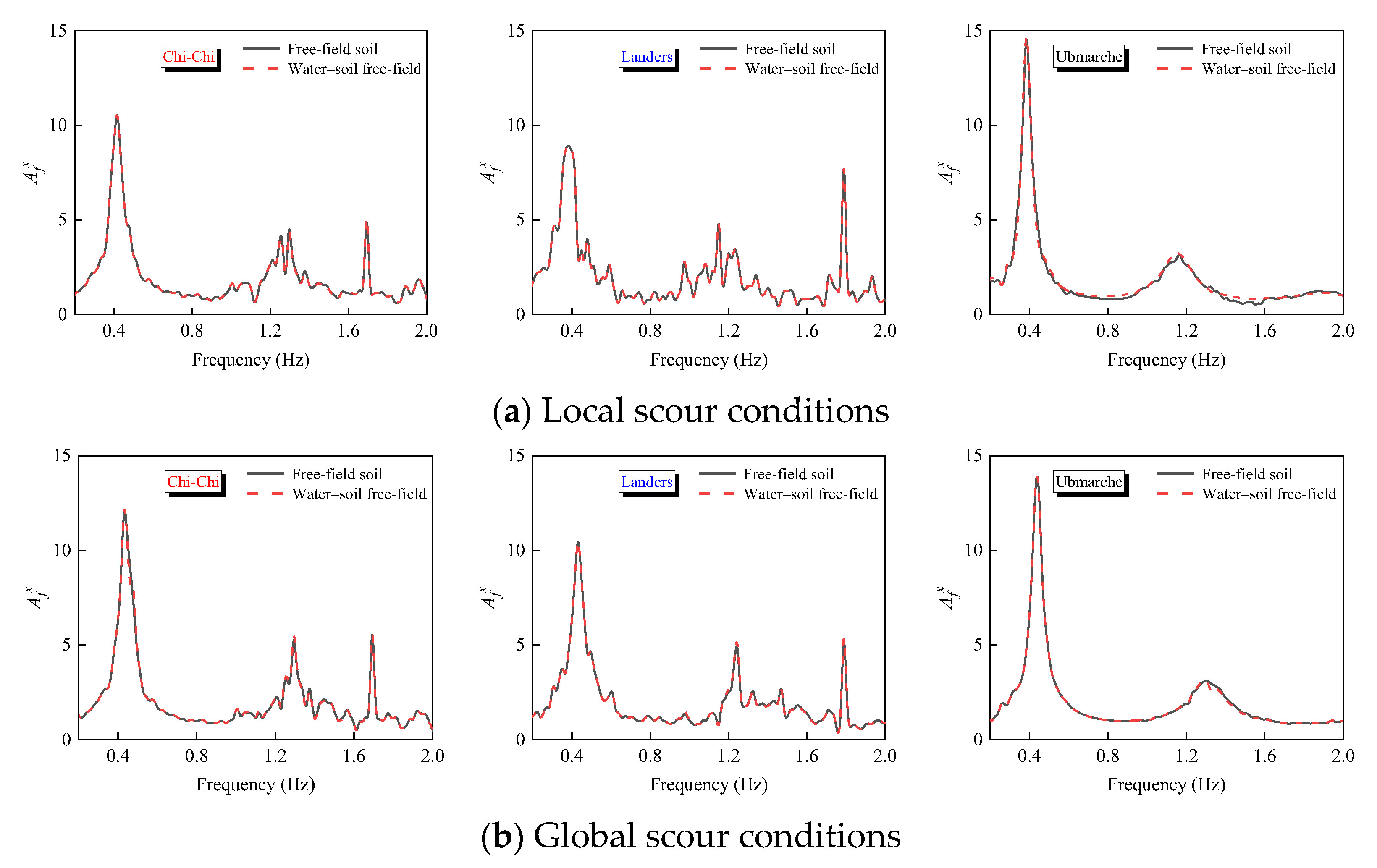
Figure 10. Mesh convergence analysis of the site response model.
Jmse 14 01068 g010
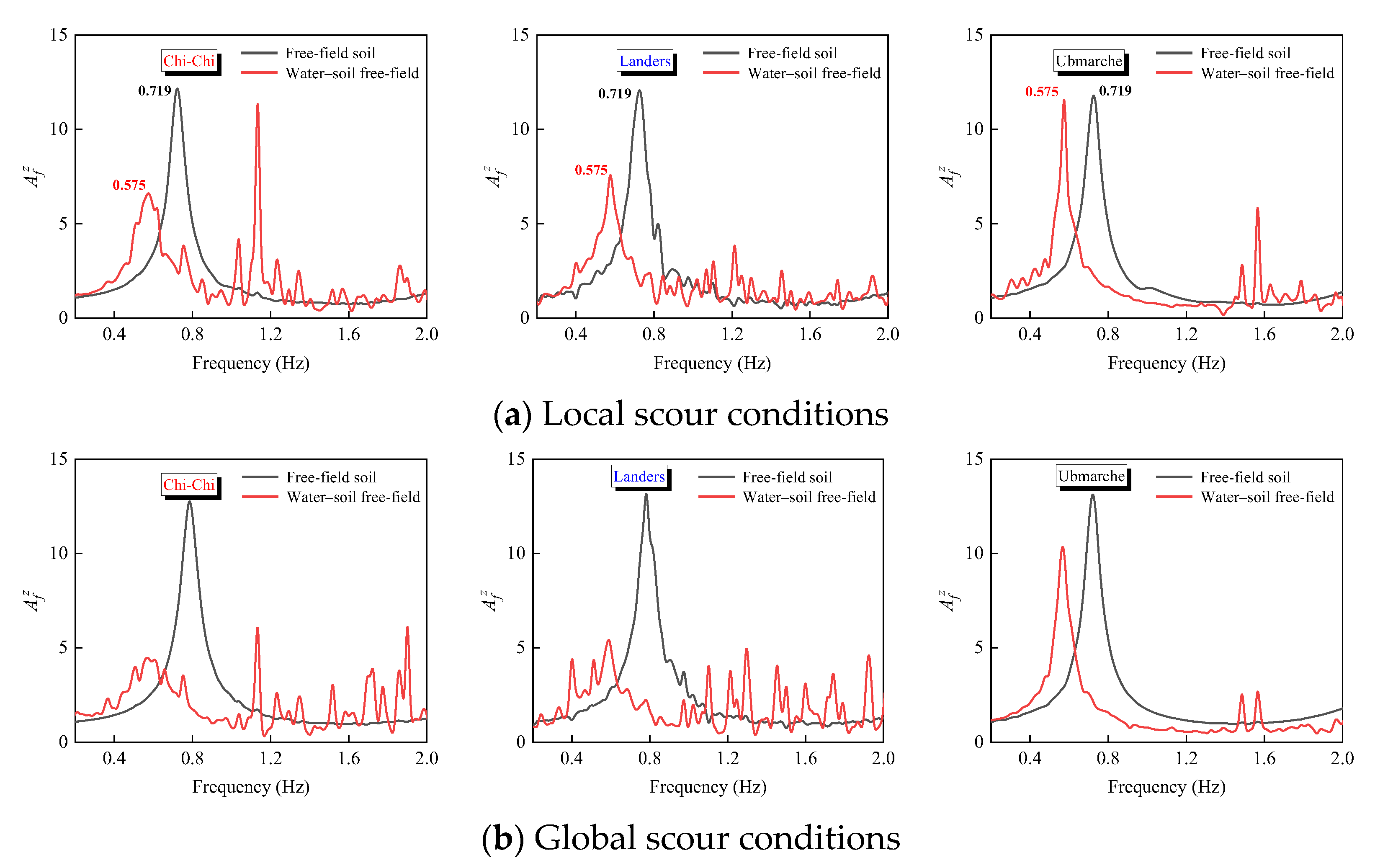
Figure 11. Schematic diagrams of the soil–structure interaction field and free-field soil model.
Jmse 14 01068 g011
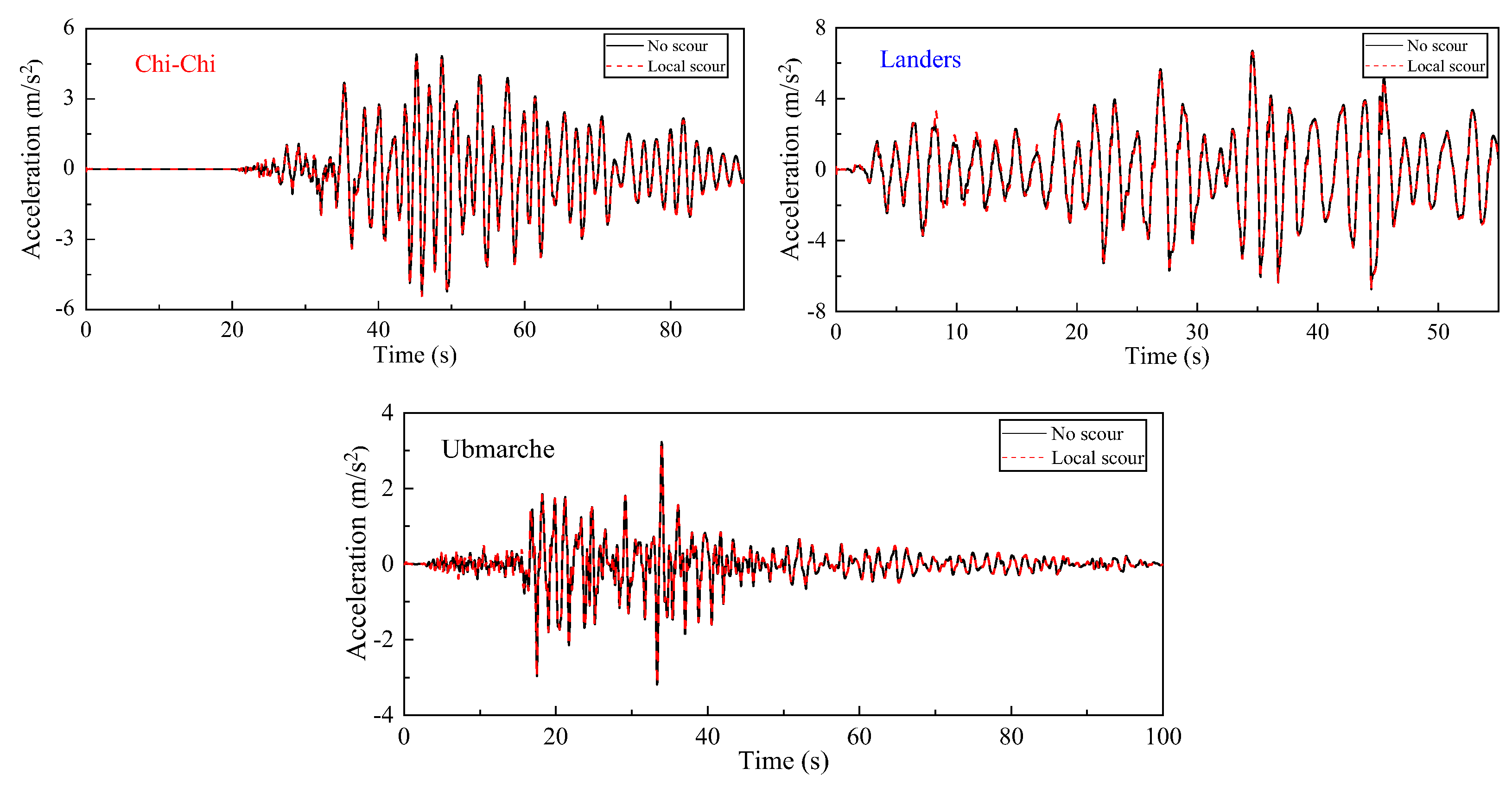
Figure 12. Comparison of numerical results of free-field soil and soil–structure interaction field.
Jmse 14 01068 g012
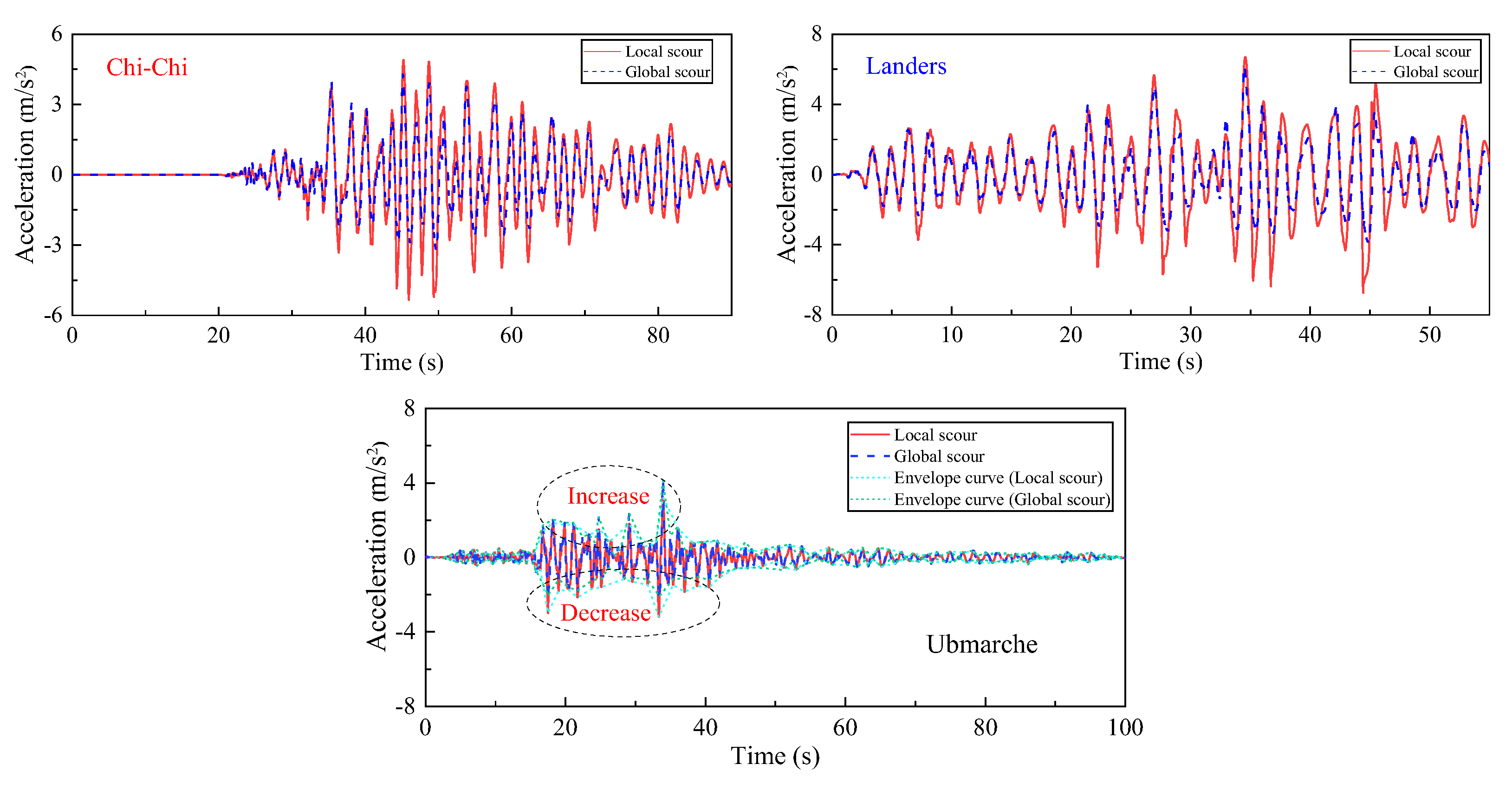
Figure 13. Comparison of numerical results of site response.
Jmse 14 01068 g013
Figure 14. Acceleration time history and Fourier spectrum of the selected seismic load.
Jmse 14 01068 g014
Figure 15. Variation of total hydrodynamic force with global scour depth.
Jmse 14 01068 g015
Figure 16. Comparison of hydrodynamic pressure on cylindrical structure surface under global scour and unscoured conditions.
Jmse 14 01068 g016
Figure 17. Variation of hydrodynamic force with scour slope angle: (a) time history curve; (b) amplitude difference compared with global scour.
Jmse 14 01068 g017
Figure 18. Peak hydrodynamic pressure distribution around the circumference of the structure with variation of scour slope angle at different water depths.
Jmse 14 01068 g018
Figure 19. Comparison of hydrodynamic pressure on the cylindrical structure surface under different scour slope angles and global scour conditions.
Jmse 14 01068 g019
Figure 20. Variation of hydrodynamic force with bottom scour width: (a) time history curve; (b) amplitude difference compared with global scour.
Jmse 14 01068 g020
Figure 21. Peak hydrodynamic pressure distribution around the circumference of the structure with variation of bottom scour width at different water depths.
Jmse 14 01068 g021
Figure 22. Comparison of hydrodynamic pressure on cylindrical structure surface under different bottom scour widths and global scour conditions.
Jmse 14 01068 g022
Figure 23. Variation of hydrodynamic force under combined bottom scour width and scour slope angle: (a) time history curve; (b) amplitude difference compared with global scour.
Jmse 14 01068 g023
Figure 24. Hydrodynamic pressure on cylindrical structure surface under combined variation of bottom scour width and scour slope angle.
Jmse 14 01068 g024aJmse 14 01068 g024b
Figure 25. Variation of added mass coefficient under scour conditions.
Jmse 14 01068 g025aJmse 14 01068 g025b
Figure 26. Horizontal acceleration time histories and acceleration response spectrum.
Jmse 14 01068 g026
Figure 27. Vertical acceleration time histories and acceleration response spectrum.
Jmse 14 01068 g027
Figure 28. Horizontal acceleration transfer function amplitude from bedrock to scoured surface under local scour conditions: (ac) scour slope angle; (df) bottom scour width.
Jmse 14 01068 g028
Figure 29. Horizontal acceleration transfer function amplitude from bedrock to scoured surface under different scour type: (ac) Sd = 0.5D; (df) Sd = 1D; (gi) Sd = 1.5D.
Jmse 14 01068 g029
Figure 30. Vertical acceleration transfer function amplitude from bedrock to scoured surface under local scour conditions: (ac) scour slope angle; (df) bottom scour width.
Jmse 14 01068 g030
Figure 31. Vertical acceleration transfer function amplitude from bedrock to scoured surface under different scour types: (ac) Sd = 0.5D; (df) Sd = 1D; (gi) Sd = 1.5D.
Jmse 14 01068 g031aJmse 14 01068 g031b
Figure 32. Horizontal acceleration transfer function amplitude from bedrock to scoured surface with water–soil interaction under scour conditions.
Jmse 14 01068 g032
Figure 33. Vertical acceleration transfer function amplitude from bedrock to scoured surface with water–soil interaction under scour conditions.
Jmse 14 01068 g033
Figure 34. Water–soil coupled vertical ground acceleration under local scour conditions.
Jmse 14 01068 g034
Figure 35. Water–soil coupled vertical ground acceleration under different scour types.
Jmse 14 01068 g035
Table 1. Default values for ϕ1 and ϕ2 [50].
ϕσkσwβγ
ϕ10.850.50.0750.5532
ϕ21.00.8560.08280.4403
Table 2. Parameters of soil and water.
PartParametersValue
SoilMass density2091.92 kg/m3
Effective density1091.92 kg/m3
Friction angle35°
Poisson’s ratio0.3
Young’s modulus35 MPa
Cohesion50 Pa
Absolute plastic strain0
WaterDensity1000 kg/m3
Volumetric modulus2.14 GPa
Table 3. Geometric parameters and material properties of monopile.
Geometric ParametersValue
Outer diameter6 m
Wall thickness0.06 m
Embedment depth35 m
Material properties
Young’s modulus206 GPa
Poisson’s ratio0.3
Table 4. Detailed information of selected seismic records in this study.
Record NameRsnVS 30 (m/s)YearStation NameMagnitudeRrup (km)
Chi-Chi1547270.321999Tcu 1237.6214.91
Landers883280.861992Northridge-176457.28172.32
Ubmarche4334298.731997Aquilpark Parcheggio5.782.61
Table 5. Natural frequency of seabed.
Natural Frequency of
Soil Only
1st Horizontal
(Hz)
2nd Horizontal
(Hz)
3rd Horizontal
(Hz)
1st Vertical
(Hz)
Pre-scour0.3120.7621.0350.631
Local scour (Sd = 1.5D)0.3130.7611.0320.633
Global scour (Sd = 1.5D)0.3660.8151.10.711
Natural frequency of coupled water–soil
Pre-scour0.3070.7491.050.503
Local scour (Sd = 1.5D)0.3070.7491.0470.502
Global scour (Sd = 1.5D)0.3560.7771.0740.51
Disclaimer/Publisher’s Note: The statements, opinions and data contained in all publications are solely those of the individual author(s) and contributor(s) and not of MDPI and/or the editor(s). MDPI and/or the editor(s) disclaim responsibility for any injury to people or property resulting from any ideas, methods, instructions or products referred to in the content.