Abstract
Efficient modeling of acoustic scattering from water-filled thin shells remains challenging due to prohibitive computational costs of rigorous methods and oversimplifications in ray-based approximations. This paper develops an iterative physical acoustics (IPA) method, presenting simple and explicit formulations for scattering by penetrable objects immersed in fluids. The method combines Kirchhoff integral frameworks with thin-plate effective boundary conditions, discretizes mid-surfaces into triangular facets, and iteratively converges pressure fields to characterize the mechanisms of multiple reflections and transmissions. Validated against analytical solutions, numerical simulations, and scaled experiments, IPA provides comprehensive field predictions encompassing internal cavity fields, external near-fields, and far-field scattering patterns within a unified framework. It achieves significant computational efficiency gains while maintaining engineering practicality, successfully reproducing distant-range highlights from these mechanisms in time-domain spectra. Limitations are observed at low frequencies and high-curvature regions where elastic-wave effects become significant. The IPA framework enables engineering-efficient scattering analysis for complex thin-shell structures.
1. Introduction
Active acoustic detection is crucial for identifying underwater vehicles, whereby precise modeling of their acoustic scattering characteristics is essential to advancing existing target detection and classification algorithms [1]. Underwater vehicles incorporate diverse structural configurations, encompassing both water-filled structures (e.g., sails and ballast tanks) and pressure-resistant compartments (e.g., equipment bays and crew modules). In high-frequency acoustic analysis of pressure-resistant structures, boundary surfaces are typically treated as wave-impenetrable interfaces through the implementation of hard, soft, or impedance boundary conditions [2]. However, the impenetrable boundary fails to capture the coupled fluid–structure interactions for water-filled thin shells, where acoustic waves not only penetrate the elastic shell but also propagate through the internal fluid, inducing elastic-wave excitation [3]. The multiple reflections and transmissions within water-filled shells generate discriminative acoustic scattering features [4], thereby establishing a physical basis for developing feature-driven classification algorithms in underwater target recognition. Therefore, there exists a need to develop computationally efficient methods for characterizing acoustic scattering from water-filled thin shells in order to forego exhaustive experiments and time-consuming simulations.
Many approaches are proposed in the literature to address acoustic scattering problems involving fluid-filled thin shells, and they can be classified into rigorous analytic, exact numerical, and approximate methods. The computation of the interaction between acoustic waves and an elastic shell requires solving a boundary value problem that includes a scalar Helmholtz equation for the acoustic pressure in the fluid medium and a vector Navier equation for the three-dimensional displacements in the elastic medium, which are coupled through boundary conditions at the fluid–elastic interface. The equations can be solved by separation of variables, which can be available to obtain rigorous solutions for scattered fields of simple-shape targets, such as elastic spherical shells [5,6], cylindrical shells [7], and so on. These solutions for canonical shapes, despite their limited practicality, establish critical foundations for computational validation or mechanism analysis in acoustic scattering. The governing equations in the elastic medium can be formulated either in differential form, which is typically approximated using the Finite Element Method (FEM) [8], or in integral form, which is approximated using the Boundary Element Method (BEM) [9]. The coupling of the interior problem for the elastic shell with the exterior problem in the fluid leads to the development of hybrid numerical approaches, specifically the FEM/BEM [10,11]. Although they can provide numerically exact results, their computational efficiency significantly diminishes at higher frequencies due to increasing computation time and storage demands.
To improve computational efficiency in modeling acoustic scattering from elastic shell structures, it is beneficial to replace direct numerical simulations of elastoacoustic interactions with simplified theoretical approaches based on specific assumptions. The main assumptions are: (1) the thickness of the shell is much smaller than the linear size of the structure, and (2) the thickness is much smaller than the acoustic wavelength in the fluid. Under these conditions, it is logical to apply established theories for elastic plates and shells [12] as a practical framework. A shell can be approximated by introducing effective boundary conditions, effectively reducing the problem from a vector-based formulation to a simpler scalar framework. In the simplest case, this condition can express Newton’s second law, and the shell can be considered purely inertial [13,14]. Further, to account for the complex nature of the interaction of acoustic waves with elastic thin shells, some kind of effective boundary conditions are derived in the form of surface differential equations [15]. In the end, the problem is reduced to a system of hypersingular integral equations, and then solved by the BEM. However, in the middle and higher frequency range, the computing resources for larger thin shell structures are usually not available in practice.
For modeling mid-to-high frequency acoustic scattering from underwater complex shell structures, approximate methodologies such as ray-based approaches and physical acoustics (PA)-based methods are helpful alternatives to full-wave numerical simulations. The ray synthesis [16,17] decomposes the scattering phenomenon into geometric and elastic-wave components, which are subsequently synthesized via coherent superposition. While offering a clear physical interpretation of wave interaction mechanisms, its application remains limited to simple geometries due to challenges in calculating elastic scattering from complex shell structures [18]. The geometric ray acoustics [19], applied in practical engineering analyses of complex shell structures, enables rapid identification of echo highlights through superposition of specular reflection components. However, it fails to account for the contributions of non-specular and elastic scattering. PA-based methods are applicable for analyzing both impenetrable boundaries [20,21] and penetrable interfaces [22,23,24] in acoustic wave propagation. A recent approach integrates geometric ray theory with physical acoustics to predict the target strength (TS) of water-filled thin-shell structures [25]. By incorporating PA, this hybrid approach accounts for non-specular geometric echoes, which are essential for characterizing complex scattering mechanisms. However, the approach limits its analysis to the first-order reflection and transmission, neglecting higher-order reflections and transmissions, which dominate in penetrable shells.
This study aims to develop a simple, computationally efficient, and physically intuitive approximate model for analyzing the acoustic scattering characteristics of arbitrarily shaped water-filled thin shells immersed in a medium. Building upon well-established theories of elastic thin plates [26], this work extends the original iterative physical acoustics (IPA) method [27,28] to the case of penetrable thin-shell structures. The proposed method relies on two fundamental assumptions: (i) the thin-shell hypothesis, which ensures inertial dominance over elastic effects across a broad frequency range [14], and (ii) the Kirchhoff approximation, which governs reflection/transmission behavior via localized plane-wave principles [29]. The method determines the complex reflection/transmission coefficients at the incident surface using local effective boundary conditions, initializes surface pressure distributions via scalar formalism, and iteratively refines these fields to convergence. This iterative procedure inherently captures the interplay of frequency-dependent multiple reflections and transmissions through the structure. Leveraging a prior discretization framework [27,28,30], an extended IPA-based facet scattering formulation for thin shells can be derived, balancing computational efficiency with physical fidelity to capture multiple reflections and transmissions.
The remainder of this work is organized as follows. Section 2 briefly introduces the Helmholtz integral equation, Kirchhoff approximation for reflection and transmission, and their implementation in modeling acoustic scattering from thin-shell structures. Then, the discretization scheme and numerical implementation of the thin-shell integral formulation are presented. Numerical validation and simulations are described using representative cases. In Section 3, the proposed method is applied to model the acoustic multiple reflection and transmission from a scaled sail of Benchmark Target Strength Simulations (BeTSSi IIB) [31], and an acoustic scattering experiment on the scaled sail is conducted and analyzed. Finally, Section 4 presents the concluding remarks.
2. Methodology
2.1. Thin-Shell Integral Formulation
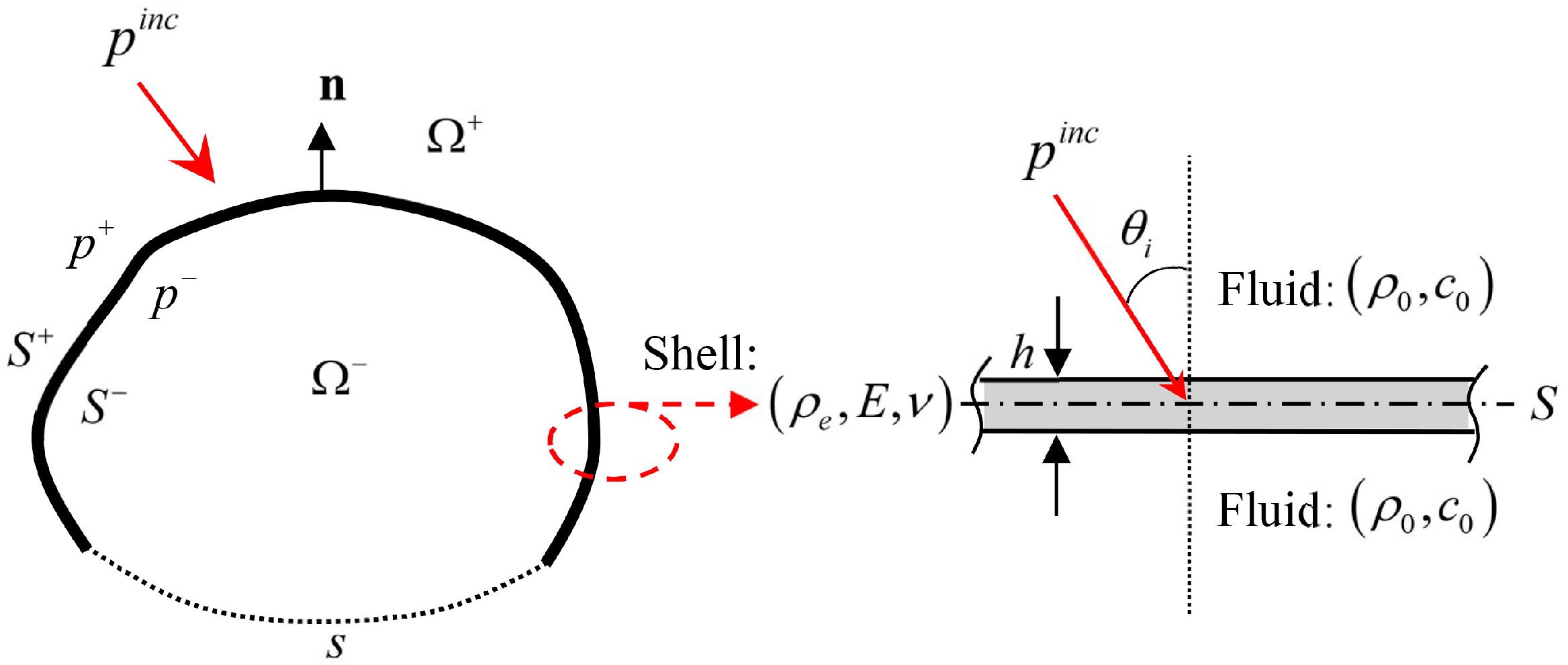
Consider a thin shell submerged in an infinite acoustic medium with a speed of sound and mean density , as shown in Figure 1. The shell is made of an elastic material characterized by a mass density , Young’s modulus , and Poisson’s ratio , and has a thickness . The neutral surface of the thin shell is denoted by , and an imaginary surface is constructed to divide the acoustic domain. The shell divides two subdomains, denoted by the exterior subdomain , bounded by the outer boundary , and the interior subdomain , bounded by the inner boundary . is the normal vector pointing in the direction of . The shell is exposed to an incident wave pressure in a scattering problem. The surface pressure on the is denoted by , and that on the is denoted by . By applying the Helmholtz integral equation to each subdomain, the thin-shell integral equation [32] can be derived and expressed in the following form
where and are the distinct position vectors of arbitrary points on ; is the scattered pressure at an arbitrary spatial coordinate outside ; is the free-field Green’s function, and is the medium wavenumber.
Figure 1.
Schematic of acoustic scattering problem for a thin shell immersed in an infinite fluid domain. A sound wave is incident at an incident angle .
Equation (1) itself is not sufficient for solving the problem ascribed to the additional unknown functions in Equation (2). One more equation is then required to supplement Equation (1) for the solution. The normal derivative of Equation (1) can be written as
The iterative solutions of Equations (1) and (3) can be represented in the form
Thus, in the th approximation, the surface pressure and its normal derivative are generated by the incident wave, surface pressure, and its normal derivative originating as a result of the th iteration.
Denoting the plane-wave reflection and transmission coefficients as and , the initial surface acoustic field () and its normal derivative on the reflection surface are given in the single scattering Kirchhoff approximation as [33]
and the initial surface acoustic field () and its normal derivative on the transmission surface can be expressed as [23]
The relationship
motivates us to rewrite Equations (4)–(7) through the application of the Kirchhoff approximation at each iteration as
Substituting Equations (12)–(15) into Equation (2) yields
where denotes the number of iterations. The convergence of Equation (16) can be effectively monitored using a suitable global parameter given by
From Equations (12)–(16), the scattered pressure field is fundamentally governed by the interfacial discontinuities in both surface pressure and its normal gradient across the shell boundary. These governing physical quantities, in turn, are determined by the inherent properties of the shell. Assuming that the Helmholtz numbers and ( being the characteristic size of the scattering object), the quantities and can be derived by the approximate theory of vibration of an infinite elastic thin plate as [26]
where and are the mechanical impedance of a thin plate and the acoustic impedance of fluid, respectively, as
where and , and is the incidence angle. Substitution of Equation (18) into Equations (12)–(16) yields a simplified formulation as
As the plate thickness approaches the thin-plate limit, the integral component of the single-layer potential asymptotically diminishes. For the rigid target scattering, i.e., and , Equations (20) and (21) reduces to
The integral formulation for the scattered pressure field generated by a thin shell structure at arbitrary spatial coordinates, which accounts for multiple reflected and transmitted wave components, is established in Equations (20) and (21). The expression specifically characterizing the multiply reflected waves of a rigid target, as derived in Equations (22) and (23), has been validated in previous studies [27,28].
2.2. Discretization and Numerical Implementation
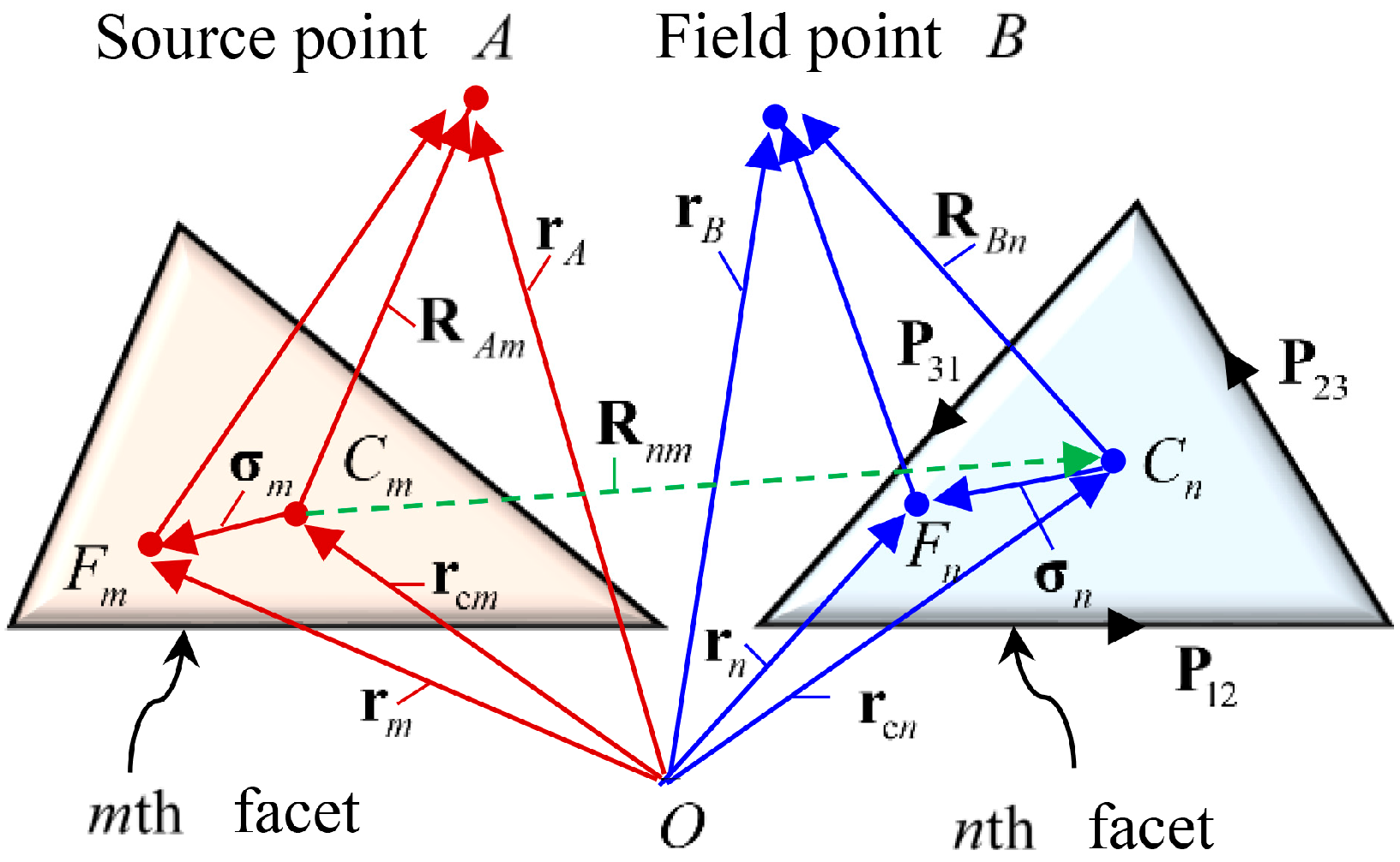
A numerical solution of Equations (20) and (21) can be achieved by discretizing the thin-shell neutral surface S into triangular facets. The scattered pressure of the thin shell at the field point can be approximated as the coherent superposition of orders of reflected and transmitted fields generated by facets. Figure 2 is a sketch of two facets and of the problem. The notation used is as follows:
Figure 2.
Definition of vectors used for general facets m and n.
(1) is the source position vector from an origin point to a source point , is the field position vector from to the field point ;
(2) is the position vector from to an arbitrary point on the th facet’s surface , is the position vector from to a centroid on , and ;
(3) , , and ; , , and ;
(4) is an outward unit normal to at the point ;
(5) Note that the subscript “” can substitute for “” to denote the above definitions regarding the th facet. Also, , , and .
Under the discrete framework, Equations (20) and (21) can be recast in a facet-based representation as follows:
with
where is the th order of jump of surface pressure at the point on , and is the th order of jump of surface pressure at the point on , respectively; is the incident field visibility function and represents the deterministic quantities that the centroid at is visible to the source at ; is the mutual visibility function and represents the quantities that one centroid at is visible to another centroid at ; and are surface integral kernels in terms of the th and th facets, respectively, which can be evaluated using Gordon’s integral algorithm [34]. These auxiliary functions are as follows:
Further details regarding the derivation of Equations (24)–(27) are available in Refs. [27,28], which provide a comprehensive treatment of the discretization methodology and numerical implementation of Equations (22) and (23).
2.3. Numerical Validation
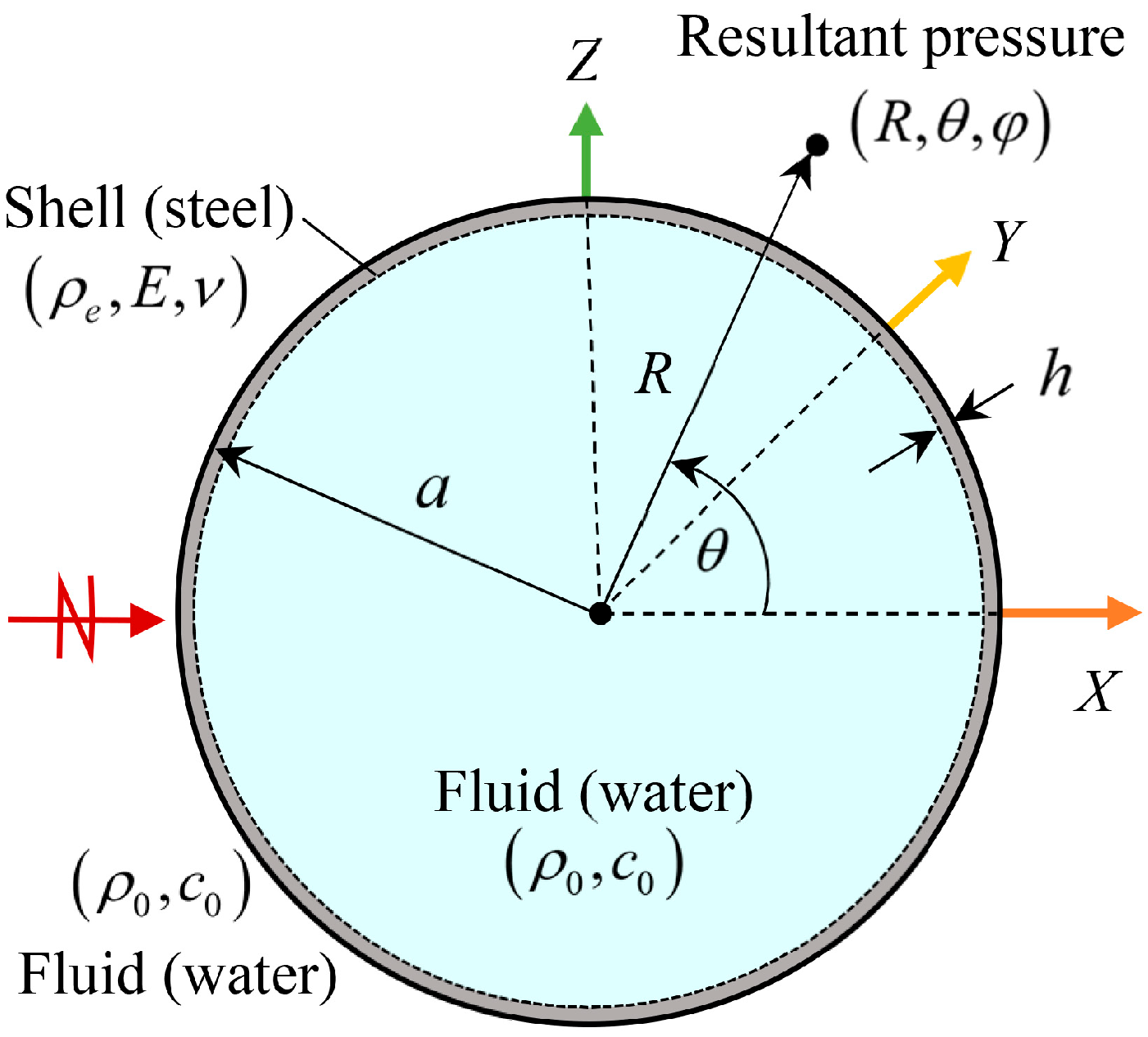
This section focuses on the canonical problem of acoustic scattering from a water-filled spherical shell immersed in an infinite fluid domain. The shell is composed of stainless steel, with all geometric and material parameters provided in Table 1. Figure 3 illustrates a harmonic acoustic plane wave of angular frequency incident onto the spherical shell along the positive -direction. The resultant pressure in the external fluid domain, denoted as , is expressed as the superposition of the incident pressure, labeled as , and the scattered pressure, referred to as , represented through a series of normal modes [5,6].
Table 1.
Geometric and material parameters adopted for the spherical shell problem.
Figure 3.
Scattering problem of a water-filled spherical shell immersed in an infinite fluid domain under plane wave incidence along the positive direction.
The incident and scattered pressures are formulated as
where denotes the order in the subscript and superscript, is the Legendre polynomial, and are the regular and outgoing spherical Hankel functions, and is the unknown coefficient characterizes (see Appendix A). This well-established benchmark case, for which exact analytical solutions are available [5,6], provides rigorous validation of the IPA and its numerical implementation. Unless otherwise stated, a triangular mesh size of and a convergence threshold of are set for the IPA simulations in this work. All simulations are performed on a personal computer with the Intel Xeon Pentium 8375C CPU with 3.5 GHz and 1.0 TB RAM.
Urick provides a comprehensive review of target strength (TS) definitions [2], characterizing it as a measure of a target’s echo-returning capability, with TS defined as
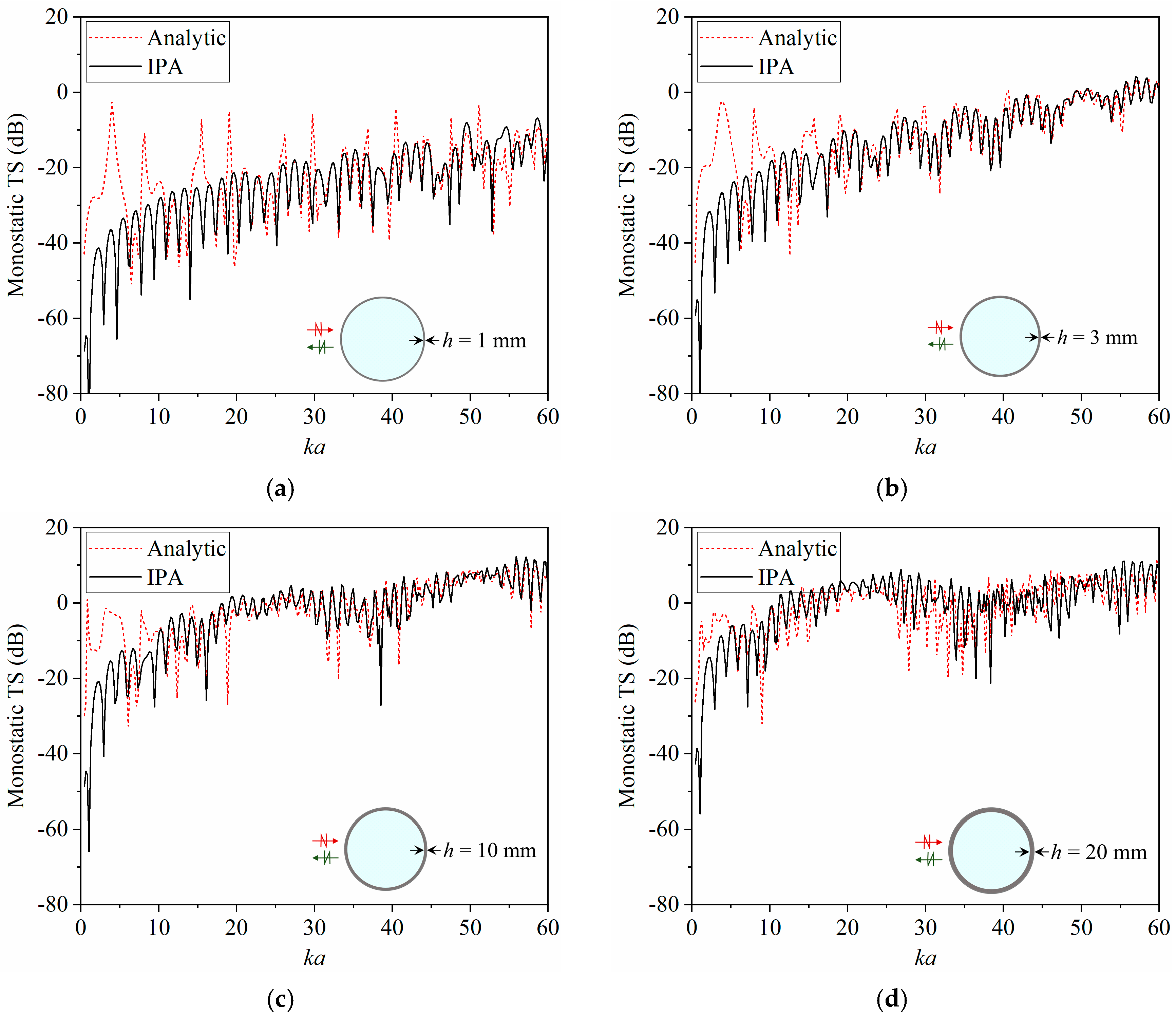
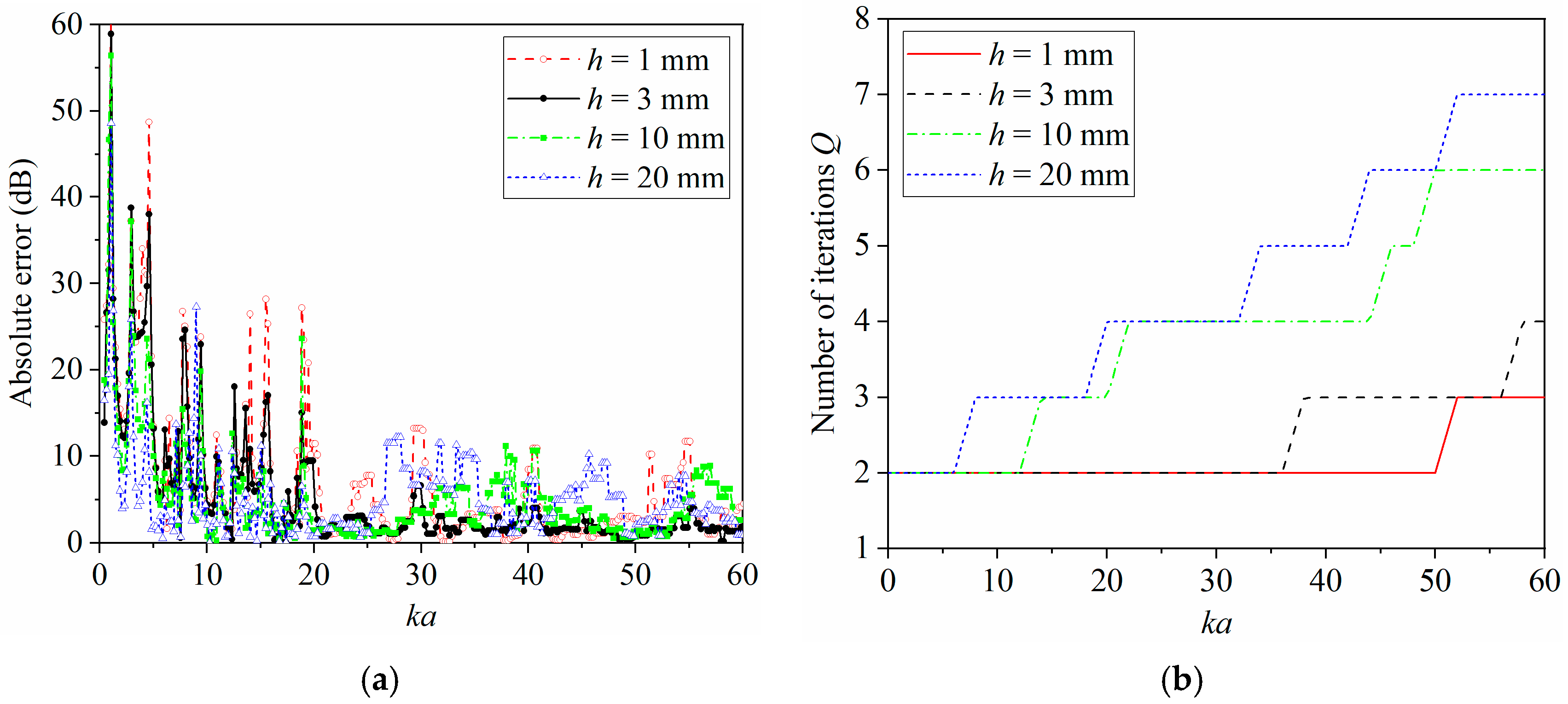
where denotes the monostatic TS configuration. The IPA-based TS is computed via Equations (24)–(27) and (35), while the analytical TS is obtained through the normal mode expansion in Equations (33) and (34) combined with Equation (35). A comparison of monostatic TS between IPA results and analytical solutions is conducted across varying Helmholtz numbers and shell thicknesses . Results for , 3, 10 and 20 mm are, respectively, presented in Figure 4a–d. As theoretically anticipated, the prediction accuracy of TS increases with . At elevated regimes, the predicted TS closely matches analytical solutions, while in the low- domain, accuracy progressively decreases. Crucially, reduced thickness-to-radius ratio () excites higher-density elastic resonance spectra, yet the characteristic interference patterns remain accurately predicted. Maximum discrepancies emerge in the low-, low- regime, attributable to unmodeled elastic-wave coupling mechanisms. The IPA solutions reproduce the general behavior of the analytical solutions, including the interference of multiple reflected and transmitted wave components, phenomena notably absent in both rigid and pressure-release boundary approximations. This discrepancy becomes particularly evident when examining the absolute error between analytical and IPA-based TS for varying and , as shown in Figure 5a. Since IPA neglects elastic-wave contributions, absolute errors exceeding 20 dB occur at low- resonance peaks. At high , rapid interference oscillations combine with minor miscalculations in acoustic wave phase accumulation through the shell, generating substantial absolute errors (>8 dB) at interference extrema positions. The number of iterations required for IPA convergence for varying for , 3, 10, and 20 mm, as shown in Figure 5b. The corresponds to the order of physical interaction, which depends on target geometry complexity and increases with both and . For complex geometries, a priori determination of is challenging; however, results demonstrate that remains bounded, reaching a maximum of 7 iterations at convergence threshold and . This rapid convergence validates the IPA method’s efficiency, attributable to the initial Kirchhoff approximation closely approximating the final solution.
Figure 4.
Comparison of monostatic TS derived from IPA concerning analytical solution for a water-filled spherical shell scattering with (a) mm, (b) 3 mm, (c) 10 mm, and (d) 20 mm.
Figure 5.
(a) Absolute error in dB between analytical and IPA-based TS for varying for , 3, 10, and 20 mm. The absolute error is computed as the value of . (b) The number of iterations required for IPA convergence for varying for , 3, 10, and 20 mm.
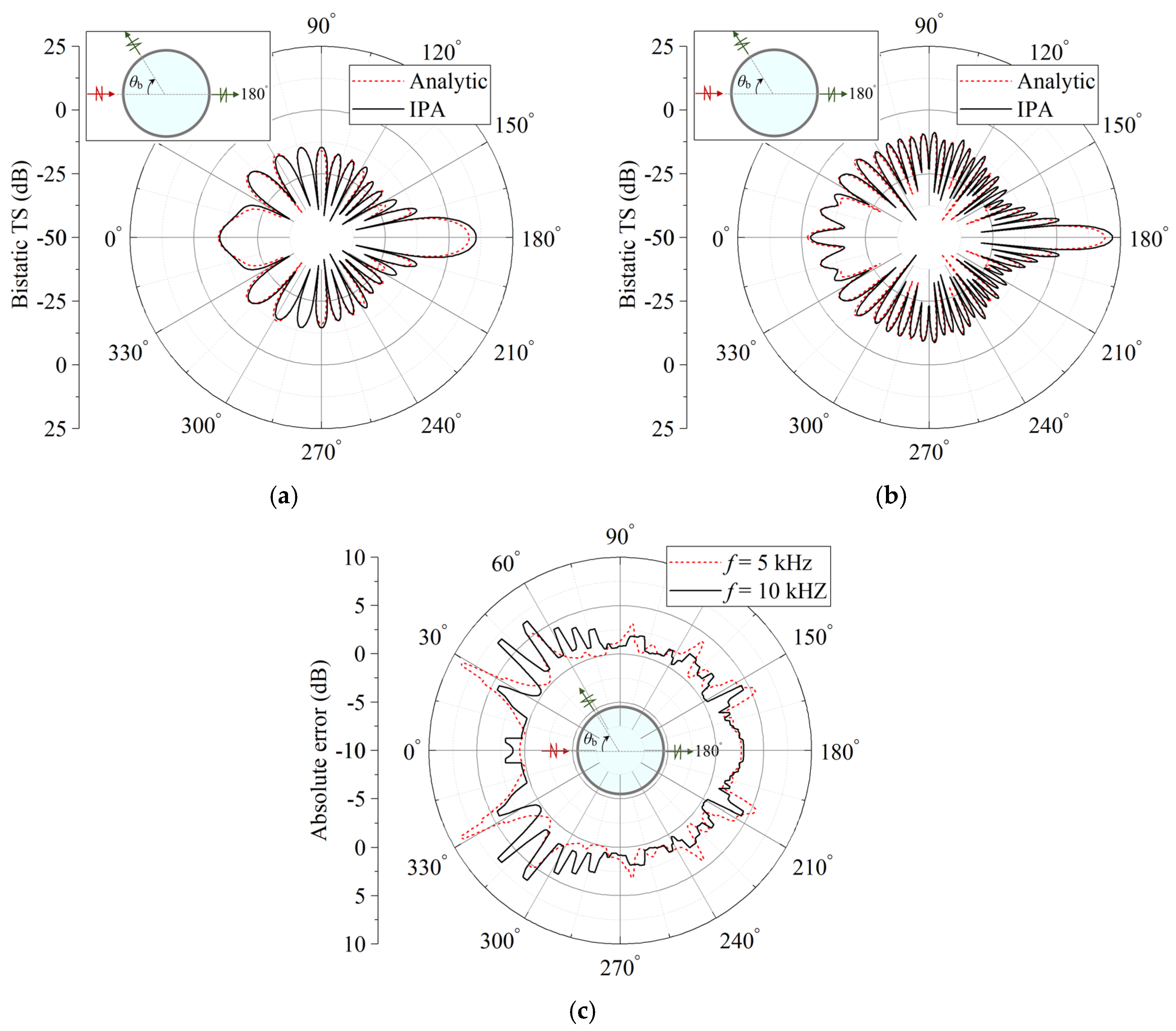
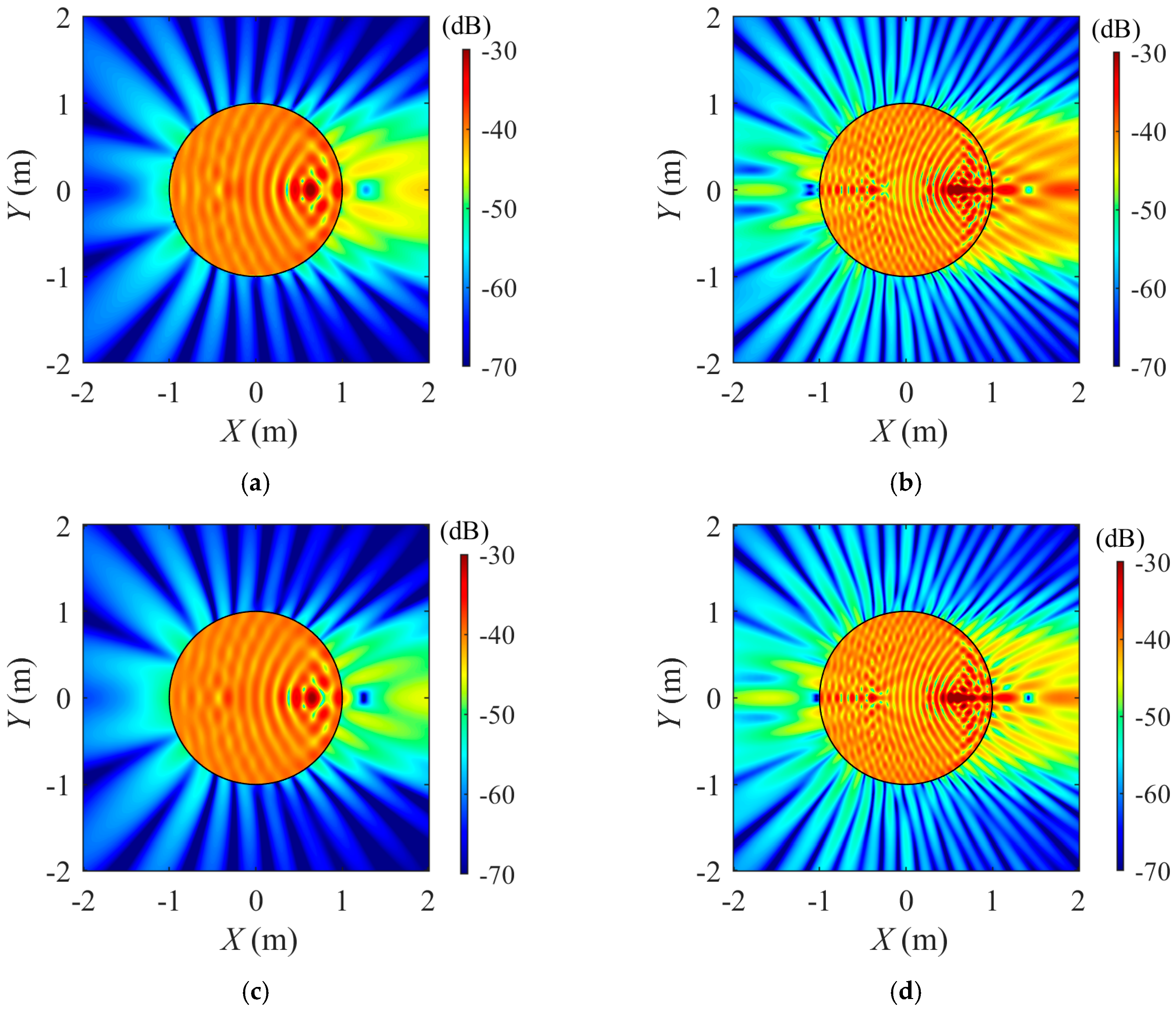
For a water-filled spherical shell with thickness mm, Figure 6a–d presents near-field scattered pressure level distributions at 5 kHz () and 10 kHz (), with the upper panels displaying the IPA results and the bottom panels showing the analytical solutions. The computational domain comprises 160,801 field points distributed across a 4.0 m × 4.0 m square region. Figure 7a,b compares the far-field angular distributions of bistatic TS between IPA and analytical solutions at identical frequencies, with the bistatic angle () sampled at 0.5° resolution. Overall, both methods exhibit strong agreement in resolving interference structures and pressure field extrema localization at high values. The angular density of interference fringes scales with excitation frequency. Significantly, the proposed methodology provides comprehensive acoustic field prediction capabilities, encompassing internal cavity fields, external near-fields, and far-field scattering patterns within a unified computational framework. Localized discrepancies stem from IPA’s inability to model shear wave propagation in the elastic solid. Figure 7c quantifies the absolute error between analytical and IPA-derived TS across bistatic angles at 5 kHz and 10 kHz. This discrepancy is particularly pronounced at interference extrema positions. While IPA neglects elastic-wave contributions, rapid high-frequency interference oscillations combine with minor phase accumulation errors during shell transmission, yet maintain absolute errors within 8 dB across all regimes. Crucially, the 5 kHz case exhibits fewer error maxima than 10 kHz due to its lower interference fringe density.
Figure 6.
Comparison of scattered sound pressure level distributions for a water-filled spherical shell with mm: IPA results at (a) 5 kHz and (b) 15 kHz versus analytical solutions at (c) 5 kHz and (d) 10 kHz.
Figure 7.
Comparison of bistatic TS of a water-filled spherical shell with mm between IPA results and analytical solutions at (a) 5 kHz and (b) 10 kHz. (c) Absolute error in dB computed as the value of over bistatic angles.
3. Sail-Scattering Modeling and Experimental Validation
3.1. IPA-Based Sail-Scattering Modeling
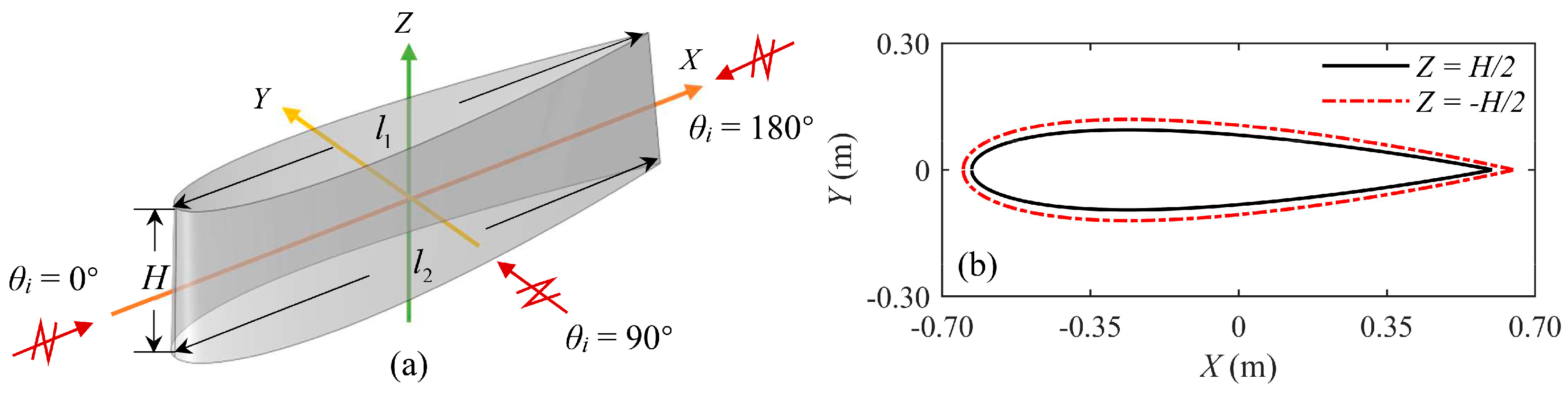
The BeTSSi IIB model has emerged as a widely utilized benchmark in submarine acoustics research, distinguished by its characteristic thin-shell sail structure that significantly contributes to its scattering signature analysis. Accordingly, a 1:10 geometric scale model of the sail was developed to facilitate comprehensive modeling and experimental validation. As shown in Figure 8, the model incorporates symmetrical airfoil profiles on both its upper and lower boundaries, mathematically defined by the following equation
where at the upper boundary and at the lower boundary, respectively. The principal geometric parameters are summarized in Table 2. The model consists of a water-filled stainless steel shell, with the material parameters as specified in Table 1.
Figure 8.
(a) Scattering by a scaled sail model under plane wave incidence at azimuth angle in the plane, (b) featuring symmetrical airfoil profiles on both upper and lower boundaries defined by Equation (19).
Table 2.
Geometric parameters for the scaled sail-scattering problem.
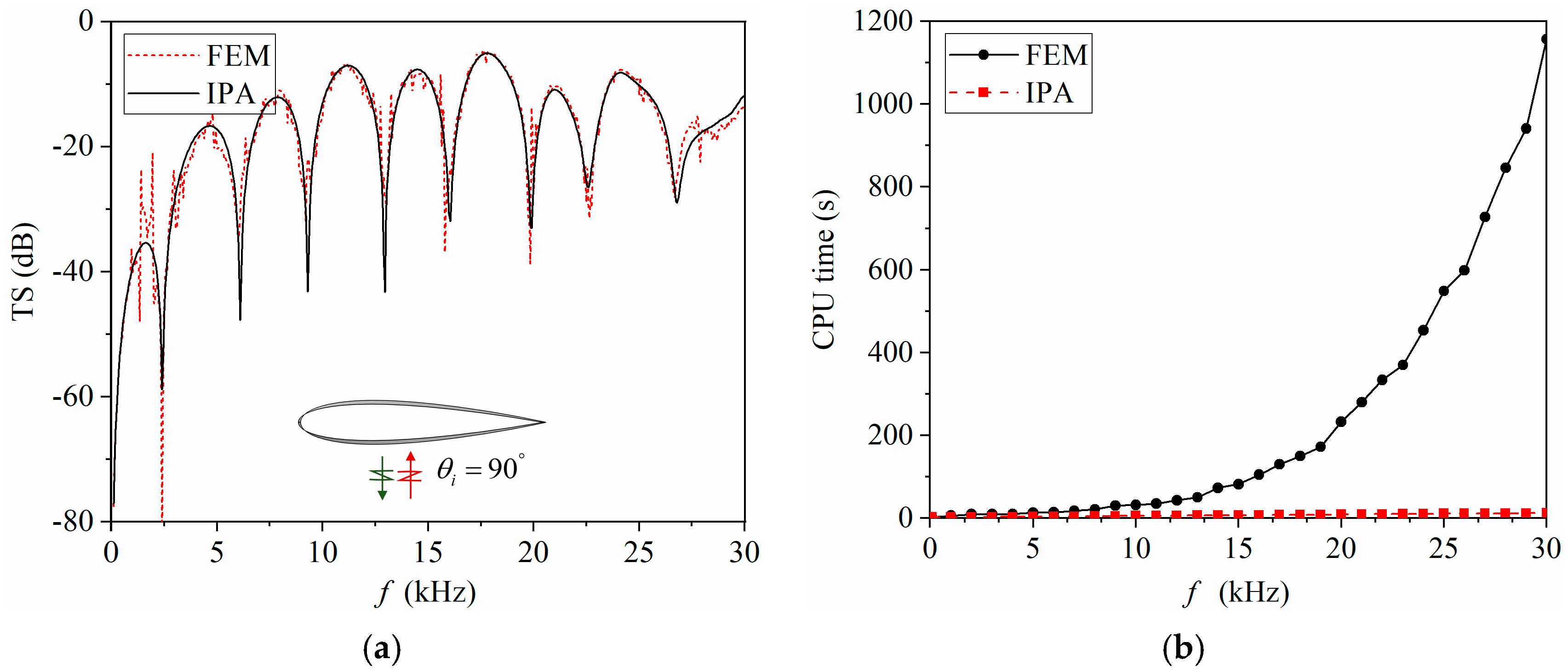
To compare the accuracy and computational efficiency between the FEM and IPA for general thin-shell structures, the sail model in Figure 8 is analyzed. The FEM simulation is implemented using the Acoustic–Solid Interaction, Frequency-Domain multiphysics module within COMSOL Multiphysics 6.2 commercial software [35]. Variations in the monostatic TS against frequency at the incident azimuth angle of are illustrated in Figure 9a. The error between the IPA result and the FEM result decreases with increasing frequency. The resonance peaks existing on the FEM curves do not change the overall tendency of the variation. At high frequencies, the TS predicted by the IPA is very close to the FEM. At lower frequencies, the accuracy decreases but the trend remains physically consistent. The corresponding CPU time used for computing TS in the FEM and IPA is given in Figure 9b. It is clear from the plot that the IPA can greatly shorten the computation time compared with the time spent by FEM, with particularly substantial efficiency gains observed at higher frequencies. One should be noted that the FEM exhibits substantial memory requirements, with the computational capacity being constrained for solving higher-frequency problems.
Figure 9.
Comparison of (a) monostatic TS of the sail model as evaluated by FEM and IPA at , and (b) the corresponding computational time for both methods.
3.2. Sail-Scattering Experiment and Validation
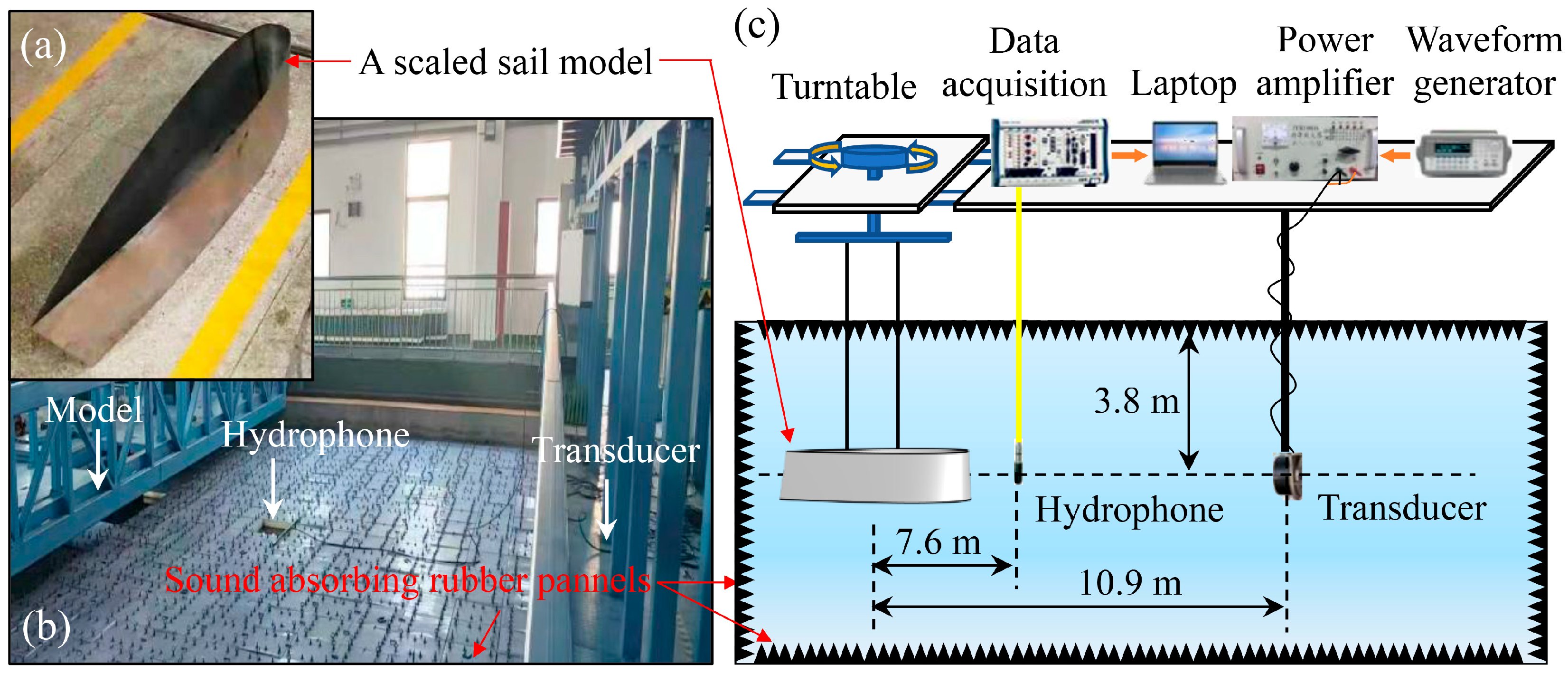
To verify the effectiveness of the proposed IPA method and demonstrate scattering characteristics of a thin-shell target, we perform an acoustic scattering experiment on the scaled sail model immersed in an anechoic tank of 30 m 15 m 10 m. To simulate an approximate free-field environment within the tank while ensuring noise isolation, the interiors are lined with sound-absorbing rubber panels designed for optimal sound absorption. As shown in Figure 10a, the experimental stainless-steel model is constructed with the same geometric dimensions and acoustic parameters as those used in the numerical simulation. Figure 10b,c shows the experimental setup. The experimental model spins around its axis at in sequence and is controlled by a mechanical turntable, whereas the transducer and receiver are fixed. The transducer has a frequency range of 60–120 kHz with an average transmitting voltage response of 146 dB re re 1 m. The receiver is a piezoelectric hydrophone (Type 8103, Brüel & Kjaer, Nairom, Denmark) operating over a frequency range of 0.1 Hz–180 kHz with a receiving sensitivity of −211 dB re . An uninterrupted power supply powers the entire measurement system to remove AC interference.
Figure 10.
Pictures of (a) experimental model and (b) experimental setup used for acoustic scattering test in an anechoic water tank. (c) Schematic illustration of the used experimental setup.
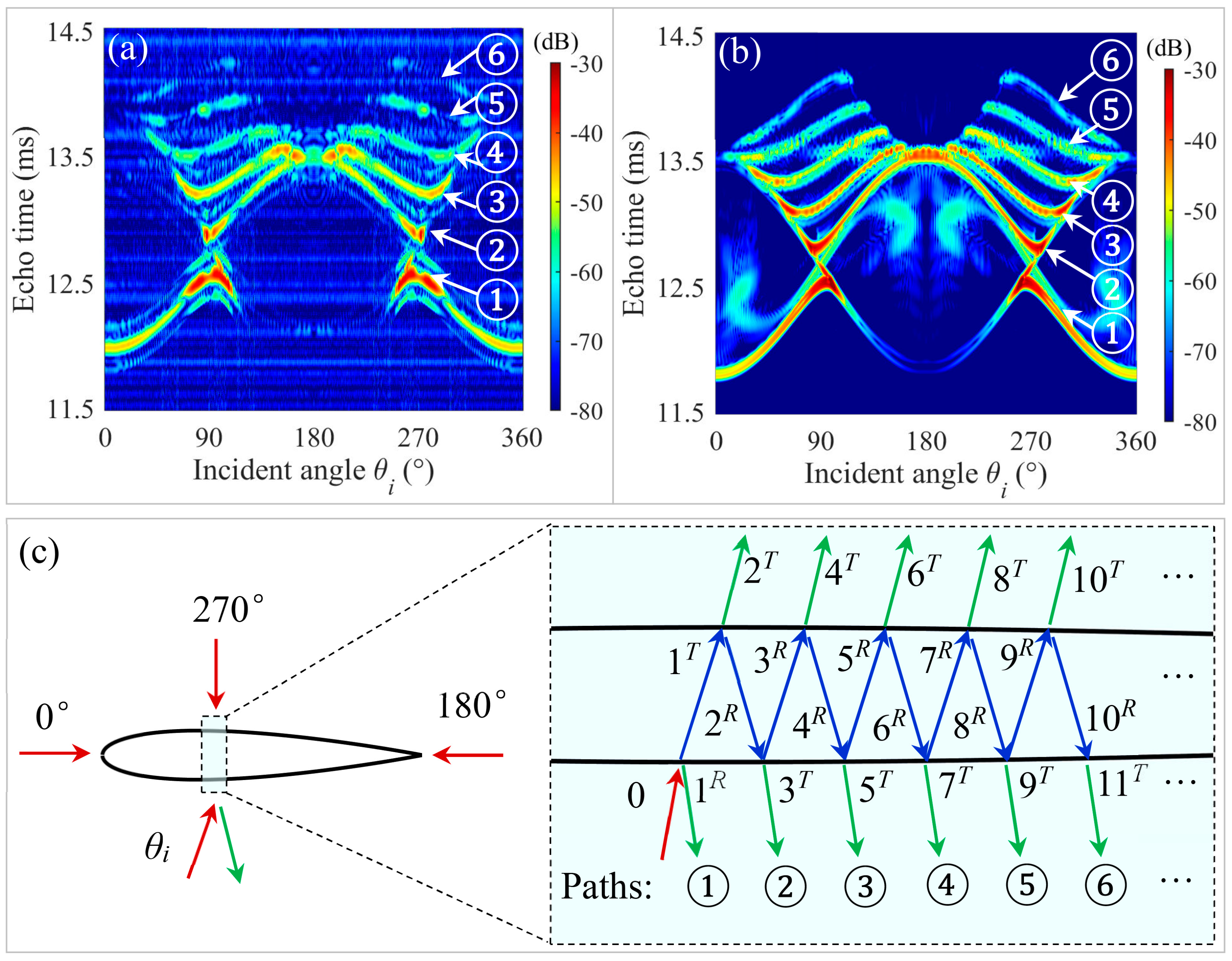
The transmitted signal is a linear frequency-modulated chirp spanning from 60 kHz to 80 kHz, with a pulse width of 0.2 ms and a burst interval of 500 ms to ensure steady-state measurement conditions. A matched filter is implemented to enhance signal-to-noise ratio and time-delay resolution. Figure 11a,b compares the time-angle spectra of matched filtered echoes obtained from the scanned measurement and IPA simulation, showing close agreement. The results in these figures are derived through mirror symmetry of the data based on the geometric symmetry of the sail model, and subsequent analyses focus exclusively on the domain. Both clearly exhibit primary reflections centered at 12.6 ms (outer surface signature) and higher-order reflections and transmissions beyond 12.8 ms across incidences, though experimental features were less distinct due to noise. Minor inconsistencies in echo envelope morphology suggest possible misalignment between the transducer, receiver, and model centroid. As depicted in Figure 11c, the incident wave illuminates the thin shell structure, generating reflected (superscript ) and transmitted (superscript ) wave components. The primary reflected wave () propagates away from the lower surface, while the field transmitted into the interior fluid along the upward propagation direction () is reflected onto the upper surface along the downward propagation direction (), and then reflected onto the lower surface and so on. This process continues with successive reflections and transmissions at both upper and lower surfaces. The fundamental propagation paths ① to ⑥ in Figure 11c correspond directly to the temporal features highlighted in Figure 10a,b. The high-order highlights associated with longer paths move toward the farther range than the primary reflections. At paths longer than ⑥, the echo signal is too weak to be shown.
Figure 11.
Comparison of time-angle spectra of monostatic echoes of a scaled sail model between (a) experimental measurement and (b) IPA simulation. (c) Schematic of multiple reflection and transmission pathways in the sail model under plane wave illumination at the incidence angle . Red arrows denote incident acoustic waves, green arrows represent external reflection and transmission waves, and blue arrows indicate internal reflection and transmission waves.
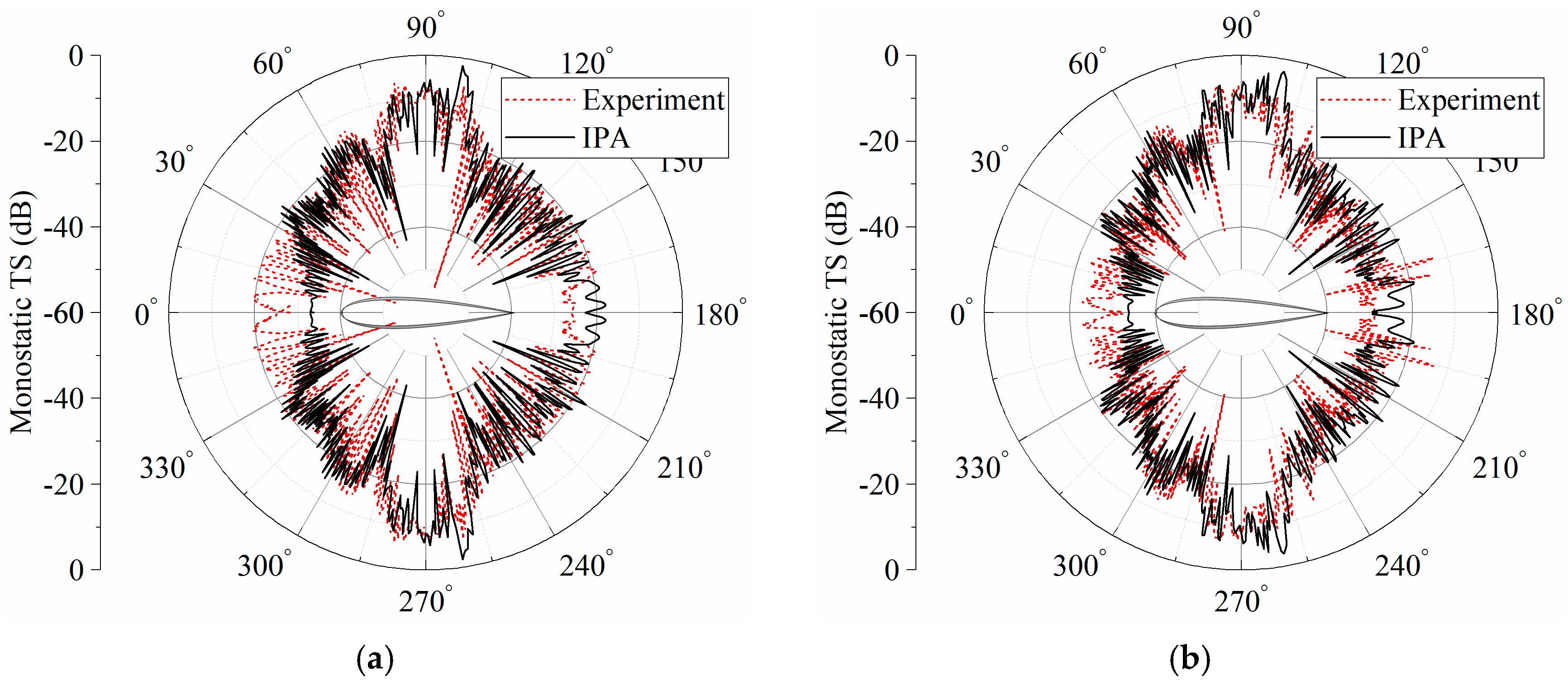
Figure 12 compares the monostatic TS of the sail model obtained using the IPA and experimental measurements at 70 kHz and 80 kHz. The angular data in this figure are generated through mirror symmetry transformation of the results, leveraging the sail’s geometric symmetry. Experimental and simulated results exhibit great agreement around the main lobes of scattering patterns, demonstrating that the IPA method effectively captures dominant scattering mechanisms and reliably predicts high-frequency scattering fields of penetrable thin shells. However, discrepancies between simulated and experimental TS are evident in the bow and stern angular regions, where simulations underestimate measured values. This deviation primarily arises from two unmodeled physical mechanisms: (i) The increased curvature of the bow shell triggers the excitation of multimodal surface elastic waves—particularly Franz waves—while enhancing radiative efficiency of Rayleigh and Stoneley waves [36], collectively amplifying scattered energy in experimental measurements; with a secondary contribution from (ii) edge diffraction echoes induced by the sharp trailing-edge discontinuity at the stern [37].
Figure 12.
Comparison of monostatic TS between IPA and experimental measurements for a sail model at (a) 70 kHz and (b) 80 kHz. Inset: a sail model.
4. Conclusions
This study proposes an IPA method for efficient modeling of acoustic scattering from thin shells immersed in fluids. The method integrates Kirchhoff integral formulations with thin-plate effective boundary conditions, discretizes mid-surfaces into triangular facets, and characterizes multiple reflection and transmission mechanisms through iterative pressure-field convergence. Validation against analytical solutions for a water-filled spherical shell, along with FEM simulations and experiments for a scaled BeTSSi IIB sail model, demonstrates three key outcomes:
(1) The IPA accurately reproduces interference patterns of reflected and transmitted waves, overcoming limitations of rigid and pressure-release approximations. It provides a unified framework predicting comprehensive acoustic fields, including internal cavity fields, external near-fields, and far-field scattering patterns.
(2) The IPA achieves significant computational acceleration over FEM, particularly at higher frequencies where FEM becomes prohibitively time-intensive, enabling efficient analysis of complex structures.
(3) The IPA demonstrates excellent agreement with experimental time-angle spectra, clearly resolving the primary reflection (12.6 ms) and higher-order reflection/transmission paths (>12.8 ms) in the sail model. This validates IPA’s capability to characterize multiple reflection-transmission features relevant to underwater vehicle acoustics.
While the IPA framework intentionally simplifies complex elastic-wave interactions and diffraction effects to maintain computational practicality for engineering design, these unmodeled phenomena contribute to localized discrepancies, particularly at low frequencies and in high-curvature regions. Future work will extend the IPA framework to elastic-dominant regimes and complex active sonar scenarios, with parallel development for viscoelastic dispersive media such as engine oils. These systems introduce fundamental complexities including waveform distortion from frequency-dependent phase velocity, resonance modulation through medium-structure coupling, and attenuation-frequency relationships altering energy distribution. Methodological extensions will involve reformulated propagation operators with causal dispersion kernels, advanced signal processing for dispersion-decoupled feature extraction, and specialized experimental protocols for viscoelastic media. Such extensions establish valuable pathways for industrial monitoring and biomedical applications beyond the aquatic scope of this study.
Author Contributions
Conceptualization, W.W., B.W. and J.F.; Methodology, W.W., Y.X. and B.W.; Validation, W.W.; Formal analysis, Y.X.; Investigation, Y.X.; Resources, B.W. and J.F.; Data curation, Y.X.; Writing—original draft, W.W. and Y.X.; Writing—review and editing, W.W.; Project administration, B.W. and J.F.; Funding acquisition, B.W. and J.F. All authors have read and agreed to the published version of the manuscript.
Funding
This research was supported by the National Natural Science Foundation of China Grant No. 12374423 and the National Natural Science Foundation of China Grant No. U2241277.
Institutional Review Board Statement
Not applicable.
Informed Consent Statement
Not applicable.
Data Availability Statement
No new data were created or analyzed in this study. Data sharing is not applicable to this article.
Acknowledgments
The author would like to thank the reviewers for their comments on improving the quality of this paper.
Conflicts of Interest
The authors declare no conflicts of interest.
Appendix A
The coefficient in Equation (20) characterizes the acoustic scattering by the water-filled spherical shell. It is computed from stress and displacement continuity conditions at the fluid-shell interface as [5,6]
where and are determinants of two 6 × 6 matrices obtained from the boundary conditions as
where , , , , , , and .
References
- Aslam, M.A.; Zhang, L.; Liu, X.; Irfan, M.; Xu, Y.; Li, N.; Zhang, P.; Jiangbin, Z.; Yaan, L. Underwater sound classification using learning based methods: A review. Expert Syst. Appl. 2024, 255, 124498. [Google Scholar] [CrossRef]
- Urick, R.J. Principles of Underwater Sound, 2nd ed.; McGraw-Hill: New York, NY, USA, 1975. [Google Scholar]
- Werby, M.F.; Überall, H. A systematic study of water-filled submerged elastic spherical shells and the resolution of elastic- and water-included resonances. J. Acoust. Soc. Am. 2002, 112, 896–905. [Google Scholar] [CrossRef]
- España, A.L.; Williams, K.L.; Plotnick, D.S.; Marston, P.L. Acoustic scattering from a water-filled cylindrical shell: Measurements, modeling, and interpretation. J. Acoust. Soc. Am. 2014, 136, 109–121. [Google Scholar] [CrossRef] [PubMed]
- Gaunaurd, G.C.; Werby, M.F. Lamb and creeping waves around submerged spherical shells resonantly excited by sound scattering. J. Acoust. Soc. Am. 1987, 82, 2021–2033. [Google Scholar] [CrossRef]
- Gaunaurd, G.C.; Werby, M.F. Sound scattering by resonantly excited, fluid-loaded, elastic spherical shells. J. Acoust. Soc. Am. 1991, 90, 2536–2550. [Google Scholar] [CrossRef]
- Brill, D.; Gaunaurd, G.C. Acoustic resonance scattering by a penetrable cylinder. J. Acoust. Soc. Am. 1983, 73, 1448–1455. [Google Scholar] [CrossRef]
- Everstine, G.C. Finite element formulatons of structural acoustics problems. Comput. Struct. 1997, 65, 307–321. [Google Scholar] [CrossRef]
- Kirkup, S. The Boundary Element Method in Acoustics: A Survey. Appl. Sci. 2019, 9, 1642. [Google Scholar] [CrossRef]
- Everstine, G.C.; Henderson, F.M. Coupled finite element/boundary element approach for fluid–structure interaction. J. Acoust. Soc. Am. 1990, 87, 1938–1947. [Google Scholar] [CrossRef]
- Wu, H.; Yu, L.; Jiang, W. A coupling FEM/BEM method with linear continuous elements for acoustic-structural interaction problems. Appl. Acoust. 2019, 150, 44–54. [Google Scholar] [CrossRef]
- Timoshenko, S.P.; Woinowsky-Krieger, S. Theory of Plates and Shells; McGraw-Hill Companies: New York, NY, USA, 1959. [Google Scholar]
- Burgschweiger, R.; Ochmann, M.; Schäfer, I. Implementation and results of a mass inertia coupling as an extension of the BEM for thin shells. In Proceedings of the 22nd International Congress on Sound and Vibration (ICSV), Florence, Italy, 12–16 July 2015. [Google Scholar]
- Chernokozhin, E.; Tsinovoy, A.; Boag, A. Scattering by thin shells in fluids: Fast solver and experimental validation. JASA Express Lett. 2021, 1, 016002. [Google Scholar] [CrossRef] [PubMed]
- Chernokozhin, E.; Boag, A. Numerical Modeling of Acoustic Scattering by Thin Elastic Shells Immersed in Fluids. TechRxiv 2024. [Google Scholar]
- Williams, K.L.; Marston, P.L. Backscattering from an elastic sphere: Sommerfeld–Watson transformation and experimental confirmation. J. Acoust. Soc. Am. 1985, 78, 1093–1102. [Google Scholar] [CrossRef]
- Yang, Y.; Norris, A.N.; Couchman, L.S. Ray tracing over smooth elastic shells of arbitrary shape. J. Acoust. Soc. Am. 1996, 99, 55–64. [Google Scholar] [CrossRef]
- Fawcett, J.A. Computing the Scattering from Slightly Deformed Spherical Shells—A Ray-Based Approach. IEEE J. Ocean. Eng. 2018, 43, 1161–1170. [Google Scholar] [CrossRef]
- Fan, J.; Liu, T.; Tang, W. The structure of highlight echoes due to specular reflection from shells of immerged target. Tech. Acoust. 2002, 21, 153–157. [Google Scholar]
- Liszka, E.G.; McCoy, J.J. Scattering at a rough boundary—Extensions of the Kirchhoff approximation. J. Acoust. Soc. Am. 1982, 71, 1093–1100. [Google Scholar] [CrossRef]
- McCammon, D.F.; McDaniel, S.T. Surface velocity, shadowing, multiple scattering, and curvature on a sinusoid. J. Acoust. Soc. Am. 1986, 79, 1778–1785. [Google Scholar] [CrossRef]
- Dacol, D.K. The Kirchhoff approximation for acoustic scattering from a rough fluid–elastic solid interface. J. Acoust. Soc. Am. 1990, 88, 978–983. [Google Scholar] [CrossRef]
- Lieuwen, T. Explicit results for wave scattering and transmission through a rough fluid–fluid interface. Appl. Acoust. 2002, 63, 1031–1050. [Google Scholar] [CrossRef]
- Ganesh, M.; Hawkins, S.C. A fast algorithm for the two-dimensional Helmholtz transmission problem with large multiple scattering configurationsa). J. Acoust. Soc. Am. 2024, 156, 752–762. [Google Scholar] [CrossRef] [PubMed]
- Tang, Y.; Wang, B.; Fan, J. Study on target strength prediction method of water-filled acoustic transparent structure. Tech. Acoust. 2021, 40, 316–323. [Google Scholar] [CrossRef]
- Junger, M.C.; Feit, D.; Greenspon, J.E. Sound, Structures, and Their Interaction; MIT Press: Cambridge, MA, USA, 1972. [Google Scholar]
- Wang, W.; Wang, B.; Fan, J. Time-domain Kirchhoff approximation extensions modeling of acoustic camera imagery with multiple scattering. Appl. Acoust. 2023, 211, 109465. [Google Scholar] [CrossRef]
- Wang, W.; Wang, B.; Fan, J.; Zhou, F.; Zhao, K.; Jiang, Z. A simulation method on target strength and circular SAS imaging of X-rudder UUV including multiple acoustic scattering. Def. Technol. 2023, 23, 214–228. [Google Scholar] [CrossRef]
- Pierce, A.D.; Beyer, R.T. Acoustics: An Introduction to Its Physical Principles and Applications; Acoustical Society of America: New York, NY, USA, 1991. [Google Scholar]
- Wang, B.; Wang, W.-h.; Fan, J.; Zhao, K.-q.; Zhou, F.-l.; Tan, L.-w. Modeling of bistatic scattering from an underwater non-penetrable target using a Kirchhoff approximation method. Def. Technol. 2022, 18, 1097–1106. [Google Scholar] [CrossRef]
- Nijhofa, M.; Fillingera, L.; Gilroyb, L.; Ehrlichc, J.; Schäferc, I. BeTSSi IIb: Submarine target strength modeling workshop. In Proceedings of the UACE2017—4th Underwater Acoustics Conference and Exhibition, Skiathos, Greece, 3–8 September 2017; pp. 377–384. [Google Scholar]
- Wu, T.W.; Wan, G.C. Numerical modeling of acoustic radiation and scattering from thin bodies using a Cauchy principal integral equation. J. Acoust. Soc. Am. 1992, 92, 2900–2906. [Google Scholar] [CrossRef]
- Lee, K.; Seong, W. Time-domain Kirchhoff model for acoustic scattering from an impedance polygon facet. J. Acoust. Soc. Am. 2009, 126, EL14–EL21. [Google Scholar] [CrossRef] [PubMed]
- Gordon, W. Far-field approximations to the Kirchoff-Helmholtz representations of scattered fields. IEEE Trans. Antennas Propag. 1975, 23, 590–592. [Google Scholar] [CrossRef]
- Multiphysics, C. COMSOL. Available online: http://cn.comsol.com (accessed on 1 August 2025).
- Frisk, G.V.; Dickey, J.W.; Überall, H. Surface wave modes on elastic cylinders. J. Acoust. Soc. Am. 1975, 58, 996–1008. [Google Scholar] [CrossRef]
- Ufimtsev; Yakovlevich, P. Fundamentals of the Physical Theory of Diffraction; Wiley: New York, NY, USA, 2007. [Google Scholar]
Disclaimer/Publisher’s Note: The statements, opinions and data contained in all publications are solely those of the individual author(s) and contributor(s) and not of MDPI and/or the editor(s). MDPI and/or the editor(s) disclaim responsibility for any injury to people or property resulting from any ideas, methods, instructions or products referred to in the content. |
© 2025 by the authors. Licensee MDPI, Basel, Switzerland. This article is an open access article distributed under the terms and conditions of the Creative Commons Attribution (CC BY) license (https://creativecommons.org/licenses/by/4.0/).