Numerical Investigation of Marine Dual-Fuel Engine Operating with High Shares of Premixed Hydrogen Fuel Using LES




Abstract
1. Introduction
2. Materials and Methods
- A homogeneous air–hydrogen mixture is considered;
- Diesel fuel is directly injected into the cylinder following a trapezoidal injection pulse;
- The working medium is assumed to behave as an ideal gas, which adequately represents its thermodynamic behavior;
- All nine cylinders are assumed to exhibit identical performance to the simulated one;
- The simulation entails the closed cycle of the engine.
2.1. Experimental Validation
2.2. Grid Sensitivity
3. Results
4. Discussion
5. Conclusions
- ▪
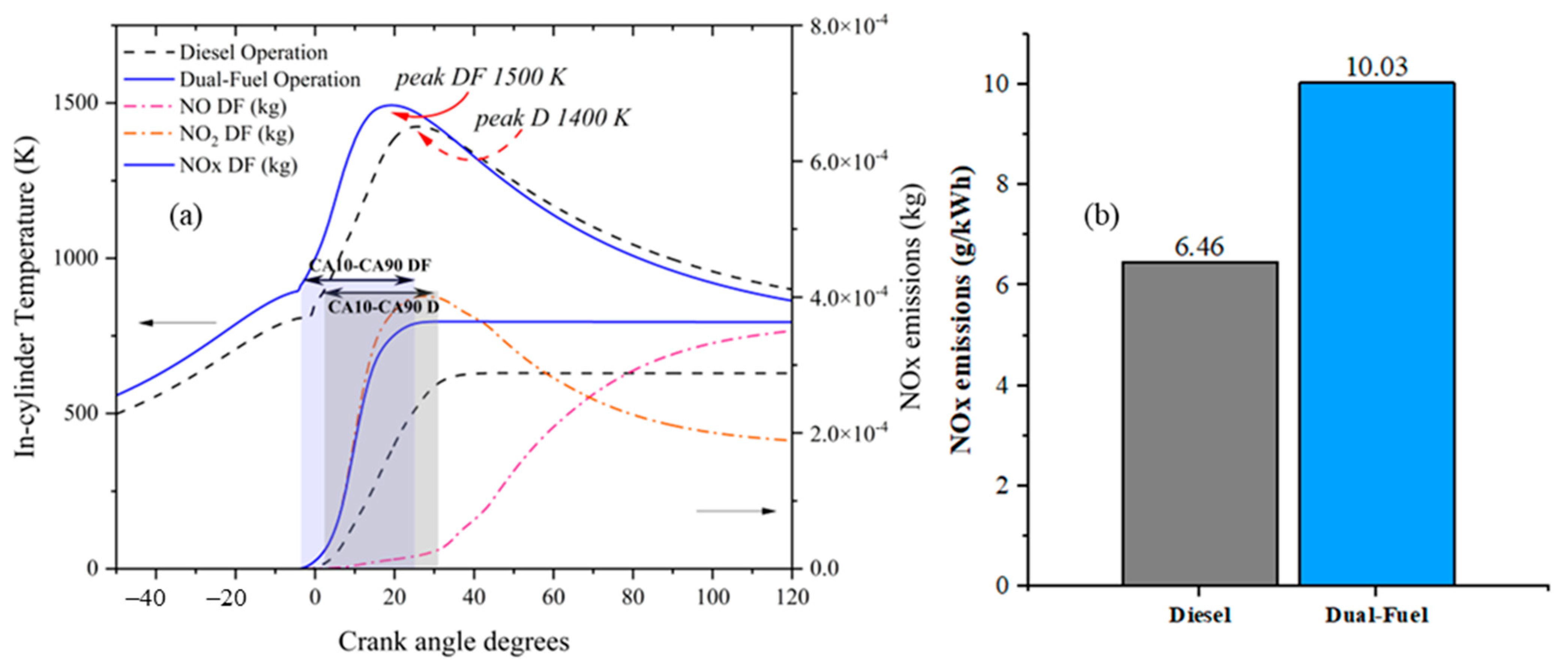
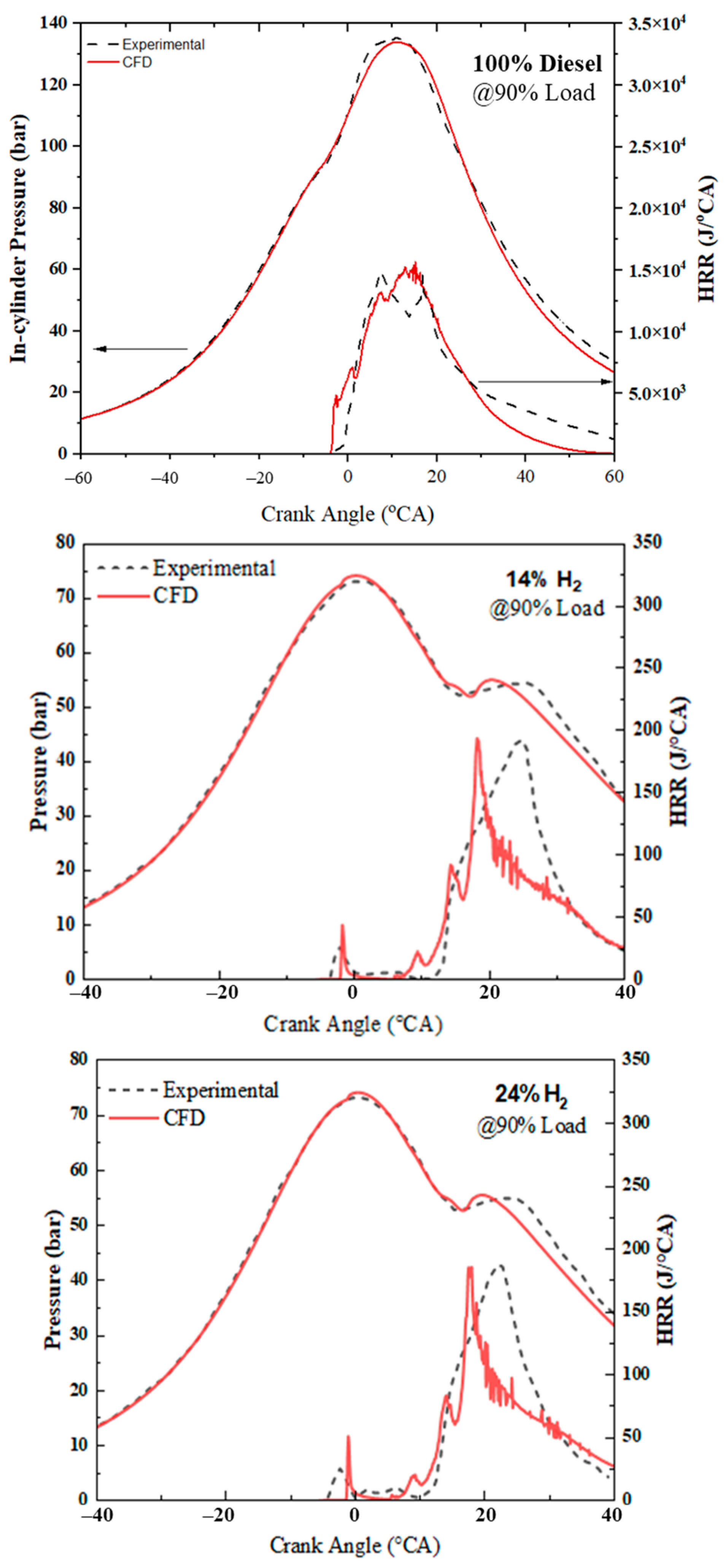
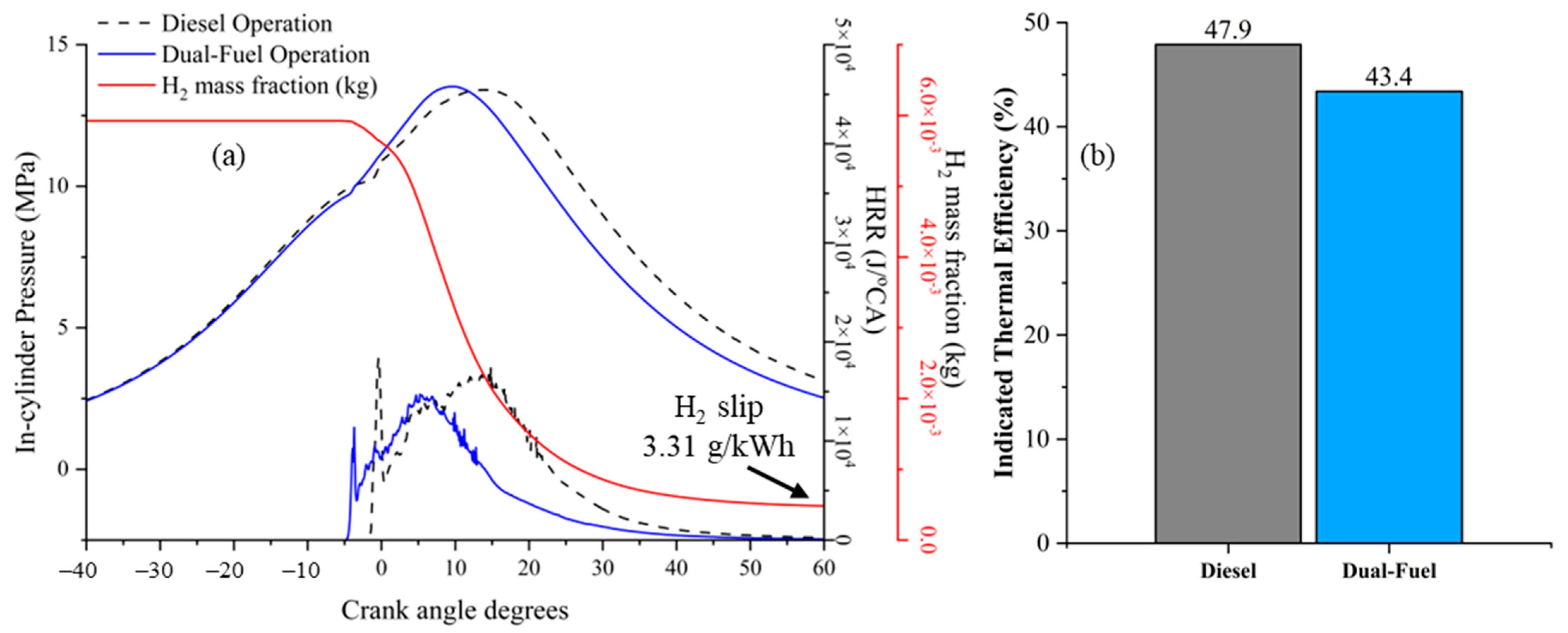
- Combustion starts earlier in dual-fuel operation, leading to an advanced in-cylinder peak pressure. However, a small portion of hydrogen remains unburned due to in-cylinder reactivity limitations.
- ▪
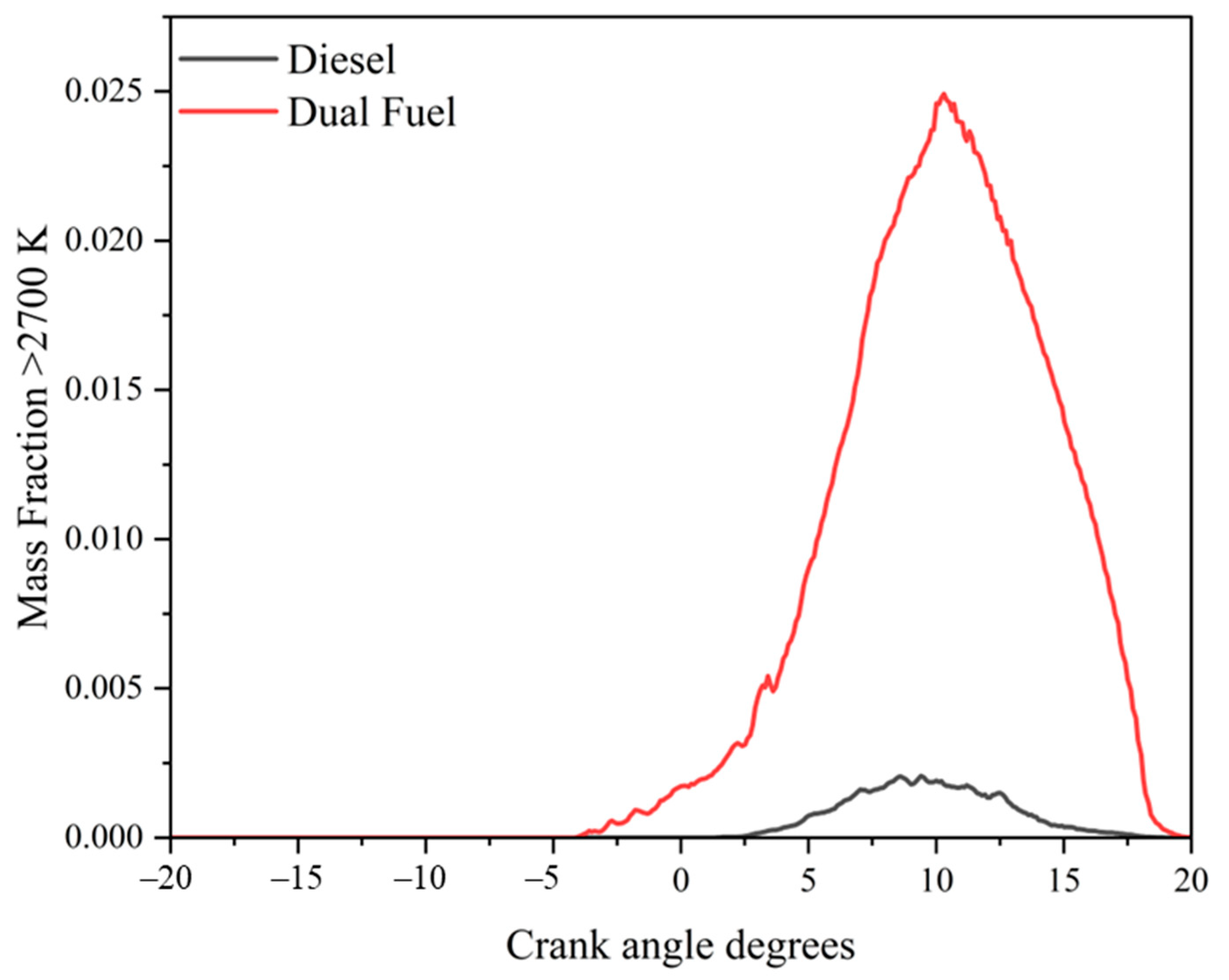
- The dual-fuel mode experiences higher in-cylinder peak temperature and a greater mass fraction in the high temperature (over 2700 K) region, favoring NOx generation.
- ▪
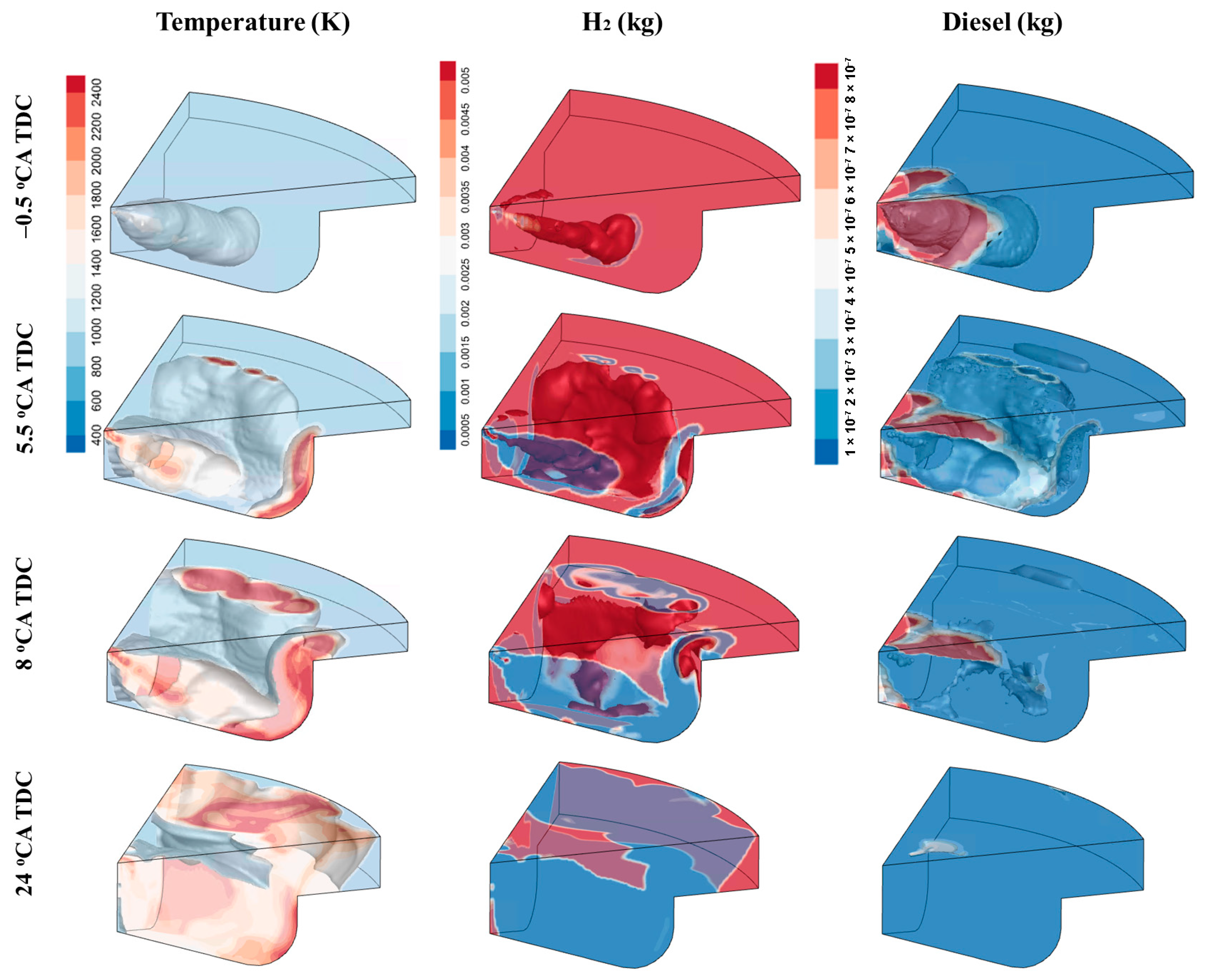
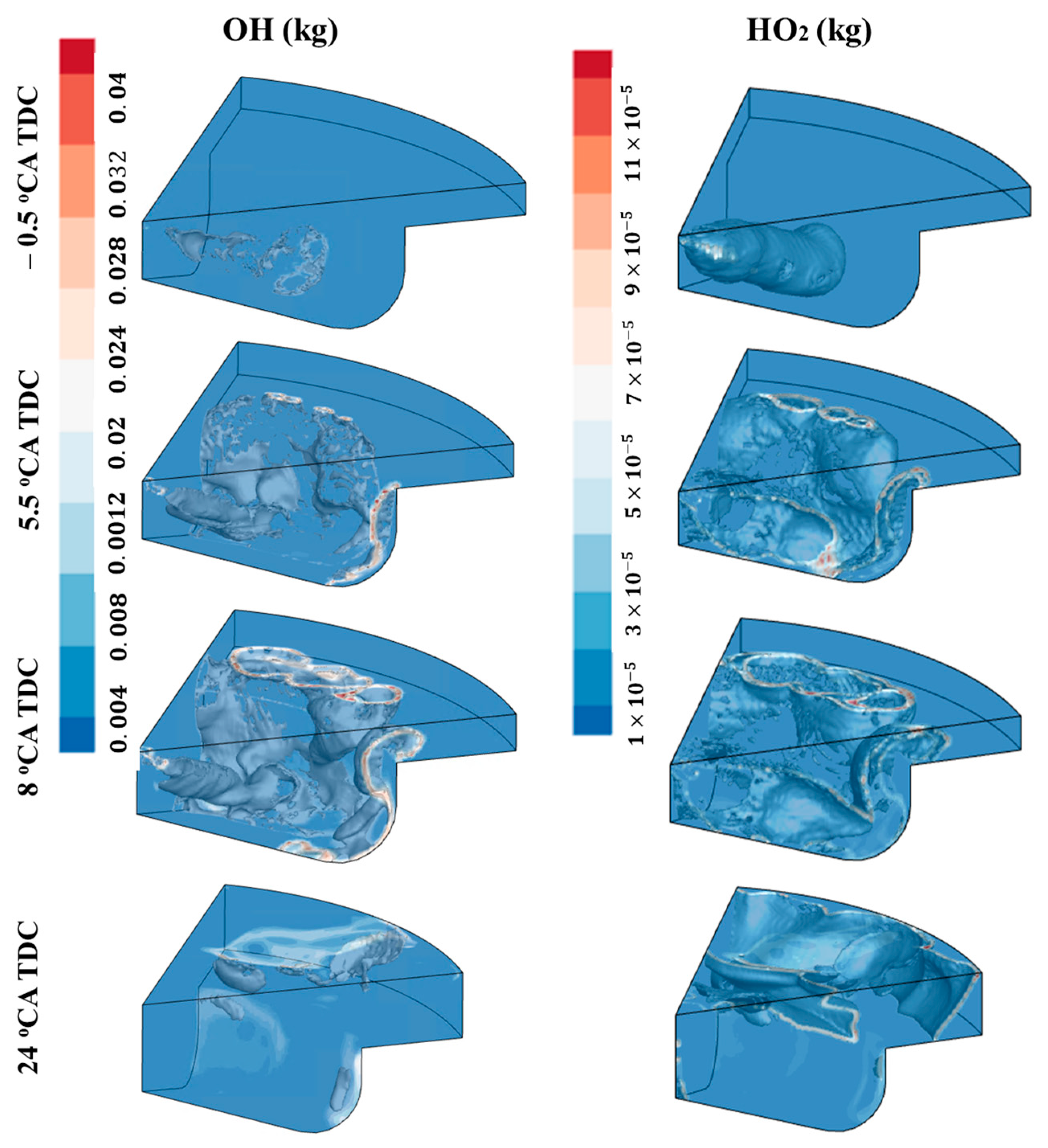
- Unburned hydrogen remains near the cylinder wall at the low temperature region in-cylinder where the high concentration of HO2 indicates combustion inhibition.
Author Contributions
Funding
Data Availability Statement
Acknowledgments
Conflicts of Interest
Appendix A

| Load (%) | Indicated Power Output | Maximum In-Cylinder Pressure | Indicated NOx Emissions | ||||||
|---|---|---|---|---|---|---|---|---|---|
| Measured (kW) | CFD (kW) | E (%) | Measured (bar) | CFD (bar) | E (%) | Measured (g/kWh) | CFD (g/kWh) | E (%) | |
| 25 | 1950 | 1900 | 3.6 | 38 | 38 | 0 | 9.15 | 9.9 | 8.6 |
| 50 | 3900 | 3950 | 2.3 | 64 | 66 | 4.1 | 9.7 | 10.1 | 4 |
| 75 | 5850 | 5700 | 3.6 | 92 | 90 | 3.2 | 9.7 | 10.4 | 7.8 |
| 100 | 7800 | 7890 | 2.2 | 126 | 125 | 1.8 | 9.43 | 10 | 6.7 |
References
- Karvounis, P.; Theotokatos, G.; Boulougouris, E. Environmental-economic sustainability of hydrogen and ammonia fuels for short sea shipping operations. Int. J. Hydrogen Energy 2024, 57, 1070–1080. [Google Scholar] [CrossRef] [Scilit]
- Stępień, Z. A comprehensive overview of hydrogen-fueled internal combustion engines: Achievements and future challenges. Energies 2021, 14, 6504. [Google Scholar] [CrossRef] [Scilit]
- Onorati, A.; Payri, R.; Vaglieco, B.M.; Agarwal, A.K.; Bae, C.; Bruneaux, G.; Canakci, M.; Gavaises, M.; Günthner, M.; Hasse, C.; et al. The role of hydrogen for future internal combustion engines. Int. J. Engine Res. 2022, 23, 529–540. [Google Scholar] [CrossRef] [Scilit]
- Shadidi, B.; Najafi, G.; Yusaf, T. A review of hydrogen as a fuel in internal combustion engines. Energies 2021, 14, 6209. [Google Scholar] [CrossRef] [Scilit]
- Dimitriou, P.; Tsujimura, T. A review of hydrogen as a compression ignition engine fuel. Int. J. Hydrogen Energy 2017, 42, 24470–24486. [Google Scholar] [CrossRef] [Scilit]
- Kumar, M.; Bhowmik, S.; Paul, A. Effect of pilot fuel injection pressure and injection timing on combustion, performance and emission of hydrogen–biodiesel dual fuel engine. Int. J. Hydrogen Energy 2022, 47, 29554–29567. [Google Scholar] [CrossRef] [Scilit]
- Huang, Z.; Yuan, S.; Wei, H.; Zhong, L.; Hu, Z.; Liu, Z.; Liu, C.; Wei, H.; Zhou, L. Effects of hydrogen injection timing and injection pressure on mixture formation and combustion characteristics of a hydrogen direct injection engine. Fuel 2024, 363, 130966. [Google Scholar] [CrossRef] [Scilit]
- Rueda-Vázquez, J.M.; Serrano, J.; Jiménez-Espadafor, F.J.; Dorado, M.D. Experimental analysis of the effect of hydrogen as the main fuel on the performance and emissions of a modified compression ignition engine with water injection and compression ratio reduction. Appl. Therm. Eng. 2024, 238, 121933. [Google Scholar] [CrossRef] [Scilit]
- Khalid, A.H.; Said, M.F.; Veza, I.; Abas, M.A.; Roslan, M.F.; Abubakar, S.; Jalal, M.R. Hydrogen port fuel injection: Review of fuel injection control strategies to mitigate backfire in internal combustion engine fuelled with hydrogen. Int. J. Hydrogen Energy 2024, 66, 571–581. [Google Scholar] [CrossRef] [Scilit]
- Zhou, L.; Cheung, C.S.; Leung, C.W.; Huang, Z. Combustion, performance and emissions of a diesel engine with H2, CH4 and H2-CH4 addition. Int. J. Hydrogen Energy 2014, 39, 4611–4621. [Google Scholar] [CrossRef] [Scilit]
- Li, Z.; Liu, J.; Ji, Q.; Sun, P.; Wang, X.; Xiang, P. Influence of hydrogen fraction and injection timing on in-cylinder combustion and emission characteristics of hydrogen-diesel dual-fuel engine. Fuel Process. Technol. 2023, 252, 107990. [Google Scholar] [CrossRef] [Scilit]
- Köse, H.; Ciniviz, M. An experimental investigation of effect on diesel engine performance and exhaust emissions of addition at dual fuel mode of hydrogen. Fuel Process. Technol. 2013, 114, 26–34. [Google Scholar] [CrossRef] [Scilit]
- Talibi, M.; Hellier, P.; Balachandran, R.; Ladommatos, N. Effect of hydrogen–diesel fuel co-combustion on exhaust emissions with verification using an in-cylinder gas sampling technique. Int. J. Hydrogen Energy 2014, 39, 15088–15102. [Google Scholar] [CrossRef] [Scilit]
- Manzoor, M.U.; Yosri, M.; Talei, M.; Poursadegh, F.; Yang, Y.; Brear, M. Normal and knocking combustion of hydrogen: A numerical study. Fuel 2023, 344, 128093. [Google Scholar] [CrossRef] [Scilit]
- Verhelst, S.; Sierens, R. Aspects concerning the optimisation of a hydrogen fueled engine. Int. J. Hydrogen Energy 2001, 26, 981–985. [Google Scholar] [CrossRef] [Scilit]
- Farzam, R.; McTaggart-Cowan, G. Hydrogen–diesel dual-fuel combustion sensitivity to fuel injection parameters in a multi-cylinder compression-ignition engine. Int. J. Hydrogen Energy 2024, 49, 850–867. [Google Scholar] [CrossRef] [Scilit]
- Smallbone, A.; Bhave, A.; Kraft, M. Virtual Performance and Emissions Mapping for Diesel Engine Design Optimization; 2011-01-1441; SAE Technical Paper; SAE: Warrendale, PA, USA, 2011. [Google Scholar]
- Li, Y.; Gao, W.; Zhang, P.; Fu, Z.; Cao, X. Influence of the equivalence ratio on the knock and performance of a hydrogen direct injection internal combustion engine under different compression ratios. Int. J. Hydrogen Energy 2021, 46, 11982–11993. [Google Scholar] [CrossRef] [Scilit]
- Babayev, R.; Andersson, A.; Dalmau, A.S.; Im, H.G.; Johansson, B. Computational comparison of the conventional diesel and hydrogen direct-injection compression-ignition combustion engines. Fuel 2022, 307, 121909. [Google Scholar] [CrossRef] [Scilit]
- Karvounis, P.; Theotokatos, G.; Gu, B.; Zhou, P. Numerical investigation of premixed hydrogen combustion in dual-fuel marine engines at high load. Int. J. Hydrogen Energy 2025, 144, 239–251. [Google Scholar] [CrossRef] [Scilit]
- Sharma, P.; Dhar, A. Compression ratio influence on combustion and emissions characteristic of hydrogen diesel dual fuel CI engine: Numerical Study. Fuel 2018, 222, 852–858. [Google Scholar] [CrossRef] [Scilit]
- Karvounis, P.; Theotokatos, G. Parametric optimisation of diesel–methanol injection timings of a dual-fuel marine engine operating with high methanol fraction using CFD. Appl. Therm. Eng. 2025, 264, 125433. [Google Scholar] [CrossRef] [Scilit]
- Karvounis, P.; Theotokatos, G.; Patil, C.; Xiang, L.; Ding, Y. Parametric investigation of diesel–methanol dual fuel marine engines with port and direct injection. Fuel 2025, 381, 133441. [Google Scholar] [CrossRef] [Scilit]
- Karvounis, P.; Theotokatos, G. Performance improvement and emissions reduction of methanol fuelled marine dual-fuel engine with variable compression ratio. Fuel Process. Technol. 2025, 272, 108208. [Google Scholar] [CrossRef] [Scilit]
- Werner, H.; Wengle, H.J. Large-eddy simulation of turbulent flow over and around a cube in a plate channel. In Turbulent Shear Flows 8: Selected Papers from the Eighth International Symposium on Turbulent Shear Flows, Munich, Germany, 9–11 September 1991; Springer: Berlin/Heidelberg, Germany, 1993; pp. 155–168. [Google Scholar]
- Ricart, L.M.; Reitz, R.D.; Dec, J.E. Comparisons of diesel spray liquid penetration and vapor fuel distributions with in-cylinder optical measurements. J. Eng. Gas Turbines Power 2000, 122, 588–595. [Google Scholar] [CrossRef] [Scilit]
- Zeldovich, Y.B. The Oxidation of Nitrogen in Combustion Explosions. J. Acta Physicochim. 1946, 21, 577–628. [Google Scholar]
- Schmidt, D.P.; Rutland, C.J. A New Droplet Collision Algorithm. J. Comput. Phys. 2000, 164, 62–80. [Google Scholar] [CrossRef] [Scilit]
- Han, Z.Y.; Xu, Z.; Trigui, N. Spray/wall interaction models for multidimensional engine simulation. Int. J. Eng. Res. 2000, 1, 127–146. [Google Scholar] [CrossRef] [Scilit]
- Yang, X.; Gupta, S.; Kuo, T.W.; Gopalakrishnan, V. RANS and large eddy simulation of internal combustion engine flows—A comparative study. J. Eng. Gas Turbines Power 2014, 136, 051507. [Google Scholar] [CrossRef] [Scilit]
- Tsitsilonis, K.M.; Theotokatos, G. A novel method for in-cylinder pressure prediction using the engine instantaneous crankshaft torque. Proc. Inst. Mech. Eng. Part M J. Eng. Marit. Environ. 2022, 236, 131–149. [Google Scholar] [CrossRef] [Scilit]
- Tsujimura, T.; Suzuki, Y. The utilization of hydrogen in hydrogen/diesel dual fuel engine. Int. J. Hydrogen Energy 2017, 42, 14019–14029. [Google Scholar] [CrossRef] [Scilit]
- Andrae, J.C.; Head, R.A. HCCI experiments with gasoline surrogate fuels modeled by a semidetailed chemical kinetic model. Combust. Flame 2009, 156, 842–851. [Google Scholar] [CrossRef] [Scilit]
- Mallouppas, G.; Yfantis, E.A.; Frantzis, C.; Zannis, T.; Savva, P.G. The effect of hydrogen addition on the pollutant emissions of a marine internal combustion engine genset. Energies 2022, 15, 7206. [Google Scholar] [CrossRef] [Scilit]
- Dere, C. Hydrogen fueled engine technology, adaptation, and application for marine engines. In Decarbonization of Maritime Transport; Springer Nature: Singapore, 2023; pp. 45–63. [Google Scholar]
- Fenimore, C.P. Formation of nitric oxide in premixed hydrocarbon flames. In Symposium (International) on Combustion; Elsevier: Amsterdam, The Netherlands, 1971; Volume 13, pp. 373–380. [Google Scholar]

| Parameter | Value |
|---|---|
| Type | Wärtsilä 9L46C |
| Maximum Power Output [kW] | 10,500 |
| Maximum Speed [rev/m] | 500 |
| Number of Cylinders | 9 |
| Compression Ratio | 14.0:1 |
| Bore—Stroke [mm] | 460–580 |
| Start of Injection Diesel (°CA BTDC) | 6 |
| Injection Pressure Diesel (bar) | 1500 |
| Diesel Injection Duration (°CA) | 20 |
| Temperature at IVC * point (K) | 340 |
| Pressure at IVC point (bar) | 2.4 |
| Simulated cycle period | IVC–EVO ** 135 °CA BTDC–135 °CA ATDC |
| HEF (%) | In-Cylinder Pressure (Bar) * | Heat Release Rate (J/°CA) * | Unburned Hydrogen (%) | ||||||
|---|---|---|---|---|---|---|---|---|---|
| Measured | CFD | E ** (%) | Measured | CFD | E (%) | Measured | CFD | E (%) | |
| 14 | 54.7 | 55.3 | 1.1 | 191 | 195 | 2.2 | 27 | 31 | 13 |
| 24 | 55 | 55.4 | 0.8 | 183 | 180 | 1.7 | 30 | 33 | 9.1 |
| Parameter | Grid 1 | Grid 2 | Grid 3 | Grid 4 |
|---|---|---|---|---|
| Base element size (mm) | 8 | 8 | 8 | 8 |
| Final element size (mm) | 6 | 4 | 2 | 1 |
| Solution duration (h) | 3 | 8 | 17 | 26 |
| RMSE on in-cylinder pressure (MPa) | 0.288 | 0.244 | 0.215 | 0.214 |
| Error on max cylinder pressure (%) | 6.2 | 4.4 | 1.3 | 3.4 |
| Adaptive mesh refinement | On: between 12 °CA BTDC and 135 °CA ATDC (for temperature and velocity) | |||
| Number of Cores Used | 40: Intel Cores IPM | |||
| Maximum/Minimum Timestep (s) | 2.5 10−5/1 10−8 | |||
| Maximum convection CFL limit | 0.95 | |||
| Maximum diffusion CFL limit | 2 | |||
| Grid size at TDC without AMR | 49,059 | |||
Disclaimer/Publisher’s Note: The statements, opinions and data contained in all publications are solely those of the individual author(s) and contributor(s) and not of MDPI and/or the editor(s). MDPI and/or the editor(s) disclaim responsibility for any injury to people or property resulting from any ideas, methods, instructions or products referred to in the content. |
© 2025 by the authors. Licensee MDPI, Basel, Switzerland. This article is an open access article distributed under the terms and conditions of the Creative Commons Attribution (CC BY) license (https://creativecommons.org/licenses/by/4.0/).
Share and Cite
Karvounis, P.; Theotokatos, G.; Gu, B.; Zhou, P. Numerical Investigation of Marine Dual-Fuel Engine Operating with High Shares of Premixed Hydrogen Fuel Using LES. J. Mar. Sci. Eng. 2025, 13, 1961. https://doi.org/10.3390/jmse13101961
Karvounis P, Theotokatos G, Gu B, Zhou P. Numerical Investigation of Marine Dual-Fuel Engine Operating with High Shares of Premixed Hydrogen Fuel Using LES. Journal of Marine Science and Engineering. 2025; 13(10):1961. https://doi.org/10.3390/jmse13101961
Chicago/Turabian StyleKarvounis, Panagiotis, Gerasimos Theotokatos, Binteng Gu, and Peilin Zhou. 2025. "Numerical Investigation of Marine Dual-Fuel Engine Operating with High Shares of Premixed Hydrogen Fuel Using LES" Journal of Marine Science and Engineering 13, no. 10: 1961. https://doi.org/10.3390/jmse13101961
APA StyleKarvounis, P., Theotokatos, G., Gu, B., & Zhou, P. (2025). Numerical Investigation of Marine Dual-Fuel Engine Operating with High Shares of Premixed Hydrogen Fuel Using LES. Journal of Marine Science and Engineering, 13(10), 1961. https://doi.org/10.3390/jmse13101961