Article

Combined-Population GWAS Identifies PROX2 as a Candidate Gene Associated with Total Teat Number Variation in Pigs


by
Haoran Shi
,
Xiaoyue Zhang
,
Lin Chen
,
Bin Yang
,
Sihan Liu
,
Guangming Li
and
Yang Liu
*
Department of Animal Genetics and Breeding, College of Animal Science and Technology, Nanjing Agricultural University, Nanjing 210095, China
*
Author to whom correspondence should be addressed.
These authors have contributed equally to this paper.
Agriculture 2026, 16(9), 953; https://doi.org/10.3390/agriculture16090953
Submission received: 3 April 2026 / Revised: 23 April 2026 / Accepted: 23 April 2026 / Published: 26 April 2026
(This article belongs to the Section Farm Animal Production)

Abstract

Teat number is an important economic trait in pigs because it affects sow reproductive performance and piglet nursing ability, yet its genetic basis and molecular regulatory mechanisms remain incompletely understood. In this study, a combined-population genome-wide association study was performed in Canadian and French Large White pigs to identify loci associated with teat number traits. A total of 4217 pigs were genotyped, and 2,244,684 autosomal single-nucleotide polymorphisms were retained after quality control and genotype imputation. Multiple association signals for total teat number were detected, with major peaks located on chromosomes 7 and 10. Among the positional candidate genes, PROX2 was prioritized for further validation, and genotype–phenotype association analysis showed that pigs with the CC genotype at the PROX2 polymorphic locus had significantly lower total teat number than those with the CT and TT genotypes. To investigate its biological role, PROX2 was silenced in porcine mammary epithelial cells. Transcriptome analysis identified 887 differentially expressed genes after PROX2 knockdown, and functional assays showed that PROX2 silencing inhibited cell proliferation, altered cell cycle progression, and affected the expression of proliferation- and development-related genes. These findings indicate that PROX2 is an important candidate gene associated with teat number variation in pigs.

1. Introduction

Teat number is an economically important trait in pigs because it directly influences sow reproductive performance and piglet suckling ability. An adequate number of well-developed teats ensures sufficient access to colostrum and milk for newborn piglets, thereby affecting piglet survival, litter weaning performance, and overall sow productivity [1,2]. As a complex quantitative trait, teat number is controlled by multiple genes and shows substantial variation among populations with different genetic backgrounds [3,4]. However, the genetic basis and molecular mechanisms underlying teat development remain incompletely understood. With the rapid advancement of high-throughput genotyping technologies, genome-wide association studies (GWAS) have become a powerful approach for dissecting the genetic architecture of complex traits and have been widely used to investigate reproductive traits in pigs [5,6,7].
In the present study, Large White pigs from the Canadian and French lines were genotyped using the GeneSeek GGP Porcine HD array. Following stringent quality control and genotype imputation with Beagle, GWAS was conducted for teat number-related traits. Multiple association signals were identified across the genome, and several candidate genes, including PROX2, ABCD4, VRTN, FRMD4A, AREL1, and ITGA8, were annotated within ±20 kb of significant and suggestive SNPs.
Among these candidates, PROX2 was prioritized for further investigation based on both positional evidence and biological plausibility. First, PROX2 was located within a strongly associated region on SSC7 identified by the combined-population GWAS. Second, compared with other positional candidates such as ABCD4, VRTN, FRMD4A, AREL1, and ITGA8, PROX2 encodes a putative homeobox transcription factor, making it a more plausible candidate for developmental regulation, epithelial cell proliferation, and tissue patterning [8,9]. Members of the homeobox gene family are known to play essential roles in organogenesis, tissue morphogenesis, and the regulation of cell proliferation and differentiation [10,11]. Although functional studies of PROX2 in mammals remain limited, available evidence suggests that it may be involved in tissue developmental processes. Because teat formation and mammary gland development depend on epithelial cell proliferation, differentiation, and morphogenesis, PROX2 was considered a biologically relevant candidate gene underlying teat number variation.
To further investigate the potential role of PROX2 in teat number formation, we combined genetic association analysis with cellular functional validation. After prioritizing PROX2 from the GWAS results, a PROX2 knockdown model was established in porcine mammary epithelial cells, followed by transcriptome sequencing and functional assays to evaluate its effects on cell proliferation, cell cycle progression, and related regulatory pathways. This study provides new insights into the molecular basis of teat number formation in pigs and supports PROX2 as a candidate functional regulator of this trait.

2. Materials and Methods

2.1. Animals, Phenotypes, DNA Extraction

Large White pigs from the Canadian and French lines raised at Haoxiang Pig Breeding Co., Ltd. (Anhui, China) were used in this study. Teat number-related phenotypes, including left teat number (LTN), right teat number (RTN), and total teat number (TTN), were recorded for pigs born between 2020 and 2025. A total of 83,351 phenotypic records were collected, including 48,139 from the Canadian line and 35,212 from the French line. Line, parity, year–season class, and pedigree information were also recorded for subsequent analyses. According to pedigree records, the two populations were genetically unrelated. Records with missing or abnormal phenotypic values were excluded prior to analysis. A total of 4217 pigs were selected for genotyping, including 2628 from the Canadian line and 1589 from the French line. Genomic DNA was extracted from ear tissue samples using the phenol–chloroform method and stored at −20 °C until further use [12].

2.2. Genotyping, Quality Control, and Genotype Imputation

All genomic analyses were based on the pig reference genome assembly Sus scrofa 11.1. All selected individuals were genotyped using the GeneSeek GGP Porcine HD array, which contains 50,915 probes. Genotype quality control was performed using PLINK v1.90 [13]. Individuals with a genotype call rate lower than 0.90 were excluded, and SNPs were removed if they had a minor allele frequency (MAF) < 0.05 or a call rate < 0.90. After quality control, the filtered chip genotypes were imputed to sequence-level density using Beagle v4.1 [14] with the PGRP v1 reference panel aligned to Sus scrofa 11.1. Imputation accuracy was evaluated using the concordance rate (CR), and the overall accuracy exceeded 0.95. After imputation and subsequent quality filtering, 2,244,684 autosomal SNPs were retained for subsequent genome-wide association analysis.

2.3. Population Genomics Analysis

To evaluate population stratification, principal component analysis (PCA) was performed using the filtered SNP dataset in PLINK v1.90 to obtain eigenvalues and eigenvectors.

2.4. Genome-Wide Association Analysis

A combined-population GWAS was performed using the Canadian and French Large White pig lines jointly. Line was included in the model as a fixed effect to account for differences between populations. Population structure was controlled by fitting a line as a fixed effect and incorporating the genomic relationship matrix into the mixed linear model, rather than relying on PCA alone. Principal components were not included as additional covariates in the final model. Association analysis was conducted using a single-SNP mixed linear model implemented in GCTA (version 1.93.3beta) with the mlma option [15]. A genomic relationship matrix (GRM) based on the imputed SNP data was fitted in the model to control for polygenic background and genetic relatedness. The model was as follows:
y = μ + X b + W g + Z u + e
where y is the vector of phenotypic observations; μ is the overall mean; b is the vector of fixed effects, including line, parity, and year–season; g is the vector of SNP effects; X is the incidence matrix relating observations to the corresponding levels of fixed effects; W is the incidence matrix relating observations to SNP effects, with elements coded as 0, 1, and 2 for genotypes A1A1, A1A2, and A2A2, respectively; u is the vector of random additive genetic effects and is assumed to follow u N ( 0 , G σ u 2 ) , where G is the genomic relationship matrix and σ u 2 is the polygenic additive genetic variance; Z is the incidence matrix for u ; and e is the vector of random residuals and is assumed to follow e N ( 0 , I σ e 2 ) , where I is the identity matrix and σ e 2 is the residual variance.
The suggestive and genome-wide significance thresholds were determined using the Bonferroni correction method and were set at l o g 10 ( 1 / N ) and l o g 10 ( 0.05 / N ) , respectively, where N is the total number of SNPs tested. Because many SNPs are not fully independent due to linkage disequilibrium, the Bonferroni correction was applied here as a conservative criterion to control the genome-wide false-positive rate. Manhattan plots and quantile–quantile (QQ) plots were generated using the qqman package in R [16].

2.5. Annotation of Candidate Genes

Candidate genes were annotated based on the pig reference genome Sus scrofa 11.1. Genes located within ±20 kb upstream and downstream of the significant and suggestive SNPs were identified using the BioMart database in Ensembl release 108. A ±20 kb interval was used as a conservative criterion to prioritize positional candidate genes located near the associated variants. Functional annotation of genes within these regions was then used for further candidate gene prioritization.

2.6. PCR Amplification and Sanger Sequencing

PCR amplification was carried out to screen for polymorphisms in the exon region of the PROX2 gene. Genomic DNA extracted from ear tissue samples was used as the template, and amplification was performed using the primers listed in Supplementary Table S1. The PCR products were examined by agarose gel electrophoresis, with DL2000 DNA Marker (Sangon Biotech, Shanghai, China) used as the molecular weight standard. PCR products showing the expected fragment size were further subjected to Sanger sequencing for polymorphism detection. Detailed polymorphism information is provided in Supplementary Figure S1.

2.7. Cell Line

Porcine mammary epithelial cells (PMECs) were obtained from Mingzhou Biotechnology (Ningbo, China; Cat. No. MZ-4053). Cells were maintained in DMEM/F12 medium containing 10% fetal bovine serum (FBS) and 1% penicillin–streptomycin at 37 °C in a humidified incubator with 5% CO2. The medium was refreshed every 1–2 days according to cell growth status, and cells were passaged at approximately 80–90% confluence. Cells in the logarithmic growth phase were used for subsequent transfection and functional assays.

2.8. Transfection Procedure

PMECs were transfected at 60–70% confluence with siNC/siPROX2 using Lipofectamine 3000 (Thermo Fisher Scientific, Waltham, MA, USA) according to the manufacturer’s instructions. Two groups (siNC and siPROX2) were included in the analysis, with three biological replicates for each group. Transfection efficiency was assessed by RT–qPCR at 24 h after transfection. The siRNA sequences used in this study are listed in Supplementary Table S2.

2.9. Cell Proliferation Assay

Cell proliferation was evaluated using CCK-8 (Beyotime Biotechnology, Shanghai, China) and crystal violet staining assays. For the CCK-8 assay, transfected cells were seeded in 96-well plates at approximately 1.5 × 10 3 cells per well. CCK-8 reagent was added at the indicated time points, incubated for 4 h, and absorbance was measured at 450 nm using a Spark® multimode microplate reader (Tecan, Männedorf, Switzerland). For crystal violet staining, cells cultured in 6-well plates were washed twice with PBS, fixed with 4% paraformaldehyde (Beyotime Biotechnology, Shanghai, China) for 15 min at room temperature, and stained with 0.1% crystal violet (Beyotime Biotechnology, Shanghai, China) for 20–30 min. Excess dye was removed by washing with distilled water, and the plates were air-dried.

2.10. Cell Cycle Analysis

At 24 h after transfection, cells were harvested, fixed with 70% ethanol at 4 °C, stained using propidium iodide (PI; Beyotime Biotechnology, Shanghai, China), and then subjected to flow cytometric analysis with 488 nm excitation. Cell-cycle distribution was determined based on standard gating strategies.

2.11. qRT-PCR Analysis

Primers for qRT-PCR and polymorphism detection were designed according to gene sequences obtained from the NCBI database and synthesized by Sangon Biotech Co., Ltd. (Shanghai, China). The detailed primer sequences are listed in Supplementary Table S3.
Total RNA was isolated using a commercial extraction kit (Tiangen, Beijing, China). First-strand cDNA was generated from 1 μg of RNA with HiScript III All-in-One RT SuperMix (Vazyme, Nanjing, China). Quantitative PCR was carried out on a CFX96 system (Bio-Rad, Hercules, CA, USA) with Taq Pro Universal SYBR qPCR Master Mix (Vazyme, Nanjing, China). Relative gene expression was determined by the 2−ΔΔCt method using GAPDH as the reference gene.

2.12. RNA-Seq, Read Processing, and Expression Quantification

All RNA-seq samples were processed under the same experimental workflow for RNA extraction, library construction, and sequencing to minimize potential batch effects. Three independent biological replicates were included in each group. Total RNA extracted from the siPROX2 and siNC groups was sent to Tsingke Biotechnology Co., Ltd. (Beijing, China) for library construction, sequencing, and raw data quality control. Raw reads were filtered by removing adaptor-containing reads, reads shorter than 100 bp after trimming, reads containing more than 10 ambiguous bases, and reads in which low-quality bases (Q ≤ 30) accounted for more than 40% of the read length. Clean reads were then aligned to the Sscrofa11.1.108 reference genome using HISAT2 (v2.2.1), and transcript abundance was quantified using StringTie (v2.0.4). The sequencing data showed high quality, with Q30 values above 95.72% and mapping rates ranging from 93.59% to 94.87%.

2.13. Differential Expression and Enrichment Analyses

Differential expression analysis was performed in R using DESeq2 (v1.26.0). Differentially expressed genes (DEGs) were defined as genes with |log2FC| ≥ 1 and FDR < 0.05. Functional enrichment analyses of DEGs were conducted for Gene Ontology (GO) categories and Kyoto Encyclopedia of Genes and Genomes (KEGG) pathways using DAVID. Terms or pathways with p < 0.05 were considered significantly enriched.

2.14. Statistical Analysis

Statistical analyses were performed using GraphPad Prism 9.5.0. For targeted validation experiments, including qRT-PCR, CCK-8, crystal violet staining, immunofluorescence quantification, and cell-cycle analysis, differences between the siNC and siPROX2 groups were evaluated using an independent samples t-test. Before analysis, the assumptions of normality and homogeneity of variance were assessed. Data are presented as mean ± SD from three independent biological replicates. A p value < 0.05 was considered statistically significant.

3. Results

3.1. Population Structure and Genome-Wide Association Analysis for Total Teat Number

Descriptive statistics for left teat number (LTN), right teat number (RTN), and total teat number (TTN) in the Canadian and French Large White pig populations are presented in Table 1. These traits showed sufficient phenotypic variation in both populations for subsequent genome-wide association analysis.
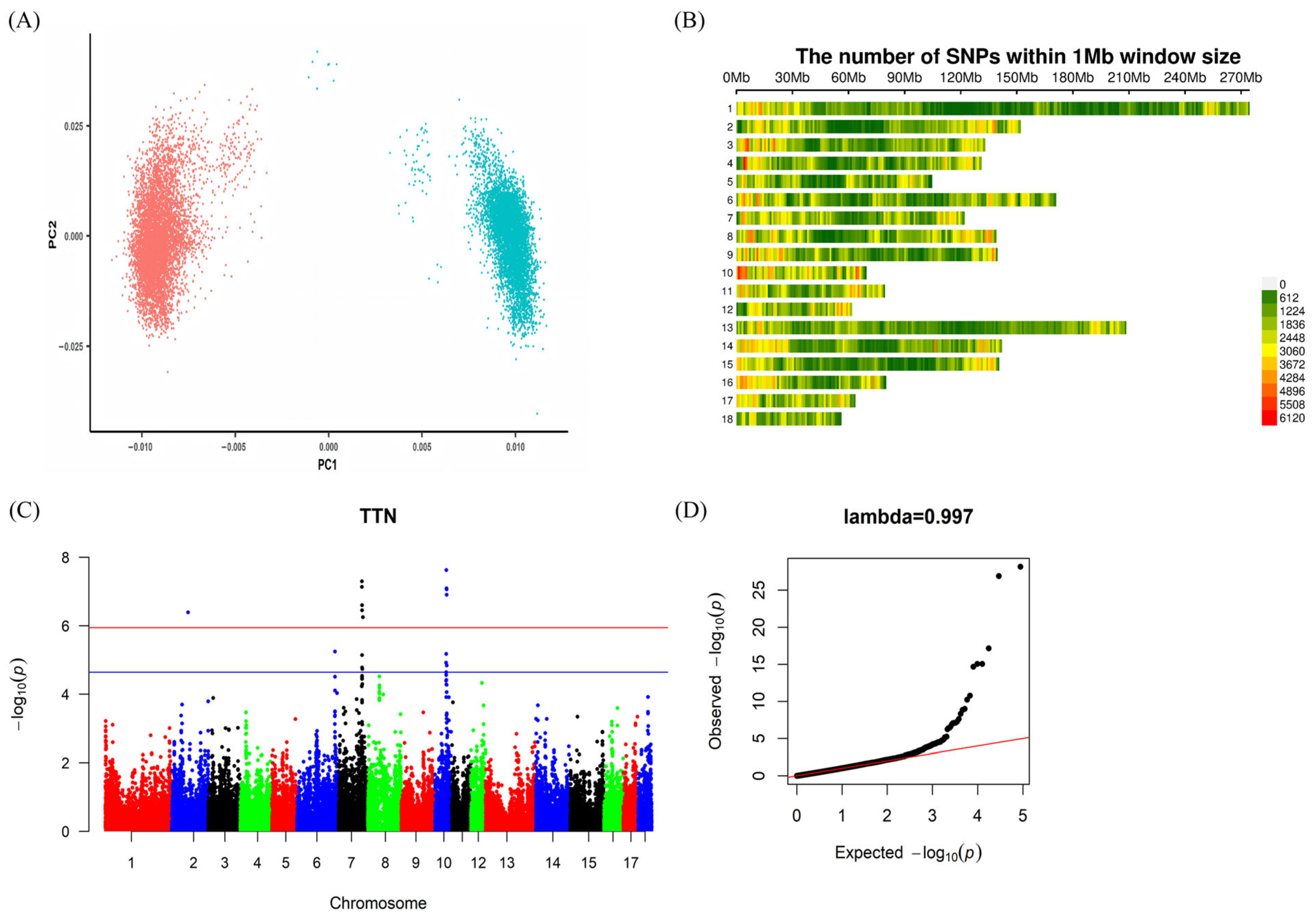
PCA based on the filtered SNP data showed a clear separation between the Canadian and French Large White pig lines, indicating detectable genetic heterogeneity between the two populations (Figure 1A). The filtered SNPs were broadly distributed across all autosomes (Figure 1B). A combined-population GWAS for total teat number (TTN) identified multiple associated loci, with the strongest signals located on SSC7 and SSC10 (Figure 1C). Such genetic heterogeneity could potentially confound association signals in a combined-population analysis if not properly controlled. In the present study, this effect was accounted for by fitting a line as a fixed effect and incorporating the genomic relationship matrix into the mixed linear model. Consistent with this, the QQ plot showed a good agreement between the observed and expected p-value distributions, with a genomic inflation factor of λ = 0.997, indicating that population structure and relatedness were well controlled (Figure 1D). Detailed information on significant and suggestive SNPs and their annotated candidate genes is provided in Supplementary Table S4.
Candidate gene annotation of the top associated loci identified several positional candidates in the SSC7- and SSC10-associated regions. A comparison of the main candidate genes is provided in Supplementary Table S5. Among these candidates, PROX2 (p = 3.52 × 10⁻⁷), located in the SSC7-associated region, was selected for further validation in the present study. To validate the candidate locus in PROX2, 120 individuals were selected from the study population by stratified random sampling according to population proportion, including 75 pigs from the Canadian line and 45 pigs from the French line. As shown in Table 2, individuals with the CC genotype had a significantly lower total teat number (TTN) than those with the CT and TT genotypes (p < 0.05), whereas no significant difference was observed between the CT and TT genotypes. These results support an association between the polymorphic locus in PROX2 and TTN variation in pigs. The PCR amplification results and polymorphism sequencing data are provided in Supplementary Figure S1.
Taken together, the genetic association at the PROX2 locus and the subsequent genotype–phenotype association analysis provided the basis for selecting PROX2 for downstream functional validation.

3.2. Transcriptomic Analysis Revealed the Regulatory Role of PROX2 in Porcine Mammary Epithelial Cells

Based on the genetic association and genotype–phenotype validation results, PROX2 was selected for downstream functional investigation. To obtain an initial overview of the molecular changes induced by PROX2 deficiency, transcriptome sequencing was first performed in porcine mammary epithelial cells after PROX2 knockdown.
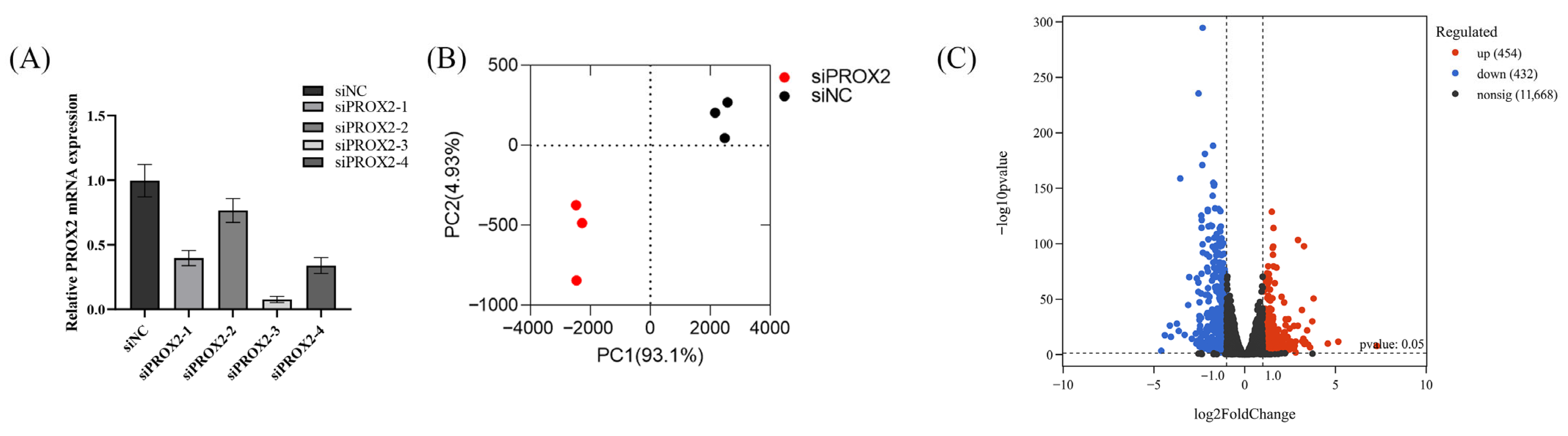
qRT-PCR validation showed that all siPROX2 fragments reduced PROX2 mRNA expression to different extents compared with the siNC group, with siPROX2-3 showing the highest knockdown efficiency; therefore, it was selected for subsequent transcriptome analysis (Figure 2A). PCA showed a clear separation between the siPROX2 and siNC groups, indicating that PROX2 silencing altered the global transcriptional profile of porcine mammary epithelial cells (Figure 2B).
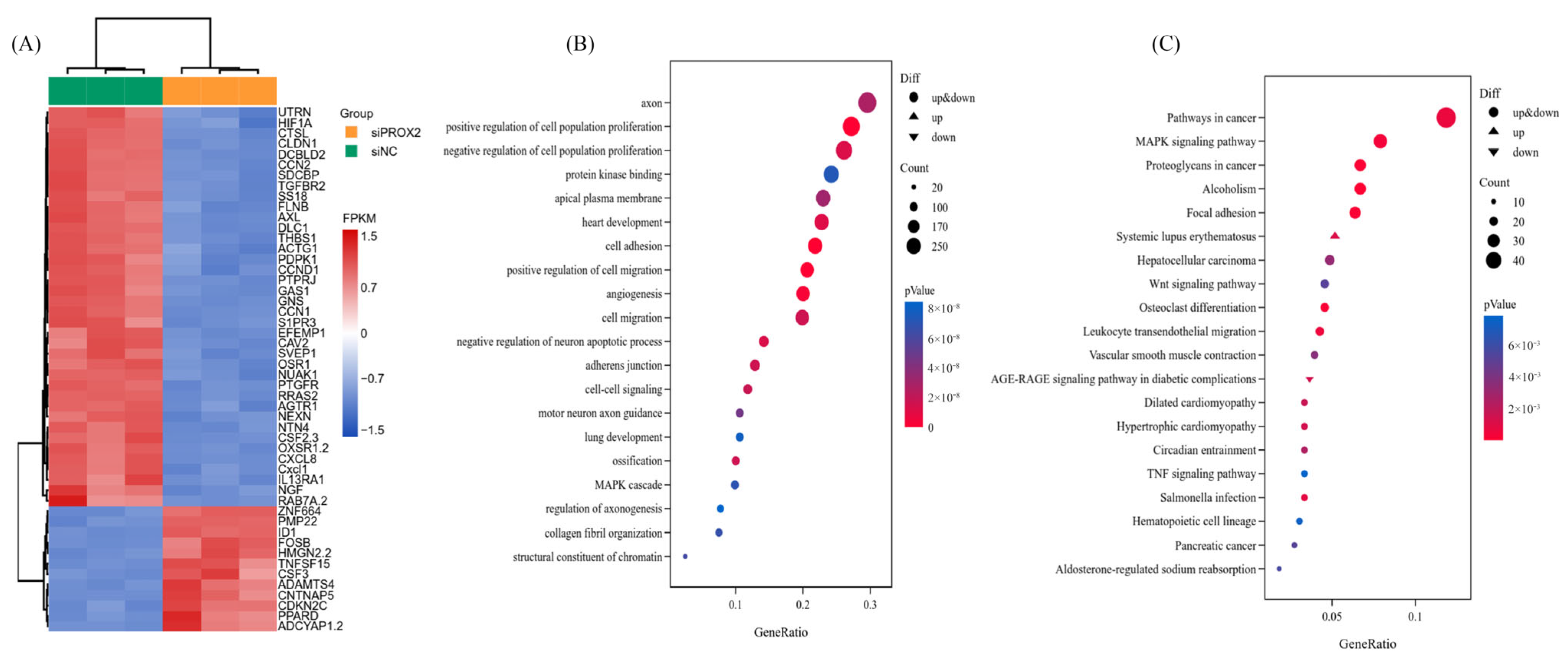
A total of 887 differentially expressed genes (DEGs) were identified after PROX2 silencing using the criteria of |log2FC| ≥ 1 and FDR < 0.05, including 454 upregulated and 432 downregulated genes (Figure 2C). The heatmap based on the top 50 DEGs enriched in positive regulation of cell population proliferation clearly distinguished the siPROX2 and siNC groups (Figure 3A). GO enrichment analysis showed that the DEGs were mainly enriched in terms related to cell proliferation, protein kinase binding, cell adhesion, cell migration, MAPK cascade, and adherens junction (Figure 3B). KEGG analysis further revealed significant enrichment in the MAPK signaling pathway, Wnt signaling pathway, focal adhesion, and pathways in cancer (Figure 3C). These transcriptomic results provided an initial overview of the molecular changes induced by PROX2 knockdown and were used as supportive evidence for subsequent functional interpretation.

3.3. PROX2 Knockdown Inhibited the Proliferation of Porcine Mammary Epithelial Cells

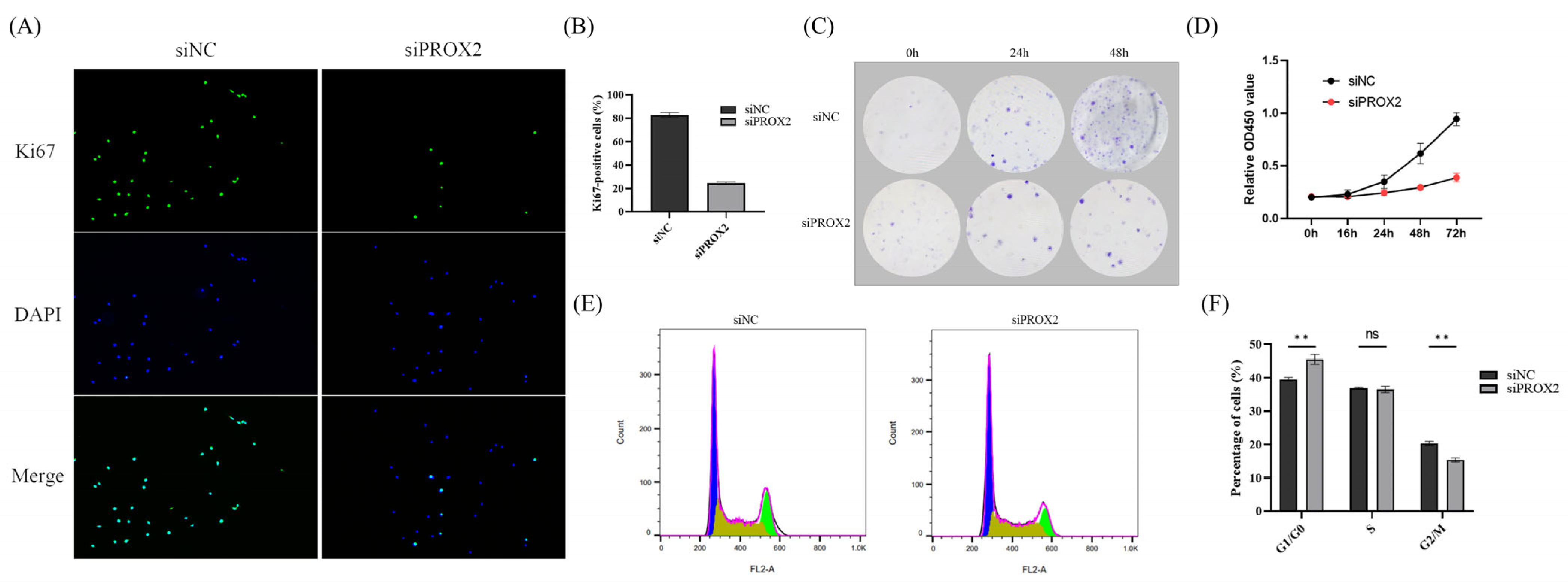
To investigate the biological function of PROX2 in porcine mammary epithelial cells, PROX2 was silenced using siRNA, followed by a series of functional assays. Compared with the siNC group, the siPROX2 group showed a significantly lower proportion of Ki67-positive cells, indicating reduced proliferative activity (Figure 4A,B). Consistent with the immunofluorescence results, the CCK-8 assay showed that cell proliferation in the siPROX2 group was significantly lower than that in the siNC group at later time points (Figure 4D). Similarly, crystal violet staining showed that PROX2 silencing markedly suppressed the growth of porcine mammary epithelial cells (Figure 4C).
Flow cytometry analysis further showed that PROX2 silencing significantly altered cell cycle distribution. Compared with the siNC group, the proportion of cells in the G1/G0 phase was significantly increased, whereas the proportion of cells in the G2/M phase was significantly decreased in the siPROX2 group, while no significant difference was observed in the S phase (Figure 4E,F). These results suggest that PROX2 deficiency impaired normal cell cycle progression and led to a tendency toward G1/S phase arrest.
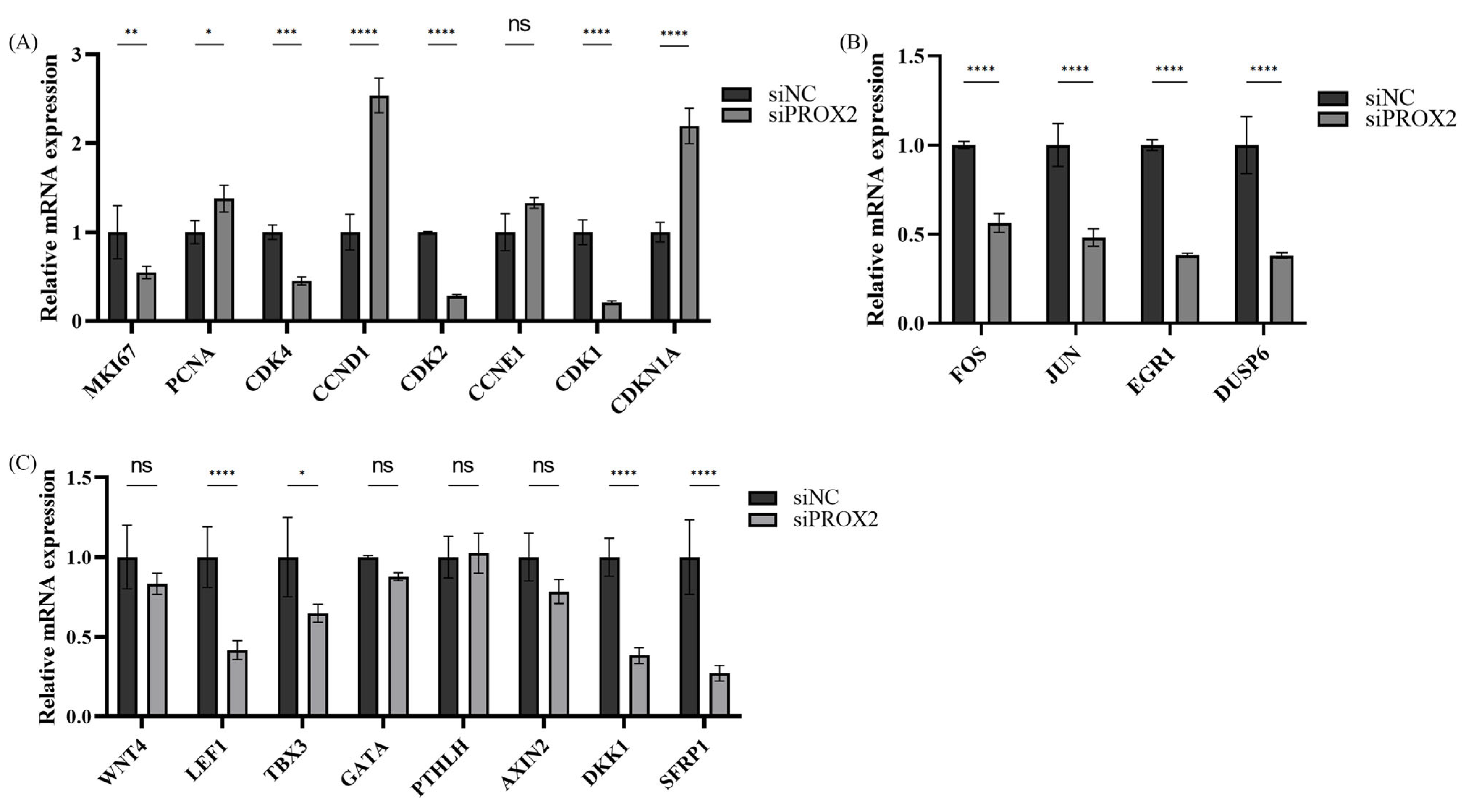
To further explore the underlying molecular basis, the expression of cell cycle-related genes was examined by qRT-PCR. The results showed that MKI67, CDK4, CDK2, and CDK1 were significantly downregulated after PROX2 silencing, whereas PCNA, CCND1, and CDKN1A were significantly upregulated, while CCNE1 showed no significant change (Figure 5A). In addition, several MAPK-related genes, including FOS, JUN, EGR1, and DUSP6, were significantly downregulated in the siPROX2 group (Figure 5B). Further analysis of mammary development-related genes showed that LEF1, TBX3, DKK1, and SFRP1 were significantly downregulated after PROX2 silencing, whereas WNT4, GATA3, PTHLH, and AXIN2 showed no significant changes (Figure 5C). Taken together, these results indicate that PROX2 silencing inhibits the proliferation of porcine mammary epithelial cells, disrupts cell cycle progression, and alters the expression of genes involved in proliferation- and development-related regulatory programs.

4. Discussion

In the present study, the relationship between PROX2 and total teat number formation in pigs was systematically evaluated through genetic association, transcriptomic analysis, and cellular functional validation. The GWAS identified multiple loci associated with total teat number, particularly on SSC7 and SSC10, where several candidate genes, including PROX2, VRTN, ITGA8, FRMD4A, ABCD4, and DLST, were annotated. In this study, PROX2 was selected for downstream validation. This choice reflects the scope of the current work rather than the exclusion of other candidates. VRTN and ABCD4 have already been extensively studied in pigs, especially in relation to vertebral development and body-axis traits [17,18,19], whereas ITGA8 and FRMD4A were not further supported by our follow-up genotype–phenotype analysis. For DLST, direct evidence linking it to mammary development or teat formation remains limited. By contrast, further genotype–phenotype association analysis showed that the synonymous variant in PROX2 was significantly associated with total teat number. Specifically, pigs with the homozygous CC genotype had significantly fewer total teats than those with the CT and TT genotypes, suggesting that this locus, or a linked genomic region, may contribute to teat number variation. Although the Canadian and French lines showed clear genetic differentiation in the PCA, this heterogeneity was explicitly accounted for in the GWAS model by fitting line as a fixed effect and incorporating the genomic relationship matrix. Therefore, the combined-population analysis remained informative for detecting loci associated with teat number variation.
Although synonymous mutations do not alter amino acid sequences, they are not necessarily functionally neutral. Such variants may influence codon usage, translation efficiency, mRNA stability, and post-transcriptional regulation [20]. In addition, SNPs identified by GWAS often serve as markers in linkage disequilibrium with the true causal variants rather than representing the functional sites themselves [21,22]. Therefore, the synonymous variant identified in PROX2 should be interpreted cautiously. It is possible that this polymorphism influences PROX2 expression or regulatory efficiency directly, or alternatively tags another functional variant in the associated region. In either case, variation at the PROX2 locus may be related to epithelial proliferation, cell-cycle regulation, and development-related transcriptional programs relevant to teat formation. Thus, although the precise mechanism remains unclear, the current data suggest that the PROX2 locus may be associated with total teat number variation in pigs.
In addition to the genetic association evidence, functional validation in porcine mammary epithelial cells further supported the potential involvement of PROX2 in teat number formation. Although teat number is established during embryogenesis, its development depends on local epithelial proliferation, differentiation, and morphogenesis [23,24]. Therefore, porcine mammary epithelial cells provide a relevant in vitro model for preliminary functional investigation.
At present, functional studies of PROX2 in mammals remain limited, and most existing reports have referred to this gene mainly in GWAS analyses of traits such as vertebral length [18,25,26]. Previous studies have suggested that the effects of PROX2 deficiency on mouse survival and spermatogenesis may be partially compensated by other factors. These studies also proposed that PROX2 may participate in cell-cycle regulation and function as a transcriptional regulator of cyclin-related genes [8]. The findings of the present study support this view to some extent. After PROX2 knockdown, the proliferative capacity of porcine mammary epithelial cells was markedly reduced and was accompanied by an abnormal cell cycle distribution, showing a tendency toward G1/S phase arrest. At the molecular level, qRT-PCR showed that MKI67, CDK4, CDK2, and CDK1 were significantly downregulated after PROX2 silencing, whereas PCNA, CCND1, and CDKN1A were significantly upregulated; CCNE1 showed no significant change. Since MKI67 is a classical marker of cell proliferation and CDK4, CDK2, and CDK1 are major regulators of cell-cycle progression, their downregulation suggests impaired proliferative and cell-cycle activity following PROX2 deficiency [27,28]. In addition, the upregulation of CDKN1A (p21) further supports enhanced cell-cycle inhibitory signaling, consistent with the observed tendency toward G1/S arrest [29].
Notably, PCNA and CCND1 showed an upward trend despite the downregulation of several major cell-cycle-promoting factors. This pattern suggests that PROX2 silencing disturbs the broader transcriptional program associated with the G1/S transition rather than simply blocking a single checkpoint. Increased PCNA and CCND1 expression may therefore reflect a compensatory or dysregulated response rather than effective cell-cycle progression. The precise molecular mechanism, however, remains to be clarified.
Transcriptome analysis together with qRT-PCR validation further showed that several MAPK-related genes, including FOS, JUN, EGR1, and DUSP6, were markedly downregulated after PROX2 silencing. This pattern is consistent with an altered MAPK-associated transcriptional response. FOS, JUN, and EGR1 are typical immediate-early response genes induced by proliferative stimuli [30], whereas DUSP6 is a classical negative-feedback regulator of the ERK pathway and is often regarded as a readout of MAPK/ERK transcriptional output [31]. The coordinated downregulation of these genes suggests that the transcriptional response to proliferative signaling was attenuated following PROX2 deficiency, consistent with the reduced proliferative capacity observed in PMECs. However, because the present study is based primarily on transcriptional evidence, these findings should be interpreted cautiously. They support a role for PROX2 in MAPK-related transcriptional regulation, but do not directly demonstrate inhibition of MAPK pathway activity at the protein level. Further analyses, such as the detection of phosphorylated ERK or MEK, are needed to test this possibility more directly.
In addition to MAPK-related genes, this study also examined expression changes in genes associated with mammary development. LEF1, TBX3, DKK1, and SFRP1 were significantly downregulated after PROX2 silencing, whereas WNT4, GATA3, PTHLH, and AXIN2 showed no significant changes. This pattern indicates that the effect of PROX2 on mammary developmental programs is selective rather than global. LEF1 is an important downstream transcription factor of the Wnt/β-catenin pathway and a well-established regulator of mammary placode formation and epithelial development [32]. TBX3 is also recognized as a key developmental transcription factor in mammary gland biology [33]. Their downregulation supports the idea that PROX2 influences not only proliferative capacity but also broader developmental regulatory programs in porcine mammary epithelial cells. Meanwhile, DKK1 and SFRP1, both inhibitors of the Wnt pathway [34], were also downregulated, suggesting that PROX2 deficiency may alter Wnt-related transcriptional regulation rather than directly demonstrating activation or suppression of Wnt pathway activity. Overall, these observations are consistent with a model in which PROX2 may influence teat formation indirectly by affecting mammary epithelial proliferation, cell-cycle regulation, and development-related transcriptional programs.
One limitation of the present study is that functional validation was performed only in vitro using porcine mammary epithelial cells. Because teat number is a developmental trait established during embryogenesis, validation in embryonic mammary tissue would provide more direct evidence for the role of PROX2 in teat formation. Nevertheless, mammary epithelial cells remain a relevant model for preliminary functional evaluation because teat development depends on epithelial proliferation, differentiation, and morphogenesis. Therefore, the current findings should be regarded as supportive evidence for the involvement of PROX2, rather than definitive proof of its embryonic developmental function. Further studies using embryonic tissue or in vivo models are required to clarify the precise role of PROX2 in teat number formation. It should also be noted that candidate gene annotation was based on a predefined ±20 kb window around significant and suggestive SNPs. Although this approach is useful for prioritizing nearby genes, distal regulatory elements may act over longer genomic distances, and the true causal gene may therefore lie outside the annotated interval.
Overall, this study provides coherent evidence supporting the involvement of PROX2 in teat number formation in pigs. GWAS and genotype–phenotype association analyses indicated that PROX2 was significantly associated with total teat number, while transcriptome analysis and cellular functional assays supported its potential role in mammary epithelial regulation. Taken together, these findings support PROX2 as a candidate gene for total teat number in pigs and provide new insight into the molecular basis of this trait.

5. Conclusions

This study identified PROX2 as an important candidate gene associated with total teat number in pigs through combined-population GWAS and genotype–phenotype association analysis. Functional experiments further demonstrated that PROX2 silencing inhibited the proliferation of porcine mammary epithelial cells, disrupted cell-cycle progression, and altered the expression of genes related to proliferation and development. Collectively, these findings support the involvement of PROX2 in teat number variation in pigs and provide new insight into the molecular basis of this trait.

Supplementary Materials

The following supporting information can be downloaded at: https://www.mdpi.com/article/10.3390/agriculture16090953/s1, Supplementary Table S1, primer information for PCR amplification of the PROX2 exon region; Supplementary Figure S1, PCR amplification and Sanger sequencing results of the PROX2 polymorphic locus; Supplementary Table S2, siRNA sequences targeting porcine PROX2; Supplementary Table S3, primer information used for qRT-PCR analysis; Supplementary Table S4, significant SNPs and annotated genes identified by combined-population GWAS; Supplementary Table S5, comparison of the main candidate genes identified in the top associated loci for total teat number.

Author Contributions

Conceptualization, Y.L.; methodology, X.Z. and G.L.; software, H.S.; validation, L.C. and S.L.; formal analysis, H.S. and L.C.; investigation, X.Z., B.Y. and S.L.; resources, B.Y. and G.L.; data curation, X.Z. and S.L.; writing—original draft preparation, H.S. and X.Z.; writing—review and editing, Y.L. and G.L.; visualization, H.S.; supervision, Y.L.; project administration, Y.L.; funding acquisition, Y.L., H.S. and X.Z. contributed equally to this work. All authors have read and agreed to the published version of the manuscript.

Funding

This research was supported by the Biological Breeding-National Science and Technology Major Projects (No. 2023ZD0404401).

Institutional Review Board Statement

Ethical review and approval were waived for this study because the genomic and phenotypic data were obtained from a commercial breeding company and no live animals were handled by the authors.

Informed Consent Statement

Not applicable.

Data Availability Statement

Data will be available upon request from the corresponding author.

Conflicts of Interest

The authors declare that they have no conflicts of interest.

Abbreviations

The following abbreviations are used in this manuscript:
LTNLeft teat number
RTNRight teat number
TTNTotal teat number
GWASGenome-wide association study
SNPSingle-nucleotide polymorphism
PCAPrincipal component analysis
GRMGenomic relationship matrix
QQQuantile–quantile
LDLinkage disequilibrium
MAFMinor allele frequency
PMECsPorcine mammary epithelial cells
DEGsDifferentially expressed genes
GOGene Ontology
KEGGKyoto Encyclopedia of Genes and Genomes
qRT-PCRQuantitative real-time polymerase chain reaction
PCRPolymerase chain reaction
PIPropidium iodide
CCK-8Cell Counting Kit-8
FBSFetal bovine serum
CVCoefficient of variation
DAVIDDatabase for Annotation, Visualization and Integrated Discovery
Tmmelting temperature
GC contentpercentage of guanine (G) and cytosine (C) bases in the primer sequence
bpbase pairs

References

  1. Obermier, D.R.; Howard, J.T.; Gray, K.A.; Knauer, M.T. The impact of functional teat number on reproductive throughput in swine. Transl. Anim. Sci. 2023, 7, txad100. [Google Scholar] [CrossRef]
  2. Wiegert, J.G.; Knauer, M.T. 98 Sow Functional Teat Number Impacts Colostrum Intake and Piglet Throughput. J. Anim. Sci. 2018, 96, 51–52. [Google Scholar] [CrossRef]
  3. Li, Y.; Pu, L.; Shi, L.; Gao, H.; Zhang, P.; Wang, L.; Zhao, F. Revealing New Candidate Genes for Teat Number Relevant Traits in Duroc Pigs Using Genome-Wide Association Studies. Animals 2021, 11, 806. [Google Scholar] [CrossRef]
  4. van Son, M.; Lopes, M.S.; Martell, H.J.; Derks, M.F.L.; Gangsei, L.E.; Kongsro, J.; Wass, M.N.; Grindflek, E.H.; Harlizius, B. A QTL for Number of Teats Shows Breed Specific Effects on Number of Vertebrae in Pigs: Bridging the Gap Between Molecular and Quantitative Genetics. Front. Genet. 2019, 10, 272. [Google Scholar] [CrossRef]
  5. Tang, J.; Zhang, Z.; Yang, B.; Guo, Y.; Ai, H.; Long, Y.; Su, Y.; Cui, L.; Zhou, L.; Wang, X.; et al. Identification of loci affecting teat number by genome-wide association studies on three pig populations. Asian-Australas. J. Anim. Sci. 2017, 30, 1–7. [Google Scholar] [CrossRef]
  6. Wang, X.; Wang, L.; Shi, L.; Zhang, P.; Li, Y.; Li, M.; Tian, J.; Wang, L.; Zhao, F. GWAS of Reproductive Traits in Large White Pigs on Chip and Imputed Whole-Genome Sequencing Data. Int. J. Mol. Sci. 2022, 23, 13338. [Google Scholar] [CrossRef]
  7. Wu, P.; Wang, K.; Zhou, J.; Chen, D.; Yang, Q.; Yang, X.; Liu, Y.; Feng, B.; Jiang, A.; Shen, L.; et al. GWAS on Imputed Whole-Genome Resequencing From Genotyping-by-Sequencing Data for Farrowing Interval of Different Parities in Pigs. Front. Genet. 2019, 10, 1012. [Google Scholar] [CrossRef]
  8. Nishijima, I.; Ohtoshi, A. Characterization of a novel prospero-related homeobox gene, Prox2. Mol. Genet. Genom. 2006, 275, 471–478. [Google Scholar] [CrossRef] [PubMed]
  9. Pistocchi, A.; Bartesaghi, S.; Cotelli, F.; Del Giacco, L. Identification and expression pattern of zebrafish prox2 during embryonic development. Dev. Dyn. 2008, 237, 3916–3920. [Google Scholar] [CrossRef] [PubMed]
  10. Hirata, J.; Nakagoshi, H.; Nabeshima, Y.; Matsuzaki, F. Asymmetric segregation of the homeodomain protein Prospero during Drosophila development. Nature 1995, 377, 627–630. [Google Scholar] [CrossRef] [PubMed]
  11. Spana, E.P.; Doe, C.Q. The prospero transcription factor is asymmetrically localized to the cell cortex during neuroblast mitosis in Drosophila. Development 1995, 121, 3187–3195. [Google Scholar] [CrossRef] [PubMed]
  12. Köchl, S.; Niederstätter, H.; Parson, W. DNA extraction and quantitation of forensic samples using the phenol-chloroform method and real-time PCR. Methods Mol. Biol. 2005, 297, 13–30. [Google Scholar] [CrossRef] [PubMed]
  13. Chang, C.C.; Chow, C.C.; Tellier, L.C.; Vattikuti, S.; Purcell, S.M.; Lee, J.J. Second-generation PLINK: Rising to the challenge of larger and richer datasets. Gigascience 2015, 4, 7. [Google Scholar] [CrossRef] [PubMed]
  14. Browning, B.L.; Browning, S.R. Genotype Imputation with Millions of Reference Samples. Am. J. Hum. Genet. 2016, 98, 116–126. [Google Scholar] [CrossRef]
  15. Yang, J.; Lee, S.H.; Goddard, M.E.; Visscher, P.M. GCTA: A tool for genome-wide complex trait analysis. Am. J. Hum. Genet. 2011, 88, 76–82. [Google Scholar] [CrossRef]
  16. Turner, S.D. qqman: An R package for visualizing GWAS results using QQ and manhattan plots. J. Open Source Softw. 2014, 3, 731. [Google Scholar] [CrossRef]
  17. Duan, Y.; Zhang, H.; Zhang, Z.; Gao, J.; Yang, J.; Wu, Z.; Fan, Y.; Xing, Y.; Li, L.; Xiao, S.; et al. VRTN is Required for the Development of Thoracic Vertebrae in Mammals. Int. J. Biol. Sci. 2018, 14, 667–681. [Google Scholar] [CrossRef]
  18. Guo, X.; Zhao, C.; Yang, R.; Wang, Y.; Hu, X. ABCD4 is associated with mammary gland development in mammals. BMC Genom. 2024, 25, 494. [Google Scholar] [CrossRef]
  19. Yang, J.; Huang, L.; Yang, M.; Fan, Y.; Li, L.; Fang, S.; Deng, W.; Cui, L.; Zhang, Z.; Ai, H.; et al. Possible introgression of the VRTN mutation increasing vertebral number, carcass length and teat number from Chinese pigs into European pigs. Sci. Rep. 2016, 6, 19240. [Google Scholar] [CrossRef]
  20. Hunt, R.C.; Simhadri, V.L.; Iandoli, M.; Sauna, Z.E.; Kimchi-Sarfaty, C. Exposing synonymous mutations. Trends Genet. 2014, 30, 308–321. [Google Scholar] [CrossRef]
  21. Xu, Y.; Liu, X.; Fu, J.; Wang, H.; Wang, J.; Huang, C.; Prasanna, B.M.; Olsen, M.S.; Wang, G.; Zhang, A. Enhancing Genetic Gain through Genomic Selection: From Livestock to Plants. Plant Commun. 2020, 1, 100005. [Google Scholar] [CrossRef]
  22. Tam, V.; Patel, N.; Turcotte, M.; Bossé, Y.; Paré, G.; Meyre, D. Benefits and limitations of genome-wide association studies. Nat. Rev. Genet. 2019, 20, 467–484. [Google Scholar] [CrossRef]
  23. Fu, N.Y.; Nolan, E.; Lindeman, G.J.; Visvader, J.E. Stem Cells and the Differentiation Hierarchy in Mammary Gland Development. Physiol. Rev. 2020, 100, 489–523. [Google Scholar] [CrossRef]
  24. Spina, E.; Cowin, P. Embryonic mammary gland development. Semin. Cell Dev. Biol. 2021, 114, 83–92. [Google Scholar] [CrossRef] [PubMed]
  25. Duijvesteijn, N.; Veltmaat, J.M.; Knol, E.F.; Harlizius, B. High-resolution association mapping of number of teats in pigs reveals regions controlling vertebral development. BMC Genom. 2014, 15, 542. [Google Scholar] [CrossRef]
  26. Ren, D.R.; Ren, J.; Ruan, G.F.; Guo, Y.M.; Wu, L.H.; Yang, G.C.; Zhou, L.H.; Li, L.; Zhang, Z.Y.; Huang, L.S. Mapping and fine mapping of quantitative trait loci for the number of vertebrae in a White Duroc × Chinese Erhualian intercross resource population. Anim. Genet. 2012, 43, 545–551. [Google Scholar] [CrossRef] [PubMed]
  27. Gerdes, J.; Lemke, H.; Baisch, H.; Wacker, H.H.; Schwab, U.; Stein, H. Cell cycle analysis of a cell proliferation-associated human nuclear antigen defined by the monoclonal antibody Ki-67. J. Immunol. 1984, 133, 1710–1715. [Google Scholar] [CrossRef] [PubMed]
  28. Malumbres, M.; Barbacid, M. Cell cycle, CDKs and cancer: A changing paradigm. Nat. Rev. Cancer 2009, 9, 153–166. [Google Scholar] [CrossRef]
  29. Engeland, K. Cell cycle regulation: p53-p21-RB signaling. Cell Death Differ. 2022, 29, 946–960. [Google Scholar] [CrossRef]
  30. O’Donnell, A.; Odrowaz, Z.; Sharrocks, A.D. Immediate-early gene activation by the MAPK pathways: What do and don’t we know? Biochem. Soc. Trans. 2012, 40, 58–66. [Google Scholar] [CrossRef]
  31. Muda, M.; Boschert, U.; Dickinson, R.; Martinou, J.C.; Martinou, I.; Camps, M.; Schlegel, W.; Arkinstall, S. MKP-3, a novel cytosolic protein-tyrosine phosphatase that exemplifies a new class of mitogen-activated protein kinase phosphatase. J. Biol. Chem. 1996, 271, 4319–4326. [Google Scholar] [CrossRef] [PubMed]
  32. Stewart, R.A.; Ding, Z.; Jeon, U.S.; Goodman, L.B.; Tran, J.J.; Zientko, J.P.; Sabu, M.; Cadigan, K.M. Wnt target gene activation requires β-catenin separation into biomolecular condensates. PLoS Biol. 2024, 22, e3002368. [Google Scholar] [CrossRef] [PubMed]
  33. Dong, L.; Lyu, X.; Faleti, O.D.; He, M.L. The special stemness functions of Tbx3 in stem cells and cancer development. Semin. Cancer Biol. 2019, 57, 105–110. [Google Scholar] [CrossRef] [PubMed]
  34. Liu, J.; Xiao, Q.; Xiao, J.; Niu, C.; Li, Y.; Zhang, X.; Zhou, Z.; Shu, G.; Yin, G. Wnt/β-catenin signalling: Function, biological mechanisms, and therapeutic opportunities. Signal Transduct. Target. Ther. 2022, 7, 3. [Google Scholar] [CrossRef]
Figure 1. Population structure analysis and genome-wide association analysis for total teat number (TTN). (A) Principal component analysis (PCA) of the Canadian and French Large White pig lines based on the filtered SNP dataset. (B) Genome-wide distribution of SNP density across chromosomes, shown as the number of SNPs within 1-Mb windows. (C) Manhattan plot of the genome-wide association analysis for TTN. The x-axis represents chromosome number, and the y-axis represents the association significance as l o g 10 ( P ) . The red and blue horizontal lines indicate the genome-wide significance threshold and suggestive significance threshold, respectively. (D) Quantile–quantile (QQ) plot of the GWAS results for total teat number (TTN). The x-axis represents the expected −log10(P) values, and the y-axis represents the observed −log10(P) values. The genomic inflation factor for the TTN analysis was λ = 0.997.
Agriculture 16 00953 g001
Figure 2. Validation of PROX2 knockdown and transcriptomic profiling of porcine mammary epithelial cells after PROX2 silencing. (A) Knockdown efficiency of four siRNAs targeting PROX2, as determined by qRT-PCR in porcine mammary epithelial cells. (B) Principal component analysis (PCA) of RNA-seq samples from the siNC and siPROX2 groups. PC1 and PC2 explained 93.1% and 4.93% of the total variance, respectively. (C) Volcano plot of differentially expressed genes (DEGs) between the siPROX2 and siNC groups. Red dots indicate significantly upregulated genes, blue dots indicate significantly downregulated genes, and black dots indicate non-significant genes. DEGs were defined as genes with |log2FC| ≥ 1 and FDR < 0.05. Data in panel (A) are presented as mean ± SD from three independent experiments.
Agriculture 16 00953 g002
Figure 3. Expression patterns and functional enrichment analysis of differentially expressed genes after PROX2 knockdown. (A) Heatmap showing the expression profiles of the top 50 DEGs enriched in the Gene Ontology term “positive regulation of cell population proliferation” (GO:0008284) across the siNC and siPROX2 groups. Color intensity indicates relative expression level. (B) Gene Ontology (GO) enrichment analysis of DEGs identified after PROX2 knockdown. (C) Kyoto Encyclopedia of Genes and Genomes (KEGG) pathway enrichment analysis of DEGs identified after PROX2 knockdown.
Agriculture 16 00953 g003
Figure 4. Effects of PROX2 knockdown on proliferation and cell-cycle progression in porcine mammary epithelial cells. (A) Immunofluorescence staining of Ki67 in porcine mammary epithelial cells after PROX2 knockdown. Ki67-positive cells are shown in green, nuclei are stained with DAPI in blue, and merged images are shown below. (B) Quantification of the percentage of Ki67-positive cells in the siNC and siPROX2 groups. (C) Crystal violet staining assay showing reduced cell growth after PROX2 silencing at different time points. (D) CCK-8 assay showing decreased cell proliferation in the siPROX2 group compared with the siNC group. (E) Flow cytometric analysis of cell-cycle distribution after PROX2 knockdown. (F) Statistical analysis of the proportions of cells in the G1/G0, S, and G2/M phases. Data are presented as mean ± SD from three independent experiments. ** p < 0.01, ns, not significant.
Agriculture 16 00953 g004
Figure 5. Effects of PROX2 knockdown on the expression of proliferation- and development-related genes in porcine mammary epithelial cells. (A) Relative mRNA expression levels of cell cycle-related genes after PROX2 knockdown. (B) Relative mRNA expression levels of MAPK-related genes after PROX2 knockdown. (C) Relative mRNA expression levels of mammary development-related genes after PROX2 knockdown. Data are presented as mean ± SD from three independent experiments. * p < 0.05, ** p < 0.01, *** p < 0.001, **** p < 0.0001; ns, not significant.
Agriculture 16 00953 g005
Table 1. Descriptive statistics of teat number traits in Canadian and French Large White pigs.
LineTraitNMeanSDMaxMinCV (%)
CanadianLTN48,1397.390.561157.62
CanadianRTN48,1397.560.591157.78
CanadianTTN48,13914.950.9720106.48
FrenchLTN35,2127.760.661158.51
FrenchRTN35,2127.930.691158.64
FrenchTTN35,21215.691.2222127.77
Table 2. Association analysis between PROX2 genotypes and total teat number in pigs.
GenotypeNTotal Teat Number (Mean ± SD)
CC2614.24 ± 0.88 a
CT4815.00 ± 0.95 b
TT4615.00 ± 0.67 b
Note: Different lowercase letters (a, b) within the same column indicate significant differences (p < 0.05), whereas the same lowercase letters indicate no significant difference (p > 0.05).
Disclaimer/Publisher’s Note: The statements, opinions and data contained in all publications are solely those of the individual author(s) and contributor(s) and not of MDPI and/or the editor(s). MDPI and/or the editor(s) disclaim responsibility for any injury to people or property resulting from any ideas, methods, instructions or products referred to in the content.