1. Introduction
Under the dual impacts of human activities and natural conditions, the balance of ecosystems is facing unprecedented shocks and disruptions [
1]. The role of green agricultural development in driving global high-quality development has become increasingly significant, emerging as a key force that cannot be ignored. The 2025 China Low-Carbon Development Report on Agriculture and Rural Areas indicates that China has achieved notable results in the synergy effect. However, there are still certain structural differences and imbalances in development between regions; the eastern and central regions are developing rapidly, while the western region has greater potential for improvement [
2]. During the 36th collective study session of the Political Bureau of the CPC Central Committee, it was emphasized that efforts should be made to simultaneously promote carbon reduction, pollution control, green expansion, and growth. Since the 18th National Congress of the Communist Party of China, our country’s ecological and environmental protection has achieved remarkable results. Agriculture is a significant source of greenhouse gas and non-point source pollution [
3]. In 2023, China’s agricultural carbon emissions totaled 885 million tons, accounting for approximately 17% of the country’s total carbon emissions [
4], Over the years, agricultural non-point source pollution and carbon emissions have become increasingly severe [
5], undermining agriculture’s ecological self-regulation capacity, disrupting ecological balance, and seriously threatening the realization of agriculture’s integrated economic, social, and ecological benefits [
6]. Agricultural production faces the dual challenges of lowering carbon emissions and pollution. Reducing carbon emissions in agriculture is a key measure for China to achieve its “dual carbon” goals and promote high-quality development in the agricultural sector.
Synergy theory provides important theoretical support for achieving the synergy of agricultural pollution control and carbon reduction. This theory emphasizes that the various elements within a system, through mutual cooperation and synergistic action, can achieve a “1 + 1 > 2” effect. Two subsystems exhibit the characteristics of having the same roots, origin, and processes, and they are highly coupled in terms of generation mechanisms, influencing factors, and control pathways. The irrational use of inputs such as fertilizers and pesticides is their common primary source [
7]. Based on the theory of synergistic effects, incorporating pollution and carbon into the same agricultural production system for integrated management can avoid efficiency losses and cost accumulation caused by single-target management. Therefore, in the governance process, mutual reinforcement effects and joint cost reduction can be realized.
The synergy effect is complex and variable, with differing theoretical mechanisms across various industrial sectors. Scholars’ research on theoretical modeling and long-term mechanisms for these synergies has mainly focused on the industrial sector [
8], particularly in the power generation industries [
9] and steel industries [
10]. To achieve sustainable development, it is necessary to achieve the balance of economic development, efficiency improvement, and environmental protection [
11]. Currently, academic research on the synergy effect has focused on evaluating the synergistic effects. There are differences in methods, such as the coupling coordination model [
12], the entropy-weighted Topsis method [
13], and the Tapio decoupling index [
14]. Research has also been conducted from different regional perspectives, including provincial scales [
15] and municipal scales [
16]. Some studies also specifically focus on measuring the efficiency of agricultural carbon emissions. Tian and Zhang (2024) measured it using the super-efficiency SBM model [
16,
17]. He et al. (2020) used social network analysis to examine the spatial synergy of two subsystems [
18]. Additionally, Zhu et al. (2024) employed coupled coordination models to examine the impact of digital technology innovation levels and digital technology transfer scale on the synergy effect in the Yangtze River Delta region from 2015 to 2021 [
19]. Furthermore, other scholars have analyzed the driving factors of it through methods such as econometric models [
20], LMDI [
21], and SWOT analysis [
22]. In addition, Mashud et al. (2026) developed a multi-tiered supply chain model that integrates carbon emissions with investments in social welfare and resilience to disruptions, revealing how supply chain design can balance the risks of production disruptions, carbon emission constraints, and social benefit objectives, thereby providing new insights into the governance of resilience in agricultural supply chains [
23]. Miah et al. (2026) [
24], on the other hand, focused on the mechanism by which cost reduction affects the green efficiency of carbon-constrained supply chains. They found that optimizing production preparation processes can significantly reduce carbon emissions intensity per unit, a finding that offers important insights for batch management and cost optimization in agricultural production in ecologically fragile regions. Furthermore, AlArjani et al. (2021) [
25] proposed a quantitative model for sustainable economic recovery in imperfect production systems, verifying the dual benefits of reusing defective products in reducing total costs and lowering carbon emissions, thereby providing a theoretical basis for resource-based management of agricultural non-point source pollution.
Agricultural pollution control and carbon reduction have long been studied as two separate issues, with most research focusing on evaluating the degree of synergy between the two subsystems or assessing their individual efficiencies. Few studies have incorporated agricultural pollution control and carbon reduction into a unified efficiency measurement framework under the concept of synergistic governance. Improving the synergistic efficiency is the core path to achieving sustainable agricultural transformation in ecologically fragile areas, and the level of the synergistic efficiency directly reflects the process and quality of the transition of agricultural production towards green, low-carbon, and sustainable practices. In summary, currently there is relatively little research in academia on the measurement of the comprehensive efficiency, and the existing studies mainly center on the estimation of carbon emissions, non-point source pollution, and their synergy effect. However, research in related fields has reached a relatively mature stage, providing valuable insights for this study.
Building upon existing research, this paper incorporates two subsystems into the synergy effect measurement framework. We introduce a super-efficiency SBM model incorporating unwanted outputs to measure agricultural practices. It constructs an evaluation index system for agricultural pollution control and carbon reduction efficiency based on an input–output perspective, quantifies the efficiency indicators, and analyzes the spatiotemporal evolution characteristics of the synergistic efficiency in these areas. Furthermore, the Tobit model is employed to conduct an in-depth investigation into various factors influencing the synergistic efficiency. This provides targeted policy recommendations for the synergy effect actions in ecologically fragile areas, as well as for low-carbon agricultural development. This study will facilitate the measurement of the synergistic efficiency across different regions, reveal the spatiotemporal variations in such efficiency and their underlying causes, and provide a theoretical basis for local governments to formulate targeted relevant policies. The marginal contributions of this paper are as follows: (1) integrating two subsystems into the efficiency measurement framework, and constructing a non-expected output super-efficiency SBM model that considers synergistic characteristics, thus addressing the limitation of existing studies that mostly measure either carbon emission efficiency or pollution-reduction efficiency alone; (2) focusing on ecologically fragile areas with unique resource endowment characteristics, and conducting an empirical study using 121 prefecture-level cities as samples; (3) revealing the characteristics and differentiated formation mechanisms of the synergistic efficiency, providing new empirical evidence for regionally differentiated governance of green agricultural development.
2. Materials and Methods
The distribution range of ecologically fragile areas in China is very wide, with the most diverse types of ecological fragility, and the most pronounced ecological fragility [
26]. Ecologically fragile areas in China hold an important ecological strategic position and barrier function, and are key regions for ecological conservation. Agricultural production activities in these areas are significantly constrained by natural conditions, while also facing the dual tasks of improving agricultural production efficiency and restoring the ecological environment. Although existing studies have begun to address the synergistic effects, relevant research on ecologically fragile areas, a special type of region, is still insufficient. Due to the ecological sensitivity and livelihood dependence of ecologically fragile areas themselves [
27], their development of the synergy effect differs significantly from that of ordinary farming areas. Therefore, conducting research on the synergy effect in ecologically fragile areas has important practical significance. This study is based on the boundaries of ecologically vulnerable areas defined in the “National Ecologically Vulnerable Area Protection Planning Outline”, combined with the completeness and continuity of agricultural statistical data at the municipal level. Municipal units with severe data omissions were excluded, and finally 121 cities were selected as research samples. The samples cover all types of ecologically vulnerable areas except the erosion areas of the Qinghai-Tibet Plateau, ensuring the representativeness and comprehensiveness of the study. Data collection sources include the China Statistical Yearbook 2009–2023, the China Rural Statistical Yearbook 2009–2023, and the statistical yearbooks of each city from 2009 to 2023. Missing values are supplemented with data from the Statistical Bulletin of National Economic and Social Development of each city. To ensure data completeness and reliability, missing values were addressed using linear interpolation for isolated gaps, with the nearest available observation applied for endpoint missingness, consistent with established practices in agricultural panel data research.
2.1. Methods for Measuring Agricultural Pollution Control and Carbon Reduction Efficiency
2.1.1. Selection of Evaluation Indicators for Agricultural Pollution Control and Carbon Reduction Efficiency
Building upon existing research on the synergy effect, energy conservation and emission reduction, as well as environmental governance [
28,
29,
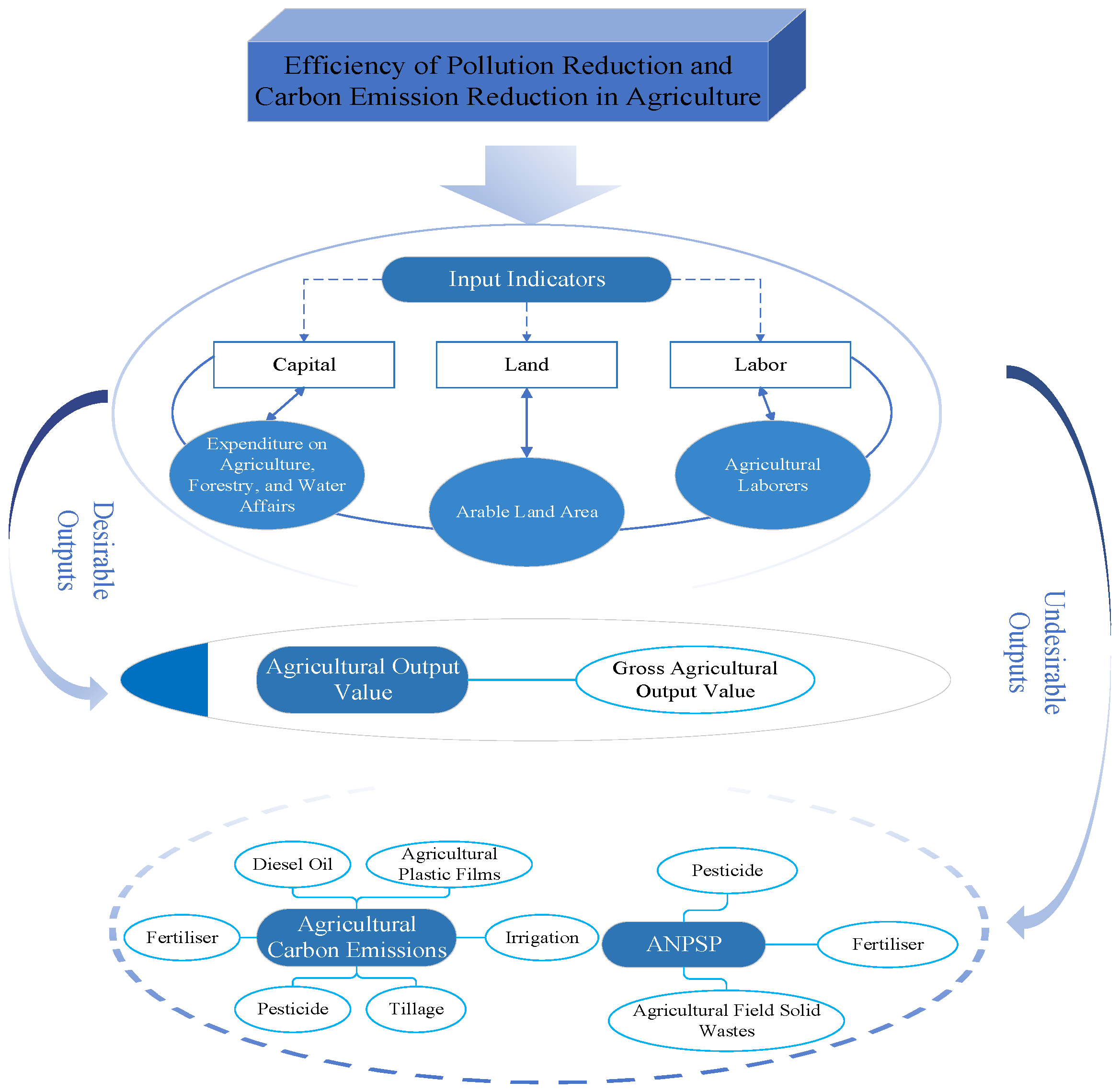
30], and according to principles such as the comprehensiveness, scientific validity, and data availability of the selected evaluation indicators, this study integrates the inputs and corresponding outputs of their synergy effect in ecologically fragile areas to construct the following evaluation indicator system for the synergistic efficiency, as shown in
Figure 1.
Among these, agricultural carbon emissions are calculated using the IPCC emission factors; following Wang et al. (2025), the accounting for agricultural carbon emissions focuses on six major direct and indirect carbon sources: diesel, chemical fertilizers, pesticides, agricultural films, irrigation, and tillage [
16], as shown in
Table 1.
For agricultural non-point source pollution, the inventory analysis method is used; three accounting indicators are identified: chemical fertilizers, pesticides, and solid agricultural waste [
16], as shown in
Table 2.
2.1.2. Methodology for Evaluating Pollution Control and Carbon Reduction Efficiency in Agriculture
Traditional DEA and SBM models cannot measure the impact of slack variables on efficiency and fail to effectively rank jointly efficient decision units, leading to inaccurate efficiency evaluations [
36]. The super-efficient SBM model not only accounts for the influence of input and output slack variables on efficiency levels but also enables comparative analysis and ranking of efficiency values across multiple efficient decision units [
37]. Therefore, this paper constructs a super-efficiency SBM model for evaluating agricultural pollution control and carbon reduction efficiency using non-expected outputs. On the premise that the synergistic efficiency of decision-making units (DMUs) is quantified, the efficiency formula for each DMU is
Among these, represents the target efficiency value; denotes the measured variable ; and signifies the respective weights. Each variable has input indicators: ; expected output indicators: ; and non-expected output indicators: . Here, , and represents the slack variable for inputs, indicating excess resource inputs; represents the slack variable for expected output, indicating a shortfall in effective output; and represents the slack variable for unanticipated output, indicating excessive carbon emissions and non-point source pollution. The larger the value of , the higher the efficiency of pollution and carbon reduction; conversely, the lower the value of A, the lower the efficiency.
2.1.3. Malmquist–Luenberger (ML) Index
The agricultural pollution control and carbon reduction efficiency values calculated using the super-efficient SBM model represent static efficiency values. To further explore their dynamic changes over time, this study introduces the ML index to examine the dynamic evolution of the synergistic efficiency in ecologically fragile regions. Its formula is as follows:
The specific breakdown method is as follows:
Among these, the change in technical efficiency (EFFCH) reflects the relative change in technical efficiency from year t to year t + 1; the change in technological progress (TECH) reflects the impact of production technology advances on the decision-making unit.
2.2. Identification of Factors Affecting Pollution Control and Carbon Reduction Efficiency in Agriculture and Model Construction
2.2.1. Identification of Factors Affecting Pollution Control and Carbon Reduction Efficiency in Agriculture
As a study on the factors influencing the synergistic efficiency, this paper references relevant literature on industrial pollution reduction, carbon emission reduction, agricultural carbon emissions, and agricultural non-point source pollution [
38,
39]. Considering data availability, the identified explanatory variables include the level of rural economic development, crop planting structure, the strength of fiscal support for agriculture, rural education level, urbanization rate, and mechanization level. The dependent variable refers to the synergistic efficiency (
Table 3). All other original data sources are drawn from provincial and municipal statistical yearbooks.
2.2.2. Construction of the Tobit Model
Given that the agricultural pollution control and carbon reduction efficiency values estimated by the super-efficient SBM model exhibit non-negative truncated characteristics, the use of OLS methods typically distorts estimation results. Most scholars employ the Tobit model for analysis to effectively avoid issues such as biased parameters [
40]. Therefore, this study employs a Tobit model for the empirical analysis of factors influencing the synergistic efficiency, as shown in Equation (7):
Here, E denotes the explained variable of the synergistic efficiency; i represents the region; t indicates the year; is the constant term; is the random disturbance term; and are the estimated parameters for rural economic development level, fiscal support for agriculture, crop planting structure, rural education level, urbanization rate, and mechanization level, respectively.
3. Results
3.1. Temporal Characteristics of Agriculture Pollution Control and Carbon Reduction Efficiency in Ecologically Fragile Areas
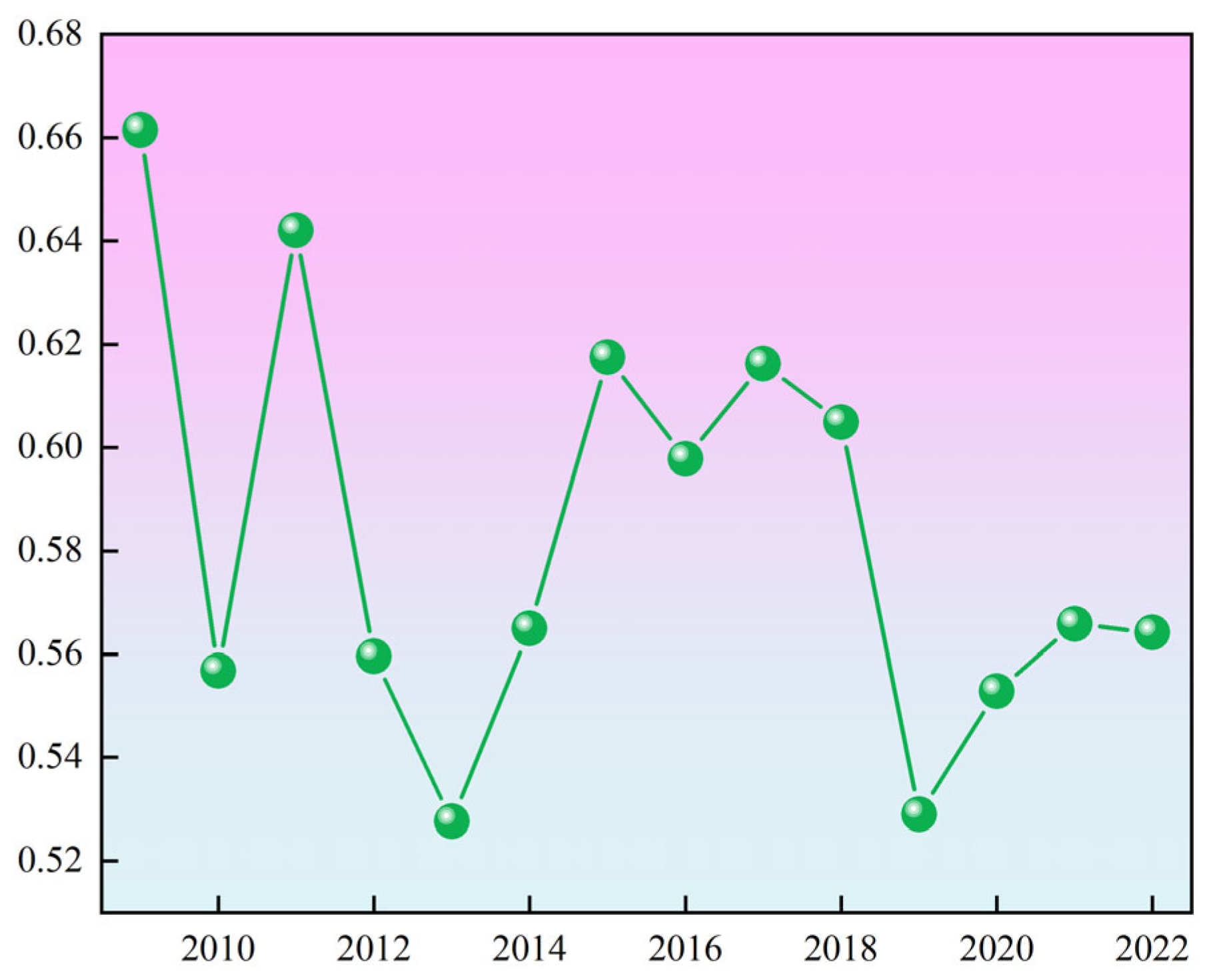
This study employs MaxDEA 9 software to calculate the synergistic efficiency of cities within ecologically fragile regions from 2008 to 2022. Efficiency values greater than or equal to 1 indicate relatively effective performance, with higher values signifying greater DMU efficiency. The results are shown in
Figure 2. The fluctuation of the synergistic efficiency in ecologically fragile areas shows a stable trend, with the mean range maintained between 0.56 and 0.66, indicating that there is still considerable room for improvement. This may be because, during the period under review, the agricultural production methods in most cities within ecologically fragile areas were still primarily based on traditional extensive models, with a high dependence on agricultural inputs such as fertilizers and pesticides, resulting in serious agricultural non-point source pollution and carbon emissions, which in turn led to an overall low synergistic efficiency.
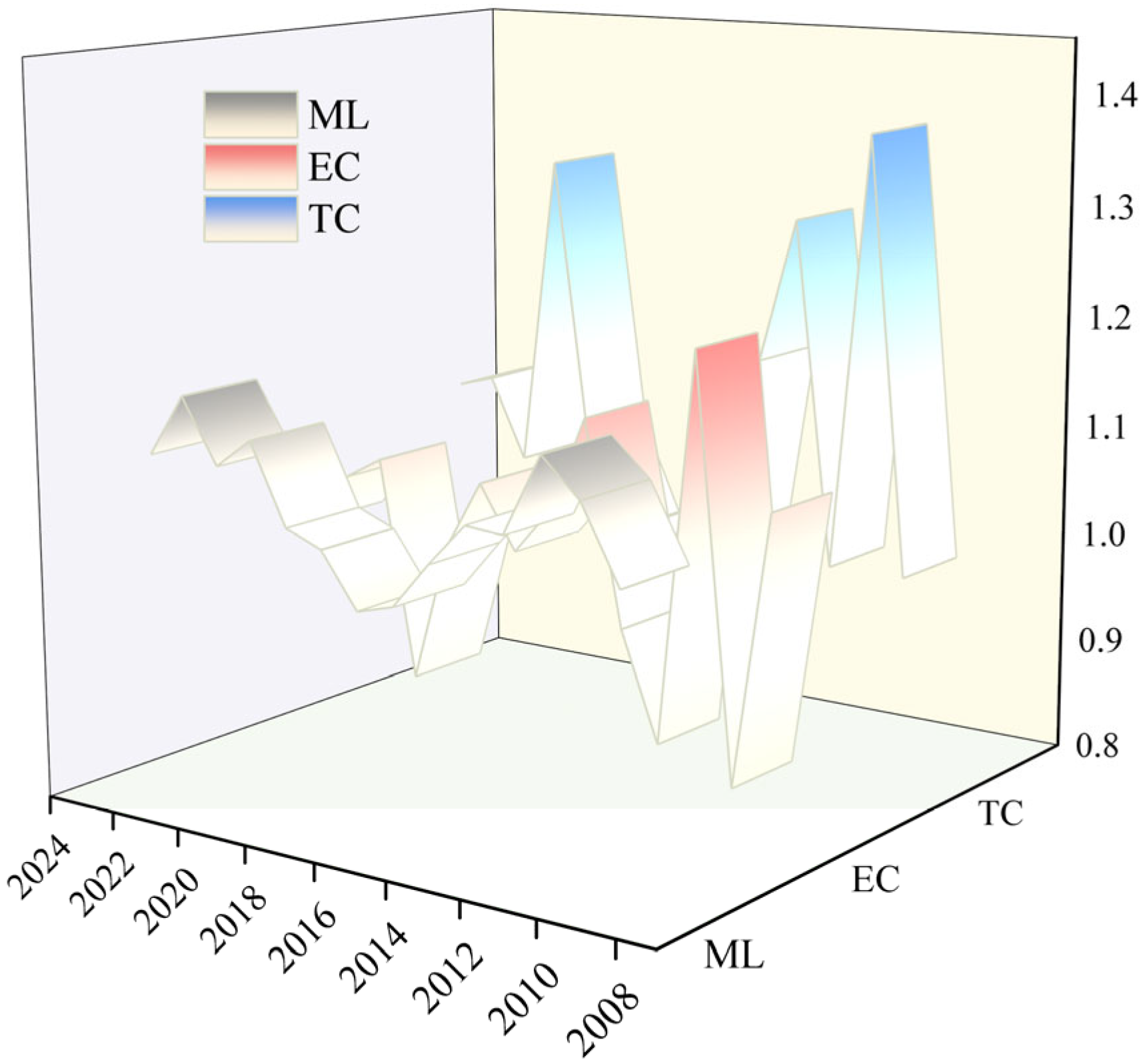
In order to further analyze the dynamic changes in the synergistic efficiency in various cities, this paper uses MaxDEA9 software to calculate the ML index of the synergistic efficiency and its decomposition indicators for each city. The measurement results are shown in
Figure 3. From 2008 to 2022, the total factor productivity change index (TFPCH) of the synergistic efficiency in ecologically fragile areas fluctuated slightly, and the total factor productivity change in each year was greater than 1, indicating that the synergistic efficiency in ecologically fragile areas improved to varying degrees every year. From the index decomposition, the improvement is mainly attributed to technological progress. The geometric average of the TC index in various prefecture-level cities from 2008 to 2022 was 1.09, growing at an annual rate of 9%; in contrast, the contribution of technical efficiency was relatively small, with an annual growth rate of only 2%, indicating that technological progress is the main factor driving the improvement of the synergistic efficiency in ecologically fragile areas.
3.2. Spatial Differentiation Characteristics of Agriculture Pollution Control and Carbon Reduction Efficiency in Ecologically Fragile Areas
Considering that the results calculated by DEA are “relative efficiency”, the results in this paper only take into account the relative levels of the synergistic efficiency among cities. If the sample data were expanded to include the entire country, the results might be different. There are significant differences in the synergistic efficiency values among cities within ecologically fragile areas. Based on the average from 2008 to 2022, only 10 cities—Yangquan, Tongling, Urumqi, Ezhou, Yichun, Huangshan, Hefei, Wuhan, Chengdu, and Xinyu—achieved effective levels of the synergistic efficiency, while the remaining 111 cities’ synergistic efficiency has not yet reached effective levels.
Examining the reasons, it can be seen that the causes for meeting efficiency standards can be divided into two categories. One category relies on superior natural conditions and well-developed infrastructure to achieve truly high-efficiency cities, such as Wuhan, Hefei, and Chengdu. The remaining seven cities meet the standards mainly due to small-scale agriculture, which results in lower pollutant and carbon emissions, thereby achieving compliance in efficiency measurements. Wuhan is located in the core area of the Jianghan Plain, at the confluence of China’s largest river, the Yangtze, and its largest tributary, the Han River, with abundant water resources and convenient irrigation. Hefei is a national commodity grain base with complete agricultural infrastructure. Chengdu, known as the “Land of Abundance,” is warm and humid and protected by the Dujiangyan irrigation system, being one of the largest granaries in Southwest China. These three cities are located on plains, suitable for large-scale farming, and their total agricultural output ranks among the top. In contrast, Yangquan’s coal industry is the pillar industry; Tongling, Ezhou, and Xinyu focus more on industry; Urumqi, Yichun, and Huangshan specialize in animal husbandry, forestry, and tourism, respectively. These cities are constrained by natural resources, have smaller-scale agriculture, and consequently lower pollutant and carbon emissions. Therefore, the efficiency compliance in these cities is more due to the limited total agricultural output forcing intensive practices rather than an actively efficient green development model. The reason the remaining 111 cities failed to meet the standard lies in the extensive nature of medium-sized agricultural production. These cities neither possess the comprehensive advantages of cities with strong agricultural sectors nor have the “naturally low emissions” of small cities. Under the current technological, management, and policy environment, it is difficult to balance production targets with the requirements of low-carbon development, resulting in low resource utilization efficiency, high pollution, and carbon emissions, and efficiency values that do not reach effective levels.
From the perspective of various regions in ecologically fragile areas, between 2008 and 2022, only six cities in these areas had an agricultural pollution control and carbon reduction total factor productivity slightly less than 1: Lijiang (0.97), Urumqi (0.99), Shizuishan (0.99), Liaoyuan (0.98), Tongchuan (0.89), and Tongling (0.92). The total factor productivity of the remaining 115 cities was all greater than 1, with an average total factor productivity of 1.08, indicating that the synergistic efficiency in ecologically fragile areas generally improved. From the perspective of index decomposition, 67 cities had an ML index and its decomposition values greater than or equal to 1, indicating that the level of progress in low-carbon agricultural production in these cities was relatively balanced, and improvements in resource allocation, management level, and agricultural technological advancement have all achieved certain results.
3.3. Analysis of Efficiency Drivers for Agriculture Pollution Control and Carbon Reduction in Ecologically Fragile Areas
This paper uses Stata 17 and applies the Tobit model to analyze the factors affecting the synergistic efficiency, and the regression results are shown in
Table 4.
Table 4 indicates that five variables passed the significance test. This confirms that these factors significantly influence the synergistic efficiency in ecologically fragile regions. Conversely, the rural education level shows no significant impact on the synergistic efficiency in these areas.
The level of rural economic development is significantly negative at 5%. This may be because in the early stages of rural economic development, agriculture mainly relies on chemical substances such as fertilizers and pesticides, with resource consumption exceeding ecological carrying capacity, and pollution emissions increasing as the economic scale expands, thereby squeezing the space for agricultural pollution control and carbon reduction; secondly, most cities mainly engage in extensive agricultural production, lack green agricultural technologies, and agricultural pollution cannot be effectively controlled, affecting the synergistic efficiency.
The strength of fiscal support for agriculture is significantly positive at the level of 1%, indicating that financial support for agriculture has a positive effect on improving the synergistic efficiency. Financial support for agriculture is mainly used for agricultural infrastructure construction, subsidizing the promotion of green agricultural technologies, etc., which improves resource utilization and reduces pollutant emissions from the source, thereby enhancing the synergistic efficiency.
The crop planting structure is significantly positive at the 1% level, indicating that reasonable adjustments in the planting structure help improve efficiency. According to the “National Compilation of Agricultural Product Costs and Benefits 2024” report, the per-unit area fertilizer application rate for food crops is 42–65% lower than that for economic crops. This indicates that as the proportion of food crops increases, the demand for agricultural chemicals such as fertilizers may show a downward trend, thereby achieving reduced non-point source pollution, lower carbon emissions, and increased agricultural output in the agricultural sector.
The urbanization rate is significantly positive at the 1% level, indicating that an increase in the urbanization rate effectively promotes the synergistic efficiency. A possible reason is that the agglomeration effect brought by the urbanization process reduces the number of agricultural practitioners, thereby promoting the transfer of rural land and large-scale operations.
The level of mechanization is significantly negative at the 1% level, indicating that an increase in mechanization has a negative inhibitory effect on the synergistic efficiency. This may be because the carbon emissions and pollution generated by agricultural machinery operations temporarily exceed the productivity gains they bring, as well as due to the inadequacies of the production system and the vulnerability of disturbance–resilience ecosystems in ecologically fragile regions. Although mechanization improves production efficiency, it is often accompanied by increased diesel consumption, soil disturbance, and insufficient matching with green management practices, leading to higher carbon emissions and agricultural non-point source pollution. Under the constraints of fragile ecosystems, mechanized input without synergistic green technology results in efficiency loss rather than synergistic improvement.
The level of rural education is not significant, suggesting that under the current model setup, the level of rural education does not have a statistically significant impact on the synergistic efficiency. This indicates that although farmers with educational experiences may have more environmental knowledge and awareness, it does not necessarily mean that this knowledge and awareness can be directly converted into actual low-carbon and low-pollution behaviors, meaning there is a lag effect in converting educational outcomes into environmental efficiency.
4. Discussion
Based on data from cities in ecologically fragile areas from 2008 to 2022, this paper measures agricultural pollution control and carbon reduction efficiency by constructing an undesirable output-based super-efficiency SBM model, and analyzes the dynamic changes in efficiency using the Malmquist–Luenberger index, thereby exploring the spatiotemporal evolution characteristics of the synergistic efficiency. It reveals the temporal and spatial differences in the synergistic efficiency in ecologically fragile areas and conducts an empirical analysis of the factors influencing the synergistic efficiency using the Tobit model, leading to the following conclusions.
From a temporal perspective, the efficiency of two subsystems in ecologically fragile areas has been continuously improving, but the overall level remains low, with technological progress being the main driving force. Between 2008 and 2022, the average synergistic efficiency in ecologically fragile areas remained around 0.58. Among these, 111 cities, accounting for about 91.7%, did not reach an effective level, indicating that the overall synergistic efficiency is low, with significant potential for improvement. According to the Malmquist–Luenberger index and its decomposition, from 2008 to 2022, the total factor productivity of the synergistic efficiency in ecologically fragile areas was consistently greater than 1, indicating a continuous upward trend in efficiency, mainly due to the significant contribution of technological progress, with an average annual growth of 9%, while the contribution of technical efficiency was relatively weak, averaging only 2% per year.
From a spatial perspective, the efficiency of two subsystems in ecologically fragile areas shows a “bipolarization” characteristic, and the causes of cities meeting the standards are very different. There are significant efficiency differences within the region, showing a “polarized” pattern. Only 10 cities, including Wuhan, Hefei, Chengdu, Yangquan, and Tongling, have reached an effective level, while the remaining 111 cities have not met the standard. Wuhan, Hefei, and Chengdu achieve relatively high efficiency with high agricultural output due to favorable natural conditions, well-developed infrastructure, and large-scale farming. In contrast, Yangquan, Tongling, Ezhou, and Urumqi passively meet the standard because of small agricultural scale and an industrial structure biased towards non-agriculture, resulting in a low overall baseline of pollutants and carbon emissions, rather than representing a truly high-efficiency green development model.
From the perspective of influencing factors, the intensity of fiscal support for agriculture, crop planting structure, and urbanization rate have a significant positive effect on the synergistic efficiency in ecologically fragile areas; the level of rural economic development and the level of mechanization have a significant negative effect on this efficiency; whereas the level of rural education has a positive but not significant effect on the synergistic efficiency in ecologically fragile areas.
In existing research, Wang et al. (2025) assessed the synergistic effects of agricultural pollution and carbon reduction in ecologically fragile areas from 2006 to 2021 and found an upward trend over time, consistent with the results of this study and there are marked differences in spatial distribution patterns [
30]. The synergistic effects consist of two components, coupling and coordination. Coupling reflects the relative quantitative relationship between agricultural carbon emissions and pollution emissions, while coordination is closely related to the emission levels of both. The findings of Wang et al. (2025) [
16] indicate that the coupling degree approached 1 during the study period in ecologically fragile areas, suggesting that the trends in agricultural carbon emissions and pollution emissions were highly consistent. And the synergy effect in ecologically fragile areas exhibits a spatial pattern characterized by “higher values in the east and lower in the west, and higher in the south and lower in the north”.
Due to variations in the scale of agricultural production across different years, the total volumes of agricultural carbon emissions and pollution emissions differed significantly, leading to marked variations in coordination. Therefore, when estimating the synergistic effects of agricultural pollution and carbon reduction based on total emissions, the results depend to a large extent on the levels of carbon emissions and pollution emissions themselves. In contrast, this study focuses on the efficiency of agricultural pollution and carbon reduction synergy, examining the comprehensive synergy from a process perspective to reflect the complex relationships among factor inputs, economic outputs, and unintended outputs.
This study addresses the dual contradiction between agricultural production and ecological protection in ecologically fragile areas, providing empirical support at the city for formulating differentiated agricultural green development policies for such regions, and also offering a reference model for the regional practice of coordinated national efforts in agricultural pollution control and carbon reduction.
5. Conclusions
The management of ecologically fragile areas has always been a major global challenge, especially in the fields of climate change mitigation and adaptation. Conducting the synergistic efficiency from a performance perspective is an important starting point. Based on existing research, precise fiscal policies need to be implemented to align fiscal investment with technological adaptation. Increasing the preferential allocation of funds for agricultural, forestry, and water affairs in ecologically fragile areas, focusing on the promotion and application of low-carbon agricultural technologies such as water-saving irrigation projects, as well as alternative technologies like organic fertilizers, soil-tested formulated fertilizers, and biopesticides, can improve the efficiency of fund usage. According to the resource constraints of ecologically fragile areas and the regional characteristics of each area, planting patterns should be adjusted, prioritizing energy-saving and water-saving crop varieties, comprehensively considering resource carrying capacity, controlling planting scale and crop types, and reducing interference with the ecosystem. The allocation ratio of resource factors should be reasonably adjusted to improve resource utilization efficiency, enhance the synergistic efficiency, and drive the development of the agricultural industry. Fully considering the local levels of economic development and resource constraints, differentiated regional policies should be formulated.
Following the recent literature [
18,
19,
20], building adaptive capacity through flexible technology extension systems and ecological buffers is suggested, rather than sole reliance on top-down technology diffusion.
For highly efficient cities such as Wuhan, Chengdu, and Hefei, they should minimize emission intensity through optimal factor allocation and play a benchmark role, strengthen demonstrations of green agricultural technology innovation, and focus on developing scalable green production technologies that are compatible with the synergy effect; establish a refined monitoring system for the synergy effect, using big data and IoT technologies to achieve real-time monitoring of carbon and pollution emissions throughout the entire agricultural production process, and precisely control emission points; establish a regional coordination governance mechanism to encourage surrounding non-compliant cities to engage in technological cooperation and industrial linkage, thereby generating a radiating impact.
For cities that are passively compliant, such as Yangquan, Tongling, and Urumqi, they need to balance emission caps with economic viability, agricultural production red lines should be defined and agricultural production scales strictly controlled; leverage local resource endowments to develop low-input, low-emission specialized industries, improve the quality of green agricultural development, and achieve a shift toward high efficiency and low emissions; establish an agricultural ecological compensation mechanism to provide special subsidies to farmers and operating entities engaged in ecological agricultural production, incentivizing green agricultural practices.
For the remaining 111 non-compliant cities, implement a “one city, one policy” emission reduction target, prioritizing low-cost emission reduction measures and focusing on high-carbon emission areas such as reducing fertilizers and pesticides and utilizing non-desirable resources, and achieve production method transformation by providing low-carbon planting technologies; strengthen the inclusive promotion of green agricultural technologies, establish a three-level technical promotion system, offer free technical training, and prioritize low-cost, easy-to-operate pollution and carbon reduction techniques such as soil testing-based fertilization, green pest control, and water-saving irrigation; promote rural land transfer and moderately scaled operations, integrating scattered farmland through land cooperatives, family farms, and other forms to enhance the scale of agricultural production, laying the foundation for the promotion of green technologies; establish an agricultural pollution control and carbon reduction assessment mechanism, incorporating pollution and carbon reduction indicators into local agricultural development assessment systems to reinforce the governance responsibilities of local governments.
The limitations of this study primarily arise from restricted data samples, which prevented the presentation of results for certain city-level measurements, and it is difficult to construct valid instrumental variables that satisfy the conditions of correlation and exogeneity; as a result, the Tobit regression model may be subject to omitted variable bias and potential endogeneity issues. Furthermore, The policy implications of this study are relatively general and directional, derived from statistically significant results and classification characteristics rather than closely linked to fine-grained quantitative findings, and more detailed and model-driven analyses will be conducted in future research to generate targeted policy insights. These areas warrant future research employing novel methods such as spatial causal inference and machine learning to create a comprehensive overview of all ecologically vulnerable zones. Similarly, extending the time range may yield more accurate and timely assessments of the effects of synergistic agricultural pollution control and carbon reduction.