Natural Factors Driving Yield Variability of Camelina sativa L. Crantz and Brassica carinata L. Brown Yield on Sandy-Textured Soils—Case Study from Poland

 ,
,  , , , ,
  , and
, and
Abstract
1. Introduction
2. Materials and Methods
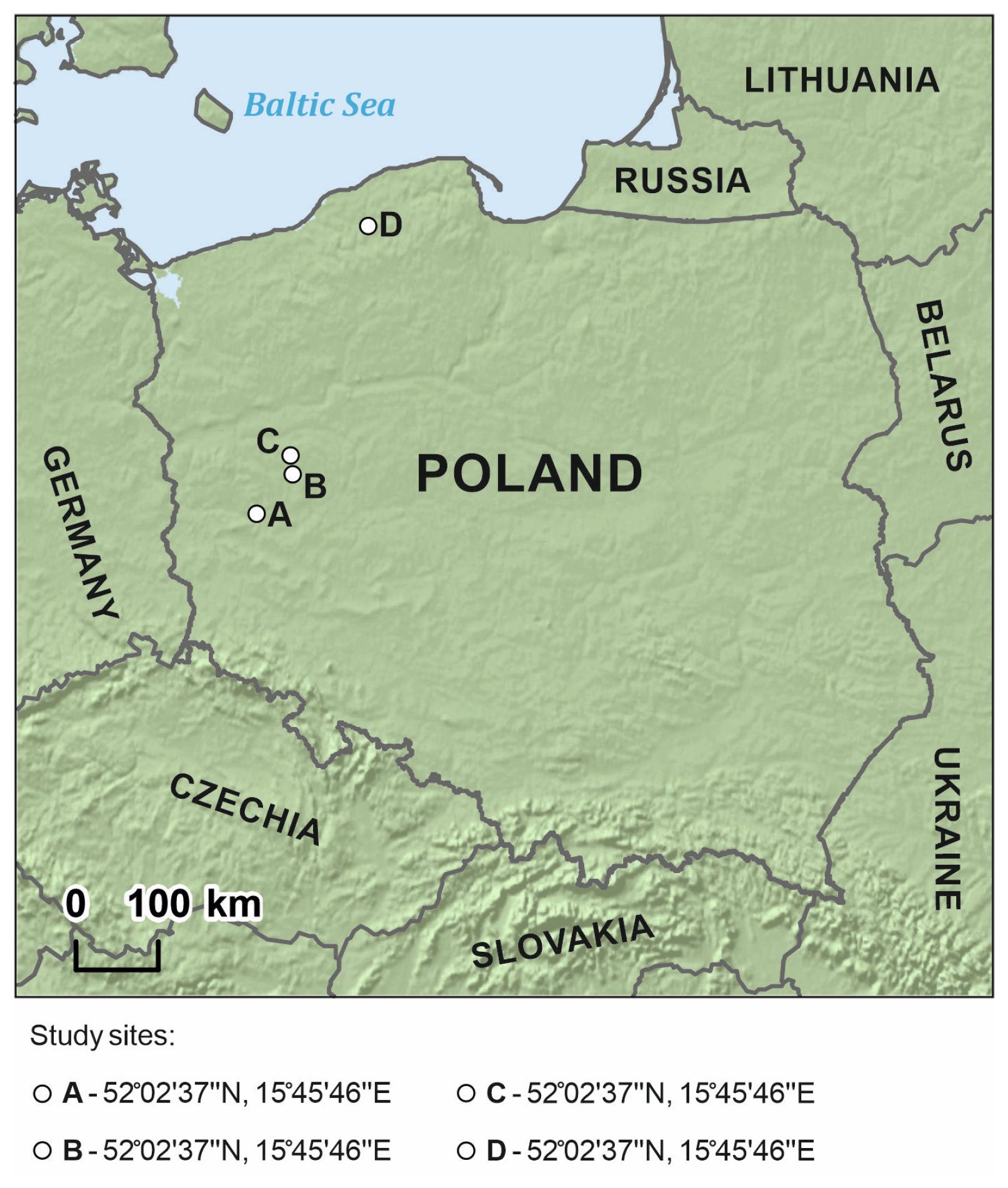
2.1. Study Sites
2.2. Field Trials
2.3. Field Survey
2.4. Laboratory Analysis
2.5. Data Processes
3. Results
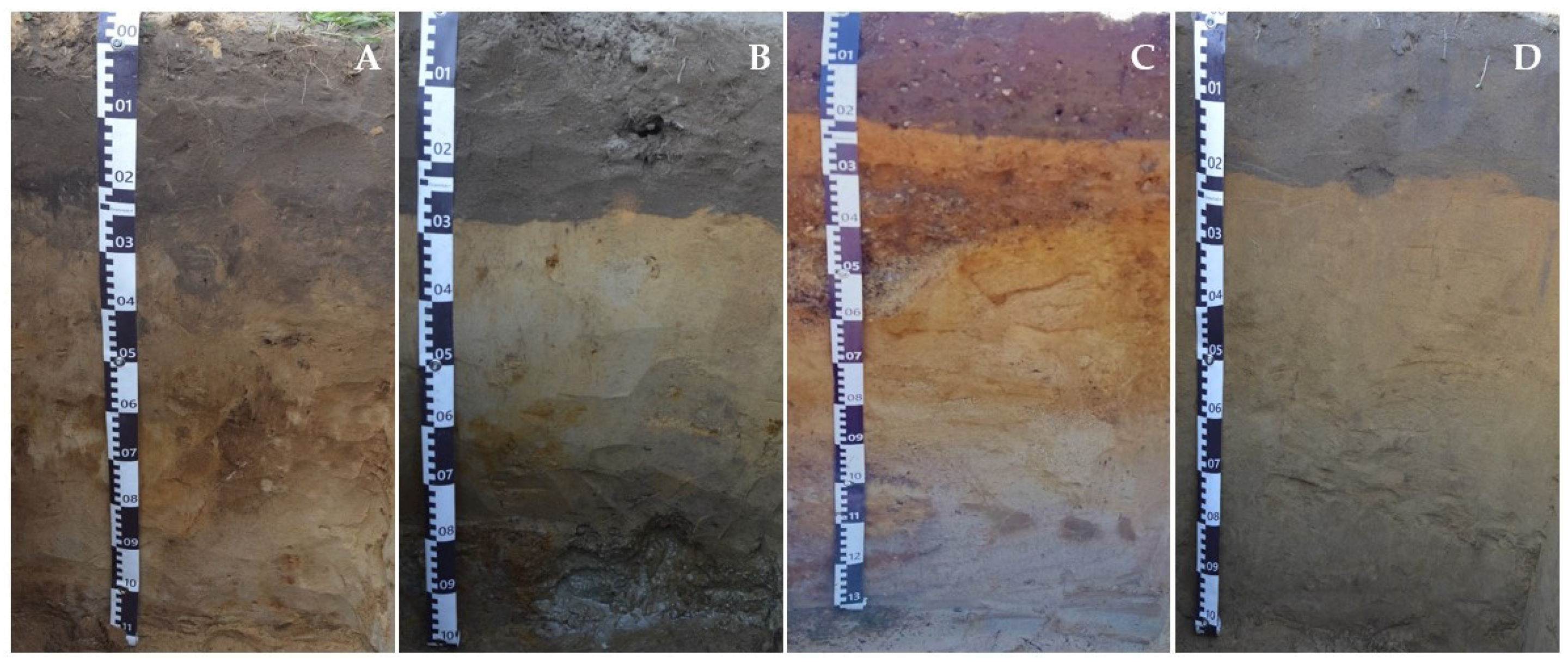
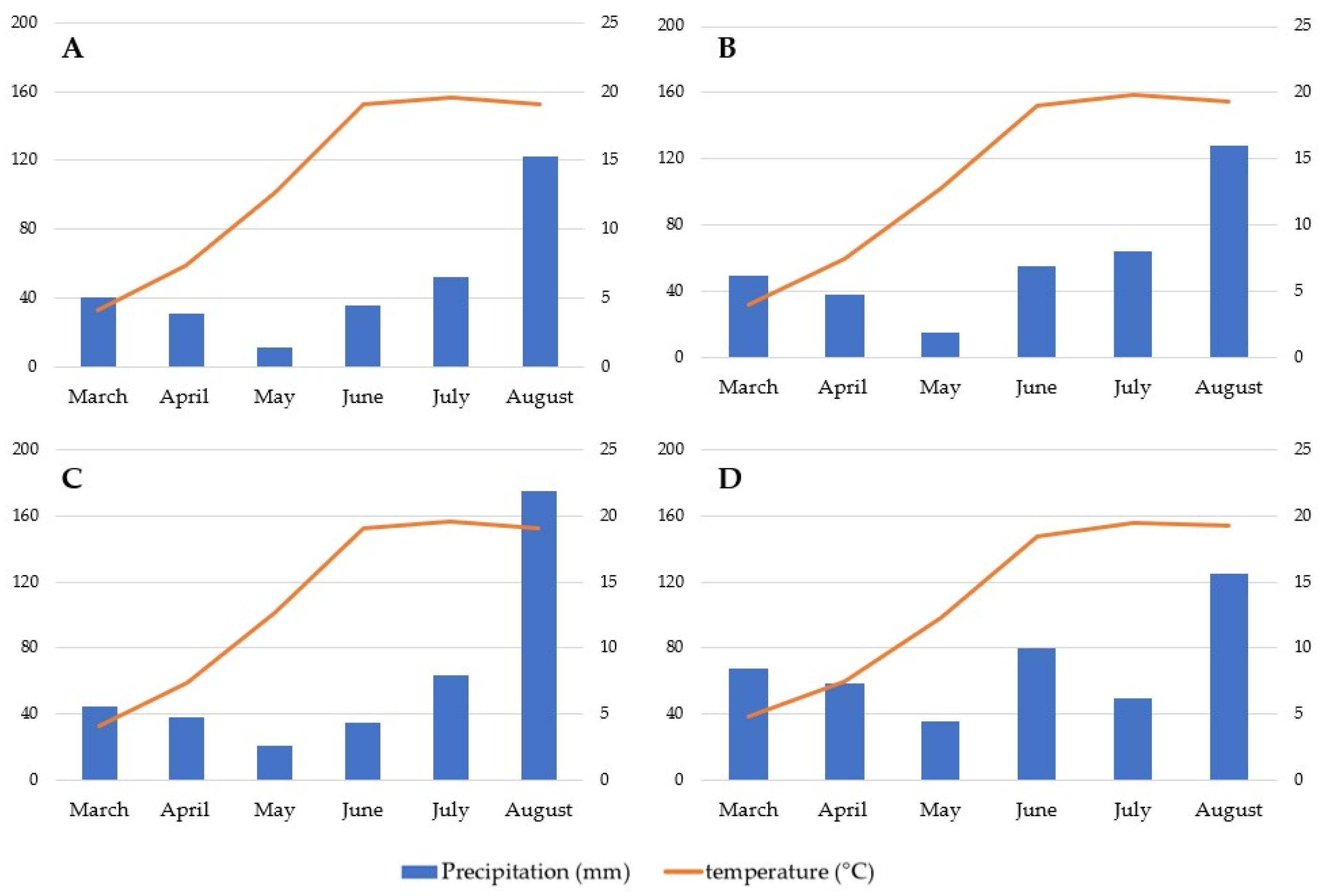
3.1. Soil and Weather Conditions Characterization
3.2. Soil Physical Properties
3.3. Soil Chemical Properties
3.4. Relationships Between Crop Yields, Soil Properties, and Weather Conditions
4. Discussion
5. Conclusions
Author Contributions
Funding
Institutional Review Board Statement
Data Availability Statement
Conflicts of Interest
References
- Copernicus. The 2023 Annual Climate Summary—Global Climate Highlights 2023. 2024. Available online: https://climate.copernicus.eu/global-climate-highlights-2023#:~:text=Almost%20all%20land%20areas%20experienced,for%20several%20regions%20in%202023 (accessed on 18 February 2026).
- European Environment Agency. Drought Impact on Ecosystems in Europe. 2023. Available online: https://www.eea.europa.eu/en/analysis/indicators/drought-impact-on-ecosystems-in-europe (accessed on 18 February 2026).
- Rahman, G.; Jung, M.K.; Kim, T.W.; Kwon, H.H. Drought impact, vulnerability, risk assessment, management and mitigation under climate change: A comprehensive review. KSCE J. Civ. Eng. 2025, 29, 100120. [Google Scholar] [CrossRef]
- Lipiec, J.; Doussan, C.; Nosalewicz, A.; Kondracka, K. Effect of drought and heat stresses on plant growth and yield: A review. Int. Agrophys. 2013, 27, 463–477. [Google Scholar] [CrossRef]
- Smreczak, B.; Hewelke, E.; Kowalik, M.; Ukalska-Jaruga, A.; Weber, J. Racjonalne zarządzanie glebami rolnymi w warunkach zmieniającego się klimatu. Soil Sci. Annu. 2024, 75, 193074. [Google Scholar] [CrossRef]
- Gus-Stolarczyk, M.; Drewnik, M.; Szymański, W. Origin, properties and transformation of soil lamellae in rusty soils (Brunic Arenosols) in southeastern Poland. Soil Sci. Annu. 2021, 72, 143881. [Google Scholar] [CrossRef]
- Jankowski, M.; Bednarek, R. Rusty soil—Gleba rdzawa—Soil of the Year 2021 in Poland. Concepts of genesis, classification and regularities of geographical distribution. Soil Sci. Annu. 2021, 72, 145585. [Google Scholar] [CrossRef]
- Jonczak, J.; Sztabkowski, K. Spatial variability of Brunic Arenosols and associated soils along the slope of the Słupia River valley (middle Pomerania, northern Poland). Soil Sci. Annu. 2021, 72, 143892. [Google Scholar] [CrossRef]
- Liu, L.; Gudmundsson, L.; Hauser, M.; Qin, D.; Li, S.; Seneviratne, S.I. Soil moisture dominates dryness stress on ecosystem production globally. Nat. Commun. 2020, 11, 4892. [Google Scholar] [CrossRef]
- Anderson, R.; Bayer, P.E.; Edwards, D. Climate change and the need for agricultural adaptation. Curr. Opin. Plant Biol. 2020, 56, 197–202. [Google Scholar] [CrossRef]
- Rezaei, E.E.; Webber, H.; Asseng, S.; Boote, K.; Durand, J.L.; Ewert, F.; MacCarthy, D.S. Climate change impacts on crop yields. Nat. Rev. Earth Environ. 2023, 4, 831–846. [Google Scholar] [CrossRef]
- Seepaul, R.; Kumar, S.; Iboyi, J.E.; Bashyal, M.; Stansly, T.L.; Bennett, R.; Boote, K.J.; Mulvaney, M.; Small, I.M.; George, S.; et al. Brassica carinata: Biology and agronomy as a biofuel crop. GCB Bioenergy 2021, 13, 582. [Google Scholar] [CrossRef]
- Neupane, D.; Lohaus, R.H.; Solomon, J.K.; Cushman, J.C. Realizing the potential of Camelina sativa as a bioenergy crop for a changing global climate. Plants 2022, 11, 772. [Google Scholar] [CrossRef] [PubMed]
- Ortiz, R.; Geleta, M.; Gustafsson, C.; Lager, I.; Hofvander, P.; Löfstedt, C.; Cahoon, E.B.; Minina, E.; Bozhkov, P.; Stymne, S. Oil crops for the future. Curr. Opin. Plant Biol. 2022, 56, 181–189. [Google Scholar] [CrossRef] [PubMed]
- Kurasiak-Popowska, D. Camelina sativa—A historical or perspective plant? Fragm. Agron. 2019, 36, 42–54. (In Polish) [Google Scholar] [CrossRef]
- Moser, B.R. Camelina (Camelina sativa L.) oil as a biofuels feedstock: Golden opportunity or false hope? Lipid Technol. 2010, 22, 270–273. [Google Scholar] [CrossRef]
- Hagos, R.; Shaibu, A.S.; Zhang, L.; Cai, X.; Liang, J.; Wu, J.; Lin, R.; Wang, X. Ethiopian mustard (Brassica carinata A. Braun) as an alternative energy source and sustainable crop. Sustainability 2020, 12, 7492. [Google Scholar] [CrossRef]
- Zanetti, F.; Peroni, P.; Pagani, E.; von Cossel, M.; Greiner, B.E.; Krzyżaniak, M.; Stolarski, M.J.; Lewandowski, I.; Alexopoulou, E.; Stefanoni, W.; et al. The opportunities and potential of camelina in marginal land in Europe. Ind. Crops Prod. 2024, 211, 118224. [Google Scholar] [CrossRef]
- IUSS Working Group WRB. World Reference Base for soil resources. In International Soil Classification System for Naming Soils and Creating Legends for Soil Maps, 4th ed.; International Union of Soil Sciences (IUSS): Vienna, Austria, 2022. [Google Scholar]
- Usowicz, B.; Lipiec, J. Spatial variability of soil properties and cereal yield in a cultivated field on sandy soil. Soil Tillage Res. 2017, 174, 241–250. [Google Scholar] [CrossRef]
- Ghazi, B.; Salehi, H.; Przybylak, R.; Pospieszyńska, A. Projection of climate change impact on the occurrence of drought events in Poland. Sci. Rep. 2025, 15, 5609. [Google Scholar] [CrossRef]
- Kottek, M.; Grieser, J.; Beck, C.; Rudolf, B.; Rubel, F. World map of the Köppen-Geiger climate classification updated. Meteorol. Z. 2006, 15, 259–263. [Google Scholar] [CrossRef]
- Richling, A.; Solon, J.; Macias, A.; Balon, J.; Borzyszkowski, J.; Kistowski, M. Regionalna Geografia Fizyczna Polski: Praca Zbiorowa; Bogucki Wydawnictwo Naukowe: Poznań, Poland, 2021. (In Polish) [Google Scholar]
- Van Reeuwijk, L.P. Procedures for Soil Analysis, 6th ed.; ISRIC: Wageningen, The Netherlands, 2002. [Google Scholar]
- Hammer, D.A.T.; Ryan, P.D.; Hammer, Ø.; Harper, D.A.T. Past: Paleontological statistics software package for education and data analysis. Palaeontol. Electron. 2001, 4, 9. [Google Scholar]
- Berzuini, S.; Zanetti, F.; Alberghini, B.; Leon, P.; Prieto, J.; Yambanis, Y.H.; Trabelsi, I.; Hannachi, A.; Udupa, S.; Monti, A. Assessing the productivity potential of camelina (Camelina sativa L. Crantz) in the Mediterranean basin: Results from multi-year and multi-location trials in Europe and Africa. Ind. Crops Prod. 2024, 219, 119080. [Google Scholar] [CrossRef]
- Li, J.; Su, Y.; Shapiro, C.A.; Schachtman, D.P.; Wang, X. Phosphate deficiency modifies lipid composition and seed oil production in camelina. Plant Sci. 2023, 330, 111636. [Google Scholar] [CrossRef]
- Graczyk, M.; Kurasiak-Popowska, D.; Niedziela, G. Changes in Camelina sativa Yield Based on Temperature and Precipitation Using FDA. Agriculture 2025, 15, 2051. [Google Scholar] [CrossRef]
- Ma, D.; He, Z.; Zhao, W.; Li, R.; Sun, W.; Wang, W.; Lin, P.; Wei, L.; Ju, W. Long-term effects of conventional cultivation on soil cation exchange capacity and base saturation in an arid desert region. Sci. Total Environ. 2024, 949, 175075. [Google Scholar] [CrossRef]
- Chiriac, O.P.; Pittarello, M.; Moretti, B.; Zavattaro, L. Factors influencing nitrogen derived from soil organic matter mineralisation: Results from a long-term experiment. Agric. Ecosyst. Environ. 2025, 381, 109444. [Google Scholar] [CrossRef]
- Gan, H.Y.; Schöning, I.; Schall, P.; Ammer, C.; Schrumpf, M. Soil organic matter mineralization as driven by nutrient stoichiometry in soils under differently managed forest stands. Front. For. Glob. Change 2020, 3, 99. [Google Scholar] [CrossRef]
- Arunrat, N.; Sereenonchai, S.; Sakurada, H.; Kongsurakan, P.; Toma, Y.; Hatano, R. Dynamics of 13C and 15N isotopes in fire-affected soils under rotational shifting cultivation in Northern Thailand. Biogeochemistry 2026, 169, 11. [Google Scholar] [CrossRef]
- Suliman, M.; Scaini, A.; Manzoni, S.; Vico, G. Soil properties modulate actual evapotranspiration and precipitation impacts on crop yields in the USA. Sci. Total Environ. 2024, 949, 175172. [Google Scholar] [CrossRef]
- Wei, J.; Zhang, X.; Li, G.; Fu, K.; Yan, M.; Li, C.; Li, C. Phosphorus Alters the Metabolism of Sugars and Amino Acids in Elite Wheat Grains. Plants 2025, 14, 3152. [Google Scholar] [CrossRef]
- Krauss, M.; Berner, A.; Perrochet, F.; Frei, R.; Niggli, U.; Mäder, P. Enhanced soil quality with reduced tillage and solid manures in organic farming—A synthesis of 15 years. Sci. Rep. 2020, 10, 4403. [Google Scholar] [CrossRef]



| Site | Depth (cm) | Particle Size Distribution | Class USDA | BD (g cm−3) | ||
|---|---|---|---|---|---|---|
| Sand (%) | Silt (%) | Clay (%) | ||||
| A | 0–30 | 90 | 7 | 3 | sand | 1.52 ± 0.03 a |
| 30–60 | 90 | 6 | 4 | sand | 1.72 ± 0.04 a | |
| B | 0–30 | 89 | 8 | 3 | sand | 1.48 ± 0.03 a |
| 30–60 | 91 | 6 | 3 | sand | 1.54 ± 0.02 b | |
| C | 0–30 | 90 | 7 | 3 | sand | 1.71 ± 0.02 b |
| 30–60 | 94 | 5 | 1 | sand | 1.55 ± 0.04 b | |
| D | 0–30 | 90 | 6 | 4 | sand | 1.55 ± 0.04 ab |
| 30–60 | 94 | 4 | 2 | sand | 1.48 ± 0.05 b | |
| Site | Depth (cm) | pH | TOC | TN | P | K | Mg | |
|---|---|---|---|---|---|---|---|---|
| H2O | 1M KCl | % | mg kg−1 | |||||
| A | 0–30 | 5.2 ± 0.1 a | 4.4 ± 0.2 a | 0.57 ± 0.05 a | 0.08 ± 0.01 b | 80.5 ± 2.0 b | 73.0 ± 2.0 b | 11.7 ± 1.0 a |
| 30–60 | 5.0 ± 0.2 a | 4.2 ± 0.2 a | 0.18 ± 0.03 a | 0.05 ± 0.01 b | 75.2 ± 0.2 b | 71.3 ± 2.3 a | 12.6 ± 0.6 a | |
| B | 0–30 | 6.2 ± 0.1 bc | 5.6 ± 0.1 ab | 0.58 ± 0.04 a | 0.05 ± 0.01 a | 86.9 ± 3.3 a | 74.6 ± 2.1 a | 10.5 ± 0.9 a |
| 30–60 | 6.3 ± 0.3 a | 5.6 ± 0.2 ab | 0.09 ± 0.02 b | 0.01 ± 0.00 a | 81.6 ± 4.4 a | 77.0 ± 1.7 a | 10.2 ± 0.8 b | |
| C | 0–30 | 6.1 ± 0.1 ab | 5.3 ± 0.1 ab | 0.49 ± 0.04 b | 0.04 ± 0.00 ab | 87.4 ± 3.6 a | 77.0 ± 1.7 a | 14.0 ± 1.1 b |
| 30–60 | 7.1 ± 0.2 b | 6.8 ± 0.2 c | 0.03 ± 0.02 b | 0.01 ± 0.00 ab | 82.3 ± 1.3 a | 61.9 ± 1.0 b | 10.8 ± 0.7 a | |
| D | 0–30 | 7.2 ± 0.2 c | 6.5 ± 0.2 b | 0.60 ± 0.02 a | 0.05 ± 0.00 a | 84.8 ± 2.8 a | 76.0 ± 3.4 a | 11.7 ± 0.8 a |
| 30–60 | 6.9 ± 0.2 ab | 6.2 ± 0.2 bc | 0.19 ± 0.03 a | 0.01 ± 0.00 a | 81.5 ± 1.2 a | 75.4 ± 3.7 a | 12.3 ± 1.0 a | |
| Site | Depth (cm) | Ca2+ | Mg2+ | K+ | Na+ | HA | TEB | CEC | BS |
|---|---|---|---|---|---|---|---|---|---|
| cmol(+) kg−1 | % | ||||||||
| A | 0–30 | 2.40 ± 0.19 ab | 0.11 ± 0.01 a | 0.03 ± 0.00 a | 0.02 ± 0.00 a | 3.51 ± 0.13 a | 2.57 ± 0.19 ab | 6.08 ± 0.27 a | 42.2 ± 1.7 a |
| 30–60 | 2.04 ± 0.16 ab | 0.15 ± 0.03 ab | 0.03 ± 0.01 a | 0.02 ± 0.00 a | 3.42 ± 0.08 a | 2.24 ± 0.17 ab | 5.66 ± 0.25 a | 39.9 ± 1.4 a | |
| B | 0–30 | 2.49 ± 0.37 a | 0.17 ± 0.05 ab | 0.02 ± 0.01 a | 0.03 ± 0.01 a | 1.21 ± 0.07 b | 2.71 ± 0.39 a | 3.91 ± 0.39 ab | 68.9 ± 3.4 b |
| 30–60 | 2.57 ± 0.53 a | 0.11 ± 0.01 a | 0.02 ± 0.01 a | 0.03 ± 0.00 a | 1.17 ± 0.06 b | 2.72 ± 0.52 a | 3.90 ± 0.50 ab | 69.4 ± 4.8 b | |
| C | 0–30 | 2.37 ± 0.29 ab | 0.28 ± 0.05 b | 0.02 ± 0.01 a | 0.03 ± 0.00 a | 1.86 ± 0.08 ab | 2.70 ± 0.28 a | 4.56 ± 0.29 ab | 59.0 ± 2.8 ab |
| 30–60 | 1.79 ± 0.21 ab | 0.20 ± 0.02 b | 0.03 ± 0.01 a | 0.03 ± 0.00 a | 1.87 ± 0.05 ab | 2.05 ± 0.17 ab | 3.92 ± 0.17 ab | 52.3 ± 2.4 ab | |
| D | 0–30 | 1.64 ± 0.25 b | 0.14 ± 0.02 ab | 0.02 ± 0.01 a | 0.02 ± 0.00 a | 1.08 ± 0.05 b | 1.83 ± 0.25 b | 2.91 ± 0.20 b | 62.6 ± 4.5 ab |
| 30–60 | 1.65 ± 0.25 b | 0.15 ± 0.02 ab | 0.02 ± 0.01 a | 0.03 ± 0.00 a | 1.18 ± 0.06 b | 1.84 ± 0.23 b | 3.02 ± 0.23 b | 60.8 ± 3.5 b | |
| Site | C. sativa | B. carinata |
|---|---|---|
| kg ha−1 | ||
| A | 300 | 150 |
| B | 930 | 370 |
| C | 720 | 150 |
| D | 420 | 0 |
| BD | pH | TOC | TN | P | K | Mg | HA | BS | Pr | T | |
|---|---|---|---|---|---|---|---|---|---|---|---|
| C. sativa | −0.368 | 0.385 | −0.769 * | −0.598 * | 0.695 * | −0.155 | −0.341 | −0.459 * | 0.796 * | 0.200 | 0.775 * |
| B. carinata | −0.062 | −0.314 | −0.295 | −0.025 | 0.178 | −0.601 * | −0.478 * | 0.197 | 0.337 | −0.632 * | 0.817 * |
Disclaimer/Publisher’s Note: The statements, opinions and data contained in all publications are solely those of the individual author(s) and contributor(s) and not of MDPI and/or the editor(s). MDPI and/or the editor(s) disclaim responsibility for any injury to people or property resulting from any ideas, methods, instructions or products referred to in the content. |
© 2026 by the authors. Licensee MDPI, Basel, Switzerland. This article is an open access article distributed under the terms and conditions of the Creative Commons Attribution (CC BY) license.
Share and Cite
Glina, B.; Kurasiak-Popowska, D.; Piechota, T.; Grzanka, M.; Mikołajczyk, S.; Tomkowiak, A.; Stuper-Szablewska, K.; Rzyska-Szczupak, K. Natural Factors Driving Yield Variability of Camelina sativa L. Crantz and Brassica carinata L. Brown Yield on Sandy-Textured Soils—Case Study from Poland. Agriculture 2026, 16, 906. https://doi.org/10.3390/agriculture16080906
Glina B, Kurasiak-Popowska D, Piechota T, Grzanka M, Mikołajczyk S, Tomkowiak A, Stuper-Szablewska K, Rzyska-Szczupak K. Natural Factors Driving Yield Variability of Camelina sativa L. Crantz and Brassica carinata L. Brown Yield on Sandy-Textured Soils—Case Study from Poland. Agriculture. 2026; 16(8):906. https://doi.org/10.3390/agriculture16080906
Chicago/Turabian StyleGlina, Bartłomiej, Danuta Kurasiak-Popowska, Tomasz Piechota, Monika Grzanka, Sylwia Mikołajczyk, Agnieszka Tomkowiak, Kinga Stuper-Szablewska, and Katarzyna Rzyska-Szczupak. 2026. "Natural Factors Driving Yield Variability of Camelina sativa L. Crantz and Brassica carinata L. Brown Yield on Sandy-Textured Soils—Case Study from Poland" Agriculture 16, no. 8: 906. https://doi.org/10.3390/agriculture16080906
APA StyleGlina, B., Kurasiak-Popowska, D., Piechota, T., Grzanka, M., Mikołajczyk, S., Tomkowiak, A., Stuper-Szablewska, K., & Rzyska-Szczupak, K. (2026). Natural Factors Driving Yield Variability of Camelina sativa L. Crantz and Brassica carinata L. Brown Yield on Sandy-Textured Soils—Case Study from Poland. Agriculture, 16(8), 906. https://doi.org/10.3390/agriculture16080906