Article

Foliar Magnesium Supplementation as a Strategy to Mitigate Salt Stress in Guava (Psidium guajava L.) Cultivars: Physiological and Growth Responses


by
Luan Cordeiro de Souza Barbosa
1,
Paulo Cássio Alves Linhares
1,
Maria Mayanna Xavier Cavalcante
1,
Daniella Xavier Maia
1,
Gabriel Sidharta dos Santos Rego
1,
Rita de Cássia do Nascimento Medeiros-Sá
2,
Alexandre Xavier de Oliveira
1,
Diogo Santos Cavalcante
1,
Alex Alvares da Silva
1,
Kleane Targino de Oliveira Pereira
2,
Salvador Barros Torres
2,
Miguel Ferreira Neto
2,
Agda Malany Forte de Oliveira
3,
Alberto Soares de Melo
3 and
Francisco Vanies da Silva Sá
1,*
1
Department of Agrarian and Exact, Universidade Estadual da Paraíba, Catolé do Rocha 58884-000, PB, Brazil
2
Department of Agronomic and Forest Sciences, Universidade Federal Rural do Semi-Árido, Mossoró 59625-900, RN, Brazil
3
Department of Biological Sciences, Universidade Estadual da Paraíba, Campina Grande 58429-900, PB, Brazil
*
Author to whom correspondence should be addressed.
Agriculture 2026, 16(8), 905; https://doi.org/10.3390/agriculture16080905
Submission received: 3 March 2026 / Revised: 9 April 2026 / Accepted: 14 April 2026 / Published: 20 April 2026

Abstract

The guava tree (Psidium guajava L.) is a tropical fruit tree of worldwide importance; however, the salinity of irrigation water severely limits its development in semi-arid regions. However, magnesium (Mg) can mitigate this stress by promoting plant photosynthetic activity. The objective was to evaluate the effect of foliar Mg in mitigating saline stress on photosynthesis and the growth of guava cultivar seedlings. The experiment was conducted in a randomized complete block design, in a 2 × 2 × 3 factorial scheme, with two guava cultivars (Kumagai and Paluma), two irrigation water salinity levels (a low-salinity control—0.5 dS m−1, and salt stress—2.5 dS m−1), and three doses of foliar Mg (0, 1, and 2 mL L−1), and six replications. A salinity of 2.5 dS m−1 reduced growth and gas exchange in both cultivars, with a reduction of approximately 30% in total dry mass, and 16% in CO2 assimilation rate. Supplementation with 1 mL L−1 of Mg attenuated the effects of stress, stimulating chlorophyll synthesis and gas exchange, reducing approximately leaf temperature in 3.5%, and vapor pressure deficit (VPD) in 12%. The Paluma cultivar was more responsive to Mg under salinity, with improved CO2 assimilation rate, stomatal control, and water use efficiency. Kumagai showed greater growth in height and diameter with 1 mL L−1 under stress. Foliar application of magnesium (1 mL L−1) is a promising strategy to produce guava seedlings under saline stress.

1. Introduction

The guava tree (Psidium guajava L.) is a tropical fruit tree widely cultivated in various parts of the world, with Brazil among the largest producers [1,2]. In recent decades, Guava production has shown linear growth, driven mainly by the search for exotic fruits and the fruit’s wide range of nutritional benefits, including fiber, vitamins, minerals, and antioxidant activity [3,4]. In 2023, Brazil produced 582,832 tons of the fruit, with Pernambuco being the state with the highest productivity, at 25,919 kg ha−1 [5].
This fruit is one of the main crops cultivated in the São Francisco Valley, a region of great importance for fruit production in Brazil. Its cultivation mainly relies on localized irrigation, an efficient technique that, when well-managed, yields significant productivity gains [6]. However, the availability of water, in adequate quantity and quality, is necessary for irrigation management.
However, the edaphoclimatic conditions of the Northeast region of Brazil, coupled with anthropogenic action, intensified by inadequate irrigation and fertilization management of crops, as well as the use of brackish water in irrigation, have contributed to the salinization of arable soils. The high salt content of the soil solution, such as sodium and chloride, compromises plant productivity [7,8,9], making salinity a limiting abiotic factor for the growth and production of guava trees [2,10,11].
Restricted plant growth and development occur in response to reduced osmotic potential caused by excess salt in the soil solution, which inhibits water uptake by the plant’s root system. This compromises the assimilation of mineral nutrients and the translocation of solutes [12,13]. Consequently, saline stress causes a series of deleterious effects on guava plants. These include reduced water potential and loss of cell turgor, which stimulate stomatal closure and consequently affect gas exchange; in addition, they cause damage to the photosynthetic apparatus and plant pigmentation [10,11,14]. These effects limit the production and translocation of sugars, reducing plant growth and development [2,15,16].
Plants of the guava cultivar ‘Paluma’ have shown sensitivity to salinity, with water electrical conductivity (EC) starting at 1.0 dS m−1, which caused several adverse effects on productive performance [10,17,18]. However, guava plants may exhibit different mechanisms of adaptation and salinity tolerance, which vary with the cultivar’s genetic material [19,20]. Therefore, the study of salinity tolerance mechanisms in guava plants becomes fundamental.
Plant tolerance to salinity in irrigation water can be enhanced by stress attenuators [21,22]. These compounds favor the activation of tolerance mechanisms, such as reduced Na+ absorption, increased K+ absorption, Na+ compartmentalization in vacuoles, or its exclusion from the apoplast [19,23,24]. Among agricultural practices that can mitigate the effects of salinity, foliar supplementation with magnesium (Mg), an essential mineral for plant metabolism, stands out. In addition to being a central element of the chlorophyll molecule, Mg is directly related to plant photosynthetic activity, acting as an enzymatic cofactor in CO2 assimilation processes, such as the Mg-ATP compound [25,26]. This effect occurs mainly because Mg is involved in photosynthetic activity and energy metabolism of plants, in the translocation of essential nutrients, in the maintenance of cellular metabolism, in protein synthesis, and in plant development [27,28].
Despite the growing interest in the use of elicitors and mineral supplementation to mitigate salt stress in fruit crops, studies specifically focusing on the role of foliar magnesium (Mg) in Psidium guajava remain scarce. Most existing research on guava under salinity has prioritized other mitigants, such as salicylic acid or silicon, or focused primarily on macronutrient uptake via soil. Therefore, a significant research gap remains regarding the effects of foliar Mg application on salt stress in guava seedlings. This study differs from previous approaches by providing a comparative physiological analysis of two commercially distinct cultivars (‘Paluma’ and ‘Kumagai’) to determine whether Mg-mediated salt tolerance is a consistent trait or genotype-specific, and to establish the optimal concentration for nursery management.
In this context, we hypothesized that foliar supplementation with Mg attenuates the deleterious effects of saline stress in guava seedlings, due to its essential role in the stability of the photosynthetic apparatus and in physiological regulation. Thus, the objective was to evaluate the effect of foliar Mg application in mitigating saline stress on photosynthetic activity and growth of two guava cultivars.

2. Materials and Methods

2.1. Description of the Experimental Area

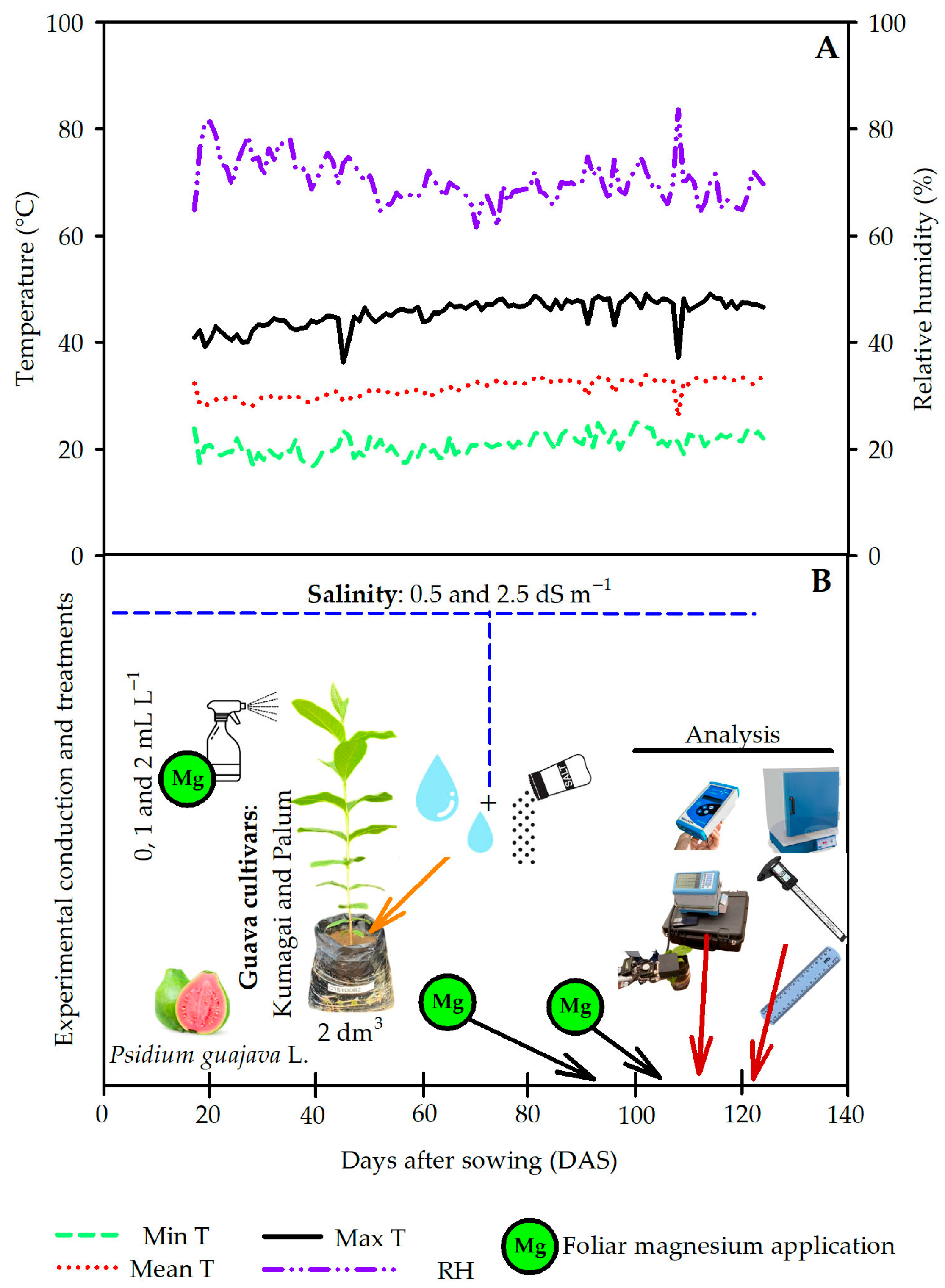
The experiment was conducted from July to November 2024 in a semi-field greenhouse of the State University of Paraíba (UEPB), Campus IV, in Catolé do Rocha, Paraíba, Brazil. The coordinates are (6°20′38″ S, 37°44′48″ W) at an altitude of 275 m. According to the Köppen classification, the climate is BSh (arid, with a rainy season in summer that extends into autumn) [29]. During the experimental period, temperature and relative humidity data from inside the greenhouse were recorded using a digital thermohygrometer with a datalogger (RC-51H, Elitech®, Canoas, Brazil). The minimum, average, and maximum temperatures were 20.79 °C, 31.36 °C, and 45.47 °C, respectively, and the relative humidity was 70.38% (Figure 1A).

2.2. Treatments and Experimental Design

A randomized complete block design was used, in a 2 × 2 × 3 factorial scheme, with six replications and two plants per replication. Factor 1 corresponded to two guava cultivars (C1: Kumagai and C2: Paluma); factor 2, to two irrigation water salinity levels (a low-salinity control—0.5 dS m−1, and salt stress—2.5 dS m−1); and factor 3, to three doses of magnesium applied via foliar spray (D0: 0 mL L−1, D1: 1 mL L−1 and D2: 2 mL L−1) (Figure 1B). We determined salinity levels and magnesium doses in preliminary experiments [30,31].

2.3. Setup and Execution of the Experiment

The guava seeds were obtained from local commerce, and sowing was carried out in polyethylene bags with a soil capacity of 2 dm3 (Figure 1B). Four seeds were sown per bag and, after germination stabilized 60 days after sowing, thinning was carried out, leaving one plant per bag.
The soil used was a Fluvisol collected from a virgin area of the experimental farm at Campus IV—UEPB. Soil samples were collected from the 0.0–30.0 cm layer, broken up, sieved (4 mm), and characterized for physical and chemical attributes, following the EMBRAPA methodology [32]. The following characteristics were obtained: pH (H2O) = 6.50; pH (CaCl2) = 5.30; O.M. = 9.70%; P = 156.80 mg dm−3; K+ = 243.60 mg dm−3; Na+ = 25.30 mg dm−3; Ca2+ = 5.78 cmolc dm−3; Mg2+ = 0.95 cmolc dm−3; Al3+ = 0.00 cmolc dm−3; H + Al = 1.20 cmolc dm−3; CTC = 7.44; V = 86.00% and PST = 1.30%; electrical conductivity of the soil saturation extract (CEes) = 0.35 dS m−1; soil density (Ds) = 1.53 kg dm−3; sand = 691.82 g kg−1; silt = 192.57 g kg−1; and clay = 115.60 g kg−1.
Based on the soil analysis results, macronutrient fertilization was carried out in four applications, corresponding to 25% of the total dose, applied in conjunction with irrigation at 35, 55, 75, and 95 days after sowing. The following amounts were applied: 50 mg of N, 127 mg of P2O5, 75 mg of K2O, 29 mg of Ca, 18 mg of Mg, and 30 mg of SO4 per dm−3 of soil, as recommended by the research laboratory [31]. The nutrient sources were: monoammonium phosphate (MAP), calcium nitrate (Ca(NO3)2), magnesium sulfate (MgSO4), potassium sulfate (K2SO4), and potassium chloride (KCl). Micronutrient fertilization was carried out via foliar application using Liqui-Plex Fruit® (Alltech, Maringá, Brazil) fertilizer, 90 and 105 days after sowing (DAS), at a rate of 3 mL L−1 of solution, following the manufacturer’s recommendation. This product has the following nutritional composition (g L−1): N = 73.50; Ca = 14.70; S = 77.91; B = 14.70; Cu = 0.74; Mn = 73.50; Mo = 1.47, and Zn = 73.50; in addition to organic carbon (OC) = 2.35%.
For foliar Mg supplementation, the commercial product FORPLANT® (Jaboticabal, Brazil) was used, with a density of 1.30 g mL−1 and an Mg content of 8%, sourced from magnesium sulfate (MgSO4). The different doses were applied with a manual sprayer (Fine Mist Clear Spray Bottle, China) and 25 mL per seedling [31], divided into two applications of 12.5 mL each, carried out on the 96th and 106th DAS (Figure 1B). At the time of Mg application, the plants corresponding to this treatment were removed from the blocks and grouped in a location distant from the other treatments to avoid contact with the applied product.
Low-salinity water was obtained from a shallow well with an electrical conductivity of 0.5 dS m−1. High-salinity water was obtained by adding the salts NaCl, CaCl2·2H2O, and MgCl2·6H2O to the healthy water in a 7:2:1 ratio, resulting in a 90 L stock solution for irrigating the S2 plants. This ratio predominates in the primary water sources available for irrigation in Northeast Brazil [33]. It follows the relationship between electrical conductivity (EC) and concentration (mmol c L−1 = EC × 10), as described by [34]. To determine the EC of the solution, a portable digital conductivity meter (Akso Ak51, Akso Produtos Eletrônicos, Brazil) was used, and this water was used to irrigate the S2 plants at 90 DAS.
After soil preparation, irrigation was carried out to keep the soil near its maximum water-retention capacity. Subsequent irrigations were performed every 2 days to maintain soil moisture near its maximum retention capacity, using the drainage lysimetry method, with the applied water depth increased by a leaching fraction (LF) of 15% every 30 days. The applied volume was estimated as an additional portion, based on the average water consumption of 4 plants, one per treatment. The applied volume (Va) per plant was obtained by the difference between the previous applied water depth (La) minus the average drainage (D), divided by the number of plants (n), as indicated in Equation (1):
V a = L a     D   n 1 L F
The total volume of water applied per plant was 4.52 L, corresponding to the application of 1.45 g of salt in plants irrigated with tap water (0.5 dS m−1) and 10.13 g of salt in plants irrigated with saline water (2.5 dS m−1). Ninety days after sowing, an additional leaching layer (15%) was applied. The drained volume was collected to determine the electrical conductivity of the drainage water (ECd) using a benchtop conductivity meter (Akso Ak51, Akso Produtos Eletrônicos, Brazil). The values were expressed in dS m−1, adjusted to 25 °C. The electrical conductivity of the saturation extract (ECes) (Table 1) was determined according to Equation (2), proposed by [35] for medium-textured soils.
E C e s = E C d 2

2.4. Variables Analyzed

The growth parameters were analyzed at 122 DAS, after the treatments were applied. Plant height (PH, cm) was measured with a graduated ruler, from the base of the plant to the apical bud. Stem diameter (SD, mm) was determined with a digital caliper at 1 cm from the soil surface. The main root length (MRL, cm) was measured with a graduated ruler. The number of leaves (NL) was determined by counting the fully expanded green leaves of each plant.
Gas exchange in guava seedlings was evaluated at 116 DAS, between 6:30 am and 10:30 am (Figure 1B). Evaluations were performed on a fully expanded leaf, located in the upper third of each plant, using an open-flow infrared gas analyzer (IRGA) (CIRAS-3, PP System, Amesbury, MA, USA). Temperature control at 25 °C, irradiation of 1200 µmol m−2 s−1 and air flow of 400 mL min−1 at atmospheric CO2 levels were used to obtain net CO2 assimilation (A, µmol m−2 s−1), stomatal conductance (gs, mol m−2 s−1), transpiration (E, mmol m−2 s−1), internal CO2 concentration (Ci, µmol mol−1), leaf temperature (LT, °C) and vapor pressure deficit from leaf to air (VPD, kPa). With these data, water use efficiency (WUE, µmol mmol−1), intrinsic water use efficiency (WUEi, µmol mol−1), and carboxylation efficiency (A/Ci, µmol m−2 s−1 Pa−1) were calculated [31].
Chlorophyll content was determined on the same leaf used for gas exchange measurements, using a portable electronic Chlorophyll meter (CFL 1030, Falker, Porto Alegre, Brazil) (Figure 1B). The equipment operates at three wavelengths: two in the red band (λ = 635 and 660 nm), corresponding to the absorption maxima of each type of chlorophyll, and one in the near-infrared (λ = 880 nm). Chlorophyll a (Chla), b (Chlb), and total (Chlt) indices were quantified, with the results expressed as the Falker Chlorophyll Index (FCI) [36].
In the 122 DAS, the seedlings were collected and sectioned into shoot and root to determine dry mass (DM) accumulation. Subsequently, they were placed in Kraft paper bags and forced-air ovened at 65 °C until they reached a constant weight (Figure 1B). Then, they were weighed on a precision analytical balance (0.0001 g) to obtain the root dry mass (RDM, g) and the shoot dry mass (SDM, g). With these values, the root-to-shoot ratio (RSR = RDM/SDM) and the total dry mass (TDM = RDM + SDM, g) were calculated.
From the DM data, the salinity tolerance index (STI) was calculated. Thus, the STI was obtained from SDM, RDM, and TDM using Equation (3).
S T I   ( % ) = D M   p r o d u c t i o n   u n d e r   s a l i n i t y D M   p r o d u c t i o n   i n   c o n t r o l × 100

2.5. Statistical Analysis

The data were subjected to the Shapiro–Wilk normality test (p ≥ 0.05). Variables that did not meet the normality assumptions were transformed using the square root (√x) (NL, SDM, RSR, gs, Chla, and Chlb). Next, we applied three-way analysis of variance (ANOVA) using the F-test (p ≤ 0.05). When the F-test indicated significance, the means were compared using the t-test (p ≤ 0.05) with the aid of the statistical software SISVAR©, version 5.8 [37]. In addition, a Pearson correlation analysis was performed using the corrplot package [38] on the R platform with RStudio version 2025.09.1. Afterward, variables with the highest positive correlations (p ≤ 0.05) were selected, and the treatment responses were presented. The figures were created using the free software LabPlot©, version 2.11.1 [39].

3. Results

The factors studied—cultivars, salinity, and magnesium doses—interacted significantly (F-test, p < 0.05) and influenced plant height (PH) and stem diameter (SD). Under a salinity of 2.5 dS m−1, a dose of 1 mL L−1 of foliar Mg provided the Kumagai cultivar with the highest PH (39.12 cm), statistically superior to that of Paluma (Table 2). At this same dose (1 mL L−1), the Kumagai cultivar maintained stable PH growth, with values like those obtained at 0.5 dS m−1, even under the higher saline stress of 2.5 dS m−1. However, doses of 0 and 2 mL L−1 of Mg resulted in severe reductions in the PH of Kumagai seedlings (34.09% and 22.63%, respectively) under a salinity of 2.5 dS m−1.
Under a salinity of 2.5 dS m−1, the Paluma cultivar-maintained plant height (PH) was similar to that obtained under 0.5 dS m−1, with only foliar supplementation of 2 mL L−1 of Mg (Table 2). At the highest salinity level (2.5 dS m−1), Mg doses significantly influenced the Kumagai cultivar, in which the application of 1 mL L−1 resulted in the highest PH (39.12 cm). In contrast, for the Paluma cultivar under the same saline stress, the dose of 2 mL L−1 of Mg produced the greatest increase in pH, reaching 32.84 cm.
The Kumagai cultivar showed a significantly larger stem diameter (SD) than Paluma under saline stress (2.5 dS m−1) and at all Mg doses tested, with increases of 21.05%, 33.53%, and 17.67% at doses of 0, 1, and 2 mL L−1, respectively (Table 2). In the Kumagai cultivar, supplementation with 1 mL L−1 of Mg, under 2.5 dS m−1, resulted in diameters similar to those observed in plants under low salinity (0.5 dS m−1) with the same dose. On the other hand, the absence of Mg (0 mL L−1) or the high dose (2 mL L−1) under saline stress reduced the SD of the Kumagai cultivar by 21.55% and 22.25%, respectively.
In the Paluma cultivar, saline stress (2.5 dS m−1) significantly reduced the diameter at all Mg doses, with decreases of 25.92%, 34.30%, and 25.80%, respectively (Table 2). Mg doses did not influence the diameter of the Kumagai cultivar under low salinity (0.5 dS m−1), nor that of Paluma at both saline levels (0.5 and 2.5 dS m−1), maintaining averages of 3.63, 3.27, and 2.33 mm, respectively. On the other hand, the Kumagai cultivar at a salinity of 2.5 dS m−1 responded positively to the 1 mL L−1 Mg dose, achieving a diameter of 3.40 mm, surpassing the other treatments.
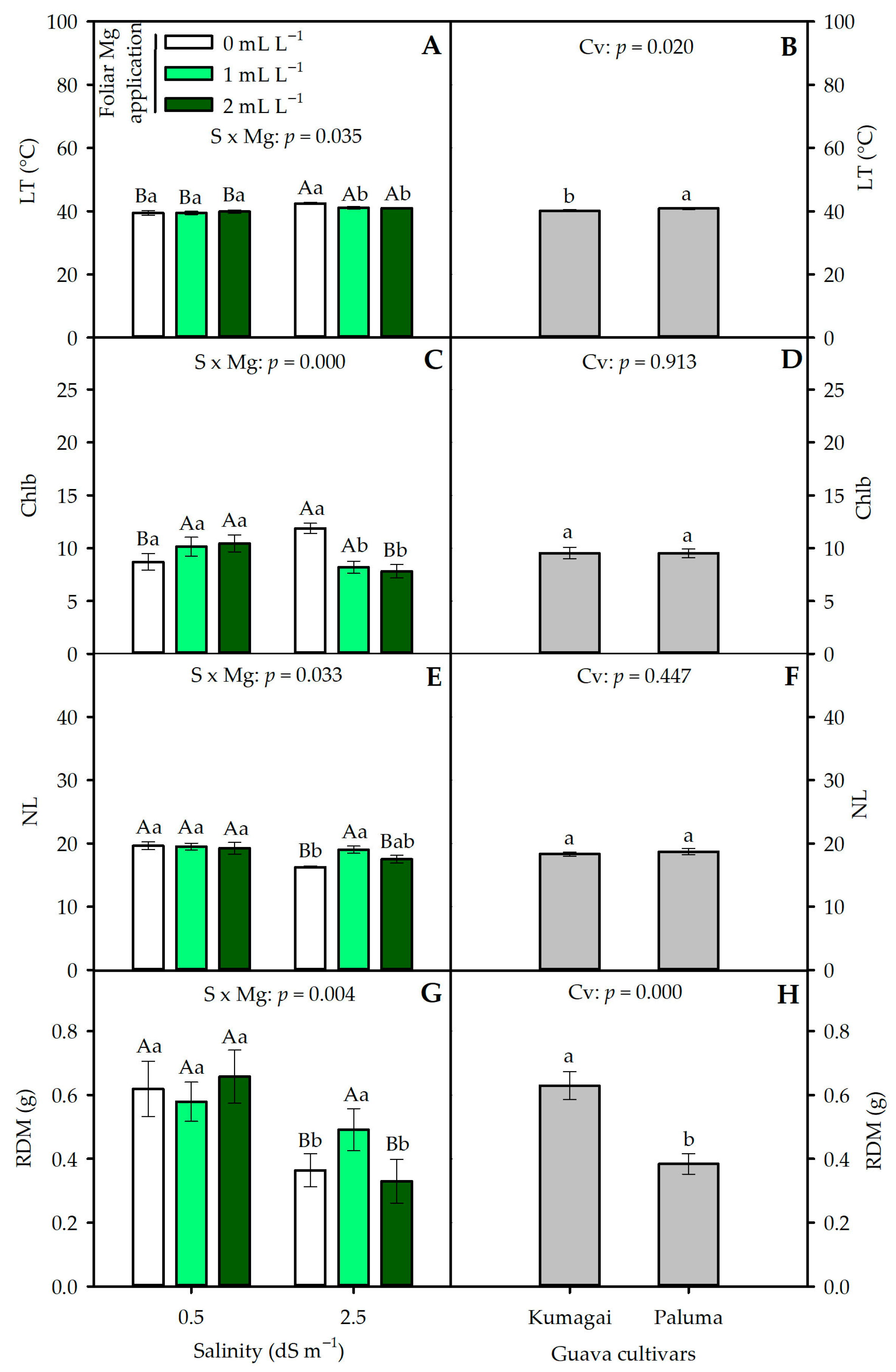
The interaction between salinity levels and foliar Mg doses, with the isolated effect of guava cultivars, significantly influenced (p < 0.05) leaf temperature (LT), chlorophyll b (Chl b), number of leaves (NL), and root dry mass (RDM) (Figure 2). A salinity of 2.5 dS m−1 increased LT at all Mg doses, with the highest values being 42.47, 41.06, and 40.94 °C, respectively (Figure 2A). Under low salinity (0.5 dS m−1), Mg doses did not alter LT, with an average of 39.60 °C. However, under saline stress (2.5 dS m−1), the application of 1 and 2 mL L−1 of Mg reduced the LT by 3.32% and 3.60%, respectively, compared to the control without magnesium (0 mL L−1). Regarding cultivar effects, Paluma maintained a significantly higher LT than Kumagai, at 40.91 °C (Figure 2B).
Regarding Chlb, in the absence of Mg (0 mL L−1), the highest saline level (2.5 dS m−1) resulted in a significant increase in the content of this pigment to 12.86, differing significantly from 0.5 dS m−1 (Figure 2C). At the 1 mL L−1 Mg dose, salinity did not influence Chlb, which remained at an average of 9.17. However, at the 2 mL L−1 dose, saline stress (2.5 dS m−1) reduced the Chlb content by 25.19% compared to the lowest salinity level. Under low salinity (0.5 dS m−1), Mg doses did not alter Chlb (average of 9.76). Under saline stress (2.5 dS m−1), supplementation with 1 and 2 mL L−1 of Mg significantly reduced Chlb by 36.24% and 39.30%, respectively, compared to untreated plants. The cultivars showed similar behavior, with an overall average of 9.52 (Figure 2D).
A salinity of 2.5 dS m−1 significantly reduced the NL at Mg doses of 0 and 2 mL L−1, with decreases of 17.18% and 9.09%, respectively (Figure 2E). In contrast, at a dose of 1 mL L−1, the plants maintained a stable NL (average of 19 leaves), regardless of the salinity level. Under low salinity (0.5 dS m−1), Mg doses did not influence the NL, which remained at 19 leaves. However, under saline stress (2.5 dS m−1), the 1 mL L−1 Mg dose showed the best performance (19 leaves), significantly exceeding the 0 mL L−1 dose. The cultivars did not show significant differences, with an overall average of 18 leaves (Figure 2F).
Salt stress (2.5 dS m−1) significantly reduced RDM by 41.93% and 50% at Mg doses of 0 and 2 mL L−1, respectively, compared to the 0.5 dS m−1 level (Figure 2G). At the 1 mL L−1 dose, there was no significant difference between salinities, with an average of 0.53 g. Under low salinity (0.5 dS m−1), Mg doses did not significantly influence RDM (average of 0.62 g). However, at a salinity of 2.5 dS m−1, the 1 mL L−1 dose was significantly superior to the other treatments by 26.53% and 32.65%, respectively. Among the cultivars, the Kumagai cultivar showed superior performance to Paluma, with a 36.51% higher RDM (0.63 g) (Figure 2H).
The factors salinity, Mg doses, and cultivars interacted significantly (p < 0.05) with respect to Chla and Chlt levels. At low salinity (0.5 dS m−1), the cultivars did not show a significant difference in response to the Mg doses tested (Table 3). However, under saline stress (2.5 dS m−1), the Paluma cultivar showed the highest Chla values, 39.42 and 34.29, at doses of 1 and 2 mL L−1 of Mg, respectively. Regarding Chlt, the Kumagai cultivar showed a significant reduction of 12.48% compared to Paluma under a salinity of 2.5 dS m−1 and with 2 mL L−1 of Mg added.
Comparing the salinity levels in each cultivar and Mg dose combination, it is observed that the Kumagai cultivar, under supplementation of 2 mL L−1, maintained Chla levels at 2.5 dS m−1 similar to those obtained at 0.5 dS m−1 (Table 3). In this same cultivar, salinity did not significantly alter Chlt at any of the Mg doses tested. On the other hand, the Paluma cultivar responded to saline stress (2.5 dS m−1) with an increase in Chla levels at doses of 0 and 1 mL L−1 of Mg, reaching the highest values (37.97 and 39.42, respectively). Furthermore, Paluma achieved the best Chlt results (50.96 and 54.88) under a salinity of 2.5 dS m−1 when it received doses of 1 and 2 mL L−1 of Mg.
When comparing Mg doses at each salinity level and cultivar, there was no significant difference for Chla and Chlt in the Kumagai cultivar under 0.5 dS m−1, with averages of 31.43 and 45.81, respectively, and in the Paluma cultivar under 2.5 dS m−1, with averages of 37.23 and 52.02 (Table 3). In the Kumagai cultivar, under 2.5 dS m−1, Chla decreased by 31.32% and 30.50% at Mg doses of 1 and 2 mL L−1, respectively. For Chlt, under the same conditions, a significant 11.17% reduction in Chla was observed at the 2 mL L−1 dose compared to the 0 mL L−1 dose. In the Paluma cultivar, at 0.5 dS m−1, the highest Chla values (32.20 and 36.48) were obtained with doses of 1 and 2 mL L−1, which differed significantly from the 0 mL L−1 dose. Regarding Chlt, under this salinity and cultivar condition, the application of 2 mL L−1 of Mg resulted in a significant reduction compared to the other doses.
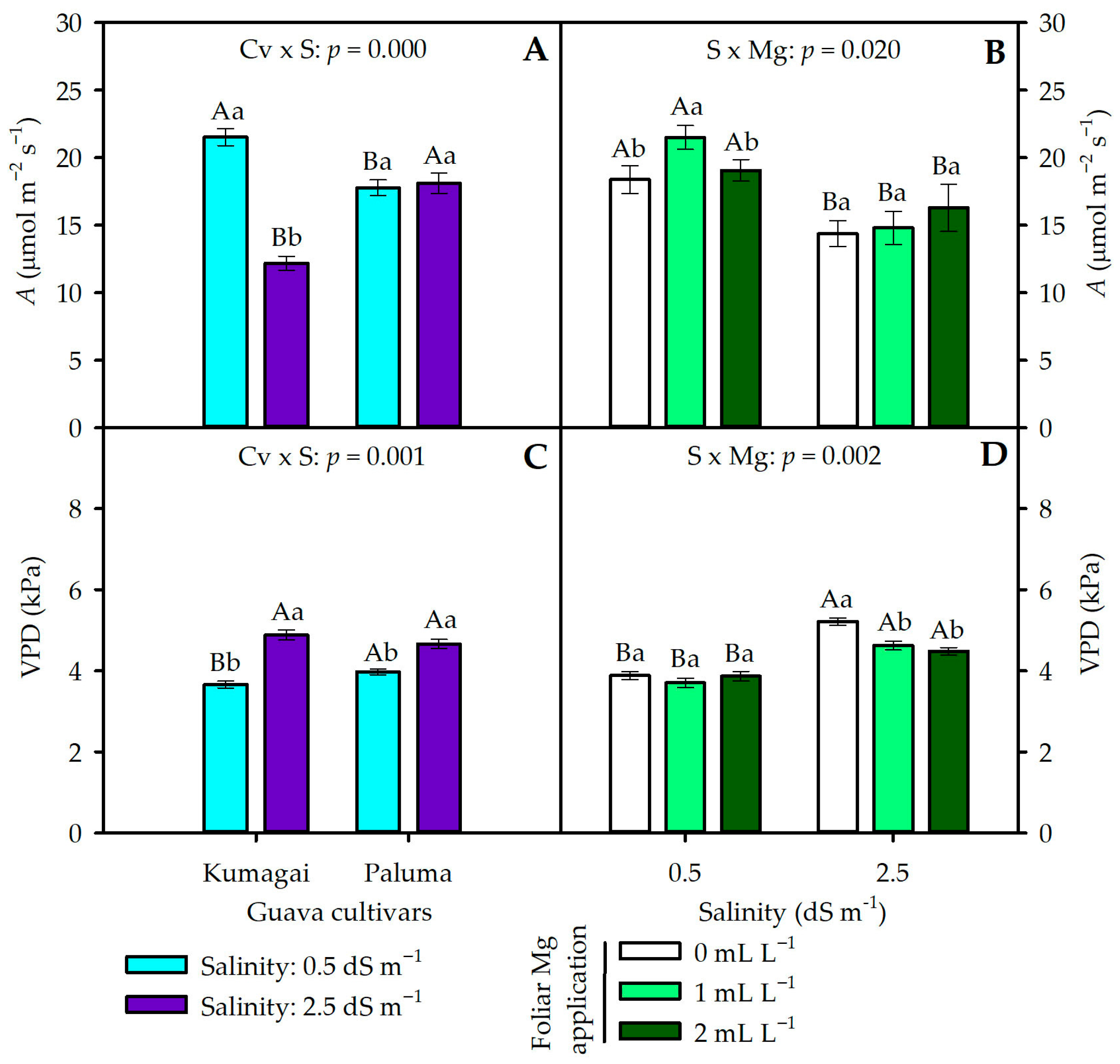
The cultivar and salinity factors interacted significantly (p < 0.05) on the net CO2 assimilation rate (A), while the interaction between salinity and foliar magnesium influenced the vapor pressure deficit (VPD) (Figure 3). Under low salinity (0.5 dS m−1), the Kumagai cultivar significantly outperformed Paluma, reaching the maximum A rate (21.52 µmol m−2 s−1) (Figure 3A). In contrast, under saline stress (2.5 dS m−1), the Paluma cultivar demonstrated greater resilience, with a higher net assimilation rate (18.11 µmol m−2 s−1).
In the Kumagai cultivar, salinity levels differed significantly, with 0.5 dS m−1 showing the highest value (21.52 µmol m−2 s−1). Meanwhile, in Paluma, no significant differences in salinity levels were observed, with an average value of 17.94 µmol m−2 s−1. At a higher salinity level of 2.5 dS m−1, there was a reduction in A compared to 0.5 dS m−1 at all Mg doses (Figure 3B). At a salinity of 2.5 dS m−1, there was no significant difference between Mg doses, with an average value of 15.15 µmol m−2 s−1. However, at 0.5 dS m−1, plants that received 1 mL L−1 of Mg showed higher A (21.50 µmol m−2 s−1), differing significantly from the other doses.
The Paluma cultivar showed a VPD of 0.5 dS m−1, compared to the Kumagai cultivar (Figure 3C). Under a salinity of 2.5 dS m−1, there was no significant difference between the cultivars, with an average value of 4.77 kPa. Comparing the salinity levels between the guava cultivars, a significant increase in VPD was observed under a salinity of 2.5 dS m−1, of 25% in Kumagai and 14.81% in Paluma (Figure 3C).
A salinity of 2.5 dS m−1 resulted in an increase in VPD at all Mg doses, with maximum values of 5.21, 4.62, and 4.48 kPa, respectively (Figure 3D). Under low salinity (0.5 dS m−1), Mg doses did not significantly alter VPD, which remained at an average of 3.81 kPa. However, under saline stress (2.5 dS m−1), doses of 1 and 2 mL L−1 of Mg reduced VPD by 11.32% and 14.01%, respectively, compared to the control dose (0 mL L−1).
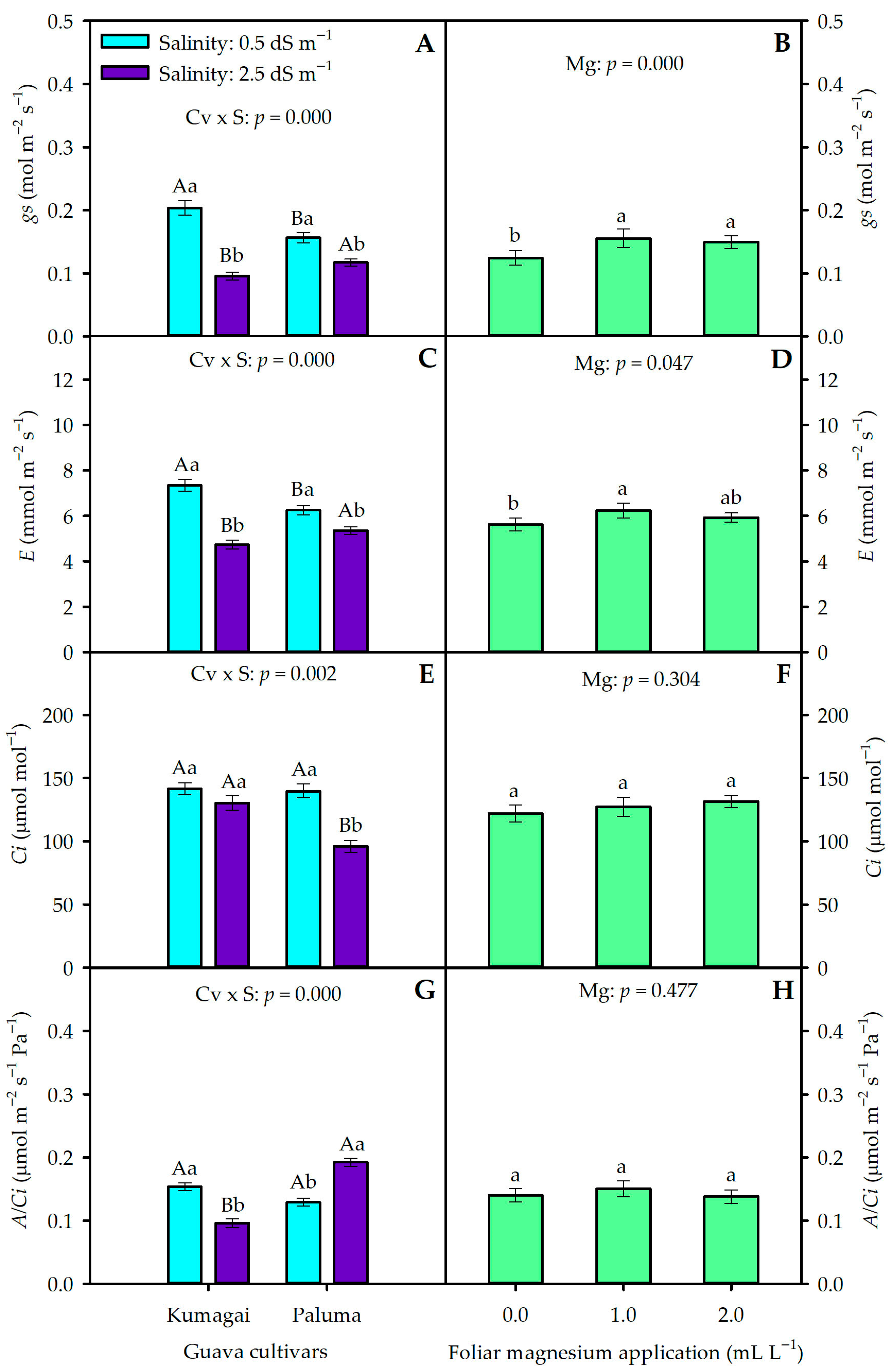
Under a salinity of 0.5 dS m−1, the Kumagai cultivar showed higher gs (0.20 mol m−2 s−1) and E (7.35 mmol m−2 s−1) than Paluma (Figure 4A,C), while for Ci and A/Ci, there were no significant differences between the cultivars under the same condition (Figure 4E,G). In contrast, under a salinity of 2.5 dS m−1, Paluma showed the highest values of gs, E, and A/Ci (0.12 mol m−2 s−1, 5.36 mmol m−2 s−1, and 0.19 µmol m−2 s−1 Pa−1, respectively) (Figure 4A,C,G), while Kumagai showed the highest Ci (130.39 µmol mol−1) (Figure 4E). In the Kumagai cultivar, saline stress (2.5 dS m−1) significantly reduced gs, E, and A/Ci by 55%, 35.51%, and 40%, respectively, but did not alter Ci (average of 135.95 µmol mol−1). In Paluma, a salinity of 2.5 dS m−1 resulted in lower values of gs, E, and Ci, but increased the carboxylation efficiency (A/Ci) to 0.19 µmol m−2 s−1 Pa−1 (Figure 4A,C,E,G).
Regarding the isolated effect of Mg doses, applications of 1 and 2 mL L−1 promoted the highest values of gs and E (Figure 4B,D). The tested doses did not significantly alter Ci and A/Ci, which maintained averages of 126.96 µmol mol−1 and 0.14 µmol m−2 s−1 Pa−1, respectively (Figure 4F,H).
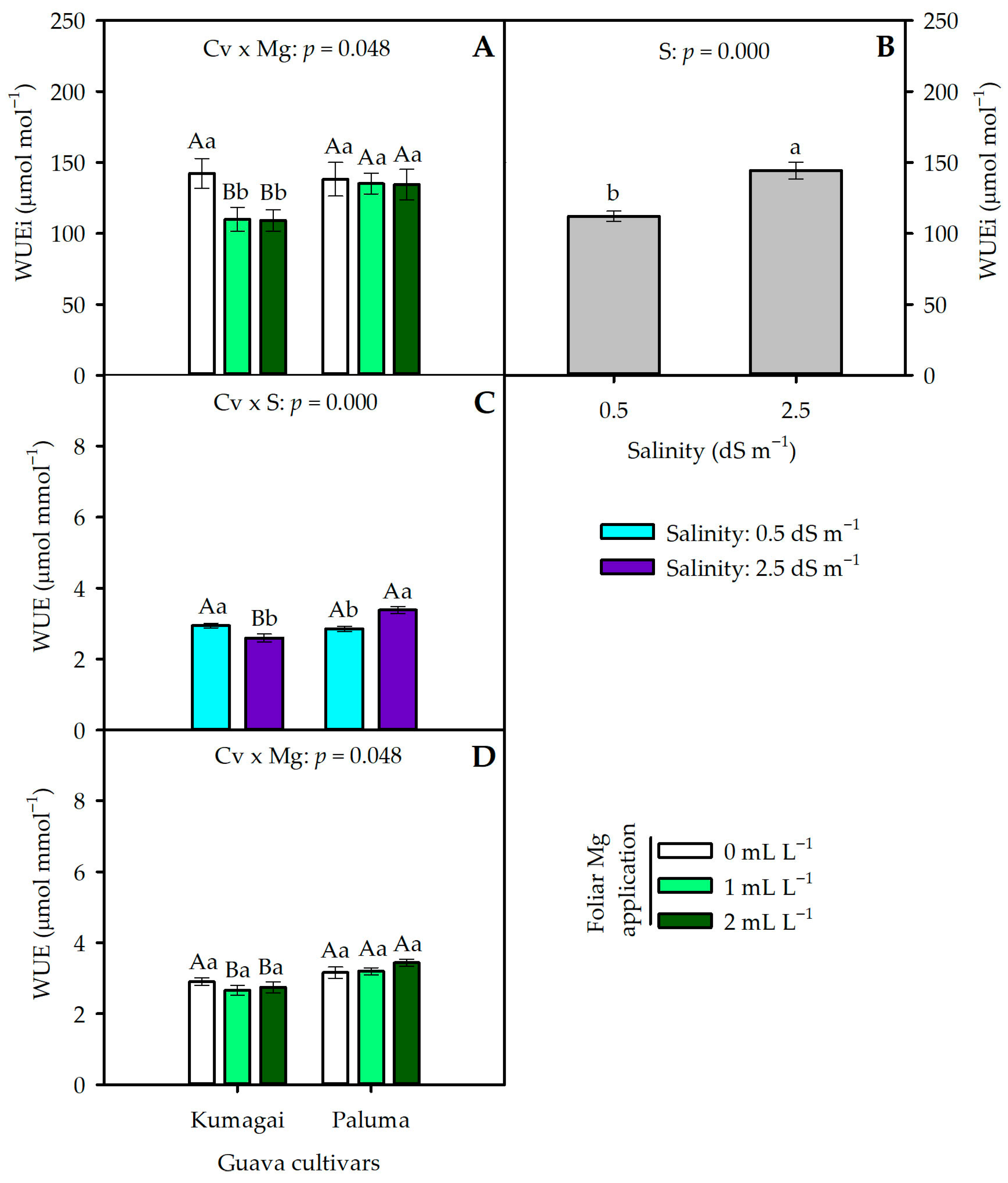
The interaction between cultivars and Mg doses significantly influenced WUEi (p < 0.05). Under doses of 1 and 2 mL L−1 of Mg, the Paluma cultivar was superior to Kumagai, registering the highest efficiencies (135.14 and 134.45 µmol mol−1, respectively) (Figure 5A). In contrast, the absence of Mg (0 mL L−1) did not promote significant differences between the cultivars.
Regarding Mg doses in each cultivar, applications of 1 and 2 mL L−1 reduced the WUEi of the Kumagai cultivar by 22.81% and 23.30%, respectively, compared to the control dose. In contrast, Mg doses did not affect WUEi in the Paluma cultivar, which remained at an average of 135.93 µmol mol−1. Analyzing the isolated effect of salinity, the level of 2.5 dS m−1 promoted the highest WUEi value (144.34 µmol mol−1).
Under low salinity (0.5 dS m−1), guava cultivars did not show significant differences in relation to water use efficiency (WUE), with an average of 2.89 µmol mmol−1 (Figure 5C). However, under saline stress (2.5 dS m−1), the Paluma cultivar showed a higher WUE (3.38 µmol mmol−1) than the Kumagai cultivar (2.96 µmol mmol−1), indicating that increasing salinity to 2.5 dS m−1 reduced the WUE of the Kumagai cultivar by 11.56%, while increasing the performance of Paluma to 3.38 µmol mmol−1 under the same conditions.
For the comparison of cultivars at each foliar Mg dose, WUE differed significantly at doses of 1 and 2 mL L−1, with Paluma superior to Kumagai by 15.55% and 15.70%, respectively (Figure 5D). The Mg doses did not differ significantly between the Kumagai cultivar (average WUE of 2.75 µmol mmol−1) and Paluma (average WUE of 3.12 µmol mmol−1).
Mg doses did not significantly alter the SDM in the Kumagai cultivar under 0.5 dS m−1 (mean of 3.22 g), nor in Paluma under 2.5 dS m−1 (mean of 1.66 g) (Table 4). However, the 2 mL L−1 dose of Mg reduced the SDM of Kumagai by 67.33% under a salinity of 2.5 dS m−1. Similarly, under low salinity (0.5 dS m−1), the Mg dose reduced the SDM of Paluma by 53.24% compared to the control dose (0 mL L−1).
Regarding RSR, the Paluma cultivar outperformed Kumagai at low salinity (0.5 dS m−1) only at a dose of 2 mL L−1 of Mg, reaching a maximum value of 0.38 (Table 4). Conversely, under saline stress (2.5 dS m−1), Kumagai registered a higher RSR than Paluma at a dose of 2 mL L−1 of foliar Mg (0.31). The Mg doses did not significantly alter the RSR of Kumagai under 0.5 dS m−1 (average of 0.25), nor that of Paluma under 2.5 dS m−1 (average of 0.18). In the Kumagai cultivar, under 2.5 dS m−1, the dose of 2 mL L−1 increased the RSR compared to the control dose, reaching the highest index (0.31). In Paluma, the 0.5 dS m−1 condition yielded the highest RSR (0.38) compared with the other treatments.
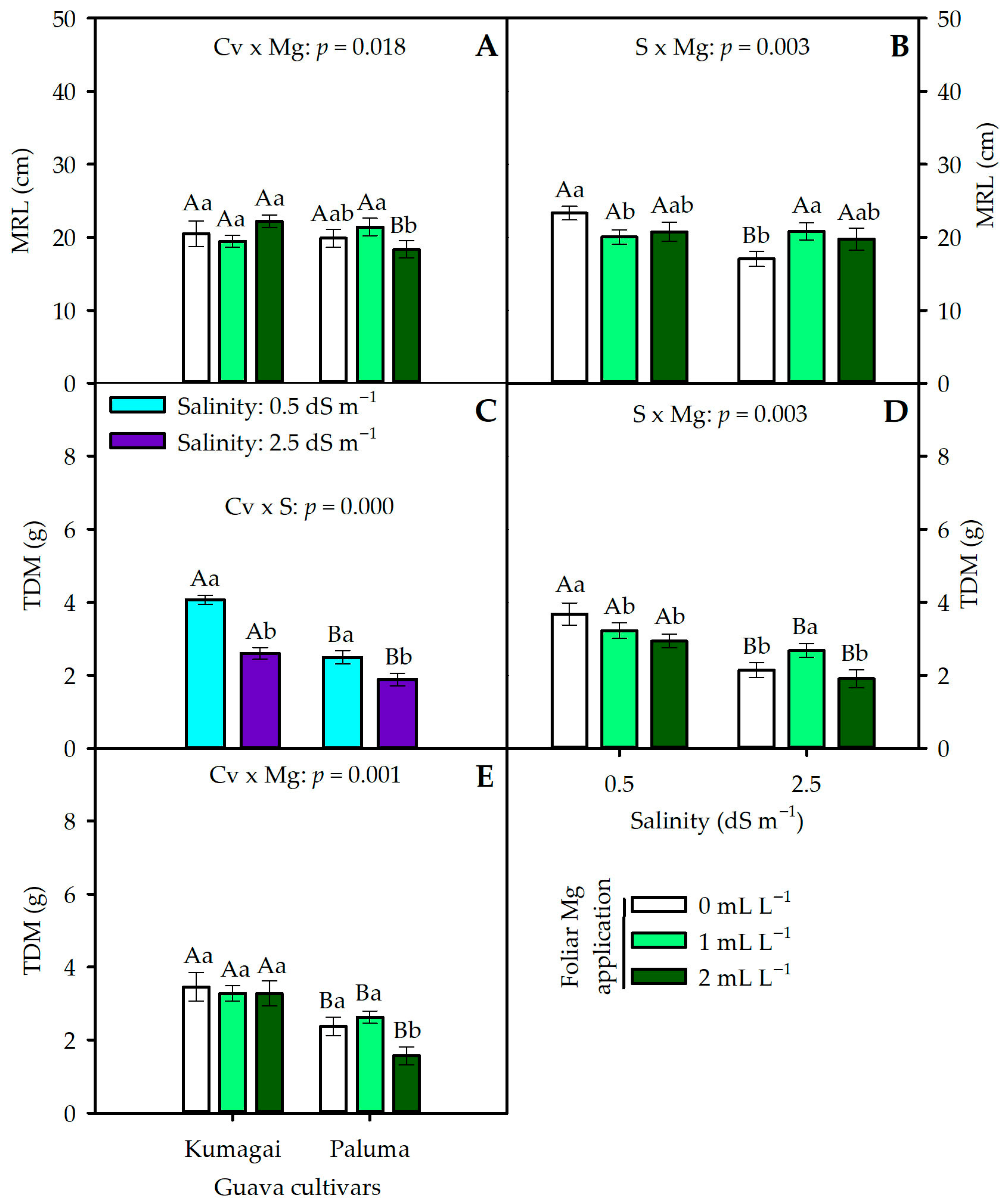
The double interactions between the factors significantly influenced MRL and TDM (p < 0.05) (Figure 6). MRL responded to the interaction’s cultivars × Mg and salinity × Mg, while TDM was affected by the interaction’s salinity × Mg, cultivars × salinity, and cultivars × Mg. In the comparison between cultivars, Kumagai surpassed Paluma by 17.39% in MRL only at the 2 mL L−1 Mg dose (Figure 6A). Mg doses did not alter MRL in the Kumagai cultivar (average of 20.71 cm). However, in Paluma, the 2 mL L−1 Mg dose reduced the MRL to 18.34 cm, which differed significantly from the other doses.
Salinity levels significantly affected MRL only in the absence of Mg (0 mL L−1), a condition in which saline stress (2.5 dS m−1) reduced growth MRL by 17.04 cm, compared to 23.32 cm observed under low salinity (Figure 6B). Under 0.5 dS m−1, a dose of 1 mL L−1 of Mg resulted in the lowest MRL (20.06 cm). Conversely, at concentrations below 2.5 dS m−1, the same dose (1 mL L−1) produced the highest MRL (20.82 cm), significantly higher than the control dose.
The Paluma cultivar showed significant reductions in total dry mass (TDM) of 39.27% and 27.31%, respectively, compared to Kumagai, under both salinity conditions (Figure 6C). When subjected to the 2.5 dS m−1 condition, guava seedlings showed a significant reduction in TDM of 36.58% and 24.10%, respectively, compared to the 0.5 dS m−1 condition, in both cultivars studied.
The salinity of 2.5 dS m−1 significantly reduced the total dry matter (TDM) of guava cultivars compared to 0.5 dS m−1, at all three Mg doses, corresponding to reductions of 41.58%, 16.77%, and 35.40%, respectively (Figure 6D). Under the 0.5 dS m−1 condition, doses of 1 and 2 mL L−1 of Mg promoted similar TDM values, but lower than the control (0 mL L−1), which showed the highest TDM (3.68 g). However, at a salinity of 2.5 dS m−1, the dose of 1 mL L−1 of Mg increased TDM (2.68 g), which differed significantly from the other doses. In the Kumagai cultivar, no significant differences were observed among the applied Mg doses, with an average TDM of 3.33 g. In Paluma, the 2 mL L−1 dose showed the lowest result (1.57 g), with a significant difference compared to the other doses (Figure 6E).
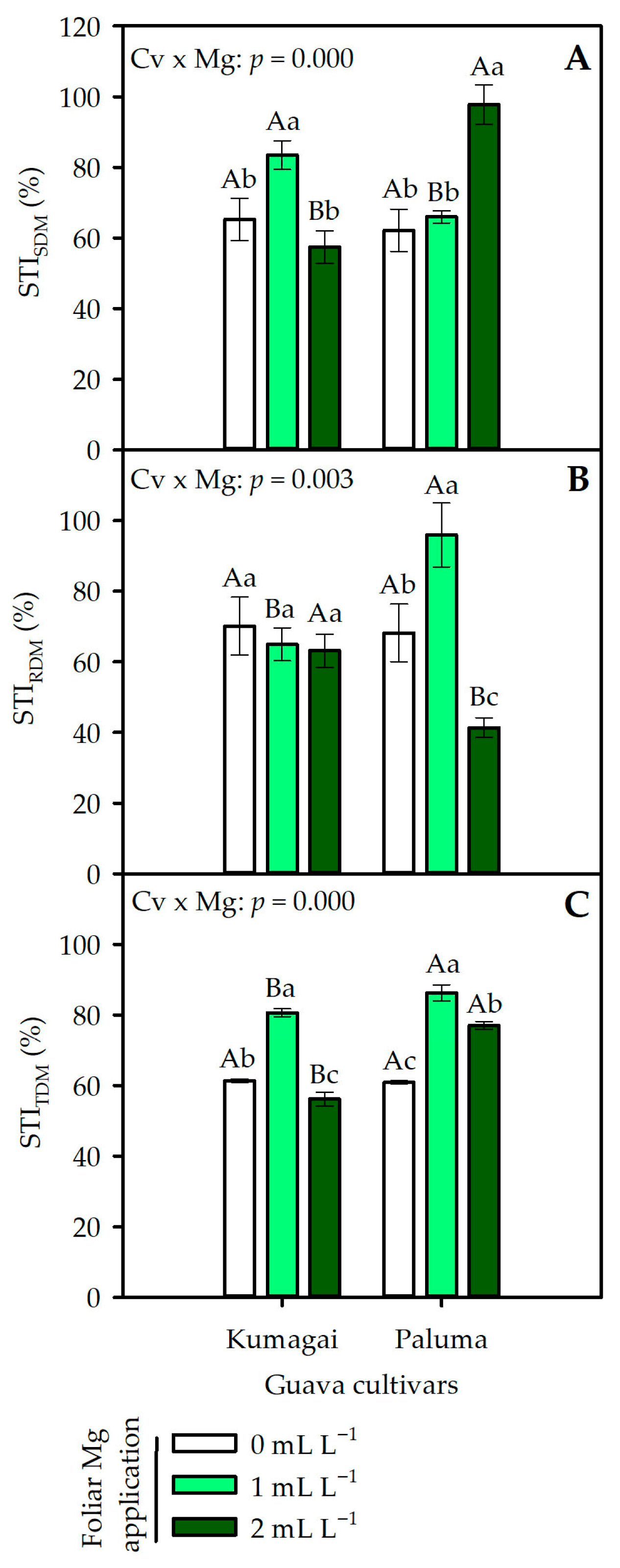
The interaction between cultivars and foliar application of Mg significantly influenced plant tolerance to salinity (p < 0.05) (Figure 7). In the absence of Mg (0 mL L−1), the cultivars did not differ from each other, maintaining an average STISDM of 63.75% (Figure 7A). However, the 1 mL L−1 dose of Mg increased the tolerance of the Kumagai cultivar to 83.48%, significantly exceeding that of Paluma. Conversely, at the 2 mL L−1 dose, Paluma registered the highest tolerance index (97.81%). When analyzing the doses in each cultivar, the 1 mL L−1 dose promoted greater tolerance in Kumagai (83.48%), while the 2 mL L−1 dose optimized tolerance in Paluma (97.81%).
Regarding STIRDM, the cultivars did not differ significantly in the absence of foliar Mg (0 mL L−1), maintaining an average index of 69.17% (Figure 7B). At a dose of 1 mL L−1 of Mg, the Paluma cultivar outperformed Kumagai, reaching the highest tolerance index (95.93%). However, at a dose of 2 mL L−1, Kumagai showed superior performance to Paluma, with an STIRDM of 63.21%. In the dose analysis for each cultivar, Mg did not significantly affect Kumagai’s tolerance (average 66.11%). In contrast, Paluma responded differently to Mg doses, following the decreasing order of tolerance: 1 mL L−1 (95.93%) > 0 mL L−1 (68.19%) > 2 mL L−1 (41.39%).
Regarding the STITDM, the guava cultivars did not differ from each other in the absence of Mg (0 mL L−1), with an average of 61.14% (Figure 7C). At a Mg dose of 1 mL L−1, Paluma was significantly superior to Kumagai, with the highest STITDM (86.23%). The Paluma cultivar also showed superior performance to the Kumagai cultivar at the dose of 2 mL L−1, with an STITDM of 77.03%. In the Kumagai cultivar, Mg doses significantly influenced tolerance, with 1 mL L−1 (80.63%) significantly higher than 0 mL L−1 (61.37%) and 2 mL L−1 (56.19%). In Paluma, the 1 mL L−1 dose (86.23%) also promoted the highest tolerance rate, compared to the 2 mL L−1 (77.03%) and 0 mL L−1 (60.92%) doses.
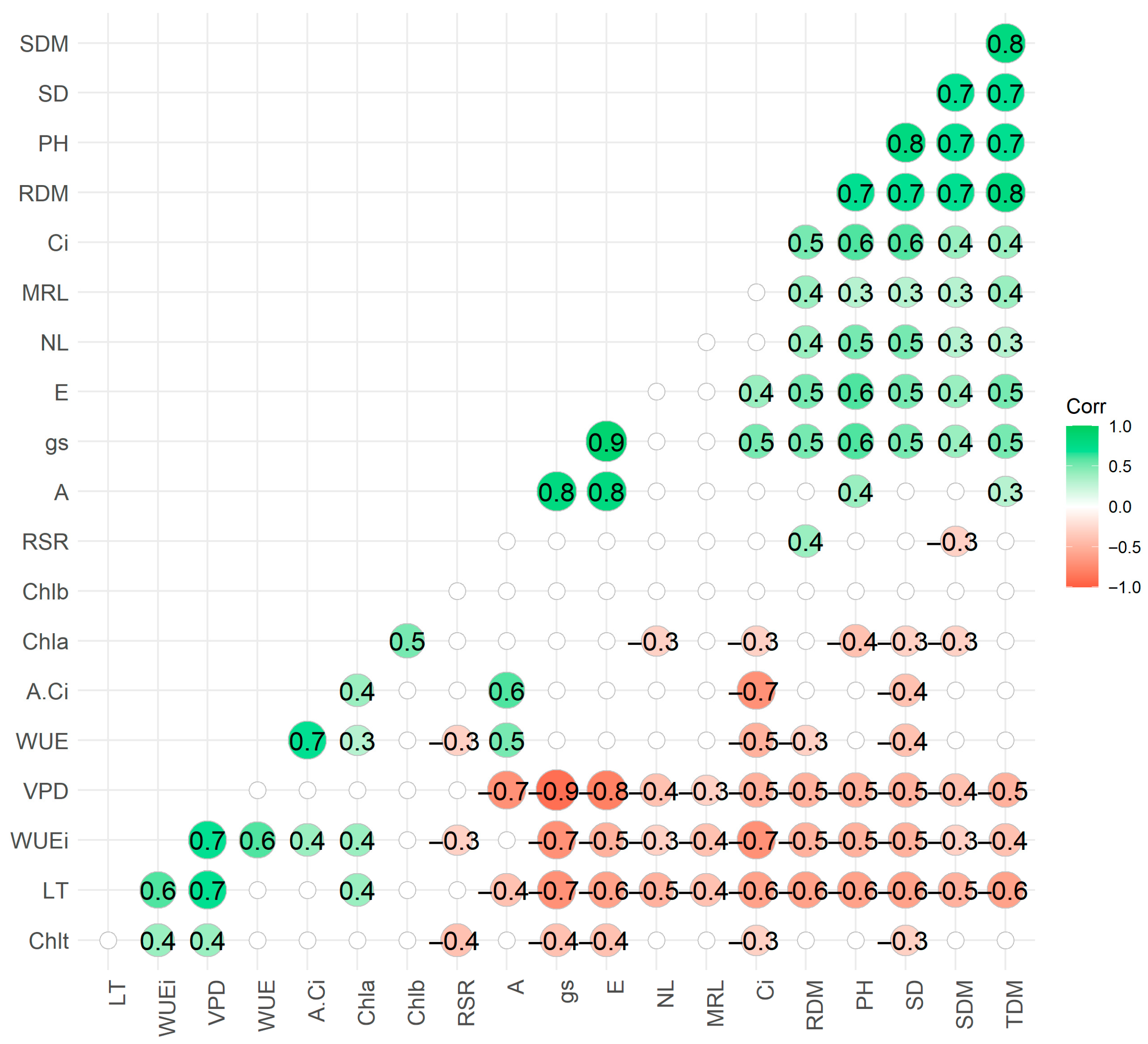
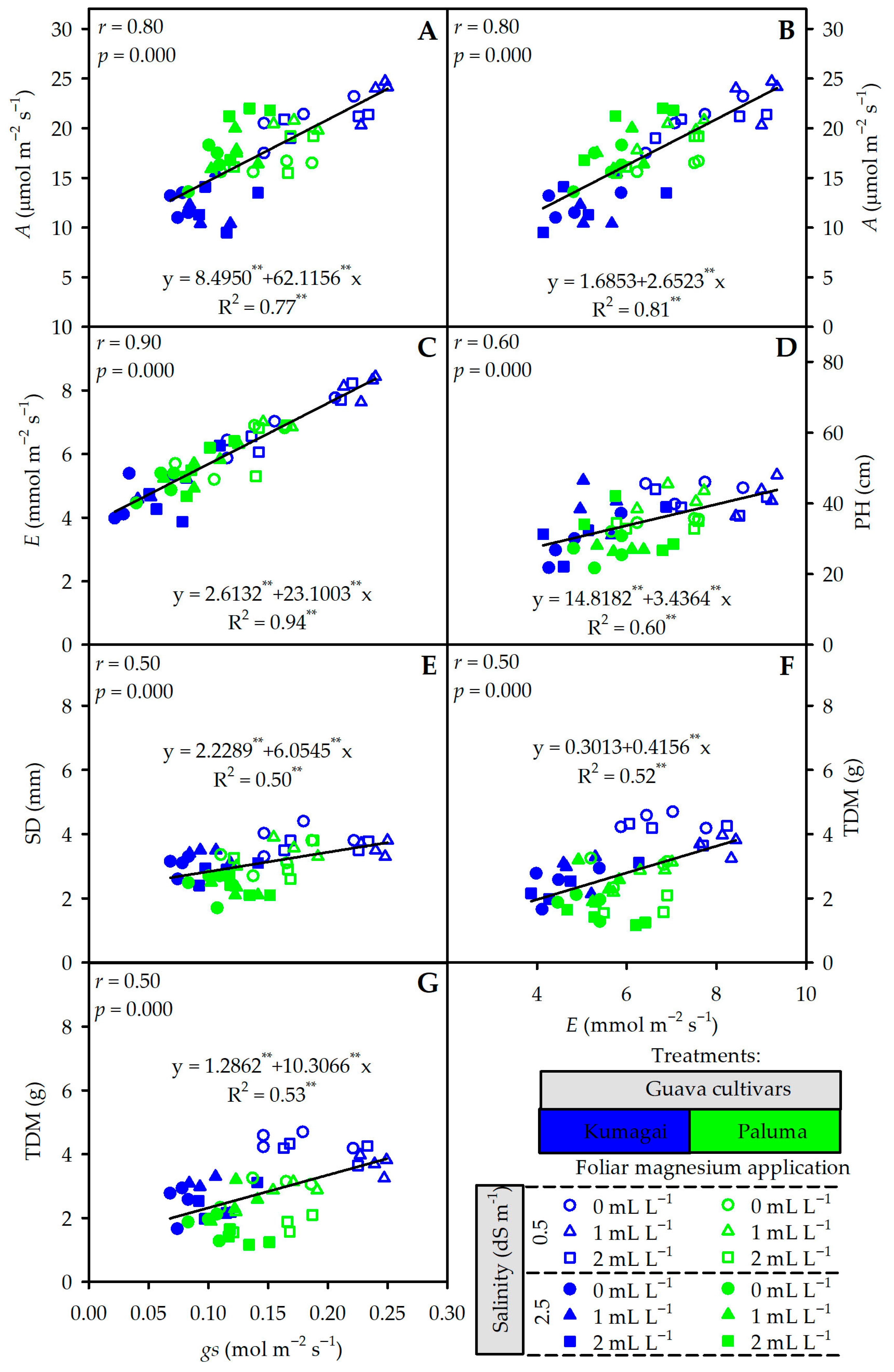
Correlation analysis (Figure 8) revealed strong positive associations (p < 0.05; r ≥ 0.70) between physiological and growth variables. Correlations between A × gs (r = 0.80), A × E (r = 0.80), and gs × E (r = 0.90) were particularly noteworthy. In growth, SD correlated positively with PH (r = 0.80), while TDM showed a strong association with RDM and SDM (r = 0.80). Furthermore, WUE correlated with A/Ci (r = 0.70), and VPD was positively associated with WUEi and LT (r = 0.70). Conversely, VPD correlated negatively (r ≤ −0.70) with gs (r = −0.90), E (r = −0.80), and A (r = −0.70). Other relevant negative correlations included gs × LT, gs × WUEi, Ci × WUEi, and Ci × A/Ci, all with r = −0.70.
The analysis revealed the behavior of the treatments in relation to the main positive correlations between gs and E (Figure 9). Stomatal conductance (gs) correlated strongly with photosynthesis (A) (r = 0.80), and the regression curve adjustment estimated an increase of 61.11 µmol m−2 s−1 in A for each unit increase in gs (Figure 9A). Plants of the Kumagai cultivar, under 0.5 dS m−1 and with foliar Mg supplementation, reached the highest levels, especially at the dose of 2 mL L−1. On the other hand, foliar Mg application increased A value in the Paluma cultivar under saline stress, as gs increased.
The equation adjustment for the correlation between E and A (r = 0.80) estimated an increase of 2.65 µmol m−2 s−1 in A for each unit increase in E (Figure 9B). Under saline stress (2.5 dS m−1), the Paluma cultivar registered the most significant increases in A associated with the increase in E when supplemented with 2 mL L−1 of foliar Mg. A similar pattern was observed between gs and E (r = 0.90), where each mol m−2 s−1 increase in gs raised E by 23.10 mmol m−2 s−1 (Figure 9C). Under a salinity of 2.5 dS m−1, the dose of 2 mL L−1 of Mg promoted the highest values in both cultivars. In contrast, under low salinity (0.5 dS m−1), the Kumagai cultivar achieved the highest E rates in response to increased gs. Furthermore, under saline stress, Paluma optimized the pH/E relationship by applying 1 and 2 mL L−1 of Mg.
Plant height (PH) also correlated positively with transpiration (E) (r = 0.60), indicating an estimated increase of 3.44 cm in PH for each unit increase in E (Figure 9D). The Kumagai cultivar showed the highest values under low salinity (0.5 dS m−1) and Mg supplementation. In the correlation between stem diameter (SD) and stomatal conductance (gs) (r = 0.50), the Kumagai cultivar outperformed Paluma at both salinity levels. For this cultivar, each mol m−2 s−1 increase in gs resulted in an estimated gain of 6.05 mm in SD (Figure 9E).
The accumulation of TDM responded positively to increases in E and gs, with r = 0.50 in both cases (Figure 9F,G). In these correlations, the Kumagai cultivar demonstrated greater responsiveness, converting the increase in E and gs into greater dry mass, even under saline stress (2.5 dS m−1). Furthermore, the application of Mg potentiated the biomass accumulation in the aforementioned cultivar.
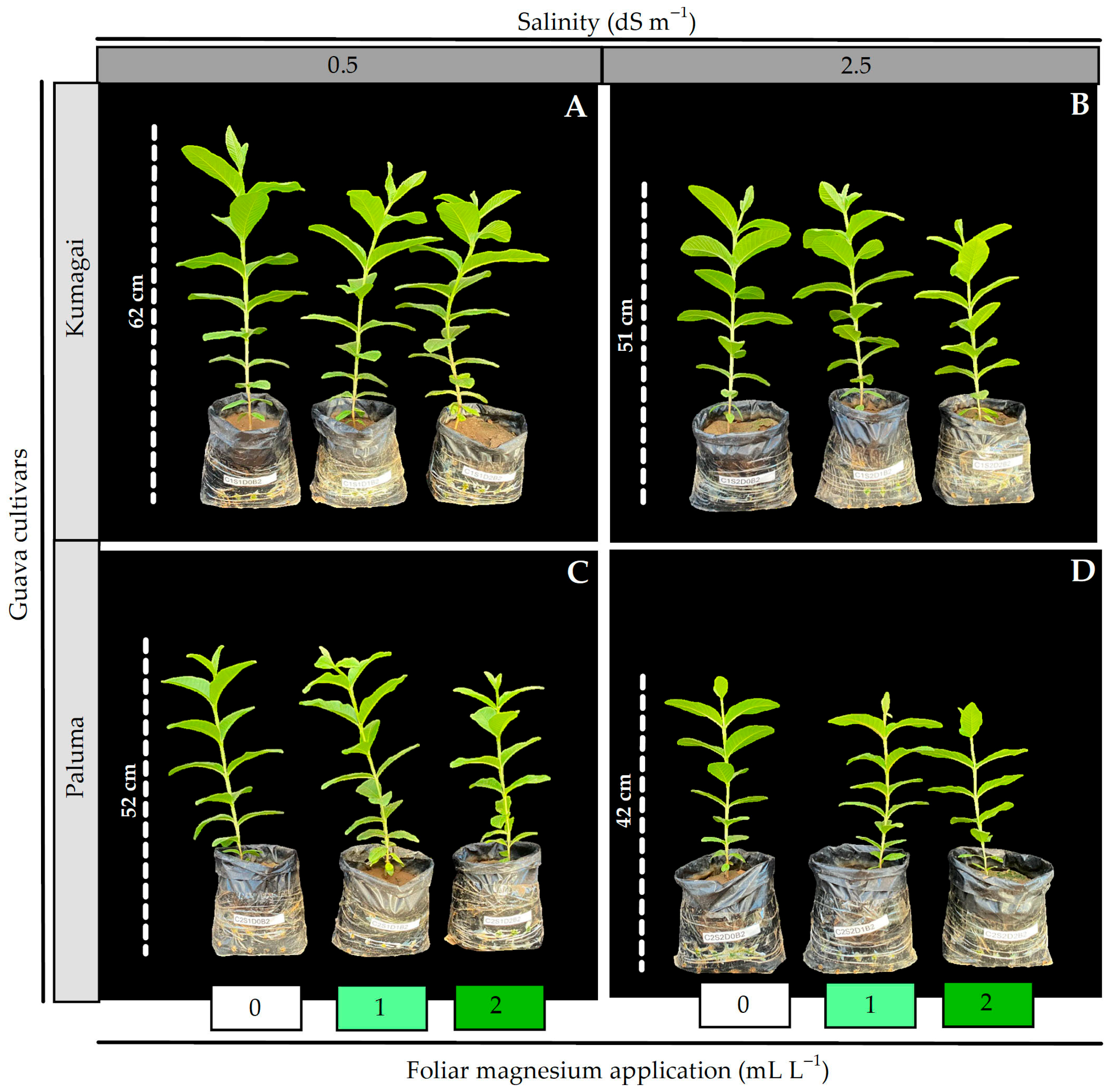
Under low salinity (0.5 dS m−1), the Kumagai cultivar showed superior phenotypic size compared to Paluma. Foliar application of 1 mL L−1 of Mg maximized the growth stimulus of both cultivars in the absence of saline stress (Figure 10A,C).
Under a salinity of 2.5 dS m−1, both guava cultivars showed reduced growth; however, with the application of 1 mL L−1 of Mg, the guava seedlings demonstrated greater tolerance to saline stress, especially in the Kumagai cultivar (Figure 10B,D).

4. Discussion

Guava production is of great socioeconomic importance in the northeastern region of Brazil. However, it is directly affected by the salinity of the irrigation water, a common situation in most production areas of this crop in the region. The development of guava cultivars with salinity-tolerance mechanisms is becoming increasingly important. Furthermore, proper crop management is necessary, employing practices that can mitigate the effects of saline stress. Alternatively, supplementing plants with foliar magnesium (Mg) is an agricultural practice that directly affects plant physiology and stimulates salinity-tolerance mechanisms. Thus, this research demonstrated that foliar Mg doses stimulate greater salinity tolerance in two guava cultivars.
The results of our study confirm that irrigation water salinity (2.5 dS m−1) acts as a severe limiting factor for guava seedling production, triggering physiological restrictions and biometric reductions in both cultivars. However, foliar application of Mg proved to be an effective mitigating strategy, showing a dose- and cultivar-dependent biphasic response. While saline stress increased vapor pressure deficit (VPD) and leaf temperature, supplementation with 1 mL L−1 of Mg optimized water status and photosynthetic pigment stability, suggesting protection of the photosynthetic apparatus. Notably, the ‘Paluma’ cultivar demonstrated greater physiological resilience under Mg supplementation, while ‘Kumagai’ prioritized investment in vegetative growth, highlighting distinct adaptive strategies between the genetic materials in the face of abiotic stress and nutritional management.
The reduction in guava seedling growth under salinity of 2.5 dS m−1 reflects the energy cost imposed by osmotic stress and ionic toxicity, which limit cell division and expansion. Saline stress affects the growth and development of guava in its different phases, as it is a crop sensitive to irrigation water salinity, and may exhibit different tolerance mechanisms depending on the variety [10,18,19,20]. The fact that foliar magnesium (Mg) supplementation mitigated these losses in variables such as plant height (PH), stem diameter (SD), and number of leaves (NL) suggests that Mg acted in maintaining metabolic homeostasis. This differential response between cultivars, such as ‘Kumagai’ being more responsive to the 1 mL L−1 dose and ‘Paluma’ to the 2 mL L−1 dose, indicates that the genetic background modulates the efficiency of foliar Mg absorption and utilization. The superiority of ‘Paluma’ at the higher dose may be related to a greater metabolic demand for Mg to protect the photosynthetic apparatus under severe stress, corroborating the hypothesis that genetic variation in guava dictates the plasticity of adaptive responses to nutritional management [20,25].
The results of gas exchange reinforce the role of magnesium as an agent that attenuates saline stress in guava trees, being an essential element not only as the nucleus of the chlorophyll molecule but also in enzymatic activation and the translocation of photoassimilates. Under limiting conditions, foliar Mg favors the source-sink relationship, ensuring the energy supply necessary for metabolic processes [26,27,28]. The ‘Paluma’ cultivar demonstrated greater physiological plasticity, maintaining higher stomatal conductance and net CO2 assimilation under stress. This behavior reflects greater efficiency in carboxylation and water use, suggesting that Mg supplementation protected the photosynthetic apparatus against oxidative damage caused by excess salts. The positive correlations observed between growth variables and gas exchange confirm that the maintenance of vegetative vigor depends on the functional stability of photosynthesis, characterizing a robust adaptive response induced by nutritional management [10,16].
Foliar application of Mg increased WUE and WUEi in guava plants of the Paluma cultivar. Thus, Mg may promote greater adaptability of this cultivar to saline stress, improving the control of stomatal opening, thereby allowing the continuity of CO2 fixation and the maintenance of water-use efficiency, a limiting factor for plant growth [40,41,42]. Therefore, by directly affecting plant photosynthetic activity, Mg is related to plant growth and development [25,43].
Research shows that irrigation water salinity reduces the growth and development of guava plants [2,10,17,18,20], results similar to those obtained in this study. Under a salinity of 2.5 dS m−1, the treated plants maintained NL, MRL, and RDM values equivalent to those of the control level (0.5 dS m−1). This preservation of the root system and the number of leaves suggests that magnesium favored the maintenance of cell turgor and the export of carbohydrates to the sinks, ensuring that the plant continued to invest in vital organs for resource acquisition. Vigorous root system development (RDM) under stress is a key adaptive trait, as it expands the contact area with the soil and enhances water and nutrient uptake, minimizing the ionic imbalance induced by excess salts [18,20,44].
Maintaining a greater number of green leaves in these plants can promote greater photosynthetic activity, thus increasing their tolerance to stress [41,45,46]. The improvement observed in photosynthetic parameters (A, gs, and E) and in the growth of guava seedlings supplemented with magnesium (Mg) under saline stress can be attributed to the multifaceted role of this macronutrient in plant biochemistry. Magnesium is the central atom of the chlorophyll molecule; therefore, its foliar application directly contributes to the maintenance of the photosynthetic apparatus [25,26]. Under salinity, Na+ ions frequently compete with Mg2+, leading to chlorophyll degradation and reduced light-harvesting efficiency [28]. By increasing Mg availability, the seedlings likely maintained greater chlorophyll synthesis and thylakoid structural integrity, as evidenced by the sustained CO2 assimilation rates in the 1 mL L−1 treatment.
Furthermore, Mg plays a crucial role in stomatal regulation and enzymatic activation. It is an obligatory cofactor for the ribulose-1,5-bisphosphate carboxylase/oxygenase enzyme (Rubisco), in which it acts as a bridge for carbamylation of the enzyme’s active site [28,31]. The maintenance of gs in plants supplemented with Mg at 2.5 dS m−1 suggests that Mg facilitated osmotic and turgor regulation of guard cells. Mitigation of salt stress involves high metabolic costs for the plant, requiring significant amounts of Mg-ATP. Most ATP-dependent enzymes in plants use Mg-ATP as a true substrate, rather than free ATP. Therefore, foliar supplementation with Mg likely increased the availability of Mg-ATP complexes, providing energy for essential processes such as the active exclusion of Na+ from the cytosol and the synthesis of compatible solutes [28,31,45,47,48,49].
This energy support explains the superior performance of the ‘Paluma’ and ‘Kumagai’ cultivars when treated with the optimal Mg dose, as they were better equipped to maintain metabolic homeostasis under high external osmotic pressure. This increase in photosynthetic activity may also be associated with the increased production of chlorophyll a and total chlorophyll in guava cultivars subjected to a salinity of 2.5 dS m−1 and supplemented with Mg at 2 mL L−1, which can be interpreted as a compensatory mechanism. Under saline stress, the reduction in leaf expansion often leads to a higher density of chloroplasts per unit of leaf area, a phenomenon known as the ‘concentration effect’. This does not necessarily imply greater photosynthetic capacity, but rather a structural adjustment to the leaf blade’s reduced size [28,31,47]. Furthermore, studies have shown that foliar fertilization with MgSO4 increases chlorophyll concentration in the leaves of cashew [31], cowpea [32], rice and cucumber [50], and grape [51].
Furthermore, magnesium is essential for the activity of the enzyme Mg-chelatase, which inserts Mg2+ into the protoporphyrin ring, the first irreversible step in chlorophyll biosynthesis, stimulating chlorophyll synthesis since it is a central element of the molecule and, additionally, acts as a cofactor for photosynthetic enzymes, participating in the formation of the Mg-ATP compound [25,26,28,31,47]. The exogenous supply of Mg likely circumvented the competitive inhibition typically exerted by Na+ ions in the soil solution, maintaining the pigment pool even under osmotic pressure. On the other hand, chlorophyll b showed a reduction under salinity of 2.5 dS m−1 and under foliar application of Mg, a response that the increase in chlorophyll a may explain. The reduction in chlorophyll b in guava plants under saline stress is a natural response of the plant, resulting from the intensity of this abiotic stress and the inhibition of chlorophyll synthesis [14,52].
Foliar supplementation with Mg, at doses of 1 and 2 mL L−1, promoted a reduction in leaf temperature and VPD in guava plants under a salinity of 2.5 dS m−1. These results are relevant for maintaining leaf thermal stability, favoring greater stomatal activity for CO2 assimilation. The reduction in temperature and VPD in these guava plants is associated with the higher A and gs values observed under Mg supplementation [53,54]. Furthermore, Mg stimulates plant photosynthetic activity, increasing carbohydrate production and promoting greater proton (H+) pumping and sucrose translocation to the sink [25,43].
Magnesium (Mg) proved effective in mitigating the effects of saline stress on gas exchange in guava plants. Foliar supplementation with Mg promoted the maintenance of shoot dry mass accumulation and biomass partitioning, evidenced in both the Kumagai and Paluma cultivars, under a salinity of 2.5 dS m−1 and supplementation of 1 and 2 mL L−1 of Mg, respectively. Consequently, these plants accumulated greater total dry mass, with the Paluma cultivar being more responsive to biomass gain when supplemented with 1 mL L−1 of Mg, even at a salinity of 2.5 dS m−1, as evidenced by the STI. Thus, Mg was efficient in stimulating photosynthetic activity in these plants, possibly because it is related to increased activity of Ribulose-1,5-Bisphosphate Carboxylase/Oxygenase (RuBisCO) [28,47,55].
The differential response between ‘Paluma’ and ‘Kumagai’ suggests a genetic basis for magnesium utilization efficiency under abiotic stress. ‘Paluma’, known for its high vegetative vigor, demonstrated superior physiological resilience, likely due to a more efficient ion homeostasis mechanism. We hypothesize that this cultivar has a greater capacity to maintain a high Mg2+/Na+ ratio in the cytosol, which is crucial for preventing Na from displacing Mg2+ from the chlorophyll functional sites. Furthermore, Mg mitigates photosynthetic damage by enhancing the antioxidant defense system. Magnesium is not only a structural component but also a signal molecule that triggers the production of Reactive Oxygen Species (ROS) scavengers [28].
Despite these significant physiological and growth improvements, it is important to acknowledge that leaf nutrient concentrations (Na+, K+, Ca2+, and Mg2+) and antioxidant enzymatic activities (SOD, CAT, and POD) were not measured in this study. However, the consistent increases in net CO2 assimilation (A) and stomatal conductance (gs) provided by the 1 mL L−1 Mg dose serve as robust physiological proxies for improved metabolic status and potential reductions in oxidative damage. The maintenance of the photosynthetic apparatus and the gain in biomass support the hypothesis that Mg supplementation effectively circumvented the competitive inhibition typically exerted by Na+ ions and strengthened the plant’s biochemical defense. These nutritional and enzymatic aspects remain essential priorities for future research to refine further the mechanistic understanding of Mg-induced salt tolerance in guava.
Therefore, our results show that foliar supplementation with magnesium (Mg) not only mitigates the deleterious effects of salinity but also reconfigures the adaptive strategy of guava cultivars under saline stress. While ‘Paluma’ relies on water-use efficiency and photosynthetic stability, ‘Kumagai’ channels its nutritional benefits towards maintaining vegetative vigor and expanding the root system. The reduction in vapor pressure deficit (VPD) and leaf temperature, combined with the increase in pigments, consolidates Mg as a key component in thermal and metabolic homeostasis under high salinity. Therefore, foliar application of Mg (especially at a dose of 1 mL L−1) is a promising agronomic management strategy for fruit growing in semi-arid regions. This practice offers a viable solution for utilizing saline water, ensuring productive sustainability and seedling quality under conditions of water scarcity and soil salinization. Therefore, future research could further explore the mitigating effect of Mg, its interaction with other nutrients, and the use of nanotechnology to increase foliar absorption efficiency, aiming to consolidate even more resilient nutritional management protocols for fruit growing in saline environments.

5. Conclusions

The Paluma cultivar was more tolerant to salinity at 2.5 dS m−1, maintaining active gas exchange and higher water-use efficiency, especially with foliar application of Mg. Under the same salinity, the Kumagai cultivar showed better growth when supplemented with Mg at 1 mL L−1. Foliar application of Mg, especially at 2 mL L−1, increased chlorophyll content, reduced leaf temperature and VPD, stimulating photosynthetic activity. The use of foliar Mg is a promising and viable alternative for producing guava seedlings in regions with low salinity and water scarcity.
From a practical standpoint, our findings suggest that nursery managers in semi-arid regions can use Mg-based foliar sprays to improve seedling quality and survival rates under saline water conditions. However, it is important to acknowledge that this study was conducted under controlled greenhouse conditions in the early growth stage. Further research is needed to evaluate these responses under field conditions, considering long-term salt accumulation in the soil and the transition to the productive phase, as well as the economic cost–benefit ratio of large-scale Mg applications.

Author Contributions

Conceptualization, L.C.d.S.B. and A.M.F.d.O.; methodology, L.C.d.S.B., P.C.A.L., M.M.X.C., D.X.M., G.S.d.S.R., R.d.C.d.N.M.-S., A.X.d.O. and D.S.C.; formal analysis, A.M.F.d.O., A.A.d.S. and A.S.d.M.; investigation, P.C.A.L., G.S.d.S.R., R.d.C.d.N.M.-S. and A.X.d.O.; data curation, L.C.d.S.B. and M.F.N.; writing—original draft preparation, L.C.d.S.B., P.C.A.L. and K.T.d.O.P.; writing—review and editing, A.A.d.S., S.B.T., M.F.N. and P.C.A.L.; supervision, A.S.d.M. and F.V.d.S.S.; project administration, F.V.d.S.S. All authors have read and agreed to the published version of the manuscript.

Funding

This study was financed in part by National Council of for Scientific and Technological Development Council—CNPq, Finance Code 303233/2022-2 and Finance Code 173348/2023-8.

Institutional Review Board Statement

Not applicable.

Data Availability Statement

The original contributions presented in the study are included in the article, further inquiries can be directed to the corresponding author.

Acknowledgments

The authors would like to extend their sincere appreciation to the Coordenação de Aperfeiçoamento de Pessoal de Nível Superior (CAPES, grant number 001), Grupo de Inovação e Pesquisa em Agricultura Irrigada (GIPAI), and Instituto Nacional de Ciência e Tecnologia em Agricultura Sustentável no Semiárido Tropical—INCT AgriS, Finance Code 406570/2022-1.

Conflicts of Interest

The authors declare no conflicts of interest.

References

  1. Silva, J.C.A.; Nobrega, J.S.; Lima, G.S.; Anjos Soares, L.A.; Ferreira, J.T.A.; Conceição Almeida, D.; Silva, G.S.; Silva, J.S.; Lacerda, C.N.; Silva, S.S.; et al. Ascorbic acid on the induction of salt stress tolerance in guava in the seedling formation phase. Plant Physiol. Biochem. 2025, 220, 109506. [Google Scholar] [CrossRef] [PubMed]
  2. Torres, R.A.; Nóbrega, J.S.; Lima, G.S.; Soares, L.A.A.; Ferreira, J.T.; Dantas, M.V.; Gheyi, H.R.; Roque, I.A. Ascorbic acid as an elicitor of salt stress on the physiology and growth of guava. Rev. Caatinga 2025, 38, e12425. [Google Scholar] [CrossRef]
  3. Kumar, M.; Kapoor, S.; Dhumal, S.; Tkaczewska, J.; Changan, S.; Saurabh, V.; Mekhemar, M.; Radha, N.; Rais, N.; Satankar, V.; et al. Guava (Psidium guajava L.) seed: A low-volume, high-value byproduct for human health and the food industry. Food Chem. 2022, 386, 132694. [Google Scholar] [CrossRef]
  4. Liu, Z.; Xiong, J.; Cai, M.; Li, X.; Tan, X. V-YOLO: A lightweight and efficient detection model for guava in complex orchard environments. Agronomy 2024, 14, 1988. [Google Scholar] [CrossRef]
  5. IBGE—Instituto Brasileiro de Geografia e Estatística. Produção Agrícola—Lavoura Permanente, Safra—2023. Available online: https://www.ibge.gov.br/explica/producao-agropecuaria/goiaba/br (accessed on 1 September 2025).
  6. Vitti, K.A.; Lima, L.M.; Martines Filho, J.G. Agricultural and economic characterization of guava production in Brazil. Rev. Bras. Frutic. 2020, 42, e-447. [Google Scholar] [CrossRef]
  7. Richards, L.A. Diagnosis and Improvement of Saline and Alkali Soil; Agricultural Handbook 60; Department of Agriculture: Washington, DC, USA, 1954; p. 160.
  8. Liang, W.; Ma, X.; Wan, P.; Liu, L. Plant salt-tolerance mechanism: A review. Biochem. Biophys. Res. Commun. 2018, 495, 286–291. [Google Scholar] [CrossRef]
  9. Queiroz, G.C.M.; Medeiros, J.F.; Silva, R.R.; Silva Morais, F.M.; Sousa, L.V.; Souza, M.V.P.; Santos, E.N.; Ferreira, F.N.; Silva, J.M.C.; Sá, F.V.S. Growth, solute accumulation, and ion distribution in sweet sorghum under salt and drought stresses in a Brazilian potiguar semiarid area. Agriculture 2023, 13, 803. [Google Scholar] [CrossRef]
  10. Silva, S.T.A.; Lima, G.S.; Lima, V.L.A.; Nóbrega, J.S.; Silva, S.S.; Ferreira, J.T.A.; Dantas, M.V.; Roque, I.A.; Soares, L.A.A.; Sousa, V.F.O. Use of proline to induce salt stress tolerance in guava. Plants 2024, 13, 1887. [Google Scholar] [CrossRef] [PubMed]
  11. Silva, S.S.; Lima, G.S.; Ferreira, J.T.; Soares, L.A.A.; Gheyi, H.R.; Nobre, R.G.; Silva, F.J.L.; Mesquita, E.F. Formation of guava seedlings under salt stress and foliar application of hydrogen peroxide. Rev. Bras. Eng. Agric. Ambient. 2024, 28, e276236. [Google Scholar] [CrossRef]
  12. Marschner, H. Mineral Nutrition of Higher Plants, 3rd ed.; Academic Press: London, UK, 2012; p. 651. [Google Scholar]
  13. Pereira, K.T.O.; Torres, S.B.; Paiva, E.P.; Alves, T.R.C.; Souza Neta, M.L.; Venâncio, J.B.; Souto, L.S.; Benedito, C.P.; Peixoto, T.D.C.; Sá, F.V.S. Discontinuous hydration cycles with elicitors improve germination, growth, osmoprotectant, and salt stress tolerance in Zea mays L. Agriculture 2023, 13, 964. [Google Scholar] [CrossRef]
  14. Xavier, A.V.O.; Lima, G.S.; Gheyi, H.R.; Silva, A.A.R.; Soares, L.A.A.; Lacerda, C.N. Gas exchange, growth, and quality of guava seedlings under salt stress and salicylic acid. Rev. Ambient. Água 2022, 17, e2816. [Google Scholar] [CrossRef]
  15. Rodrigues Filho, R.A.; Nobre, R.G.; Lima, G.S.; Moraes, F.M.S.; Soares, L.A.A.; Teixeira, A.D.S.; Peixoto, T.D.C.; Vasconcelos, E.S. Production of guava seedlings with increasing water salinity and nitrogen-potassium fertilizations. Rev. Caatinga 2023, 36, 929–939. [Google Scholar] [CrossRef]
  16. Ferreira, J.T.A.; Lima, G.S.; Silva, S.S.; Soares, L.A.A.; Fatima, R.T.; Nóbrega, J.S.; Gheyi, H.R.; Almeida, F.A.; Mendonça, A.J.T. Hydrogen peroxide in the induction of tolerance of guava seedlings to salt stress. Semin. Ciênc. Agrár. 2023, 44, 739–754. [Google Scholar] [CrossRef]
  17. Bezerra, I.L.; Gheyi, H.R.; Nobre, R.G.; Barbosa, J.L.; Fátima, R.T.; Elias, J.J.; Souza, L.P.; Azevedo, F.L. Physiological alterations and production of guava under water salinity and nitrogen fertilizer application. Semin. Ciênc. Agrár. 2018, 39, 1945–1956. [Google Scholar] [CrossRef]
  18. Rodrigues, A.C.S.; Lopes, K.P.; Pereira, M.B.; Anjos Soares, L.A.; Lima, G.S.; Almeida Leite, M.I.; Guedes, M.A.; Oliveira Sá, V.K.N.; Silva, T.I. Effect of priming guava seeds with H2O2 on seedling production under salt stress. Semin. Ciênc. Agrár. 2024, 45, 1423–1442. [Google Scholar] [CrossRef]
  19. Abrar, M.M.; Sohail, M.; Saqib, M.; Akhtar, J.; Abbas, G.; Wahab, H.A.; Mumtaz, M.Z.; Mehmood, K.; Memon, M.S.; Sun, N.; et al. Interactive salinity and water stress severely reduced the growth, stress tolerance, and physiological responses of guava (Psidium guajava L.). Sci. Rep. 2022, 12, 18952. [Google Scholar] [CrossRef]
  20. Hussain, K.; Qadri, R.; Khan, R.I.; Ahmed, A.H.; Azam, M.; Akram, M.T.; Khan, M.I.; Arshad, A.; Shrestha, S. Evaluating the Impact of Triacontanol on Physiological, Enzymatic and Biochemical Responses of Psidium Guajava L. Under Salinity Stress. Appl. Fruit Sci. 2025, 67, 323. [Google Scholar] [CrossRef]
  21. Sá, F.V.S.; Brito, M.E.; Silva, L.A.; Moreira, R.C.; Paiva, E.P.; Souto, L.S. Exogenous application of phytohormones mitigates the effect of salt stress on Carica papaya plants. Rev. Bras. Eng. Agric. Ambient. 2020, 24, 170–175. [Google Scholar] [CrossRef]
  22. Costa, A.A.; Paiva, E.P.; Torres, S.B.; Souza Neta, M.L.; Pereira, K.T.O.; Leite, M.S.; Sá, F.V.S.; Benedito, C.P. Osmoprotection in Salvia hispanica L. seeds under water stress attenuators. Braz. J. Biol. 2022, 82, e233547. [Google Scholar] [CrossRef]
  23. Ahmad, K.; Saqib, M.; Akhtar, J.; Ahmad, R. Evaluation and characterization of genetic variation in maize (Zea mays L.) for salinity tolerance. Pak. J. Agric. Res. 2012, 49, 521–526. [Google Scholar]
  24. Assaha, D.V.; Ueda, A.; Saneoka, H.; Al-Yahyai, R.; Yaish, M.W. The role of Na+ and K+ transporters in salt stress adaptation in glycophytes. Front. Physiol. 2017, 8, 509. [Google Scholar] [CrossRef]
  25. Hermans, C.; Johnson, G.N.; Strasser, R.J.; Verbruggen, N. Physiological characterisation of magnesium deficiency in sugar beet: Acclimation to low magnesium differentially affects photosystems I and II. Planta 2004, 220, 344–355. [Google Scholar] [CrossRef]
  26. Prado, M.R. Magnesium. In Mineral Nutrition of Tropical Plants, 1st ed.; Springer: Berlin/Heidelberg, Germany, 2021; pp. 165–174. [Google Scholar]
  27. El-Ezz, S.F.A.; Lo’ay, A.A.; Al-Harbi, N.A.; Al-Qahtani, S.M.; Allam, H.M.; Abdein, M.A.; Abdelgawad, Z.A. A Comparison of the effects of several foliar forms of magnesium fertilization on ‘Superior Seedless’ (Vitis vinifera L.) in saline soils. Coatings 2022, 12, 201. [Google Scholar] [CrossRef]
  28. Ahmed, N.; Zhang, B.; Bozdar, B.; Chachar, S.; Rai, M.; Li, J.; Li, Y.; Hayat, F.; Chachar, Z.; Tu, P. The power of magnesium: Unlocking the potential for increased yield, quality, and stress tolerance of horticultural crops. Front. Plant Sci. 2023, 14, 1285512. [Google Scholar] [CrossRef] [PubMed]
  29. Figueredo, G.M.; Silva Sousa, C.; Mesquita, E.F.; Oliveira Mesquita, F.; Diniz, J.P.C.; Brito Neto, J.F.; Melo, A.S.; Rocha, J.L.A. Variability of temperature, rainfall, and reference evaporation of Catolé do Rocha-PB municipality, semi-arid region of Brazil. Rev. JRG Estud. Acad. 2024, 7, e14578. [Google Scholar] [CrossRef]
  30. Sá, F.V.D.S.; Nobre, R.G.; Silva, L.D.A.; Moreira, R.C.; Paiva, E.P.D.; Oliveira, F.A.D. Tolerance of guava rootstocks under salt stress. Rev. Bras. Eng. Agríc. E Ambient. 2016, 20, 1072–1077. [Google Scholar] [CrossRef]
  31. Oliveira, A.X.D.; Linhares, P.C.A.; Rego, G.S.D.S.; Medeiros-Sá, R.D.C.D.N.; Barbosa, L.C.D.S.; Silva Júnior, J.P.D.; Cavalcante, D.S.; Silva, A.A.; Nunes Júnior, E.S.; Sá, F.V.D.S. Exogenous Magnesium Application as a Salinity Mitigator in Cashew Genotypes. Plants 2025, 15, 37. [Google Scholar] [CrossRef]
  32. EMBRAPA (Empresa Brasileira de Pesquisa Agropecuária); Teixeira, P.C.; Donagemma, G.K.; Fontana, A.; Teixeira, W.G. (Eds.) Manual de Métodos de Análise de Solo, 3rd ed.; Revista e Atualizada; Embrapa: Brasília, Brazil, 2017. [Google Scholar]
  33. Medeiros, J.F.; Lisboa, R.A.; Oliveira, M.; Silva Júnior, M.J.; Alves, L.P. Caracterização das águas subterrâneas usadas para irrigação na área produtora de melão da Chapada do Apodi. Rev. Bras. Eng. Agric. Ambient. 2003, 7, 469–472. [Google Scholar] [CrossRef]
  34. Rhoades, J.P.; Kandiah, A.; Mashali, A.M. The Use of Saline Waters for Crop Production; Irrigation and Drainage Paper 48; FAO: Rome, Italy, 1992; p. 133. [Google Scholar]
  35. Ayers, R.S.; Westcot, D.W. A Qualidade da Água na Agricultura, 2nd ed.; UFPB: Campina Grande, Brazil, 1999; p. 153. [Google Scholar]
  36. Falker Automação Agrícola Ltda. Manual do Medidor Eletrônico de Teor de Clorofila; ClorofiLOG/CFL 1030; Falker Automação Agrícola: Porto Alegre, Brazil, 2008; p. 33. [Google Scholar]
  37. Ferreira, D.F. SISVAR: A computer analysis system for fixed effects split-plot type designs. Braz. J. Biom. 2019, 37, 529–535. [Google Scholar] [CrossRef]
  38. Wei, T.; Simko, V.R. Package ‘‘Corrplot’’: Visualization of a Correlation Matrix (Version 0.84). 2017. Available online: https://github.com/taiyun/corrplot (accessed on 10 January 2026).
  39. LabPlot Team. LabPlot: A FREE, Open Source, Cross-Platform Data Visualization and Analysis Software Accessible to Everyone and Trusted by Professionals (Version 2.11.1). 2025. Available online: https://labplot.org (accessed on 1 December 2025).
  40. Sá, F.V.S.; Gheyi, H.R.; Lima, G.S.; Pinheiro, F.W.A.; Paiva, E.P.; Moreira, R.C.L.; Silva, L.A.; Fernandes, P.D. The right combination of NPK fertilization may mitigate salt stress in custard apple (Annona squamosa L.). Acta Physiol. Plant 2021, 43, 59. [Google Scholar]
  41. Silva, A.A.; Rubio, Z.C.C.; Linhares, P.C.A.; Silva, K.R.E.; Pimentel, G.V.; Marchiori, P.E.R. Genotypic variation of sugarcane for salinity tolerance: Morphological and physiological responses. Ciênc. Agrotecnologia 2022, 46, e000122. [Google Scholar] [CrossRef]
  42. Nóbrega, J.S.; Lima, G.S.; Ferreira, J.T.A.; Silva, J.C.A.; Soares, L.A.A.; Sousa, V.F.O.; Freire, P.V.O.; Fátima, R.T.; Almeida, F.S.; Gheyi, H.R.; et al. Ascorbic Acid Alleviates Salt Stress on the Physiology and Growth of Guava Seedlings. Phyton 2025, 94, 1587. [Google Scholar] [CrossRef]
  43. Geiger, D. Plant sucrose transporters from a biophysical point of view. Mol. Plant 2011, 4, 395–406. [Google Scholar] [CrossRef] [PubMed]
  44. Praxedes, S.S.C.; Ferreira Neto, M.; Loiola, A.T.; Santos, F.J.Q.; Umbelino, B.F.; Silva, L.A.; Moreira, R.C.L.; Melo, A.S.; Lacerda, C.F.; Sá, F.V.S. Photosynthetic responses, growth, production, and tolerance of traditional varieties of cowpea under salt stress. Plants 2022, 11, 1863. [Google Scholar] [CrossRef] [PubMed]
  45. Andrade, L.I.F.; Linhares, P.C.A.; Fonseca, T.M.; Silva, A.A.; Santos, J.P.; Pereira, M.P.; Silva, V.A.; Marchiori, P.E.R. Photosynthetic efficiency and root plasticity promote drought tolerance in coffee genotypes. Acta Physiol. Plant 2022, 44, 109. [Google Scholar] [CrossRef]
  46. Souza Júnior, P.C.; Marchiori, P.E.R.; Hippler, F.W.R.; Bastos, L.S.; Linhares, P.C.A.; Peralta Sanchez, M.A. Boron foliar supplementation as a strategy to attenuate drought stress in soybean. Ann. Appl. Biol. 2023, 183, 220–230. [Google Scholar] [CrossRef]
  47. Santos, A.S.d.; Neto, M.F.; Melo, H.Y.d.A.; Filho, R.A.R.; Oliveira, F.d.C.d.; Medeiros, J.F.d.; Silva, C.A.d.; Rosario, P.C.d.M.; Medeiros, J.F.d.; Dias, N.d.S.; et al. Growth, Physiology and Yield of Traditional Cowpea Varieties Under Salt Stress Using Exogenous Magnesium. Plants 2025, 14, 3524. [Google Scholar] [CrossRef]
  48. Parry, M.A.; Keys, A.J.; Madgwick, P.J.; Carmo-Silva, A.E.; Andralojc, P.J. Rubisco regulation: A role for inhibitors. J. Exp. Bot. 2008, 59, 1569–1580. [Google Scholar] [CrossRef]
  49. Xie, K.; Cakmak, I.; Wang, S.; Zhang, F.; Guo, S. Synergistic and antagonistic interactions between potassium and magnesium in higher plants. Crop J. 2021, 9, 249–256. [Google Scholar] [CrossRef]
  50. Xie, K.; Pan, Y.; Meng, X.; Wang, M.; Guo, S. Critical leaf magnesium thresholds for growth, chlorophyll, leaf area, and photosynthesis in rice (Oryza sativa L.) and cucumber (Cucumis sativus L.). Agronomy 2024, 14, 1508. [Google Scholar] [CrossRef]
  51. Bai, R.; Liu, H.; Liu, Y.; Yong, J.W.H. Effects of foliar application of magnesium fertilizer on photosynthesis and growth in grapes. Agronomy 2024, 14, 2659. [Google Scholar] [CrossRef]
  52. Vitor, M.S.; Lima, G.S.; Soares, L.A.A.; Lacerda, C.N.; Silva, S.S.; Sá, V.K.N.O.; Dias, A.S.; Gheyi, H.R.; Nóbrega, J.S. Salicylic acid and irrigation with water of different cationic compositions on ‘Paluma’ guava seedlings. Rev. Bras. Eng. Agric. Ambient. 2024, 28, e281106. [Google Scholar] [CrossRef]
  53. Grantz, D.A.; Moore, P.H.; Zeiger, E. Stomatal responses to light and humidity in sugarcane: Prediction of daily time courses and identification of potential selection criteria. Plant Cell Environ. 1987, 10, 197–204. [Google Scholar] [CrossRef]
  54. Shirke, P.A.; Pathre, U.V. Influence of leaf-to-air vapour pressure deficit (VPD) on the biochemistry and physiology of photosynthesis in Prosopis juliflora. J. Exp. Bot. 2004, 55, 2111–2120. [Google Scholar] [CrossRef] [PubMed]
  55. Robinson, S.P.; Portis, A.R., Jr. Release of the nocturnal inhibitor, carboxyarabinitol-1-phosphate from ribulose bisphosphate carboxylase/oxygenase by Rubisco activase. Febs Lett. 1988, 233, 413–416. [Google Scholar] [CrossRef]
Figure 1. Temperatures (Minimum (Min T), mean (Mean T), and maximum (Max T)) and relative air humidity (RH), during the experimental period (A) and experimental conduction and treatments (B).
Agriculture 16 00905 g001
Figure 2. Leaf temperature—LT (A,B), chlorophyll b—Chlb (C,D), number of leaves—NL (E,F), and root dry mass—RDM (G,H), of guava cultivar seedlings under saline stress and foliar magnesium application. (A,C,E,G) Uppercase letters compare salinity (S) at each magnesium (Mg) level, and lowercase letters compare Mg at each S. (B,D,F,H) Greek letters compare guava cultivars (Cv). Means followed by the same letter do not differ significantly from each other (t-test, p < 0.05). The p-value for the interaction and the isolated effect was presented (F-test, p ≤ 0.05).
Agriculture 16 00905 g002
Figure 3. Net CO2 assimilation rate—A (A,B) and leaf vapor pressure deficit to air—VPD (C,D) of guava cultivar seedlings under saline stress and with foliar magnesium application. (A,C) Uppercase letters compare cultivars (Cv) with each other within each salinity (S), and lowercase letters compare S with each other within each Cv. (B,D) Uppercase letters compare S at each magnesium level (Mg) and lowercase letters compare Mg at each S. Means followed by the same letter do not differ significantly from each other (t-test, p < 0.05). The p-value of the interaction was presented (F-test, p ≤ 0.05).
Agriculture 16 00905 g003
Figure 4. Stomatal conductance—gs (A,B), transpiration—E (C,D), internal CO2 concentration—Ci (E,F), and carboxylation efficiency—A/Ci (G,H) of guava cultivar seedlings under saline stress and foliar magnesium application. (A,C,E,G) Uppercase letters compare cultivars (Cv) within each salinity (S), and lowercase letters compare S between cultivars (cv). (B,D,F,H) Greek letters compare magnesium doses (Mg). Means followed by the same letter do not differ significantly from each other (t-test, p < 0.05). The p-value for the interaction and the isolated effect was presented (F-test, p ≤ 0.05).
Agriculture 16 00905 g004
Figure 5. Intrinsic water use efficiency—WUEi (A,B) and water use efficiency—WUE (C,D) of guava cultivar seedlings under saline stress and under foliar magnesium application. (A,D) Uppercase letters compare cultivars (Cv) with each other within each magnesium (Mg) level, and lowercase letters compare Mg levels with each other within each Cv. (C) Uppercase letters compare cv with each other within each salinity (S), and lowercase letters compare S with each other within each Cv. (B) Greek letters compare S levels. Means followed by the same letter do not differ significantly from each other (t-test, p < 0.05). The p-value for the interaction and the isolated effect was presented (F-test, p ≤ 0.05).
Agriculture 16 00905 g005
Figure 6. Main root length—MRL (A,B) and total dry mass—TDM (CE) of guava cultivar seedlings under saline stress and foliar magnesium application. (A,E) Uppercase letters compare cultivars (Cv) with each other within each magnesium (Mg) level, and lowercase letters compare Mg levels with each other within each Cv. (B,D) Uppercase letters compare salinity (S) at each Mg level, and lowercase letters compare Mg at each S. (C) Uppercase letters compare Cv at each S, and lowercase letters compare S at each Cv. Means followed by the same letter do not differ significantly from each other (t-test, p < 0.05). The p-value of the interaction was presented (F-test, p ≤ 0.05).
Agriculture 16 00905 g006
Figure 7. Salinity tolerance index (STI) based on shoot dry mass—STISDM (A), root dry mass—STIRDM (B), and total dry mass—STITDM (C) of guava cultivar seedlings under foliar magnesium application. Uppercase letters compare cultivars (Cv) with each other within each magnesium (Mg) level, and lowercase letters compare Mg levels with each other within each Cv. Means followed by the same letter do not differ significantly from each other (t-test, p < 0.05). The p-value of the interaction was presented (F-test, p ≤ 0.05).
Agriculture 16 00905 g007
Figure 8. Pearson correlation (p < 0.05) between physiological and growth variables in guava cultivar seedlings subjected to salinity levels and doses of foliar magnesium. The abbreviations for the characteristics are described in the Materials and Methods section and in the previous figures.
Agriculture 16 00905 g008
Figure 9. Dispersion and linear fit between A × gs (A), A × E (B), E × gs (C), PH × E (D), SD × gs (E), TDM × E (F), and TDM × gs (G) in guava seedlings under different salinity levels and doses of foliar magnesium. The points represent the treatment averages for the Kumagai and Paluma cultivars. Abbreviations: see Section 2. ** = Significant at a 5% probability level.
Agriculture 16 00905 g009
Figure 10. Guava cultivar seedlings under saline stress and with foliar application of magnesium (AD). A = Kumagai in low salinity under Mg doses; B = Kumagai in low salinity under Mg doses; C = Paluma in low salinity under Mg doses; and D = Paluma in high salinity under Mg doses.
Agriculture 16 00905 g010
Table 1. Electrical conductivity of soil saturation extract (ECes) of guava seedlings under saline stress and foliar application of magnesium.
CultivarsSalinity (dS m−1)Magnesium (mL L−1)ECe (dS m−1)
01.08
0.511.30
Kumagai 21.45
04.45
2.513.92
22.50
01.48
0.511.30
Paluma 20.83
03.75
2.513.65
22.32
Table 2. Plant height (PH) and stem diameter (SD) of guava cultivar seedlings under saline stress and foliar application of magnesium.
CultivarsSalinity (dS m−1)Magnesium (mL L−1)PH (cm)SD (mm)
043.94 αAa3.88 αAa
0.5142.22 αAa3.58 αAa
Kumagai 240.30 αAa3.64 αAa
028.96 αBb3.04 αBab
2.5139.12 αAa3.40 αAa
231.18 αBb2.83 αBb
034.42 βAb3.24 βAa
0.5141.98 αAa3.44 αAa
Paluma 233.75 βAb3.14 βAa
026.29 αBb2.40 βBa
2.5127.07 βBb2.26 βBa
232.84 αAa2.33 βBa
Cv × S × Mgp = 0.001p = 0.018
Means followed by the same letter in a row or column do not differ significantly from each other (t-test, p > 0.05). Greek letters compare cultivars (Cv) in each Salinity × Mg combination; Uppercase letters compare Salinity levels (S) in each Cv × Mg combination; and Lowercase letters compare Magnesium doses (Mg) in each Cv × S combination.
Table 3. Chlorophyll a (Chla) and total chlorophyll (Chlt) of guava cultivar seedlings under saline stress and foliar application of magnesium.
CultivarsSalinity (dS m−1)Magnesium (mL L−1)ChlaChlt
033.92 αAa46.12 αBa
0.5131.79 αAa44.41 αAa
Kumagai 228.58 βAa46.90 αAa
036.52 αAa54.07 αAa
2.5125.08 βBb49.07 αAab
225.38 βAb48.03 βAb
025.04 βBb50.39 αAa
0.5132.20 αBa44.85 αBa
Paluma 236.48 αAa36.75 βBb
037.97 αAa50.22 αAa
2.5139.42 αAa50.96 αAa
234.29 αAa54.88 αAa
Cv × S × Mgp = 0.049p = 0.000
Means followed by the same letter in a row or column do not differ significantly from each other (t-test, p > 0.05). Greek letters compare cultivars (Cv) in each Salinity × Mg combination; Uppercase letters compare Salinity levels (S) in each Cv × Mg combination; and Lowercase letters compare Magnesium doses (Mg) in each Cv × S combination.
Table 4. Shoot dry mass (SDM) and root/shoot ratio (RSR) of guava cultivar seedlings under saline stress and with foliar application of magnesium.
CultivarsSalinity (dS m−1)Magnesium (mL L−1)SDM (g)RSR
03.29 αAa0.24 αAa
0.513.10 αAa0.24 αAa
Kumagai 23.26 αAa0.26 βAa
02.51 αBa0.19 αAb
2.512.62 αAa0.21 αAab
21.69 αBb0.31 αAa
02.78 αAa0.17 αAb
0.512.68 αAa0.17 αAb
Paluma 21.30 βAb0.38 αAa
01.76 βBa0.18 αAa
2.511.77 βBa0.23 αAa
21.46 αAa0.13 βBa
Cv × S × Mgp = 0.001p = 0.003
Means followed by the same letter in a row or column do not differ significantly from each other (t-test, p > 0.05). Greek letters compare cultivars (Cv) in each Salinity × Mg combination; Uppercase letters compare Salinity levels (S) in each Cv × Mg combination; and Lowercase letters compare Magnesium doses (Mg) in each Cv × S combination.
Disclaimer/Publisher’s Note: The statements, opinions and data contained in all publications are solely those of the individual author(s) and contributor(s) and not of MDPI and/or the editor(s). MDPI and/or the editor(s) disclaim responsibility for any injury to people or property resulting from any ideas, methods, instructions or products referred to in the content.