1. Introduction
Globally, more than 2.3 billion people still lack access to clean cooking fuels and technologies [
1,
2]. Traditional biomass fuels—firewood, charcoal, crop residues, and animal dung—remain the dominant energy sources in low- and middle-income countries, contributing to severe indoor air pollution, deforestation, and greenhouse gas (GHG) emissions [
2]. The World Health Organization (WHO) estimates that exposure to household air pollution from solid fuels causes approximately 3.8 million premature deaths annually [
3]. These negative consequences highlight the urgency of achieving Sustainable Development Goal 7 (SDG7), which calls for universal access to affordable, reliable, sustainable, and modern energy by 2030 [
4].
Biogas, a renewable energy derived from anaerobic digestion of organic waste, has emerged as one of the most promising clean cooking alternatives in rural contexts [
5]. Beyond its role in providing a smokeless, renewable, and locally available energy source, biogas technology generates bio-slurry, a nutrient-rich by-product that improves agricultural productivity and reduces reliance on chemical fertilizers [
6,
7]. By substituting for firewood, charcoal, and kerosene, biogas adoption can substantially reduce household fuel expenditures while simultaneously advancing climate and health goals [
8].
Indonesia, the world’s fourth most populous country, faces a dual challenge: ensuring energy security while reducing reliance on fossil fuels. National energy policy aims to achieve a 23% share of renewables by 2025, as outlined in Presidential Regulation No. 5/2006 and Presidential Regulation No. 61/2011 [
9]. Within this framework, biogas is identified as a priority renewable technology due to its potential to convert abundant agricultural residues and livestock waste into usable energy [
10].
West Java Province, home to more than one-third of Indonesia’s dairy cattle population, generates an estimated 1.22 million tons of manure annually [
11,
12]. If effectively harnessed, this resource could substantially reduce dependence on both subsidized liquefied petroleum gas (LPG) and unsustainable firewood collection. However, despite more than 47,000 digesters installed nationally, biogas adoption remains low, with only around 5% of rural households accessing biogas technology [
12,
13]. In the literature, numerous studies have assessed the potential of biogas technology in various countries, often emphasizing its technical feasibility, environmental benefits, and socio-economic implications. For example, biomass field trials in southern Indiana demonstrated the viability of a 50-MW biopower plant using locally tailored data [
14], while in Turkey, animal manure and agricultural residues were assessed for both energy production and carbon dioxide reduction [
15]. Similar research in Brazil highlighted the dual benefits of biogas in energy generation and emissions avoidance [
15,
16]. In South Africa, the Integrated Renewable Energy Potential Assessment (IREPA) employed a multi-dimensional approach to examine biogas within the broader renewable energy landscape. Other studies such as those in Ethiopia [
17] and Africa more broadly [
18,
19] focused on the socio-economic benefits of biogas, while also outlining the persistent barriers that hinder adoption. From these diverse experiences, it is evident that the global literature provides a strong foundation on both the opportunities and the constraints of biogas technology; however, a framework that effectively bridges technical potential with socio-economic and policy contexts is still lacking [
20].
Theoretical models of technology adoption have been employed to explain the diffusion of biogas technology, but these often fall short when applied to developing countries. Widely used frameworks such as the Technology Acceptance Model (TAM), the Unified Theory of Acceptance and Use of Technology (UTAUT), the Diffusion of Innovation Theory (DOI), and the Theory of Reasoned Action (TRA) are valuable in highlighting constructs such as perceived usefulness, ease of use, subjective norms, and behavioral intentions [
21,
22]. However, they are often insufficient in contexts like Indonesia where adoption is influenced by structural and cultural conditions, not just individual-level attitudes. For example, the TAM emphasizes perceived usefulness but does not capture economic accessibility or trust in government programs [
23]. Similarly, UTAUT includes facilitating conditions but assumes functional institutional frameworks, which are often weak in rural Indonesia. The DOI explains adoption through innovation characteristics but pays little attention to socio-political and financial barriers. TRA focuses on individual rational choice but overlooks the collective nature of household energy decision-making, particularly in rural communities [
21]. Therefore, while these models are useful as starting points, they must be adapted and expanded to capture the realities of biogas adoption in Indonesia [
24].
The improved framework proposed in this study addresses these shortcomings by integrating additional constructs that are particularly relevant to Indonesia’s socio-economic and policy environment. These include trust in institutions and technology providers, risk perception of adopting new systems, financial accessibility through subsidies and microfinance, the enforcement of renewable energy policies, and the leadership role of community networks [
21]. By embedding these factors, the framework captures a broader spectrum of influences that shape adoption beyond the technical and behavioral determinants emphasized in earlier models [
23]. Furthermore, it draws on lessons from global experiences, such as Germany’s success in grid integration, India’s promotion of community-scale plants, and China’s widespread use of household digesters. However, rather than transferring these models wholesale, the framework adapts them to Indonesia’s mixed economic structure. Here, both rural households, still heavily dependent on firewood, and urban industries seeking sustainable alternatives, stand to benefit from appropriately scaled biogas systems [
25,
26]. This integration of global lessons with local realities strengthens the explanatory power of the framework and increases its relevance for Indonesian energy policy.
Another significant improvement of this framework is its multi-level perspective and its bridging of the gap between supportive policies and practical adoption. Previous studies in countries such as Ethiopia, Uganda, and Pakistan have largely concentrated on household-level determinants of adoption, such as age, education, livestock ownership, and income [
27,
28]. While these factors are important, they fail to address the institutional, infrastructural, and industrial dimensions that are equally critical in Indonesia. The proposed framework therefore adopts a dual-level approach: at the household and community level, it highlights the importance of socio-cultural acceptance, affordability, and local leadership; at the industrial and urban level, it emphasizes policy enforcement, infrastructure, and private sector participation [
20]. Crucially, the framework also recognizes the gap that often exists between ambitious renewable energy policies and on-the-ground realities of limited awareness, financing barriers, and weak institutional capacity. By explicitly bridging policy with practice and embedding socio-cultural acceptance into institutional mechanisms, the framework provides a more comprehensive and realistic pathway for accelerating biogas adoption in Indonesia. This study aims to identify the household-, resource-, and institutional-level factors associated with functional biogas adoption among dairy-farming households in West Java, Indonesia. By focusing on both the economic and operational dimensions, the study seeks to provide empirically grounded insights to support more effective and context-sensitive biogas policies.
2. Materials and Methods
2.1. Theoretical Background and Research Hypotheses
2.1.1. Conceptualizing Household Biogas Adoption
Household adoption of biogas technology is a multifaceted decision shaped by economic incentives, resource availability, user capabilities, and institutional support. Unlike many other household technologies, biogas systems require not only initial investment but also continuous operational engagement, including feedstock management and maintenance. As a result, adoption decisions are closely linked to both structural feasibility and behavioral factors.
In this study, household biogas adoption is understood as a function of three interrelated dimensions:
Perceived benefits, including cost savings and time efficiency.
Resource capacity, particularly livestock ownership and feedstock availability;
Institutional support, including training, extension services, and cooperative engagement.
2.1.2. Theoretical Perspectives
To interpret the empirical results, this study draws on insights from the Diffusion of Innovations (DOI) framework and the Theory of Planned Behavior (TPB). DOI highlights the importance of perceived relative advantage, compatibility, and complexity in shaping adoption decisions, while TPB emphasizes attitudes, perceived behavioral control, and social influences.
These frameworks are not implemented as formal structural models in this study. Instead, they serve as interpretive lenses that help organize the observable variables included in the regression analysis and provide a structured way to interpret empirical findings.
2.1.3. Research Hypotheses
Based on the conceptual framework and prior empirical studies, the following hypotheses are formulated:
H1. Households facing higher fuel cost pressure are more likely to adopt biogas technology.
H2. Households with greater livestock ownership are more likely to adopt biogas due to increased feedstock availability.
H3. Perceived time-saving benefits positively influence the likelihood of adoption.
H4. Participation in technical training or extension programs increases the probability of adoption.
H5. Higher education levels may reduce adoption likelihood due to access to alternative modern energy sources.
These hypotheses guide the selection and interpretation of explanatory variables in the logistic regression model.
2.2. Description of Study Area
This study was conducted in West Java Province, Indonesia, a region where rapid urbanization coexists with extensive rural areas dominated by agriculture and livestock production. The province is characterized by fertile volcanic soils and upland farming systems, but many rural households continue to rely on traditional biomass—particularly firewood—for daily energy needs. This reliance contributes to localized environmental degradation and forest pressure, especially in densely populated upland districts. Combined with relatively low household incomes and uneven access to modern energy services, these conditions make West Java a critical setting for examining household-scale renewable energy adoption, particularly biogas [
29,
30].
Primary data were collected through a household survey conducted between April and June 2021 across nine districts: Sumedang, Bandung District, West Bandung, Bandung City, Bekasi, Karawang, Bogor, Cianjur, and Purwakarta. A total of 201 rural households were surveyed, comprising 101 biogas adopters and 100 non-adopters, enabling direct comparison between user and non-user groups. The questionnaire captured household demographics, livestock ownership, energy-use practices, perceptions of biogas benefits, and institutional engagement, as well as operational experience among adopters. The survey instrument was informed by prior biogas adoption studies and refined through preliminary field consultations to ensure contextual relevance. Data collection was carried out by trained enumerators fluent in local languages, ensuring accuracy and cultural sensitivity during fieldwork.
Observations are drawn from nine districts, and standard errors in the regression analysis are clustered at the district level to account for potential intra-district correlation. Given the relatively small number of clusters (
n = 9), robustness checks were conducted using heteroskedasticity-robust standard errors and alternative specifications to ensure that statistical inference is not driven by clustering assumptions [
29,
30]. West Java Province was selected due to its high concentration of dairy farming households and the presence of established biogas promotion programs supported by local authorities and cooperatives. However, this context also implies that the study area is not representative of all rural regions in Indonesia.
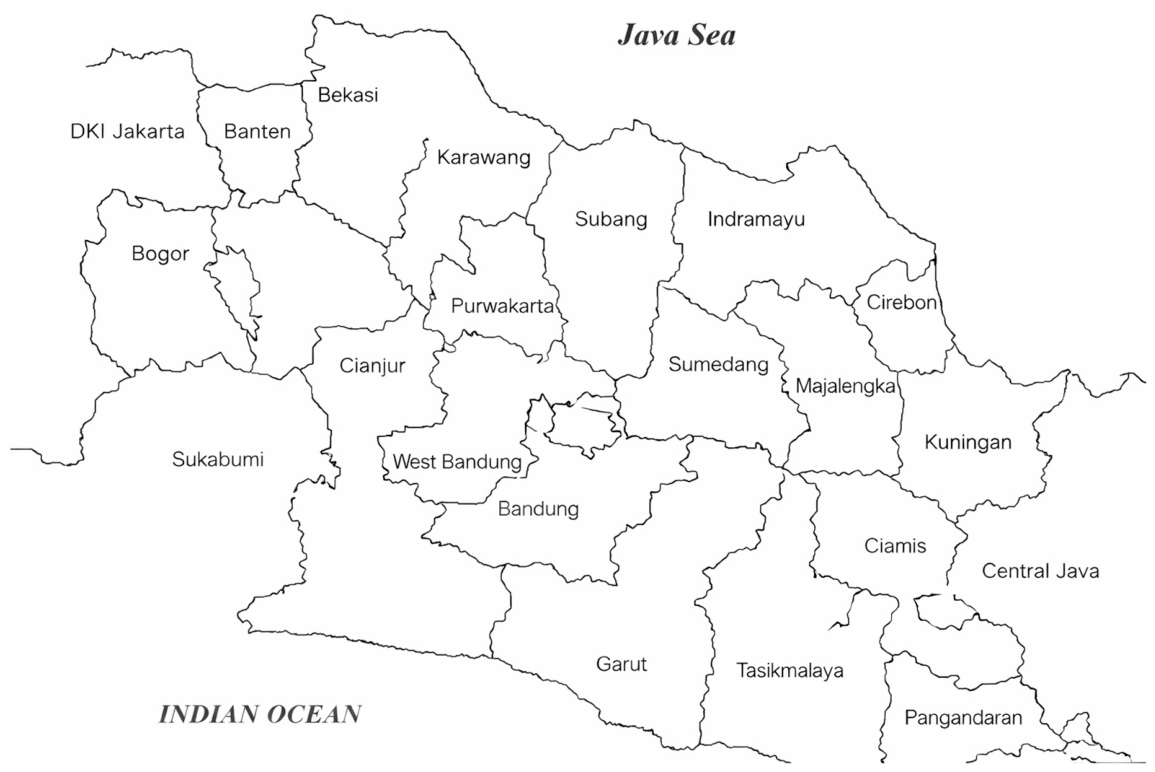
The sample is therefore best understood as analytically representative of dairy-farming households in selected districts with active renewable energy initiatives, rather than statistically representative of the entire province or country. This contextual specificity is important when interpreting the results and their broader applicability. The geographical context of the study area is illustrated in
Figure 1, which presents the administrative map of West Java Province (
Figure 1).
2.3. Data Collection
The study was conducted in West Java Province, Indonesia, a region where provincial authorities have increasingly promoted pro-poor renewable energy initiatives, particularly waste-to-energy and other low-carbon technologies. Household survey data were collected between April and June 2021, covering both dry and rainy seasons to account for seasonal variation in energy demand and organic waste availability. Structured questionnaires were administered to household heads in accordance with approved ethical protocols. The survey captured demographic and socioeconomic characteristics, livestock and resource availability, awareness and perceptions of biogas technology, and—where applicable—household experience with biogas system operation.
A stratified sampling strategy was employed to ensure representation of both biogas adopters and non-adopters. The final sample consisted of 201 households, including 101 adopters with functional digesters and 100 non-adopters. Data collection was supported by trained enumerators fluent in Bahasa Indonesia and Sundanese, ensuring clear communication and cultural appropriateness. In addition to the household survey, focus group discussions and on-site observations were used to validate responses and contextualize household practices related to energy use, digester functionality, and slurry utilization. This mixed-source approach strengthened data reliability while maintaining a balanced comparison between adopter and non-adopter households.
Table 1 below summarizes the explanatory variables included in the empirical models, detailing their measurement, coding schemes, and hypothesized direction of influence on household biogas adoption based on the Biogas Adoption Framework (BAF). Variables capture personal, economic–motivational, technical, and contextual factors expected to shape adoption decisions.
2.4. Sampling Strategy
A comparative cross-sectional design was employed, including both biogas adopters and non-adopters. Due to the absence of a comprehensive registry of biogas users, adopter households were identified using records from dairy cooperatives, local extension offices, and biogas program implementers. Non-adopter households were randomly selected from the same villages as adopters to ensure comparability in agroecological, market, and institutional conditions.
The final sample comprised 201 households, including 101 biogas adopters with functional digesters and 100 non-adopters. This sampling approach allows for systematic comparison between groups while acknowledging that adoption is not randomly distributed across the population.
2.5. Empirical Analysis
To examine factors associated with household biogas adoption, a binary logistic regression model was estimated, with adoption status (1 = adopter; 0 = non-adopter) as the dependent variable [
30,
31]. Explanatory variables were selected based on prior empirical research and insights from the Diffusion of Innovation and Theory of Planned Behavior literature, including household demographics, livestock ownership, education, income, perceived fuel-cost pressure, perceived time-saving benefits, access to electricity, and participation in biogas-related training [
30,
31].
Standard errors were adjusted using cluster-robust estimation at the district level to account for spatial correlation in adoption behavior. Model performance was evaluated using goodness-of-fit measures, receiver operating characteristic (ROC) analysis, and calibration diagnostics. Average marginal effects were calculated to facilitate interpretation of estimated coefficients [
30,
31,
32].
2.6. Interpretation Framework
Diffusion of Innovation and Theory of Planned Behavior perspectives are used in this study as an interpretive framework rather than as formal behavioral models. The empirical analysis does not estimate latent constructs such as attitudes, subjective norms, or perceived behavioral control [
33]. Instead, these theoretical perspectives guide interpretation of observed adoption patterns by linking statistically significant predictors—such as training participation, perceived time savings, and fuel-cost pressure—to broader concepts of relative advantage, capability, and perceived control.
This approach allows the study to translate regression results into policy-relevant insights while avoiding over-specification of behavioral theory beyond what is supported by the data.
2.7. Ethical Considerations
Ethical review and approval were not required for this study under applicable Indonesian regulations and institutional guidelines, as the research involved anonymous, non-invasive household surveys posing minimal risk to participants [
34,
35,
36]. Participation was voluntary, and informed verbal consent was obtained from all respondents prior to data collection. All procedures were conducted in accordance with the principles of the Declaration of Helsinki (1975, revised 2013) [
37,
38].
2.8. Data Analysis
Household survey data from West Java were analyzed using binary logistic regression, which is appropriate for modeling dichotomous outcomes such as biogas adoption and is widely used in empirical studies of energy-technology uptake. Logistic regression was selected due to its interpretability, robustness in small-to-moderate samples, and direct estimation of adoption probabilities through odds ratios. The dependent variable was defined as actual adoption of household biogas technology (1 = adopter; 0 = non-adopter). Model parameters were estimated using maximum likelihood estimation [
30,
31,
32].
Explanatory variables capture household characteristics, resource endowments, perceptions, and institutional exposure, including livestock ownership, education, income, perceived fuel-cost pressure, perceived time-saving benefits, access to electricity, and participation in biogas-related training. These variables reflect key dimensions emphasized in the conceptual framework but are treated as observed covariates rather than latent constructs. All analyses were conducted using SPSS version 24 (IBM, Armonk, NY, USA). Model adequacy was assessed using the Hosmer–Lemeshow goodness-of-fit test, receiver operating characteristic (ROC) curves, and classification accuracy. Statistical inference is based on Wald tests, with significance evaluated at the 5% level, and results are reported using odds ratios to facilitate interpretation [
39].
The Biogas Adoption Framework (BAF) developed in this study is not a formally estimated behavioral model and does not merge or structurally integrate Diffusion of Innovation (DOI) and the Theory of Planned Behavior (TPB). The empirical strategy of this study is based exclusively on a cross-sectional logistic regression model using observable household-level variables. DOI and TPB are employed solely as interpretive reference points to contextualize and organize the statistically estimated associations, rather than as empirically tested theoretical constructs.
The regression model estimates the probability of household biogas adoption as a function of measurable socioeconomic, technical, and contextual characteristics. No latent constructs—such as attitudes, subjective norms, perceived behavioral control, or innovation stages—are estimated [
31,
40]. The study does not test causal pathways between readiness, intention, and behavior, nor does it implement structural equation modeling or mediation analysis. Instead, the analysis identifies statistically significant correlates of adoption and reports marginal effects to quantify their empirical relevance [
31,
40]
The BAF serves as a post-estimation organizing framework that groups the regression variables into four domains—personal, economic–motivational, technical, and environmental factors. This classification is designed to enhance interpretability and policy translation rather than to impose a behavioral process model. The domains provide a structured way to discuss how different categories of observed determinants relate to established adoption theories, while remaining strictly grounded in the regression results.
Accordingly, the contribution of this study is empirical and policy-oriented rather than theoretical integration. DOI and TPB function as conceptual lenses that support interpretation and policy discussion, but they are not merged, validated, or structurally tested within the econometric model. By maintaining this distinction, the analysis avoids theoretical over-specification and ensures that conclusions are limited to relationships directly supported by the data [
6,
41].
3. Result and Discussion
3.1. Determinants of Household Biogas Adoption
Table 2 reports the estimated effects of key variables on household biogas adoption. The results show that adoption is primarily shaped by perceived benefits, economic conditions, and institutional support, rather than by basic demographic characteristics. Perceived time-saving benefits emerge as the strongest determinant of adoption (OR = 6.85,
p < 0.001). Households that expect biogas to reduce time spent on fuel collection and cooking are substantially more likely to adopt, reflecting the importance of labor efficiency in rural household decision-making.
Fuel-cost pressure is also positively and significantly associated with adoption (OR = 3.57,
p < 0.001). This suggests that households facing higher energy expenditures are more inclined to switch to biogas as a cost-saving alternative. Participation in training programs significantly increases the likelihood of adoption (OR = 1.59,
p < 0.001), highlighting the importance of institutional support. Training appears to reduce operational uncertainty and improve user confidence in managing biogas systems [
42,
43,
44].
Livestock ownership shows a statistically significant effect; however, the direction of this relationship depends on model specification. In the preferred specification (
Table 2), the odds ratio is below one (OR = 0.72), indicating a negative association. This suggests that greater livestock ownership does not necessarily translate into higher adoption and may reflect practical or management constraints in utilizing manure effectively. In contrast, alternative specifications (
Table 3) show a positive association. Taken together, these results indicate that livestock availability alone is not a sufficient condition for adoption, and its effect should be interpreted cautiously [
24].
Education is negatively associated with adoption (OR = 0.62, p = 0.005), implying that more educated households may rely on alternative modern energy sources or have different energy preferences. Other variables—including age, gender, household size, income, and electricity access—do not show statistically significant effects in the preferred model. This indicates that general socioeconomic characteristics play a more limited role once perceived benefits and institutional factors are considered. Overall, the findings suggest that adoption decisions are driven more by perceived utility and operational feasibility than by demographic characteristics alone.
Training participation significantly increases adoption likelihood (OR = 1.59, p < 0.001; AME = +0.120), highlighting the importance of institutional support. Livestock ownership is statistically significant (p = 0.003), indicating that households with greater livestock capacity are more likely to adopt, consistent with resource availability considerations. In contrast, age, gender, family size, income, and electricity access do not show statistically significant effects at conventional levels, although age and income display weak positive trends. Interestingly, education is negatively associated with adoption (OR = 0.62, p = 0.005), implying that higher formal education levels are linked with a lower likelihood of adoption after controlling for other factors. Overall, the findings suggest that perceived functional benefits and economic pressures are stronger predictors of adoption than general demographic characteristics
Institutional and functional factors show the largest disparities between groups. Nearly two-thirds of adopter’s report having received biogas-related training, compared with only 18% of non-adopters (
p < 0.001; SMD = 1.09). Likewise, 72% of adopters perceive time-saving benefits from biogas use, whereas only 21% of non-adopters report such expectations (
p < 0.001; SMD = 1.13). These large effect sizes underscore the importance of training exposure and perceived convenience in shaping adoption decisions. To enhance interpretability, average marginal effects (AMEs) were computed and are reported in
Table 2. Unlike odds ratios, AMEs express the change in predicted probability of functional biogas adoption associated with a one-unit change in each explanatory variable, holding other variables constant. AMEs were calculated as average marginal effects across all observations rather than at sample means, providing a more representative estimate of effect magnitude.
Standard errors are clustered at the district level (nine districts) to account for potential intra-district correlation arising from shared program exposure, local policy implementation, extension service provision, cooperative structures, and market access conditions. Households within the same district may face similar institutional environments, subsidy schemes, infrastructure quality, and technical support systems, which could induce correlated error terms and downward-biased standard errors if clustering were ignored. Clustering at the district level, therefore, provides more conservative and reliable inference by adjusting for unobserved contextual heterogeneity across districts [
45,
46].
Table 3 presents an alternative specification of the logistic regression model. While most core findings remain consistent—particularly the strong effects of time savings, fuel-cost pressure, and training—some differences emerge. Odds ratios greater than one indicate a positive association with adoption likelihood, while values below one indicate a negative association. Statistical significance levels are denoted as ***
p < 0.01, **
p < 0.05, *
p < 0.10. Standard errors are clustered at the district level (
n = 9).
To ensure clarity and avoid inconsistencies, this study uses
Table 2 as the primary specification, with
Table 3 as a robustness check. Notably, livestock ownership and electricity access have positive, statistically significant effects in this specification. These differences reflect sensitivity to model structure and highlight the importance of interpreting results across specifications rather than relying on a single model.
3.2. Biogas Adoption Framework (BAF) in West Java
This study applies the Biogas Adoption Framework (BAF) as a structured post-estimation interpretive device to organize and contextualize the empirically estimated determinants of functional household biogas adoption in West Java.
For analytical clarity, the empirically tested variables are grouped into four domains: Personal Influences (PI), Economic and Motivational Influences (EMI), Technical Influences (TI), and Environmental Influences (EI). This grouping is organizational rather than theoretical; it does not introduce additional explanatory constructs beyond those estimated in the regression.
Variables not included in the regression model (e.g., broader socio-cultural norms, informal institutional dynamics, stove compatibility perceptions, and other contextual observations) are not assigned statistical significance. Where relevant, such factors are discussed separately as descriptively observed or conceptually inferred considerations and are clearly distinguished from regression-based findings [
47,
48].
Accordingly, relationships within the BAF are explicitly categorized into: (i) empirically tested associations derived from the multivariate logistic regression results; (ii) descriptively observed differences reported in
Table 2; and (iii) conceptually interpreted relationships informed by DOI and TPB to support explanation. This differentiation ensures analytical coherence and prevents attribution of statistical validation to variables that were not formally tested.
3.2.1. Personal Influences (PI)
Descriptive comparisons (
Table 2) indicate limited differences between adopters and non-adopters in age, gender, and household size. These characteristics do not emerge as strong determinants in the multivariate regression once other factors are controlled for.
Education, however, exhibits a statistically significant negative association with adoption in the regression model. While adopters have higher average levels of education, the multivariate results suggest that, after controlling for other variables, additional years of formal education are associated with a lower probability of adoption. This may reflect opportunity costs, alternative energy preferences, or a greater reliance on LPG among more educated households [
49,
50].
Household income does not show a statistically significant effect in the regression model, indicating that adoption is not primarily driven by general income capacity. Overall, personal influences appear to shape adoption indirectly rather than acting as decisive drivers once capability- and benefit-related variables are considered [
51].
3.2.2. Economic and Motivational Influences (EMI)
Economic and motivational factors emerge as central empirically supported determinants of adoption [
10,
50]. Fuel-cost pressure is positively and significantly associated with biogas adoption. Households reporting higher perceived fuel expenditures are more likely to adopt, suggesting that economic incentives remain a key motivator even in a subsidized LPG environment. This finding underscores the role of energy affordability concerns in shaping adoption decisions. Livestock ownership is also positively and significantly associated with adoption [
48,
52]. Larger herd size increases the likelihood of adoption, reflecting manure availability as a structural precondition for functional biogas systems. Without adequate feedstock, adoption is technically infeasible regardless of motivation. Together, these findings indicate that economic incentives interact with structural feasibility conditions to influence adoption outcomes [
53,
54].
3.2.3. Technical Influences (TI)
Technical influences are reflected most strongly in training participation and perceived time-saving benefits, both of which exhibit robust positive associations with adoption in the regression model [
55].
Participation in hands-on training significantly increases the probability of adoption. However, because training was not randomly assigned, this relationship is interpreted as associative rather than causal. Training likely reduces [
55,
56] perceived complexity and enhances user confidence in operating and maintaining digesters. Perceived time savings also show a strong positive association with adoption. Households that recognize reductions in fuel collection and cooking effort are substantially more likely to adopt. This aligns with the interpretation of relative advantage in DOI and perceived behavioral control in TPB. These findings suggest that operational capability and perceived functionality are more influential than abstract awareness alone.
3.2.4. Environmental Influences (EI)
Environmental influences operate primarily through resource availability rather than through climatic variability. Water availability shows a positive association with adoption, indicating that digester feasibility depends partly on adequate water supply. However, environmental variables do not independently dominate adoption decisions once economic and technical factors are accounted for.
Electricity access does not emerge as a significant determinant, suggesting that biogas functions as a complementary cooking and waste-management solution rather than as a substitute for grid electricity [
27,
57,
58]. Overall, environmental conditions shape feasibility constraints but do not, in the absence of economic incentives and technical support, independently drive adoption [
23,
27].
Table 3 synthesizes the regression results within the Biogas Adoption Framework by grouping empirically tested determinants into four analytical domains. The results indicate that adoption is most strongly associated with perceived time savings, fuel-cost pressure, livestock ownership, and participation in training. Education exhibits a negative association, while income and several demographic characteristics do not demonstrate significant independent effects.
Importantly, the framework does not claim statistical validation for variables that were not included in the regression model. Descriptive observations and contextual considerations are clearly separated from empirically tested relationships. Taken together, the findings suggest that functional biogas adoption in West Java depends primarily on the alignment of structural feasibility (manure and water availability), economic motivation (fuel-cost pressure), and operational capability (training and perceived benefits), rather than on general socioeconomic status alone. The BAF therefore serves as a structured synthesis of regression findings, providing policy-relevant interpretation without extending beyond the empirical model.
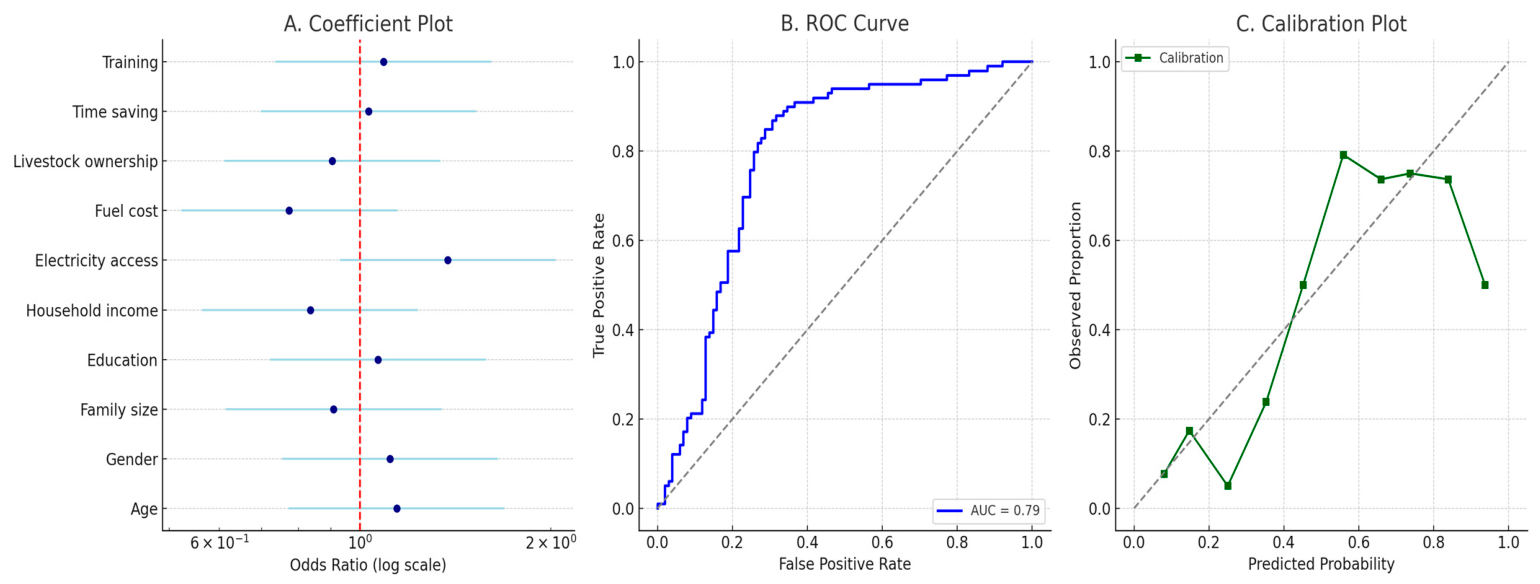
Figure 2 summarizes the performance and diagnostic evaluation of the logistic regression model estimating functional biogas adoption. The assessment combines three complementary graphical diagnostics: a coefficient plot, a receiver operating characteristic (ROC) curve, and a calibration plot.
Panel A (Coefficient Plot) displays estimated odds ratios on a logarithmic scale, with the vertical reference line indicating an odds ratio of one (no effect). Variables with confidence intervals entirely above unity—particularly training participation, perceived time savings, fuel-cost pressure, and livestock ownership—exhibit positive associations with adoption. These results are consistent with the regression estimates reported in
Table 3. In contrast, several demographic characteristics (e.g., age, gender, household size, and income) display odds ratios closer to one and/or confidence intervals overlapping unity, indicating weaker or statistically insignificant associations once other variables are controlled for. The coefficient plot visually reinforces that adoption is more strongly associated with capability- and benefit-related factors than with general socioeconomic characteristics.
Panel B (ROC Curve) evaluates the model’s discriminatory performance. The area under the curve (AUC) is approximately 0.79, indicating good predictive ability in distinguishing adopters from non-adopters. An AUC near 0.8 suggests that the model performs substantially better than random classification, while not indicating overfitting.
Panel C (Calibration Plot) assesses agreement between predicted and observed adoption probabilities. The plotted points generally track the 45-degree reference line across most probability ranges, indicating satisfactory calibration. Although minor deviations appear at extreme predicted probabilities, there is no systematic evidence of consistent over- or under-prediction. Together, these diagnostics suggest that the model demonstrates reasonable discrimination and acceptable calibration, supporting the reliability of the estimated associations reported in the regression analysis.
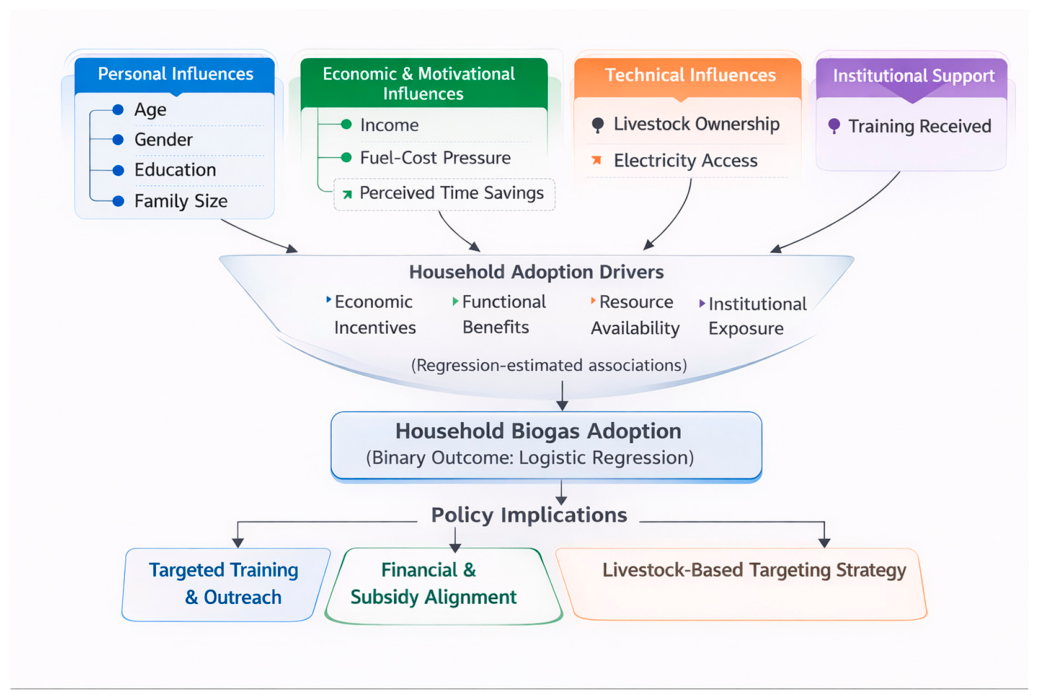
Figure 3 below illustrates biogas adoption as a staged process linking household readiness, intention to adopt, and actual use, shaped by four interrelated domains: personal influences, economic–motivational influences, technical influences, and environmental influences. Rather than depicting a statistically estimated model, the framework serves as an analytical and interpretive tool to situate empirical findings within a broader sustainability–resilience perspective, highlighting how household capabilities and enabling conditions jointly influence adoption outcomes.
3.3. Biogas Adoption Framework (BAF) Interpretation
To organize the empirical findings, the Biogas Adoption Framework (BAF) groups variables into four domains: personal, economic–motivational, technical, and environmental factors. This framework is used as an interpretive tool rather than a formal model.
Economic and technical factors emerge as the most influential. Fuel-cost pressure reflects economic motivation, while training participation and perceived time savings capture operational capability and perceived benefits. These factors consistently show strong and statistically significant associations with adoption.
Personal characteristics, such as age, gender, and household size, do not play a decisive role once other variables are controlled for. Education shows a negative effect, likely reflecting differences in access to alternative energy sources. Environmental factors, including electricity access, do not exhibit stable effects across specifications, suggesting that biogas functions more as a complementary solution rather than a substitute for existing energy infrastructure.
Overall, the framework highlights that adoption depends on the alignment of economic incentives, technical capacity, and perceived usefulness, rather than on structural characteristics alone.
3.4. Model Performance and Robustness
Model diagnostics indicate satisfactory performance. The receiver operating characteristic (ROC) curve yields an area under the curve (AUC) of approximately 0.79, suggesting good discriminatory ability between adopters and non-adopters. Calibration results show that predicted probabilities are broadly consistent with observed outcomes. Standard errors were clustered at the district level to account for shared contextual conditions, ensuring more reliable inference. Additional robustness checks confirm that the main findings—particularly the effects of time savings, fuel-cost pressure, and training—remain stable across alternative specifications.
3.5. Effects of Biogas Adoption on Household Outcomes
Table 4 presents the adjusted effects of biogas adoption on key household outcomes. The results indicate that adoption generates substantial benefits across multiple dimensions. Biogas adoption significantly reduces firewood and kerosene use, indicating a clear shift away from traditional and transitional fuels. This contributes to reduced pressure on local biomass resources and lower household energy expenditures.
From
Table 4 below, the outcome estimates indicate that biogas adoption generates substantial and statistically robust benefits across energy use, agricultural inputs, and household labor allocation. Firewood and kerosene consumption decline sharply among adopters, confirming that biogas effectively substitutes for traditional and transitional cooking fuels and reduces pressure on local biomass resources. The near-elimination of chemical fertilizer use reflects the productive reuse of bio-slurry, highlighting biogas as an integrated energy–agriculture intervention rather than a stand-alone energy technology.
In addition, the significant reduction in time spent collecting fuel translates into meaningful weekly time savings, primarily benefiting women, who are typically responsible for fuel collection and cooking. Together, these effects demonstrate that biogas adoption delivers simultaneous environmental, economic, and social gains, reinforcing its relevance for sustainable and resilient rural livelihoods.
These findings highlight the multidimensional benefits of biogas adoption: reduced reliance on traditional fuels, improved agricultural input sustainability, and significant time savings for household labor.
Chemical fertilizer use declines sharply, reflecting the substitution effect of bio-slurry as an organic fertilizer. This highlights the integrated nature of biogas systems, linking energy production with agricultural productivity. Adoption also reduces time spent on fuel collection, resulting in meaningful labor savings. These benefits are particularly relevant for women, who are typically responsible for fuel-related tasks in rural households. Overall, the results demonstrate that biogas adoption delivers simultaneous environmental, economic, and social benefits, reinforcing its relevance for sustainable rural development.
3.6. Limitations of the Study
This study has several limitations that should be considered when interpreting the findings. First, the sample is geographically limited to selected districts in West Java and does not represent all rural households in Indonesia. Second, the cross-sectional design captures adoption status at a single point in time and does not account for dynamic changes in technology use or abandonment. Third, the identification of adopters relied partly on program records, which may introduce selection bias. Despite these limitations, the study provides valuable insights into adoption patterns in a context where biogas development is actively promoted [
13,
34,
59]. For future research in Indonesia, it is important to expand beyond household-level surveys to include economic, technical, and environmental feasibility analyses at community and industrial scales. Pilot projects and full-scale demonstrations involving multiple stakeholders—including local governments, cooperatives, and private sector actors—would generate stronger evidence on operational challenges and sustainability. Further studies should also identify user-specific needs and adapt digester designs accordingly, recognizing that cultural practices, gender roles, and land tenure systems influence technology acceptance. In addition, research should explore the fermentation potential of alternative substrates available in Indonesia (such as food waste, palm oil residues, and rice husks) to ensure resilience against seasonal variability in feedstock supply [
1,
7,
12].
By addressing these limitations, future studies will not only improve the reliability of adoption models but also support Indonesia’s broader renewable energy strategy (RUEN) and initiatives such as the Domestic Biogas Programme (BIRU), ensuring that biogas becomes a practical, socially acceptable, and sustainable energy solution across diverse regions of the country [
11,
12,
13,
60].
4. Discussion
The findings of this study provide important insights into the factors influencing household biogas adoption in dairy-based rural systems. The results highlight that adoption is not driven by a single factor, but rather by the interaction between perceived benefits, resource availability, and institutional support.
First, the strong positive effect of perceived time-saving benefits suggests that households value technologies that reduce daily labor burdens. This aligns with previous studies showing that convenience and time efficiency are critical drivers of clean energy adoption in rural contexts.
Second, fuel cost pressure emerges as a significant motivator. Households facing higher expenditures on conventional fuels are more likely to adopt biogas as a cost-saving alternative. This finding supports the argument that economic incentives remain central to household energy transitions [
61].
Third, livestock ownership plays a crucial role, reflecting the importance of structural feasibility. Biogas systems depend on a stable supply of organic feedstock, and households with larger herds are better positioned to sustain operation. This confirms that biogas adoption is inherently tied to agricultural production systems.
Fourth, participation in training programs significantly increases adoption likelihood, highlighting the importance of technical knowledge and user confidence. Biogas systems require regular maintenance and operational understanding, and insufficient training can become a barrier to sustained use.
Interestingly, higher levels of formal education are associated with lower adoption probability. This may reflect greater access to alternative energy sources such as LPG or electricity among more educated households, as well as differences in energy preferences. This finding suggests that biogas promotion strategies should be tailored to different socioeconomic segments.
Overall, the results emphasize that successful biogas adoption requires an integrated approach that combines technical feasibility, user capability, and supportive institutional environments [
6,
23,
41].
5. Conclusions
This study examined the determinants of household biogas adoption among dairy-farming households in West Java, Indonesia. The results demonstrate that adoption is shaped by a combination of economic incentives, resource availability, and institutional support mechanisms.
Key factors influencing adoption include perceived time-saving benefits, fuel cost pressure, livestock ownership, and participation in training programs. At the same time, higher levels of formal education are associated with lower adoption, suggesting the influence of alternative energy preferences.
These findings highlight the need for policies that go beyond financial incentives and address practical and institutional barriers to sustained use. In particular, strengthening training systems, ensuring reliable technical support, and integrating biogas programs with agricultural development strategies are critical for long-term success.
While the findings are most directly applicable to dairy-based rural systems in West Java, they offer broader insights for similar smallholder contexts where energy and agricultural systems are closely interconnected.