Article

Elicitor-Driven Changes in Harvest Quality of ‘Calabacita’ Figs Under High-Density Production

by
Carlos Moraga-Lozano
1,
Mónica Palomino-Vasco
1,
Alicia Rodríguez
2,
Manuel J. Serradilla
1,* and
Margarita López-Corrales
3
1
Department of Postharvest, Plant Value Enhancement, and Emerging Technologies, Centre for Scientific and Technological Research of Extremadura (CICYTEX), Agri-Food Technological Institute of Extremadura (INTAEX), Junta de Extremadura, Avda. Adolfo Suárez s/n, 06007 Badajoz, Spain
2
Department of Animal Production and Food Science, University Institute for Agricultural Resources (INURA), University of Extremadura, Avda. Adolfo Suárez s/n, 06007 Badajoz, Spain
3
Department of Mediterranean Fruticulture, Centre for Scientific and Technological Research of Extremadura (CICYTEX), Finca La Orden-Valdesequera Research Centre, Junta de Extremadura, 06187 Guadajira, Spain
*
Author to whom correspondence should be addressed.
Agriculture 2026, 16(7), 790; https://doi.org/10.3390/agriculture16070790
Submission received: 6 February 2026 / Revised: 24 March 2026 / Accepted: 30 March 2026 / Published: 2 April 2026

Abstract

Fresh figs are characterised by high perishability, leading to a limited postharvest shelf life. Consequently, preharvest elicitor application strategies have been explored to enhance their quality and storability. During the 2022 and 2023 seasons, figs (cv. Calabacita) grown under high-density conditions were treated with oxalic acid (OA; 1 and 2 mM), melatonin (MEL; 0.1 and 0.5 mM), and γ-aminobutyric acid (GABA; 10 and 50 mM) through foliar sprays applied two or three times. Fruits were harvested at commercial maturity and analysed immediately after harvest. Physicochemical and bioactive parameters were determined. Analysis of variance was used to assess treatment effects, and t-tests were used to evaluate differences in the number of applications and between seasons. Significant seasonal effects were observed, whereas no cumulative effect from repeated applications was detected. OA at 2 mM increased fruit weight (37.9 g) and size (42.5 mm) and delayed ripening. MEL treatments enhanced sugar accumulation (100.1 g kg−1 and 96 g kg−1 of glucose and fructose, respectively), while GABA treatments were associated with a more advanced maturity stage. Notably, OA (2 mM), MEL (0.5 mM), and GABA (50 mM) significantly increased enzymatic antioxidant activity by an average of 24% and non-enzymatic antioxidant capacity by around 17% in general terms. These results indicate that preharvest elicitor application is a promising and eco-friendly approach to improve the nutritional value and overall quality of fresh figs.

1. Introduction

Figs are complex inflorescences, characterised by a distinctive fruit developmental pattern. Structurally, the fig fruit consists of an enlarged, fleshy receptacle (the syconium) that encloses numerous small flowers and, later, the true fruits (drupelets/achenes), with an apical ostiole that provides the only opening to the internal cavity [1]. Their ripening is generally classified as climacteric, with an increase in respiration rate and ethylene production at the onset of the ripening [2]. Fig fruit development is often described by a double-sigmoid growth curve comprising three phases. Phase I is characterised by rapid growth in size due to cell division, and by significant increases in moisture and sugar content. A lag period occurs during Phase II, during which the fig fruit remains the same size and the sugar content remains almost unchanged. This period takes 4–6 weeks. In Phase III, rapid diameter growth and the ripening phase occur, including colour change and softening of the fruit. During this final stage, the fruit accumulates most of its sugar, reaching around 90% of its full-maturity content [3,4,5].
Recent studies indicate that ripening depends on crosstalk between ethylene and abscisic acid (ABA) [6]. In figs, both phytohormones appear to regulate the reproductive structures, whereas the surrounding receptacle (syconium) tissue was controlled exclusively by ABA [7]. Unlike typical climacteric fruits, figs are harvested at full on-tree ripeness rather than at a pre-ripening stage to achieve high eating quality, as is common for non-climacteric fruits [8]. ABA levels continue to rise until full ripeness, and figs pass their climacteric peak before harvest [9], resulting in a very short postharvest life. This is particularly critical for the ‘Calabacita’ cultivar, the most economically important variety in the Extremadura region (Spain), which is highly valued for its sensory attributes but faces significant challenges due to its high perishability [10]. Consequently, formulating effective strategies to limit postharvest losses is a priority; however, these approaches must also conform to broader sustainability objectives.
Moreover, the adoption of high-density production systems in fig orchards has emerged as a strategy to improve land-use efficiency and profitability, although it requires more sophisticated management to ensure fruit quality and tree health under intensive conditions [11]. To protect the environment and reduce food waste associated with the short postharvest life of fig fruit, a range of preharvest strategies has been explored. One well-studied approach comprises the preharvest application of elicitors, which can activate metabolic pathways and induce acquired resistance to biotic or abiotic stresses. Notably, these compounds can be effective at very low concentrations [12].
Among these elicitors, oxalic acid (OA) has attracted increasing attention. OA is a naturally occurring dicarboxylic acid in plants. It has been identified in a range of metabolic processes during plant and fruit growth and development, and it is also considered a potential source of protons and electrons [13]. Foliar preharvest applications of OA have been reported to influence fruit quality, including increased firmness in peaches [14], improved skin colour at harvest in grapes [15], and delayed ripening and postharvest senescence in lemons [16], plums [17] and blackberries [18]. In addition, OA treatments have been shown to enhance antioxidant capacity and increase total phenolic content during cold storage in several fruits, such as kiwifruit [19], nectarines [20] and persimmons [21]. Furthermore, Zhu et al. [22] reported an inhibitory effect of OA against Penicillium expansum in kiwifruit.
Another elicitor that has received considerable attention is melatonin (MEL) (N-acetyl-5-methoxytryptamine), an indoleamine identified in a wide range of plant species [23]. MEL is synthesised from tryptophan—the same precursor as the phytohormone indole-3-acetic acid (IAA)—and has therefore been described by some authors as having phytohormone-like activity, including the capacity to modulate the expression of hormone-related genes. As a result, MEL is involved in multiple physiological and developmental processes, including growth and morphogenesis, tolerance to biotic and abiotic stresses, root development, and the regulation of leaf senescence [24,25,26,27]. The potential of preharvest MEL treatments has been widely investigated in several fruit species. In sweet cherry, applications across a range of concentrations improved yield and enhanced resistance to adverse climatic conditions, while also promoting key quality attributes such as fruit weight, colour, firmness, total soluble solids, and titratable acidity, and increasing bioactive compounds (e.g., anthocyanins) [28,29,30,31]. Similarly, preharvest MEL enhanced sugar and organic acid content and improved peel strength and red coloration in pears [32,33]. In addition, MEL treatments have been reported to boost bioactive compound content and antioxidant activity in pomegranates [34], blueberries [35], raspberries [36], and plums [37].
In addition to OA and MEL, γ-aminobutyric acid (GABA) is a four-carbon, non-protein amino acid widely distributed across plant tissues and organs [38]. Exogenous GABA has been shown to enhance plant tolerance to temperature fluctuations [39], saline-alkalinity [40], drought [41] and oxidative [42] stresses. It also holds considerable promise for enhancing fruit quality. Foliar GABA applications have increased yield, enhanced skin colour, and elevated antioxidant content in pomegranates [43] and lemons [44]. In pepper, postharvest life improved, with higher radical-scavenging activity correlating with enhanced physicochemical attributes. Additionally, across a range of concentrations, GABA treatments have alleviated chilling injury in various horticultural commodities by reinforcing antioxidant defence mechanisms and reducing oxidation, membrane damage, and permeability [45,46].
As previously mentioned, these elicitors represent a promising, eco-friendly approach to enhancing the quality of fruits and vegetables at harvest and during storage. However, to the best of our knowledge, their effects on fresh fig quality remain largely unexplored. Given this gap, the present study aimed to evaluate the impact of these compounds and the number of preharvest applications on the physicochemical traits of fresh figs (cv. ‘Calabacita’) grown at high density. Furthermore, both enzymatic and non-enzymatic antioxidant activities were also assessed to provide a comprehensive evaluation of fruit quality at harvest.

2. Materials and Methods

2.1. Plant Material and Experimental Design

The study was conducted during the 2022 (S1) and 2023 (S2) seasons in an experimental fig orchard (Ficus carica, L.) cv. ‘Calabacita’. The orchard was established in 2019 using cuttings from ‘Calabacita’ trees held at the National Fig Germplasm Bank (Centre for Scientific and Technological Research of Extremadura, CICYTEX, ‘Finca La Orden’; Guadajira, Badajoz, Spain; 38°85′19′′ N, −6°68′28′′ W). Trees were trained to an espalier system under high-density planting (3 m × 2.5 m; 1.333 trees ha−1) and managed using standard agronomic practices. Irrigation was supplied through a drip irrigation system. Each tree received water via a single 4 L·h−1 emitter, with the drip line positioned in the centre of the tree row. Water was applied three times per week for 5 h·day−1, providing approximately 3500 m3·ha−1 annually from mid-May to early October. No leaf abscission or other symptoms indicative of water deficit were observed during the study period.
In addition to irrigation management, fertilisation consisted of the annual application of 400 kg·ha−1 of a 9–18–27 NPK complex fertiliser during winter and 150 kg·ha−1 of potassium nitrate in spring. The precise amount of fertiliser applied each year was determined by adjusting these rates based on both the specific nutrient requirements of fig trees [47] and the current soil nutrient status, established through soil analyses and guideline recommendations. Regarding plant protection, no treatments were applied during the study period; instead, only a single application of copper and summer oil was made after winter pruning.
Meteorological data were obtained from the REDAREX online platform [48]. These data are shown in Figure S1 (Supplementary Material). In general, both seasons exhibited comparable climatic conditions, with moderate day-to-day variation. Three elicitors—OA, MEL and GABA (Sigma-Aldrich, St. Louis, MO, USA)—were applied as foliar sprays, each at two concentrations: OA at 1 mM (OA1) and 2 mM (OA2), MEL at 0.1 mM (MEL01) and 0.5 mM (MEL05), and GABA at 10 mM (GABA10) and 50 mM (GABA50). The selected concentrations were based on previous reports on other fruit and vegetable crops [15,16,35,44] as there is currently no scientific evidence regarding the application of these compounds in fresh figs. All spray solutions contained Tween 20 (Chemsolute, Th. Geyer GmbH & Co. KG, Renningen, Germany) at 0.2 mL L−1 as a surfactant. Control (CO) trees were sprayed with the surfactant solution only. For each treatment, 18 trees were randomly selected and arranged into three replicates of six trees. Treatments were applied either two or three times, using 1.2 L of solution per tree with a battery-powered automatic backpack sprayer (MATABI e15 LTC, Goizper S. Coop., Antzuola, Gipuzkoa, Spain), early in the morning. The first application was carried out at the transition between the end of Phase II and the beginning of Phase III, a developmental stage associated with major physiological changes in fig fruit. The second and third applications were performed at one-week intervals.
Two and three preharvest applications were evaluated to determine whether an additional treatment during fruit development could enhance the response and promote cumulative effects on fruit quality at harvest under realistic commercial conditions in a super-intensive orchard.
Figs were harvested one week after the second and third applications, generating two harvest batches (2APP and 3APP). Based on previous studies by our research group [49,50], fruits were harvested at commercial ripeness (diameter between 40 and 45 mm). Fruits were analysed at harvest and transported from the orchard to the laboratory in a refrigerated van at 5 ± 0.5 °C. This experimental design was implemented in S1 and repeated in S2.

2.2. Methodology

Physicochemical parameters were assessed in 30 sound fruits, randomly selected from each treatment and free from visible defects. Firmness was measured using a TA.XT2i Texture Analyser (Stable Micro Systems, Godalming, UK) fitted with a 25 mm flat-base probe (test speed: 0.2 mm s−1) and calculated as the slope of the force–deformation curve up to 6% deformation (N mm−1) [51]. Fruit weight was recorded (g) with a CB Complet electronic balance (Cobos, Barcelona, Spain). Fruit size was measured (mm) with a digital calliper (Mitutoyo Corporation, Kawasaki, Japan). After non-destructive measurements, fruits were pooled into three replicates of 10 fruits (n = 3) per treatment and homogenised with a blender for further analyses. Total soluble solids (TSS) were assessed with a PR-01 digital refractometer (Atago Co., Ltd., Tokyo, Japan) and expressed as °Brix. Titratable acidity (TA) was measured with an automatic titrator (T50 Graphix, Mettler-Toledo S.A.E., L’Hospitalet de Llobregat, Barcelona, Spain) using 0.1N NaOH and reported as % citric acid. The ripening index (RI) was calculated as the TSS/TA ratio. Individual sugars and organic acids were identified and quantified by high performance liquid chromatography (HPLC 1200 Series; Agilent Technologies, Palo Alto, CA, USA) as described by Serradilla et al. [52] and expressed as g kg−1 of fresh weight (FW). Individual sugars were detected with a refractive index detector (RID), using a Shodex Sugar SP0810 column (300 × 8 mm; Shodex/Resonac Corporation, Tokyo, Japan) maintained at 70 °C, with ultrapure water as the mobile phase at a flow rate of 0.6 mL min−1. Organic acids were separated and quantified through a Rezex ROA-Organic Acid H+ (8%) column (300 × 7.8 mm; Phenomenex, Torrance, CA, USA) coupled to a diode array detector (DAD) operating at 210 nm. Sulfuric acid at 0.005 N was used as a mobile phase at a flow rate of 0.5 mL min−1. The results were calculated from a calibration curve for each compound analysed.
Bioactive compounds were assessed through non-enzymatic and enzymatic antioxidant activities. Samples for analysis were collected from three biological replicates (n = 3) per treatment, with 10 fruits per replicate, which were pooled and homogenised to obtain a composite sample representative of the experimental unit. The figs were stored at −80 °C until analysis. Total non-enzymatic antioxidant activity (TAA) was measured using the DPPH and ABTS assays and quantified as mg Trolox equivalents (TE) 100 g−1 FW, according to Pérez-Jiménez et al. [53] using a UV-2401PC spectrophotometer (Shimadzu, Kyoto, Japan). Total phenolic content (TPC) was determined using the Folin–Ciocalteu method [54] and expressed as mg gallic acid equivalents (GAE) 100 g−1 FW. Enzymatic antioxidant activity, including ascorbate peroxidase (APX), catalase (CAT) and peroxidase (POD), followed the method of Carrión-Antolí et al. [55] and was measured on the same spectrophotometer. Enzyme activities were expressed as U min−1 g−1, where U is the enzyme activity units per minute per gram.

2.3. Statistical Analysis

Statistical analysis was performed using SPSS 25.0 for Windows (IBM Copr., Armonk, NY, USA). For each variable, a three-way analysis of variance (ANOVA) was conducted with season, treatment, and number of applications as factors, and their interactions were also tested. Prior to ANOVA, the assumptions of normality and homogeneity of variances were verified using the Shapiro–Wilk and Levene’s tests, respectively. When these assumptions were not met, data were transformed to satisfy the requirements for parametric analysis. When significant differences among treatments were detected, means were compared using Tukey’s test. Differences were considered significant at p < 0.05. In addition, for each bar plot, one-way ANOVA was applied independently for each application to evaluate treatment effects. When significant differences among treatments were detected, means were compared using Tukey’s test. Differences were considered significant at p < 0.05. Differences between the number of applications were further assessed using an independent samples t-test. All data are reported as the mean ± standard deviation (SD).
A principal component analysis (PCA) was conducted to investigate multivariate relationships among the evaluated variables and to reduce data dimensionality. The PCA was performed using the individual data from all replicates across treatments, seasons, and application frequencies. Prior to PCA, data were standardised (z-score transformation) to avoid scale effects among variables measured in different units. Five principal components were retained for interpretation. The PCA was used to evaluate the overall effects of growing season, number of applications, and applied treatments on fruit quality and physiological parameters, and to identify grouping patterns among samples along the principal component axes.

3. Results

3.1. Physicochemical Parameters

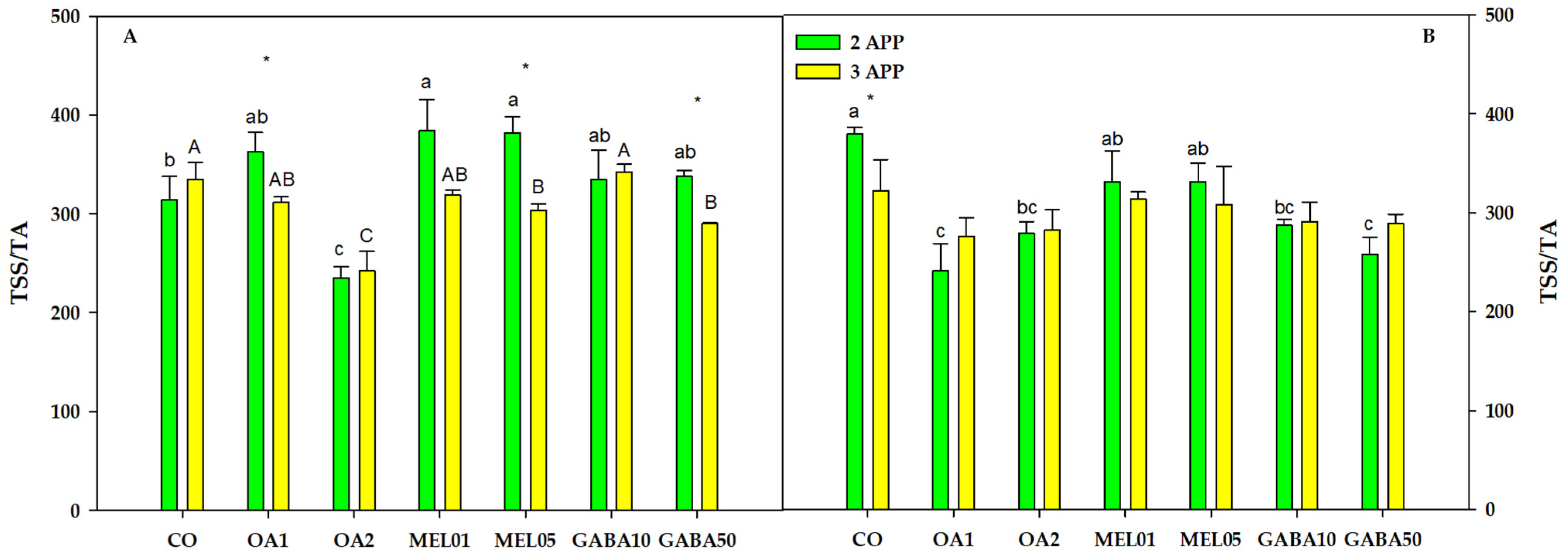
Table 1 shows the data for the physicochemical parameters. There were no significant differences in firmness among treatments, but figs treated with MEL01 and OA2 showed slightly higher firmness values (0.84 and 0.82 N mm−1, respectively). Figs harvested in S1 were firmer than those from S2. Figs treated with 3APP were also firmer than those with 2APP (p < 0.05), with average values of 0.84 and 0.73 N mm−1, respectively. No significant interactions were found among the factors studied for firmness. Concerning fruit weight, all factors were significant. Figs from S2 were 7 g heavier than those from S1, and 2APP fruits weighed more than 3APP fruits (36.0 vs. 31.7 g). OA2 produced the heaviest figs (37.9 g), while the other treatments averaged about 33 g. Fruit size followed a similar trend, being about 4 mm larger in S2 than in S1. Fruits from 2APP were about 2 mm larger than those from 3APP. OA2 also produced the largest fruits (42.5 mm), but this was not significantly different from CO treatment. MEL and GABA treatments resulted in the smallest fruits, with GABA10 having the lowest average size (39.3 mm). For both fruit weight and size, the season and application interaction (S × APP) was significant, meaning the difference between 2APP and 3APP changed depending on the season (Table 1). Regarding TSS and TA, figs from S1 presented higher TSS (26.7 °Brix) and TA (0.084% citric acid) than those from S2 (20.6 °Brix and 0.071% citric acid). The number of applications did not have a significant effect on these values; the mean TSS was 24.2 for 2APP and 23.2 °Brix for 3APP, and both had the same TA (0.077% citric acid). OA2 exhibited the lowest TSS (21.7 °Brix; p < 0.05), while MEL01 showed the highest (24.6 °Brix). OA2 also had the highest TA (0.085% citric acid), while CO and MEL05 displayed the lowest (0.072% citric acid). RI was higher in figs from S1 than from S2. The number of applications did not significantly affect RI. MEL and CO treatments presented the highest RI values (mean RI > 330), while OA2 had a mean RI of 259.7, a delayed ripening at harvest. For TSS, TA, and RI, significant interaction effects (Table 1) indicate that treatment responses depended on both the year and application regime. Figure 1 shows a detailed breakdown of the RI data. At the harvest stage S1 (Figure 1A), figs treated with OA2 had significantly lower RI values than other treatments. At stage S2 (Figure 1B), both OA treatments significantly reduced RI when applied twice (2APP). In contrast, three OA applications (3APP) only slightly decreased RI compared to untreated figs. These results align with the trends in Table 1.

3.2. Individual Sugars and Organic Acids

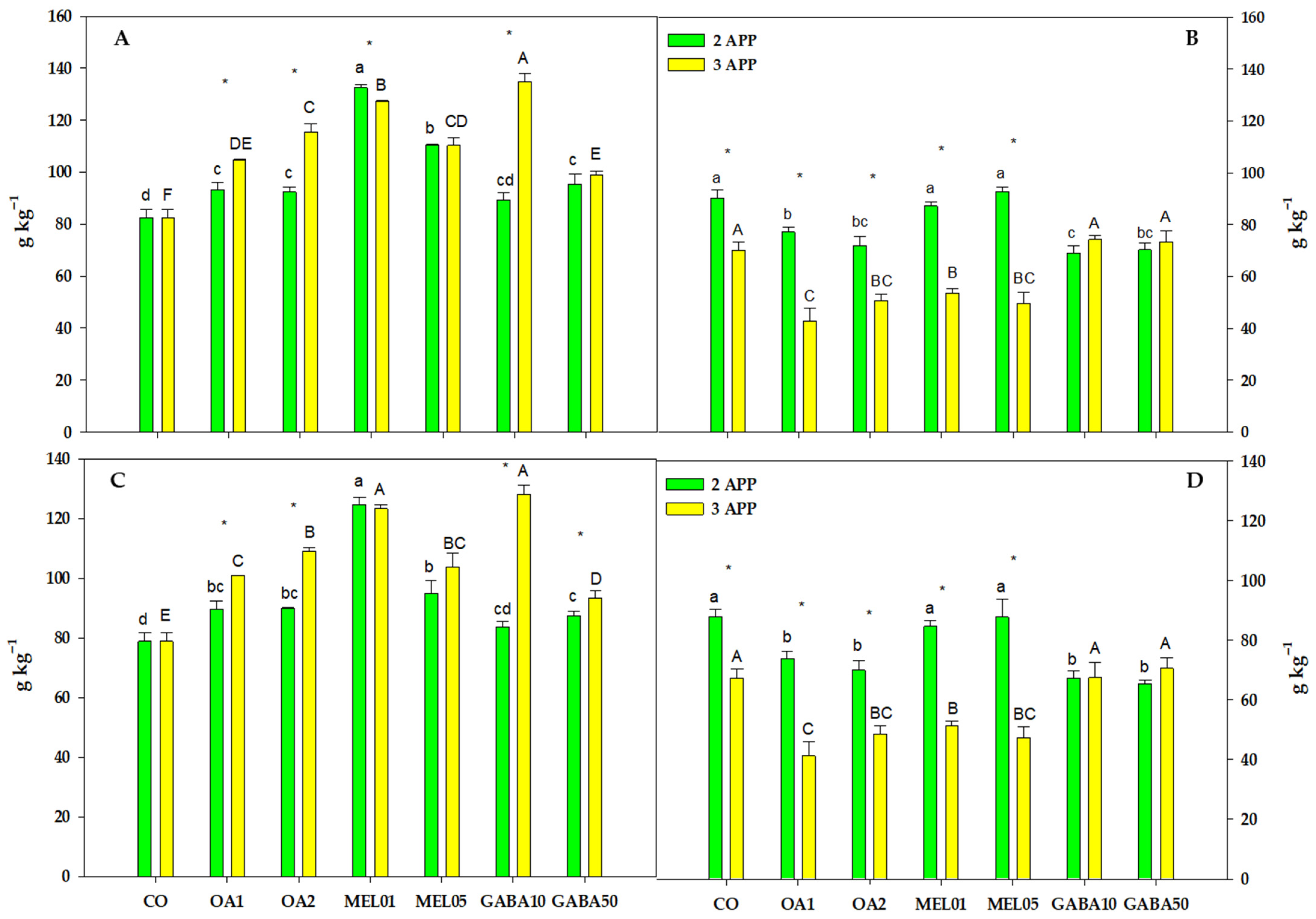
The concentration of individual sugars and organic acids identified by HPLC are shown in Table 2. The analysis showed significant seasonal variations in the levels of glucose and fructose. Figs from S1 exhibited higher mean glucose (104.9 g kg−1) and fructose (99.1 g kg−1) values, while S2 figs showed decreases of about 35 g kg−1 for both sugars. No significant differences in sugar content were observed regarding the number of applications (means ranged from 80.8 to 89.6 g kg−1). MEL01-treated figs showed the highest glucose (100.1 g kg−1) and fructose (96.0 g kg−1) contents, whereas OA1 treatment produced the lowest (79.4 and 76.4 g kg−1, respectively). By contrast, GABA10 treatment increased glucose and fructose contents by 13% and 10%, respectively, compared to untreated figs. As illustrated in Figure 2, the detailed sugar data support these findings displayed in Table 2. During S1, both MEL- and GABA-treated figs consistently showed higher glucose (Figure 2A) and fructose (Figure 2C) levels, regardless of the number of applications. Moving into S2, the results shift: two MEL applications produced glucose (90.2 g kg−1; Figure 2B) and fructose (88.1 g kg−1; Figure 2D) levels similar to those of the control, whereas two GABA applications resulted in reduced sugar levels. Notably, three MEL applications in S2 were linked to lower sugar content. However, in this same period, GABA-treated figs exhibited slightly higher glucose and fructose (74 and 68 g kg−1, respectively) than the untreated fruit. Four organic acids were analysed: oxalic, citric, malic, and succinic (Table 2). Oxalic acid concentration was lower in S1 (0.04 g kg−1) than in S2 (0.07 g kg−1). In addition, figs subjected to 2APP demonstrated higher oxalic acid content than those under 3APP (0.07 vs. 0.04 g kg−1). Figs treated with GABA showed the lowest oxalic acid content. For citric, malic, and succinic acids, S1 figs had higher concentrations than S2 (citric: 1.7 vs. 0.7; malic: 8.1 vs. 6.0; succinic: 6.3 vs. 3.7 g kg−1, respectively). Similarly, 2APP increased these acids (1.3, 7.8, and 5.4 g kg−1). However, all treatments significantly reduced concentrations relative to the control (CO). On the other hand, a pronounced three-factor interaction was observed for both sugars and organic acids. The S × APP × TR interaction was highly significant (Table 2).

3.3. Bioactive Compounds

Data on non-enzymatic and enzymatic antioxidant activity are provided in Table 3. Non-enzymatic activity was assessed using two assays. TAA using the DPPH assay showed a remarkable increase in S2 (61.4 mg TE 100 g−1) compared to S1. The number of applications also influenced TAA concentrations, with higher mean values observed in figs subjected to 2APP (58.2 mg TE 100 g−1) compared to those receiving 3APP (49.7 mg TE 100 g−1). Regarding treatments, all showed a marked improvement in TAA compared to CO (except OA1), with the highest mean value obtained in figs treated with MEL05 (57.4 mg TE 100 g−1). The ABTS assay revealed trends in TAA that were consistent with those obtained using the DPPH assay concerning treatments. Mean TAA values ranged from a maximum of 56.5 mg TE 100 g−1 in the MEL05 treatment to 45.4 mg TE 100 g−1 in the OA1 treatment. With respect to season and the number of applications, no significant differences were found. A slight enhancement was observed in S1 compared to S2 (52.8 vs. 50.5 mg TE 100 g−1, respectively). In terms of the number of applications, the mean values were 52.3 for the figs with 2APP and 51 mg TE 100 g−1 for those with 3APP. Regarding TPC, significantly higher values were recorded in S2, reaching an average of 59.7 mg GAE 100 g−1, compared with 41.3 mg GAE 100 g−1 in S1. The results for the number of applications ranged from 52.5 to 48.5 mg GAE 100 g−1 for 2APP and 3APP, respectively. The MEL01 treatment showed greater enhancement than the CO treatment, with mean values ranging from 53.5 to 46.4 mg GAE 100 g−1.
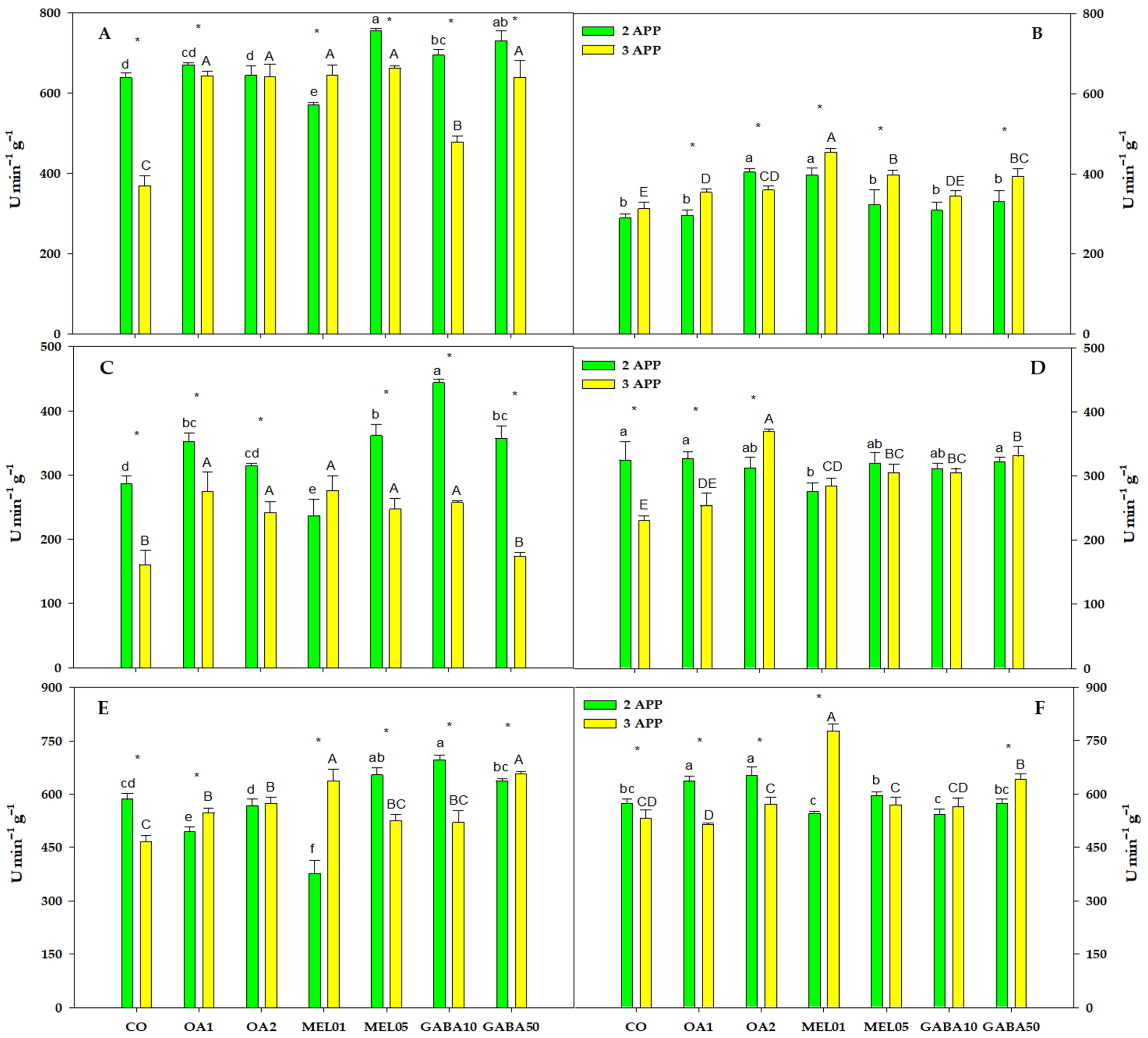
In relation to the analysis of enzymatic antioxidant activity, the enzymes POD, CAT and APX were assessed. The results demonstrated a marked enhancement in POD in figs from S1 (627.5 U min−1 g−1), approximately twofold higher than in S2. The range observed for the POD enzyme was 504.1–478.0 U min−1 g−1 for 2APP and 3APP, respectively. Nevertheless, all treatments increased antioxidant capacity, as evidenced by the higher POD activity than in the control. Consequently, treatment with MEL05 had the highest POD activity (534.7 U min−1 g−1). CAT enzyme activity did not show significant differences between the evaluated seasons, with values ranging from 284.3 to 304.8 U min−1 g−1. However, a significant increase was observed in figs subjected to 3APP (364.9 U min−1 g−1) compared with those receiving 2APP (324.3 U min−1 g−1). Overall, all treatments resulted in higher CAT activity than CO. Among them, GABA10 and OA2 showed the highest average CAT activities, with values of 328.9 and 309.5 U min−1 g−1, respectively. APX activity was not affected by season or number of applications. However, the treatments notably influenced APX activity. In particular, GABA50 (626.8 U min−1 g−1) and OA2 (591.3 U min−1 g−1) significantly increased APX activity compared to CO, which showed the lowest average value (538.7 U min−1 g−1). Significant interaction effects were detected among the studied factors, indicating that the response of the evaluated parameters depended on the combined influence of season (S), number of applications (APP), and treatment (TR) (Table 3). Figure 3 presents the activities of POD, CAT, and APX under different treatments and application numbers across both growing seasons. It provides a detailed visual representation of the trends reported in Table 3. In S1 (Figure 3A,C,E), antioxidant enzyme activities were generally higher after 2APP than after 3APP. More specifically, POD activity (Figure 3A) was significantly enhanced by all treatments during 3APP. Under 2APP, GABA- and MEL05-treated figs showed significantly higher values than the control. Similarly, a comparable response was observed for CAT activity (Figure 3C). The highest stimulation occurred in GABA10 under 2APP, followed by MEL05 and GABA50. Furthermore, APX activity (Figure 3E) showed a marked increase, with 2APP showing the greatest increase in GABA and MEL05 treatments. MEL01 and GABA50 showed comparatively high APX activity after three applications.
In contrast, S2 (Figure 3B,D,F) showed more variable, treatment-dependent enzyme responses. POD activity (Figure 3B) increased significantly in figs receiving 2APP of OA2 and MEL01. 3APP further enhanced POD activity in most treatments, with both MEL treatments showing the most pronounced stimulation. CAT activity (Figure 3D) showed lower variability among treatments. However, a significant improvement occurred under 3APP in OA2- and GABA50-treated figs. APX activity (Figure 3F) improved after two OA applications. The highest values were observed in figs treated with three MEL01 applications, followed by those treated with GABA50.

3.4. Integrative Multivariate Interpretation Based on Principal Component Analysis

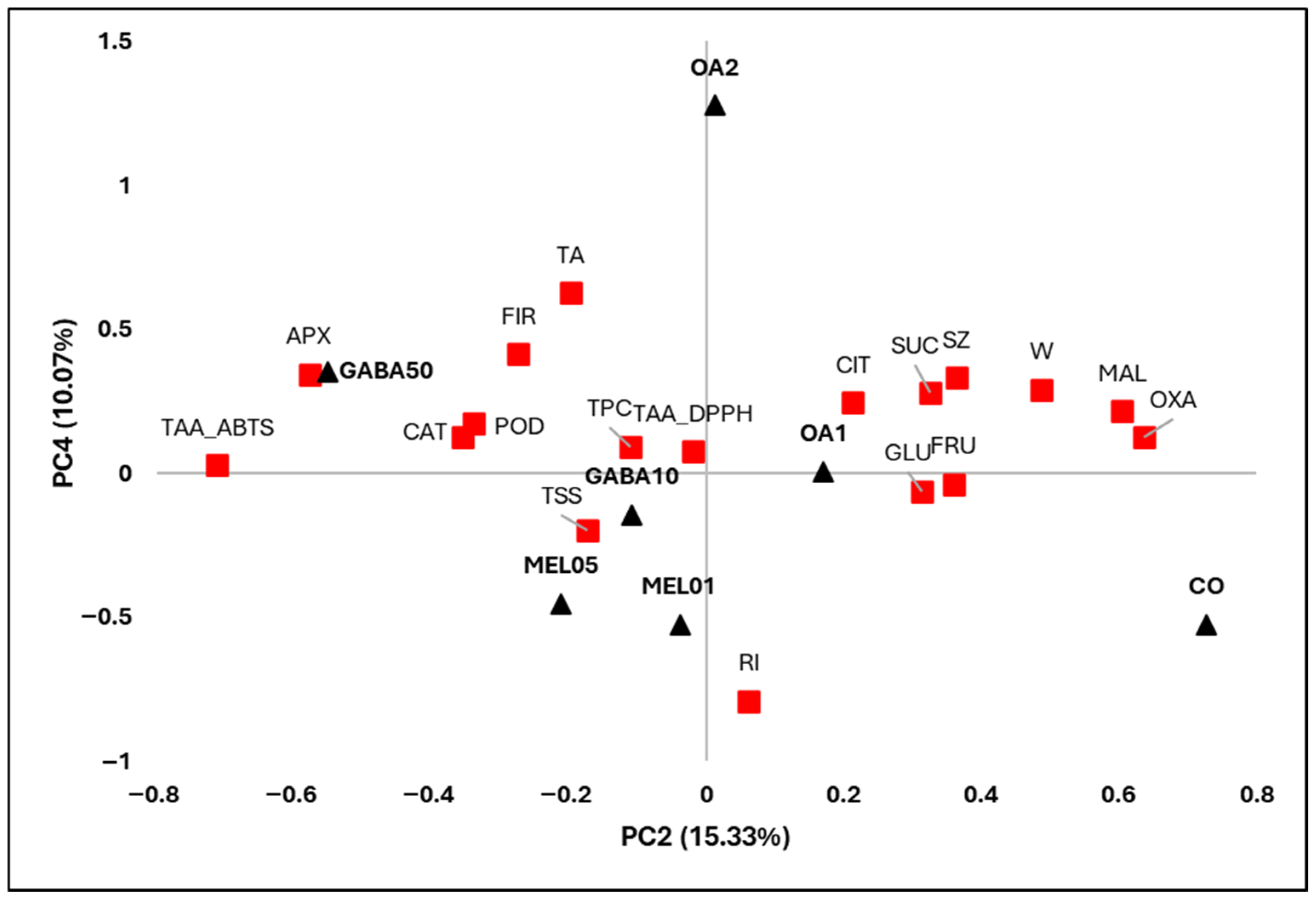
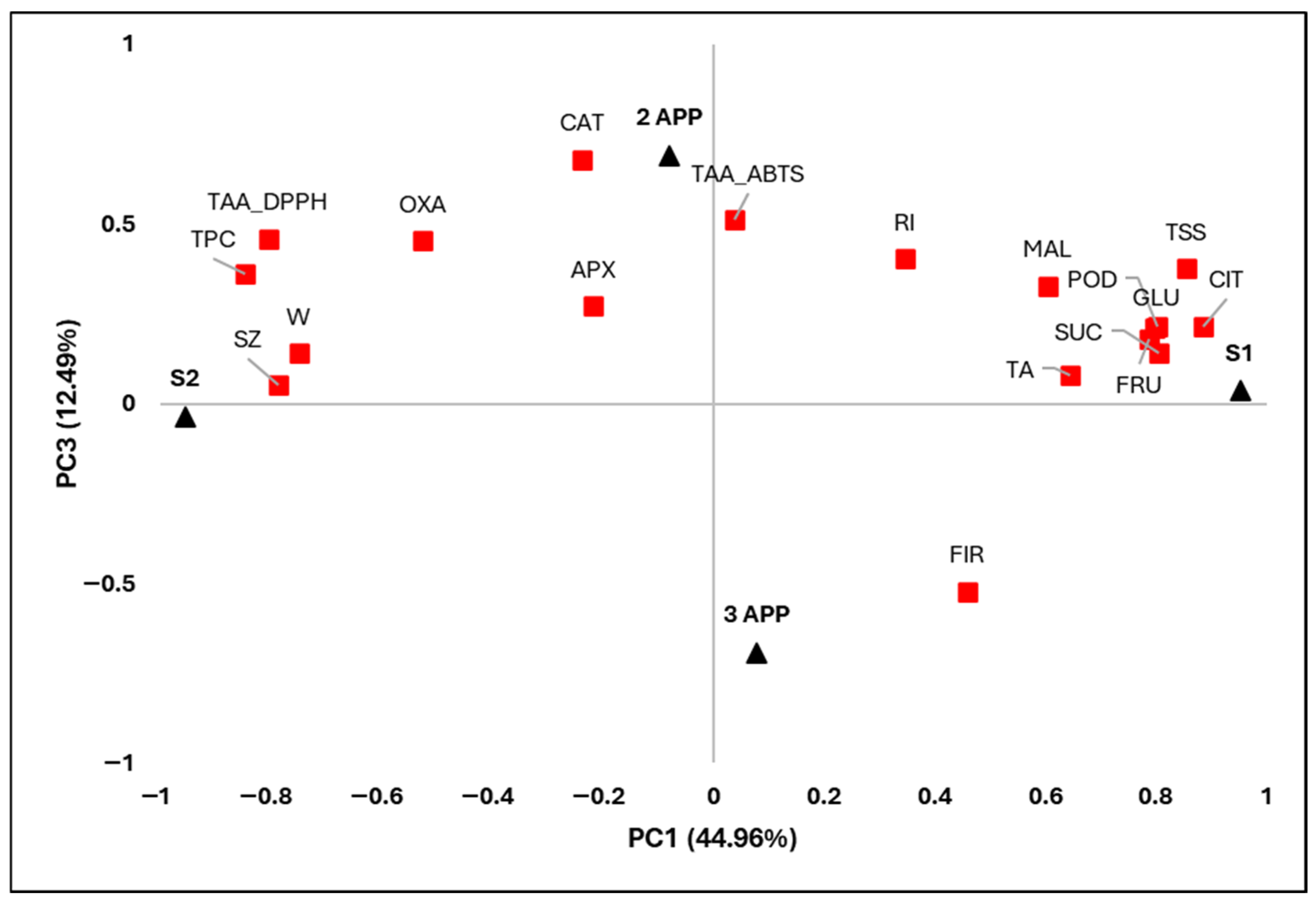
Overall, the multivariate patterns derived from the PCA showed that OA, MEL, and GABA were associated with clearly differentiated responses in fig fruit quality attributes (Figure 4). MEL treatments were mainly aligned with components associated with higher accumulation of soluble sugars and organic acids, as well as with variables related to antioxidant activity and enzymatic responses, indicating a consistent association with metabolic enrichment. GABA treatments showed a comparable but less pronounced distribution pattern, with the higher dose (GABA50) displaying a closer association with variables related to antioxidant capacity.
In contrast, OA treatments, particularly at the highest dose, were positioned separately in the multivariate space and were mainly associated with firmness, higher titratable acidity, and lower ripening index values, reflecting a distinct quality profile compared with the other elicitors.
The PCA also showed that application frequency and seasonal conditions contributed to the overall variability (Figure 5). Two applications were generally located closer to variables associated with antioxidant enzymatic activity, whereas three were more closely associated with firmness and ripening-related parameters. Moreover, the separation between seasons along the main component indicated that interannual variability strongly influenced the sugar–acid balance and the overall metabolic composition of the fruits.
Taken together, these multivariate relationships provide a clear and integrative visualisation of treatment-specific effects on physicochemical, metabolic, and antioxidant-related traits, summarising the main trends observed across the experimental conditions.

4. Discussion

The effectiveness of the applied treatments depends on several factors. Orchard age is a crucial determinant: trees at early developmental stages typically produce fewer fruits, which can alter resource allocation and lead to differences in fruit growth, development, and quality traits compared with fruit from fully mature trees as the orchard matures over successive years [56,57,58]. The experiment was conducted over two consecutive seasons in a young super-intensive fig orchard, when the trees were 3 and 4 years old and had already reached the productive stage. Although this approach allowed us to capture interannual variability under commercial conditions, longer-term studies including additional seasons and more mature orchards are needed to fully elucidate year-dependent responses. Moreover, the timing of elicitor application is a key parameter for obtaining positive effects on fruit quality and varies among species. The number of applications and the concentration of elicitors also play a decisive role, as these compounds are characterised by their ability to induce physiological responses in fruit at very low concentrations [59,60].
As shown in the results, elicitor treatments caused responses that varied across several parameters as the dose increased. The concept of hormesis accounts for this response: elicitors exert beneficial effects at low or moderate doses but may inhibit or become toxic at higher concentrations [61]. Factors such as crop type, physiological stage and timing of application determine the sub-toxic or optimal range. In the case of oxalic acid (OA), numerous studies have extensively demonstrated that OA delays ripening, enhances fruit quality and triggers protective responses. However, excessive accumulation of OA can lead to phytotoxic effects [62,63]. In the present study, we observed a clear dose-dependent response, with the higher concentration (OA2) delaying ripening and enhancing the bioactive profile. Reports on different fruit species treated with increasing exogenous OA concentrations show that higher doses associate with stronger physiological and biochemical responses [64,65,66]. These data suggest that the concentrations applied in this study supported metabolic homeostasis and remained within an effective range.
Similarly, preharvest melatonin application induced a dose-dependent response in fig fruit. The lower concentration (0.1 mM) enhanced glucose and fructose accumulation and contributed to higher fruit firmness. In contrast, the higher concentration (0.5 mM) promoted greater catalase activity. Melatonin has been reported to regulate sugar metabolism and fruit ripening [25]. This includes the modulation of sucrose-cleaving enzymes and source–sink relationships, which may favour hexose accumulation at appropriate concentrations [67,68]. The improved firmness observed at 0.1 mM may be associated with a delayed softening process. Melatonin can influence ethylene biosynthesis and signalling, as well as the activity of cell wall-degrading enzymes such as polygalacturonases and pectinases, helping to maintain cell wall soundness during ripening [69]. Conversely, higher melatonin concentrations are associated with greater activation of antioxidant metabolism, including increased catalase activity. This may reflect better regulation of the redox state during fruit ripening [70,71]. This pattern is consistent with a hormetic response, in which moderate levels of the elicitor stimulate beneficial metabolic adjustments, whereas higher levels induce adaptive mechanisms aimed at maintaining cellular homeostasis.
GABA works as a signalling molecule and is broken down through the GABA shunt pathway, which connects to the citric acid (TCA) cycle. The GABA shunt has two main functions: it can either trigger enzymes that help remove harmful molecules called reactive oxygen species (ROS) or adjust how mitochondria manage energy and reduce power, which affects how sugars and organic acids are made [72]. Lower or moderate levels of added GABA have been linked to higher levels of basic plant chemicals, such as organic acids and sugars, as seen in this study [73,74]. These results suggest that exogenous GABA may function as a signalling hub, coordinating the carbon-nitrogen balance and energy status through the GABA shunt to maintain cellular homeostasis. In contrast, higher levels of GABA may shift energy allocation toward the production of more complex plant chemicals in response to stress [75,76].
In our study, all treatments resulted in slightly higher firmness compared to CO treatment. This is a positive outcome from a postharvest perspective, since higher firmness usually correlates with better resistance to handling damage and slower softening, which can help extend shelf life and maintain quality during storage and marketing. Firmness is also a key attribute for consumers and helps with marketability. Our results from OA2 increased by 9% with respect to untreated figs. These findings are in agreement with previous reports. Retamal-Salgado et al. [77] found that three applications of OA at 2 mM increased fruit firmness at harvest in blueberries. Similarly, plums treated three times with OA at 2 mM also showed greater firmness at harvest [17]. In line with our findings (an enhancement by 10% from MEL05 related to CO), cherries treated three times with MEL at 0.1, 0.3, and 0.5 mM showed improved firmness [30]. Likewise, three applications of MEL at 0.1 mM increased firmness in freshly harvested strawberries [78]. Cortés-Montaña et al. [37] reported that three applications of MEL generally exerted a stronger effect on fruit firmness than two, suggesting that repeated treatments during fruit development have a cumulative effect. In our study, GABA50 improved firmness by about 5% with respect to the control batch. Badiche-El Hilali [79] reported that treatments with 50 mM GABA improved firmness in lemons. Pomegranates treated five times with 10, 50, and 100 mM GABA also showed higher firmness compared to the control [80]. However, ‘Honeycrisp’ apples treated with 40 mM GABA over two seasons showed inconsistent results, with firmness improving in one year but remaining the same or even decreasing in the other [81]. The firmness increase may reflect delayed softening due to improved cell-wall and membrane integrity. Enhanced antioxidant defences (and related enzyme activity) can limit oxidative damage during ripening, helping maintain tissue structure. The greater firmness observed in treated fruit may be related to the lower activity of polygalacturonase (PG) and pectin methyl esterase (PME). This reduction could have delayed pectin degradation, strengthened mesocarp cell walls, and limited the hydrolysis of cell wall components during on-tree ripening [17,82,83].
OA2 treatment significantly increased fruit weight up to 12% and size, while other treatments did not affect figs compared to untreated ones. Apricots treated with OA also produced larger fruit than untreated ones [64]. Applying OA at 1, 5, and 10 mM, applied four times, resulted in larger and heavier pitahaya compared to untreated fruit [84]. In contrast, preharvest OA treatments did not affect blueberry fruit weight or size [85]. These findings indicate that the impact of OA on fruit weight and size can differ between species. The increase in size and weight from OA may be partly due to Ca2+ chelation, which changes pectin and cell wall properties to support tissue expansion [86,87]. OA has been reported to play a key role in cell growth, as its accumulation has been observed during the cell proliferation phase in plants [64]. In line with these results, preharvest MEL treatments in cherries did not increase fruit weight [88]. However, Medina-Santamarina et al. [89] found that preharvest applications of 0.1 mM MEL increased fruit weight in ‘Colorado’ and ‘Mikado’ apricot cultivars. According to other authors, MEL is thought to increase fruit size/weight mainly by protecting photosynthesis and reducing oxidative stress, which helps sustain sugar production and import into the fruit during development [90,91]. In our research, a slight decrease was observed in the GABA treatments. Lemons treated with 10, 50, or 100 mM showed no significant differences in fruit size [44], which is consistent with the findings of Cheng et al. [92], who reported that GABA-treated apples did not present greater fruit weight than untreated controls. Like MEL, GABA is thought to promote fruit growth by improving stress tolerance and osmotic balance, thereby helping maintain turgidity and photosynthetic activity, allowing fruits to continue expanding and accumulating more fresh weight [38].
TSS and TA are important determinants of consumer acceptance. A balanced ratio of these two is considered key to the best taste in fruit [93]. The TSS/TA ratio, or RI, is a reliable measure of fruit ripeness when both attributes are considered [94]. Serna-Escolano et al. [16] found that TSS and TA behaved differently in lemons over two seasons, which matches the findings of this study. In other fruits, preharvest OA applications have been shown to lower TSS and raise TA across concentrations from 0.5 to 8 mM. Two studies on apricots reported effects at 2 mM OA [64,95]. These findings support our results and suggest that OA may slow fruit ripening. The delay in ripening observed in OA2-treated figs may be attributed to the suppression of 1-aminocyclopropane-1-carboxylic acid (ACC) synthase expression, a key enzyme involved in ethylene biosynthesis. The downregulation of this enzyme could result in reduced ethylene production, thereby lowering fruit respiration rates and delaying the onset of the climacteric peak [96]. This suggests that OA acts as a signalling modulator that interferes with the ethylene-dependent ripening cascade. This is thought to be mostly caused by the treatments’ effects on fruit size, as larger fruits have more intercellular space and less dry matter accumulation per unit area [85]. Applying MEL twice at 0.1 mM increased TSS in pears and reduced TA by 30% [32]. Carrión-Antolí et al. [55] also found that TSS increased in two sweet cherry cultivars, while TA stayed about the same as in the control. These results show that MEL can boost TSS, possibly by affecting carbohydrate metabolism [67]. GABA treatment at 10, 50, and 100 mM did not change these values in pomegranates [80]. However, the same GABA concentrations and application methods in sweet cherries led to higher TSS and TA at harvest [97]. This suggests that high TSS and TA levels may be good signs of consumer acceptance [98]. The RI, which decreased by about 30% with respect to CO, showed delayed ripening in figs treated with 2 mM OA. Ahmed et al. [64] found similar results in apricots at the same concentration. Some studies found that preharvest MEL at different concentrations did not change the RI [37,99]. For GABA, Al Shoffe et al. [81] used 40 mM for three years but did not observe a significant effect on the RI. Our results would support the hypothesis that OA, MEL, and GABA can modulate ripening by altering sugar accumulation (°Brix) and organic acid metabolism (acidity) through changes in redox status. As a result, they can modify the RI by changing the balance between sugar import and acid consumption. While these responses are consistent with mechanisms previously associated with redox regulation and hormone-mediated control of ripening, the present study did not directly evaluate hormonal profiles, stress markers, or signalling components in fig tissues. Therefore, these processes are discussed here as plausible explanatory frameworks supported by the literature, rather than as mechanisms demonstrated by our experimental data.
The individual sugar and organic acid profiles were consistent with previous studies on different fig fruit cultivars [100,101]. Regarding preharvest OA application, no significant differences were observed in the sugar and organic acid profiles compared with untreated figs, in agreement with the findings of García-Pastor et al. [66]. Similarly, grapes treated three times with OA 5 mM showed reduced sugar content, whereas the levels of the main organic acids remained unchanged [15]. These results support the hypothesis that OA treatment may delay fruit ripening. This response may be associated with reduced metabolic activity in the fruit, leading to a slower progression of quality-related changes, including TSS accumulation, TA decline and firmness loss [17]. Several studies using exogenous MEL on pomegranates (0.1 mM) [102], plums (0.1 mM) [67] and peaches (0.15 mM) [68] have reported a significant increase in sugar content, while organic acid levels remained unchanged or even decreased compared to untreated fruit. These findings are similar to the results from our study, where sugar accumulation was around 23 and 12% from MEL01 and MEL05, respectively, compared to untreated figs. Overall, this evidence suggests that MEL can alter key enzymes and gene expression involved in sugar and organic acid metabolism [67]. MEL may explain the increased glucose and fructose contents in figs by enhancing sucrose catabolism through the upregulation of invertase-related genes. In parallel, MEL may favour fructose accumulation by repressing fructokinase genes, which is an enzyme involved in fructose catabolism [103]. These molecular adjustments highlight the role of melatonin in regulating source-sink relationships and carbohydrate partitioning through hormonal crosstalk. Exogenous GABA applications have been demonstrated to increase both sugar and organic acid contents. In line with our study, GABA10 showed an increase of up to 13% with respect to the control batch. This effect has been described in postharvest studies conducted on apples [104], soybeans [74], and strawberries [105]. GABA can shift TSS and acidity by increasing key sugars (glucose, fructose, and sucrose) and remodelling organic-acid pools through the GABA shunt, which feeds carbon into mitochondrial TCA cycle intermediates (e.g., malate) [73].
All elicitors evaluated in the present study enhanced antioxidant activity through both enzymatic and non-enzymatic systems, highlighting their capacity to activate fruit defence mechanisms. This effect is associated with the scavenging of reactive oxygen species (ROS) by non-enzymatic compounds such as phenolic acids, flavonoids, and vitamins, as well as with the induction of genes encoding antioxidant enzymes and cell wall structural components [69,106,107]. Although the enhanced antioxidant activity observed here is compatible with the activation of stress-related responses described in other fruit systems, no direct molecular or hormonal analyses were performed in the present study; therefore, these interpretations should be considered hypothesis-based and not direct evidence of specific signalling pathway activation. A general increase of around 13%, 15%, and 13% in non-enzymatic antioxidant activity was observed for OA2, MEL, and GABA treatments, respectively, compared with the control. OA1 showed a pattern similar to CO. The aforementioned hypothesis is supported by several studies involving preharvest OA applications. Three treatments with OA 2 mM increased TPC and TAA in artichokes [108]. Under the same conditions, two sweet cherry cultivars also exhibited enhanced antioxidant activity associated with higher TPC and TAA levels [65]. García-Pastor et al. [66] reported similar results in pomegranates, where OA treatment at 1 mM improved these antioxidant-related parameters, in agreement with the findings of the present study. The increase in phenols could be due to the activation of the enzyme phenylalanine ammonia-lyase (PAL). PAL is a crucial enzyme in the phenylpropanoid pathway involved in phenolic production [85]. Studies conducted on sweet cherries [55] and Myrica rubra [109], in which three preharvest treatments were applied at concentrations of 0.1, 0.3, and 0.5 mM, reported increases in antioxidant activity as determined by TPC and TAA. In addition, treatments with 0.05 and 0.2 mM increased TPC in raspberries [36], whereas the 0.1 mM treatment did not. Melatonin has been reported to enhance the accumulation of antioxidant compounds such as ascorbic acid, proline, flavonoids and carotenoids by inducing the expression of genes involved in their biosynthesis, including GSH, GR1, GR2, GMDH, GME, GGGT, GPP, GDH and GLDH [110]. Finally, GABA treatments also demonstrated a significant enhancement in non-enzymatic antioxidant activity. The TPC and TAA levels at harvest were significantly increased by treatments with 10 and 50 mM GABA in lemons [79] and pomegranates [80]. These results are similar to those obtained in our study. These findings suggest that the application of these elicitors may act as an adaptive strategy to enhance fruit tolerance to potential biotic and abiotic stresses during preharvest and postharvest periods.
The enzymatic antioxidant activity was also affected by the different elicitor treatments. POD activity increased after all treatments, averaging 28% higher than the control. Similarly, OA, MEL05, and GABA treatments raised CAT activity by 22%, 23%, and 24%, respectively. MEL01 responded like the control figs. For APX activity, GABA50 led to the highest increase (16%), followed by OA2 (10%), while other treatments increased APX by an average of 8%. OA concentrations similar to those used in this study increased the activity of POD and CAT enzymes in apricots [64]. On the other hand, the activity of POD, CAT, and APX enzymes was improved by Martínez-Esplá et al. [17] with three applications of OA 2 mM on plums at harvest time. Furthermore, lemons treated with concentrations ranging from 0.1 to 1 mM exhibited increased antioxidant activity in the previously mentioned enzymes [16]. The increase in antioxidant enzyme activity may reflect an improved balance between hydrogen peroxide generation and scavenging, likely reflecting OA’s role in mitigating oxidative stress [111]. Our results showed increased POD activity in all MEL treatments, along with a significant enhancement of CAT activity at 0.5 mM MEL. In contrast, APX activity exhibited only a slight increase. These findings are consistent with previous reports in blackberries [112], pears [113], and sweet cherries [55] treated with MEL at concentrations ranging from 0.05 to 0.2 mM. GABA treatments also modulated antioxidant enzyme activity, leading to an overall increase in the activity of the evaluated enzymes. Similar responses were reported by Öz et al. [114] in strawberries treated with 10 mM GABA, where CAT and APX activities increased significantly at harvest. Likewise, cherries subjected to three applications of 50 mM GABA showed a marked enhancement in the antioxidant activities of POD, CAT, and APX at harvest time [98]. These results suggest that elicitors may enhance cellular antioxidant enzymatic activity by regulating or modulating the metabolic pathways associated with these enzymes, thereby activating fruit defence mechanisms against abiotic and biotic stresses [15,115,116]. While these findings provide a strong mechanistic basis for the observed quality improvements, further research using omics technologies will be essential to fully map the gene regulatory networks involved in these elicitor-driven responses.

5. Conclusions

The effectiveness of preharvest elicitor treatments depends on factors such as crop species, orchard age, elicitor dose, application frequency, and timing. Seasonal changes had a strong effect, probably because the fig trees were still developing. Repeated applications did not show a clear cumulative effect.
Applying 2 mM OA increased fruit weight by 12%, resulting in larger fruit, and lowered the RI, indicating delayed ripening at harvest. MEL treatments raised sugar levels by up to 23%, and GABA treatments enhanced both sugar content and TA. These changes show shifts in the fruit’s metabolism rather than just speeding up ripening. In addition, OA (2 mM), MEL (0.5 mM), and GABA (50 mM) treatments boosted enzymatic antioxidant activity by over 20% and non-enzymatic antioxidant systems by approximately 15%. Overall, these findings show that preharvest elicitor treatments enhance fig resilience to biotic and abiotic stresses and may improve their quality and nutritional value.

Supplementary Materials

The following supporting information can be downloaded at: https://www.mdpi.com/article/10.3390/agriculture16070790/s1, Figure S1: Temporal evolution of temperature (Temp) (A) and relative humidity (RH) (B) throughout the preharvest period in the two experimental seasons (S1 and S2).

Author Contributions

Conceptualization: M.J.S., A.R. and M.L.-C.; methodology: C.M.-L. and M.P.-V.; formal analysis: C.M.-L. and M.P.-V.; investigation: C.M.-L., M.P.-V. and M.J.S.; writing—original draft preparation: C.M.-L.; writing—review and editing: A.R., M.P.-V., M.L.-C., and M.J.S.; supervision: M.J.S.; project administration: M.J.S., M.L.-C. and A.R.; and funding acquisition: M.J.S., M.L.-C. and A.R. All authors have read and agreed to the published version of the manuscript.

Funding

This research was funded by projects PID2020-115359RR-C21 and PID2020-115359RR-C22. C.M.L. and M.P.V. gratefully acknowledge contracts PRE2021-100318 and JDC2022-049532-I, respectively, both funded by MICIU/AEI/10.13039/501100011033 and by ESF+ and the European Union NextGenerationEU/PRTR, respectively.

Institutional Review Board Statement

Not applicable.

Data Availability Statement

The raw data supporting the conclusions of this article will be made available by the authors on request.

Conflicts of Interest

The authors declare no conflicts of interest.

Abbreviations

The following abbreviations are used in this manuscript:
OAOxalic acid
OA1Oxalic acid 1 mM
OA2Oxalic acid 2 mM
MELMelatonin
MEL01Melatonin 0.1 mM
MEL05Melatonin 0.5 mM
GABAγ-Aminobutyric acid
GABA10γ-Aminobutyric acid 10 mM
GABA50γ-Aminobutyric acid 50 mM
ABAAbscisic acid
IAAIndole-3-acetic acid
TAATotal antioxidant activity
FWFresh weight
TPCTotal phenolic content
APXAscorbate peroxidase
CATCatalase
PODPeroxidase
ANOVAAnalysis of variance
SDStandard deviation
SSeason
APPApplications
TRTreatment
TSSTotal soluble solids
TATitratable acidity
RIRipening index
TETrolox equivalent

References

  1. Sandhu, A.K.; Islam, M.; Edirisinghe, I.; Burton-Freeman, B. Phytochemical Composition and Health Benefits of Figs (Fresh and Dried): A Review of Literature from 2000 to 2022. Nutrients 2023, 15, 2623. [Google Scholar] [CrossRef]
  2. Freiman, Z.E.; Rosianskey, Y.; Dasmohapatra, R.; Kamara, I.; Flaishman, M.A. The Ambiguous Ripening Nature of the Fig (Ficus carica L.) Fruit: A Gene-Expression Study of Potential Ripening Regulators and Ethylene-Related Genes. J. Exp. Bot. 2015, 66, 3309–3324. [Google Scholar] [CrossRef]
  3. Crisosto, H.; Ferguson, L.; Bremer, V.; Stover, E.; Colelli, G. Fig (Ficus carica L.). In Postharvest Biology and Technology of Tropical and Subtropical Fruits: Cocona to Mango; Elsevier Ltd.: Amsterdam, The Netherlands, 2011; pp. 134–158. ISBN 9781845697358. [Google Scholar]
  4. Freiman, Z.E.; Rodov, V.; Yablovitz, Z.; Horev, B.; Flaishman, M.A. Preharvest Application of 1-Methylcyclopropene Inhibits Ripening and Improves Keeping Quality of “Brown Turkey” Figs (Ficus carica L.). Sci. Hortic. 2012, 138, 266–272. [Google Scholar] [CrossRef]
  5. Cui, Y.; Wang, Z.; Chen, S.; Vainstein, A.; Ma, H. Proteome and Transcriptome Analyses Reveal Key Molecular Differences between Quality Parameters of Commercial-Ripe and Tree-Ripe Fig (Ficus carica L.). BMC Plant Biol. 2019, 19, 146. [Google Scholar] [CrossRef]
  6. Zhu, X.; Zhu, Q.; Zhu, H. Editorial: Towards a Better Understanding of Fruit Ripening: Crosstalk of Hormones in the Regulation of Fruit Ripening. Front. Plant Sci. 2023, 14, 1173877. [Google Scholar] [CrossRef] [PubMed]
  7. Lama, K.; Harlev, G.; Shafran, H.; Peer, R.; Flaishman, M.A. Anthocyanin Accumulation Is Initiated by Abscisic Acid to Enhance Fruit Color during Fig (Ficus carica L.) Ripening. J. Plant Physiol. 2020, 251, 153192. [Google Scholar] [CrossRef]
  8. Qiao, H.; Zhang, H.; Wang, Z.; Shen, Y. Fig Fruit Ripening Is Regulated by the Interaction between Ethylene and Abscisic Acid. J. Integr. Plant Biol. 2021, 63, 553–569. [Google Scholar] [CrossRef] [PubMed]
  9. Lama, K.; Yadav, S.; Rosianski, Y.; Shaya, F.; Lichter, A.; Chai, L.; Dahan, Y.; Freiman, Z.; Peer, R.; Flaishman, M.A. The Distinct Ripening Processes in the Reproductive and Non-Reproductive Parts of the Fig Syconium Are Driven by ABA. J. Exp. Bot. 2019, 70, 115–131. [Google Scholar] [CrossRef] [PubMed]
  10. Galván, A.I.; Serradilla, M.J.; Córdoba, M.G.; Domínguez, G.; Galán, A.J.; López-Corrales, M. Implementation of Super High-Density Systems and Suspended Harvesting Meshes for Dried Fig Production: Effects on Agronomic Behaviour and Fruit Quality. Sci. Hortic. 2021, 281, 109918. [Google Scholar] [CrossRef]
  11. Galán, A.J.; Domínguez, M.G.; Pérez-López, M.; Galván, A.I.; Pérez-Gragera, F.; López-Corrales, M. Agronomic Performance and Fruit Quality of Fresh Fig Varieties Trained in Espaliers Under a High Planting Density. Horticulturae 2025, 11, 750. [Google Scholar] [CrossRef]
  12. Hidalgo, C.; Ruiz-Moyano, S.; Serradilla, M.J.; Galván, A.I.; Rodríguez, A. Elicitors: Impact on the Fungal Pathogenicity and Colonization in Fruits. Curr. Opin. Food Sci. 2024, 60, 101233. [Google Scholar] [CrossRef]
  13. Hasan, M.U.; Singh, Z.; Shah, H.M.S.; Kaur, J.; Woodward, A.; Afrifa-Yamoah, E.; Malik, A.U. Oxalic Acid: A Blooming Organic Acid for Postharvest Quality Preservation of Fresh Fruit and Vegetables. Postharvest Biol. Technol. 2023, 206, 112574. [Google Scholar] [CrossRef]
  14. Razavi, F.; Hajilou, J. Enhancement of Postharvest Nutritional Quality and Antioxidant Capacity of Peach Fruits by Preharvest Oxalic Acid Treatment. Sci. Hortic. 2016, 200, 95–101. [Google Scholar] [CrossRef]
  15. García-Pastor, M.E.; Giménez, M.J.; Serna-Escolano, V.; Guillén, F.; Valero, D.; Serrano, M.; García-Martínez, S.; Terry, L.A.; Alamar, M.C.; Zapata, P.J. Oxalic Acid Preharvest Treatment Improves Colour and Quality of Seedless Table Grape ‘Magenta’ Upregulating on-Vine Abscisic Acid Metabolism, Relative VvNCED1 Gene Expression, and the Antioxidant System in Berries. Front. Plant Sci. 2021, 12, 740240. [Google Scholar] [CrossRef]
  16. Serna-Escolano, V.; Giménez, M.J.; Castillo, S.; Valverde, J.M.; Martínez-Romero, D.; Guillén, F.; Serrano, M.; Valero, D.; Zapata, P.J. Preharvest Treatment with Oxalic Acid Improves Postharvest Storage of Lemon Fruit by Stimulation of the Antioxidant System and Phenolic Content. Antioxidants 2021, 10, 963. [Google Scholar] [CrossRef]
  17. Martínez-Esplá, A.; Serrano, M.; Martínez-Romero, D.; Valero, D.; Zapata, P.J. Oxalic Acid Preharvest Treatment Increases Antioxidant Systems and Improves Plum Quality at Harvest and during Postharvest Storage. J. Sci. Food Agric. 2019, 99, 235–243. [Google Scholar] [CrossRef]
  18. Erbas, D.; Mertoglu, K.; Eskimez, I.; Polat, M.; Koyuncu, M.A.; Durul, M.S.; Bulduk, I.; Kaki, B.; Esatbeyoglu, T. Preharvest Salicylic Acid and Oxalic Acid Decrease Bioactive and Quality Loss in Blackberry (Cv. Chester) Fruits during Cold Storage. J. Food Biochem. 2024, 2024, 4286507. [Google Scholar] [CrossRef]
  19. Ali, M.; Liu, M.-M.; Wang, Z.-E.; Li, S.-E.; Jiang, T.-J.; Zheng, X.-L. Pre-Harvest Spraying of Oxalic Acid Improves Postharvest Quality Associated with Increase in Ascorbic Acid and Regulation of Ethanol Fermentation in Kiwifruit Cv. Bruno during Storage. J. Integr. Agric. 2019, 18, 2514–2520. [Google Scholar] [CrossRef]
  20. Eroğul, D.; Kibar, H.; Şen, F.; Gundogdu, M. Role of Postharvest Oxalic Acid Treatment on Quality Properties, Phenolic Compounds, and Organic Acid Contents of Nectarine Fruits during Cold Storage. Horticulturae 2023, 9, 1021. [Google Scholar] [CrossRef]
  21. Tekin, O.; Kucuker, E.; Aglar, E.; Alan, D.; Sumbul, A. Effects of Postharvest Citric, Oxalic Acid and Modified Atmosphere Packaging Applications on Fruit Quality and Biochemical Properties in Persimmon. BMC Plant Biol. 2025, 25, 1353. [Google Scholar] [CrossRef]
  22. Zhu, Y.; Yu, J.; Brecht, J.K.; Jiang, T.; Zheng, X. Pre-Harvest Application of Oxalic Acid Increases Quality and Resistance to Penicillium expansum in Kiwifruit during Postharvest Storage. Food Chem. 2016, 190, 537–543. [Google Scholar] [CrossRef]
  23. Arnao, M.B.; Hernández-Ruiz, J. Melatonin as a Regulatory Hub of Plant Hormone Levels and Action in Stress Situations. Plant Biol. 2021, 23, 7–19. [Google Scholar] [CrossRef]
  24. Tan, D.X.; Reiter, R.J. An Evolutionary View of Melatonin Synthesis and Metabolism Related to Its Biological Functions in Plants. J. Exp. Bot. 2020, 71, 4677–4689. [Google Scholar] [CrossRef] [PubMed]
  25. Arnao, M.B.; Hernández-Ruiz, J. Functions of Melatonin in Plants: A Review. J. Pineal Res. 2015, 59, 133–150. [Google Scholar] [CrossRef] [PubMed]
  26. Arnao, M.B.; Hernández-Ruiz, J. Melatonin: A New Plant Hormone and/or a Plant Master Regulator? Trends Plant Sci. 2019, 24, 38–48. [Google Scholar] [CrossRef] [PubMed]
  27. Wang, Y.; Reiter, R.J.; Chan, Z. Phytomelatonin: A Universal Abiotic Stress Regulator. J. Exp. Bot. 2018, 69, 963–974. [Google Scholar] [CrossRef]
  28. Carrión-Antolí, A.; Lorente-Mento, J.M.; Valverde, J.M.; Castillo, S.; Valero, D.; Serrano, M. Effects of Melatonin Treatment on Sweet Cherry Tree Yield and Fruit Quality. Agronomy 2022, 12, 3. [Google Scholar] [CrossRef]
  29. Michailidis, M.; Tanou, G.; Sarrou, E.; Karagiannis, E.; Ganopoulos, I.; Martens, S.; Molassiotis, A. Pre- and Post-Harvest Melatonin Application Boosted Phenolic Compounds Accumulation and Altered Respiratory Characters in Sweet Cherry Fruit. Front. Nutr. 2021, 8, 695061. [Google Scholar] [CrossRef]
  30. Cortés-Montaña, D.; Bernalte-García, M.J.; Palomino-Vasco, M.; Serradilla, M.J.; Velardo-Micharet, B. Effect of Preharvest Melatonin Applications at Dusk on Quality and Bioactive Compounds Content of Early Sweet Cherries. J. Sci. Food Agric. 2024, 104, 1583–1590. [Google Scholar] [CrossRef]
  31. Ruiz-Aracil, M.C.; Valverde, J.M.; Beltrà, A.; Lorente-Mento, J.M.; Carrión-Antolí, A.; Valero, D.; Guillén, F. Enhancing Sweet Cherry Resilience to Spring Frost and Rain-Induced Cracking with Pre-Harvest Melatonin Treatments. Curr. Plant Biol. 2024, 40, 100388. [Google Scholar] [CrossRef]
  32. Zhao, L.; Yan, S.; Wang, Y.; Xu, G.; Zhao, D. Evaluation of the Effect of Preharvest Melatonin Spraying on Fruit Quality of ‘Yuluxiang’ Pear Based on Principal Component Analysis. Foods 2023, 12, 3507. [Google Scholar] [CrossRef] [PubMed]
  33. Sun, H.-L.; Wang, X.-Y.; Shang, Y.; Wang, X.-Q.; Du, G.-D.; Lü, D.-G. Preharvest Application of Melatonin Induces Anthocyanin Accumulation and Related Gene Upregulation in Red Pear (Pyrus ussuriensis). J. Integr. Agric. 2021, 20, 2126–2137. [Google Scholar] [CrossRef]
  34. Lorente-Mento, J.M.; Guillén, F.; Castillo, S.; Martínez-Romero, D.; Valverde, J.M.; Valero, D.; Serrano, M. Melatonin Treatment to Pomegranate Trees Enhances Fruit Bioactive Compounds and Quality Traits at Harvest and during Postharvest Storage. Antioxidants 2021, 10, 820. [Google Scholar] [CrossRef] [PubMed]
  35. Zheng, H.; Yang, Y.; Wu, S.; Jia, F.; Jiang, J.; Yu, L.; Ou, G.; Shu, M.; Qin, W. Effects of Pre-Harvest Application of Melatonin, 24-Epibrassinolide, and Methyl Jasmonate on Flavonoid Content in Blueberry Fruit. Front. Nutr. 2024, 11, 1495655. [Google Scholar] [CrossRef]
  36. Shah, H.M.S.; Singh, Z.; Hasan, M.U.; Kaur, J.; Afrifa-Yamoah, E.; Woodward, A. Melatonin Application Suppresses Oxidative Stress and Maintains Fruit Quality of Cold Stored ‘Esperanza’ Raspberries by Regulating Antioxidant System. Postharvest Biol. Technol. 2024, 207, 112597. [Google Scholar] [CrossRef]
  37. Cortés-Montaña, D.; Bernalte-García, M.J.; Serradilla, M.J.; Velardo-Micharet, B. Optimal Preharvest Melatonin Applications to Enhance Endogenous Melatonin Content, Harvest and Postharvest Quality of Japanese Plum. Agriculture 2023, 13, 1318. [Google Scholar] [CrossRef]
  38. Wang, J.; Sun, S.; Fang, W.; Fu, X.; Cao, F.; Liu, S. Gamma-Aminobutyric Acid: A Novel Biomolecule to Improve Plant Resistance and Fruit Quality. Plants 2025, 14, 2162. [Google Scholar] [CrossRef]
  39. Wang, J.; Zhang, Y.; Wang, J.; Khan, A.; Kang, Z.; Ma, Y.; Zhang, J.; Dang, H.; Li, T.; Hu, X. SlGAD2 Is the Target of SlTHM27, Positively Regulates Cold Tolerance by Mediating Anthocyanin Biosynthesis in Tomato. Hortic. Res. 2024, 11, uhae096. [Google Scholar] [CrossRef]
  40. Dabravolski, S.A.; Isayenkov, S.V. The Role of the γ-Aminobutyric Acid (GABA) in Plant Salt Stress Tolerance. Horticulturae 2023, 9, 230. [Google Scholar] [CrossRef]
  41. Mahadi Hasan, M.; Alabdallah, N.M.; Alharbi, B.M.; Waseem, M.; Yao, G.; Liu, X.-D.; Abd El-Gawad, H.G.; Abou El-Yazied, A.; Ibrahim, M.F.M.; Shah Jahan, M.; et al. GABA: A Key Player in Drought Stress Resistance in Plants. Int. J. Mol. Sci. 2021, 22, 10136. [Google Scholar] [CrossRef]
  42. Suhel, M.; Husain, T.; Prasad, S.M.; Singh, V.P. GABA Requires Nitric Oxide for Alleviating Arsenate Stress in Tomato and Brinjal Seedlings. J. Plant Growth Regul. 2023, 42, 670–683. [Google Scholar] [CrossRef]
  43. Lorente-Mento, J.M.; Guillén, F.; Martínez-Romero, D.; Carrión-Antoli, A.; Valero, D.; Serrano, M. γ-Aminobutyric Acid Treatments of Pomegranate Trees Increase Crop Yield and Fruit Quality at Harvest. Sci. Hortic. 2023, 309, 111633. [Google Scholar] [CrossRef]
  44. Badiche, F.; Valverde, J.M.; Martínez-Romero, D.; Castillo, S.; Serrano, M.; Valero, D. Preharvest Use of γ-Aminobutyric Acid (GABA) as an Innovative Treatment to Enhance Yield and Quality in Lemon Fruit. Horticulturae 2023, 9, 93. [Google Scholar] [CrossRef]
  45. Nazzal, A.H.; Hatamnia, A.A.; Mohammadi, M.; Ranjbar, M.E. Pre-Harvest Influence of Gamma-Aminobutyric Acid (GABA) on Post-Harvest Quality and Shelf-Life of Bell Pepper (Capsicum annuum L.) During Cold Storage. J. Plant Growth Regul. 2025, 44, 4122–4134. [Google Scholar] [CrossRef]
  46. Javed, H.U.; Liu, Y.S.; Shi, P.; Mahreen, N.; Rastegar, S.; Hao, J.G.; Dai, Z.R.; You, G.; Ali, S. A Comprehensive Meta-Analysis Exploring Potential of GABA for Postharvest Chilling Injury Mitigation in Horticultural Produce. Sci. Hortic. 2024, 338, 113558. [Google Scholar] [CrossRef]
  47. Jones, J.B., Jr.; Wolf, B.; Mills, H.A. Plant Analysis Handbook II; Micro-Macro Publishing: Athens, GA, USA, 1991. [Google Scholar]
  48. Redarex. Red de Asesoramiento al Regante de Extremadura. Available online: https://redarexplus.juntaex.es/RedarexPlus/index.php?modulo=agrometeorologia&camino=Agrometeorolog%EDa&pagina=datos.php&rango=diarios&estacionesSeleccionadas=6_205#foco_aqui (accessed on 12 March 2026).
  49. Pereira, C.; López-Corrales, M.; Serradilla, M.J.; Villalobos, M.d.C.; Ruiz-Moyano, S.; Martín, A. Influence of Ripening Stage on Bioactive Compounds and Antioxidant Activity in Nine Fig (Ficus carica L.) Varieties Grown in Extremadura, Spain. J. Food Compos. Anal. 2017, 64, 203–212. [Google Scholar] [CrossRef]
  50. Pereira, C.; Martín, A.; López-Corrales, M.; de Guía Córdoba, M.; Galván, A.I.; Serradilla, M.J. Evaluation of the Physicochemical and Sensory Characteristics of Different Fig Cultivars for the Fresh Fruit Market. Foods 2020, 9, 619. [Google Scholar] [CrossRef] [PubMed]
  51. Moraga-Lozano, C.; Fernández-León, A.M.; López-Corrales, M.; Rodríguez, A.; Serradilla, M.J.; Palomino-Vasco, M. Preharvest Application of Oxalic Acid to ‘Calabacita’ Fresh Figs: Effects on Physicochemical and Antioxidant Profile During Cold Storage. Foods 2025, 14, 4061. [Google Scholar] [CrossRef] [PubMed]
  52. Serradilla, M.J.; Lozano, M.; Bernalte, M.J.; Ayuso, M.C.; López-Corrales, M.; González-Gómez, D. Physicochemical and Bioactive Properties Evolution during Ripening of “Ambrunés” Sweet Cherry Cultivar. LWT 2011, 44, 199–205. [Google Scholar] [CrossRef]
  53. Pérez-Jiménez, J.; Arranz, S.; Tabernero, M.; Díaz- Rubio, M.E.; Serrano, J.; Goñi, I.; Saura-Calixto, F. Updated Methodology to Determine Antioxidant Capacity in Plant Foods, Oils and Beverages: Extraction, Measurement and Expression of Results. Food Res. Int. 2008, 41, 274–285. [Google Scholar] [CrossRef]
  54. Singleton, V.L.; Orthofer, R.; Lamuela-Raventós, R.M. [14] Analysis of Total Phenols and Other Oxidation Substrates and Antioxidants by Means of Folin-Ciocalteu Reagent. In Methods in Enzymology; Academic Press: Cambridge, MA, USA, 1999; pp. 152–178. [Google Scholar]
  55. Carrión-Antolí, A.; Martínez-Romero, D.; Guillén, F.; Zapata, P.J.; Serrano, M.; Valero, D. Melatonin Pre-Harvest Treatments Leads to Maintenance of Sweet Cherry Quality During Storage by Increasing Antioxidant Systems. Front. Plant Sci. 2022, 13, 863467. [Google Scholar] [CrossRef] [PubMed]
  56. Riffle, V.; Palmer, N.; Federico Casassa, L.; Peterson, J.C.D. The Effect of Grapevine Age (Vitis vinifera L. Cv. Zinfandel) on Phenology and Gas Exchange Parameters over Consecutive Growing Seasons. Plants 2021, 10, 311. [Google Scholar] [CrossRef]
  57. Meena, N.K.; Asrey, R. Tree Age Affects Physicochemical, Functional Quality and Storability of Amrapali Mango (Mangifera indica L.) Fruits. J. Sci. Food Agric. 2018, 98, 3255–3262. [Google Scholar] [CrossRef] [PubMed]
  58. Faizi, Z.A.; Saies, G.S.; Öztürk, A.; Ullah, I. Evaluation of Fig Performance Based on Tree Ages and Irrigation Intervals Under Dry Temperate Climate. Erwerbs-Obstbau 2023, 65, 1617–1626. [Google Scholar] [CrossRef]
  59. Darwish, O.S.; Ali, M.R.; Khojah, E.; Samra, B.N.; Ramadan, K.M.A.; El-Mogy, M.M. Pre-Harvest Application of Salicylic Acid, Abscisic Acid, and Methyl Jasmonate Conserve Bioactive Compounds of Strawberry Fruits during Refrigerated Storage. Horticulturae 2021, 7, 568. [Google Scholar] [CrossRef]
  60. Elmenofy, H.M.; Okba, S.K.; Salama, A.M.; Alam-Eldein, S.M. Yield, Fruit Quality, and Storability of ‘Canino’ Apricot in Response to Aminoethoxyvinylglycine, Salicylic Acid, and Chitosan. Plants 2021, 10, 1838. [Google Scholar] [CrossRef]
  61. Duarte-Sierra, A.; Tiznado-Hernández, M.E.; Jha, D.K.; Janmeja, N.; Arul, J. Abiotic Stress Hormesis: An Approach to Maintain Quality, Extend Storability, and Enhance Phytochemicals on Fresh Produce during Postharvest. Compr. Rev. Food Sci. Food Saf. 2020, 19, 3659–3682. [Google Scholar] [CrossRef]
  62. Deng, J.; Bi, Y.; Zhang, Z.; Xie, D.; Ge, Y.; Li, W.; Wang, J.; Wang, Y. Postharvest Oxalic Acid Treatment Induces Resistance against Pink Rot by Priming in Muskmelon (Cucumis melo L.) Fruit. Postharvest Biol. Technol. 2015, 106, 53–61. [Google Scholar] [CrossRef]
  63. Li, P.; Liu, C.; Luo, Y.; Shi, H.; Li, Q.; PinChu, C.; Li, X.; Yang, J.; Fan, W. Oxalate in Plants: Metabolism, Function, Regulation, and Application. J. Agric. Food Chem. 2022, 70, 16037–16049. [Google Scholar] [CrossRef]
  64. Ahmed, M.; Ullah, S.; Razzaq, K.; Rajwana, I.A.; Akhtar, G.; Naz, A.; Amin, M.; Khalid, M.S.; Khalid, S. Pre-Harvest Oxalic Acid Application Improves Fruit Size at Harvest, Physico-Chemical and Sensory Attributes of ‘Red Flesh’ Apricot During Fruit Ripening. J. Hortic. Sci. Technol. 2021, 4, 48–55. [Google Scholar] [CrossRef]
  65. Martínez-Esplá, A.; Zapata, P.J.; Valero, D.; García-Viguera, C.; Castillo, S.; Serrano, M. Preharvest Application of Oxalic Acid Increased Fruit Size, Bioactive Compounds, and Antioxidant Capacity in Sweet Cherry Cultivars (Prunus avium L.). J. Agric. Food Chem. 2014, 62, 3432–3437. [Google Scholar] [CrossRef]
  66. GarcíaPastor, M.E.; Giménez, M.J.; Valverde, J.M.; Guillén, F.; Castillo, S.; Martínez Romero, D.; Serrano, M.; Valero, D.; Zapata, P.J. Preharvest Application of Oxalic Acid Improved Pomegranate Fruit Yield, Quality, and Bioactive Compounds at Harvest in a Concentration? Dependent Manner. Agronomy 2020, 10, 1522. [Google Scholar] [CrossRef]
  67. Xiao, Y.; Wu, Y.; Huang, Z.; Guo, M.; Zhang, L.; Luo, X.; Xia, H.; Zhang, X.; Liang, D.; Lv, X.; et al. Mechanism of Induced Soluble Sugar Accumulation and Organic Acid Reduction in Plum Fruits by Application of Melatonin. BMC Plant Biol. 2024, 24, 1208. [Google Scholar] [CrossRef]
  68. Zhou, K.; Cheng, Q.; Dai, J.; Liu, Y.; Liu, Q.; Li, R.; Wang, J.; Hu, R.; Lin, L. Effects of Exogenous Melatonin on Sugar and Organic Acid Metabolism in Early-Ripening Peach Fruits. PLoS ONE 2023, 18, 2959. [Google Scholar] [CrossRef]
  69. Sati, H.; Khandelwal, A.; Pareek, S. Effect of Exogenous Melatonin in Fruit Postharvest, Crosstalk with Hormones, and Defense Mechanism for Oxidative Stress Management. Food Front. 2023, 4, 233–261. [Google Scholar] [CrossRef]
  70. Wang, Y.; Guo, M.; Zhang, W.; Gao, Y.; Ma, X.; Cheng, S.; Chen, G. Exogenous Melatonin Activates the Antioxidant System and Maintains Postharvest Organoleptic Quality in Hami Melon (Cucumis. melo Var. Inodorus Jacq.). Front. Plant Sci. 2023, 14, 1274939. [Google Scholar] [CrossRef]
  71. Zhang, M.; Yang, X.; Yin, C.; Lin, X.; Liu, K.; Zhang, K.; Su, Y.; Zou, X.; Liao, L.; Wang, X.; et al. Effect of Exogenous Melatonin on Antioxidant Properties and Fruit Softening of ‘Fengtang’ Plum Fruit (Prunus salicina Lindl.) during Storage at Room Temperature. Front. Plant Sci. 2024, 15, 1348744. [Google Scholar] [CrossRef]
  72. Bouché, N.; Fait, A.; Bouchez, D.; Møller, S.G.; Fromm, H. Mitochondrial Succinic-Semialdehyde Dehydrogenase of the γ-Aminobutyrate Shunt Is Required to Restrict Levels of Reactive Oxygen Intermediates in Plants. Proc. Natl. Acad. Sci. USA 2003, 100, 6843–6848. [Google Scholar] [CrossRef]
  73. Wu, X.; Huo, R.; Yuan, D.; Zhao, L.; Kang, X.; Gong, B.; Lü, G.; Gao, H. Exogenous GABA Improves Tomato Fruit Quality by Contributing to Regulation of the Metabolism of Amino Acids, Organic Acids and Sugars. Sci. Hortic. 2024, 338, 113750. [Google Scholar] [CrossRef]
  74. Chen, F.; Wang, Y.; Liu, Y.; Chen, Q.; Liu, H.; Tian, J.; Wang, M.; Ren, C.; Zhao, Q.; Yang, F.; et al. Exogenous γ-Aminobutyric Acid (GABA) Provides a Carbon Skeleton to Promote the Accumulation of Sugar and Unsaturated Fatty Acids in Vegetable Soybean Seeds. Environ. Exp. Bot. 2025, 229, 106052. [Google Scholar] [CrossRef]
  75. Alqarawi, A.A.; Hashem, A.; Abd_Allah, E.F.; Al-Huqail, A.A.; Alshahrani, T.S.; Alshalawi, S.R.; Egamberdieva, D. Protective Role of Gamma Amminobutyric Acid on Cassia Italica Mill under Salt Stress. Legume Res.-Int. J. 2016, 39, 396–404. [Google Scholar] [CrossRef]
  76. Ma, Y.; Wang, P.; Wang, M.; Sun, M.; Gu, Z.; Yang, R. GABA Mediates Phenolic Compounds Accumulation and the Antioxidant System Enhancement in Germinated Hulless Barley under NaCl Stress. Food Chem. 2019, 270, 593–601. [Google Scholar] [CrossRef]
  77. Retamal-Salgado, J.; Adaos, G.; Cedeño-García, G.; Ospino-Olivella, S.C.; Vergara-Retamales, R.; Lopéz, M.D.; Olivares, R.; Hirzel, J.; Olivares-Soto, H.; Betancur, M. Preharvest Applications of Oxalic Acid and Salicylic Acid Increase Fruit Firmness and Polyphenolic Content in Blueberry (Vaccinium corymbosum L.). Horticulturae 2023, 9, 639. [Google Scholar] [CrossRef]
  78. El-Shieny, A.-H.A.H.; Abd-Elkarim, N.A.; Elsadek, M.A. Melatonin Pre-Harvest Foliar Application Improves Pepper Fruit Yield and Postharvest Fruit Quality. Seybold Rep. 2020, 17, 193–207. [Google Scholar] [CrossRef]
  79. Badiche-El Hilali, F.; Valverde, J.M.; Díaz-Mula, H.; Serrano, M.; Valero, D.; Castillo, S. Potential Preharvest Application of γ-Aminobutyric Acid (GABA) on Improving Quality of ‘Verna’ Lemon at Harvest and during Storage. Agriculture 2023, 13, 1397. [Google Scholar] [CrossRef]
  80. Lorente-Mento, J.M.; Valero, D.; Martínez-Romero, D.; Badiche, F.; Serrano, M.; Guillén, F. Preharvest Multiple Applications of GABA Improve Quality Traits and Antioxidant Compounds of Pomegranate Fruit during Storage. Horticulturae 2023, 9, 534. [Google Scholar] [CrossRef]
  81. Al Shoffe, Y.; Nock, J.F.; Zhang, Y.; Watkins, C.B. Pre- and Post-Harvest γ-Aminobutyric Acid Application in Relation to Fruit Quality and Physiological Disorder Development in ‘Honeycrisp’ Apples. Sci. Hortic. 2021, 289, 110431. [Google Scholar] [CrossRef]
  82. Rastegar, S.; Hassanzadeh Khankahdani, H.; Rahimzadeh, M. Effects of Melatonin Treatment on the Biochemical Changes and Antioxidant Enzyme Activity of Mango Fruit during Storage. Sci. Hortic. 2020, 259, 108835. [Google Scholar] [CrossRef]
  83. Yan, W.; Cao, M.; Shi, L.; Wu, W.; Xu, F.; Chen, W.; Yang, Z. γ-Aminobutyric Acid Delays Fruit Softening in Postharvest Kiwifruit by Inhibiting Starch and Cell Wall Degradation. Postharvest Biol. Technol. 2024, 213, 112916. [Google Scholar] [CrossRef]
  84. Erazo-Lara, A.E.; García-Pastor, M.E.; Padilla-González, P.A.; Serrano, M.; Valero, D. Yellow Pitahaya (Selenicereus megalanthus Haw.) Growth and Ripening as Affected by Preharvest Elicitors (Salicylic Acid, Methyl Salicylate, Methyl Jasmonate, and Oxalic Acid): Enhancement of Yield, and Quality at Harvest. Horticulturae 2024, 10, 493. [Google Scholar] [CrossRef]
  85. Mertoğlu, K.; Eskimez, İ.; Polat, M.; Erbaş, D.; Bulduk, İ. Effects of Preharvest Salicylic Acid and Oxalic Acid Treatments on Blackberry (Cv. Bursa 1) Fruit Quality. Int. J. Second. Metab. 2025, 12, 235–247. [Google Scholar] [CrossRef]
  86. Hocking, B.; Tyerman, S.D.; Burton, R.A.; Gilliham, M. Fruit Calcium: Transport and Physiology. Front. Plant Sci. 2016, 7, 569. [Google Scholar] [CrossRef] [PubMed]
  87. Mthembu, S.S.; Magwaza, L.S.; Tesfay, S.Z.; Mditshwa, A. Advancing Fruit Preservation: Ecofriendly Treatments for Controlling Fruit Softening. Horticulturae 2024, 10, 904. [Google Scholar] [CrossRef]
  88. Xia, H.; Shen, Y.; Shen, T.; Wang, X.; Zhang, X.; Hu, P.; Liang, D.; Lin, L.; Deng, H.; Wang, J.; et al. Melatonin Accumulation in Sweet Cherry and Its Influence on Fruit Quality and Antioxidant Properties. Molecules 2020, 25, 753. [Google Scholar] [CrossRef]
  89. Medina-Santamarina, J.; Zapata, P.J.; Valverde, J.M.; Valero, D.; Serrano, M.; Guillén, F. Melatonin Treatment of Apricot Trees Leads to Maintenance of Fruit Quality Attributes during Storage at Chilling and Non-Chilling Temperatures. Agronomy 2021, 11, 917. [Google Scholar] [CrossRef]
  90. Sharma, P.; Thakur, N.; Mann, N.A.; Umar, A. Melatonin as Plant Growth Regulator in Sustainable Agriculture. Sci. Hortic. 2024, 323, 112421. [Google Scholar] [CrossRef]
  91. Ahmad, I.; Song, X.; Hussein Ibrahim, M.E.; Jamal, Y.; Younas, M.U.; Zhu, G.; Zhou, G.; Adam Ali, A.Y. The Role of Melatonin in Plant Growth and Metabolism, and Its Interplay with Nitric Oxide and Auxin in Plants under Different Types of Abiotic Stress. Front. Plant Sci. 2023, 14, 8507. [Google Scholar] [CrossRef]
  92. Cheng, P.; Yue, Q.; Zhang, Y.; Zhao, S.; Khan, A.; Yang, X.; He, J.; Wang, S.; Shen, W.; Qian, Q.; et al. Application of γ-Aminobutyric Acid (GABA) Improves Fruit Quality and Rootstock Drought Tolerance in Apple. J. Plant Physiol. 2023, 280, 153890. [Google Scholar] [CrossRef]
  93. Ikegaya, A.; Ohba, S.; Toyoizumi, T.; Arai, E. Quality Evaluation of Strawberries Grown in Various Regions by Singaporeans and Japanese. Int. J. Fruit Sci. 2021, 21, 883–895. [Google Scholar] [CrossRef]
  94. Serna-Escolano, V.; Giménez, M.J.; Zapata, P.J.; Cubero, S.; Blasco, J.; Munera, S. Non-Destructive Assessment of “Fino” Lemon Quality through Ripening Using NIRS and Chemometric Analysis. Postharvest Biol. Technol. 2024, 212, 112870. [Google Scholar] [CrossRef]
  95. Sevinç Üzümcü, S.; Koyuncu, M.A.; Onursal, C.E.; Güneyli, A.; Erbaş, D. Effect of Pre-Harvest Oxalic Acid Treatment on Shelf-Life of Apricot Cv. ‘Roxana.’. Nevşehir Bilim ve Teknoloji Dergisi 2020, 9, 73–80. [Google Scholar] [CrossRef]
  96. Arif, A.B.; Susanto, S.; Widayanti, S.M.; Matra, D.D. Pre-Storage Oxalic Acid Treatment Inhibits Postharvest Browning Symptoms and Maintains Quality of Abiu (Pouteria caimito) Fruit. Sci. Hortic. 2023, 311, 111795. [Google Scholar] [CrossRef]
  97. Carrión-Antolí, A.; Badiche-El Hilali, F.; Lorente-Mento, J.M.; Díaz-Mula, H.M.; Serrano, M.; Valero, D. Antioxidant Systems and Quality in Sweet Cherries Are Improved by Preharvest GABA Treatments Leading to Delay Postharvest Senescence. Int. J. Mol. Sci. 2024, 25, 260. [Google Scholar] [CrossRef]
  98. Patel, H.; Taghavi, T.; Samtani, J.B. Fruit Quality of Several Strawberry Cultivars during the Harvest Season under High Tunnel and Open Field Environments. Horticulturae 2023, 9, 1084. [Google Scholar] [CrossRef]
  99. Tijero, V.; Muñoz, P.; Munné-Bosch, S. Melatonin as an Inhibitor of Sweet Cherries Ripening in Orchard Trees. Plant Physiol. Biochem. 2019, 140, 88–95. [Google Scholar] [CrossRef] [PubMed]
  100. Sedaghat, S.; Rahemi, M. Enzyme Activity Regarding Sugar and Organic Acid Changes during Developmental Stages in Rainfed Fig (Ficus carica L. Cv Sabz). Int. J. Fruit Sci. 2018, 18, 14–28. [Google Scholar] [CrossRef]
  101. Gundesli, M.A.; Ugur, R.; Urün, I.; Ercisli, S.; Kafkas, N.E.; Ilhan, G.; Spalevic, V.; Ullah, R.; Bari, A. Evaluation of the Total Phenolic Content, Sugar, Organic Acid, Volatile Compounds and Antioxidant Capacities of Fig (Ficus carica L.) Genotypes Selected from the Mediterranean Region of Türkiye. Hortic. Sci. 2024, 51, 111–126. [Google Scholar] [CrossRef]
  102. Medina-Santamarina, J.; Serrano, M.; Lorente-Mento, J.M.; García-Pastor, M.E.; Zapata, P.J.; Valero, D.; Guillén, F. Melatonin Treatment of Pomegranate Trees Increases Crop Yield and Quality Parameters at Harvest and during Storage. Agronomy 2021, 11, 861. [Google Scholar] [CrossRef]
  103. Liu, Y.; Feng, Y.; Chen, S.; Pan, Y.; Xu, J.; Yu, W.; Li, C. Revealing the Significance of Melatonin in Postharvest Quality of Tomato Fruit, Especially in Sugar Metabolism and Transport. Postharvest Biol. Technol. 2026, 231, 113909. [Google Scholar] [CrossRef]
  104. Zhu, J.; Li, C.; Fan, Y.; Qu, L.; Huang, R.; Liu, J.; Zhang, C.; Ge, Y. γ-Aminobutyric Acid Regulates Mitochondrial Energy Metabolism and Organic Acids Metabolism in Apples during Postharvest Ripening. Postharvest Biol. Technol. 2022, 186, 111846. [Google Scholar] [CrossRef]
  105. Zhang, Y.; Lin, B.; Tang, G.; Chen, Y.; Deng, M.; Lin, Y.; Li, M.; He, W.; Wang, Y.; Zhang, Y.; et al. Application of γ-Aminobutyric Acid Improves the Postharvest Marketability of Strawberry by Maintaining Fruit Quality and Enhancing Antioxidant System. Food Chem. X 2024, 21, 101252. [Google Scholar] [CrossRef]
  106. Aghdam, M.S.; Flaherty, E.J.; Shelp, B.J. γ-Aminobutyrate Improves the Postharvest Marketability of Horticultural Commodities: Advances and Prospects. Front. Plant Sci. 2022, 13, 884572. [Google Scholar] [CrossRef]
  107. Wang, W.; Cao, Z.; Hou, F.; Shi, J.; Jiao, J.; Chen, L.; Gong, Z.; Wang, Y. Quality Maintenance Mechanism of Oxalic Acid Treatment in Fresh-Cut Apple Fruit during Storage Based on Nontarget Metabolomics Analysis. Food Chem. 2024, 436, 137685. [Google Scholar] [CrossRef]
  108. Martínez-Esplá, A.; García-Pastor, M.E.; Zapata, P.J.; Guillén, F.; Serrano, M.; Valero, D.; Gironés-Vilaplana, A. Preharvest Application of Oxalic Acid Improves Quality and Phytochemical Content of Artichoke (Cynara scolymus L.) at Harvest and during Storage. Food Chem. 2017, 230, 343–349. [Google Scholar] [CrossRef]
  109. Chen, J.Q.; Ma, Y.S.; Zhou, H.; Yu, R.X.; Xiong, M.; Yang, N.; Wang, J.Q.; Tian, Y.; Su, L.Y. Myrica Rubra Preharvest Treatment with Melatonin Improves Antioxidant and Phenylpropanoid Pathways During Postharvest Storage. Foods 2025, 14, 64. [Google Scholar] [CrossRef]
  110. Li, N.; Zhai, K.; Yin, Q.; Gu, Q.; Zhang, X.; Melencion, M.G.; Chen, Z. Crosstalk between Melatonin and Reactive Oxygen Species in Fruits and Vegetables Post-Harvest Preservation: An Update. Front. Nutr. 2023, 10, 3511. [Google Scholar] [CrossRef]
  111. Ding, Z.; Tian, S.; Zheng, X.; Zhou, Z.; Xu, Y. Responses of Reactive Oxygen Metabolism and Quality in Mango Fruit to Exogenous Oxalic Acid or Salicylic Acid under Chilling Temperature Stress. Physiol. Plant. 2007, 130, 112–121. [Google Scholar] [CrossRef]
  112. Shah, H.M.S.; Singh, Z.; Hasan, M.U.; Afrifa-Yamoah, E.; Woodward, A. Preharvest Melatonin Application Alleviates Red Drupelet Reversion, Improves Antioxidant Potential and Maintains Postharvest Quality of ‘Elvira’ Blackberry. Postharvest Biol. Technol. 2023, 203, 112418. [Google Scholar] [CrossRef]
  113. Yan, S.; Zhao, L.; Wang, Y.; Zhao, D.; Xu, G.; Cheng, C.; Zhou, Z. Preharvest Application of Melatonin Affects the Color, Strength, and Antioxidant Capacity of Pear Peels by Regulating Phenylpropane Metabolism. Agronomy 2023, 13, 2898. [Google Scholar] [CrossRef]
  114. Öz, A.T.; Ali, M.A.; Sönmez, D.A.; Kafkas, E. Enhancement of Antioxidant Defense Mechanism by Preharvest GABA Spray on Postharvest Quality of Strawberries. Appl. Food Res. 2026, 6, 101721. [Google Scholar] [CrossRef]
  115. Khan, A.; Numan, M.; Khan, A.L.; Lee, I.J.; Imran, M.; Asaf, S.; Al-Harrasi, A. Melatonin: Awakening the Defense Mechanisms during Plant Oxidative Stress. Plants 2020, 9, 407. [Google Scholar] [CrossRef] [PubMed]
  116. Liu, H.; Xing, J.; Wang, Q.; Chang, Y.; Zhuang, H.; Han, H.; Zhou, R.; Wang, H.; Liu, H. Molecular Mechanism of Exogenous GABA in Regulating Salt Tolerance in Tomato (Solanum lycopersicum L.). Int. J. Mol. Sci. 2025, 26, 5145. [Google Scholar] [CrossRef] [PubMed]
Figure 1. Effect of the different treatments and number of applications on the RI (TSS/TA) of figs. Bars represent mean values (±SD) for each treatment under two (2APP) and three applications (3APP). Different lowercase and uppercase letters indicate significant differences among treatments for 2APP and 3APP, respectively, while asterisks denote significant differences between the number of applications within each treatment (p ≤ 0.05). (A) corresponds to data from S1, whereas (B) shows data from S2. CO indicates the control; OA1 and OA2 indicate oxalic acid at 1 and 2 mM, respectively; MEL01 and MEL05 indicate melatonin at 0.1 and 0.5 mM, respectively; and GABA10 and GABA50 indicate γ-aminobutyric acid at 10 and 50 mM, respectively.
Agriculture 16 00790 g001
Figure 2. Effect of the different preharvest treatments and number of applications on the glucose and fructose contents of figs. Bars represent mean values (±SD) for each treatment under two (2APP) and three applications (3APP). Different lowercase and uppercase letters indicate significant differences among treatments for 2APP and 3APP, respectively, while asterisks denote significant differences between the number of applications within each treatment (p ≤ 0.05). (A,B) correspond to glucose data from seasons 1 and 2, respectively, whereas (C,D) correspond to fructose data from seasons 1 and 2. CO indicates the control; OA1 and OA2 indicate oxalic acid at 1 and 2 mM, respectively; MEL01 and MEL05 indicate melatonin at 0.1 and 0.5 mM, respectively; and GABA10 and GABA50 indicate γ-aminobutyric acid at 10 and 50 mM, respectively.
Agriculture 16 00790 g002
Figure 3. Effect of the different preharvest treatments and number of applications on antioxidant enzyme activities of figs. Bars represent mean values (±SD) for each treatment under two (2APP) and three applications (3APP). Different lowercase and uppercase letters indicate significant differences among treatments for 2APP and 3APP, respectively, while asterisks denote significant differences between the number of applications within each treatment (p ≤ 0.05). (A,B) show POD activity in seasons 1 and 2, respectively; (C,D) show CAT activity in seasons 1 and 2; and (E,F) show APX activity in seasons 1 and 2. CO indicates the control; OA1 and OA2 indicate oxalic acid at 1 and 2 mM, respectively; MEL01 and MEL05 indicate melatonin at 0.1 and 0.5 mM, respectively; and GABA10 and GABA50 indicate γ-aminobutyric acid at 10 and 50 mM, respectively.
Agriculture 16 00790 g003
Figure 4. Biplot of the second (PC2, 15.33%) and fourth (PC4, 10.07%) components obtained from principal component analysis (PCA), illustrating the relationships between quality-related variables and elicitor treatments in fig fruits. Red squares represent the loadings of physicochemical and antioxidant parameters, including firmness (FIR), weight (W), size (SZ), total soluble solids (TSS), titratable acidity (TA), ripening index (RI), glucose (GLU), fructose (FRU), oxalic acid (OXA), citric acid (CIT), malic acid (MAL), succinic acid (SUC), antioxidant capacity (TAA_DPPH, TAA_ABTS), total phenolic content (TPC), and antioxidant enzymes (CAT, APX, POD). Black triangles indicate the scores corresponding to the control (CO) and elicitor treatments (GABA10, GABA50, MEL01, MEL05, OA1, OA2). The spatial distribution reflects treatment-dependent differences associated with organic acid metabolism, antioxidant responses, ripening-related traits, and structural attributes of the fruits.
Agriculture 16 00790 g004
Figure 5. Biplot of the first (PC1, 44.96%) and third (PC3, 12.49%) components obtained from principal component analysis (PCA), illustrating the multivariate relationships among physicochemical traits, antioxidant parameters, and experimental conditions in fig fruits. Red squares represent the loadings of physicochemical and antioxidant parameters, including firmness (FIR), weight (W), size (SZ), total soluble solids (TSS), titratable acidity (TA), ripening index (RI), glucose (GLU), fructose (FRU), oxalic acid (OXA), citric acid (CIT), malic acid (MAL), succinic acid (SUC), antioxidant capacity (TAA_DPPH, TAA_ABTS), total phenolic content (TPC), and antioxidant enzymes (CAT, APX, POD). Black triangles indicate the factor scores corresponding to seasons (S1, S2) and the number of elicitor applications (2 APP, 3 APP). The spatial distribution reflects the main sources of variability associated with fruit metabolic maturity, antioxidant responses, and structural attributes.
Agriculture 16 00790 g005
Table 1. Mean values ± SD of the physicochemical parameters measured in two seasons (S1 = 2022; S2 = 2023), at two application frequencies (2APP = two applications; 3APP = three applications), and under different foliar spray treatments: CO (control), OA1 (oxalic acid, 1 mM), OA2 (oxalic acid, 2 mM), MEL01 (melatonin, 0.1 mM), MEL05 (melatonin, 0.5 mM), GABA10 (γ-aminobutyric acid, 10 mM), and GABA50 (γ-aminobutyric acid, 50 mM).
Firmness (N mm−1)Weight (g)Size (mm)TSS (°Brix)TA (% Citric Acid)RI (TSS/TA)
Season
S1 0.86 ± 0.2630.3 ± 3.338.5 ± 2.926.7 ± 2.60.084 ± 0.009321.0 ± 45.4
S20.72 ± 0.1537.4 ± 4.942.2 ± 1.920.6 ± 2.00.071 ± 0.007299.3 ± 38.4
p***************
Applications
2APP0.73 ± 0.1536.0 ± 6.341.4 ± 3.924.2 ± 4.70.077 ± 0.011318.4 ± 52.7
3APP0.84 ± 0.2231.7 ± 3.239.3 ± 2.523.2 ± 2.60.077 ± 0.009301.9 ± 29.4
p******n.s.n.s.n.s.
Treatments
CO0.75 ± 0.2233.8 b ± 7.240.7 ab ± 3.423.9 ab ± 2.20.072 d ± 0.009337.8 a ± 32.0
OA10.75 ± 0.1734.0 b ± 8.440.5 ab ± 3.922.7 bc ±4.50.077 bc ± 0.007297.9 b ± 49.9
OA20.82 ± 0.2337.9 a ± 6.842.5 a ± 3.221.7 c ± 2.40.085 a ± 0.015259.7 c ± 26.2
MEL010.84 ± 0.2333.1 b ± 7.839.5 b ± 4.224.6 a ± 4.40.073 cd ± 0.009336.9 a ± 34.8
MEL050.77 ± 0.1833.9 b ± 7.339.9 b ± 3.723.9 ab ± 2.90.072 d ± 0.007331.2 a ± 38.1
GABA100.77 ± 0.2132.7 b ± 8.239.3 b ± 4.224.5 a ± 4.50.080 b ± 0.008313.8 ab ± 30.3
GABA500.79 ± 0.3131.6 b ± 9.340.3 b ± 4.624.4 a ± 4.90.083 a ± 0.008293.7 b ± 31.1
pn.s.**************
p S × APP n.s.***********
p S × TRn.s.n.s.n.s.*********
p APP × TRn.s.n.s.*********
p S × APP × TRn.s.n.s.n.s.*********
Different lowercase letters in each column indicate significant differences among treatments (p < 0.05) according to Tukey’s test. n.s.: not significant; *: p < 0.05; **: p < 0.01; ***: p < 0.001. TSS: Total soluble solids; TA: Titratable acidity; RI: Ripening index. S: Season; APP: number of applications; TR: treatment.
Table 2. Mean values ± (SD) of individual sugars and organic acids measured in two seasons (S1: 2022; S2: 2023), at two application frequencies (2APP: two applications; 3APP: three applications), and under different foliar spray treatments: CO (control), OA1 (oxalic acid, 1 mM), OA2 (oxalic acid, 2 mM), MEL01 (melatonin, 0.1 mM), MEL05 (melatonin, 0.5 mM), GABA10 (γ-aminobutyric acid, 10 mM), and GABA50 (γ-aminobutyric acid, 50 mM).
Glucose
(g kg−1)
Fructose
(g kg−1)
Oxalic Acid (g kg−1)Citric Acid (g kg−1)Malic Acid (g kg−1)Succinic Acid (g kg−1)
Season
S1 104.9 ± 17.299.1 ± 16.40.04 ± 0.011.7 ± 0.38.1 ± 1.36.3 ± 1.1
S269.5 ± 15.366.5 ± 14.80.07 ± 0.040.7 ± 0.26.0 ± 1.73.7 ± 0.5
p******************
Applications
2APP89.6 ± 16.584.8 ± 14.60.07 ± 0.041.3 ± 0.57.8 ± 1.25.4 ± 1.3
3APP84.8 ± 29.880.8 ± 28.40.04 ± 0.011.0 ± 0.66.3 ± 2.14.6 ± 1.8
pn.s.n.s.********
Treatments
CO81.3 cd ± 8.078.3 c ± 8.00.06 a ± 0.031.4 a ± 0.88.4 a ± 2.35.8 a ± 2.5
OA179.4 d ± 24.576.4 c ± 23.60.06 a ± 0.031.2 bc ± 0.66.8 bc ± 2.34.9 bc ± 2.5
OA282.6 cd ± 25.179.4 c ± 23.60.06 a ± 0.021.2 bc ± 0.66.9 bc ± 1.44.9 bc ± 1.8
MEL01100.1 a ± 33.596.0 a ± 31.70.06 a ± 0.061.1 bc ± 0.56.8 c ± 2.04.6 c ± 1.3
MEL0590.8 b ± 26.083.5 b ± 23.00.06 a ± 0.041.1 c ± 0.56.6 c ± 2.24.8 bc ± 1.2
GABA1091.8 b ± 27.286.6 b ± 26.10.04 c ± 0.011.2 ab ± 0.67.4 b ± 1.05.2 b ± 1.4
GABA5084.5 c ± 13.679.3 c ± 12.20.05 b ± 0.021.1 bc ± 0.56.6 c ± 0.84.8 bc ± 0.9
p******************
p S × APP******************
p S × TR******************
p APP × TR******************
p S × APP × TR****************
Different lowercase letters in each column indicate significant differences among treatments (p < 0.05) according to Tukey’s test. n.s.: not significant; *: p < 0.05; **: p < 0.01; ***: p < 0.001. S: Season; APP: number of applications; TR: treatment.
Table 3. Mean values ± (SD) of bioactive parameters measured in two seasons (S1: 2022; S2: 2023), at two application frequencies (2APP: two applications; 3APP: three applications), and under different foliar spray treatments: CO (control), OA1 (oxalic acid, 1 mM), OA2 (oxalic acid, 2 mM), MEL01 (melatonin, 0.1 mM), MEL05 (melatonin, 0.5 mM), GABA10 (γ-aminobutyric acid, 10 mM), and GABA50 (γ-aminobutyric acid, 50 mM).
TAA DPPH (mg TE 100 g−1)TAA ABTS (mg TE 100 g−1)TPC (mg GAE 100 g−1)POD
(U min−1 g−1)
CAT
(U min−1 g−1)
APX
(U min−1 g−1)
Seasons
S1 46.5 ± 7.052.8 ± 12.341.3 ± 6.8627.5 ± 98.4284.3 ± 76.0567.1 ± 86.9
S261.4 ± 6.750.5 ± 11.759.7 ± 6.6354.6 ± 49.4304.8 ± 35.9591.1 ± 67.3
p***n.s.******n.s.n.s.
Applications
2APP58.2 ± 8.752.3 ± 13.452.5 ± 9.9504.1 ± 178.6324.3 ± 48.2580.1 ± 79.1
3APP49.7 ± 13.051.0 ± 10.548.5 ± 12.6478.0 ± 134.3364.9 ± 56.0578.1 ± 78.2
p***n.s.n.s.n.s.***n.s.
Treatments
CO49.9 c ± 12.146.3 c ± 11.046.4 d ± 6.1402.7 d ± 146.0250.5 c ± 66.5538.7 c ± 54.6
OA150.5 bc ± 10.345.4 c ± 7.348.1 cd ± 10.4490.8 b ± 174.7301.6 b ± 44.2547.5 c ± 57.3
OA255.2 a ± 7.452.5 b ± 6.553.3 a ± 4.5512.0 ab ± 138.3309.5 ab ± 48.5591.3 b ± 39.9
MEL0155.9 a ± 13.254.9 a ± 9.353.5 a ± 16.7517.0 a ± 102.8267.9 c ± 25.4583.6 bc ± 53.7
MEL0557.4 a ± 11.956.5 a ± 14.751.0 abc ± 10.0534.7 a ± 188.7307.9 b ± 44.8585.6 bc ± 50.9
GABA1052.6 b ± 8.251.0 b ± 16.950.2 bc ± 11.4456.4 c ± 159.0328.9 a ± 72.9580.3 bc ± 74.4
GABA5056.4 a ± 10.955.2 a ± 15.251.1 ab ± 14.0524.0 a ± 175.2295.7 b ± 75.8626.8 a ± 35.2
p******************
p S × APP***************
p S × TR******************
p APP × TR****************
p S × APP × TR******************
Different lowercase letters in each column indicate significant differences among treatments (p < 0.05) according to Tukey’s test. n.s.: not significant; *: p < 0.05; **: p < 0.01; ***: p < 0.001. S: Season; APP: number of applications; TR: treatment.
Disclaimer/Publisher’s Note: The statements, opinions and data contained in all publications are solely those of the individual author(s) and contributor(s) and not of MDPI and/or the editor(s). MDPI and/or the editor(s) disclaim responsibility for any injury to people or property resulting from any ideas, methods, instructions or products referred to in the content.